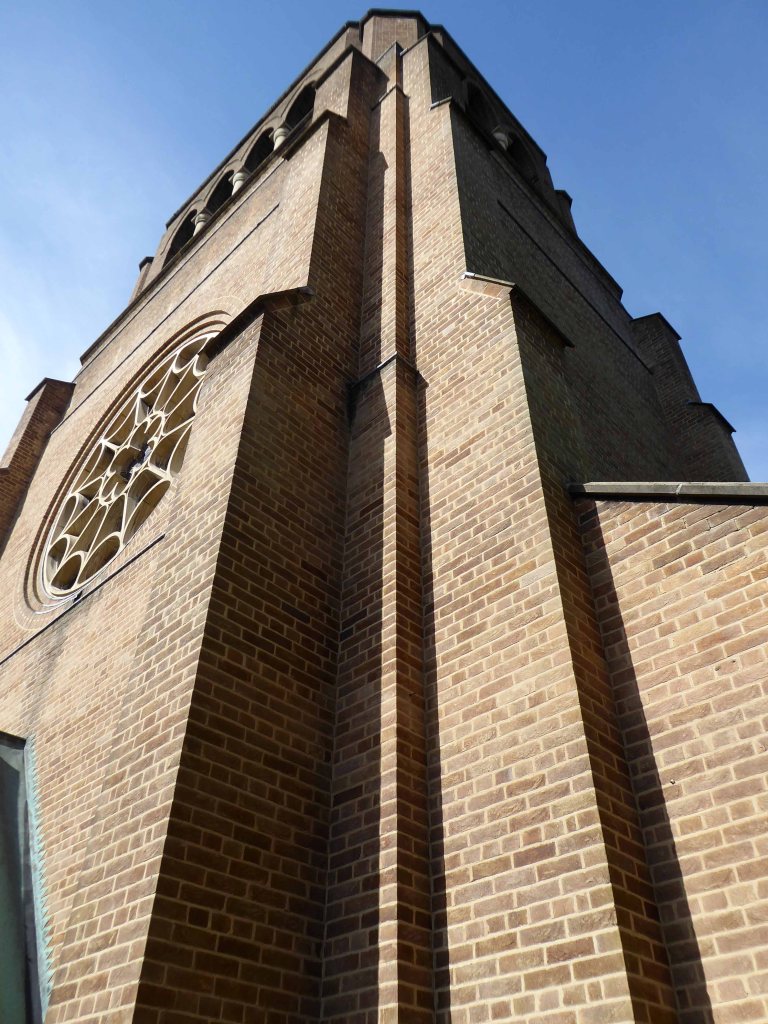
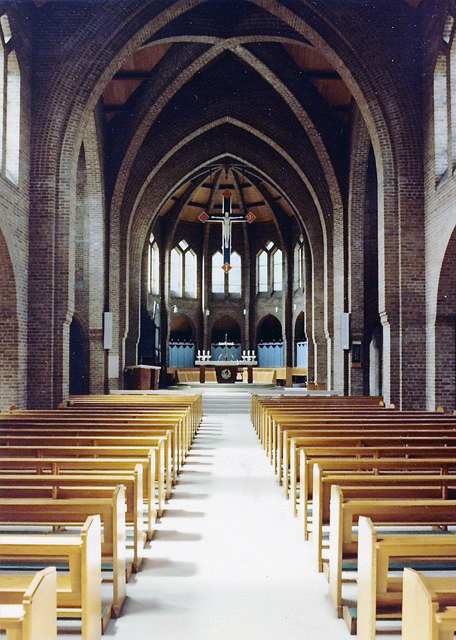
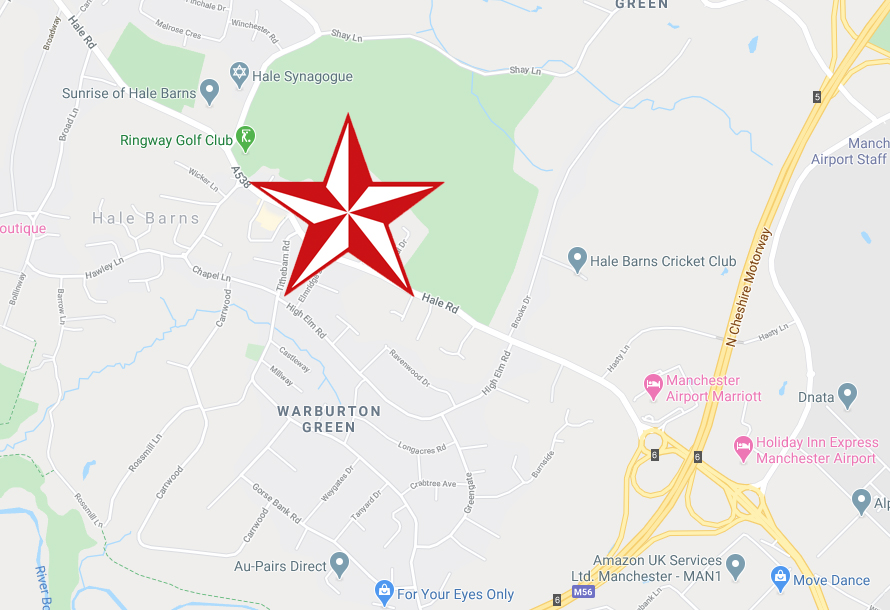
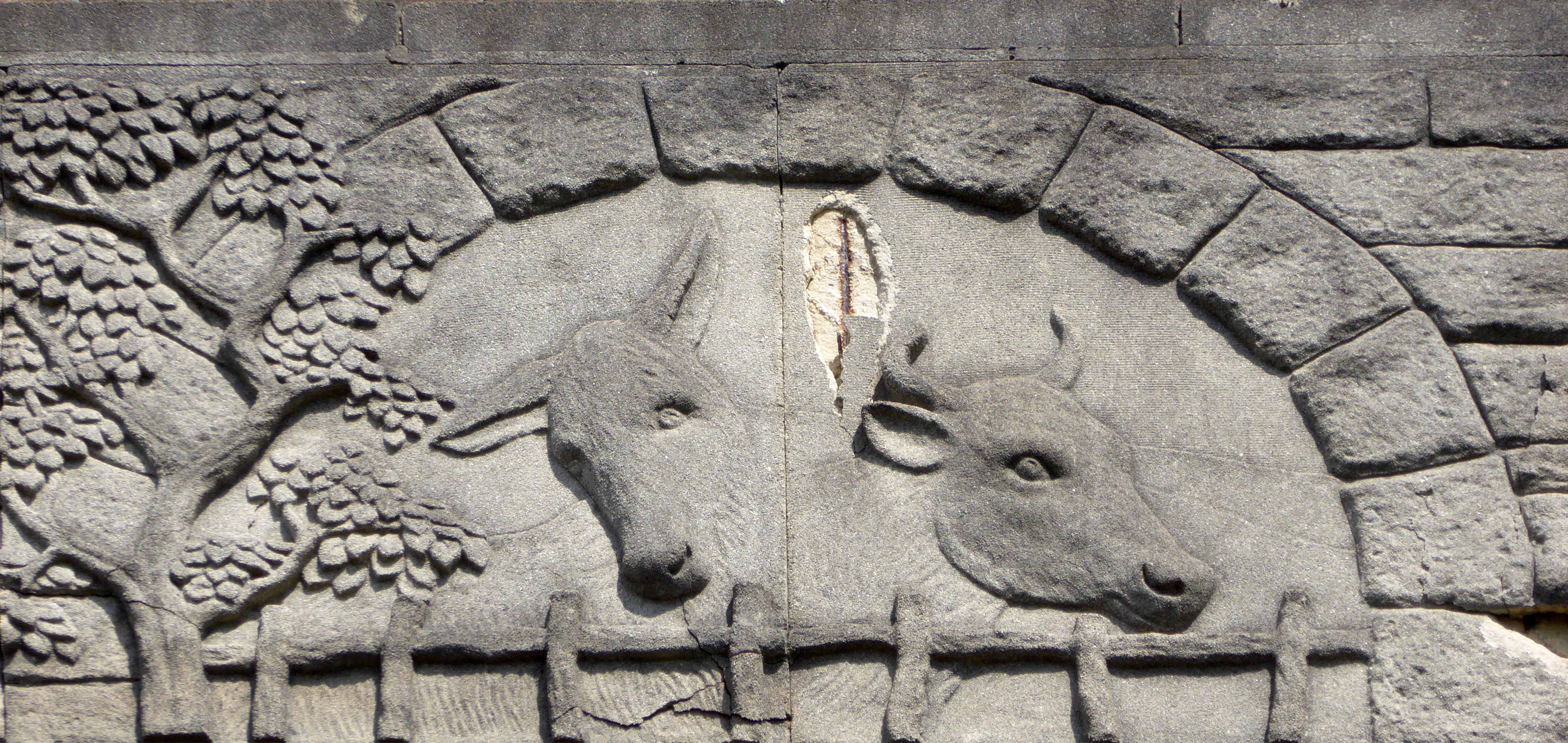
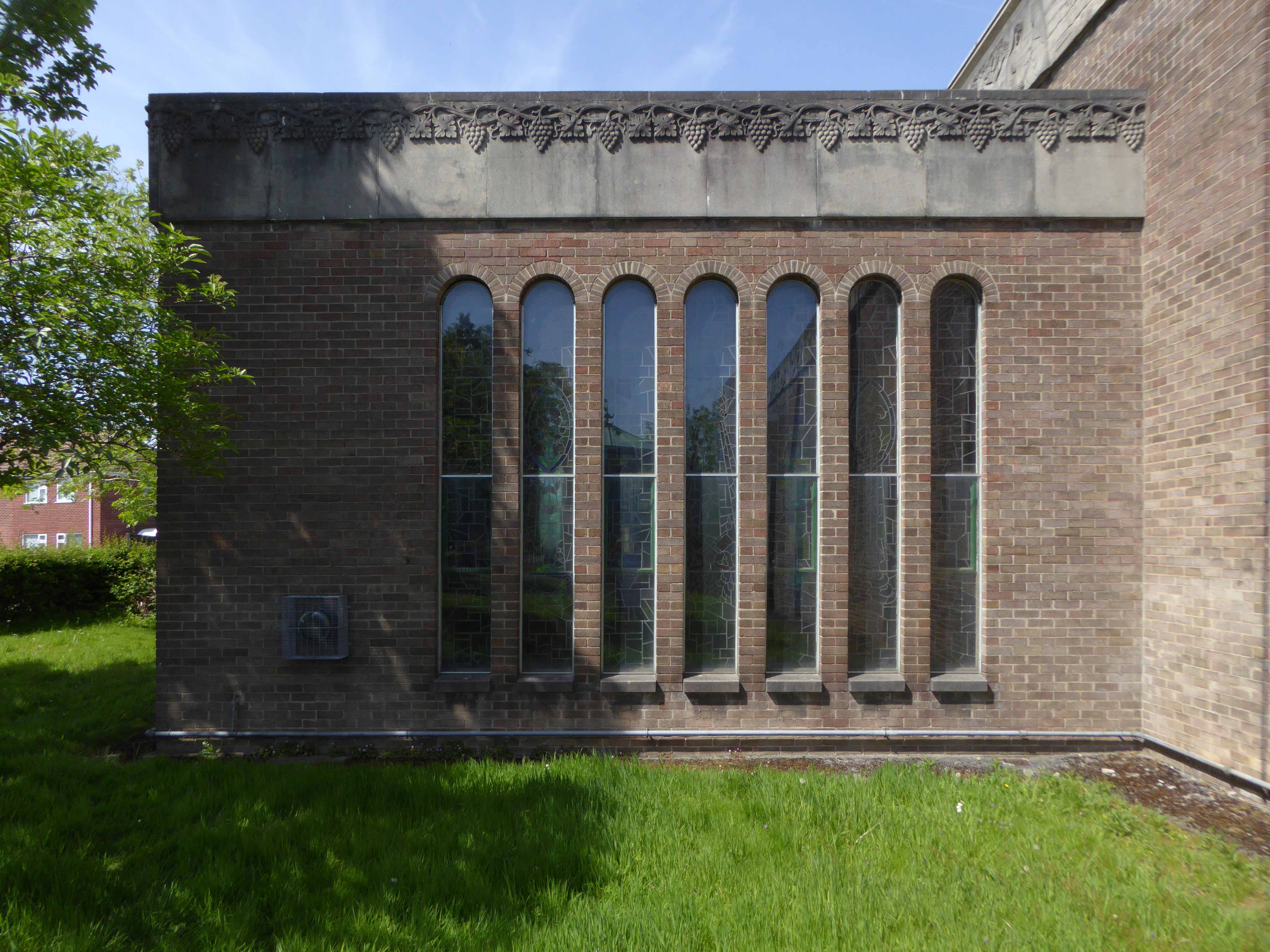
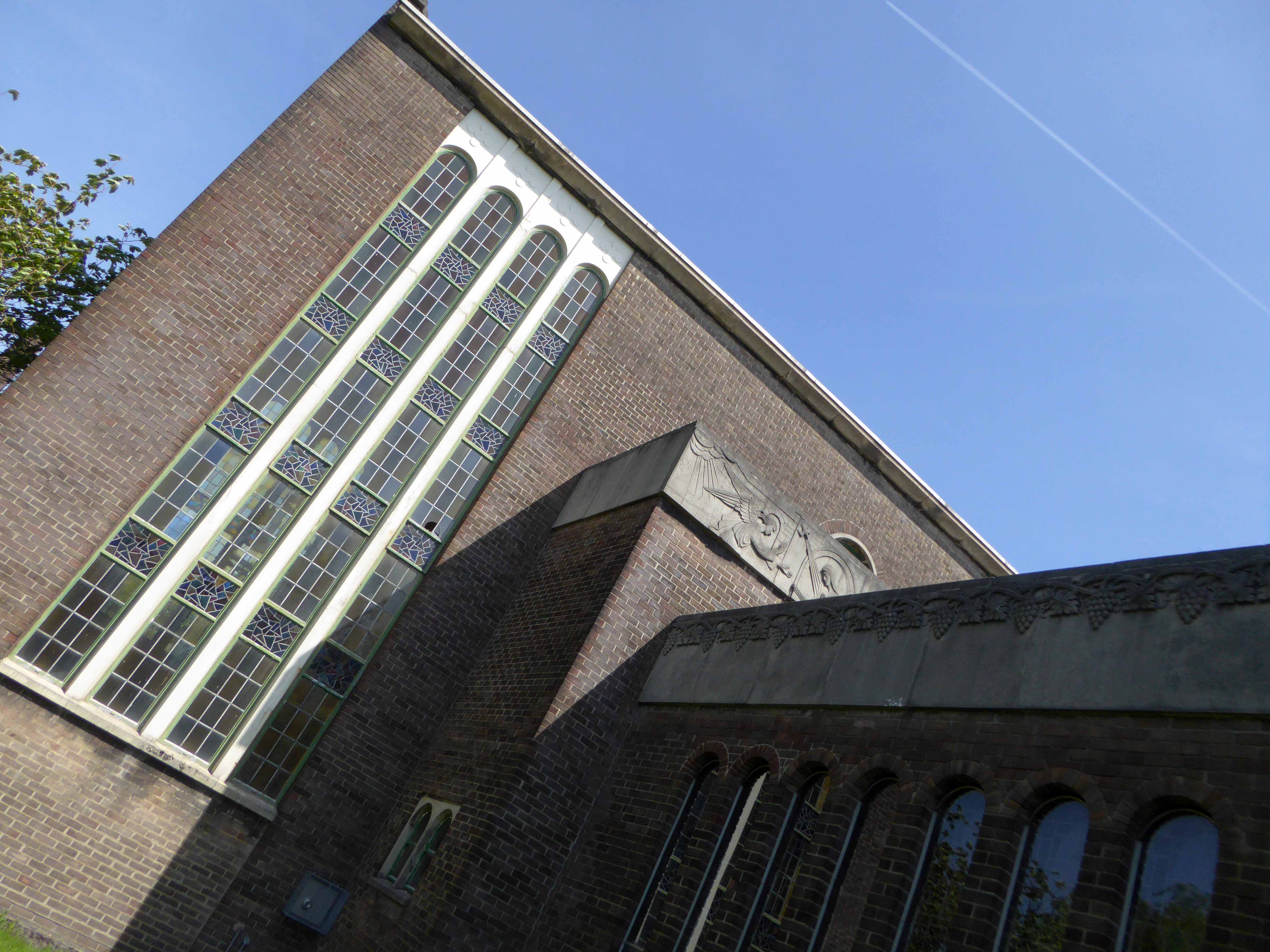
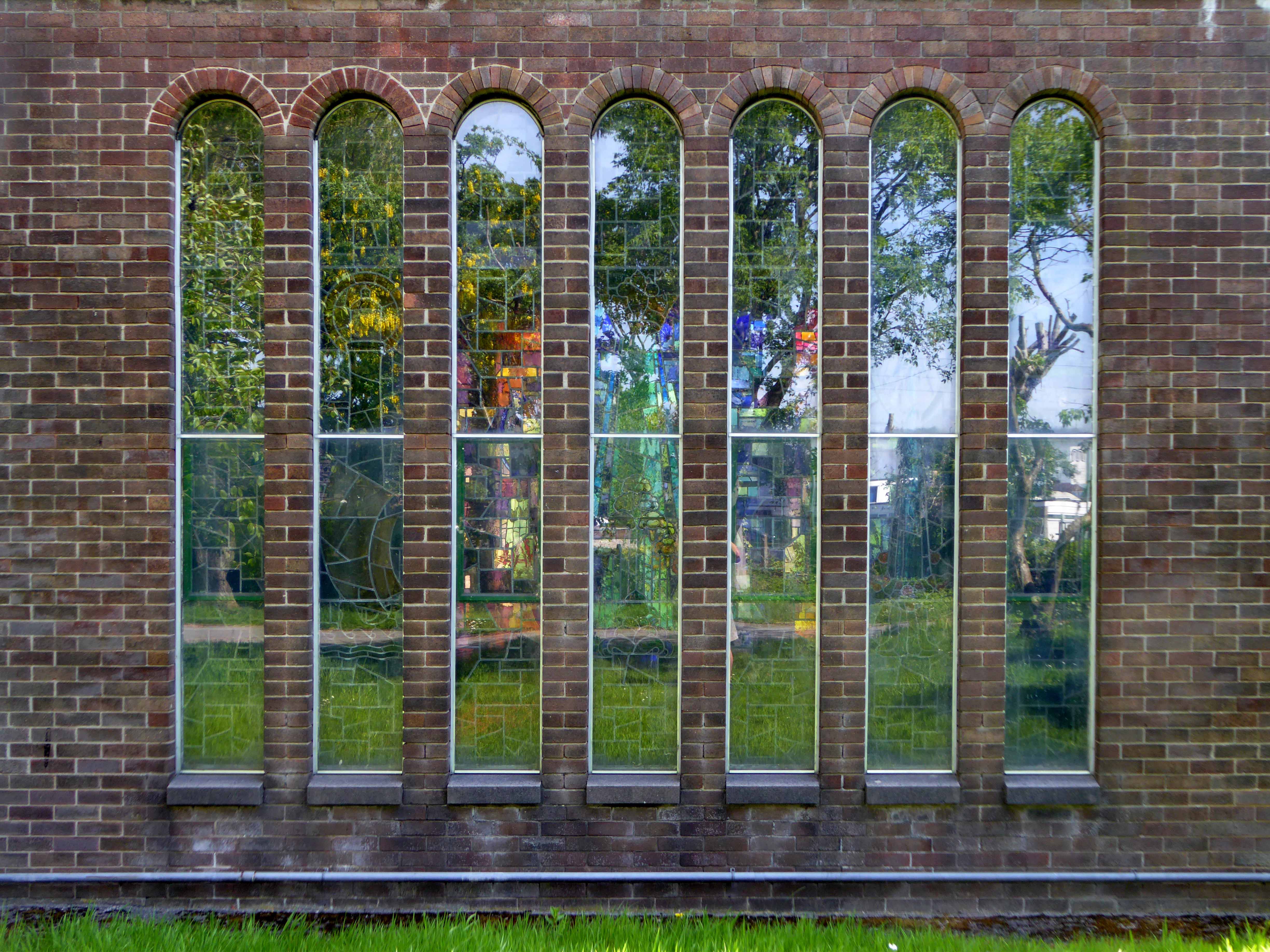
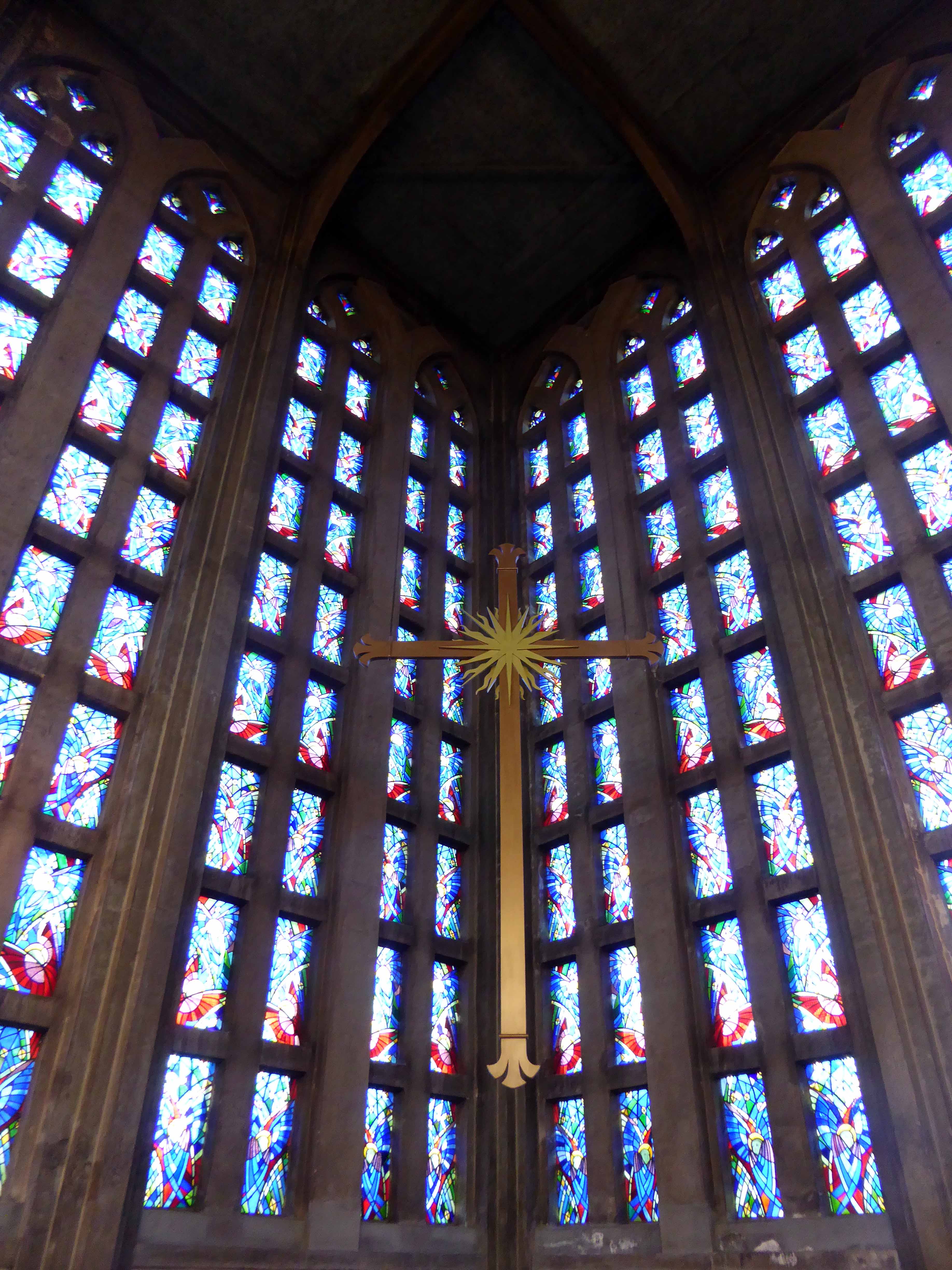
The magnum opus of the architect Arthur Farebrother, who was a parishioner. The church is executed in monumental style and has a powerful and little-altered interior which owes a debt to Dom Paul Bellott’s design for the Benedictine Abbey of Quarr, Isle of Wight.
The parish was formed in 1958 and fundraising for building a church started almost immediately. The church was designed by Arthur Farebrother, a parishioner, and the contractors were Browns of Wilmslow, a craft firm with a high reputation particularly for woodwork and carving. The building was finally opened in 1964.
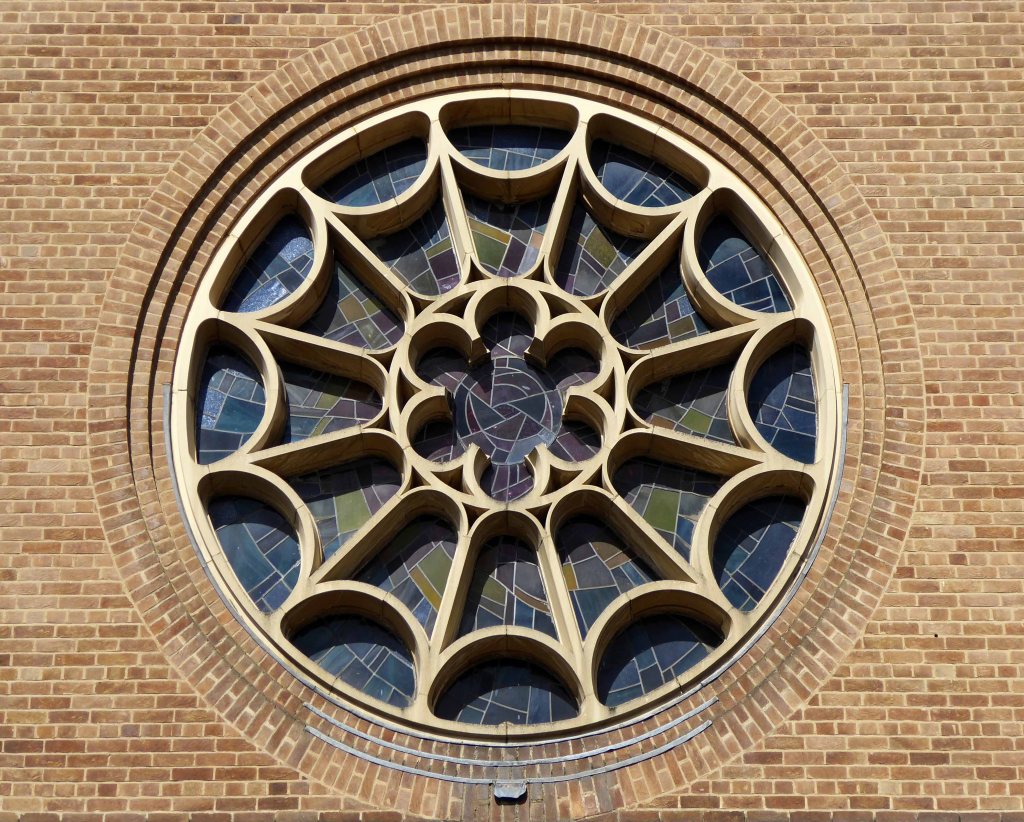
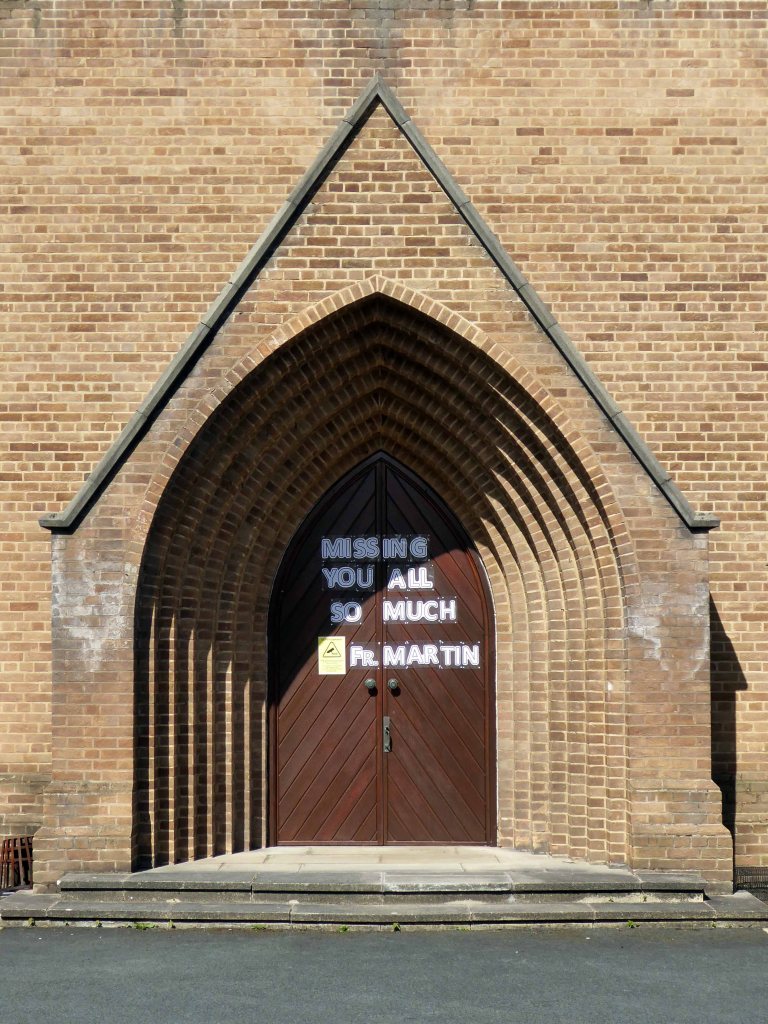
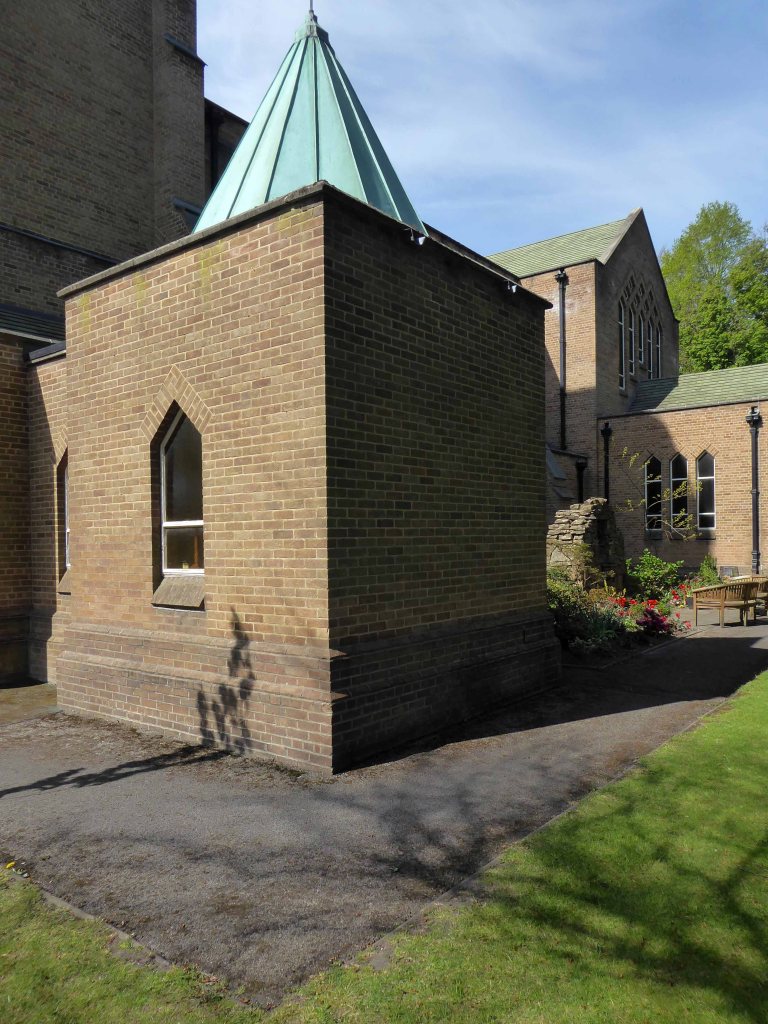
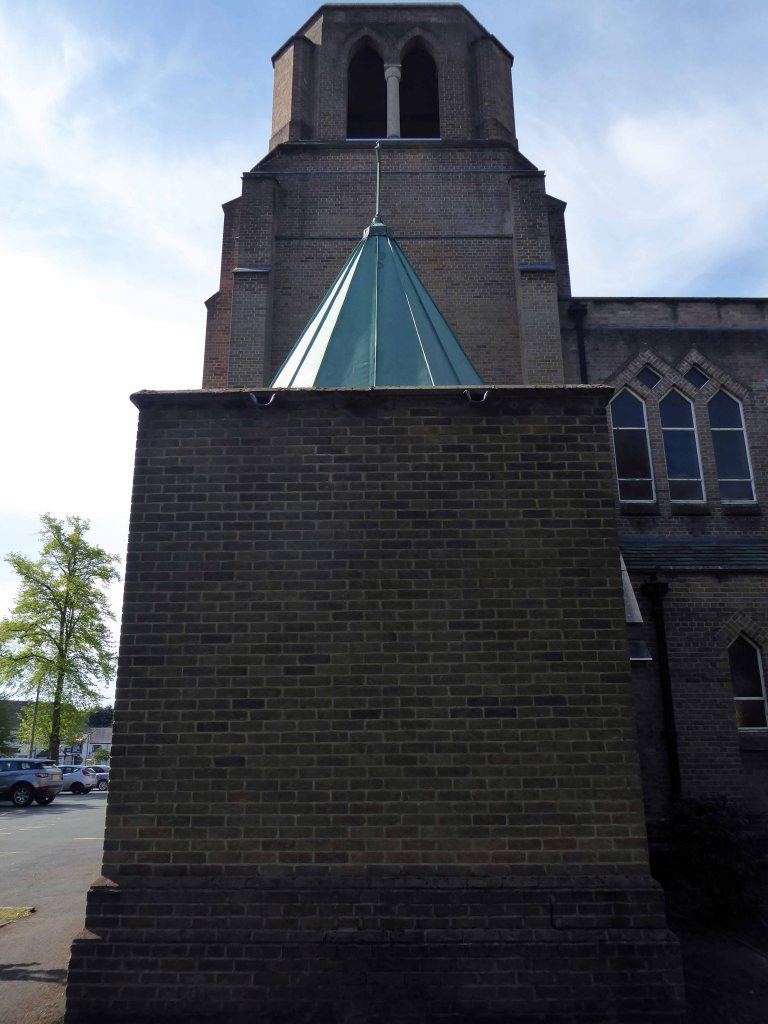
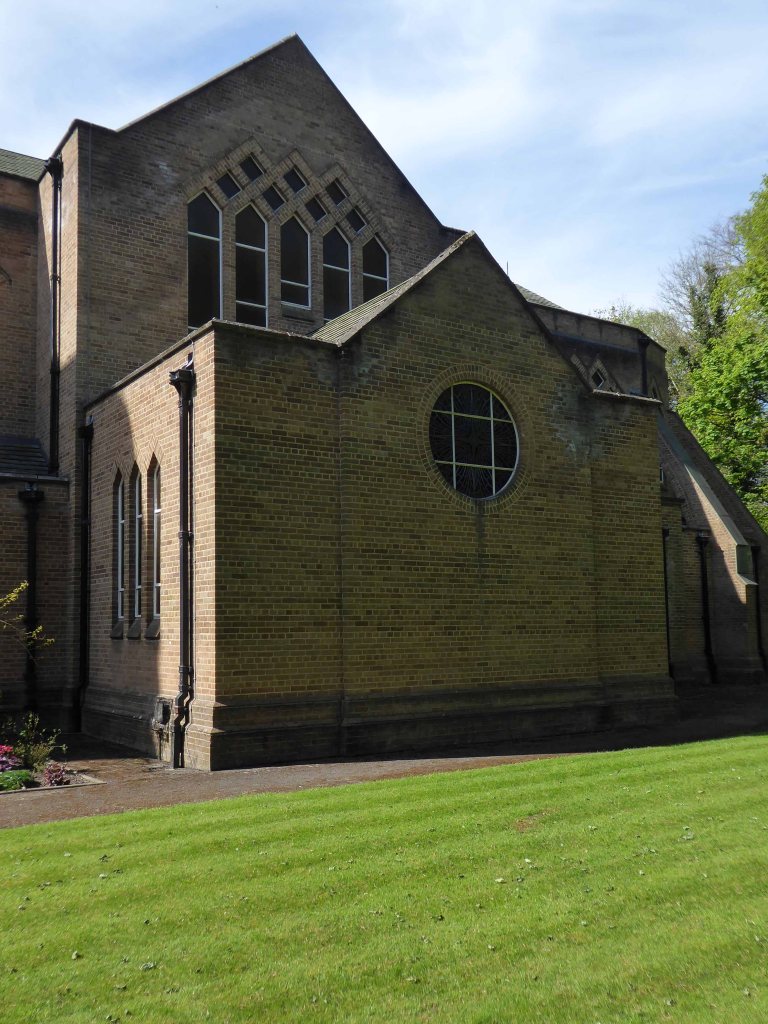
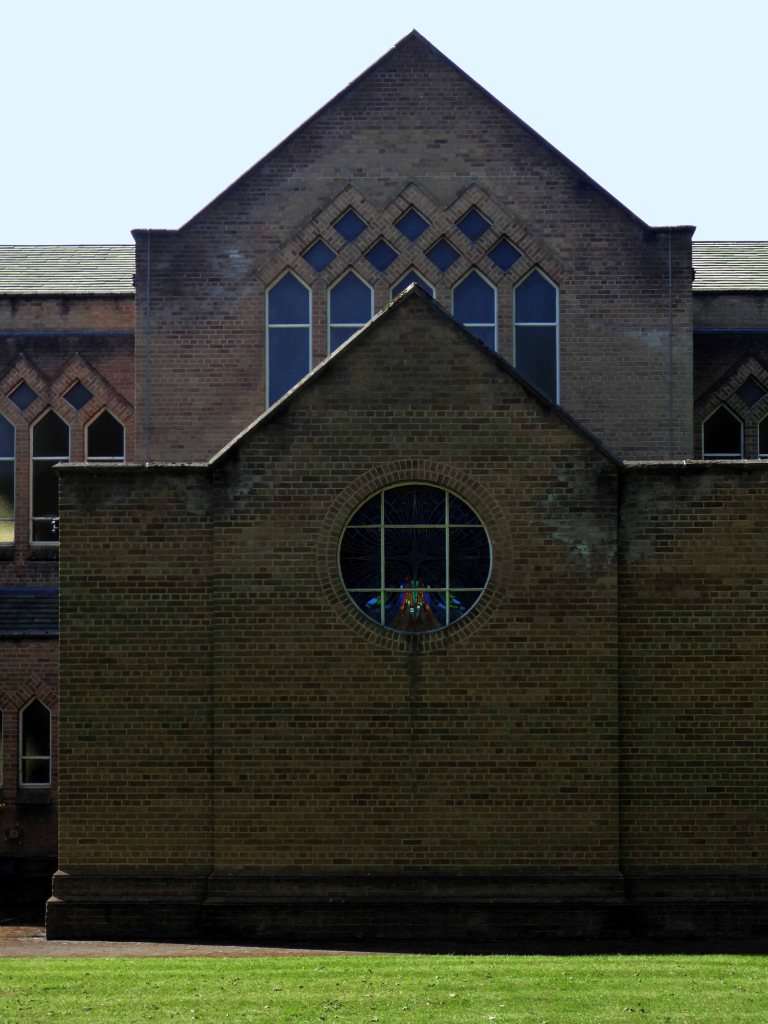
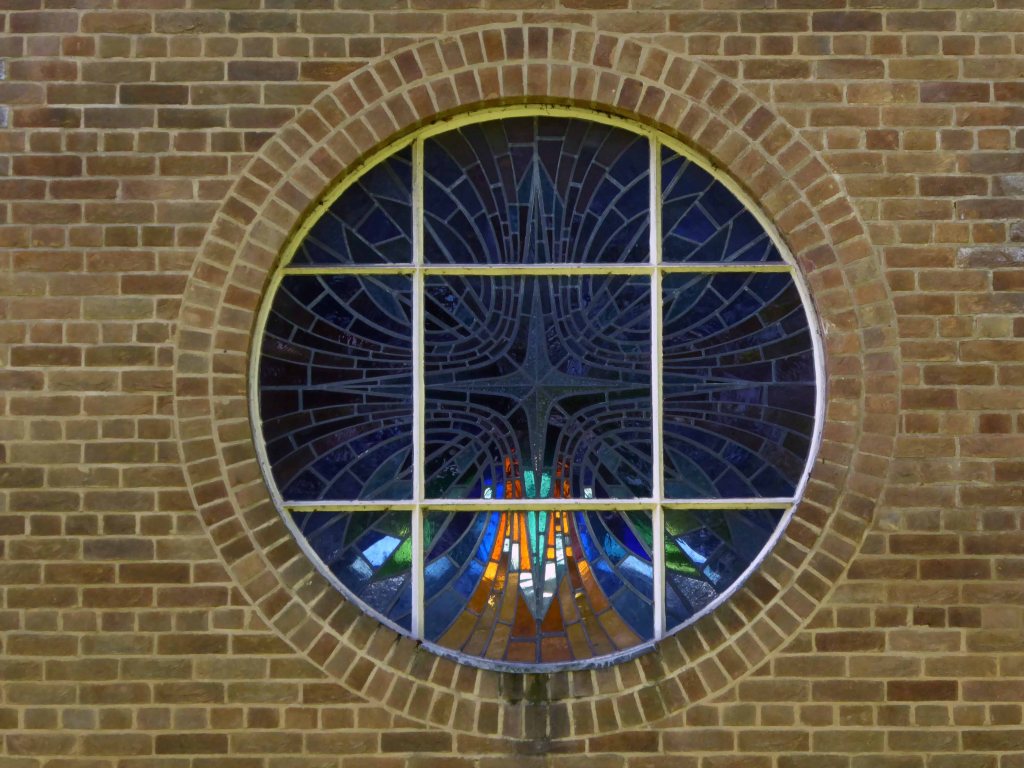
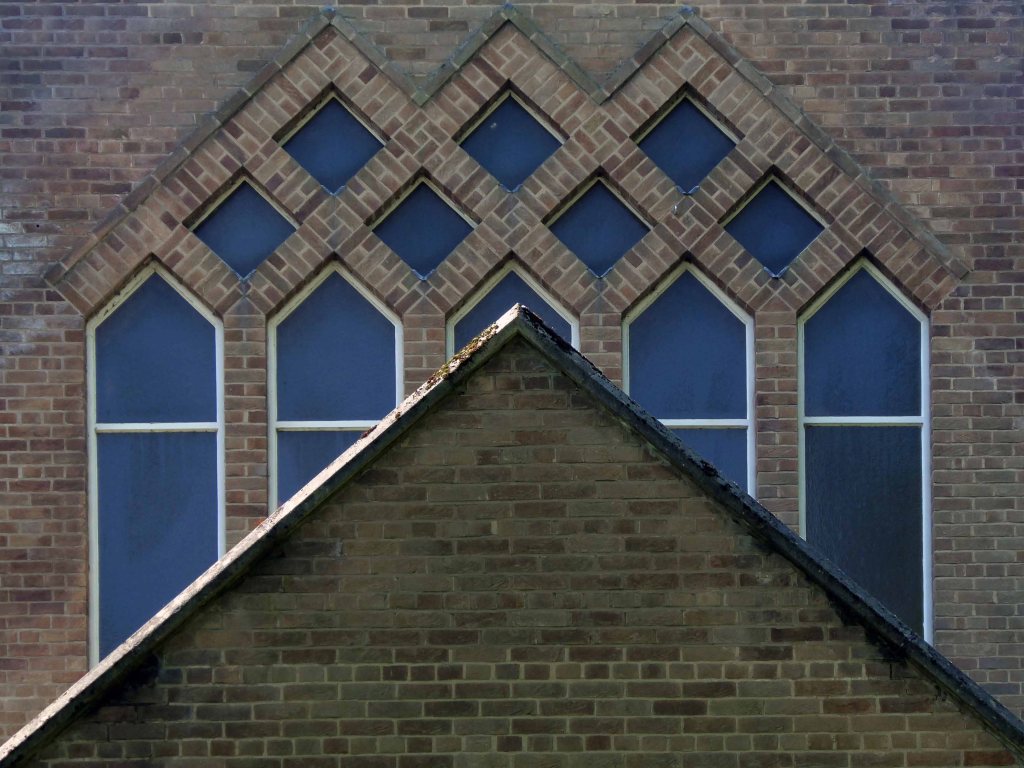
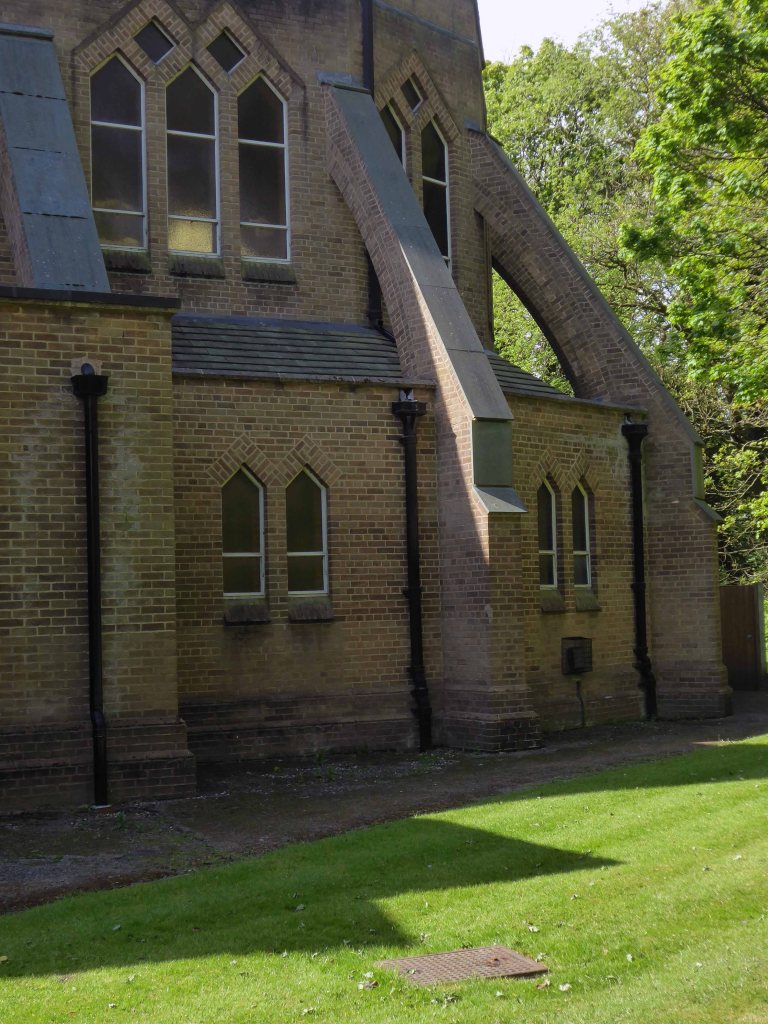
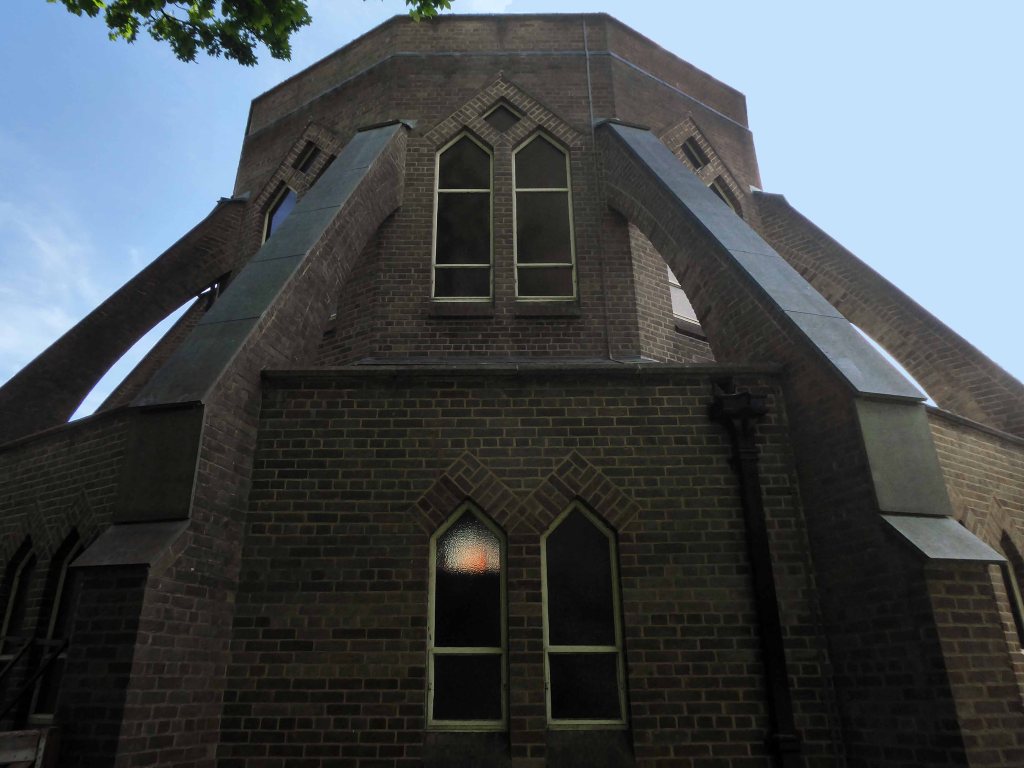
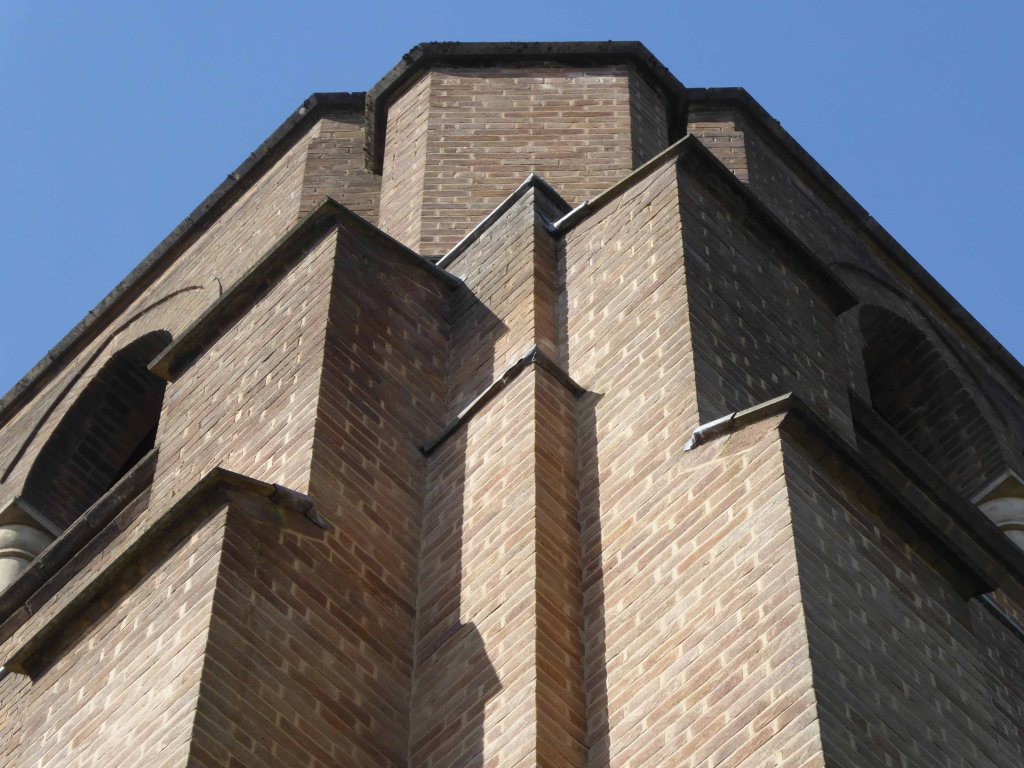
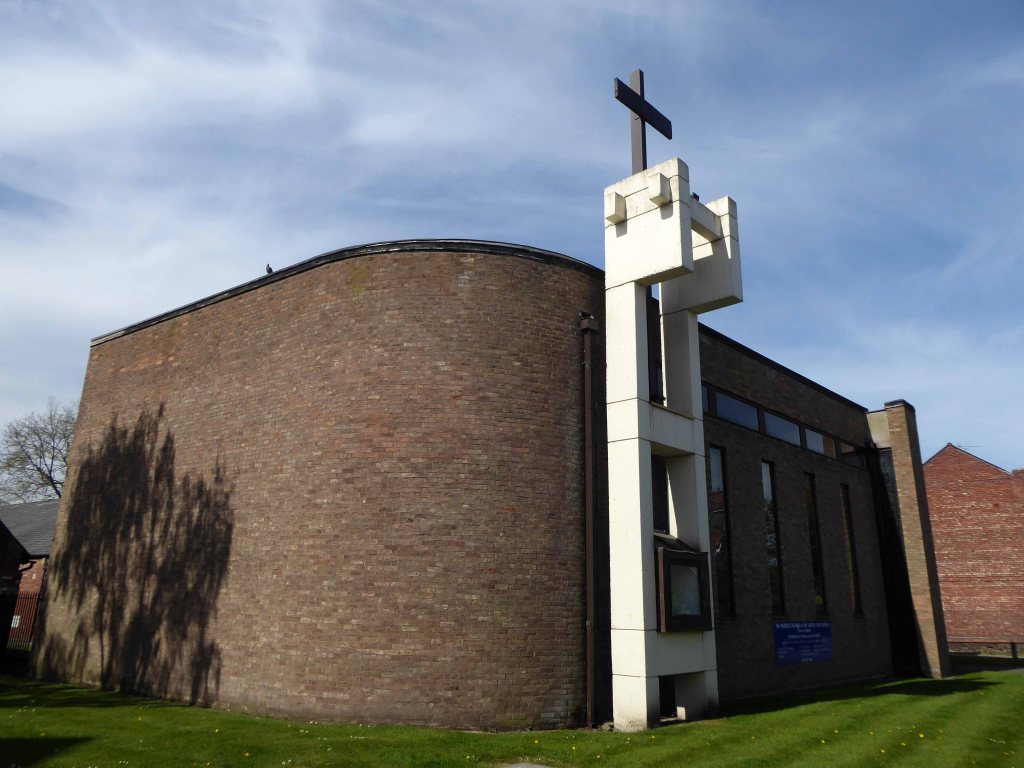
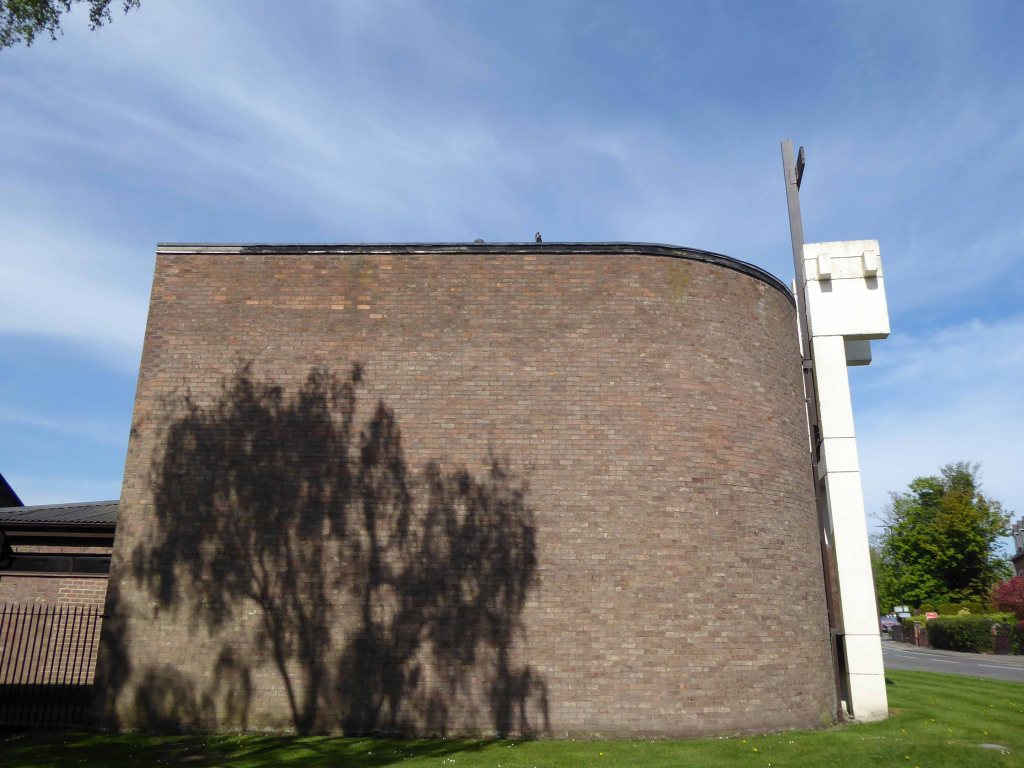
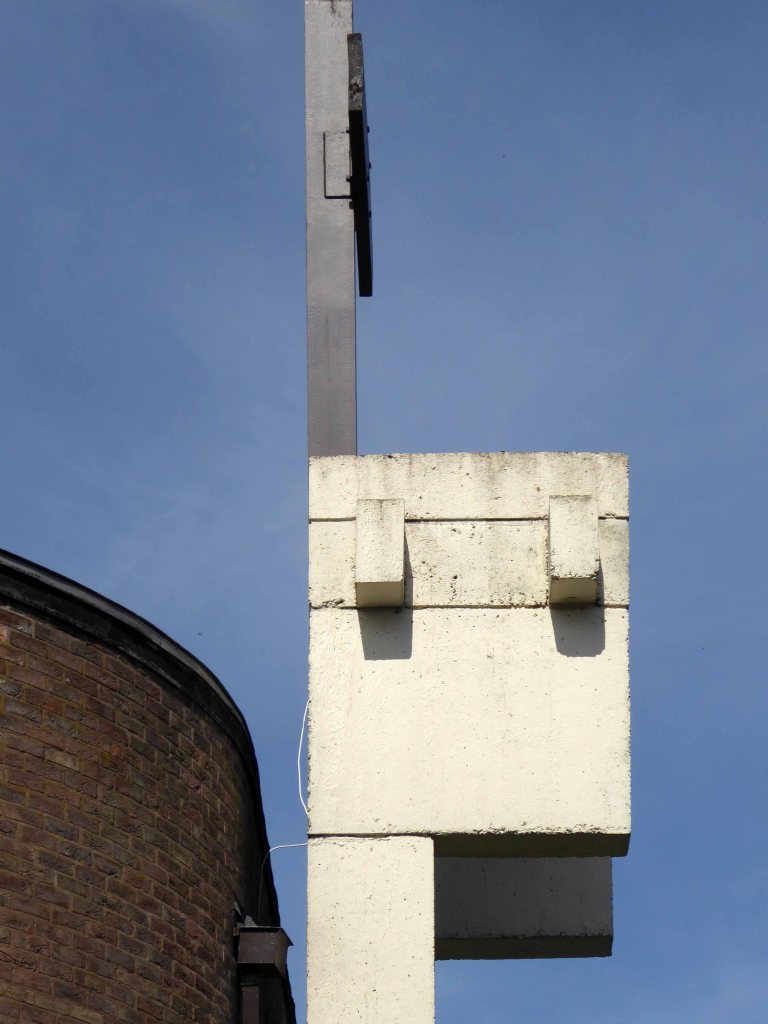
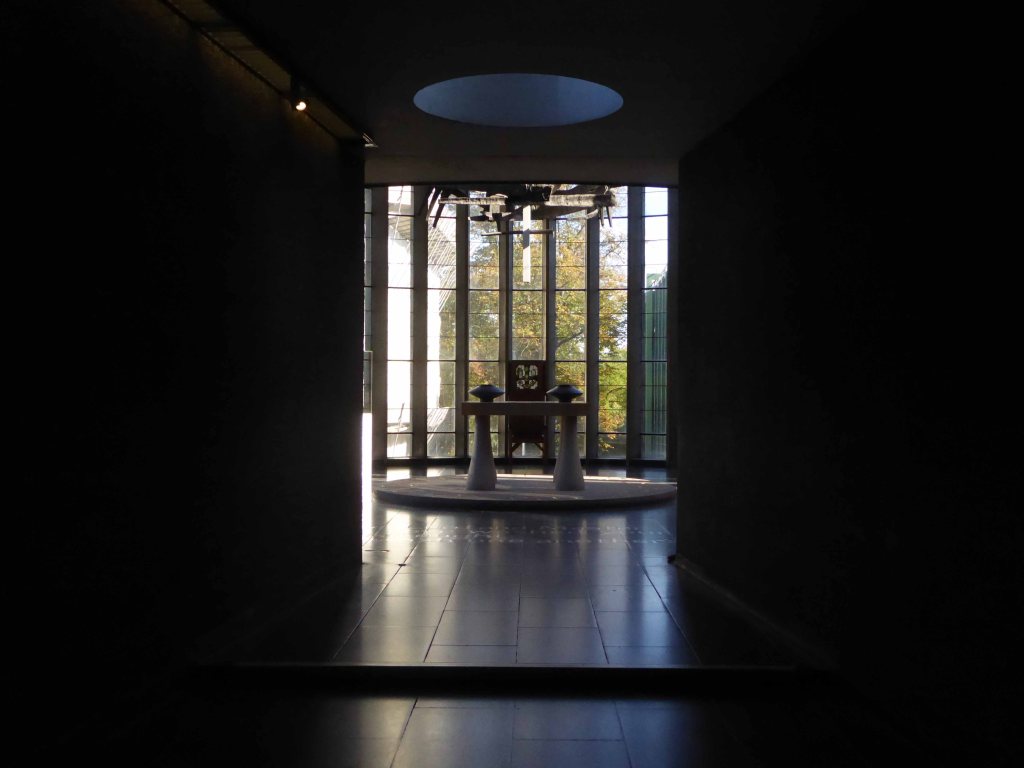
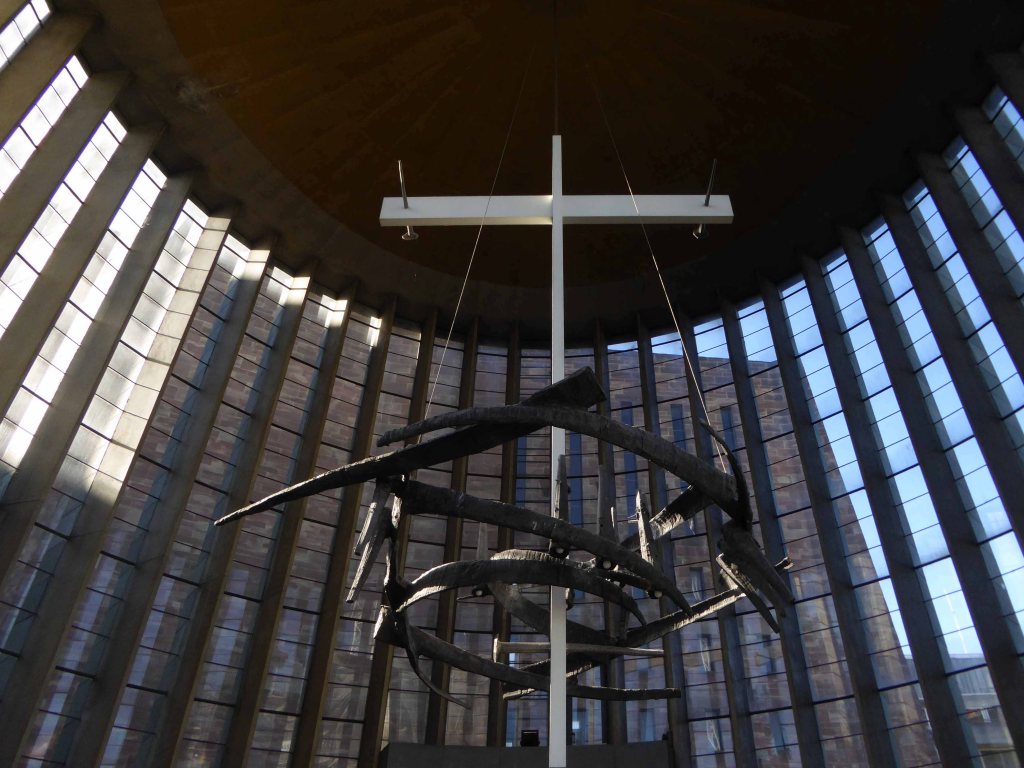
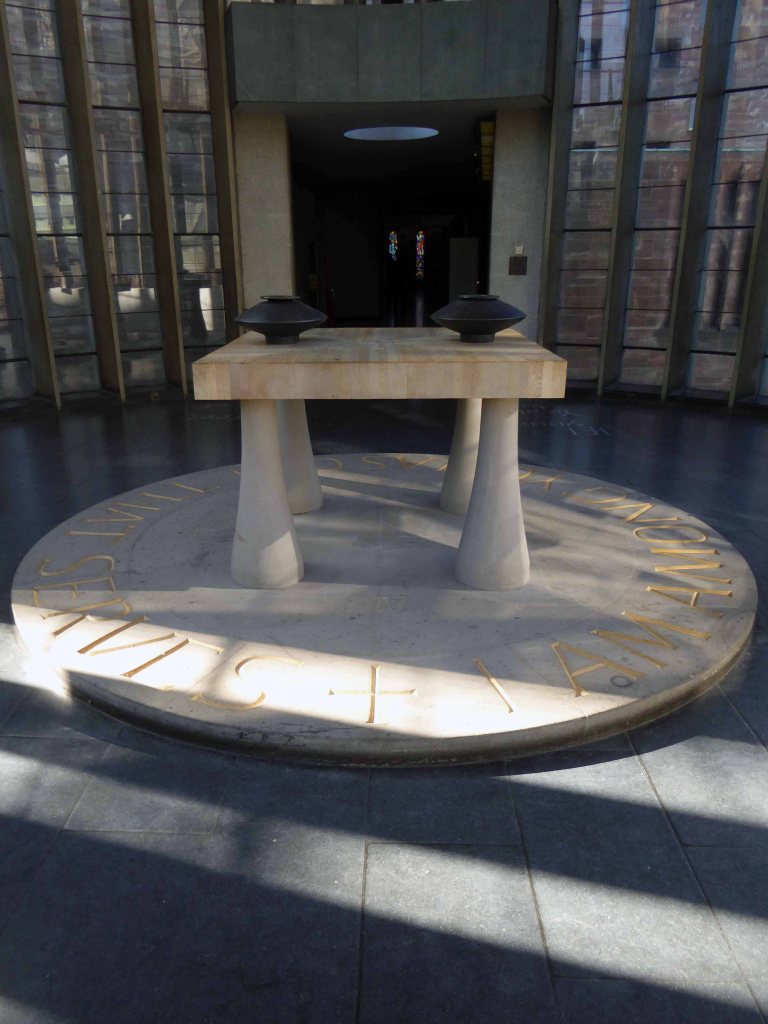
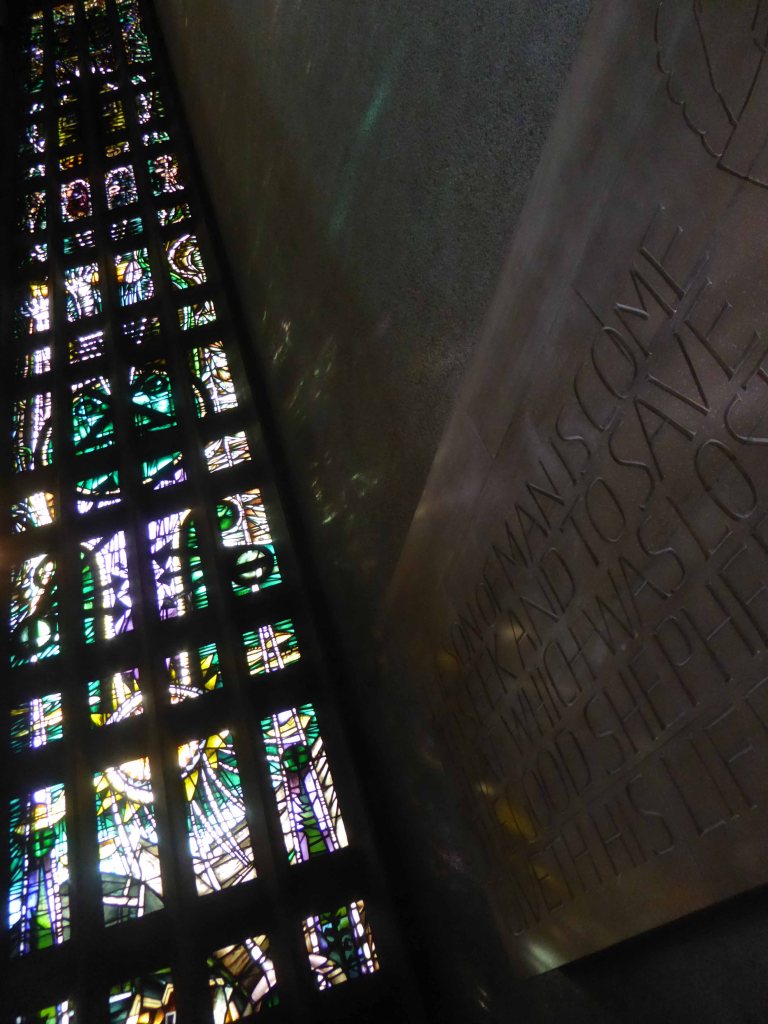
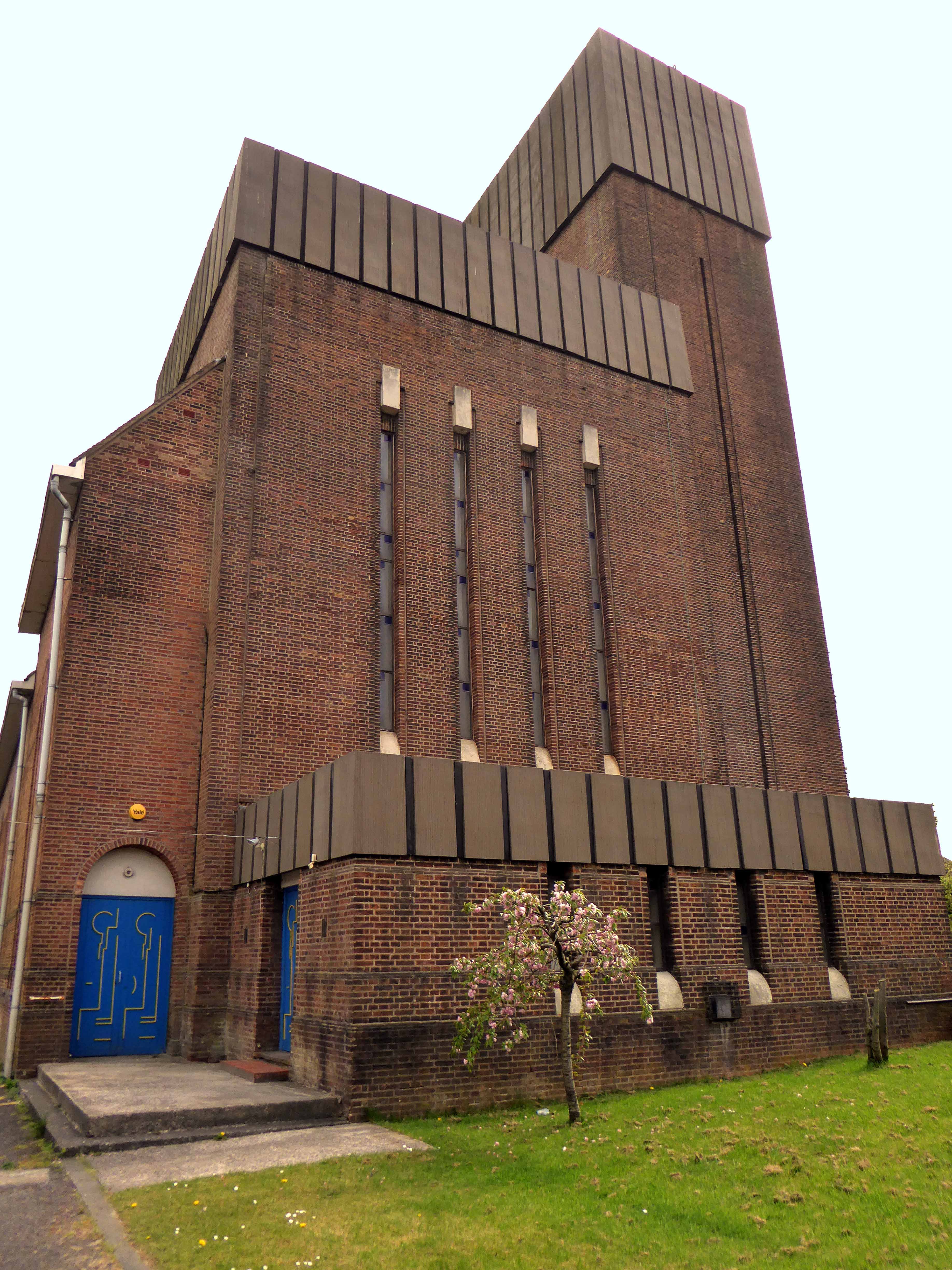
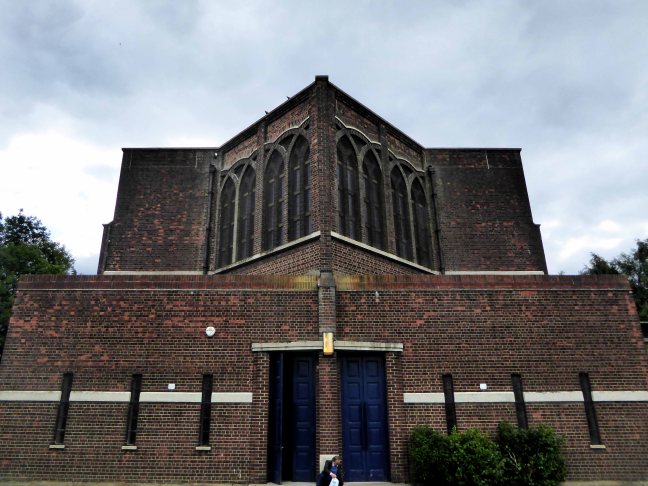
Holy Angels is a building of great presence, of pale brick executed in free early Gothic style with Romanesque overtones. It has a powerful pylon-like west tower, transeptal chapel, attached southwest baptistery with a conical copper-clad roof, and a plain presbytery attached on the north side. The interior is dominated by the powerful brick arches which continue into the ceiling as vaulting. Narrow processional aisles and ambulatory. The north side confessionals are framed by a timber surround. Elevated forward altar with choir seating around in an arc. The simple modern furnishings are probably original.
I was in search of All Saints just along the way in Hale Road, but came upon Holy Angles looming large on the corner.
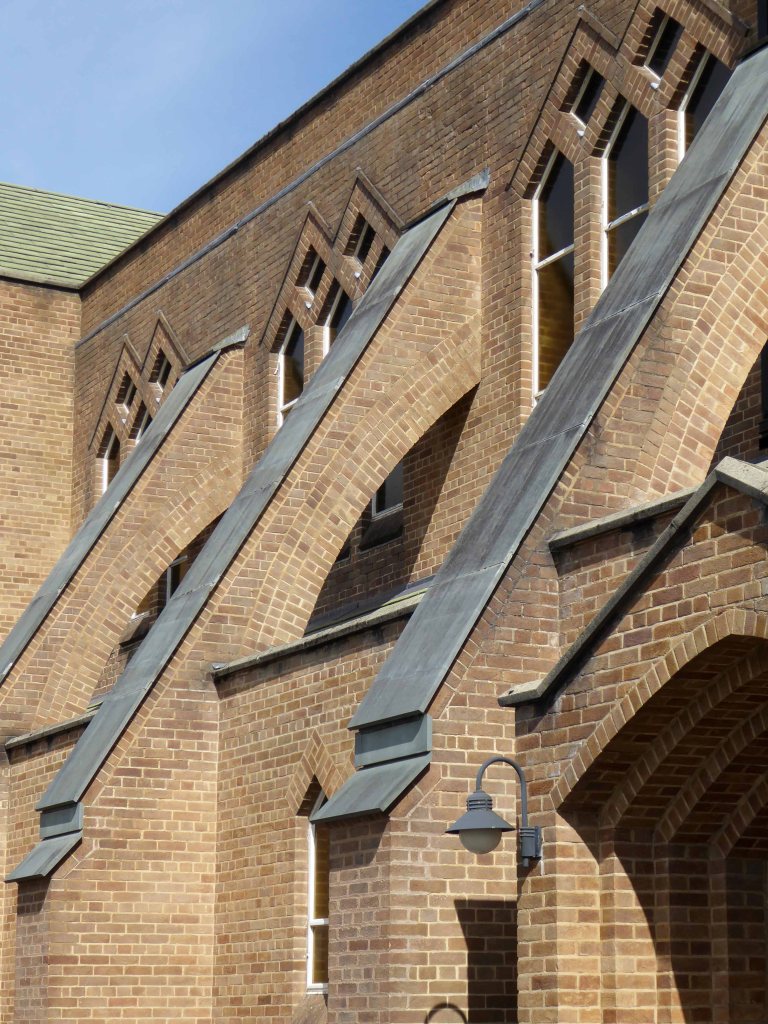
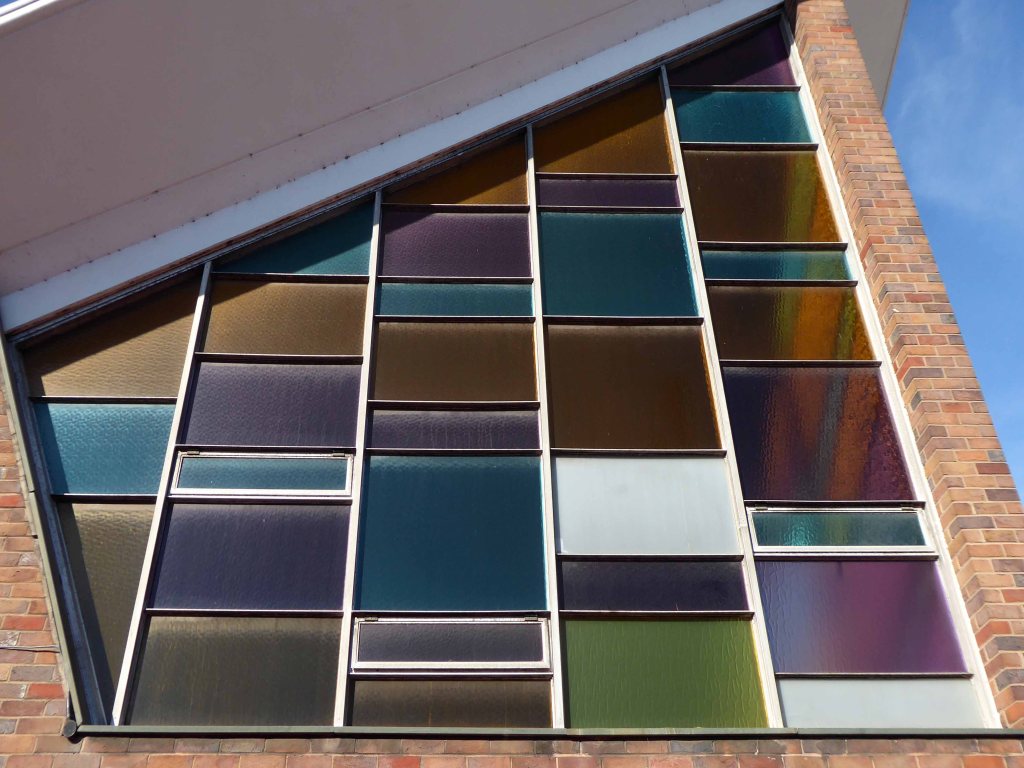
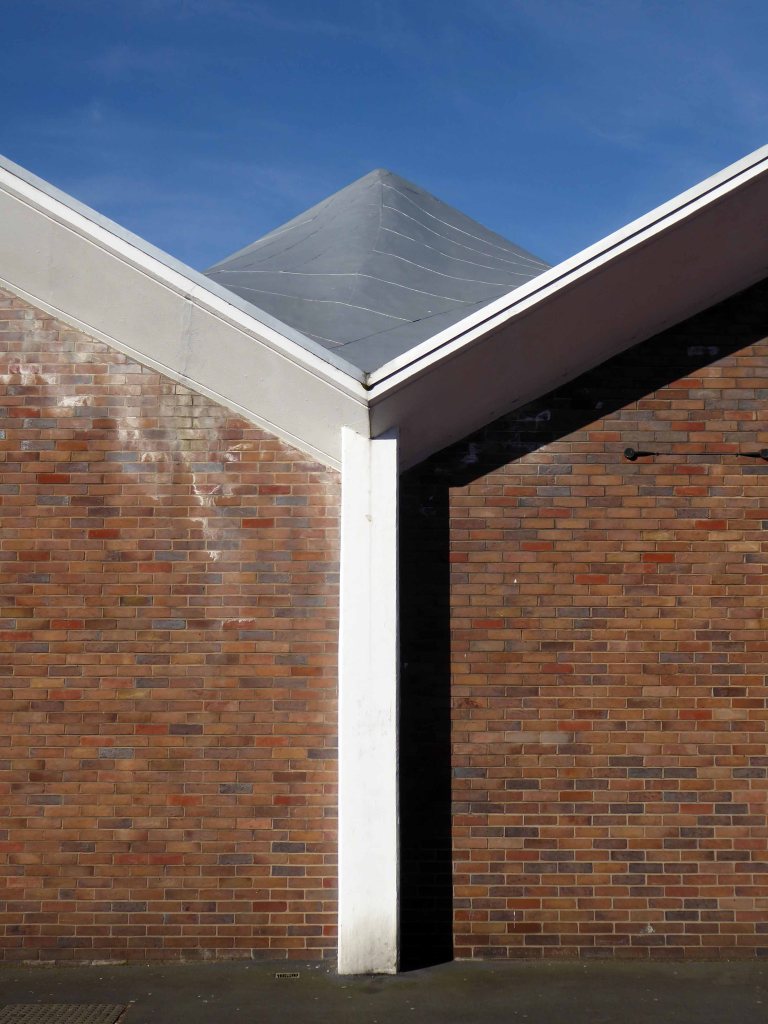
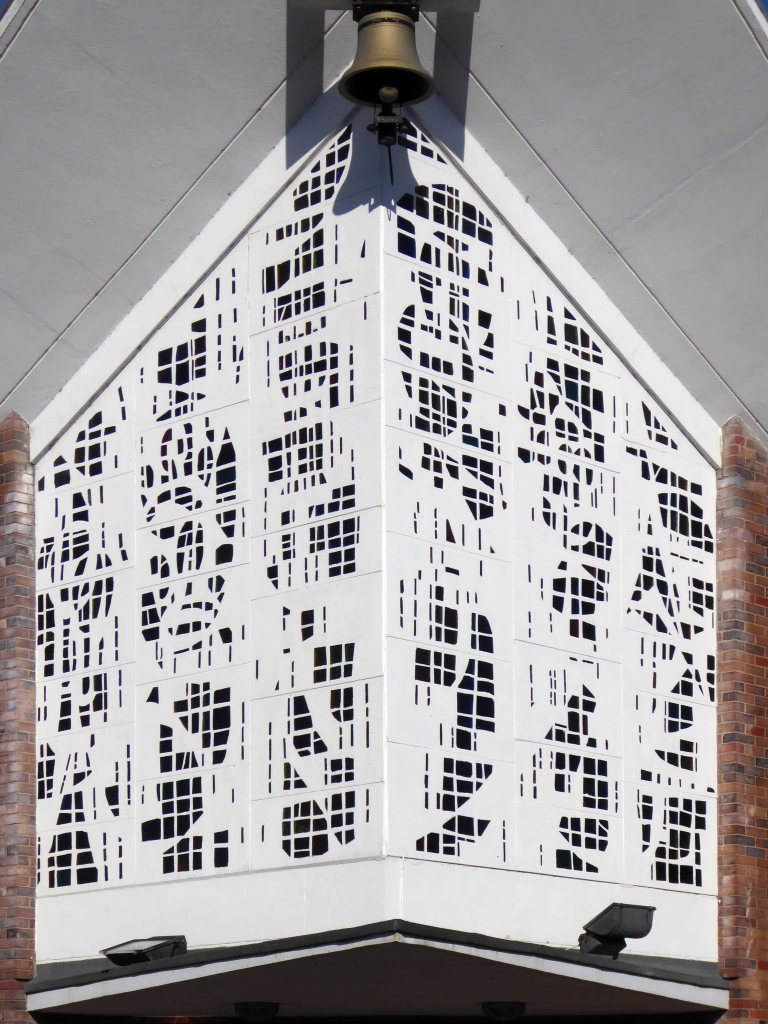
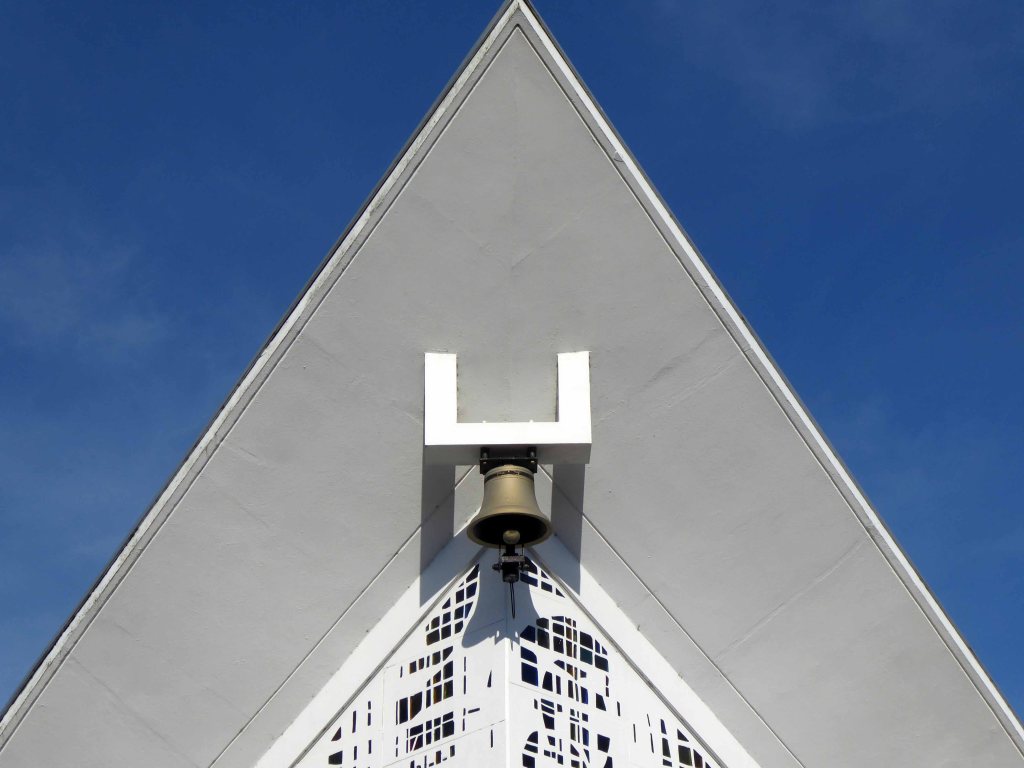
A commanding essay in pale brick, though referencing architecture of the Middle Ages, it has a transitional modernity in its angular Arts and Crafts details.
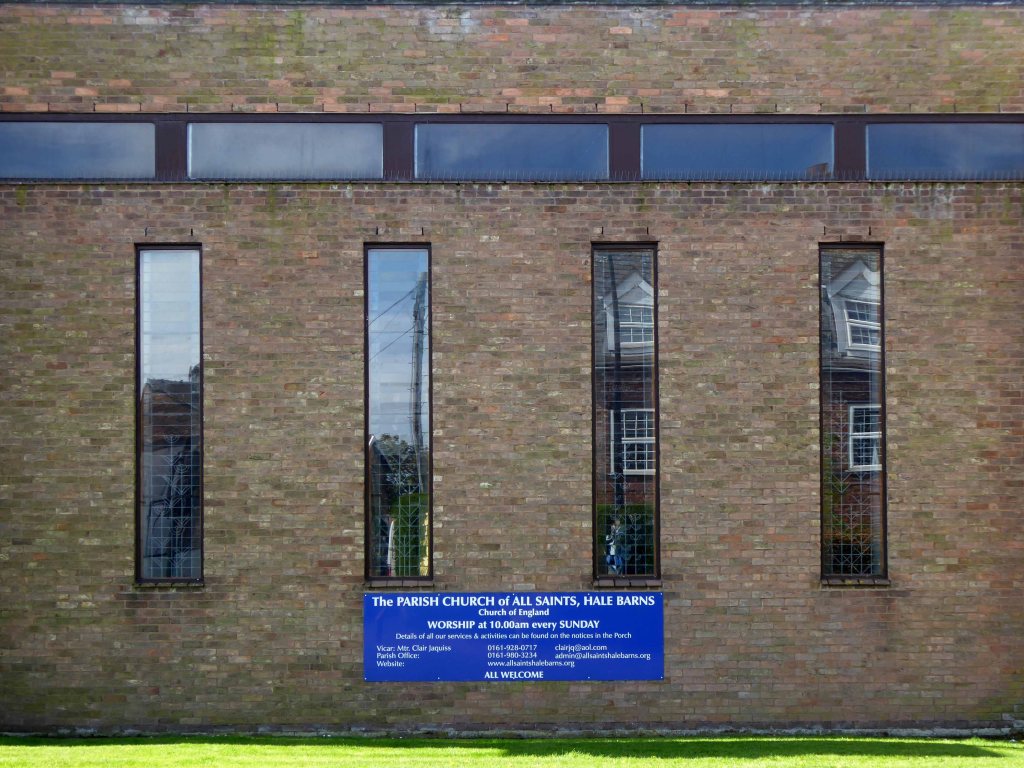
As Hale Barns grew in the 1950s and 1960s it was clear that the small daughter church was less than adequate in terms of size and facilities, and under the leadership of the Rev Fred Cox, the then Vicar, a new church was planned for the site. Designed by Brian Brunskill, All Saints Church was consecrated in 1967.
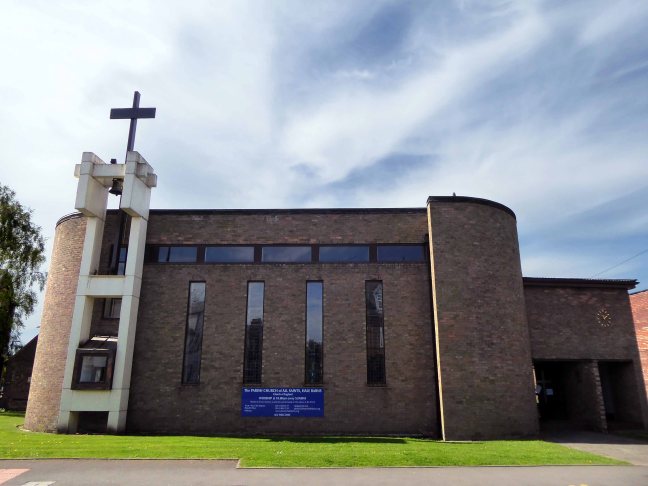
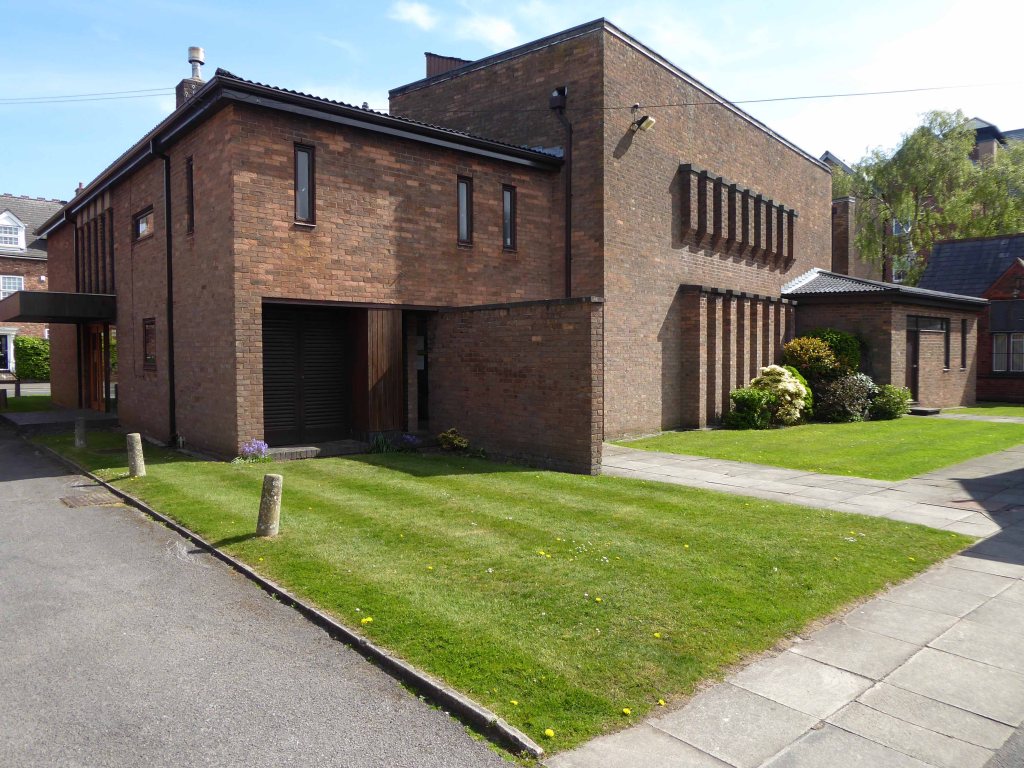
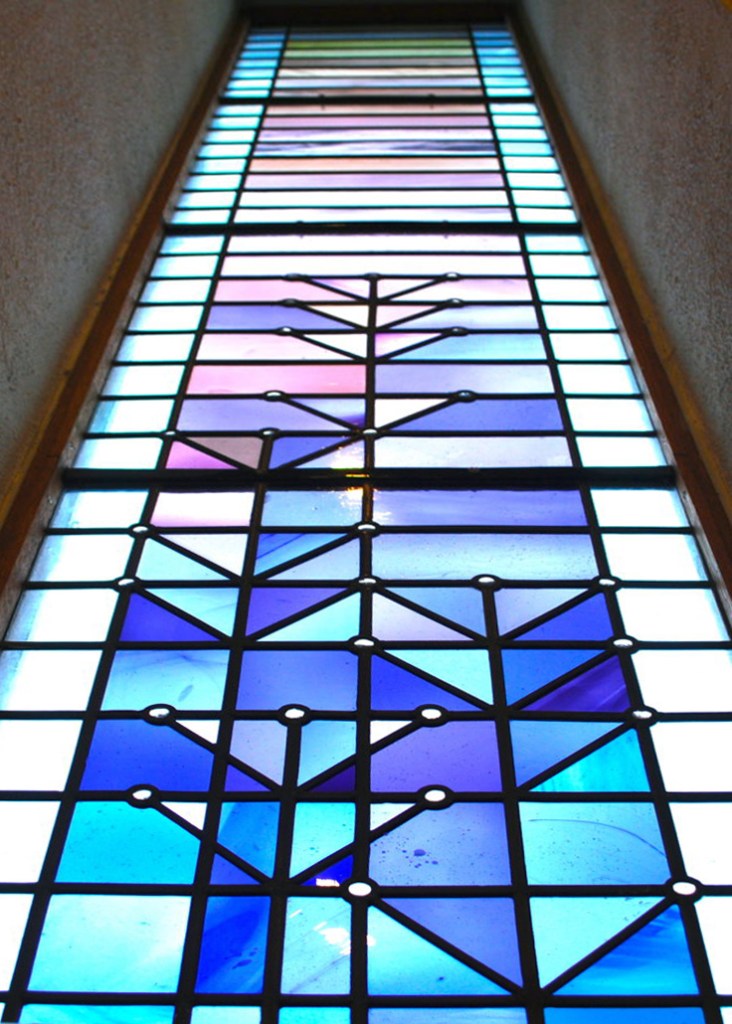
Outside it can seem a rather stark building, of brown brick, set back from the busy Hale Road but inside it is full of light and space. The influence has clearly been that of the French architect Le Corbusier, and there is a wonderful interplay of curved and straight walling. At first there was no stained glass, but in the early 1980s glass by the Japanese artist Sumiko was installed in the north windows. This includes a stylised tree-of-life design. In the baptistry there is some Victorian glass brought from St Mary’s Church.
In 2009 a radical and daring re-ordering of the building was completed. The church was carpeted and new furniture of high quality, designed and made by Treske, woodcarvers of Thirsk, North Yorkshire, was installed. The tree-of-life design in the 1980s glass has been echoed in the glass inserts to the Lectern and High Altar and also in the metal uprights of the Altar Rail. All the fittings are moveable, giving a flexible space. This flexibility give opportunities to explore how the building itself can enrich worship at different seasons of the Church’s year.
My first time in Hale Barns – hence my first visit to All Saints.
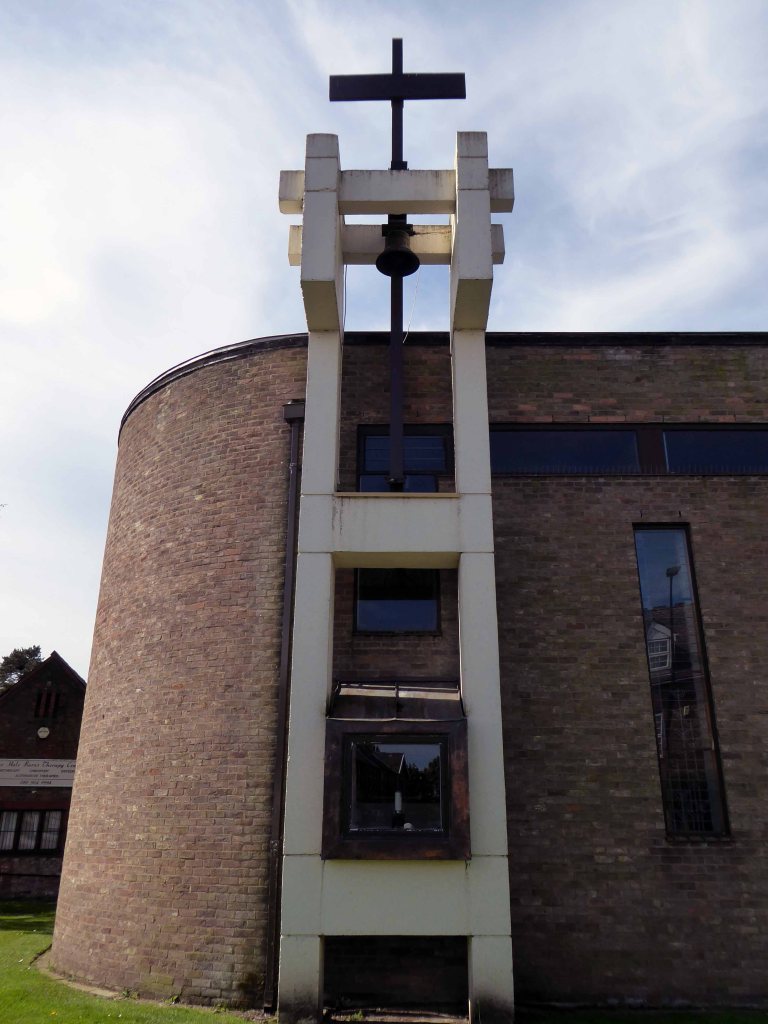
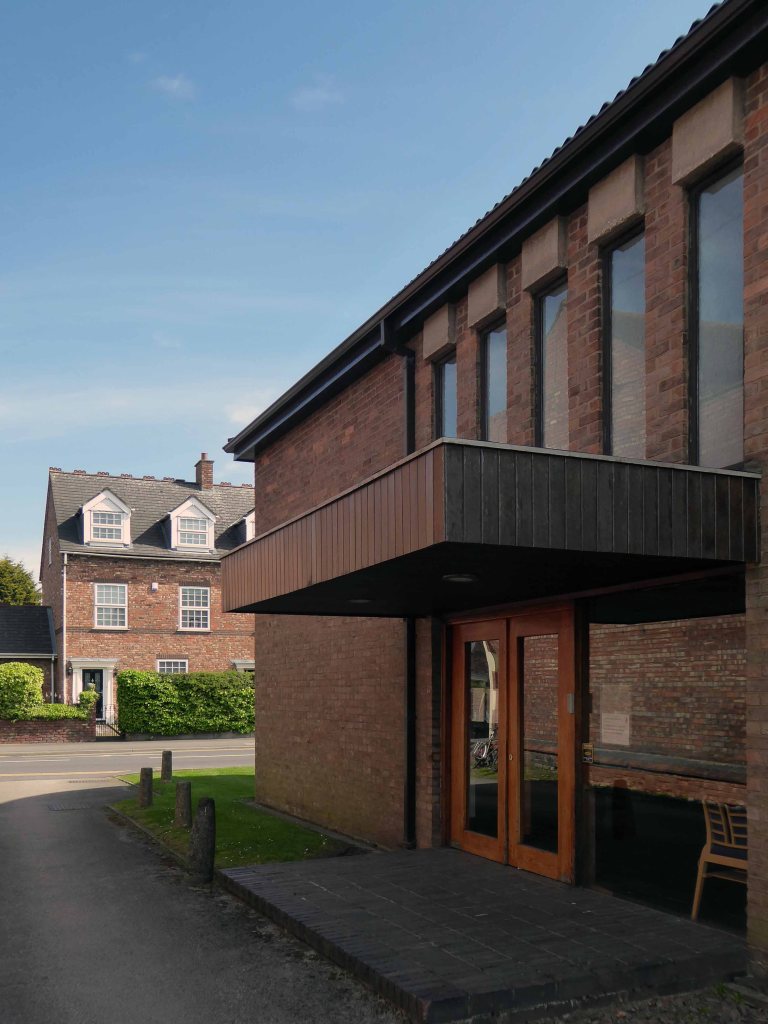
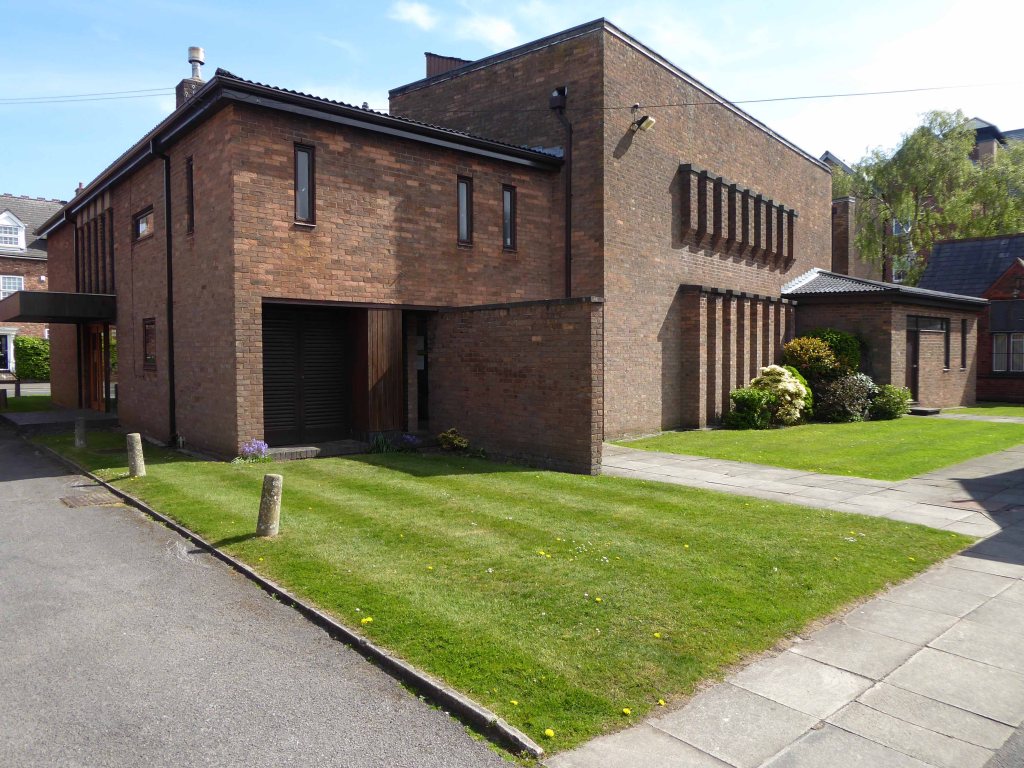
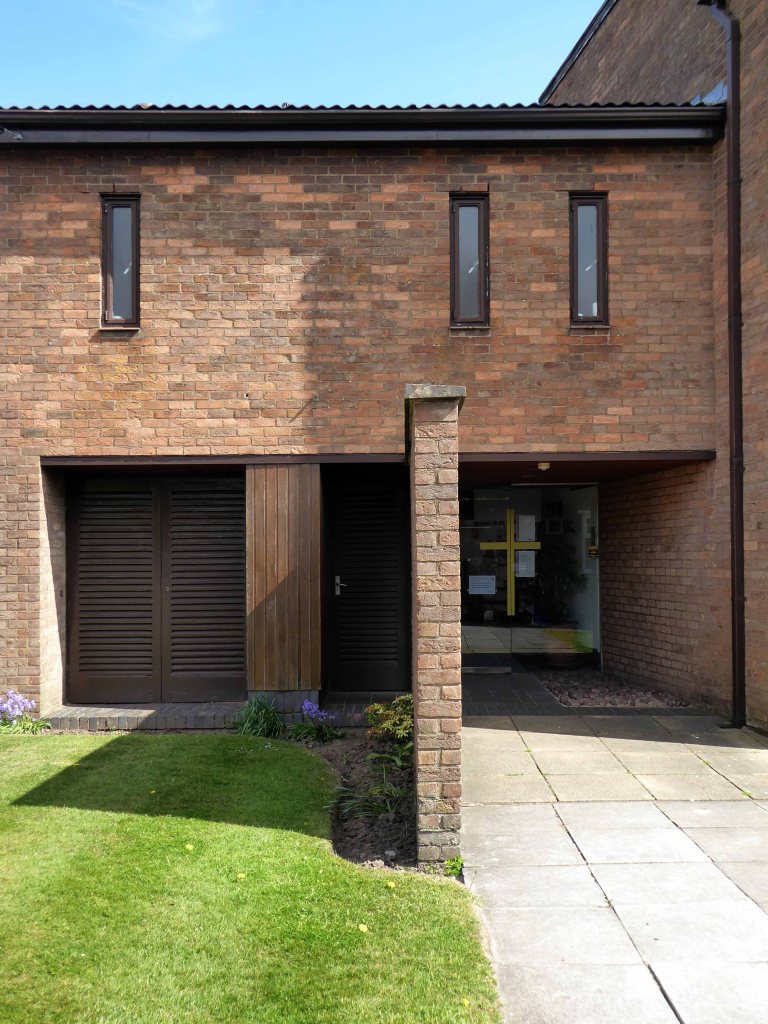
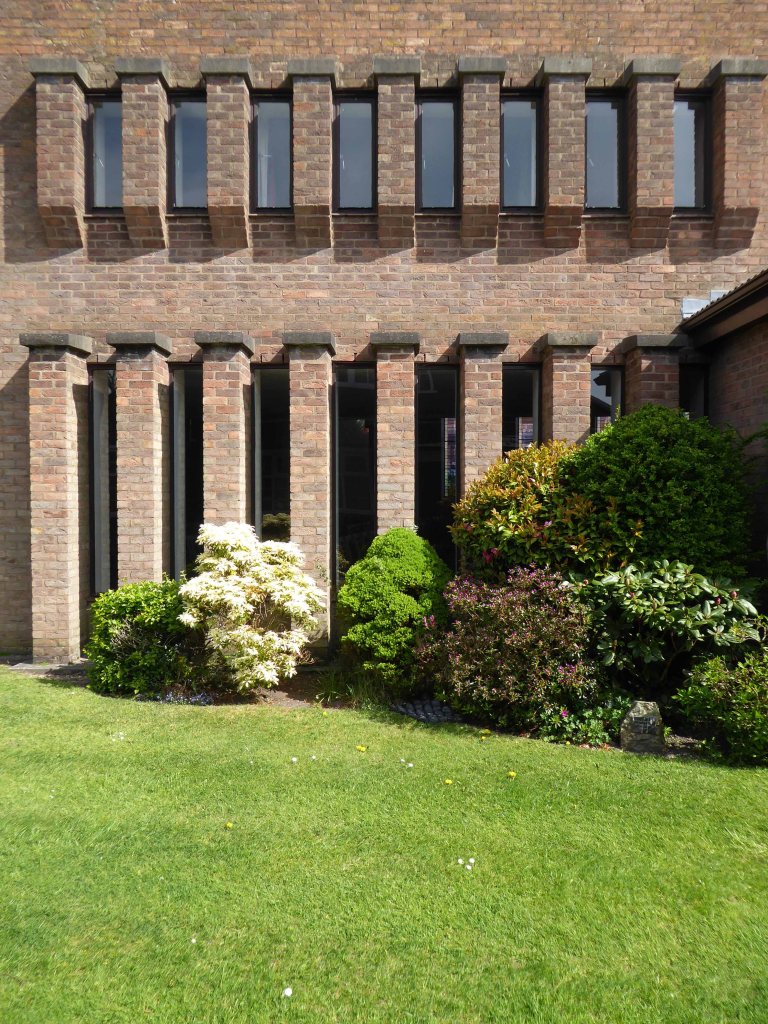
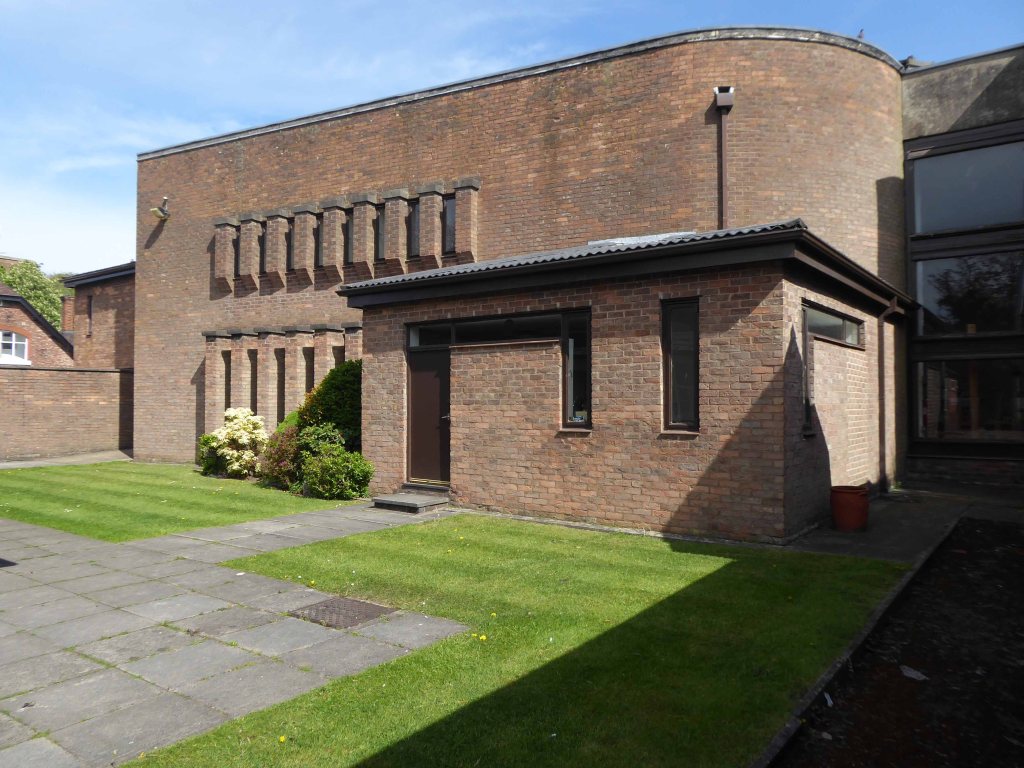
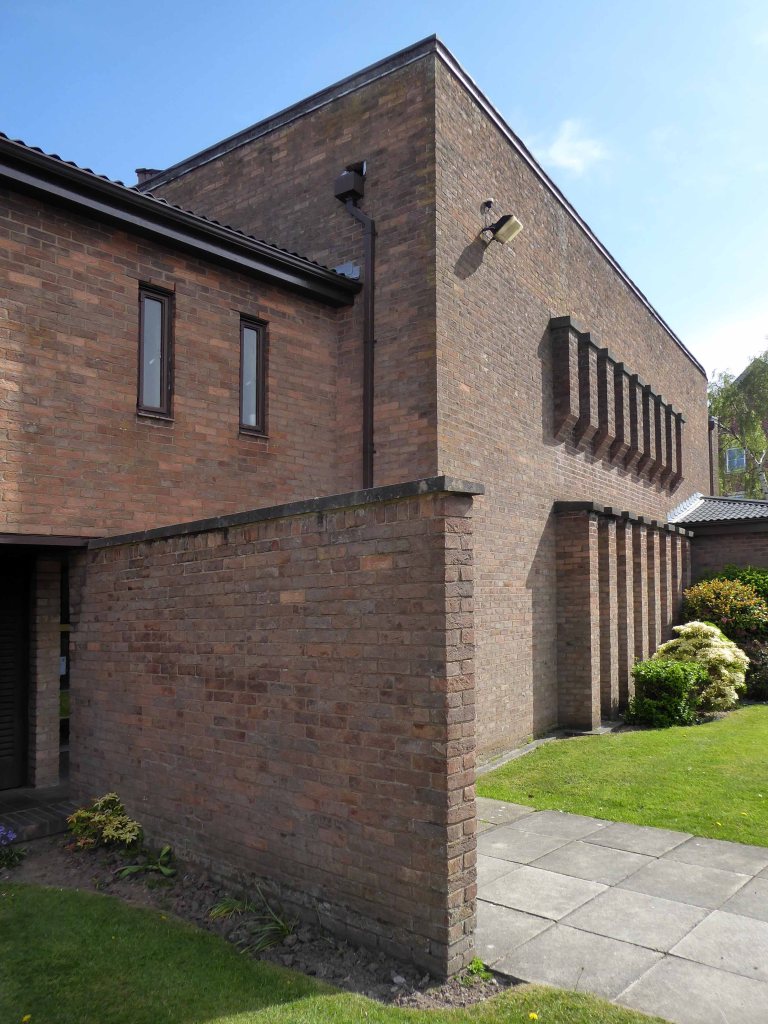
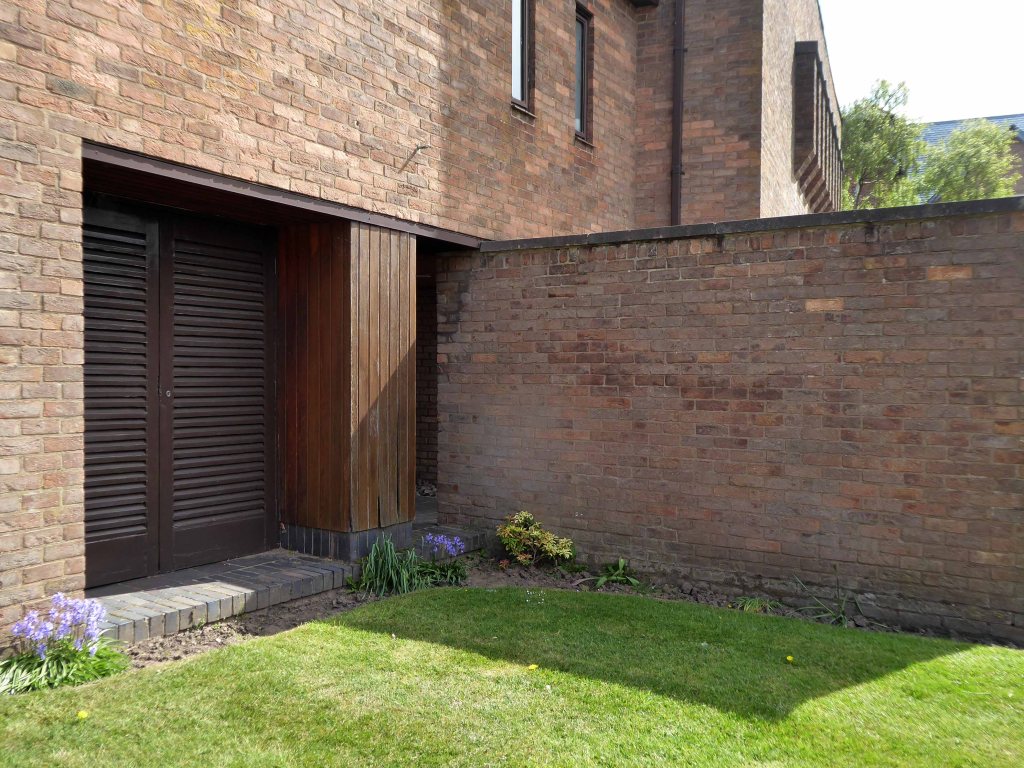
Small in scale, but large in ambition – a wonderful exercise in the calm controlled use of brick, rich in small details, along with an expressive mix of warm curves within a rigid grid.
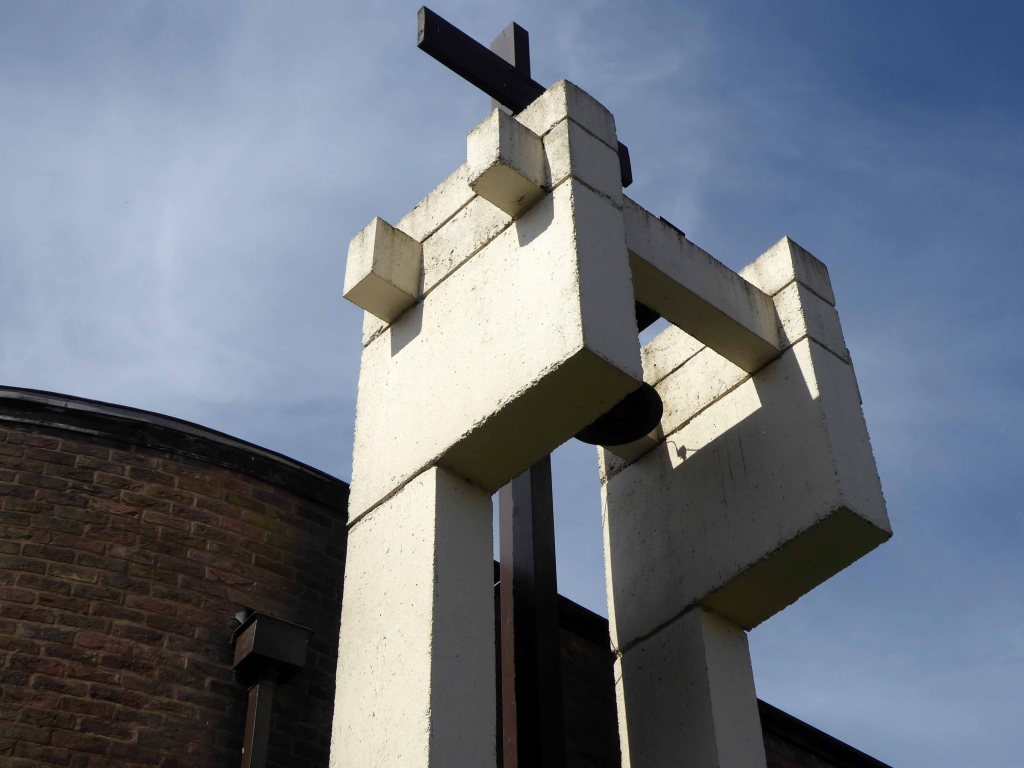
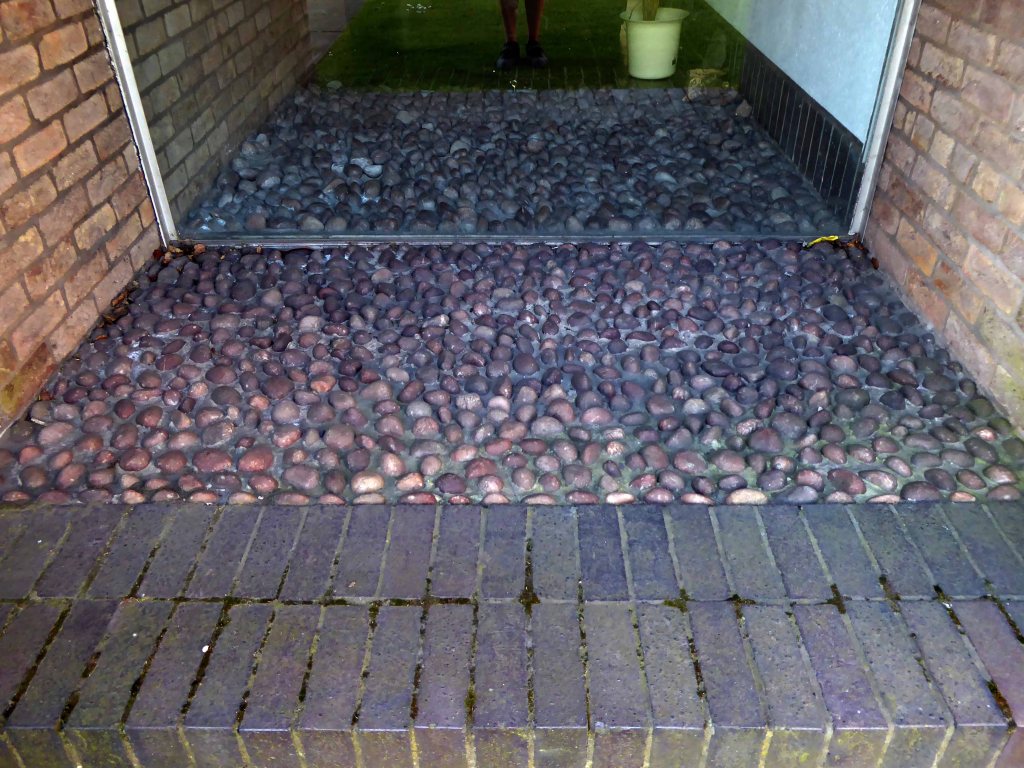
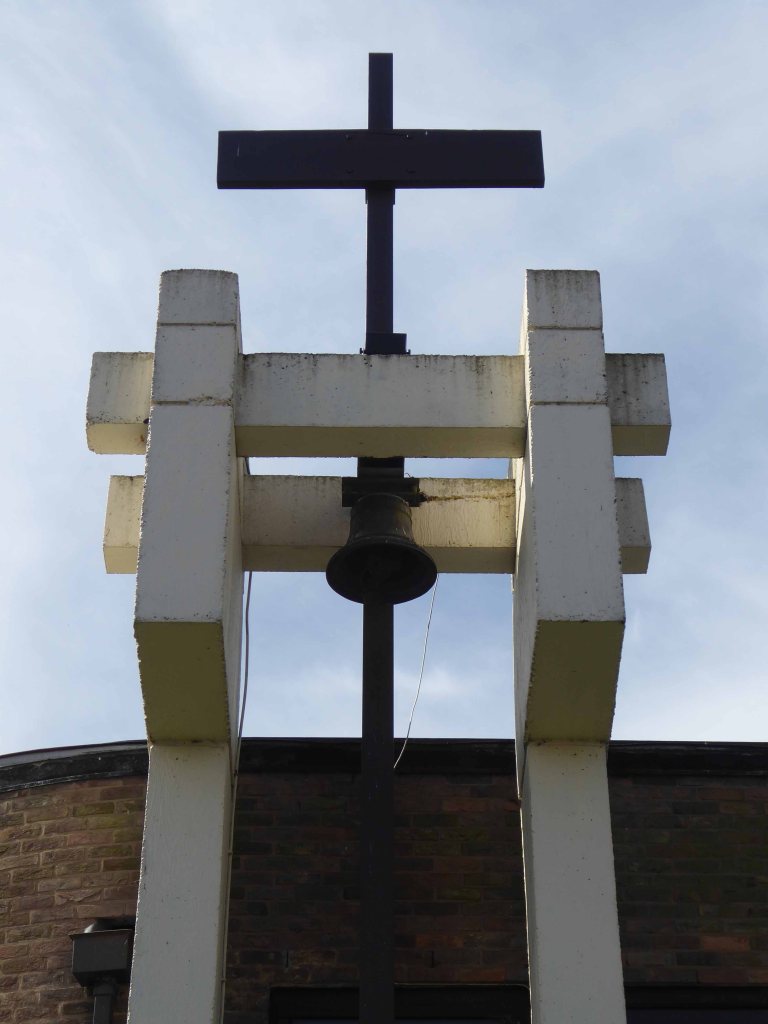
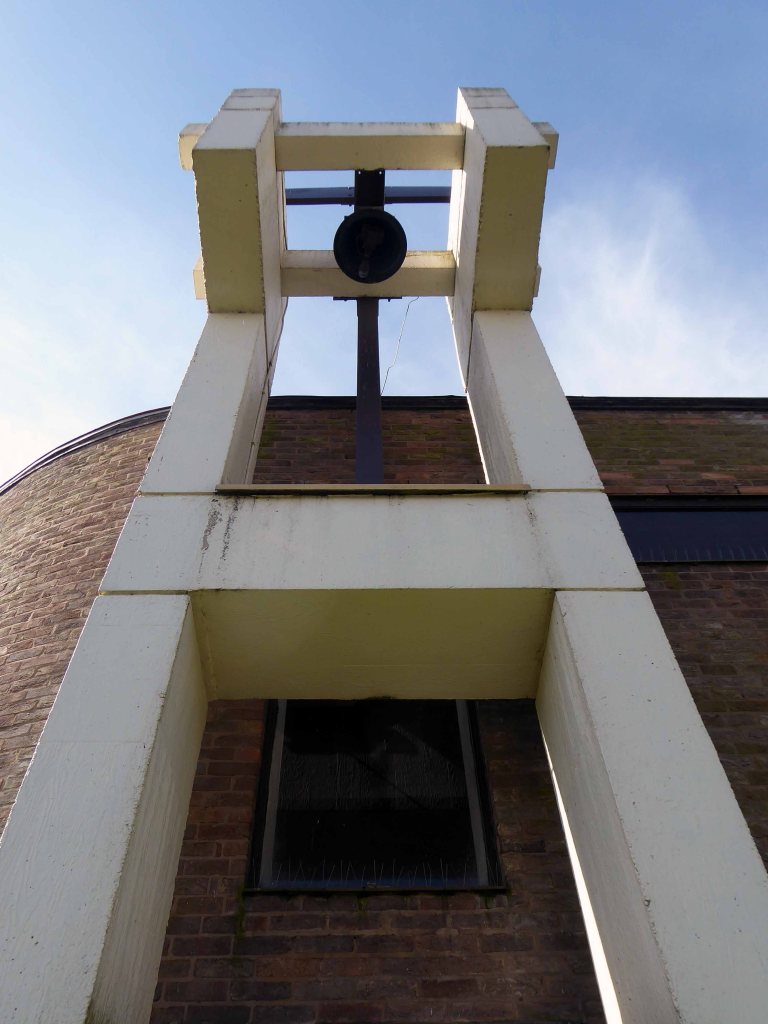
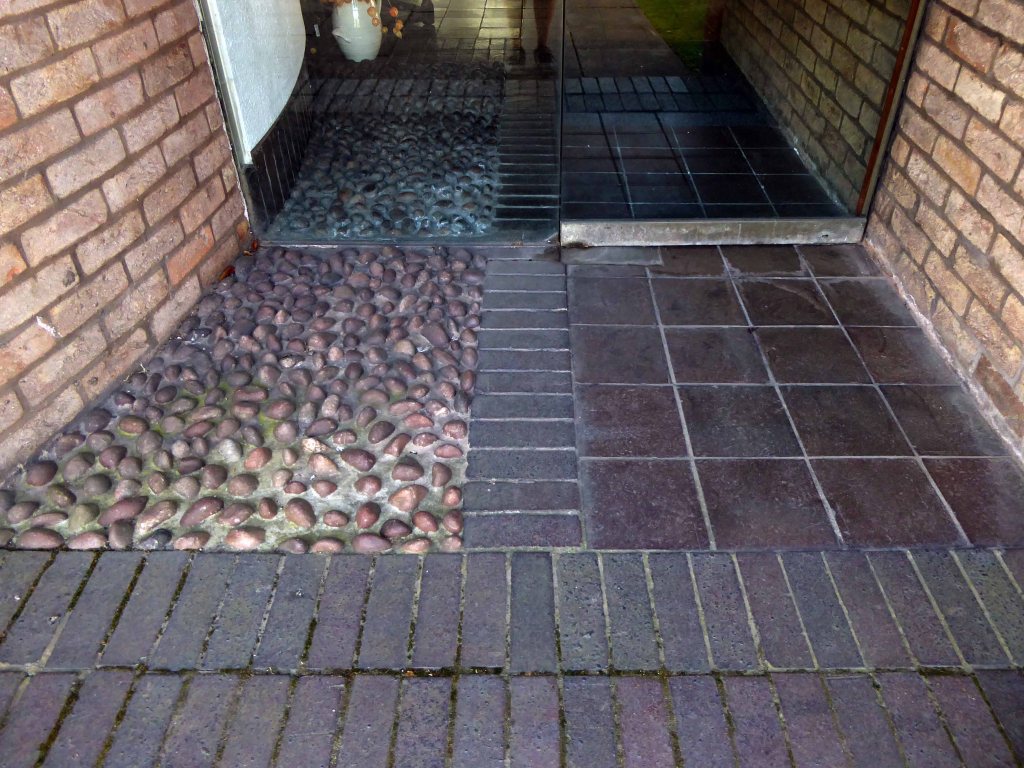
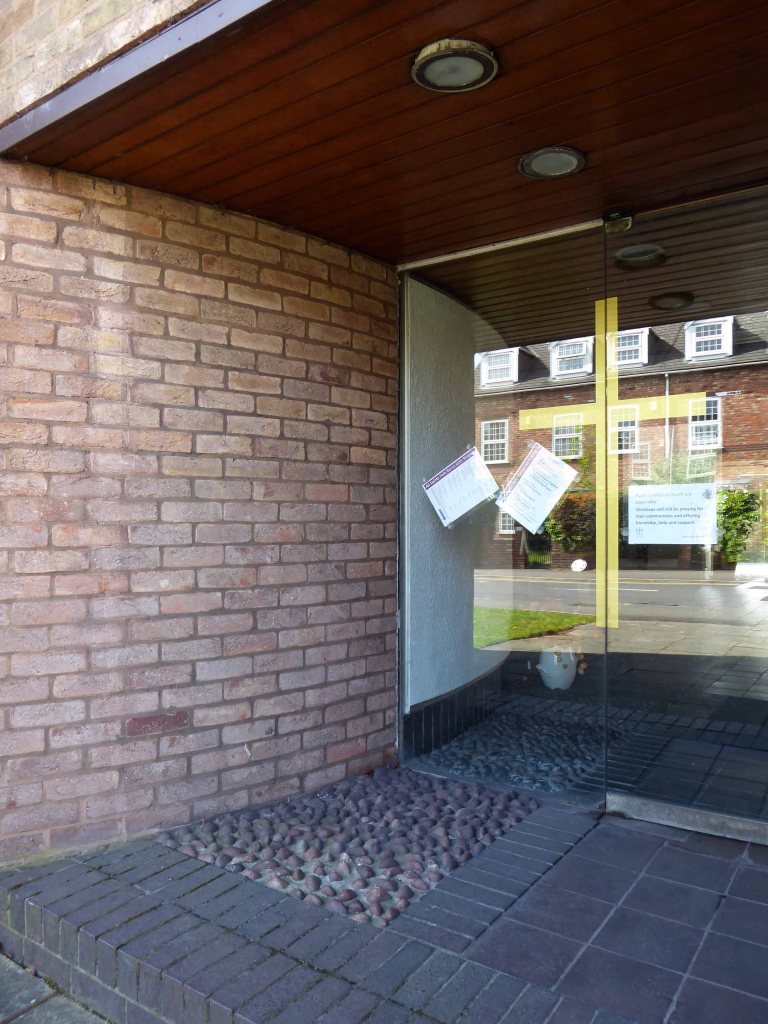
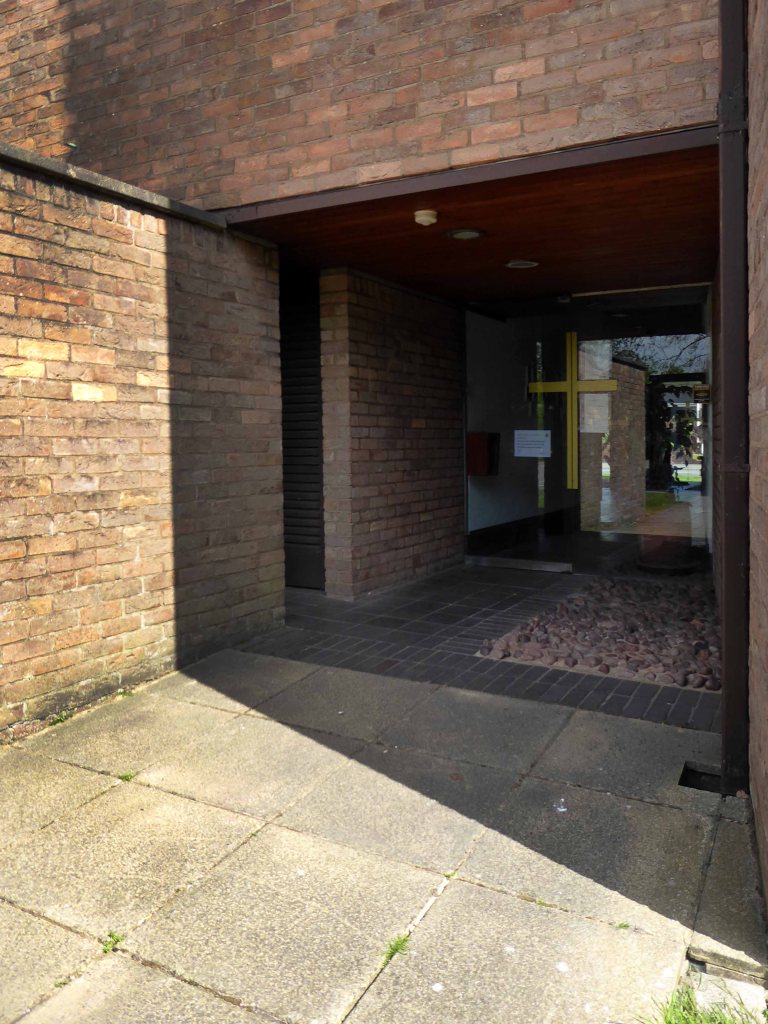
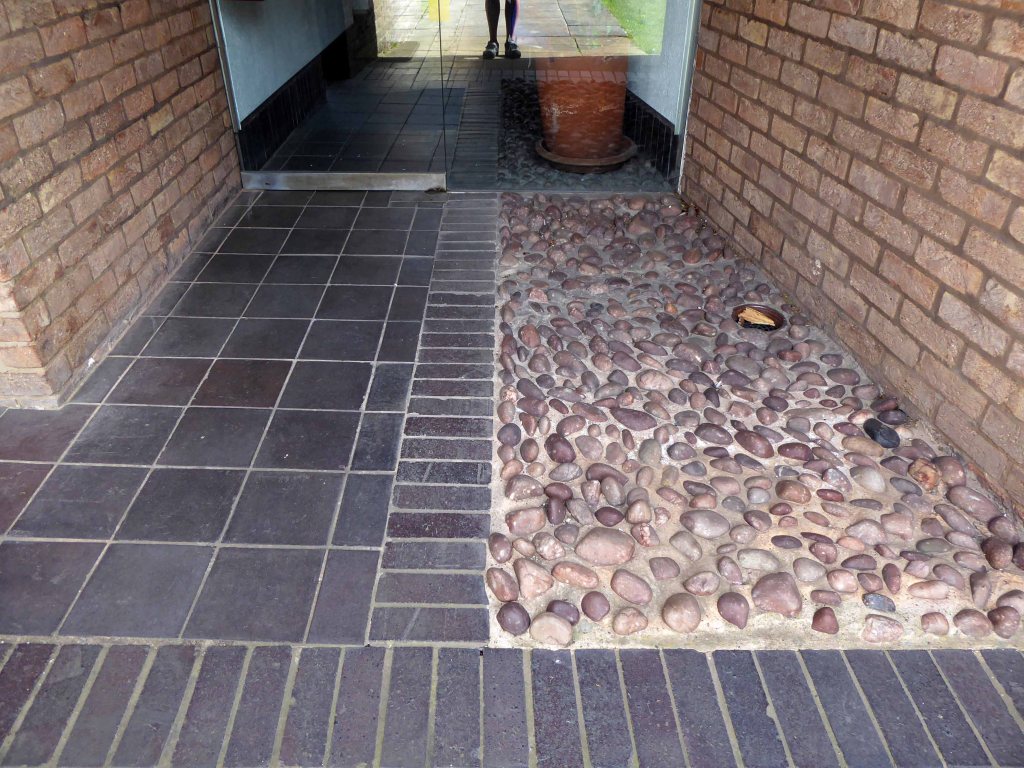
Of particular note is the sculptural concrete bell tower, the exterior use of pebbles in the porch which flow into the interior space, along with a discrete palette of grey tiling.
It demands to be circumnavigated – fresh surprises await around each turn, simple hard landscaping of flags, softer restrained planting and open areas of lawn, so very well tended.
Let’s take a look around.
Here are some images of the reworked interior taken from the All Saints gallery.
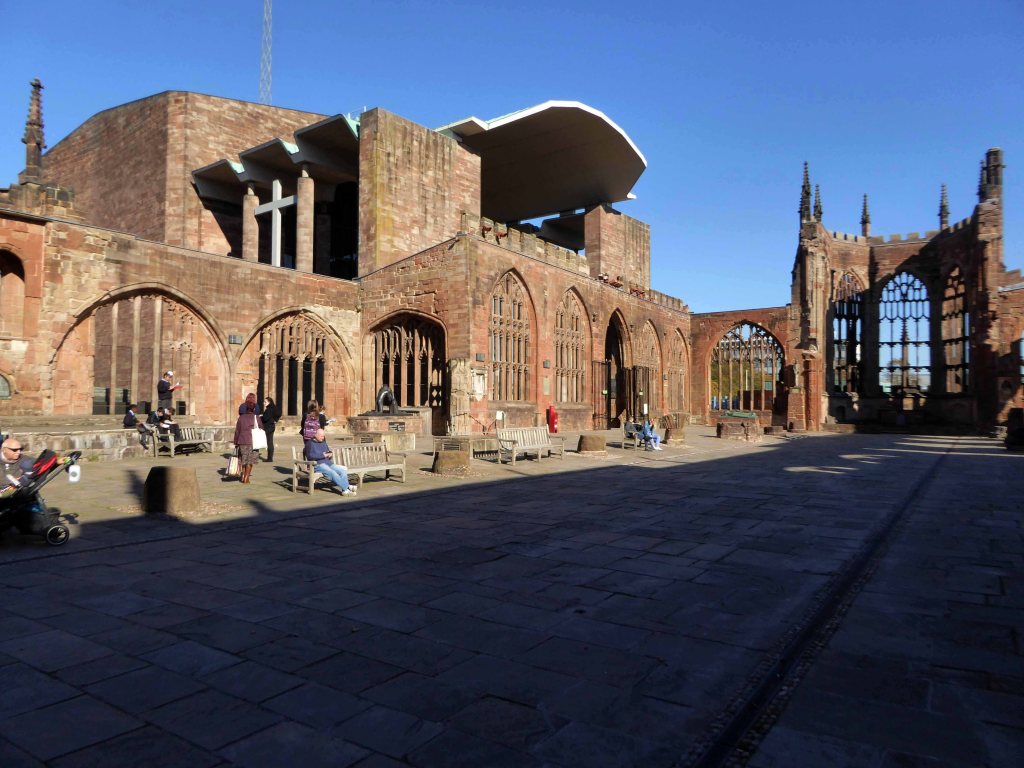
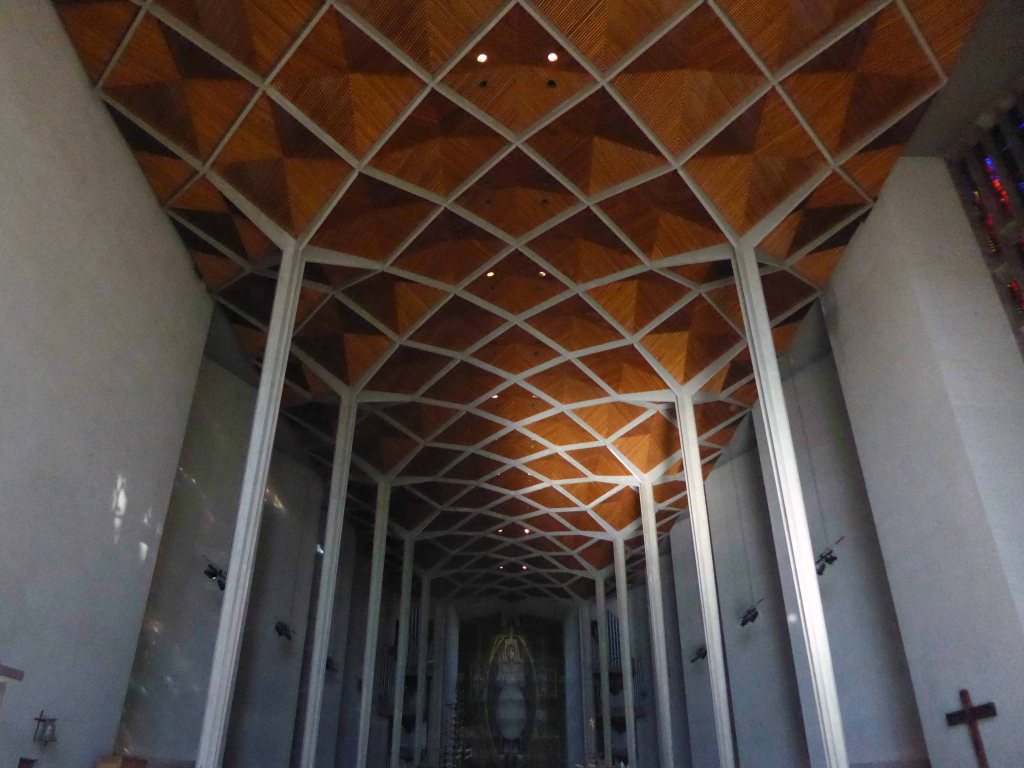
On the night of 14 November 1940, the city of Coventry was devastated by bombs dropped by the Luftwaffe. The Cathedral burned with the city, having been hit by several incendiary devices.
The decision to rebuild the cathedral was taken the morning after its destruction. Rebuilding would not be an act of defiance, but rather a sign of faith, trust and hope for the future of the world. It was the vision of the Provost at the time, Richard Howard, which led the people of Coventry away from feelings of bitterness and hatred. This has led to the cathedral’s Ministry of Peace and Reconciliation, which has provided spiritual and practical support, in areas of conflict throughout the world.
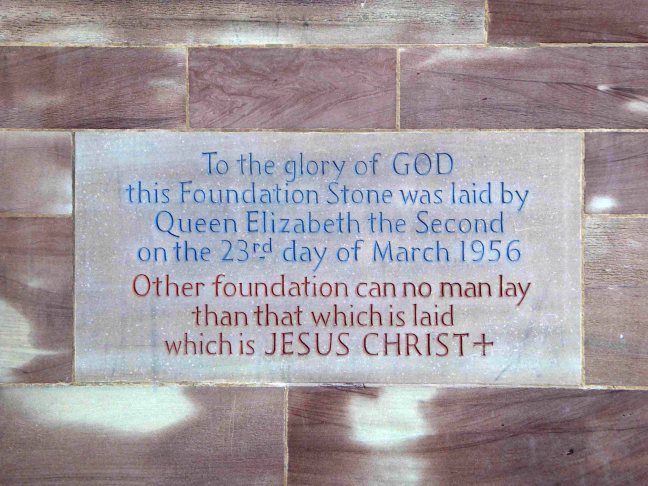
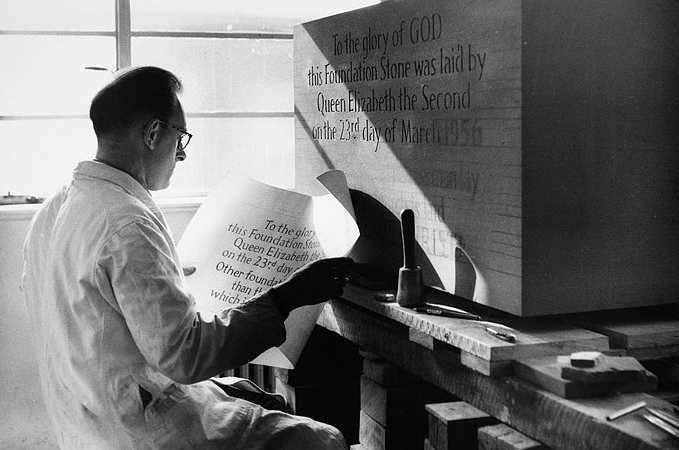
Her Majesty the Queen laid the foundation stone on 23 March 1956 and the building was consecrated on 25 May 1962, in her presence. The ruins remain hallowed ground and together the two create one living Cathedral.
Ralph Beyer carving the foundation stone for Coventry Cathedral.
The new Cathedral was itself an inspiration to many fine artists of the post-war era. The architect, Sir Basil Spence, commissioned work from Graham Sutherland, John Piper, Ralph Beyer, John Hutton, Jacob Epstein, Elisabeth Frink and others – most still to reach the peak of their artistic careers.
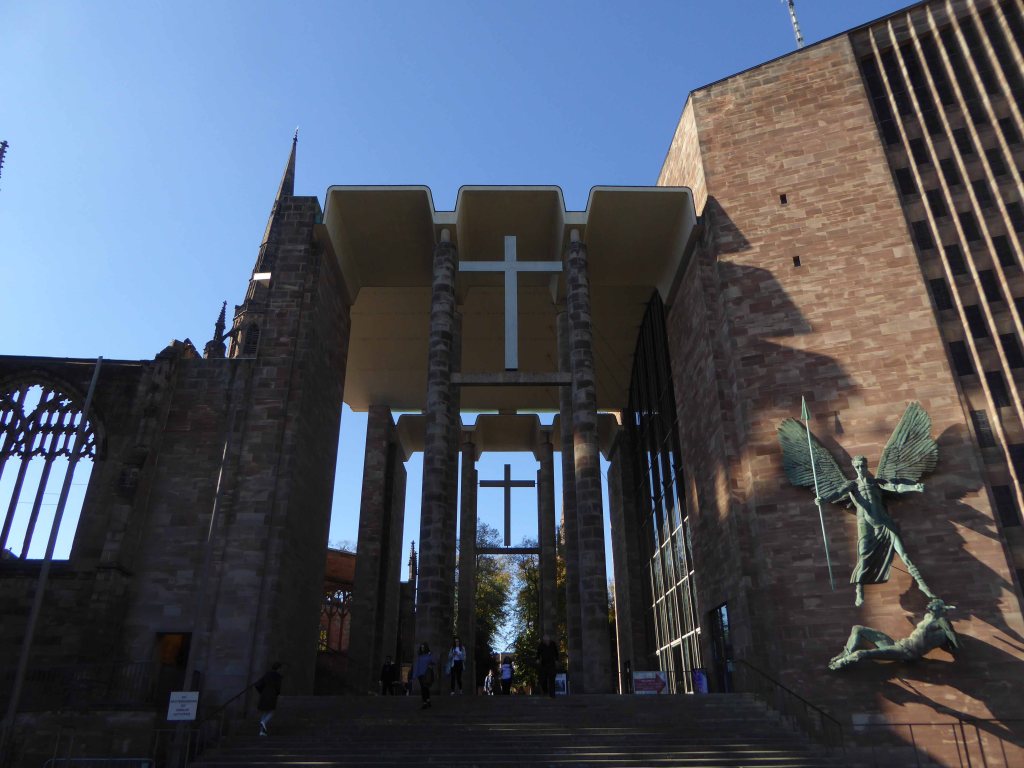
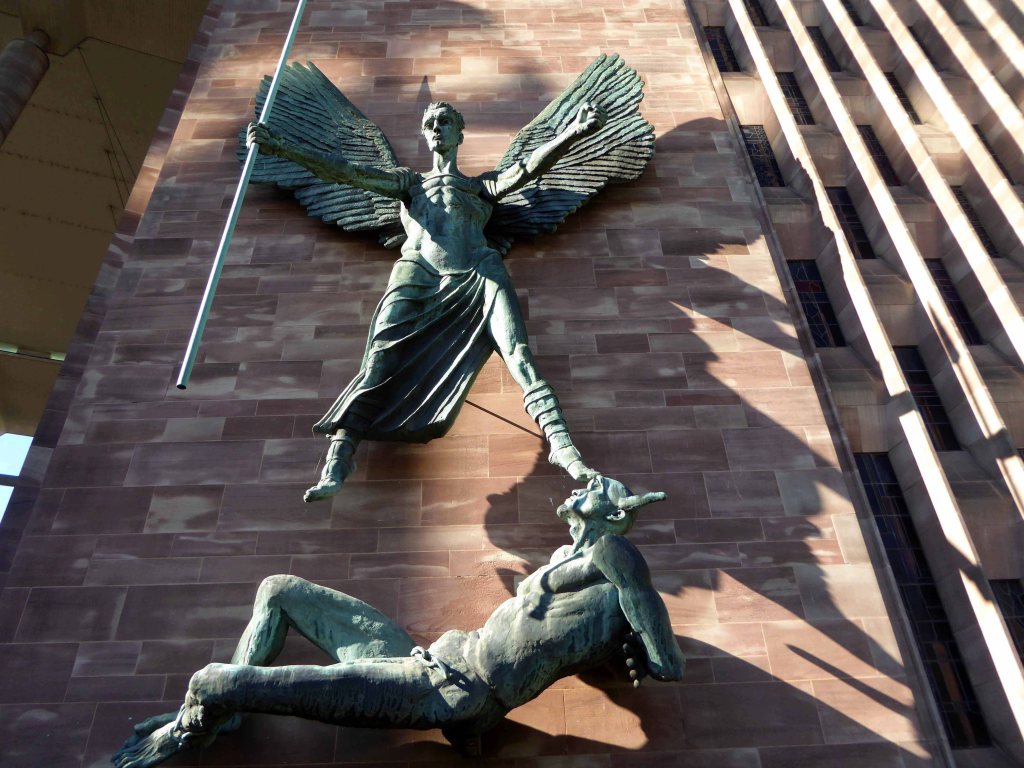
St. Michael and the Devil on the southern end of the east wall. It was sculpted by Sir Jacob Epstein, who, sadly, died in 1959, and therefore didn’t live to see his masterpiece mounted on the cathedral wall a year later.
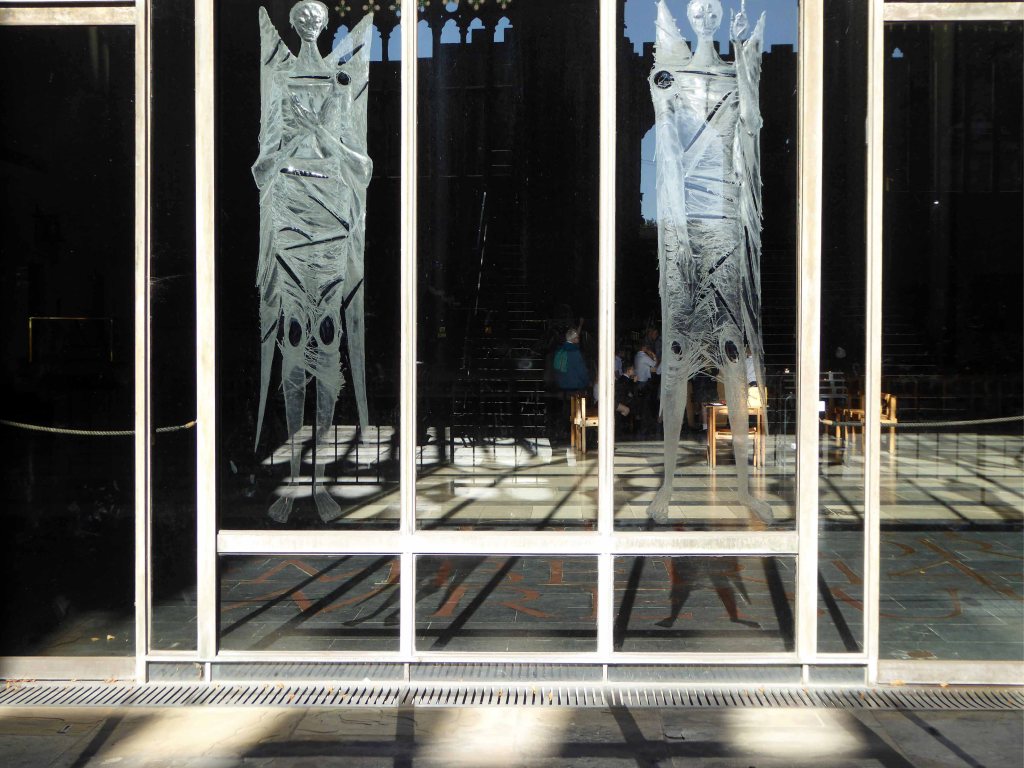
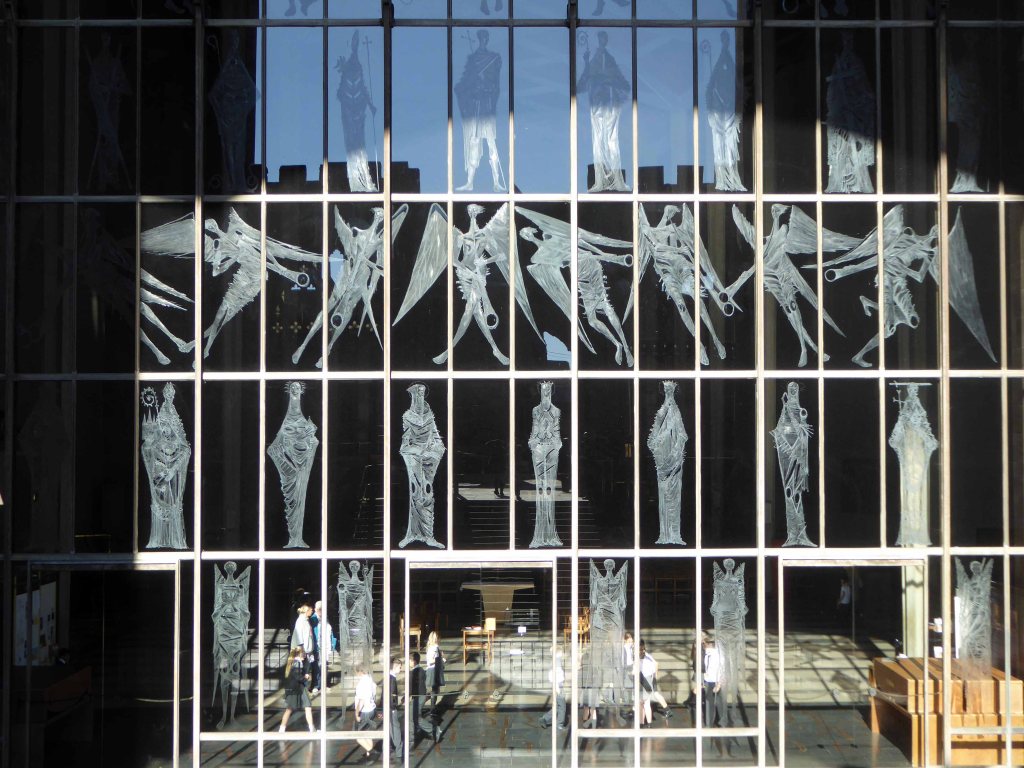
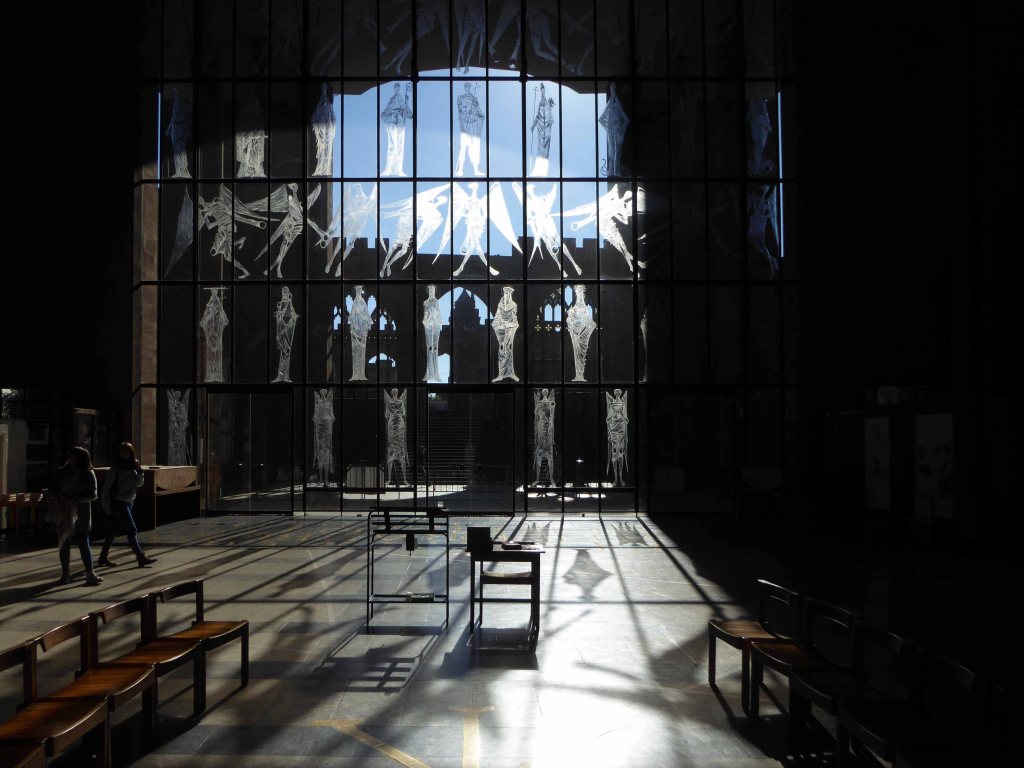
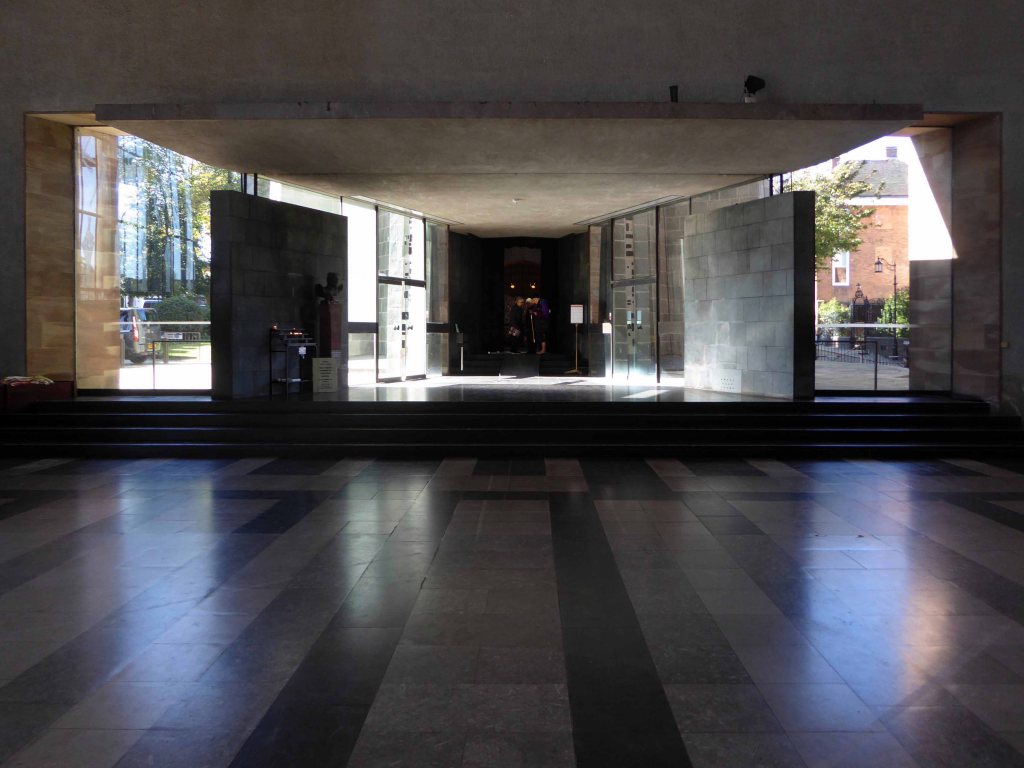
Entrance to the cathedral is through the Screen of Saints and Angels – it is seventy feet high and forty five feet wide and is supported by a bronze framework hung by wires from the roof for added strength.
This unique screen formed part of Sir Basil Spence’s first vision for the new cathedral. As he stared out from the ruins of the bombed cathedral, he saw the shape for the new church through a screen of saints. This transparent wall would link the old and new – making each mutually visible from within each other. Provost Howard set out to draw up a scheme consisting of all the saints who were responsible for the bringing of Christianity to Britain. As John Hutton began to make initial designs, he soon realised that row upon row of saints would need to be broken up in some way, and suggested that angels be inserted between the saints.
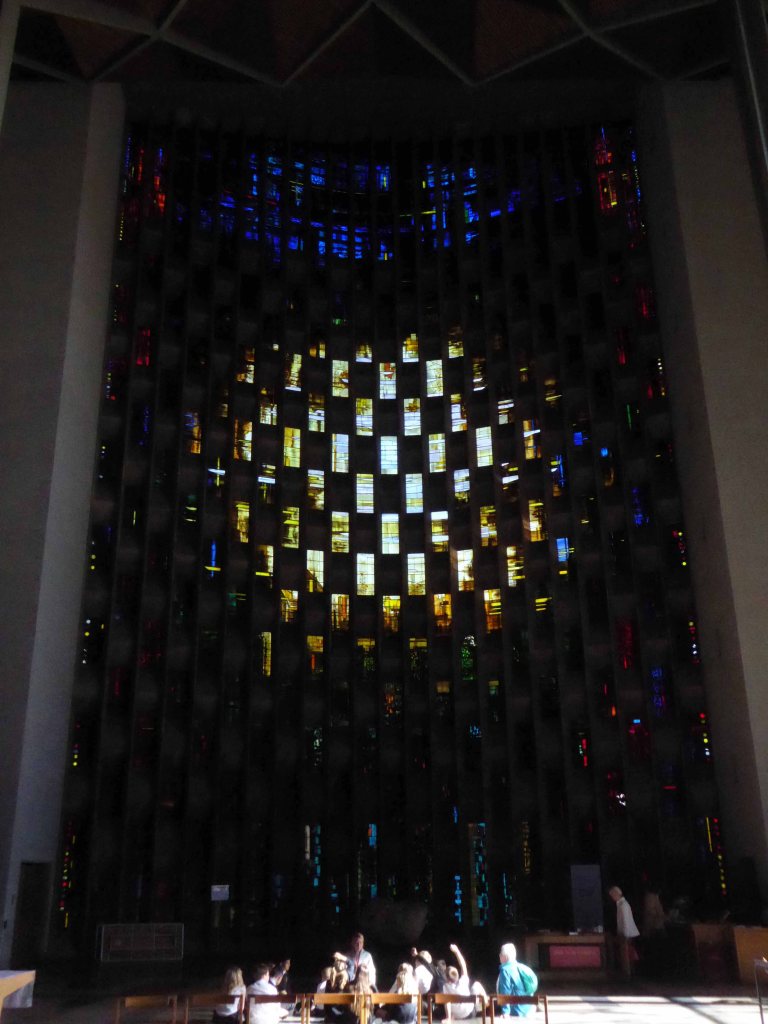
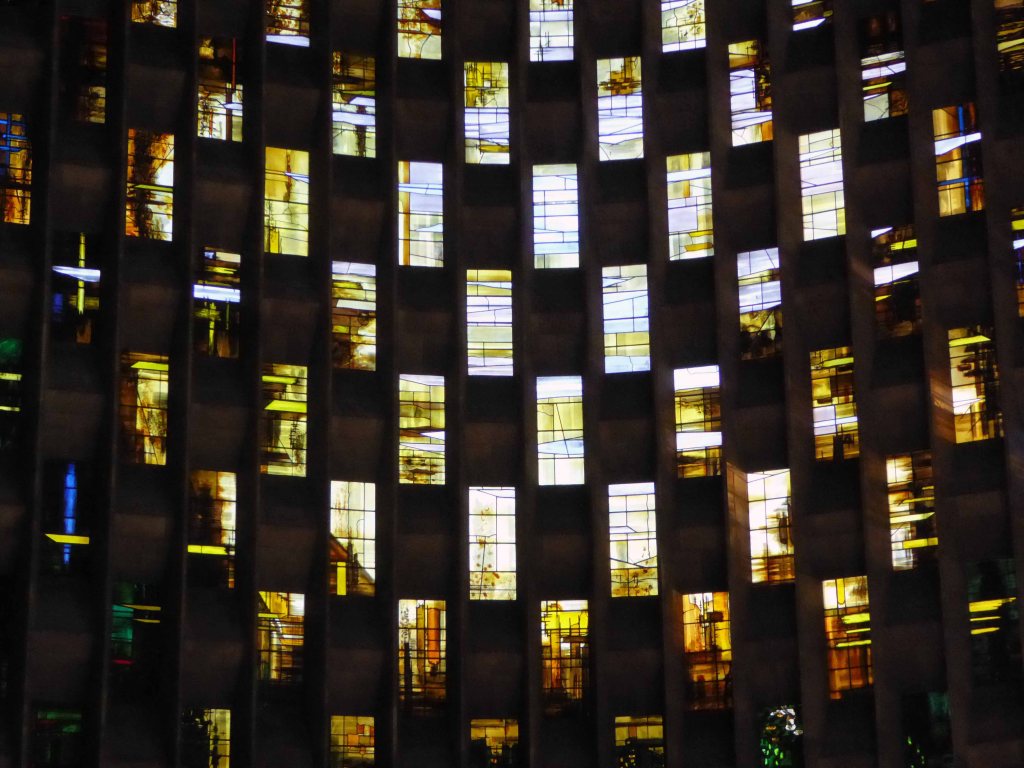
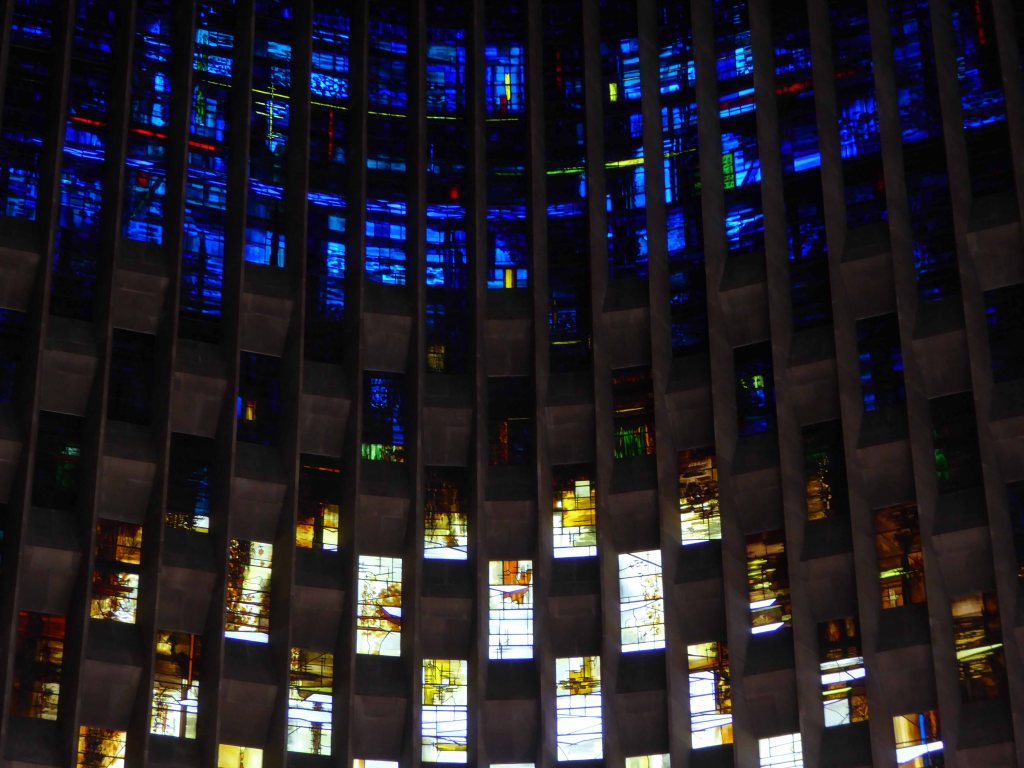
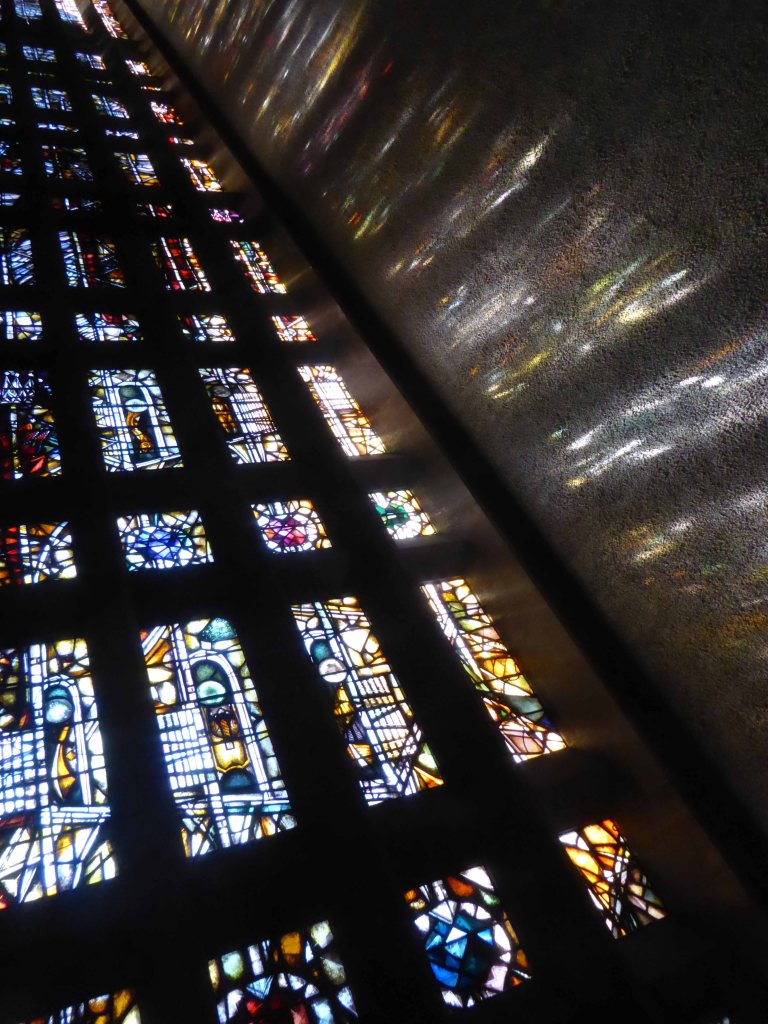
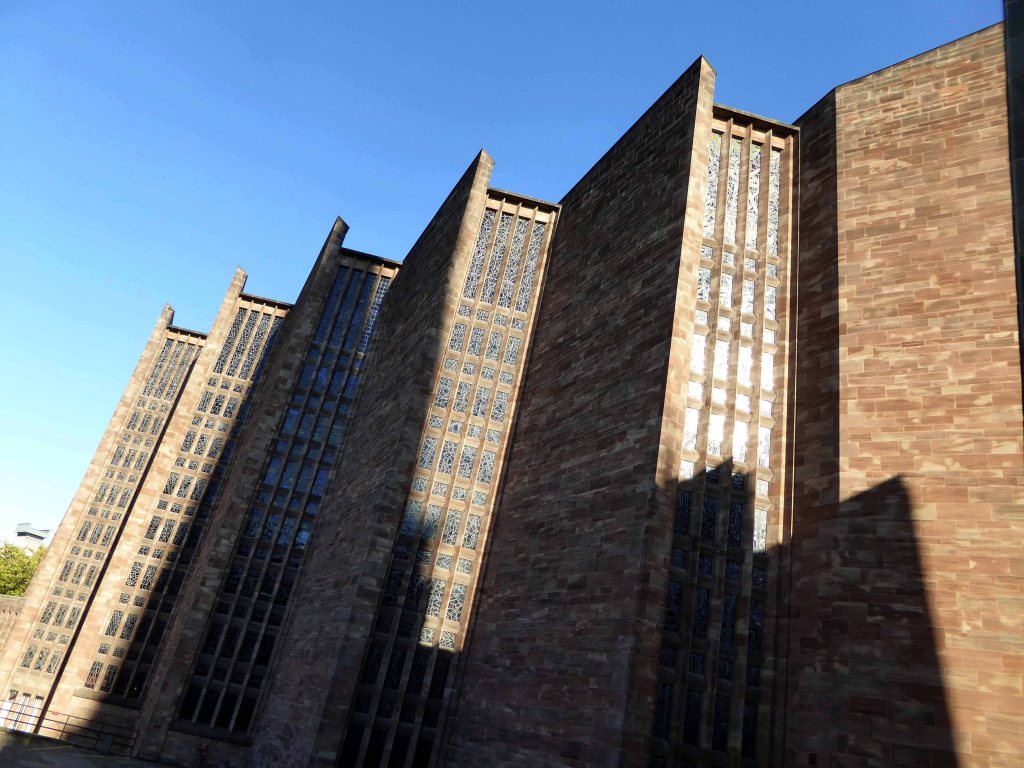
The eighty one foot high Baptistery Window containing a total of one hundred and ninety five lights of stained glass in bright primary colours designed by John Piper and Patrick Reyntiens, with the Stone of Bethlehem for a font just in front. Each individual window contains an abstract design, but the overall effect is breathtaking. Basil Spence himself designed the stone containing the glass.
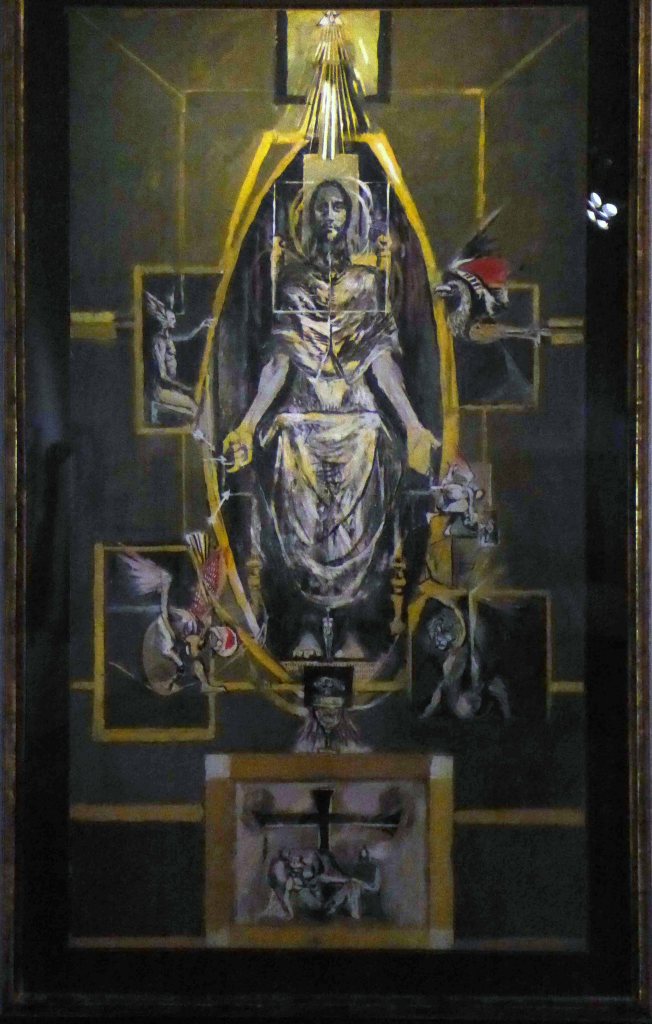
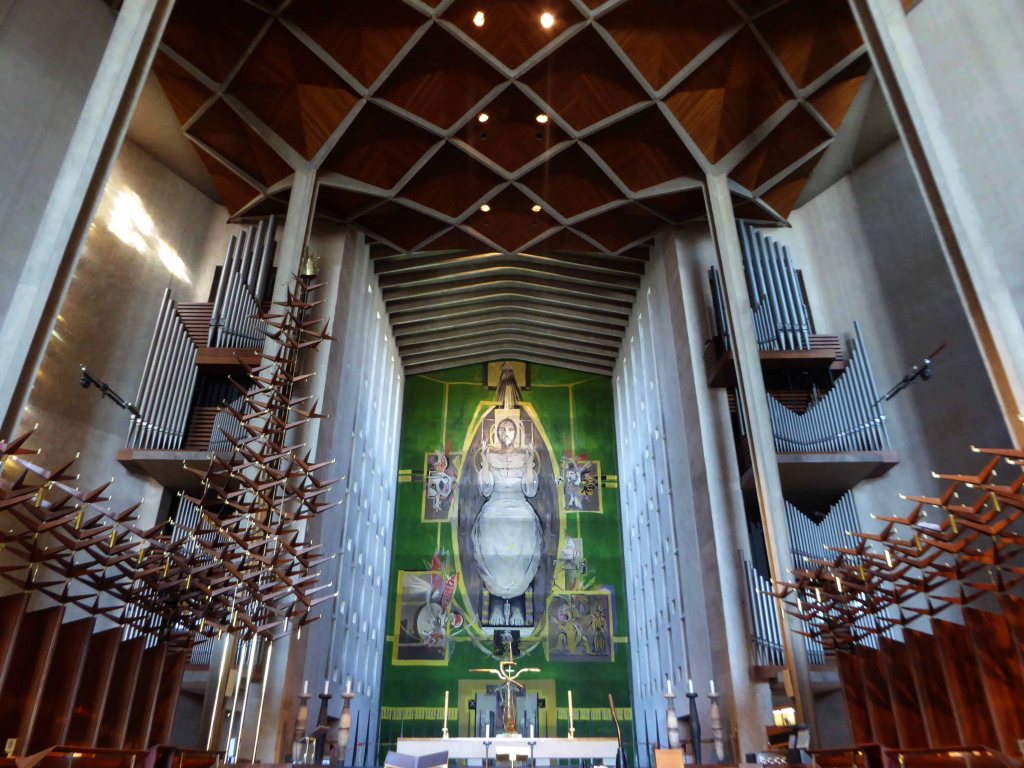
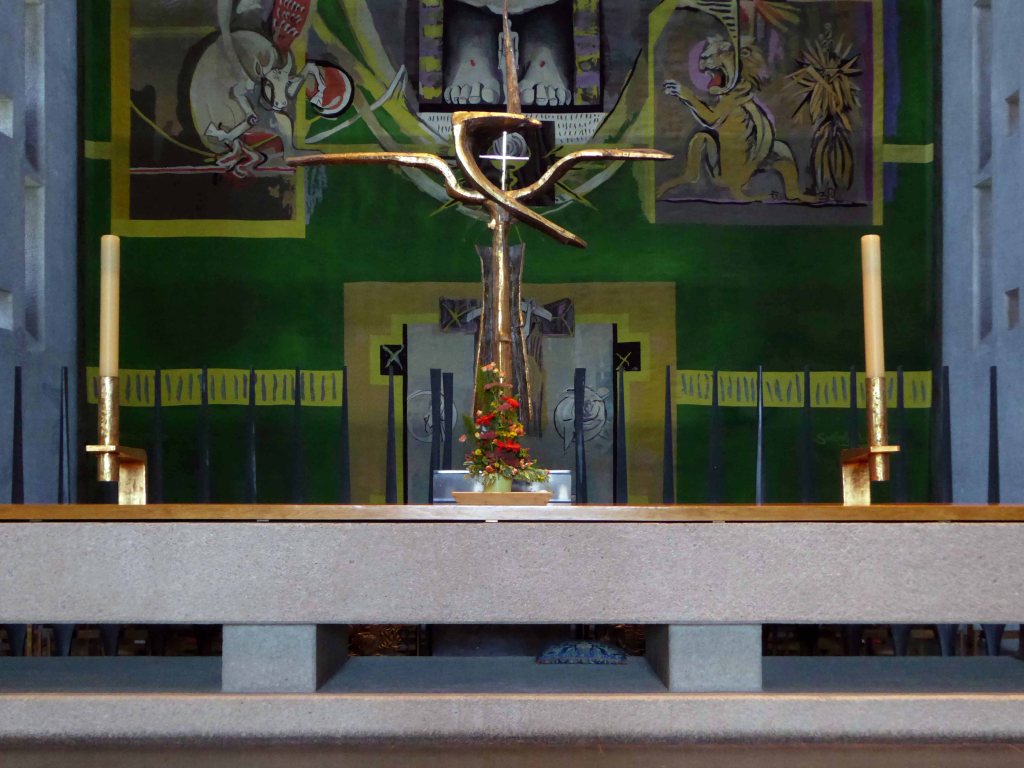
The great tapestry was another example of a re-think in design. Basil Spence’s original intention was to depict the Crucifixion but Provost Howard suggested that the subject be Christ in Majesty and from there on, this idea prevailed
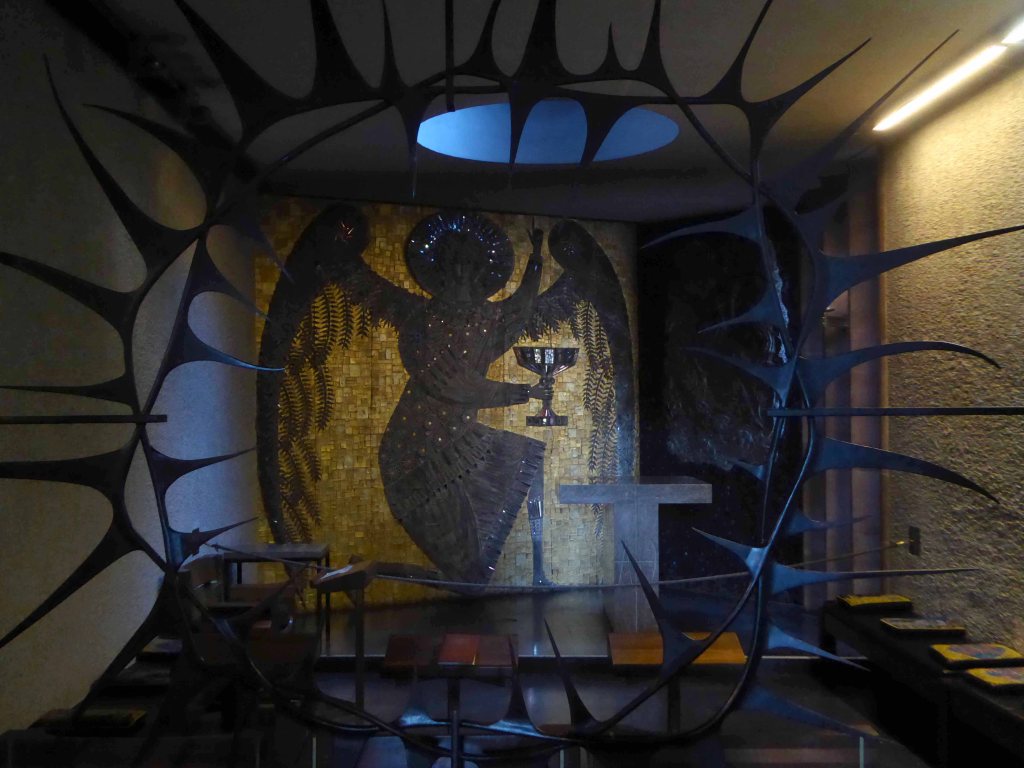
The Chapel of Christ in Gethsemane is approached by following the aisle from the Baptistery window towards the altar which is at the north end. The mosaic depicts the Angel of Agony by Steven Sykes and becomes more impressive when seen from a distance through the wrought iron crown of thorns designed by Basil Spence.
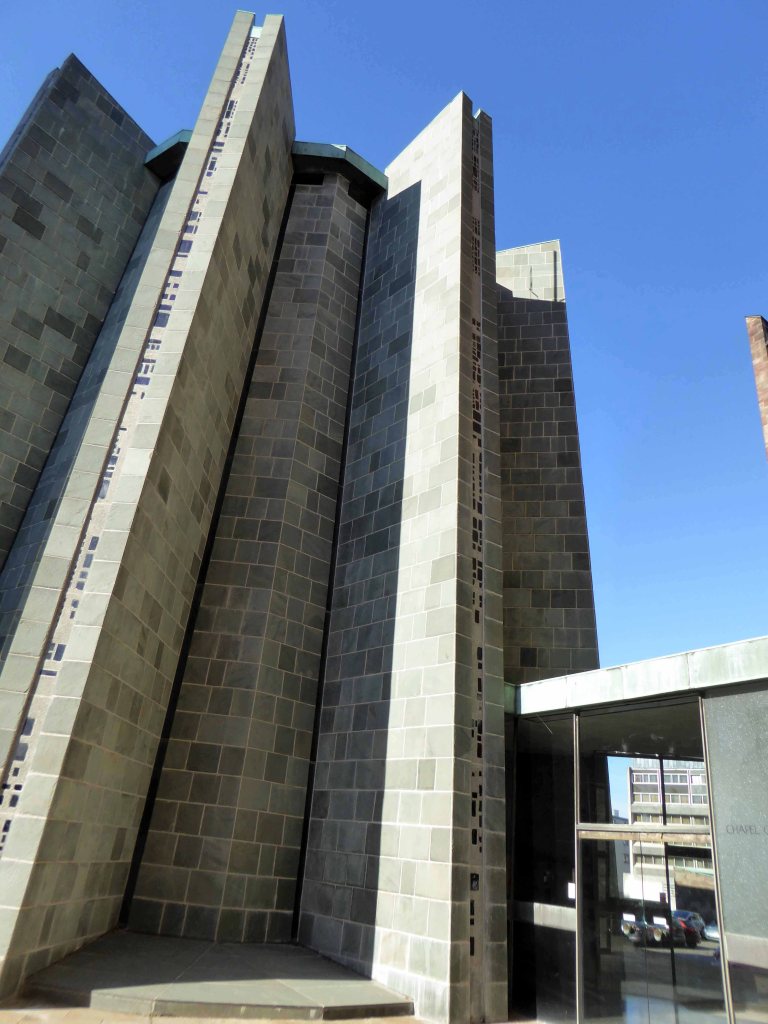
A short passageway takes you through to the Chapel of Christ the Servant – also known as the Chapel of Industry due to the view of Coventry workplaces from its narrow windows.
Monumental inscriptions to walls and floor by Ralph Beyer
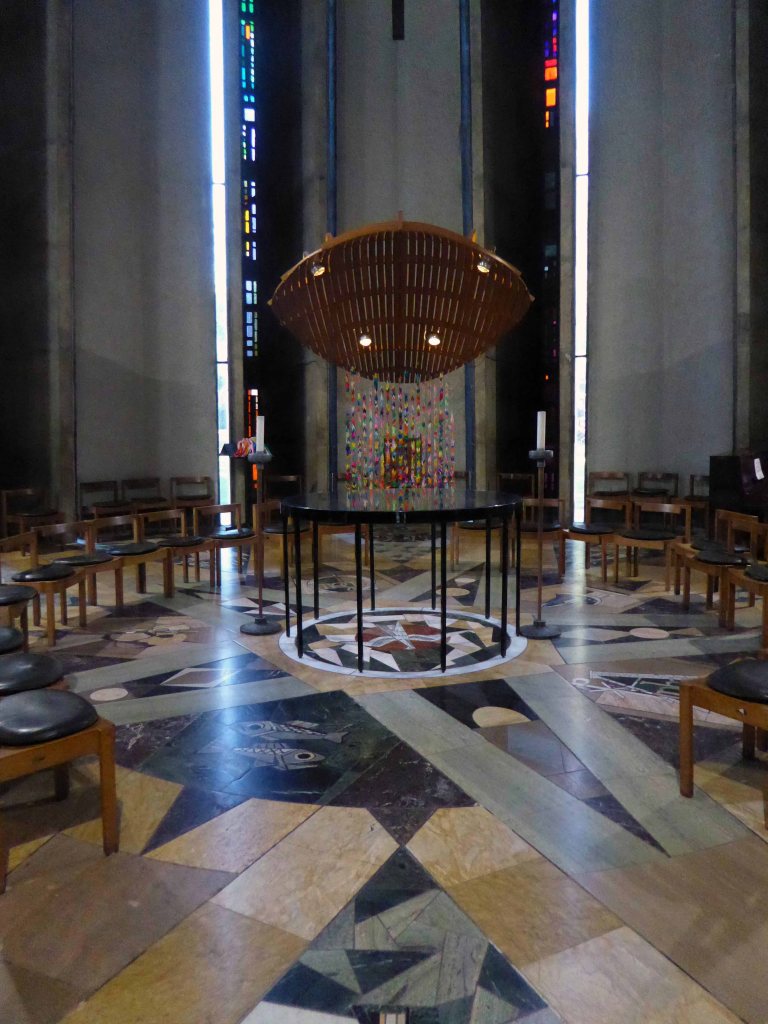
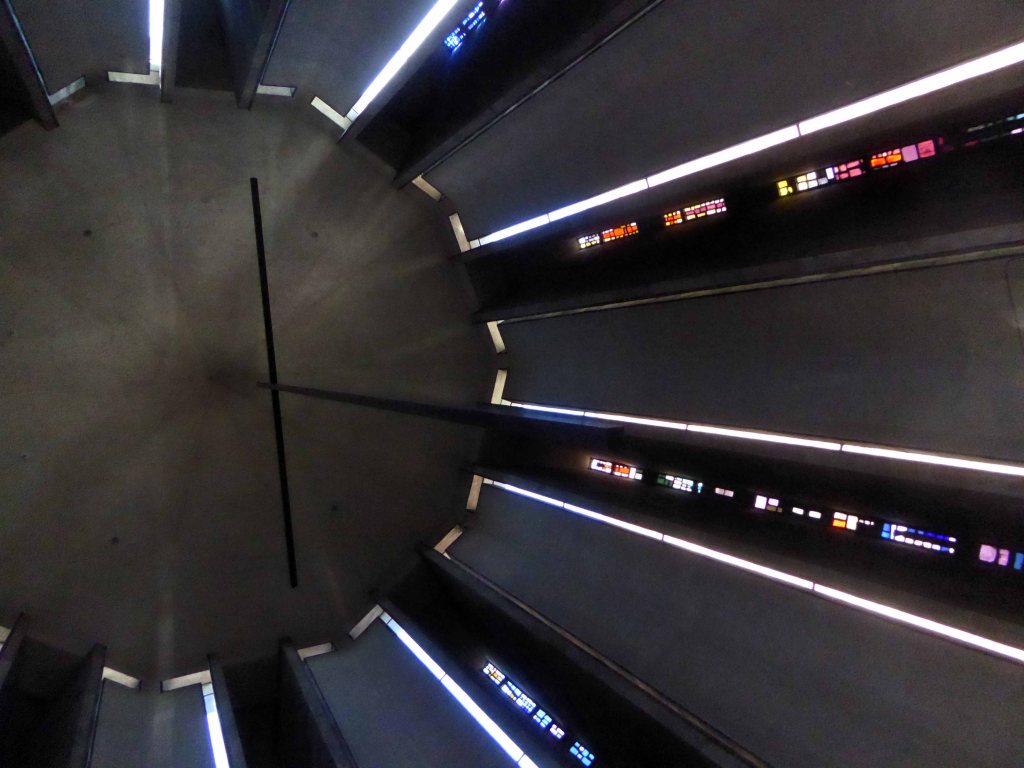
At the far end of the aisle, opposite the Baptistery Window is the Chapel of Unity, with its detailed mosaic floor, donated by the people of Sweden, representing the nations of the world and lit by shafts of light from the narrow stained glass windows around the circumference of the star shaped chapel.
This design was Basil Spence’s vision of a chapel representing the star which began the story of Christ – from the outside it appears shaped similarly to a Crusader’s tent.
The chapel is intended for prayer by all denominations, not just Anglican, and for this reason was purposely built with no view of the great altar.
Set back from Beverley Road – we just about found this delightful Modernist gem. Tucked in amongst student accommodation and approximate to the Endsleigh College.
The church built in 1965 is fan-shaped in plan. Concrete portal frame with yellow brick infill. Shallow-pitched sheet metal clad roof. The main rear wall is flat and blind, with a parapet, and extends across the building at full height. From this wall the main body of the church radiates, three facetted bays to either side, with a saw tooth eaves line, then a projecting square block which houses the narthex and west gallery. The saw tooth eaves continue just above the entrance block to complete the fan shape. Attached to the other side of the main wall are the low, square projections of the side chapels and sacristies and a concrete framed bell tower with shallow pitched roof. The entrance block is clad is artificial stone, has a wide, glazed screen with central doors and a thin flat canopy.
We had arrived some twenty five strong as part of Manchester Modernist’s Hull Mooch – we were very warmly welcomed and left more than satisfied by the riches both within and without.
My thanks to Deacon Rev. Robert Shakesby
Above this an inset panel of decorative mosaic by Ludwig Oppenheimer Ltdof Manchester -the firm ceased trading in 1965. The facetted elevations have large glazed areas set in a bold concrete grid of mullions and transoms, tripartite in the centre with a border of smaller divisions. The bell tower is placed in the centre of the east wall and has a port cullis-like bell-opening facing west.
The mosaic is surrounded by decorative abstract panels in light relief
Let’s take a look inside.
The interior is a light and spacious essentially single cell, with the shallow canted projection of the sanctuary – top lit by a row of seven small circular skylights, the low side chapels and the organ gallery. The concrete portal frame provides a dramatic grid radiating from the centre of the east wall. Sanctuary fittings in contrasting marbles, by Toffolo & Son of Hull, designed as a piece. Similar marble altar in the northeast side chapel. The chapels have subtle shallow-pitched arches. West gallery also with circular skylights. Organ pipes at either end arranged within a striking double-curve enclosure, like a grand piano in plan. Open-backed pews and original light fittings. Stained glass by Leo Earley of Earley & Co. of Dublin. Stations of the Cross, wooden relief panels set within integral frames, somewhat stark.
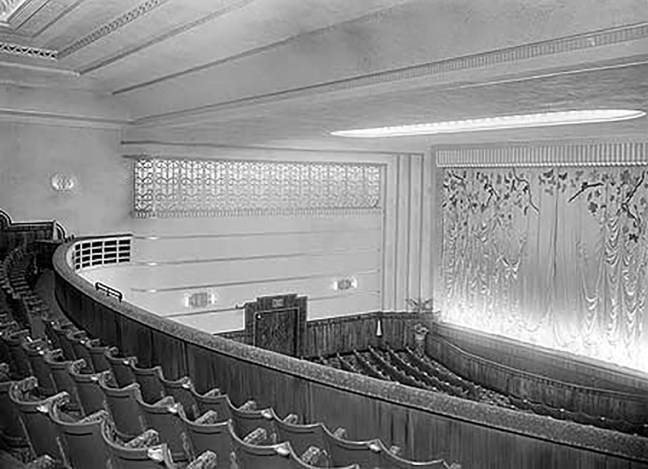
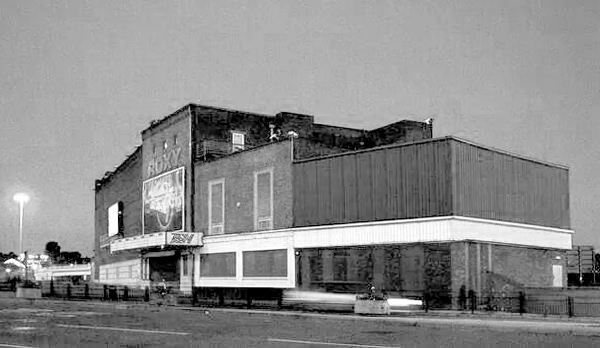
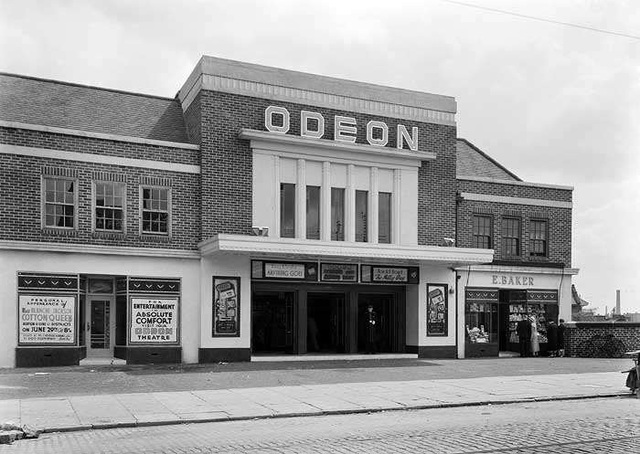
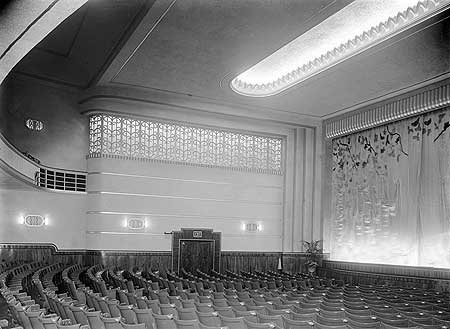
This was planned to be the Verona Cinema, a project of local builders – P Hamer Verona Cinema Ltd. The construction of the cinema was almost completed when Hamer sold the building to Oscar Deutsch and it opened as one of his Odeon theatres.
Hamer then used the proceeds of the sale to build the Roxy Cinema Holinwood, which was designed by Drury & Gomersall.
Opening date of the Odeon Theatre was 29th June 1936, when the first programme was Bing Crosby in “Anything Goes” and Harold Lloyd in “The Milky Way”. Designed by the noted cinema architectural firm of Drury & Gomersall, the frontage had a neat entrance in brick, with white stone facings on the window surrounds. There was a parade of shop units on each side of the entrance which had matching brickwork and a white stone trim.
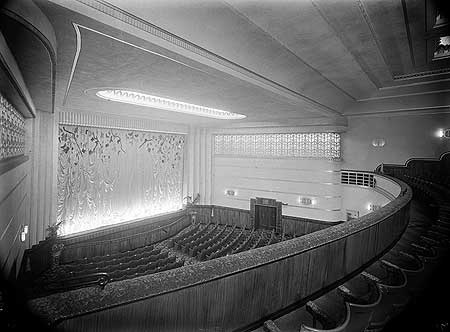
Inside the auditorium the seating was arranged for 834 in the stalls and 330 in the circle. The side splay walls on each side of the proscenium was decorated in wide horizontal bands, and topped with a backlit illuminated grille.
The Odeon was closed by the Rank Organisation on 11th March 1961 with Kenneth More in “Man in the Moon”.
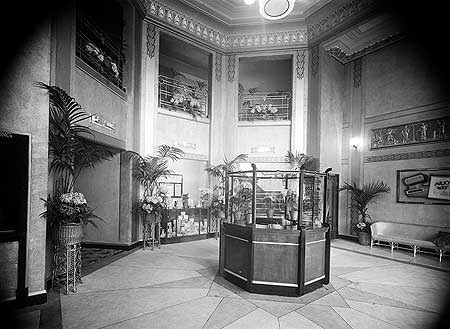
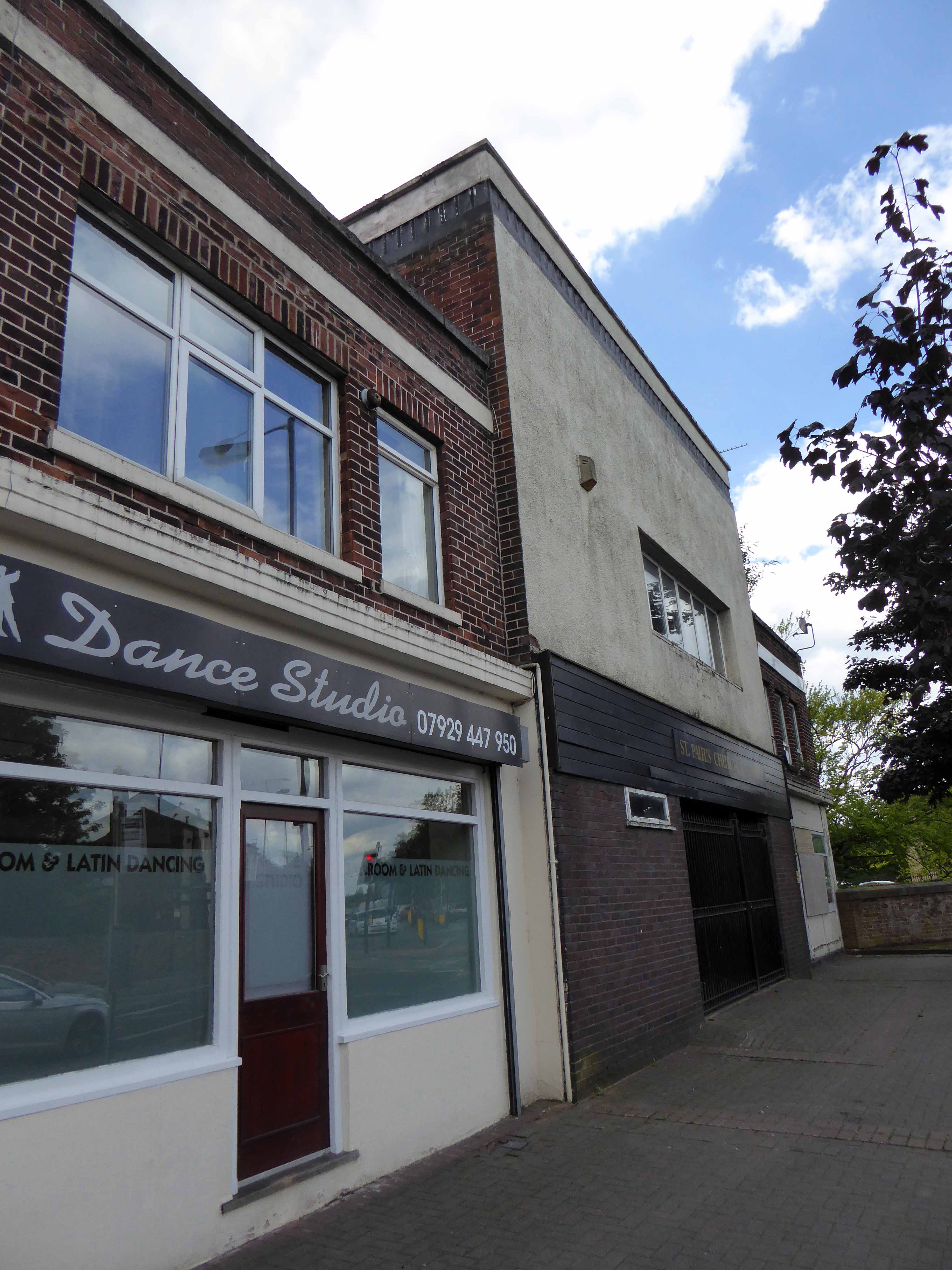
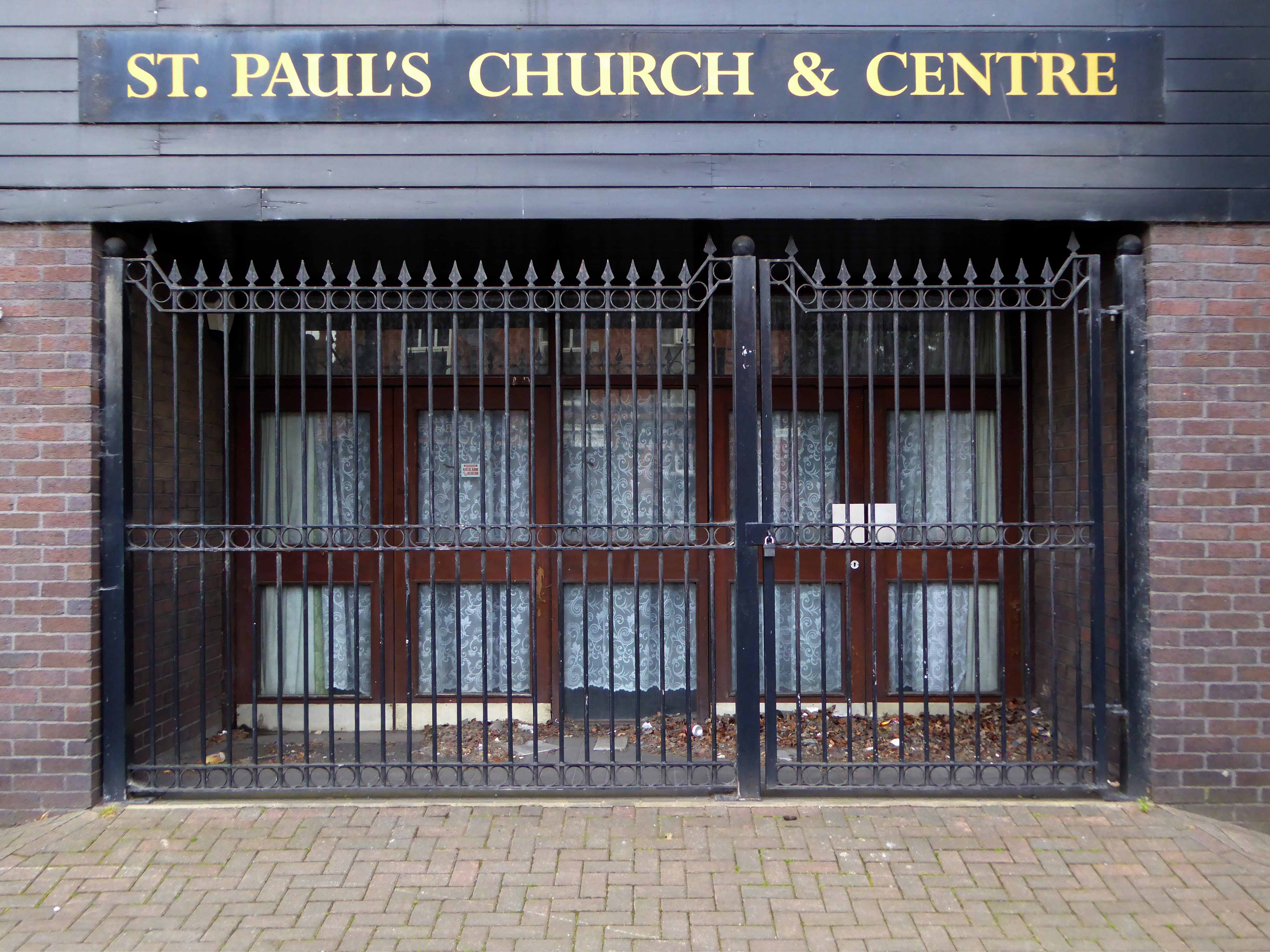
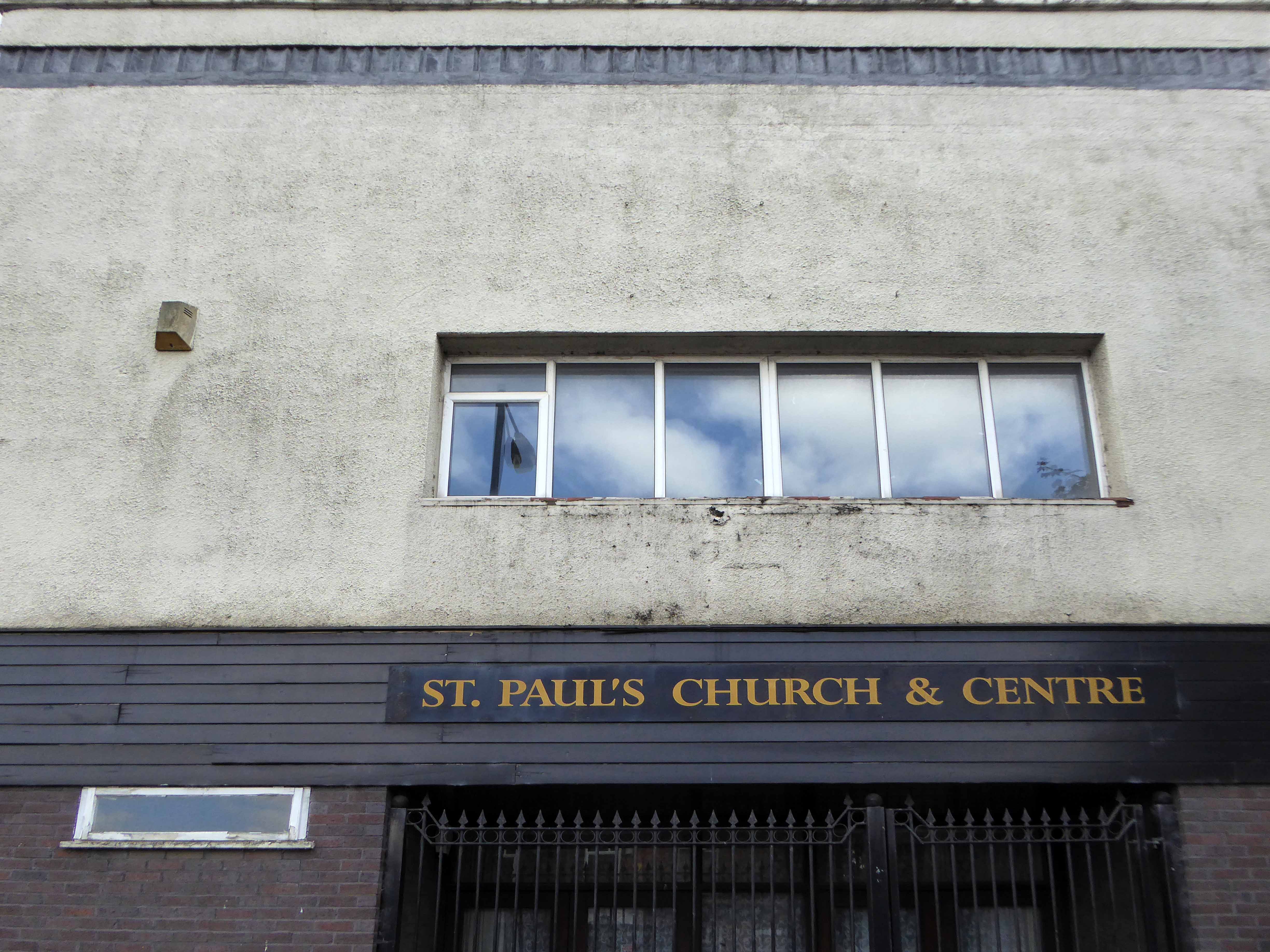
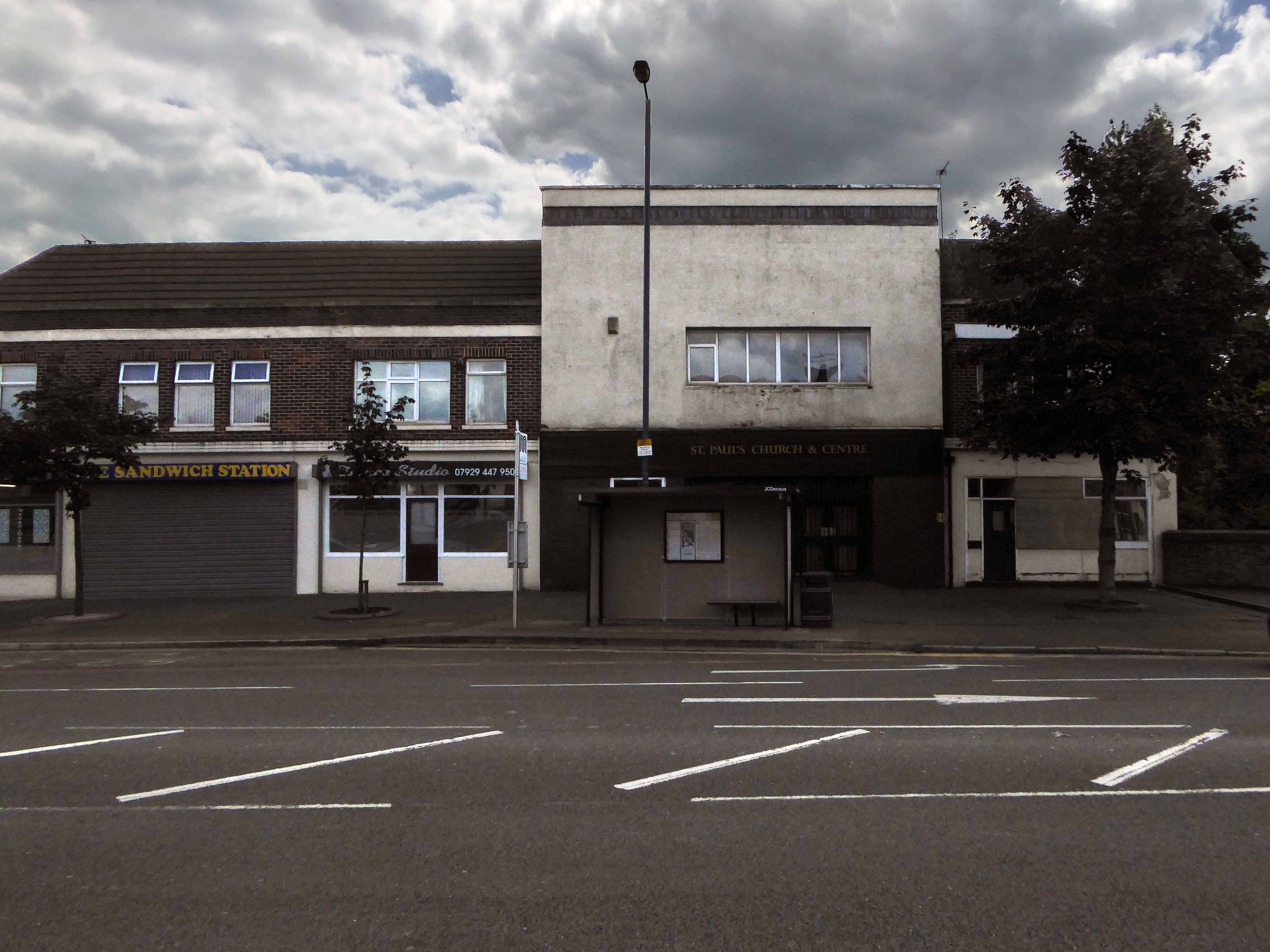
It was converted into St. Paul’s Roman Catholic Church. Former cinemas have made good conversions to churches and the fabric of the buildings are generally respected. In this case though, the sad story is that the front entrance has been rendered over and inside all details of it cinematic past have been erased. You would never know you were inside what had been been an Art Deco styled building.
I passed by nearly every day for years travelling to and from school, I played there at a wedding reception in the church social club. I sadly have no recollection of the building in use as a cinema.
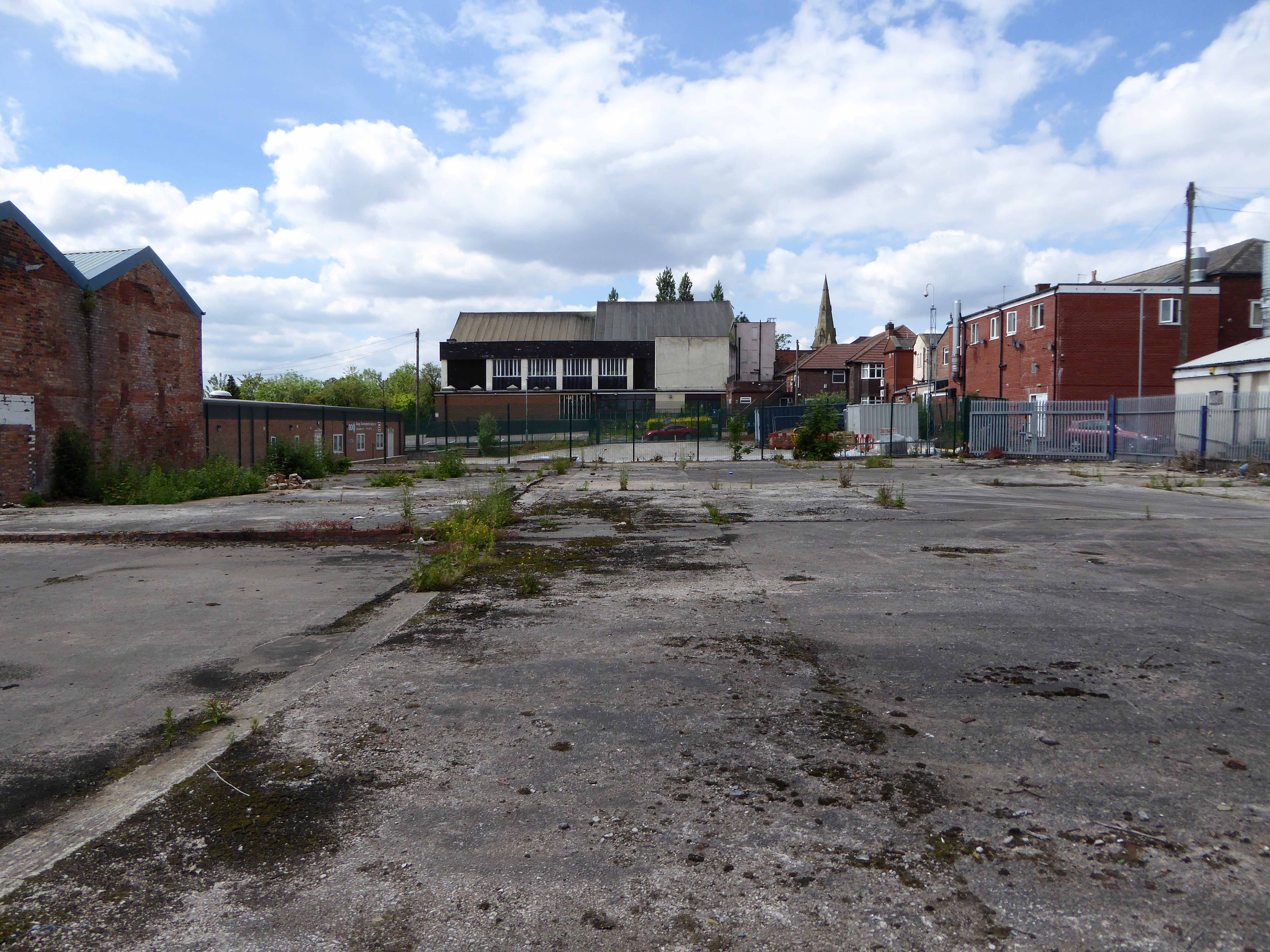
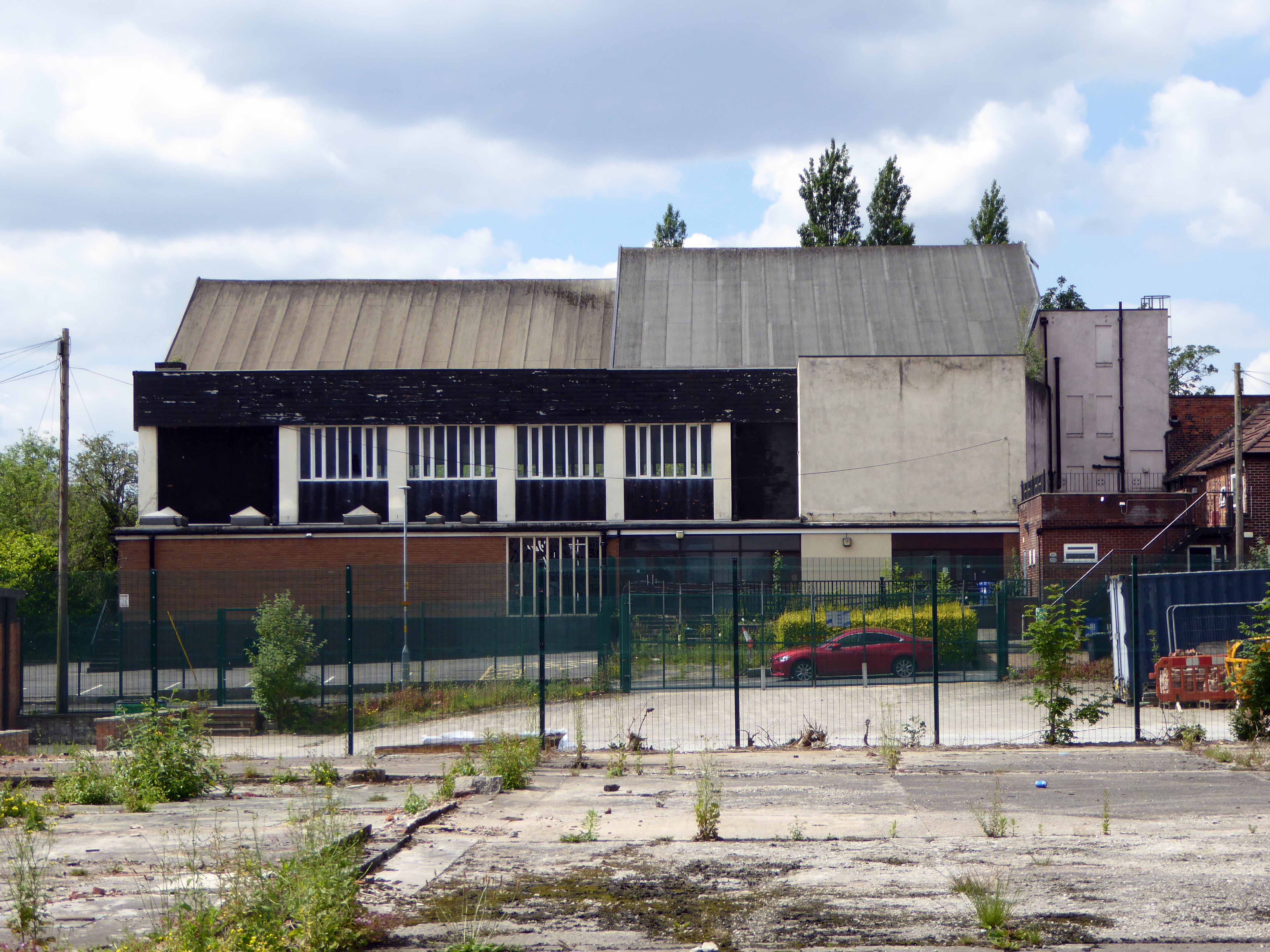
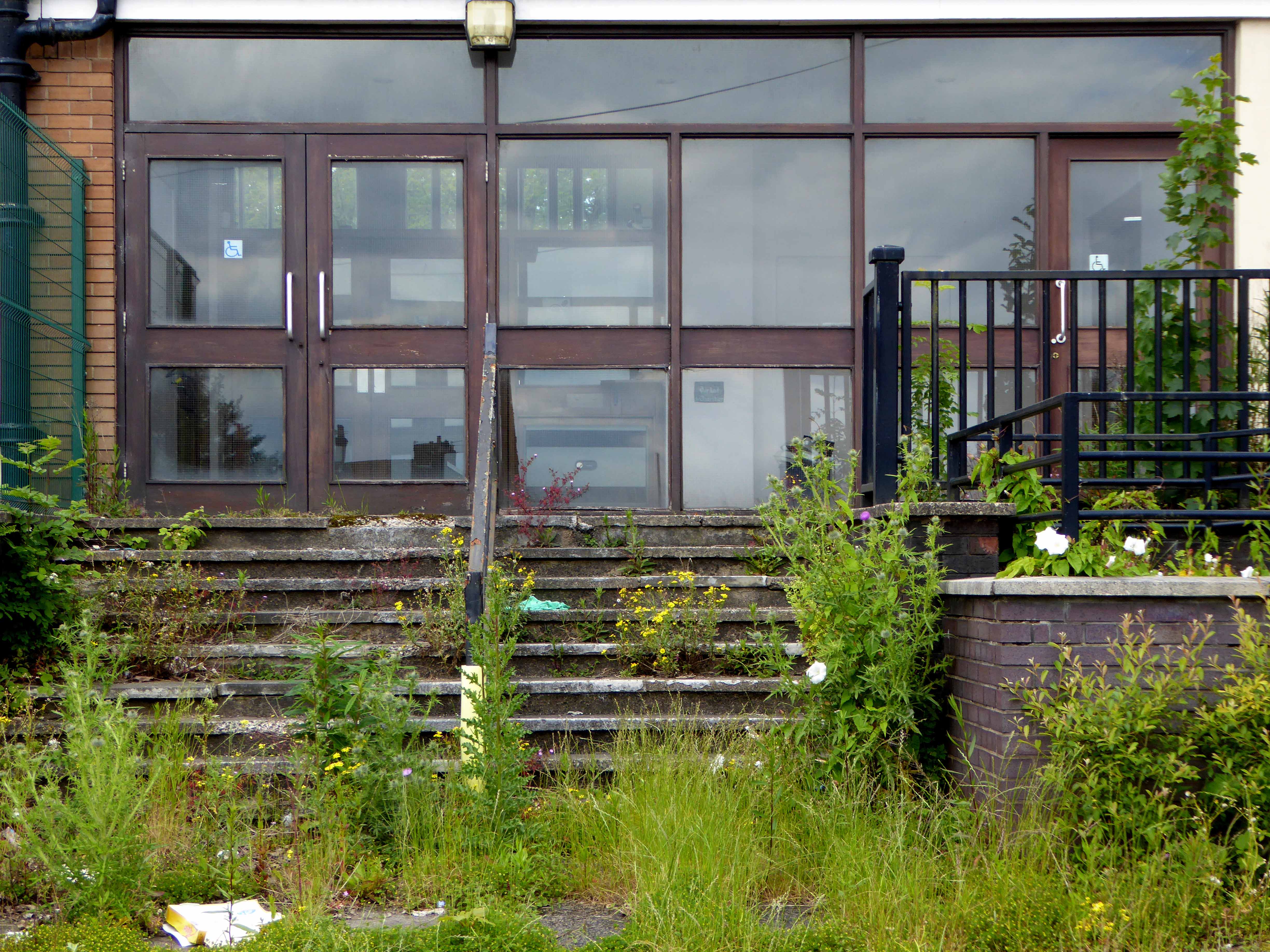
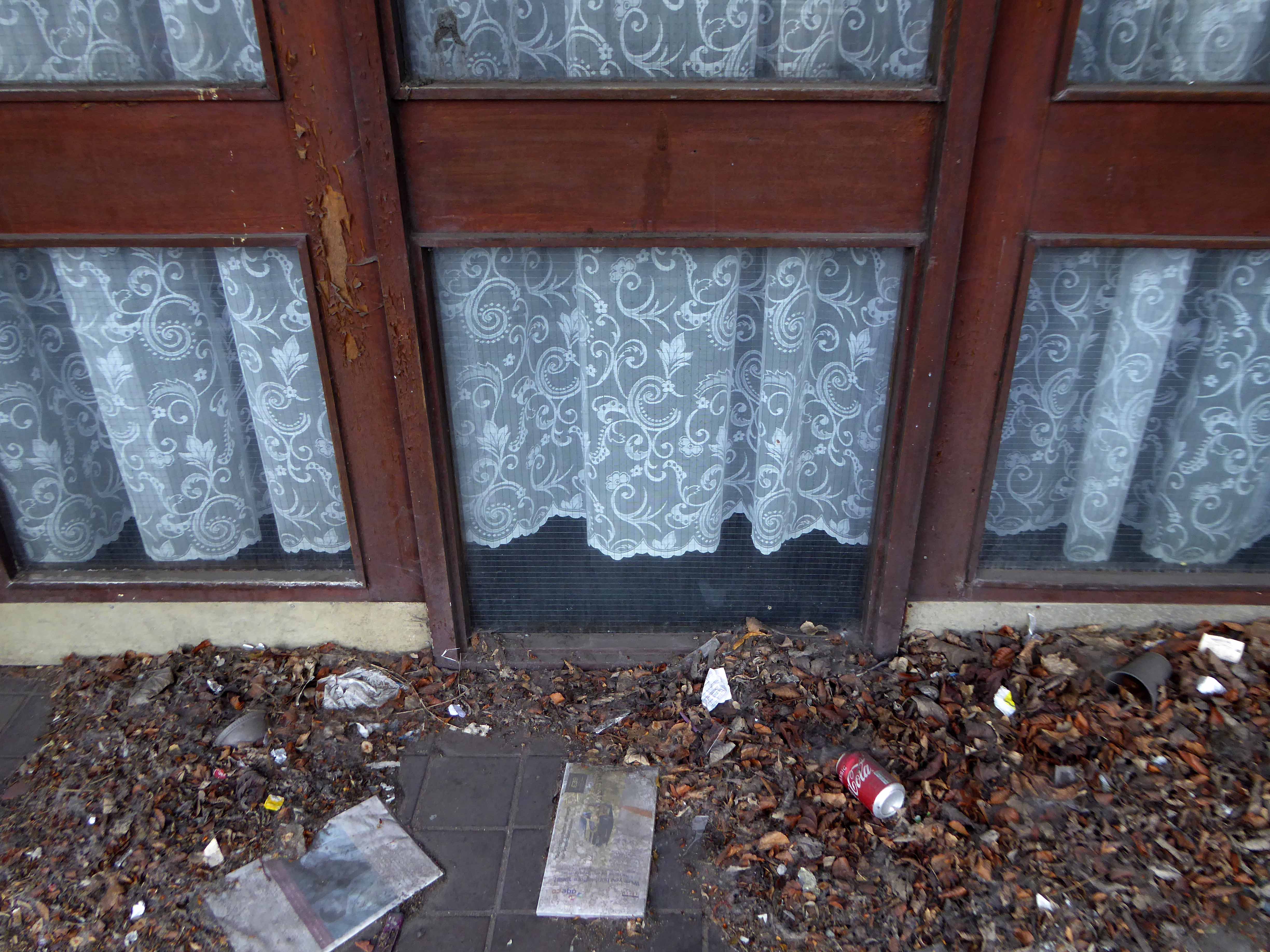
It has been closed since 2010 – currently it has no purpose or seemingly any future use, there are no For Sale signs in evidence.
I popped by to see you yesterday – a truly remarkable structure set amongst the terraced housing of an unremarkable street.
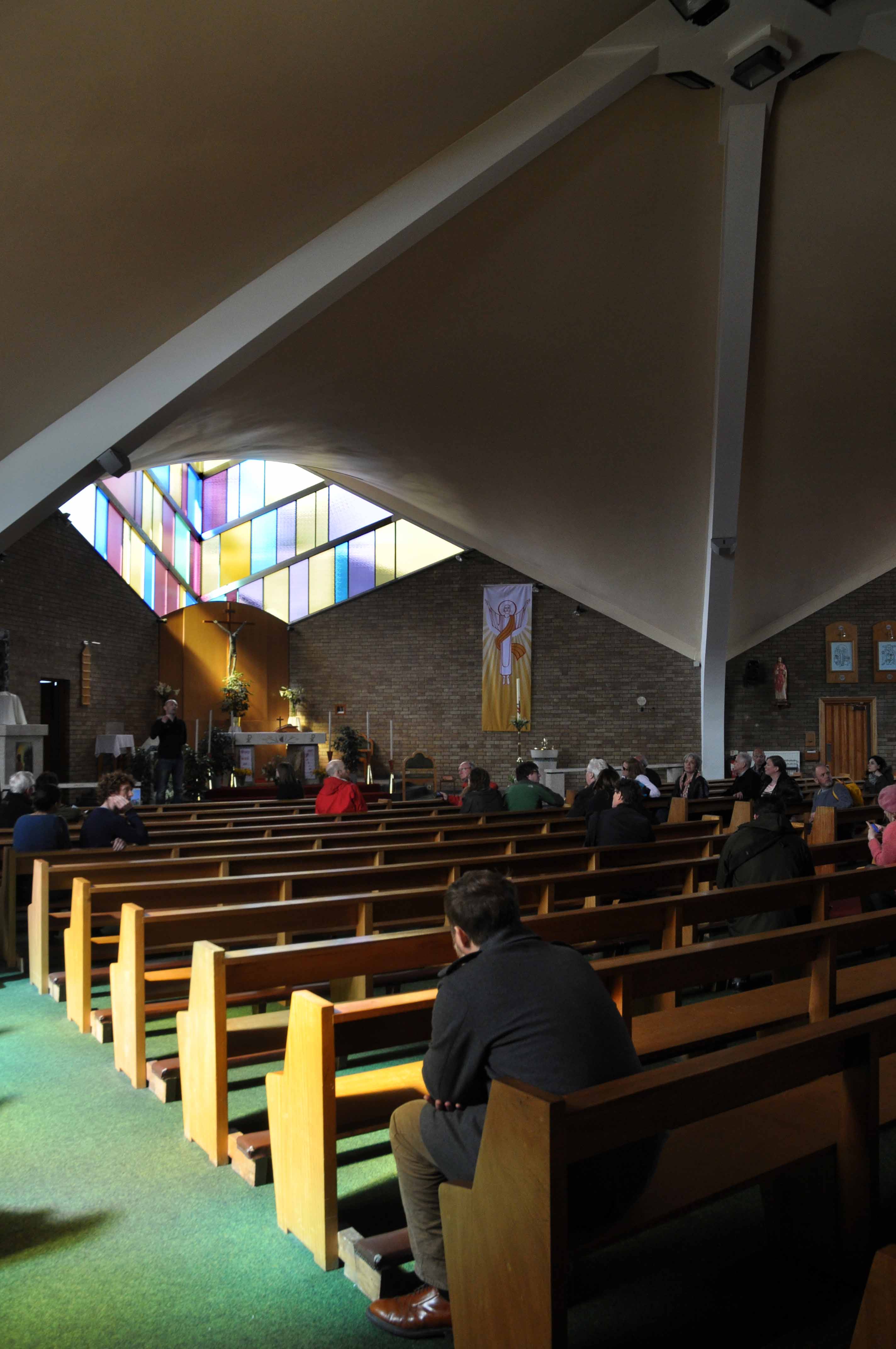
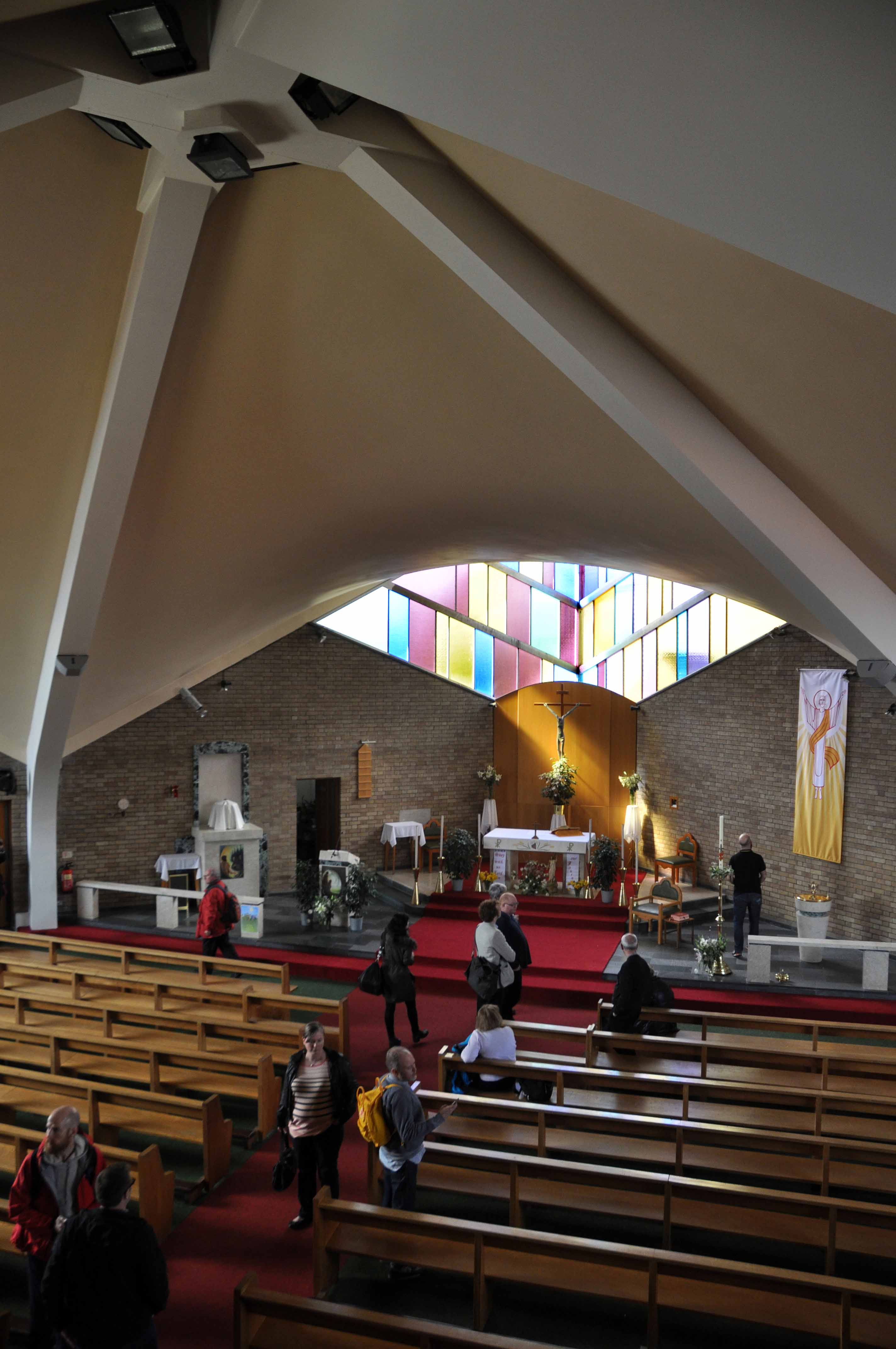
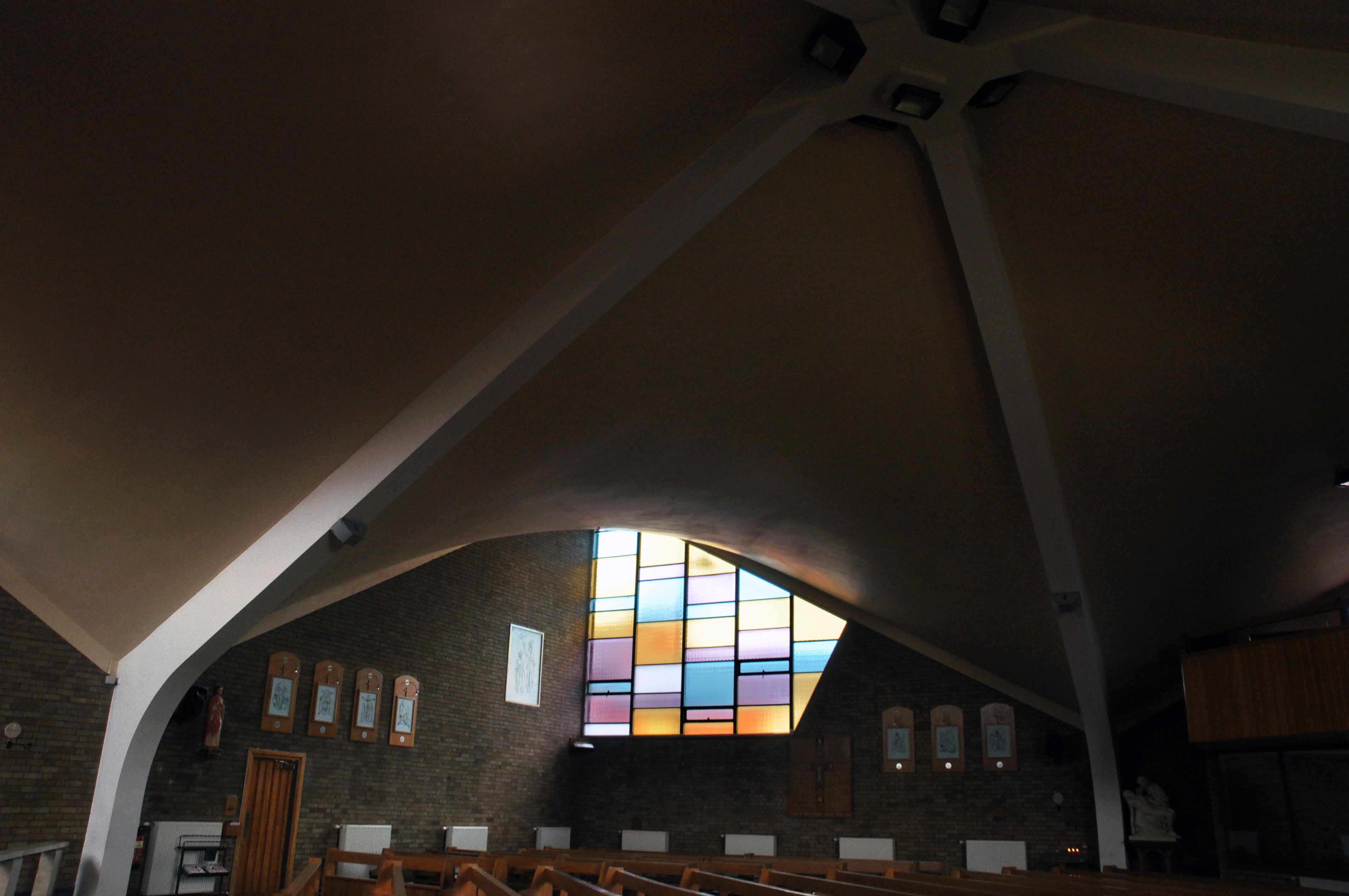
The foundation stone for the present building laid by Bishop Beck in August 1962. He returned to bless and open the church on 25 June 1963. The new church was built from designs by Walter Stirrup & Sons – job architect Kevin Houghton, at a cost of about £60,000. The church is notable for its dalle de verre glass, by Carl Edwards of Whitefriars.
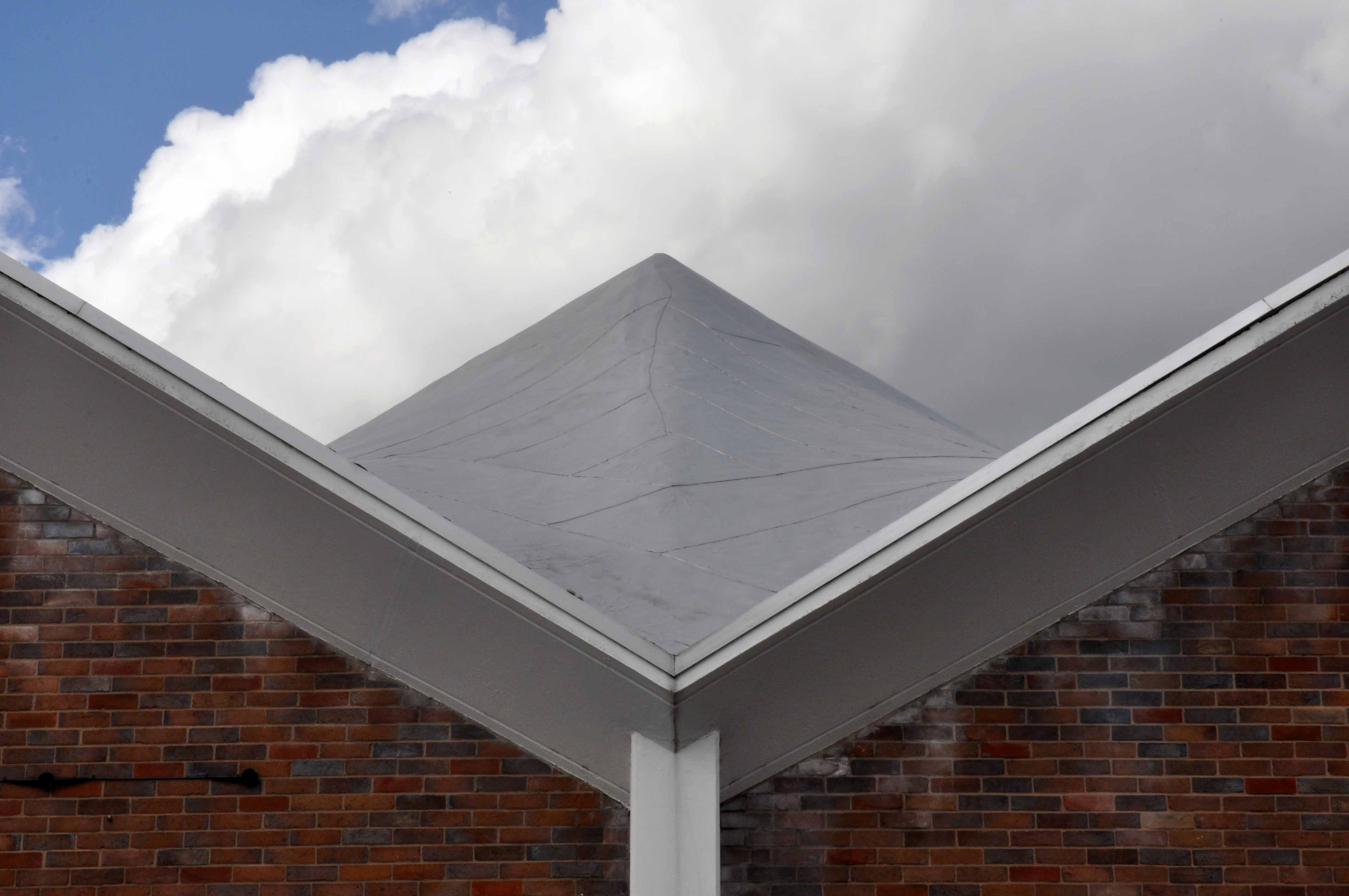
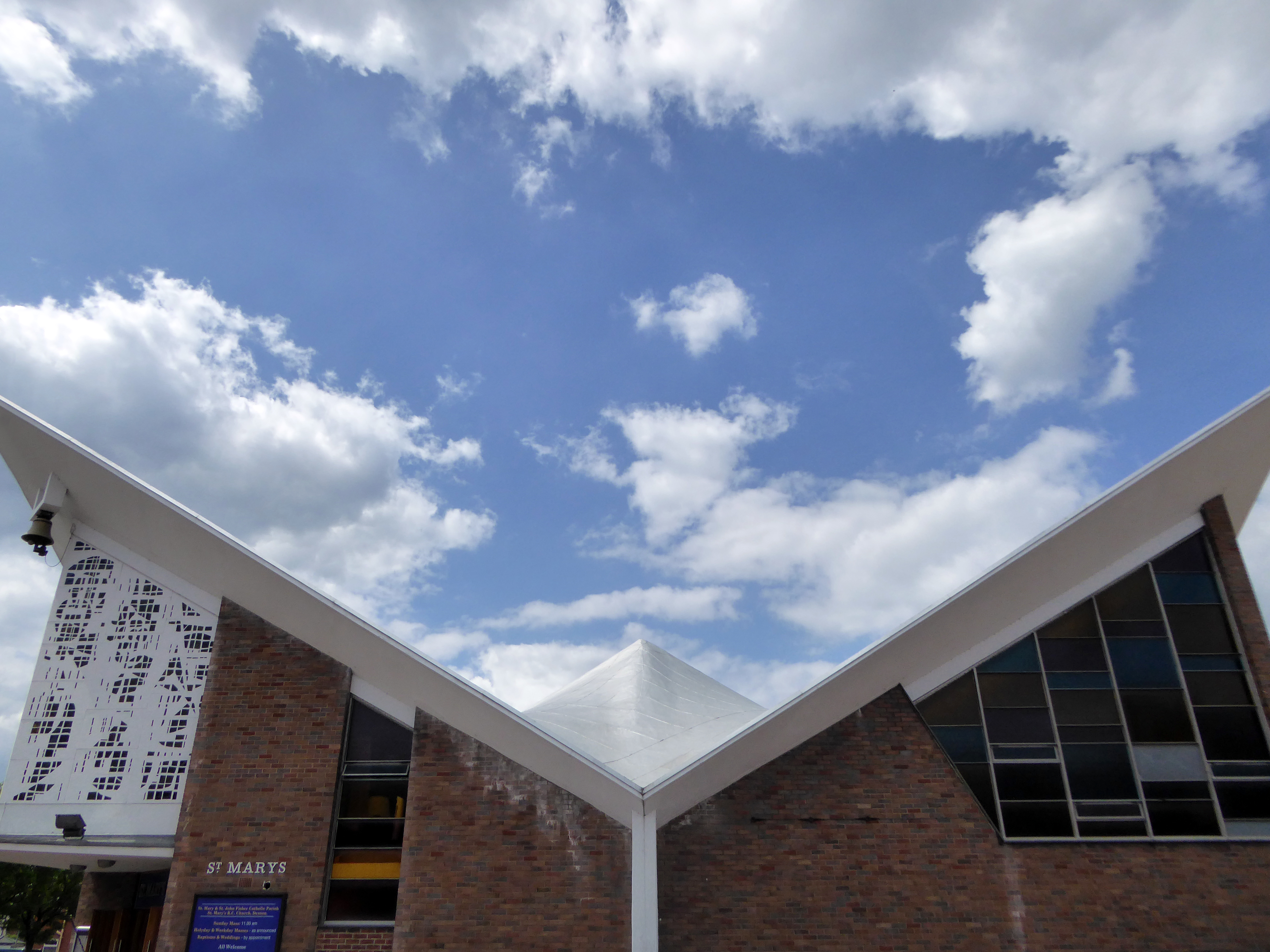
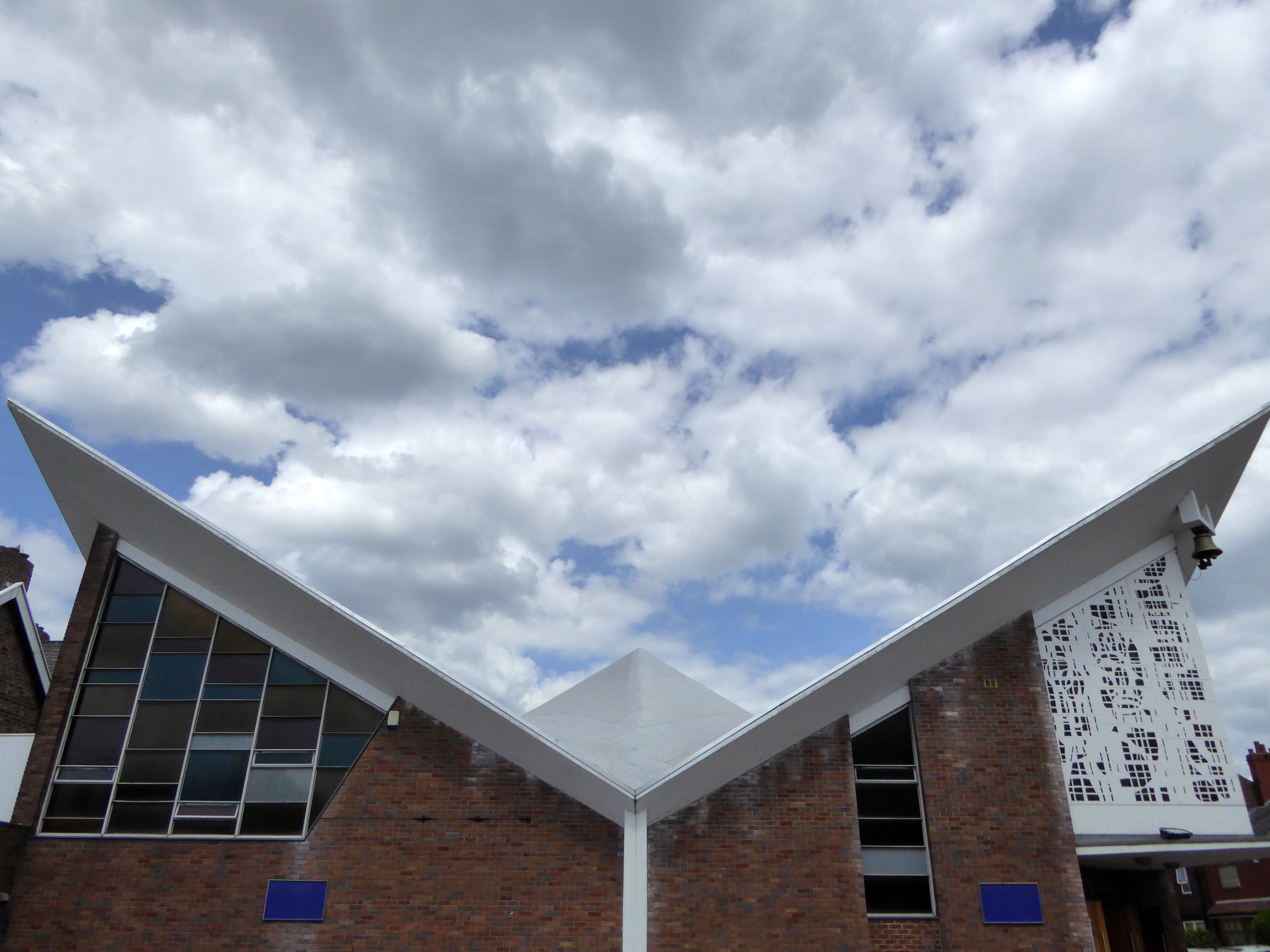
The church is a very striking and characterful building with a hyperbolic paraboloid roof rising in peaks on four sides, with clerestory lighting in the angles, that on the west side jutting out to form a canopy over the entrance. It was described by Nikolaus Pevsner as ‘wildly expressionist’.
Well it’s almost a mighty long way to cycle from Stockport to here, but well worth it.
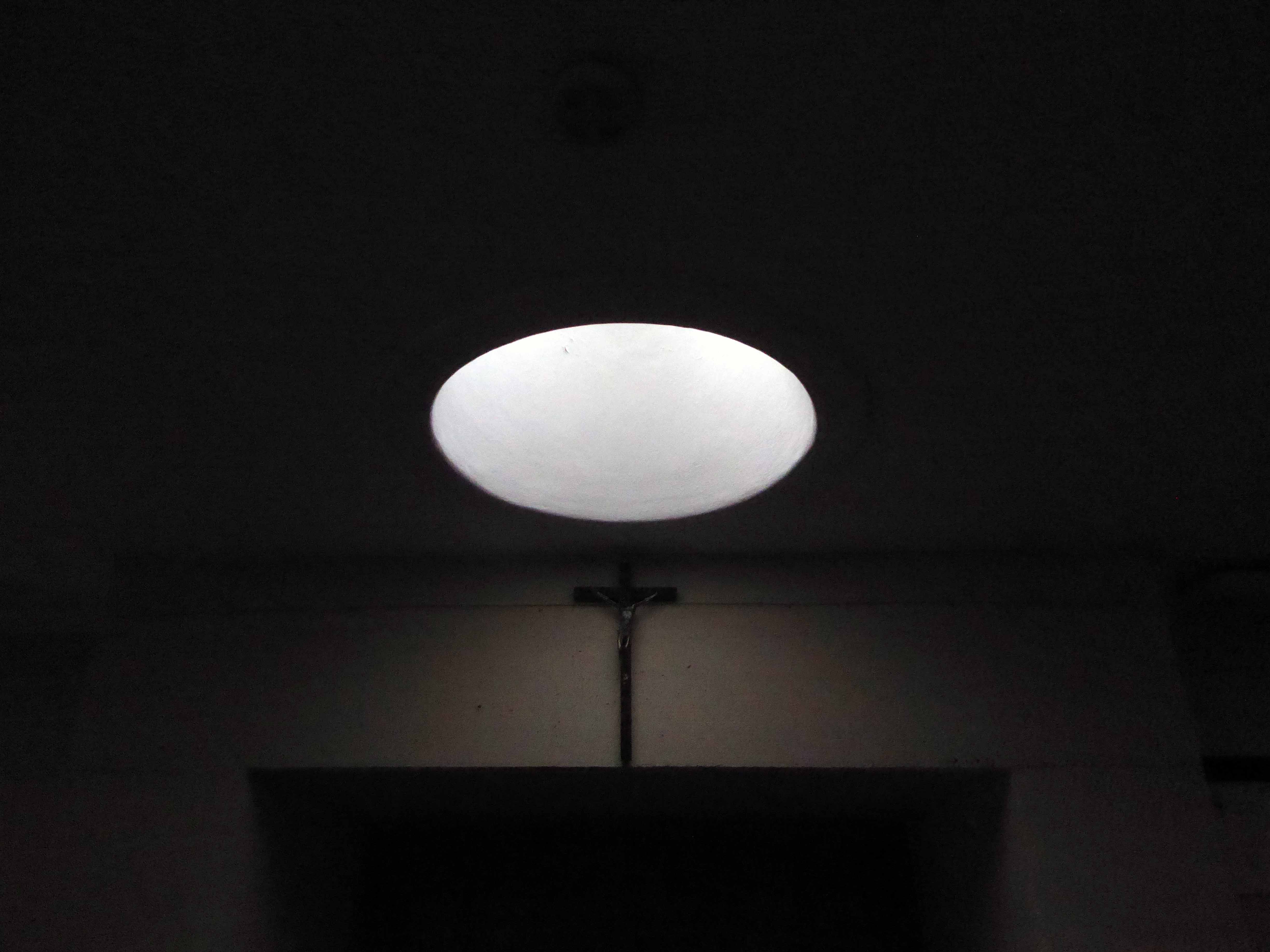
A clear functional design of the 1970s, designed to place all the internal focus on the top-lit altar, which beneath its modern cladding incorporates a pre-Reformation altar stone. The external appearance of the church is slightly forbidding but the interior is enhanced by vibrant slab glass.
More than somewhat bunker like in its recessed situation, well below street level, yet interesting and engaging nonetheless – I’m rather fond of grey.
Working around the comings and goings of the adjacent school, I half circumnavigated the site, capturing something of the detail and exterior views of the stained glass. The interior will have to wait until another day.
Planned and newly constructed housing developments in Norden and Bamford made it apparent that a new church was needed nearer the geographical centre of the parish. In June 1975 the present church of St Vincent de Paul was opened, nearly a mile away from the old church. The architect was Bernard Ashton of the Cassidy & Ashton Partnership, Preston.
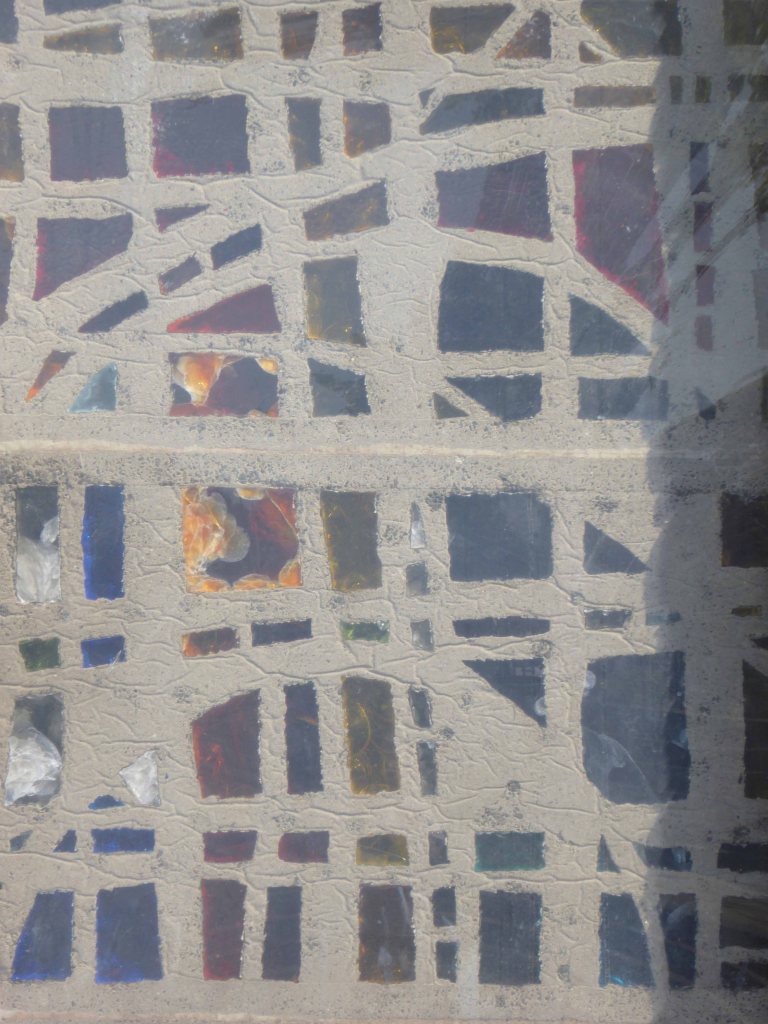
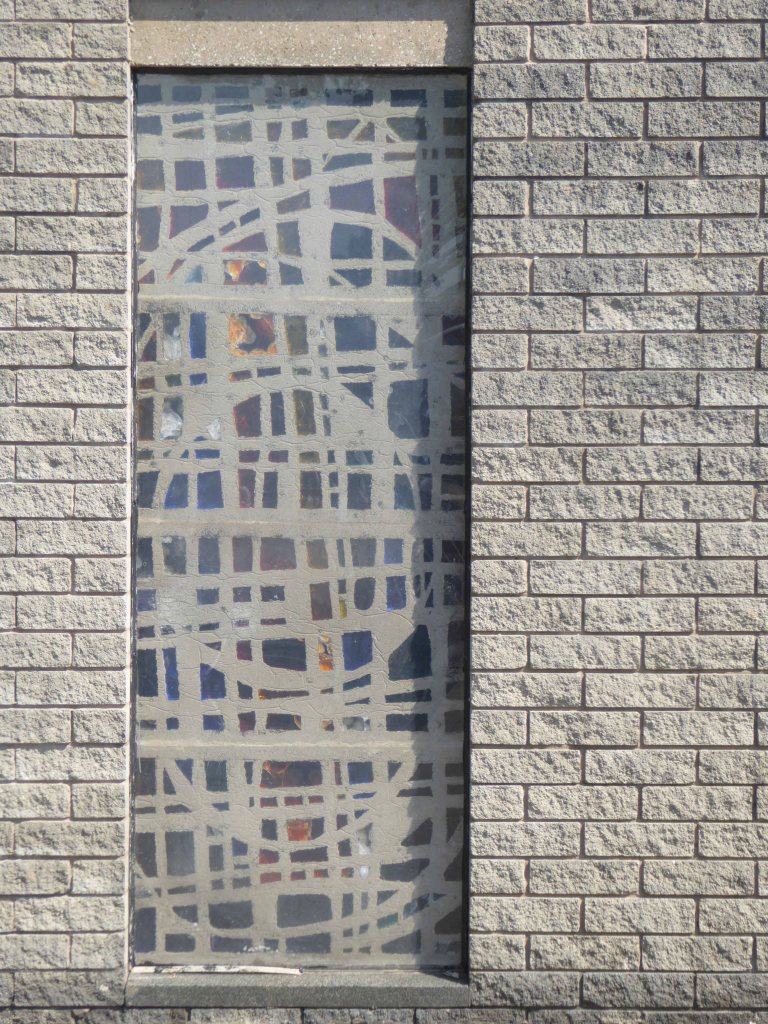
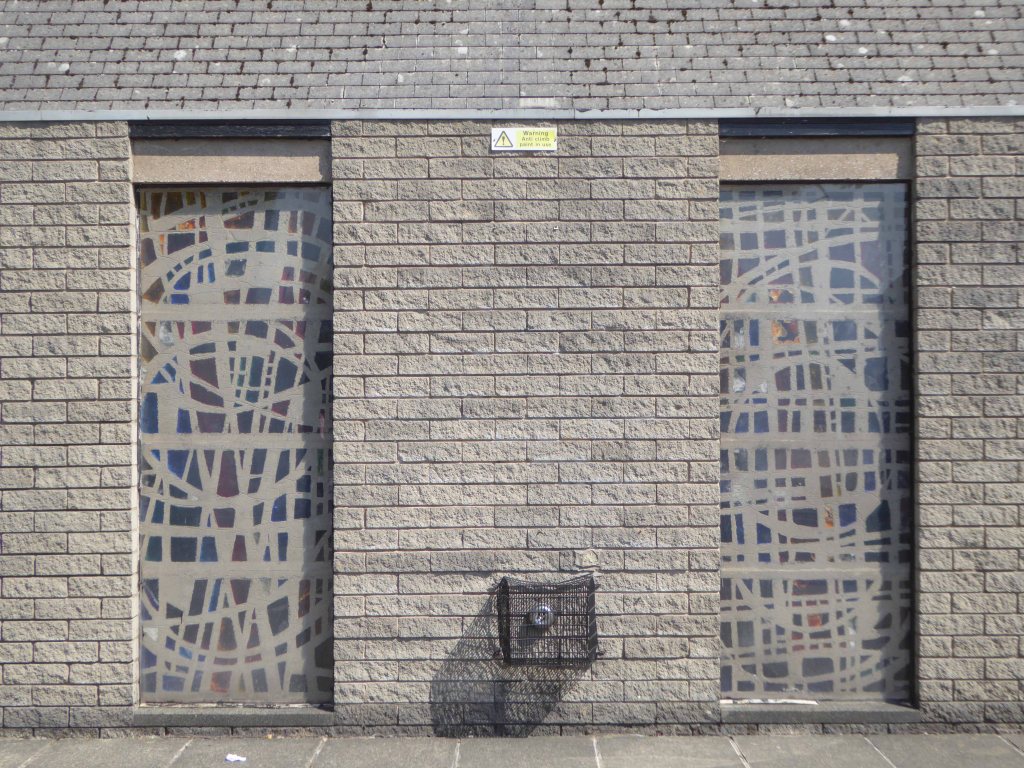
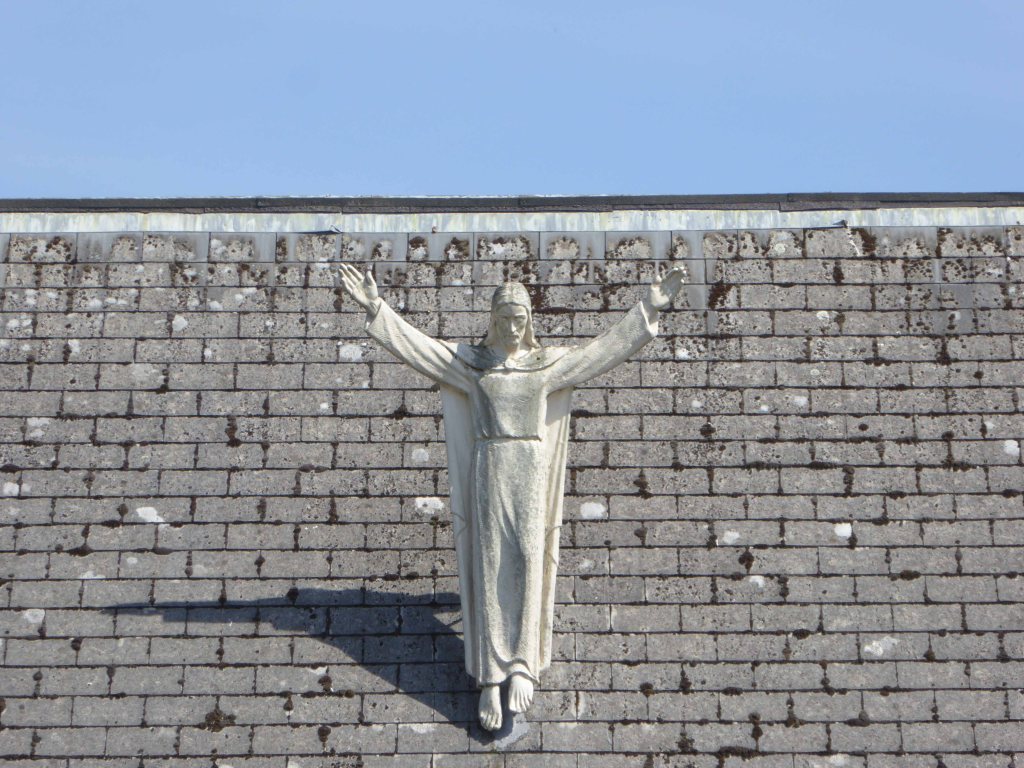
Internally the church is simply fitted with plain white plastered or boarded walls. The low level of daylighting enhances the effect of the four corner windows, which are filled with rainbow glass, and of the top-lit altar. The dalle de verre glass was designed by Eddie Blackwell and made in Dom. Charles Norris’s workshop at Buckfast Abbey. The figure of the risen Christ on the roof over the entrance porch were also designed by Blackwell.
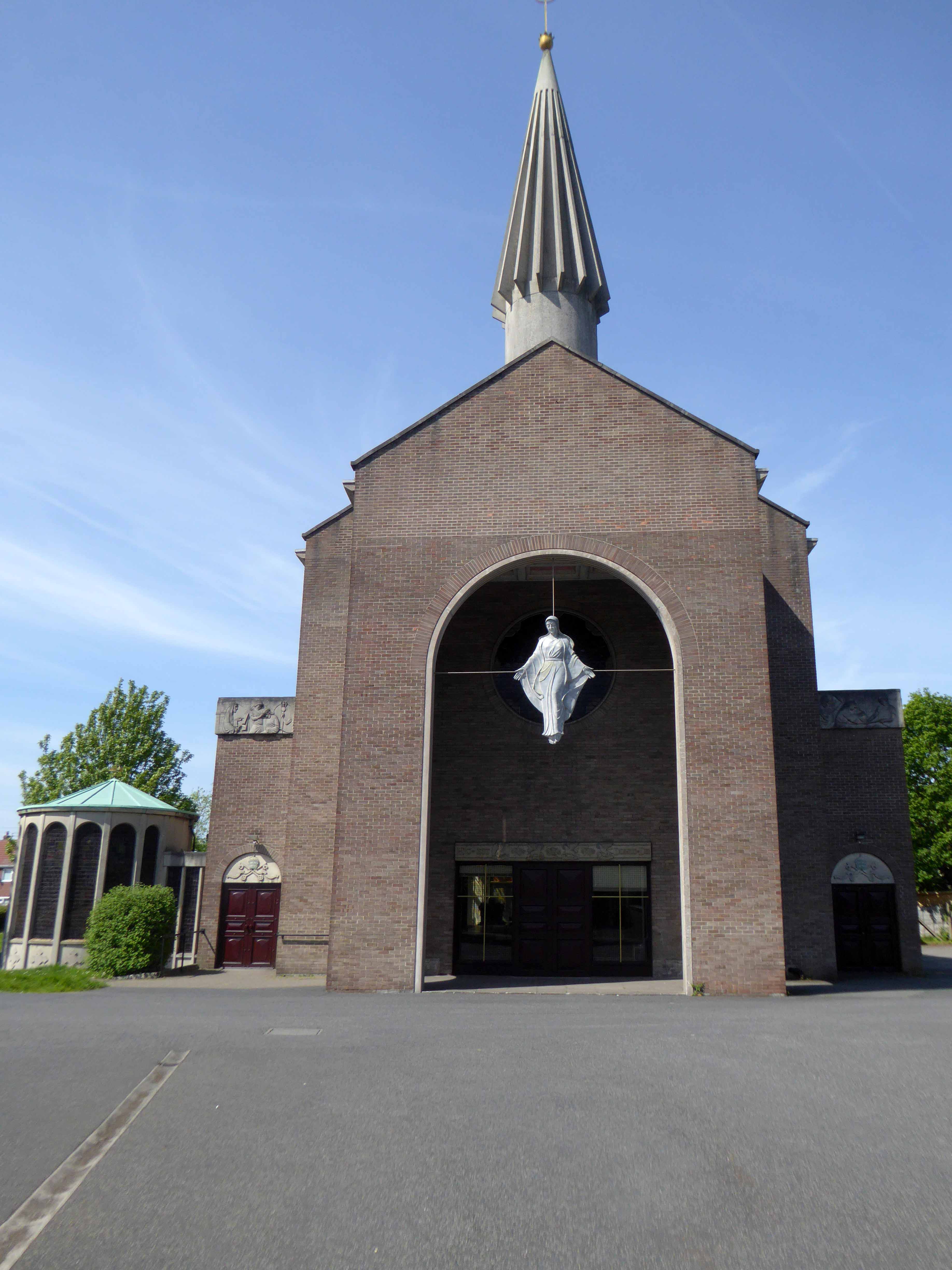
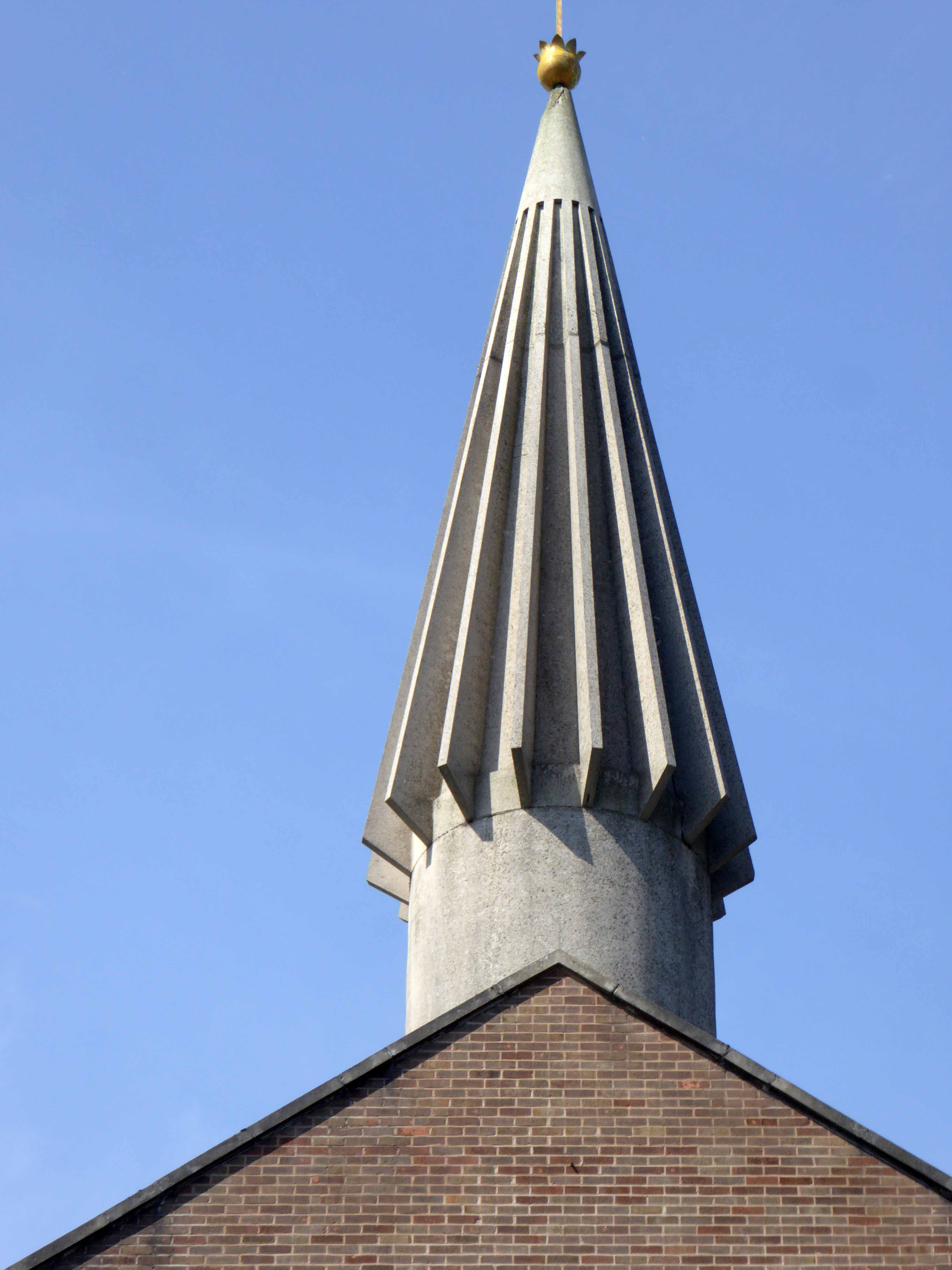
A church of the early 1960s, built before the Second Vatican Council on a traditional basilican plan. The design is striking and unusual, with an interesting combination of Gothic, classical and modern architectural motifs. The architect, Tadeusz Lesisz of Greenhalgh & Williams, is a little known figure but a designer of some interest. The church exhibits a scheme of sculpture, stained glass and mosaic on Marian themes, mainly by local designers, and retains almost all of the original furnishings and fittings in little altered state. It also retains furnishings from the late-nineteenth-century predecessor church.
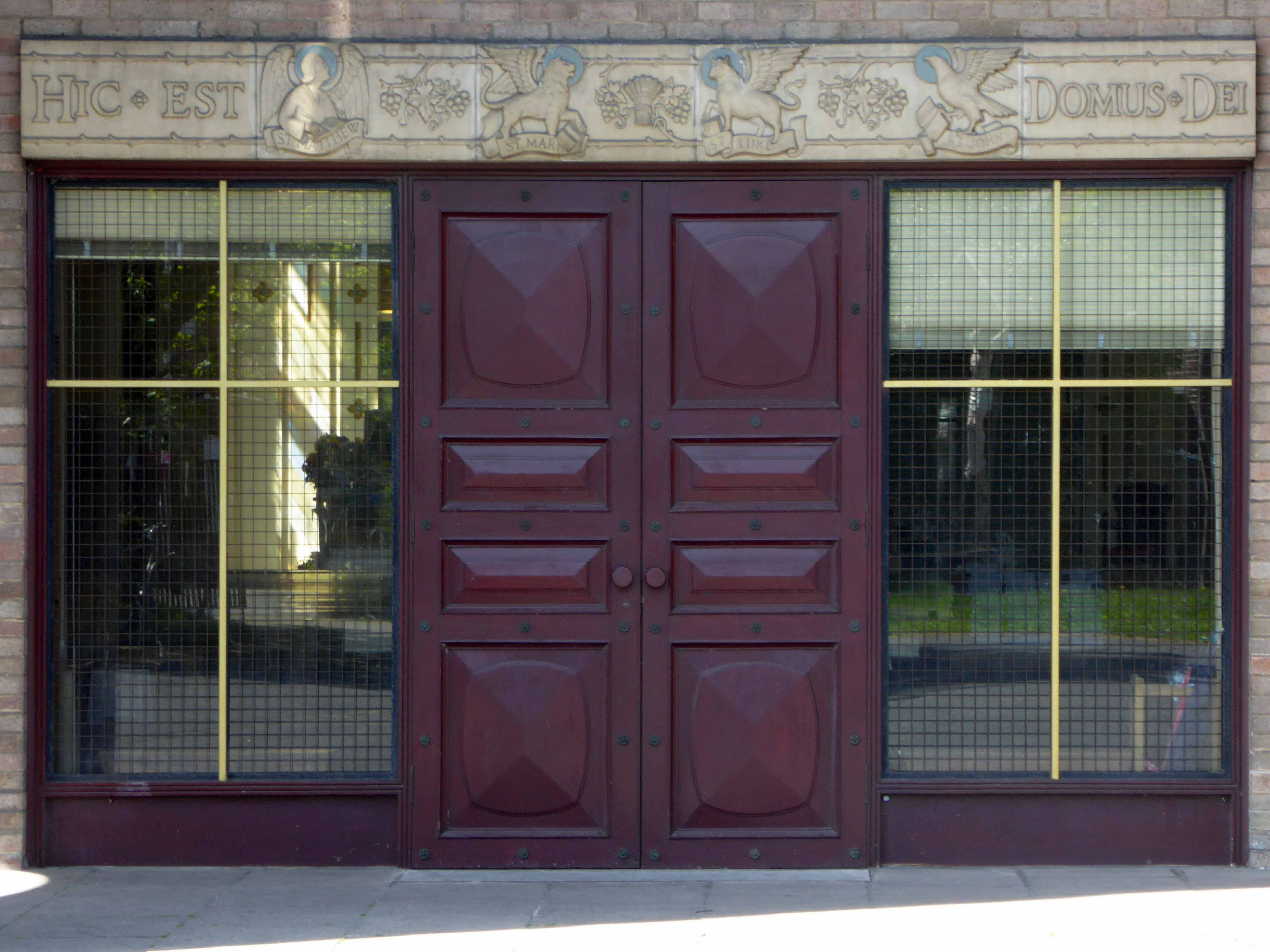
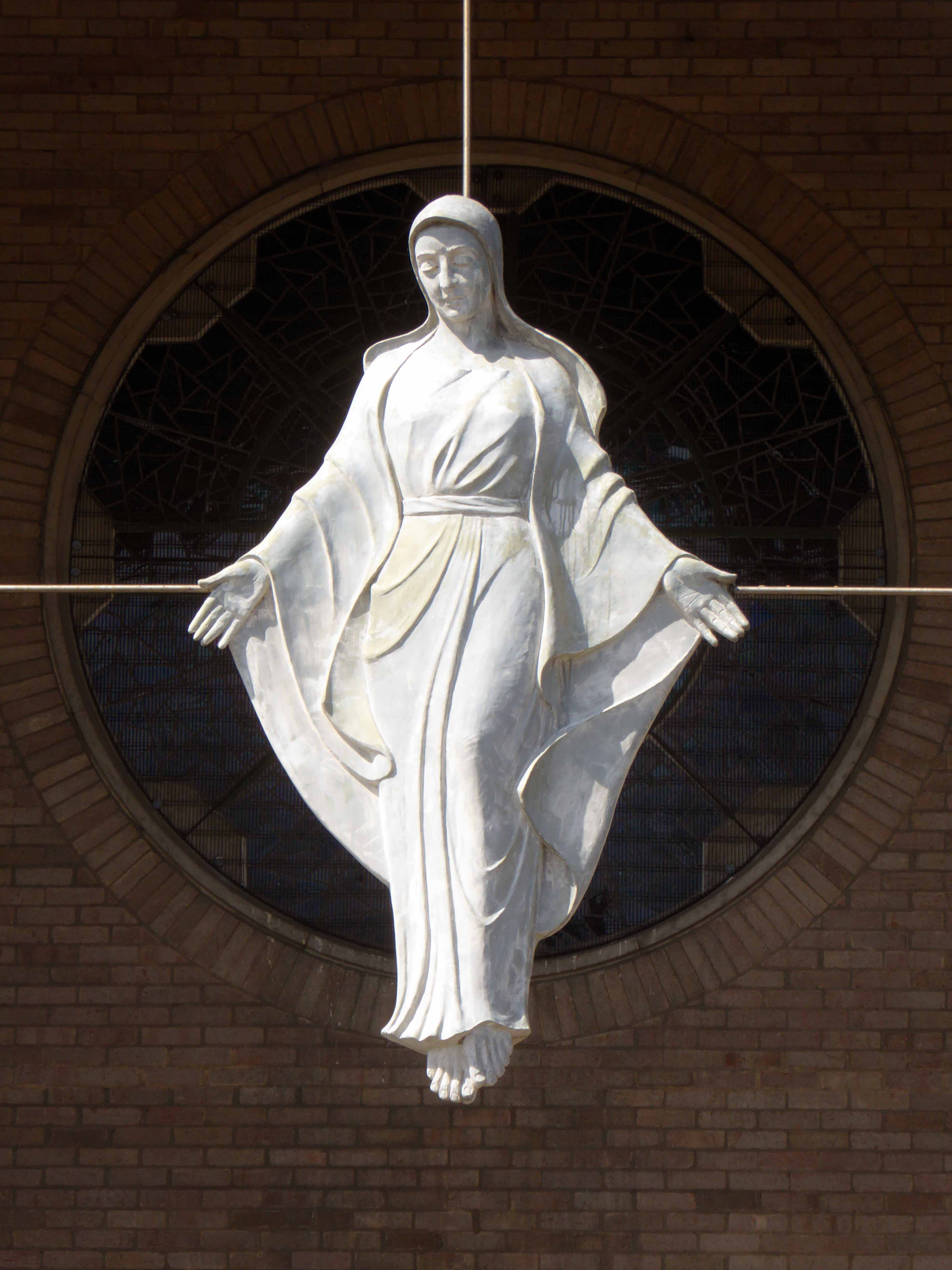
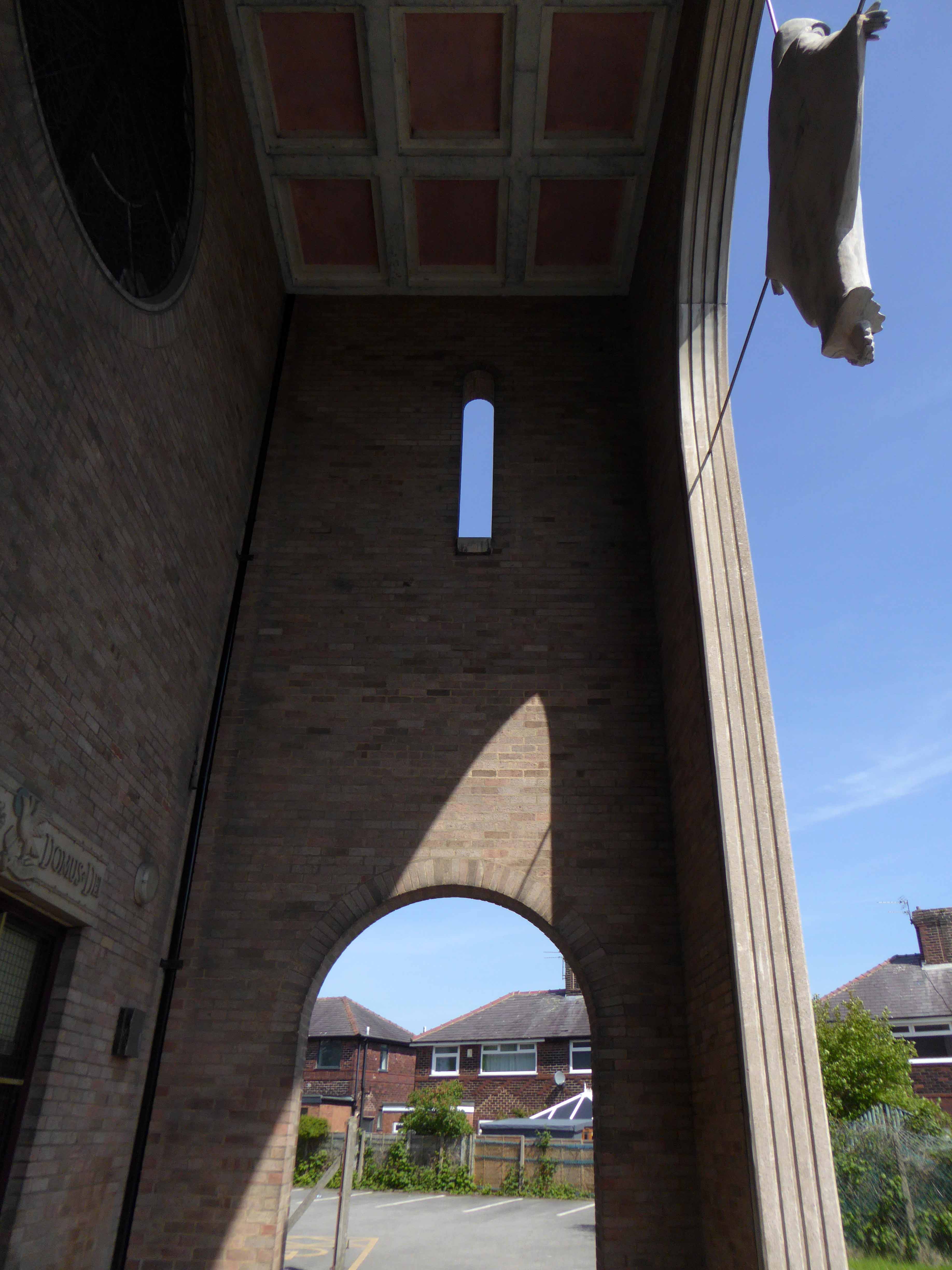
The west front is very striking, the broad entrance arch enclosing a suspended aluminium figure of the Virgin by E.J. Blackwell of Manchester, who also executed the moulded artificial stone friezes.
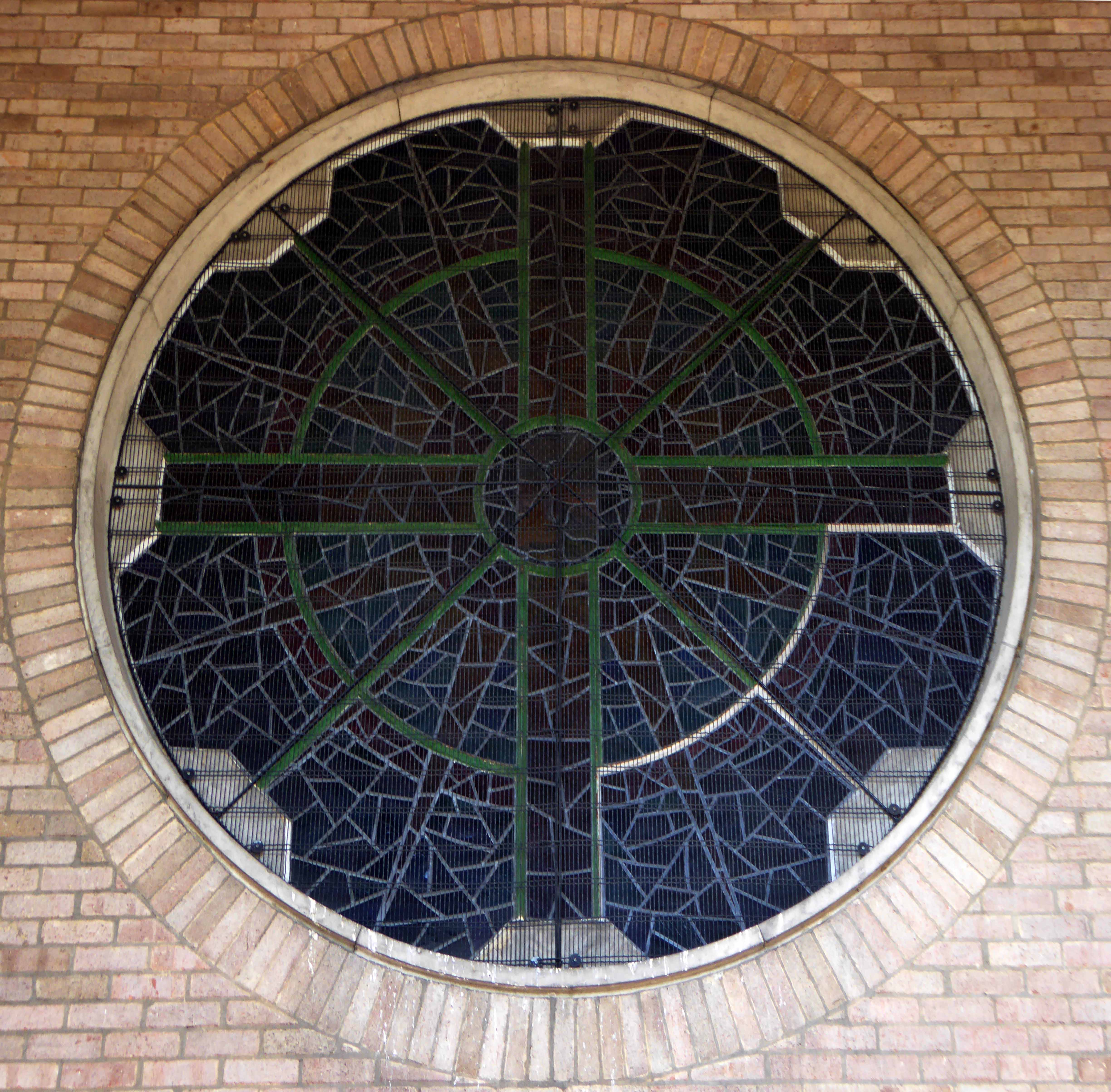
The stained glass is by Charles Lightfoot, much of it to the designs of the architect, some incorporating glass from the previous church.
It never fails to surprise, turning the corner of a somewhat anonymous suburban street to find:
A building of outstanding importance for its architectural design, advanced liturgical planning and artistic quality of the fixtures and fittings.
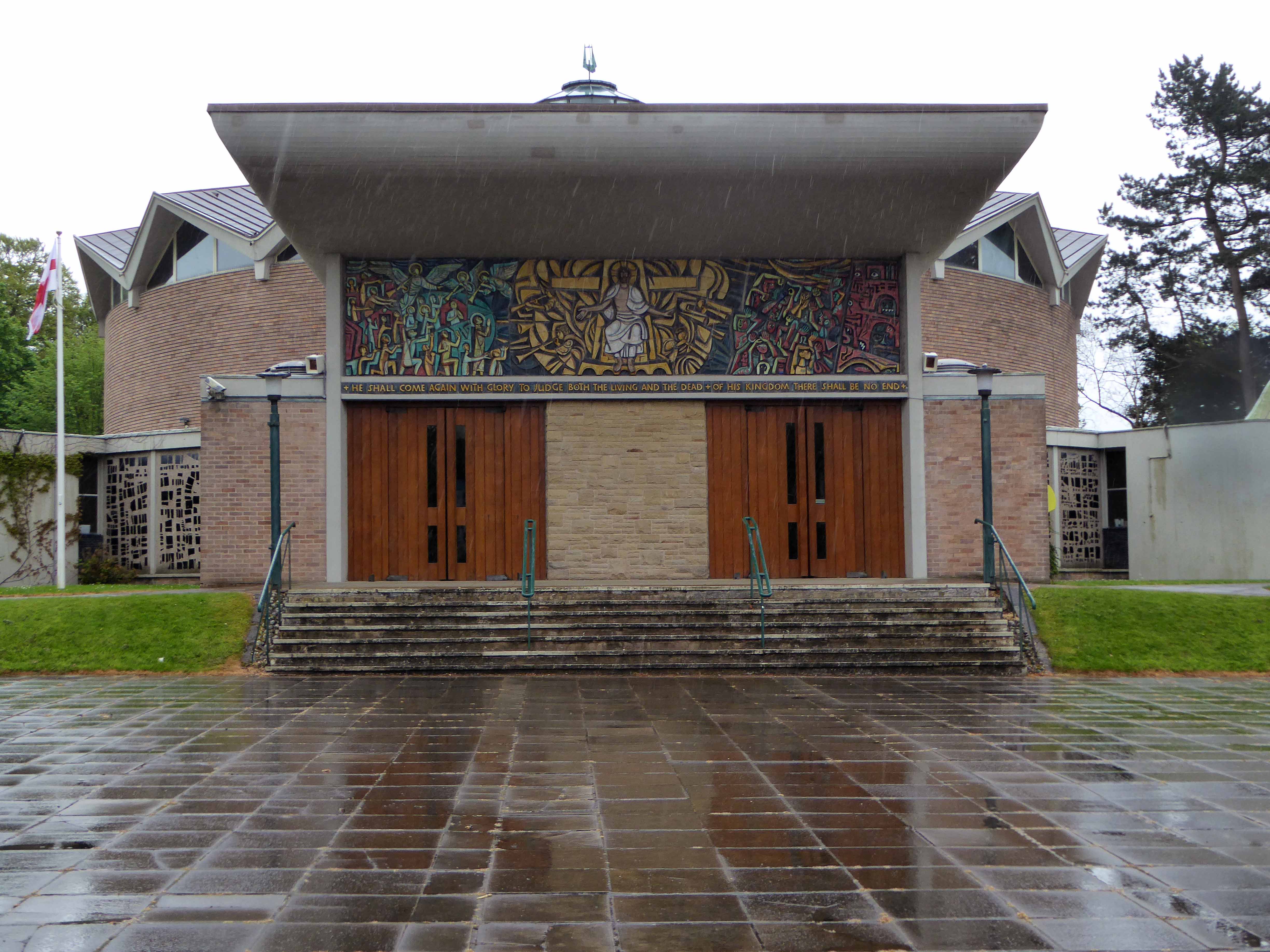
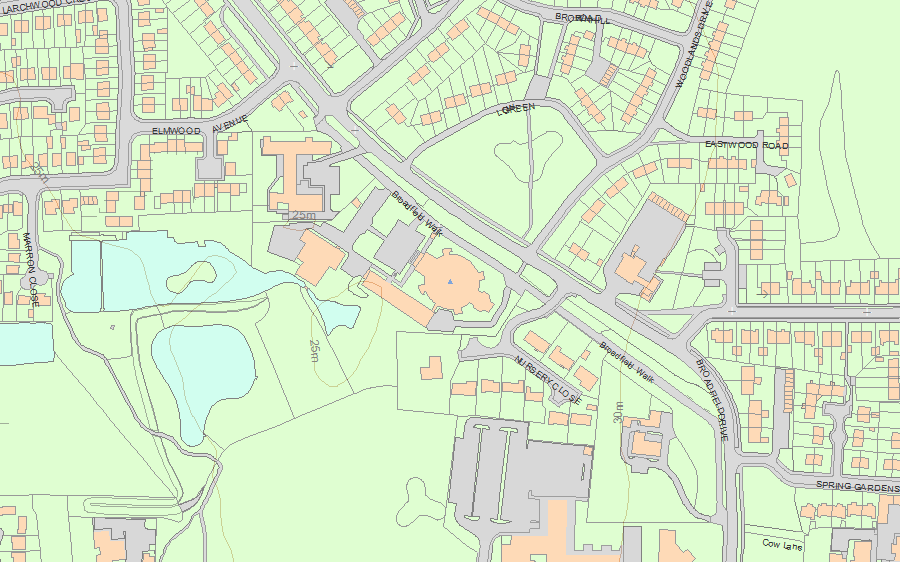
Broadfield Drive Leyland Lancashire PR25 1PD
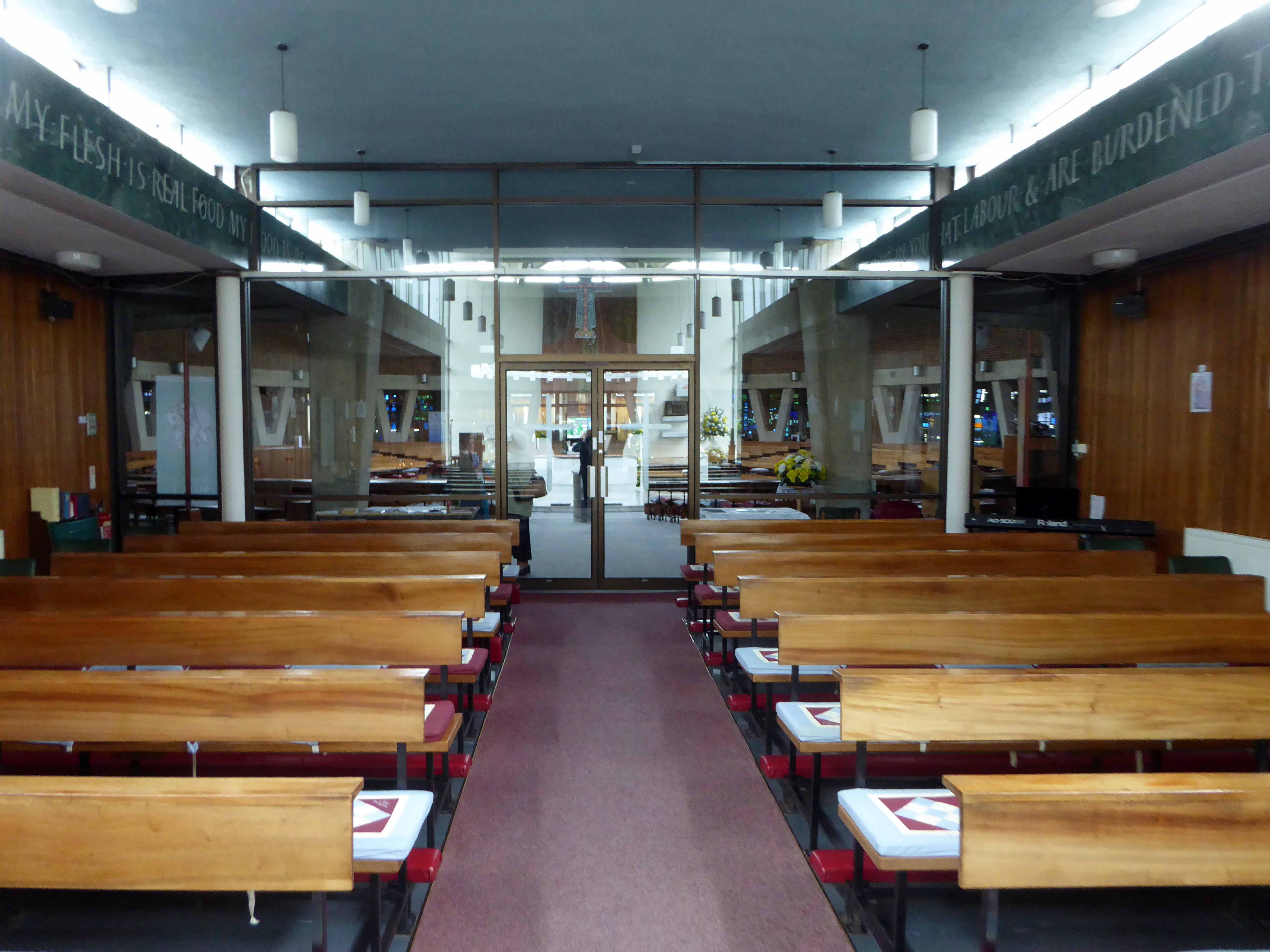
The Benedictines came to Leyland in 1845 and the first Church of St. Mary’s was built on Worden Lane in 1854. The Catholic population was small at this time, but had grown to around 500 by 1900. Growth was assisted by the industrial development of Leyland and after the Second World War the town was earmarked as the centre of a new town planned in central Lancashire. By the early 1960’s, the Catholic population was 5,000. Fr Edmund Fitzsimmons, parish priest from 1952, was a guiding force in the decision to build a large new church of advanced liturgical design, inspired by progressive continental church architecture of the mid 20th century. The church was designed by Jerzy Faczynski of Weightman and Bullen. Cardinal Heenan blessed the foundation stone in 1962 and the new church was completed ready for its consecration and dedication by Archbishop Beck in April 1964.
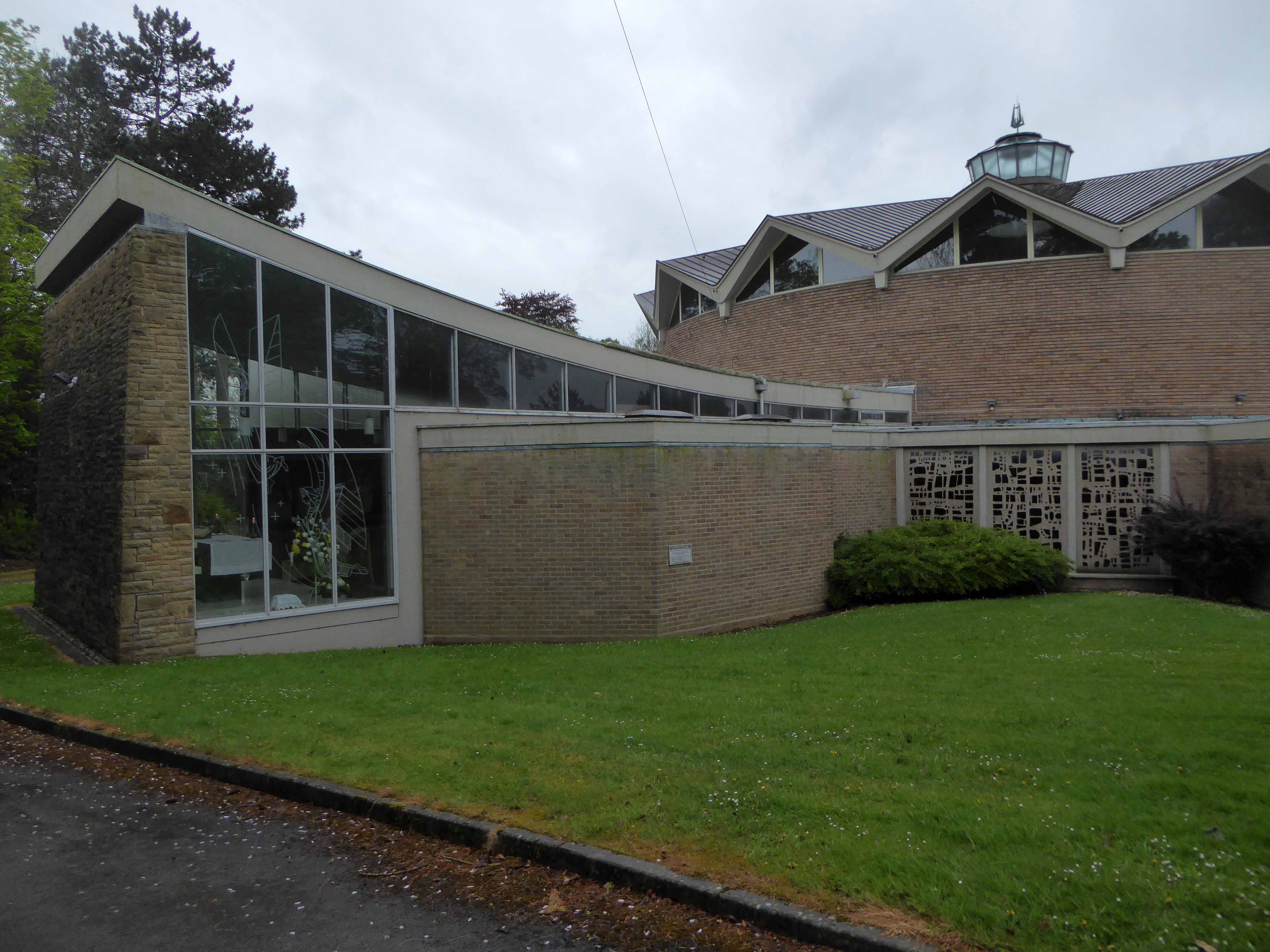
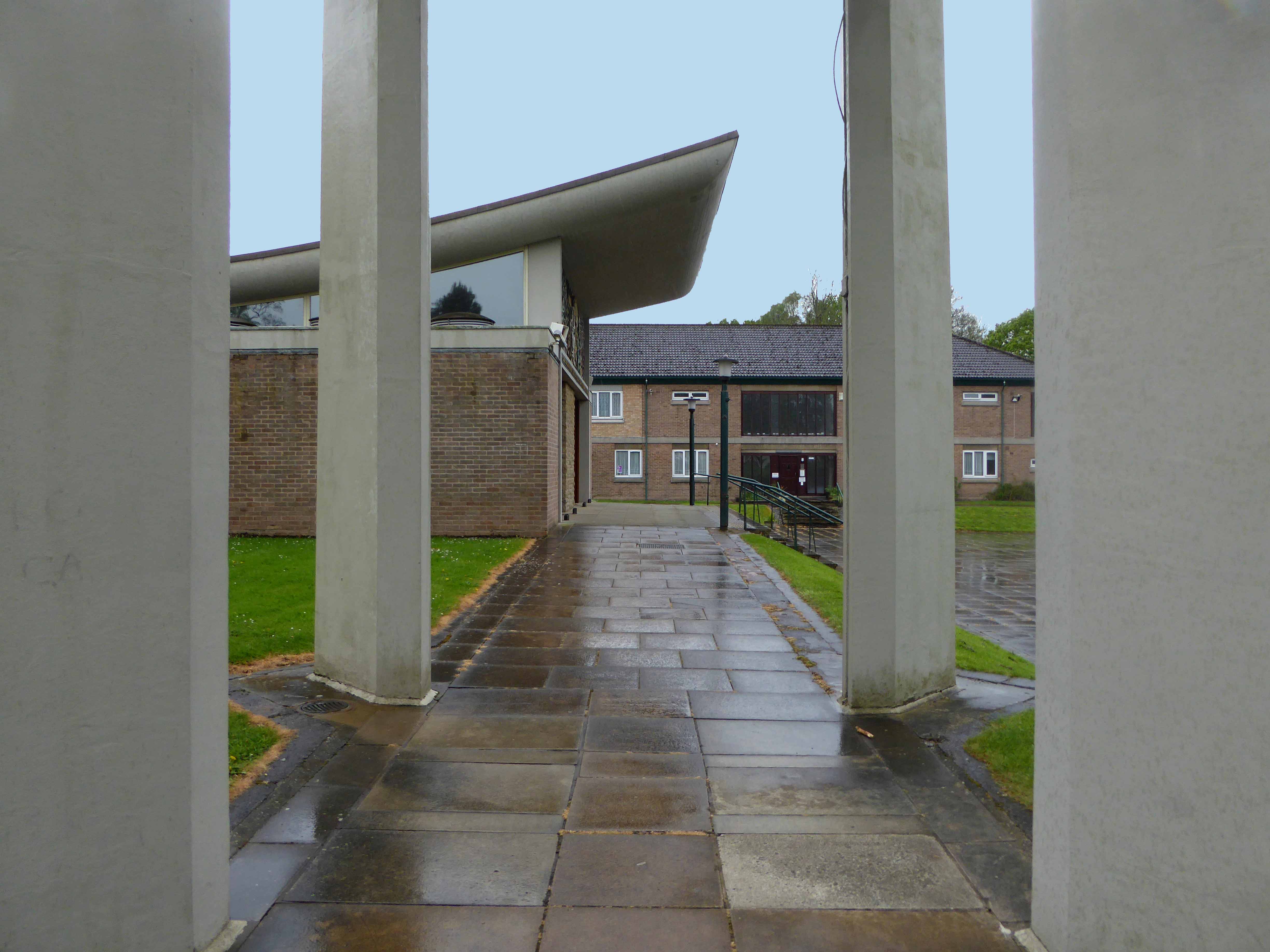
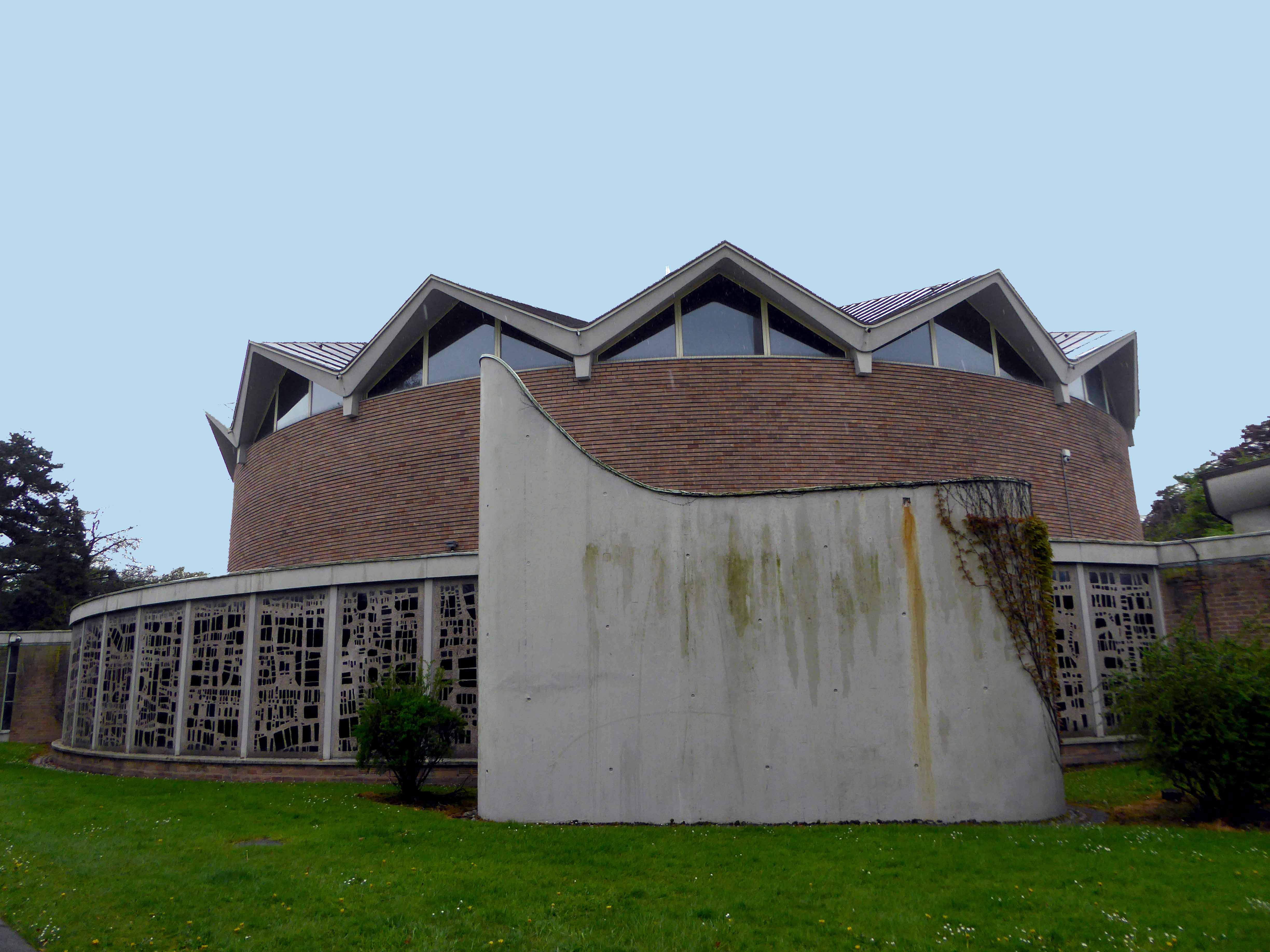
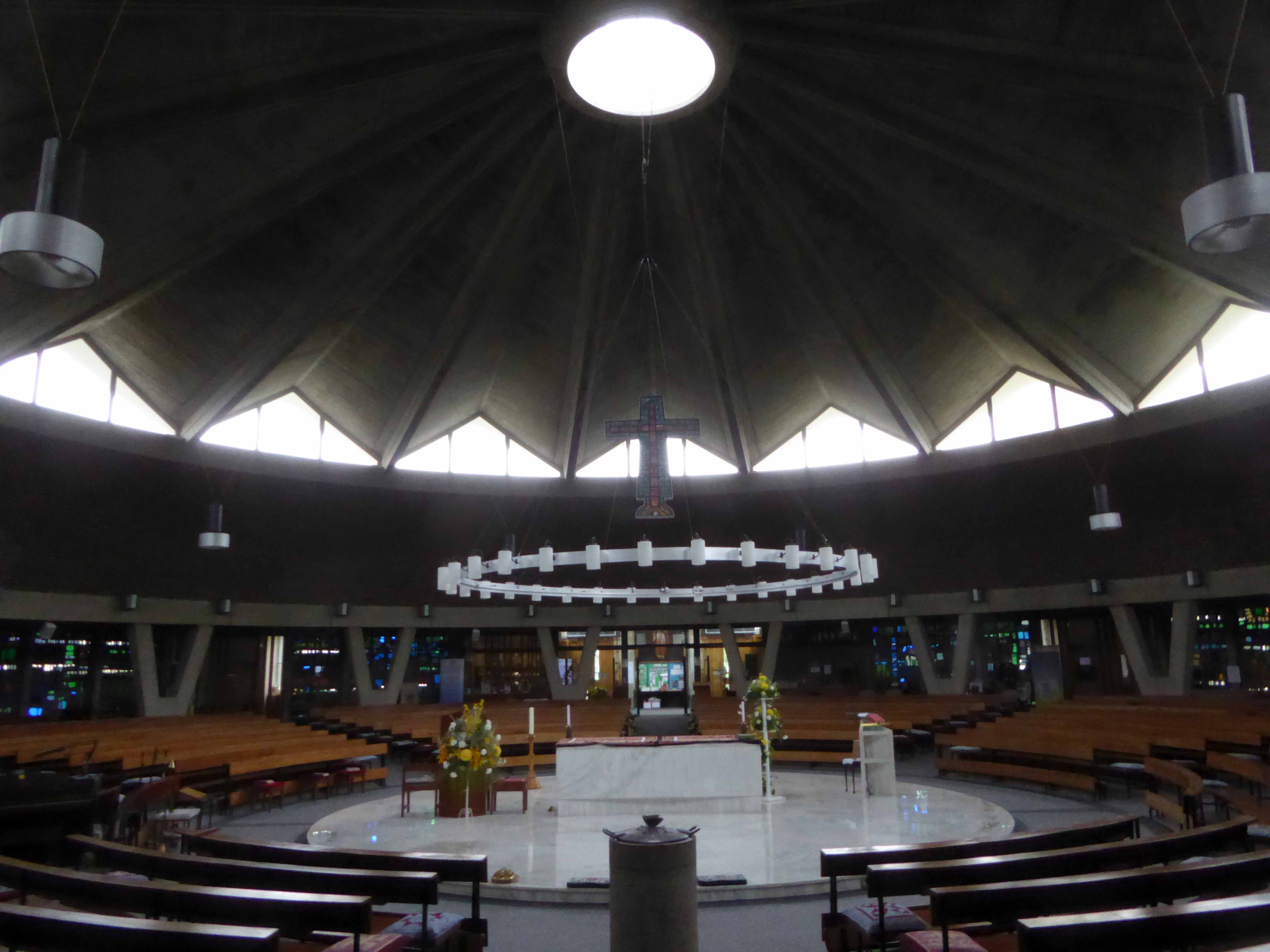
Pink brick, reinforced concrete, copper covered roofs, zig-zag to main space and flat to aisle. Circular, aisled plan with projecting entrance and five projecting chapels.
Central altar. Entrance in large projecting porch with roof rising outwards and the roof slab cantilevered above the doors, its underside curving upward.
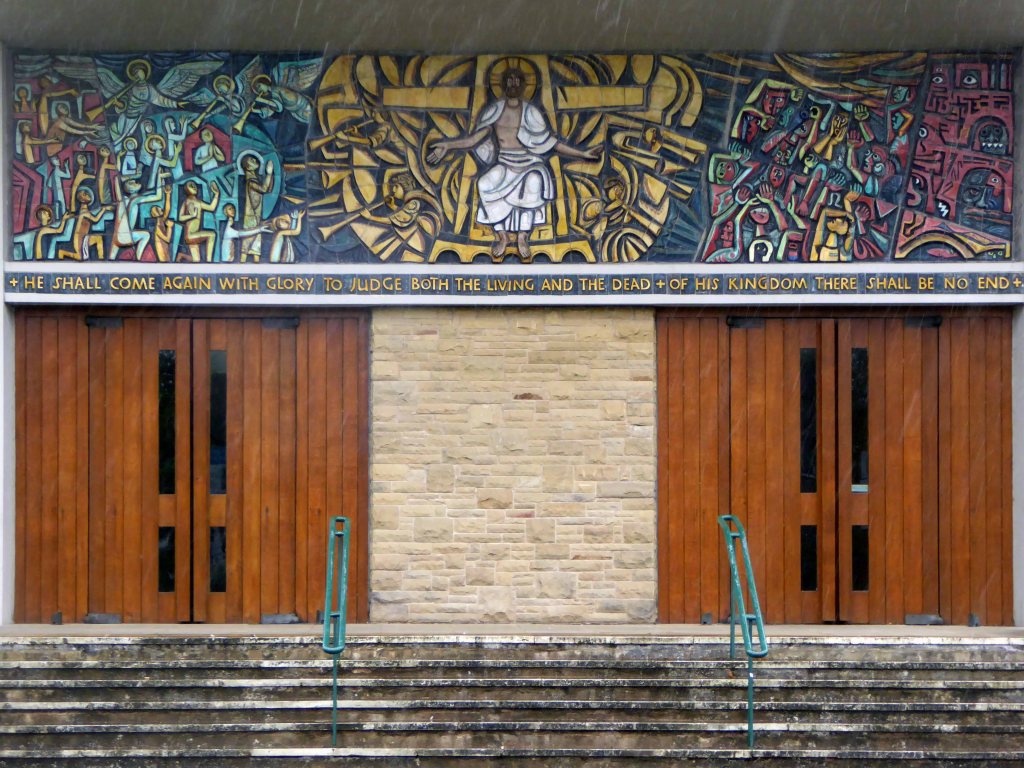
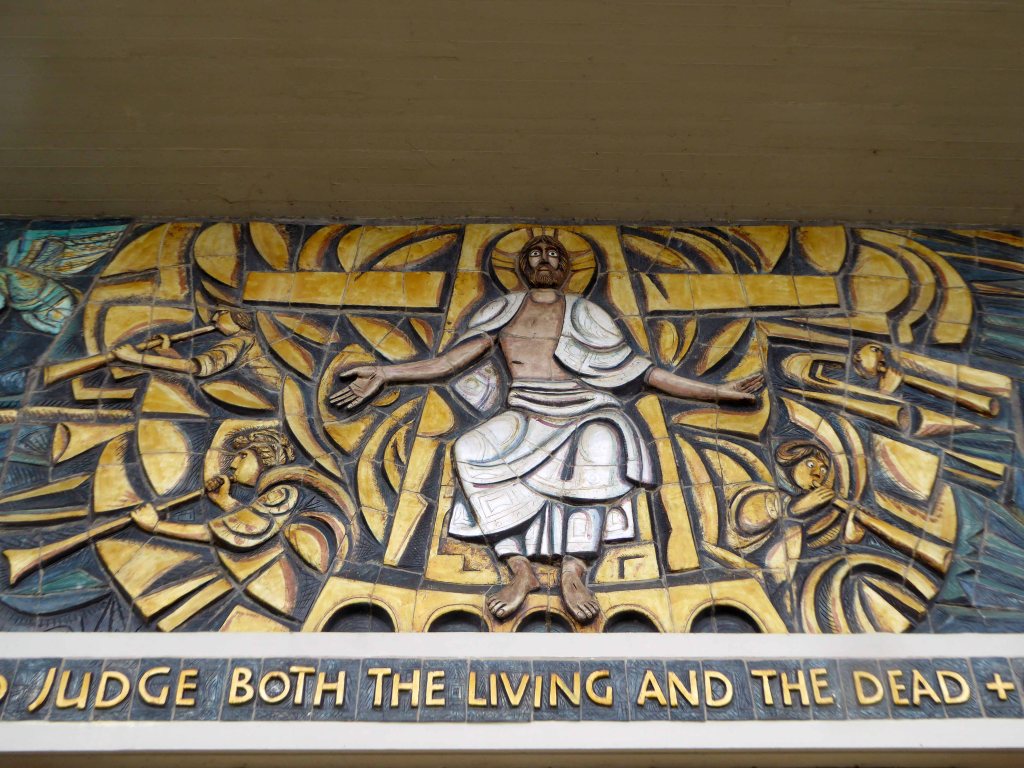
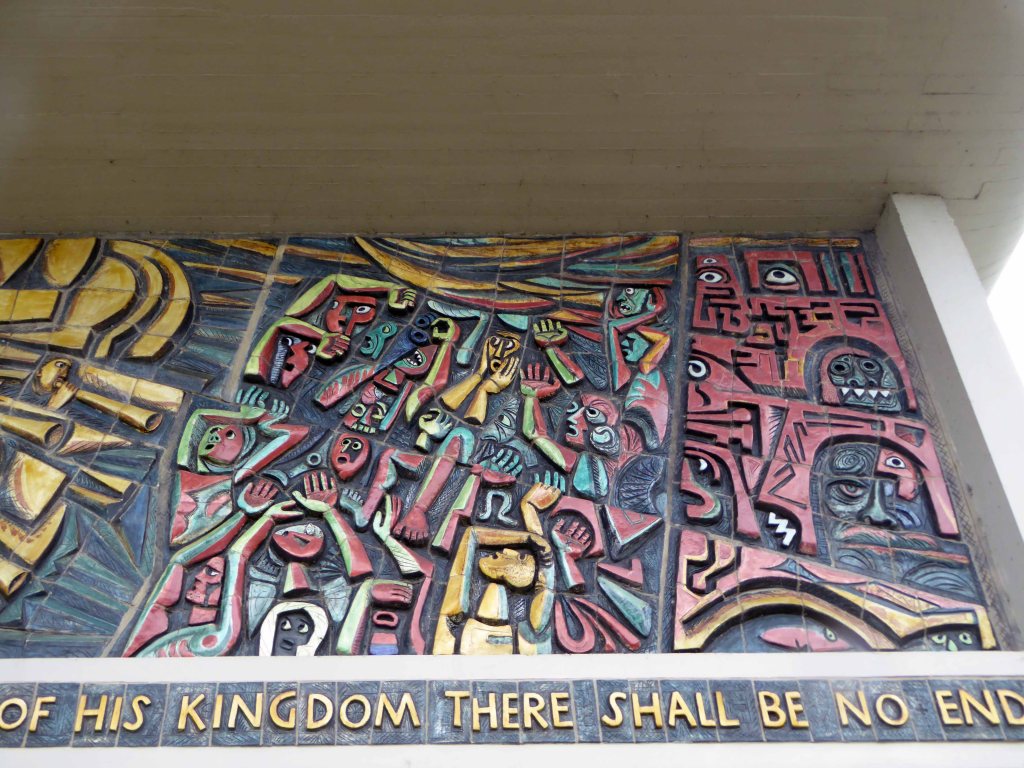
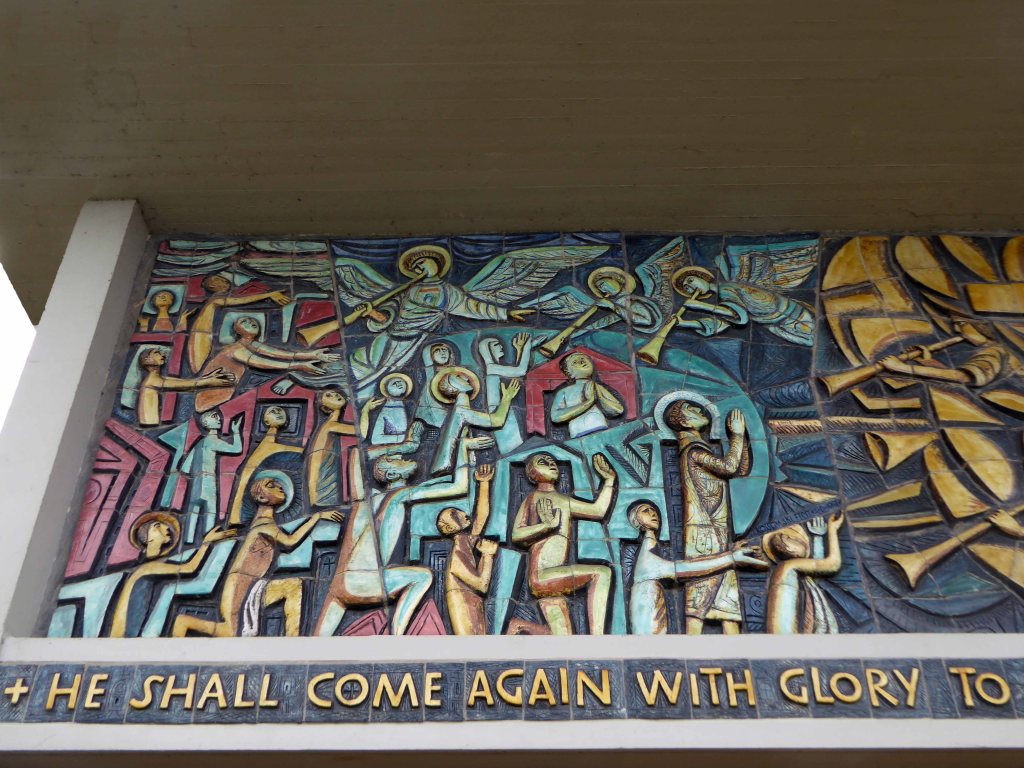
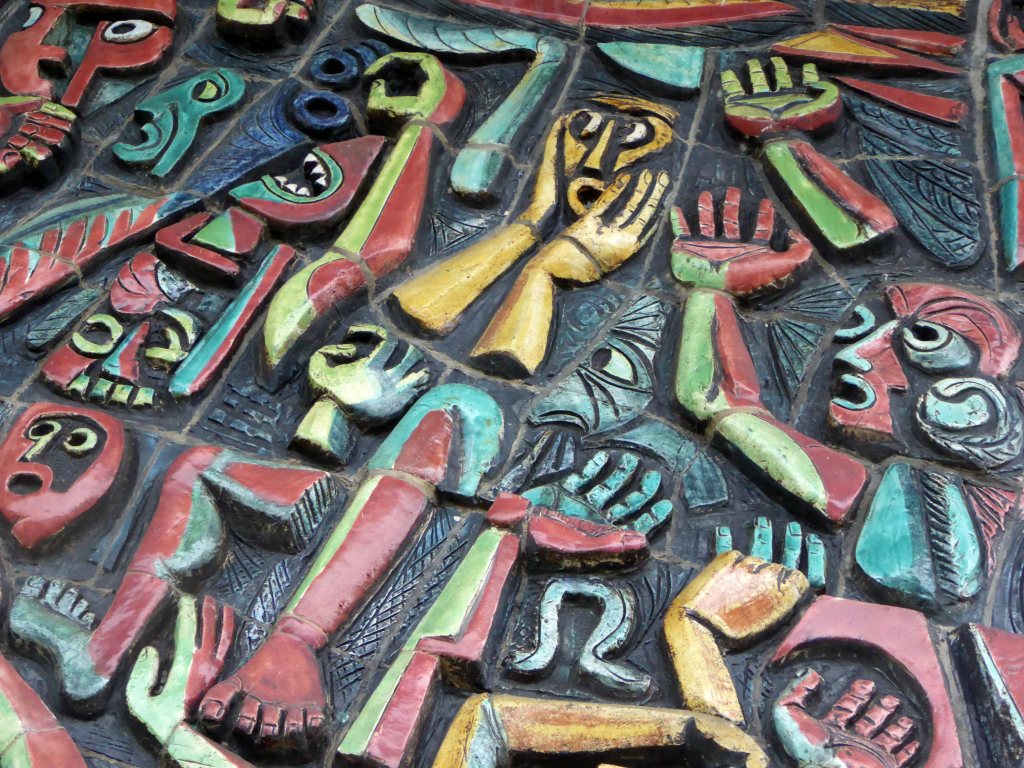
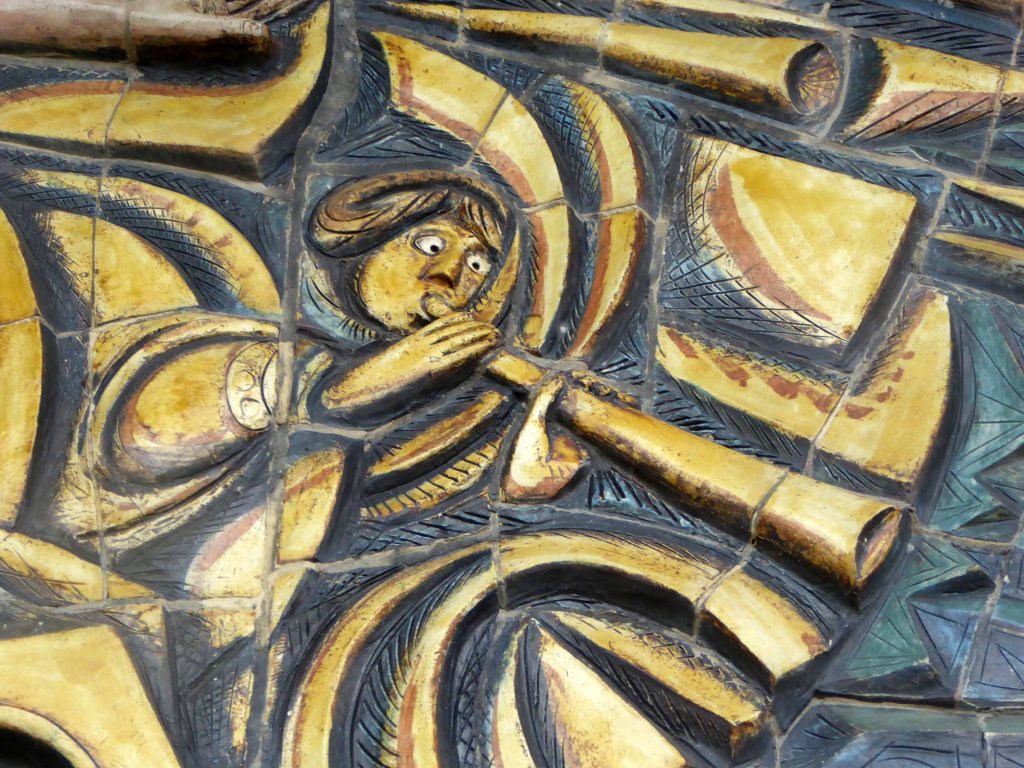
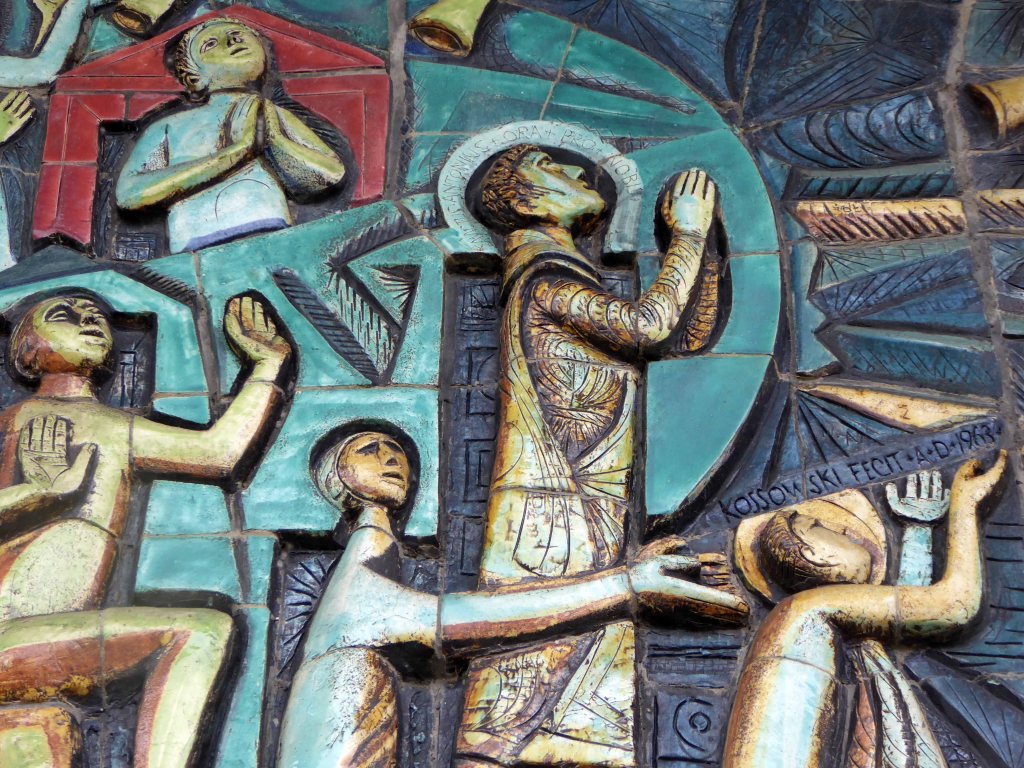
Large polychrome ceramic mural representing the Last Judgment by Adam Kossowski occupies the width of the porch above the two double- doored entrances.
Brick rotunda with projecting painted reinforced concrete chapels to left and right, of organic round-cornered form.
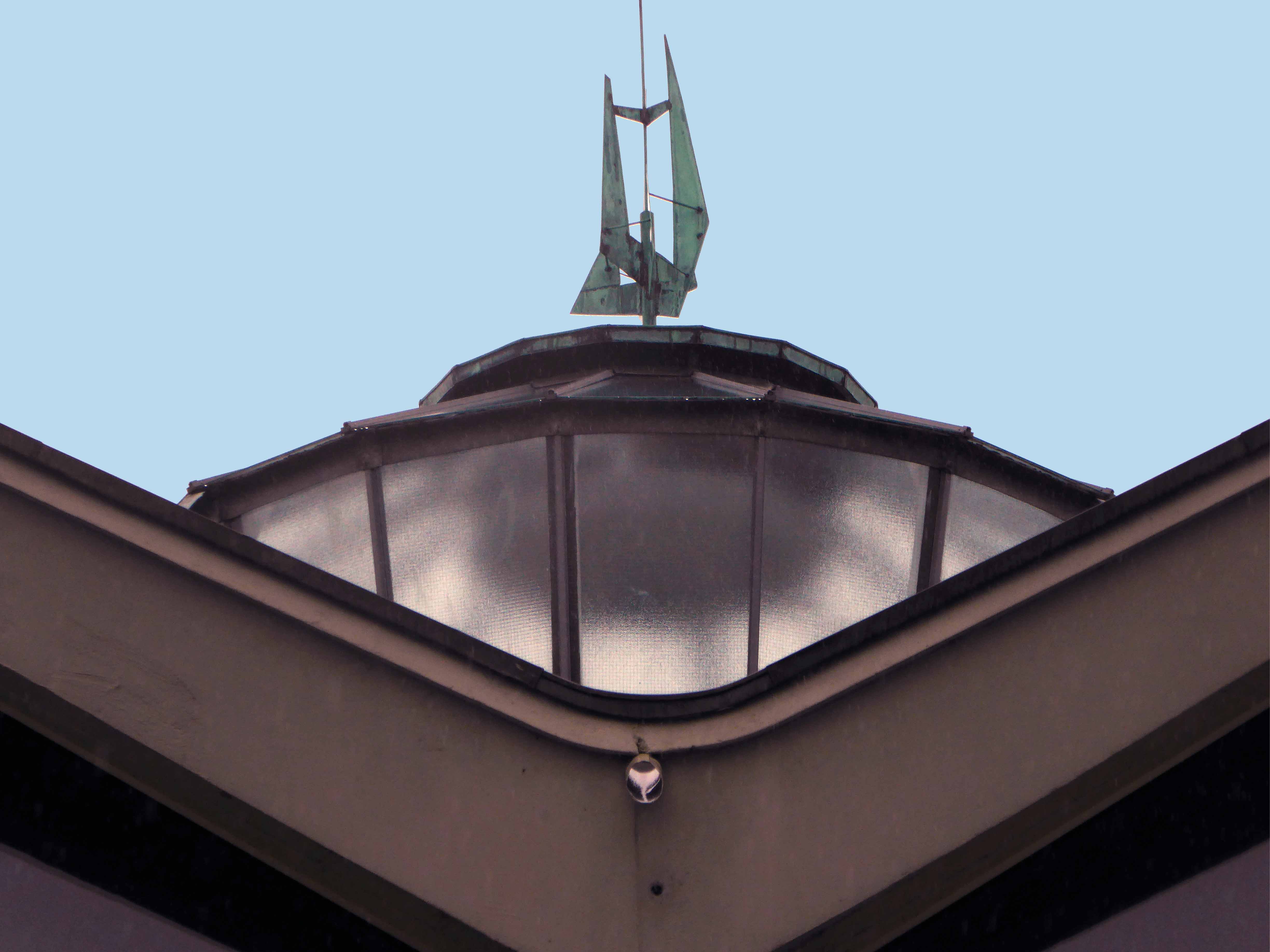
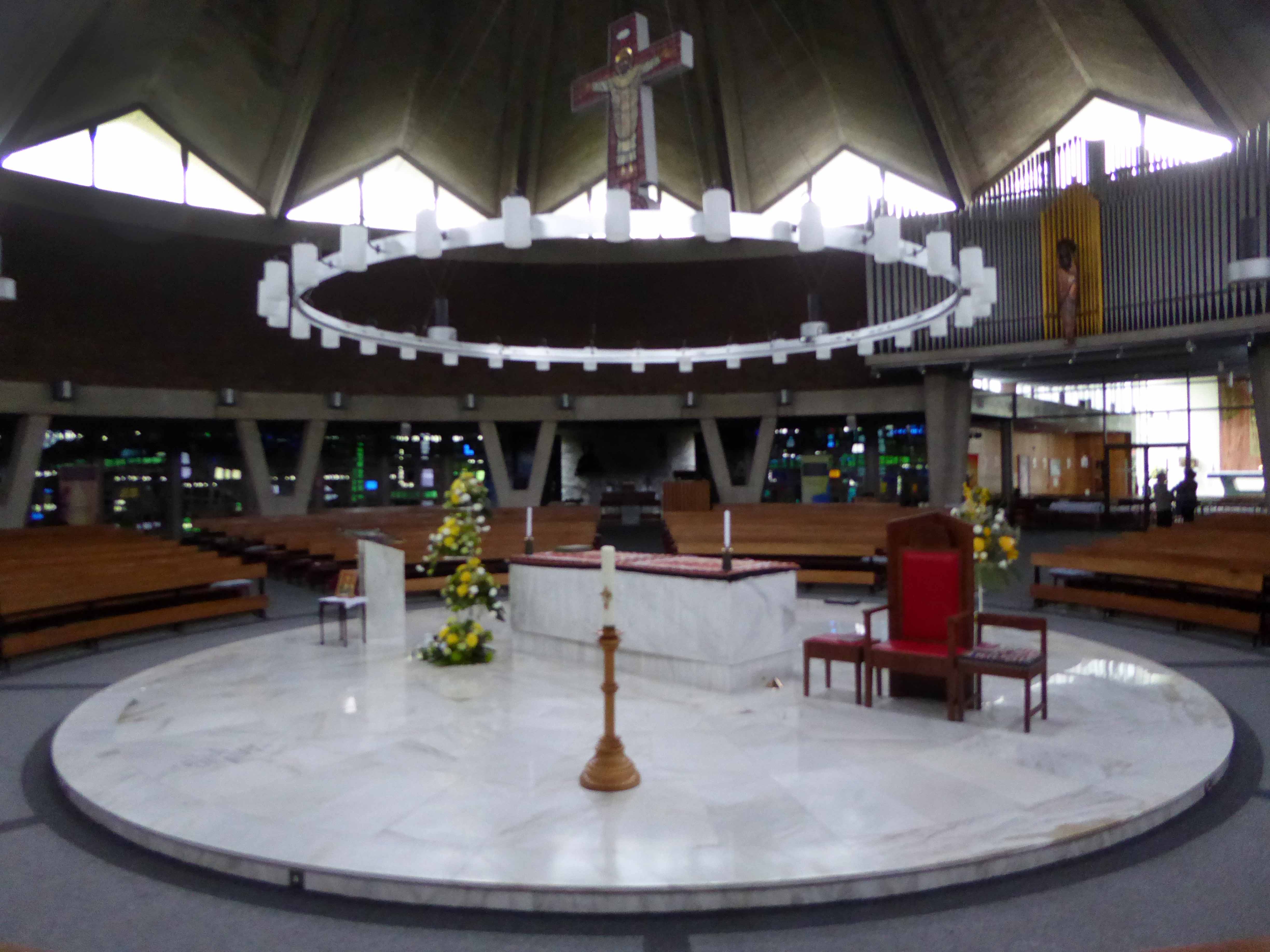
Folded radial roof above main space, leaning outwards to shelter triangular clerestory windows. Circular glazed light to centre of roof, its sides leaning outwards, culminating in a sculpted finial of copper or bronze.
Internally, sanctuary is floored in white marble, raised by a step, and the white marble altar is raised by three further steps.
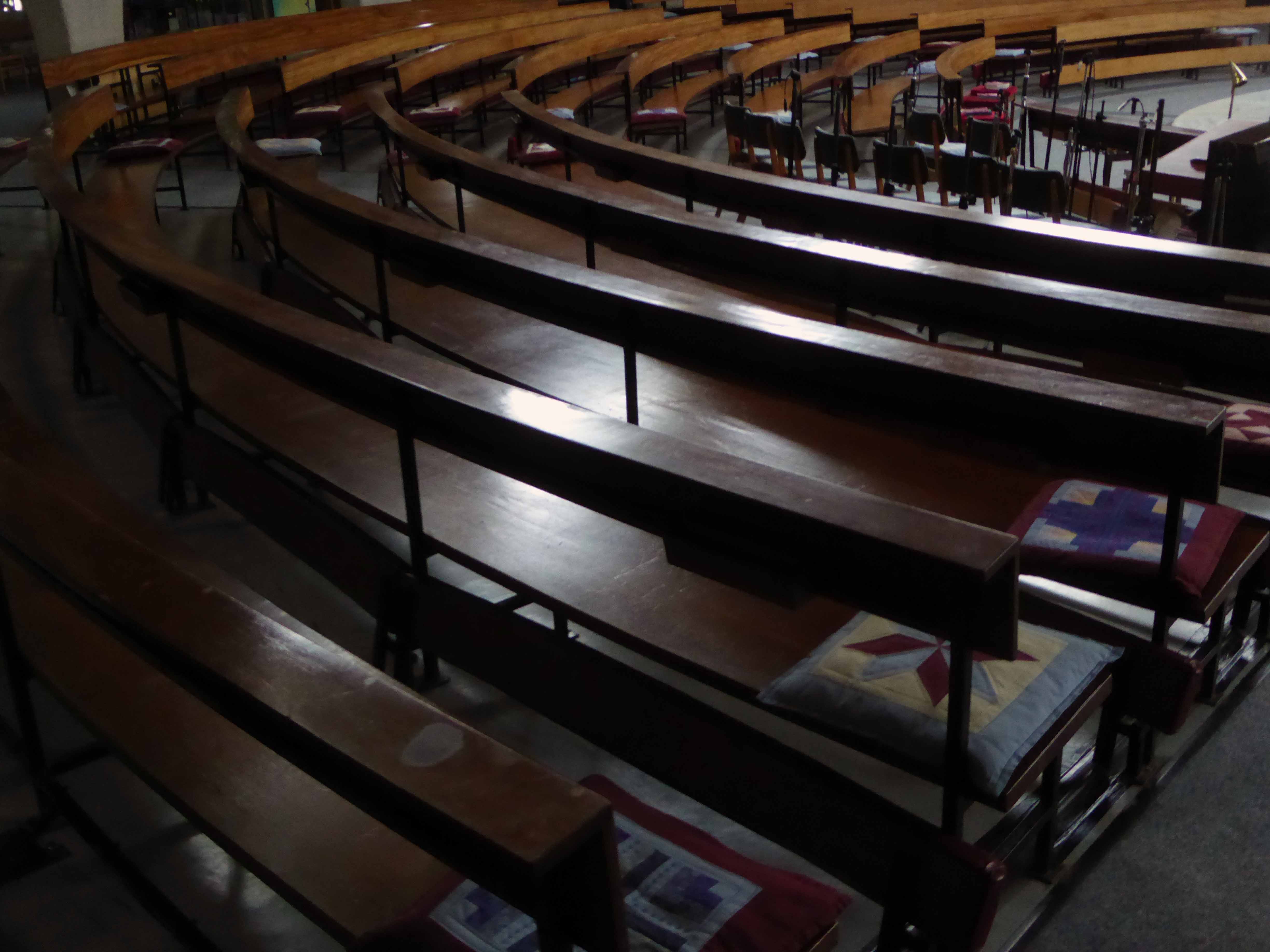
Fixed curved timber benches are placed on slightly raked floor.
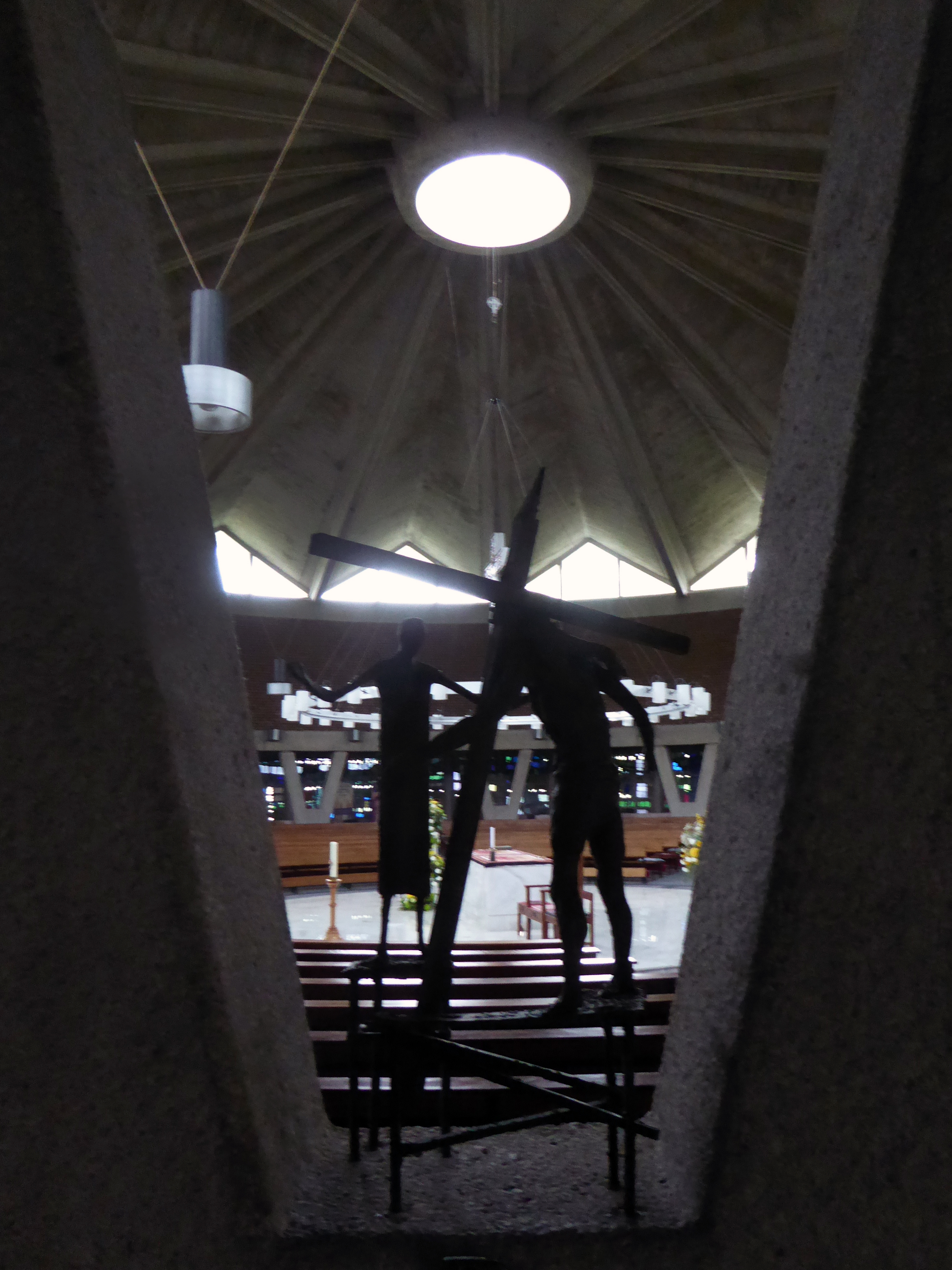
`Y’ shaped concrete aisle posts, designed to incorporate the Stations of the Cross, sculpted by Arthur Dooley.
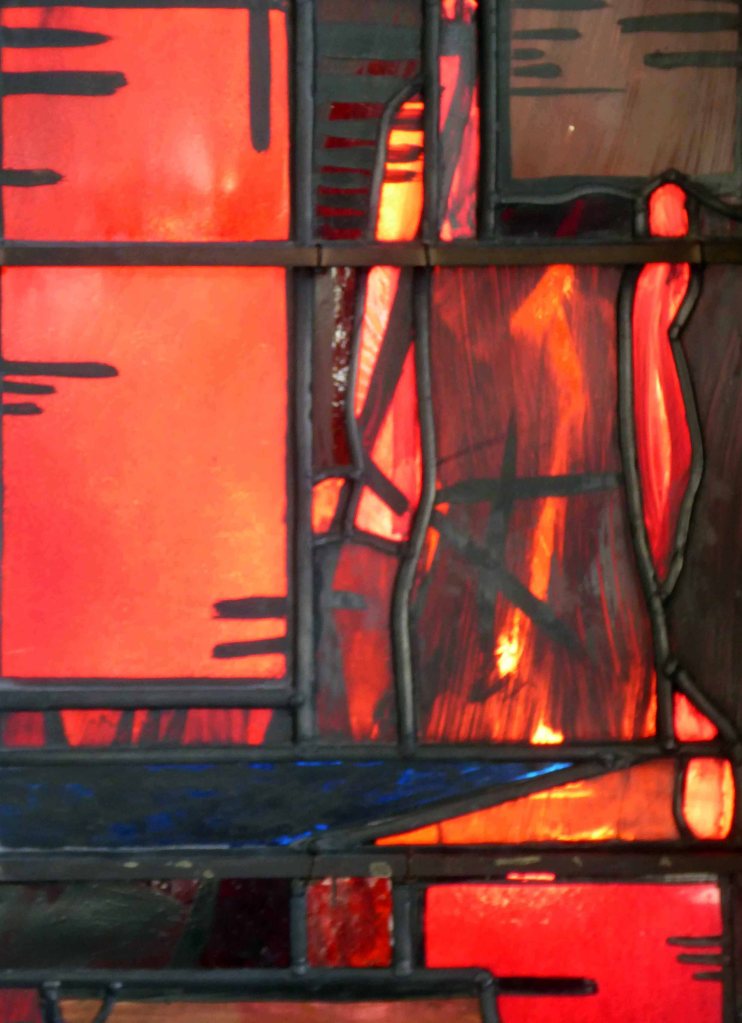
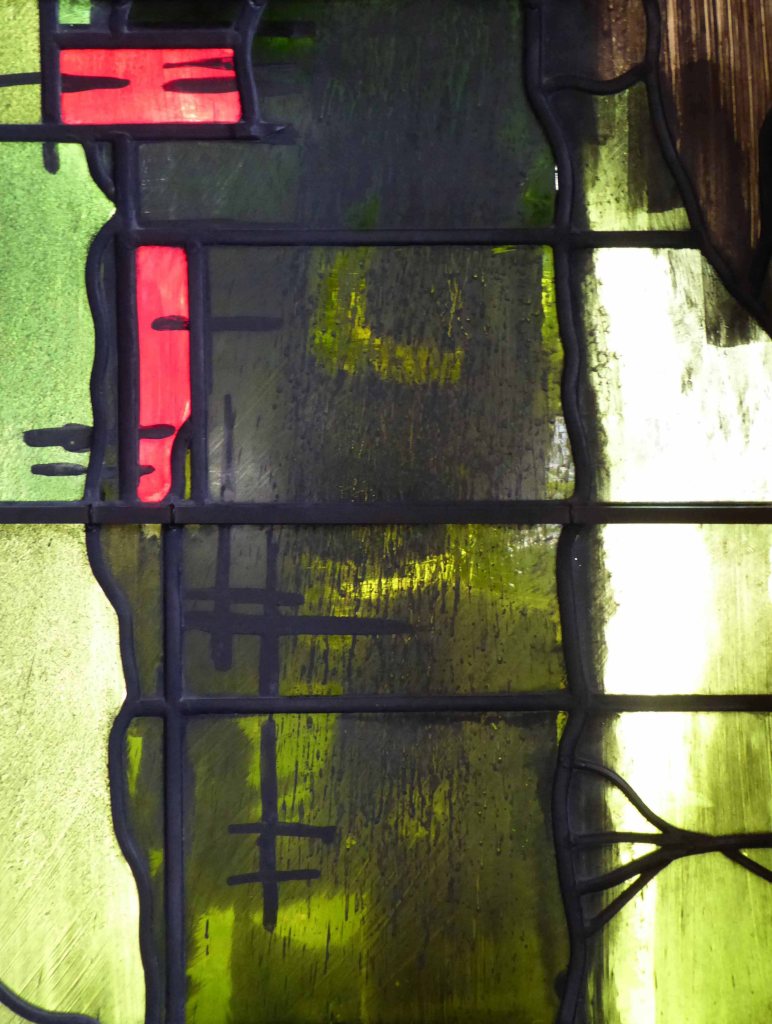
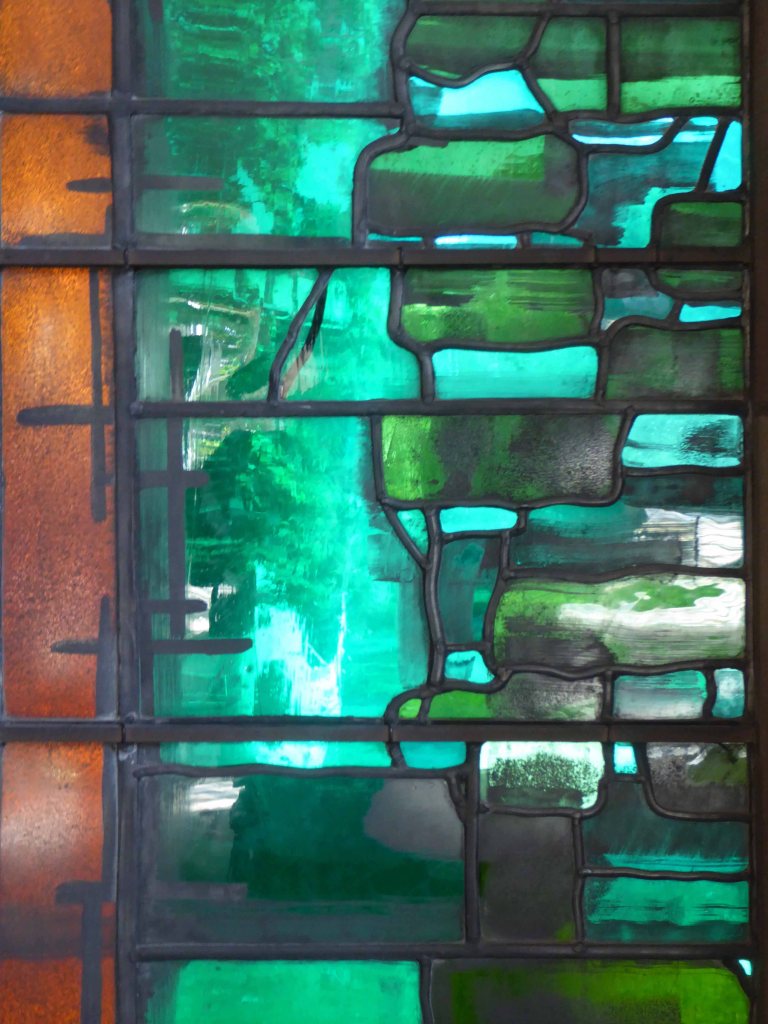
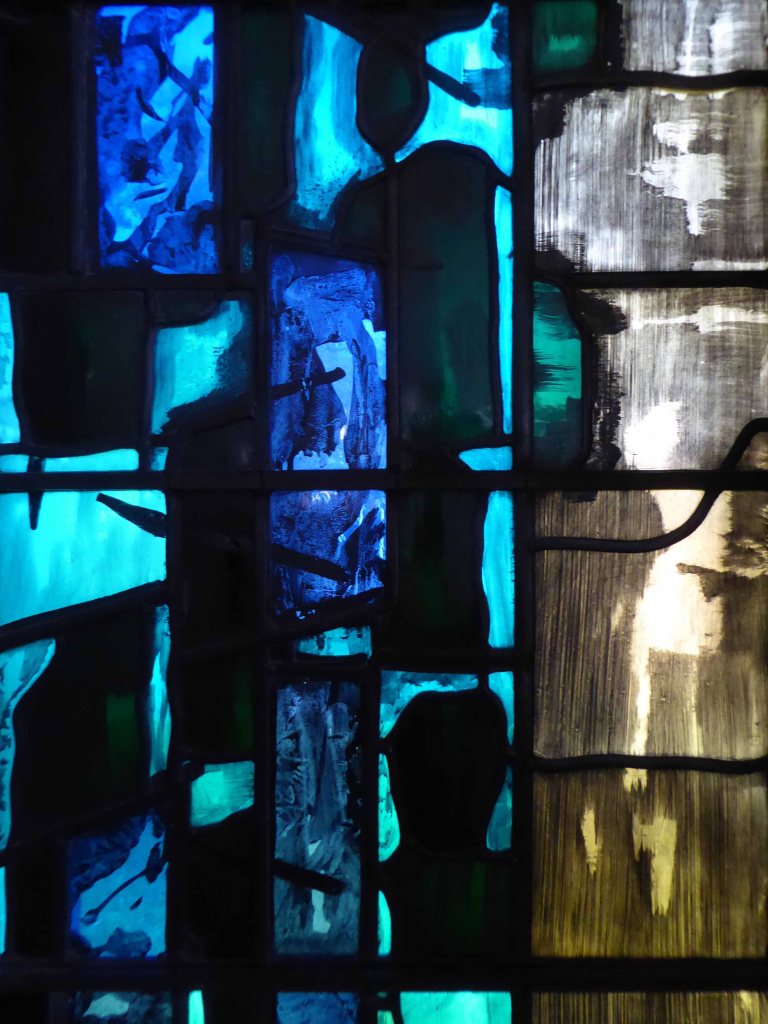
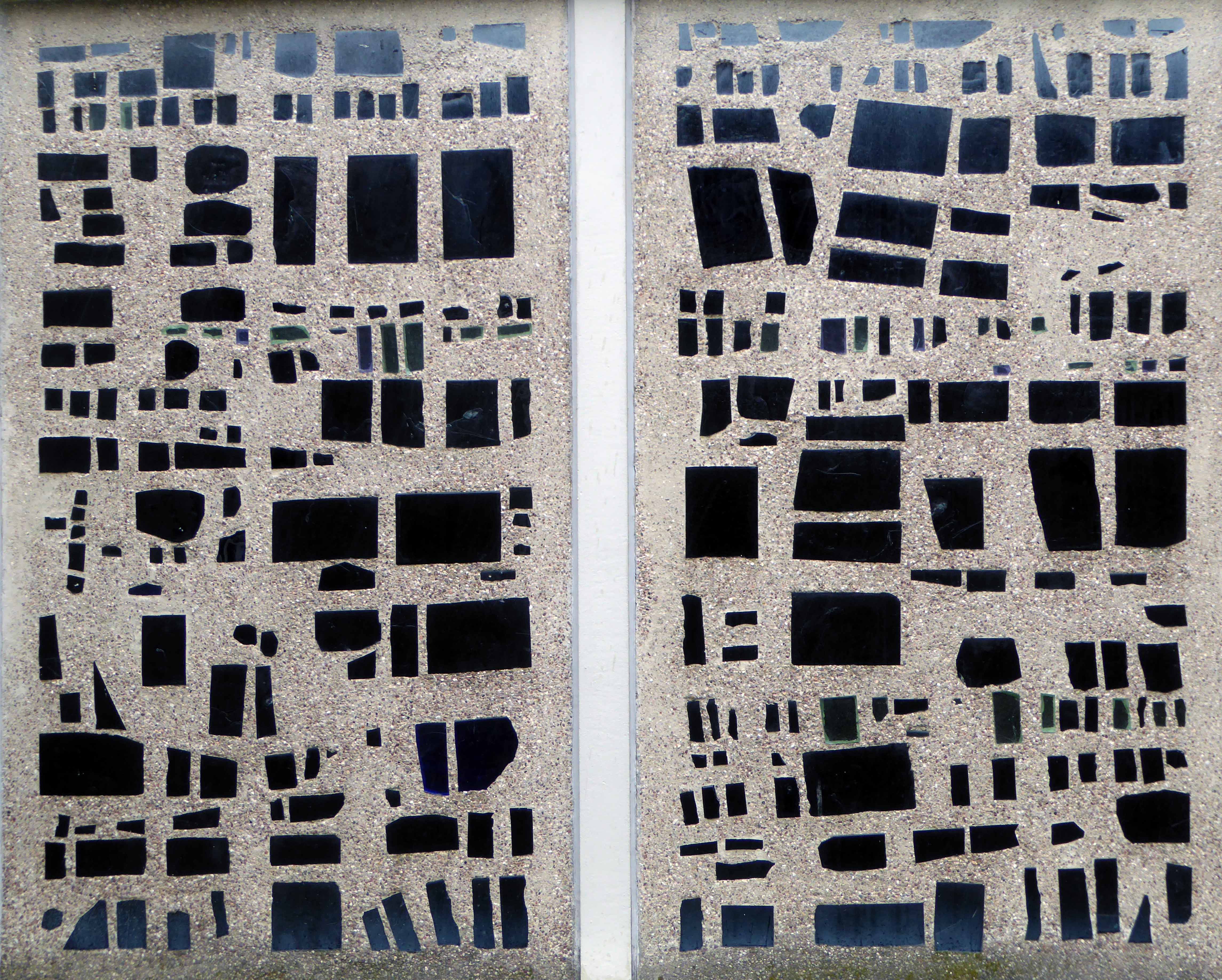
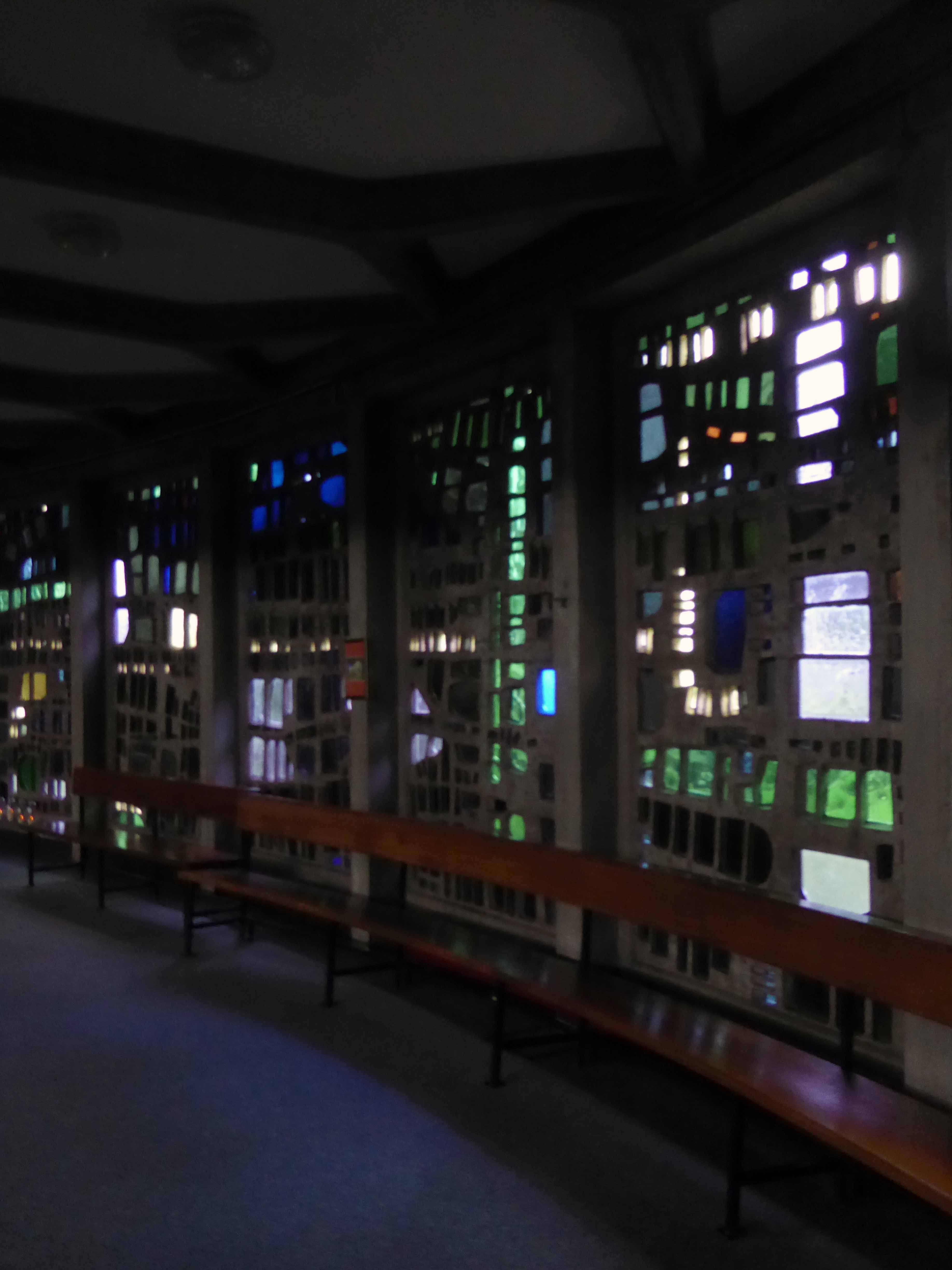
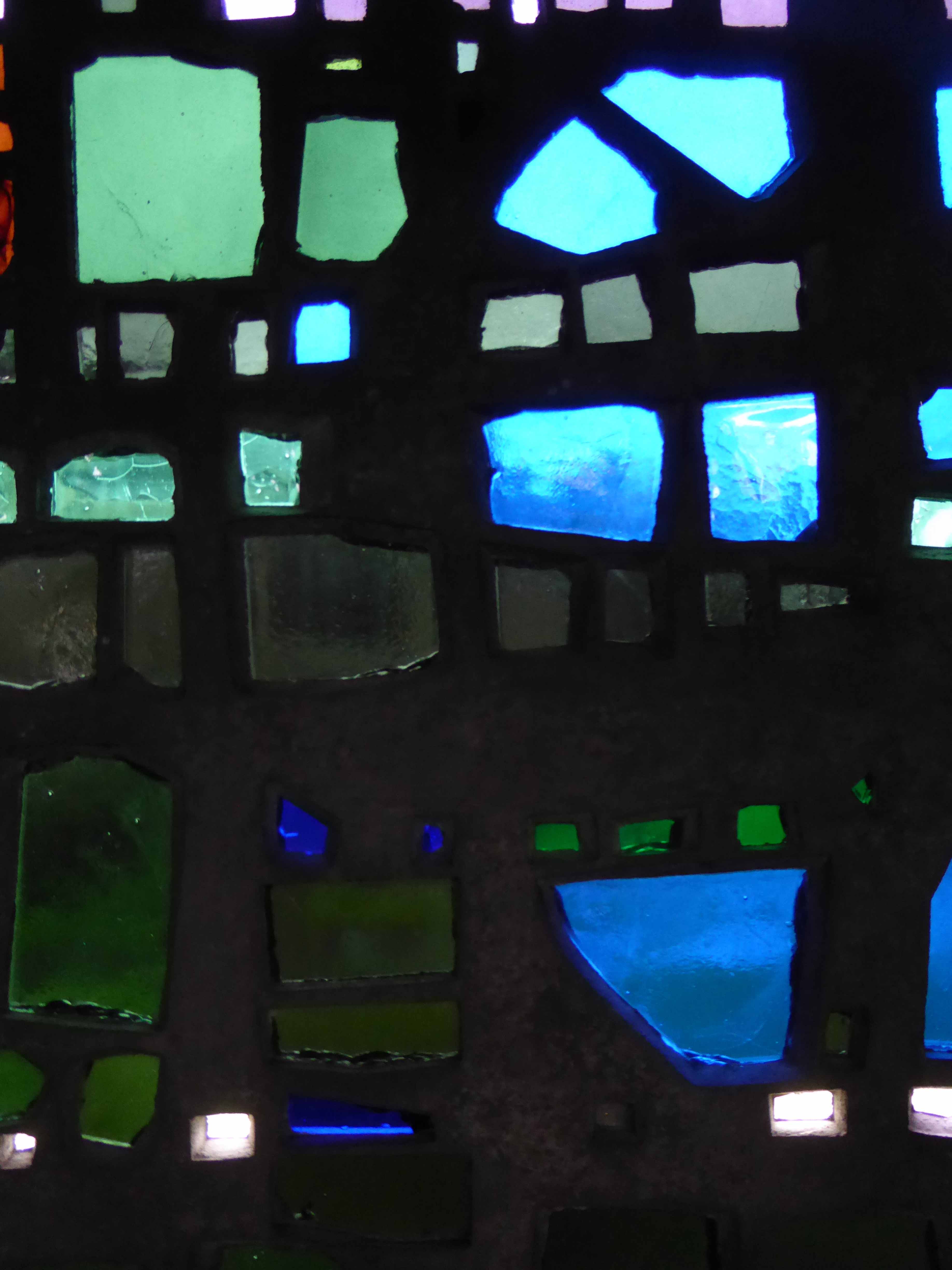
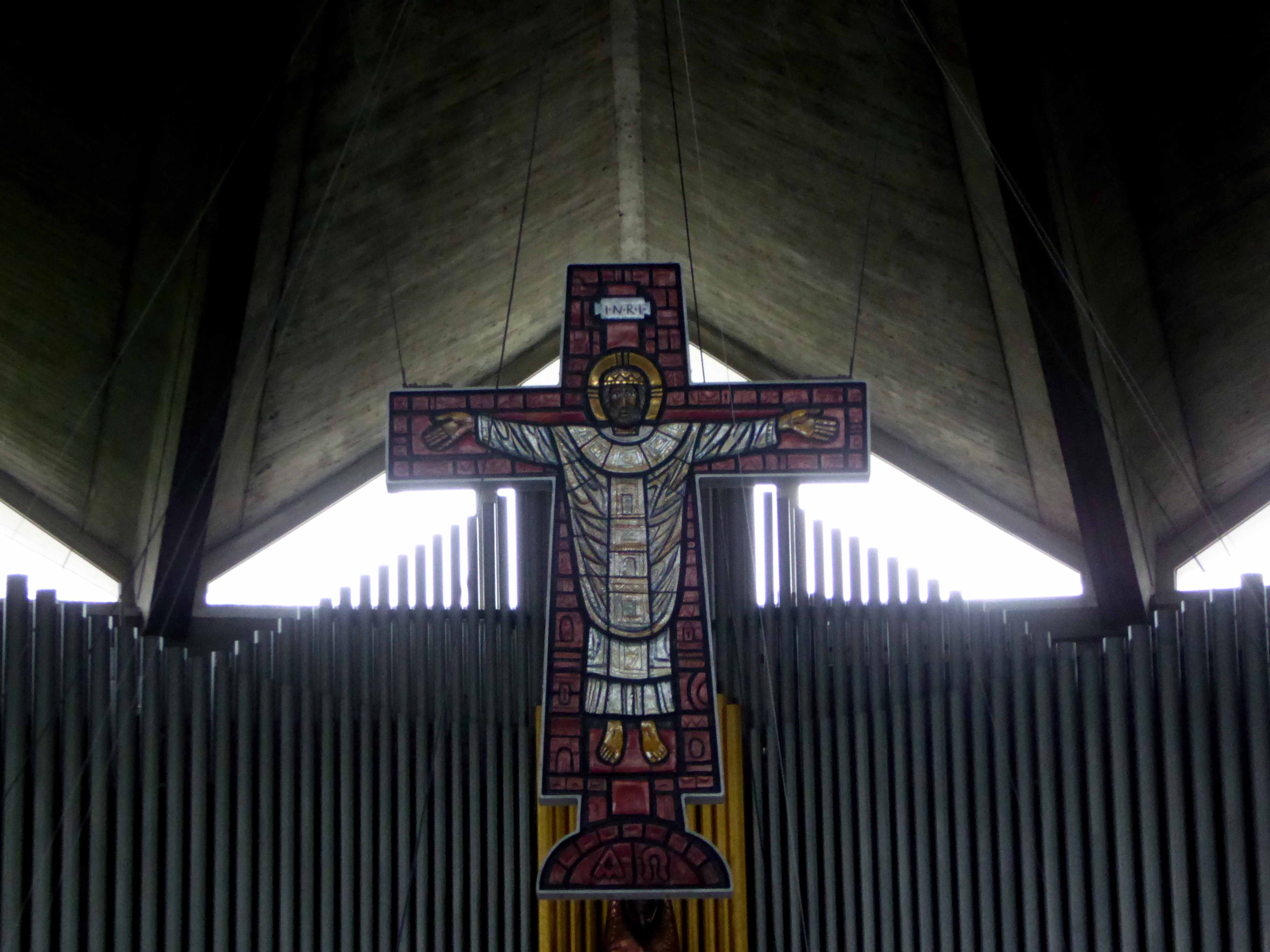
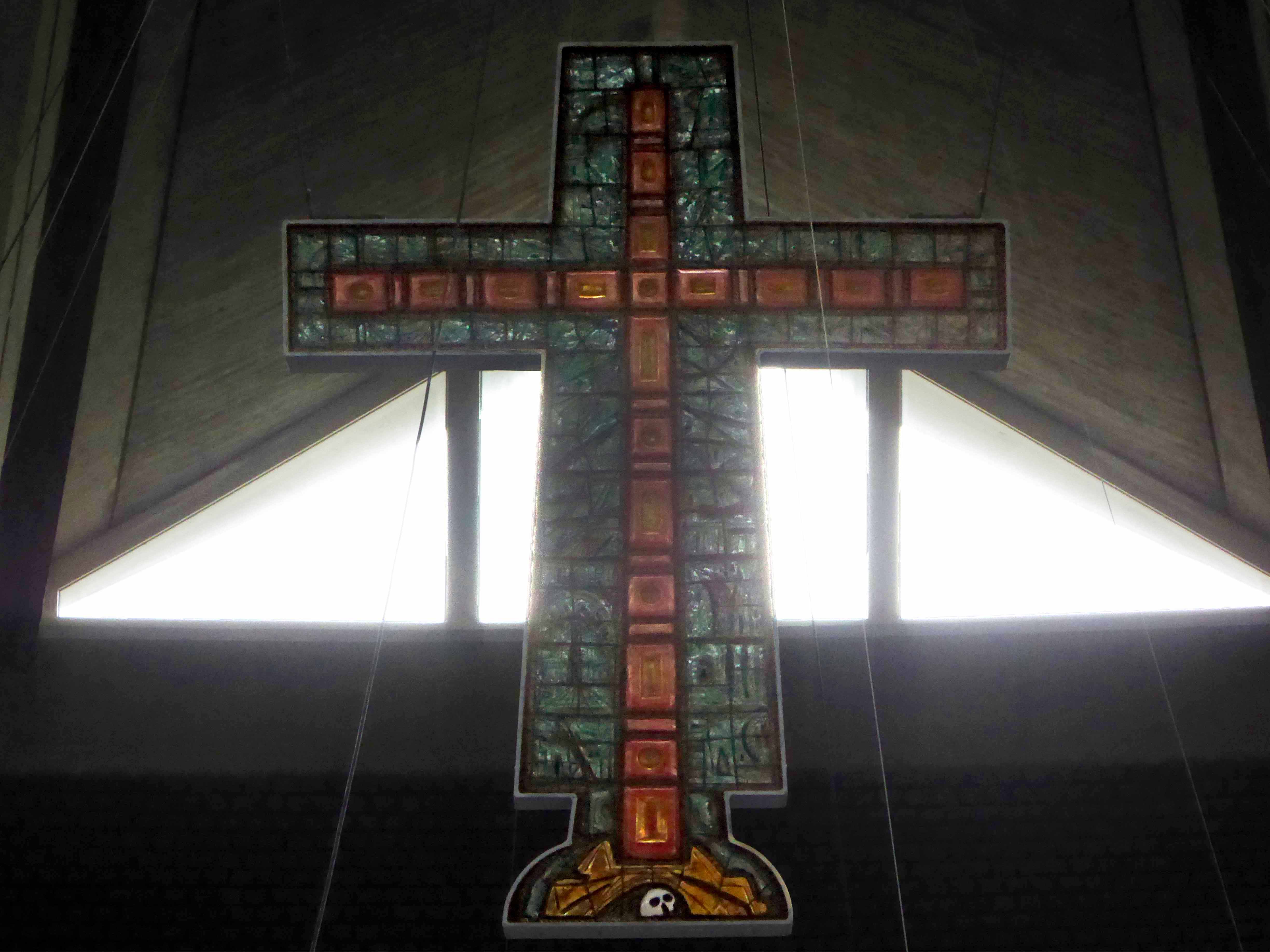
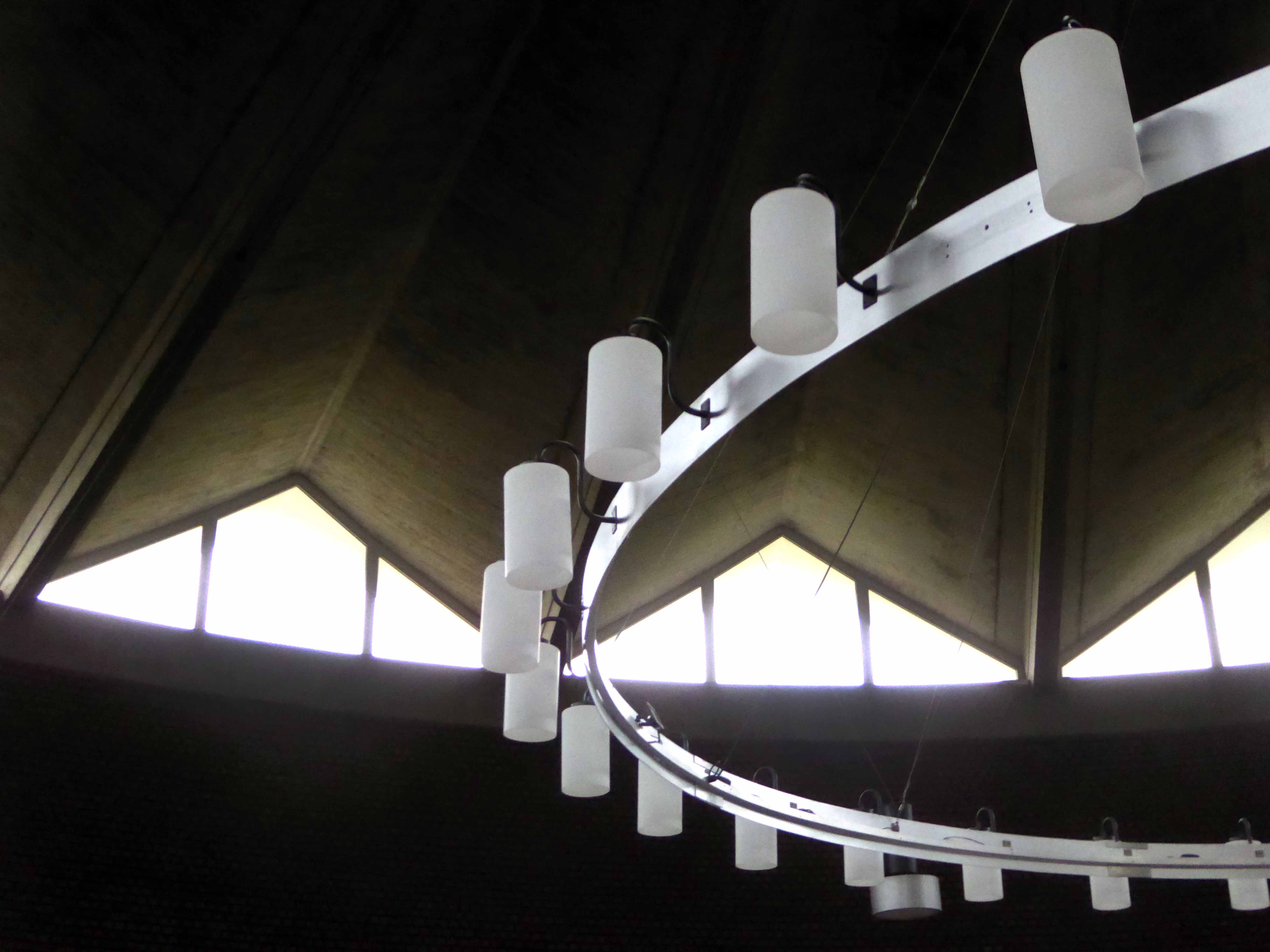
Above these the exposed brick drum rises to the exposed, board-marked concrete folded roof. The aisle walls comprise thirty-six panels of abstract dalle-de-verre stained glass, totalling 233 feet in length, by Patrick Reyntiens, mostly in blues and greens. The theme is the first day of Creation. Suspended above the altar is the original ring-shaped light fixture, and also Adam Kossowski’s ceramic of Christ the King.
Further original light fittings are suspended above the congregation.
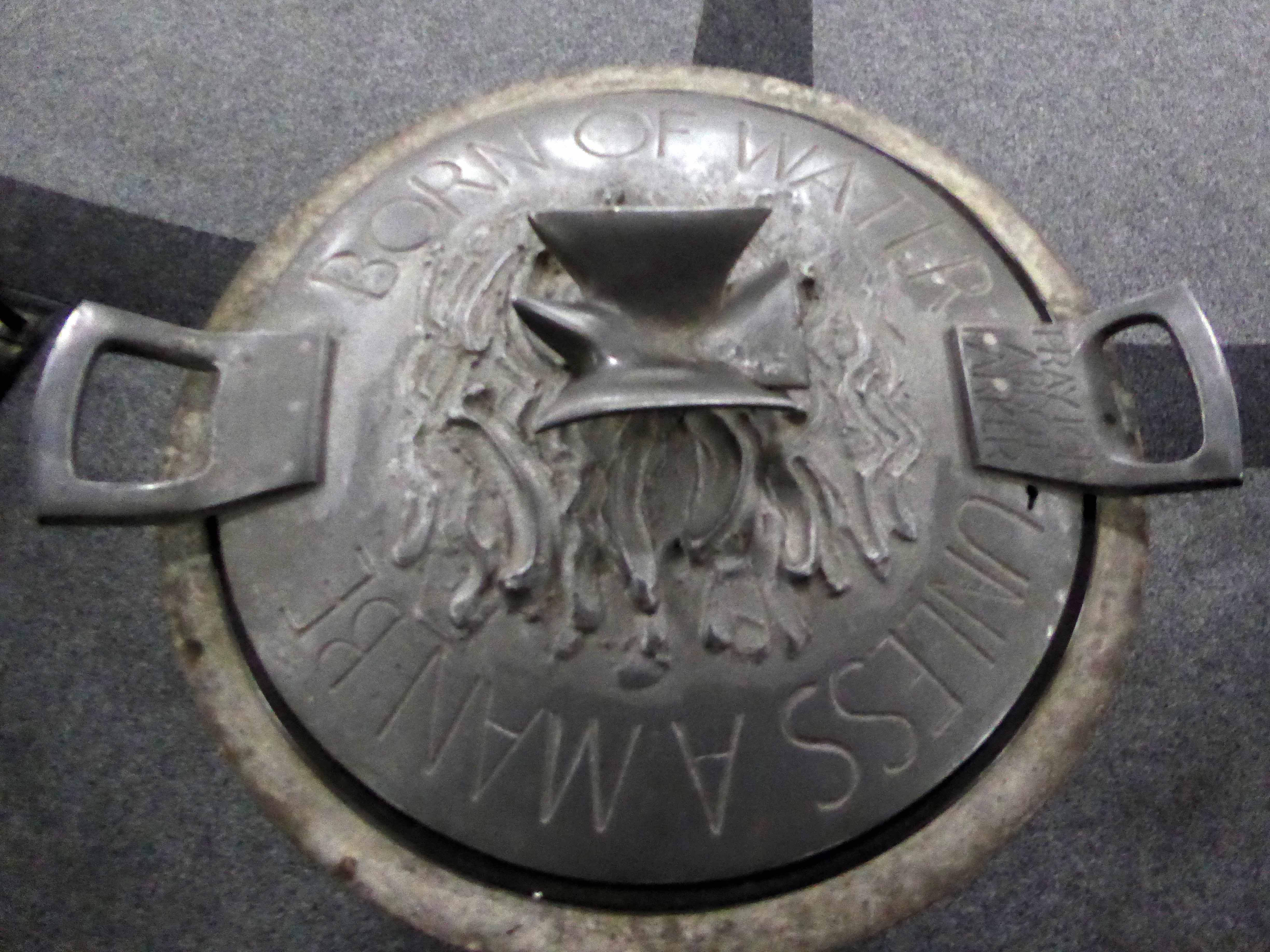
The font is placed in the narthex, in a shallow, marble-lined depression in the floor. It comprises a concrete cylinder with an inscribed bronze lid.
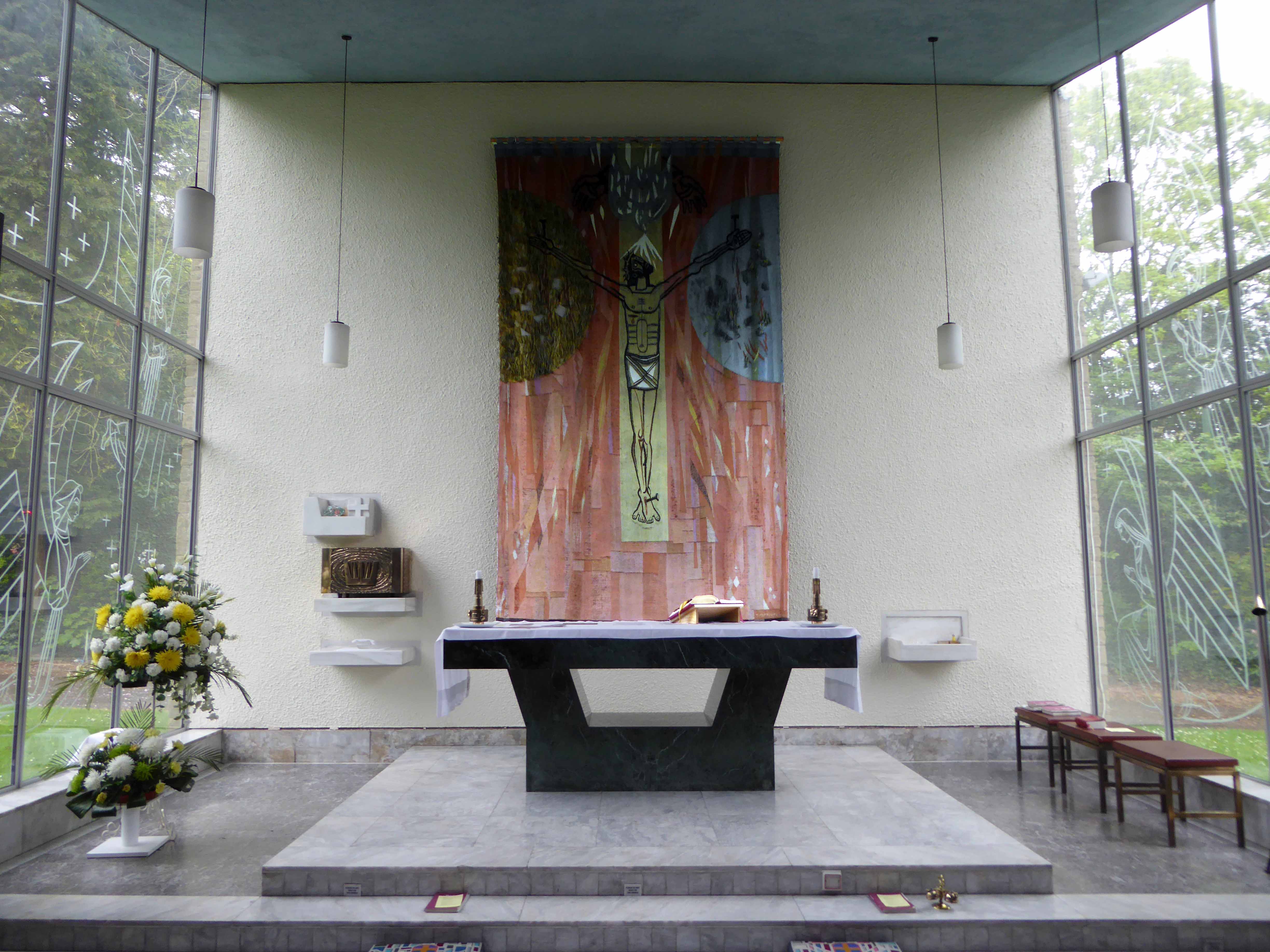
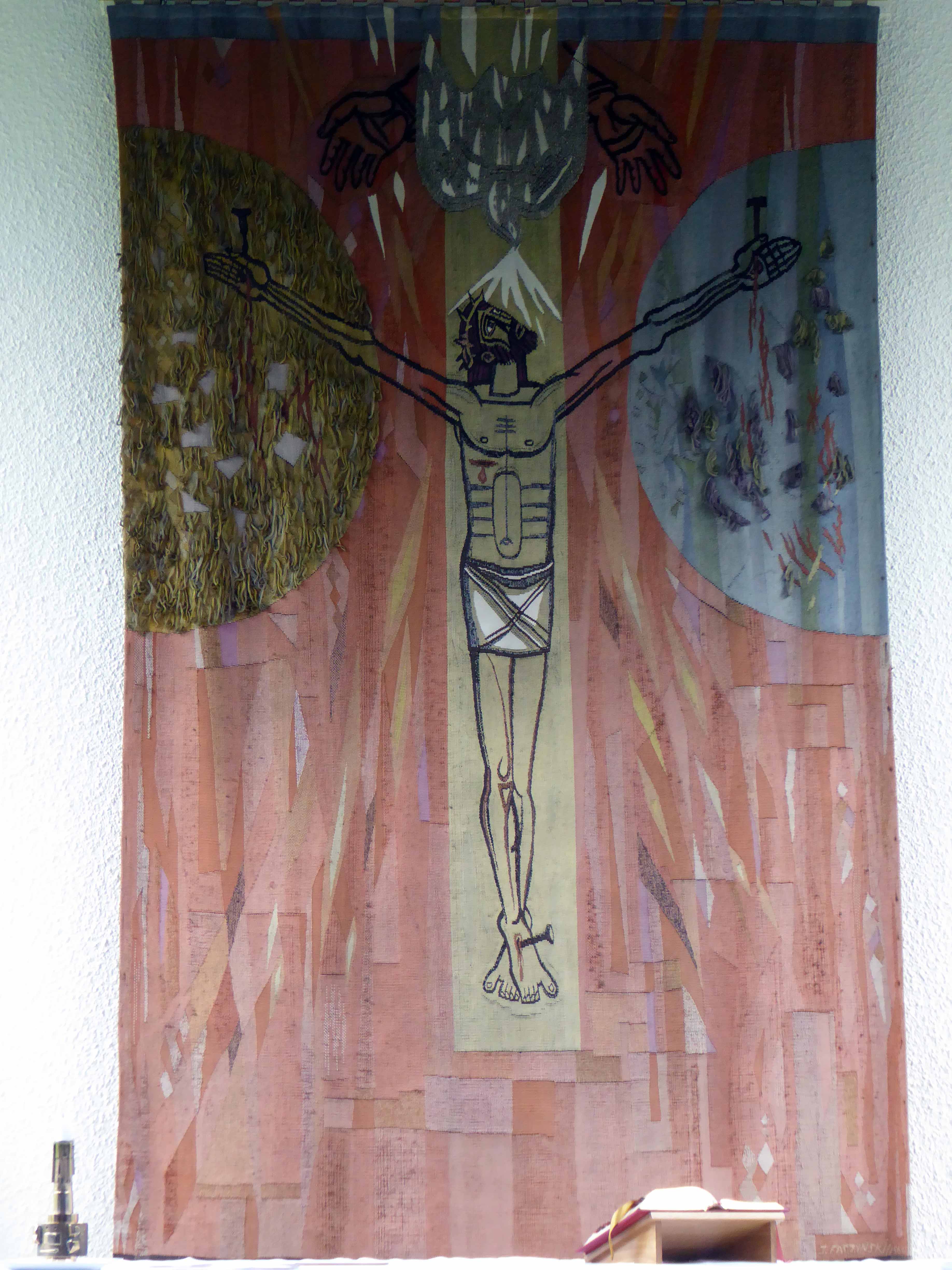
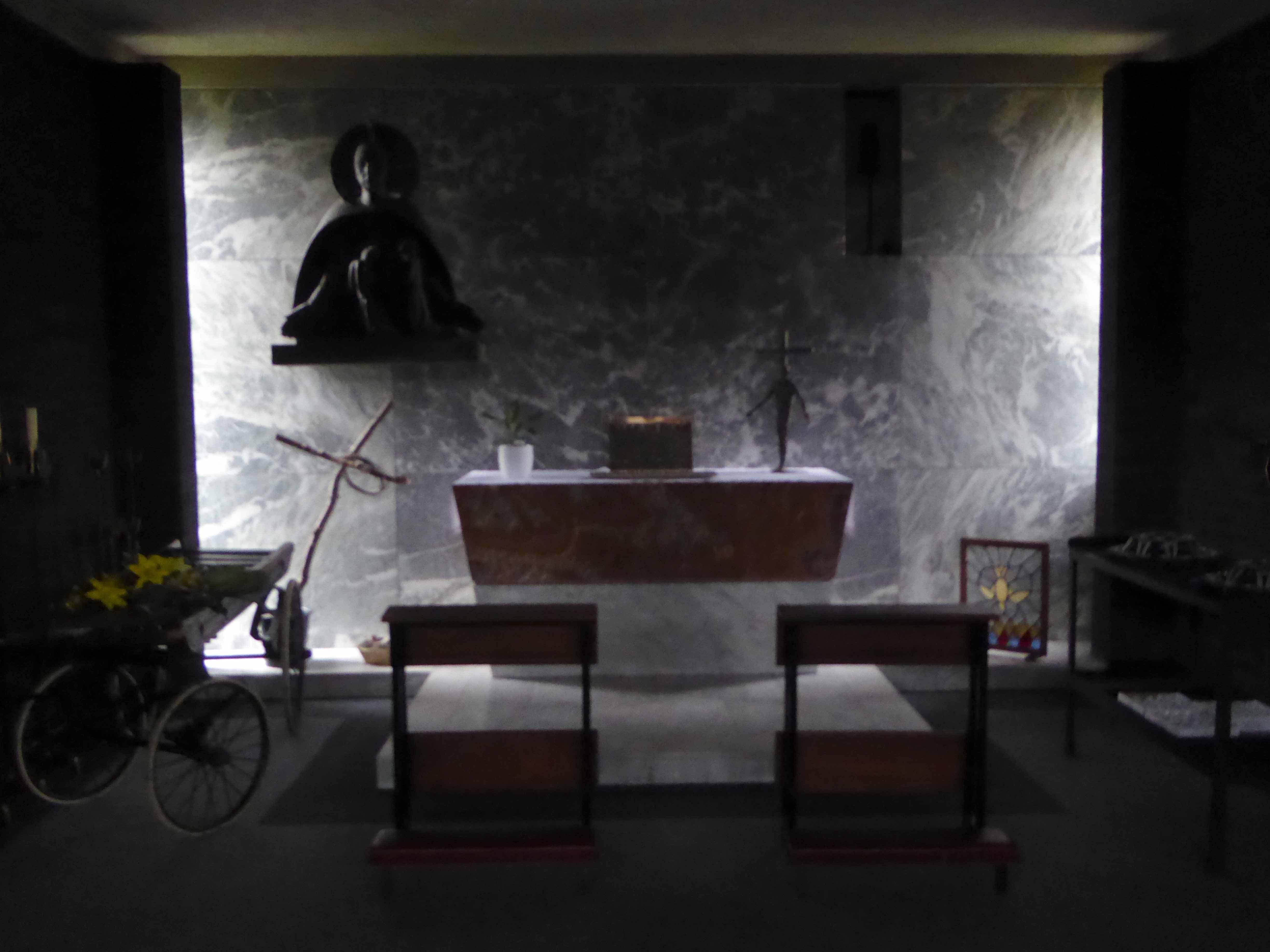
The Blessed Sacrament Chapel, with its rising roof slab, contains a green marble altar with in-built raking supports.
Behind it is a tapestry representing the Trinity, designed by the architect J. Faczynski.
Many thanks to Father John and the members of the congregation for the warm welcome that they extended to us on the day of our visit to their exceptional Grade II Listed church.
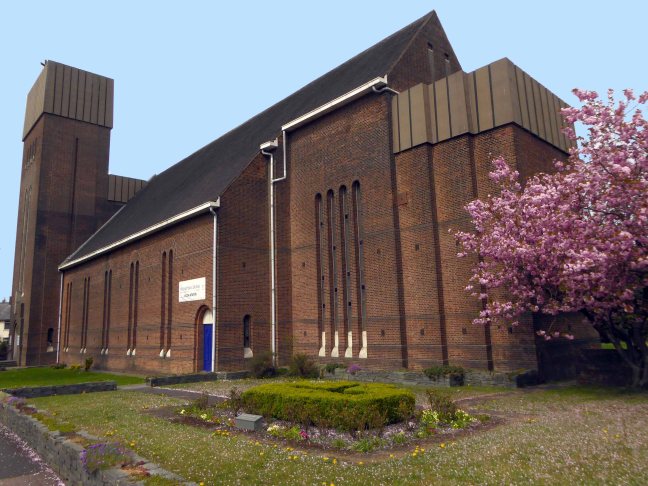
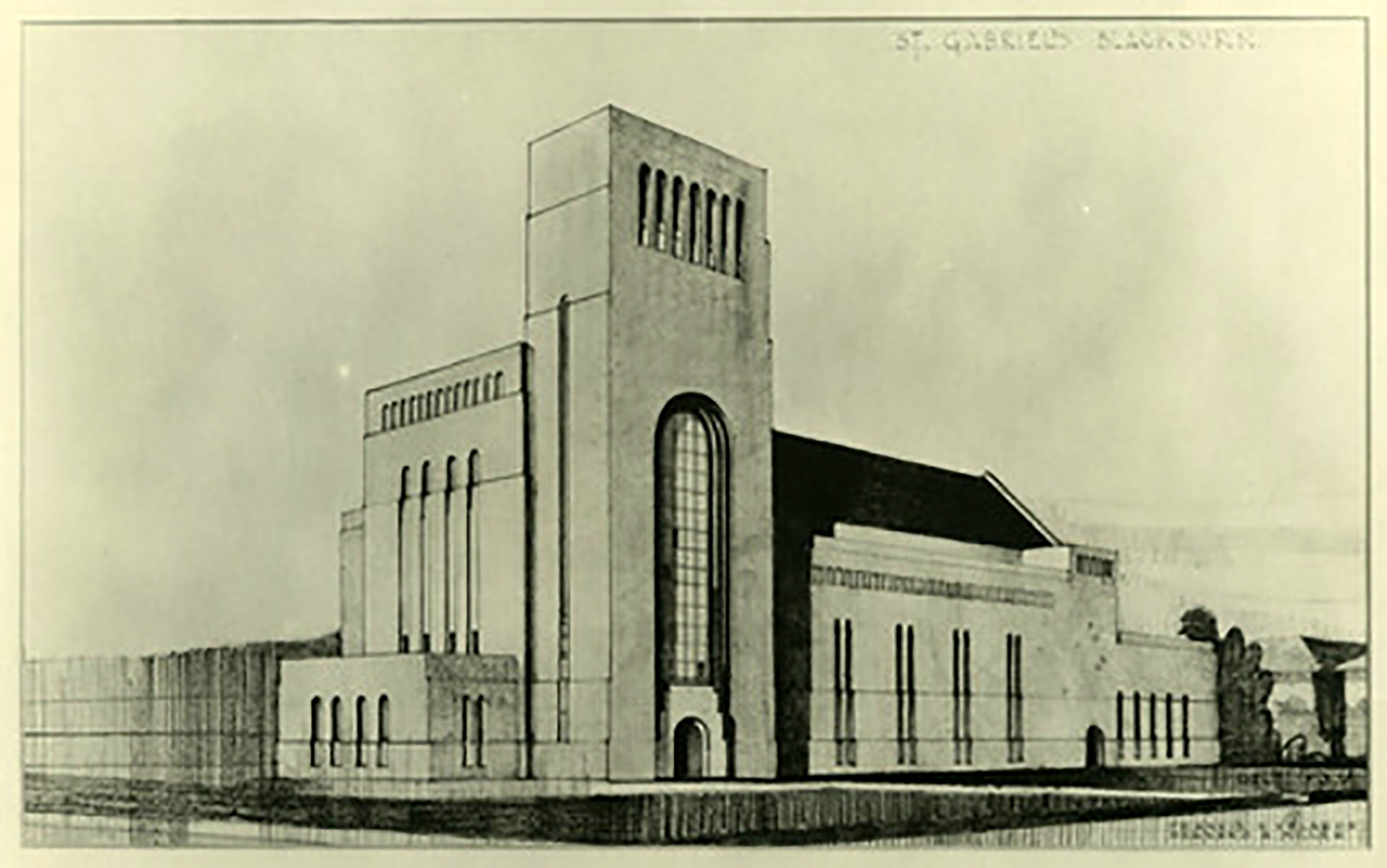
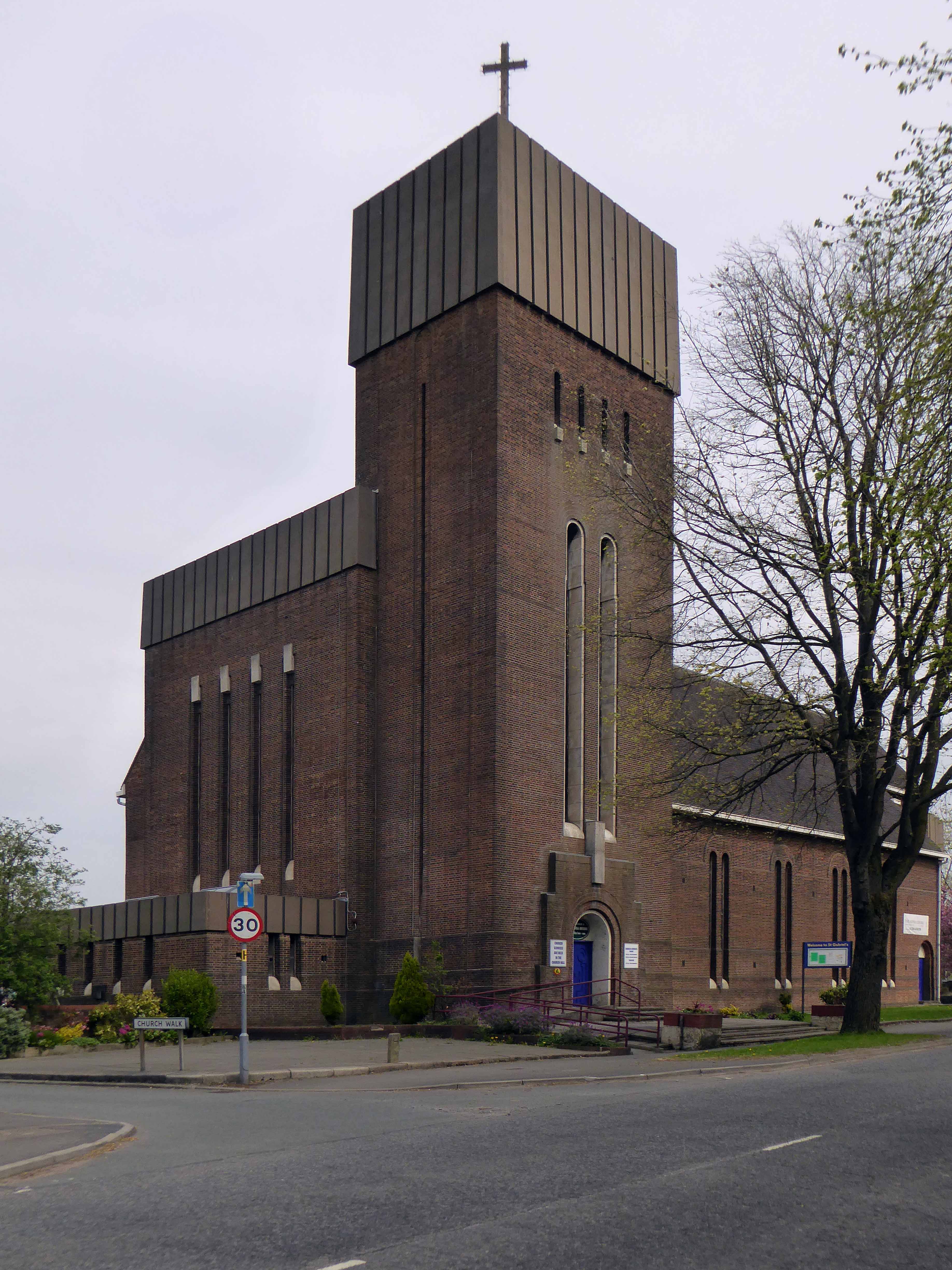
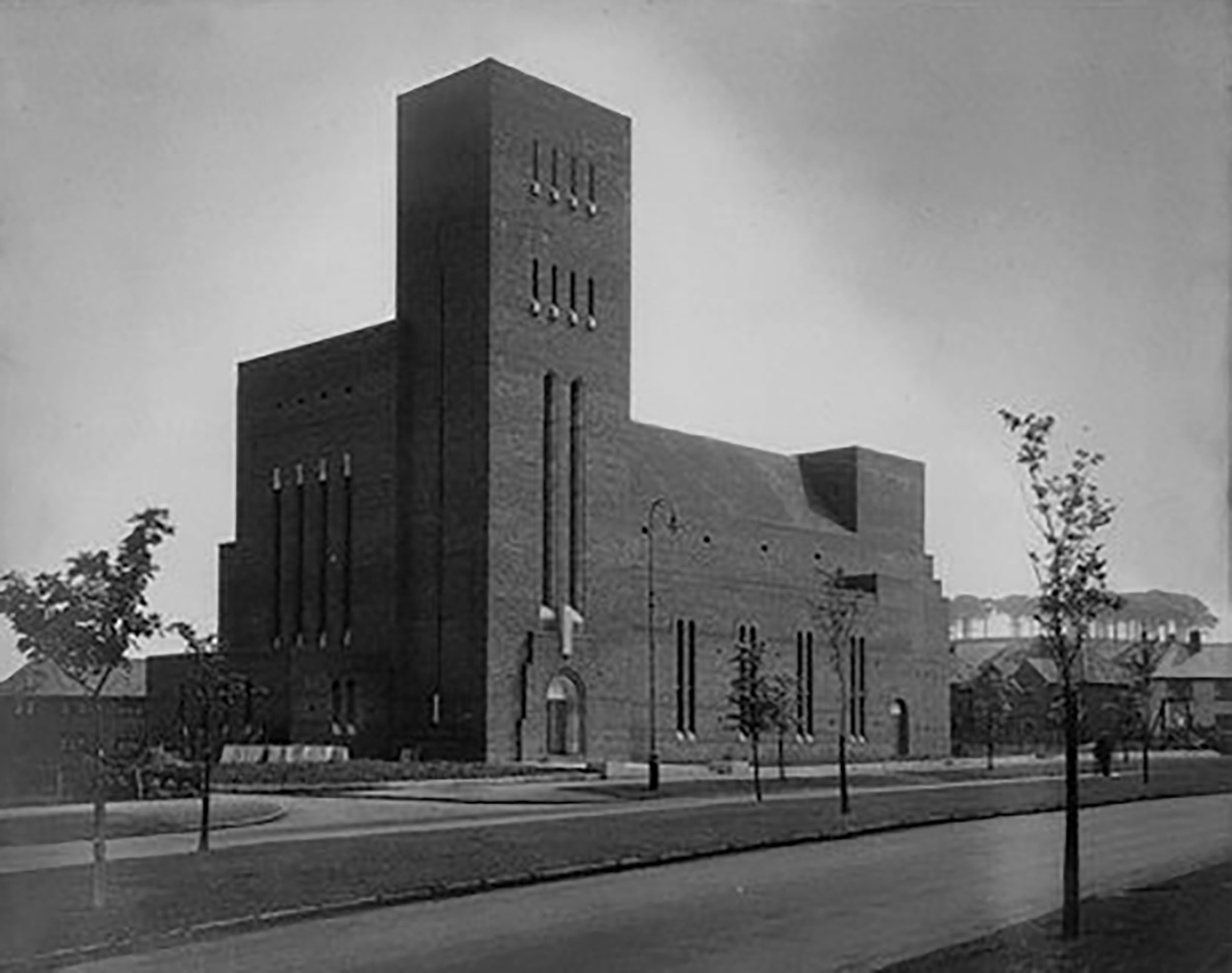
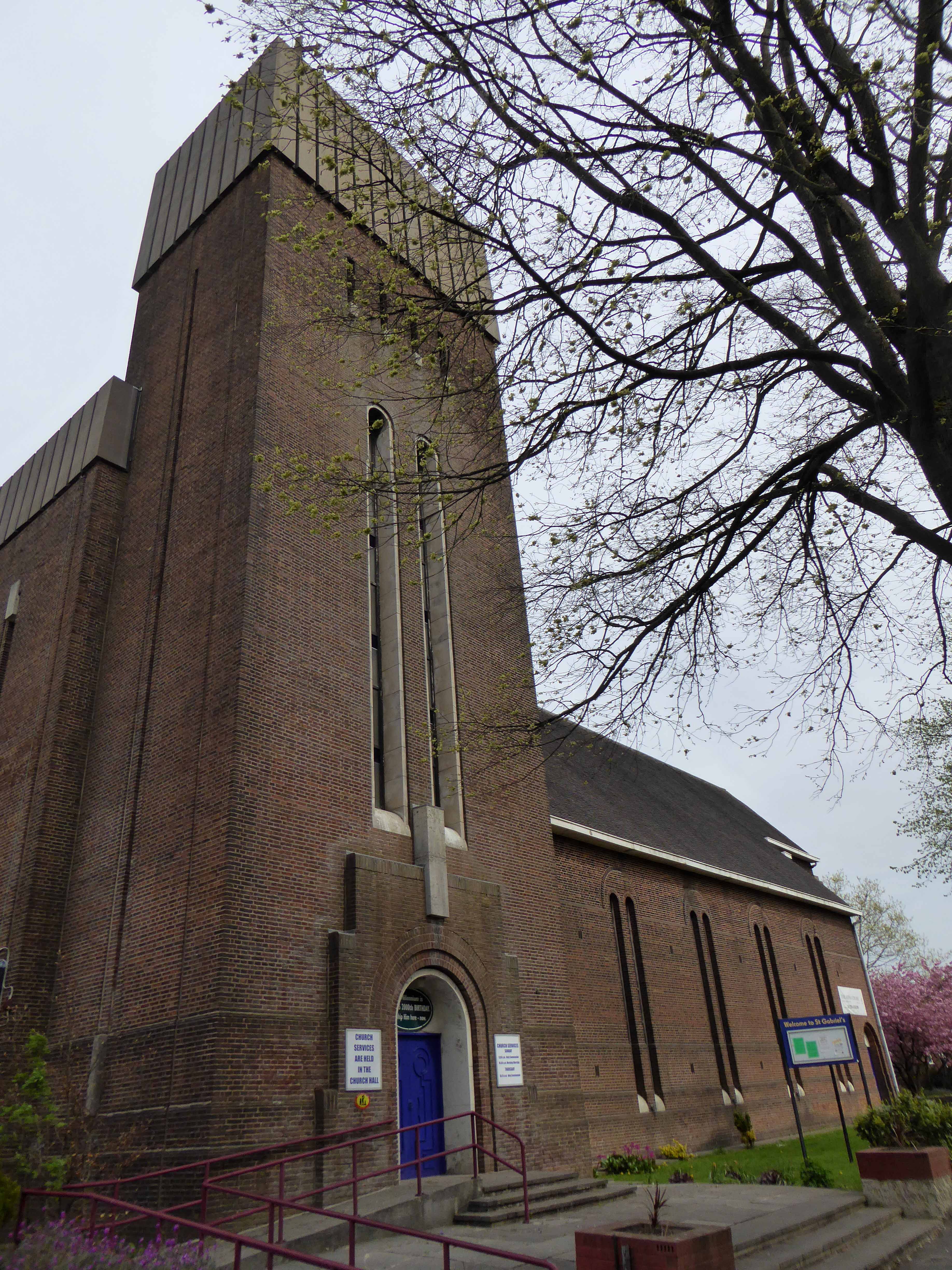
The original design of Liverpool architect F.X. Velarde attracted so much attention when St Gabriel’s opened in 1933.
“The new building… marks a new departure from the accepted ecclesiastical style and is unique in this district,” said the old Blackburn Times when it was consecrated on April 8, 1933, by the Bishop of Blackburn, Dr P.M. Herbert.
But this is a church which throughout its life has been fraught with settlement cracks, repairs and redesign – it’s original towers truncated and clad, flat roofs pitched and timbers replaced.
For 34 years ago, the landmark building was facing possible demolition — with the parish confronted with a then-immense bill of £15,000 for repairs. The crisis was due to serious damage to the roof timbers caused by water penetration.
Eventually, it took £40,000-worth of refurbishment inside and out lasting until 1975 to save St Gabriel’s — at considerable expense to its original appearance. The main tower was shortened by six feet and later clad at the top with glass-fibre sheathing while the east tower was removed altogether and its flat roofs were made into pitched ones to deal with the rotting roof timbers and problems of settlement.
In fact, the difficulties that its design and construction posed were recognised much earlier in 1956 when the church, which had cost £20,000 to build, was found to be in urgent need of repairs that would cost more than £1,500. For an inspection by the Diocesan Architect found that major defects in the flat roof could have serious consequences unless they were given early attention and portions of the parapet wall were found to have large cracks due to settlement while half the building’s brickwork needed pointing.
And so it now stands forlorn and unused – services are now held in the adjacent church hall. A series of interlocking monumental interwar functionalist brick clad slabs, once thought to resemble a brewery or cinema, now awaits its fate. Though it remains a thing of wonder in both scale and detailing, well worth a wander around if you’re passing.
Its tall slim arched windows reaching towards the heavens, Deco detailed doors firmly closed.
Now here I am in Colwyn Bay generally minding my own and everybody else’s business, when all of a sudden I noticed a cast iron glazed awning.
Proudly announcing the proprietors – sadly supported by a distressing modern addition – now I’m not one to decry and debunk the rising tide of modernity, I’m all in favour of unisex clothing and central heating.
But the unchecked encroachment of vacuous vinyl really is the limit.
Businesses displayed a degree of dignified permanence unknown to the current high street trader. So here it is writ larger than life in stained glass and Carter’s Tiles.
Loud and proud.
And as an addendum here are the delightful tiles from the Llandudno branch, snapped two years previously.
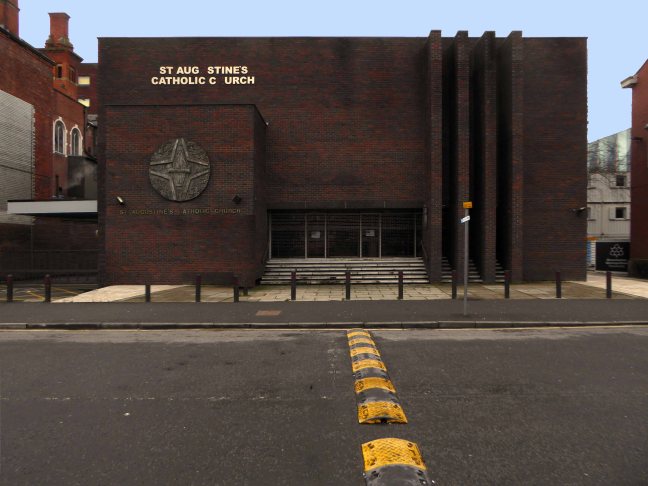
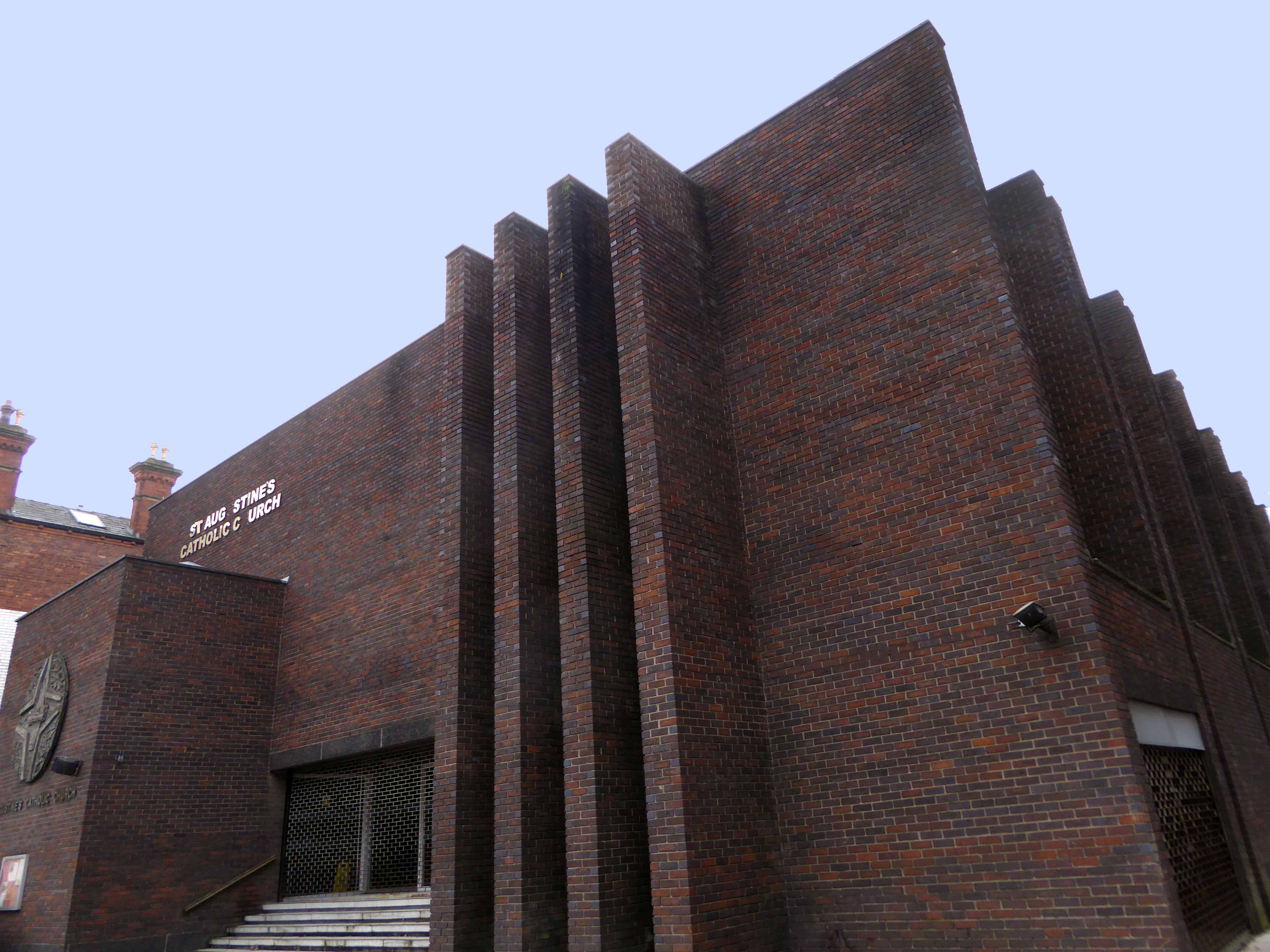
We have been here before on the west side of Grosvenor Square, between the former Eye Hospital and Registry Office on Lower Ormond Street, sits the solid stolid brick form of St Augustine.
The original St Augustine’s was one of the oldest Roman Catholic churches in Manchester, having been established at Granby Row in 1820. This church was sold in 1905 to make way for the Manchester Municipal Technical College, and a new church built on York Street. This church was destroyed in the Manchester Blitz of 1940. The present site previously housed a chapel of ease in a building bought from the Methodists in the 1870s. It had briefly been a separate parish, but in 1908 was amalgamated with St Augustine’s parish. After the War it was the only surviving church in the parish. The new St Augustine’s was built here with the help of a grant from the War Damage Commission, at a cost of £138,000, when it was clear that the original building was inadequate. The new building was opened in 1968 and consecrated in 1970.
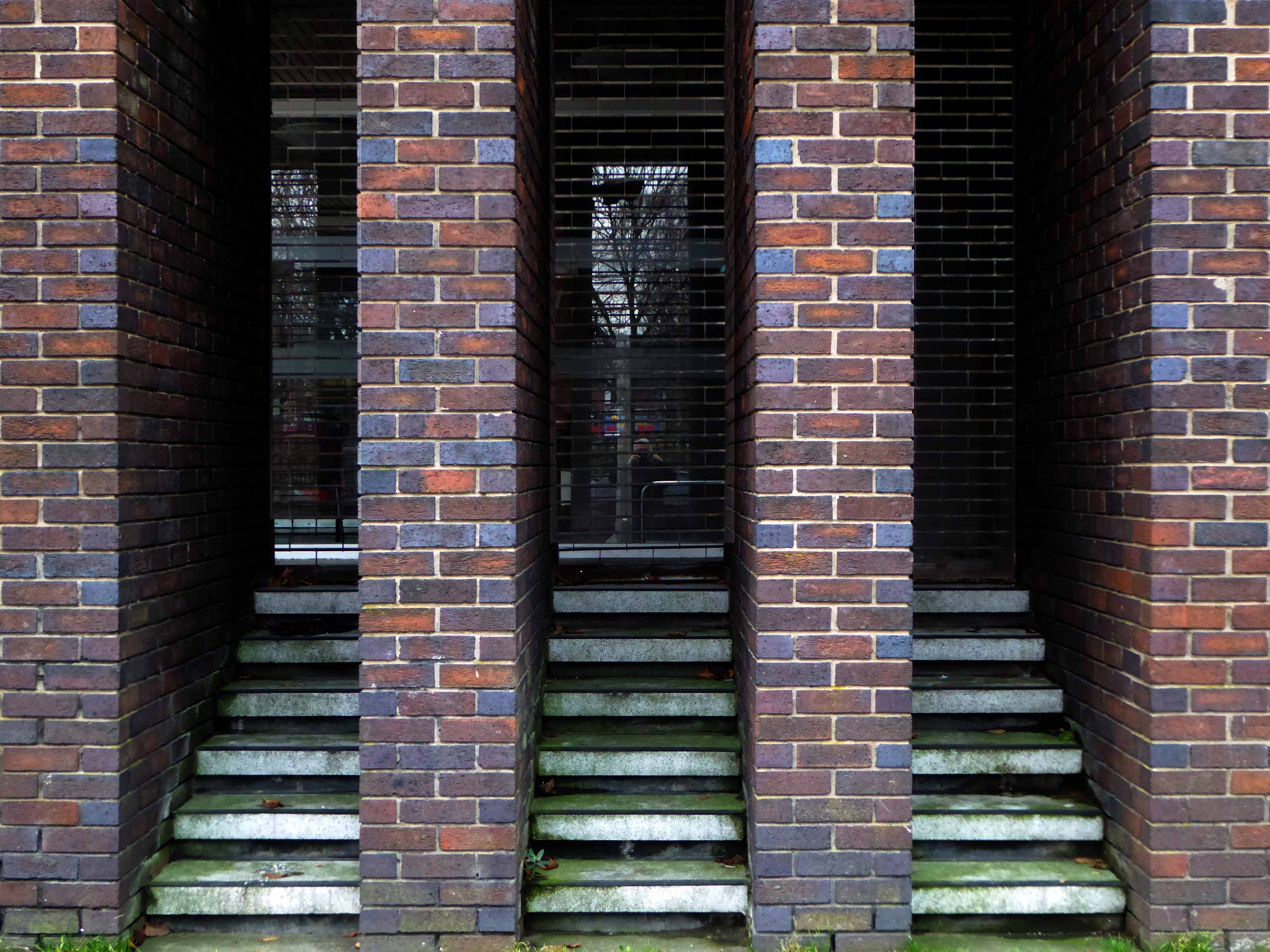
Roman Catholic Church 1967-8 by Desmond Williams & Associates. Load-bearing dark brown brick construction with felt roofs supported on Vierendeel girders, with rear range in brick and timber cladding.
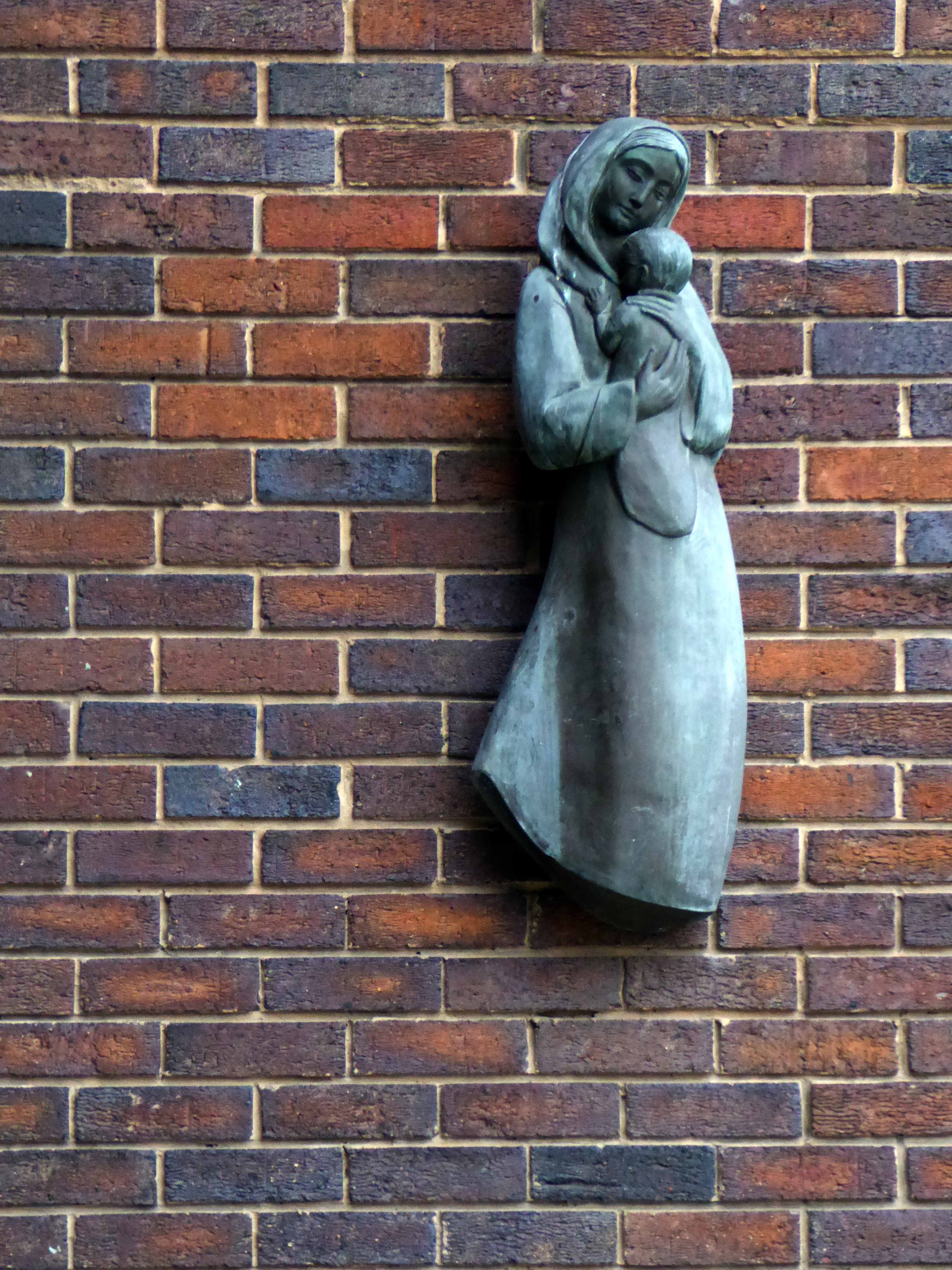
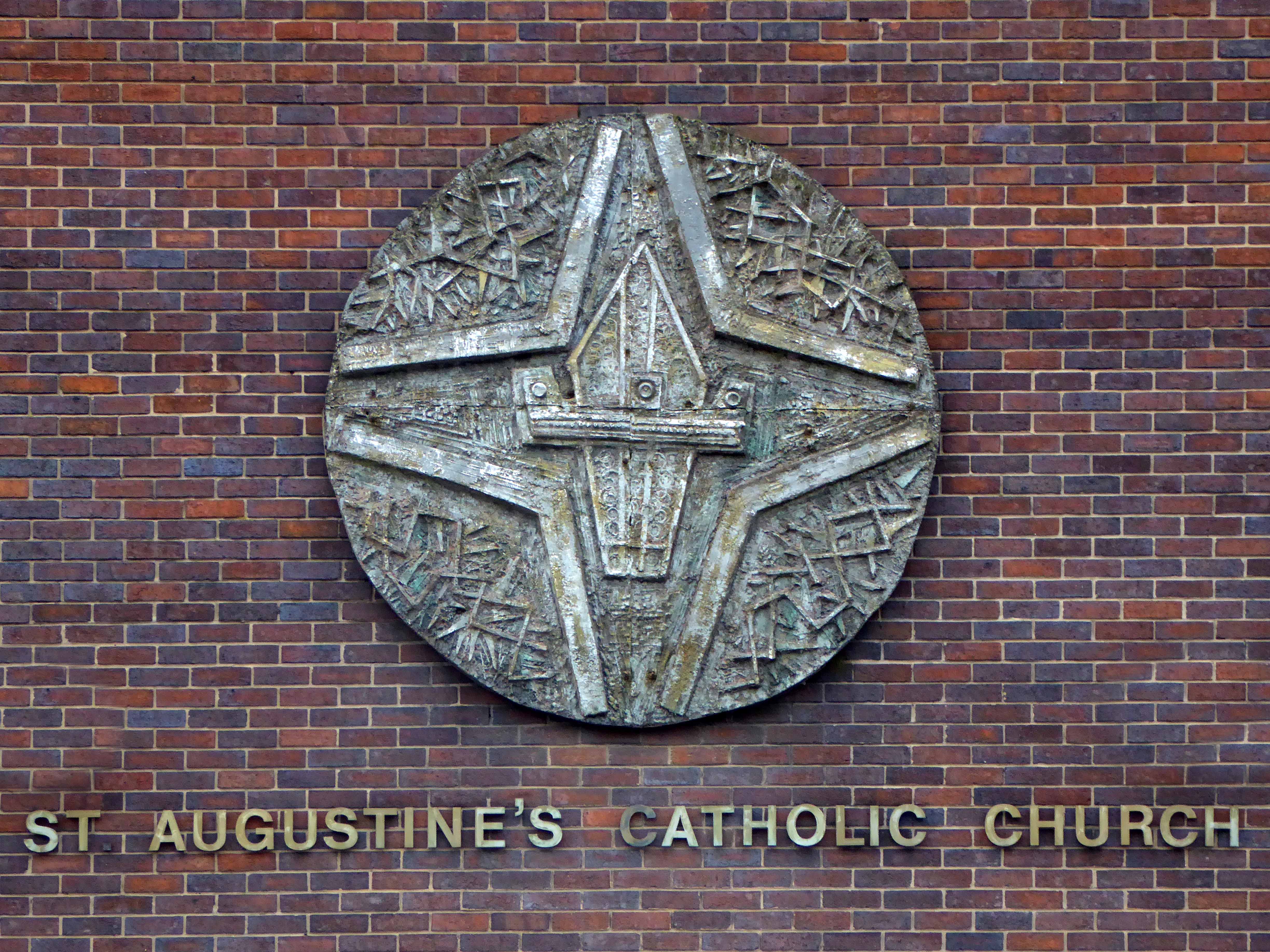
Body of church virtually square, with corridor at rear right leading to cross wing containing offices and accommodation. Windowless façade with floating service projection to the left and four full height brick fins to the right of wide recessed central entrance reached by low flight of steps. On the projection a ceramic plaque with star and mitre and on the inner face of the left hand fin a figure of the Madonna, both by Robert Brumby. Set back returns of 6 bays, divided by pairs of projecting slim brick piers. Openings between the pairs of piers filled with coloured chipped French glass. Secondary entrance beneath large cantilevered canopy in first bay of left hand return. Slender linking block containing sacristy. The rear presbytery range, containing first floor hall, meeting rooms, kitchen, chaplaincy offices and accommodation for four priests. Bell tower rising from parish rooms block.
A simple box plan with ceiling of steel trusses clad with timber and clerestory north lights. Sanctuary of three stepped platforms with white marble altar set forward. Large ceramic reredos sculpture of Christ in Majesty by Robert Brumby of York. Bays containing either projecting confessionals or chapel recesses are divided by pairs of projecting slim brick piers. Fixed seating in angular U-shape surrounding Sanctuary. Side chapel to left. Narthex. West gallery above originally with seating, now housing organ. Unified scheme of decoration by Brumby including the external plaque and statue, holy water stoups, wall light brackets, circular font with ceramic inset and aluminium lid, altar table with bronze inset and, probably, Stations of the Cross sculptures. Also by Brumby, a memorial plaque fashioned from mangled plate, damaged in the Blitz, commemorating the earlier parish church which this replaced.
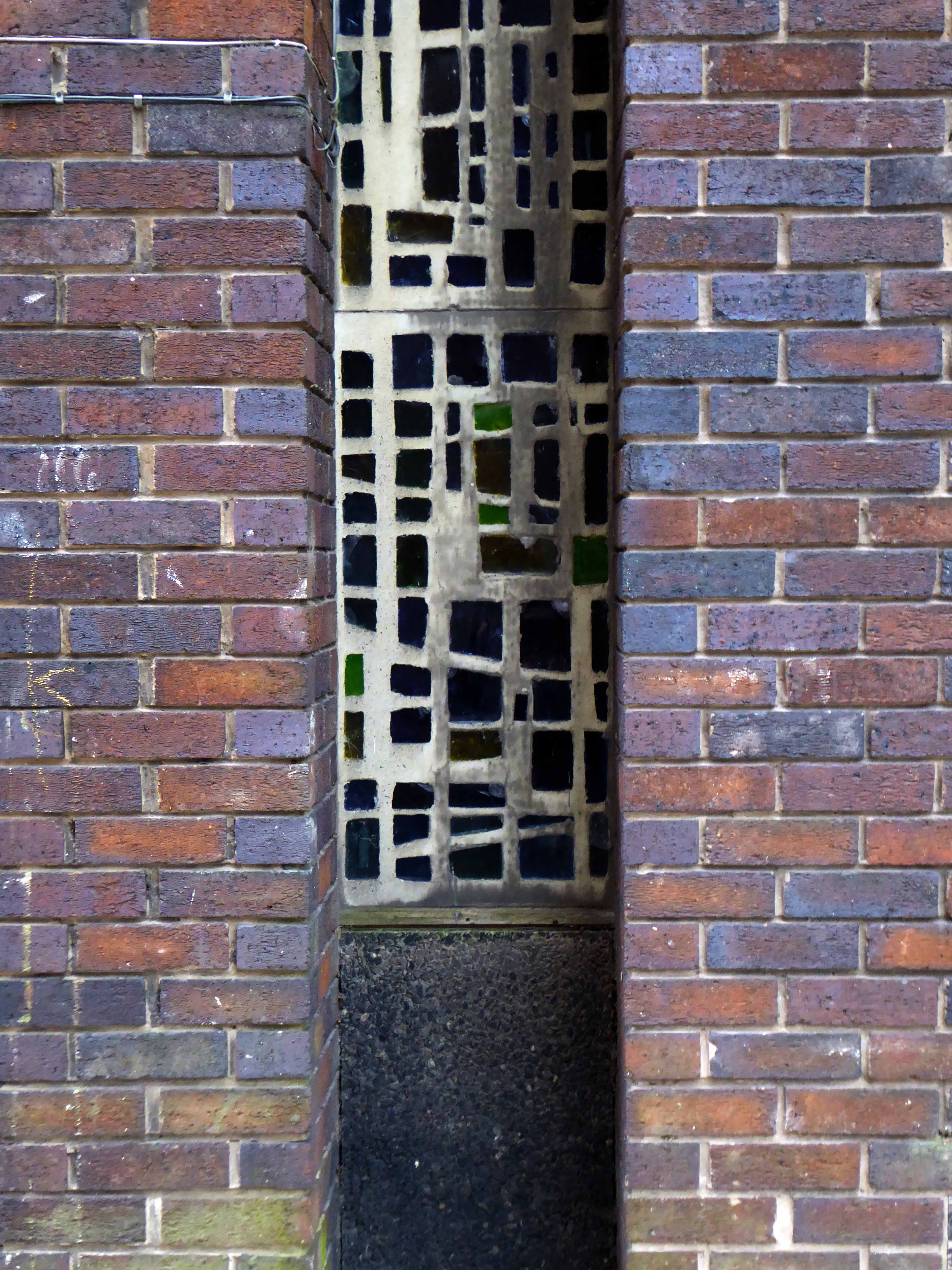
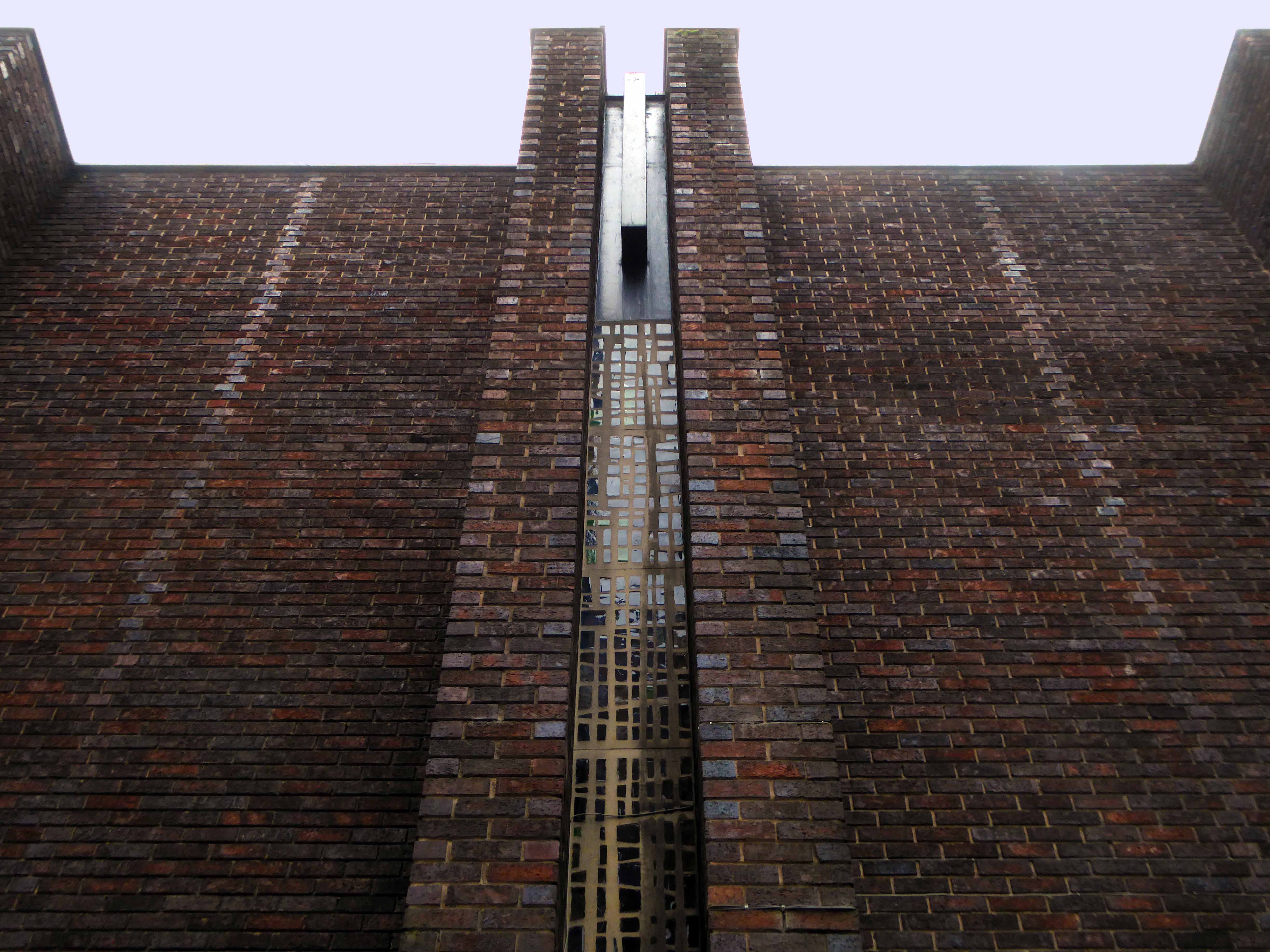
Of particular note are the stained glass windows.
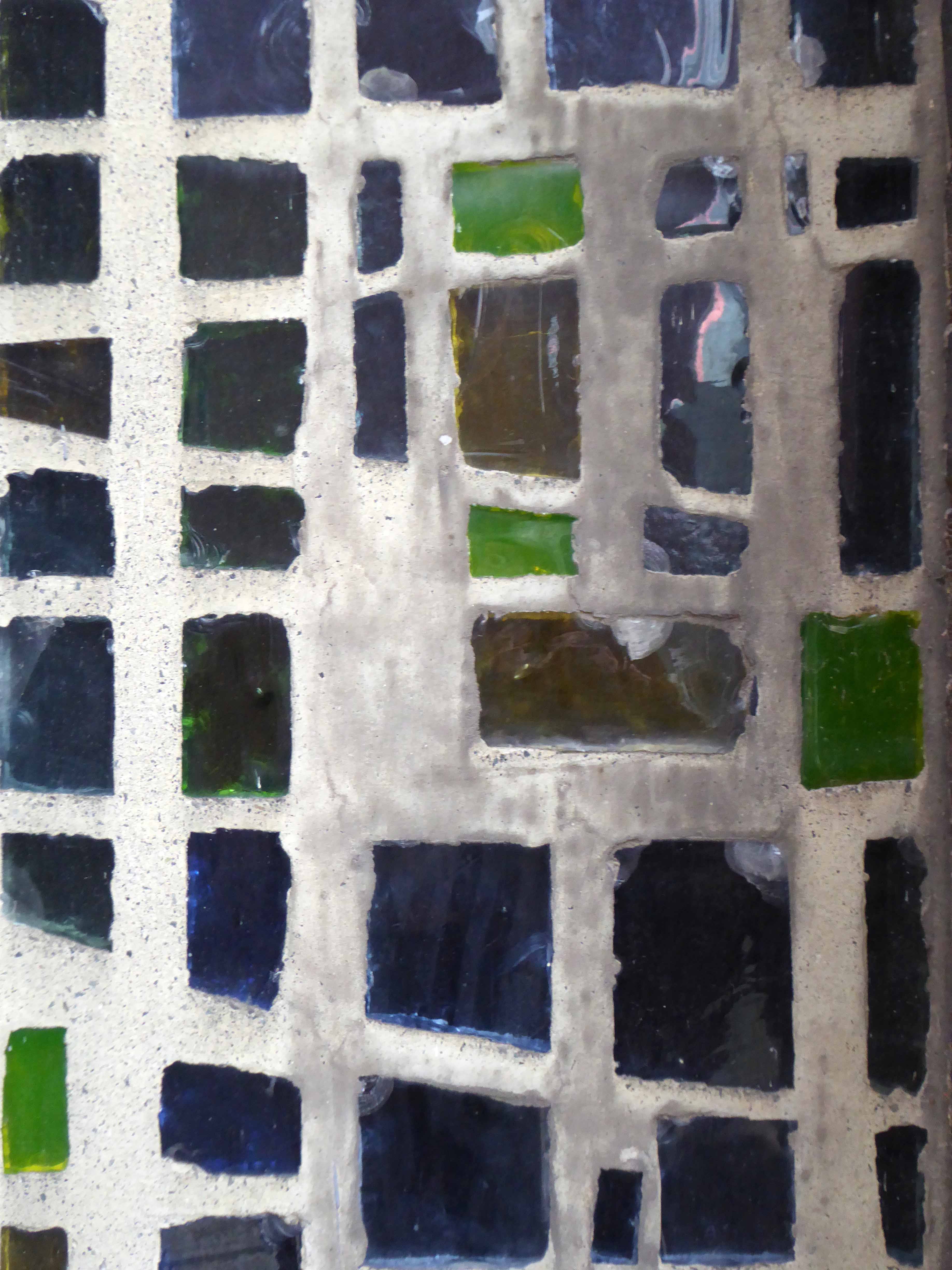
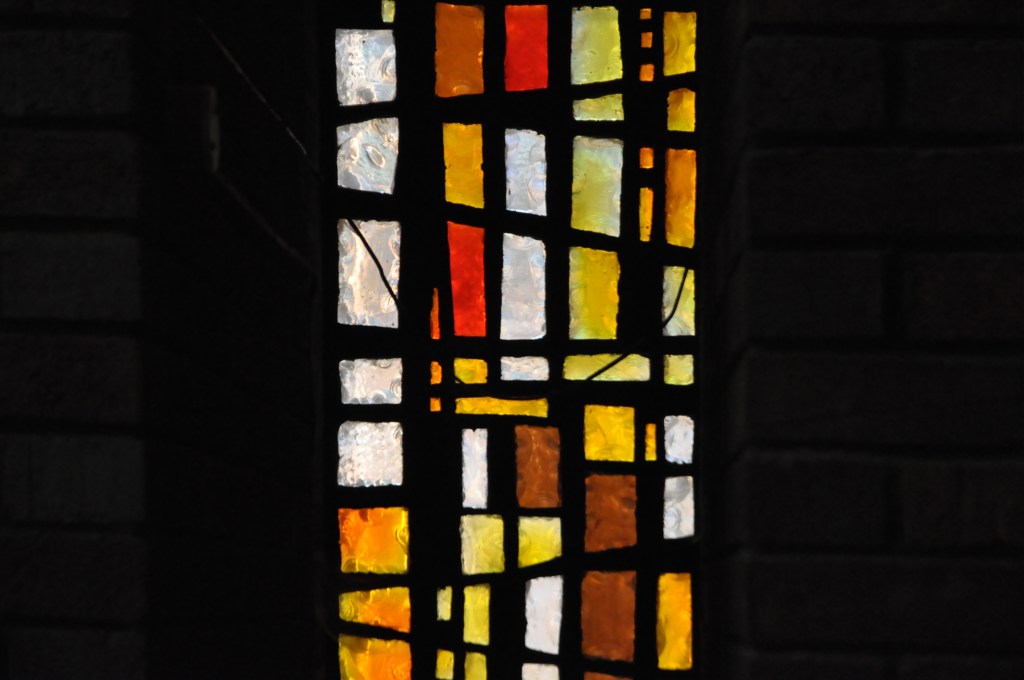
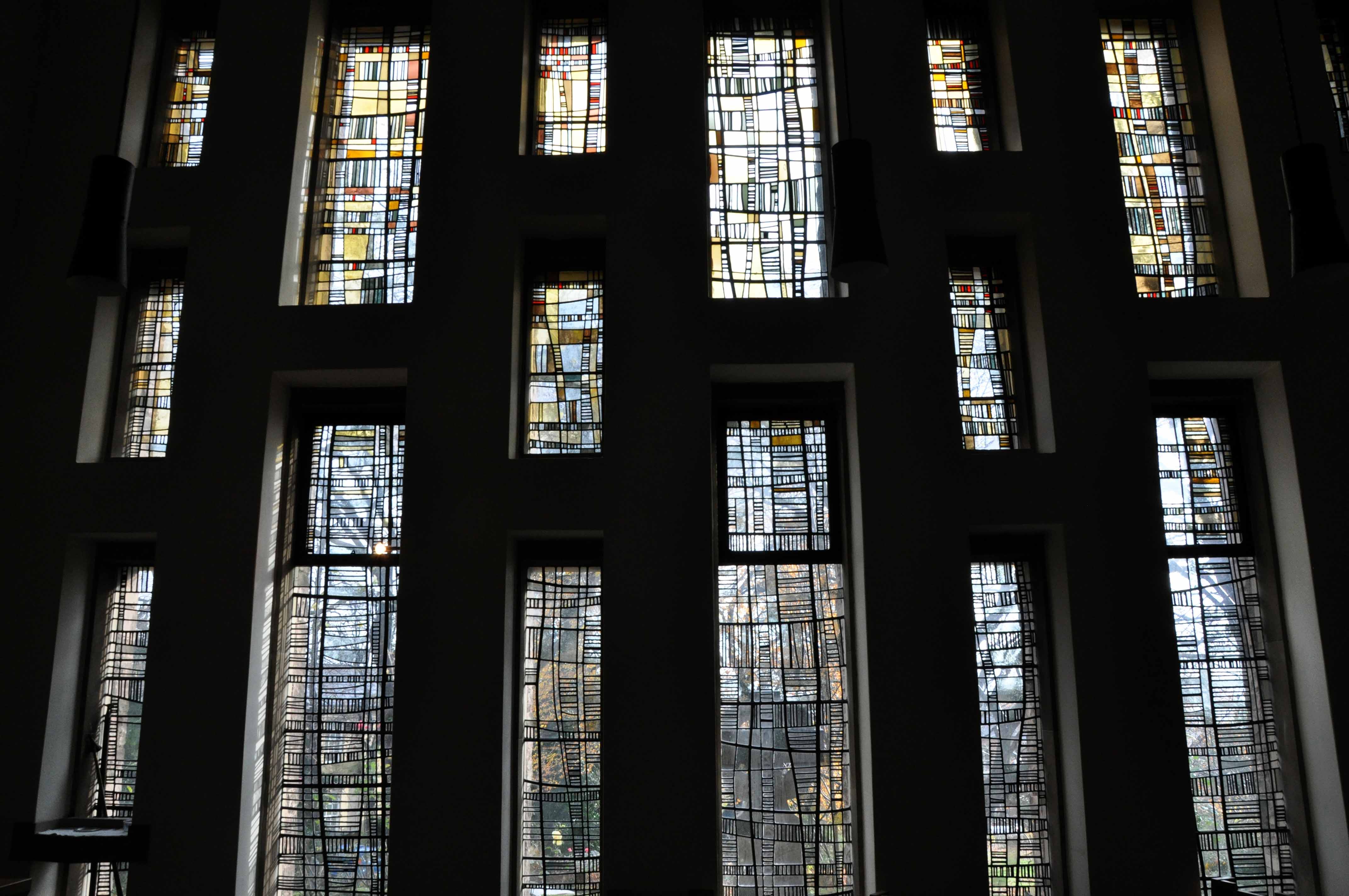
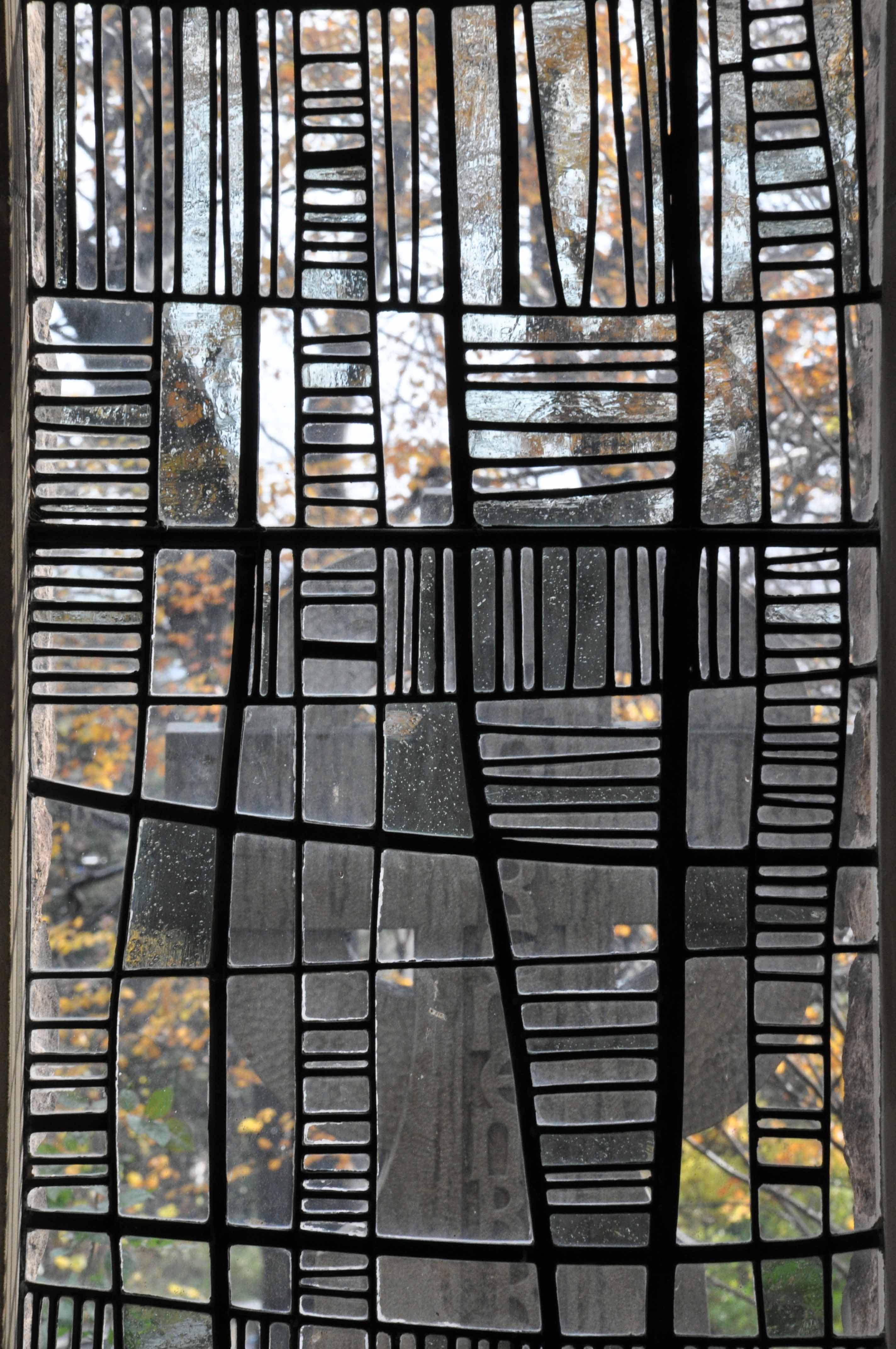
The internal atmosphere of the church is modified by the changes in light cast through the stained glass windows. The windows are of a colourful random and abstract design and ascend the full height of the walls between structural bays which themselves form enclosures to confessionals and stores. The pieces of coloured glass are suspended in concrete and were supplied by the now defunct Whitefriars company. The designer was a French artist, Pierre Fourmaintraux, who began working with Whitefriars in 1959, using the ‘dalle de verre’ (slab glass) technique that had been developed in France between the wars. His motif was a small monk variously painted upon, or cast into, the glass. In St. Augustine’s the motif is cast and highly stylised and can be found tucked away at the foot of each of the rear windows.
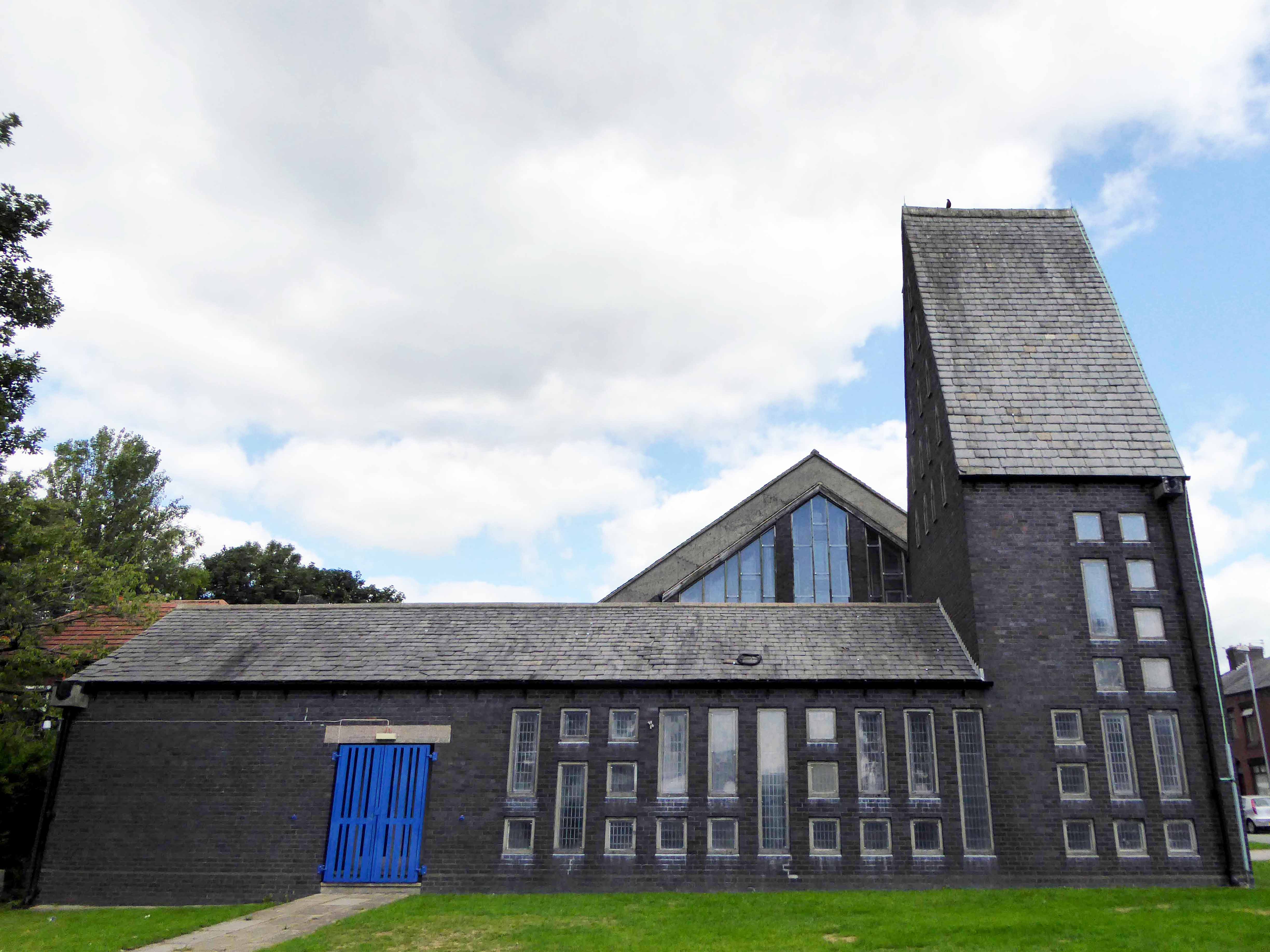
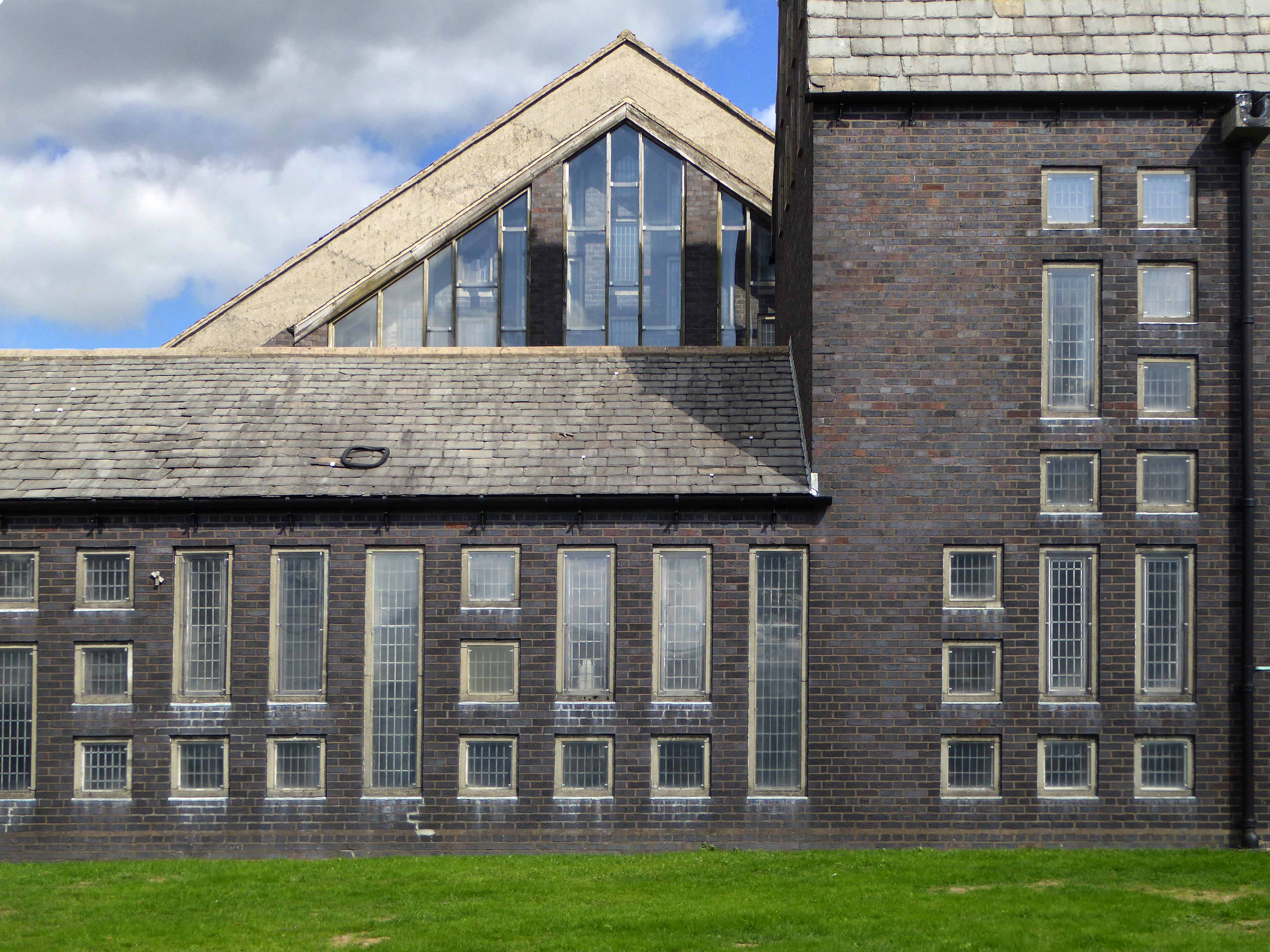
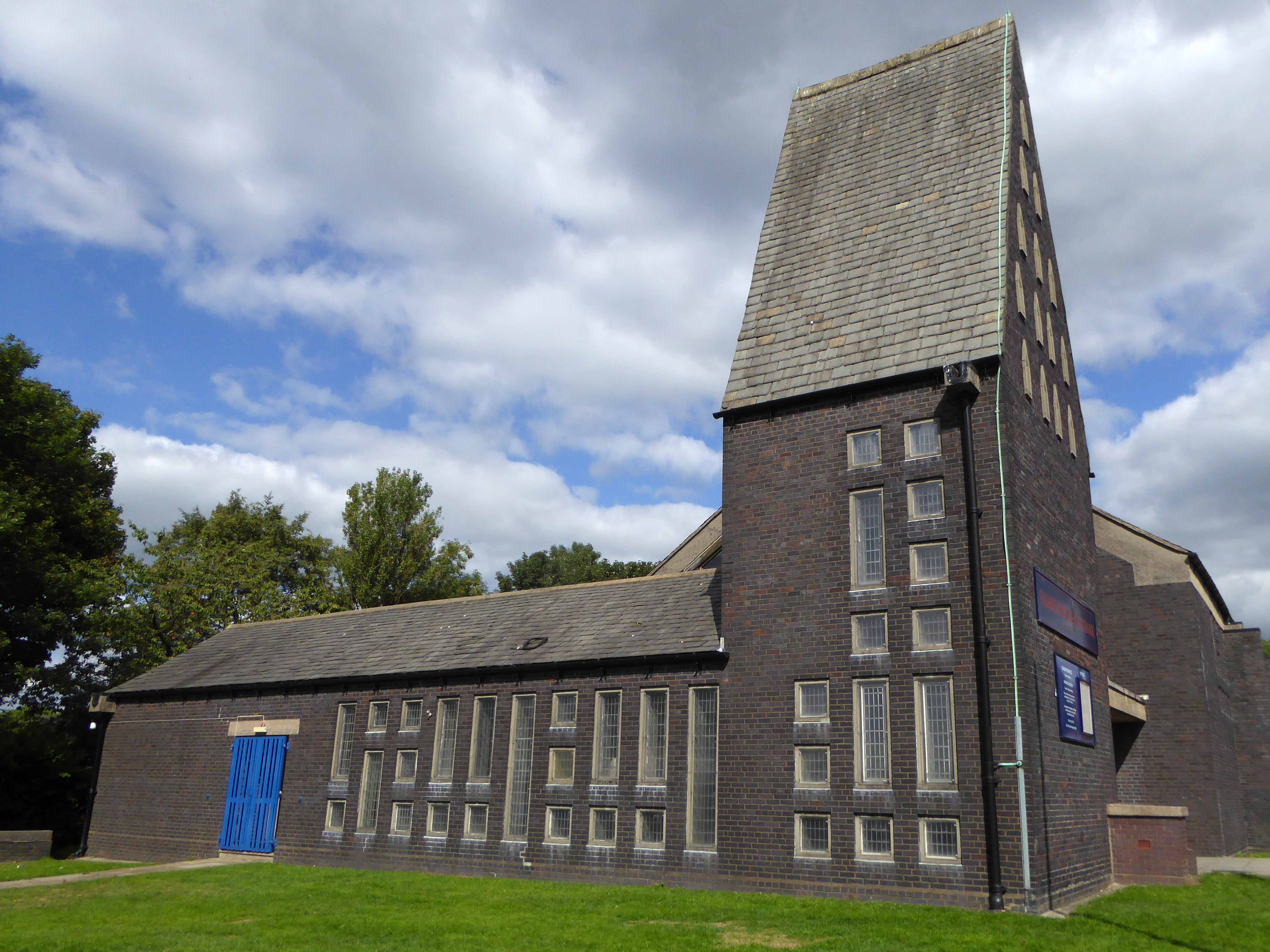
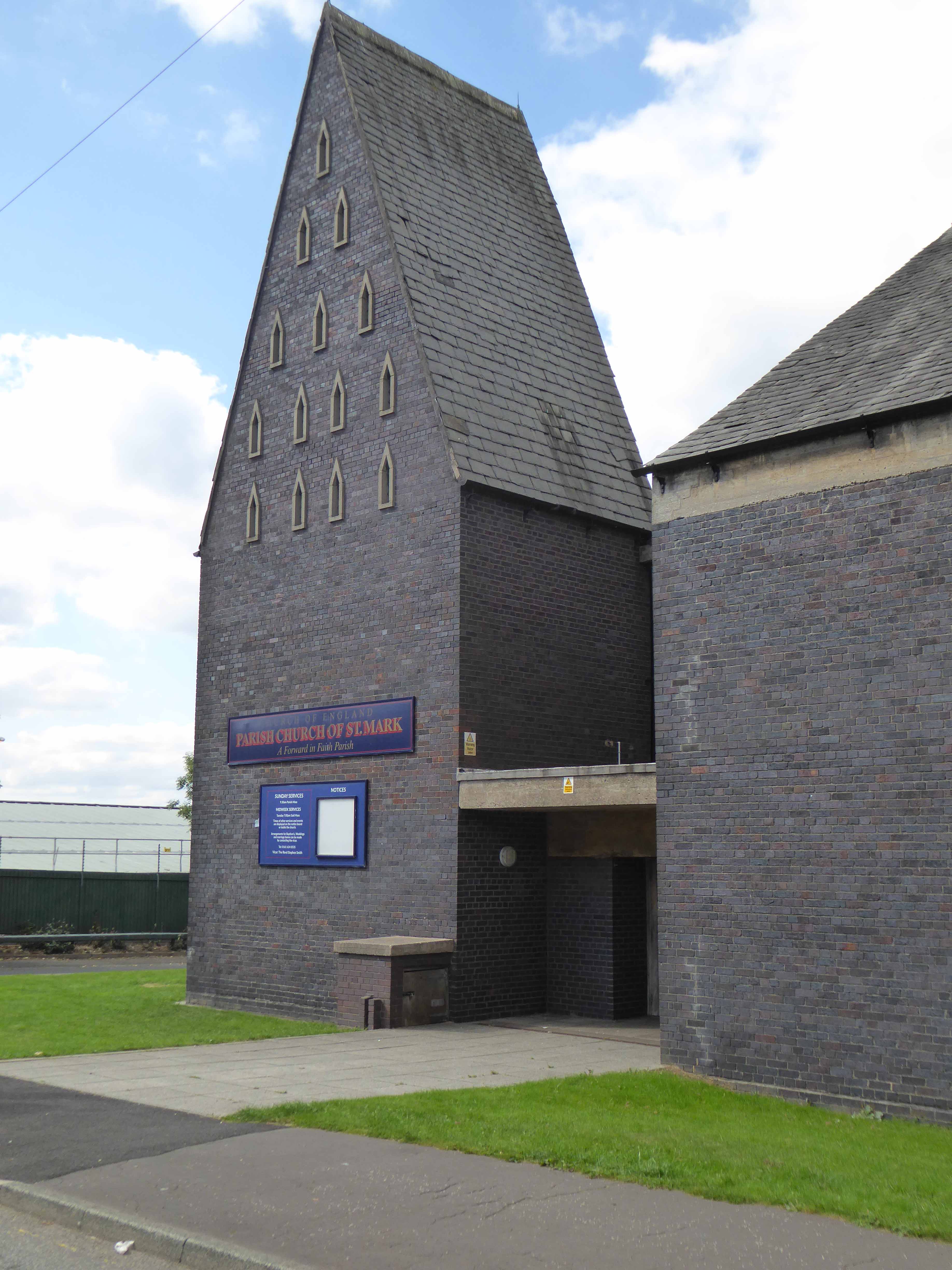
Life is full of little surprises, to turn from Middleton Road into Milne Street in downtown Chadderton and discover a triangular, blue-grey brick tower soaring into the September sky.
So solid geometries pierced by rectangular, triangular and angular gridded windows, deservedly Grade II Listed in 1998, made all the more extraordinary by its seemingly ordinary surroundings.
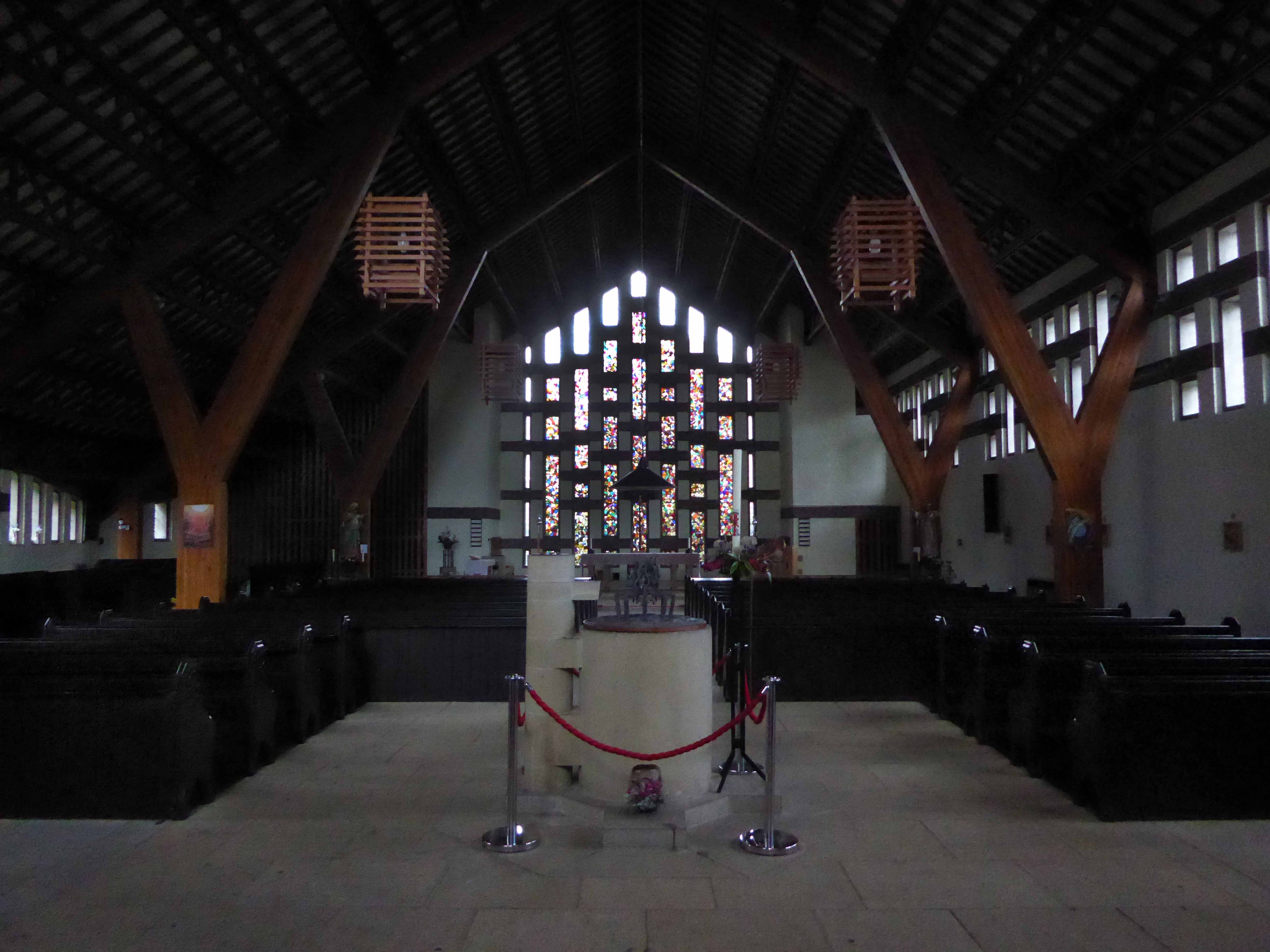
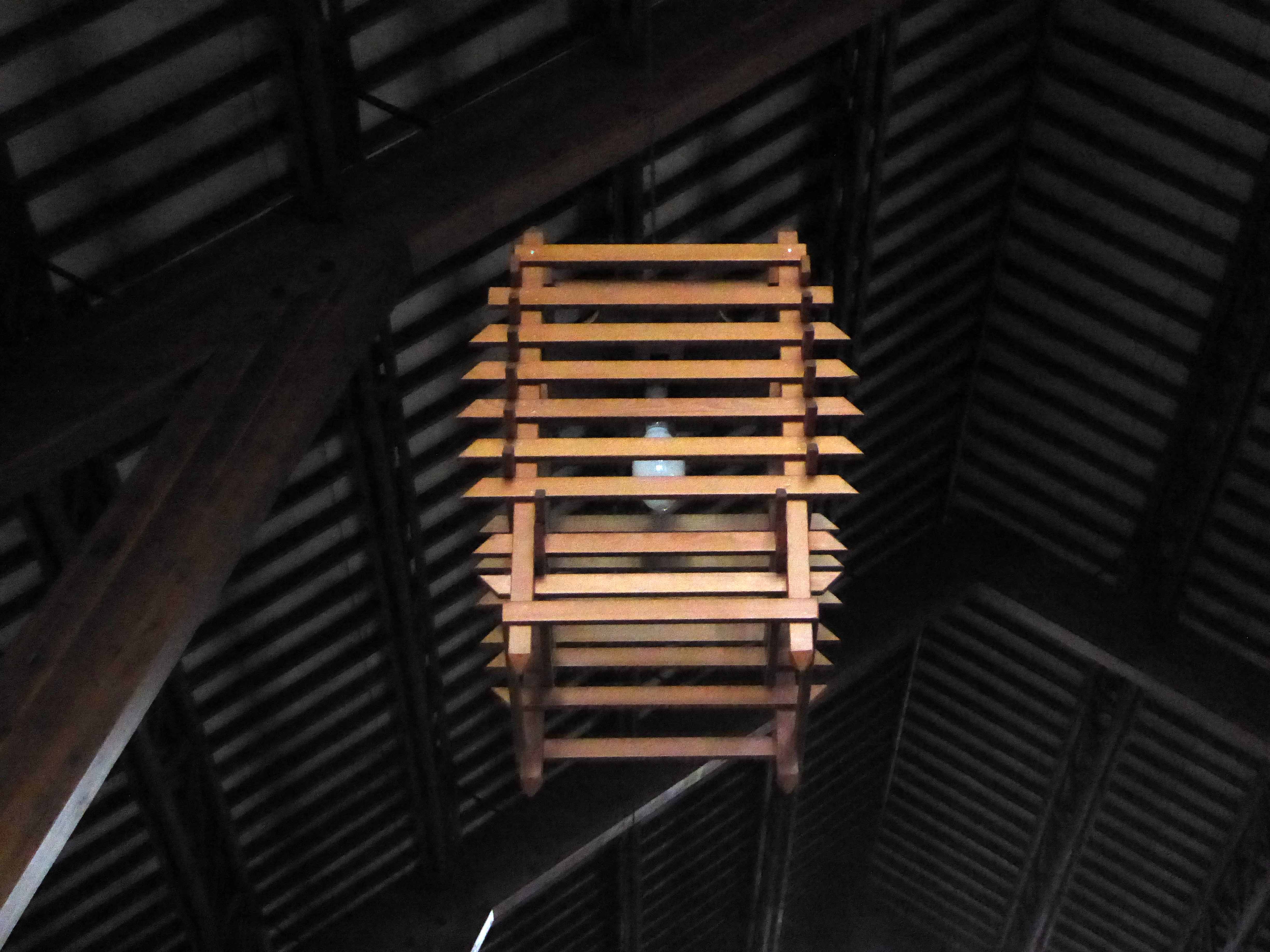
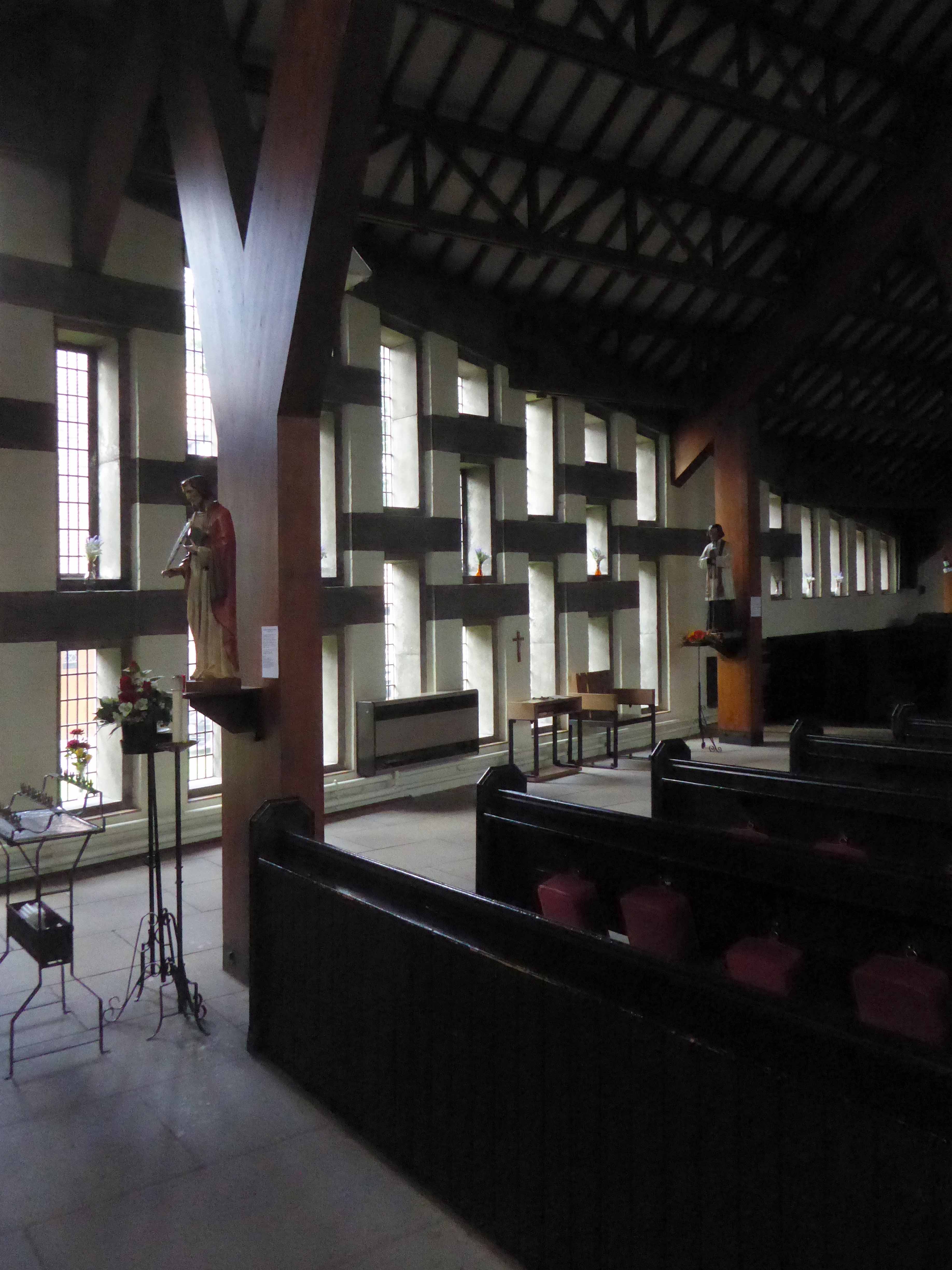
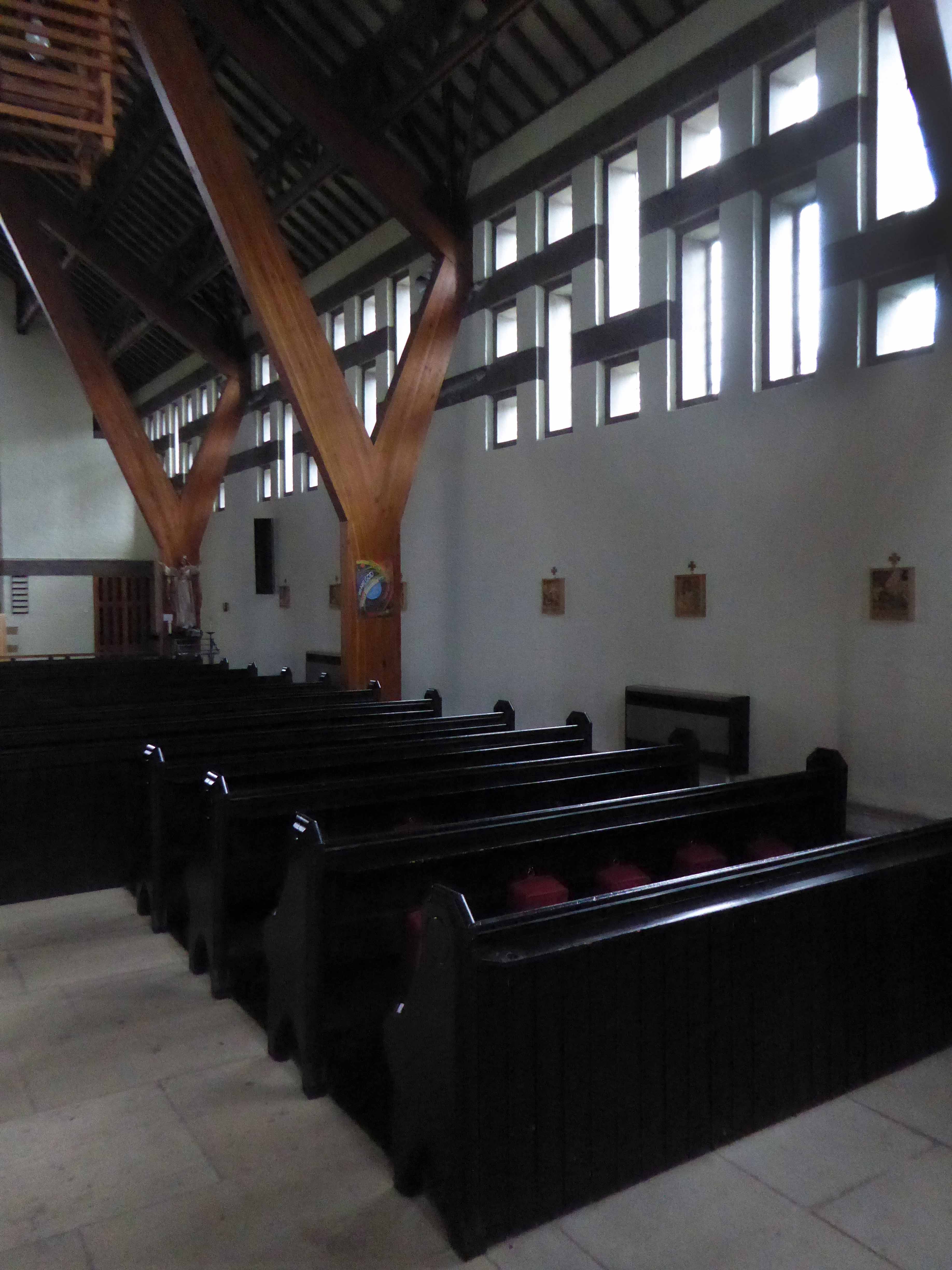
The interior mixes tradition with modernity, reusing pews and fragments of stained glass. Restrained natural lighting, complemented by slatted wooden, almost oriental boxed light shades. The furniture, fixtures and fittings bringing together a coherent decorative order.
The whole an uplifting and embracing space, punctuated by the curved y-shaped wooden supports, rising to the timber framed roof structure.
It was a pleasure to meet the current incumbent Father Stephen and a privilege to spend some time exploring this altogether delightful and impressive church.
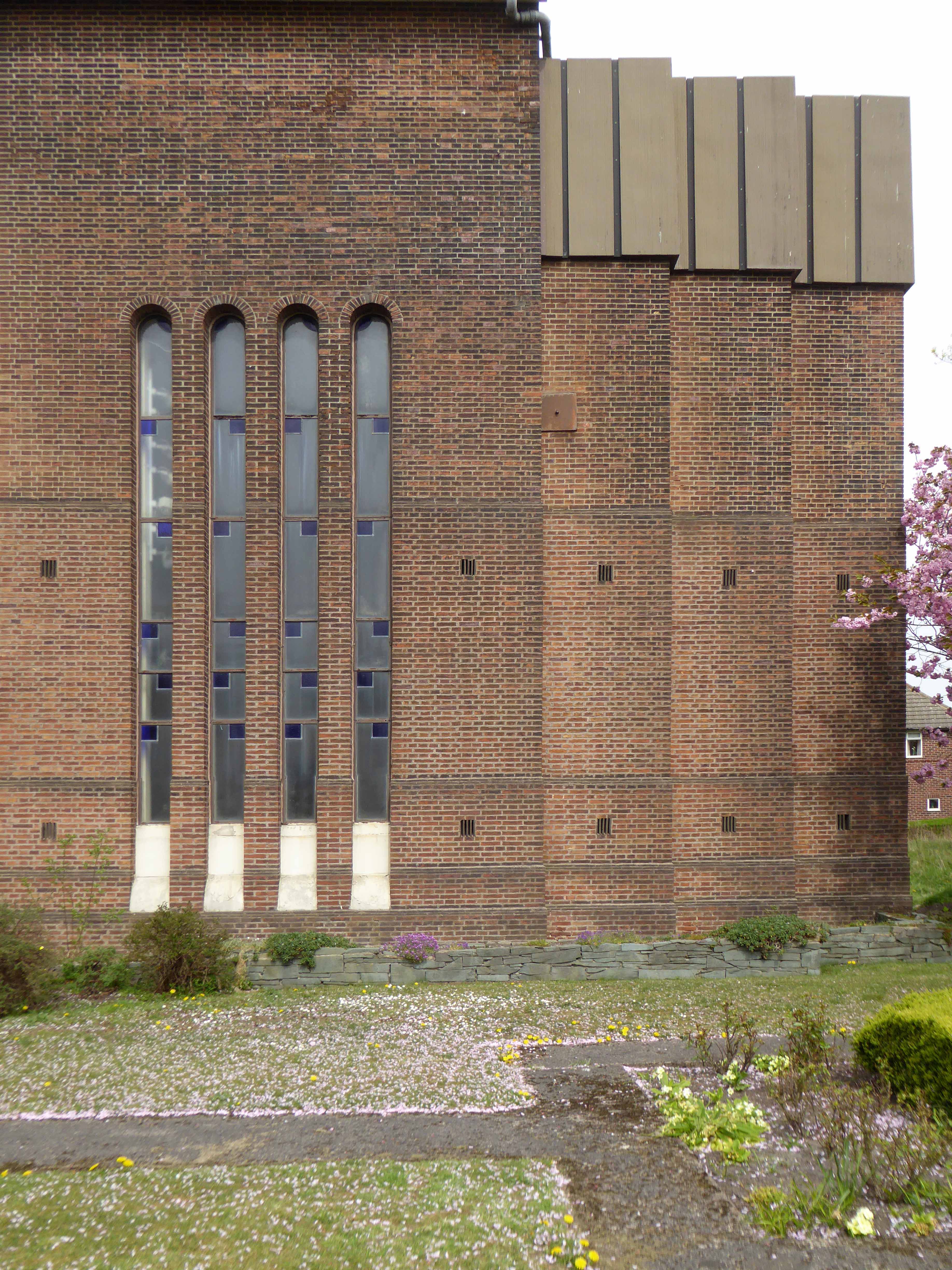
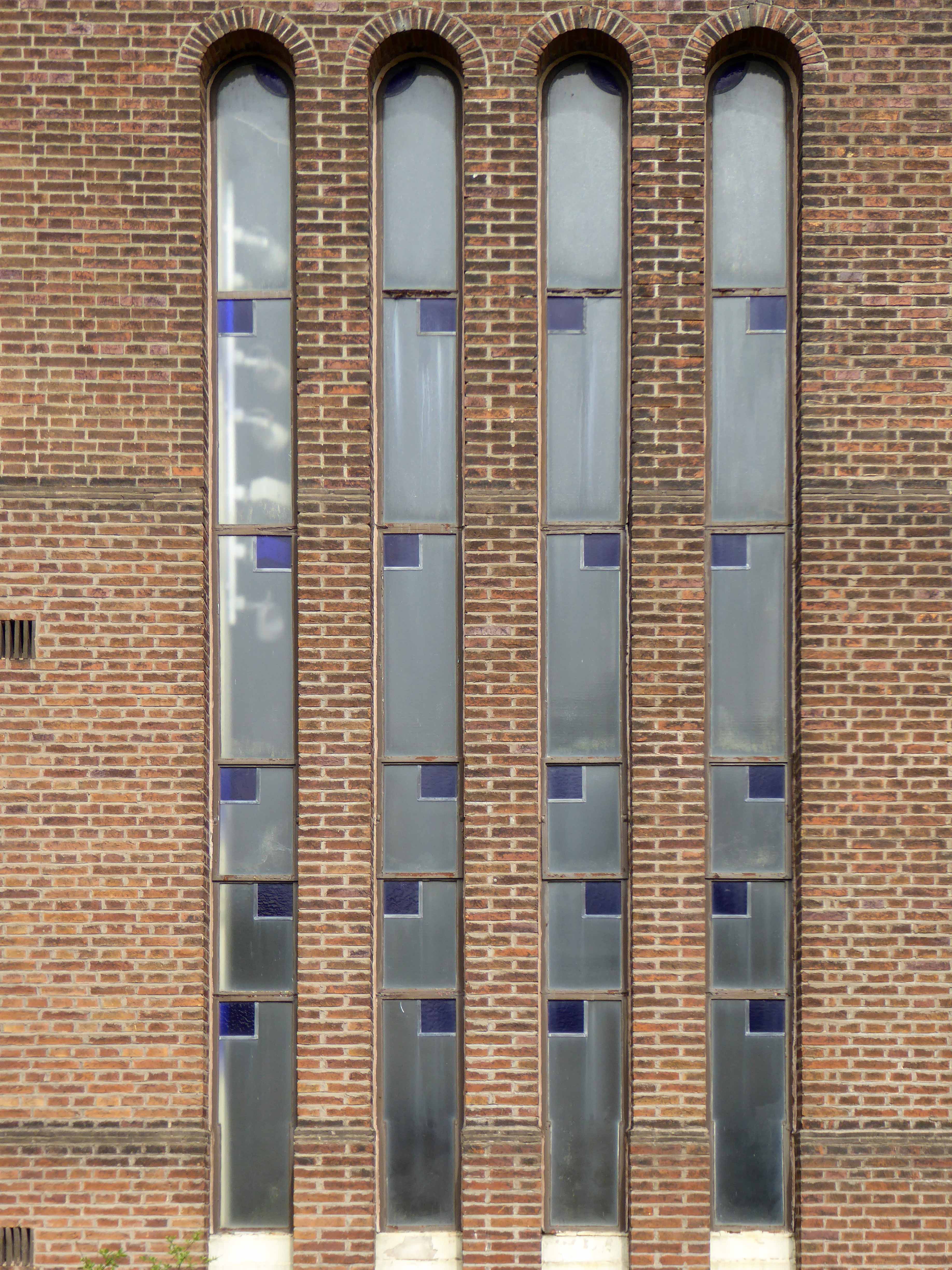
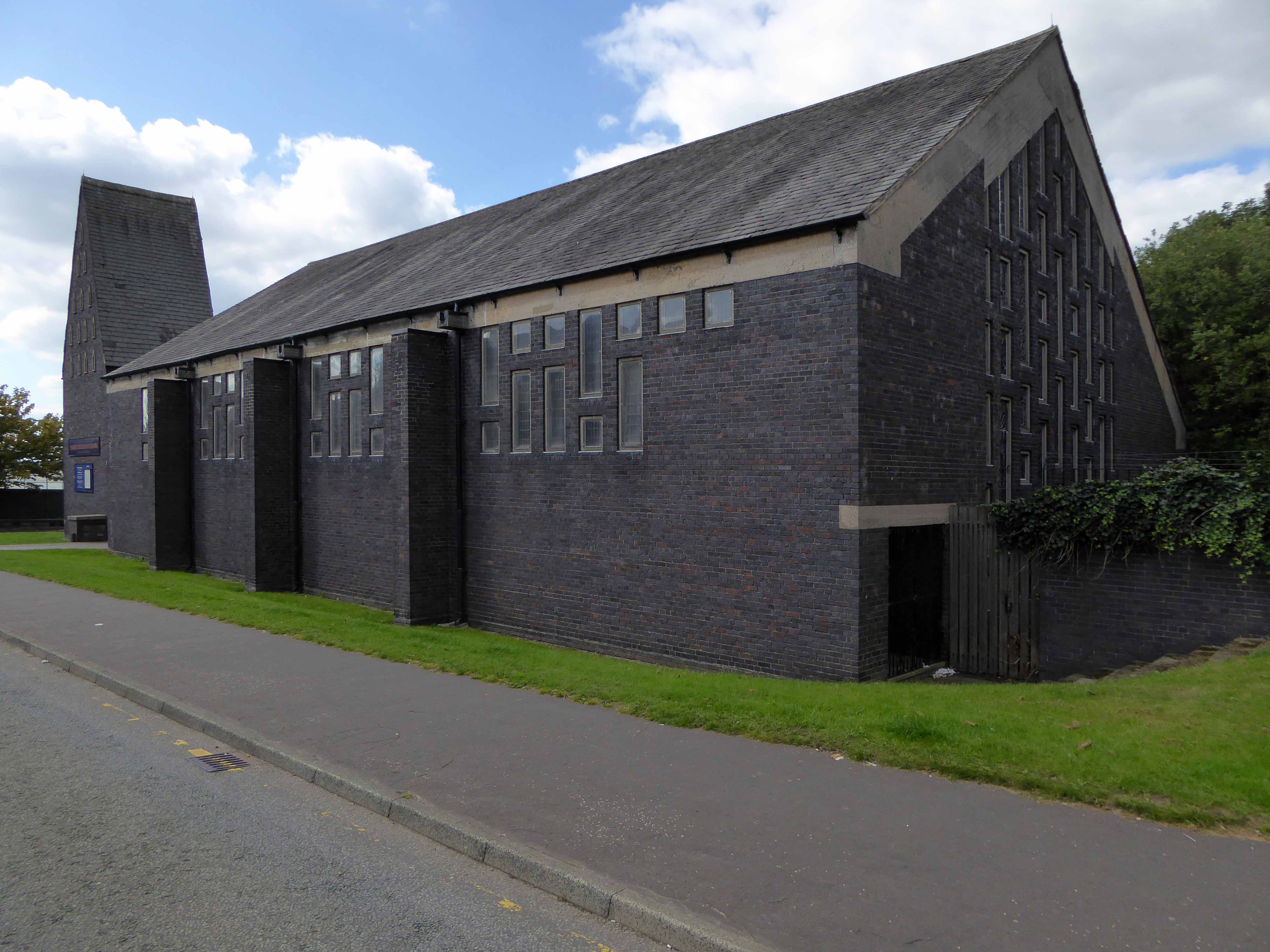
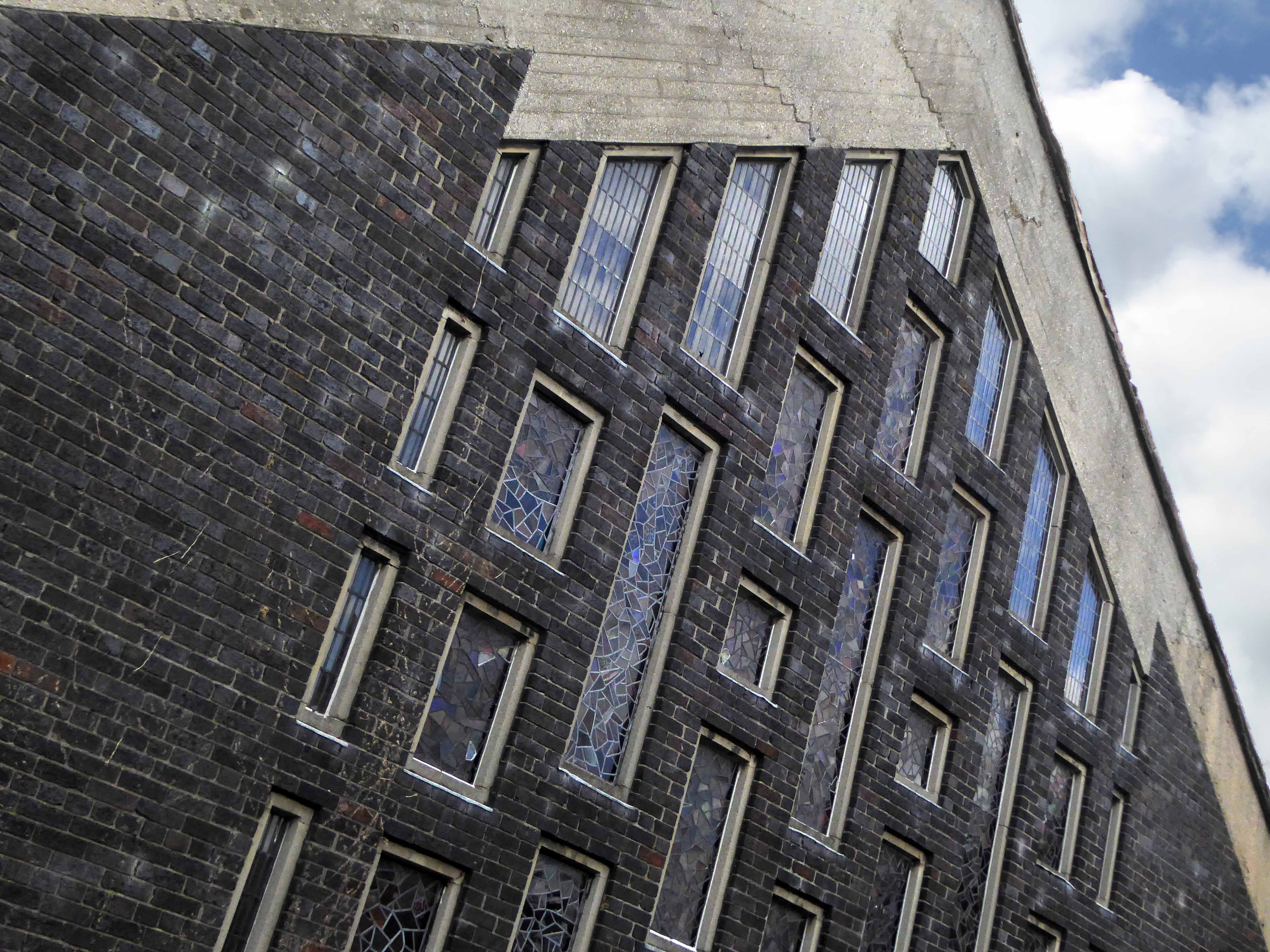
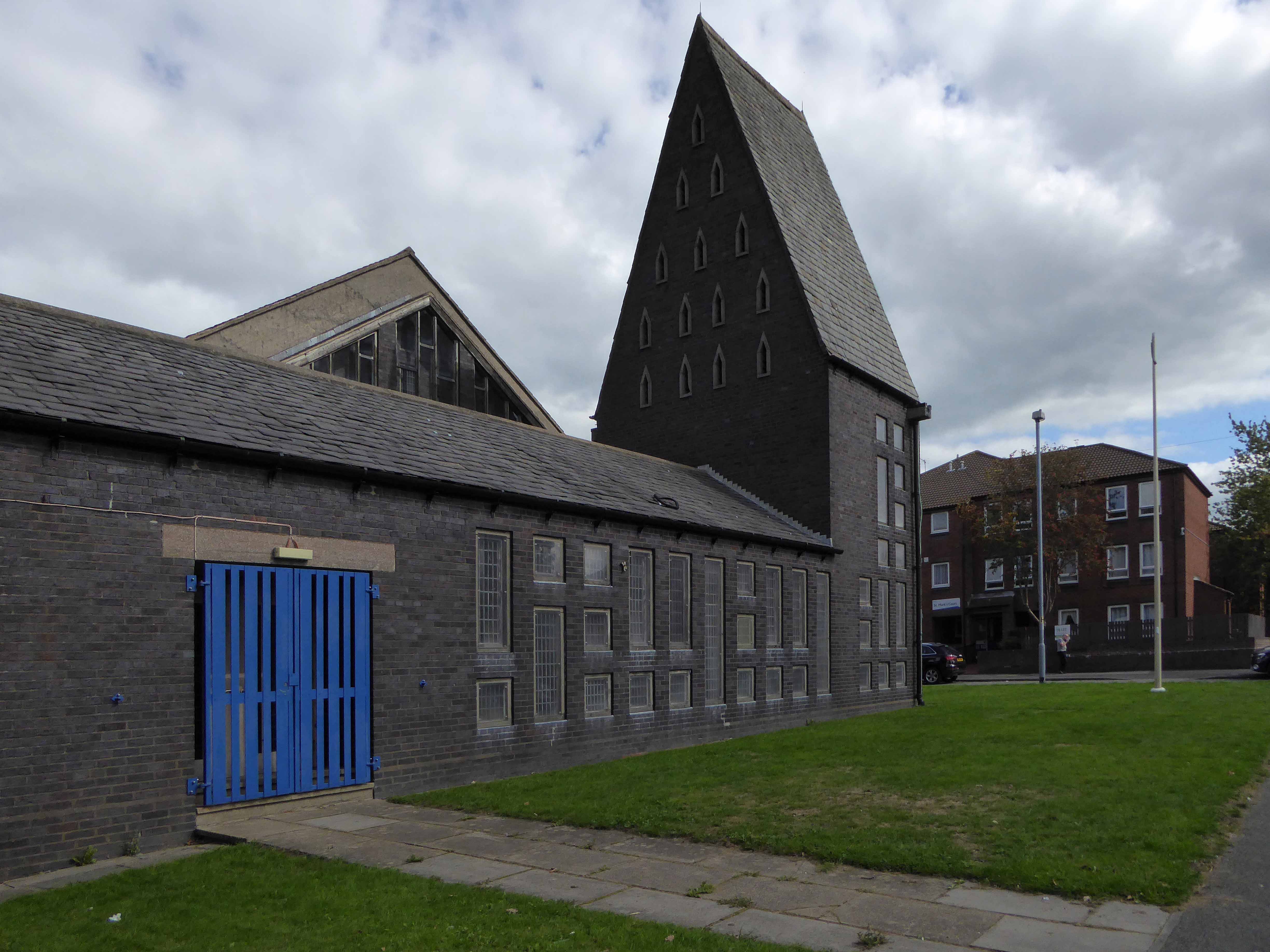
G.G. Pace 1960-63 – Blue engineering brick; graduated slate to pitched roofs – low pitched to church and entrance and steeply pitched to tower. Concrete dressings around windows. Five sided aisled space, three walls being orthoganal and the liturgical north side being canted outwards to provide room for the choir. Entrance with narthex to west and west also is a small rectangular chapel. Corner site, the corner itself dominated by a low rectangular brick tower with a high gabled roof. Four bay nave, the bays separated by buttresses and with rectangular windows set in varying groups high in the wall. West wall of nave is visible, and secondary glazing has been sensitively installed over the west window between the western buttresses. Thick exposed board-marked concrete beam at eaves. On return elevation, tower is flush with small chapel, with irregular groups of rectangular windows to both. Rectangular leaded lights. Recessed entrance with two doors of timber and leaded-glazing in vertical strips. Liturgical north and south faces of the tower each has a stack of 14 small pointed louvres. Jutting gutter spouts in exposed board-marked concrete.
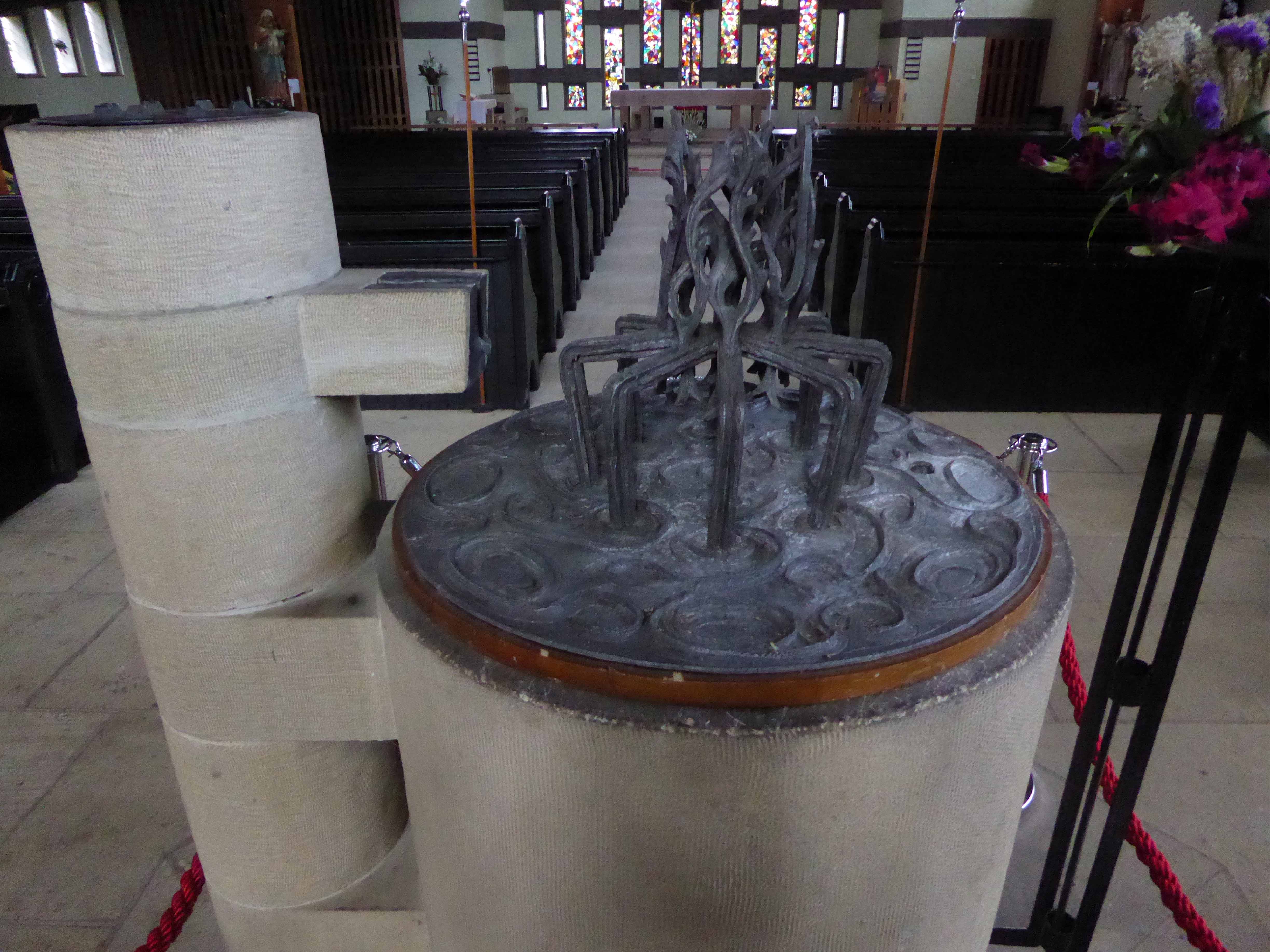
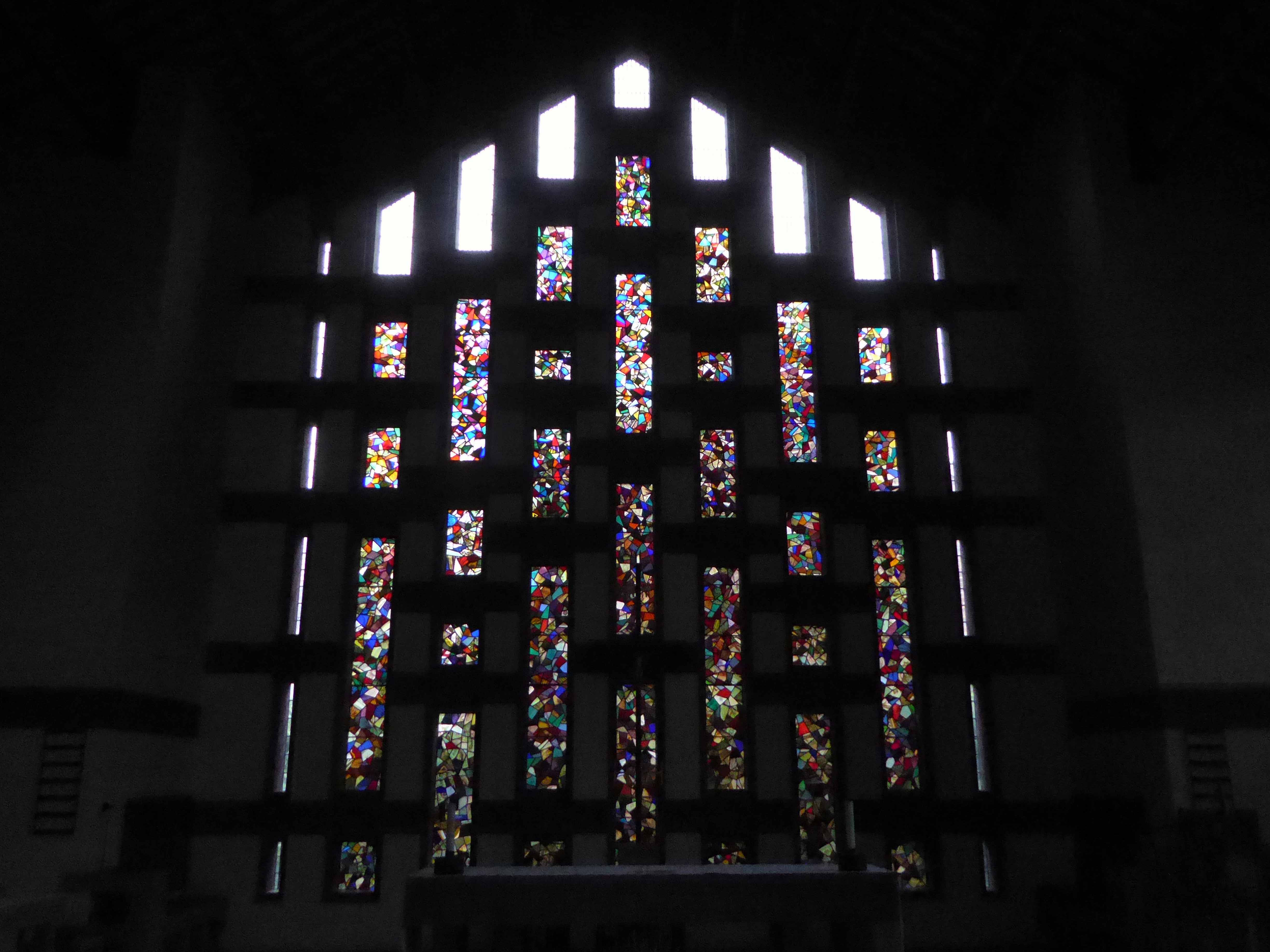
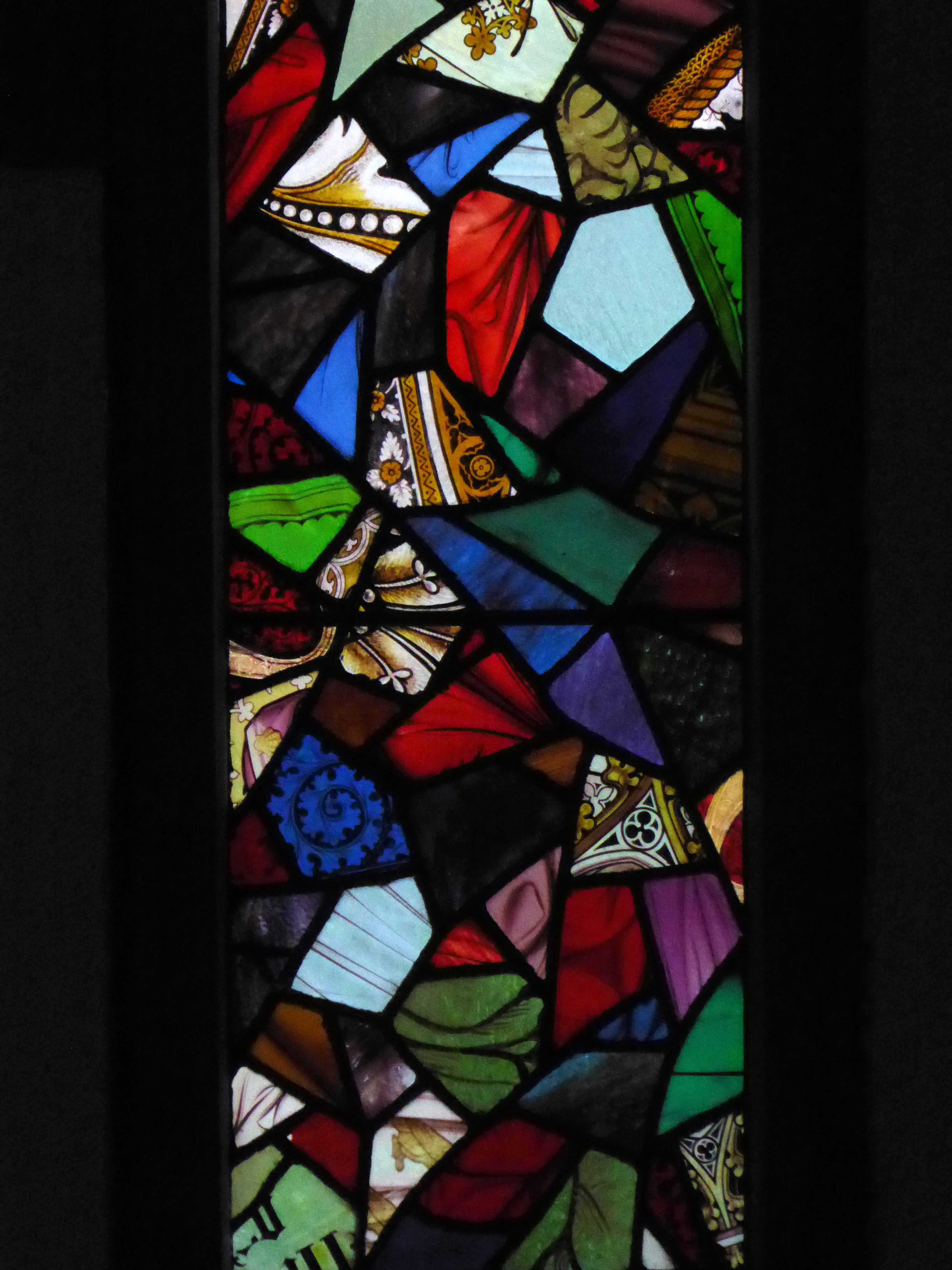
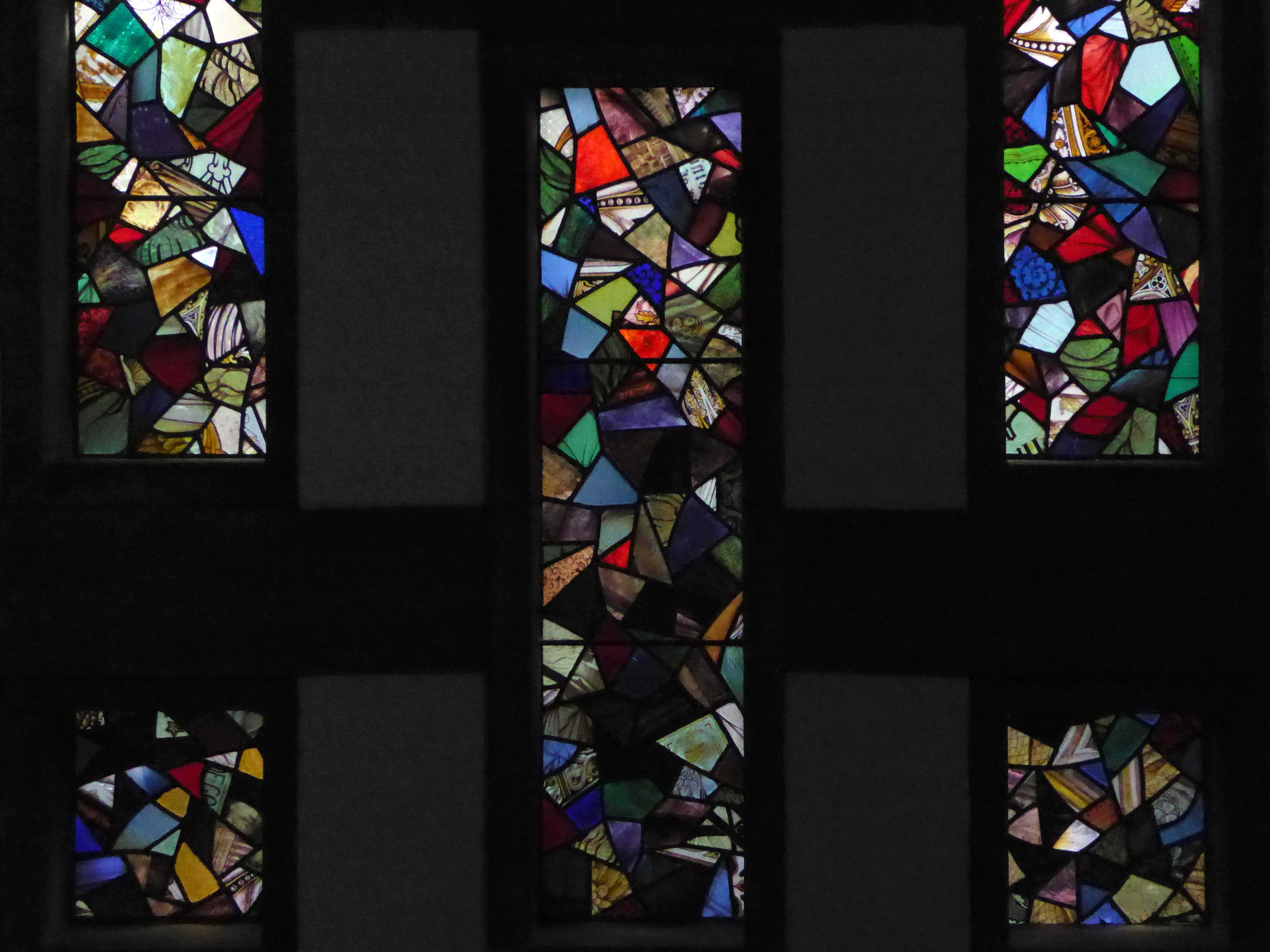
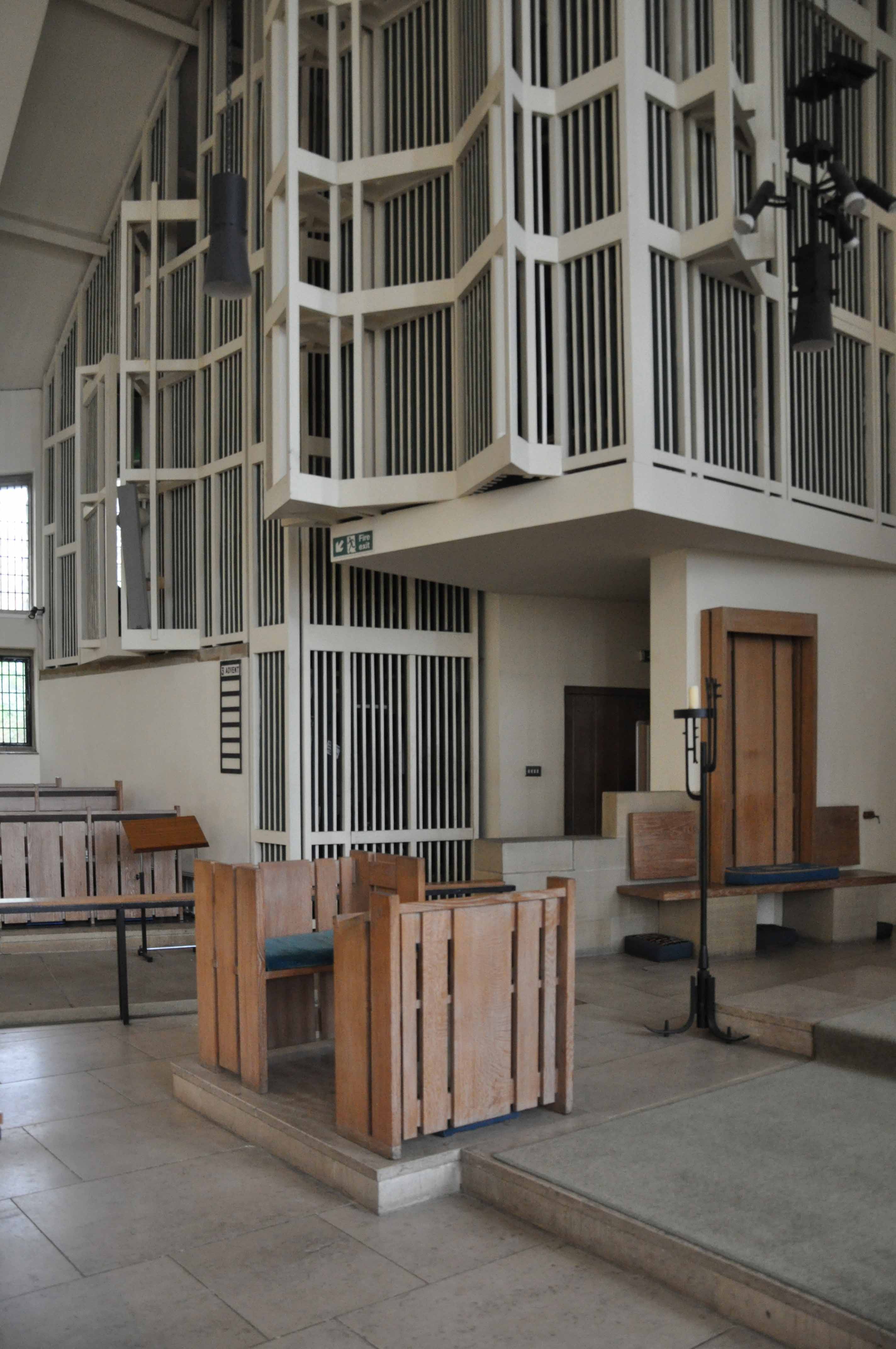
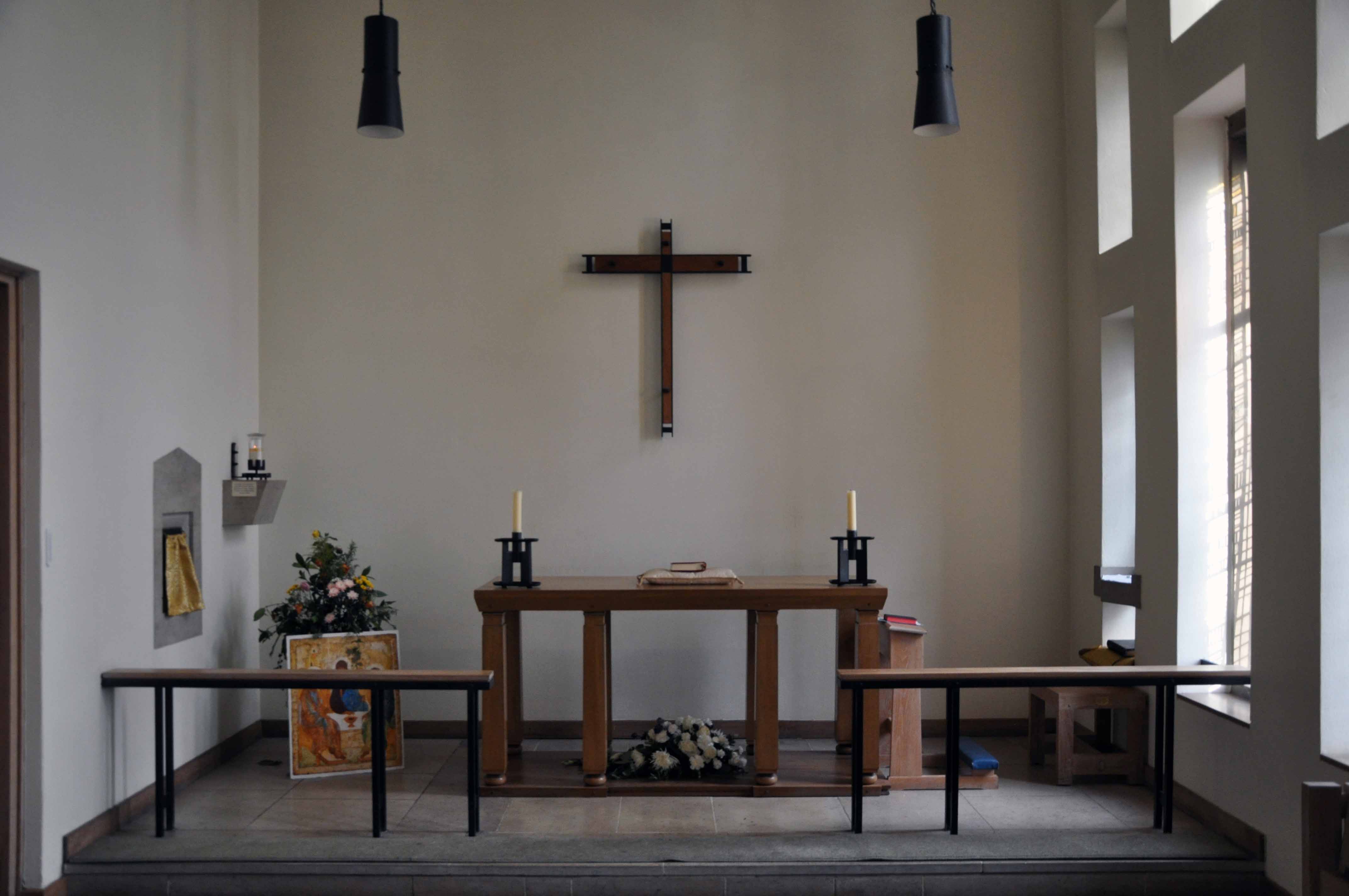
Internally the bays are divided by three pairs of varnished laminated timber `y’ shaped supports and trusses, supporting timber trussed purlins (with prominent bolts) and timber rafters. Walls are white-painted brick with exposed board-marked concrete bands, which act as bonding strips between brick piers and as lintels for windows. Original altar of limed timber with four pairs of legs, is in original position, set forward from the east wall. Sanctuary raised by two steps. Limed timber pulpit, also chunky and so is altar rail with thick black metal supports and thick limed timber handrail. Priest’s chair to match, against east wall. Black metal crucifix also in characteristic Pace manner. Stone sedilia built into the north and south walls of the sanctuary. East window with stained glass which comprises broken and reset fragments of nineteenth-century glass. Font sited in central aisle towards the west end; this is of tooled cream stone, the bowl comprising a monolithic cylinder, flanked by a smaller cylinder which rises higher and has a prominent spout. Elaborate font cover in roughly textured cast aluminium, rising to flame-like pinnacles. Reused nineteenth-century benches, painted semi-matt black. Narthex and west chapel with limed timber doors, which have decorative nail-heads in rows. West chapel has open truss timber roof, painted white. Sanctuary light and cross are characteristic of Pace’s style.
A fine example of Pace’s idiosyncratic manner, this church shows the influence of the Liturgical Movement, especially in the forward placement of the altar.
The church was originally built in 1868–1871 to a standard neo-Gothic design by William Henry Crossland. This building was destroyed by an incendiary bomb during the “Sheffield Blitz” of 12 December 1940, only the spire and a porch survived (they are now Grade II listed structures). The remnants of the bombed church were used as the basis for a new church designed by George Pace and constructed 1958–1963. This new building is of a Modernist design but is also sympathetic to the Gothic spire and porch. It is a rubble-faced concrete building with striking slit windows of varying numbers and locations around the building. There are also two notable stained glass windows: the Te Deum window by Harry Stammers and the west window by John Piper and Patrick Reyntiens.
Wikipedia told me so.
he laddered design glass in the side chapel, is by Gillian Rees-Thomas.
Welcome to St Mark’s – an open, welcoming church for people from all walks of life who wish to learn more about Jesus and Christian faith and seek the freedom to ask the big questions. We have strong engagement with Christian communities and other faith traditions. People come from all over the country to participate in our Centre for Radical Christianity, where a lively climate of debate and learning can be found.
This a remarkable building staffed by remarkably welcoming people, it’s exterior betraying little of the wonders within. Divine stained glass, brut concrete structures, pale limed wood, sculptural forms – full of light and warmth.
I’ve passed this way before, 2012 at the behest of Richard Hector Jones in the company of Owen Hatherley and others – recreating the legendary White Bus Tour.
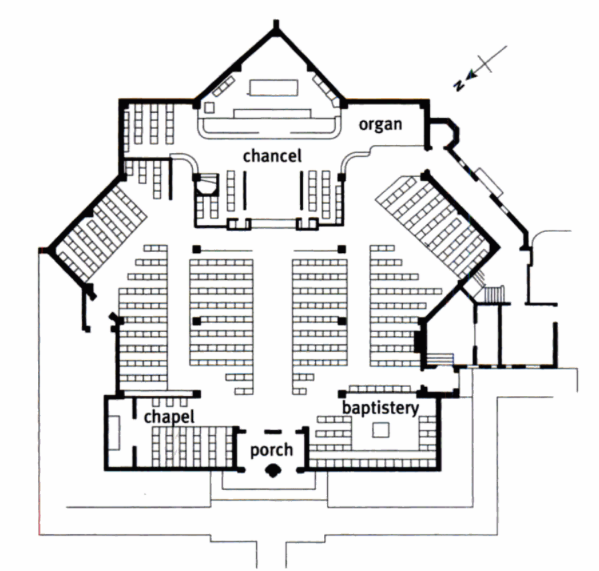
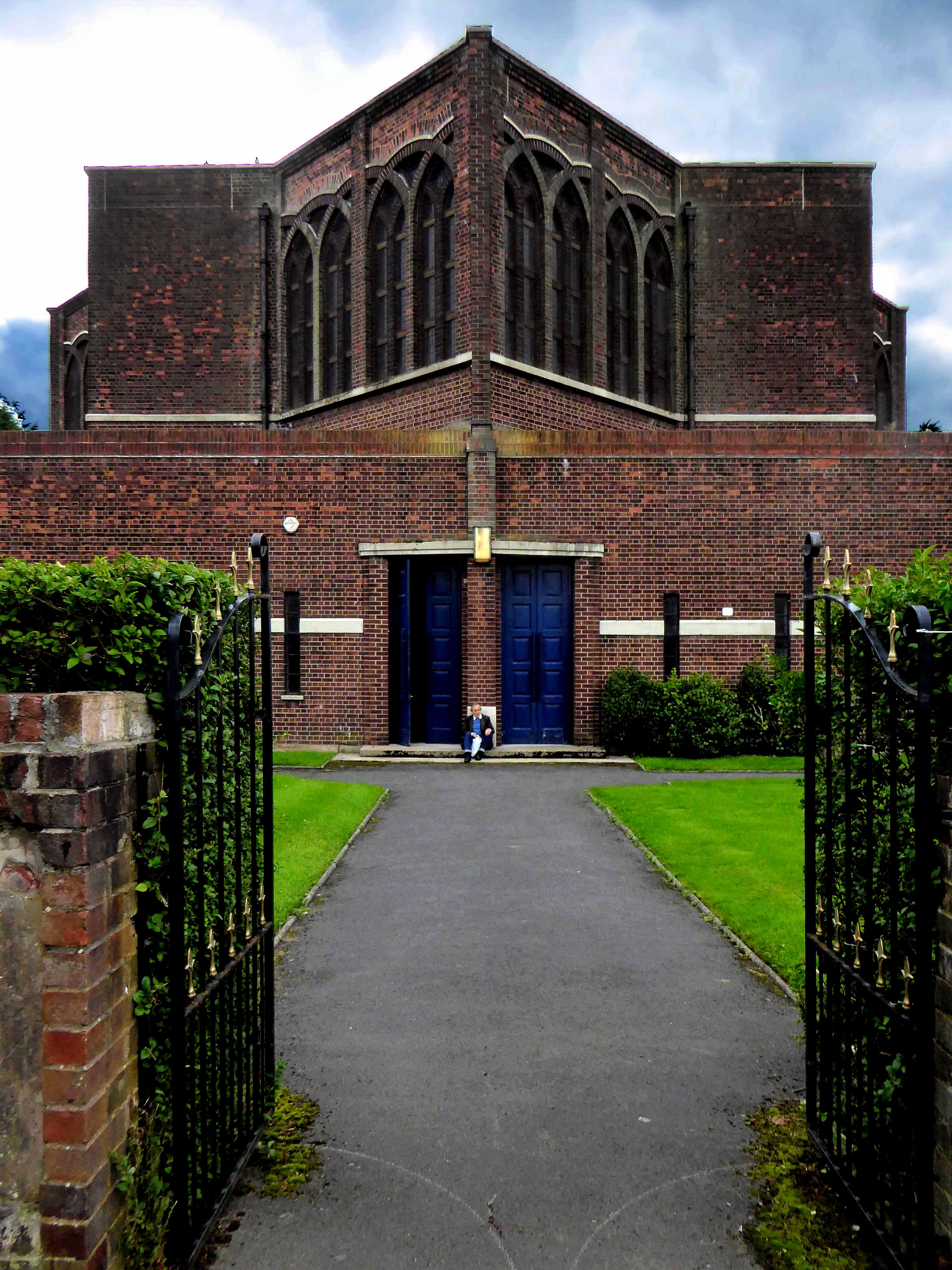
Church. 1937, by N.F.Cachemaille-Day. Red brick in English bond with some stone dressings (roof concealed). Star-shaped plan formed by the diagonal intersection of two unequal squares, plus a wide rectangular narthex enclosing the west end. The main vessel is a lofty structure with plain walls, sill-band carried round, and plain parapet, except for the upper part of each side of the cardinal projections, which have windows in tall intersecting Romanesque arcading with Y-tracery, all in brick, with a central pilaster strip rising to a moulded cornice. Large plain cross rising from roof. The single-storey flat-roofed narthex has coupled plain rectangular doorways in the centre and 3 narrow rectangular lancets to each side. Interior (as reported 16.01.81): ingenious plan with lofty columns supporting flat ribbed roof. Forms group with Rectory attached to south side.
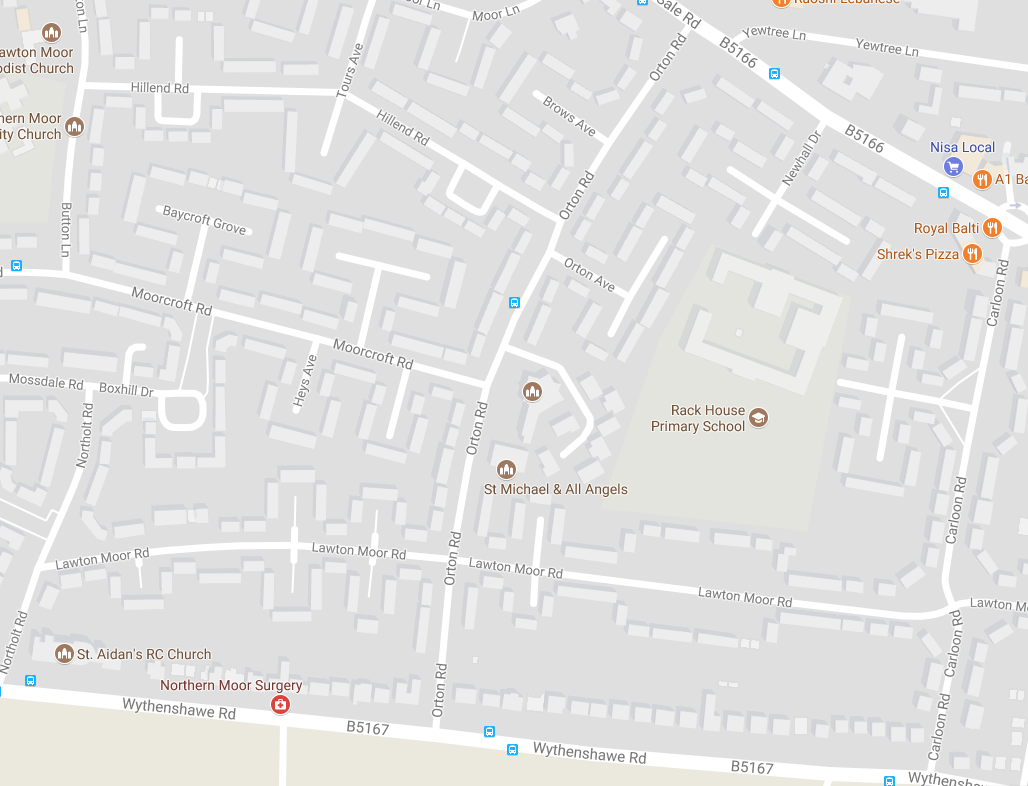
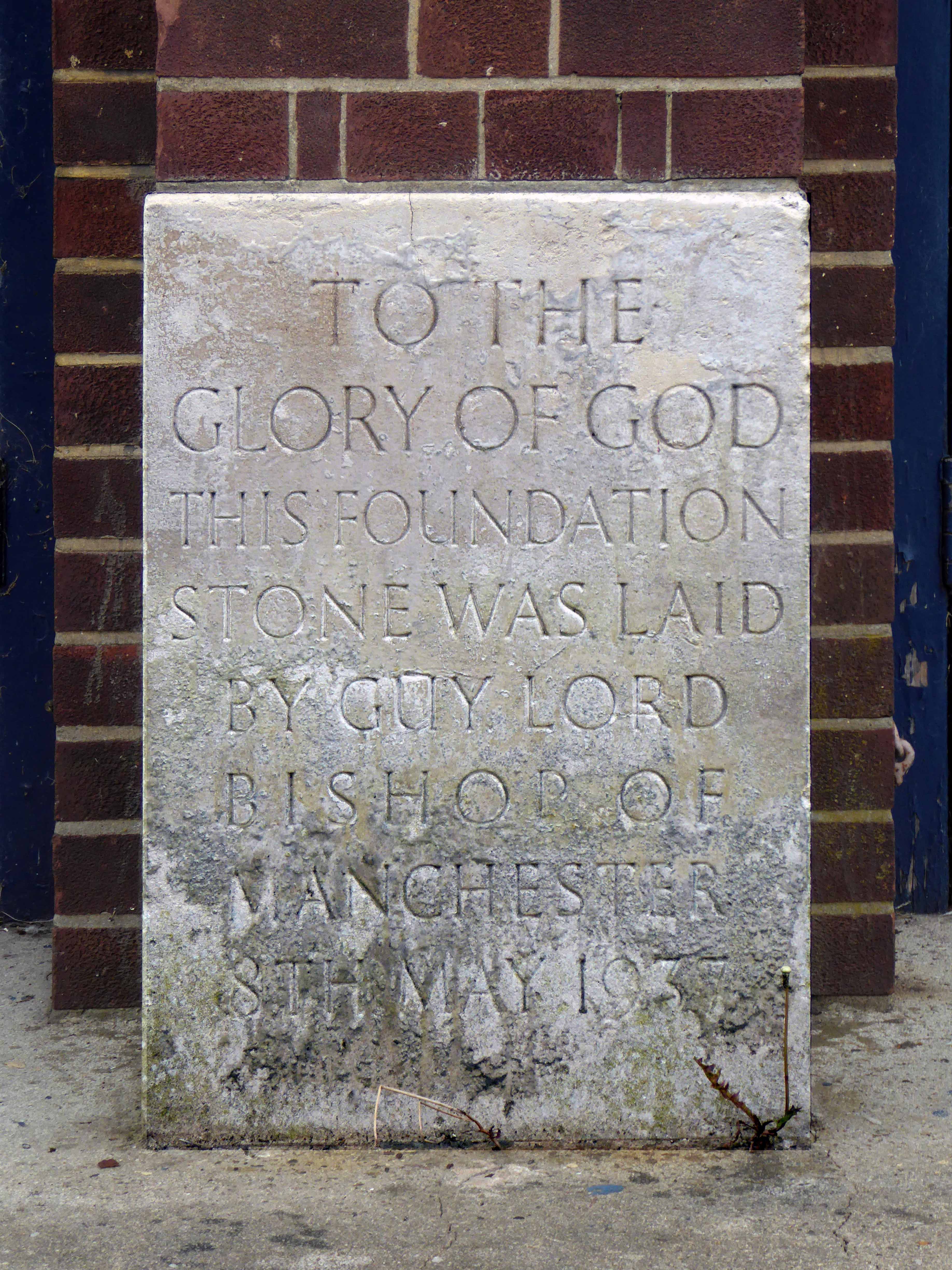
The Corporation of Manchester acquired the Wythenshawe Estate in 1926 and began laying out the garden suburb in 1930. It was eventually to have 25,000 houses and a population of 100,000. The garden suburb was designated part of the parish of Church of St Wilfrid, Northenden, but that small parish church proved insufficient to accommodate the rising congregation. A mission church was therefore opened in 1934, and in 1935 the diocese approved plans for the construction of a new parish church at Orton Road. The budget was £10,000.Nugent Francis Cachemaille-Day was appointed as architect for both the church and the adjoining parsonage. The foundation stone for the church was laid on 8 May 1937, by the Bishop of Manchester. The builder was J. Clayton and Sons of Denton.
So has the redoubtable Nikolaus Pevsner:
A sensational church for its country and its day. The material is brick, bare in four of the corners, with large brick windows in the other four. The intersecting arches of the windows are the only period allusion.The interior has very thin exposed concrete piers and a flat ceiling. The church make sit clear that the architect had studied Continental experiments, the parsonage points to Germany and Mendelssohn. Stained glass by Geoffrey Webb.
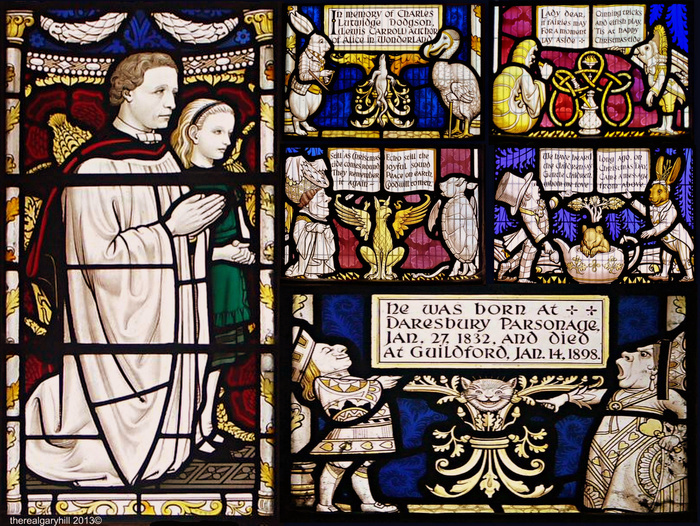
Geoffrey Webb lived and worked in the centre of East Grinstead at the height of his career and is noted among enthusiasts of fine glass for his use of brilliant blues. In his early career he worked with Charles Eamer Kempe, the most prolific and best-known stained glass artist of his generation. Webb’s work can also be found in many other places around the UK including Manchester Cathedral and Tewkesbury Abbey, and in Daresbury parish church in Cheshire where he designed a memorial window in honour of Lewis Carroll.
So I cycled by one almost sunny Sunday morning, engaged in the porch by an elderly joke telling gent, awaiting his more devout partner.
I love the bible, they all rode on motor bikes – “the roar of Moses’ Triumph is heard in the hills, Joshua’s Triumph was heard throughout the land.”
The Apostles were in one Accord. – Acts 5:12
We waited out the end of the morning service, exchanging gags, eventually I entered. Met by cheery parishioners and priest, welcomed with open arms, happy to chat and allow me to go about the business of snapping this enchanting building. Take yourself down there and bathe in the stained glass light from the sun drenched east windows, feel the warmth of the open elevating space, everything’s looking up:
A sensational church for its country and its day – today.
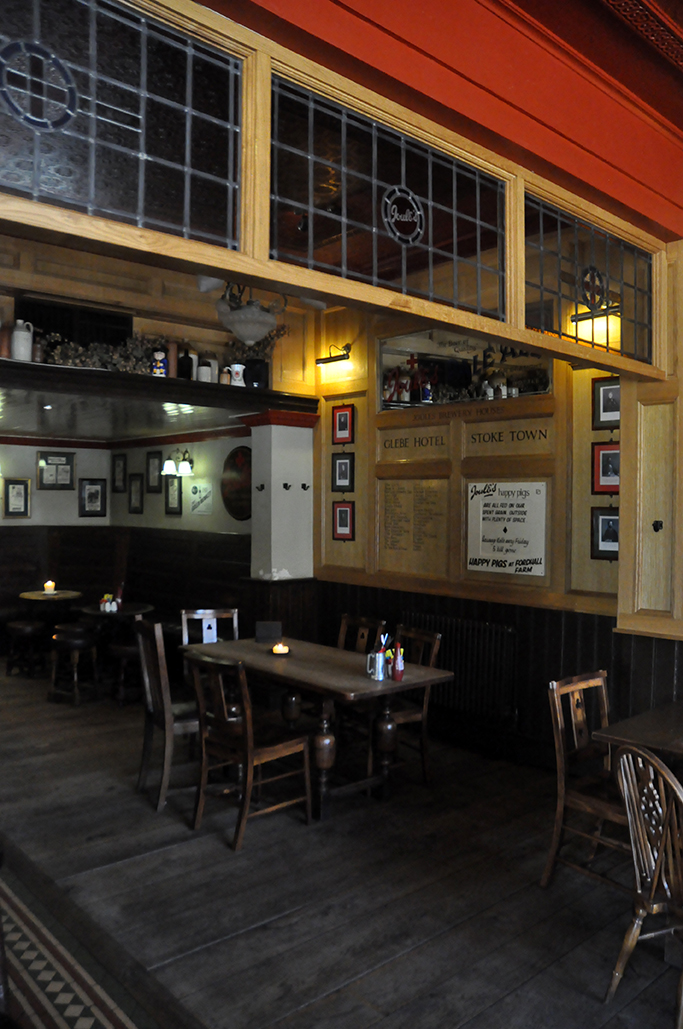
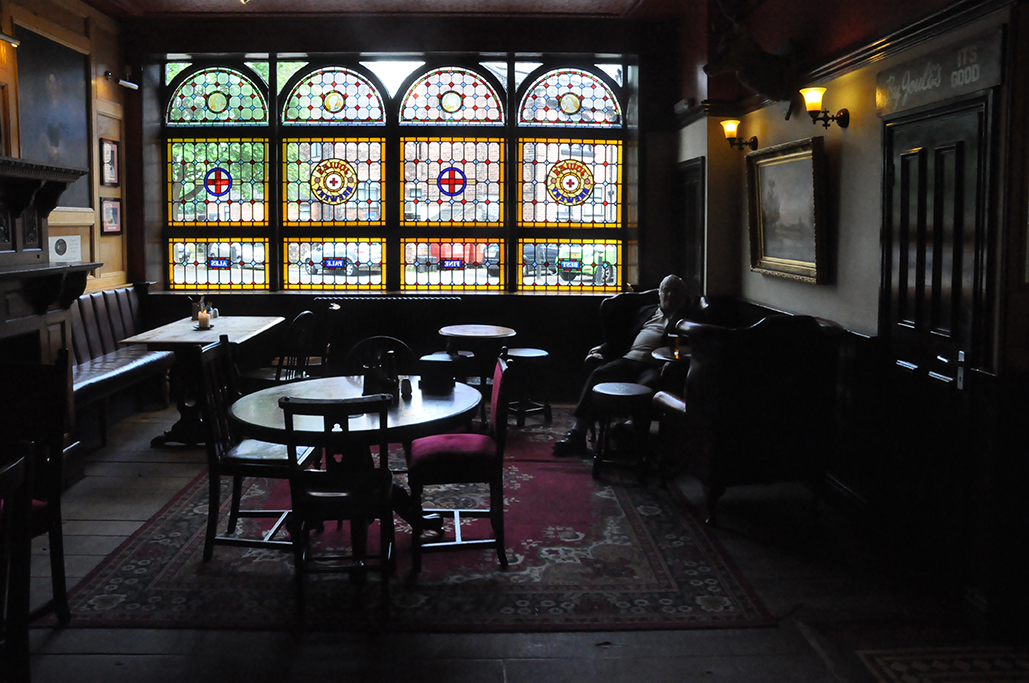
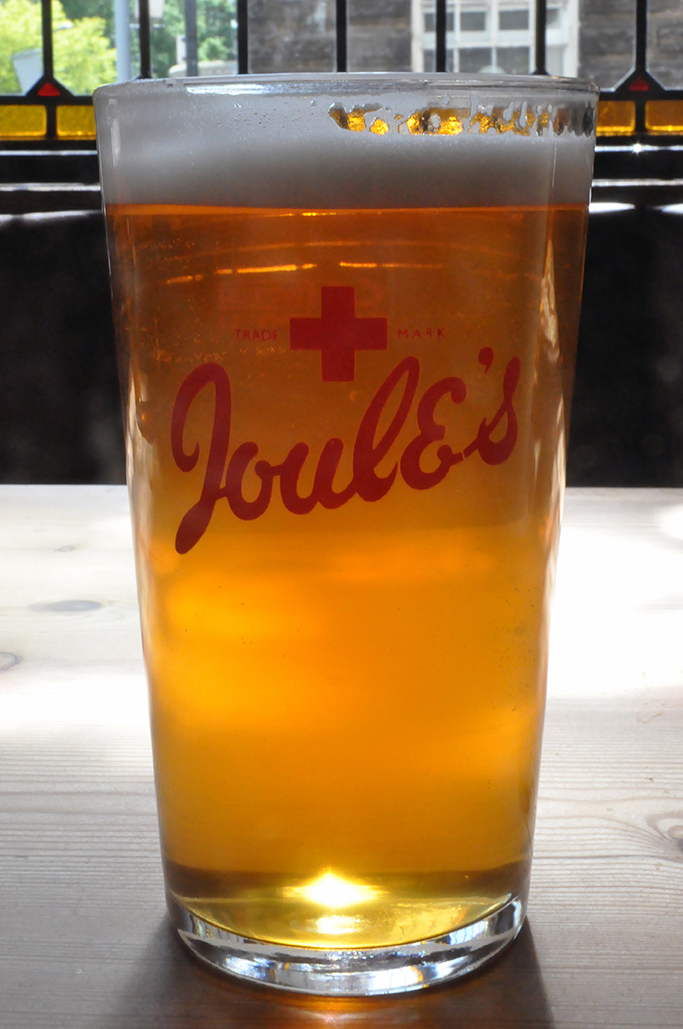
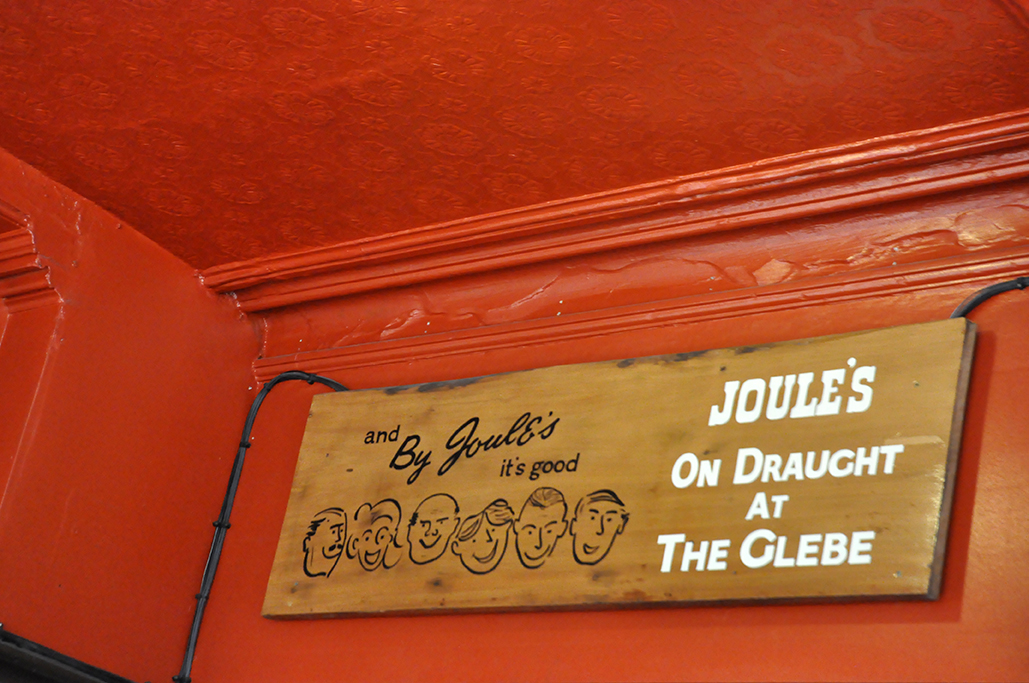
Hard by Stoke Minster stands the only pub in the area I care to visit, tucked in a cosy corner by the Civic Centre, five minutes from the station, barely time to work up a thirst.
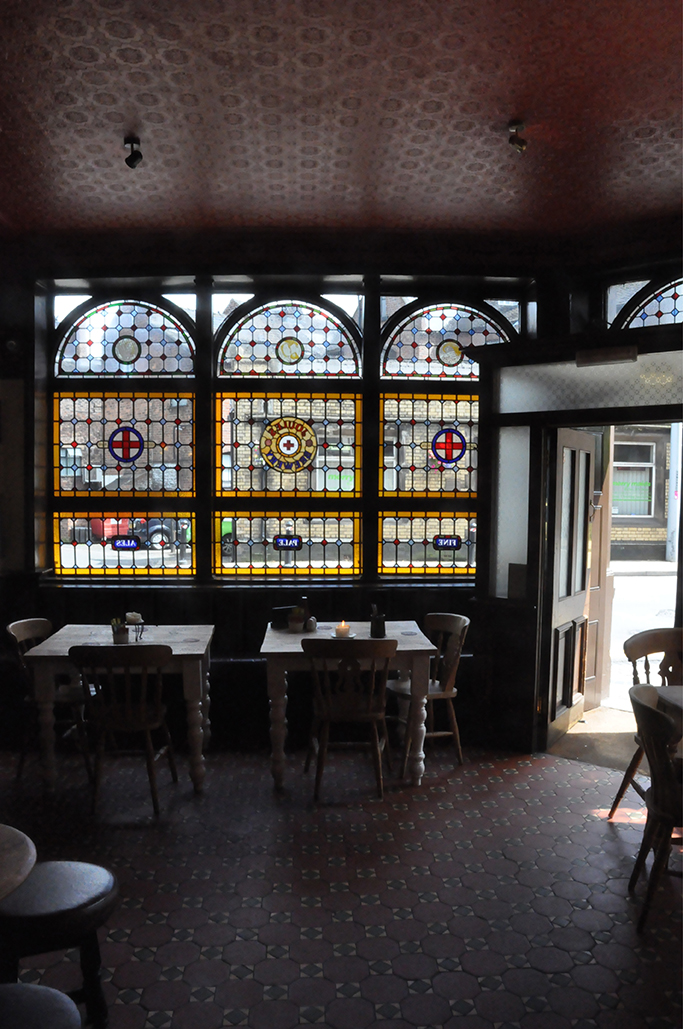
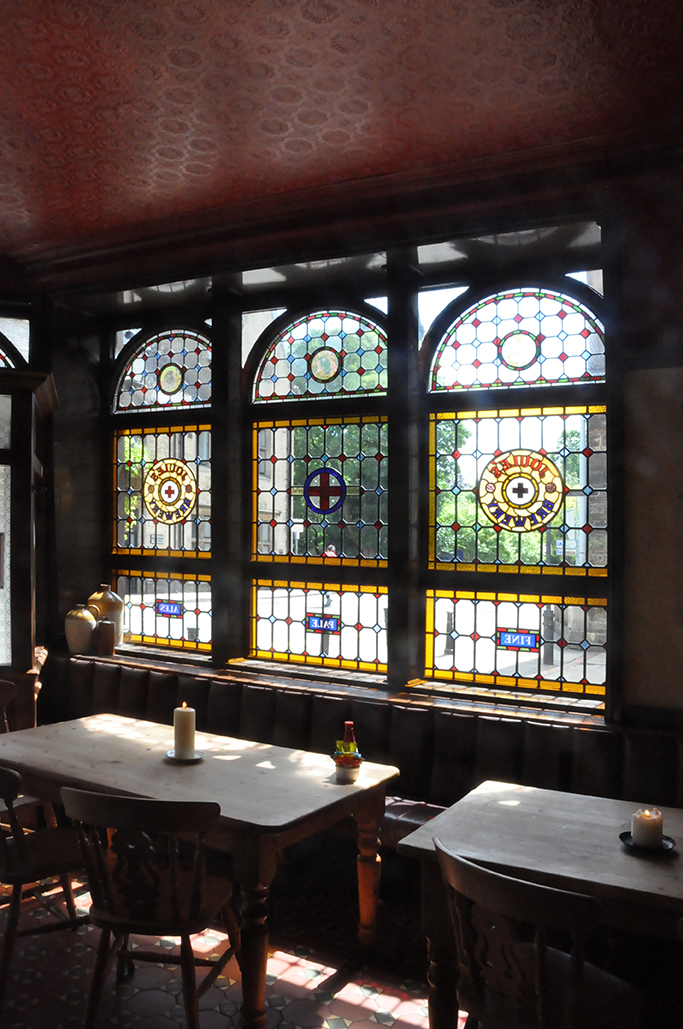
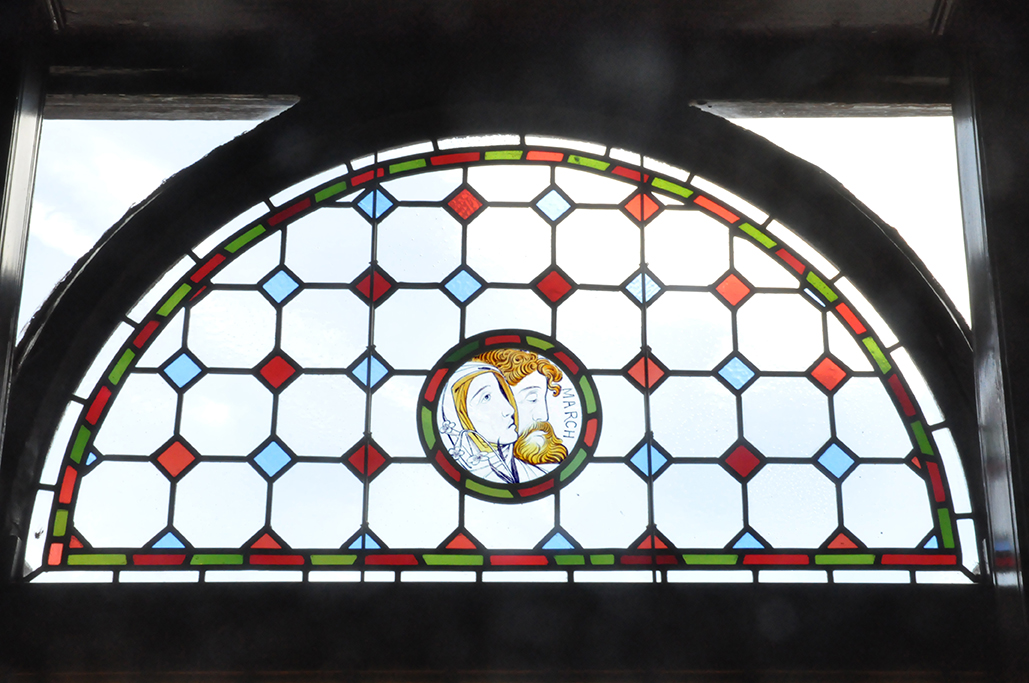
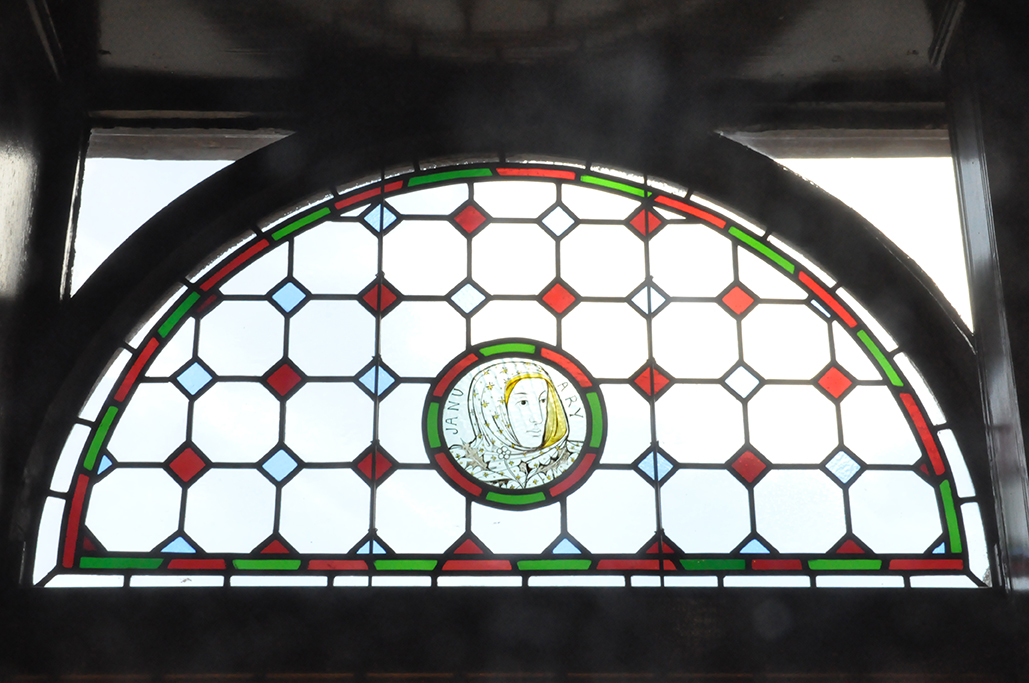
Carefully and skilfully refurbished, exquisite original semi circles of stained and painted glass depicting the months of the year – though there is no February, the lower panes a recent addition.
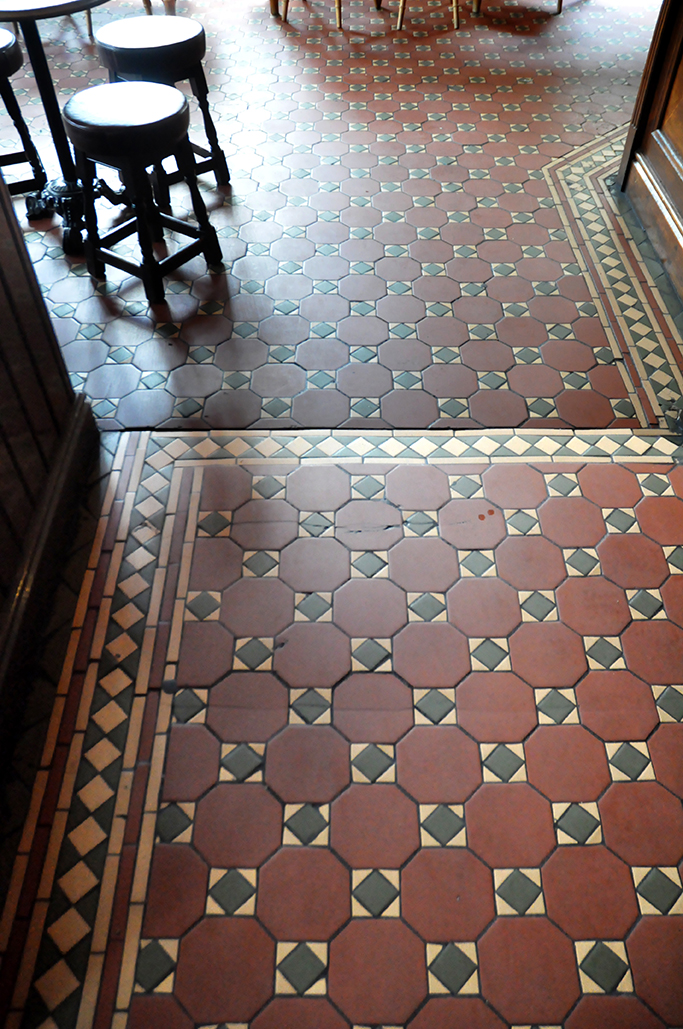
A tiled floor and broad stripped floorboards beneath your feet.
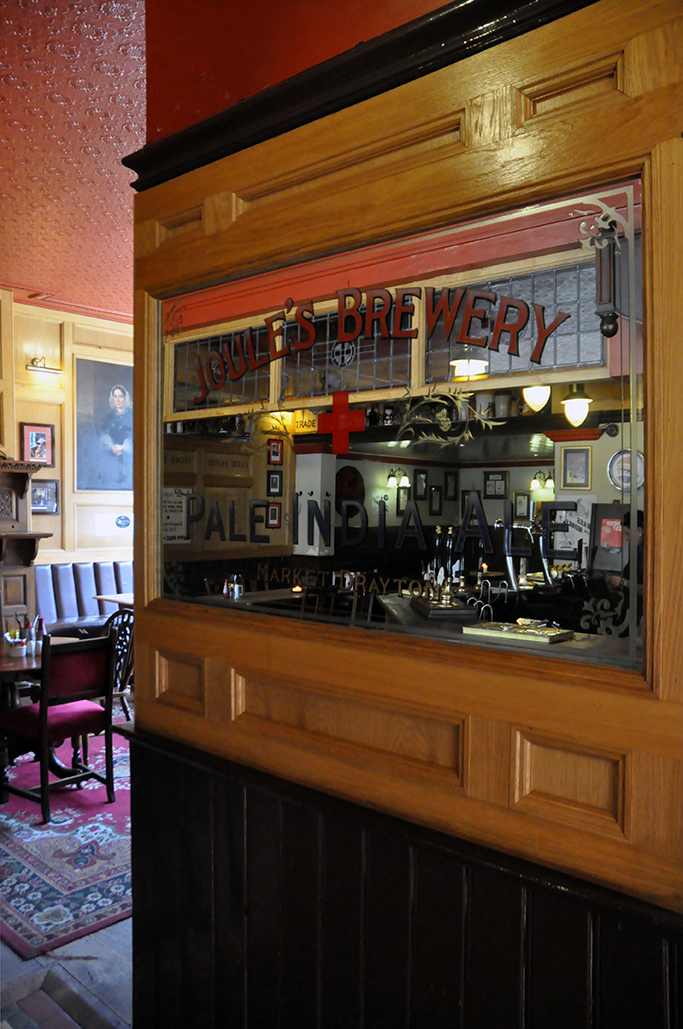
Sympathetically furnished, plainly, simply appropriate to a pub with pride.
In being a pub.
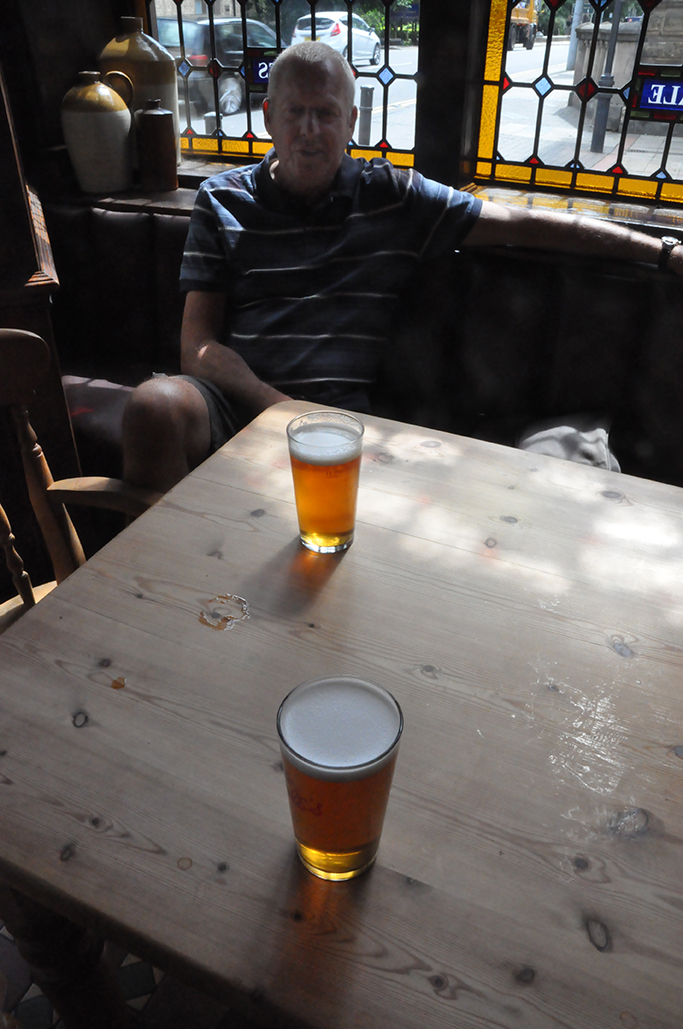
We and the afternoon sun, spill lazily in, in time for a pint.







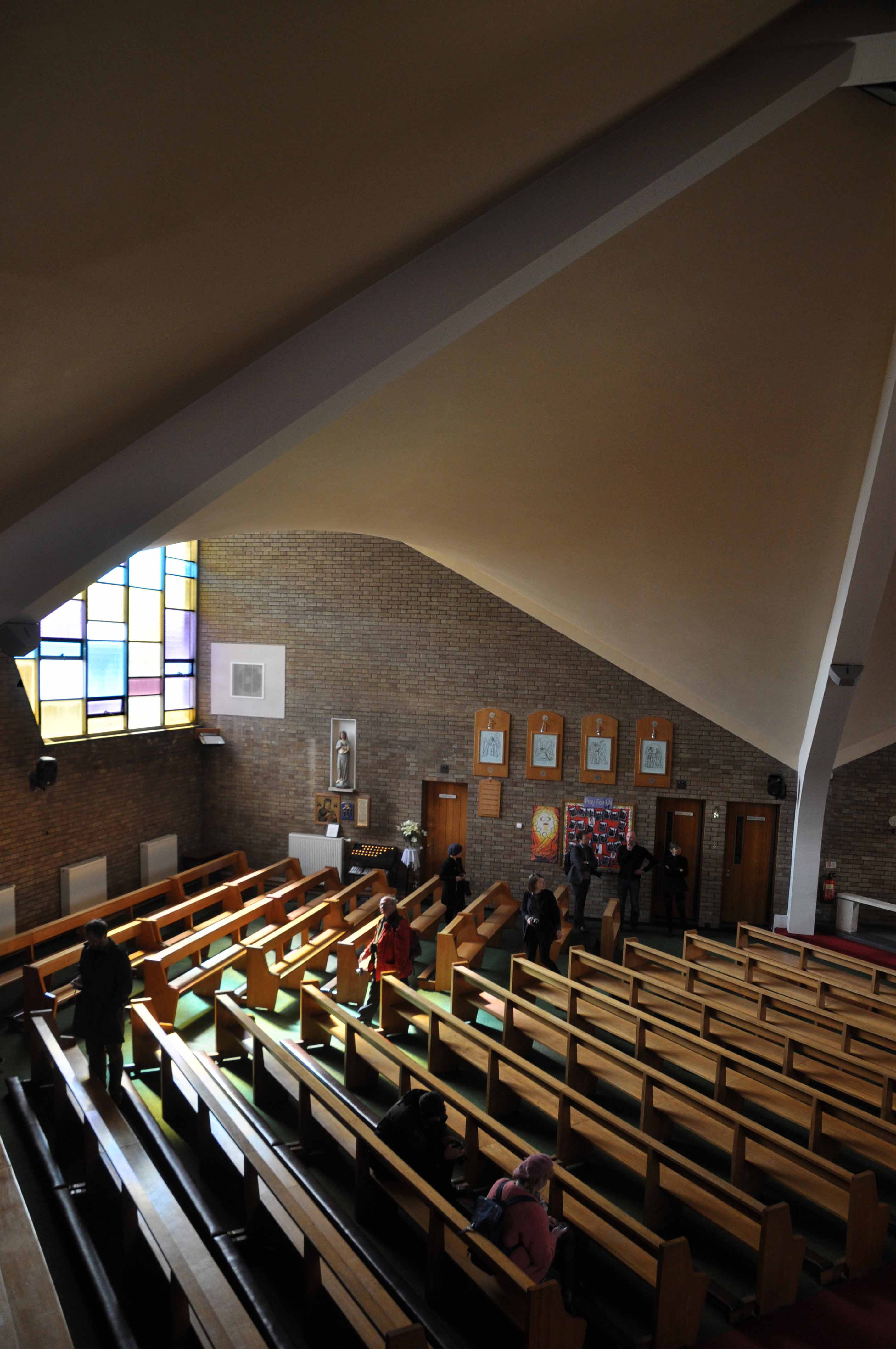
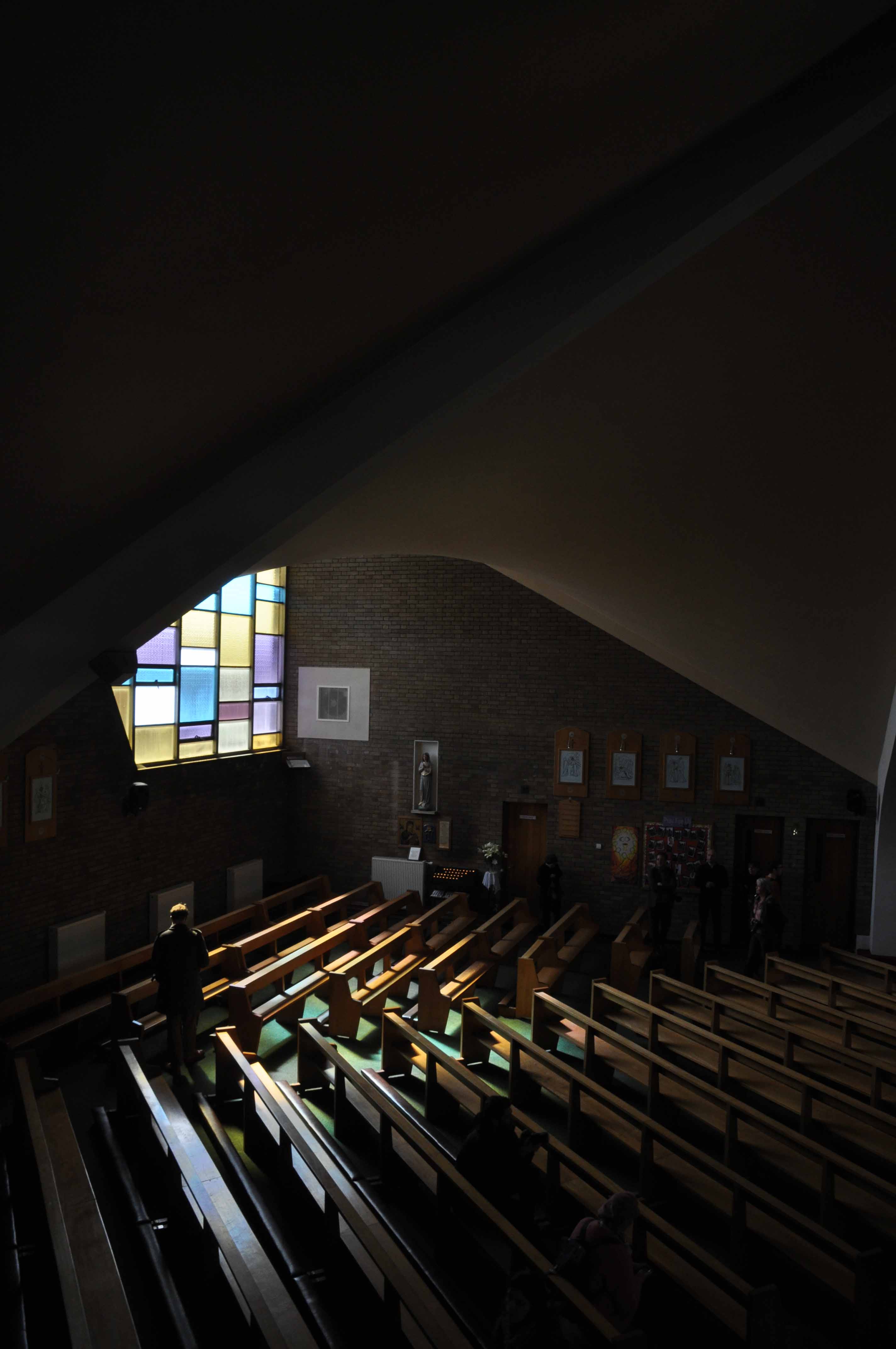
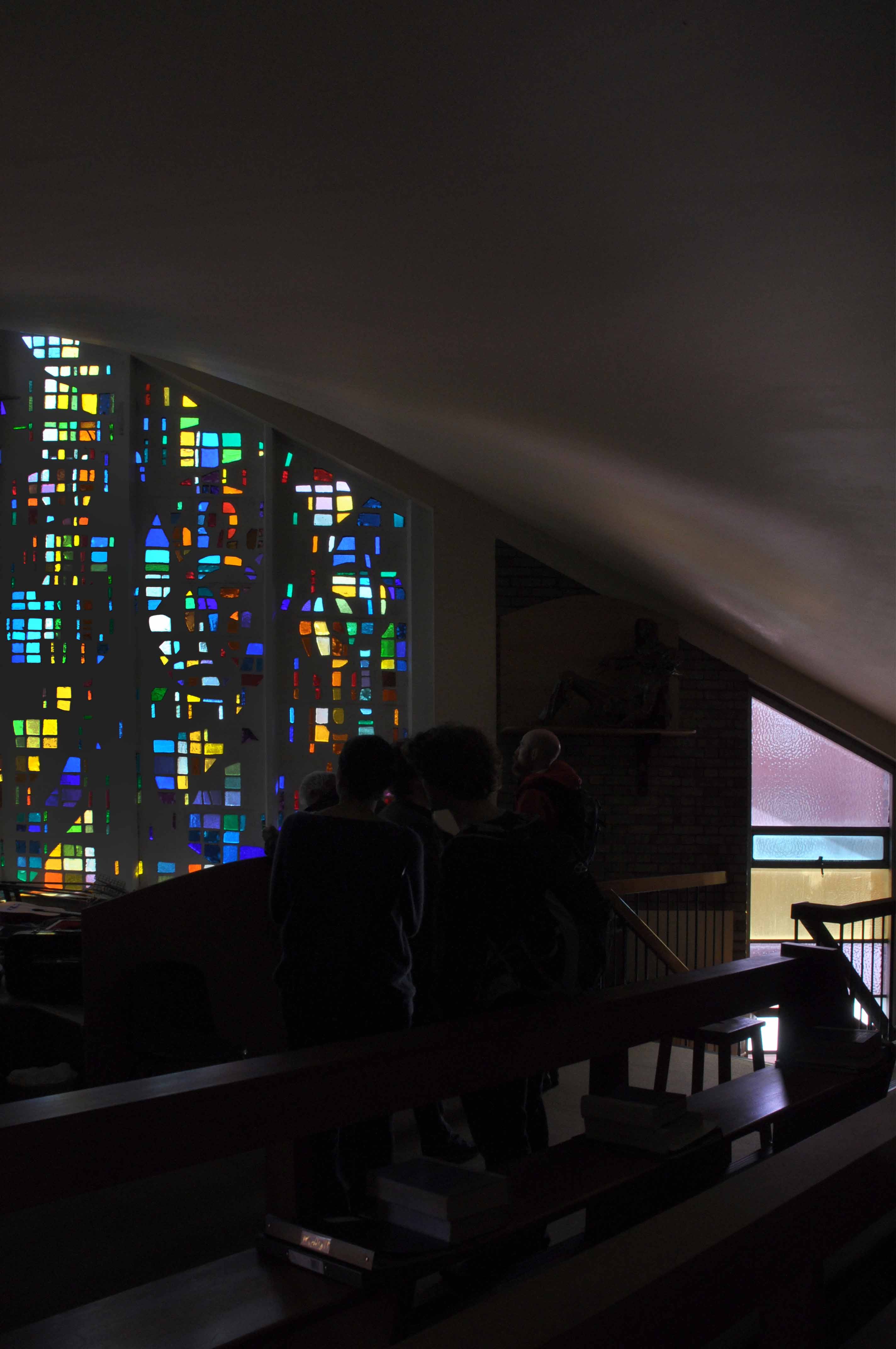
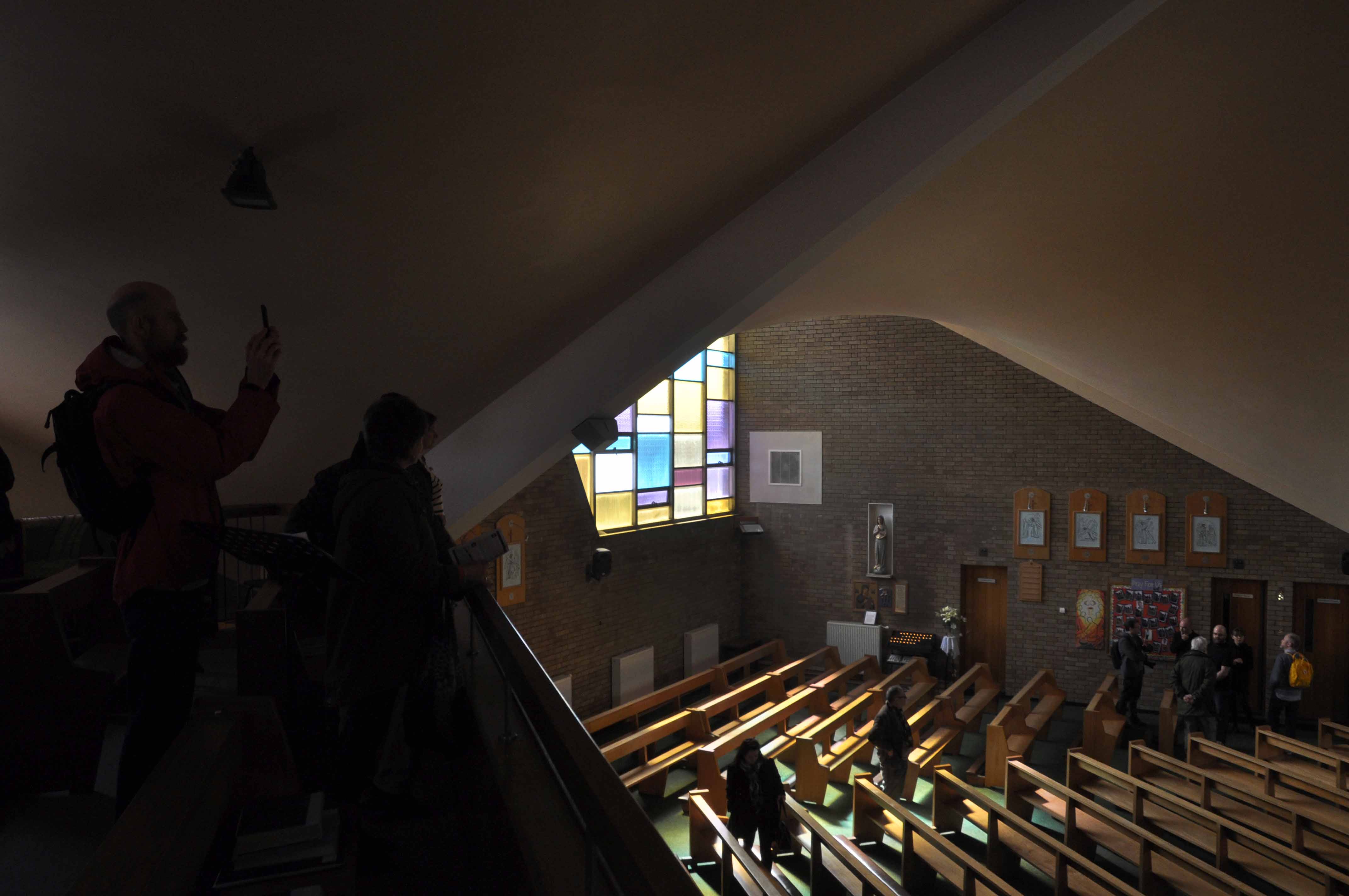






 Modern Mooch