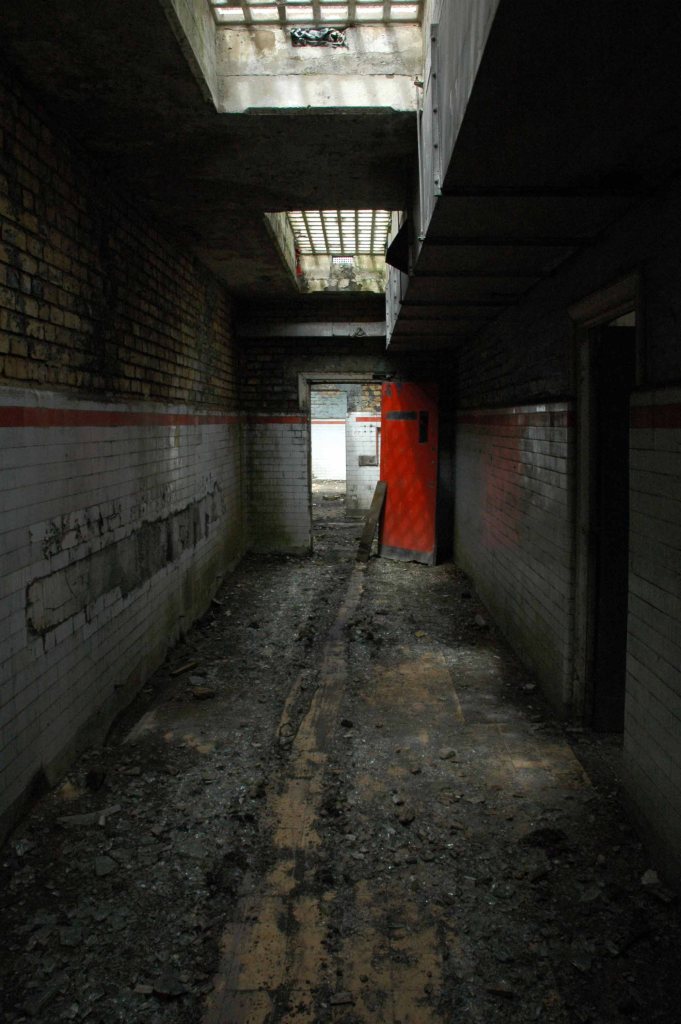
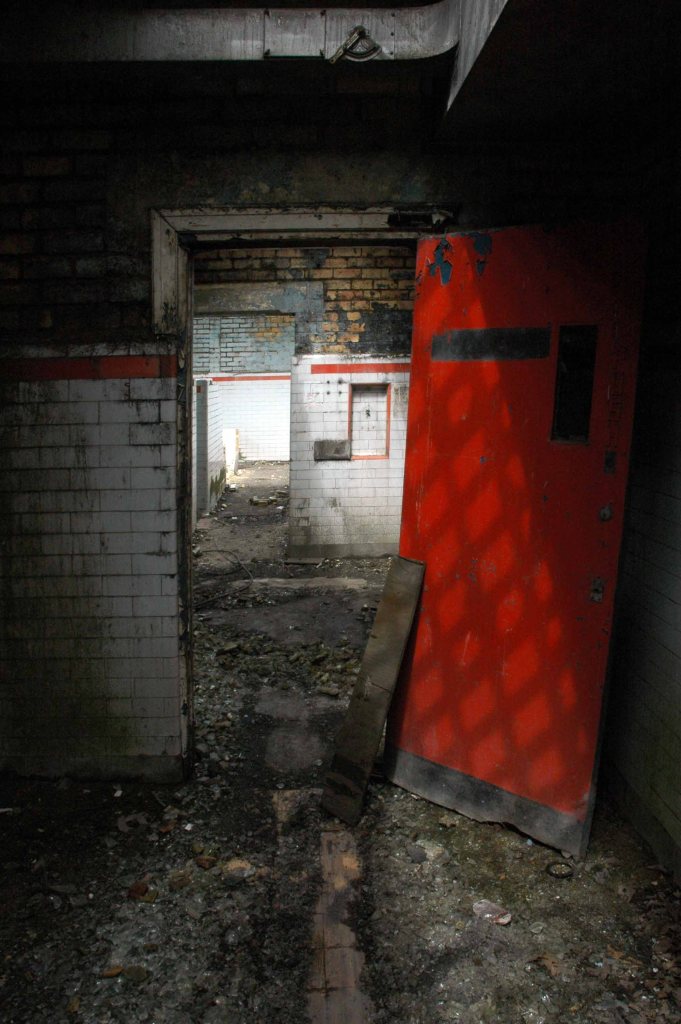
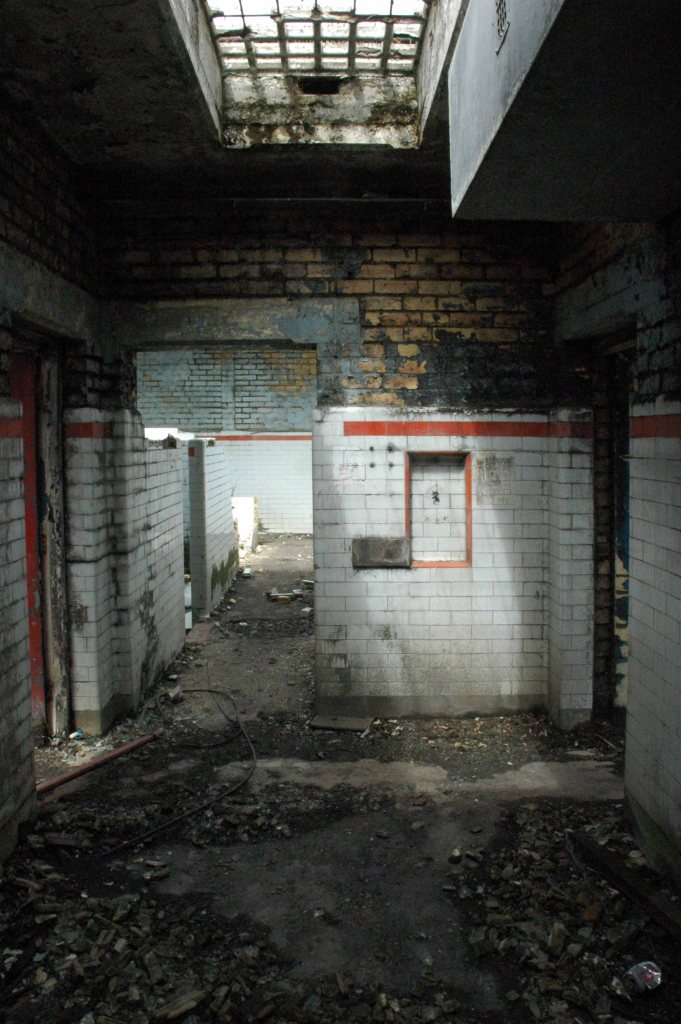
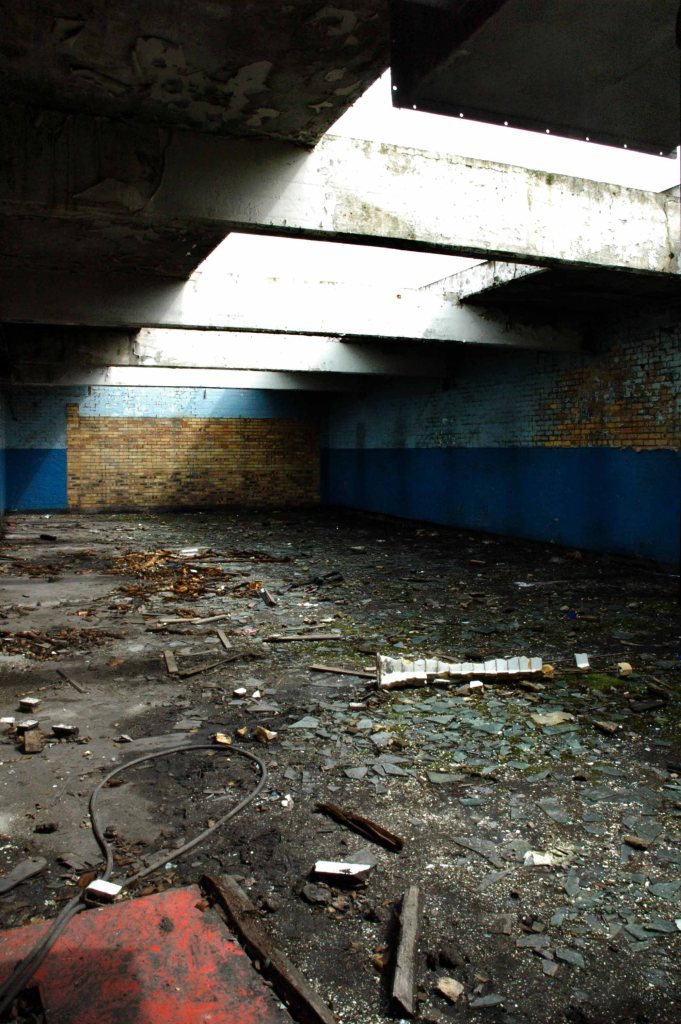
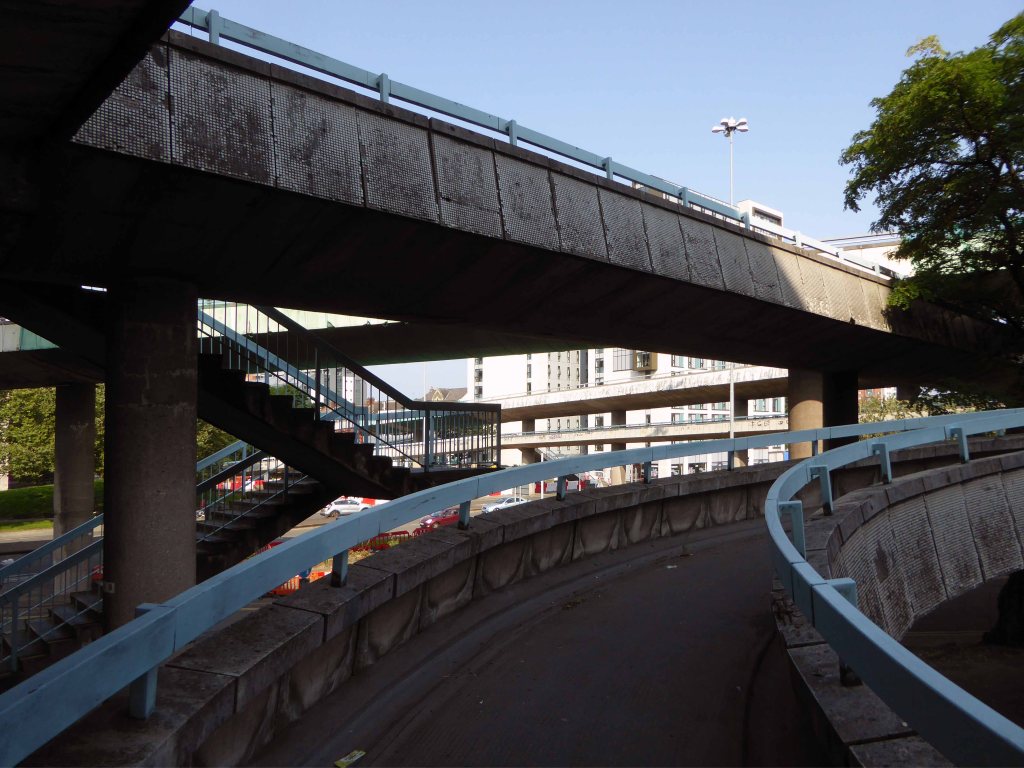
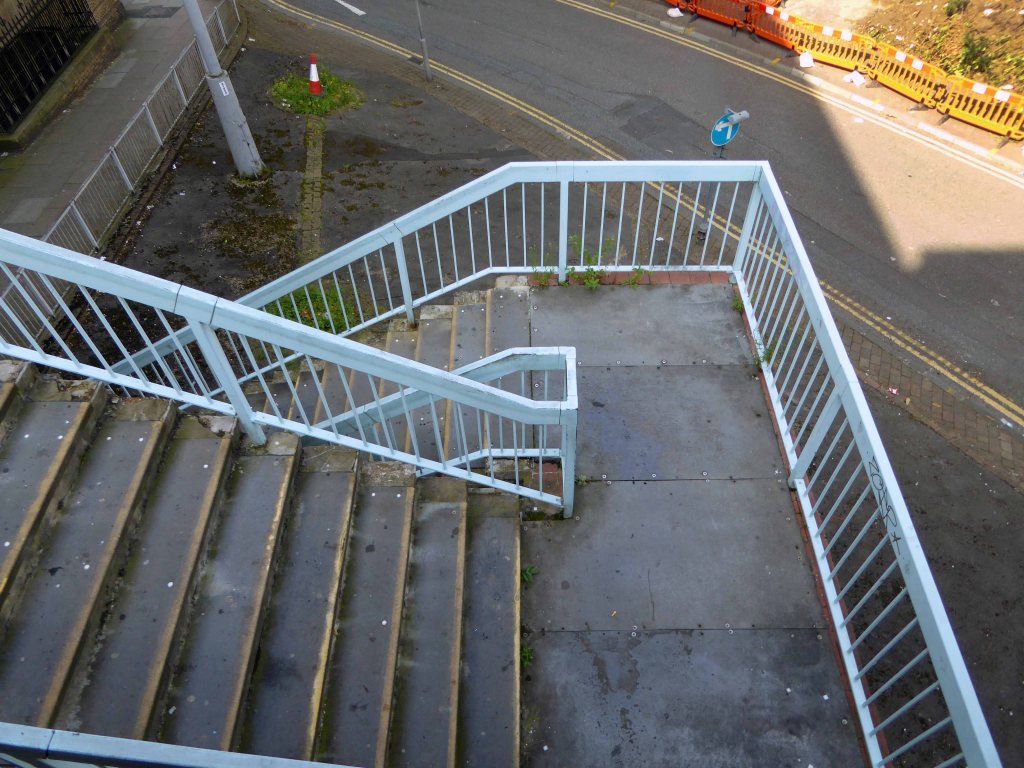
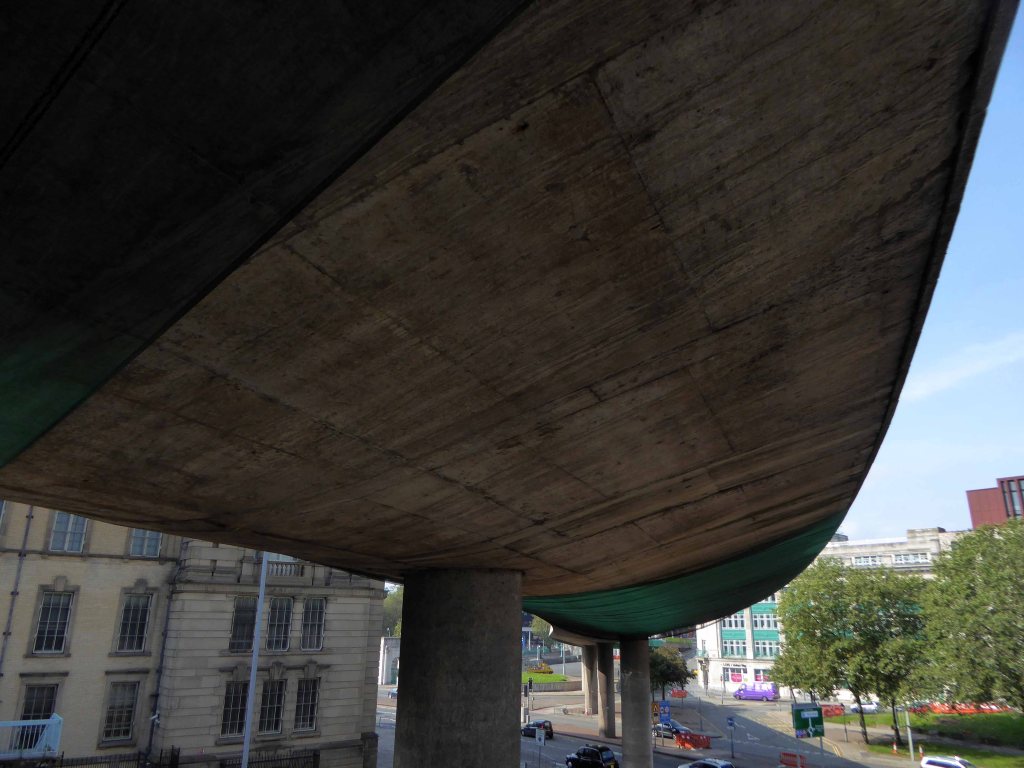
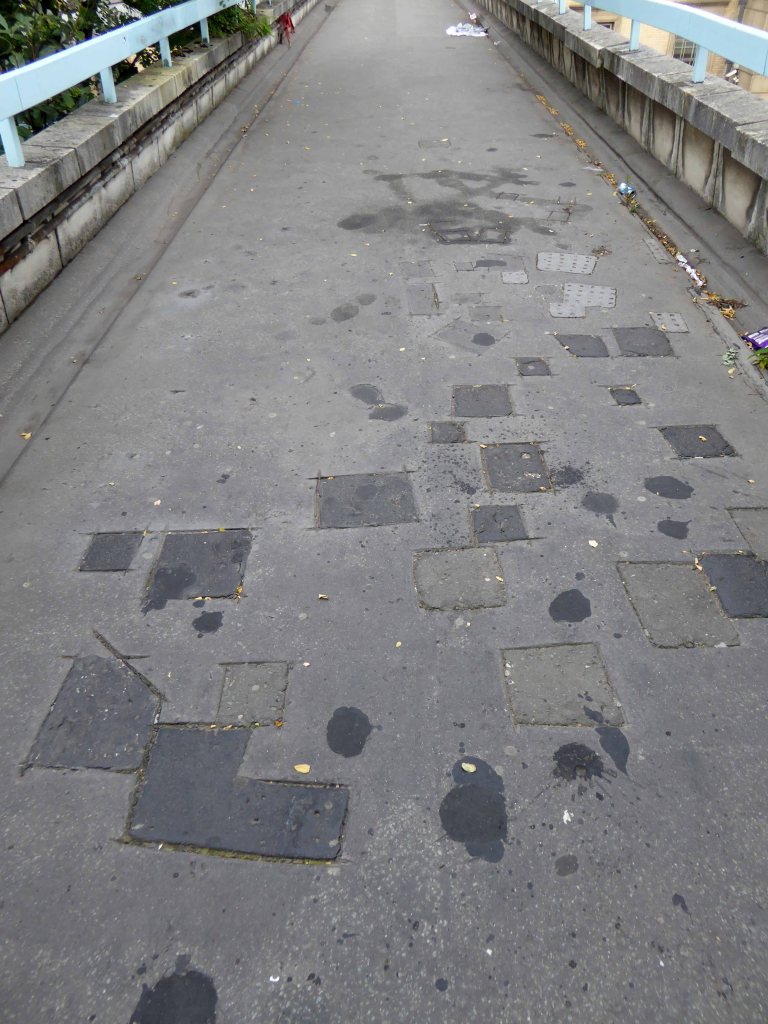
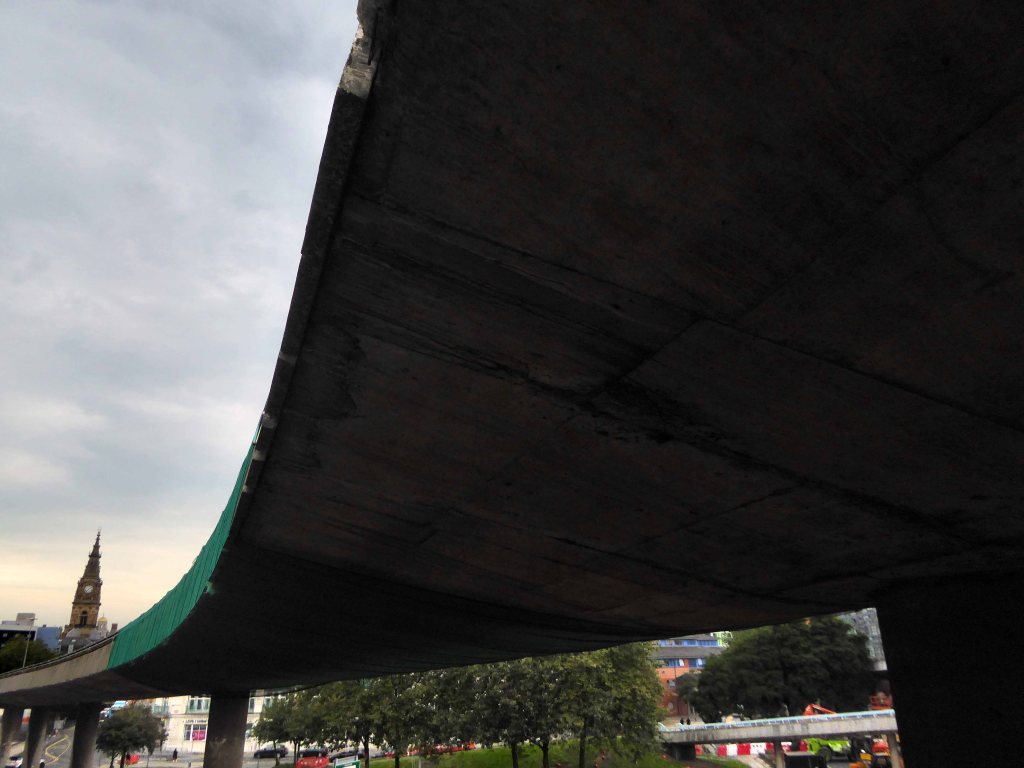
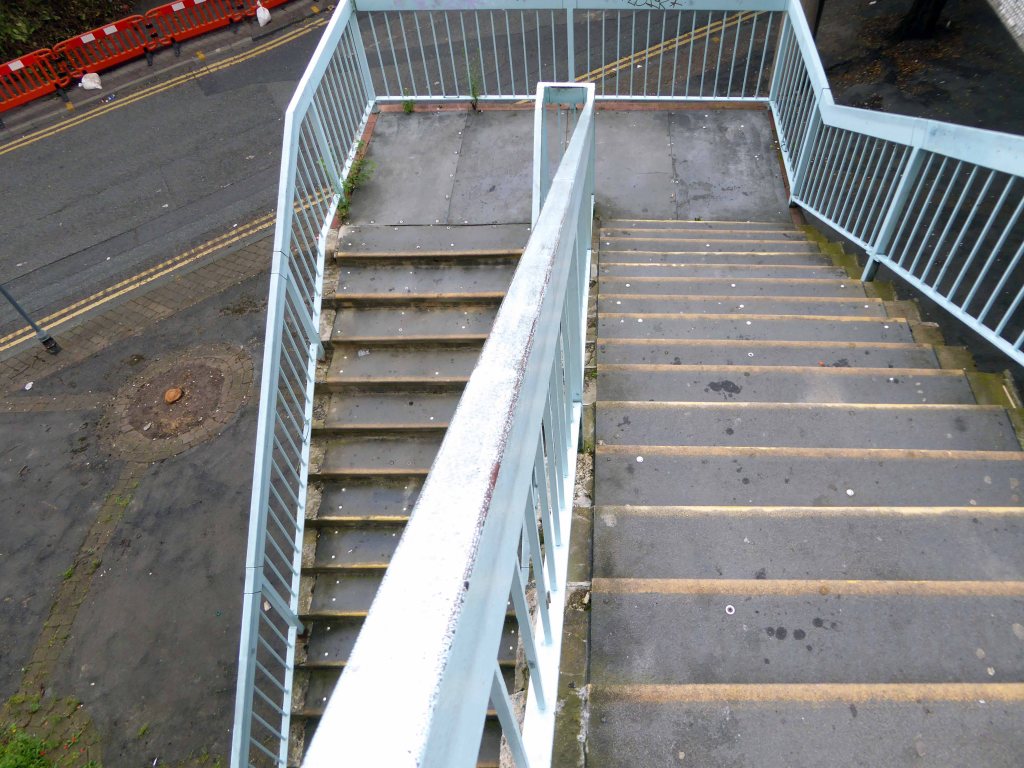
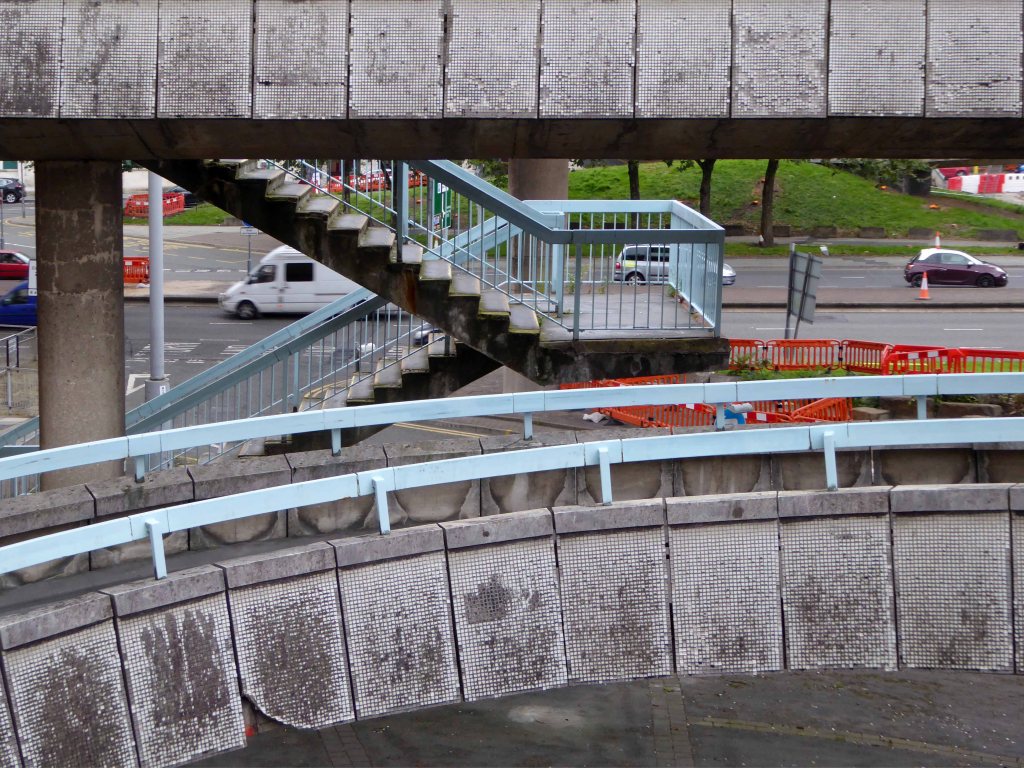
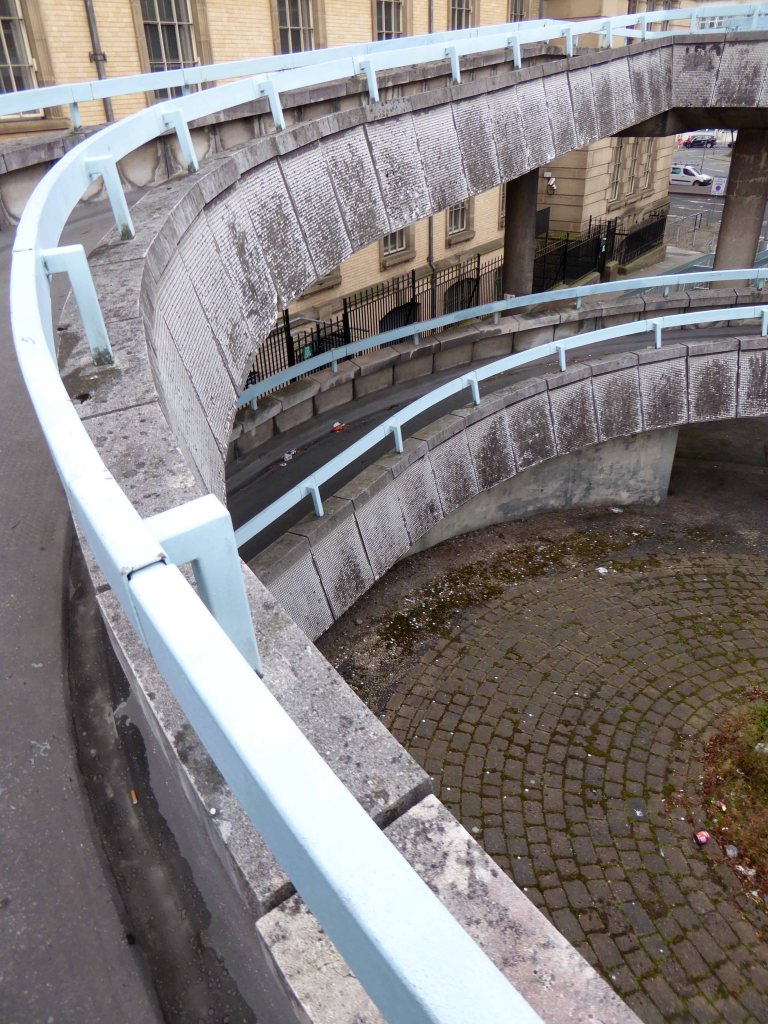
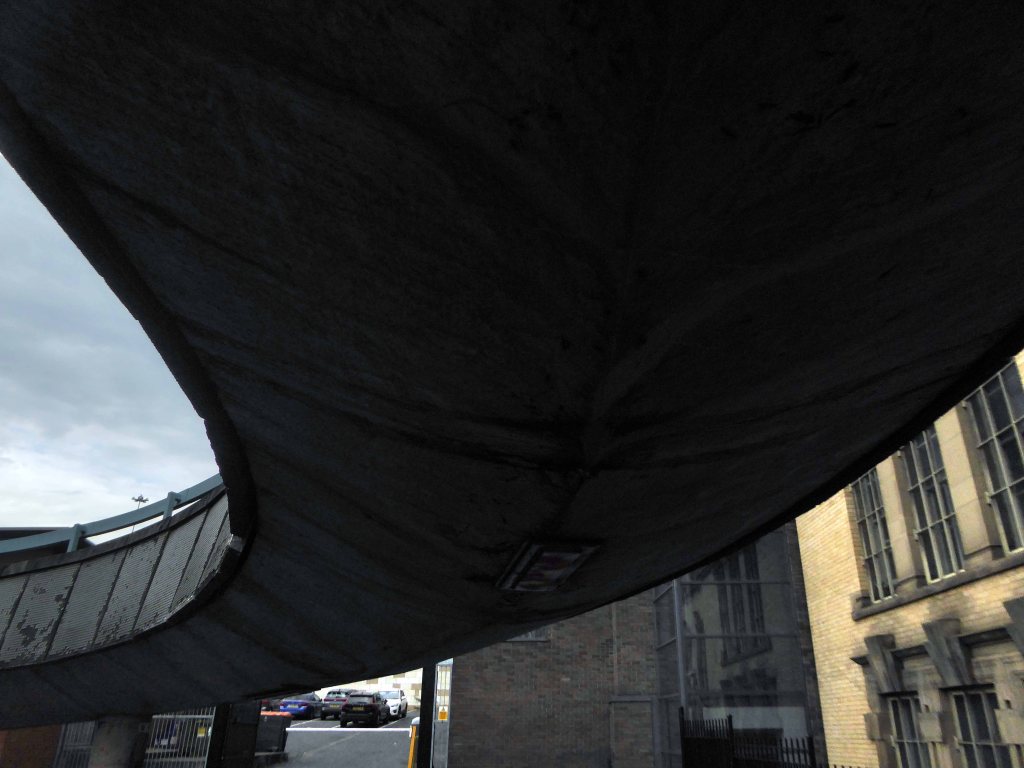
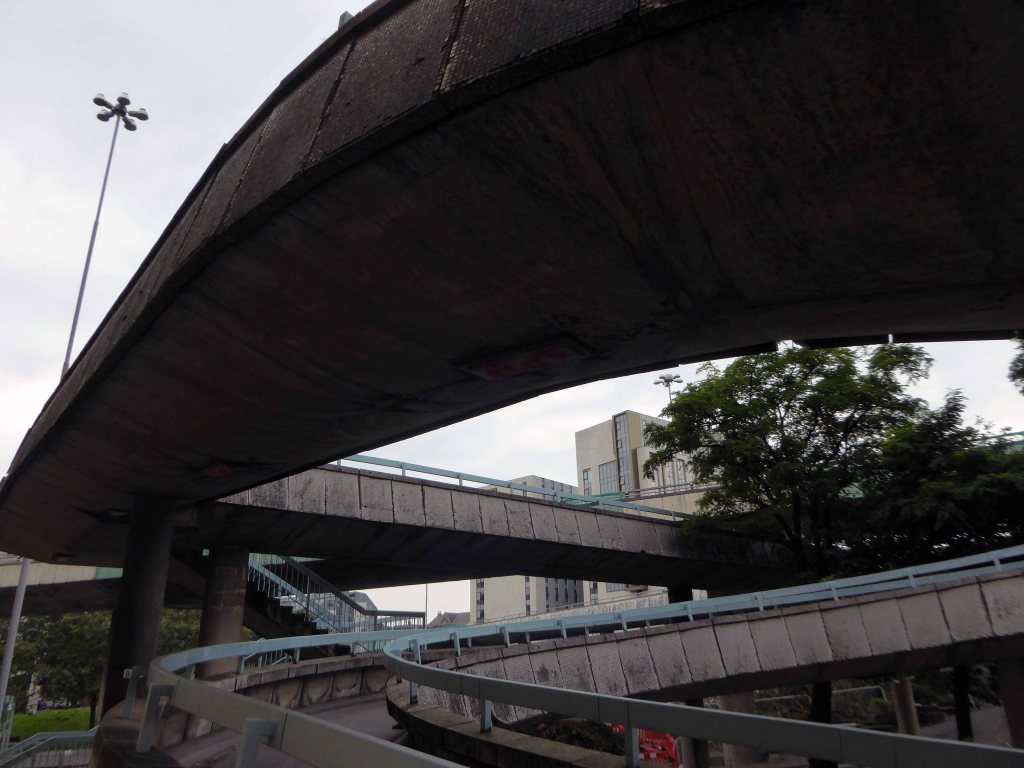
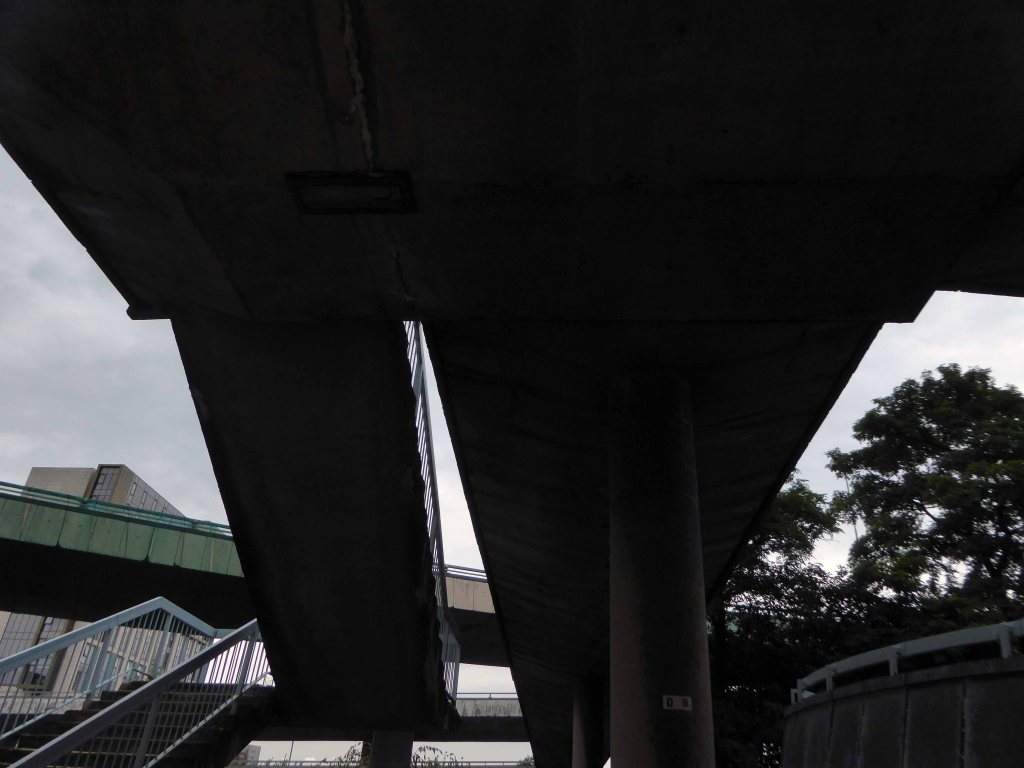
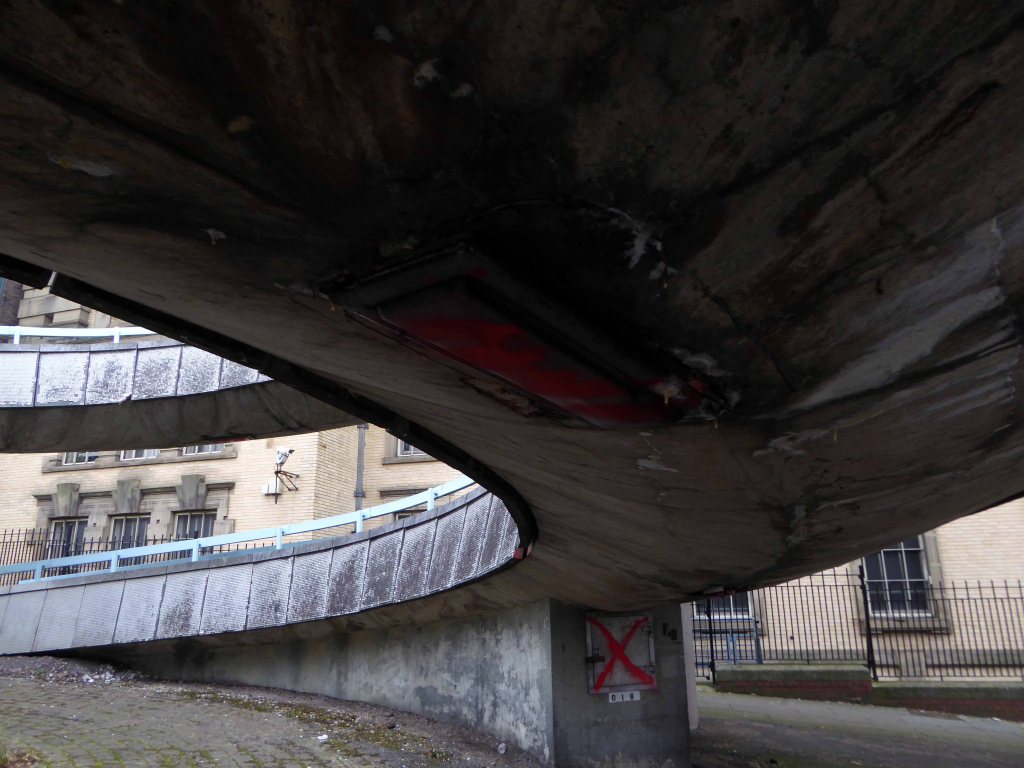
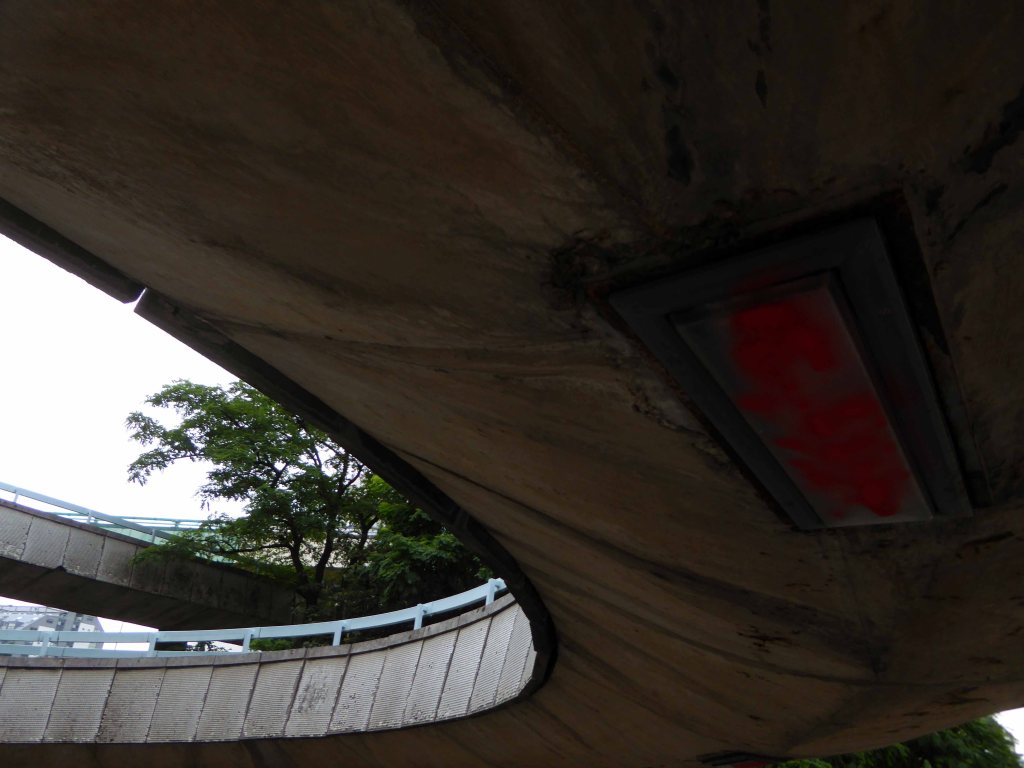
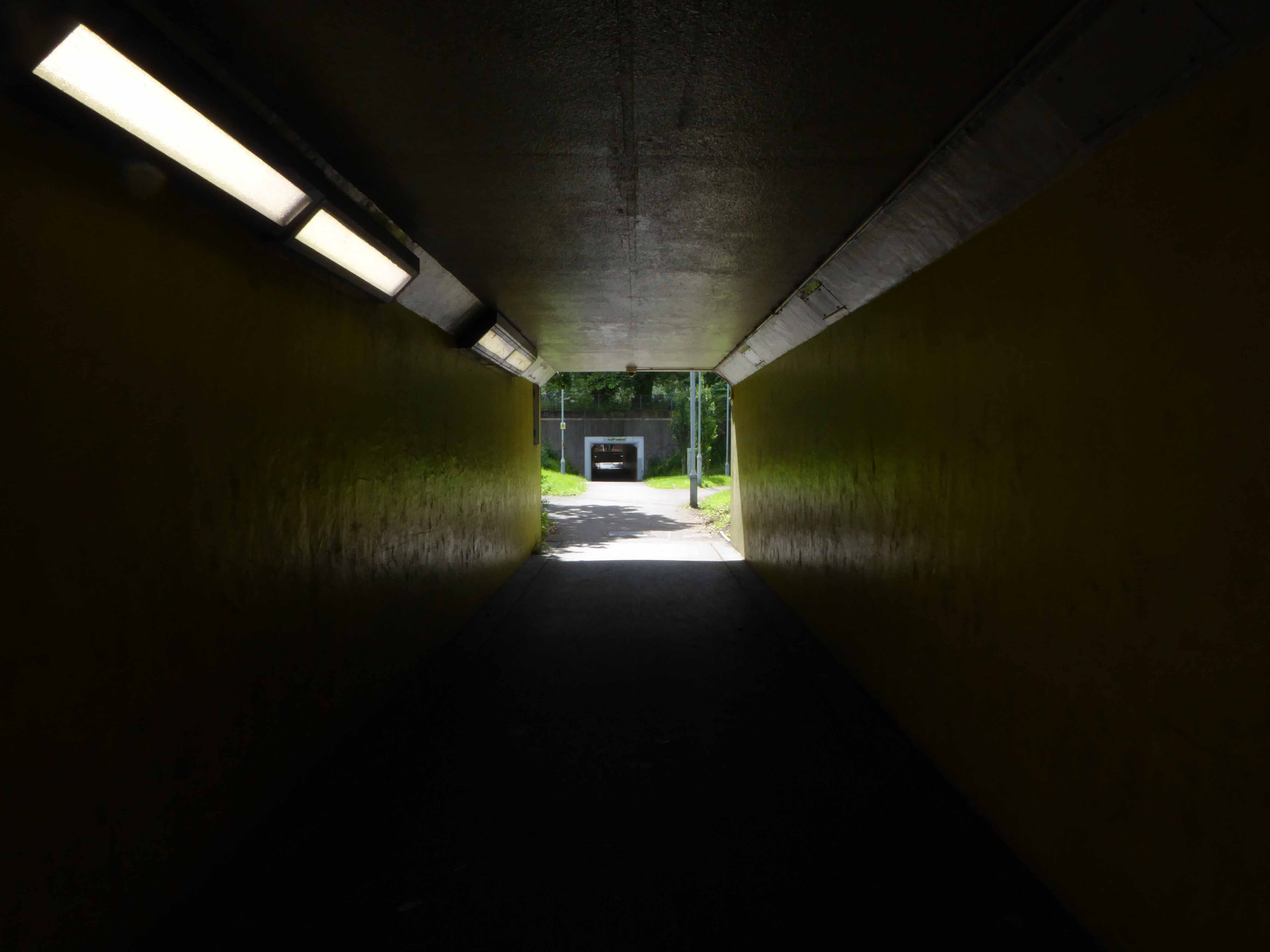
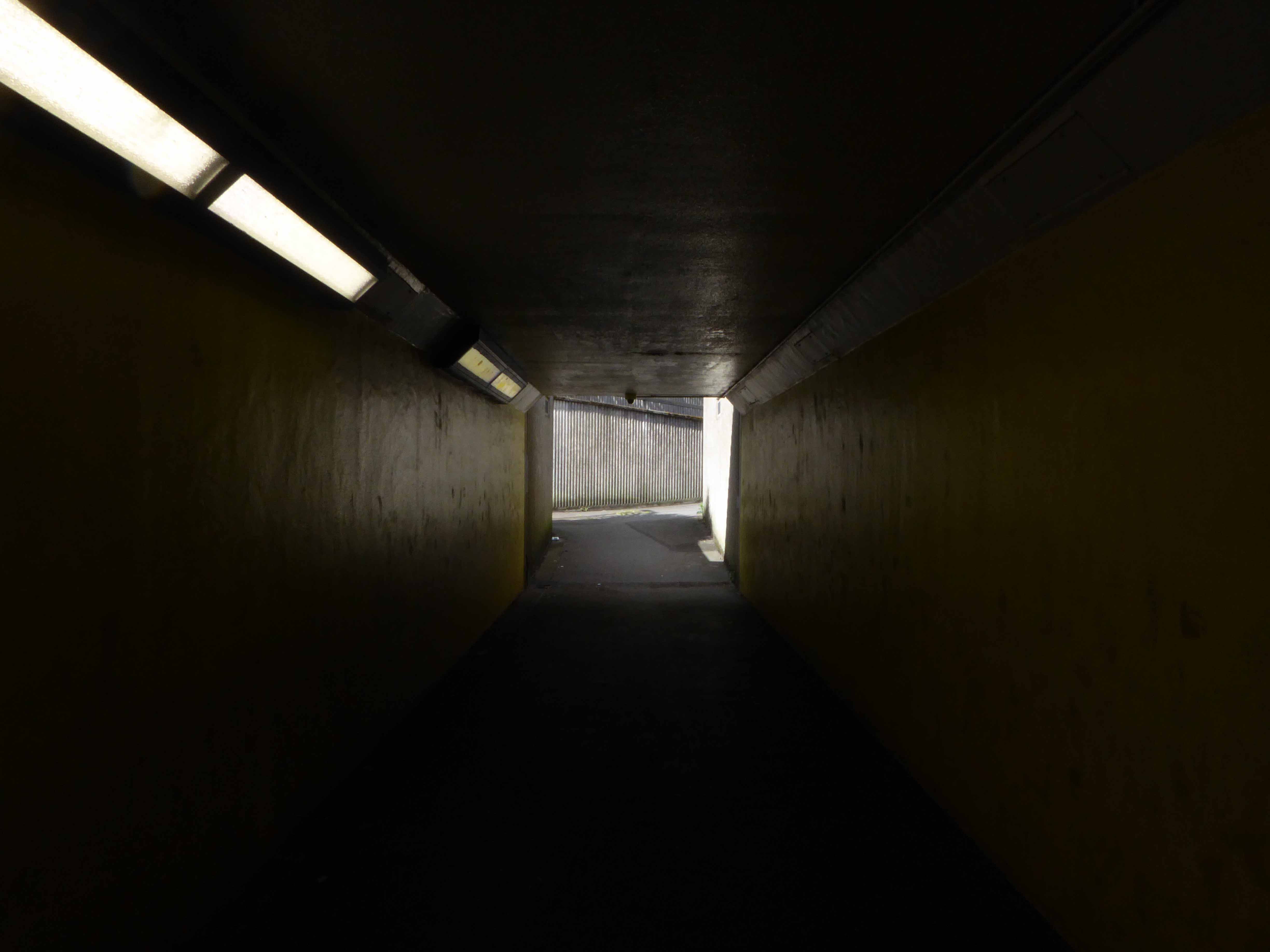
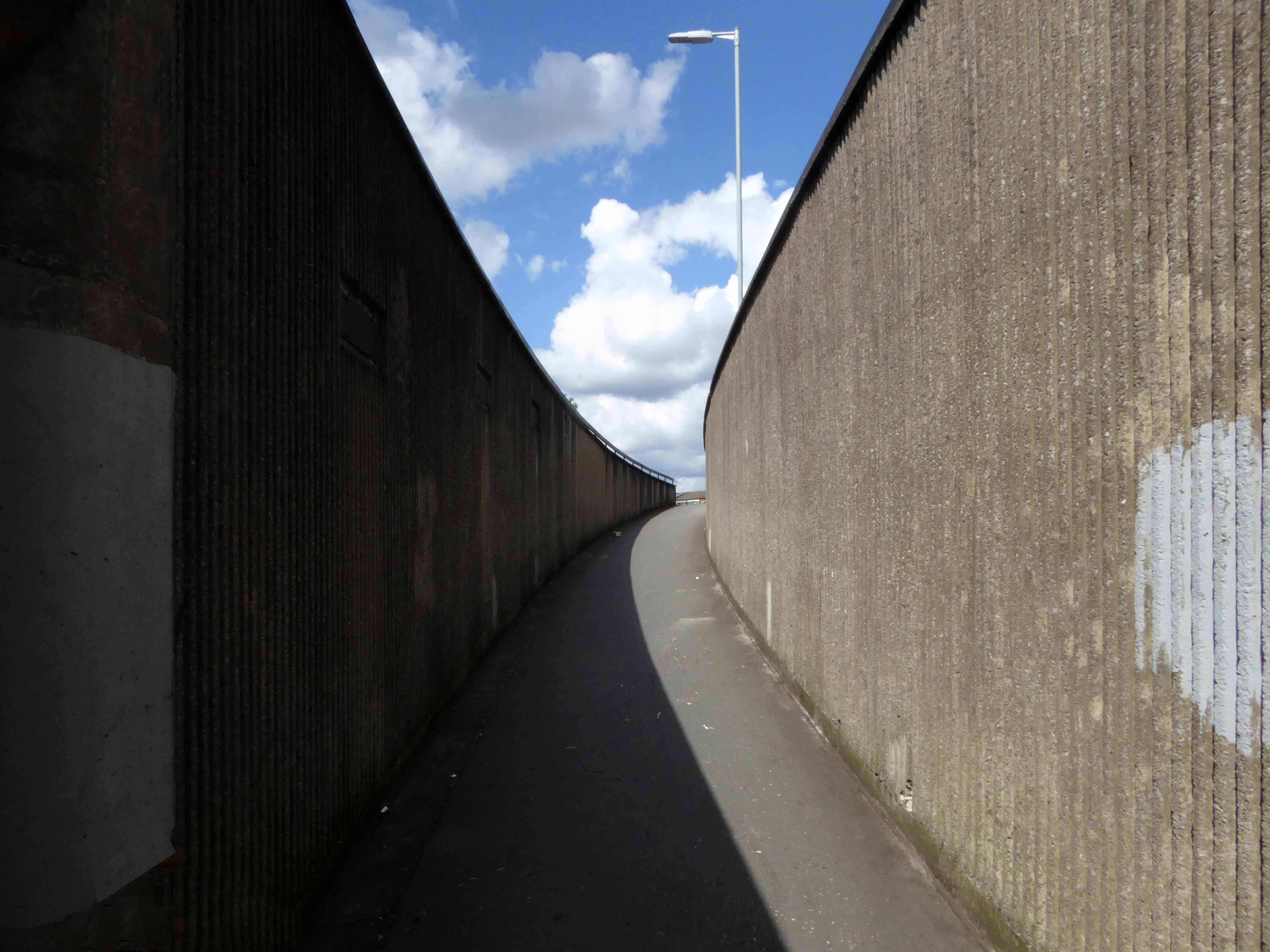
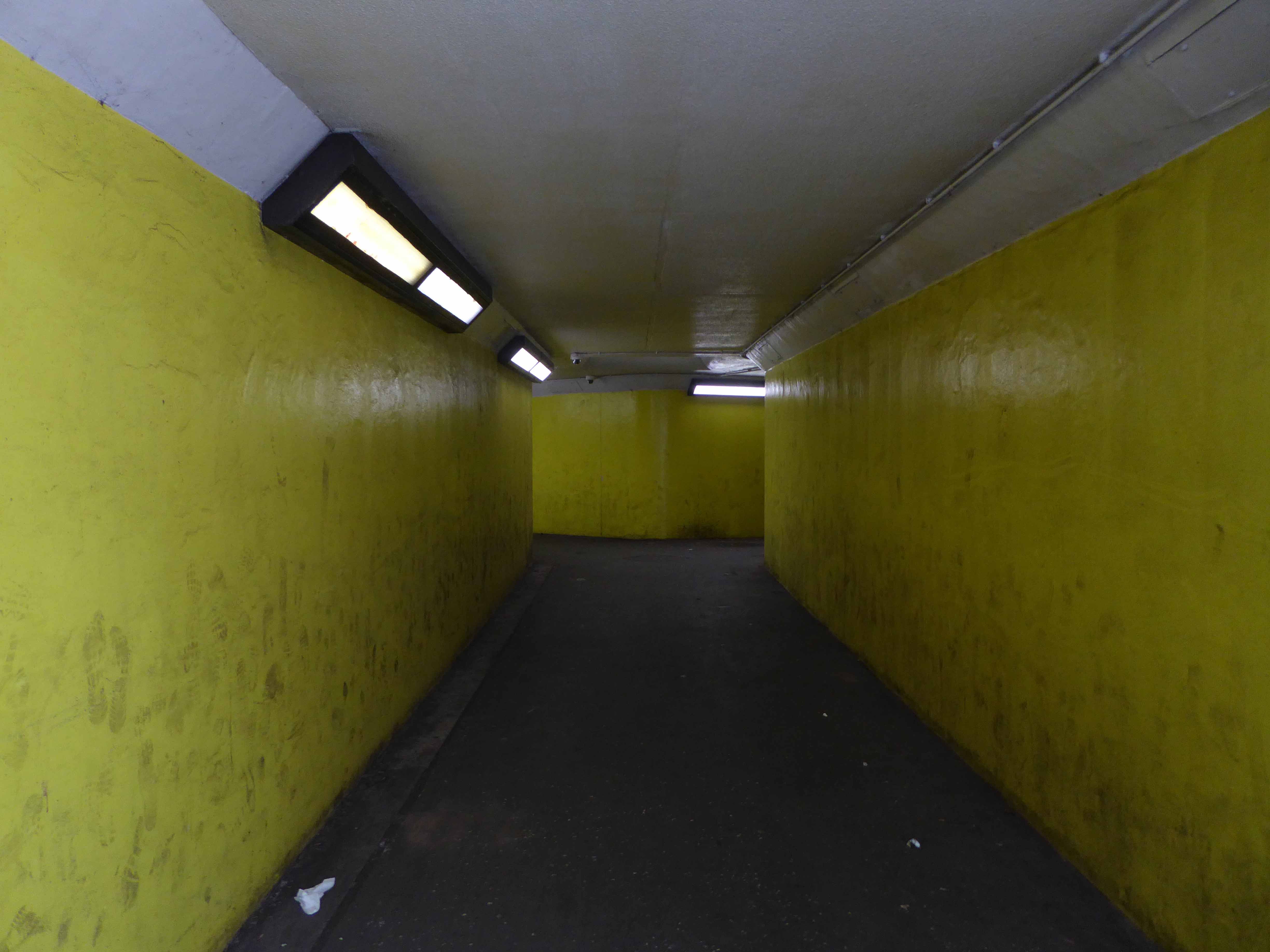
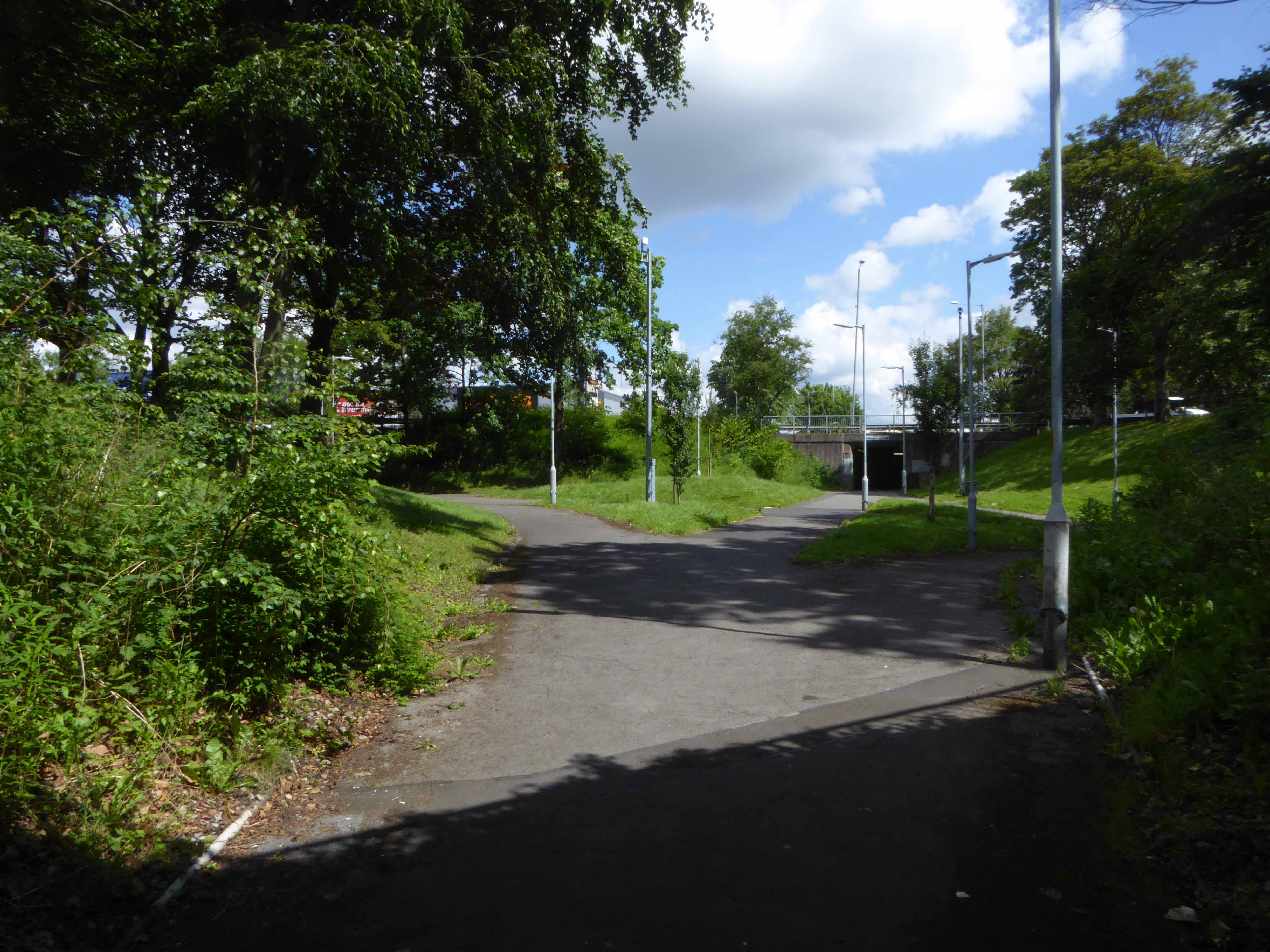
We recently took a look around Redrock, today we visit the next door neighbour – the car park ramp.
Replacing the old Debenham’s ramp.
Linking the old world of Merseyway with the shiny new NCP.
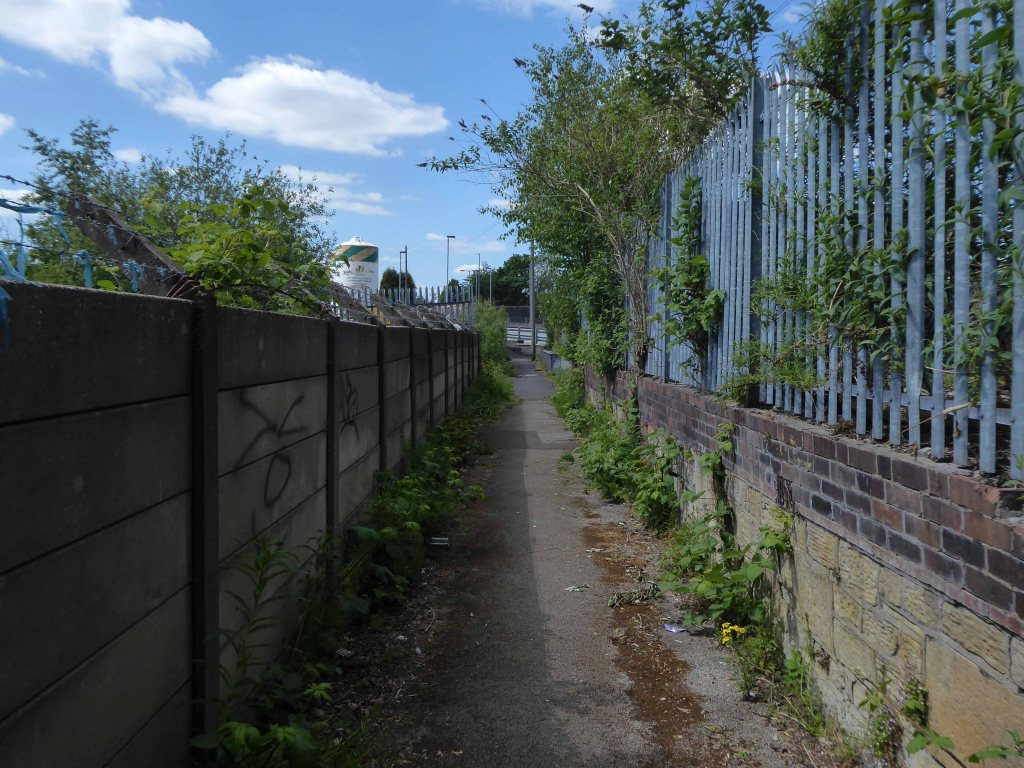
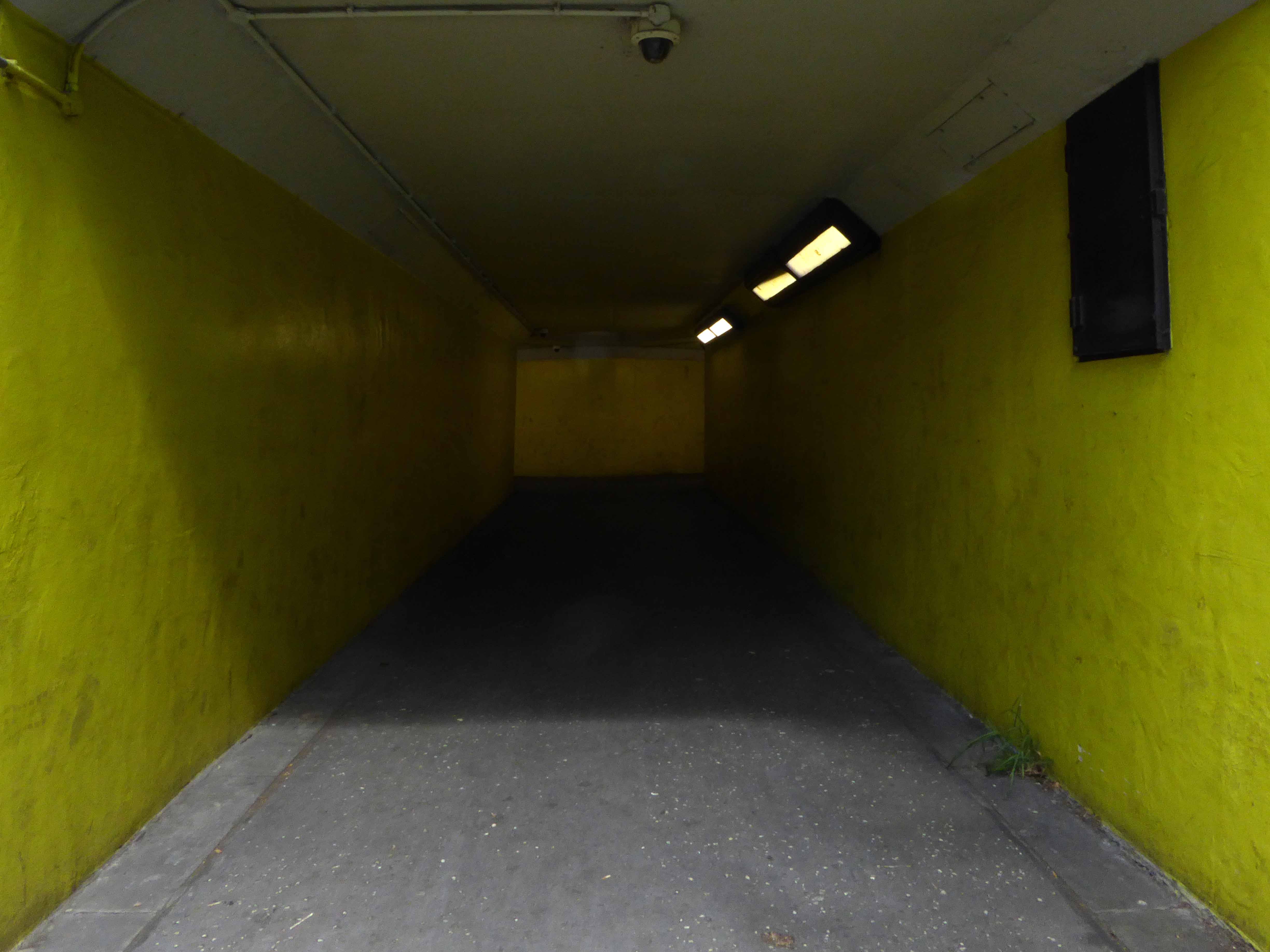
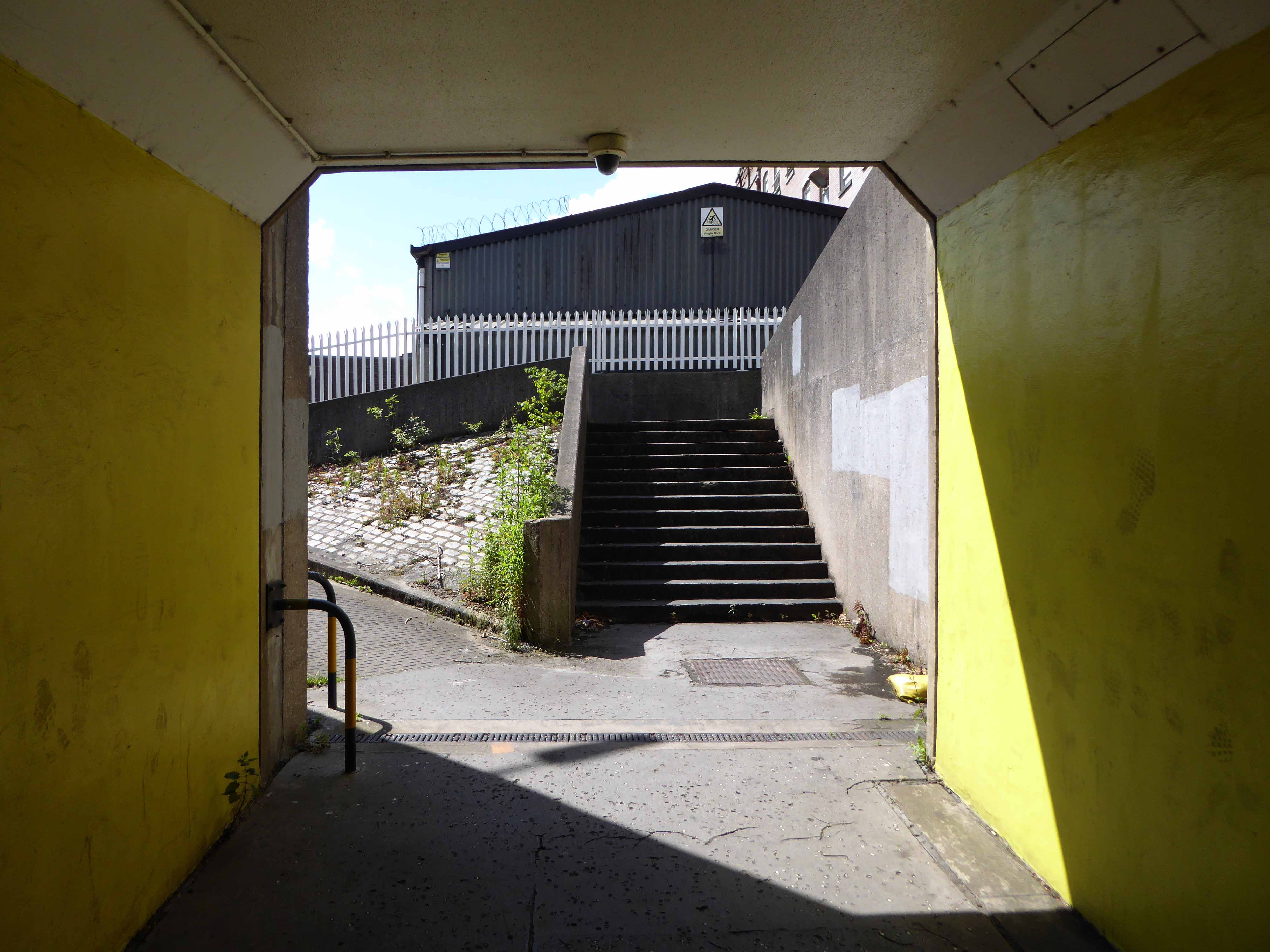
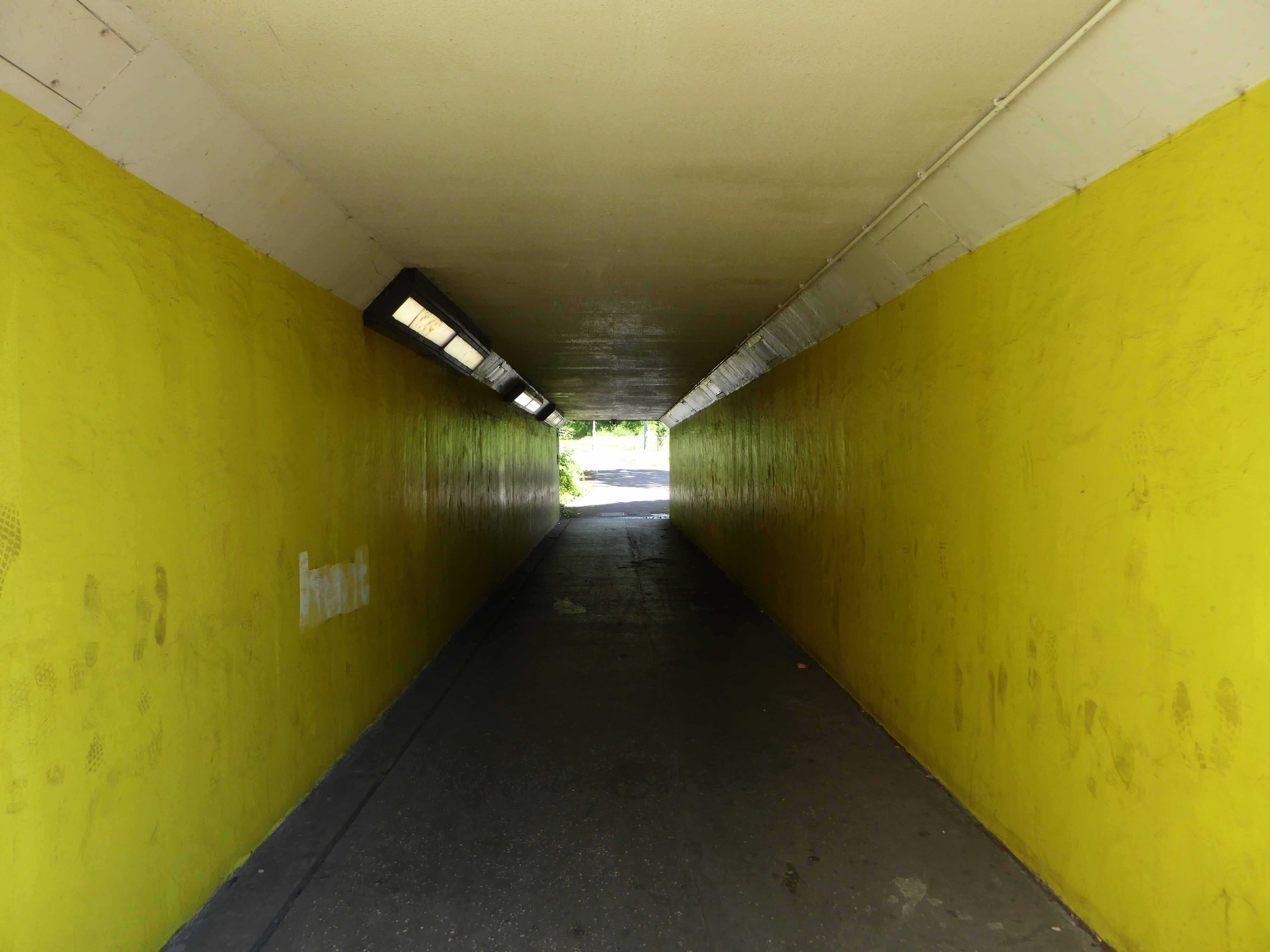
I don’t drive no car so I have to make do with the ecologically sound and ever so affordable means of pedestrian trespass, proceeding incautiously I recorded my journey into the unknown.
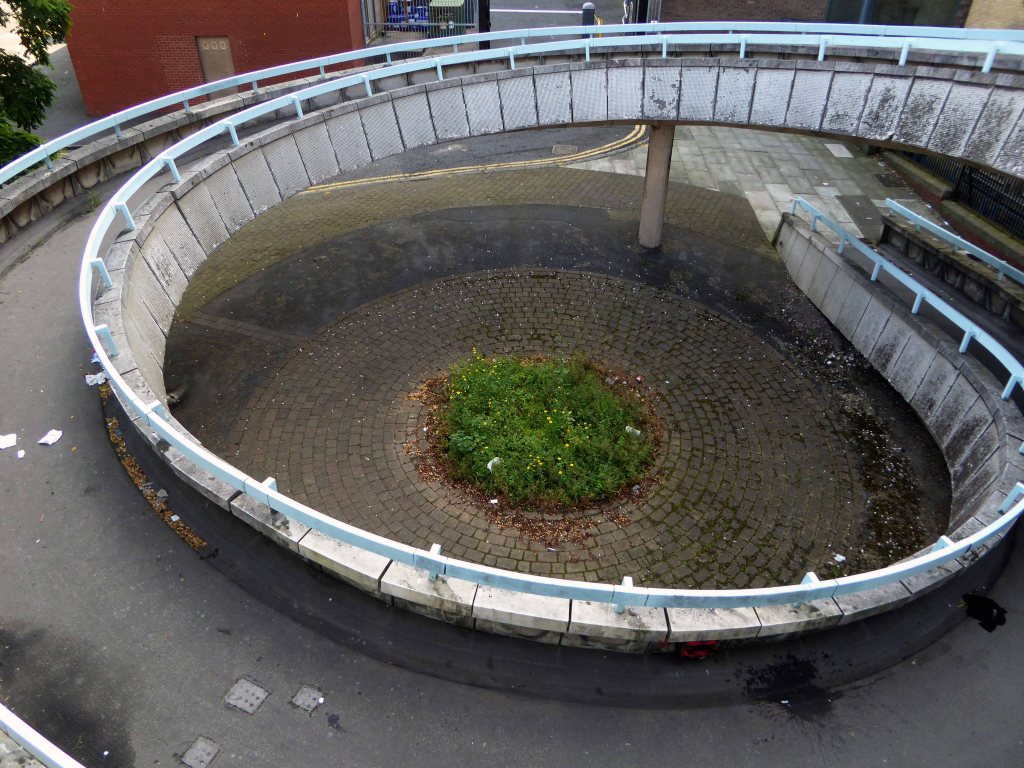
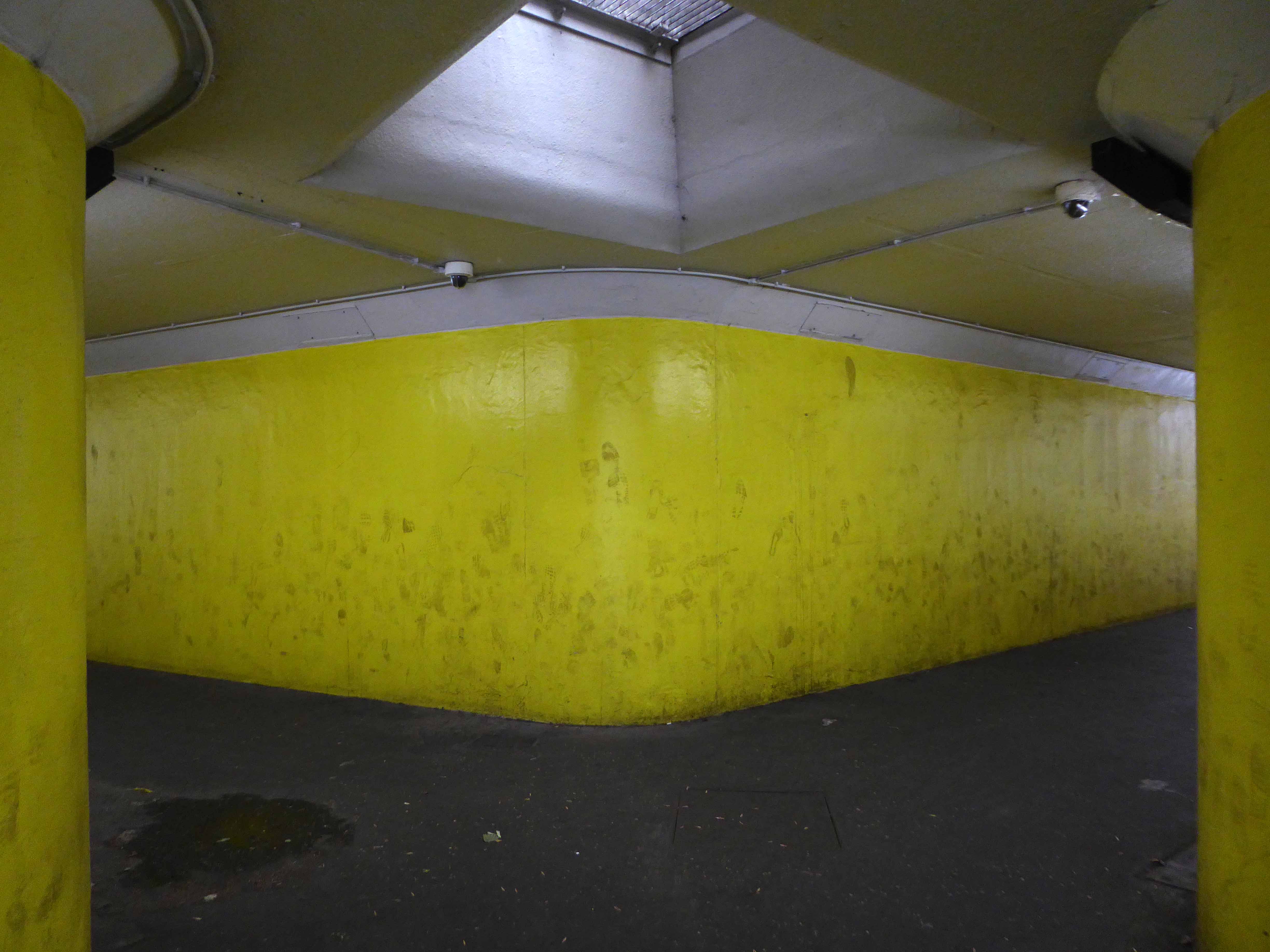
Returning safely to Basecamp I investigated further, circumnavigating the drainage area.
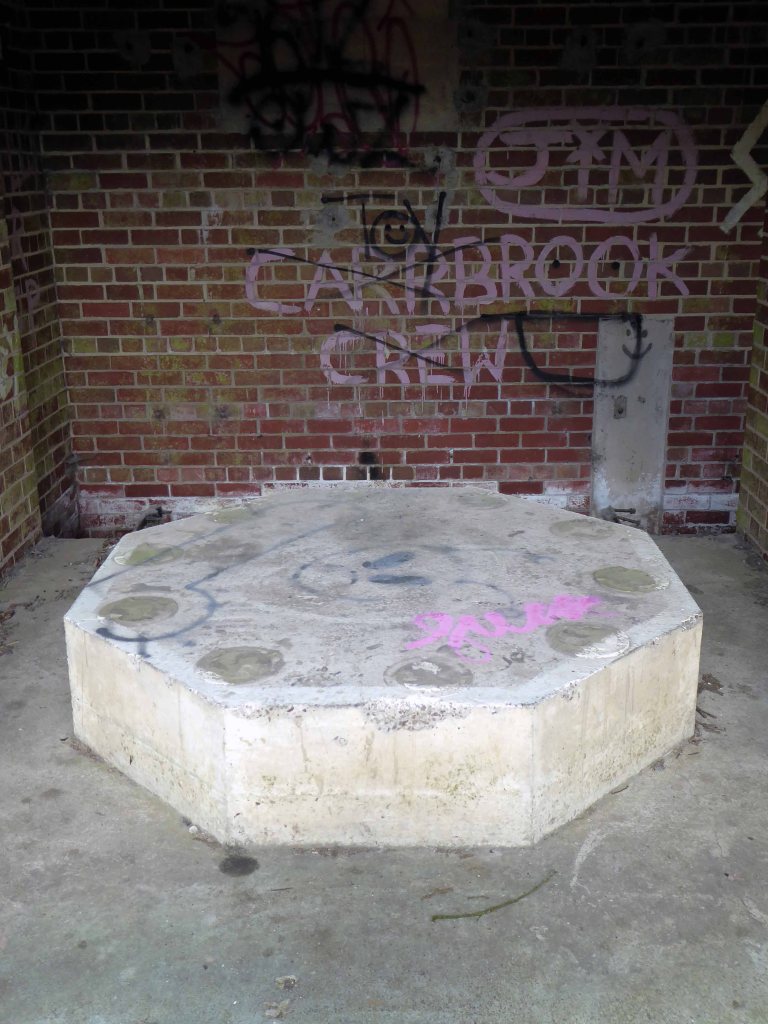
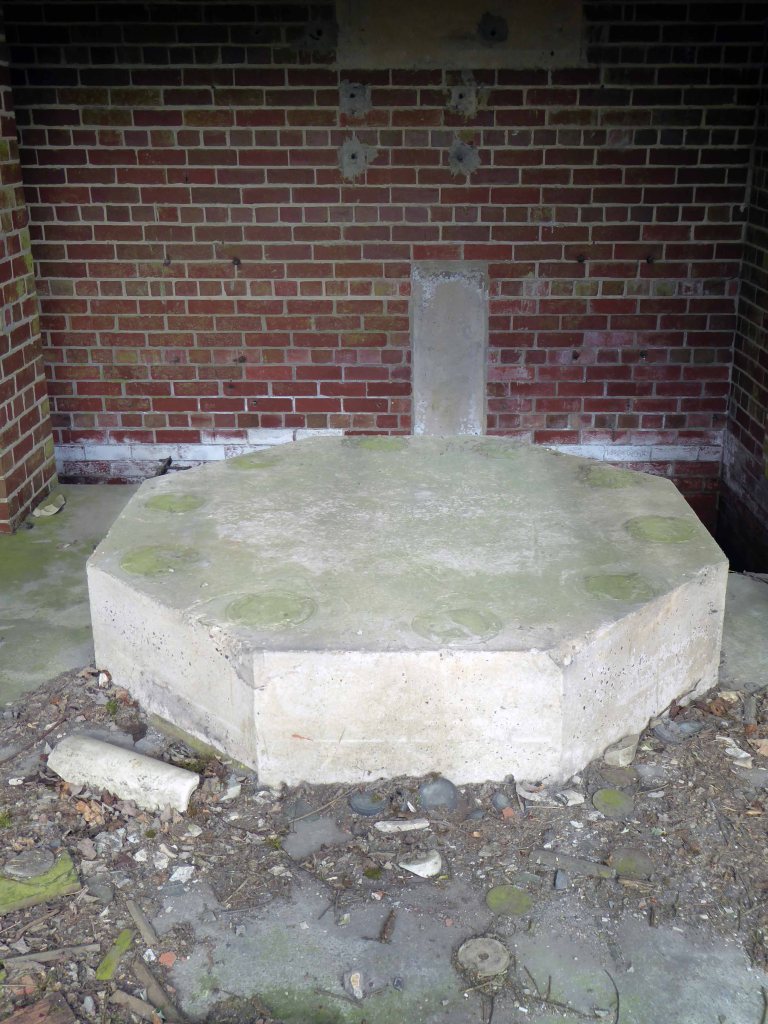
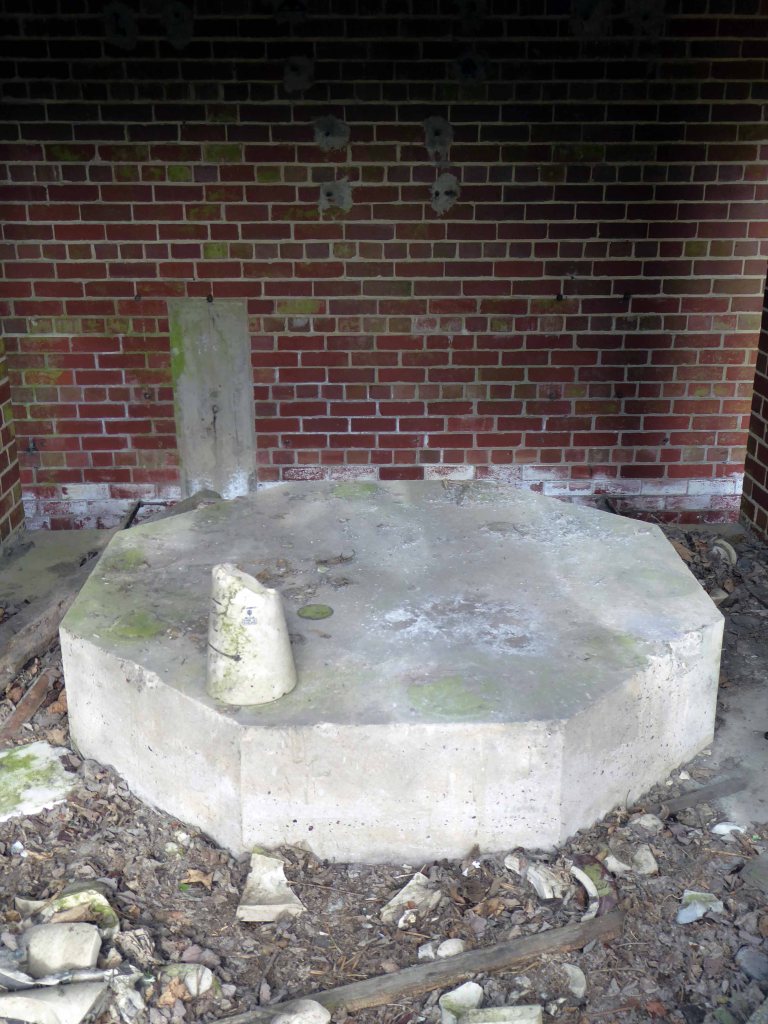
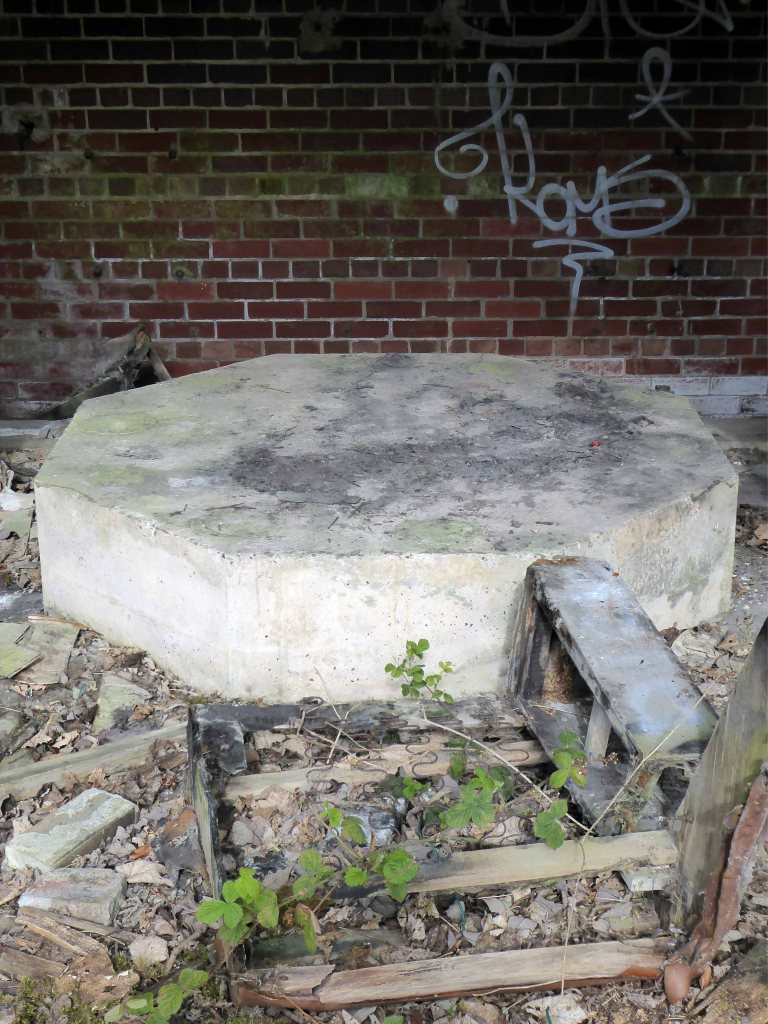
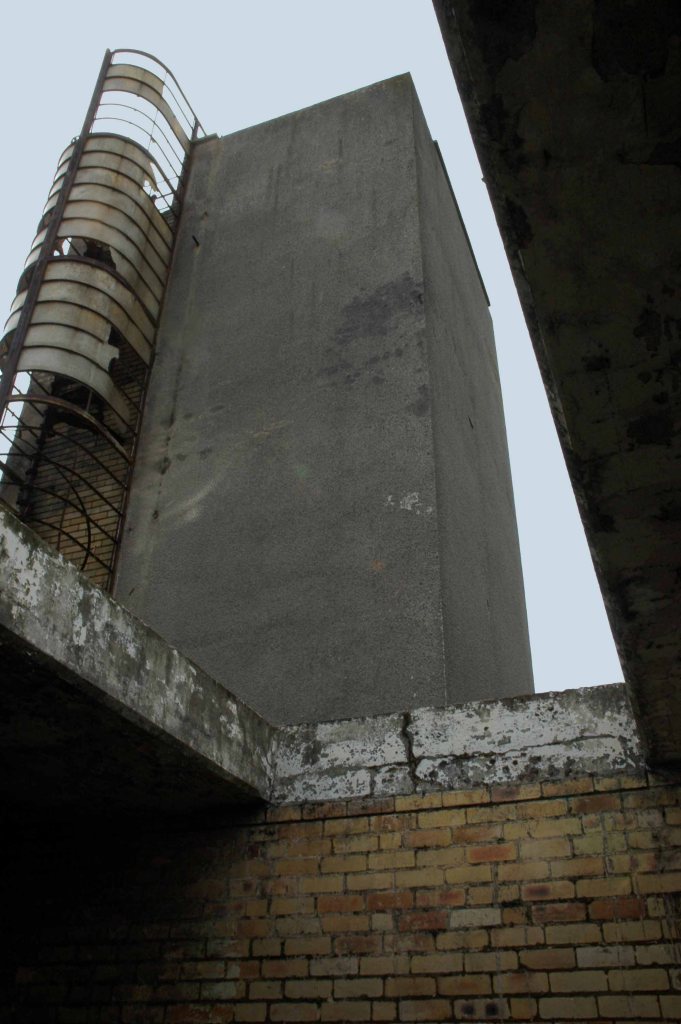
I have to admit that I am over fond of this small sacred space, a modern impenetrable temple of Brutalism. My ambition is to stage an art/music event within, just wait and see/hear if I don’t!
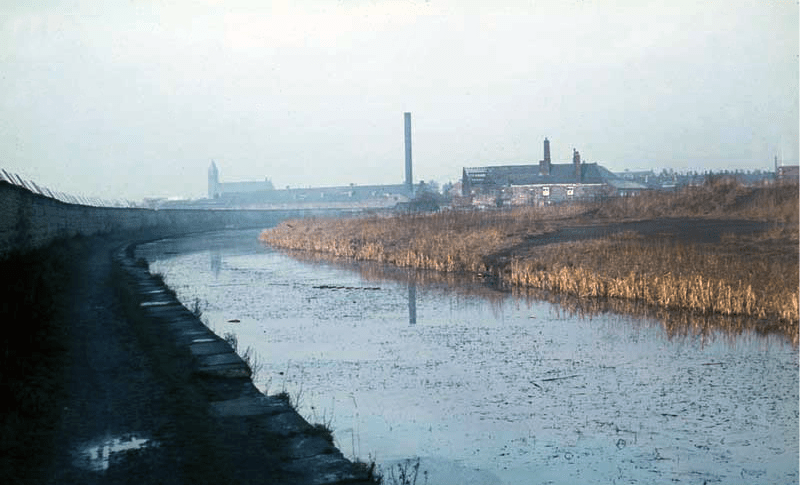
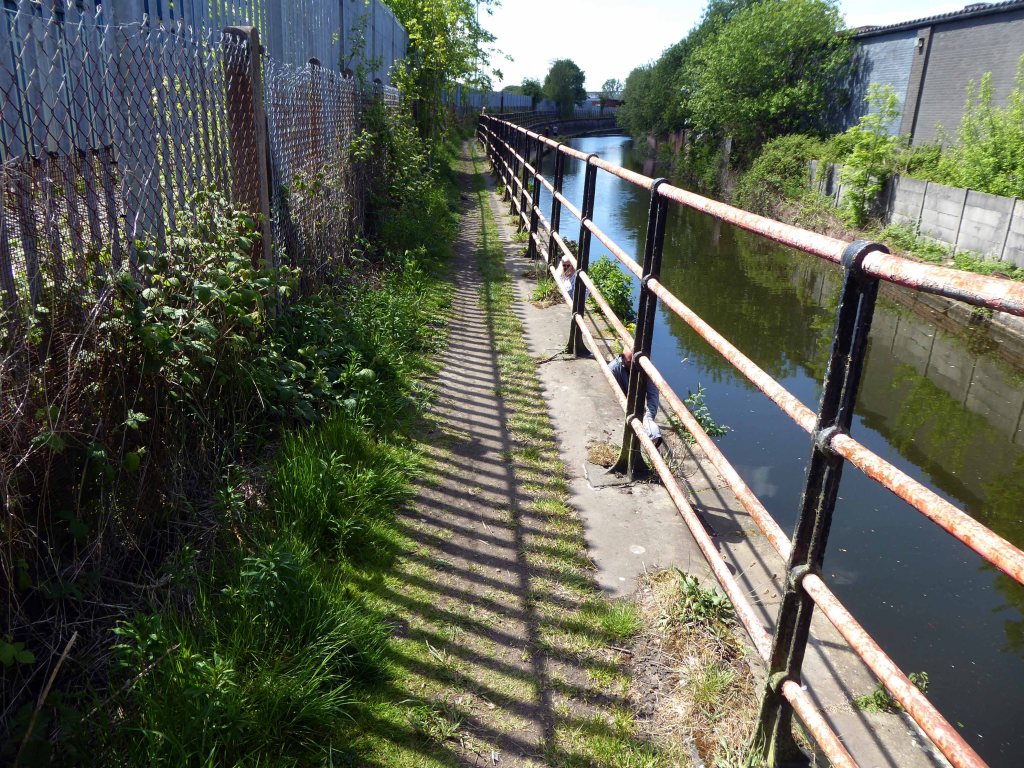
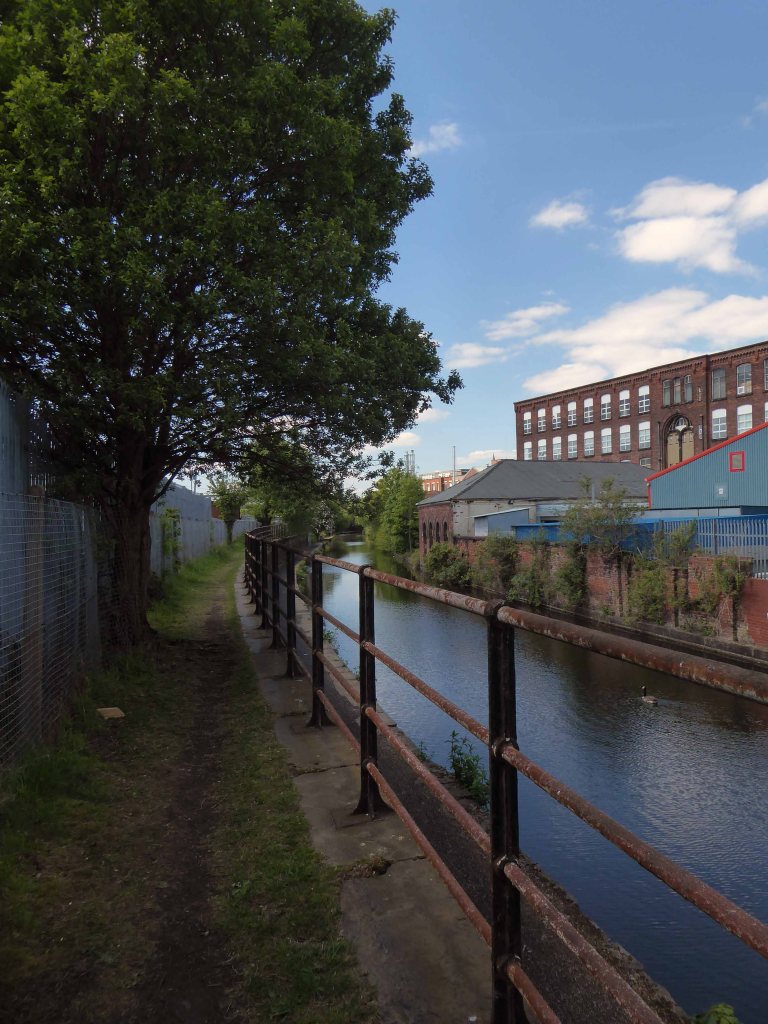
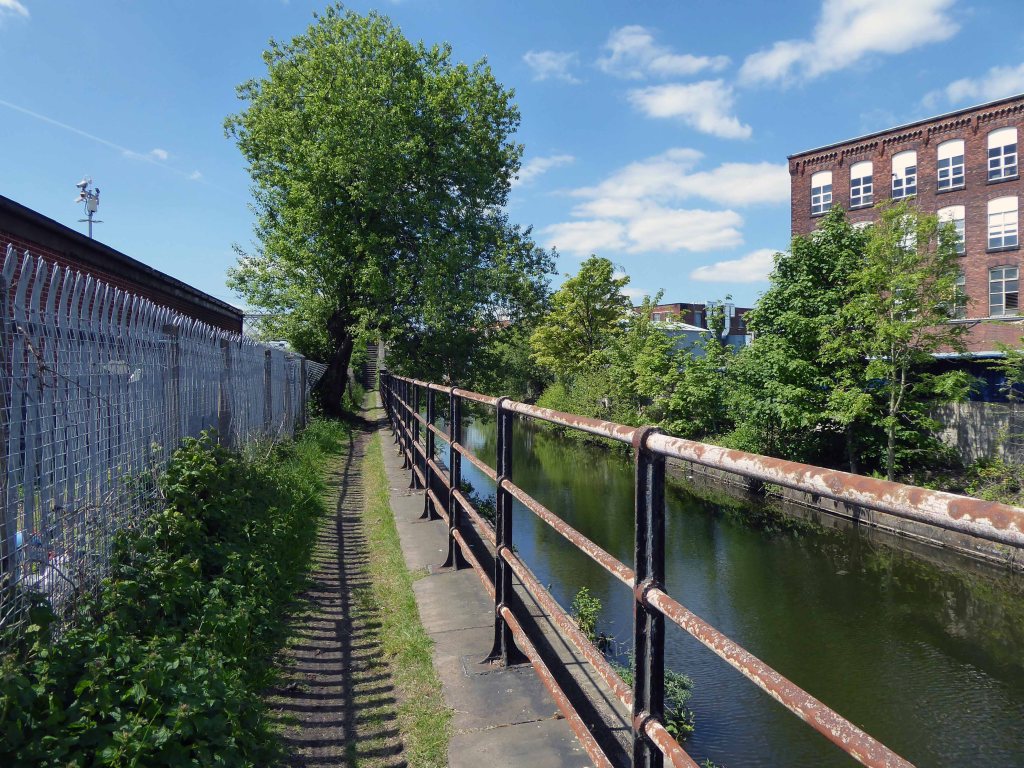
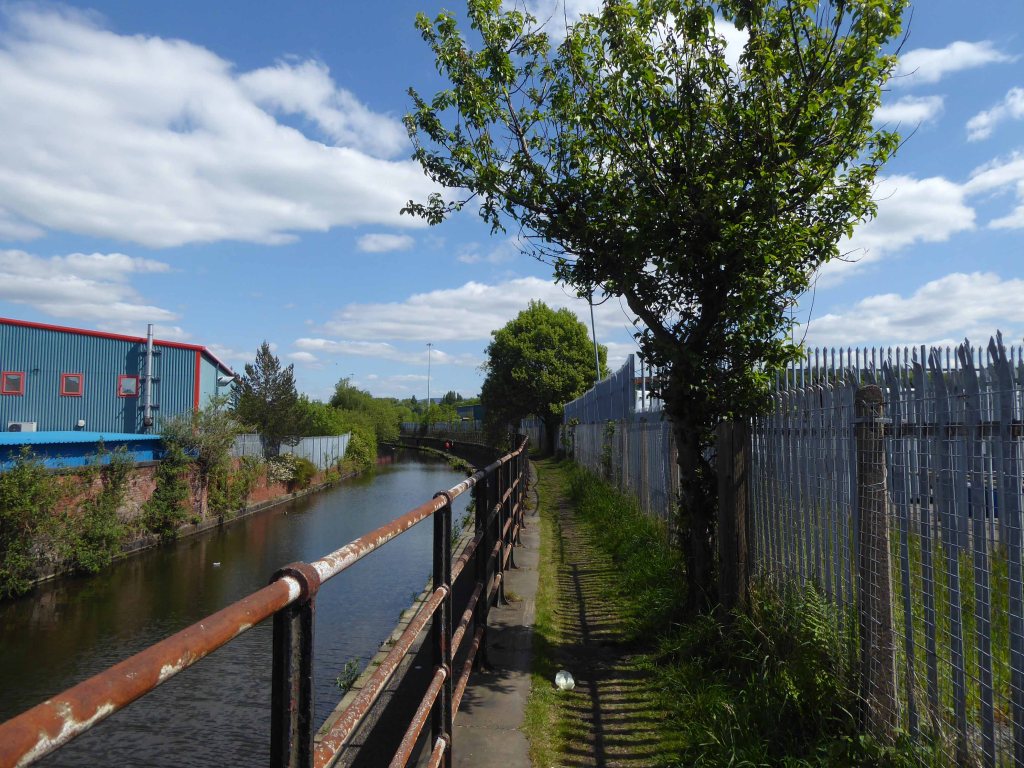
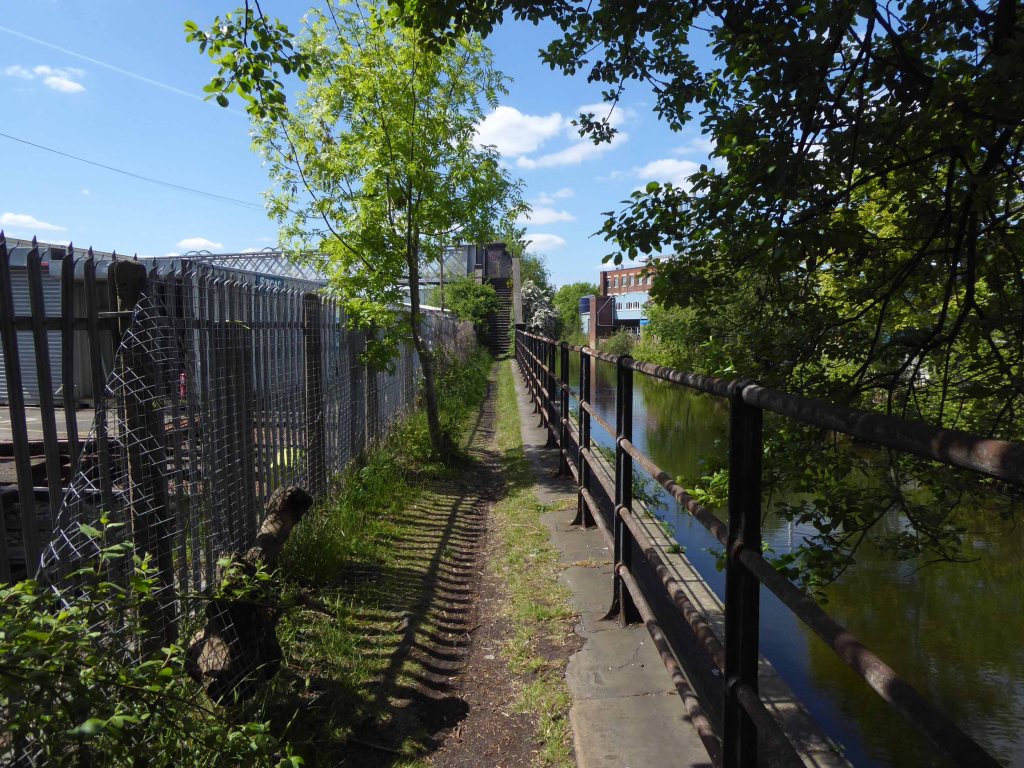
The canal received its Act of Parliament in 1792. It was built to supply coal from Oldham and Ashton under Lyne to Manchester. The first section between Ancoats Lane to Ashton-under-Lyne and Hollinwood was completed in 1796.
The Great Central Railway in England came into being when the Manchester, Sheffield and Lincolnshire Railway changed its name in 1897, anticipating the opening in 1899 of its London Extension. On 1 January 1923, the company was grouped into the London and North Eastern Railway.
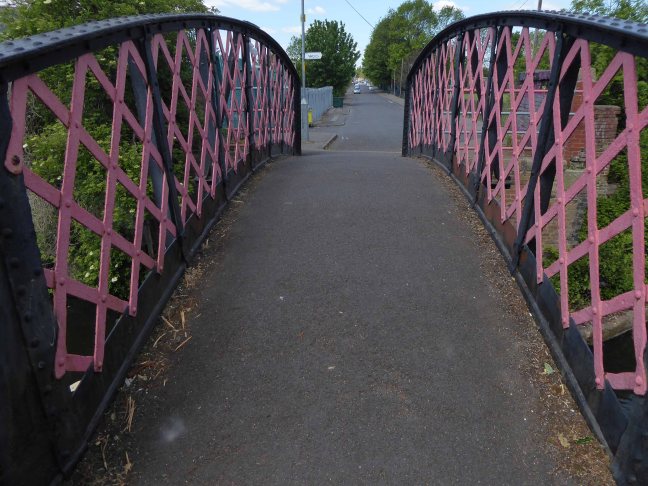
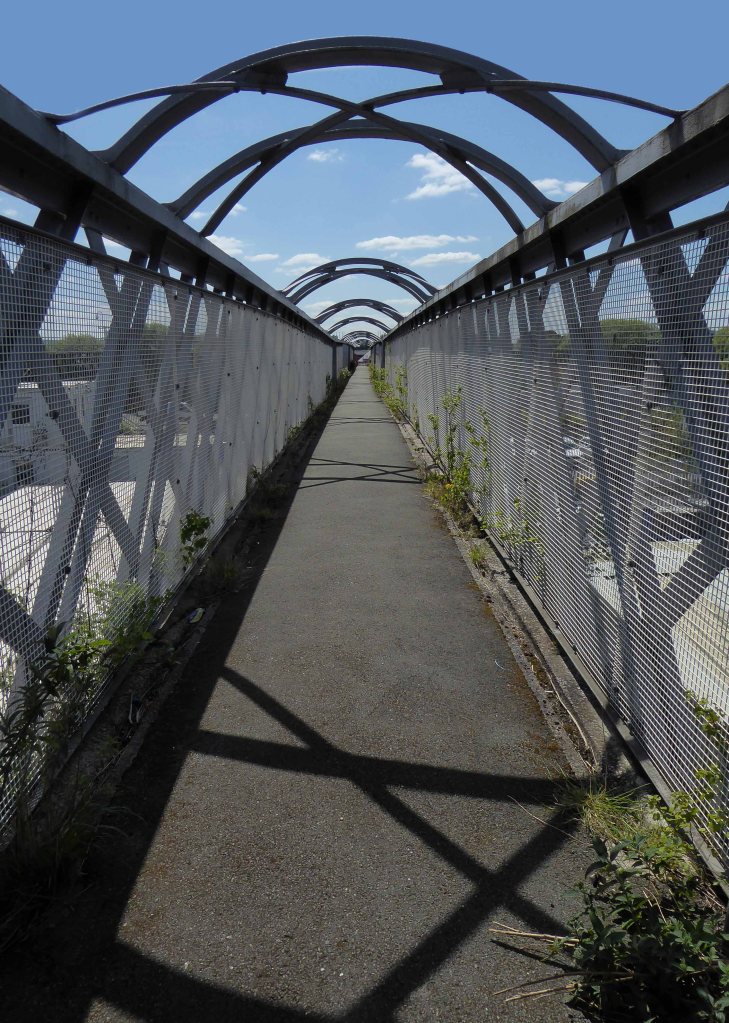
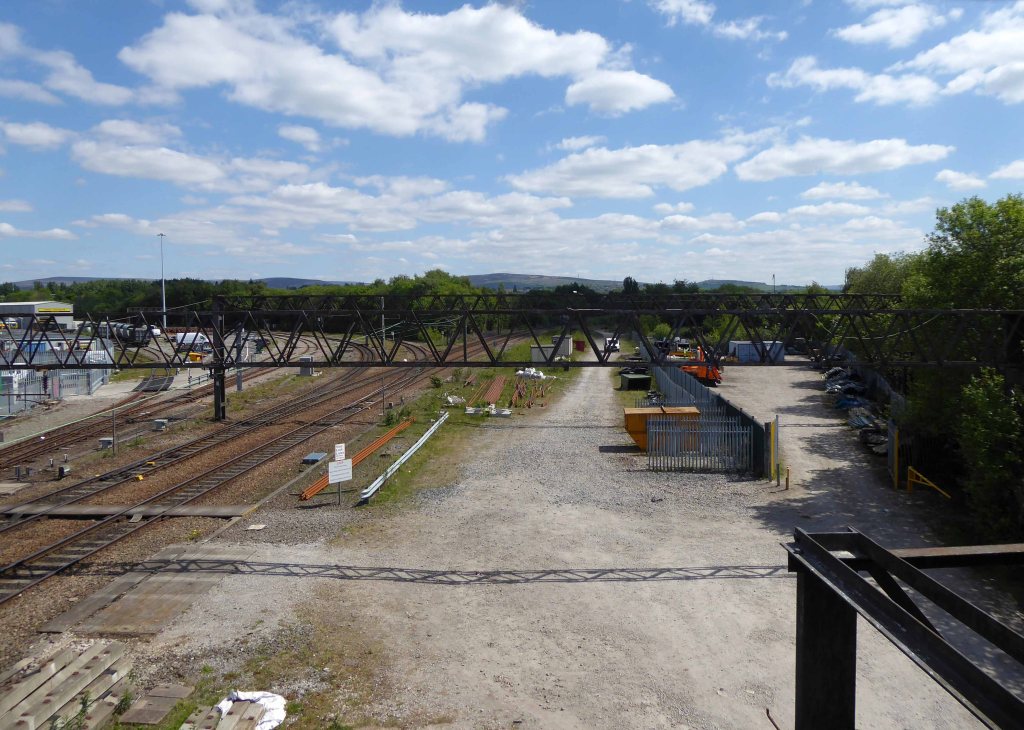
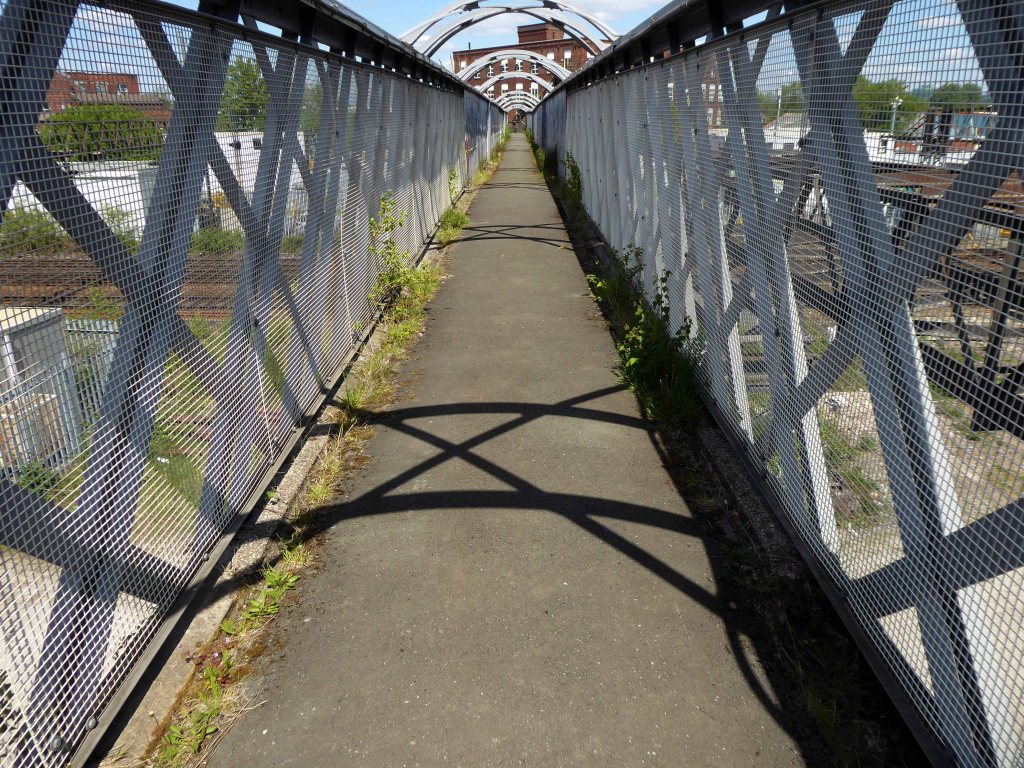
I had walked beside the elevated path, alongside the canal coming home from school, rode by it whilst working as a Guide Bridge goods guard.
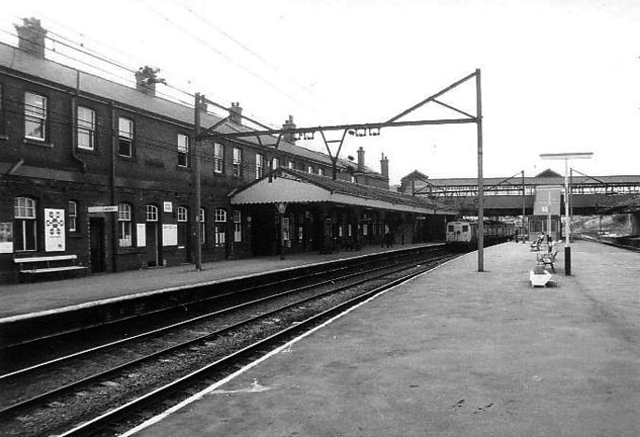
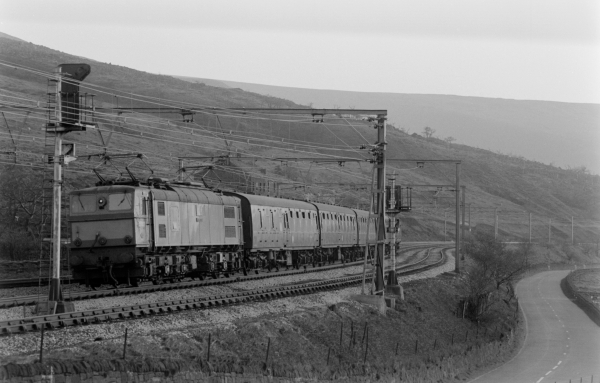
This was busy railway, steel coal, oil and people hurtling back and forth across the Pennines, under the DC wires of the Woodhead Line.
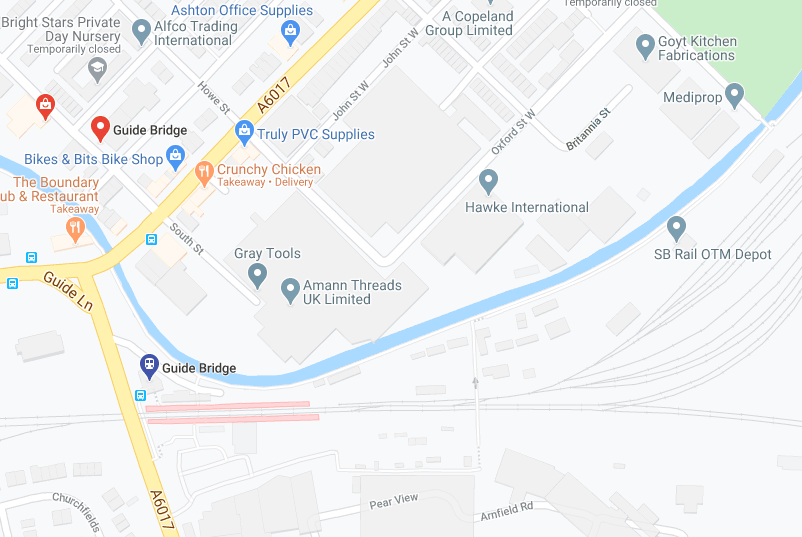
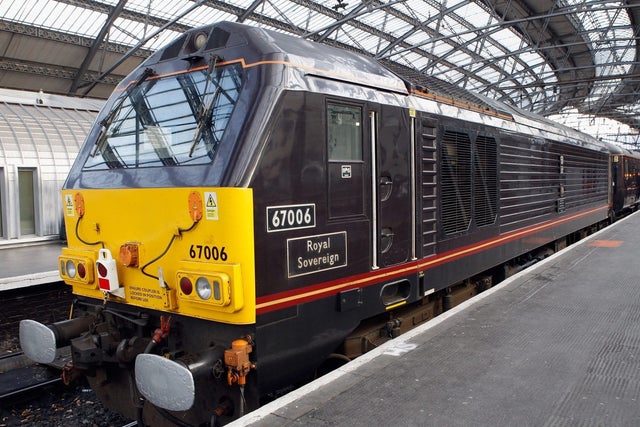
One memorable night the Royal Train stayed overnight, in what are now the SB Rail OTM sidings.
Toffs in dinner jackets were leaning from the windows, as we gazed in awe from the platform.
Swietelsky is one of Austria’s leading construction companies with international contracts encompassing highways, tunnelling, residential and commercial developments, alpine construction and railways.
The journey ends by the seriously depleted station buildings, the buffet bar, depot and engine shed long gone.
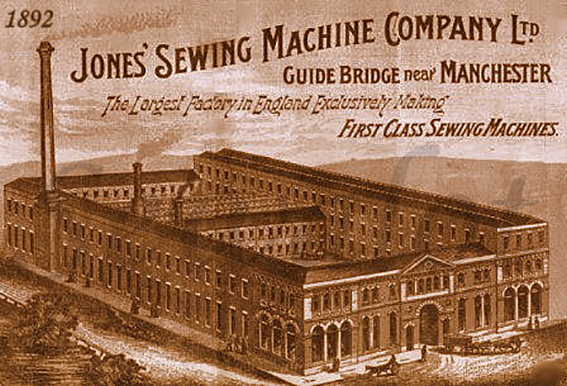
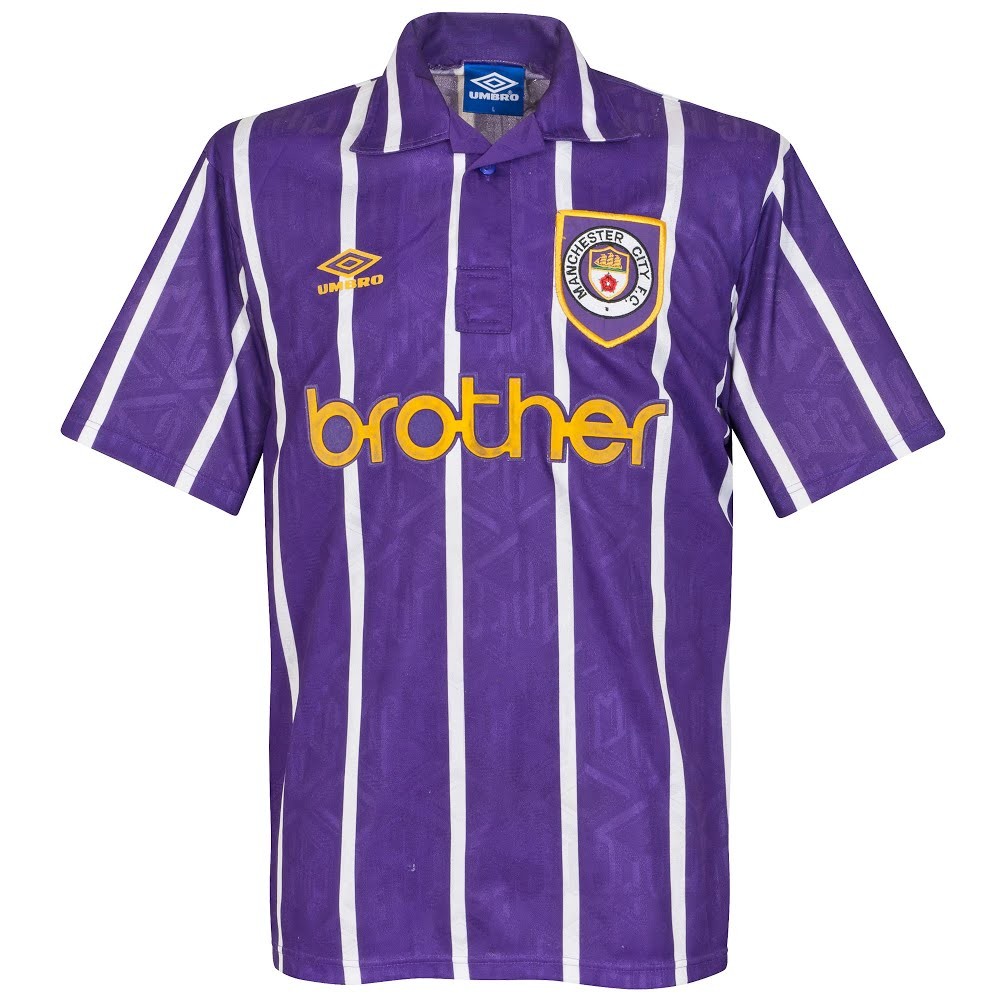
Thomas Chadwick later joined Bradbury & Co. William Jones opened a factory in Guide Bridge, Manchester in 1869. In 1893 a Jones advertising sheet claimed that this factory was the – Largest Factory in England Exclusively Making First Class Sewing Machines. The firm was renamed as the Jones Sewing Machine Co. Ltd and was later acquired by Brother Industries of Japan, in 1968. The Jones name still appeared on the machines till the late 1980s.
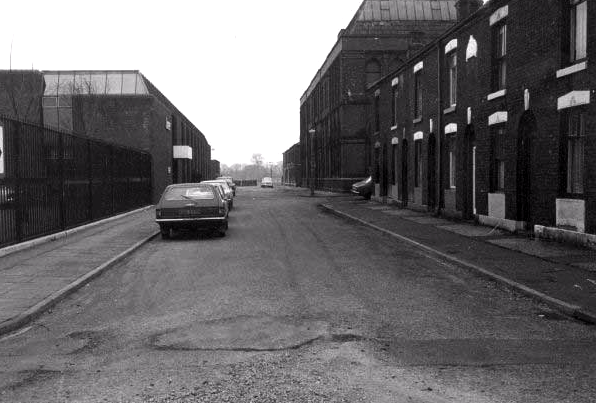
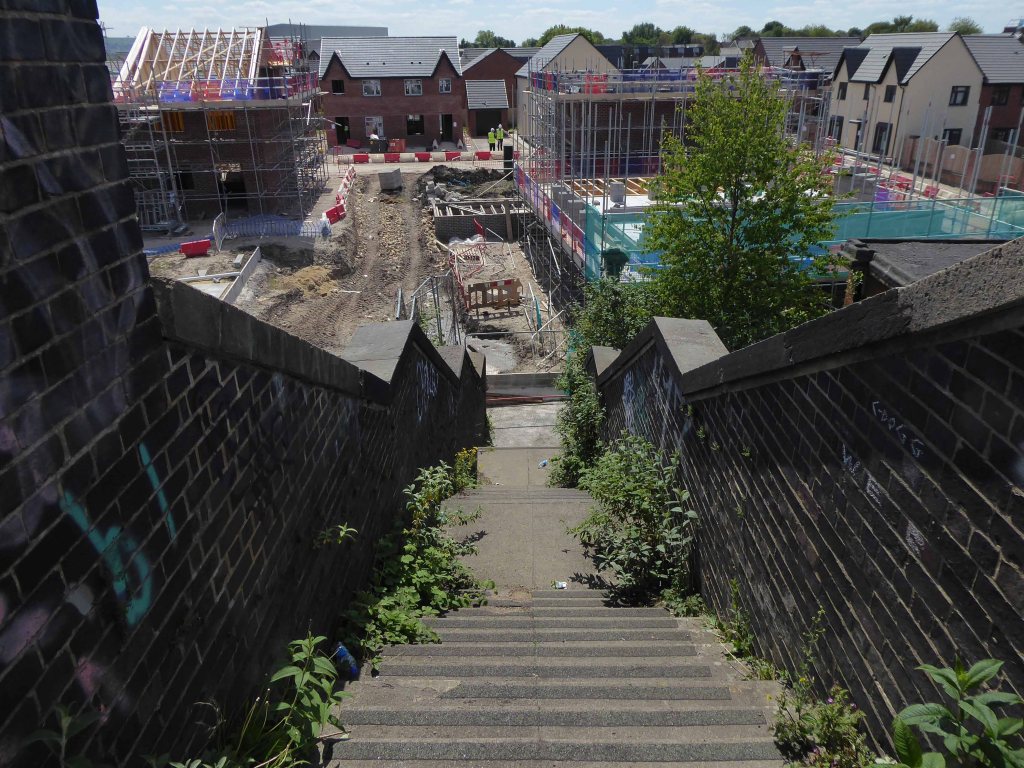
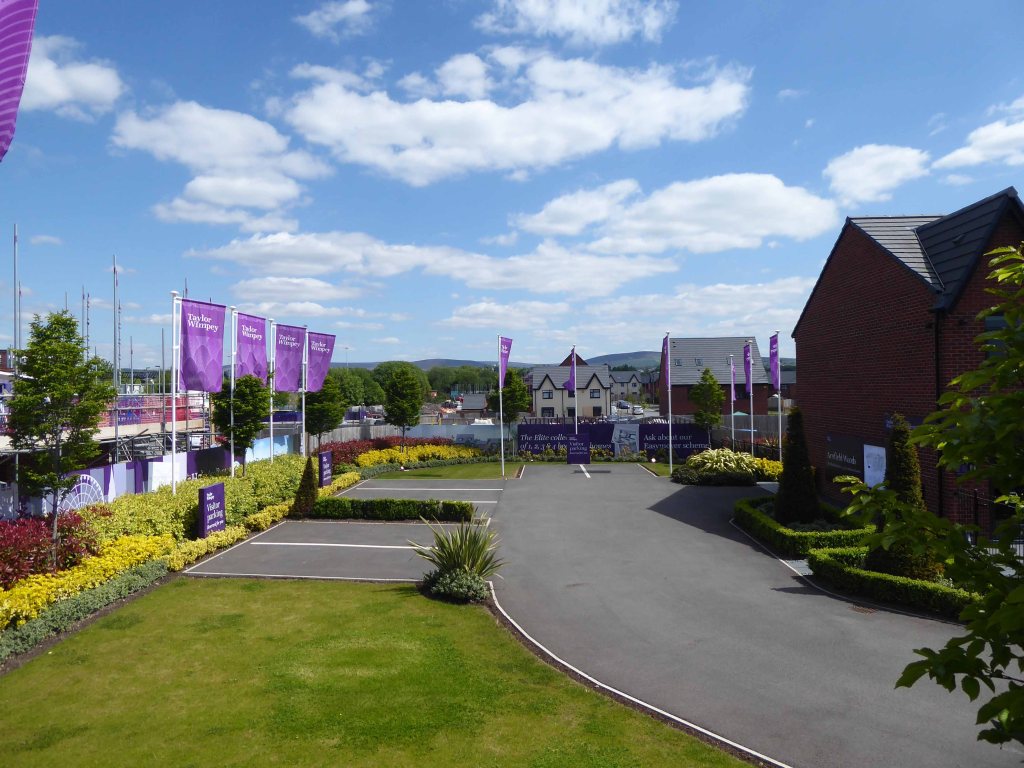
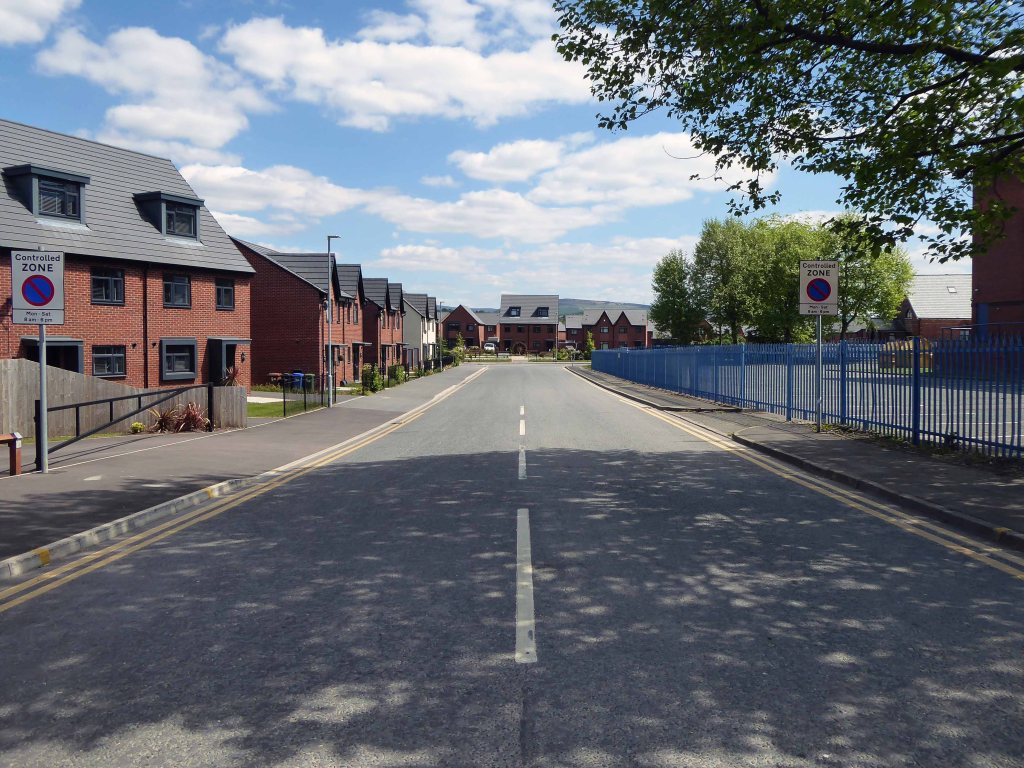
The site is now home to new homes and homeowners, as the area seeks to capitalise on the spread of wealth from Central Manchester.
Arnfield Woods is an exclusive development offering two, three and four bedroom homes, located adjacent to the Guide Bridge train station, which provides direct access into Manchester City Centre and direct access into Glossop.
The world turns:
Time changes everything except something within us which is always surprised by change.
The area was formerly a dense web of housing and industry.
With the gas works at its heart .
High speed gas once the fuel of the future is almost a thing of the past. Coal Gas produced in coke retorts long gone, North Sea Gas hissed off.
Low carbon heating will replace domestic boilers from 2025, the need for gas storage holders is minimal.
Goodnight Mr Therm.
There are currently 53 listed holders on the Historic England site.
Some have been repurposed – WilkinsonEyre has completed work on Gasholders London; a development of 145 apartments within a triplet of listed gasholder guide frames.
Little now remains of the Portwood Gas Works.
These are the rearranged remnants re-sited by Dunelm Mill – it’s curtains for our industrial heritage.
Your business is unique, so we don’t offer a one-size-fits-all.
Instead, we layer six Protective Services for your complete security.
Unlock six Protective Services
One of the UK’s largest retail parks, Stockport Retail Park benefits from a strategic location on the M60 Manchester orbital motorway making it one of the city’s most accessible parks. The park forms a natural extension to the town centre, offering a wide range of uses from value convenience to fashion and home as well as a number of cafés and restaurants.
This is the post industrial landscape of consumption and its infrastructure that faces the defunct and mothballed site, whatever next?
All that is solid melts into air as Marx and Marshall Berman told us.
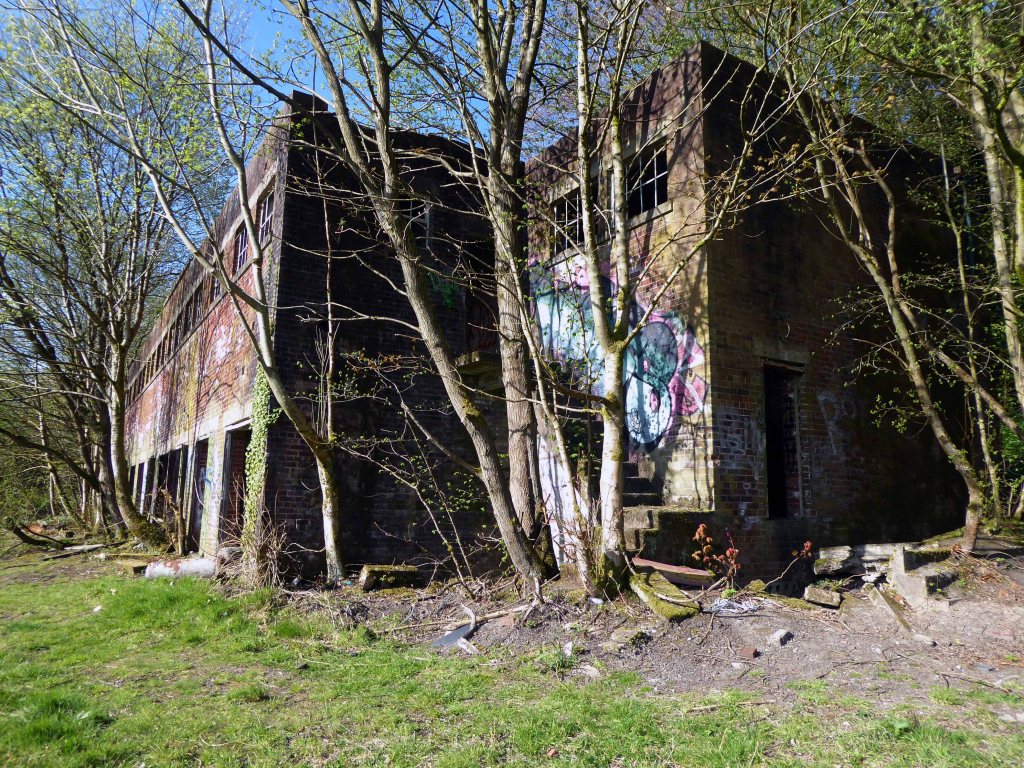
Though remnants remain – this is a short journey through a hole in fence, down into the warren of power station offices past.
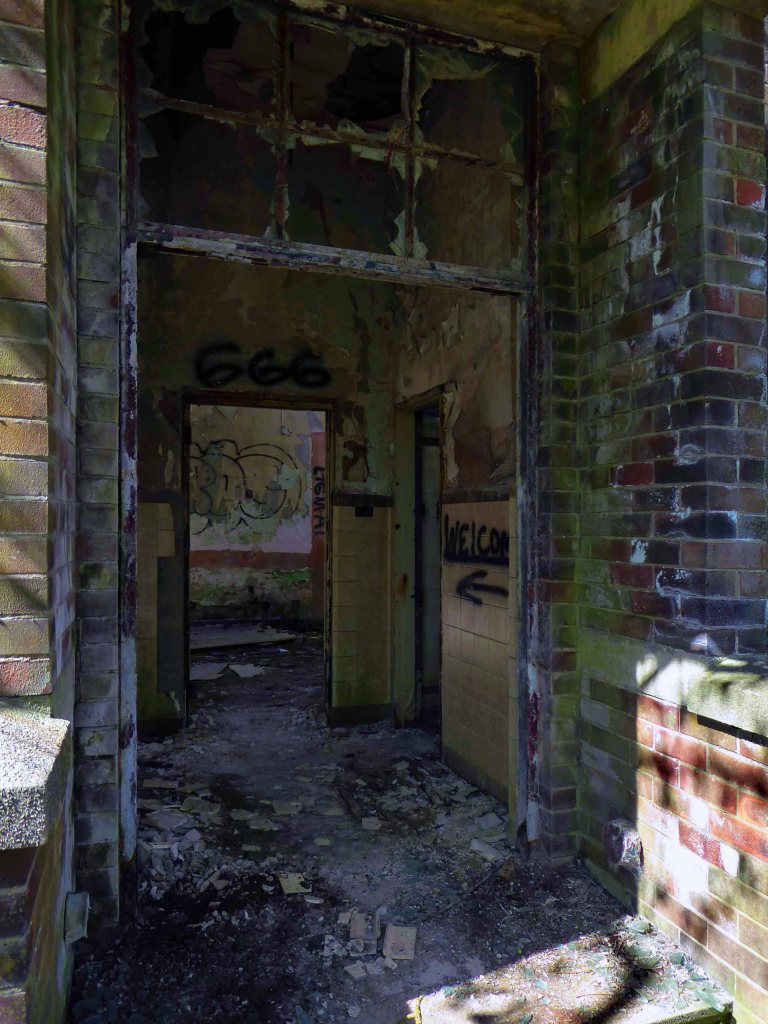
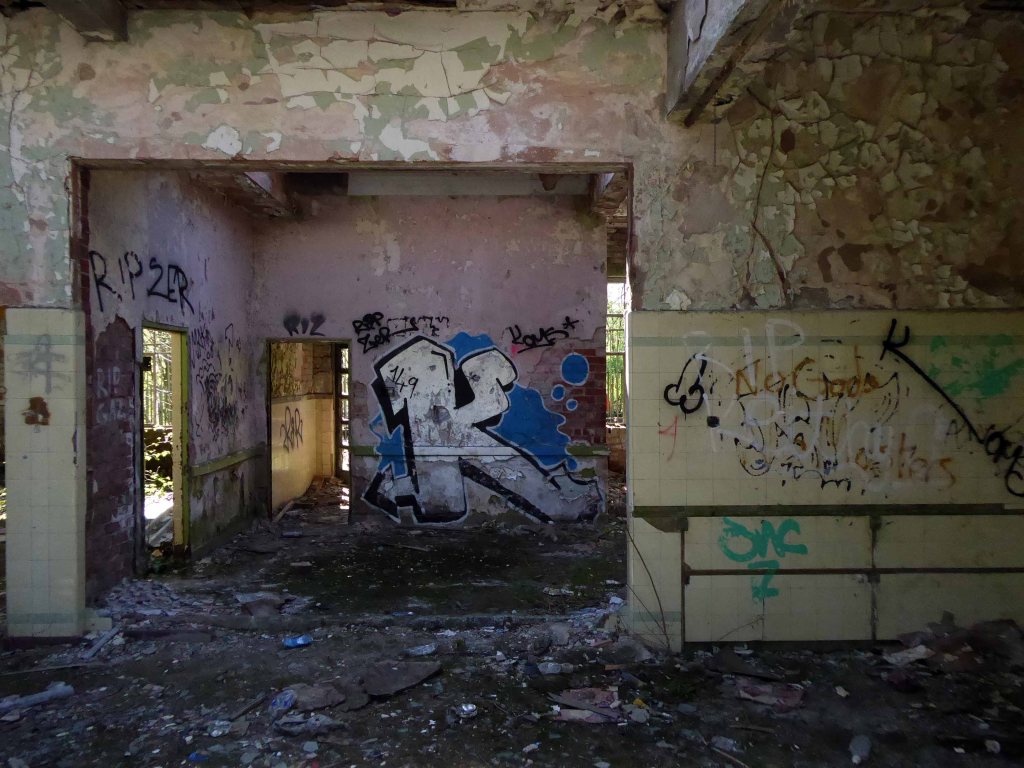
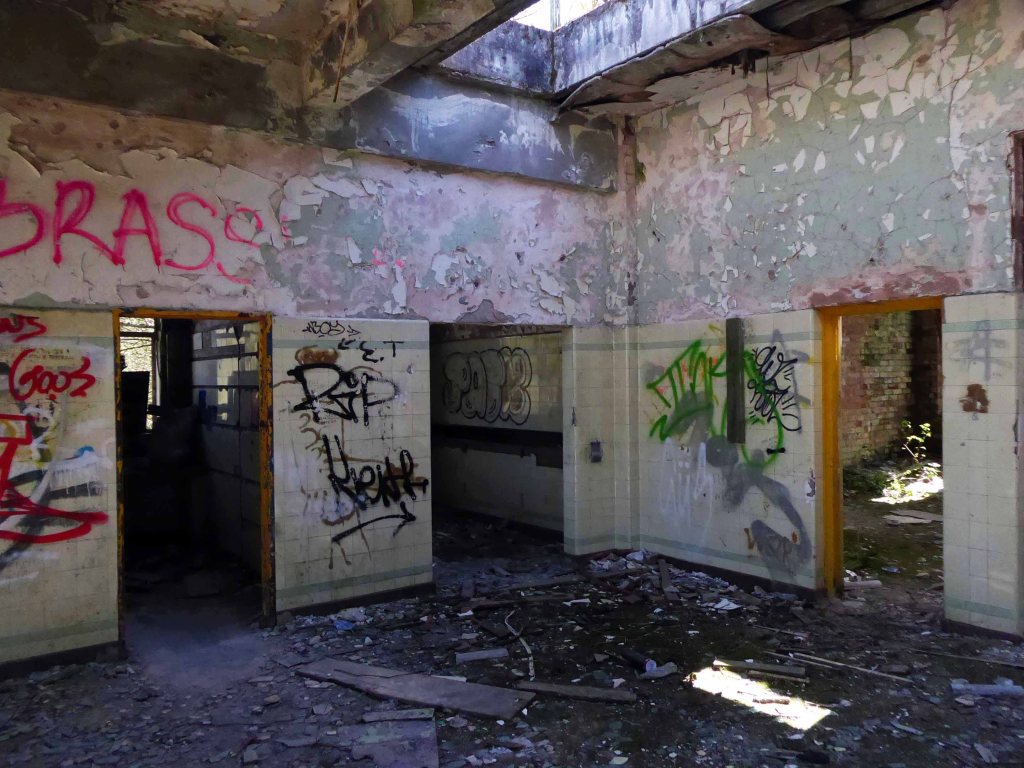
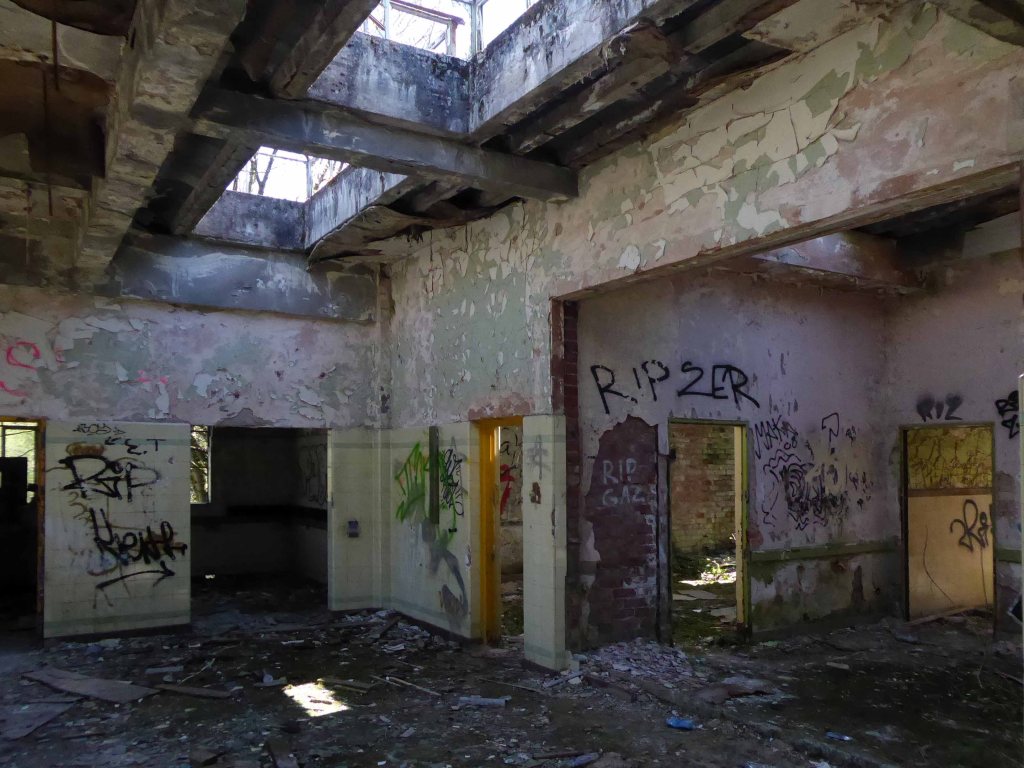
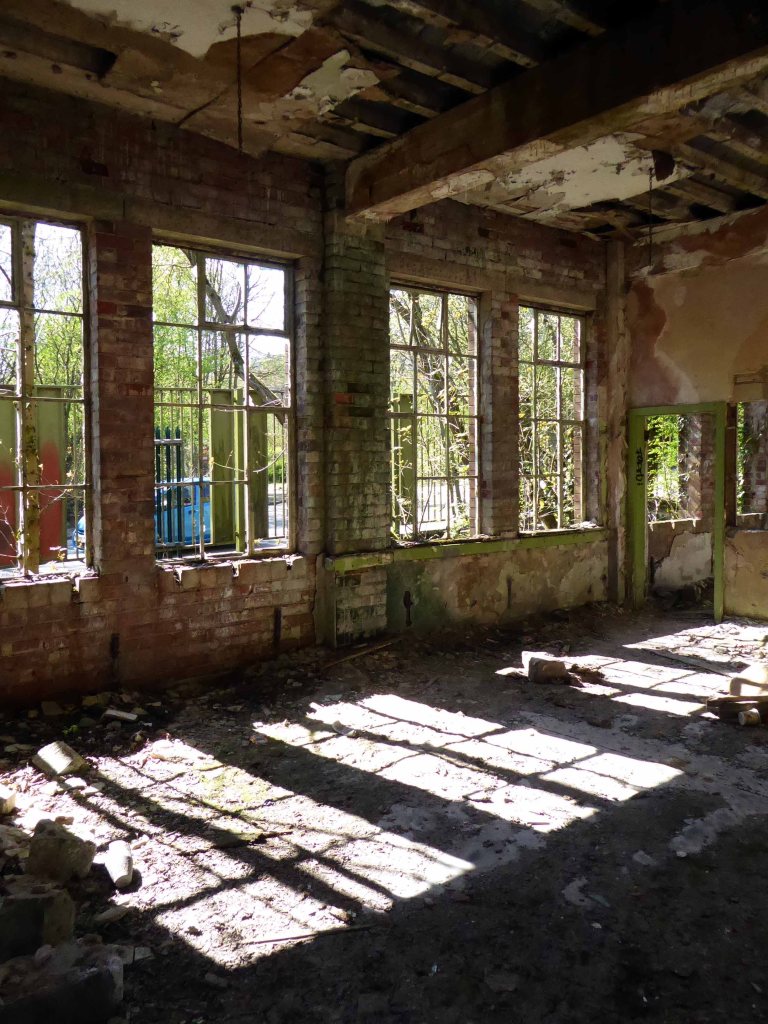
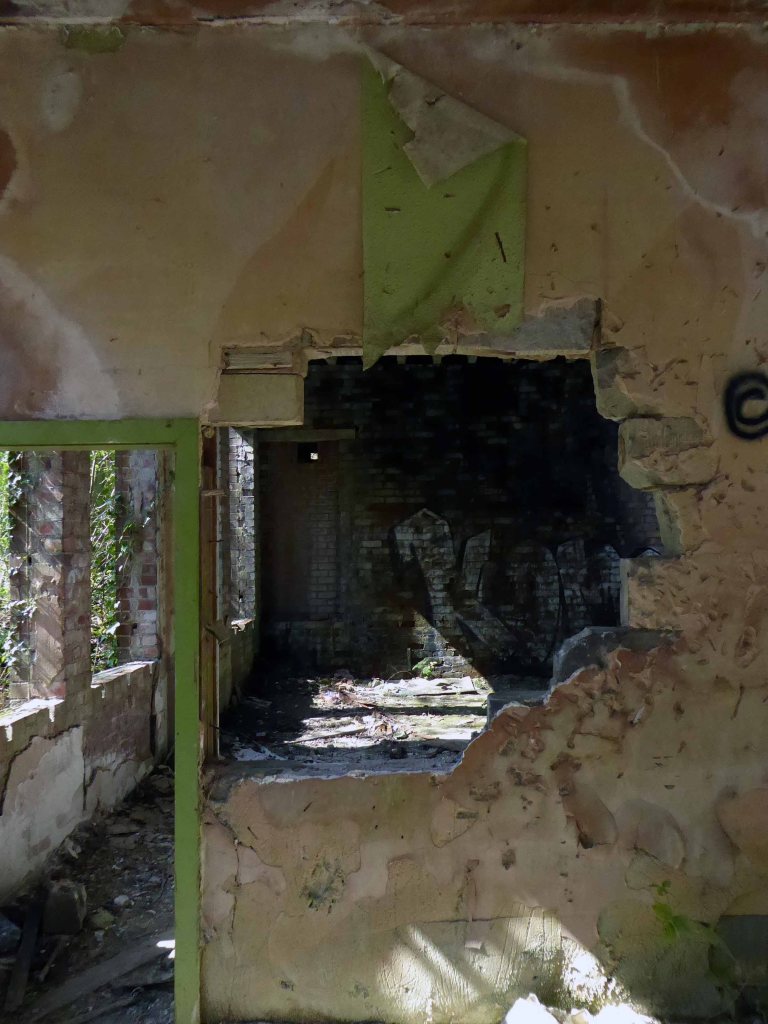
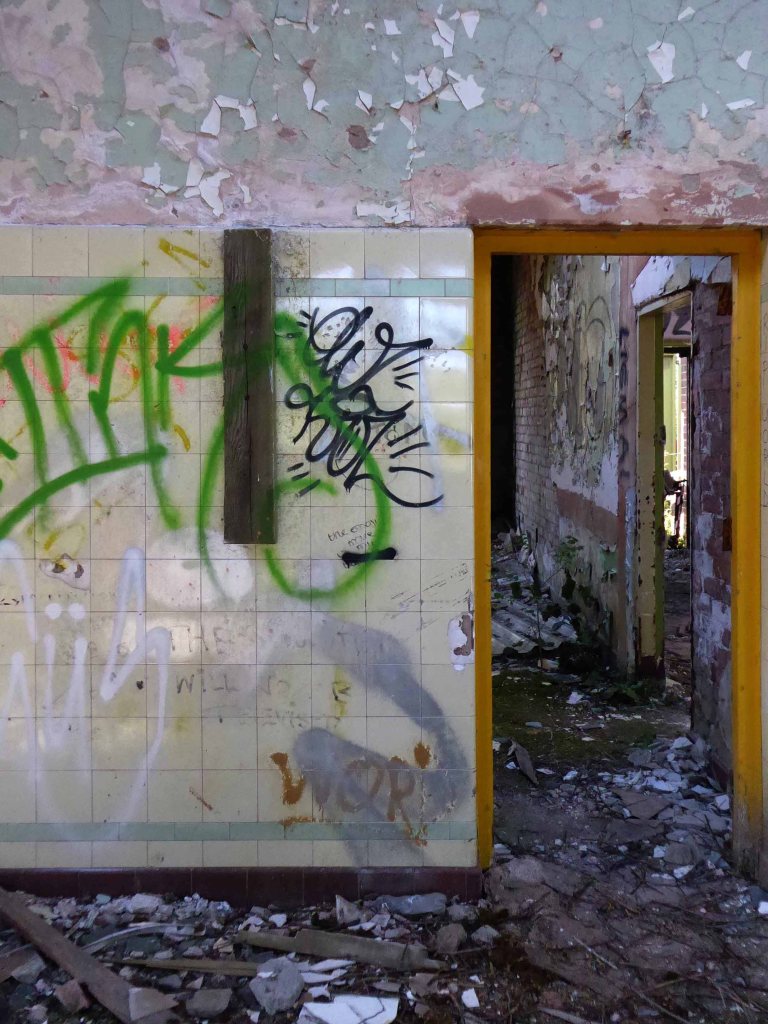
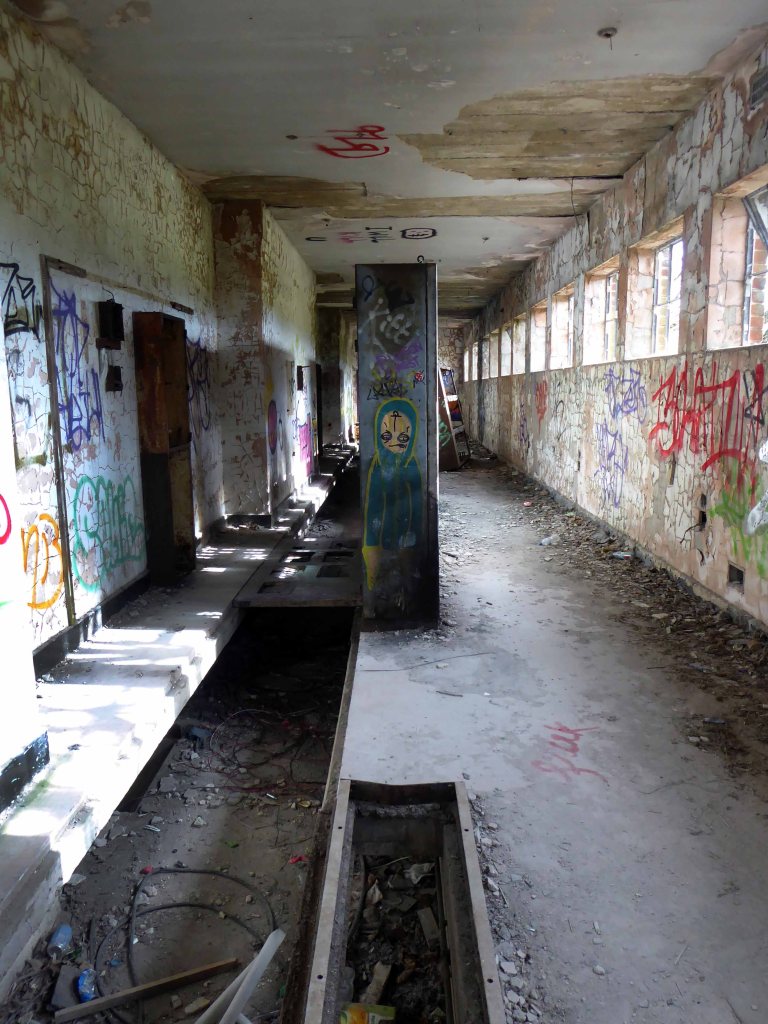
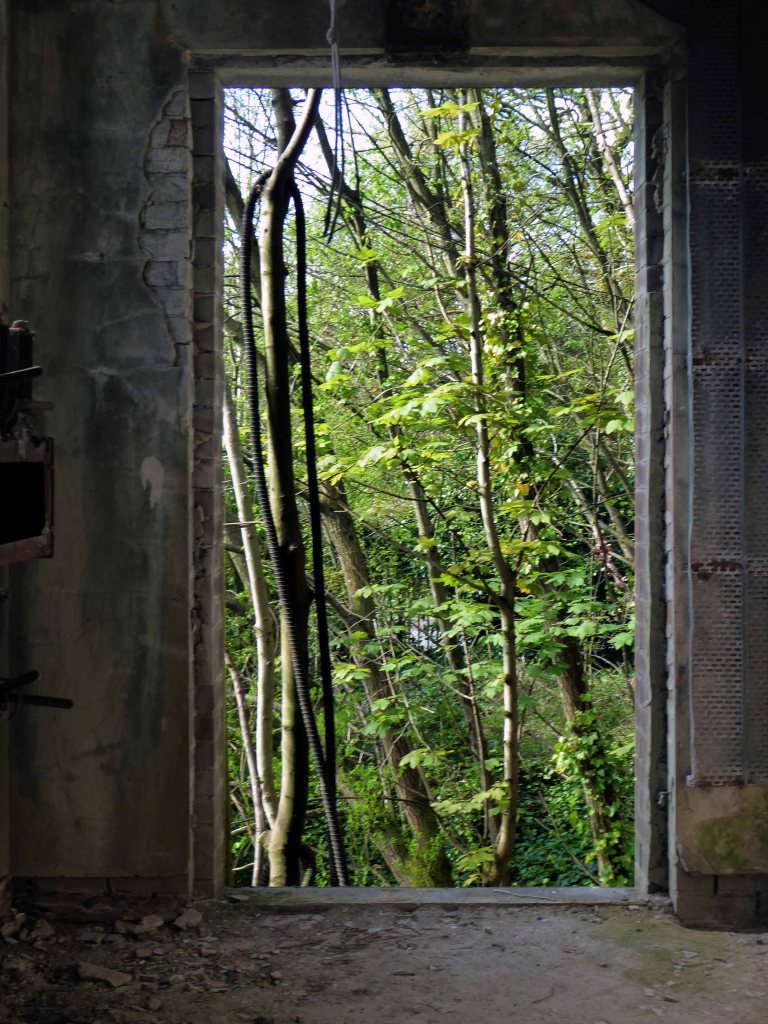
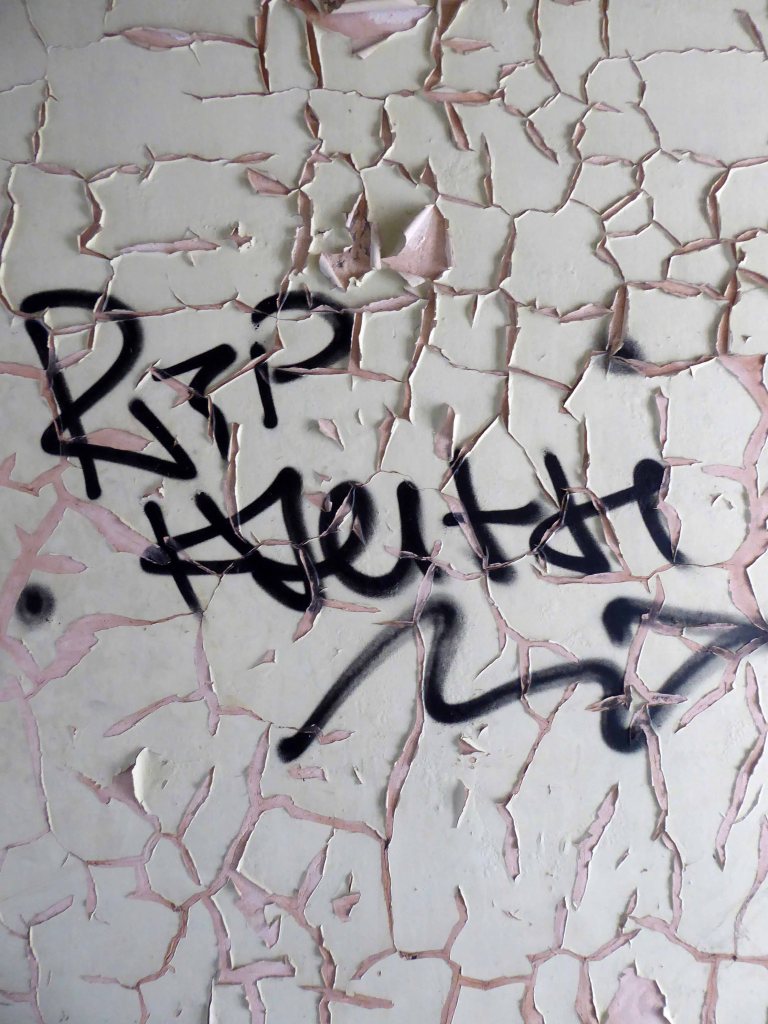
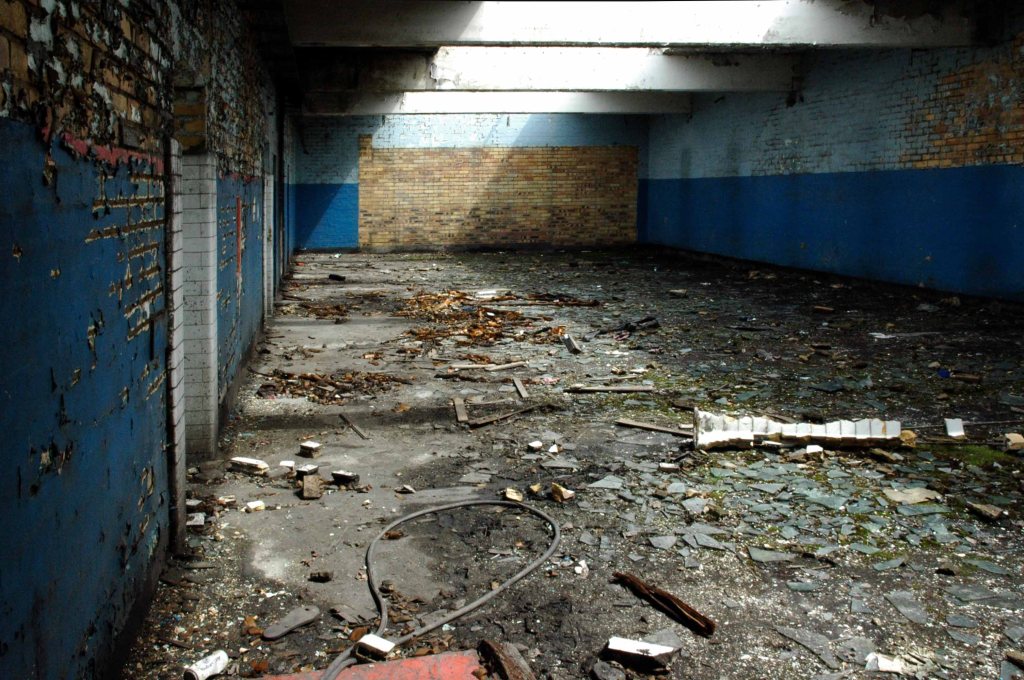
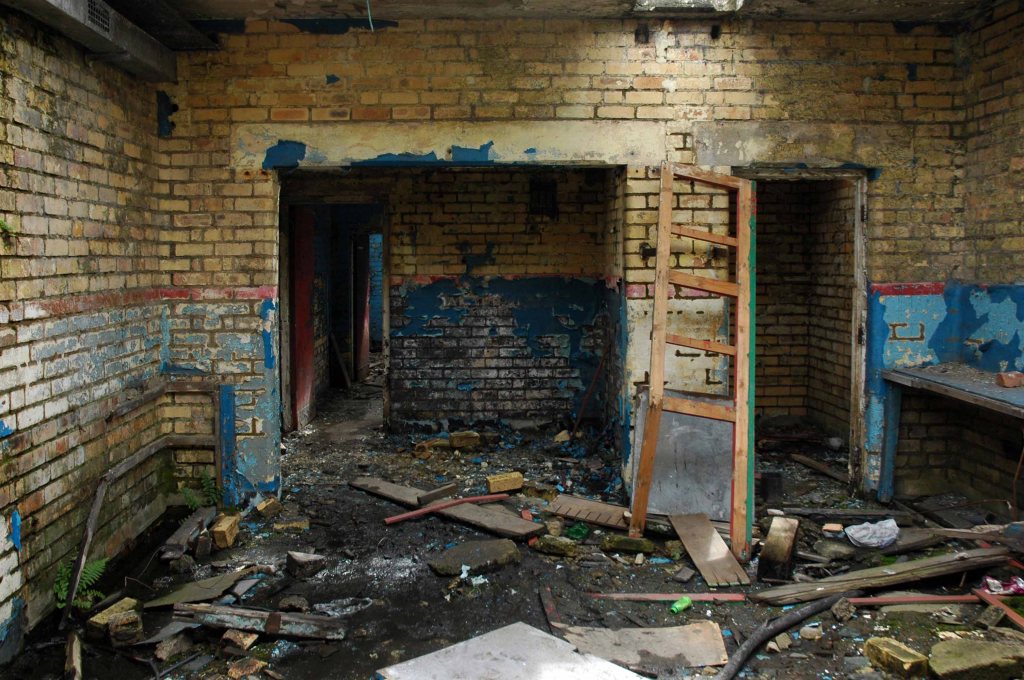
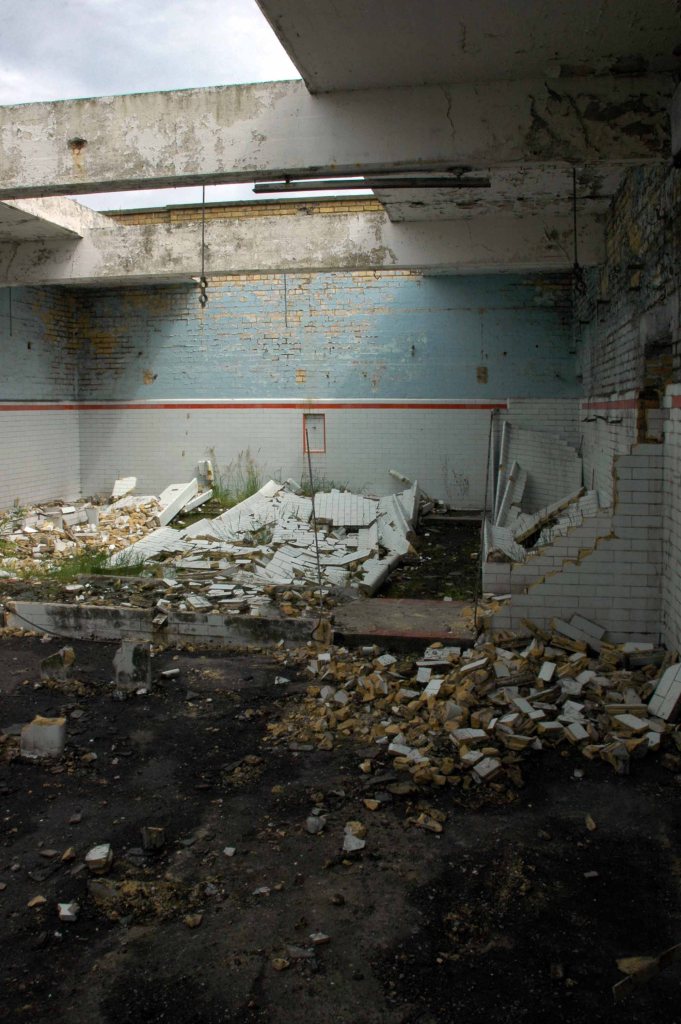
They have been stripped of their former use and meaning, transformed into a transitory art performance space, paint and plaster now peeling, appealing to the passing painter, partially reclaimed by nature.
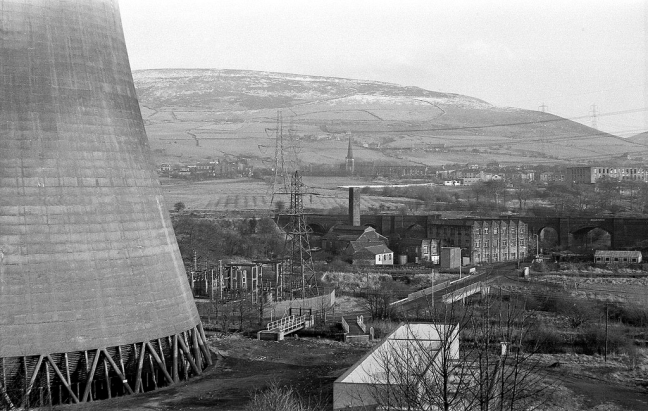
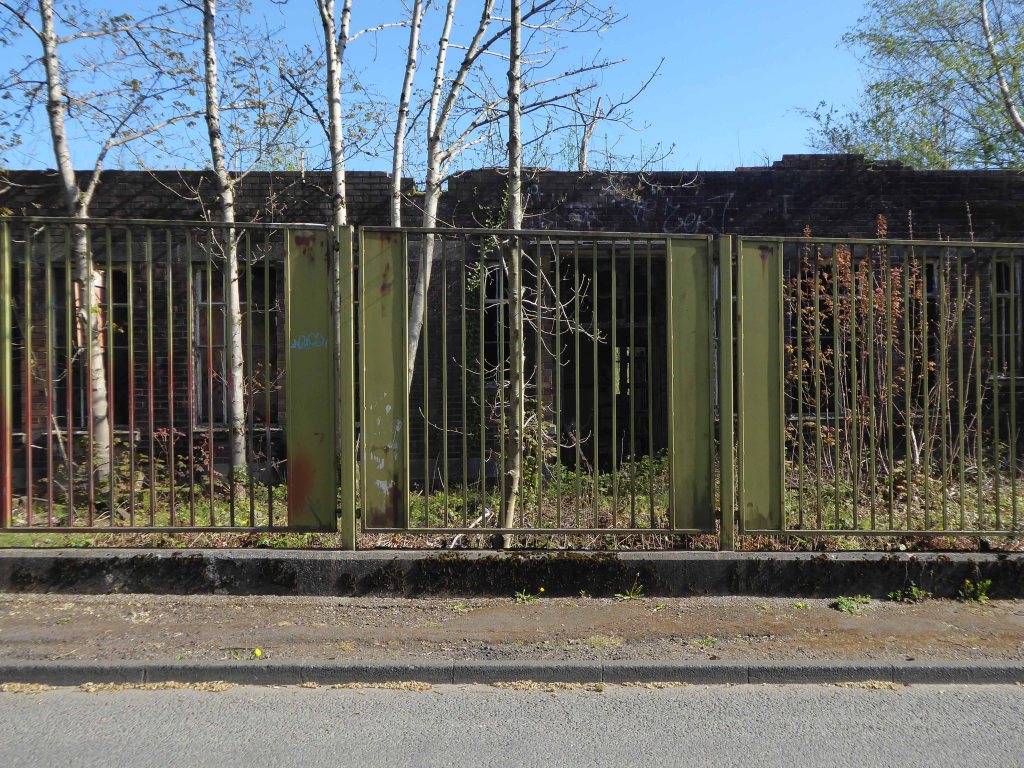
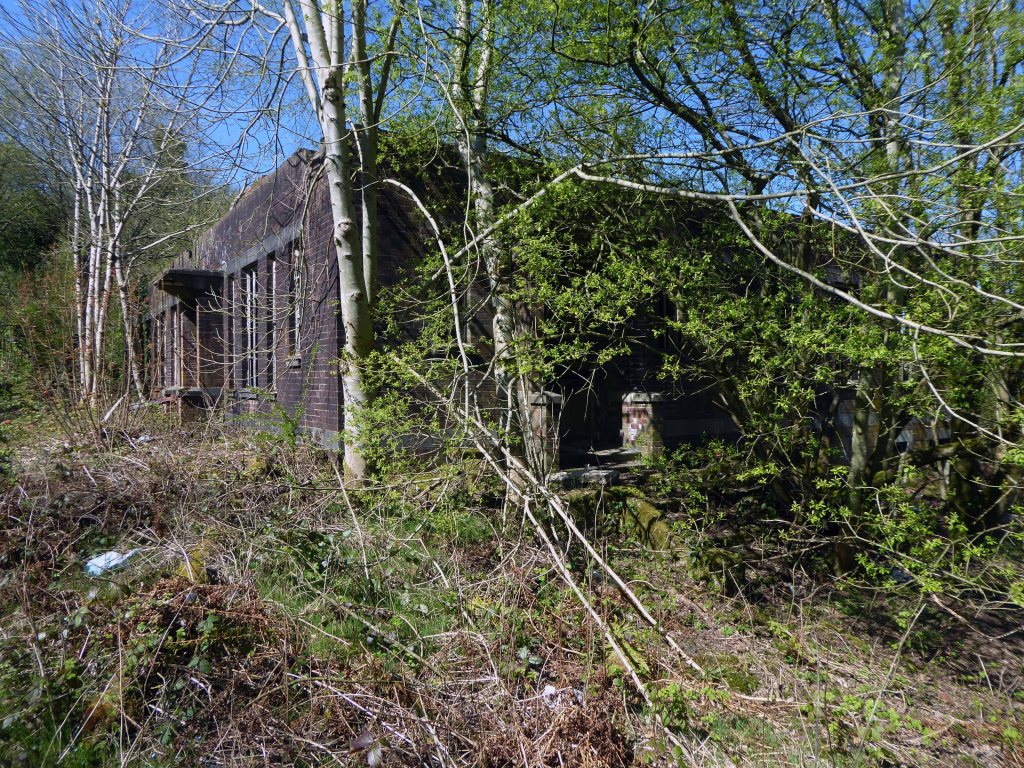
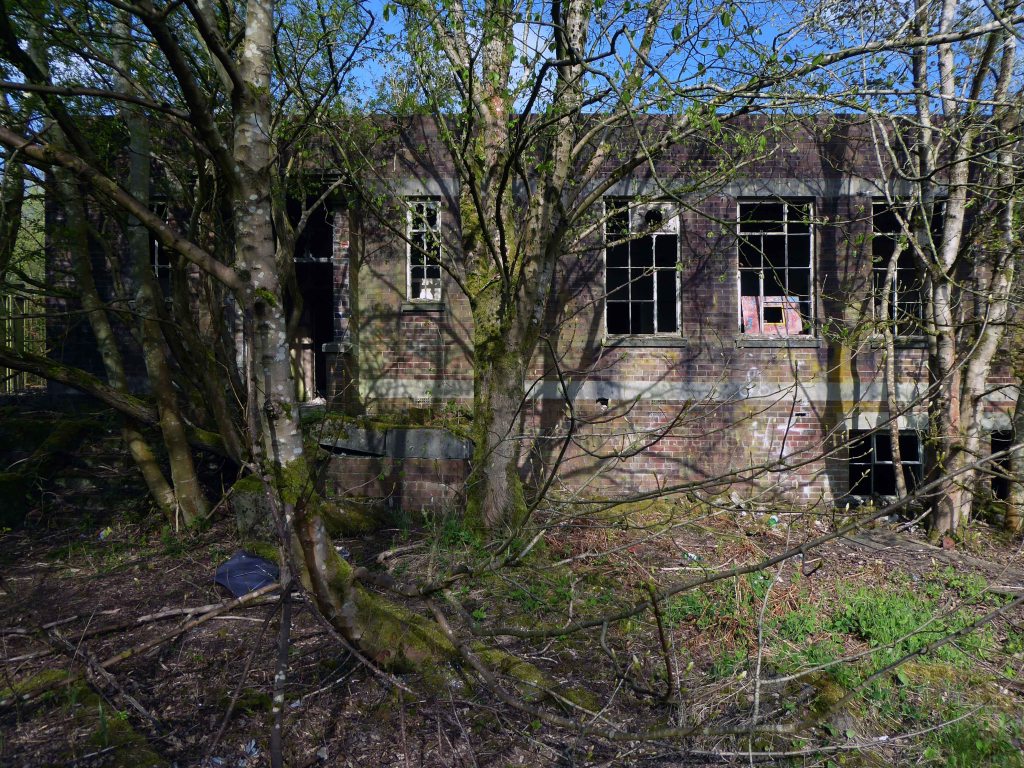
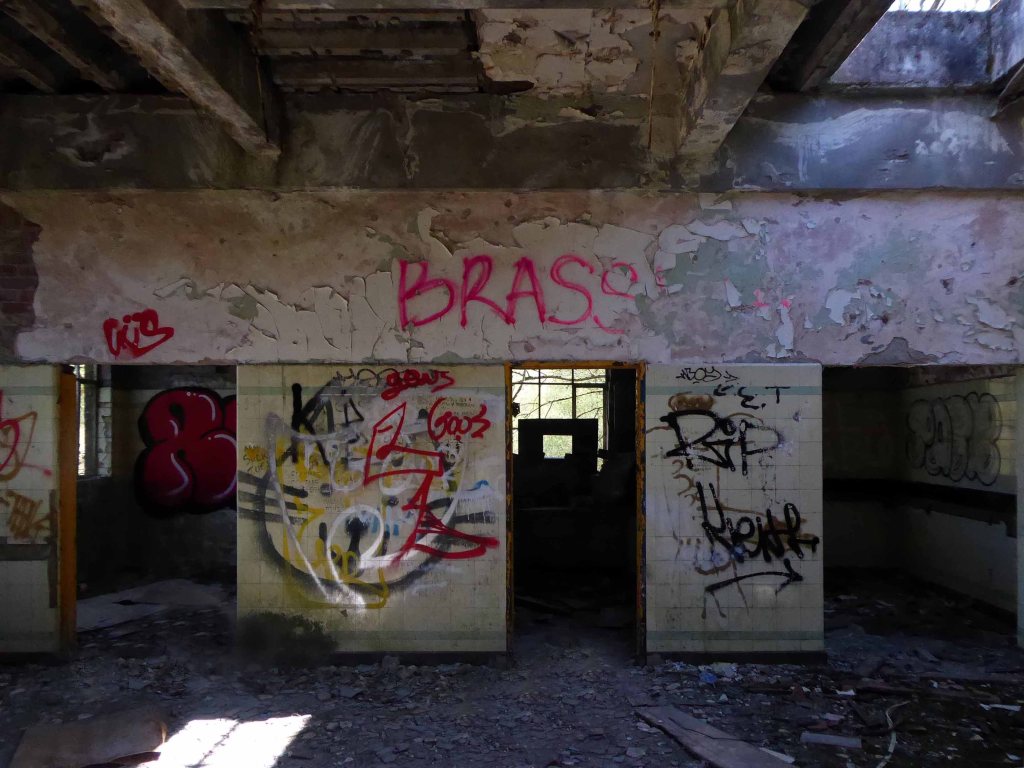
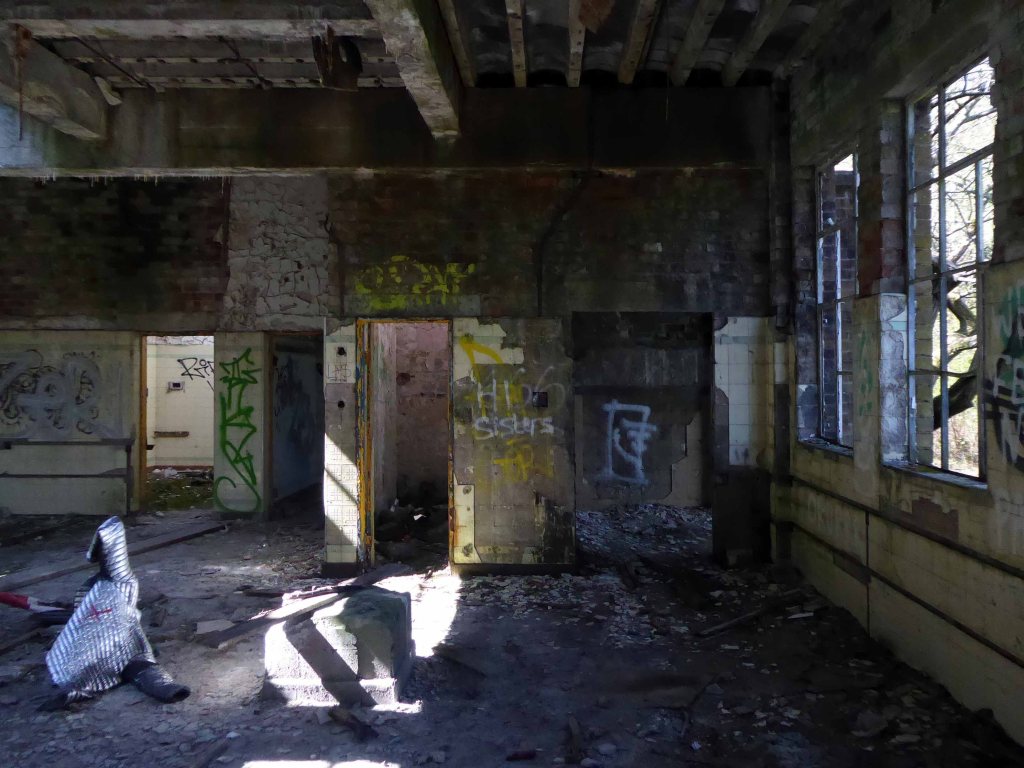
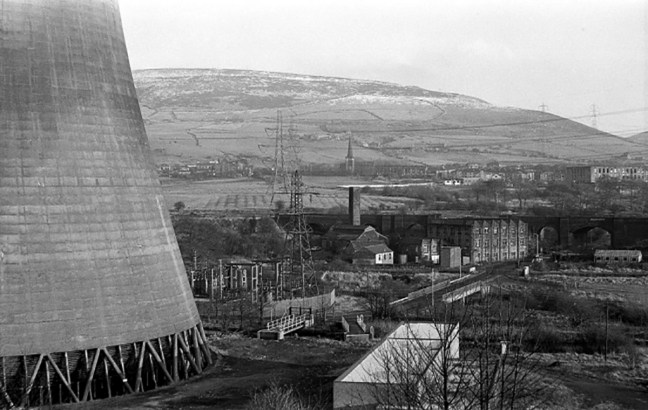
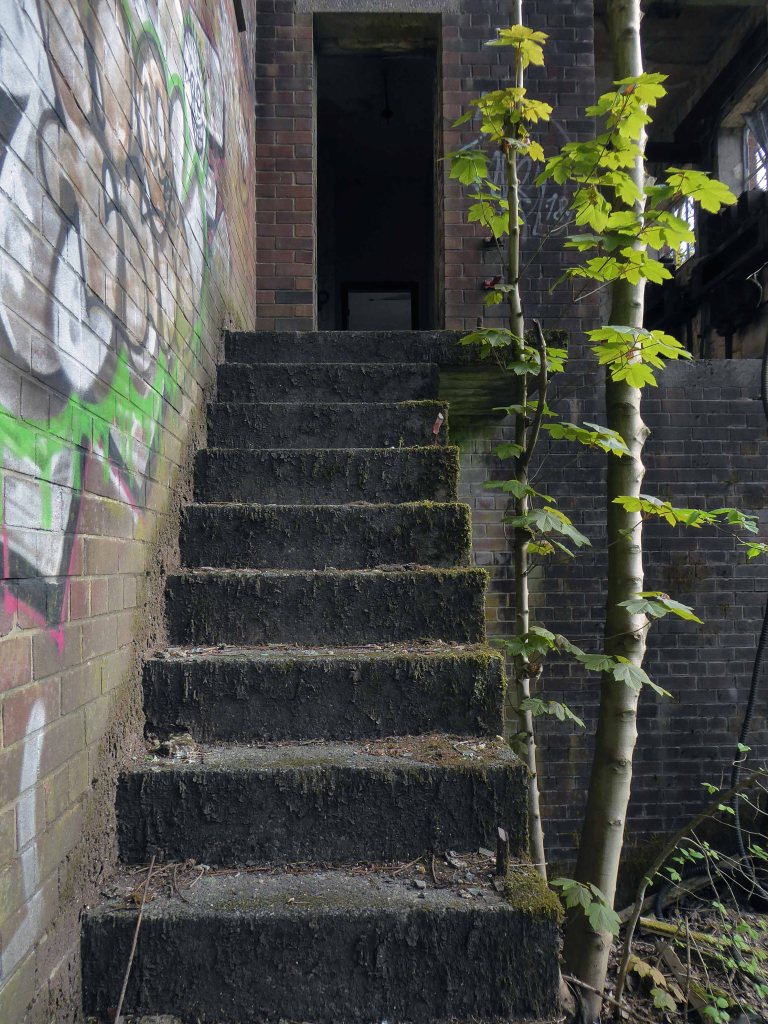
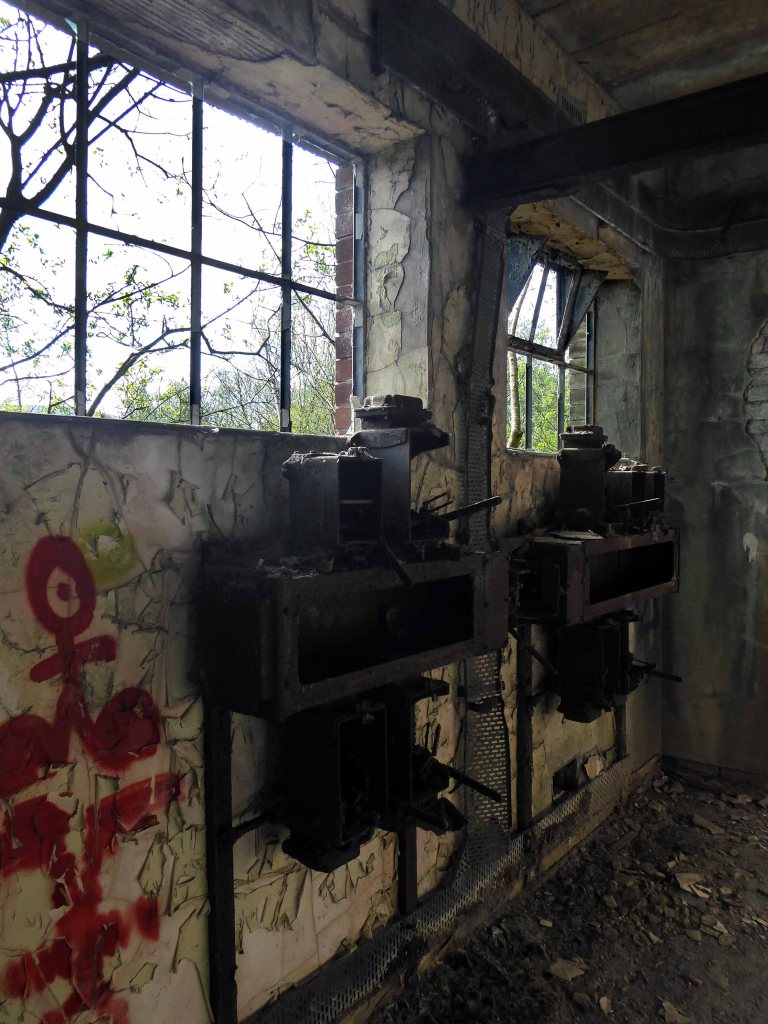
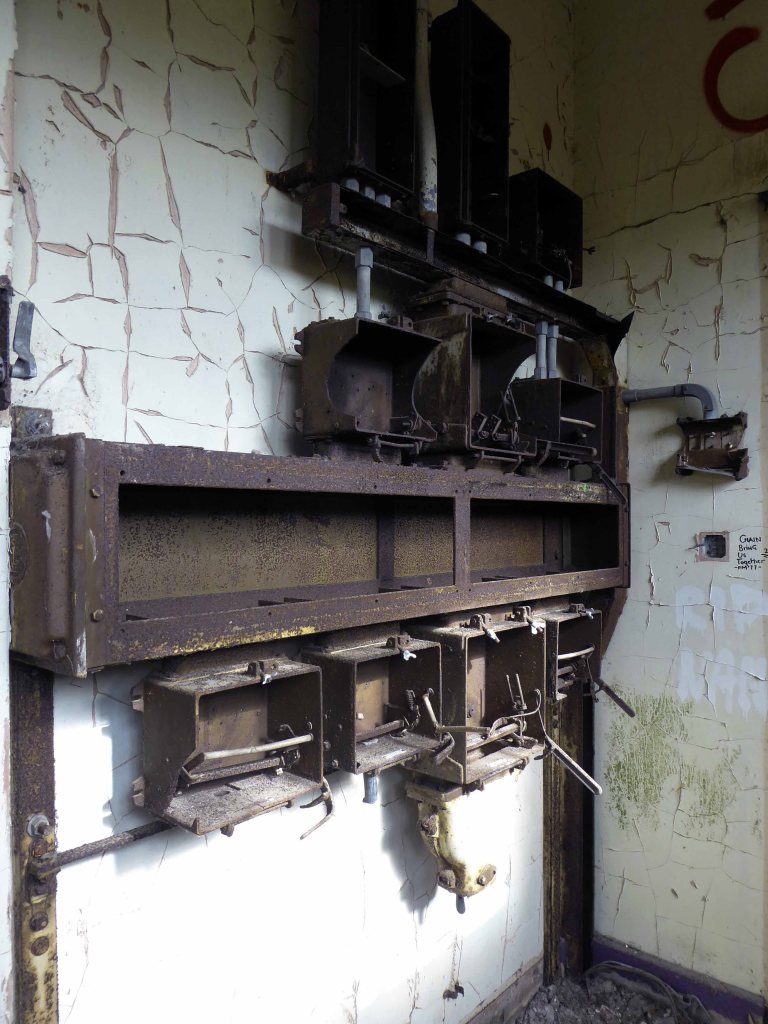
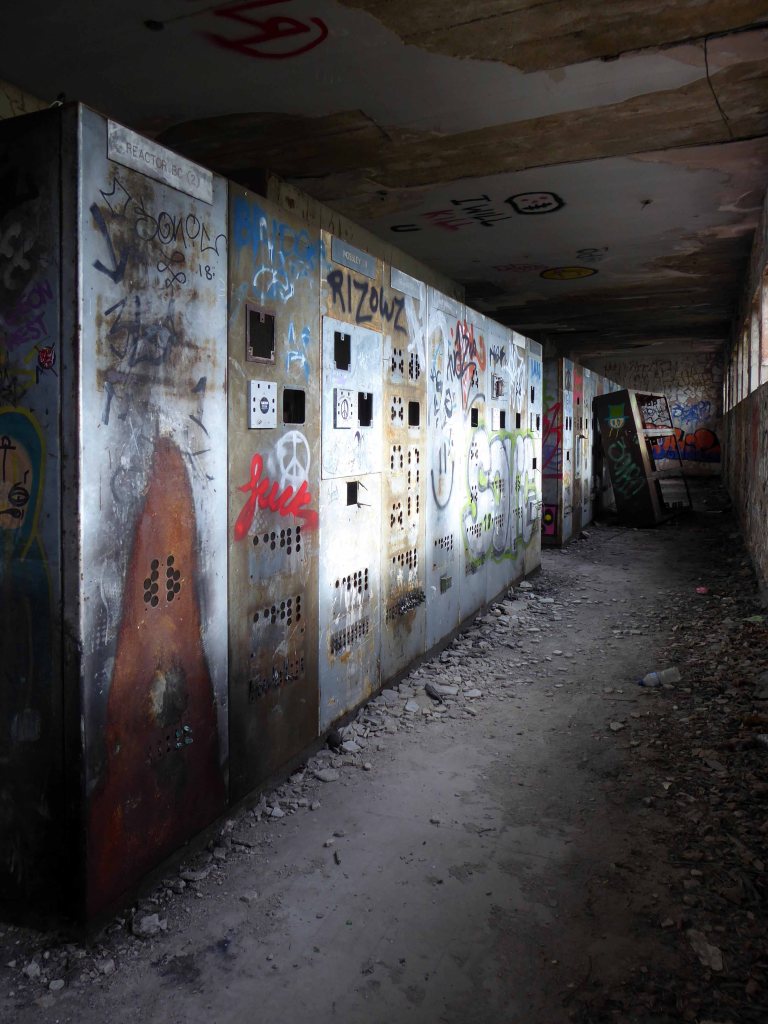
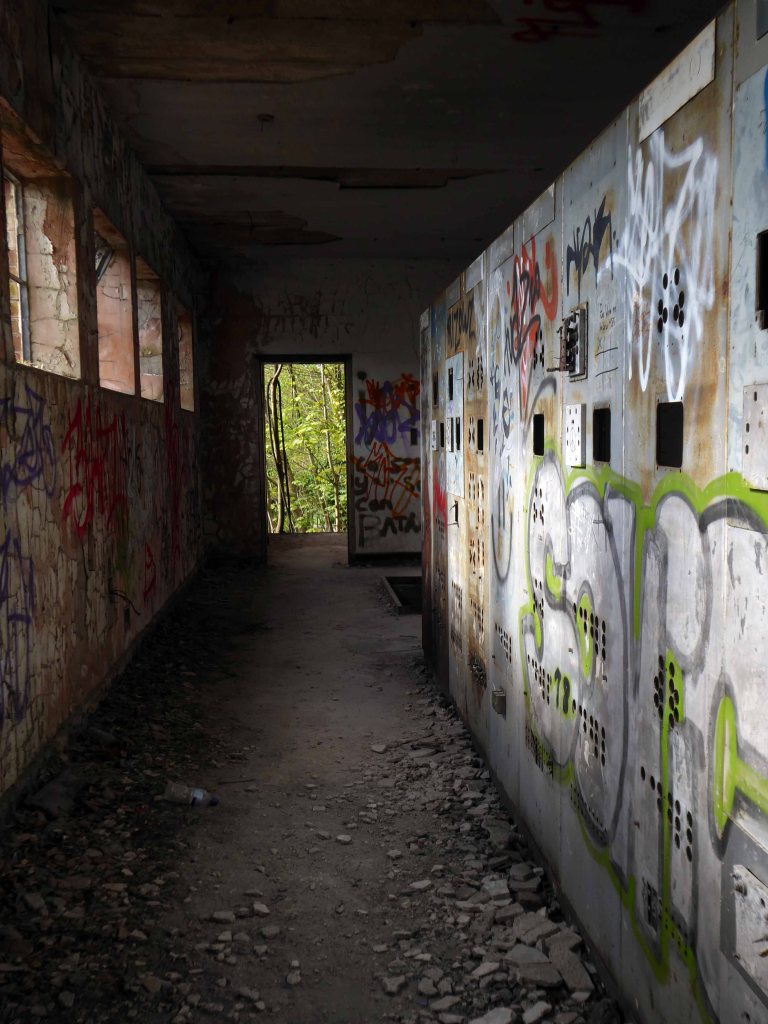
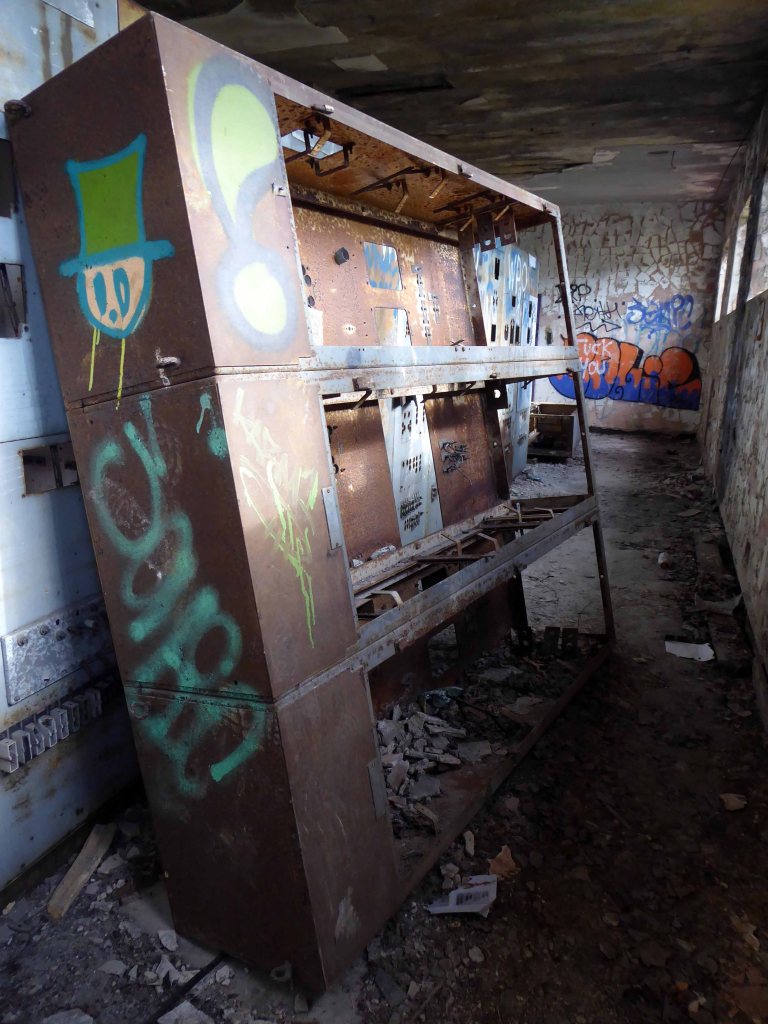
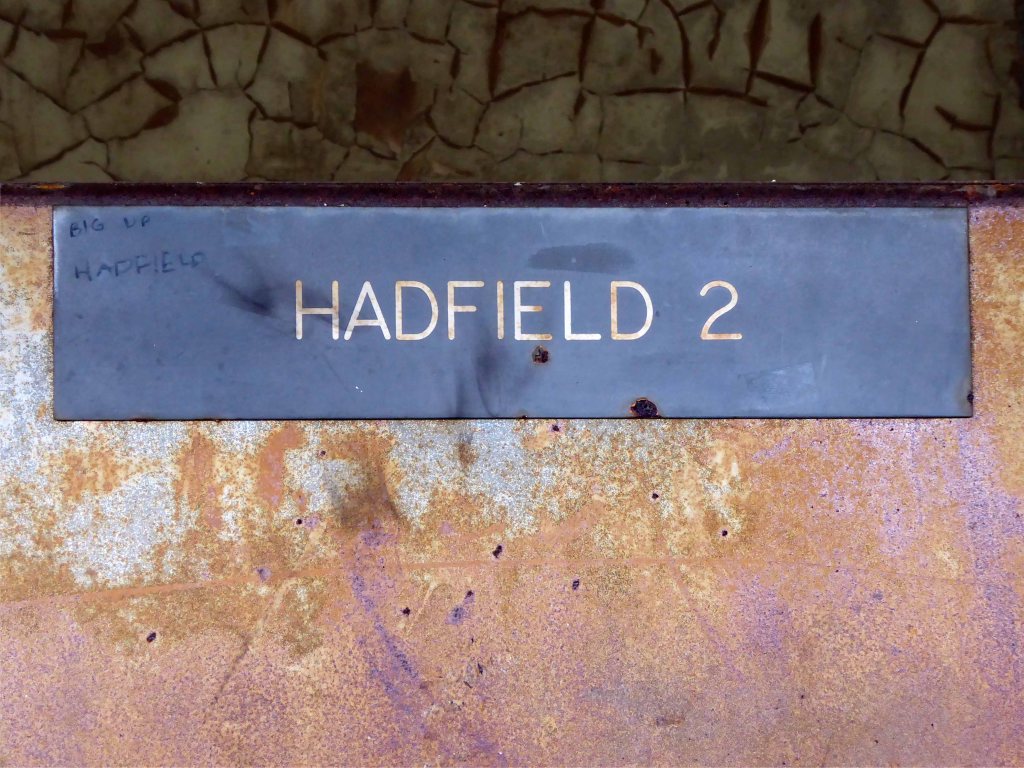
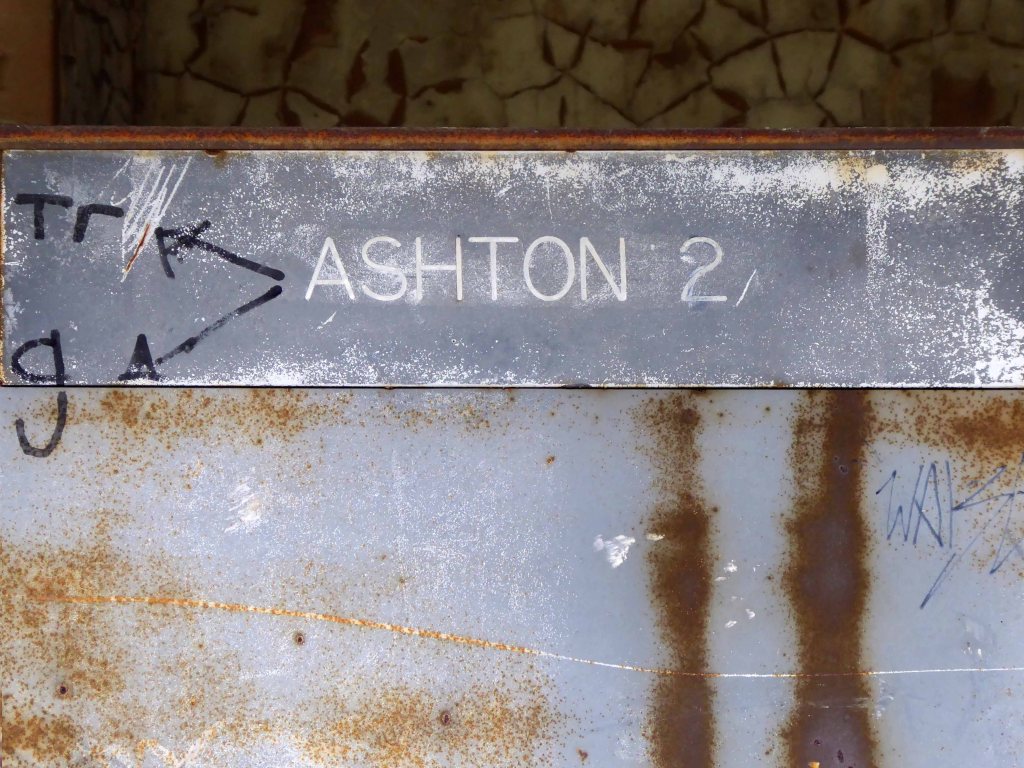
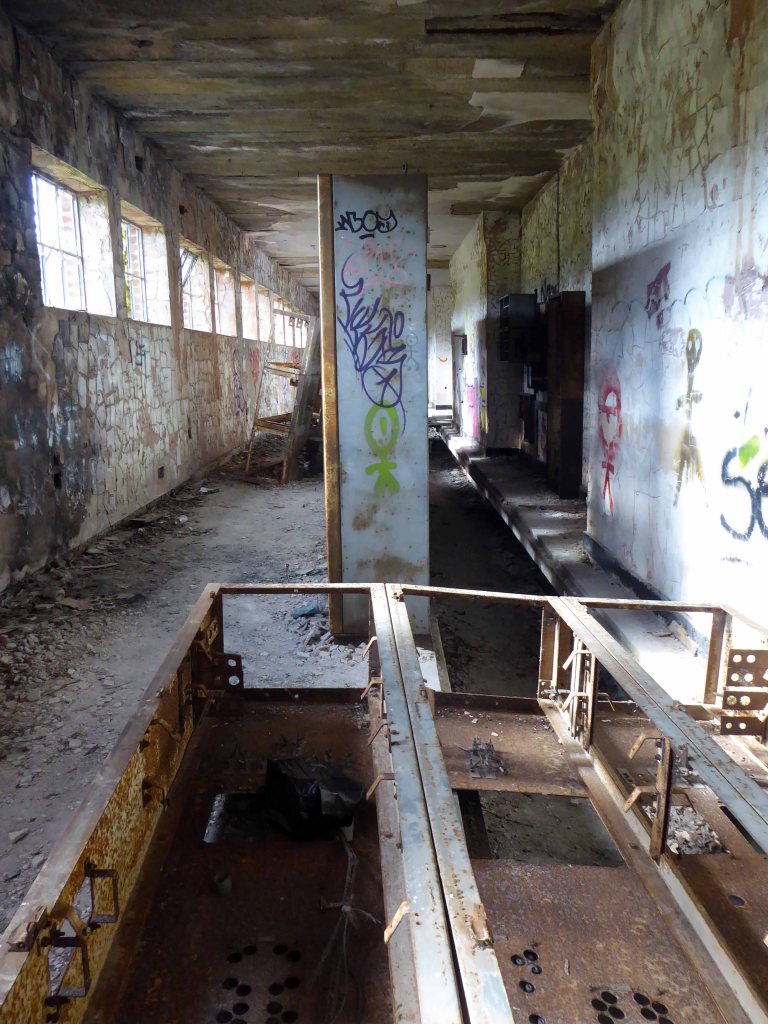
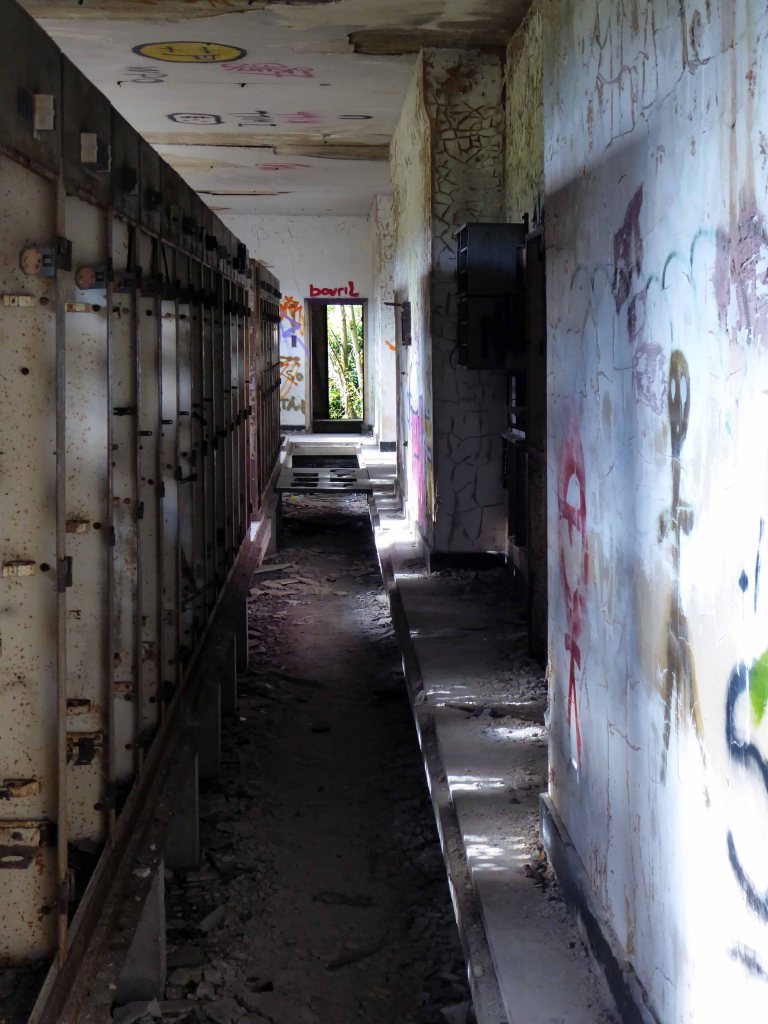
I’m back here to day in search of an abandoned control centre at the long gone Hartshead Power Station.
The station was opened in 1926 by the Stalybridge, Hyde, Mossley and Dukinfield Transport and Electricity Board.
The station was closed on 29 October 1979 with a generating capacity of 64 megawatts. It was demolished during the late 1980s, although part of the site is still used as an electrical substation.
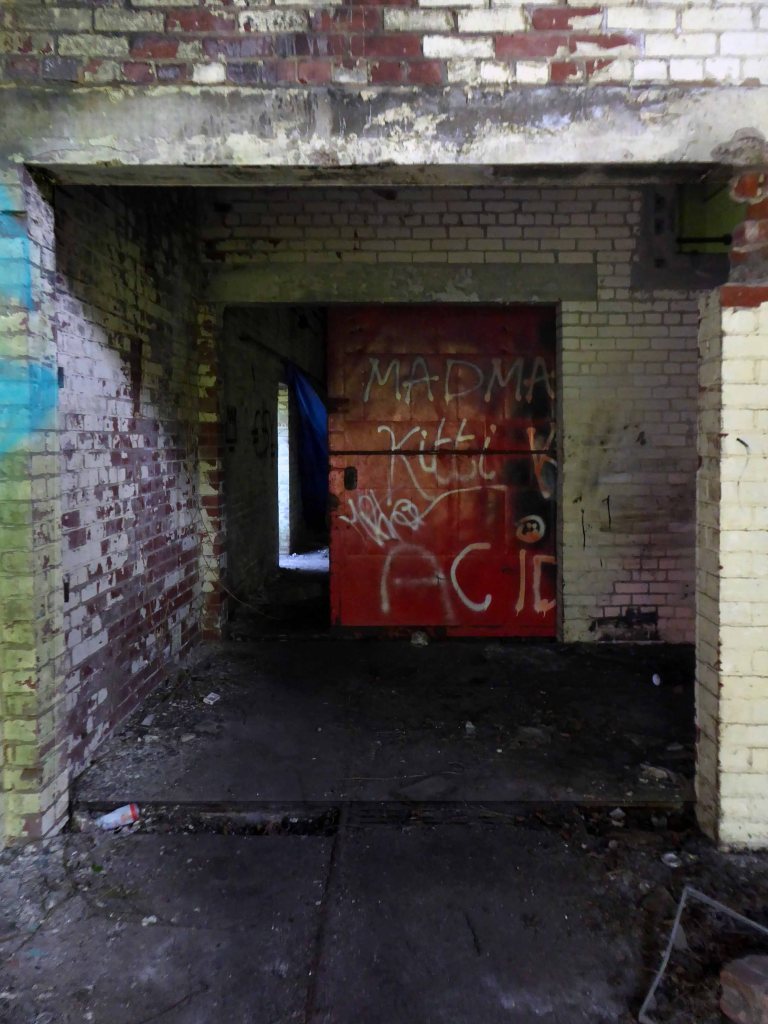
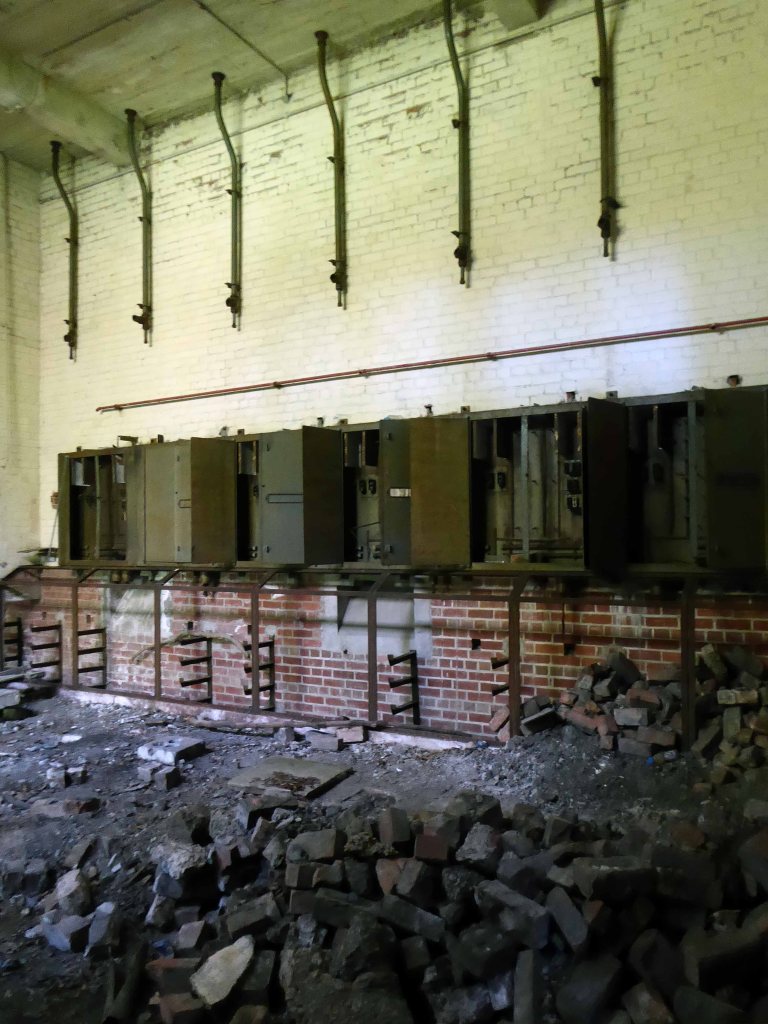
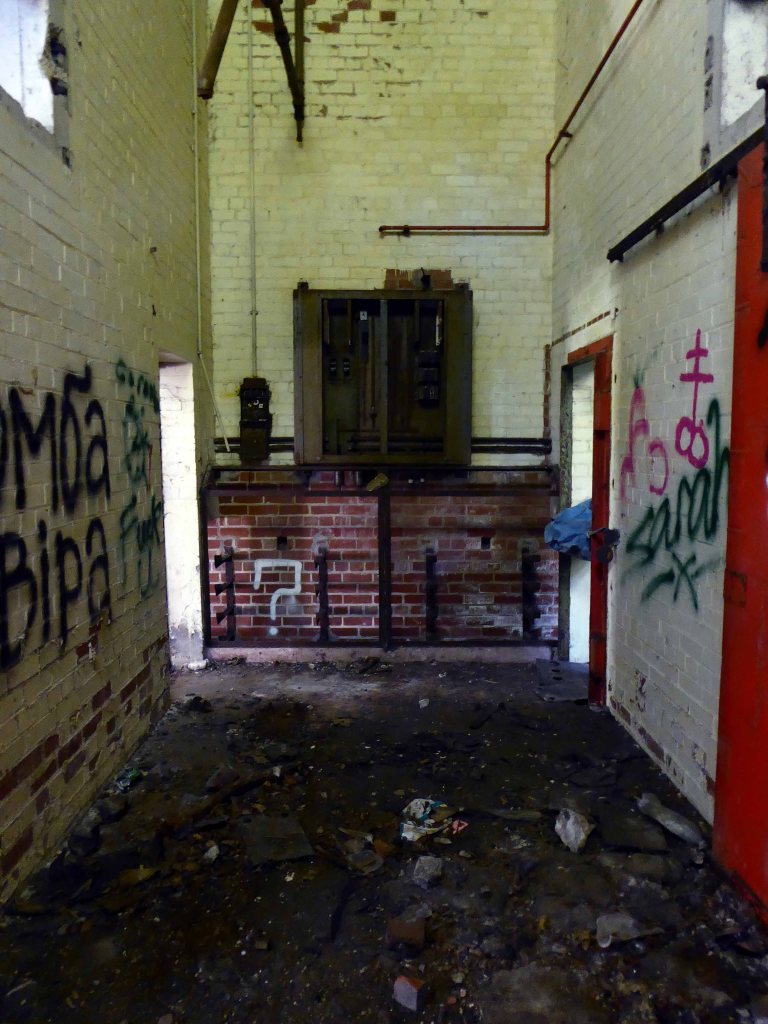
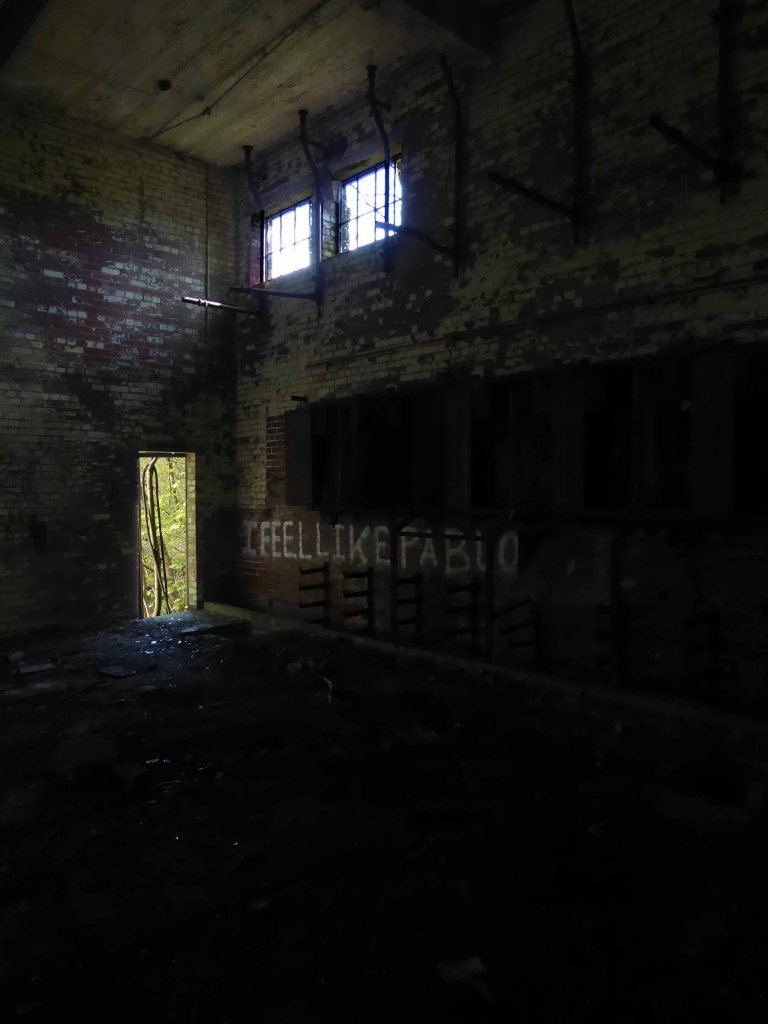
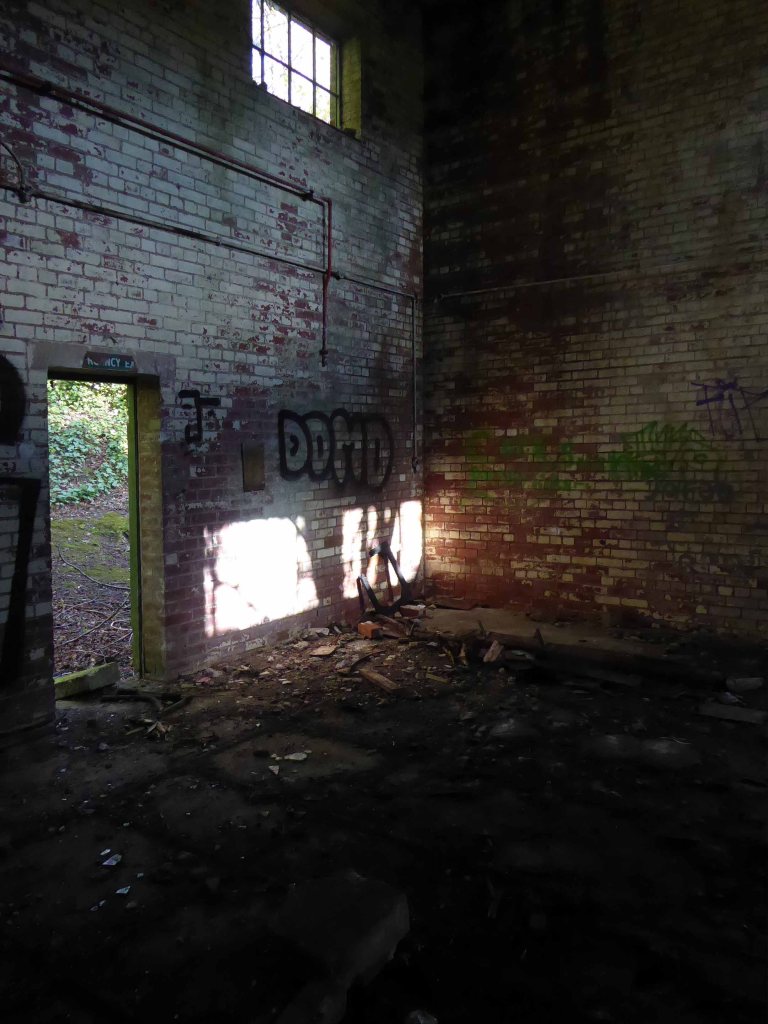
First glimpsed on an urban exploration site, I had awaited an opportunity to slip through the fence and take a look around – here’s what I found.
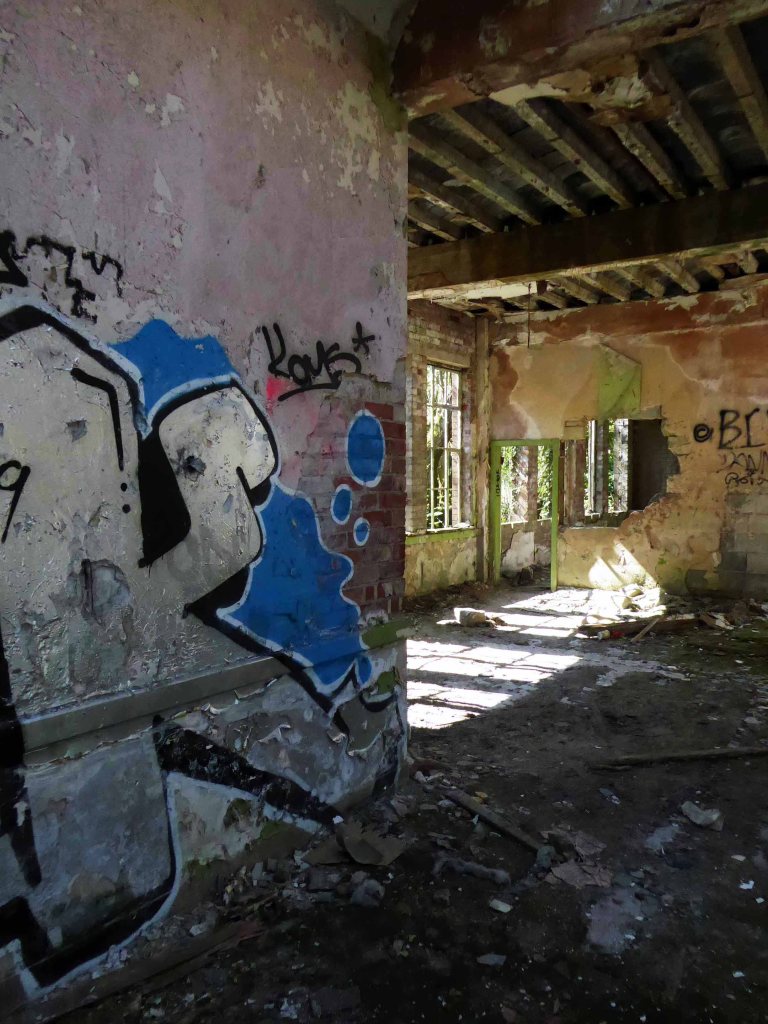
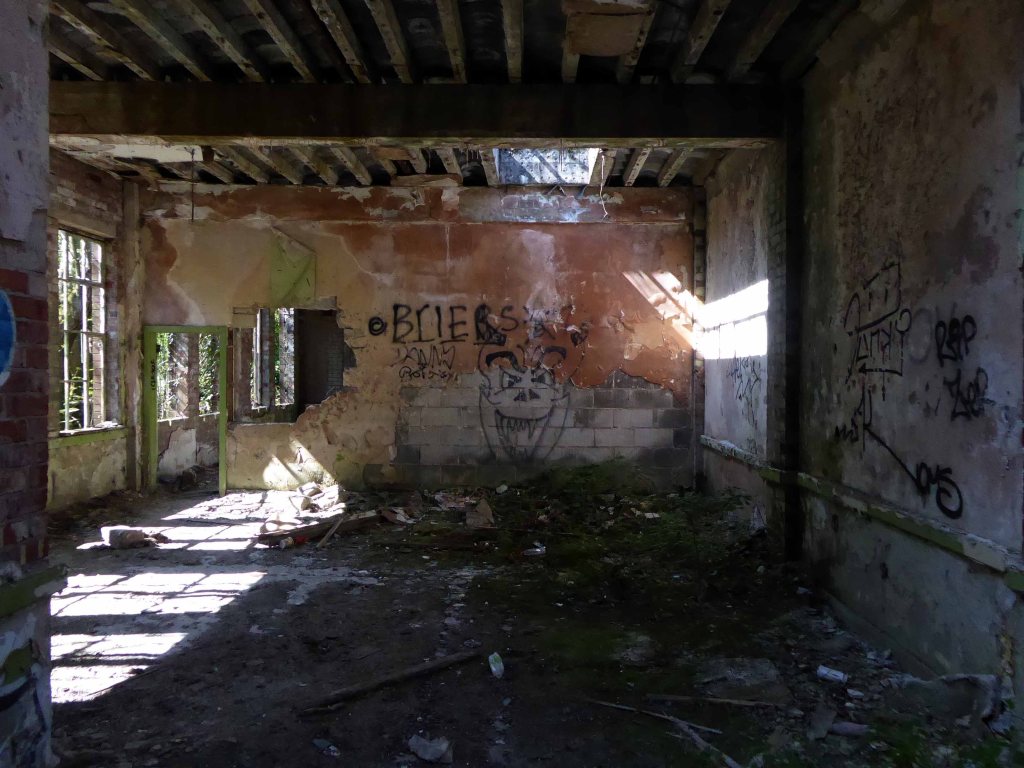
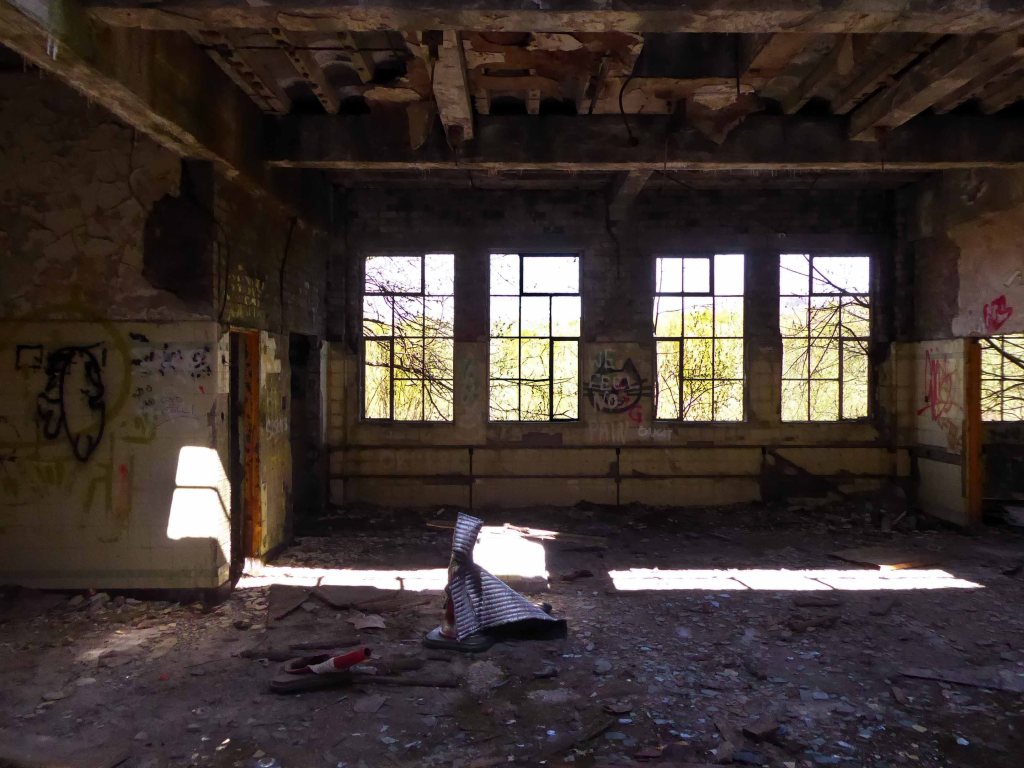
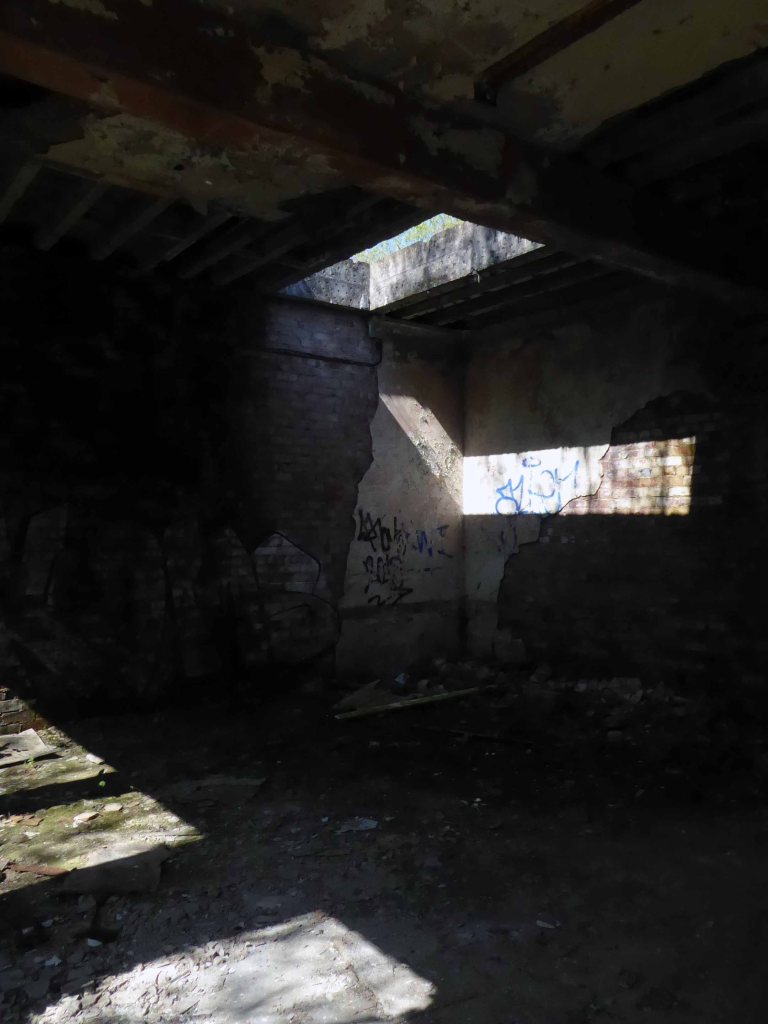
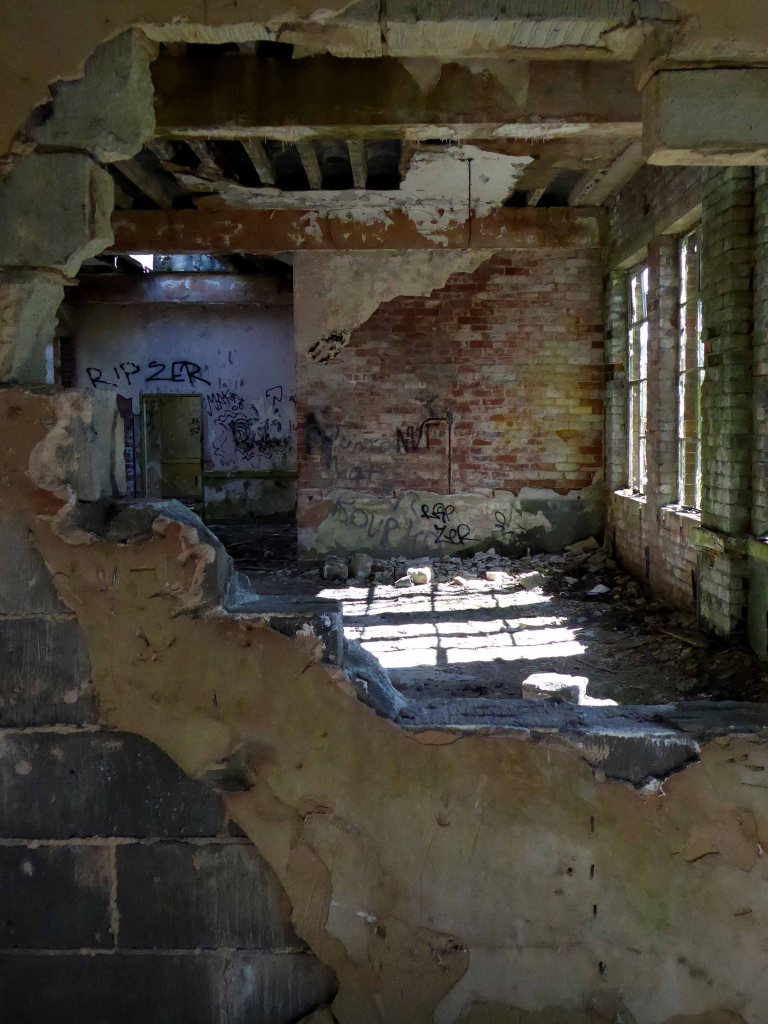
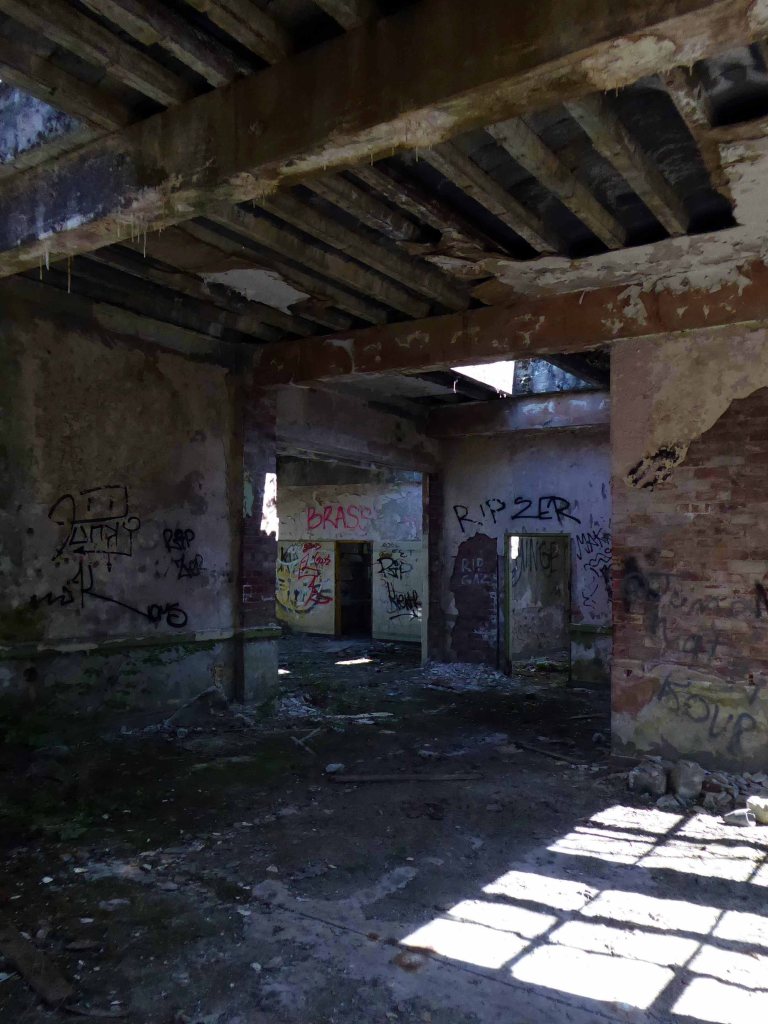
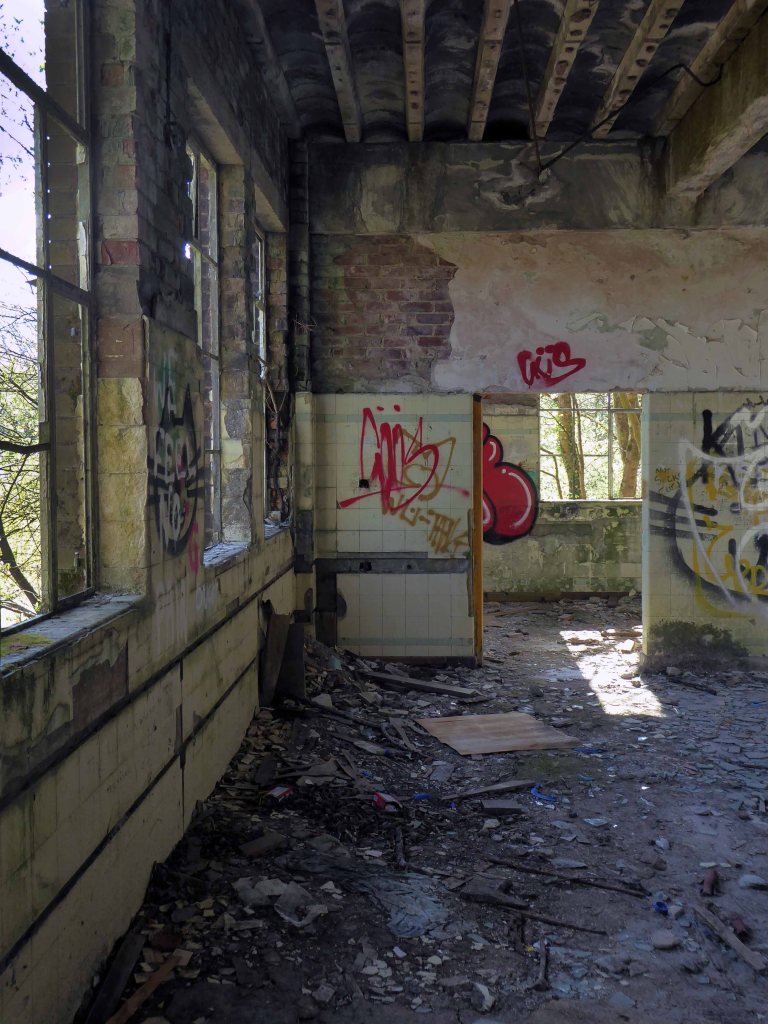
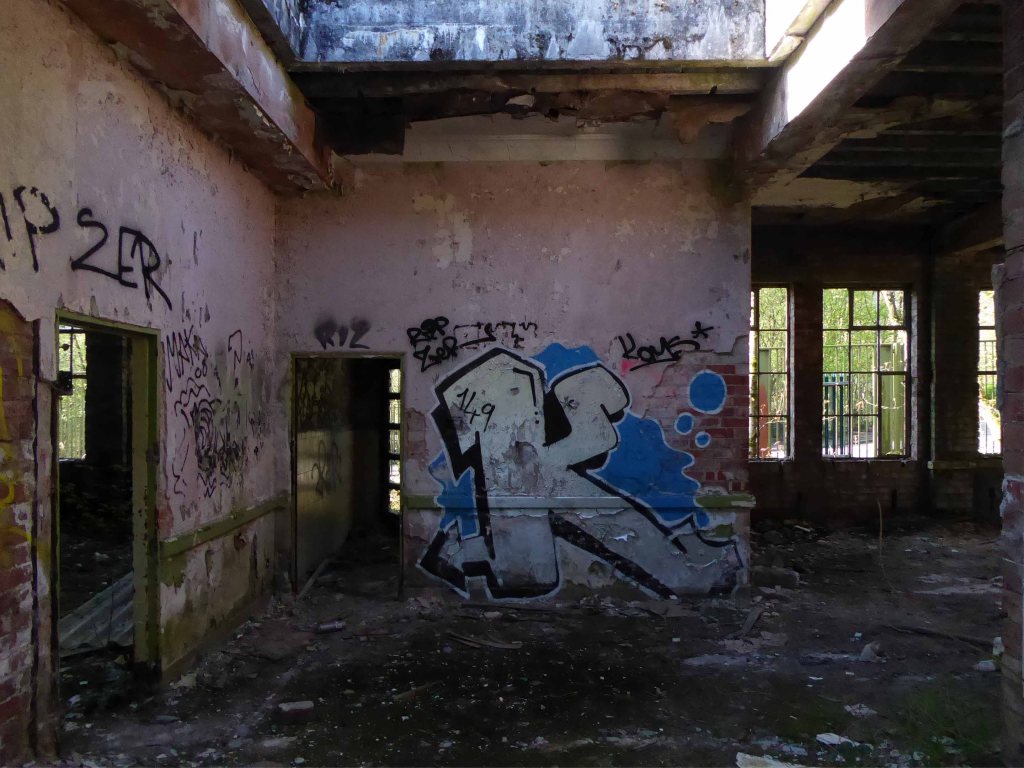
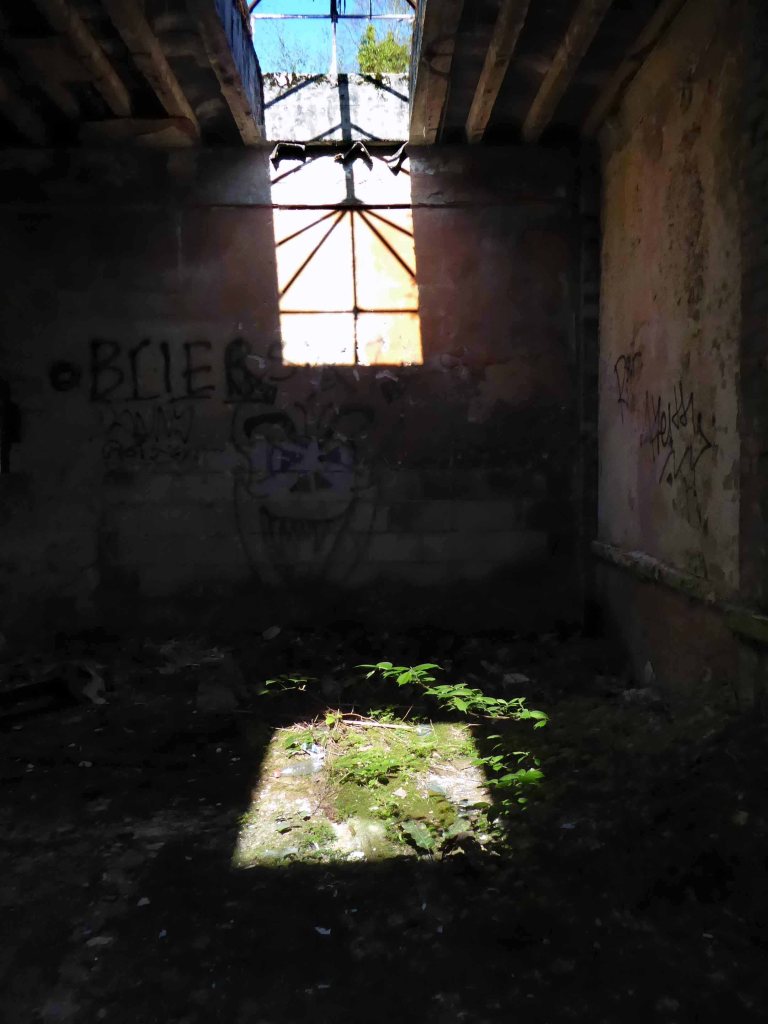
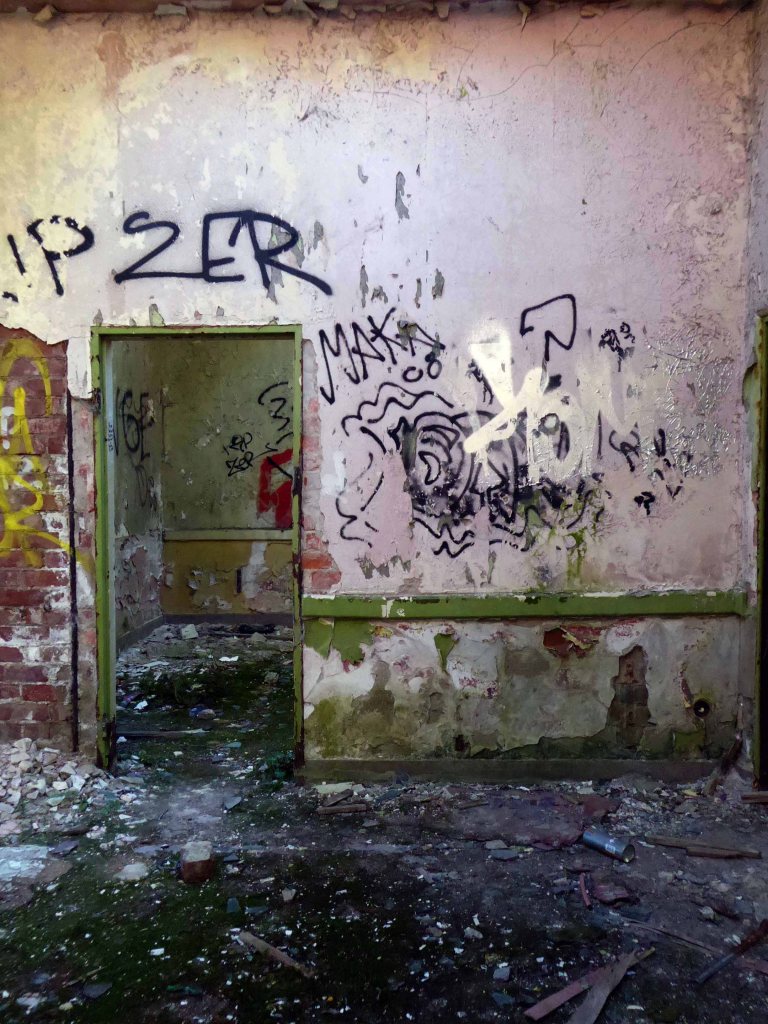
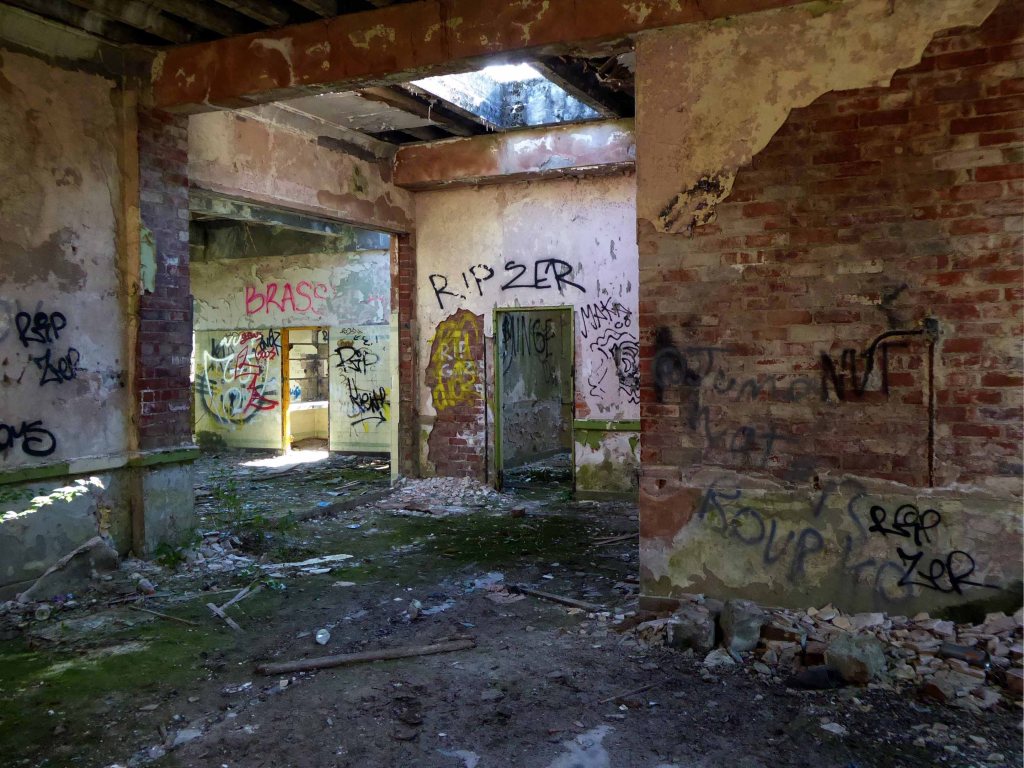
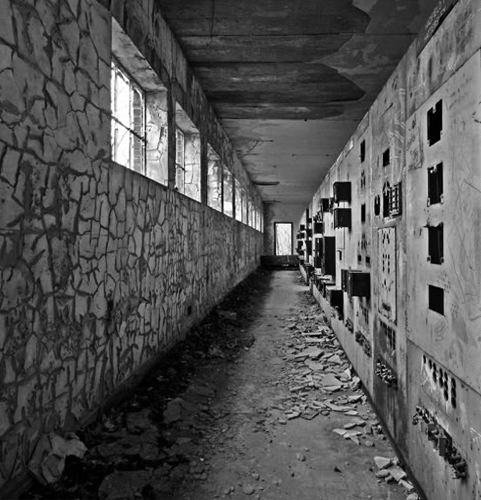
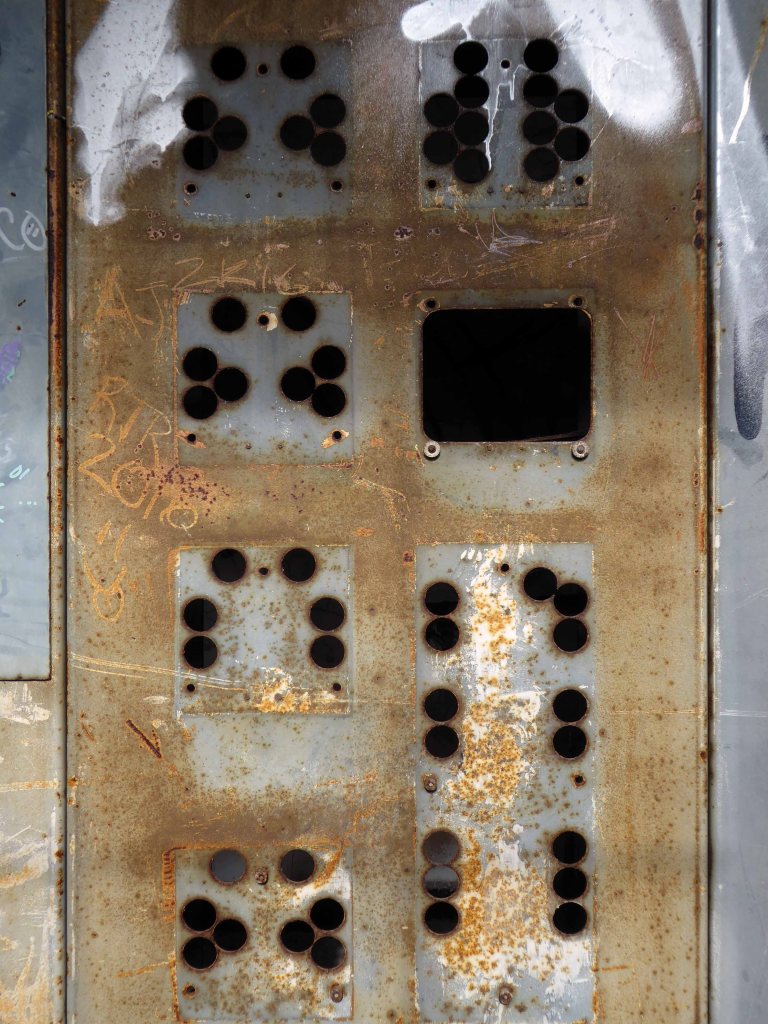
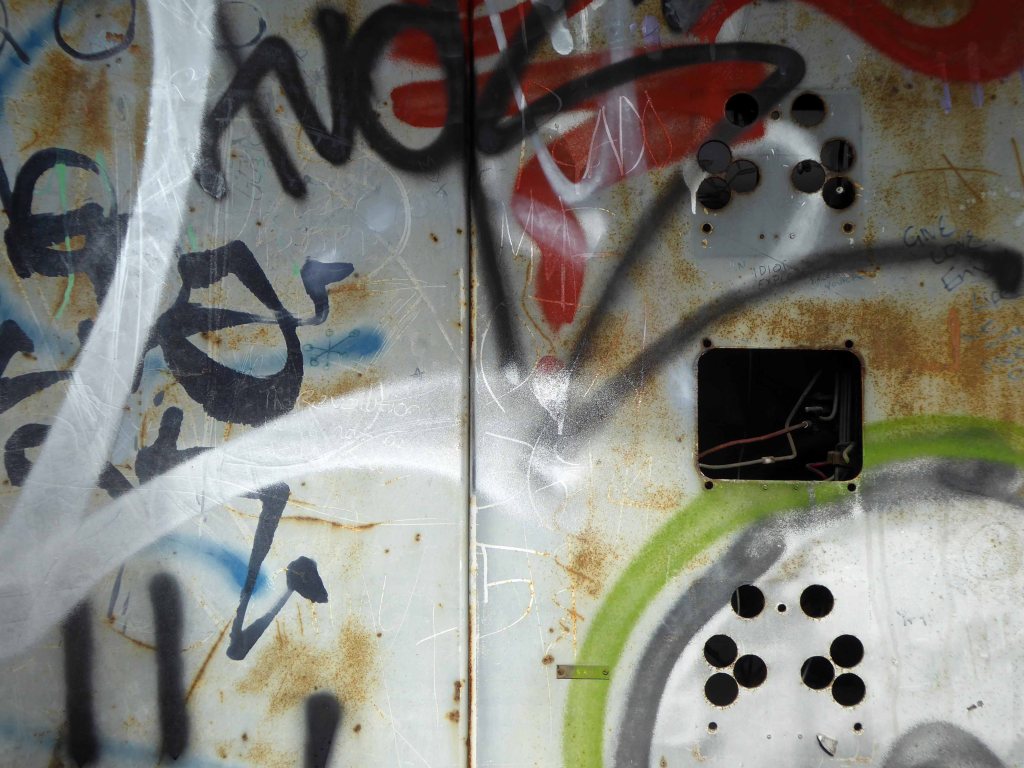
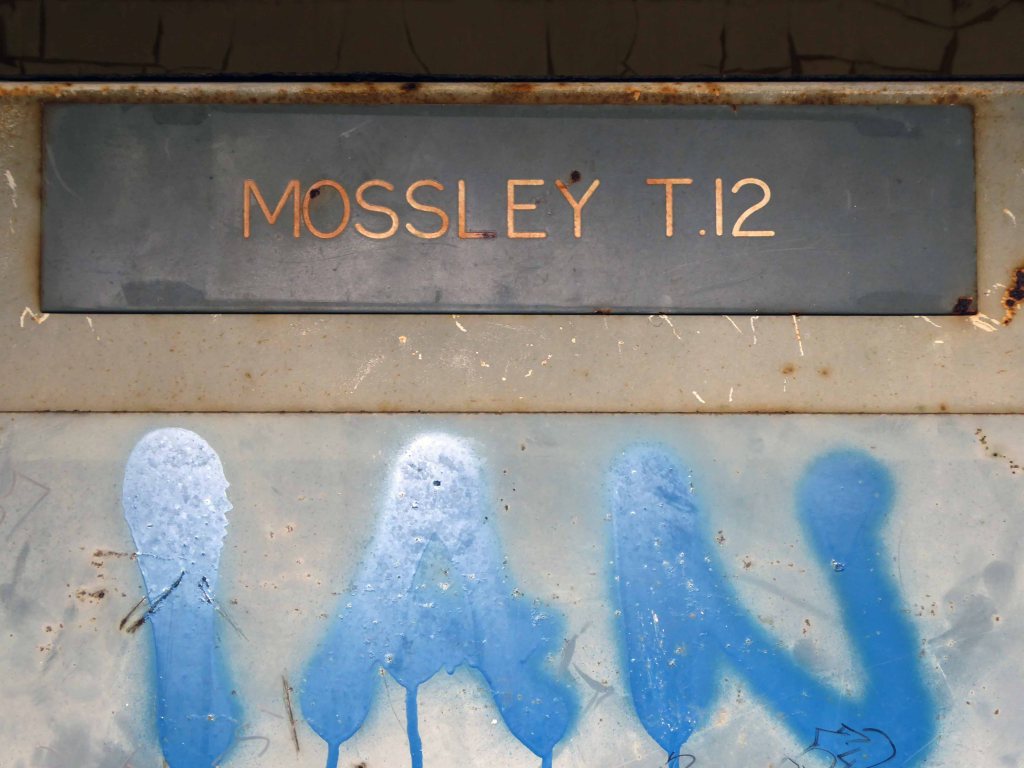
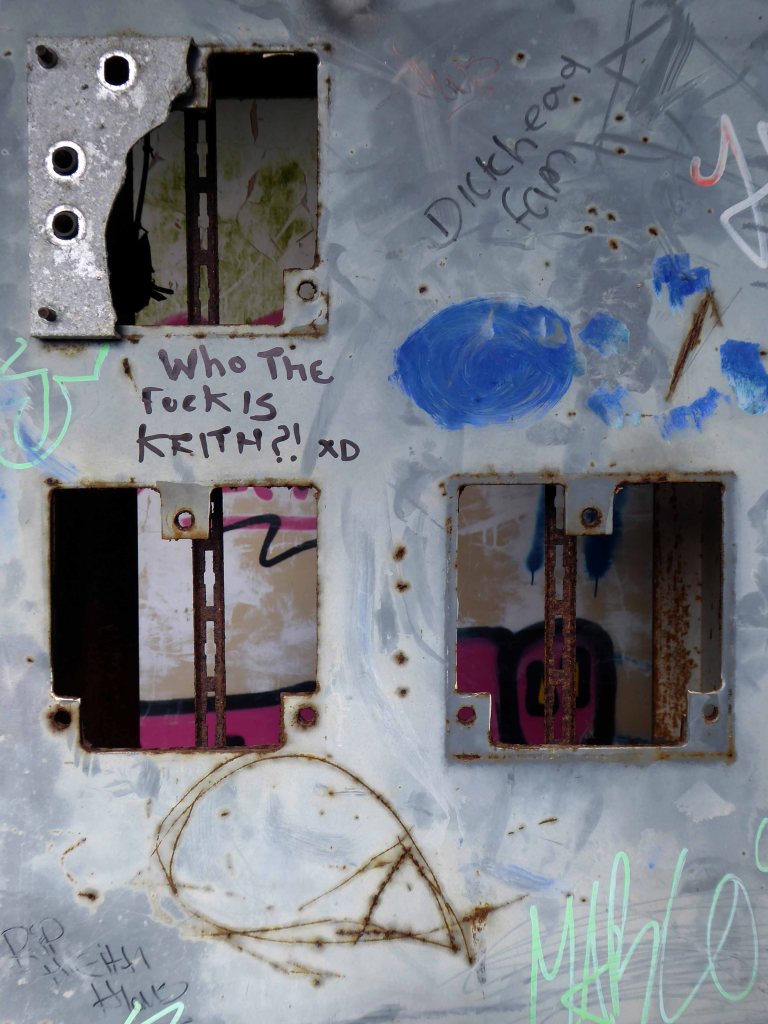
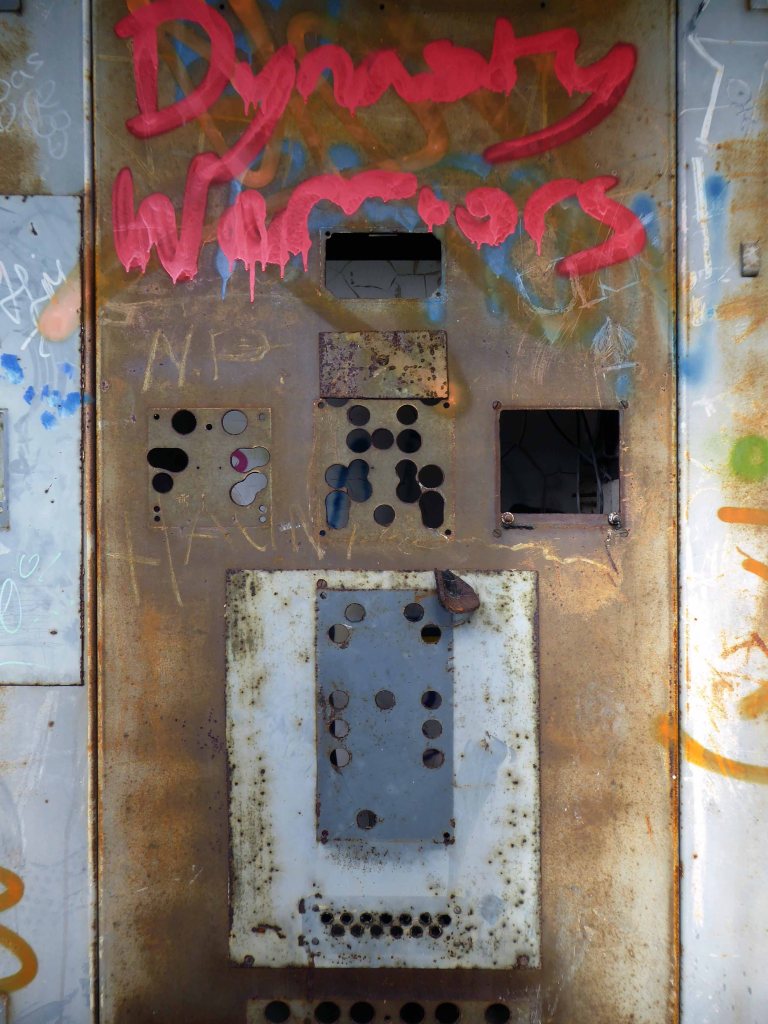
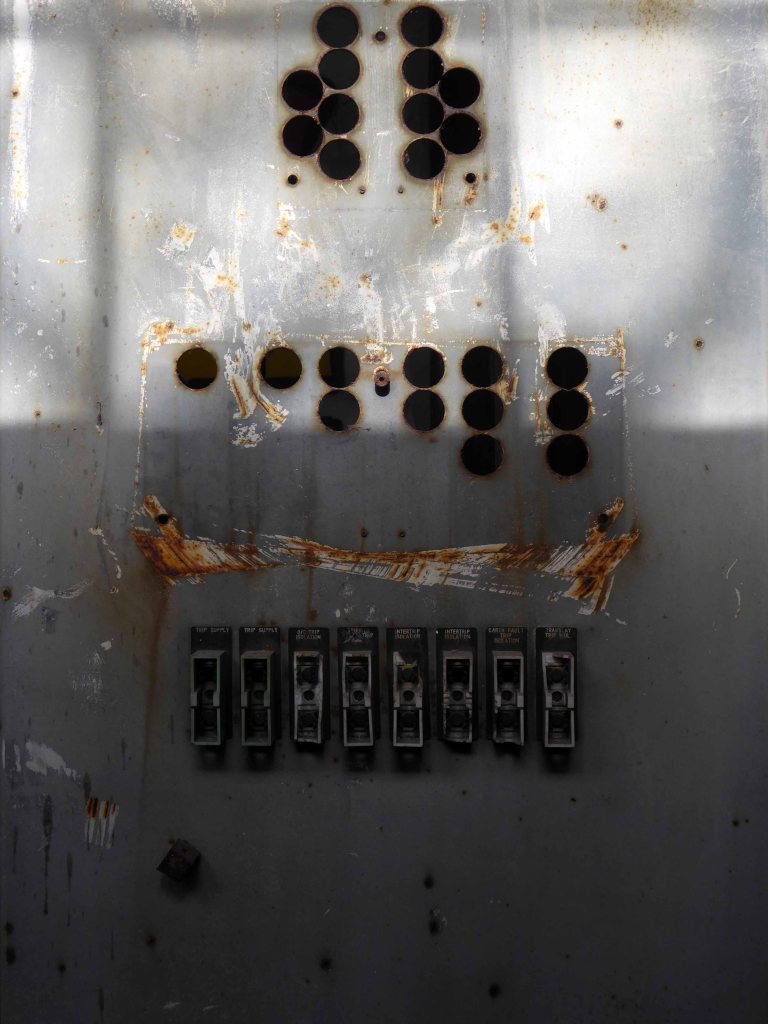
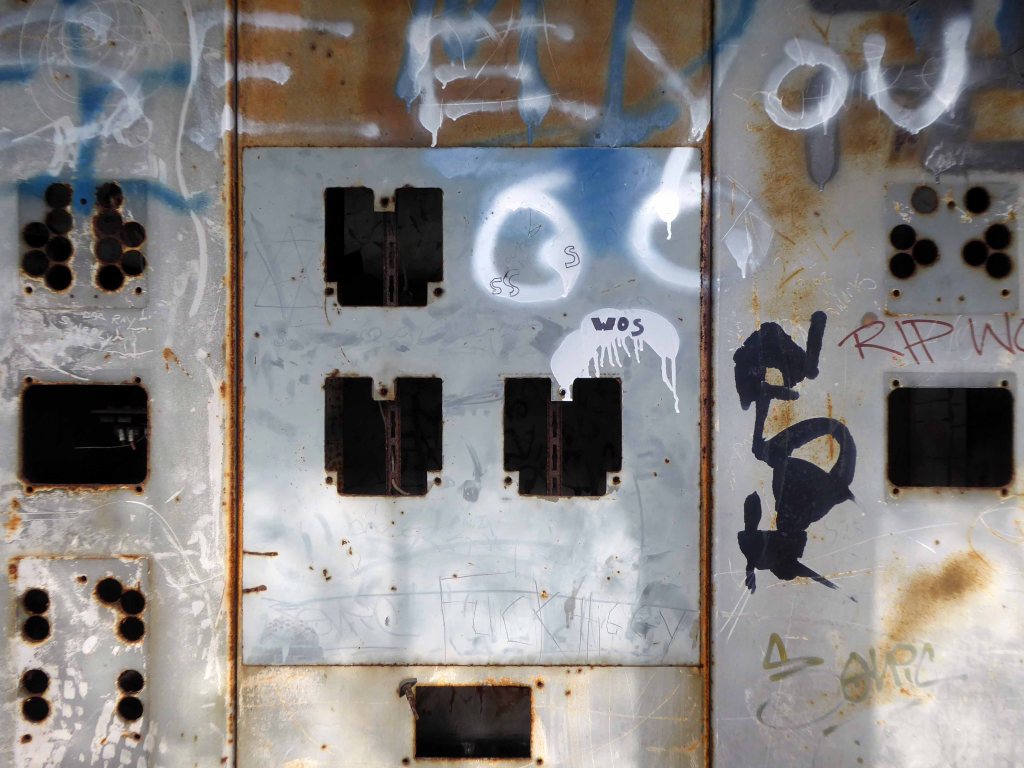
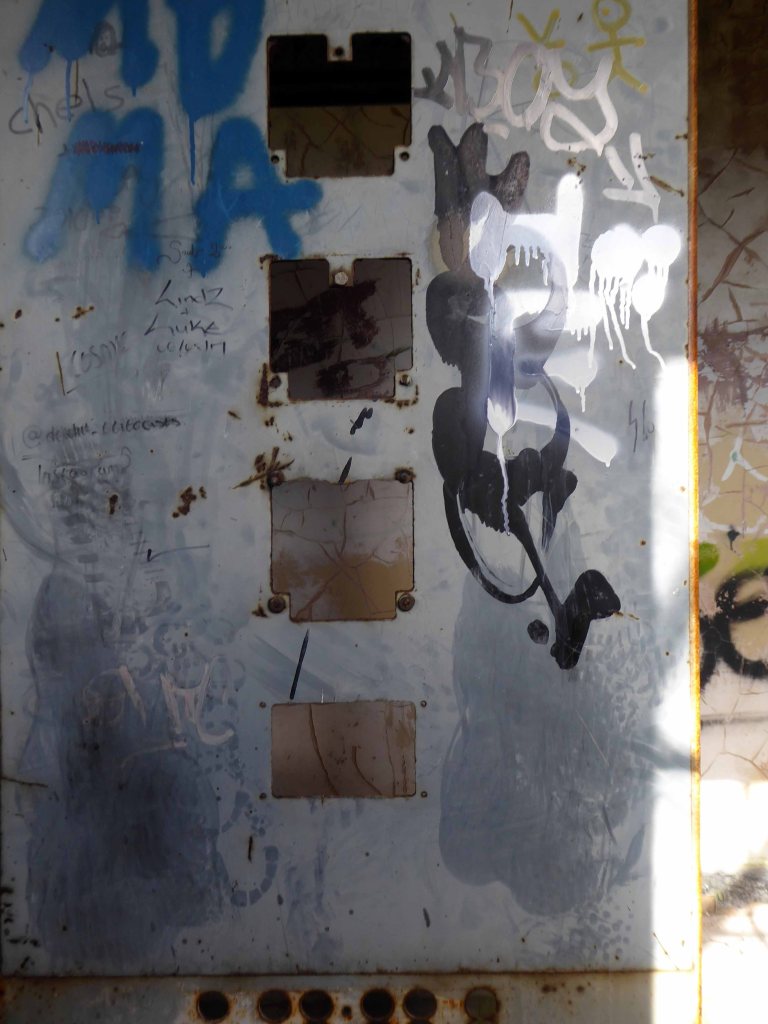
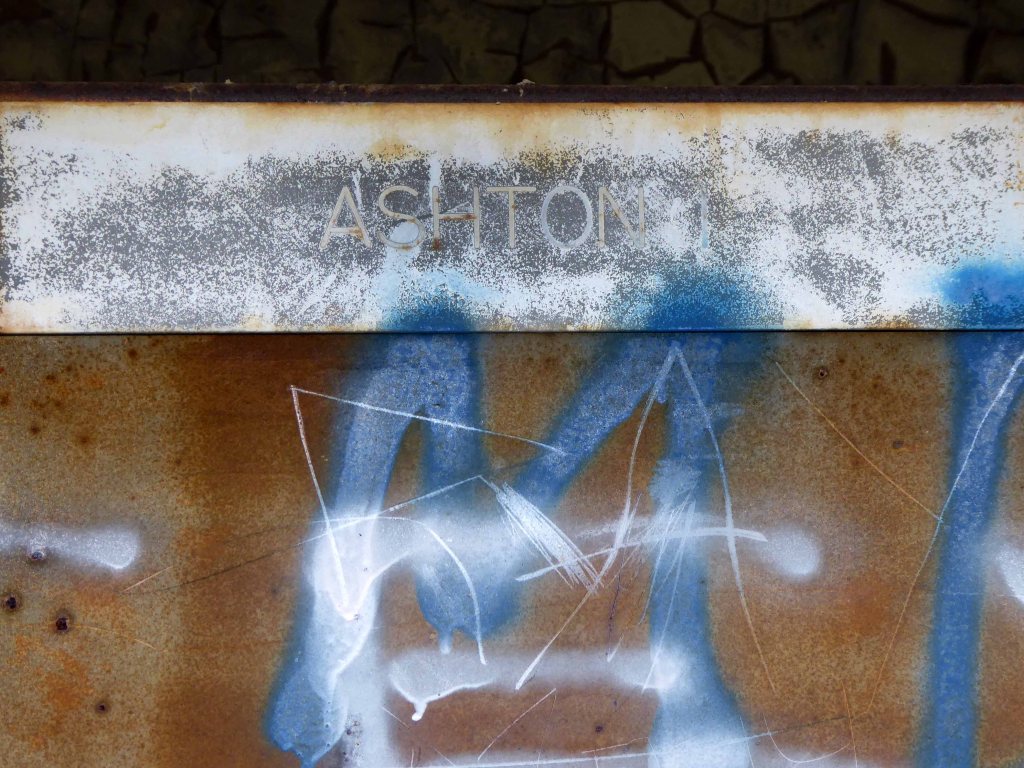
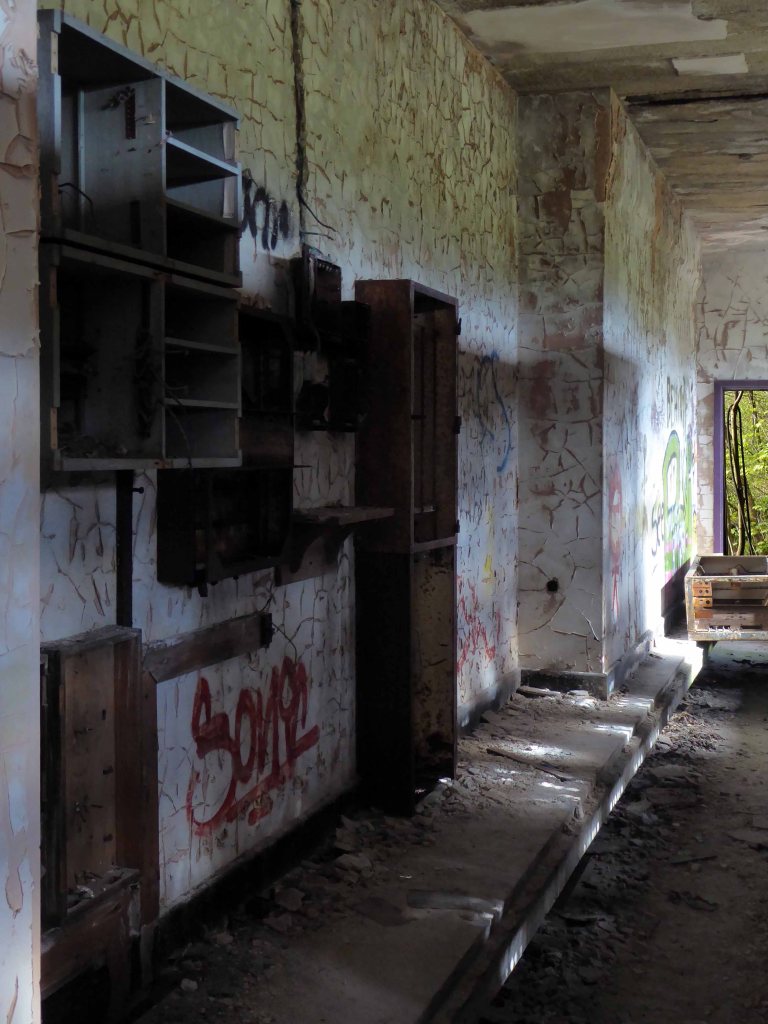
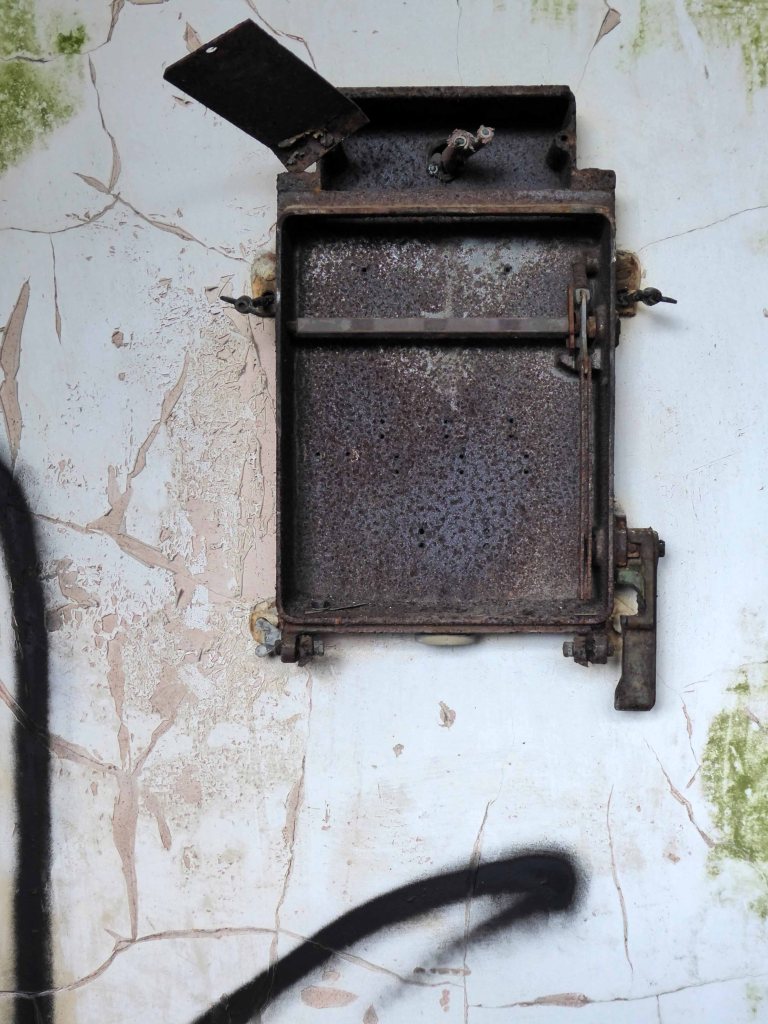
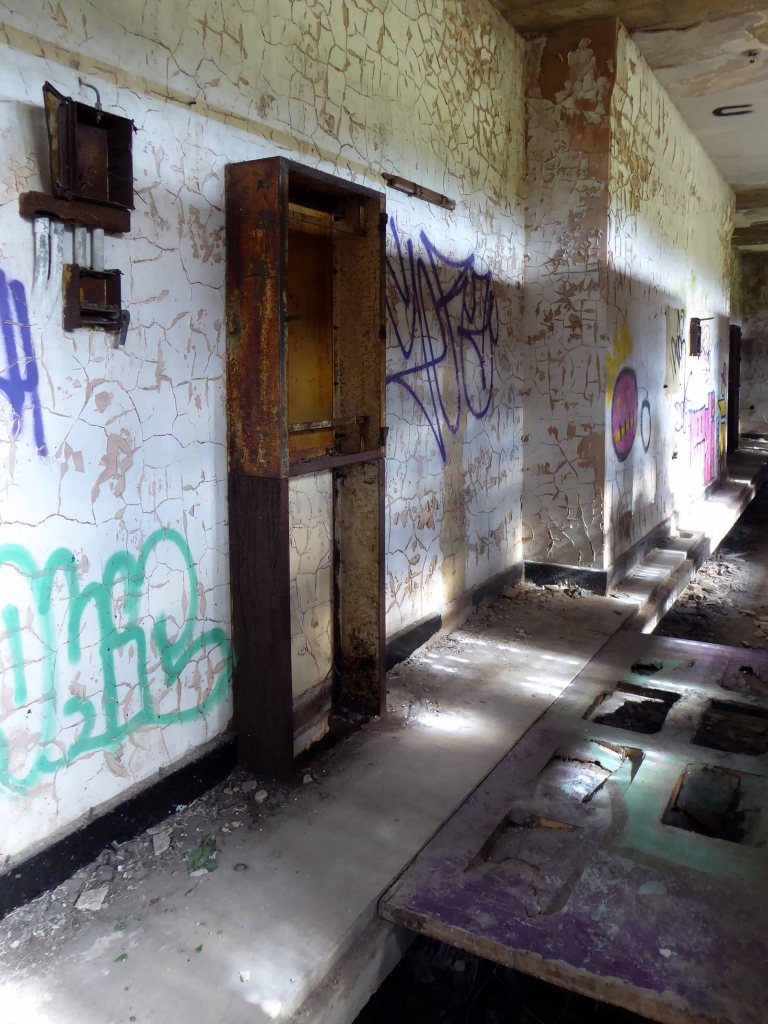
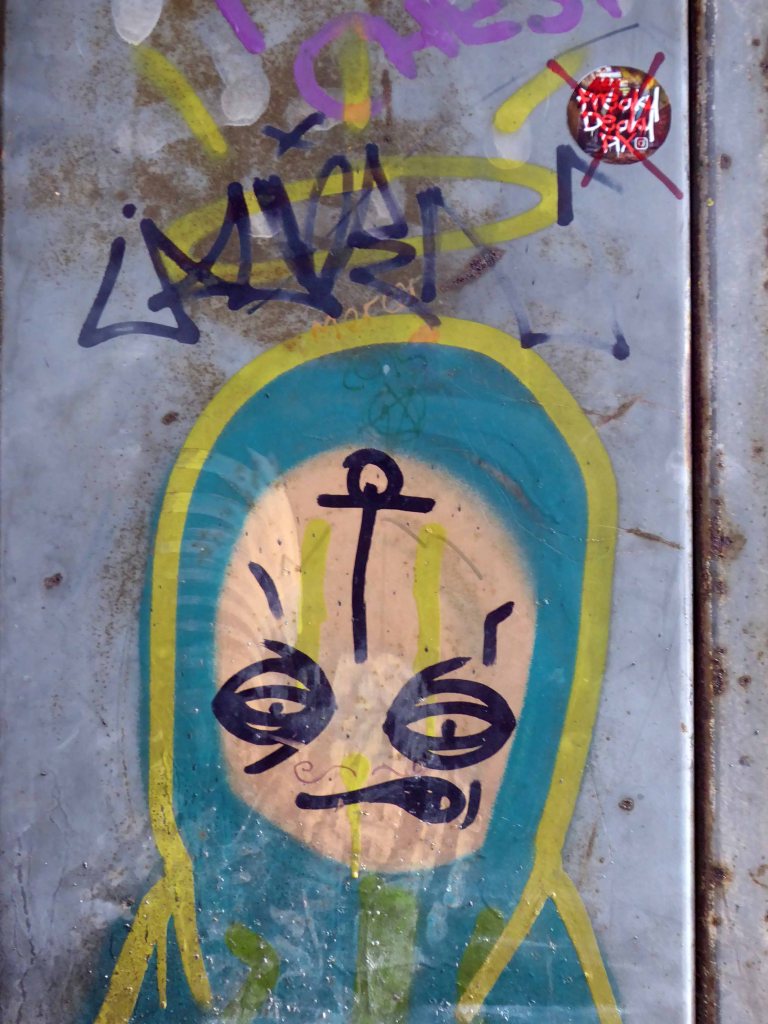
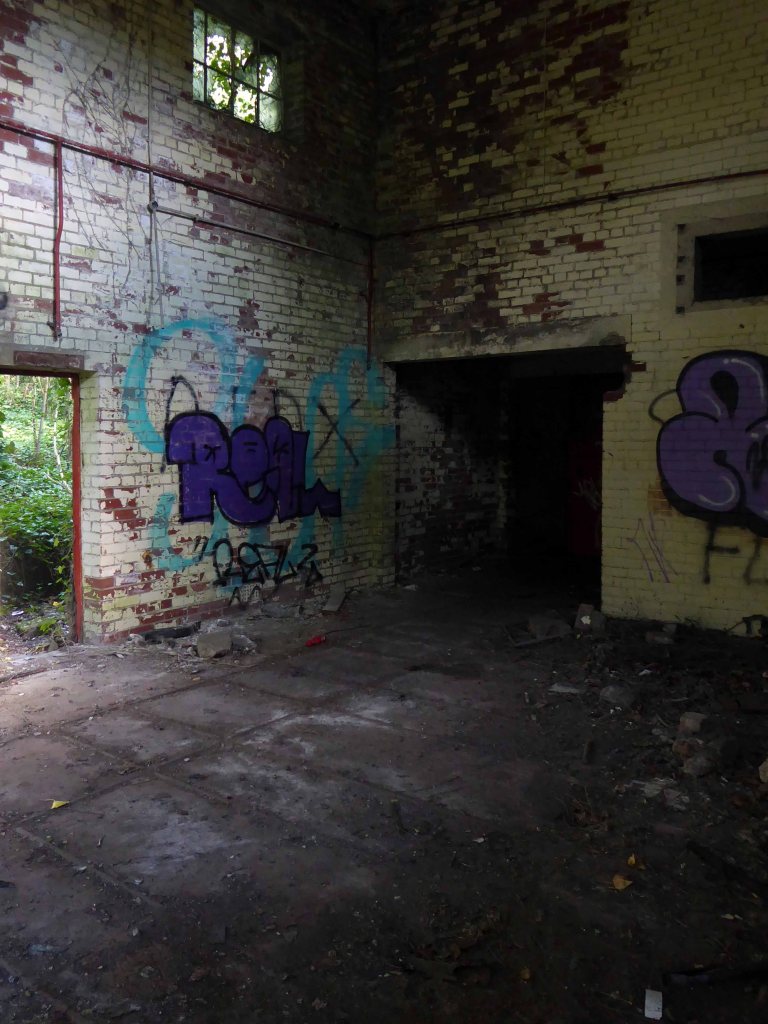
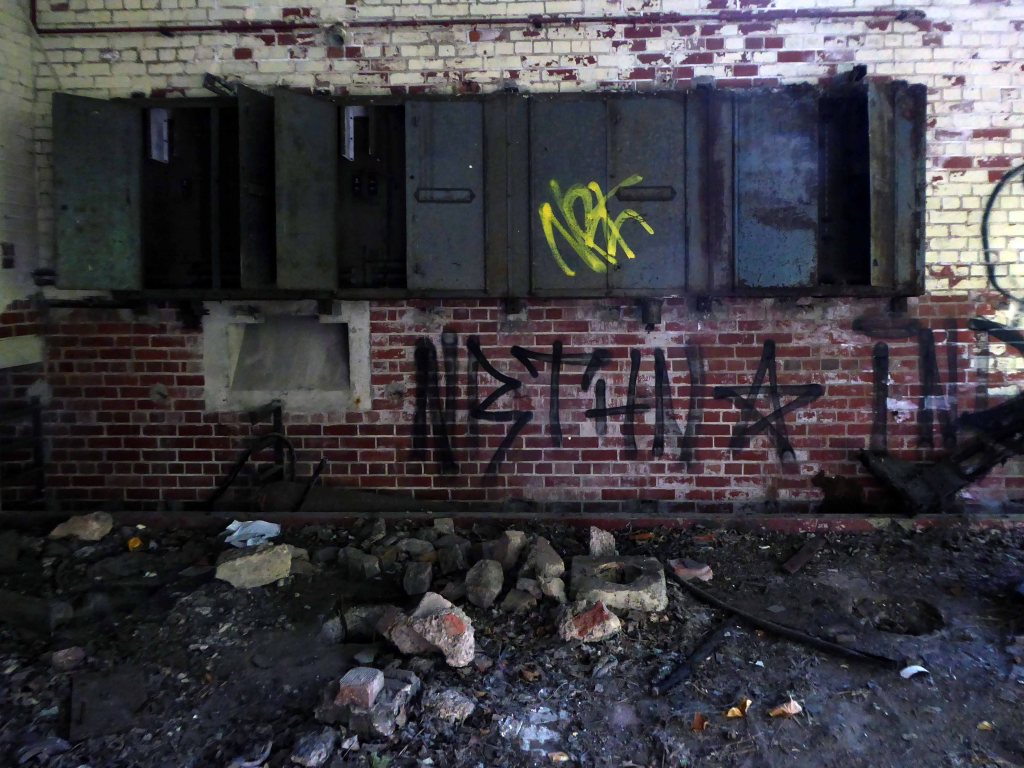
Most of the valuable equipment stripped out leaving and empty shell, covered in layers of the taggers’ interventions.
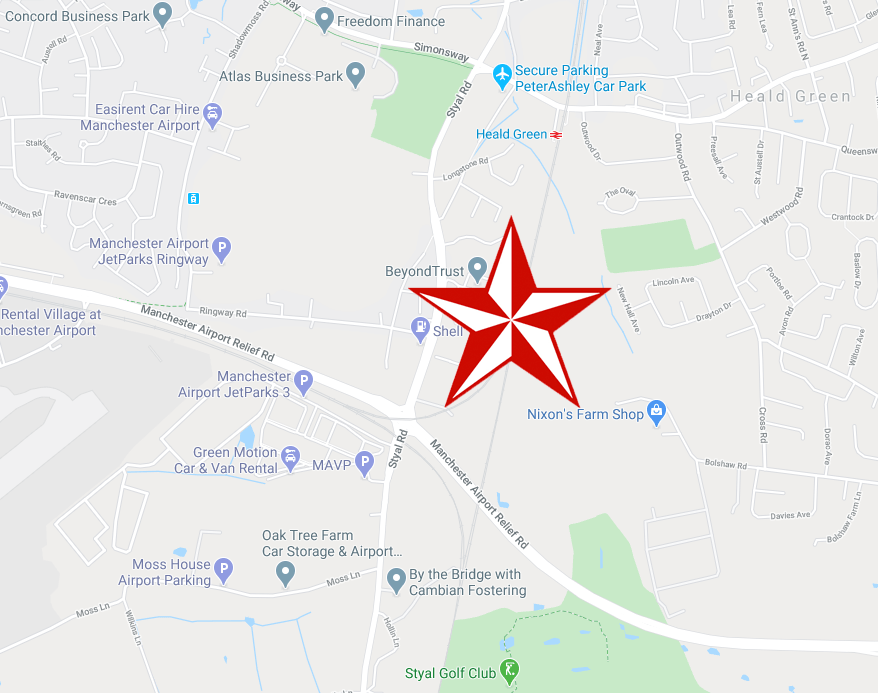
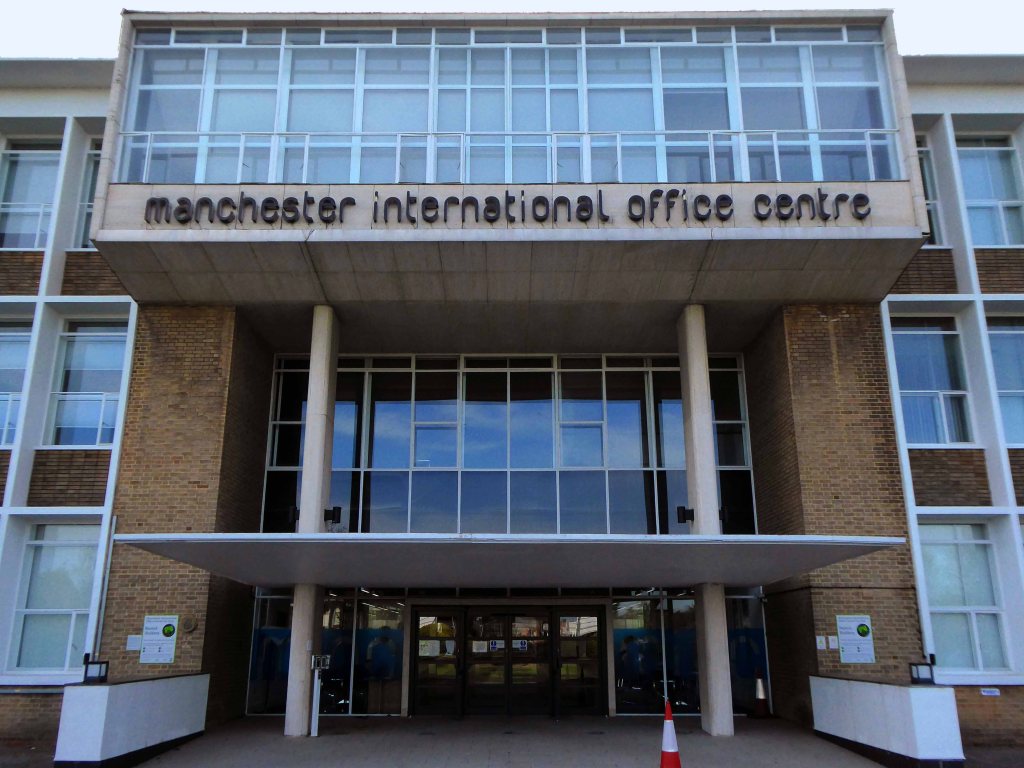
Manchester International Office Centre 11 Styal Rd Wythenshawe Manchester M22 5WB
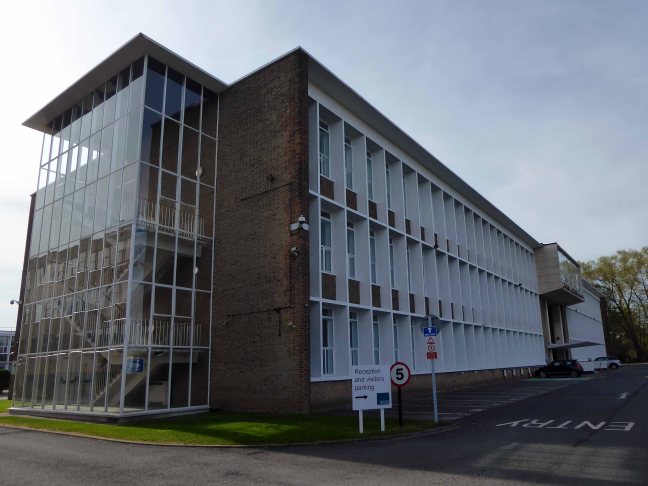
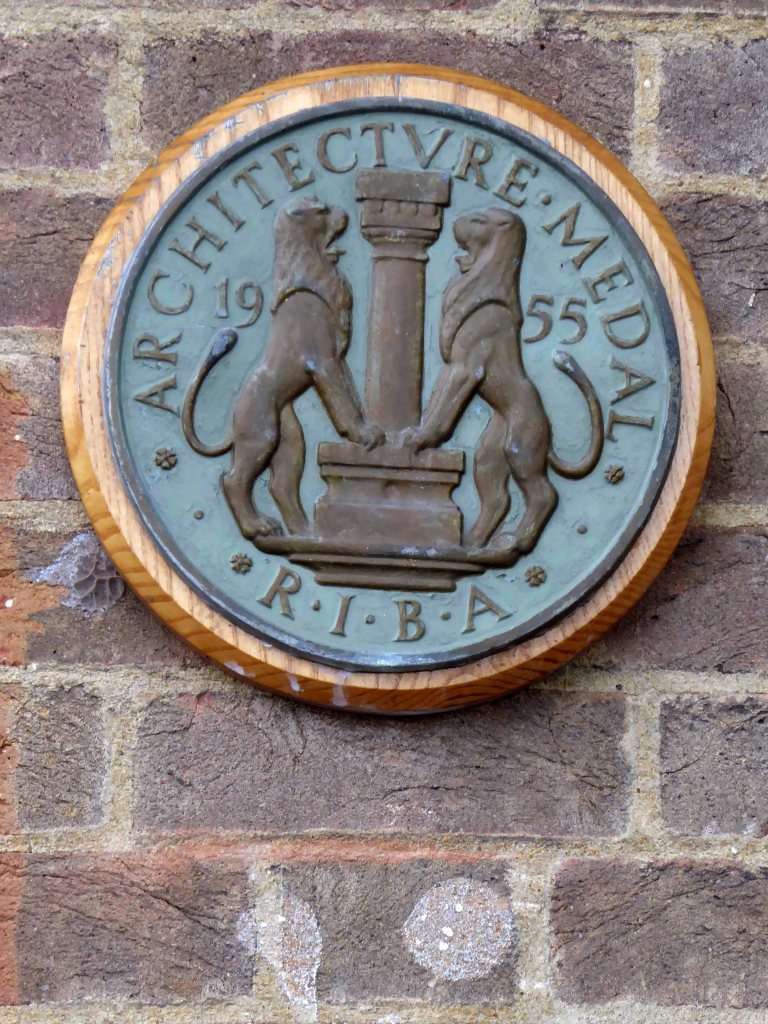
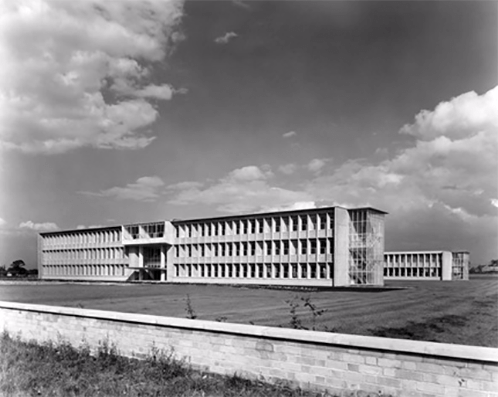
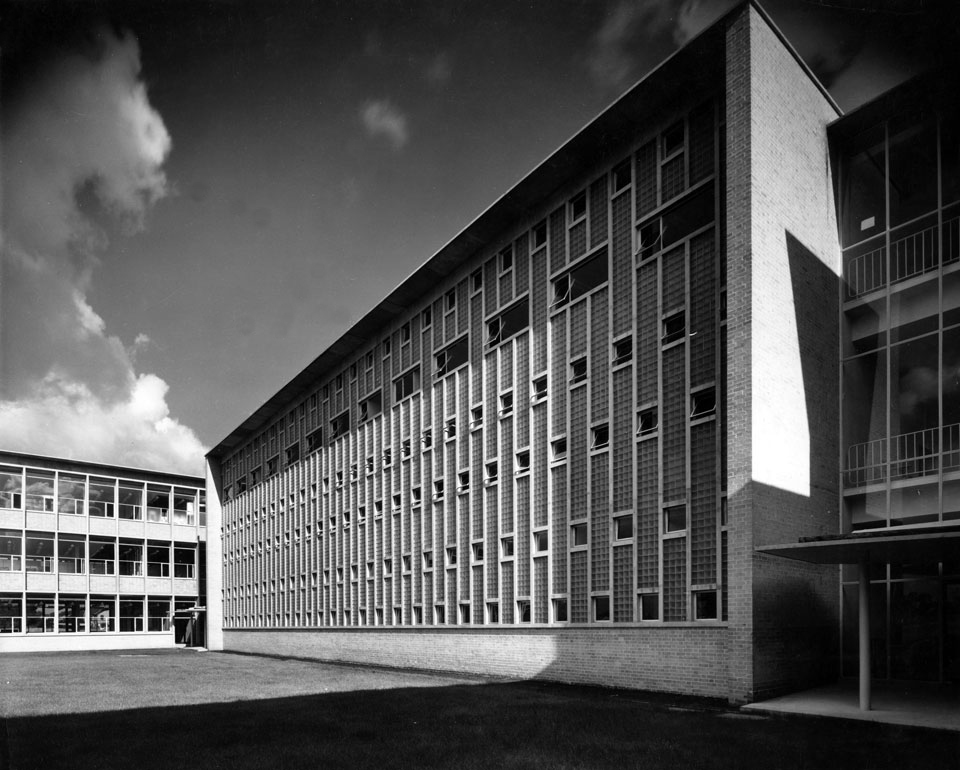
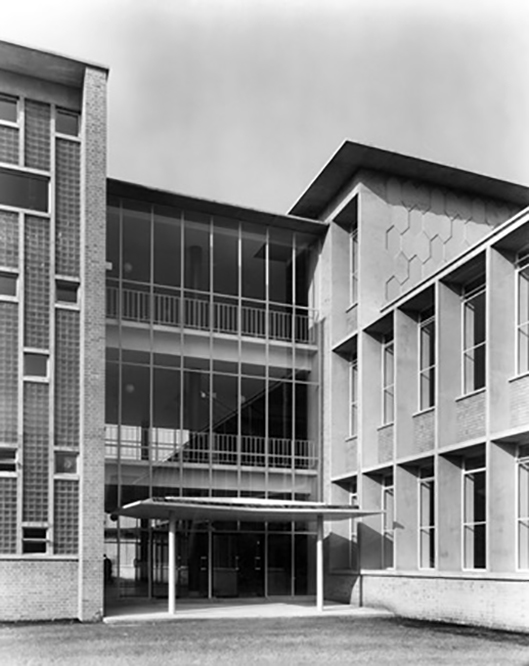
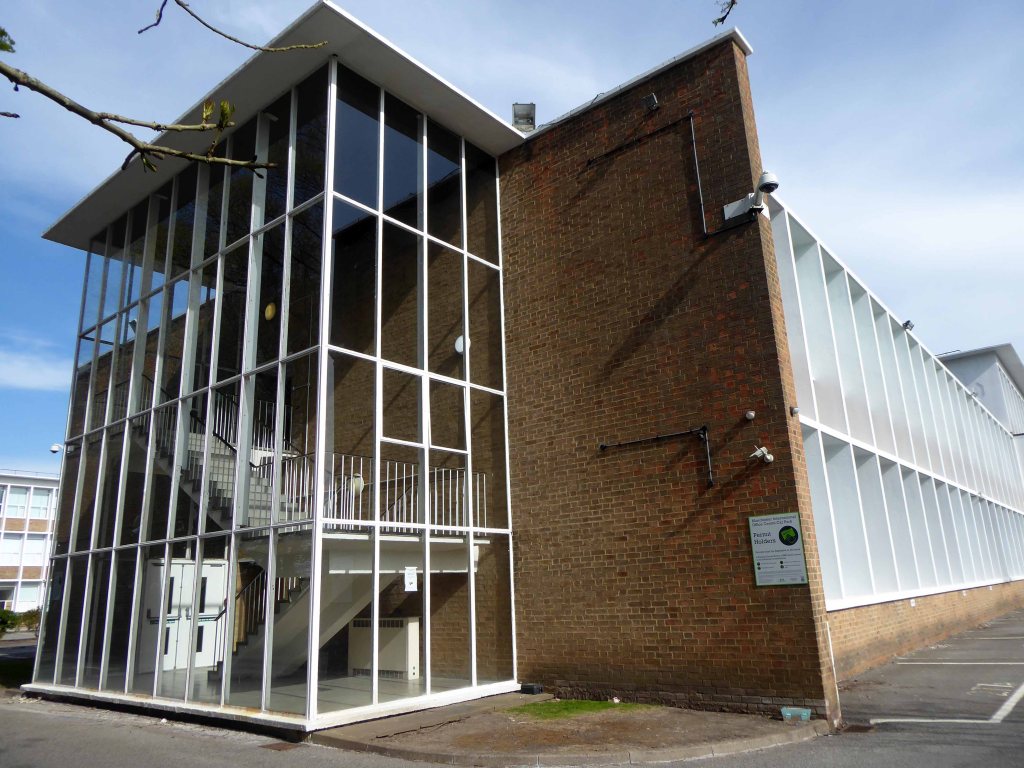
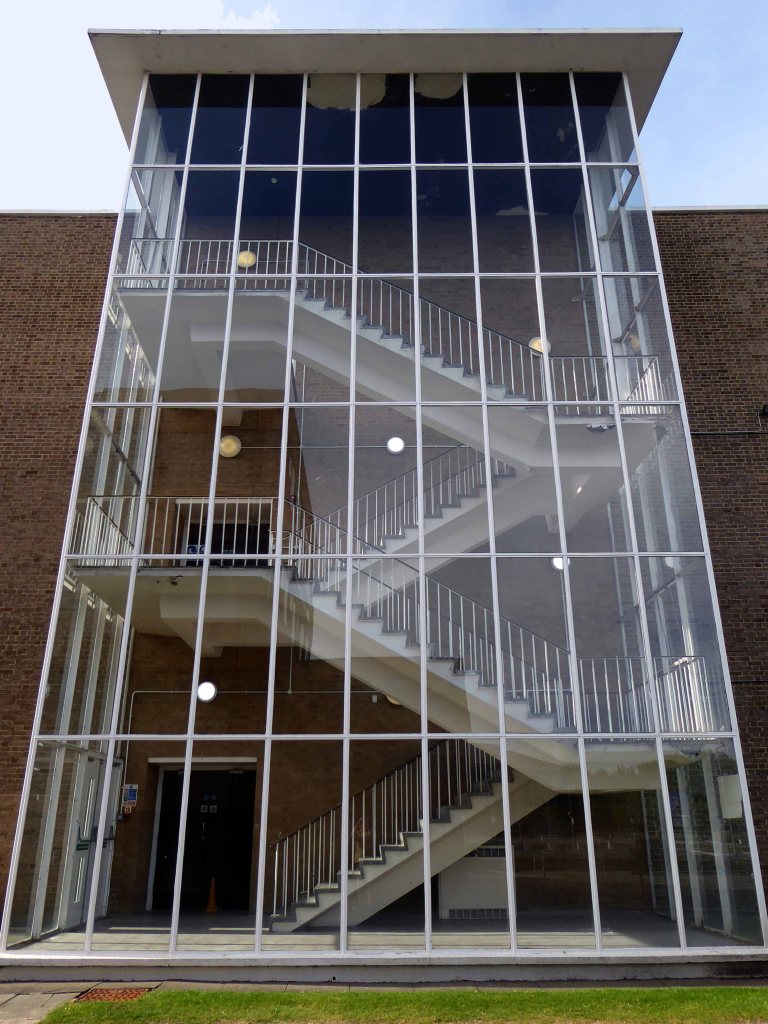
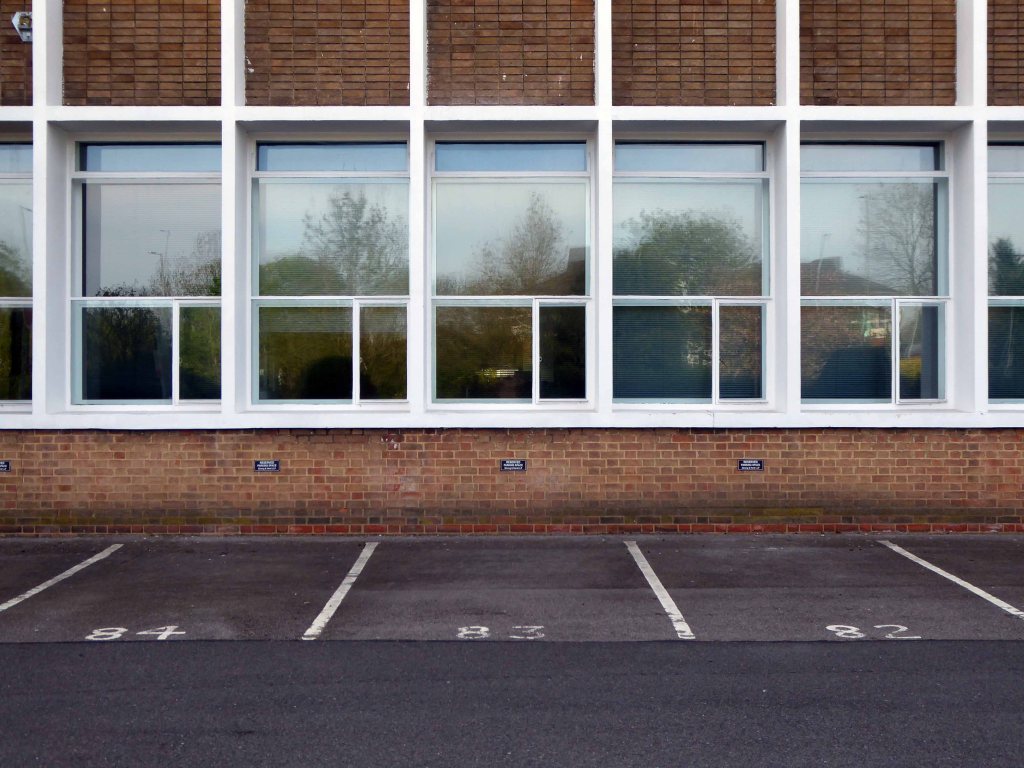
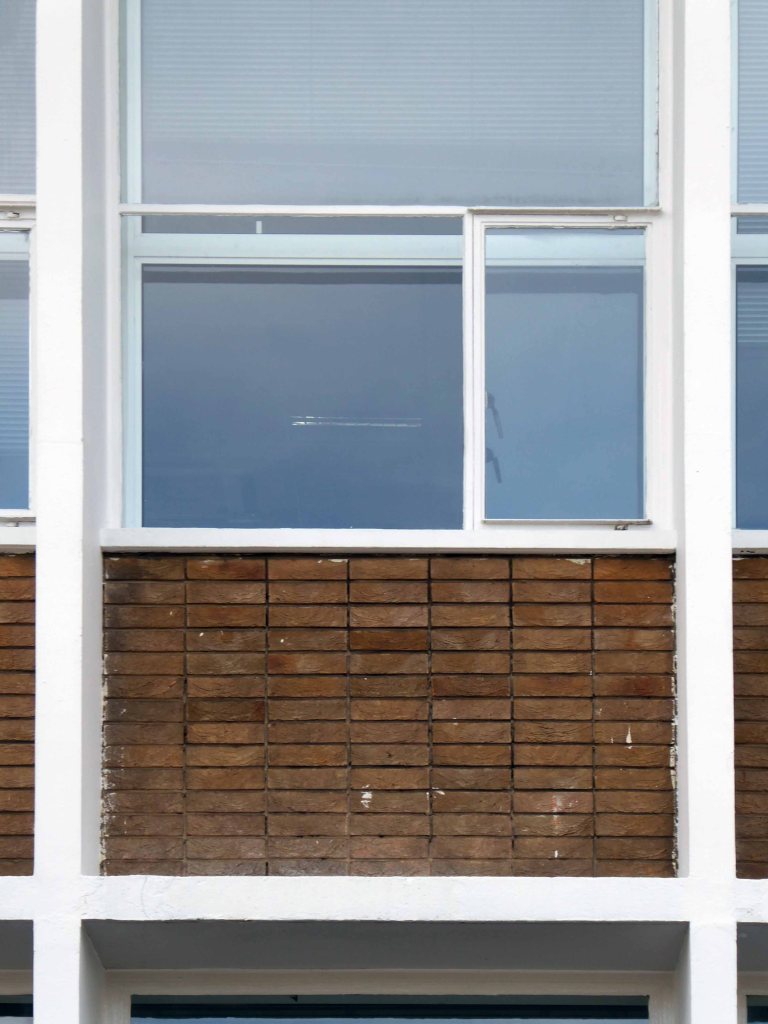
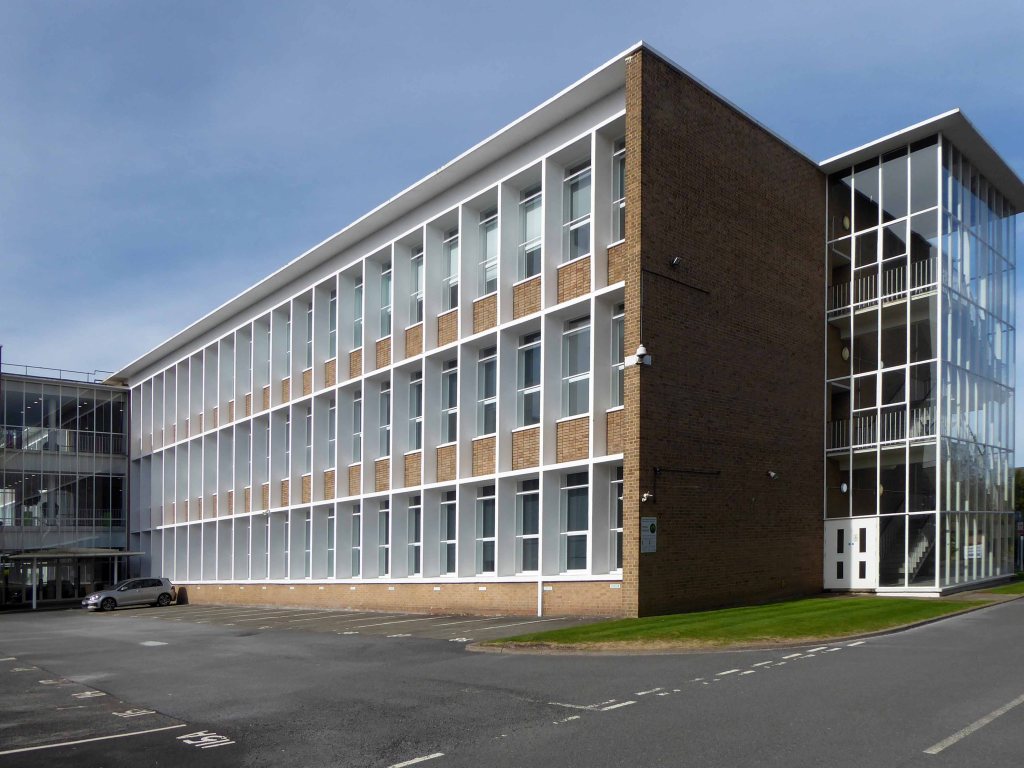
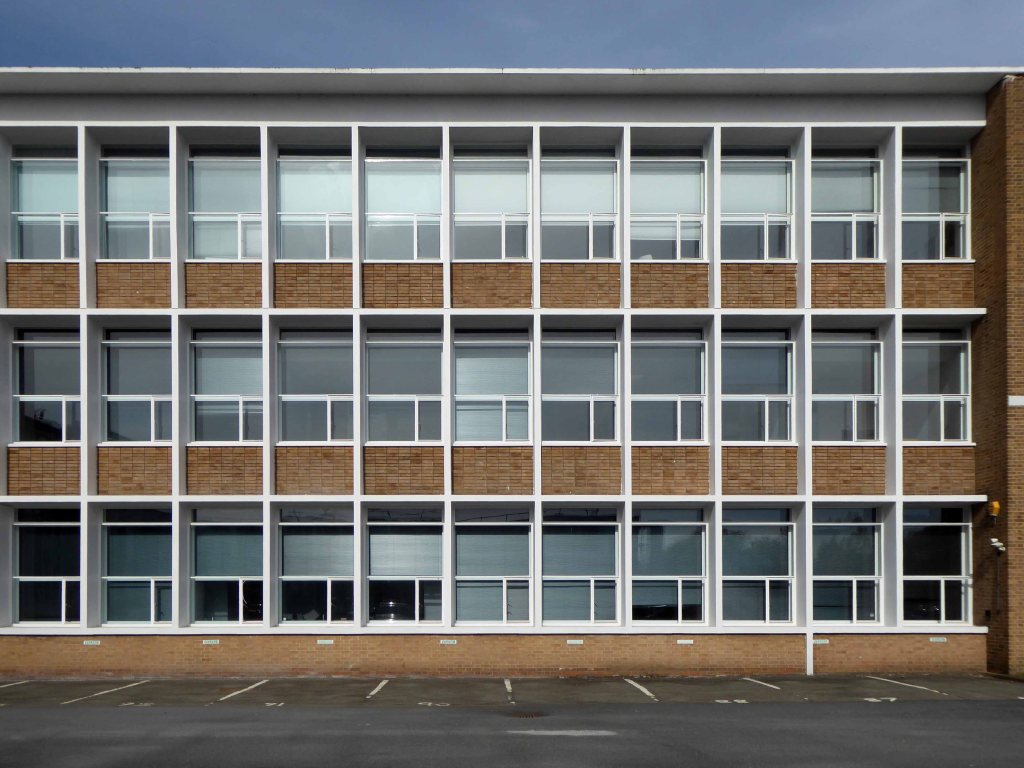
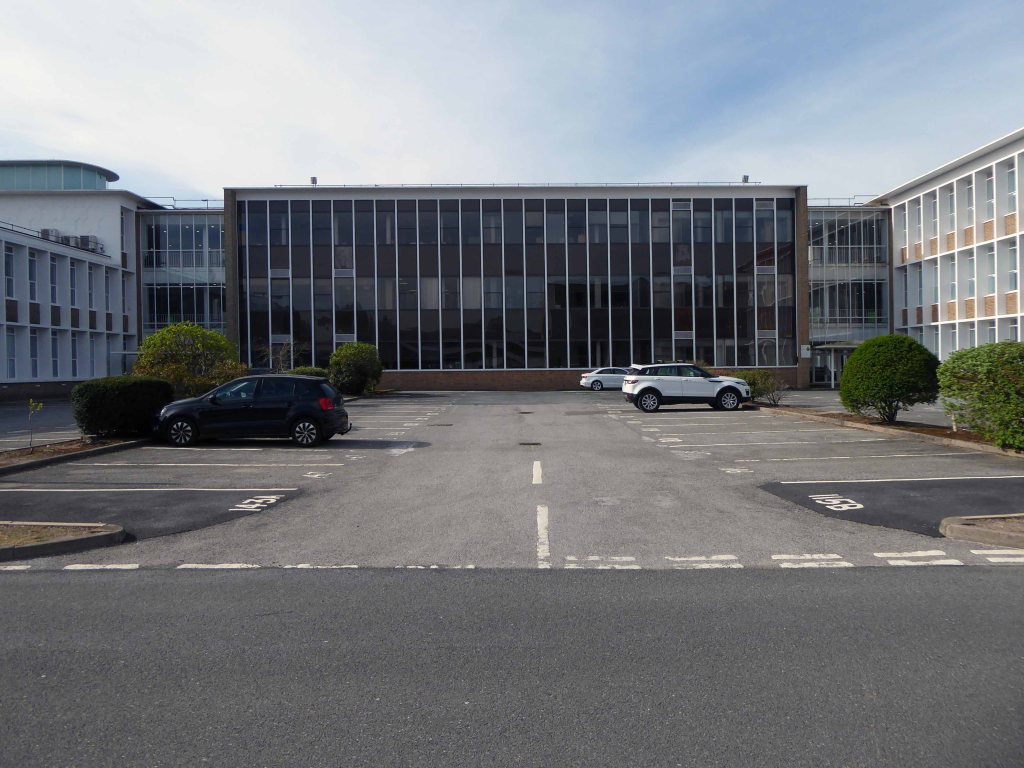
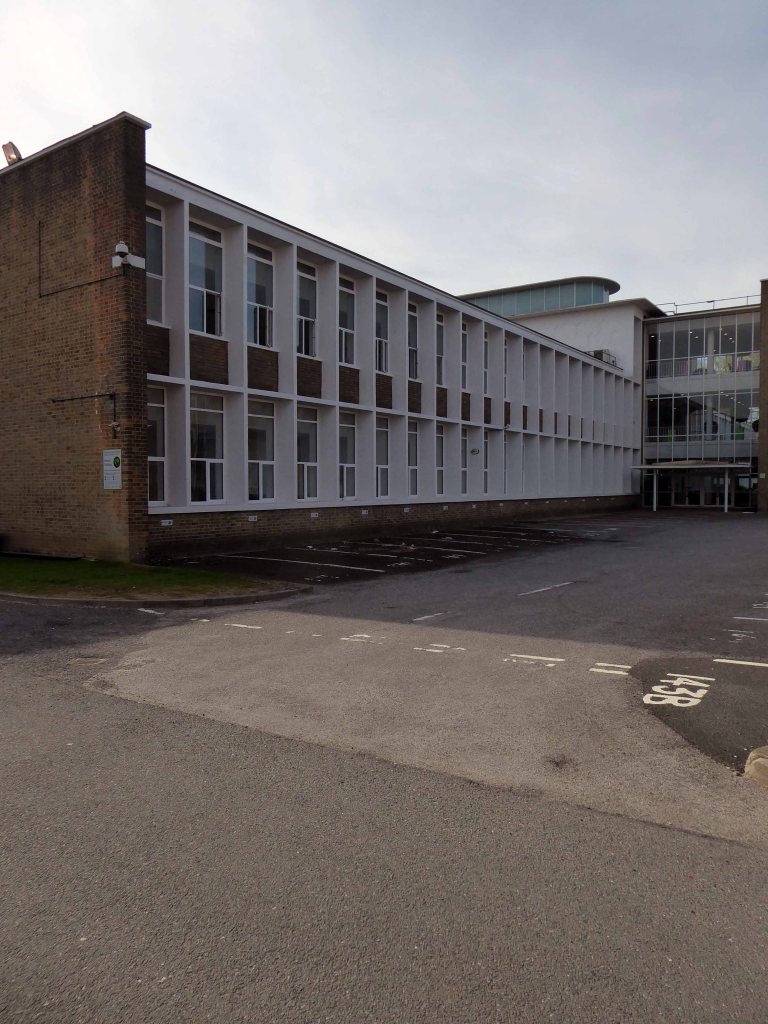
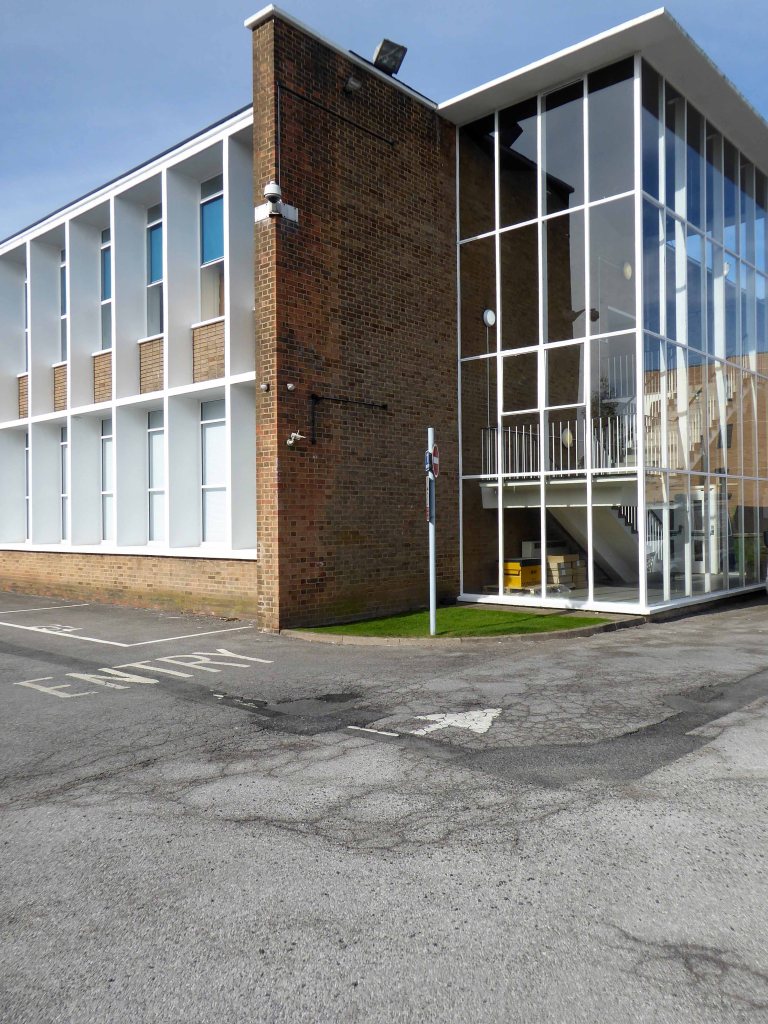
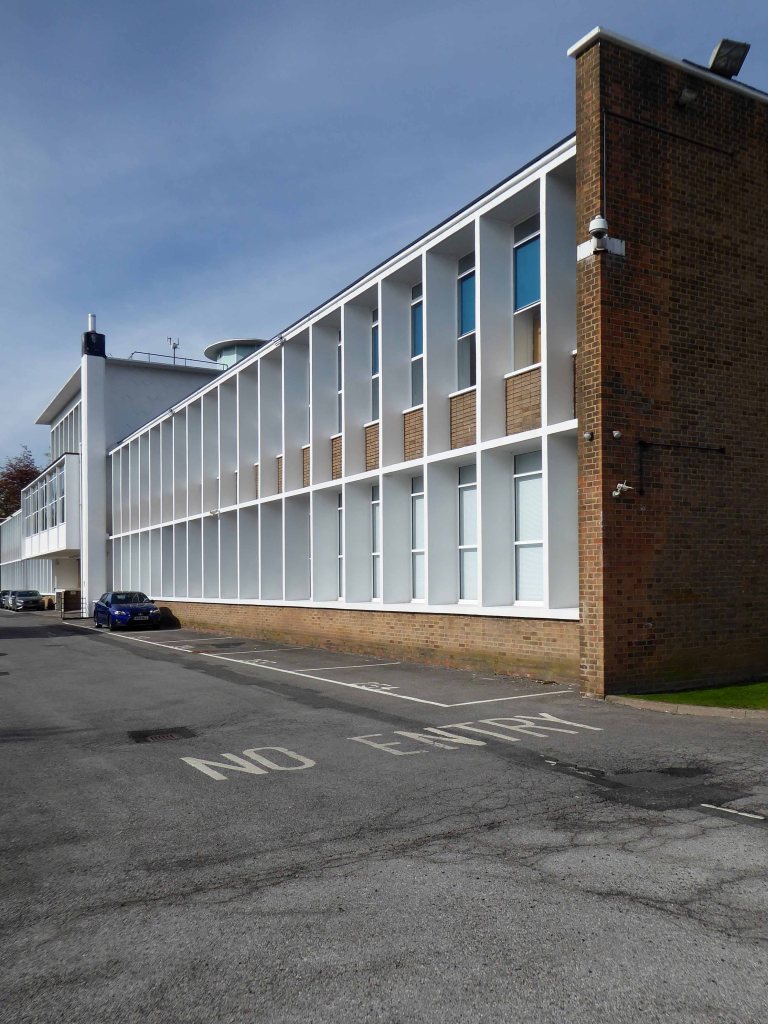
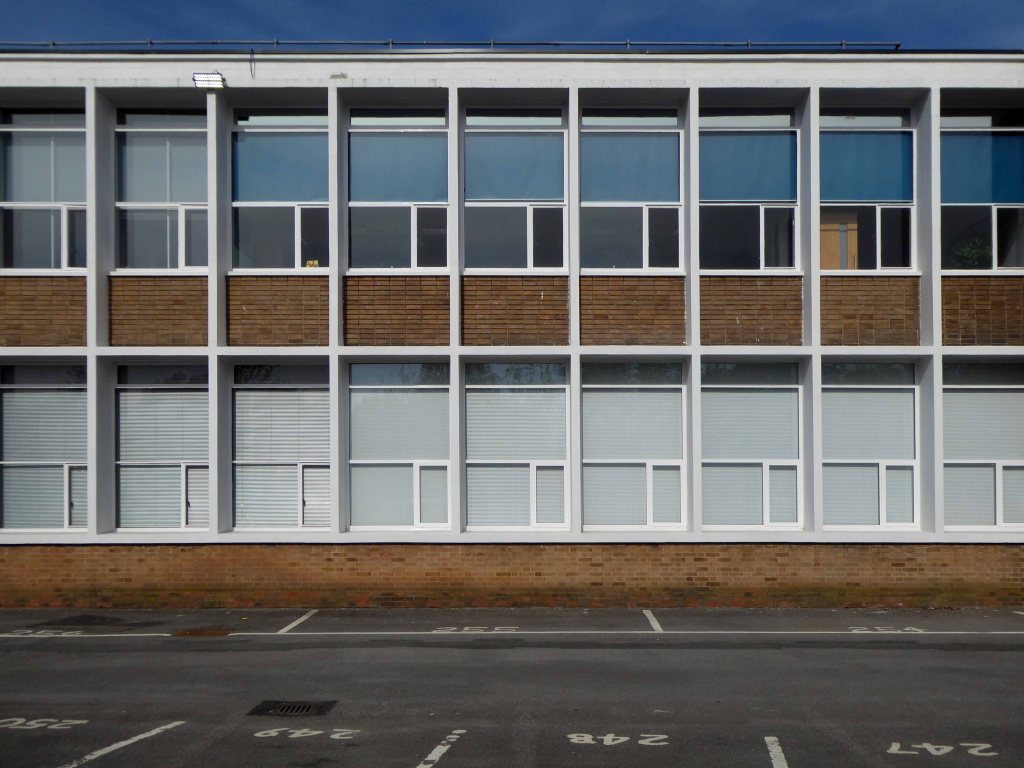
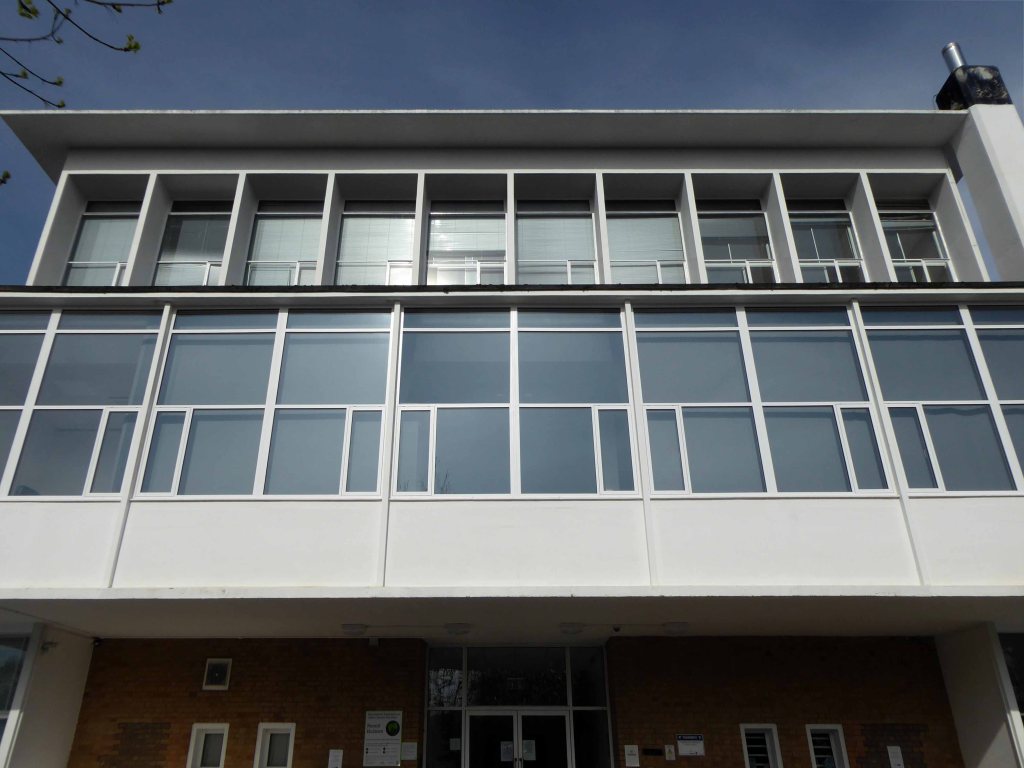
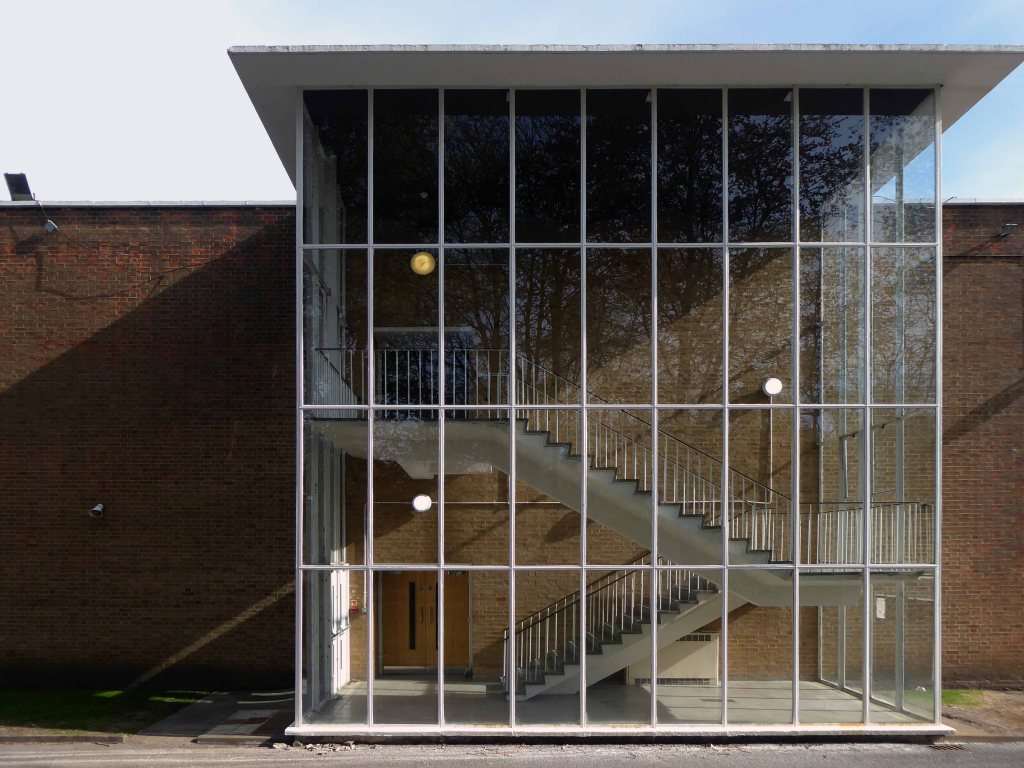
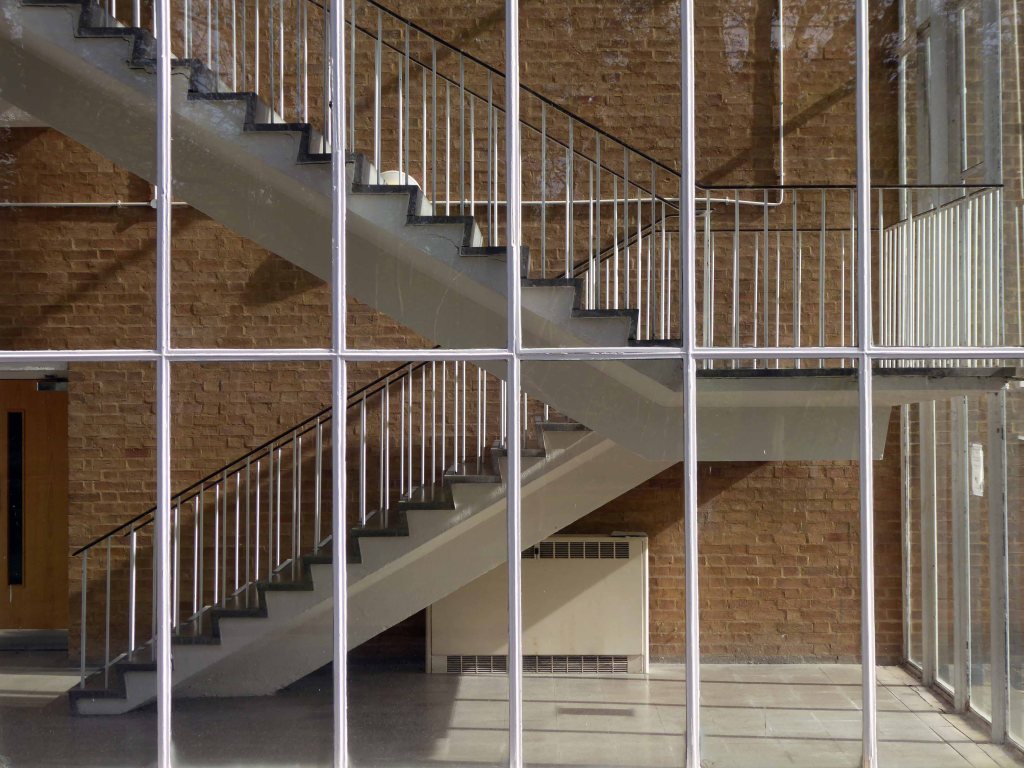
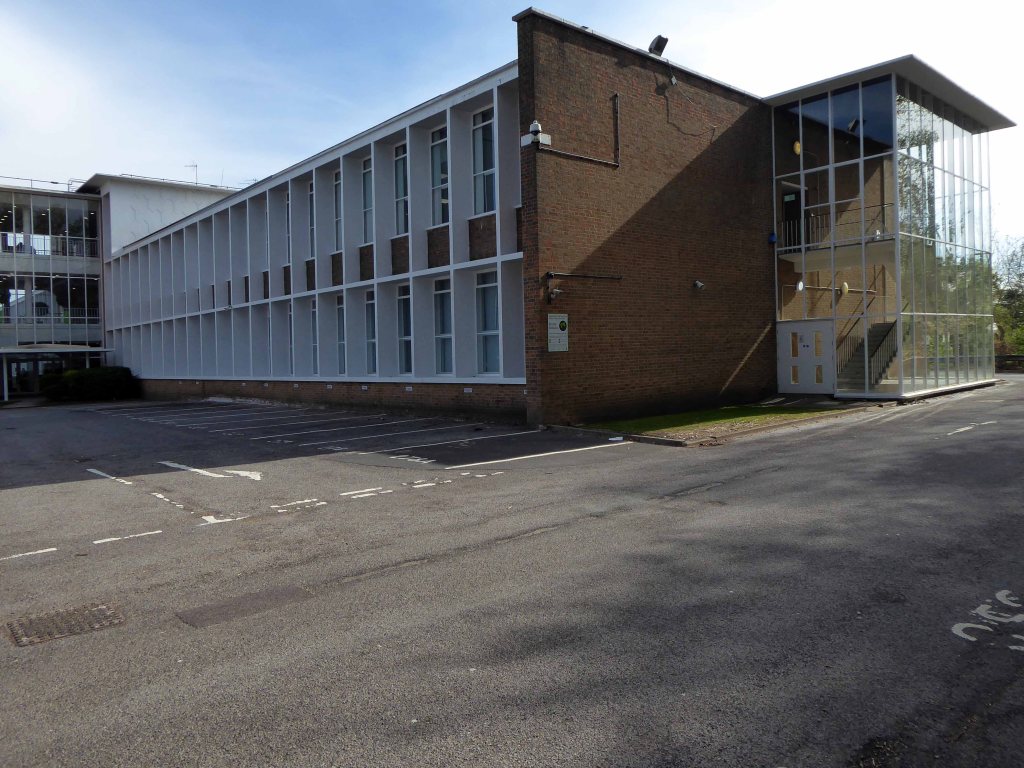
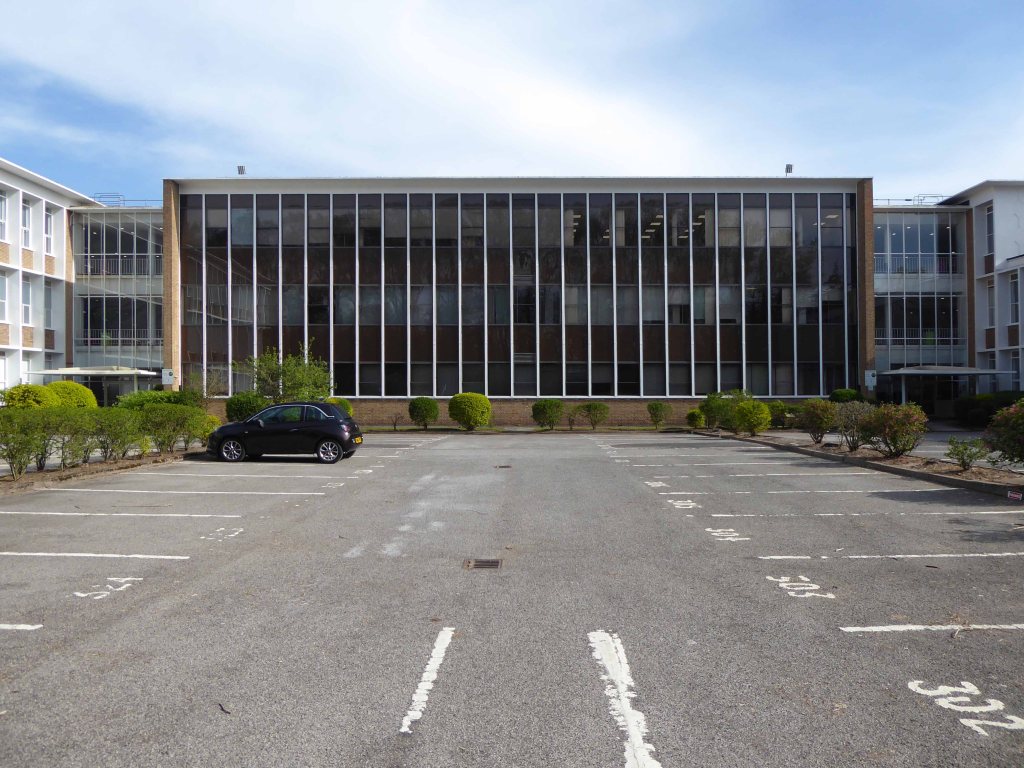
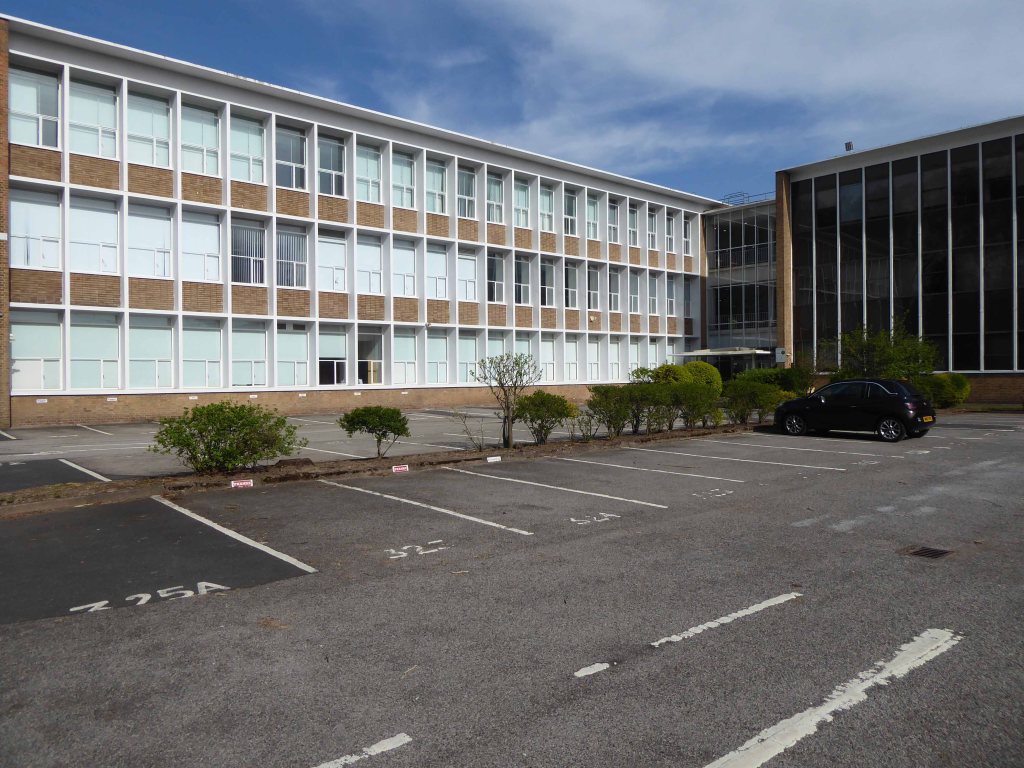
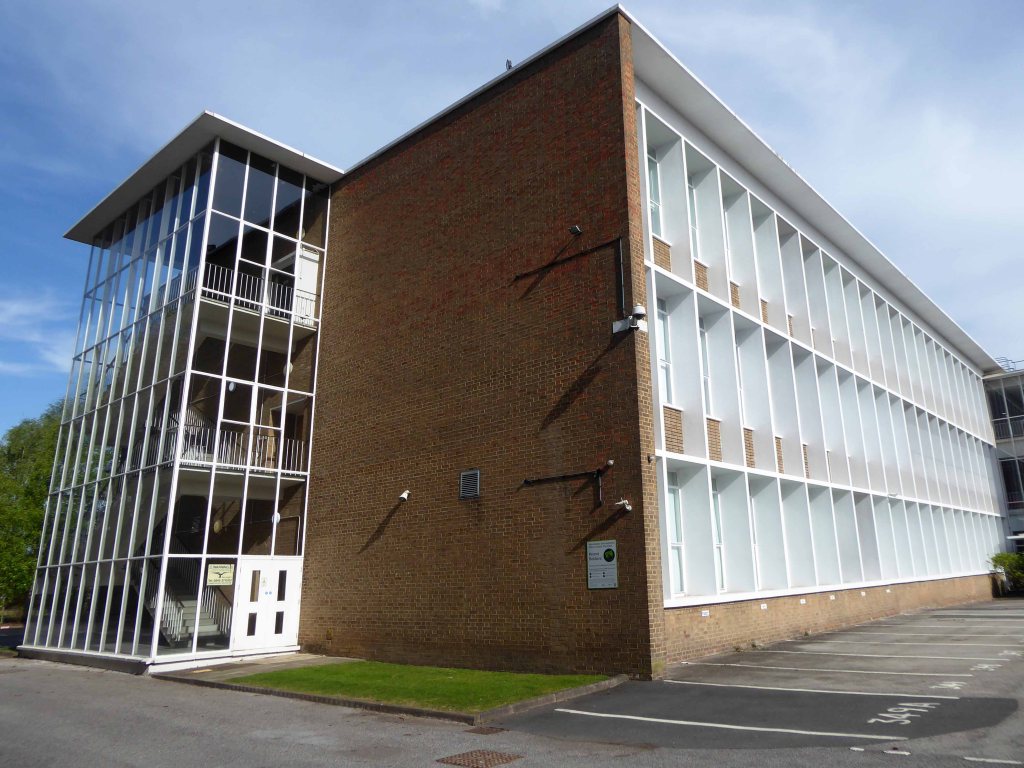
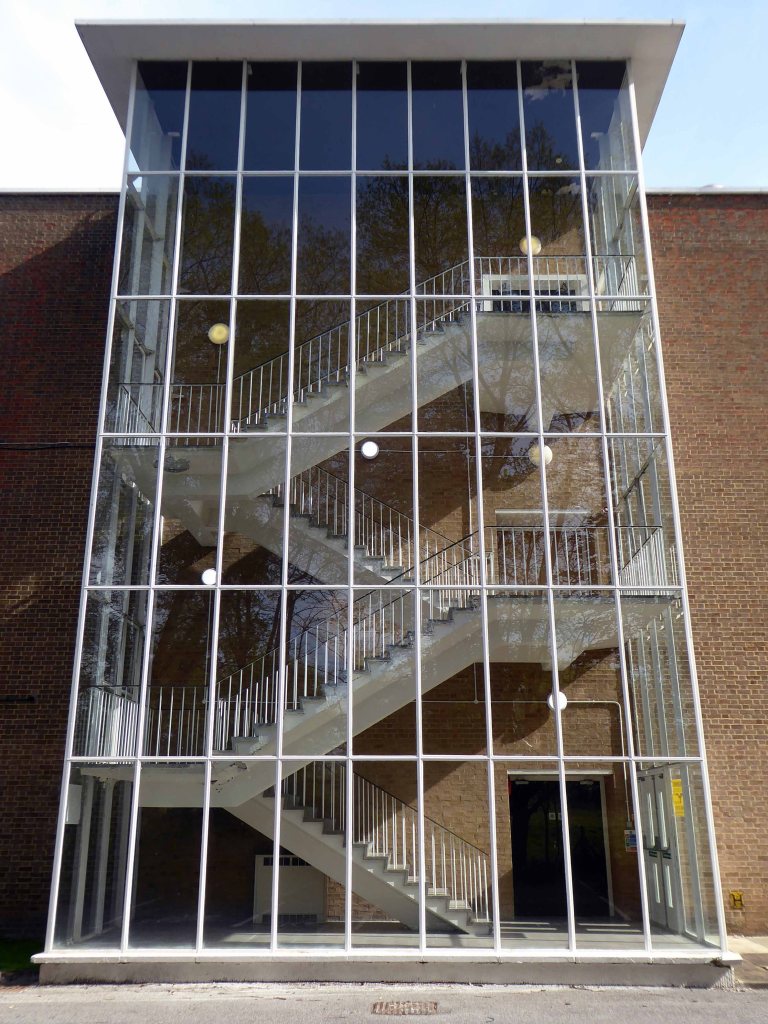
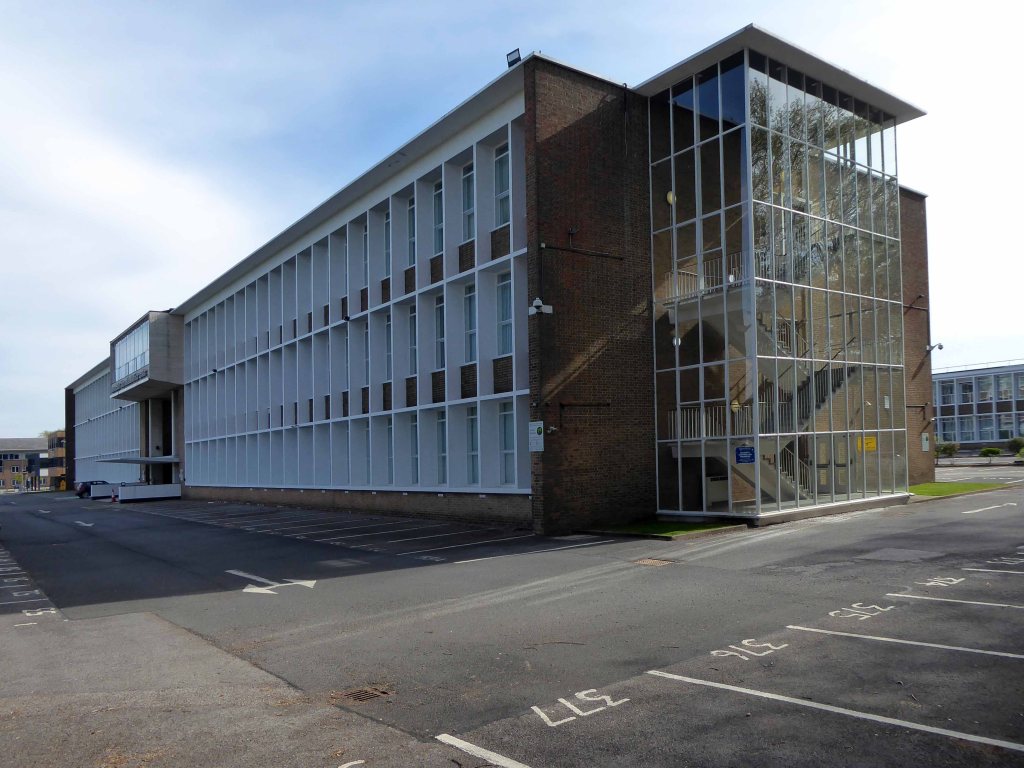
Renold Chains were once a huge firm employing thousands in south Manchester, their main factory at Burnage, now demolished to make way for a supermarket. This grouping was designed as the administrative headquarters for the company and was in receipt of an RIBA Architecture Bronze Medal in 1955. The scheme, of two parallel wings connected by a central hub running perpendicular, now seems fairly pedestrian, though still exudes some presence by virtue of the evident control in the design and construction of relief within the main façade. This building, though, actually points toward the moment where Cruickshank & Seward were turning, with the rest of the profession, toward new engineered, curtain walling solutions. The three storey glazed stair towers are made of a relatively fine steel section glazing bar and are clearly expressed at the ends of the blocks; these perhaps pre-empt the altogether more refined towers at the Renold Building and Roscoe Building of the Universities. The third floor boardroom was also positively expressed as a curved solid, cantilevered above the entrance canopy. That the building was developed in such close proximity to the airport has ensured its continued viability as office and conferencing space. The firm also delivered the adjacent building for the same client in the 1970s.
Four weeks into a pandemic – cycling somewhere else. I turned off and into the grounds of the former Renold House, currently trading as Manchester International Office Ccentre.
Manchester International Office Centre (MIOC) is a prominent landmark office building extending to some 100,000 sq ft which provides occupiers with high quality space ranging from suites of 450 to 8,000 sq ft.
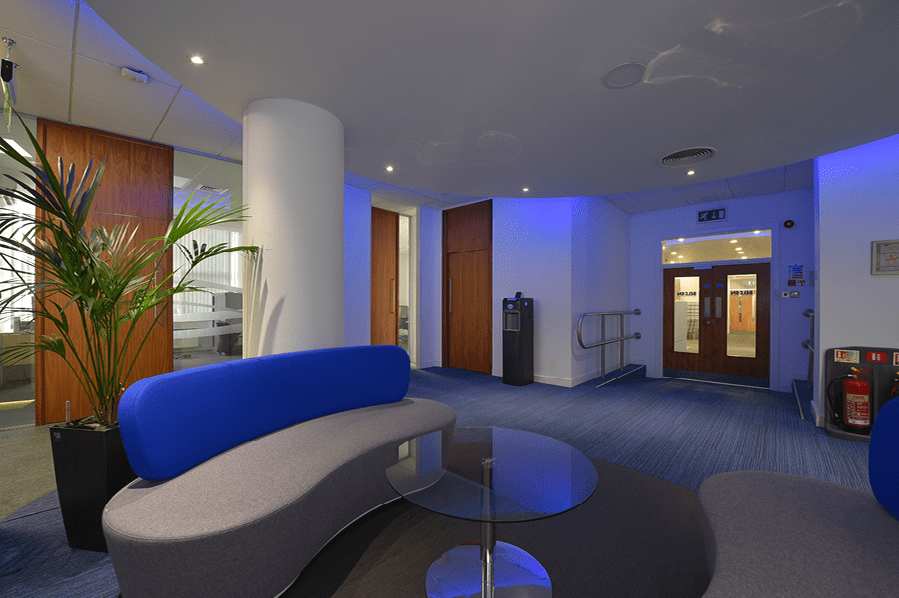
The building has undergone a complete internal transformation with a total refurbishment of the reception and common areas. The office suites provide a superb working environment in line with the demands of todays occupier.
On arriving home I hungrily rustled up a few RIBA Archive images from 1954.
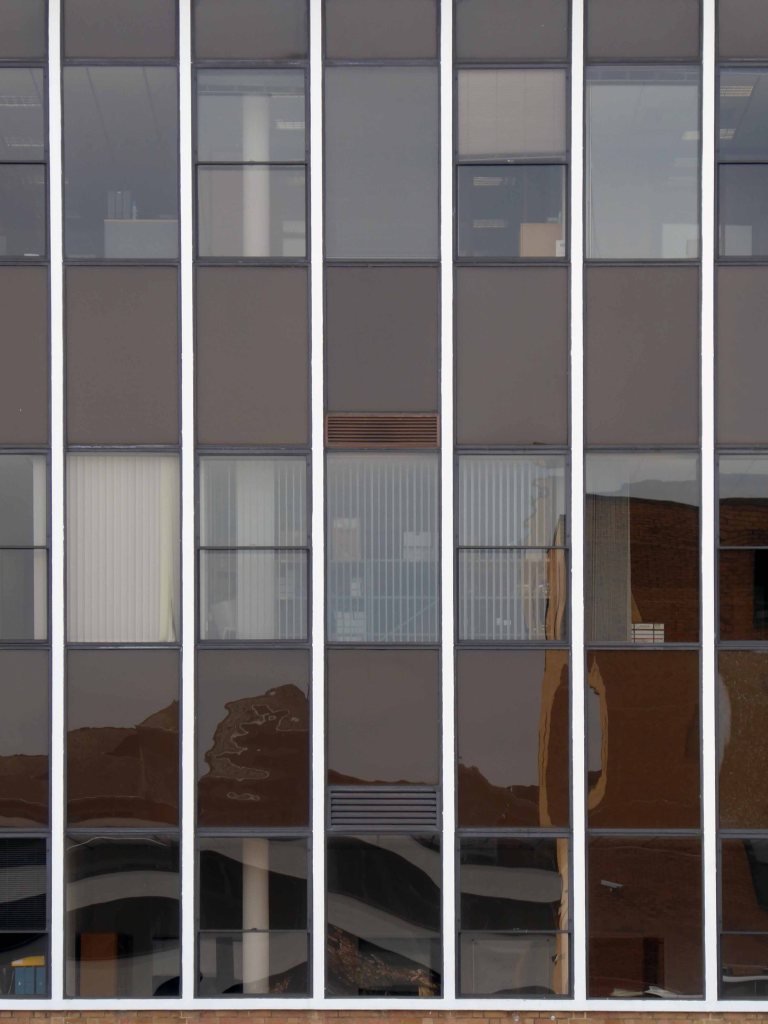
Much remains intact – though gone is the concrete grid and glass brick insertions of the 1954 central section – replaced with a slick glass and steel skin.
And there are unpleasant intrusions made by the fitting of contemporary security and lighting – using intrusive exterior conduit.
It’s a sunny day with a southwest light – there’s nobody about, let’s take a look around.
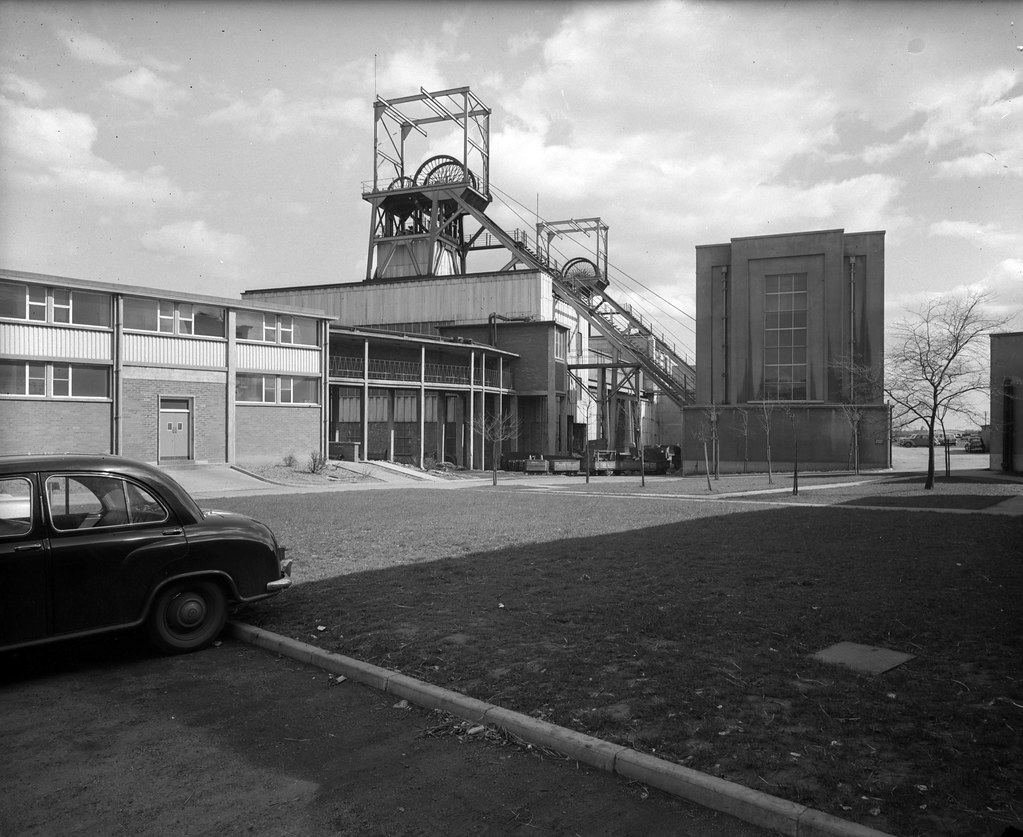
Pebbledashed over white brick. Roofs part concrete slab, part glazed behind parapet. Irregular plan, Modern Movement style. Group of blocks of varying height round tall central tower with rounded, glazed stair turret. Walls mainly sheer, with plinth and slight roof projection.
Long block on east of tower has central south projection with glazed, banded steel double door under high strip of windows beneath eaves overhang. Taller storeroom to west has similar doors in 2 recessed banded glazed bays; and abuts on south-east corner of tower. Similar double doors in base of tower. Large lower south-western canteen wing abuts on west side of tower and has banded glazing around two sides above a projecting sill. Slightly-projecting 3-bay office section to north has steel cross casements; on its return another casement and a door with hollow-chamfered jambs and flat hood. Taller bath block behind. Wave pattern on rainwater heads.
This is the youngest colliery in the neighbourhood, having commenced operations for the Ashington Coal Co Lt. in 1934. The shafts, which are situated comparatively near to the coast, are two in number, and both were sunk to the High Main seam level, which is 486 ft from the surface. The downcast No. 1 is 18 ft in diameter and is used for coal-raising on two shifts per day, and the upcast, which has a diameter of 15 ft, is used for ventilation and emergency man riding only.
The seams being worked are the High Main, the Diamond, the Main, and the Yard. Each of these seams shows practically the same nature of roof and floor as throughout the two neighbouring collieries and the distance between the seams is also comparable. They are, of course, found at slightly greater depths at Lynemouth, the Yard seam, for example, being 660 ft. below the surface near to the shafts, as compared with some 300 ft. at Ellington.
It was one of Britain’s largest collieries until it was closed in 1994.
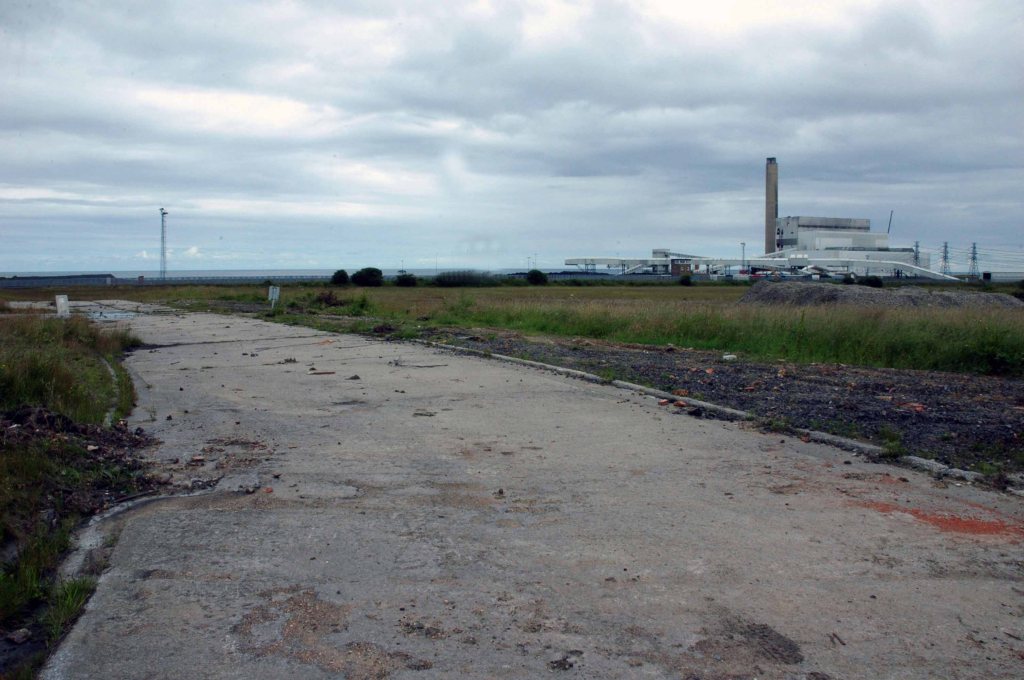
I was cycling the coast in July 2012 and happened by, seeing the tower of the baths from an adjacent path, passing by the faded signage.
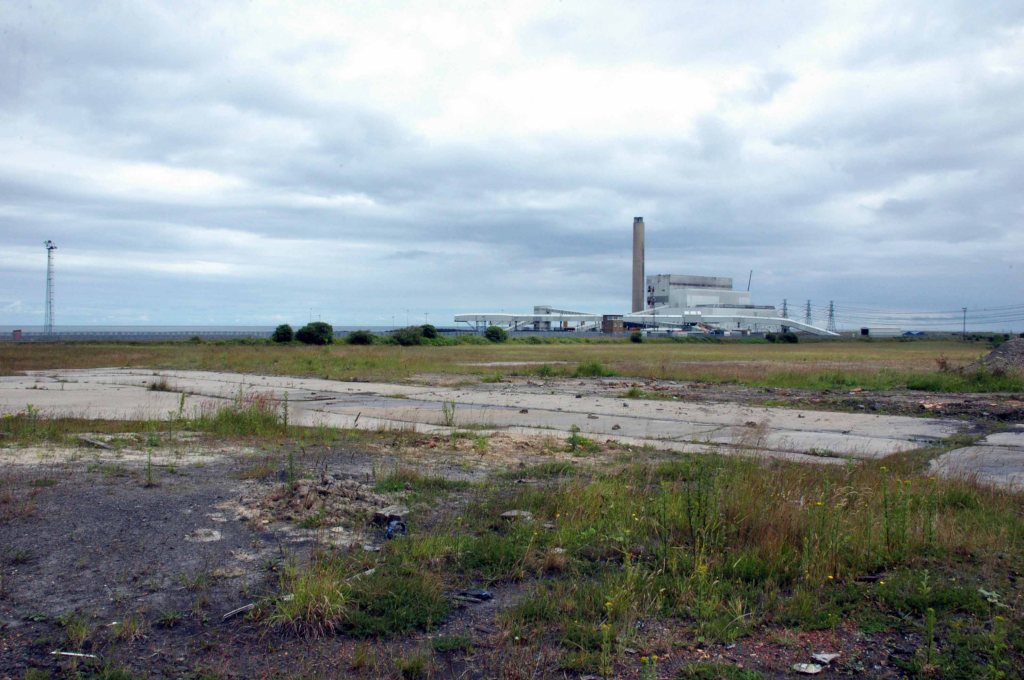
Into the raw expanse of a now empty post-industrial landscape.
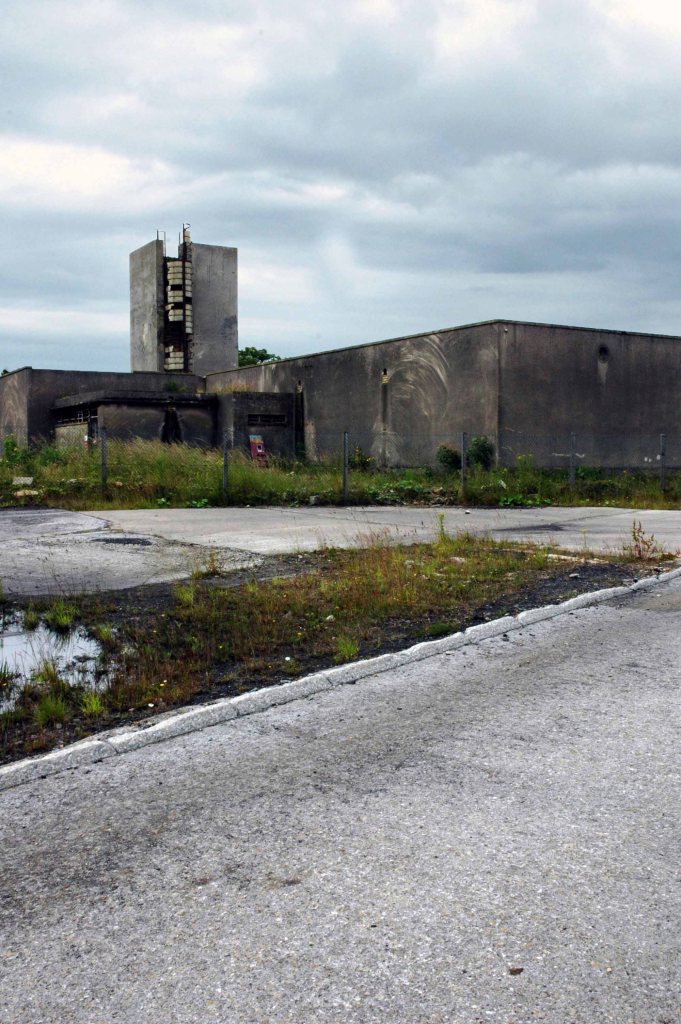
And on towards the bath house.
I am not by nature an urbex urban explorer, simply an explorer.
Entering the open site, I was well aware of the significance of the building and its history – working lives that had constructed the baths, entered and left through those very same doors.
Well of course we’ve all been here before, haven’t we?
Well I have – I even wrote all about it right here.
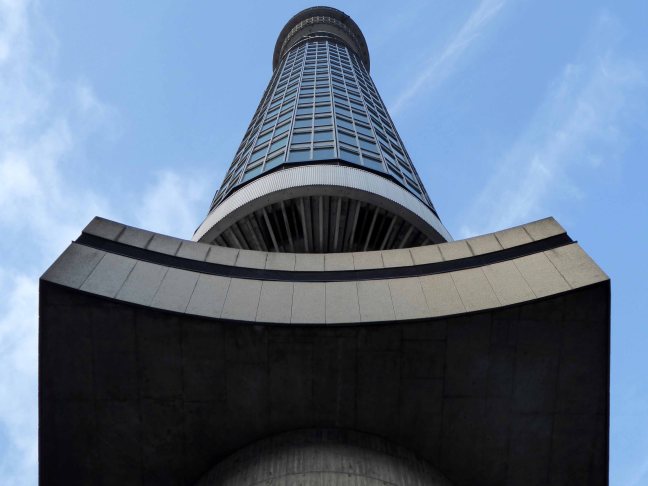
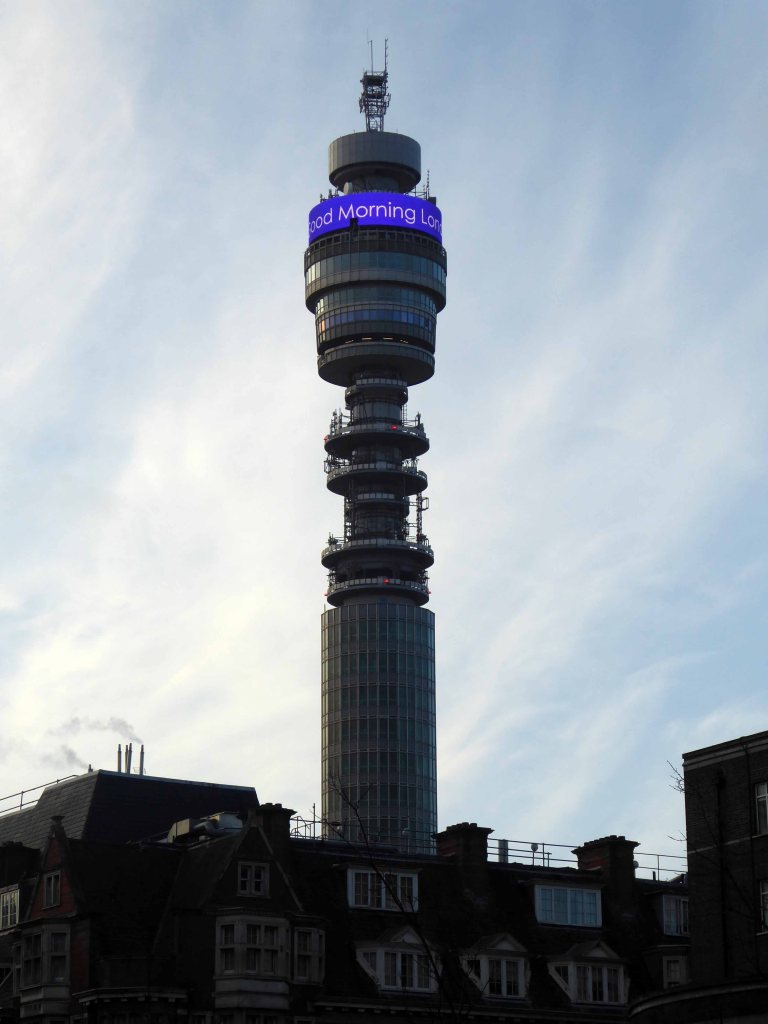
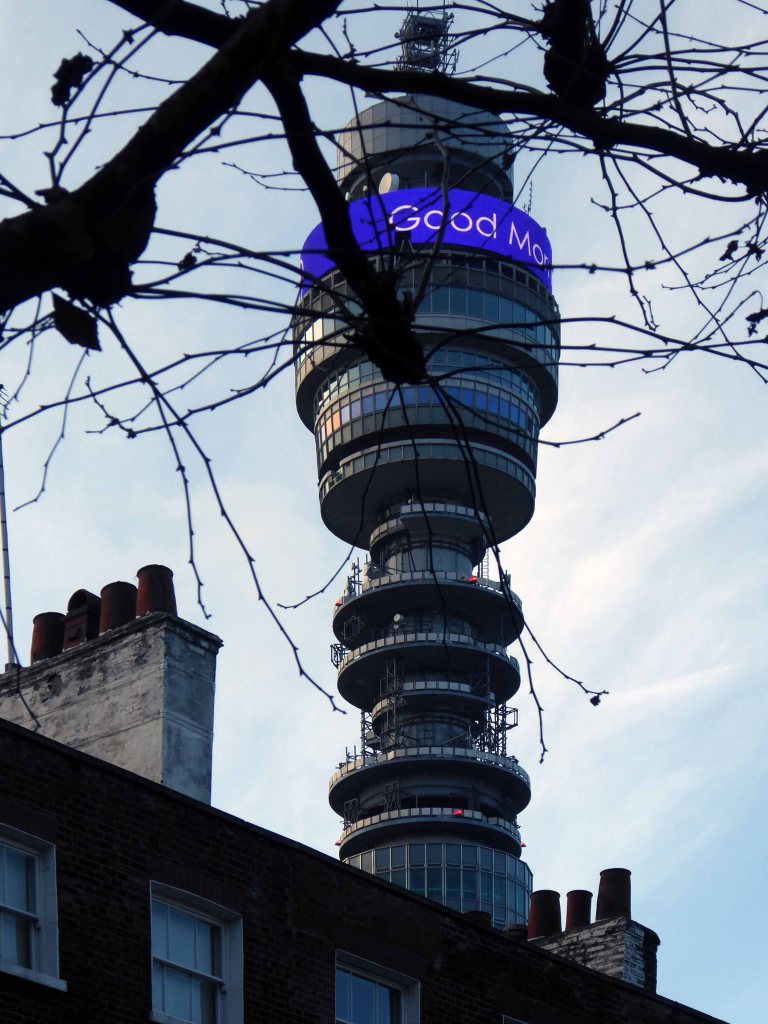
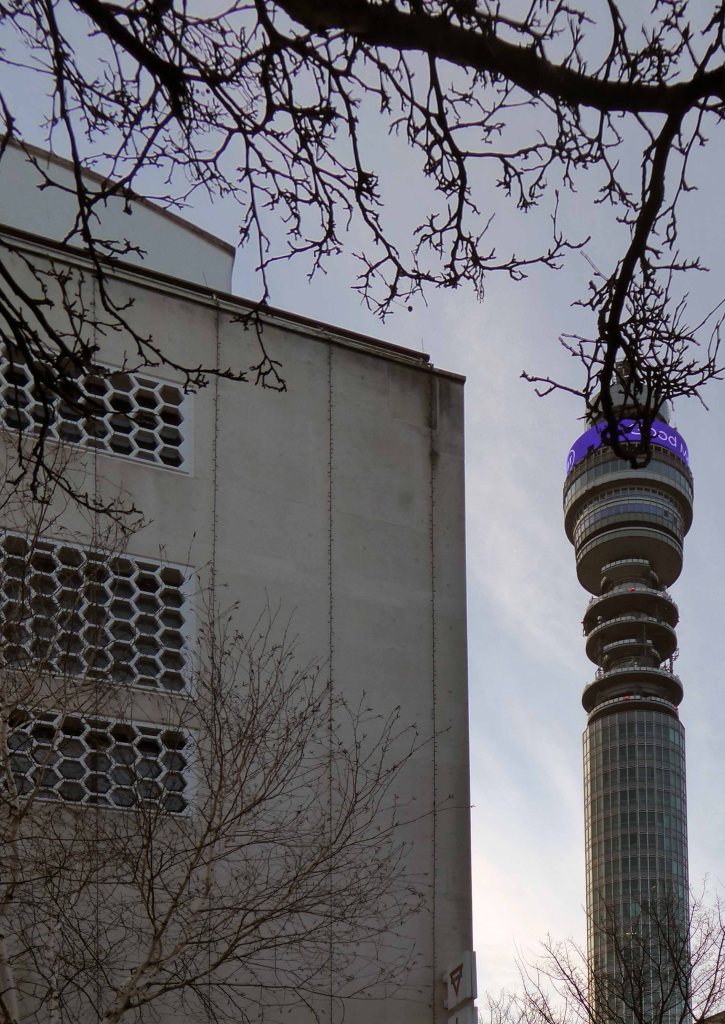
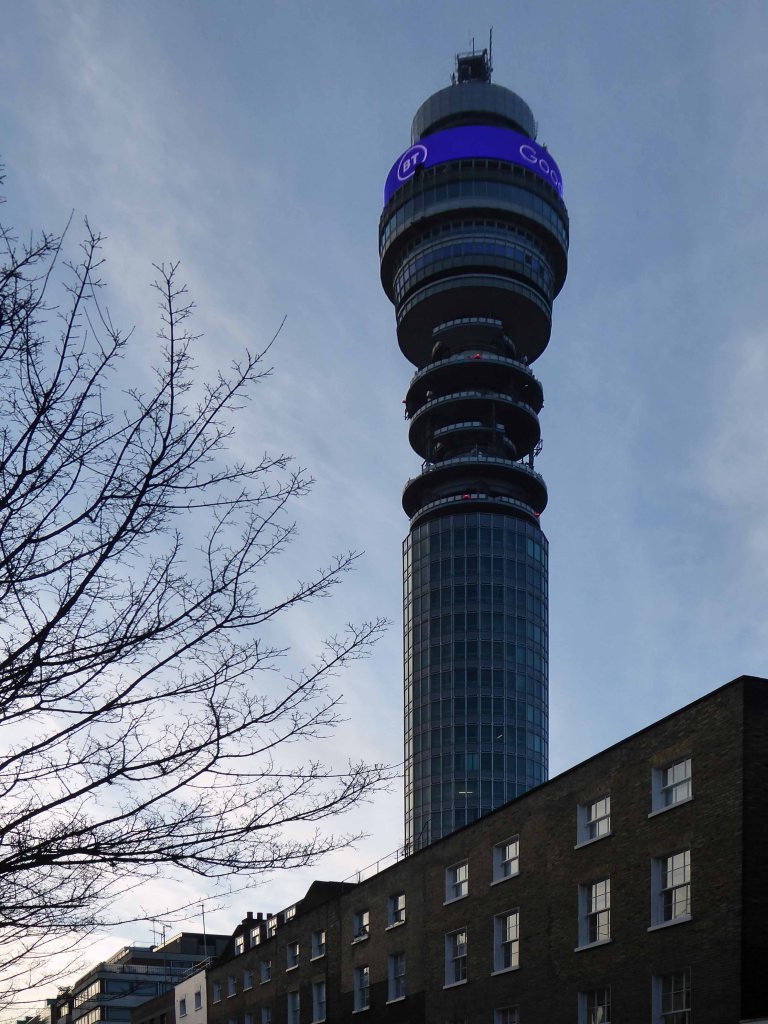
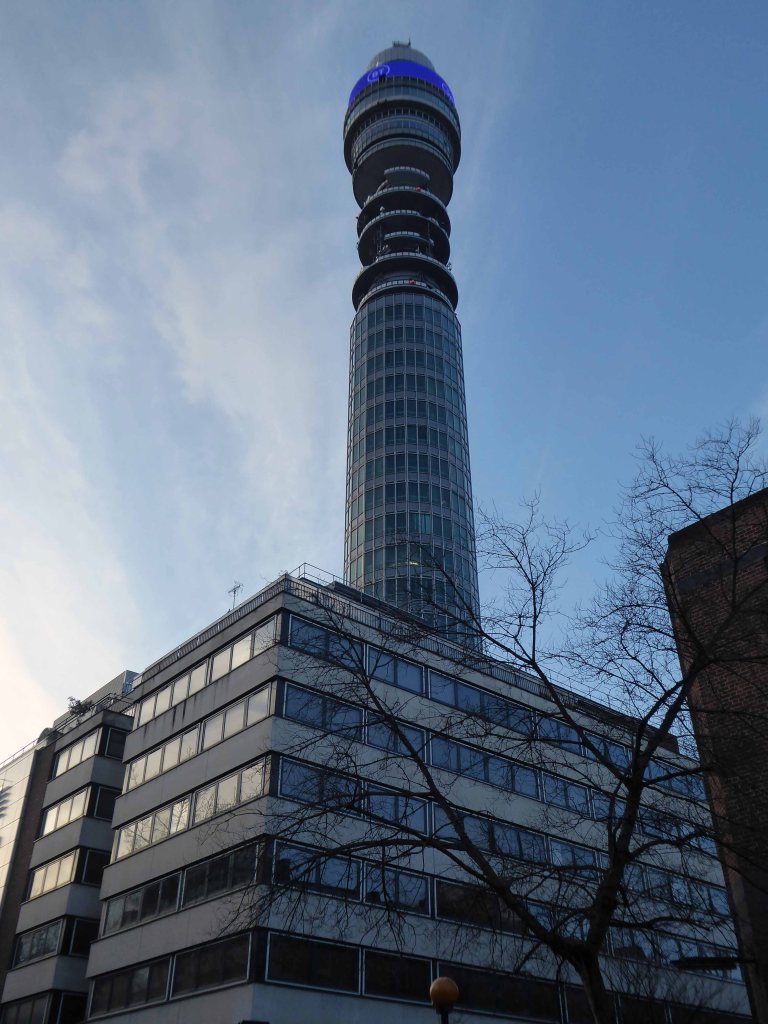
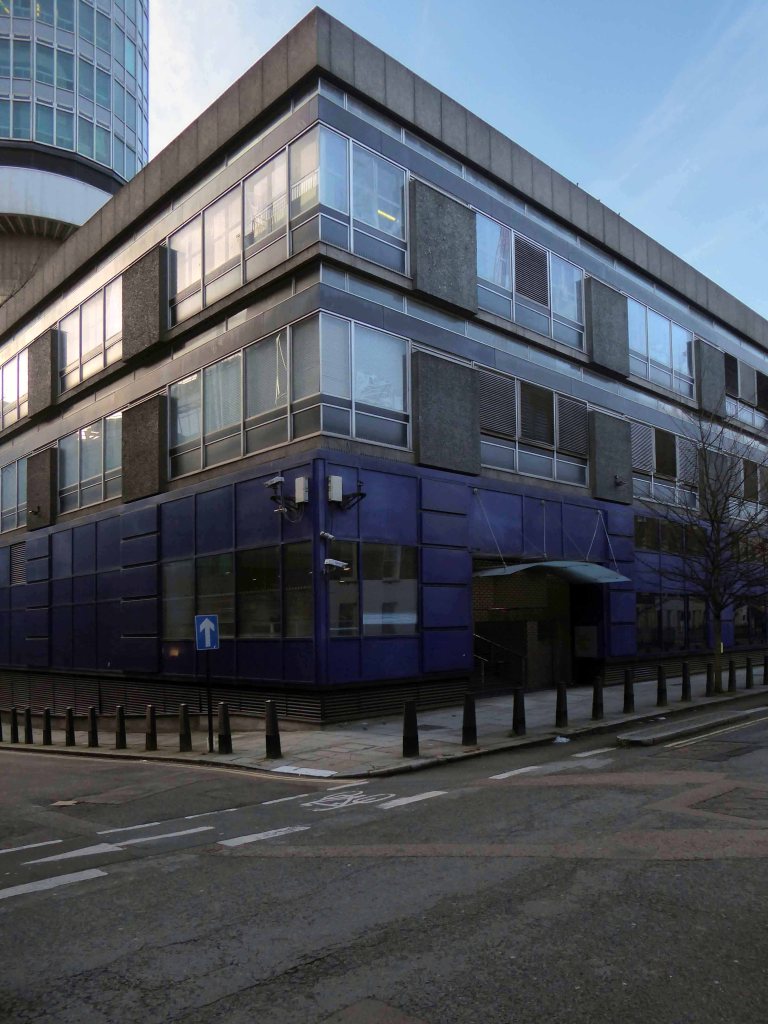
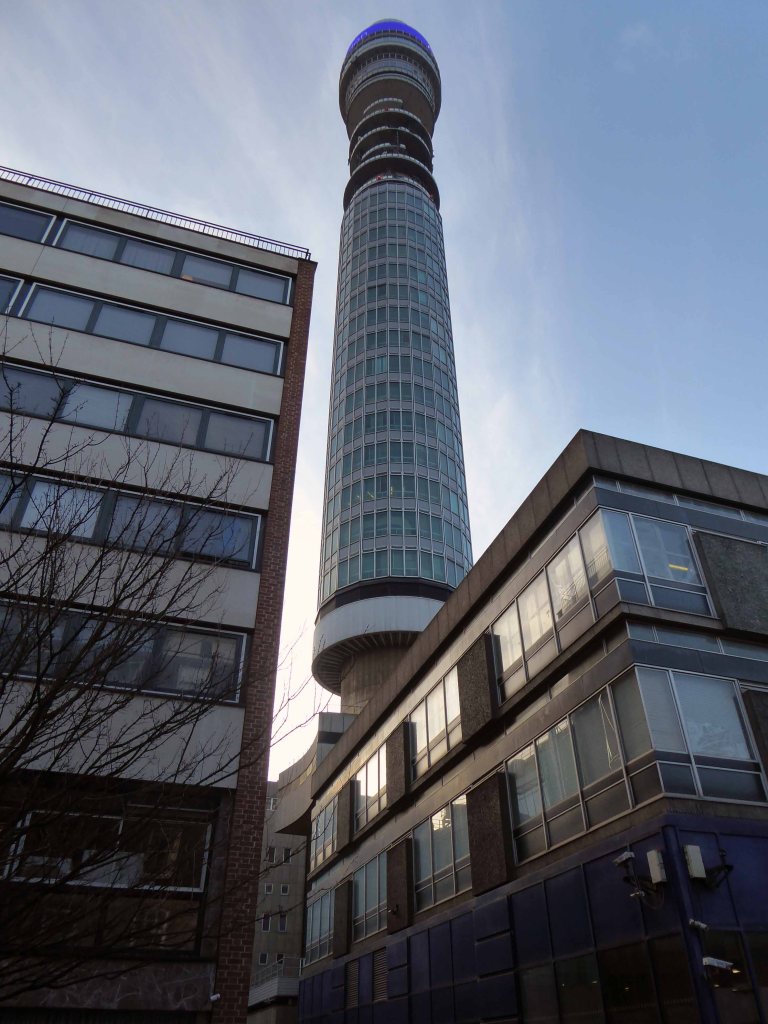
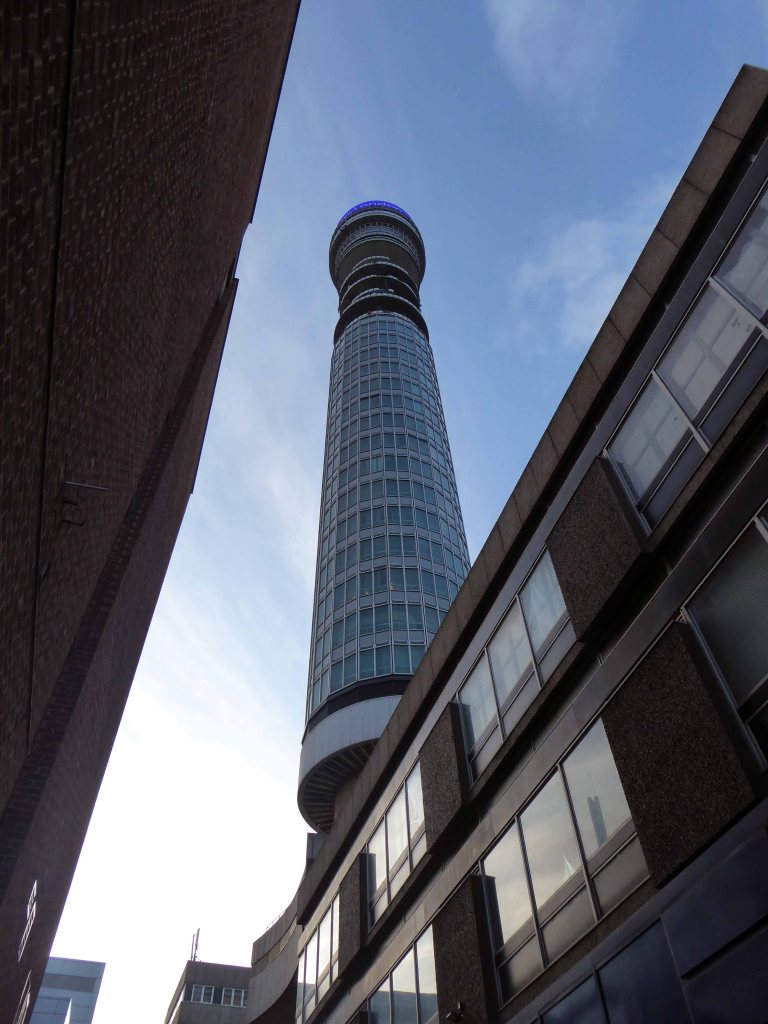
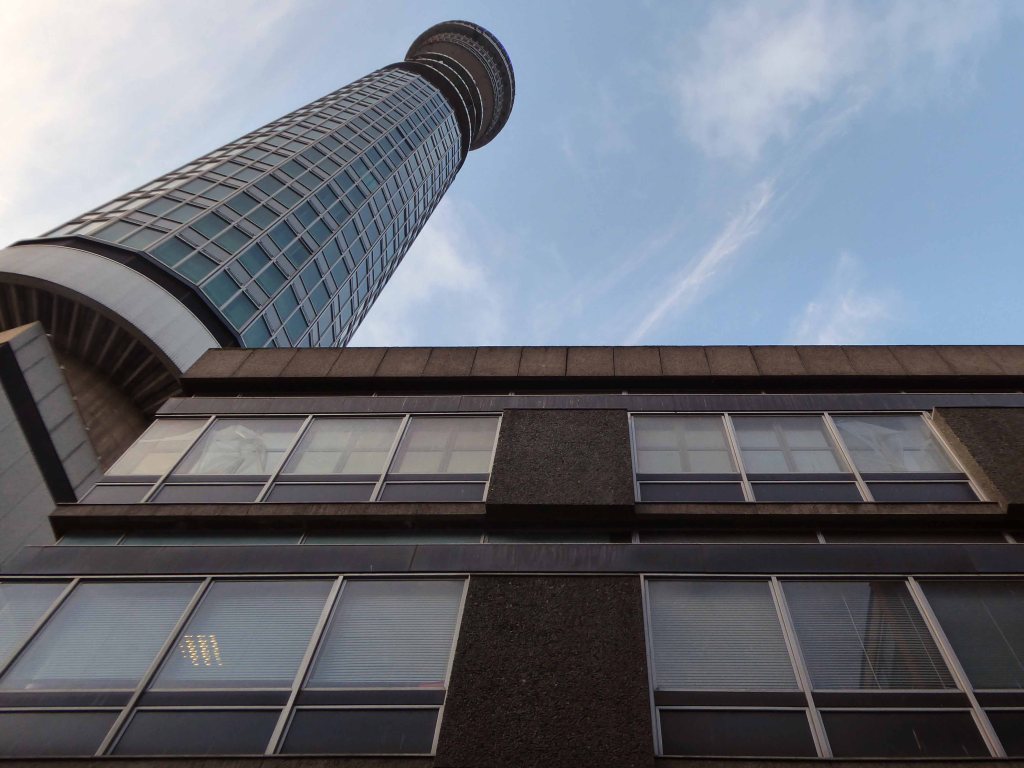
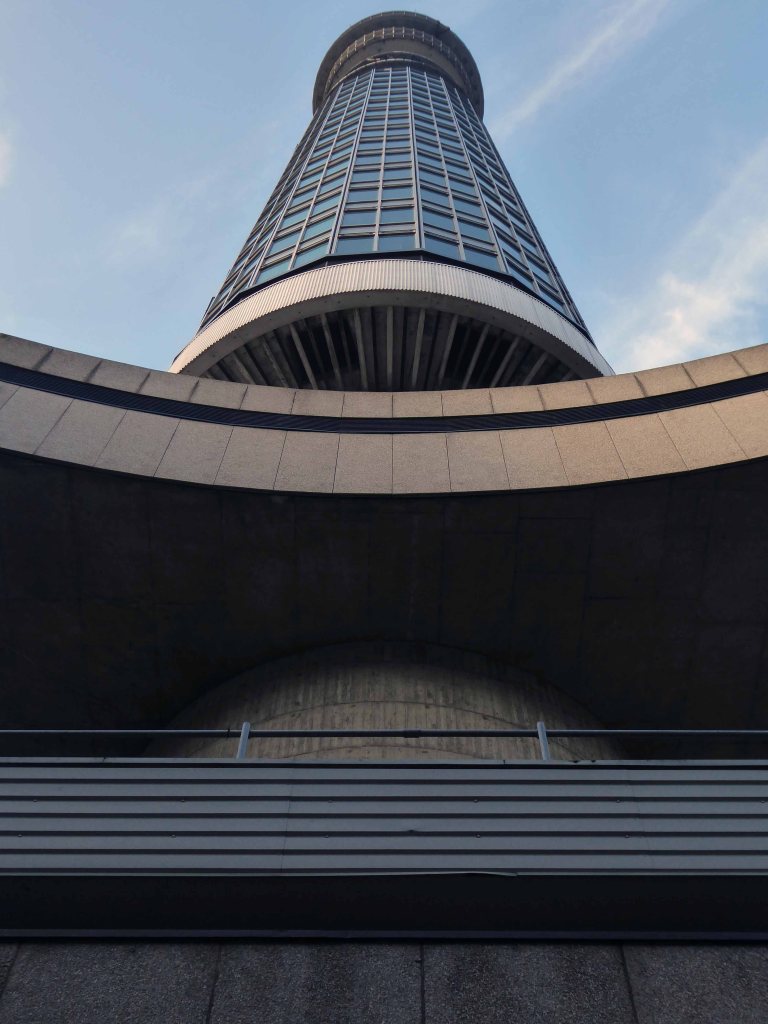
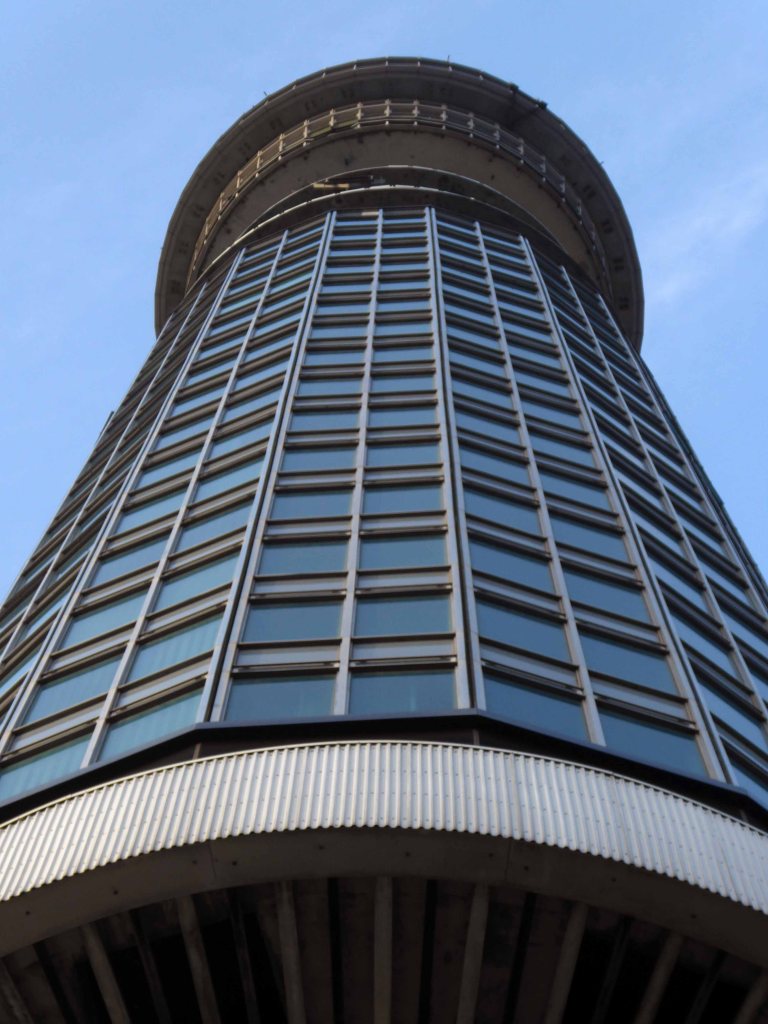
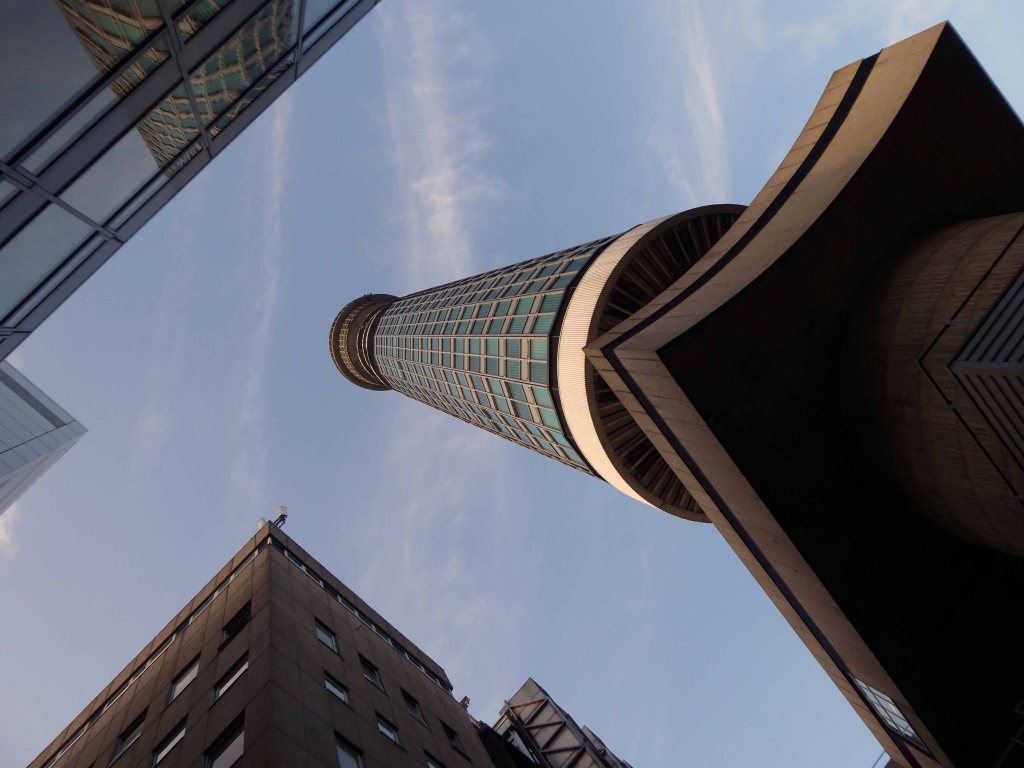
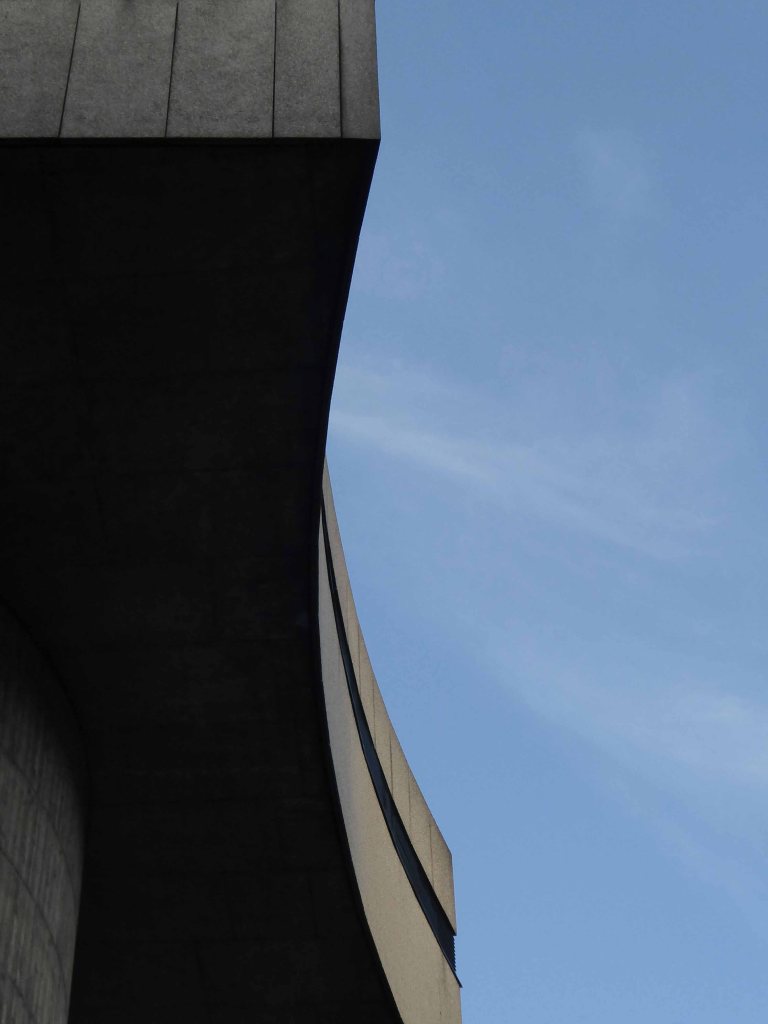
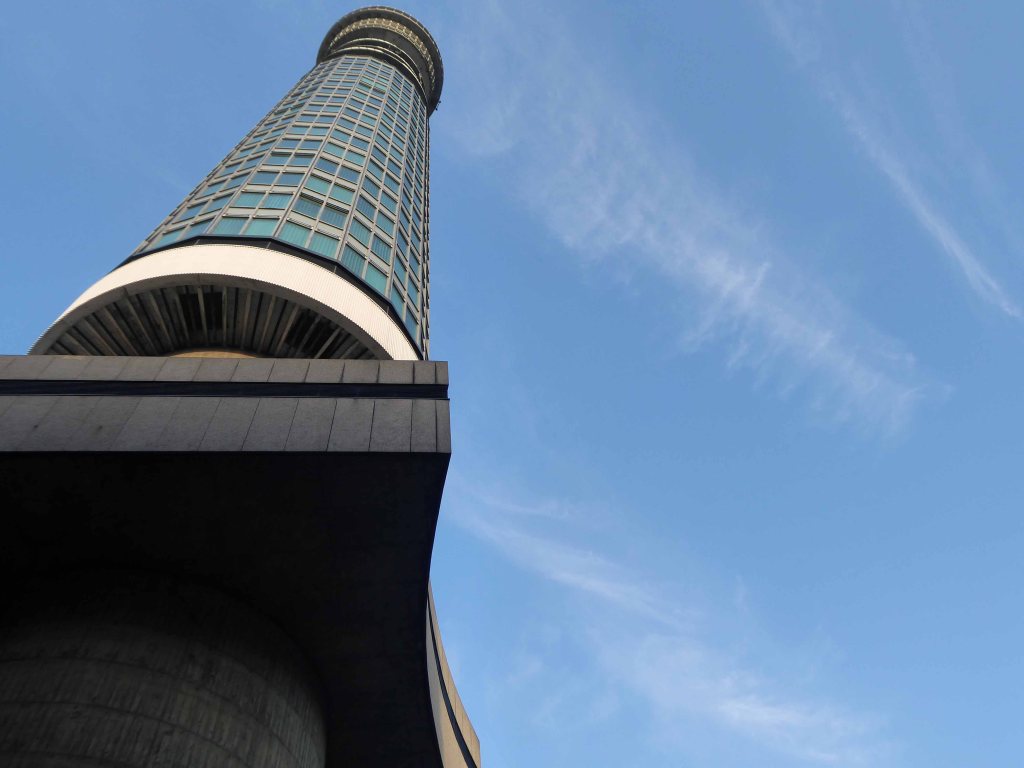
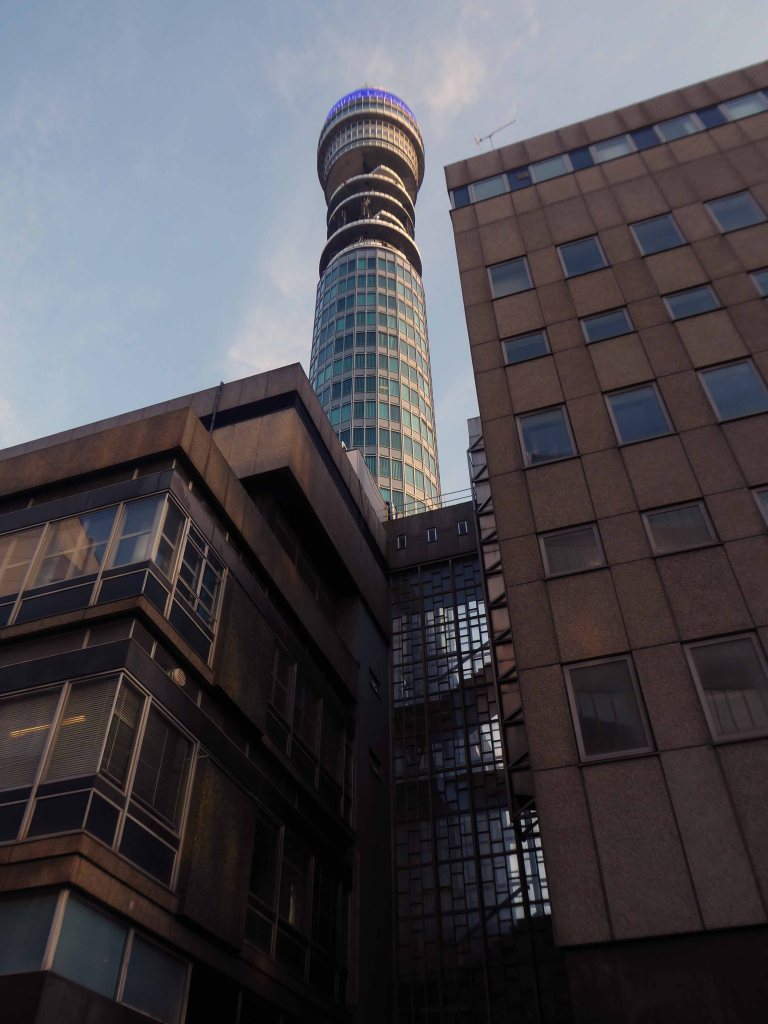
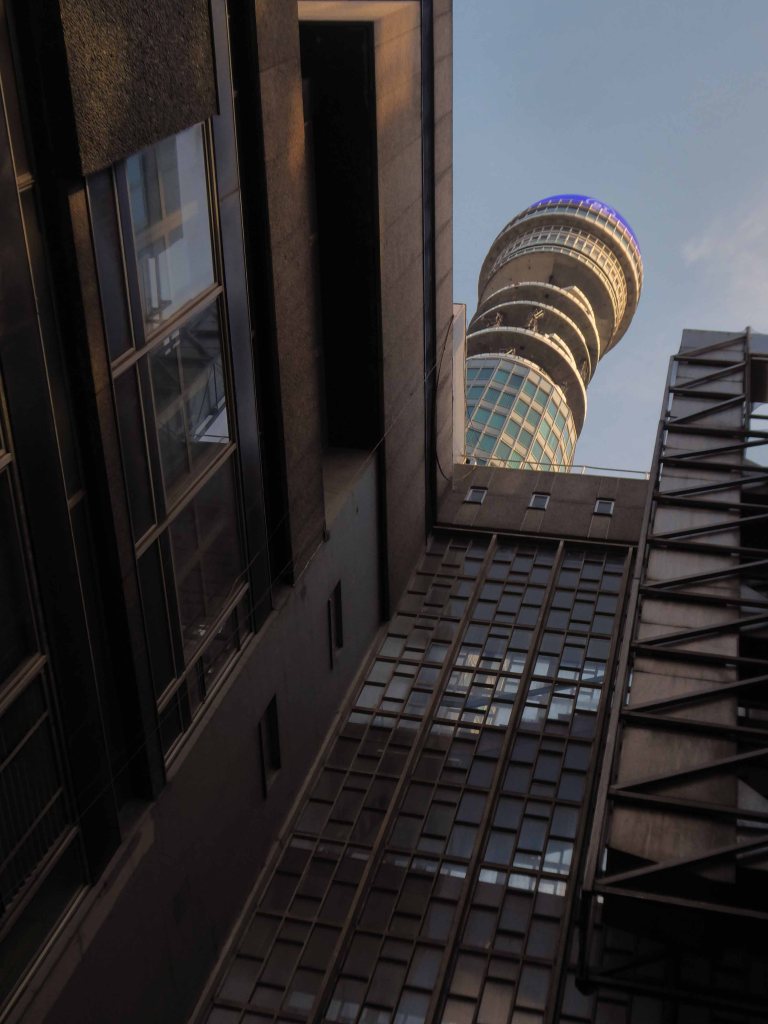
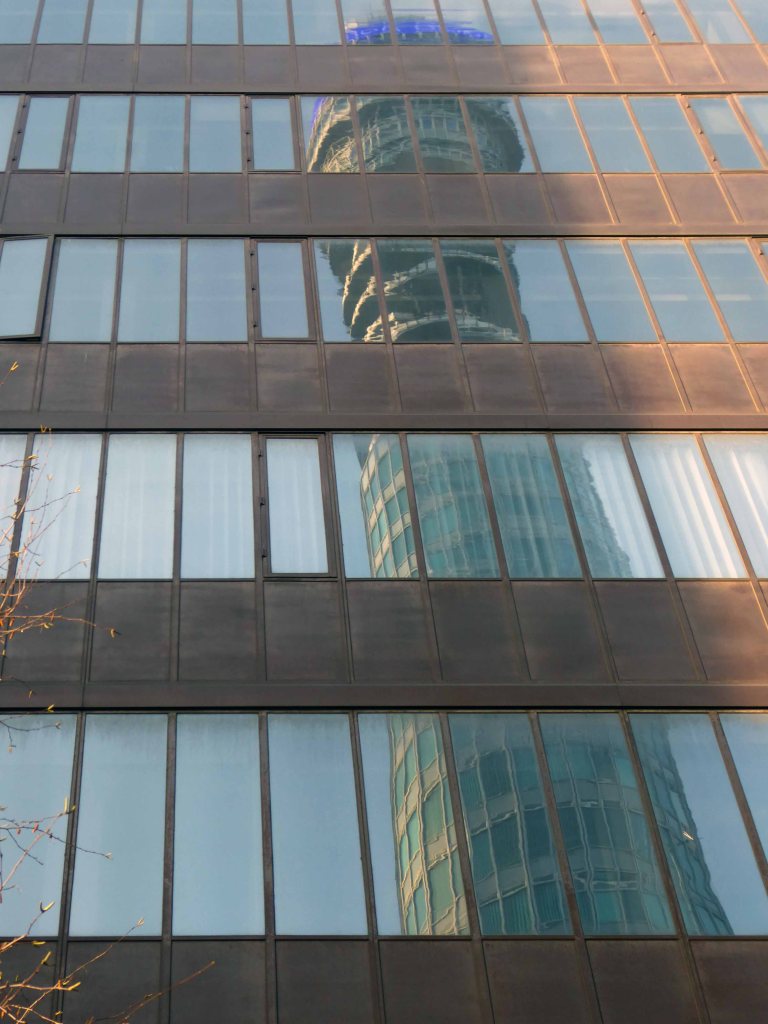
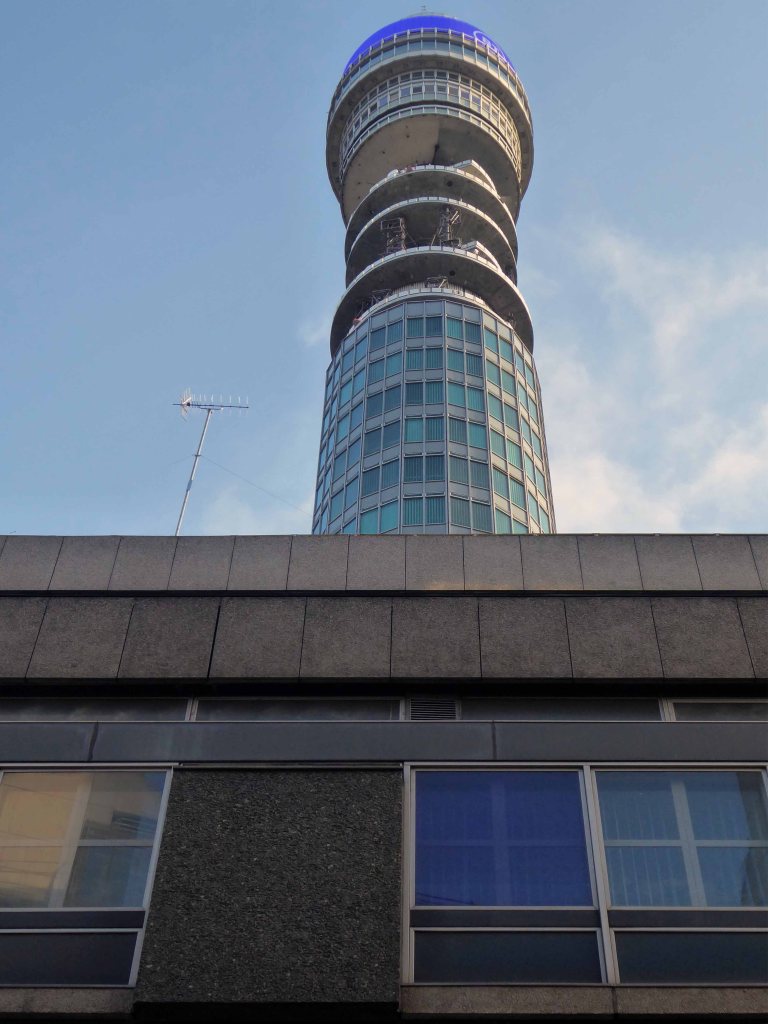
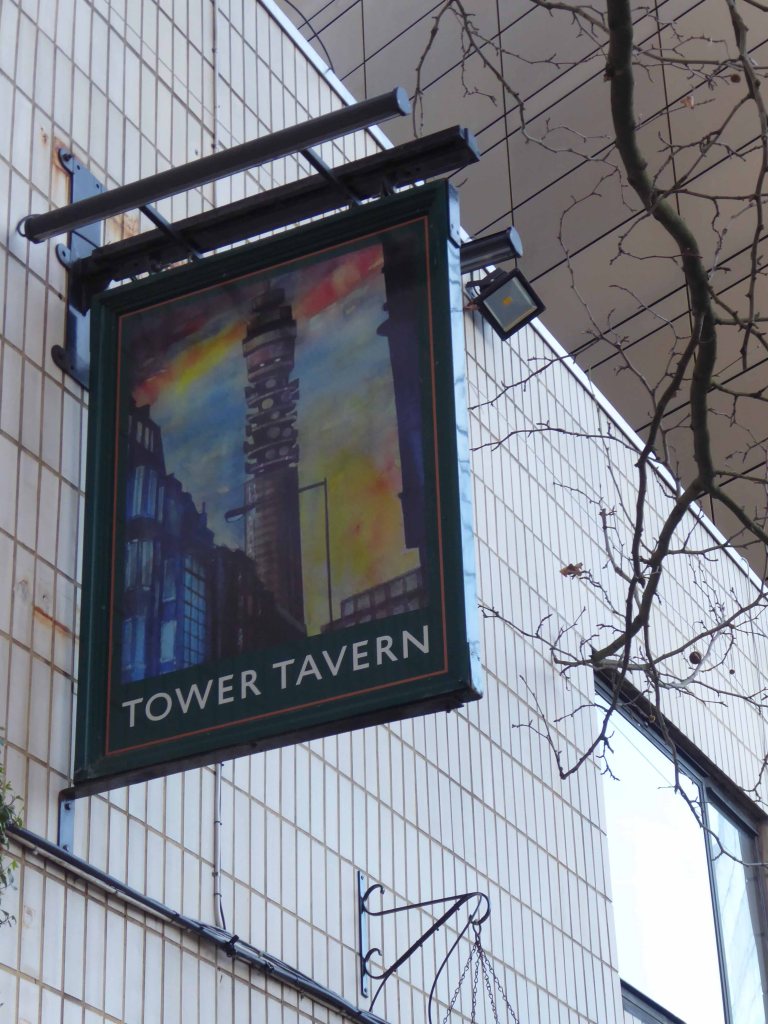
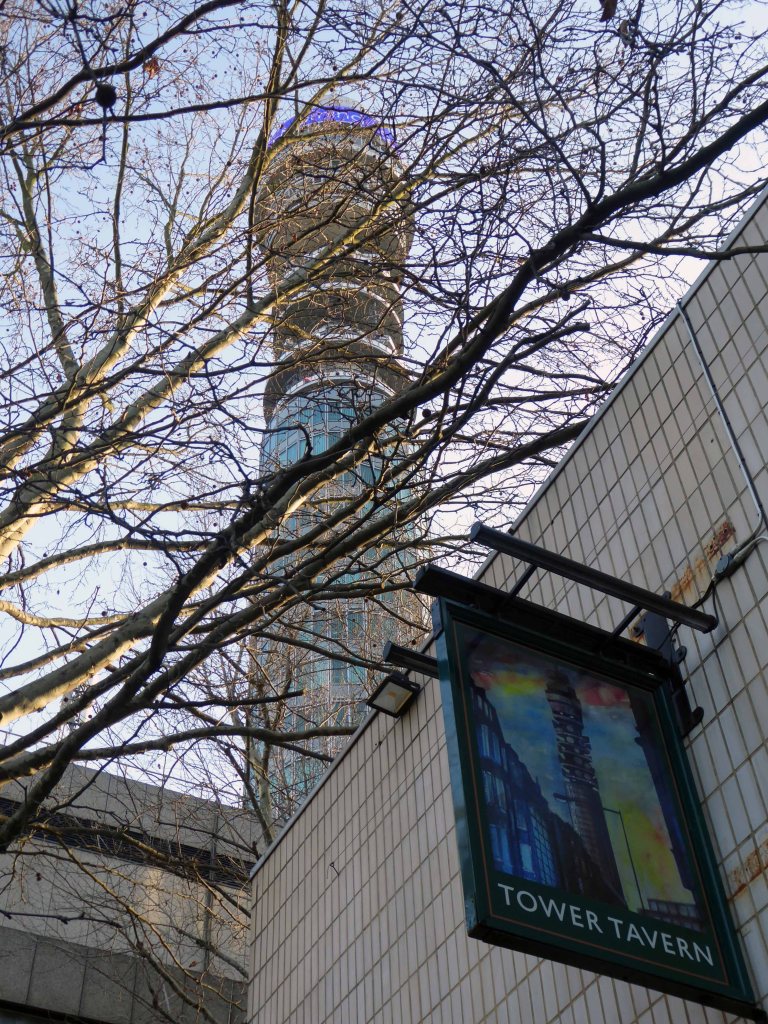
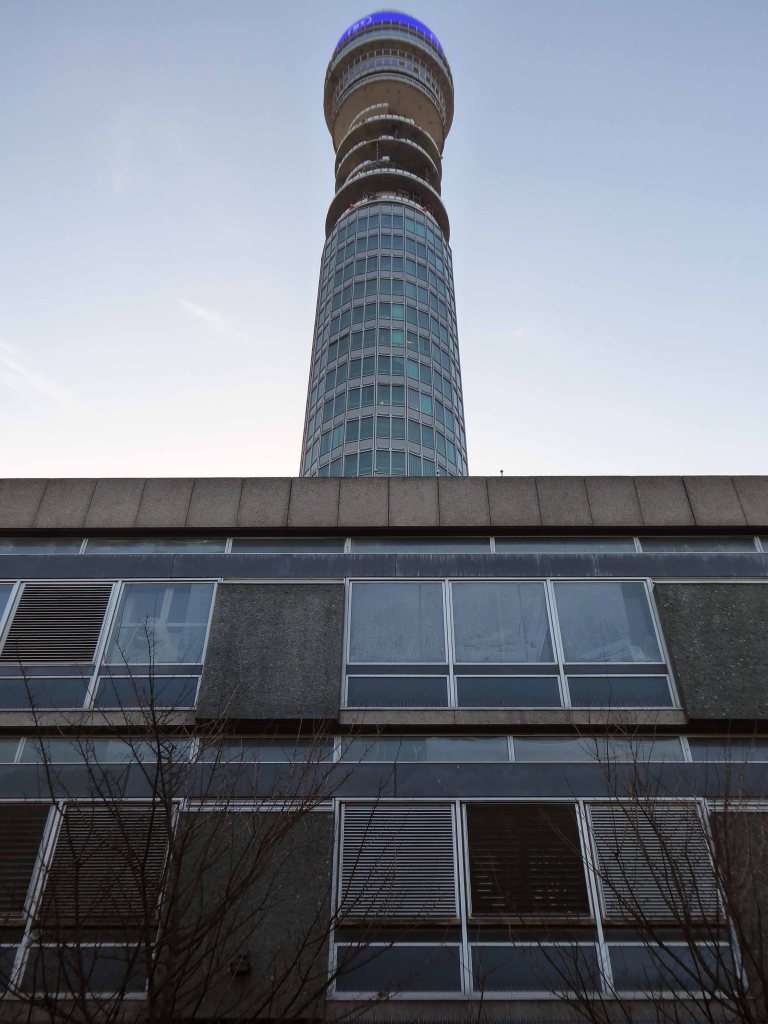
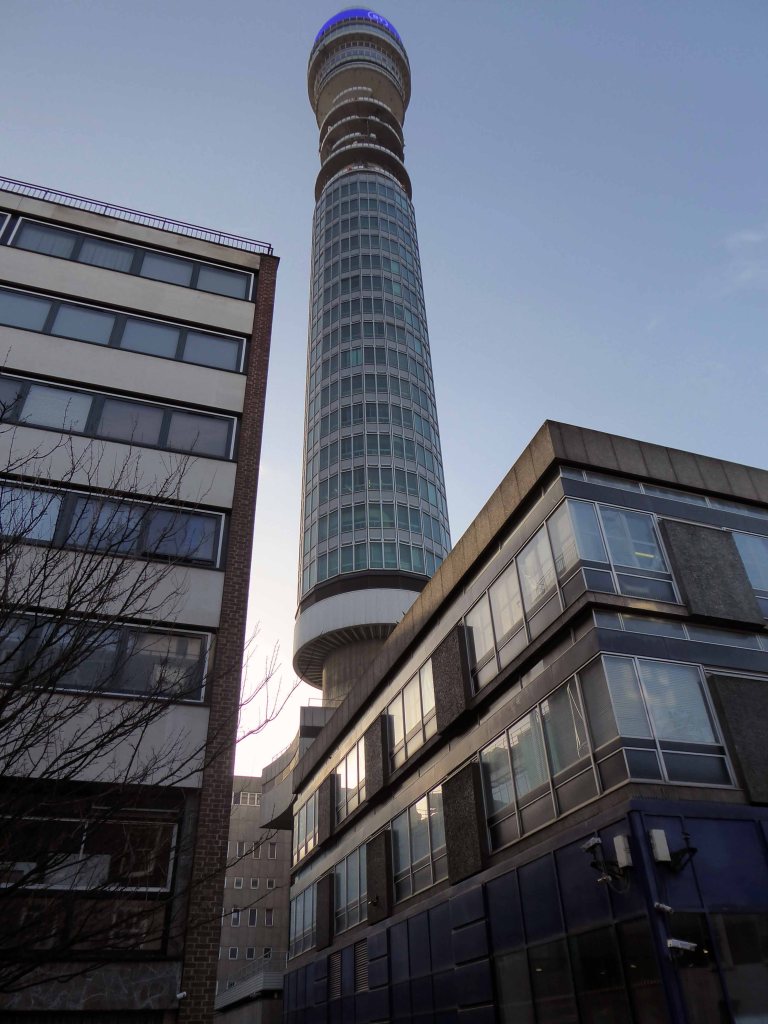
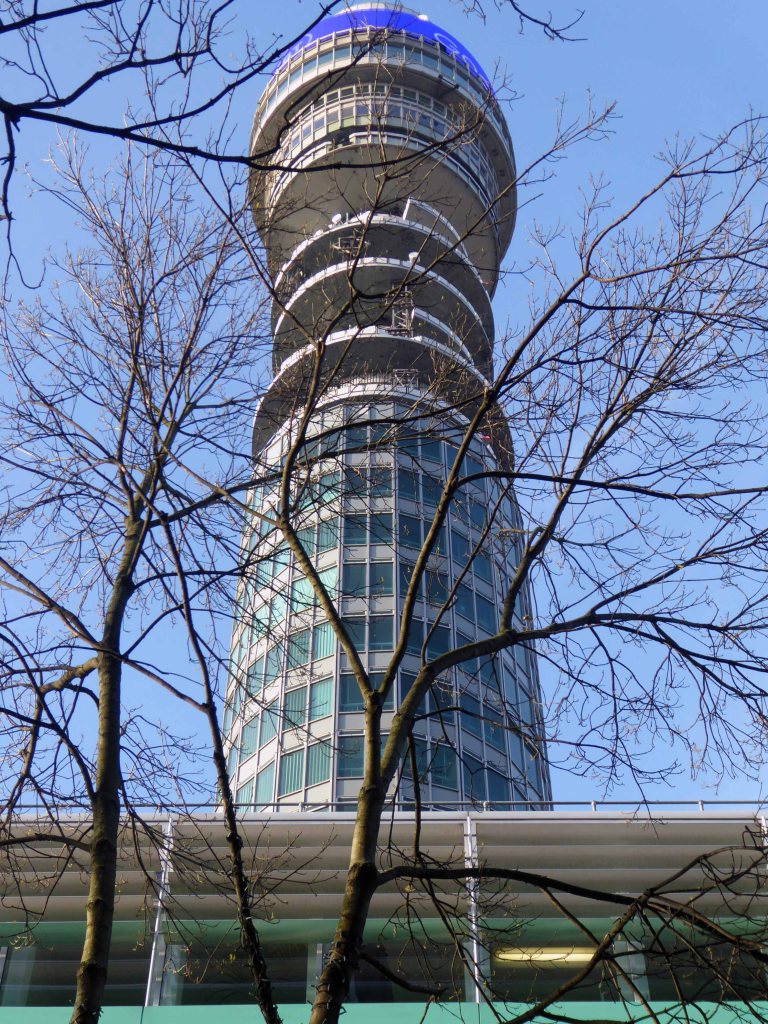
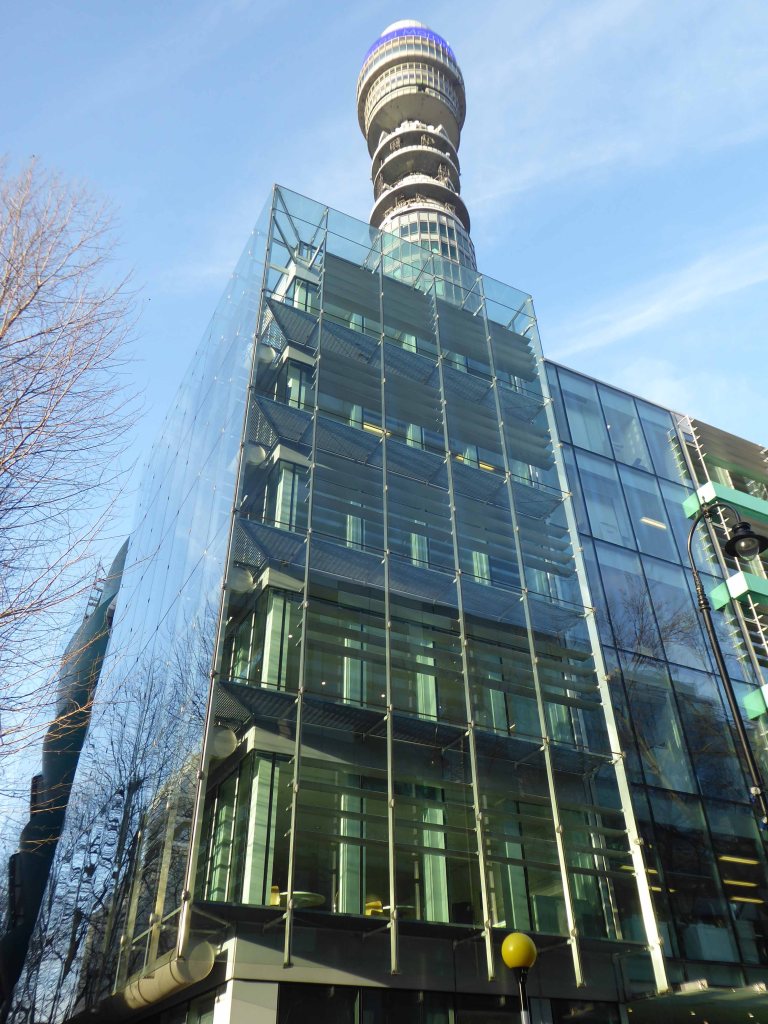
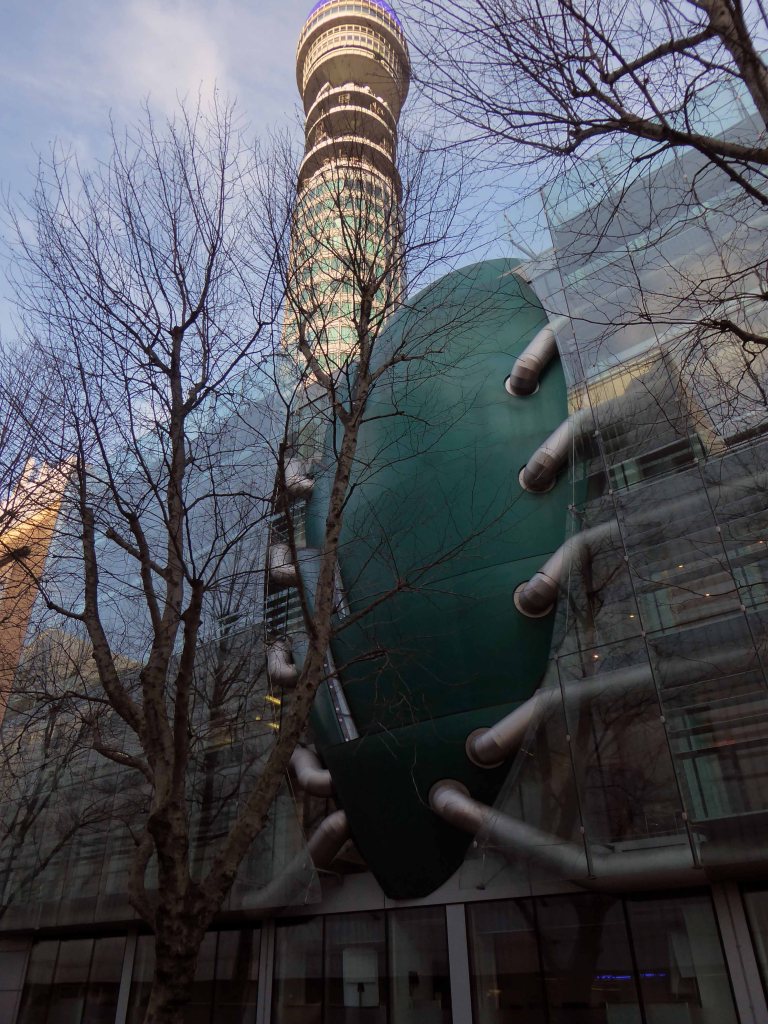
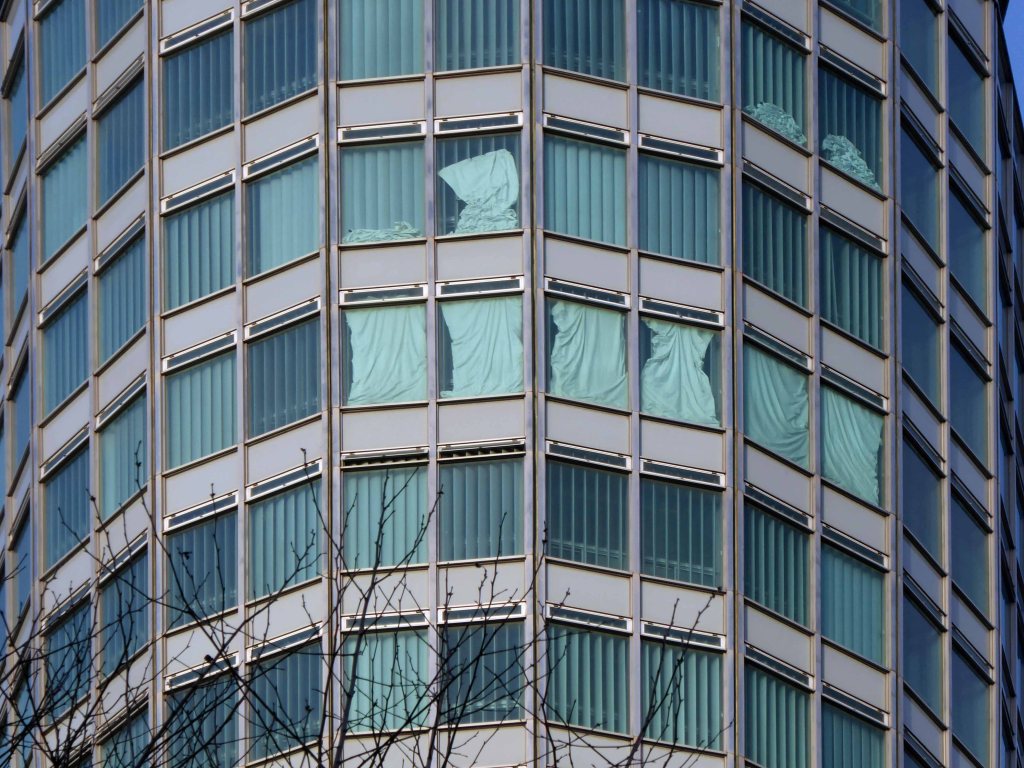
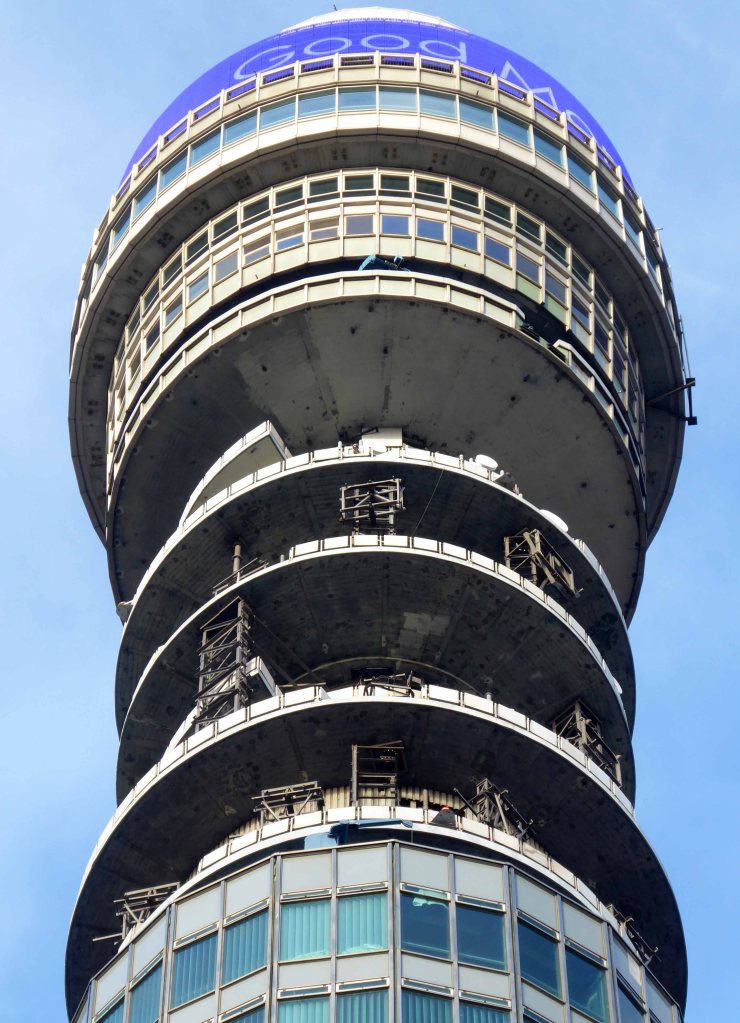
The tower was designed by the architects of the Ministry of Public Building and Works: the chief architects were Eric Bedford and G. R. Yeats. Typical for its time, the building is concrete clad in glass. The narrow cylindrical shape was chosen because of the requirements of the communications aerials: the building will shift no more than 25 centimetres in wind speeds of up to 95 mph. Initially, the first 16 floors were for technical equipment and power. Above that was a 35-metre section for the microwave aerials, and above that were six floors of suites, kitchens, technical equipment and finally a cantilevered steel lattice tower. To prevent heat build-up, the glass cladding was of a special tint. The construction cost was £2.5 million.
The tower was topped out on 15 July 1964, and officially opened by the then Prime Minister Harold Wilson on 8 October 1965. The main contractor was Peter Lind & Co Ltd.
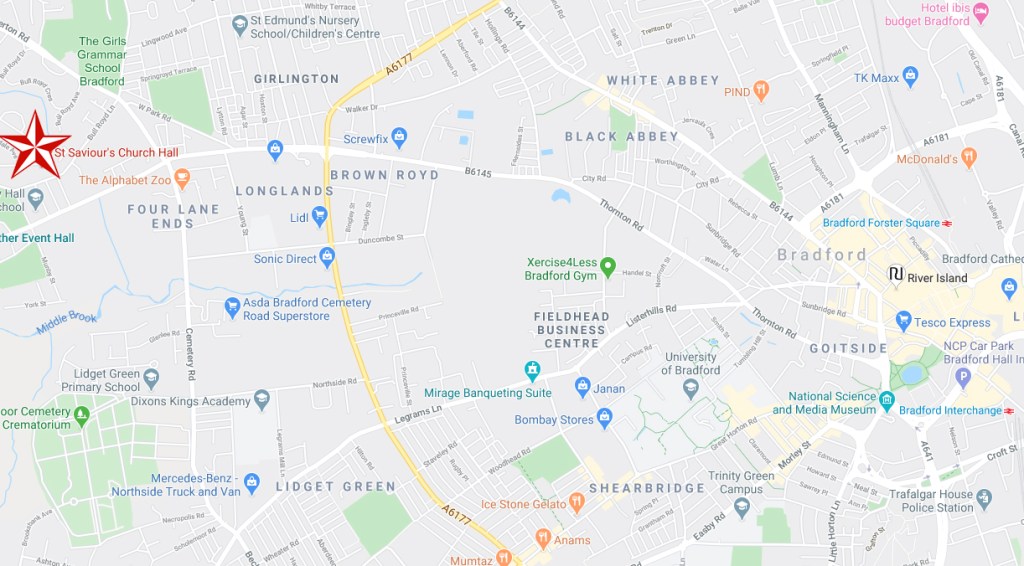
What a delight – the stunning surprise that awaits you, around one particular suburban corner of Bradford.
I had called ahead, to arrange the visit – the Reverend Dorothy Stewart had gracefully invited me to join members of the community and herself, one wild and windy Wednesday.
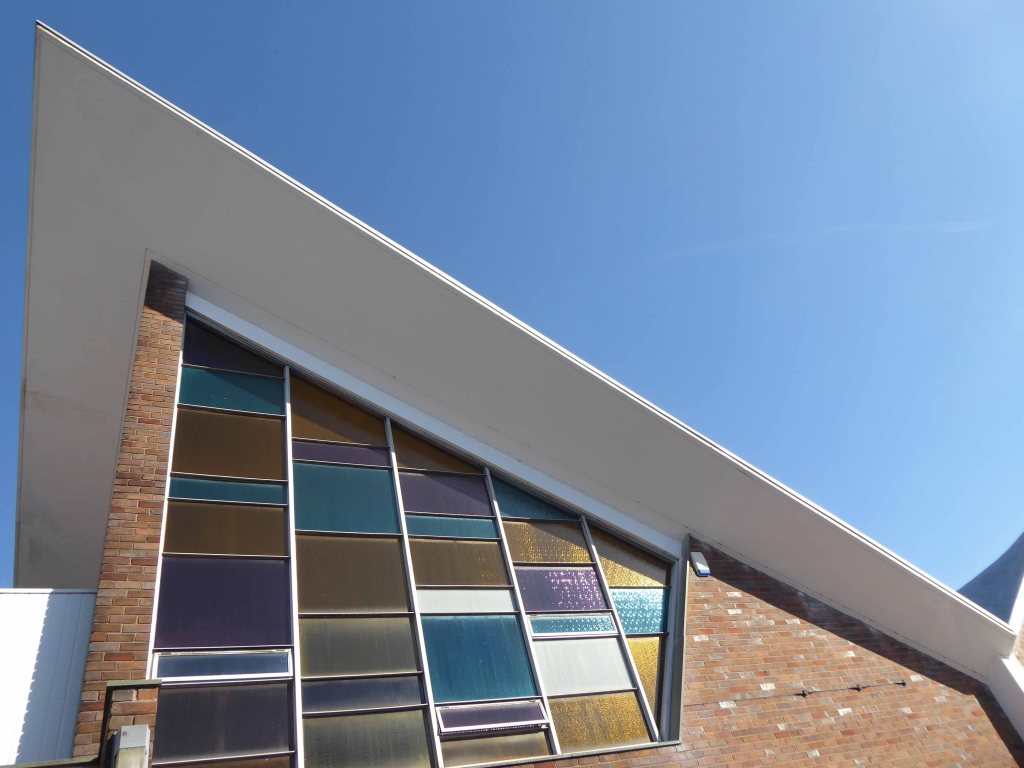
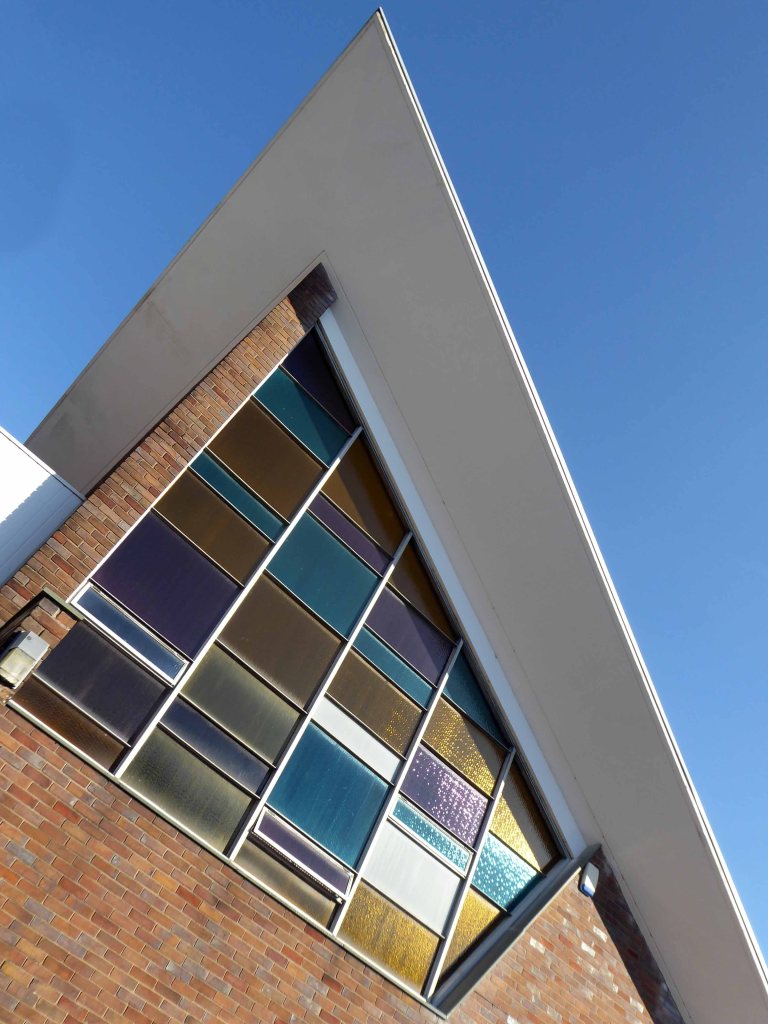
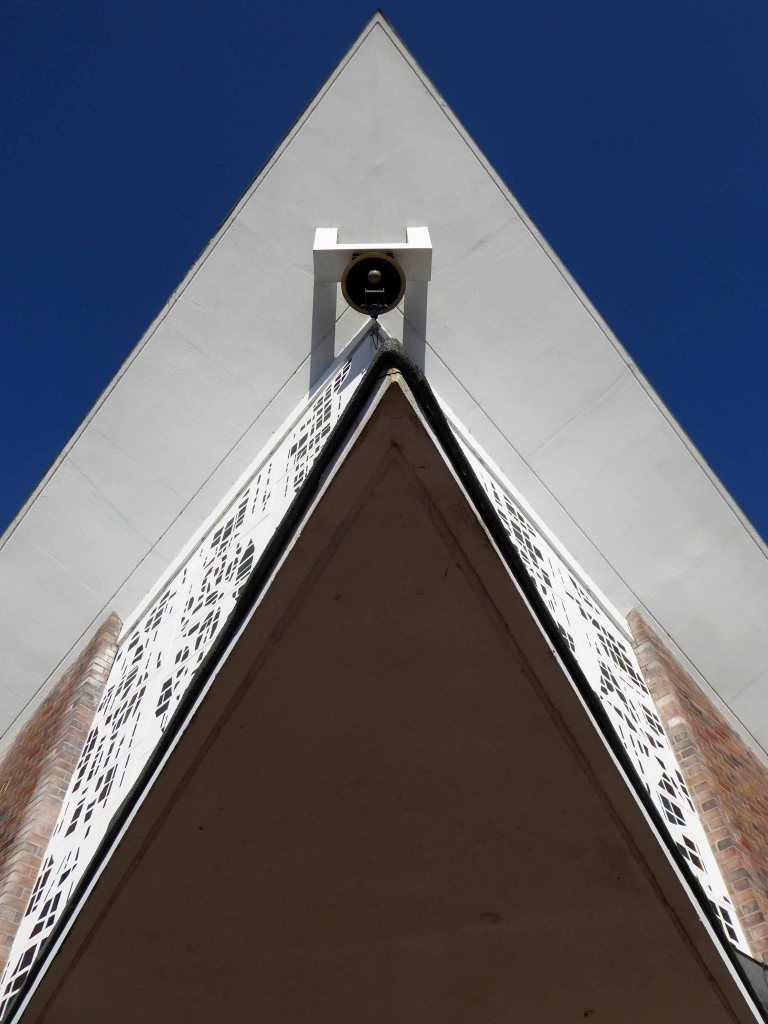
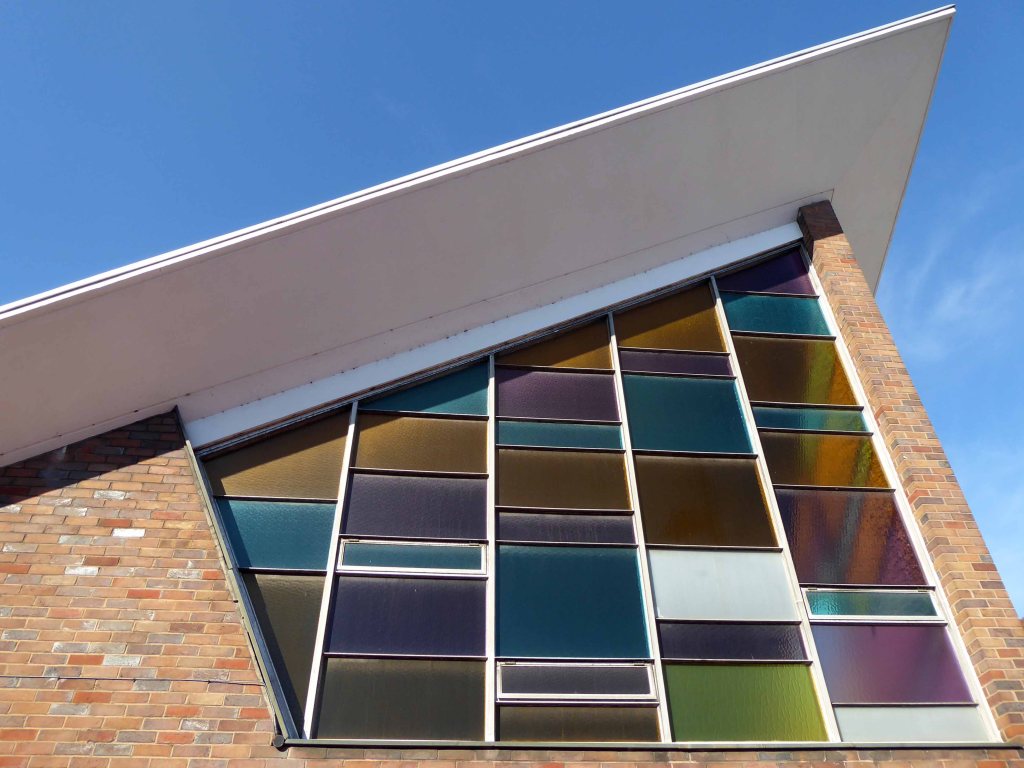
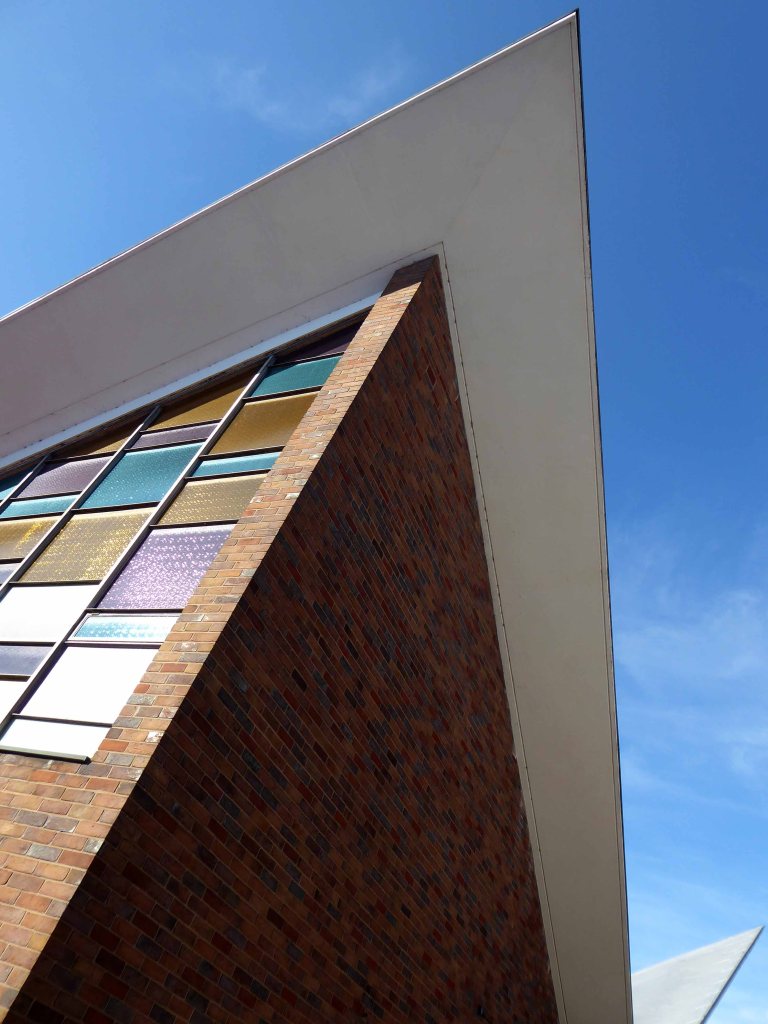
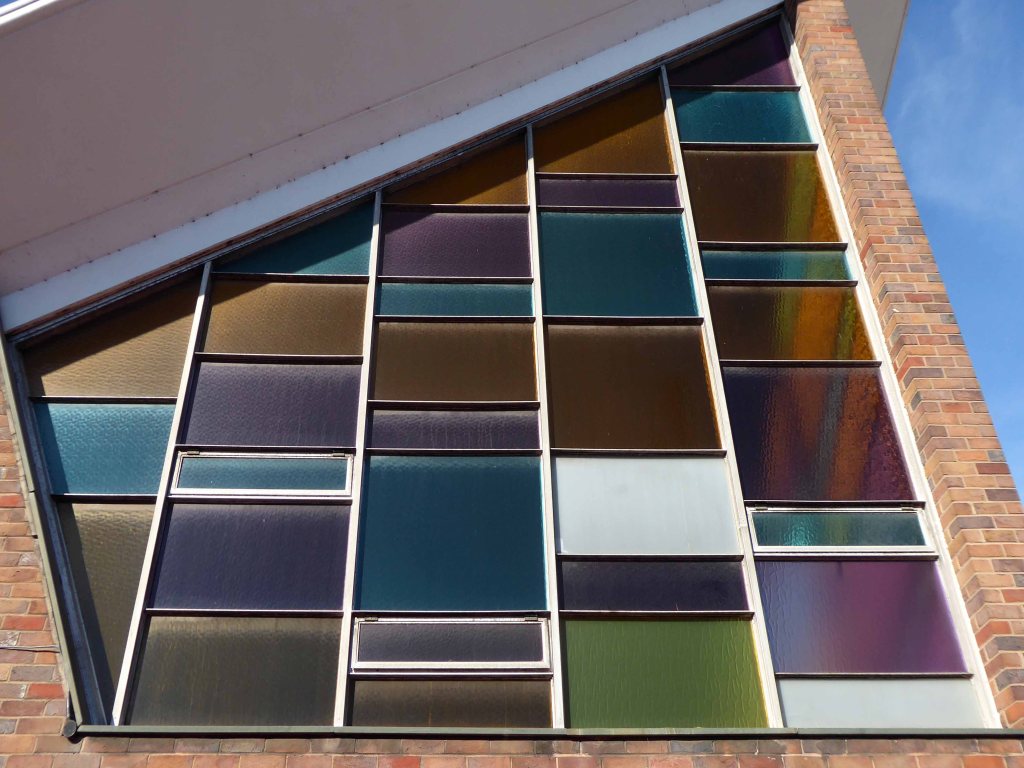
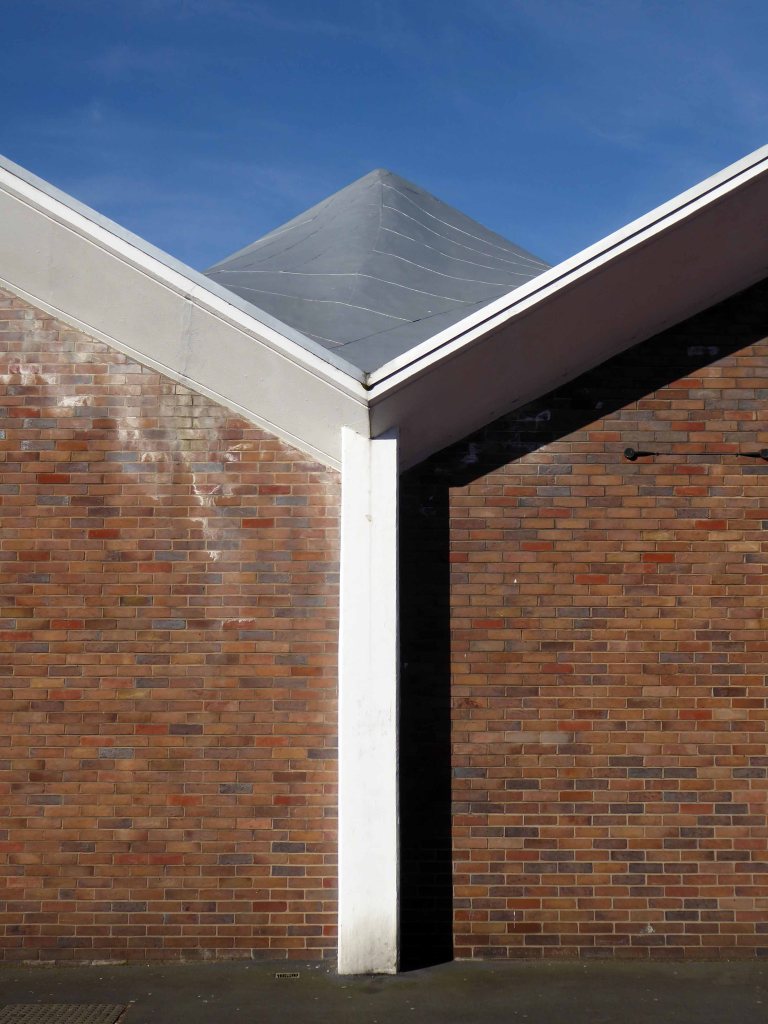
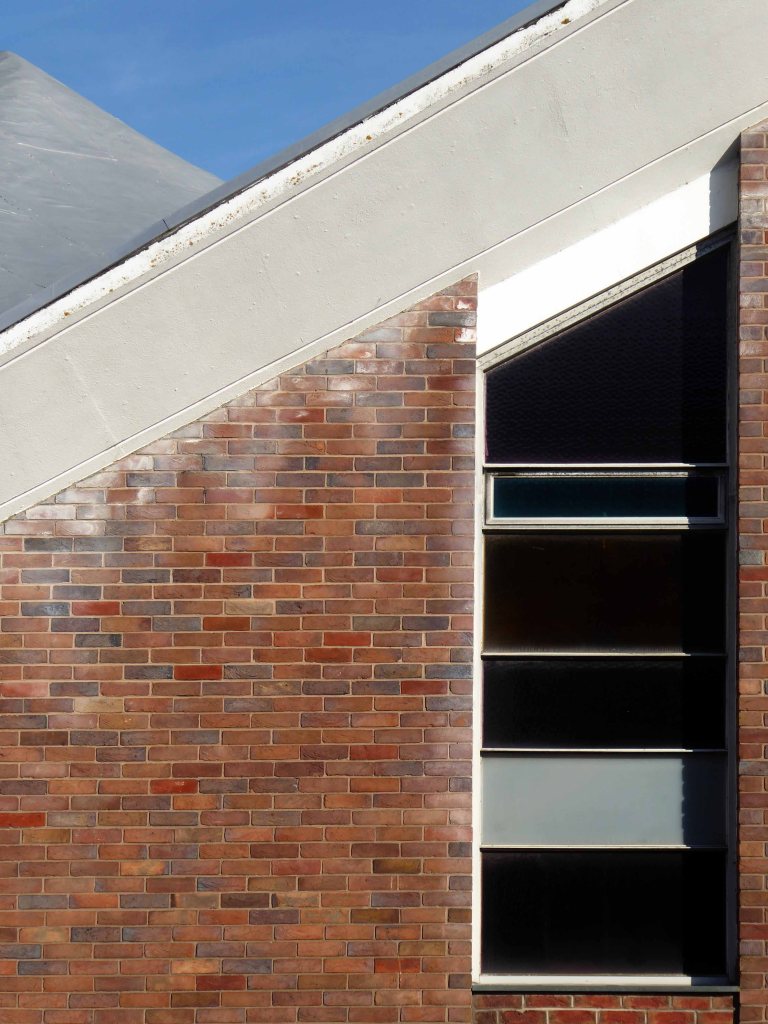
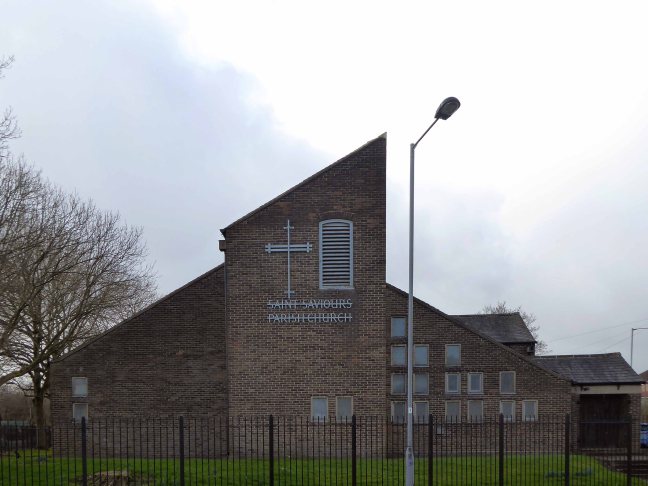
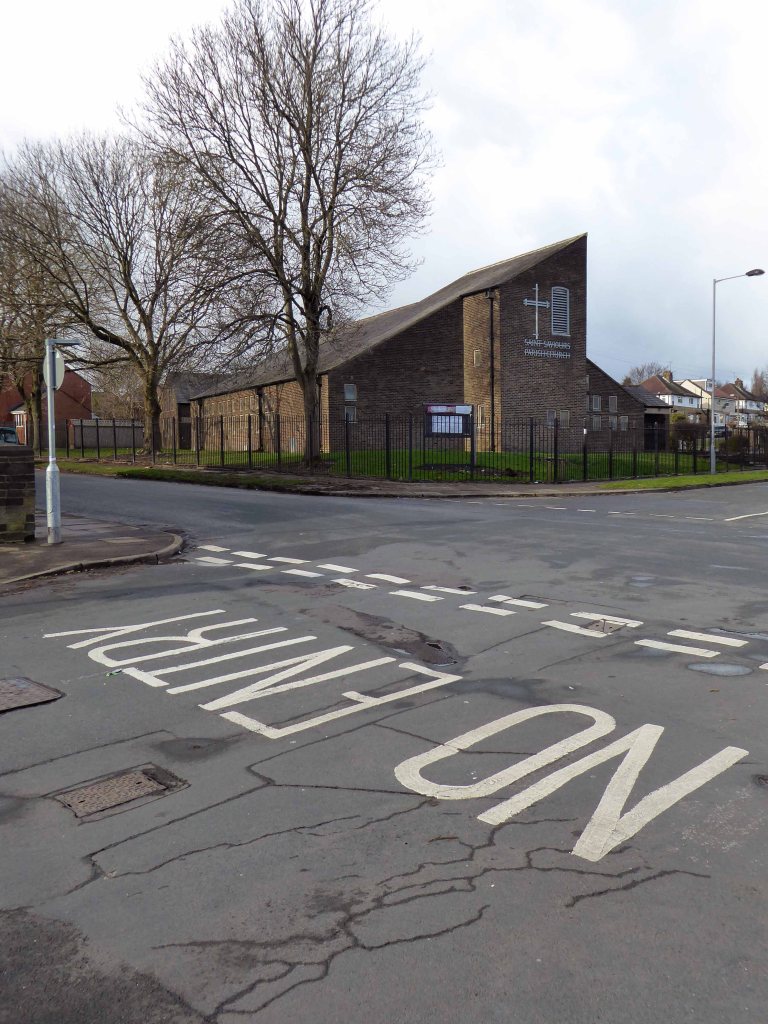
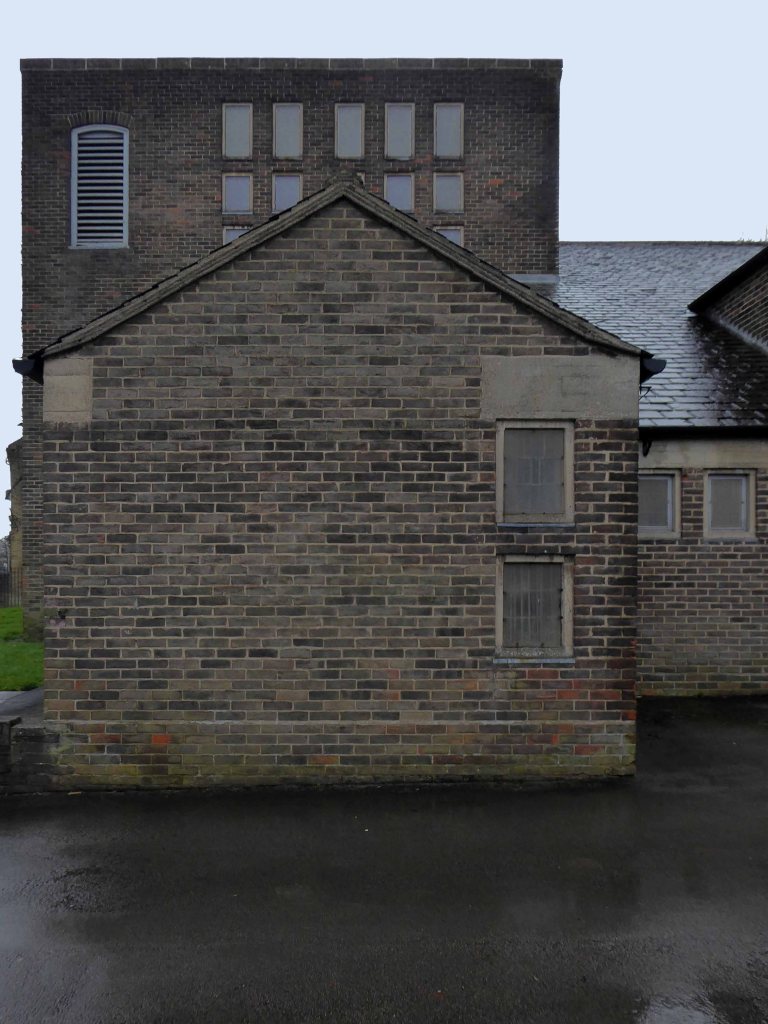
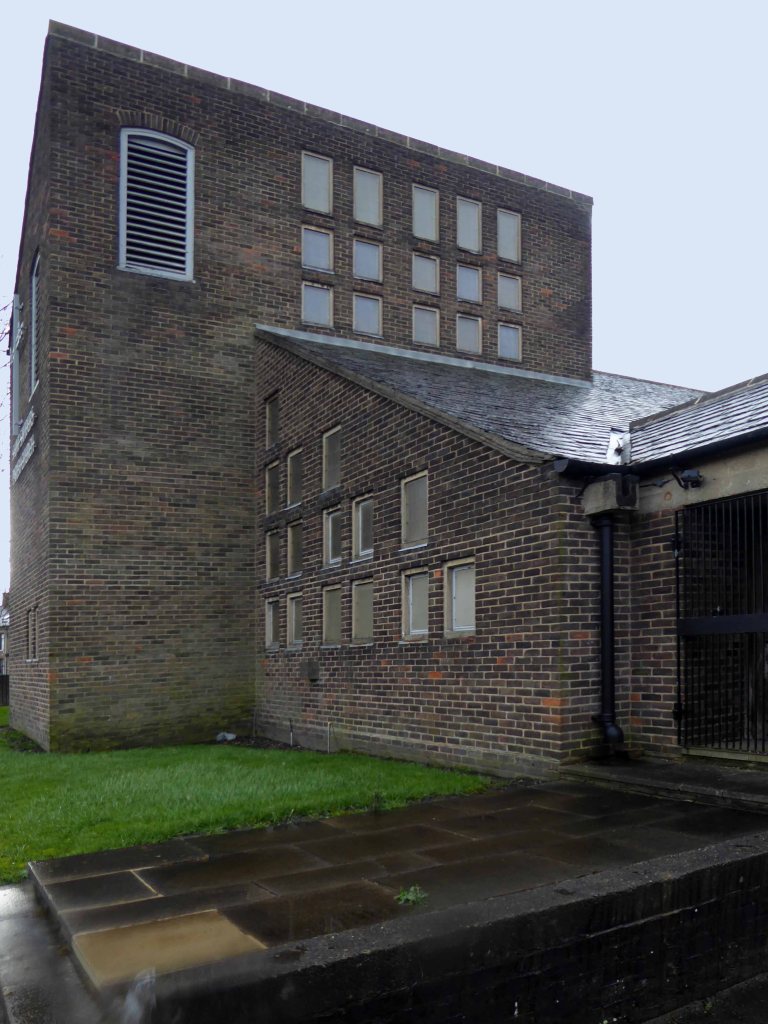
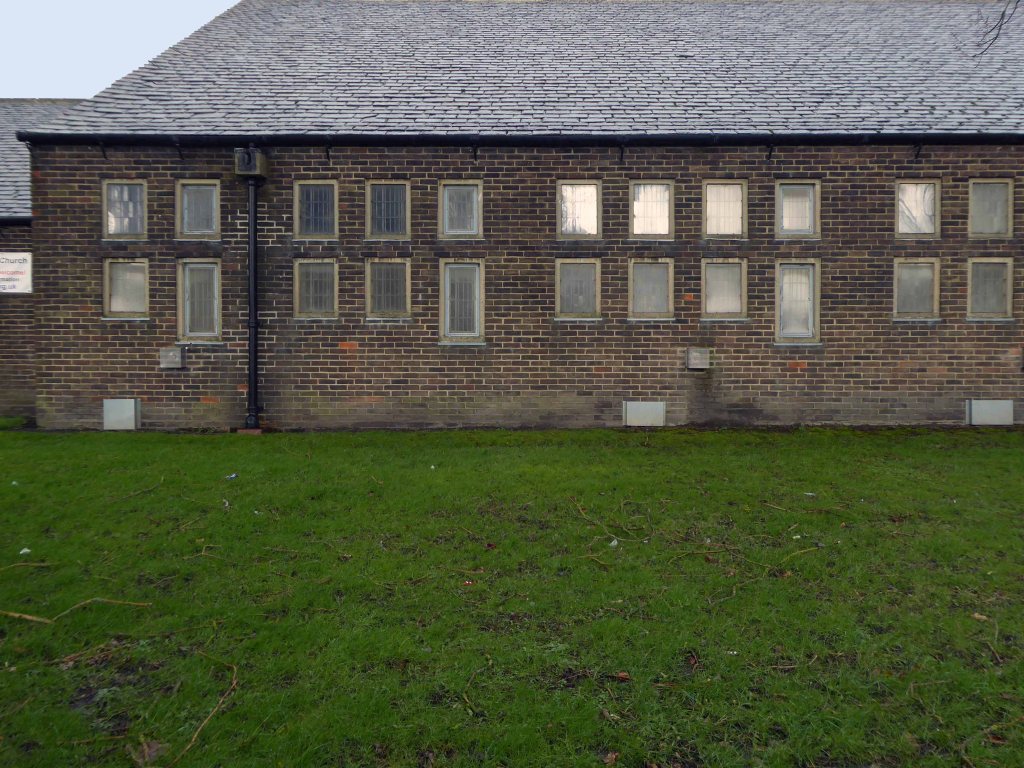
Steel frame and shuttered concrete with dark red brick walls in stretcher bond, and slate roofs.
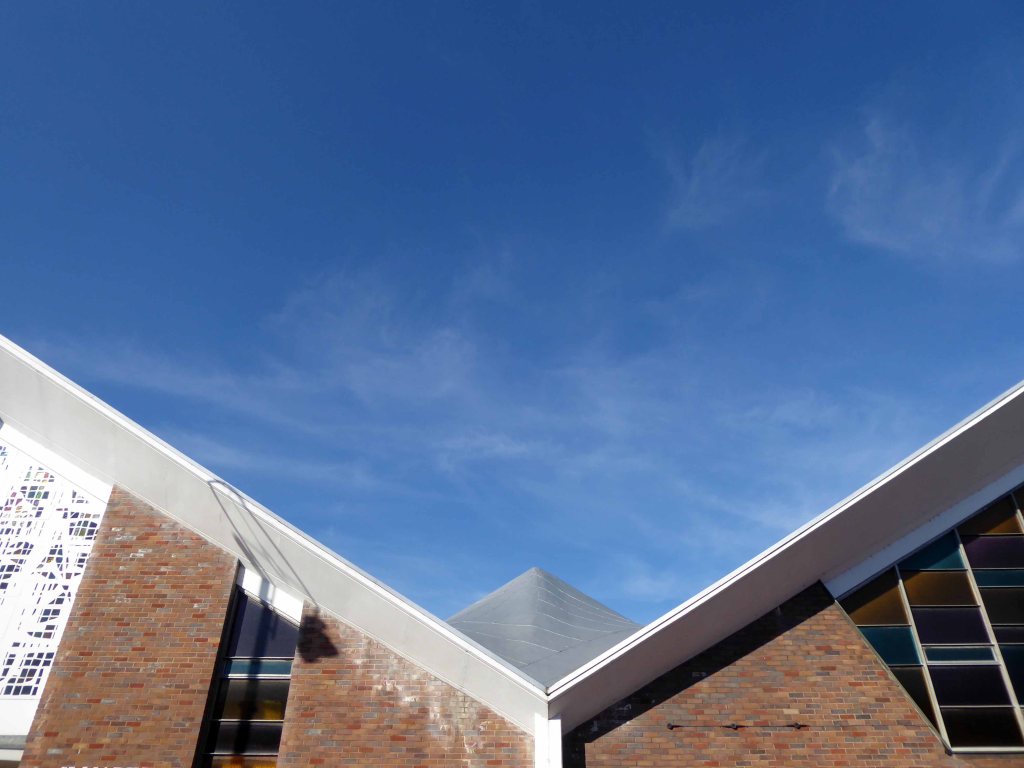
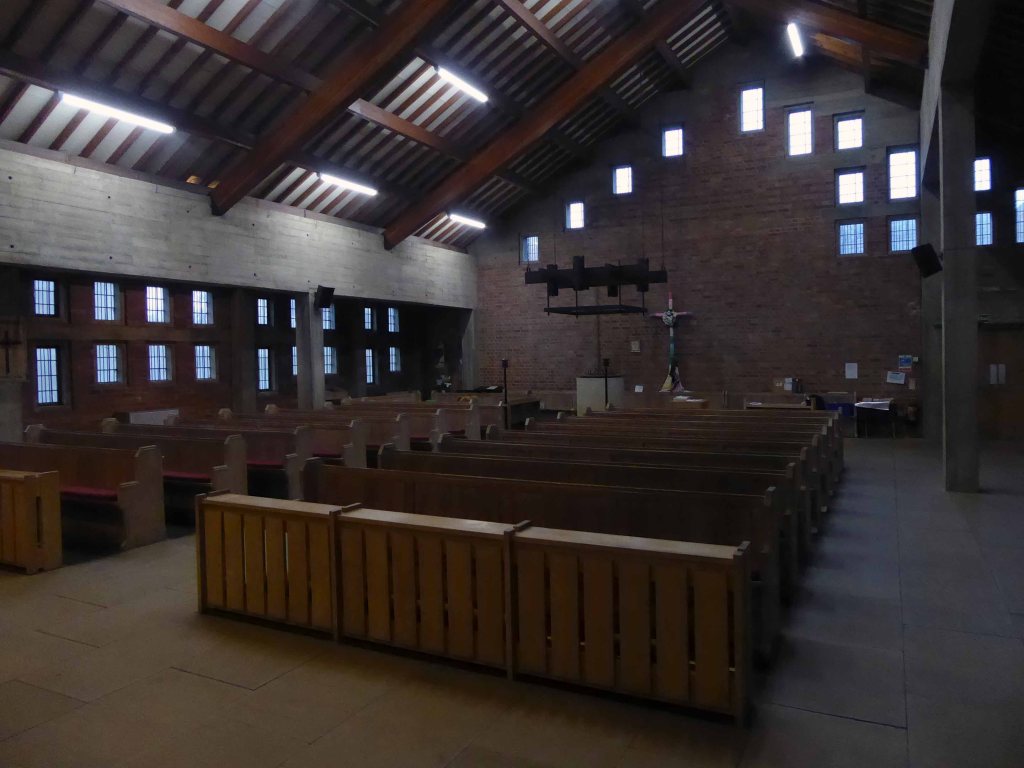
Church of 1966 with attached hall of 1971, both designed by architect George Pace. Characterised by asymmetric arrangement of roofs, exposed structure and juxtaposition of materials, this is a complete and largely unaltered example of Pace’s work. The asphalt roof and windows are in very poor condition. Repair works to the roof were carried out in 2016 with funding from the National Lottery Heritage Fund’s former Grants for Places of Worship scheme.
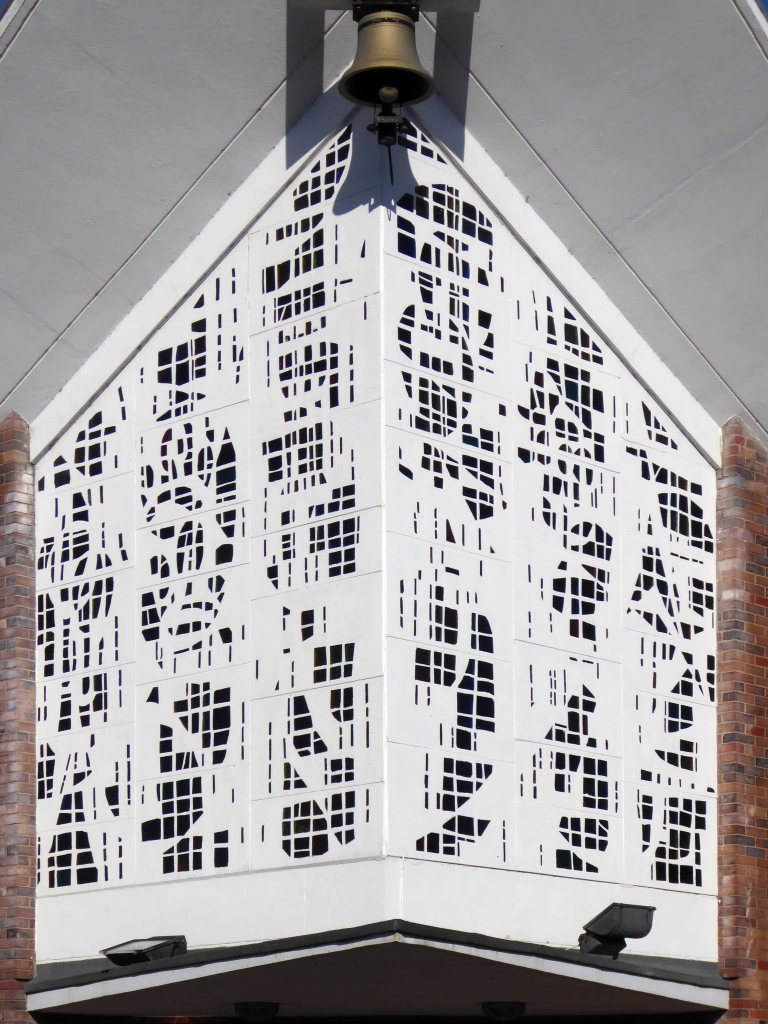
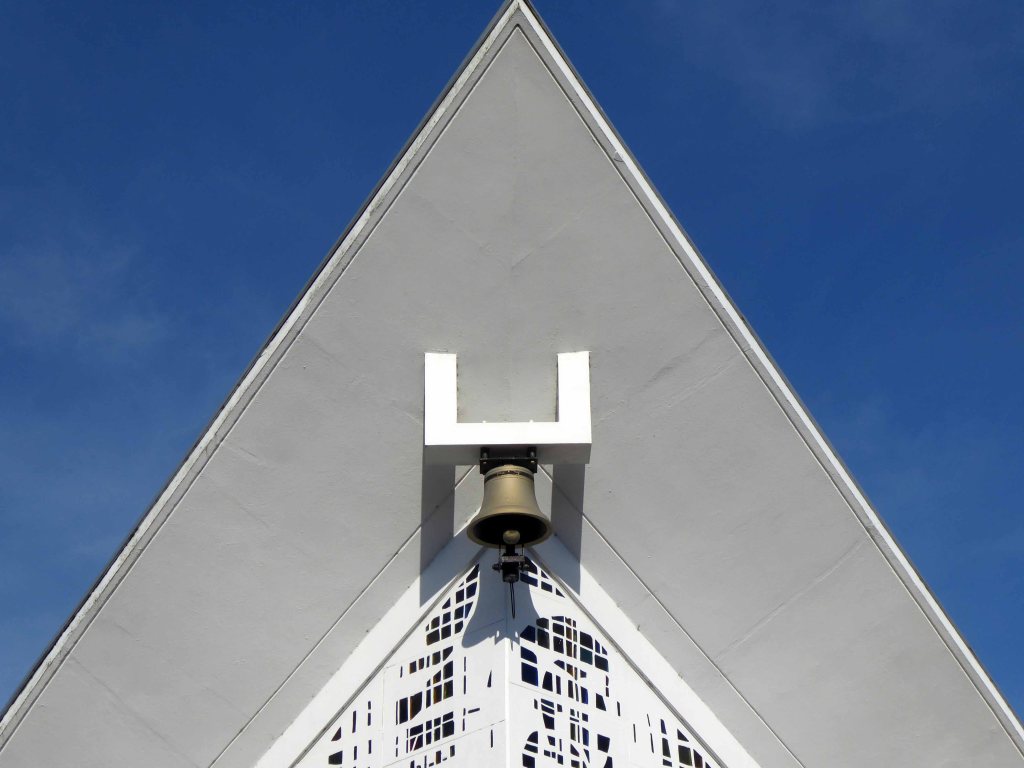
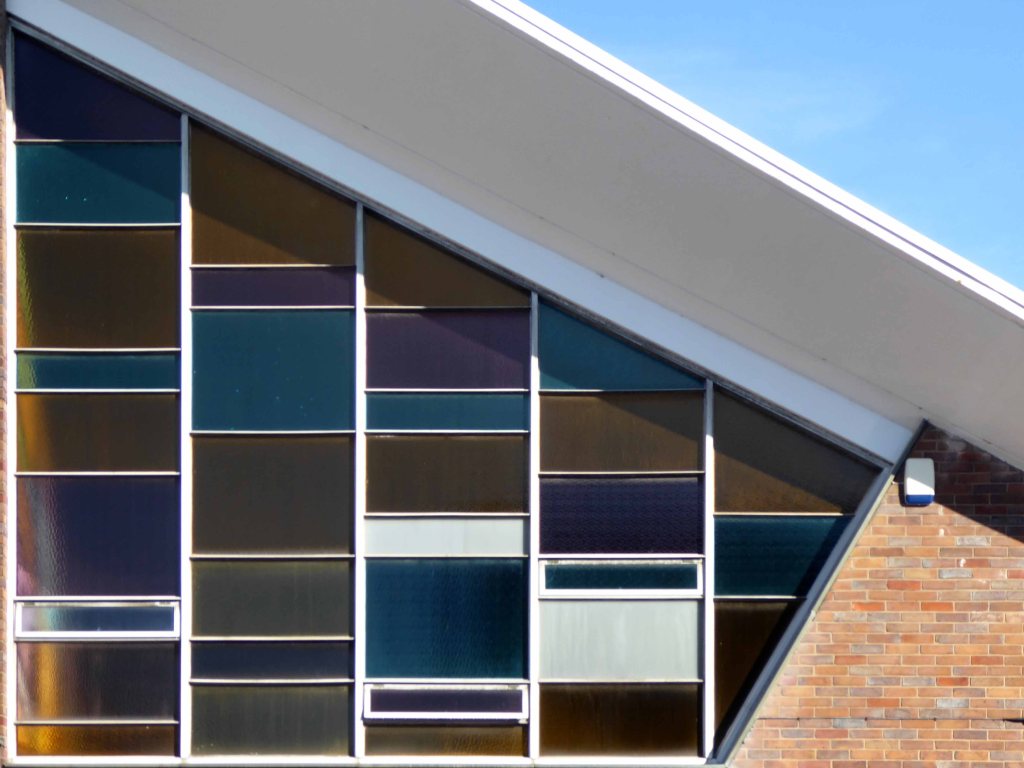
The exterior is stark and angular, the body of the church is a broad rectangle with no division between nave and chancel, with a bell tower to the east, vestries to the north-west and a chapel to the west. At the western end is the church hall, added in 1971. Externally a single asymmetric roof covers the main body of the church, rising at the east end to form a mono-pitch section over the altar area and incorporating the bell tower. There is a porch at the east end of the north side, and a transept with a double pitch roof. To the west is a single storey, flat roof section with an entrance to the north, extending to the transept. West of the main body of the church on the south side is a separate roof, housing a chapel. To the west is the church hall, with a north-south asymmetric roof. All the windows are rectangular, of varying sizes, with plain glass in rectangular leaded lights. Lintels over the doors and the parapet of the flat roofed block are of shuttered concrete, as are the window surrounds.
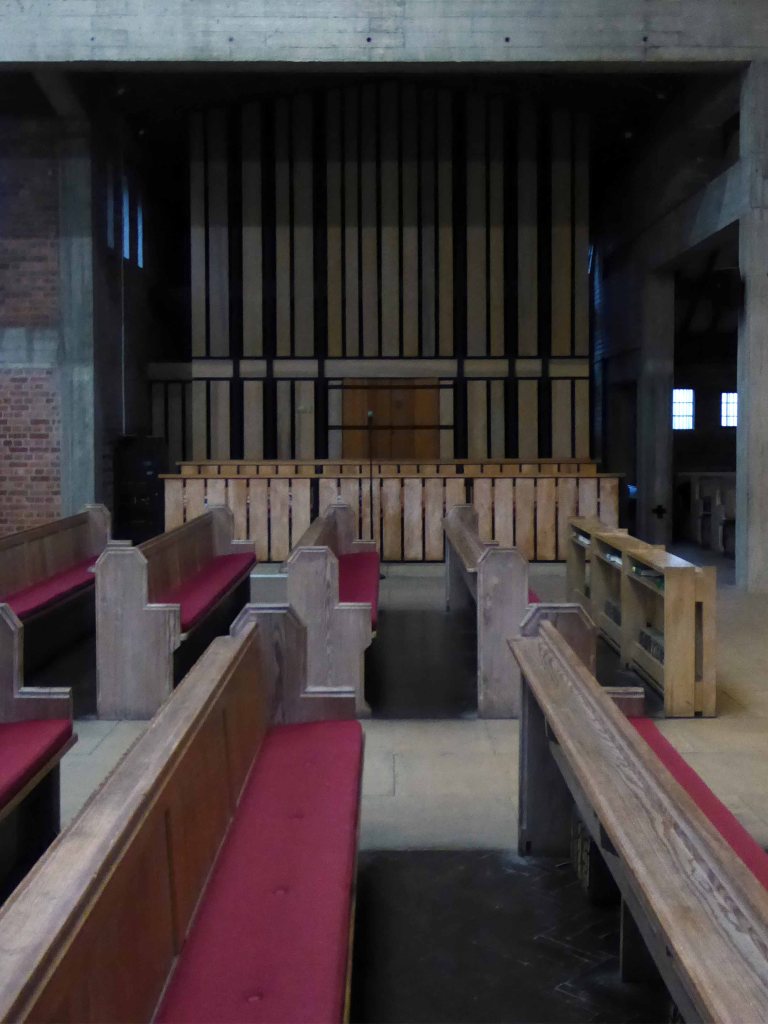
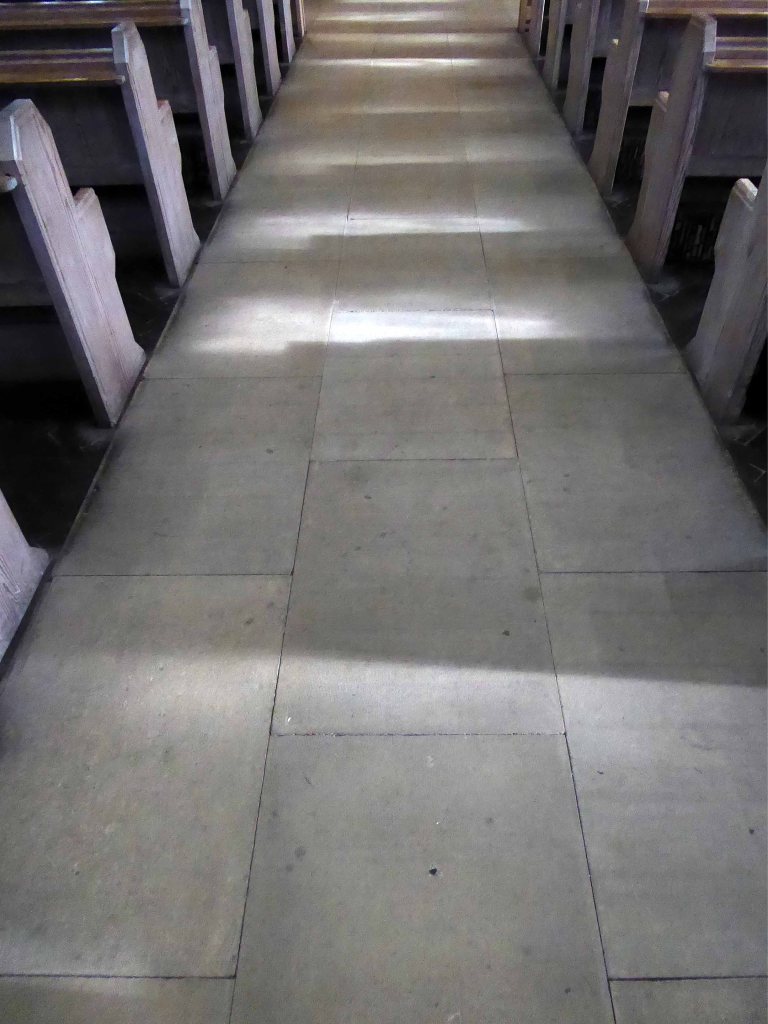
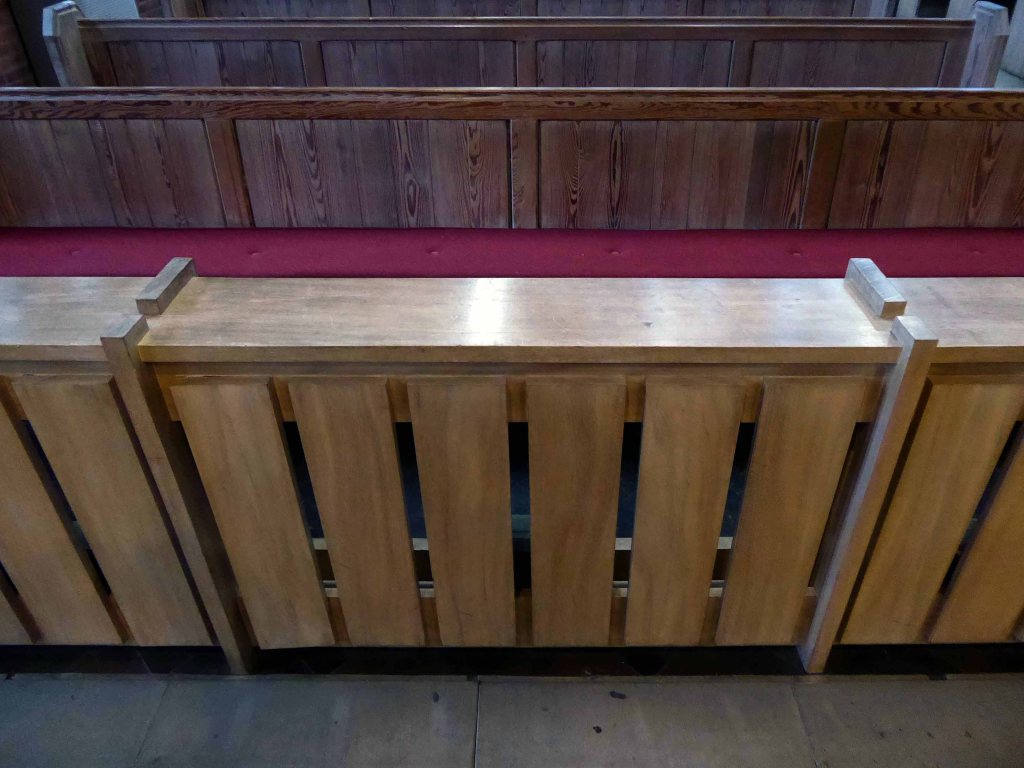
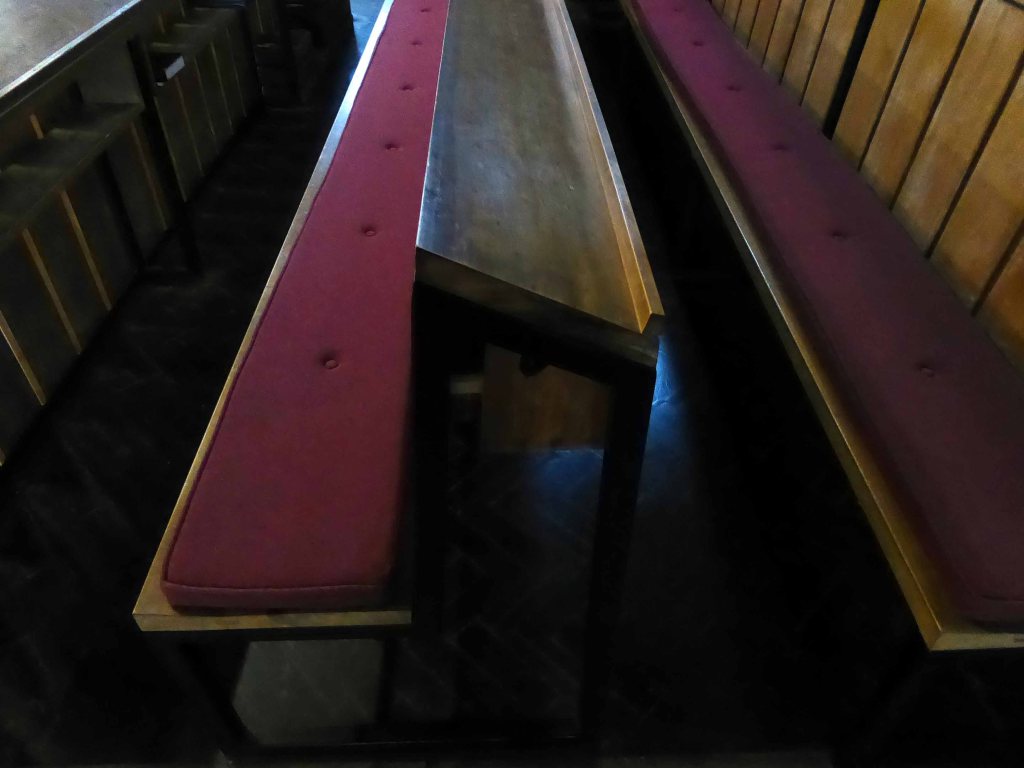
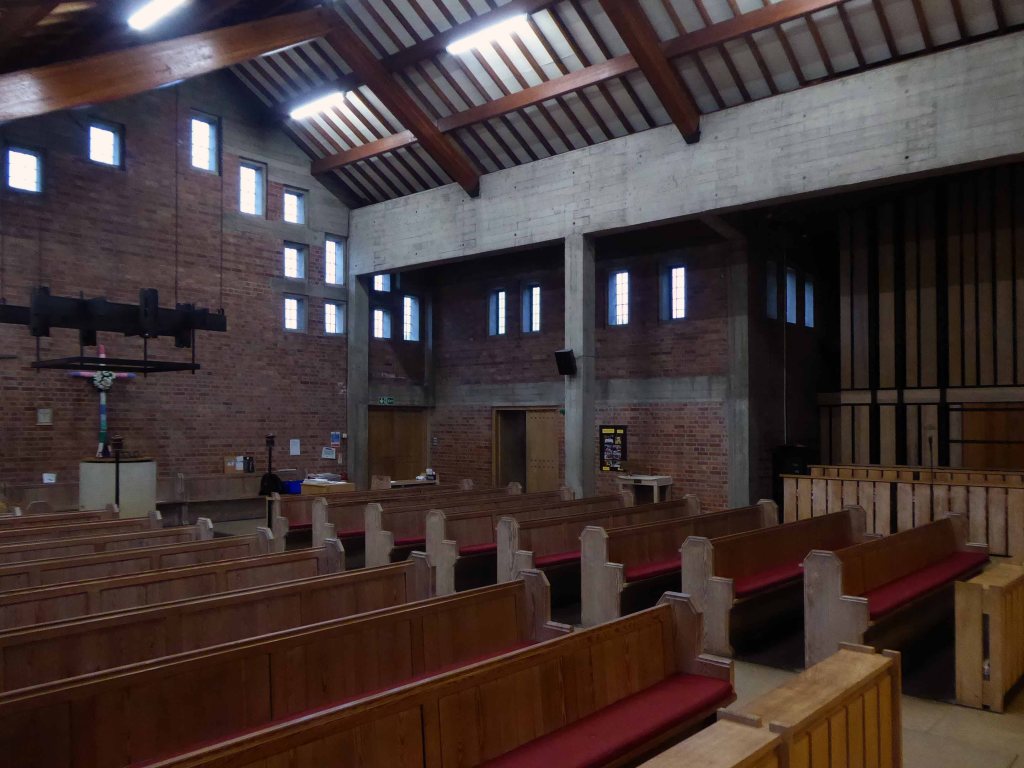
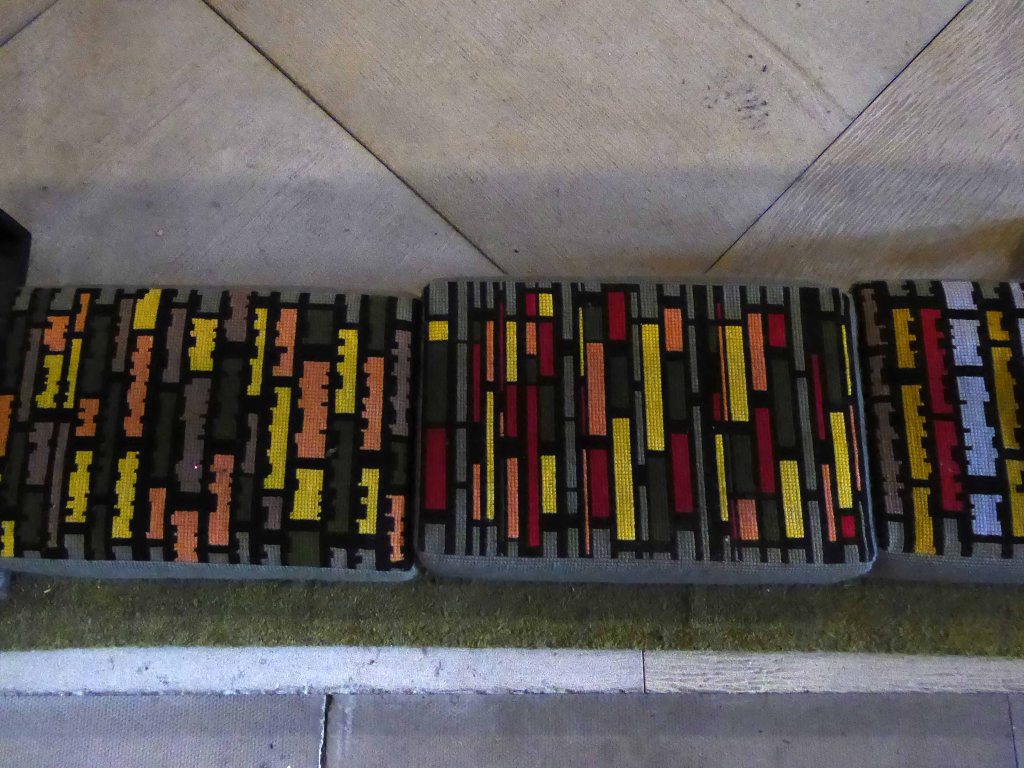
The body of the church contains Victorian stripped oak bench pews derived from St John’s church in Little Horton, arranged with a central aisle. To the north side is a range of contemporary pews in wood with vertical slatted fronts, in front of the organ, recovered from St. Chrysostom’s Bradford , by Driver and Haigh of Bradford, which is housed in the transept with a matching front of vertical wooden slats.
Let’s take a look.
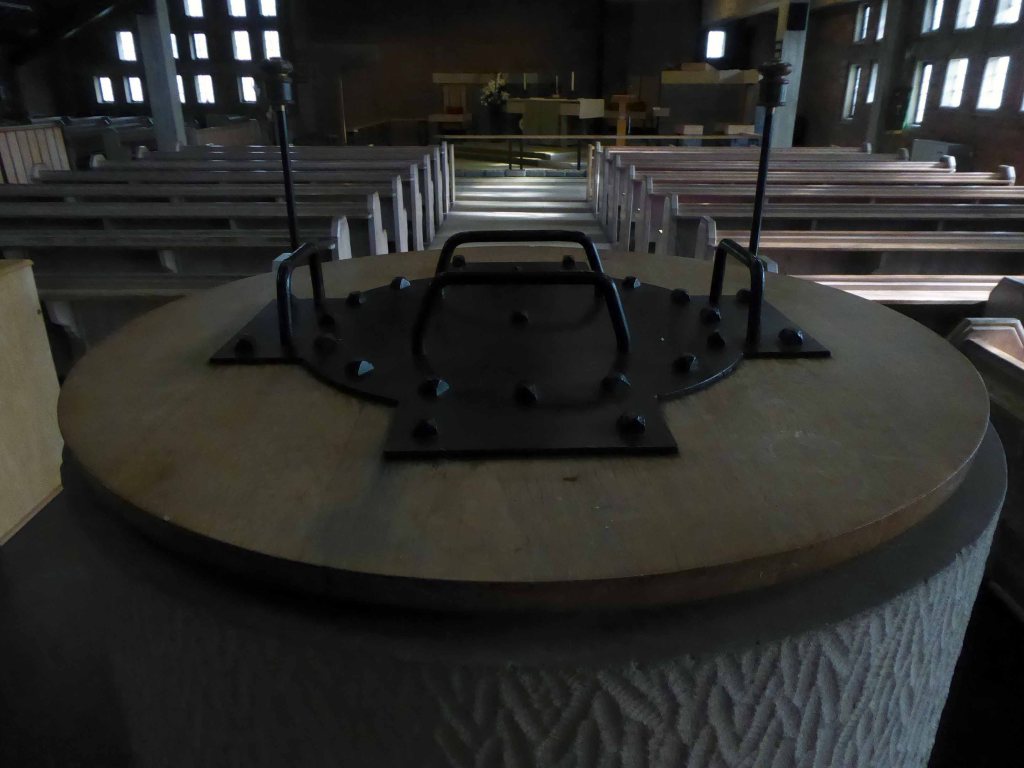
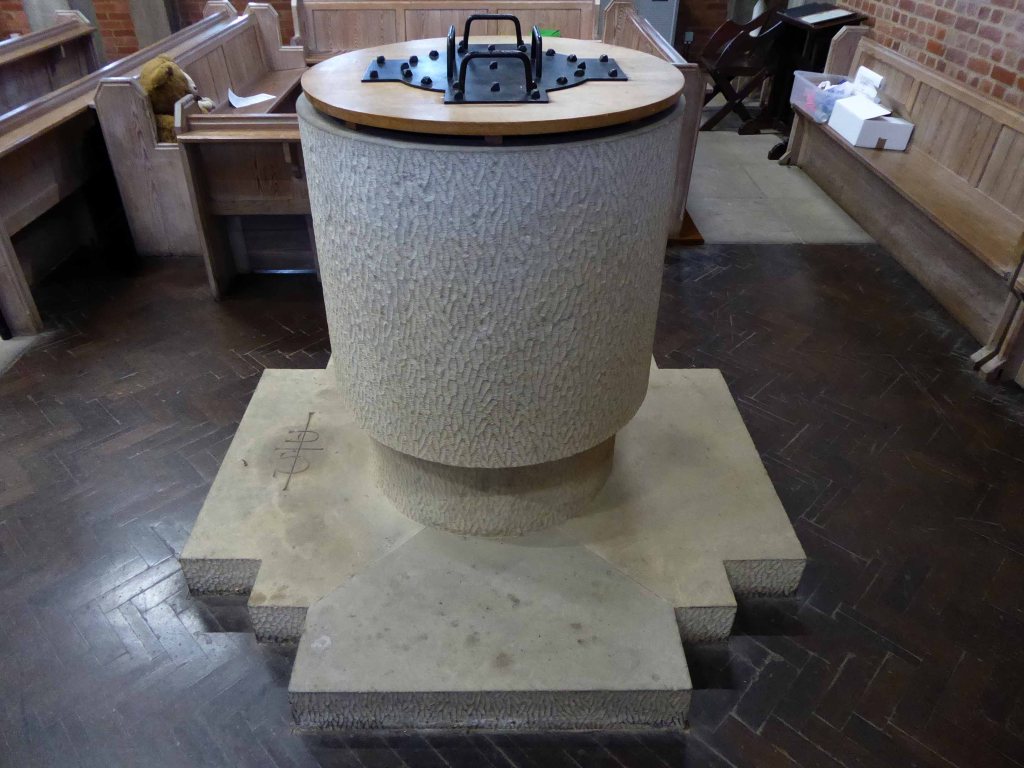
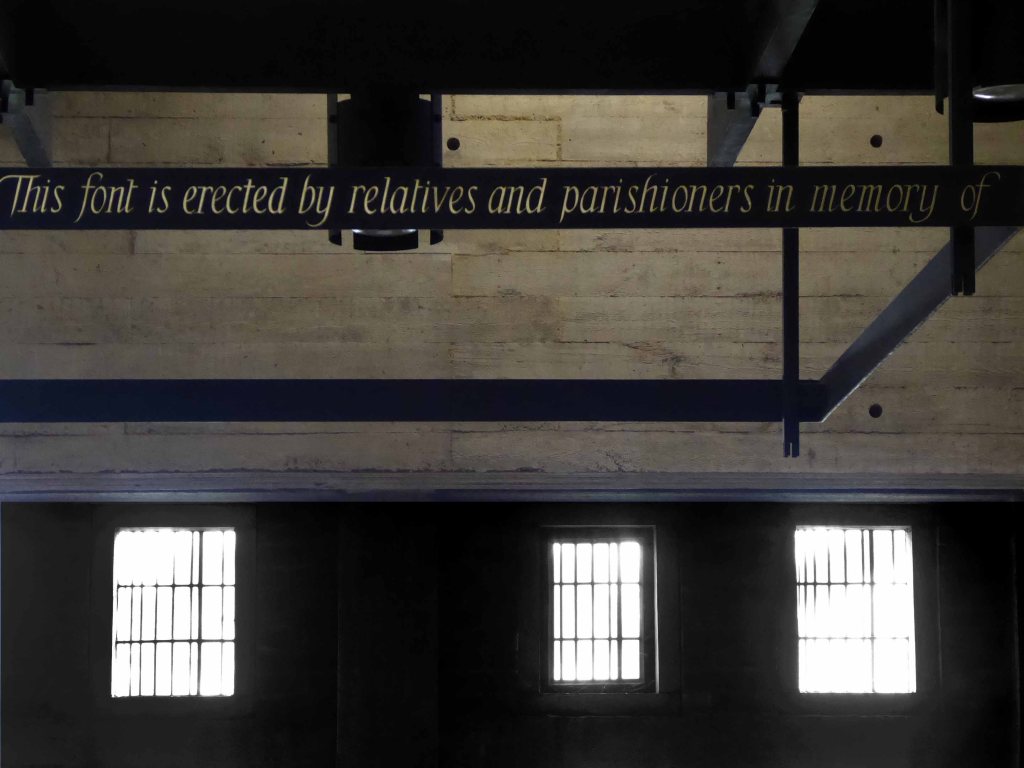
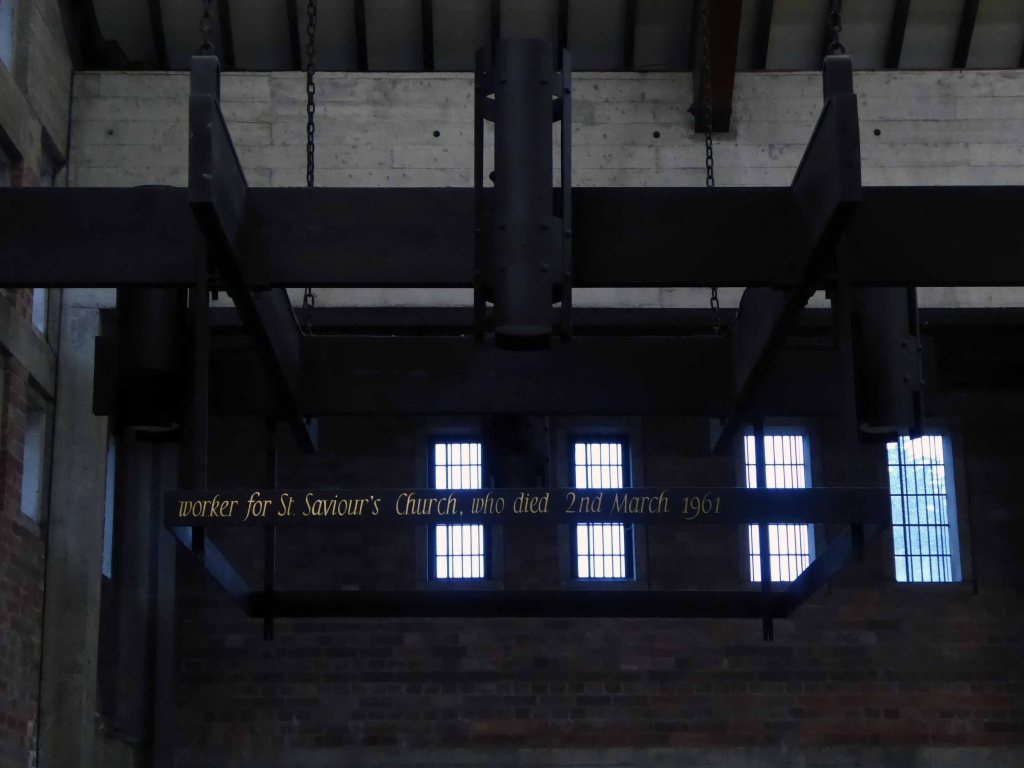
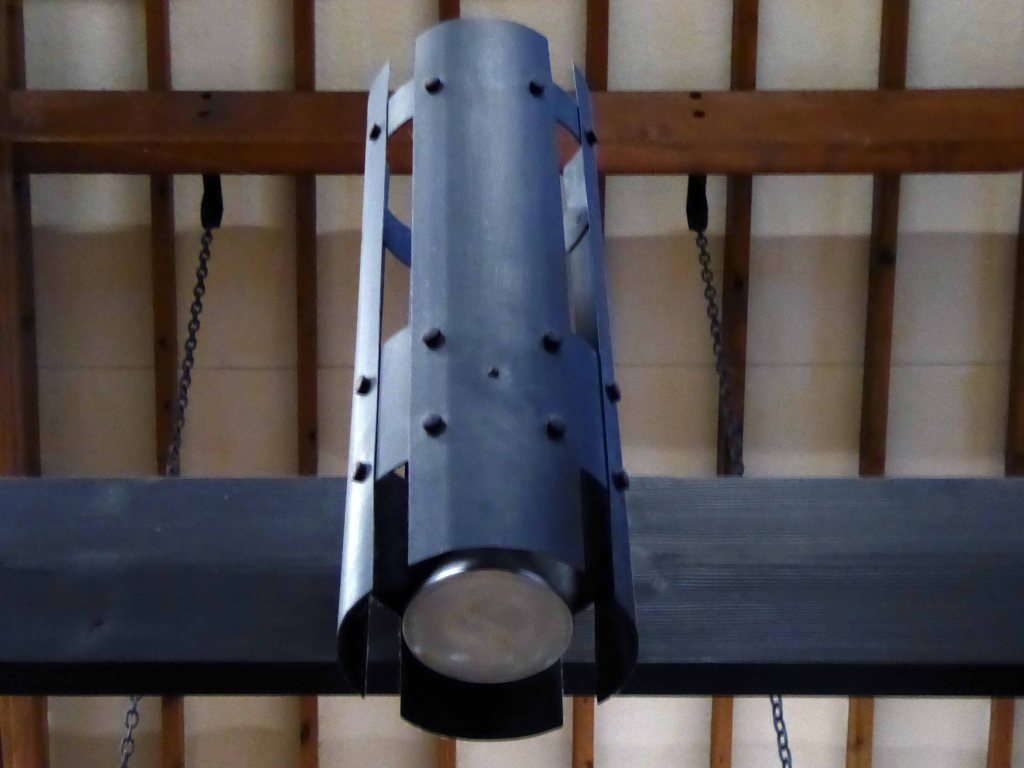
To the rear is the cylindrical font in white concrete with a wooden lid, set on a raised platform. Suspended above it is a large light fitting in black metal, inscribed around the edges with the words: “This font is erected by relatives and parishioners in memory of/ Beatrice May Parkin, for over forty years a Sunday School teacher and/ worker for St Saviour’s Church, who died 2nd March 1961”.
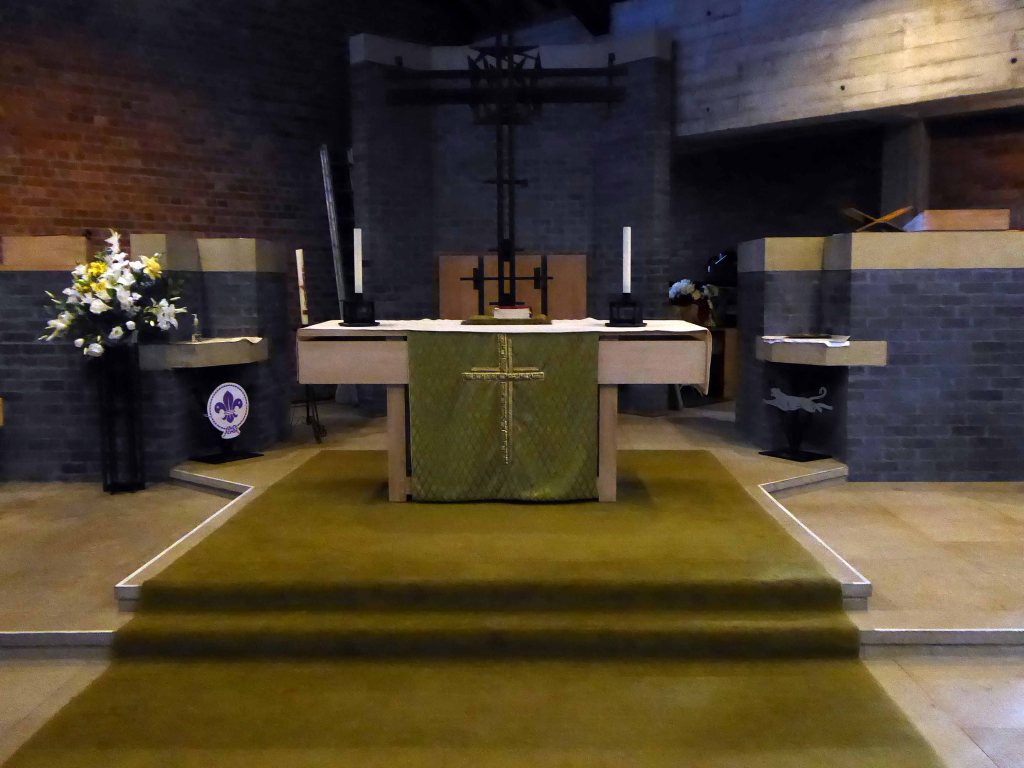
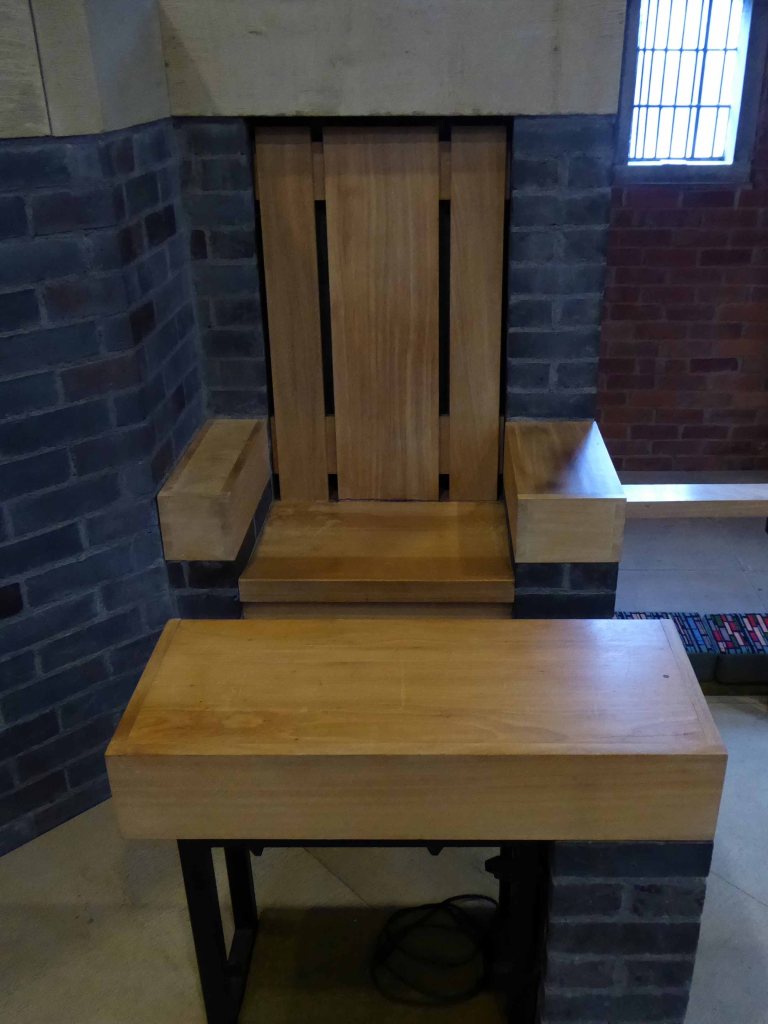
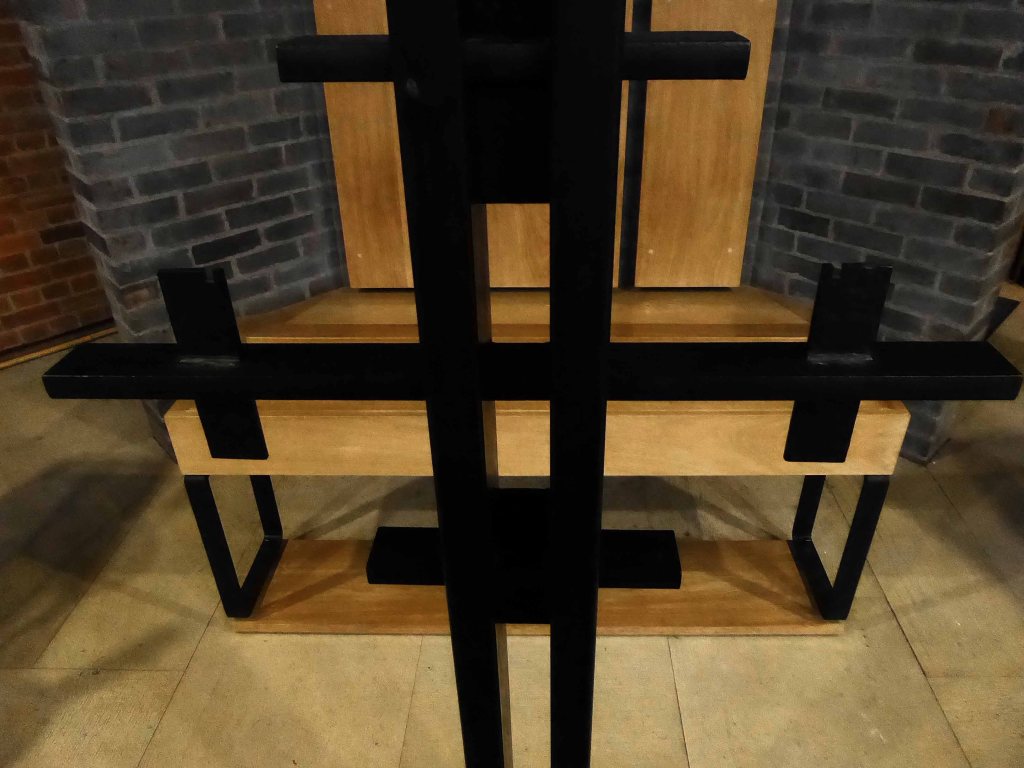
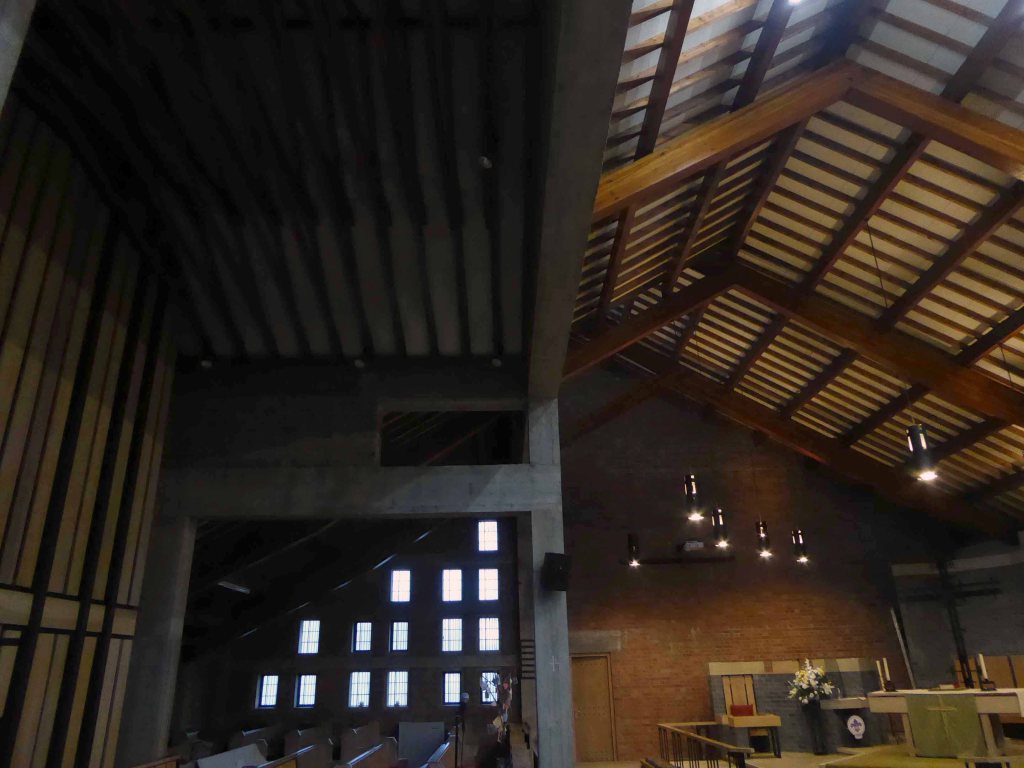
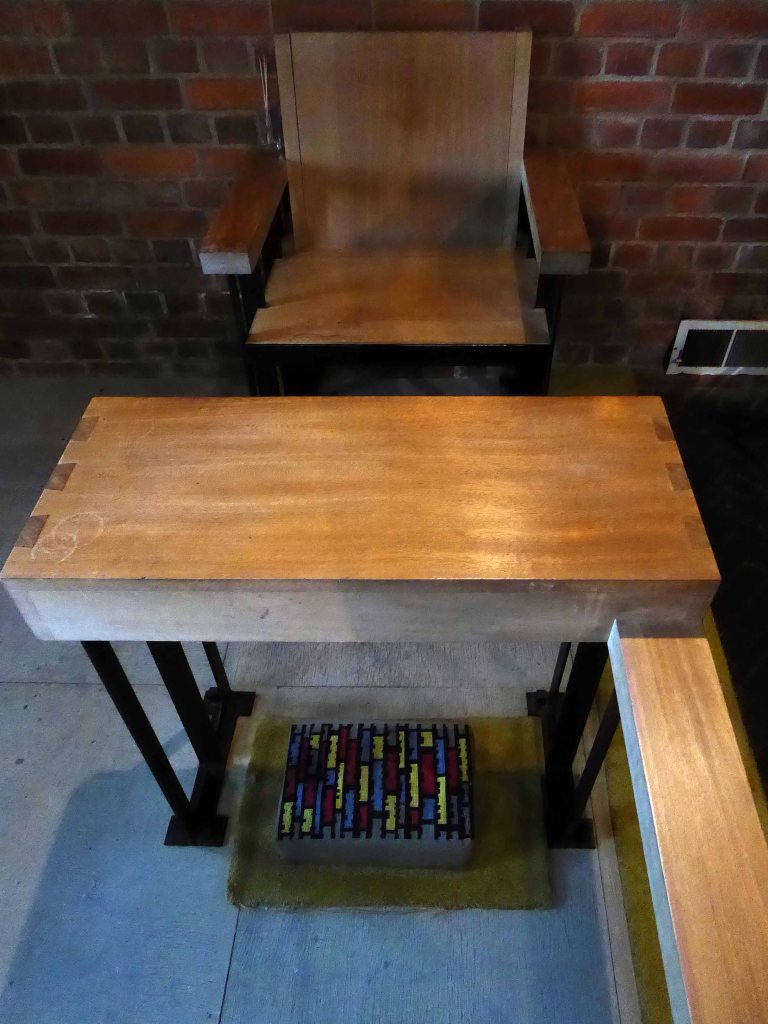
There is no separate chancel, and the finishes throughout are exposed brick, shuttered concrete and limed oak. The sanctuary area is in the south-east corner and consists of a tall angled purple brick reredos, topped with concrete, and a lower detached, angled purple brick pillar to each side each holding a shelf and incorporating a wooden seat. In front of the central reredos is an integral wooden bench with three backs, and a large black metal cross in the same style as those on the exterior but with more elaboration, fixed to the floor on a raised concrete block. To the fore is the altar table on a low raised platform. The whole is enclosed within an altar rail of iron and wood, open to the centre.
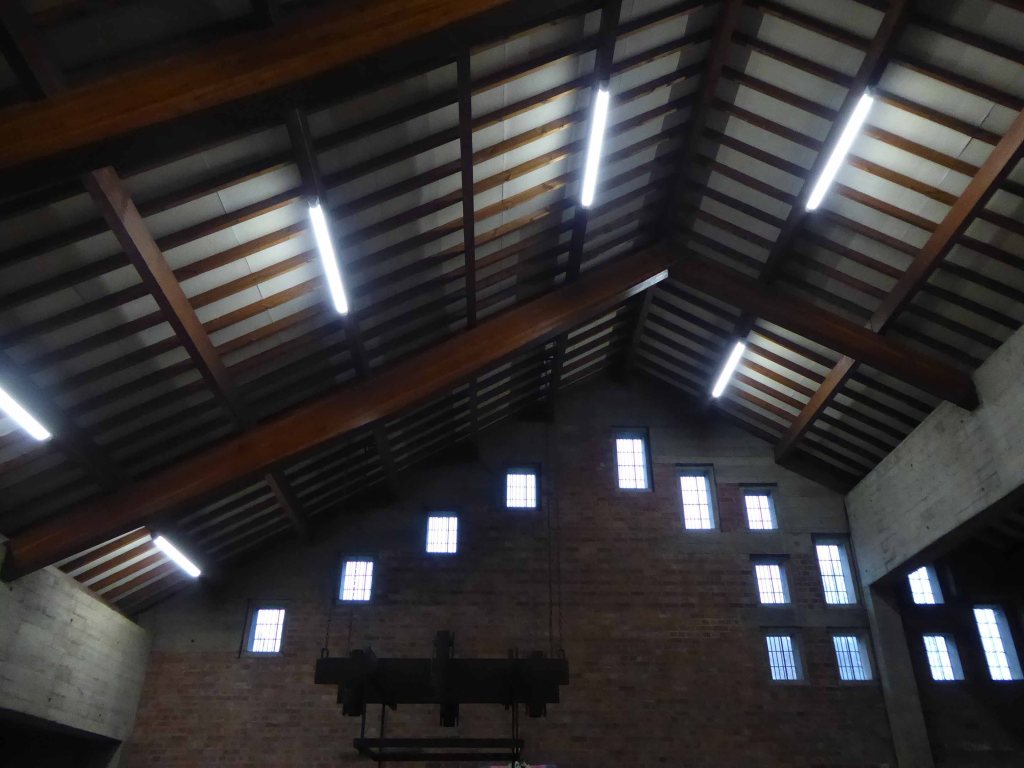
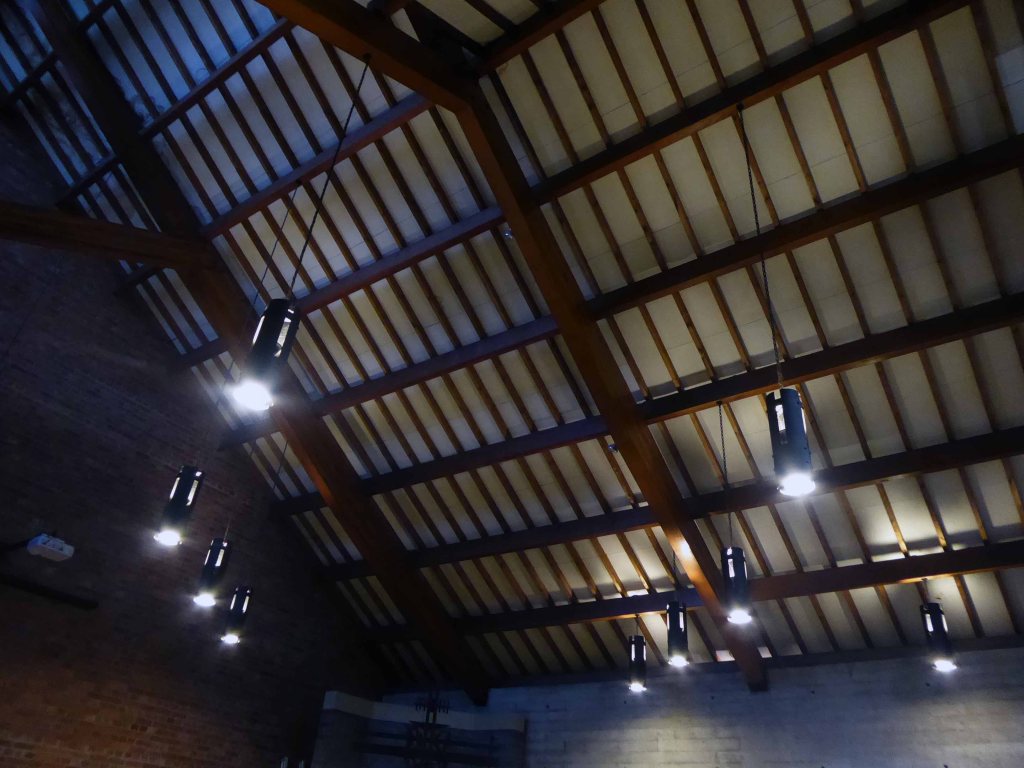
The main roof has exposed wooden trusses supported on concrete pillars and beams, with rafters and purlins also exposed creating a latticework pattern.
The whole interior order is orderly, calm and coherent, a simple consistency of materials and architectural intent.
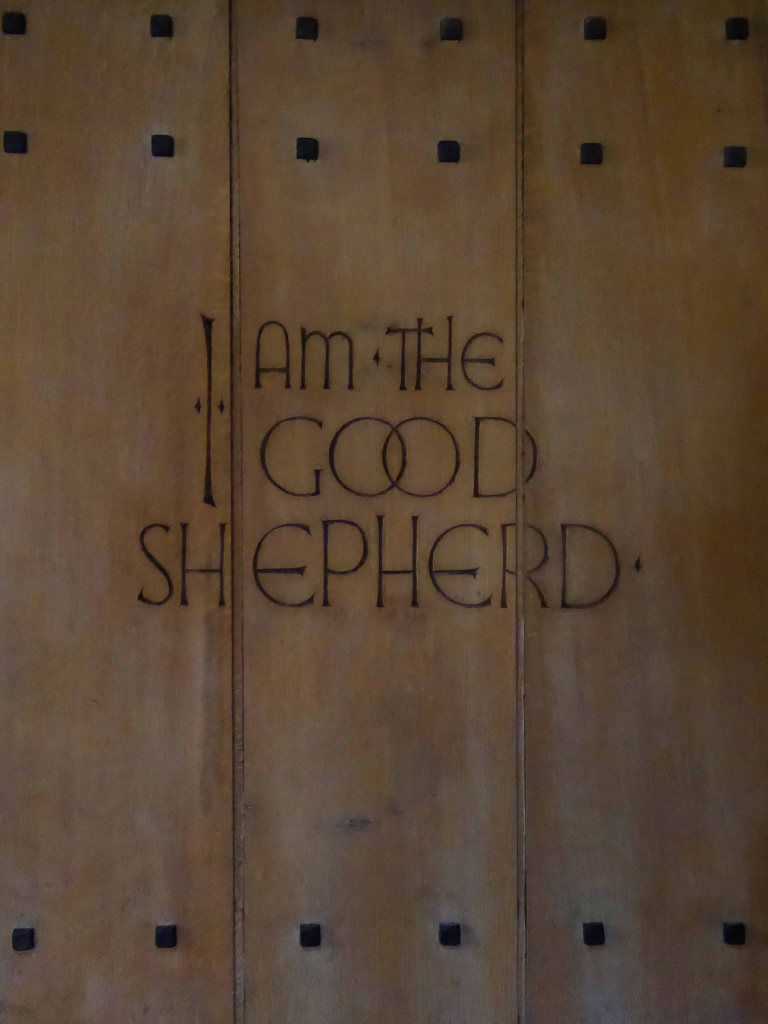
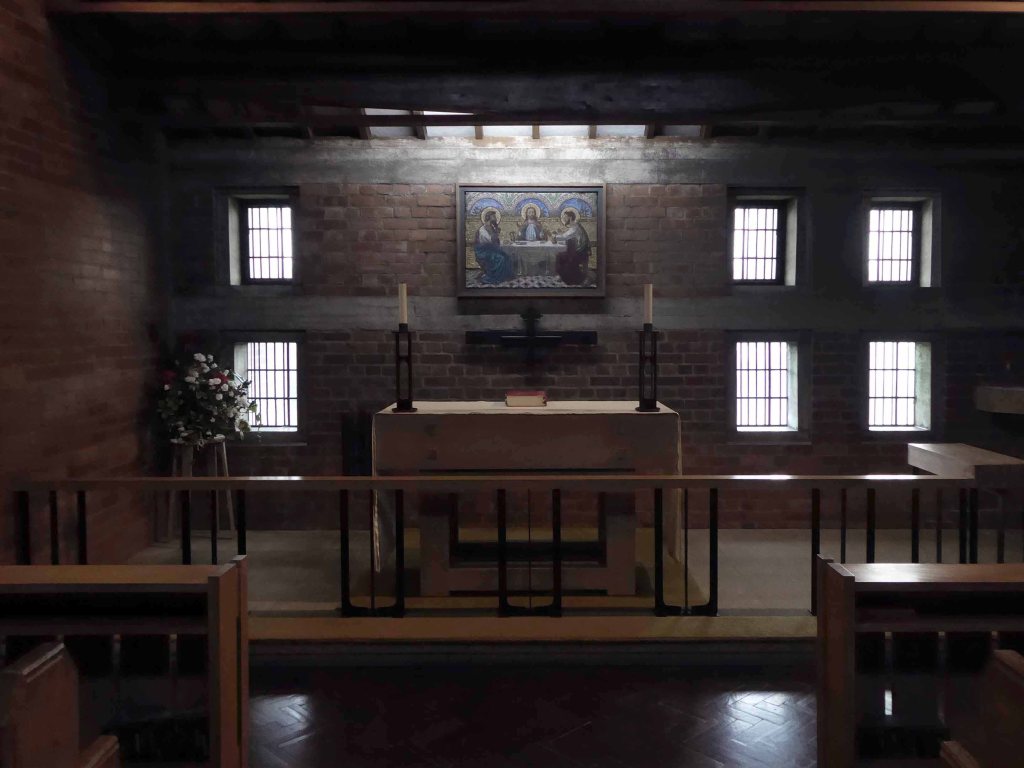
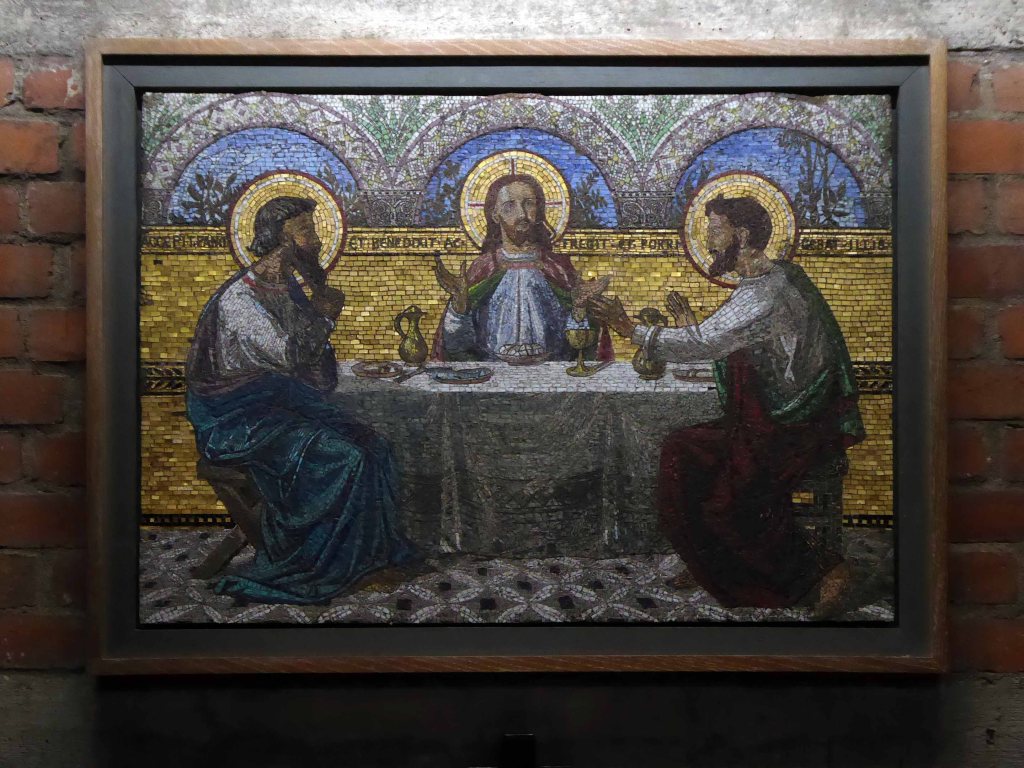
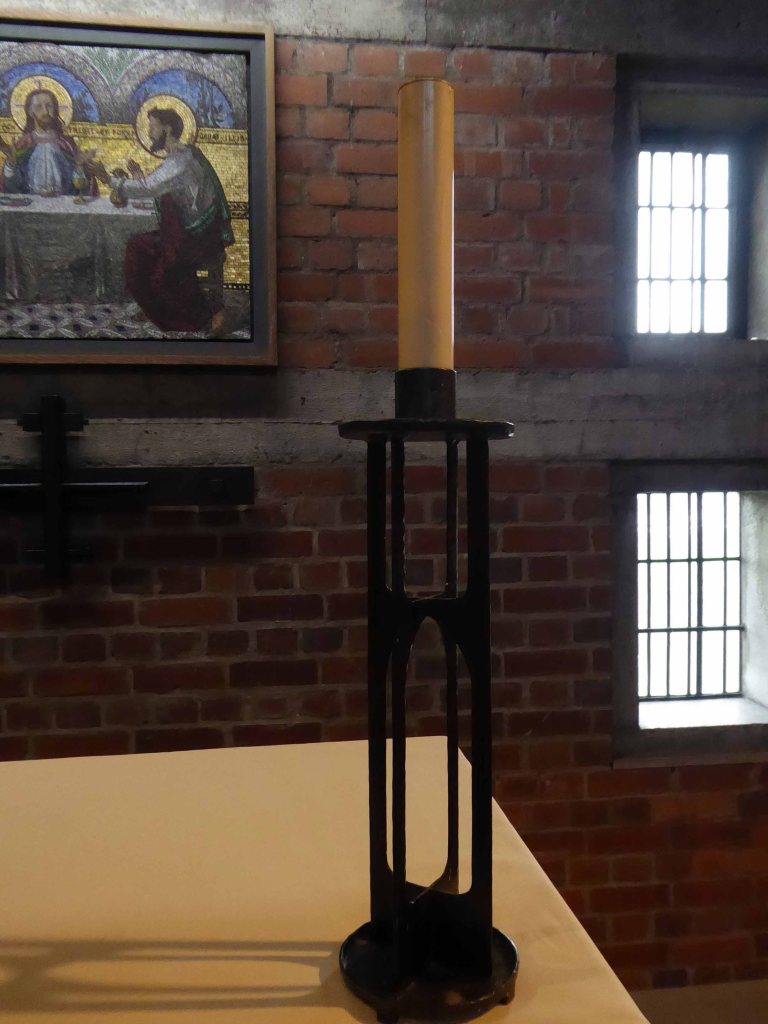
The solid wood, studded chapel door has the words “I am the Good Shepherd” engraved on it. The chapel has exposed beams and rafters, and an altar to the north with iron and wood altar rail in front. Pews are as in the church. There is a mosaic plaque behind the altar which came from St John’s church in Little Horton.
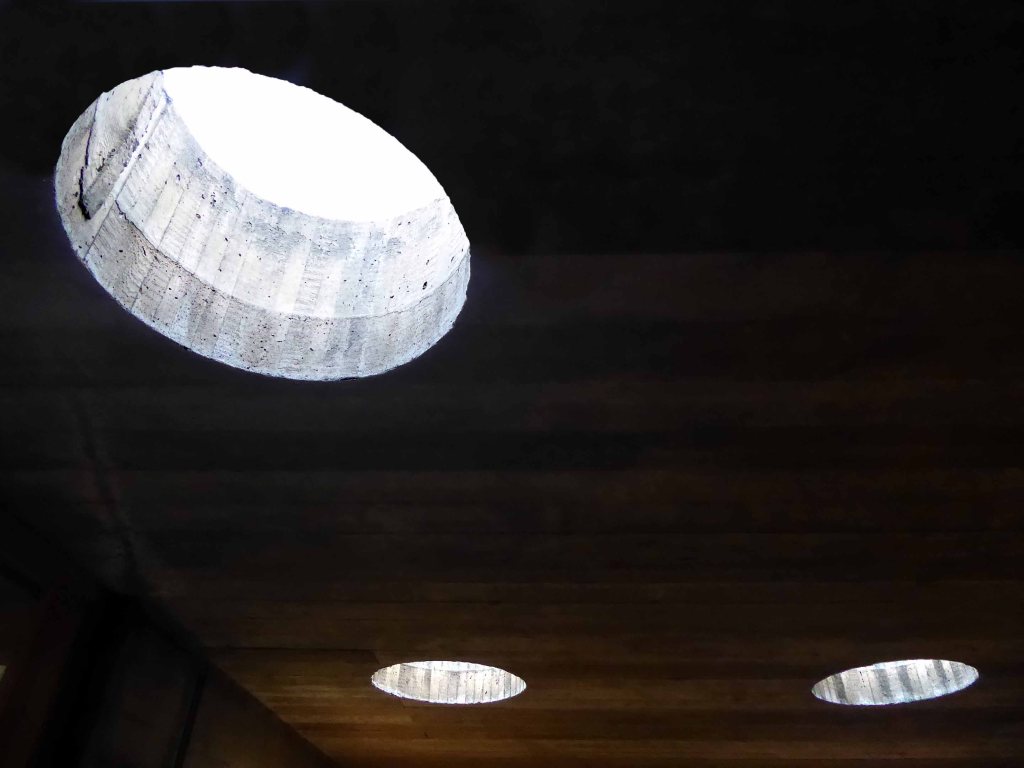
Beyond to the west is the narthex, with shuttered concrete ceilings pierced by circular skylights, exposed brick walls and doors to the chapel, service rooms and hall.
Such a pleasure to visit such an enchanting church – it was a precious privilege to be welcomed by the congregation, warden and Reverend Dorothy.
The Humber Ferry was a ferry service on the Humber between Kingston upon Hull and New Holland in Lincolnshire which operated until 1984, after the completion of the Humber Bridge in 1981.
I walked from Hull to Hessle – but you were always on my mind.
Glimpsed once or twice from a train, I’d never been up close and personal.
The Humber Bridge was opened by Her Majesty Queen Elizabeth II in 1981.
It is one of the marvels of modern engineering and was, until 1998, the longest single span suspension bridge in the world but there are now five other longer bridges of this type. However it is still the longest that can be used by pedestrians.
The bridge is 2,220 metres long and the towers, which are farther apart at the top than the bottom to compensate for the curvature of the earth, are 155 metres high. It was built at the narrowest point of the estuary known as the ‘Hessle Whelps’ and when completed it was admired for its design and elegance, but reviled by others as a bridge from nowhere to nowhere, the crossing comprises a dual carriageway with walkways for pedestrians and cyclists on both sides.
Although approval to build the bridge was granted in 1959 work did not begin until 1972 due to difficulties in financing the project. In 1966 Harold Wilson, the Prime Minister of the day, allowed Barbara Castle, the Minister for Transport, to give permission for the bridge to be built, hoping that the announcement would be a vote winner in the forthcoming Hull North by-election.
Construction Team
The consulting engineers for the project were Freeman Fox & Partners . Sir Ralph Freeman had produced the first ideas in 1927 and in the early 1930s the cost of the project was estimated at £1.725 million and that the bridge would be unlikely to recoup the construction or maintenance costs. In 1935 he had an idea for a 4,500-foot suspension bridge for the Humber Tunnel Executive Committee. Sir Gilbert Roberts produced more ideas in 1955 for a bridge with a 4,500-foot central span, costing £15 million, to be paid for by East Riding County Council and Lindsey County Council. Once it was likely that a bridge would be constructed, Bernard Wex produced the design in 1964 that was actually built. The bridge was built to last 120 years.
The architect was R. E. Slater ARIBA. The administration building for the tolls, was designed by Parker & Rosner. The landscaping was designed by Prof Arnold Weddle. Wind tunnel testing took place at the National Maritime Institute at Teddington and the road deck is designed for wind speeds up to 105 miles per hour (170 km/h).
Even on the calmest of days the power and sway, push and pull of wind and tide is an uplifting, hair-raising and visceral experience.
The elegantly engineered giant towers above as you gaze from the shore.
An elegy to human endeavour in concrete and steel.
The bridge is of necessity firmly anchored to the ground.
The walkway wide and high astride the estuary.
The tall towers towering above.
The whole structure tied down, anchored and suspended securely.
The mid brown waters of the Humber flowing gently below.
I walked back and to in the company of a handful of fellow travellers, on foot and bike, one of life’s best ever free rides, and reluctantly bade farewell as I headed home to Hull.
But just like just like General MacArthur I came through andI shall return.
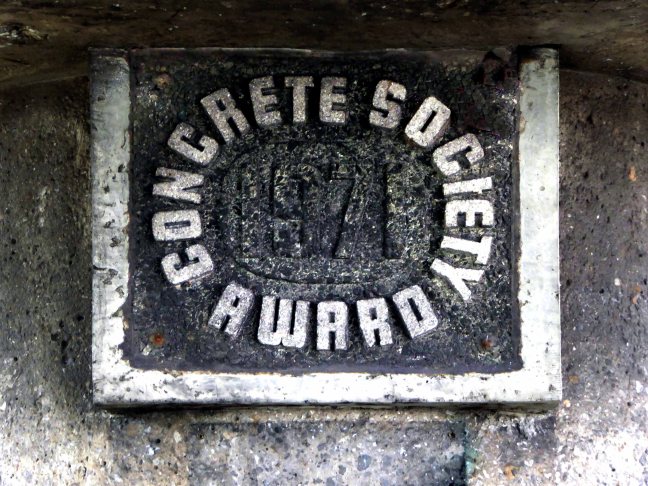
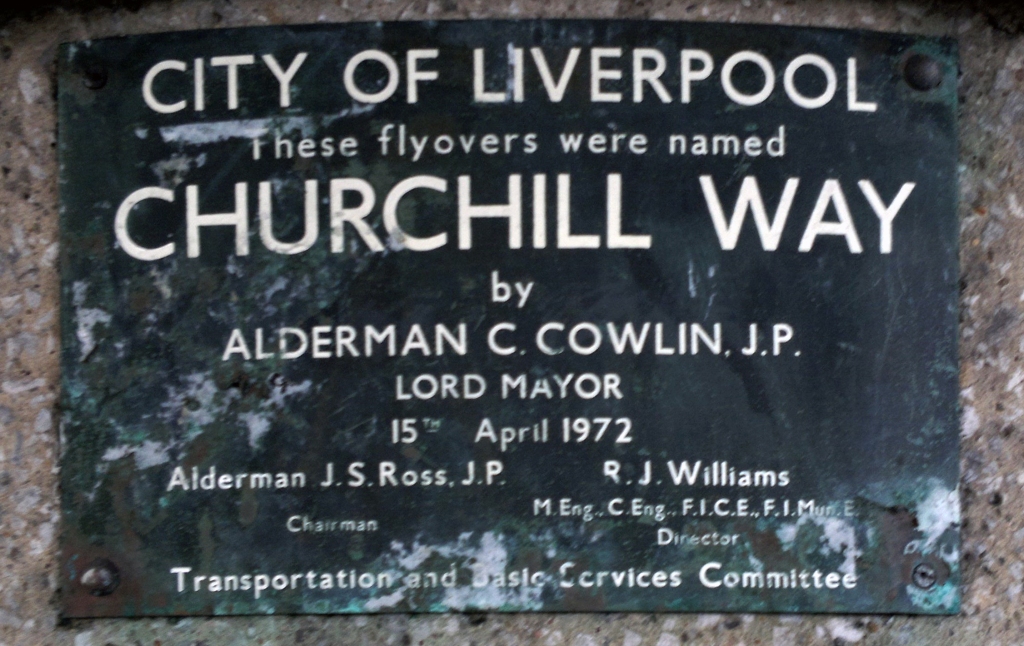
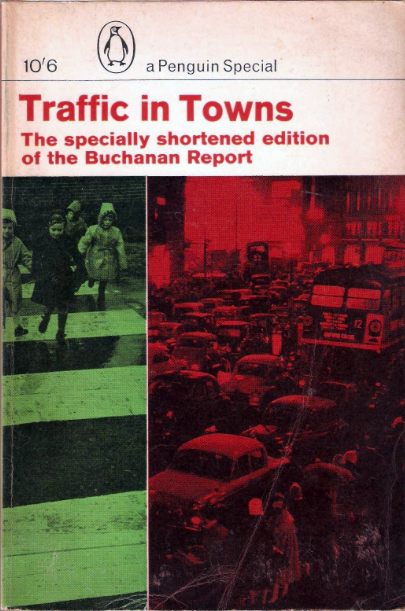
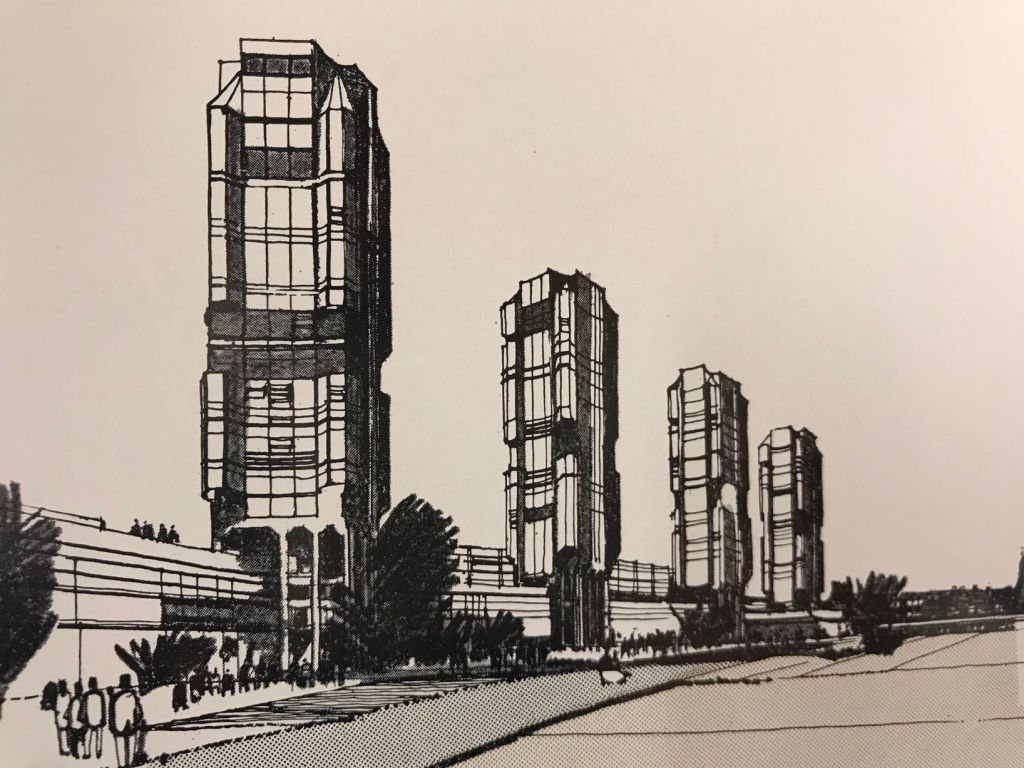
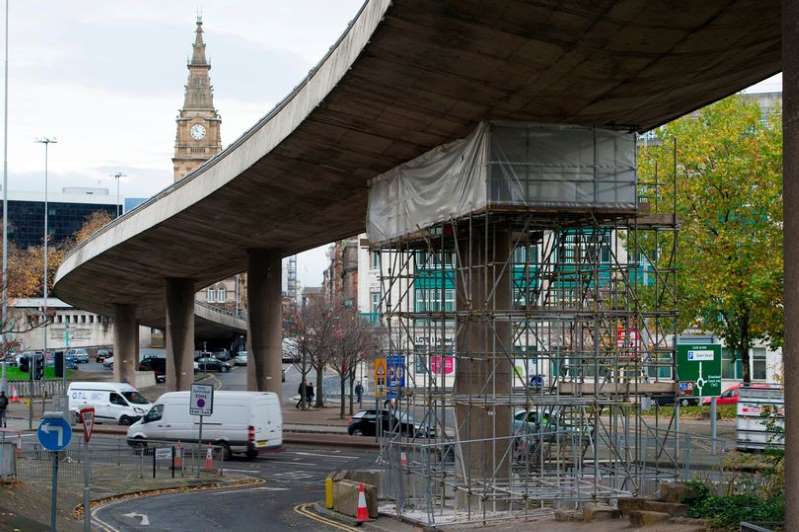
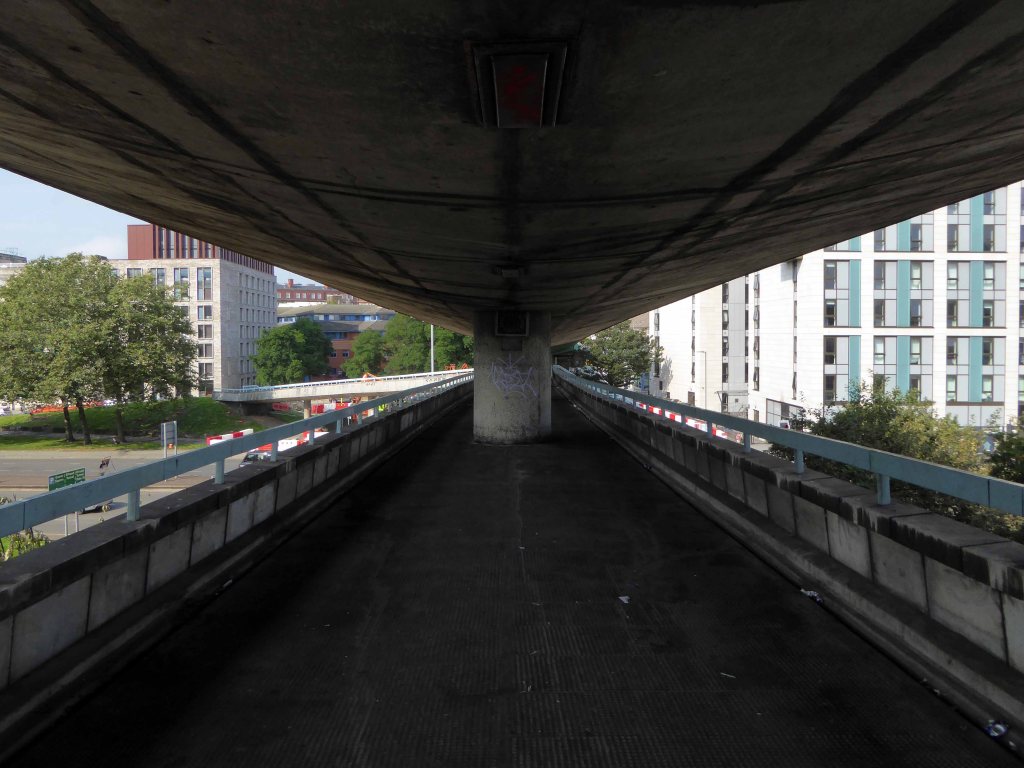
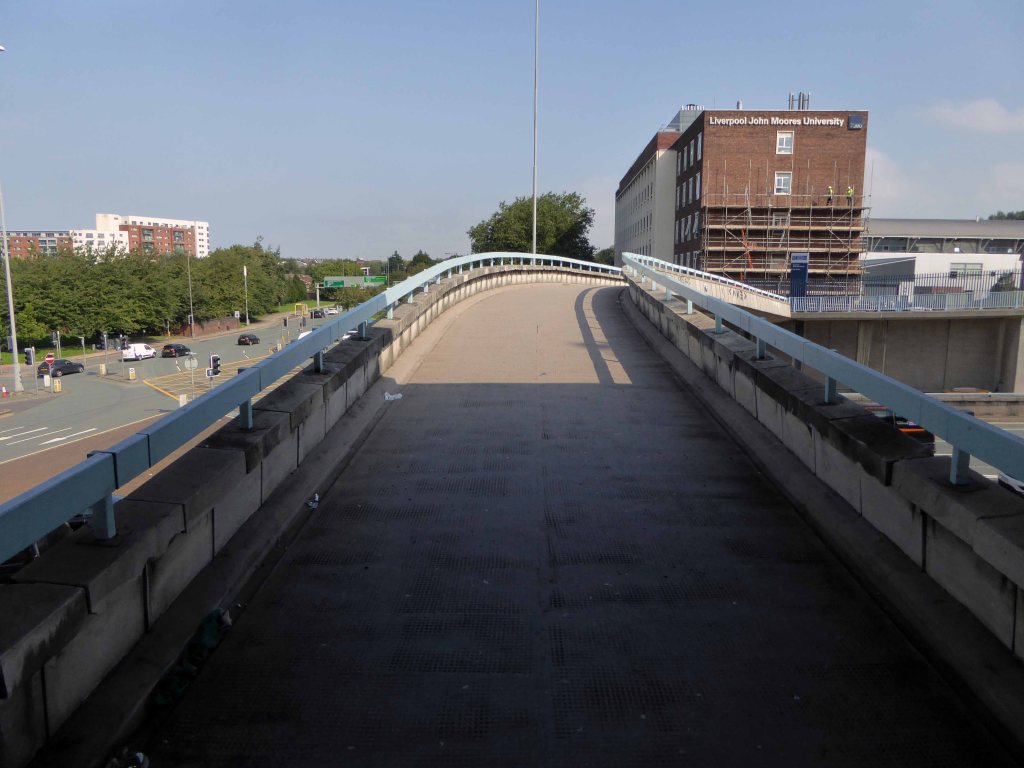
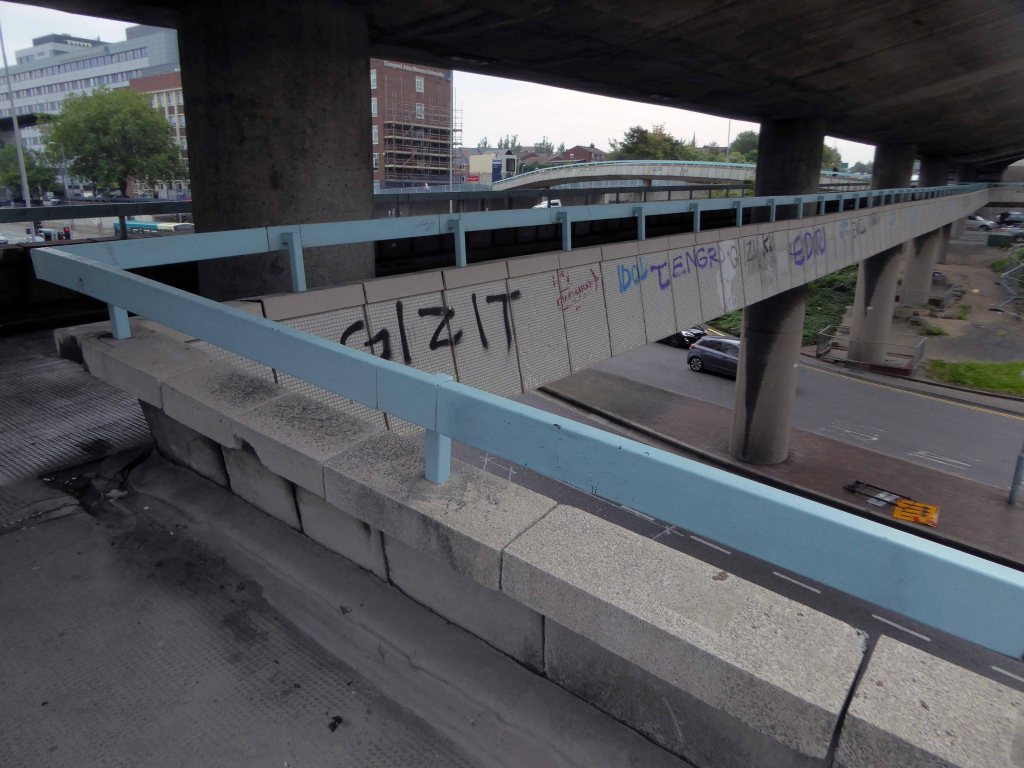
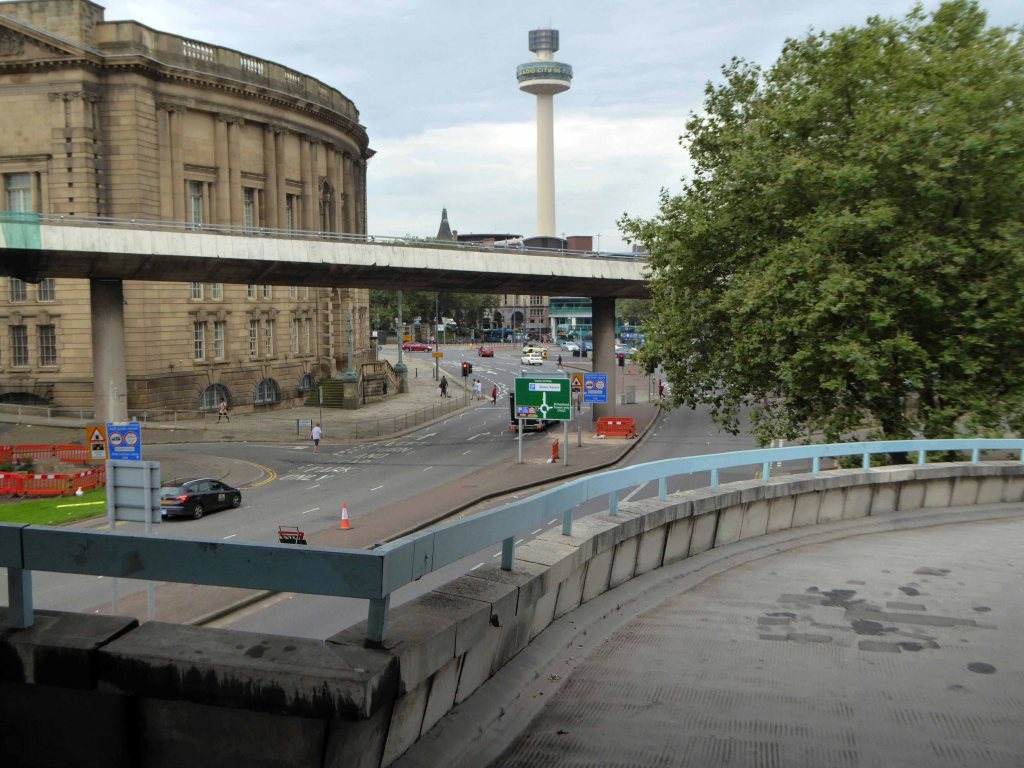
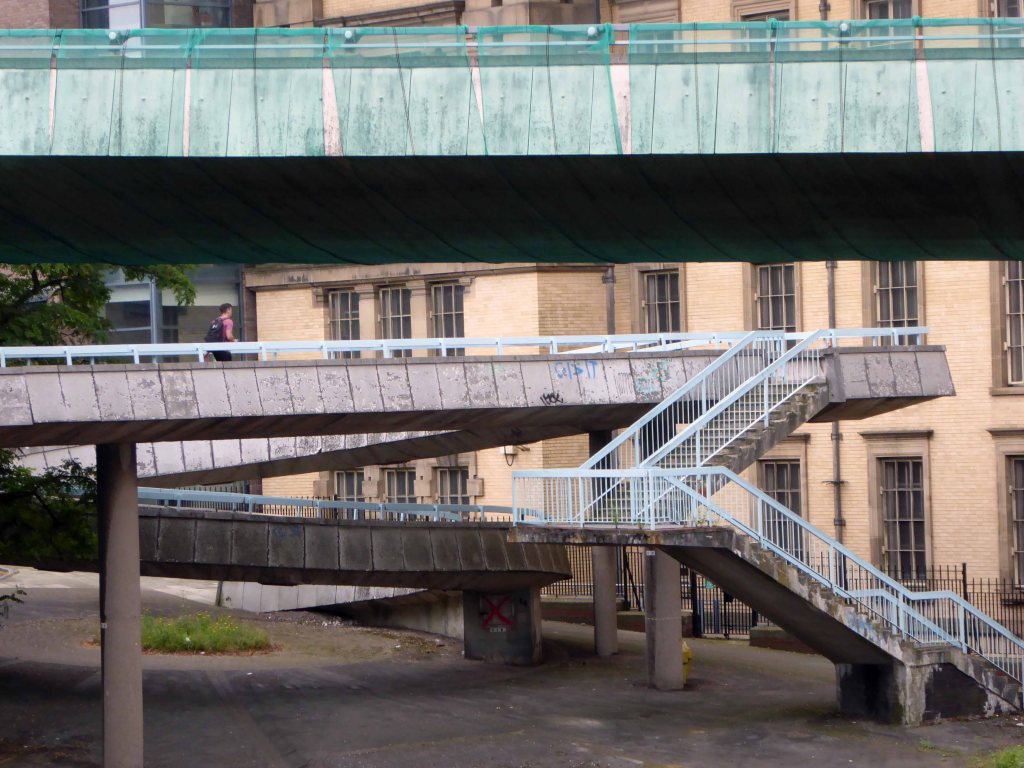
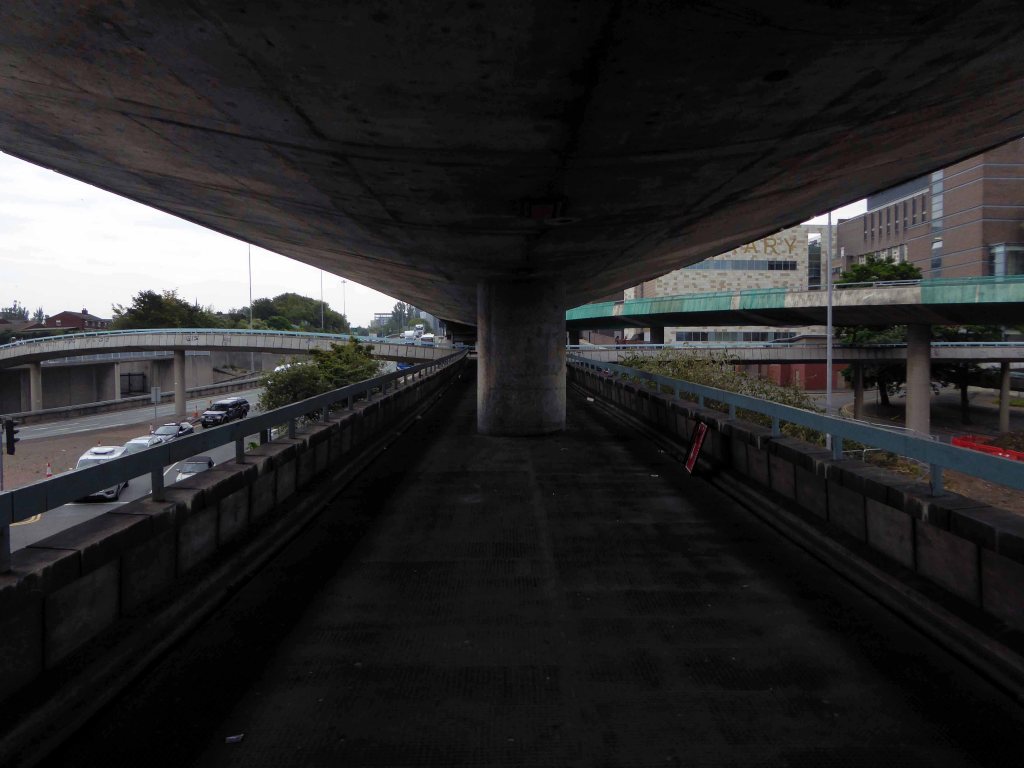
Opened in 1972 as an almost belated response to George Buchanan’s 1963 Traffic in Towns which had informed the Liverpool City Centre Plan of 1965.
The report warned of the potential damage caused by the motor car, while offering ways to mitigate it. It gave planners a set of policy blueprints to deal with its effects on the urban environment, including traffic containment and segregation, which could be balanced against urban redevelopment, new corridor and distribution roads and precincts.
These policies shaped the development of the urban landscape in the UK and some other countries for two or three decades. Unusually for a technical policy report, it was so much in demand that Penguin abridged it and republished it as a book in 1964.
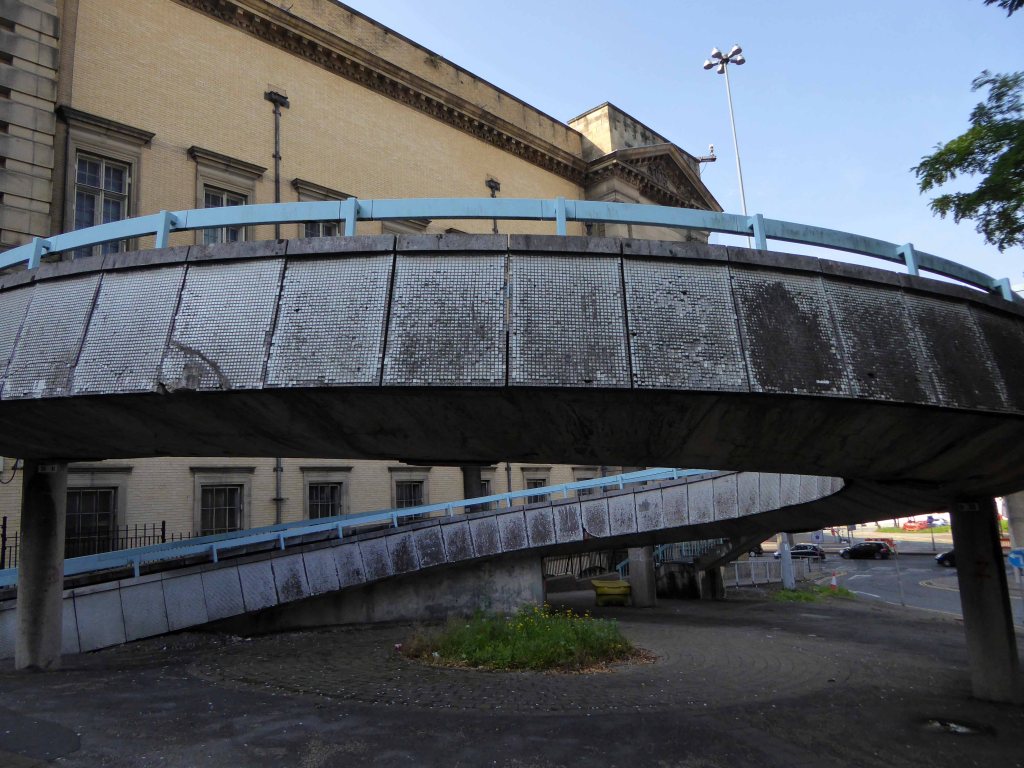
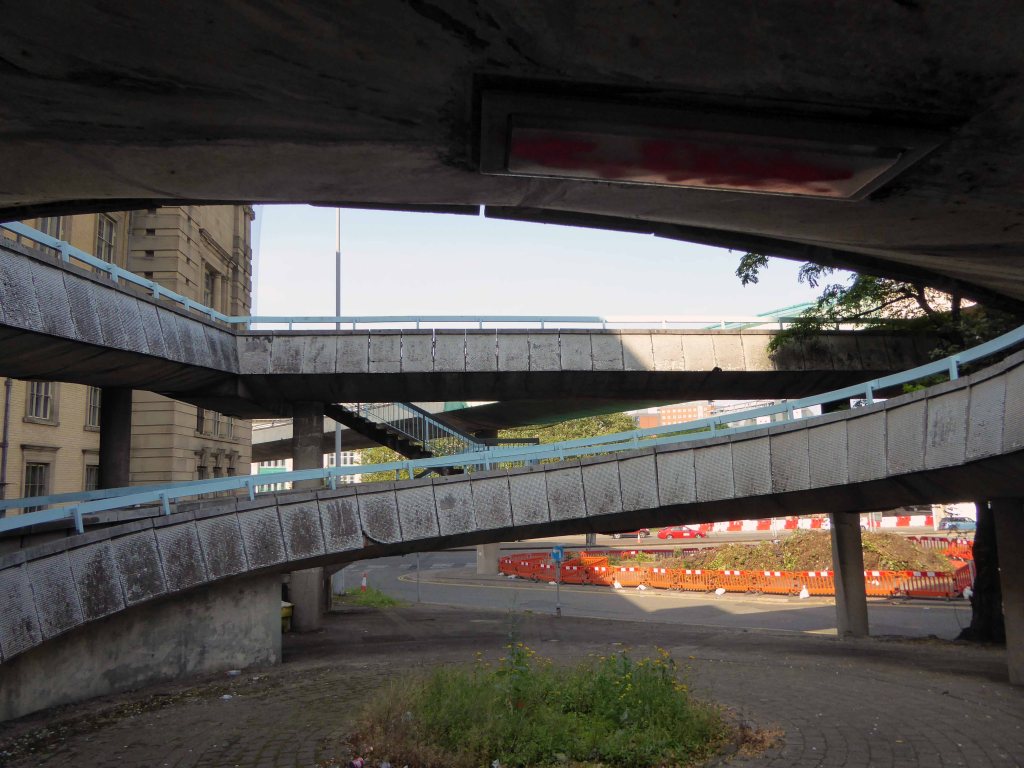
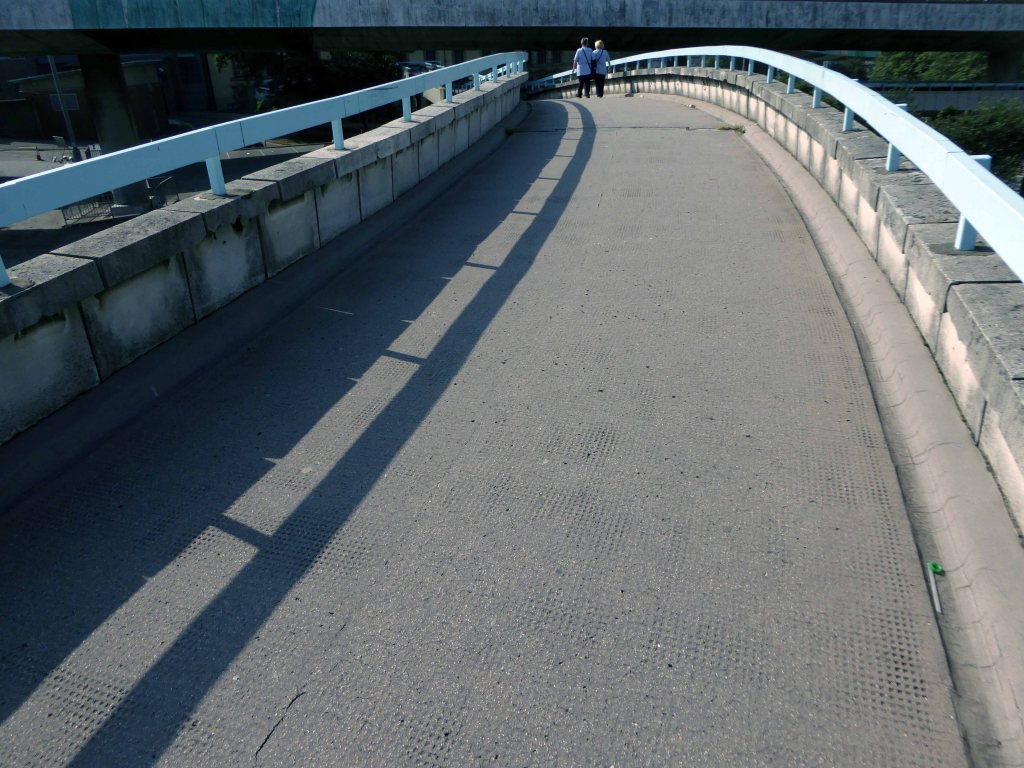
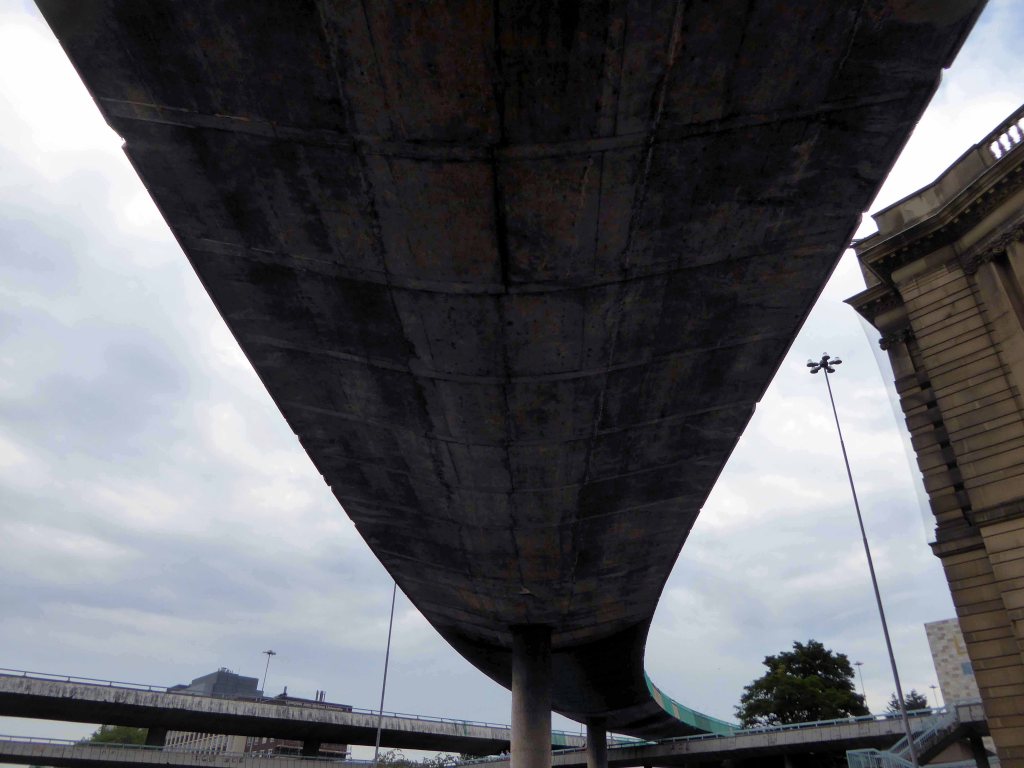
The Churchill Way was realised and remained in use until September 2nd 2019 – closed and facing a £10 million demolition programme, following a maintenance report which found them to be unsafe – and presumably beyond economic repair.
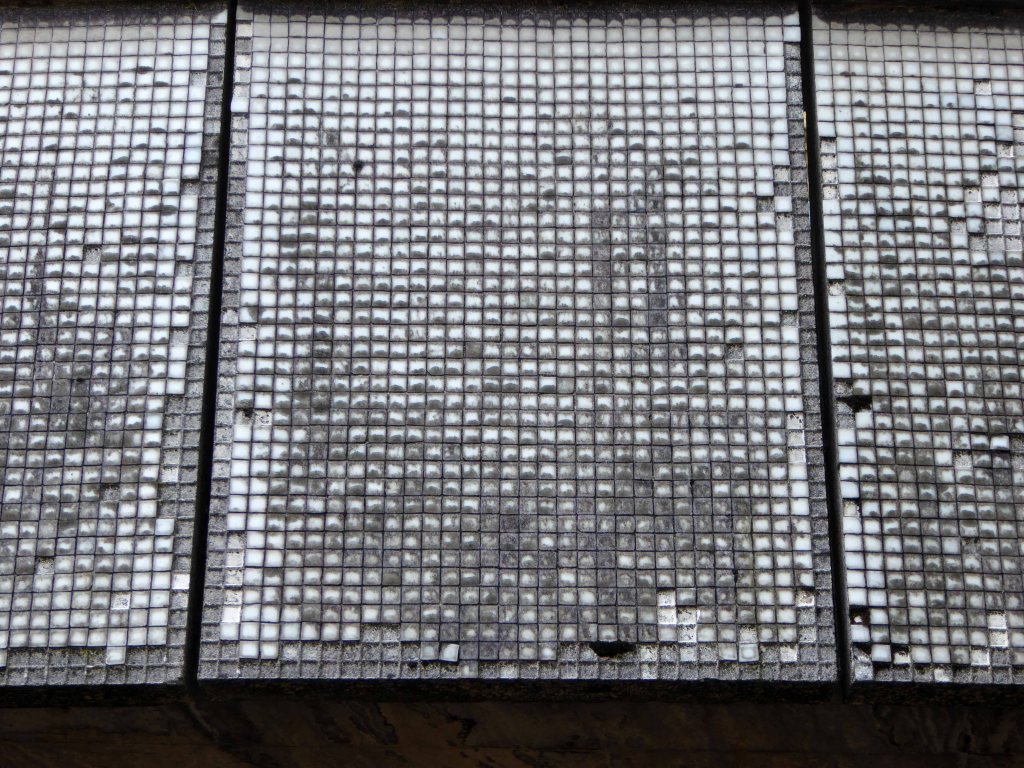
And so I took one last look around taking snaps, an epitaph to the end of an era, and the end of an idea that was once once rendered concrete.
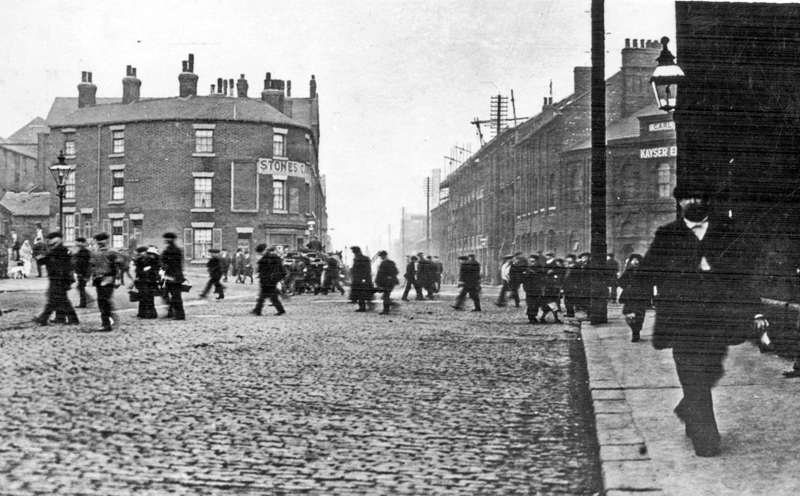
A city once awash with industry and ale – a myriad of pubs slaking the thirst of the thirsty steel workers.
A liquid equilibrium flowing and flowering for over a century.
The Lower Don Valley once home to a wealth of boozers, tells a different tale today.
A fall in production produced a proportionate reduction in consumption.
The clatter of clogs on cobbles, metal on metal is but a distant memory, along with the sound of pints pulled and hastily glugged.
The architecture of ale still prevails – now purveying pleasures and delights of a different stripe, whatever takes your fancy, as long as it’s not too fancy.
And doesn’t involve taking a drink.
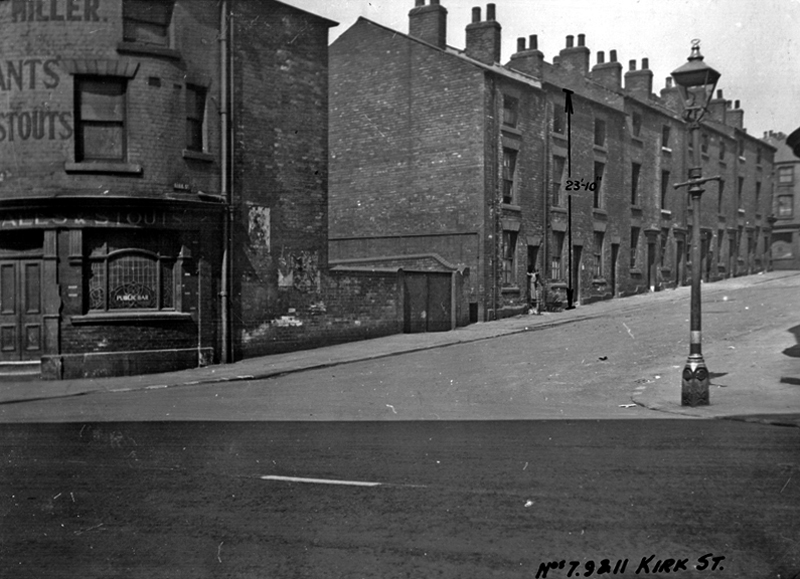
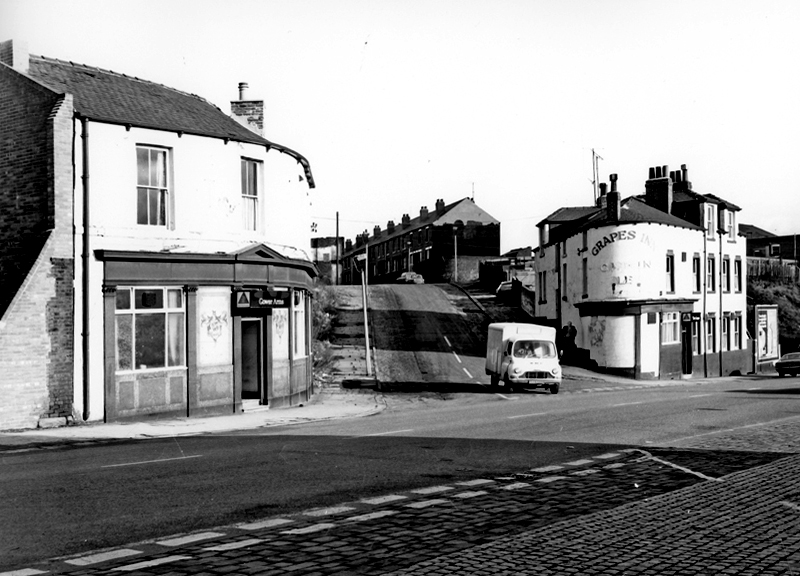
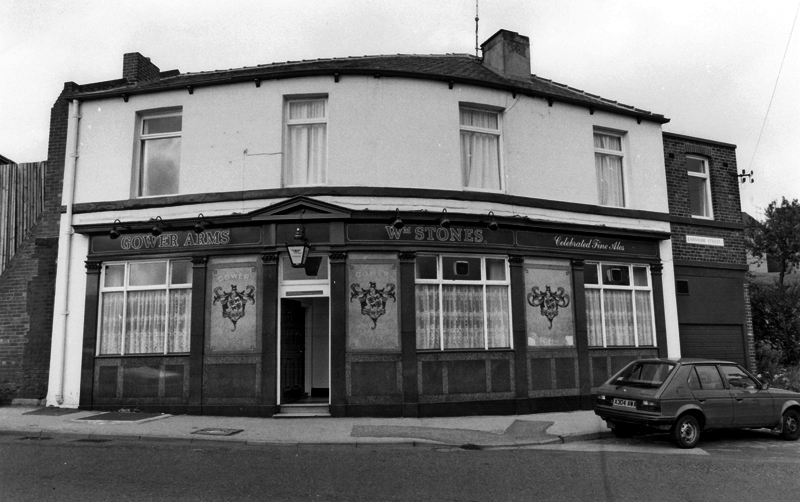
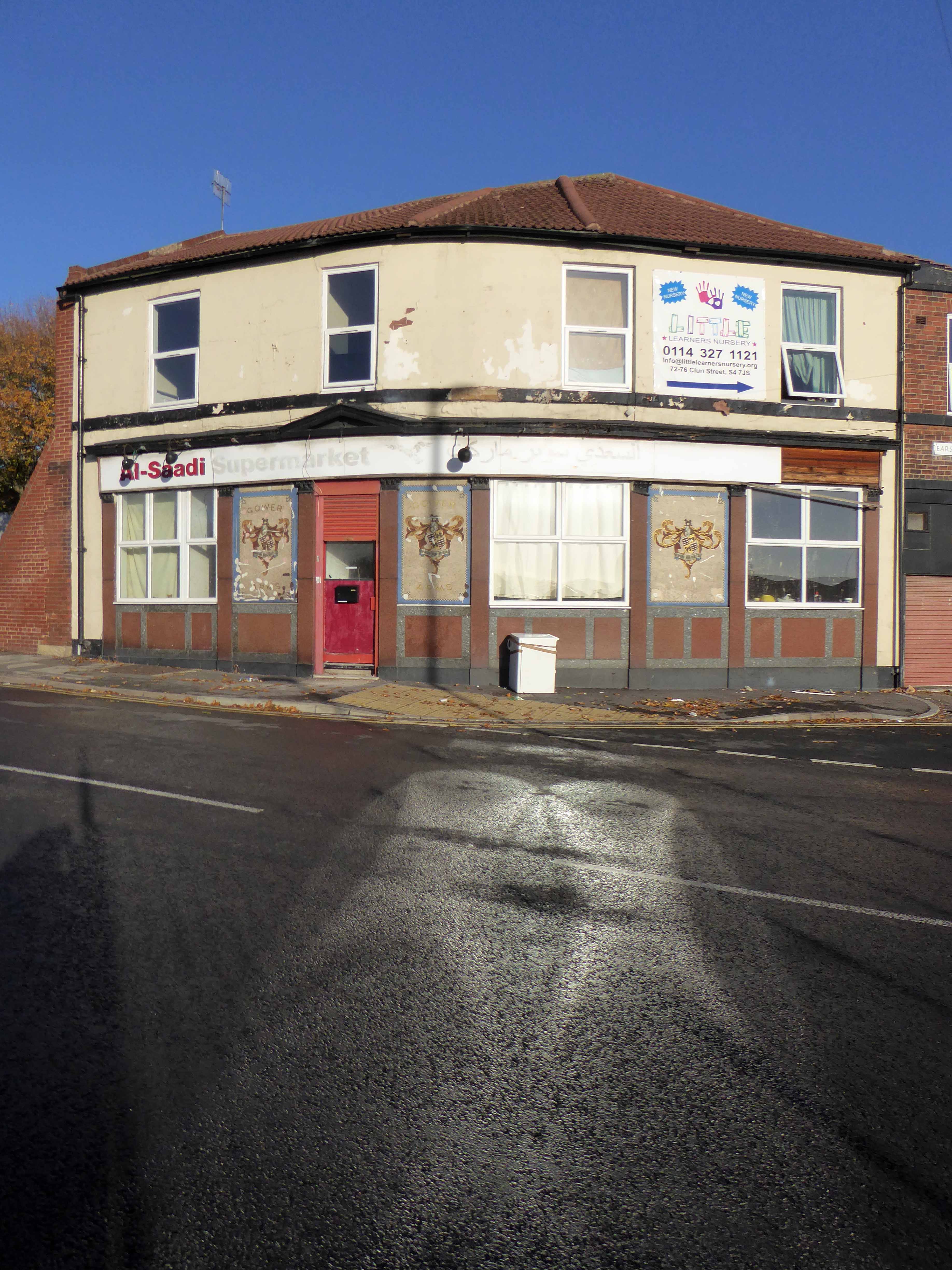
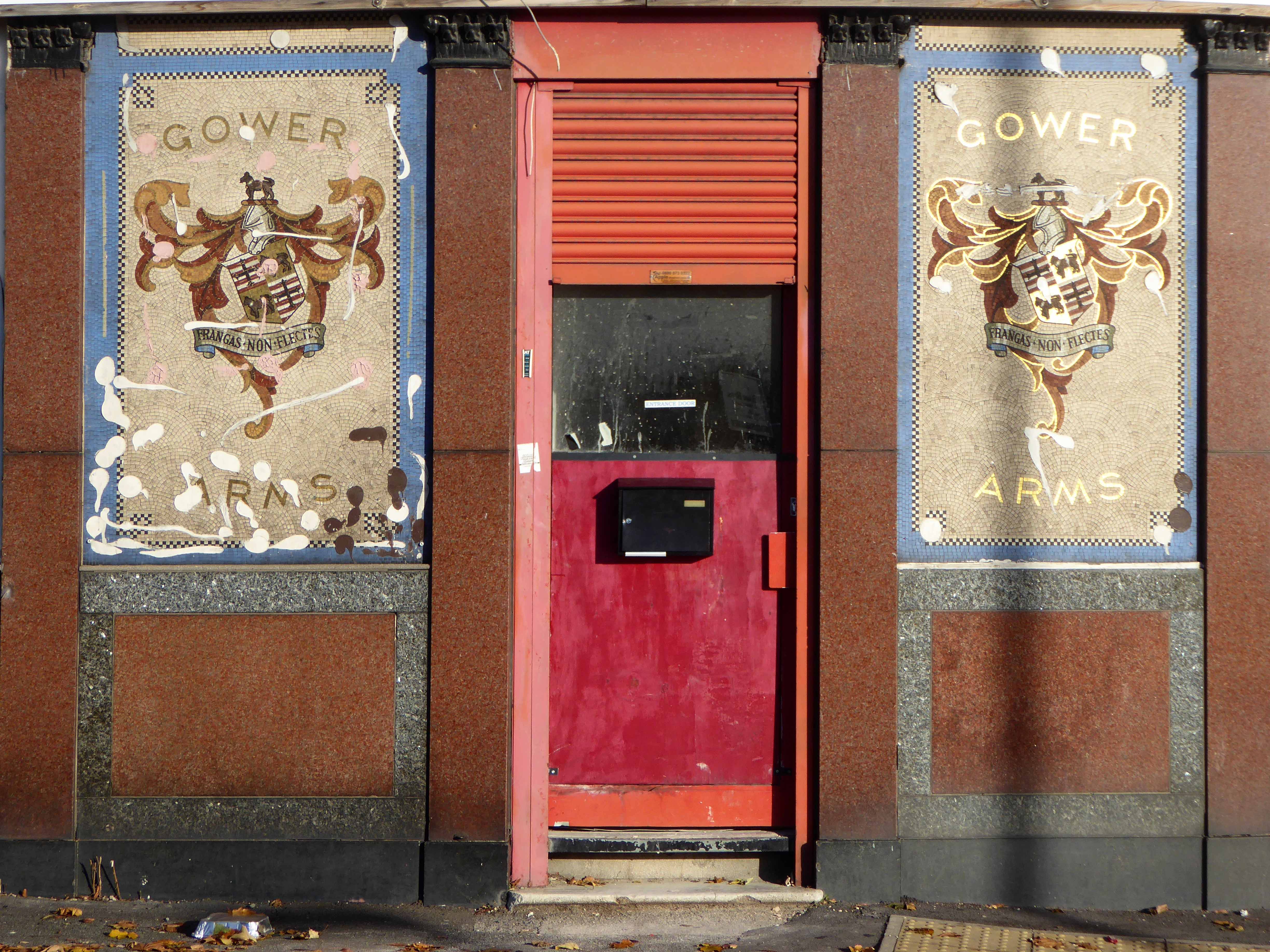
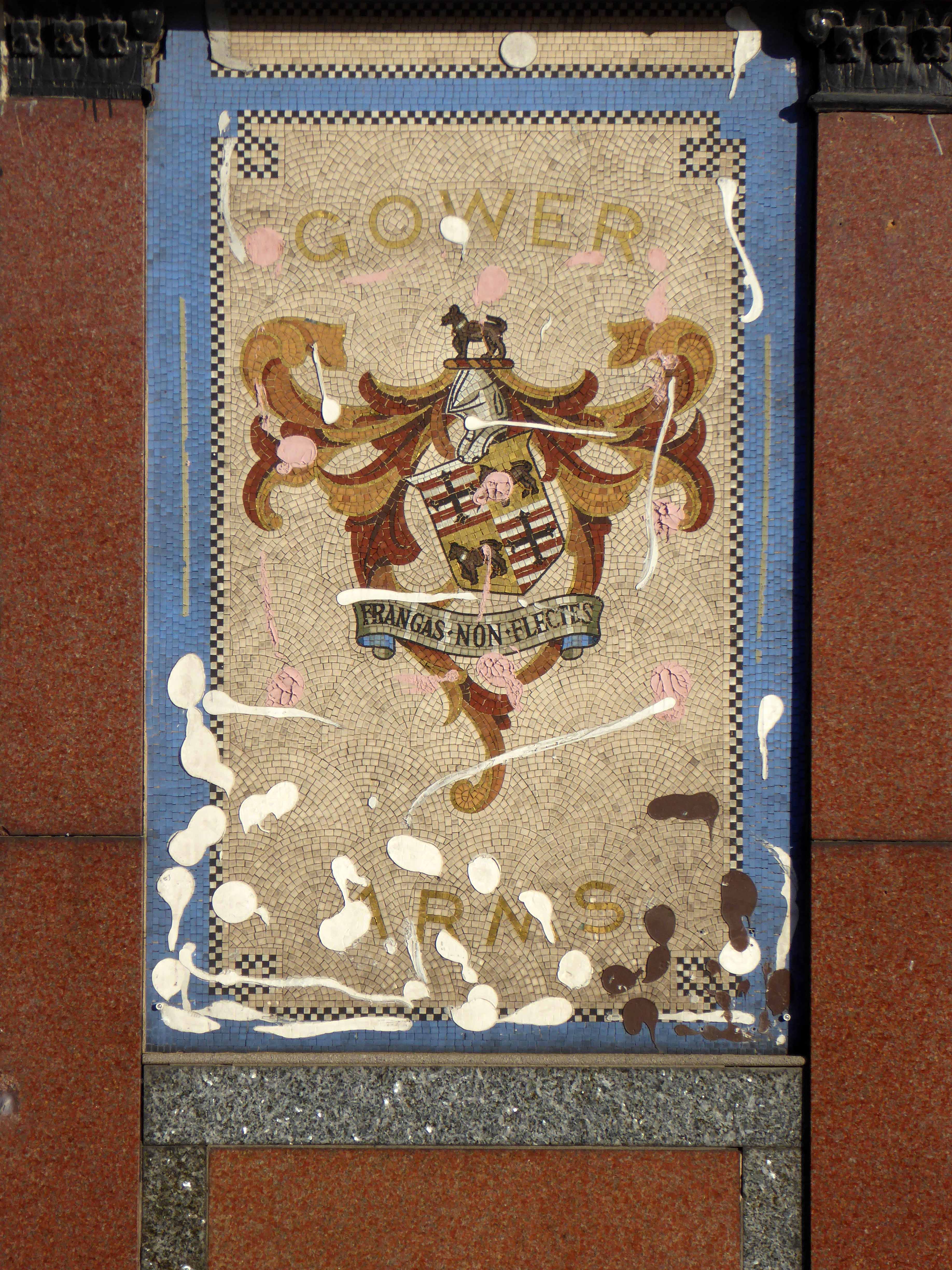
The Gower Arms – 47 Gower Street Burngreave Sheffield S4 7JW
I drink down there – top pubs methinks. They are old fashioned pubs with some real characters. Will be there Friday night in the Staff first, Royal Oak, Gower, Grapes and back to the Staff till I drop.
Blade Bloke 2007
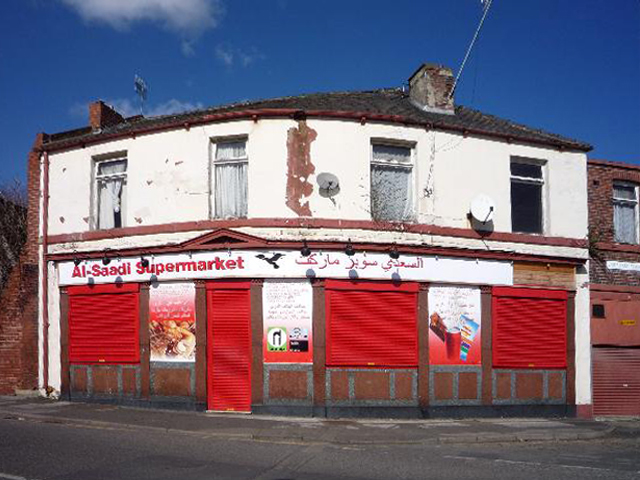
From top pub to closed corner supermarket in two shakes of a monkey’s tale.
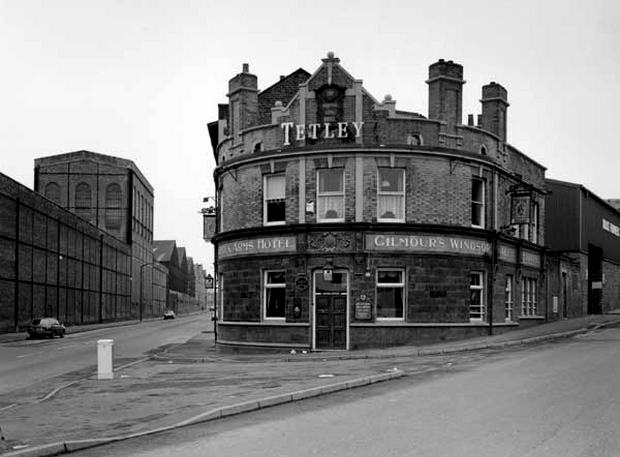
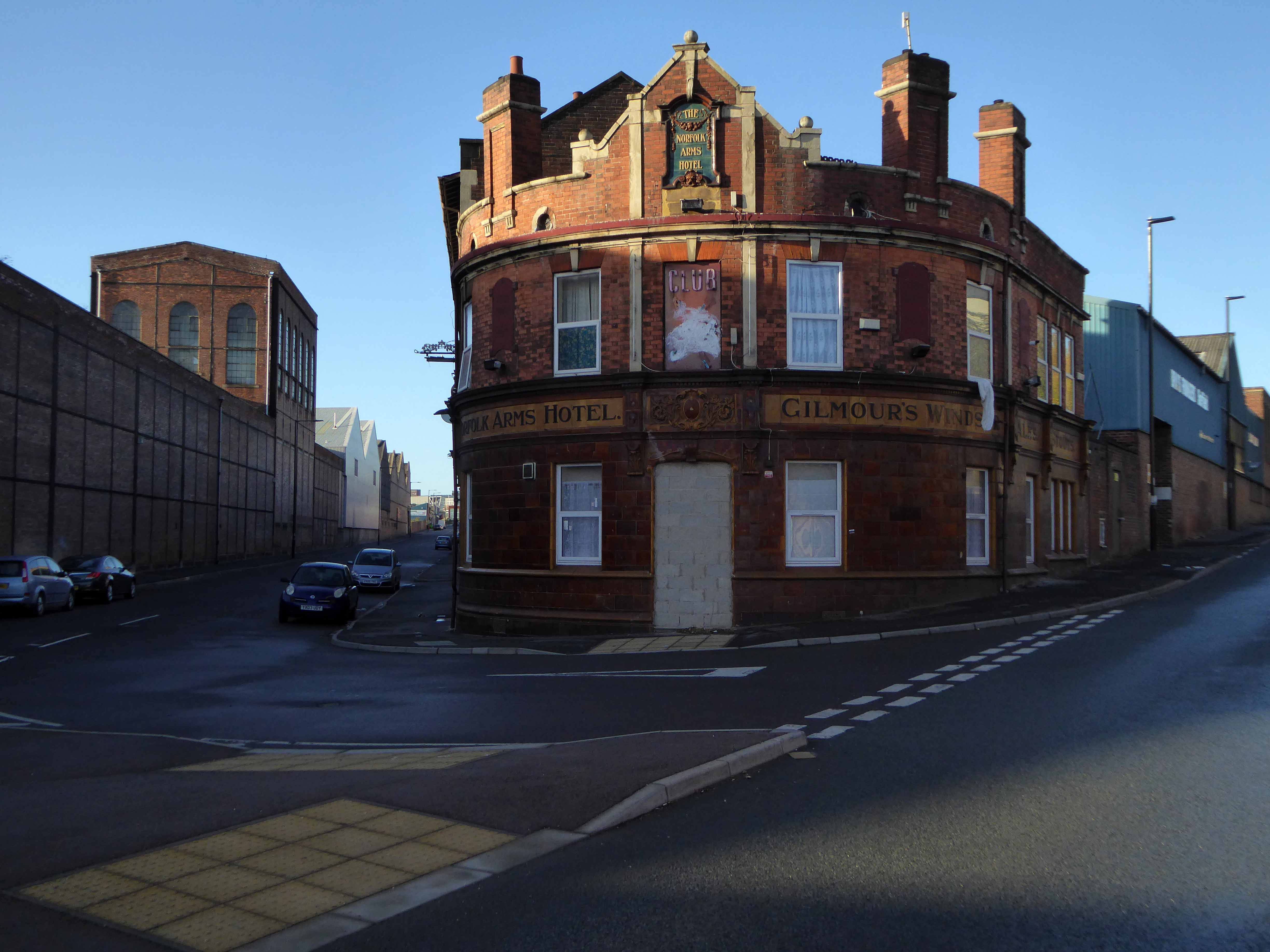
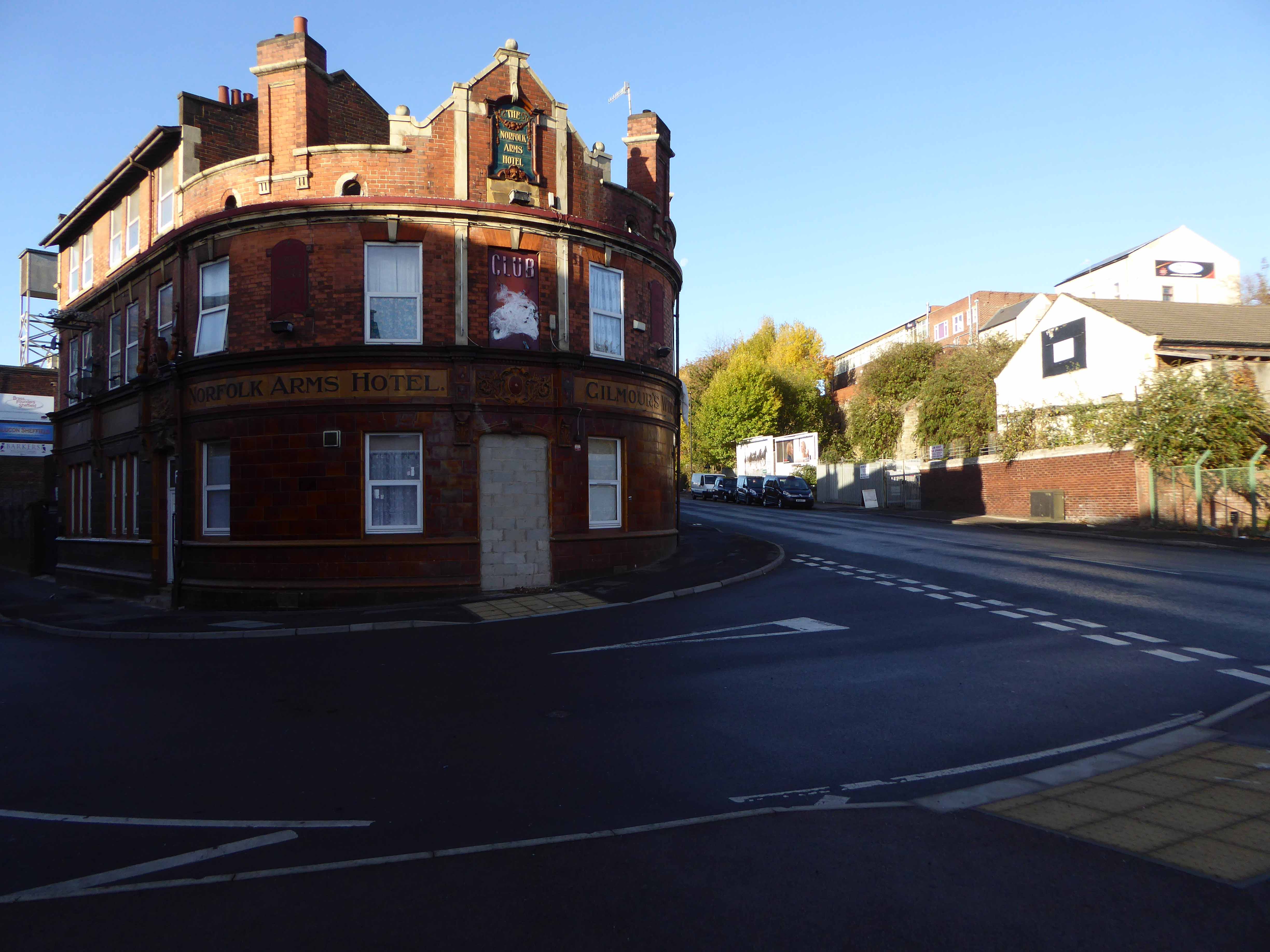
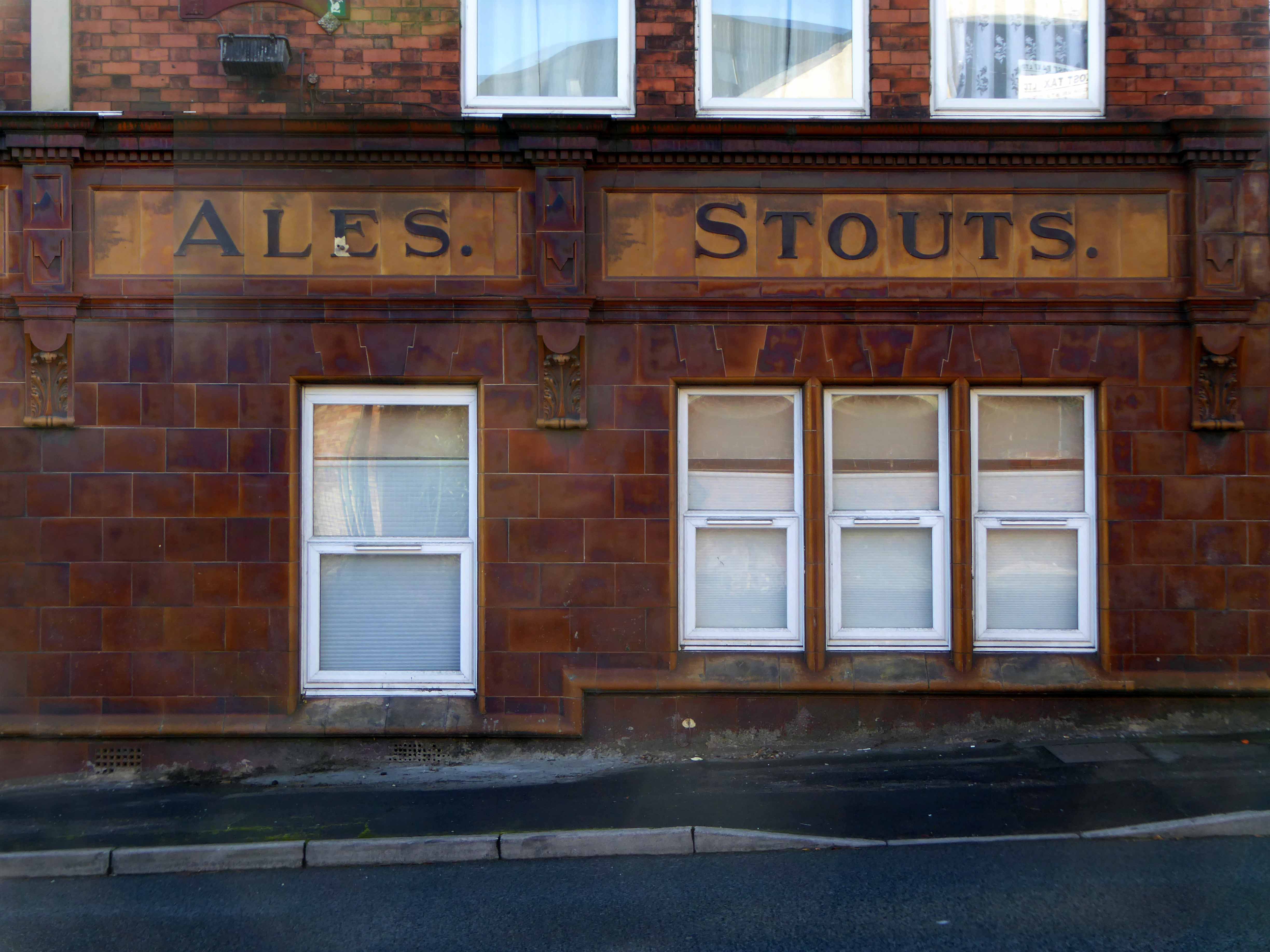
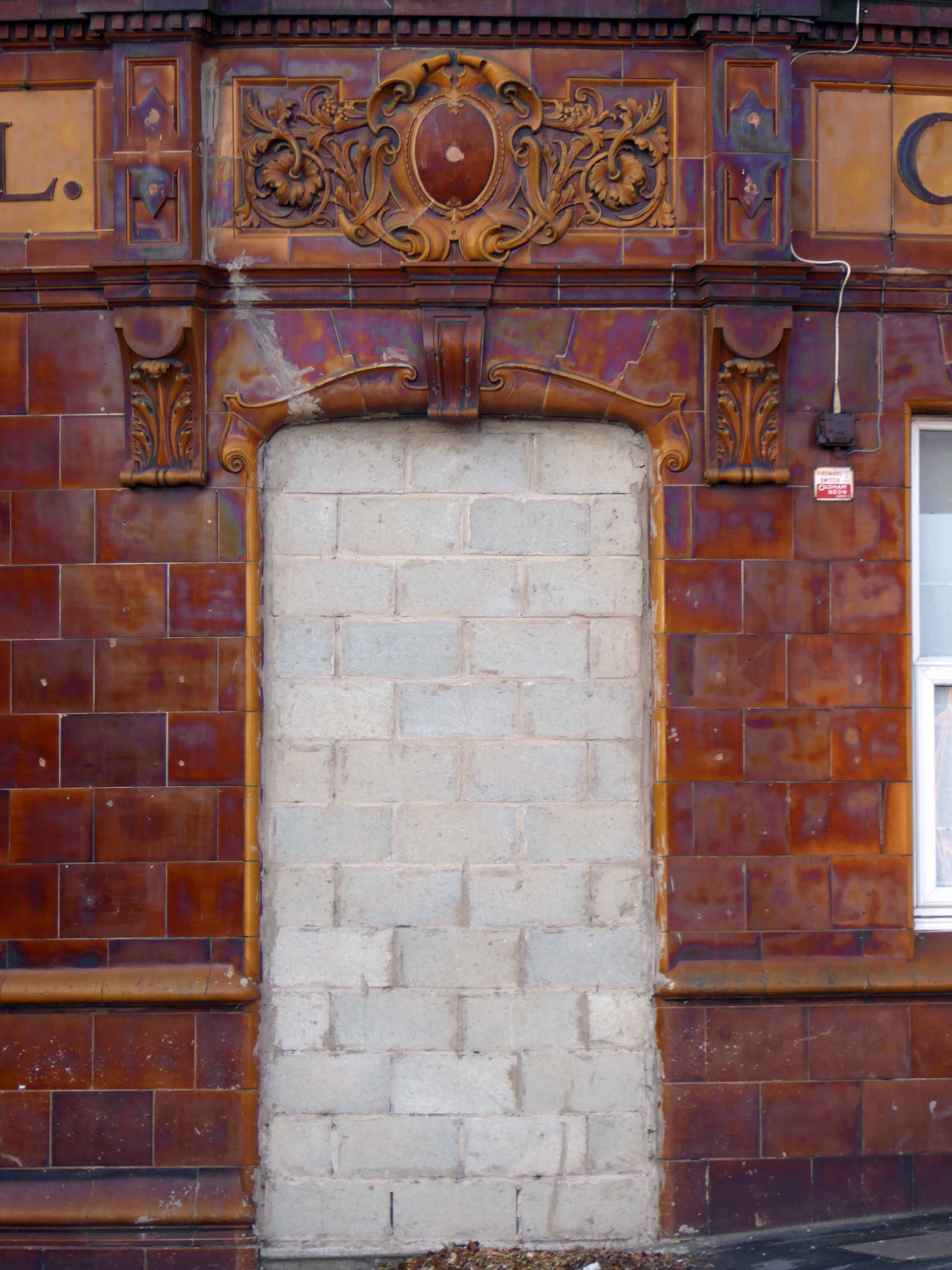
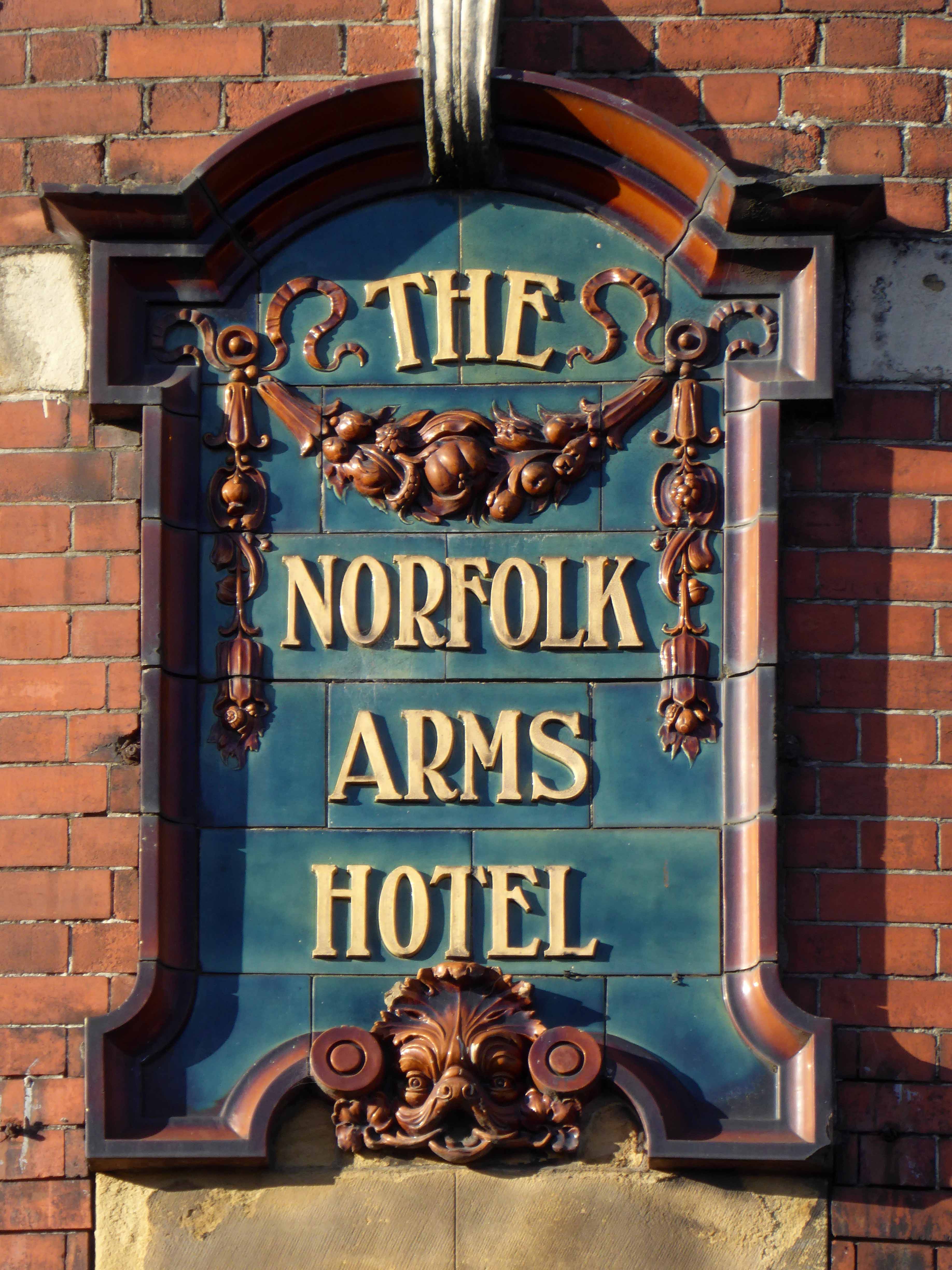
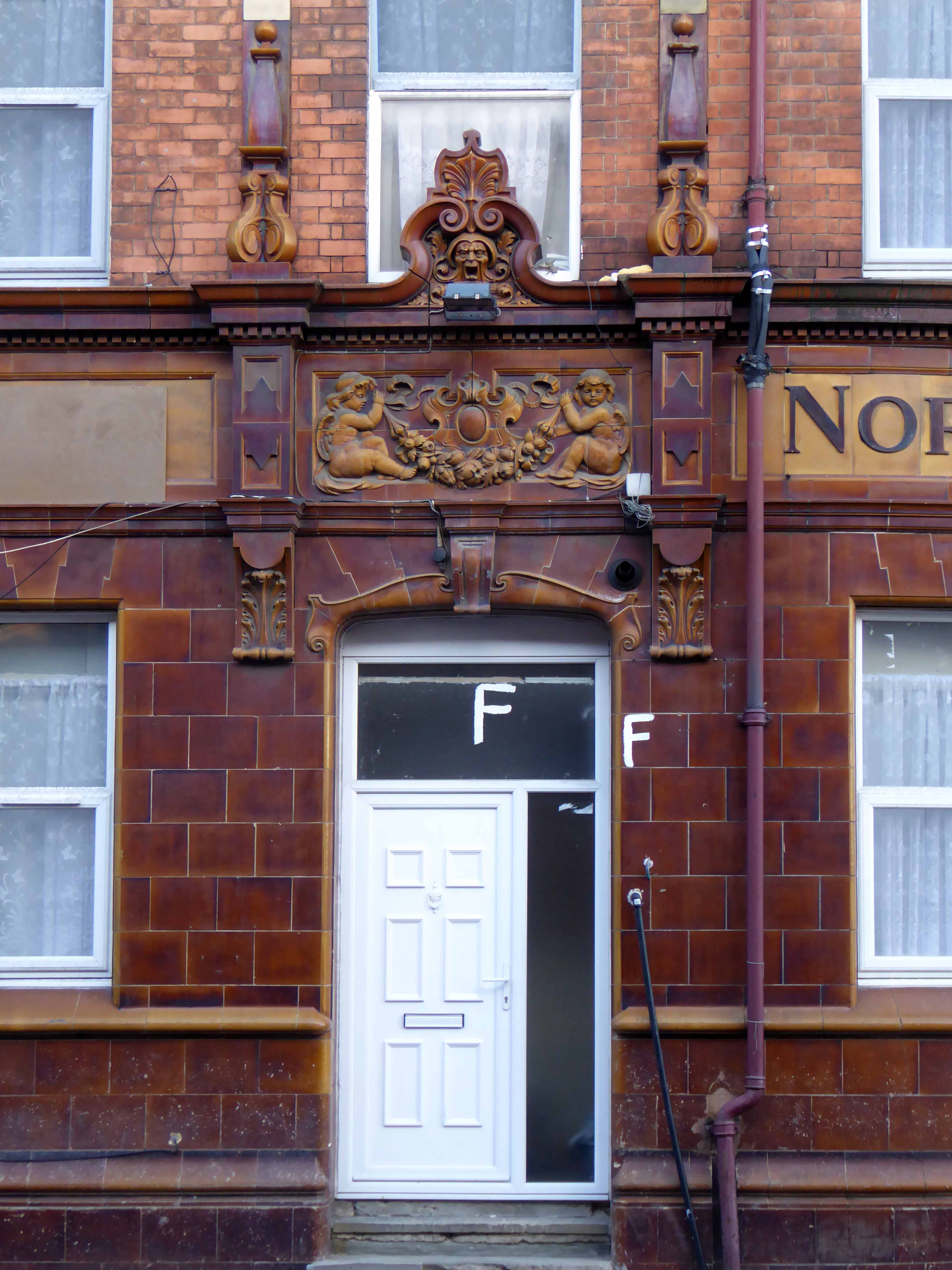
The Norfolk Arms Hotel – 195/199 Carlisle Street Sheffield S4 7LJ
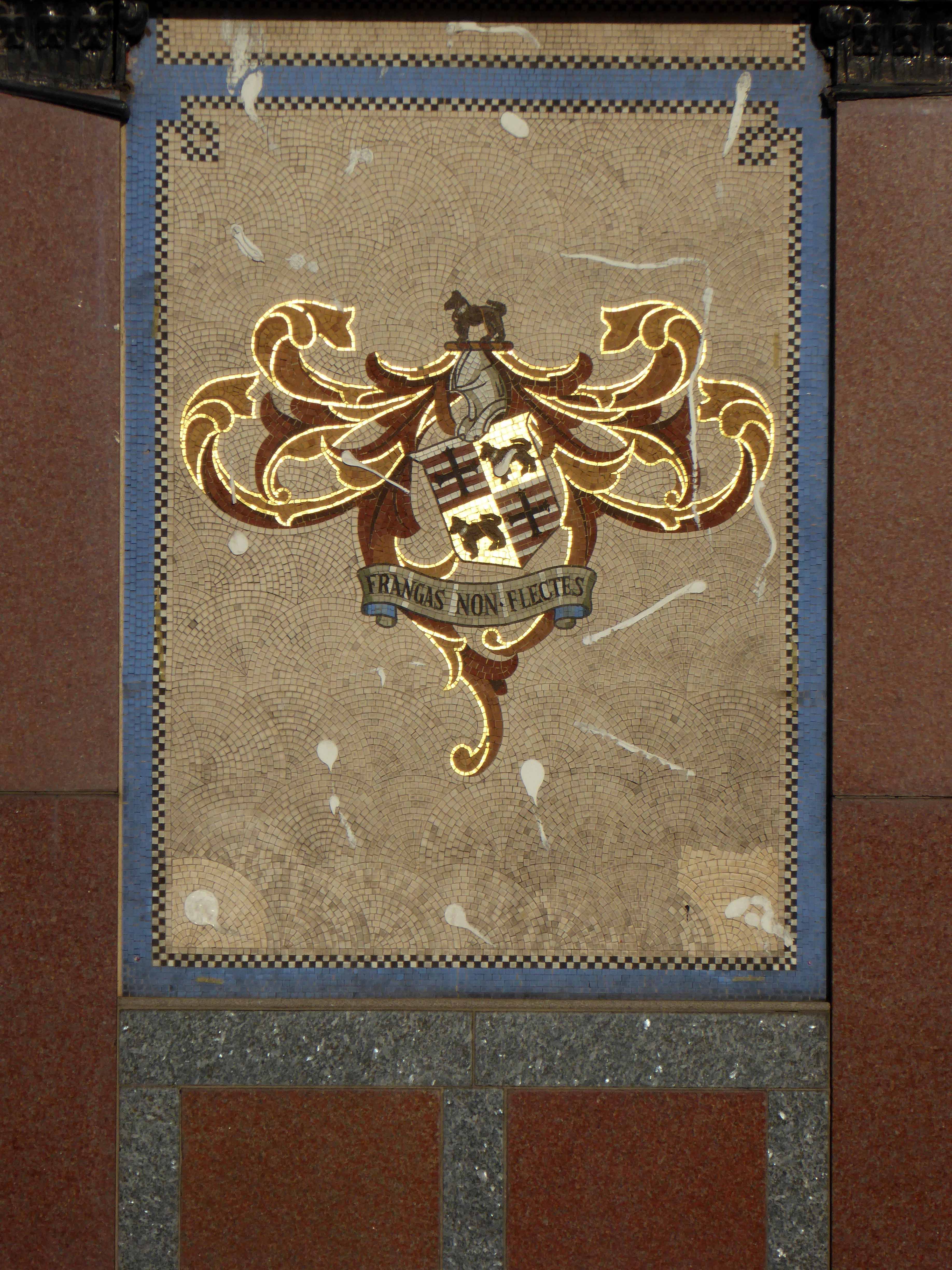
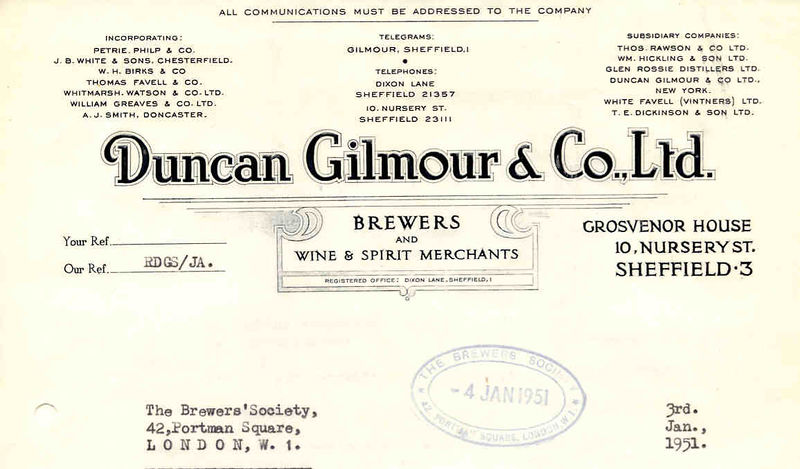
From a Gilmour’s tap, Tetley tavern to a temple of trendy funk.
Club Xes is a nightclub in Sheffield described as a vibrant and thrilling, and full of Sheffield’s young and trendy crowd. The DJs are renowned for providing the newest funkiest records.
Premises Type – This place does not serve real ale.
Premises Description – Gay nightclub.
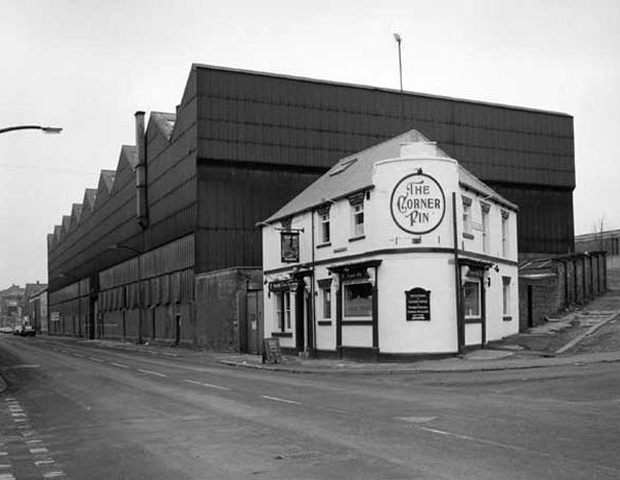
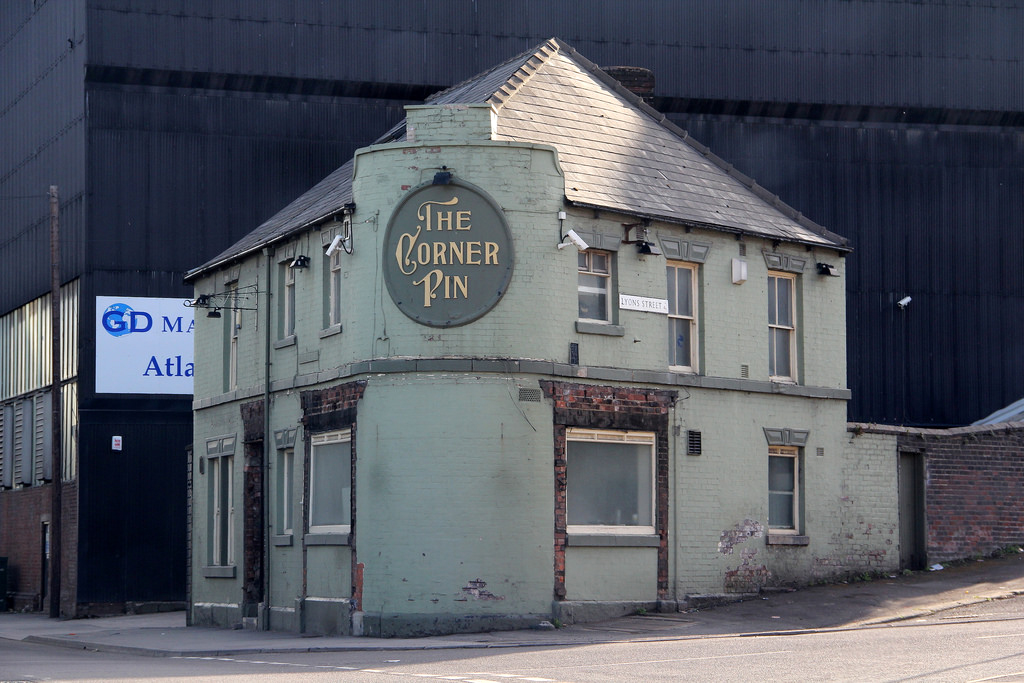
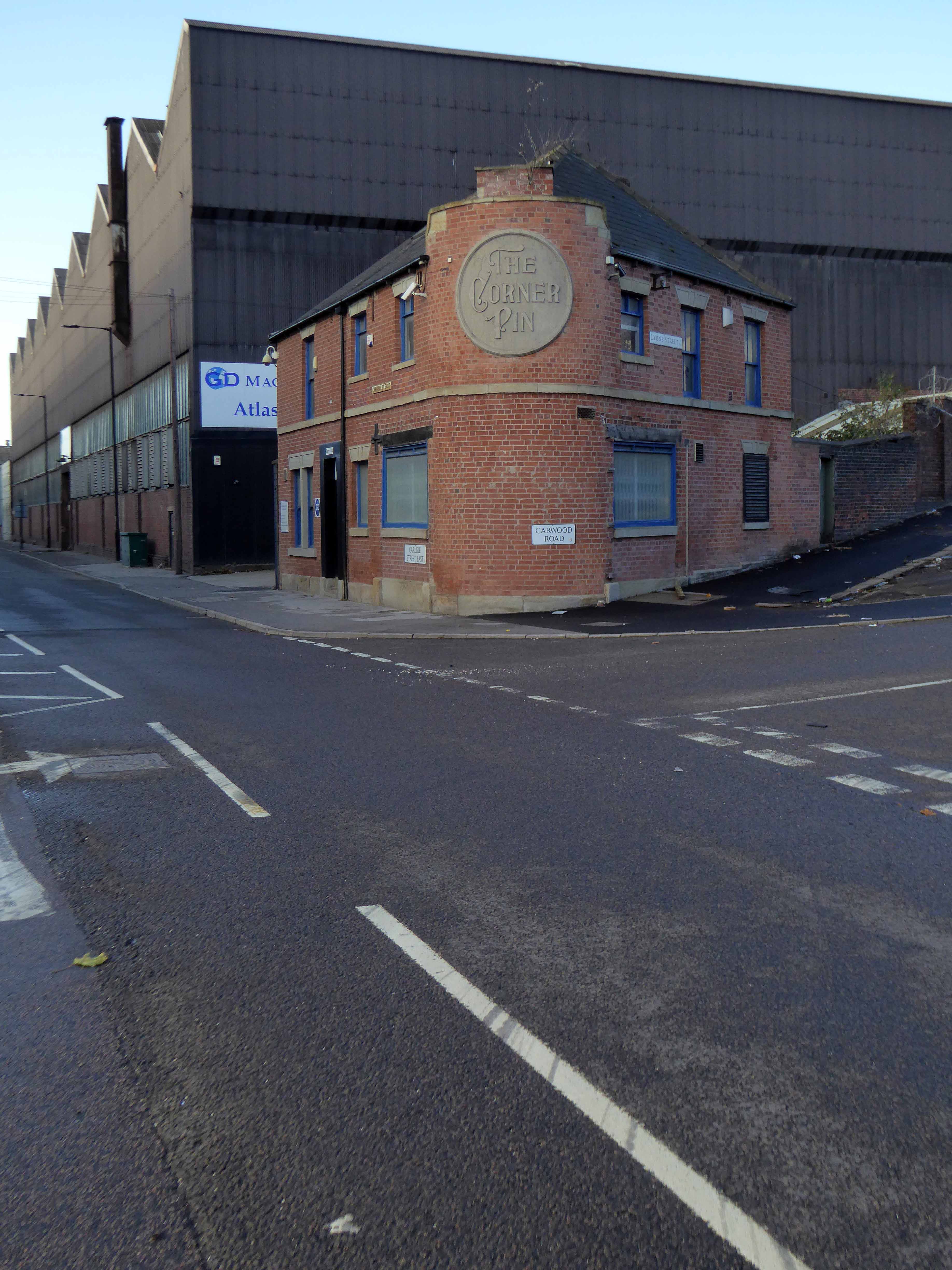
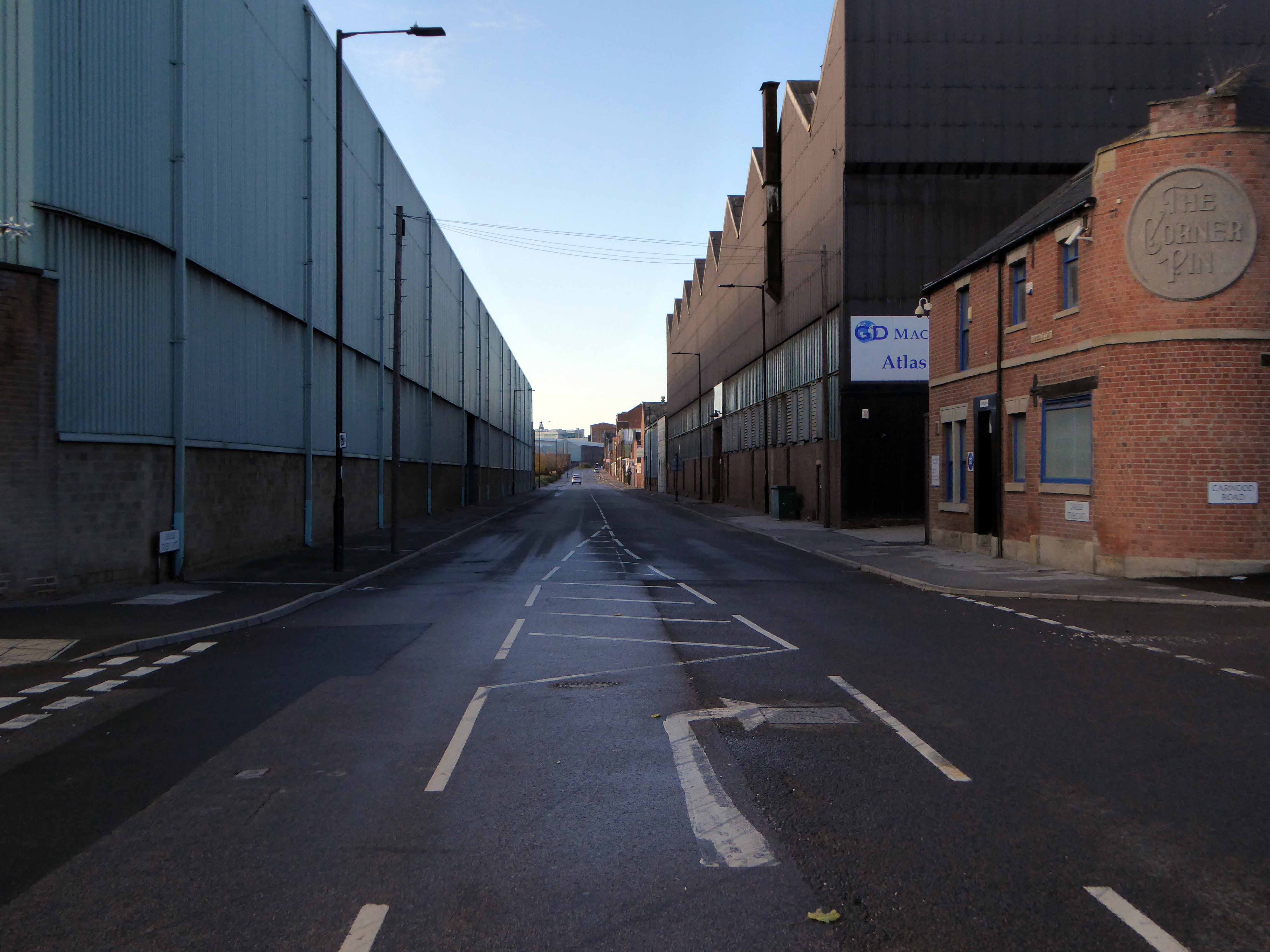
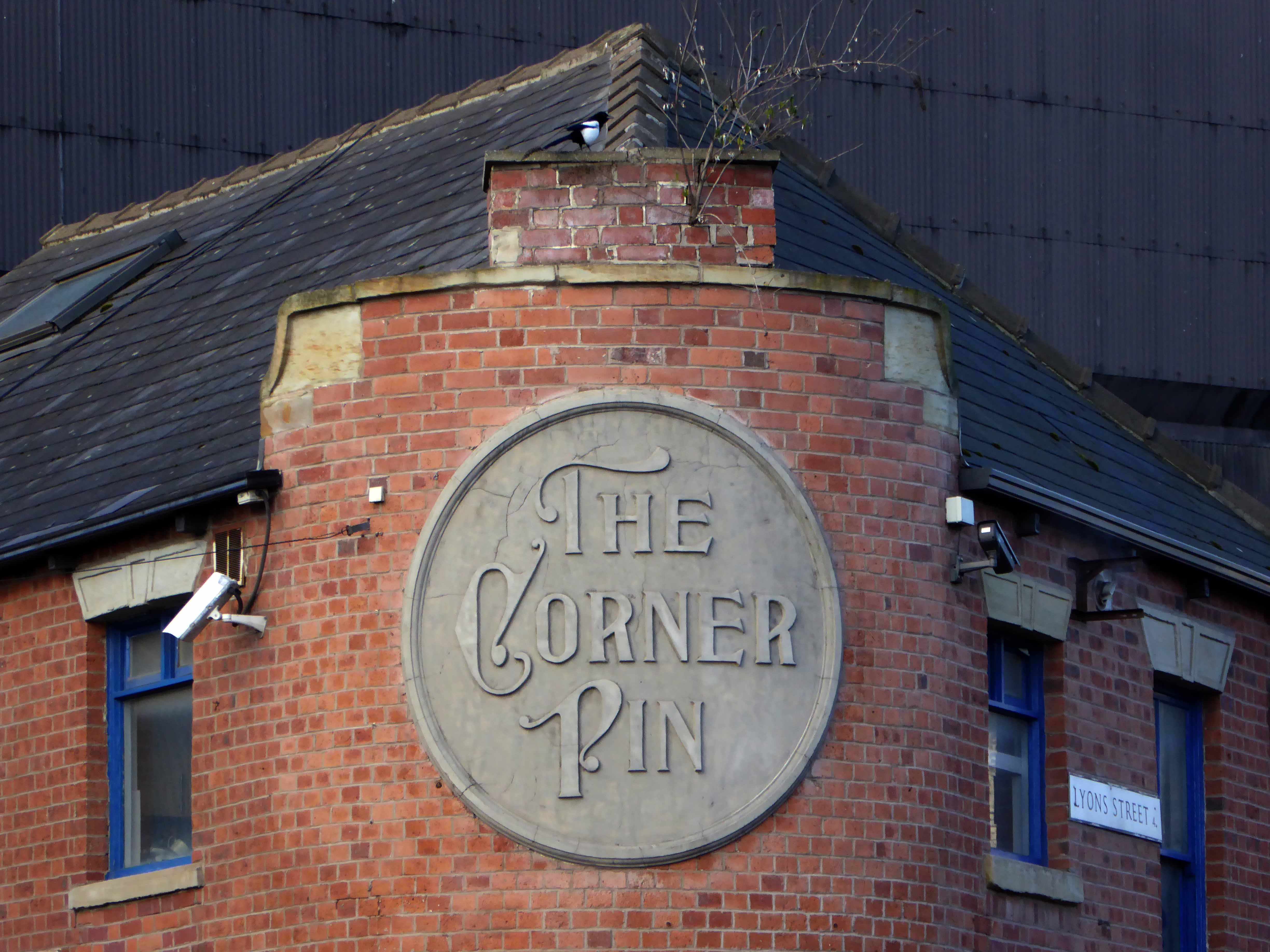
The Corner Pin – 231-233 Carlisle Street East Sheffield S4 7QN
First licensed to sell beer in 1840. One of 26 public houses serving the steel industry along a three- quarter mile stretch of Carlisle Street. It is said to have a ghost who likes to turn the lights on in the middle of the night and footfalls can be heard.
The Corner Pin was the last of the Steelmakers pubs in Sheffield and was one of my favourite places to visit for a real good pint! I would come over from Melbourne once or twice a year, still do, and meet up with Chris Payling and many others still left over from the days of Sheffield Steel, but now all gone.
They even took away your window frames, along with your dignity once a pale green shadow of yourself, stripped back to brick.
Stop dreaming of a foaming pint right now – you’re an office.
Obviously, stating the obvious in Comic Sans on a shocking pink ground may ease the pain of industrial decline and its attendant social and economic ills.
Sheffield along with the majority of British manufacturing towns and cities, has seen the wealth created by over a century of hard labour spirited elsewhere, and the means by which that wealth was created shipped overseas or overwritten by new technologies.
This has not been an accident or unfortunate consequence of global trends, it has been government policy.
It has not been government policy to regenerate these towns and cities.
So Sheffield has taken the initiative to become – The fastest growing British city outside London.
Though that may do little to redress the structural economic divides within the city.
So I walked the avenues and alleyways of the Lower Don Valley, early on an October Sunday morning, mourning the passing of the clang and clamour that once fuelled the city and the nation.
An aroma of engine oil and the sound of metal on metal still permeates the area, and the low autumnal sun warms the long straight streets.
My thanks to all those happy souls who braved the cold winds, sunshine and threat of snow on Sunday 28th October 2018 – Steve.
Sharing ideas, memories and animated conversation, as we circumnavigated the fenced perimeter of Europe’s largest listed structure. In search of a personal photographic response to the site.
Eva Brothers of Crabtree Forge, Crabtree Lane, Clayton, Manchester.
1909 The partnership of James Eva, Archibald William Eva, Victor Eva, Arthur Eva, and Frank Eva, carrying on business as Forge-masters, at Crabtree-lane, Clayton, Manchester, under the style or firm of Eva Bothers was ended. All debts due would be settled by Archibald William Eva, Victor Eva, Arthur Eva, and Frank Eva, who continued the business under the same style.
By 1953 The EVA group of companies was the largest edge tool makers in the world, exporting most of their products. The associated companies included: Chillington Tool Co, Edward Elwell Limited of Wednesbury, A. W. Wills and Son Limited of Birmingham, John Yates and Co Limited of Birmingham, and the Phoenix Shovel Co Limited of Cradley Heath.
1958 Acquired T. Williams Drop forgings and Tools of Small Heath, Birmingham
1959 Planned to convert into a holding company; depressed demand for heavy engineering but continued group prosperity were anticipated.
1960 Eva Brothers paid dividends and made scrip issue; changed the name to Eva Industries as the holding company.
1976: Eva Brothers continued to be a part of Eva Industries.
This is where Manchester’s prosperity was created, engineering along with King Cotton, formed the financial foundations of the city. These industries are now all but vanished, along with the communities and skills that created them, work and wealth are elsewhere.
Years of free-market economics, acquisition, asset stripping, amalgamation and monopoly have bequeathed a legacy of loss.
Once bustling and business like sheds and yards, are now forests of buddleia and bramble. The sound of metal on metal, but a dull memory, amidst the wilder side of wildlife and the gentle whisper of peeling paint.
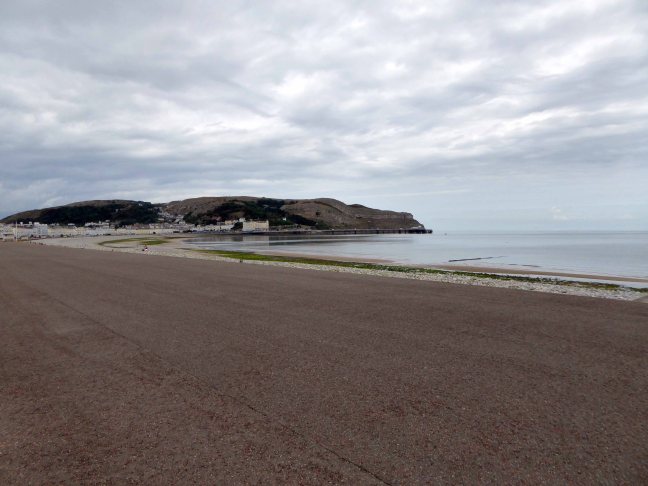
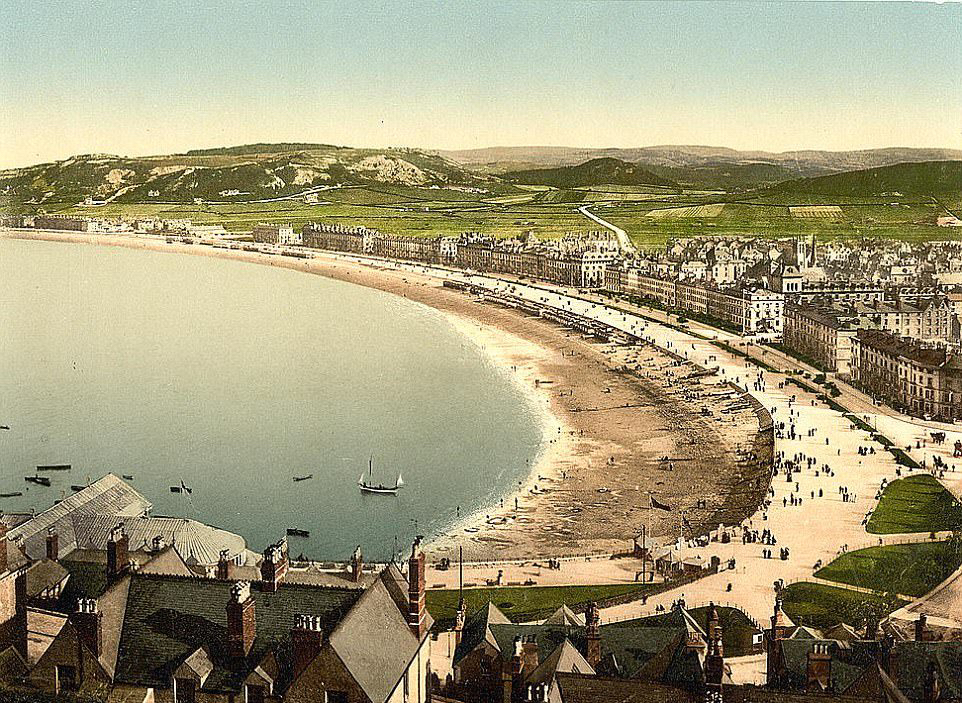
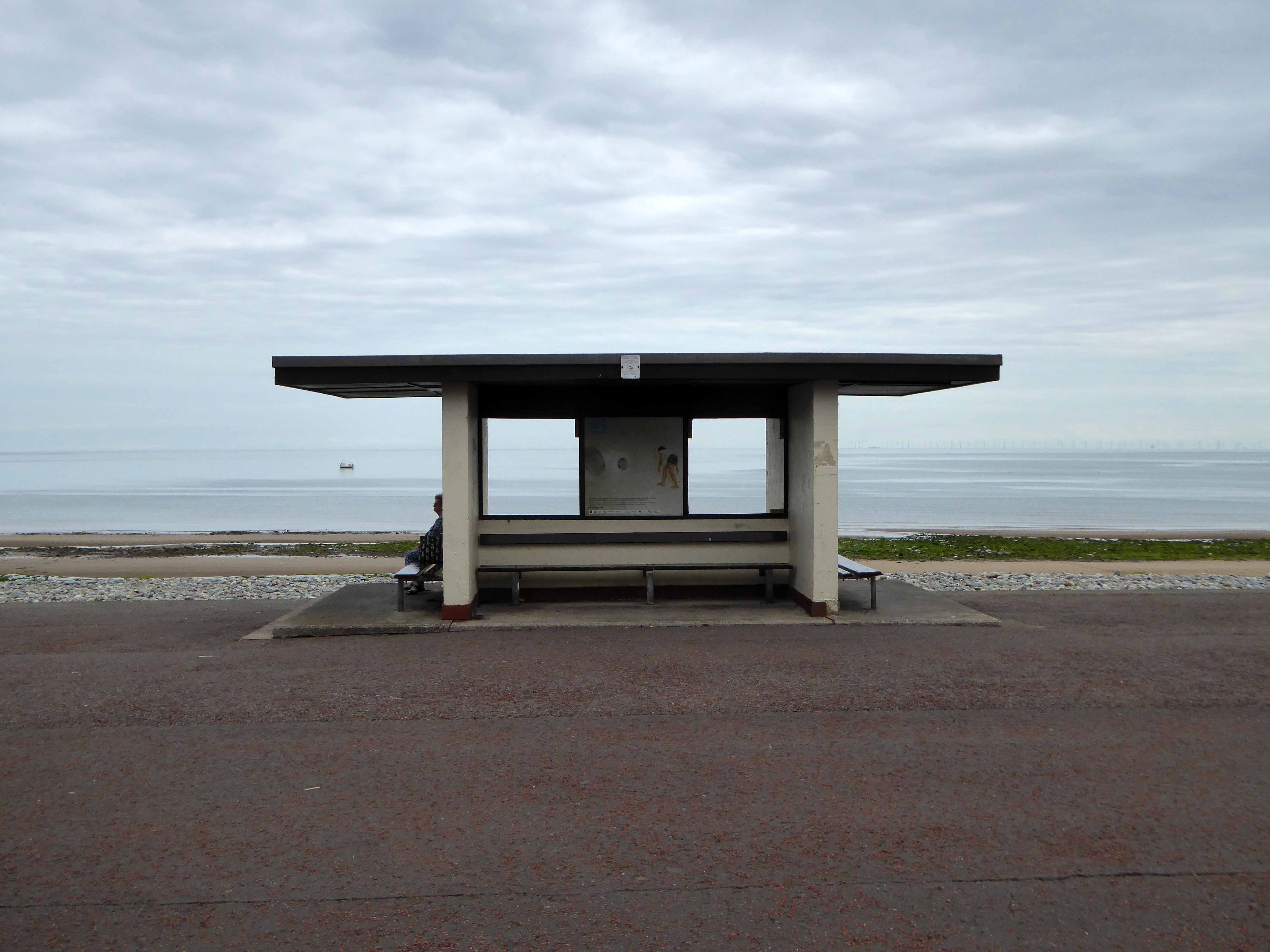
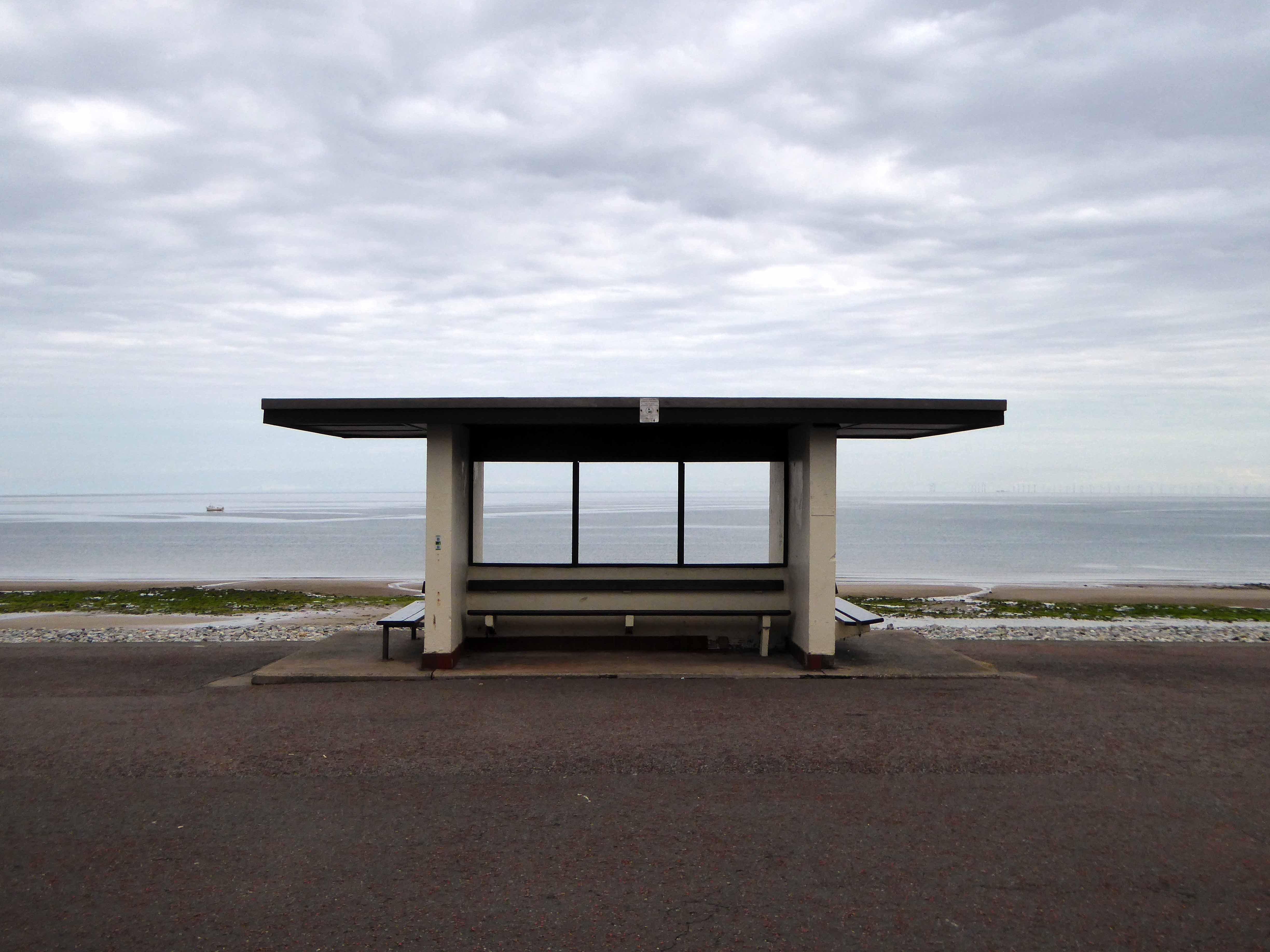
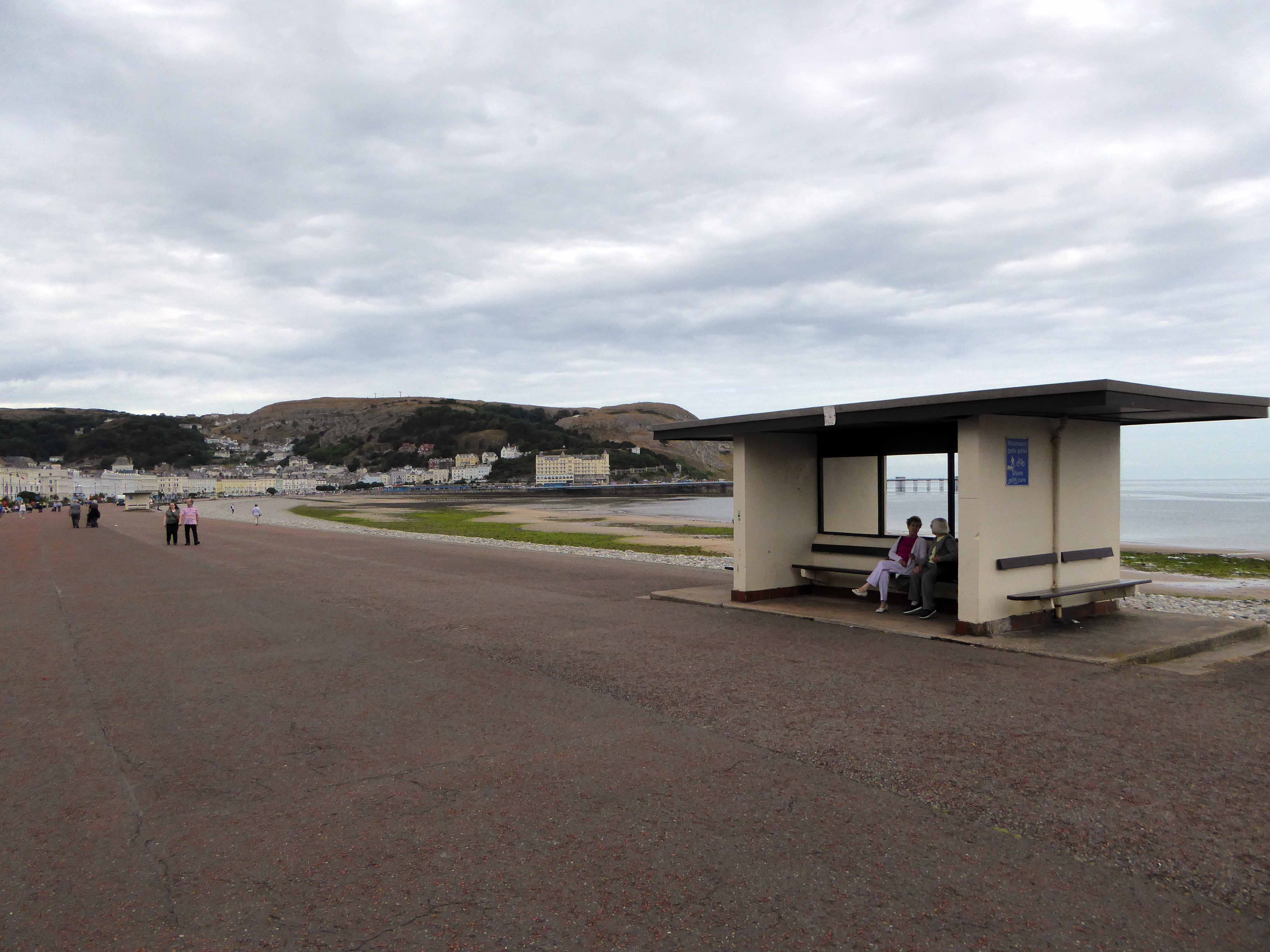
The town of Llandudno developed from Stone Age, Bronze Age and Iron Age settlements over many hundreds of years on the slopes of the limestone headland, known to seafarers as the Great Orme and to landsmen as the Creuddyn Peninsula.
Some years later.
In 1848, Owen Williams, an architect and surveyor from Liverpool, presented landowner Lord Mostyn with plans to develop the marshlands behind Llandudno Bay as a holiday resort. These were enthusiastically pursued by Lord Mostyn. The influence of the Mostyn Estate and its agents over the years was paramount in the development of Llandudno, especially after the appointment of George Felton as surveyor and architect in 1857.
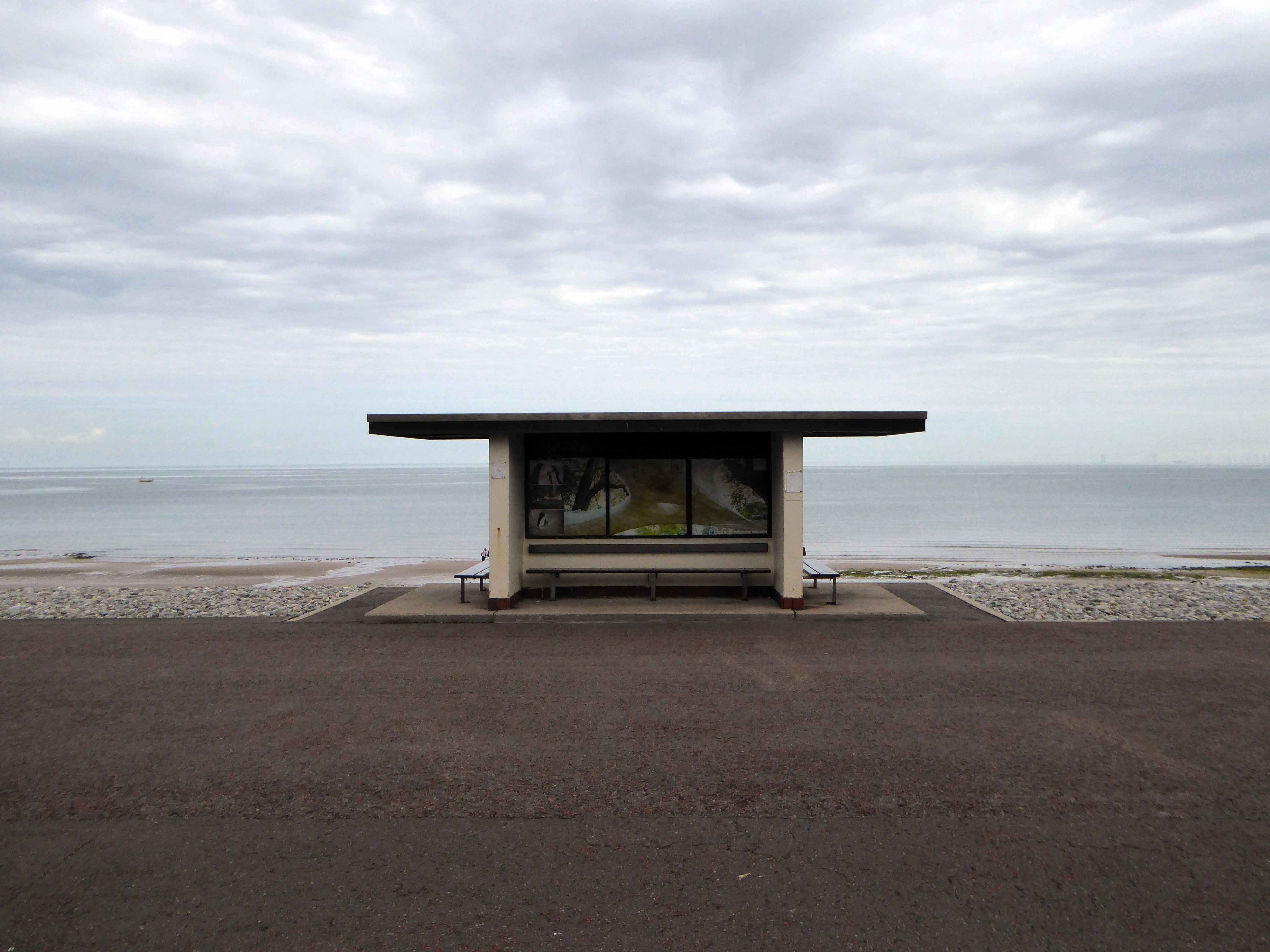
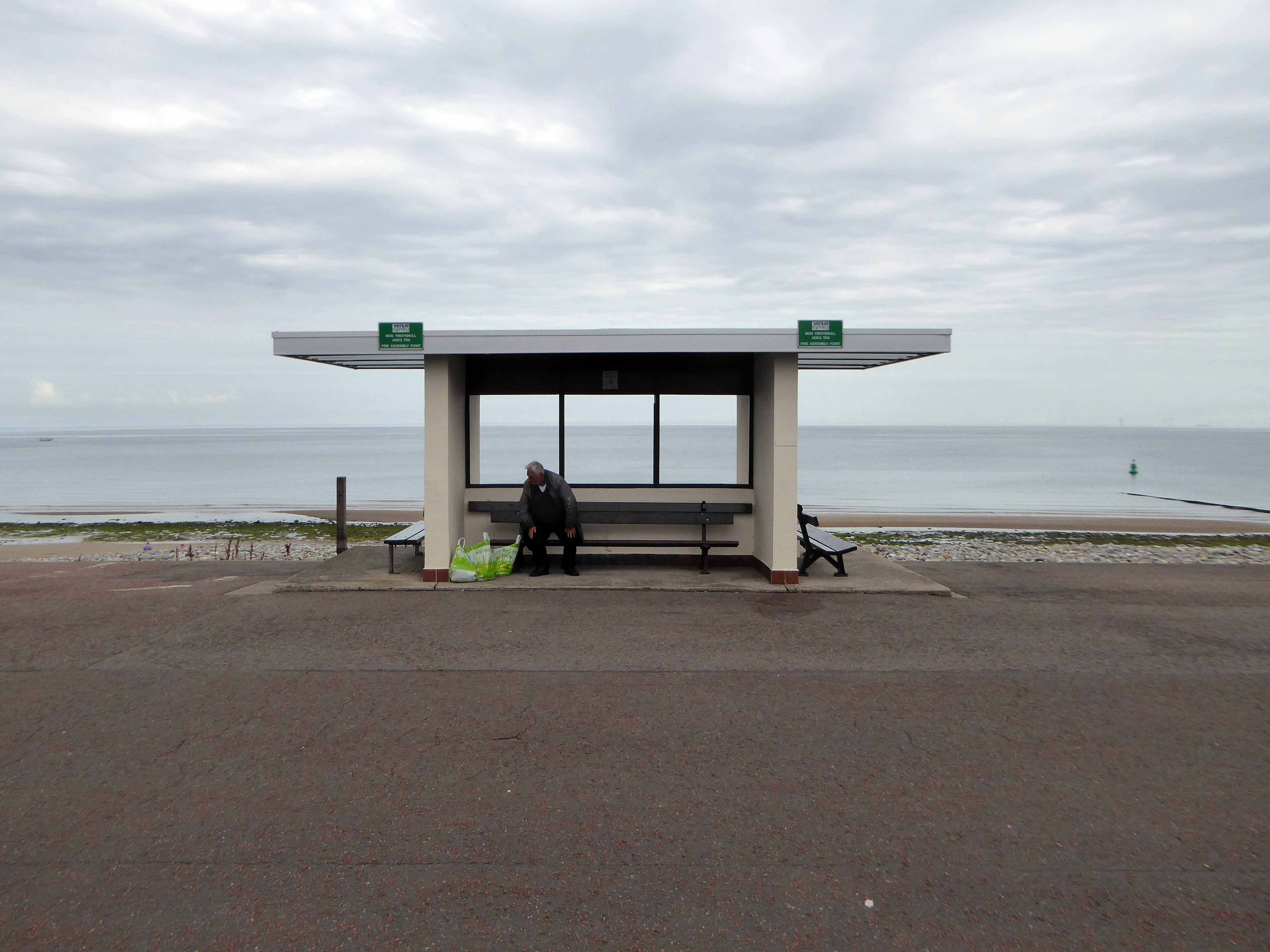
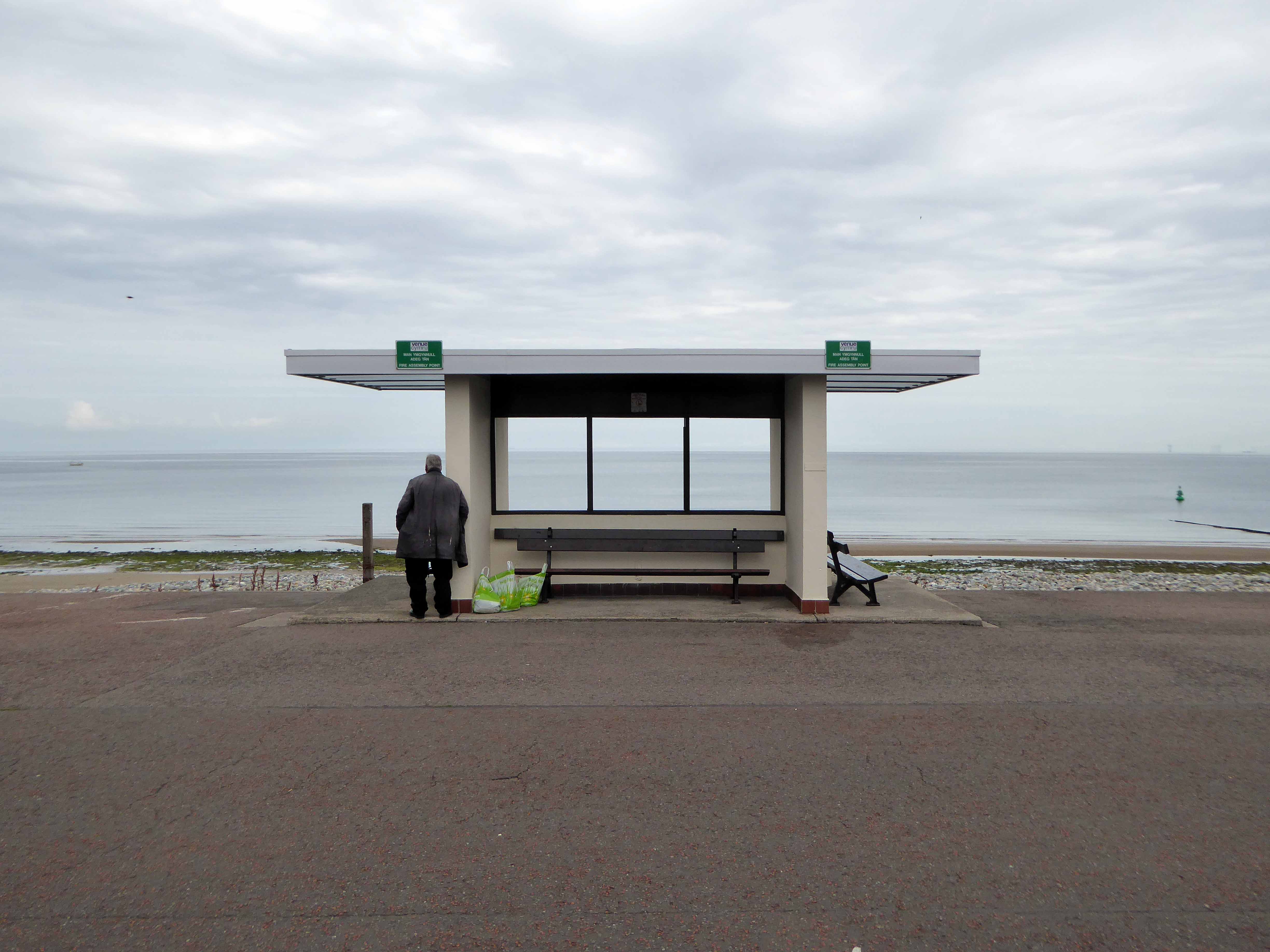
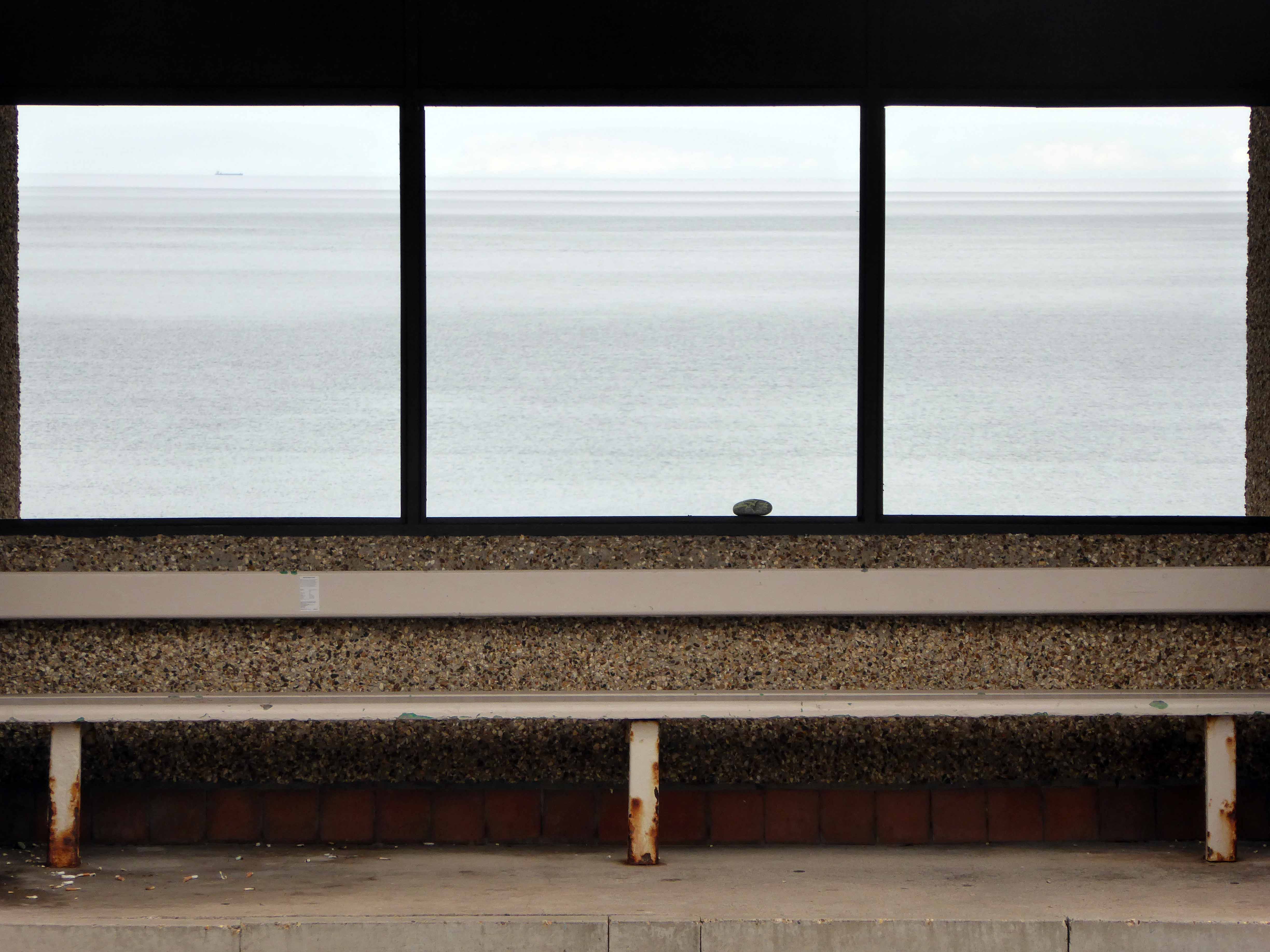
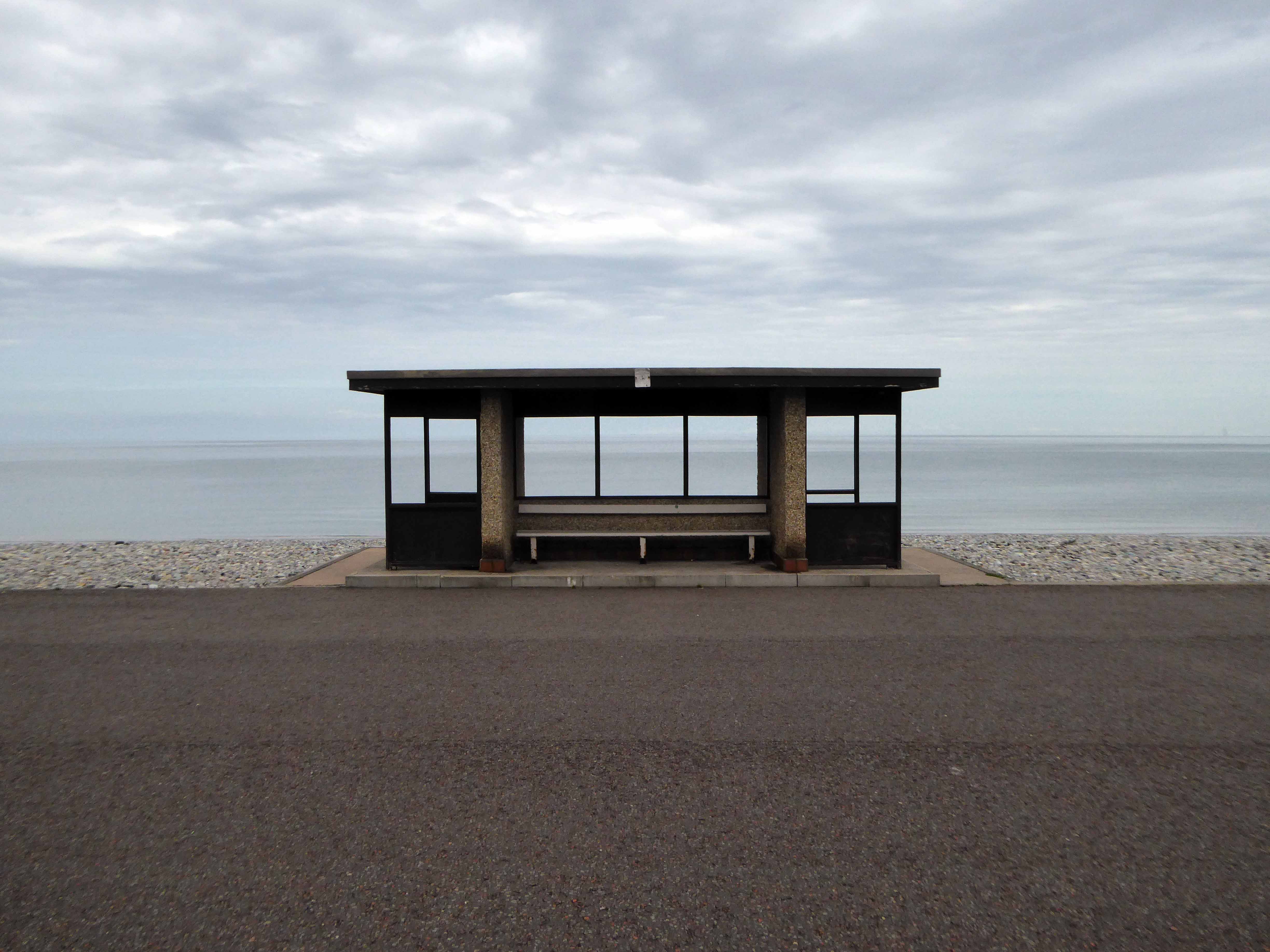
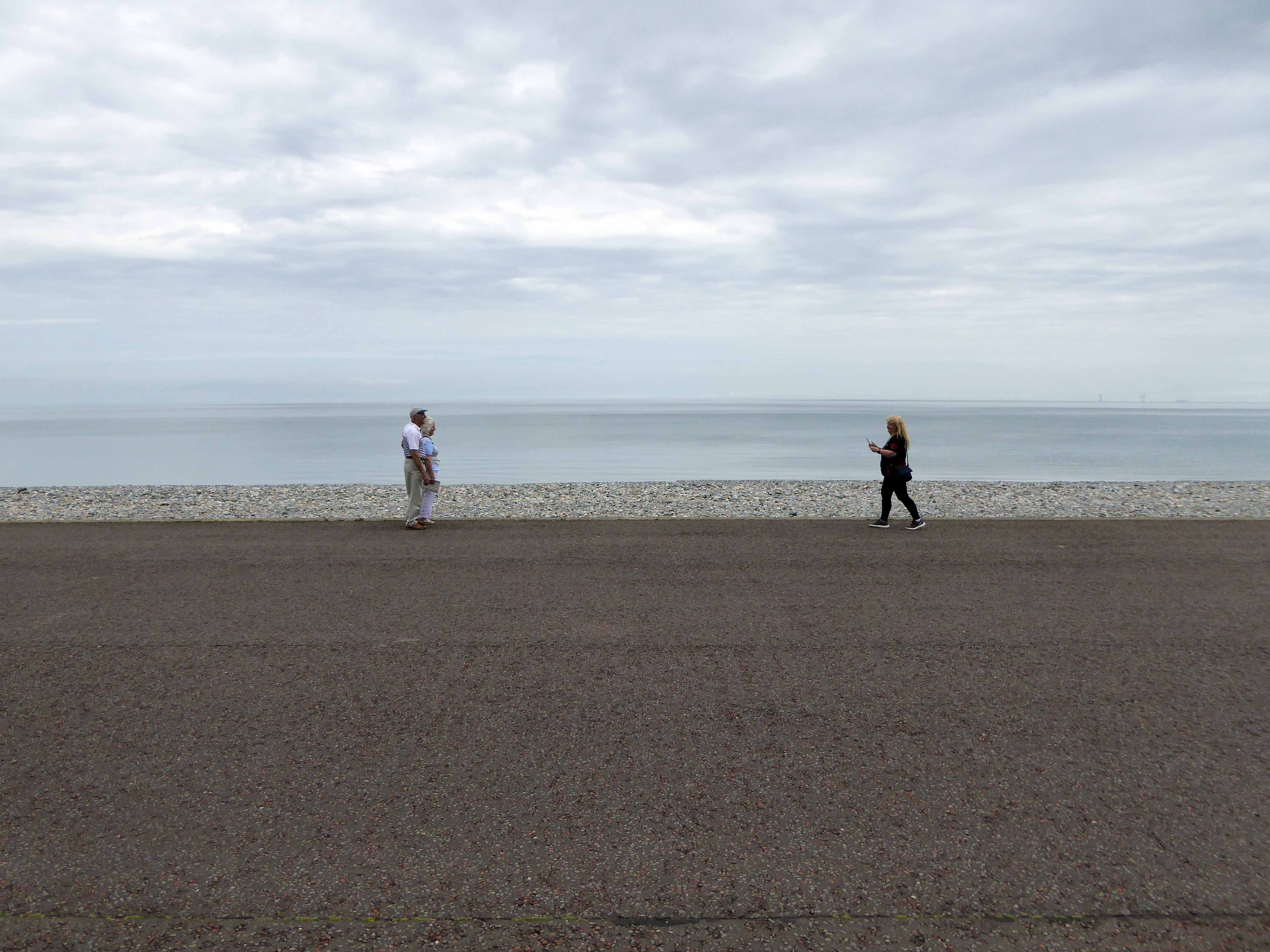
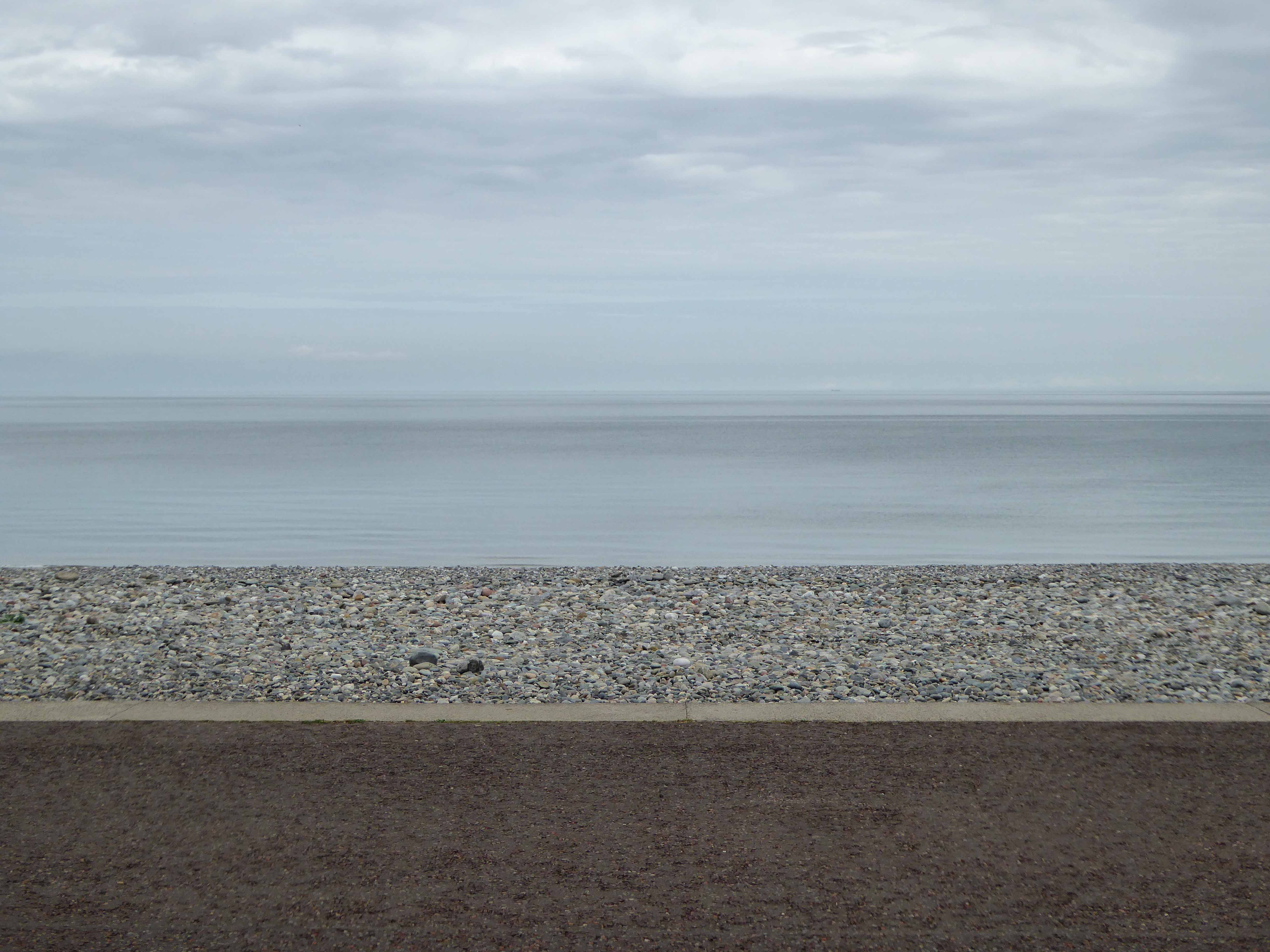
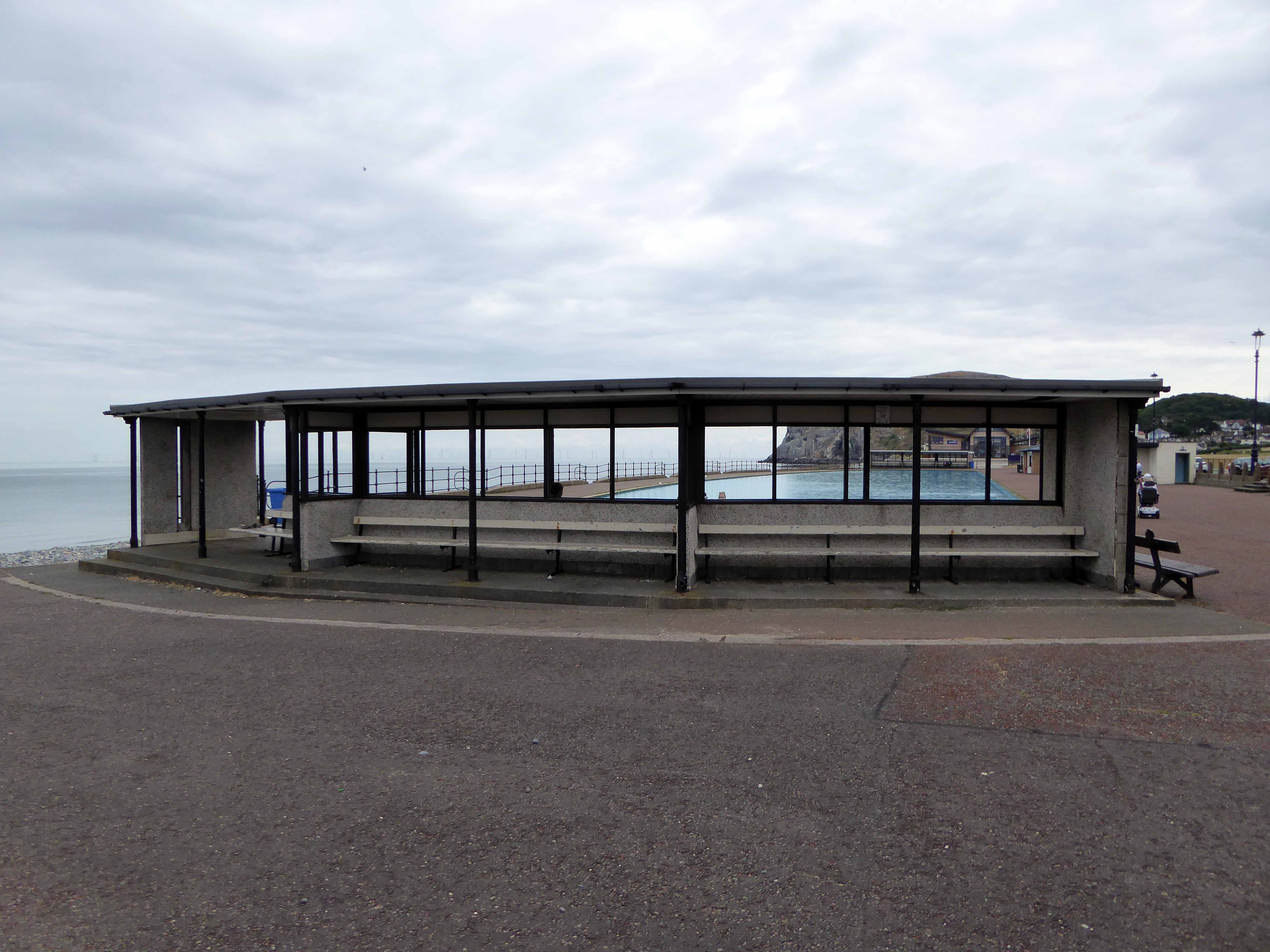
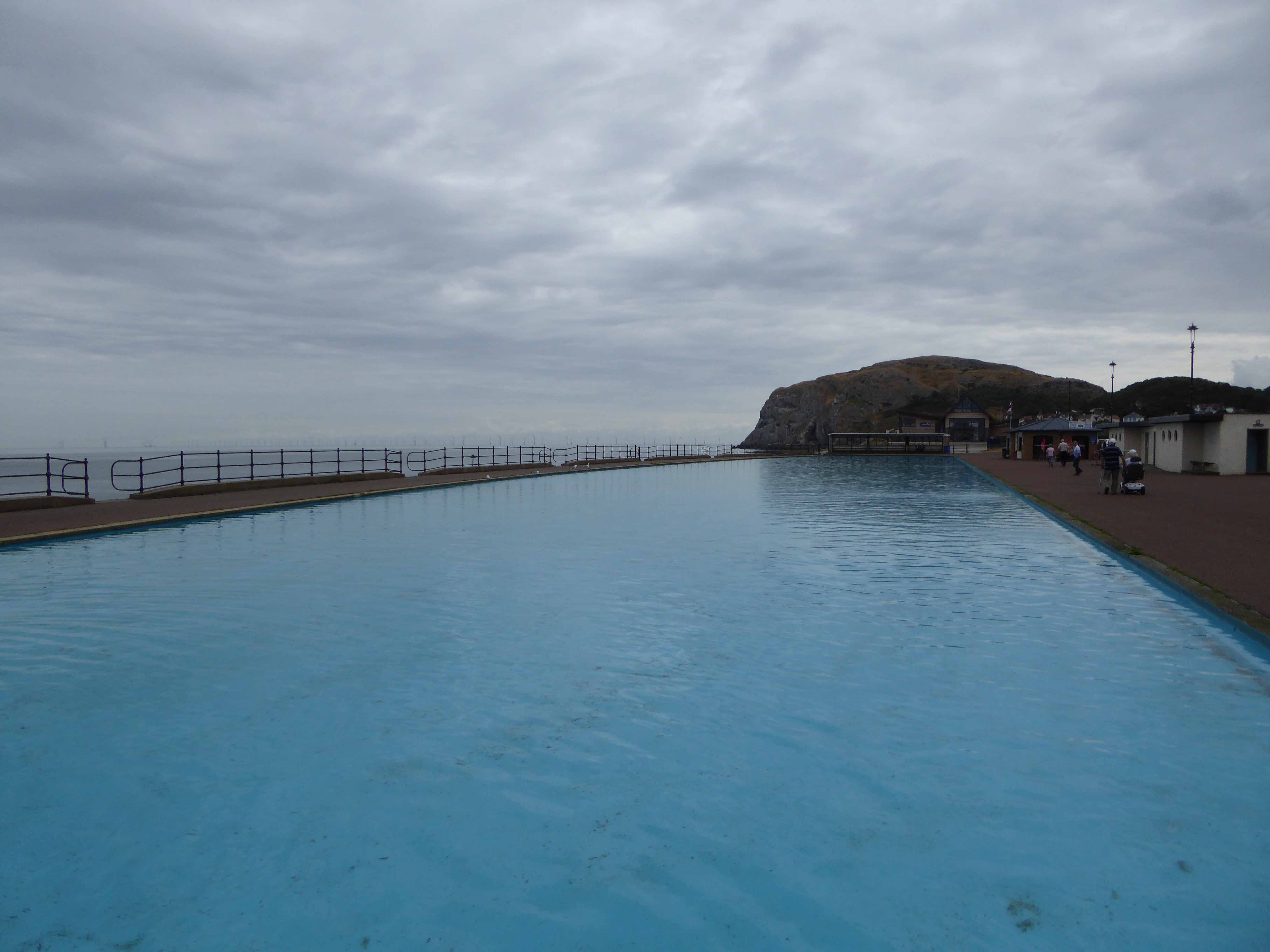
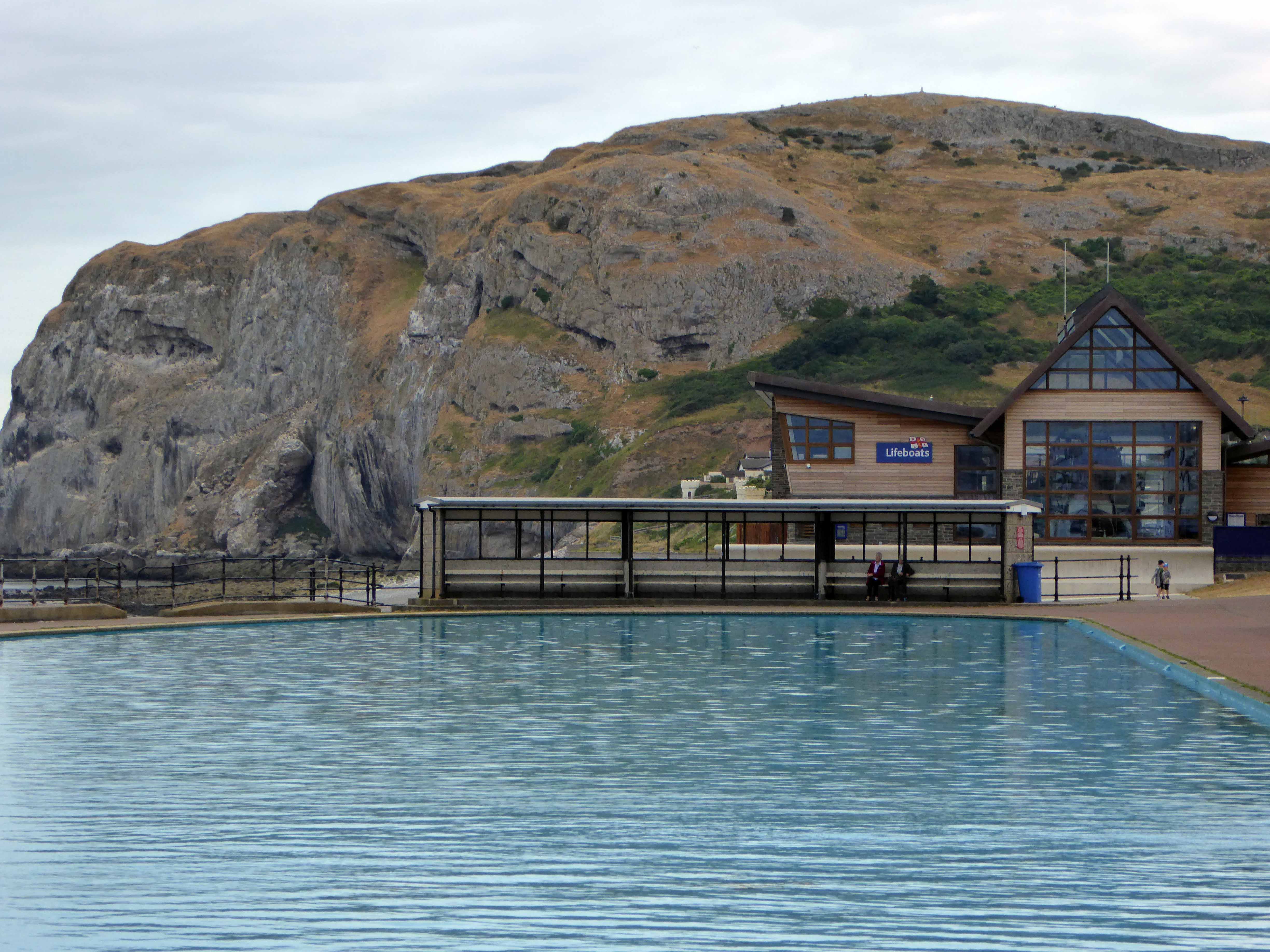
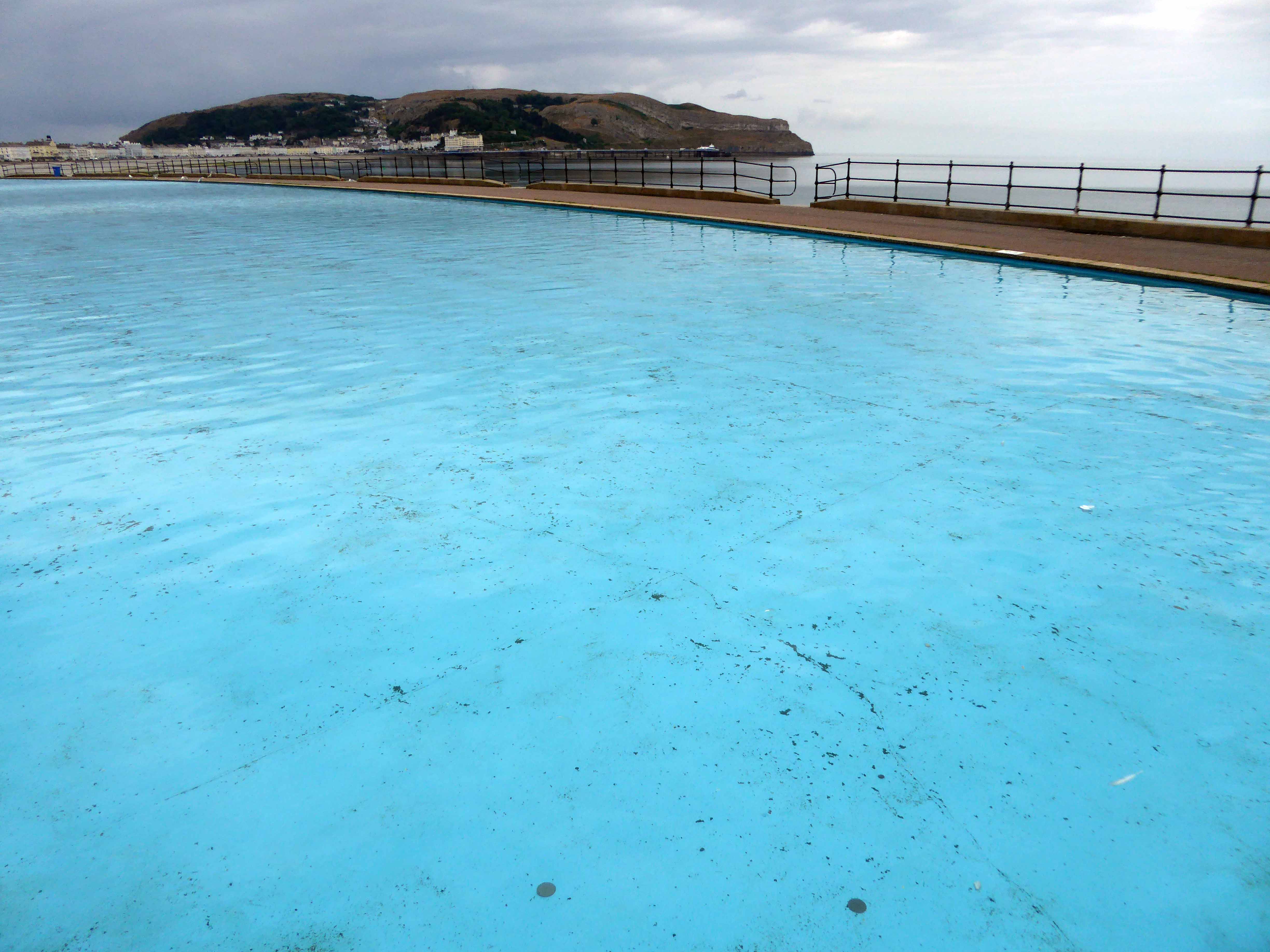
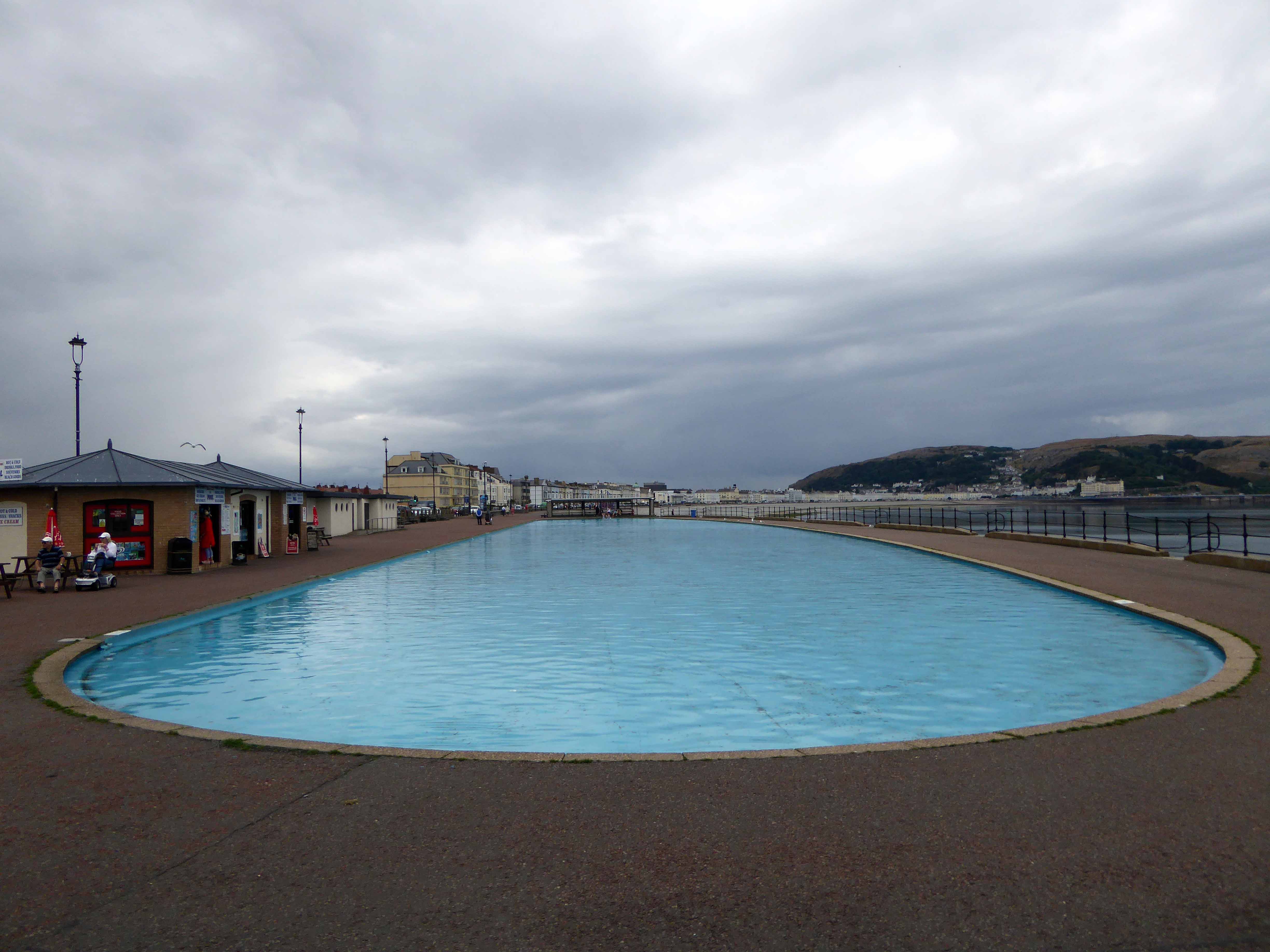
The edge of the bay is marked by concrete steps and a broad promenade, edging a pebbled beach which arcs from Orme to Orme.
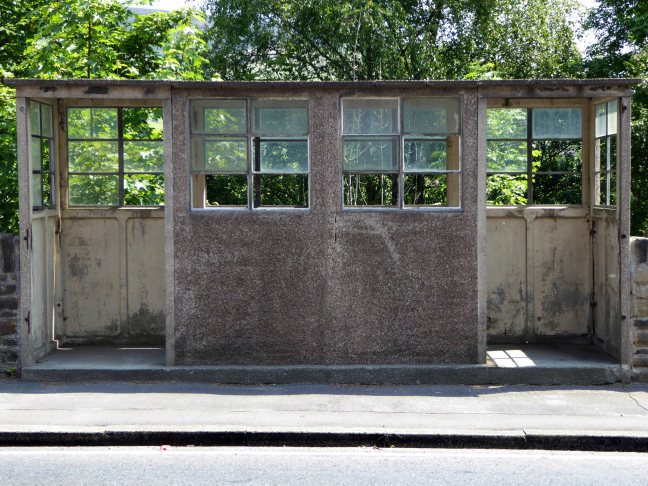
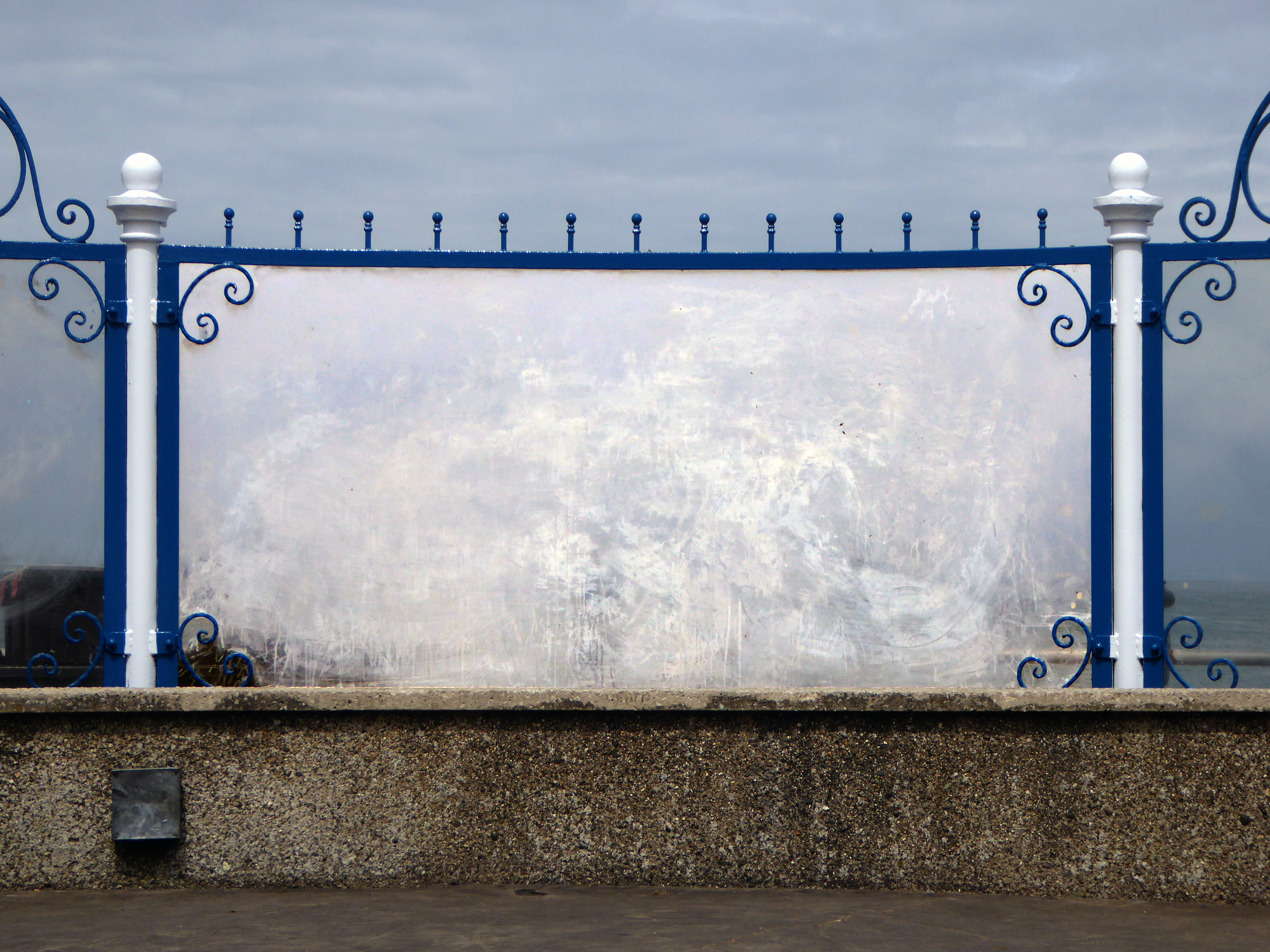
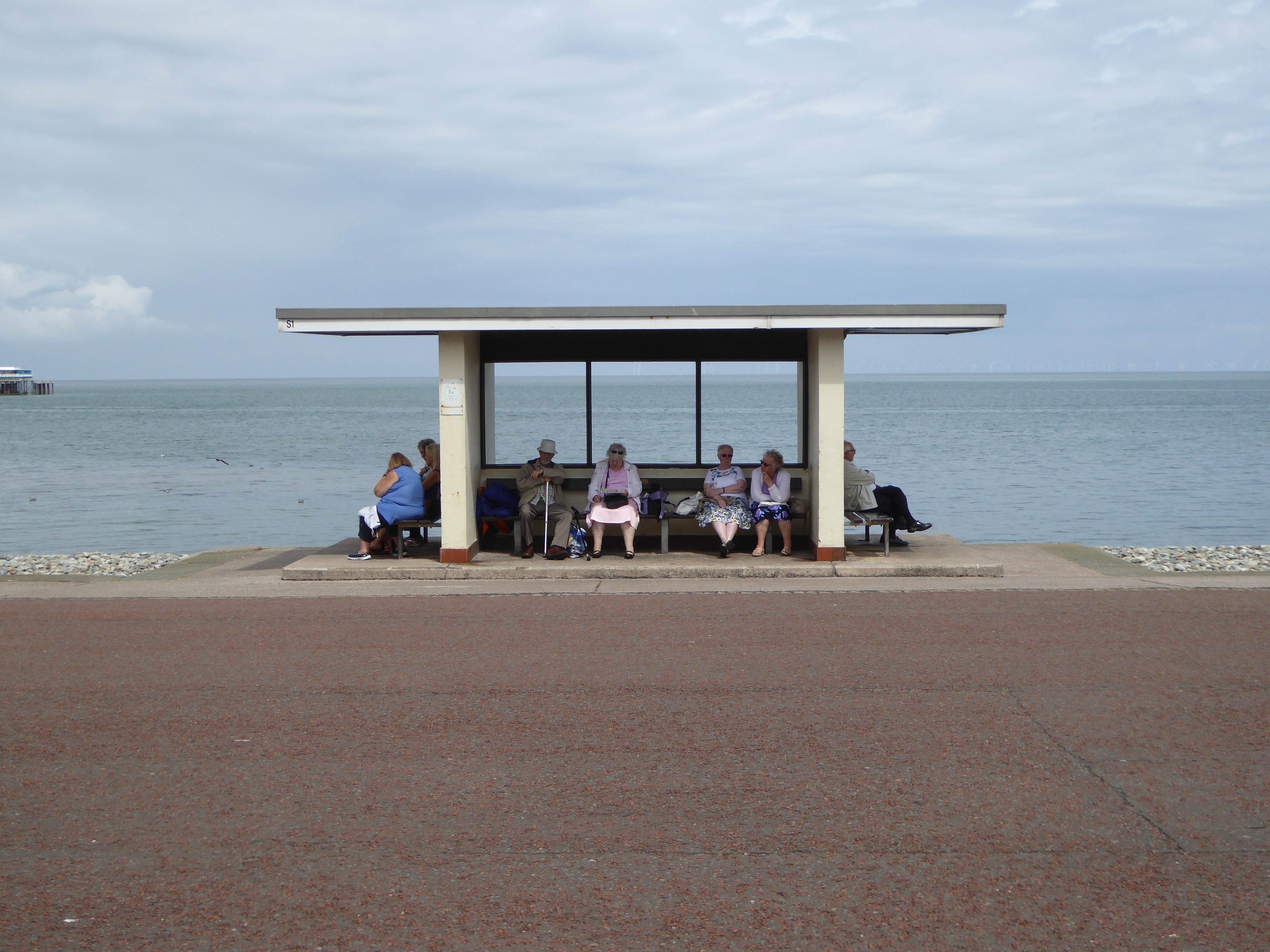
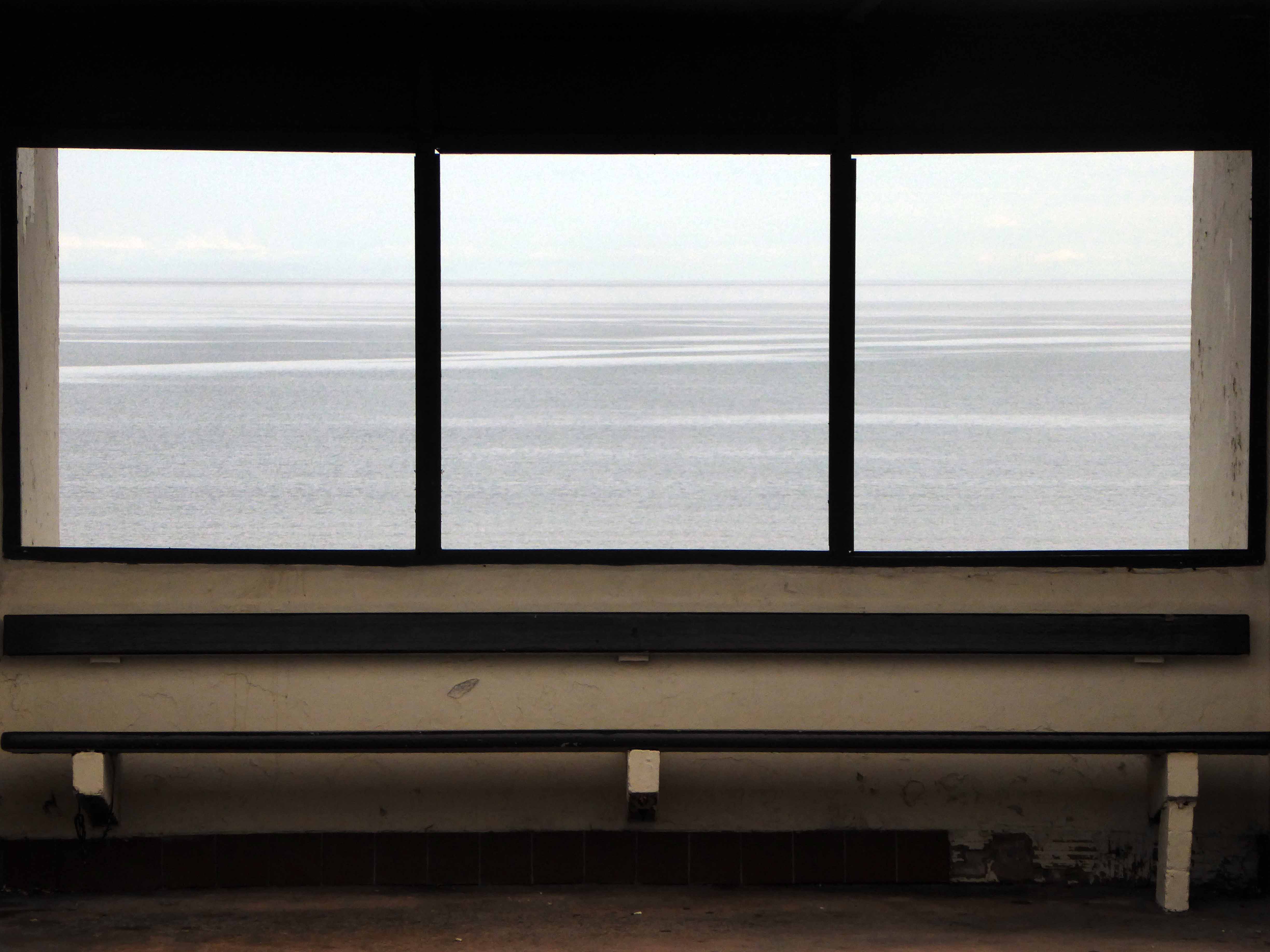
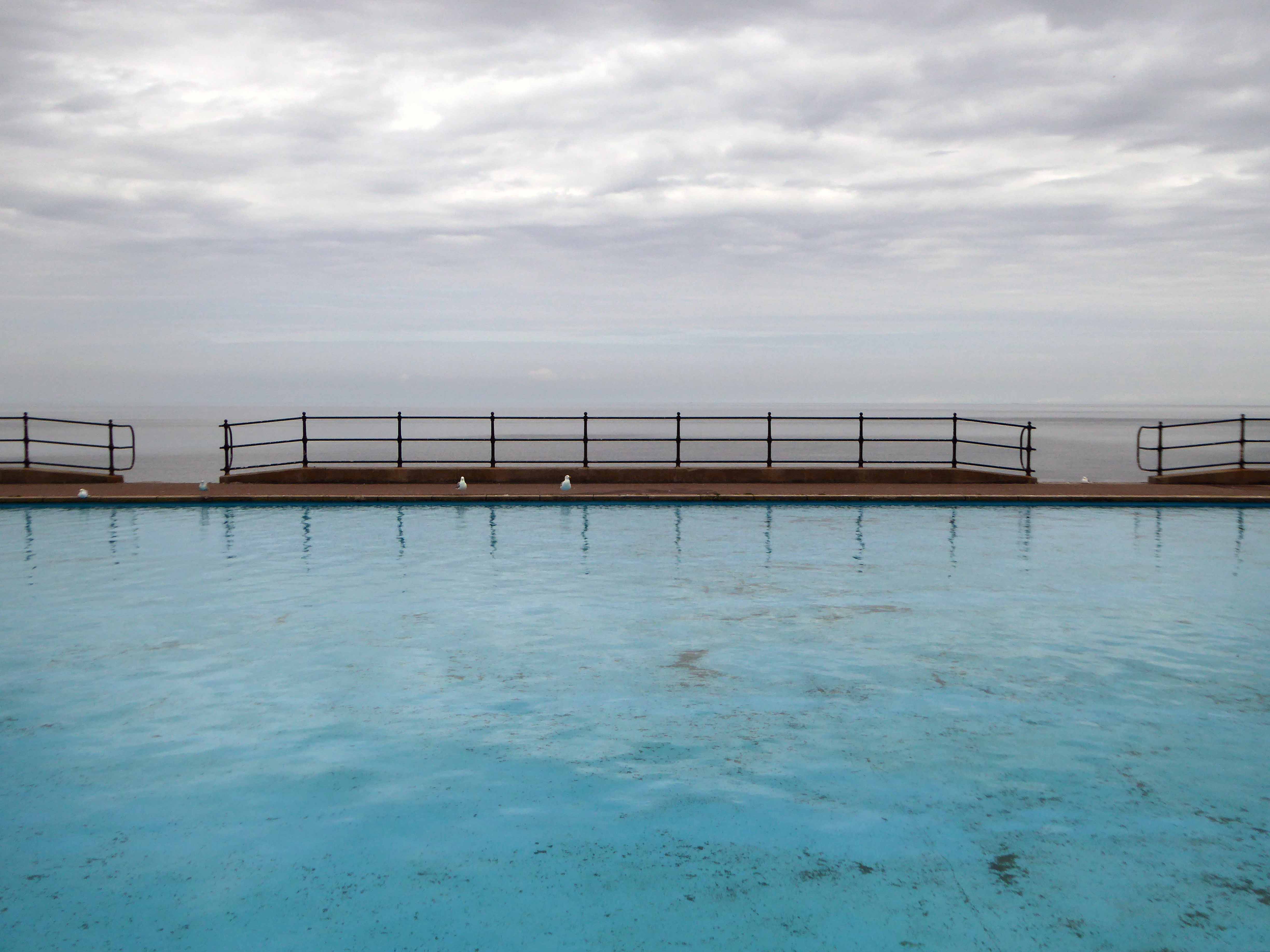
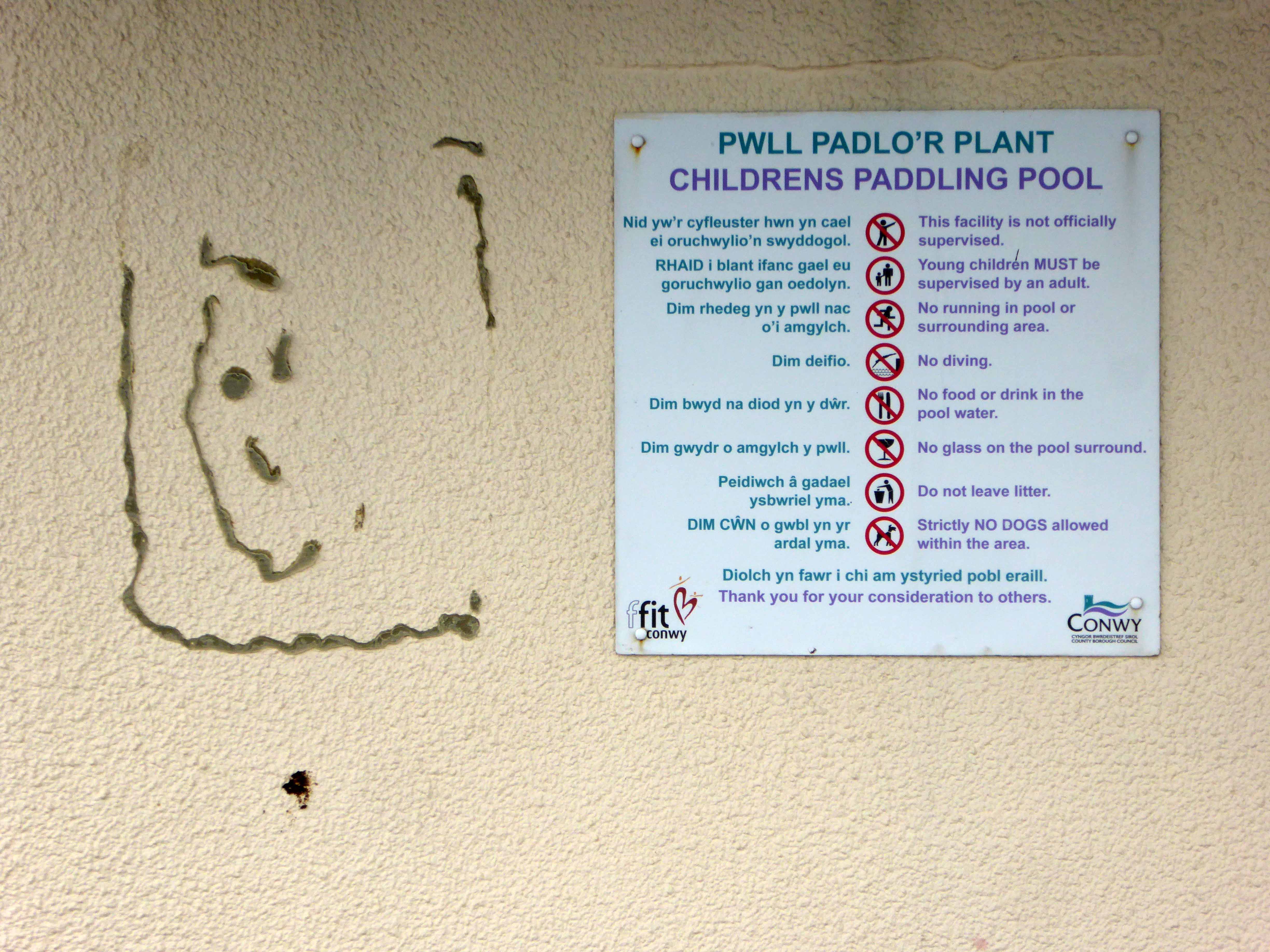
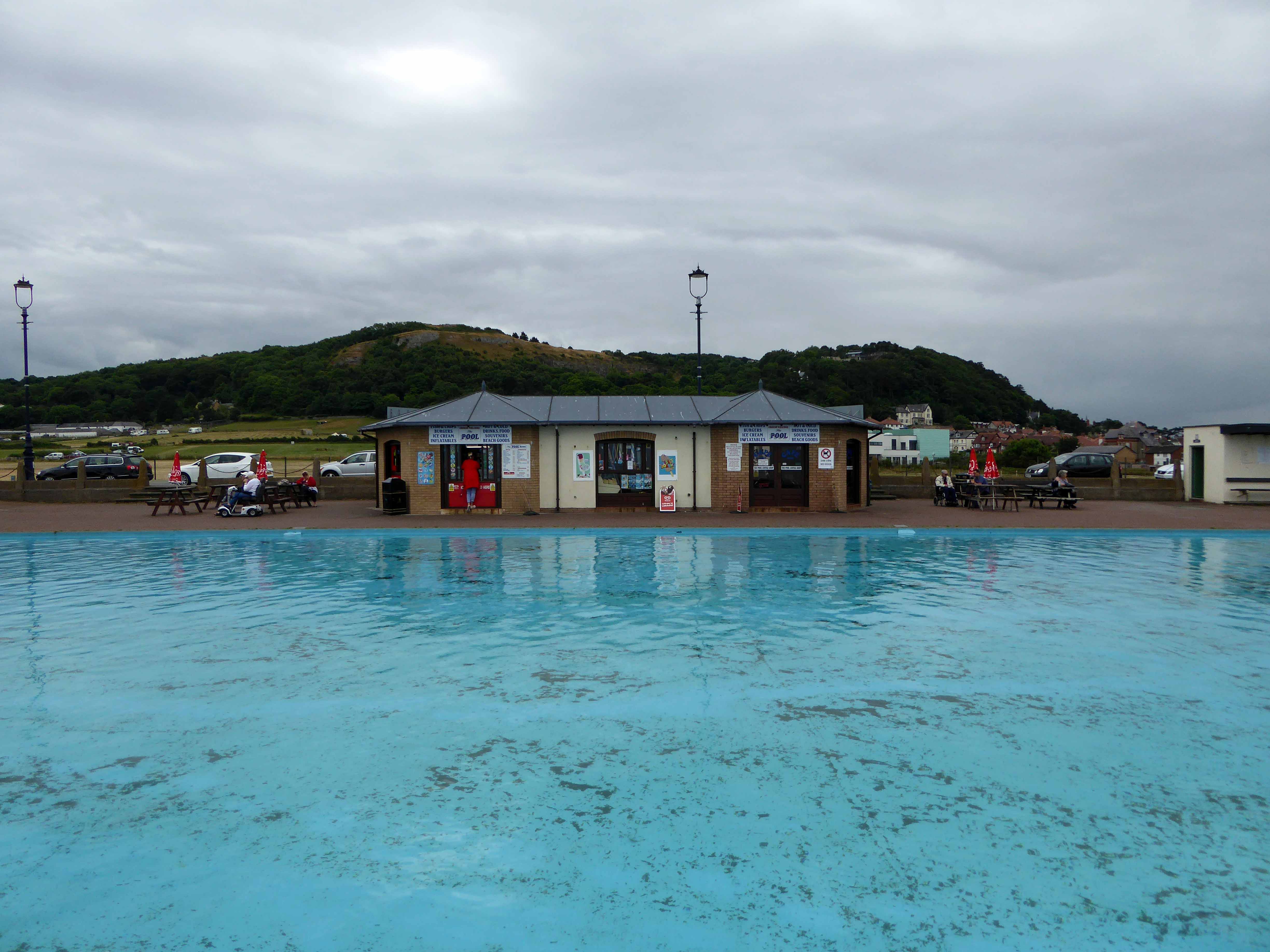
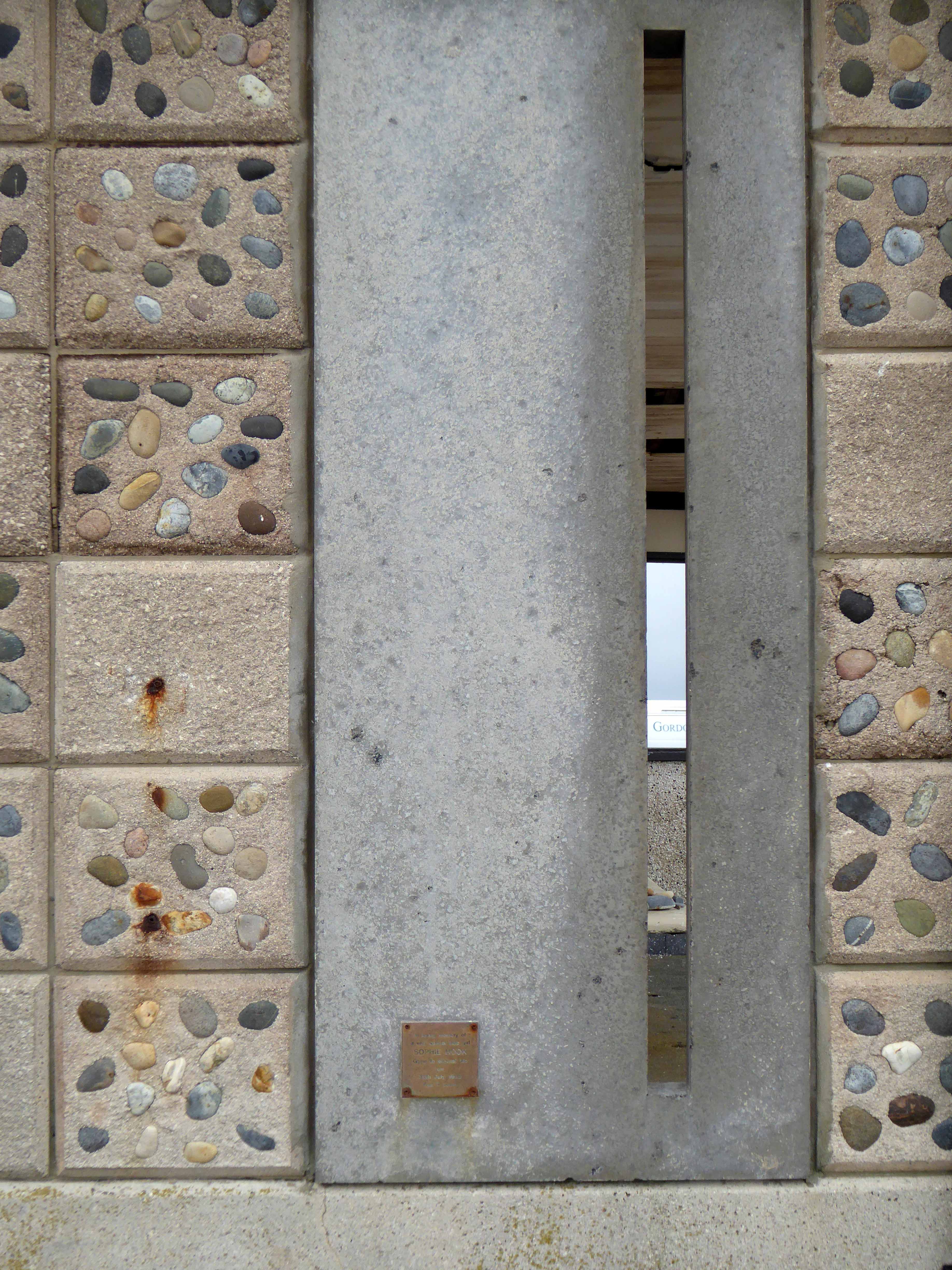
Walk with me now and mark the remarkable shelters, paddling pools and bandstand screens, along with the smattering of people that people the promenade.
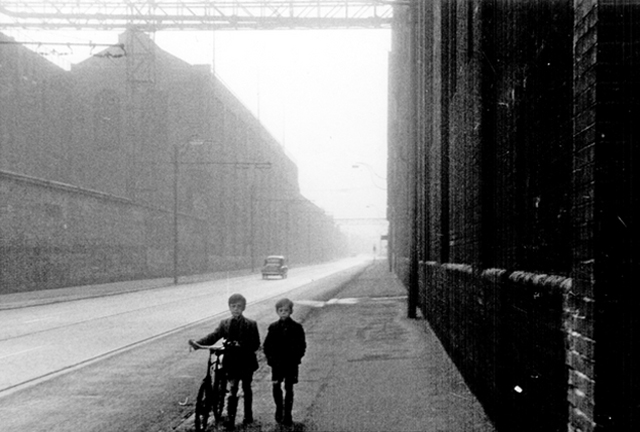
To begin at the beginning or thereabouts, Taylor Street was at the heart of Gorton to the east of Manchester city centre.
A typical street of tightly packed brick terraces, dotted with shops, pubs, people and industry. I worked there as van lad for Mother’s Pride bread back in the 70s and saw those shops, pubs, people and industry slowly disappear.
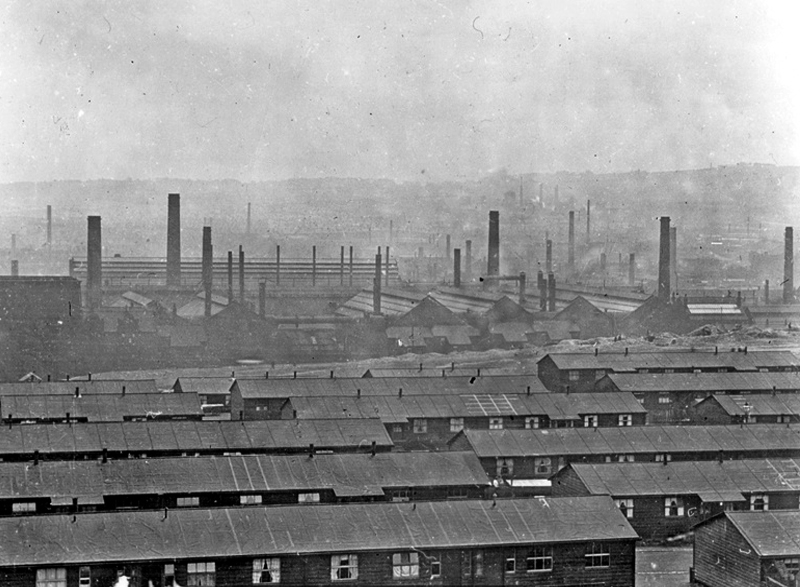
Beyer Peacock whose immense shed dominated the northern end of the street, simply ceased to be, as steam gave way to diesel.
As full employment gave way to a date with the dole.
Adsega opening on nearby Cross Street heralded the arrival of the super fast, self-service supermarket, and sounded the death knell of the cosy corner cupboard.
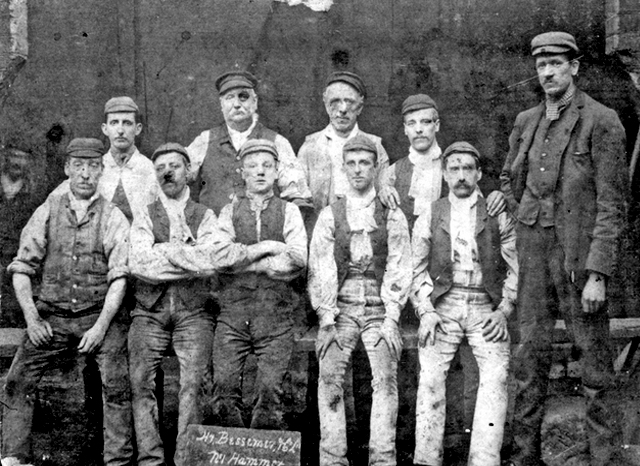
The local pub was The Bessemer – its name forging an unbreakable link with the surrounding steel industry, that eventually broke.
To the left of the pub is the Bishop Greer High School construction site – the first of the new build that would later dominate the area, along with wide open spaces where shops, pubs, people and industry once were.
When the school eventually shut its doors, it became an annex of Openshaw Technical College, and I found myself working there in the 80s at the East Manchester Centre, until its eventual closure.
It’s now sheltered accommodation for the lost and lonely:
Located in a quiet suburb of Manchester with excellent links to the city centre, Gorton Parks has an exceptional range of facilities spread out across five separate houses, each offering a different care option. Melland House offers dementia residential care, Abbey Hey provides nursing dementia care, Debdale is the house for intermediate nursing care and Sunny Brow offers general nursing care.
We sought solace in The Pineapple.
The streets were trimmed and slimmed, much of the past a mere ghostly presence, almost imprinted on the present.
A brave new world of brand new modern housing, with an Estate Pub to match.
A busy bustling boozer – lots of live and local action for the lively locals, latterly seeing out time as a house of House – a real bangin’ Bashment, bass-man bargain basement.
Until time is finally called – no more four to the floor, last one out shut the door.
Nothing lasts forever and a sign of the times is an upended pub sign, lying dormant in the dust.
The Chunky no longer a great big hunk o’funk.
The big screen TV forever failing to deliver all the action, live or otherwise.
Latterly transformed into Dribble Drabble.
And so the beat goes on as successive waves of success and recession, boom and bust free-market economics, wash over the nation and its long suffering folk.



































































 Modern Mooch