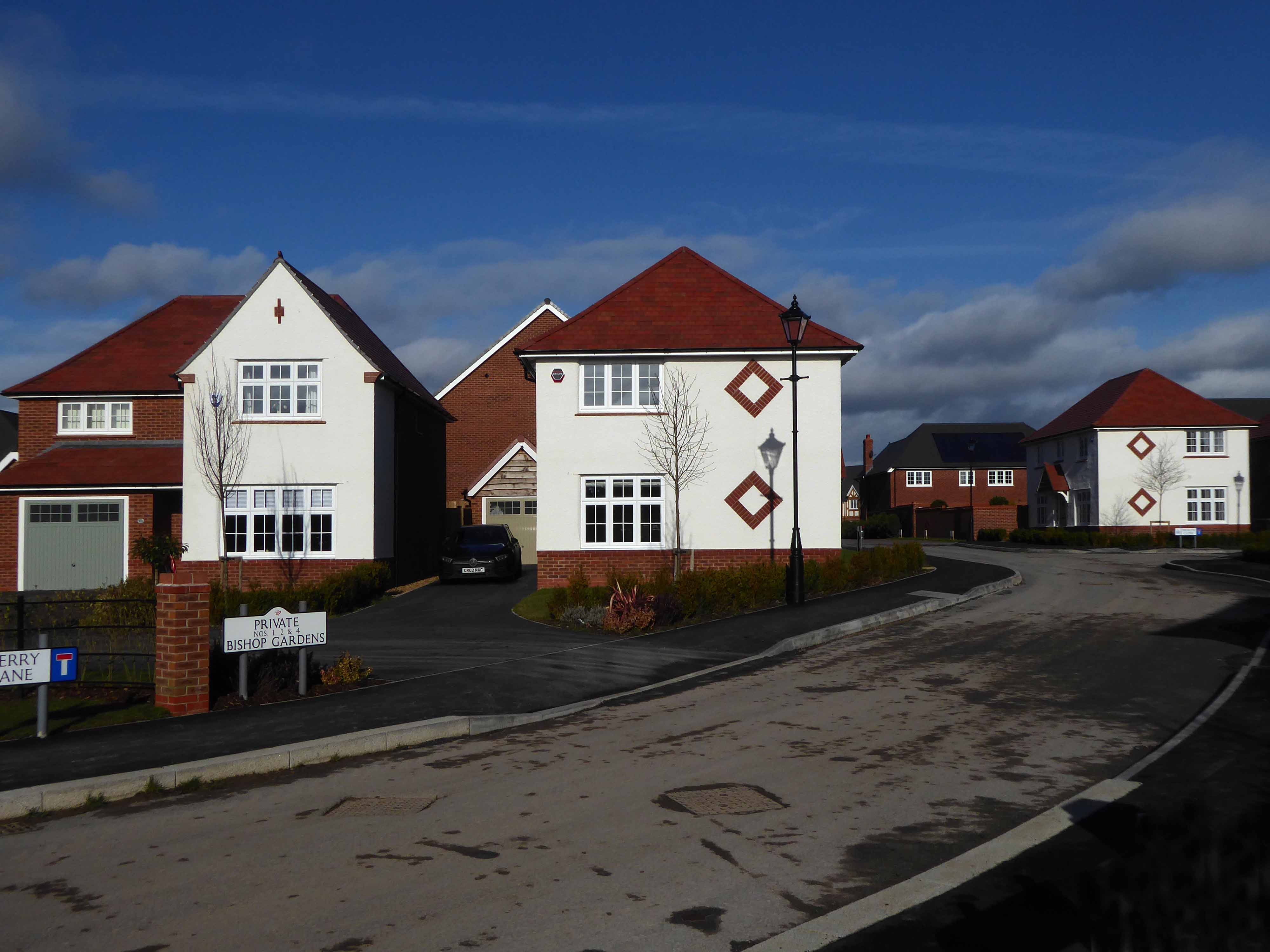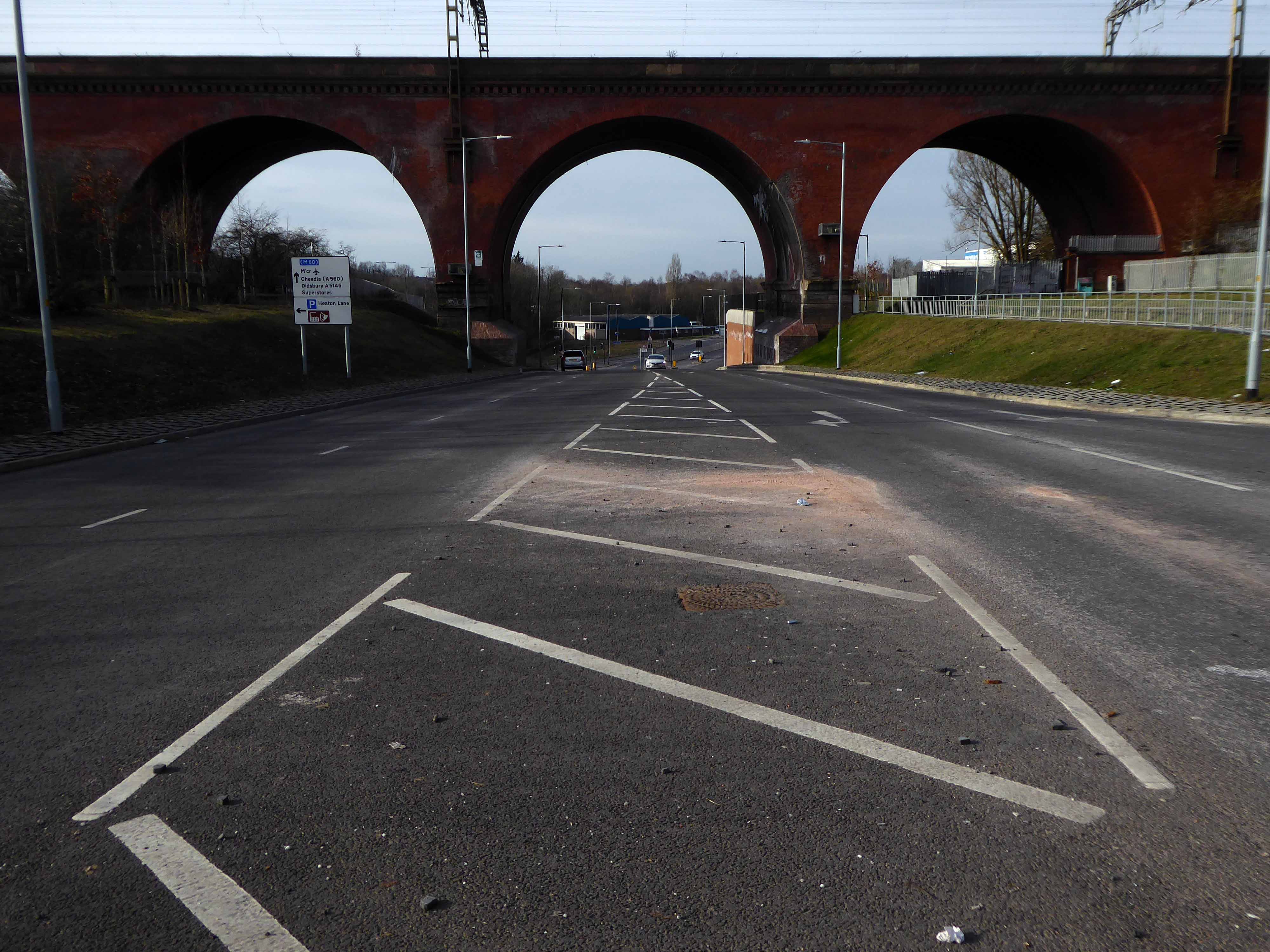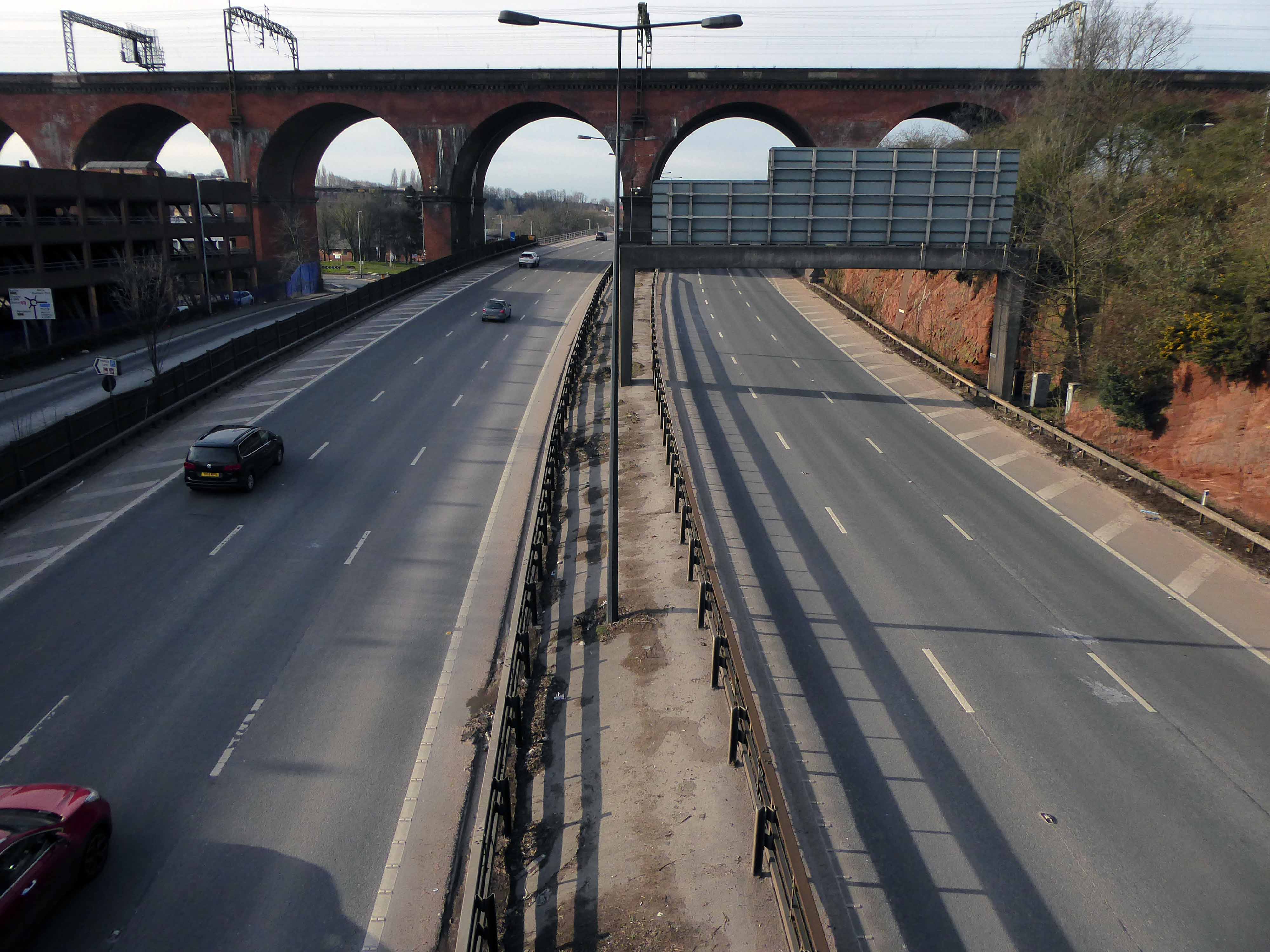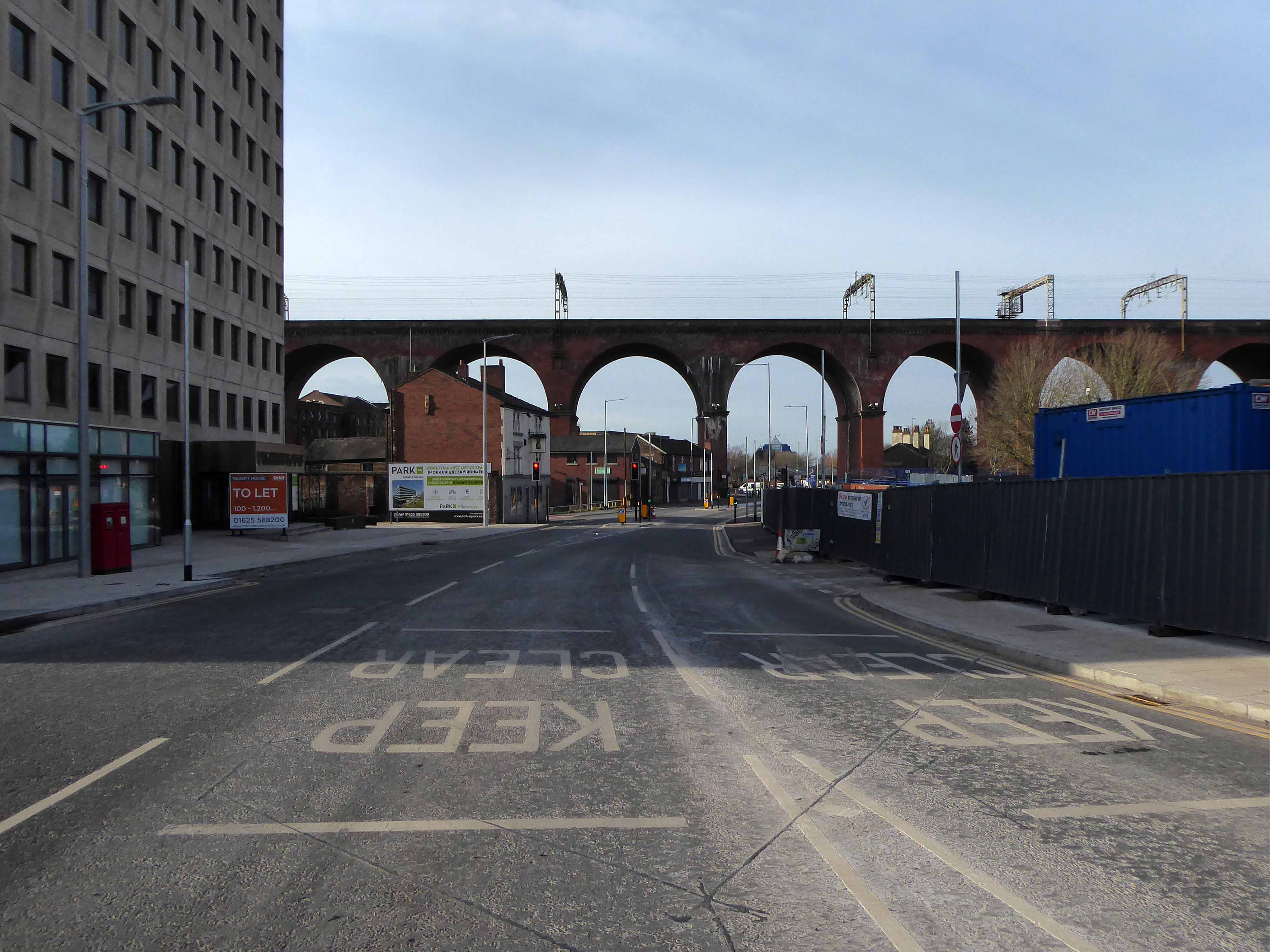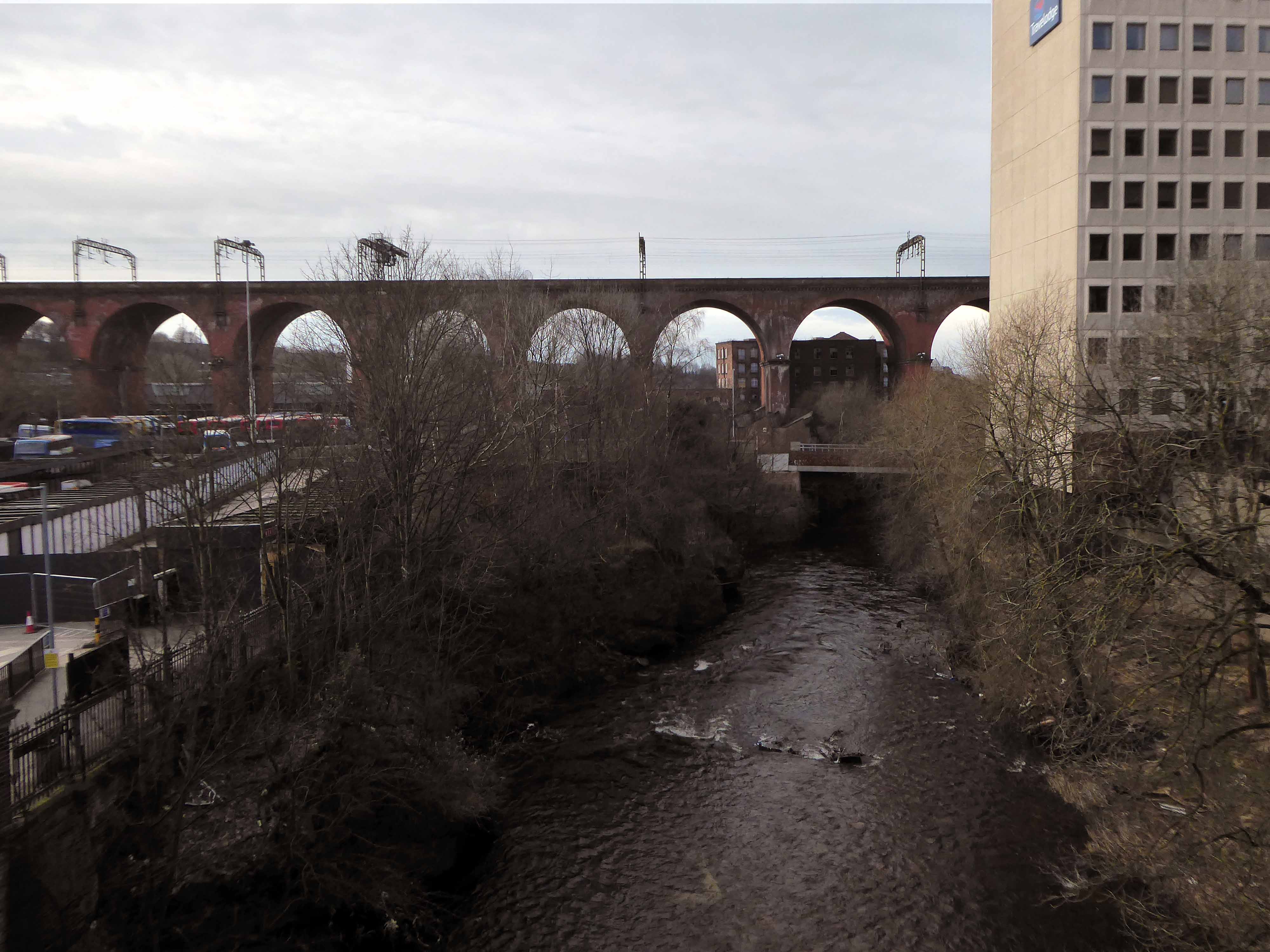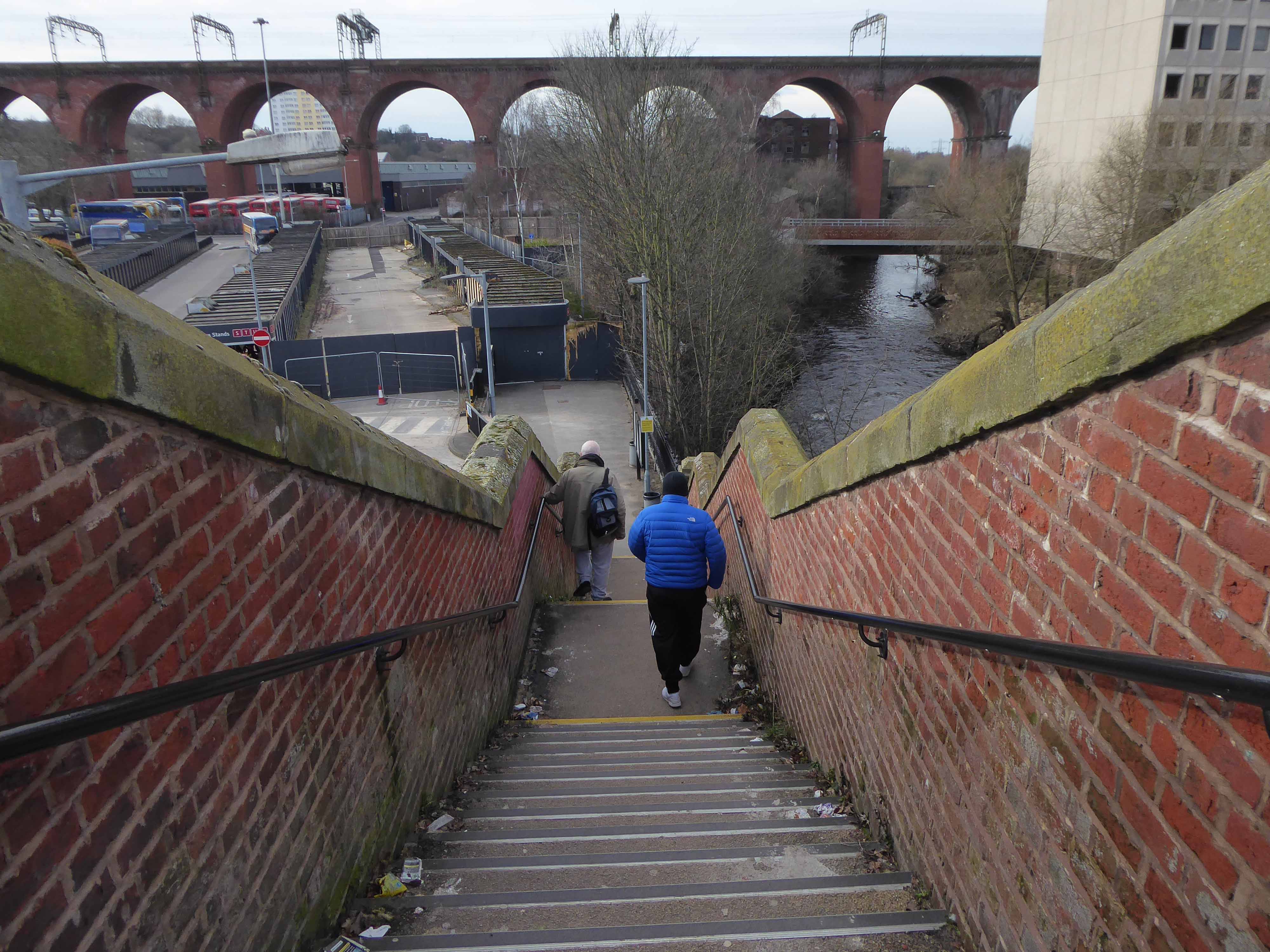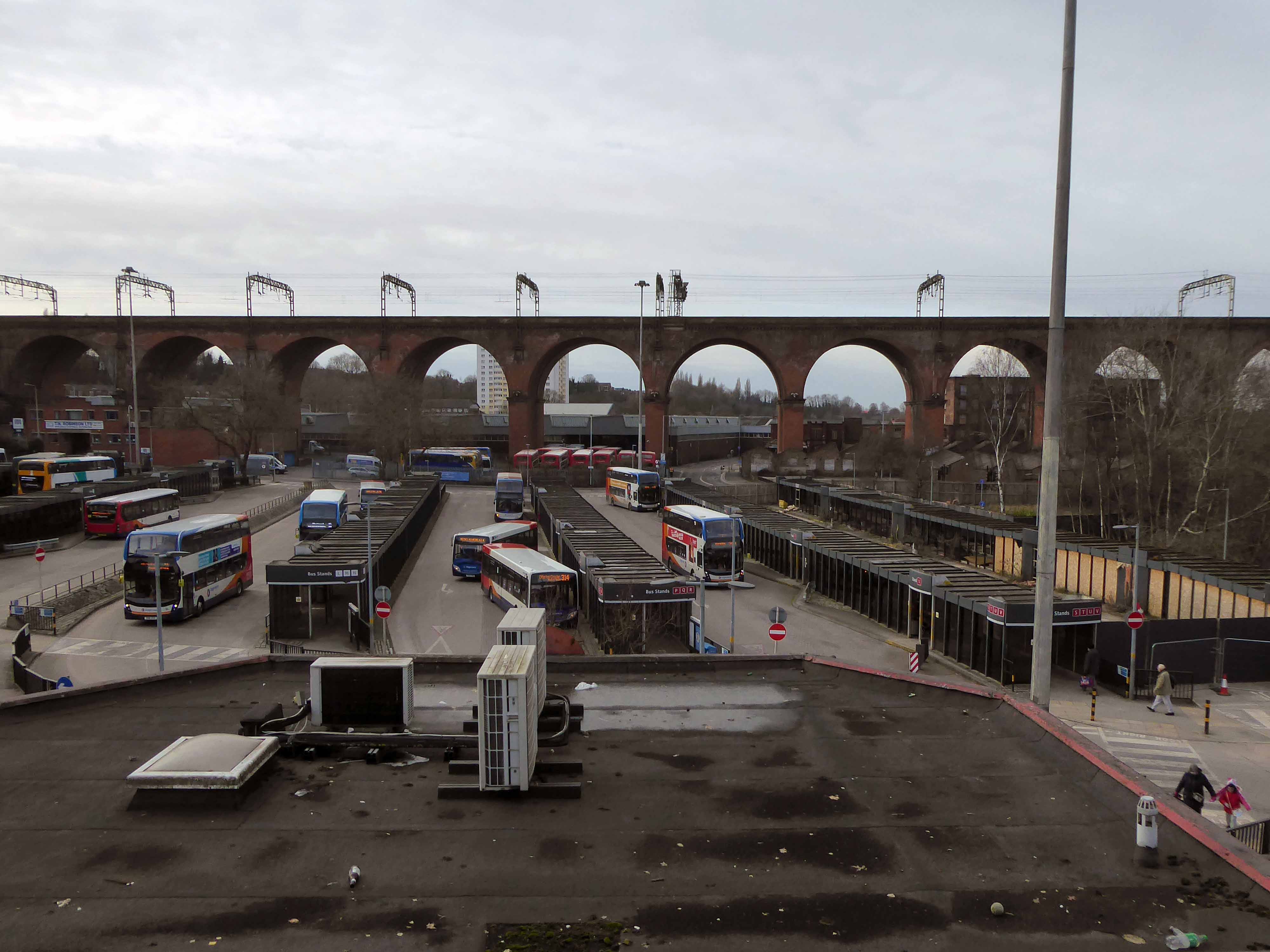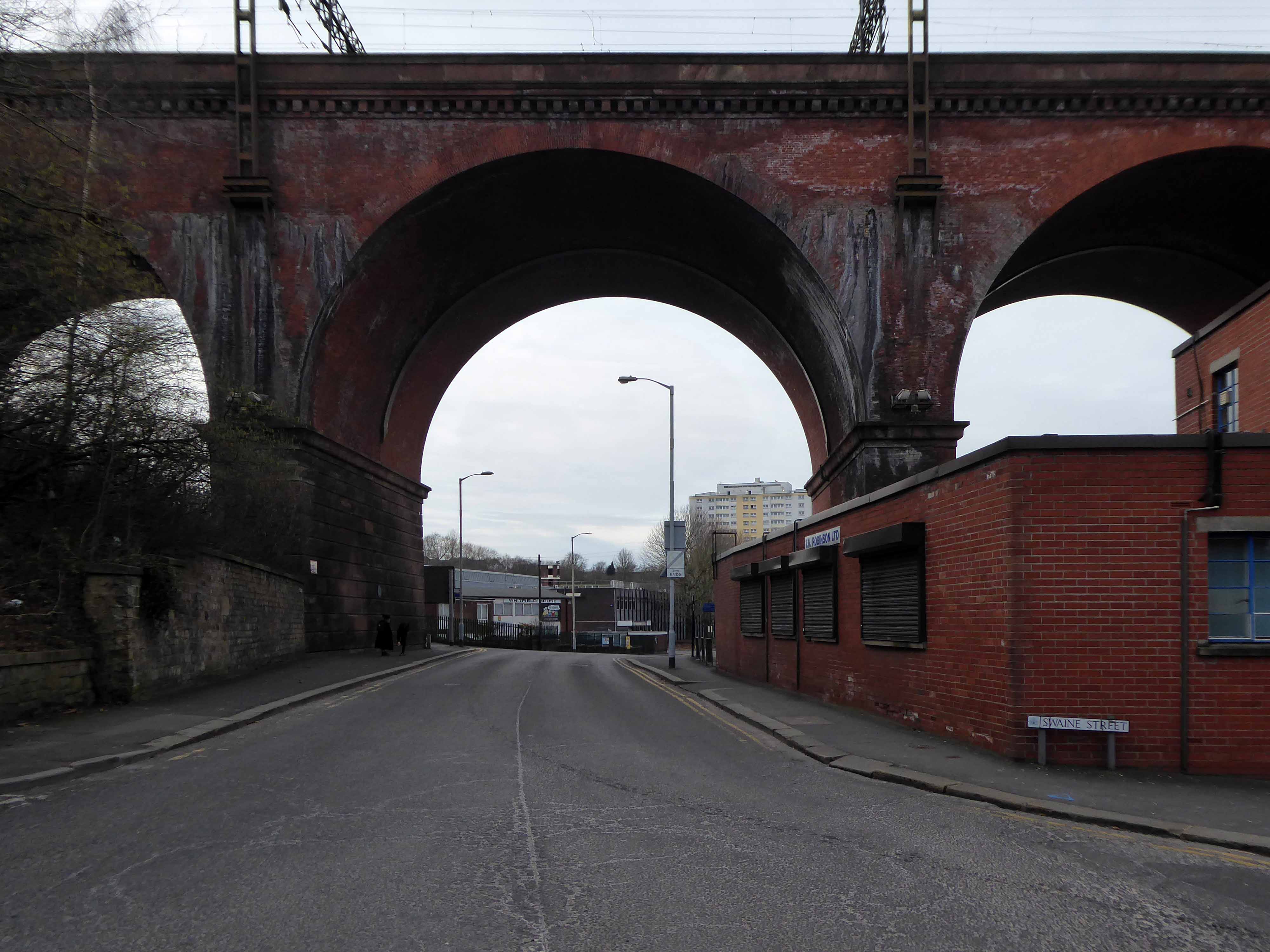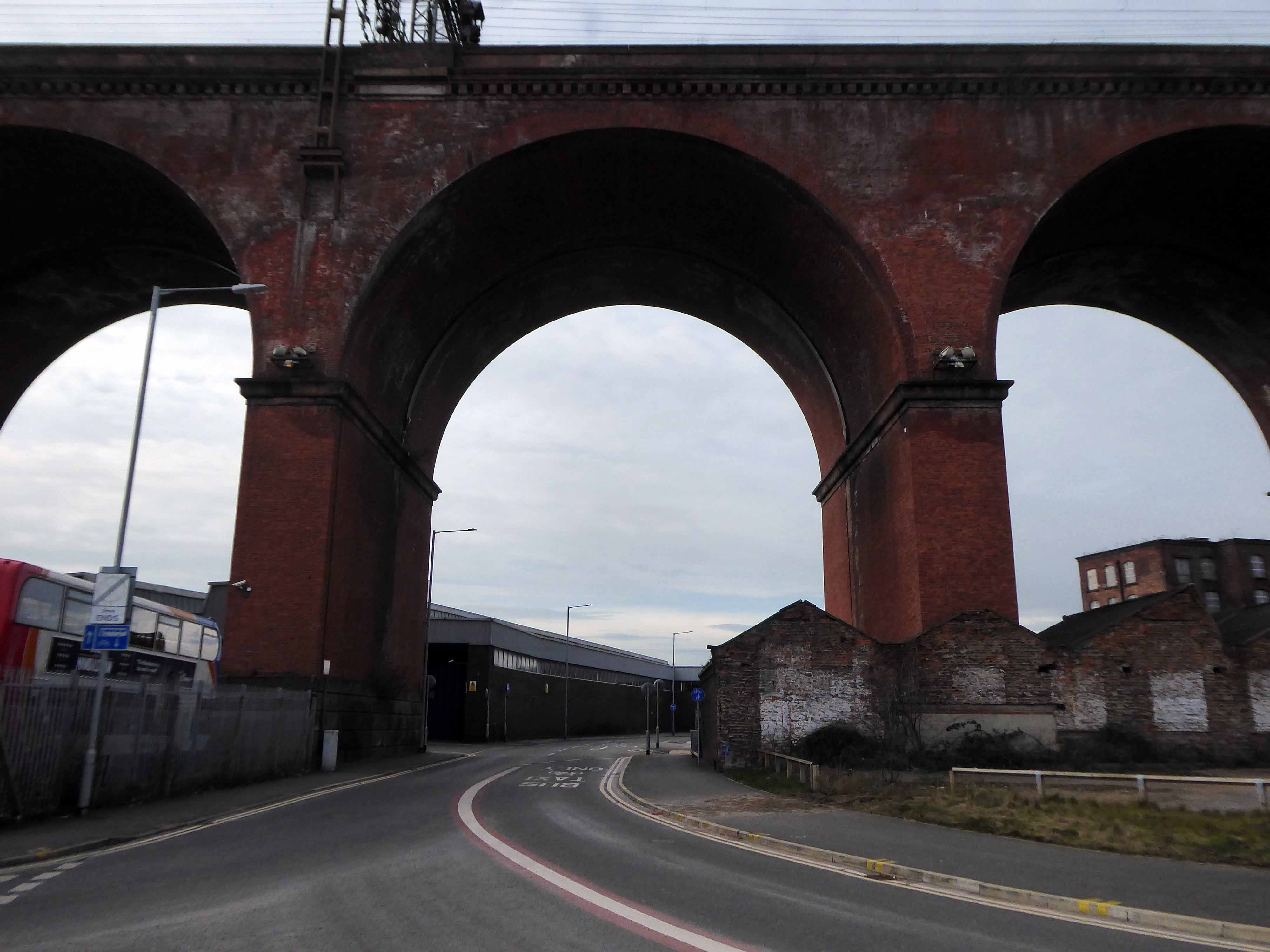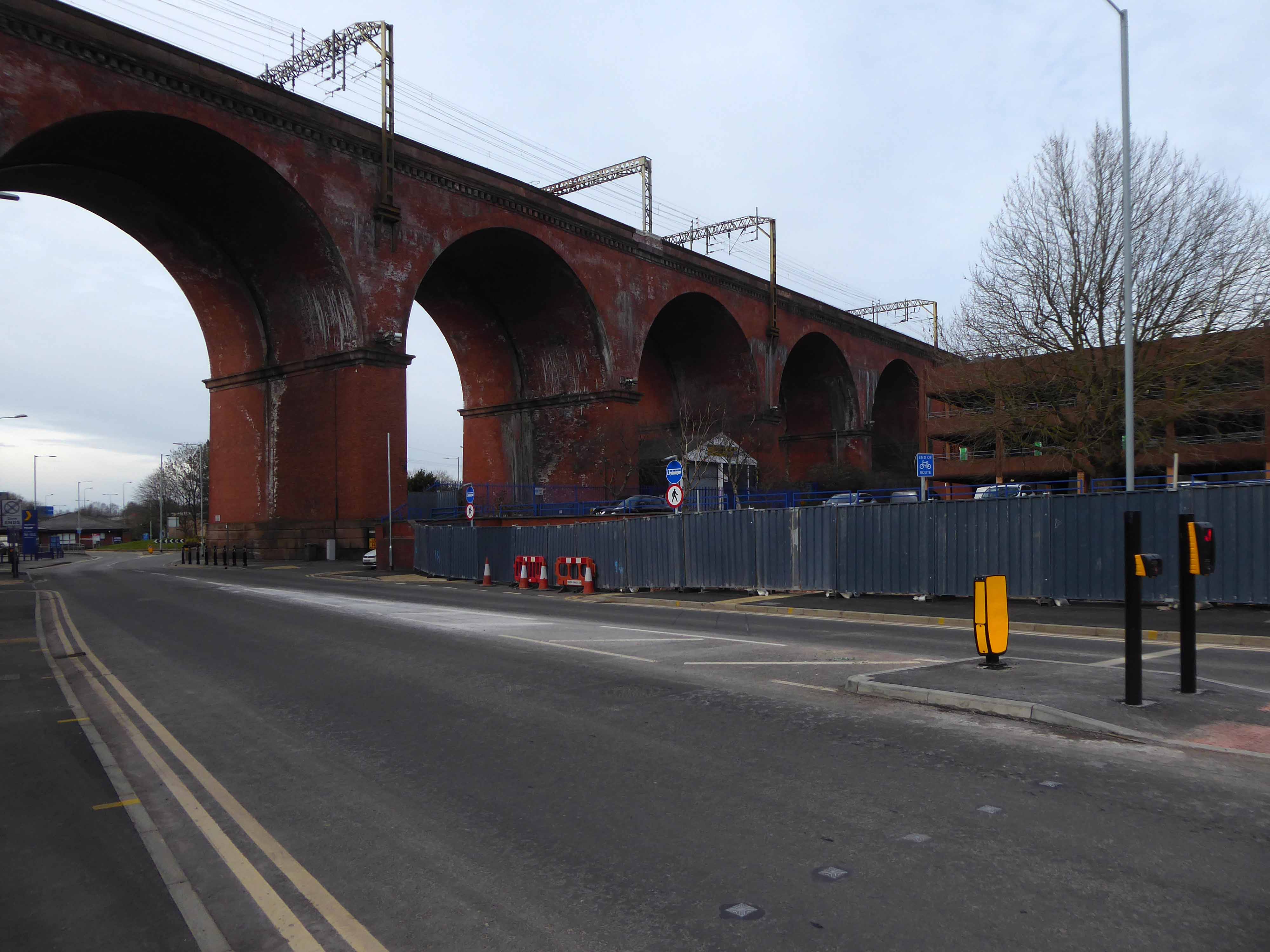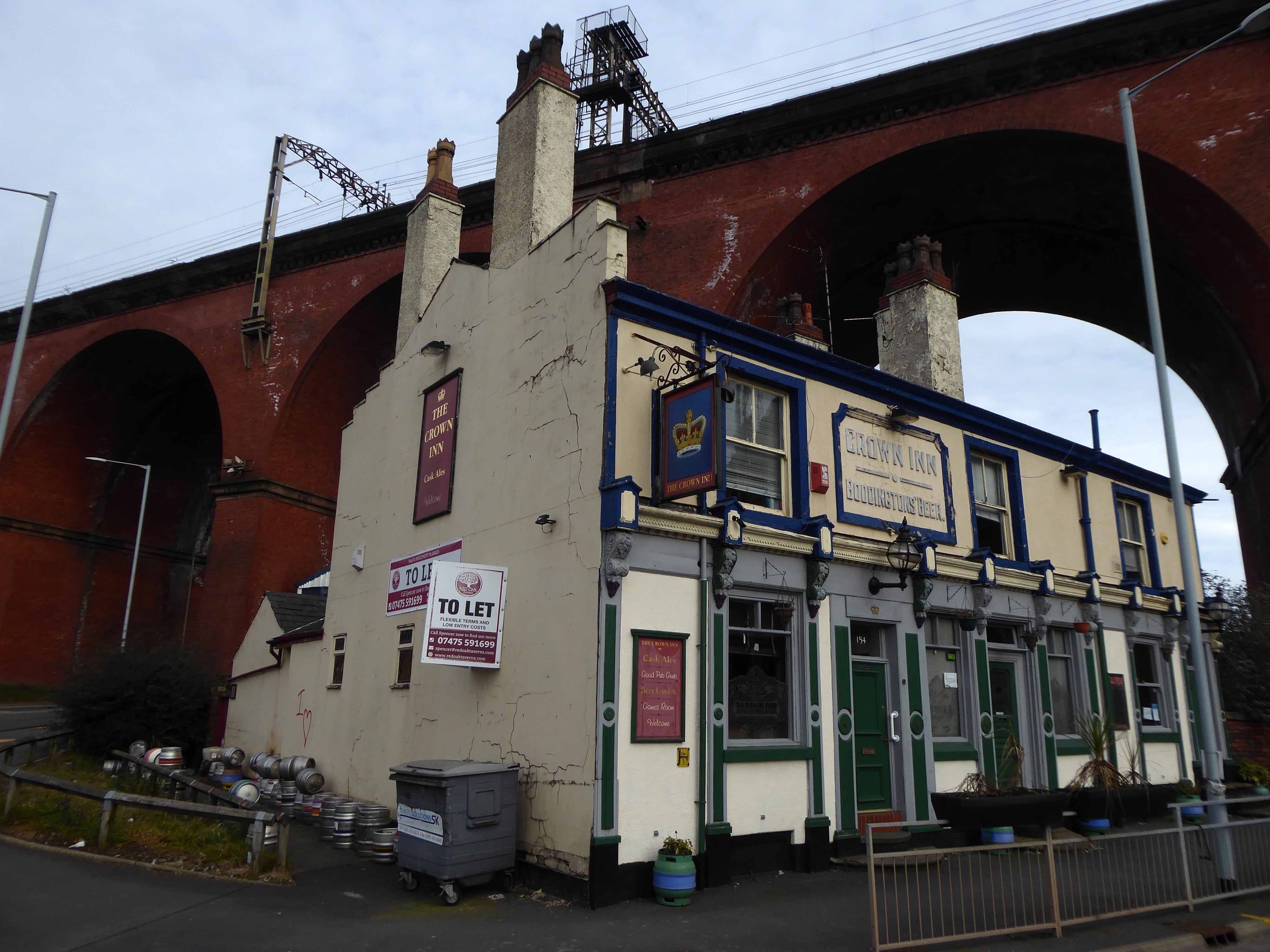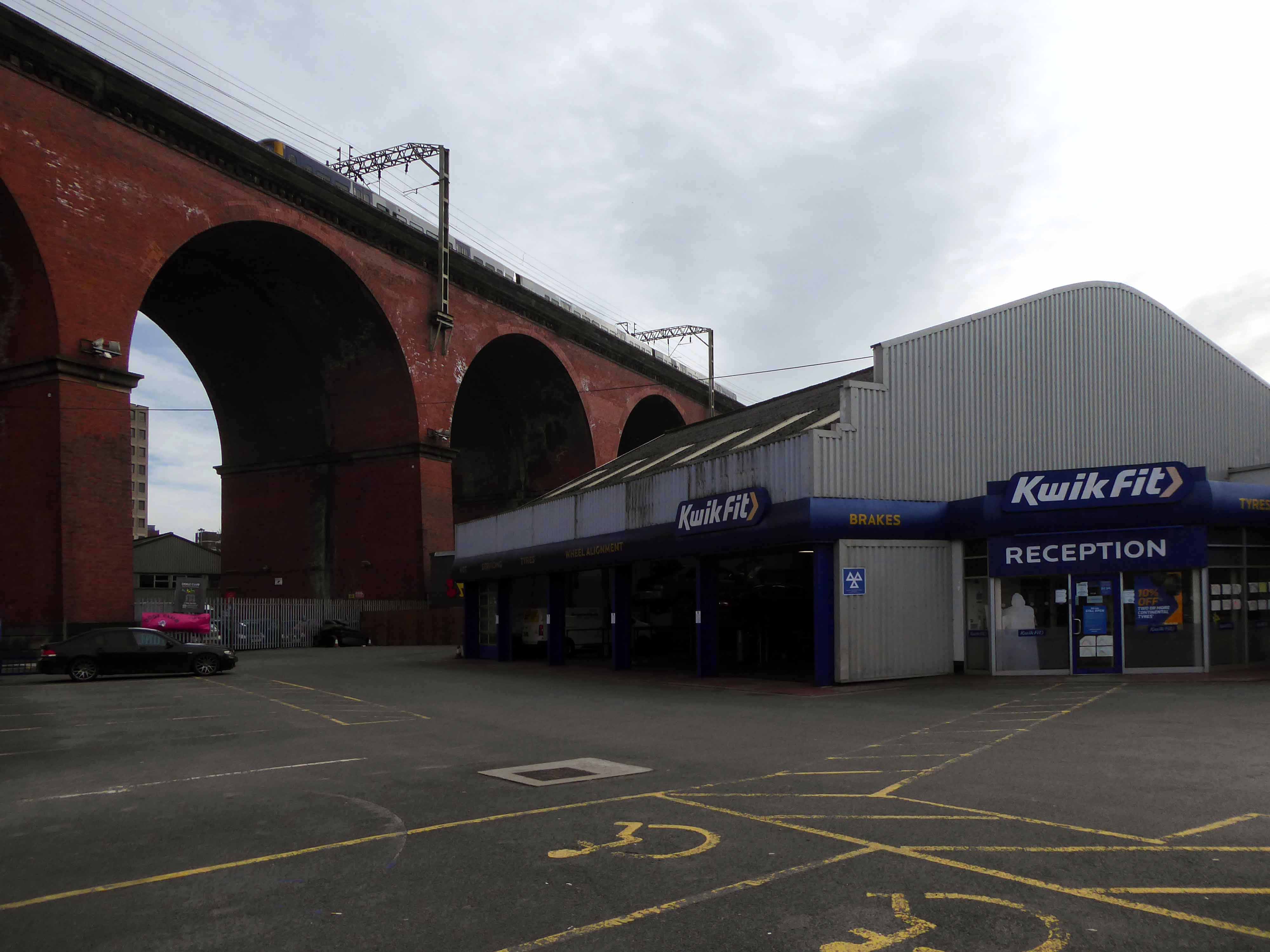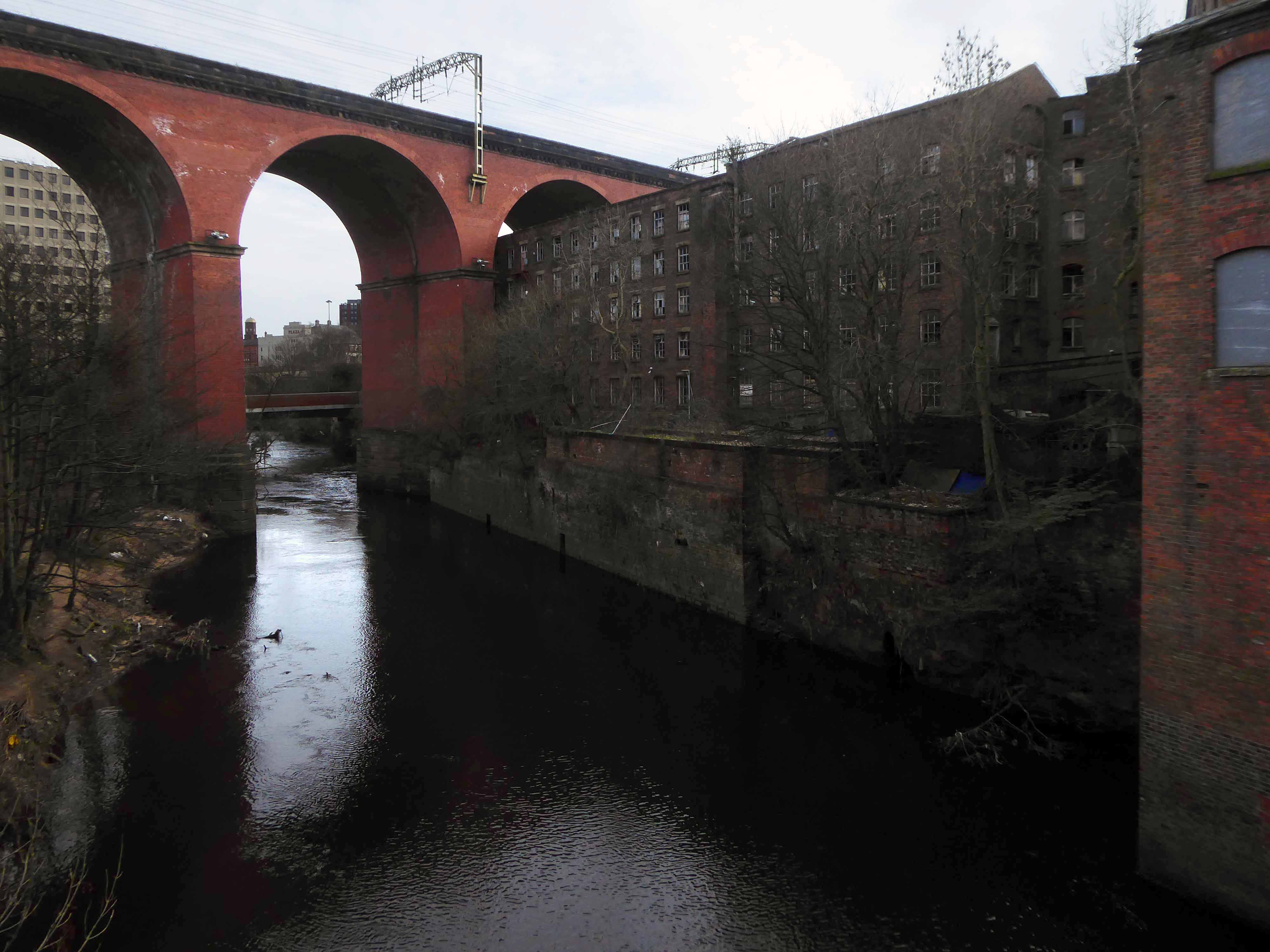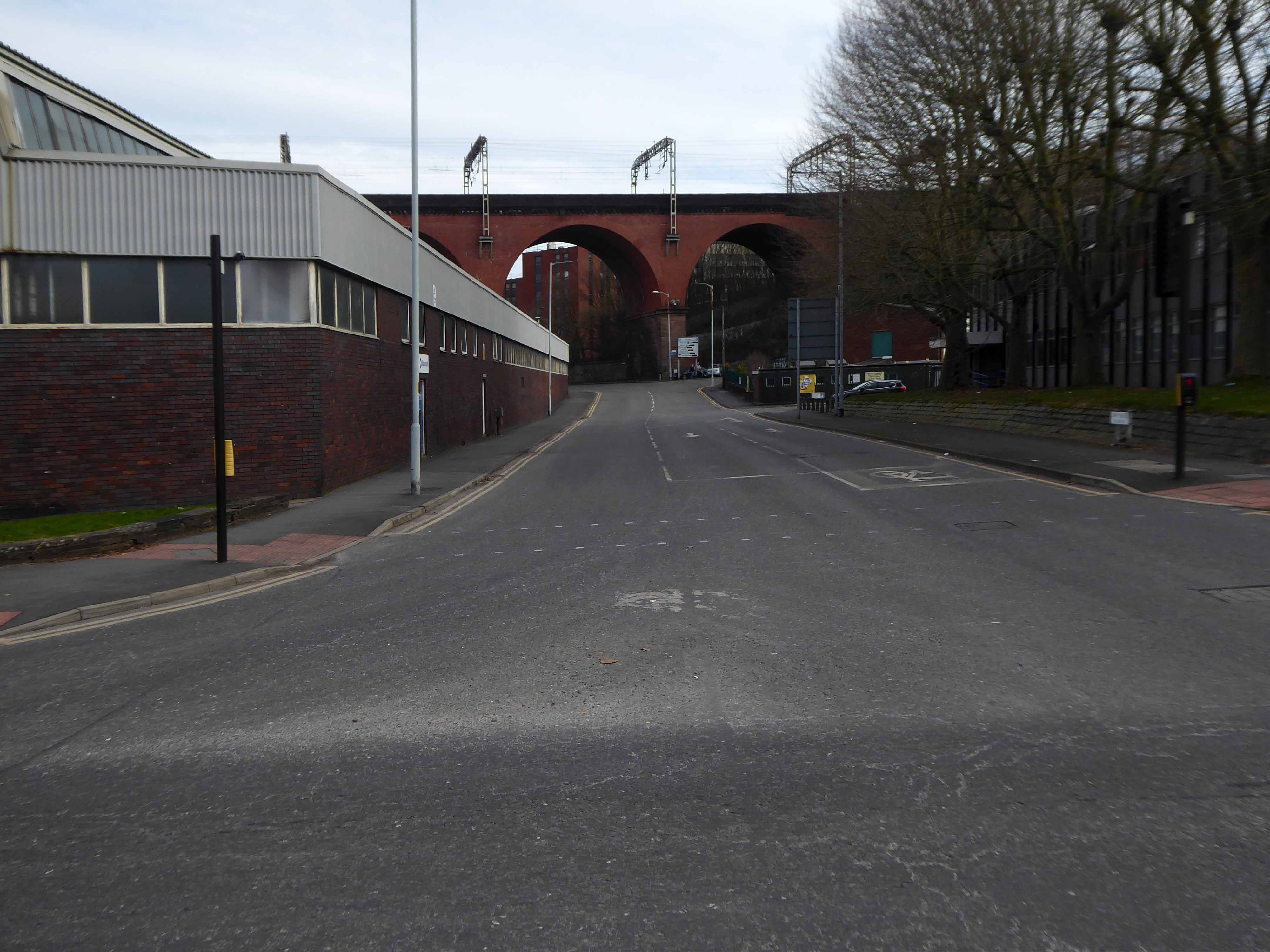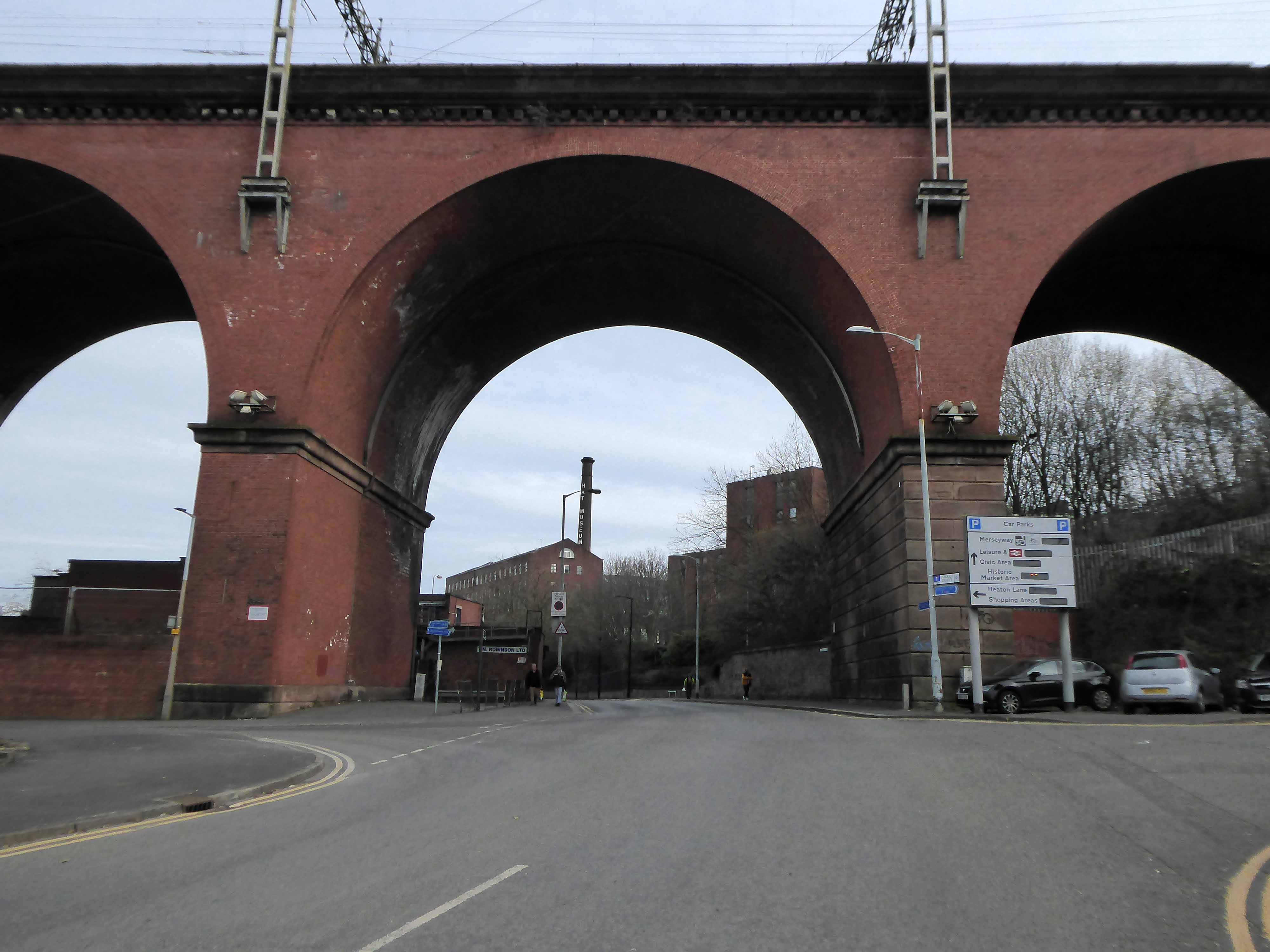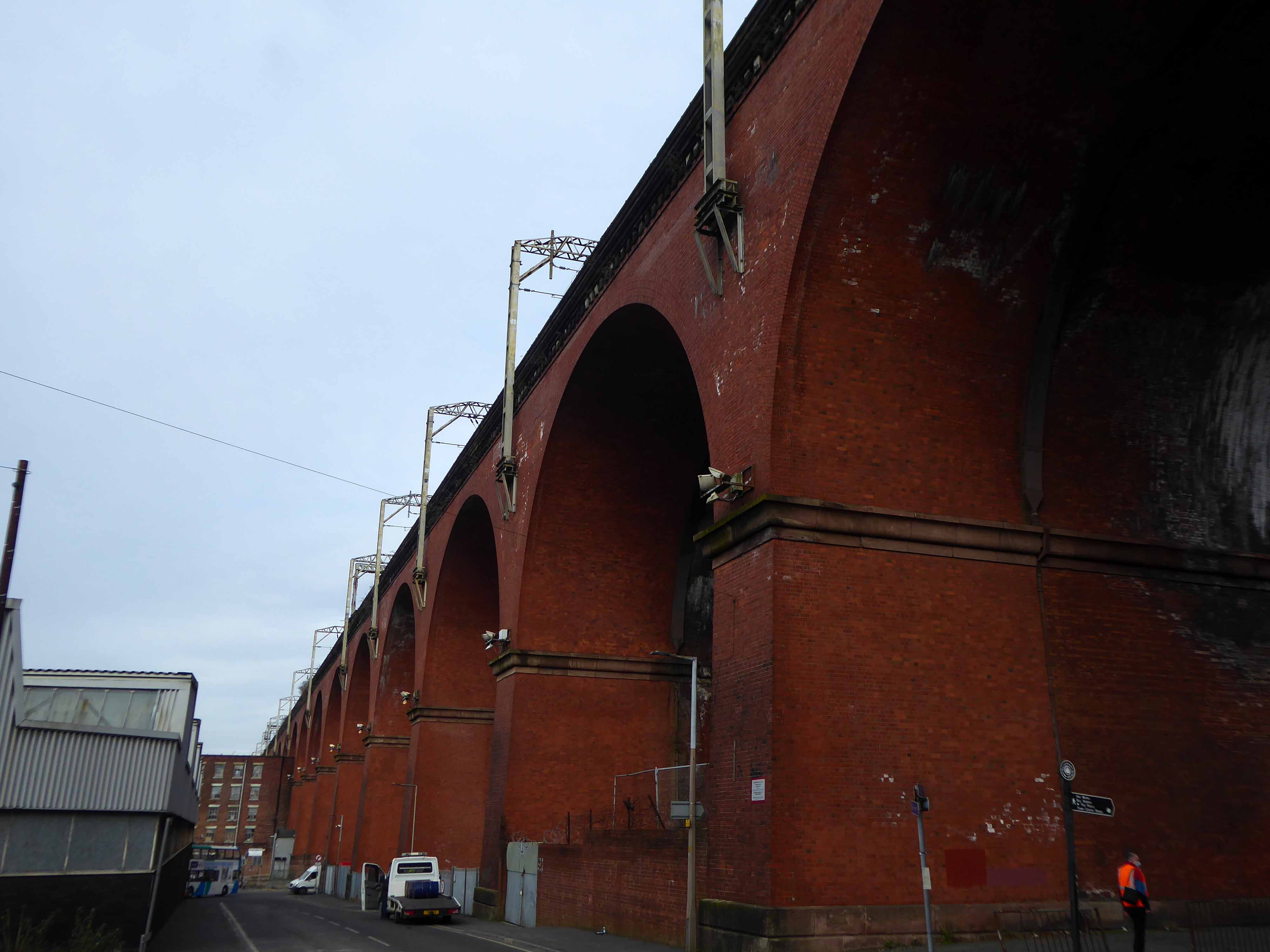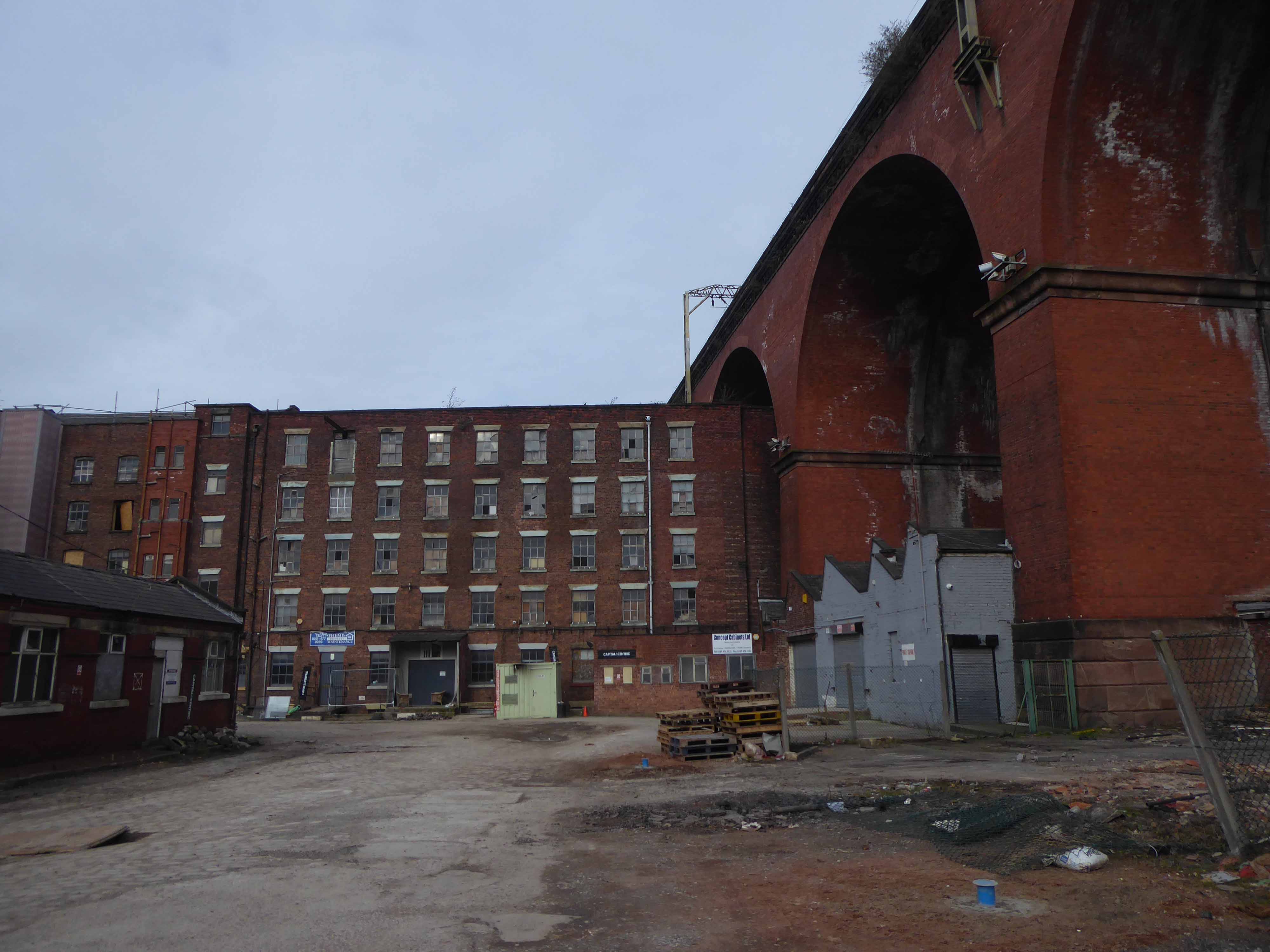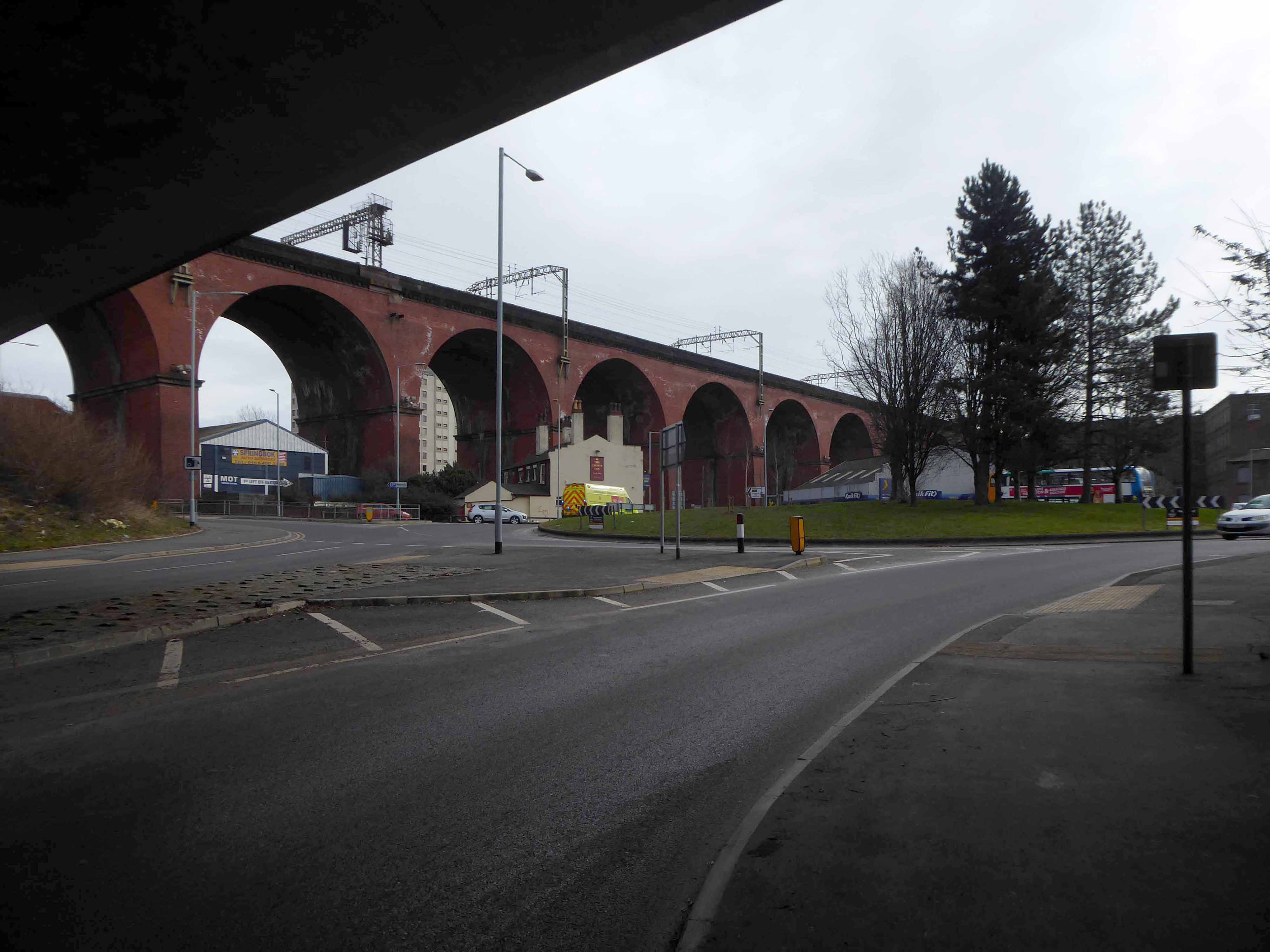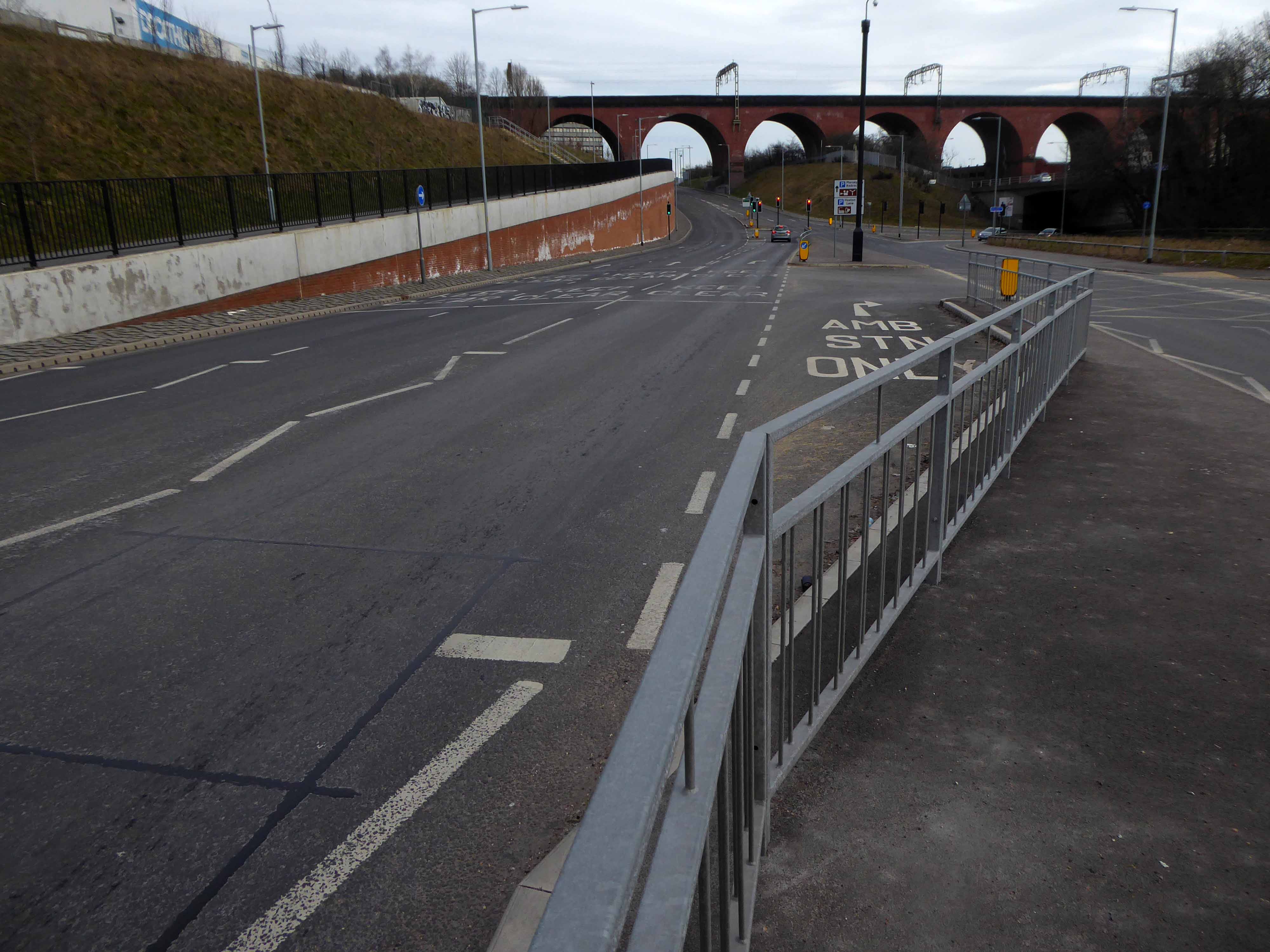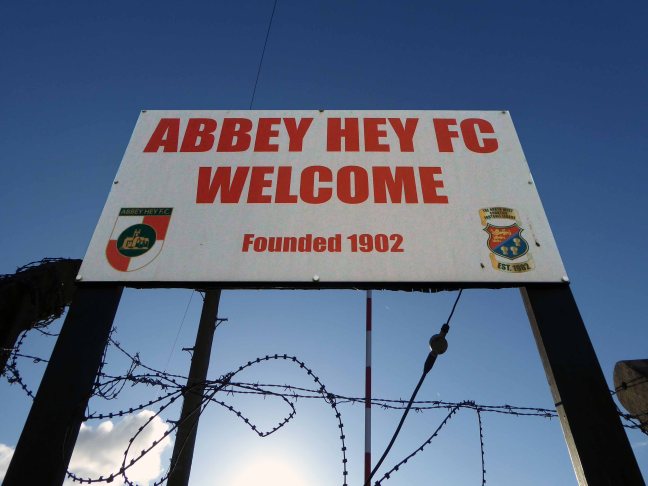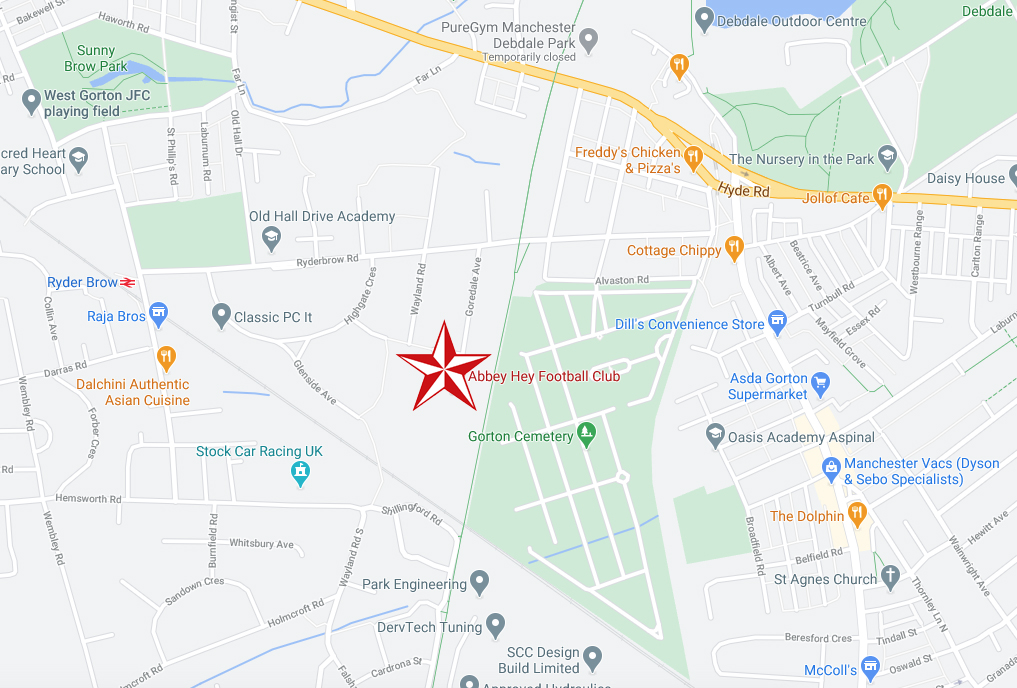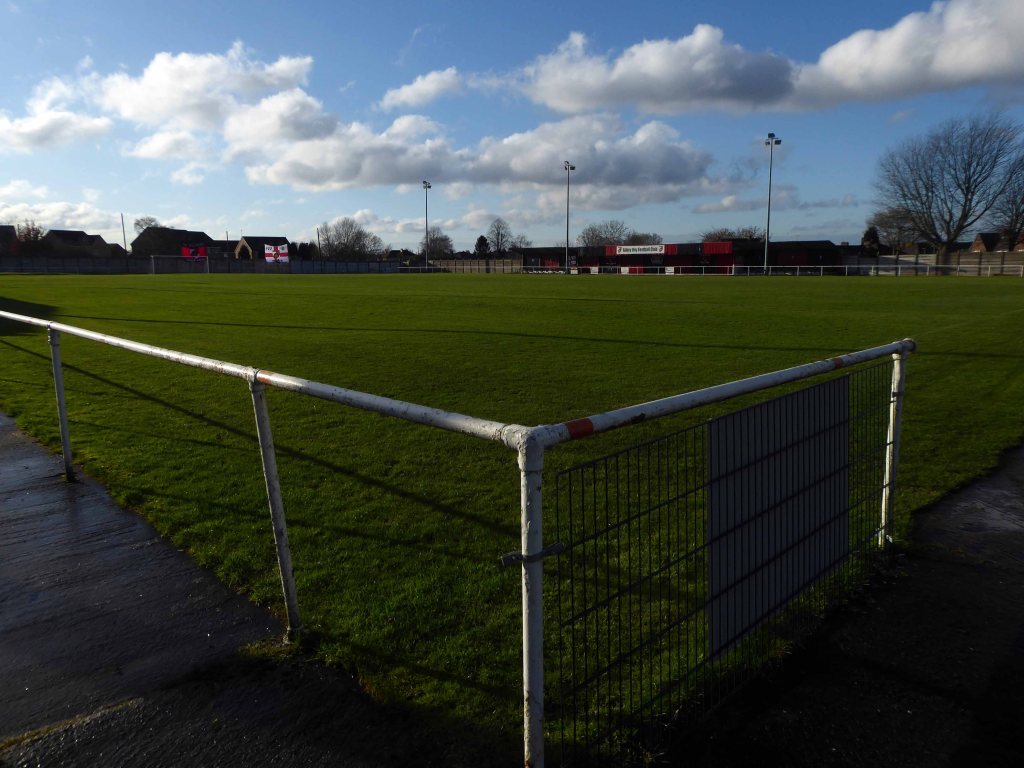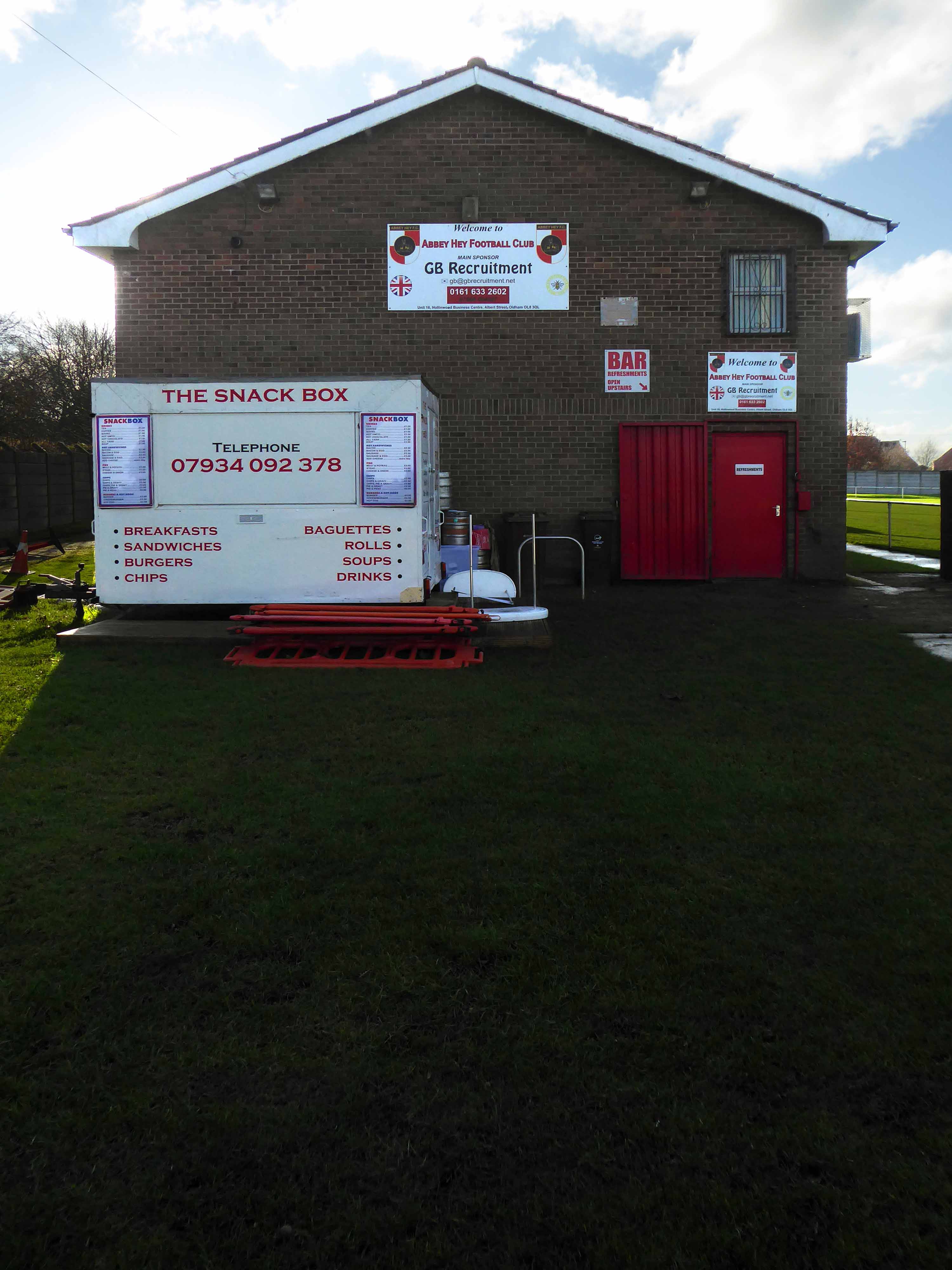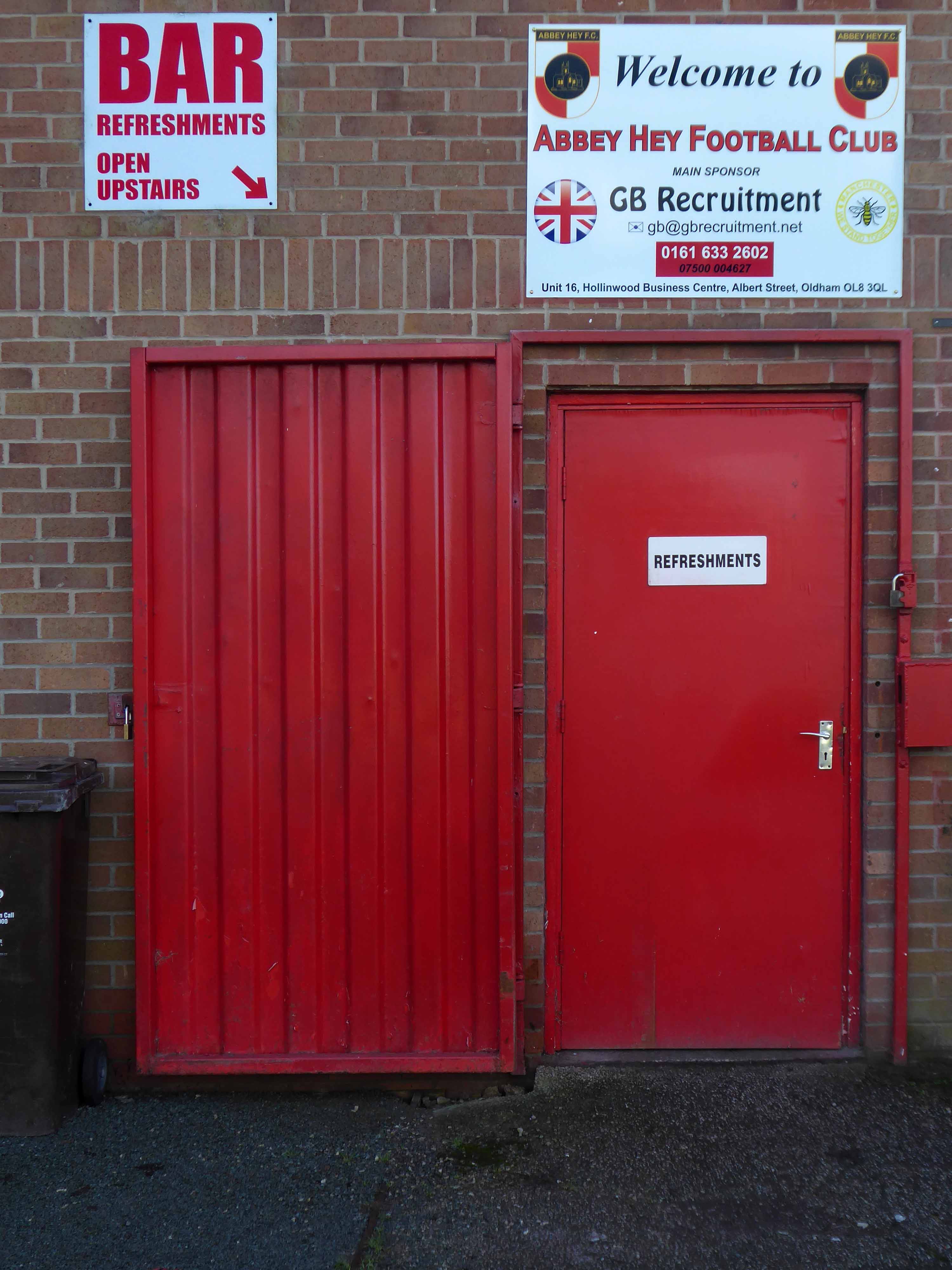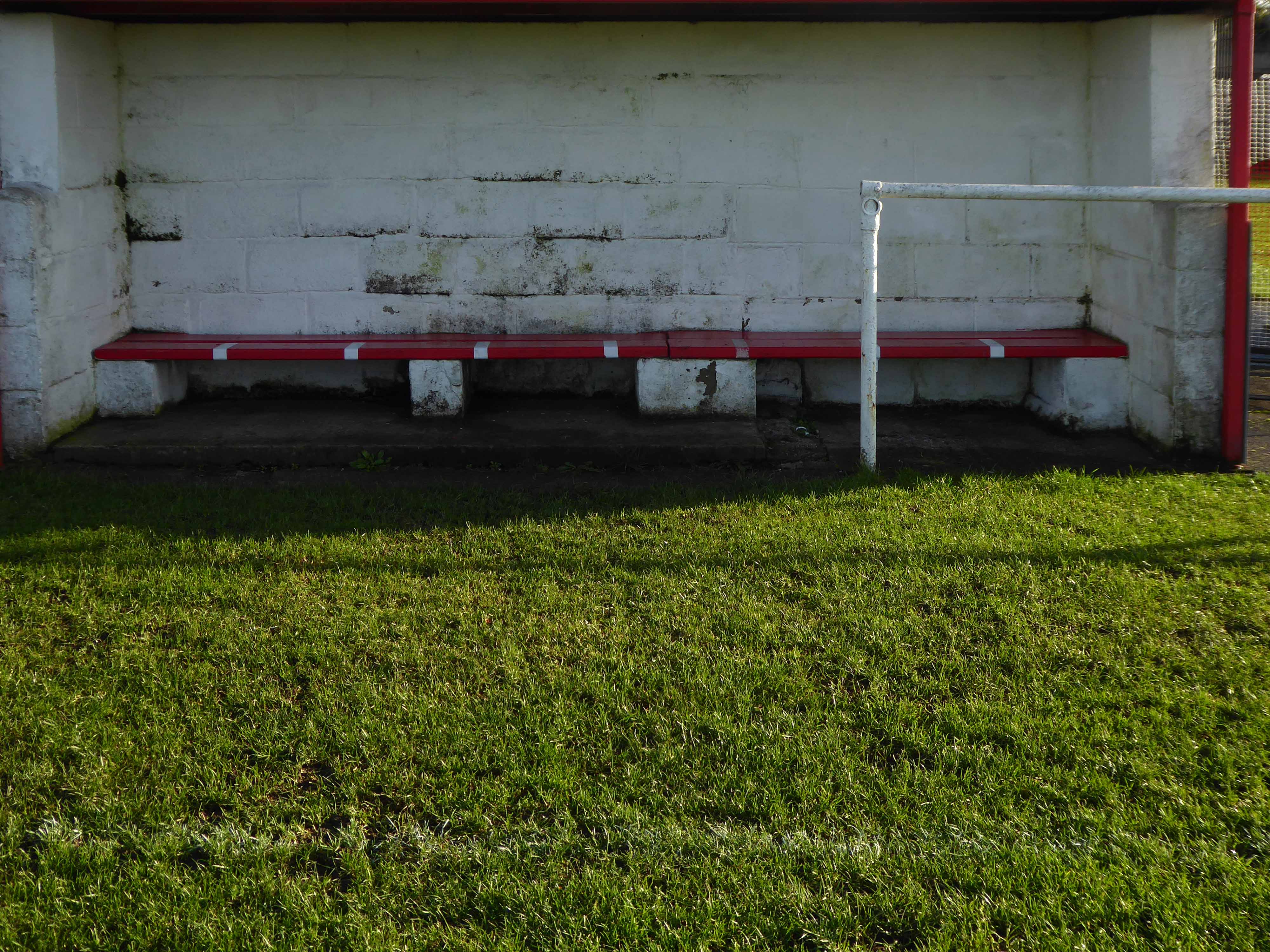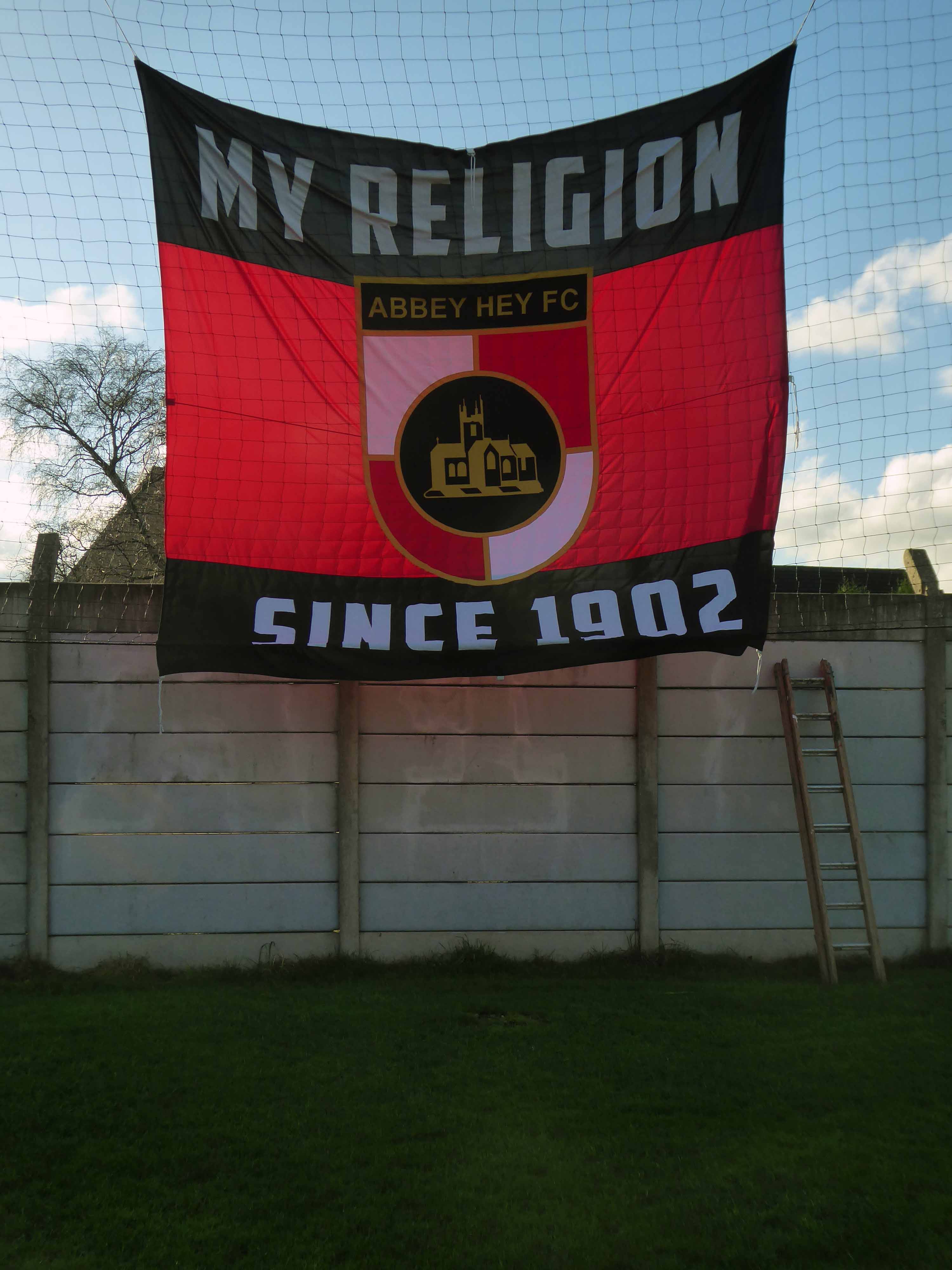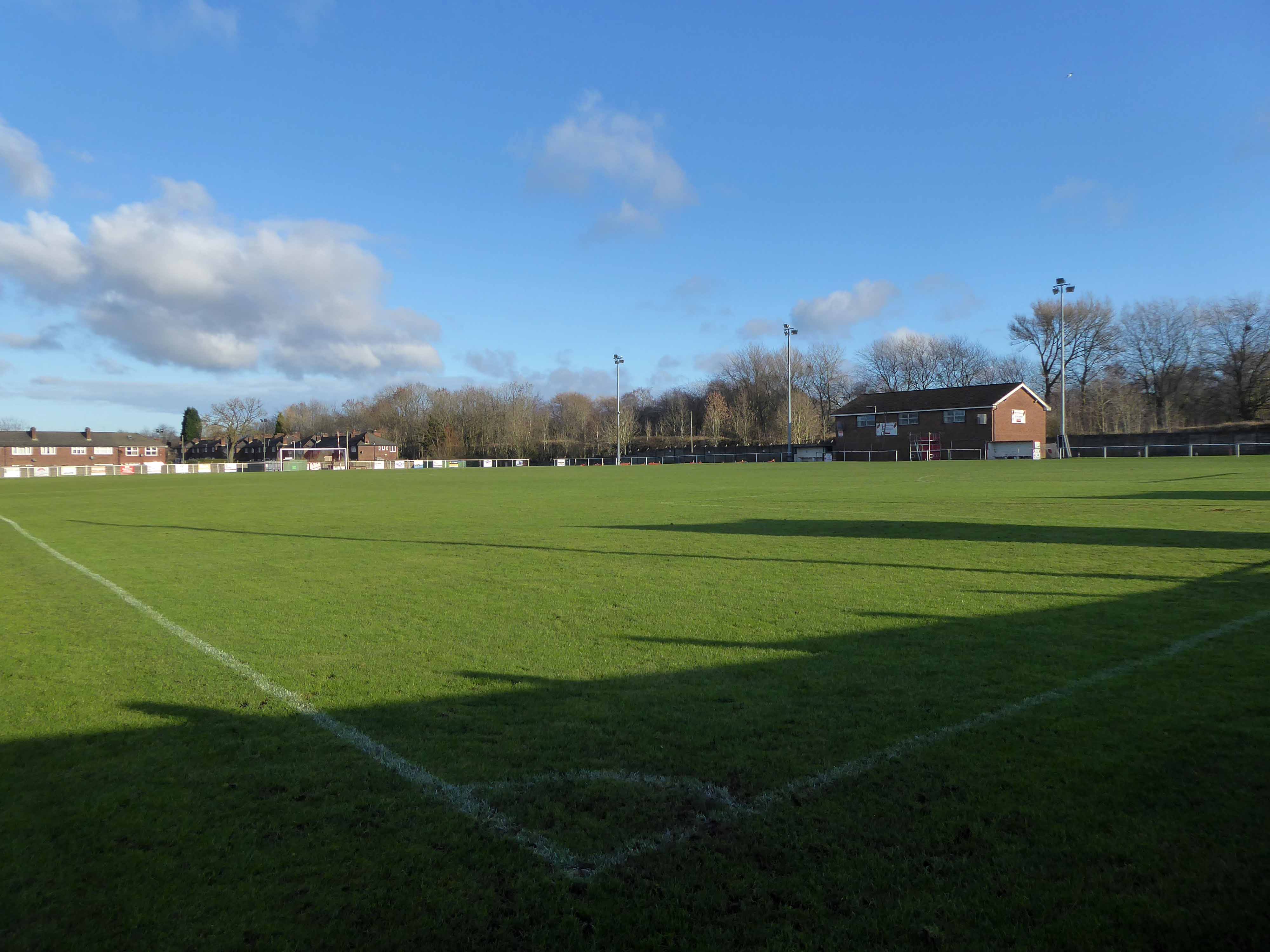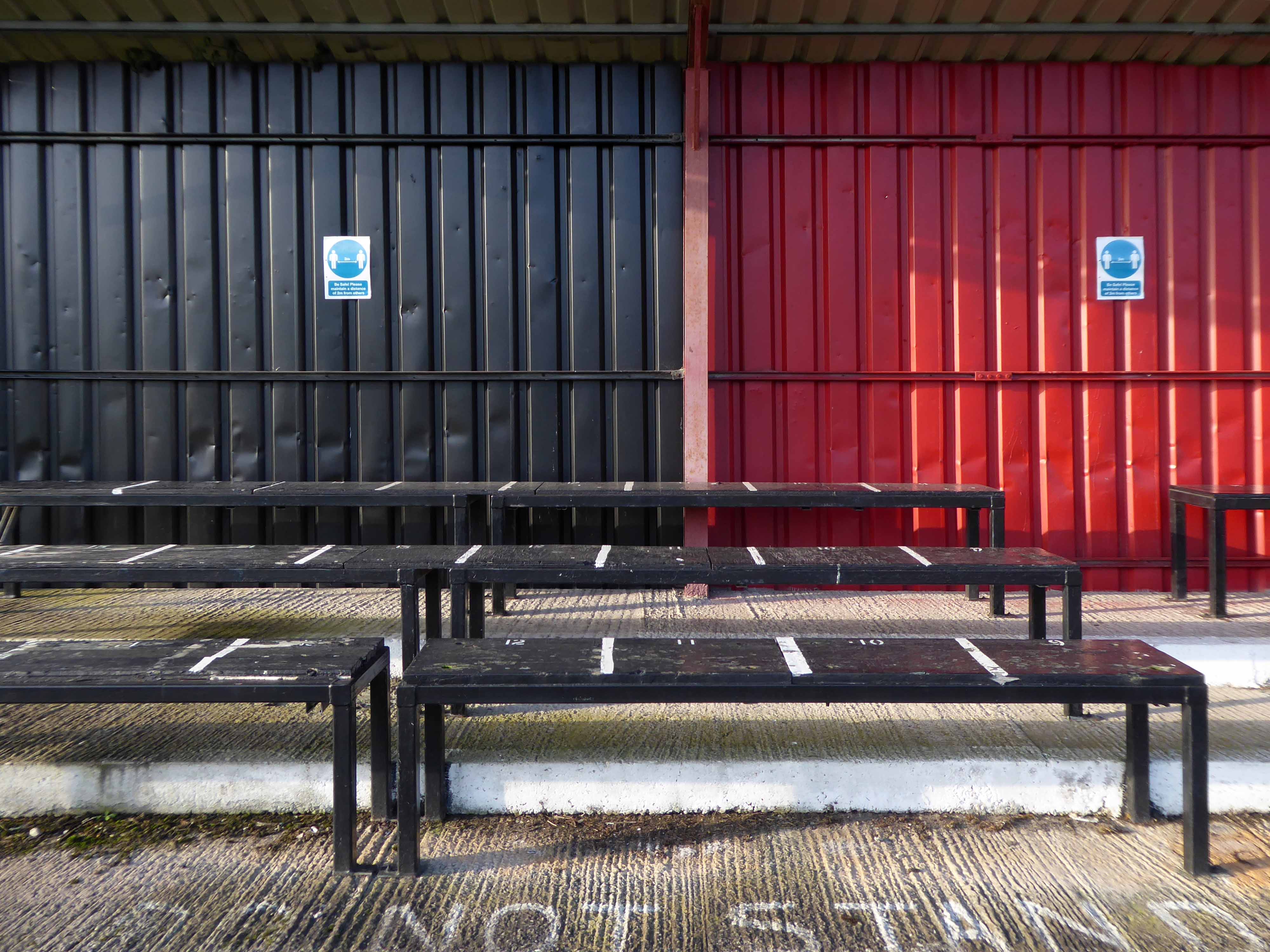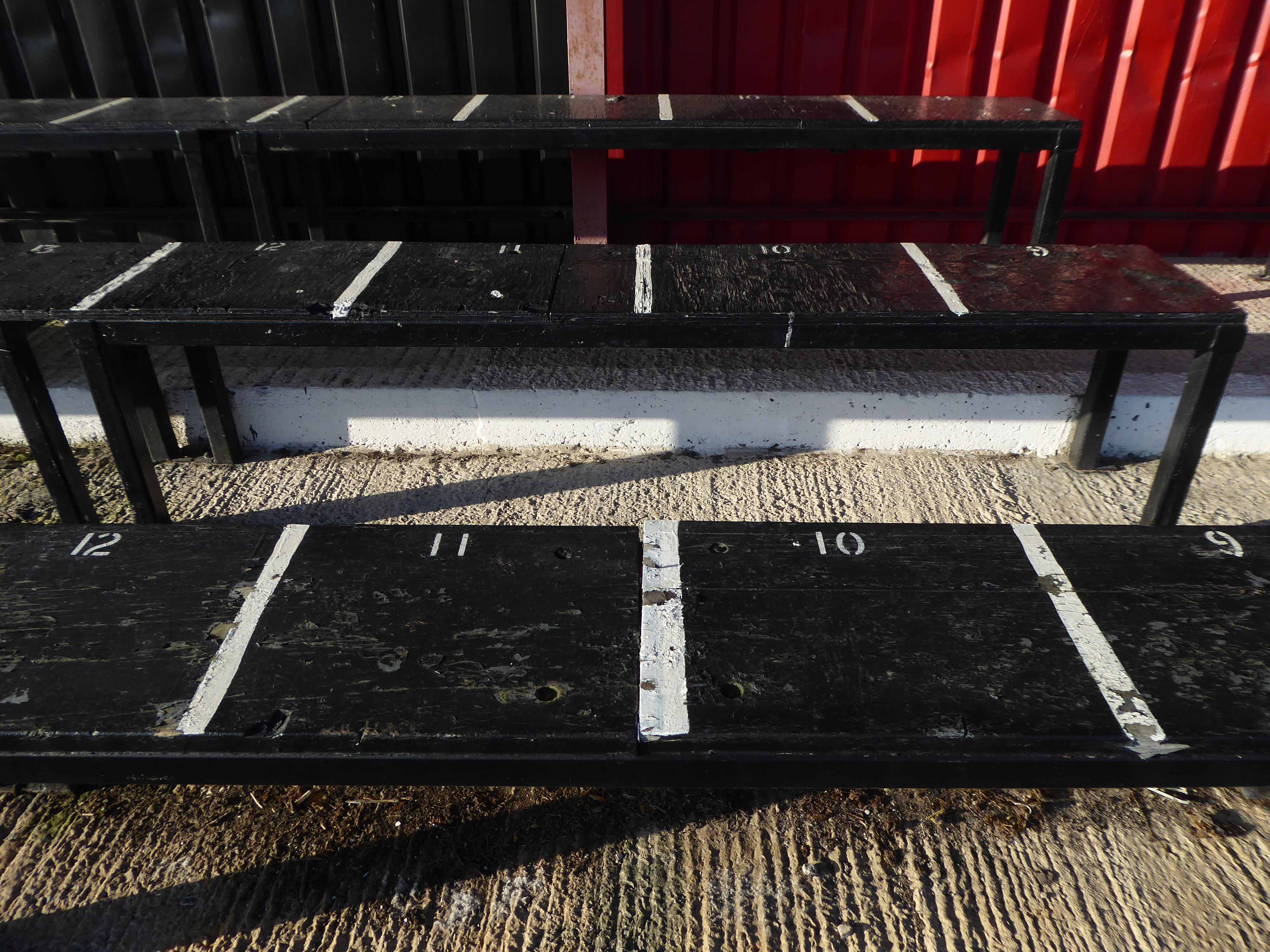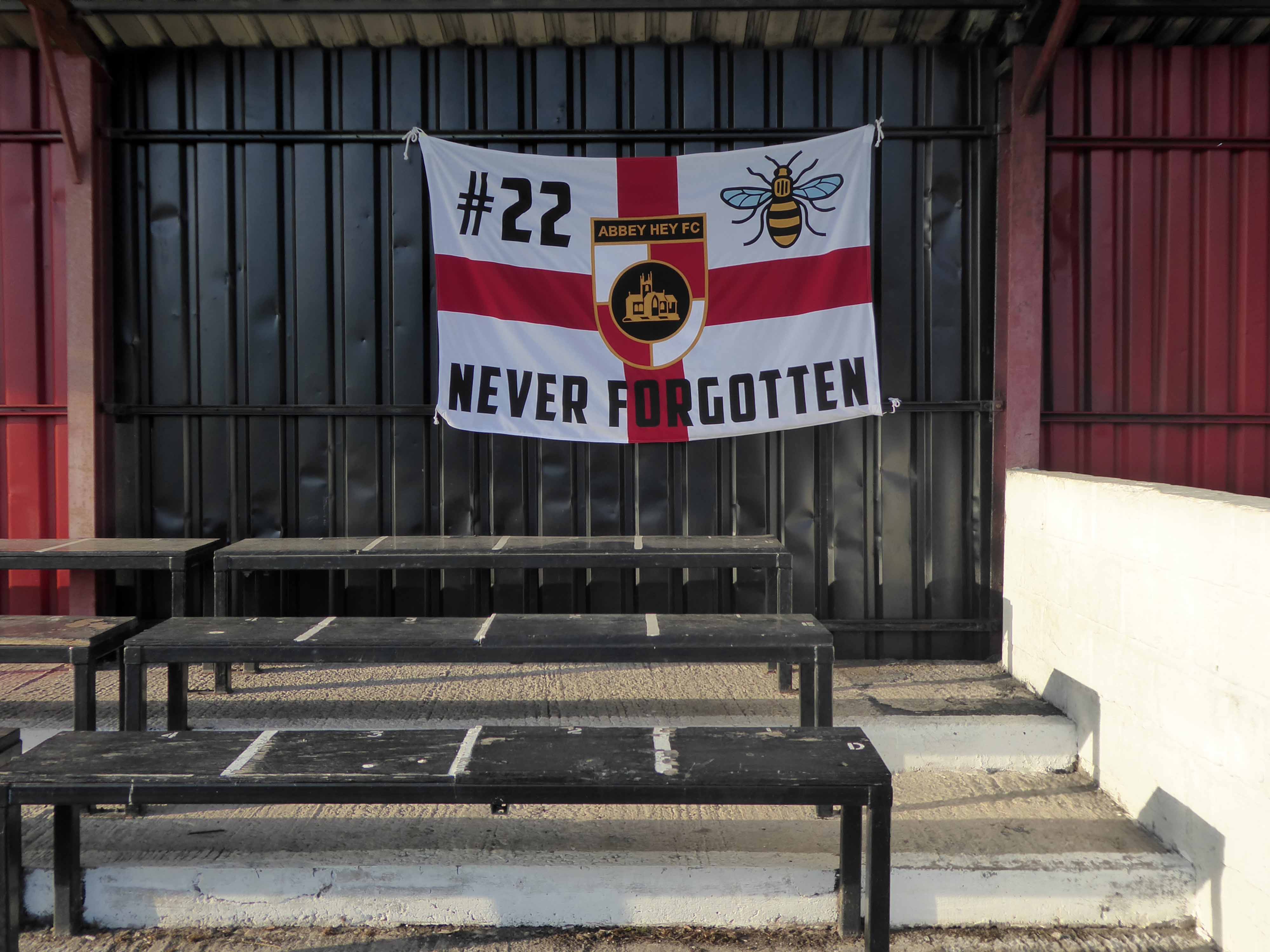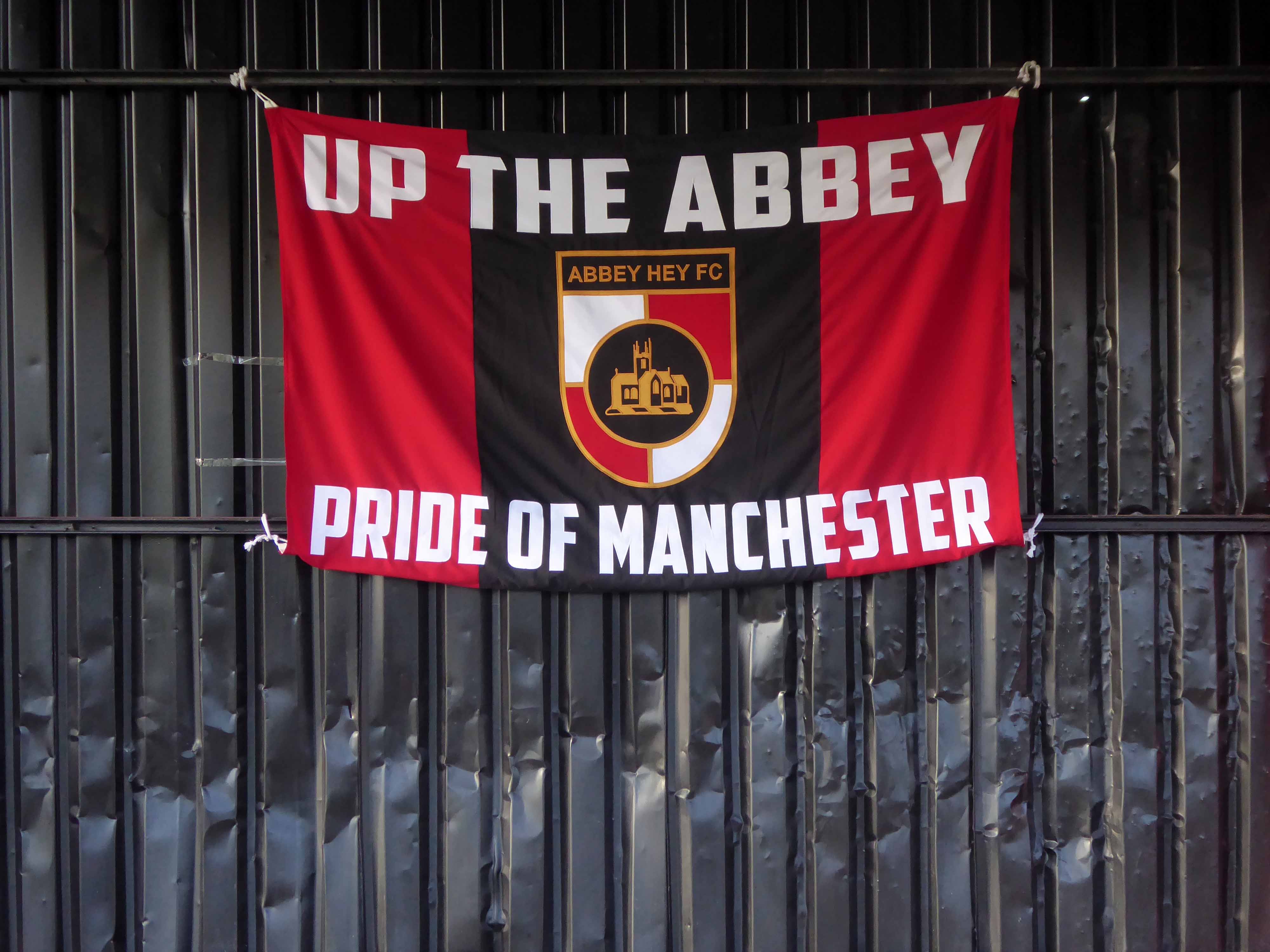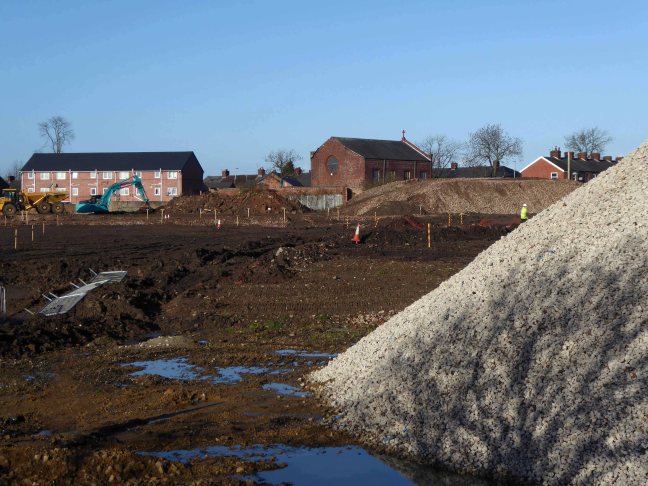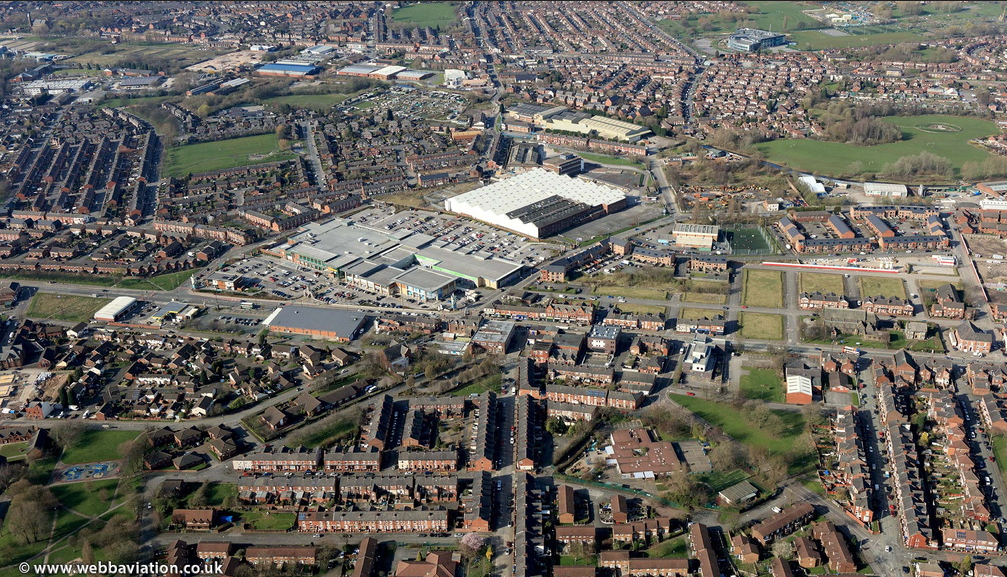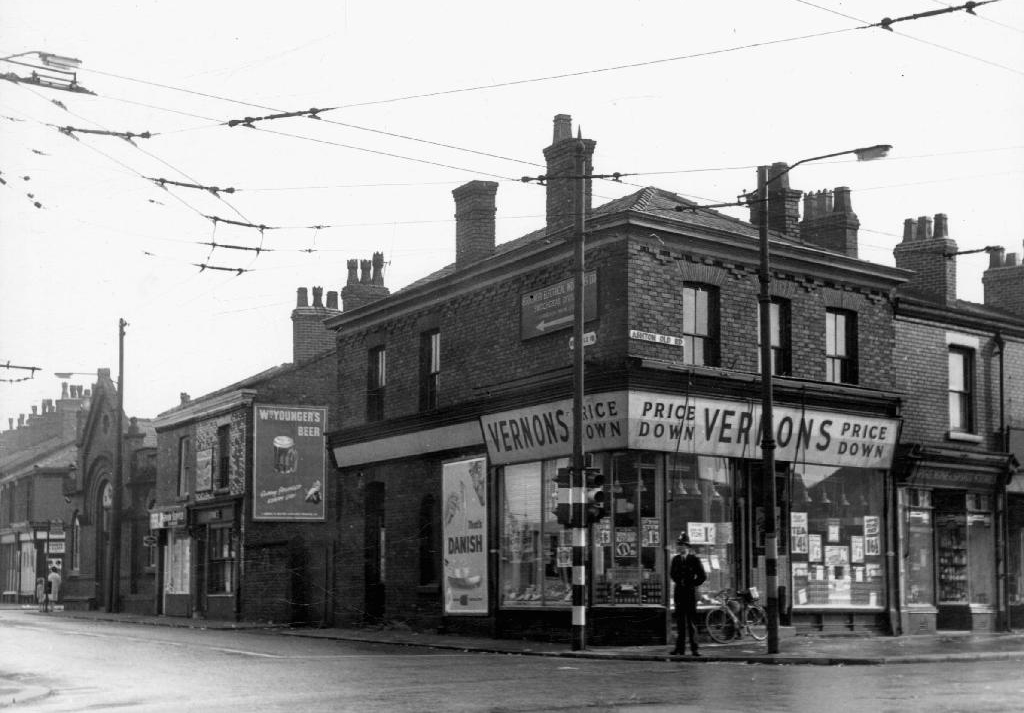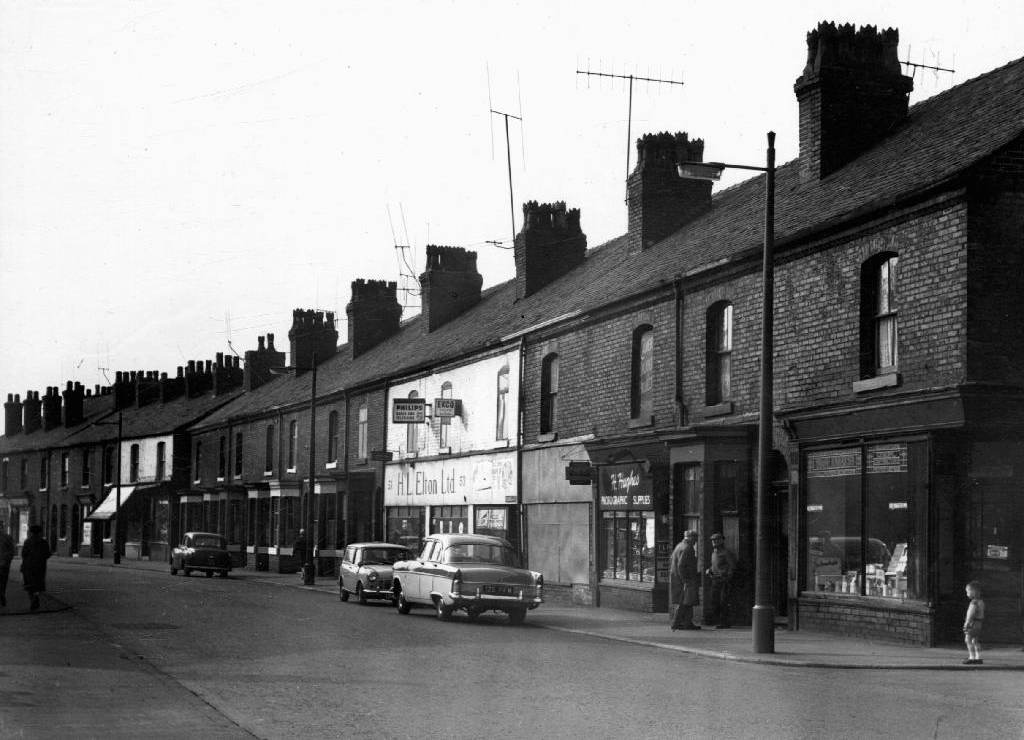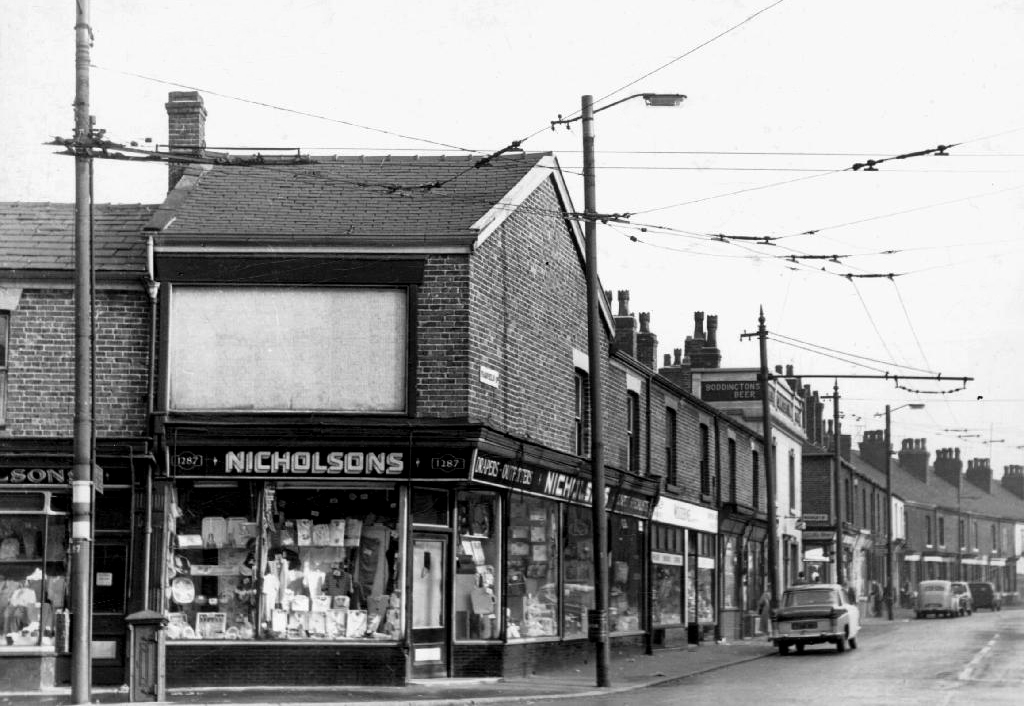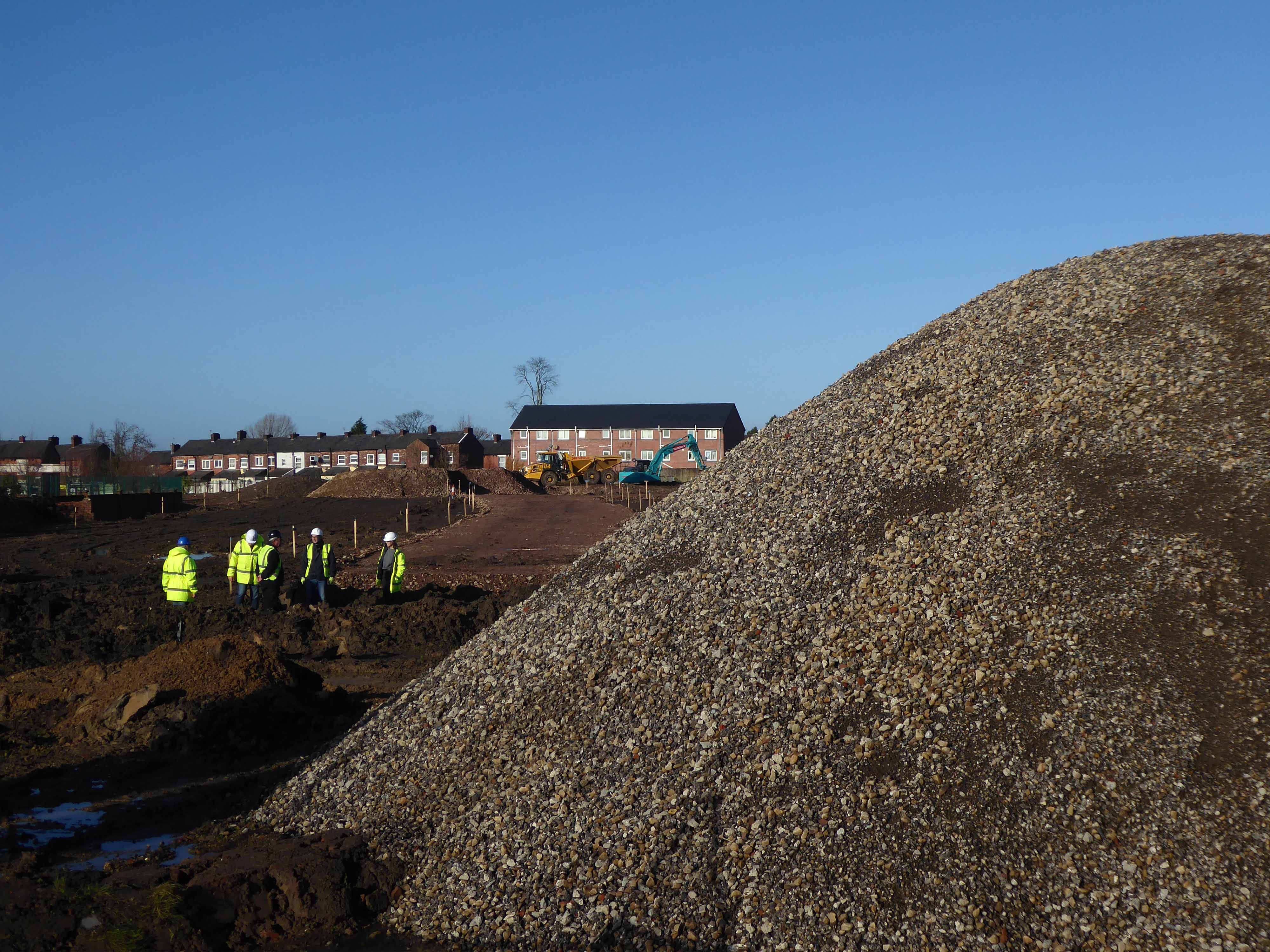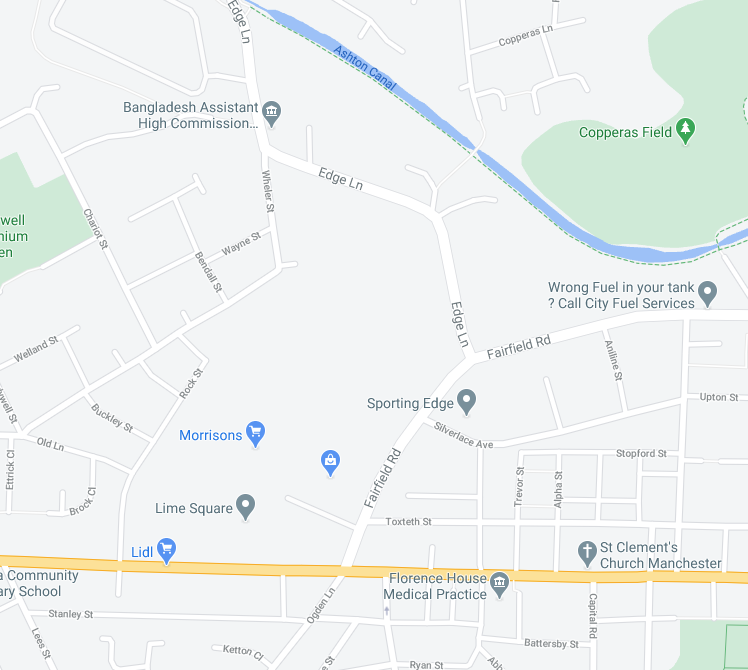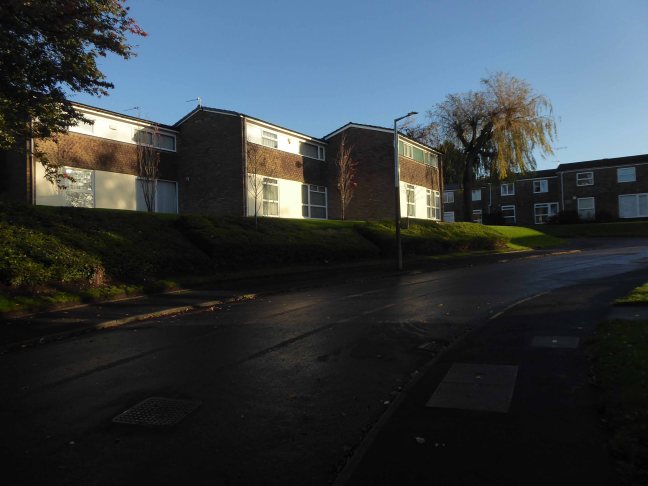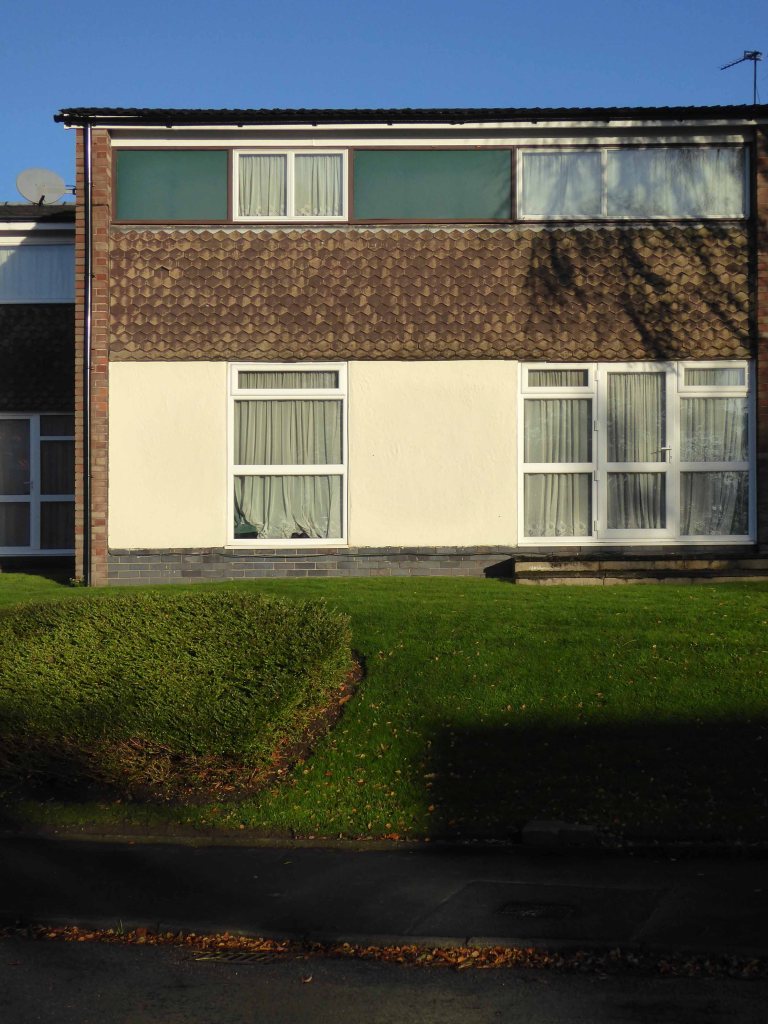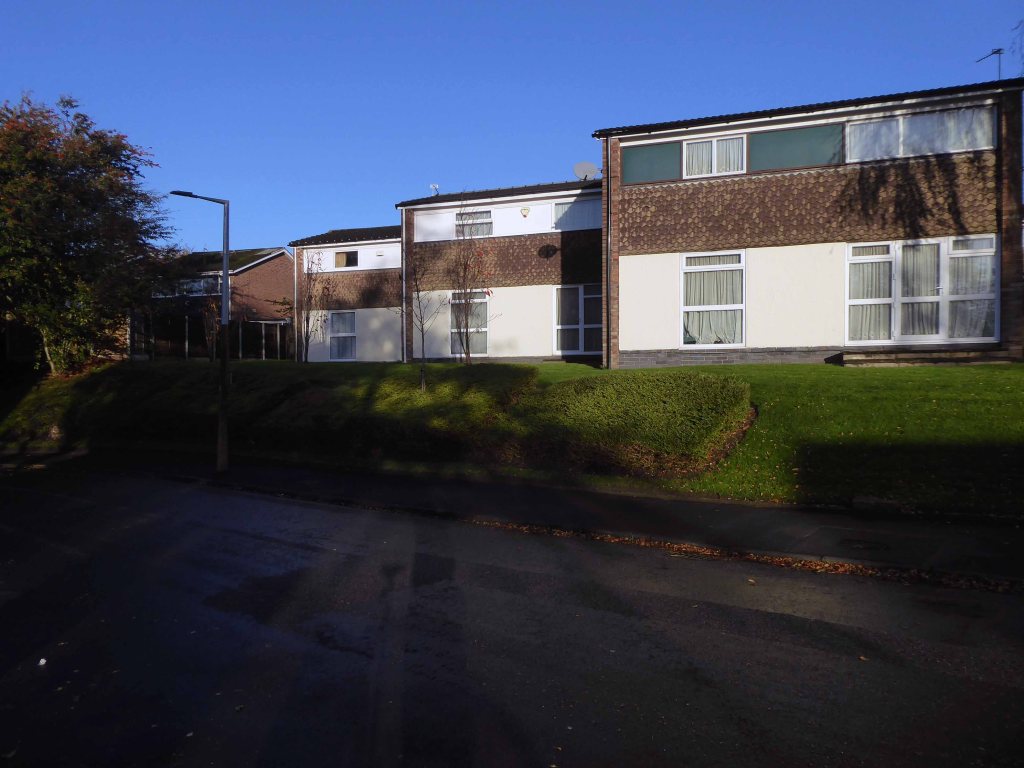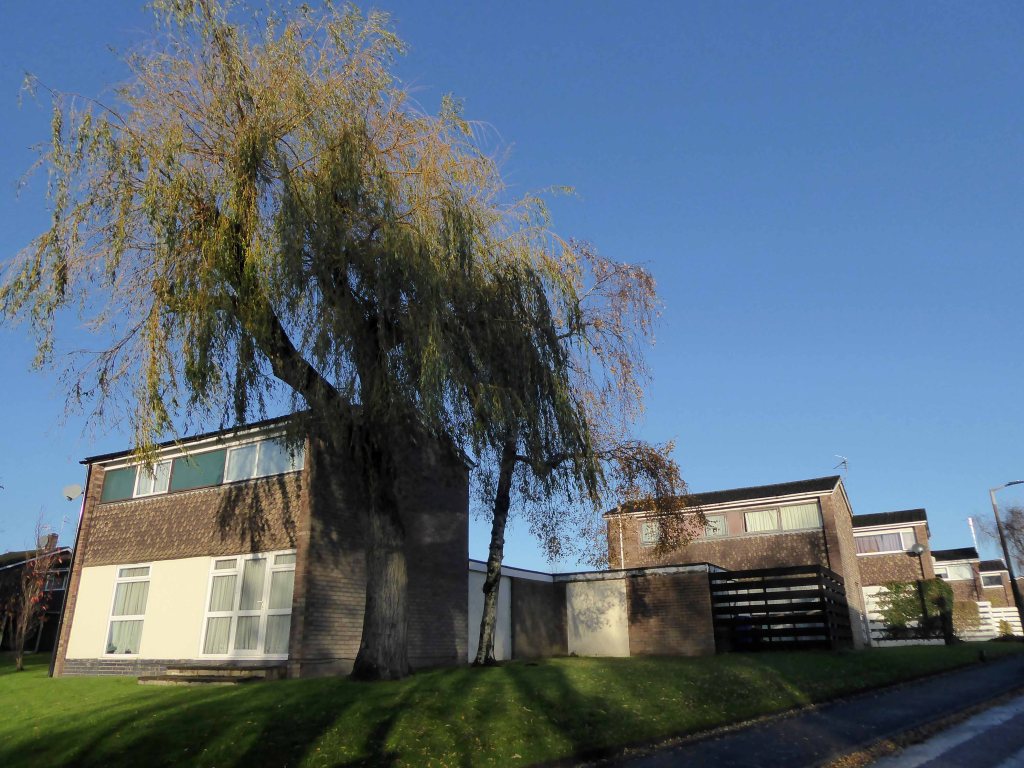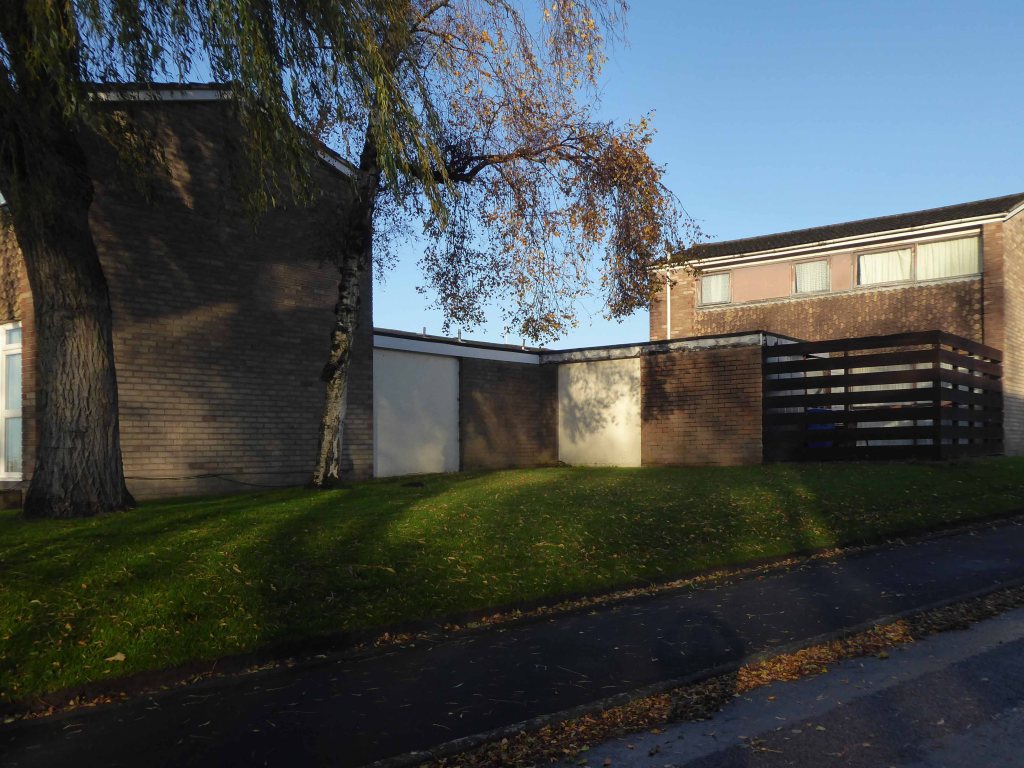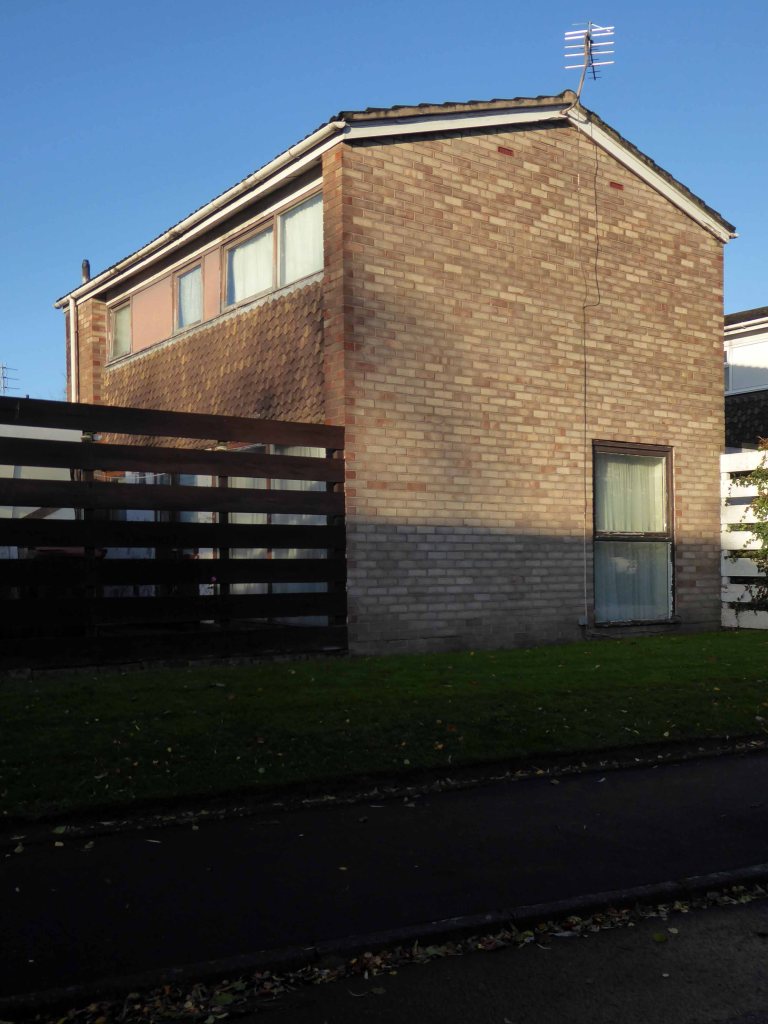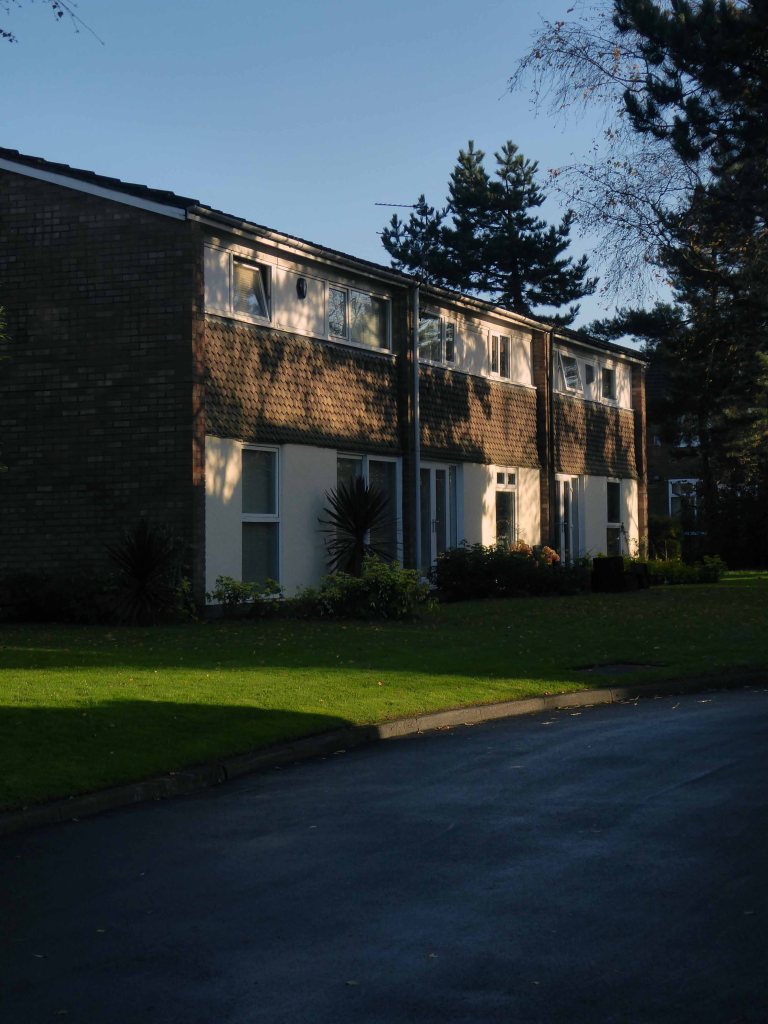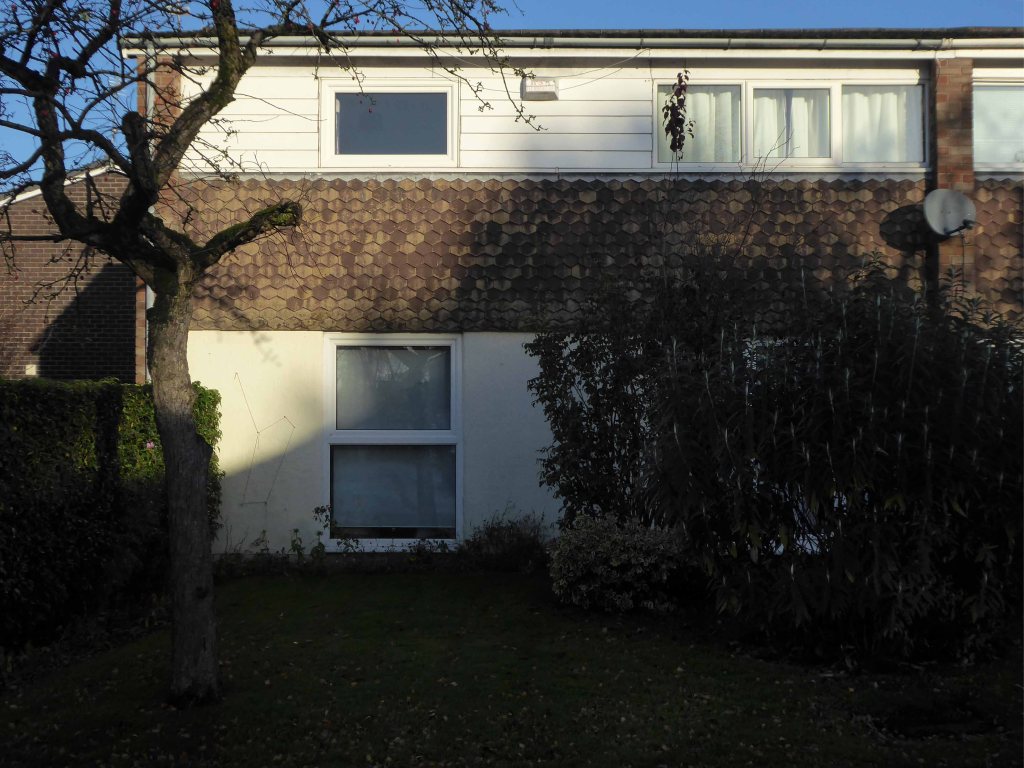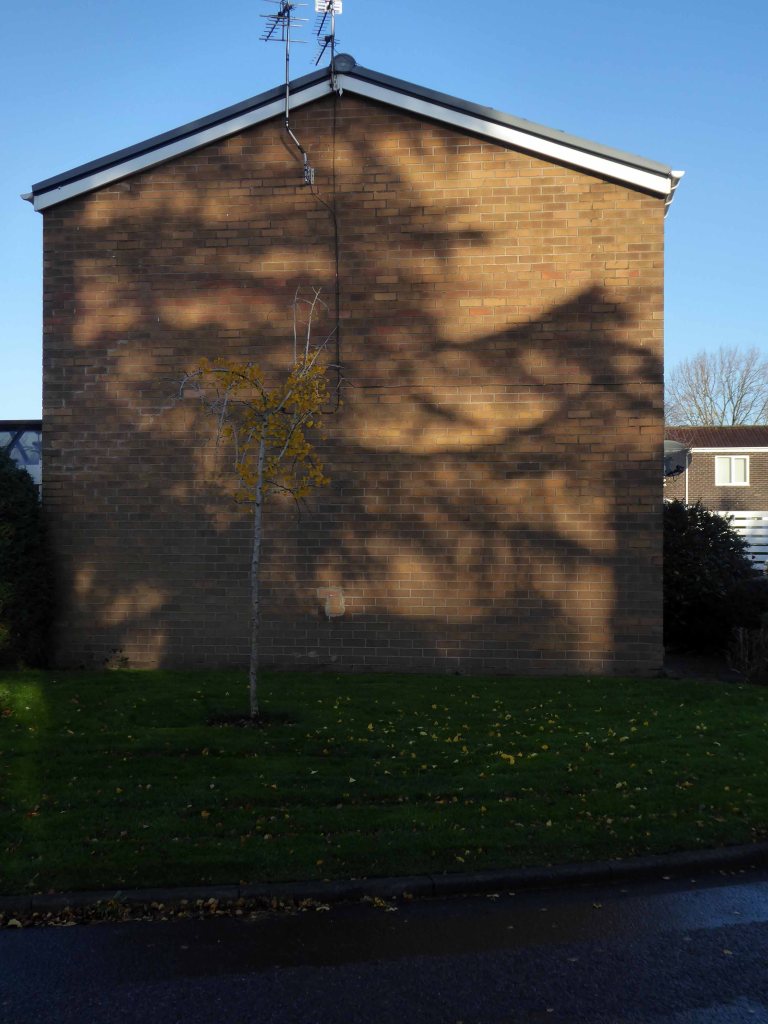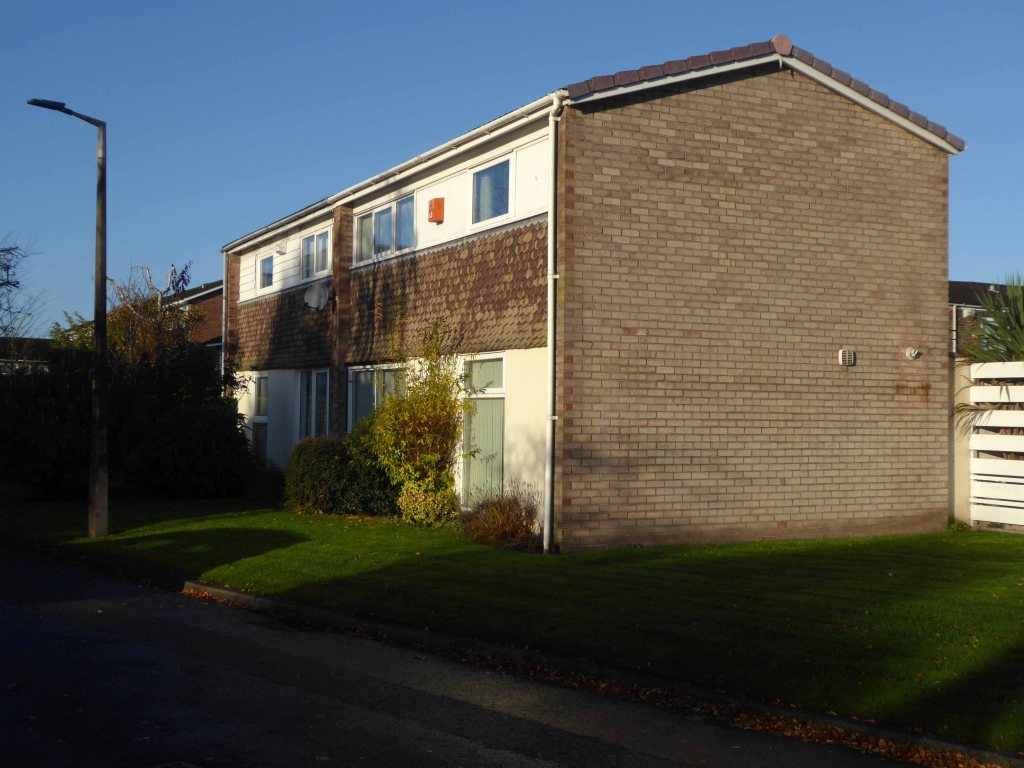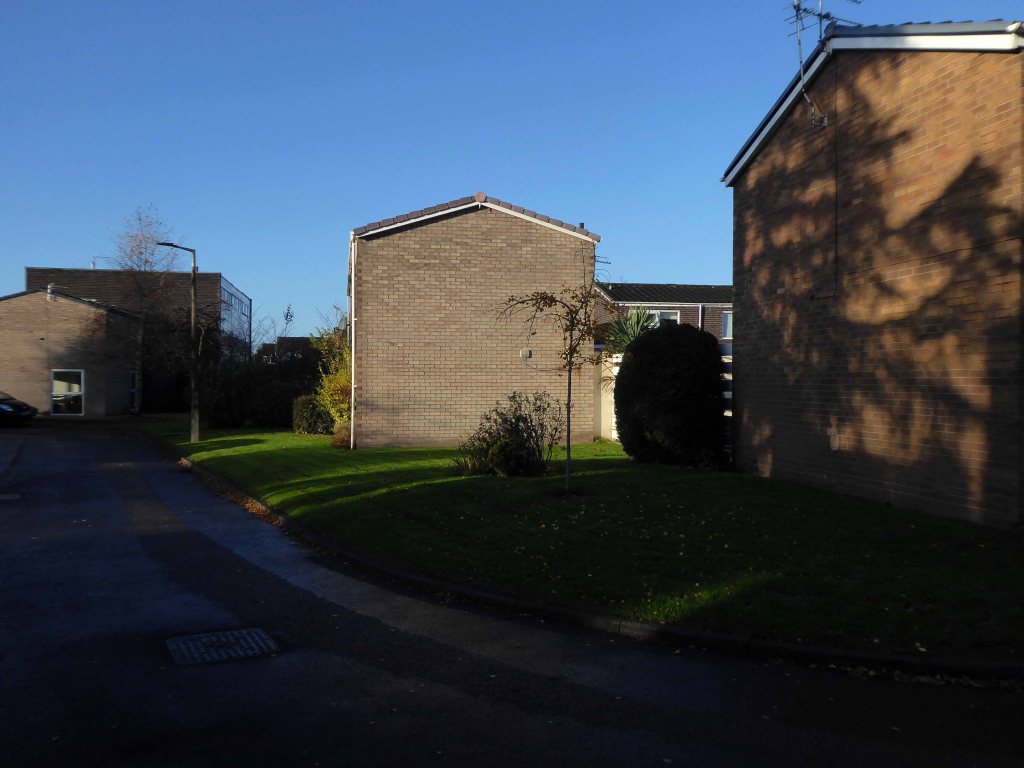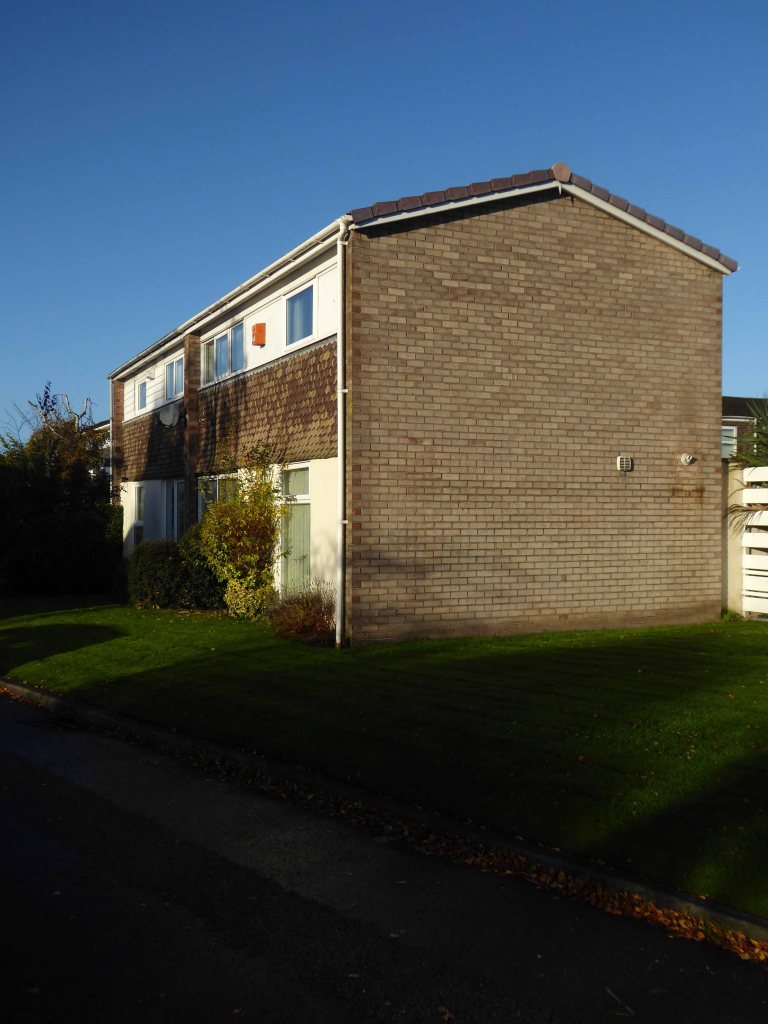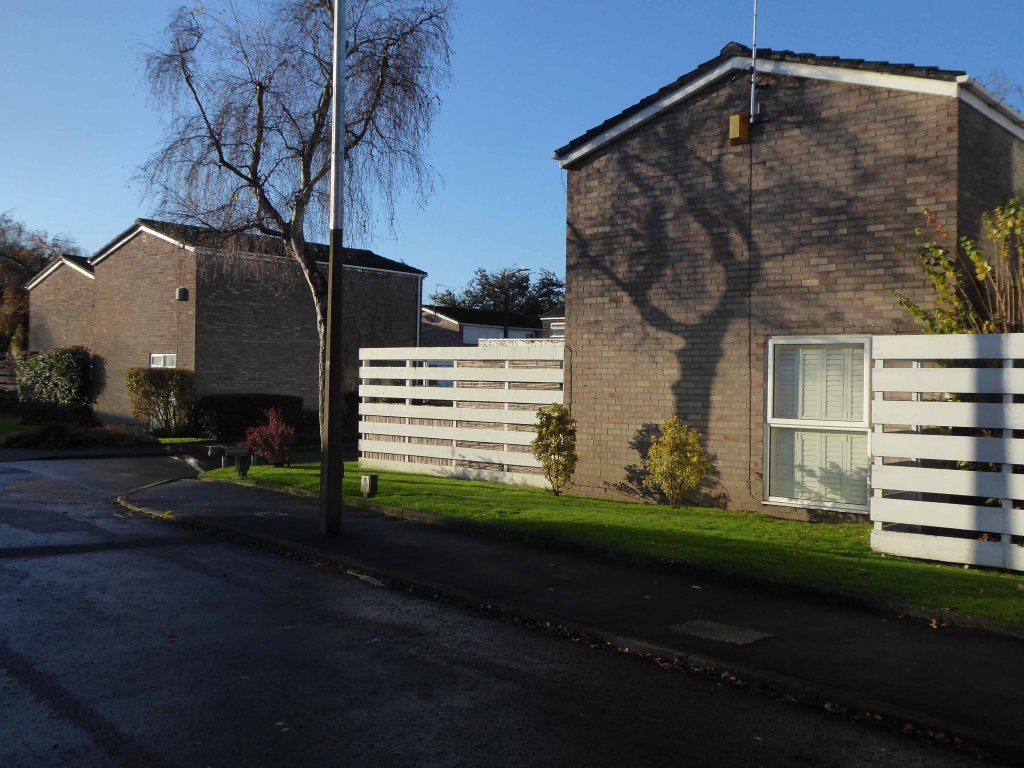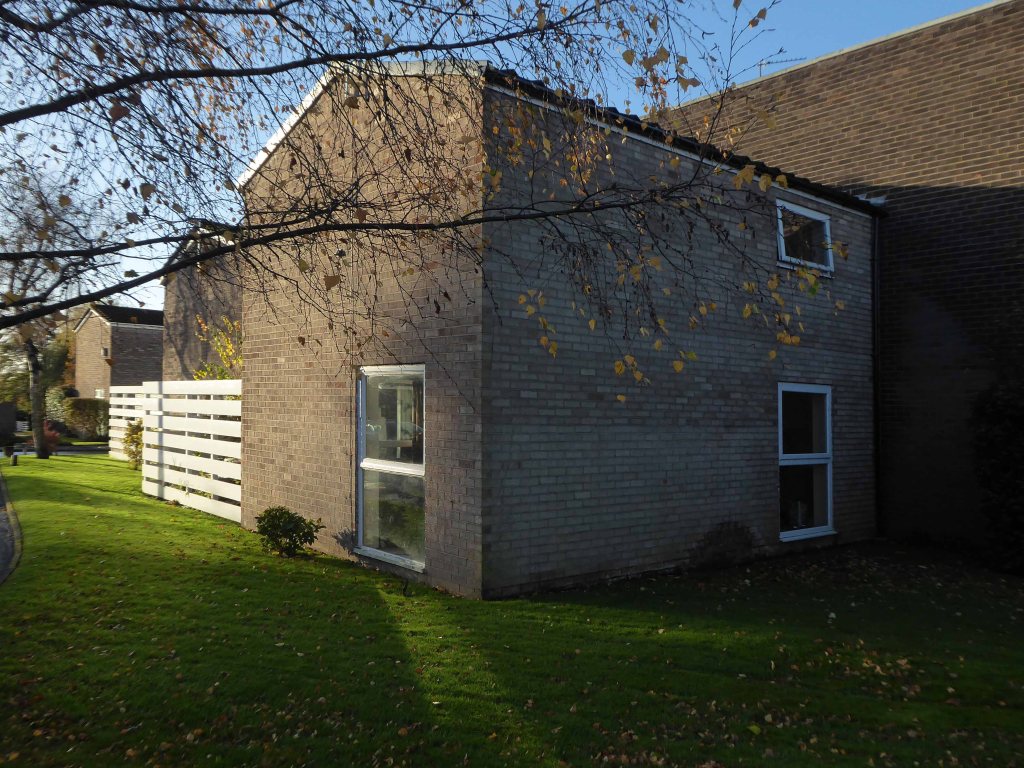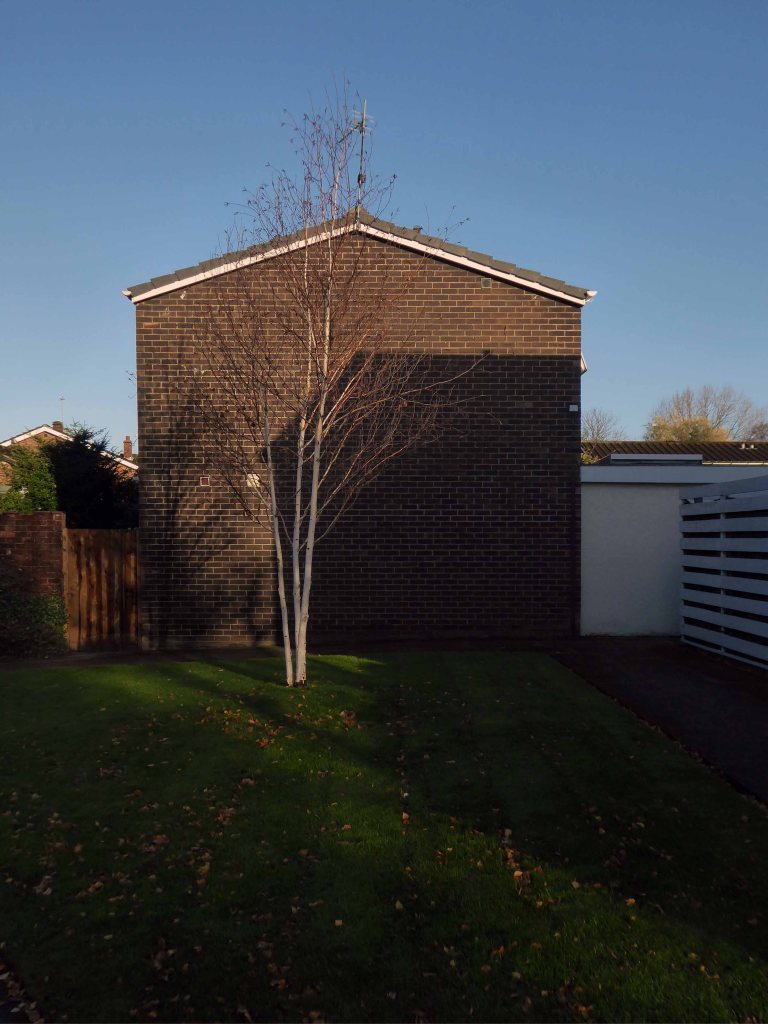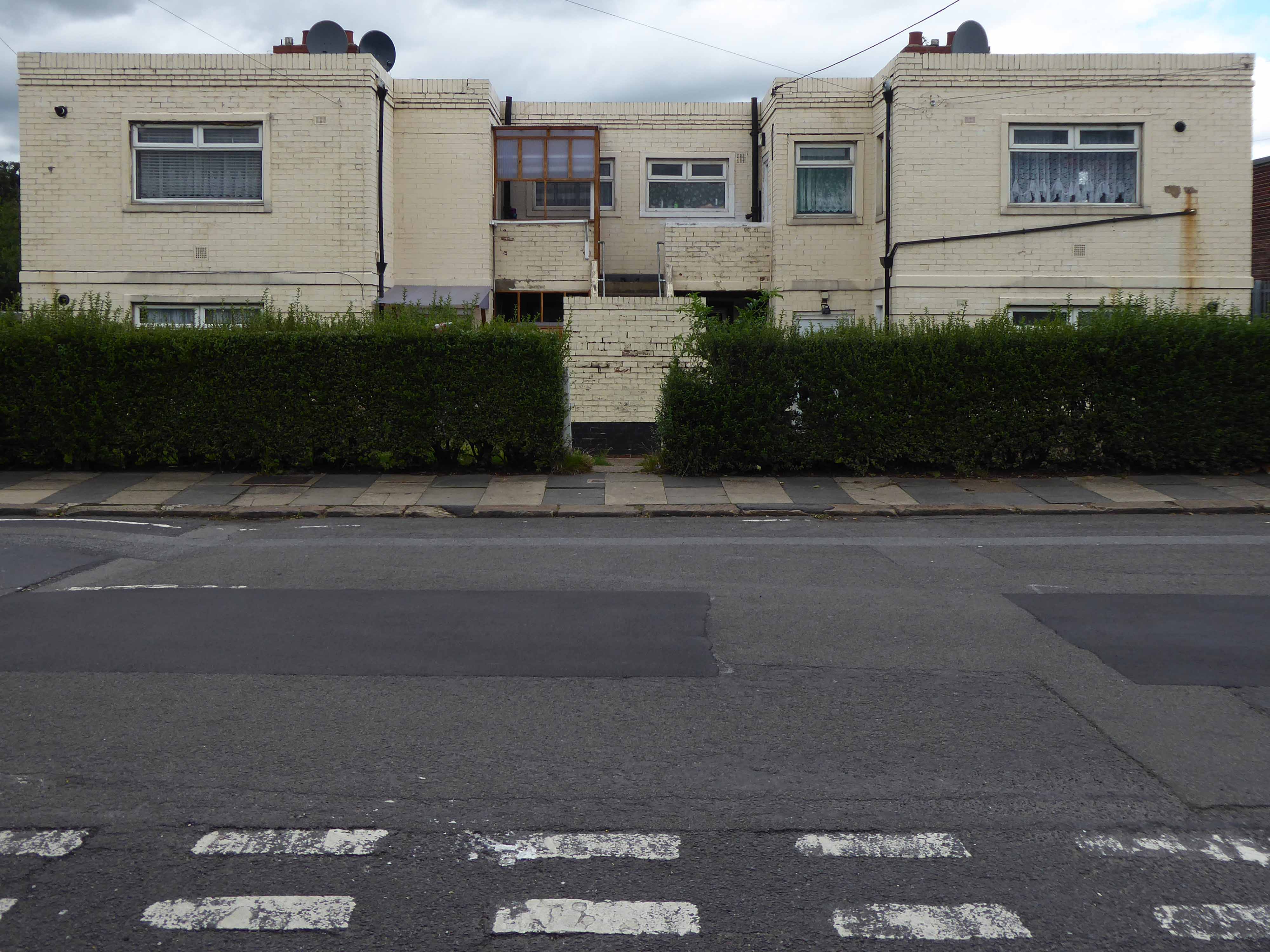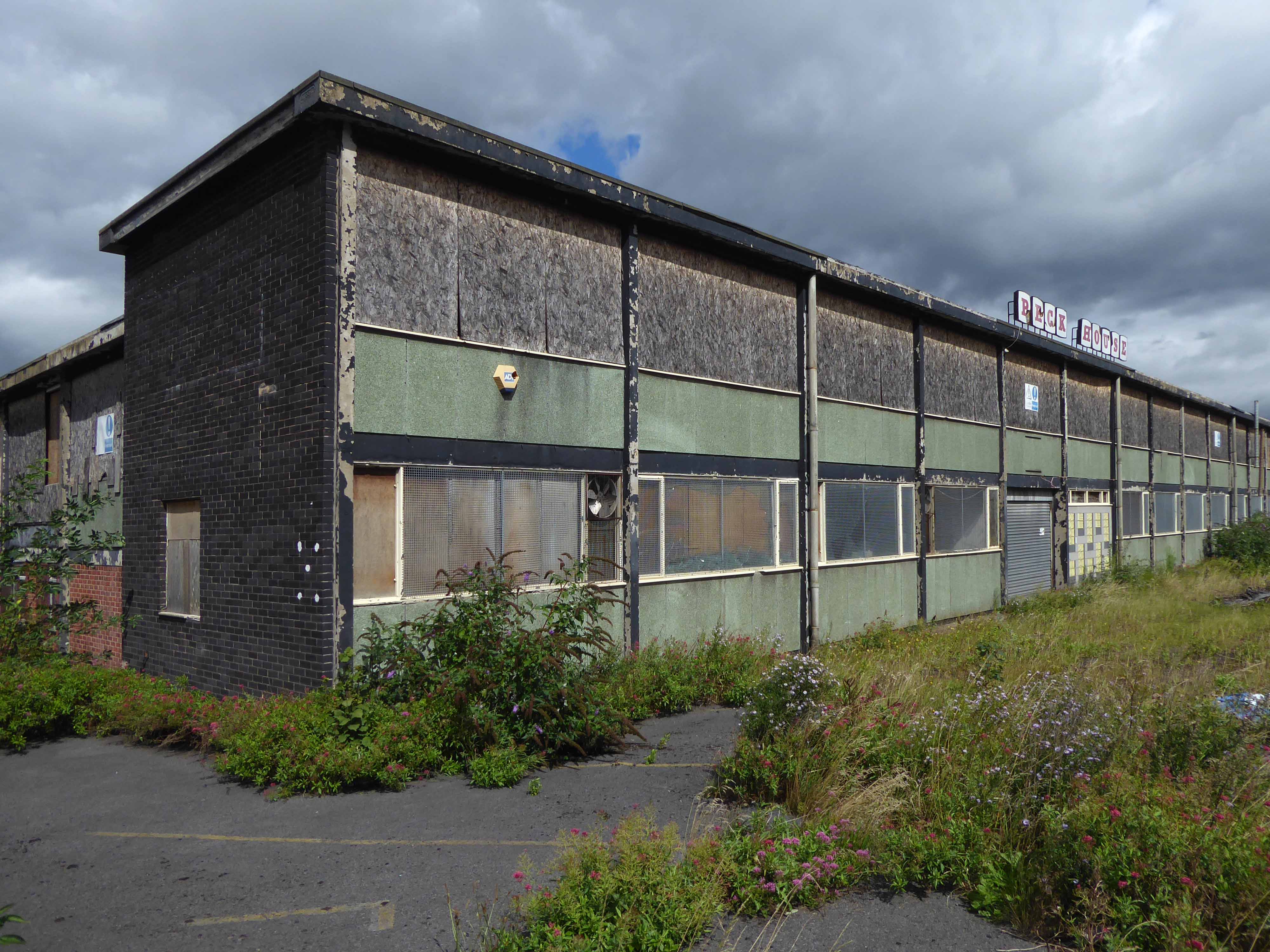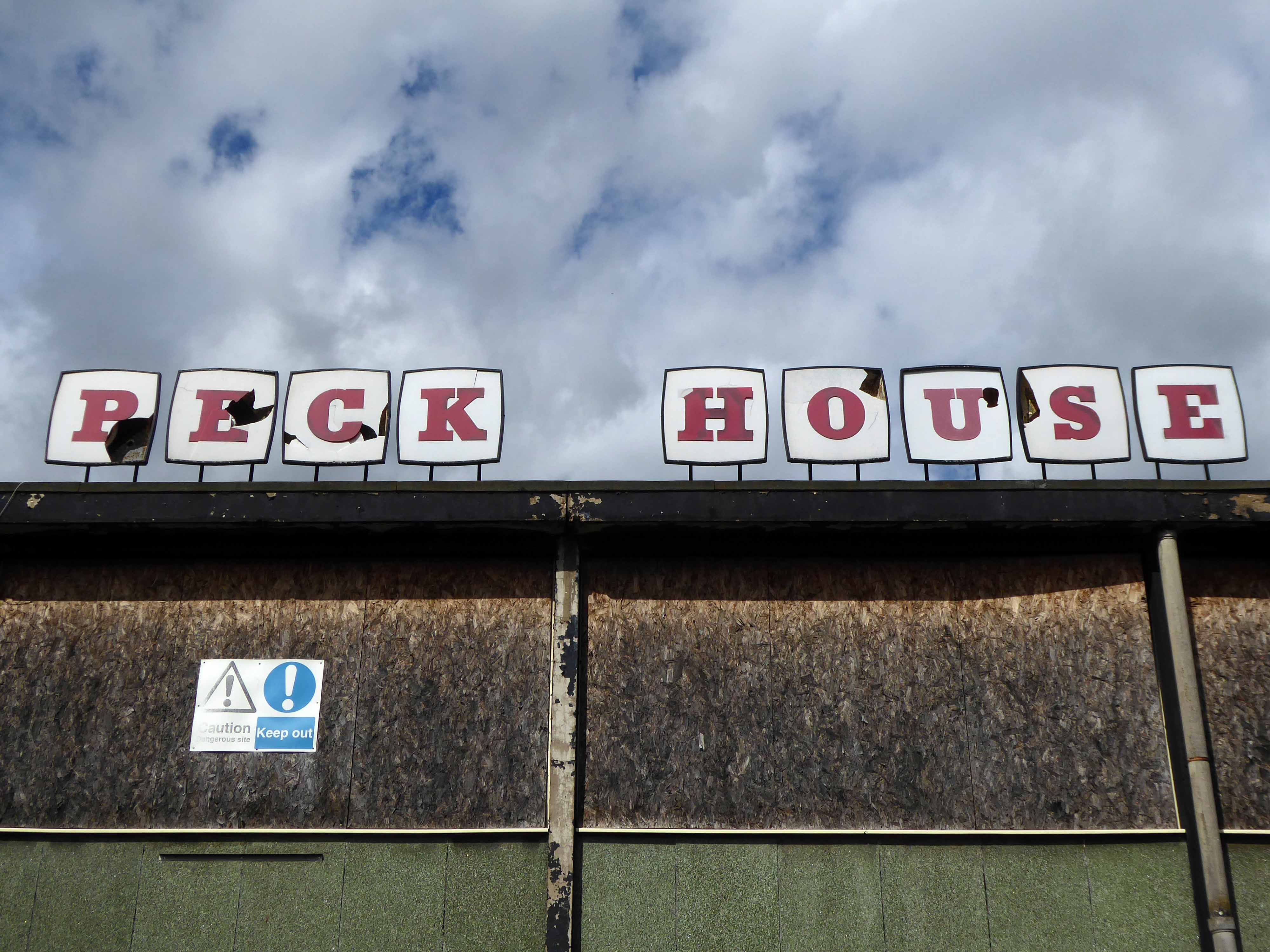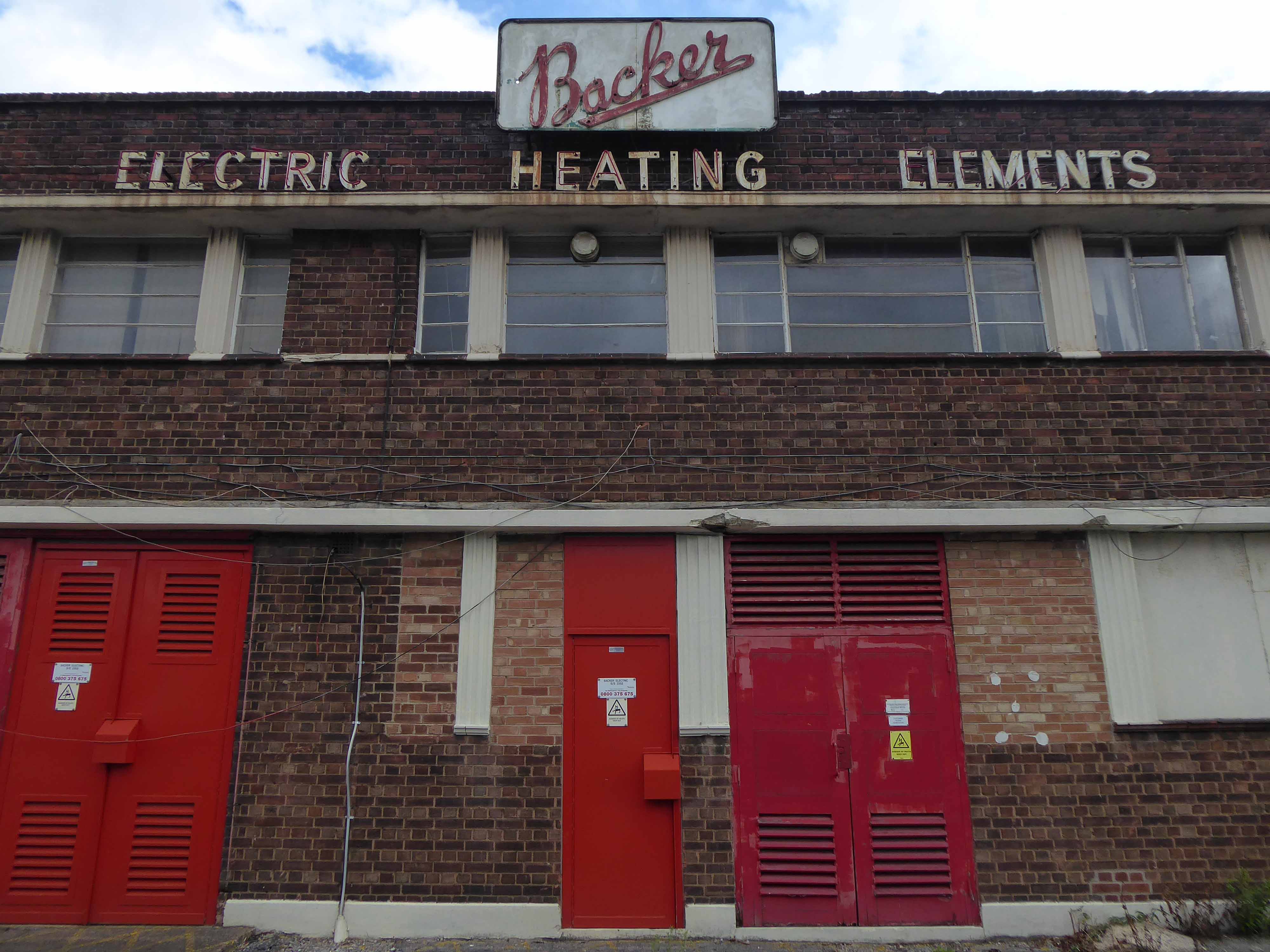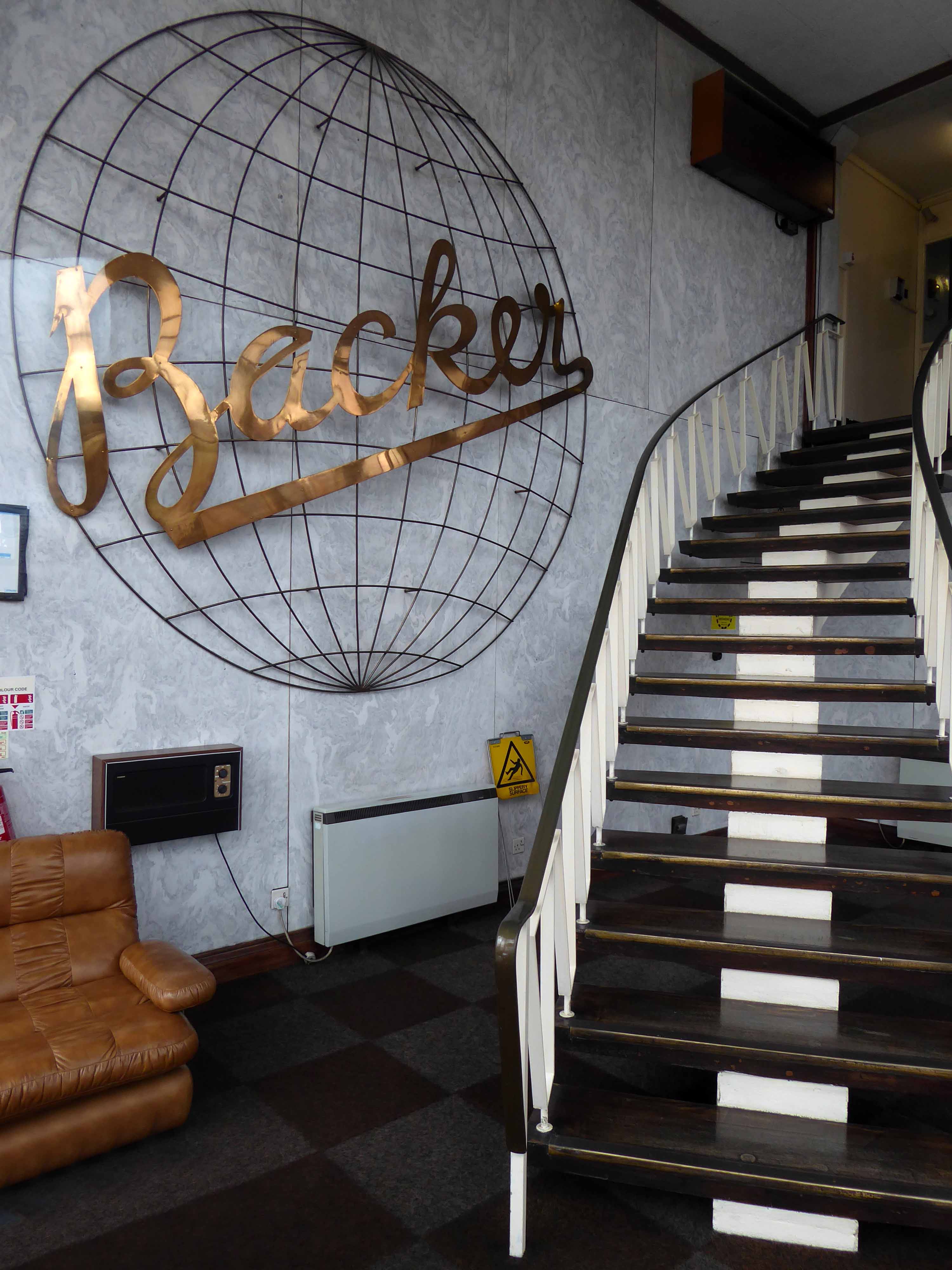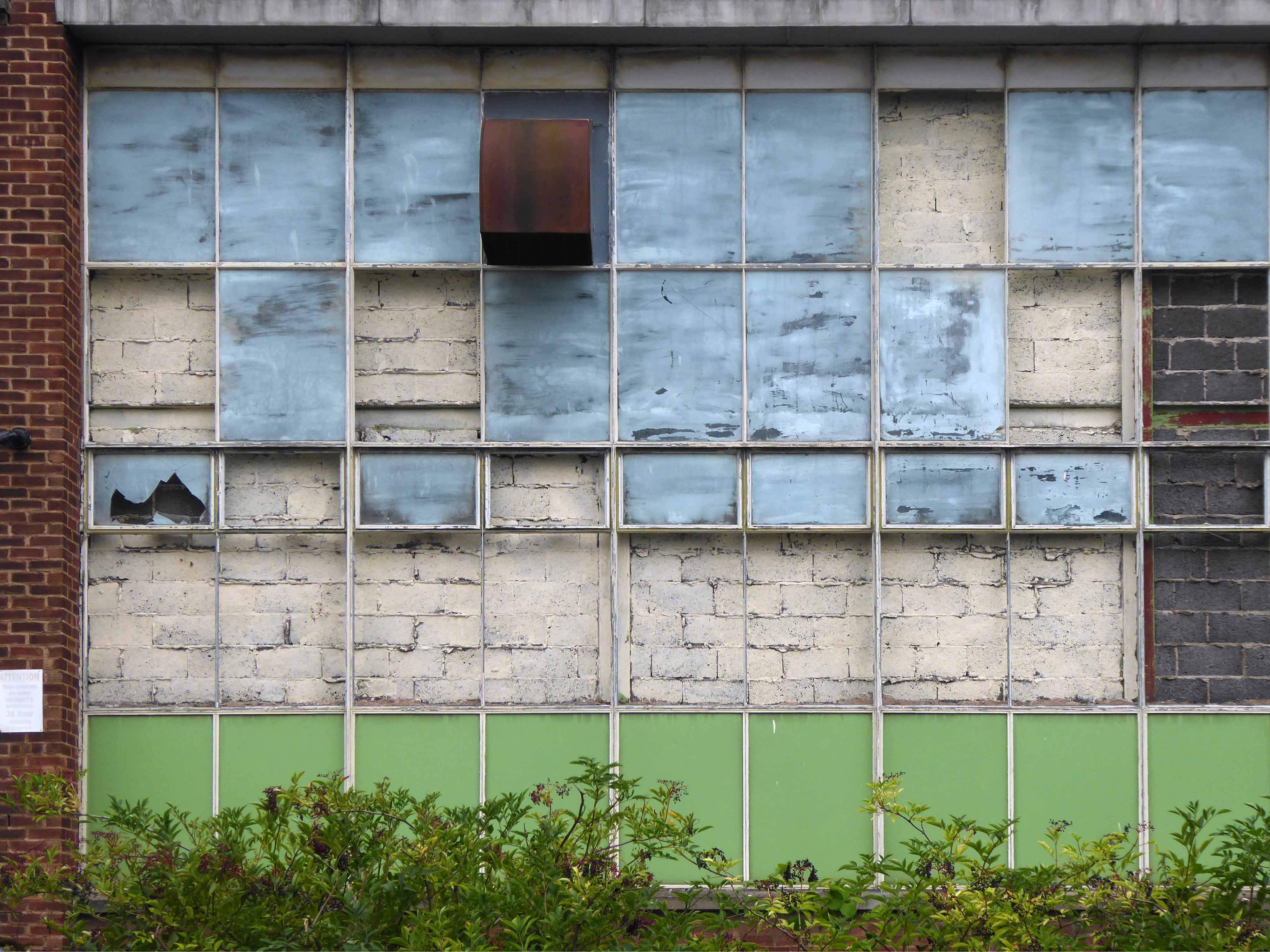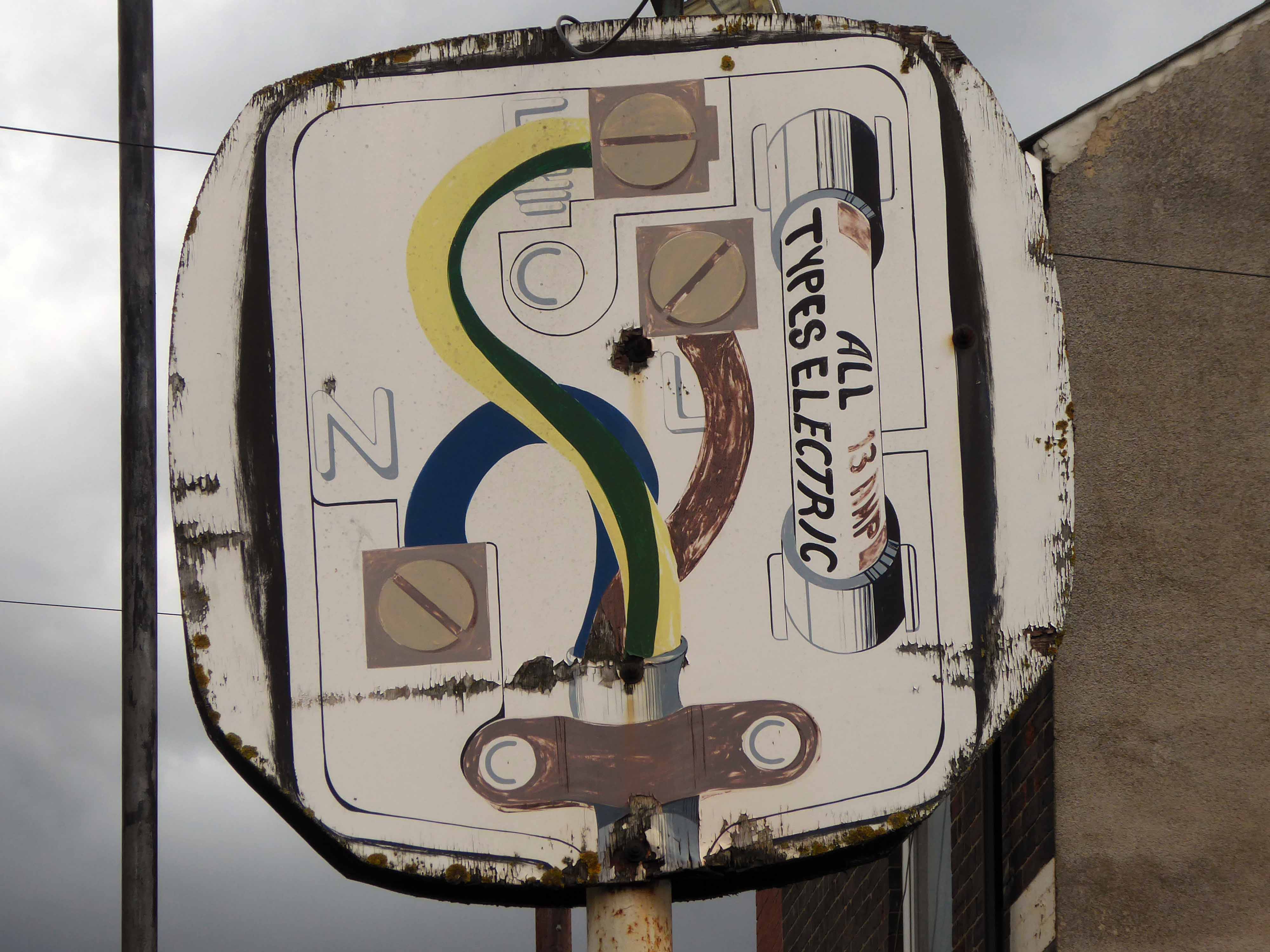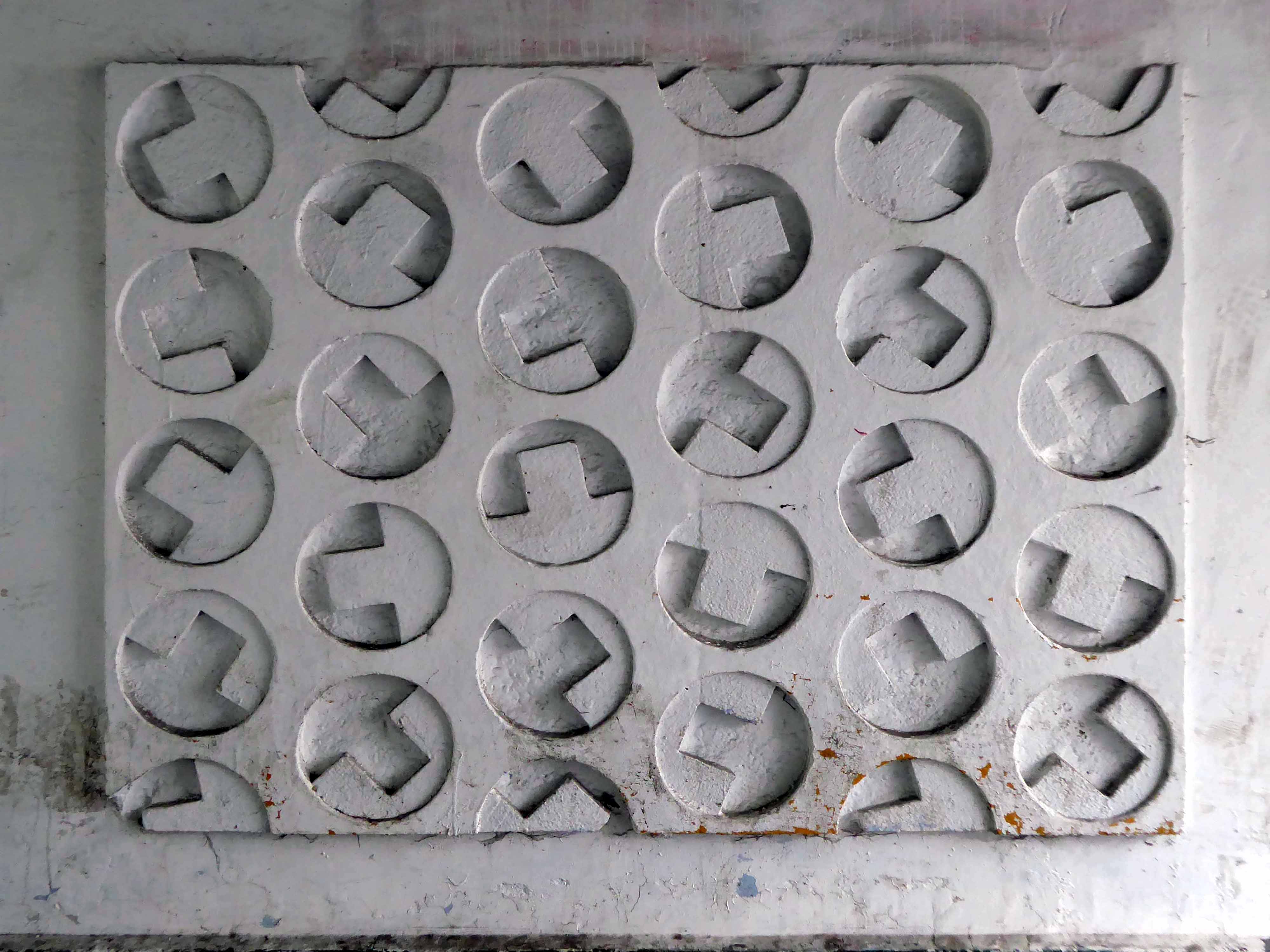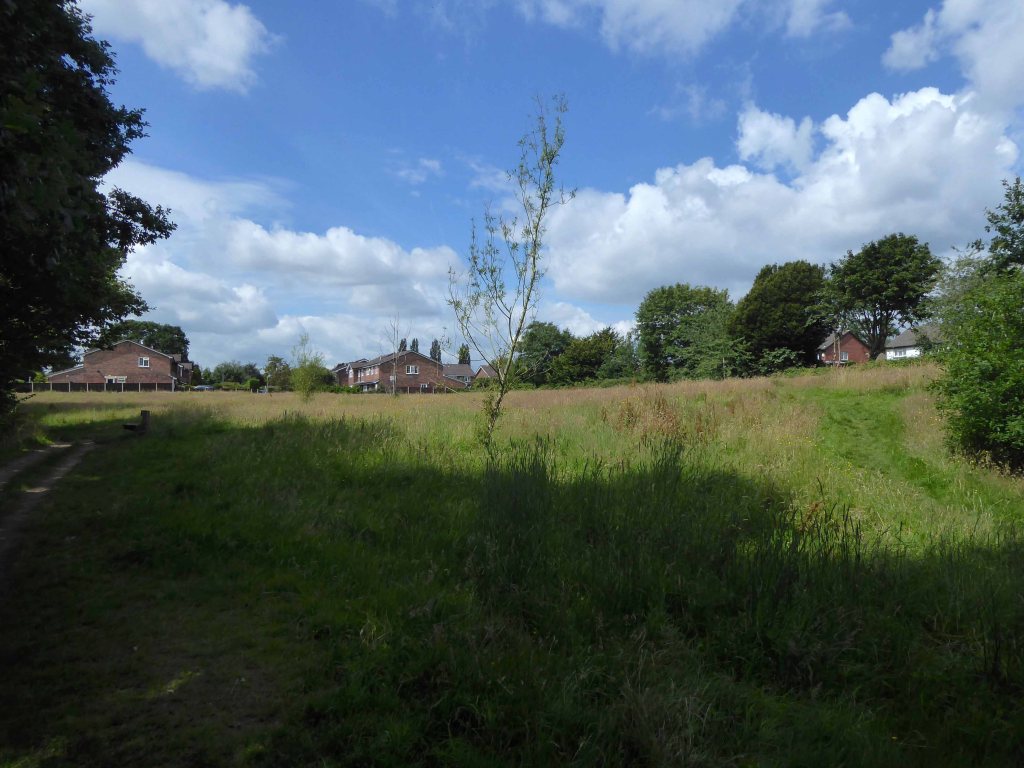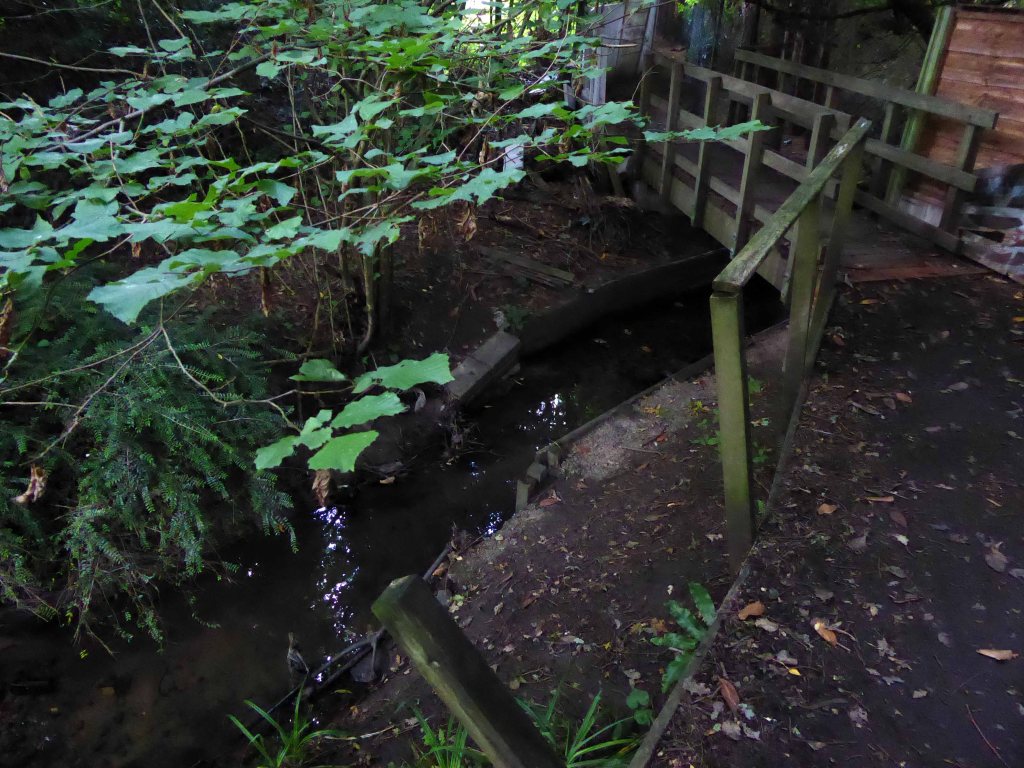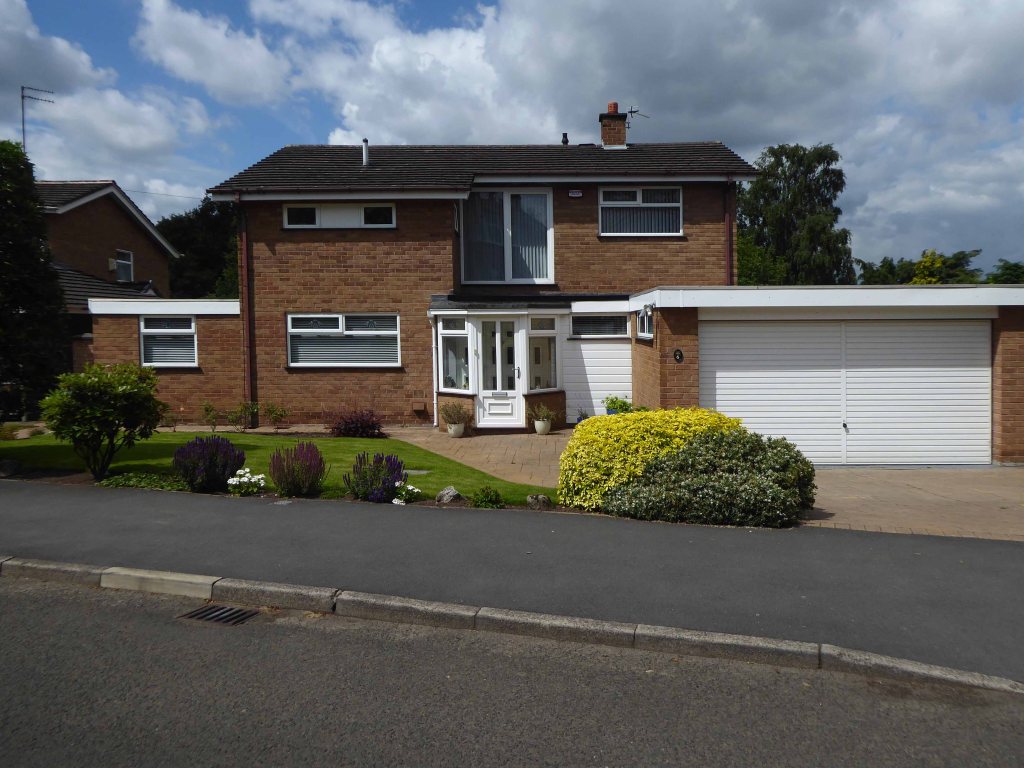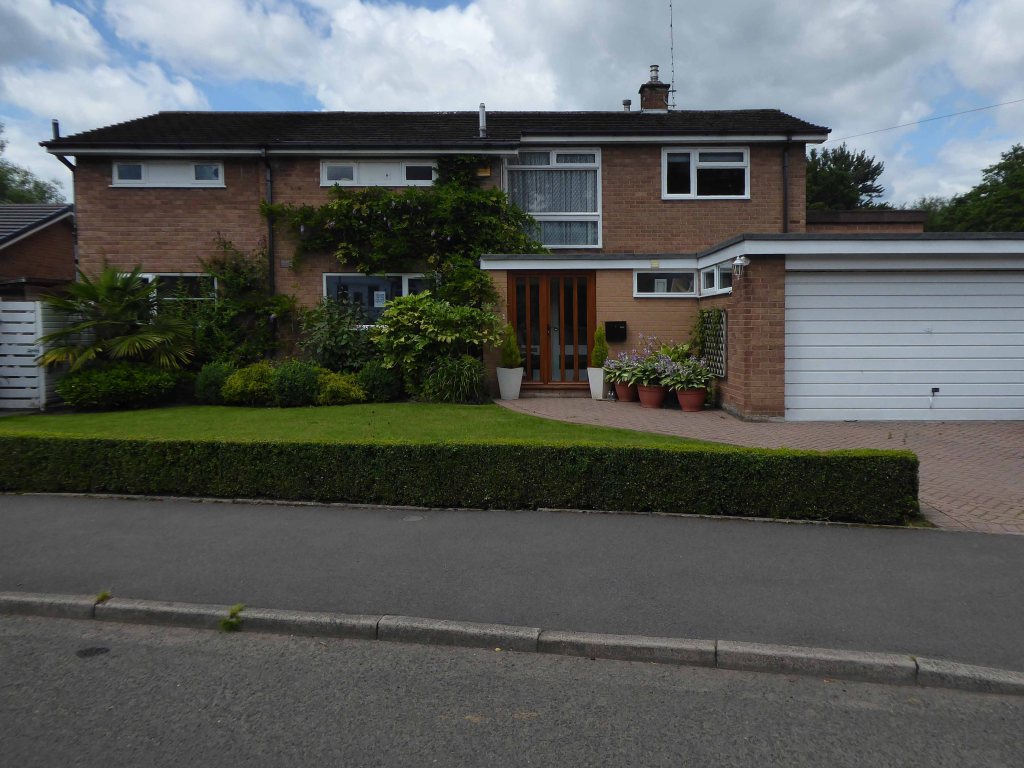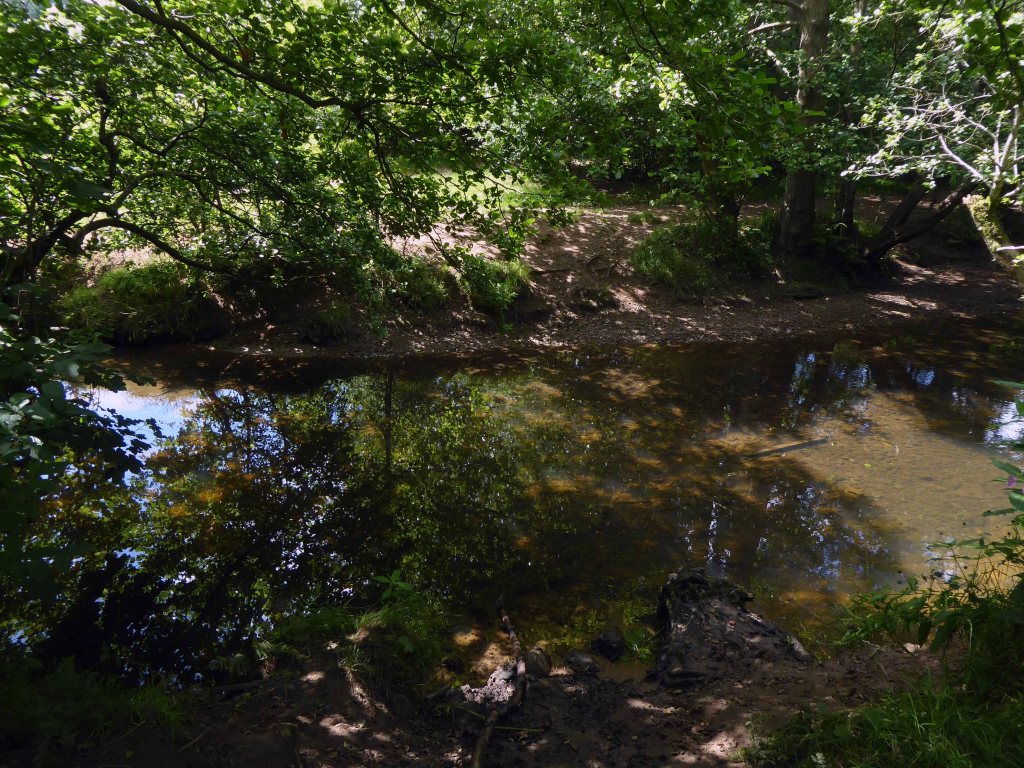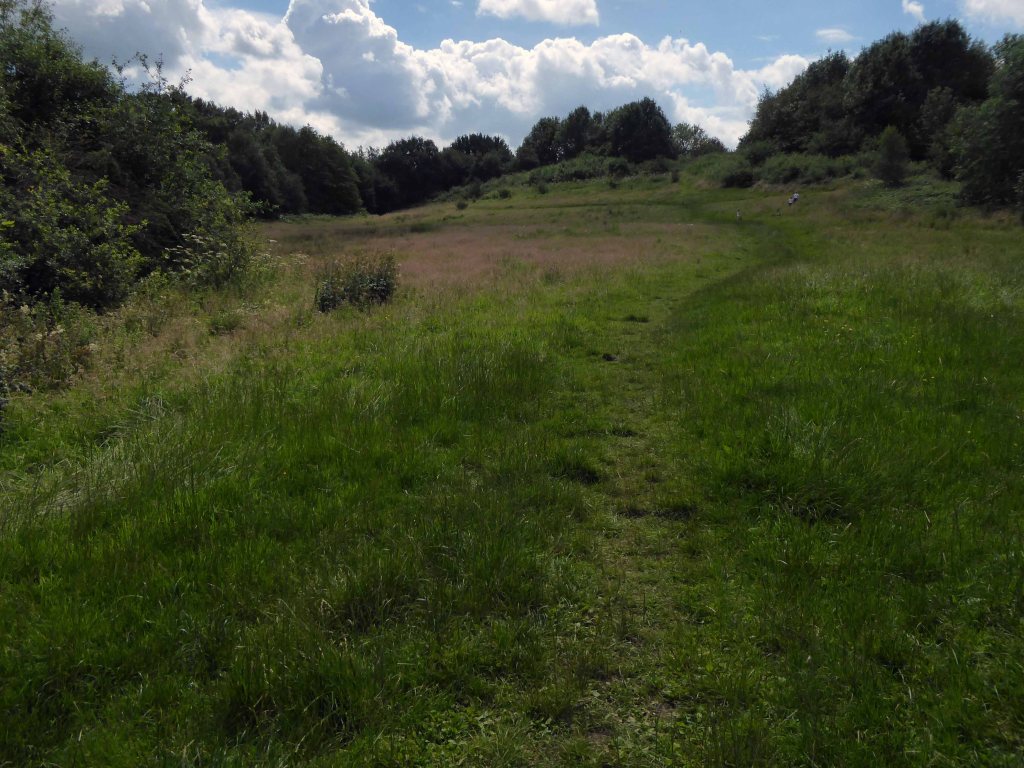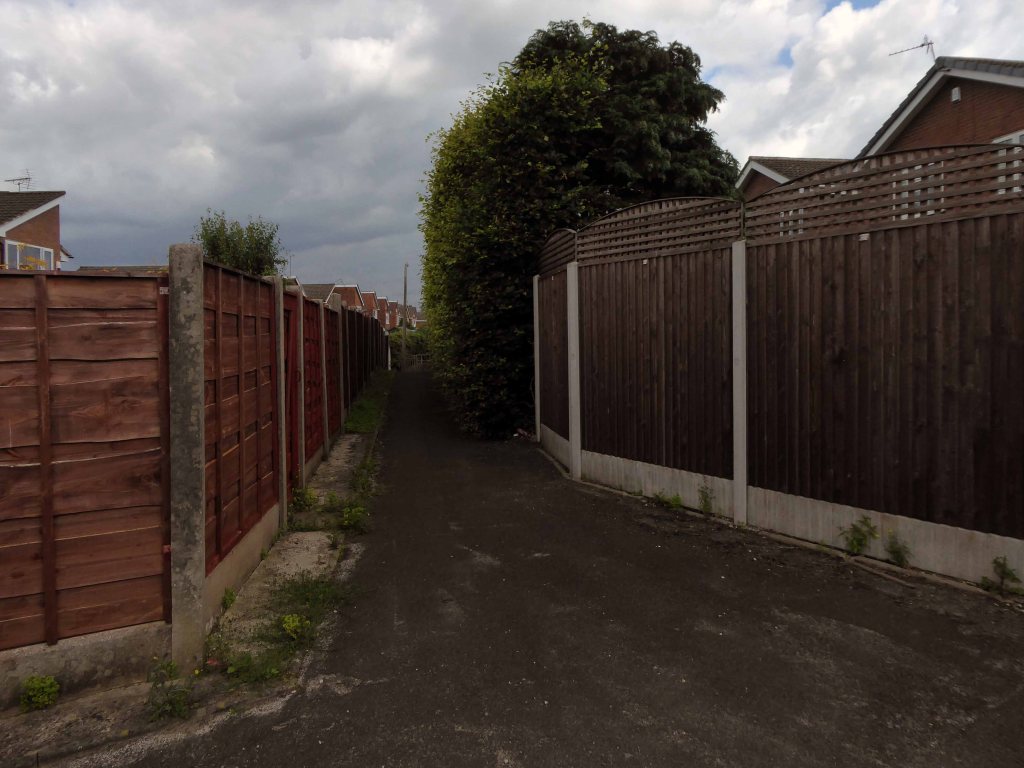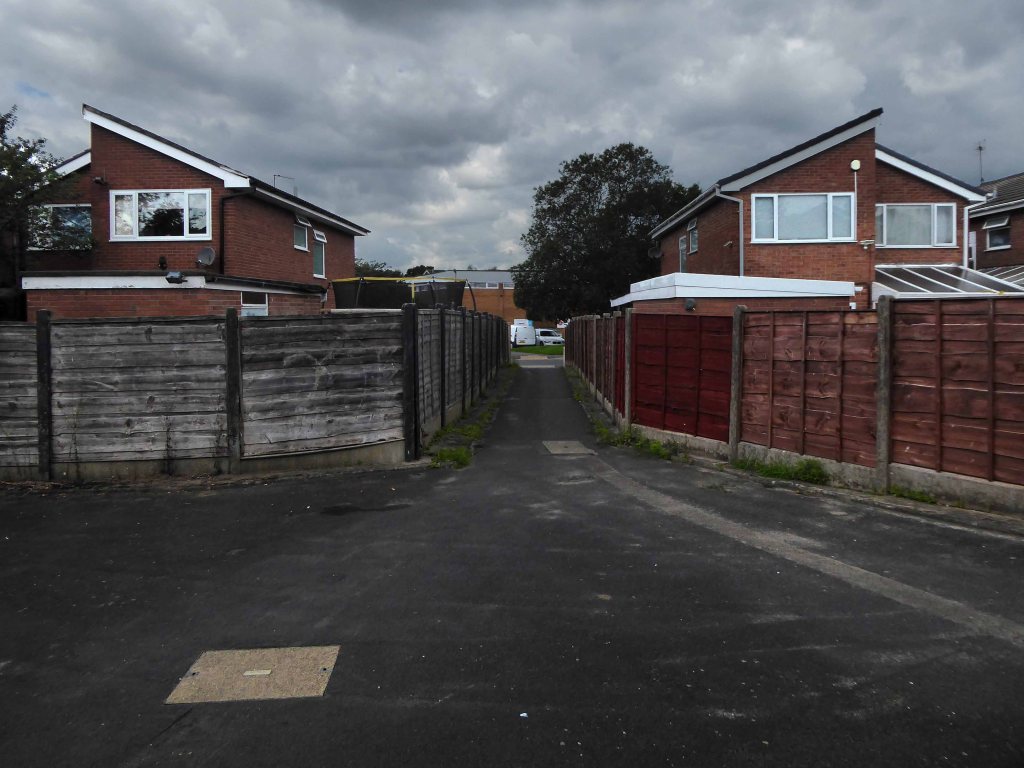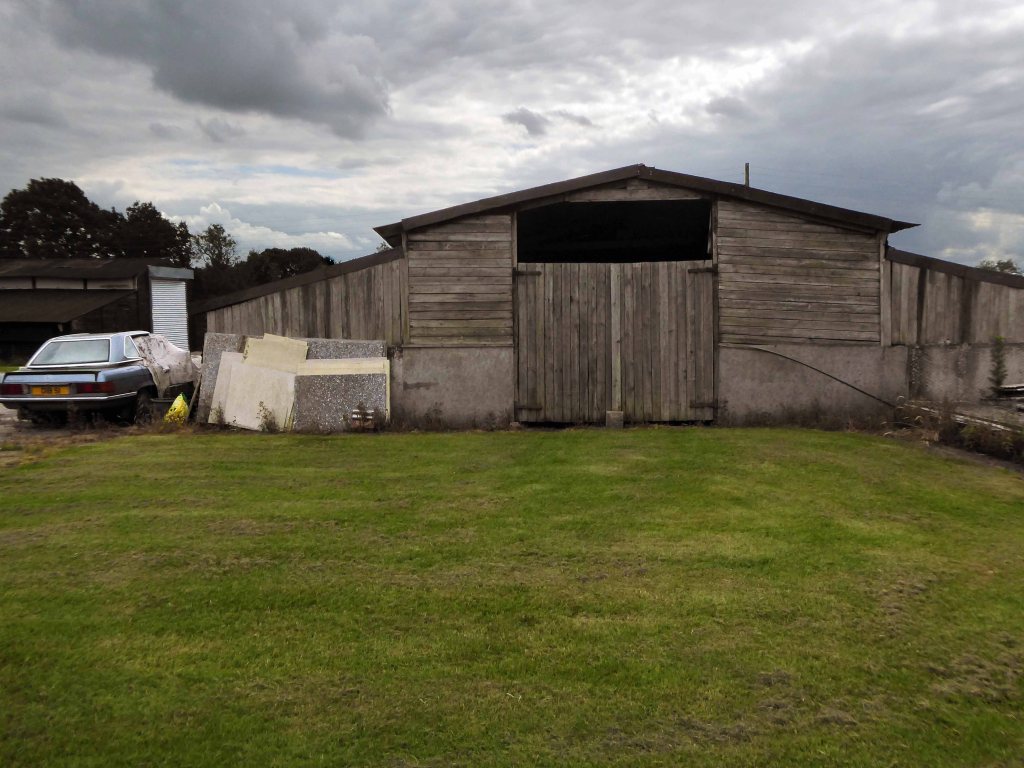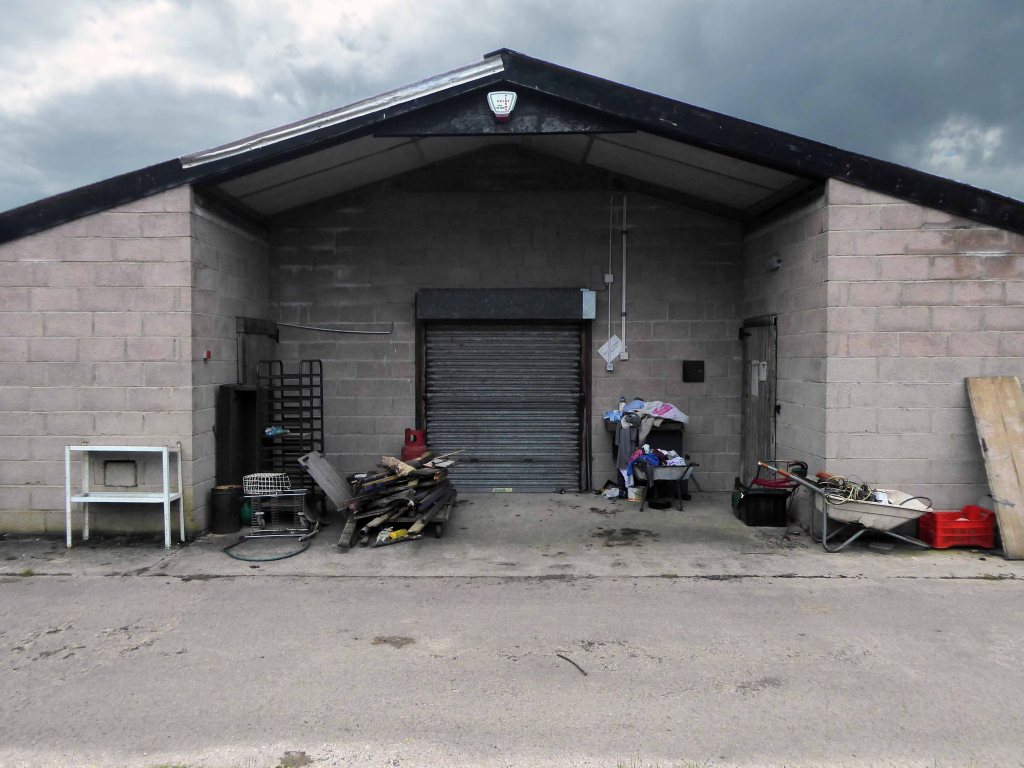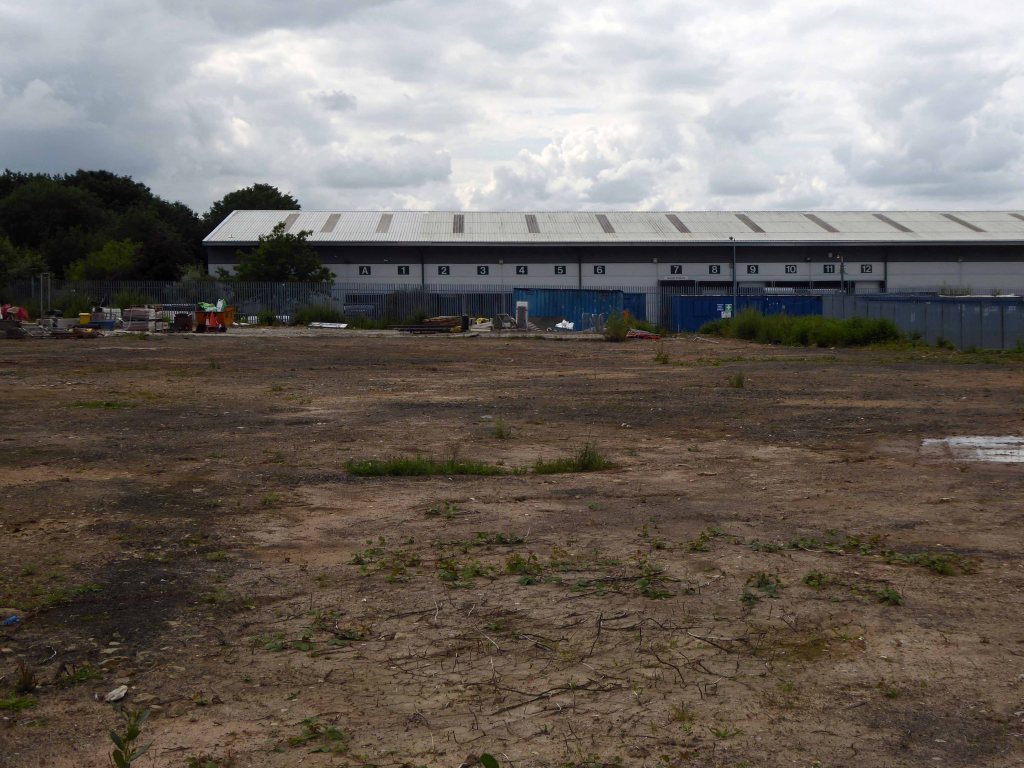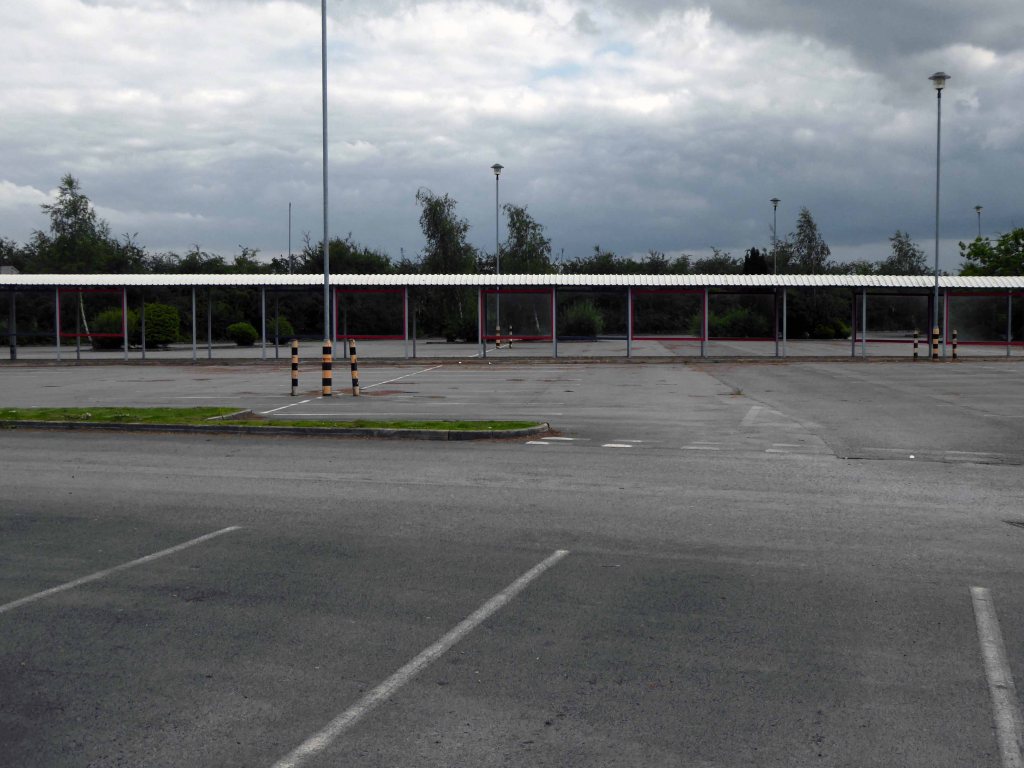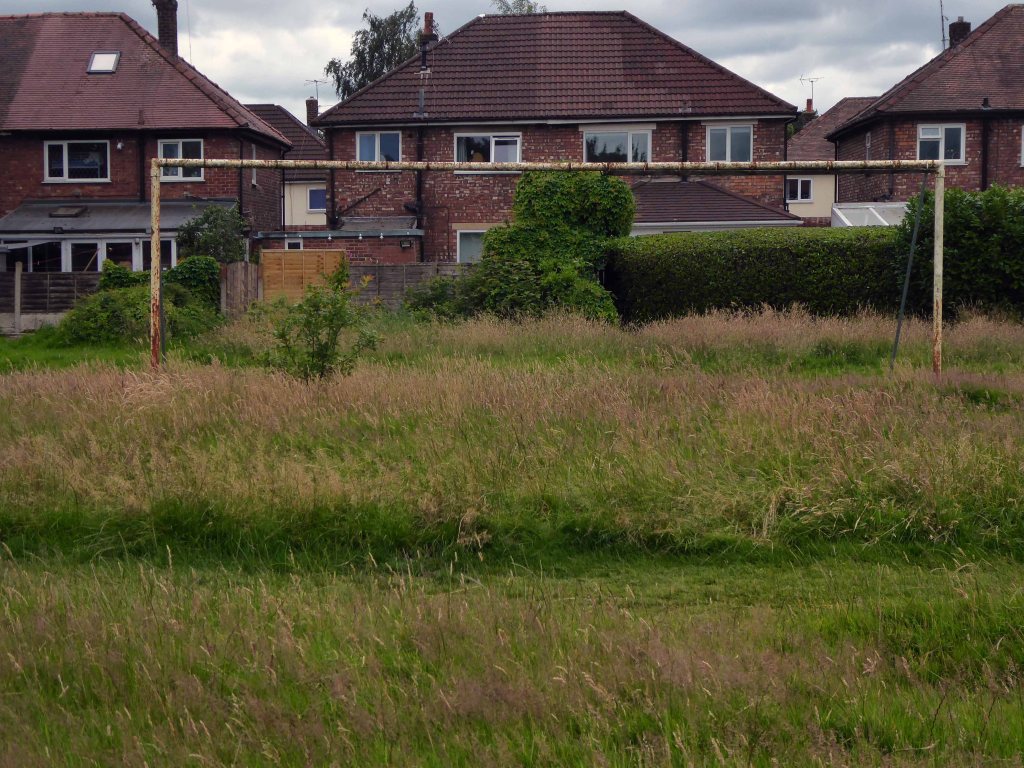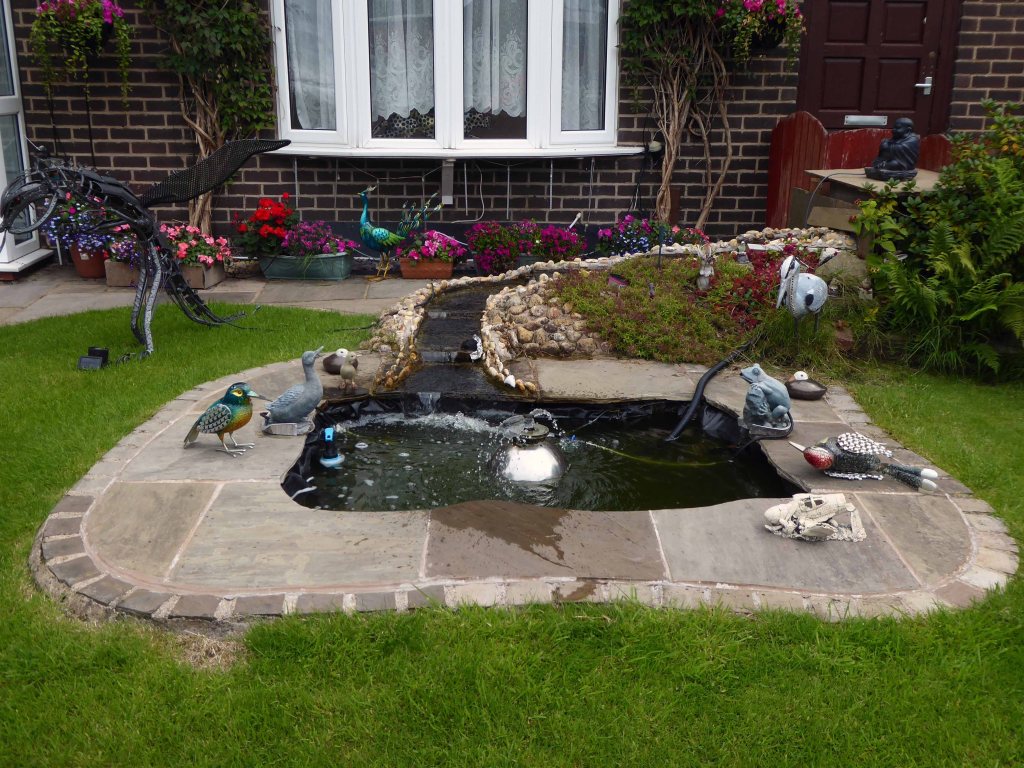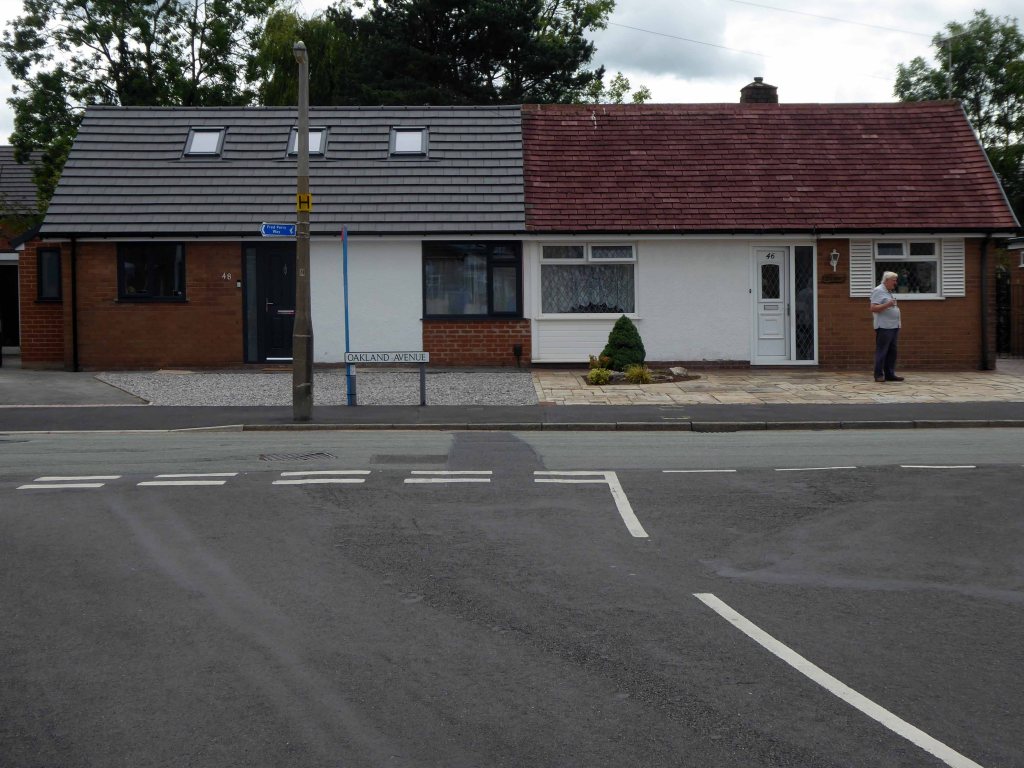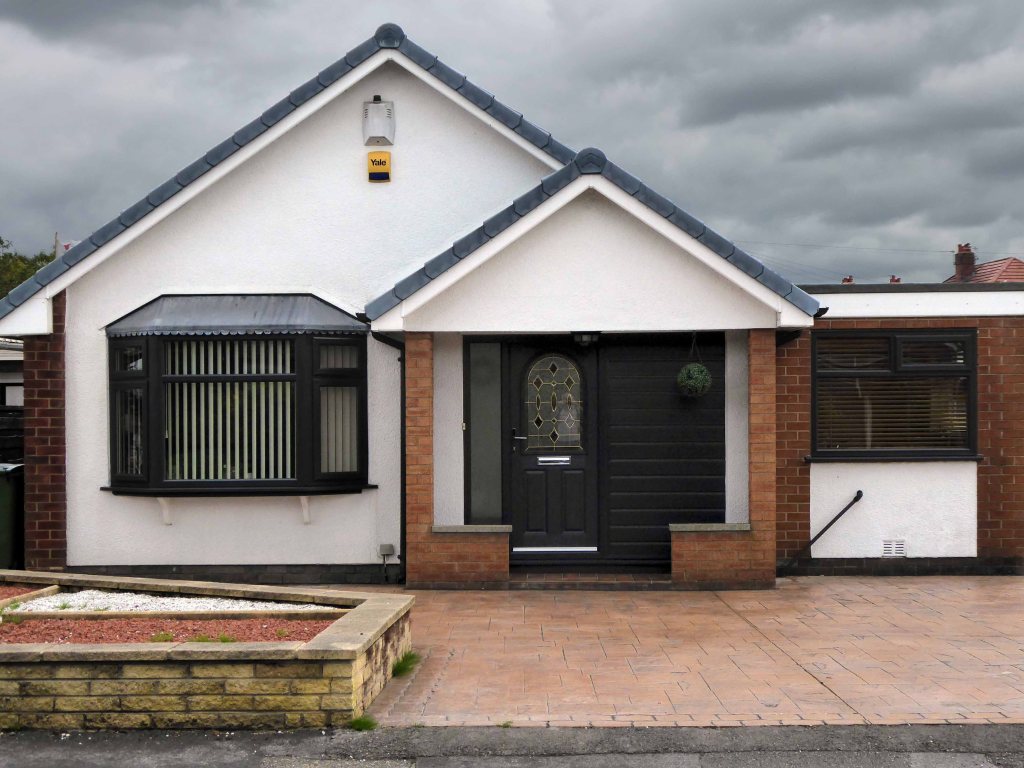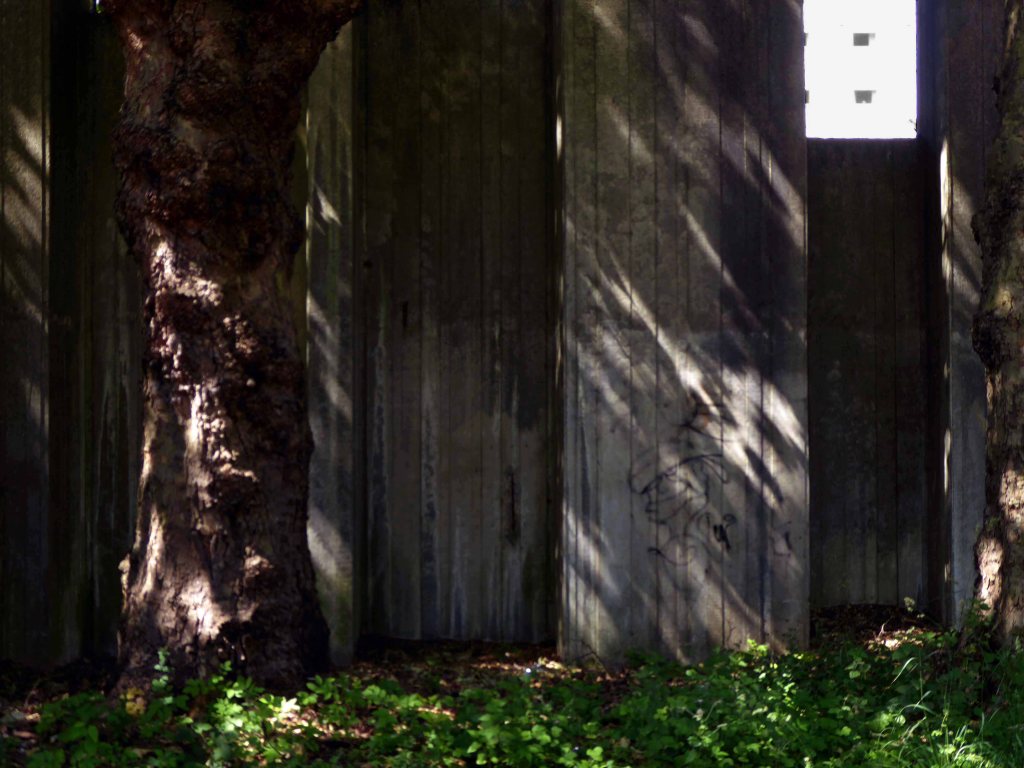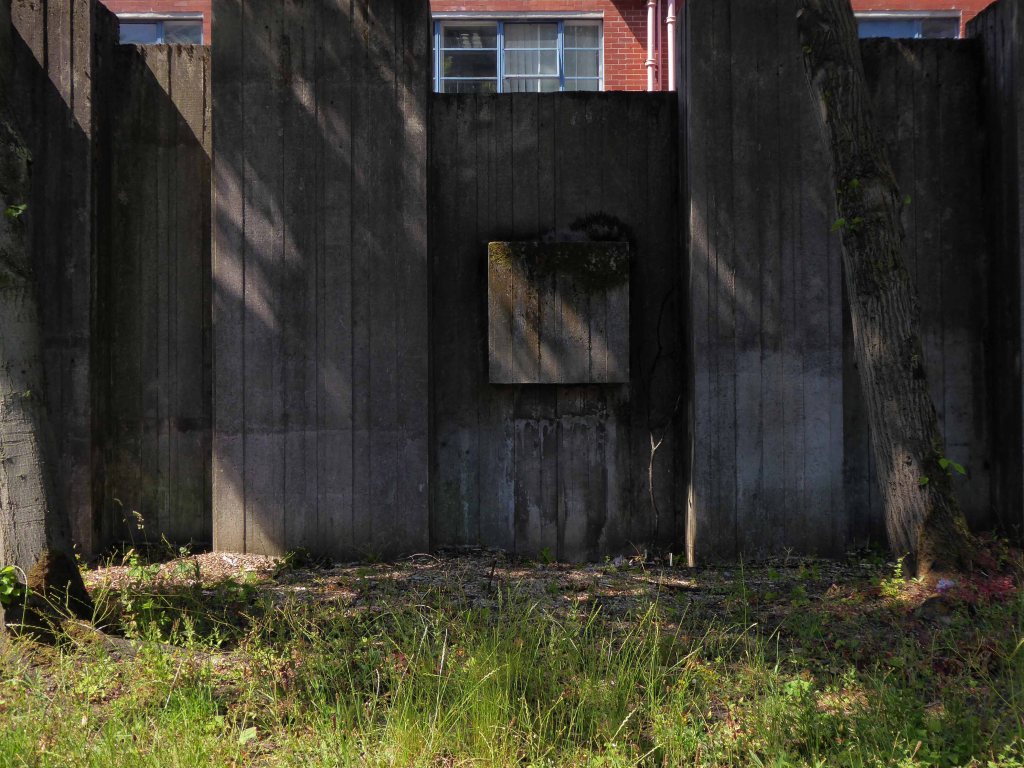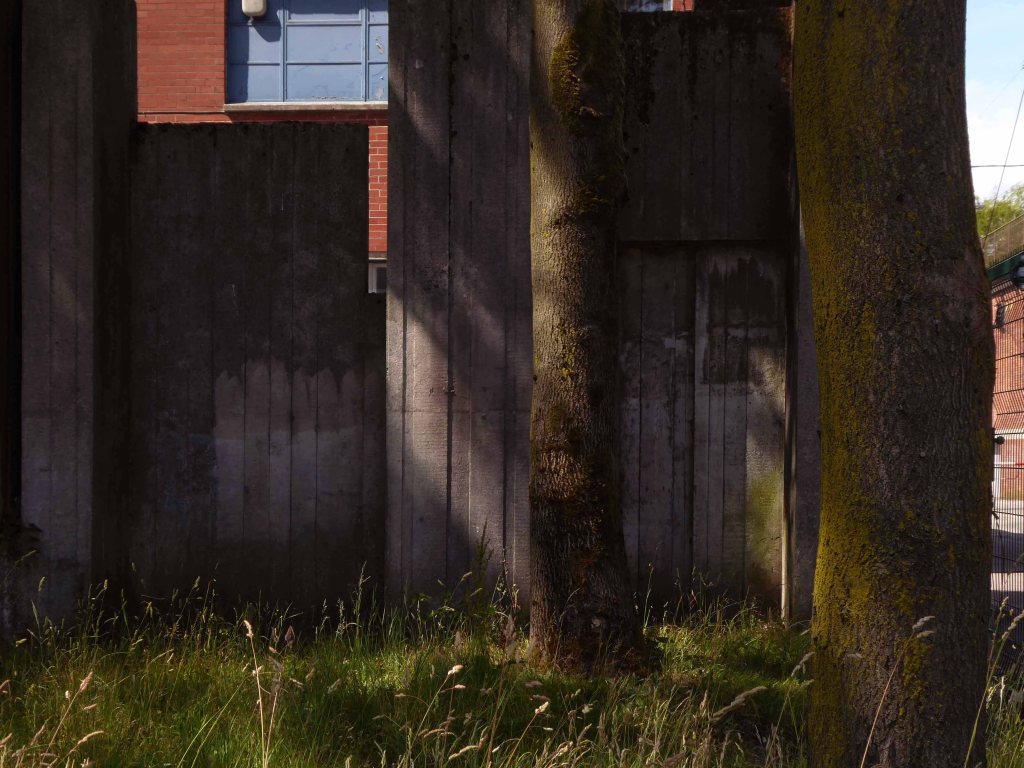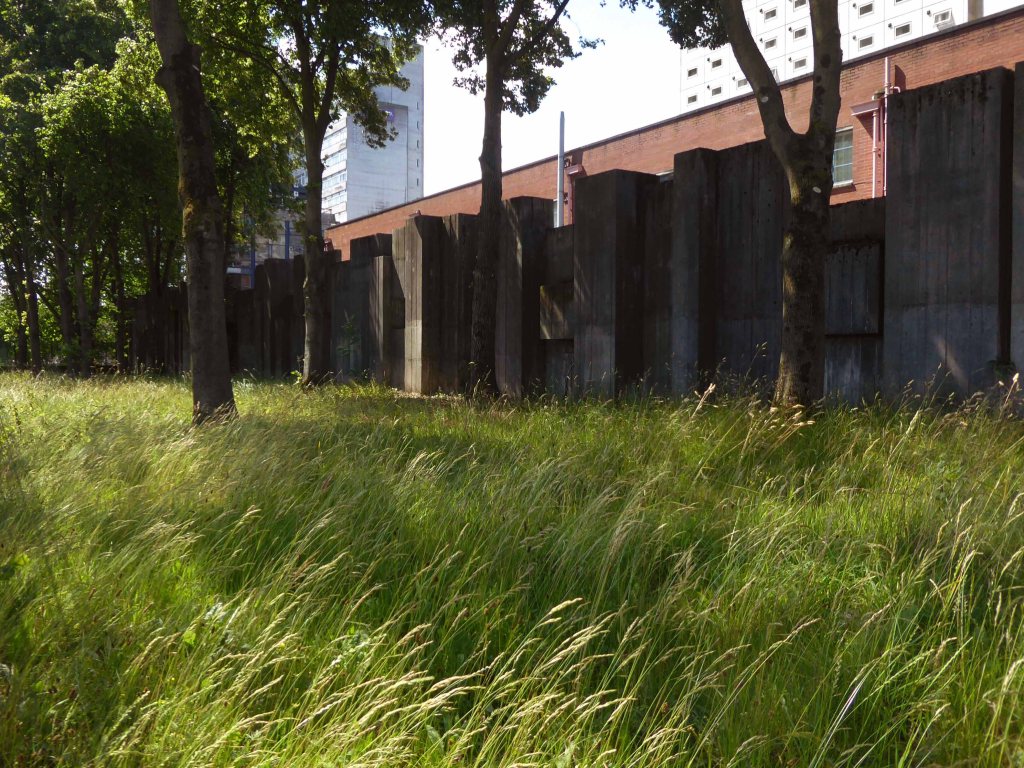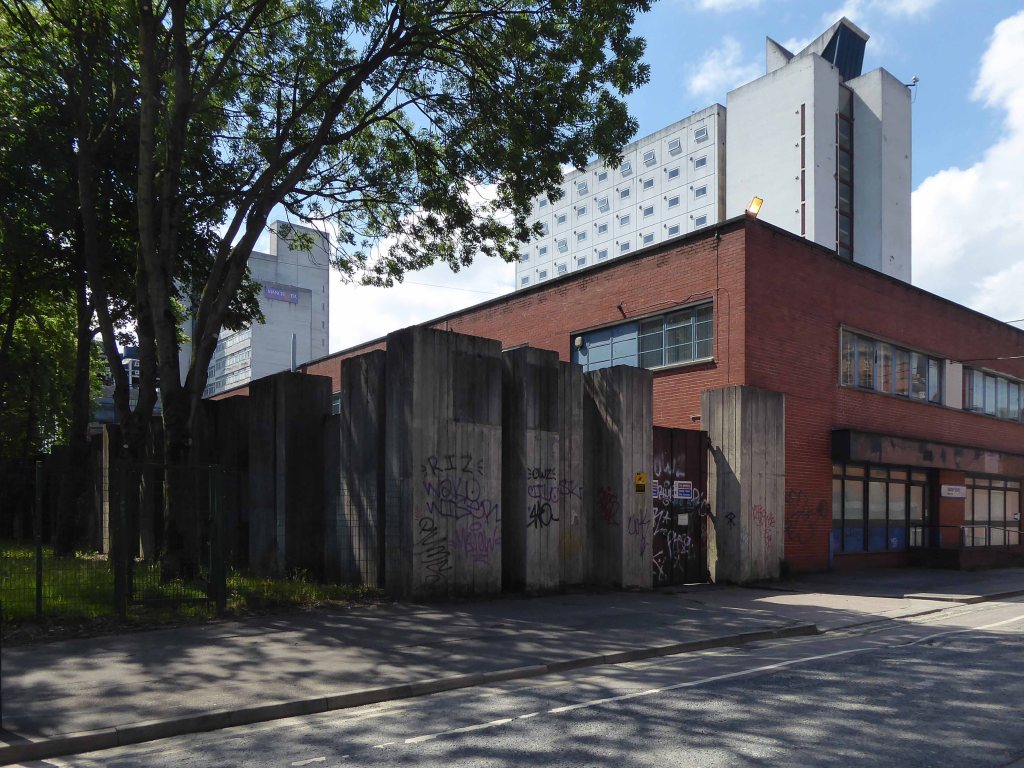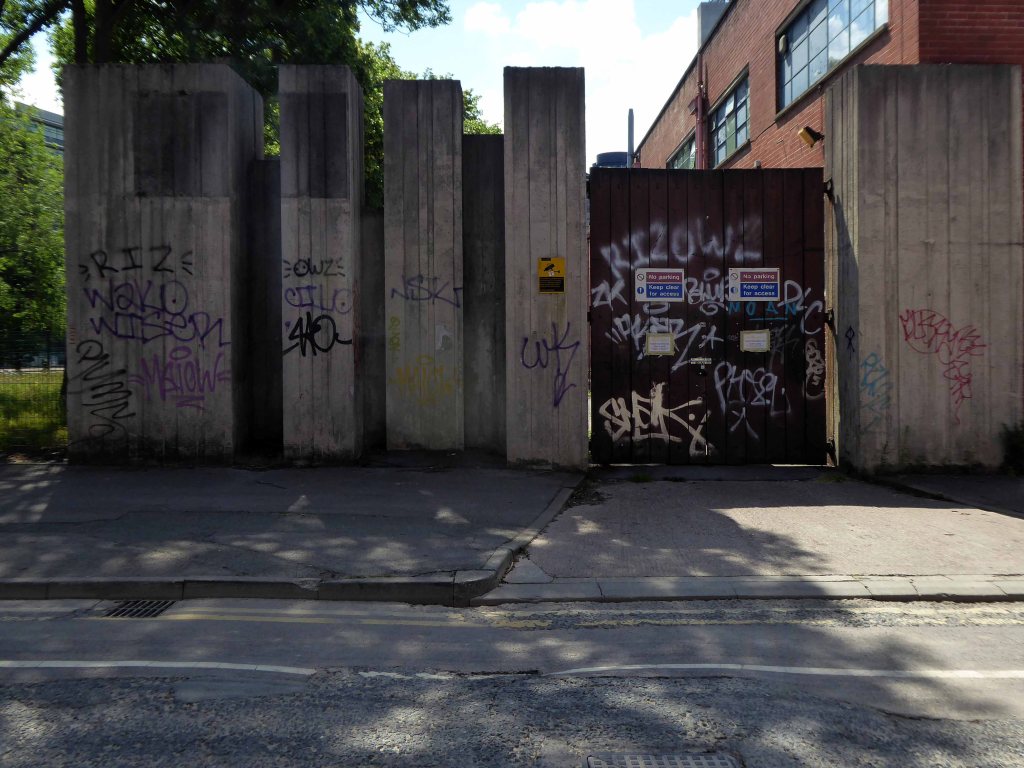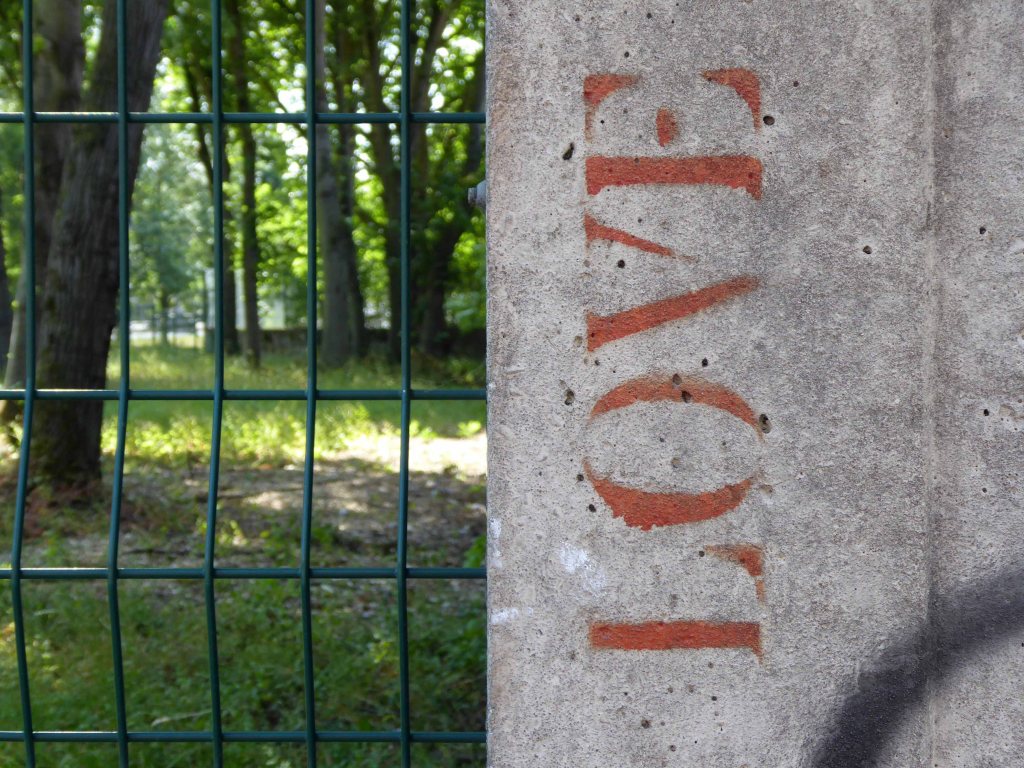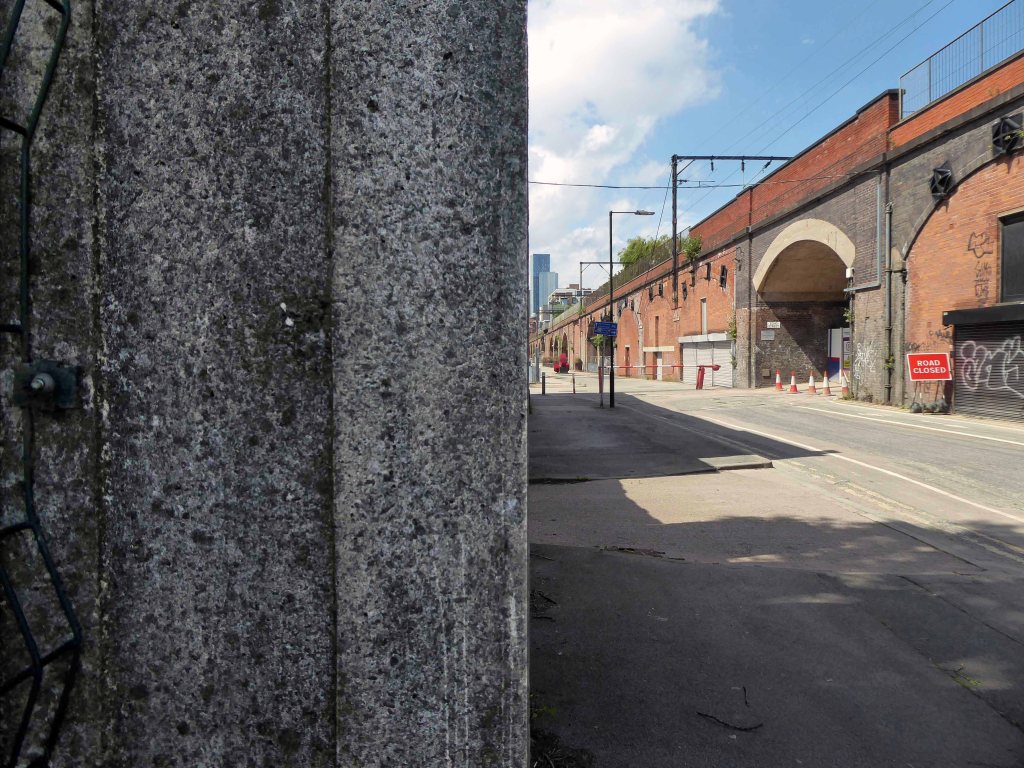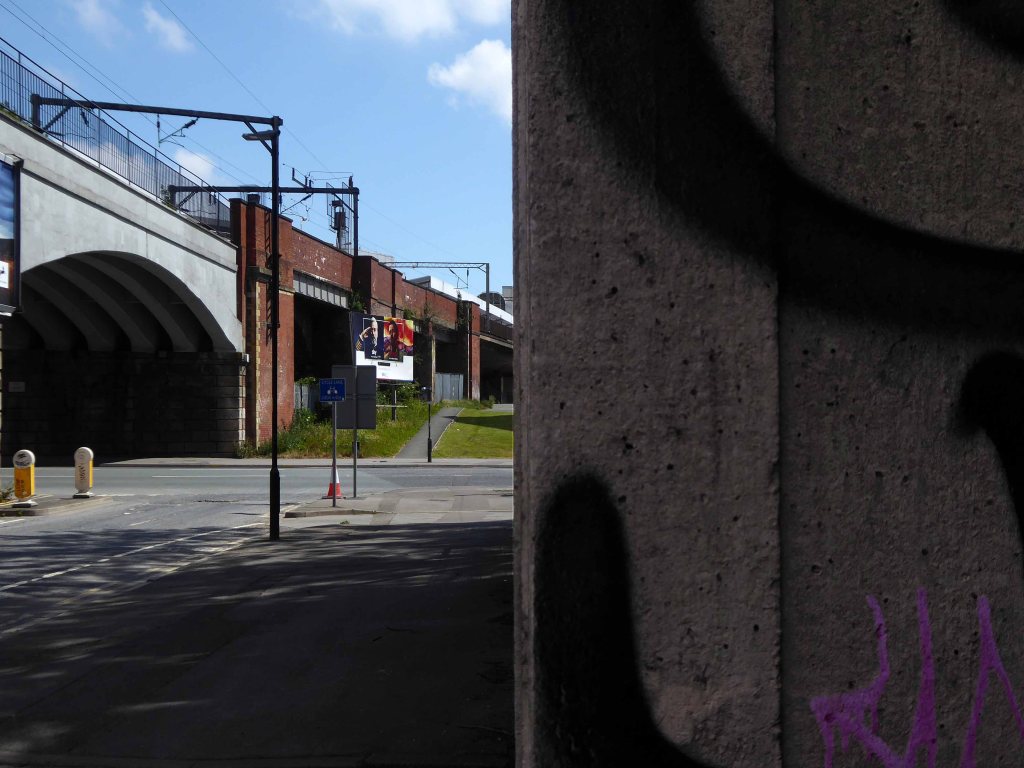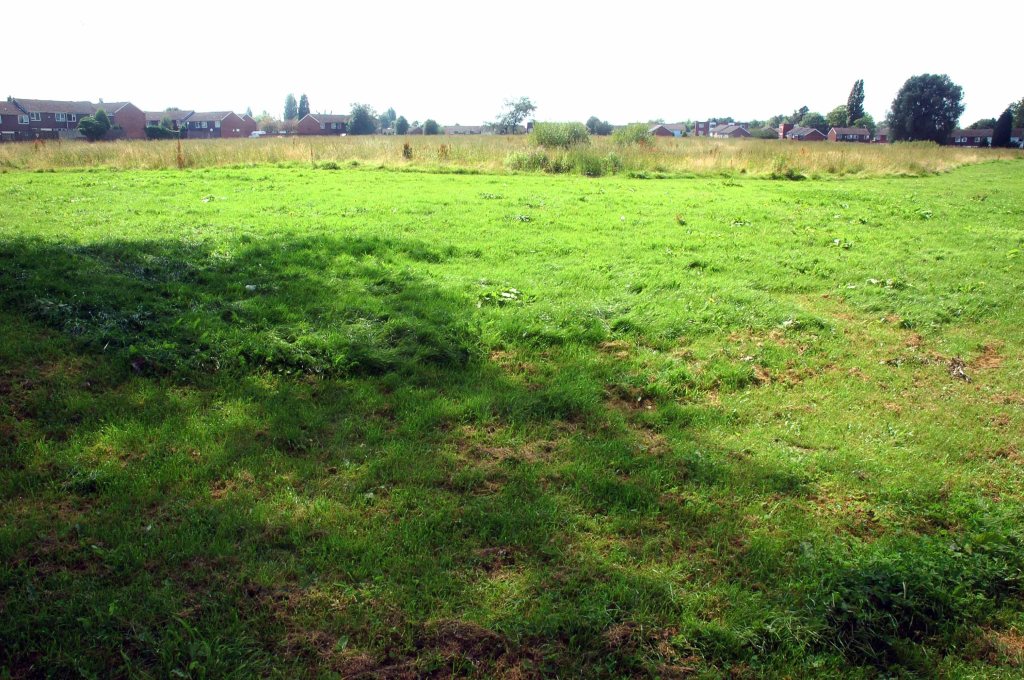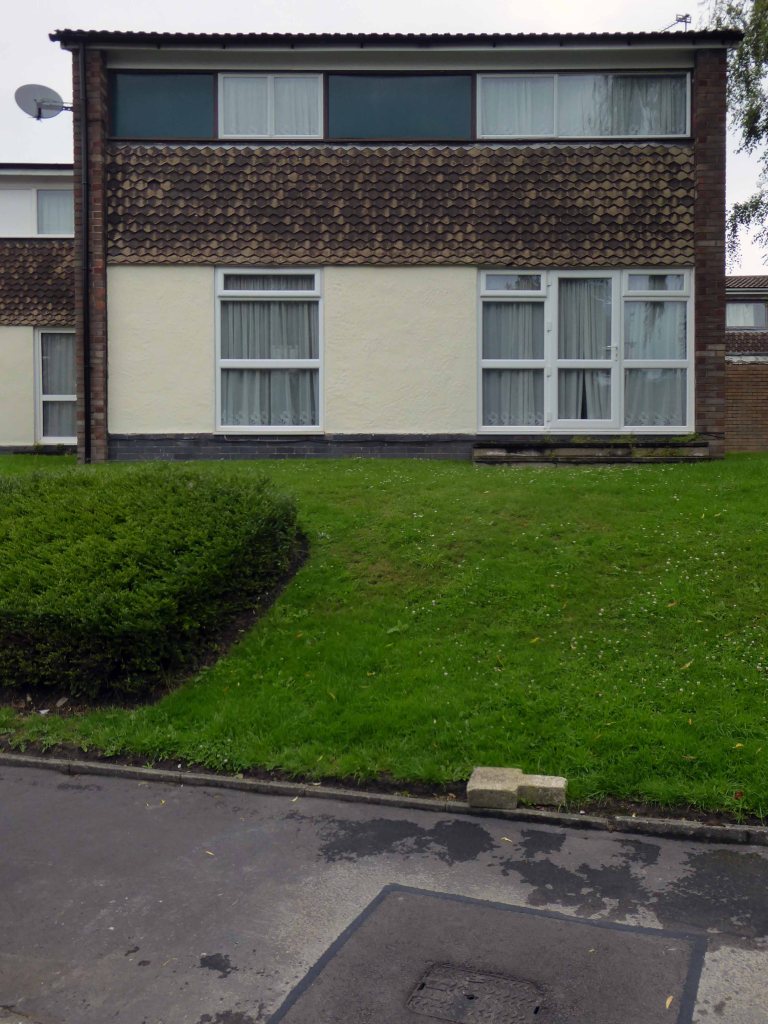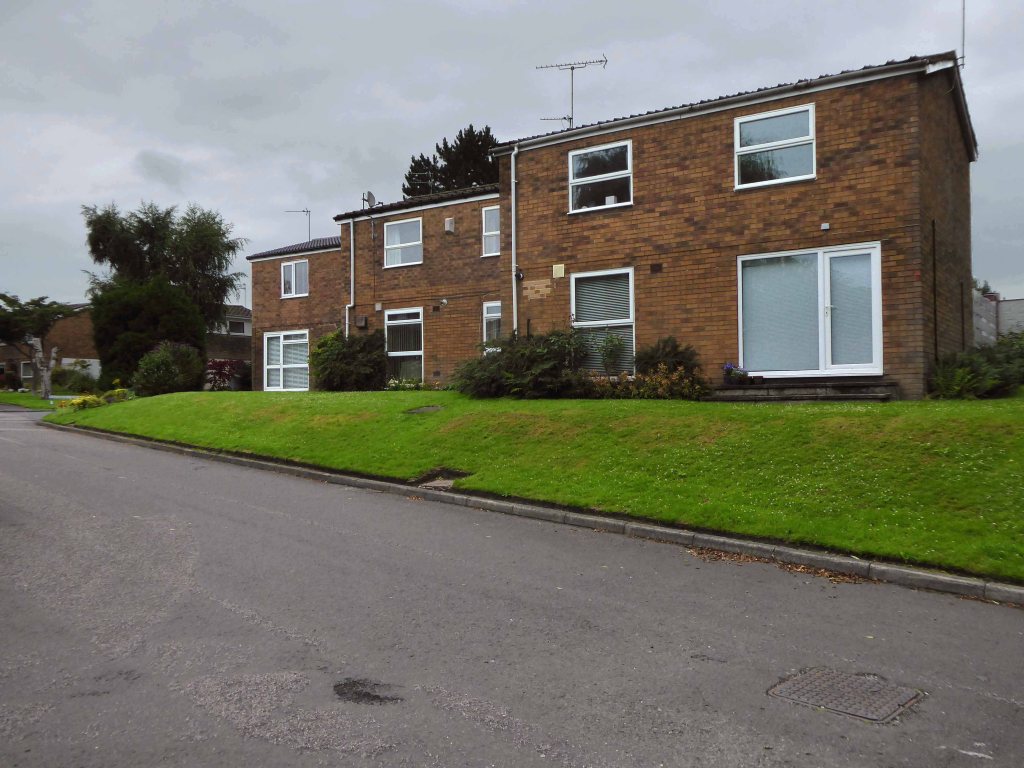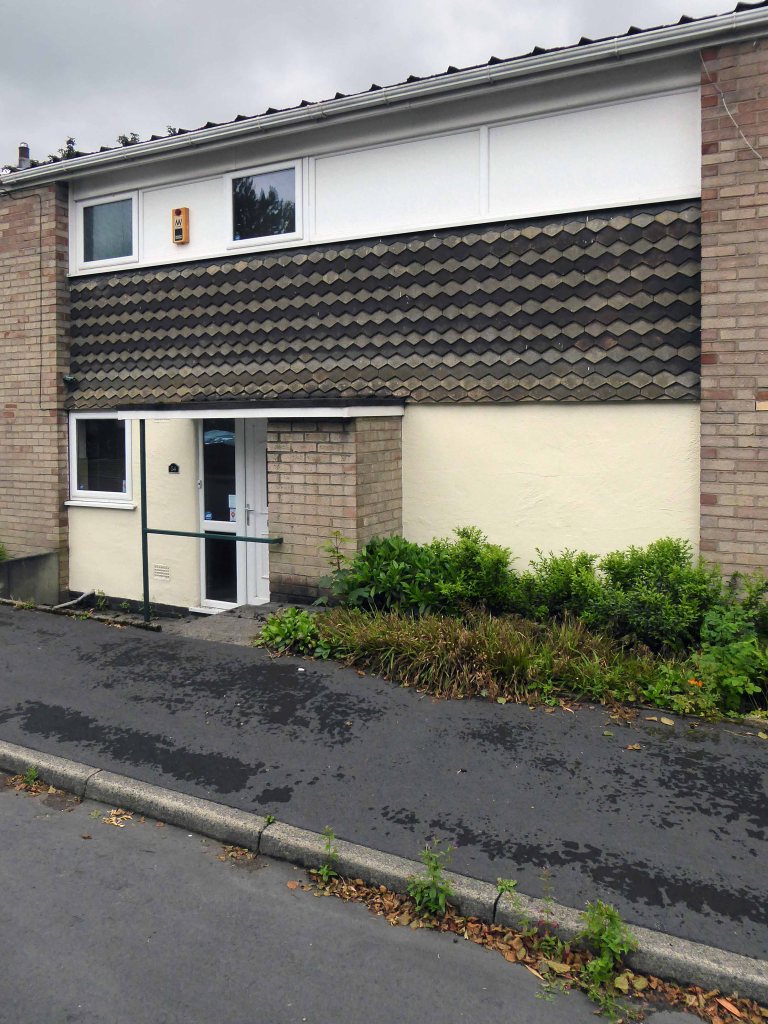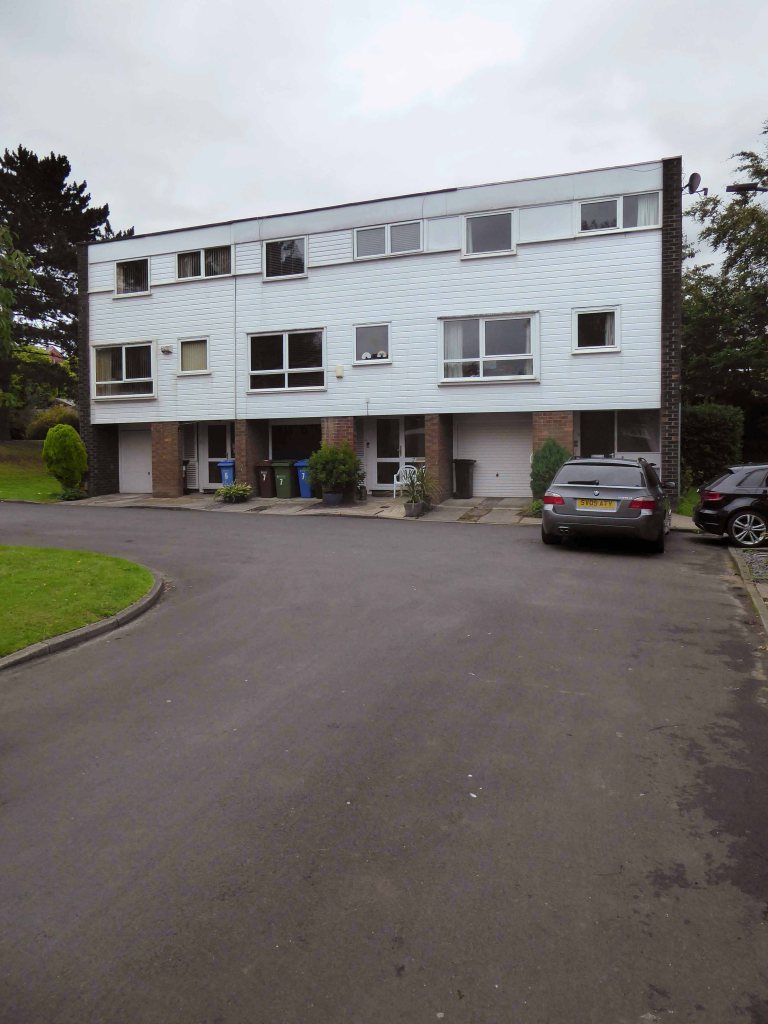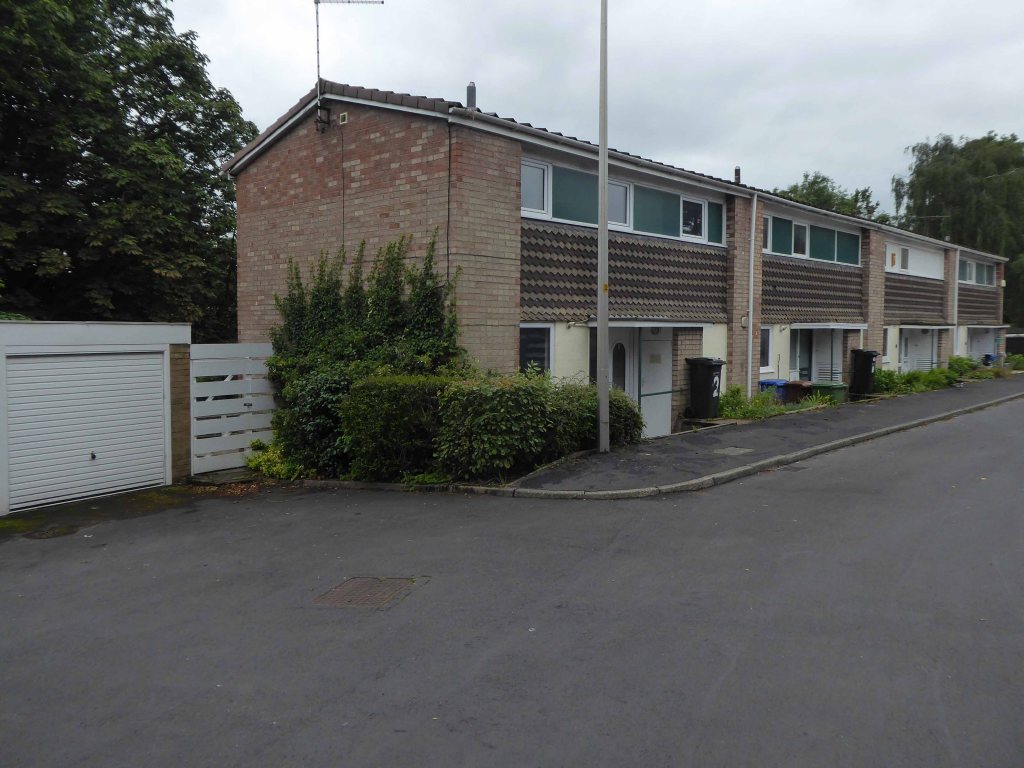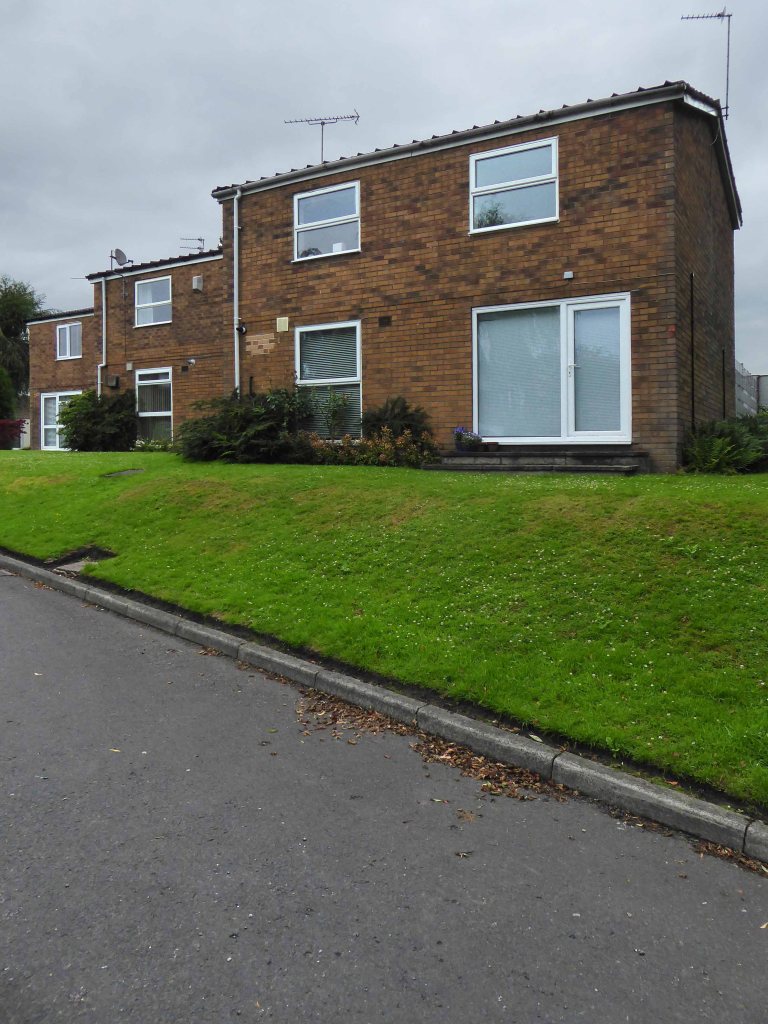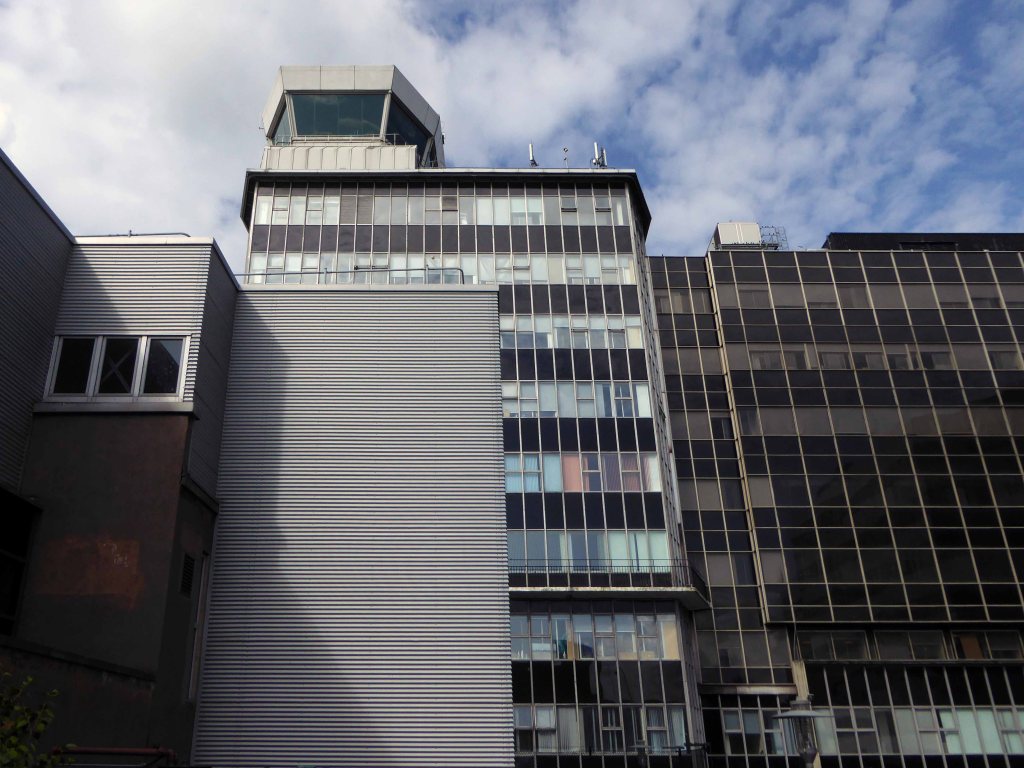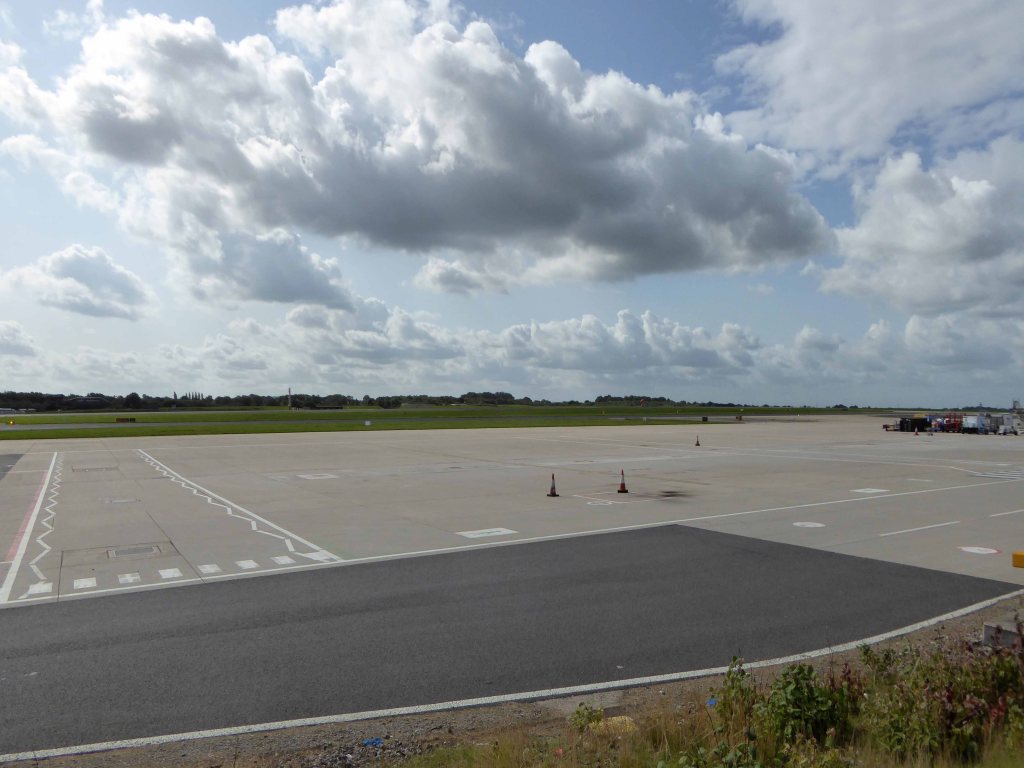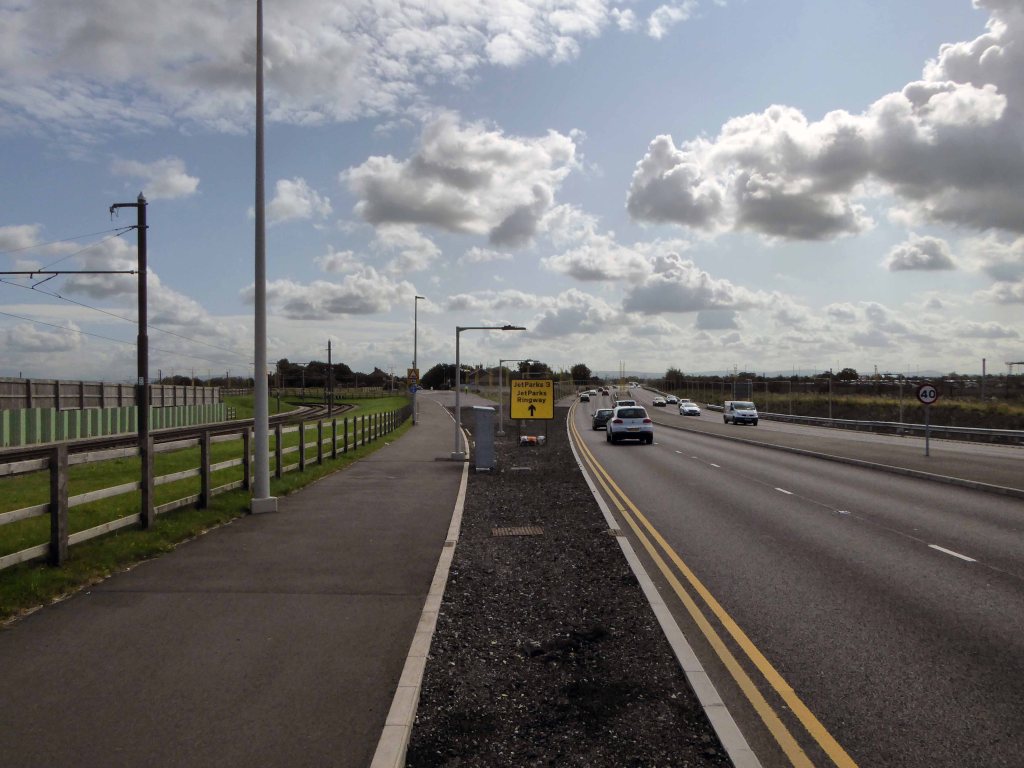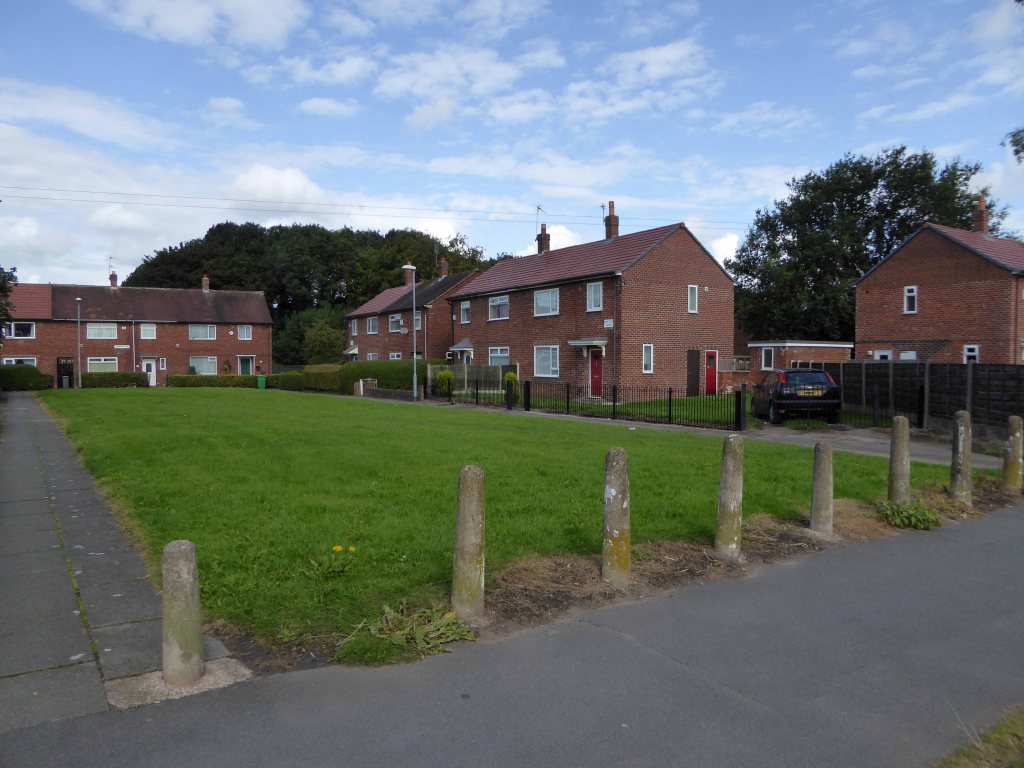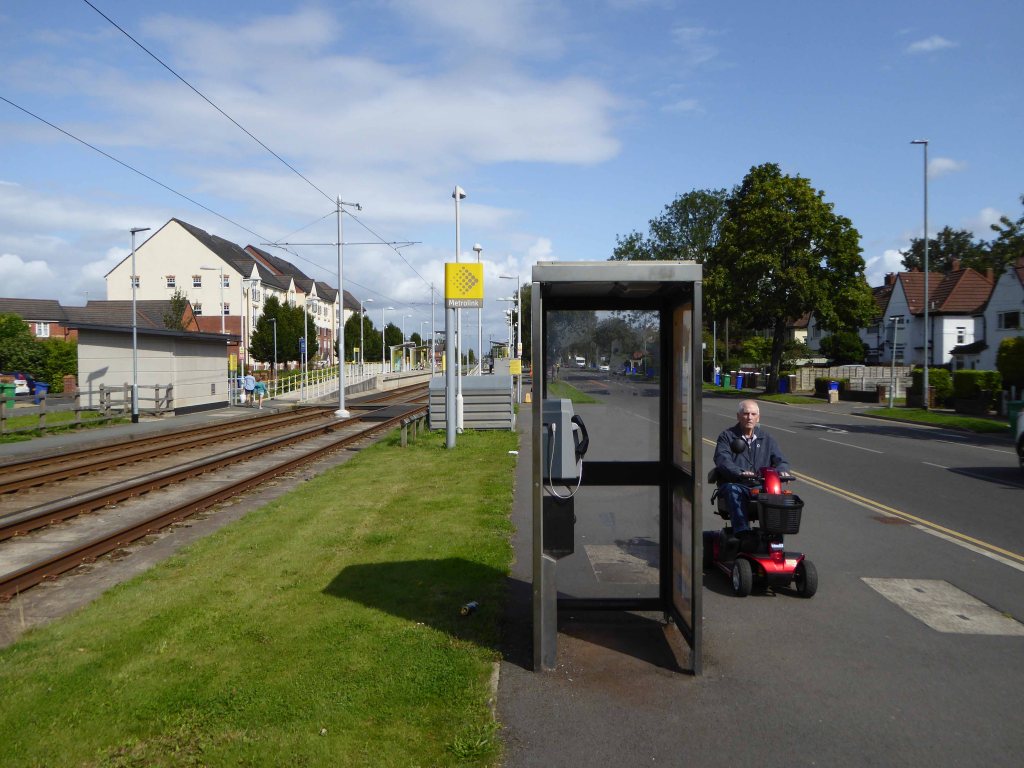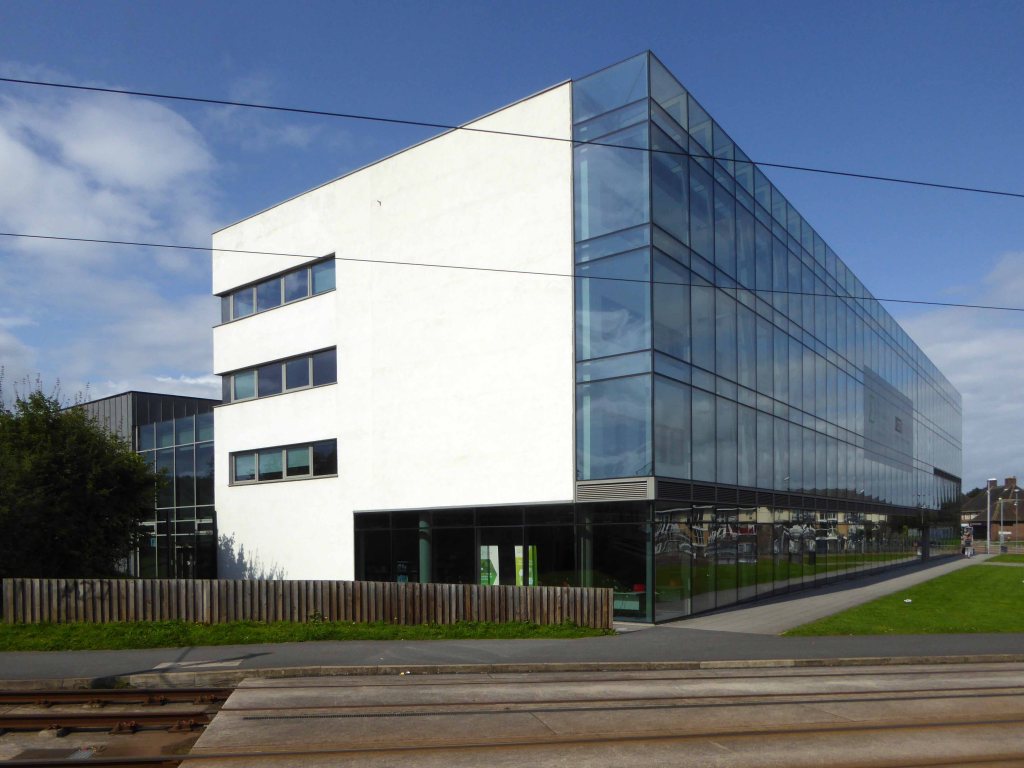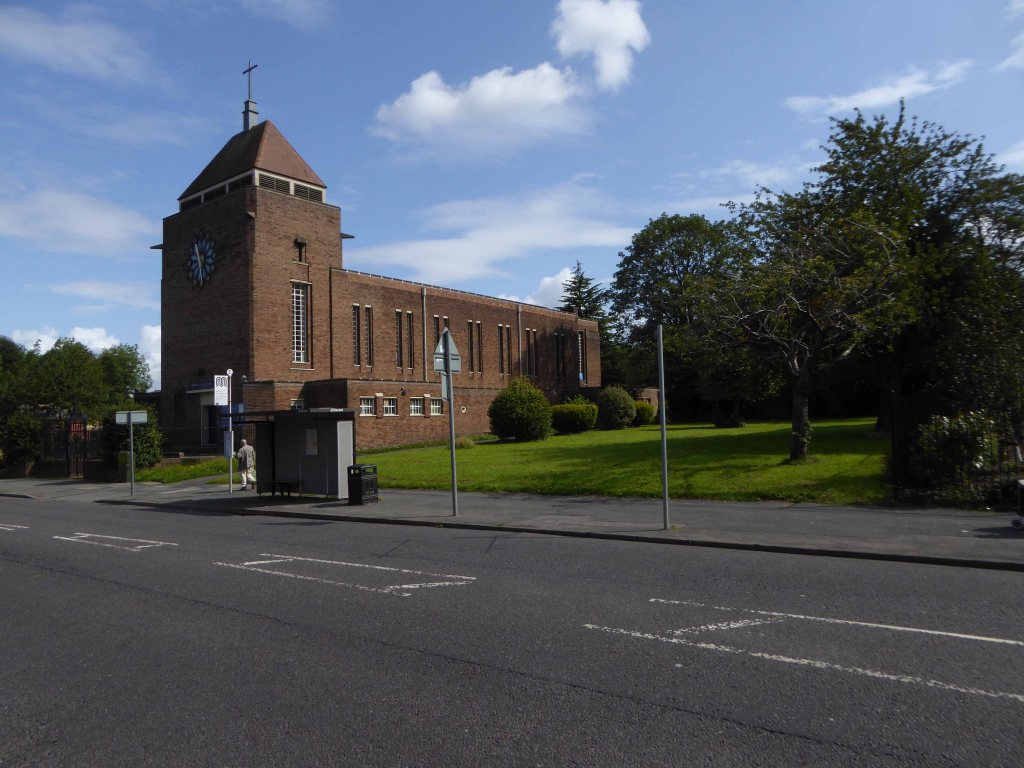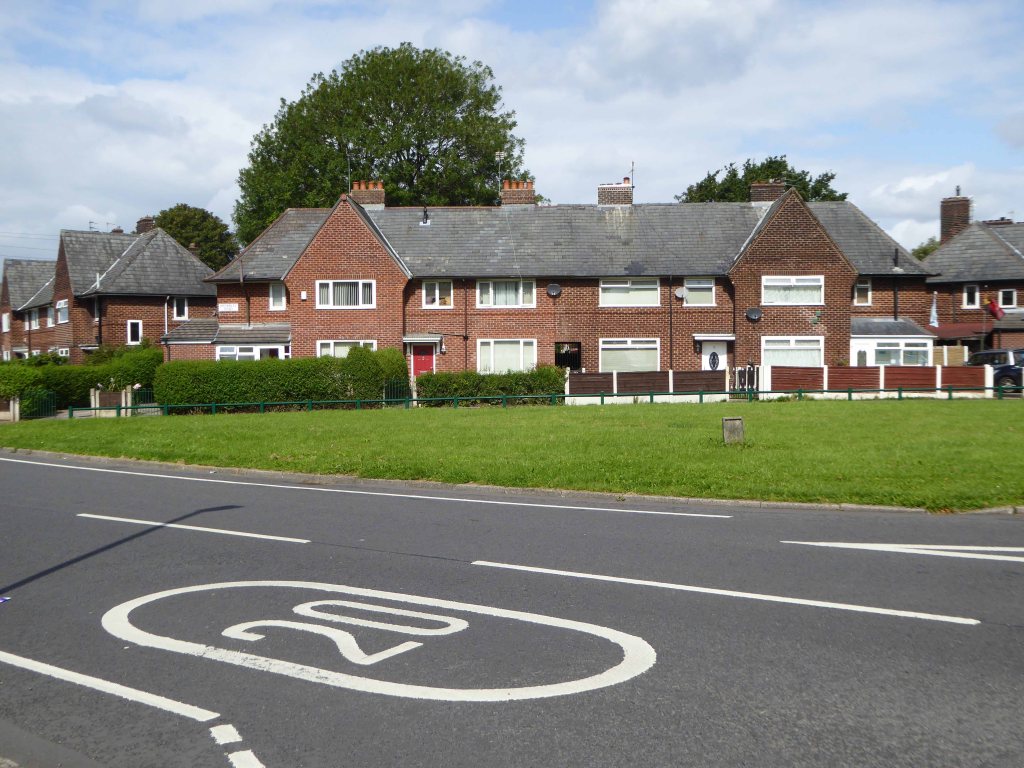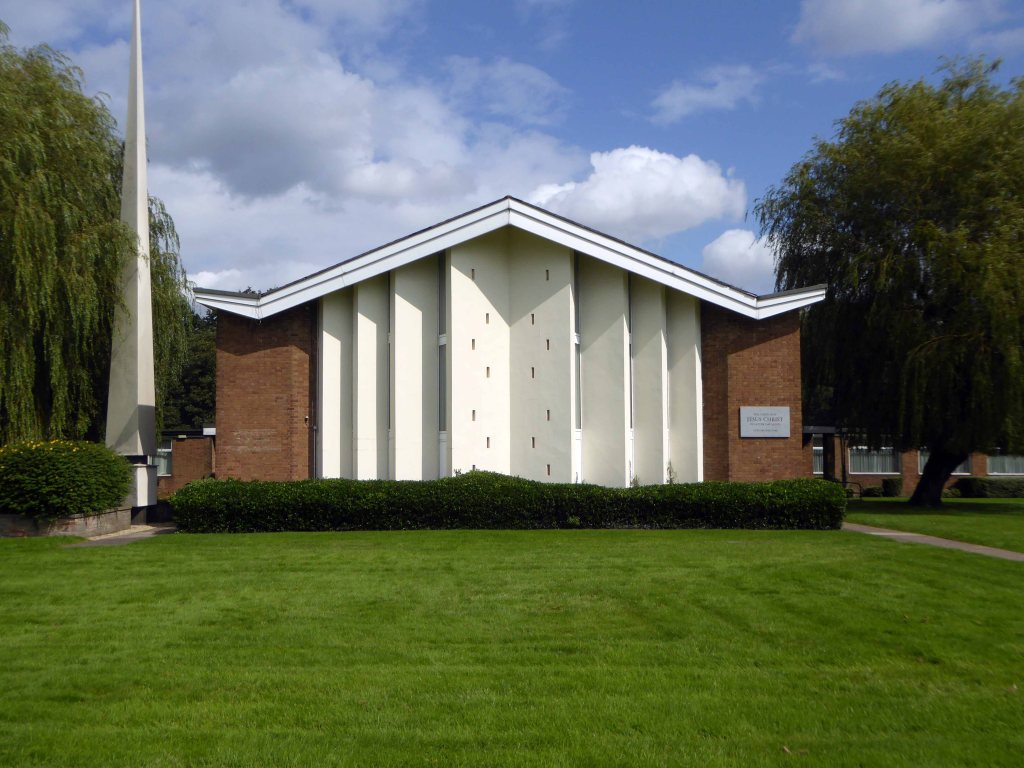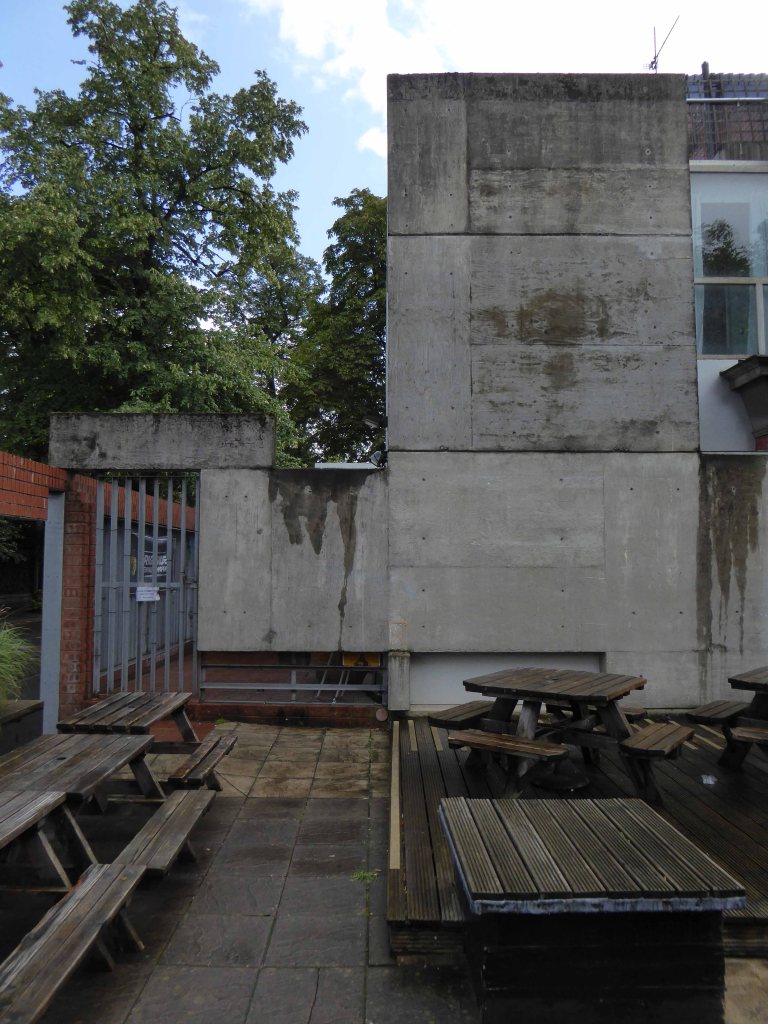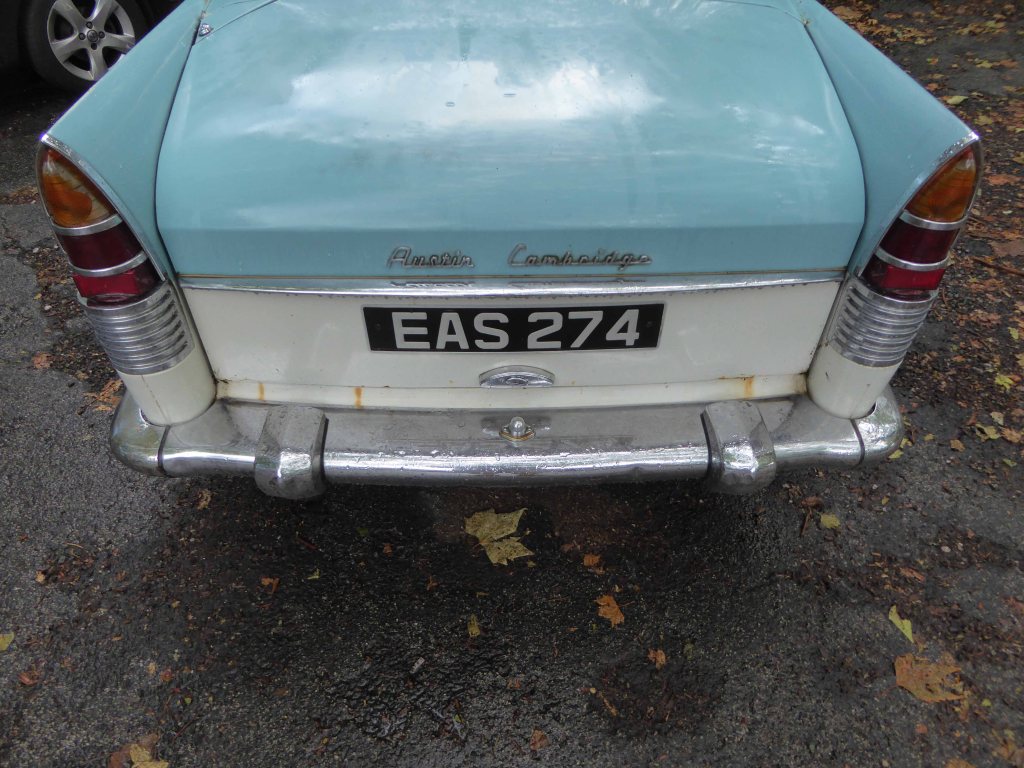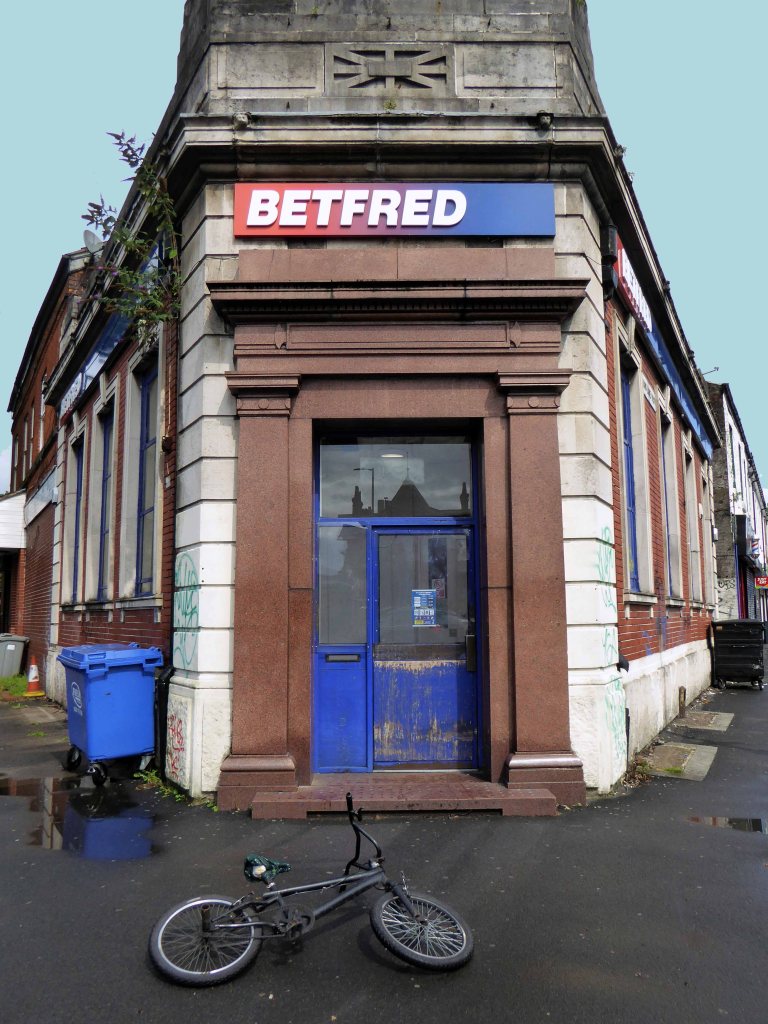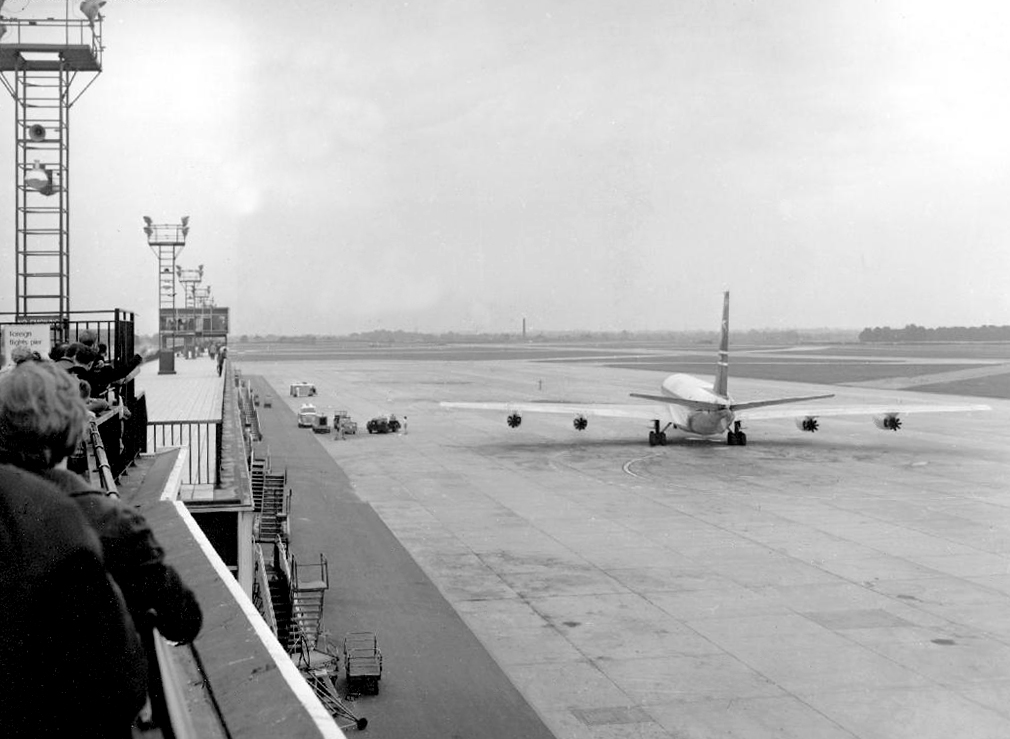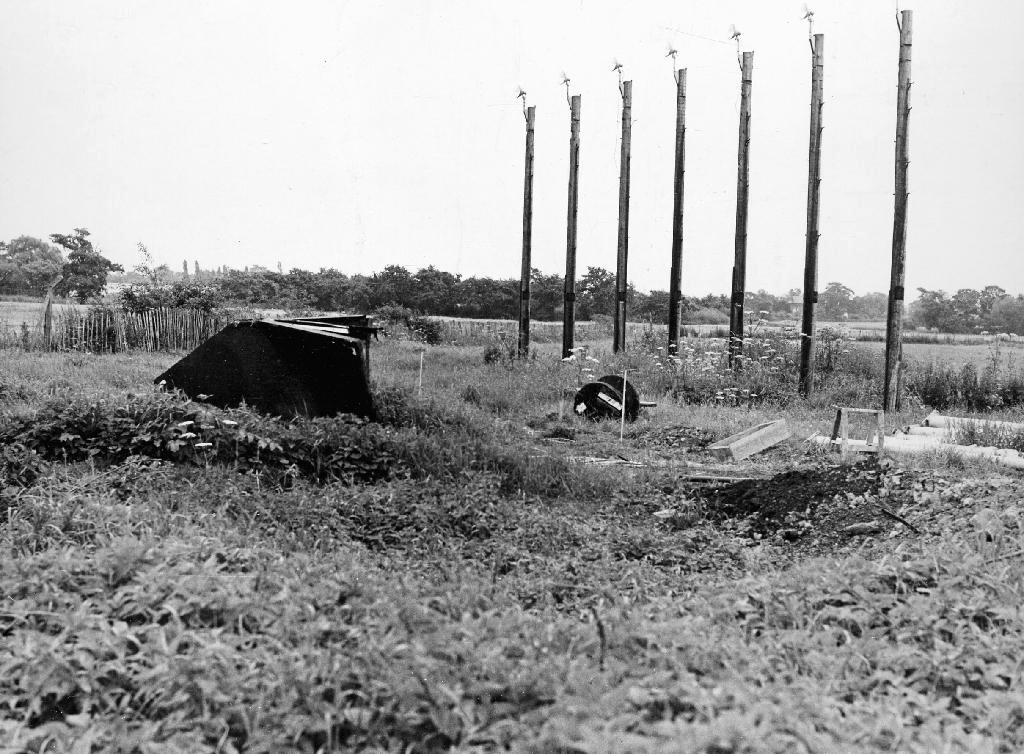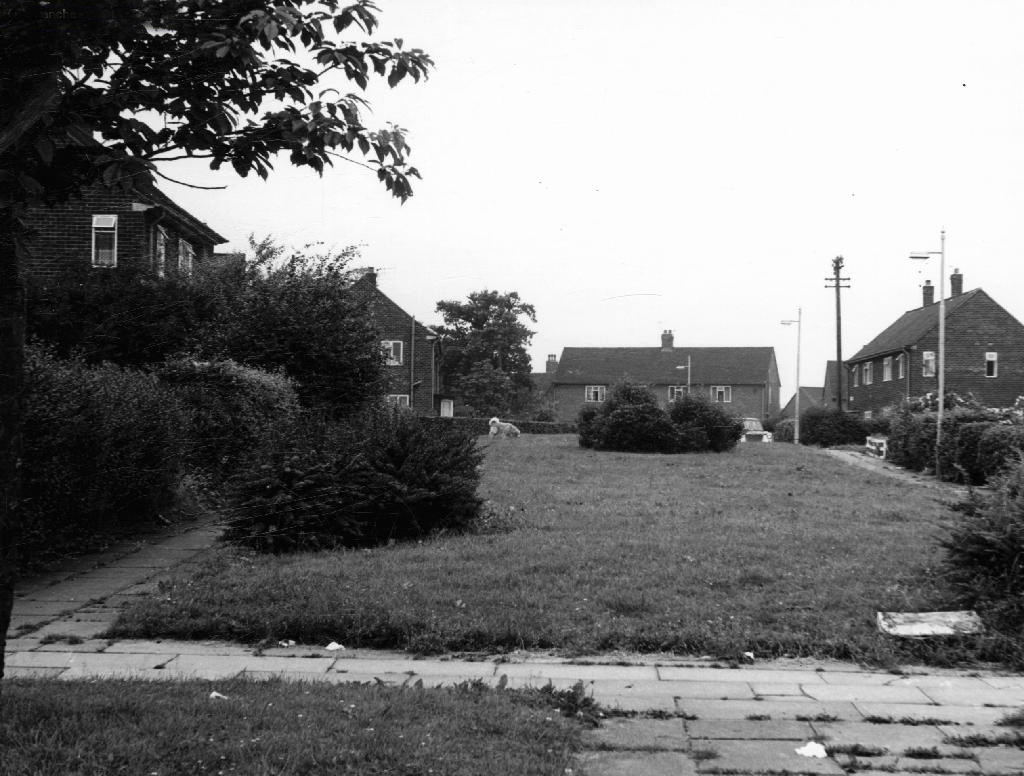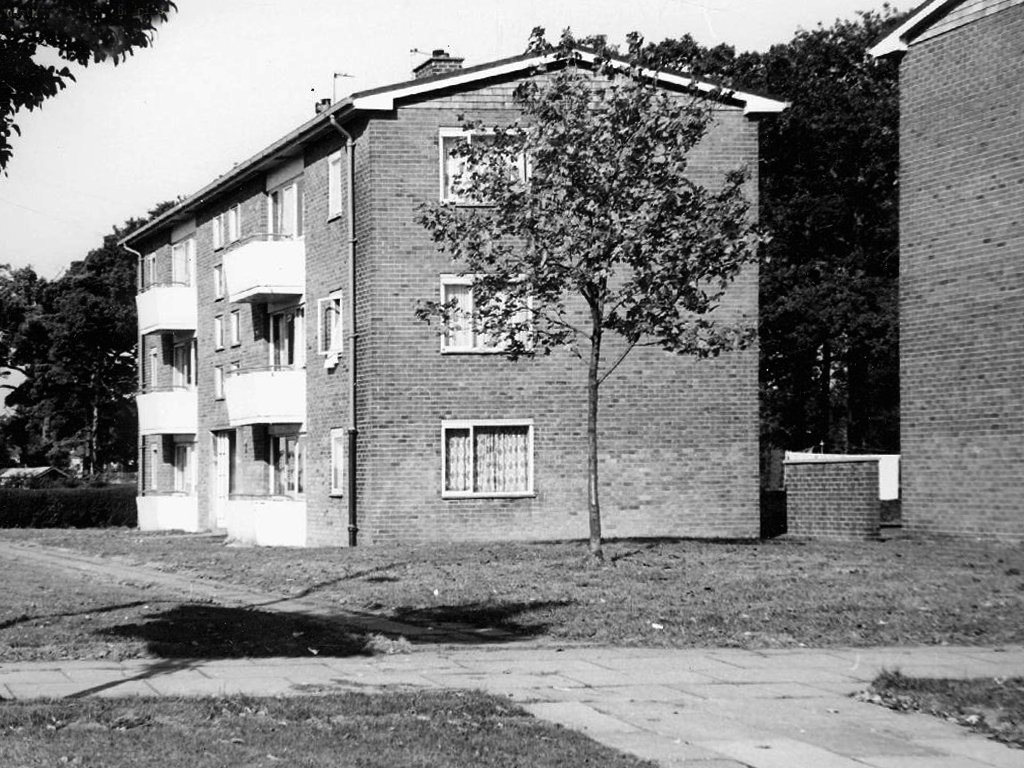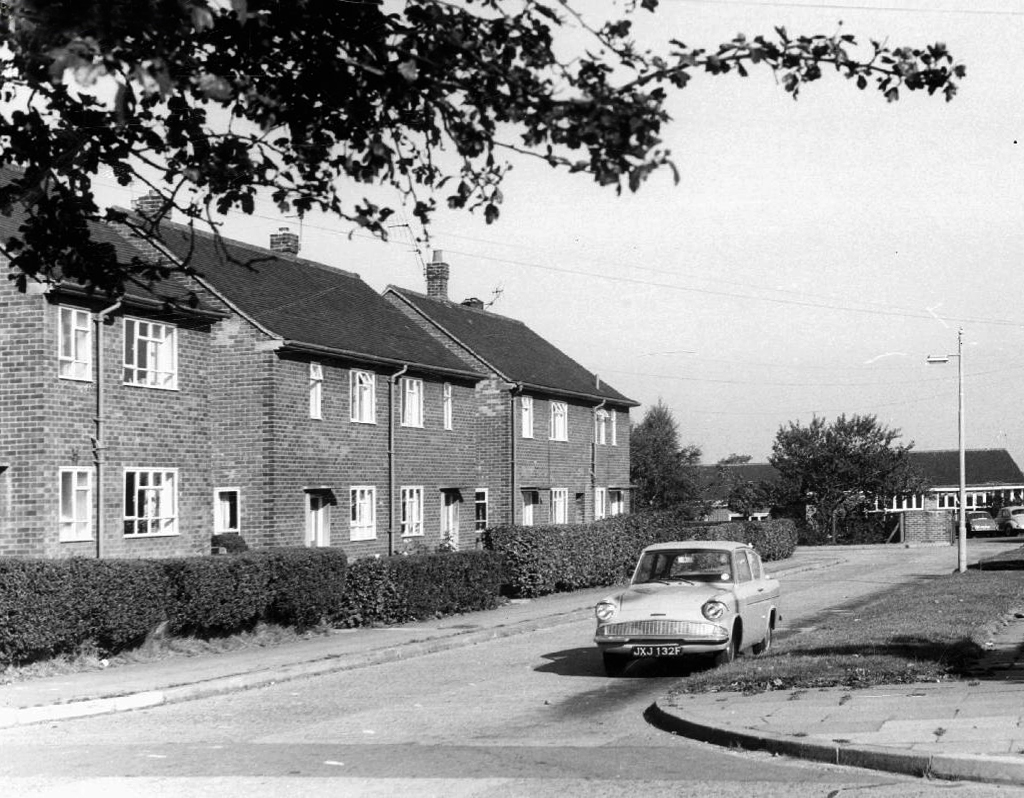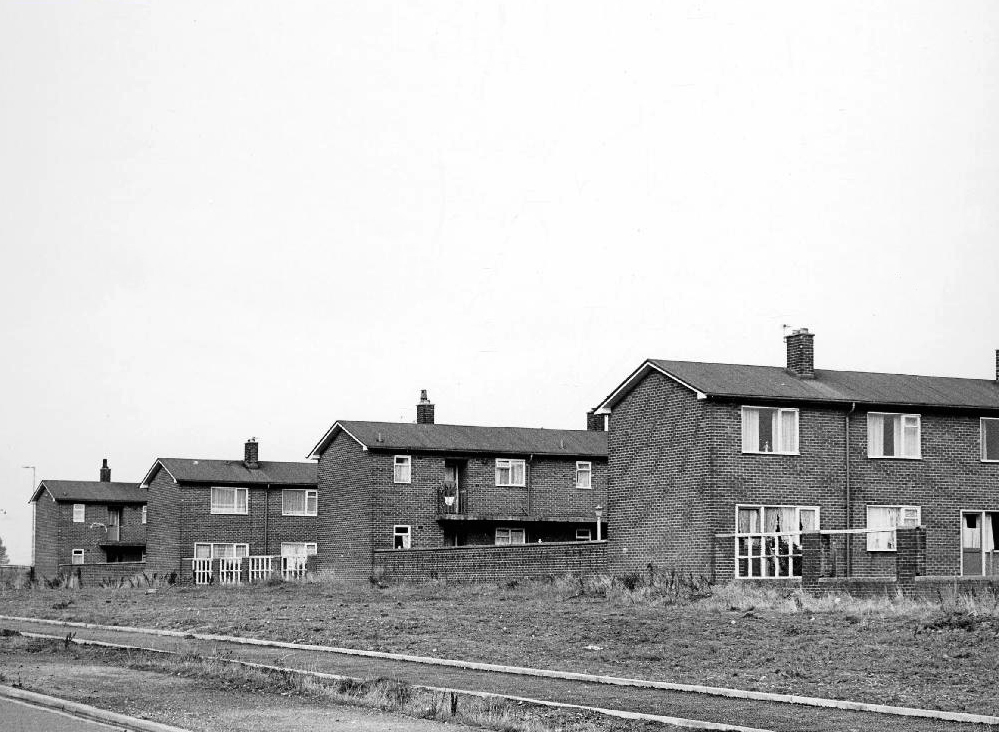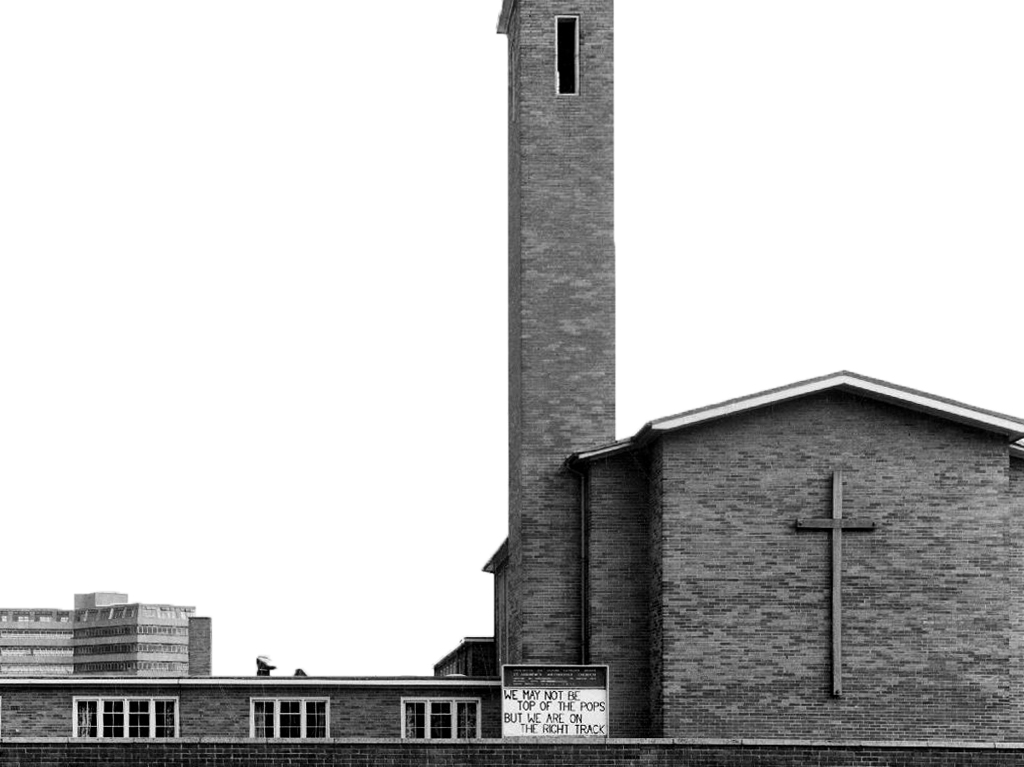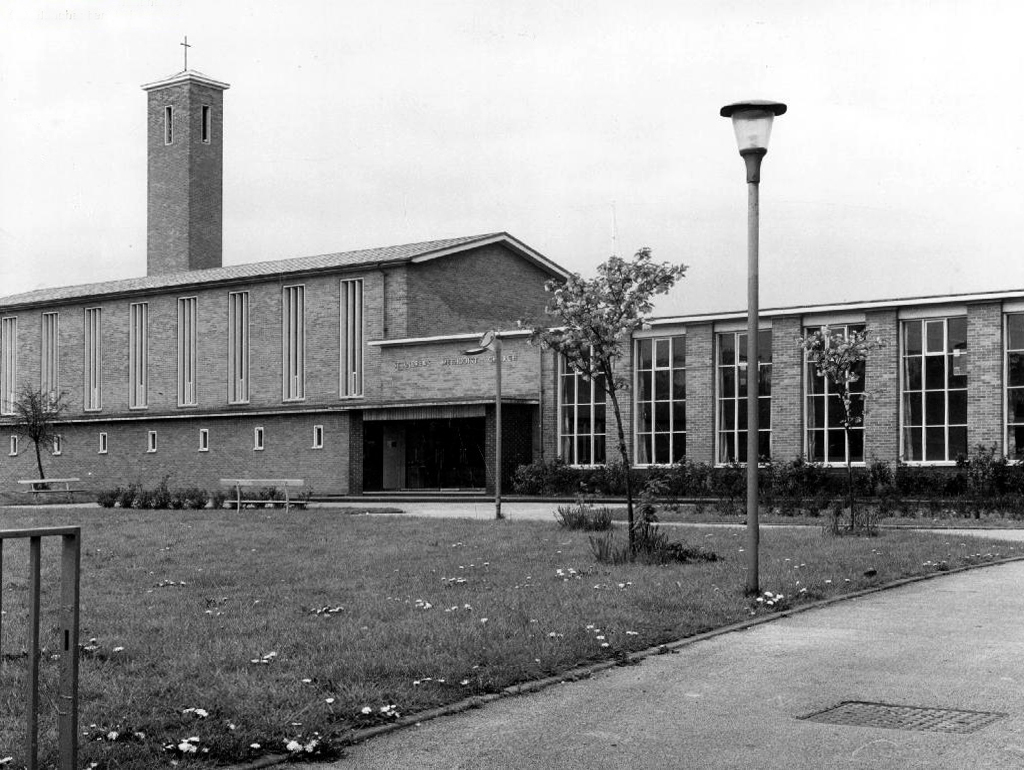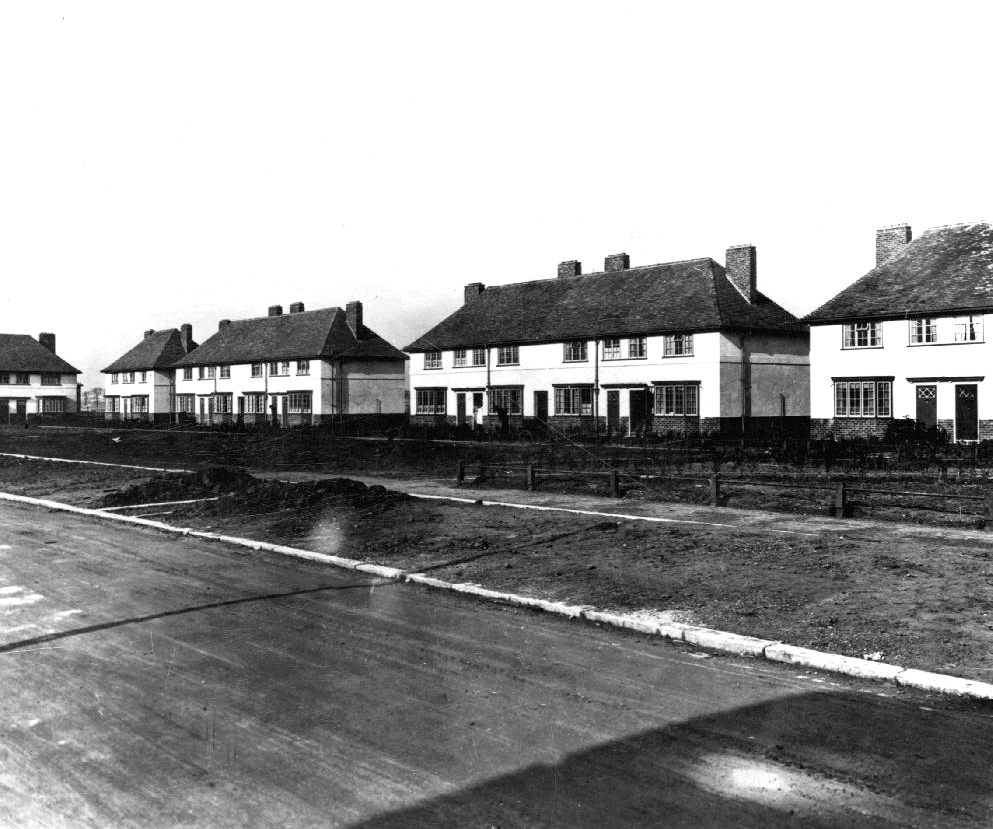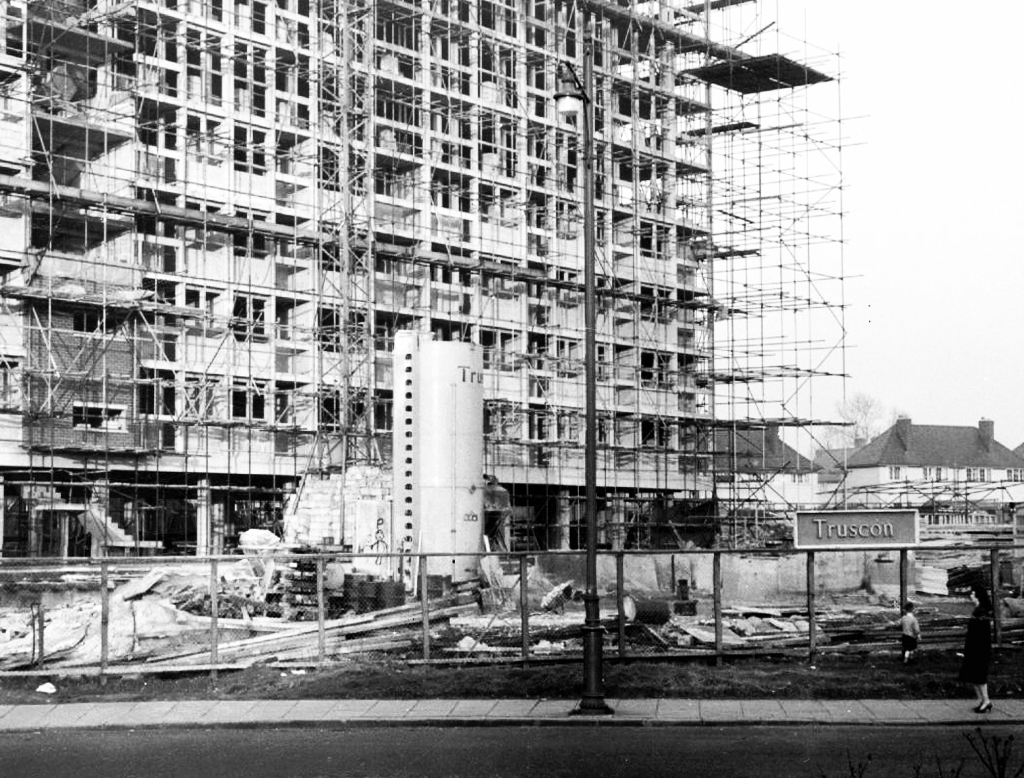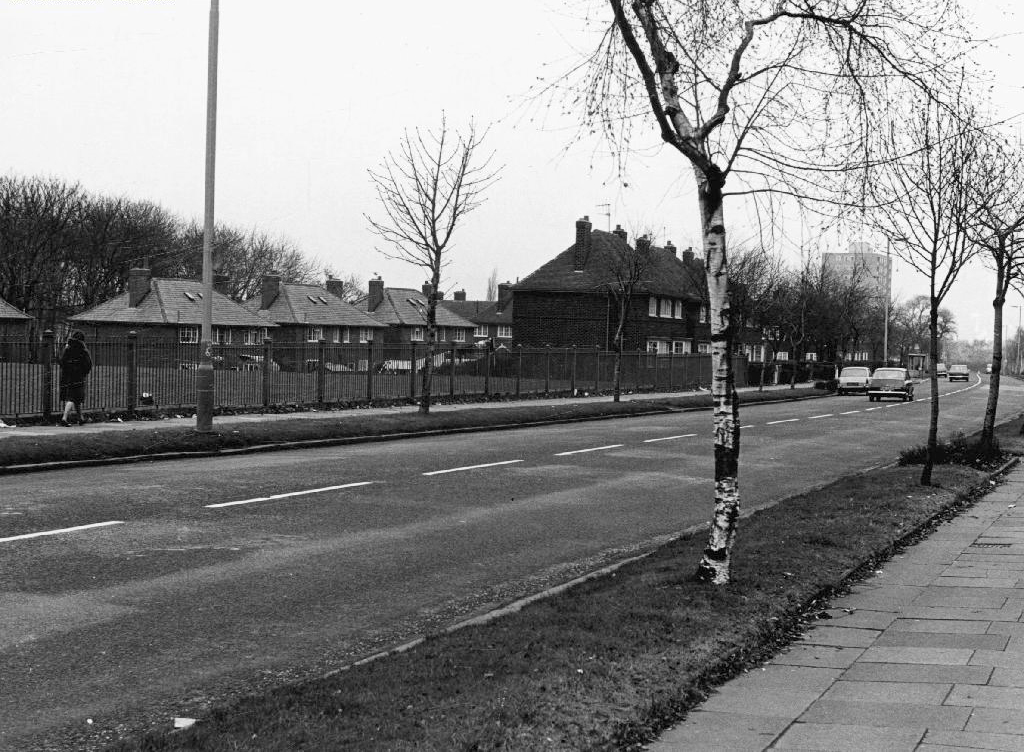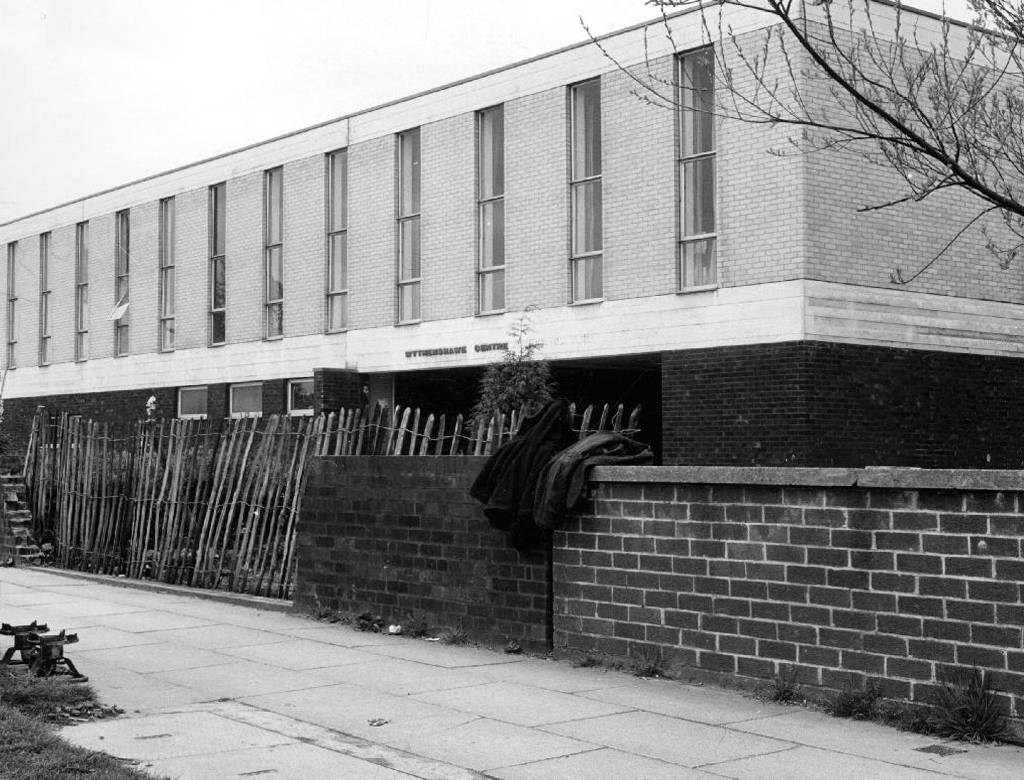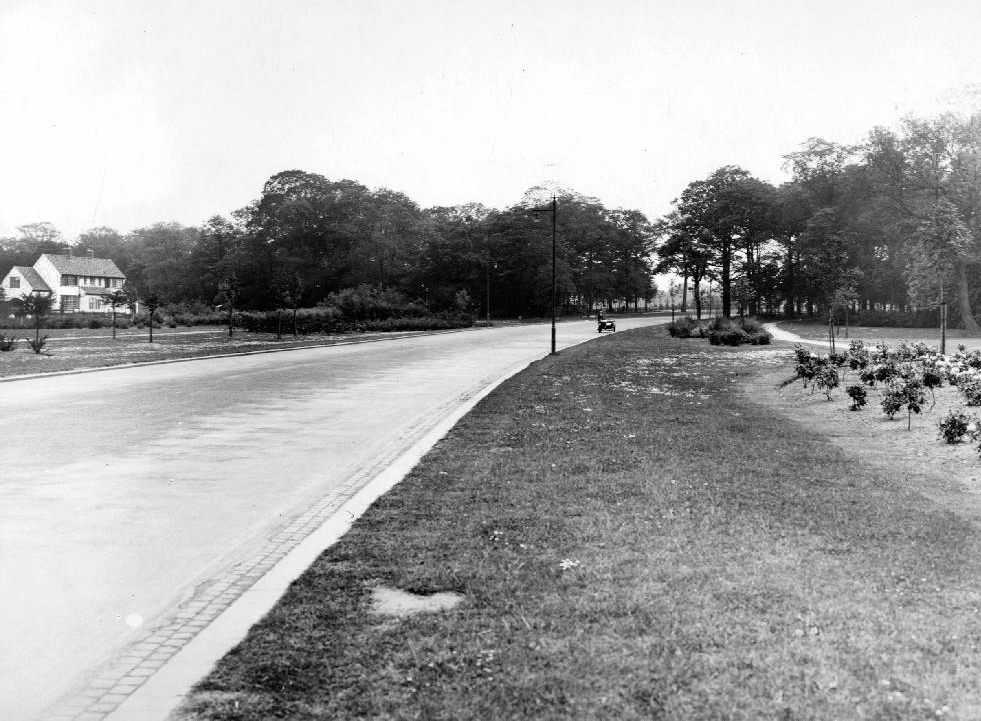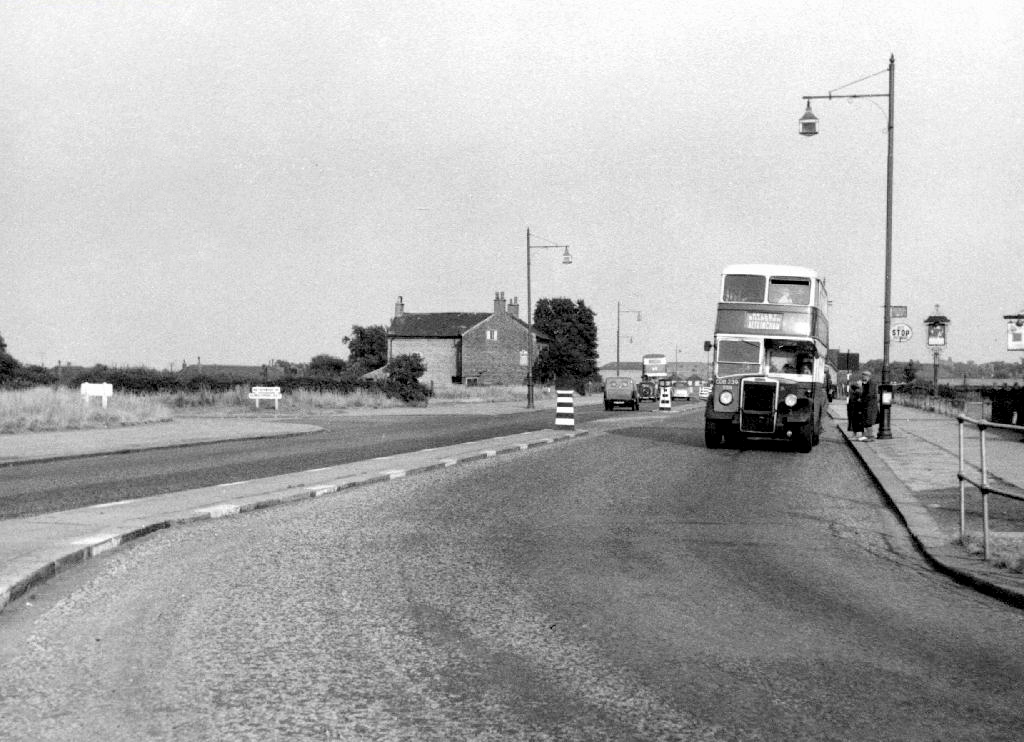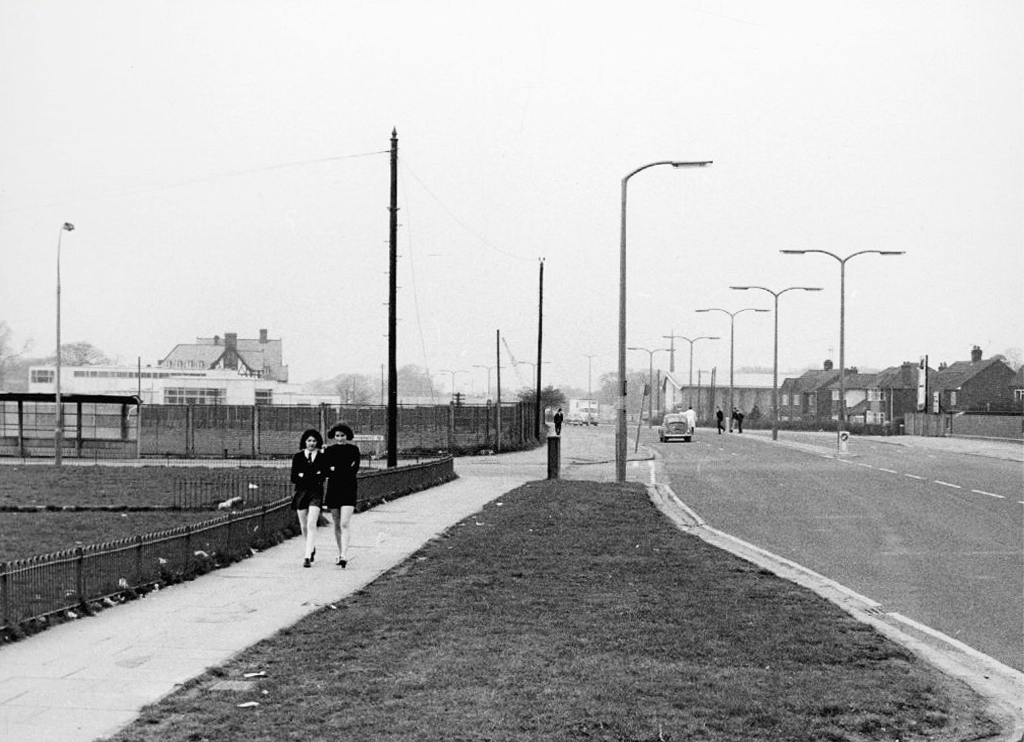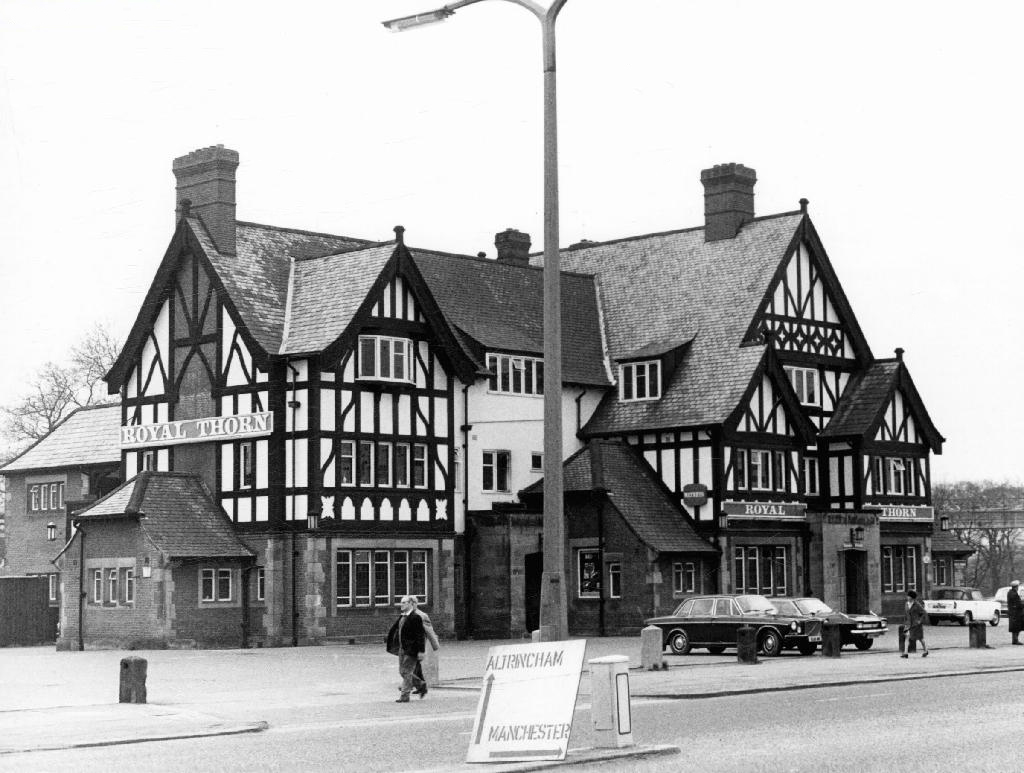
Abbey Stadium Goredale Avenue Gorton Manchester M18 7HD.
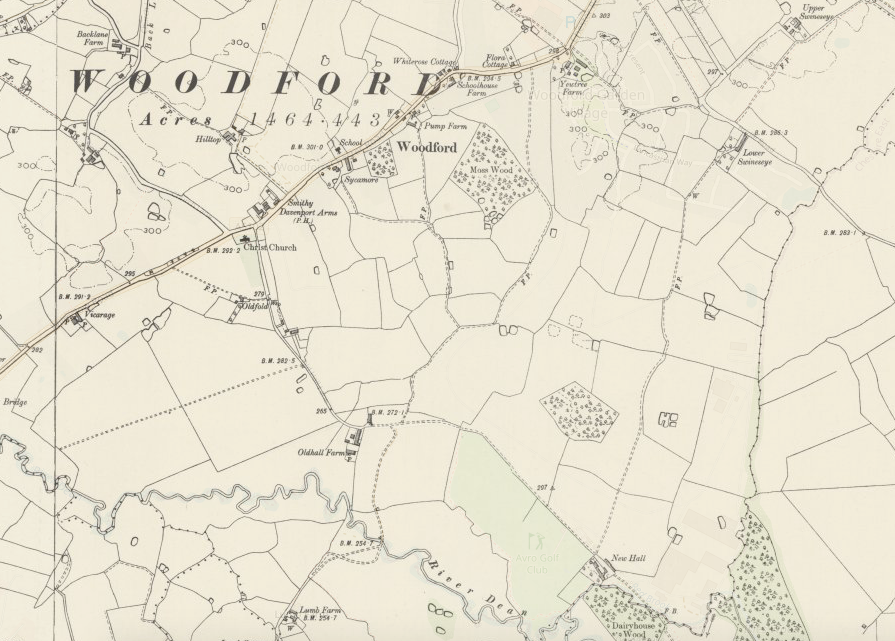
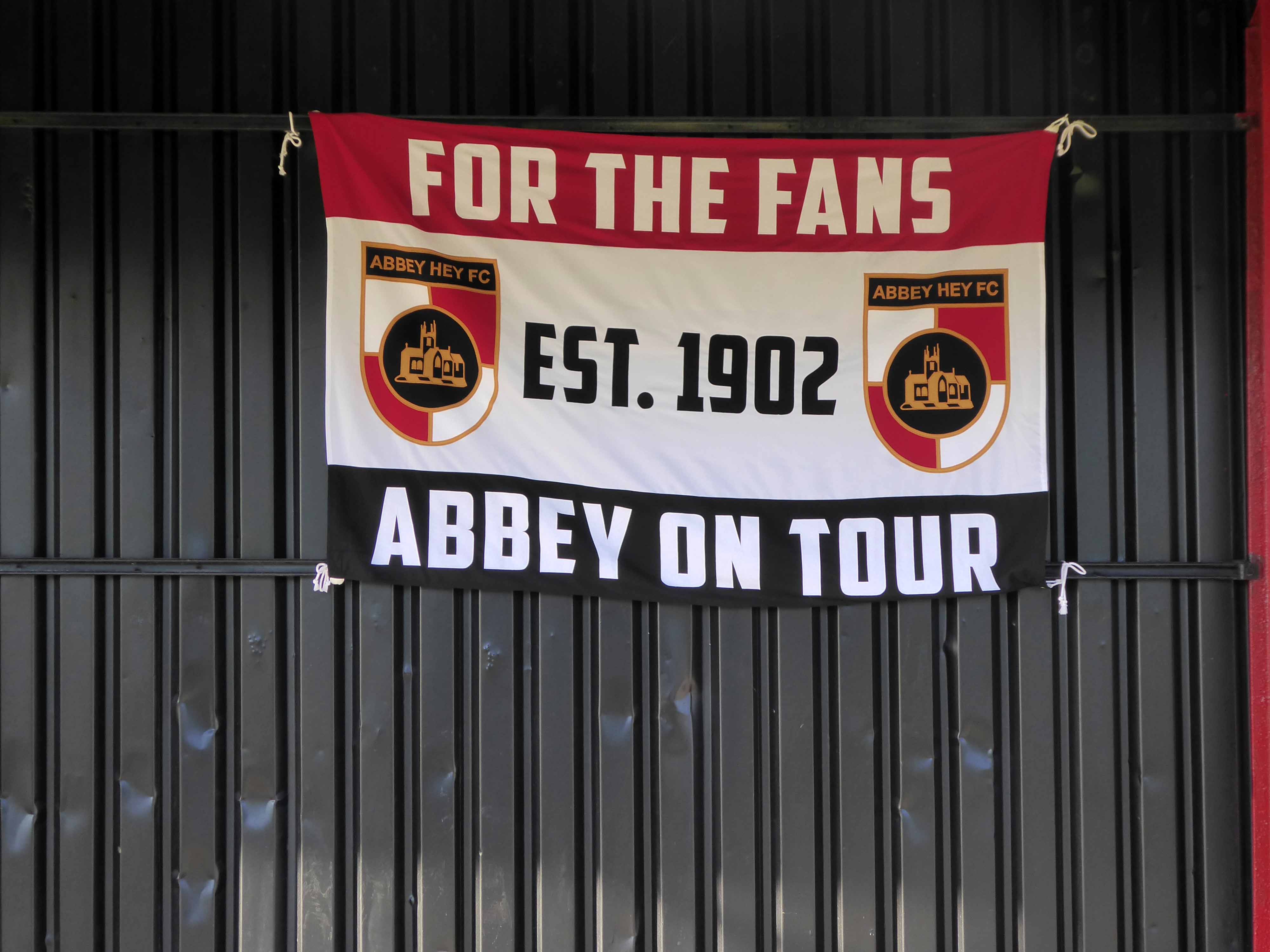
Abbey Hey FC was formed in 1902 in the Abbey Hey district of Gorton, some three miles away from the centre of Manchester. During their formative years and through the two World Wars, the club was disbanded and reformed on a number of occasions. Starting in the Church Sunday Leagues, they progressed through the Manchester Amateur Leagues during the intervening years but the club really came into it’s own in the 1960s after it took in the players of the Admiralty Gunning Engineering Department following it’s closure.
In 1978 with the club decided to apply for a position in the Manchester League, this meant that the club had to find an enclosed ground suitable for playing their home games. The nearest ground available at the time was in Chorlton at Werburghs Road.
In 1984 the club at last had their own home,improvements to the ground could only have been achieved by the hard work and dedication of the committee, who not only raised the money to carry out the improvements but also carried out 90% of the work themselves.
Promotion to the 1st Division meant that the club had to install floodlights. True to form, they designed, ordered, erected and wired them within a couple of months. The biggest job during the ground improvements was the building of the new clubhouse and dressing rooms. Planning permission was given with the majority of work once again being carried out by the club’s own members.
This is a story of persistence and commitment from members, managers and players – keeping a viable non-league football team alive at the centre of a Community.
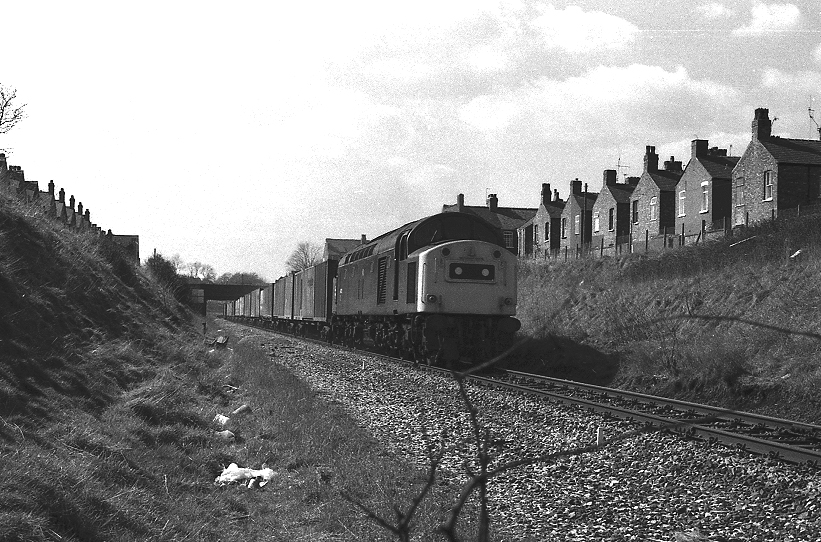
I have cycled by here for years, along the Fallowfield Loop – and worked down here in the Seventies when the rail link was still extant.
Photo – Neil Ferguson-Lee via Robert Todd and Levy Boy.
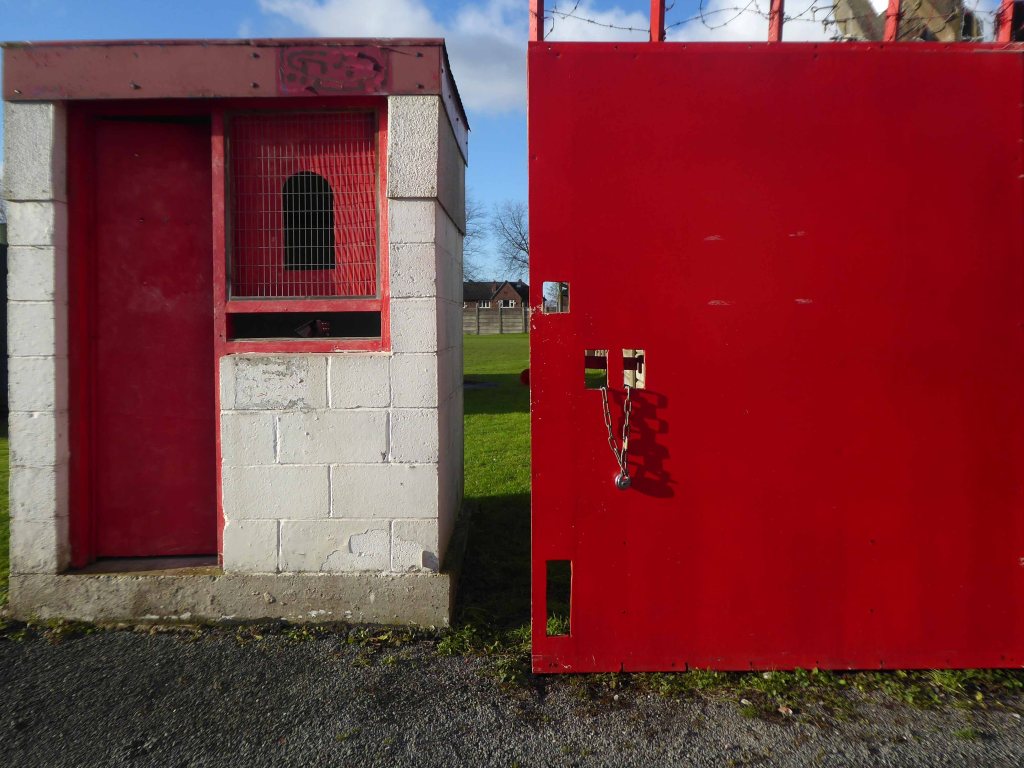
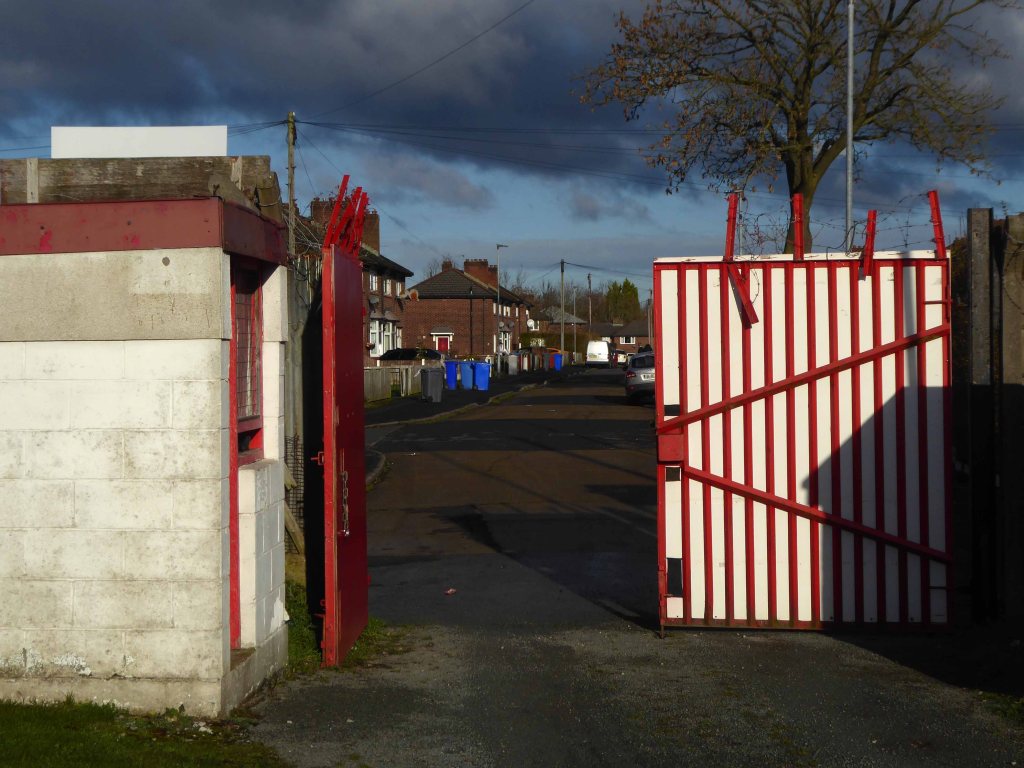
So today seeing the gates open, I decided to take a look around the ground – many thanks to groundsman Simon for taking the time to stop and chat.
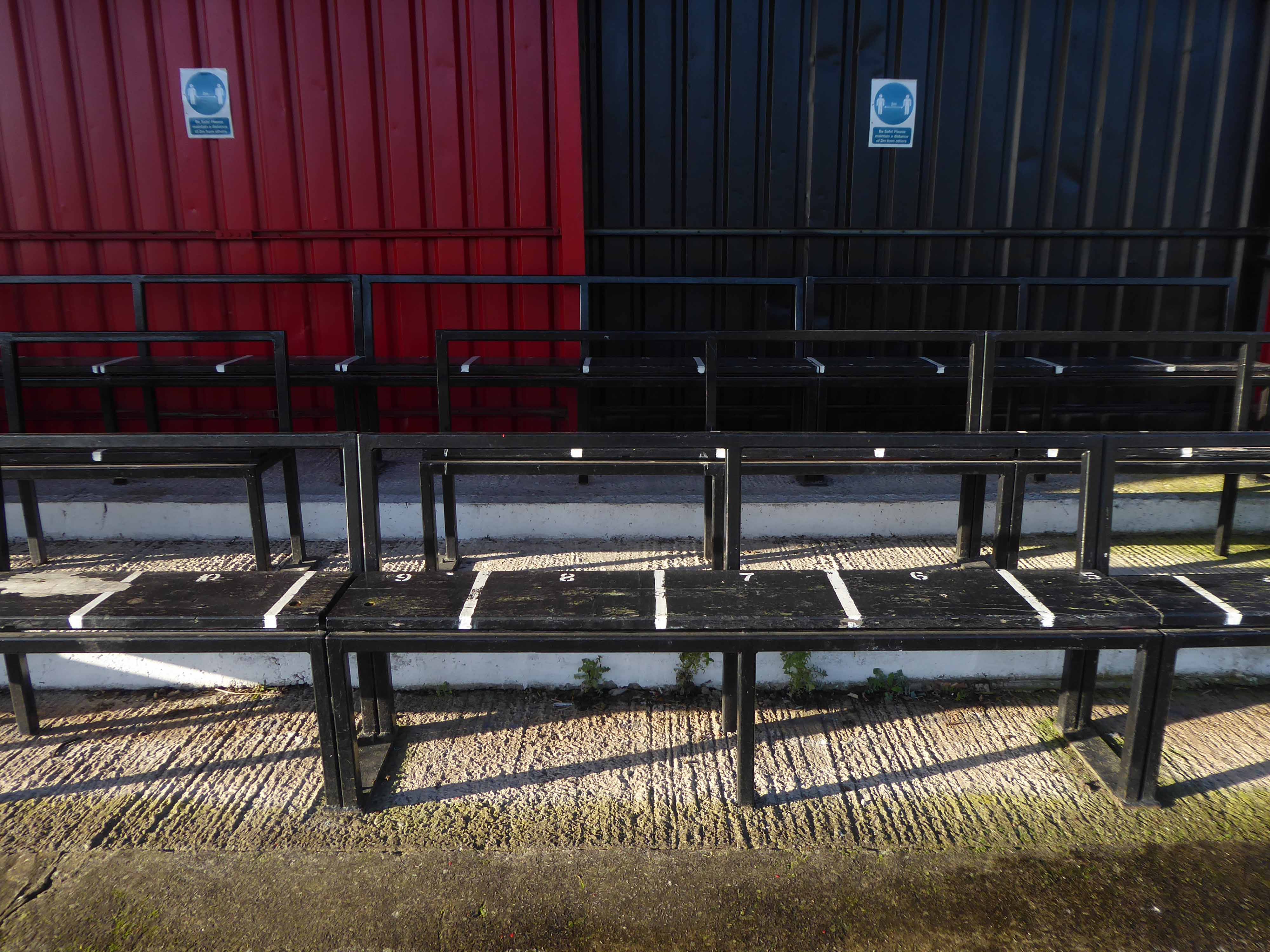
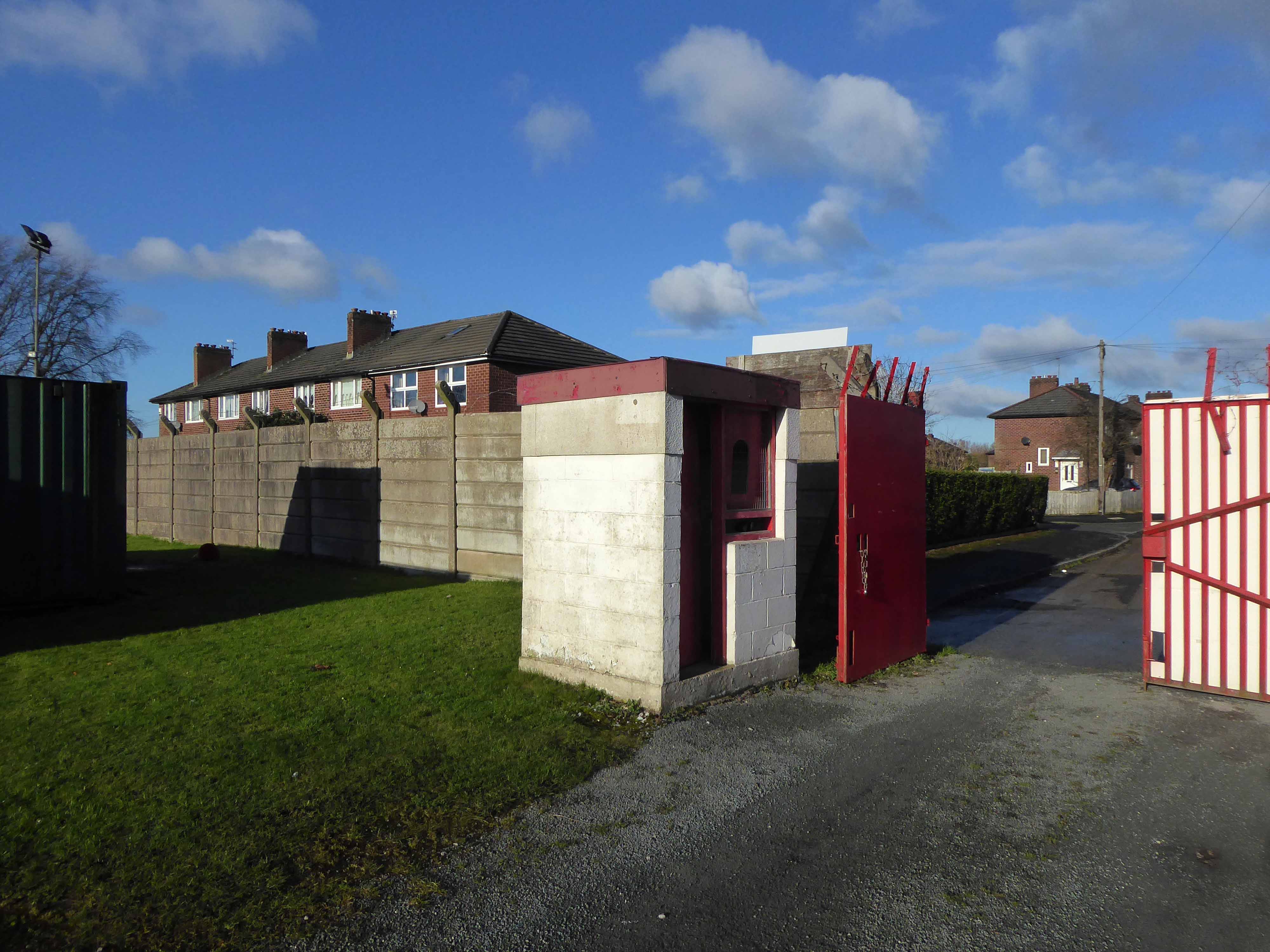
Everything is spick and span, the playing surface in excellent nick, and all the stands seat and fences standing smartly to attention, having had a fresh coat of paint.
So let’s take a look around:
I’ll be back to watch a match, just as soon as the rules and regulations allow!
The city, however, does not tell its past, but contains it like the lines of a hand, written in the corners of the streets, the gratings of the windows, the banisters of the steps, the antennae of the lightning rods, the poles of the flags, every segment marked in turn with scratches, indentations, scrolls.
Italo Calvino – Invisible Cities
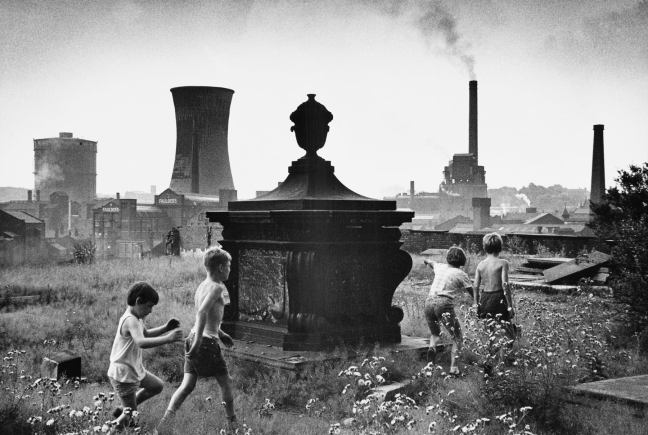
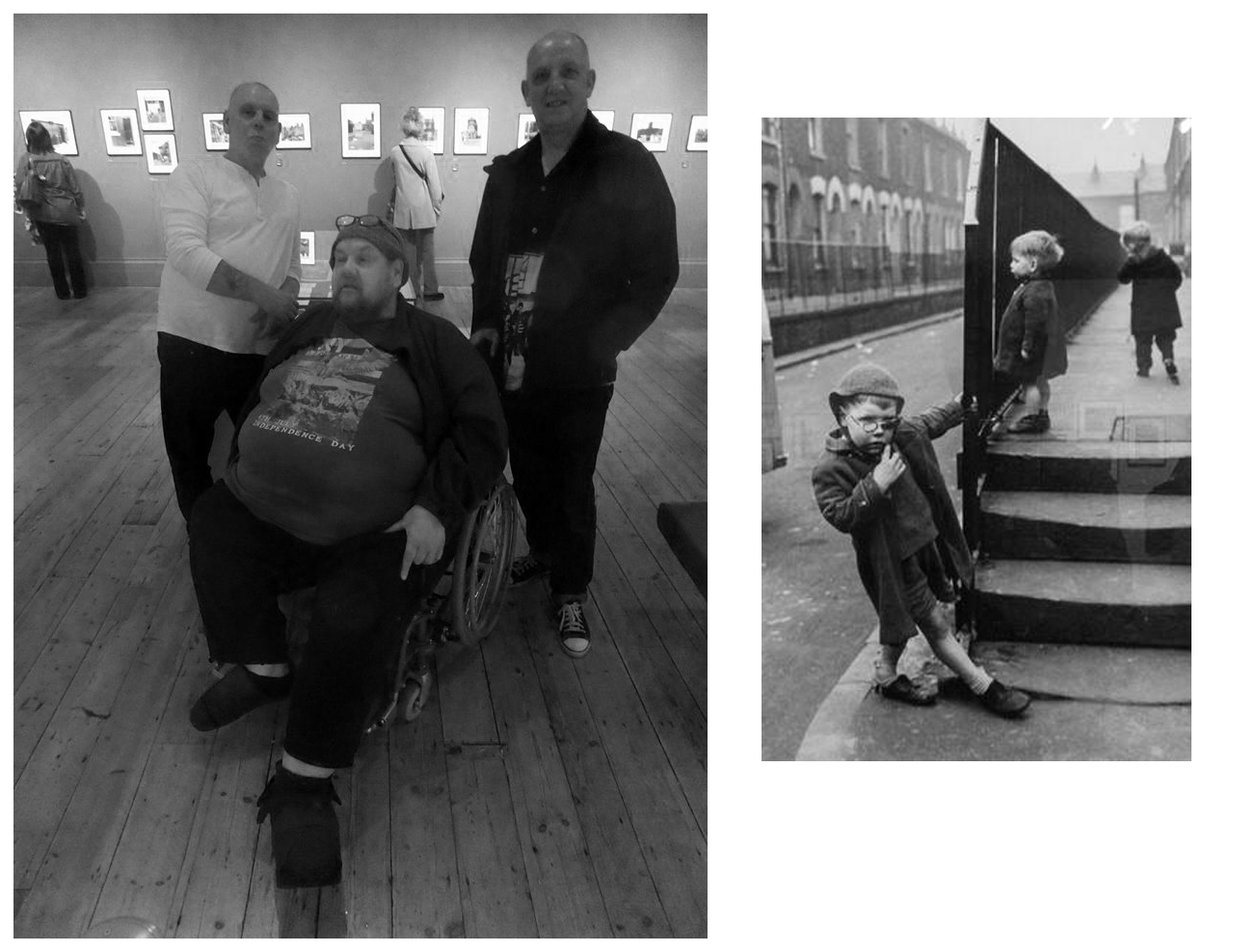
Paul Dobraszczyk posted this Shirley Baker photograph, he was puzzled by its exact location, it puzzled me too.
For nearly all that is depicted here, is now no longer extant, save one hopes, for the group of playmates.
All that is solid melts into air, all that is holy is profaned, and man is at last compelled to face with sober senses his real conditions of life, and his relations with his kind.
Shirley Baker was a renowned documentary photographer, who worked extensively in Greater Manchester.
I love the immediacy of unposed, spontaneous photographs and the ability of the camera to capture the serious, the funny, the sublime and the ridiculous. Despite the many wonderful pictures of the great and famous, I feel that less formal, quotidian images can often convey more of the life and spirit of the time.
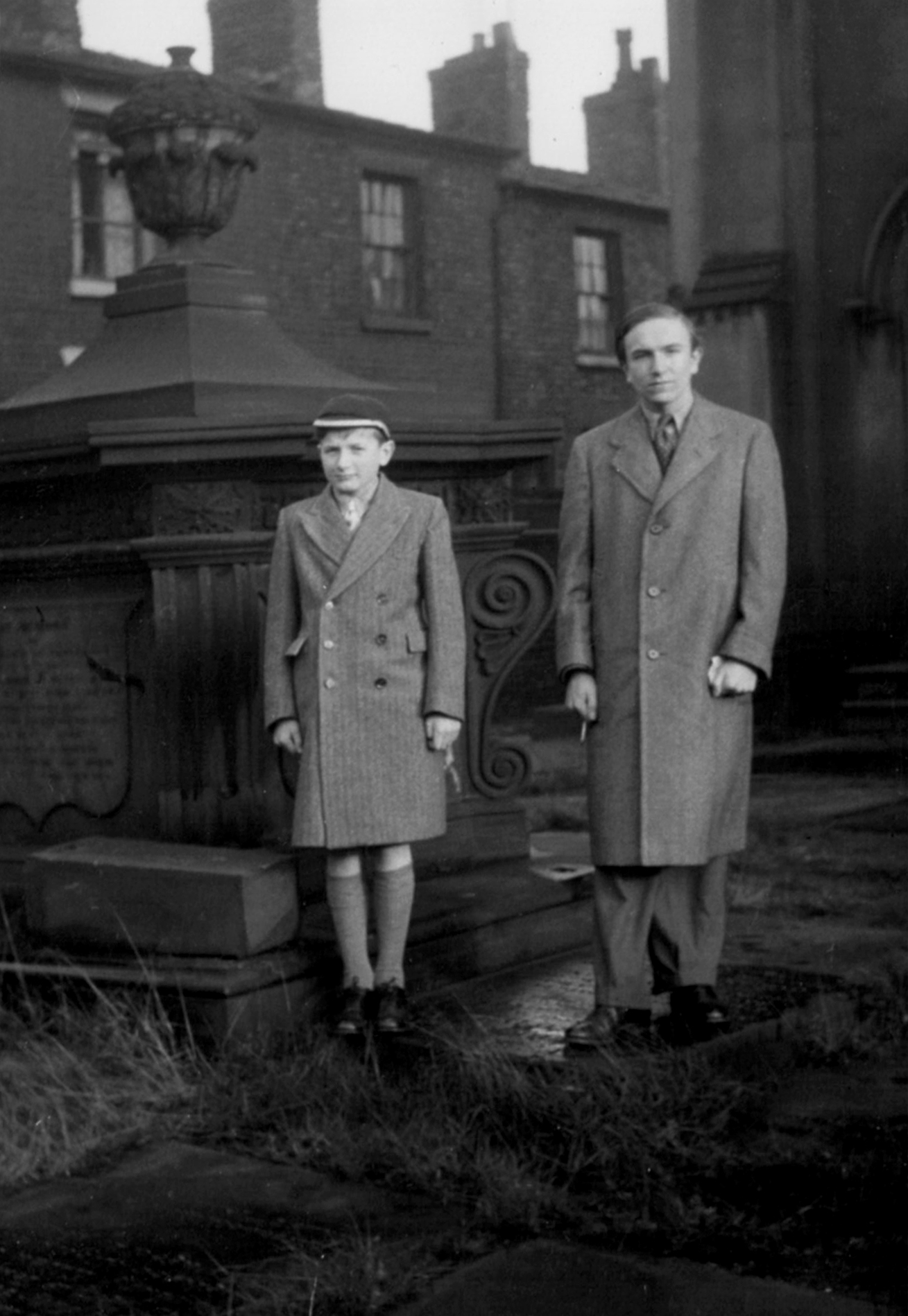
I am grateful to Stephen Bann who has identified the monument as the Bann Family vault:
Stephen Bann and his younger brother – many thanks for the text and photograph Stephen.
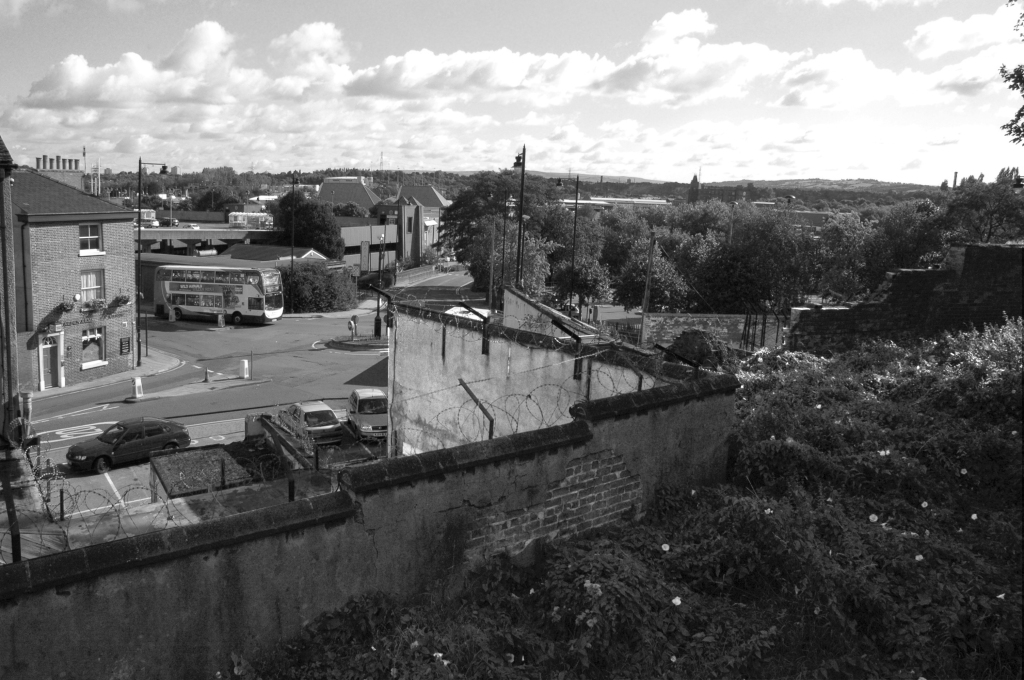
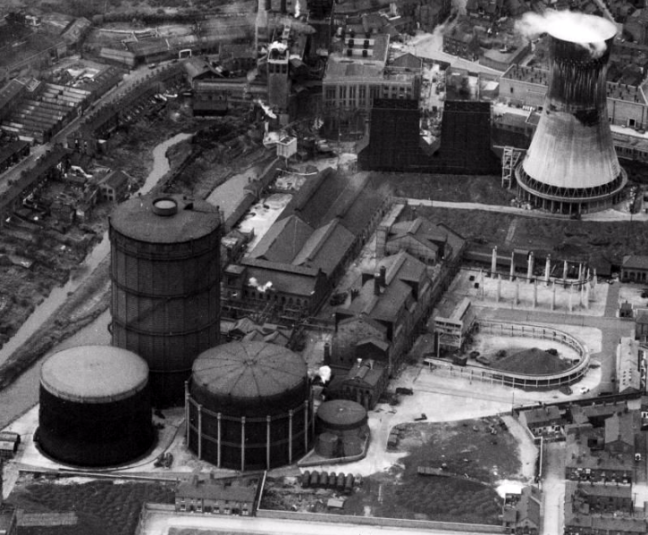
Her photograph was taken in Stockport 1967 – I first assumed it was taken from St Mary’s Church, looking toward the former power station.
I was mistaken.
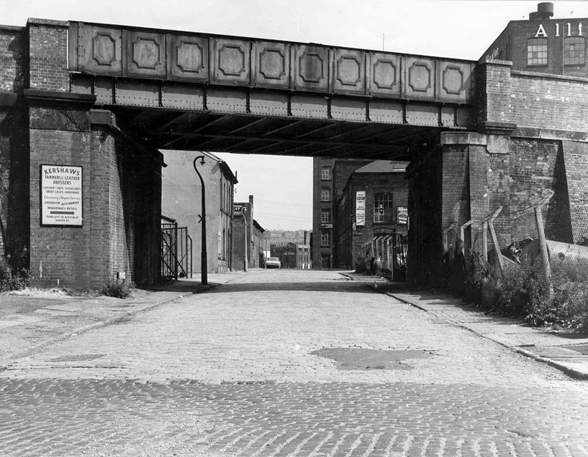
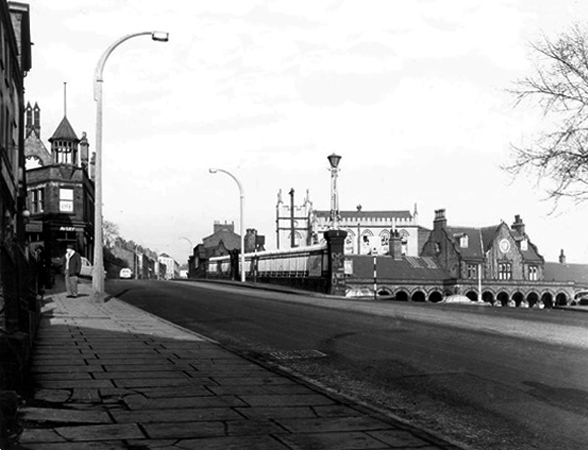
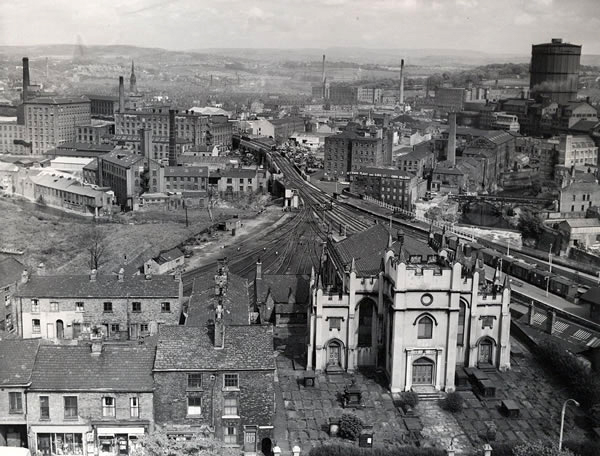
Using the Stockport Image Archive, I found the possible site, in this photograph of Tiviot Dale Station.
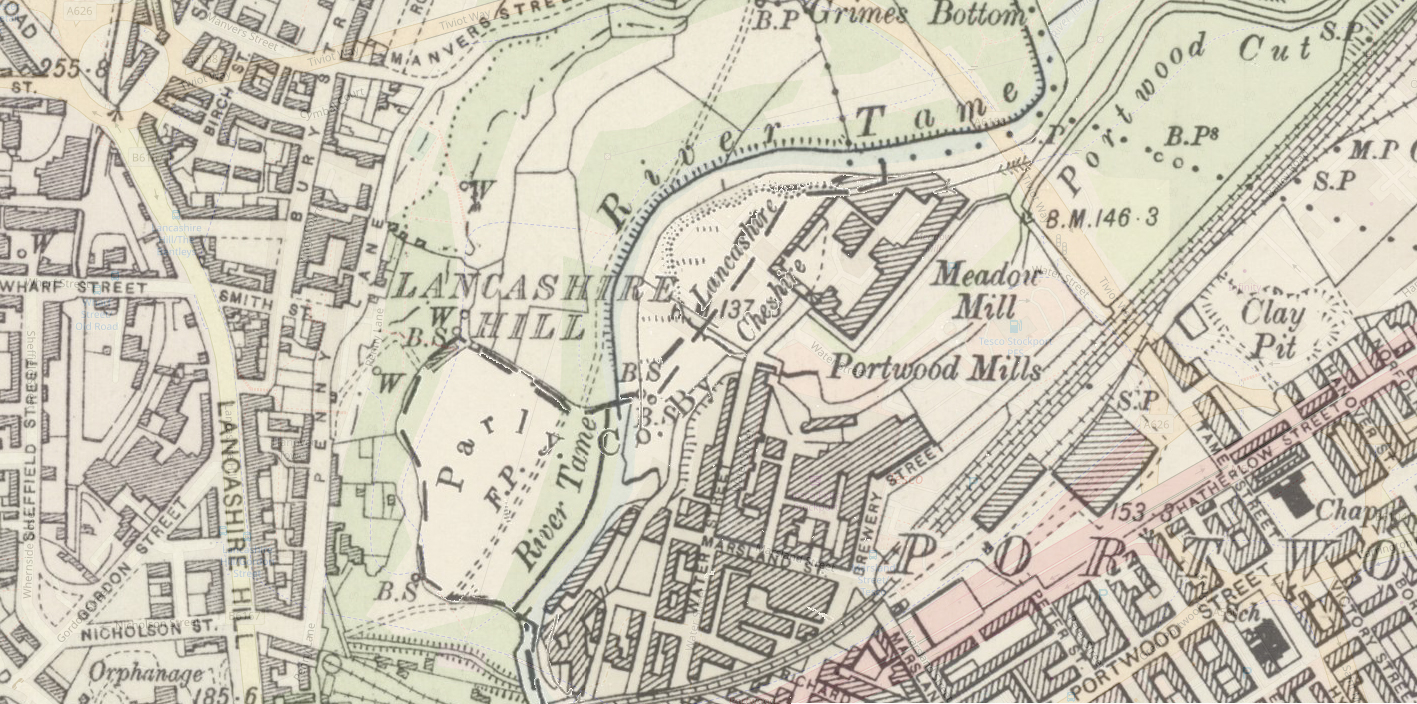
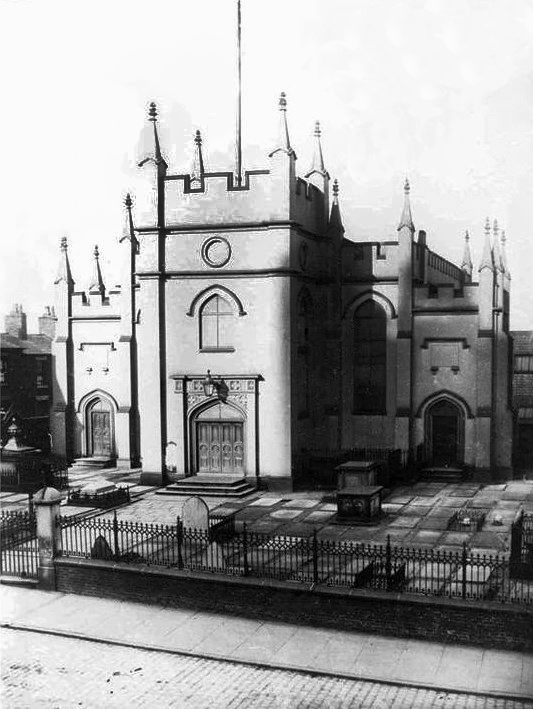
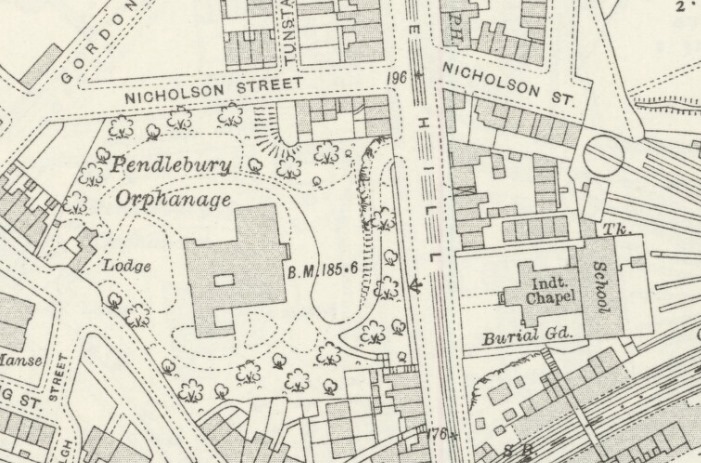
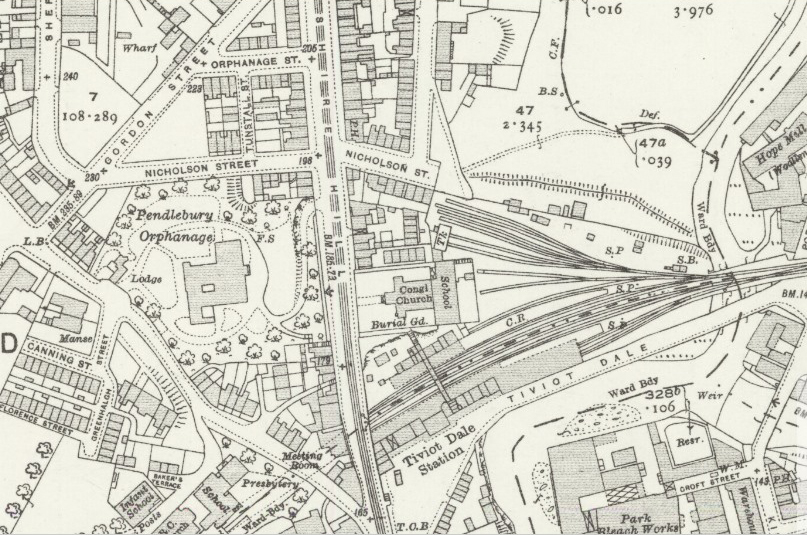
There on the eastern edge of Lancashire Hill – Hanover Chapel.
Seen here on the maps of 1917 and 1936.
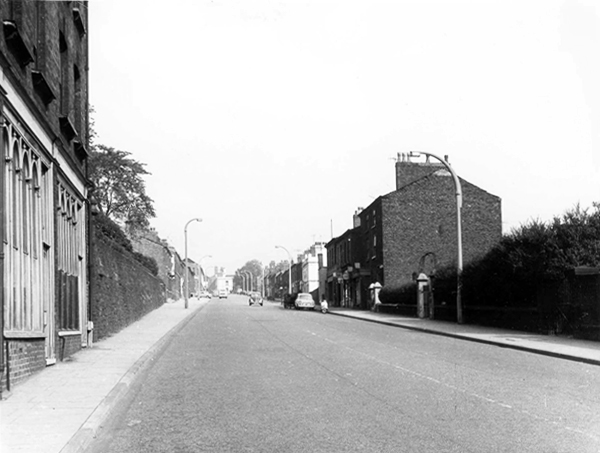
An area of intense activity, road, rail, housing and infrastructure.
Hanover Chapel closed 1962 – though we may assume from Shirley Baker’s photograph, that following its demolition the graveyard remained intact but untended.
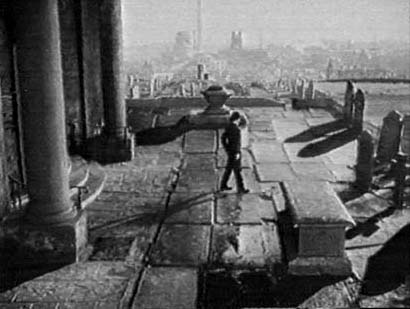
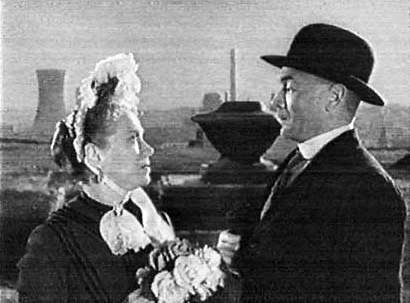
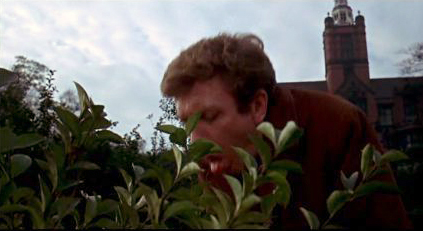
The chapel is thought be seen in the 1954 film Hobson’s Choice, directed by David Lean and starring John Mills, here awaiting his bride to be – the parish church of St Mary’s on the skyline.
Though closer examination reveals that this is not Hanover Chapel – where did those pillars come from?
Where are we, in a labyrinth of invention with a superimposed Stockport backdrop?
My thanks to Robert Collister for these observations.
Improbably out of time, the cooling towers are yet to be built, or blown up.
Here John is joined by Salford born Brenda Doreen Mignon de Banzie, playing Maggie.
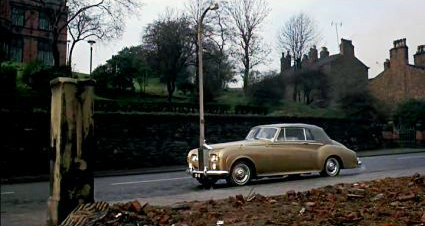
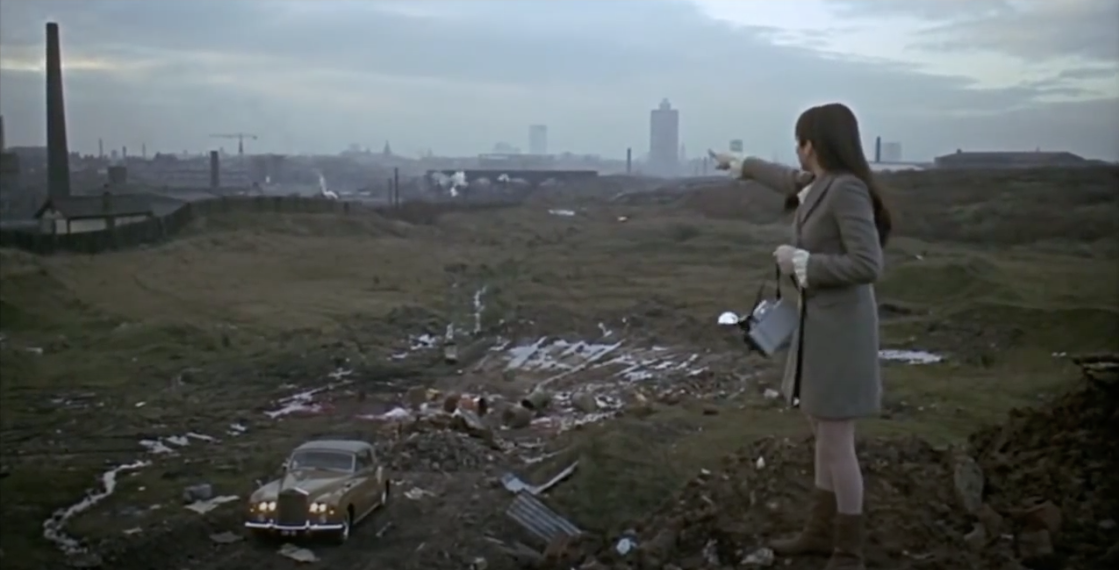
The demolished chapel rubble appears in the foreground of Albert Finney’s gold Roller CB 1E in Charlie Bubbles.
The film’s screenplay was the work of Shelagh Delaney, whose previous work A Taste of Honey also used local locations.
Where Finney has pulled up, feeling proper poorly.
As a serendipitous symmetry, Charlie Bubbles co-star Liza Minelli plays a photographer recording Salford’s disappearing streets.
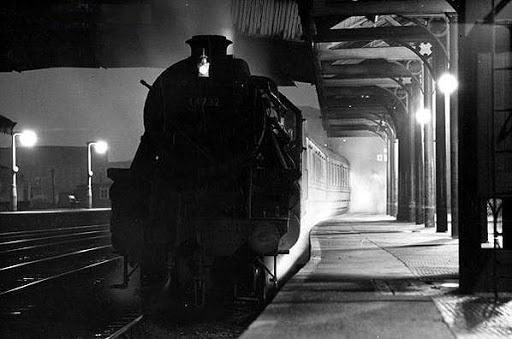
Bit by bit everything disappears, Tiviot Dale Station closed completely on January 2nd 1967.
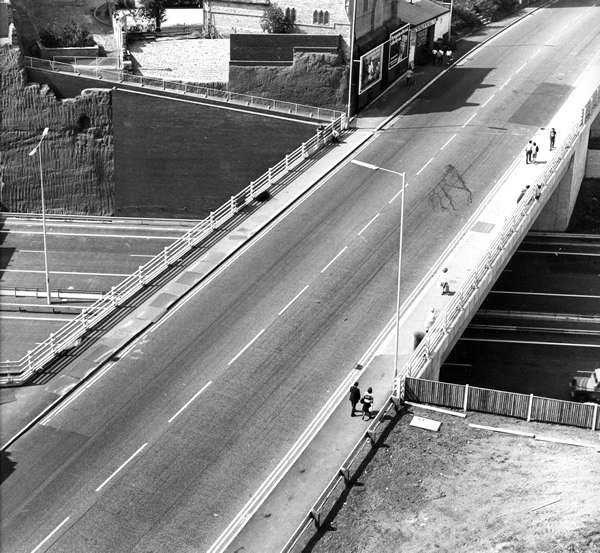
Where once there was a continuous run from the chapel to the town centre, the motorway has since intervened.
The Tiviot Dale pub on the right is no more, closed in 2013.
We had people from all parts of the country turn up on our final day,some of them brought their children who wanted to come because they remember the pub so fondly from their childhood. It was really humbling to see that our pub had touched so many lives.
I remember this pub as a Boddingtons house in the 1970’s. Excellent bitter served by handpump from small vault at the front and a larger “best room” behind, both very narrow given the width of the pub. The landlord employed an unusual method of ensuring everyone got a full pint; a half pint glass of beer was kept between the pumps and your pint was topped up from the half which was constantly replenished to keep it fresh. I have not seen this practice in any other pub.
Phil Moran
When’s the next tram due?
Millgate Power Station operated until 1976.
At the adjacent gas works – gas holder number three was dismantled in 1988, gas holders one and two were removed in 2019.
The nature of infrastructure, housing and industry has changed radically.
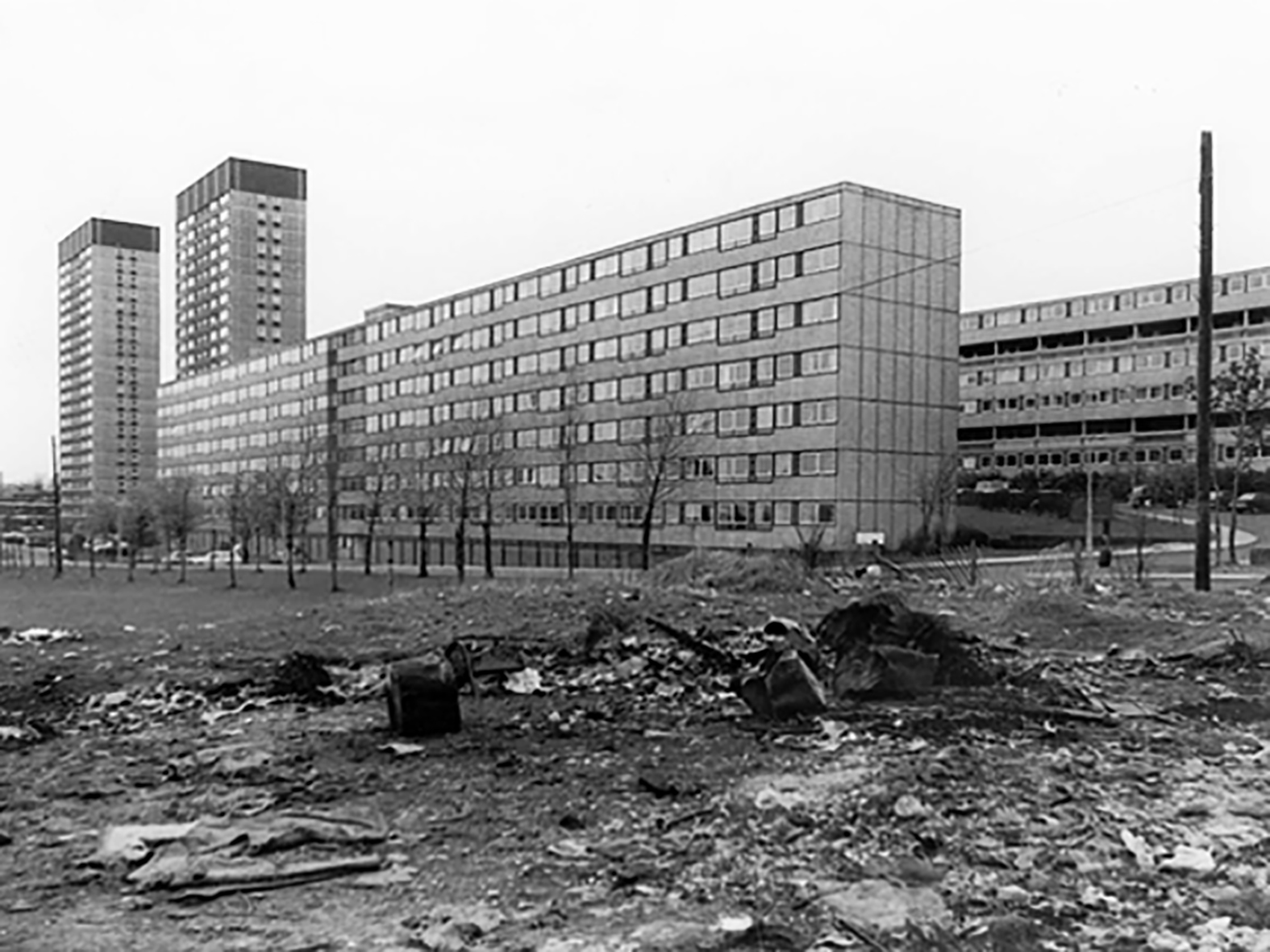
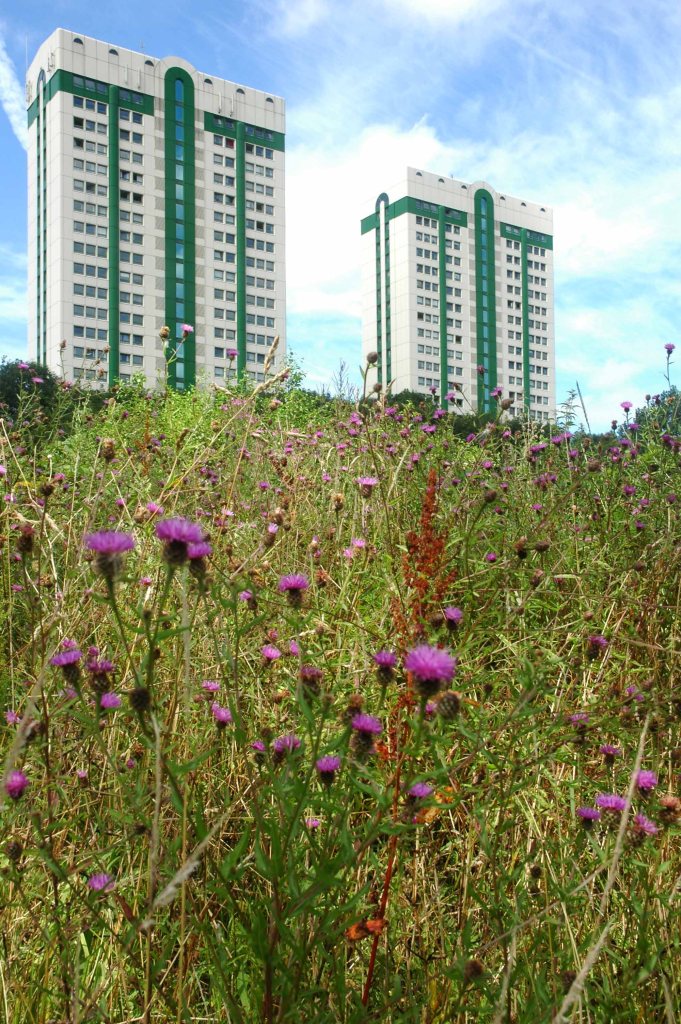
Lancashire Hill flats were built in the 60s, designed by City Architect JS Rank, two seven storey blocks containing 150 dwellings; two six storey blocks containing 120 dwellings.
Replacing tight rows of terraced housing.
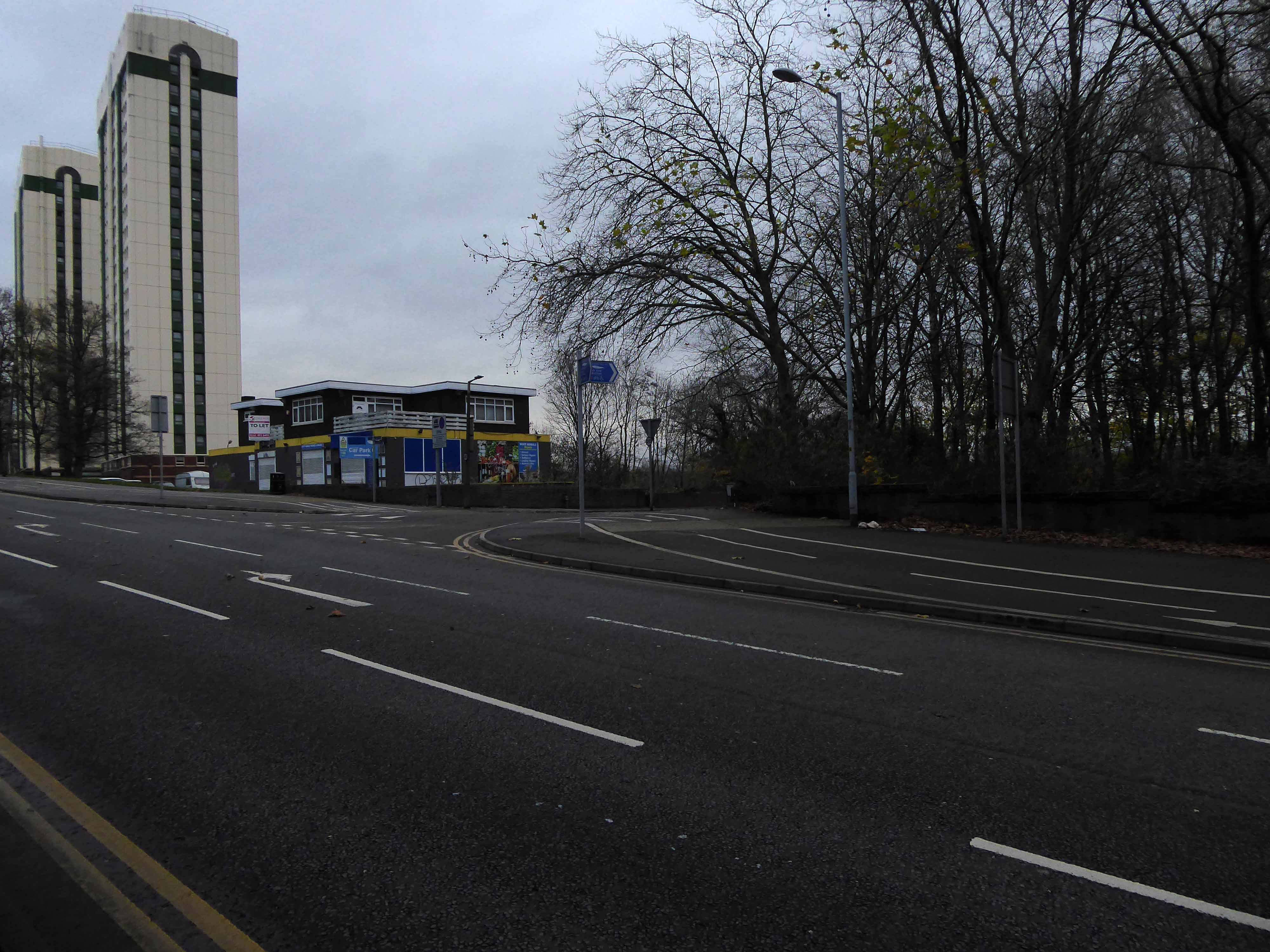
They themselves clad and revamped.
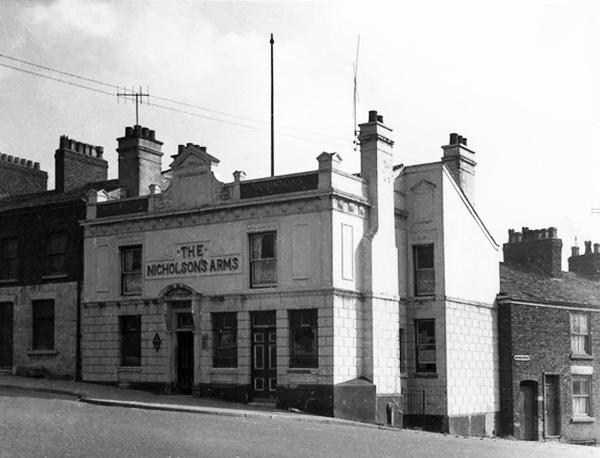
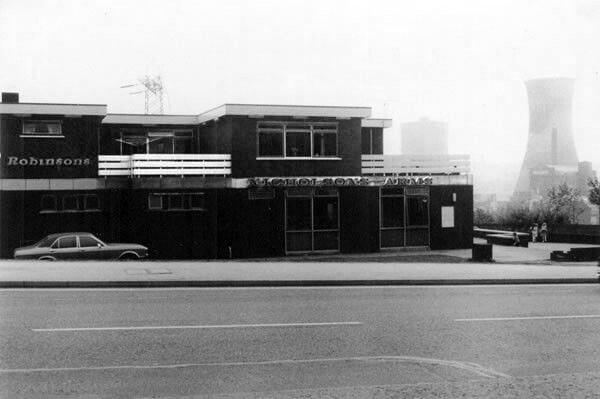
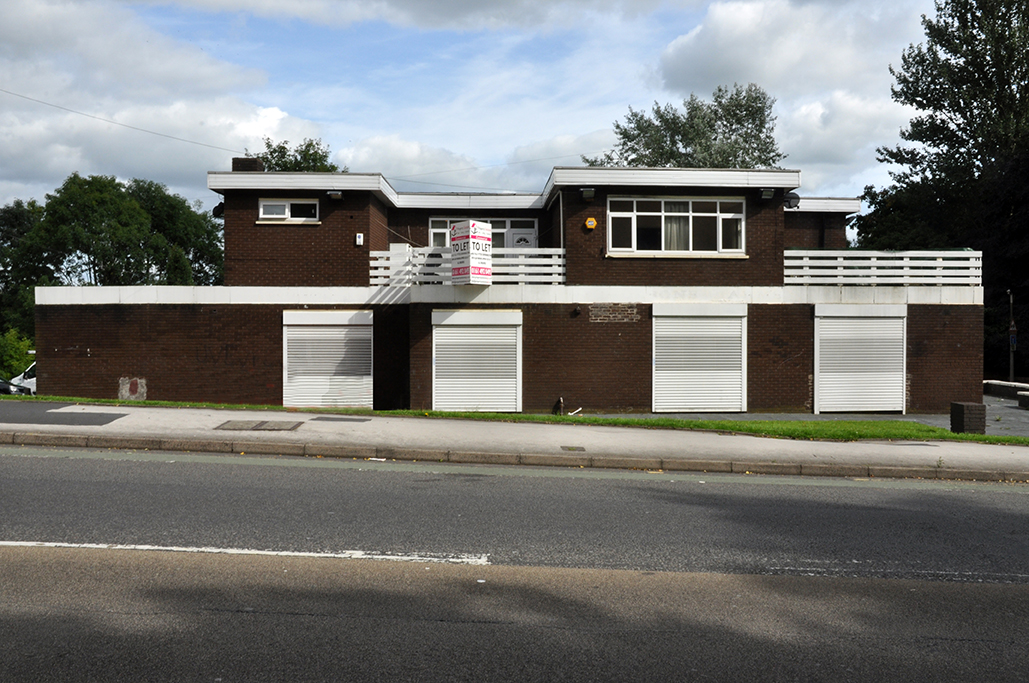
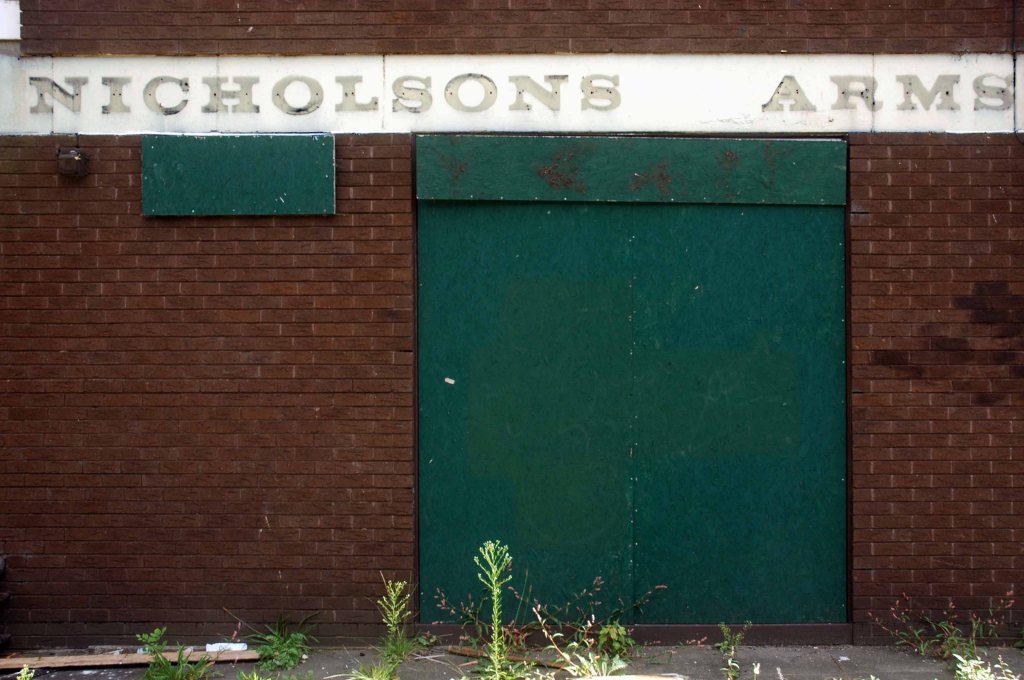
The Nicholson’s Arms built to serve the flats closed and currently empty, signs say to let – replaced an earlier pub, sited on the corner of long gone Nicholson Street.
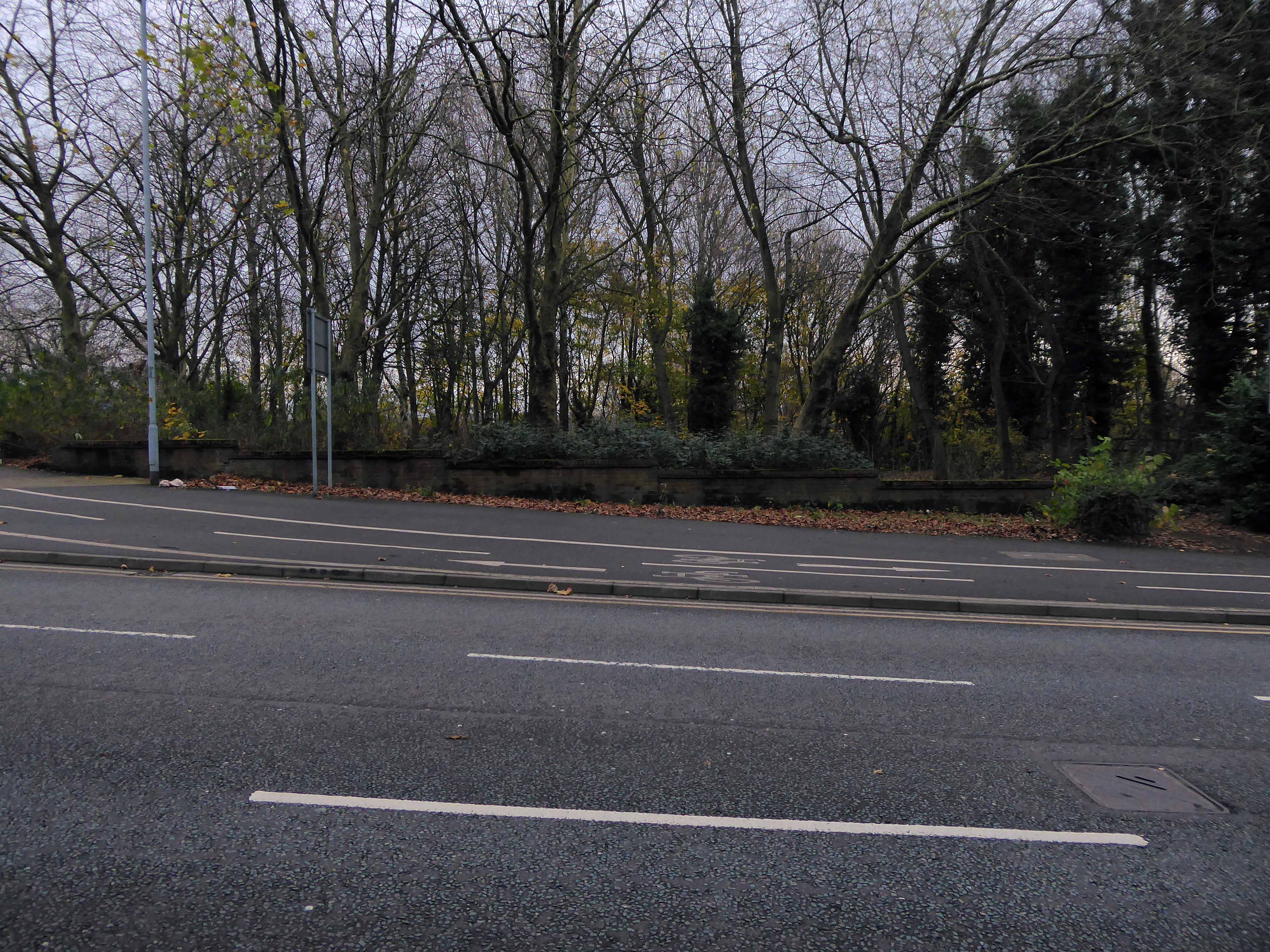
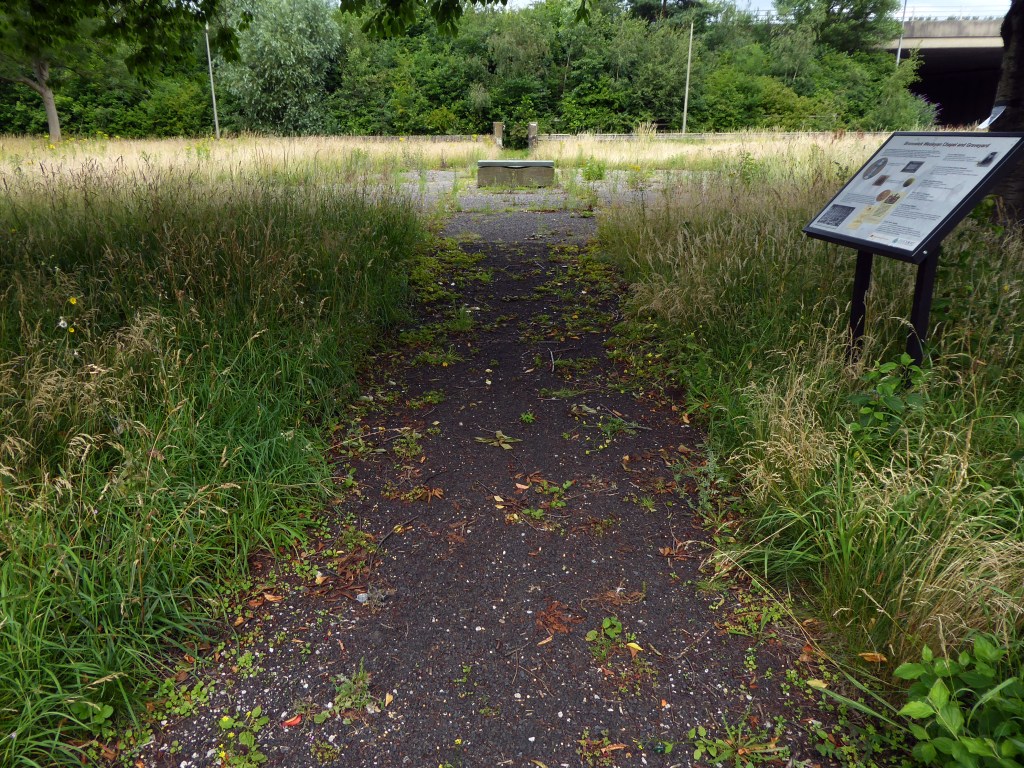
Today from the road there’s simply no trace of the site’s past purpose.
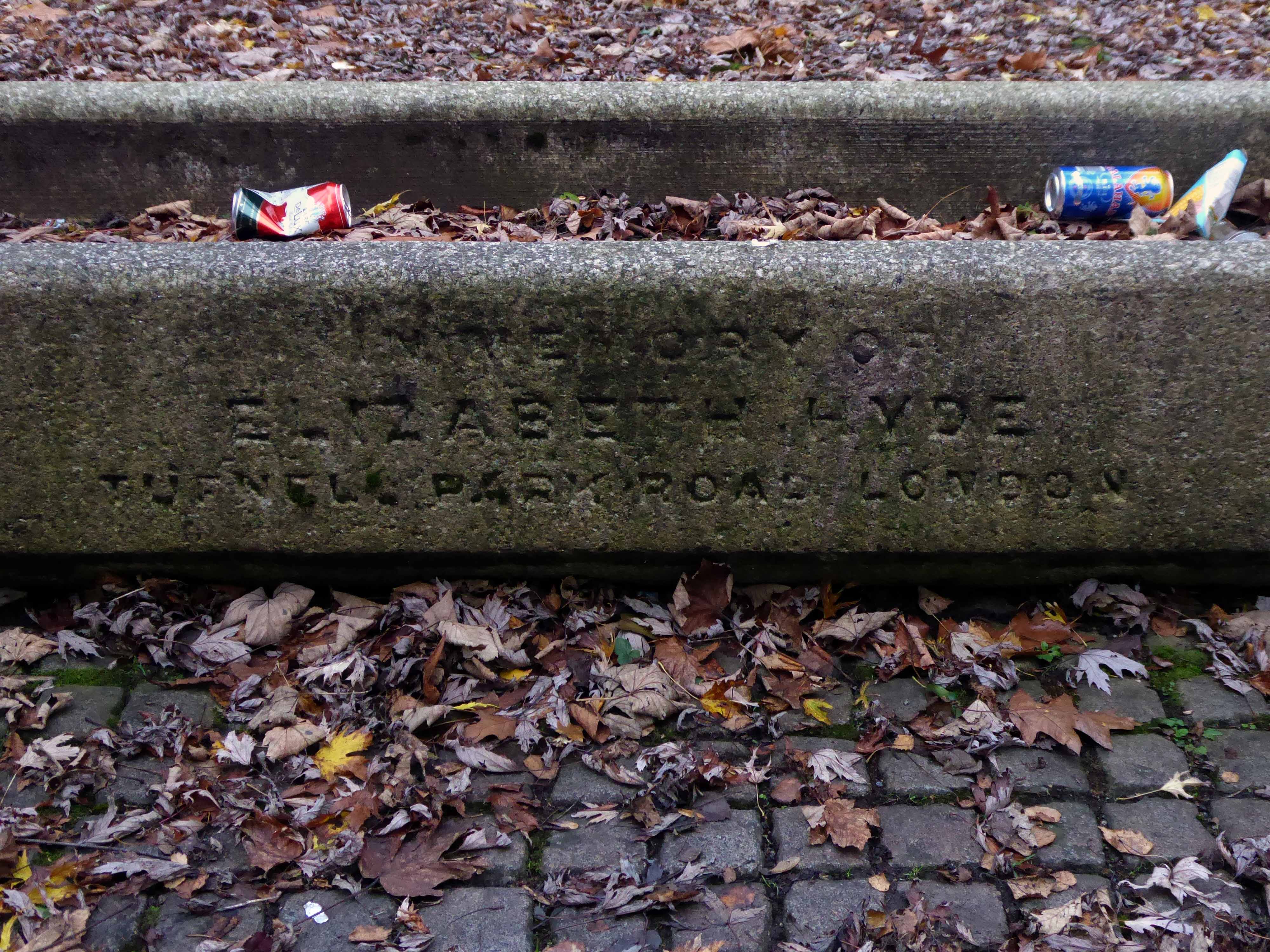
At the centre of what is now a compact civic grassed area – a trough.
Incongruously in memory of Elizabeth Hyde of Tufnell Park Road London.
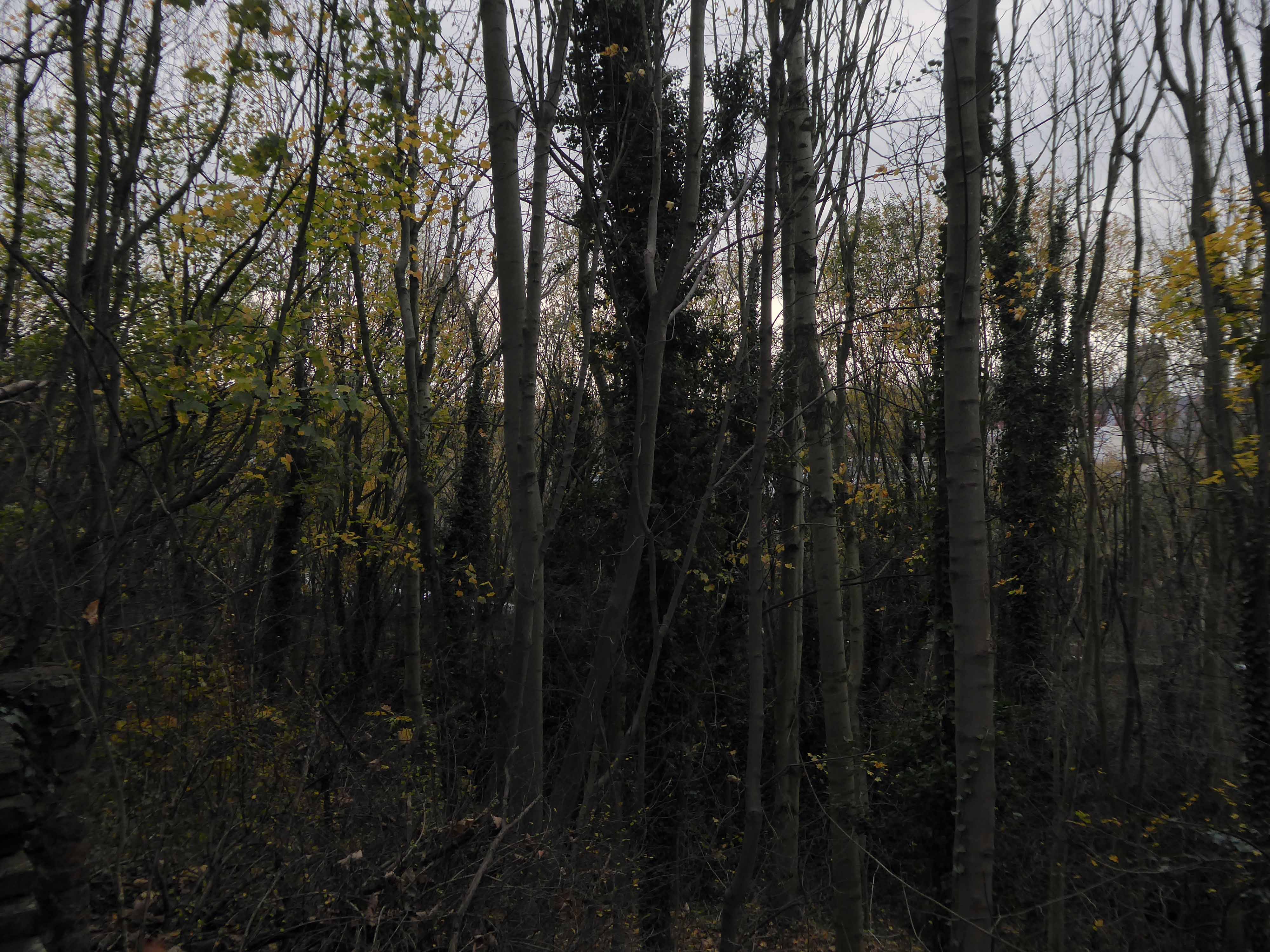
The dense stand of trees is impenetrable – no longer a view of the non existent power station and beyond.
And they that shall be of thee shall build the old waste places: thou shalt raise up the foundations of many generations; and thou shalt be called, the repairer of the breach, the restorer of paths to dwell in.
Isiah 58:12
As a footnote I did meet brothers Stephen, Derek and Peter who appeared in this Shirley Baker photograph 55 years ago – she promised them an ice cream each – they never ever received an ice cream.
They are seen in Sunnyside Street Ordsall – long since demolished.
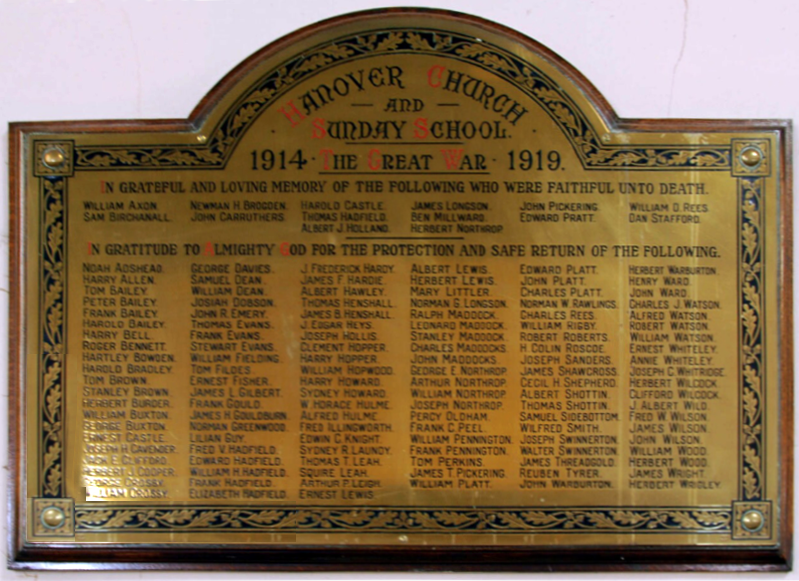
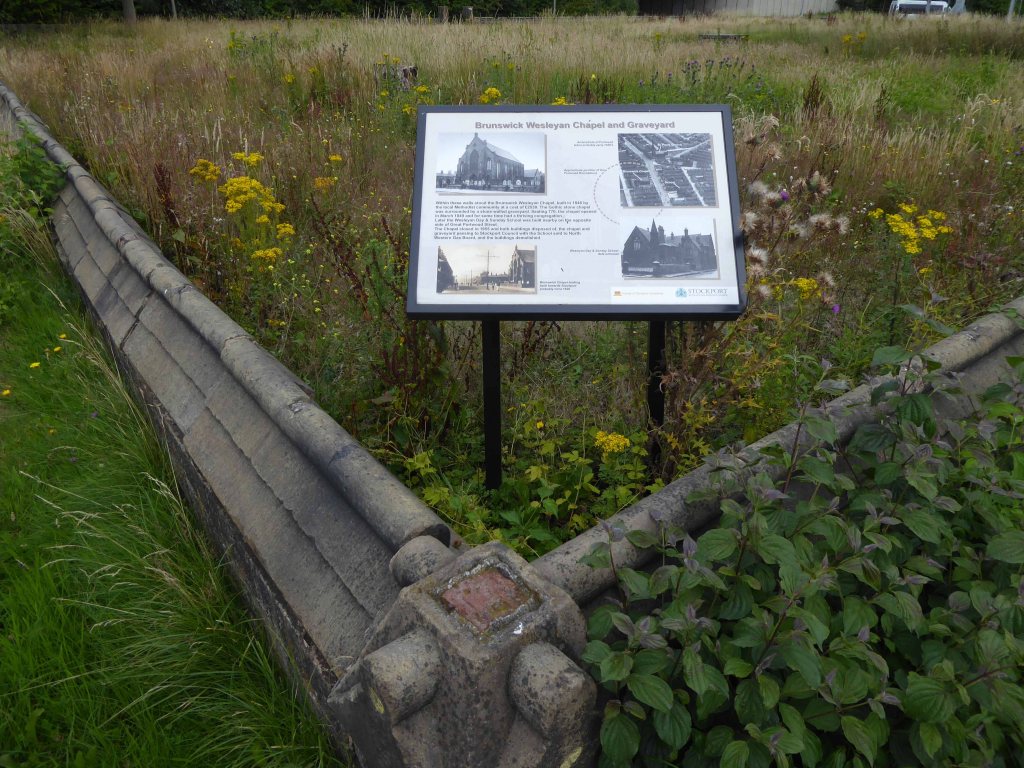
A commemorative plaque from the Chapel still exists, sited now on the wall of Wycliffe Congregational Church Georges Road Stockport.
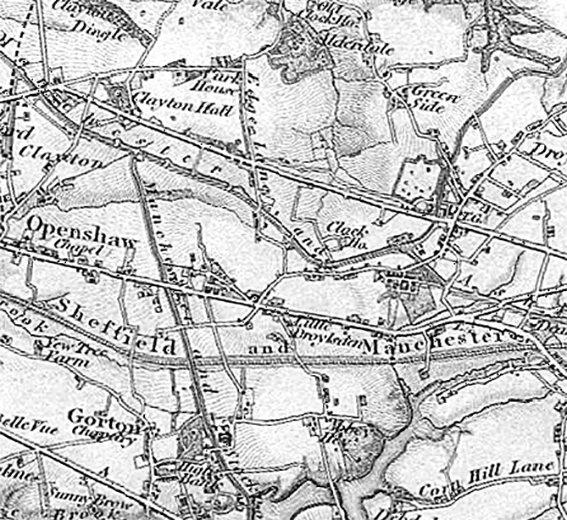
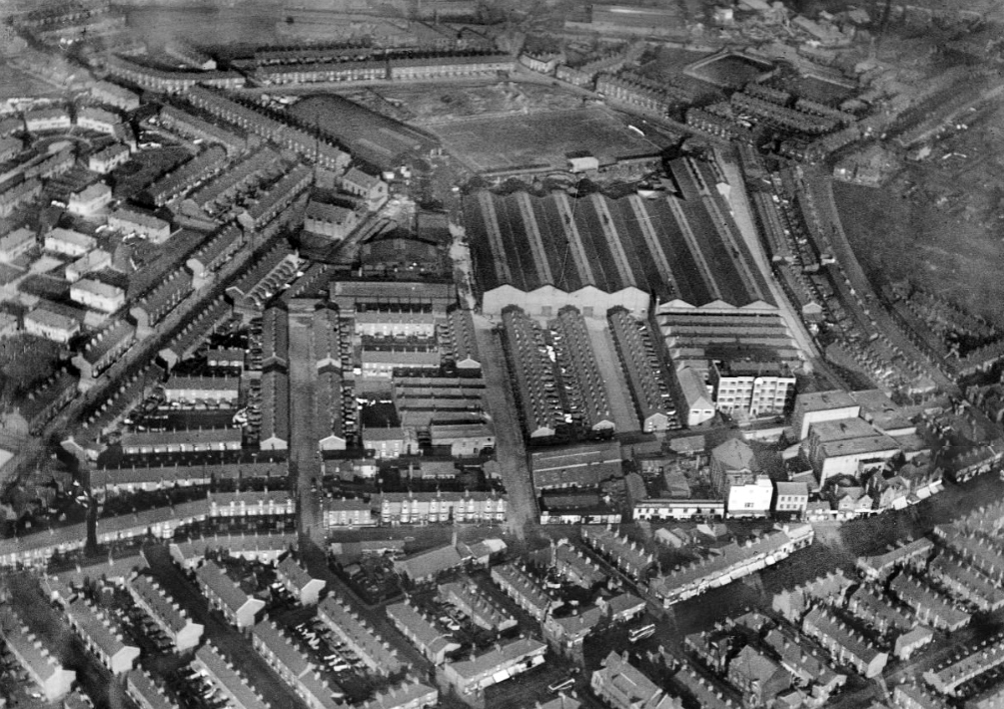
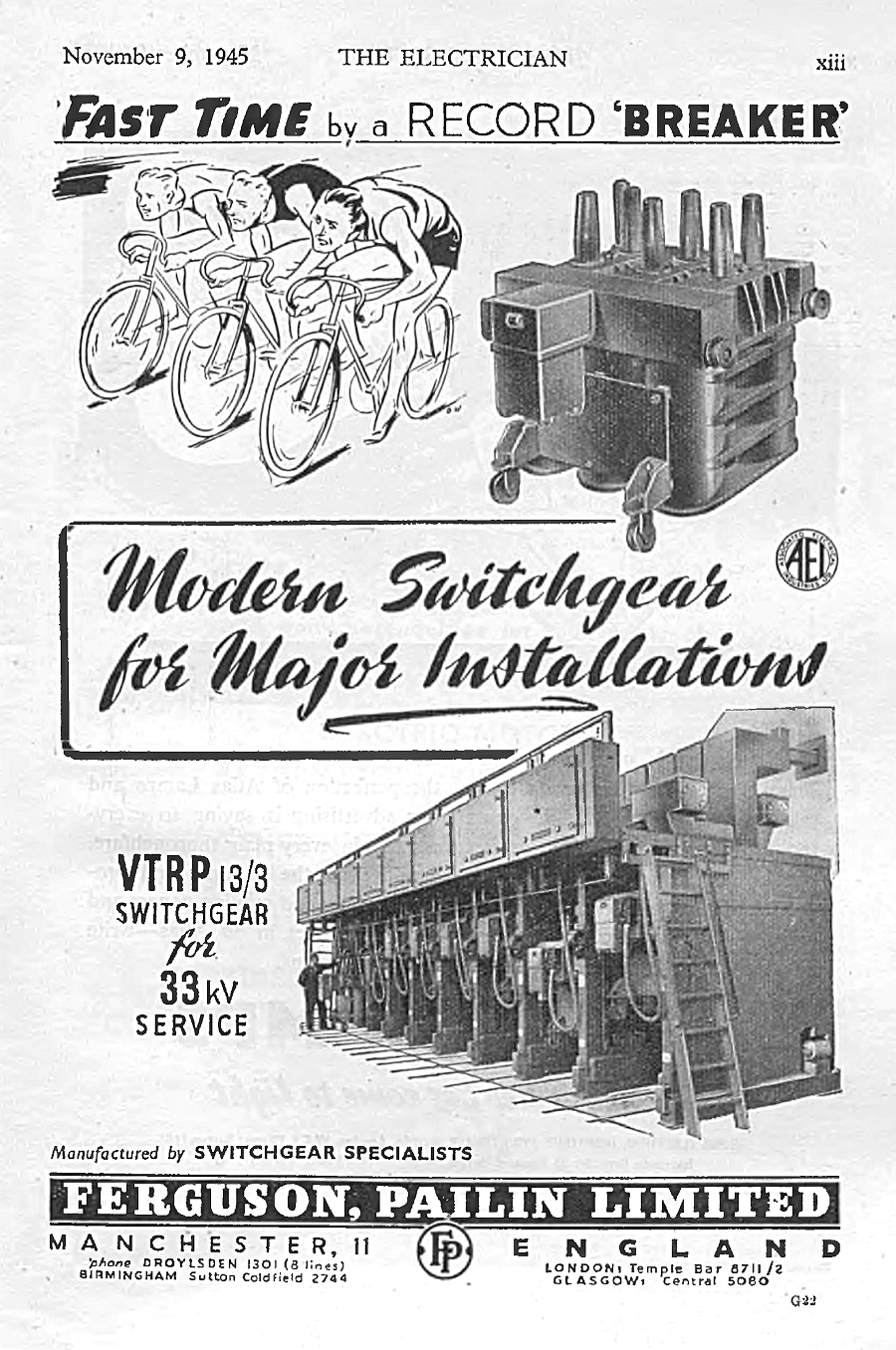
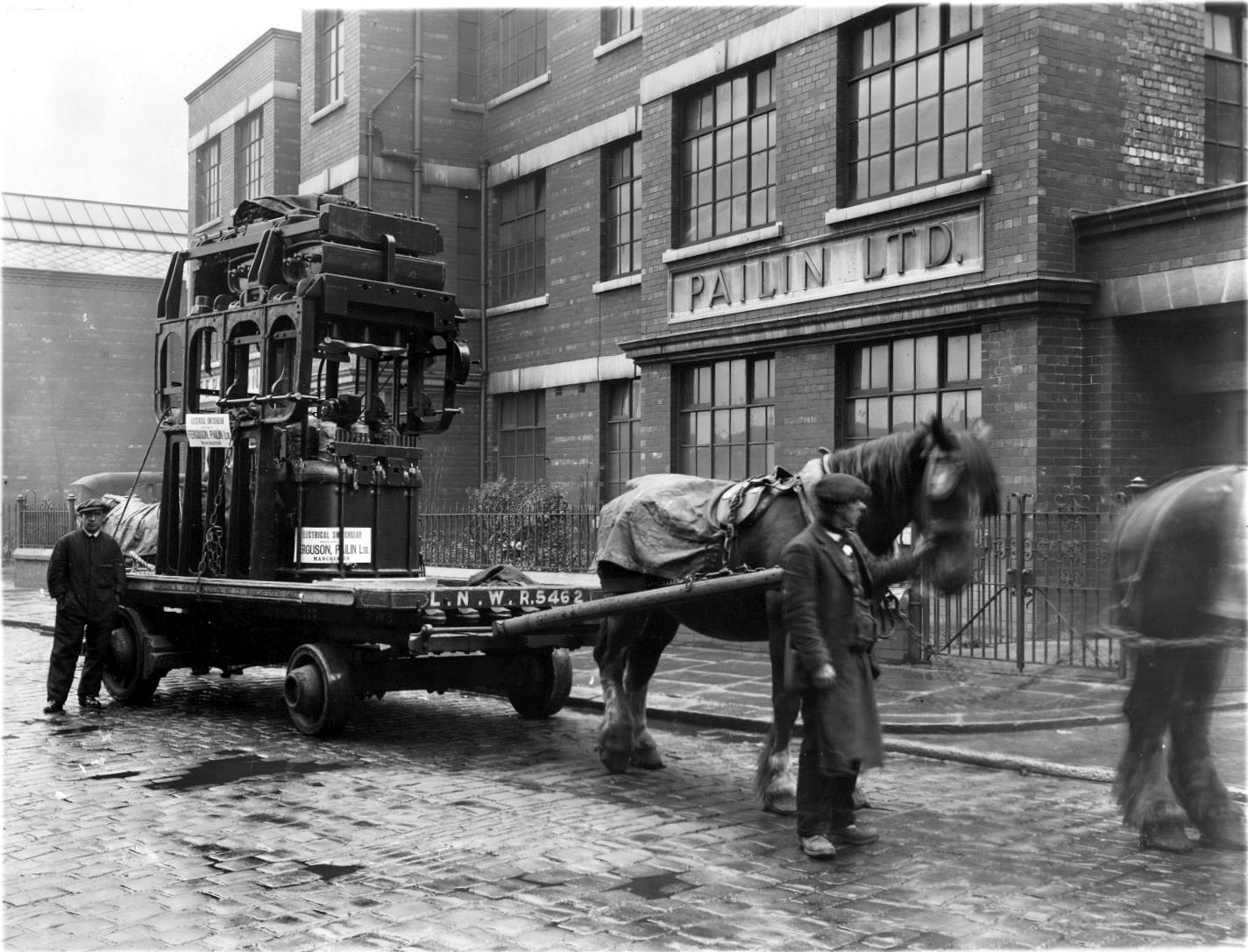
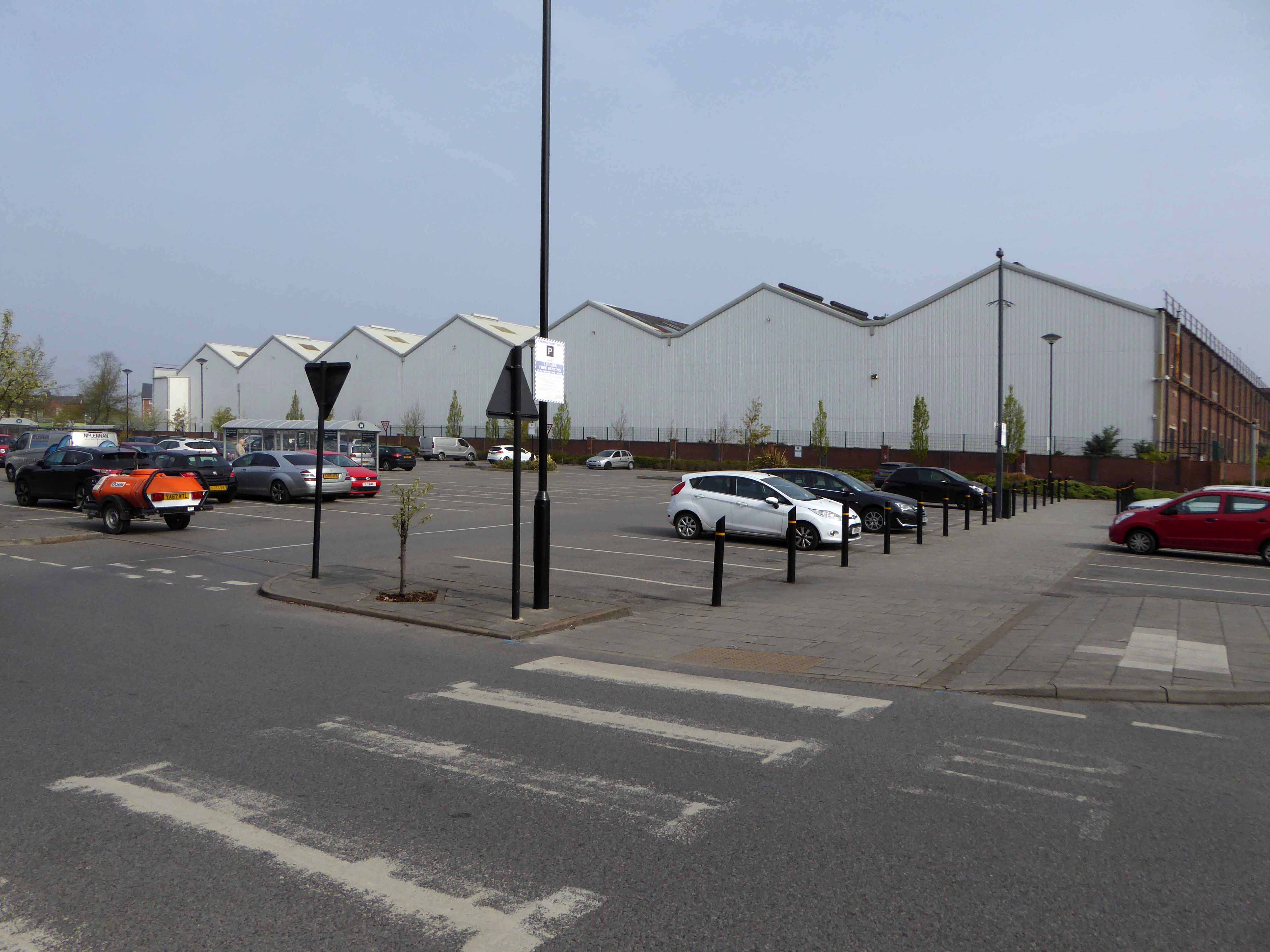
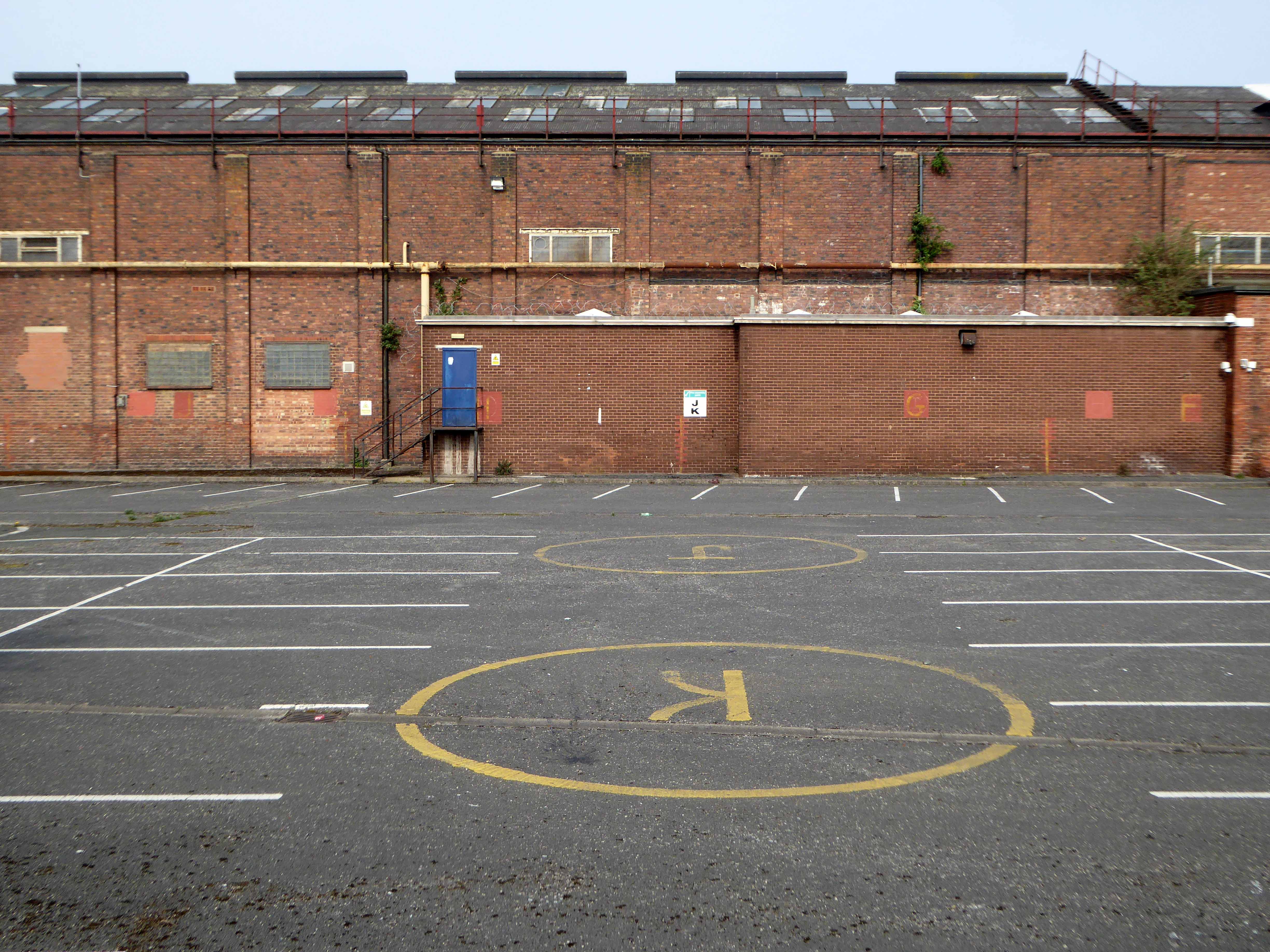
Ferguson Pailin Electrical Engineering are established in 1913 on Fairfield Road/Edge Lane.
By 1939 the factory is fully formed and the area a dense warren of industry and terraced housing.
Makers of heavy duty electrical switchgear and general electrical engineers, of Higher Openshaw, Manchester.
1913 Ferranti Ltd sold its switchgear patents and stock to Ferguson, Pailin Ltd. Samuel Ferguson and George Pailin had worked for Ferranti as switchgear engineers. They left in 1913 to set up their own switchgear business at a factory in Higher Openshaw, Manchester.
The company was acquired by Associated Electrical Industries (AEI) in 1928. Following the restructuring of AEI in 1960, Ferguson, Pailin & Co ceased to be a separate subsidiary and was merged into AEI switchgear. Following the takeover of AEI by GEC in 1967, the Higher Openshaw works became part of GEC Switchgear. In 1989, GEC merged its electrical engineering interests with those of Alsthom to form GEC Alsthom. The factory was later closed by Alstom in 2003, with most of the employees finishing on 22 November 2002.
The company has a Facebook page which shares former employees memories – from which these archive photographs were taken.
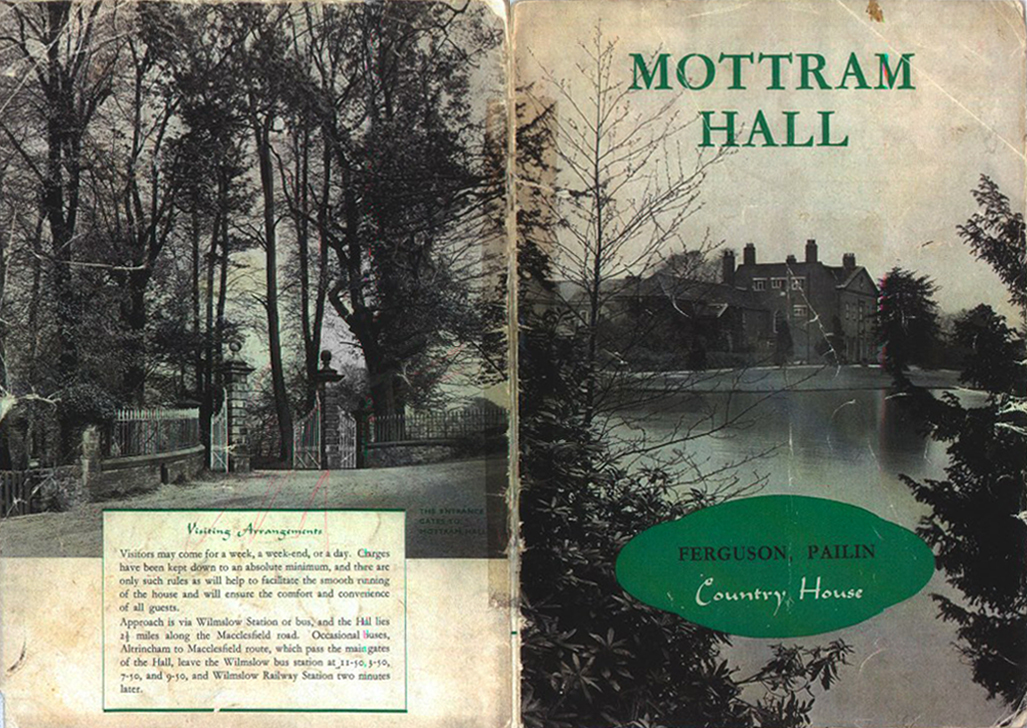
Notably the firm provided extensive leisure facilities for their employees.
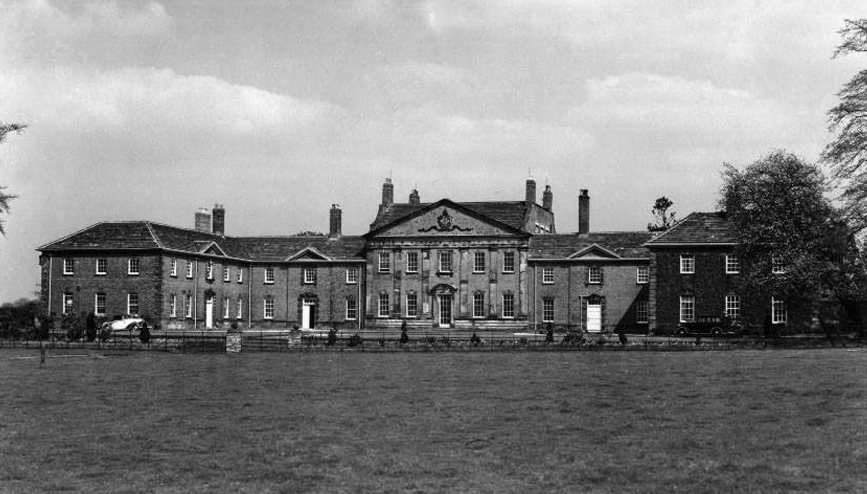
The company acquired Mottram Hall to give employees an opportunity to go on affordable holidays during World War II. The company bought three properties in 1939/40 in order to provide holidays for staff and workers during the war. Mottram Hall was bought for the works, a small hotel in Llandudno for the middle level staff and a property in Criccieth for senior staff. Mottram Hall was sold as surplus to requirements by GEC in 1968 and is now a luxury country house hotel.
Sadly the days when benevolent employers thought to take care of their employees in such a manner, are largely a thing of the past.
For business guests, our sleek and sophisticated conference rooms feature the latest technology to get your agenda off to a prompt and professional start. Plus, catering facilities and a plush break out space for comfortable downtime between meetings.
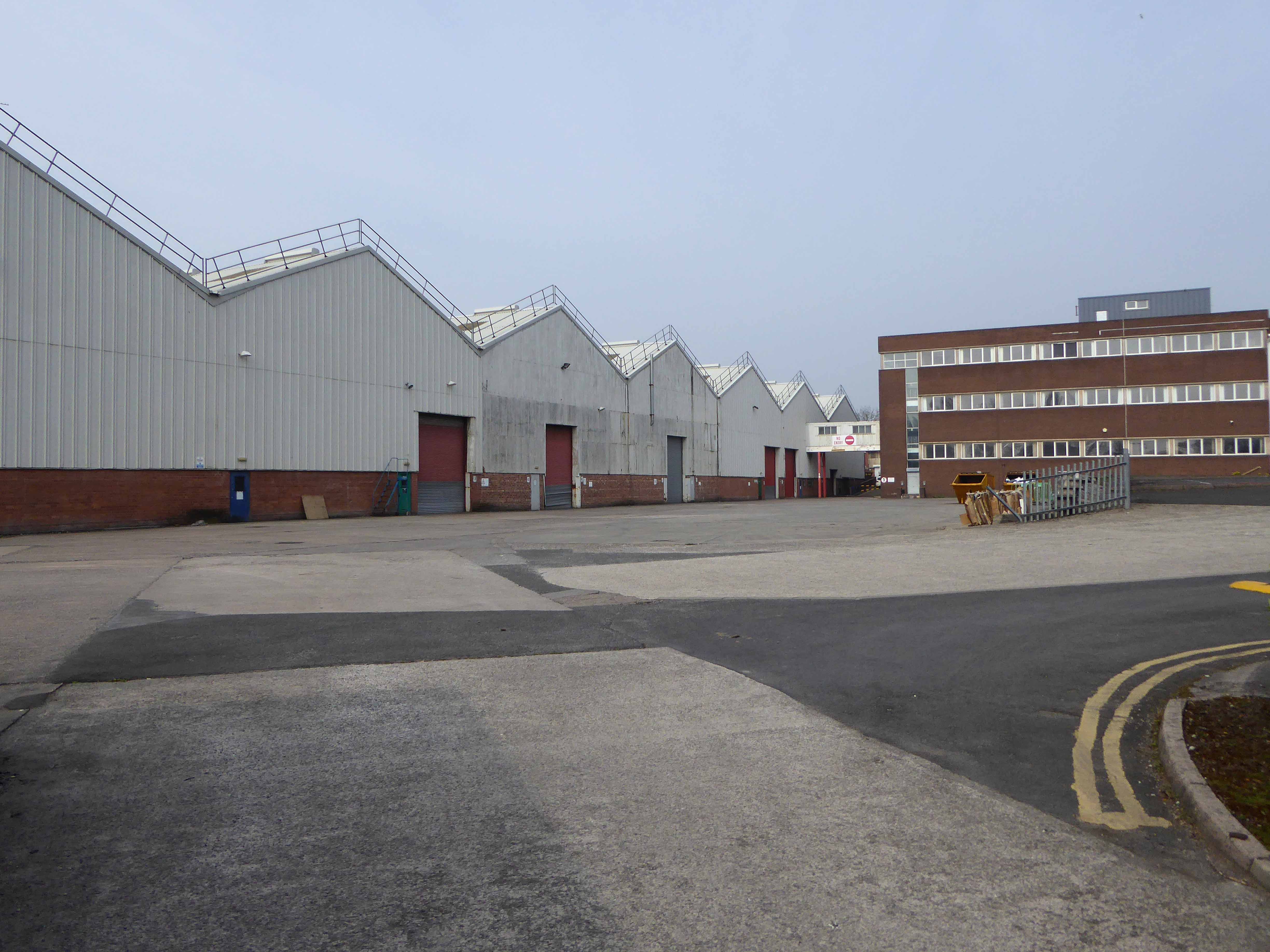
Last time I passed through many of the factory buildings were still extant though underused. A portion of the site lost to the development of the Lime Square Shopping Centre.
Lime Square is a shopping destination which is helping to put the heart back into Openshaw district centre here in east Manchester. Lime Square is home to the stunning Steamhammer sculpture and a host of great High Street names.
By and large replacing the plethora of busy local businesses which once thrived in the area.
Part of the site became the site of a car park for B&M Bargains.
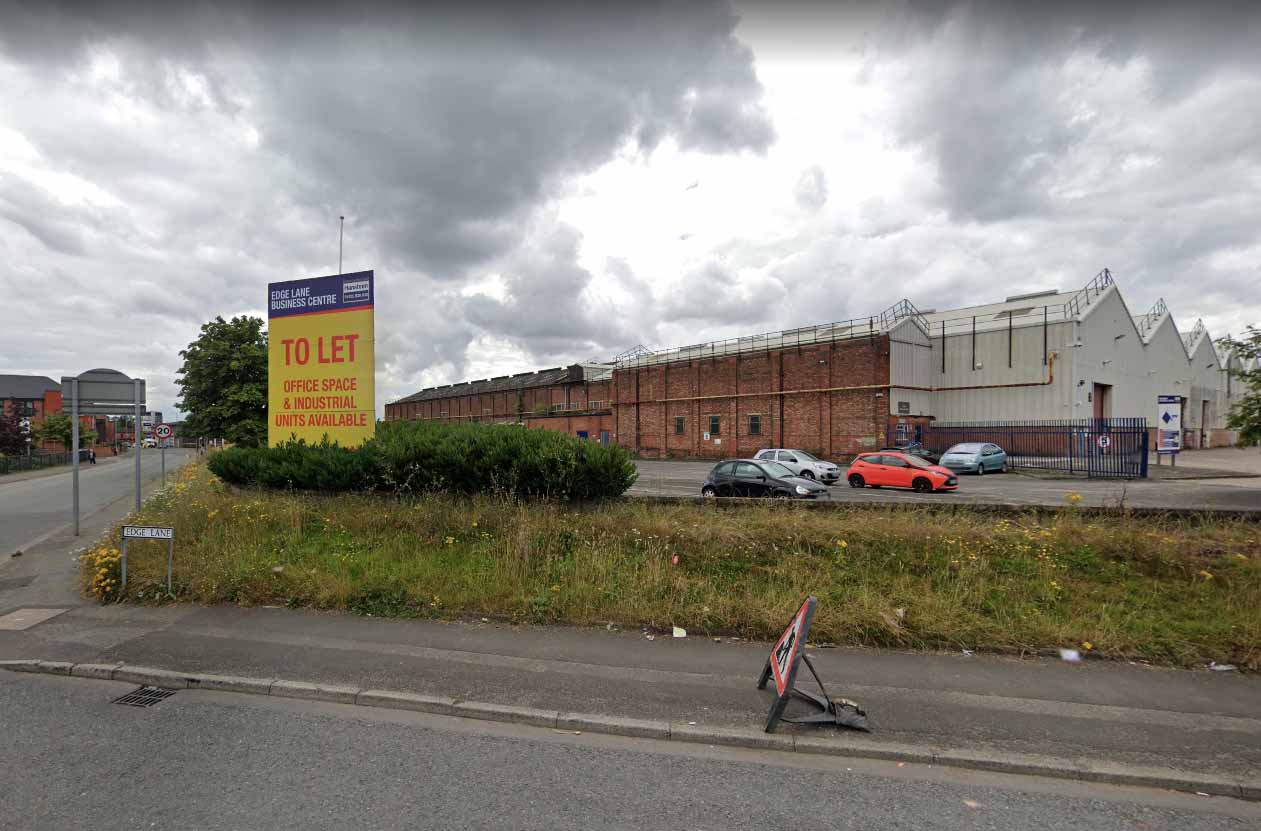
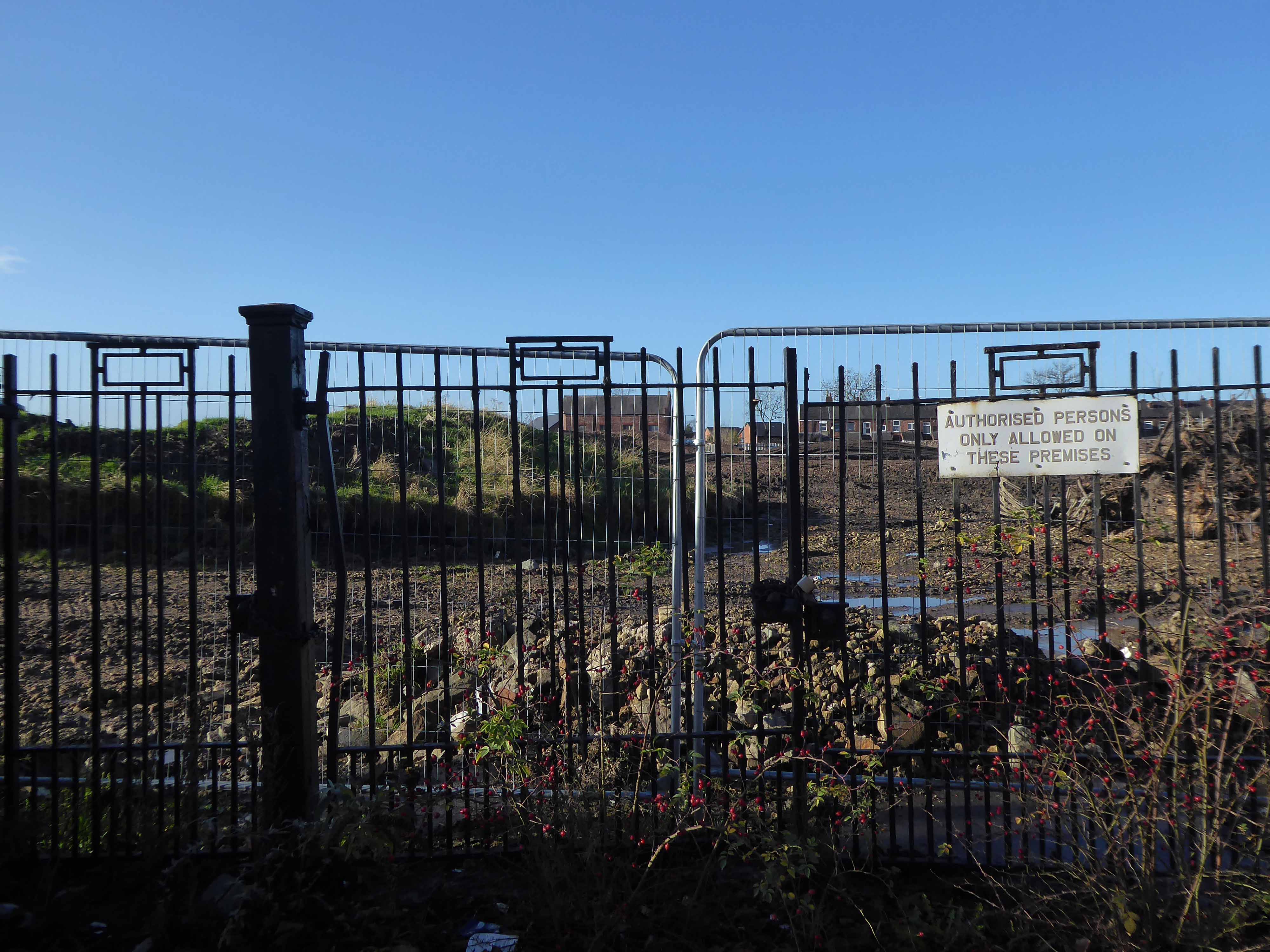
Empty car parking and to let signs in superabundance.
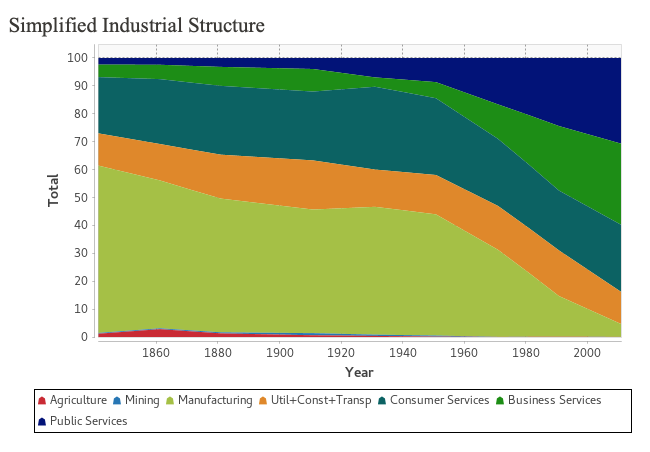
So there we are the end of an era – the decline in manufacturing, the structure ending life as an empty warehouse.
But wait, what’s all this?
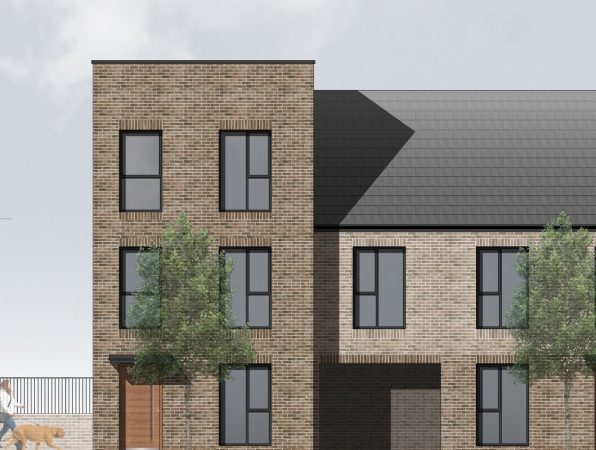
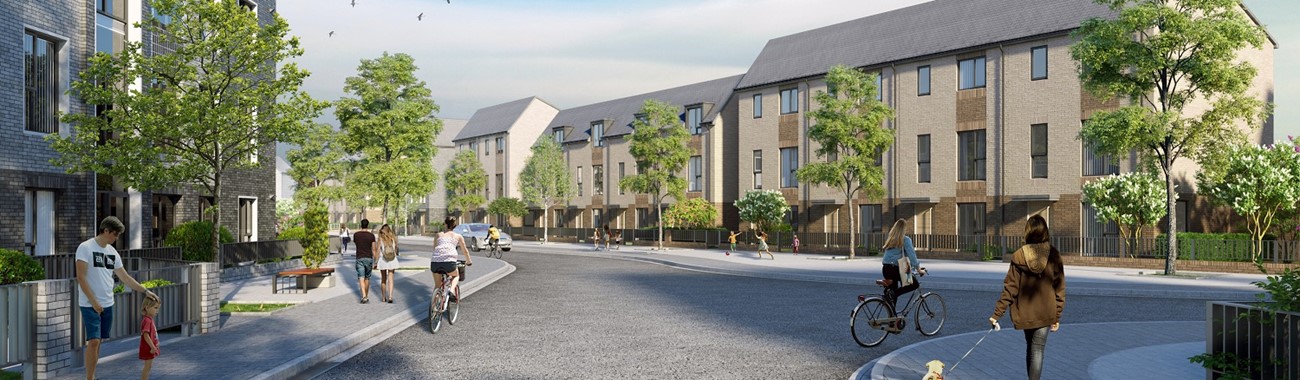
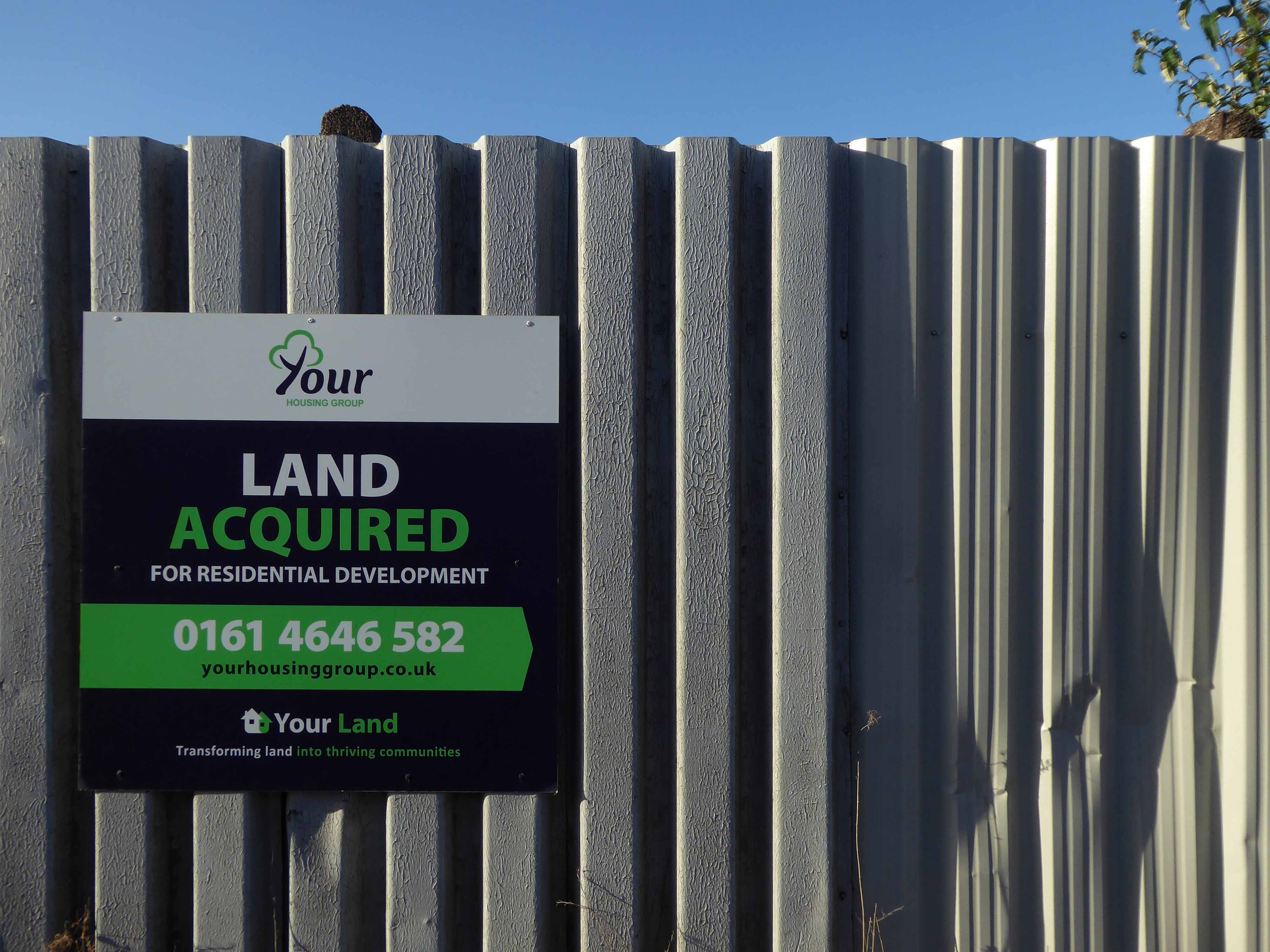
Your Housing Group, the Warrington-based affordable housing provider, wants to build a residential scheme on the site of a former warehouse on Edge Lane, with work starting this summer subject to consent.
The project in Openshaw comprises 216 homes available on a mix of tenures, according to a planning application submitted to Manchester City Council. A total of 72 will be for sale as shared ownership schemes, another 72 will be for private rent, and 72 will be for affordable rent.
So there we are another phase of development for one small area of Manchester, should you change to pass, just spare a moment to recall those thousands of souls that laboured their whole working lives – right here on Fairfield Road and Edge Lane.
There comes a time in everyone’s life, when one simply must go to Rotherham, at least once – so I did.
To keep company with my personal town guide, Sheffield Modernist and local resident, Helen Angell.
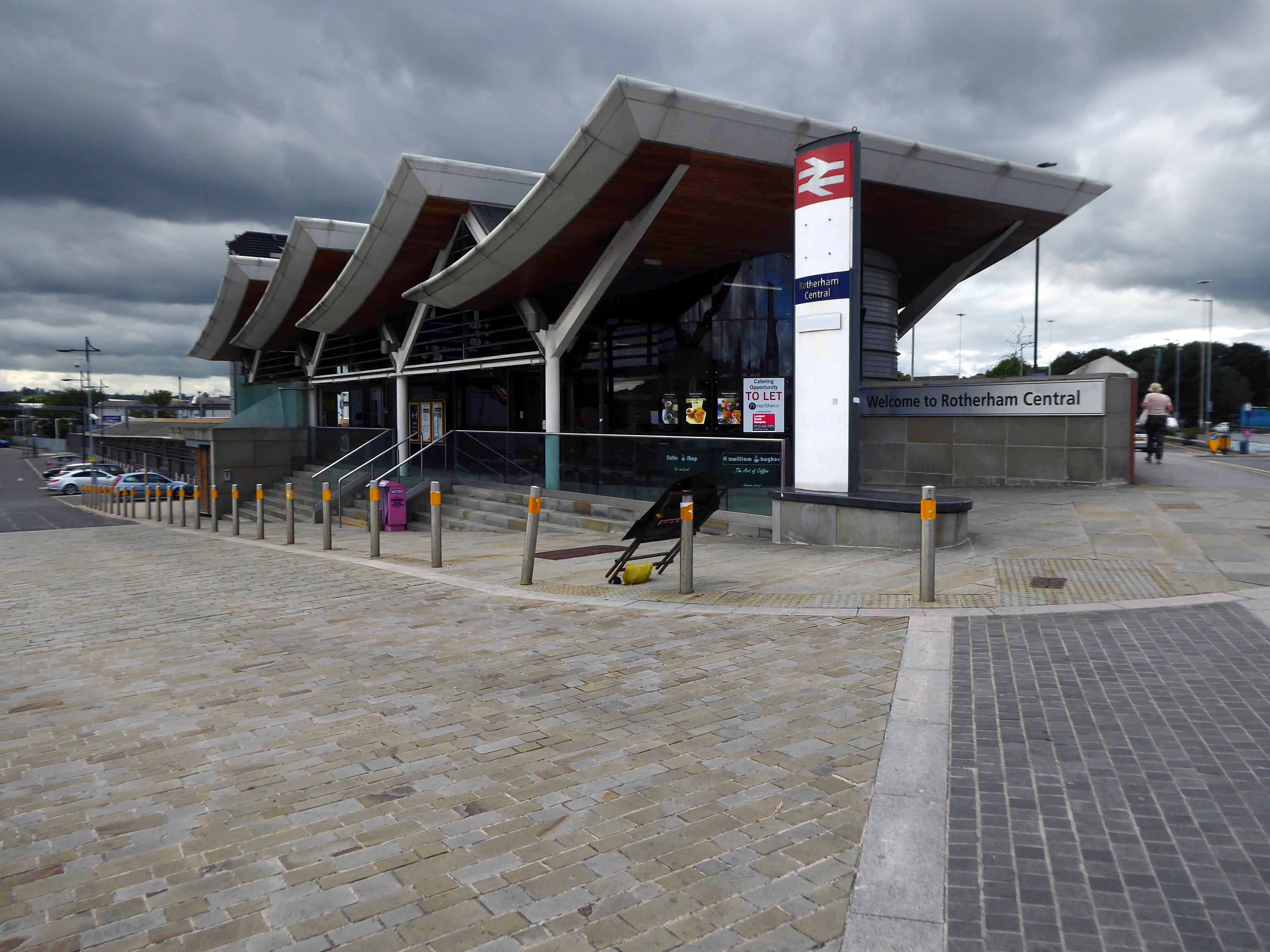
I arrived early at Rotherham Central, so went for a solo wander.
The station was originally named Rotherham, becoming Rotherham and Masborough in January 1889 and finally Rotherham Central on 25 September 1950.
The newish Rotherham Central station was opened to passengers on 11 May 1987, the present iteration on Friday 24 February 2012, as part of the Rotherham Renaissance plans for the regeneration of the town.
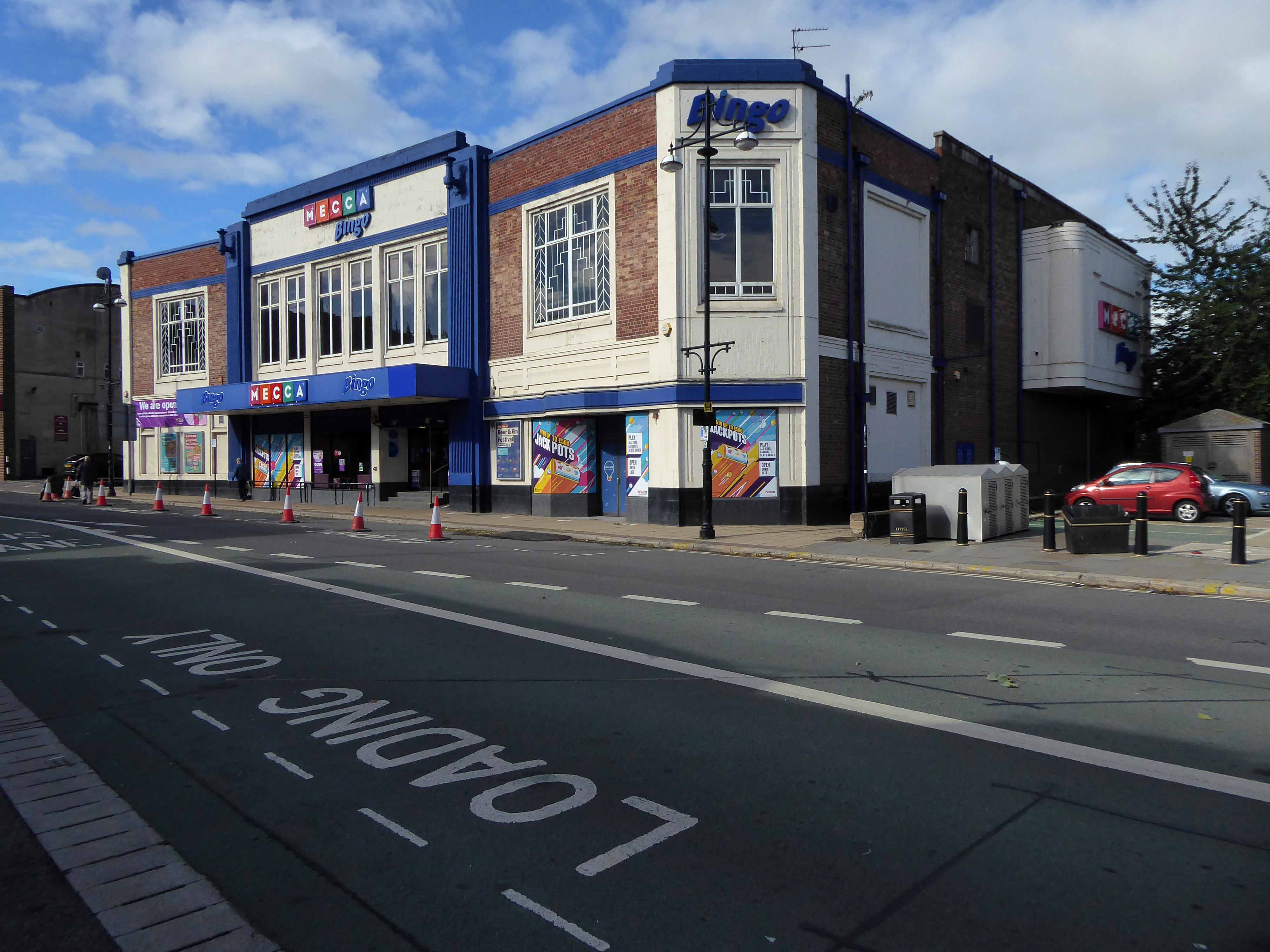
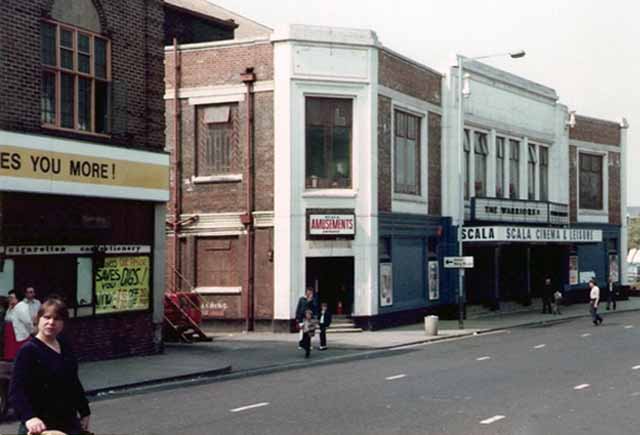
Opened 22 December 1934 as the Regal Cinema with Leslie Howard in Girls Please. Sandy Powell, the famous comedian attended opening night this 1,825 seat. It was designed by the Hull based architectural firm Messrs Blackmore & Sykes for local exhibitor Thomas Wade and was leased to the Lou Morris chain.
By 1937 it was operated by the London & Southern Super Cinemas Ltd. chain. The Regal Cinema was leased to the Odeon circuit in 1946 and was re-named Odeon. It was sold by the Rank Organisation to an independent operator in 1975 and renamed Scala Cinema, by 1981 using the circle only.
Closed 23rd September 1983 with the film Porky’s.
Became a bingo hall initially named Ritz but now Mecca. On 20th February 2020 the building was put up for sale by auction at an asking price of £600,000+, but failed to sell, with the maximum reached £590,000. Mecca bingo continues in the building.
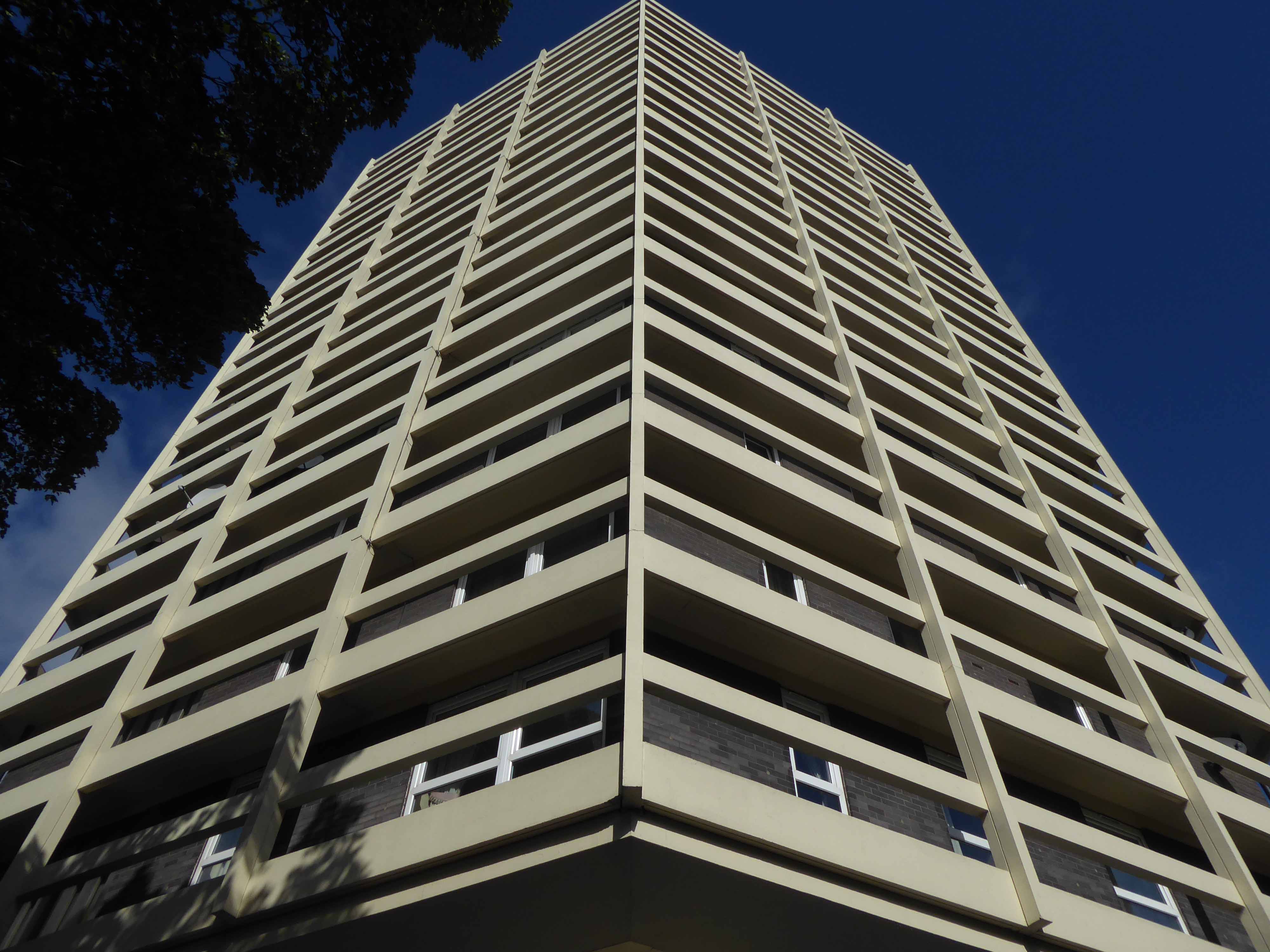
Main contractors J. Finnegan it’s thirteen storeys high – housing forty eight dwellings.
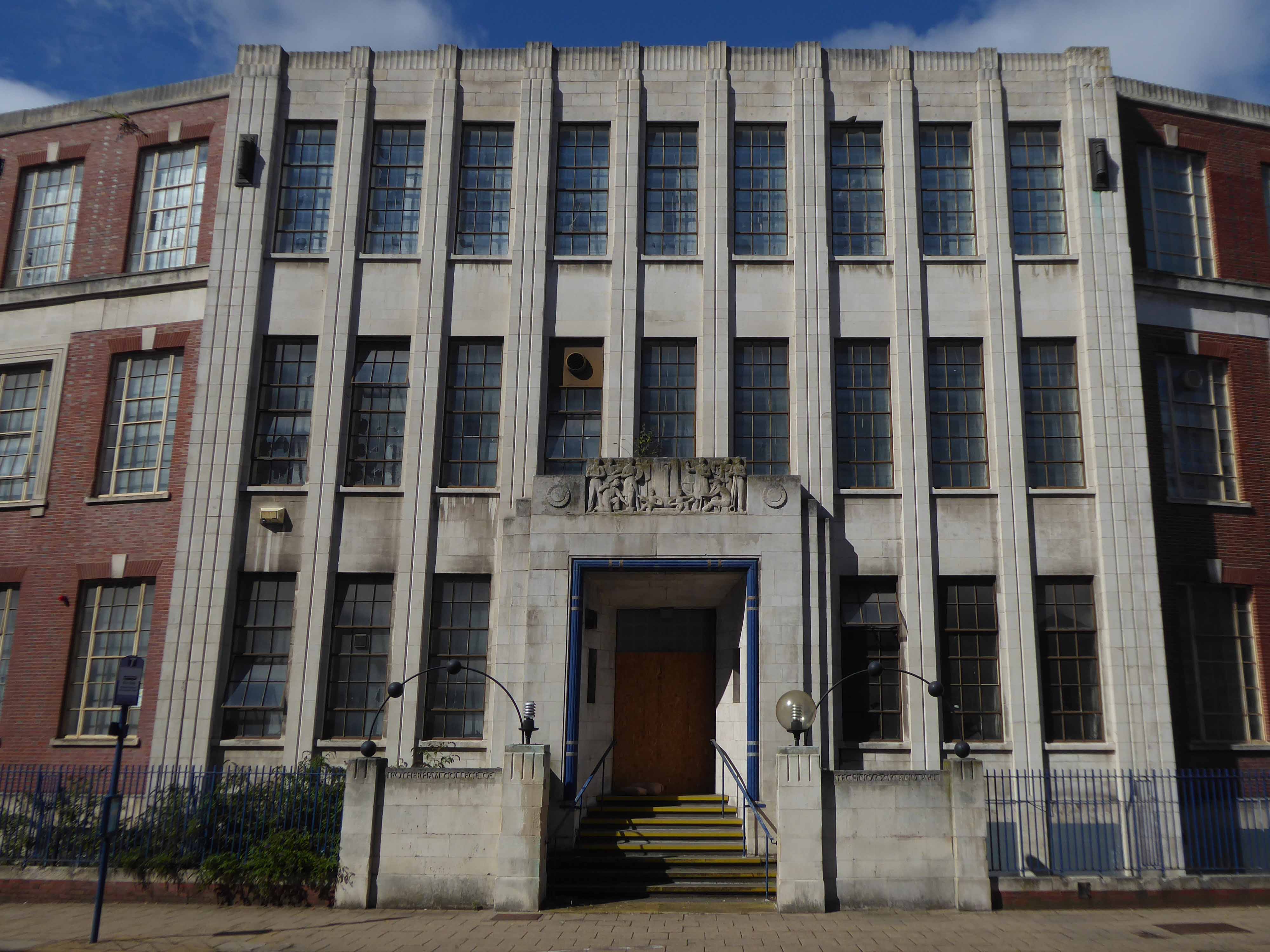
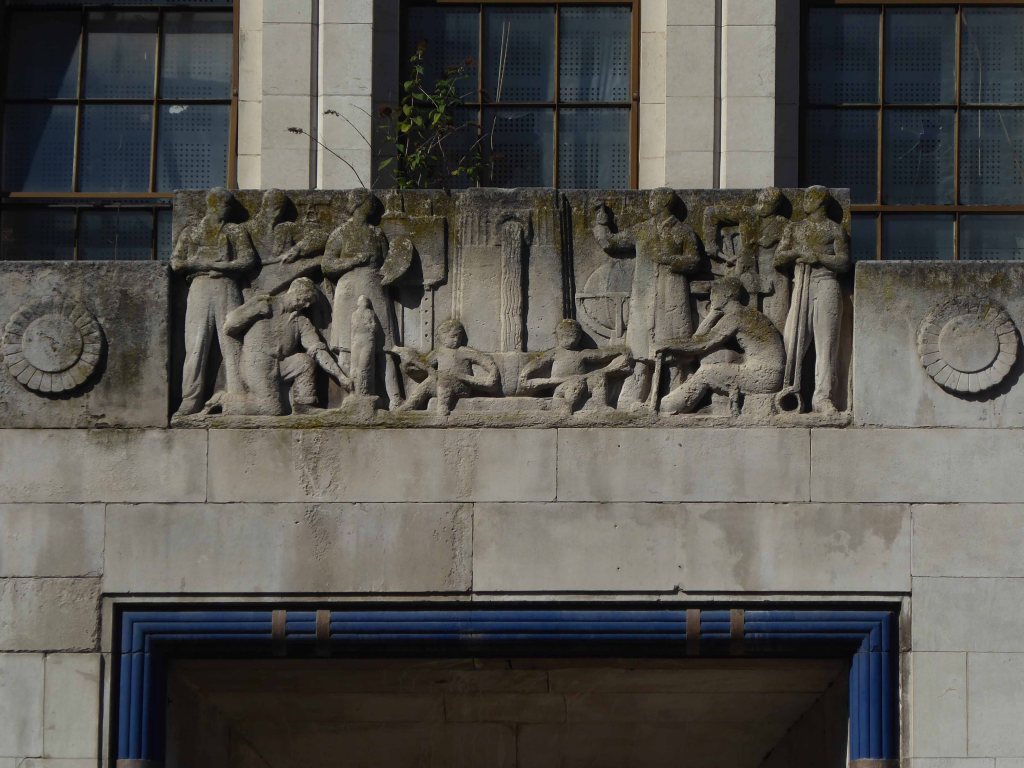
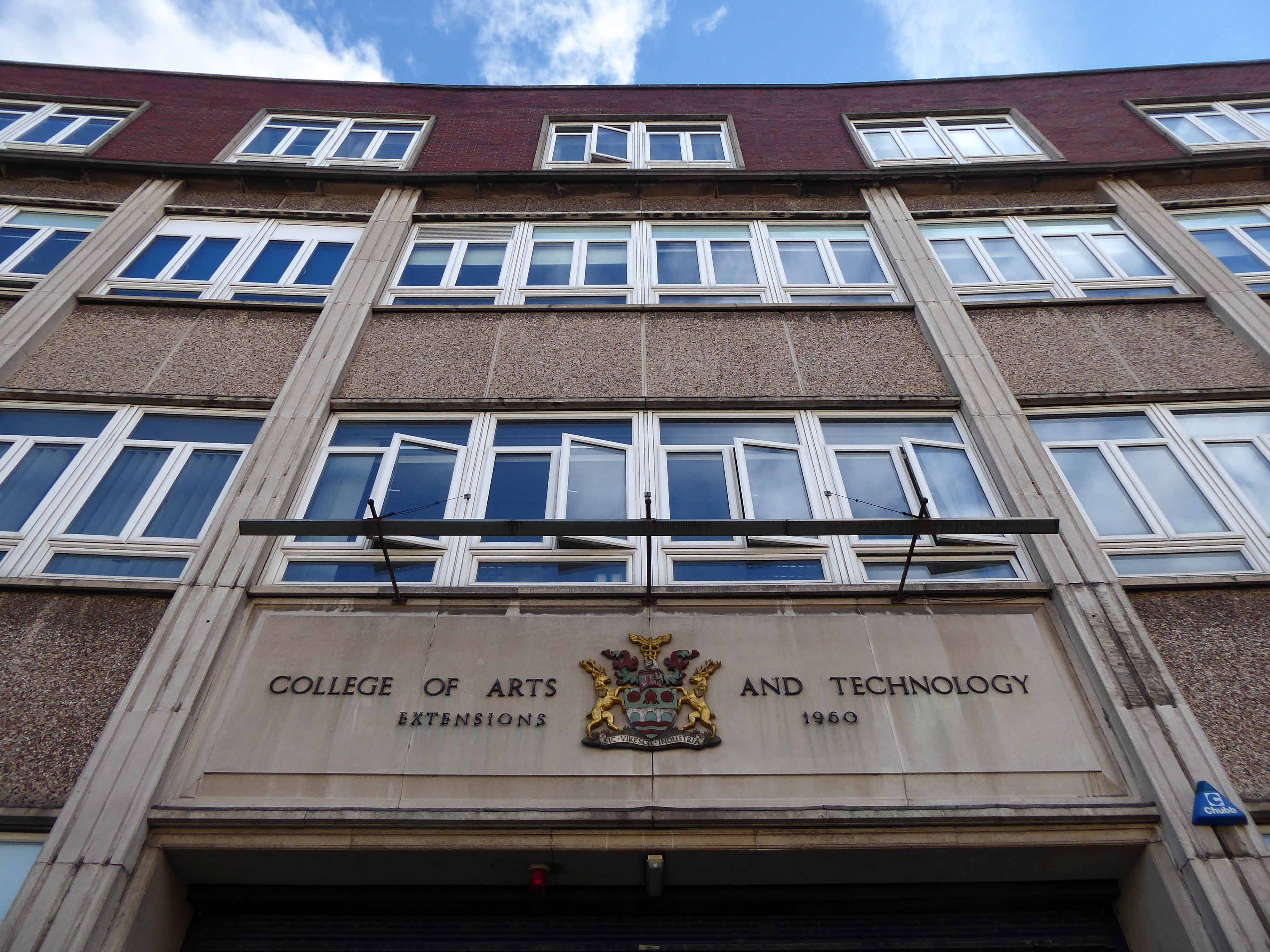
Interwar Technical College – Howard Building
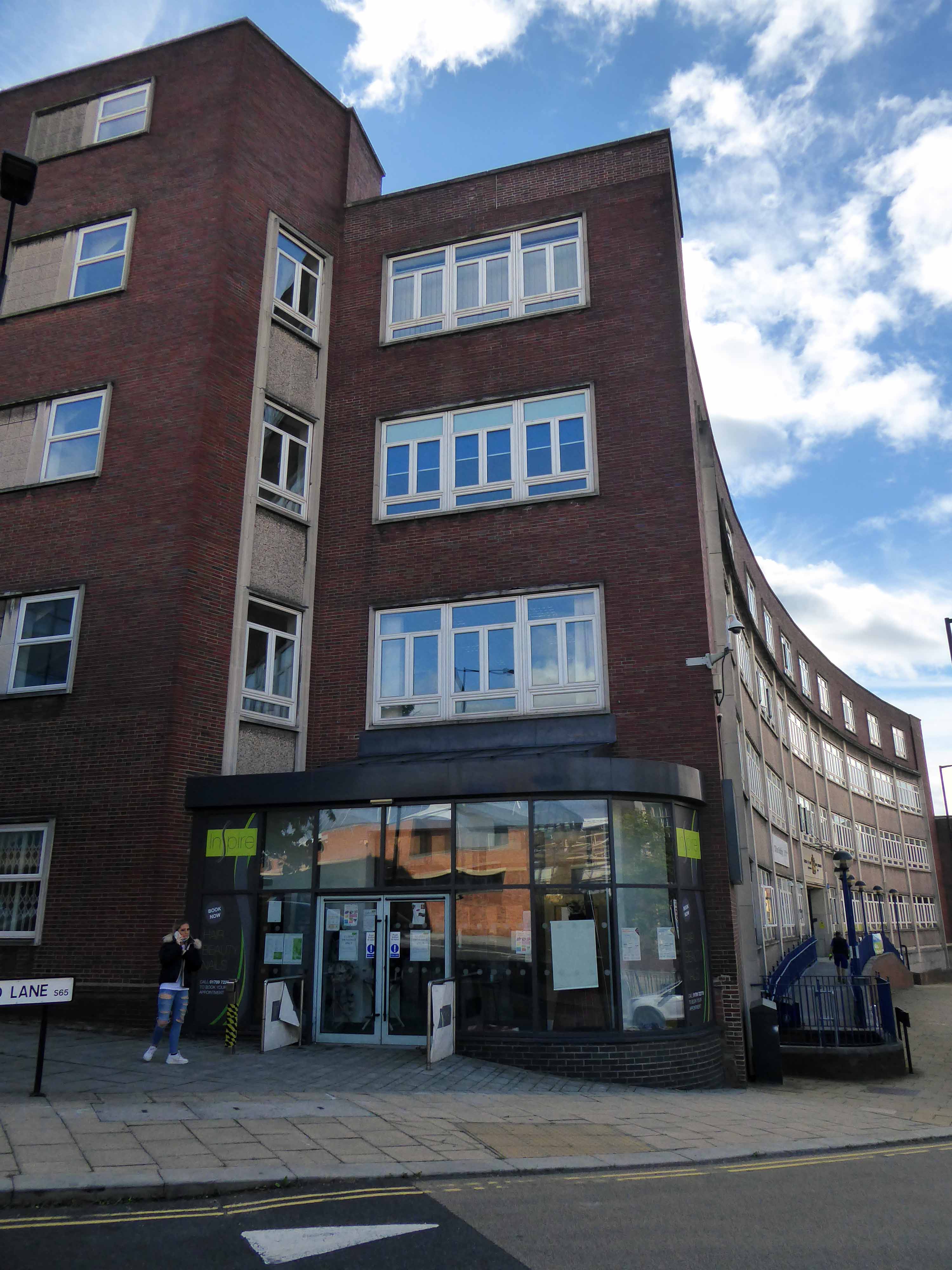
From the 1930s, it provided technical-orientated education from the Howard Building on Eastwood Lane, Rotherham. In 1981, three neighbouring colleges of arts, technology and adult education were merged into one. As a result, the college became known as Rotherham College of Arts and Technology.
Revised plans to convert the historic Howard Building in Rotherham town centre into self-contained studios and apartments have been approved by the planning board at Rotherham Council.
The prominent former college building was sold prior to going to auction last September after it was advertised as a development opportunity and given a guide price of £250,000 by local auctioneers, Mark Jenkinson & son.
A group of rogue property directors with links to a prominent derelict building in Rotherham have been banned for a total of 54 years. The six, of Absolute Living Developments, were found to have misled more than 300 people to invest at least £12 million in residential properties.
The firm was linked through a lender to Avro Developments, which had plans passed in 2015 to renovate former college block the Howard Building in Rotherham town centre.
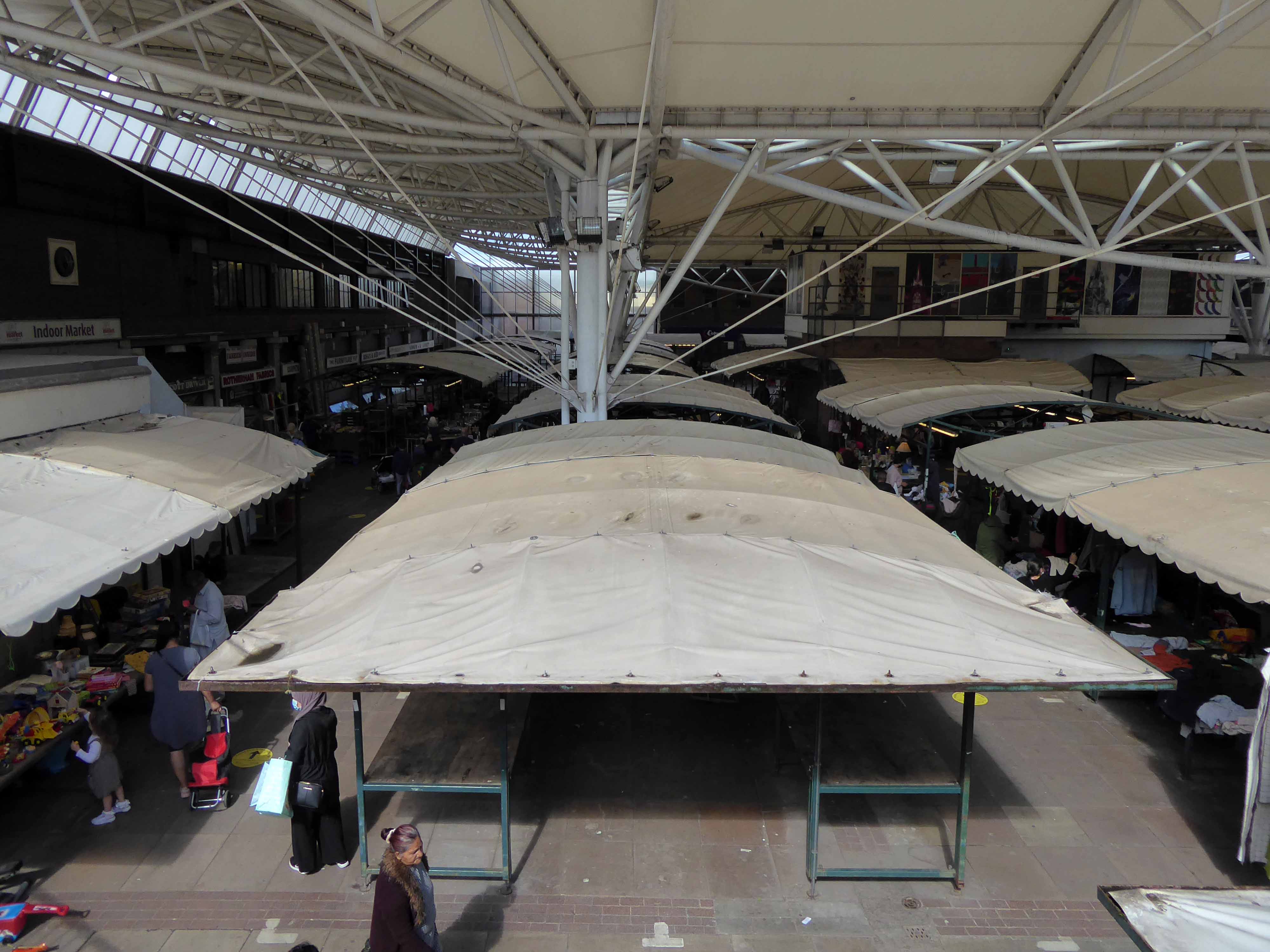
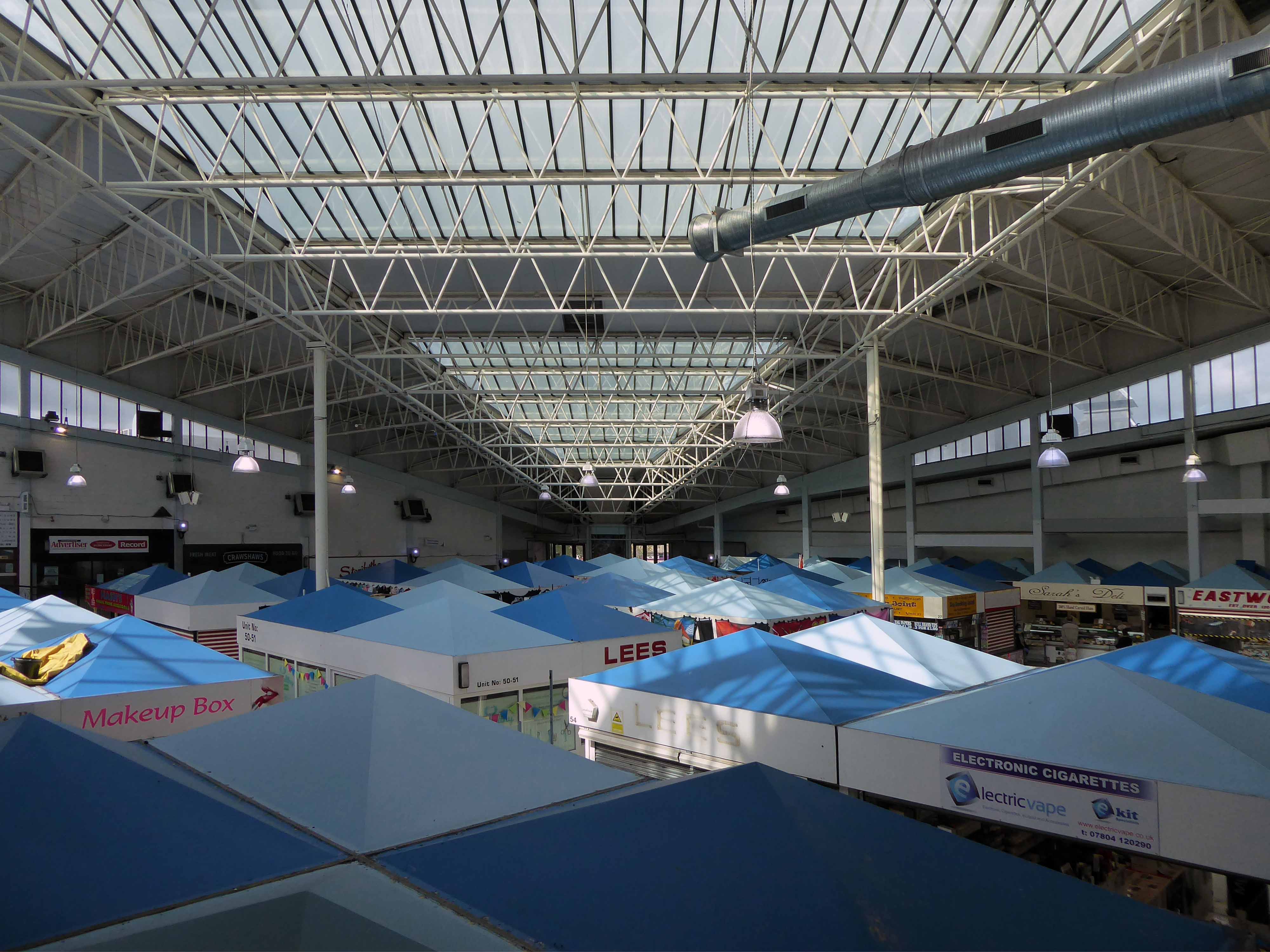
With a strident high tech canopy, very recently added – though Rotherham’s history stems back 800 years when it is thought that the original royal market charter was granted by King John in the year 1207.
There are traces of the 1970’s rebuild.
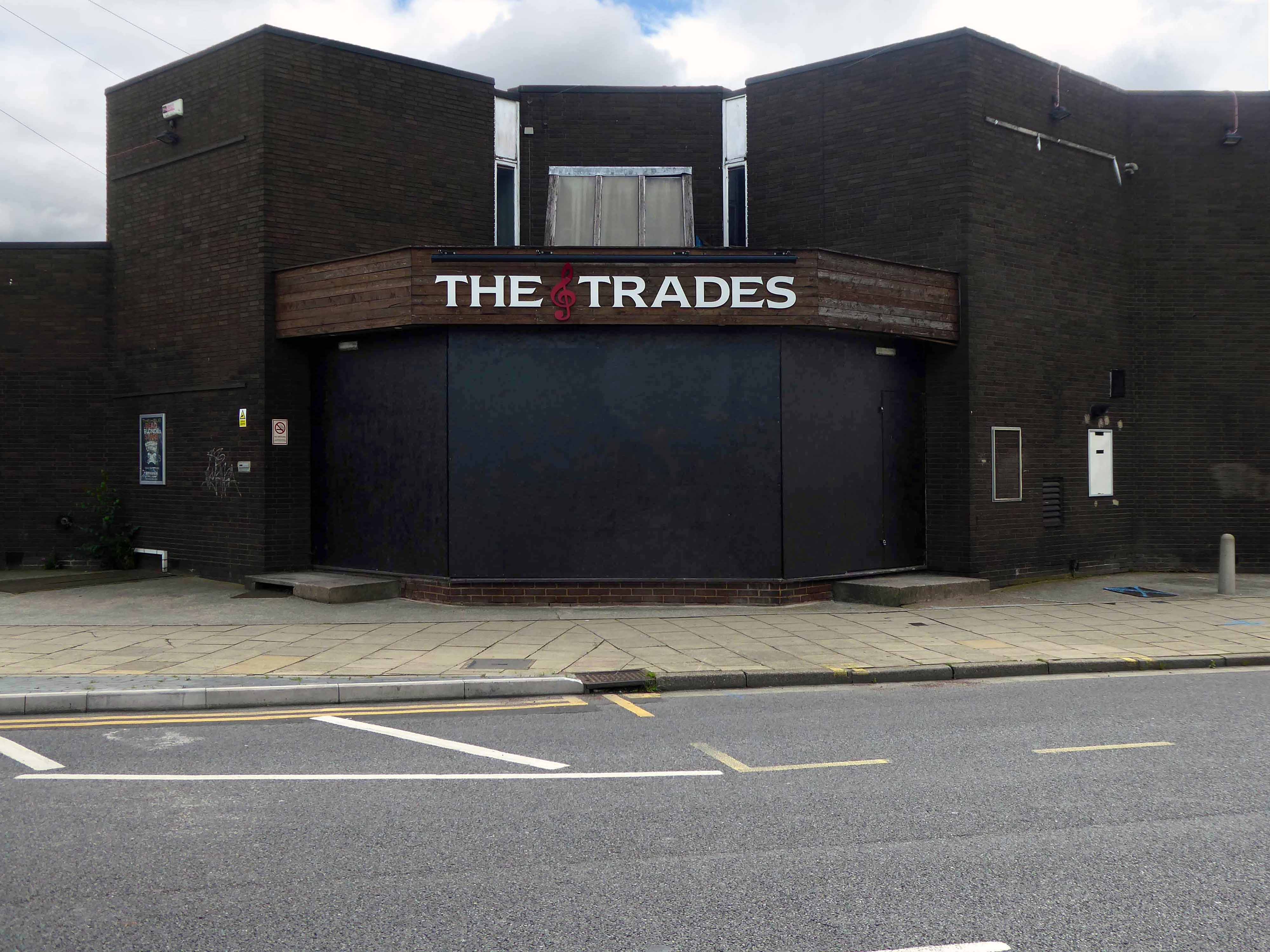
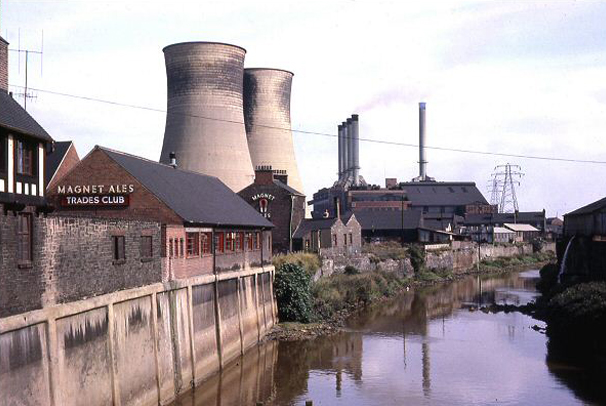
Bunker-like The Trades former music venue/pub, which replaced the former riverside Trades Club.
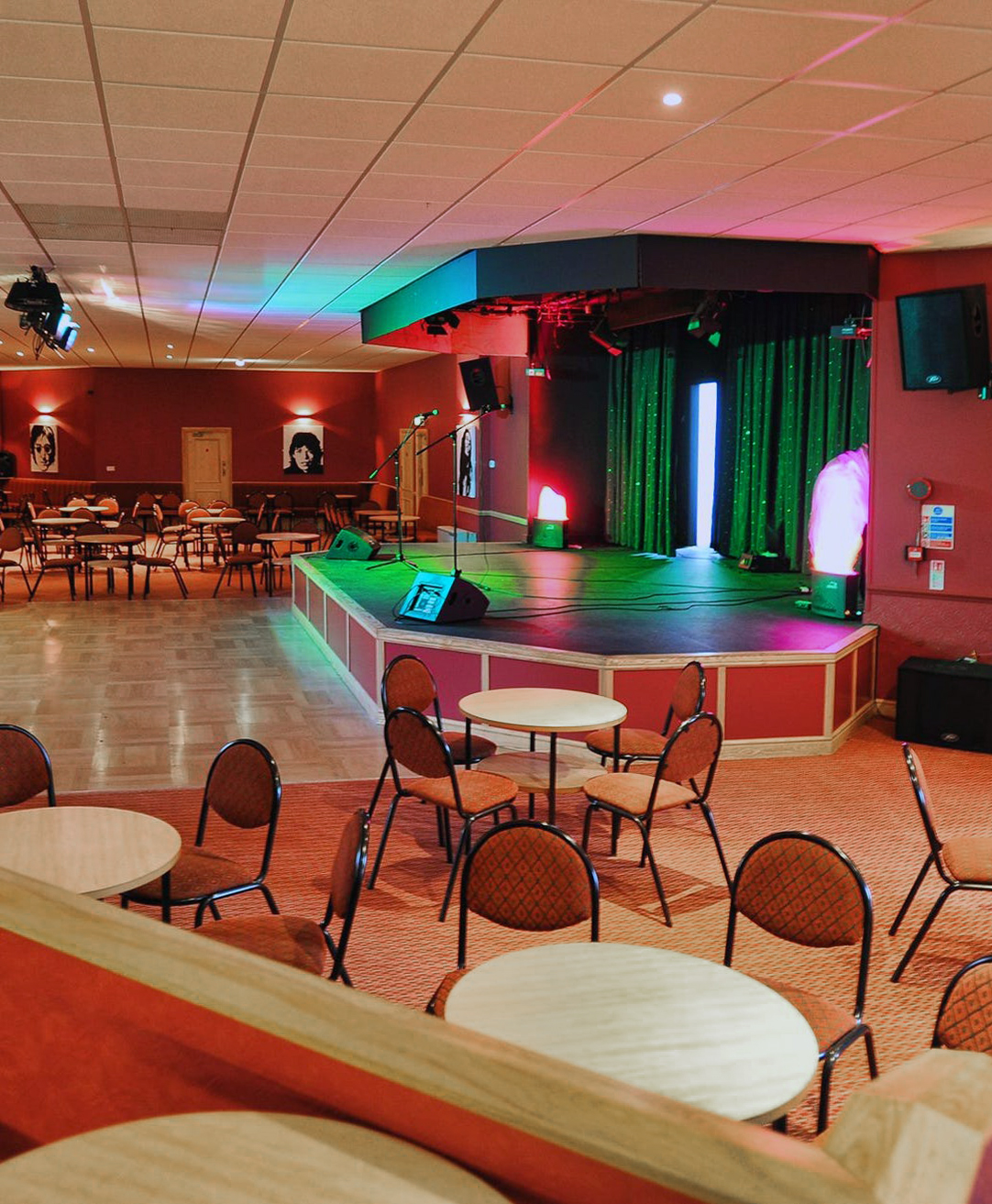
The PA now silenced.
This was an amazing event. The bands were really good and the drinks offers, while limited, were good. The ceiling in the ladies toilets had fallen through and was dripping, presumably there had been a leak from all the rain, but this didn’t lessen the awesome experience.
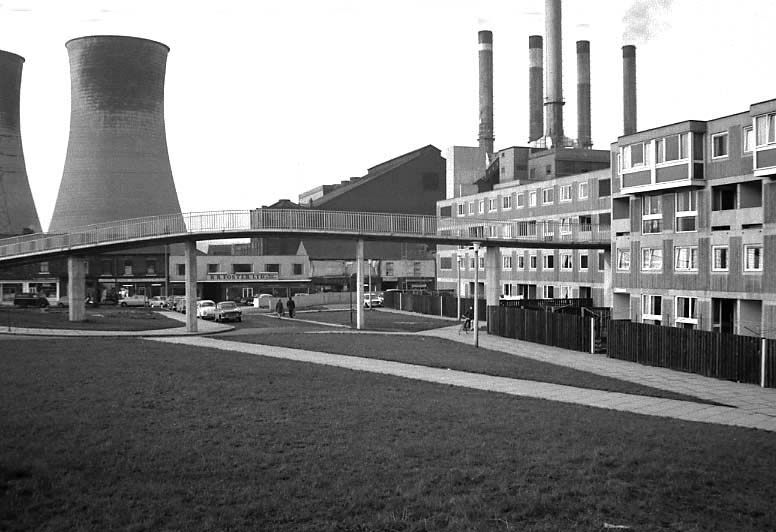
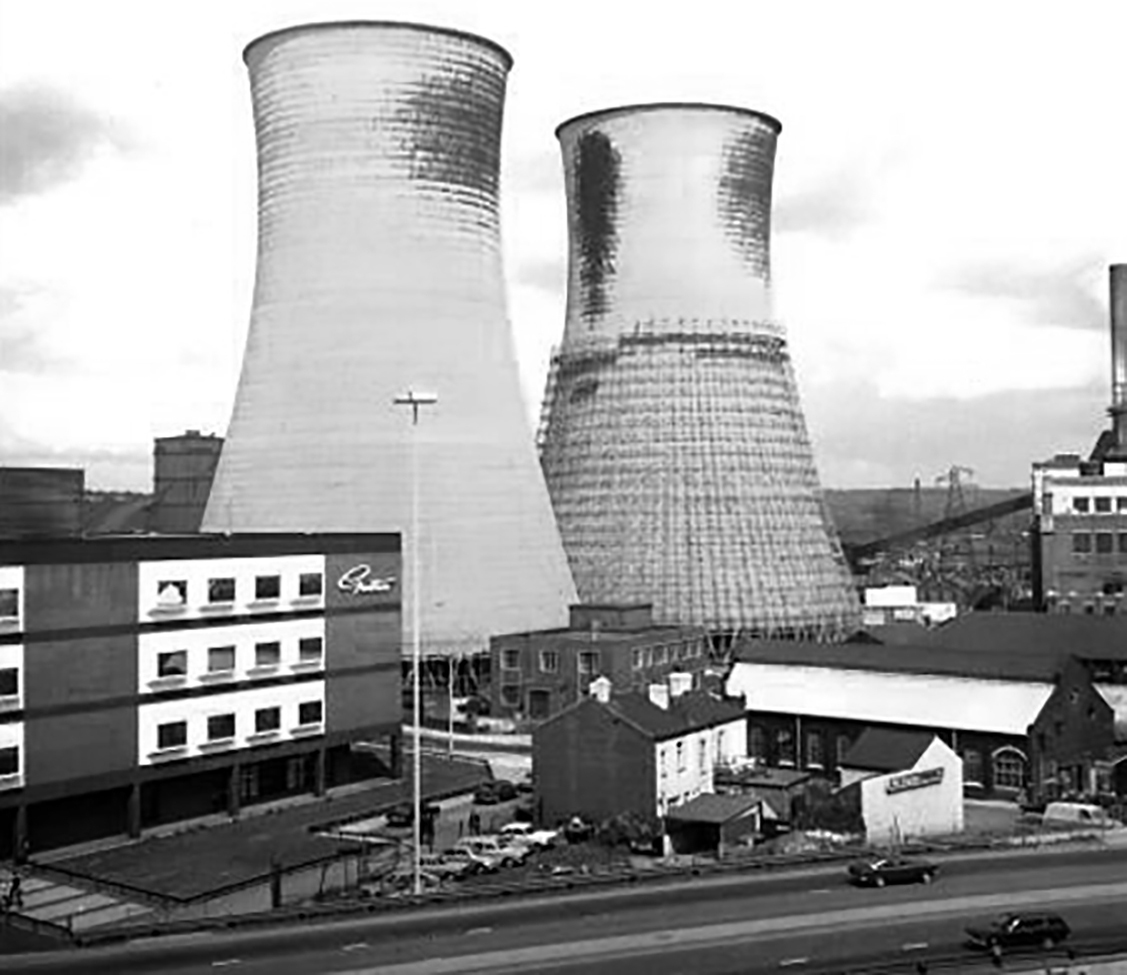
The cooling towers and flats are long gone – the coal-fired power station operated from 1923 until October 1978.
The Prince of Wales Power Station in Rotherham was located on Rawmarsh Road and was opened by the Prince of Wales – the future King Edward VIII.
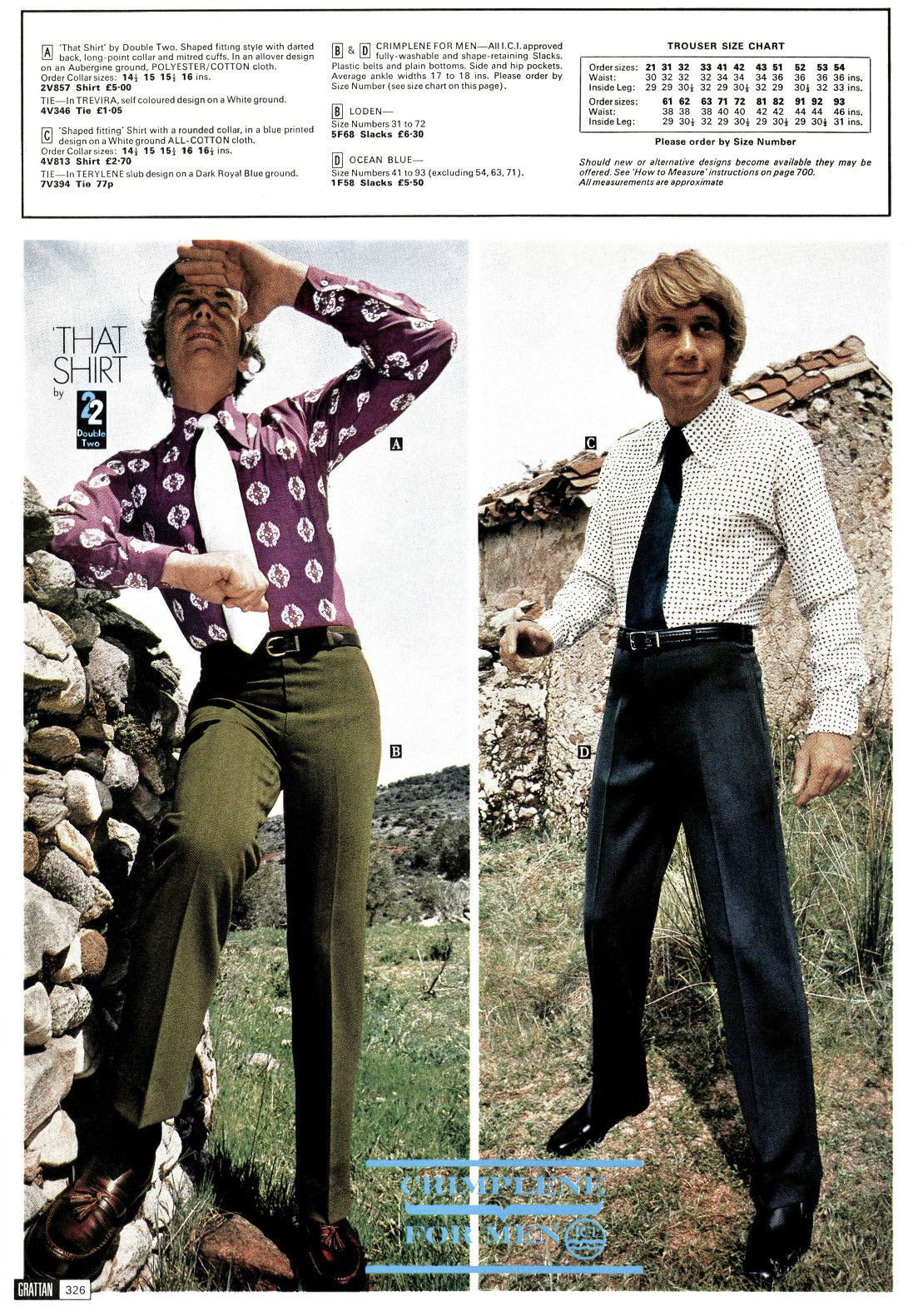
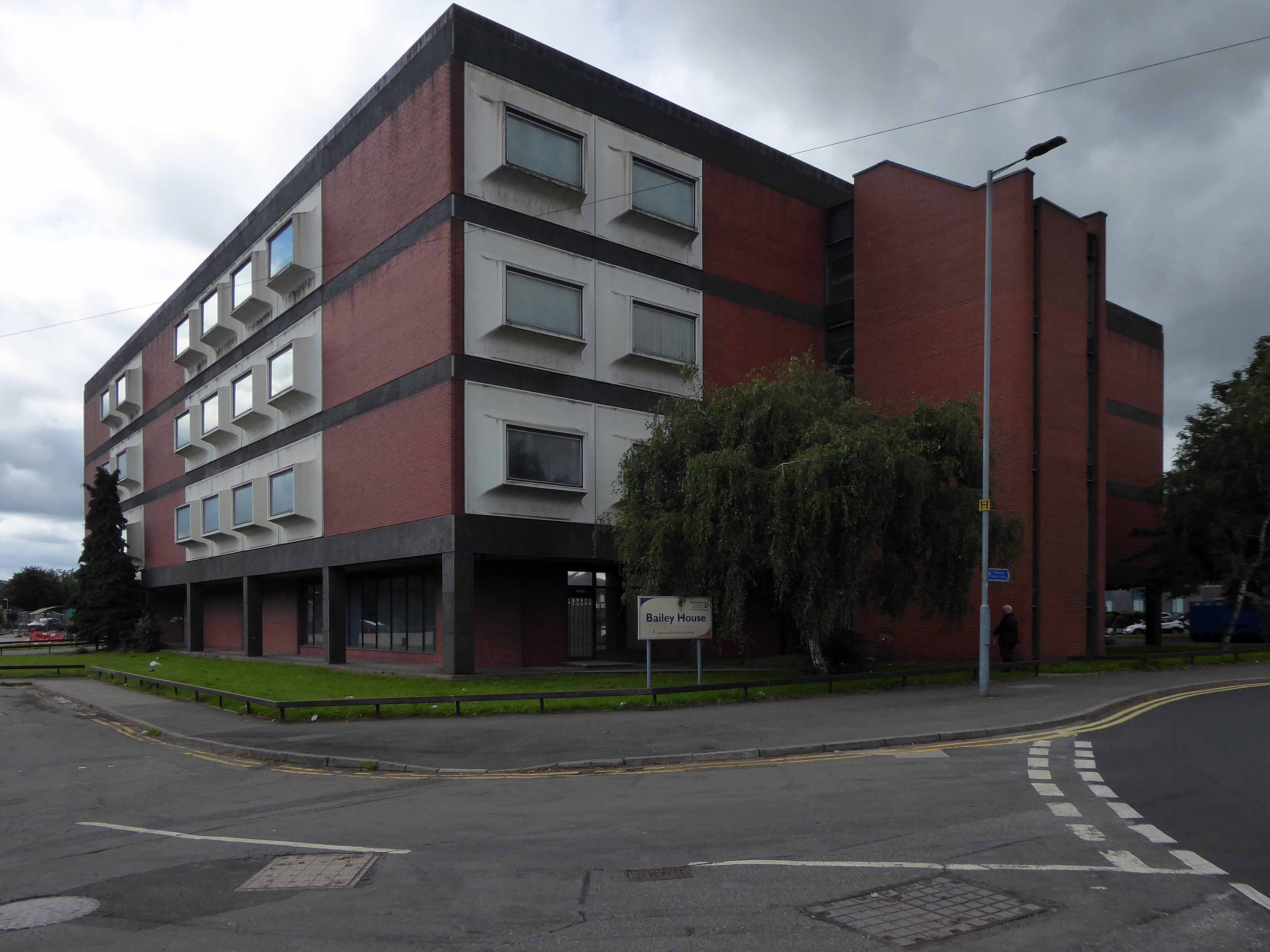
The former Grattans catalogue offices can be seen to the left.
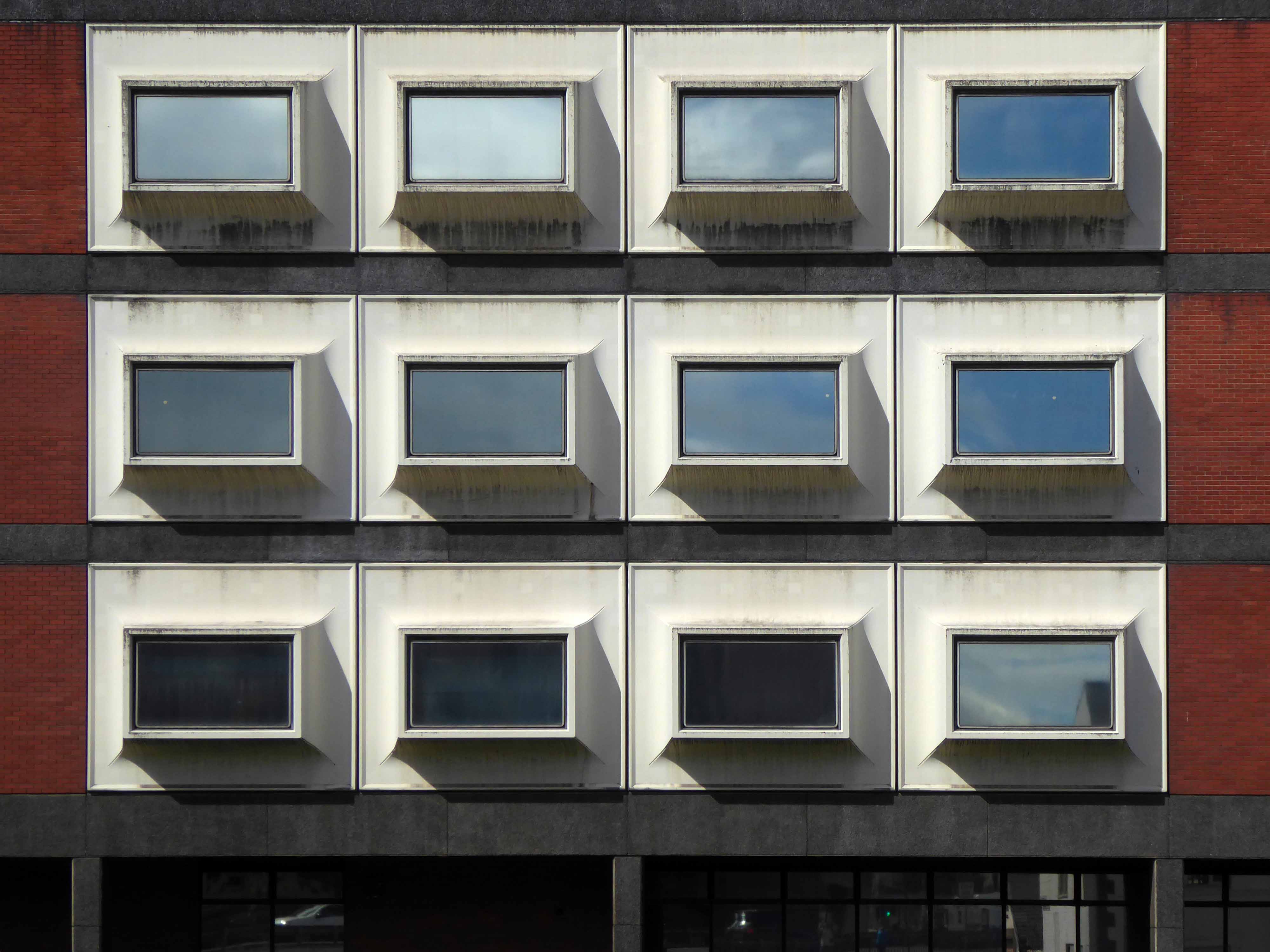
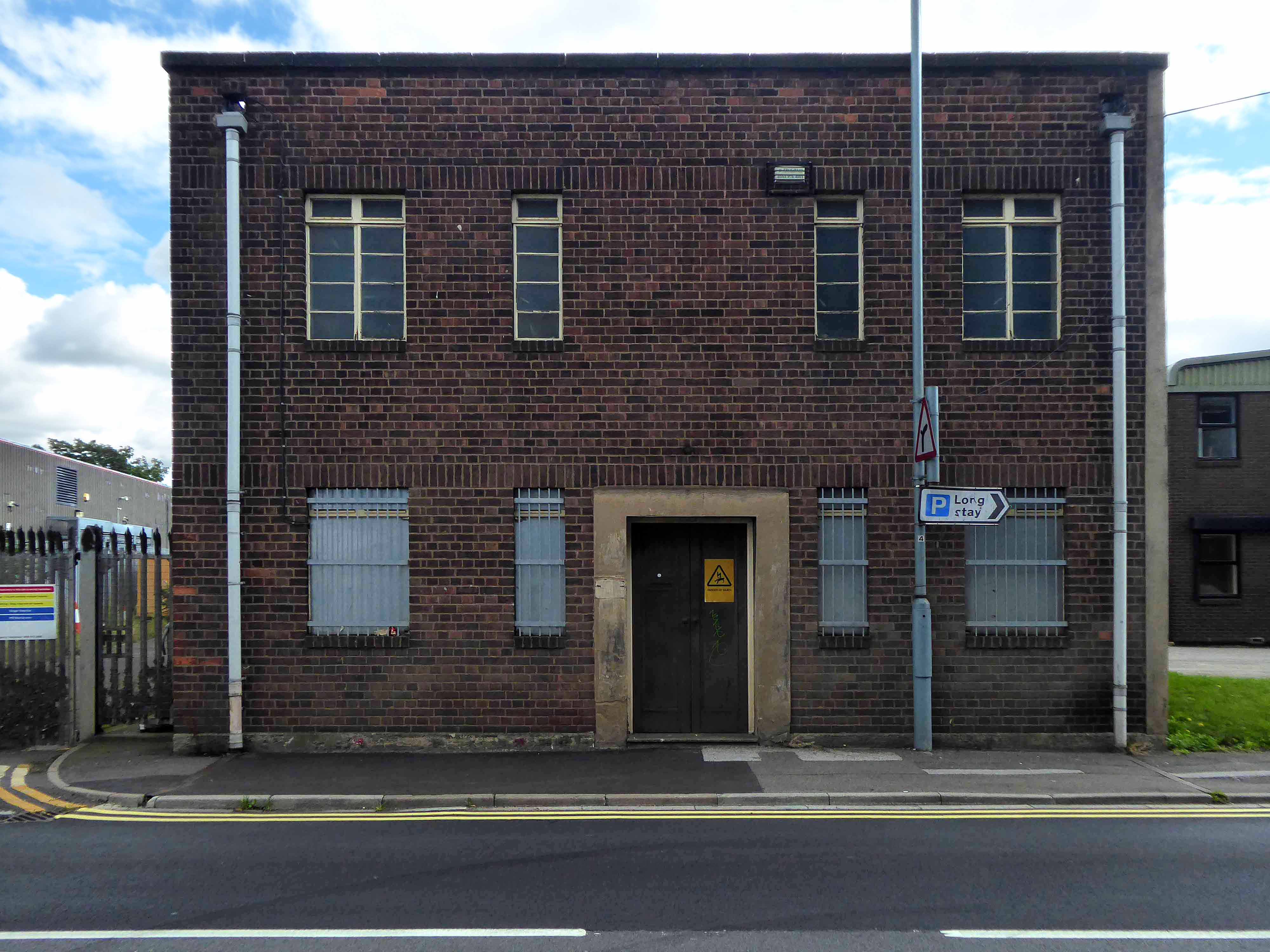
Renamed Bailey House and still in use by the local authority, its days it seems are numbered.
The building is named after Rotherham-born engineer Sir Donald Bailey whose ingenious bridge designs played a key role in shortening World War II, the house in which Bailey was born, 24 Albany Street is still standing.
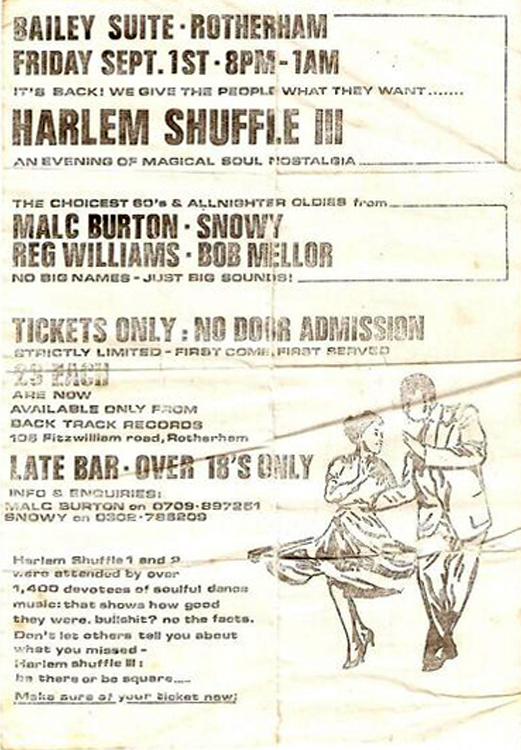
Sadly no longer home to the Harlem Shuffle
No big names – just big sounds.
There are some surviving power station buildings.
Along with electrical infrastructure.
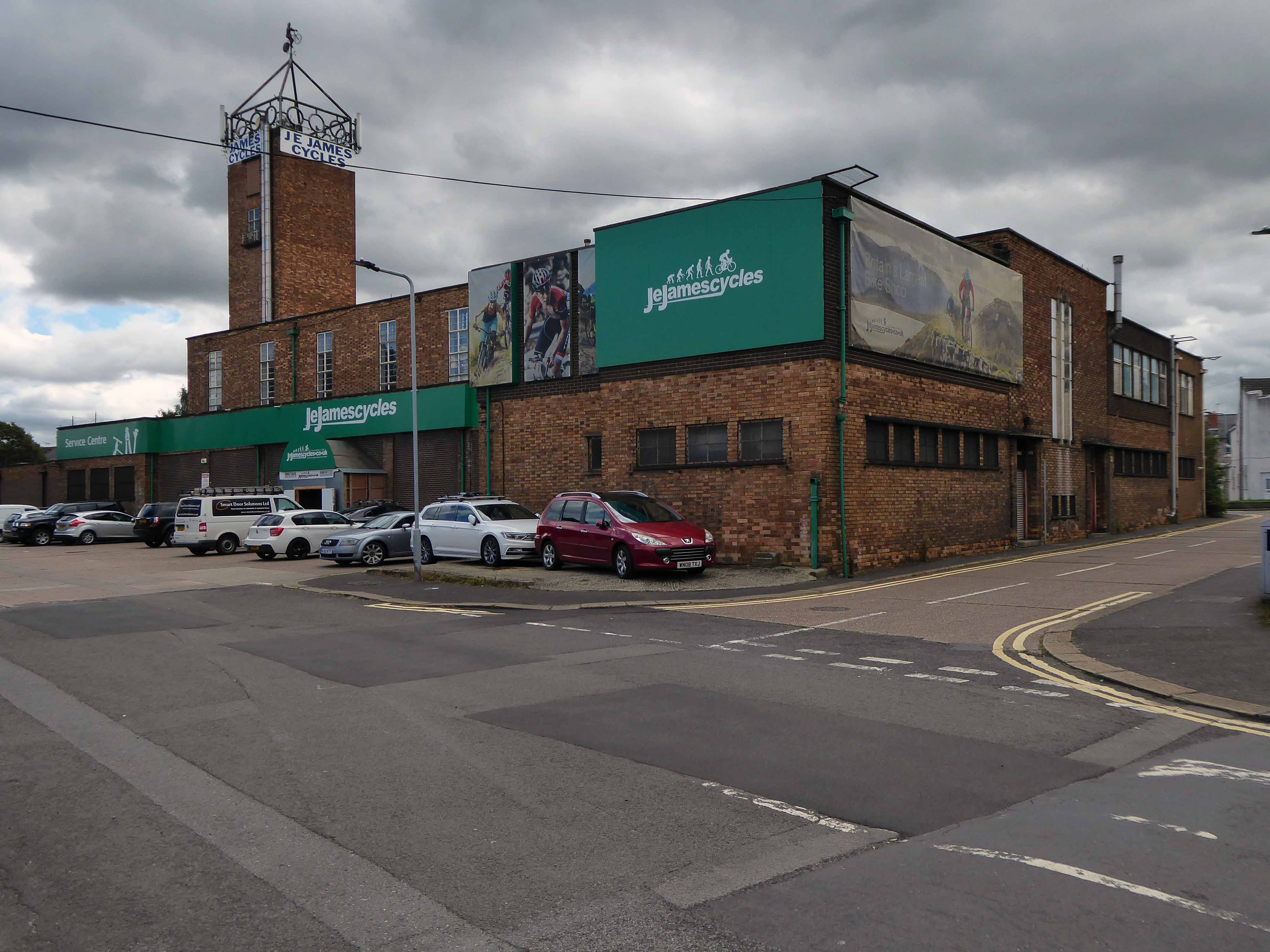
Up the road next, to the former fire station, which now houses J E James Cycles.
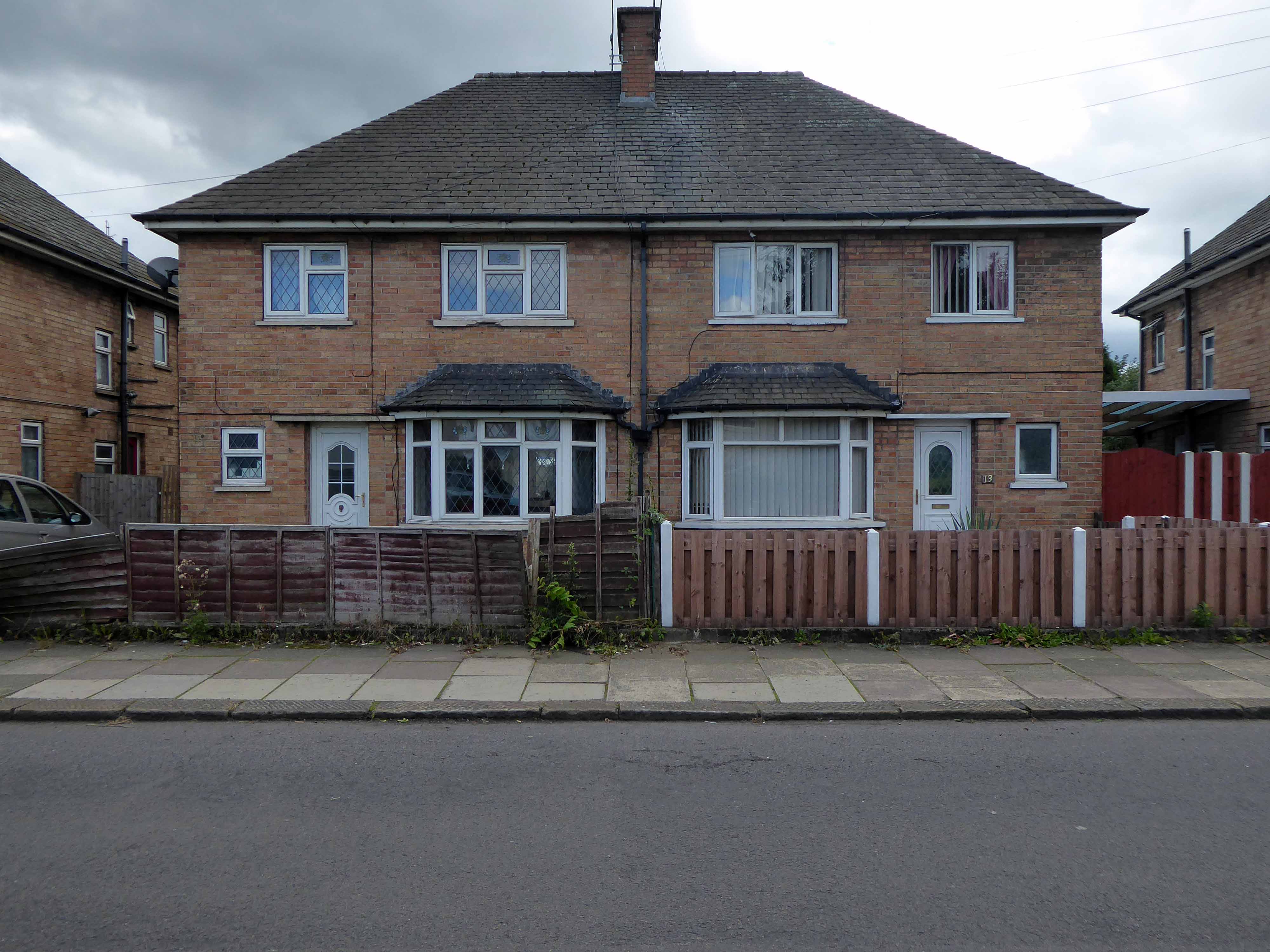
It is surrounded by typically atypical inter war housing.
I could make the wild assumption, that these flat roofed maisonettes were originally homes fit for firefighters.
With a final notable note regarding Rotherham’s hand painted council commissioned signage – I’d like to think that they have a sign writer in their employ.
Many thanks to my learned companion Helen – thanks for a fine day out, so much to see and do!
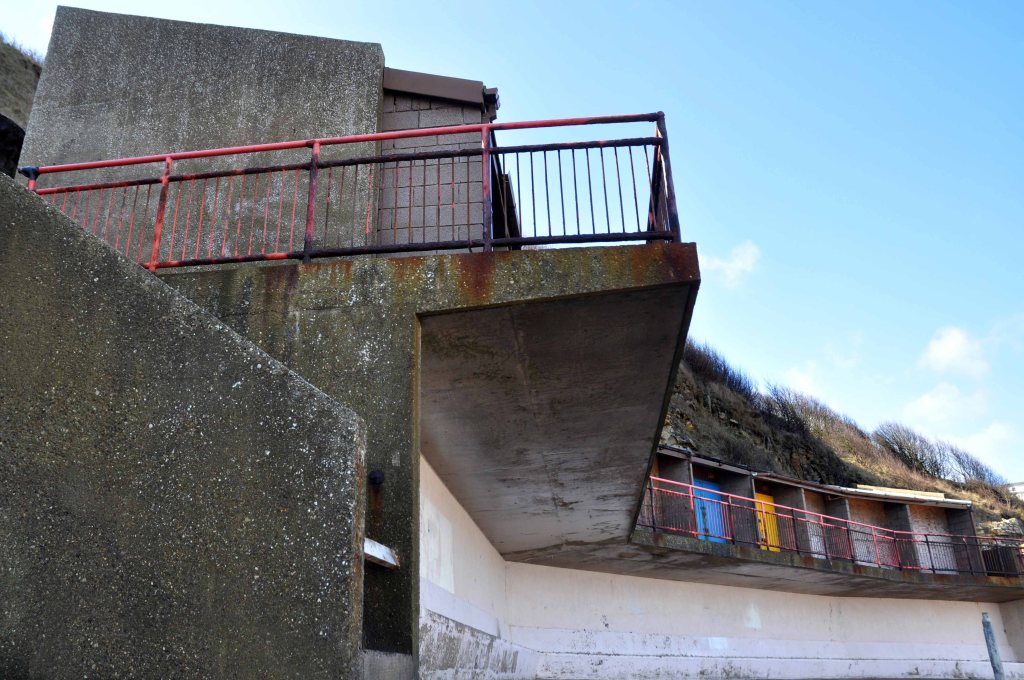
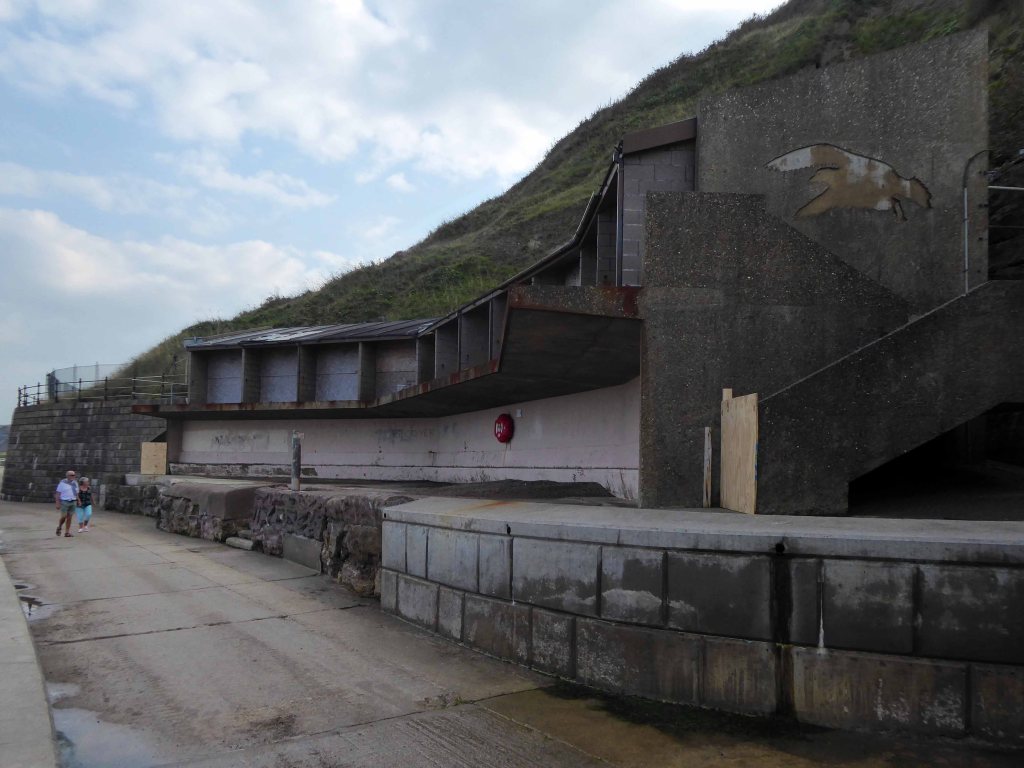
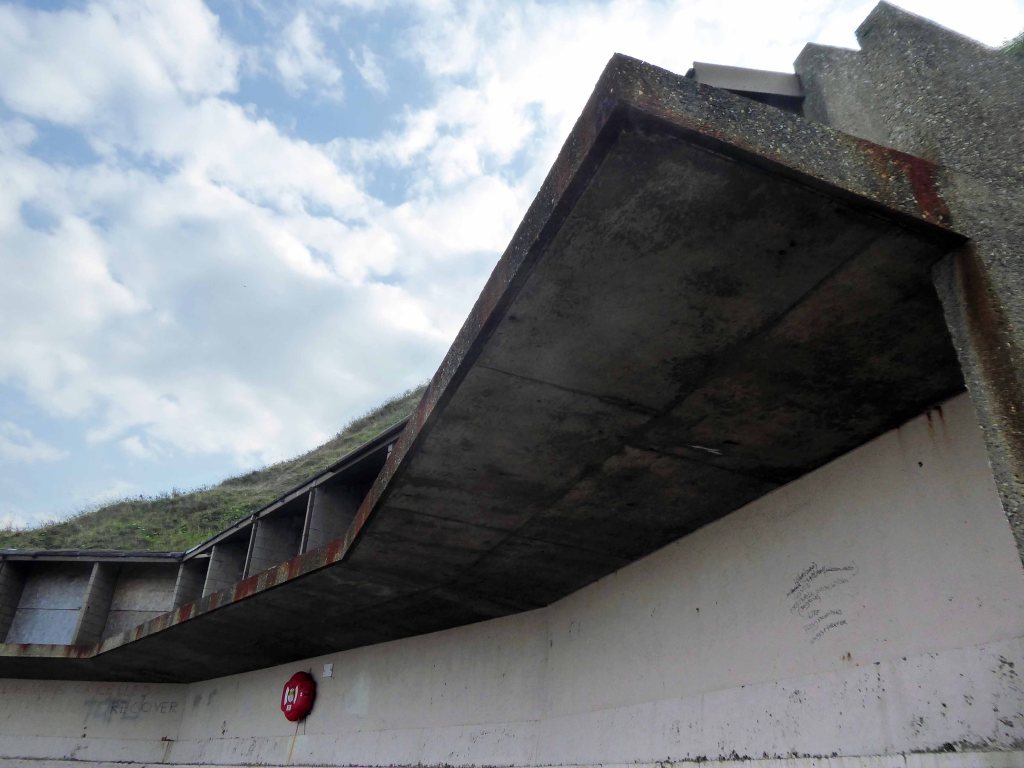
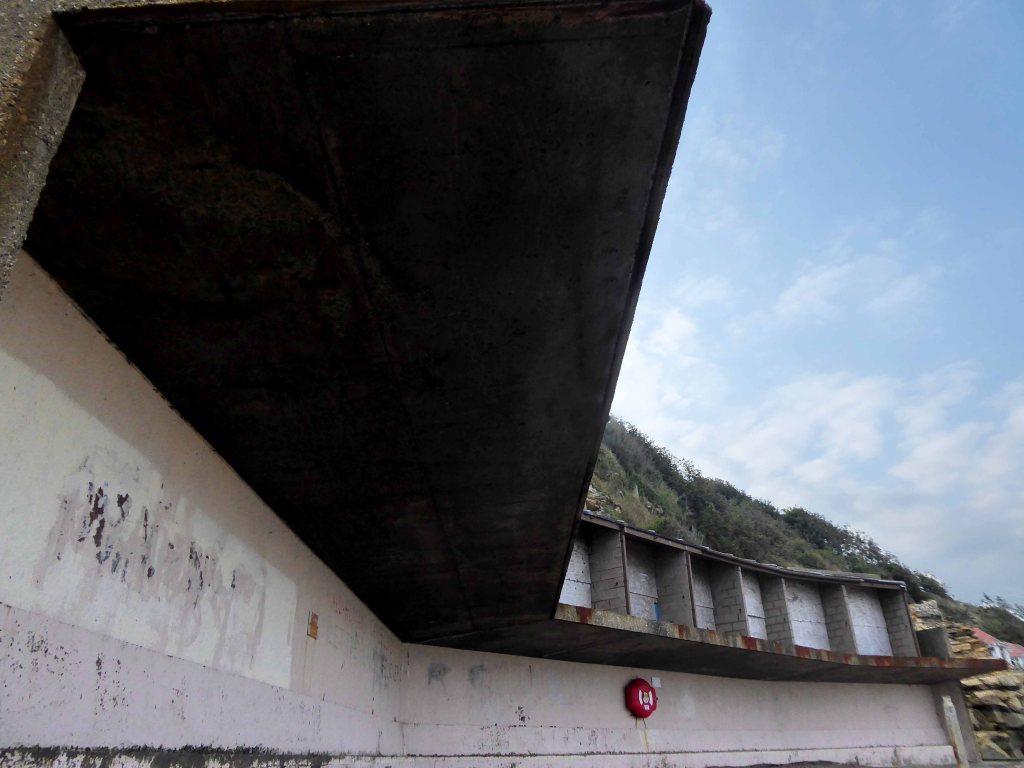
Walking the wet walkway of Bridlington’s south shore, I was pleasantly surprised by this semi-distant concrete construction.
Which cleverly accommodates a convenient public convenience.
The pumping station is the most immediately obvious aspect of the scheme , situated as it is on the promenade.
Hanson UK supplied the concrete, with a range of complex mixes required.
You’re trying to make concrete with as little water in it as possible, but it still has to move to be placed into position. The only way to achieve this is with powerful admixtures, which deflocculate the cement despite the lack of water in it to lubricate it.
This difficulty also applied to almost all the concrete above ground level for durability reasons – anything that could come into contact with seawater had to be able to withstand it.
The final major complication was the aesthetic requirements from the local council. All the visible concrete had to match an older Victorian Spa, located a little way up the beach, which had previously been refurbished using Hanson concrete.
We were asked to match the colour, shading and texture of the new concrete to the spa.
The team was forced to use white cement, which had been used in the spa, but because of durability requirements they needed to use a cement replacement to improve the overall chemical resistance of the product. They used ground granulated blast furnace slag to replace 55 per cent of the white cement, which is white in colour itself. This had the added sustainability benefit of replacing imported white cement with a local waste byproduct.
All this to house the Yorkshire Water treatment plan and allow Bridlington to regain its Blue Flag status.
The extended pipework carrying the waste water far far away.
At the Headworks the Arup design concept was to extend the pumping station using pre-cast concrete panels that are sensitive to the existing facade. The development of 2015 succeeds in integrating a Brutalist aesthetic, into a largely Victorian setting. Incorporating several levels of seating and associated street furniture, affording some shelter and clear sight lines with transparent panels.
The artwork in front of the huts on Bridlington Promenade by Rachel Welford looks fantastic. The huts built by our contractors Morgan Sindall Grontmij (MGJV) were completed in August and they’re available for hire through the East Riding of Yorkshire Council. The beach huts are larger than the other beach huts on the Promenade and include disabled access and are especially suitable for family groups. Complementary artwork, also designed by Rachel Welford has been incorporated in the glass balustrade in front of the huts.
The world is inherently unstable, along comes a train a resort appears, along comes a ‘plane a resort disappears, along comes a virus and people disappear.
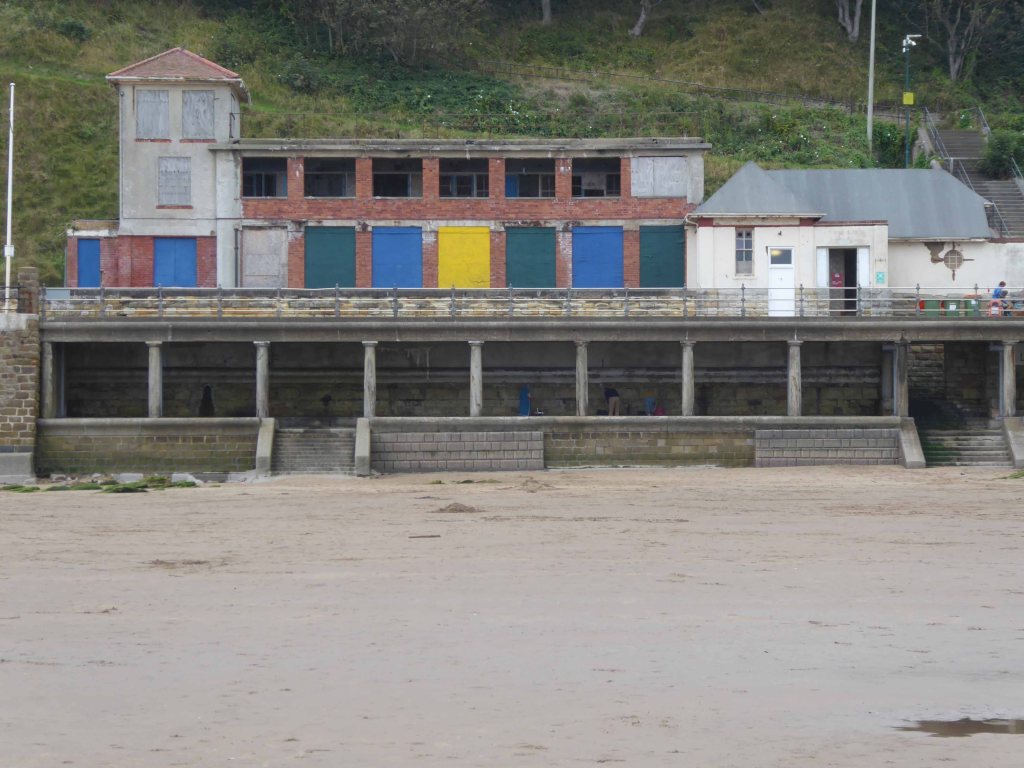
Some of the oldest sun bathing chalets almost became an Arts Hub.
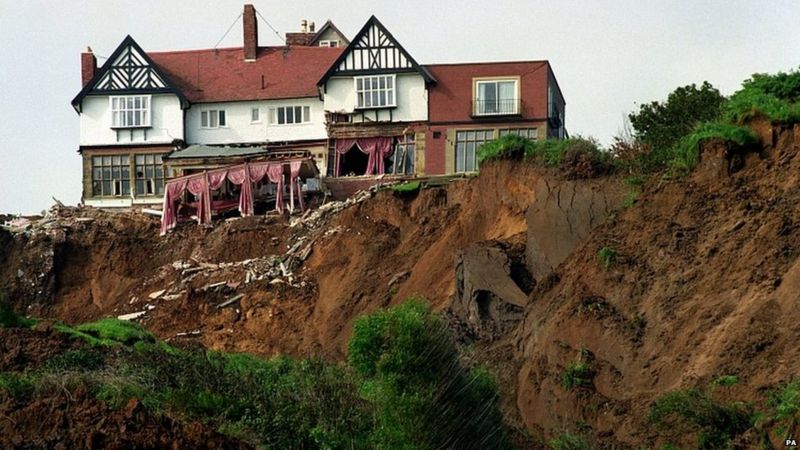
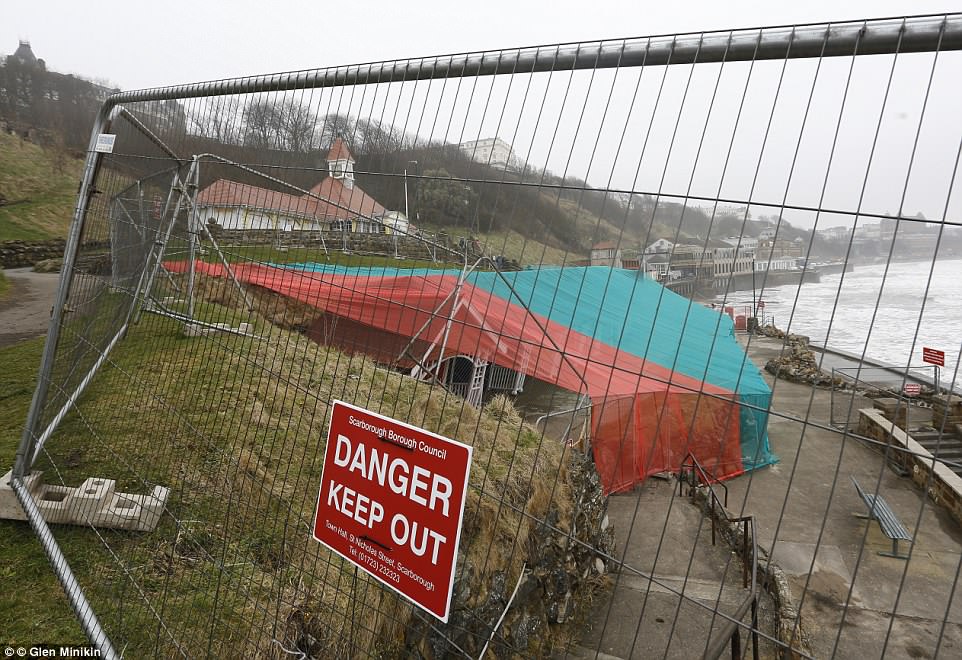
Seaside chalets were under threat, with the cause believed to be the failure of a retaining wall.
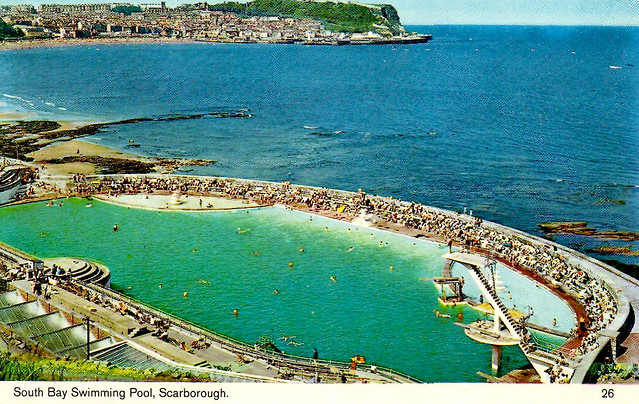
The swimming pool has been and gone, only an empty shell remains.
There are speculative plans and piecemeal repairs, but these are difficult times, and attracting substantial finance and flocks of tourists to revitalise the town, is no simple matter.
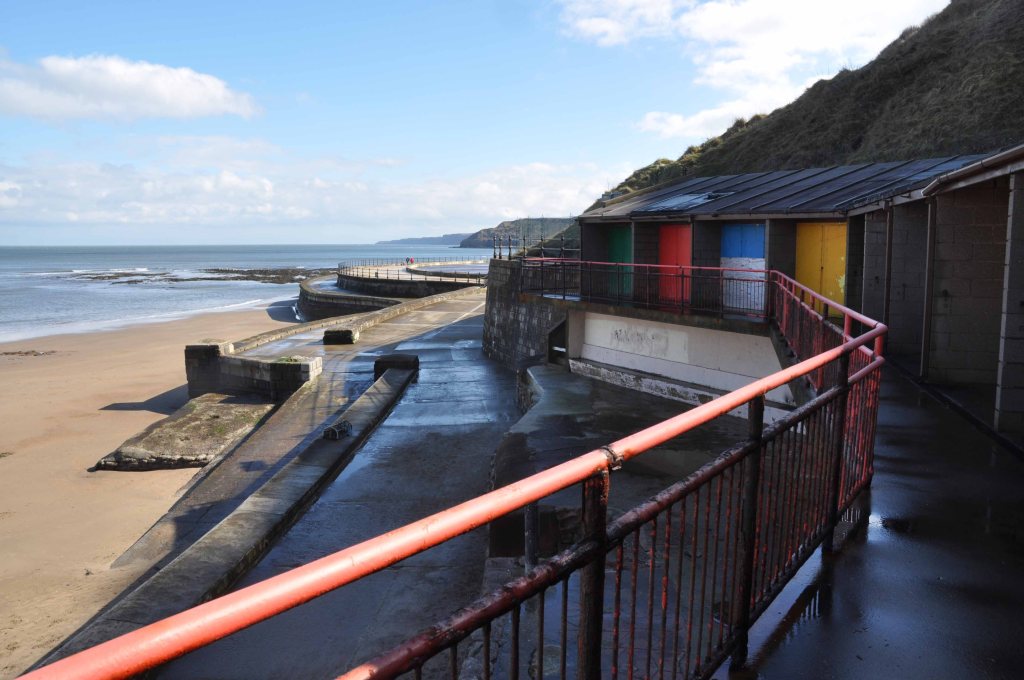
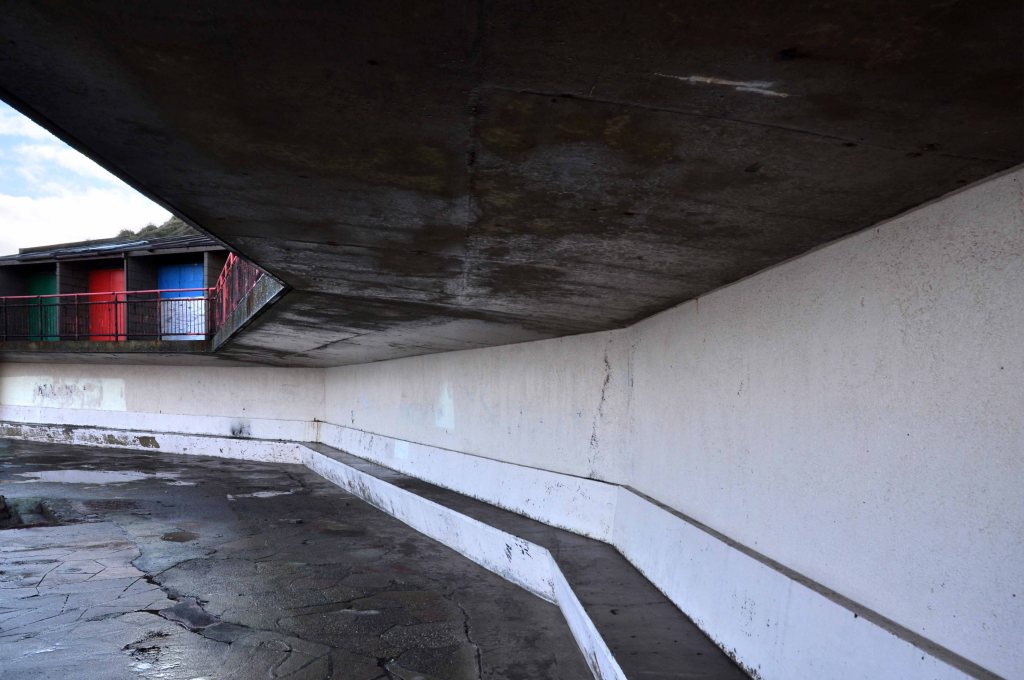
From 2011 I have visited South Bay, intrigued by all the above, but there’s a special place in my heart for these concrete chalets.
They never get a mention.
Here they are some years ago.
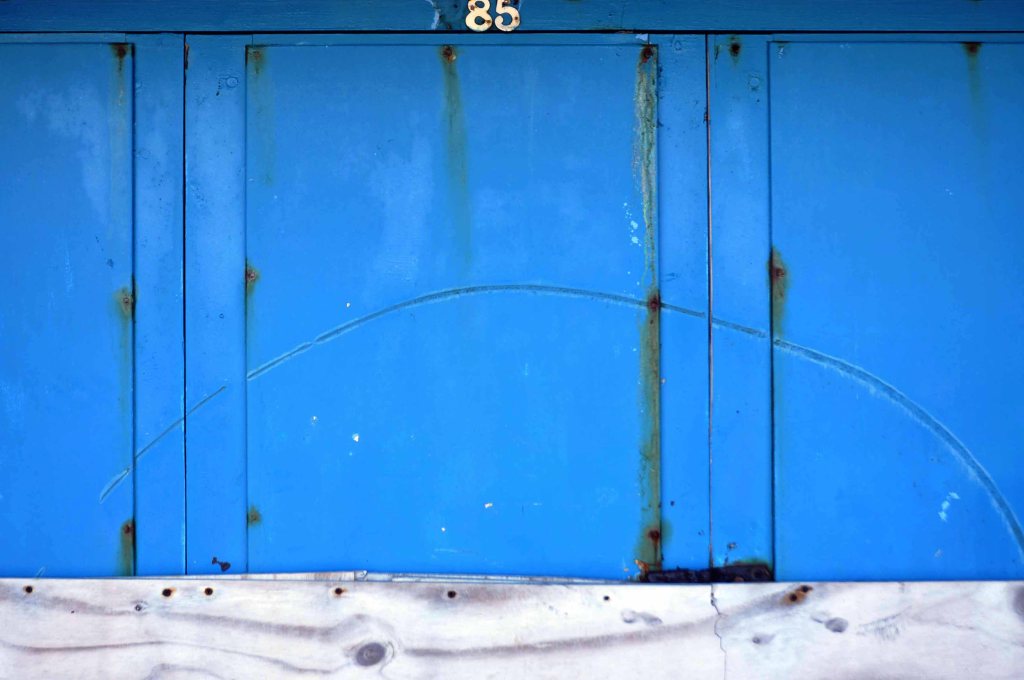
The primary coloured paint almost still fresh on their well locked doors.
They stand forlorn on the concrete shore overlooking an indifferent North Sea, hoping for a future in an uncertain age.
As I snapped I chatted to a local ANTIFA Anarcho Punk – ex Mansfield Miner and political activist, he feared that they would be swamped by some tidal wave of gentrification.
If so when, not soon.
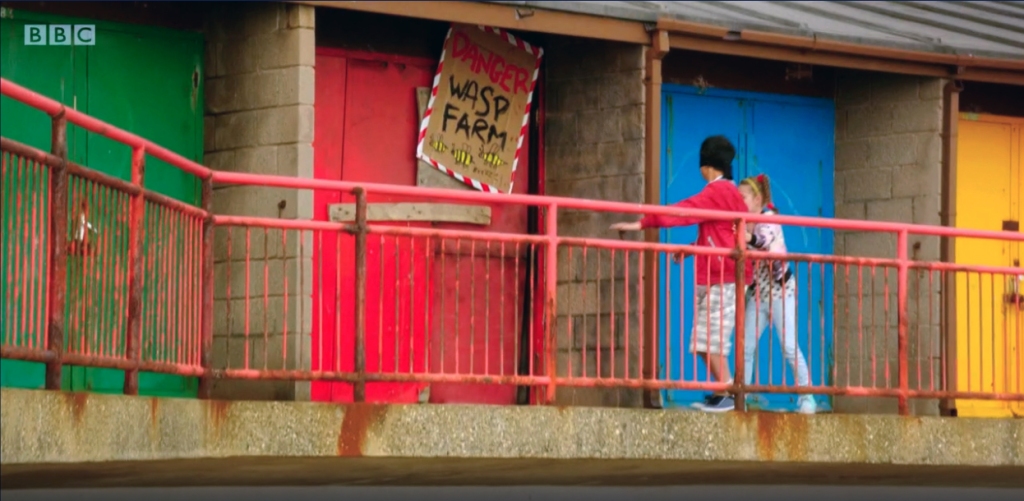
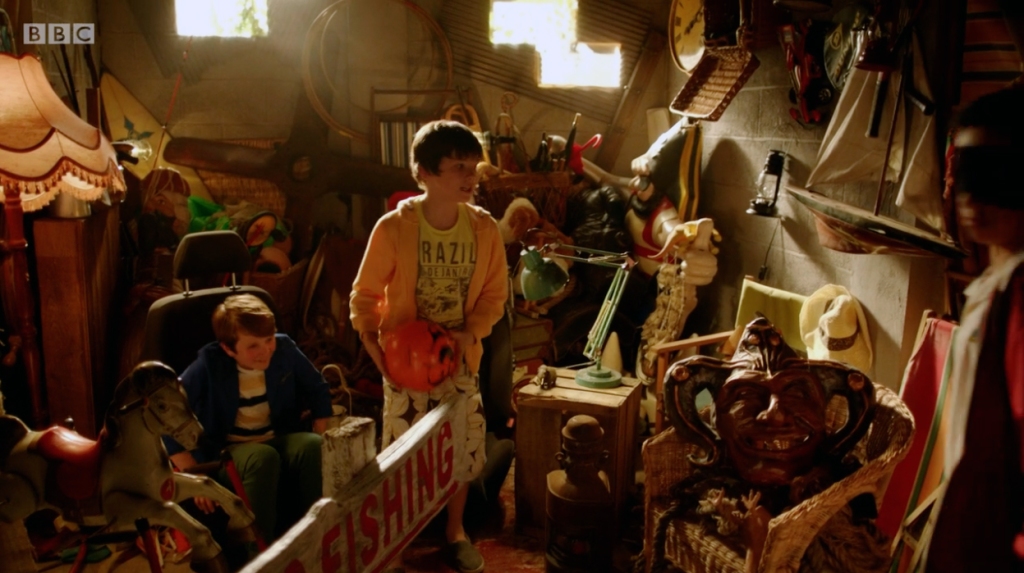
As a post script I have been informed that the site was used as a kid’s den in the CBBC TV series All at Sea!
Having started in the middle, let’s fast forward to the end – the beginning will have to wait.
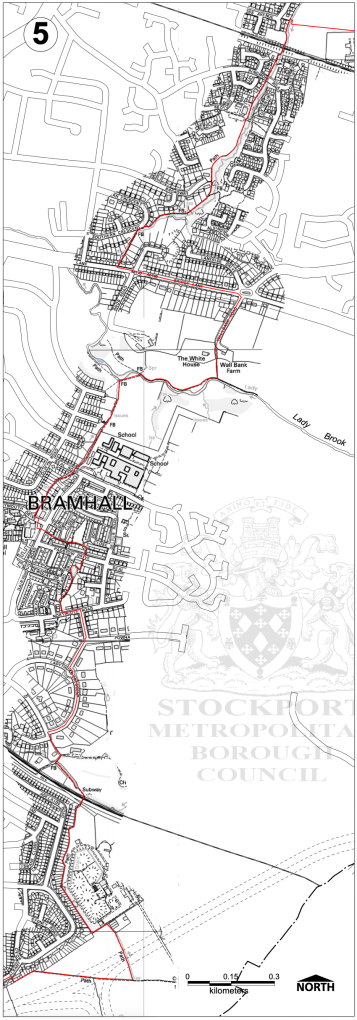
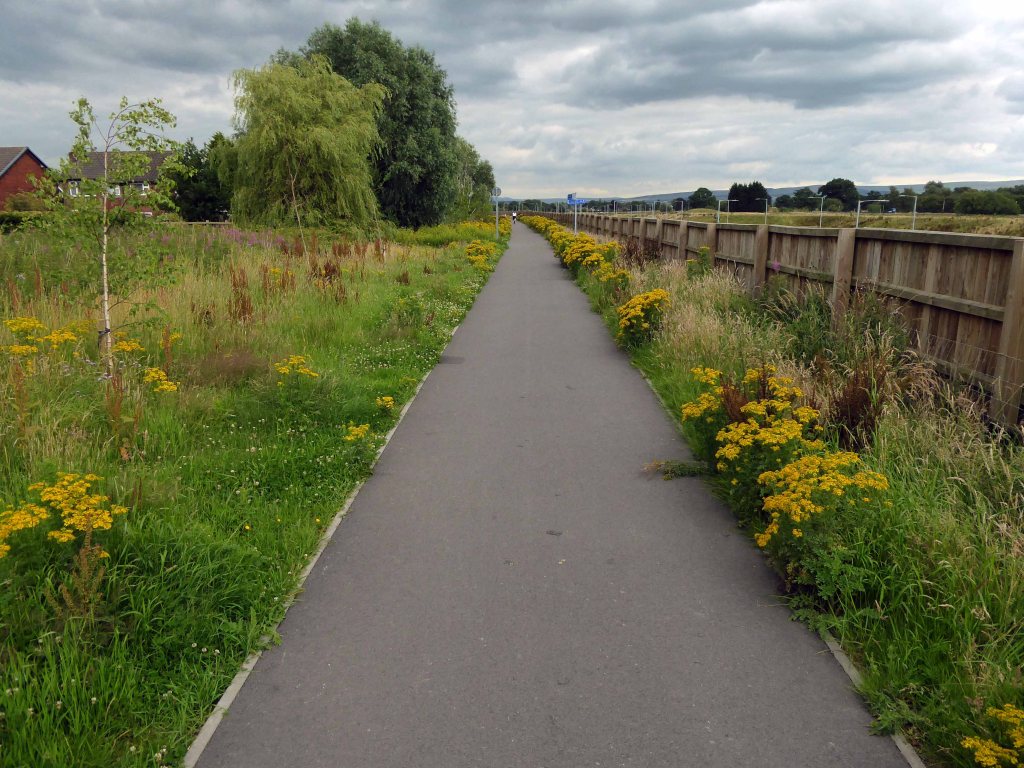
We take up our walk along Fred’s Way once more by Mirrlees Fields.
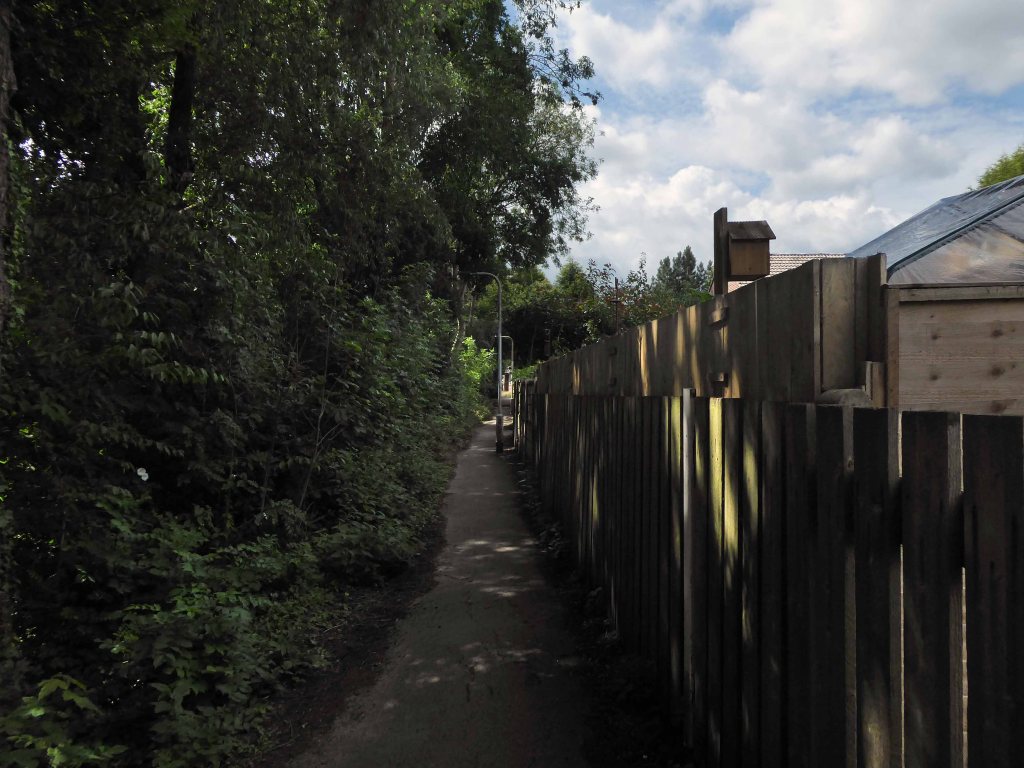
Following the brook along the narrow shallow valley, betwixt and between houses.
Briefly opening out into green open space.
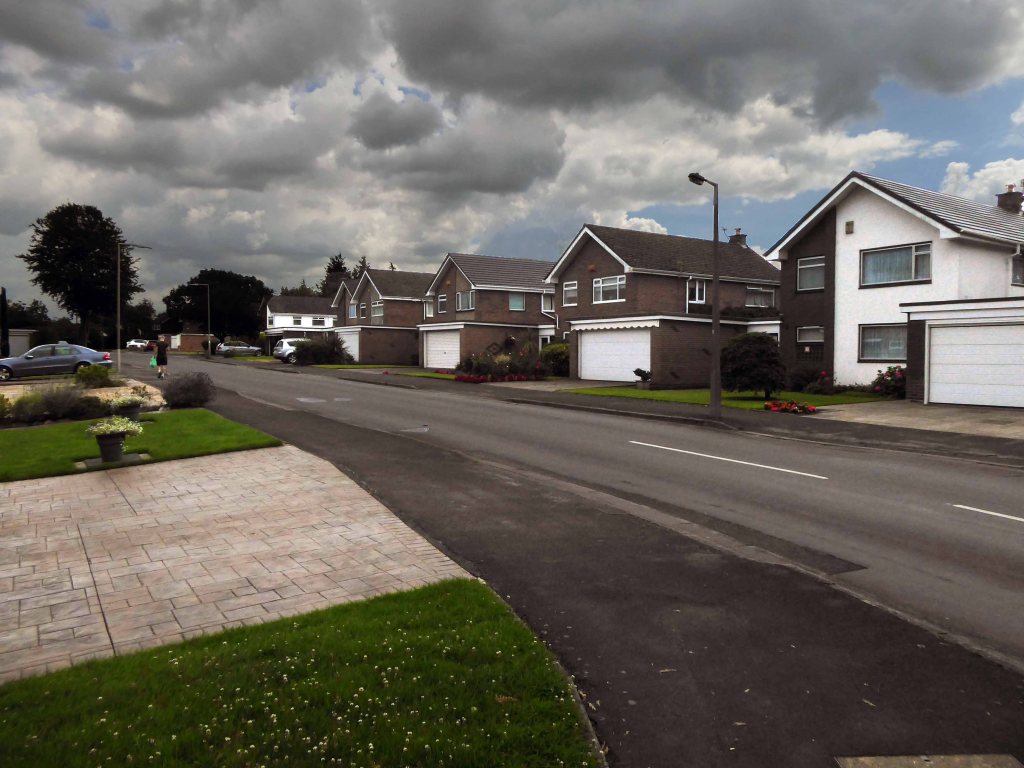
Crossing the road and entering the detached world of the detached house.
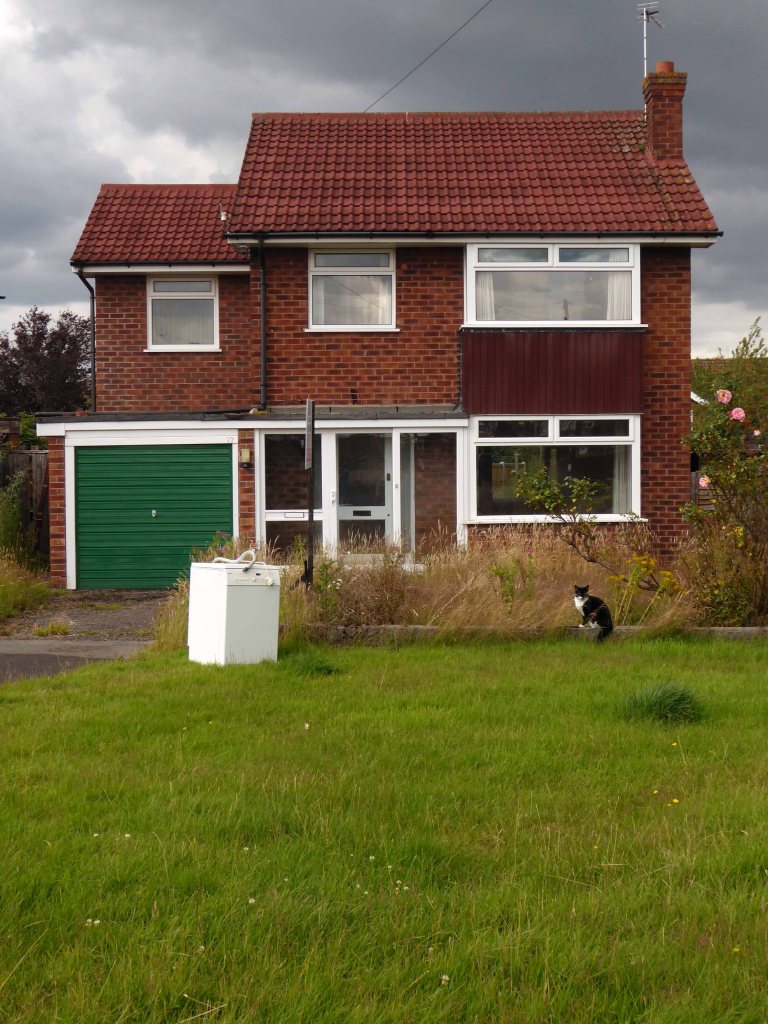
No two the same or your money back!
Diving feet first into Happy Valley, home to the Lady Brook stream.
And quickly out again.
Emerging once again into the space between spaces.
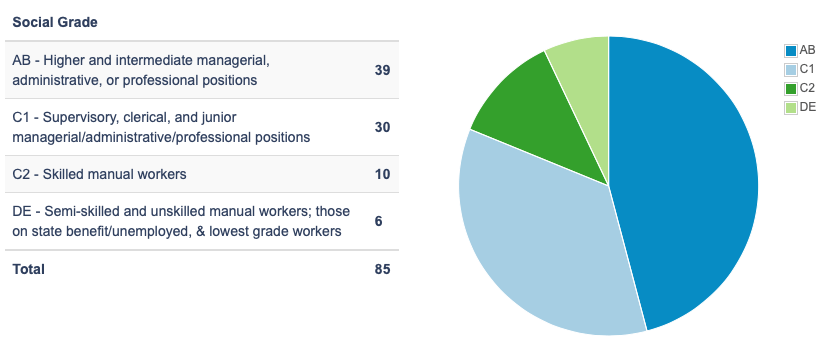
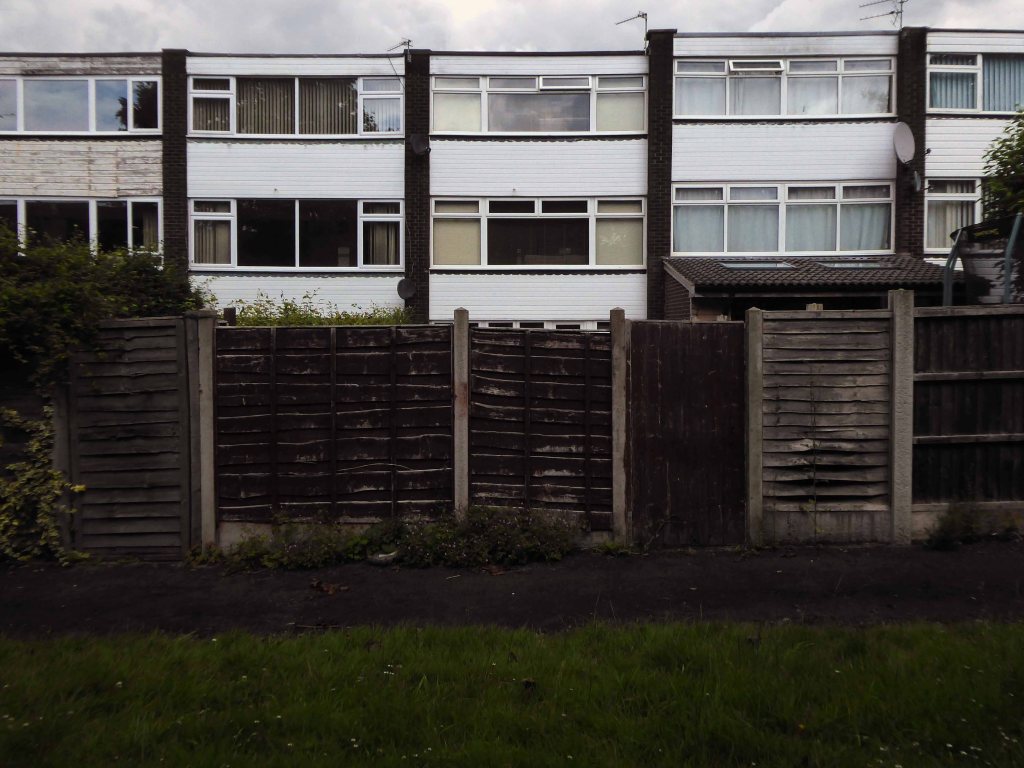
The suburban idyll of the Dairyground Estate home to very few semi-skilled and unskilled manual workers; those on state benefit/unemployed, and lowest grade workers.
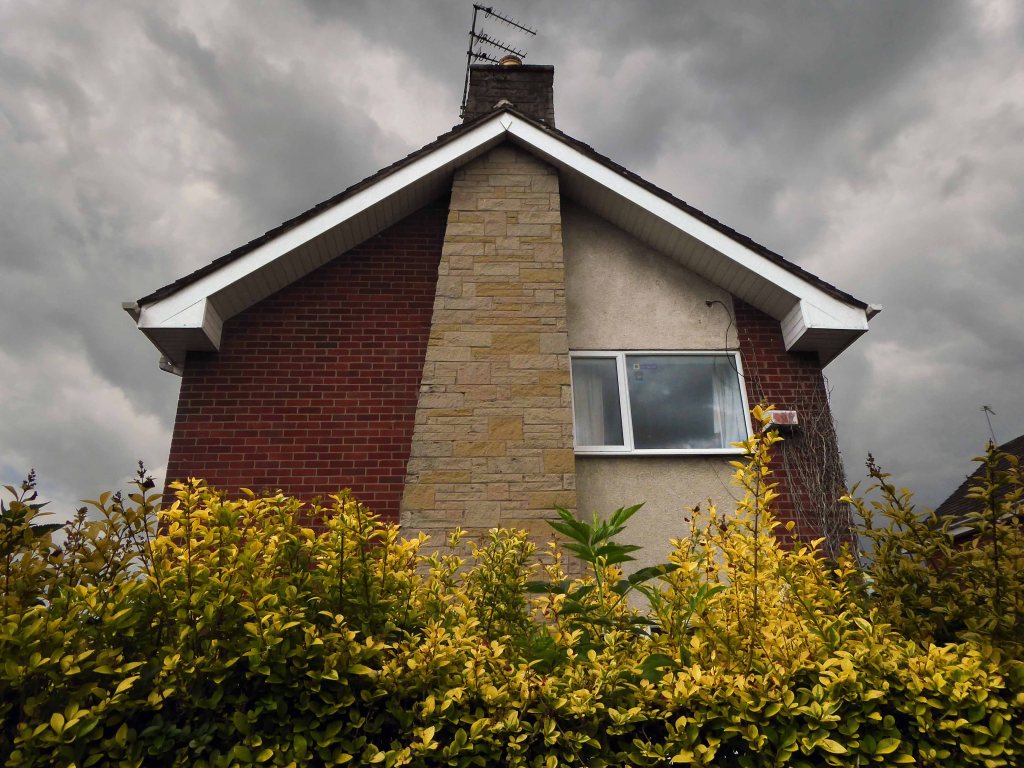
But home to an interesting array of Post War housing.
Including examples of the style de jour, à la mode conversions and updates extended and rendered, black, white and grey symbols of success or extensive extended credit facilities.
Though the more traditional fairy tale variant still has a space and place, in the corner of some well behaved cul de sac.
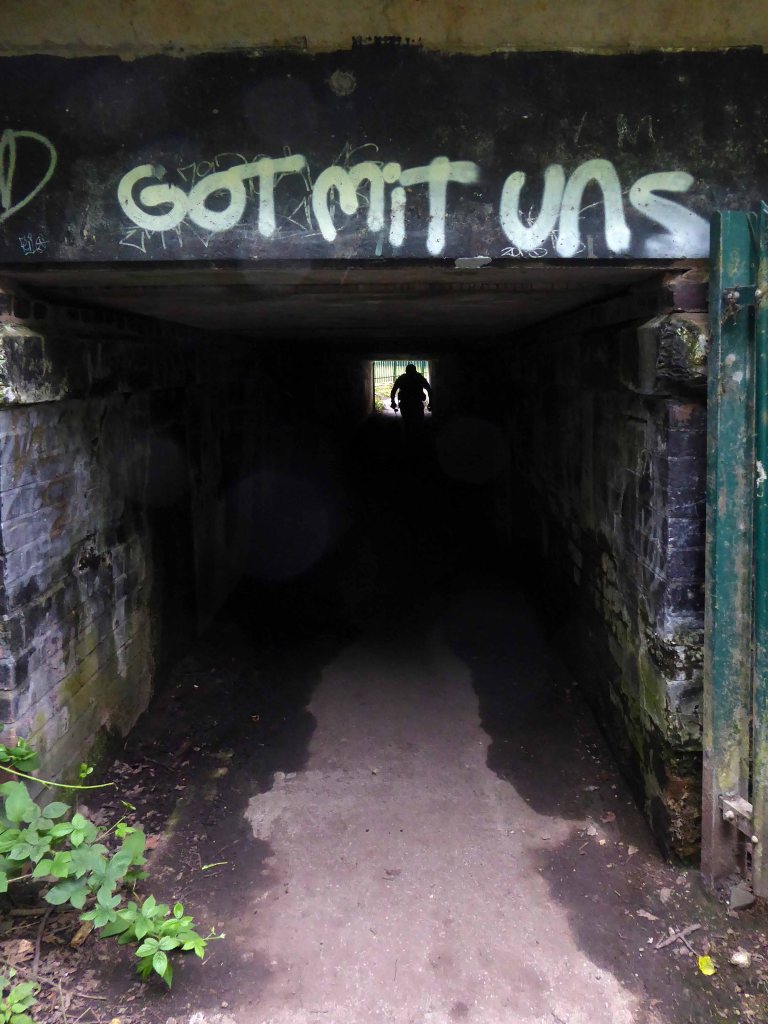
Under the railway – through a low tunnel darkly.
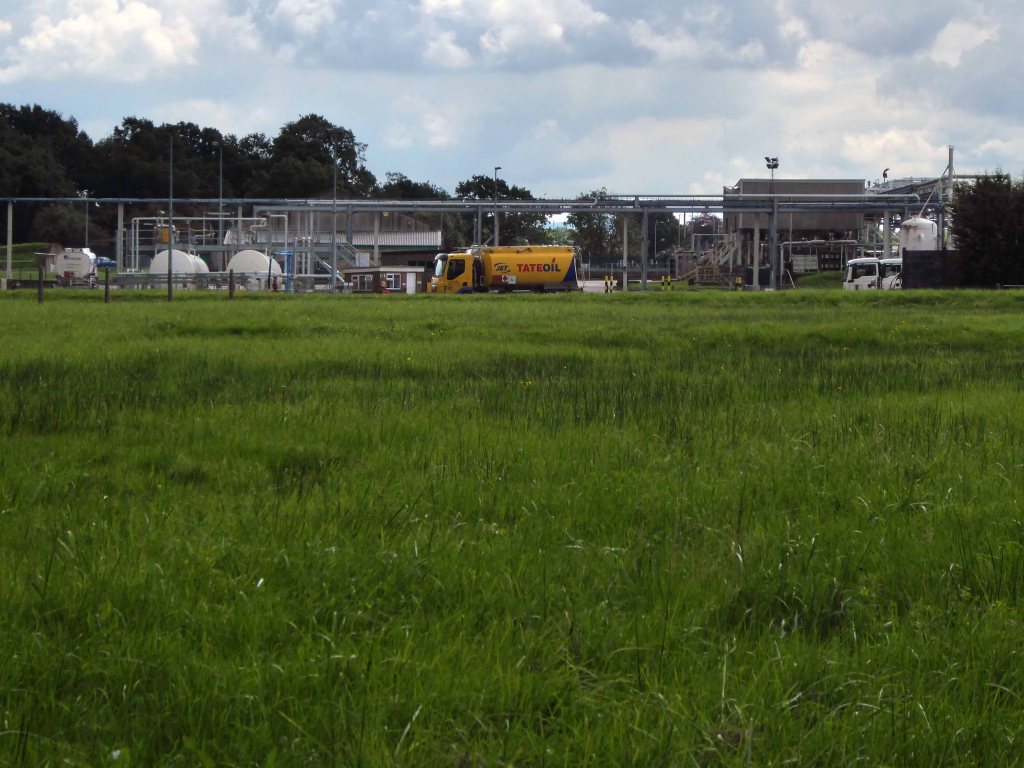
We struck oil, black gold, Texas Tea – Tate Oil.
The area of Little Australia – so called as all the roads are named after towns in Australia, is bordered by the West Coast Main Line to the north, the Bramhall oil terminal to the east, Bramhall village centre to the west and Moorend Golf Club to the south.
We emerged into a warren of obfuscation, dead ends and conflicting signs, having made enquiries of the passing populace, we realigned with the new bypass.
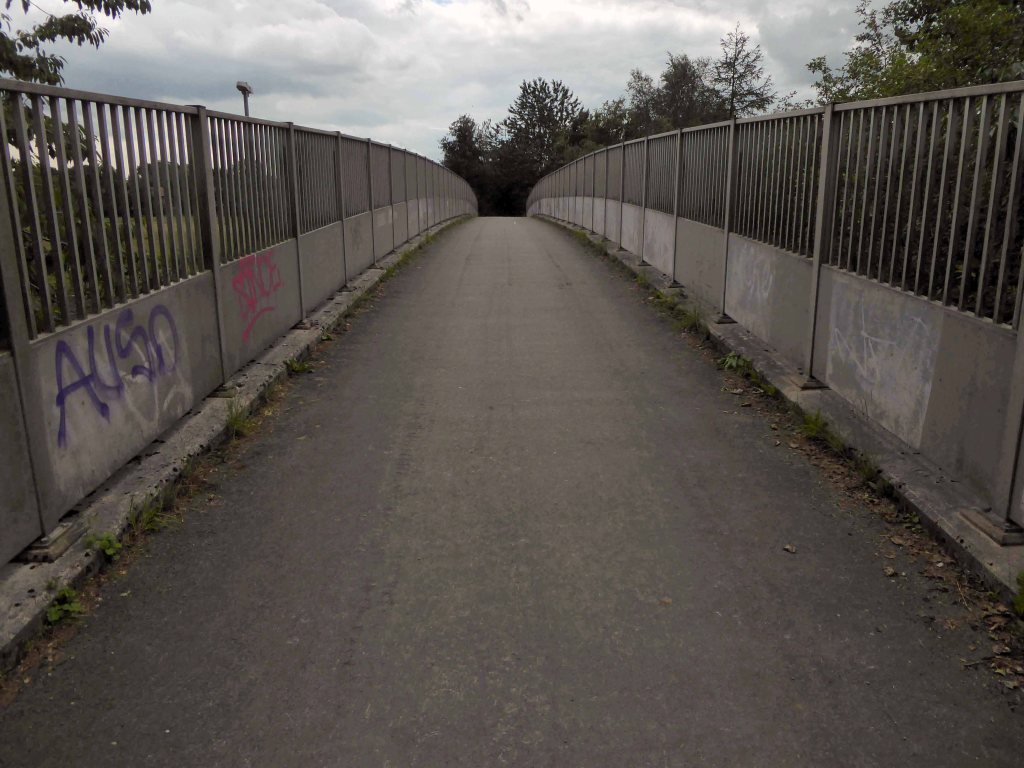
Passing over the conveniently placed footbridge over the bypass and beyond.
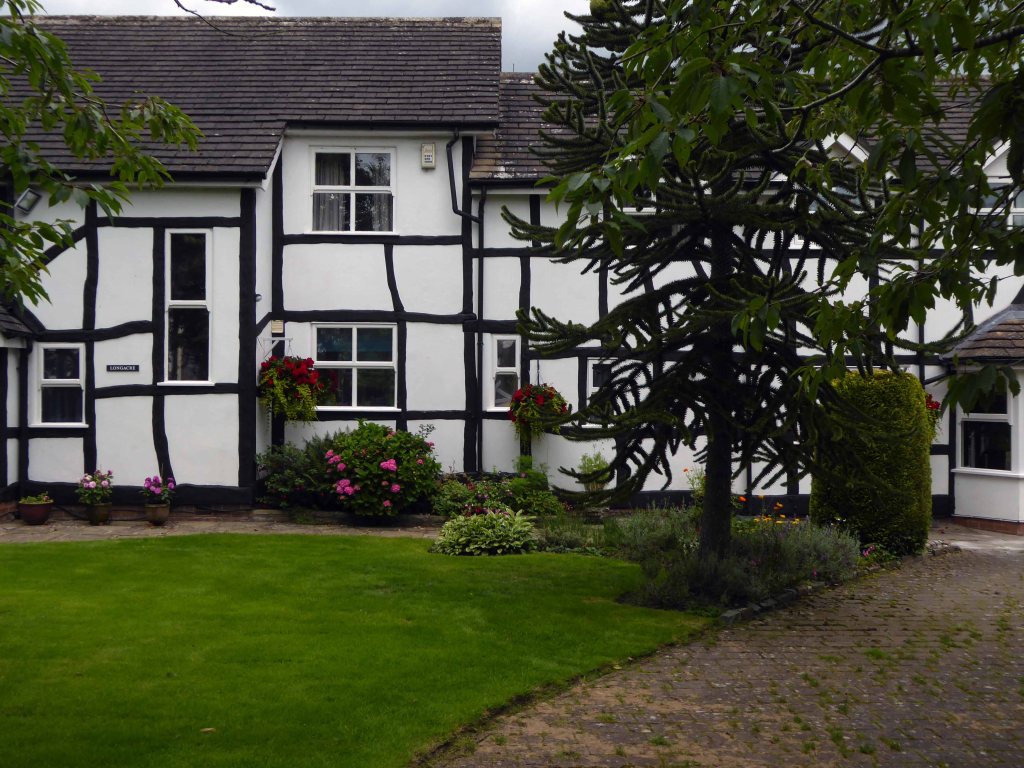
Emerging amongst faux beams and real Monkey Puzzles.
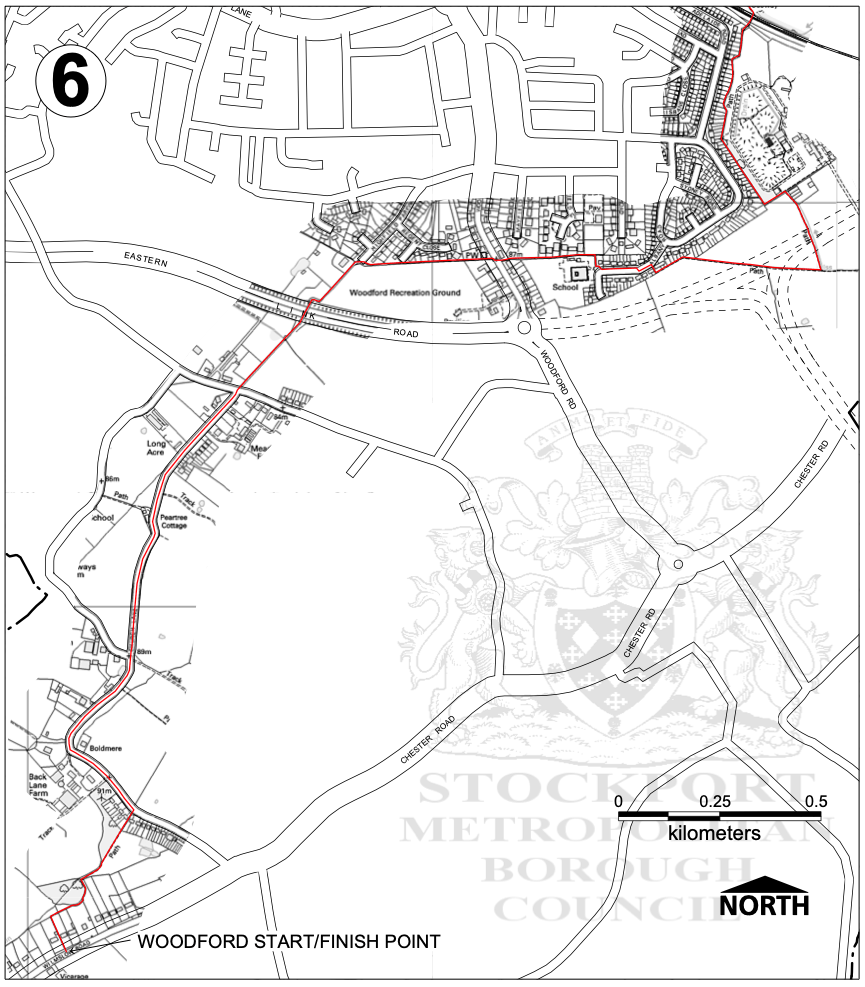
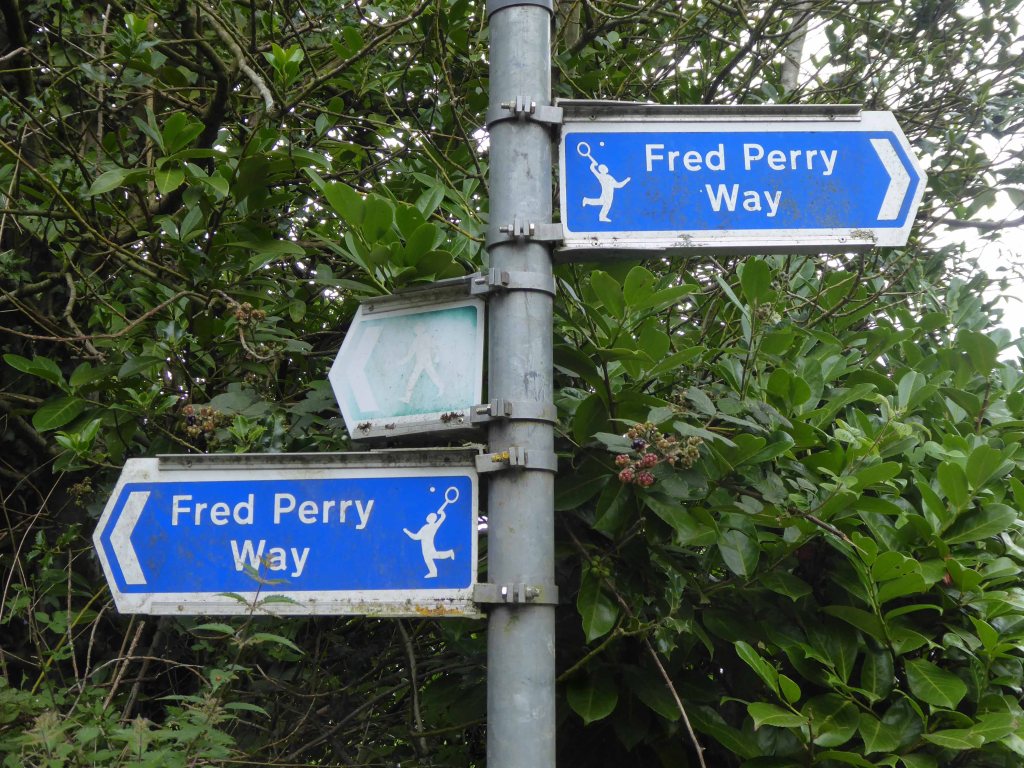
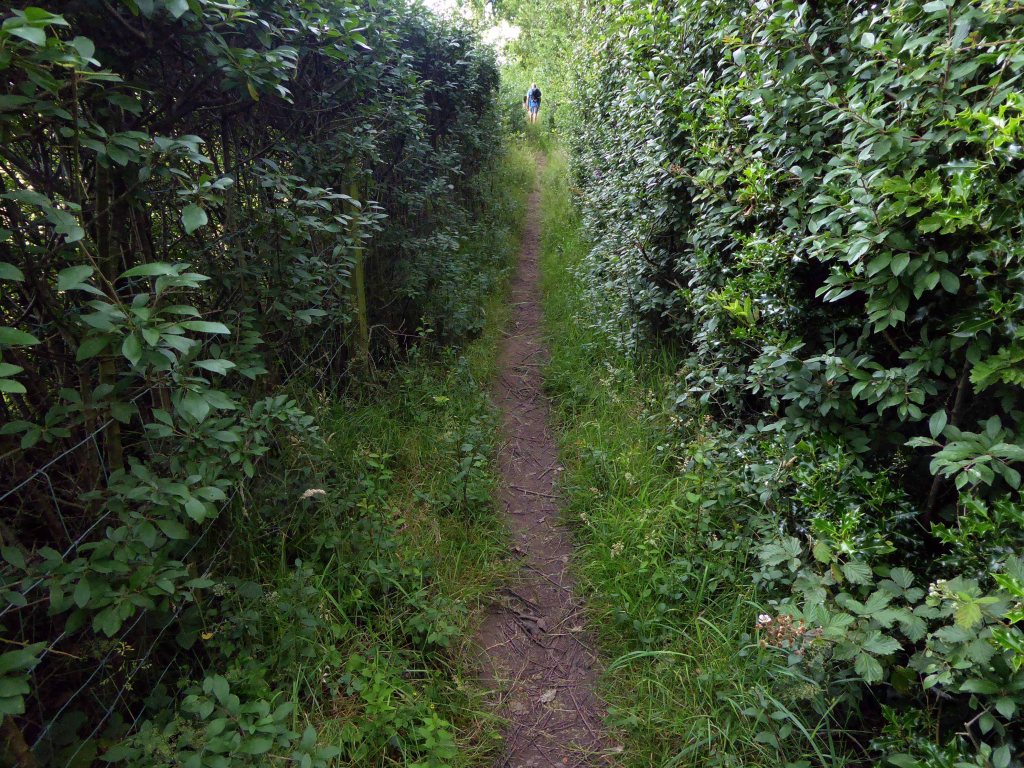
It was at this point that, unbeknownst to us, we followed a twisted sign, misdirecting us along an overgrown path – to Handforth.
We failed, in the end we failed to arrive to arrive at the end.
Heading west like headless chickens towards the Turkey Farm.
Making our way mistakenly to Handforth Dean Retail Park – rear of.
Crossing slip roads with no pedestrian access and the forbidden territory of an industrial sized gymnasium car park.
Woodford will just have to wait, another day another dolorous excursion.
I’ll do anything twice or more – so here we are again, this time on foot.
Let’s start at the very beginning, a very good place to start – in the middle, the section from the town centre to Hazel Grove.
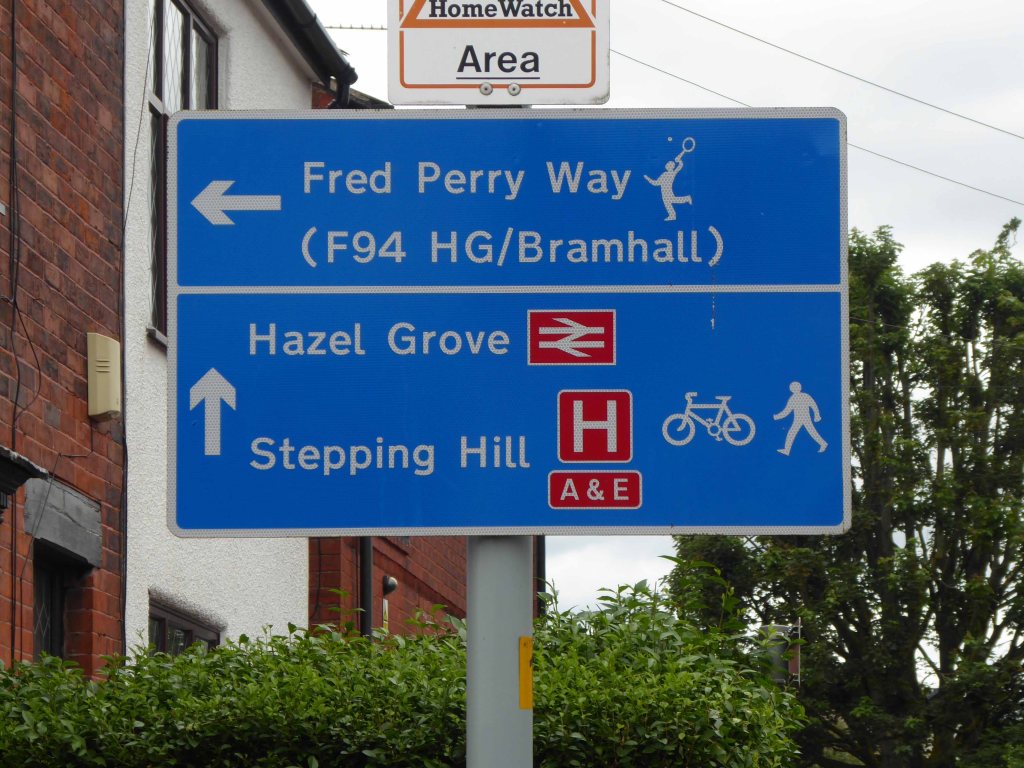
Maps are available here for free – we declined the offer, deciding to follow signs instead, many of which were missing or rotated, the better to misinform and redirect – such is life.
We are mostly lost most of the time, whether we like it or know it or not.
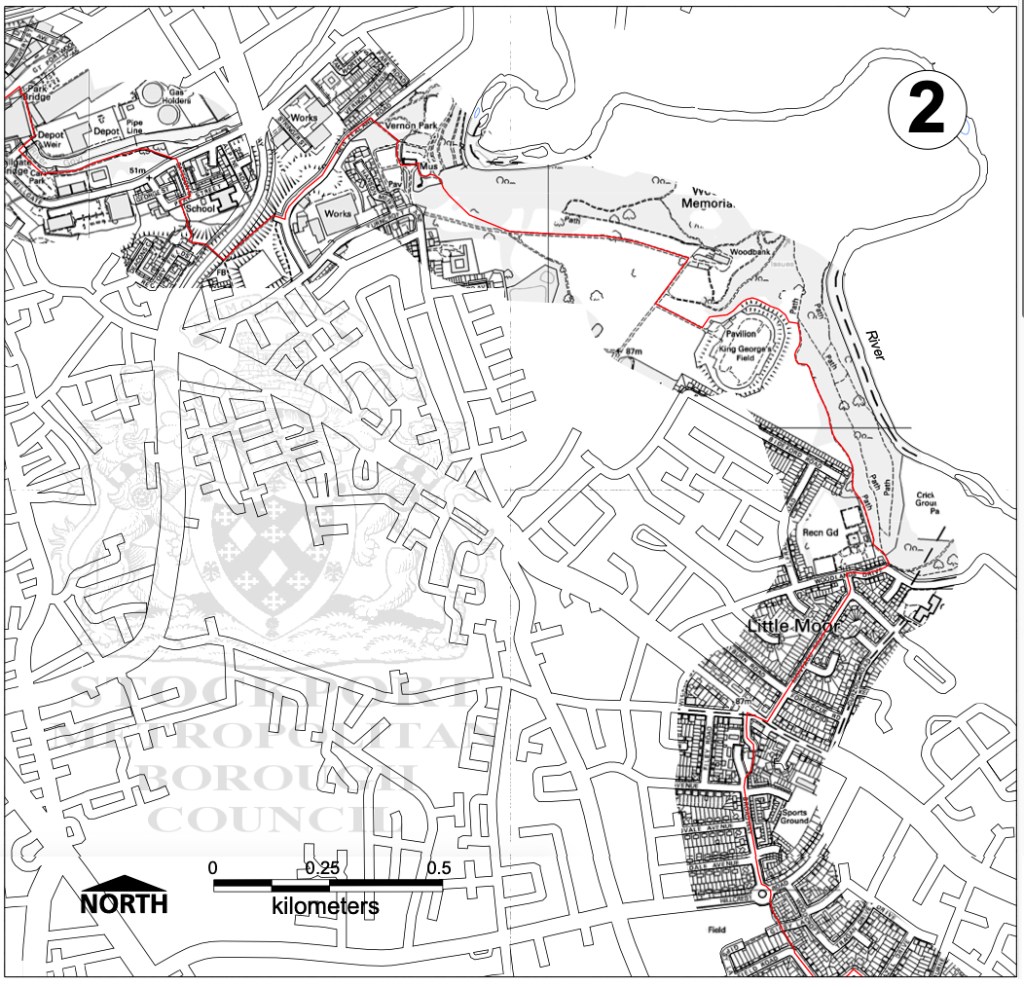
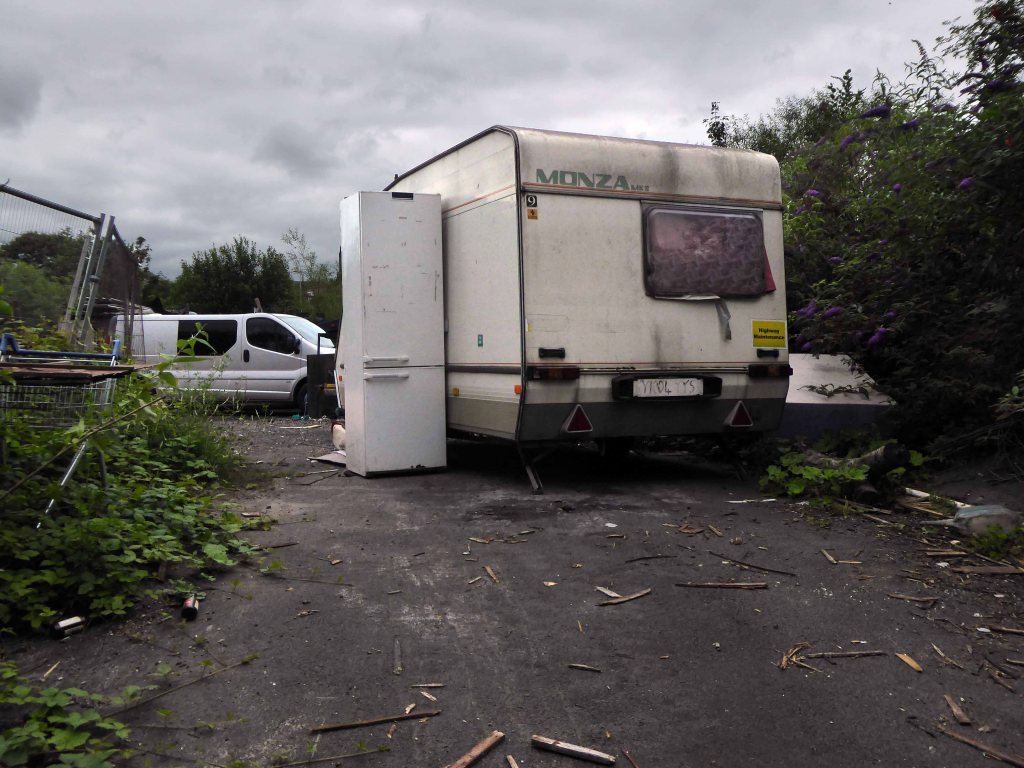
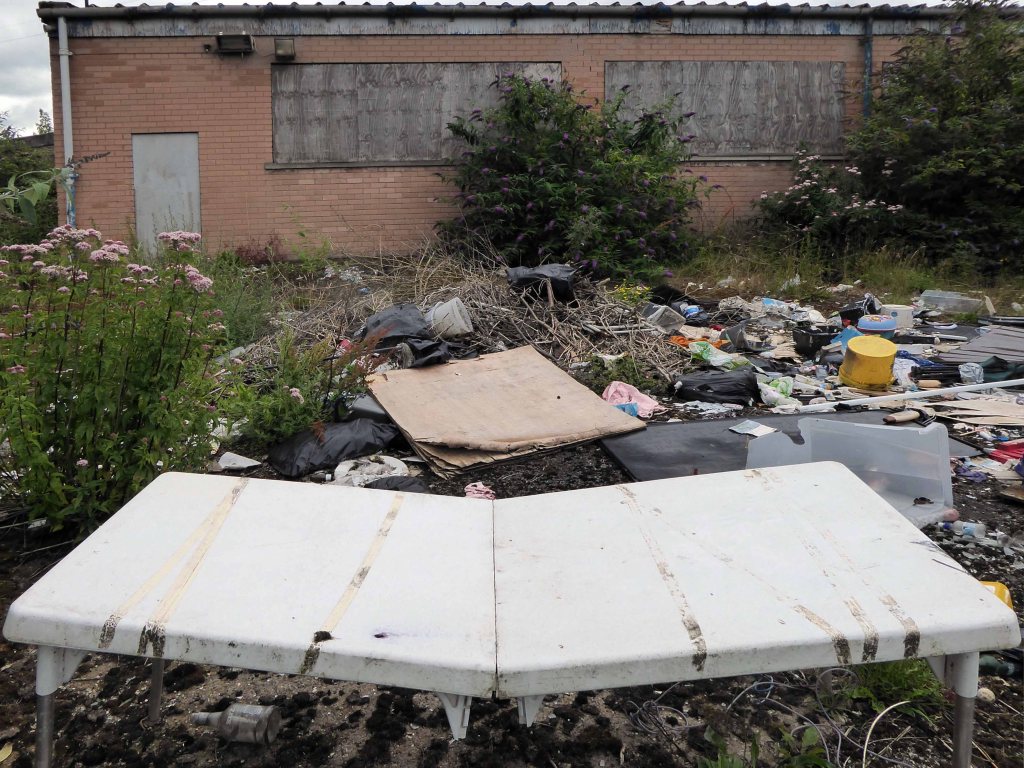
We begin at the confluence of the rivers Mersey and Goyt – which no longer seems to be a Way way, the signs having been removed, and proceed down Howard Street, which seems to have become a tip.
The first and last refuge for refuse.
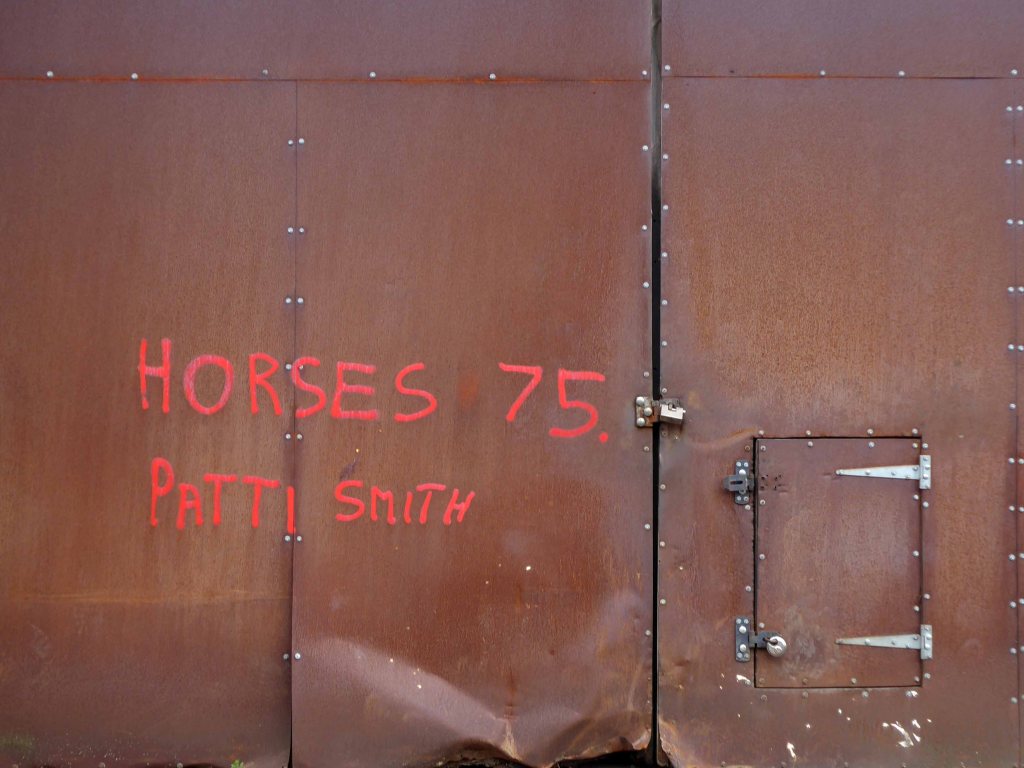
Passing by the kingdom of rust – Patti Smith style.
Passing under the town’s complex internal motorway system by underpass.
Almost opposite the entrance to the museum, now set in shrubbery, are the foundations, laid in September 1860, of what was to be a forty metre high Observatory Tower. Despite a series of attempts, funds for the tower could not be raised and the ‘Amalgamated Friendly Societies of Stockport’ eventually had to abandon the idea.
Historic England
Out east and passing alongside the running track.
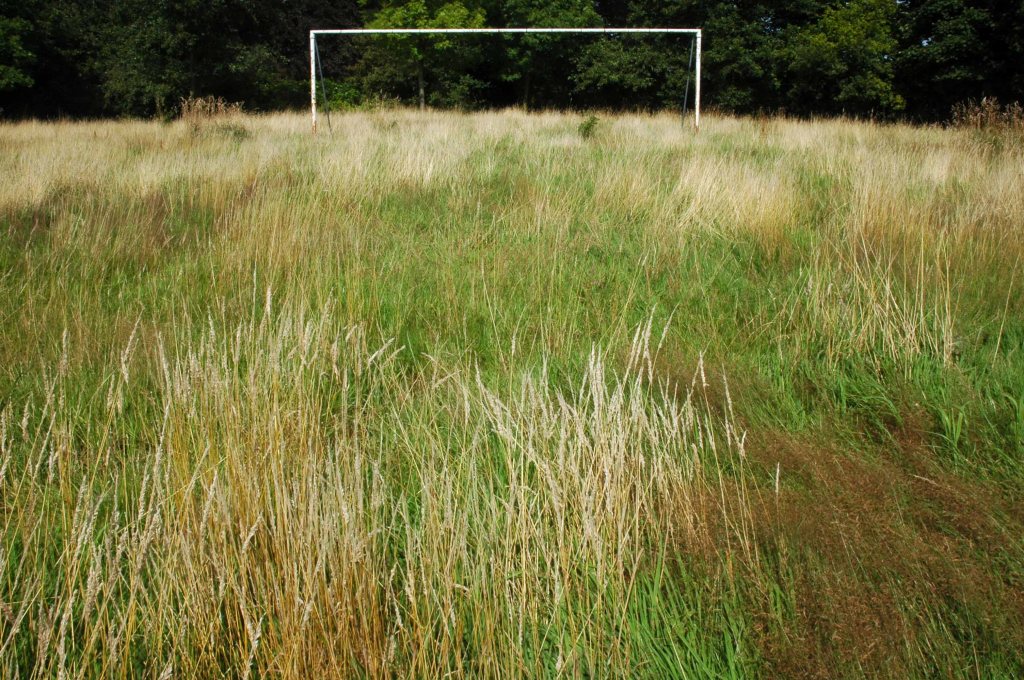
Lush meadows now occupy the former football field, twixt inter-war semis and the woodland beyond.
Out into the savage streets of Offerton where we find a Buick Skylark, incongruously ensconced in a front garden.
The only too human imperative to laugh in the face of naturalism.
We have crossed over Marple Road and are deep in the suburban jungle of mutually exclusive modified bungalows.
Off now into the wide open spaces of the Offerton Estate – the right to buy refuge of the socially mobile, former social housing owning public.
People living on Offerton Estate have been filmed for a programme entitled ‘Mean Streets’ which aims to highlight anti-social behaviour in local communities.
The next thing we know we’re in a field, a mixed up melange of the urban, suburban and rural, on the fringes of a Sainsbury’s supermarket filling station.
We cross the A6 in Hazel Grove and here for today our journey ends
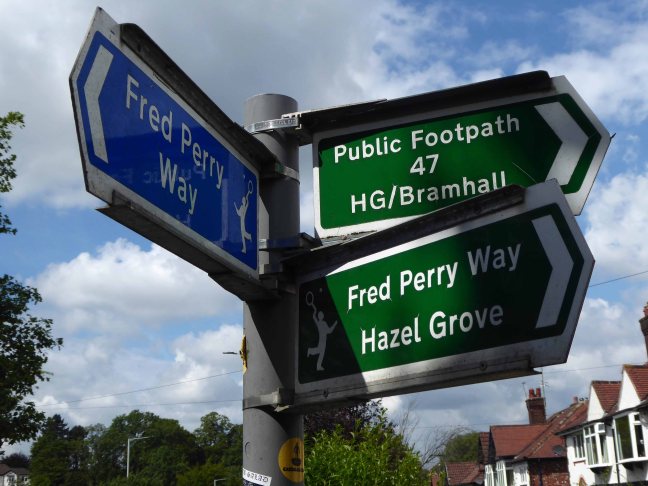
Ignoring the sign we went in the opposite direction.
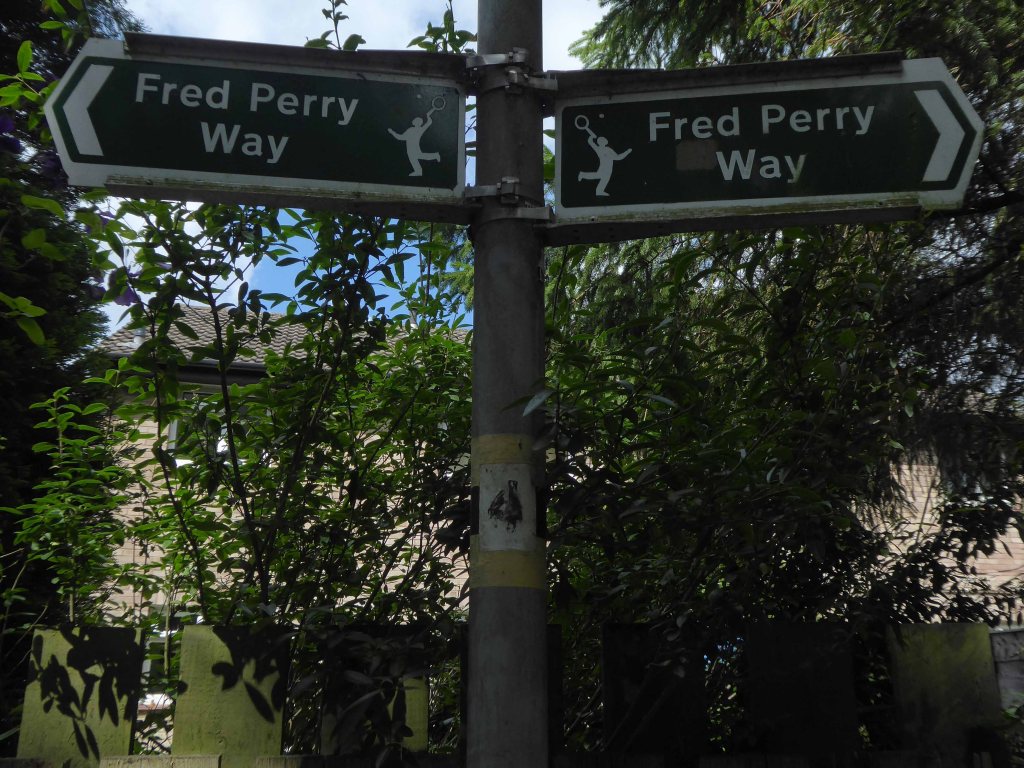
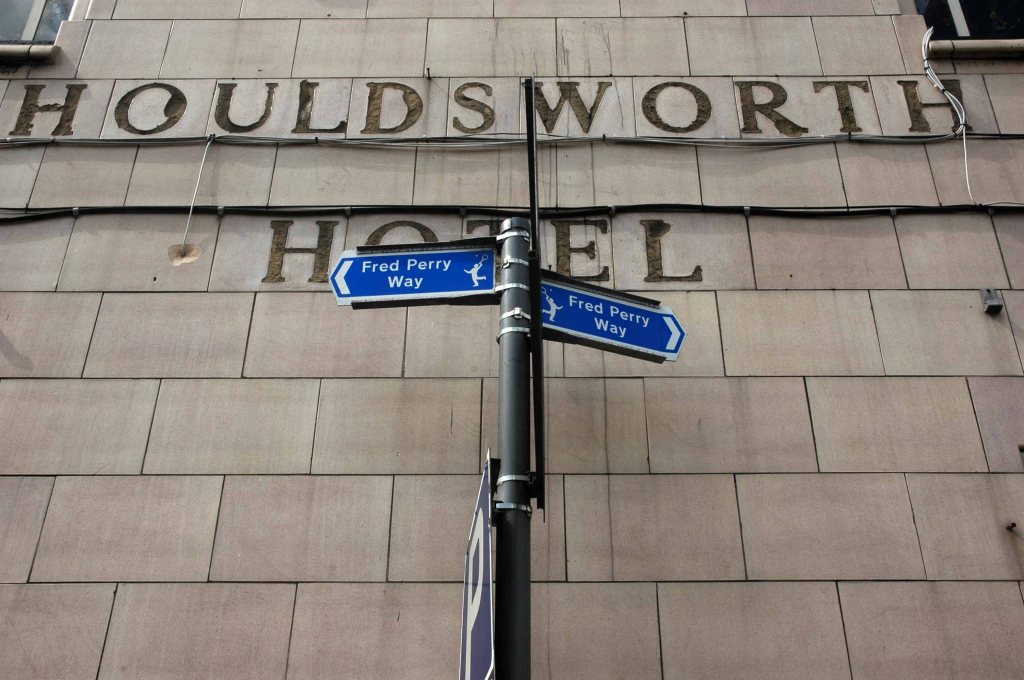
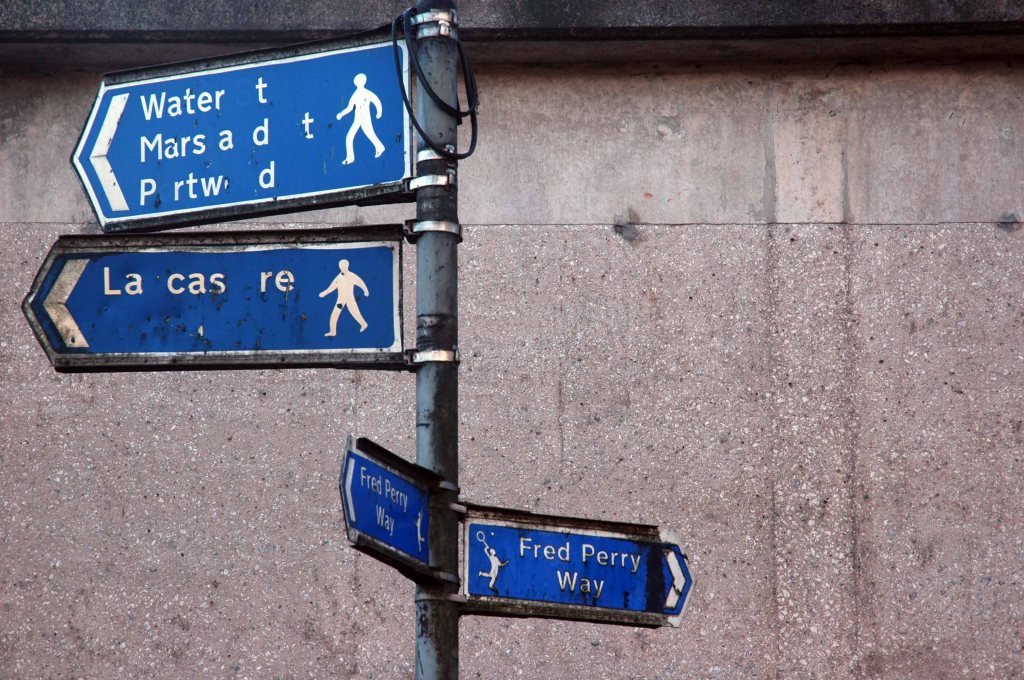
As we reach the edge of Mirrlees Fields – the site of the only Fred Perry laurel leaf logo emblazoned way marker.
The Fields are currently designated as a green space and are not available for residential development. But MAN would like to overturn this designation for over one third of the Fields.
MAN Energy Solutions UK is the original equipment manufacturer of Mirrlees Blackstone diesel engines.
Before the Blackstone MAN came in 1842 – the fields were all fields.
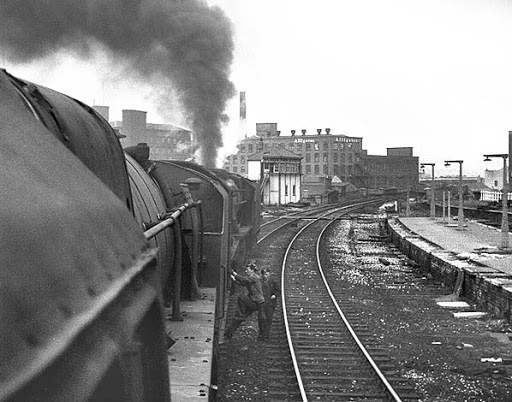
The Cheshire Lines Committee CLC operated Stockport, Timperley and Altrincham Junction Railway line from Portwood to Skelton Junction, a section of what became the Woodley to Glazebrook line.

It remained a part of the CLC, which was jointly owned from 1923 by the London and North Eastern Railway and the London Midland and Scottish Railway , until 1948 when it became part of the British Railways London Midland Region.
Closed in 1982, following the demise of the Woodhead route; the track was subsequently lifted in 1986.
in the age of steam mainline St Pancras trains and local stoppers flew by.
My interest lies in the small portion of track at the end of Georges Road – I worked as a Guide Bridge goods guard in and out of the scrap yard there, in the Seventies.
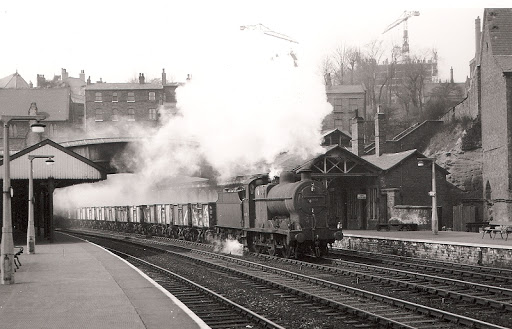
Now I walk past almost every day and it’s almost all gone.
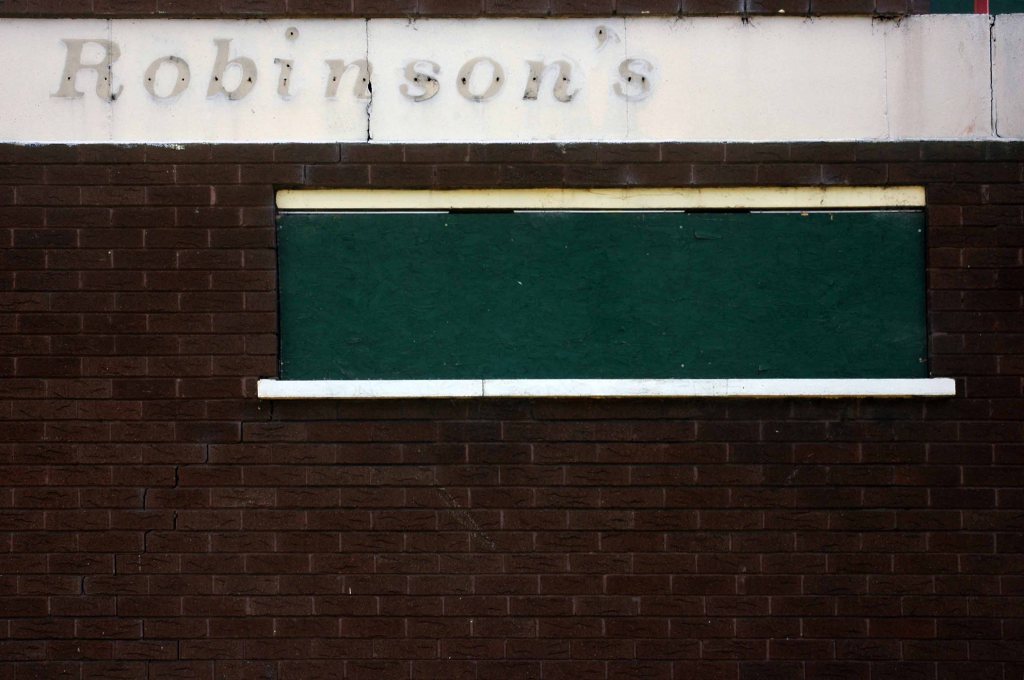
The bridge which it supported now demolished, time called long ago in the long lost Gardeners Arms – originally a Bell’s Brewery pub latterly a Robinsons house.
What remains is a triangular island faced in glazed and blue engineer’s brick, topped out with trees.
I have entertained the idea of accessing the area by ladder, exploring and possibly setting up camp – though I think the proximity to an almost constant flow of traffic, would prove less than commodious.
It evokes for me an elevated affinity with Ballard’s Concrete Island.
He reached the foot of the embankment, and waved with one arm, shouting at the few cars moving along the westbound carriageway. None of the drivers could see him, let alone hear his dry-throated croak, and Maitland stopped, conserving his strength. He tried to climb the embankment, but within a few steps collapsed in a heap on the muddy slope.
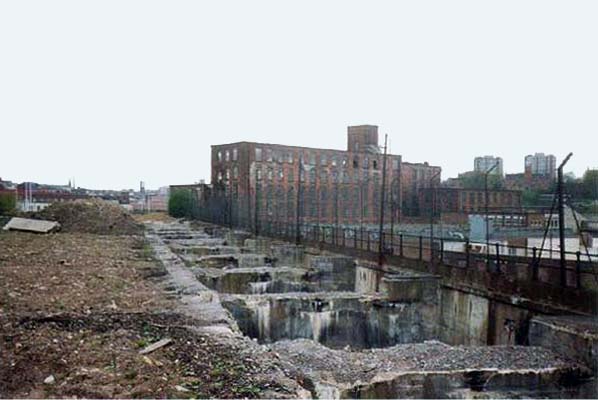
So here it is as is complete with tags, signs, cracks and all.
It remains as a monument to those who built and worked on the railway.
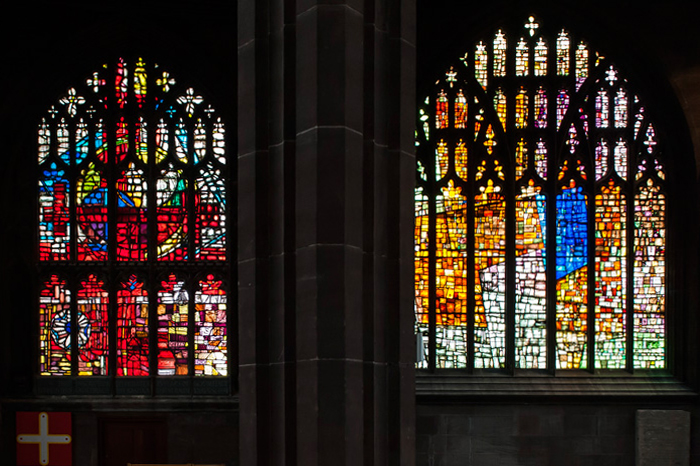
Tony Holloway’s work also illuminates the windows of Manchester Cathedral.
As well as the panels of the Faraday Tower, just the other side of UMIST.
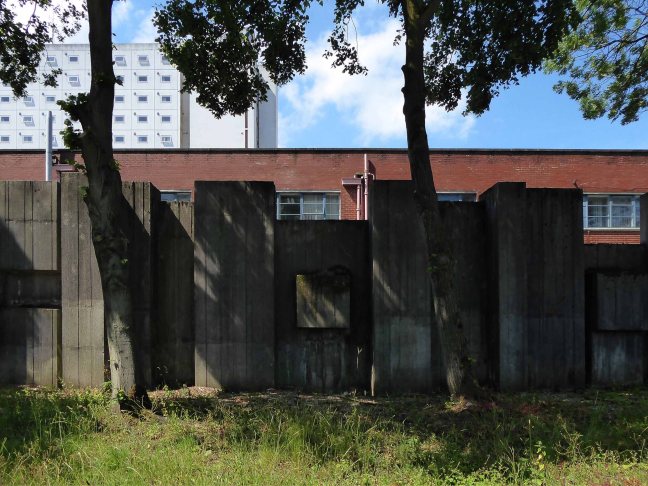
The wall is listed, fenced and obscured by the gradual incursion of assorted greenery.
It’s beginning to attract moss, amongst other things – just not like a rolling stone.
Like nearly everything else, it looks different each time you pass by, more or less light, new tags and signs – so here it is as of Saturday 13th June 2020.
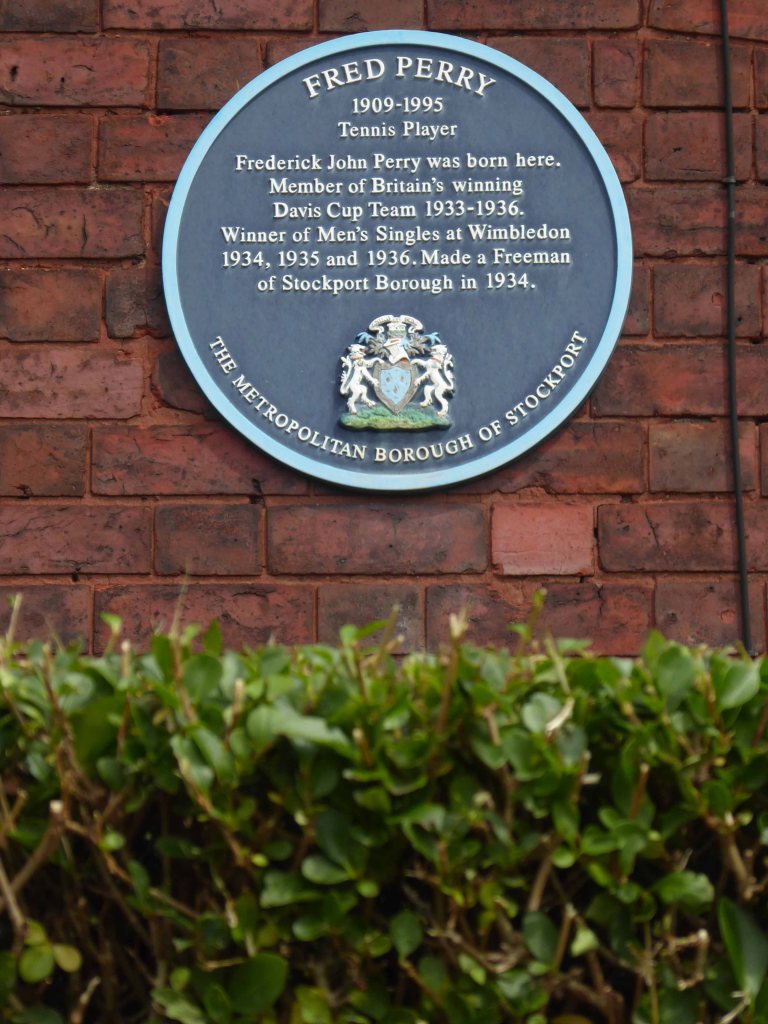
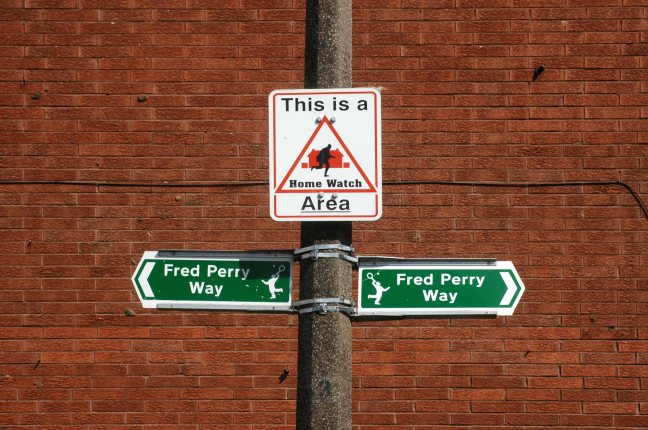
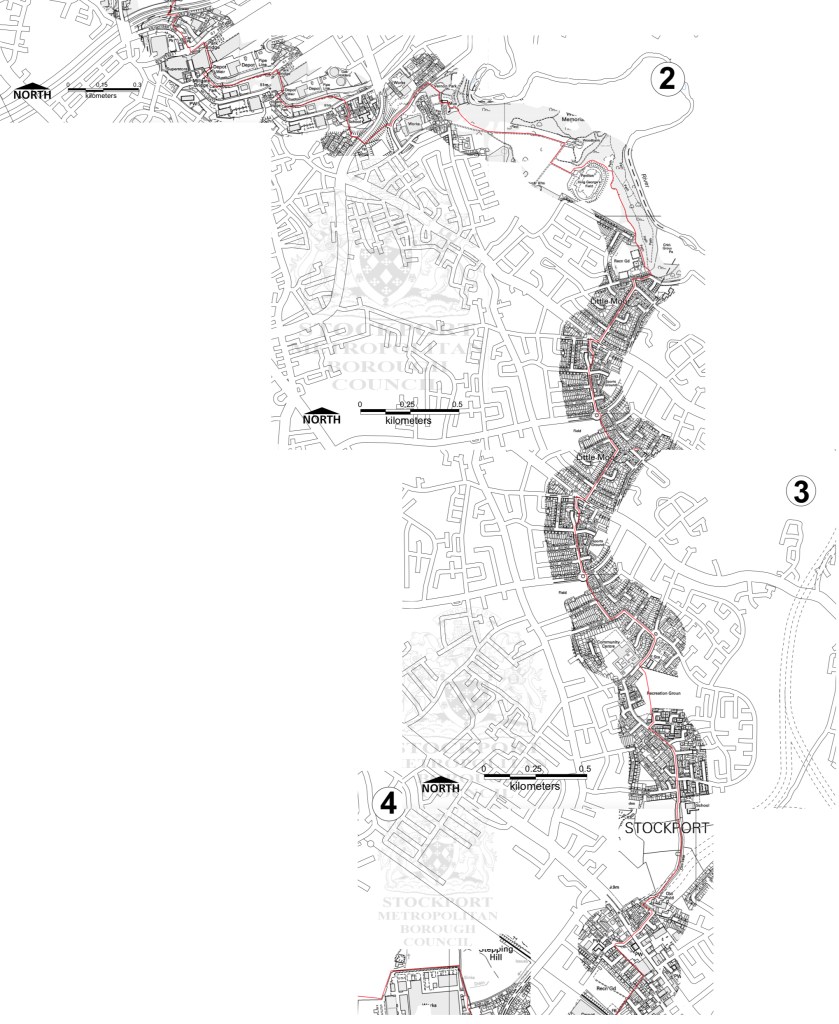
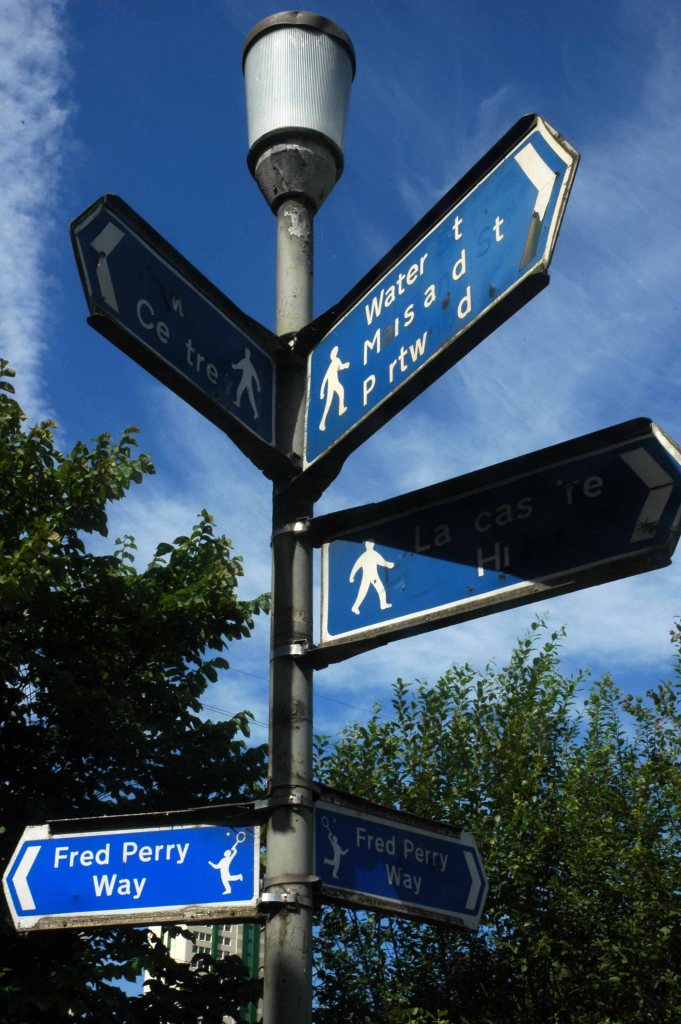
Some time ago in Stockport Fred Perry was born, lived and moved away – in pretty rapid succession. Nevertheless the Borough claims him as their own and to celebrate the fact, they have devised a Way.
Not the way or an away day but a named way, the Fred Perry Way.
Stretching from North Reddish in the north to Woodford in the south – zigging and zagging through and across highways and byways, avenues and alleyways.
Combining rural footpaths, quiet lanes and river valleys with urban landscapes and park lands.
For the long distance walker it may be useful as a link route. The Fred Perry Way provides a link between the Bollin Valley Way, and through that, the North Cheshire Way, and via a short link between Mottram & Woodford, the Tame Valley Way and Etherow Goyt Valley Way at Stockport. A full crossing of historical North Cheshire could be devised, linking Black Hill & Crowden on the Pennine Way with Hilbre Island, utilising also the Wirral Way/Wirral Shore Way.
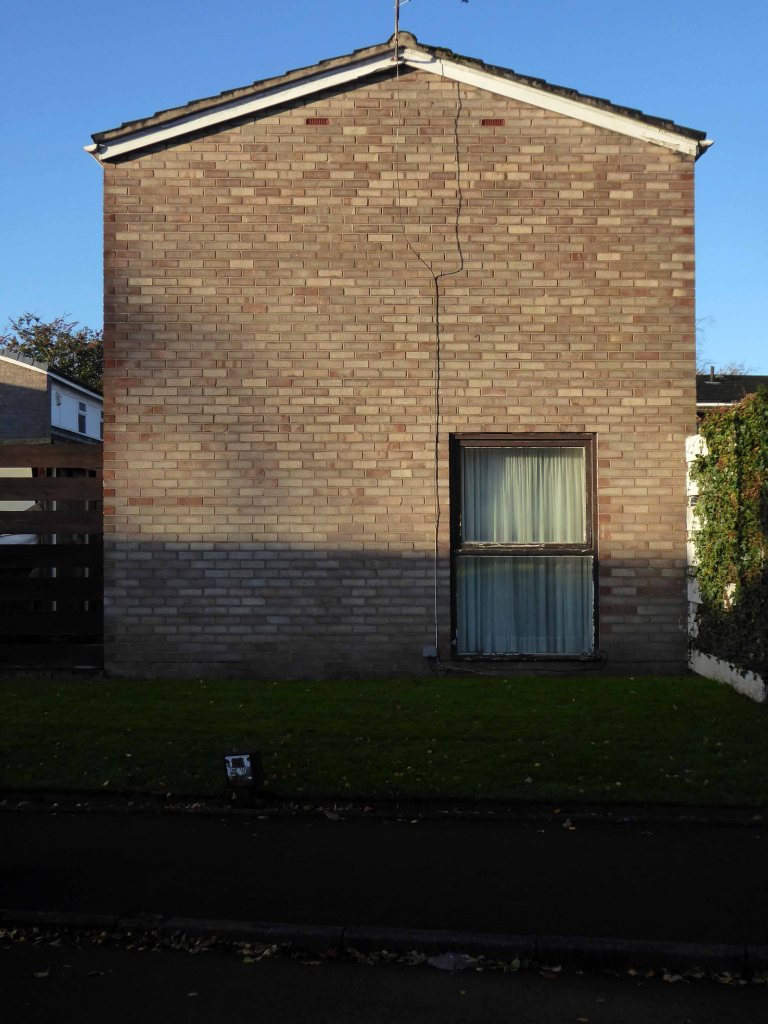
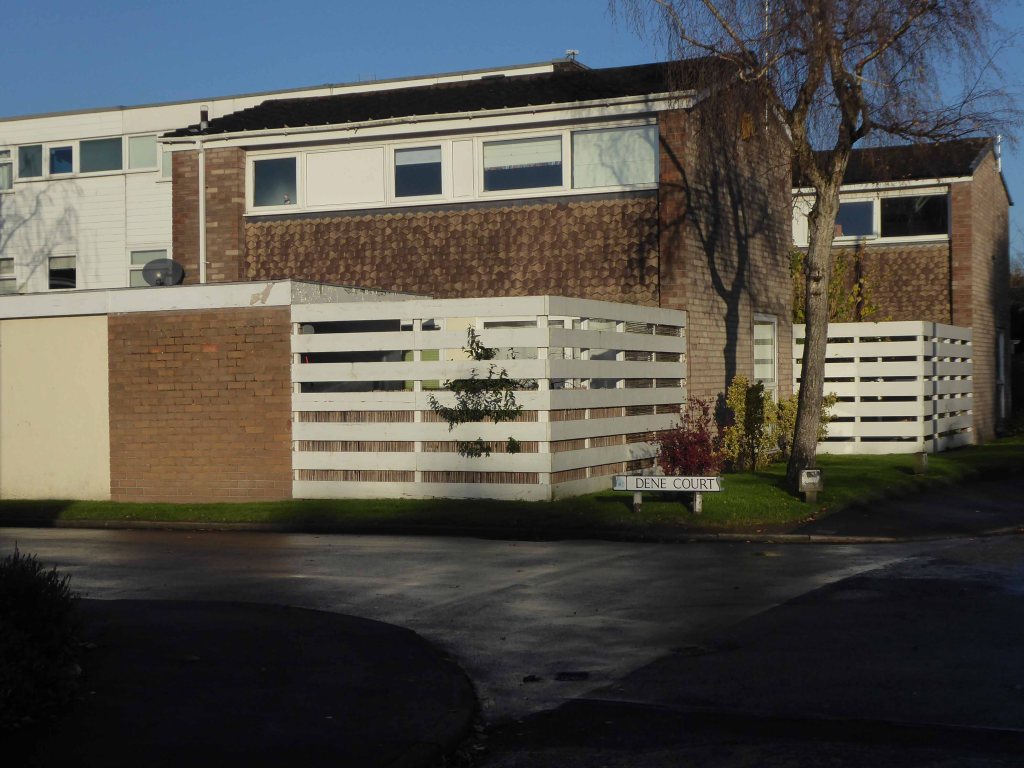
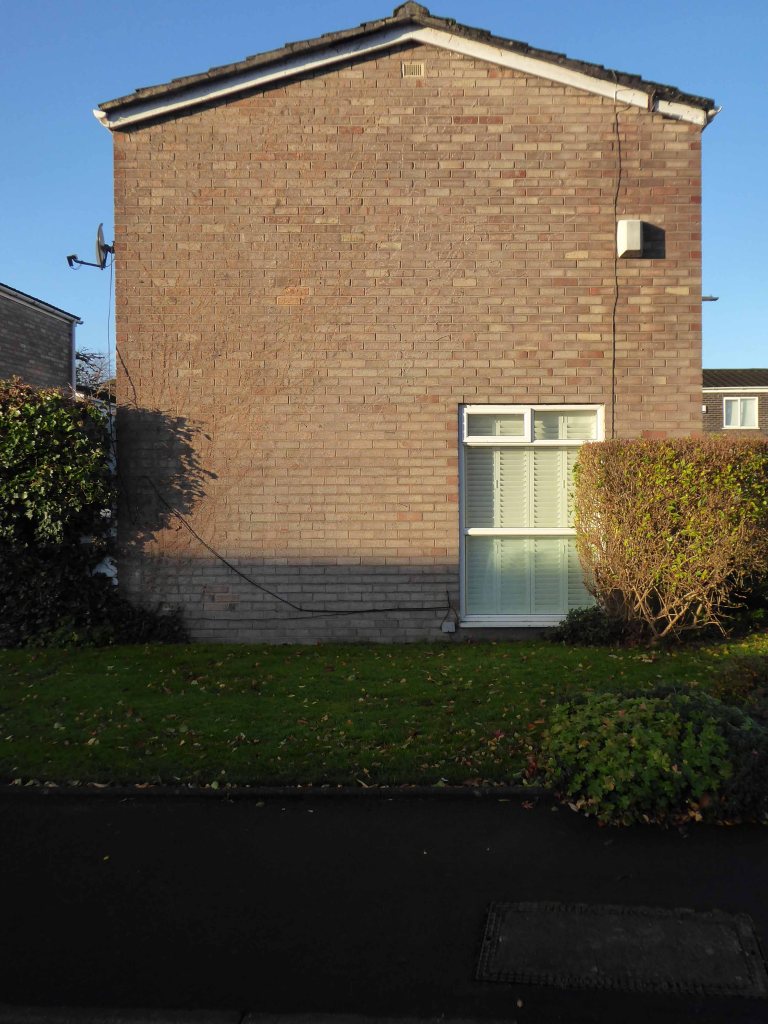
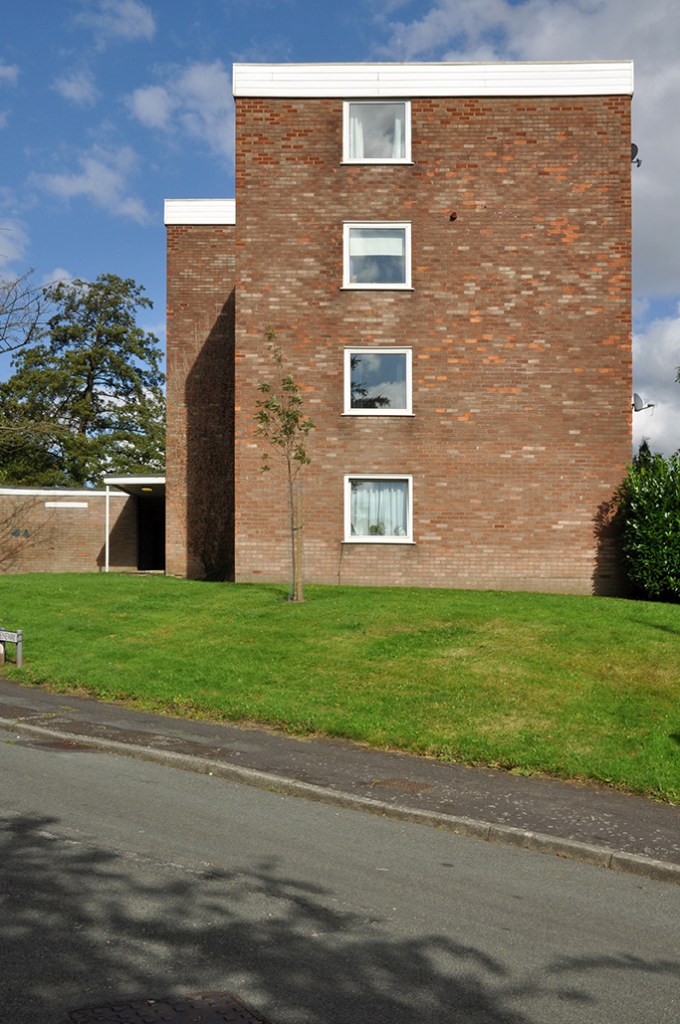
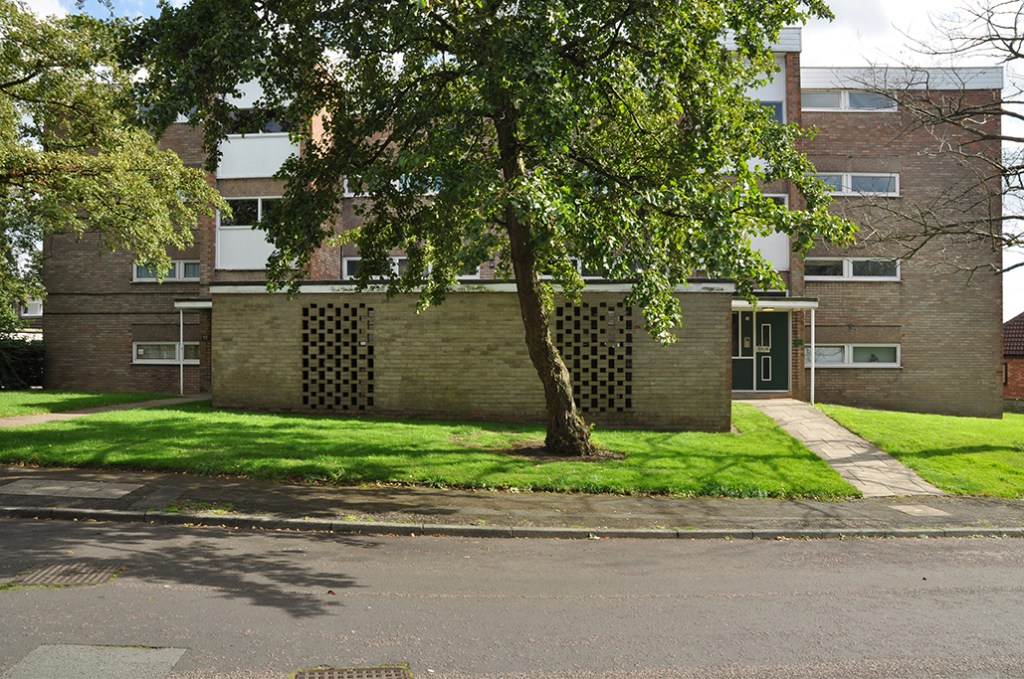
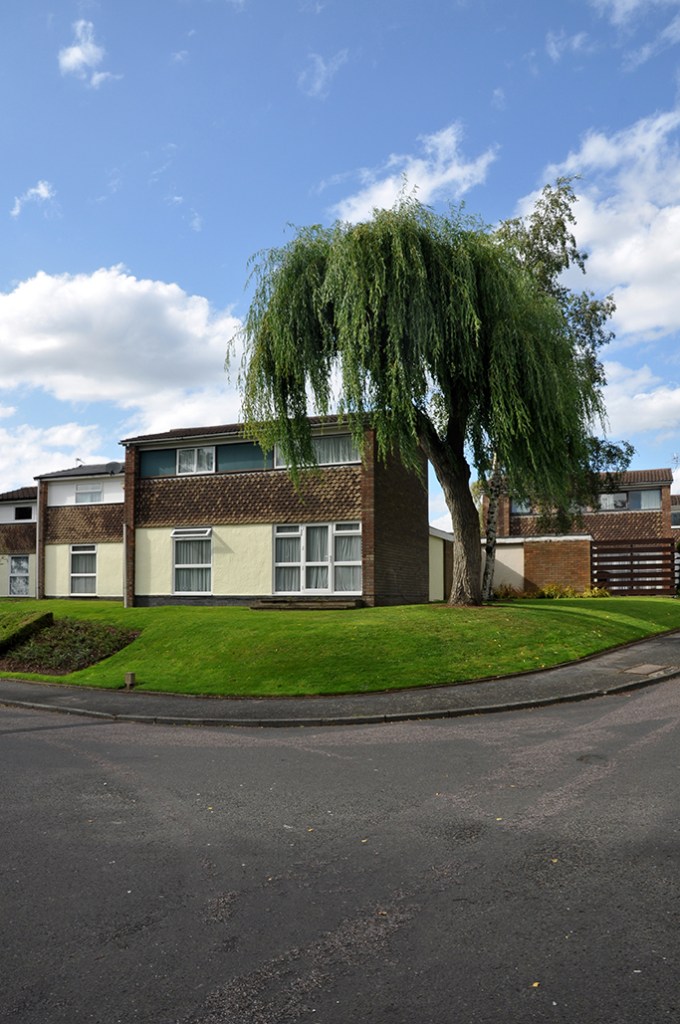
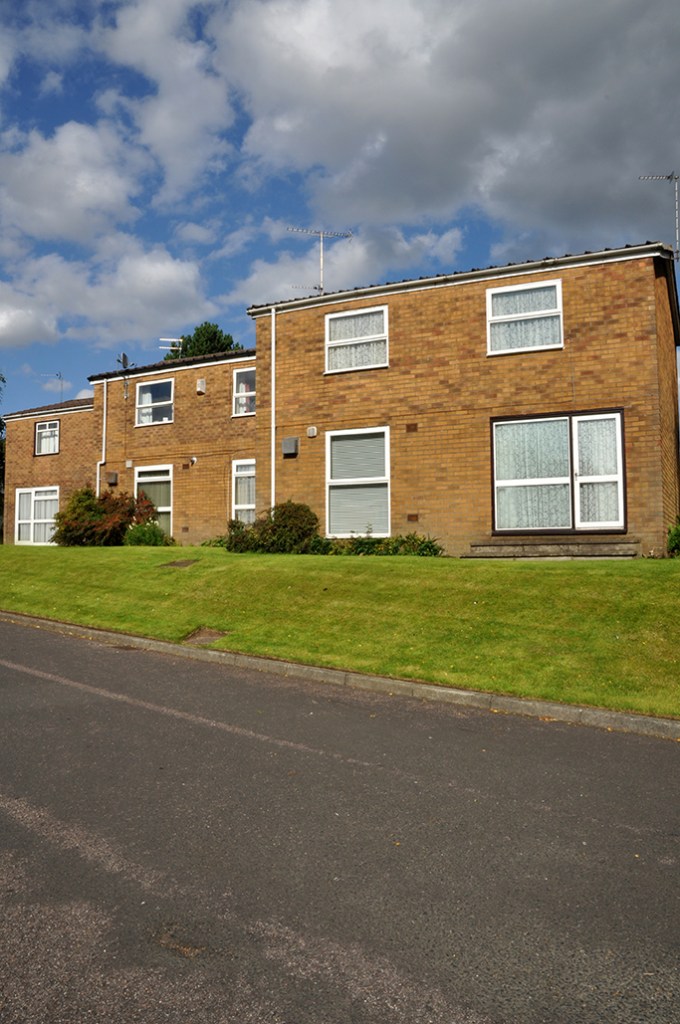
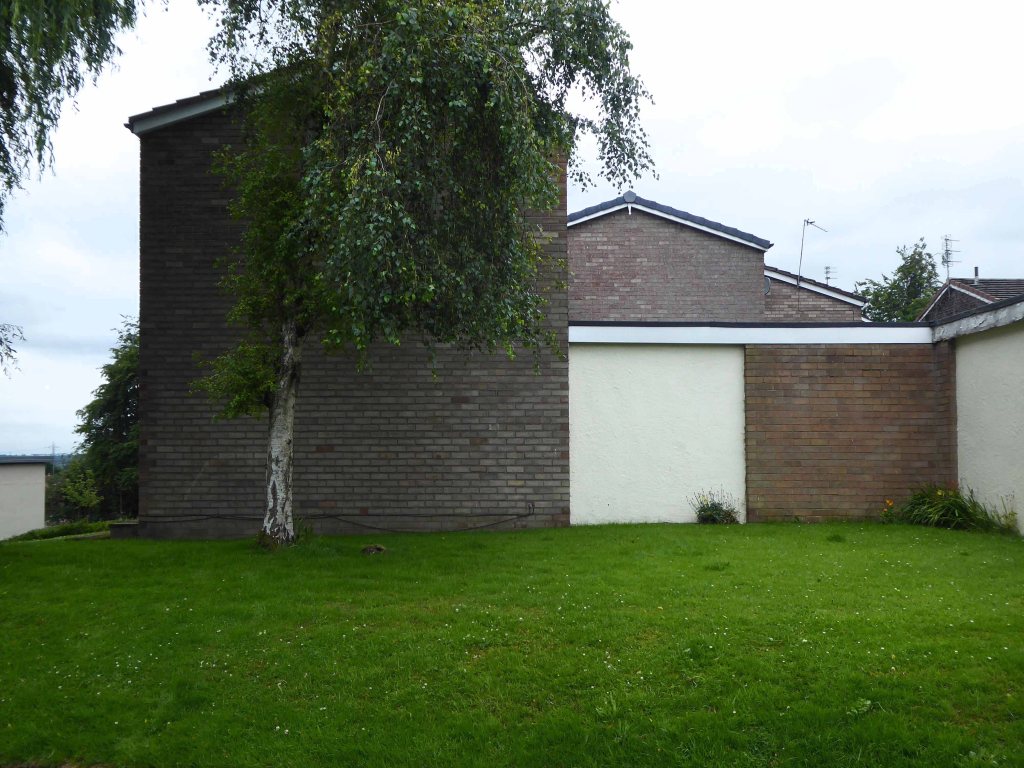
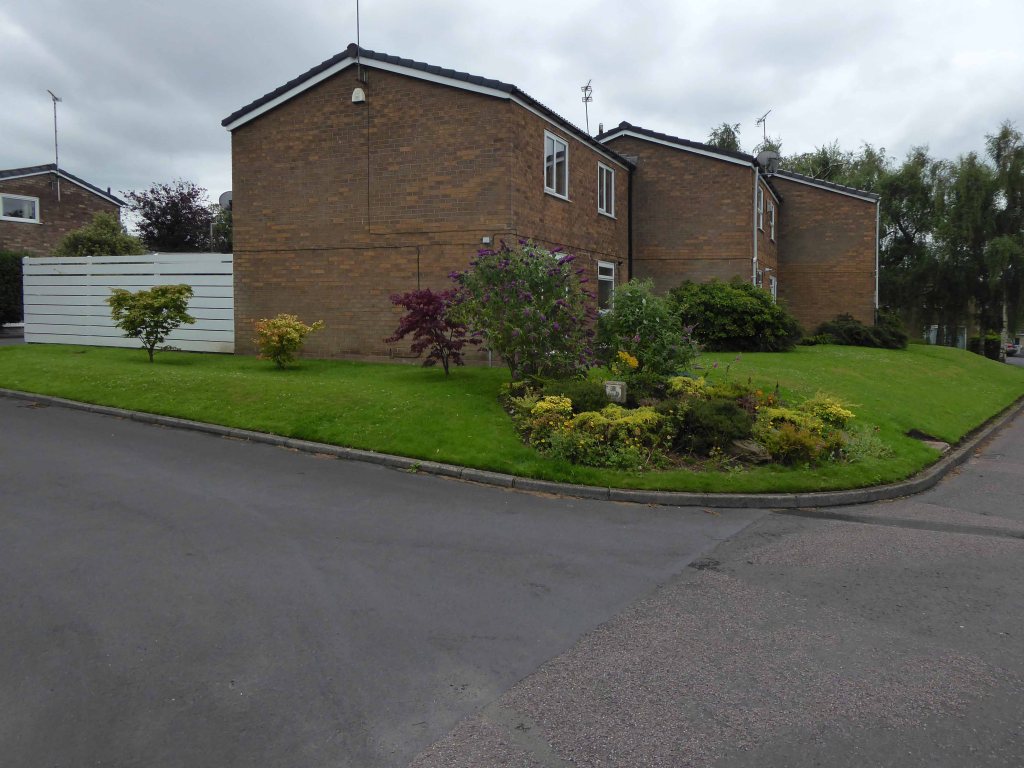
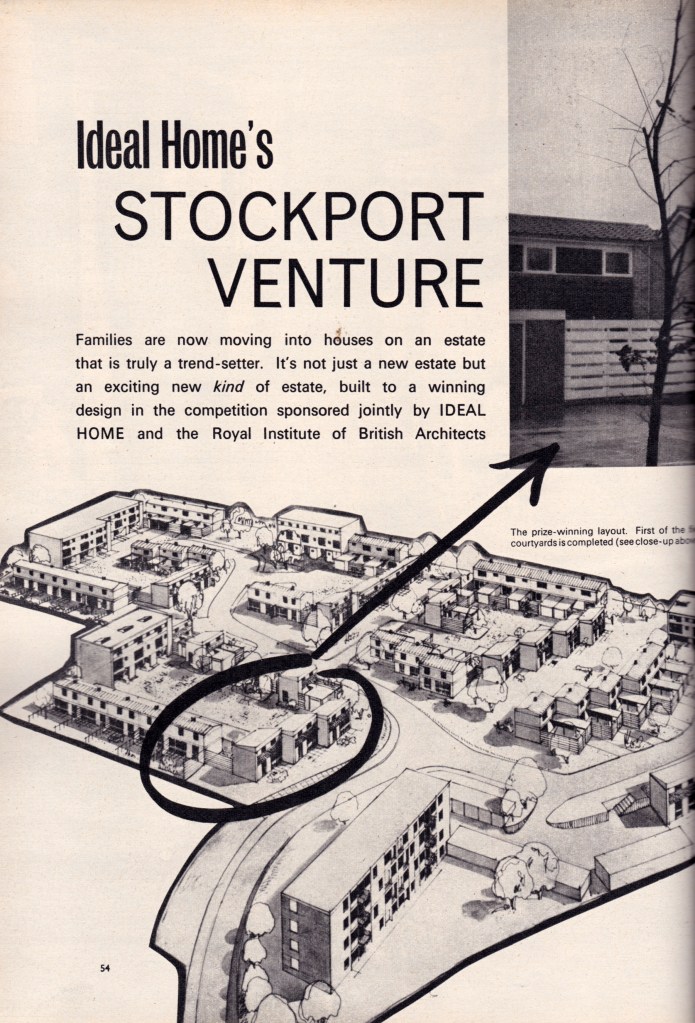
Deneway almost but not quite, literallyon my doorstep:
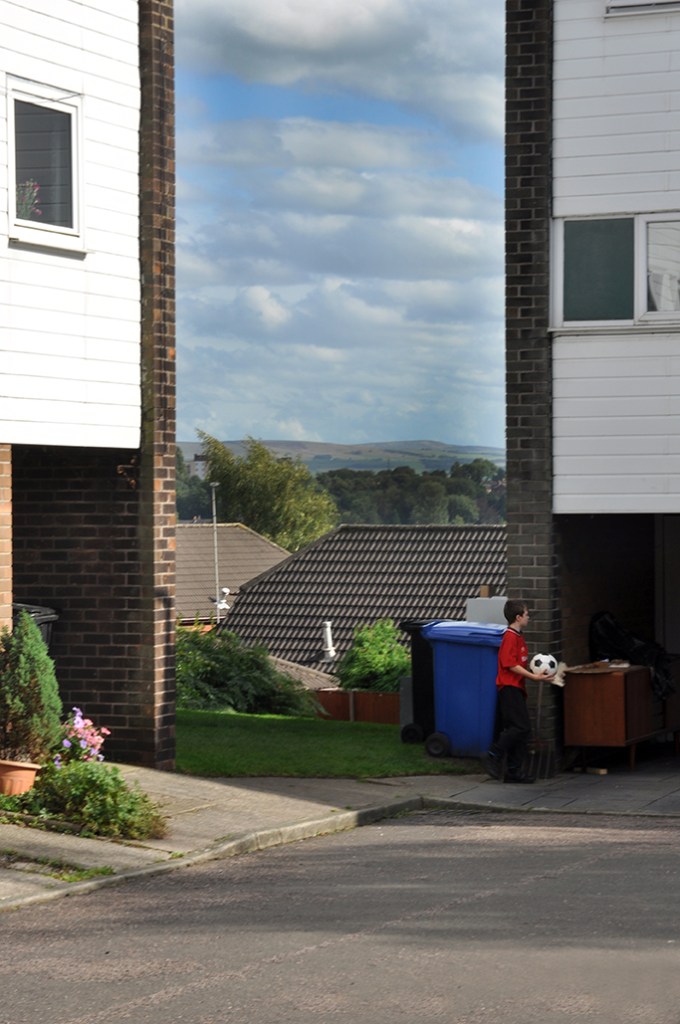
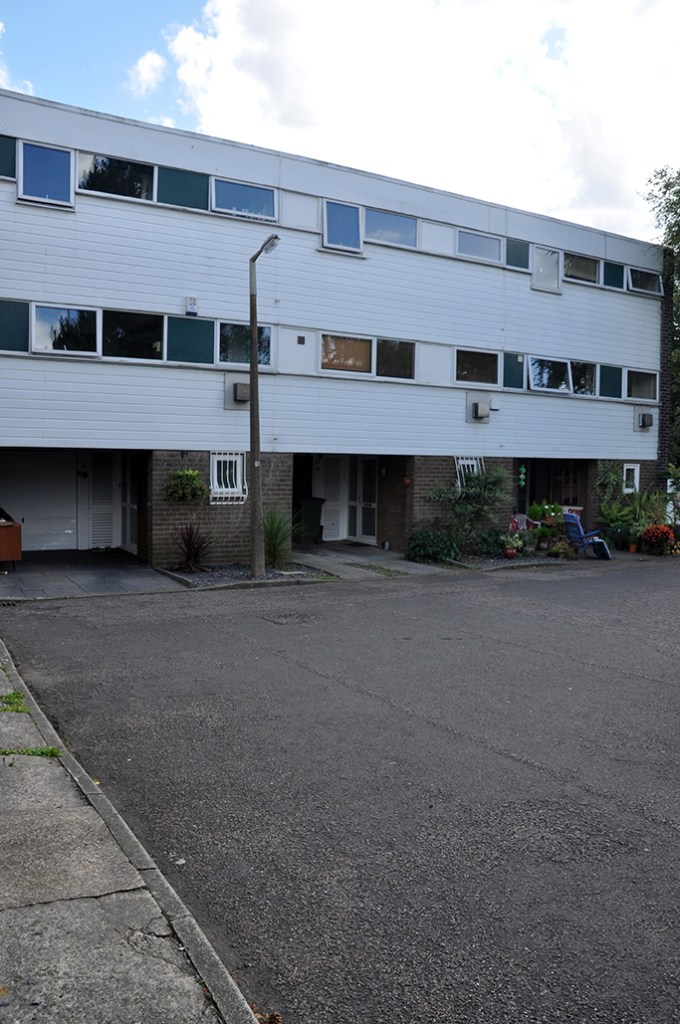
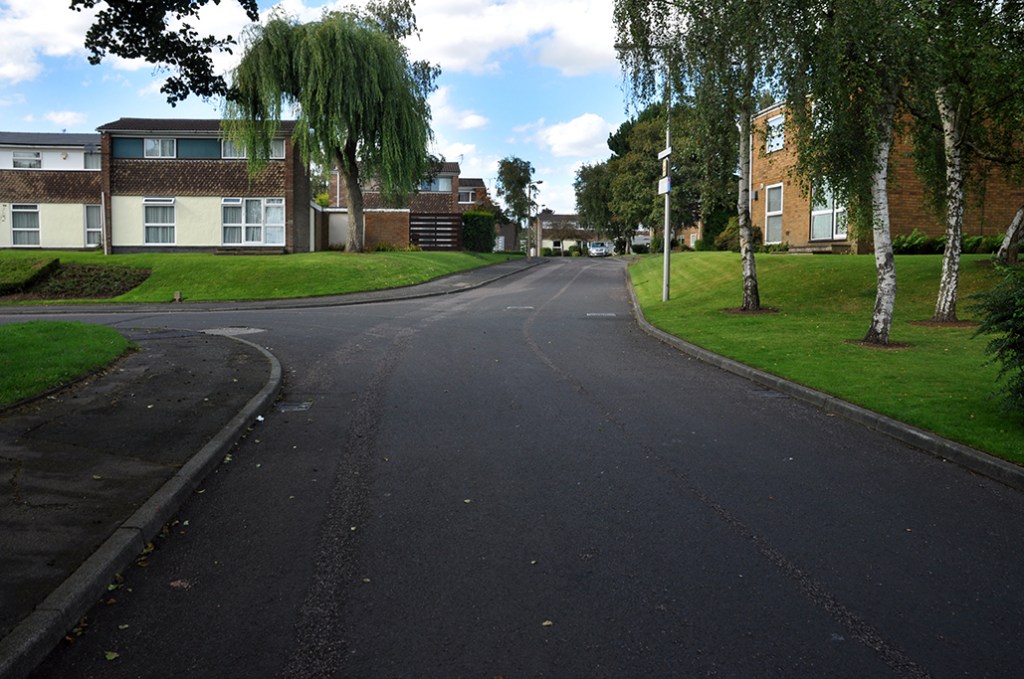
High above the Mersey Valley and 70 meters above sea level Deneway Estate stands proud, affording views of the Pennine White Peak to the south east and nothing but some other houses in all other directions.
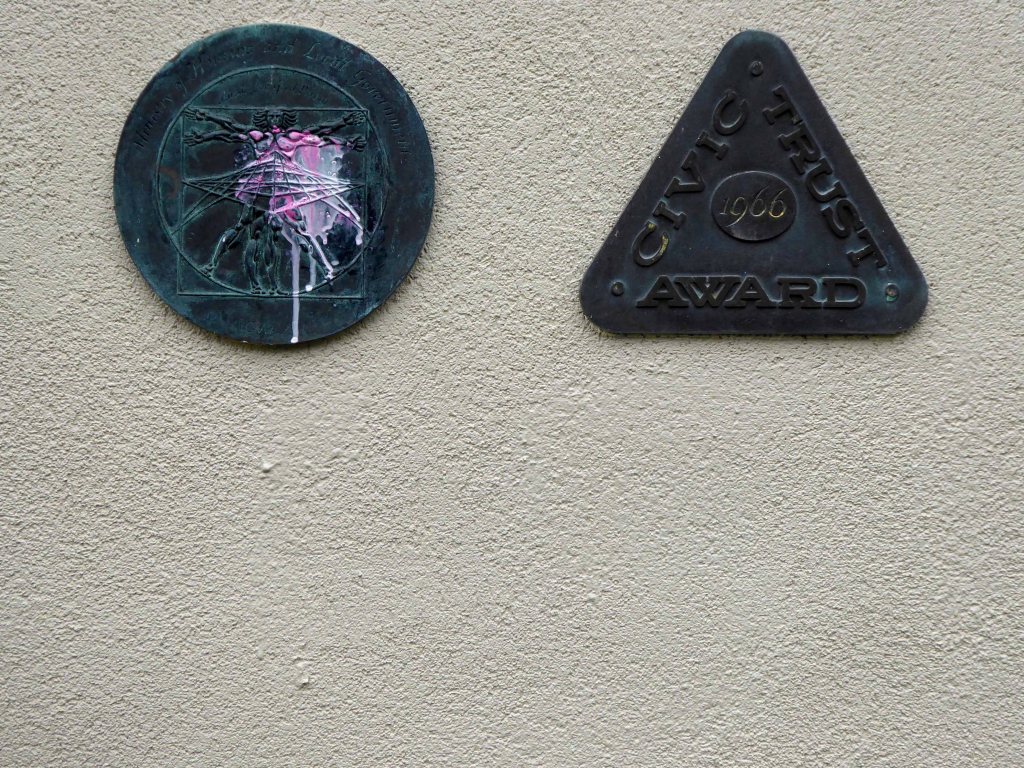
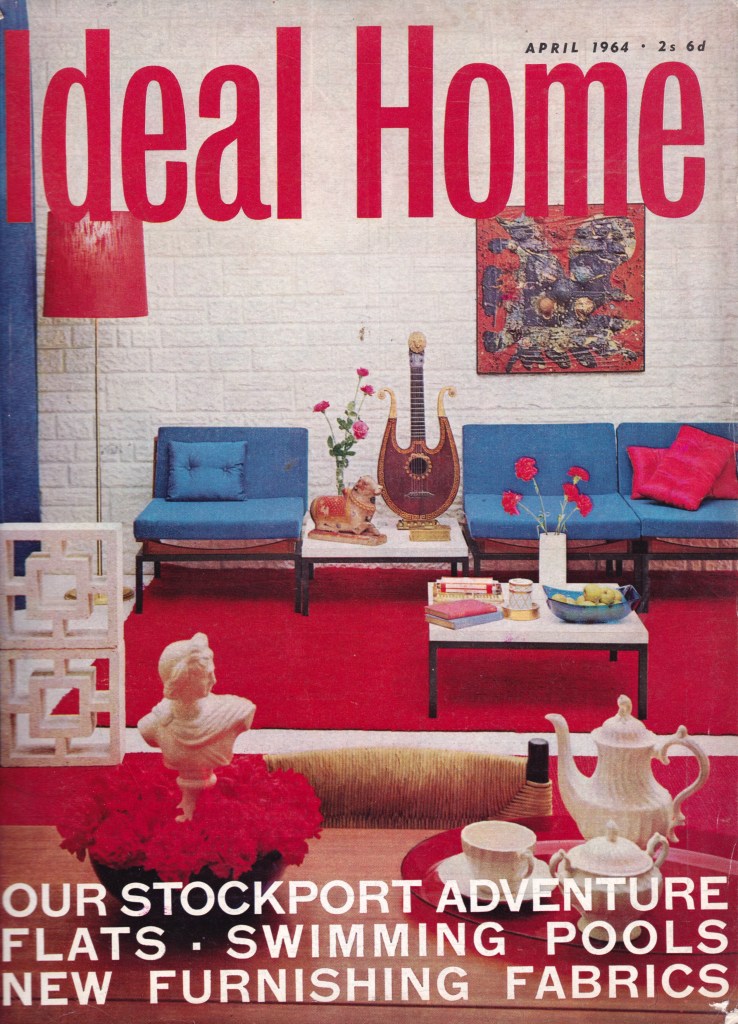
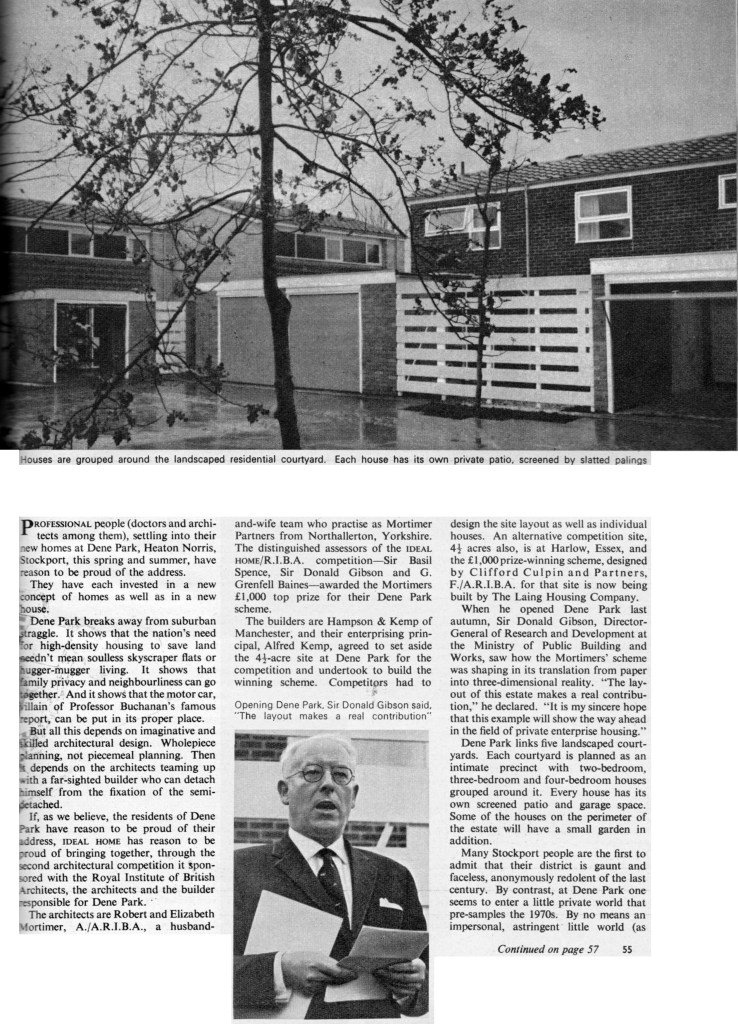
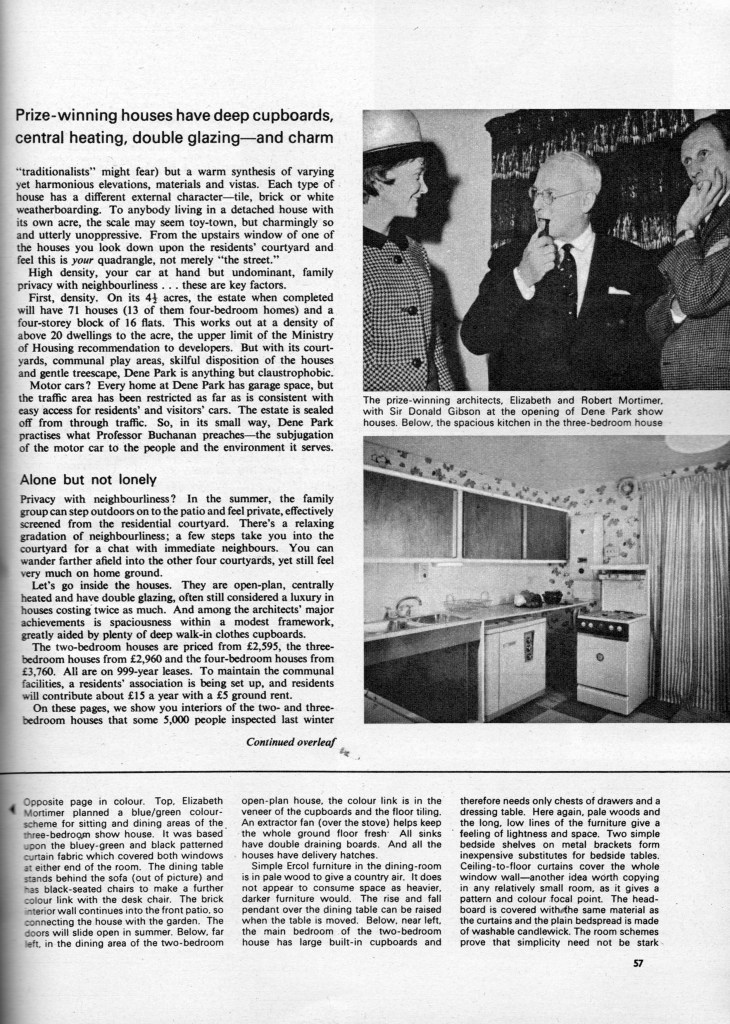
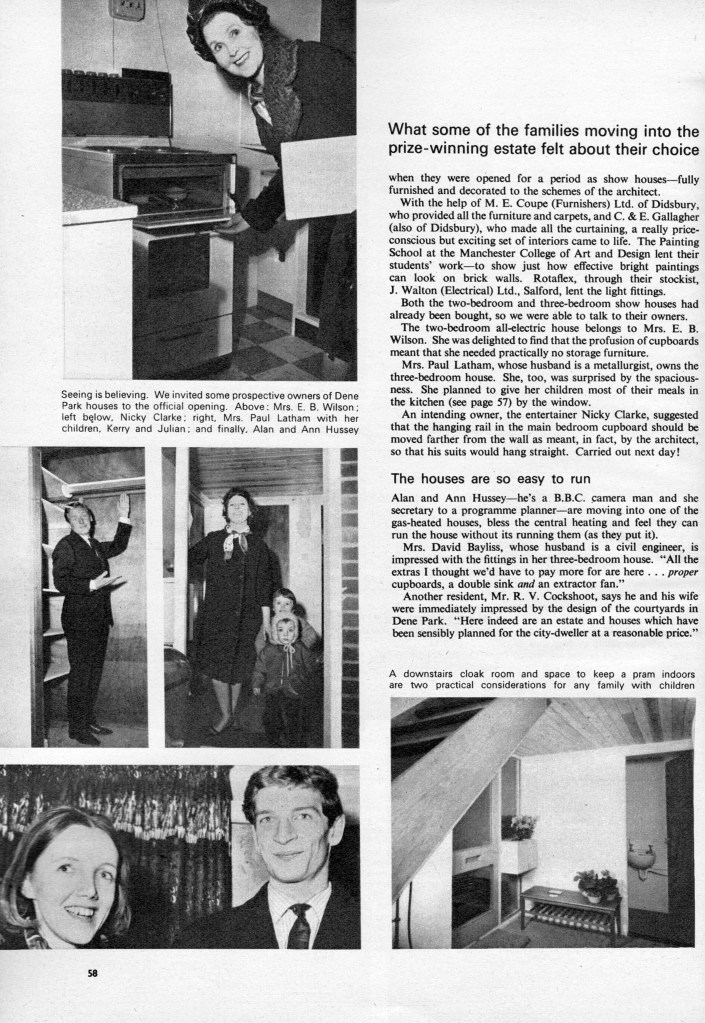
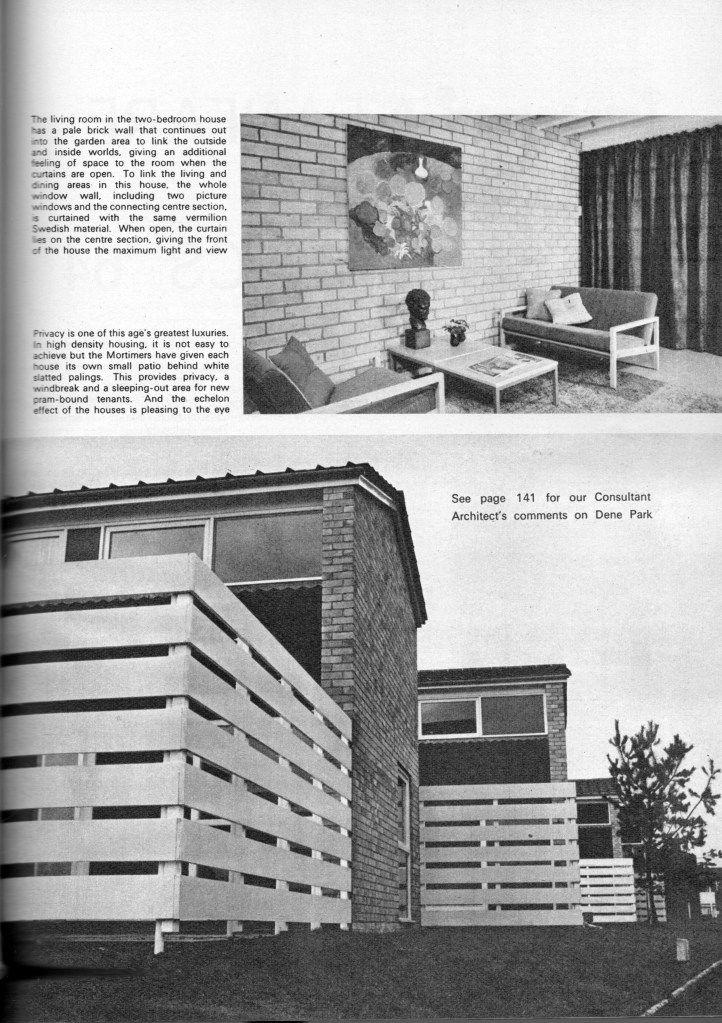
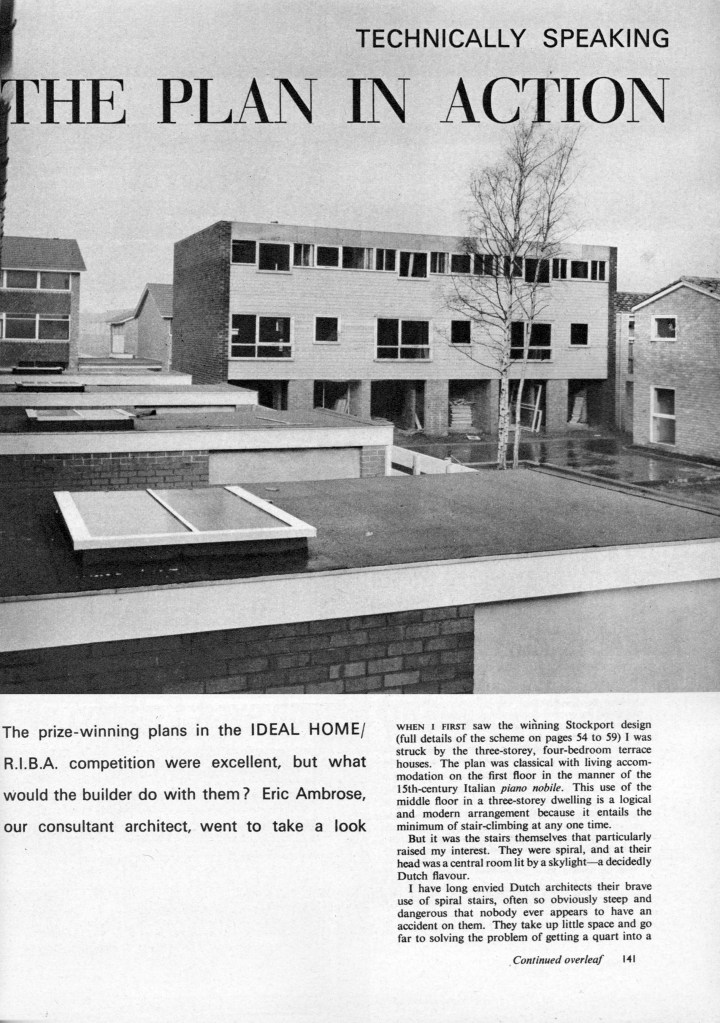
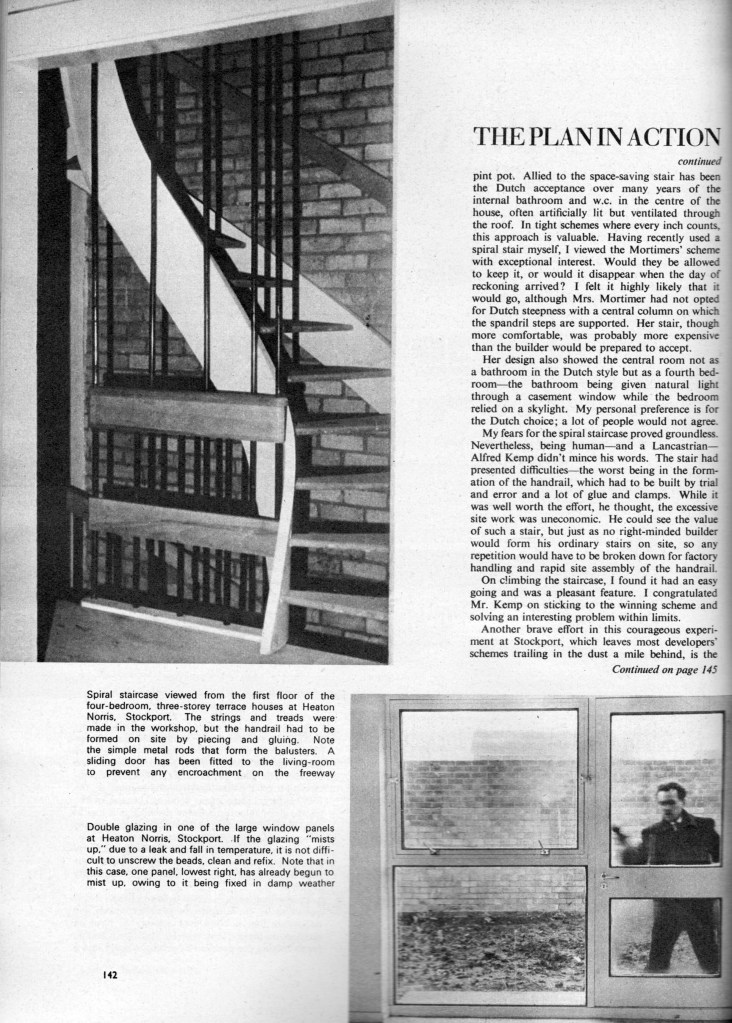
Built in 1964, by architects Mortimer & Partners it was an award winner from the word go – coming first in an Ideal Homes sponsored competition.
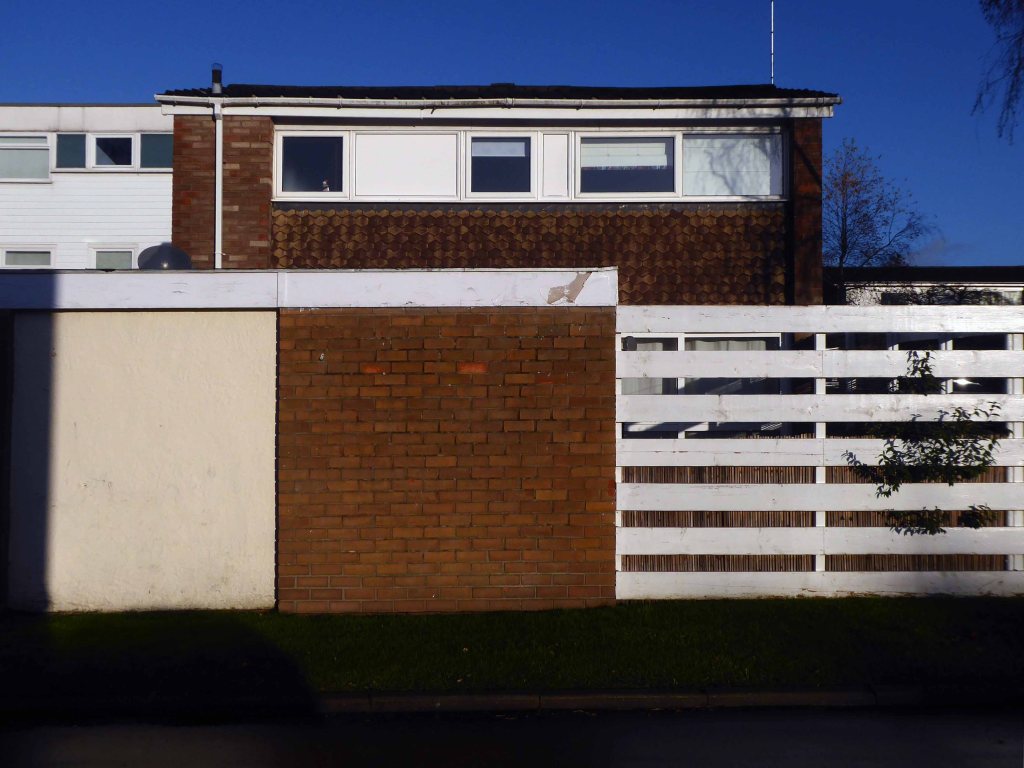
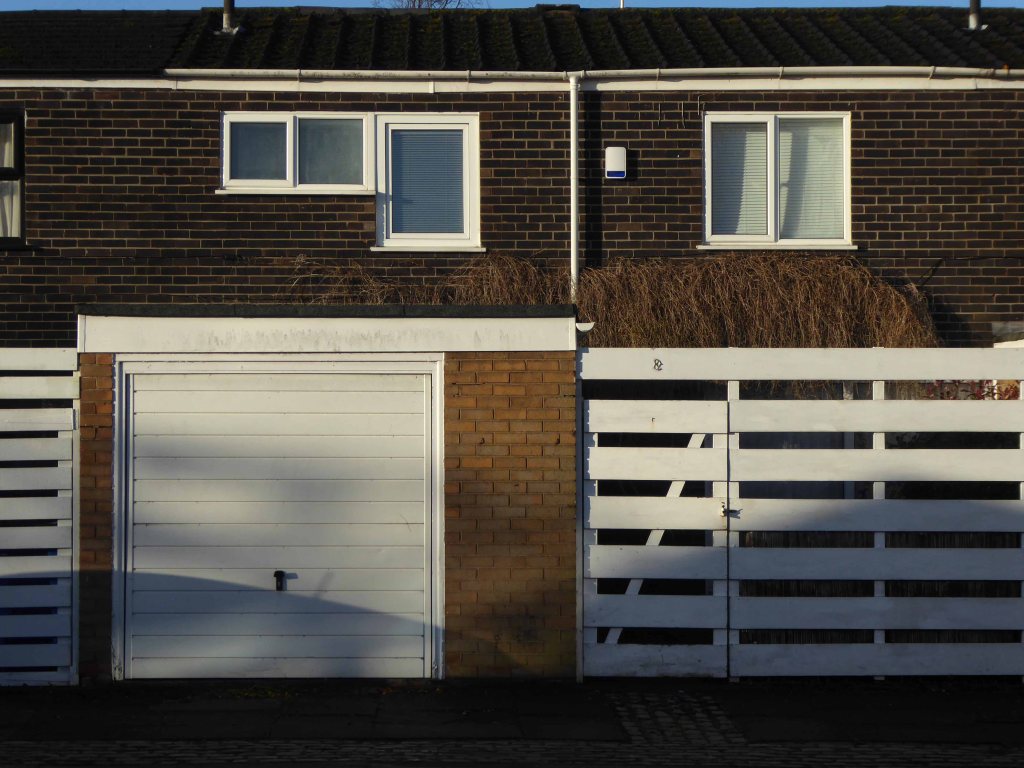
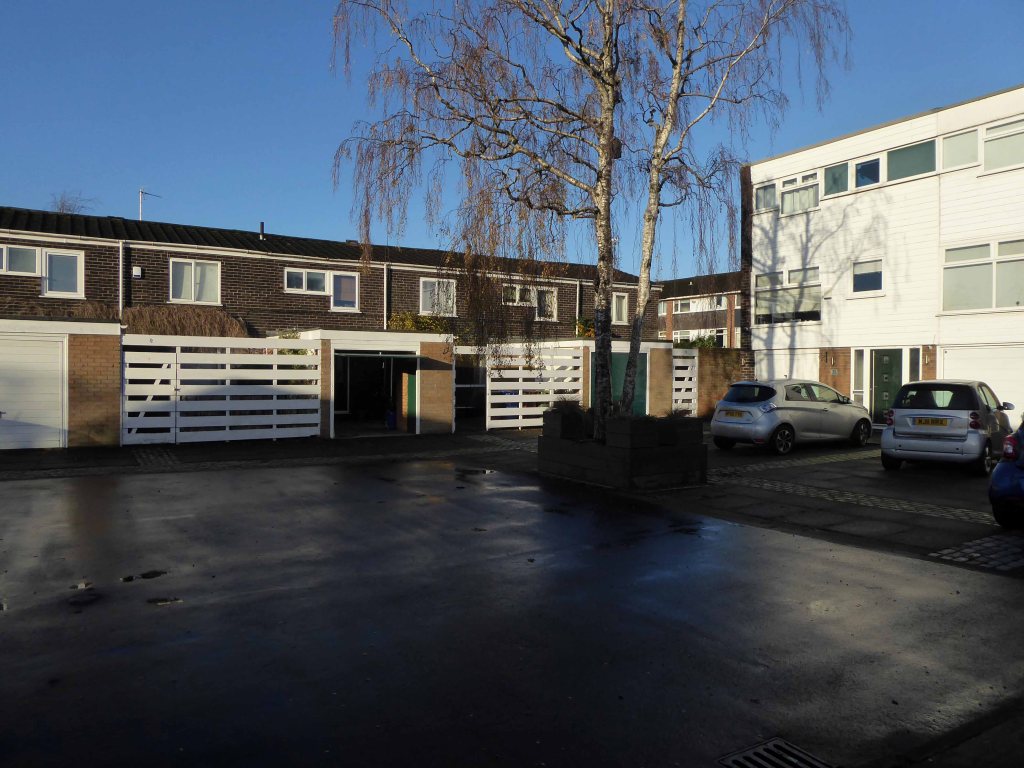
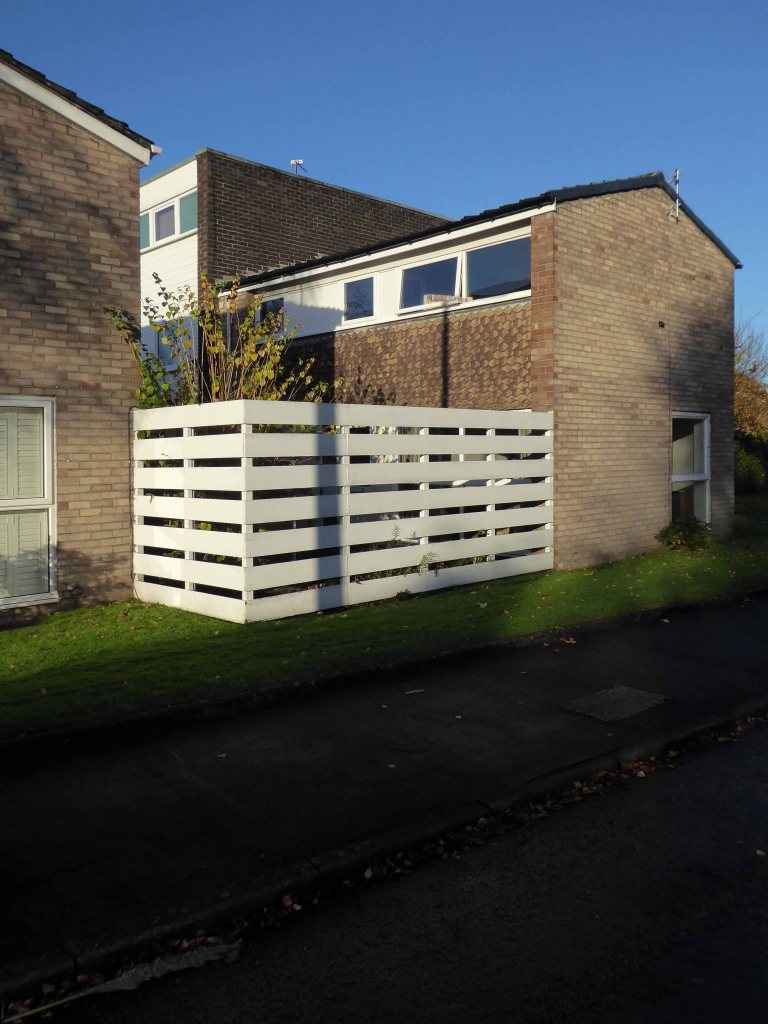
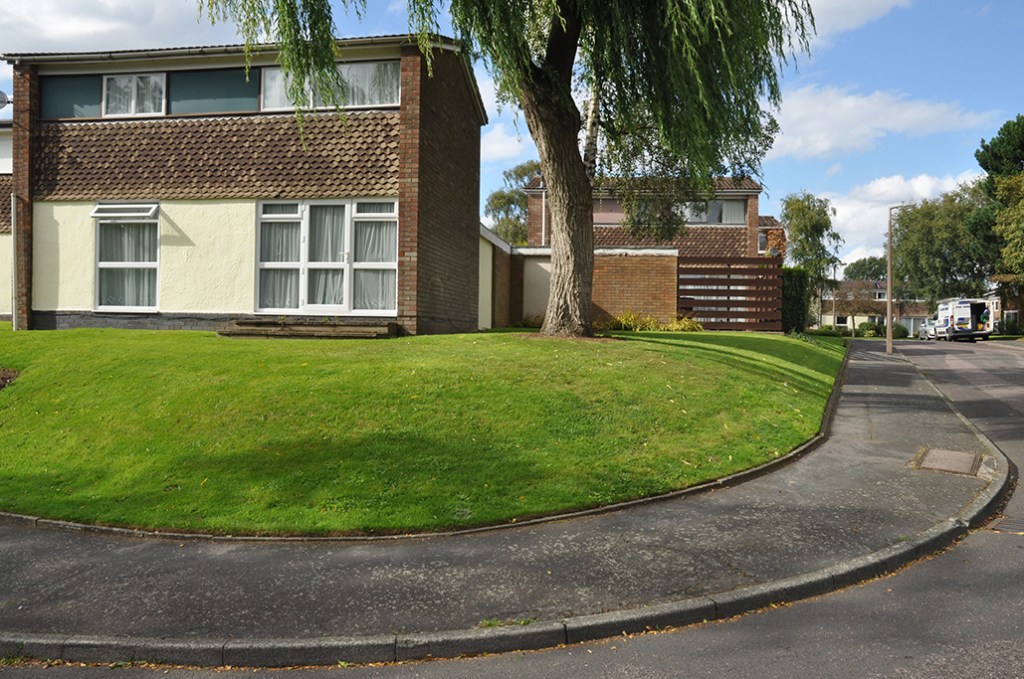
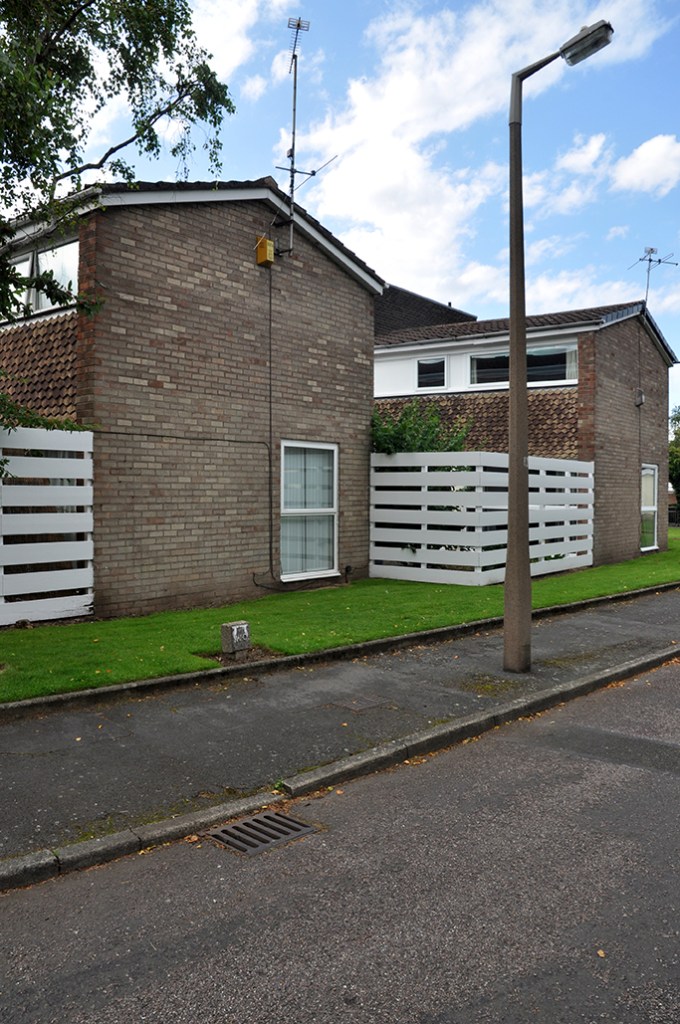
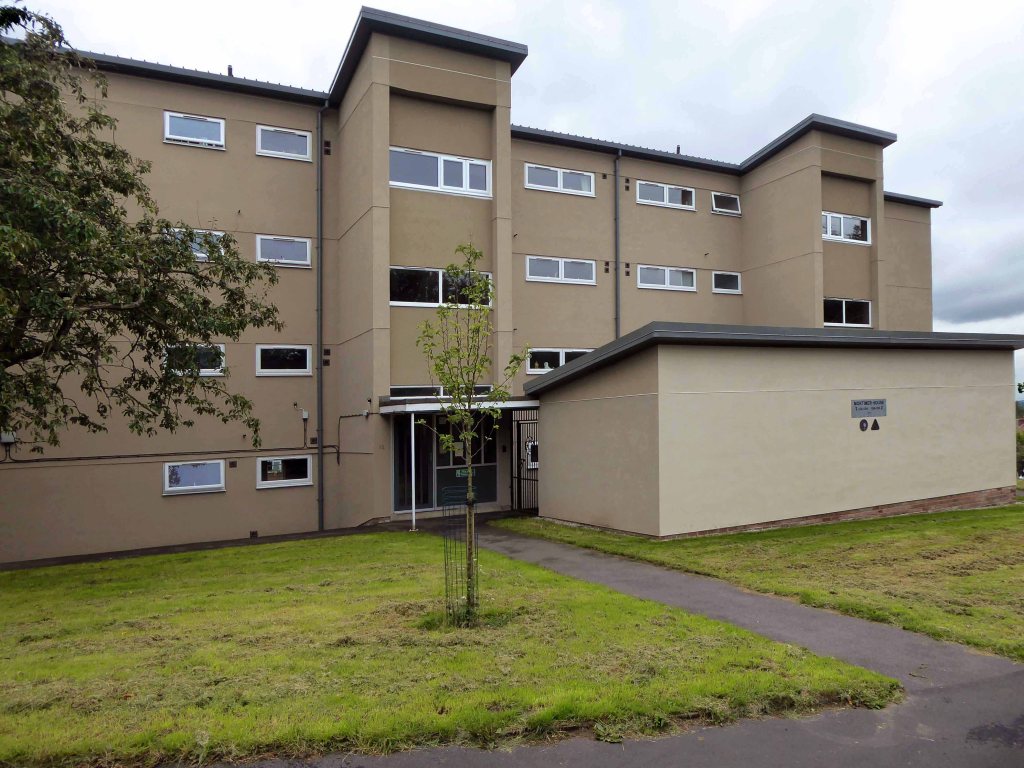
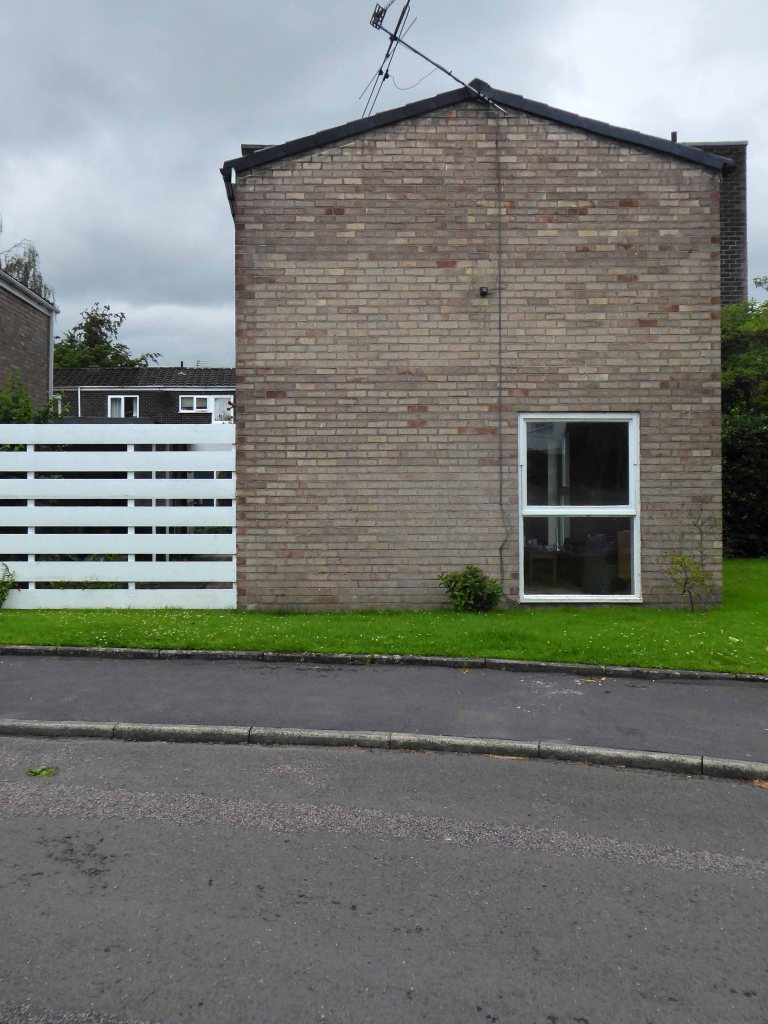
Very much in the tradition of the Span Estates, it consists of small groups of two and three storey terraced homes, with communal open, well tended front gardens. At the entrance to the estate stands a single low tower block of flats.
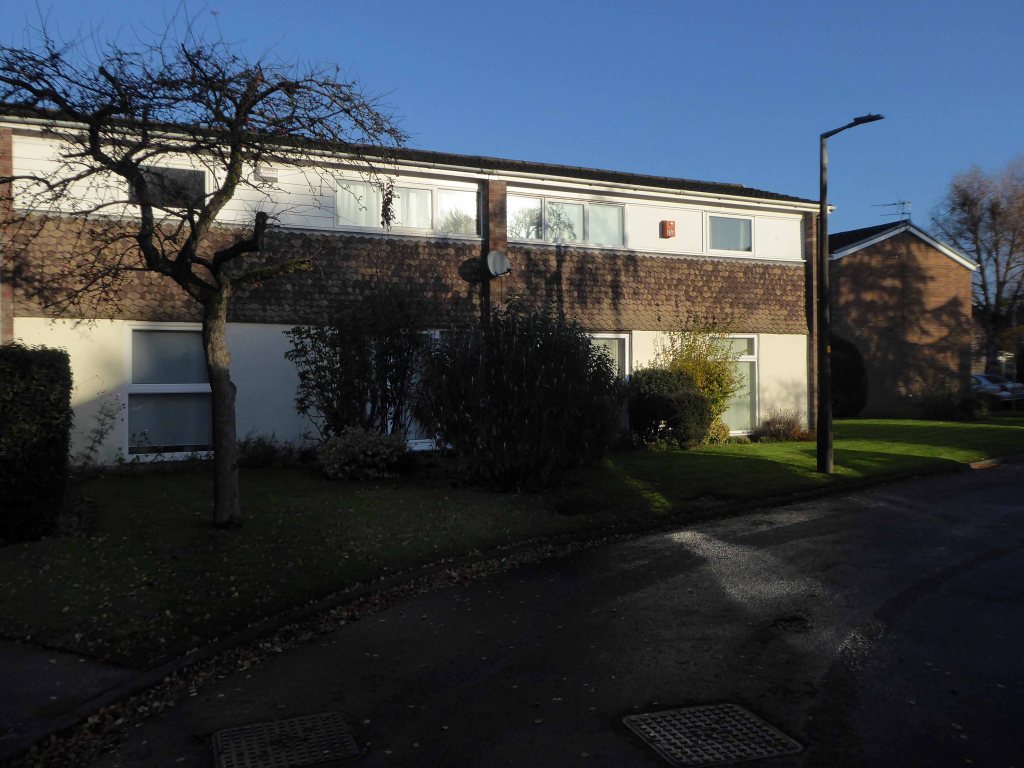
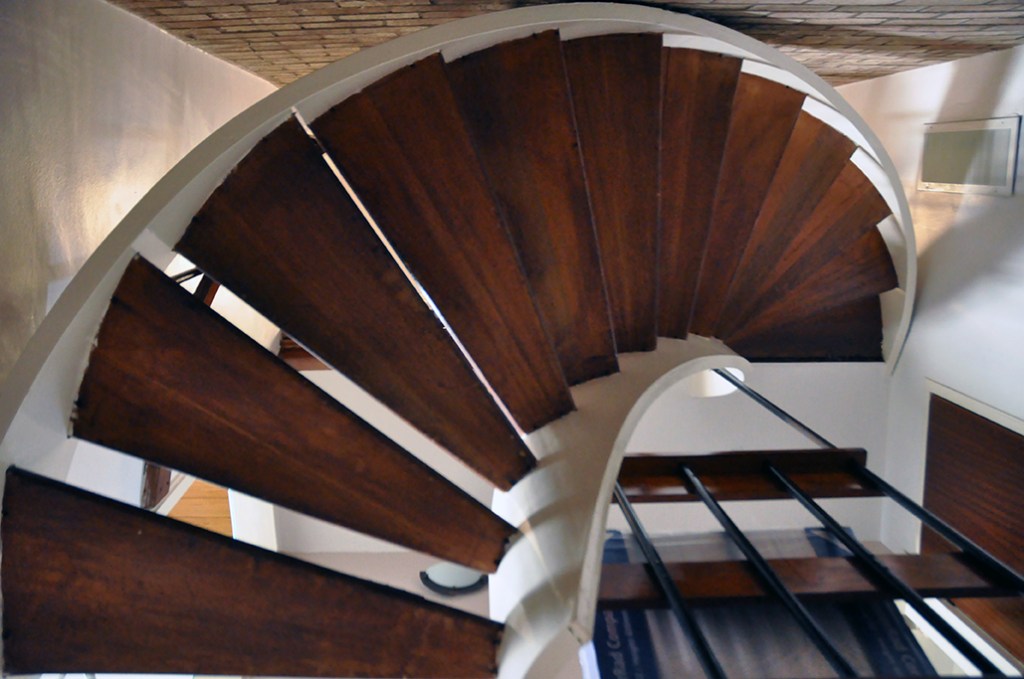
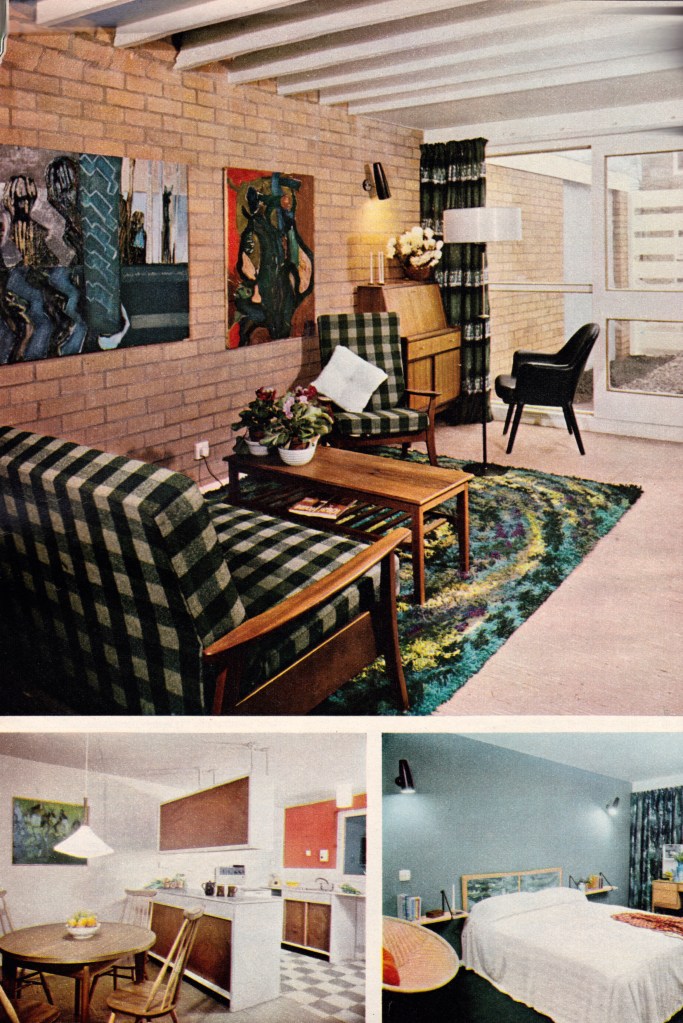
The architecture sits quietly and confidently in the landscape, well behaved, prim and proper. Interiors are open plan and afforded ample daylight by generous windows. Detailing is tiled and wood panelled, with low pitched roofs.
Jump the train, walk, cycle, bus or tram, but arrive with eyes and heart wide opento enjoy this suburban gem – it’s right up my street.
This was my very first piece that appeared on the old Manchester Modernist site way back in 2014.
Six years later I walked up the road again and found the flats clad in a funny colour cladding and the plaques moved, much else was as was. I assume, that under deed of covenant, fencing and guerilla gardening within open areas is verboten, along with fancy extensions.
The estate therefore retains its original integrity.
The sun in the meantime however – had gone in.
Here are the pages of Ideal Home which featured this award winning estate.
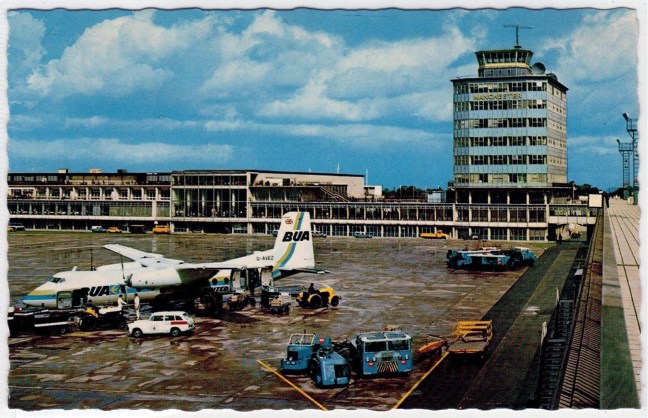
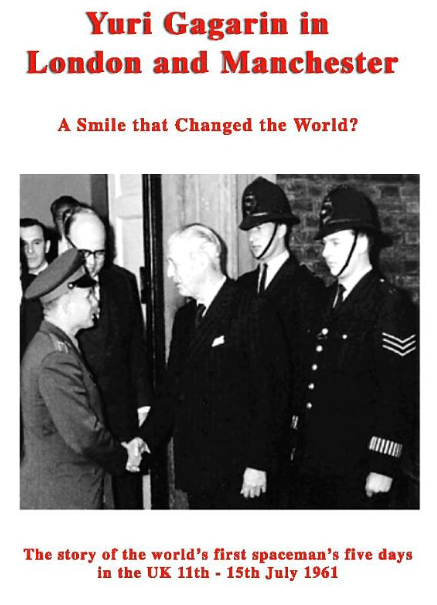
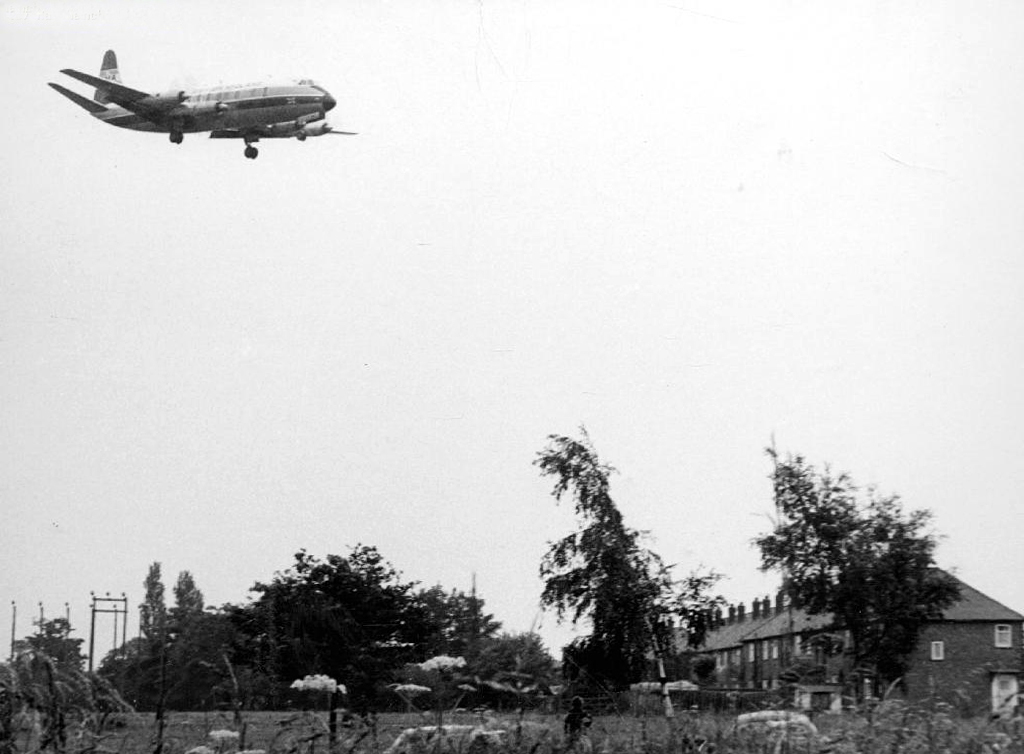
Exactly three months to the day after his flight in Vostok I had ushered in a new age of space exploration, on 12 July 1961, the trim figure of Yuri Gagarin strode down the gangway of a British Viscount airliner and walked briskly out across the runway of Manchester airport towards a sea of expectant faces, and flashing camera bulbs.
A loose approximation of what he may have see on that day in 1961.
We were allowed out of Brownley Green school to line the road as he passed, great memories.
I stood on Chester Road with my mum, I was 4 years old, but still remember it.
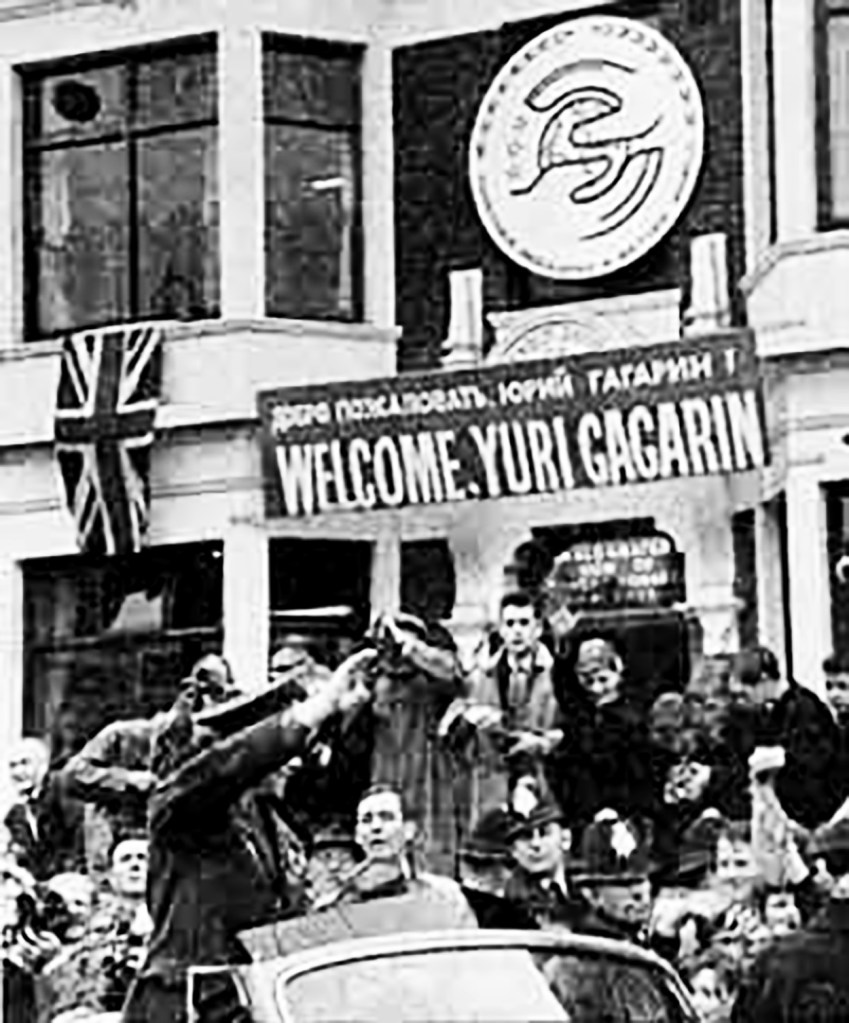
At that time, I was a student, working my socks off in the Central Library, I went outside into St. Peter’s Square to watch him pass, he gave everyone a big smile.
Still tell my children, tiny at the time – you saw the first man in space, I remember his smile.
Worked in an office in Albert Square – had a grandstand view of him arriving at the Town Hall.
I can remember a police escort taking Yuri to Albert Square via Princess Parkway through Withington, Fallowfield and Moss side, there were hundreds of people lined up watching a waving at him.
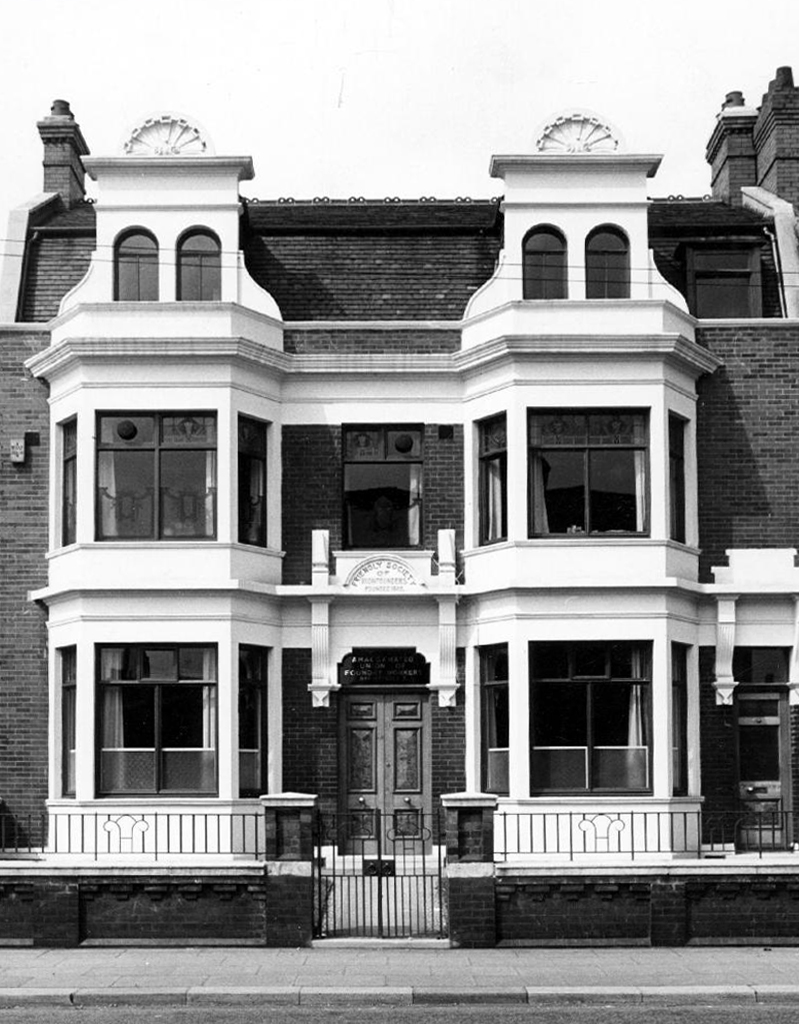
When Gagarin visited Manchester he was given a bronze bust of Lenin made by the Amalgamated Union of Foundry Workers. Four were made in total and my Dad owns one of them.
My Grandad’s funeral was on the day he came, as we passed down Altrincham Rd onto the Parkway policemen who were holding back the crowds saluted, he would have loved it.
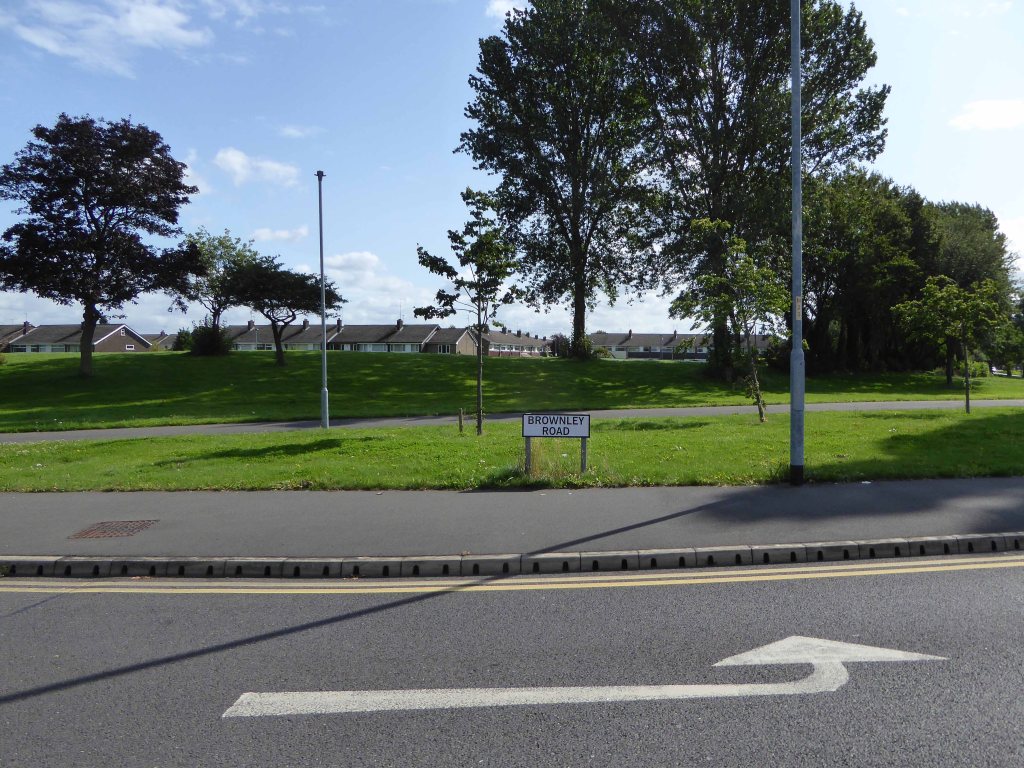
Yeah I seen him stood up in a big car with a green uniform on. It was going down Brownley Rd passing Meliden Crescent heading for the Airport in Wythenshawe, I was about 6 years old.
Working for Manchester Parks as a 20 yr old on Princess Parkway and he came past me as I was mowing the grass, in an open top Rolls or Bentley, he saluted me personally as he passed, of course I stood to attention and returned the salute – Magic Moment
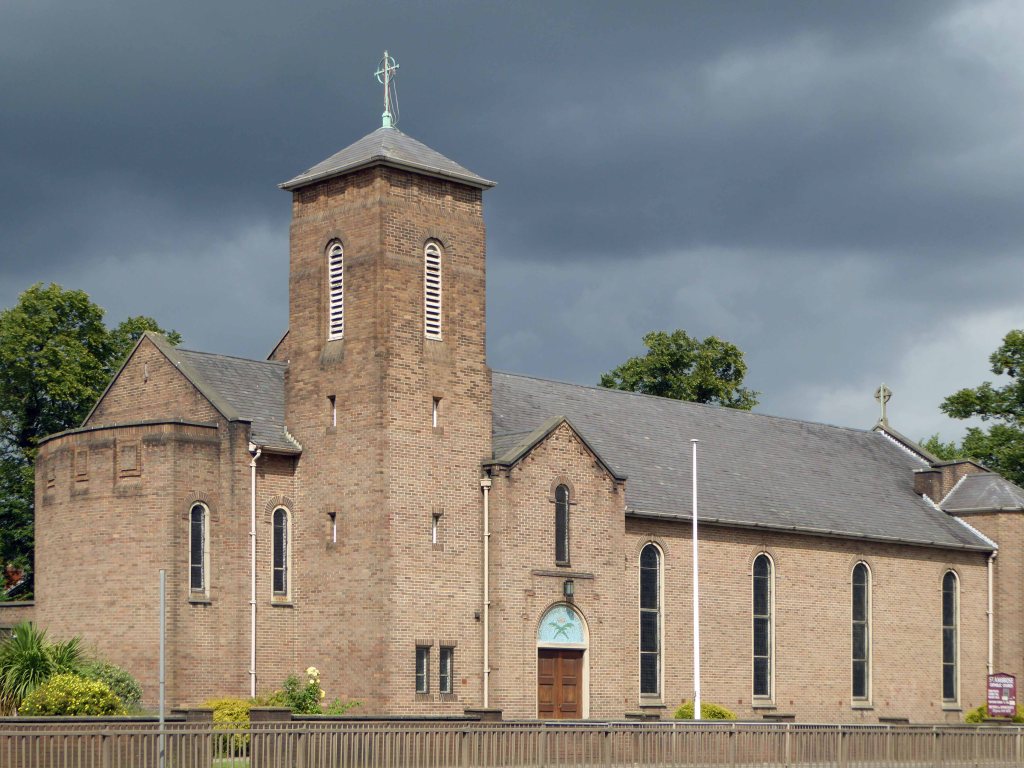
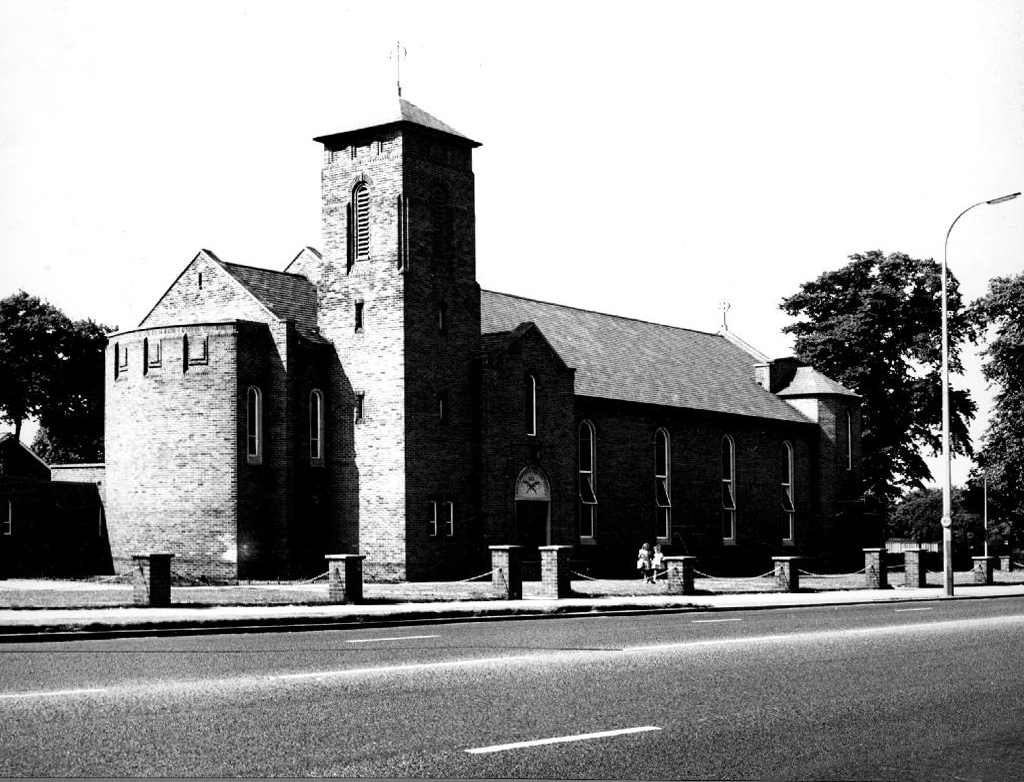
St AmbroseA well-detailed, relatively modest post-war design by Reynolds & Scott, with an impressive and largely unaltered vaulted interior. The dedication relates to St Ambrose Barlow, a Catholic martyr from nearby Barlow Hall.
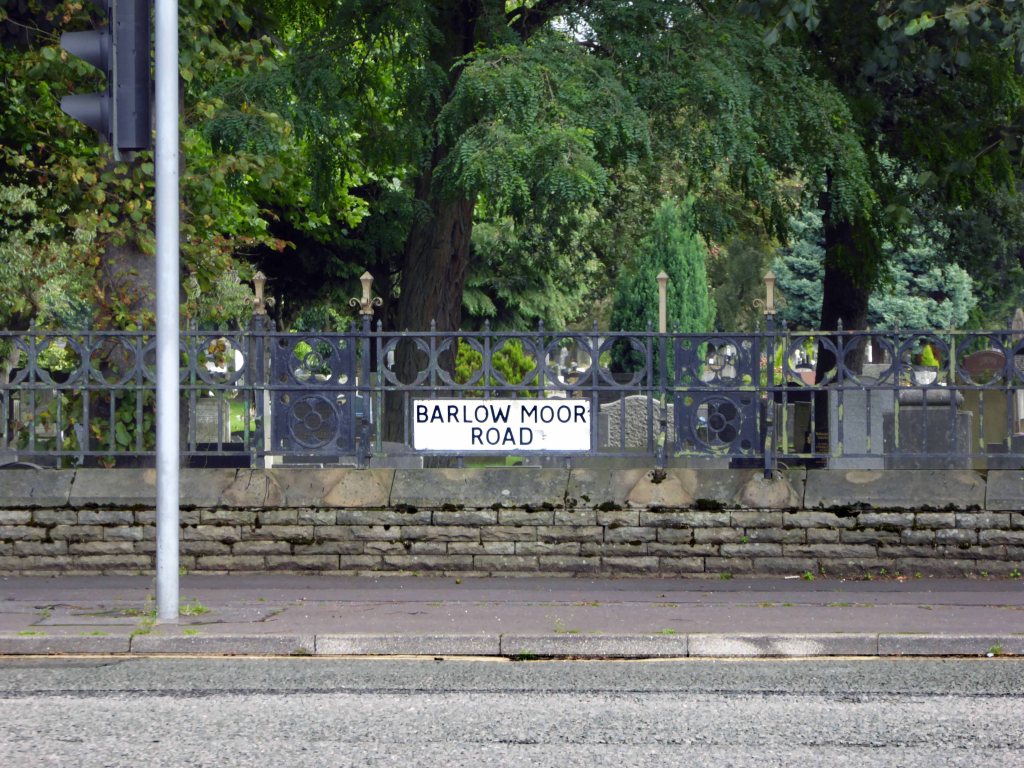
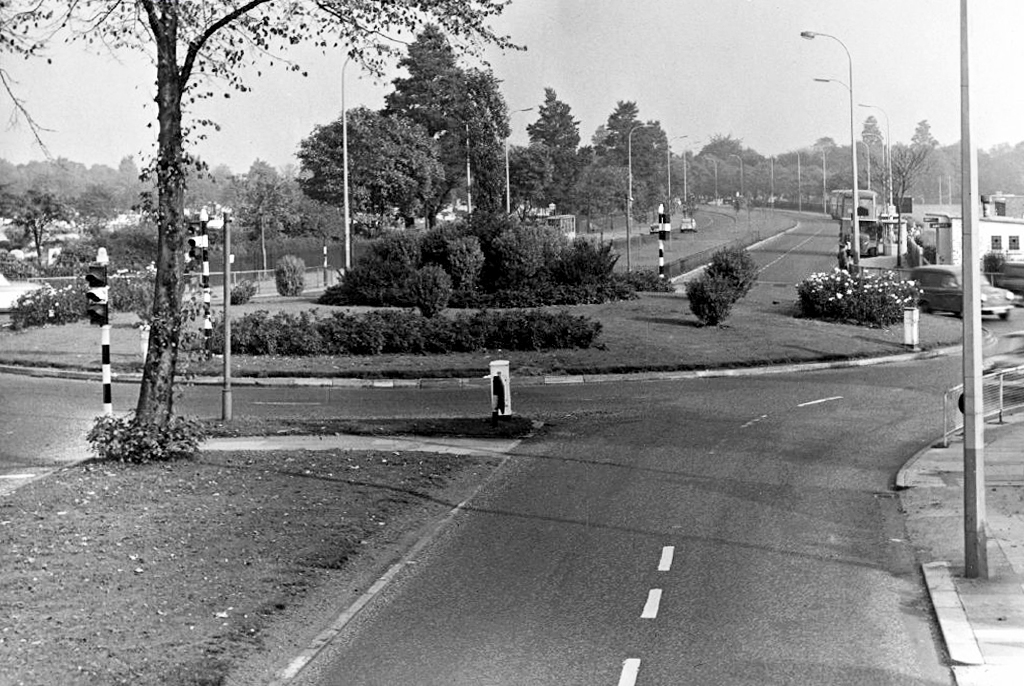
Barlow Moor Road
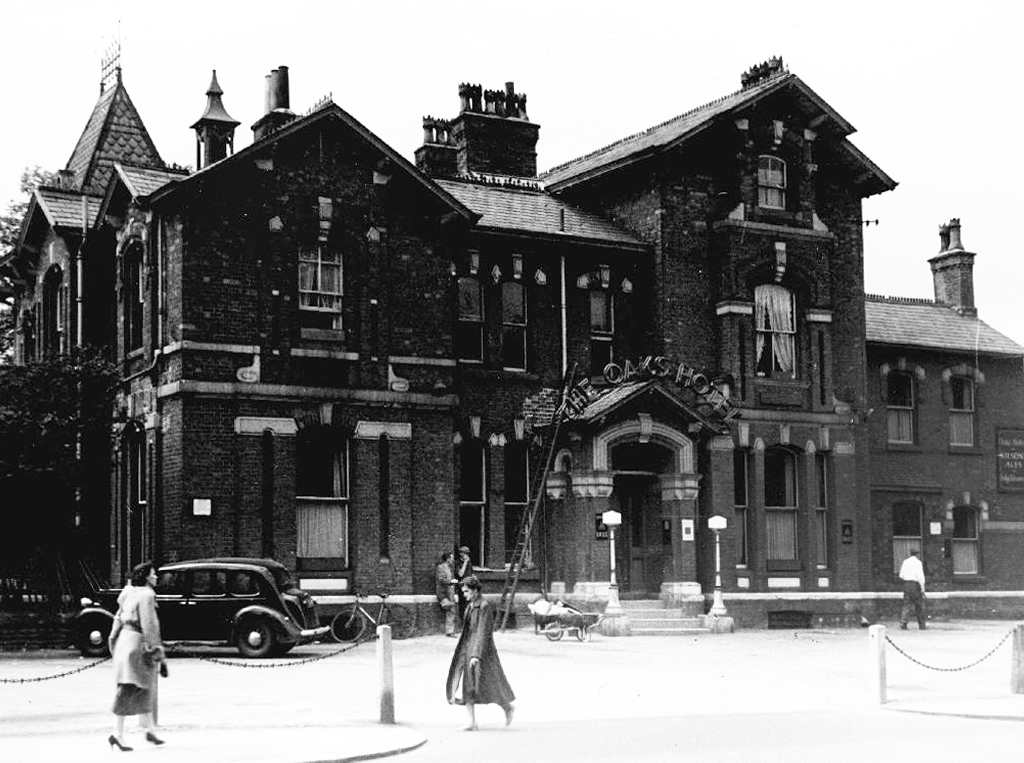
The Oaks demolished in the early 1990s following a brief life as the Sports Bar
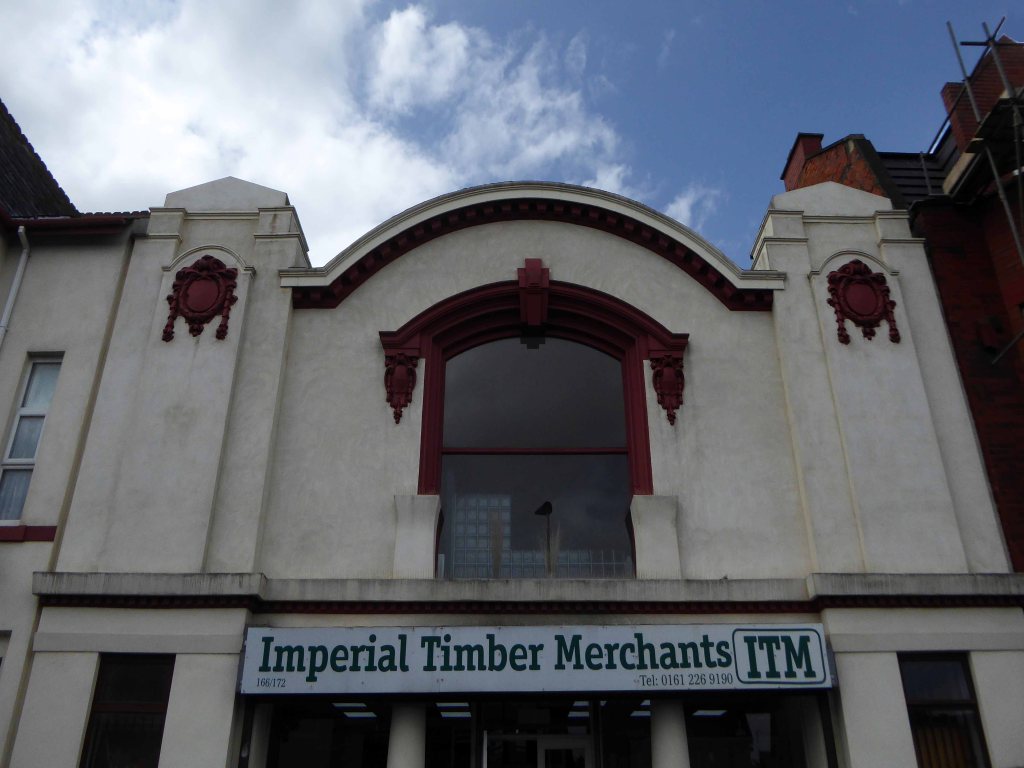
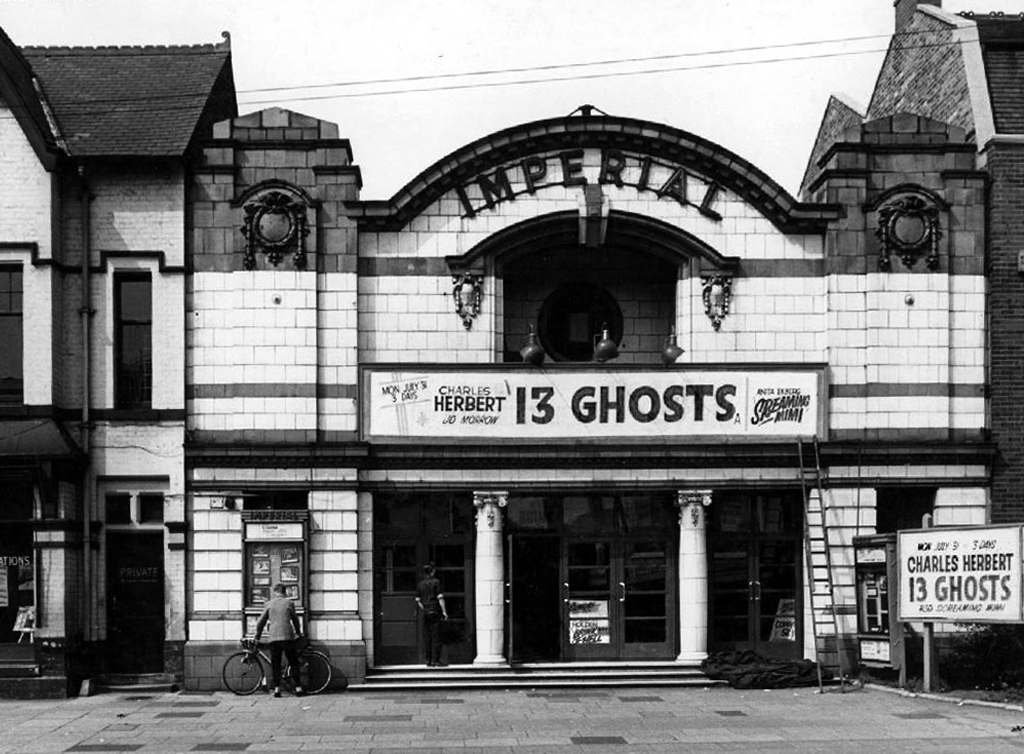
Imperial Picture Theatre – was opened in 1914. Seating was provided in stalls level only. It had a 5 feet deep stage and two dressing rooms. There was also a café in the cinema. Around 1929 it was equipped with a Western Electric sound system.
Architect W.H. Matley
The Imperial Picture Theatre was closed on 15th January 1976 with Charlotte Rampling in Caravan to Vaccares and Jean-Claude Brialy in A Murder Is a Murder Is a Murder.
I was last here in 2016 on a much brighter, blue skied day in March.
2020 mid-lockdown and overcast, I took a walk to take another look.
There is a perennial appeal to this well ordered island of tranquility, an archetypal suburbia incubated in 1906, a copy book estate.
The housing estate of 136 houses known as Burnage Garden Village, a residential development covering an area of 19,113sqm off the western side of Burnage Lane in the Burnage ward. The site is situated approximately six kilometres south of the city centre and is arranged on a broadly hexagonal layout with two storey semi-detached and quasi detached dwelling houses situated on either side of a continuous-loop highway. The highway is named after each corresponding compass point with two spurs off at the east and west named Main Avenue and West Place respectively. Main Avenue represents the only access and egress point into the estate whilst West Place leads into a resident’s parking area.
The layout was designed by J Horner Hargreaves. Houses are loosely designed to Arts and Crafts principles, chiefly on account of being low set and having catslide roofs.
At the centre of the garden village and accessed by a network of pedestrian footpaths, is a resident’s recreational area comprising a bowling green, club house and tennis courts. The estate dates from approximately 1906 and was laid out in the manner of a garden suburb with characteristic hedging, front gardens, grass verges and trees on every street.
Verges and paving were freshly laid, hedges and gardens well tended, cars parked prettily.
The central communal area calm and restful, but lacking the clunk of lignum vitae wood on jack, hence the scorched earth appearance of the normally well used crown green.
When World War II broke out, Hastings and St Leonards-on-Sea were considered vulnerable to attacks and invasion from abroad. On the night of Saturday 29 July 1944 a doodlebug was hit over the English Channel. Damaged, it nevertheless continued to fly towards the coastline of St Leonards-on-Sea. It was approaching Marine Court which was hosting a servicemen’s party – but it veered and crashed in front of the doors of St Leonard’s Church, making a deep crater. The tower fell into this, and the rest of the church was brought down as well. Although there were no casualties, the church was completely destroyed. Although the problem of rock falls and subsidence associated with the cliffs had continued throughout the life of the church, the War Damage Commission would only pay for it to be rebuilt on the same site. The architectural partnership of brothers Giles and Adrian Gilbert Scott were commissioned to design the new building.
Patrick Reyntiens stained glass
The unique features were inspired by Canon Cuthbert Griffiths, rector from 1929 to 1961. Following a dream, he went to Israel and had the prow of a Galilean fishing boat constructed to form the pulpit.
Marble work on the floor depicts locally caught skate and herring.
Beyond the communion rail are loaves and fishes set in different marble patterns bordered by scallop shells, a copy of the Byzantine mosaic in the Church of the Feeding of the Five Thousand in Galilee.
The structure set into shifting cliffs is subject to subsidence.
Procedures have been completed for St Leonard’s Parish Church on Marina to be closed for worship.
The service will be next Saturday August 4 2018 at 3pm.
Because the building cannot be used the service will be at St Ethelburga’s in St Saviour’s Road.
St Leonard’s has been called the church with an inbuilt message. Even the very stones cry out to those who have eyes to see, ears to hear and a heart to understand and accept the Good News of the Gospel.
I’ve cycled by here for some fifty years or more – always admiring its serrated roof.
Way back when we would roam around on our bikes, exploring the waste ground adjacent to Jackson’s Brickworks.
Where we would scavenge tape from the Rotunda tip.
I remember it as a Remploy Centre.
My last 13 years prior to retirement last May were spent at the centre, on Windmill Lane, Denton. Just before I left, a lot of demolition work was done, prior to redevelopment of much of the site.
I seem to remember the place always being referred to locally as Th’ Rehab – the Rehabilitation Centre, a Government training centre, where skills were taught, such as joinery, bricklaying etc, and there was also a Remploy Unit housed there.
Local men could go for a free haircut, administered by a well supervised trainee.
Proximity to the M60, seen here under construction is paramount to its future success.
This former production plant for concrete components is now sadly partitioned and houses a number of businesses, only one of which still has a manufacturing base. The engineer for the project was also the client; reinforced concrete engineers, Matthews & Mumby. The intention was to create large floor areas, free from columns, to accommodate fourteen casting beds of about fifty metres in length. The structure of the two sheds was formed from arch units assembled on the ground, jacked into position and post-tensioned to form large tied span arches. Each arch spans approximately thirty metres and was designed to carry up to fourteen one tonne loads along the monorail hangers that ran the length of the factory, centred to each casting bed and suspended from the arches. Lantern section glazing hugs the curve of the arches that act as a reflective surface to provide an even light across the factory floor. The rails and hangers added a further louvered filter to the light, described at the time as ‘the ‘venetian blind’ effect. Originally the elevation between the V shaped columns was also glazed, this has now been filled and significantly reduces the aesthetic presence of the exposed structure and a distinctly ‘modern’ building of the time.
Mainstream Modern – my thanks to Richard Brook for the text and archive images.
So one sunny day last week, on a lockdown walk I went to take a look around.
The addition of cladding is never an uplifting sight on any site – the integrity of the building is seriously challenged.
Sometimes a former Rehabilitation Centre can do without rehabilitation it seems.
What we have here is an abbreviated account of an extraordinary estate.
T Cecil Howitt was responsible for the initial designs, sketches and layout of the first fifty houses in Beachlands, making him both the architect father and inspiration for the estate.
The oyster shell houses, together with the homes on the Beachlands Estate, were a form of kit build, imported from Sweden by local builders Martin and Saunders. The original plan to build envisaged a choice from as many as twelve possible kits, built in four waves, the estate is now studied, photographed and mentioned by architectural historians from across the country.
The estate is the embodiment of mutable Modernism – some original details prevail, whilst others are overwritten in the style de jour.
Having strolled and chatted to the warm and friendly residents, what does still permeate the whole development is a loose bonhomie – that easy going, anything goes manner which the seaside embodies.
The Ridgeback World Voyage takes centre stage – thanks for keeping me company every day.
God bless Asda and the tradition of the British gnome – now writ larger than life.
The route from Eastbourne is a low-level level delight which drifts inevitably toward Bexhill on Sea.
It was decided to ask the RIBA to hold a competition to design the new building and the choice of judge was made by its president Sir Raymond Unwin. He selected Thomas S. Tait, who was respected by established architects but was also known to be sympathetic towards the ideals of new ‘modernist’ architects. The Bexhill Borough Council prepared a tight brief that indicated that a modern building was required and that heavy stonework is not desirable.The competition was announced in The Architects Journal of 7 September 1933, with a closing date of 4 December 1933. Two hundred and thirty designs were submitted and they were exhibited at the York Hall in London Road, from 6 February to 13 February 1934. The results were announced in the Architects Journal of 8 February 1934 and the £150 first prize was won by Erich Mendelsohn and Serge Chermayeff.
It’s Tuesday 5th August 2015 and the taps don’t match – is this a good omen?
Or simply proprietorial pragmatism?
And why is the sink a funny shape?
Any road up we’re off up the road, the sun’s a shining and here we are in Littlehampton.
Looking at a pale blue gas holder, some way off in the middle distance.
Staring up at a fishmonger’s ghost.
Passing by an ultra-squiggly seaside shelter as a runner passes by.
The Long Bench at Littlehampton is thought to be the longest bench in Britain and one of the longest in the world. The wood and stainless steel bench ‘flows’ along the promenade at Littlehampton in West Sussex – curving round lamp posts and obstacles, twisting up into the seafront shelters, dropping down to paths and crossings.
The bench was opened in July 2010 and can seat over 300 people. It was funded by Arun District Council and CABE’s ‘Sea Change’ capital grants programme for cultural and creative regeneration in seaside resorts. The bench was also supported by a private donation from Gordon Roddick as a tribute to his late wife Anita, the founder of the Body Shop, which first began trading in Littlehampton.
Water treatment plant.
Nothing lifts the spirits quite like a wildflower meadow.
Imagine my surprise having gone around the back – an expressionist concrete spiral stairway.
Letting the sky leak in here at Burlington Court in Goring on Sea
The phrase deceptively spacious is one that is often overused within the property industry, however it sums up this ground floor flat prospectively. Offering a great alternative to a bungalow and providing spacious and versatile living accommodation, this is an absolute must for your viewing list.
What a delightful Modernist frieze on the side of Marine Point – Worthing!
With lifts to all floors this triple aspect corner apartment is situated on the fifth level and has outstanding panoramic sea views across from Beachy Head to Brighton through to the Isle of Wight. It is also benefits from stunning South Down views to the west and north. The property has been recently refurbished to a high specification and includes features such as: Quick-Step flooring, security fitted double glazed windows, a hallway motion sensor lighting system, extensive storage space and two double bedrooms.
Fox and Sons are delighted to offer For Sale this immaculate seafront penthouse located within the highly desirable Normandy Court situated on the sought after West Parade, Worthing. Upon entry you will notice that the communal areas are kept in good condition throughout.
One of the finest modular pre-cast concrete car parks in the land.
Borough council officers have recommended developing the Grafton car park, with a fresh study recommending that building new homes there is key – saying it is important to help revitalise the town centre and bring in new cutlural and leisure activities.
The car park is currently undergoing essential maintenance to be able to keep it open in the short term but the recommendation is that it should eventually be demolished to make way for the new development.