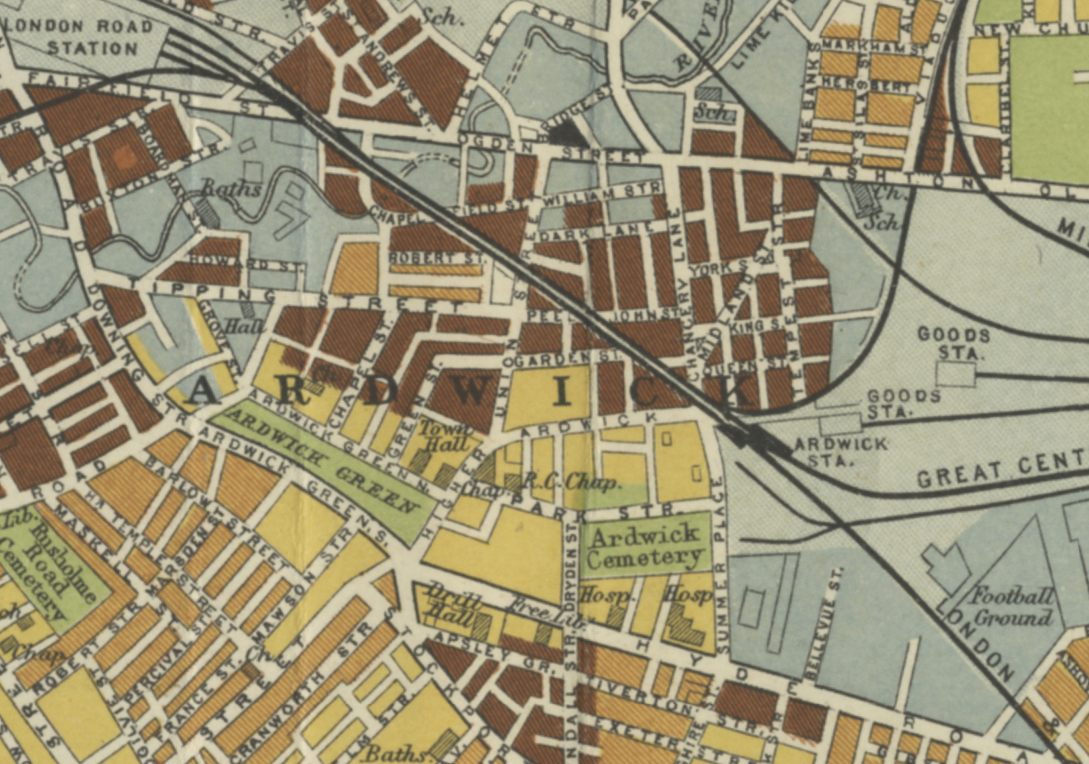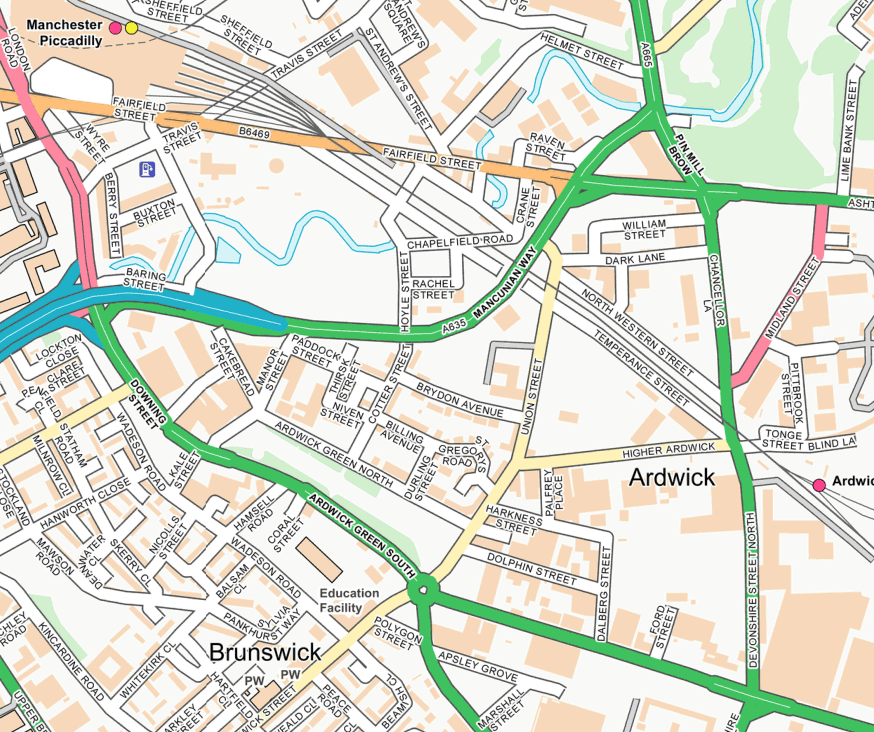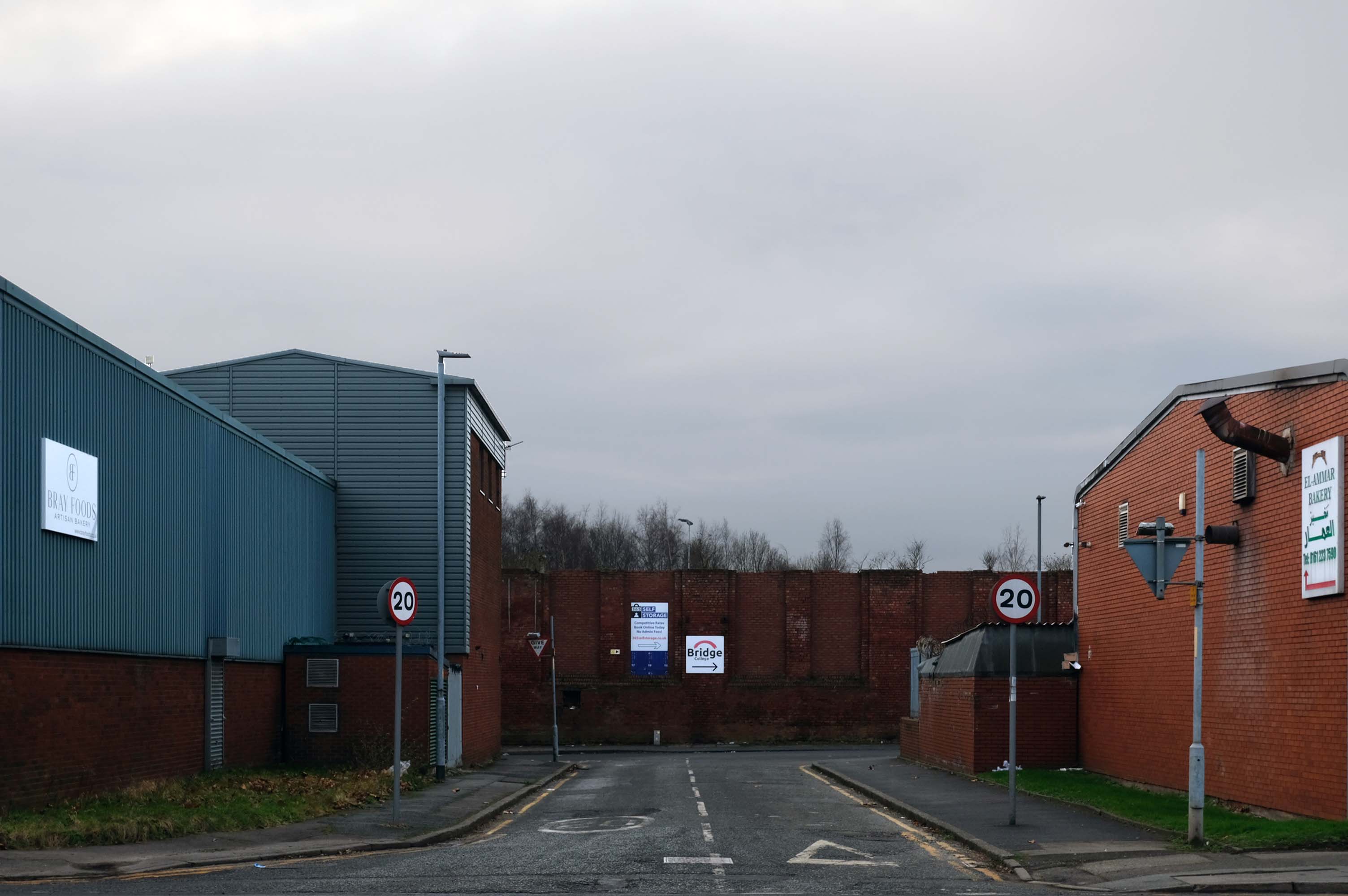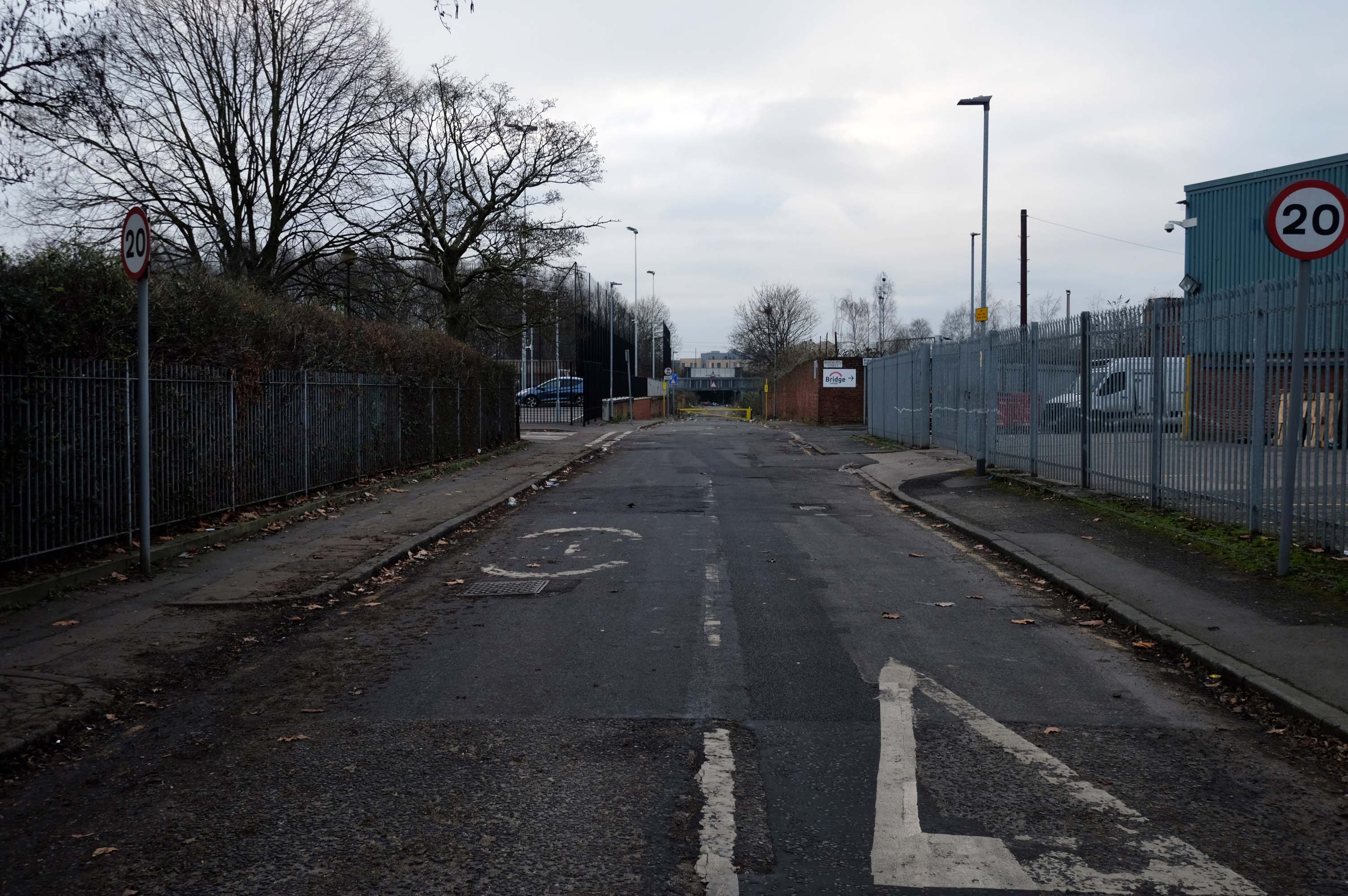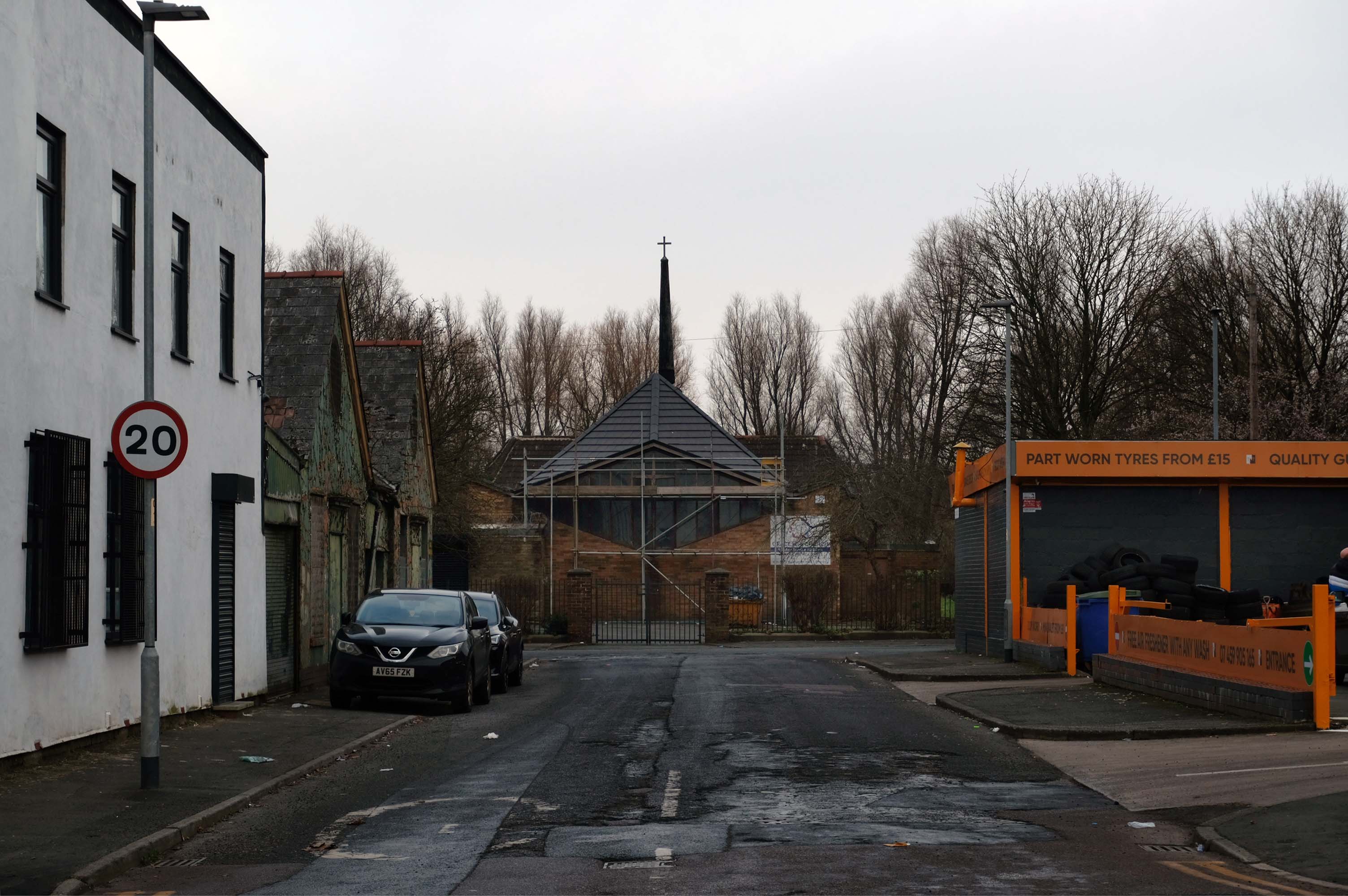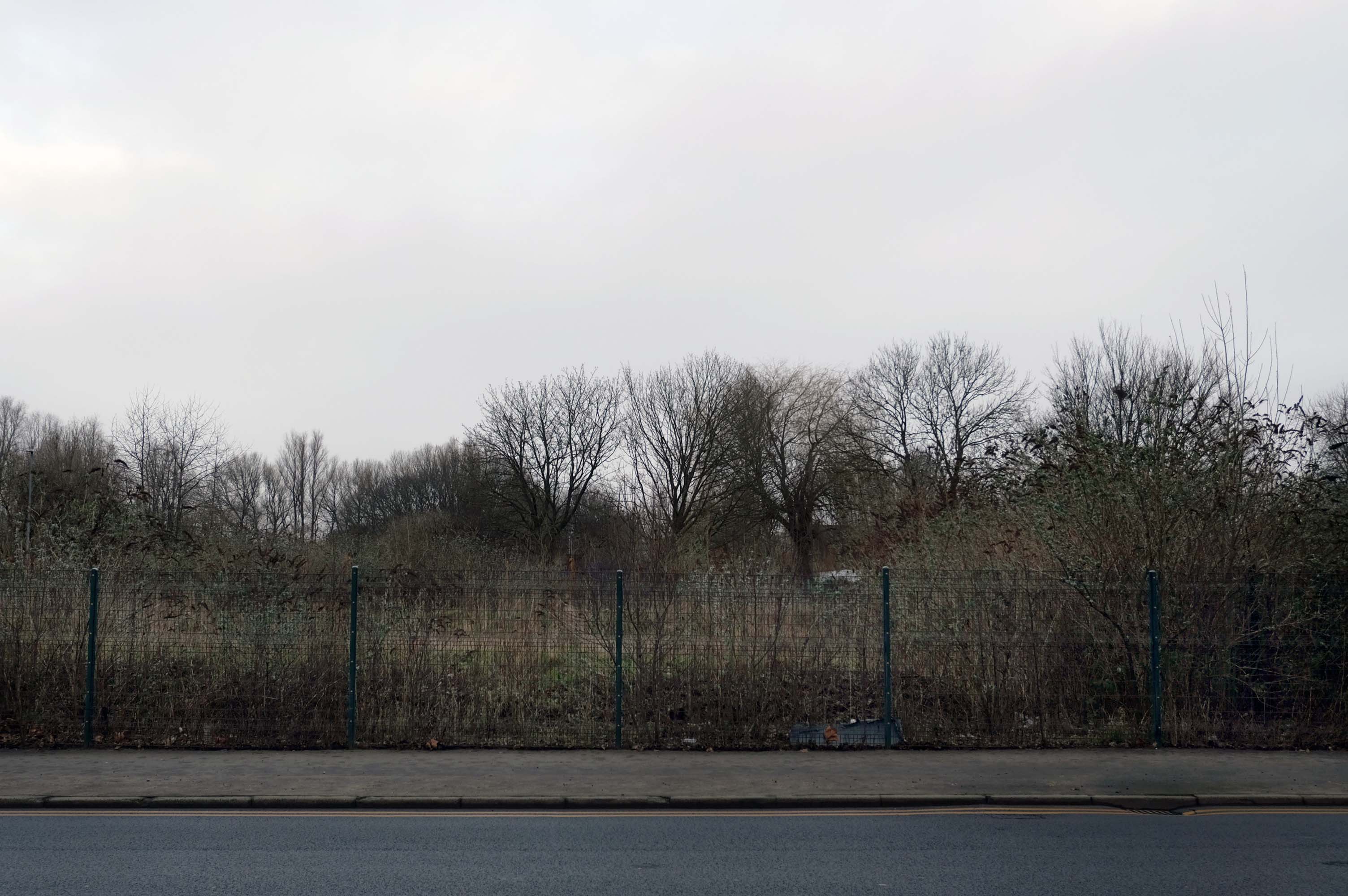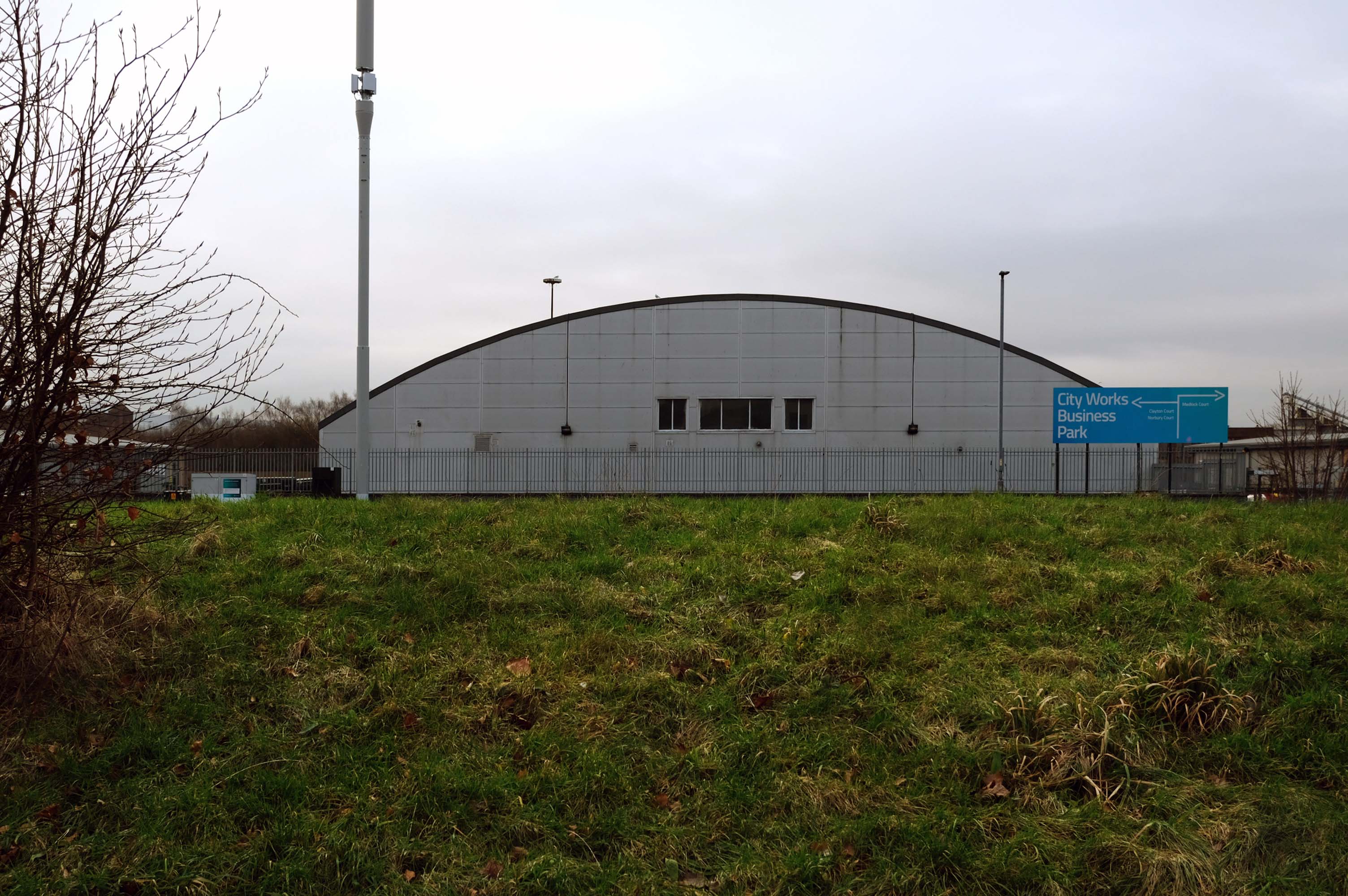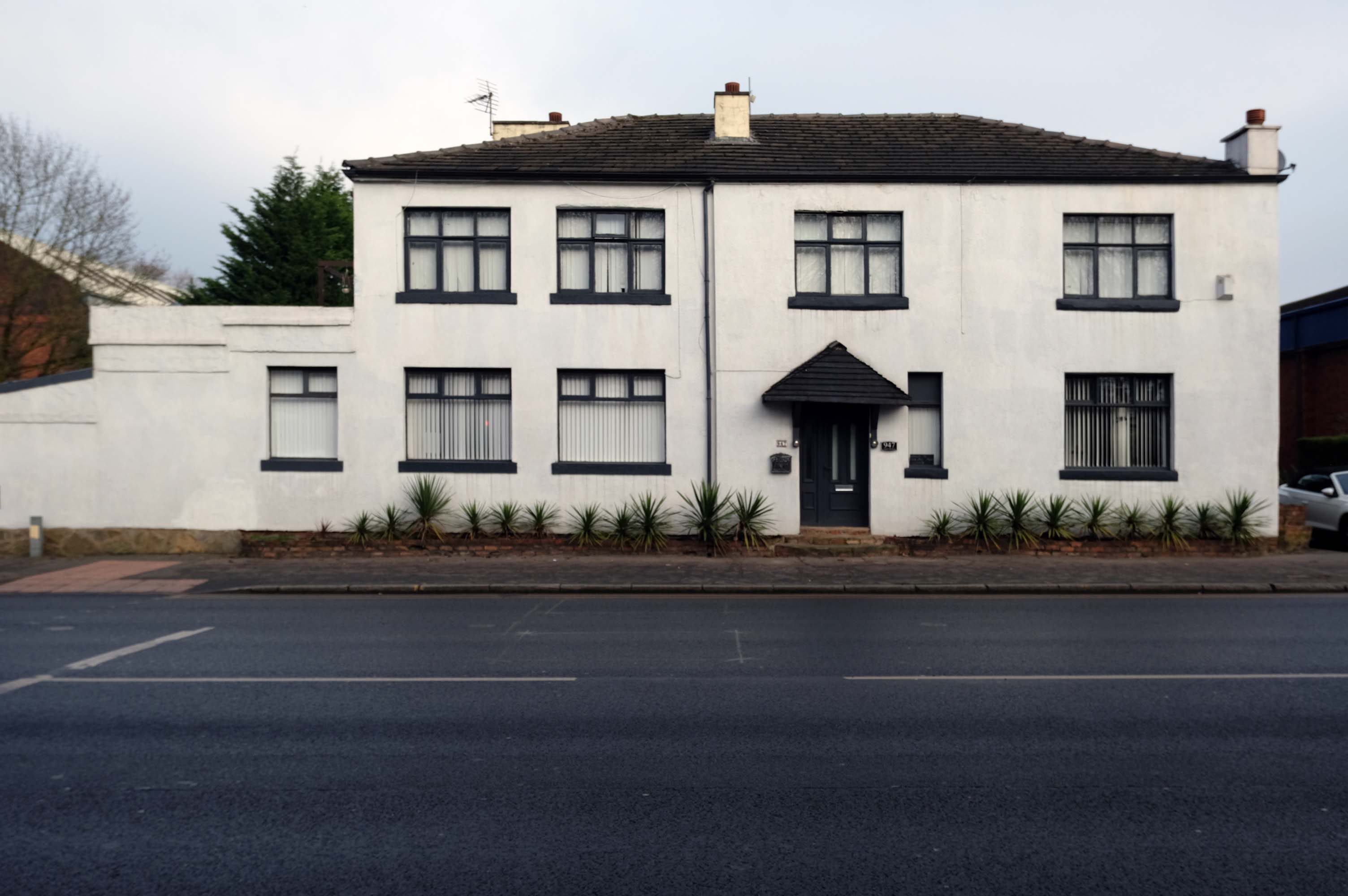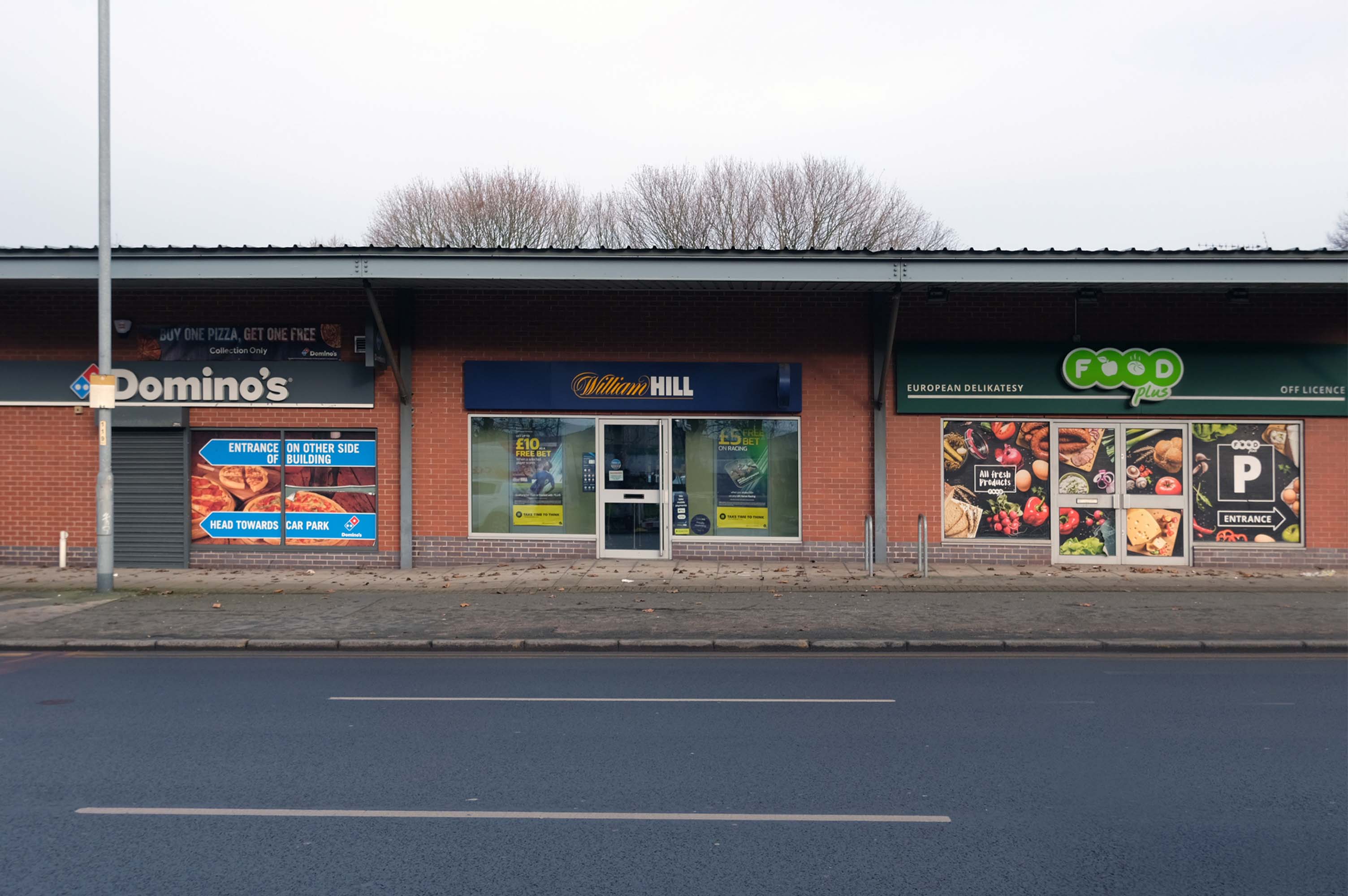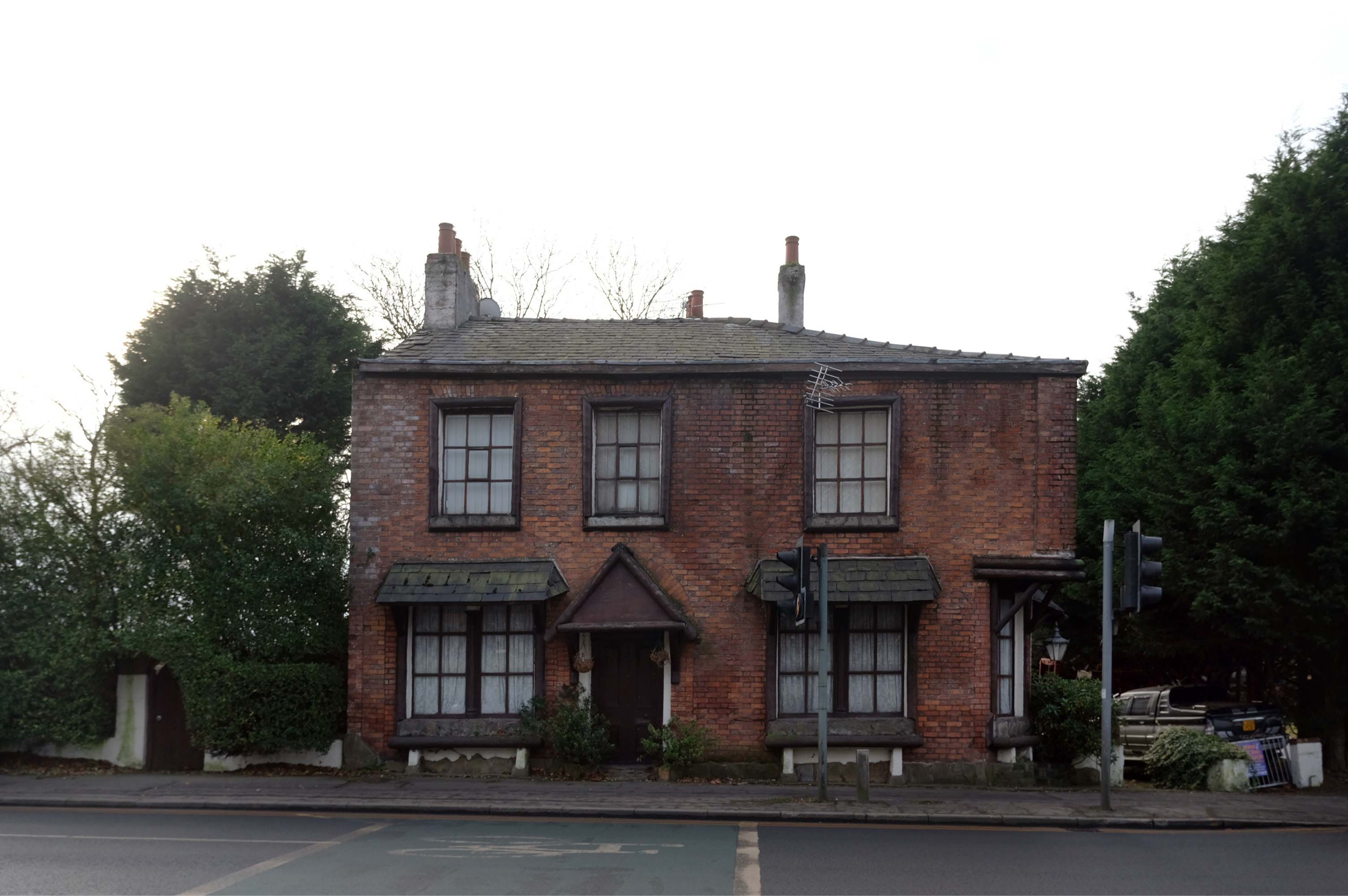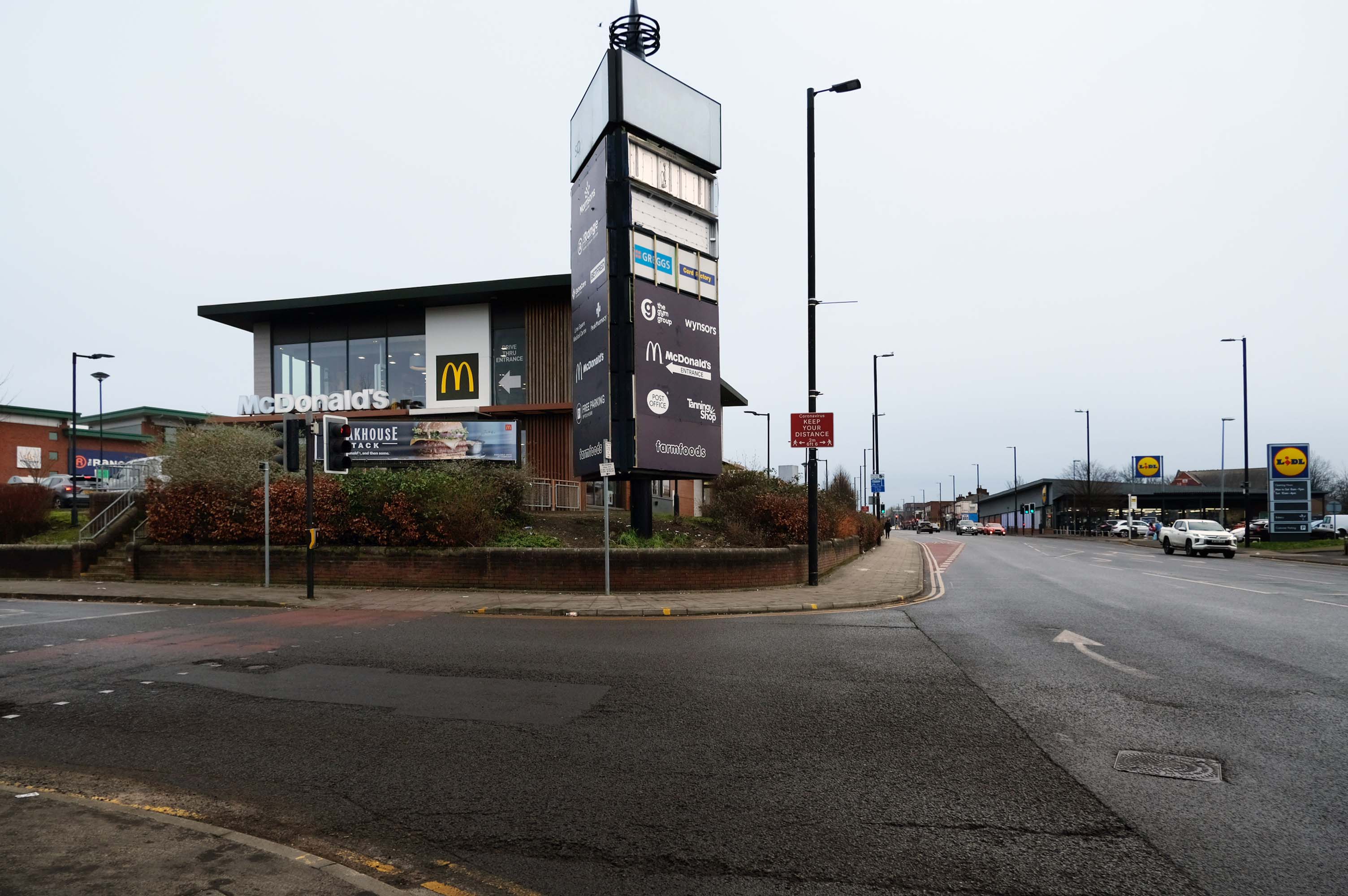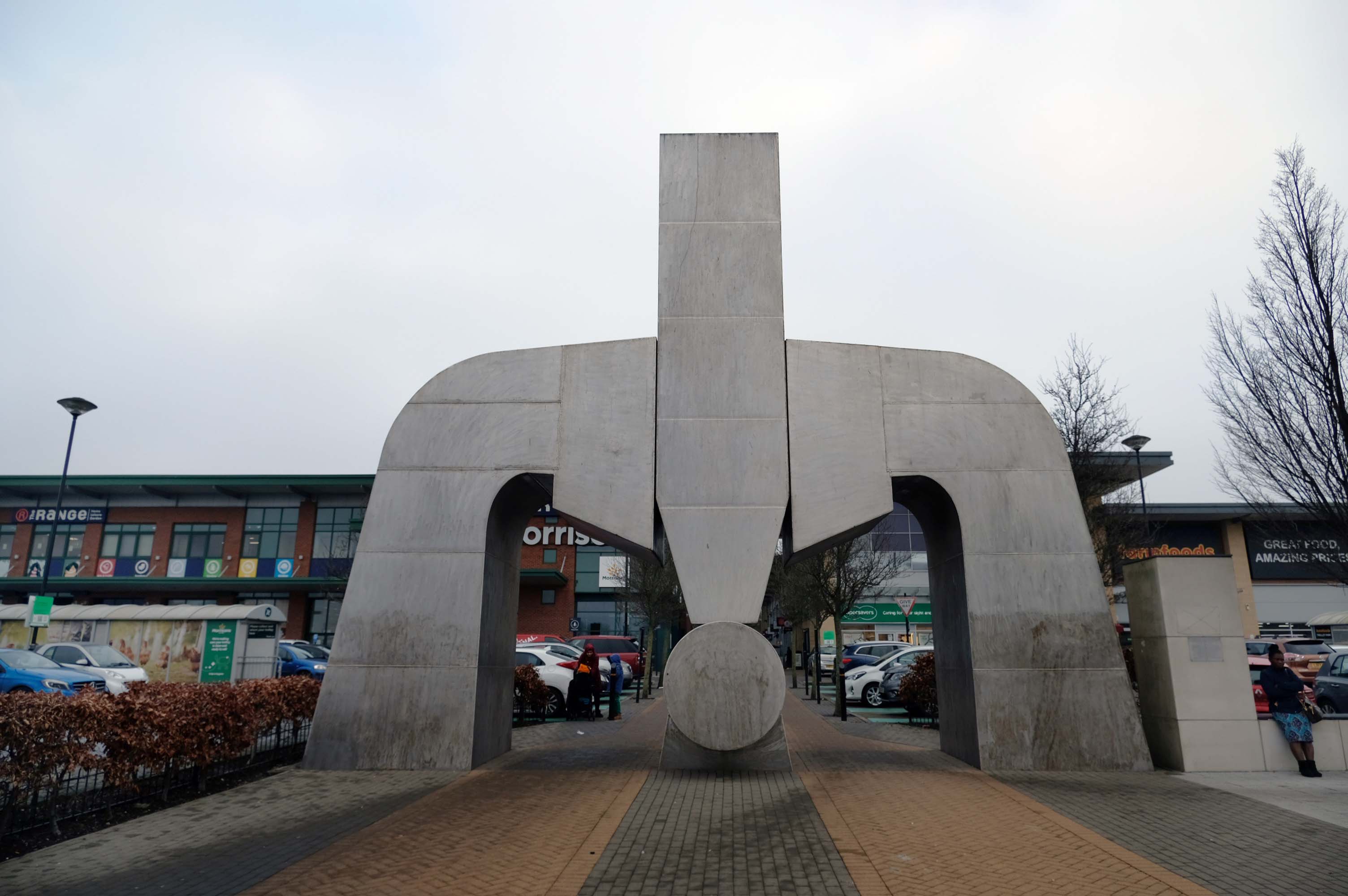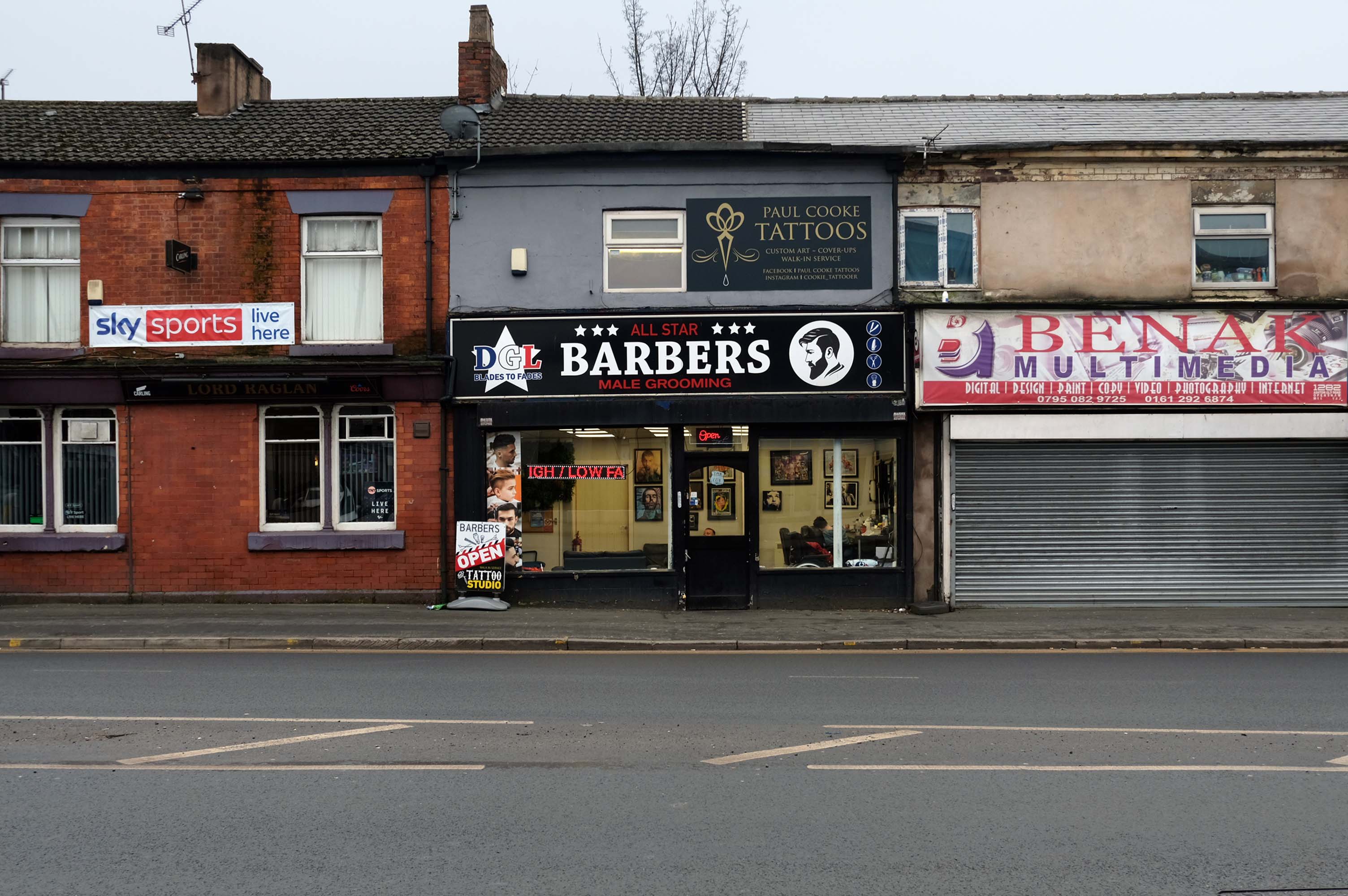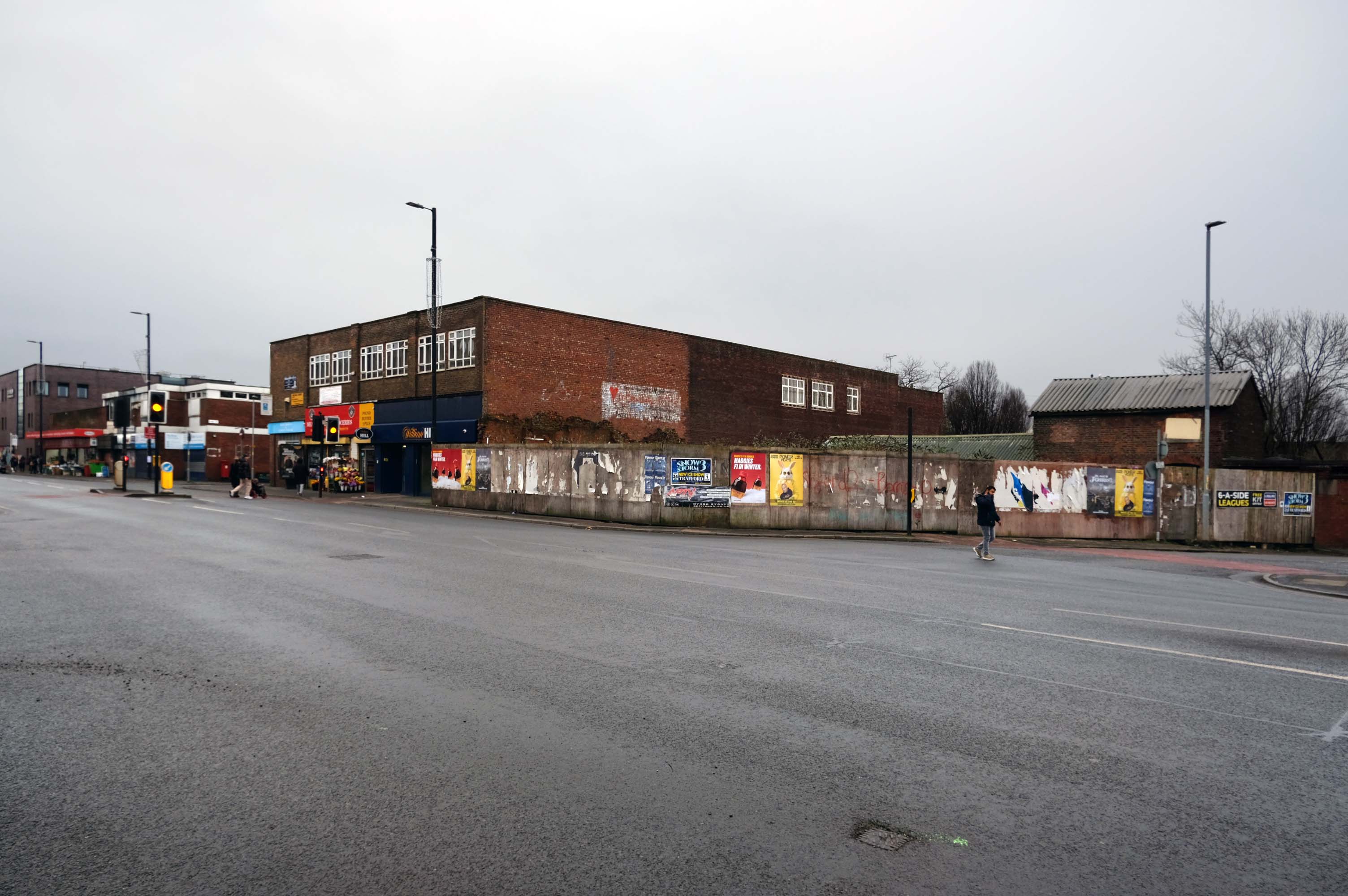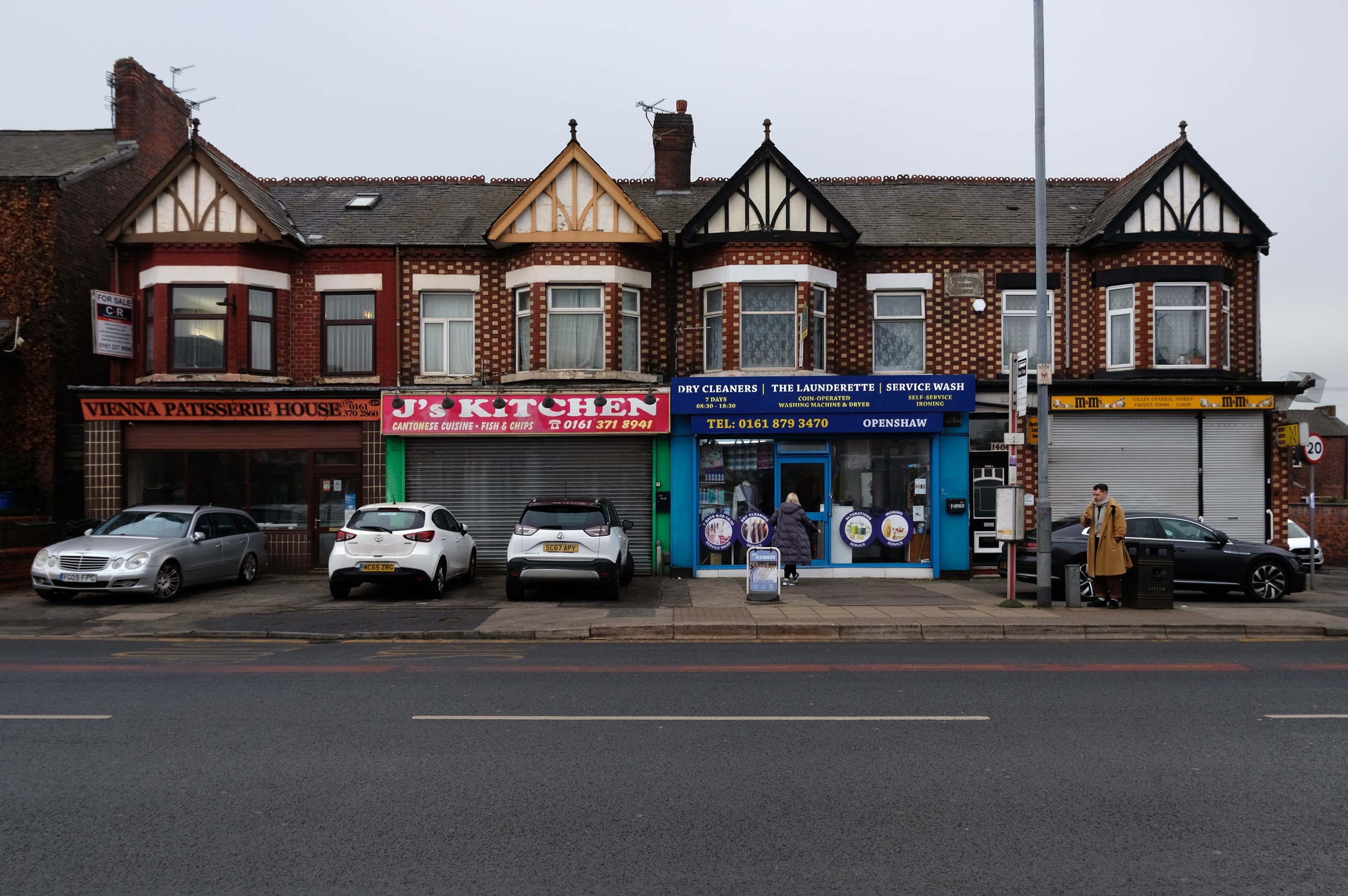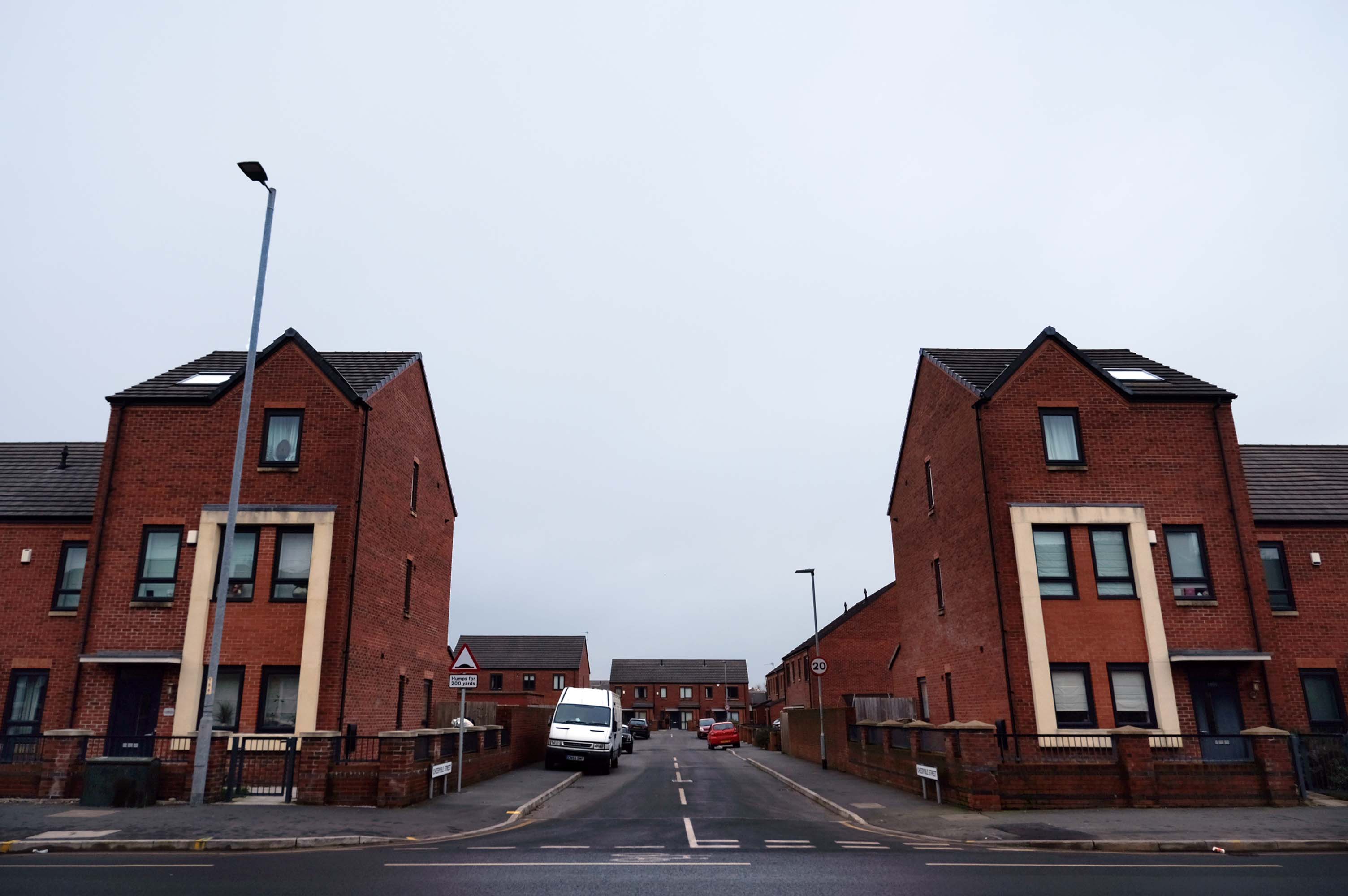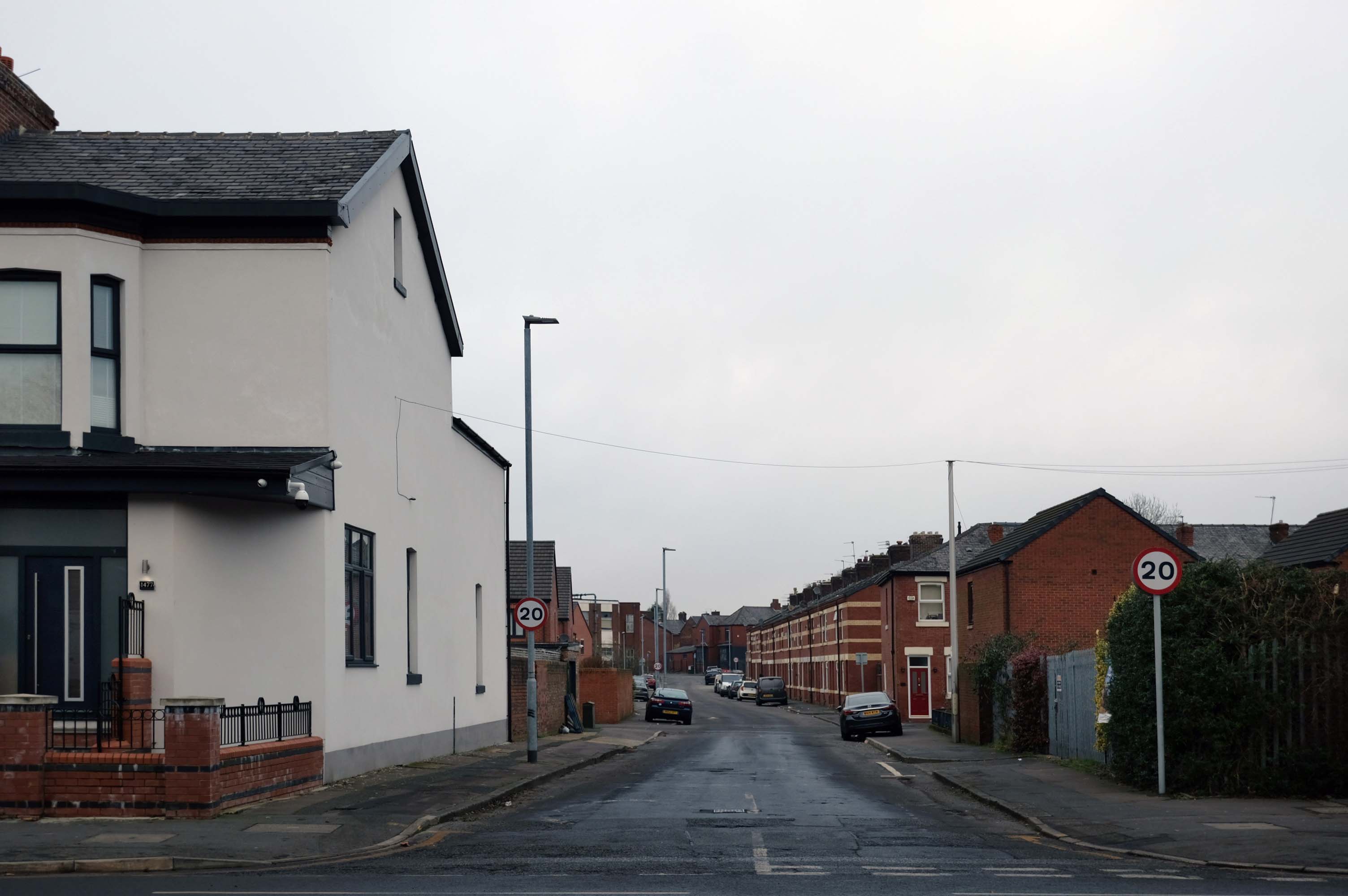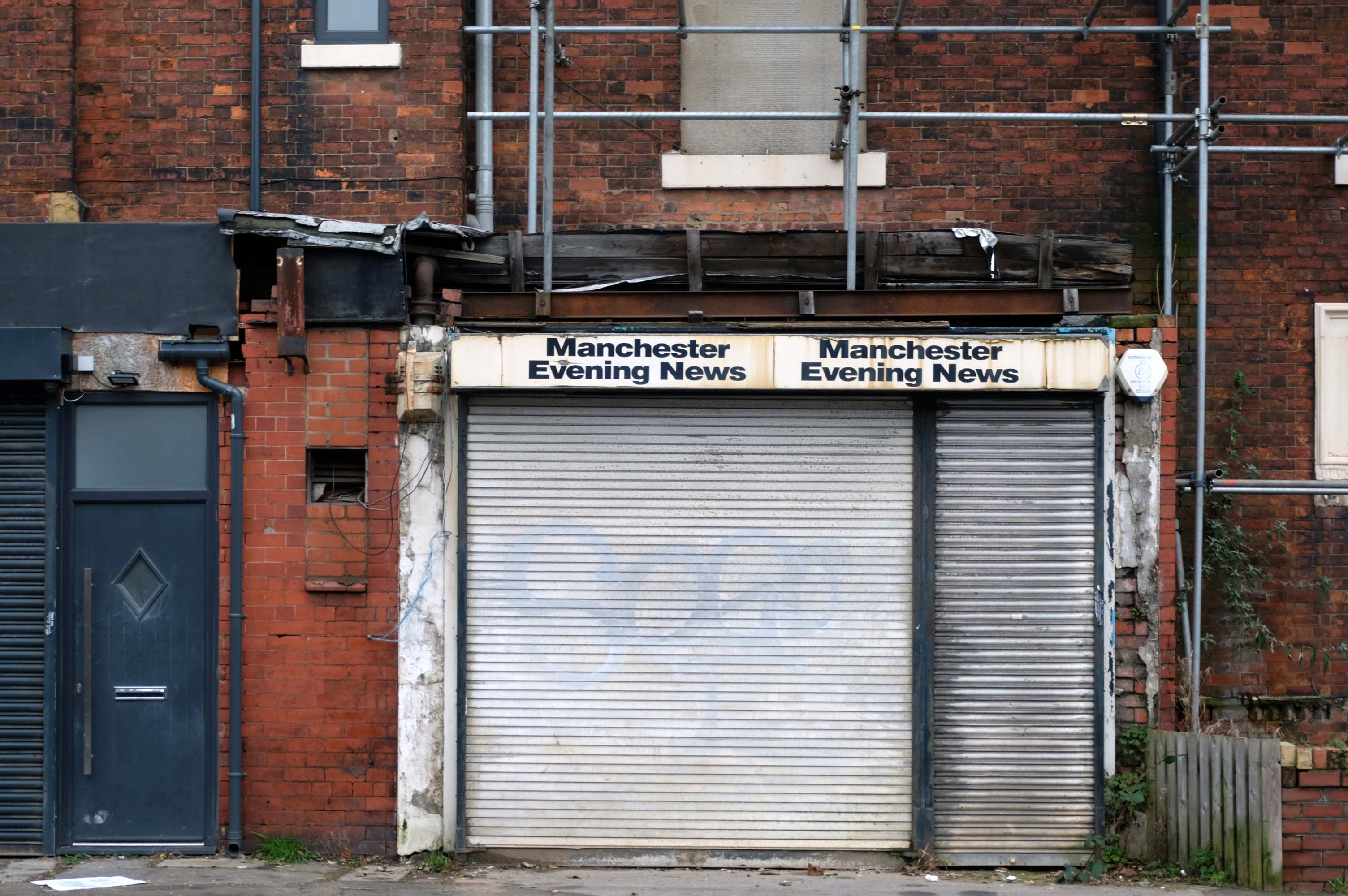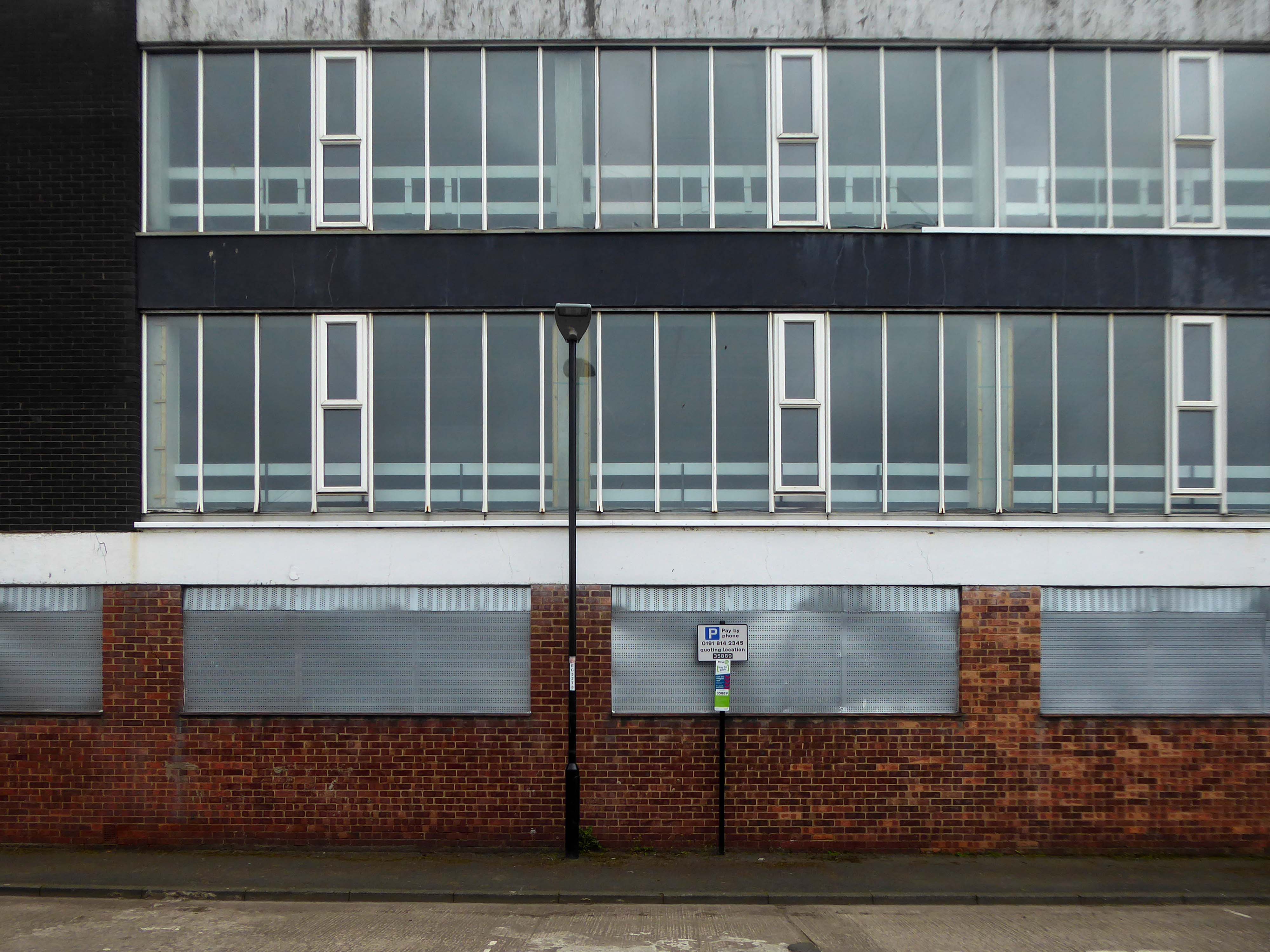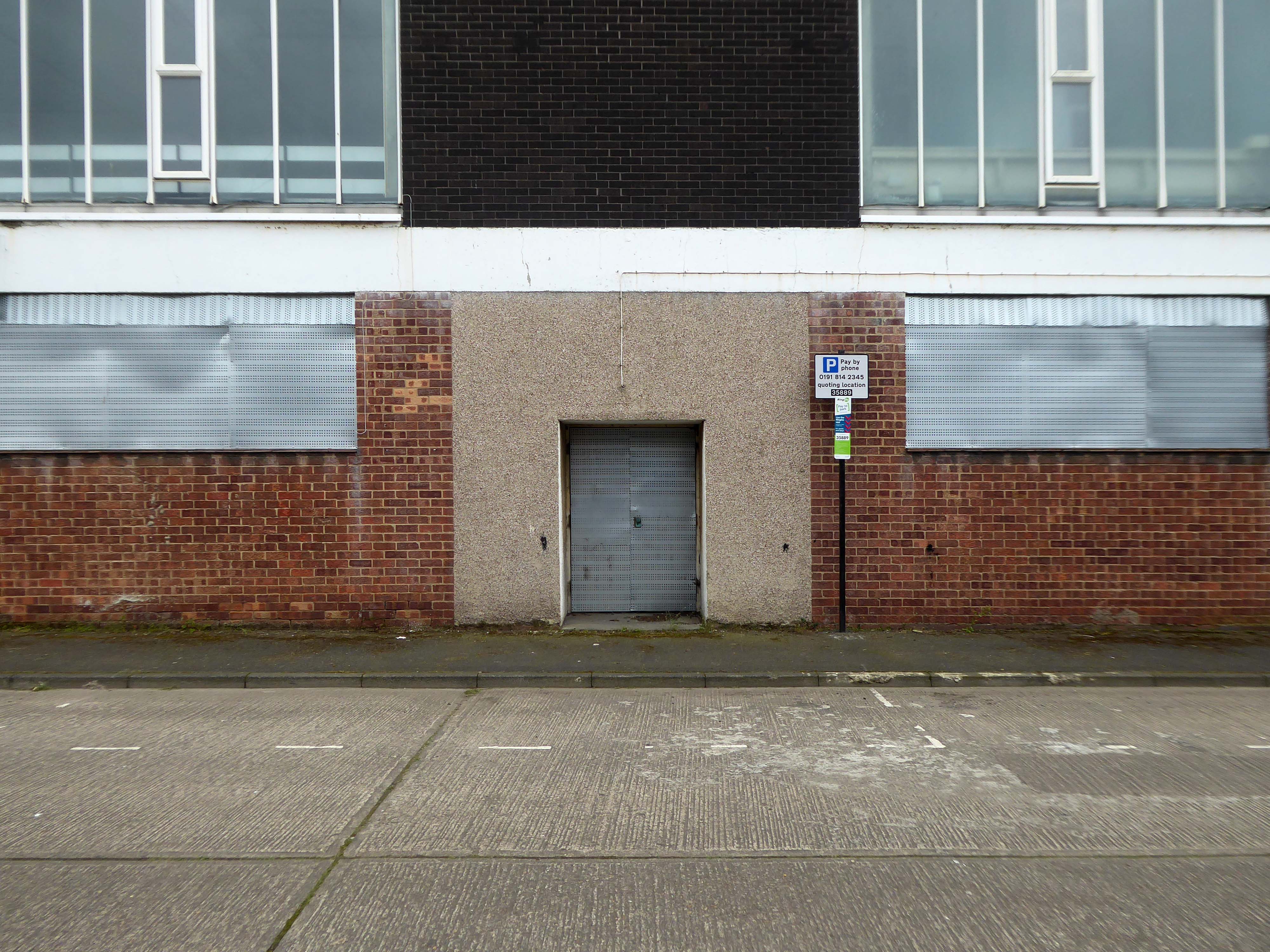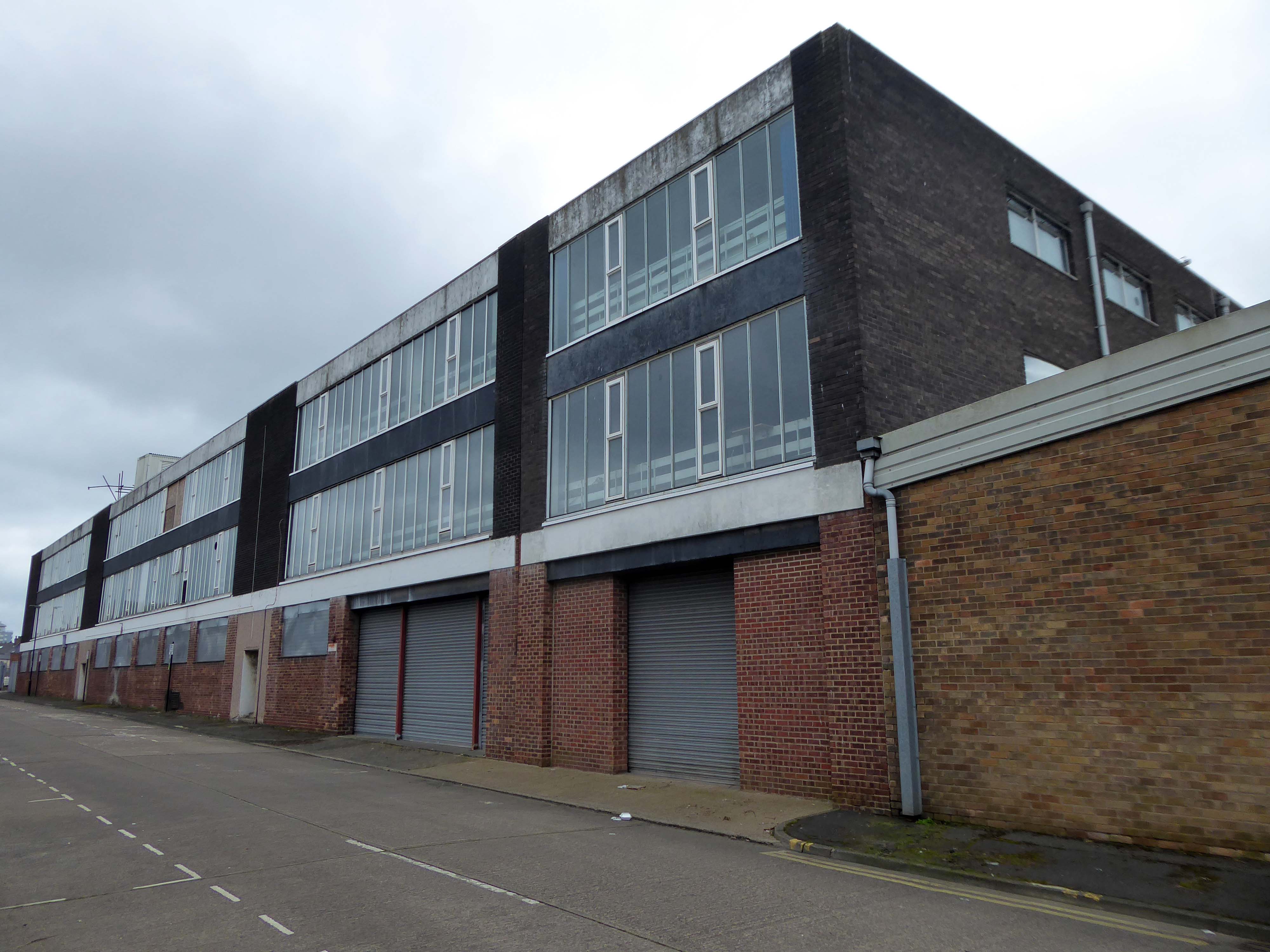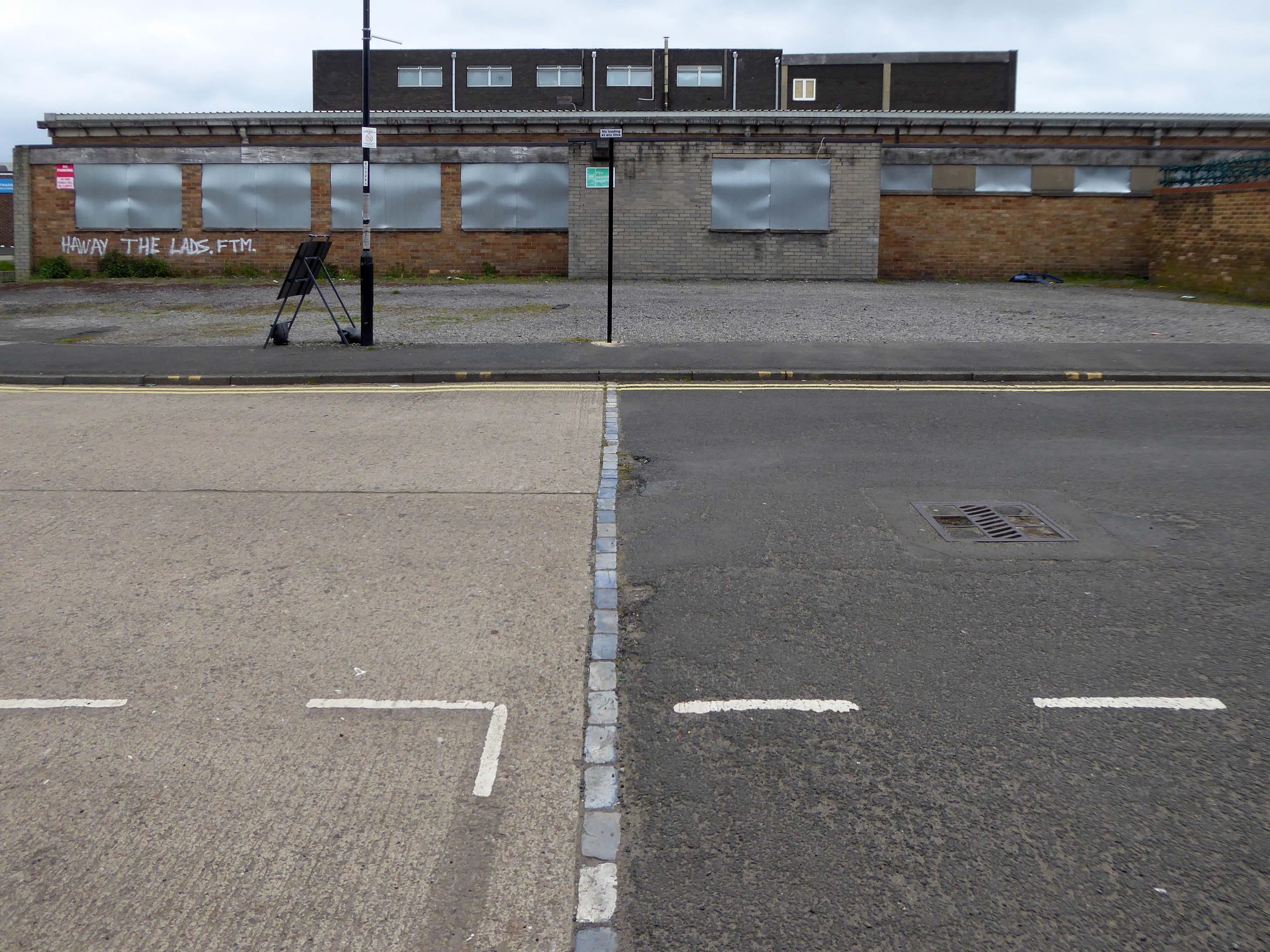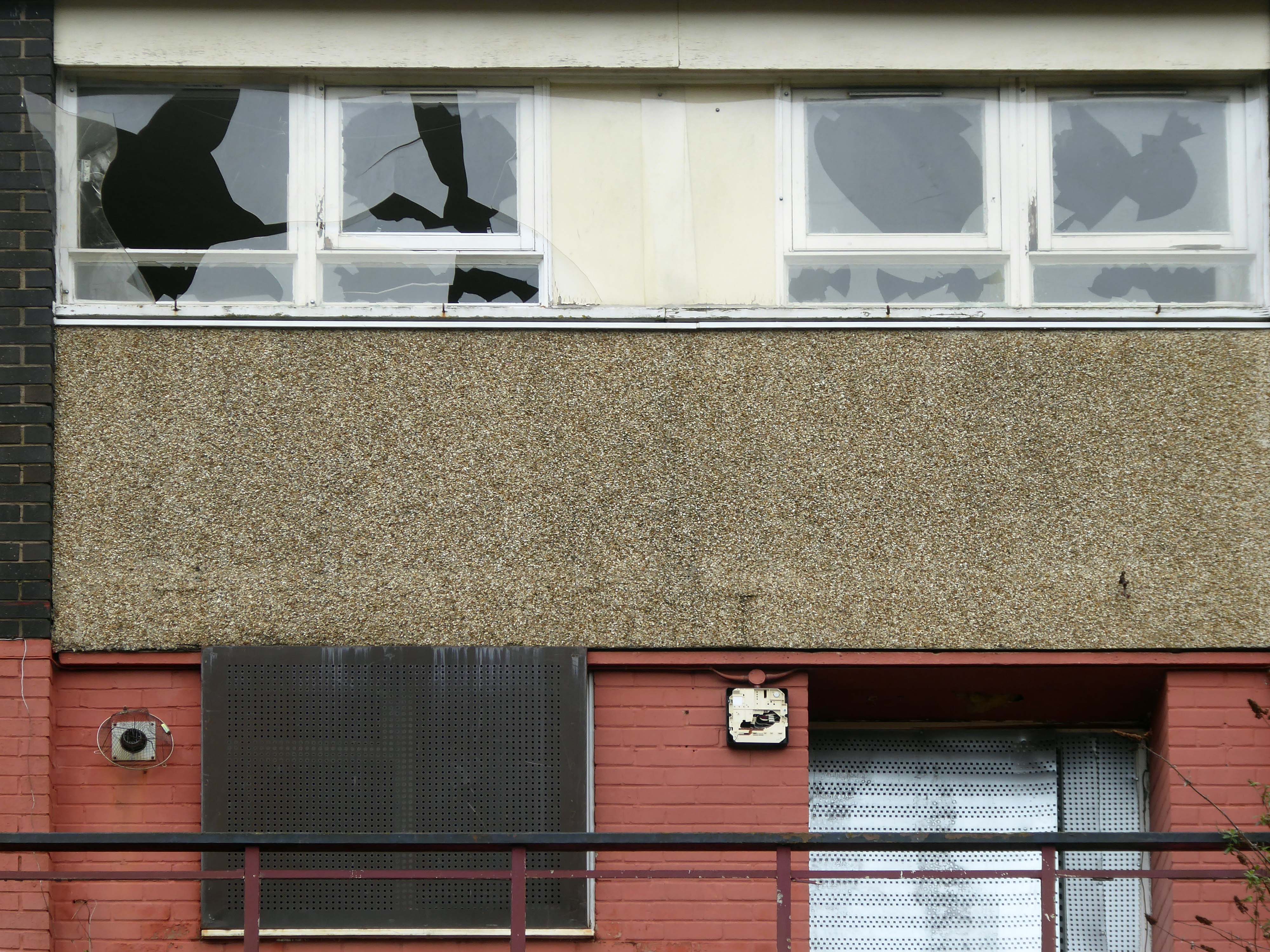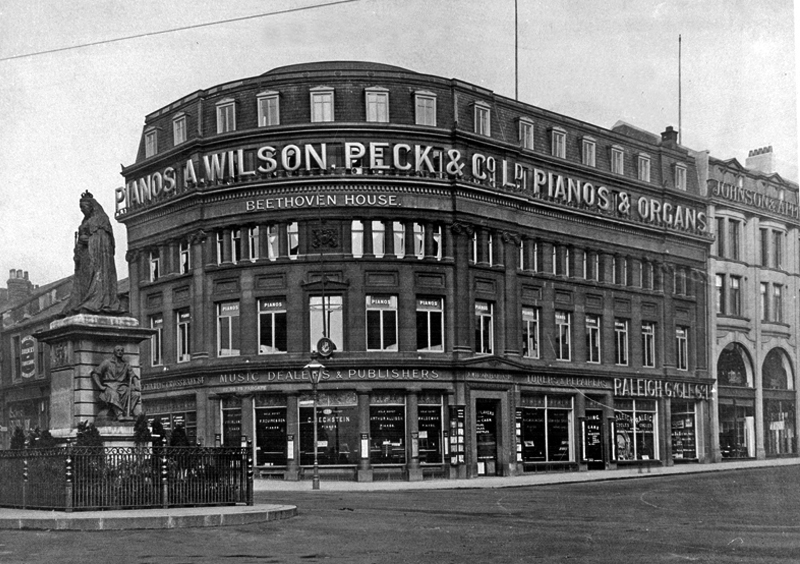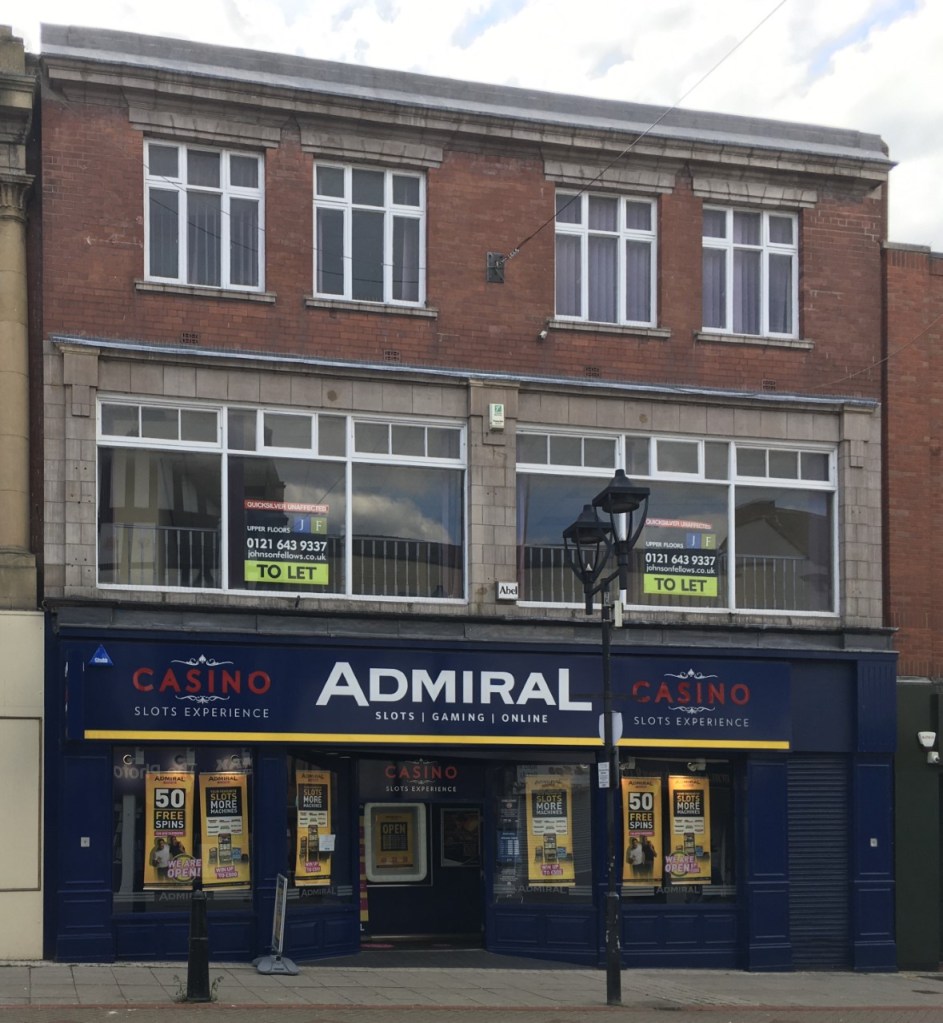
Ardwick Walk Again

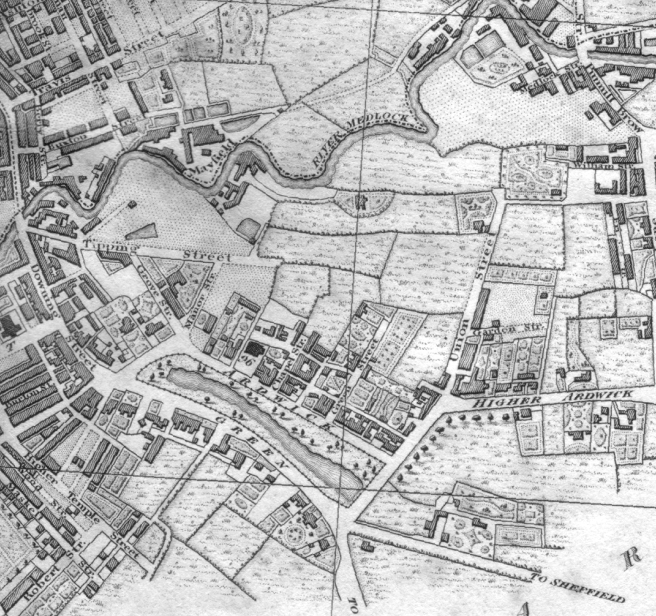
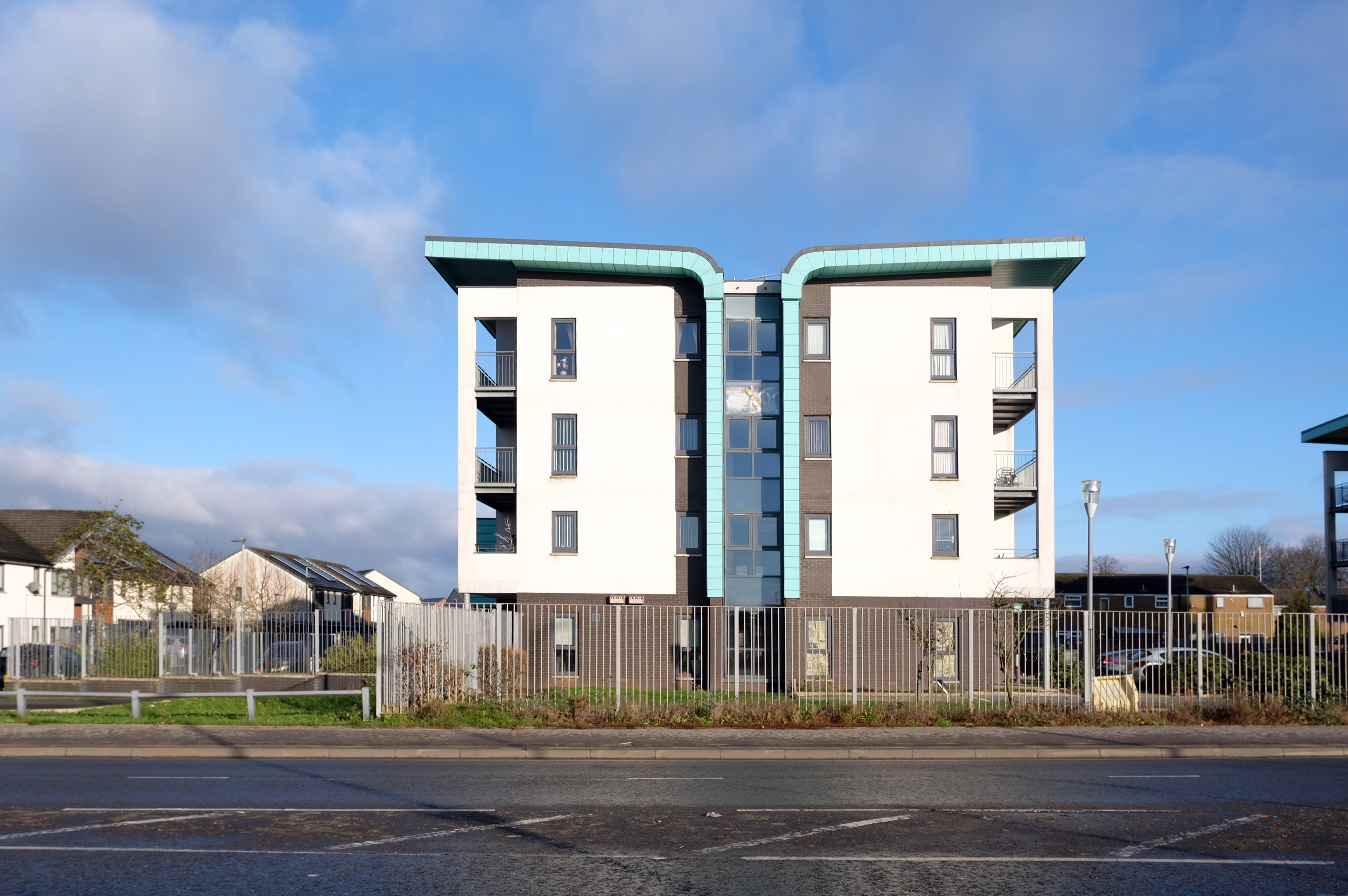
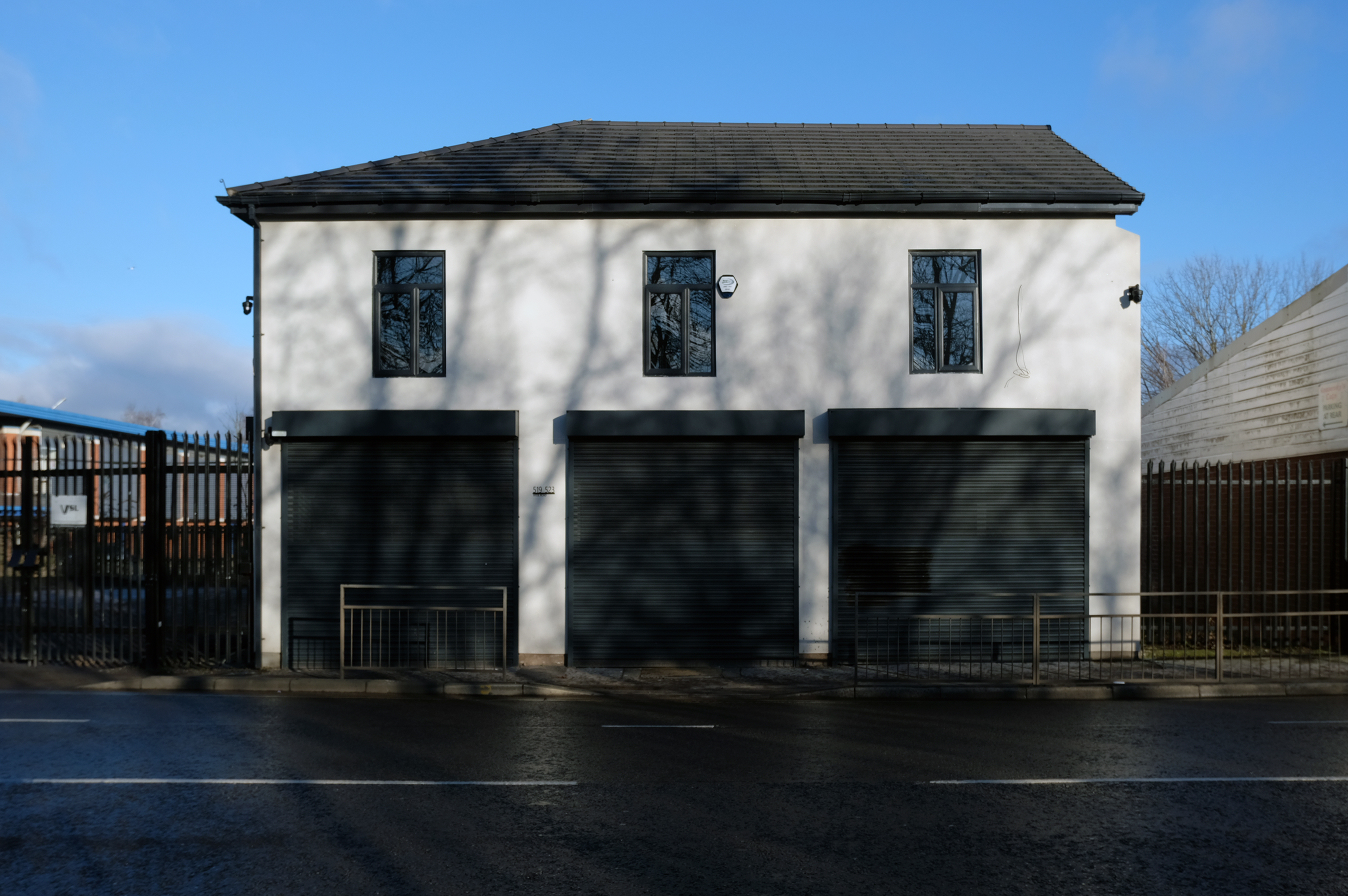
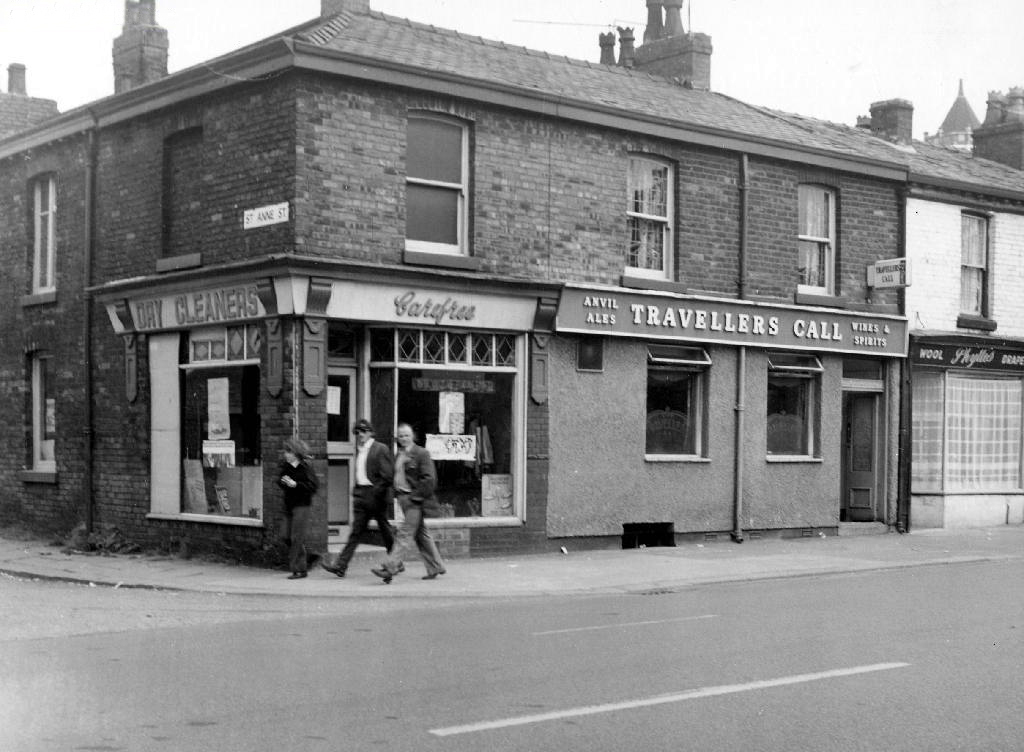
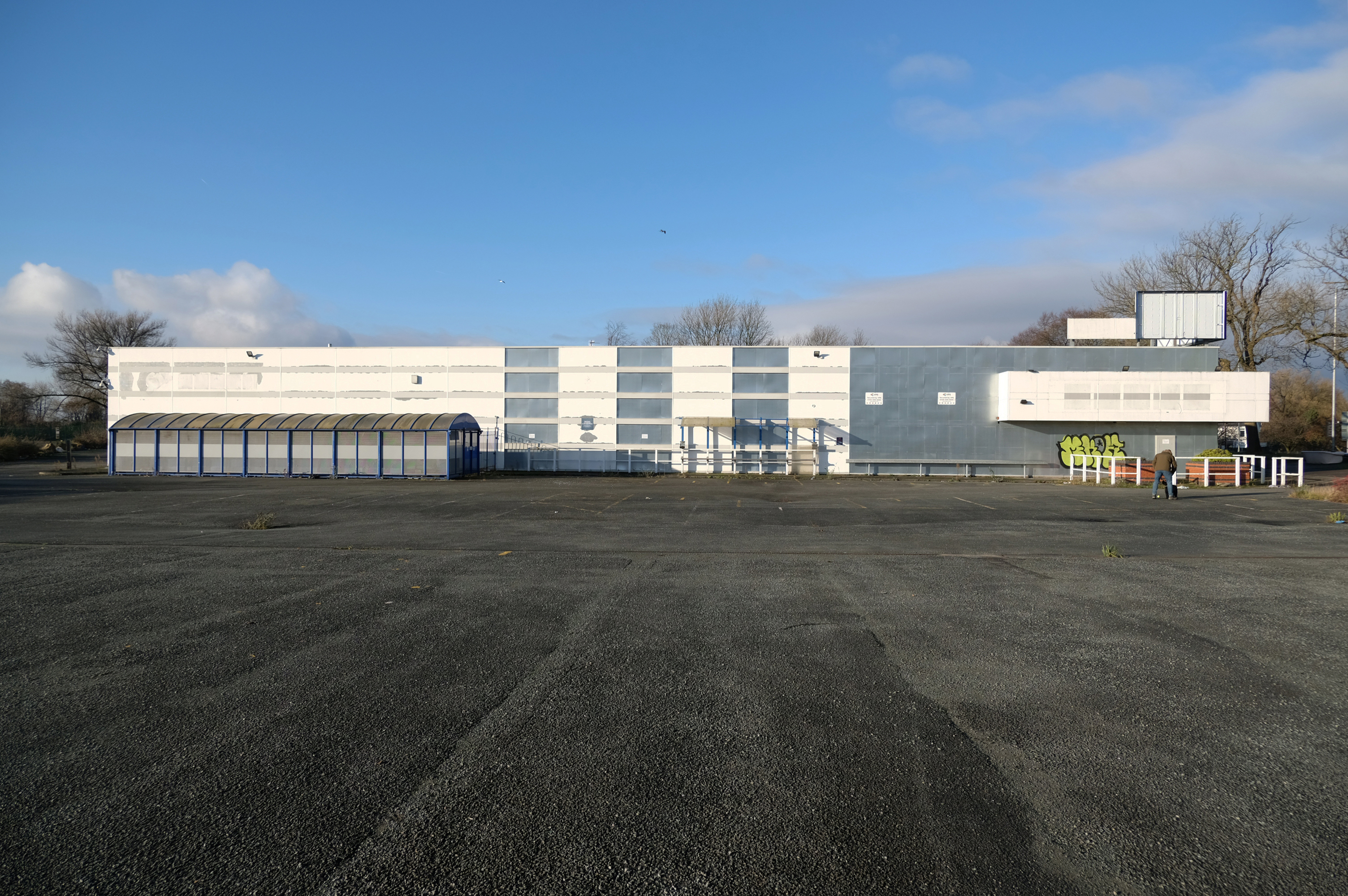
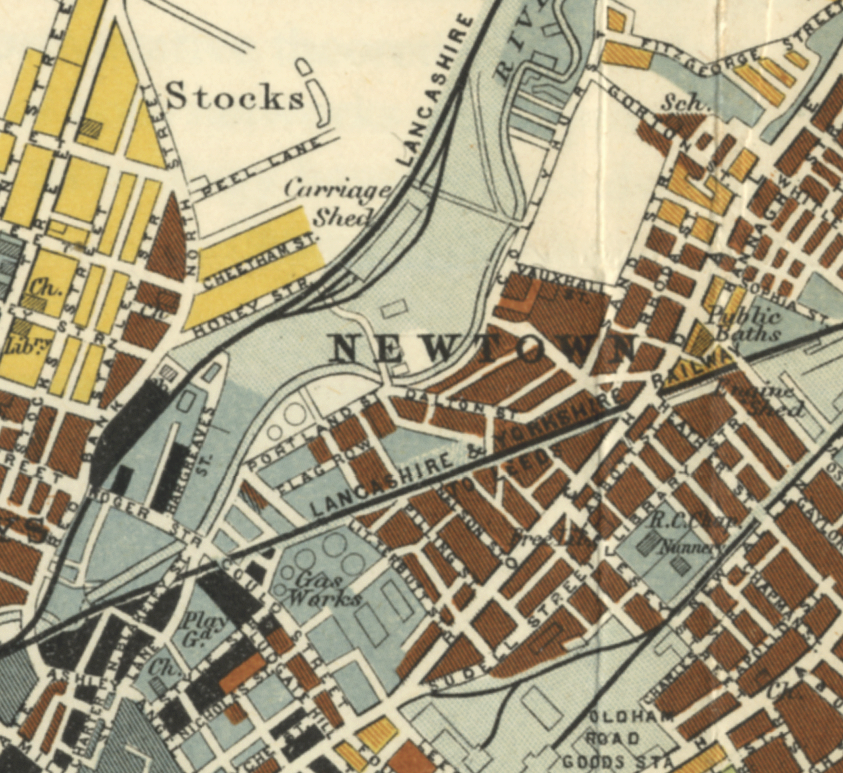
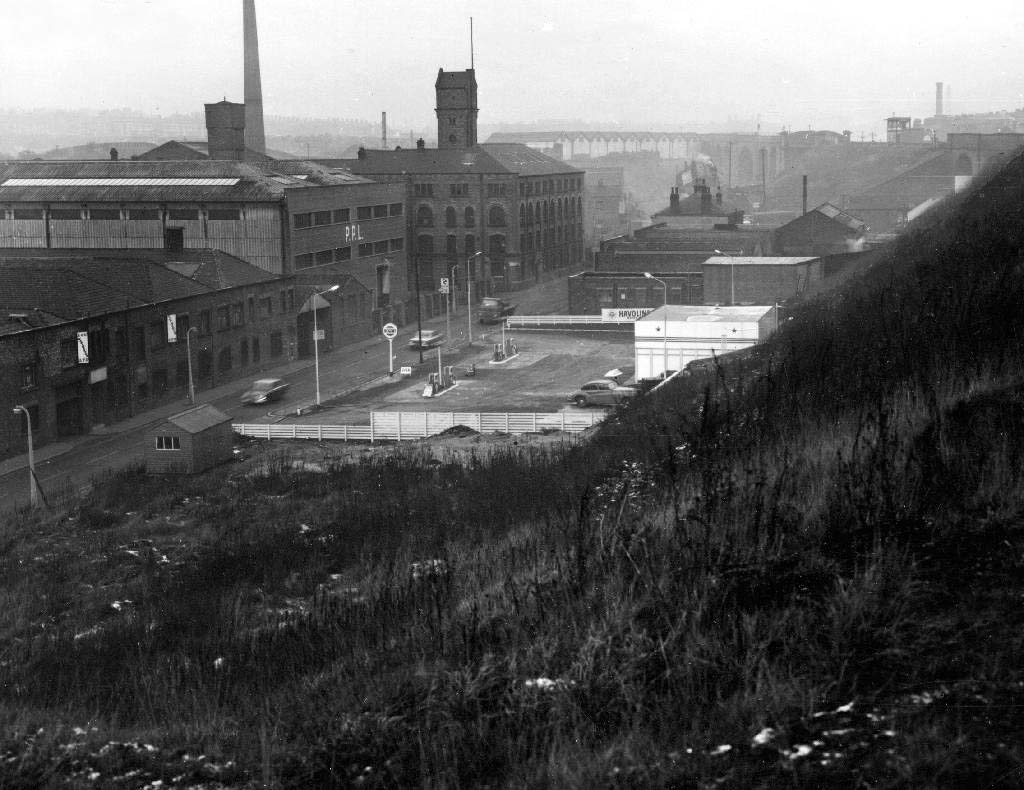
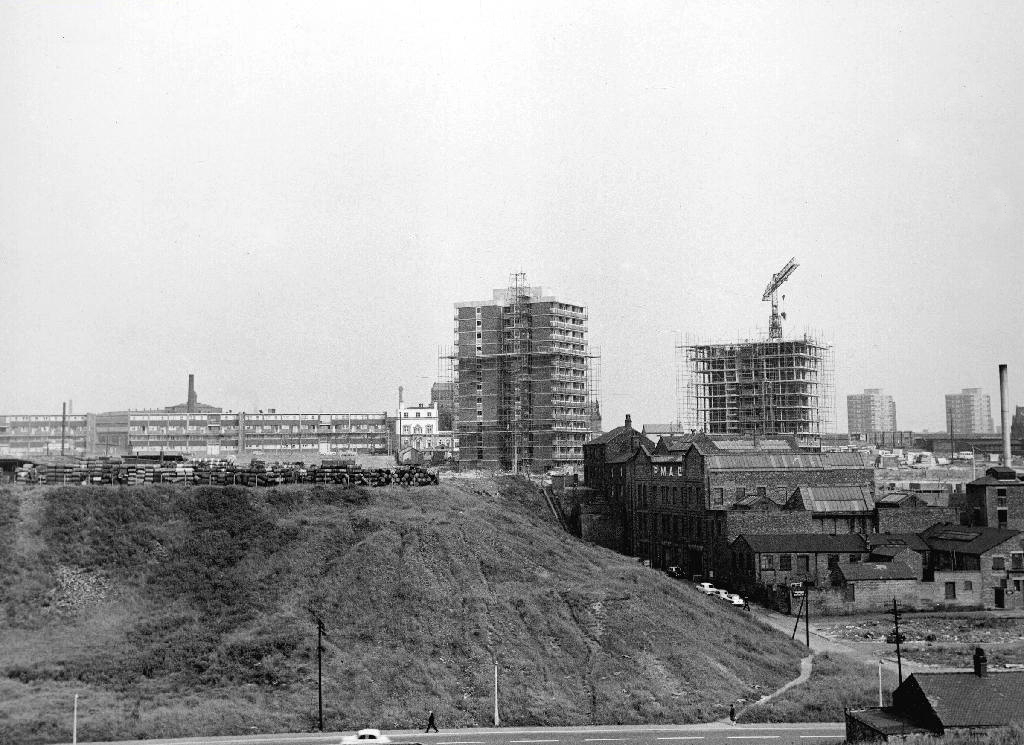
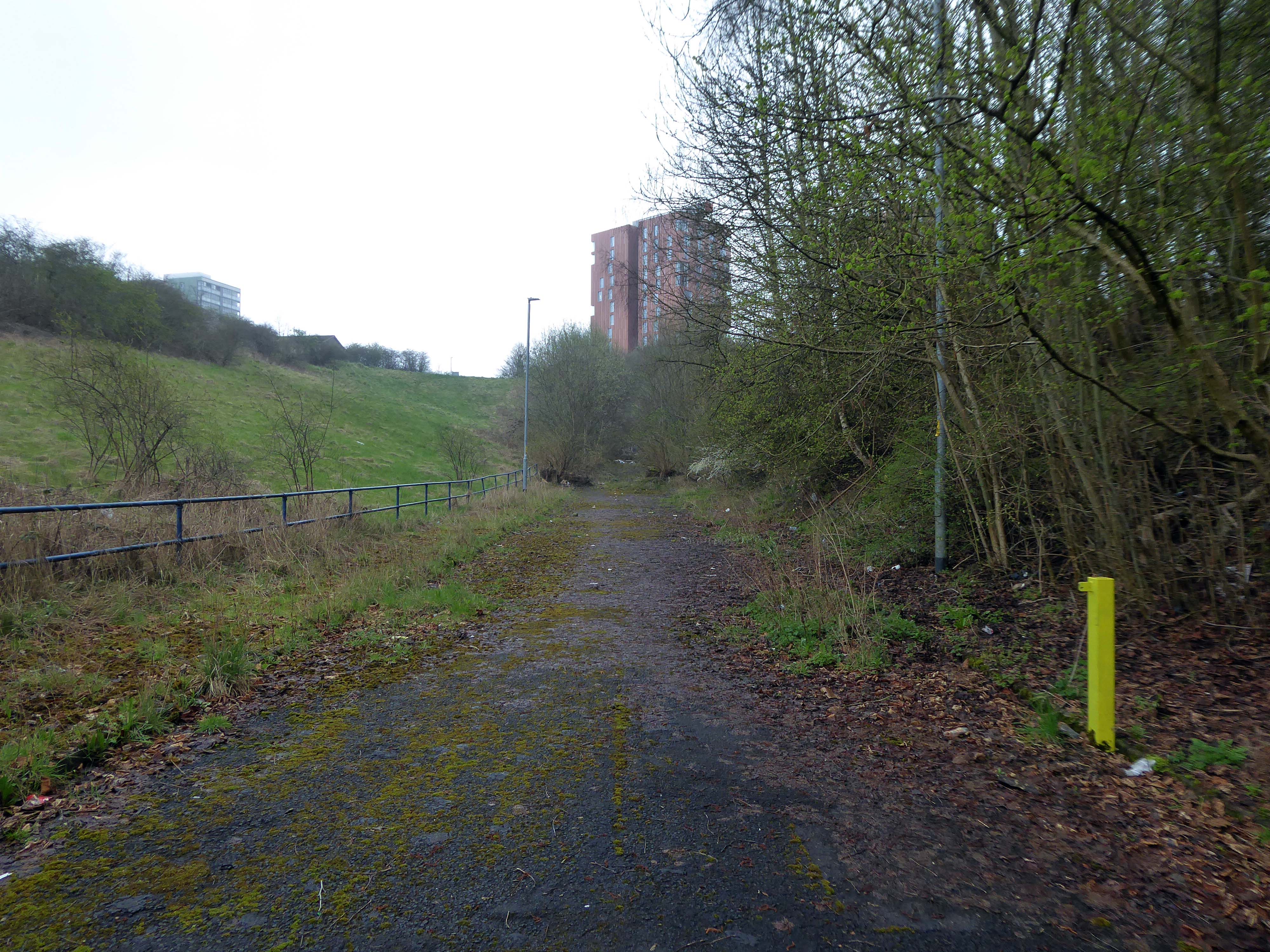
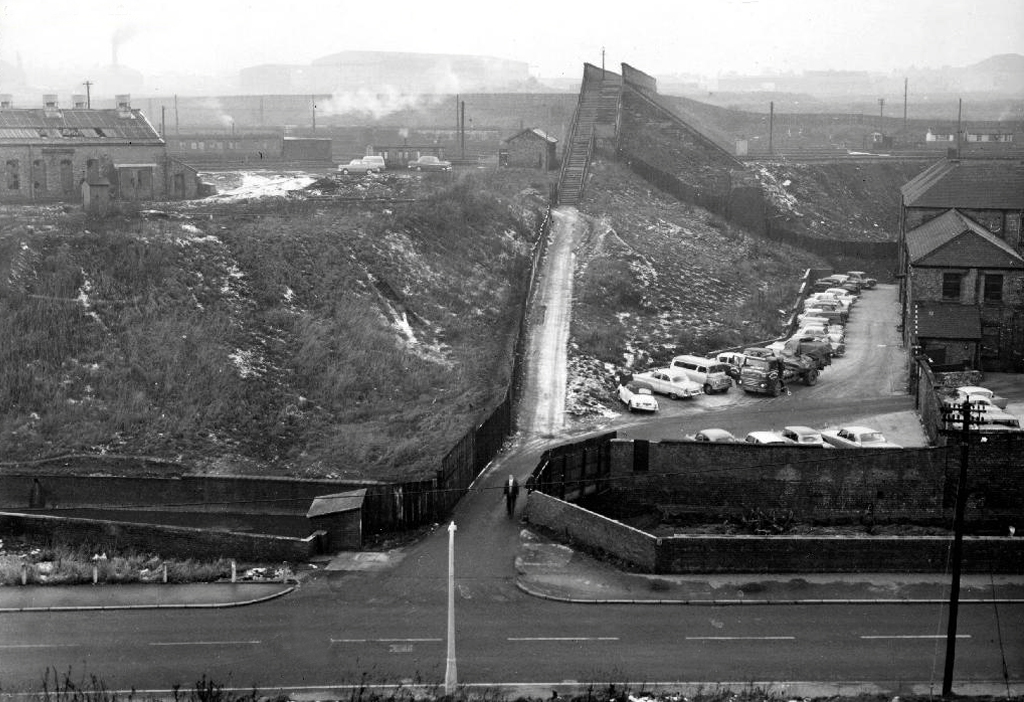
1824

1904

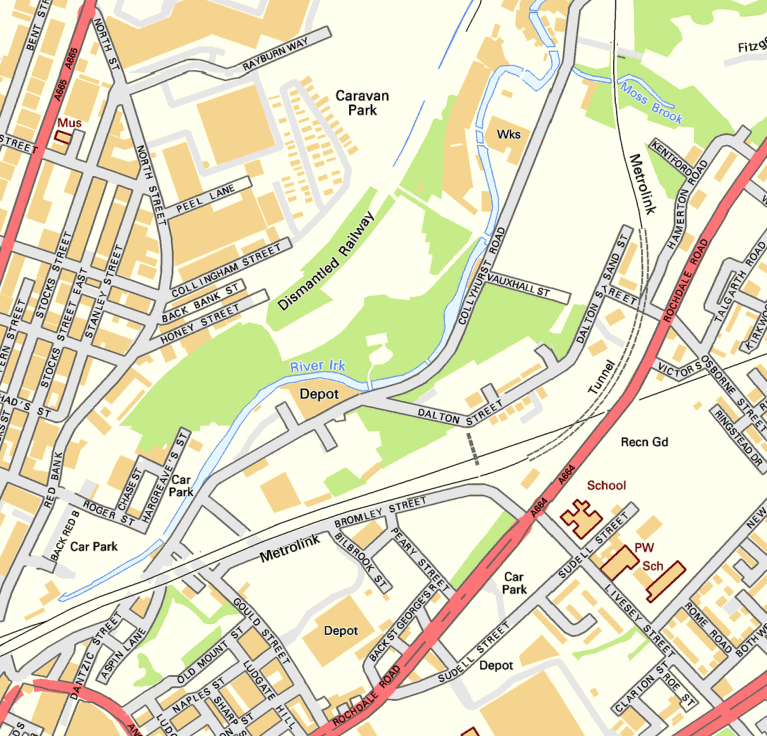
2025

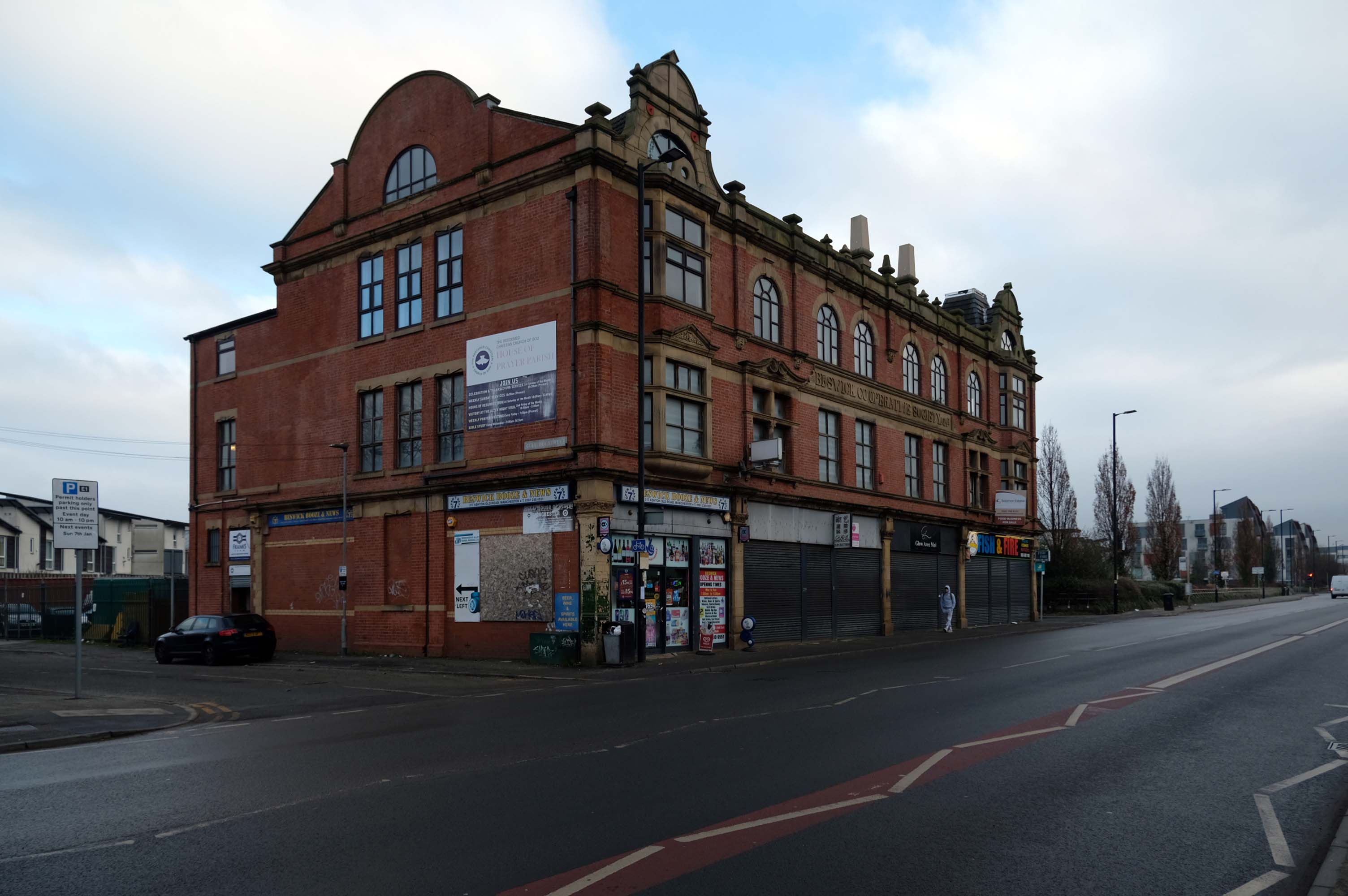
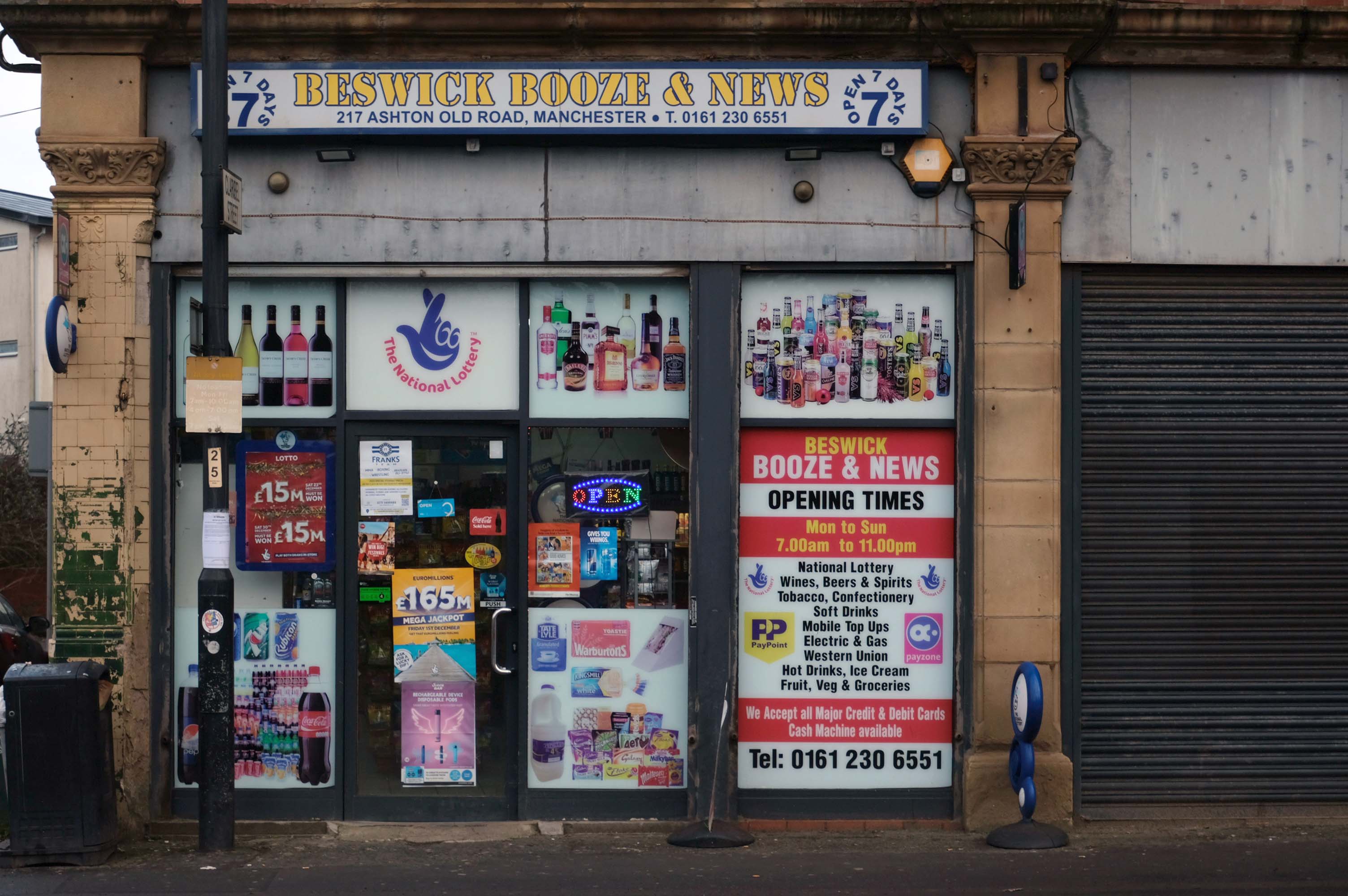
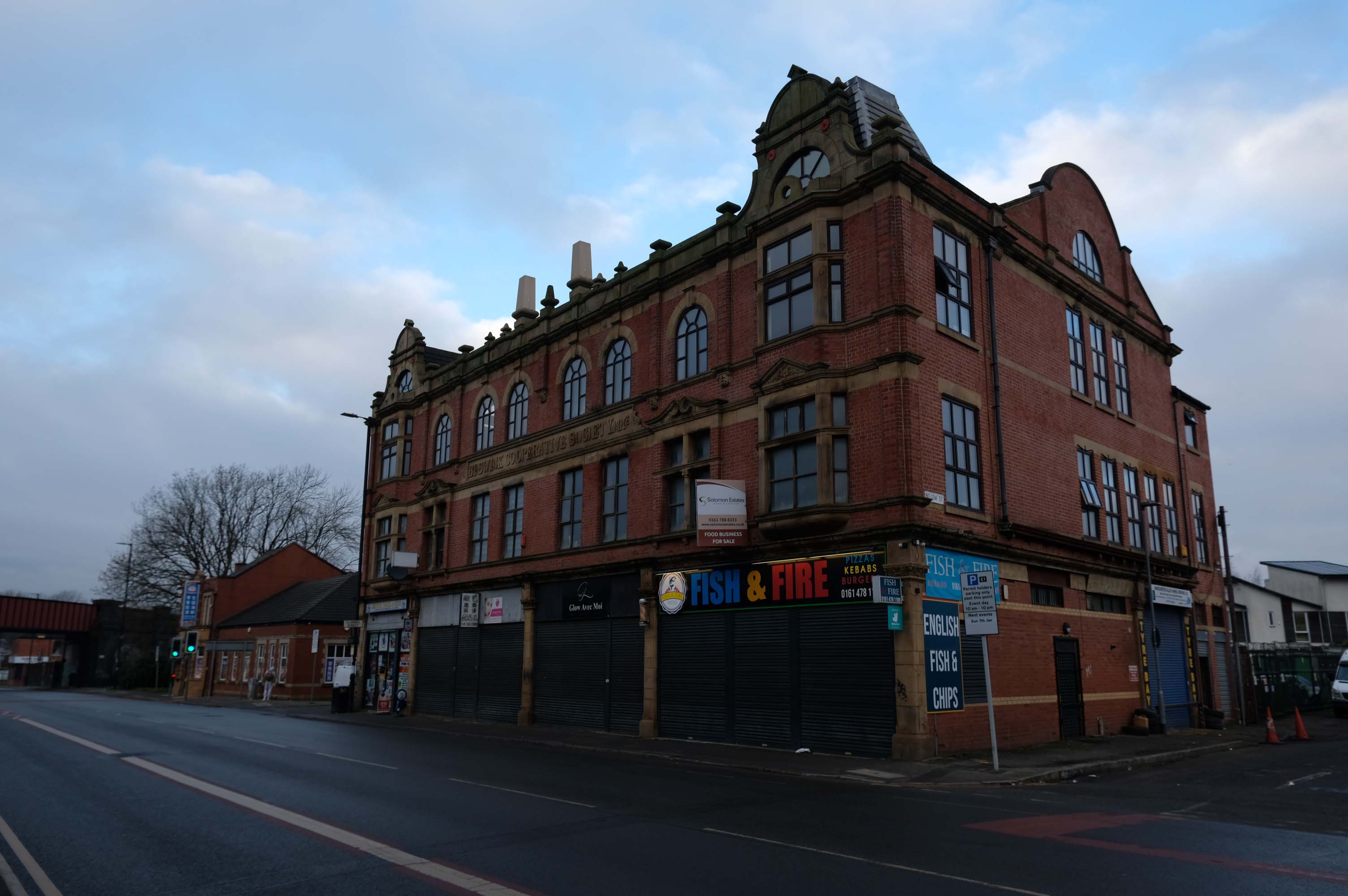
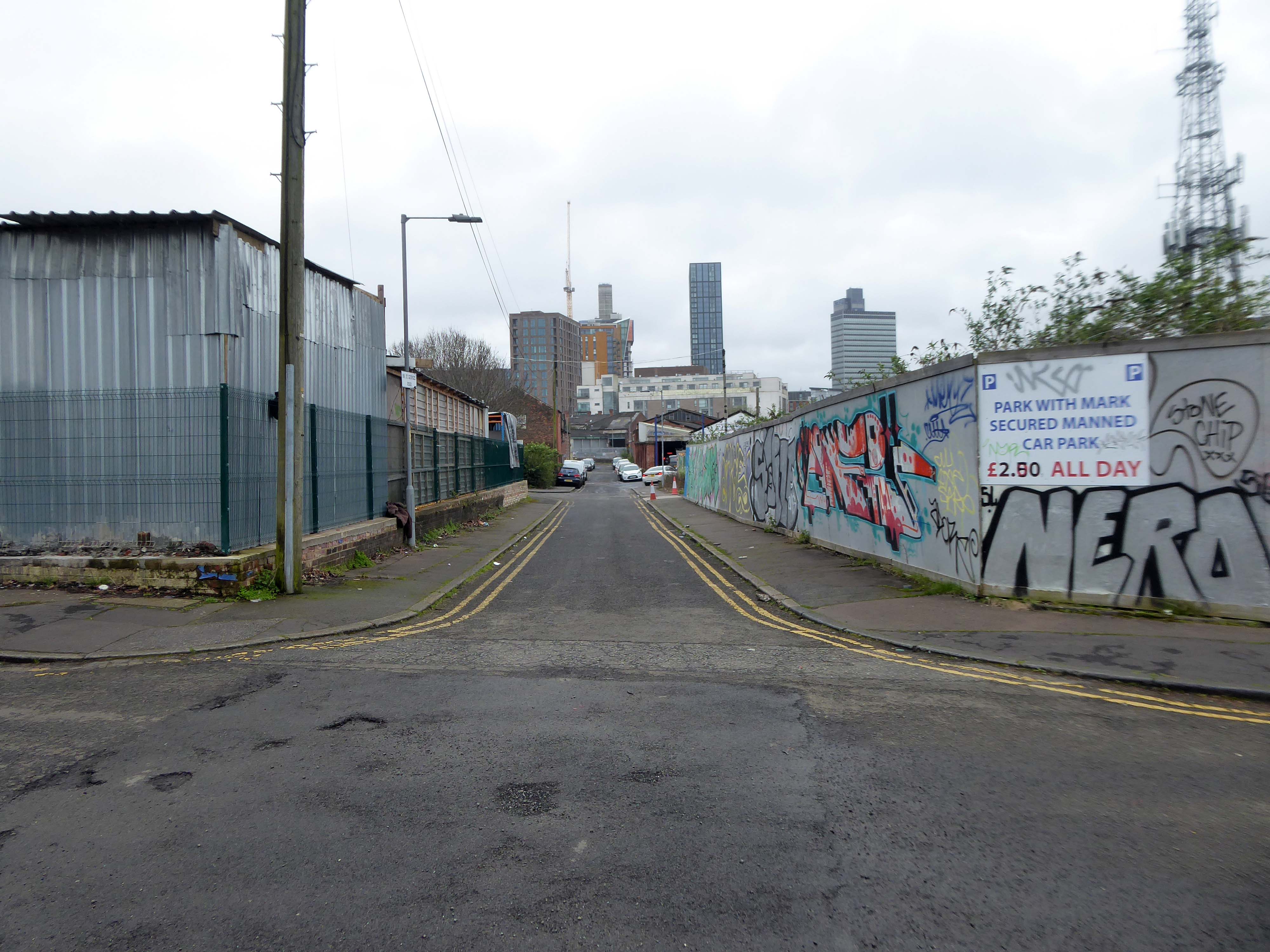
Previously in February 2022 I walked the fair streets of Ardwick.

Three and a bit years on it was time to see what had been coming and going on.

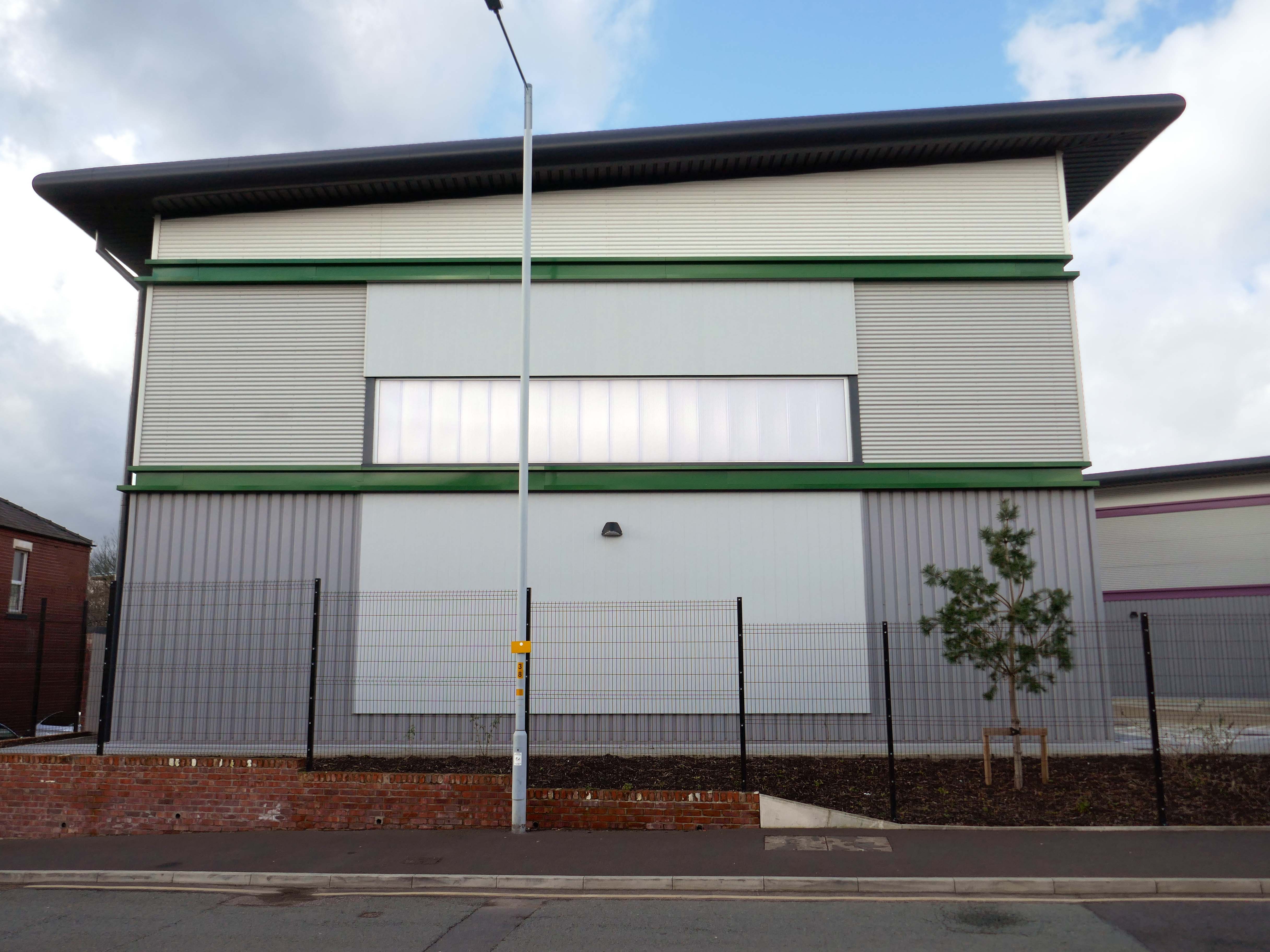
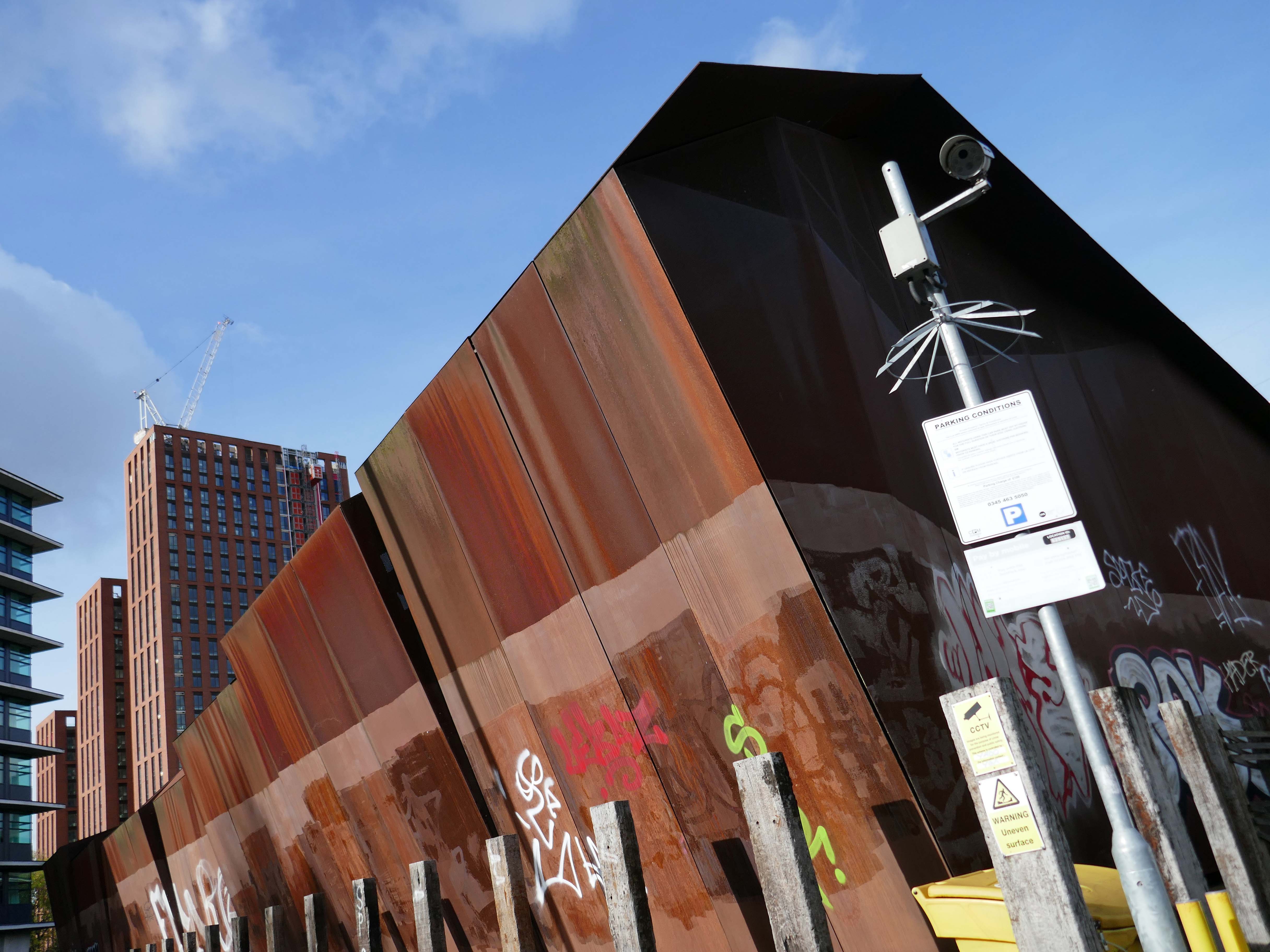
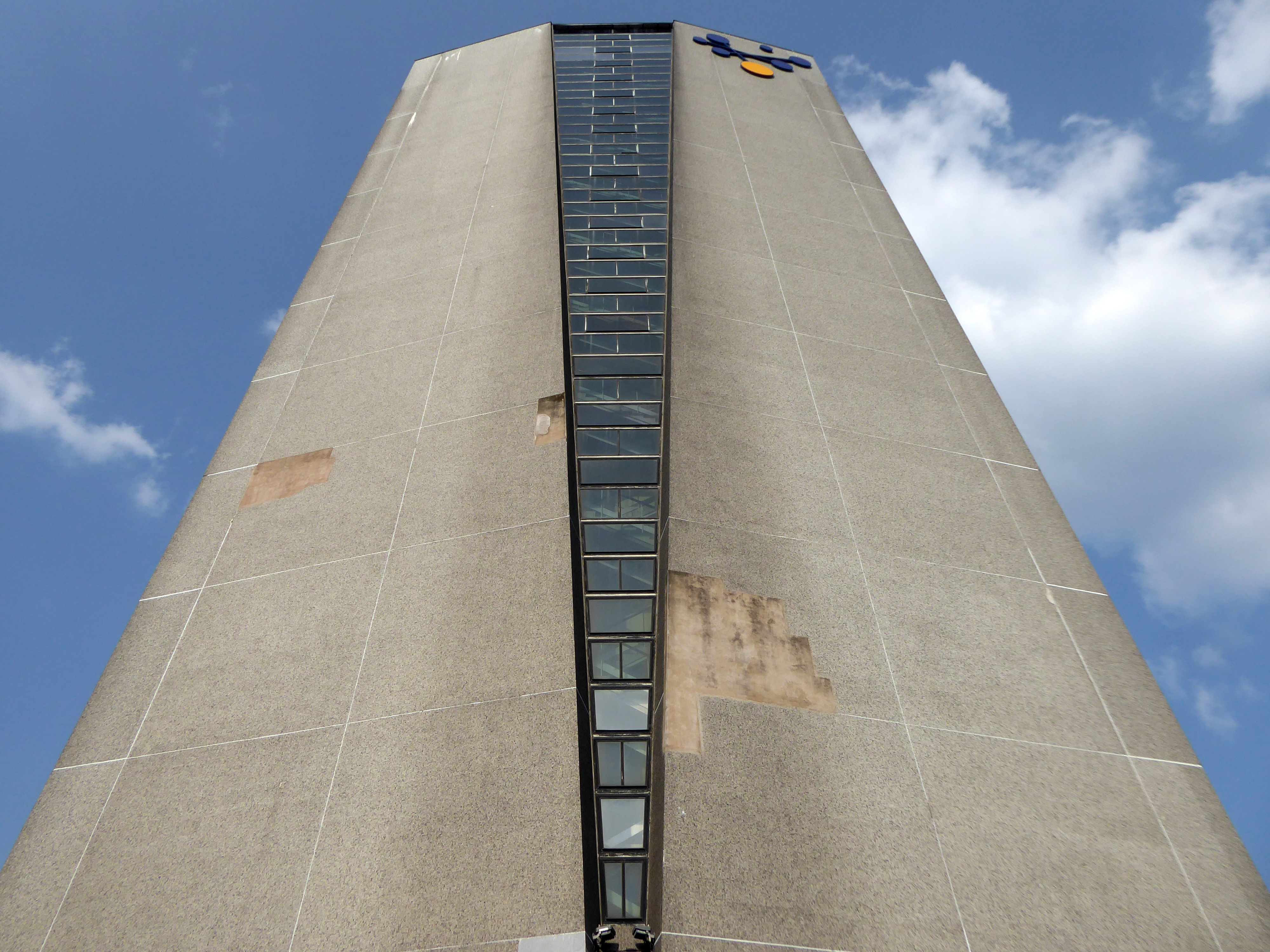
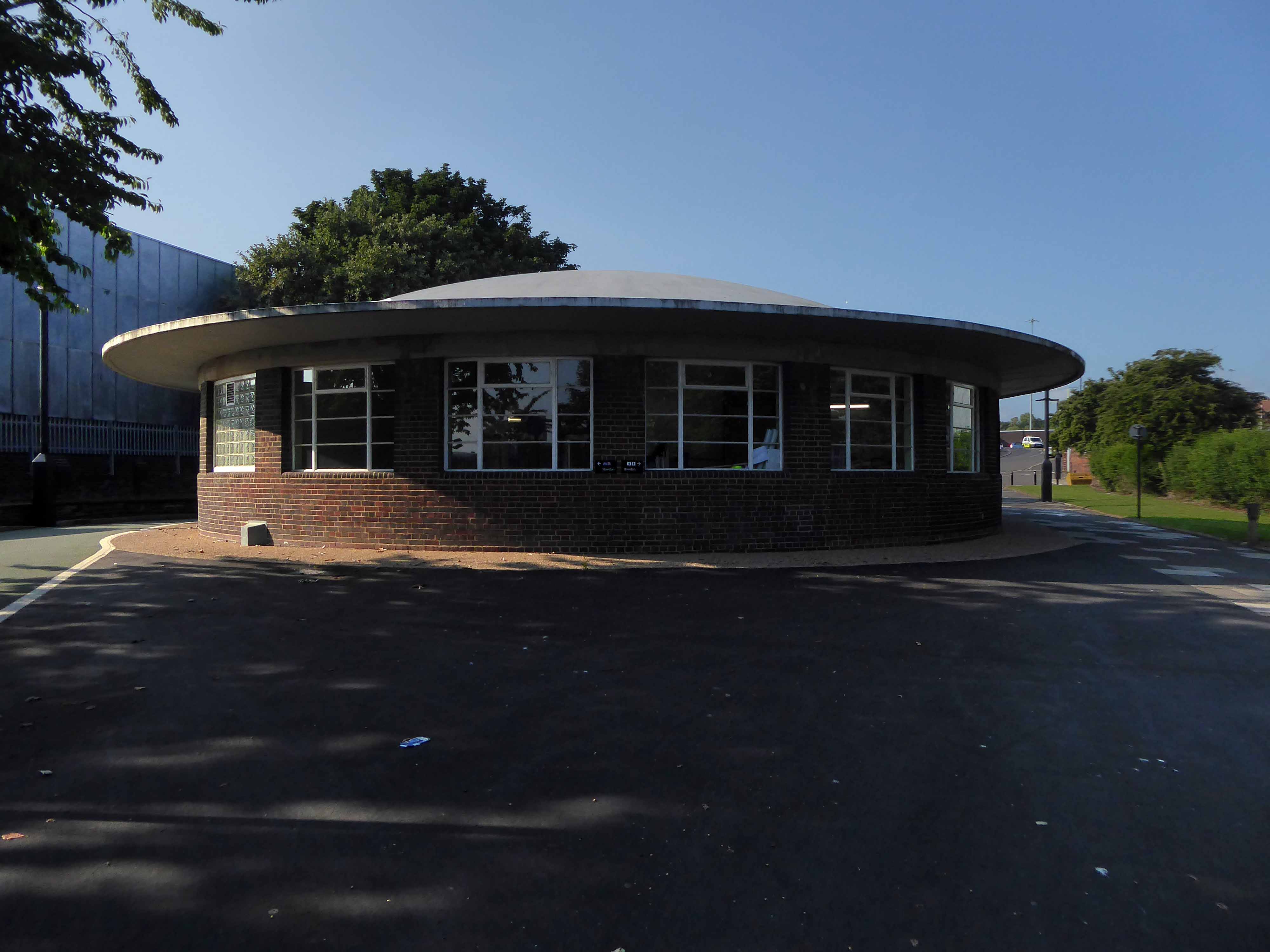
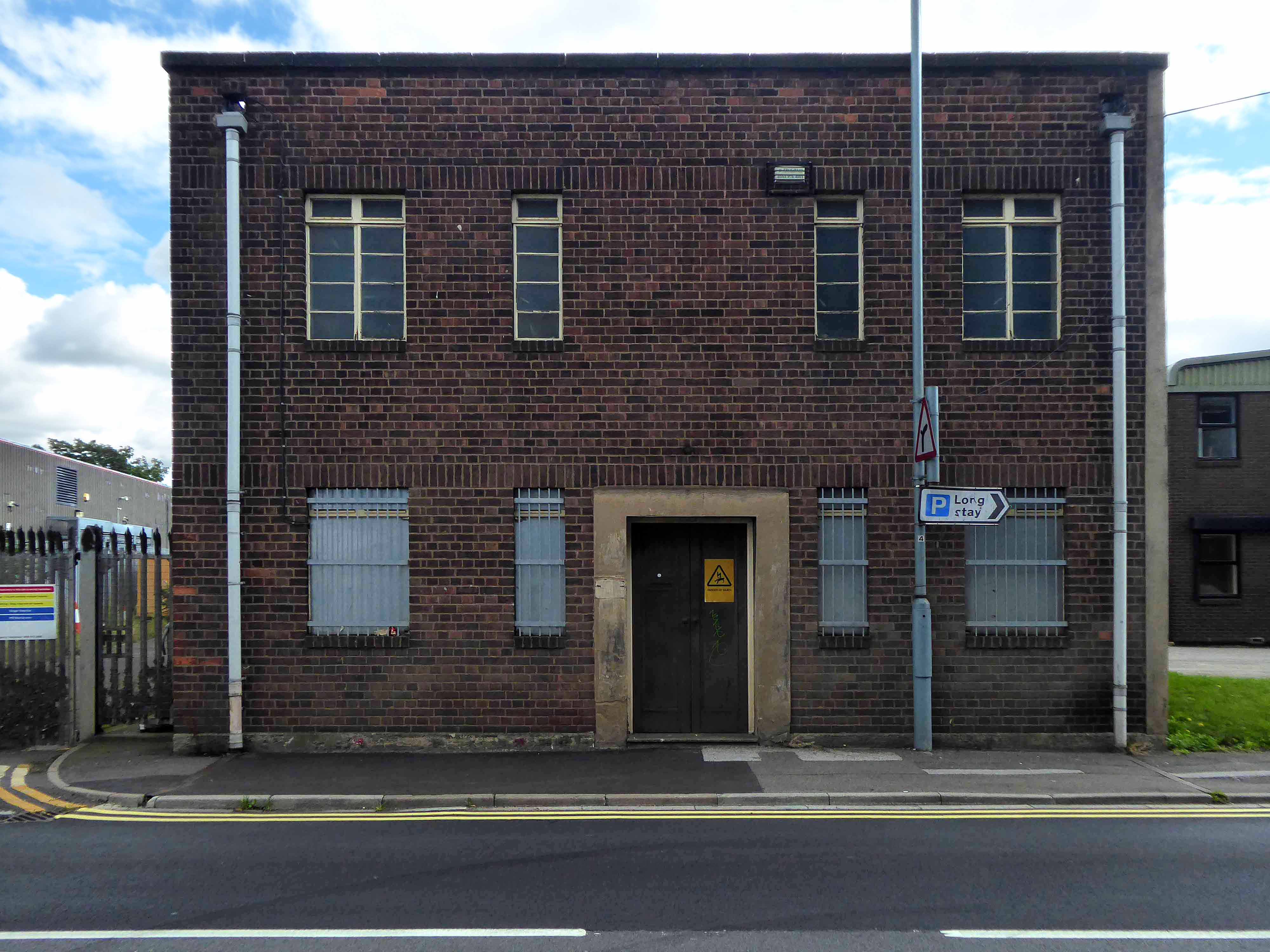
The Central Manchester Primary Substation on Travis Street is still there.

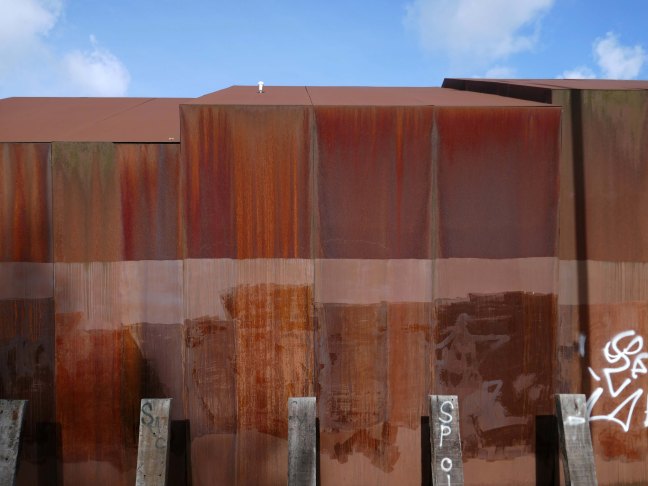
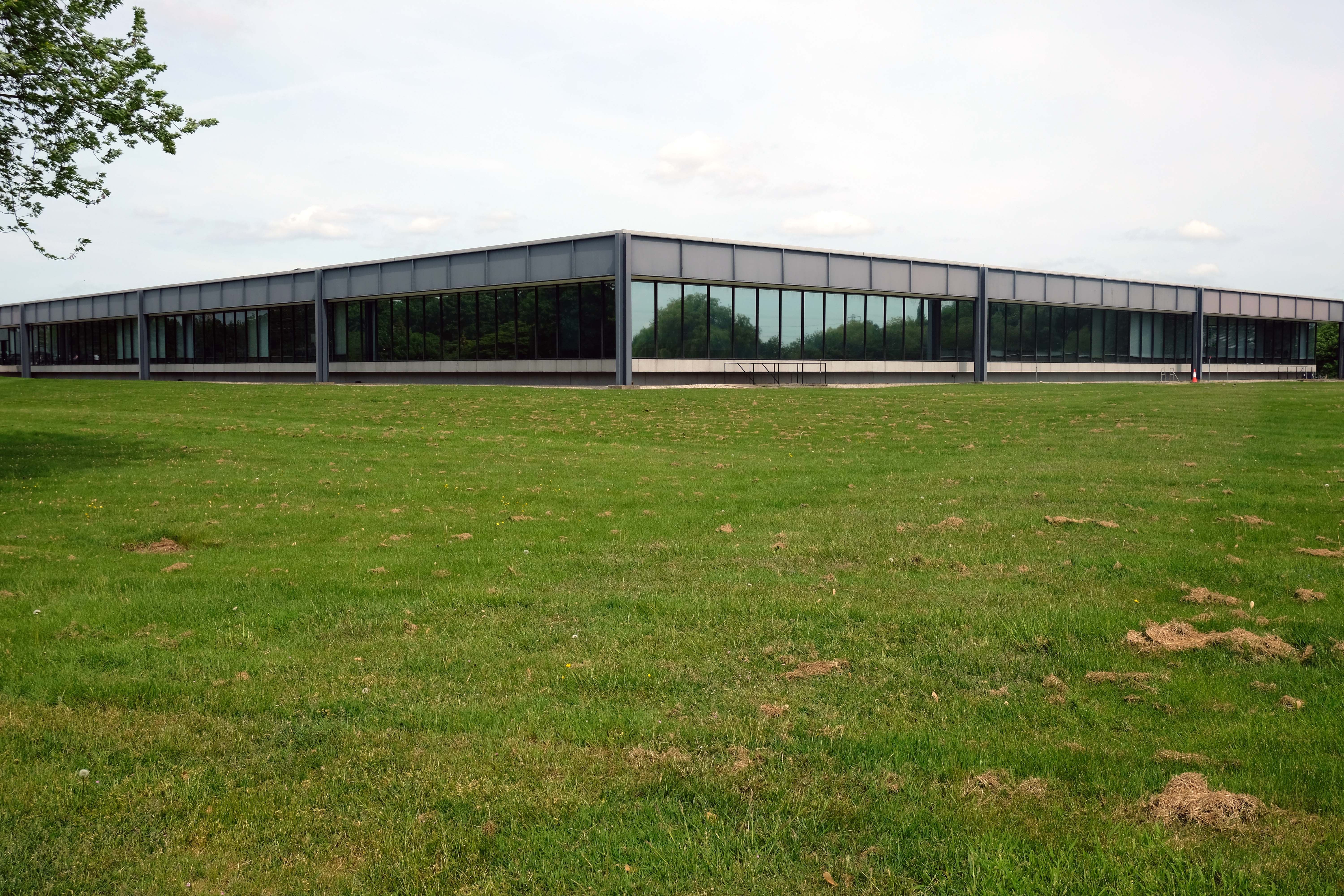
The building was cladded with a COR-TEN® steel envelope, the nature of which was relatively complex.

Corten steel sets itself apart due to the inclusion of unique alloying elements: chromium, nickel, copper and added phosphorous which gives the steel its self-protecting properties.

Architect: Walker Simpson

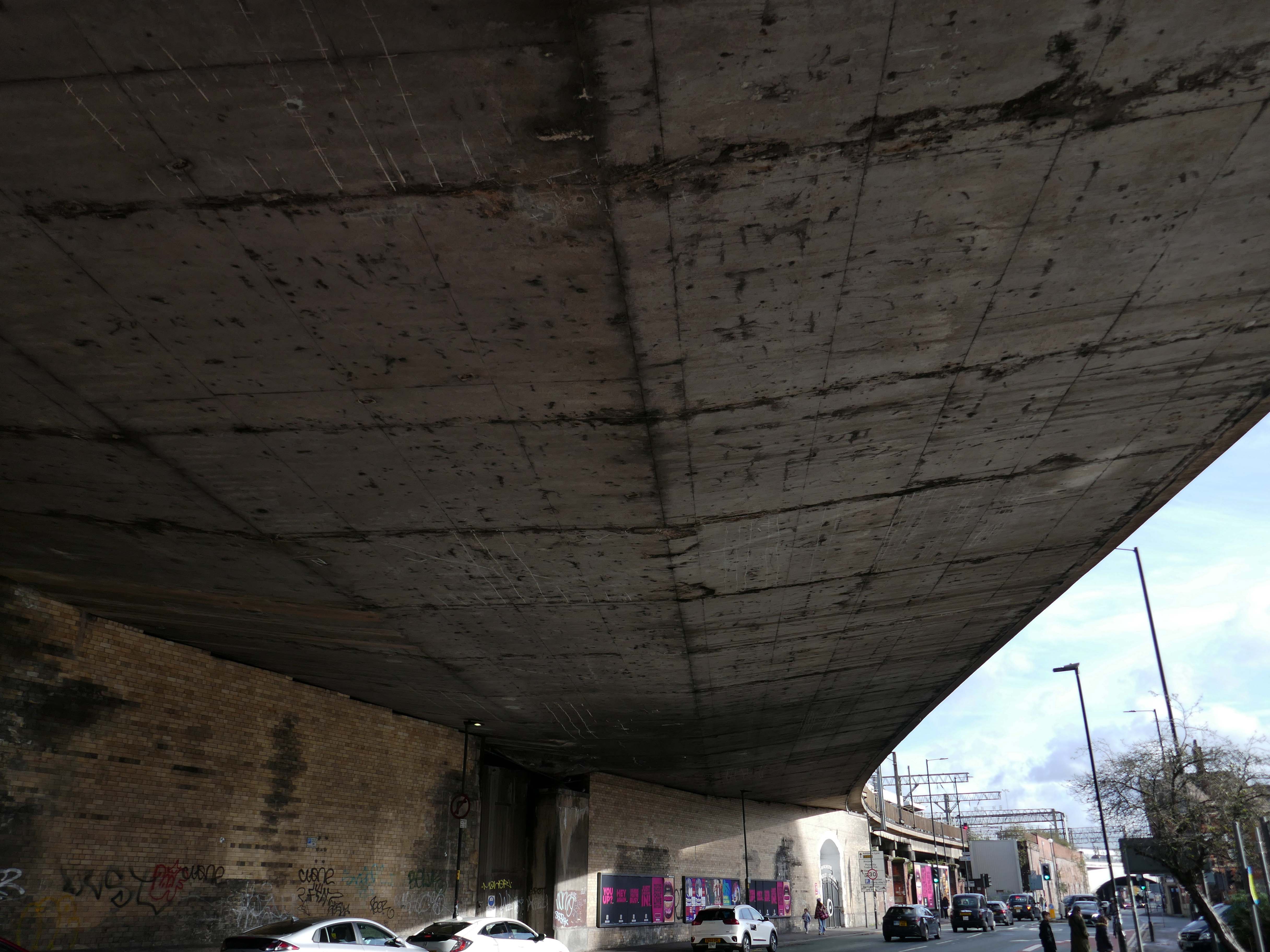
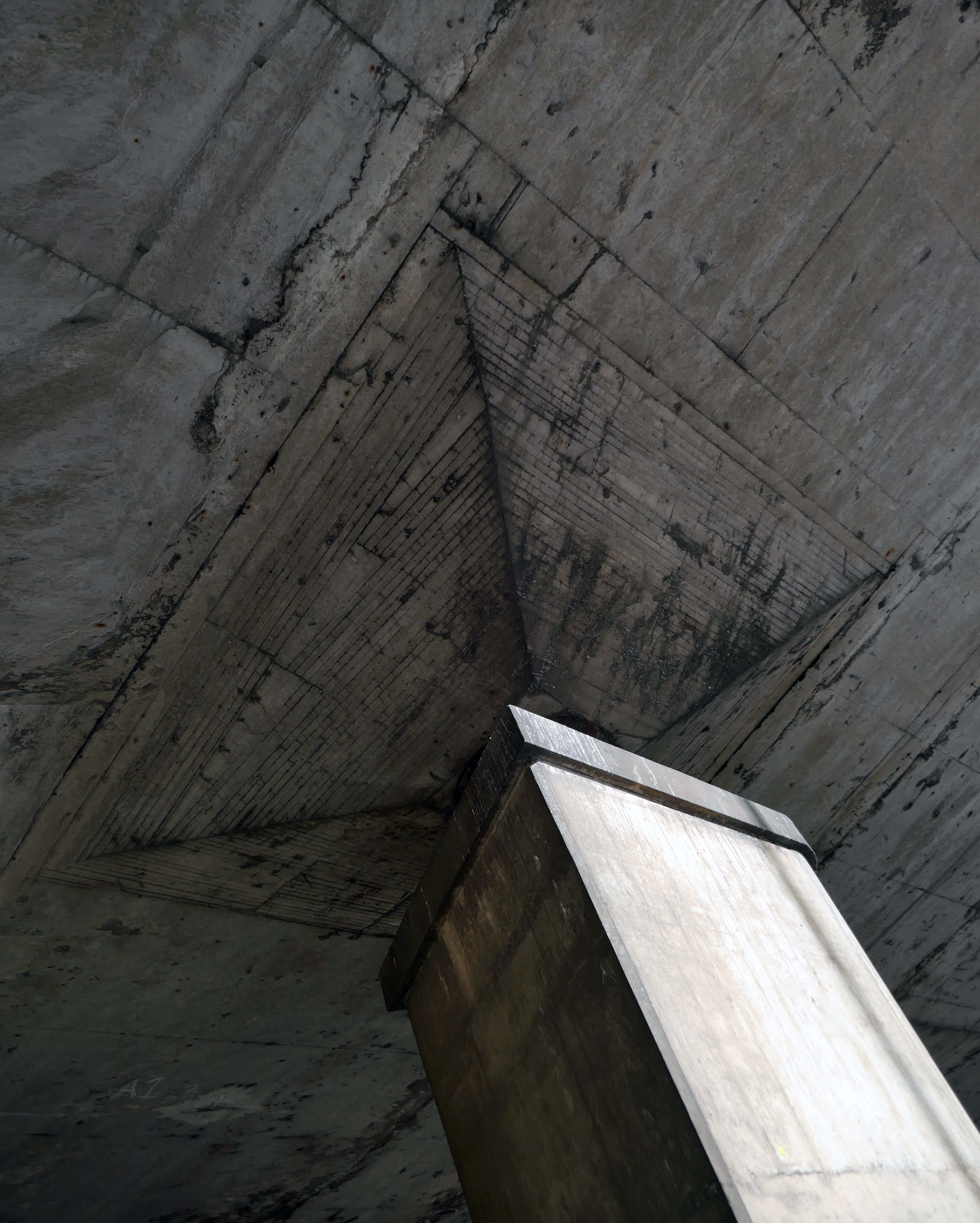
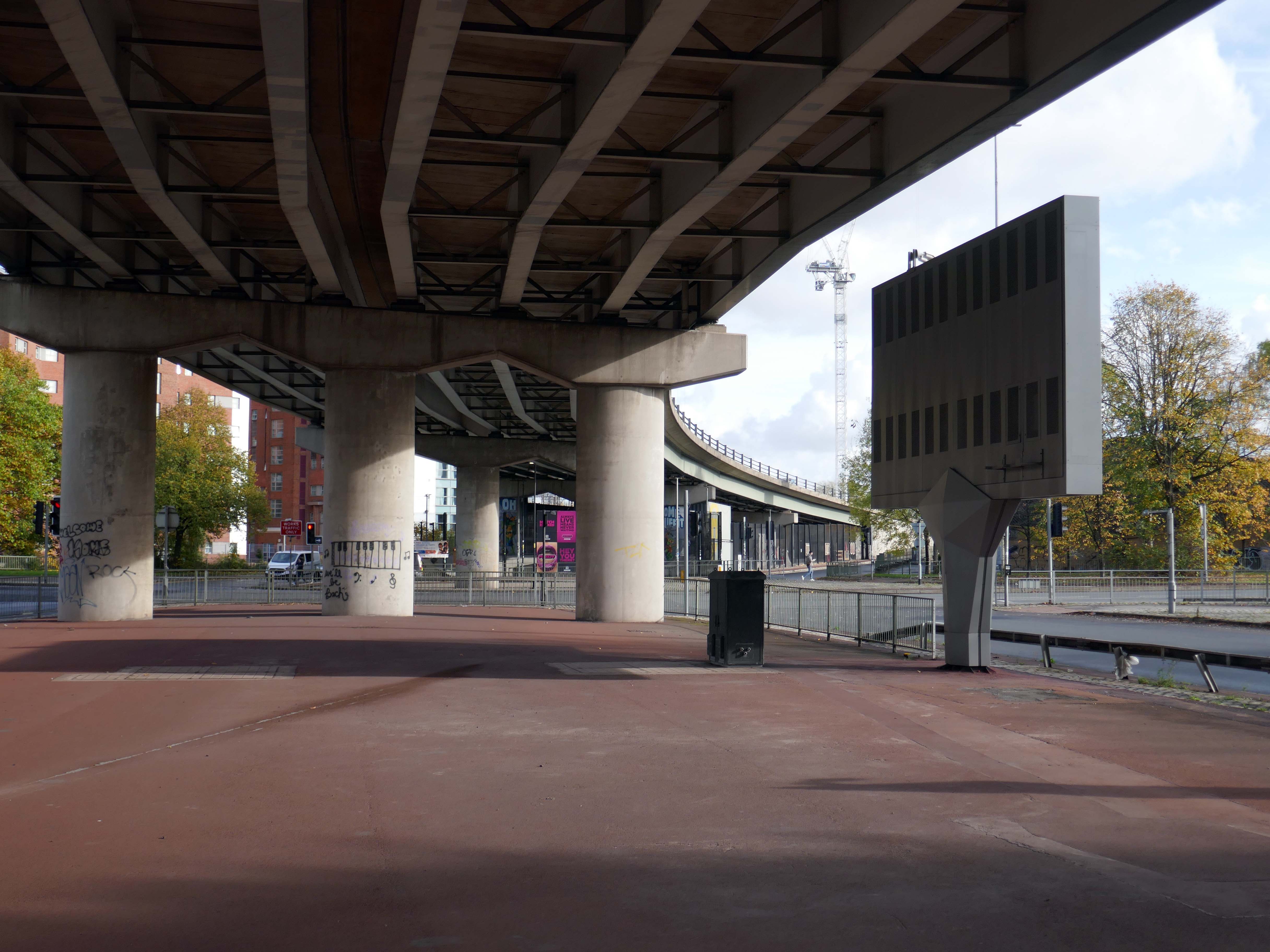
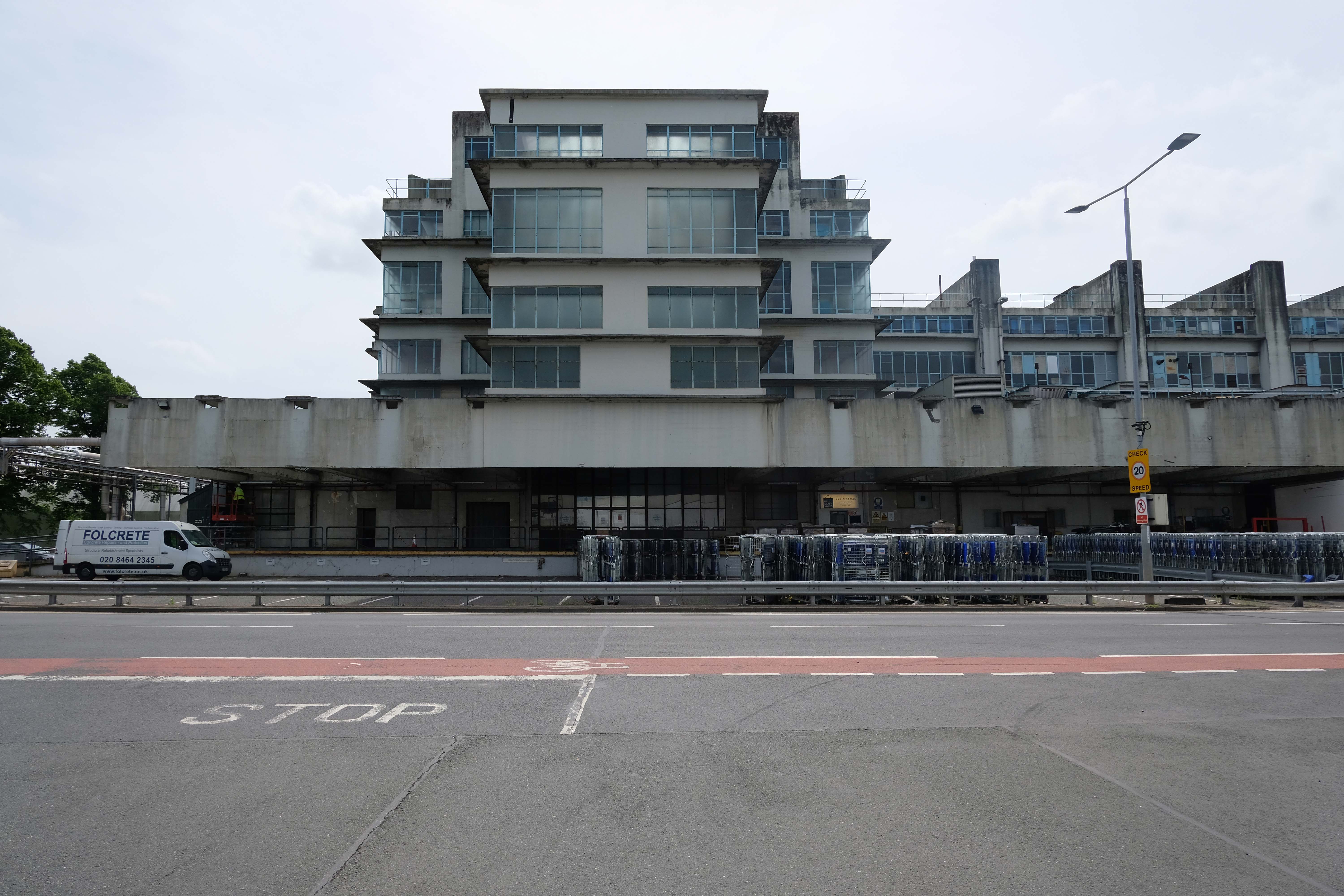
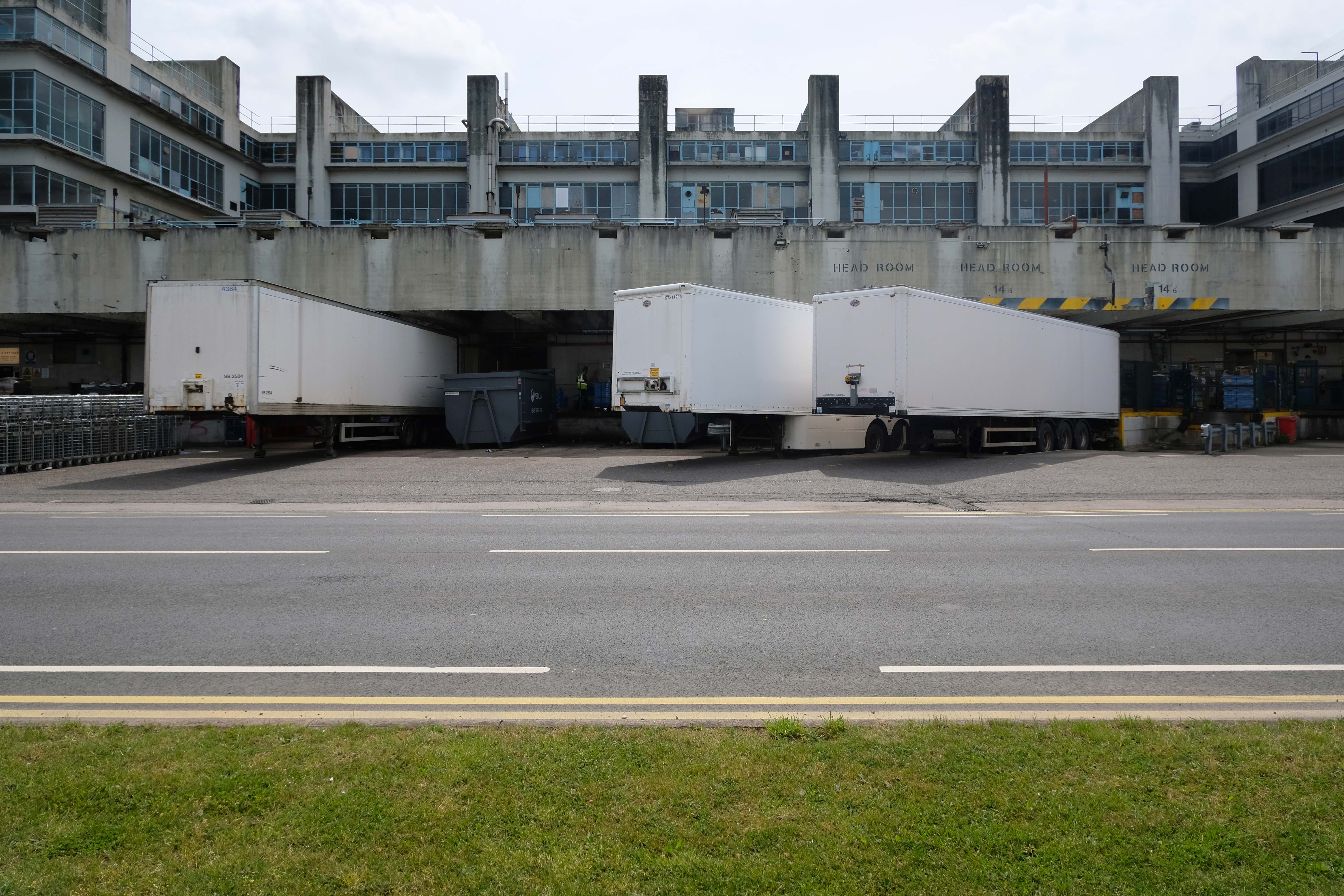
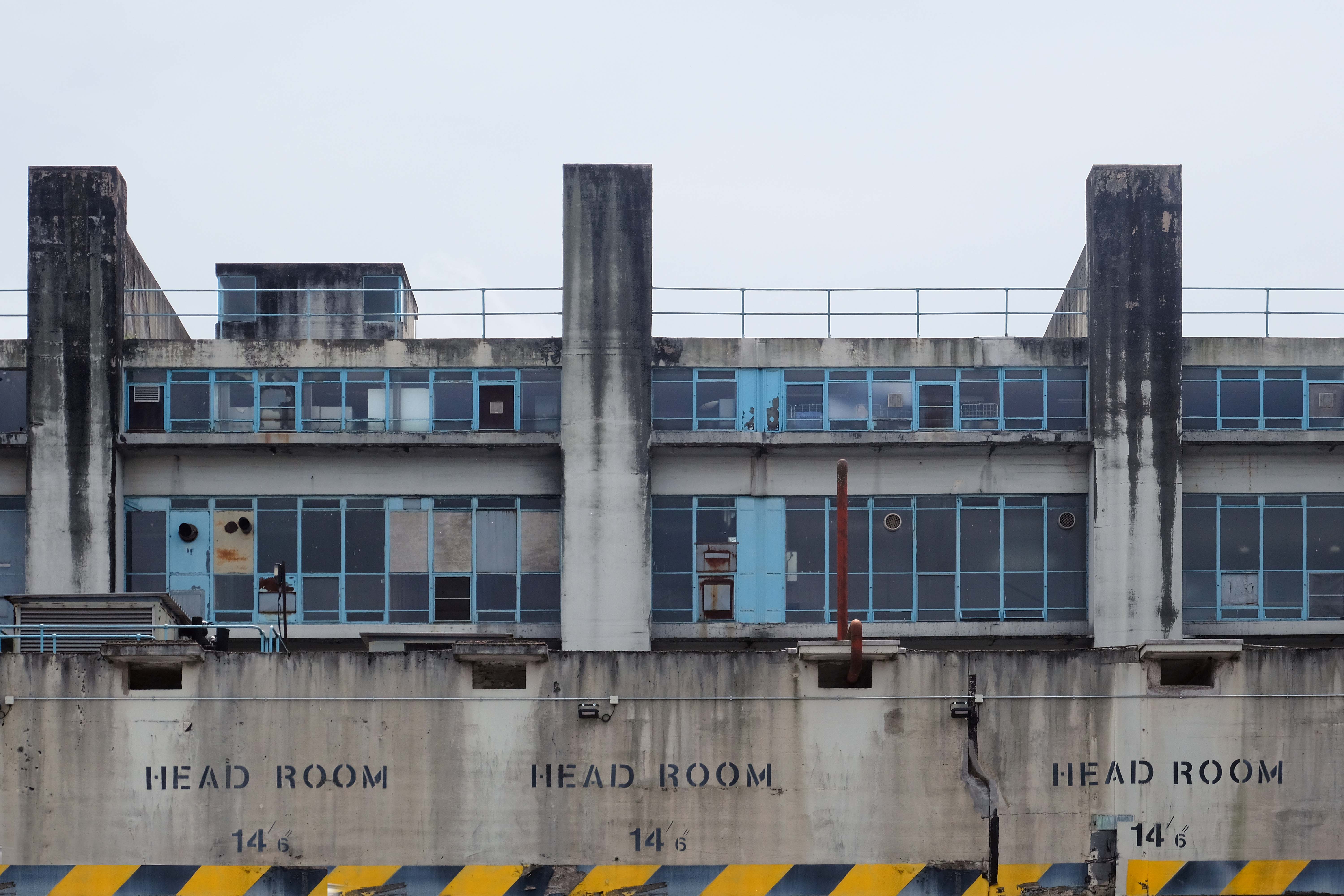
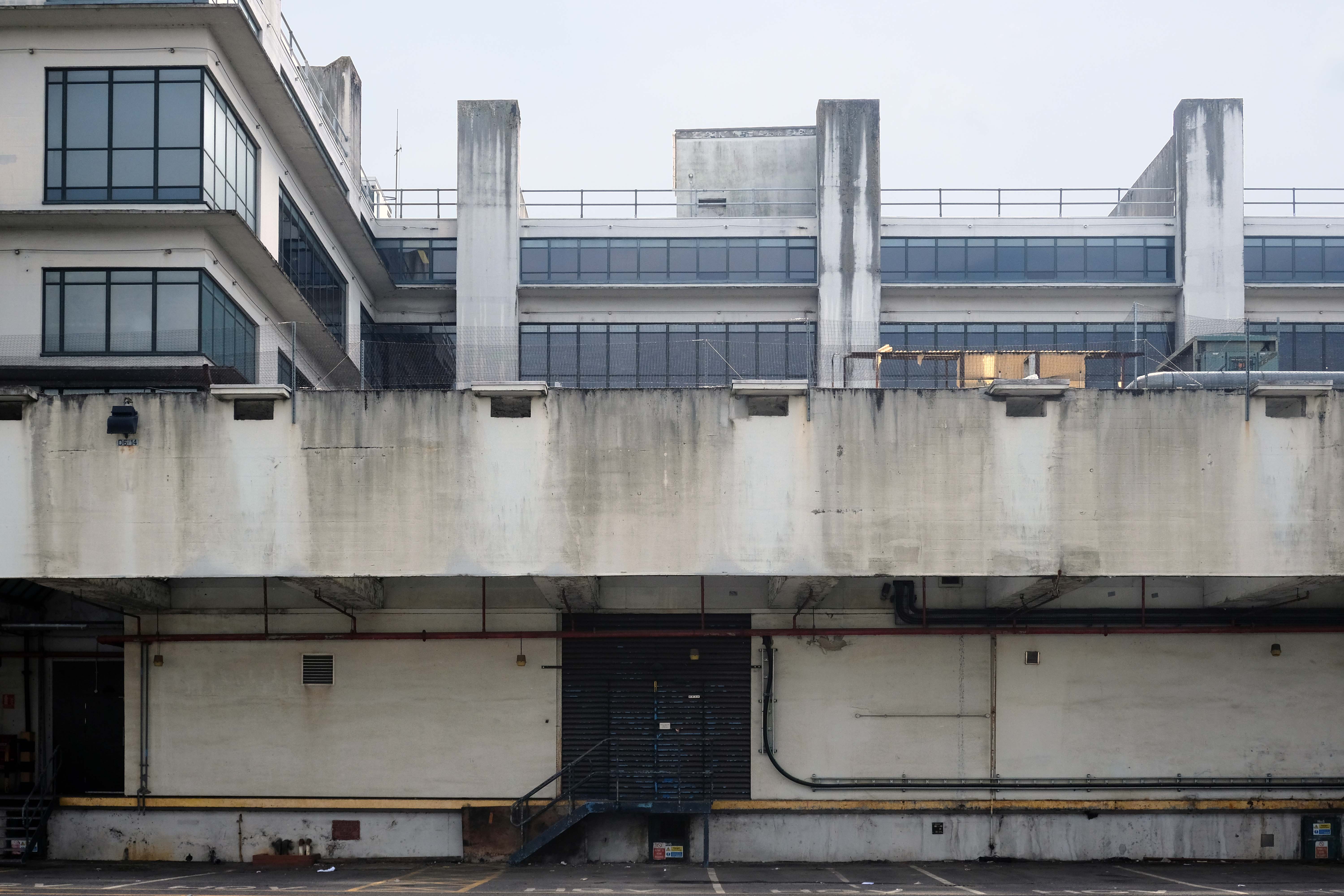
Immediately adjacent are Platforms Thirteen and Fourteen, bridged over the roadway by this vast concrete construction.

Platform 14 is primitive, I understand totally from an infrastructure standpoint because it’s on a bypass line on a bridge, but it gets too overcrowded and is windswept. The rest of the station is ok. Platforms 13/14 have not changed in 40 years, grim.

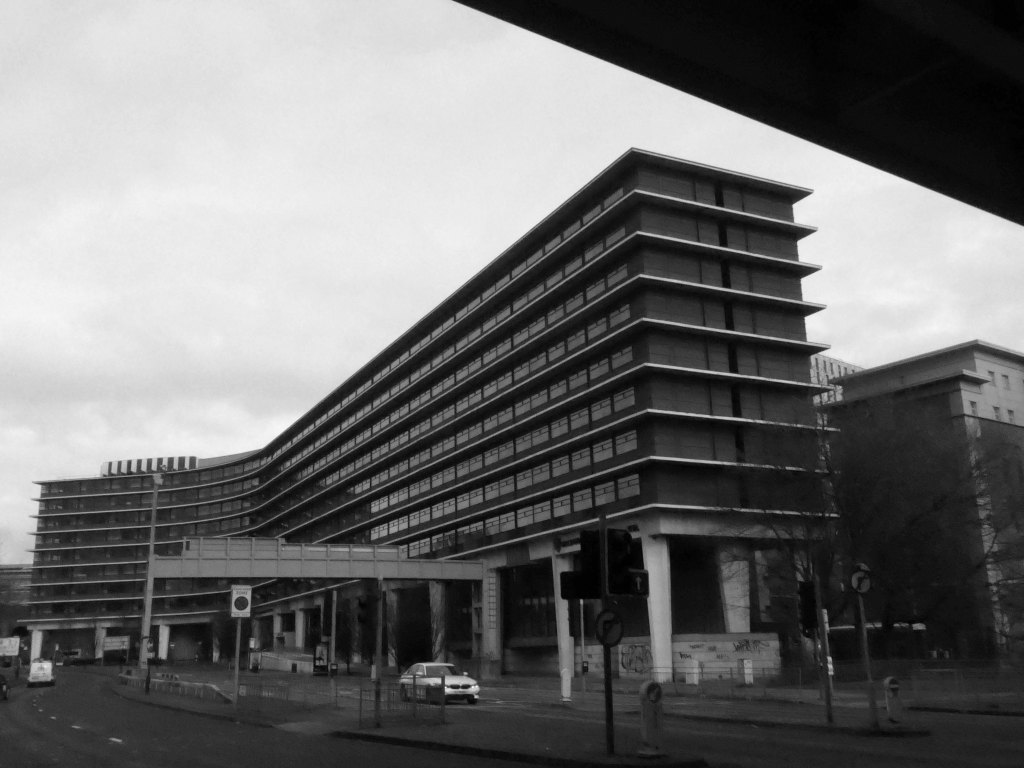
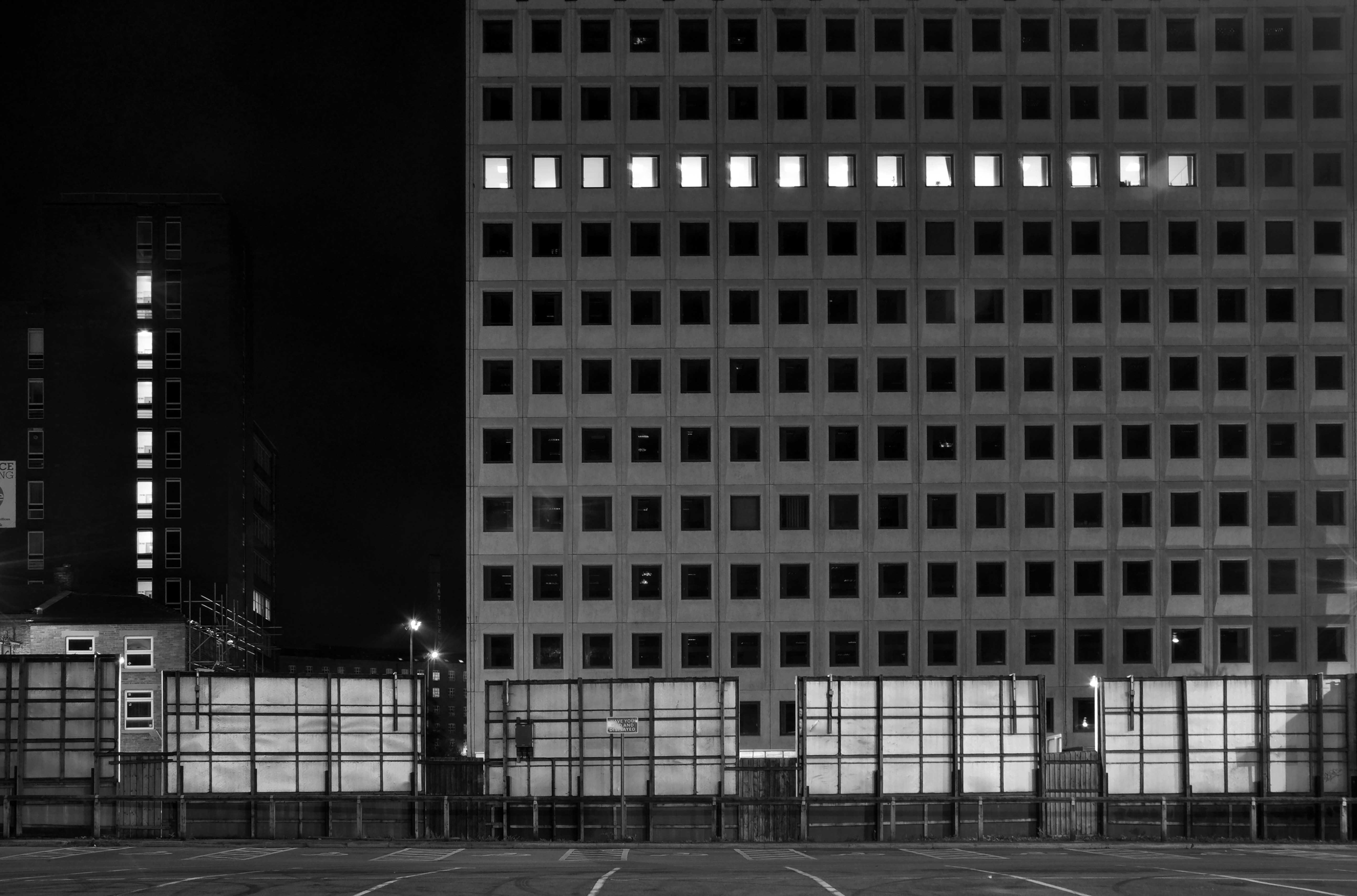
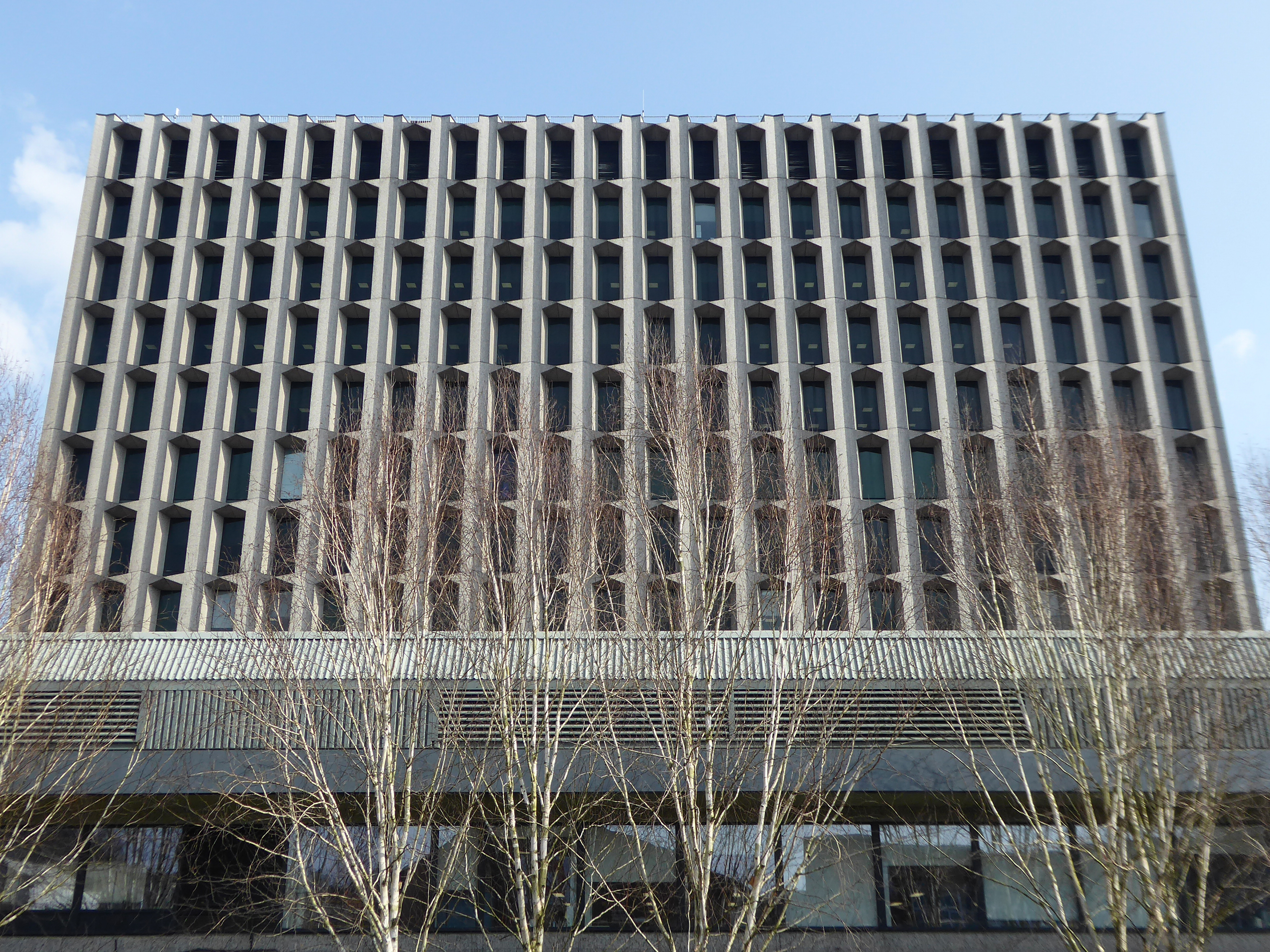
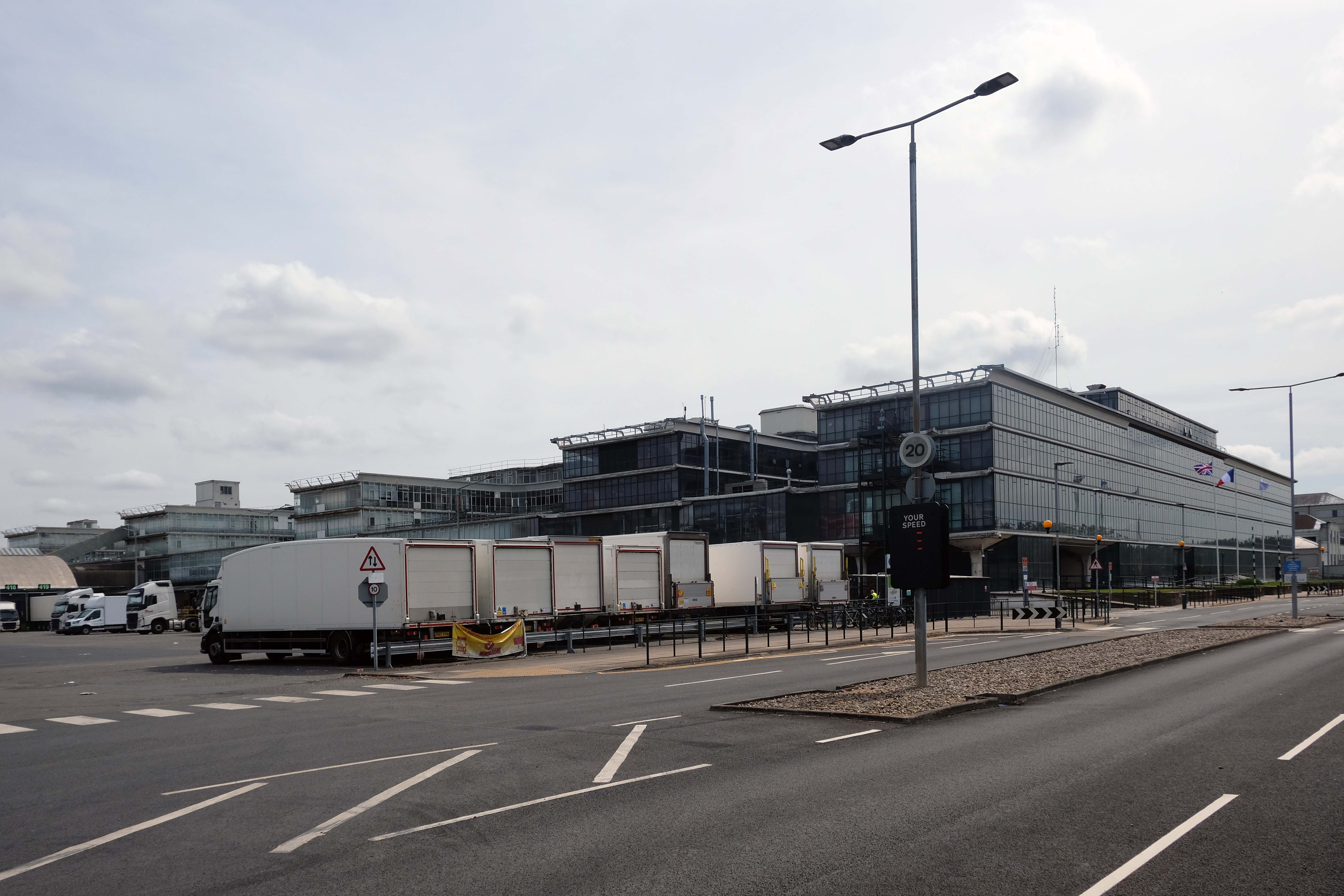
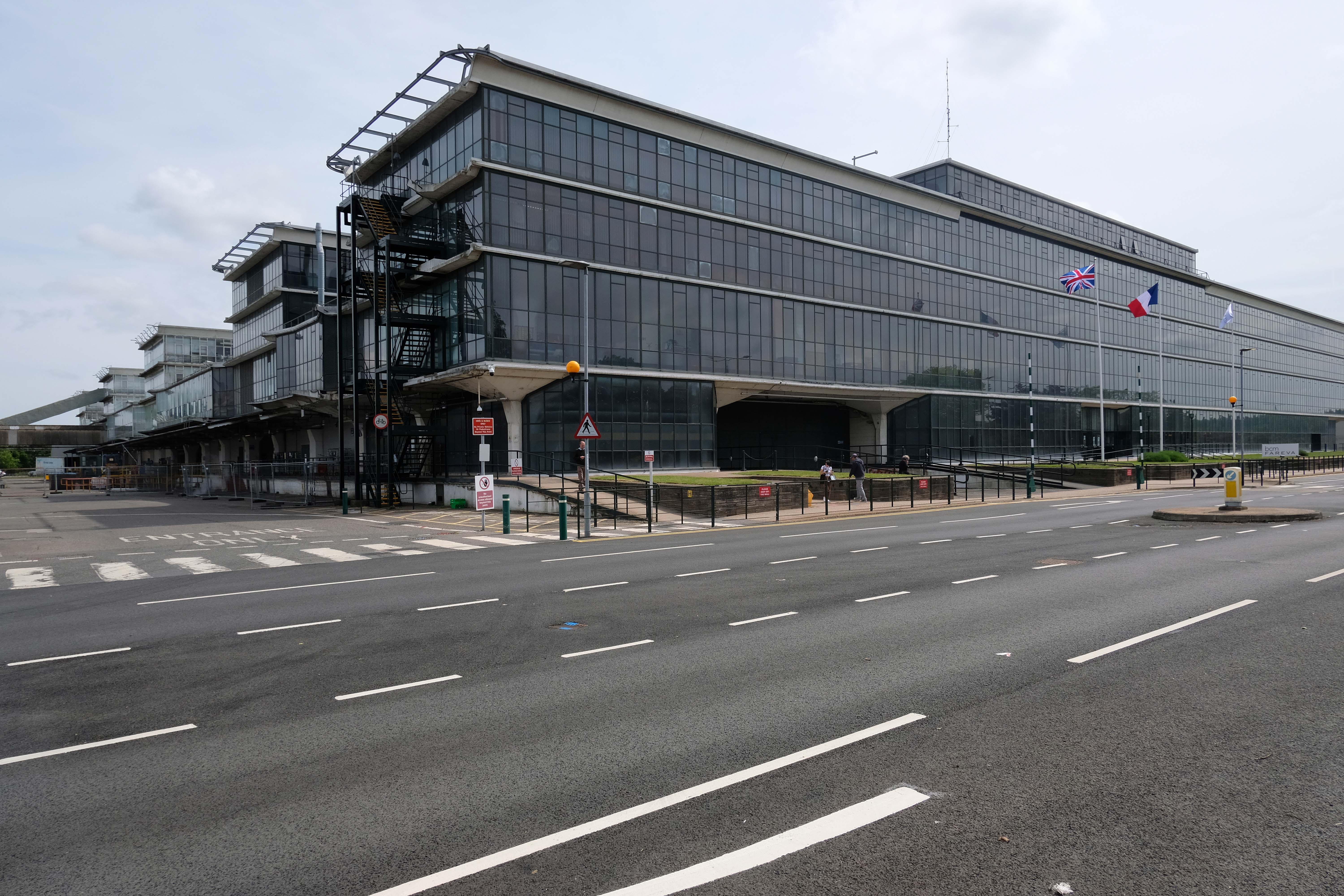
We the pass to the former BT Building – architects JW Hammond 1973.

Originally conceived as a hotel, there were no takers at the time, so it became the BT HQ.

Currently Marriot Hotel Piccadilly

Comprising 338 rooms, Manchester Marriott Hotel Piccadilly is near a shopping district, a 10-minute ride from Etihad Stadium. Offering a location right in the centre of a beautiful neighbourhood, this comfortable hotel boasts a lounge bar along with city views.

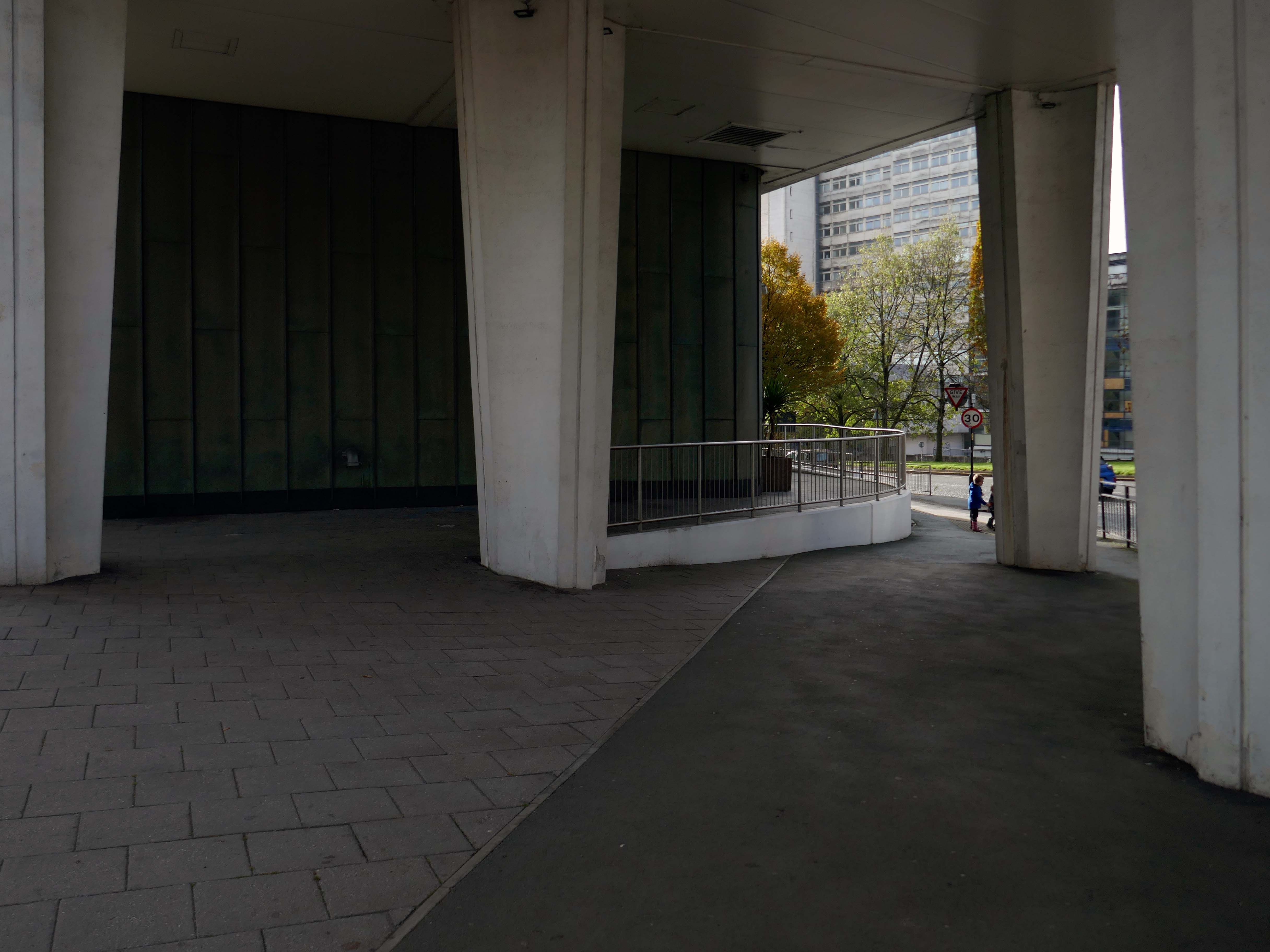
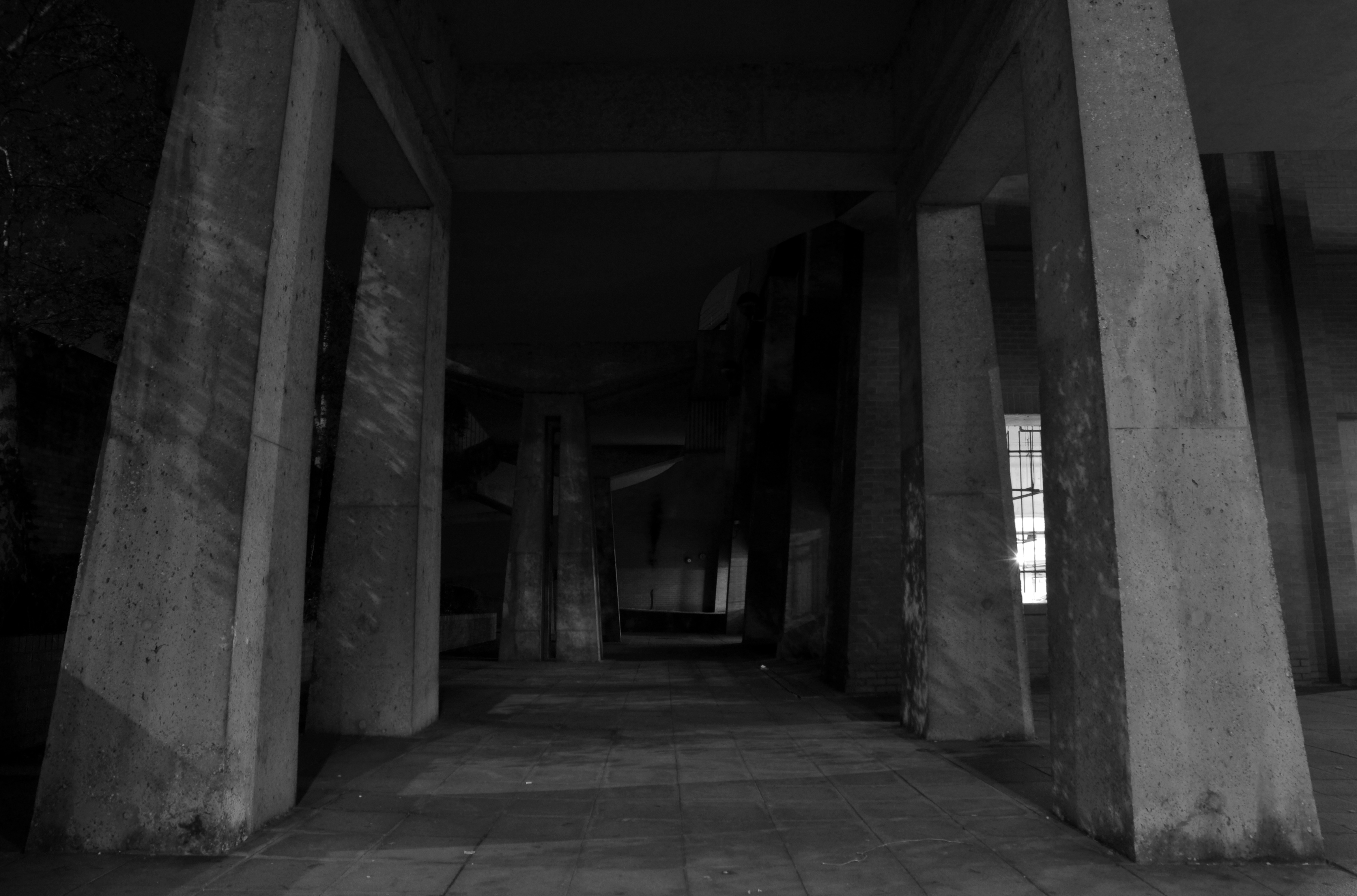
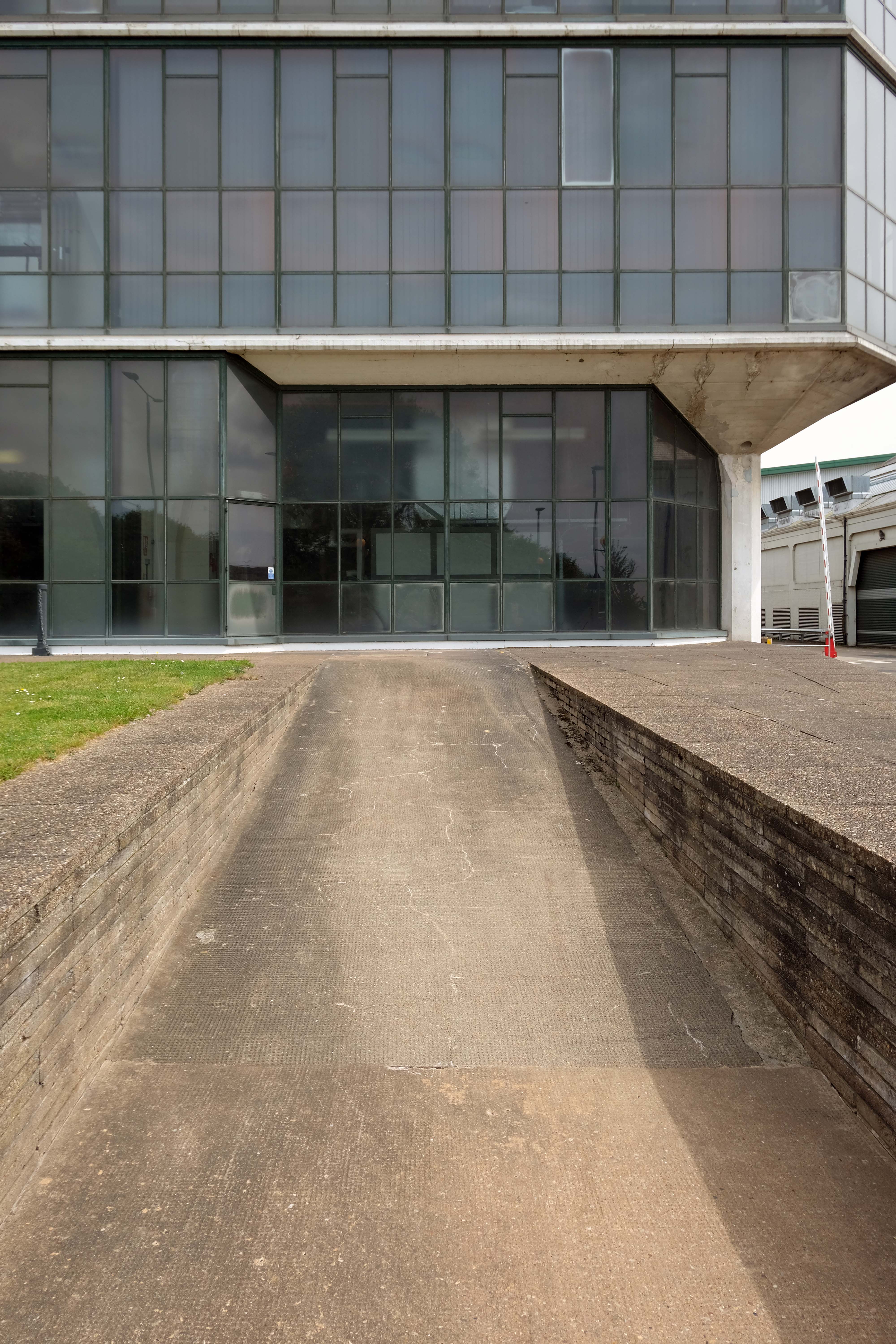
It is supported on the most magnificent piloti.

Over the road the Holloway Wall 1968 – Grade II listed but its remodelling is in the air.

The developer’s architects now propose to ‘reimagine’ the artwork and incorporate it into the foyer of the new office building. However, this ‘reimagining’ requires large sections of the artwork to be removed by cutting away and ‘folding’ around 30% of the sculpture.

Modernist

The remainder of the UMIST site is also under threat – only the Renold Building is listed and to be retained intact.

Lecture Theatre, along with the Maths and Sciences Building.

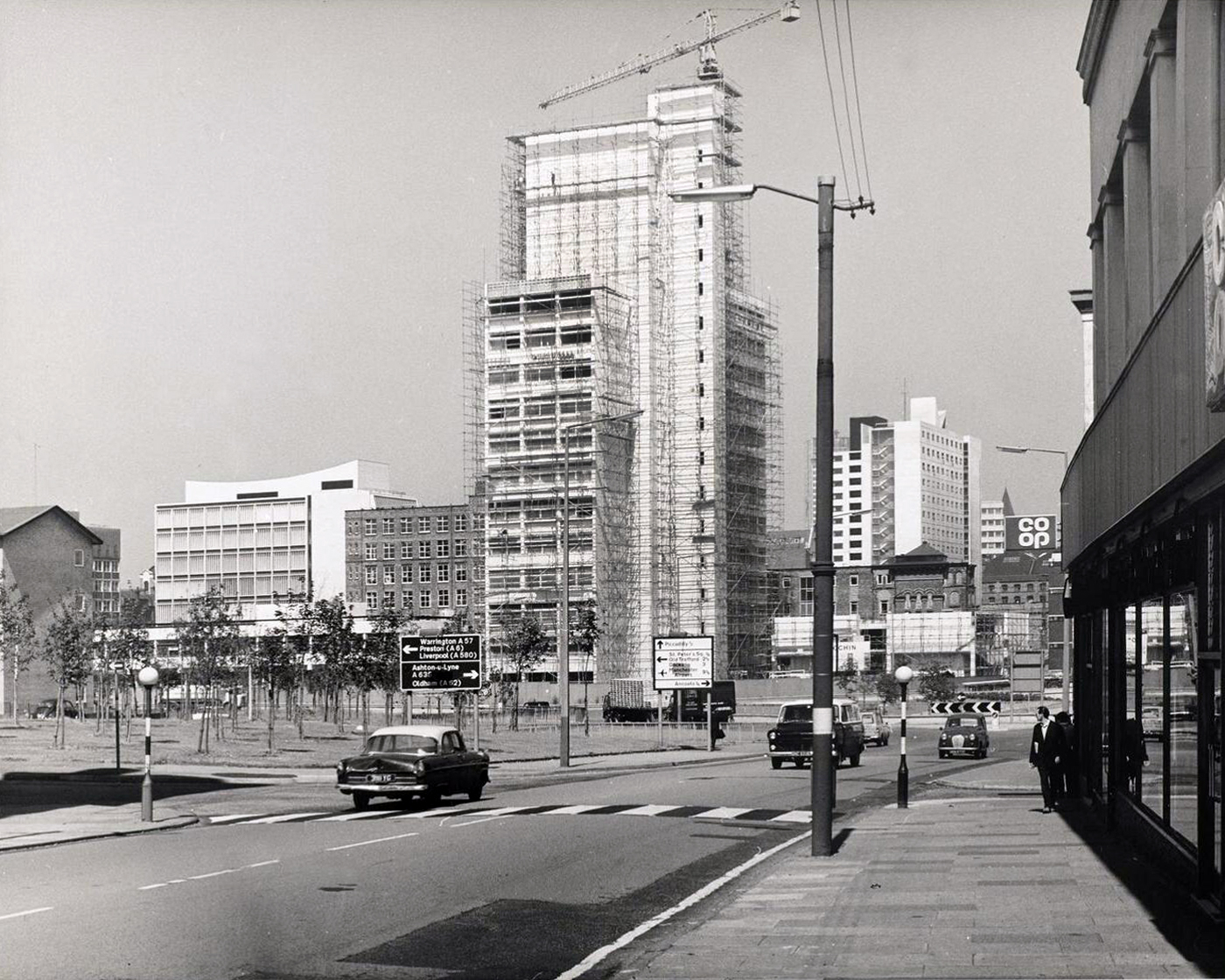
Seen here under construction before the arrival of the Mancunian Way extension.

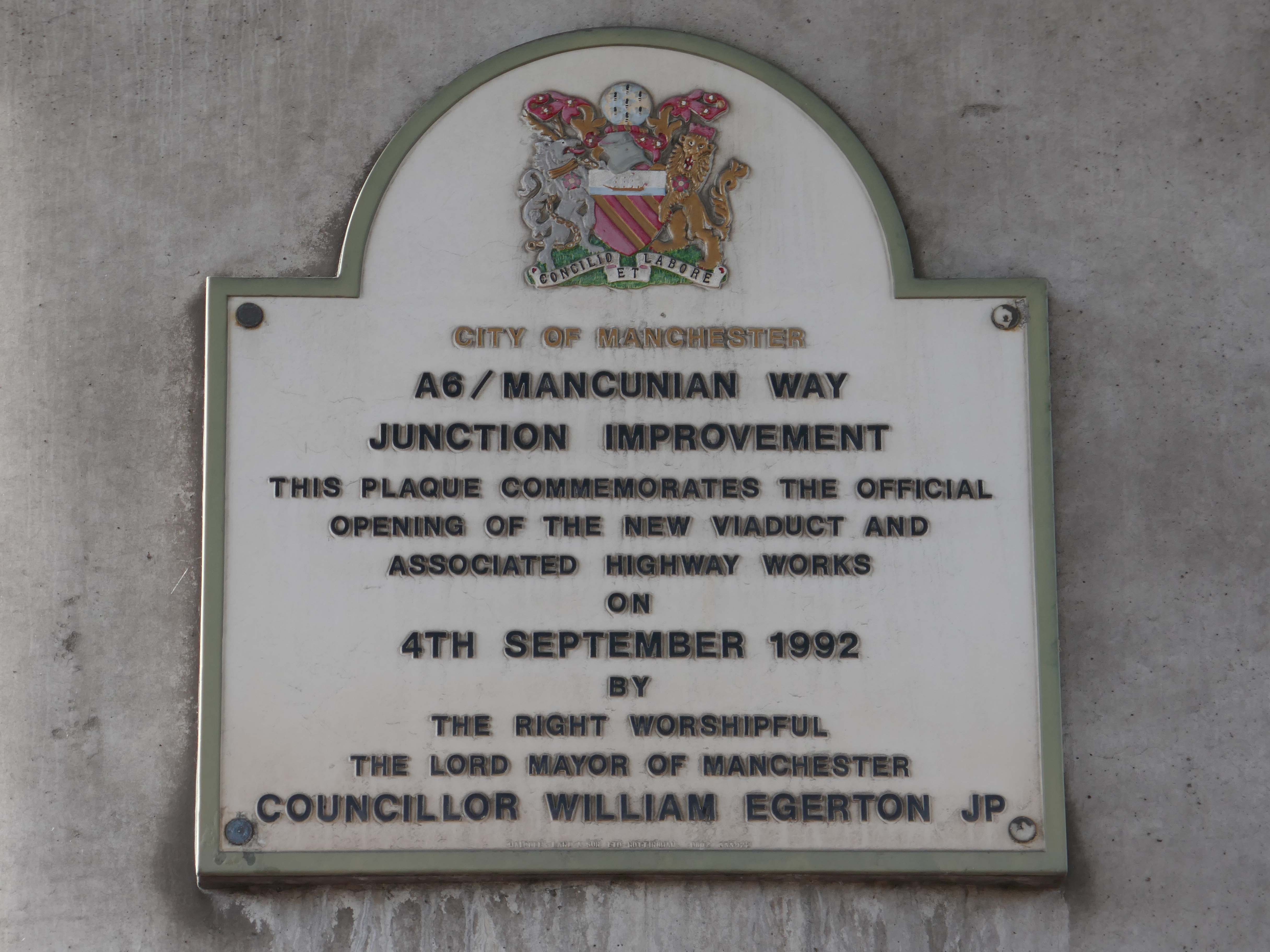
The Mancunian Way extension opened in 1992.

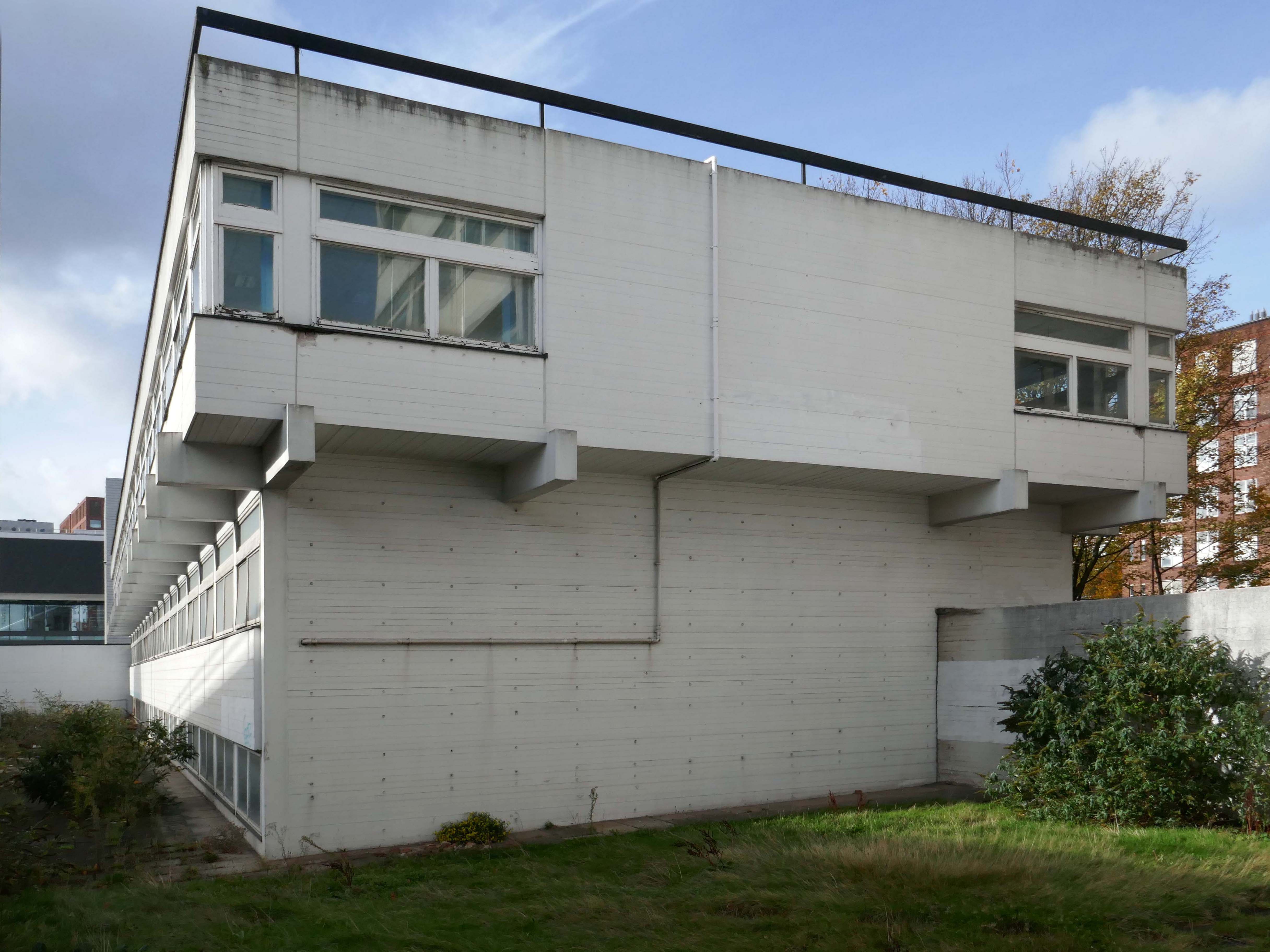
From beneath the roadway we can see the Ferranti Building.

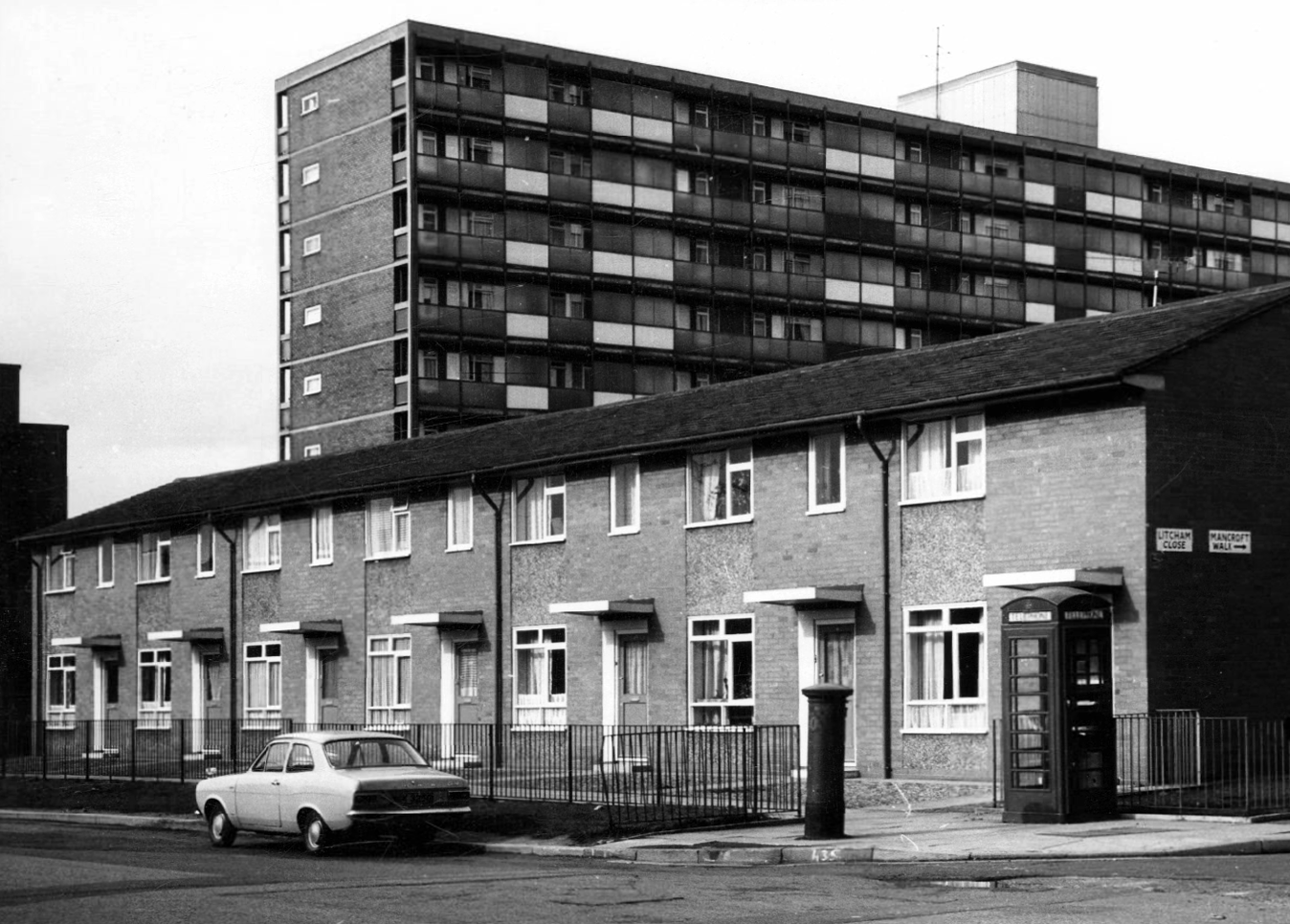
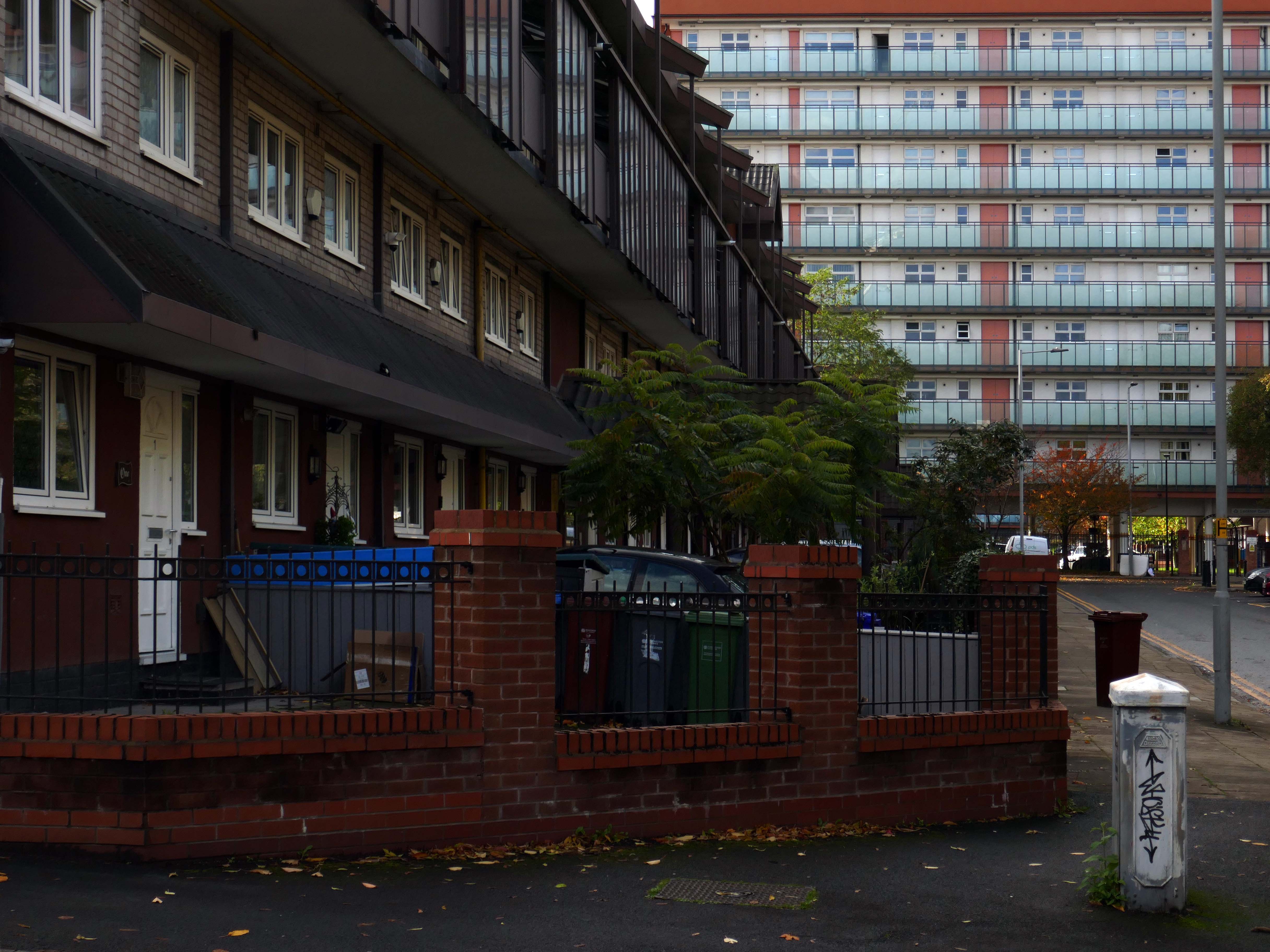
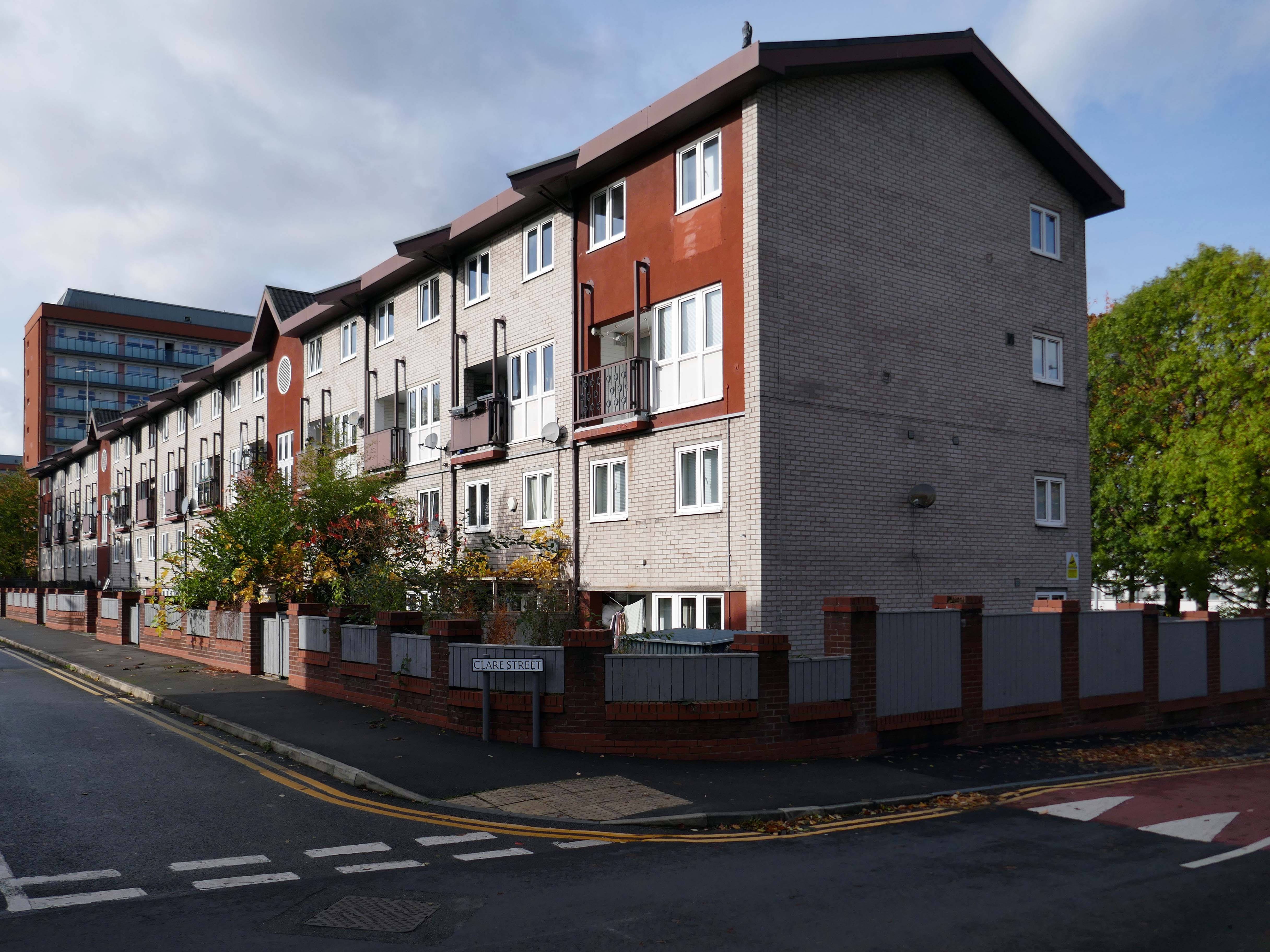
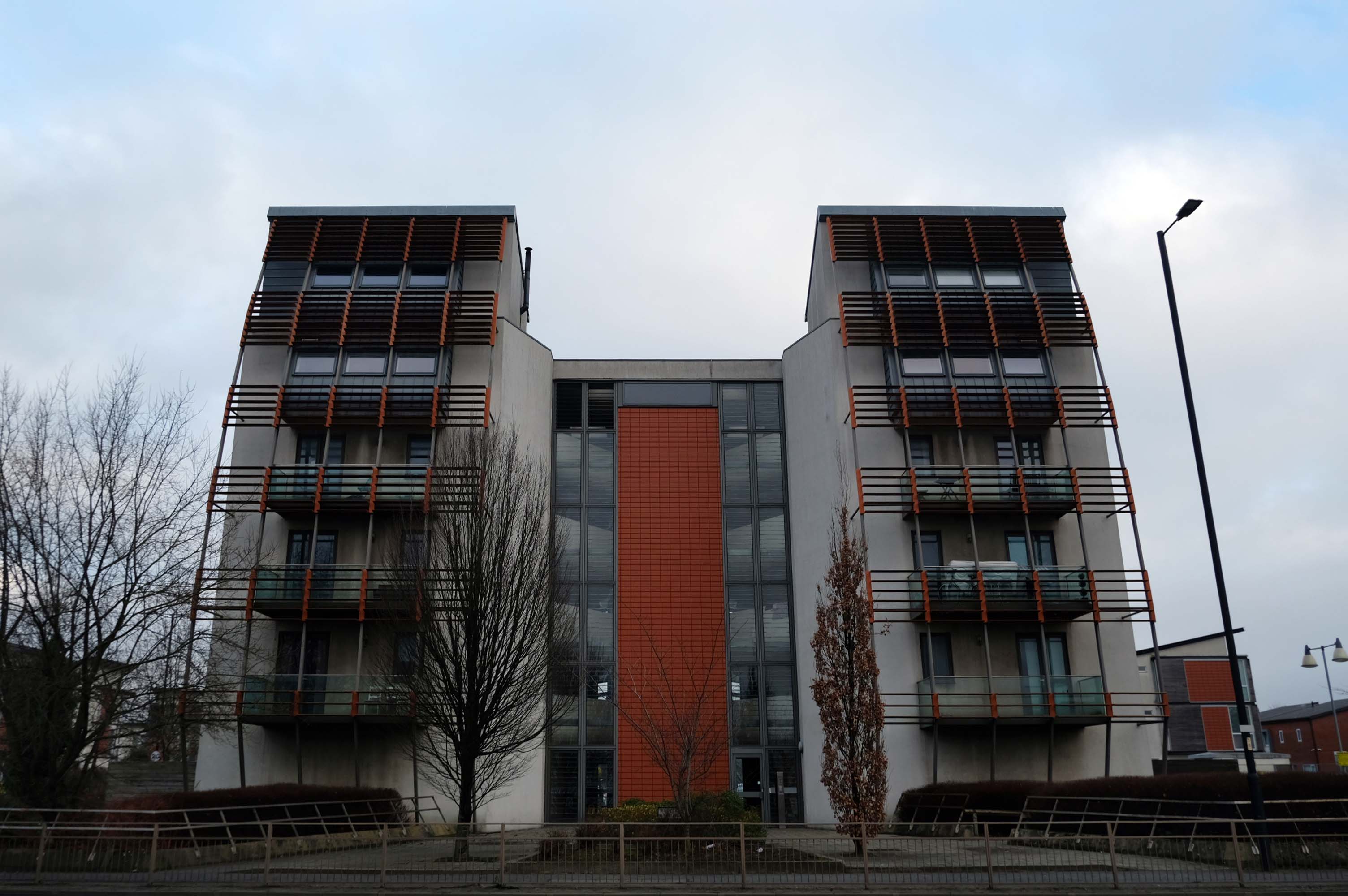
Crossing over to see the Brunswick Estate, built in the Sixties and Seventies and recently refurbished.

S4B is a partnership leading the £106m regeneration of Brunswick, Manchester. The Brunswick Regeneration PFI is a combination of government funding, private investment and expertise that will revitalise Brunswick. Improvements will include council home refurbishments, new homes for sale and to rent and an improved neighbourhood design.

Pro Manchester

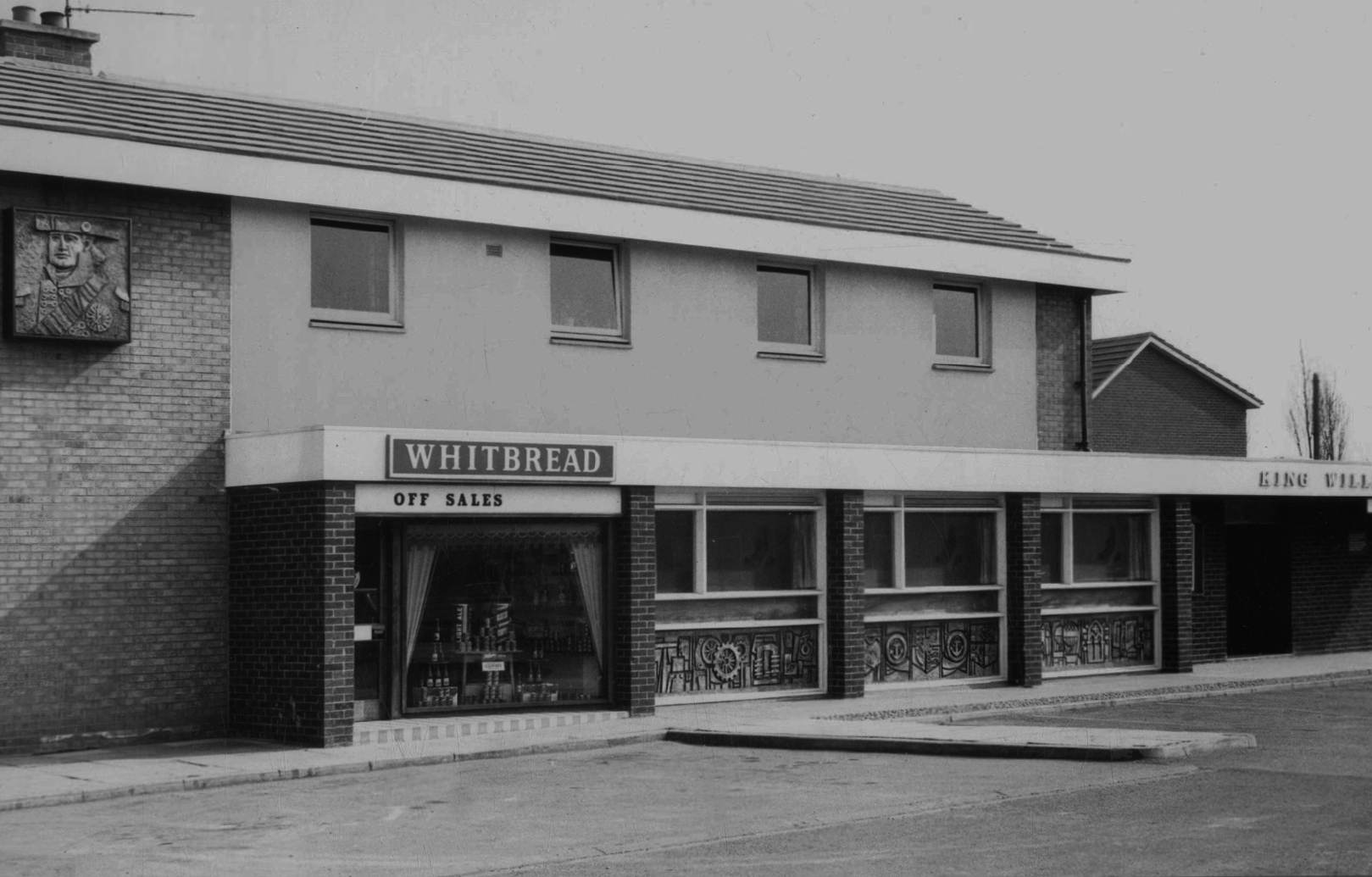
Long gone lost estate pub from the estate – King William IV a former Chesters then Whitbread estate pub was built in 1967. Closed in 1996 when it was converted to residential property. It had a brief spell 1991 to 1995 as brewery premises for the Dobbin’s West Coast Brewery, during this period the interior was stripped out to accommodate the brewery paraphernalia.

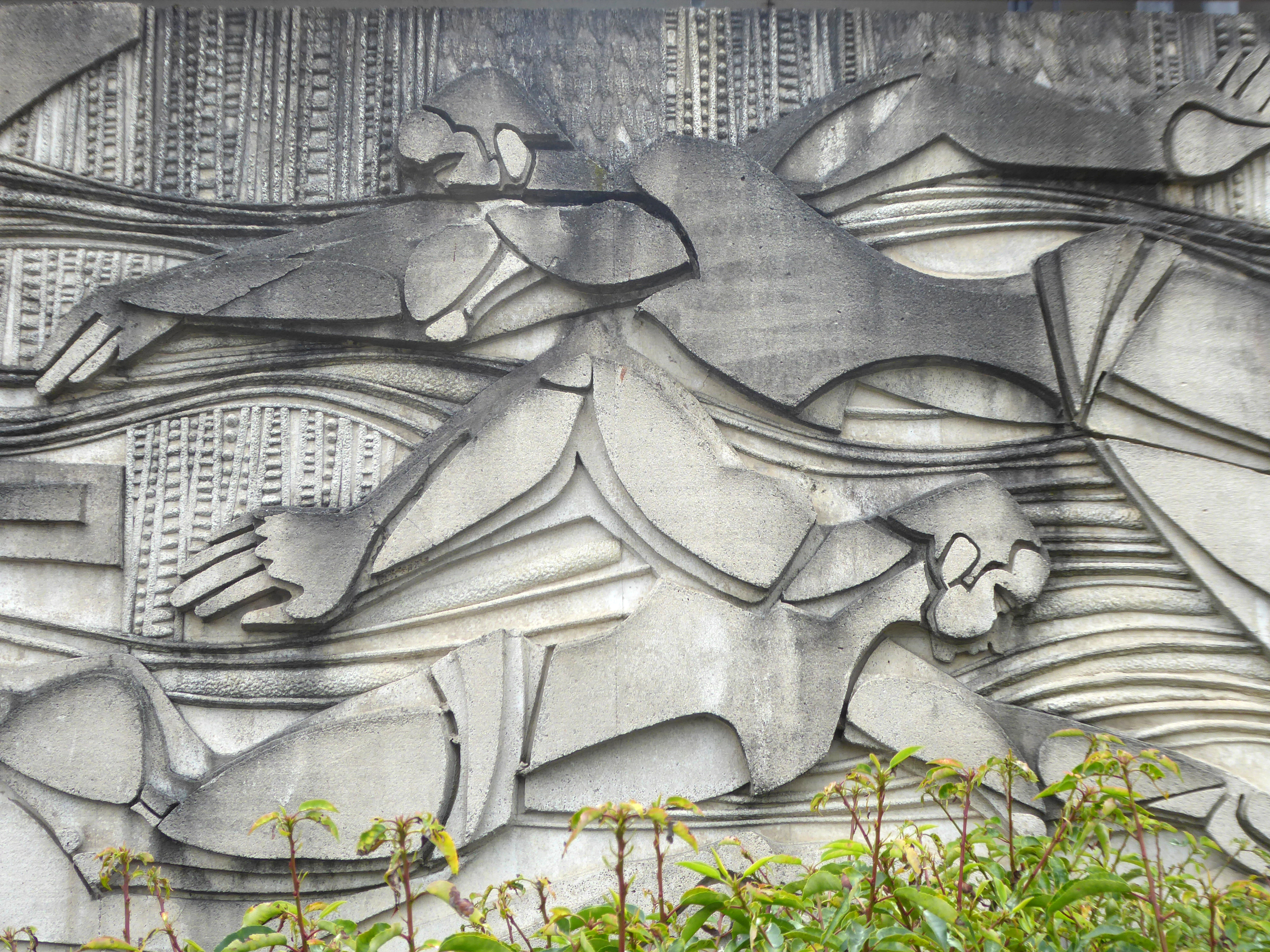
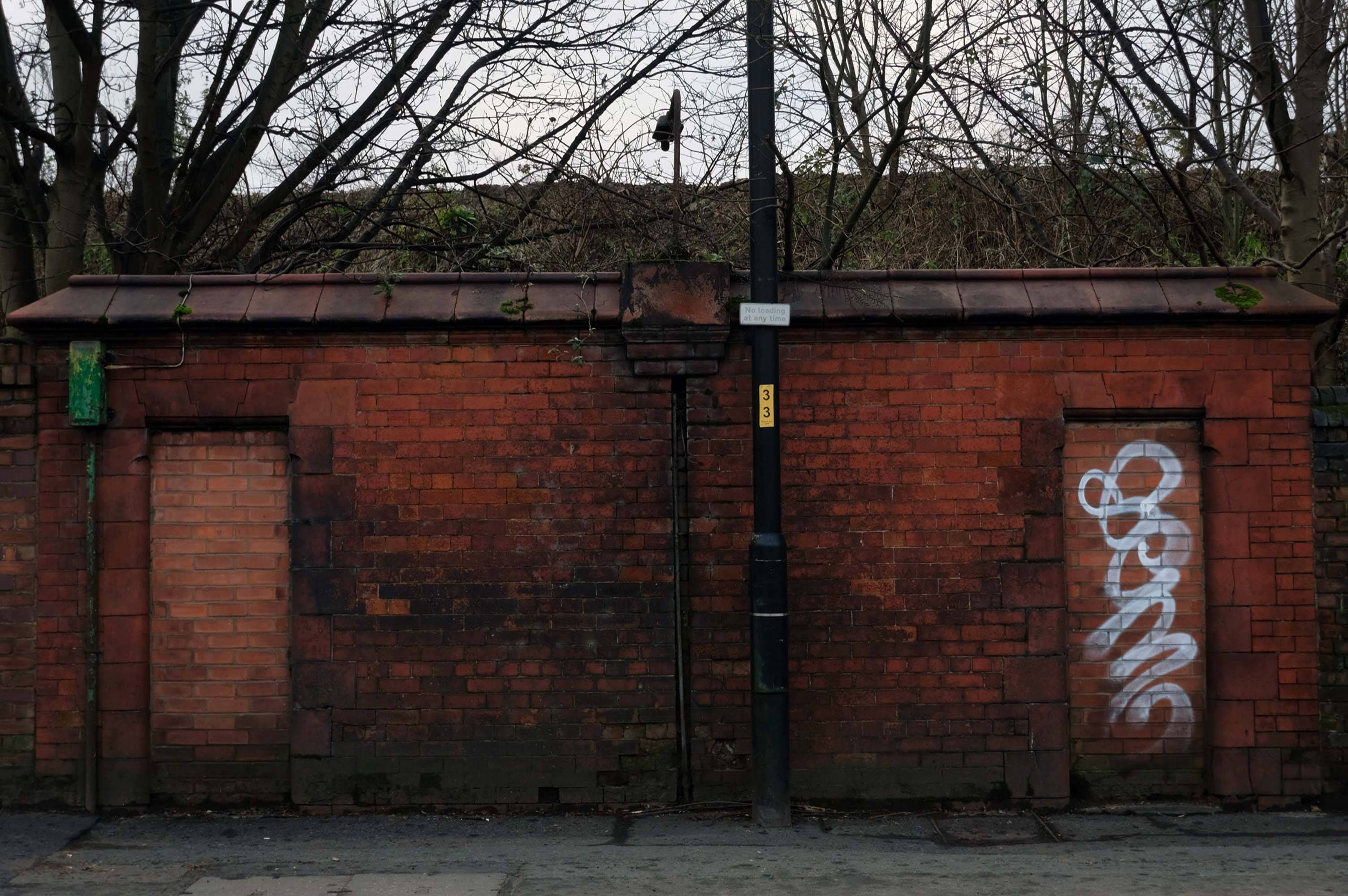
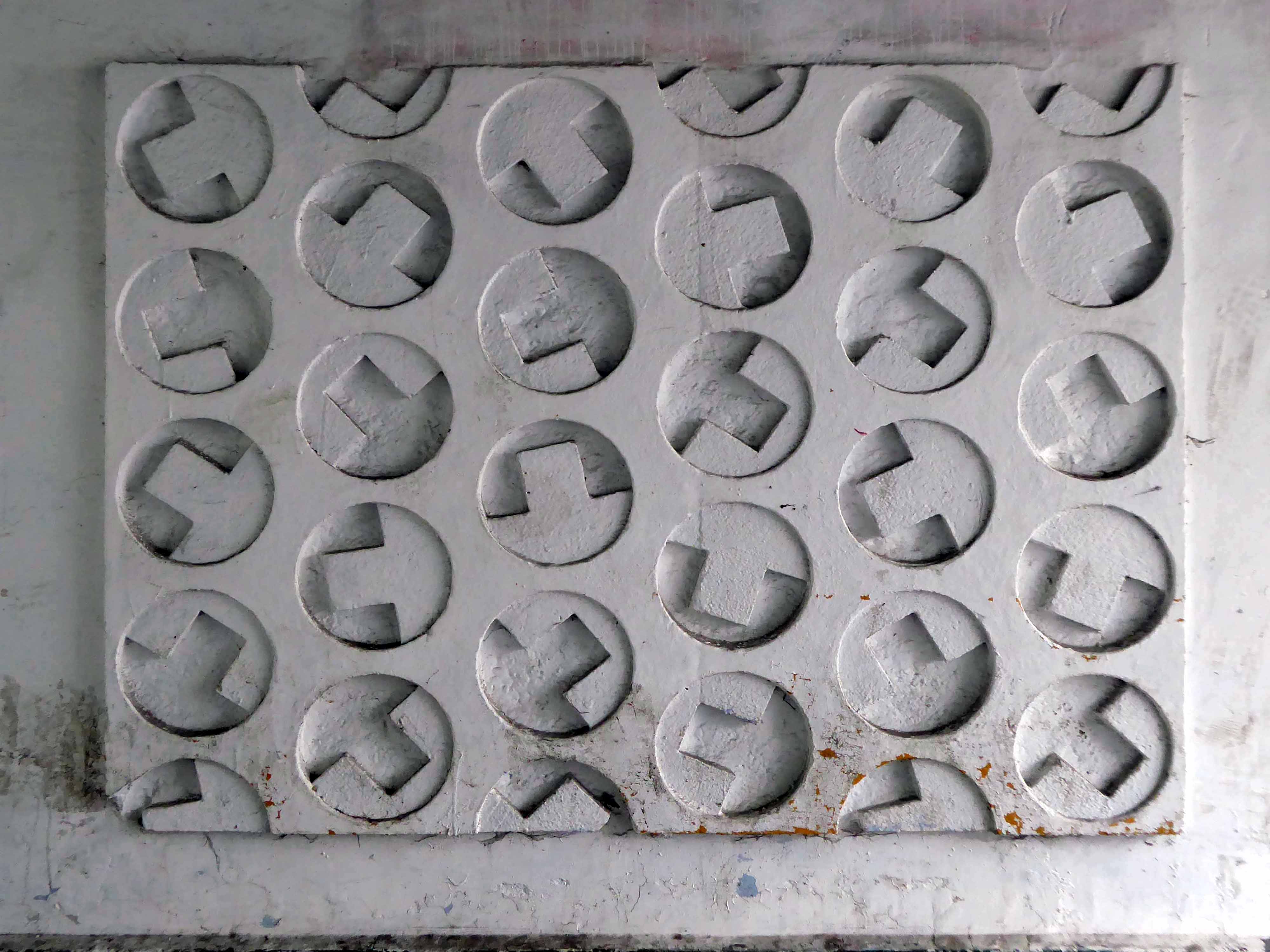
We take a jog around the block to see the concrete relief that clads the road ramp.

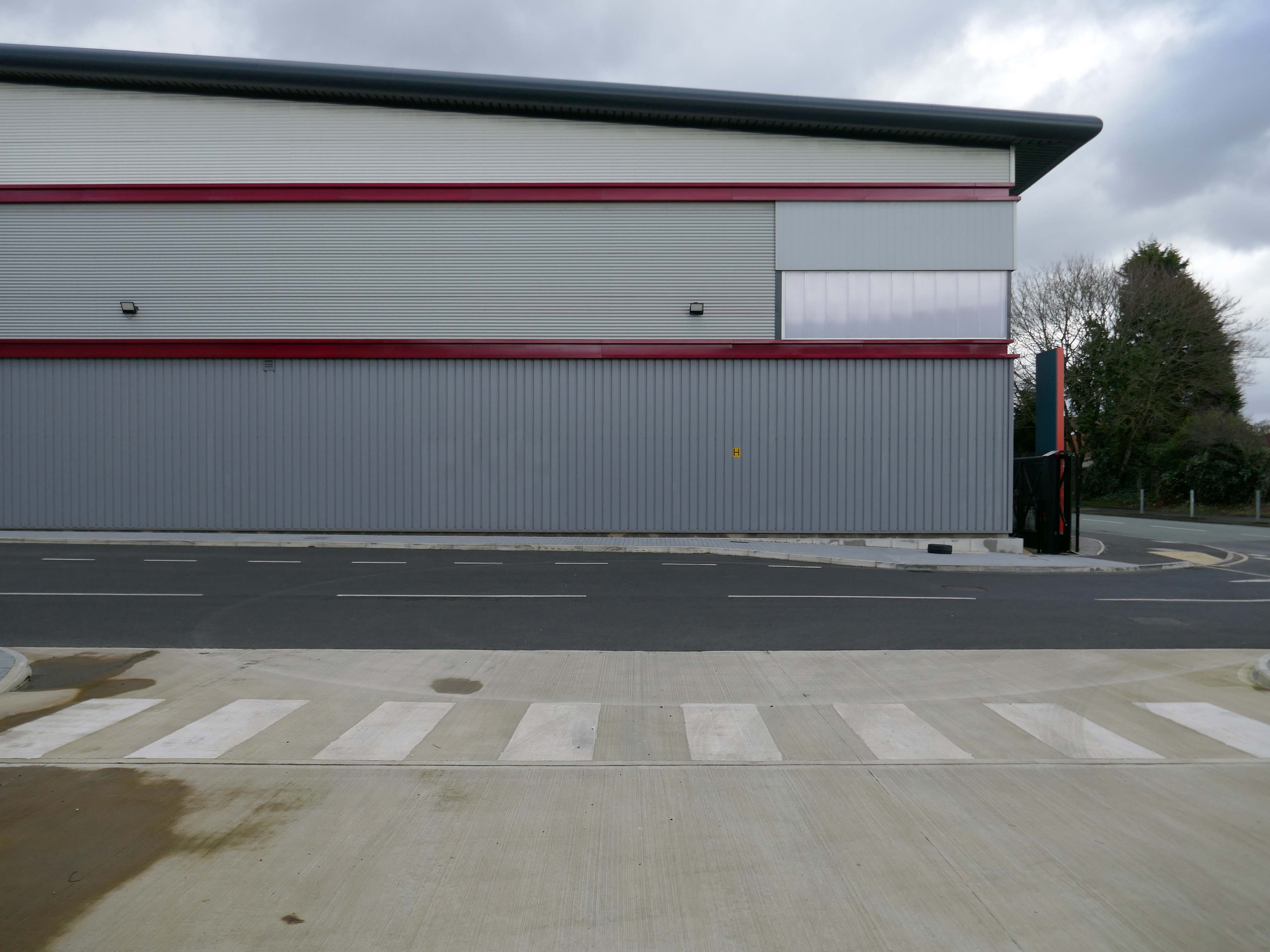
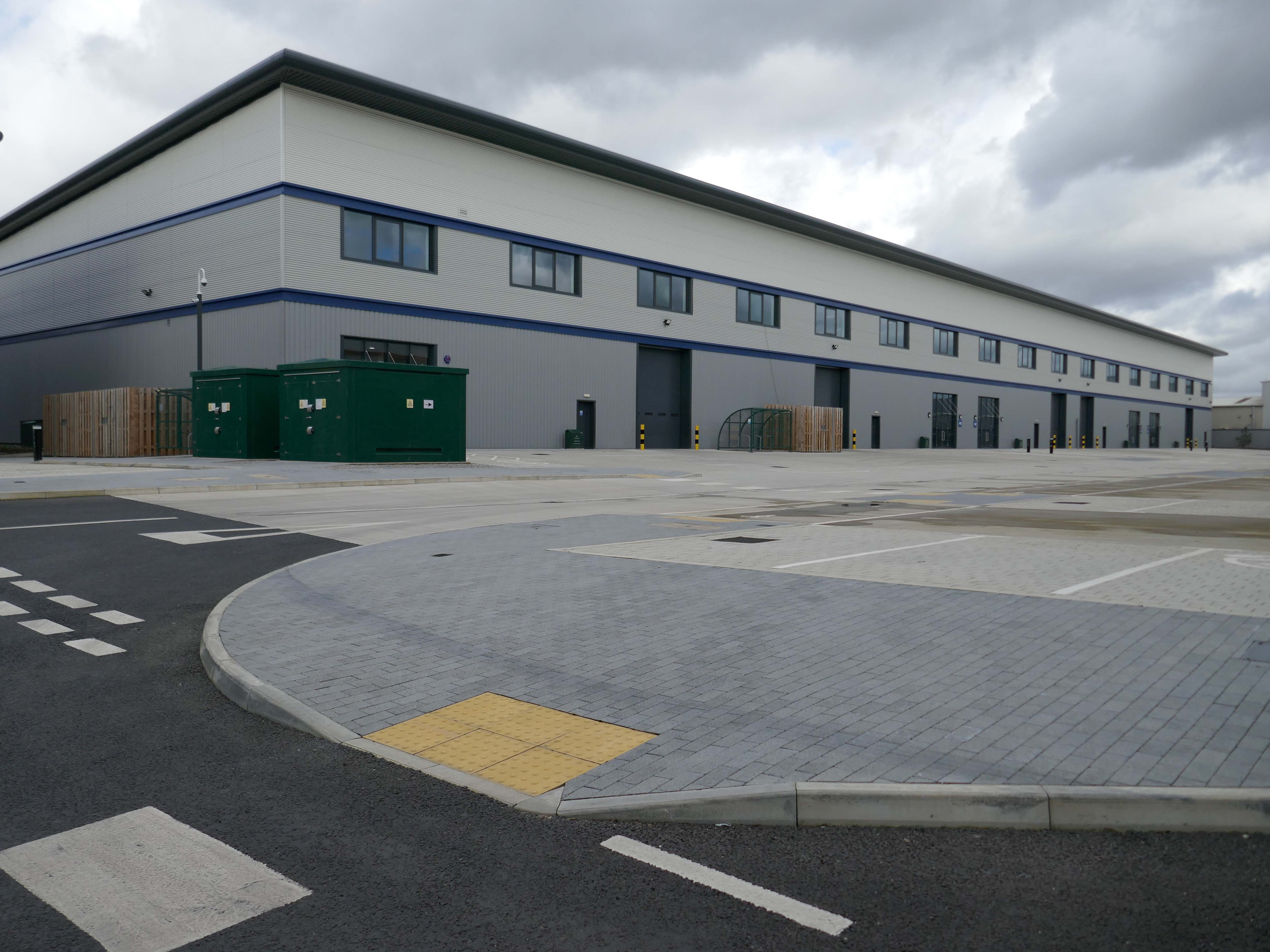
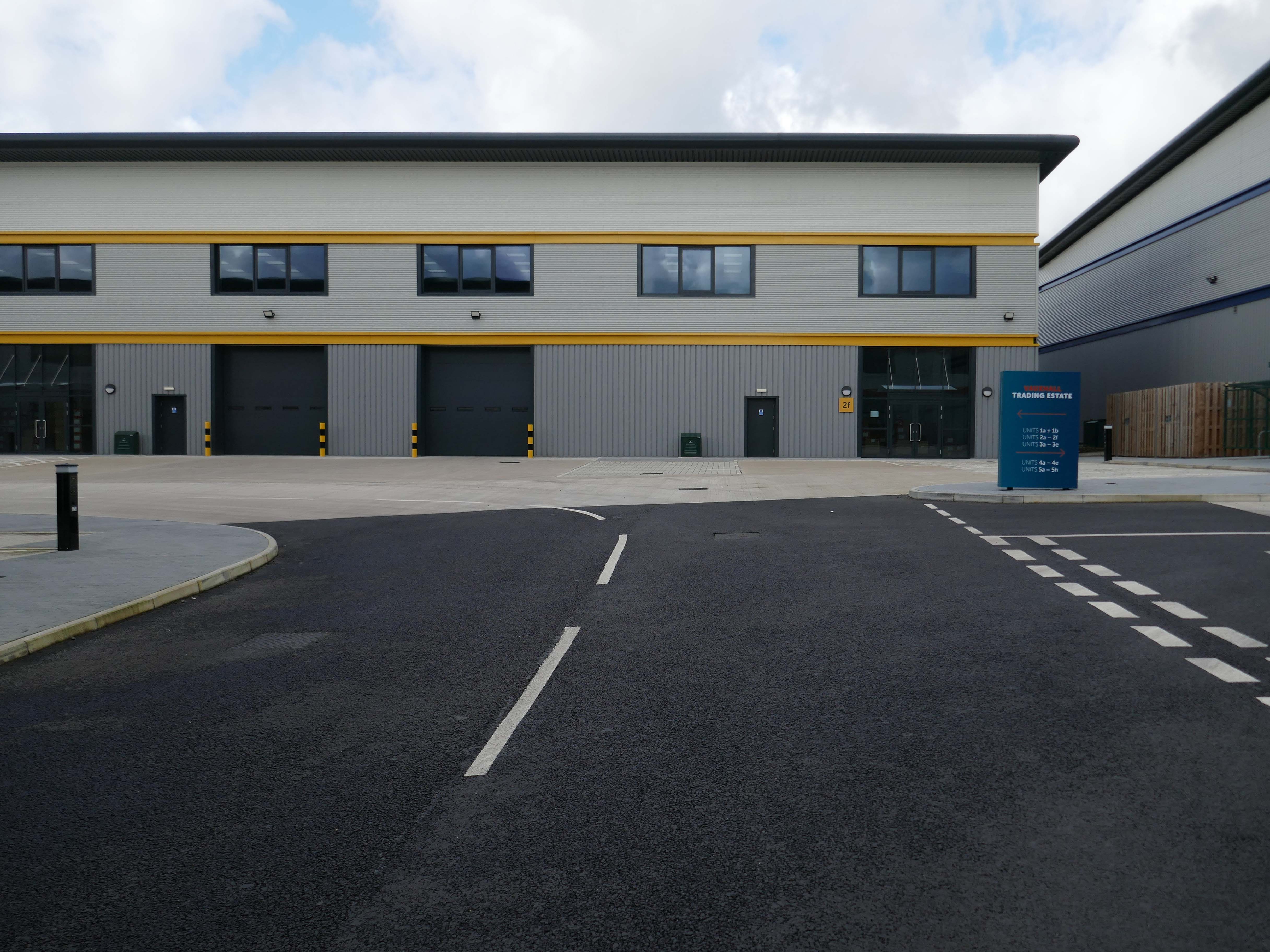
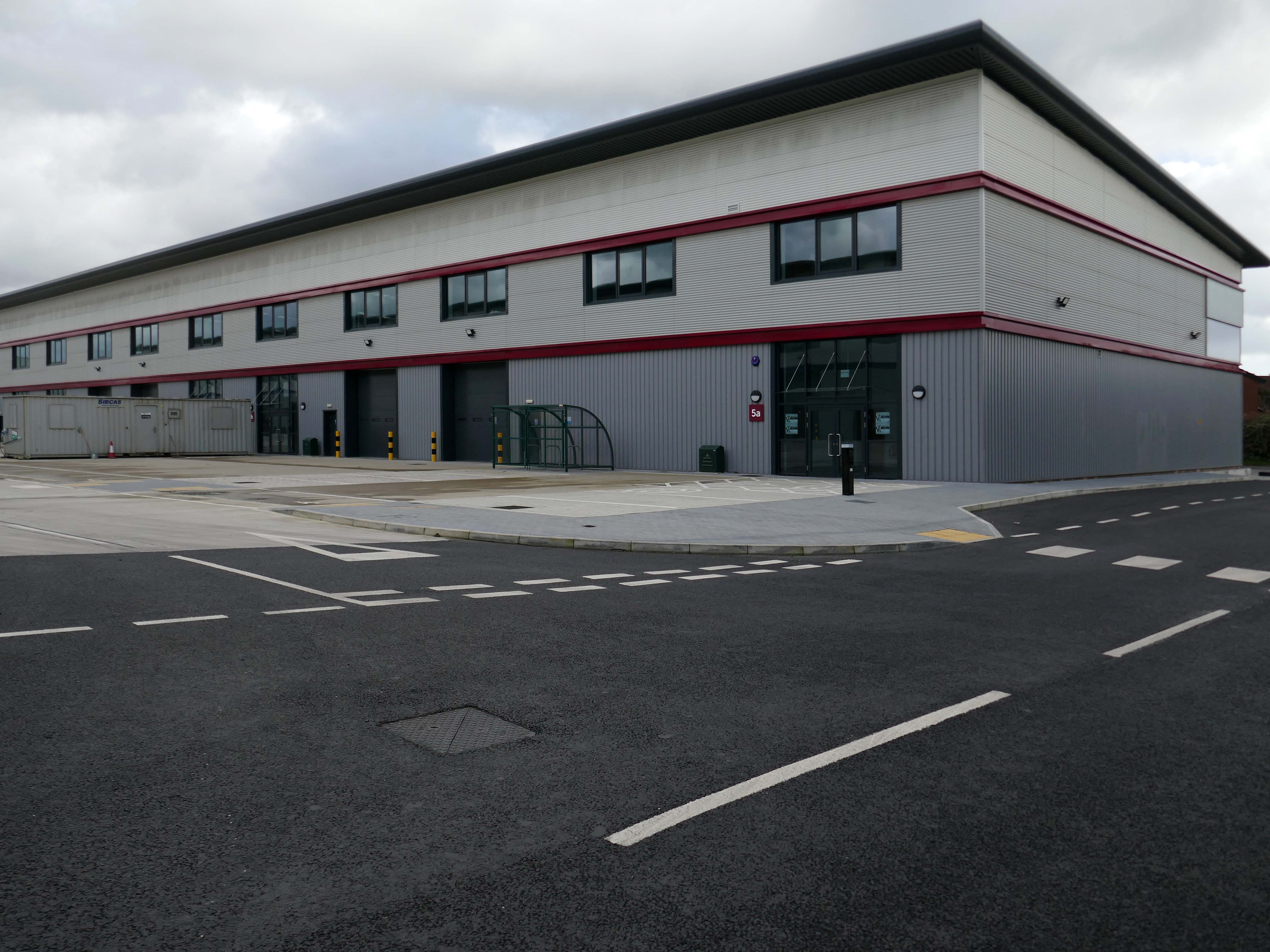
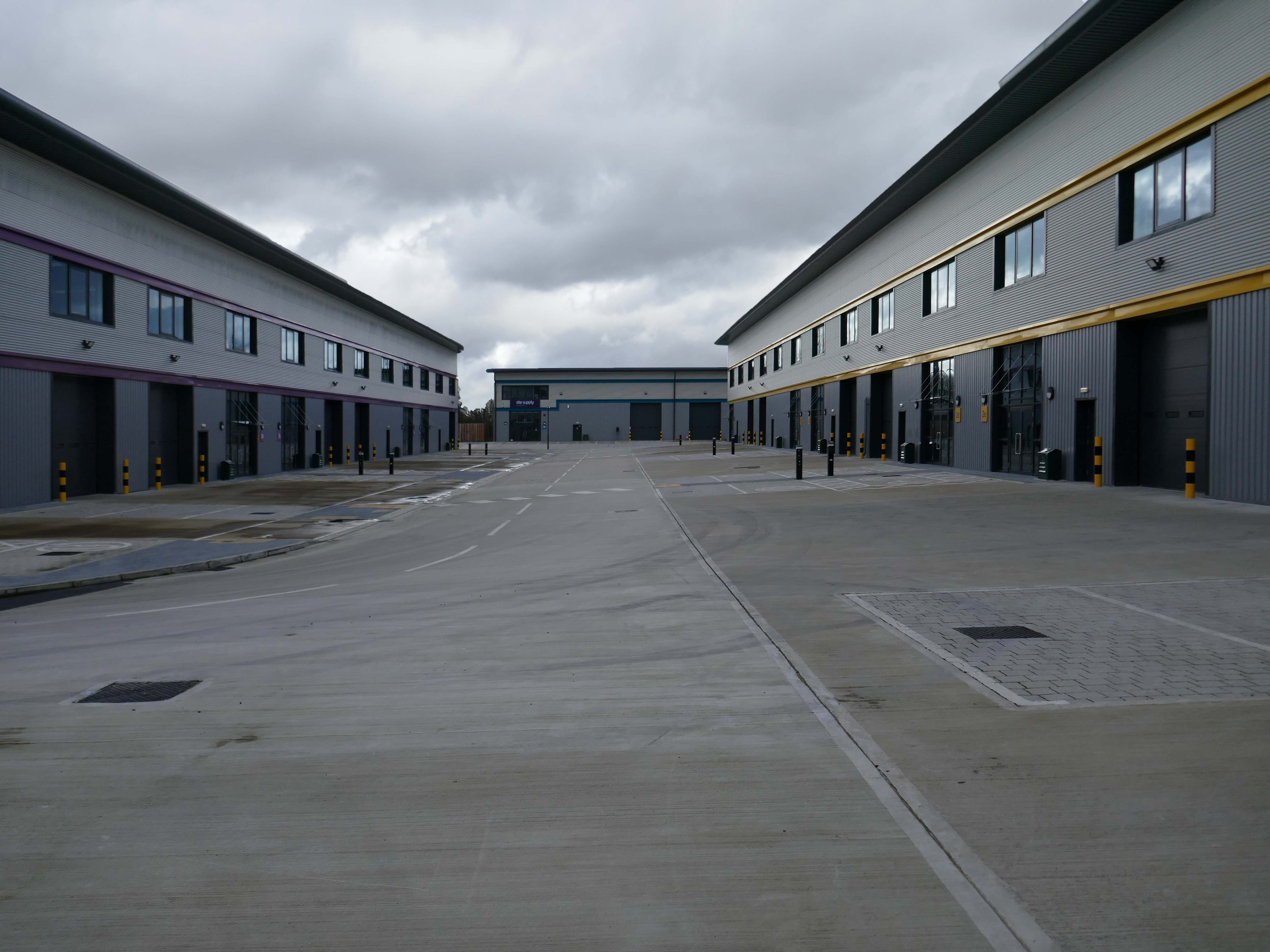
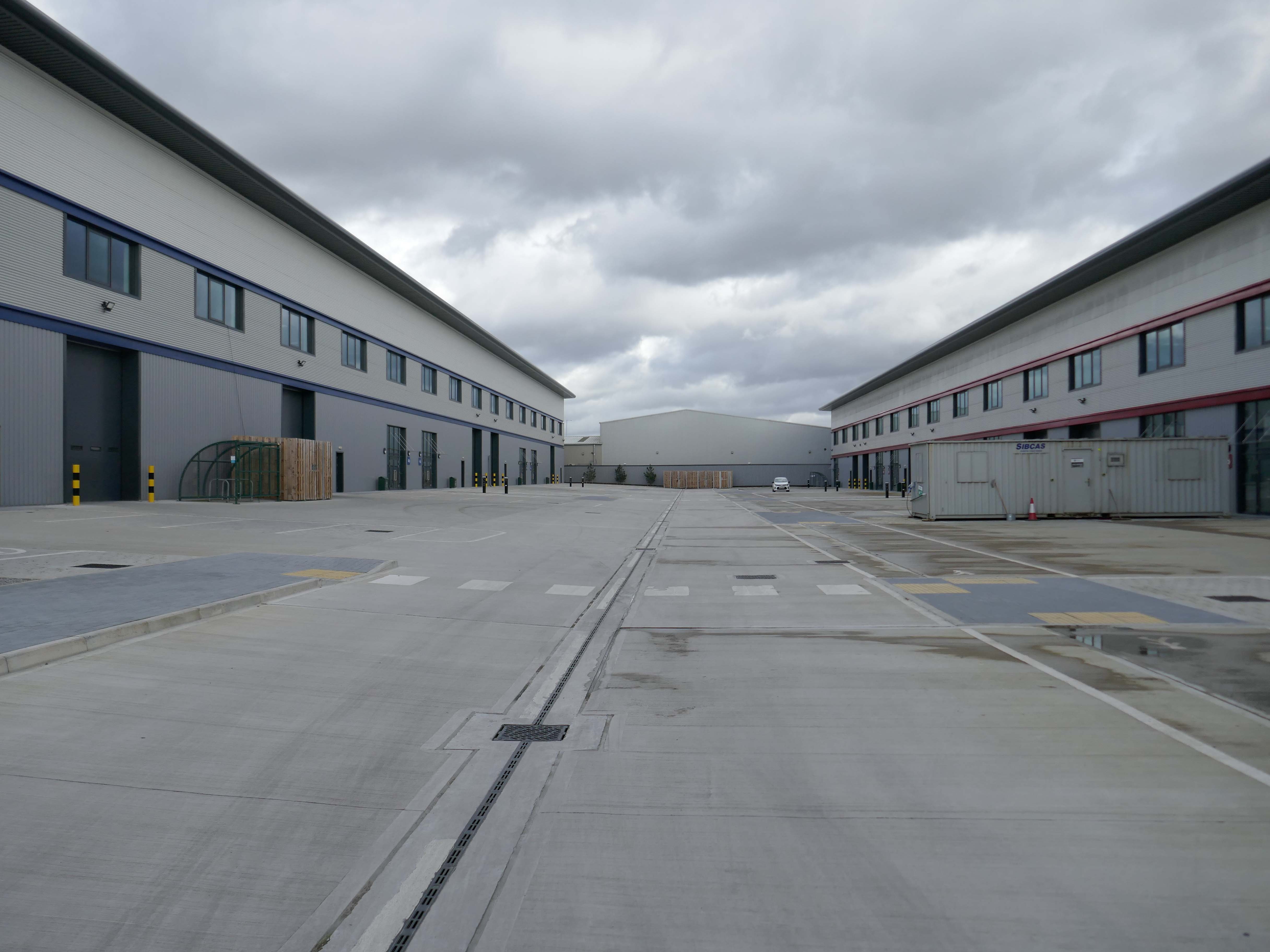
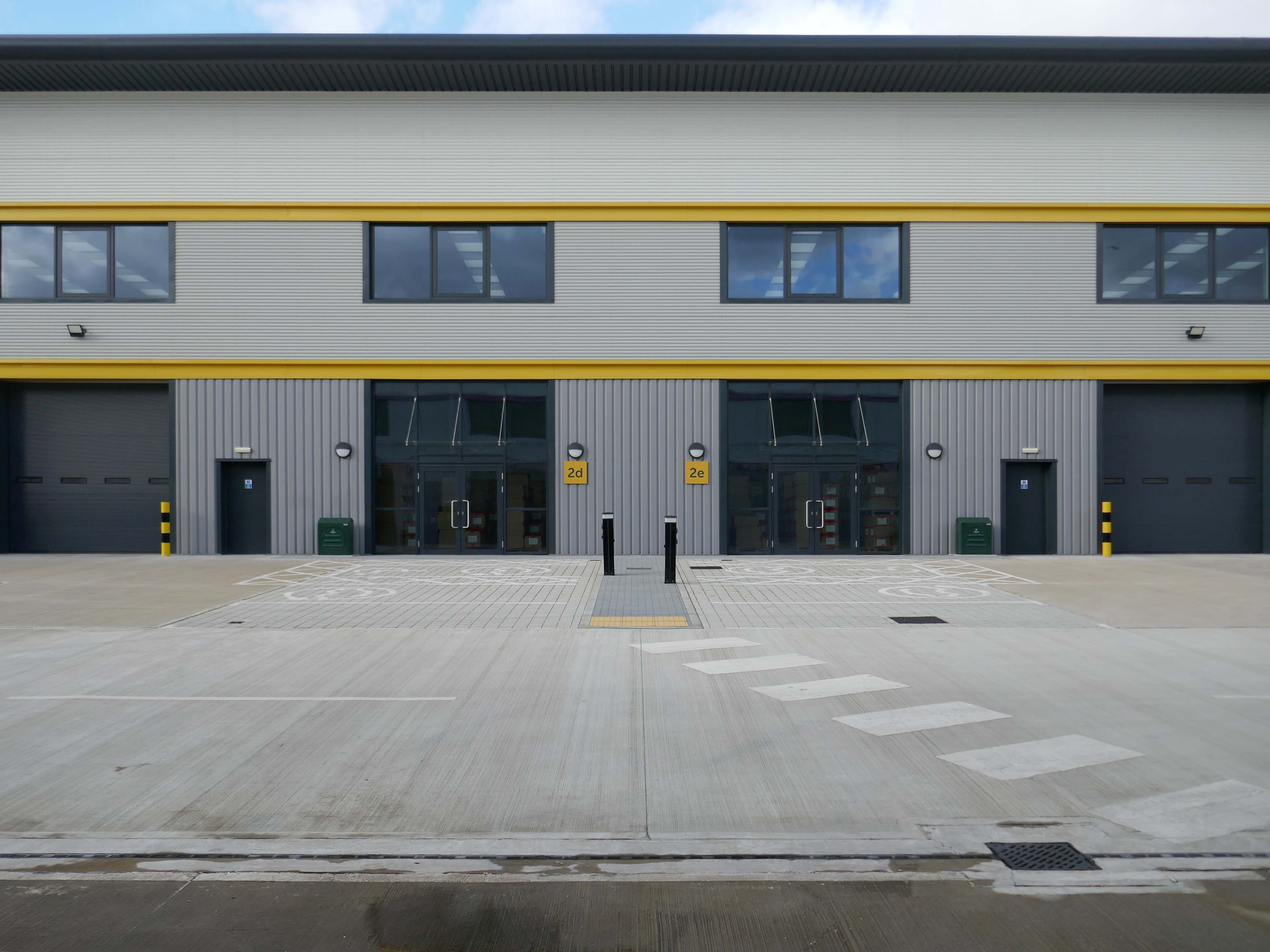
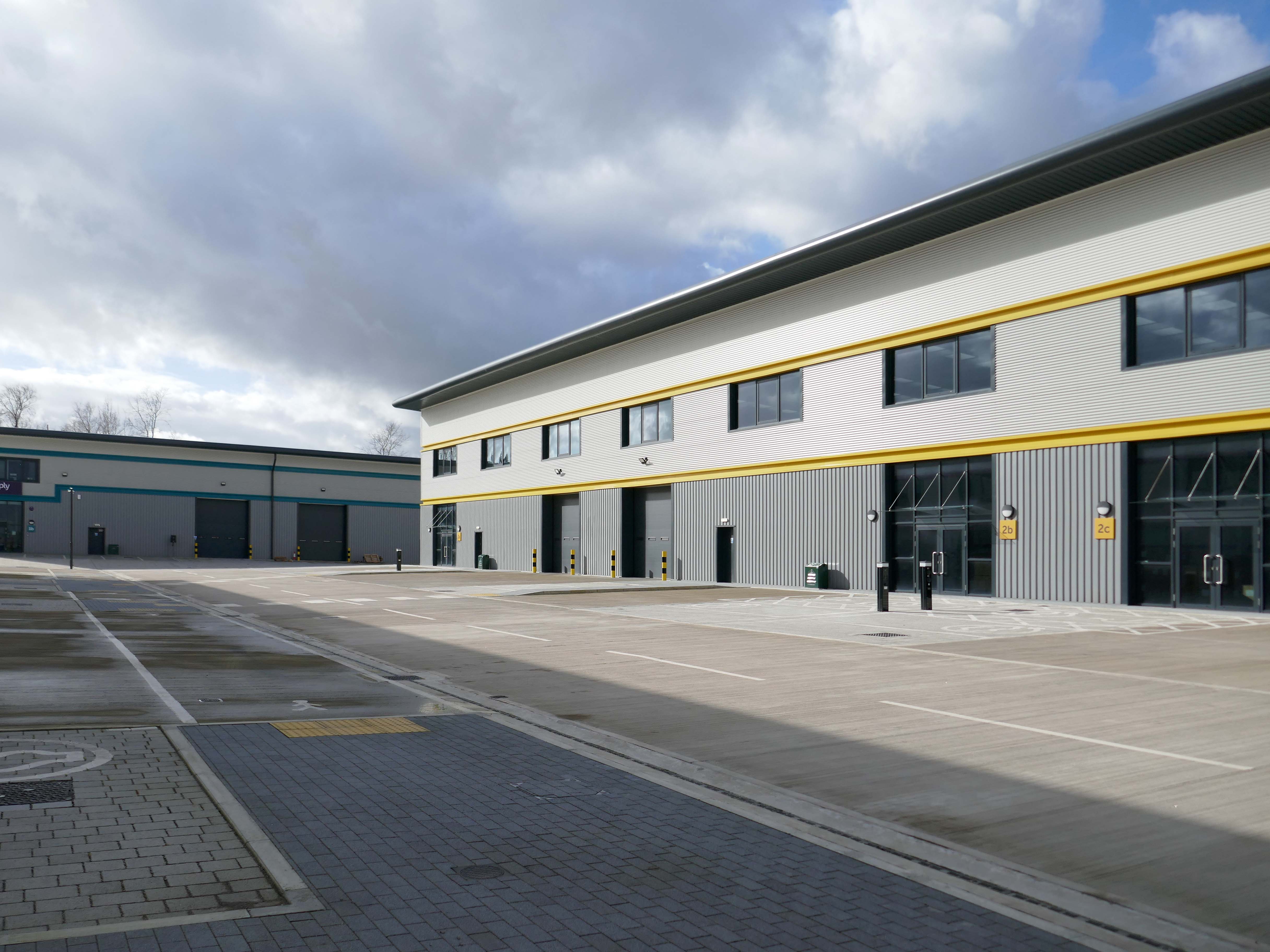
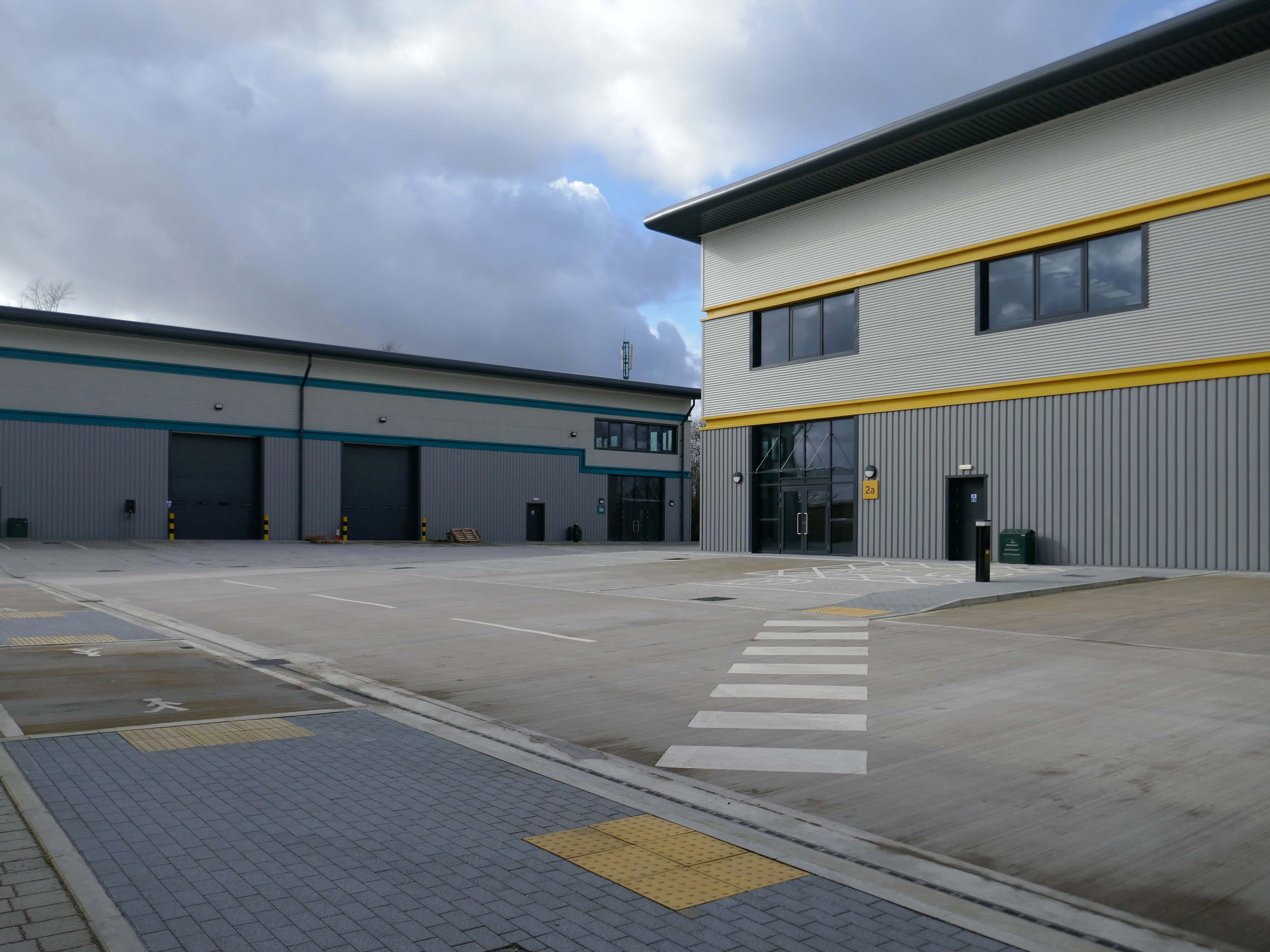
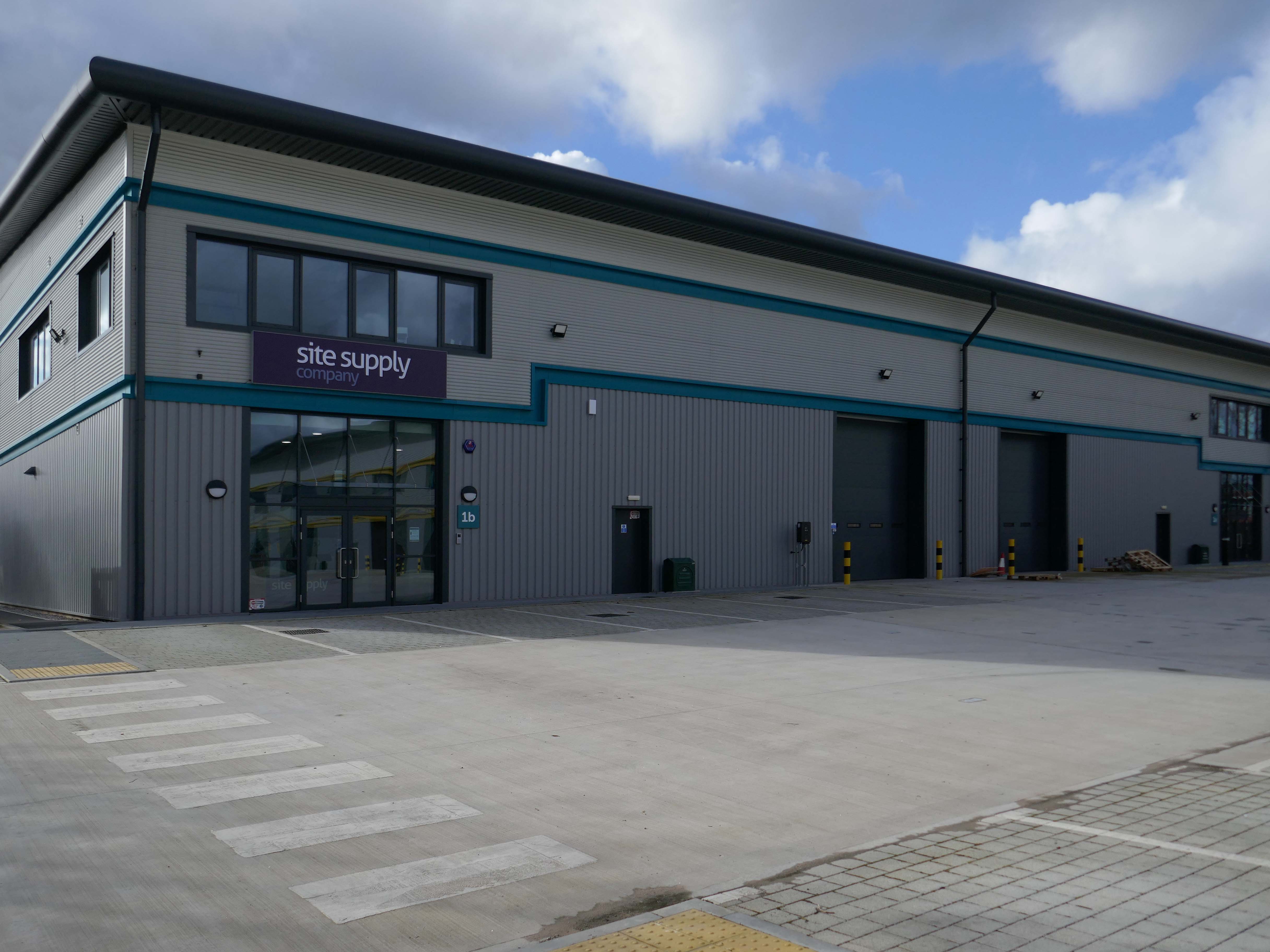
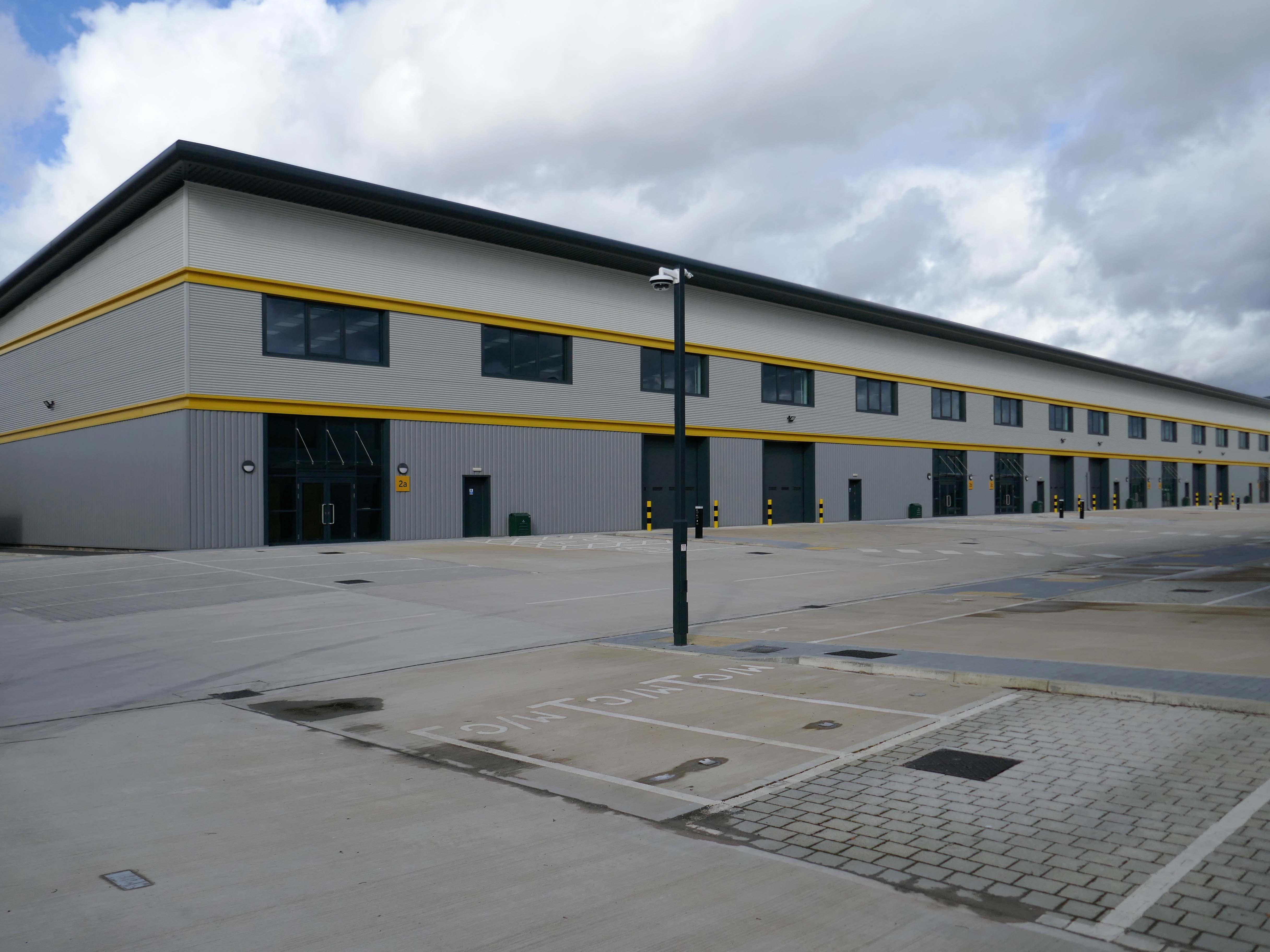
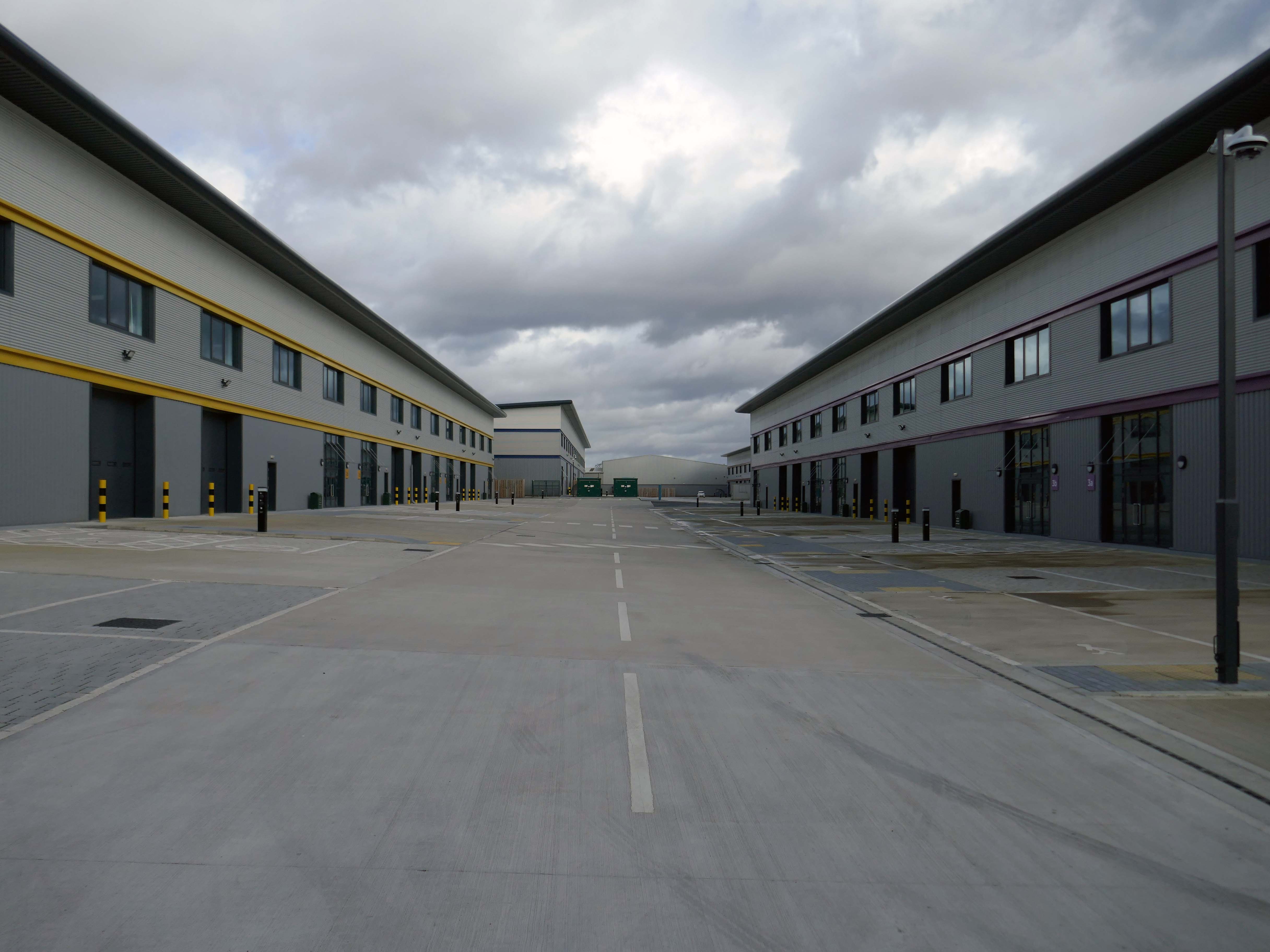
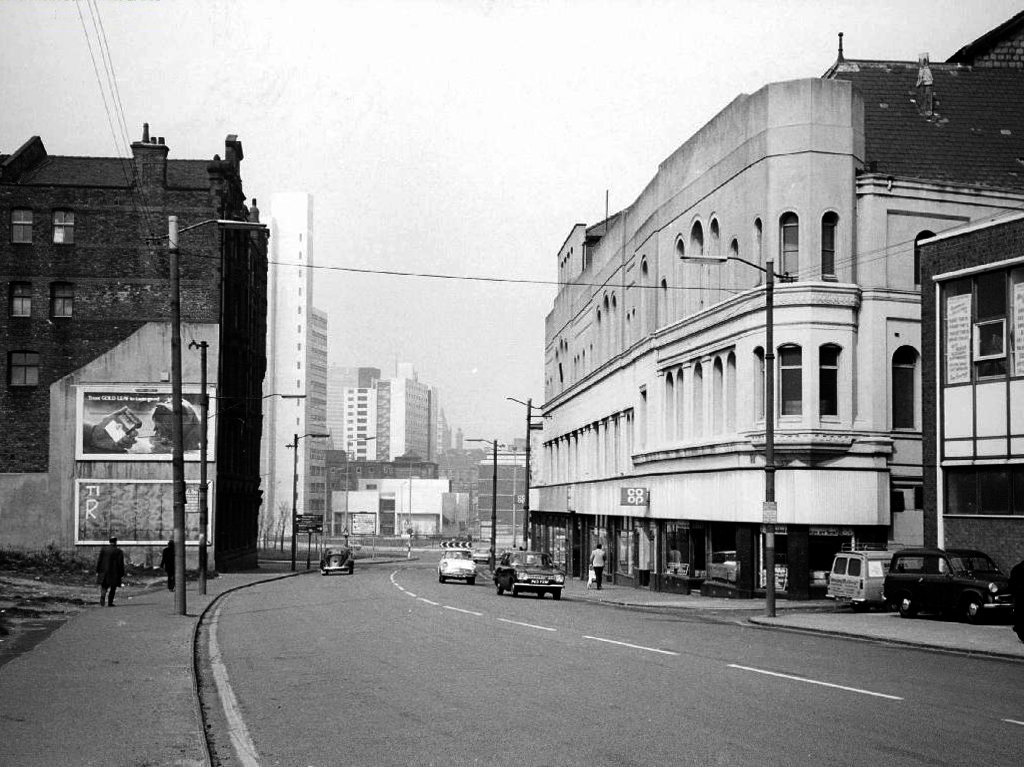
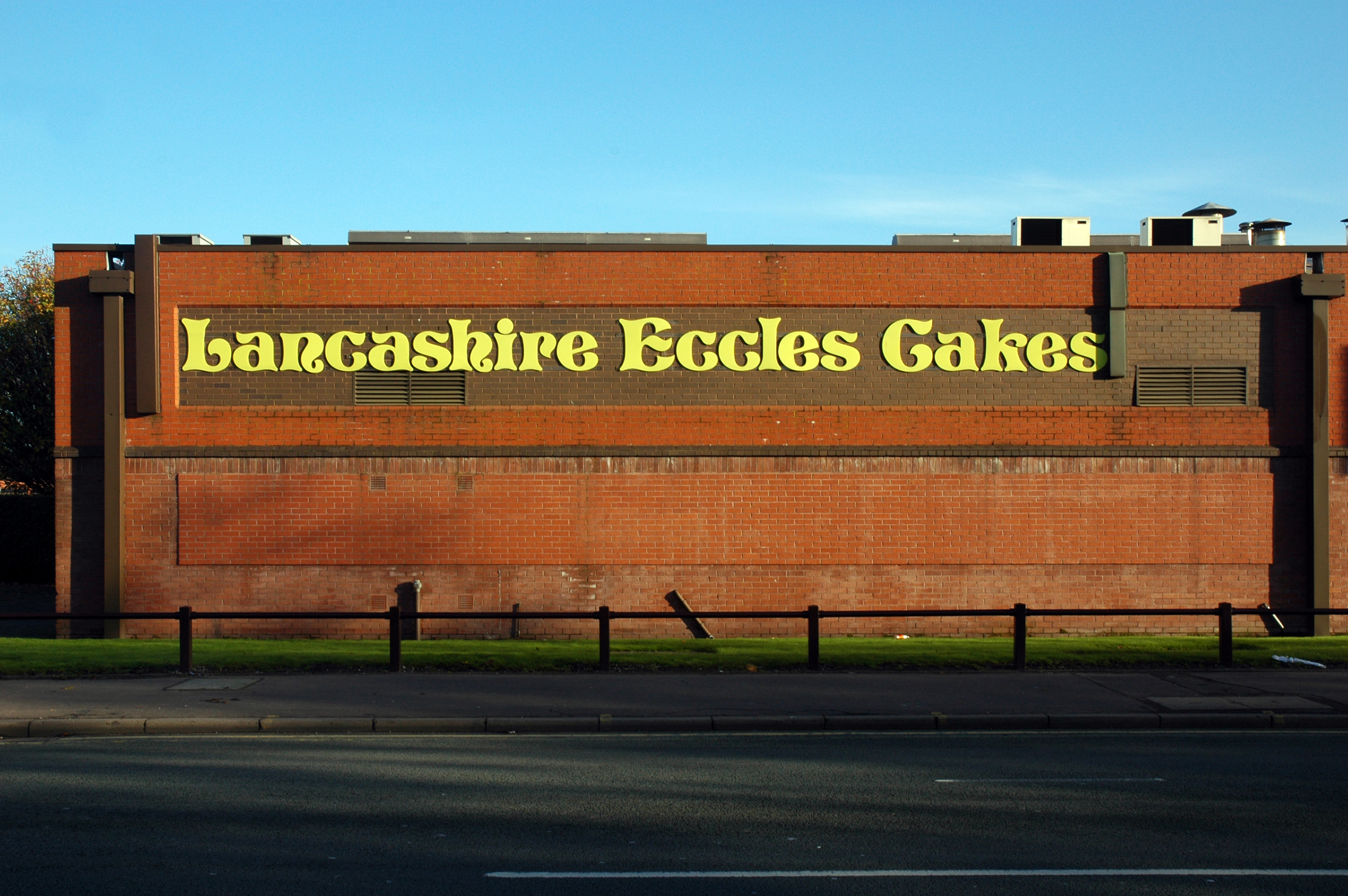
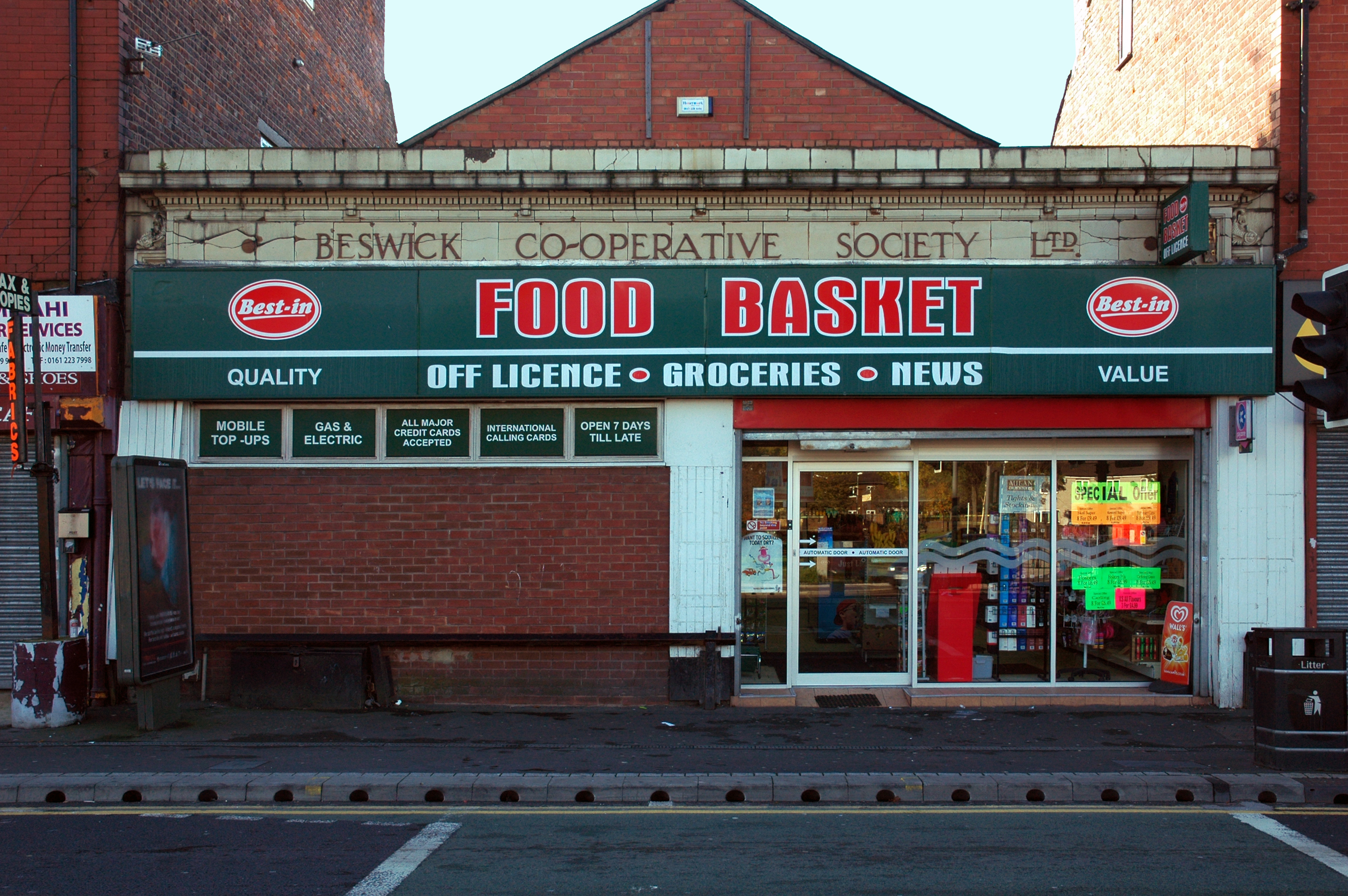
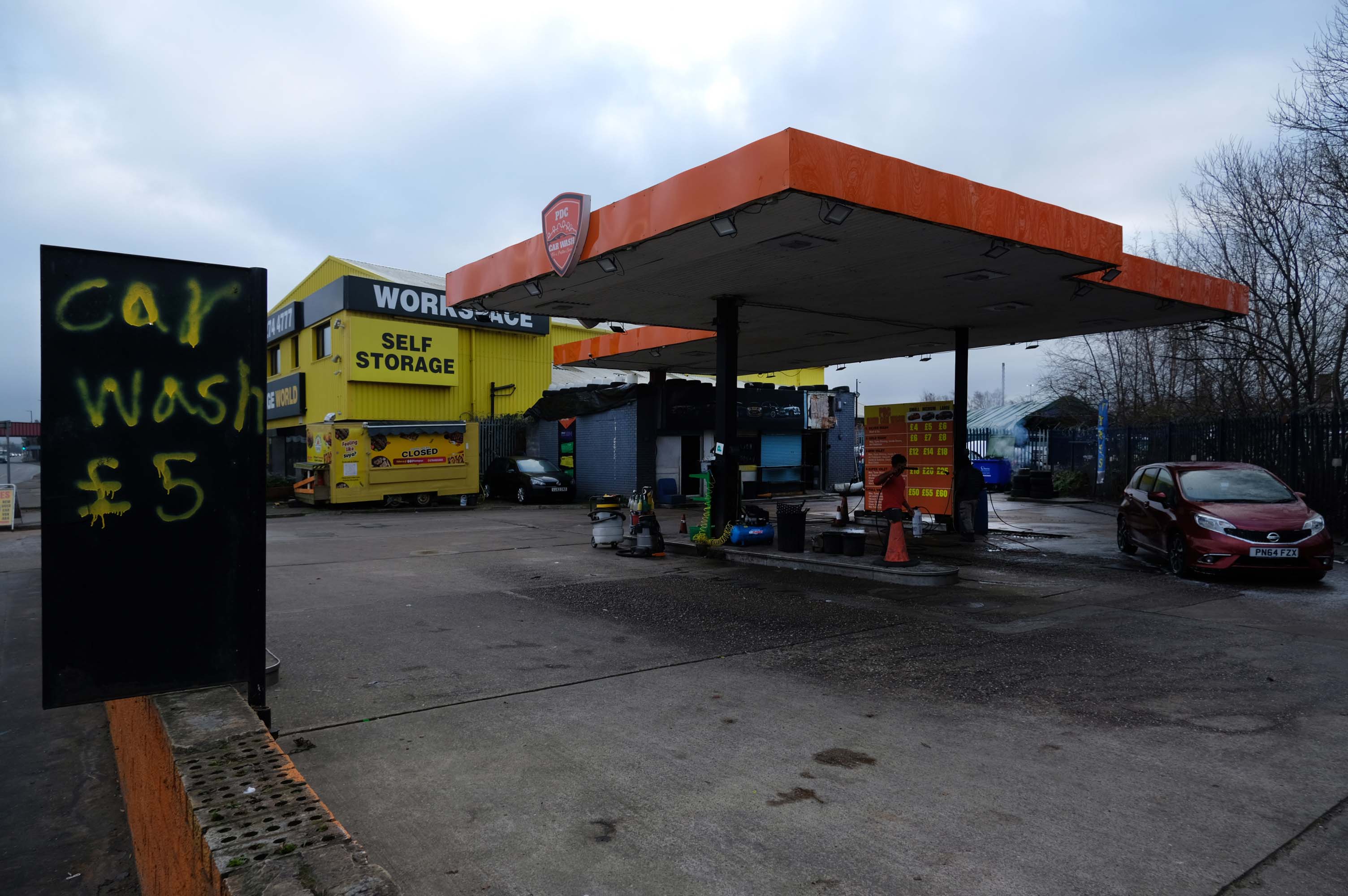
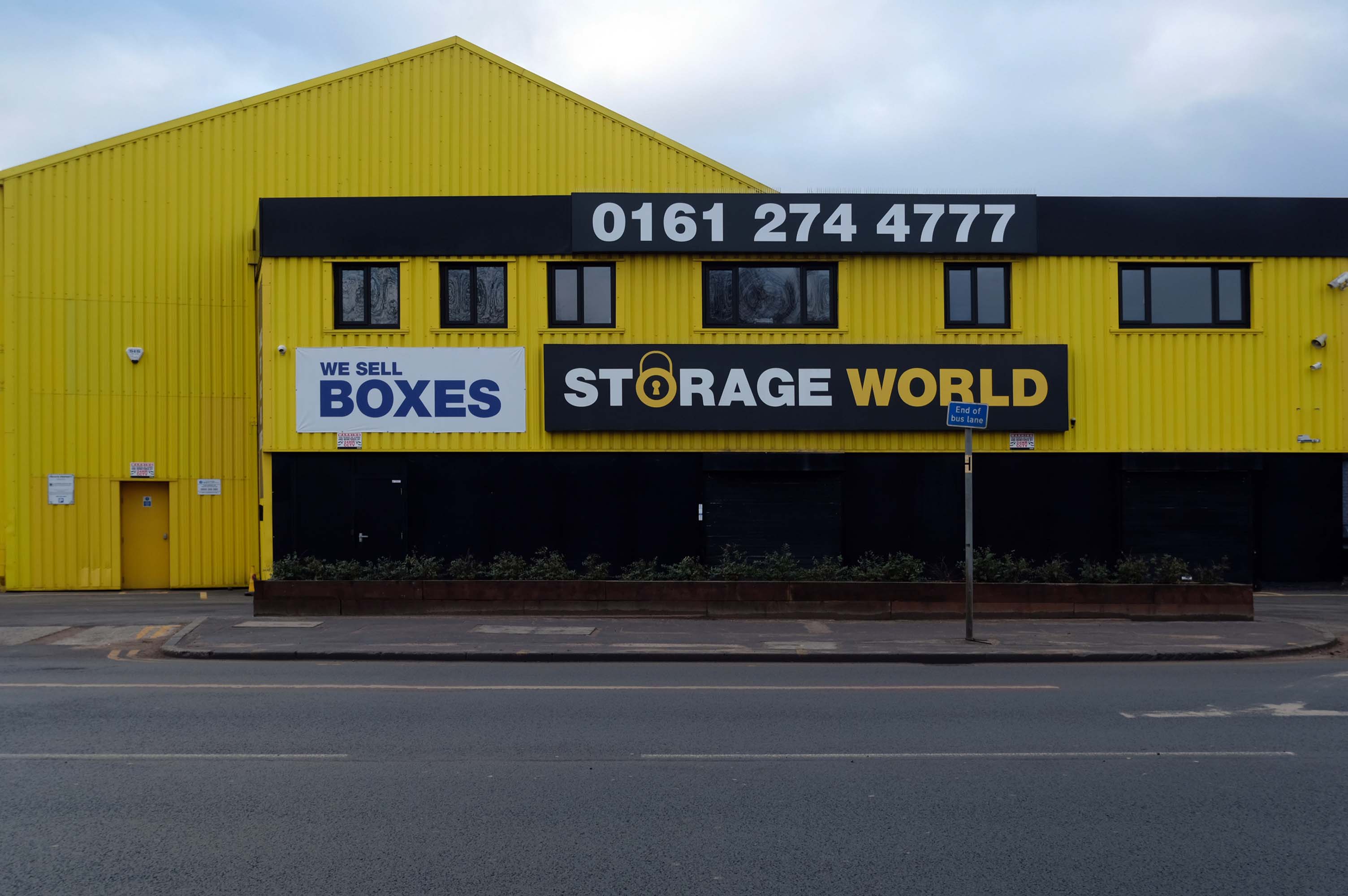
Where there was once a giant Cooperative Store there is now a light industrial and retail estate.

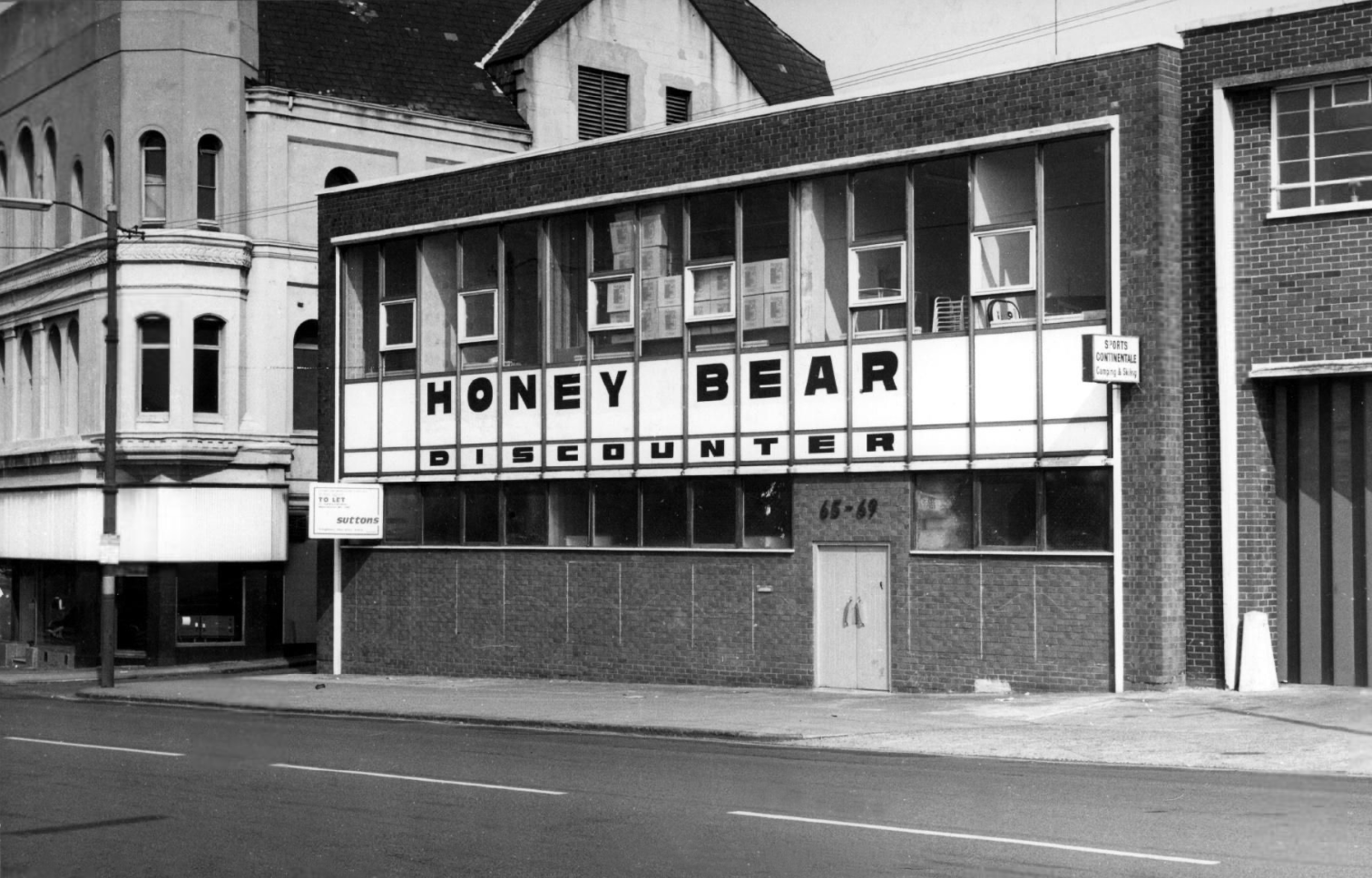
And the Honey Bear Discounter has become Spirit Studios.

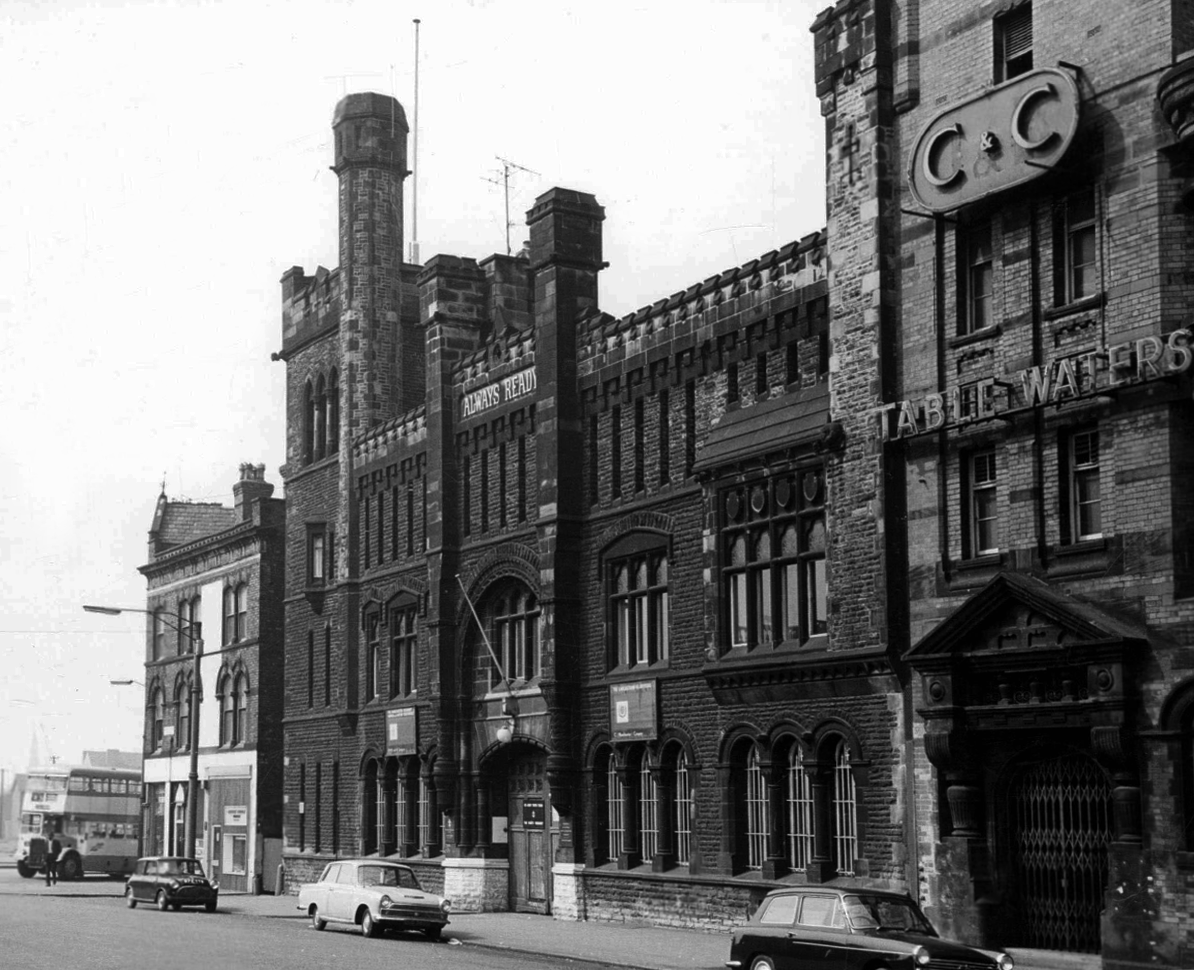
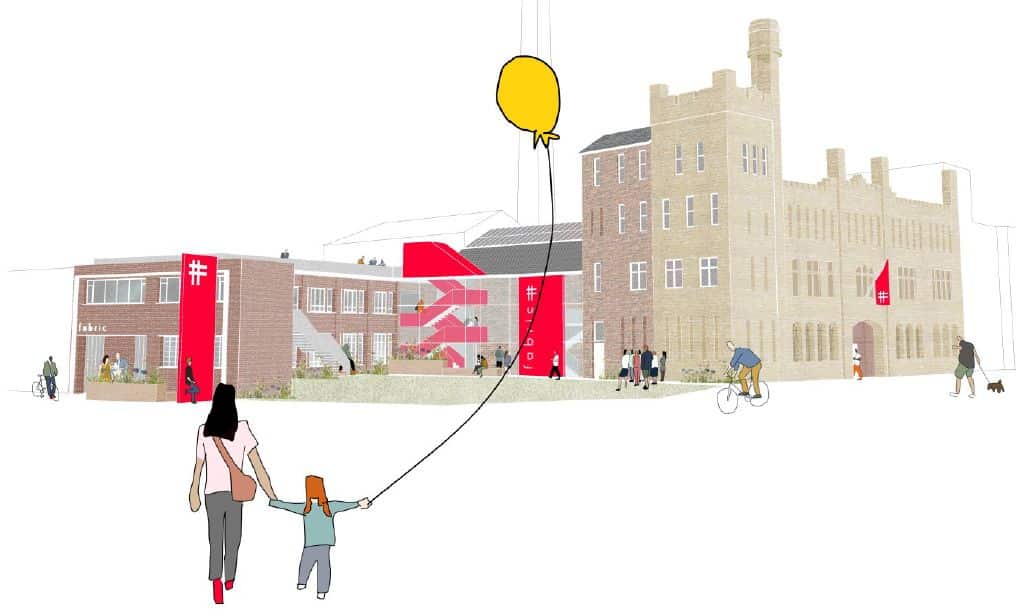
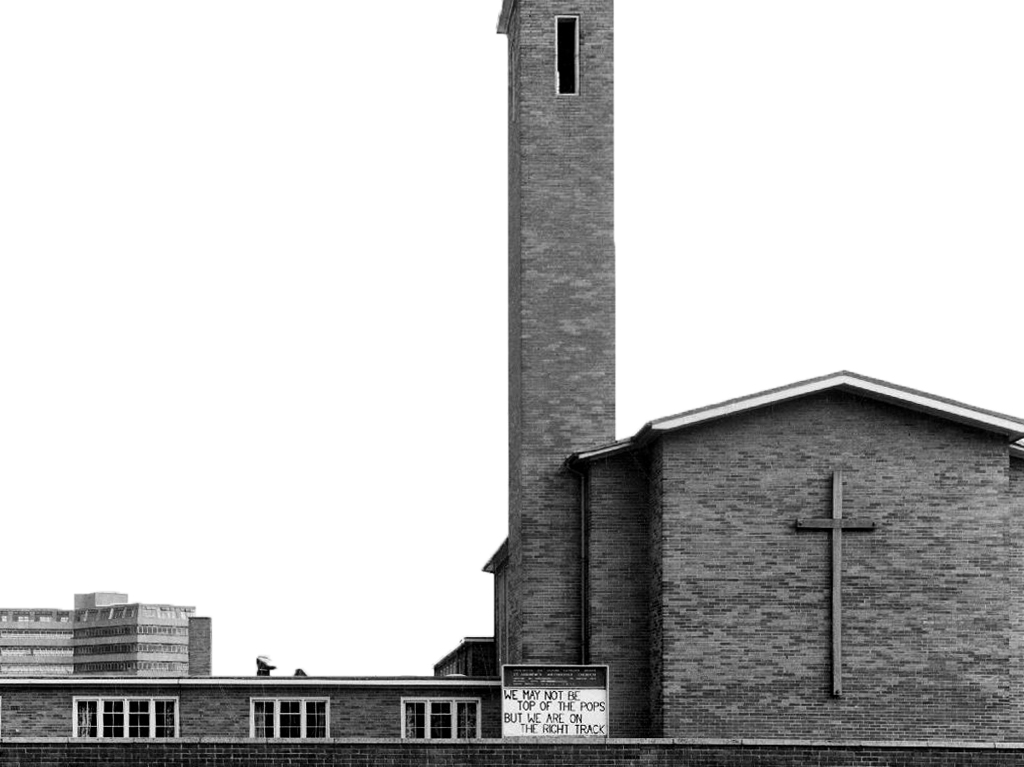
And the Barracks has become the Fabric Church.

The Diocese of Manchester has been working in partnership with the Church Revitalisation Trust to open Fabric Church and refurbish the building, following a successful bid to the Church of England’s Strategic Mission and Ministry Investment Board.

We’re excited to be working alongside Fabric Church on the transformation of the Grade II listed former Ardwick Barracks in Manchester. This ambitious refurbishment project will see the historic site reimagined as a vibrant community hub, featuring a new worship hall, community café, offices, meeting spaces, and more.

Hexaconsulting

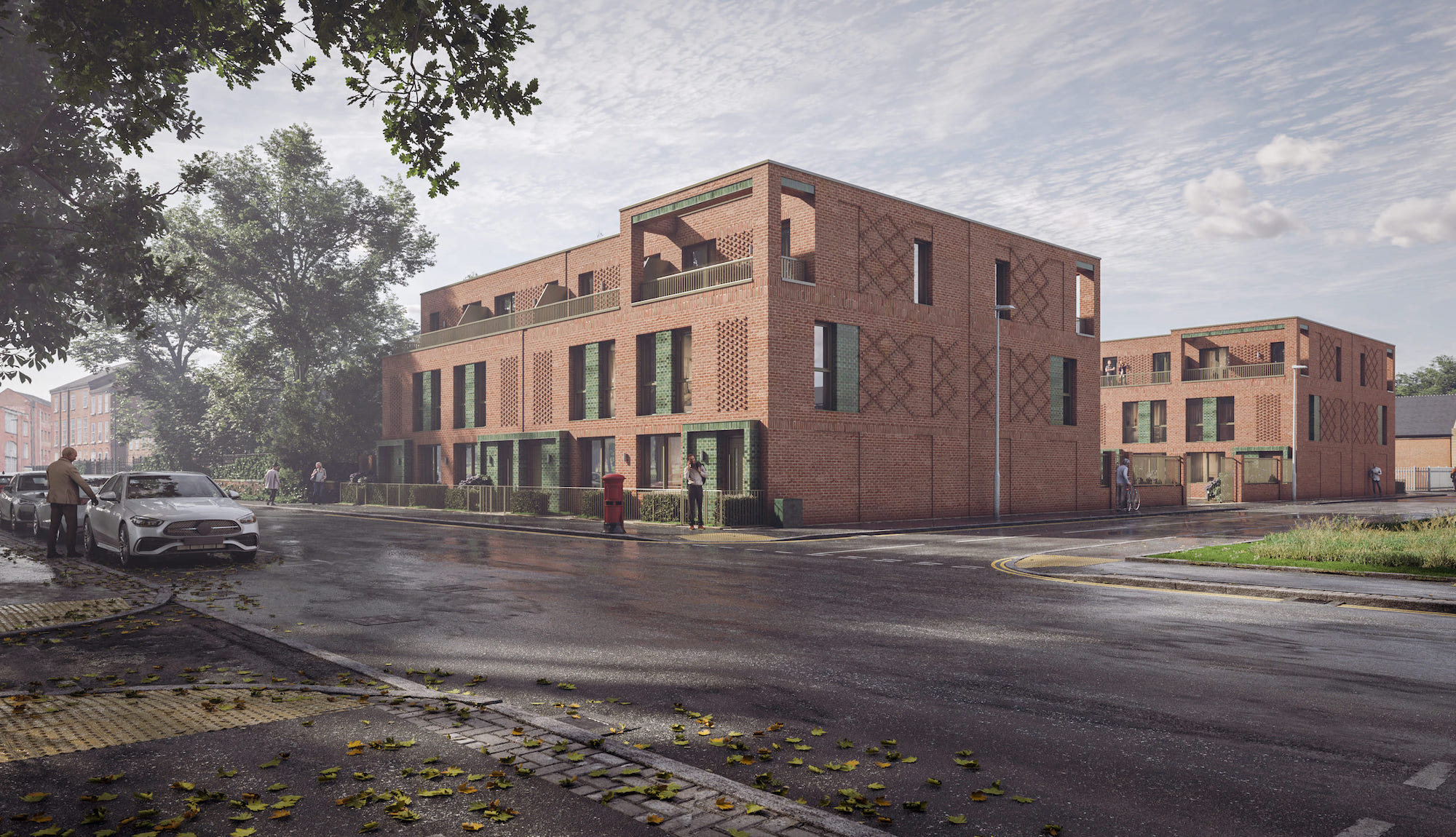
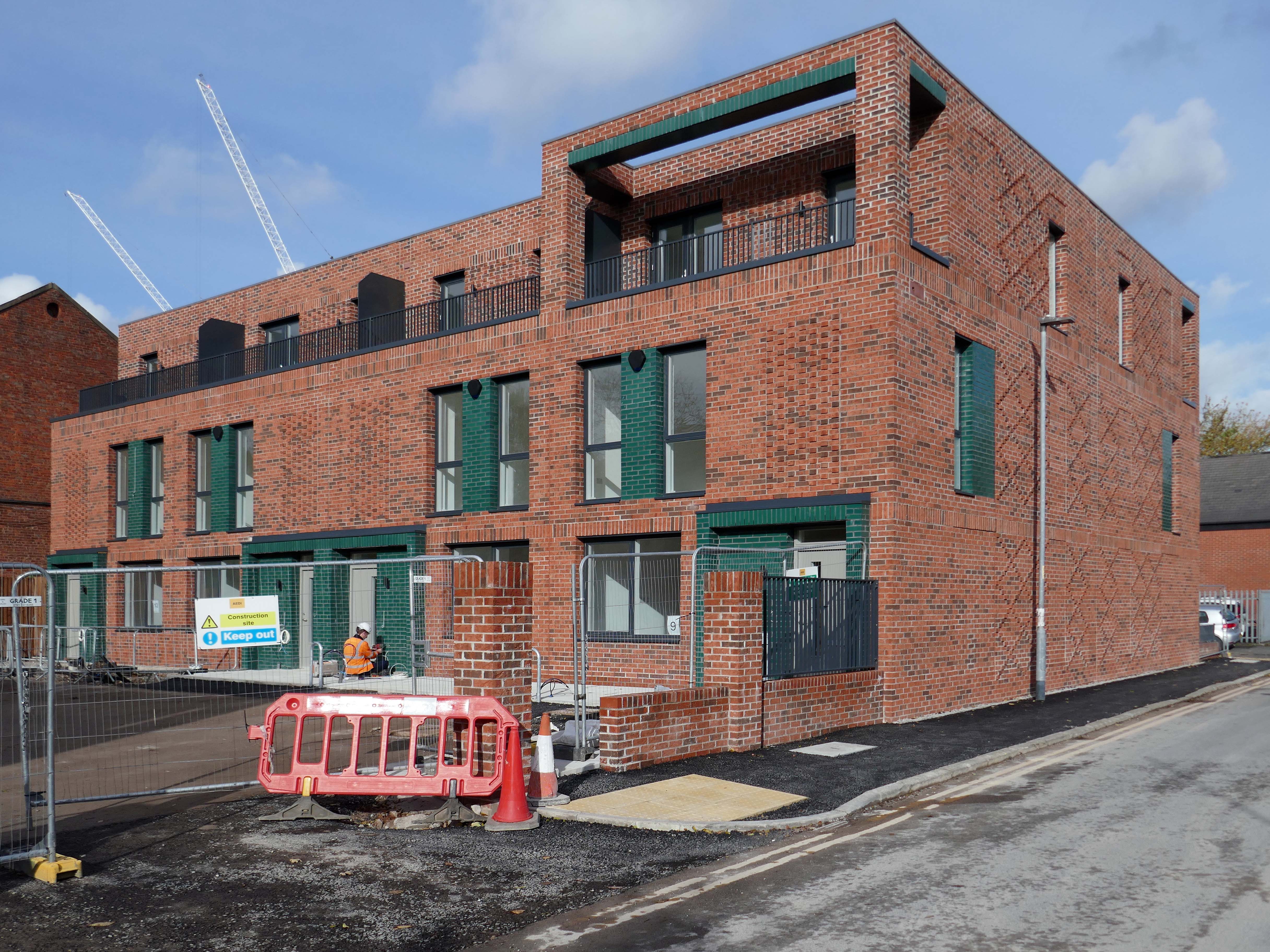
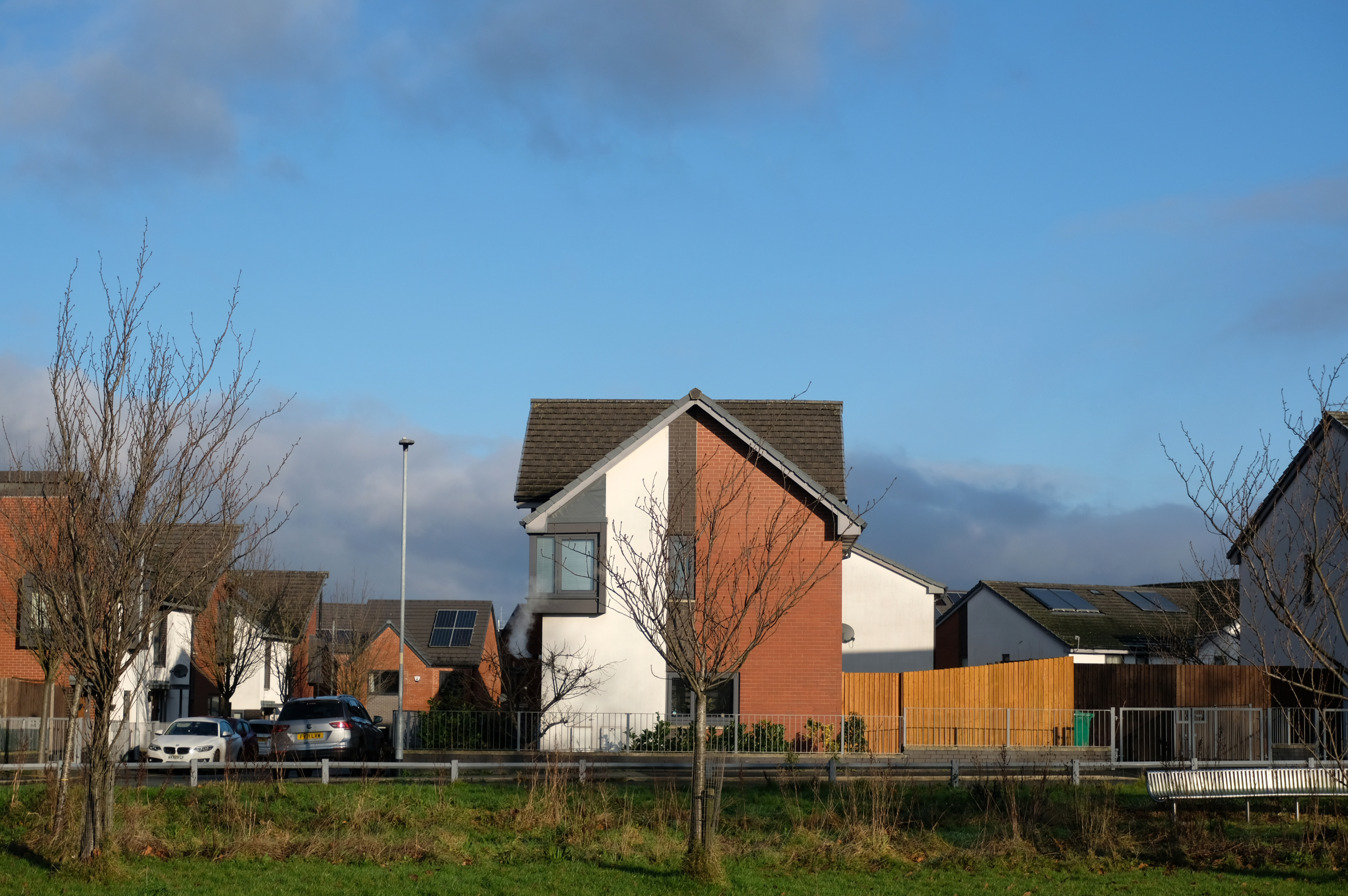
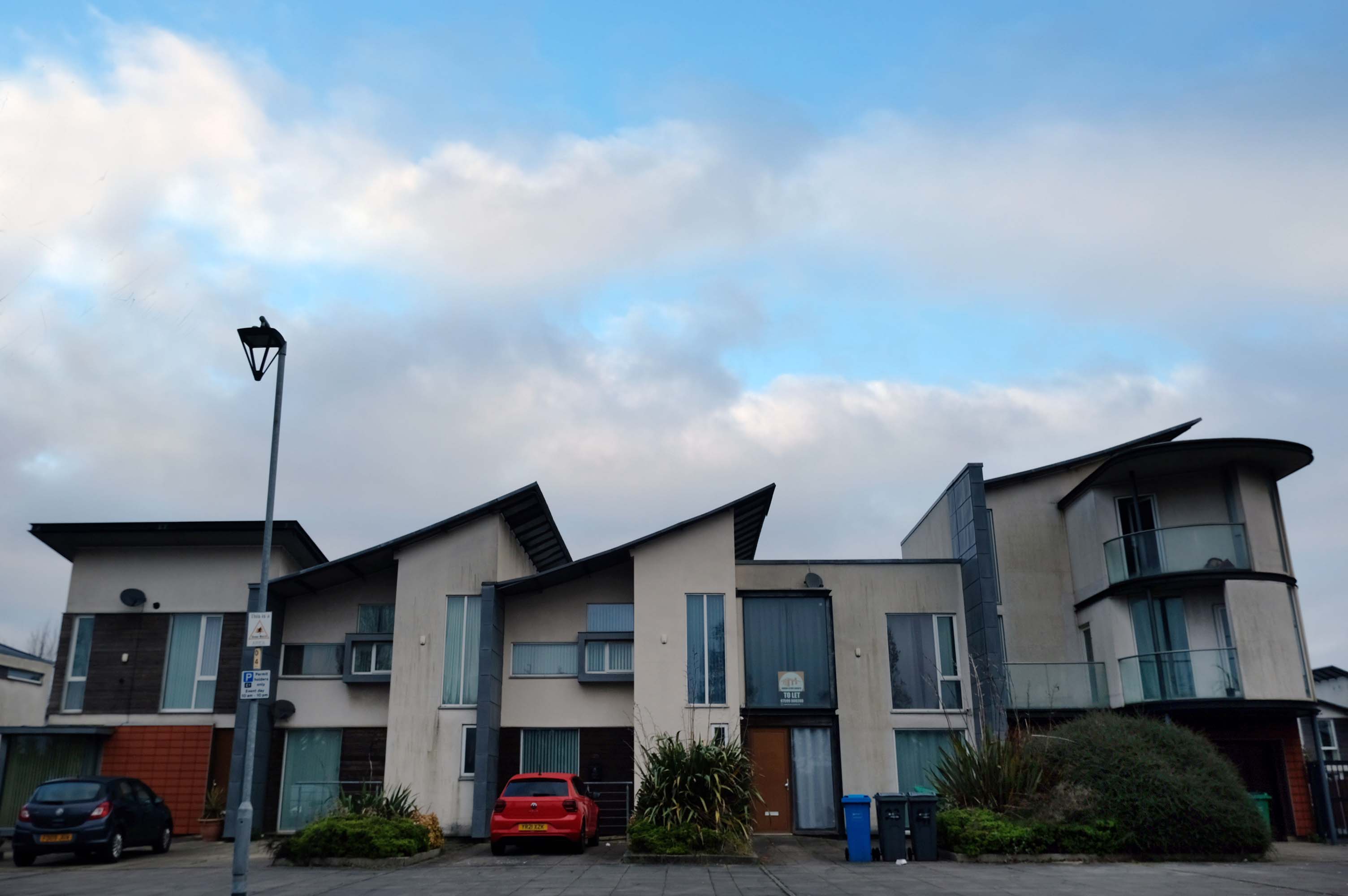
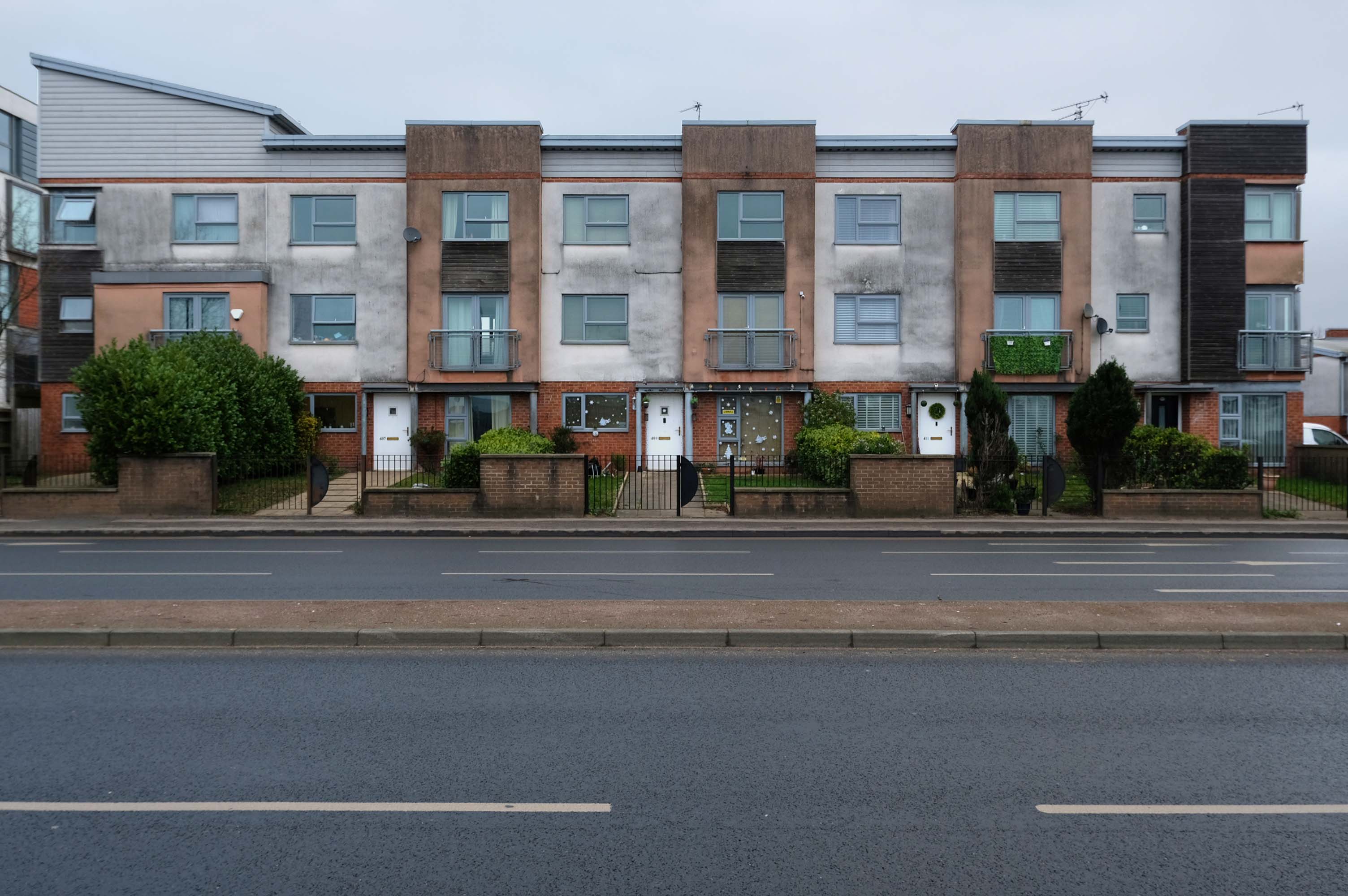
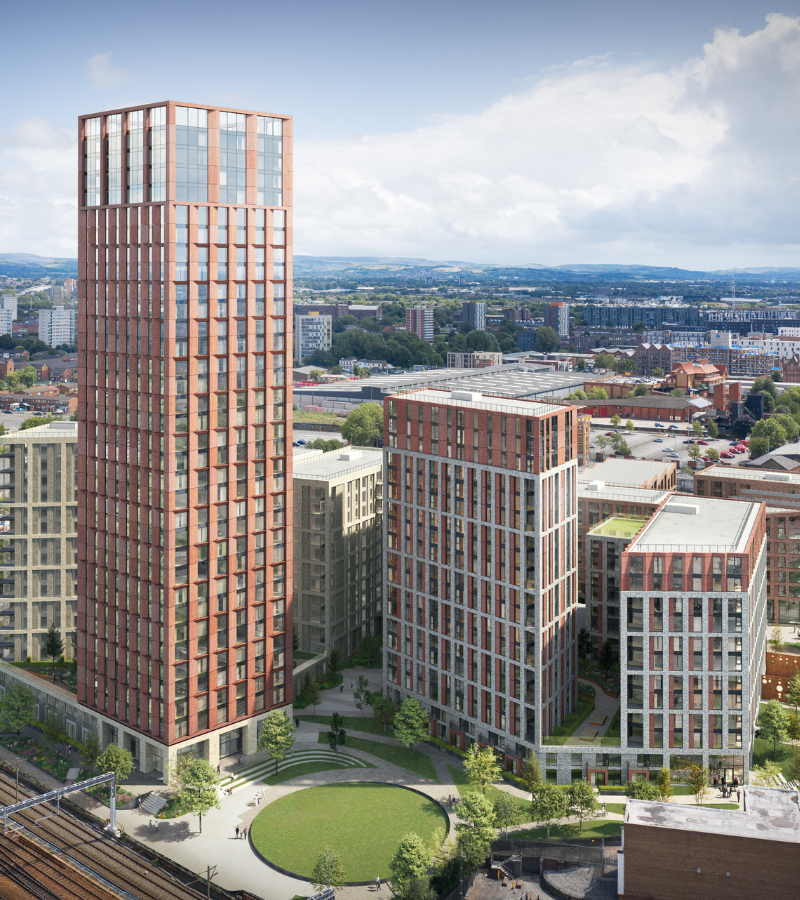
Alongside Ardwick Green Park there are new housing developments nearing completion.

Ardwick Green combines contemporary design with great light infused spaces, offering stylish homes with a modern twist, private parking, outdoor spaces and a welcoming community atmosphere an urban retreat that truly feels like home.

With the city just moments away, living at Ardwick Green will give homeowners easy access to Manchester City Centre and beyond with its vibrant social scene, bustling business landscape and extensive transport network on your doorstep. 

Step Places

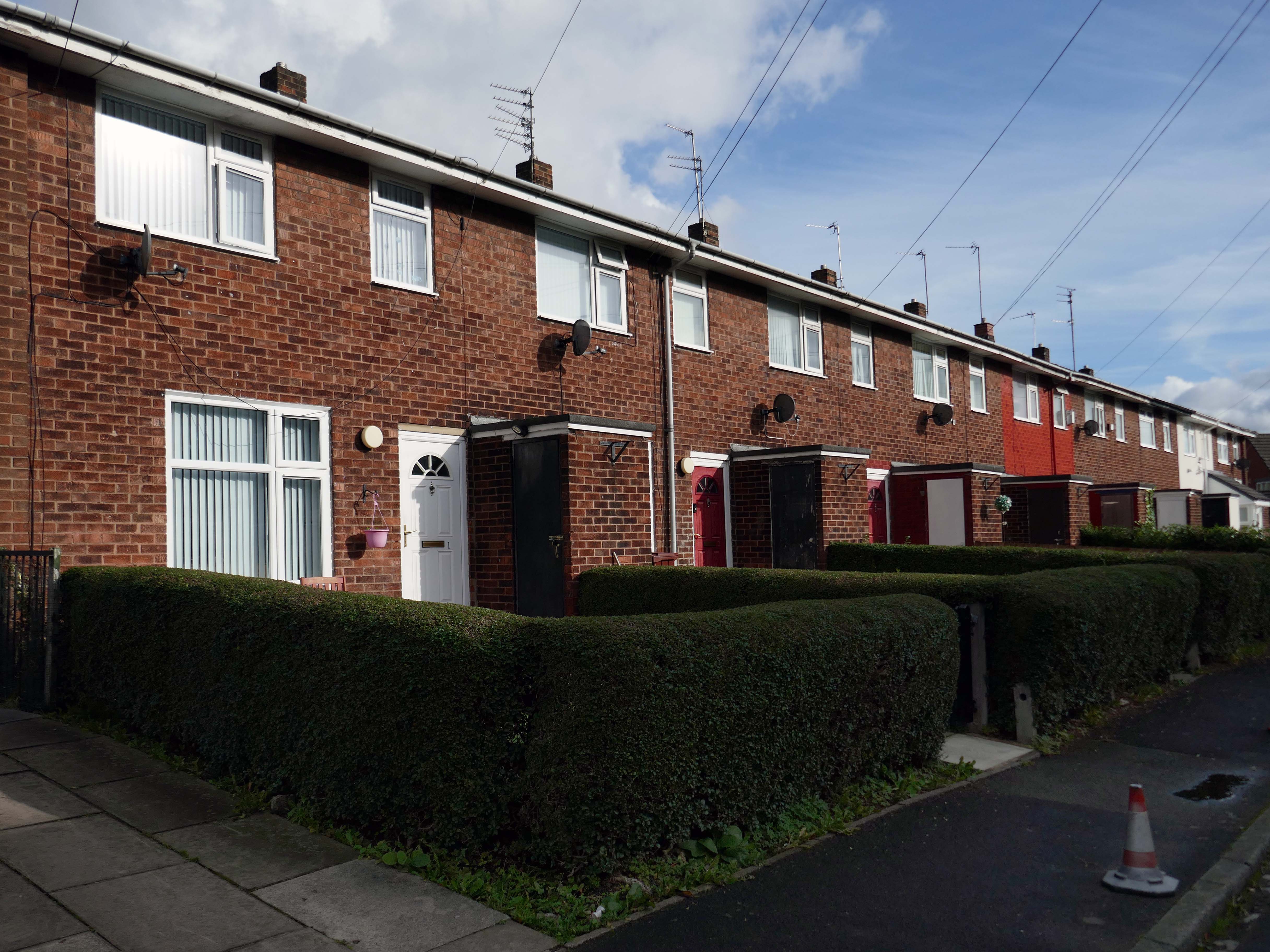
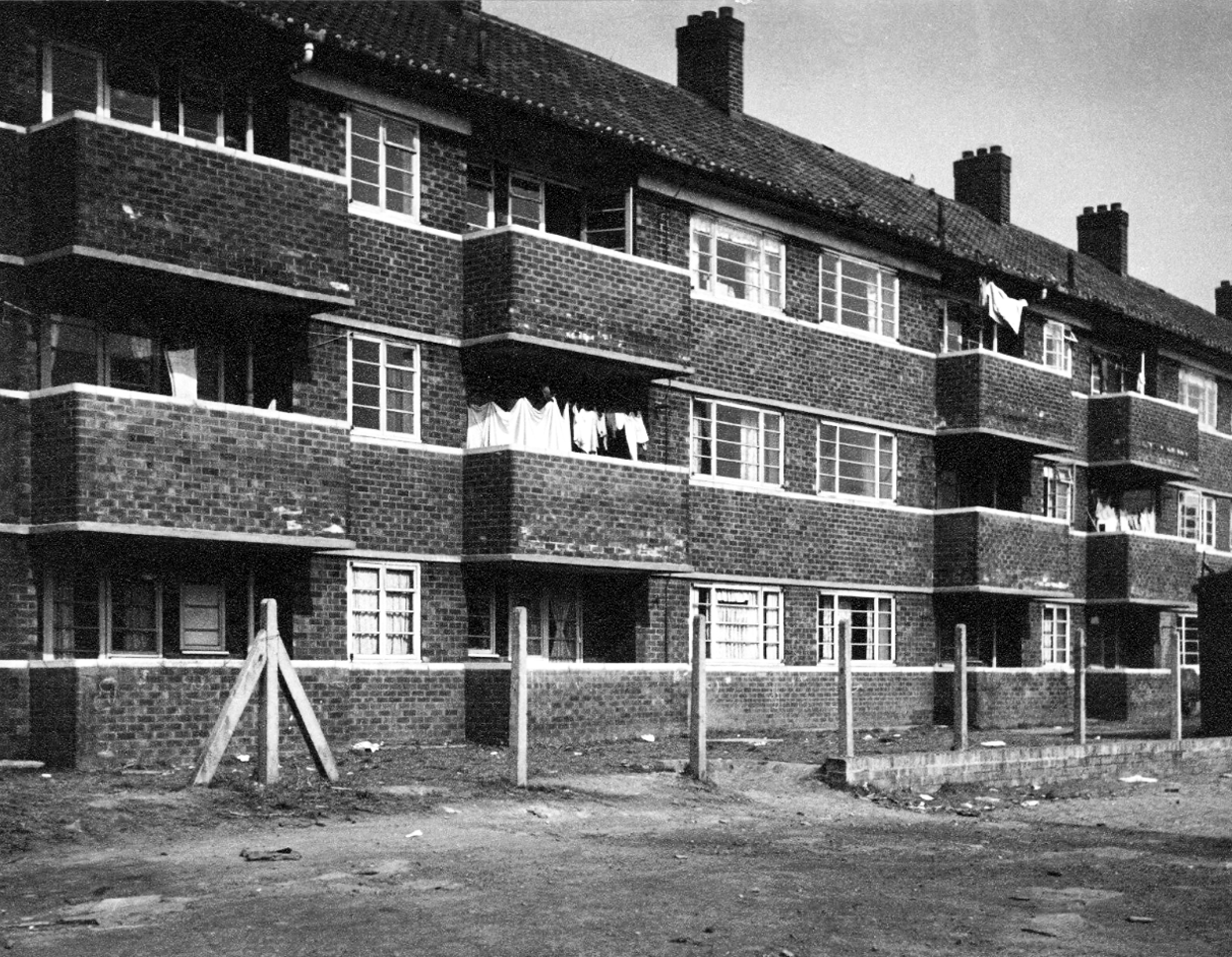
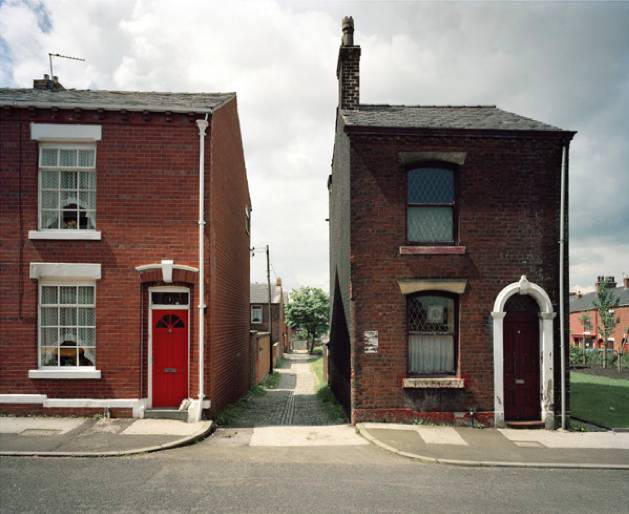
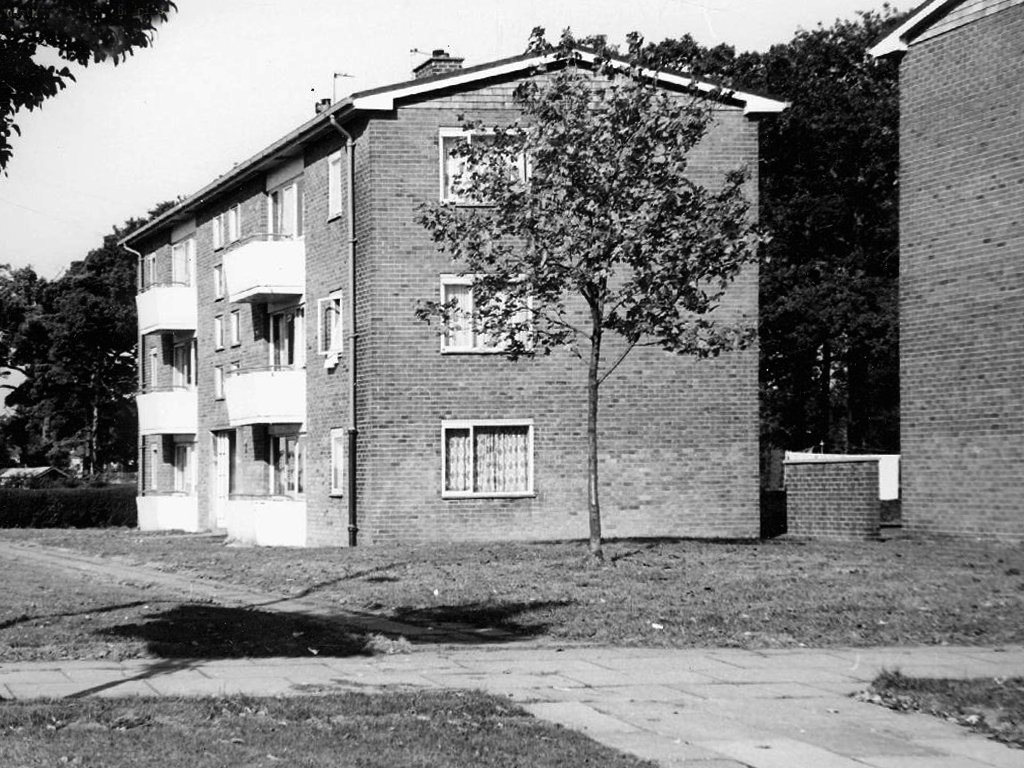
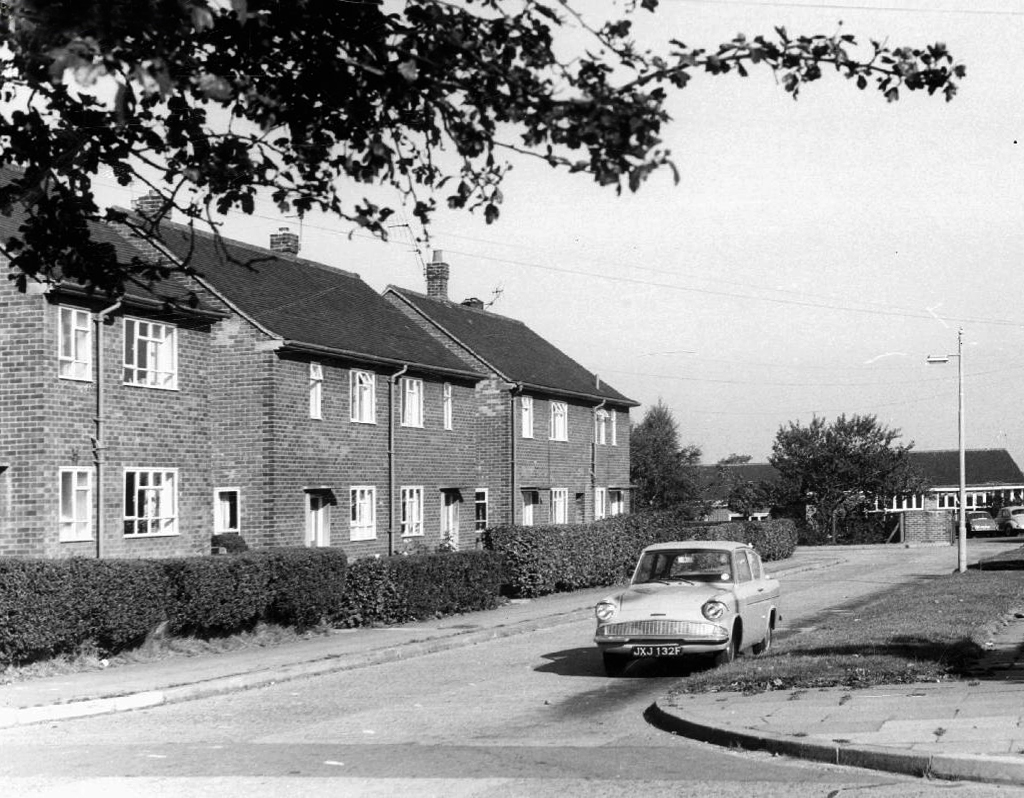
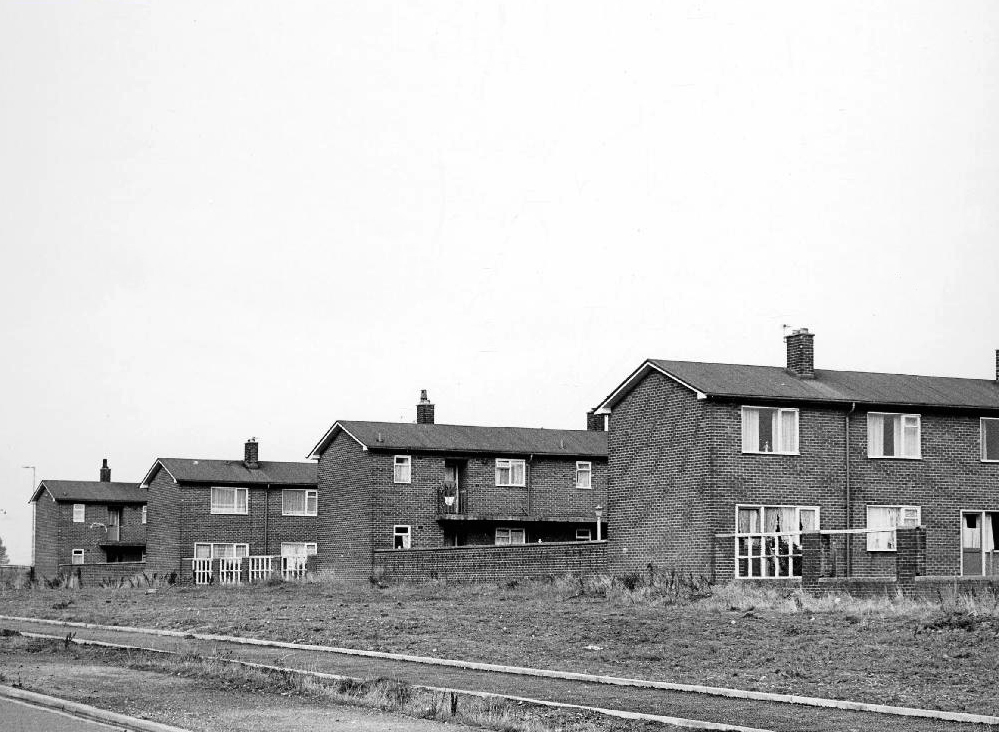
The area is home to a mixed and mongrel bunch of homes.

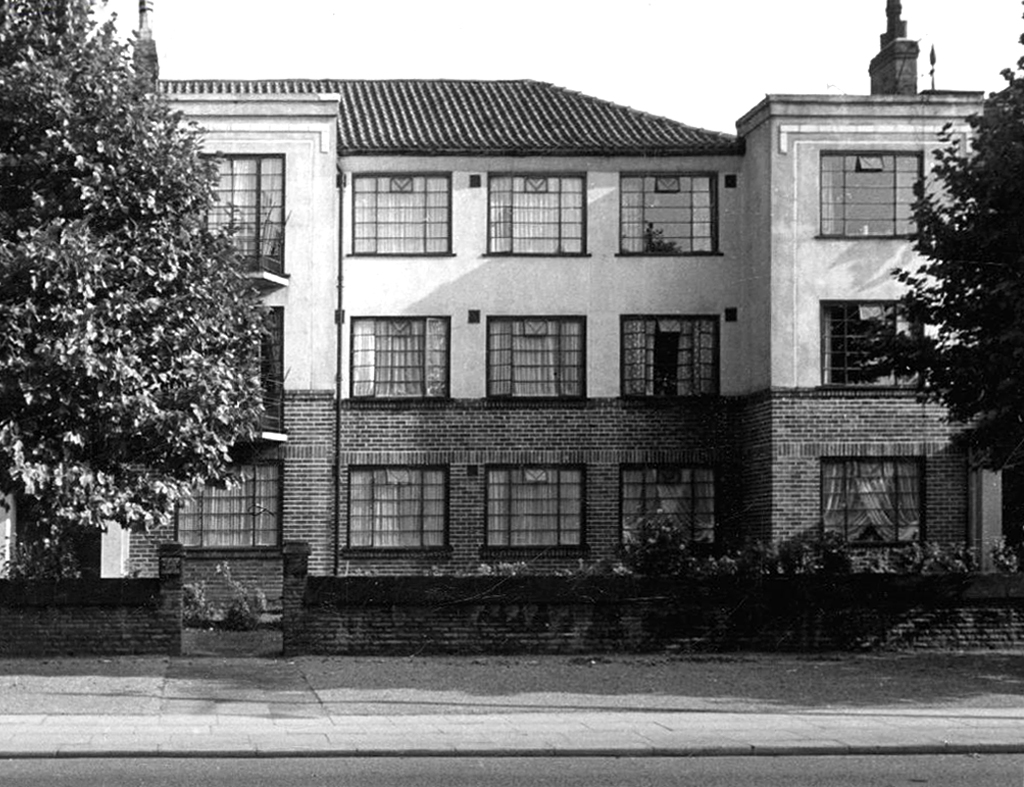
Though these interwar flats, seen here in 1956, are now long gone.

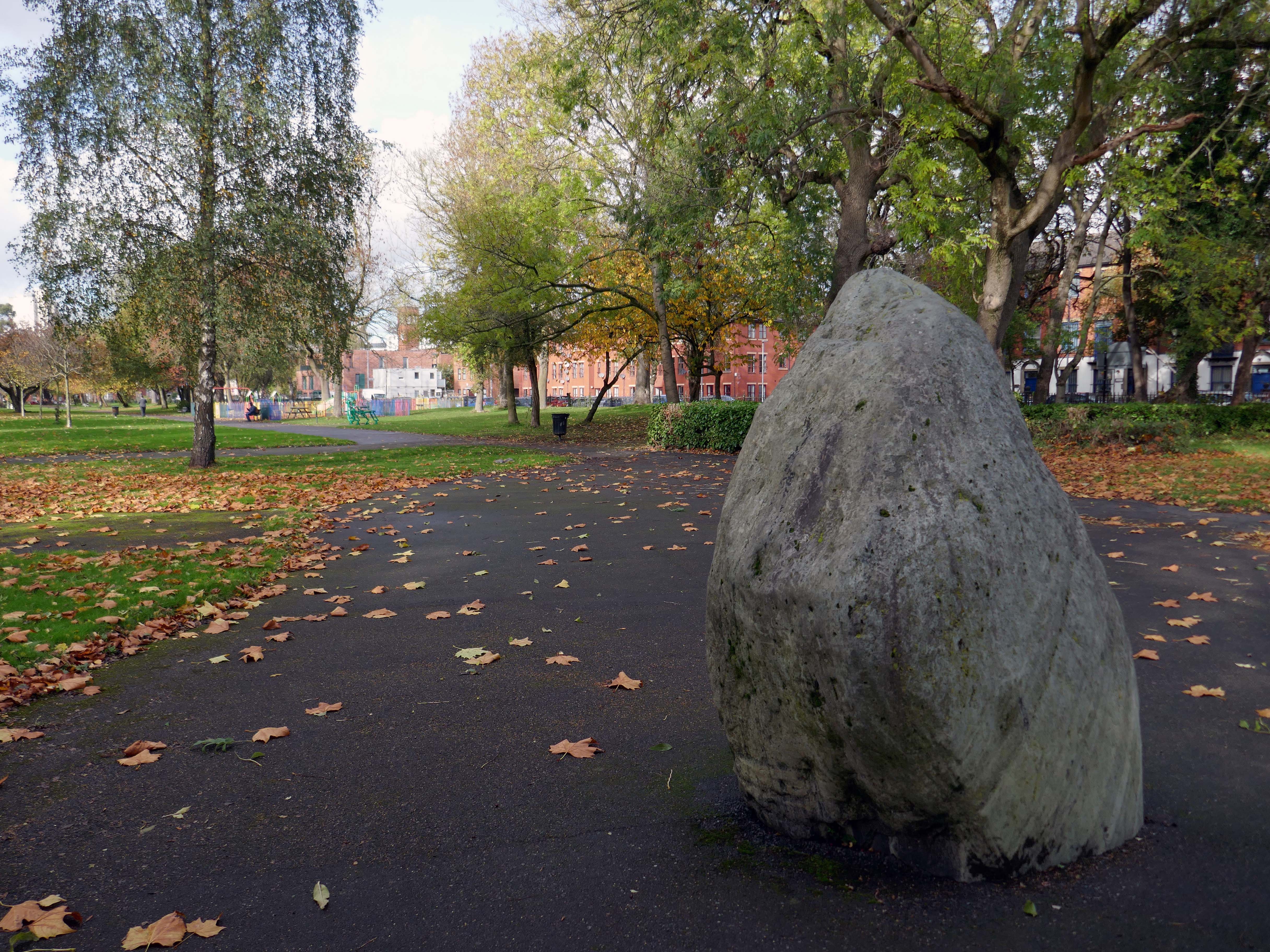
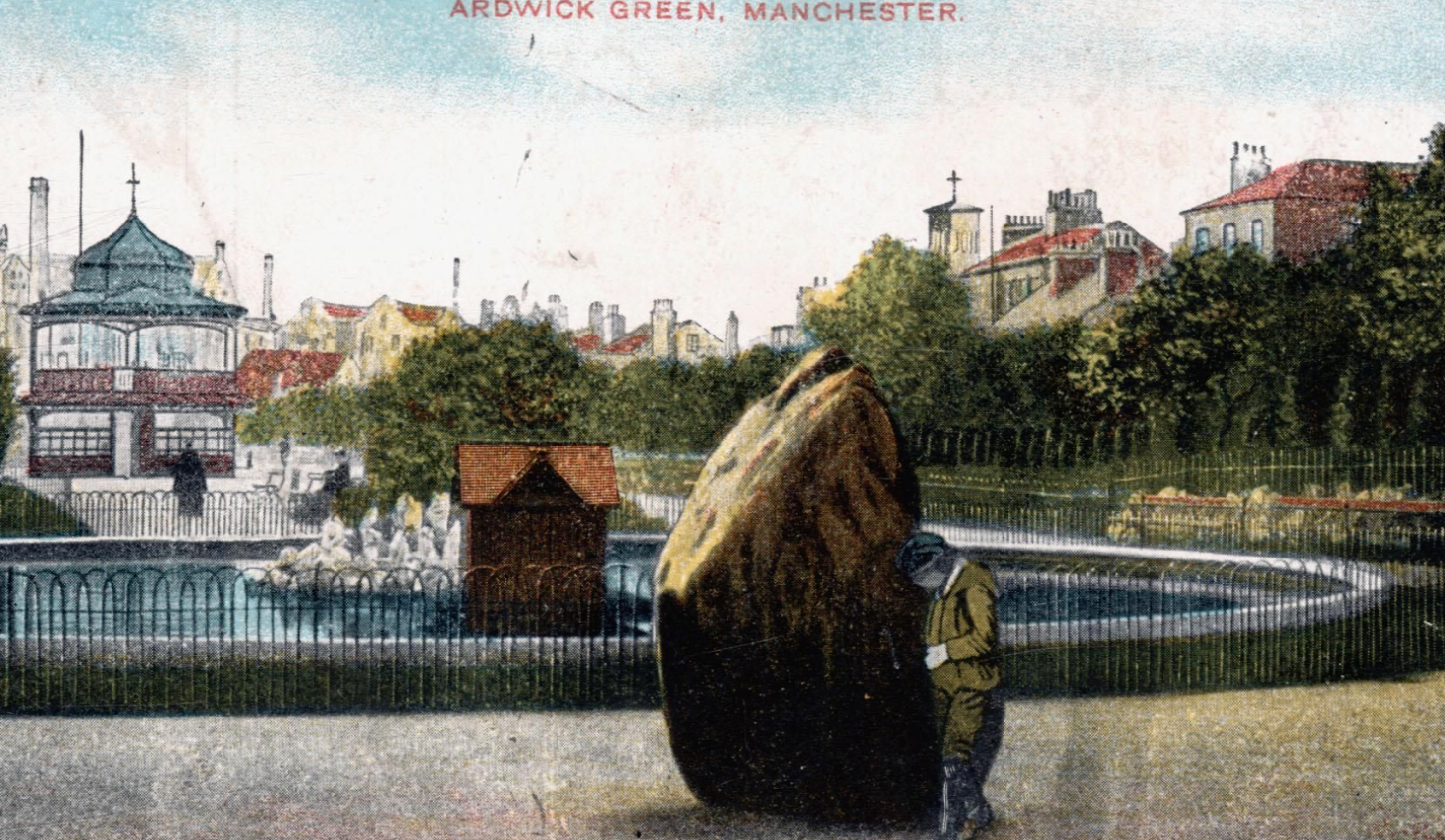
Within the park is a glacial erratic, which arrived following the Last Glacial Period .

Without which much of what we understand as the modern age would possibly not now exist.

It appears to be green slate from the Lake District, the native underlying rock in this part of Manchester is a red sandstone.

Postcard of 1906

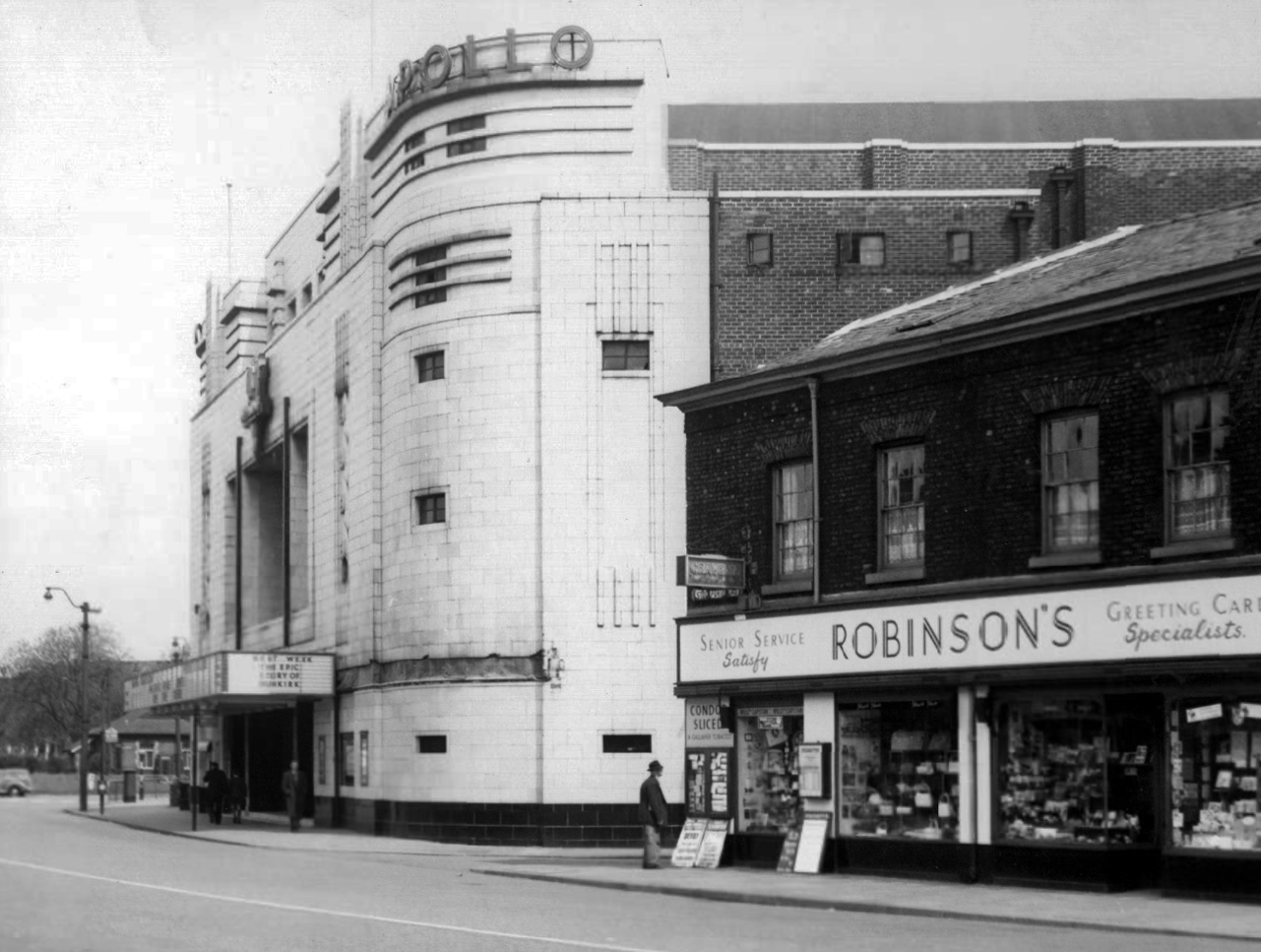
The Apollo of course prevails. – seen here in 1958

Architects: Peter Cummings Alex M Irvine

Opened on 29th August 1938 the interior decorations were carried out by noted interior designers Mollo & Egan with the Holophane lighting designed by R Gillespie Williams.

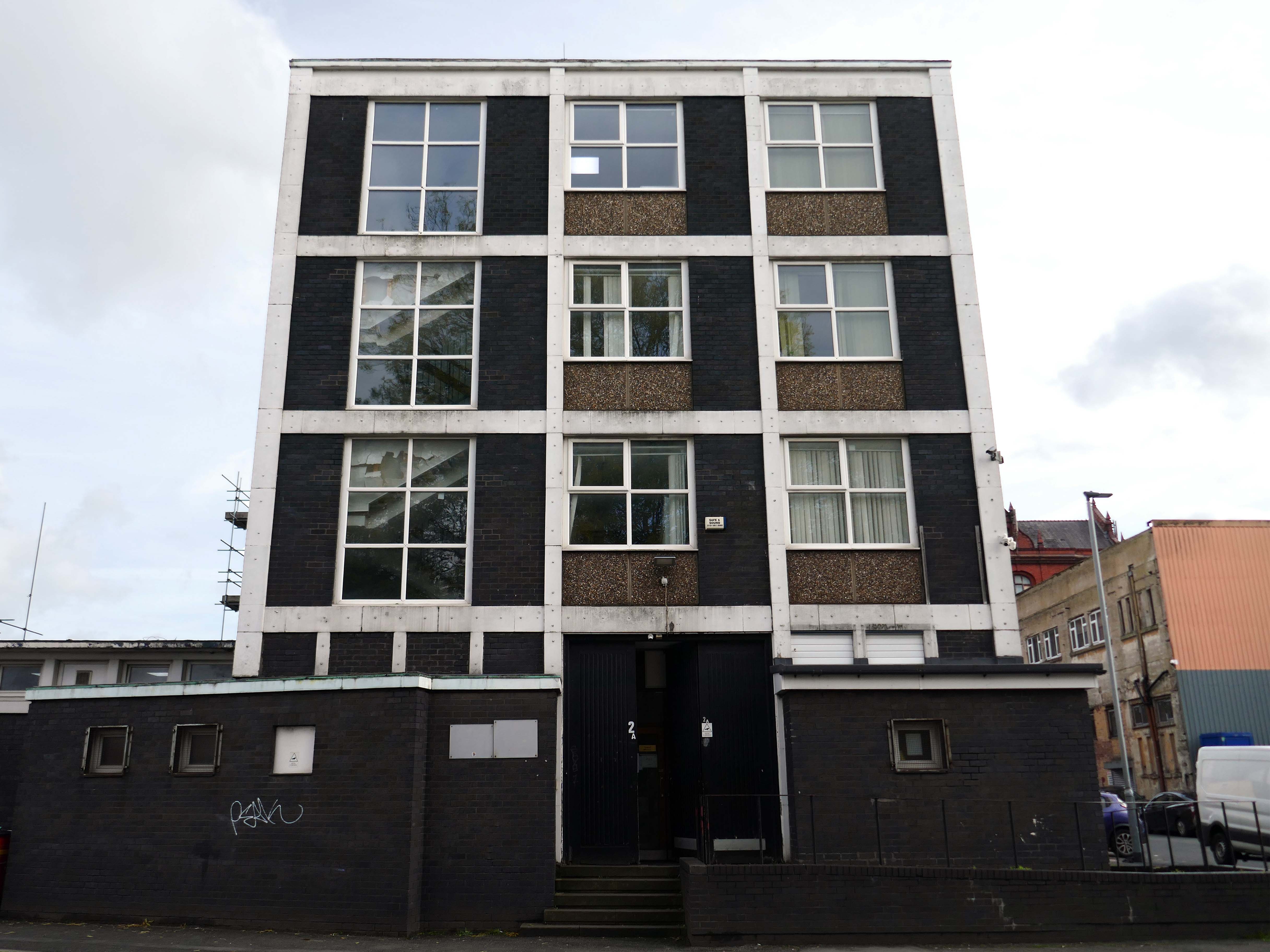
This Sixties municipal building remains a mystery.

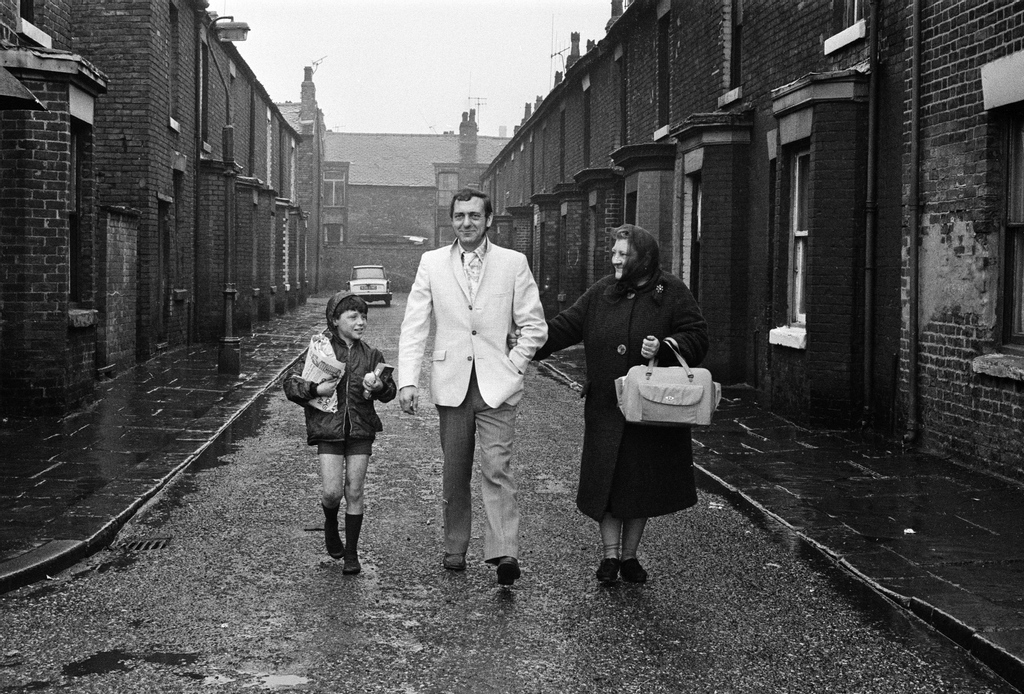
Actor Harry H Corbett visiting his childhood area in 1969, he lived on Earl Street and later in Wythenshawe.

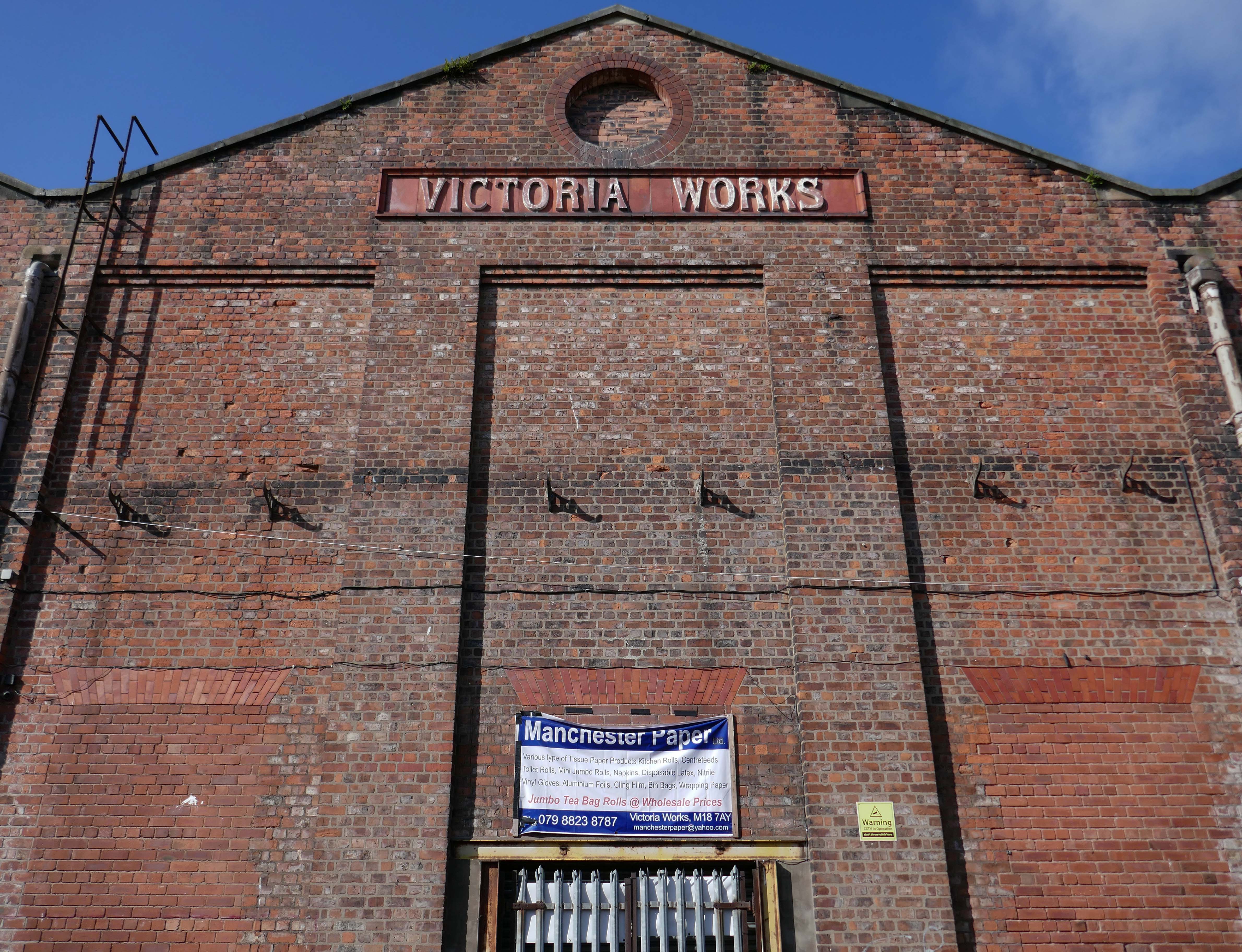
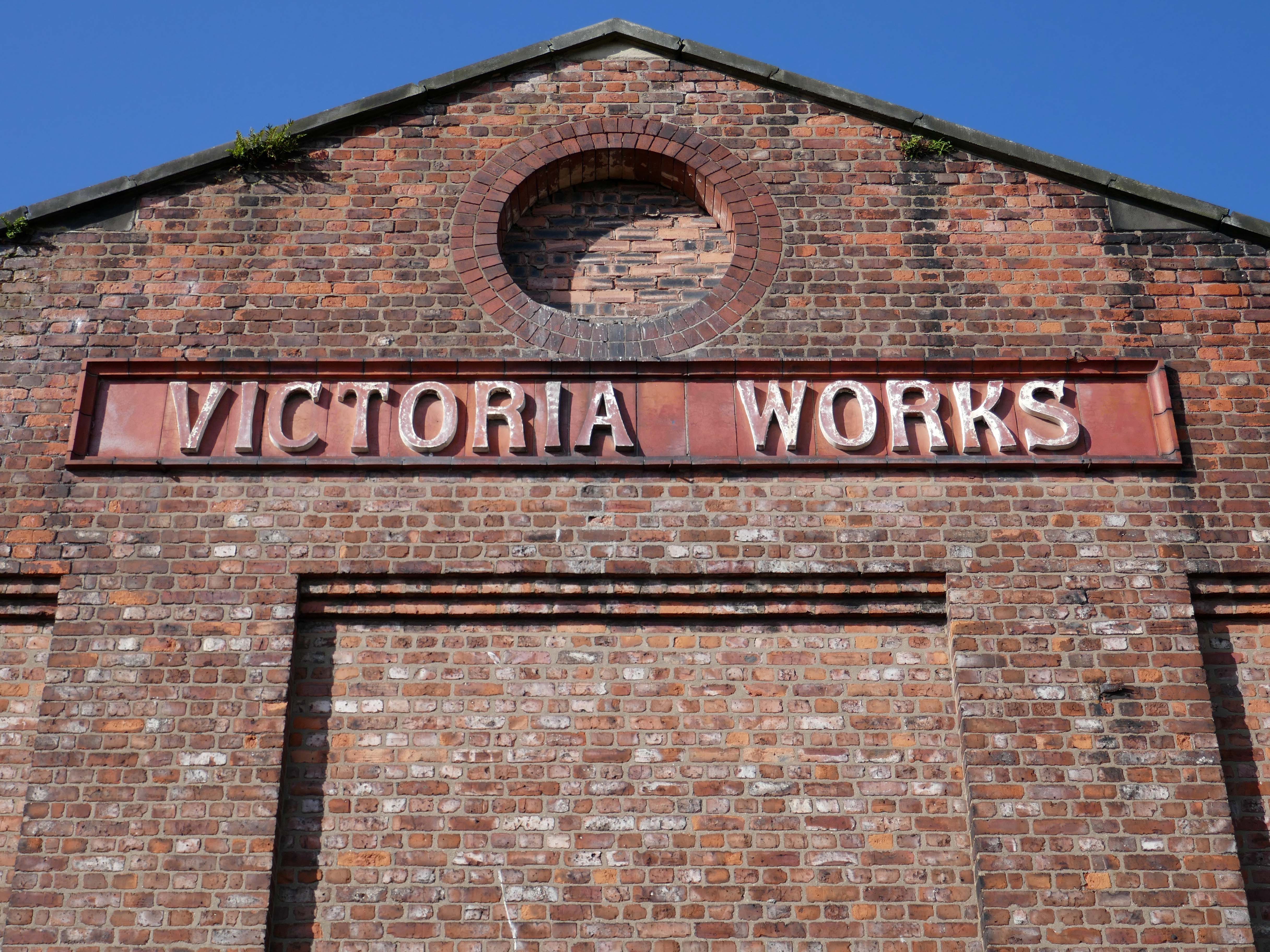
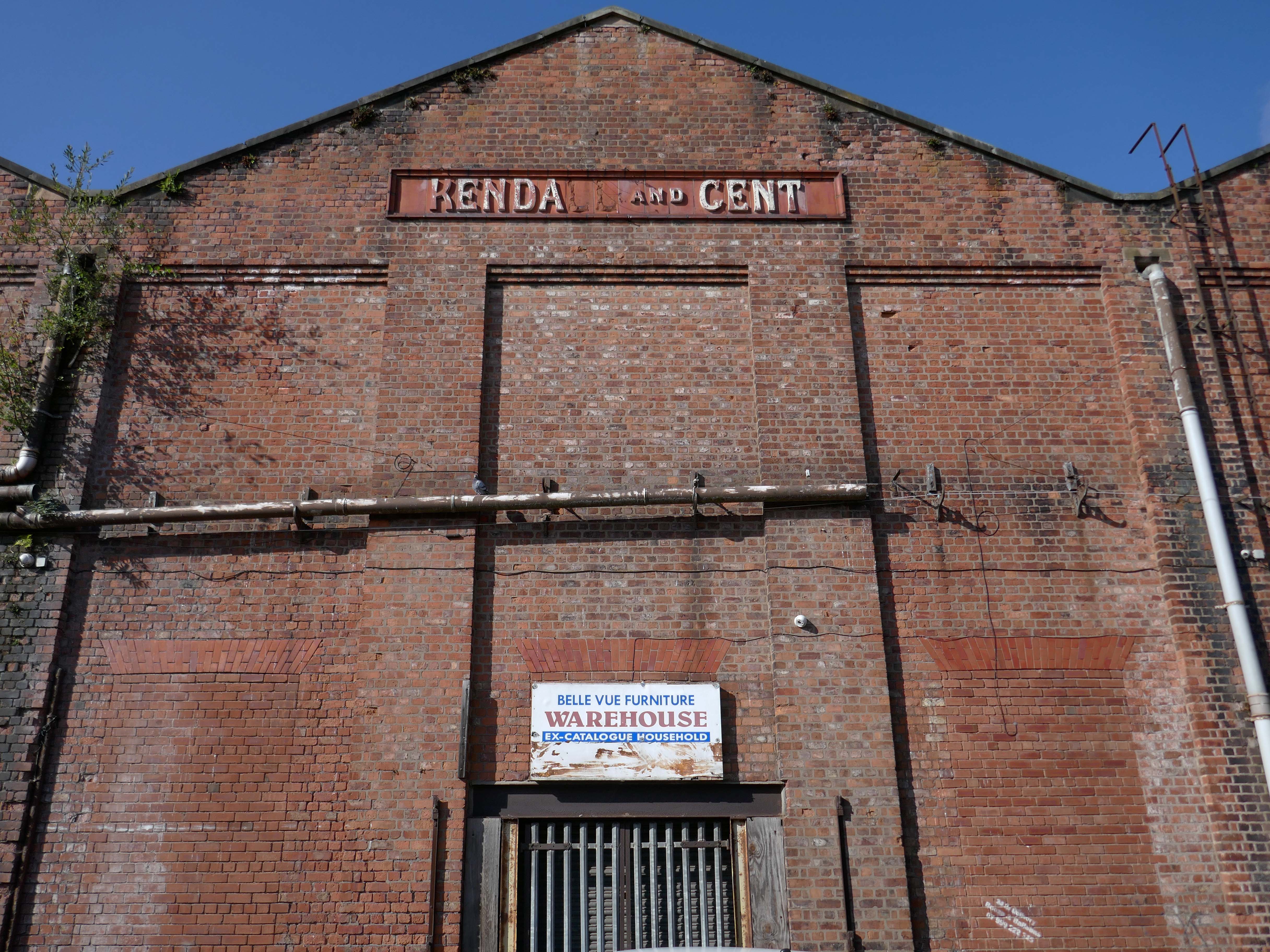
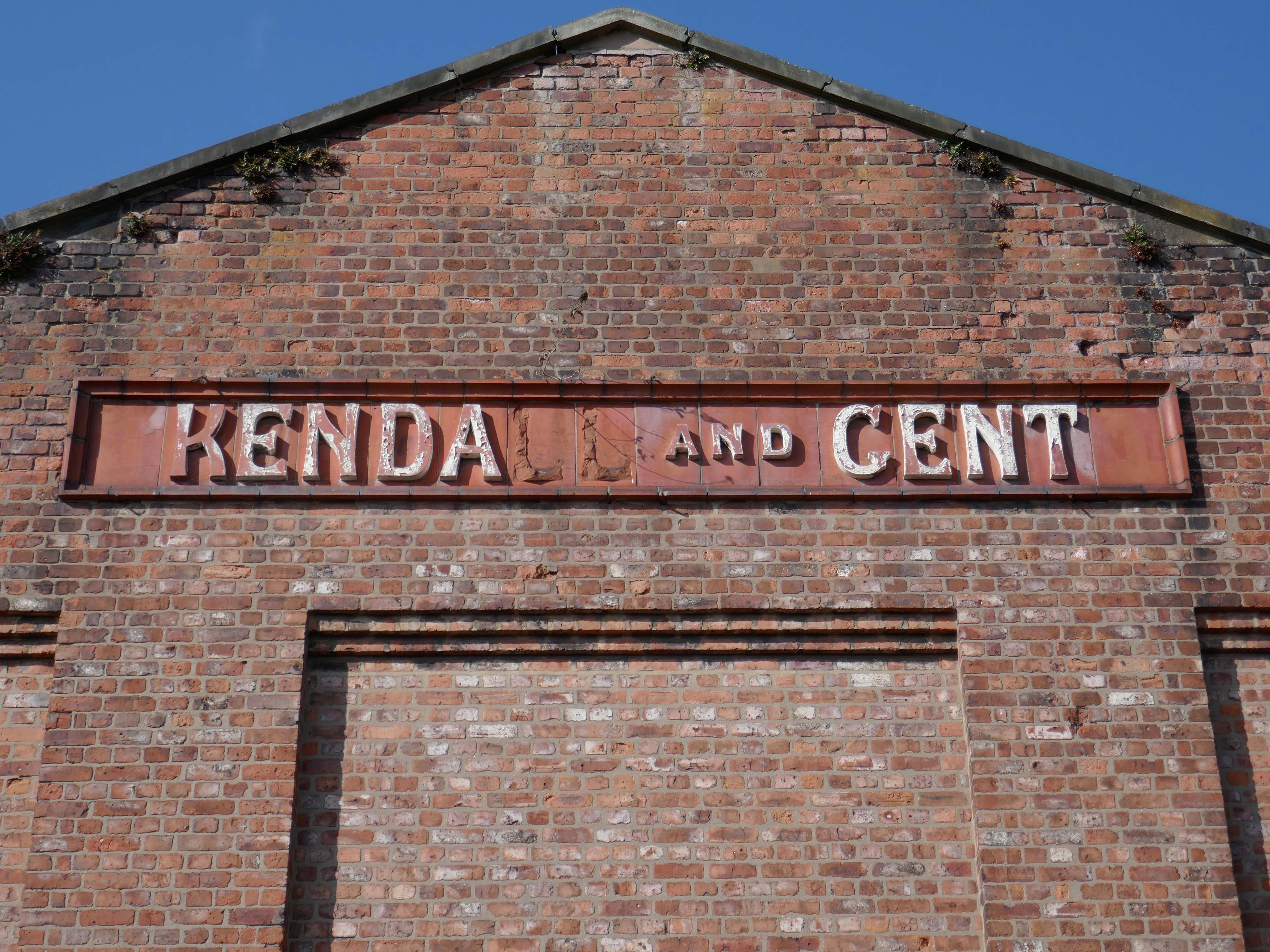
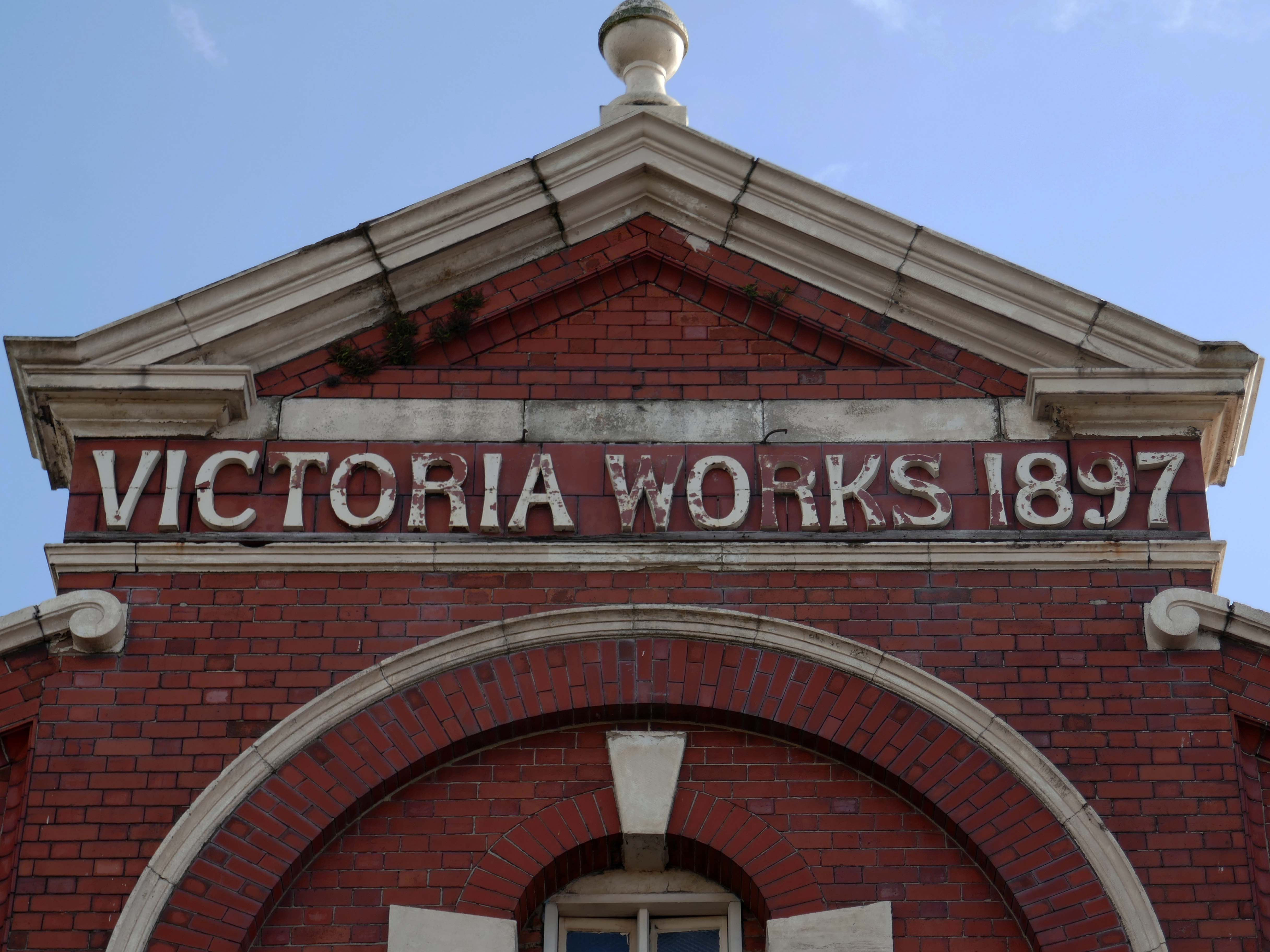
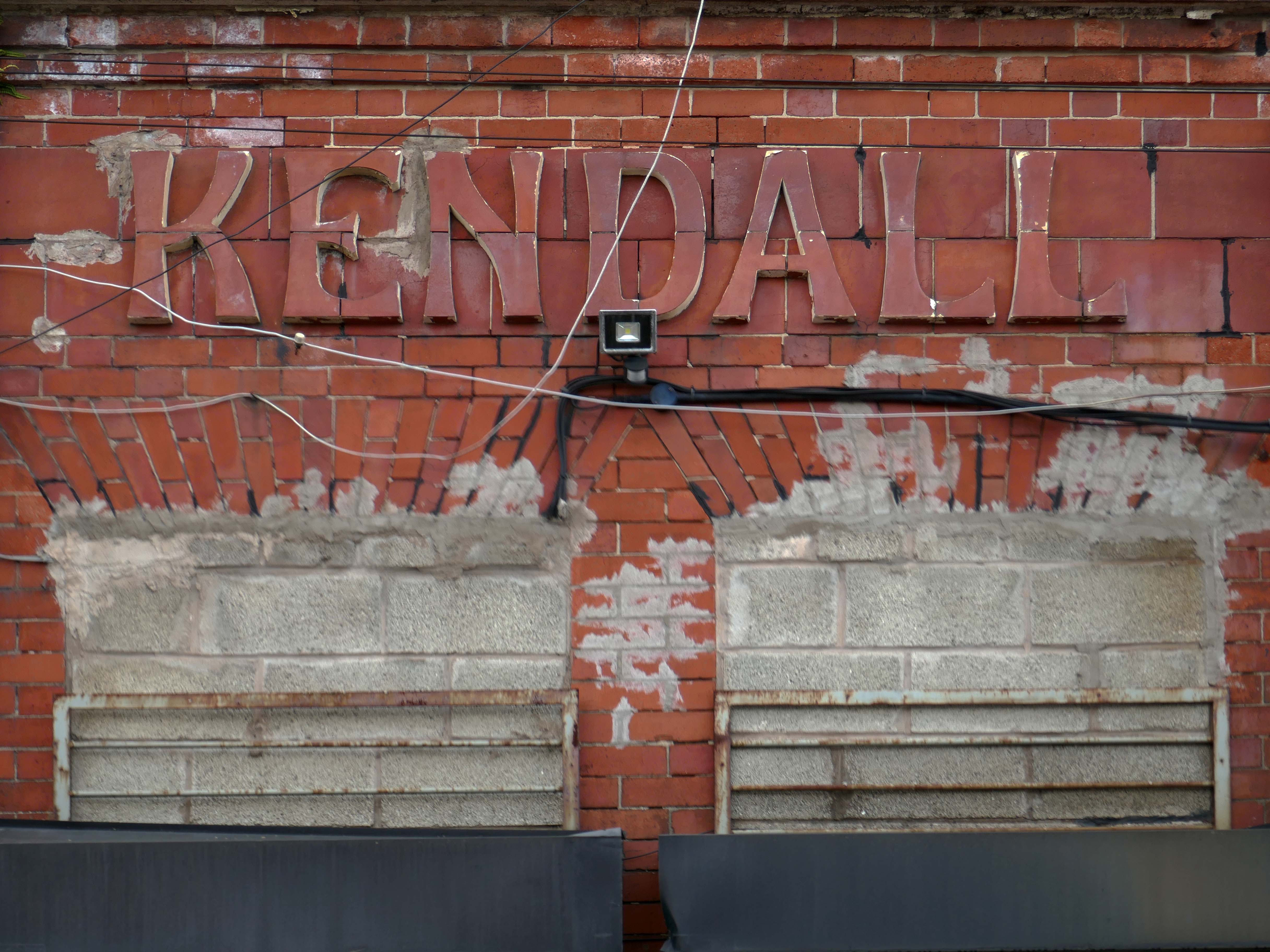
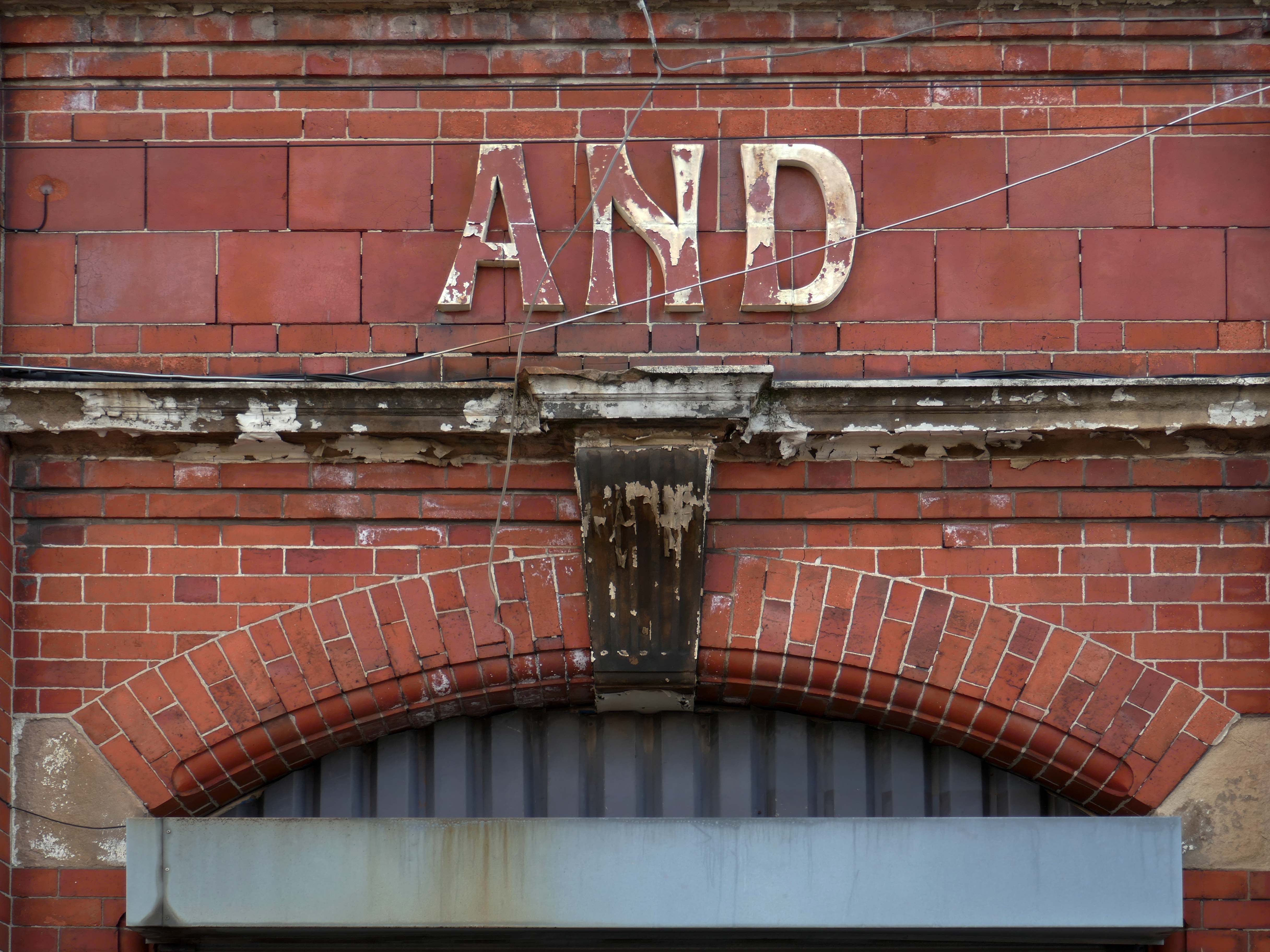
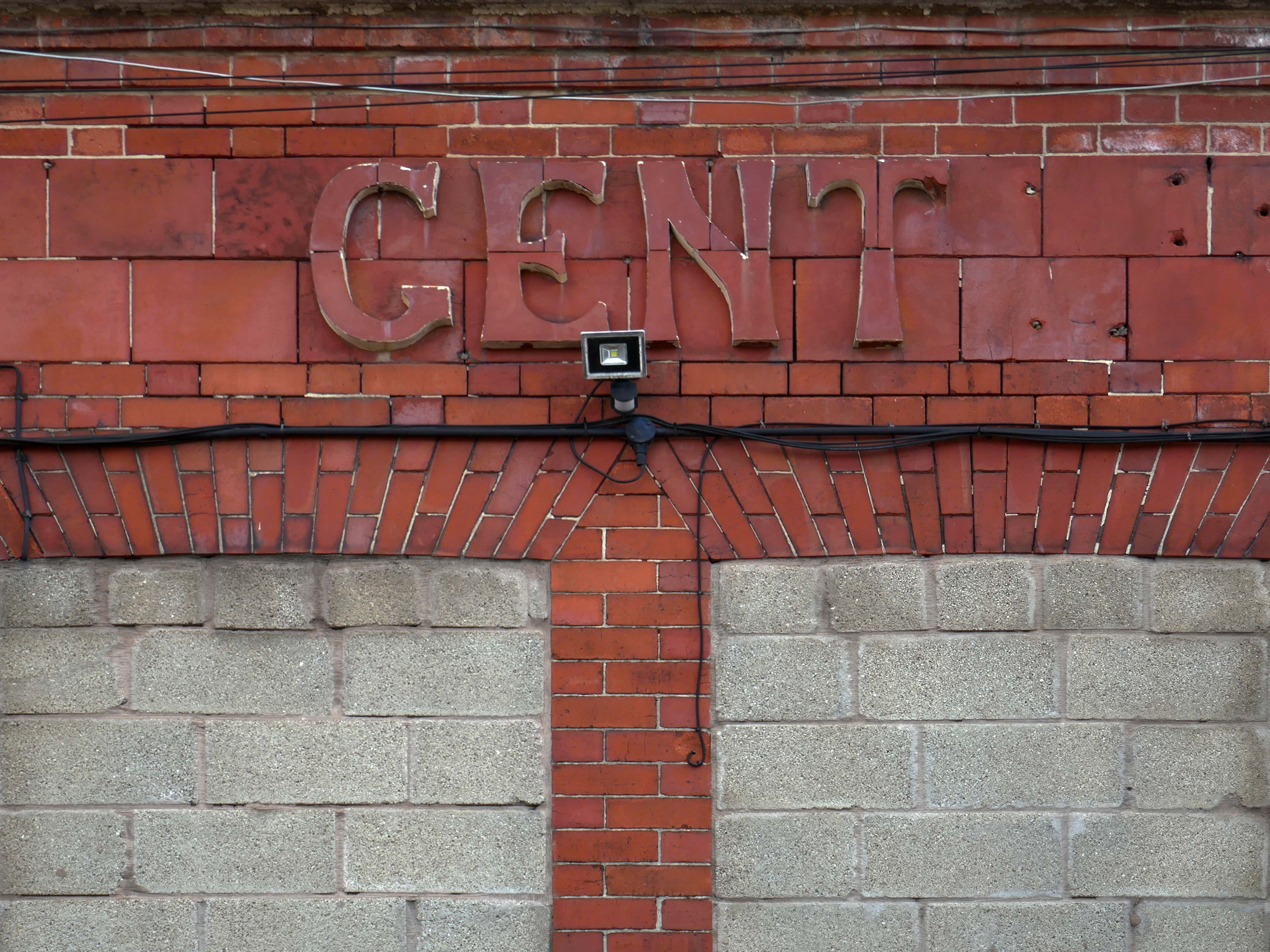
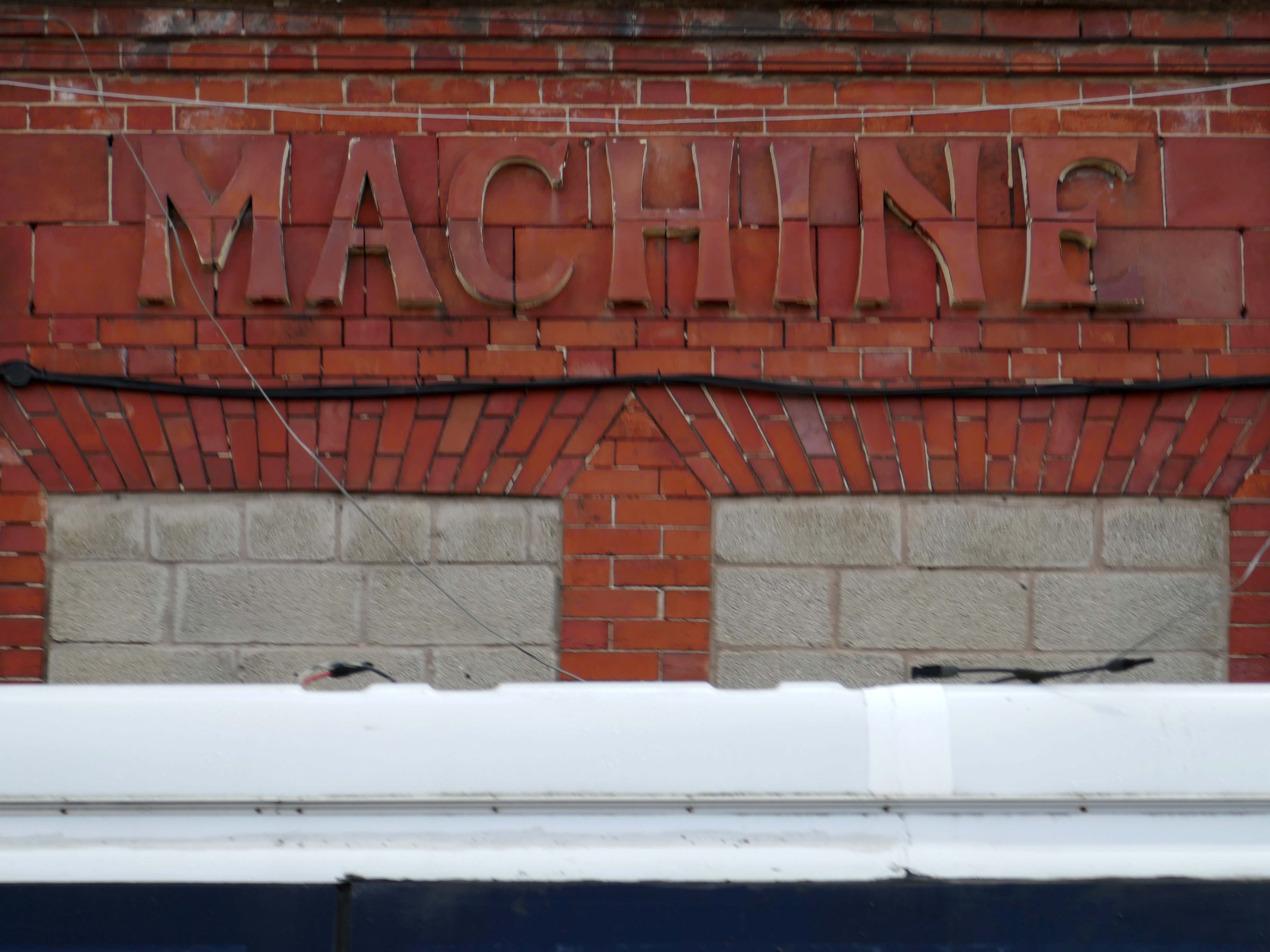
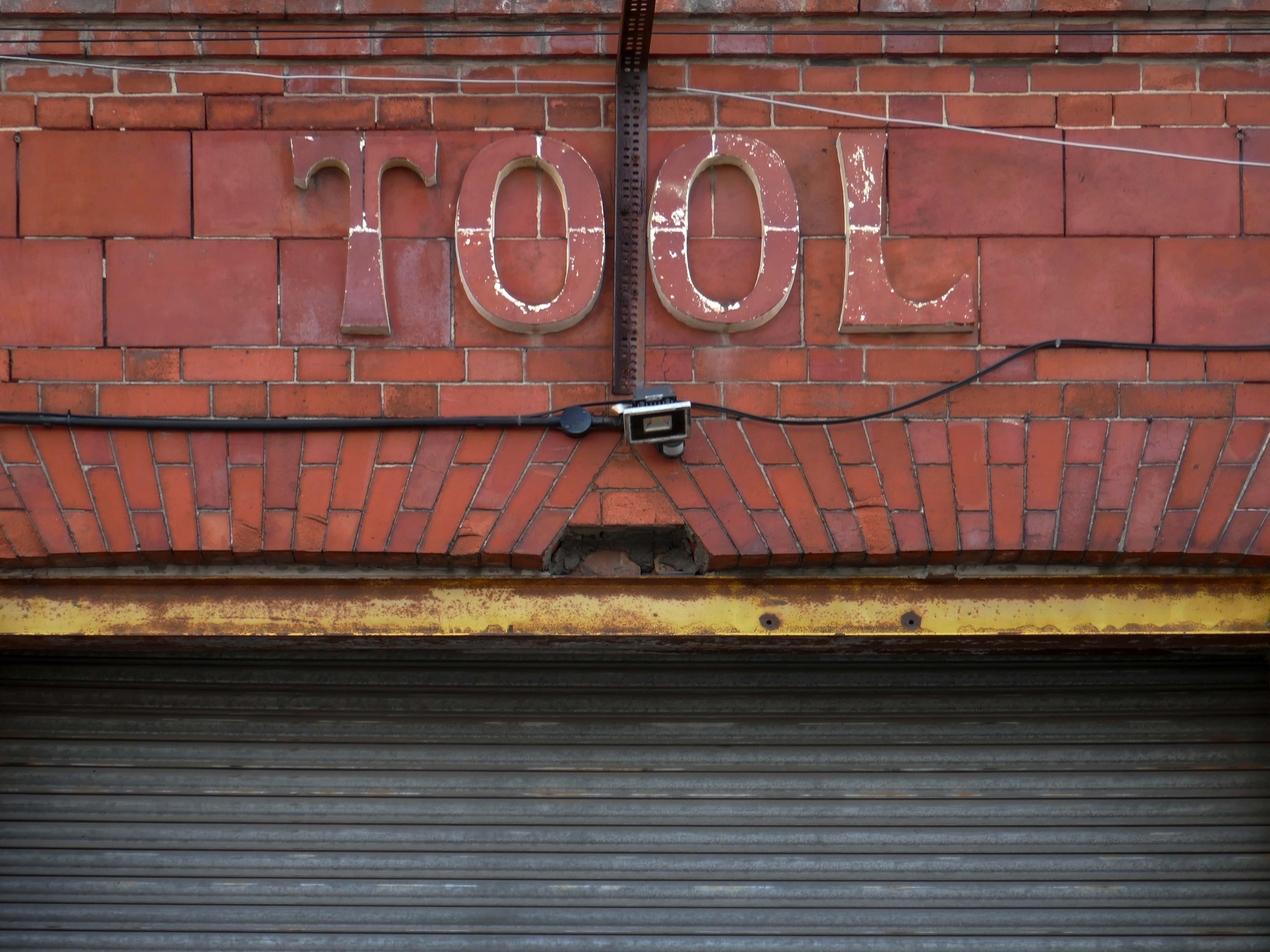
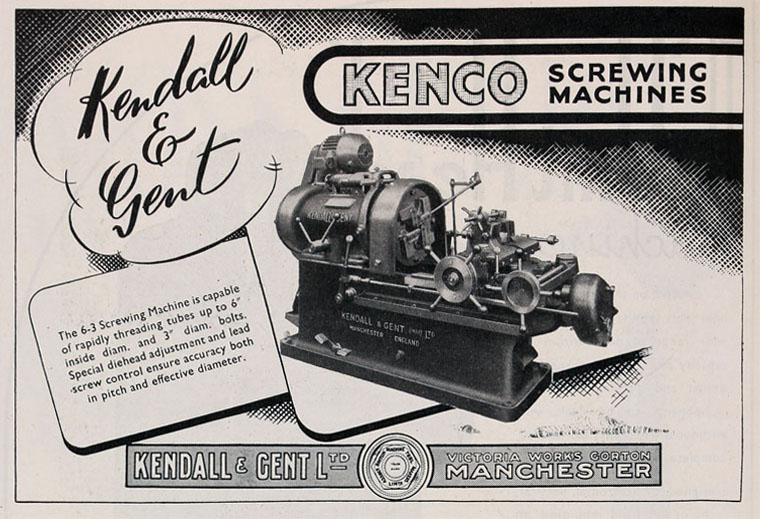
Kendall & Gent – Victoria Works

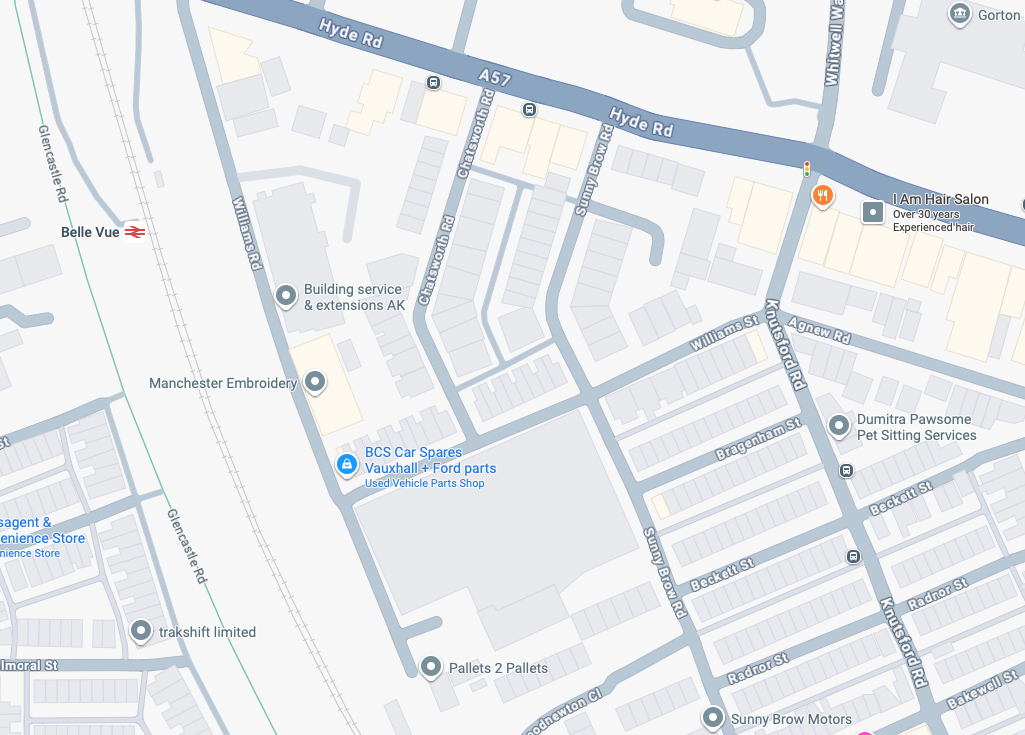
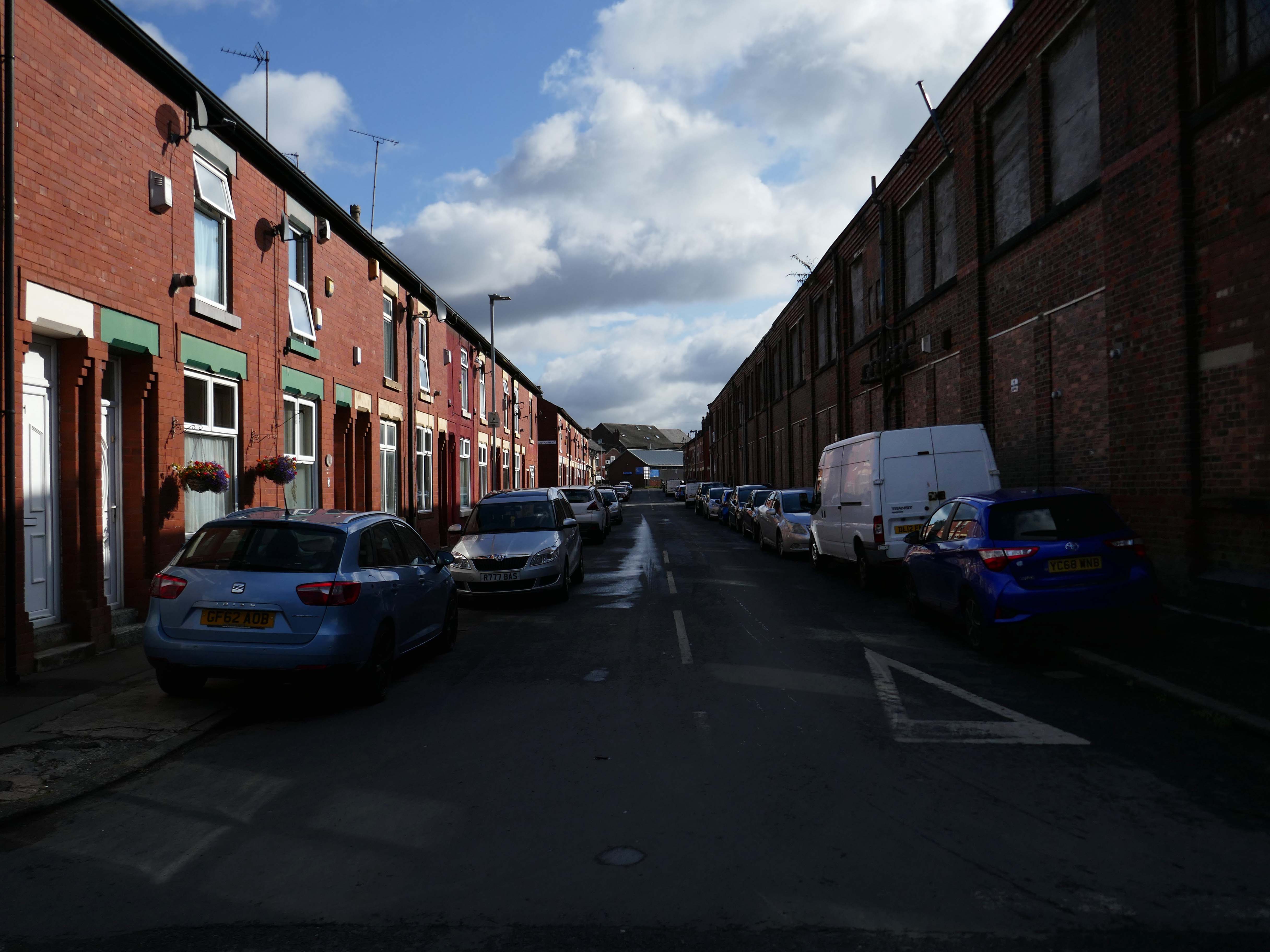
Bounded on three sides by Williams Road, Williams Street and Sunny Brow Lane.

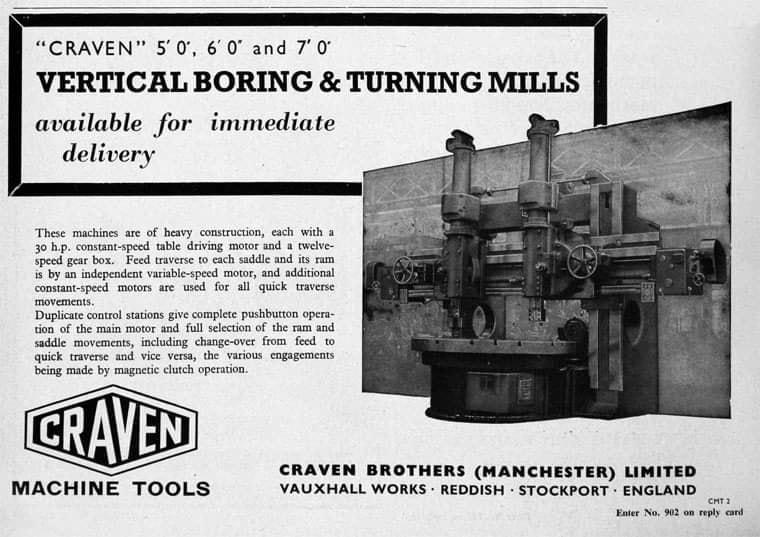
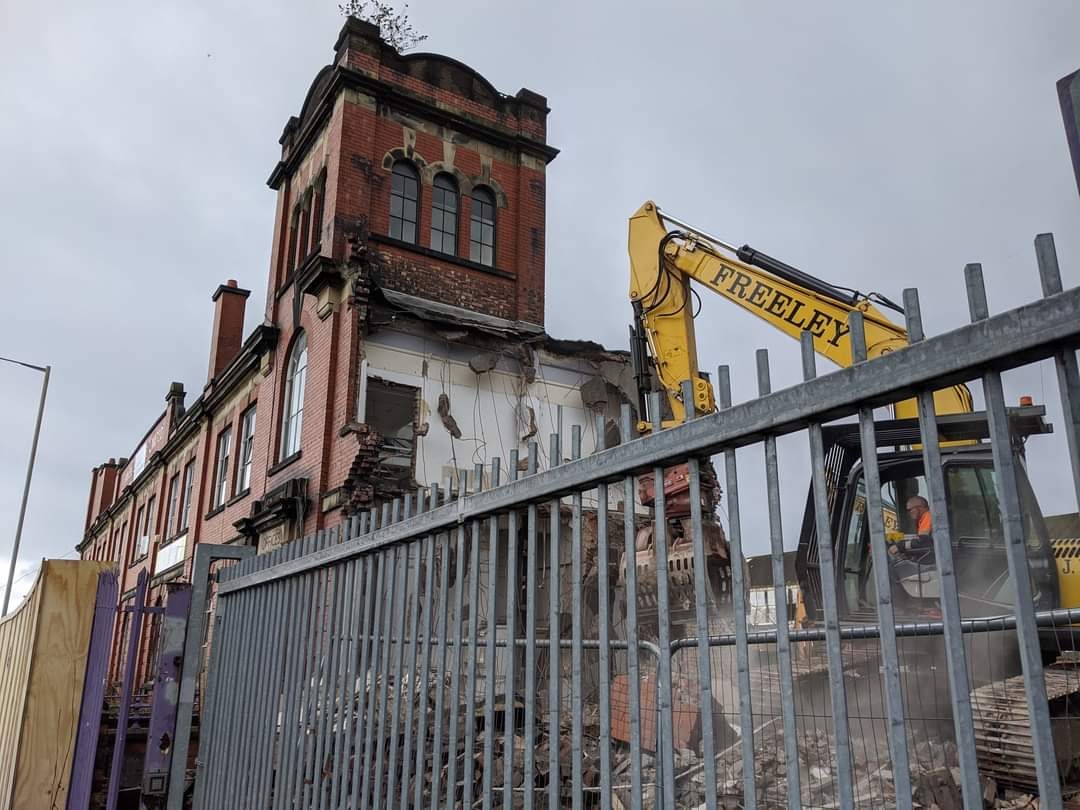
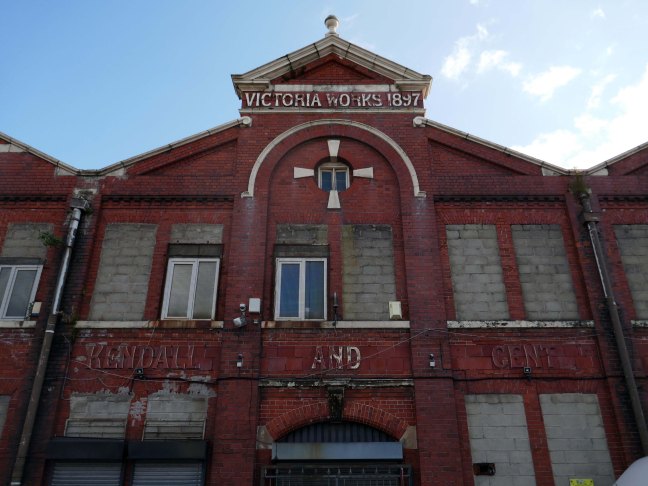
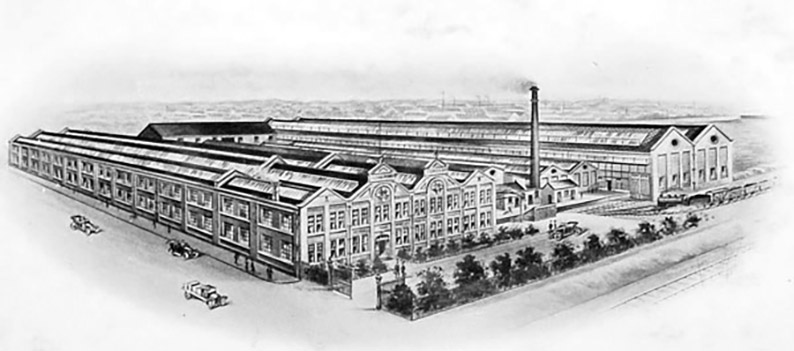
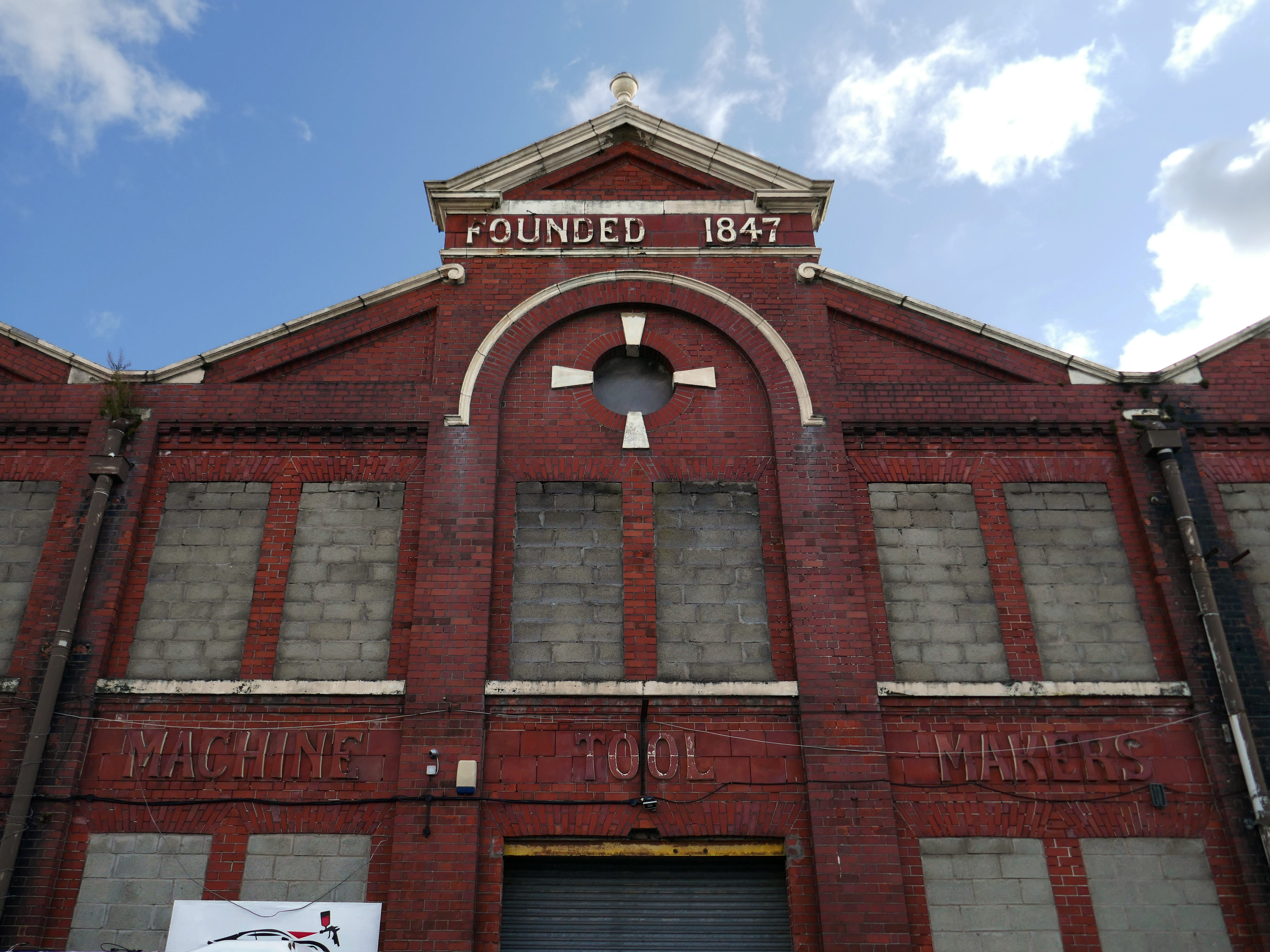
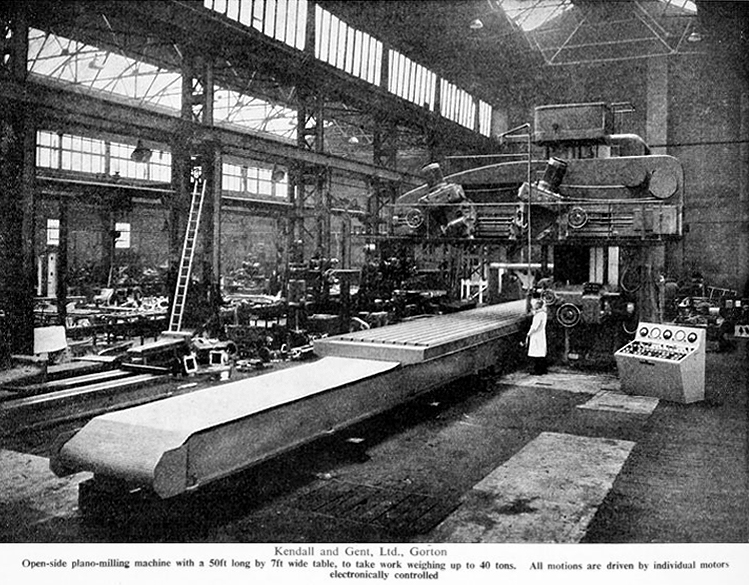
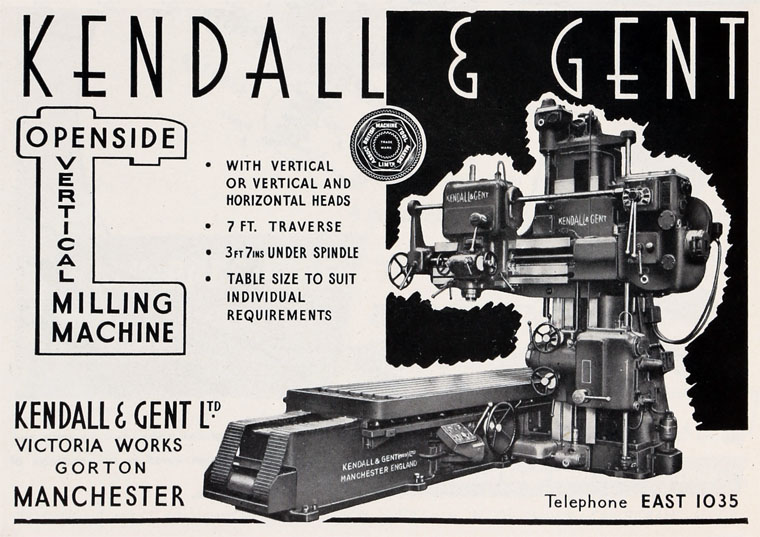
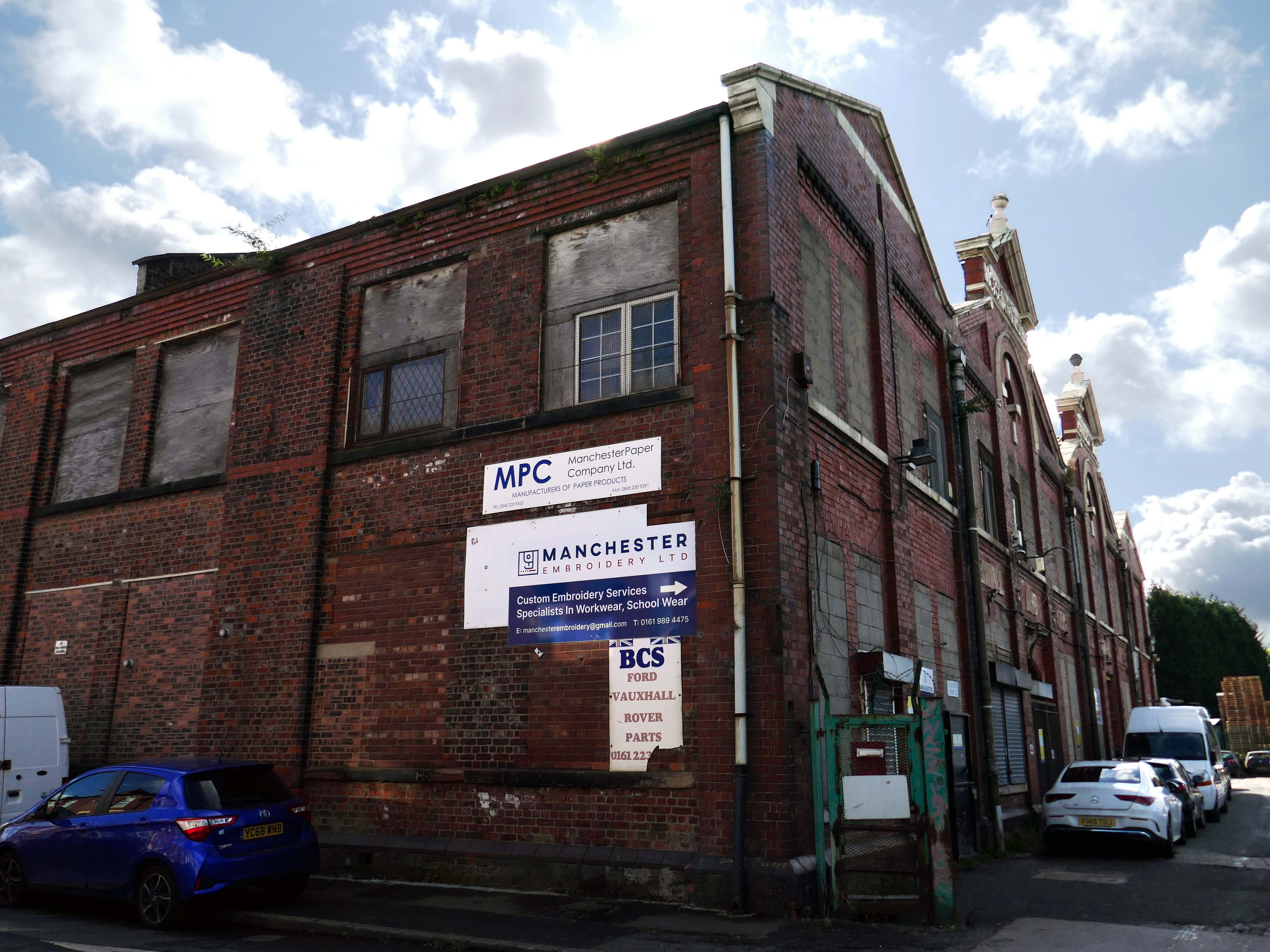
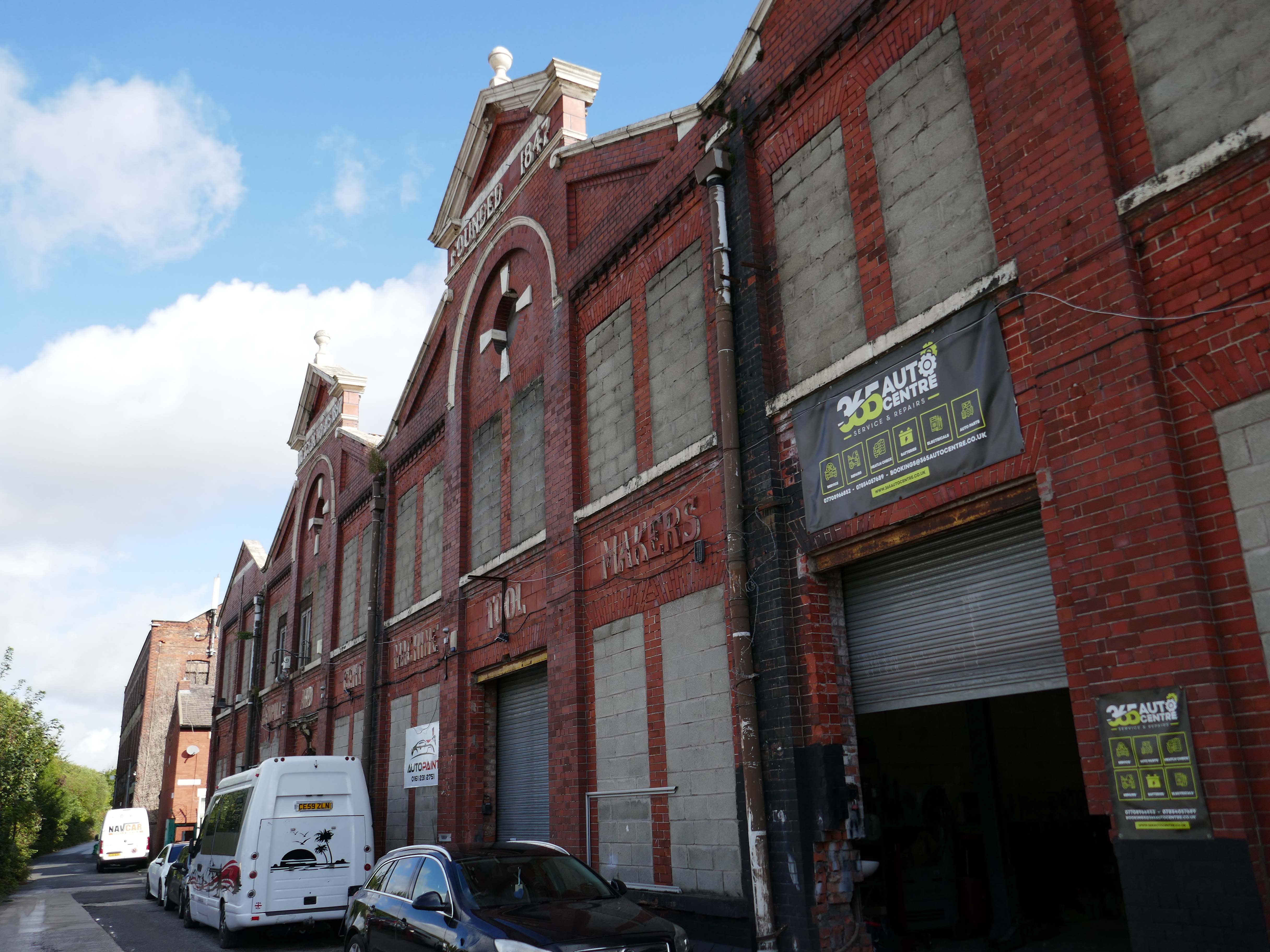
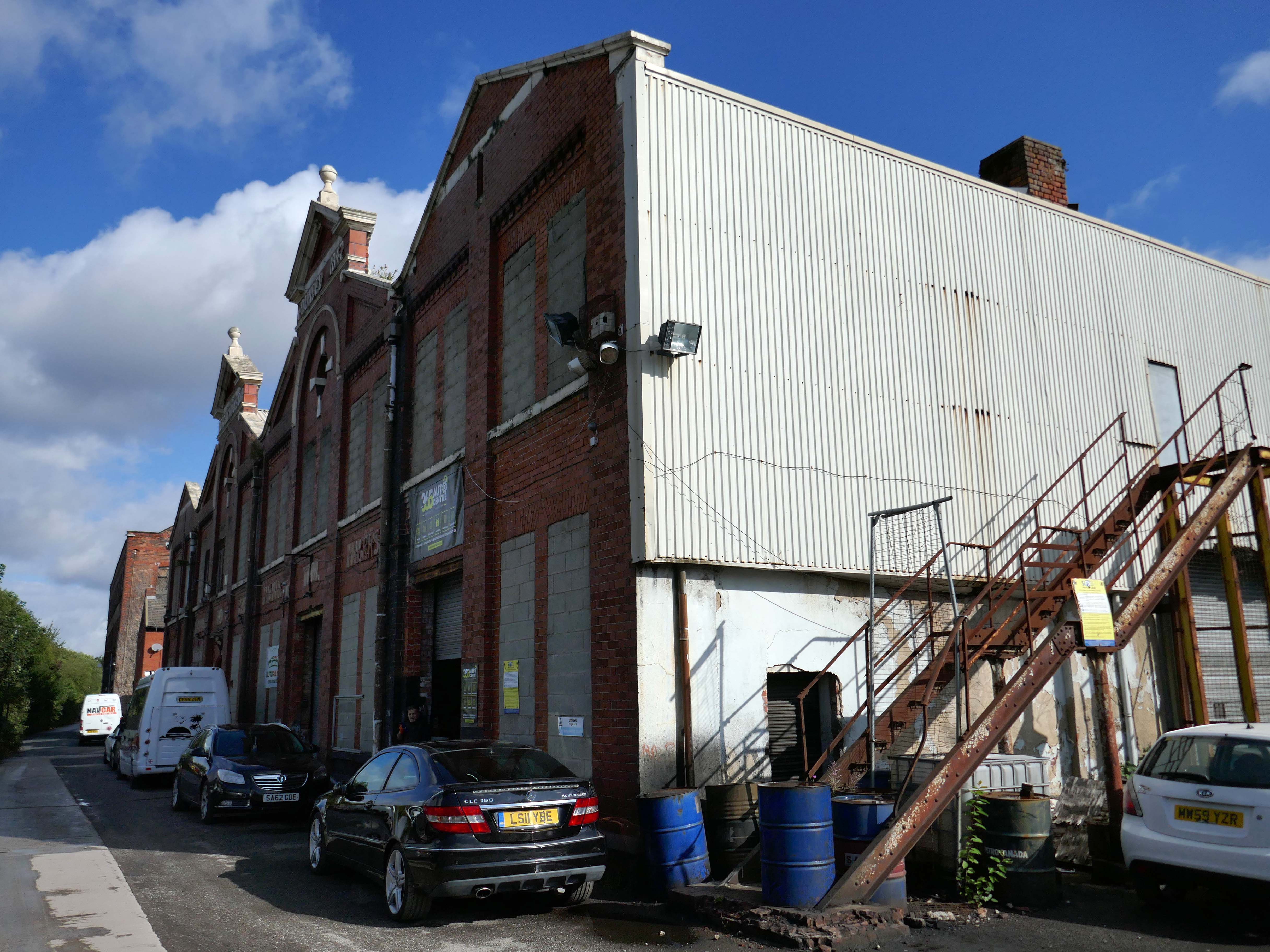
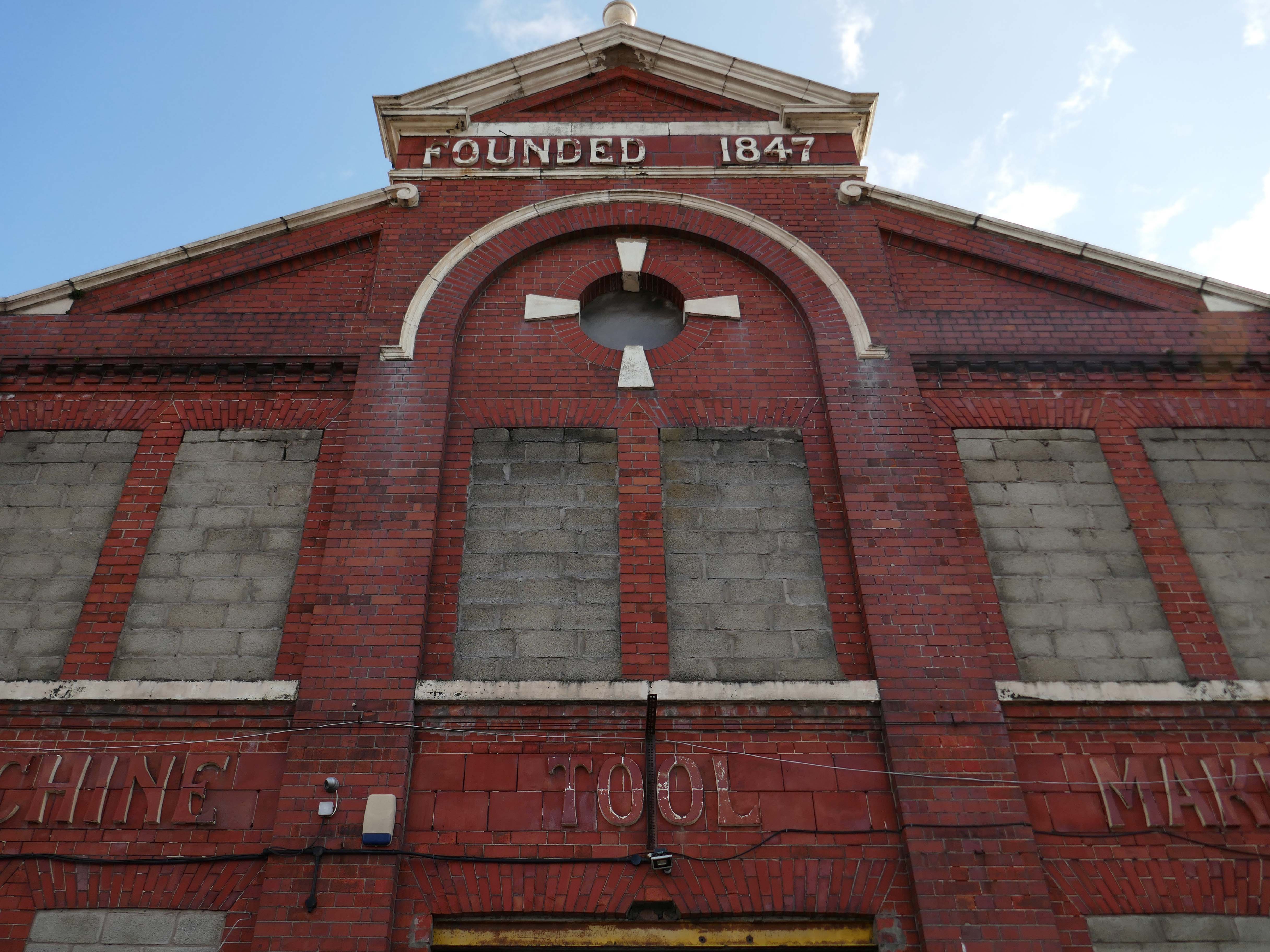
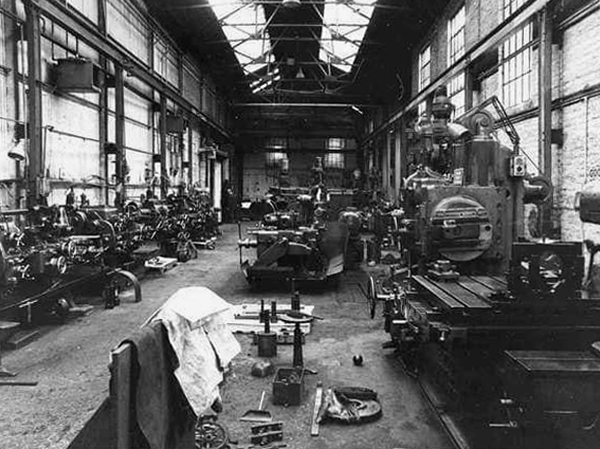
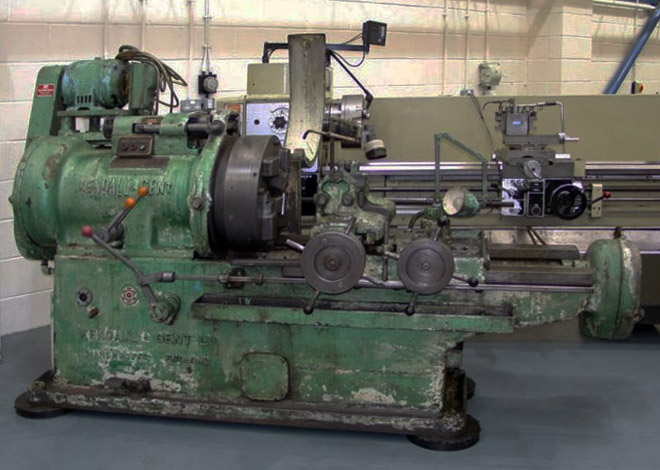
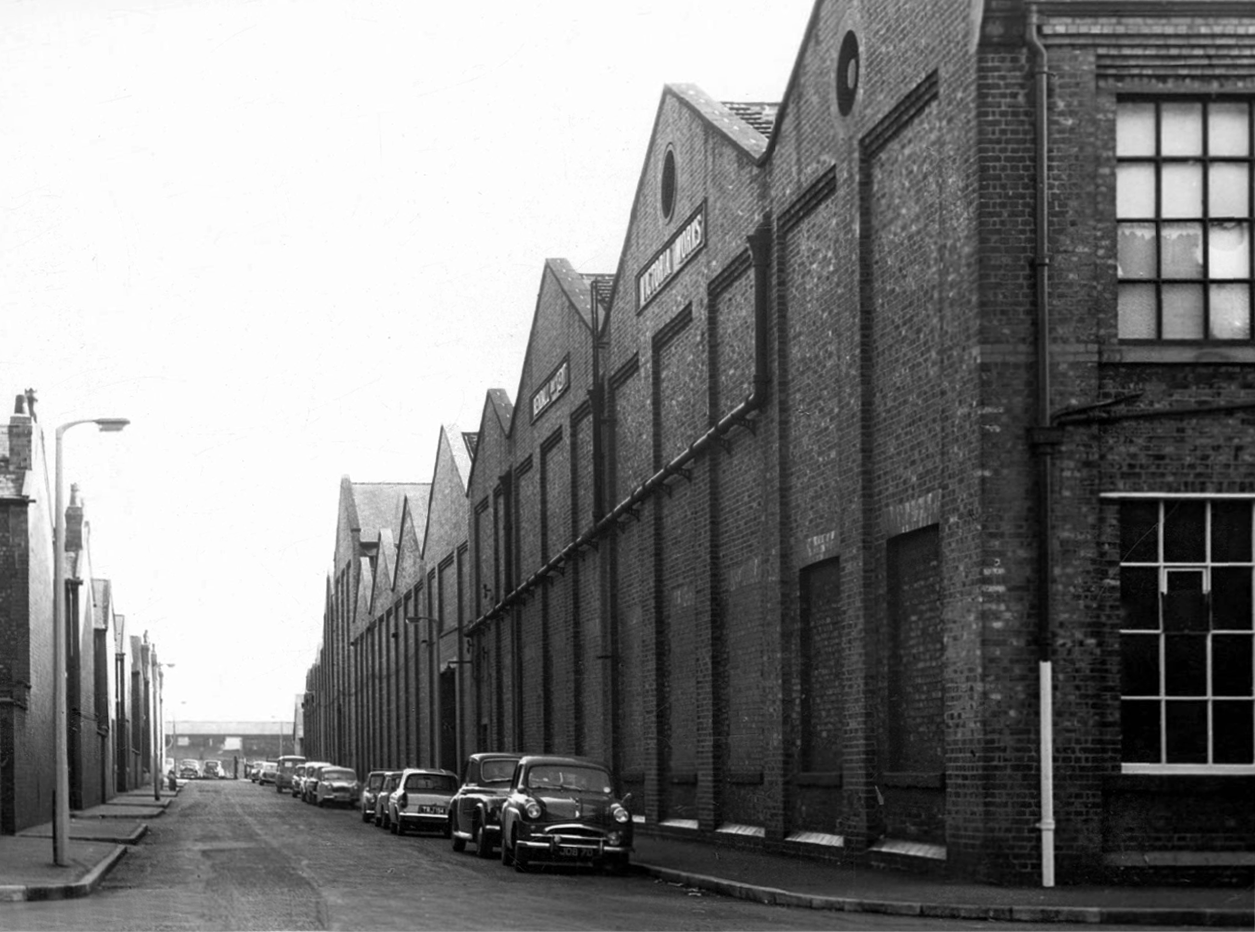
Here’s the Victoria Works, formerly home to machine tool makers Kendall & Gent of Gorton Manchester.

Kendall and Gent were machine tool makers, originally of Victoria Works, Springfield, Salford.

Founded by William Kendall and George Gent in 1847.

Latterly of Victoria Works, Belle Vue/Gorton from the 1890’s, acquired by Staveley Industries in 1966.

Graces Guide

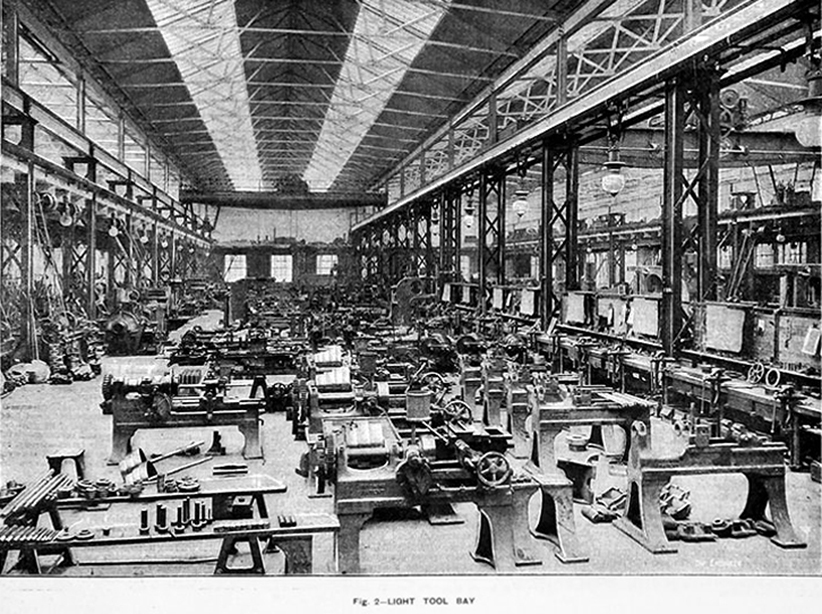
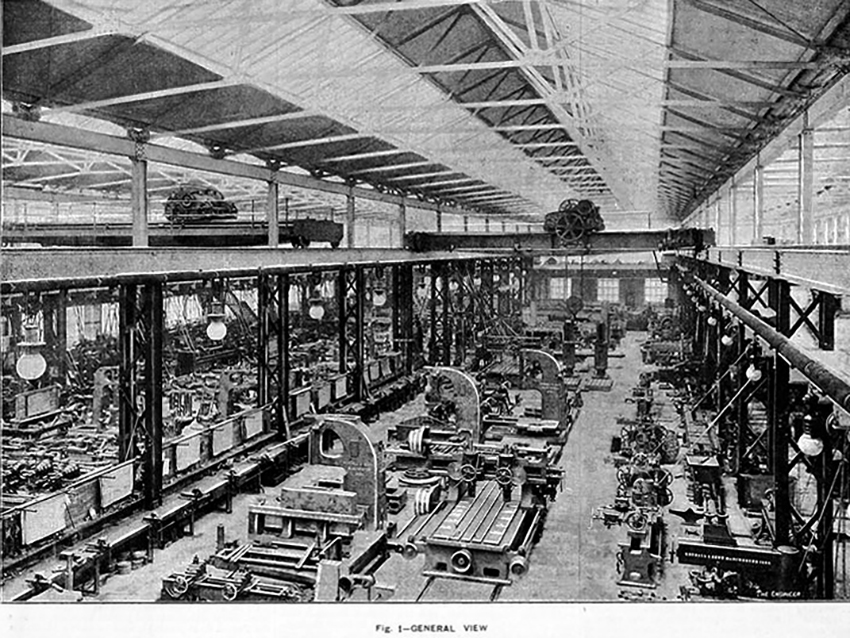
This was a world of heavy and light engineering, which reached in a broad swathe across Greater Manchester, from Stockport to Cheetham Hill and beyond.

This is the Gorton Works – illustrations taken from Graces Guide.

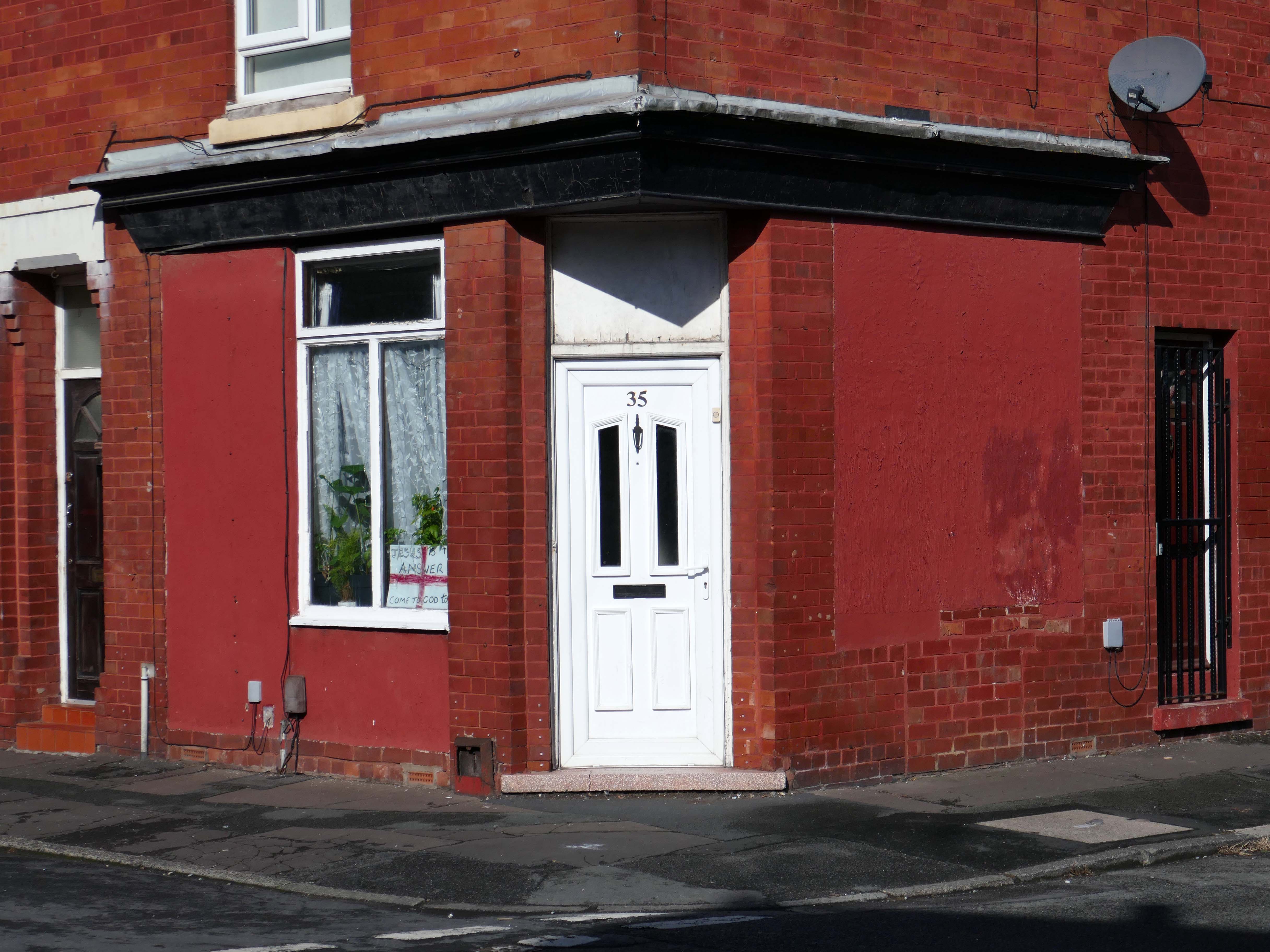
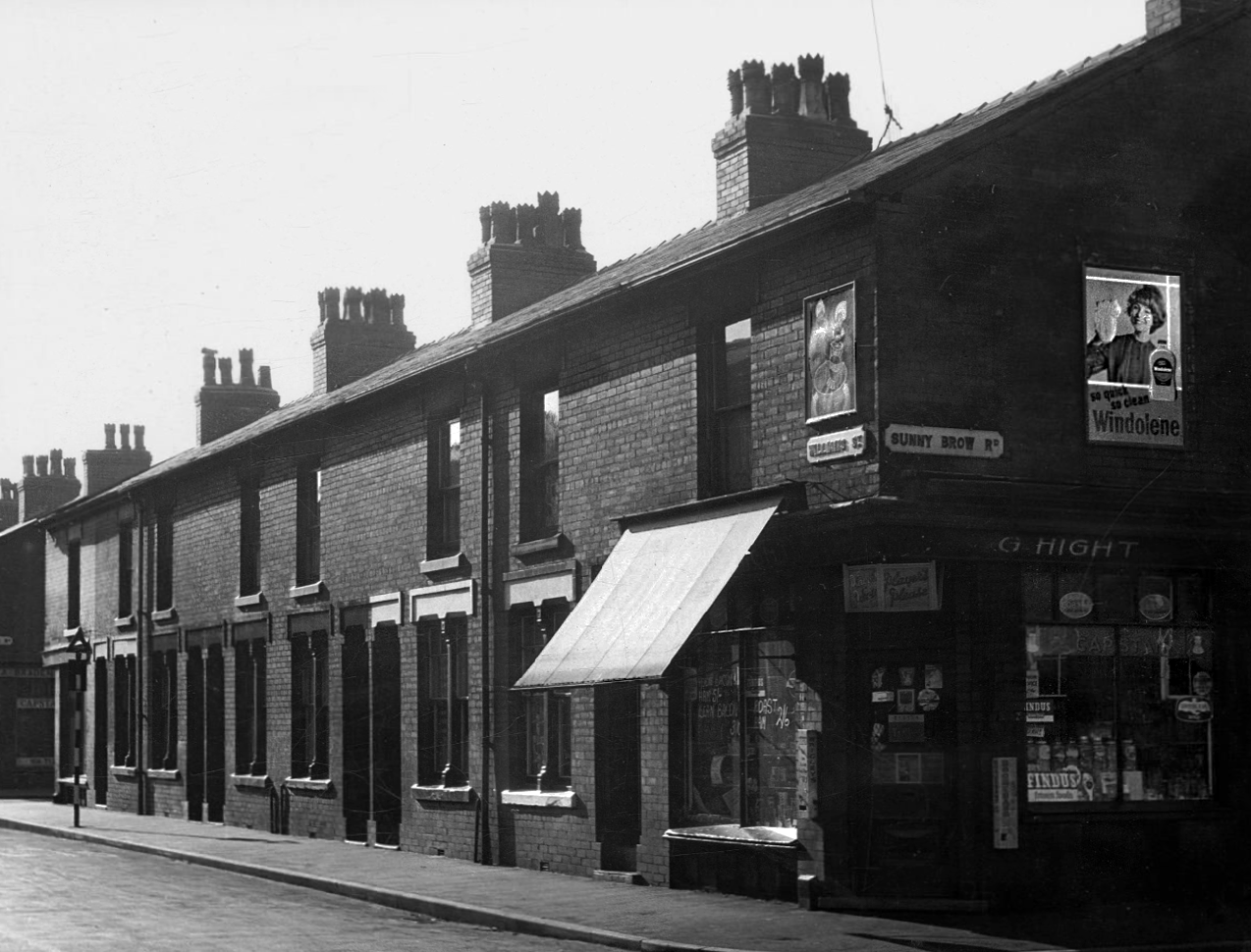
This was a world of terraced houses and corner shops, side by side with the local works.

Photographs: Tommy BrooksLocal Image Collection

This is that corner of Williams Street and Sunny Brow Road today.

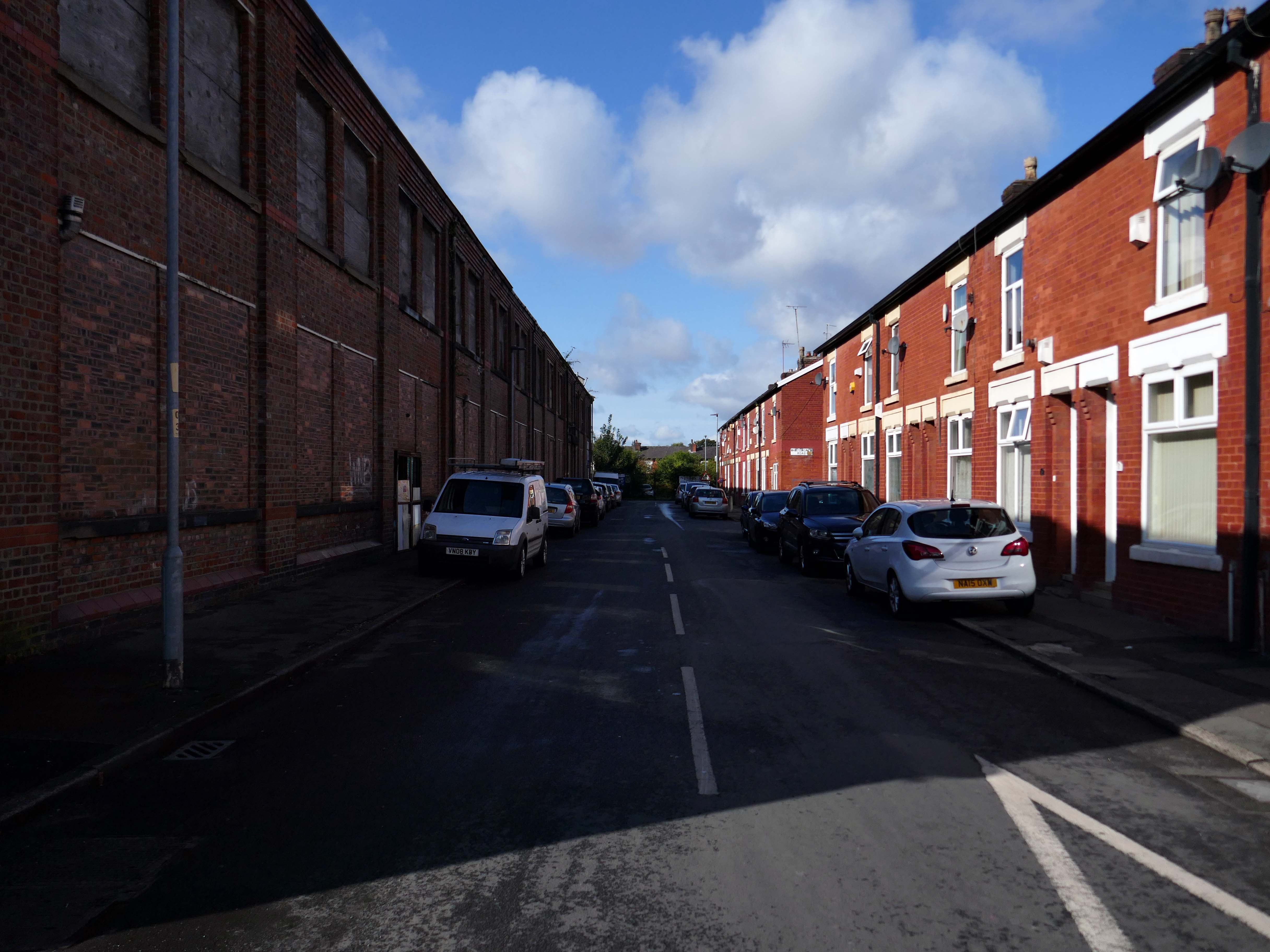
Victoria Works Sunny Brow Road.

Victoria Works Williams Street

Victoria Works Williams Road

Manchester’s engineering industry has subsequently been seriously diminished.

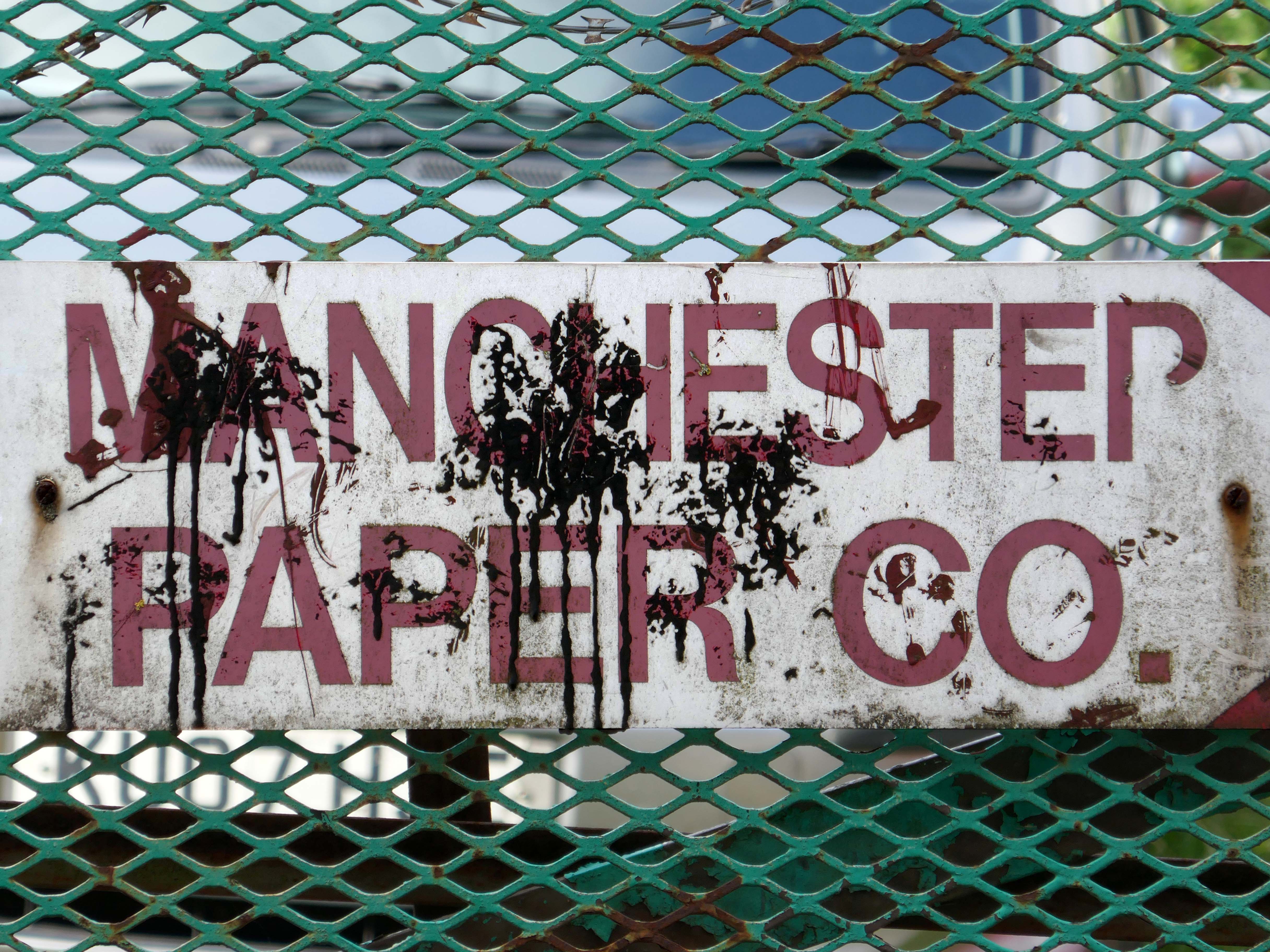
The building became a base for toilet paper manufacturing and distribution.

But the metal beat goes on in both Wolverhampton and Florida.

Originally formed in 1847, Kendall and Gent enjoyed many years as one of the biggest machine tool manufacturers in the UK, producing many large machines which are still in production today. Many of the tangential threading machines are still used in pipe, bolt and stud threading.

Kendall and Gent

Also of interest Richard Peacock Gorton industrialist .

Walking – Talking

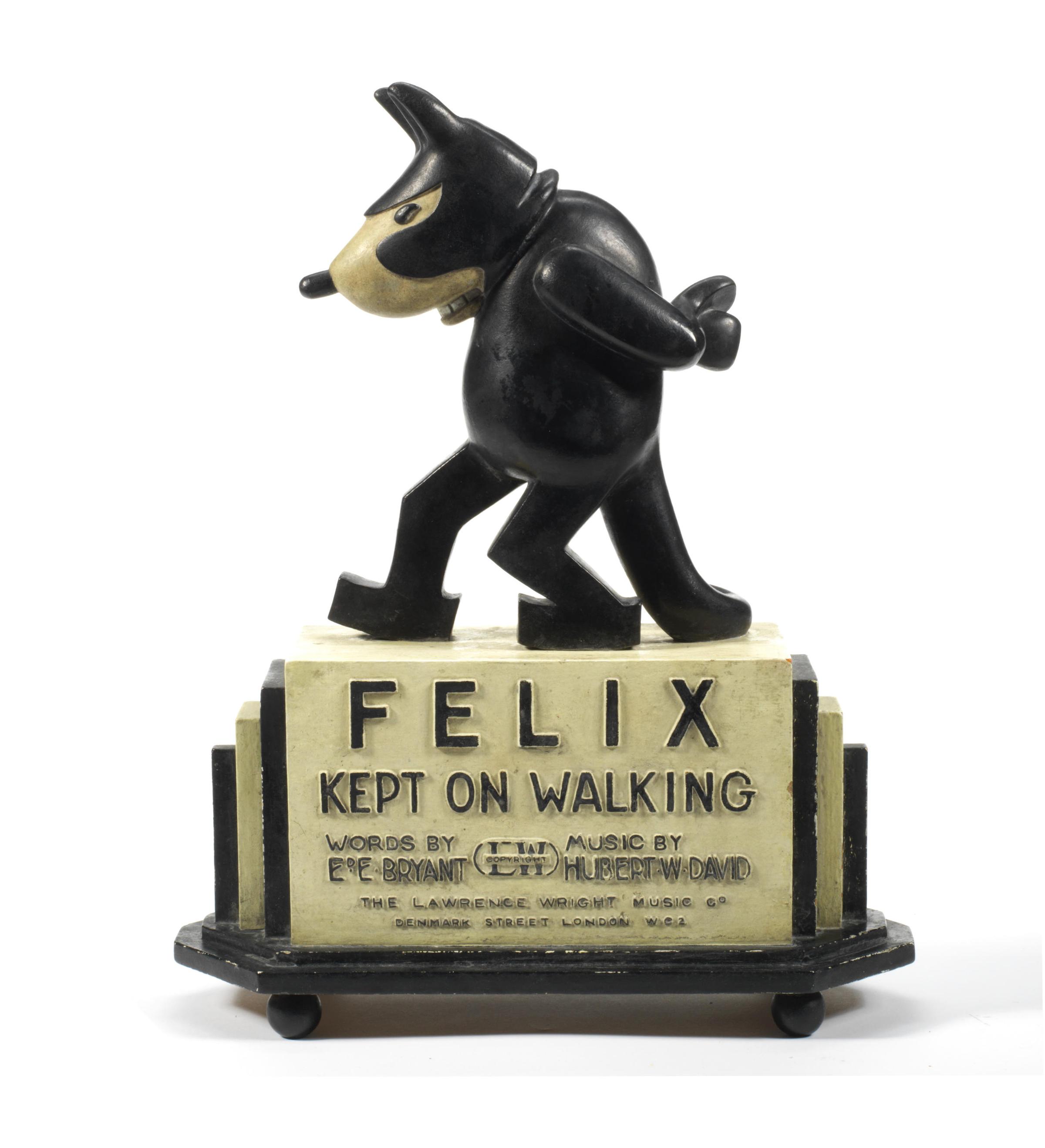
I began walking when quite young, then like Felix, I kept on walking, walking still.

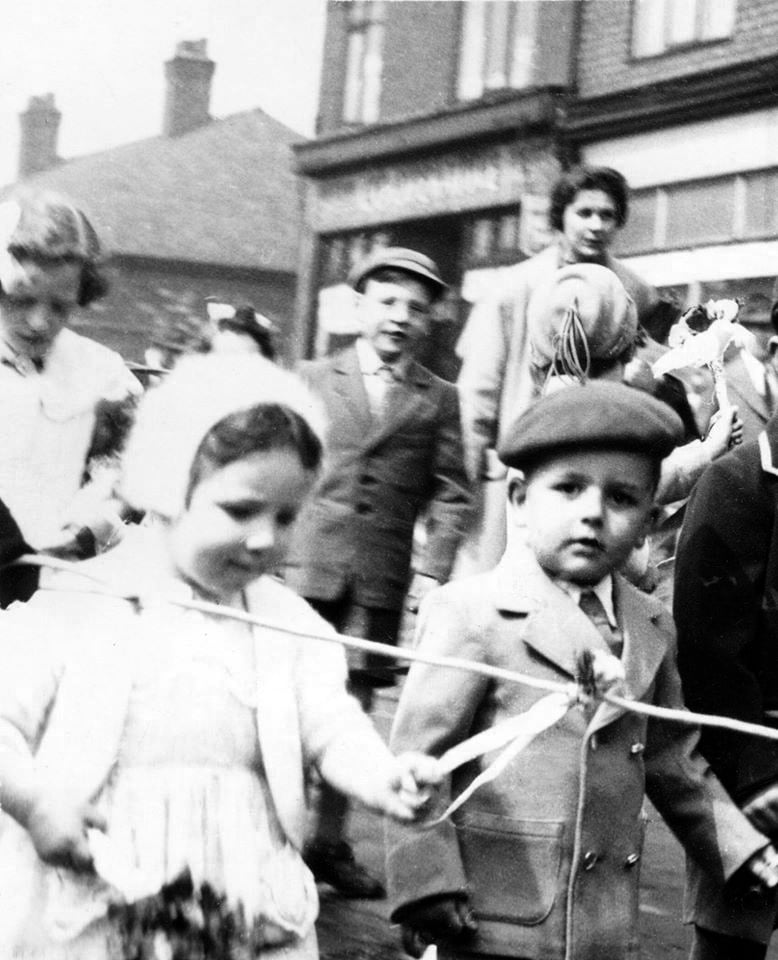
The photograph was taking during the Whit Walks in 1958 – aged three, I was engaged in religious pilgrimage, as we know there are many reasons for walking, this is but one.

I was fortunate to grow up at a time when youngsters were permitted to roam freely, less traffic, less anxiety, gave me access to a wider axis of exploration.

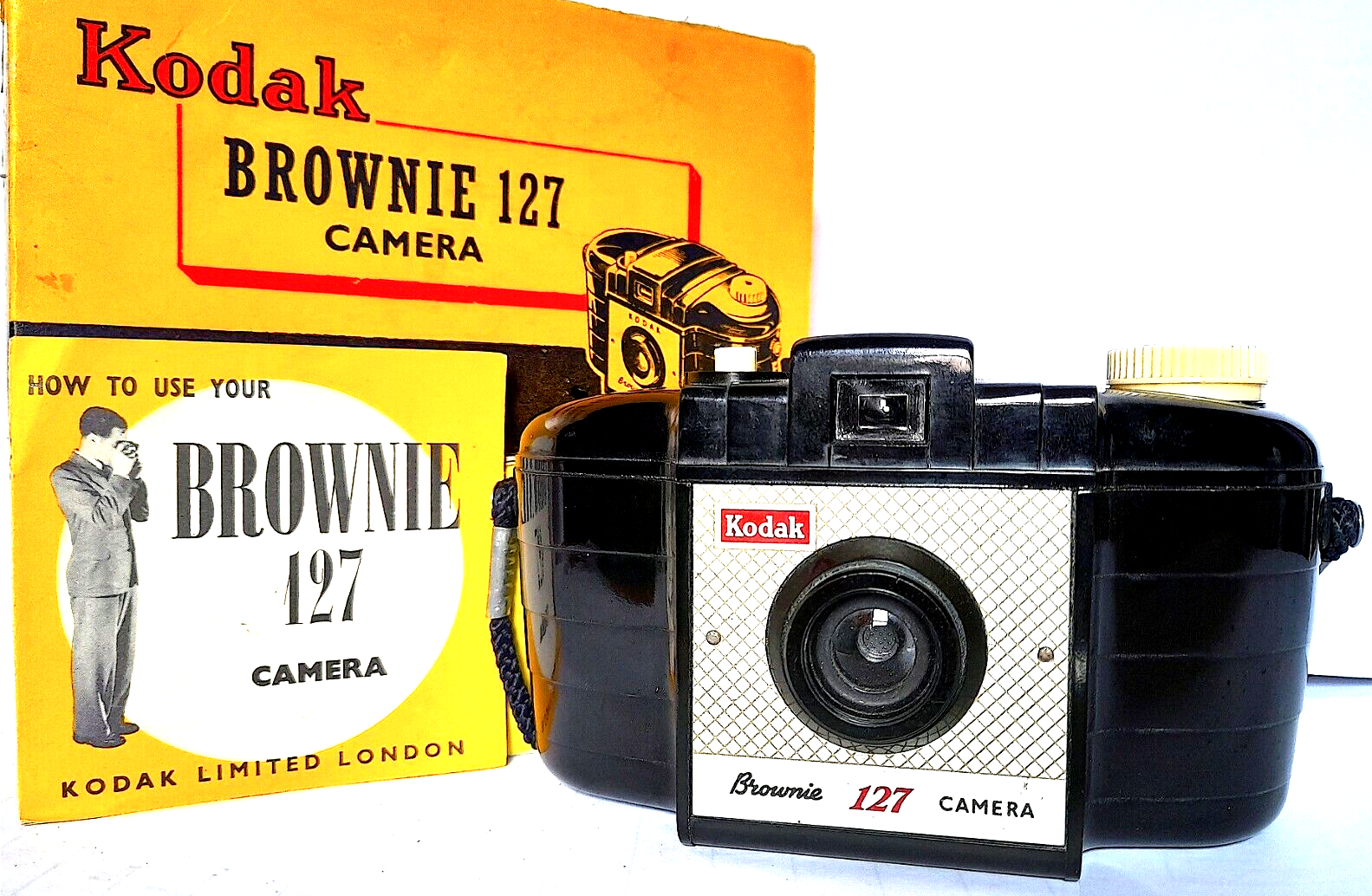
The photograph would have been taken I assume, by my mam, on the Brownie 127. When aged nine I wandered alone through the local woods and exposed twelve frames of 44mm 127 film, the prints are long gone, yet I remember each of the photographs and locations clearly.

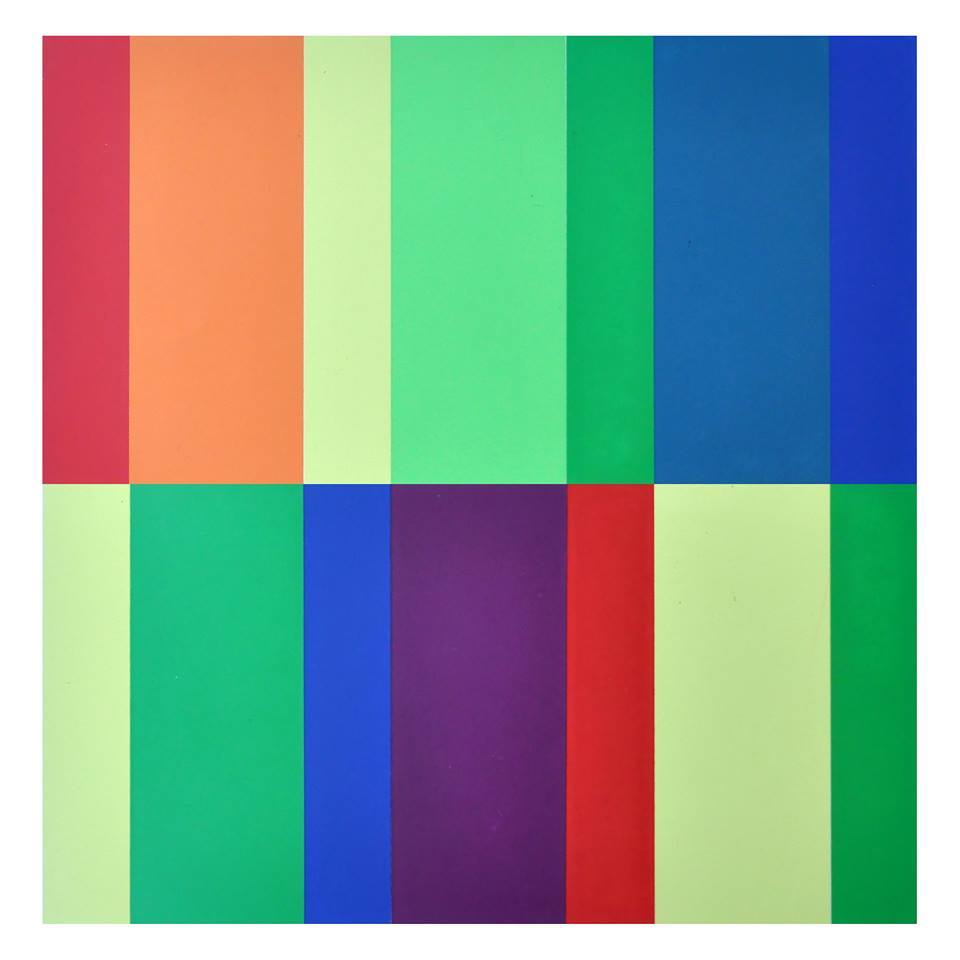
I went to school, then I didn’t, then I went to Art School, eventually becoming a teenage Constructivist, tutored by Jeffrey Steele, a leading light in the British Systems movement.

The rigidity of the grid, symmetry and orthogonal framing have stayed with me.

Then I went to work for a very long time indeed, then all of a sudden I didn’t. Taking early retirement aged 59 some ten years ago, subsequently taking to the roads, streets and hills of Britain in search of nothing in particular.

In recent years there has been a rapid development in the culture of walking, theories, films, guides, songs and literature. I am fully cognisant of such, yet believe at heart that walking can be free of such baggage, we can stride unhindered, atavistic and carefree/less.

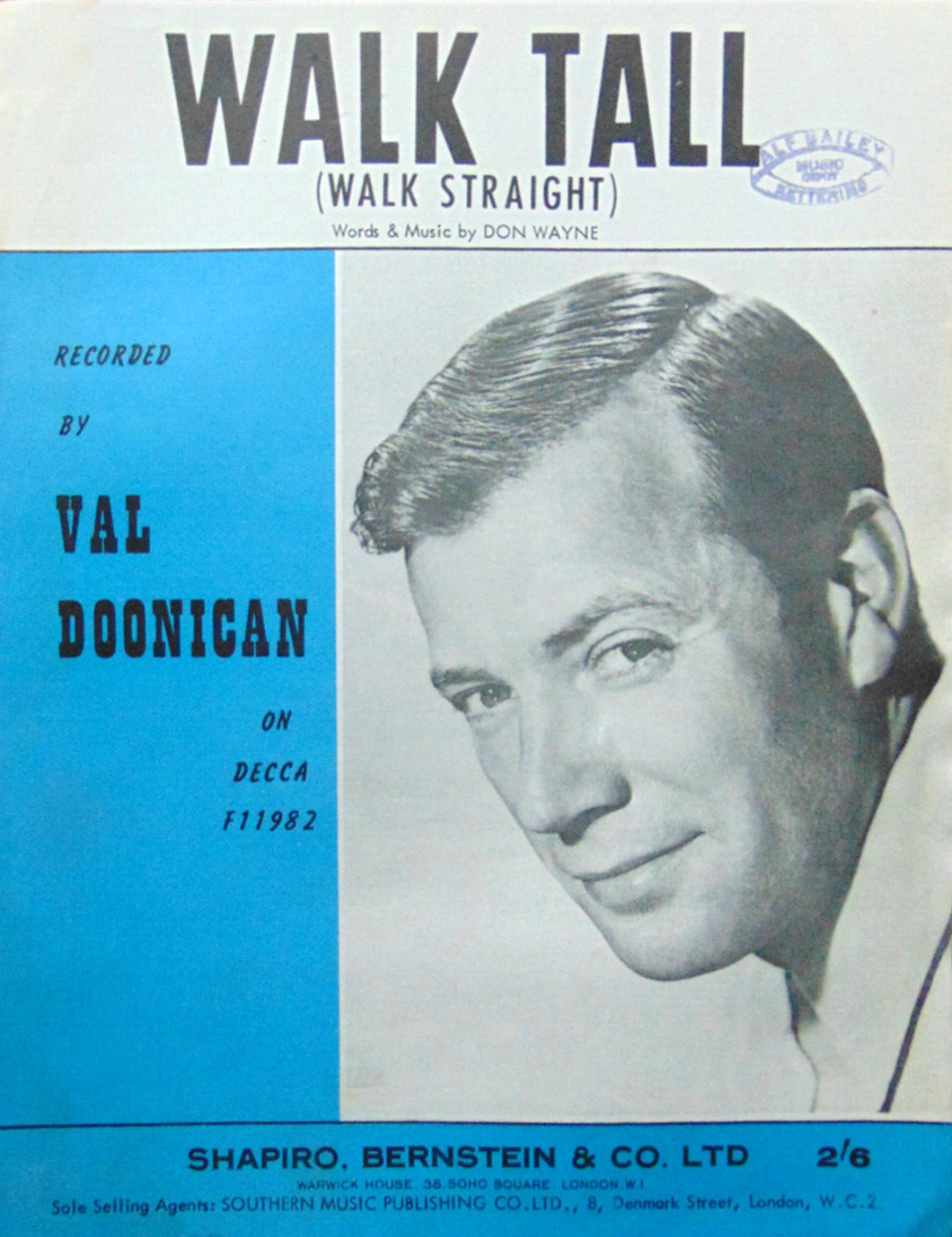
Walk tall, walk straight and look the world right in the eye.

Getting lost is about the unfamiliar appearing.

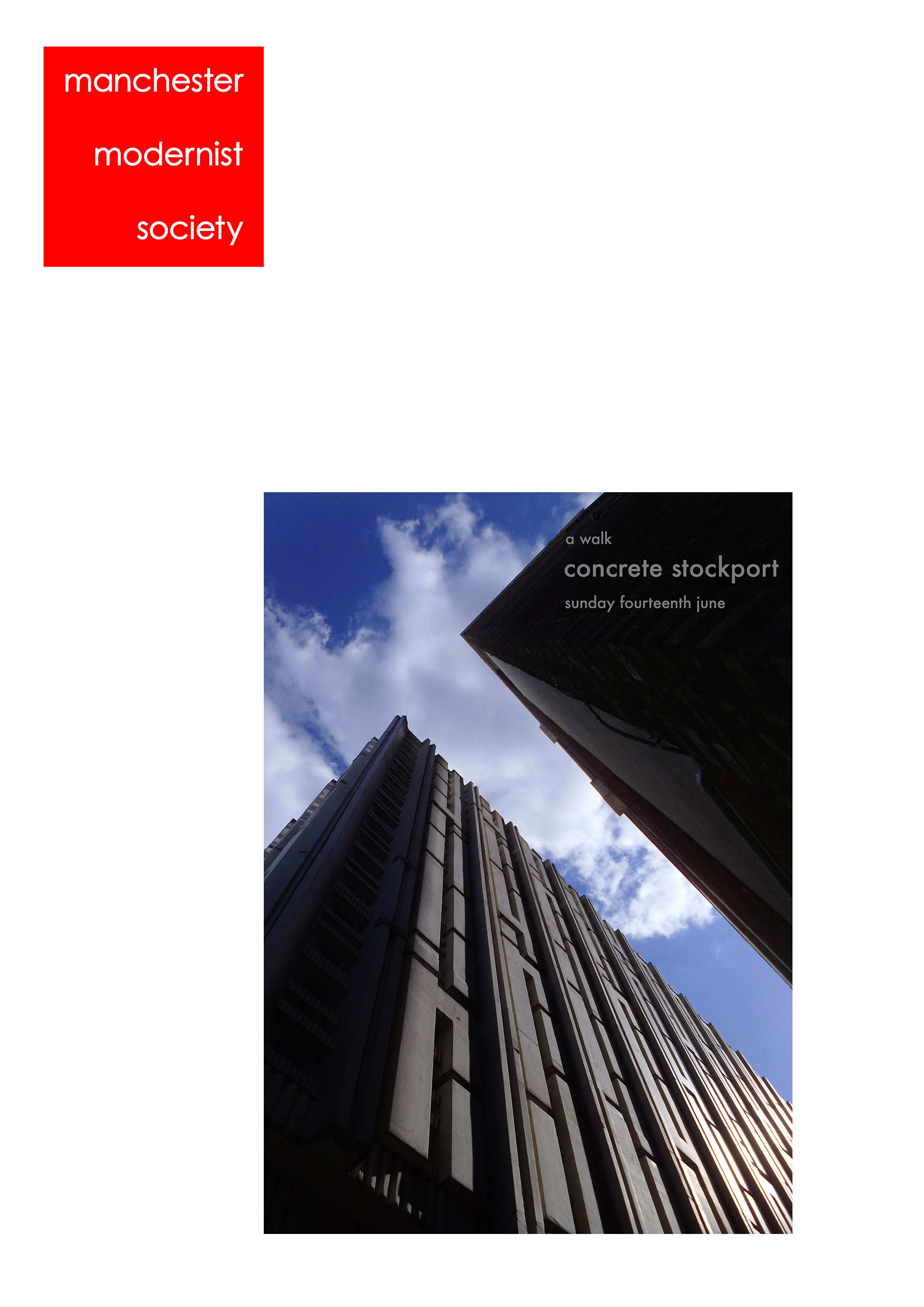
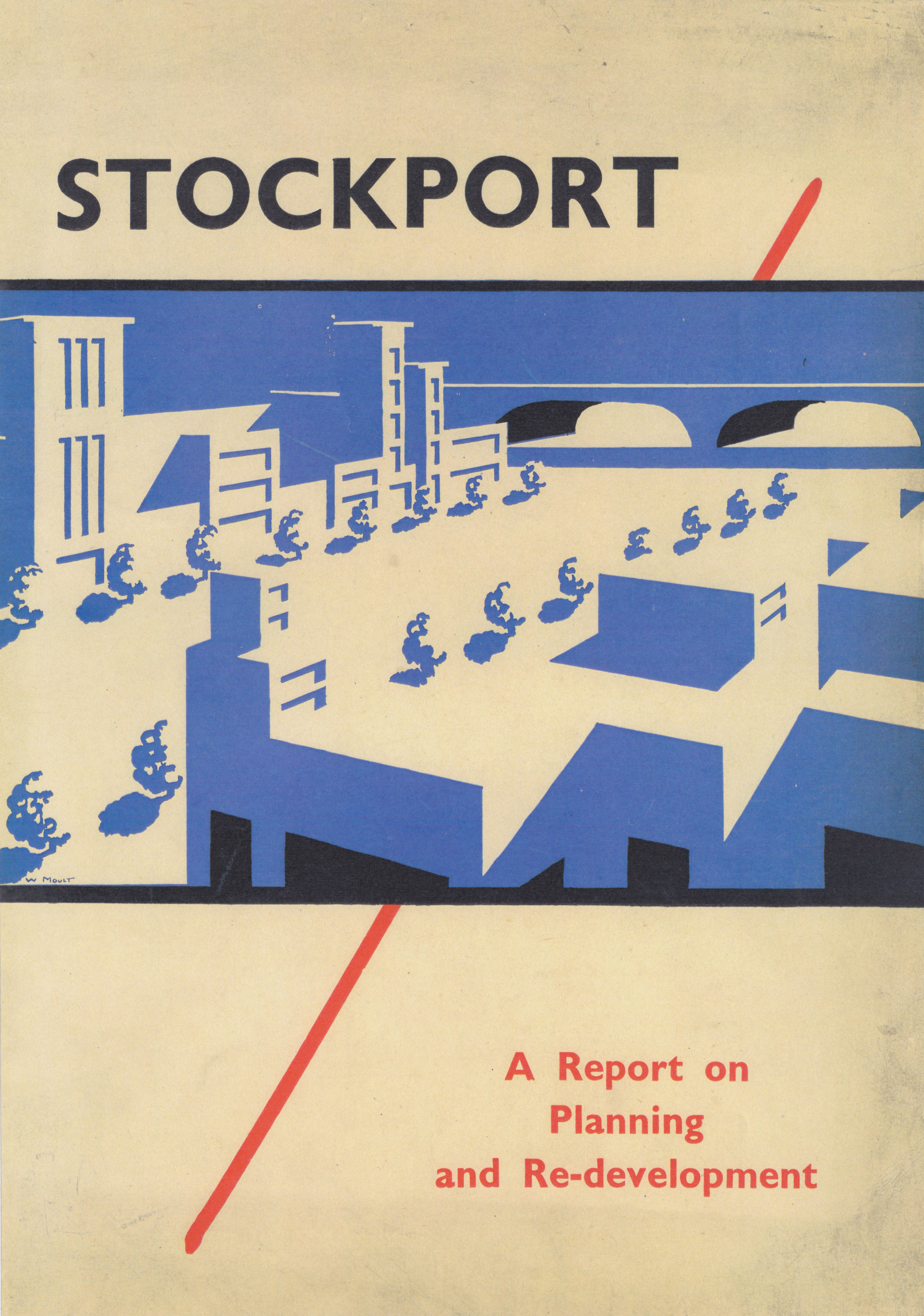
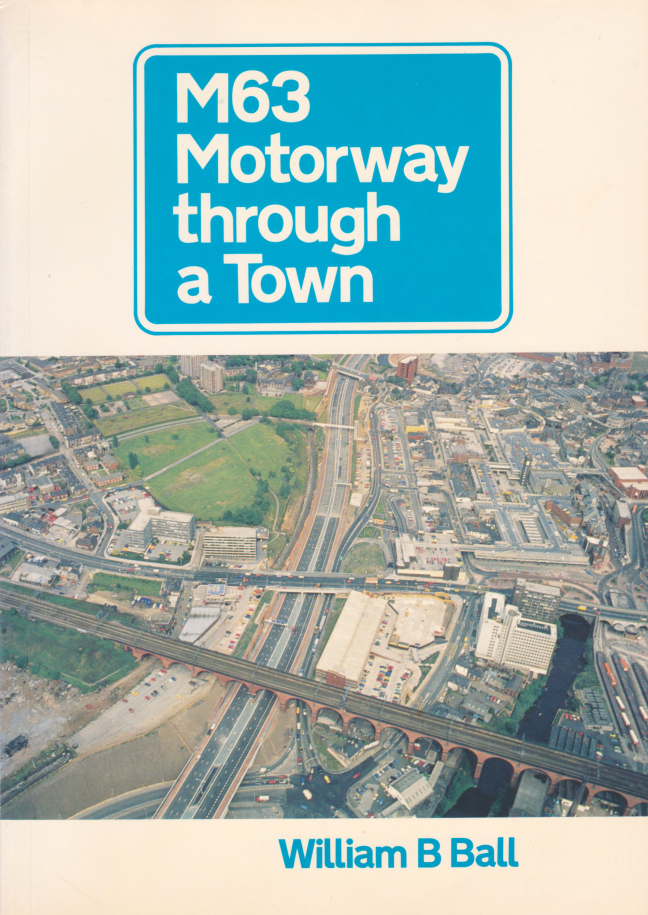
In my own small way, I have become part of that baggage, having been asked to lead a walk around Stockport by the the modernist neé Manchester Modernist Society.

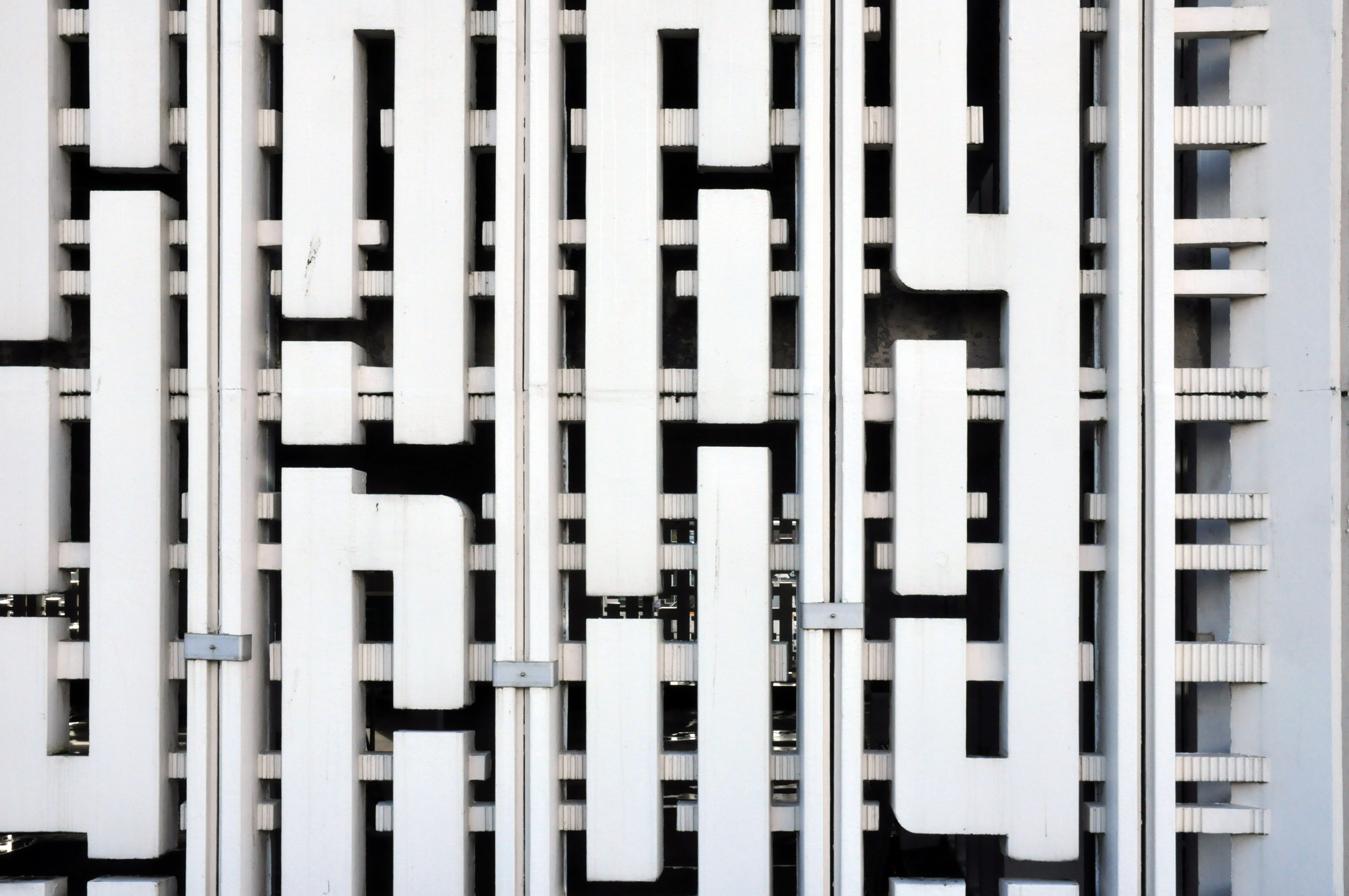
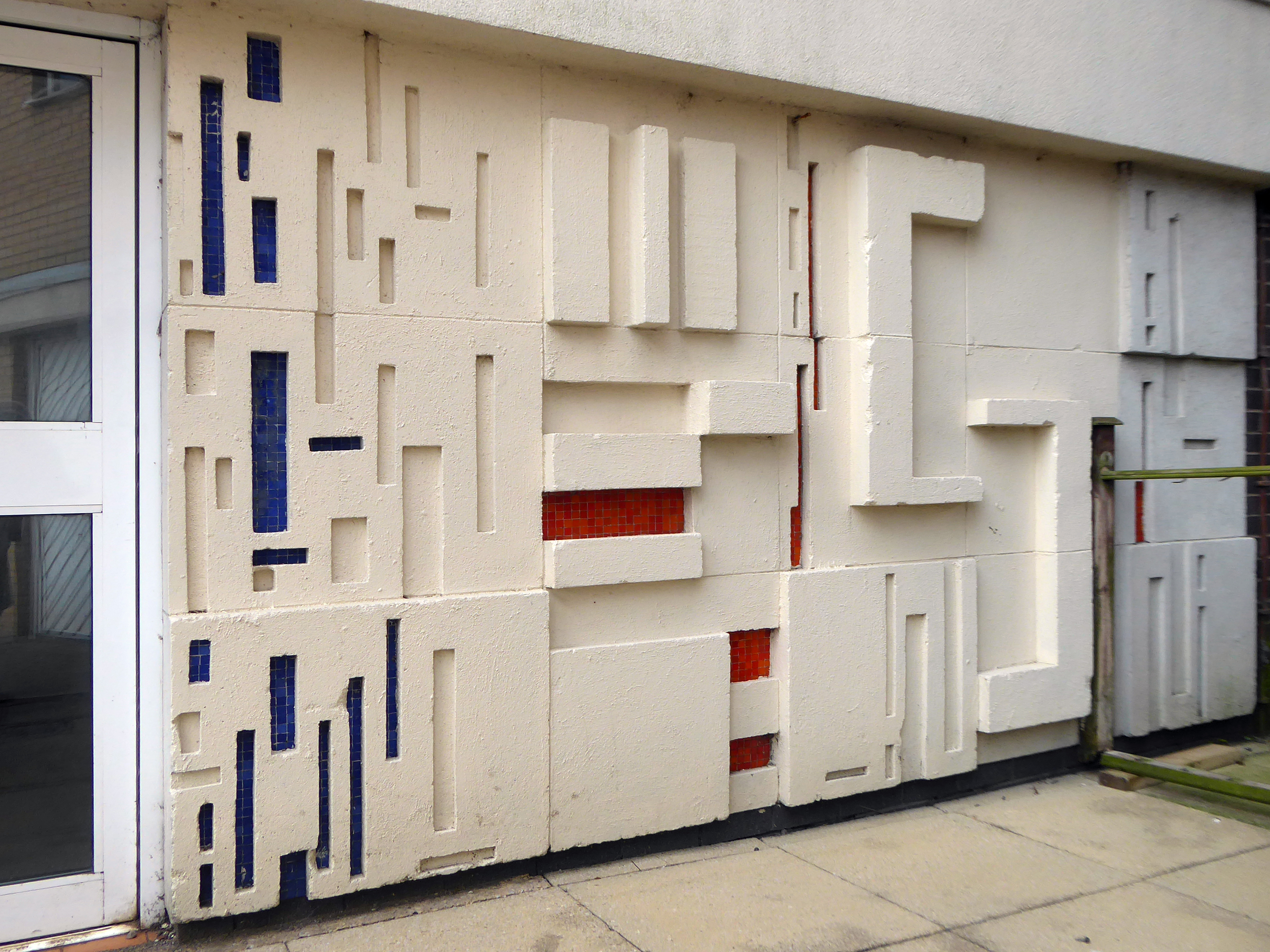
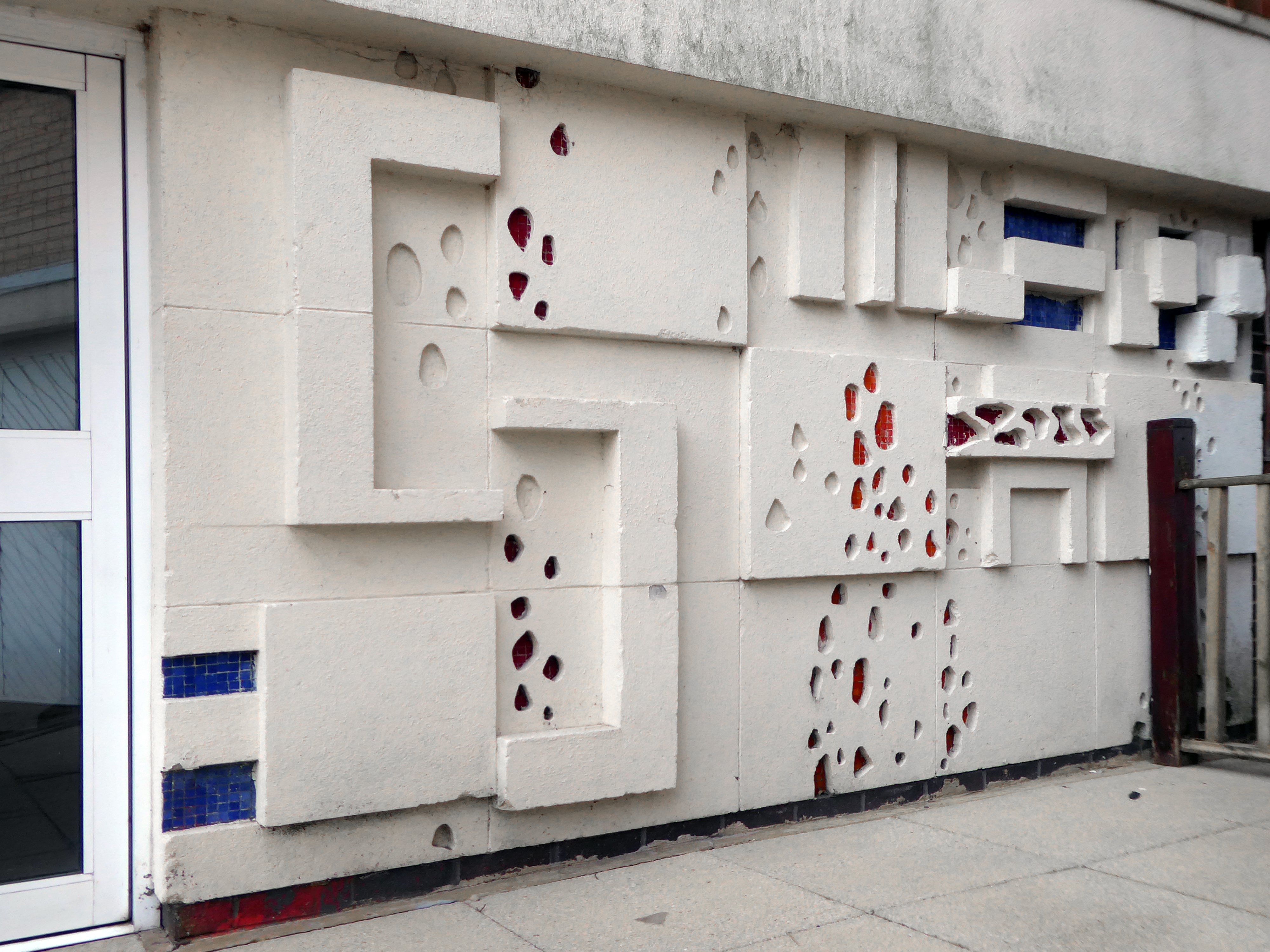
The photograph depicts Alan Boyson’s concrete screen wall, attached to the former Cooperative super store designed by Philip Andrew. The two worked to gather on the Hull Cooperative store, which is adorned by Alan’s huge Three Ships mosaic.

Philip was a childhood friend of Alan Boyson and it was Alan’s father, manager of the Marple Co-operative Society, that recommended Philip for an apprenticeship job in 1951 to the chief architect at the CWS in Manchester HQ.

Ships in the Sky

In preparation for the tour, I visited the town’s Local Heritage Library and read extensively from serendipitous charity shop finds.

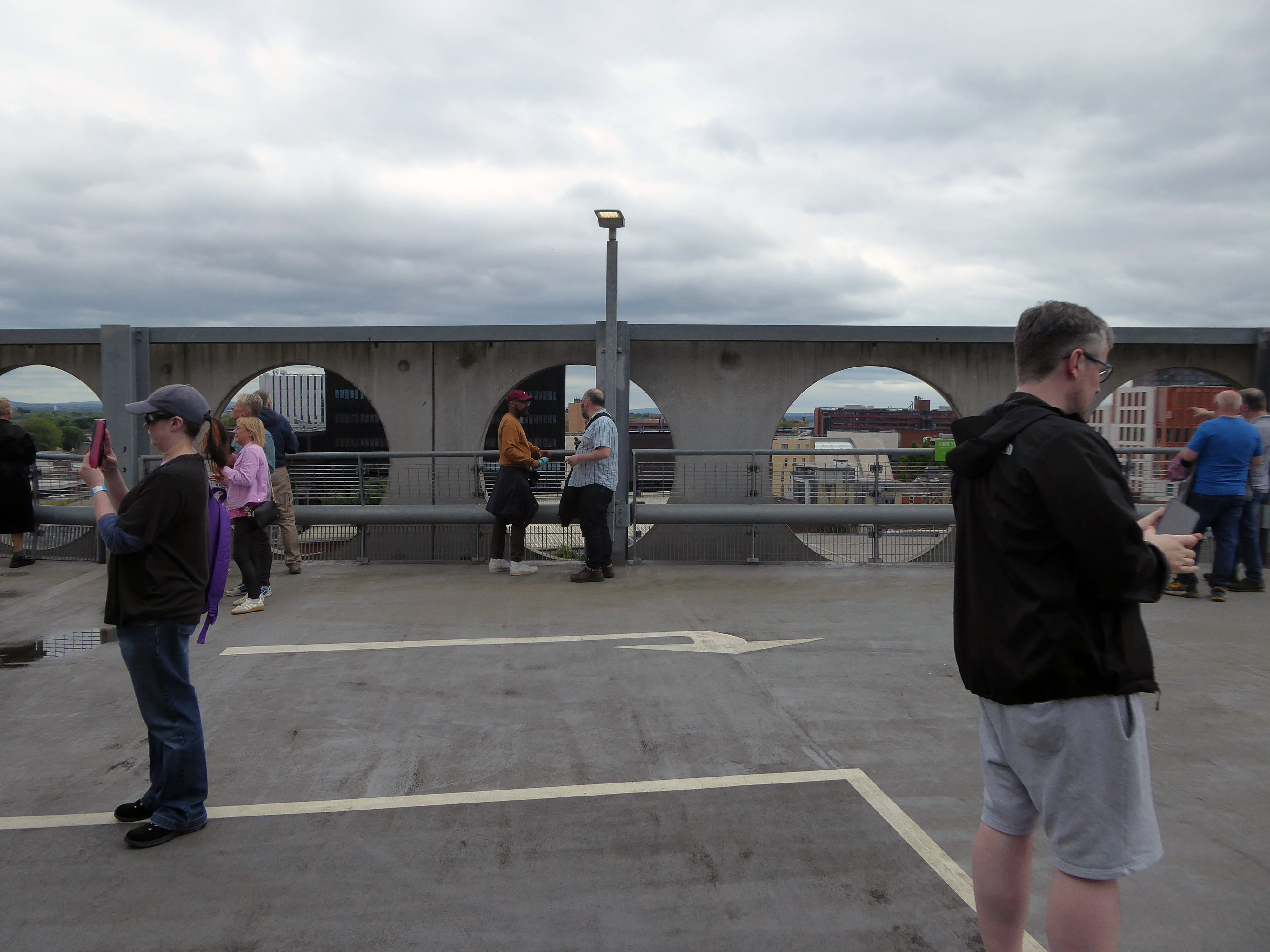
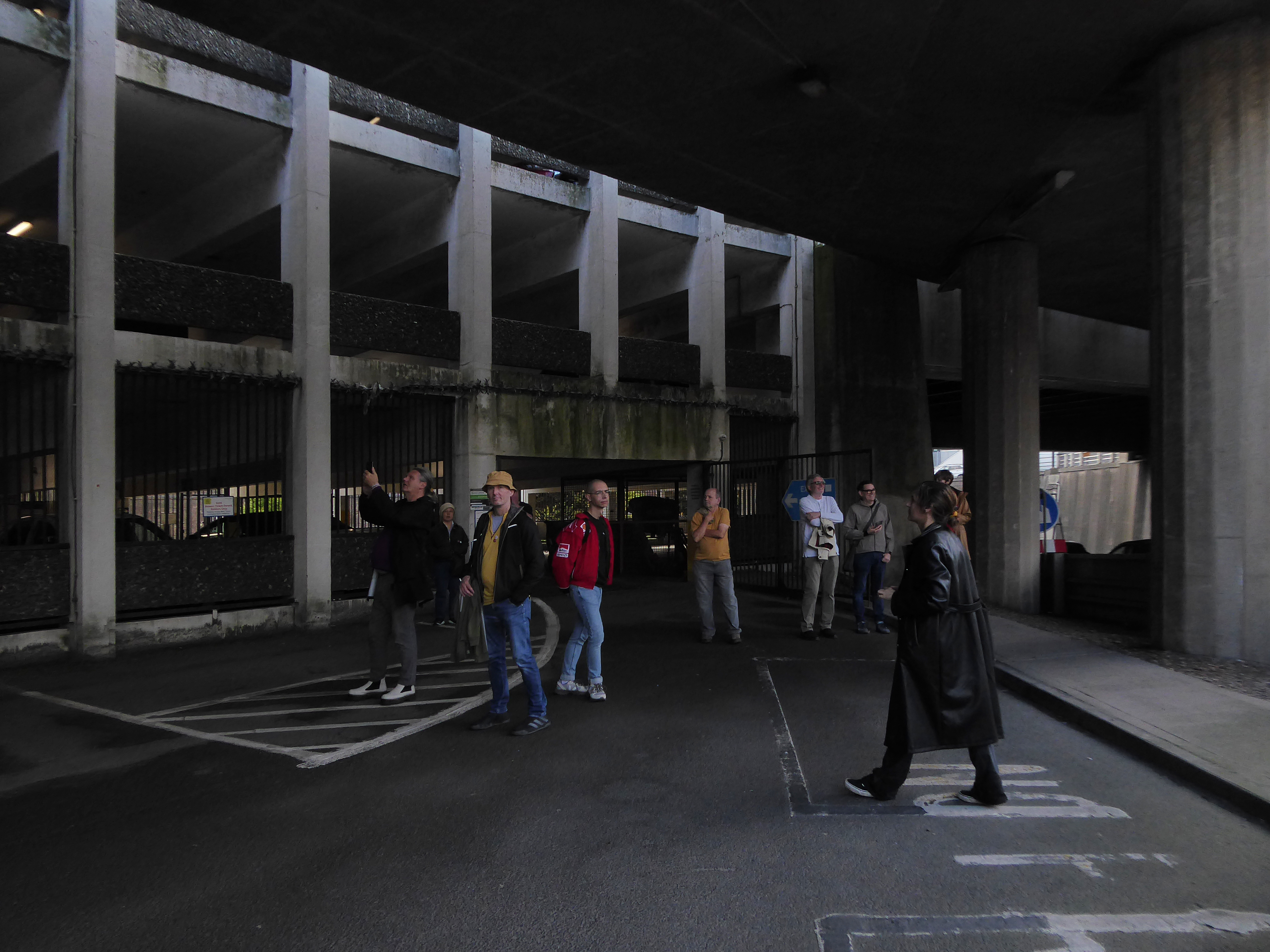
The two hour route was designed around an economy of distance and elevation, allowing time for others to take in, what may be for them unfamiliar surroundings. A group of around twenty or so folk became sociable and engaged, with a suitably concise and apposite contribution from myself. There are those who busied themselves taking snaps along the way, chatting amiably or simply gazing in amazement.

The service building above the former Debenham’s store.

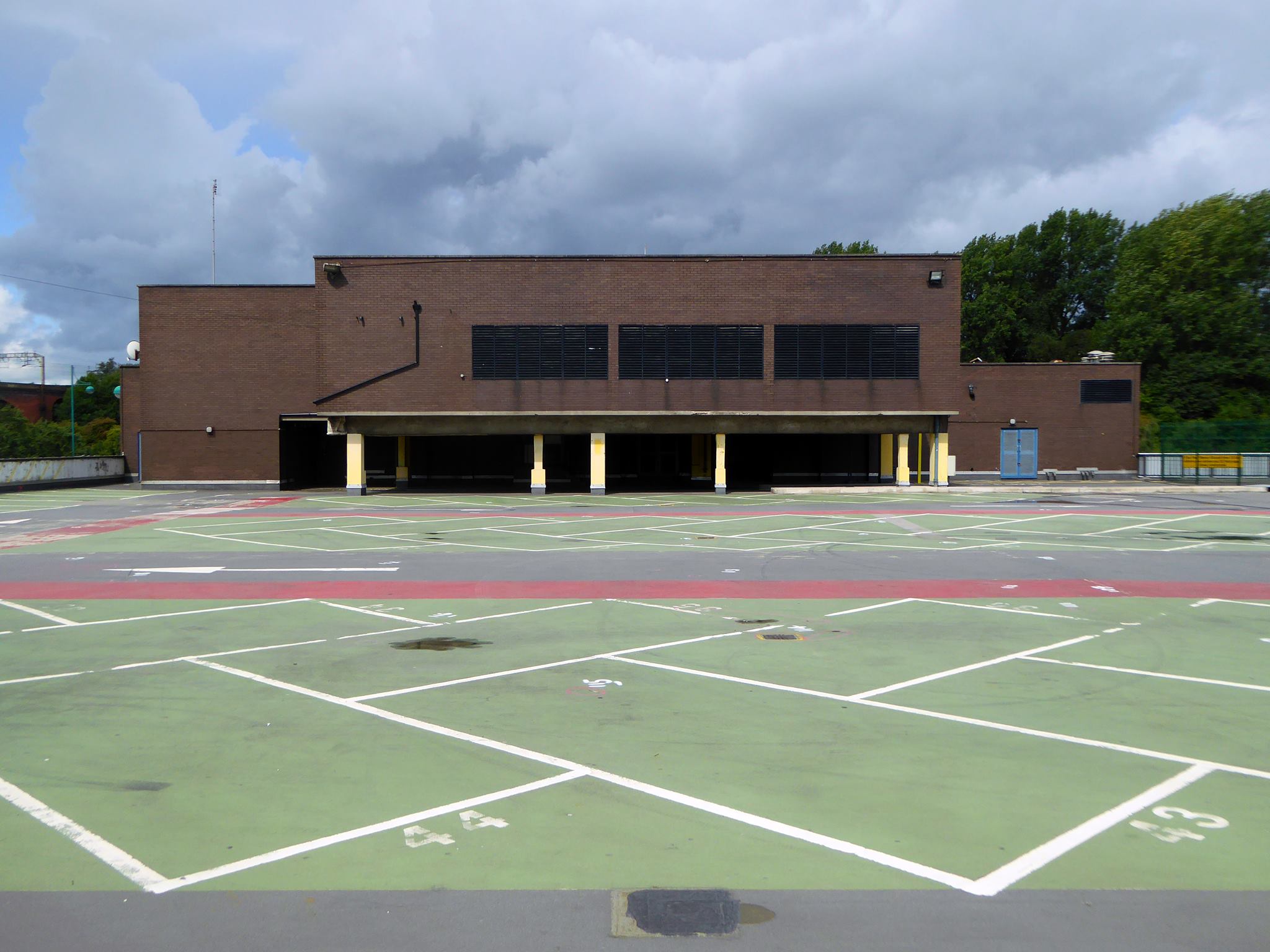
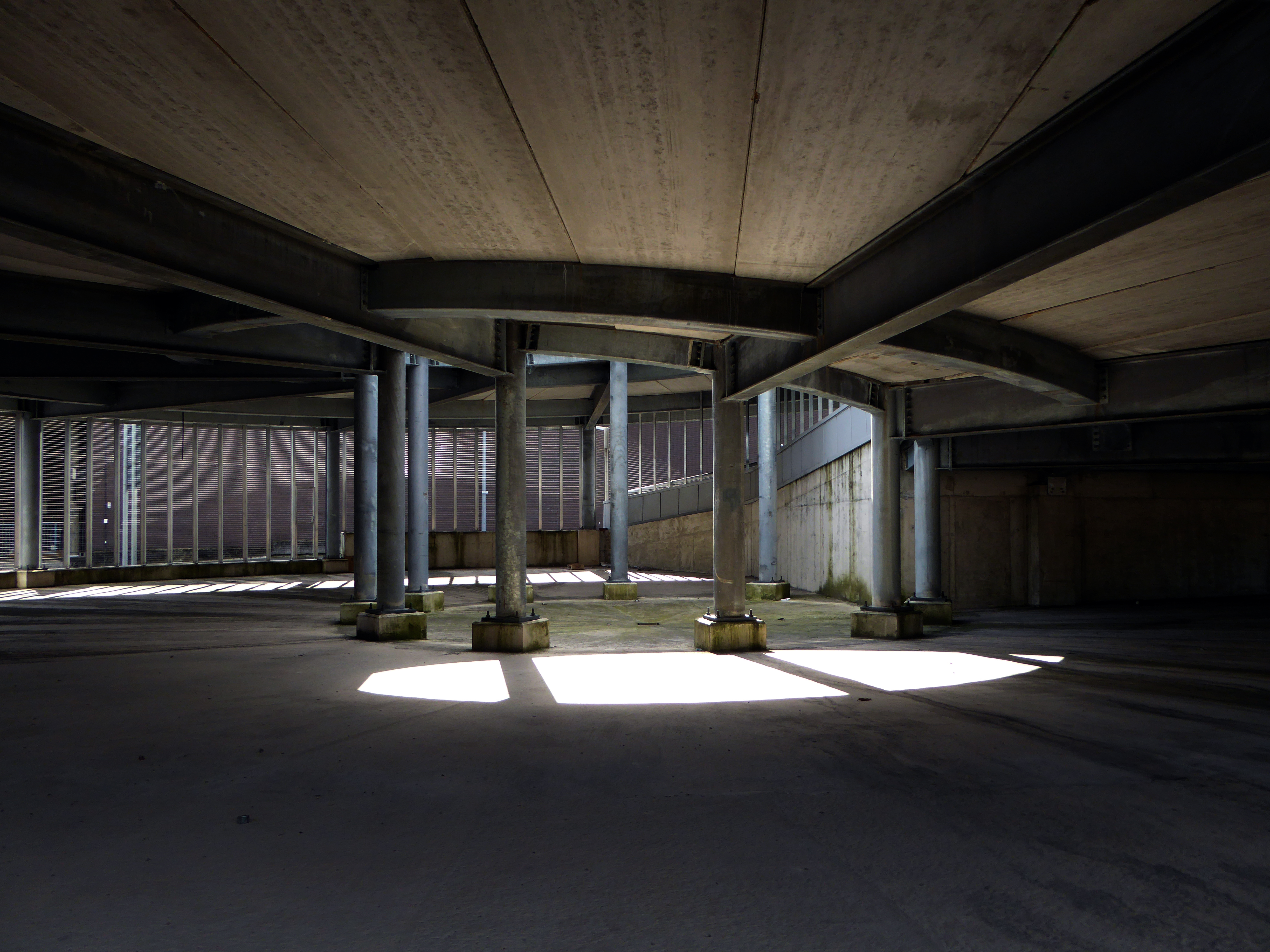
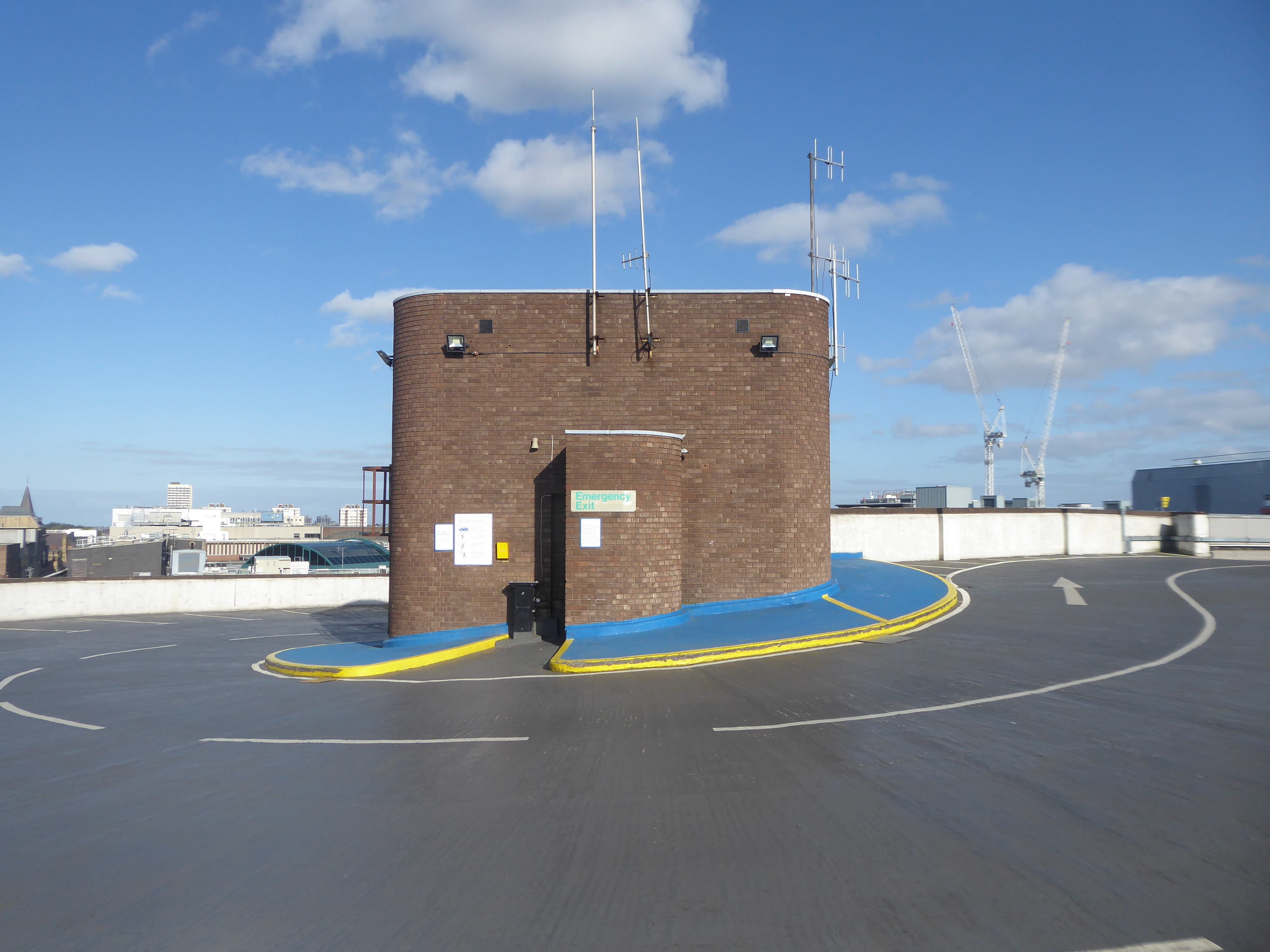
Beneath the spiral ramp which leads to the Red Rock car park.

The architects for the scheme were BDP – the building was not well received as it was awarded the Carbuncle of the Year 2018.

Stockport’s Town Hall extension Stopford House.

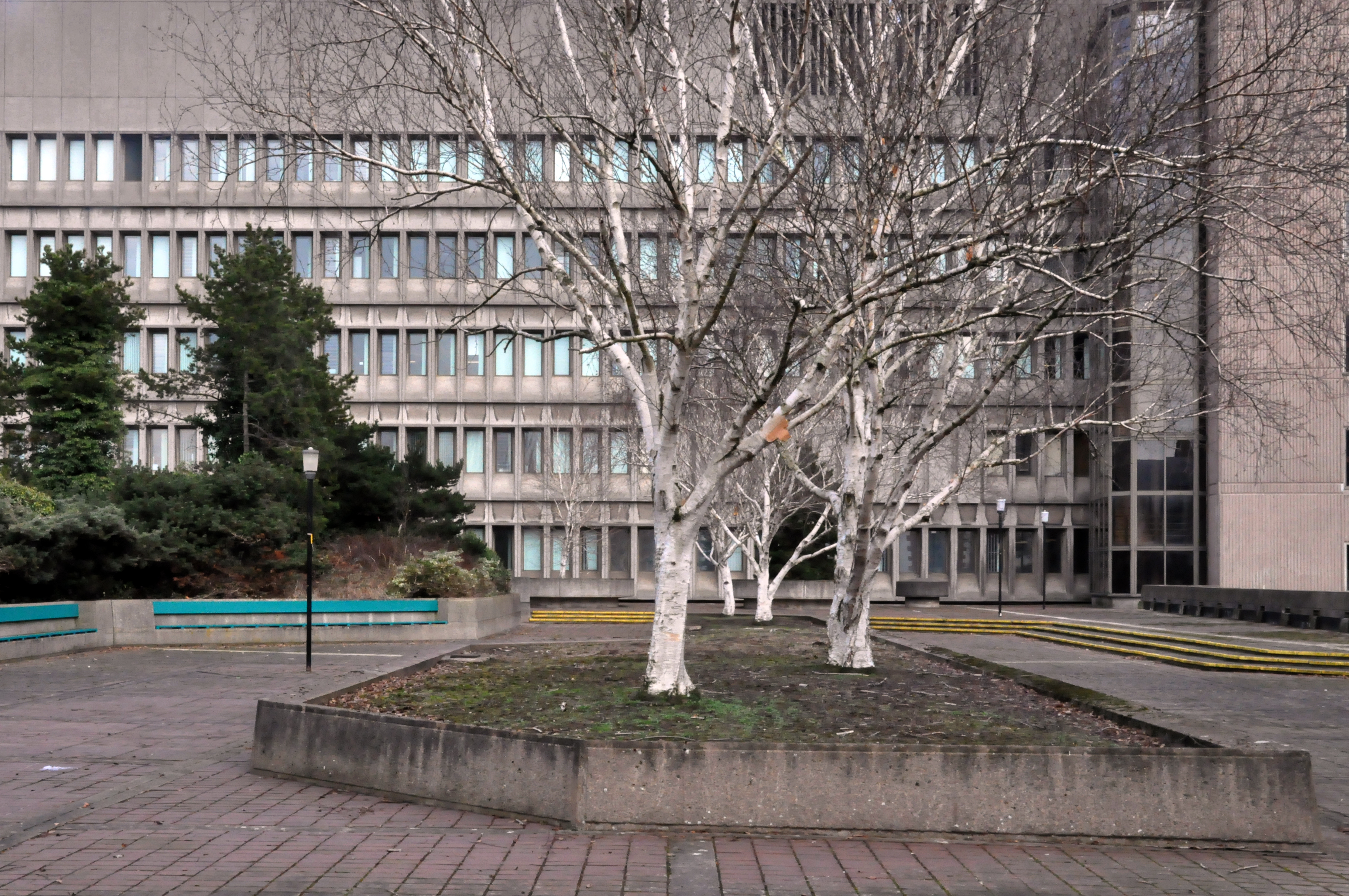
Famed as an imaginary TV police station, this civic building is a civic building I simply can’t resist. I return on a regular basis to wander and snap. This is an open public space that seems little loved and has few visitors.

From then onwards I have been taking folks on Modernist Mooches on a regular basis, two or so a month, during the less inclement times of year.

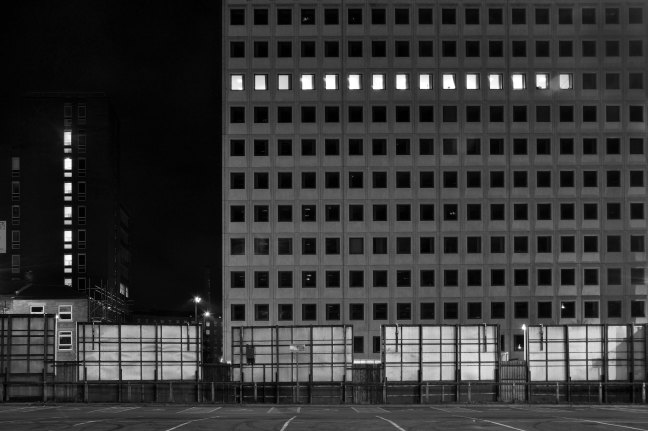
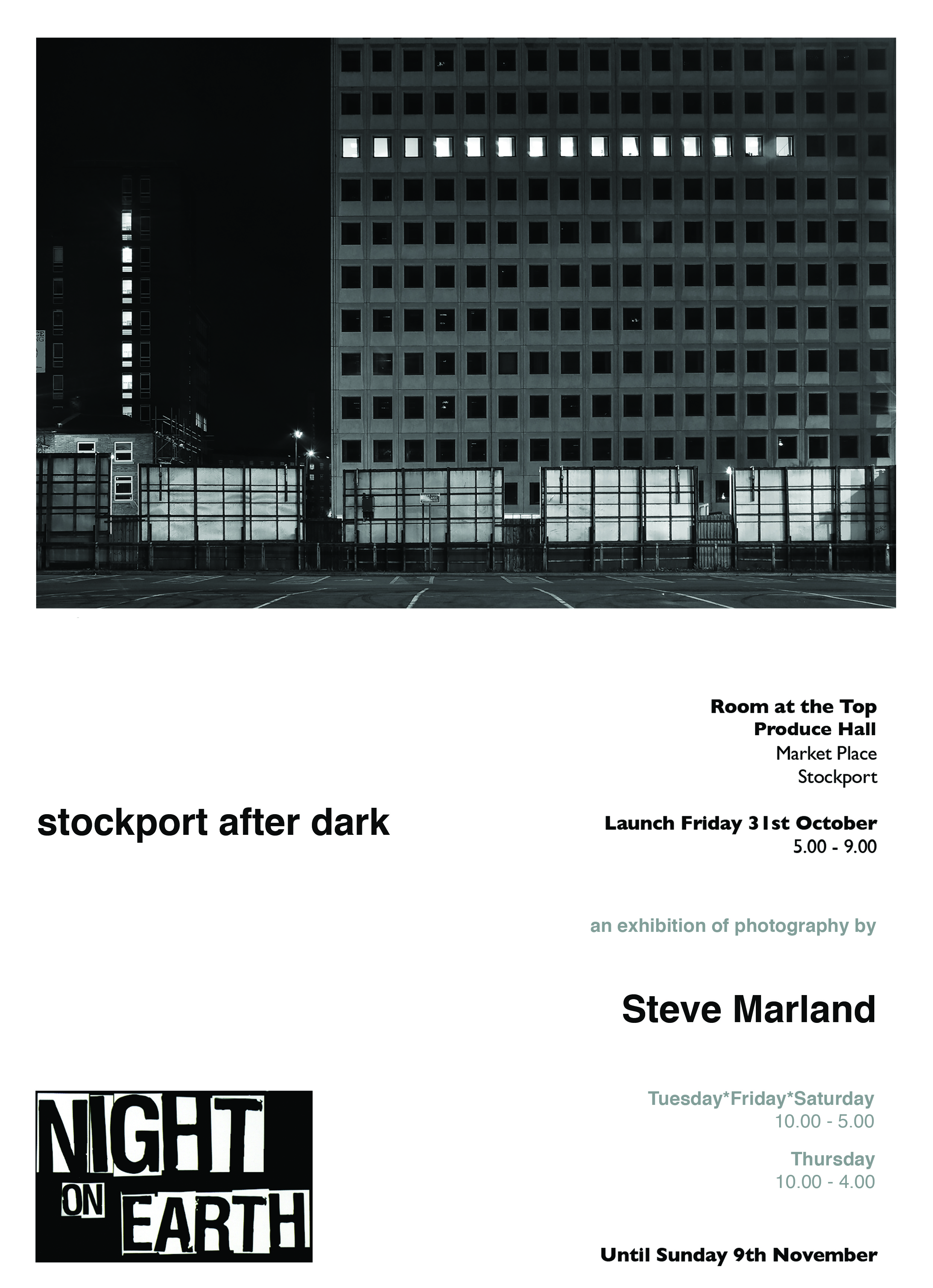
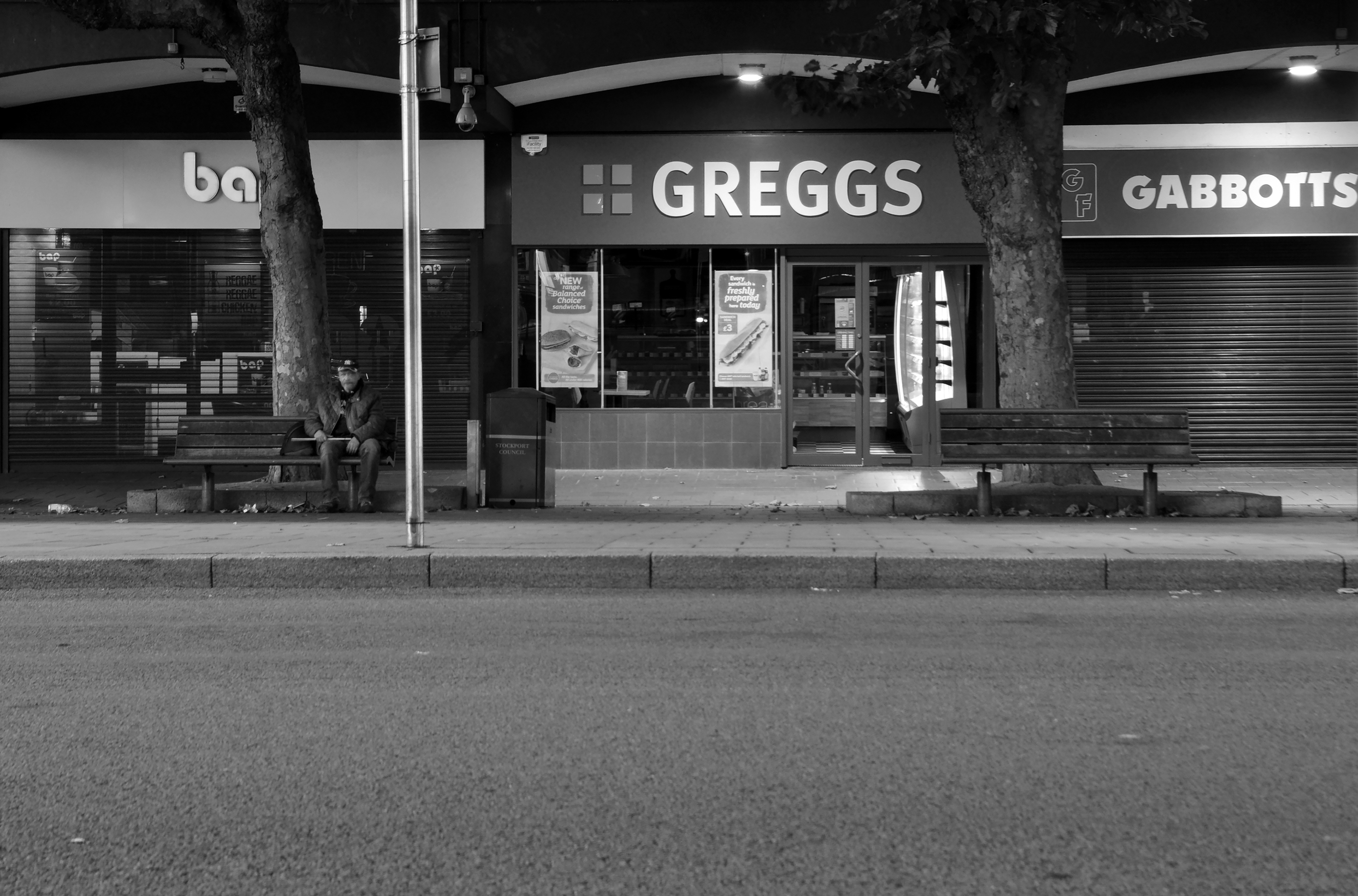
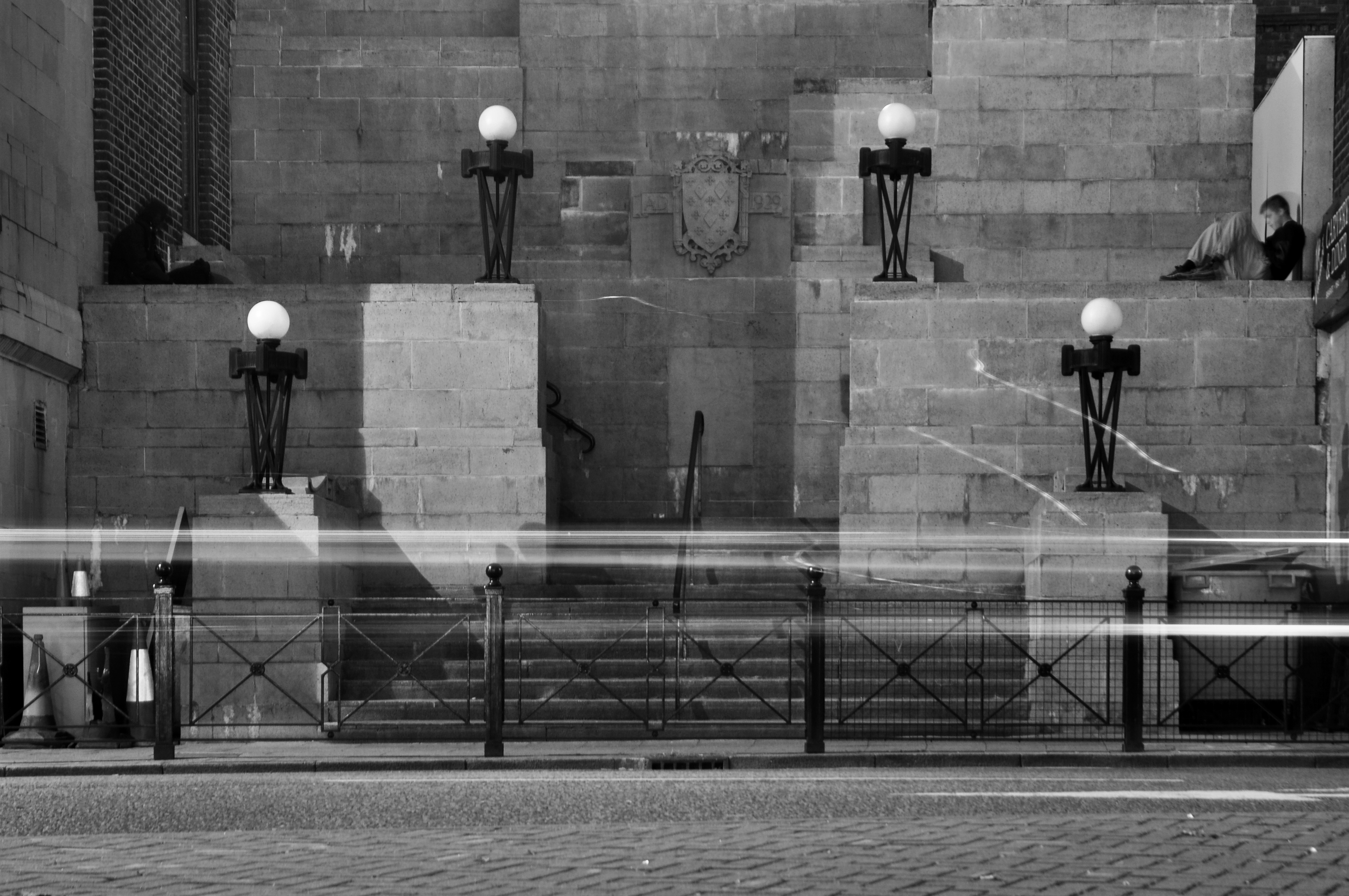
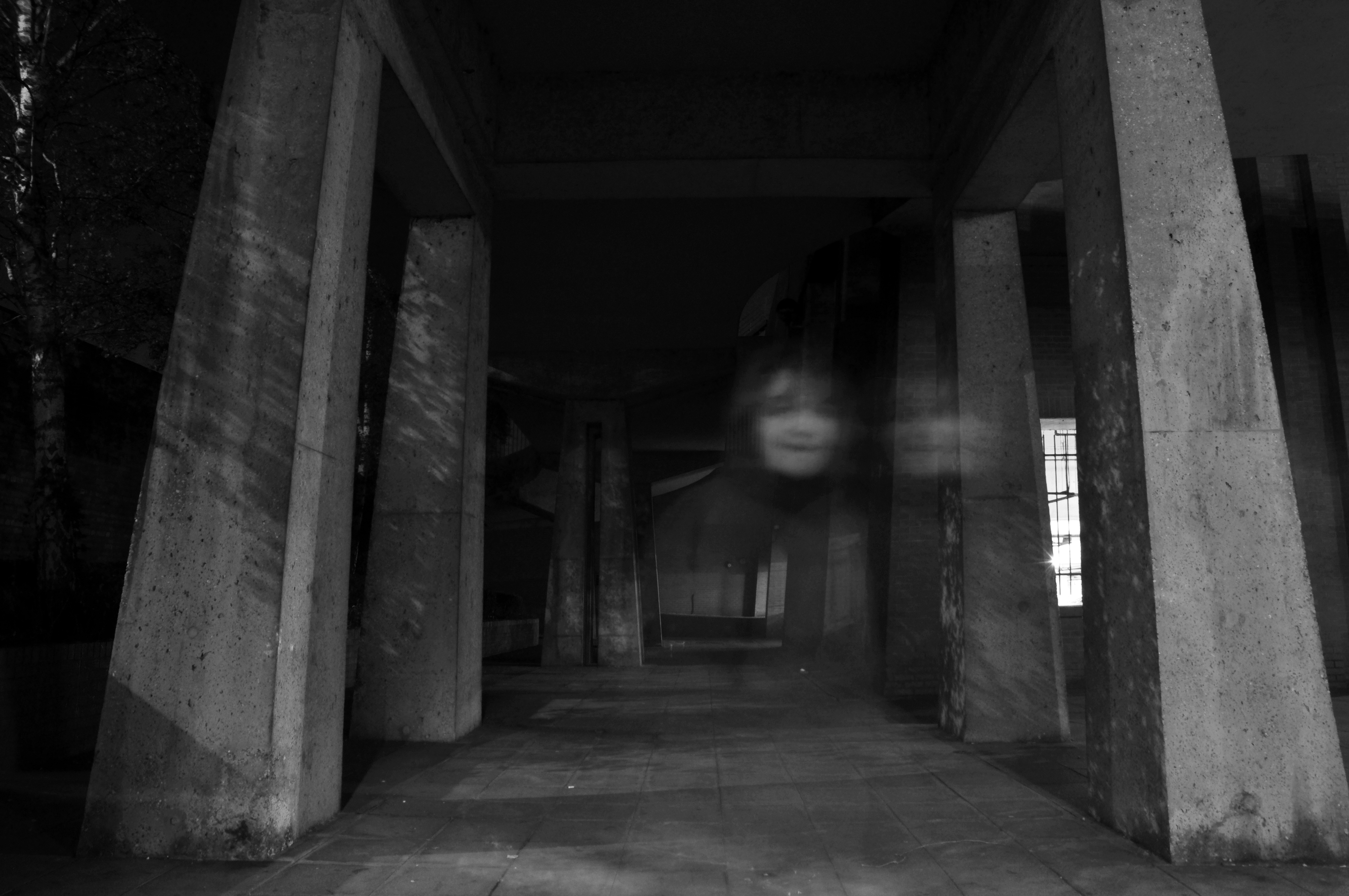
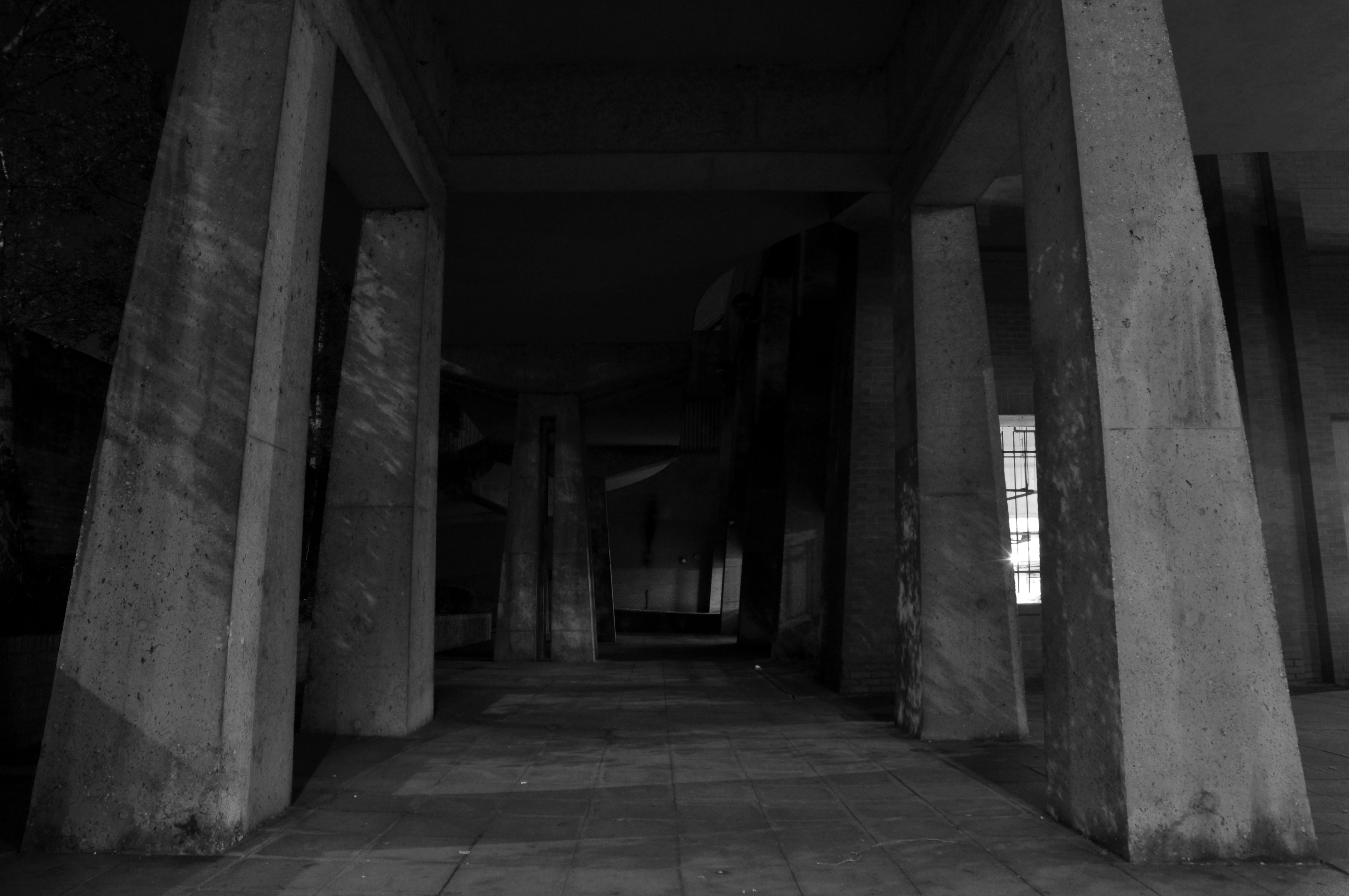
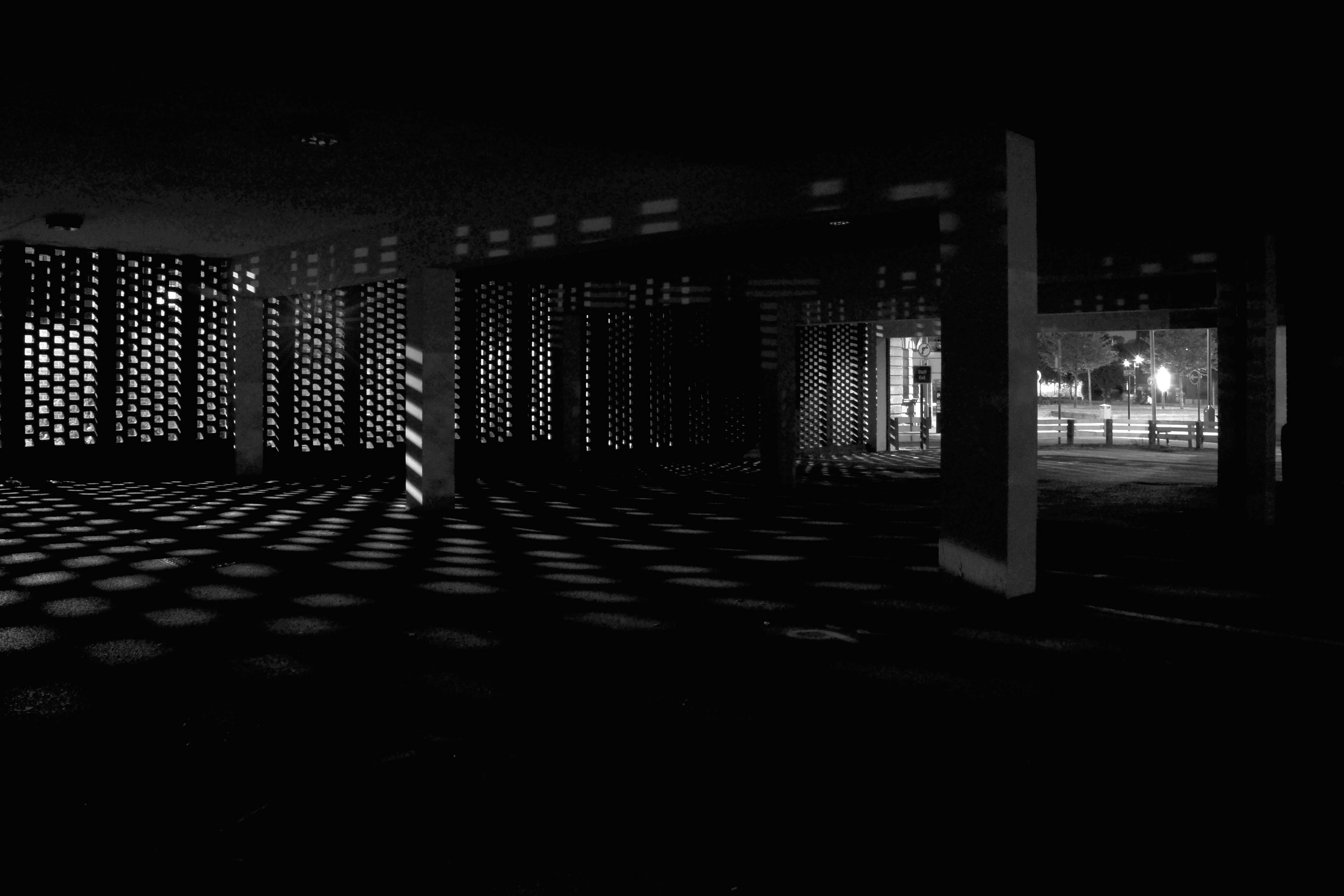
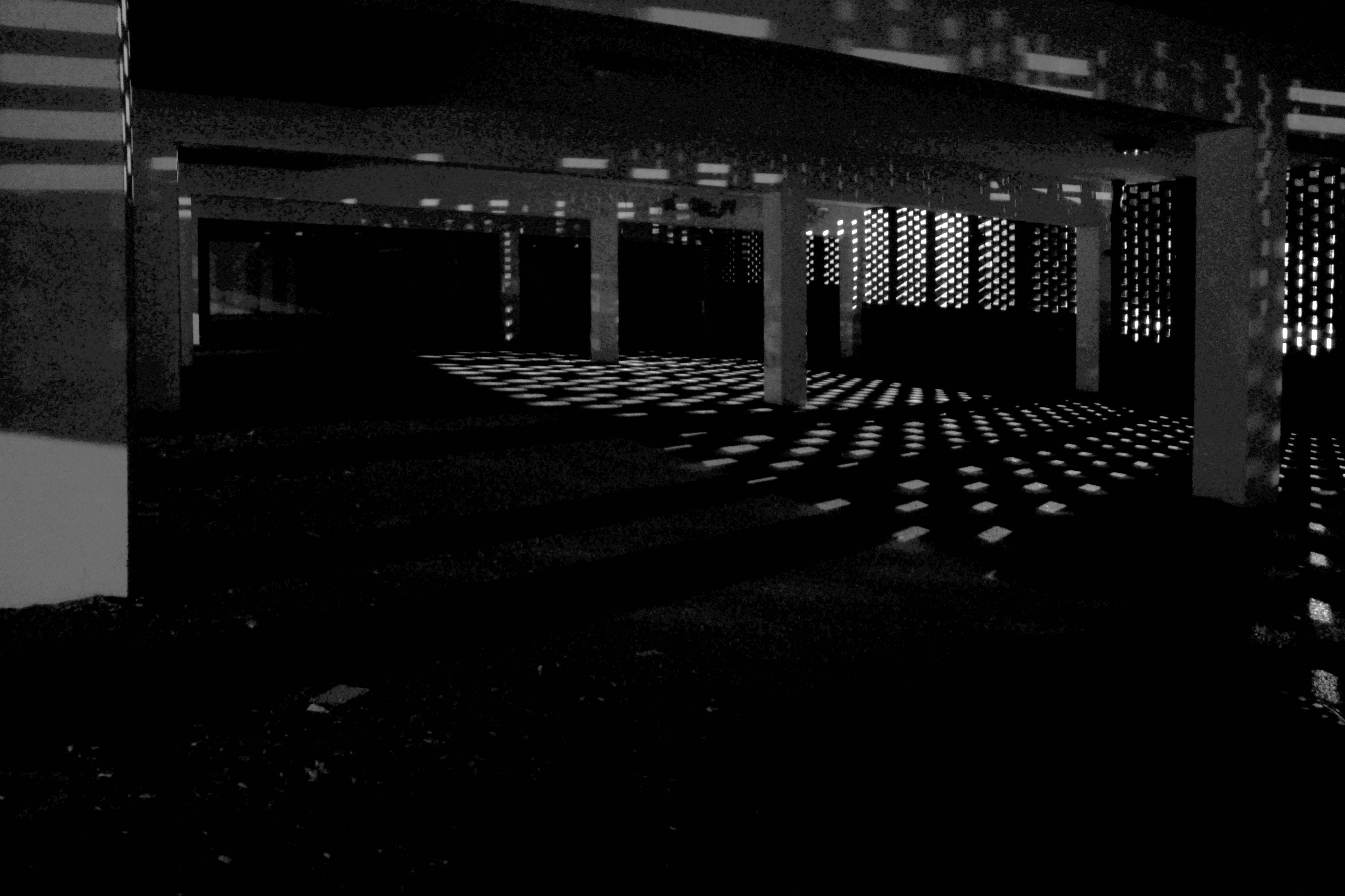
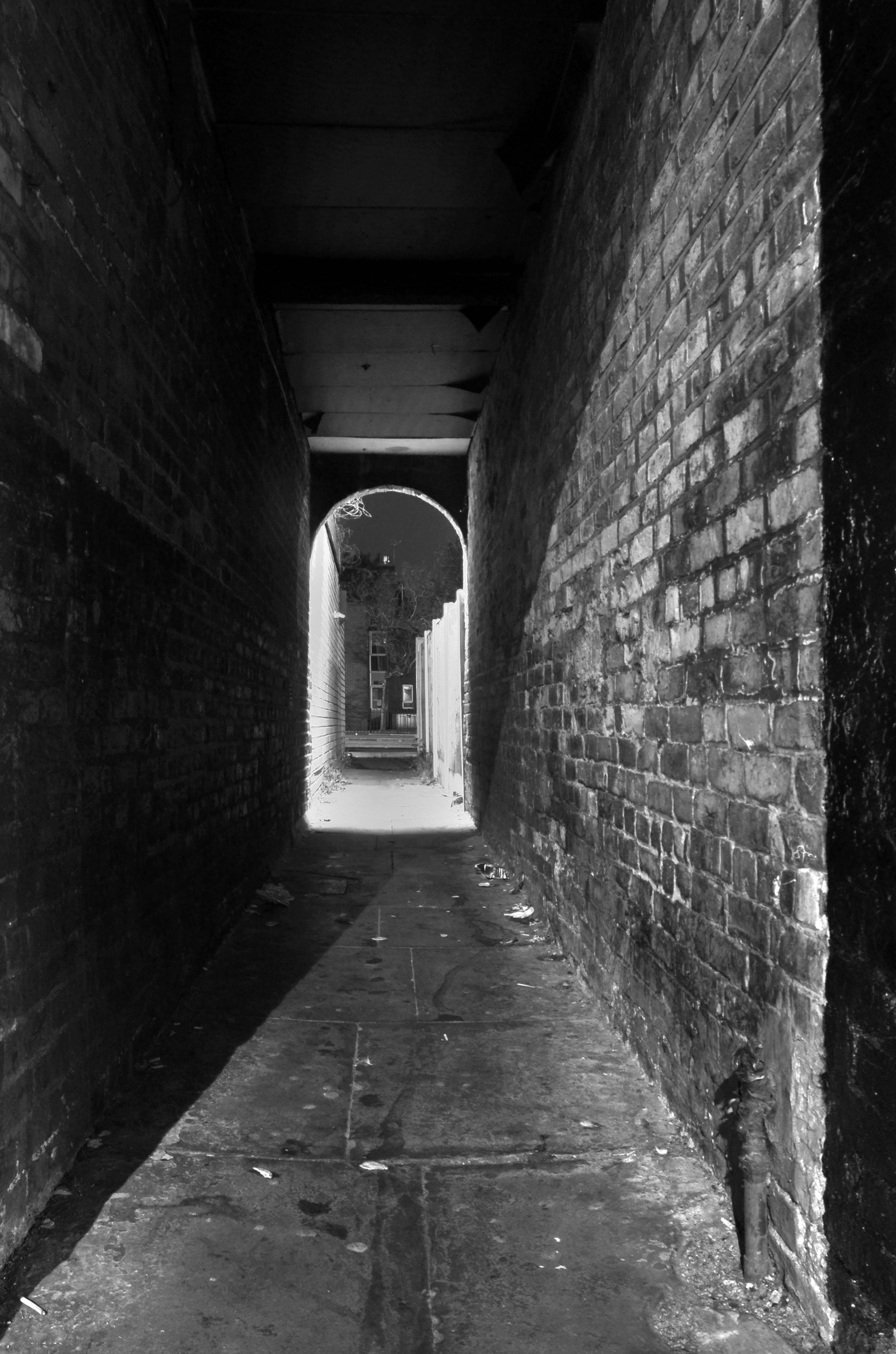
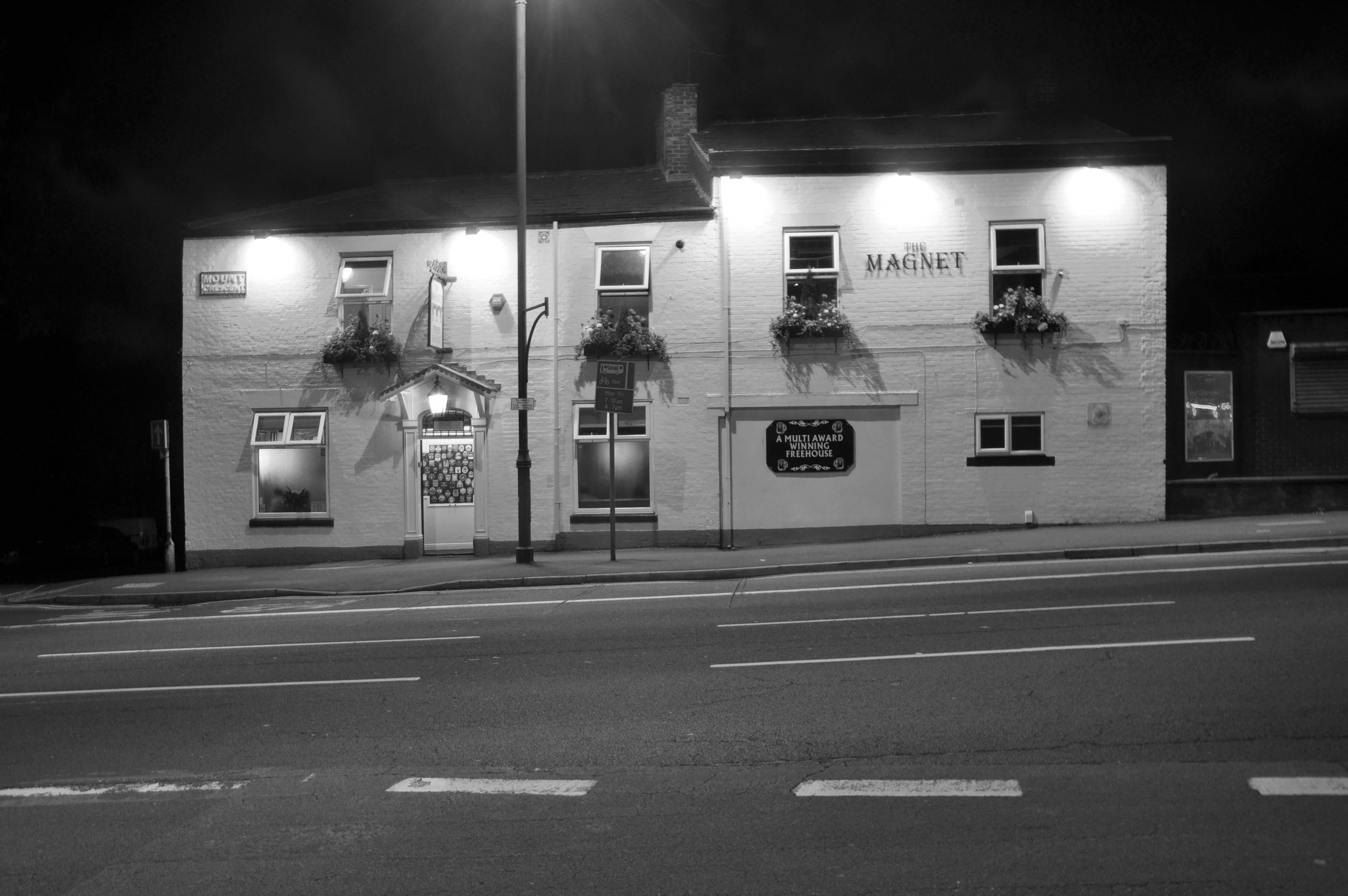
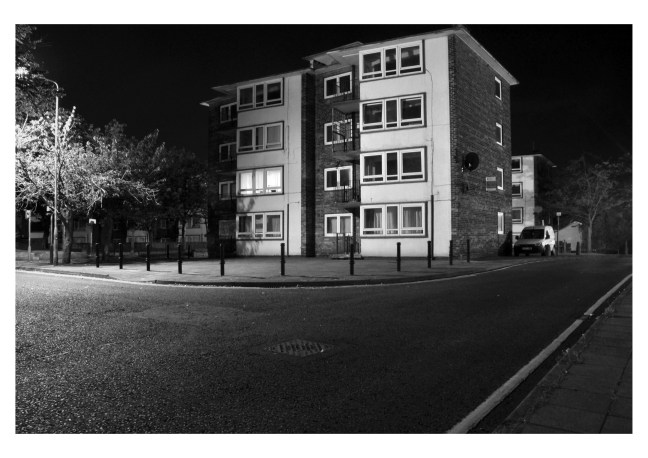
At about the same time I was asked to exhibit my photographs in Stockport, I chose to mooch about at night. Walking around an almost deserted town, avoiding the glare of streetlights, there is a mild frisson to be about when nobody else is about. The air feels different, exposures are longer, the almost waking world feels arrested, by the low available light.

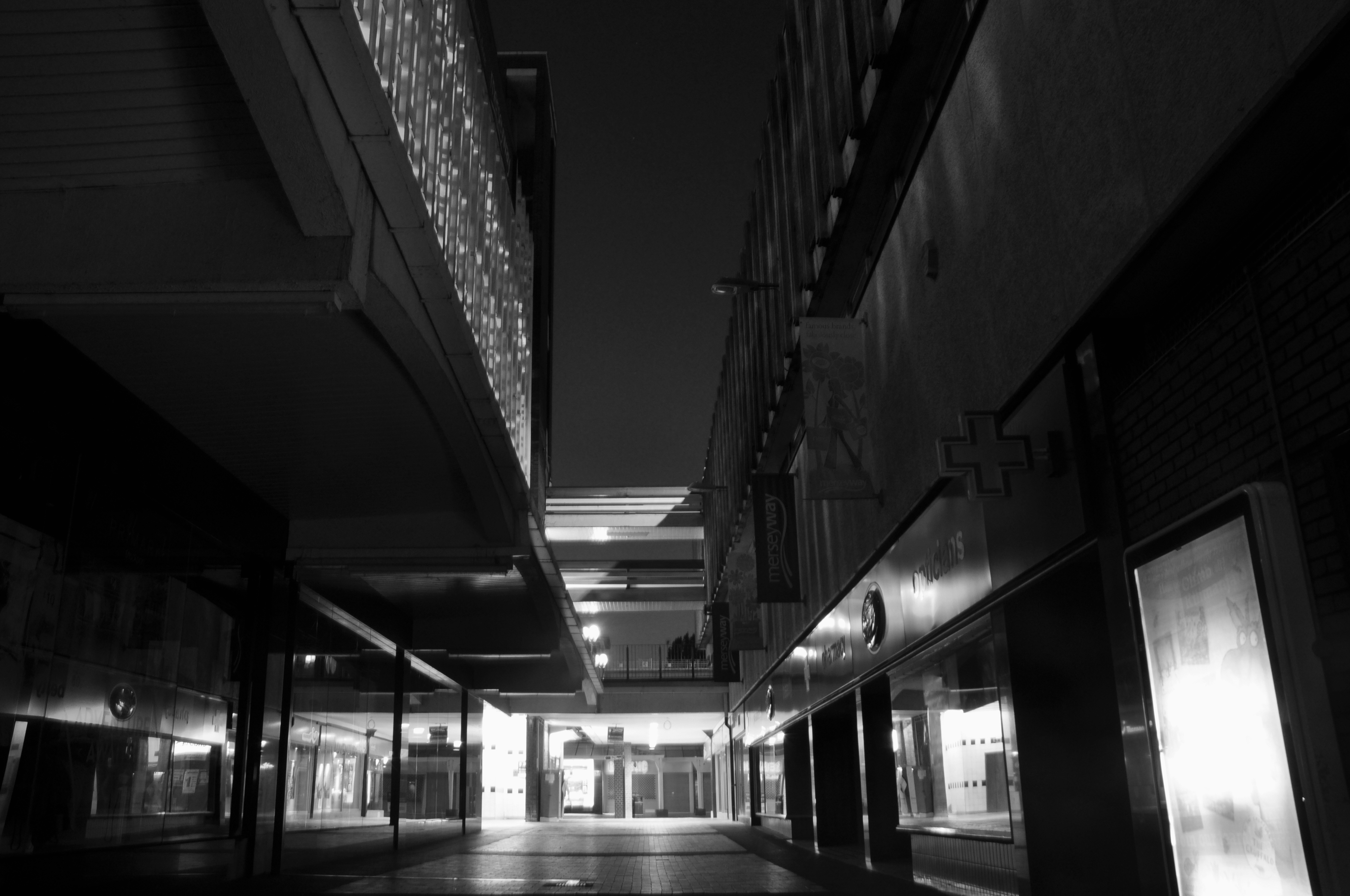
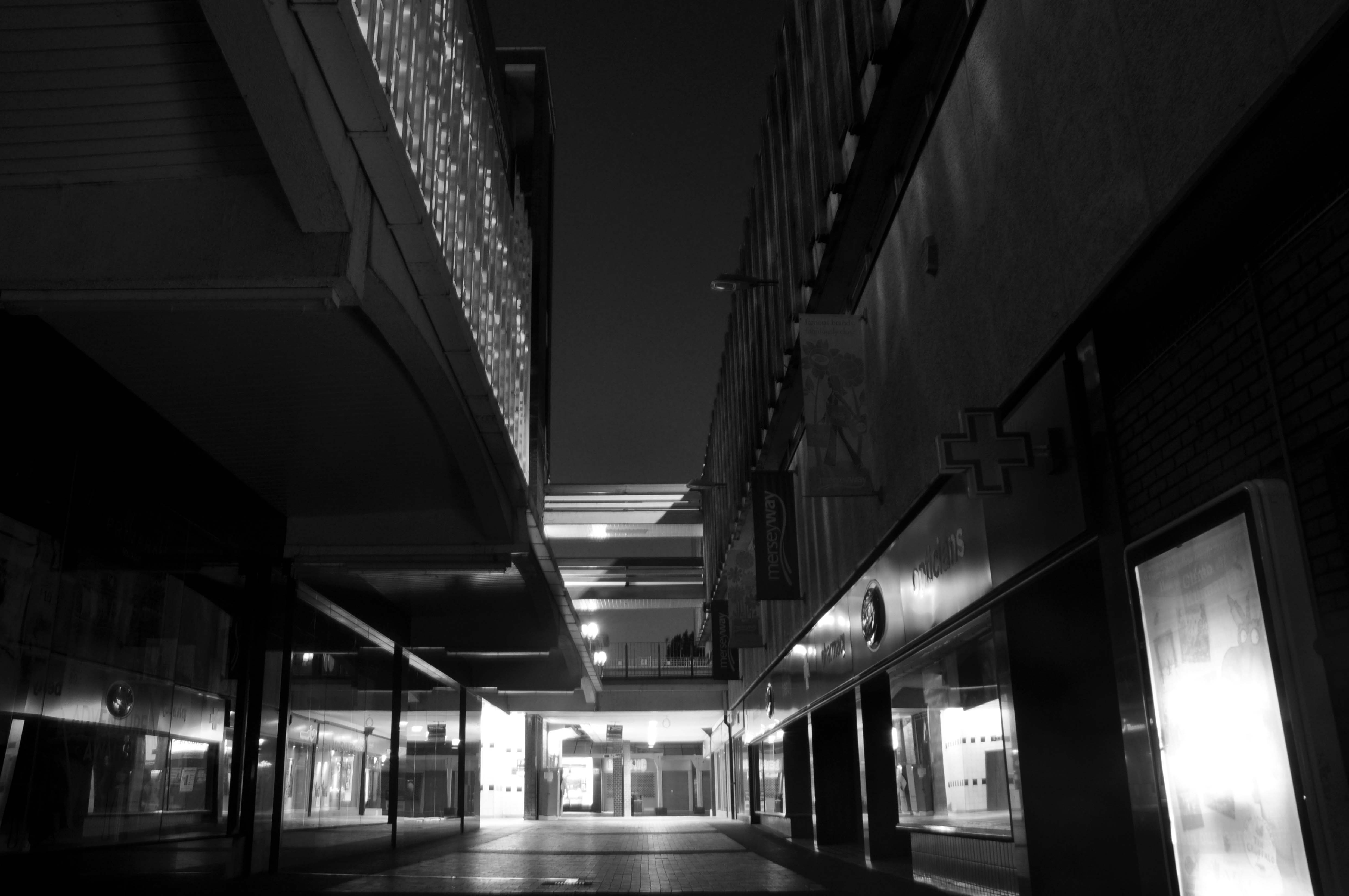
Merseyway Shopping Centre designed by Bernard Engle and Partners, opened in 1965.

My local shopping centre and as such part of my weekly walking and shopping life.

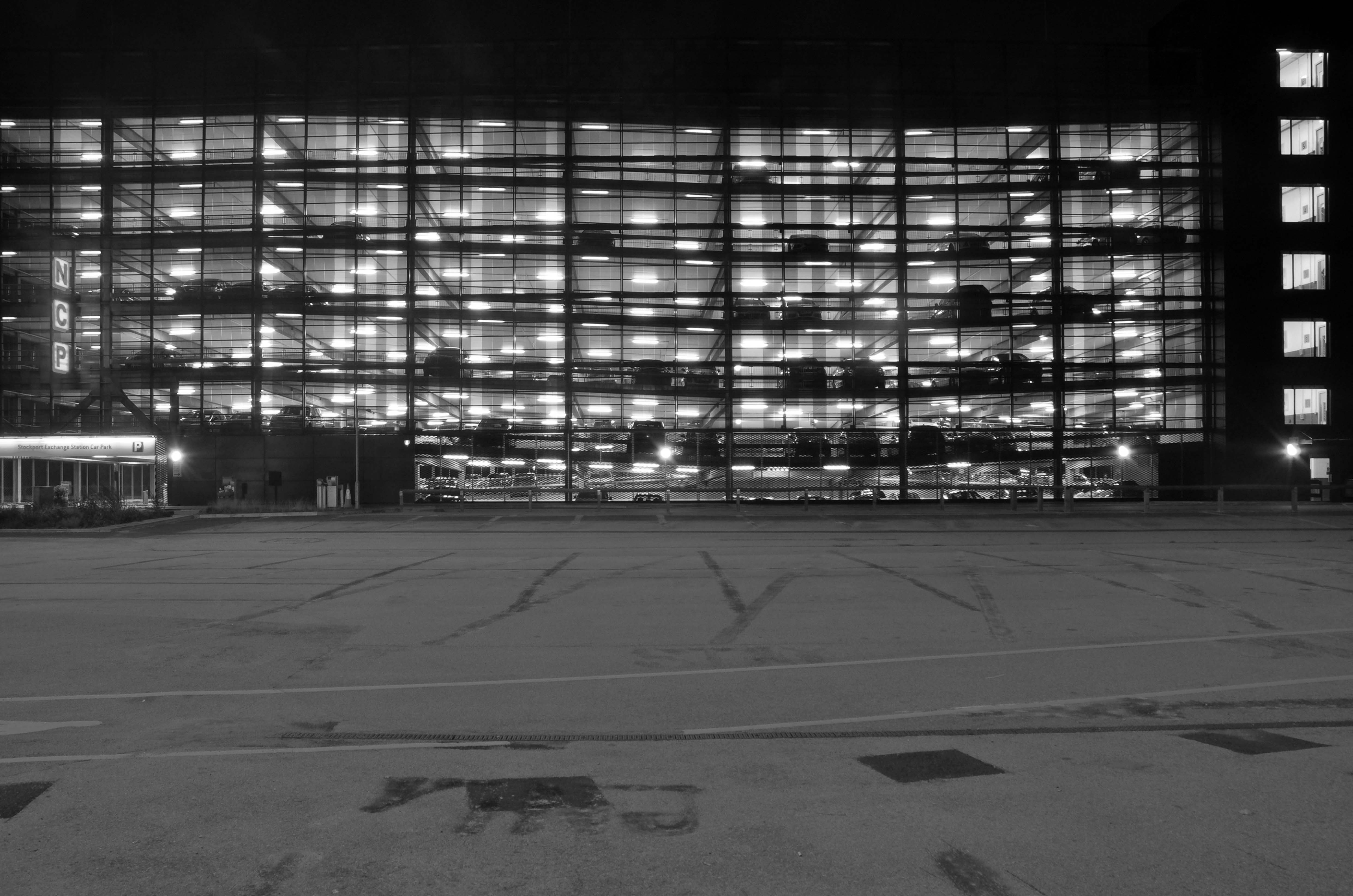
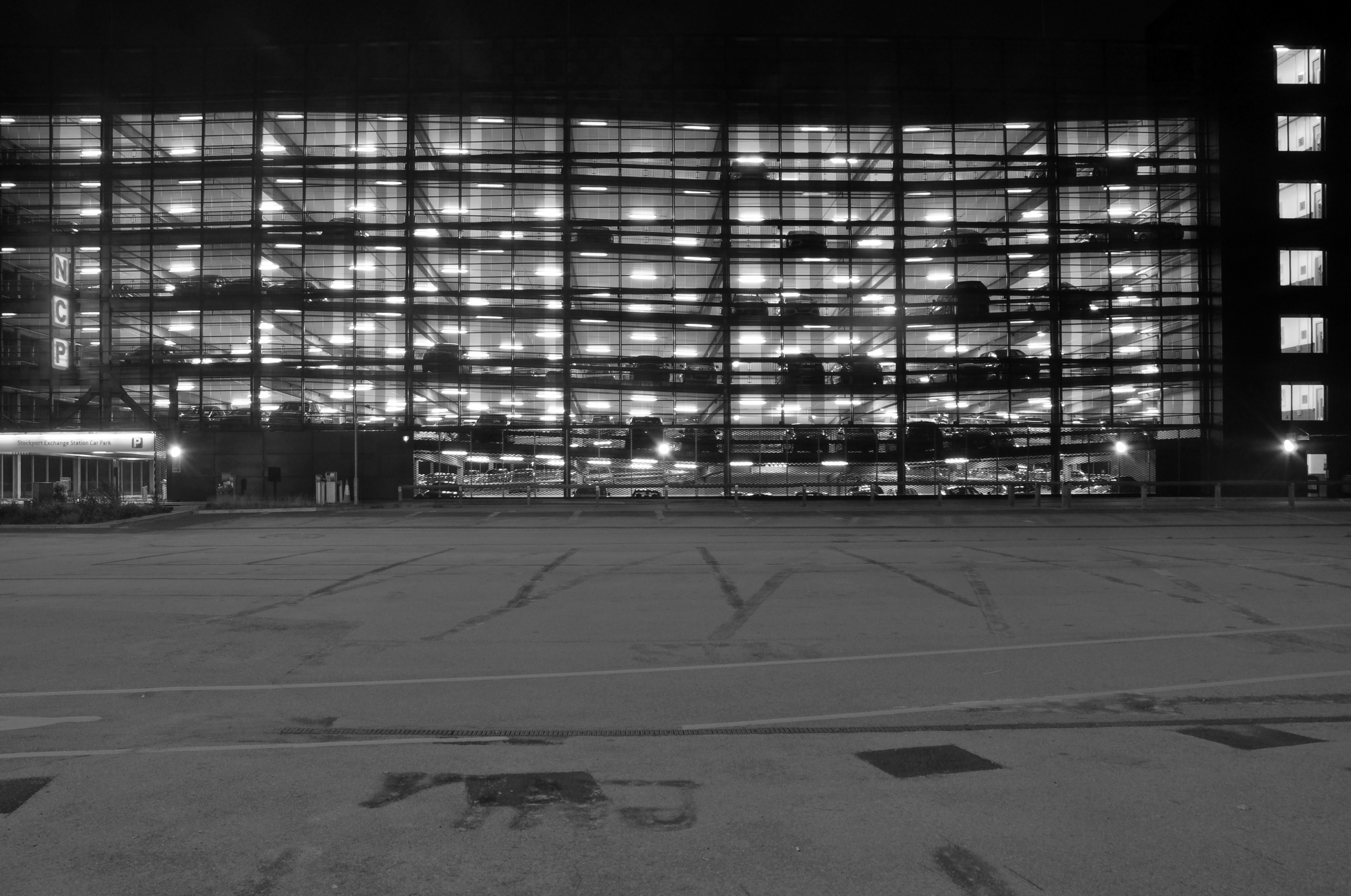
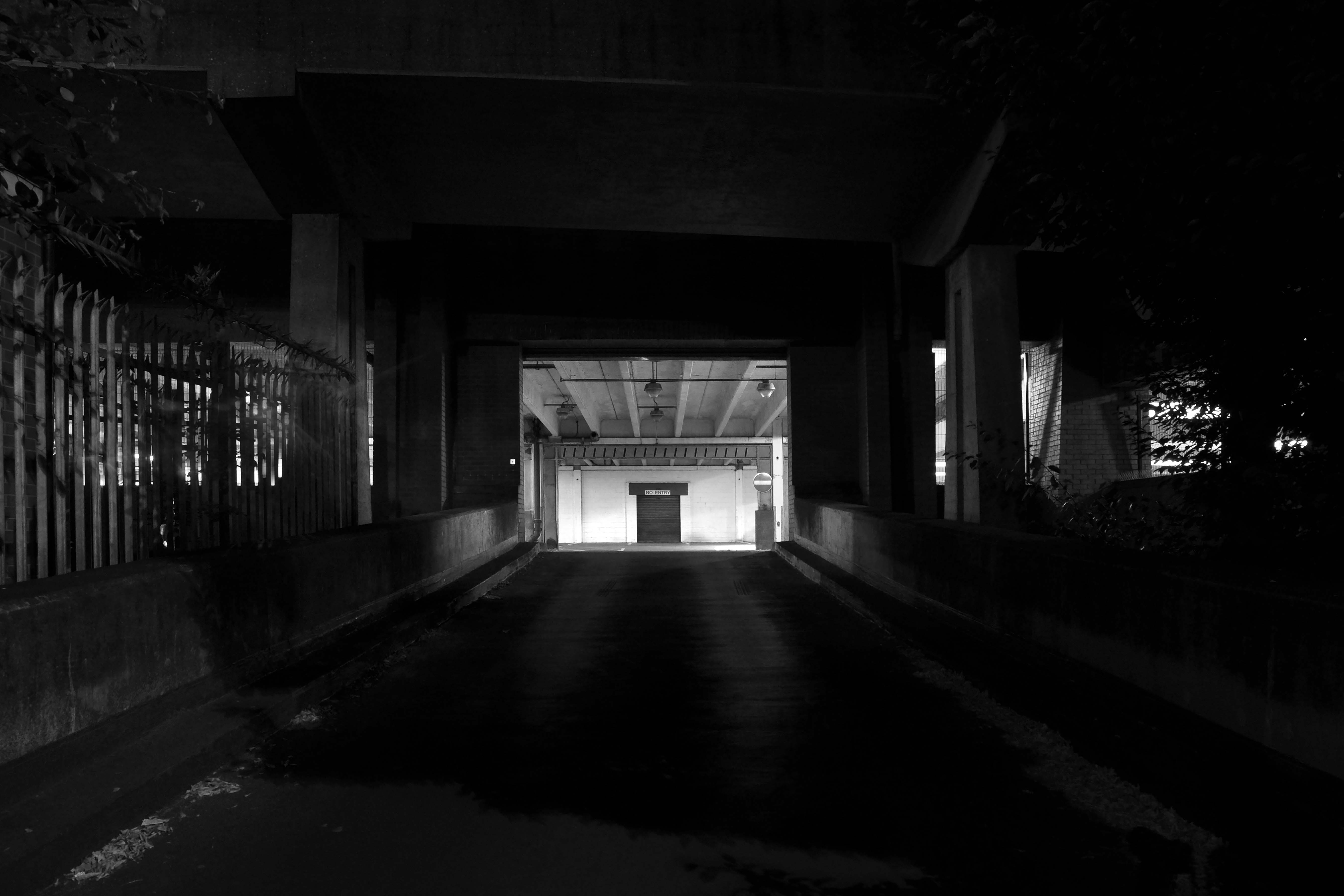
NCP Car Park located on Stockport Station approach.

Regent House

Asda superstore

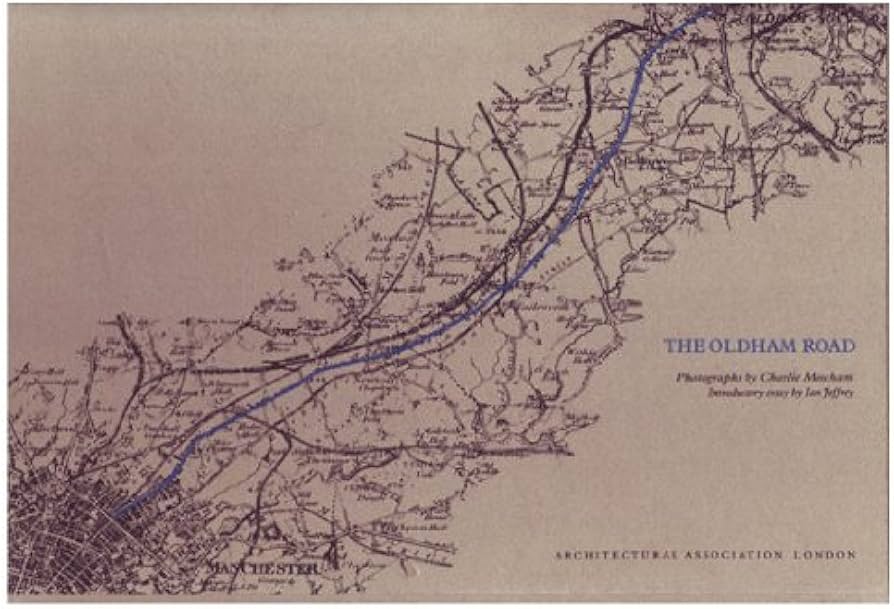
I found a copy of Charlie Meecham’s book Oldham Road in a charity shop.

Inspiring me in 2014, to walk in mostly straight lines, though often as not zig zagging along the main arterial roads of Manchester.

Taking pictures on Sunday mornings, in order to avoid traffic, mildly amused to be ignoring the primary function of the routes.

This is one of the more familiar roads, having walked up and down several times over several years. It was to have been an extension of the Mancunian Way, forming a trans-pennine motorway. Much of the property lining the route was cleared in preparation, it was never built, and for years a strange semi-deserted ambience hung over the A57.

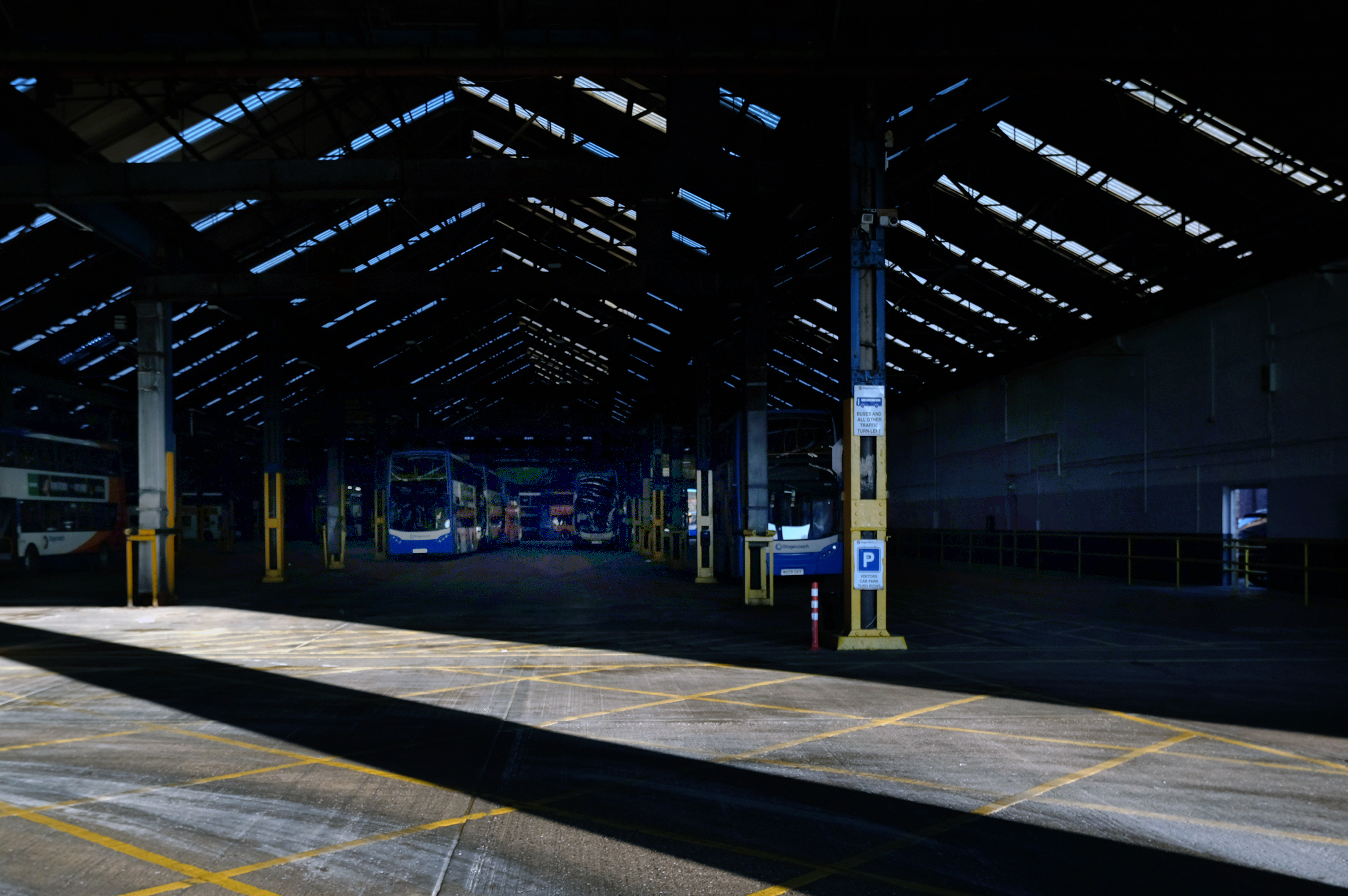
Bus Depot

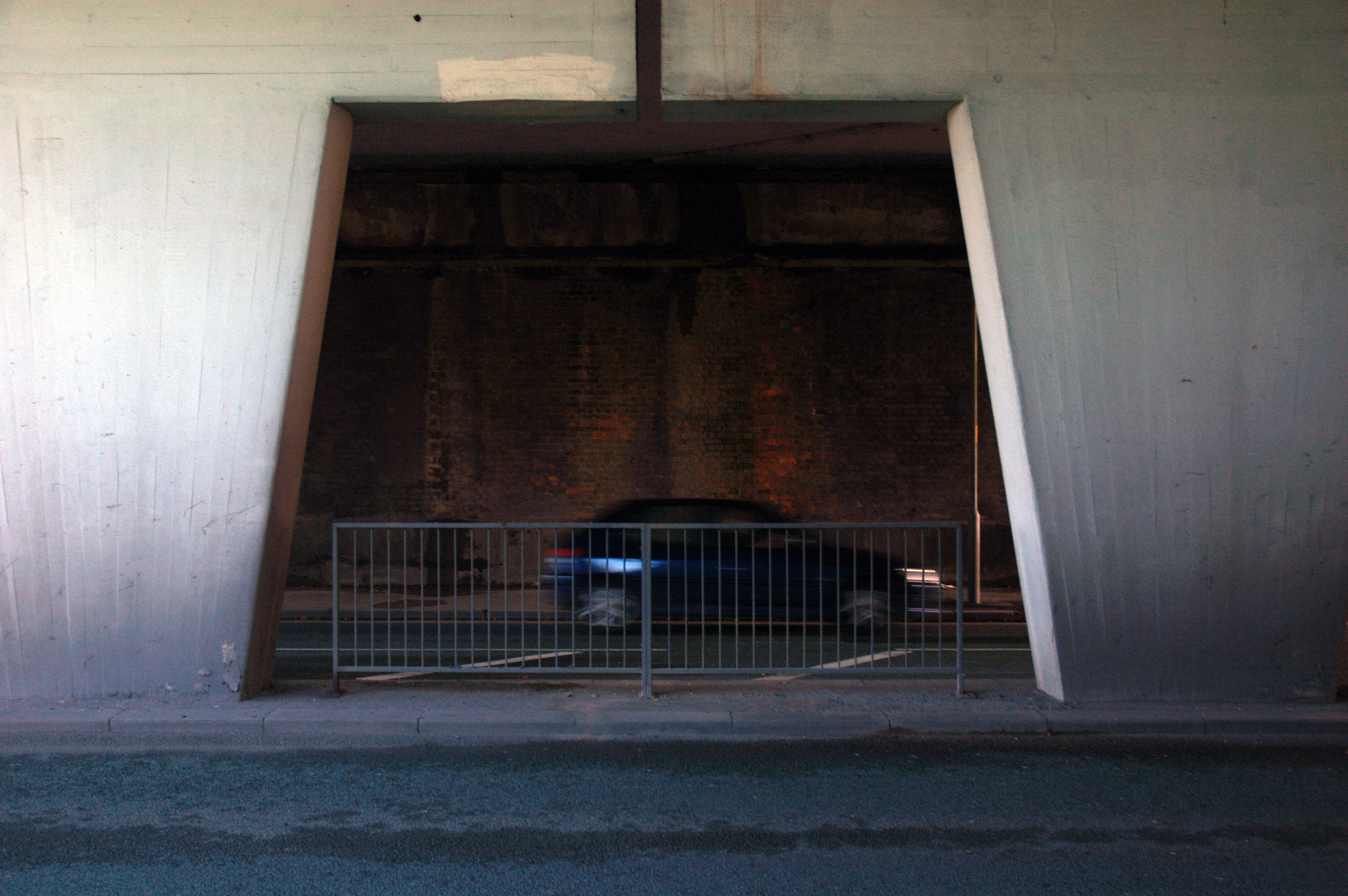
Railway Bridge

The car showrooms which later became an African Evangalist church.

Having cleared away both Victorian and Sixties housing, new architectural forms arose in West Gorton.

Where there were once dozens of pubs, often there are now none.

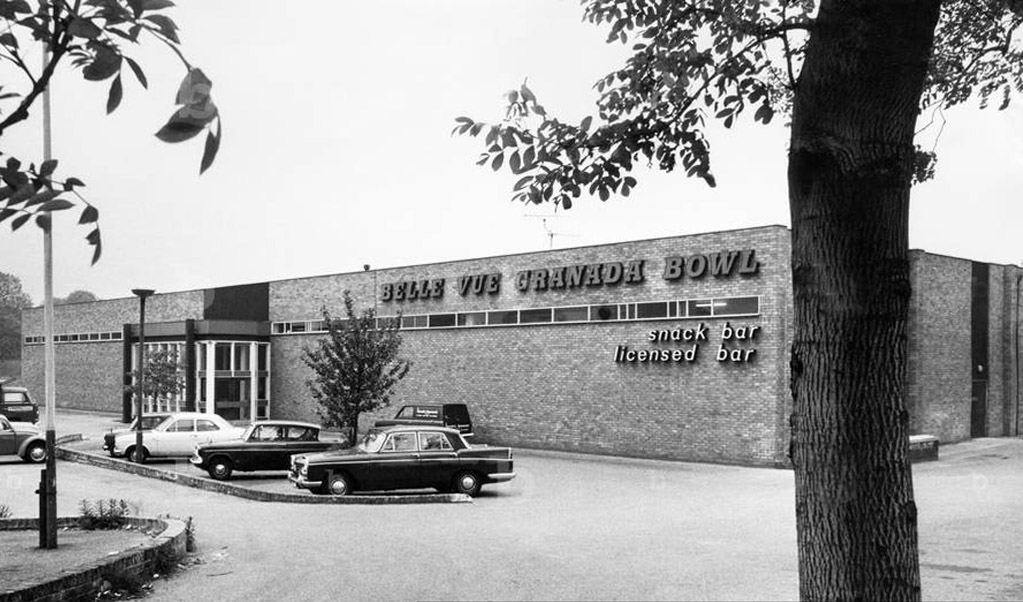
The Belle Vue Granada Bowl became a Bingo Hall then became nothing.


The 192 bus runs between Manchester Piccadilly and hazel Grove, I often ride between Stockport and town, and back.

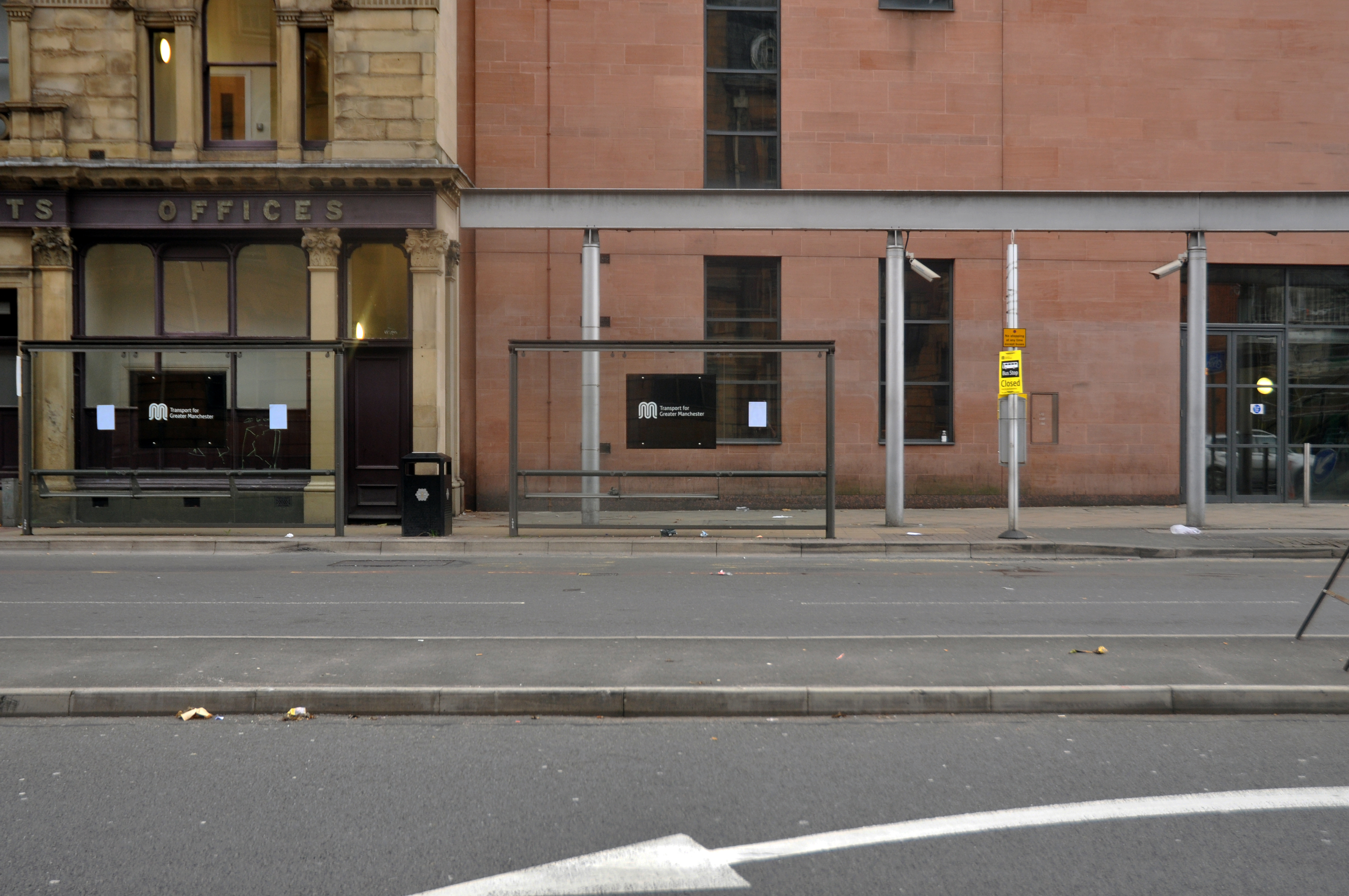
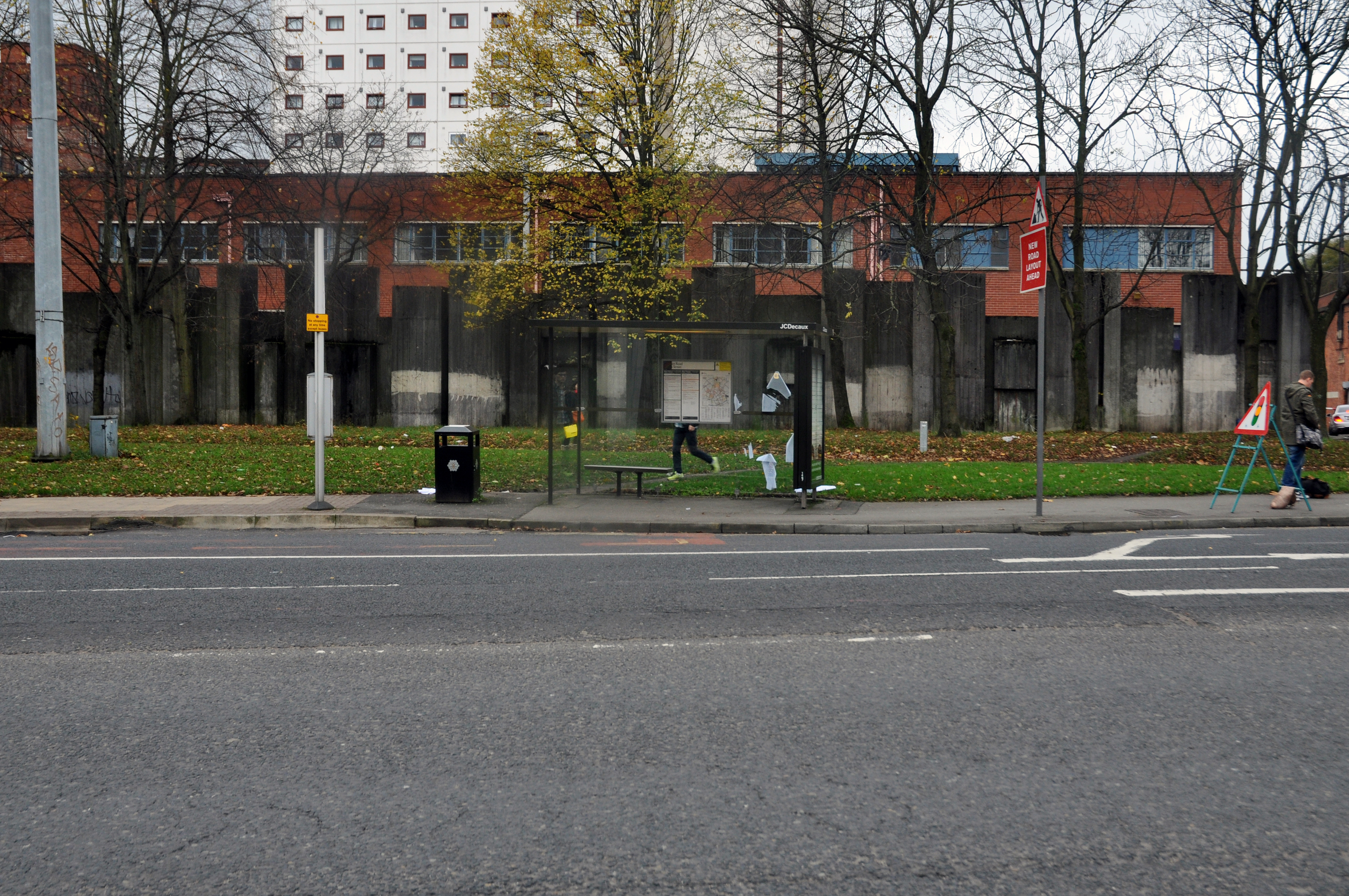
I decided to walk the route, photographing each of the ninety eight bus stops along the way.

Piccadilly Station

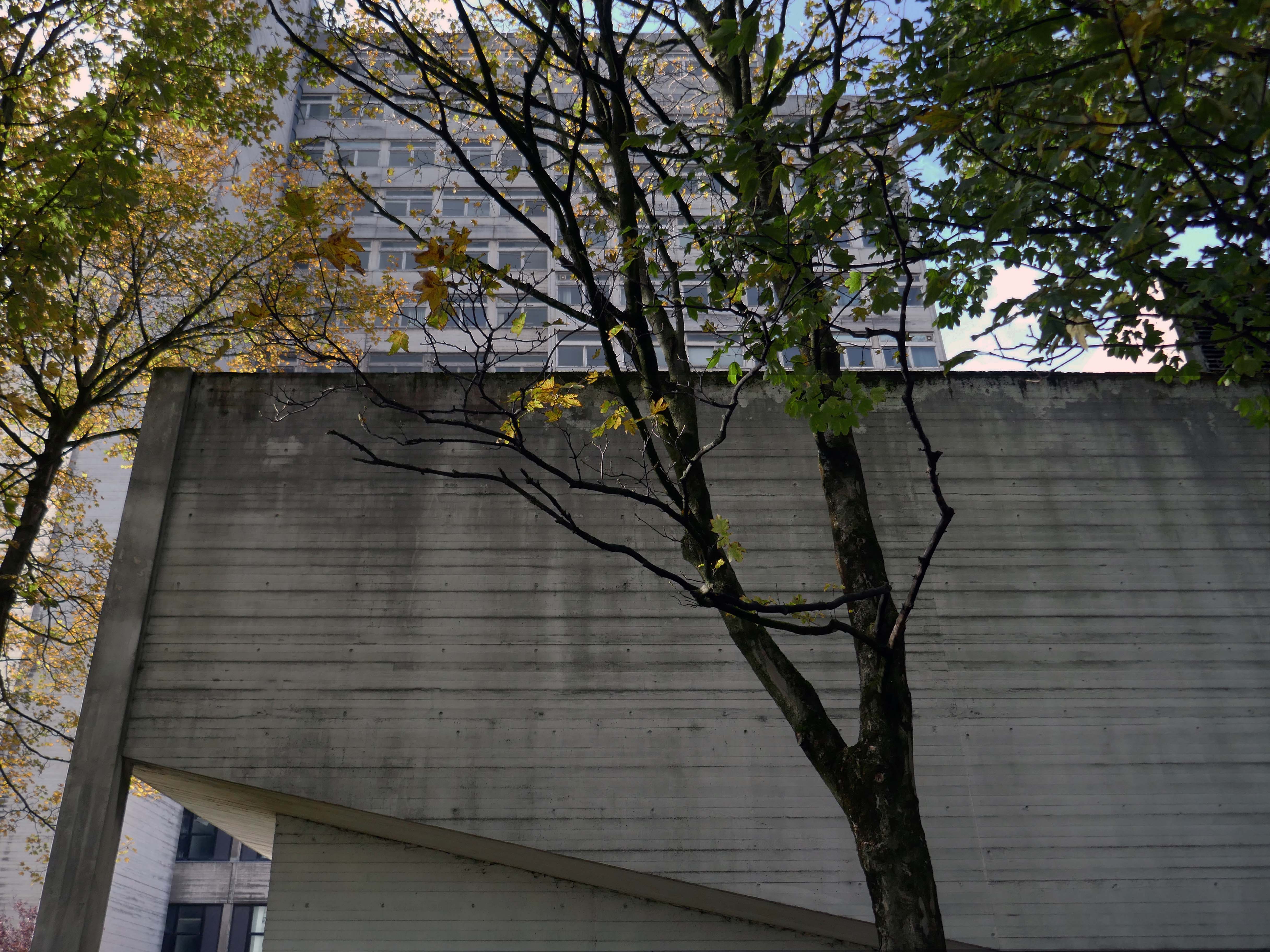
UMIST Retaining Wall

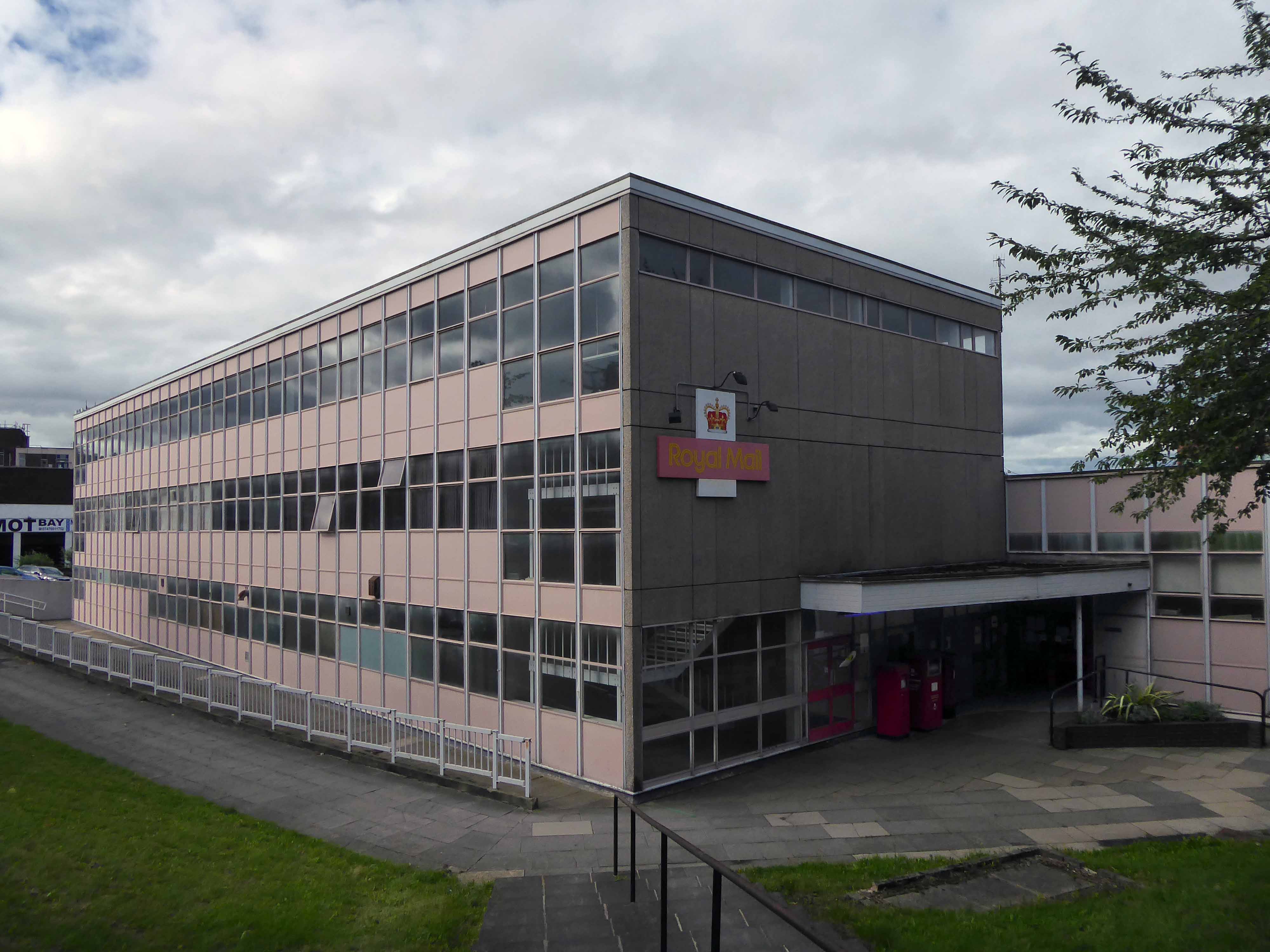
Ardwick Post Office

Levenshulme

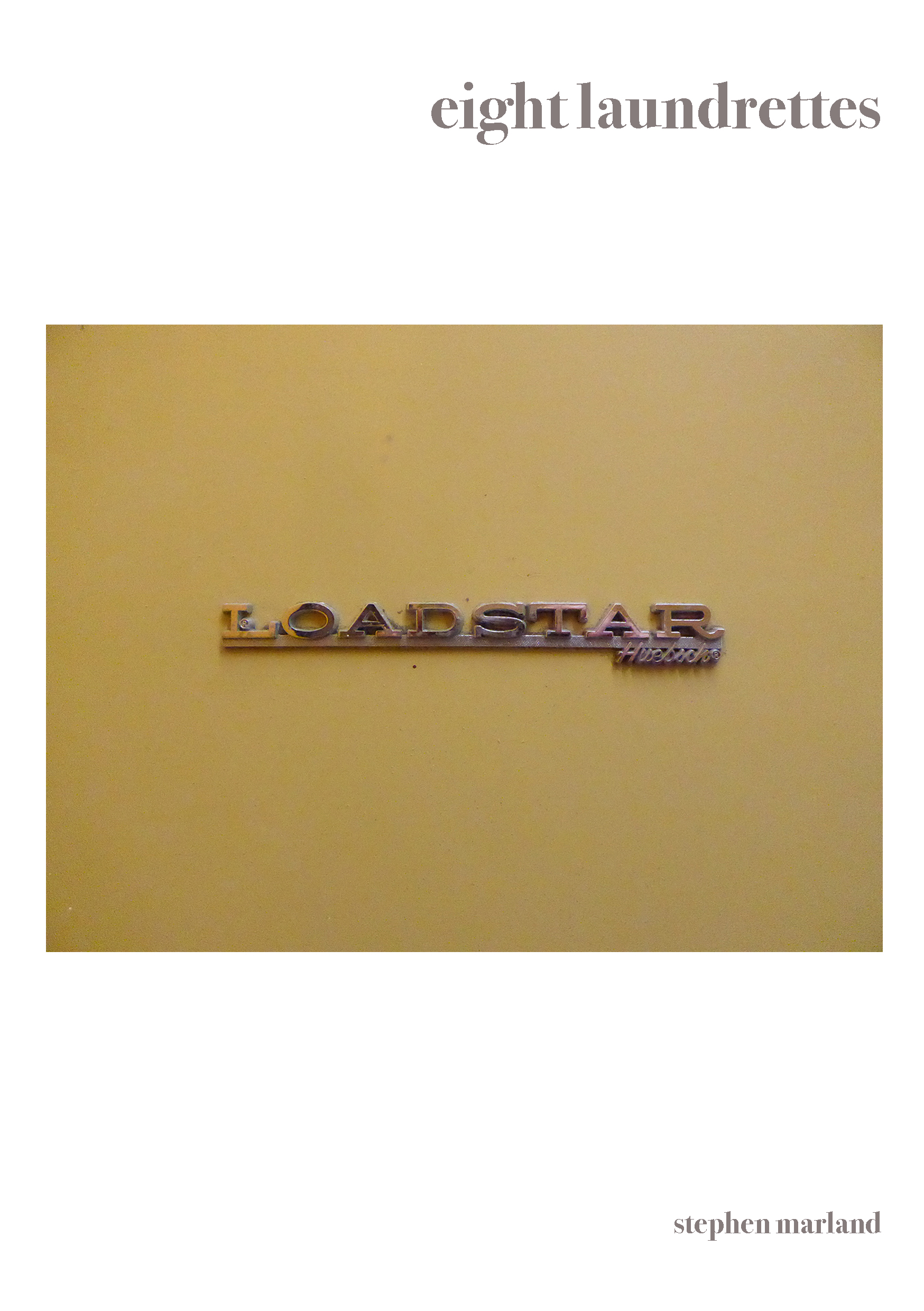
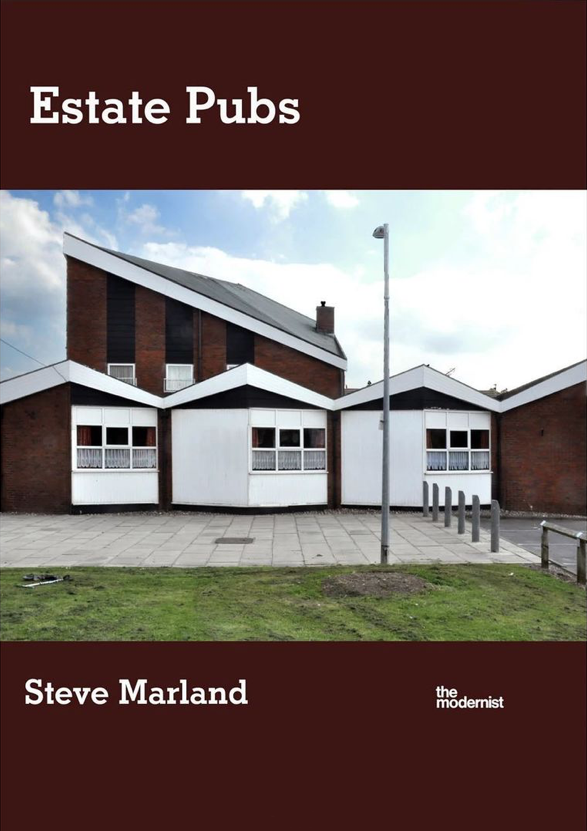
A book published by the modernist – literally eight launderettes.

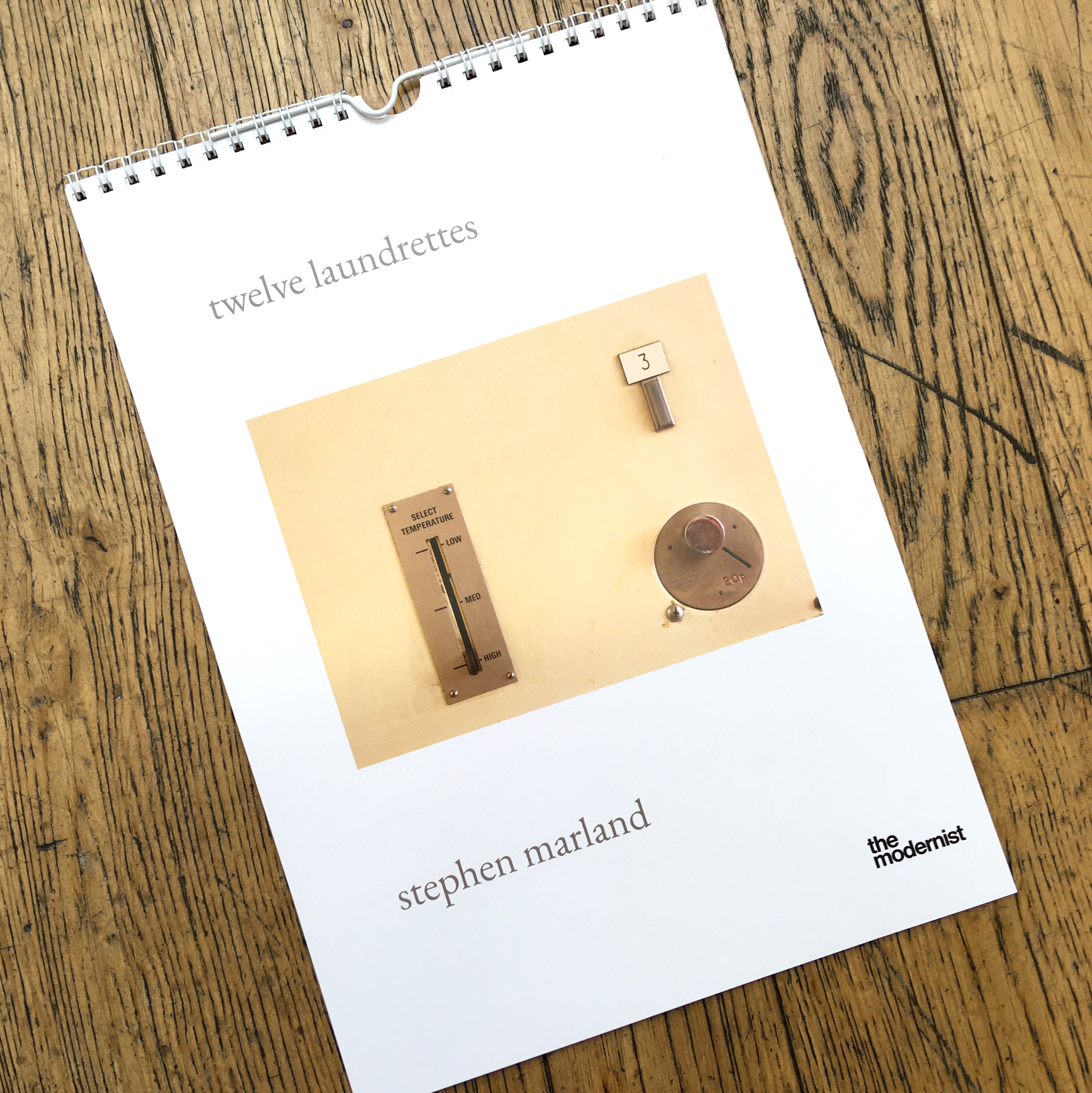
Which became the first modernist calendar.

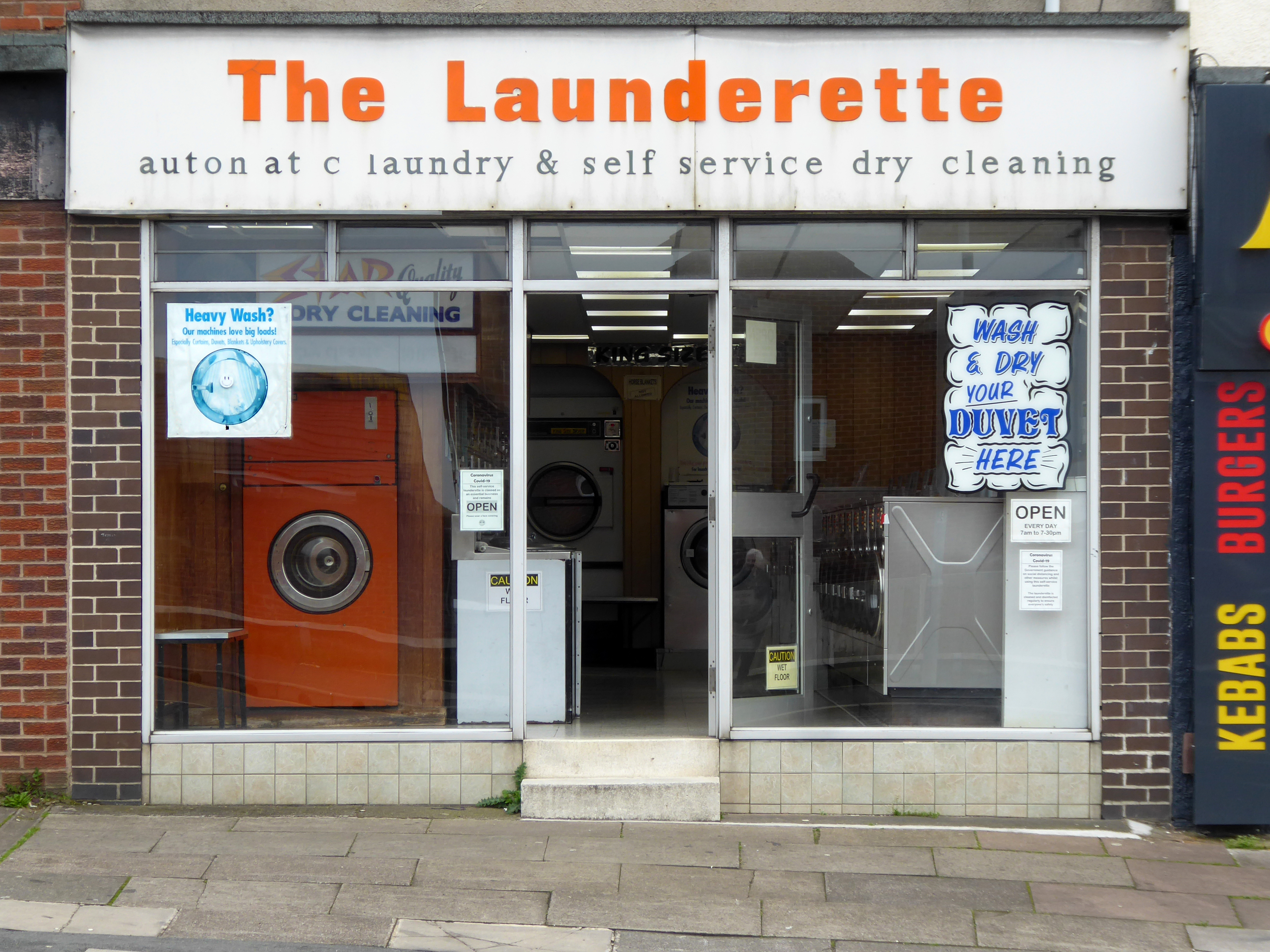
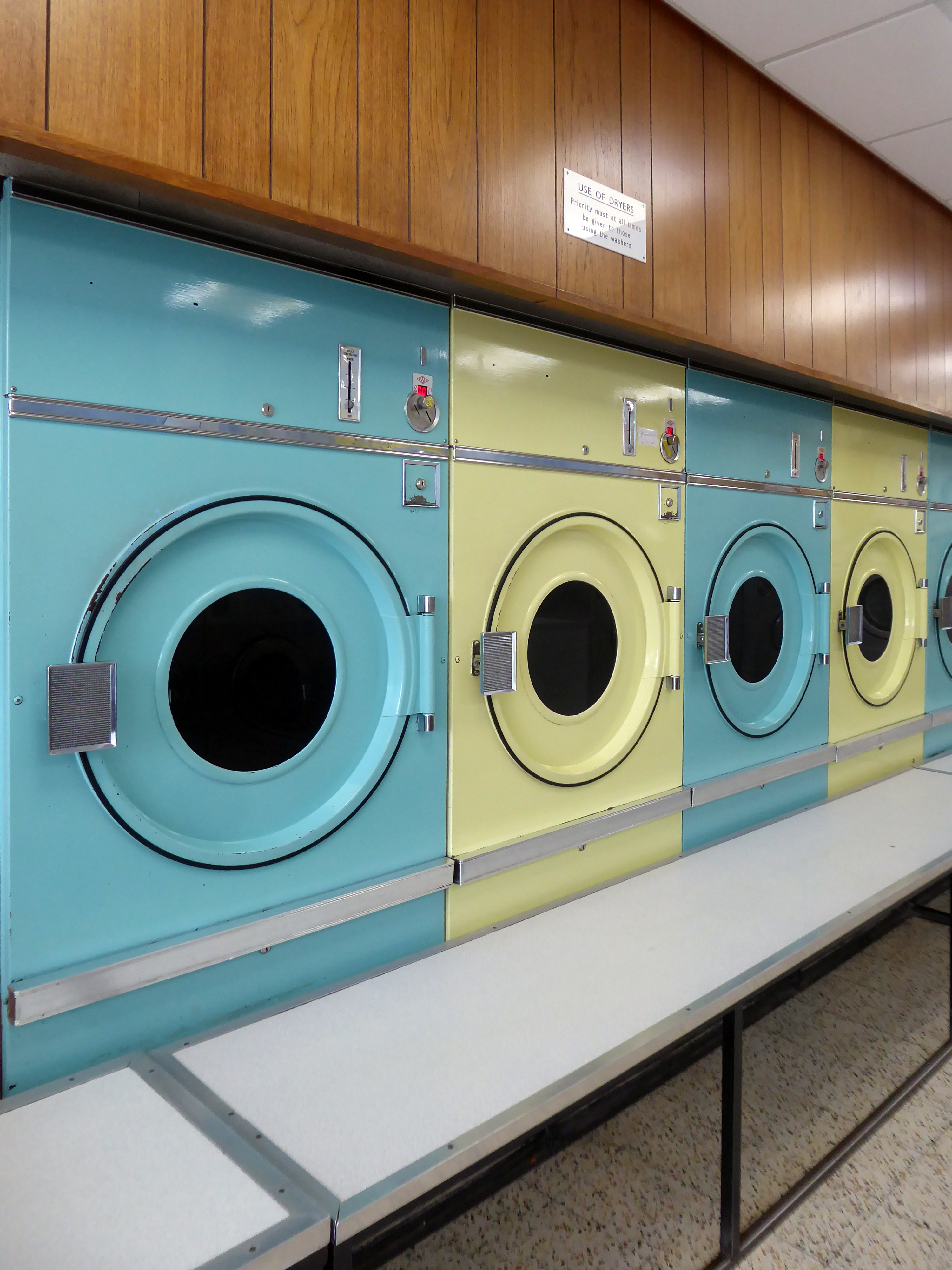
Now, everywhere I go, I see launderettes – so arriving in Hanley with time on my hands, wandering around I found this exemplary example.

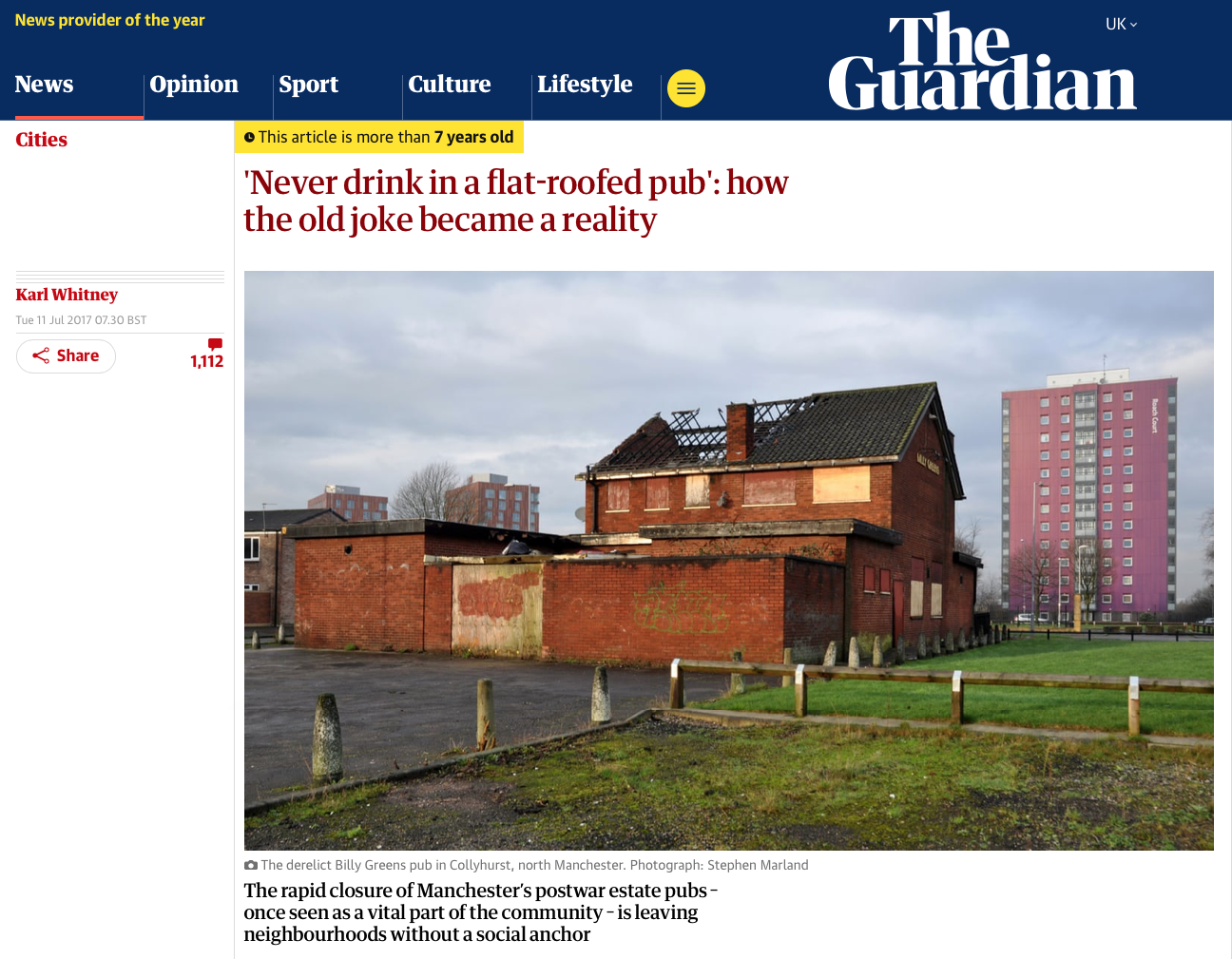
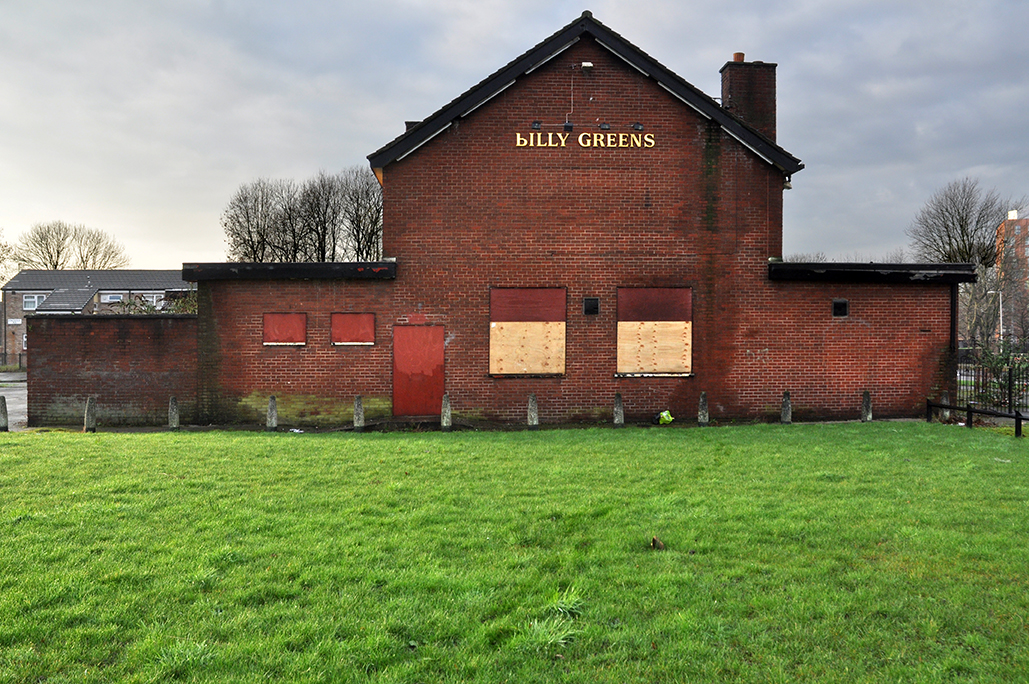
Having a blog entitled Manchester Estate Pubs, the national media became interested in my photographs. I had spent quite some time, wandering around in search of this endangered architectural typology.

This was Billy Greens in Collyhurst, named for a local boxer, now demolished.

Which in turn became the second modernist calendar.

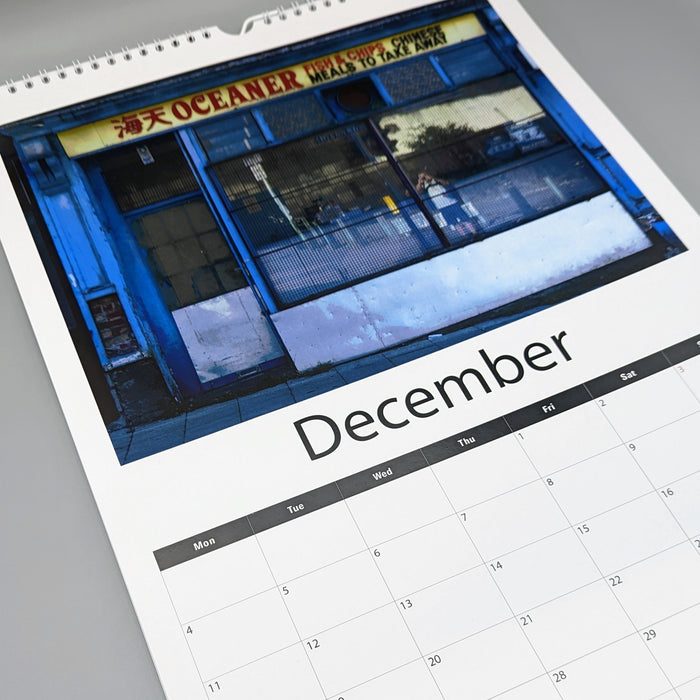
Followed the following year by fish and chip shops.

So building a vocabulary for my mooching, discovering yet another chippy, laundry, pub, Burton’s, telephone exchange, glazed stairway or underpass.

These things find you, yearning for some small amount of attention and affection.

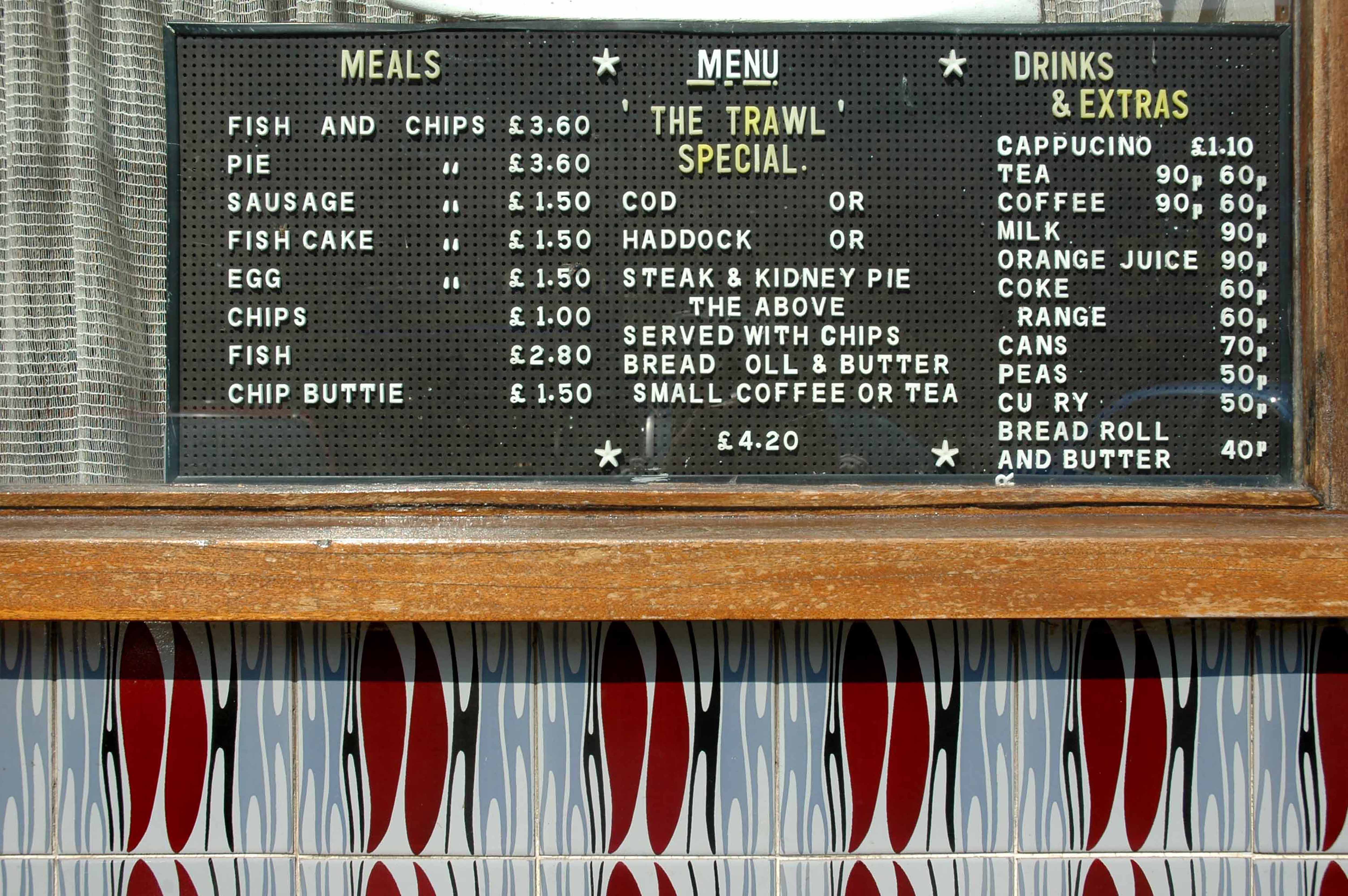
The Trawl – my favourite peg board menu, my favourite Bridlington chippy.

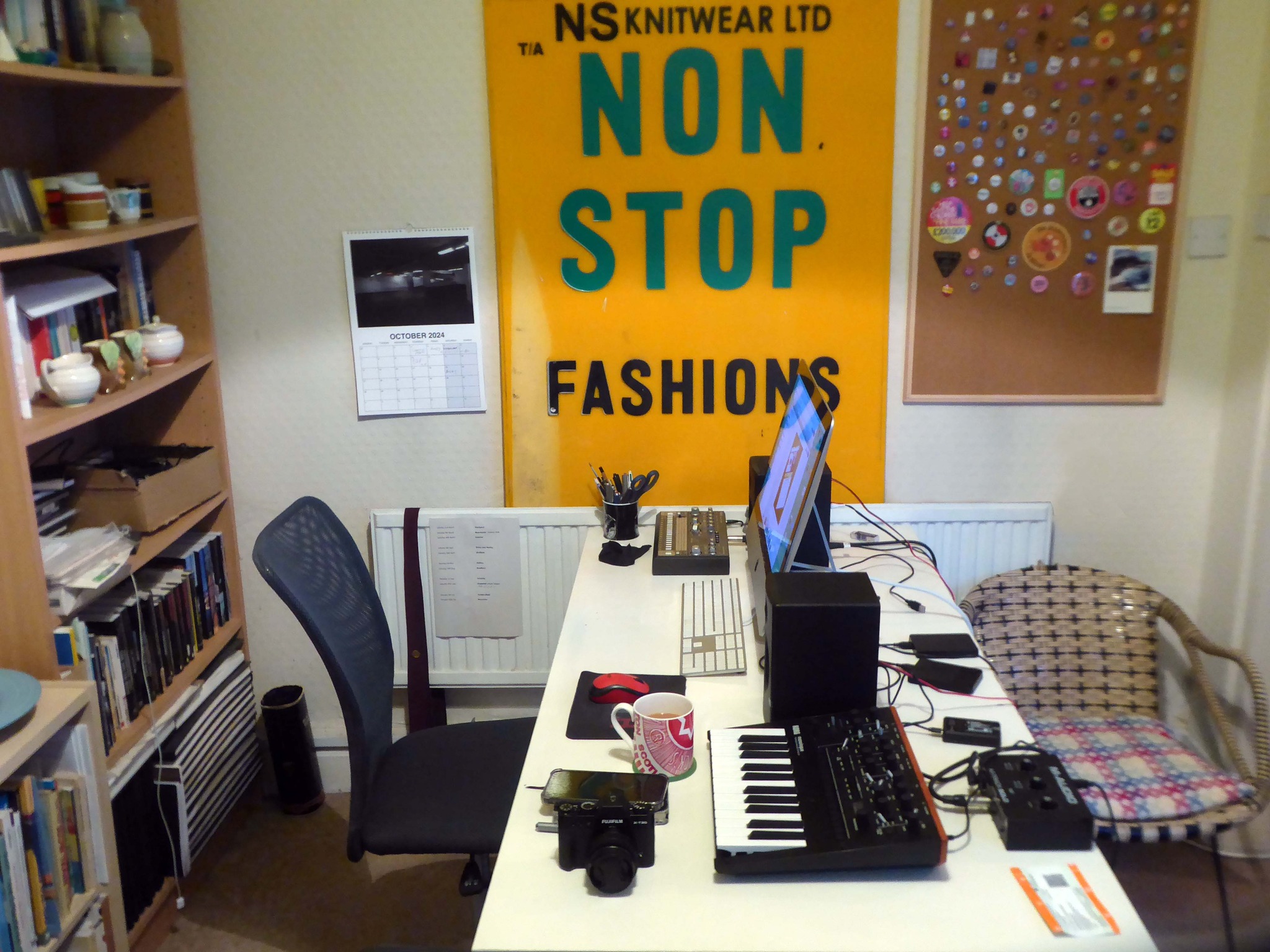
We are now coming to the end of the car park year – seen here on the wall of my command centre.

The calendar was an adjunct to a walk – Twelve Car Parks.

Here we all are at Circle SquareFielden Clegg Bradley were concept architects while Leach Rhodes Walker were delivery architects.

In September we walked around Newcastle for a weekend away – taking in Eldon Square, ably guided by local modernist Euan Lynn.

Ending our tour at Manors Car Park.

Following an urban river – the River Irk, an excellent way to devise a linear walk.

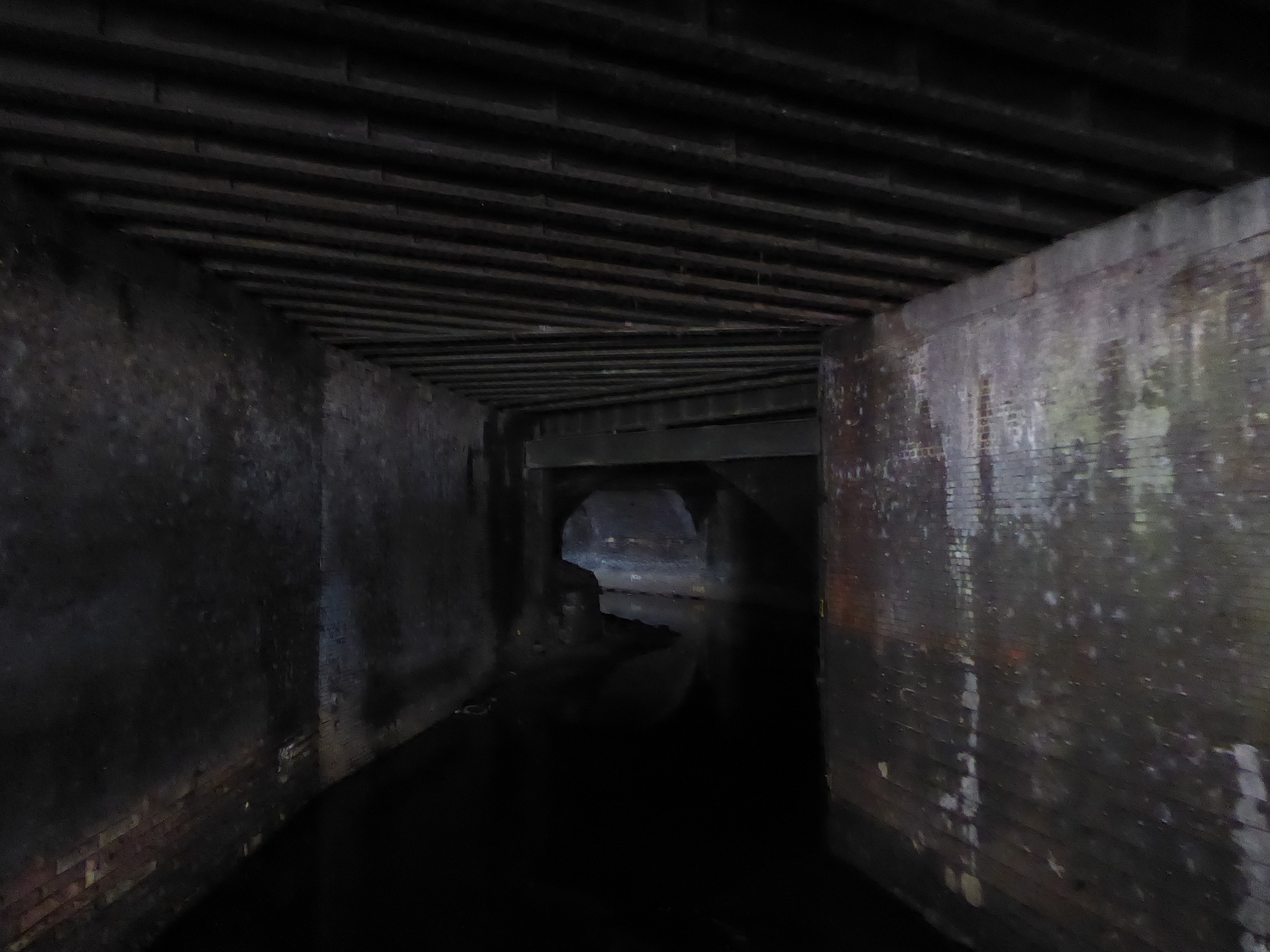
The river enclosed in blue engineers brick as it passes under the railway.

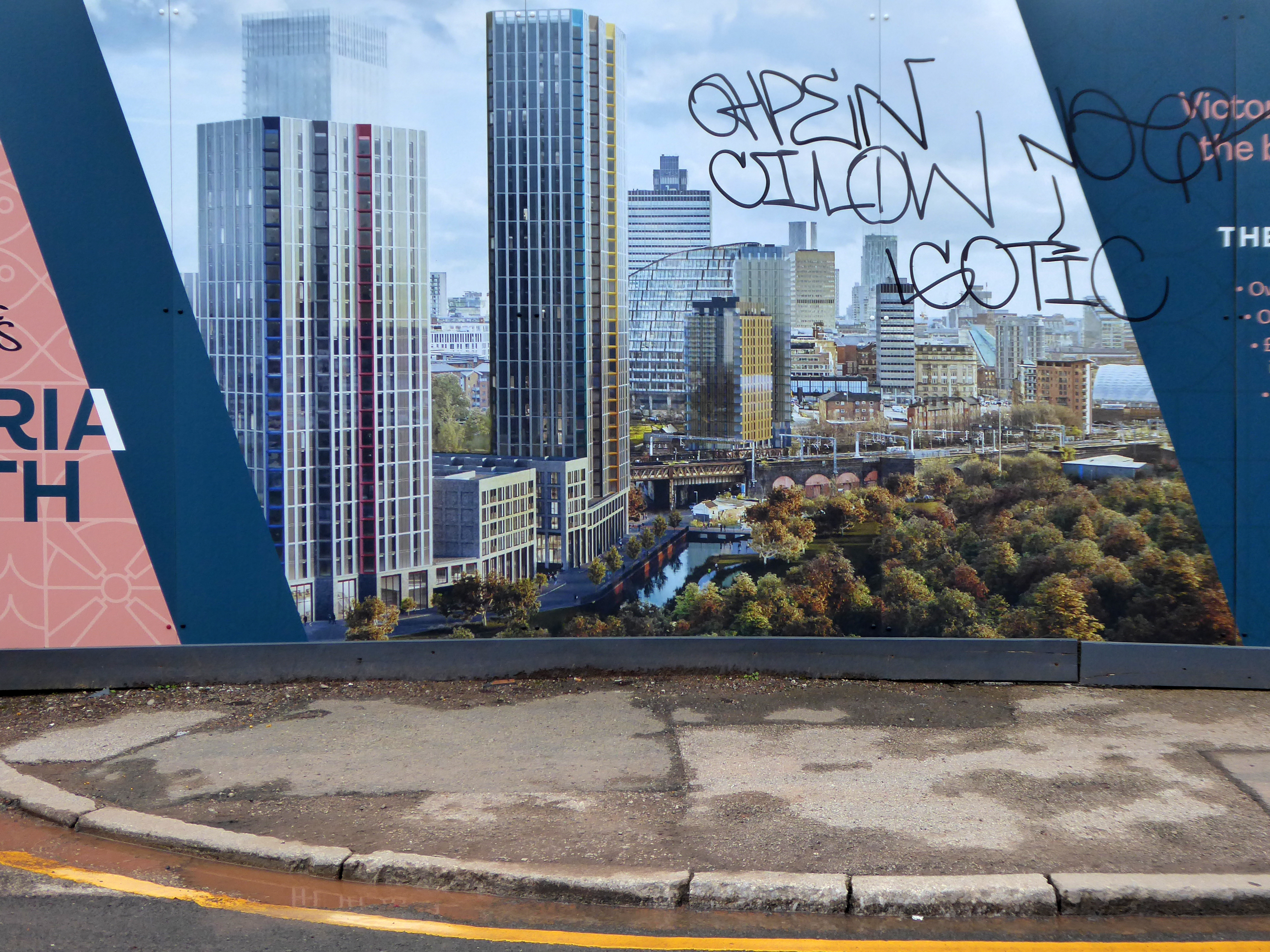
A long neglected are is now the scene of mass regeneration – rebranded Victoria North.

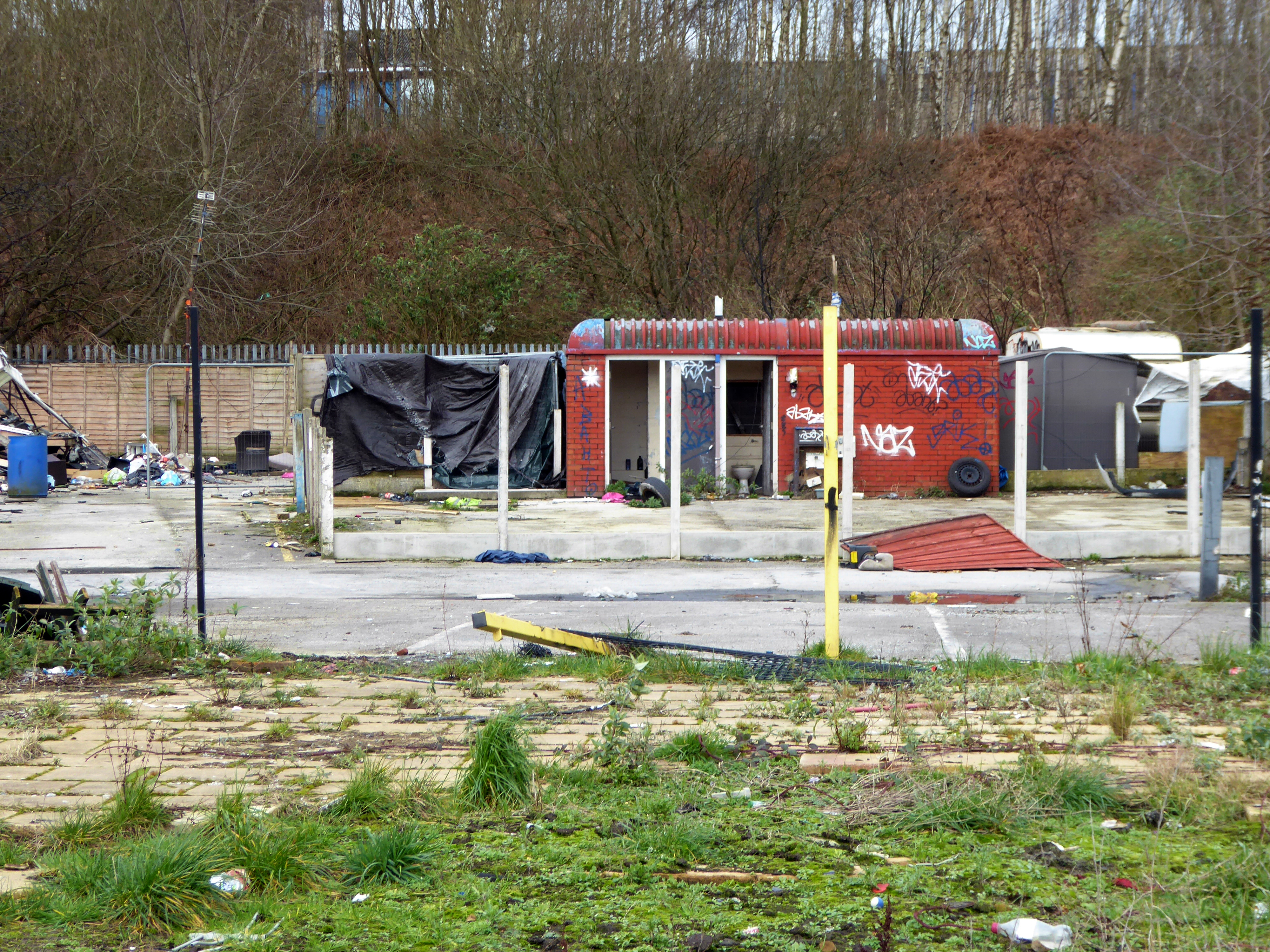
The former Traveller’s homes are now rubble.

Rushing miles ahead to Blackley the home of Richard Siefert’s ICI Tower.

And around the corner, these delightful reliefs attached to the Tower Blocks.

I was asked to assist in putting together an exhibition for Collyhurst Voices – walking through the memories of a community under threat.

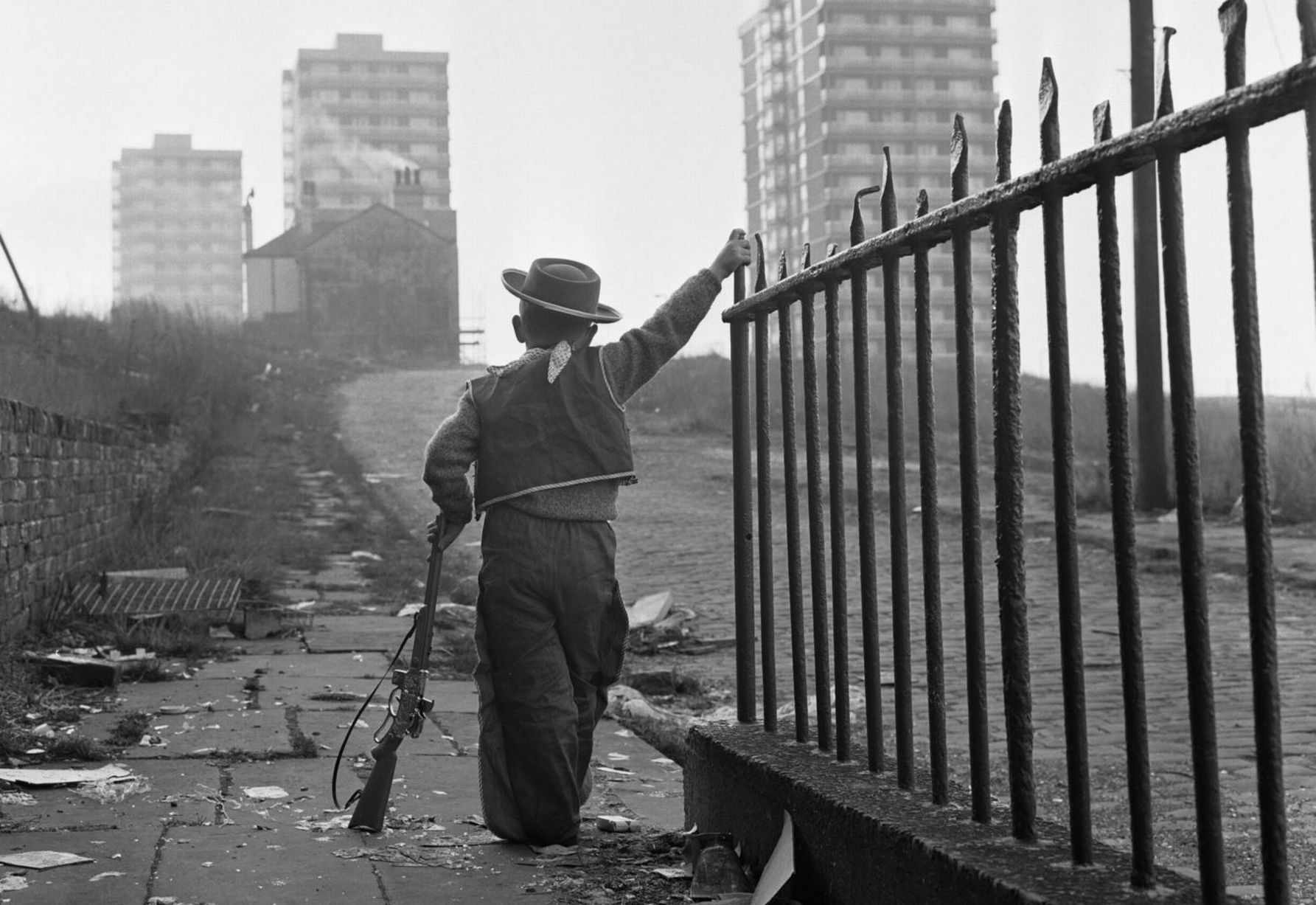
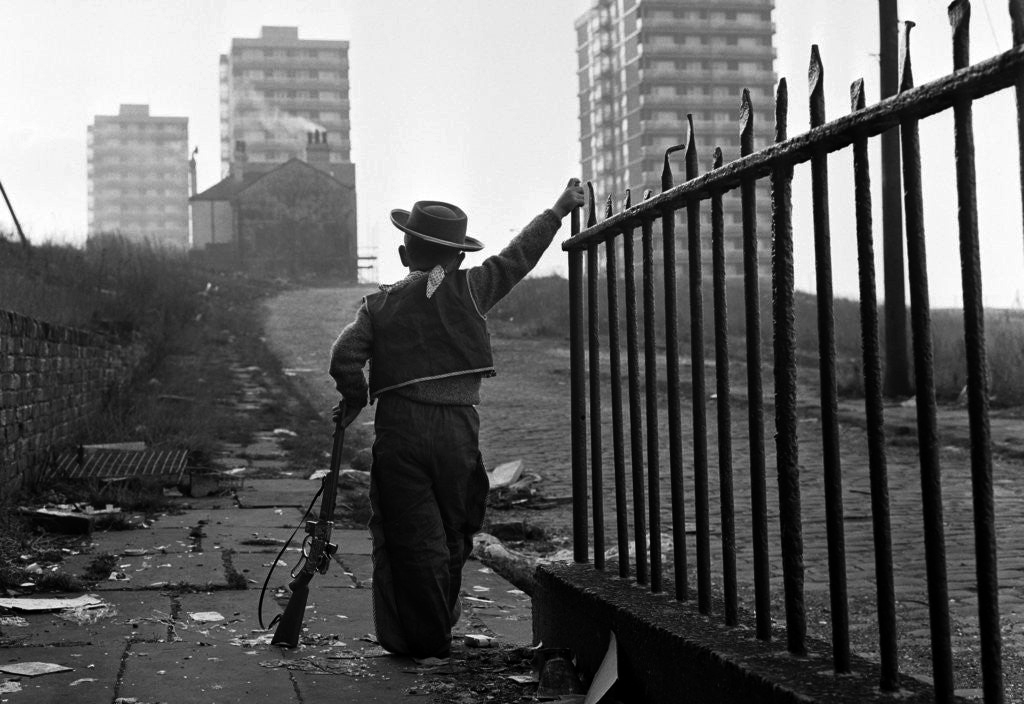
Walking in the footsteps of Dennis Hussey’s Collyhurst Cowboy – looking toward Dalton Street

Then uphill to Eastford Square and the long lost homes.

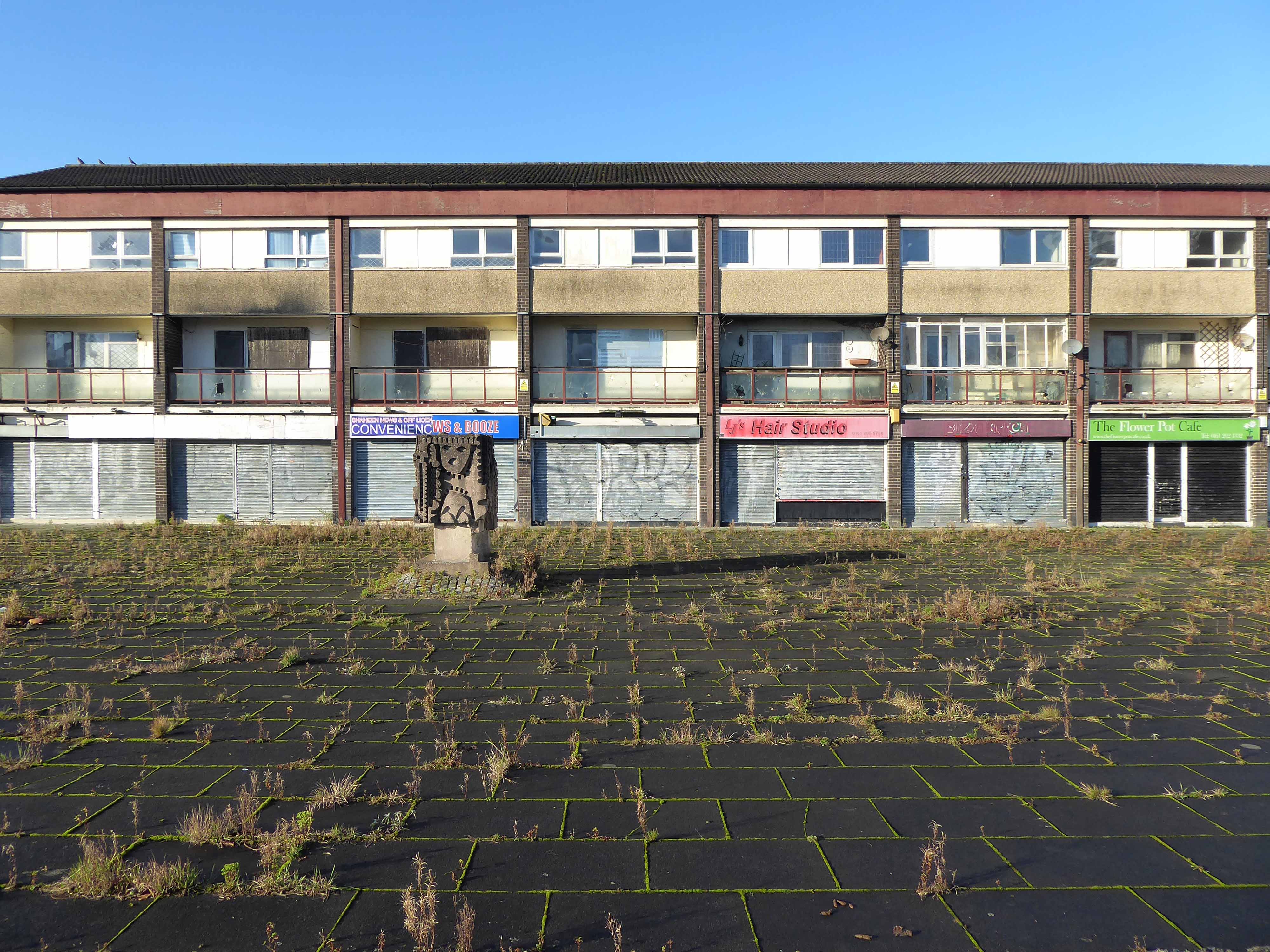
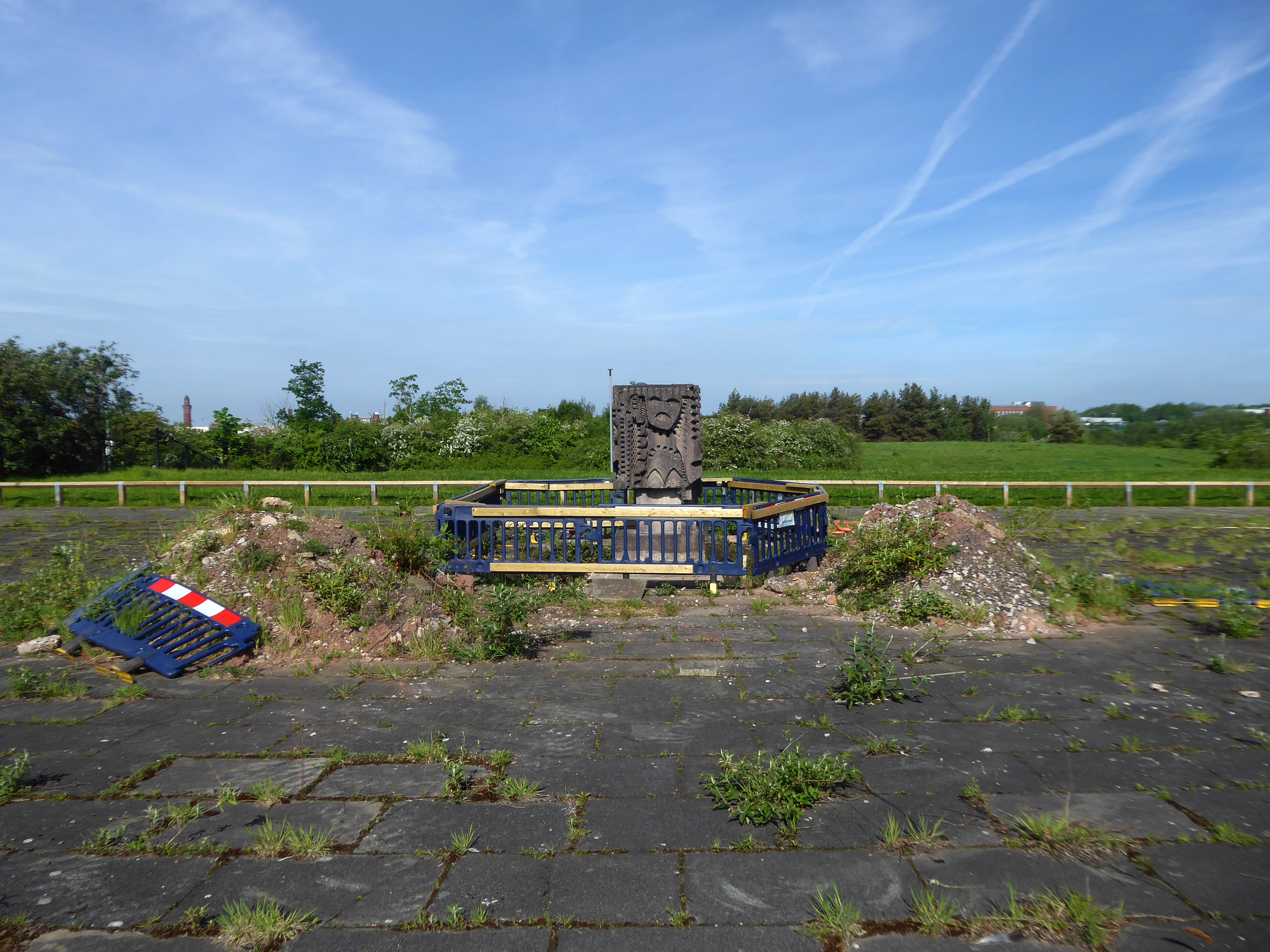
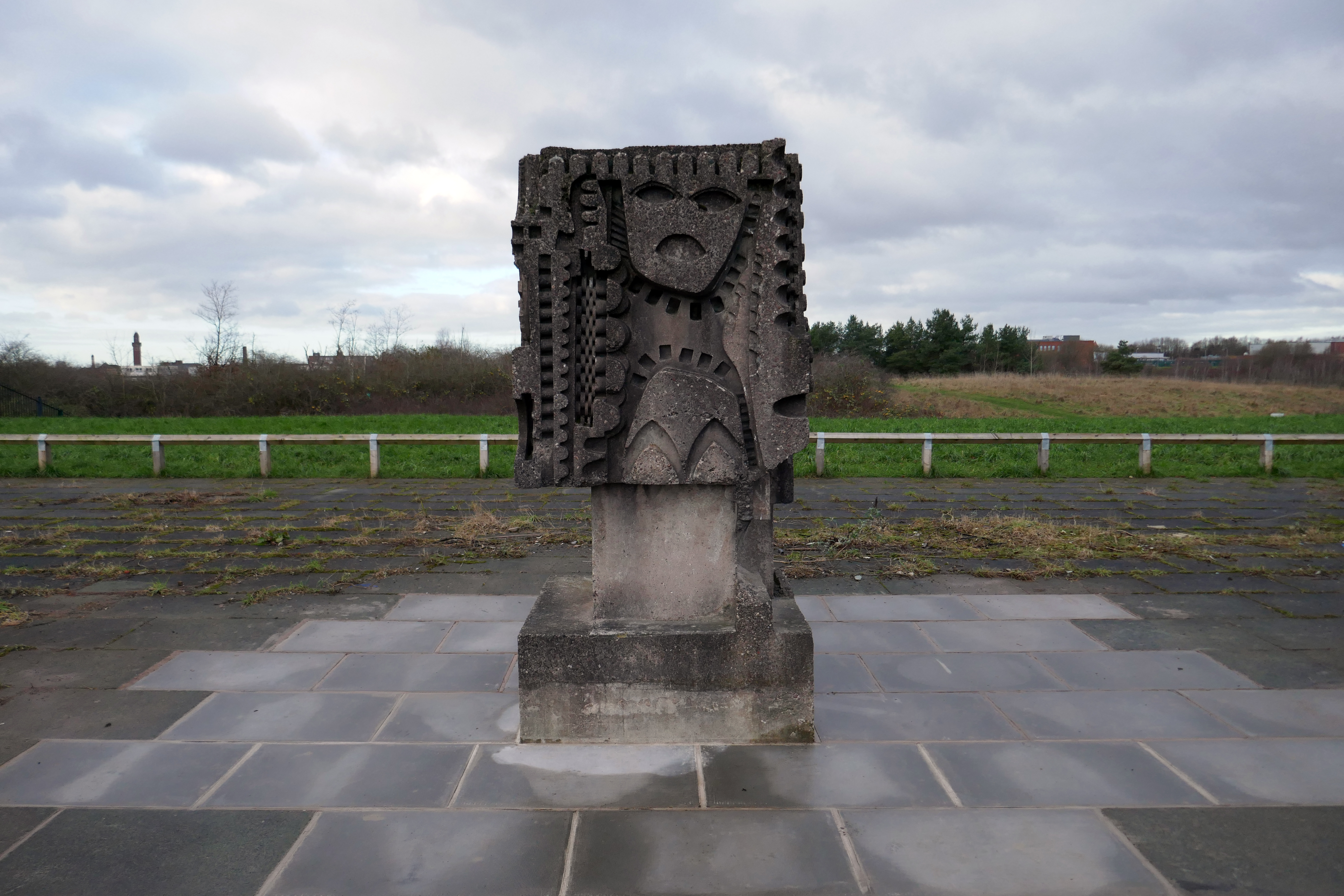
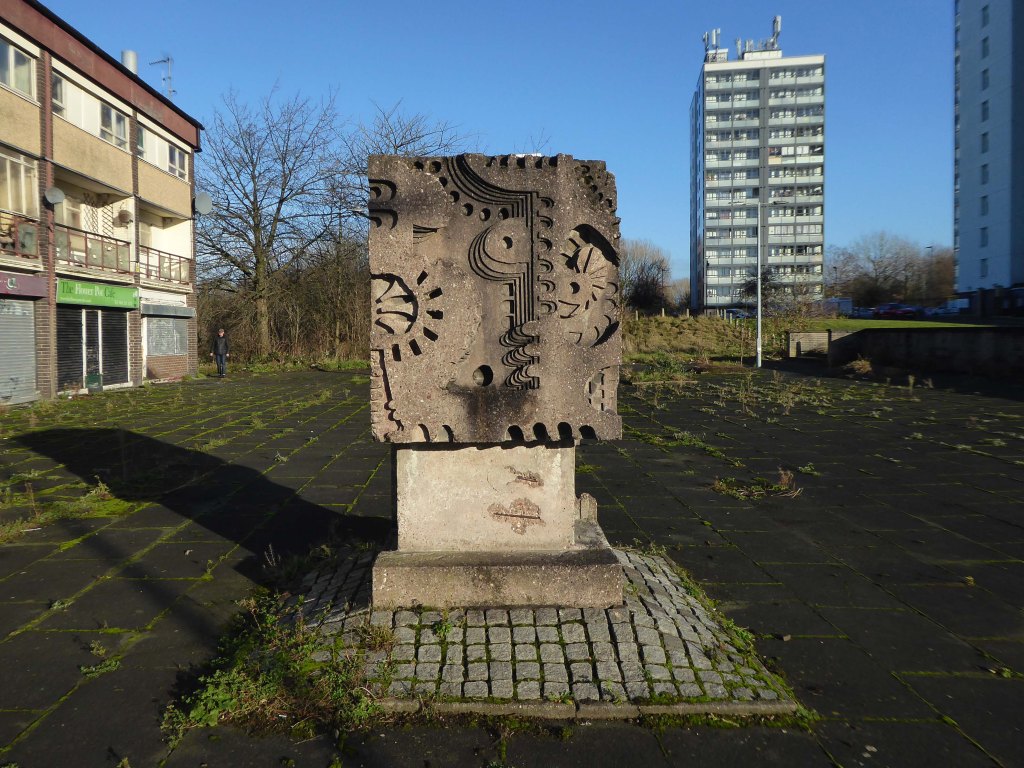
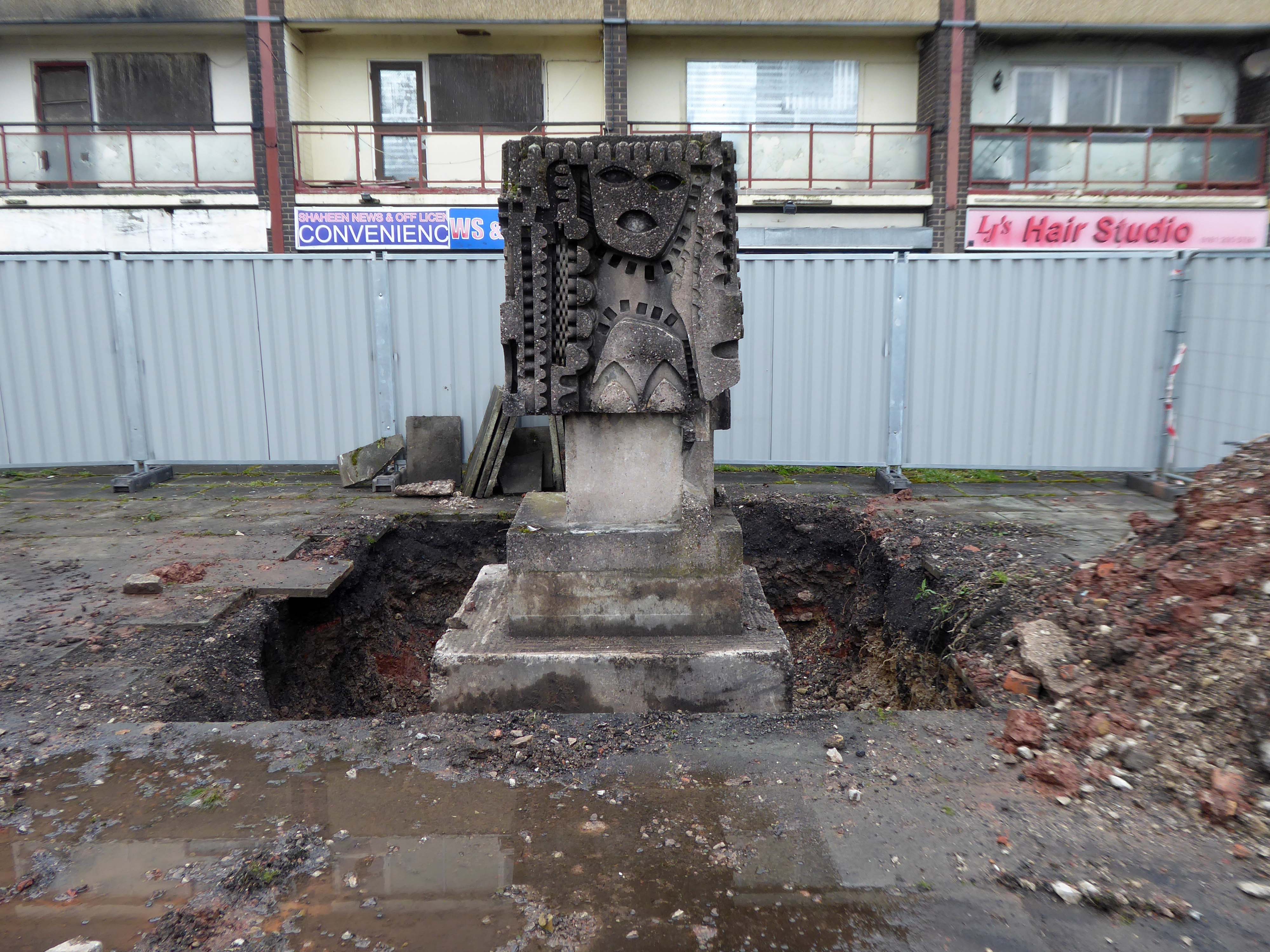
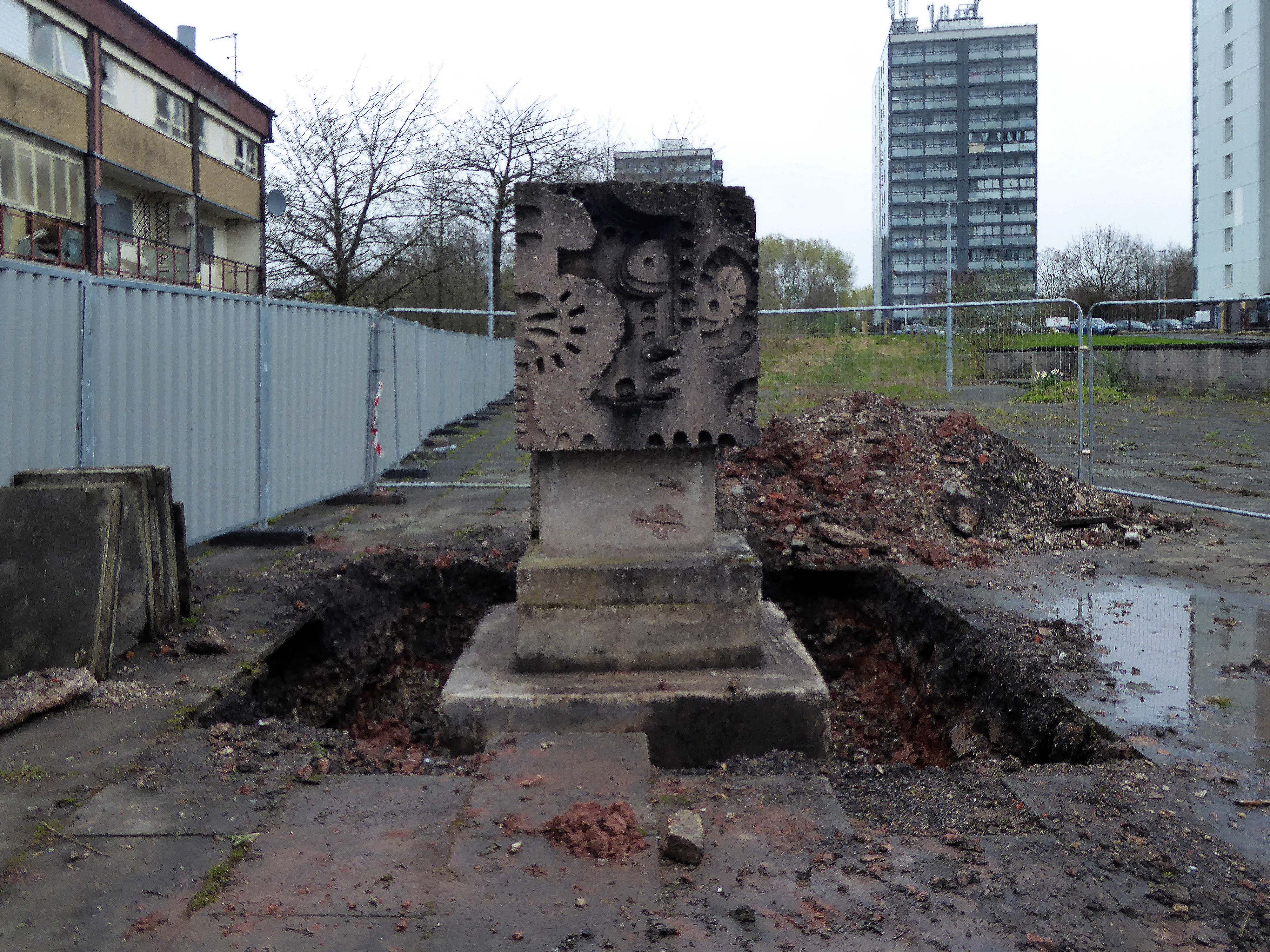
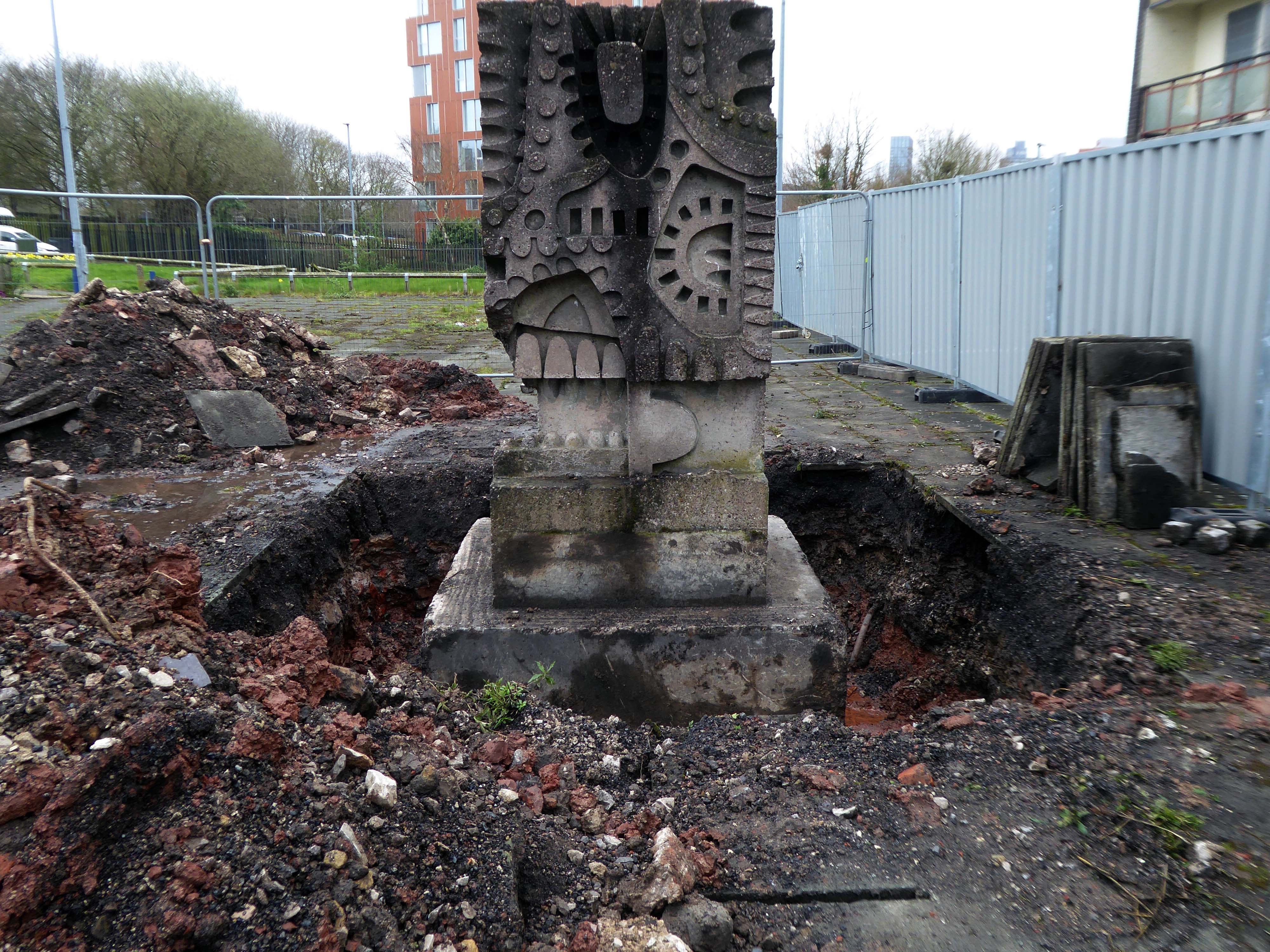
Home to William Mitchell’s Totem, the homes long gone and the Council pledged to move the totem too.

The state of play this week, the detritus removed and the base filled in, repaved and safe for a while.

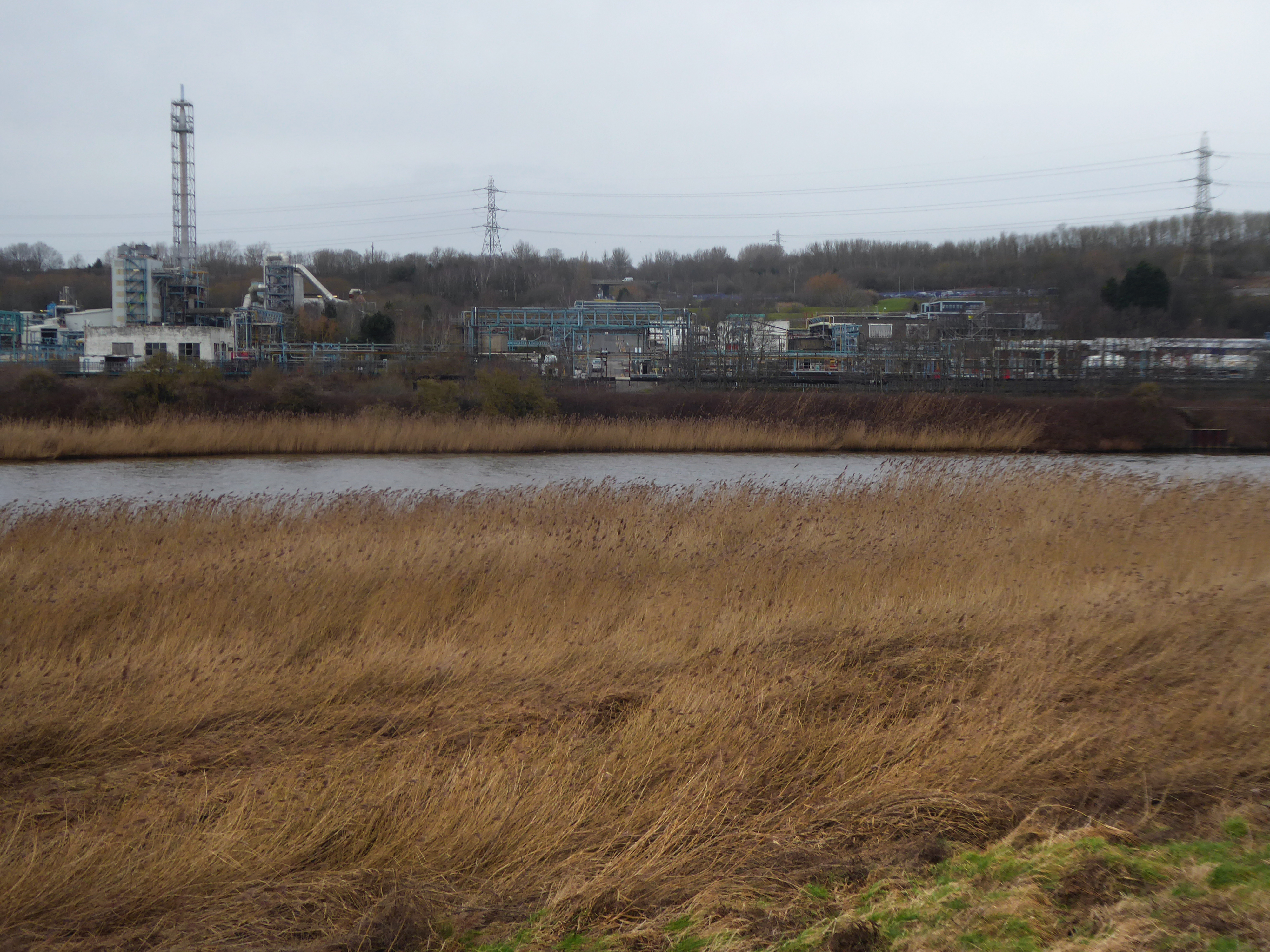
Off now to the Weaver Valley another day another river, passing under Weaver Viaduct

The looking toward Koura Global – leader in the development, manufacture, and supply of fluoro products and technologies, opened a new HFA 152a production facility at their Runcorn site in the UK.

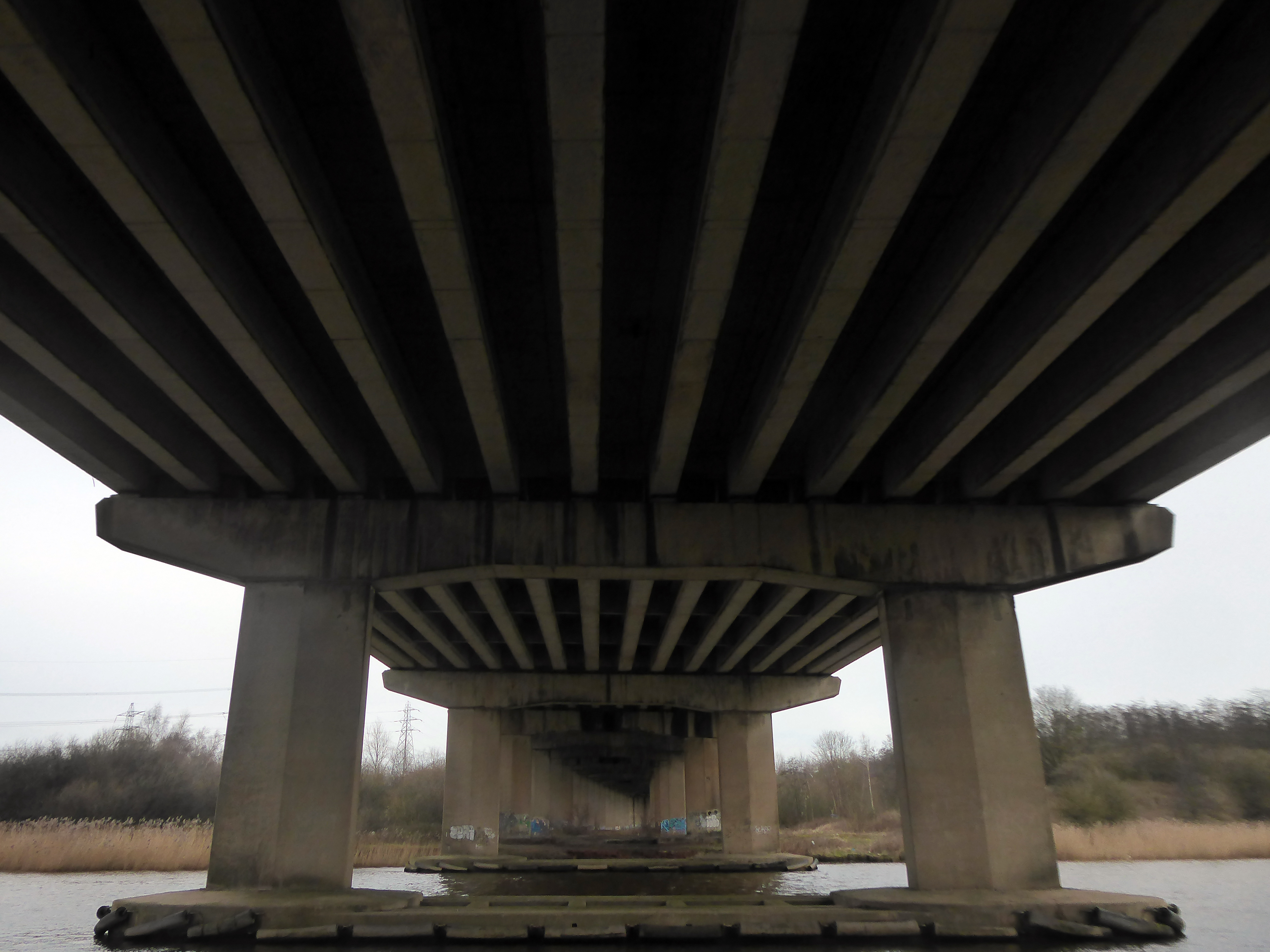
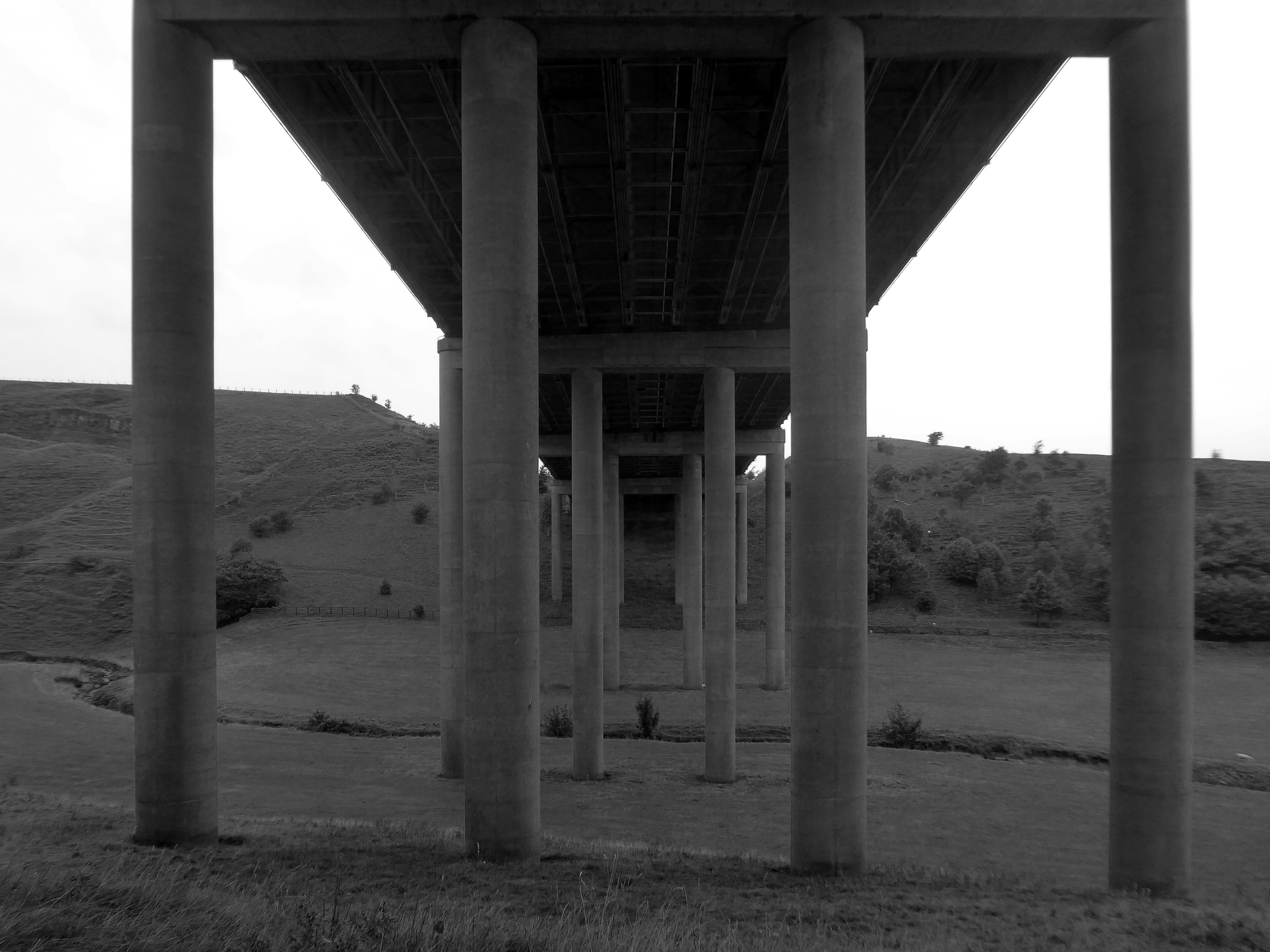
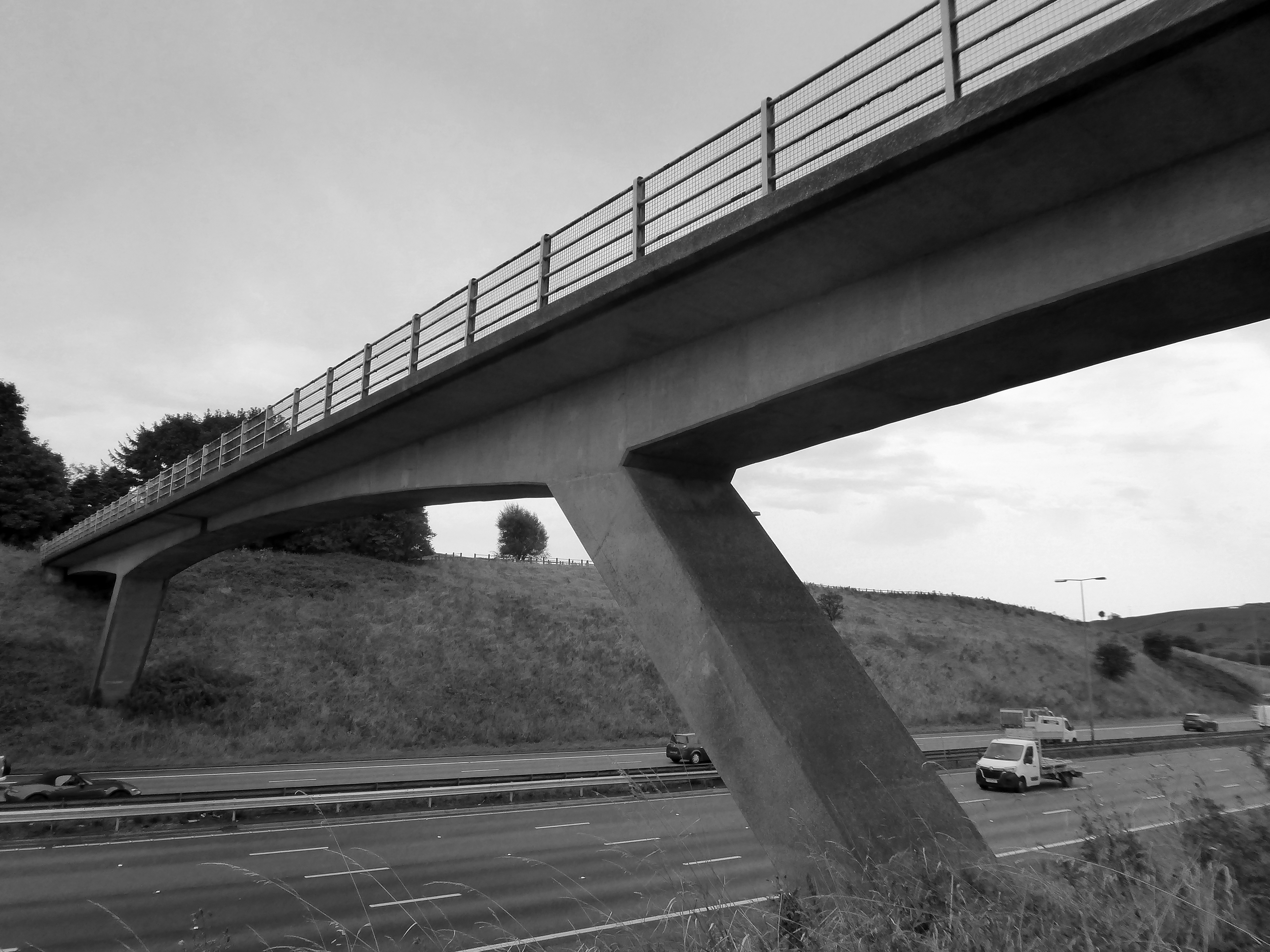
Further rural Modernism as we pass under and traverse the M62, whilst walking around the Piethorn Valley

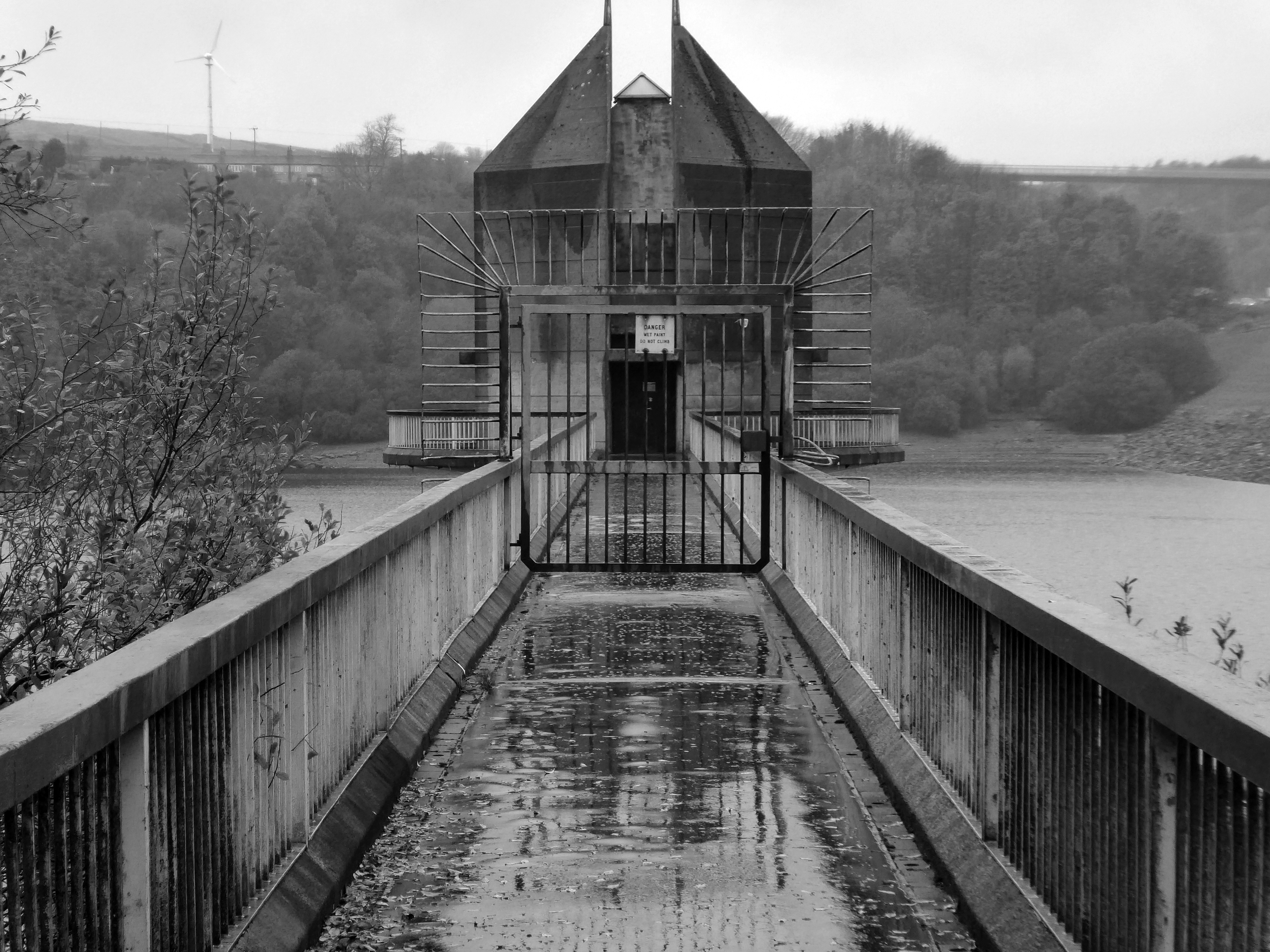
Then recently visiting several Yorkshire Reservoirs – here we are at Scammonden.

The newest of the Modernist Mooches was to Burnley where we visited the Keirby Hotel.

The former GUS Offices with a mural by Diane and William Morris.

Plus the Charles Anderson concrete relief at the Crow Wood Hotel.

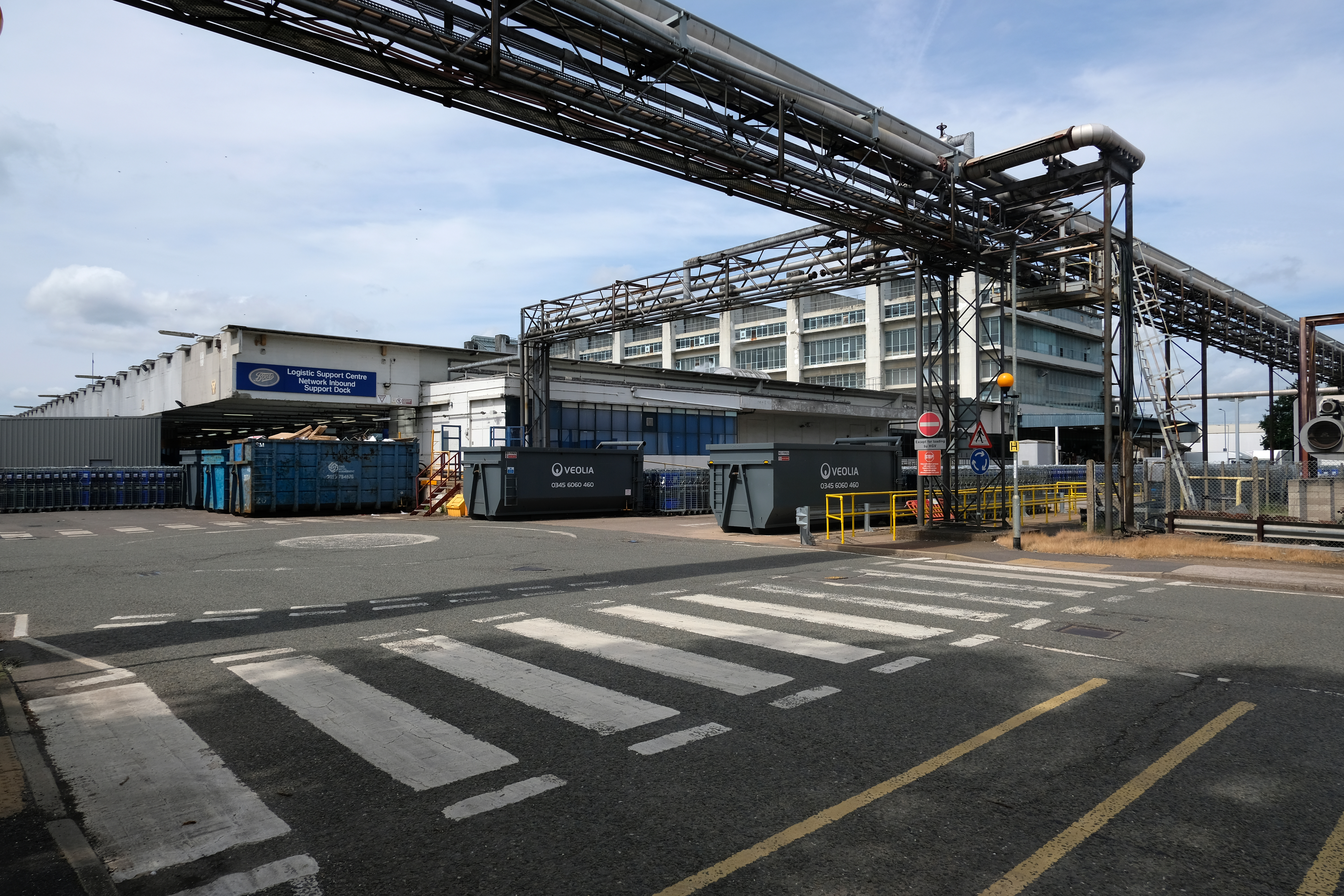
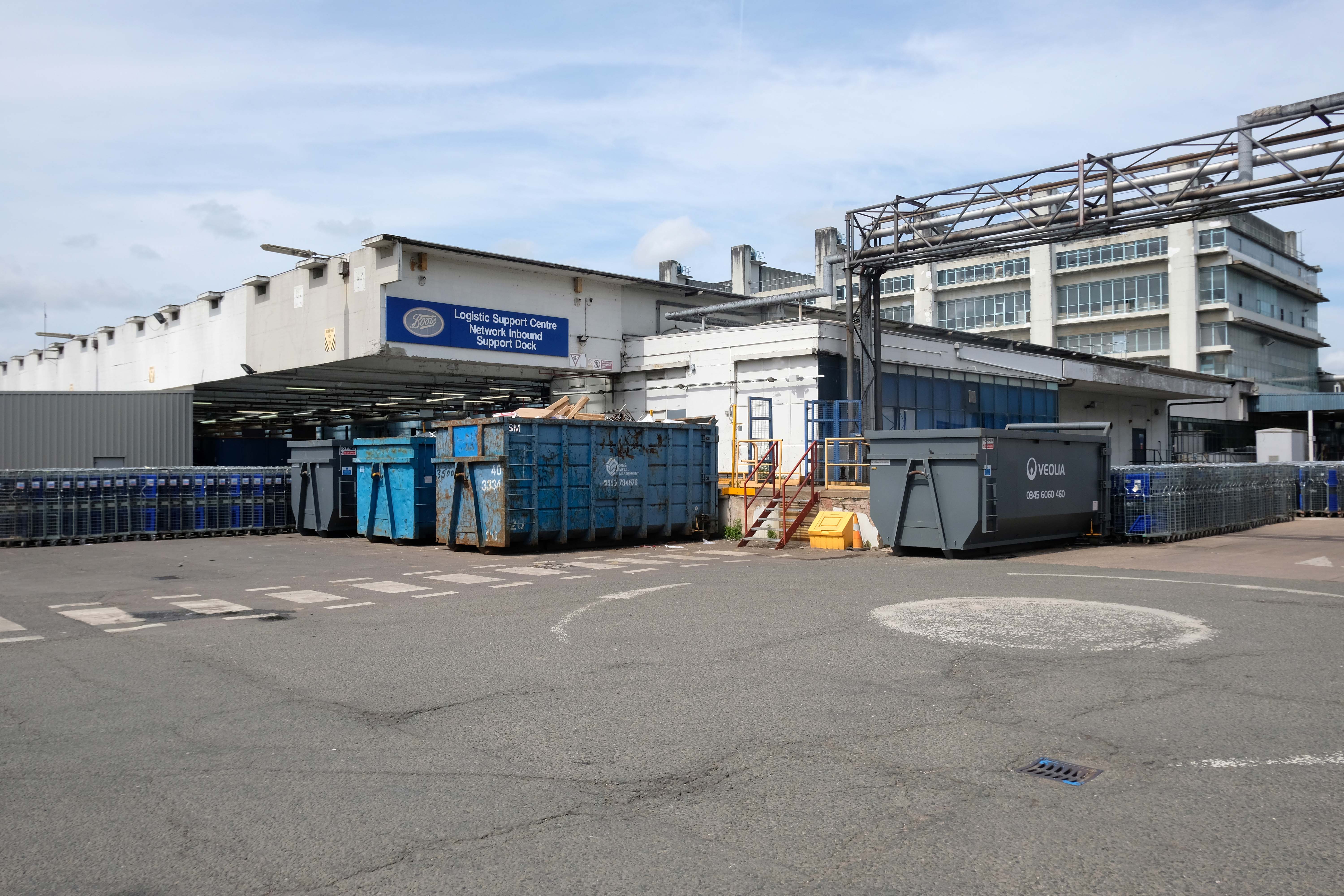
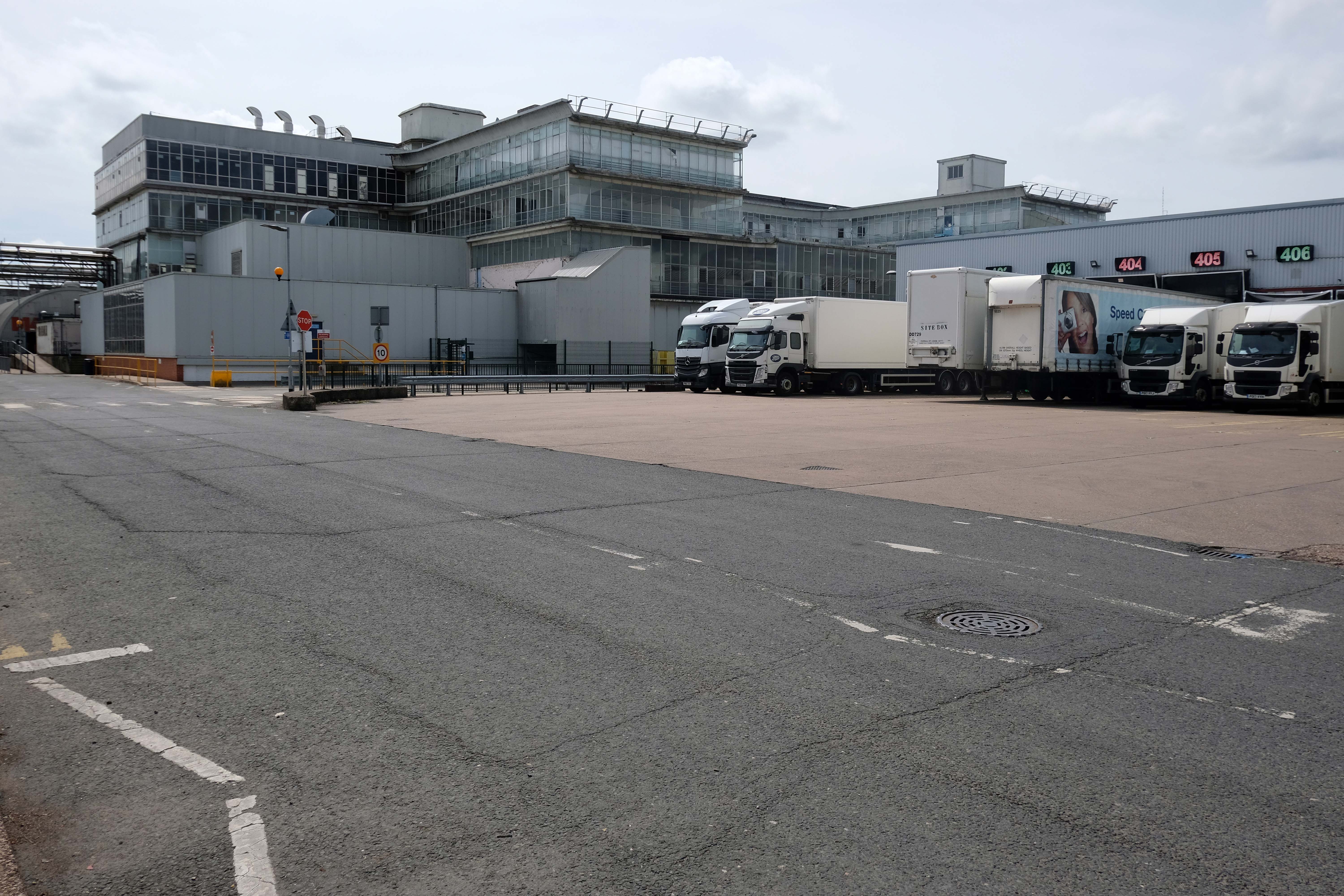
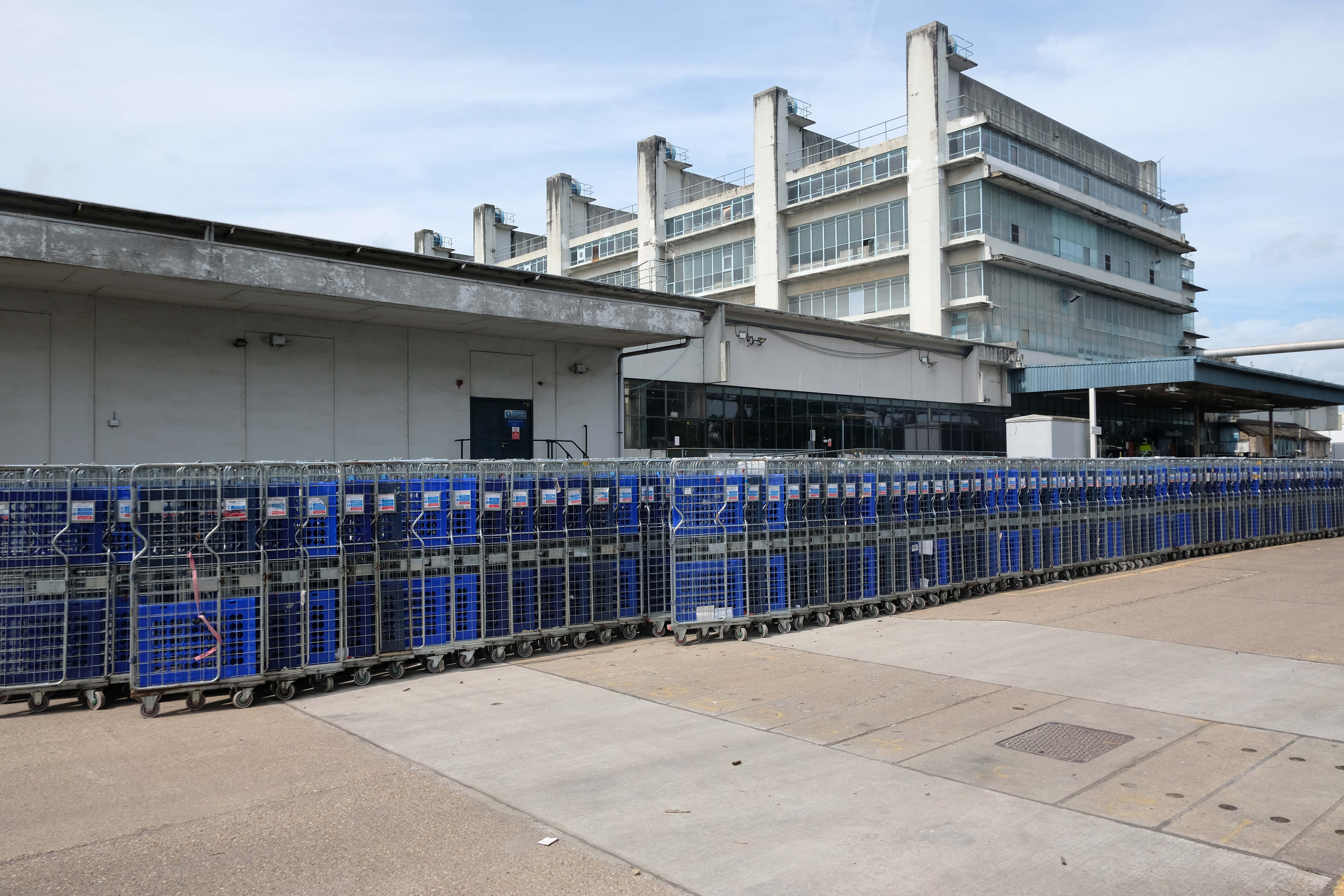
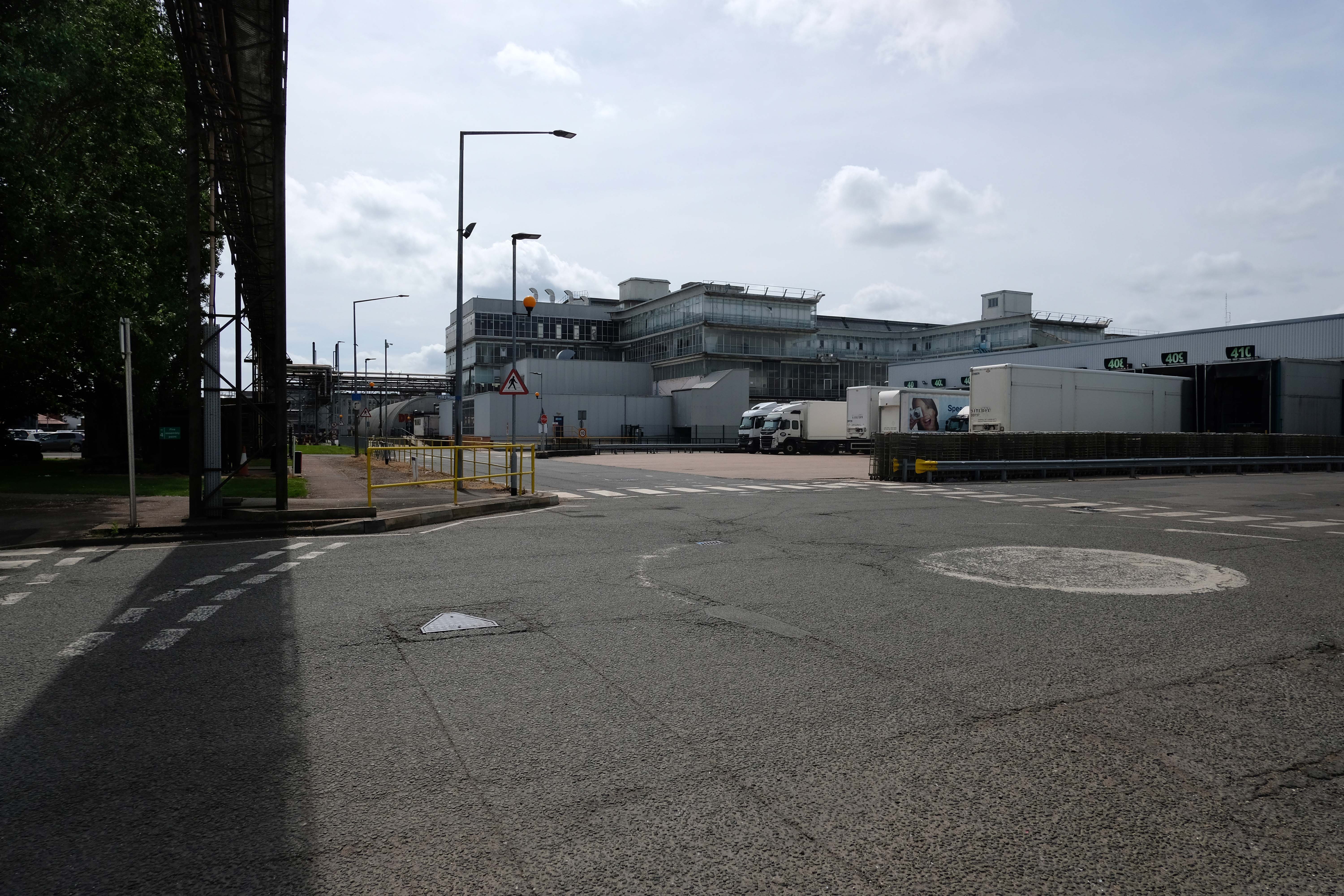
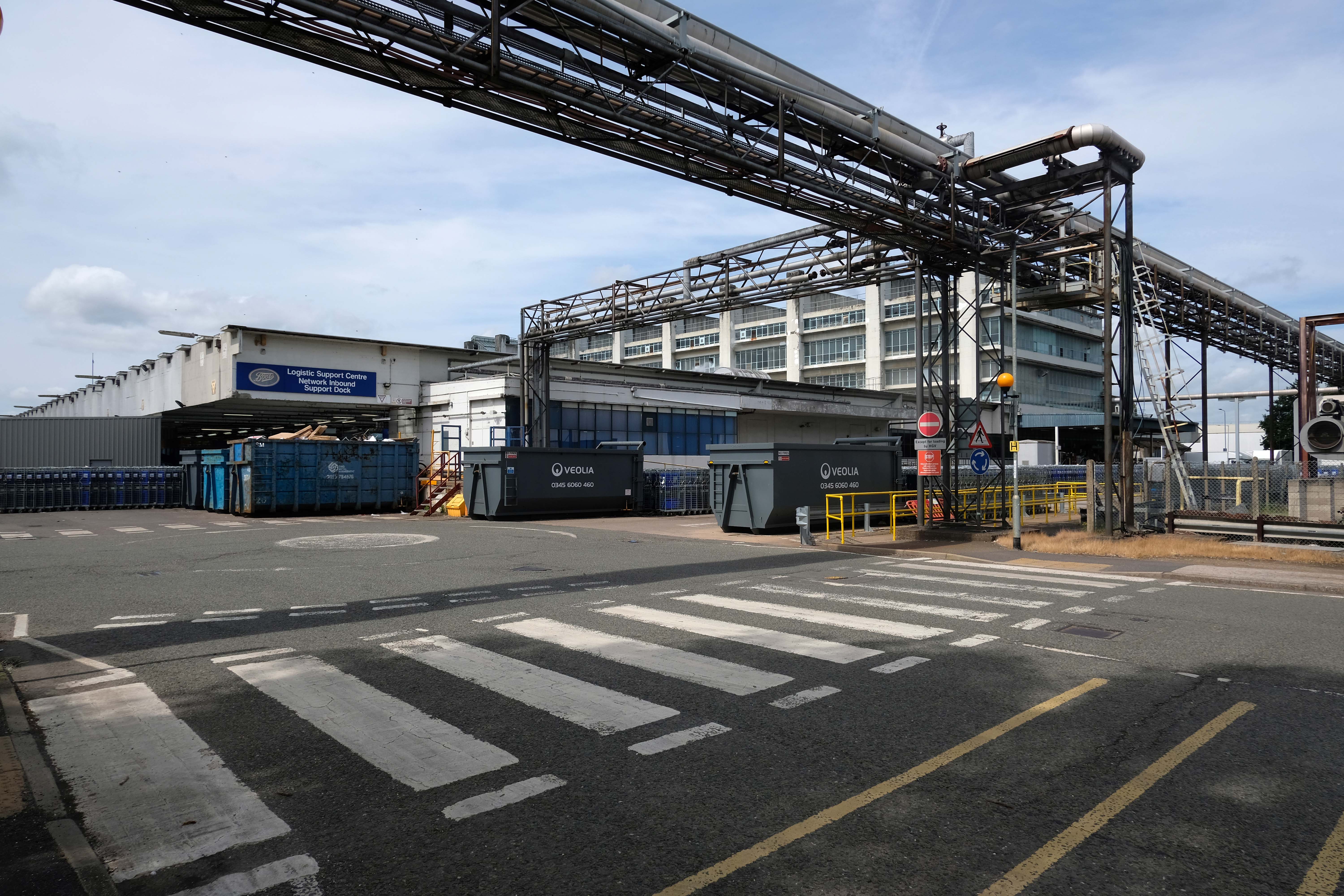
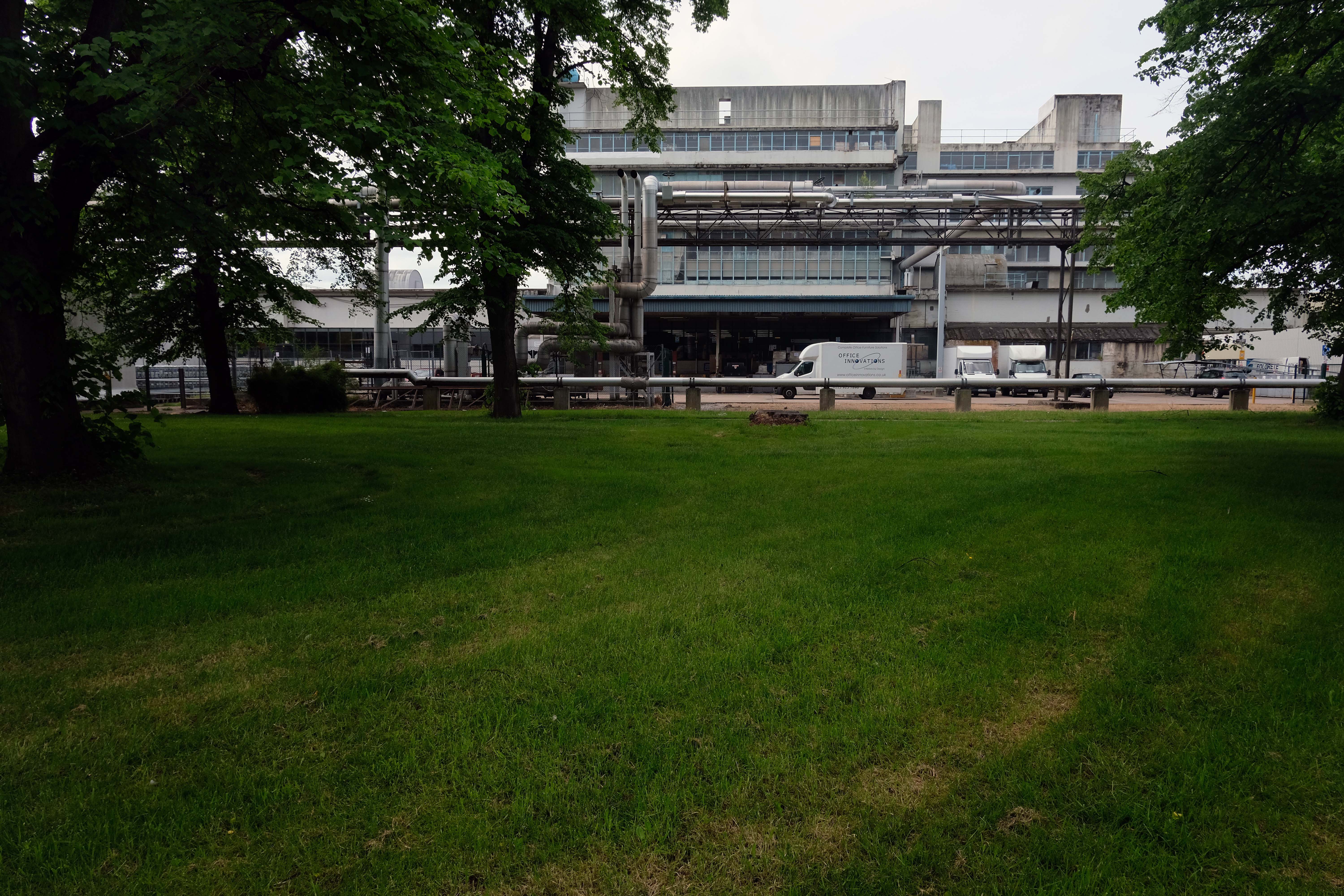
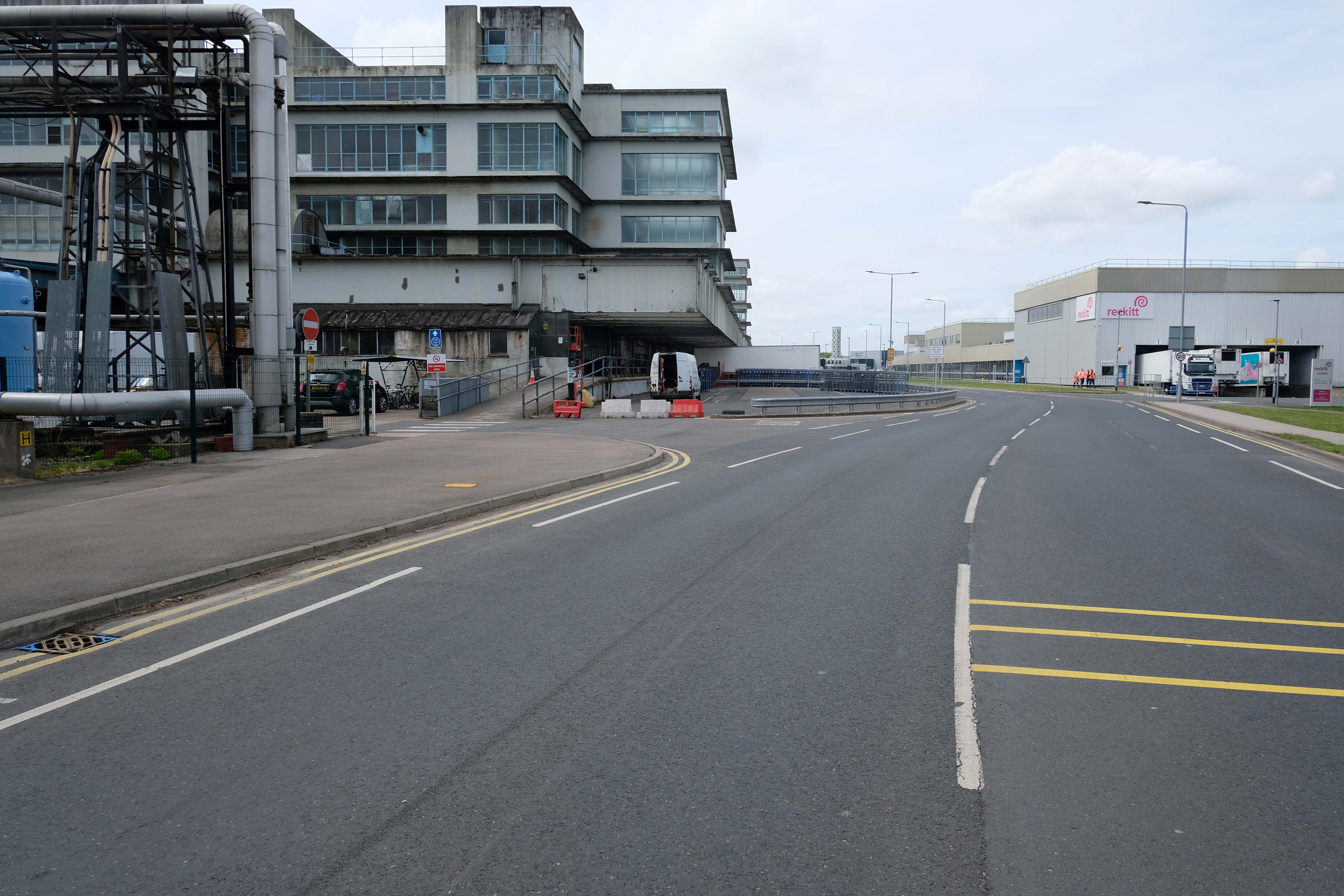
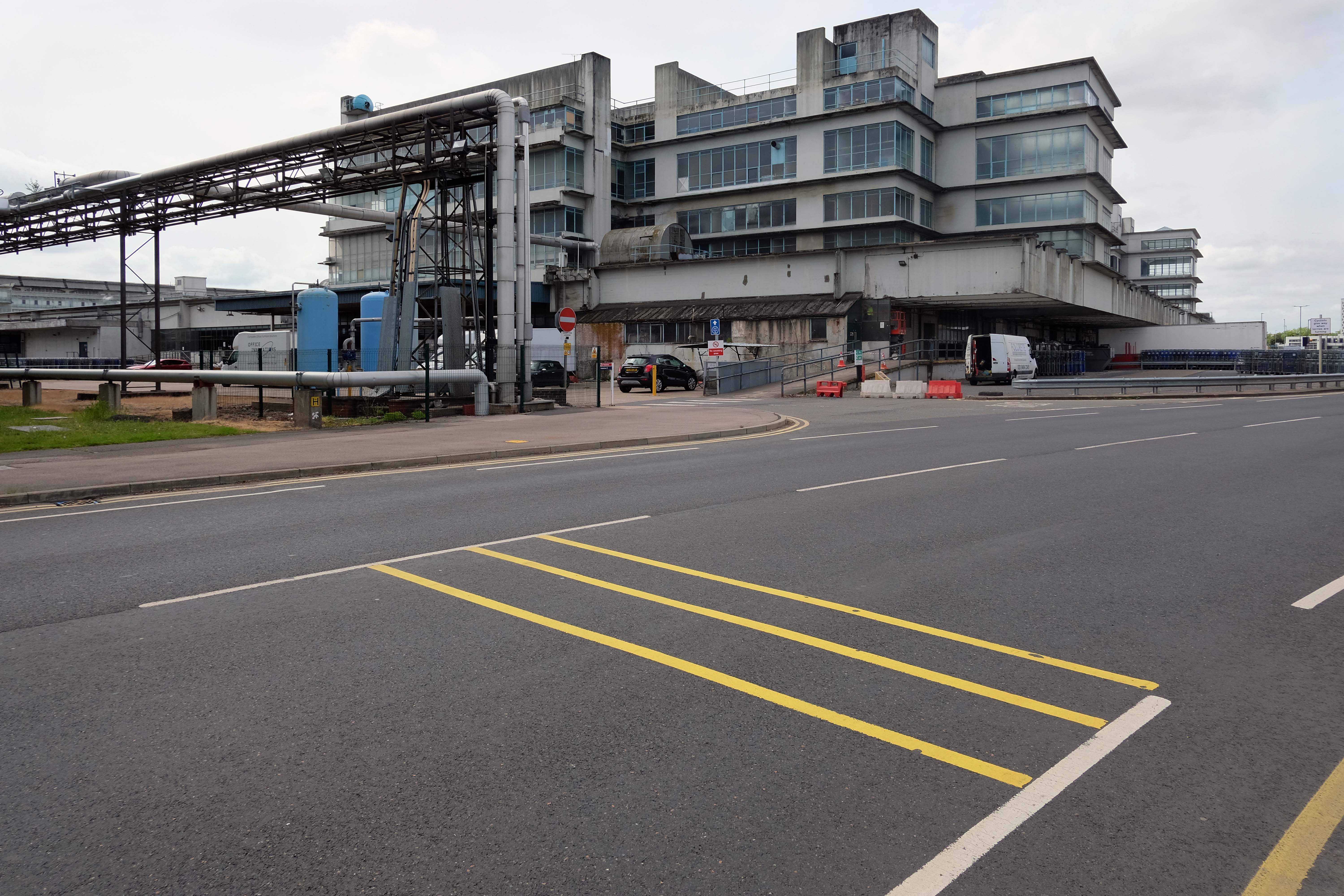
Finally a little light relief – a visit to the Boots factory in Nottingham.

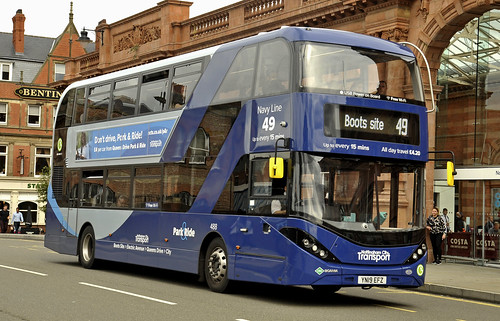
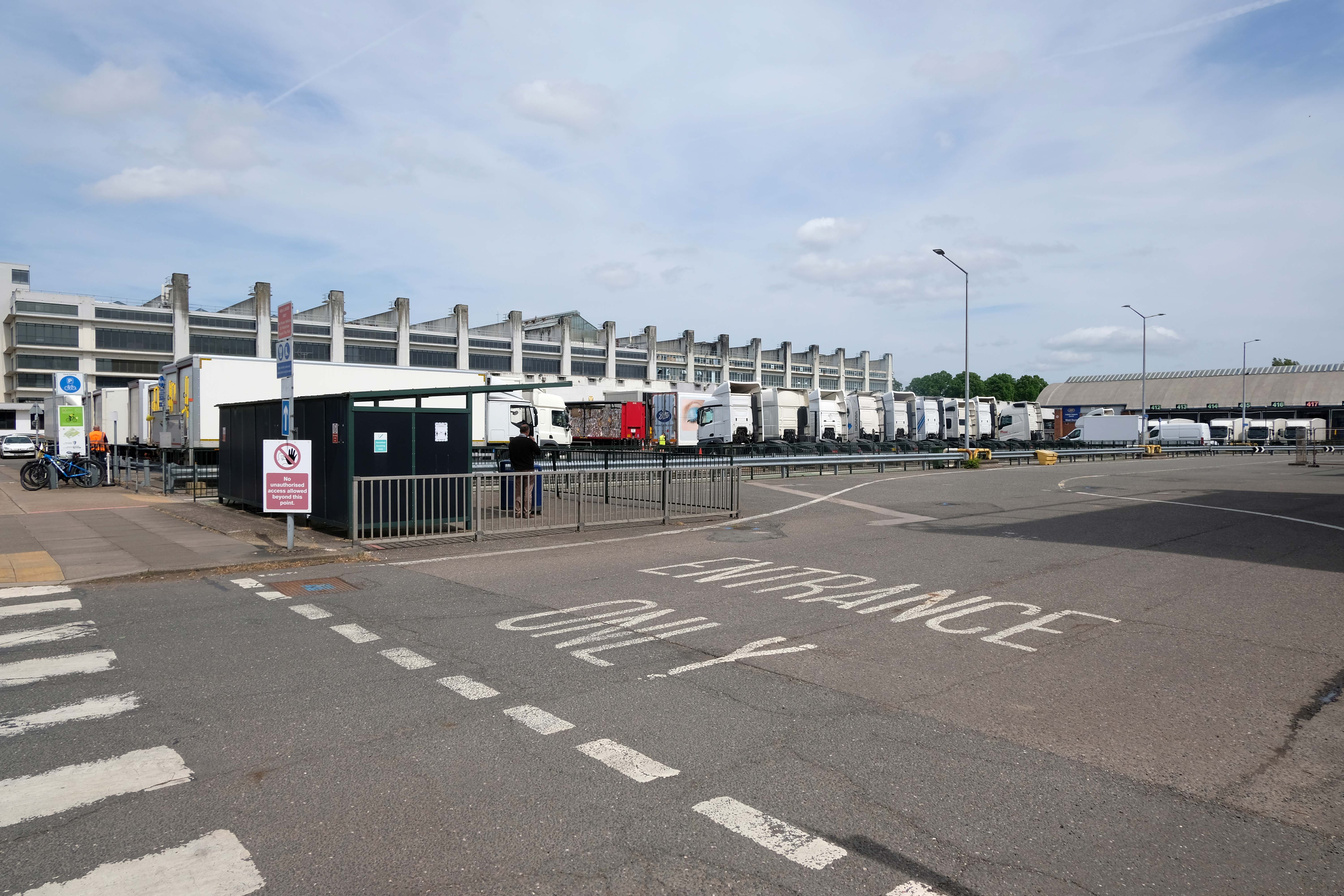
Having innocently board a bus outside the station with a Boots head code , I alighted within the factory gates. Then innocently walking around taking snaps, unheeded until the men in the van stopped me in my tracks.

Who are you, what are you doing?

I am the Modern Moocher going about my business – well it turns out this was not permitted and I was red carded by the earnest security guards and asked to leave forthwith. Suitably rebuked, I politely bade them farewell and headed for the gates.

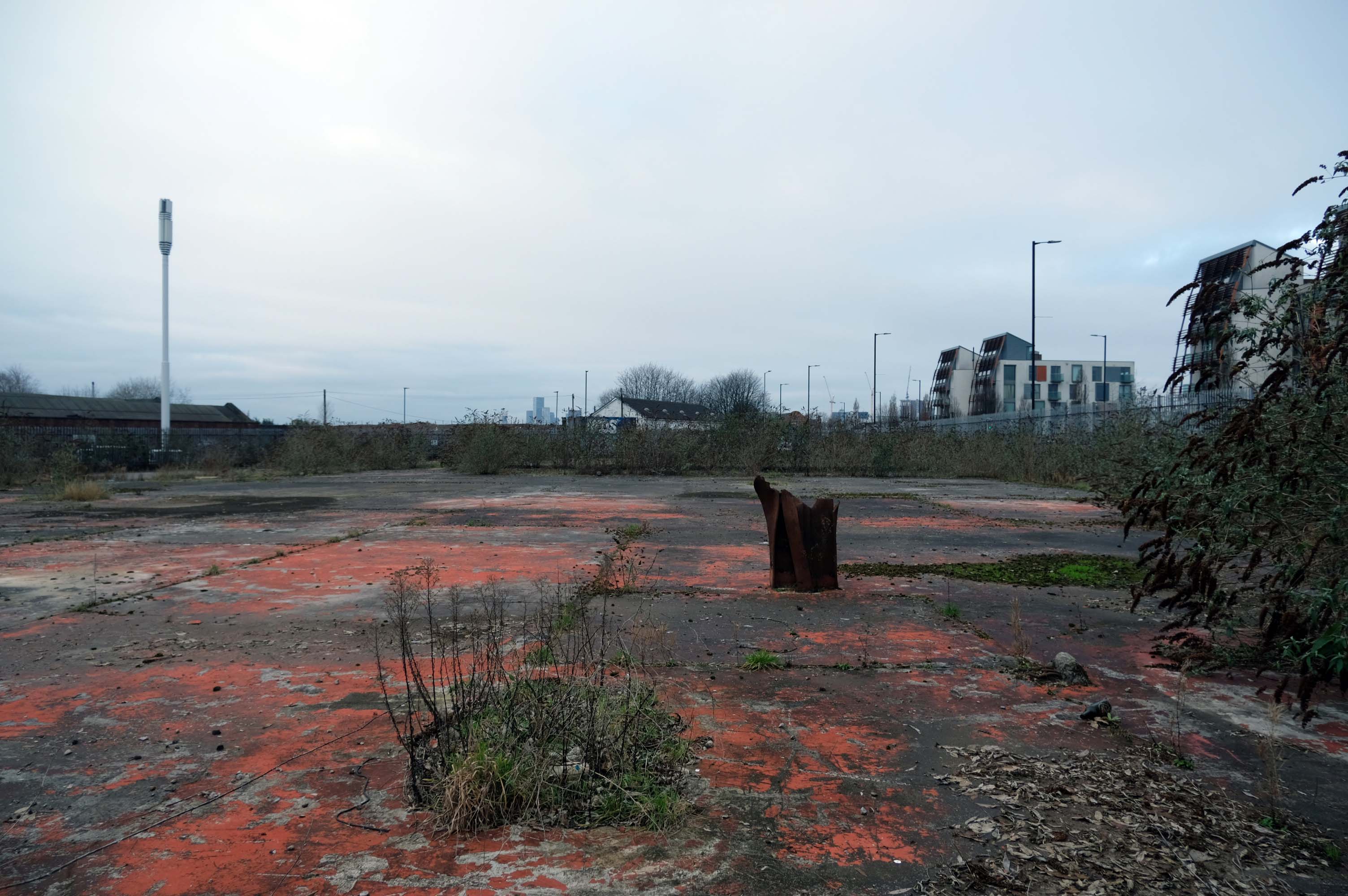
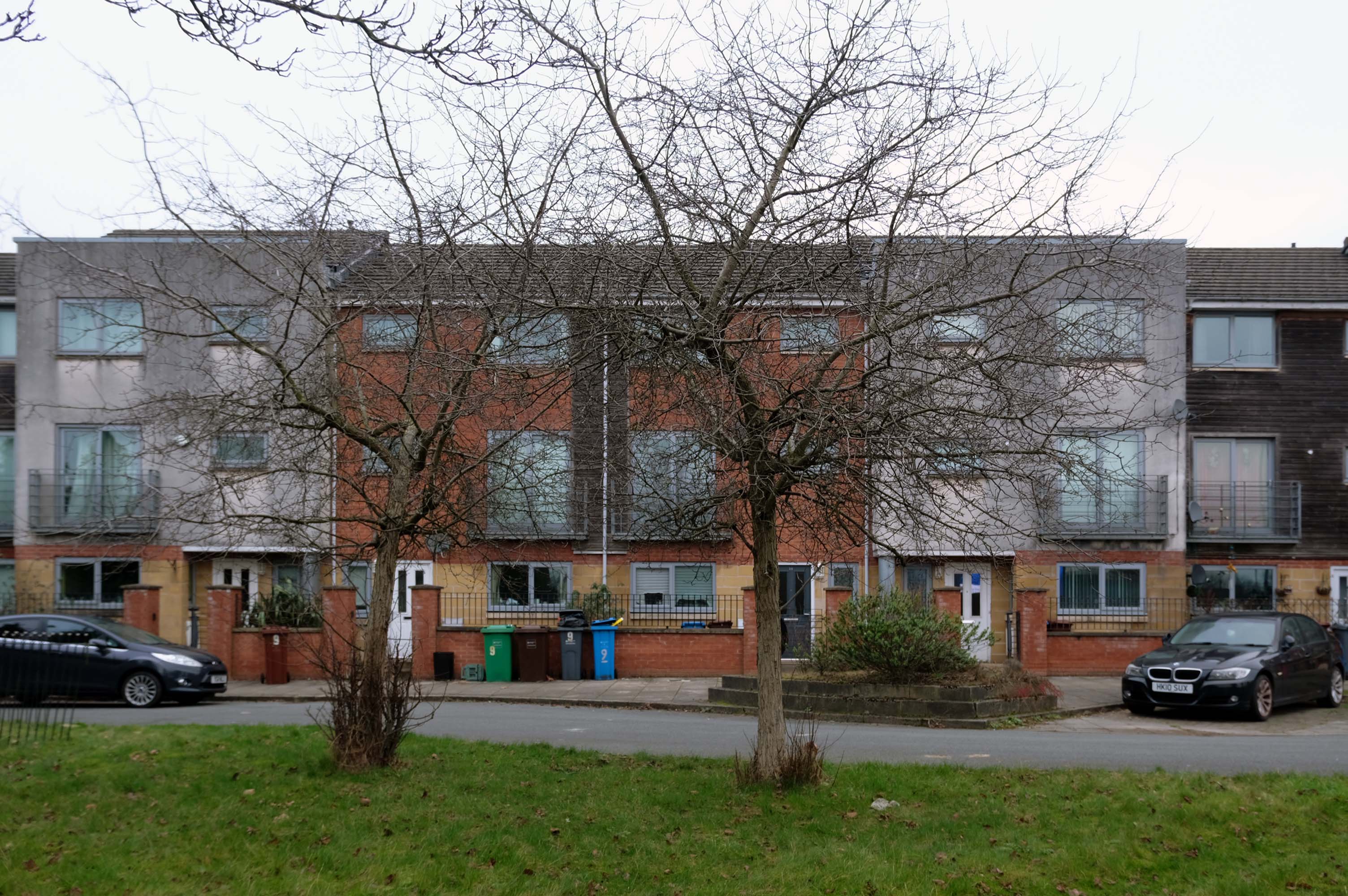
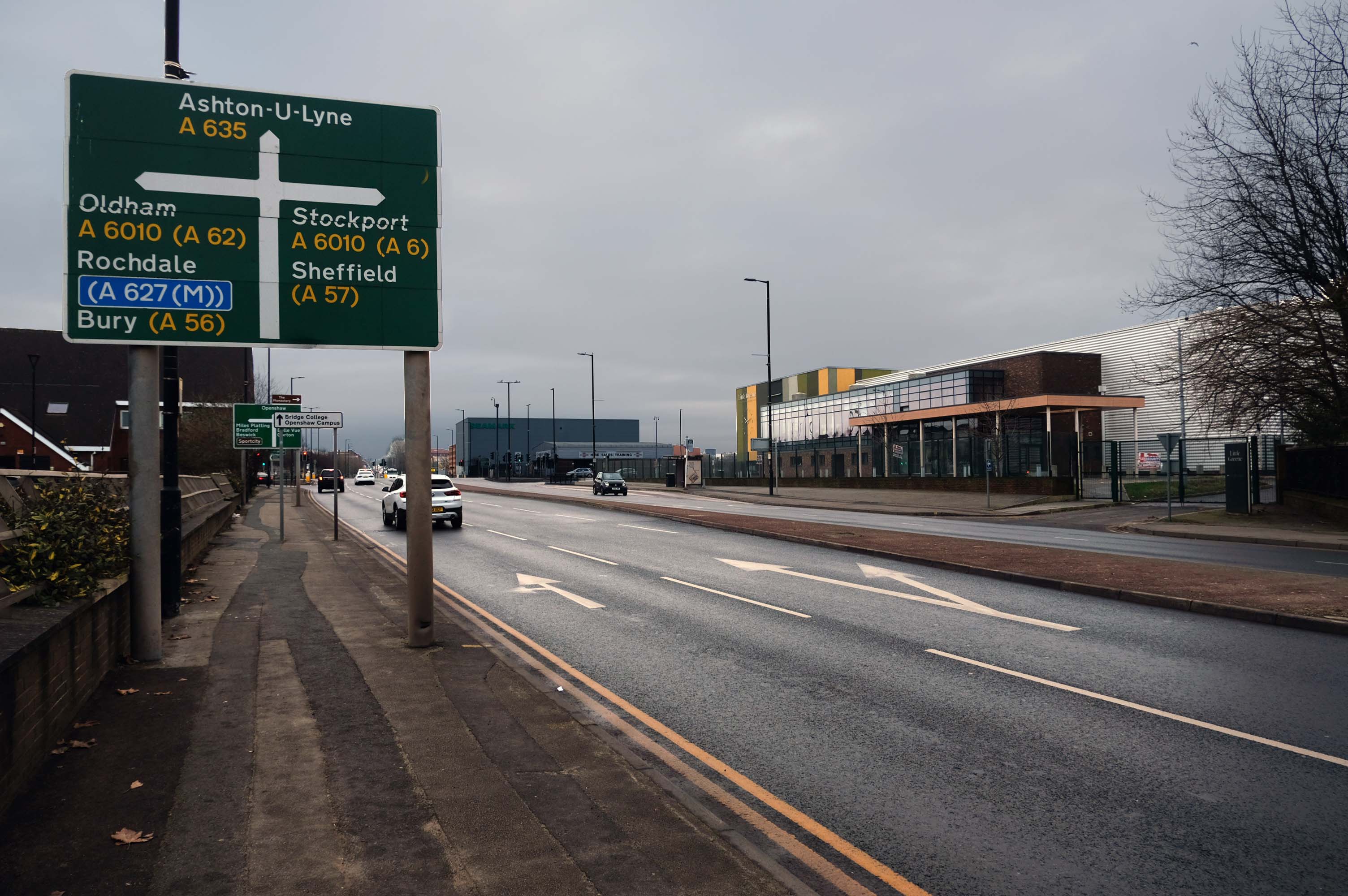
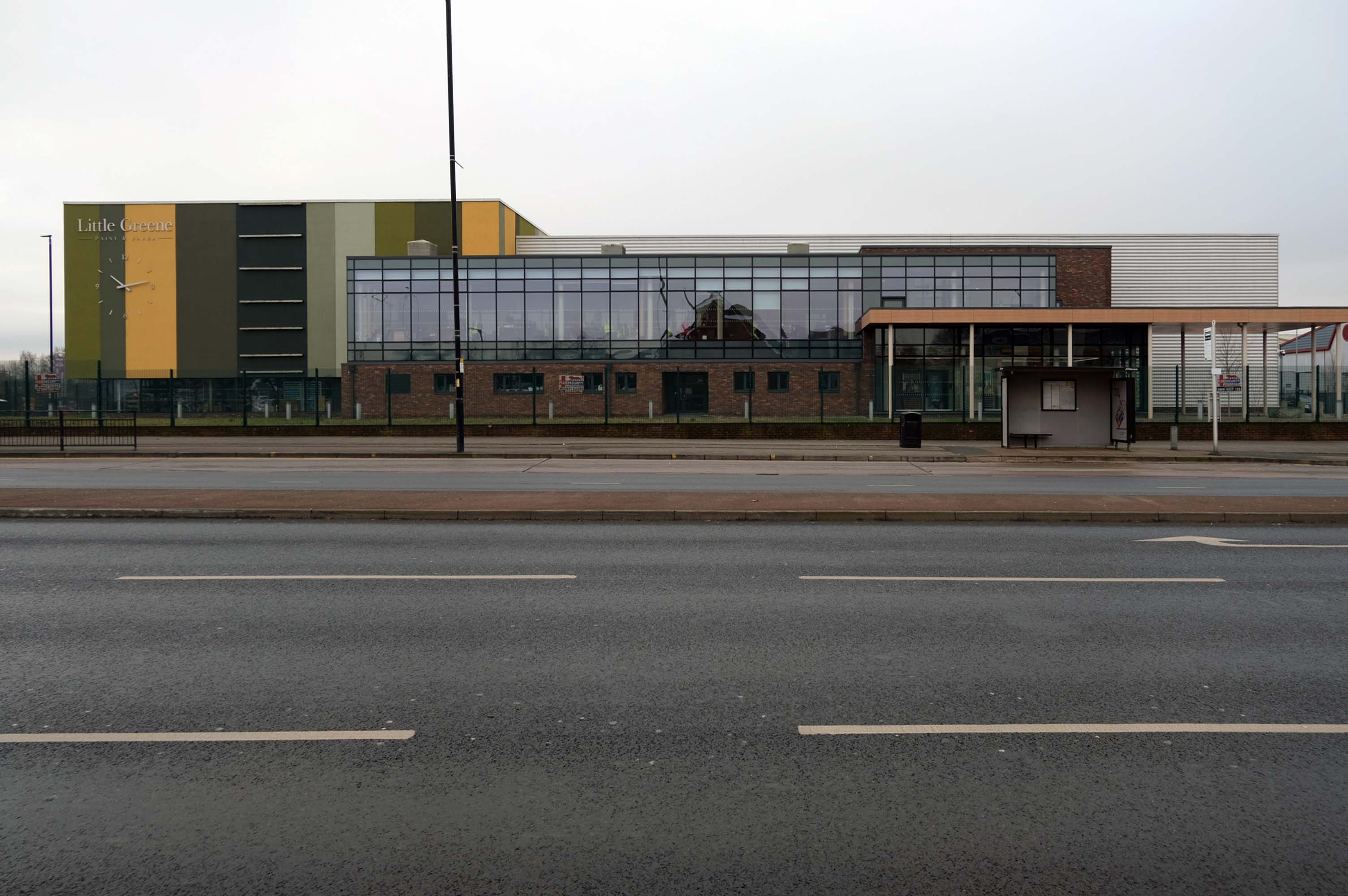
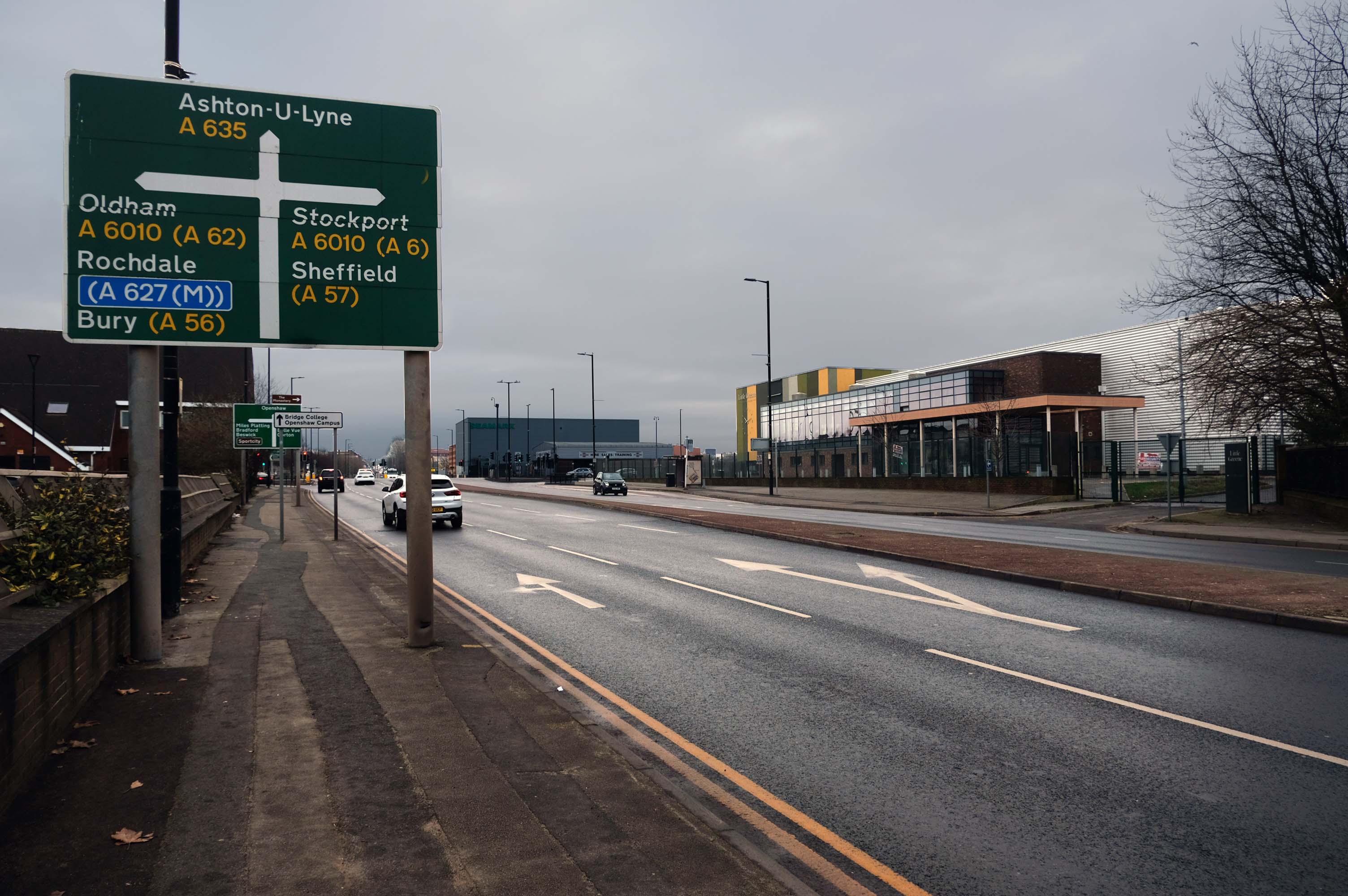
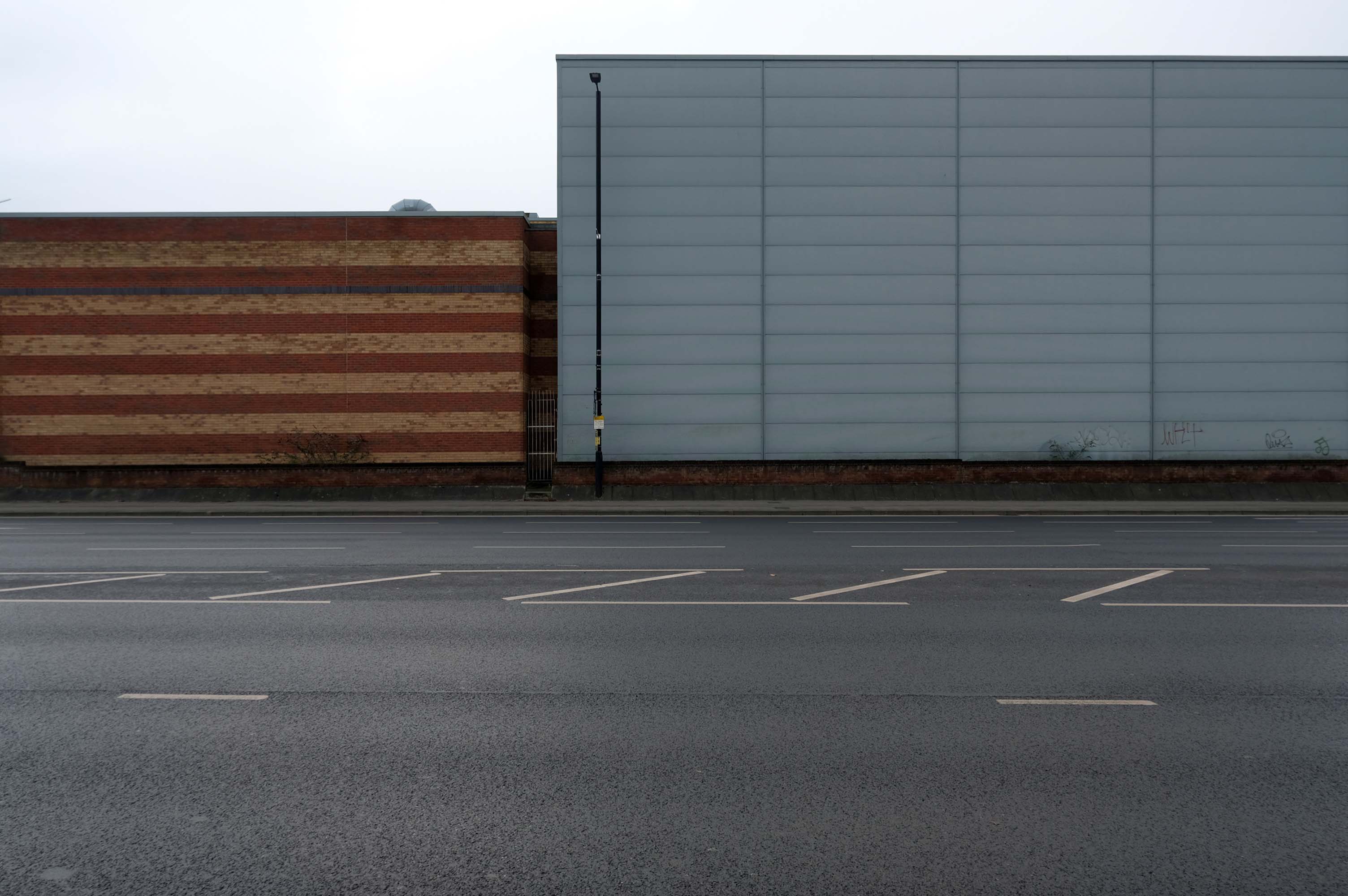
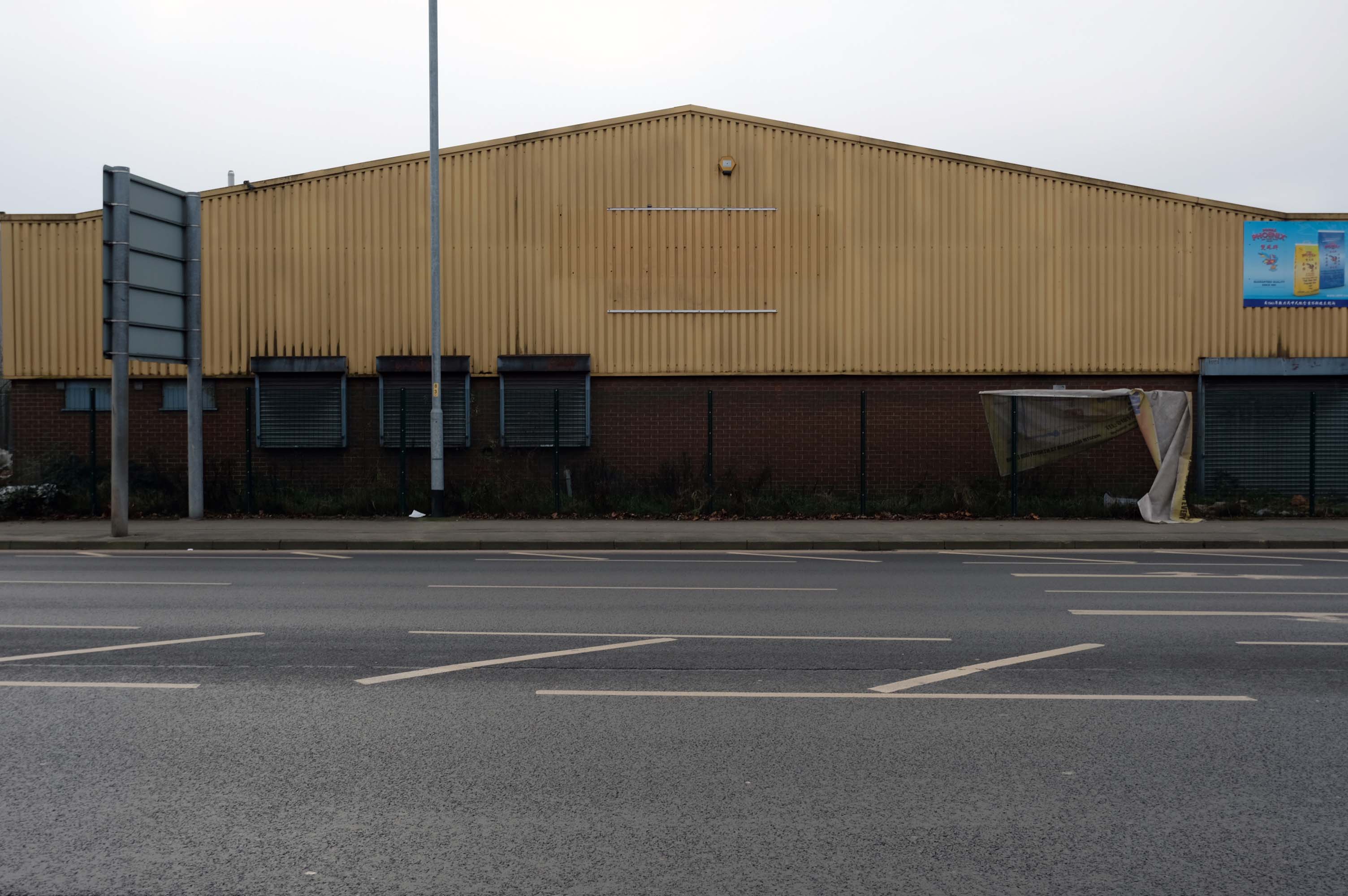
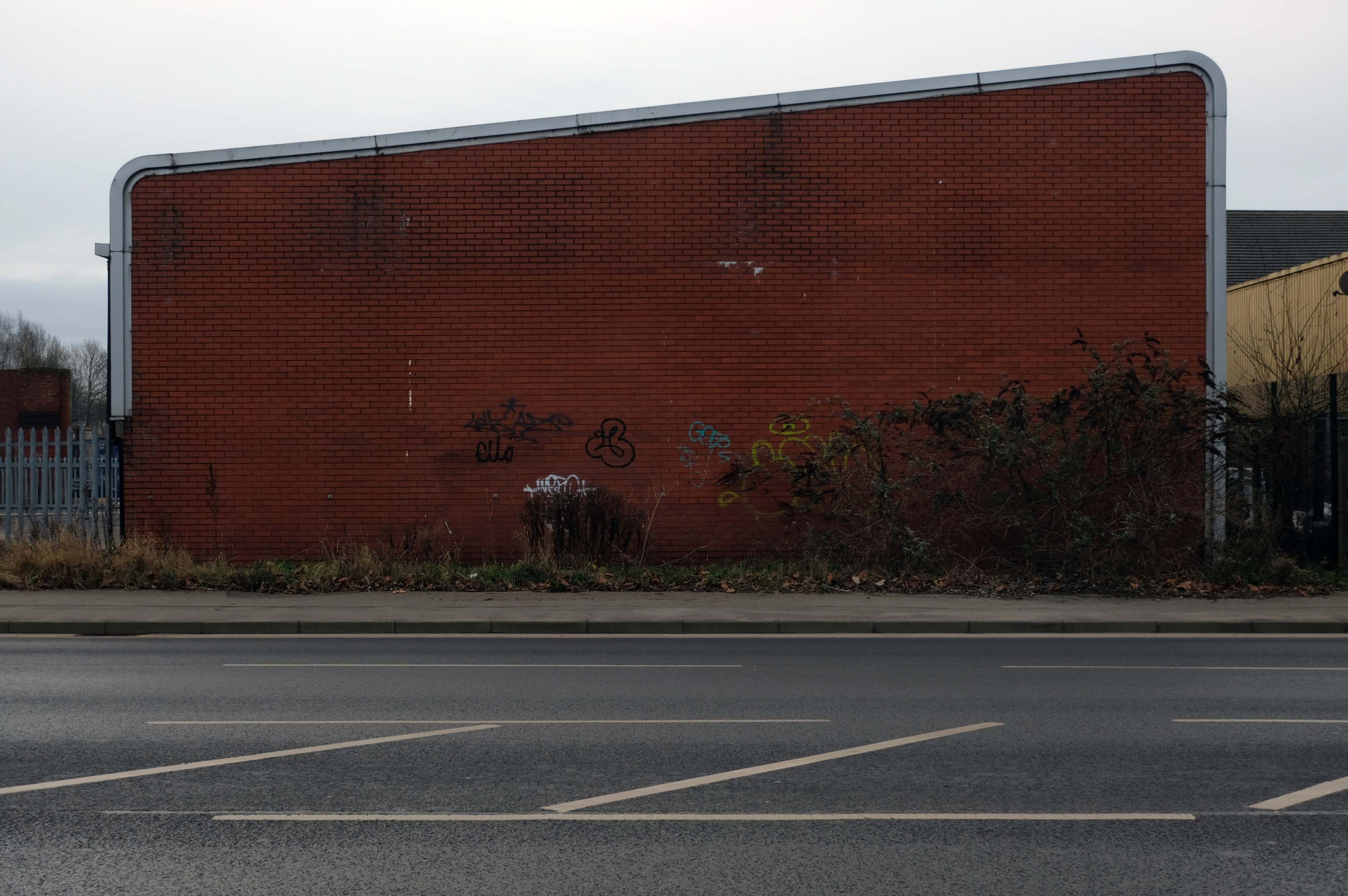
Manchester Arterial 2024 – A635

Having photographed the arterial roads of Manchester in 2014, I have resolved to return to the task in 2024.

Some things seem to have changed, some things seem to have stayed the same.

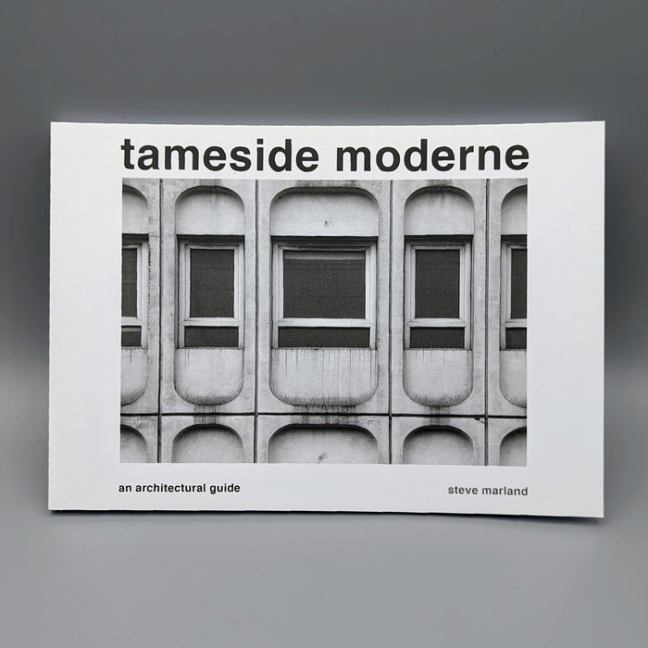
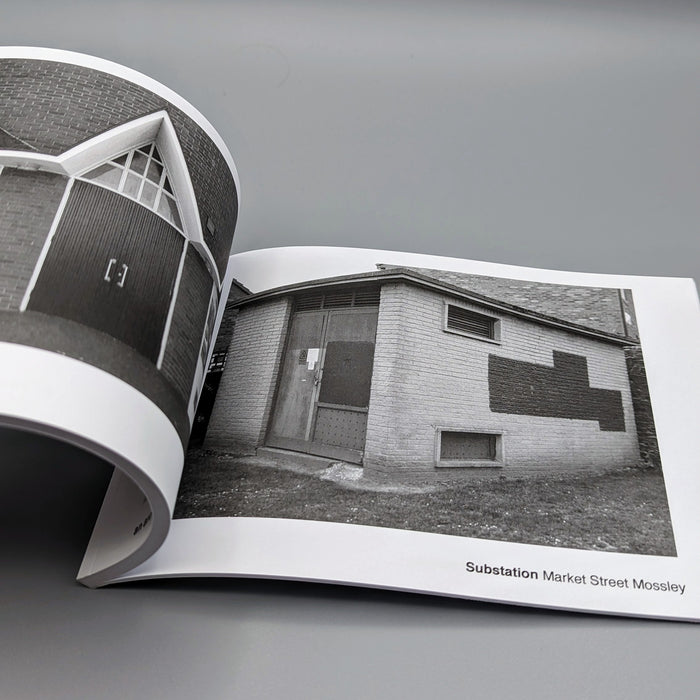
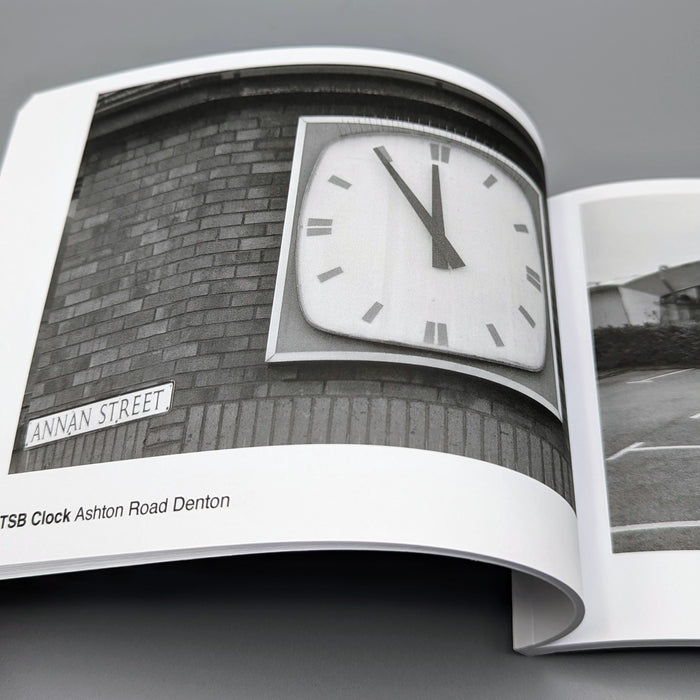
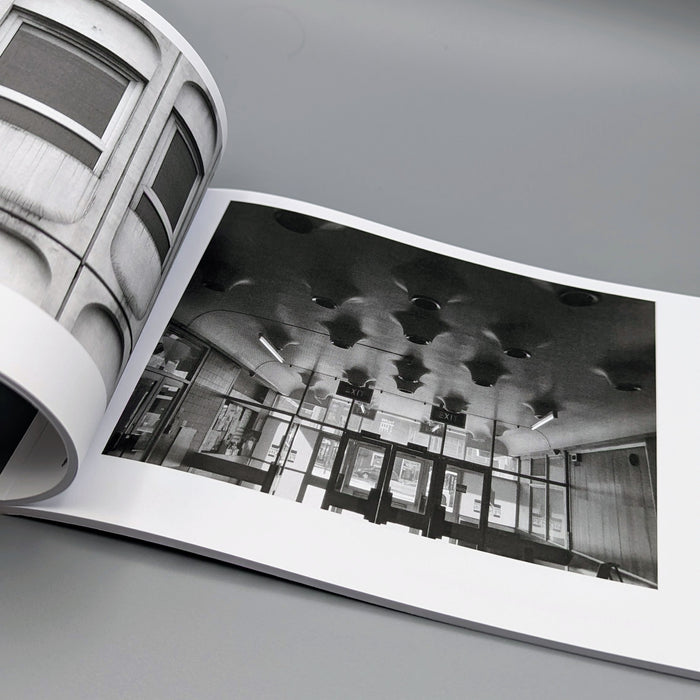
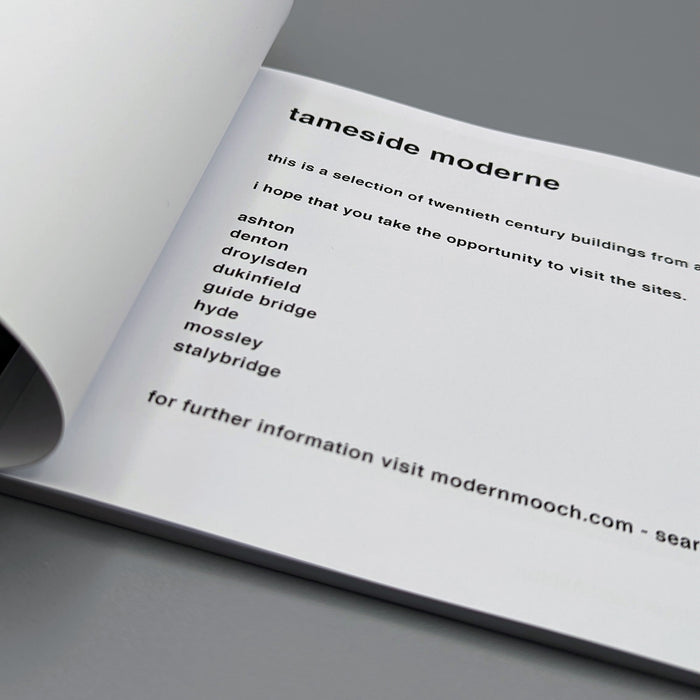
tameside moderne book

Available online here or call in the Modernist Shop on Port Street Manchester.

Tameside Moderne

By Steve Marland

A comprehensive guide to the Borough’s modern architecture.

Almost two years in the making.

Tameside east of Manchester – a volcanic explosion of concrete, glass, steel, brick and wood!

From sacred sites to suburban substations, a rollercoaster ride through provincial style.

  
Softcover, 84pages,
B&W
148 x 210xmm – landscape

£10 well spent – be quick these will fly!

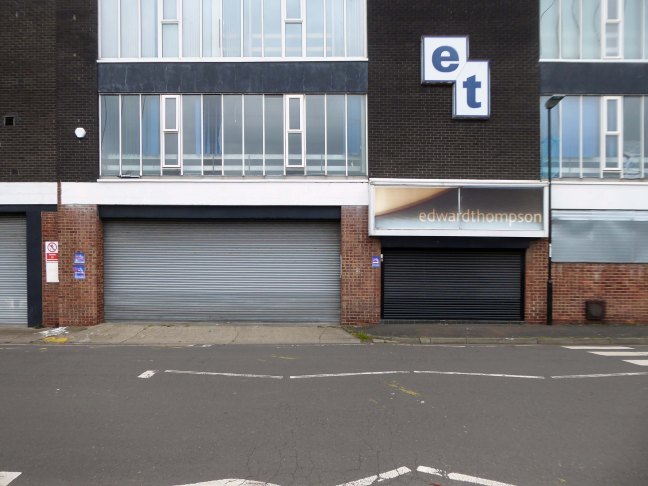
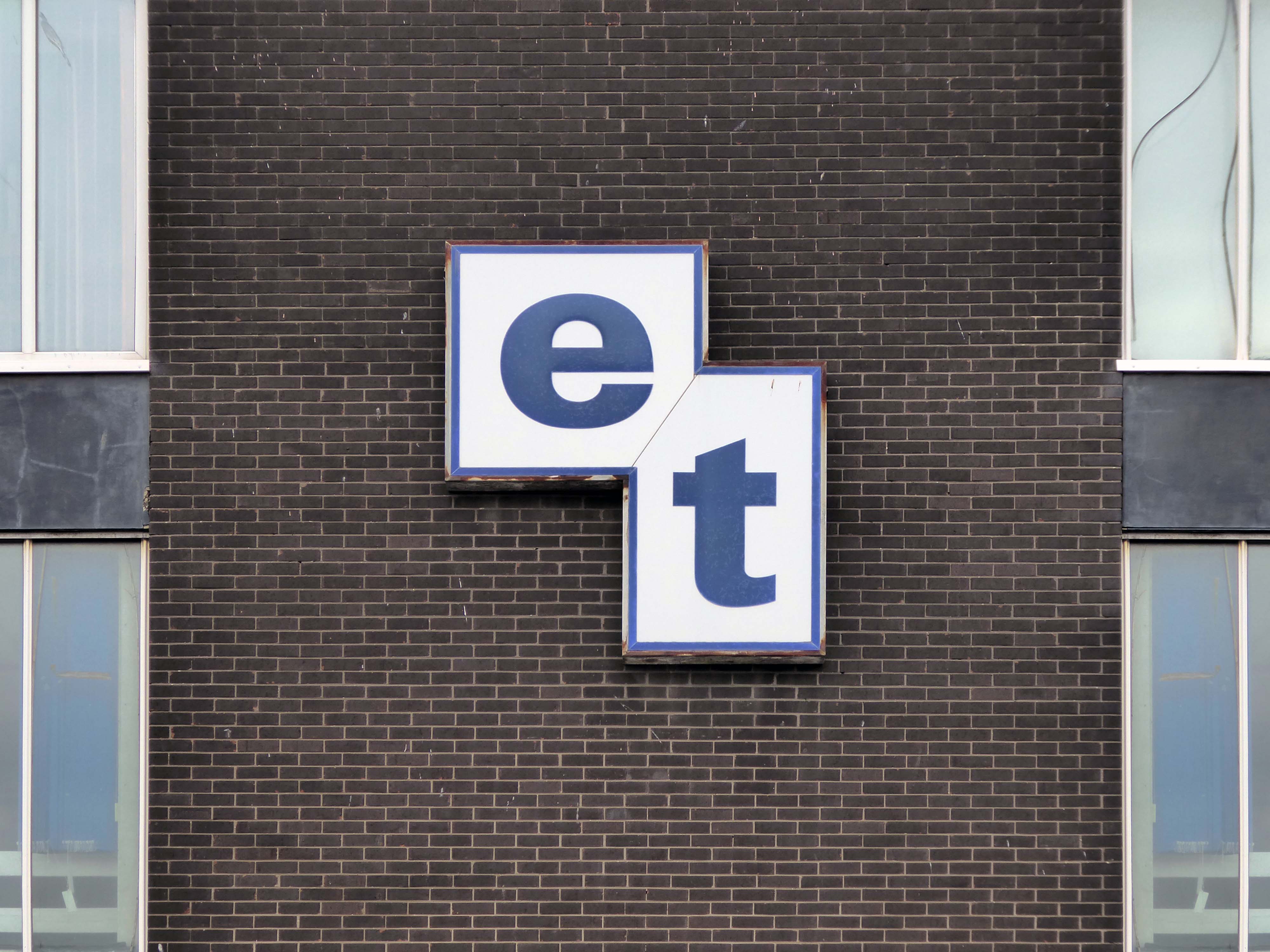
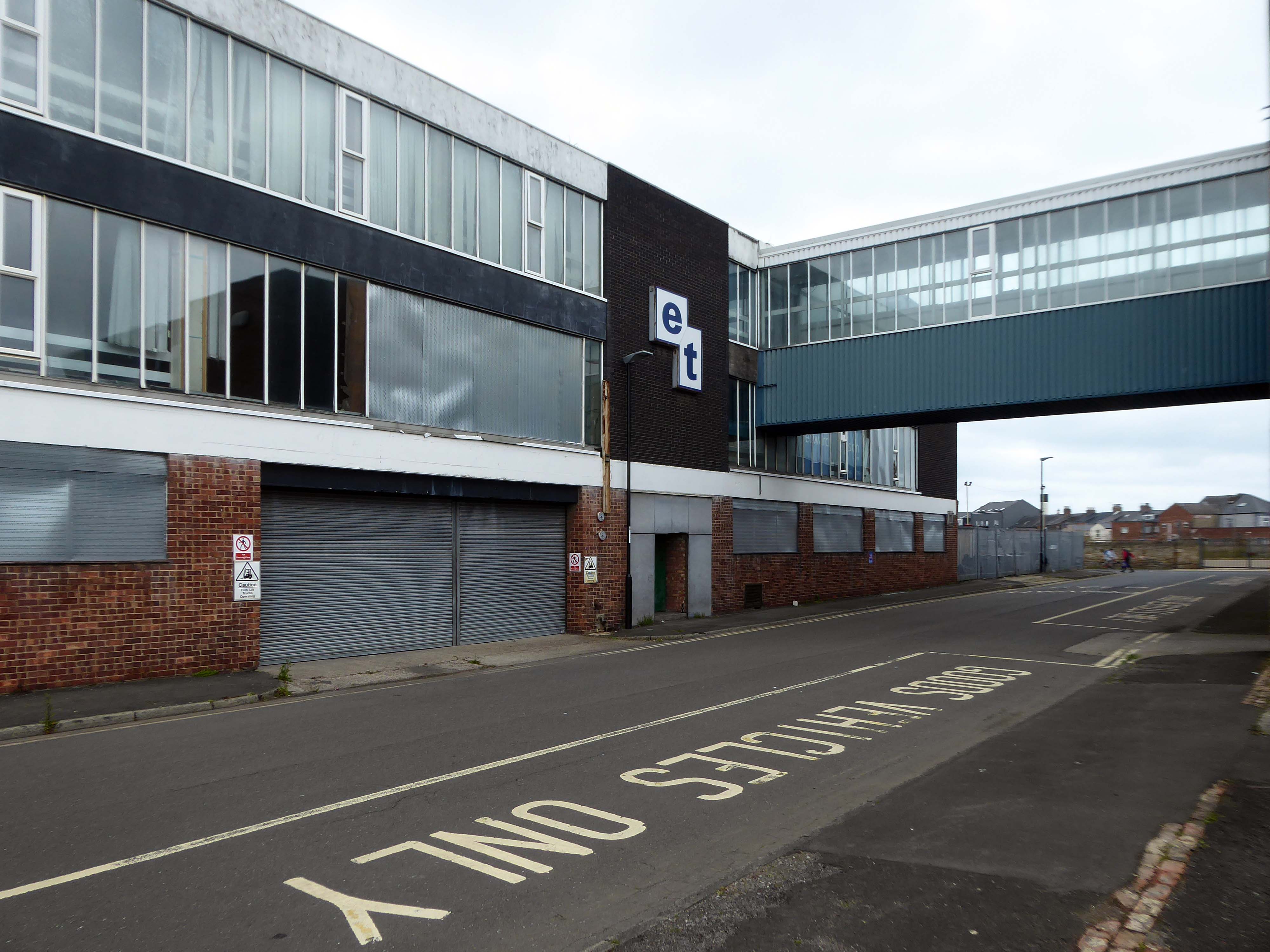
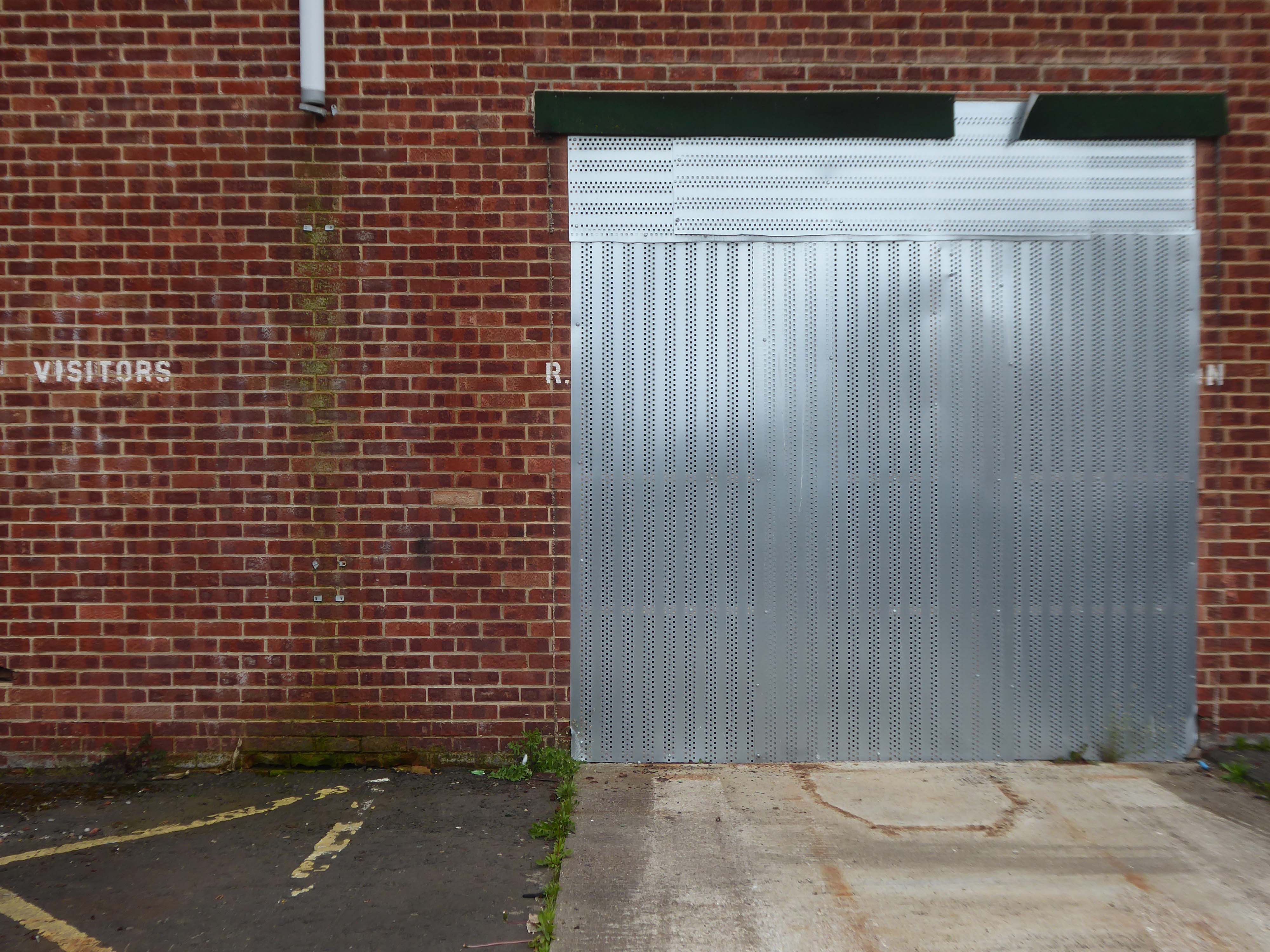
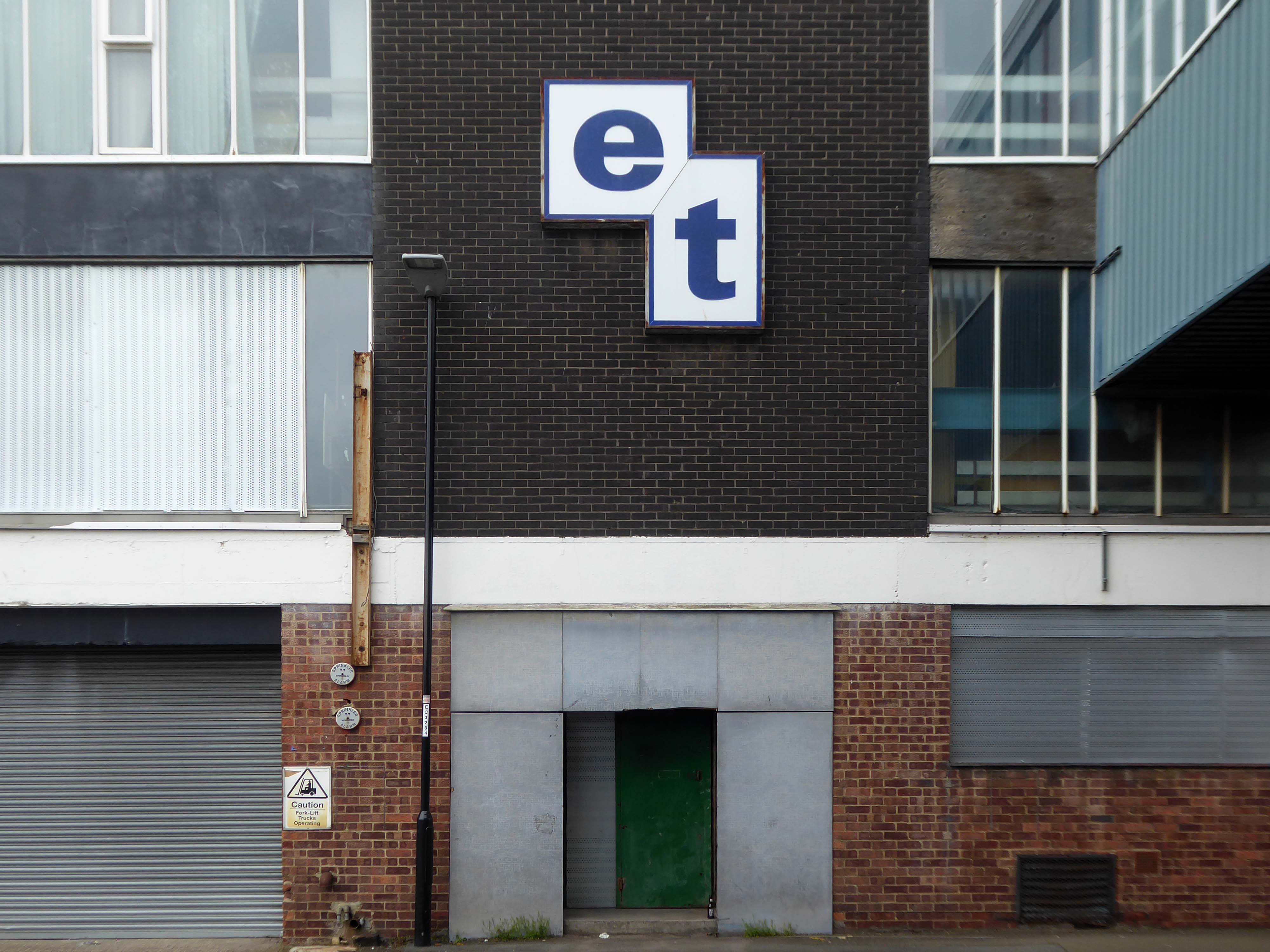
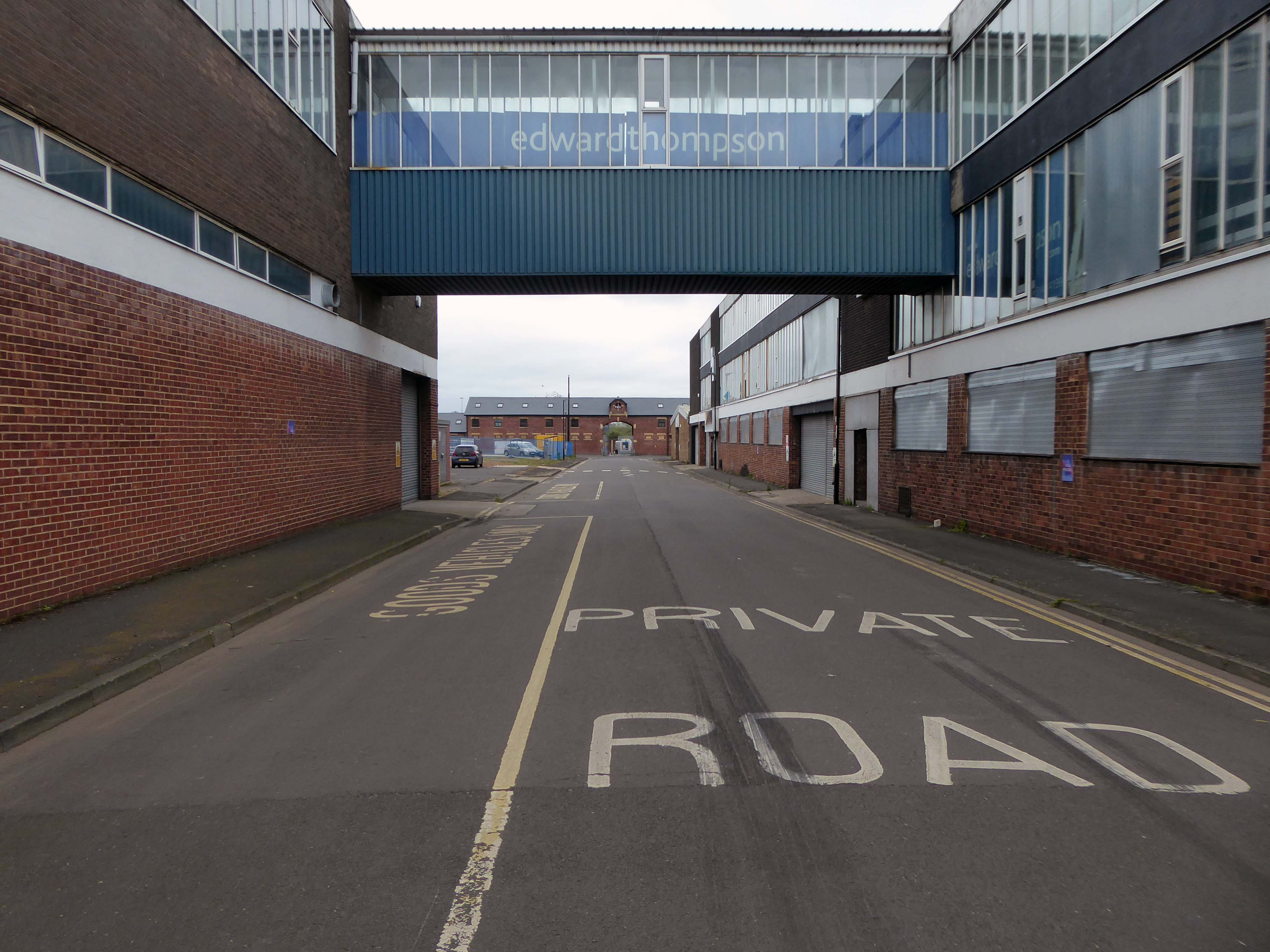
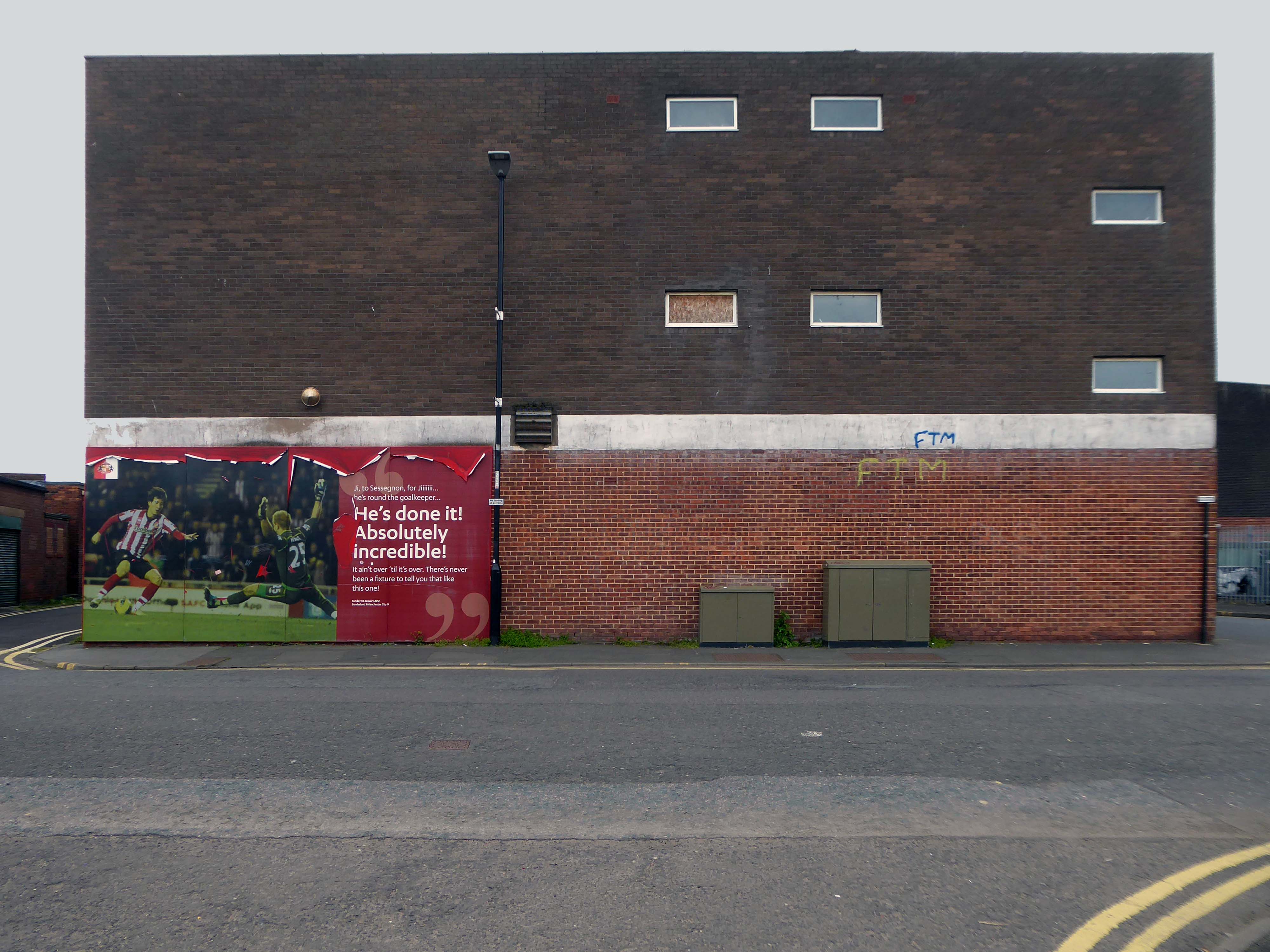
Edward Thompson – Sunderland

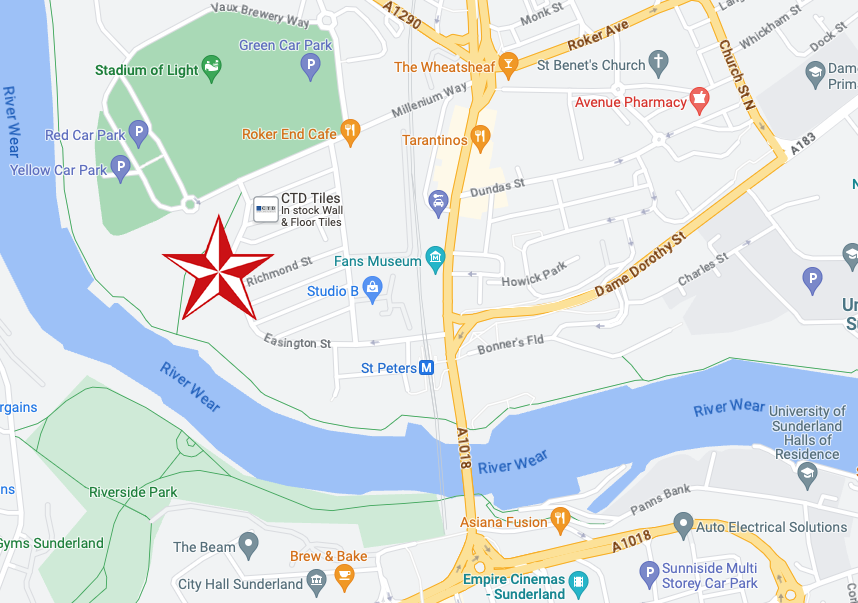
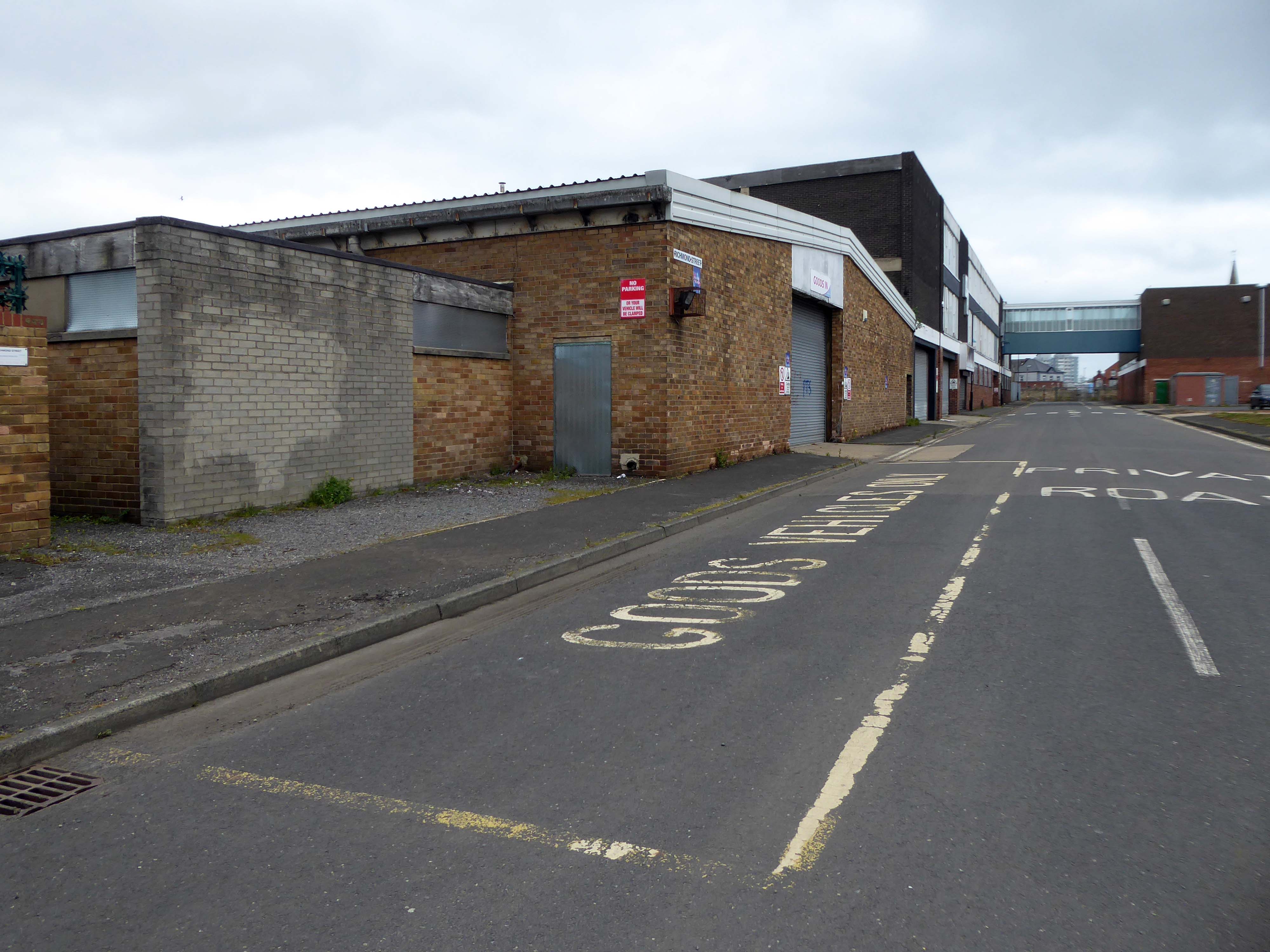
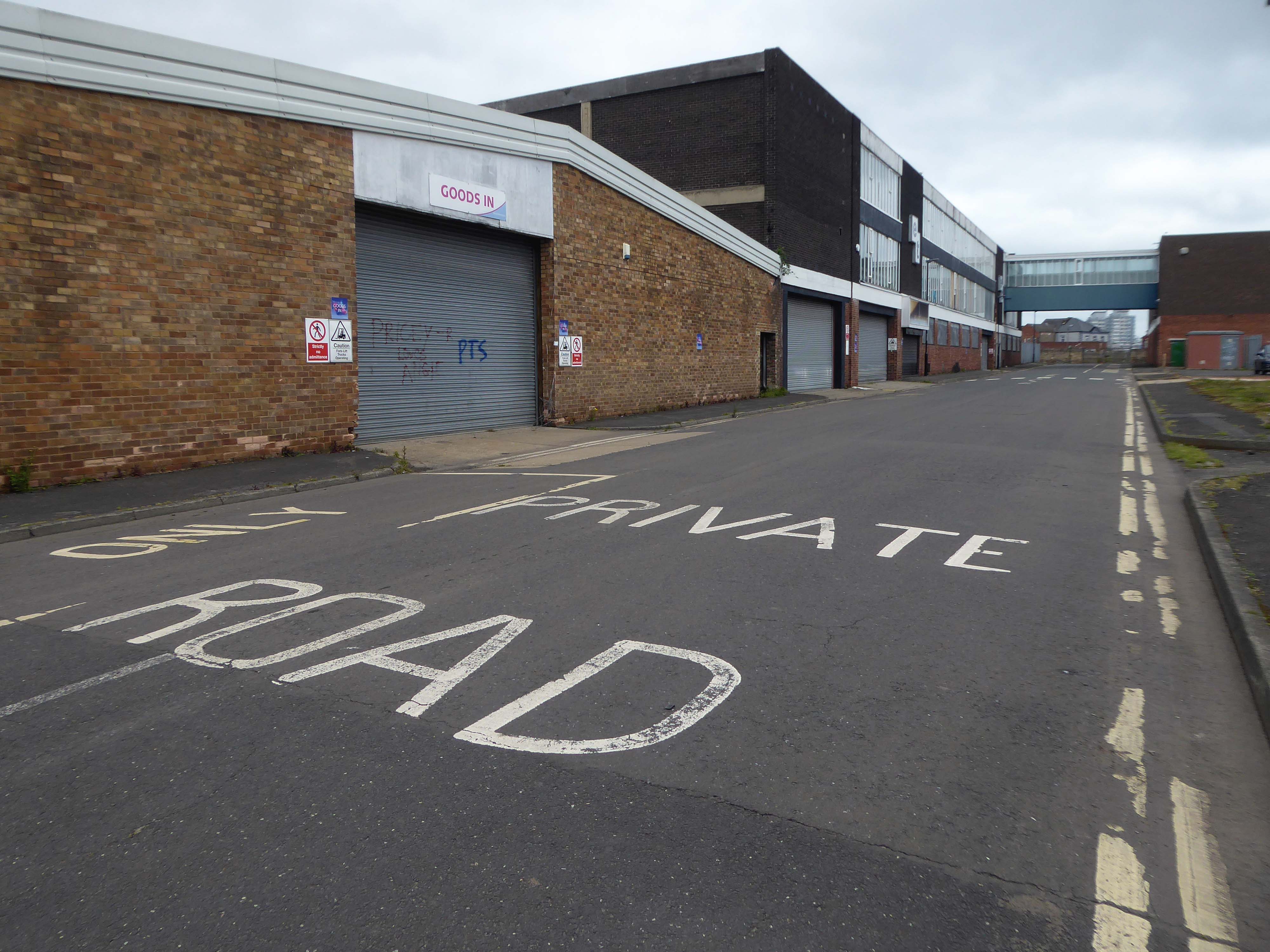
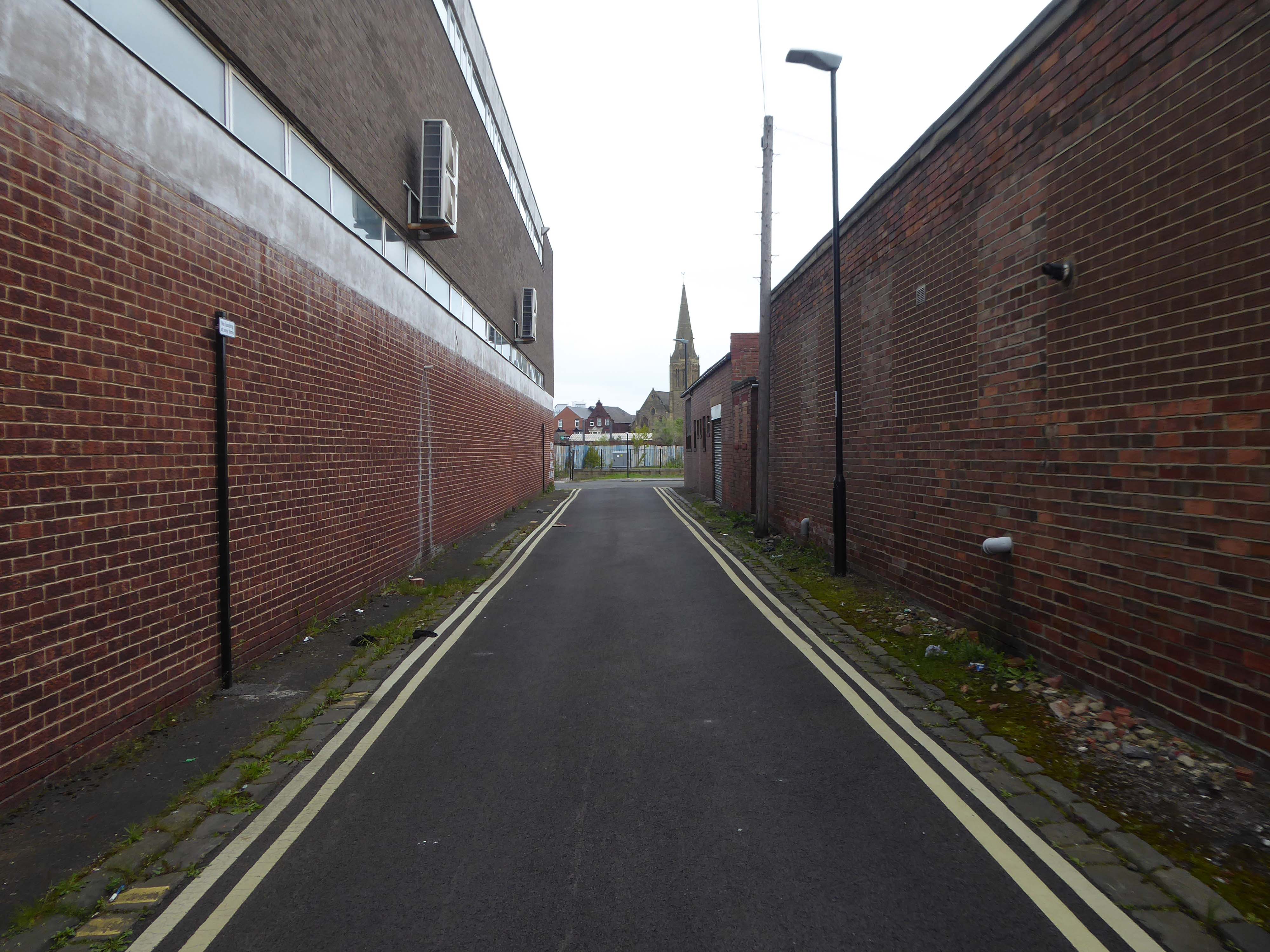
Richmond St Monkwearmouth Sunderland SR5 1BQ

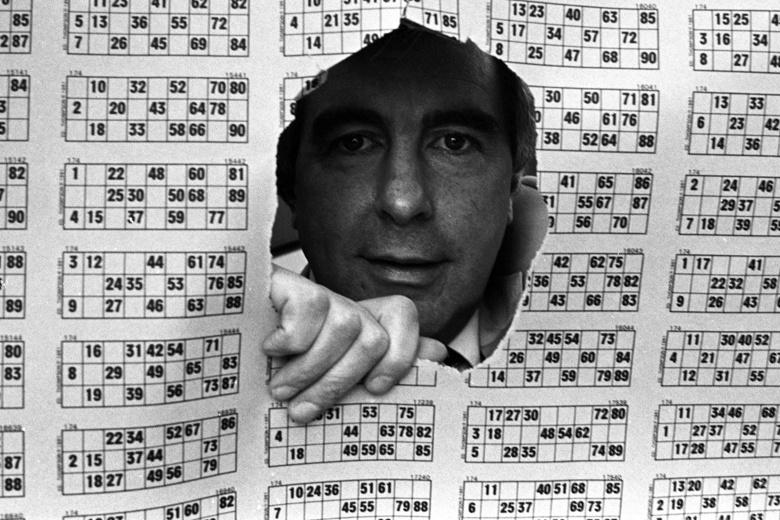
Bingo-Master’s Breakout!

Two swans in front of his eyes
Colored balls in front of his eyes
It’s number one for his Kelly’s eye
Treble-six right over his eye

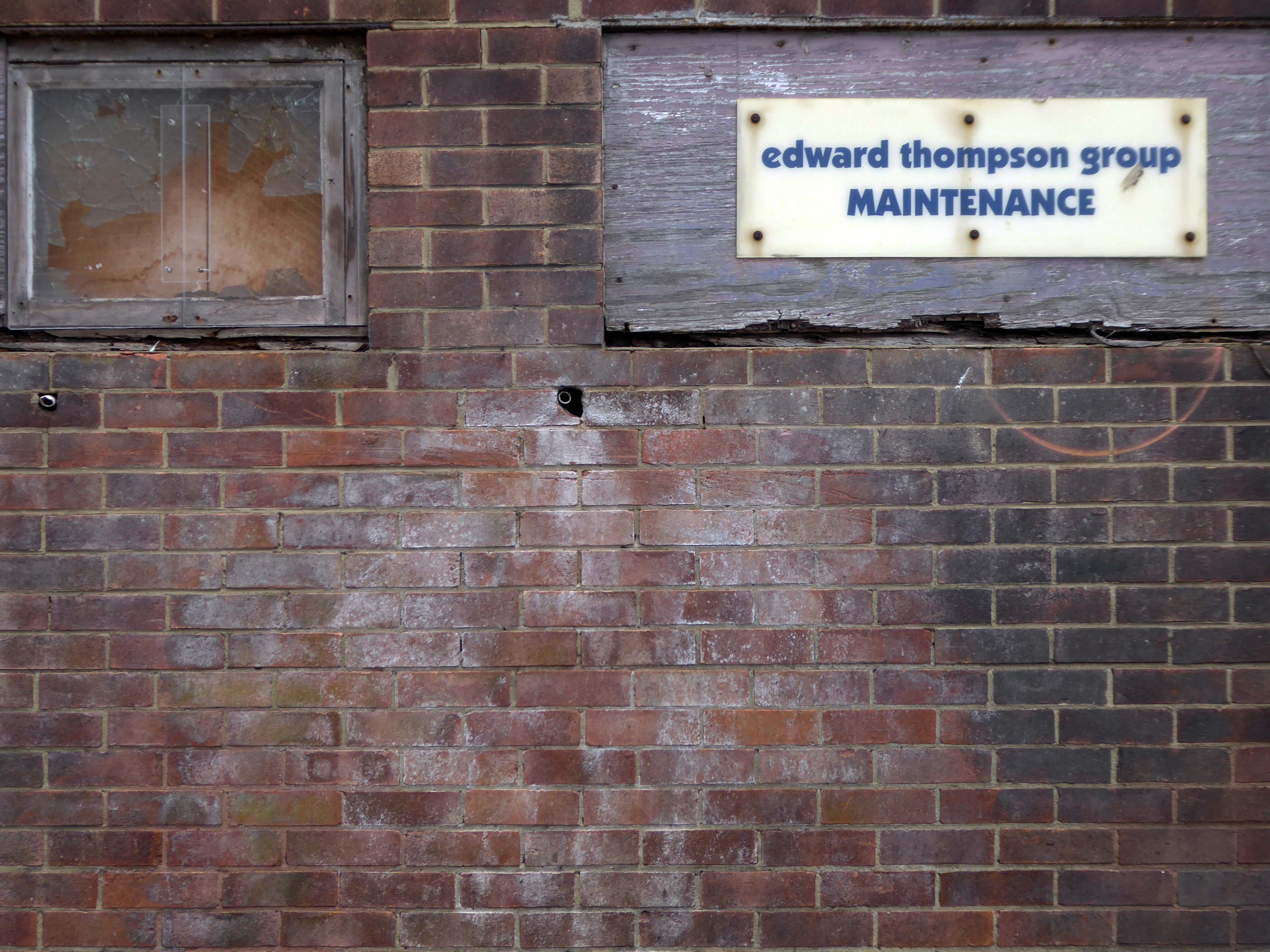
Edward Thompson, the family printing business, was founded in Sunderland in 1867.

They identified a business opportunity when a local priest, Jeremiah O’Callaghan, ordered some bingo tickets for a parish fund-raising exercise.

From those humble beginnings, Edward Thompson mushroomed in size as Britain went bingo-mad in the 1960s, becoming first the UK’s and then the world’s biggest producer of bingo cards and tickets.

Sky News

The company which has been printing for more than 155 years – has been hit hard by the crash in bingo hall use as Covid ripped through the leisure sector. CEO Paddy Cronin said he was ‘gutted’ but the business had finally had to face the inevitable as the cashflow dried up.

We were built on a bet but our luck has now run out – he told The Northern Echo.

Covid completely changed the market and as the halls went into decline it just became untenable so I had to break the news to the workers.
They were the pioneers of newspaper bingo, printing the first cards in 1975 and going on to work in places like Bolivia and Belgium and even printing the ballot papers for Nelson Mandela’s 1994 election in South Africa.

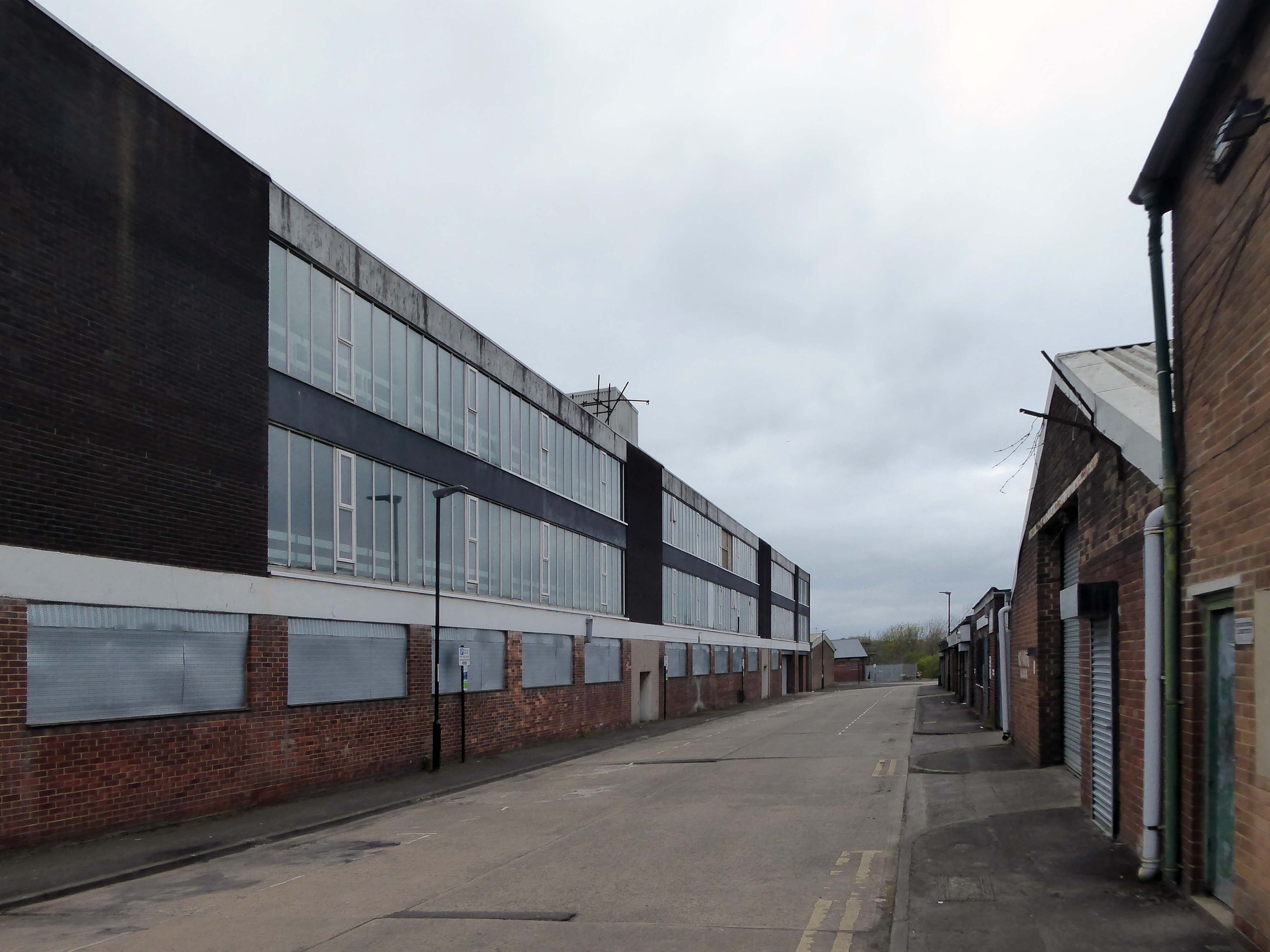
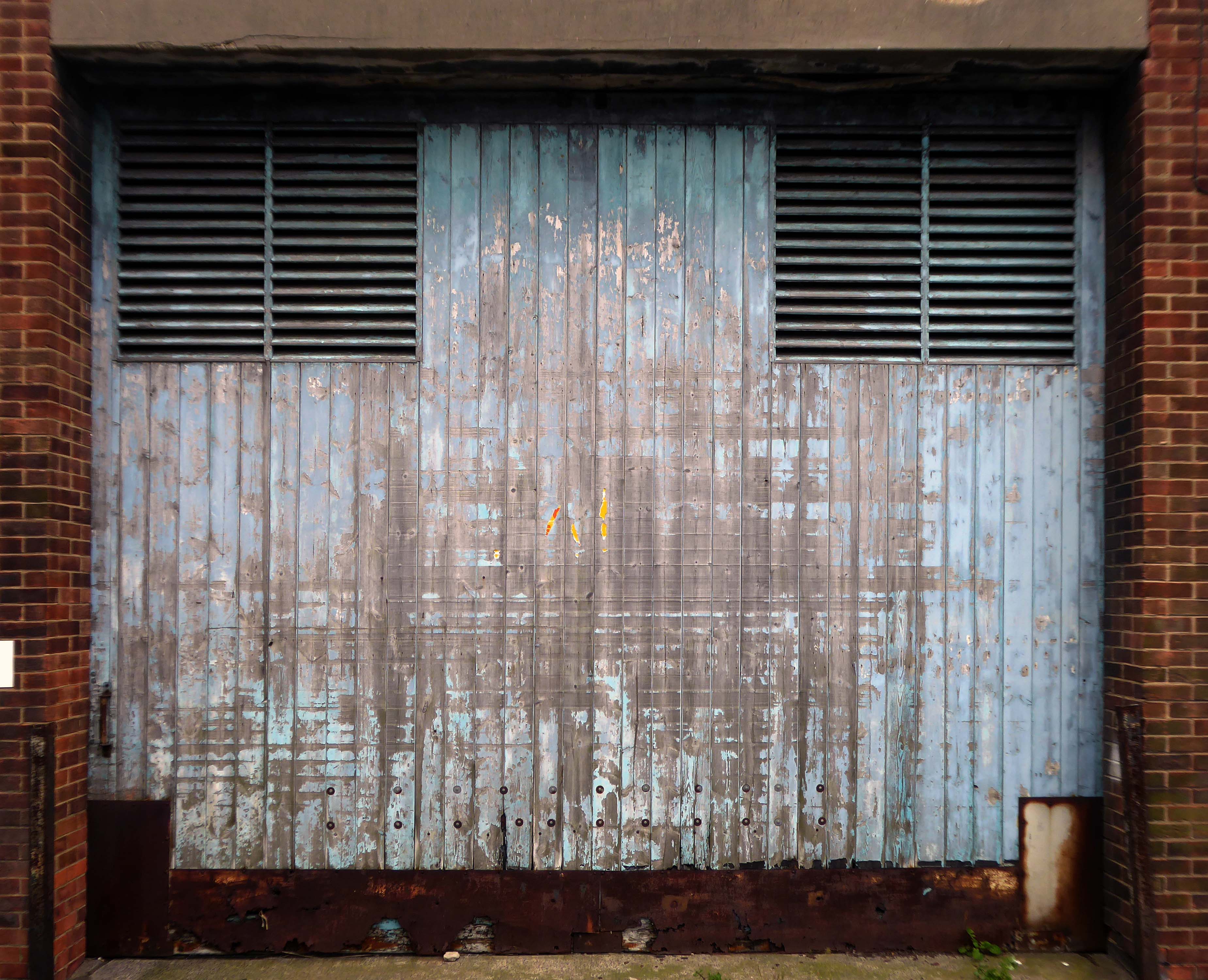
So their number is up the factory is tinned-up, house has been called for the very last time.

Yeah, yeah, industrial estate

Well you started here to earn your pay
Clean neck and ears on your first day
Well we tap one another as you walk in the gate
And we’d build a canteen but we haven’t got much space

Industrial Estate

Collyhurst Cheetham Circular

It’s Friday, the rain has almost stopped and I have a job to do.

The putative William Mitchell totem in Eastford Square is being moved.

Having taken a particular interest in this particular piece of public art for some time – I need to go and take a little look.

But what will we see along the way, as we hasten along Rochdale Road?

Which once looked like this, way back when in 1904.

Though some things inevitably come and go, as some things are prone to do.

The city is undergoing yet another reinvention as Manchester becomes – an attractive place to invest and do business.

See, I am doing a new thing!

Now it springs up; do you not perceive it?

I am making a way in the wilderness and streams in the wasteland.

Isaiah 43:19

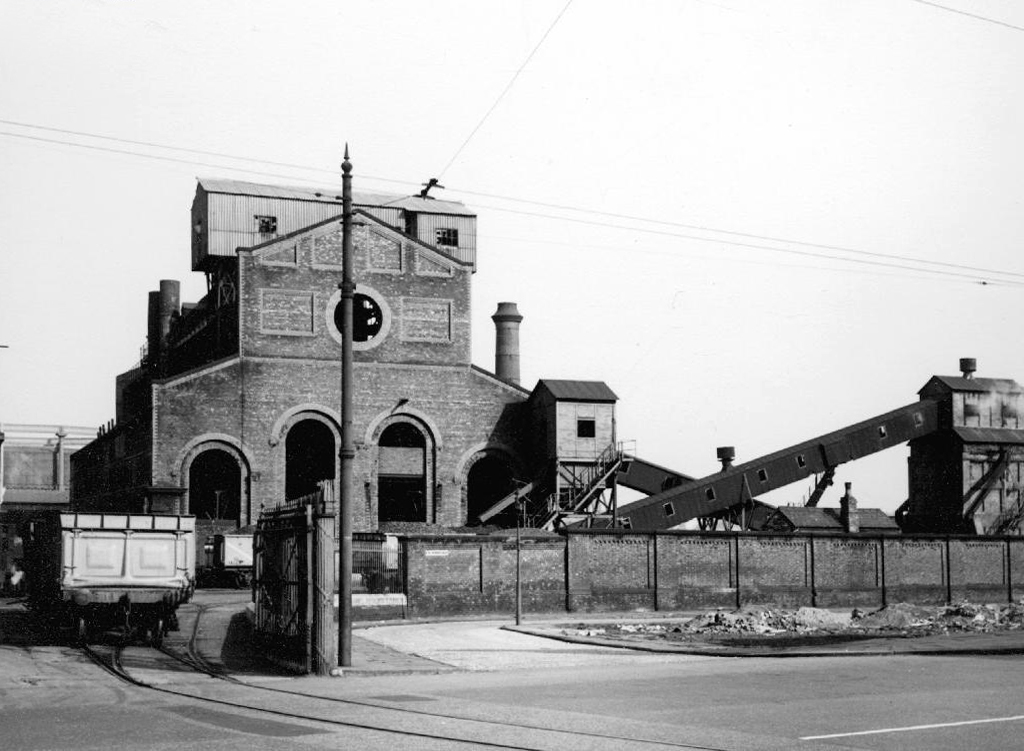
Once there was a gas works here – adjoining Gould Street, seen here in 1958.

The Gould Street Gas Works was a gas manufacturing plant located in Manchester, England. Originally built in 1824, the plant was operated by the Manchester Corporation Gas Department and was in operation from 1833 to 1969. It was named after the street on which it was located, which was named after John Gould, who was a prominent Manchester businessman in the 19th century.

Derelict Manchester

The Gasworks New Town neighbourhood is one of seven envisioned by the £4bn Victoria North masterplan. It will feature nine buildings ranging from 8 to 34 storeys. The 6.6-acre site has most recently been home to a car park but the green development will overwhelmingly prioritise walking and cycling over driving. It will result in tens of millions of pounds being pumped into the city’s economy over the lifetime of the development.

Plans for a trailblazing city centre regeneration scheme that will create more than 1200 homes has been approved by Manchester City Council.

MCR Property

A total of 85 of the 1200, will be affordable homes available through Shared Ownership. 

Though as of March 31st 2023 ground is yet to be broken, no signs of the:

New centre of gravity for central Manchester that will create thousands of jobs and inject tens of millions of pounds into the city’s economy.

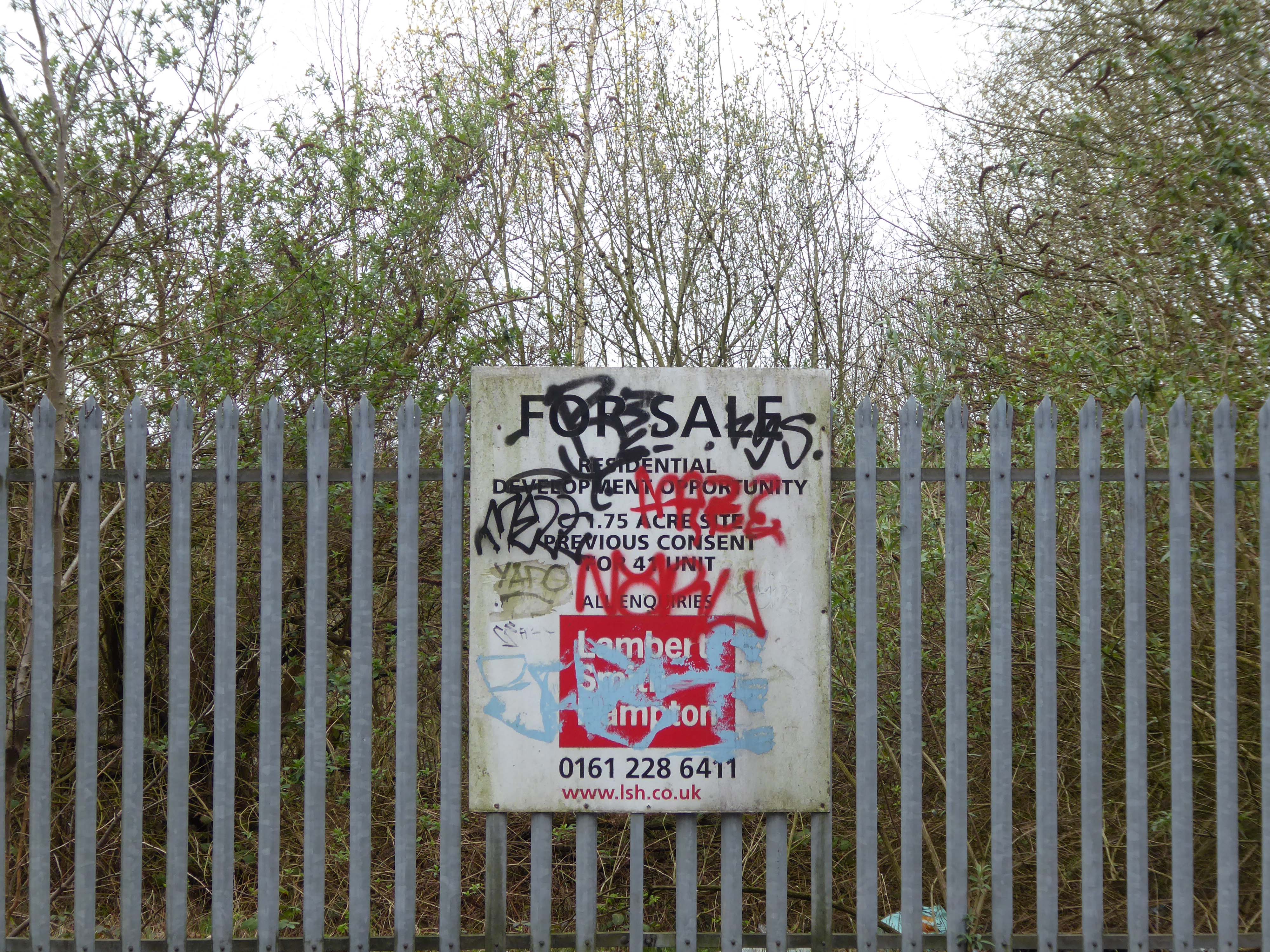
So you zig-zag wanderers, make the most of these wide open expanses of affordable car parking, while you can.

The future may yet be here today – or the next.

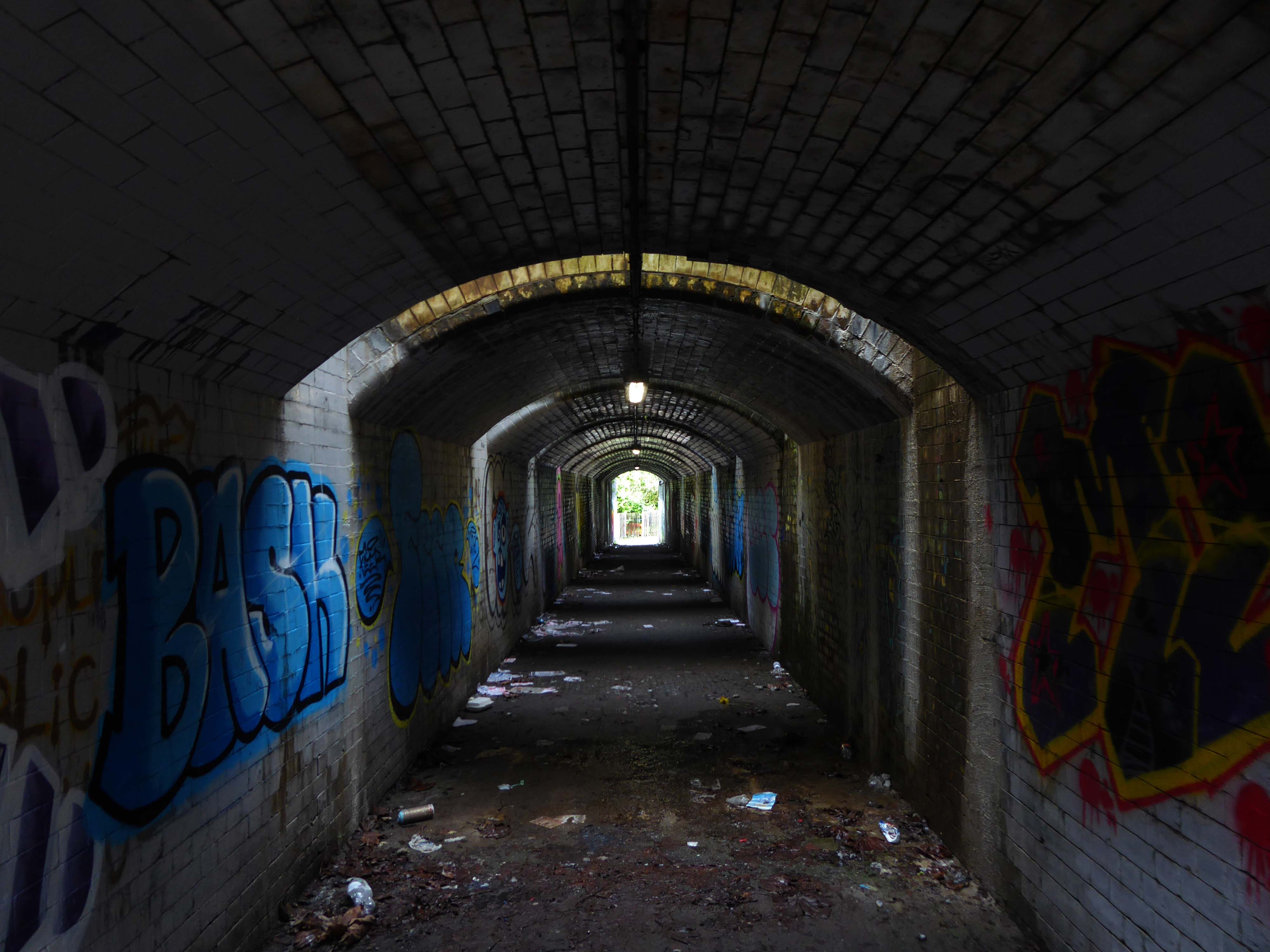
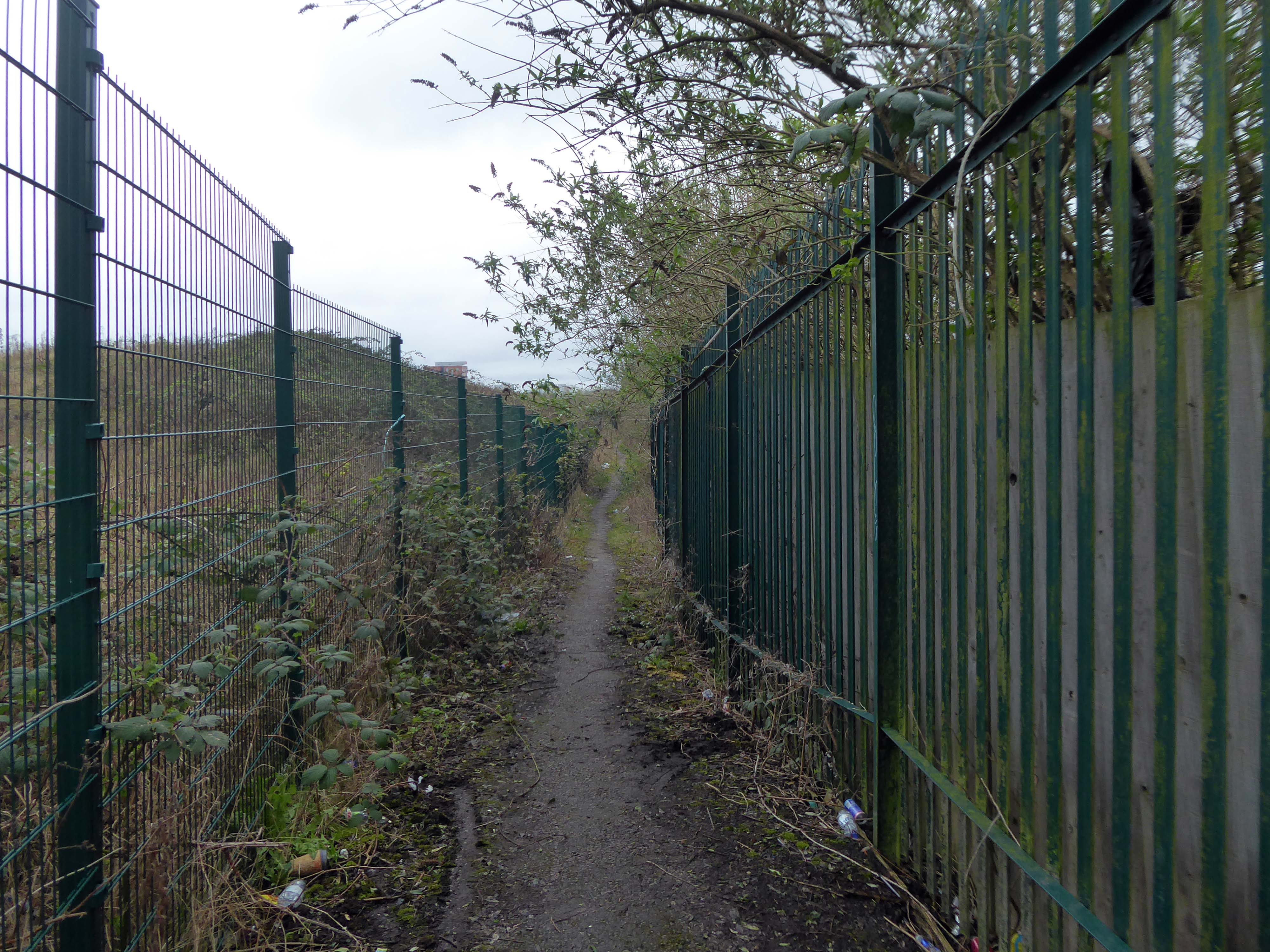
Let’s duck under the railway, through this sad damp pedestrian tunnel – the domain of the cash strapped daytime drinker, transient tagger and disaffected leaflet distributor.

Next thing you know you have emerged into the daylight on Dalton Street – we have been here before seeking the Collyhurst Cowboy.

Photograph: Dennis Hussey

Onwards to Eastford Square.

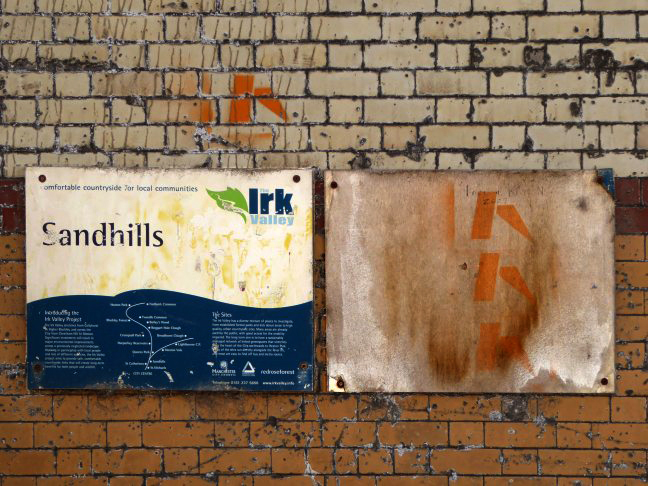
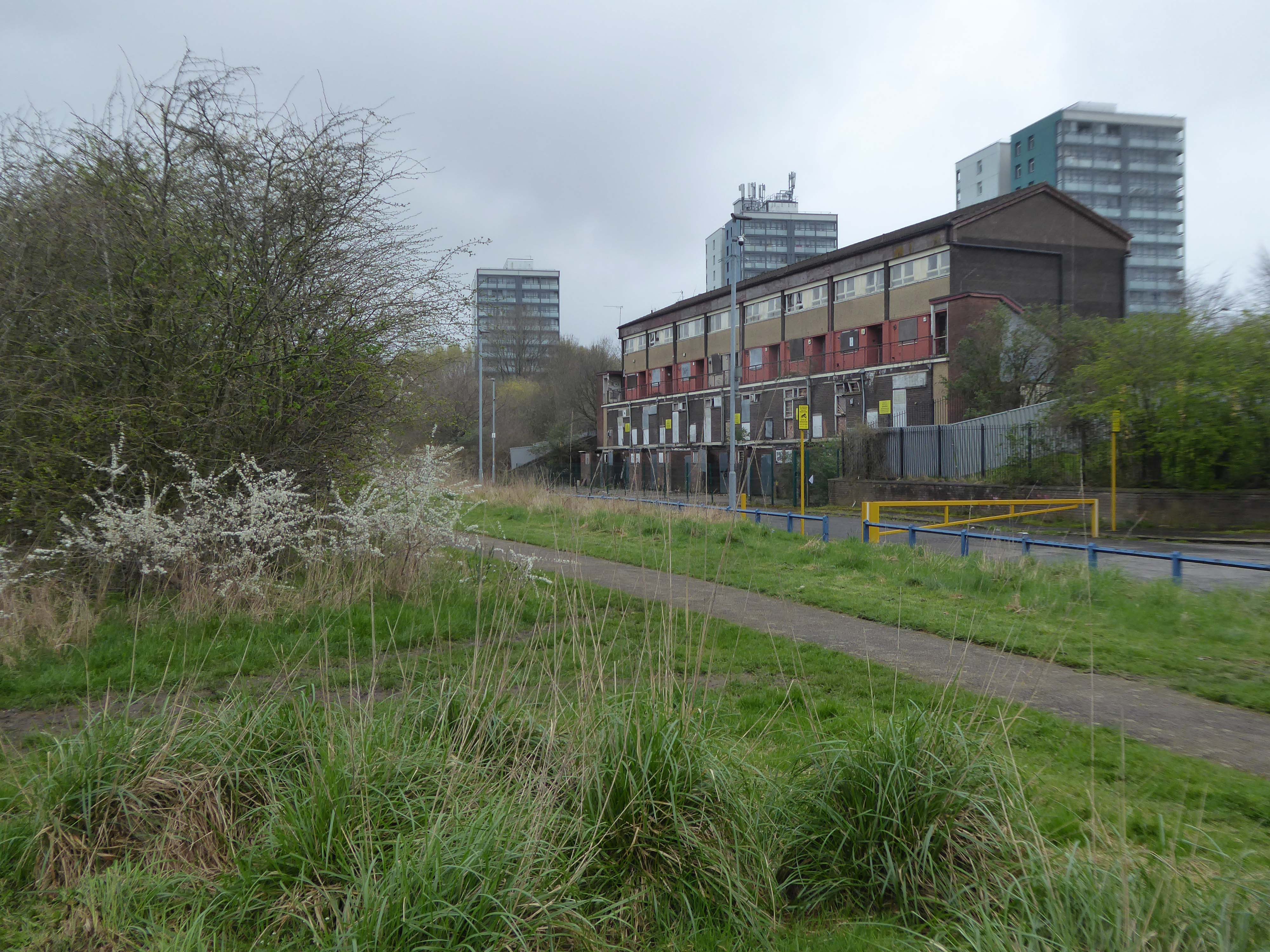
The shops and maisonettes are due to be demolished any day now – no longer to gaze open-eyed upon the former quarry of Sandhills.

Around the front the diggers have been a digging – digging up around the base of the totem.

The work is to be re-sited by the nearby tower blocks.

The end is nigh.

Heading now for Collyhurst Road and the Irk Valley – seen here in 1960.

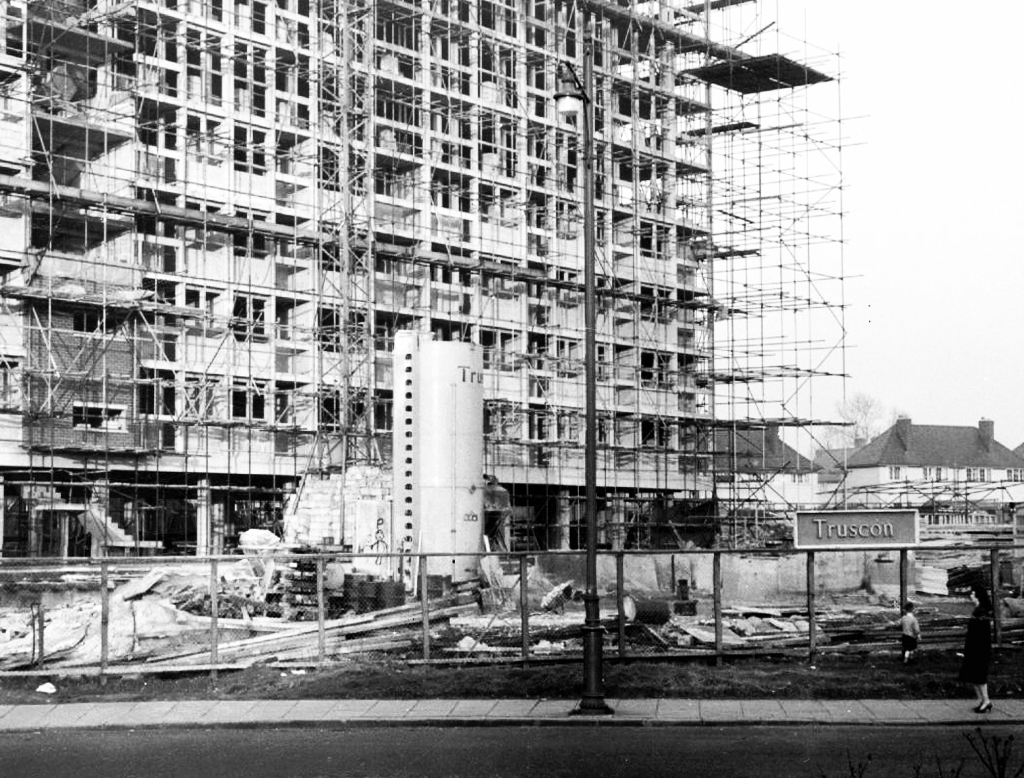
Looking back on the Square and the Dalton Street flats – Humphries, Dalton, Roach, Vauxhall and Moss Brook Courts under construction.

Vauxhall Street now but a shadow of its former self – the last traces of industry long gone.

Reclaimed over time by trees and dense underbrush.

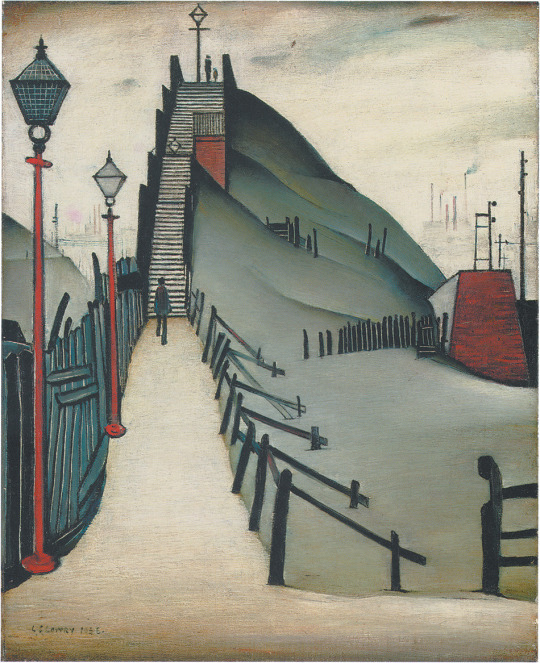
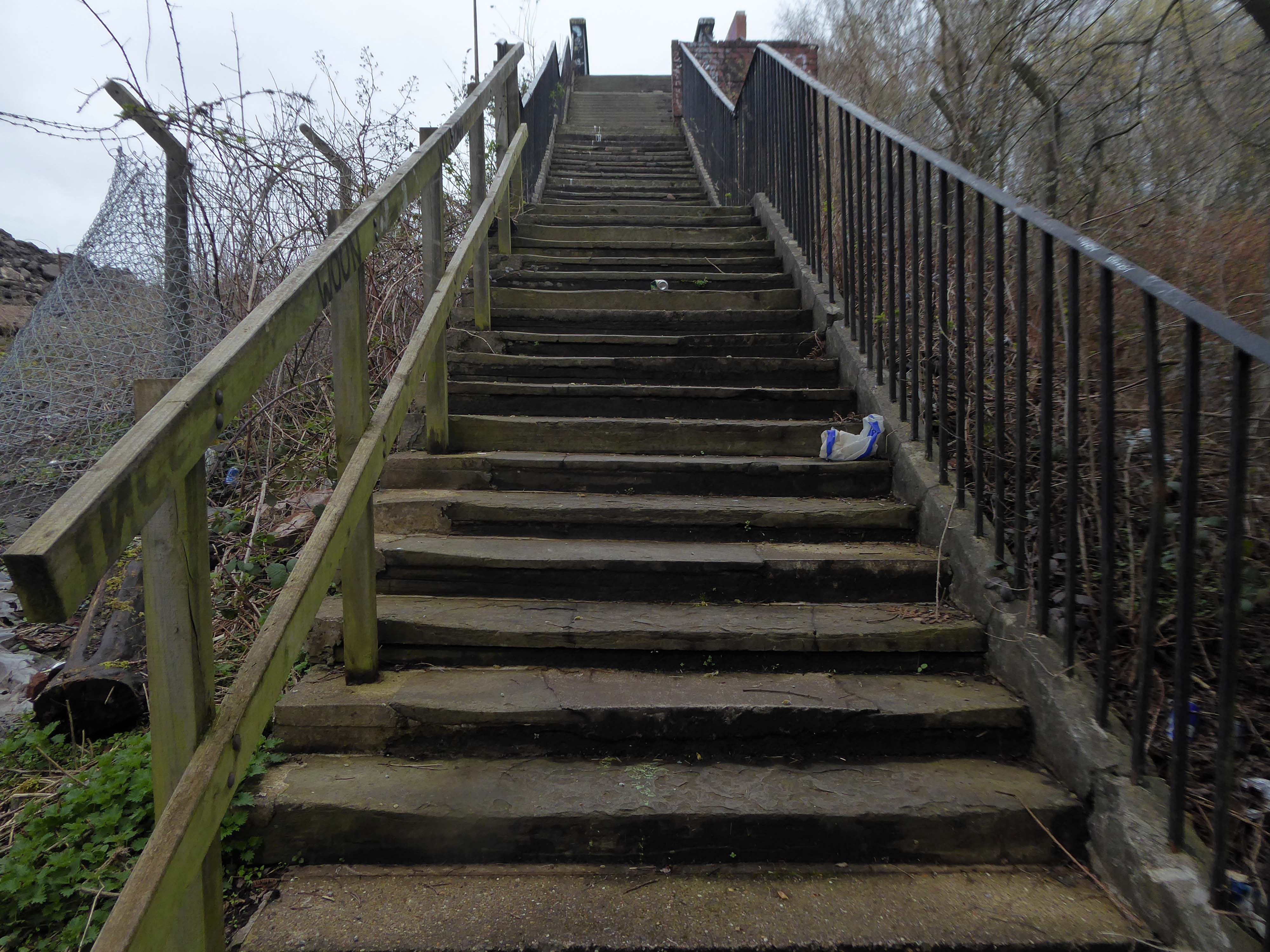
Crossing Collyhurst Road and up and over the railway via Barney’s Steps also known as the Lowry Steps.

LS Lowry

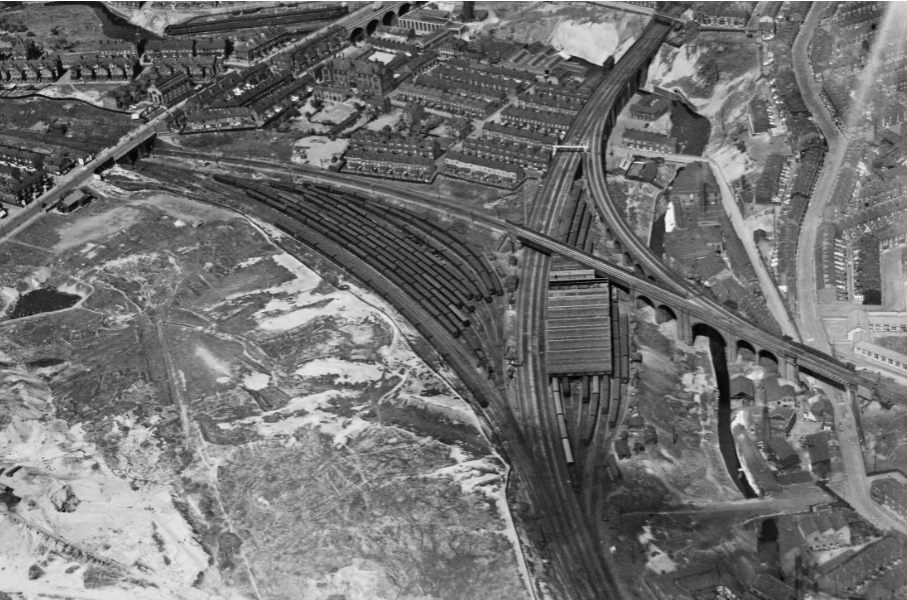
By the late 1950’s the whole of this area which we called Barney’s Tip became a refuse tip for Manchester City Council.

Britain from Above

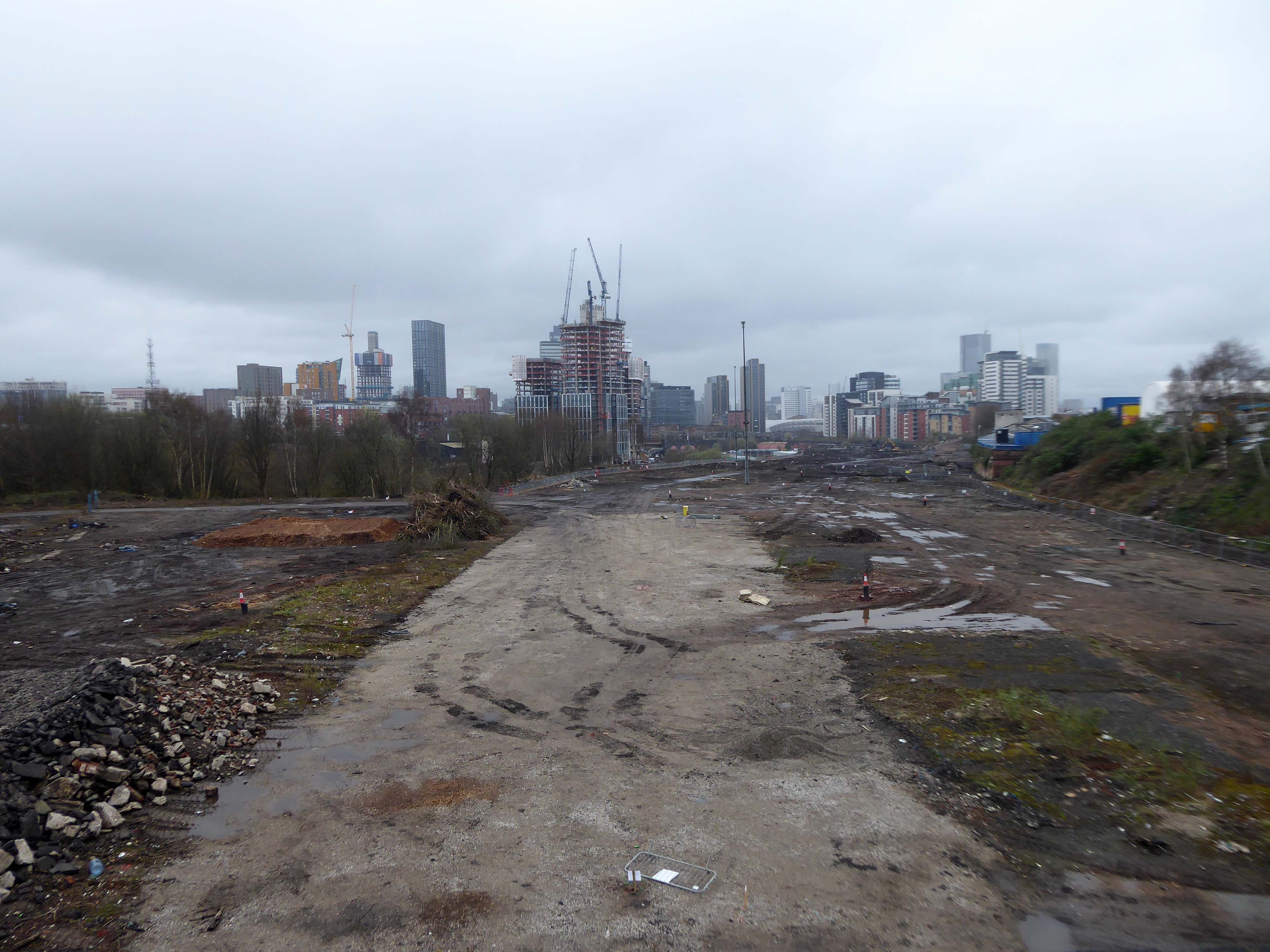
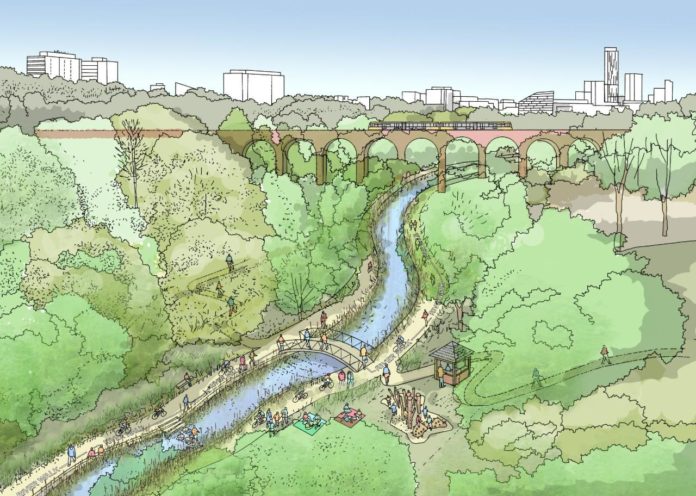
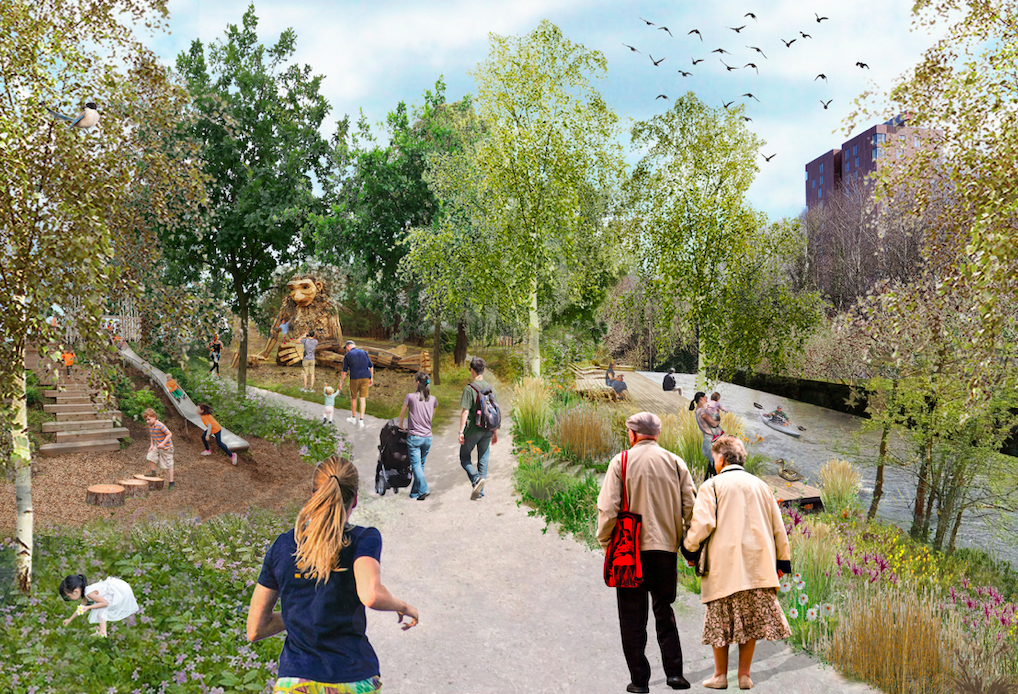
The area is in the process of being reconfigured as a delightful country park.

The investment will also help develop an initial phase of the planned City River Park incorporating St Catherine’s Wood as part of a network of public open space, including improvements along the River Irk and works to improve flood resilience, unlocking the potential of the Irk Valley that will characterise the wider Northern Gateway project.

About Manchester

The first phase of the City River Park will begin work to transform former railway architecture to develop the new Viaduct Linear Park north of Victoria Train Station, new stepped public realm space – Red Bank Terraces, along with new green space by the River Irk and the key improvements to St Catherine’s Wood.  

Manchester Gov UK

The Victoria North Express is coming your way!

Pressing on we pass the Showman’s quarters.
Collingham Street is lined with trucks, trailers, stalls and mobile homes.
But there’s nothing temporary about this Cheetham Hill neighbourhood; most residents have lived here for years and many plan to spend the rest of their lives here.
Founded more than forty years ago, it was created by the Showman’s Guild of Great Britain – and it’s reserved exclusively for fairground workers both retired and current.

Built on Queens Road tip, a former rubbish dump, and rented out by Manchester Council, many of the 52 homes belong to older retired showmen or families for whom an itinerant lifestyle has become more challenging.

It’s a close-knit community with a unique shared history.

MEN.

Emerging eventually onto Rayburn Way.

Home to the Eden Girls Leadership Academy and Eden Boys Leadership Academy.

And a whole host of delightful light industrial units.

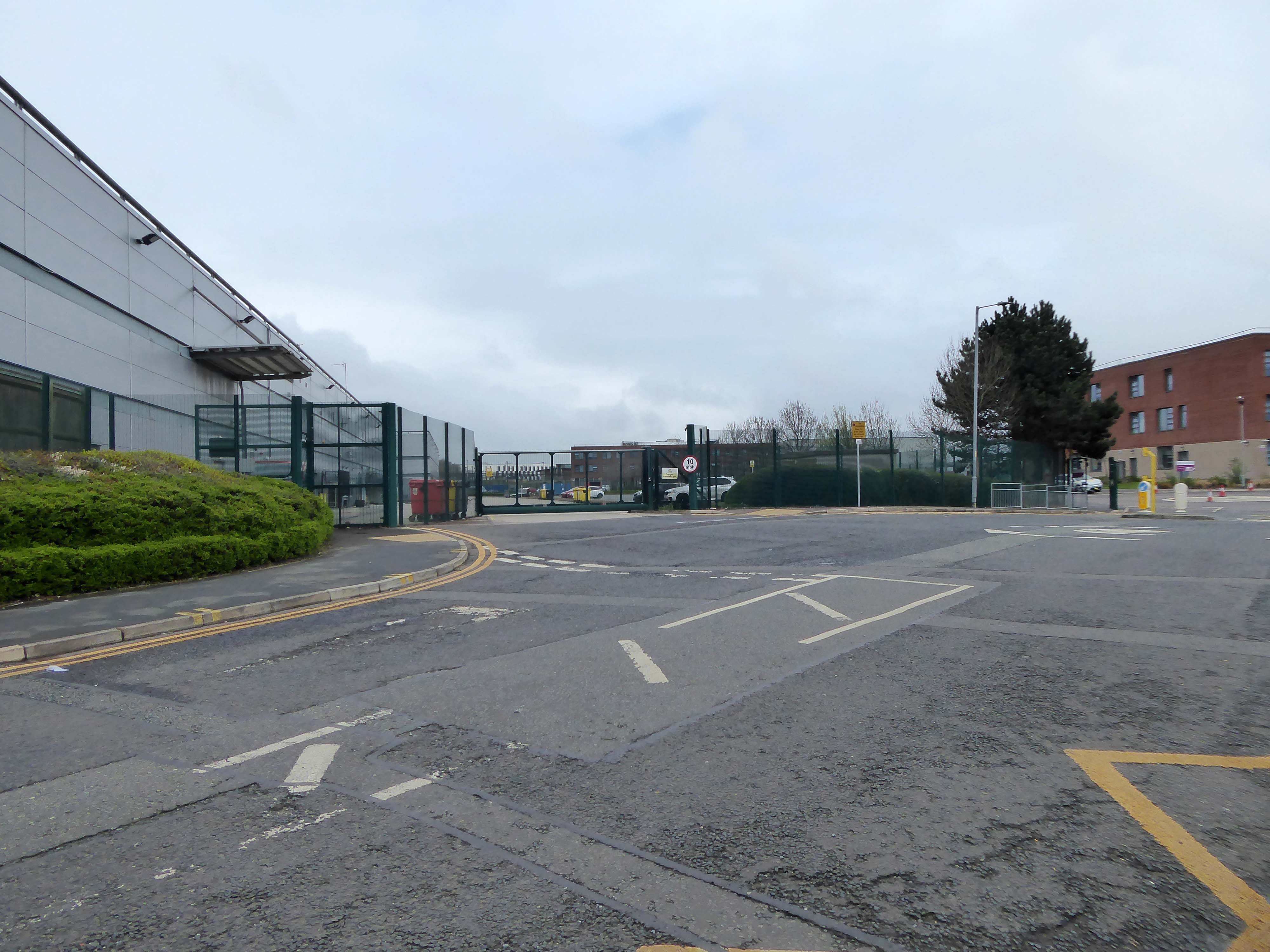
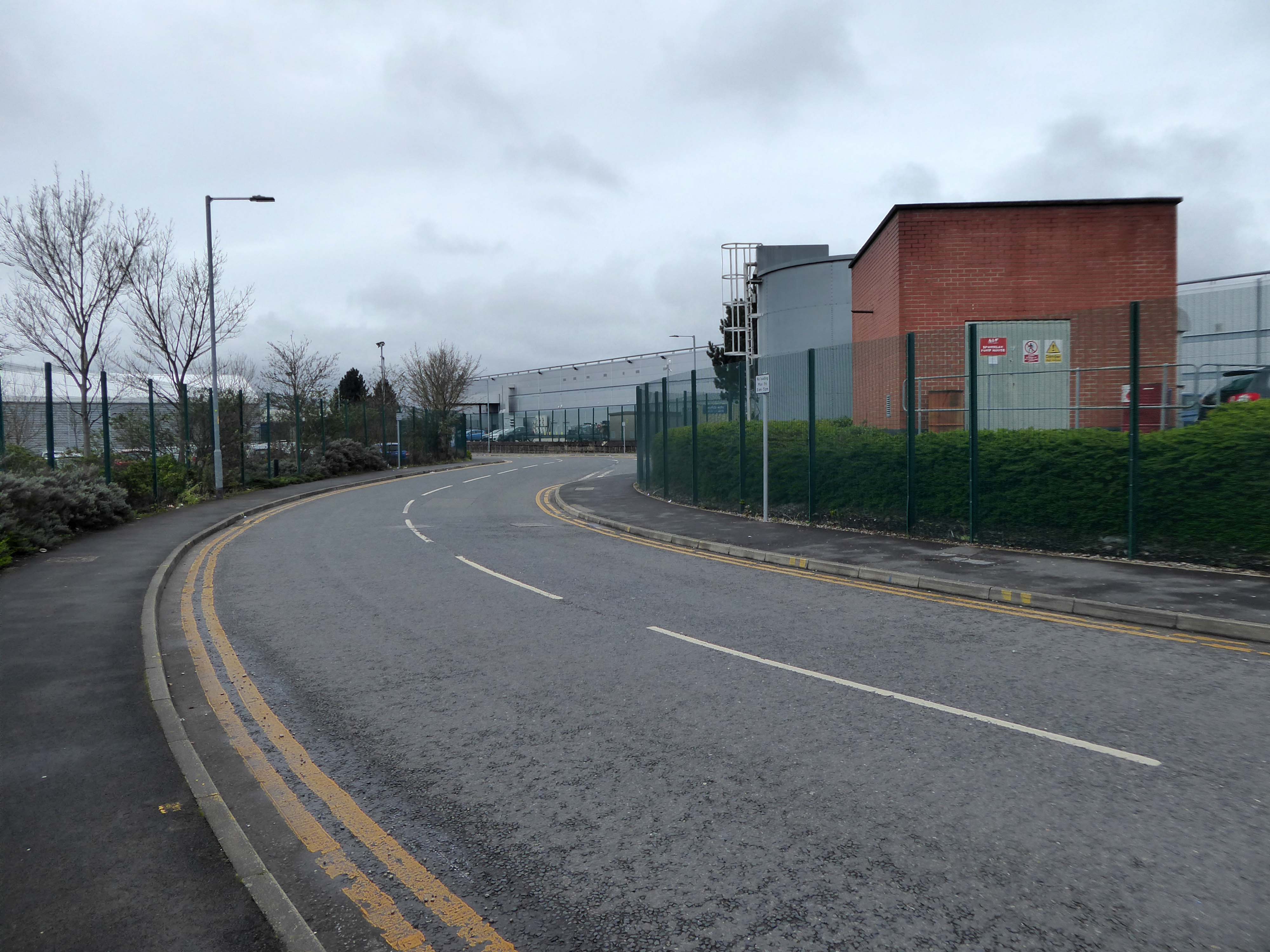
Let’s all go west – along North Street.

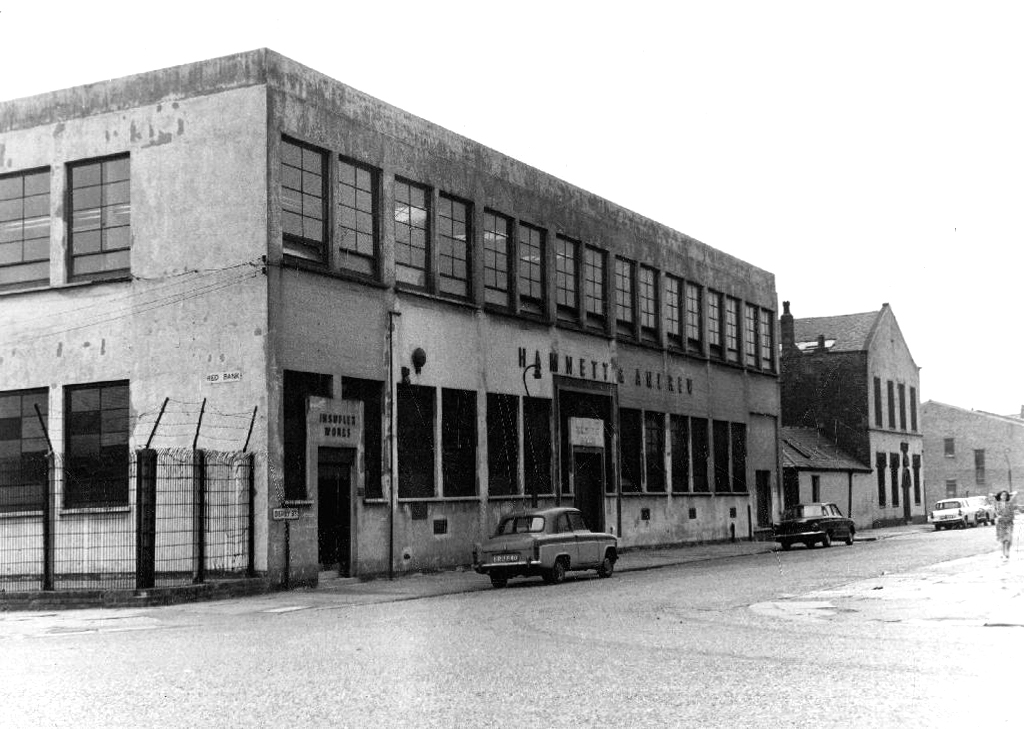
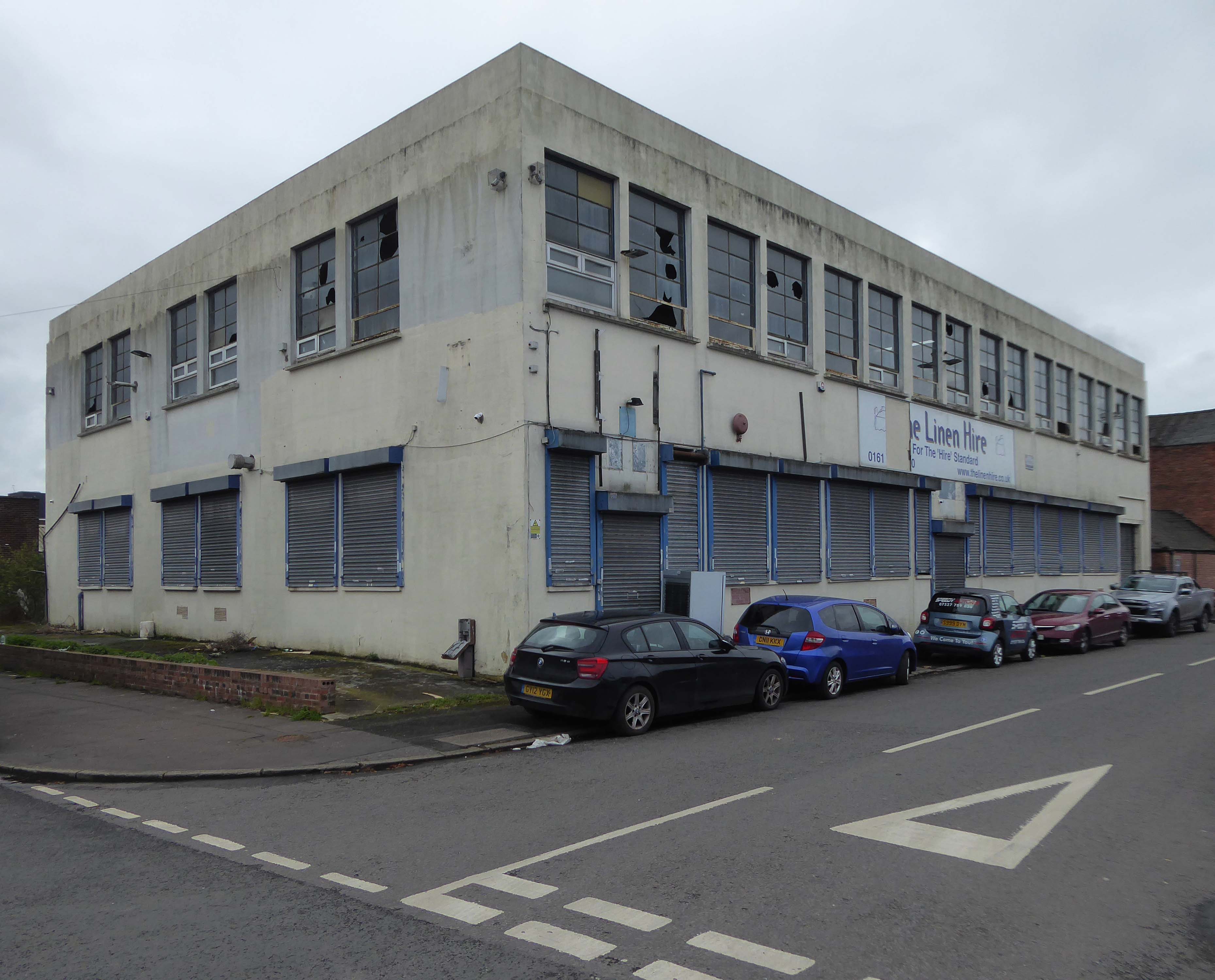
On the corner of Derby Street and Honey Street we find Hamnett & AndrewInsuflex Works

Later transformed into Linen Hire, though I fear that further linen hire may well be in abeyance, on a permanent basis.

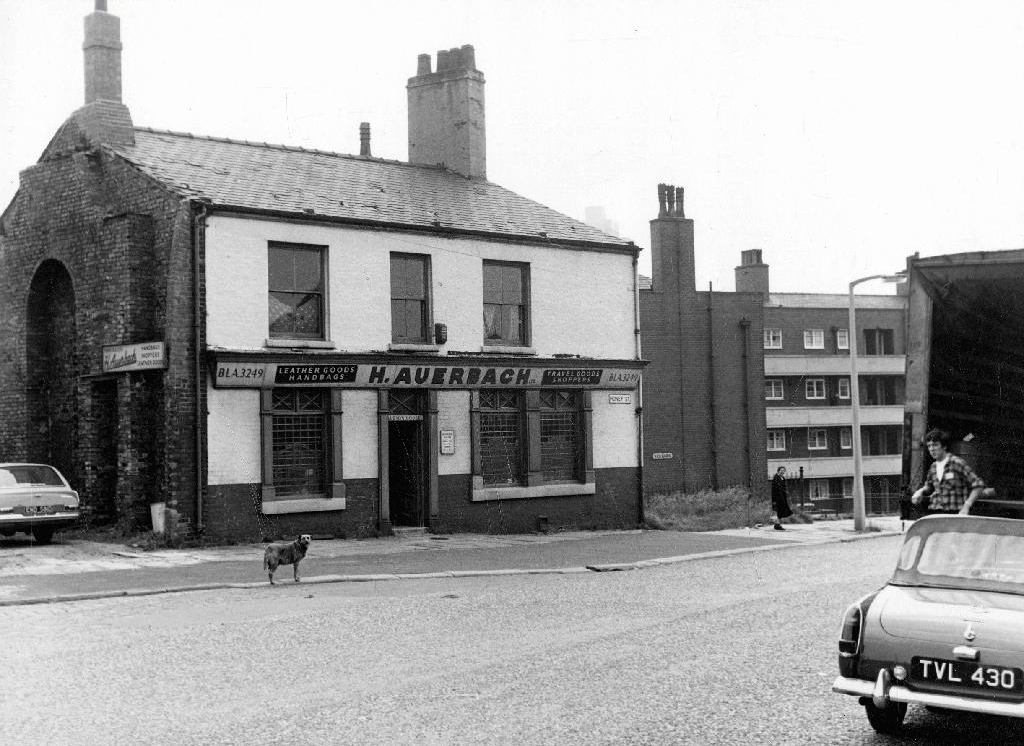
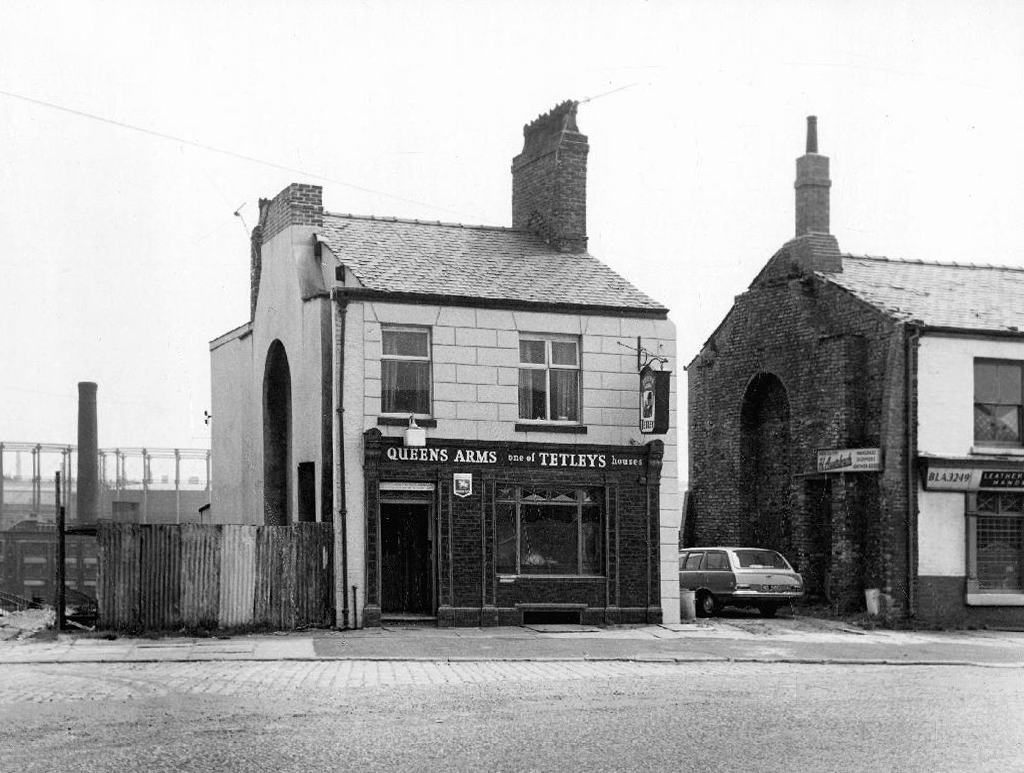
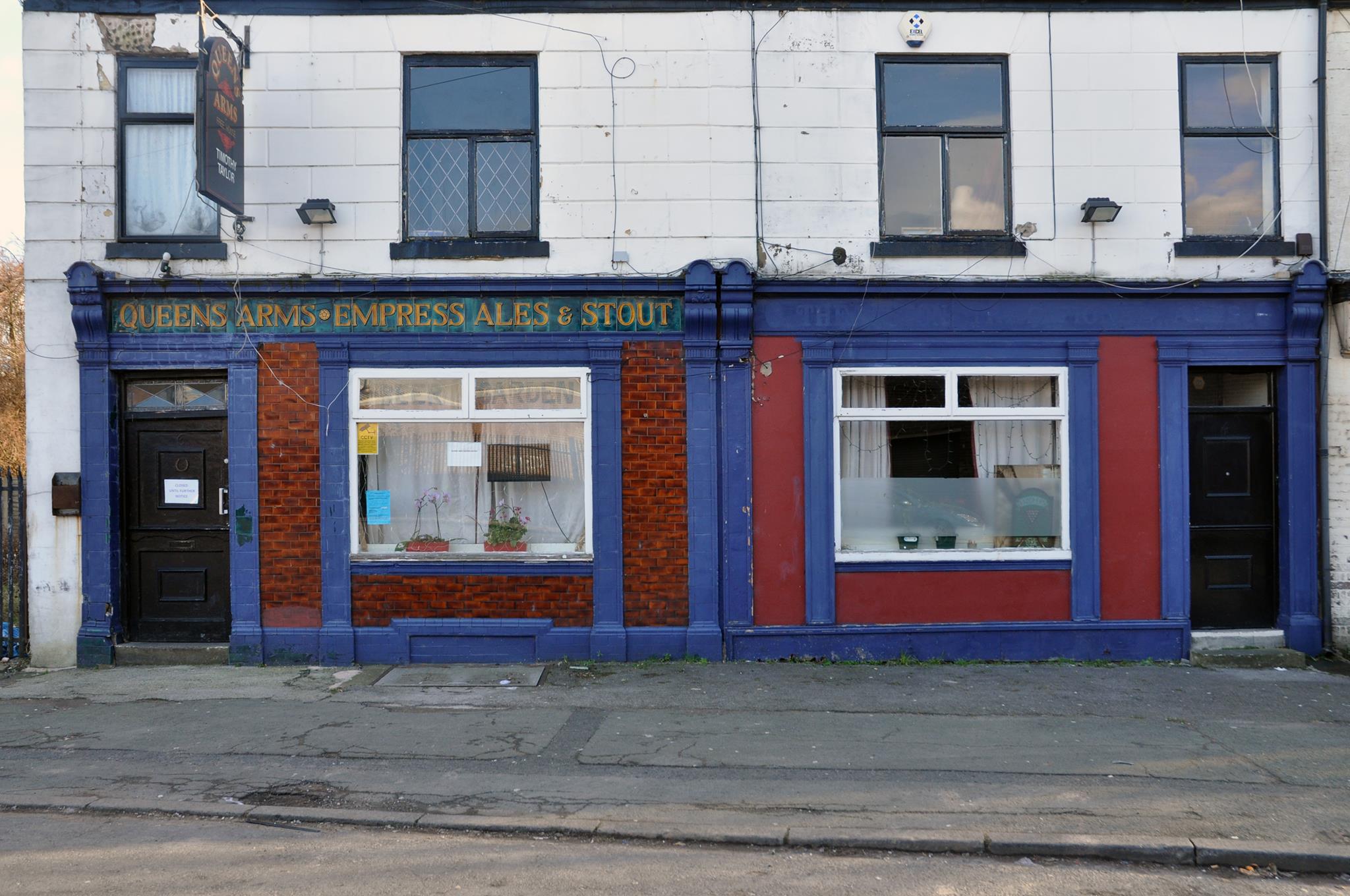
What was happening at the Queens Arms back in 1966?

These were the older premises.

Then next door, the newer premises.

Photo: Alison G

The Queens Arms was held in high regard amongst the real ale crowd and had been a regular fixture in the Good Beer Guide.  

As recently as 2007 it was named the City Life Pub of the Year, 

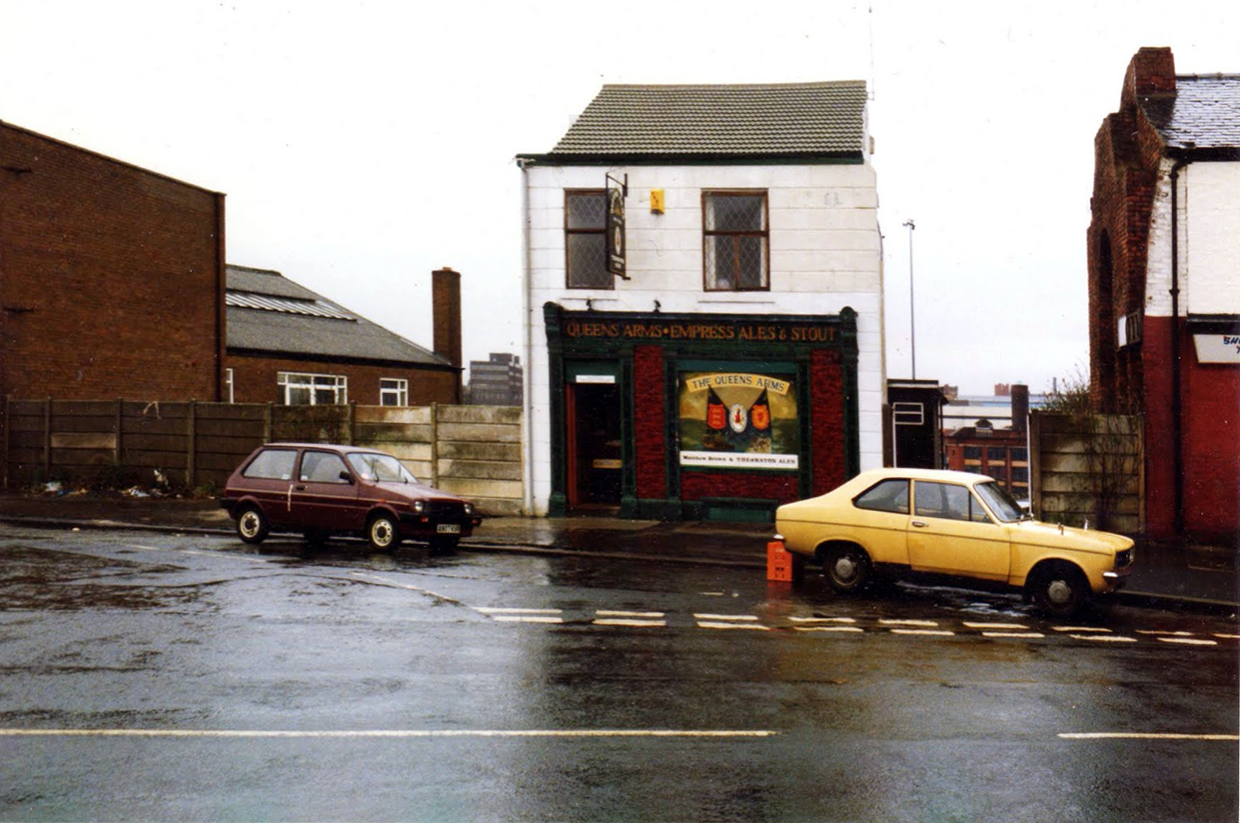
Empress Brewery Co Ltd – 383 Chester Road, Old Trafford.

Registered as above May 1896 – 236 public houses. 

Acquired by Walker Cain Ltd. 1929 and brewing ceased.

Brewery History

The pub was extended in 1987.

Seen here in 2015 closed for the foreseeable.

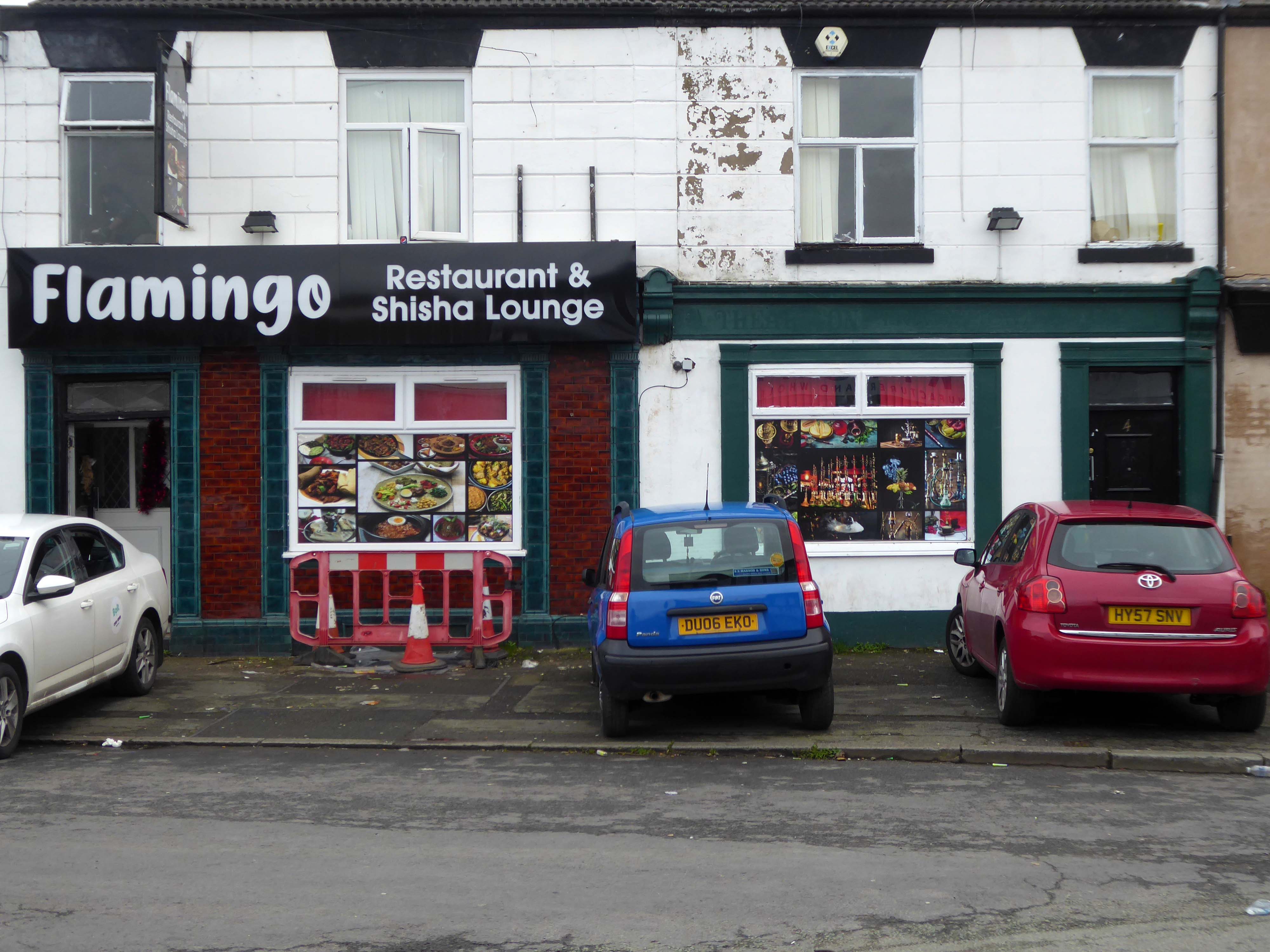
Recently becoming Flamingo – well strike me pink!

Though not without its own particular issues it would seem, according to the MEN.

The licensing out of hours team has received noise complaints relating to the premises which was found to be open beyond permitted hours when visited. Officers also identified breaches of the Health Act during inspections in which people were seen smoking shisha pipes in an enclosed extension at the back.

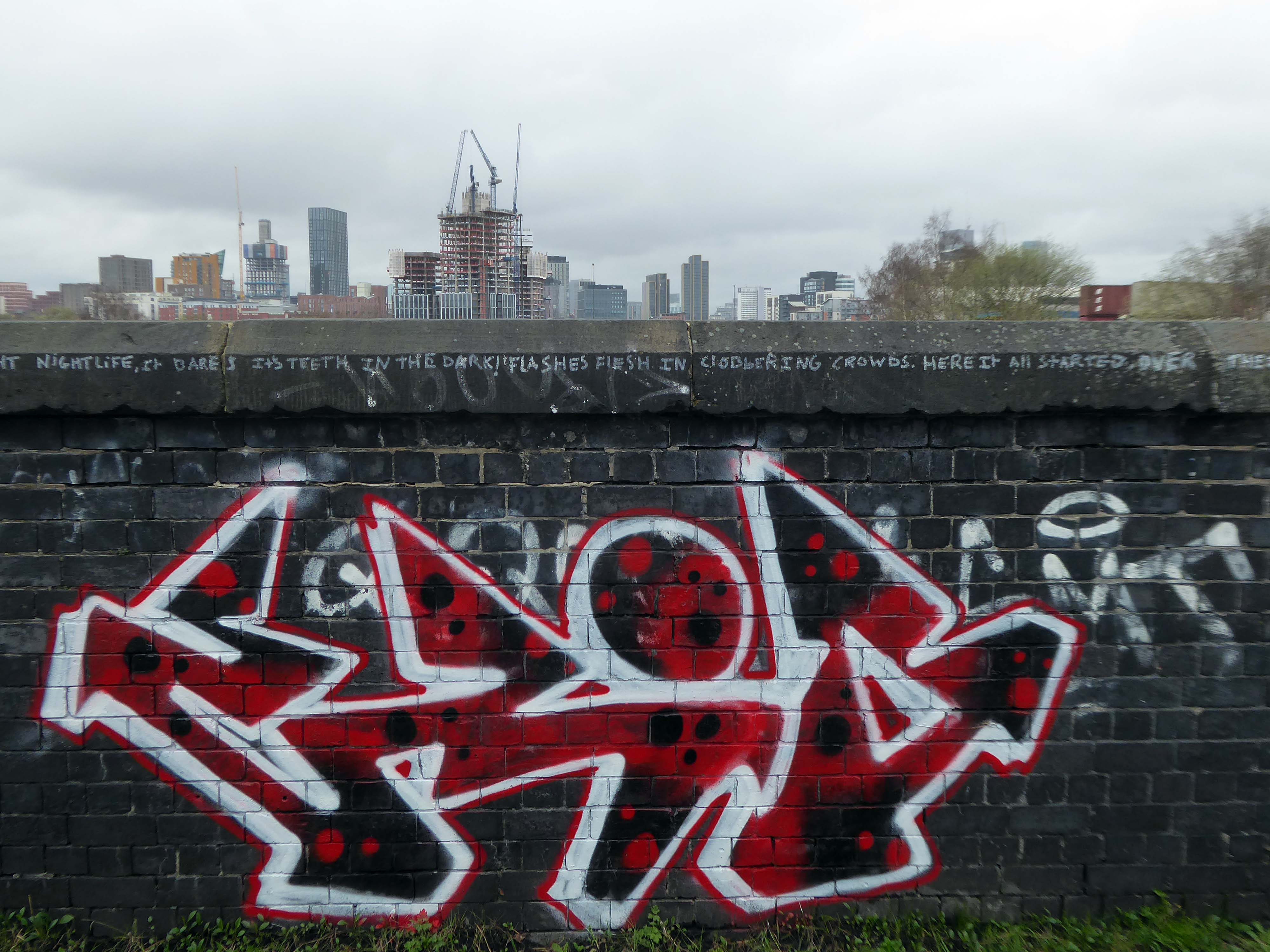
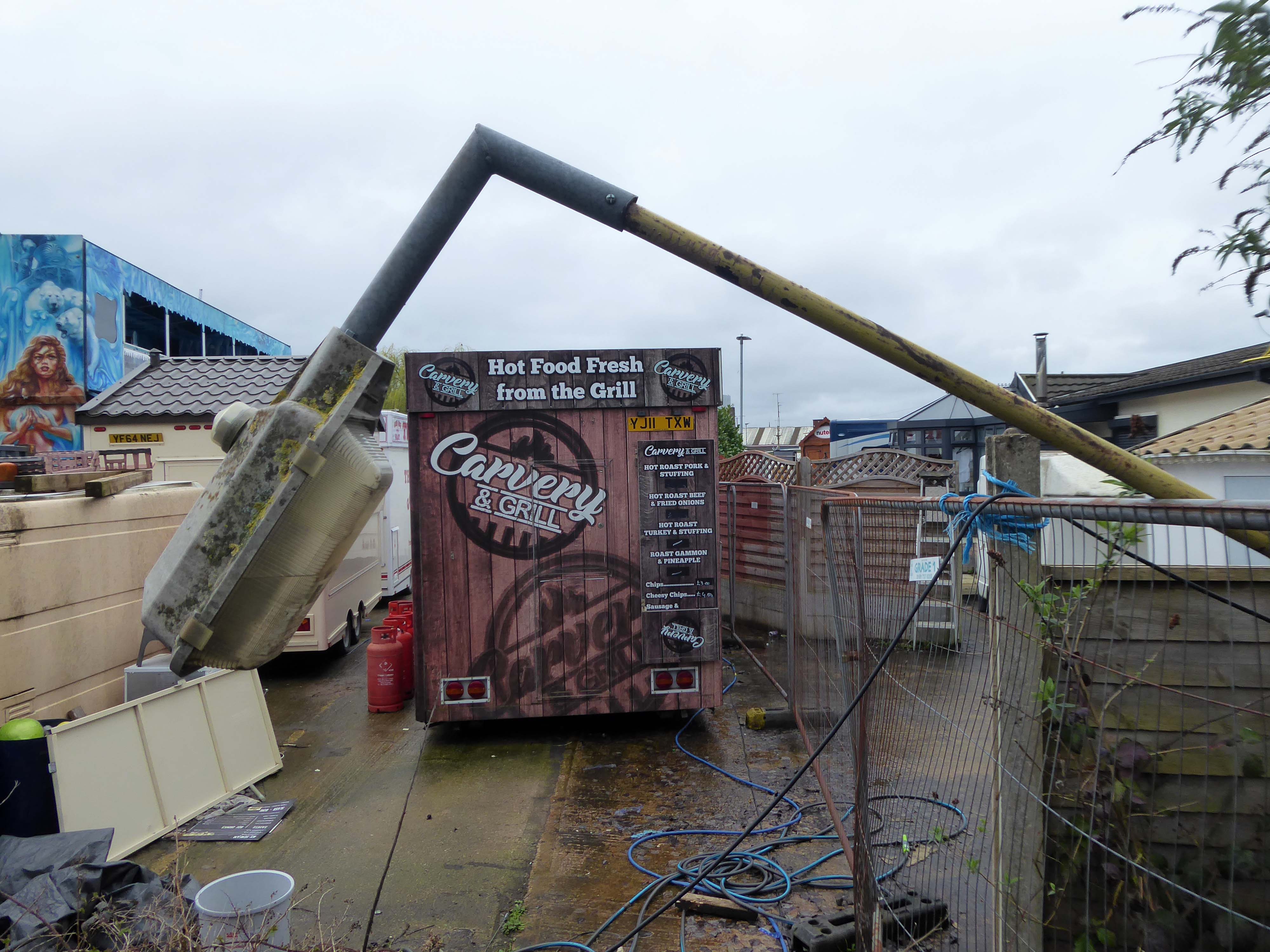
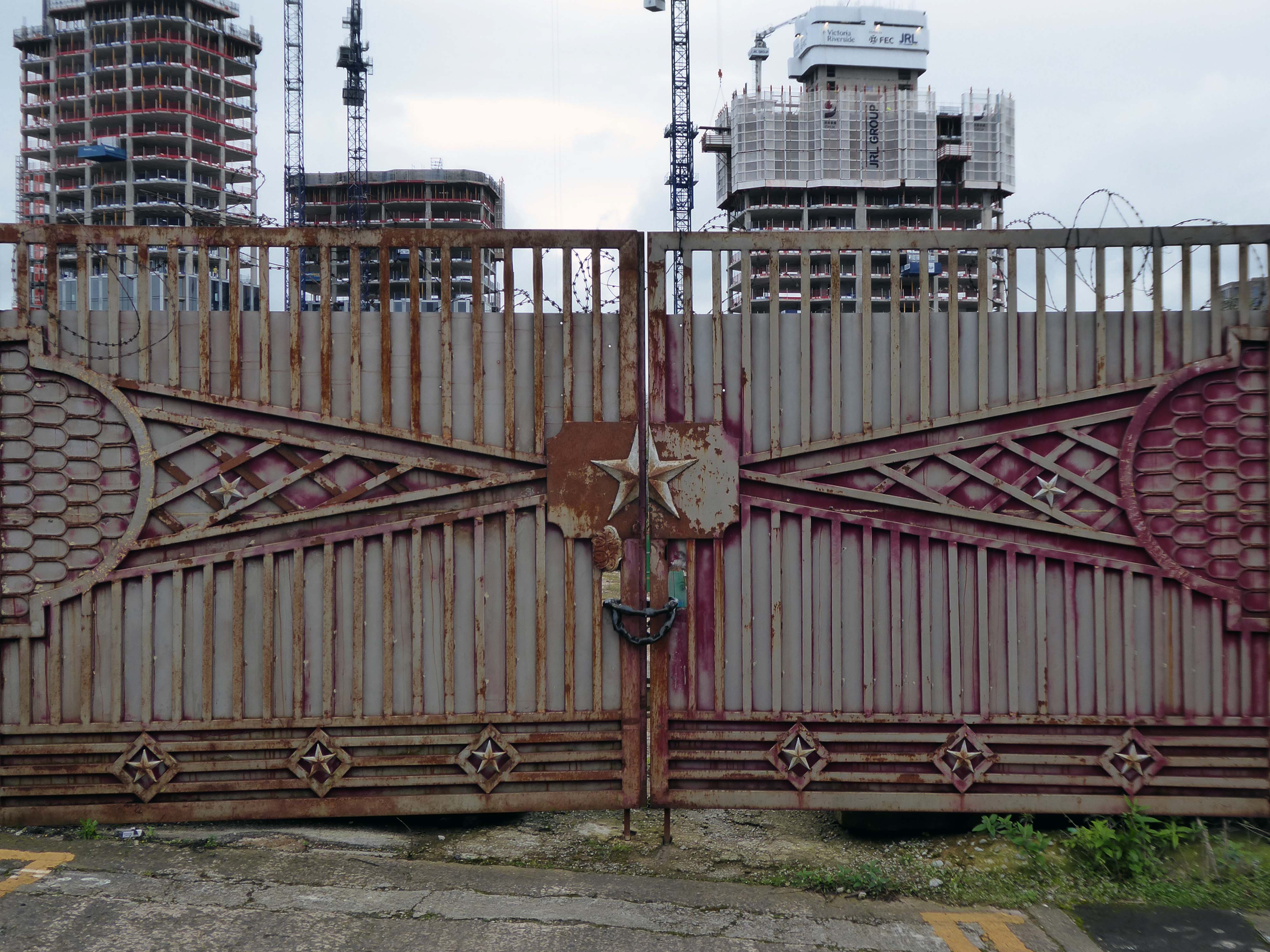
We will leave the Flamingo be and head back into town – but not without giving a nod to this confusing collision between this self-made scrapyard-man chic gate and the ever changing skyline of overheated urban regeneration.

The new creation has come: The old has gone, the new is here!

Corinthians 5:17

Archival photographs – Manchester Local Image Collection

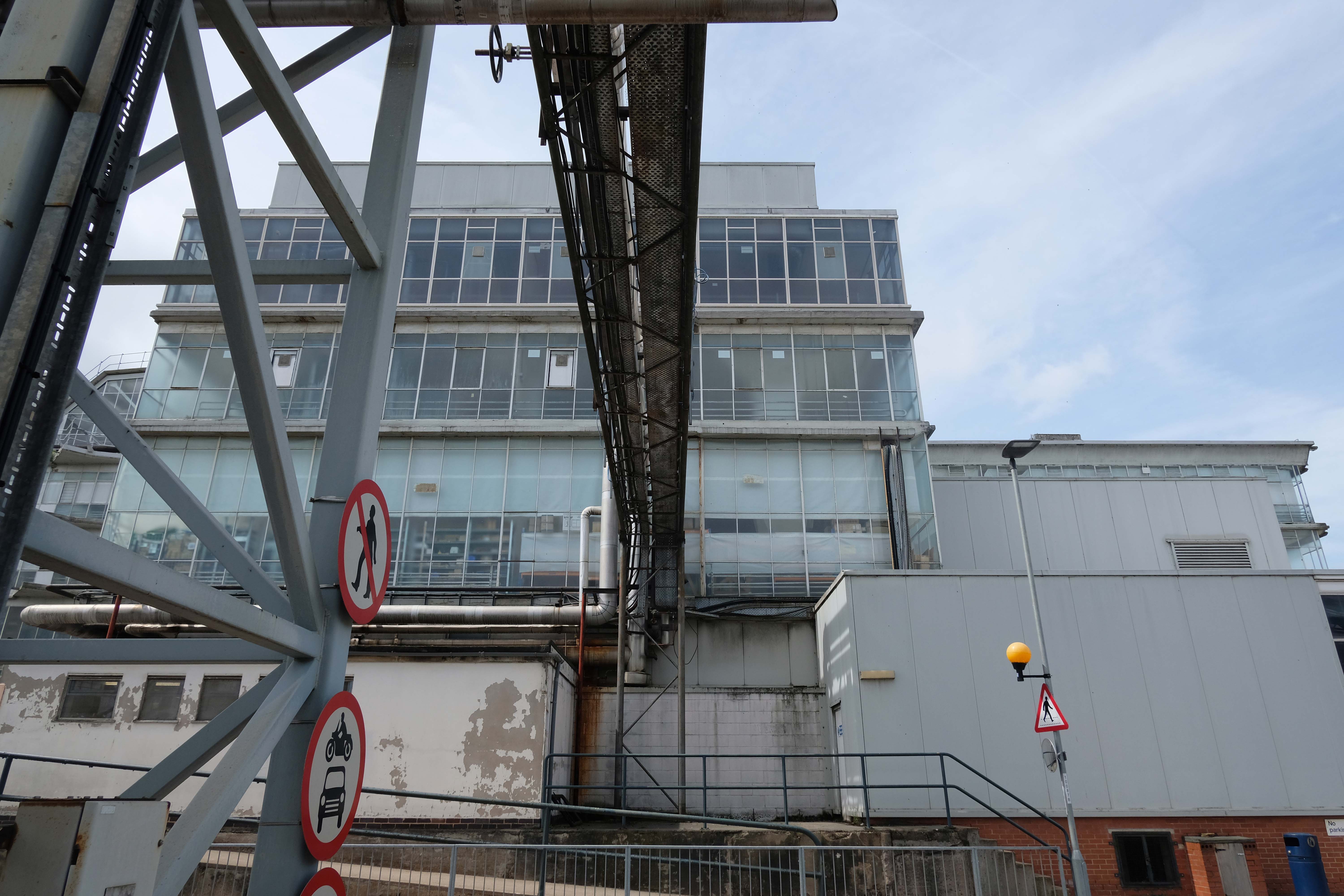
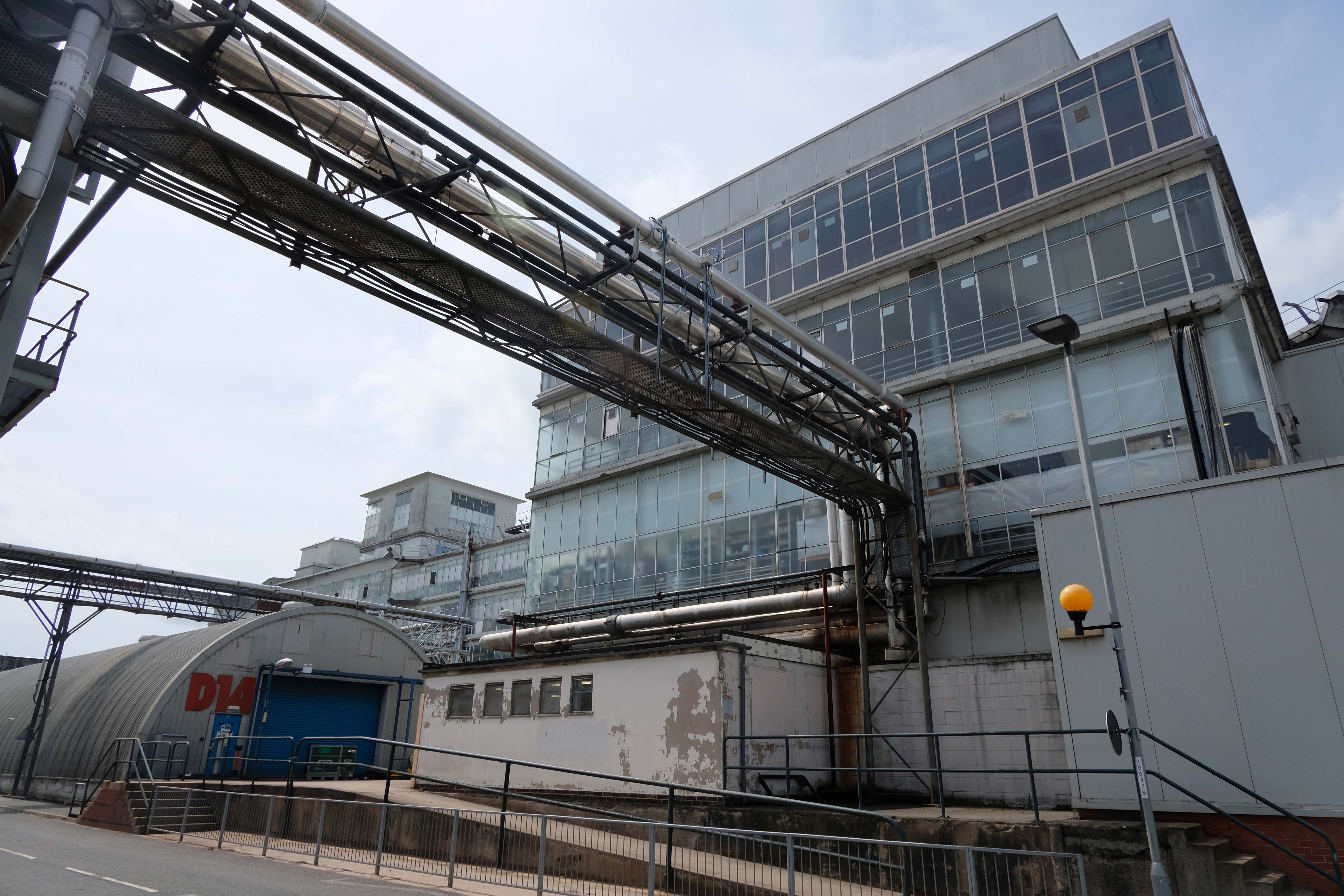
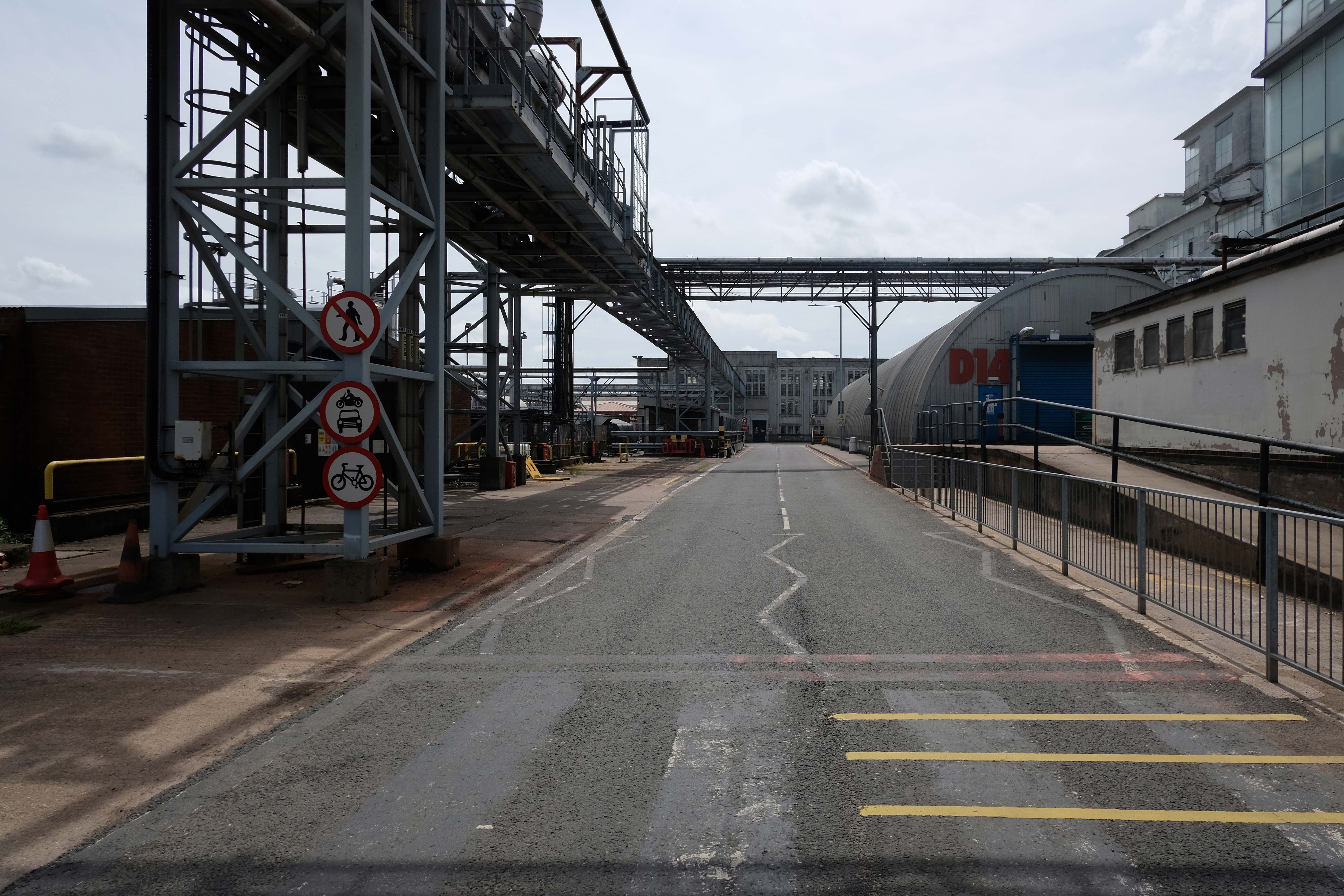
Boots – Nottingham

I boarded the 49 bus to Boots.

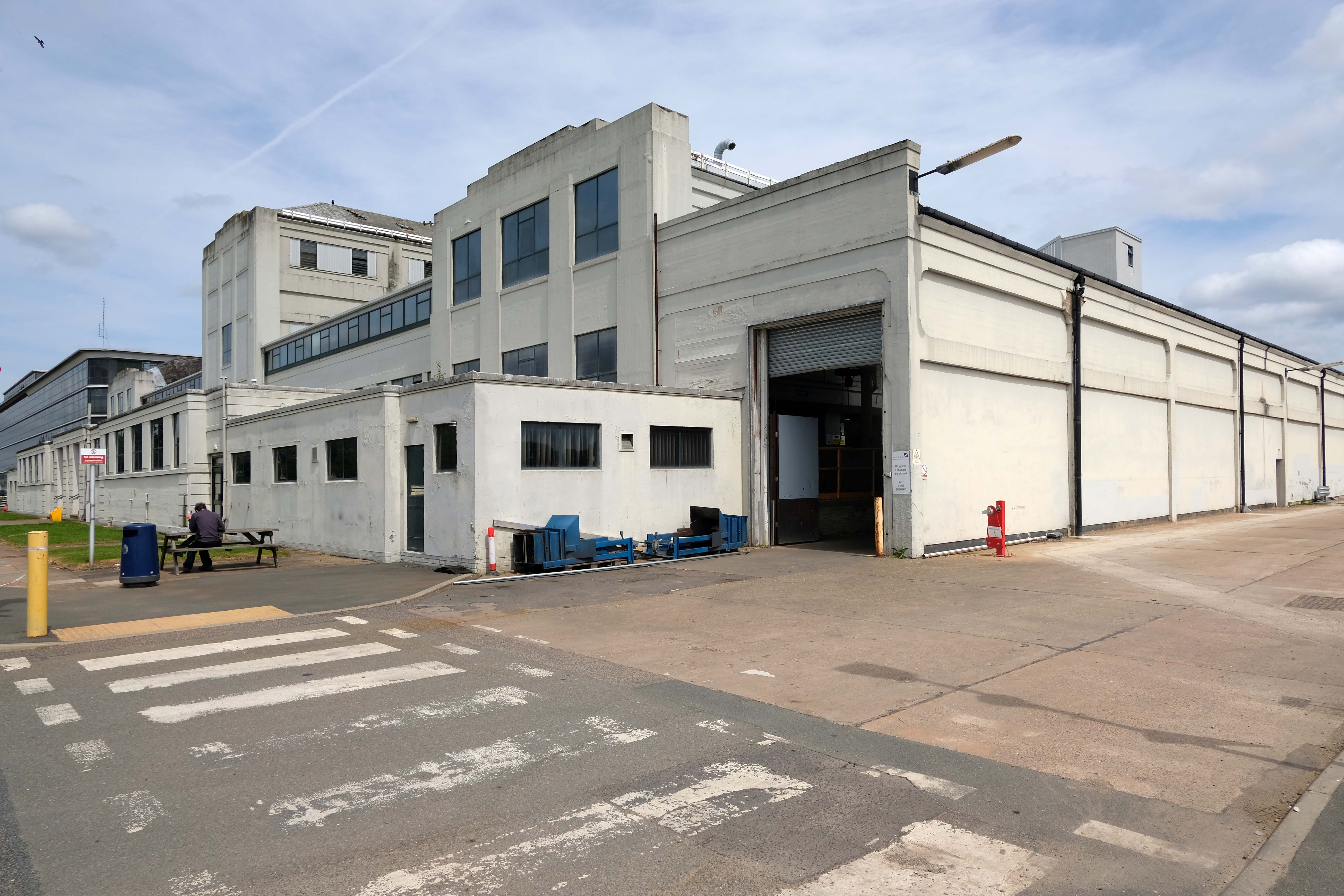
I alighted from the 49 bus at Boots and proceeded to take a look around.

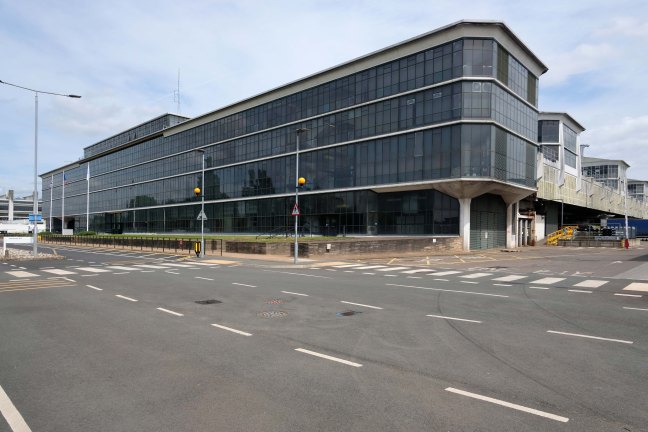
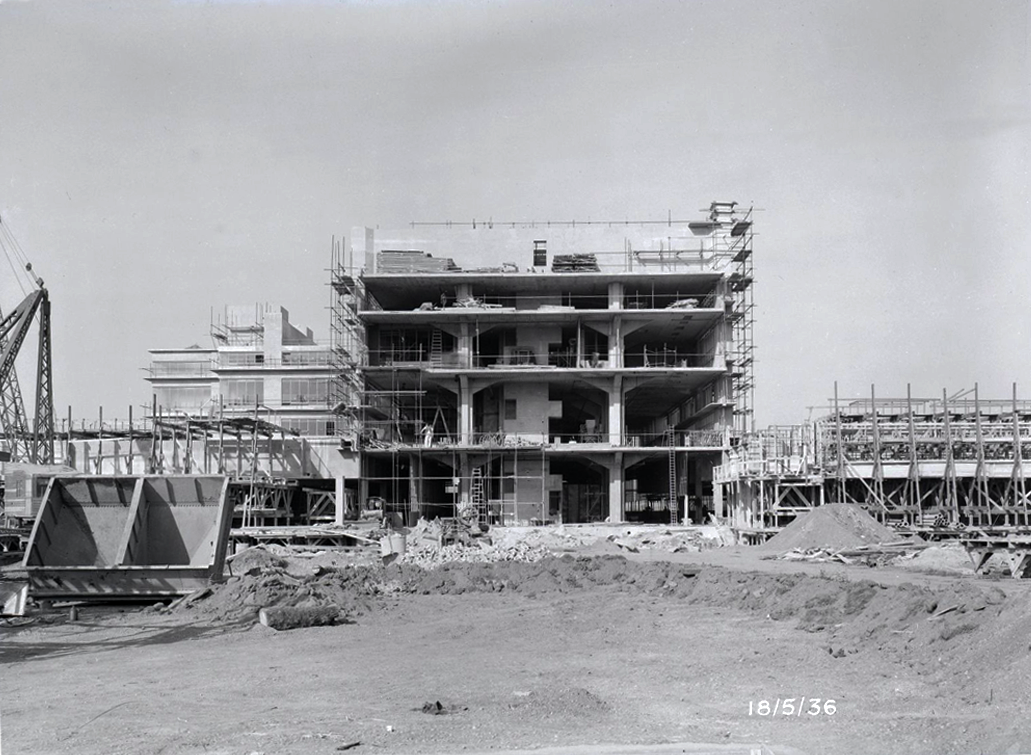
Unsurprisingly the construction work was now complete.

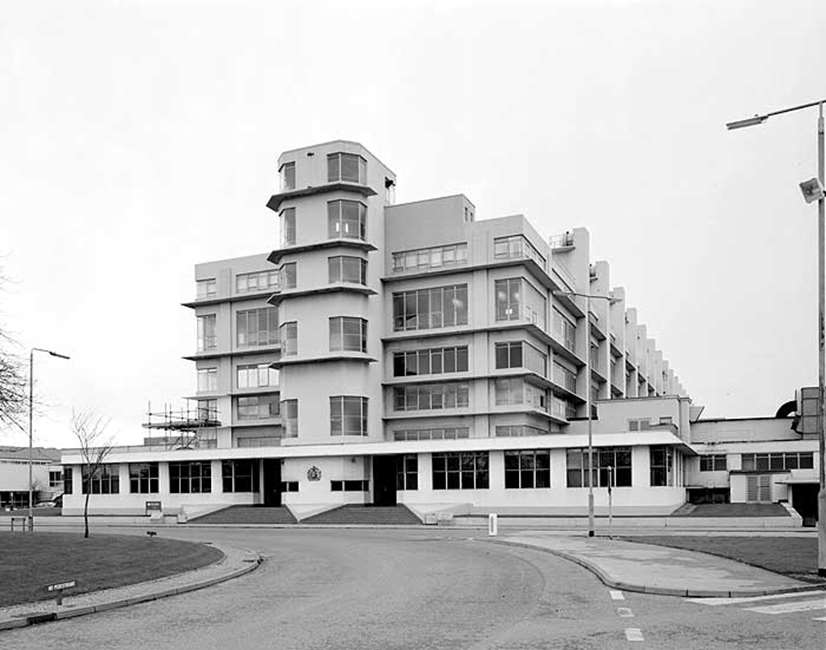
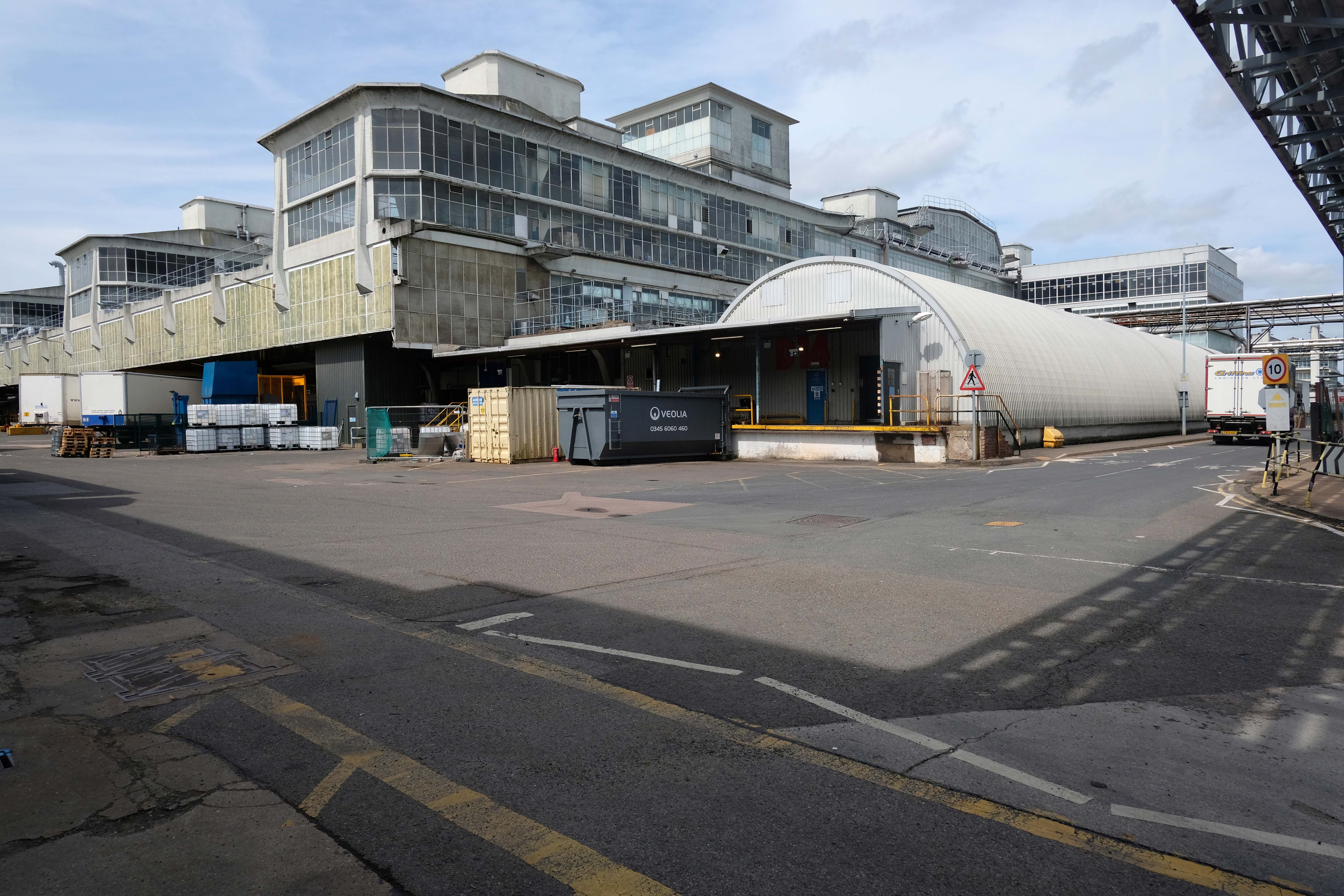
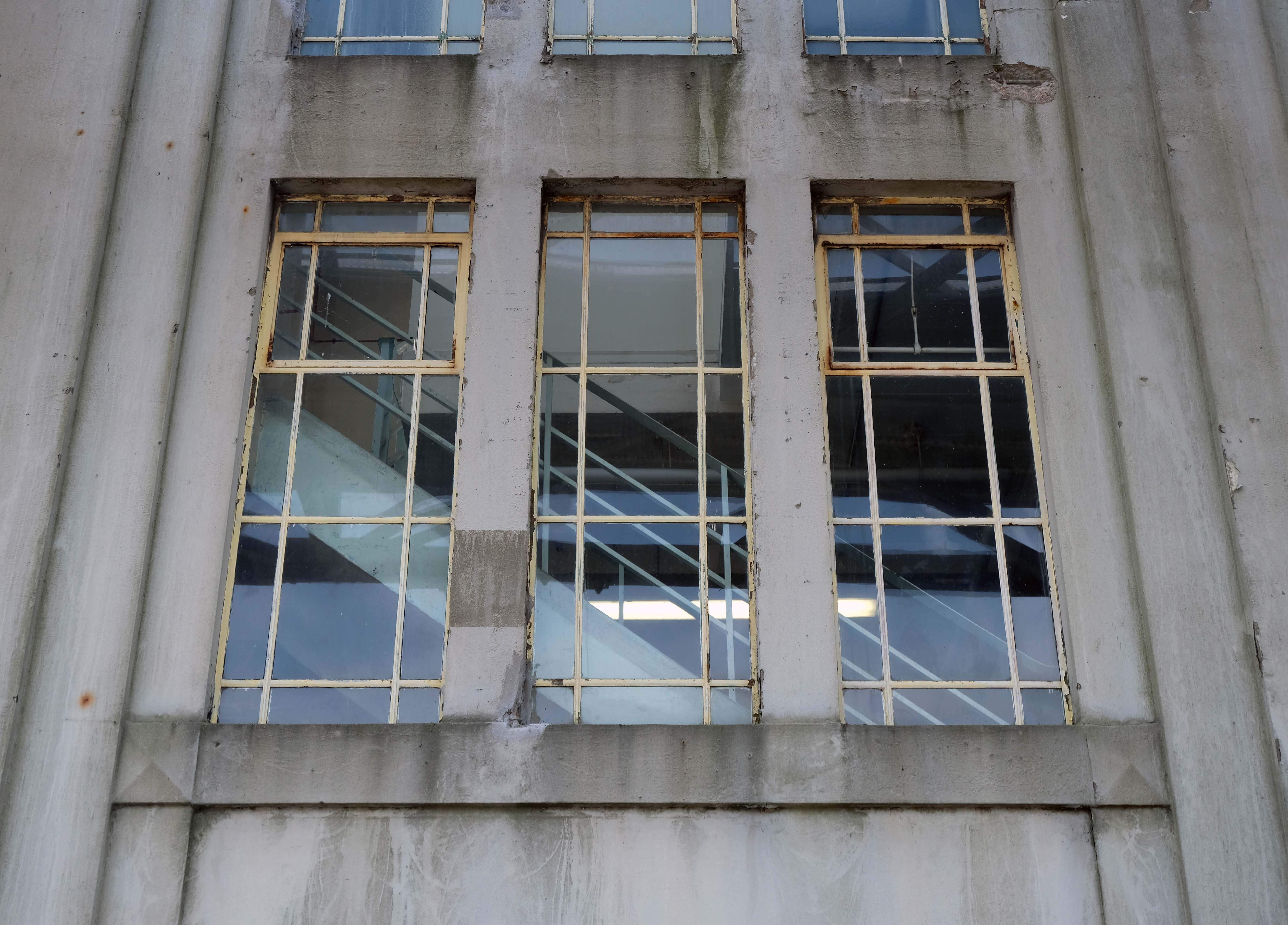
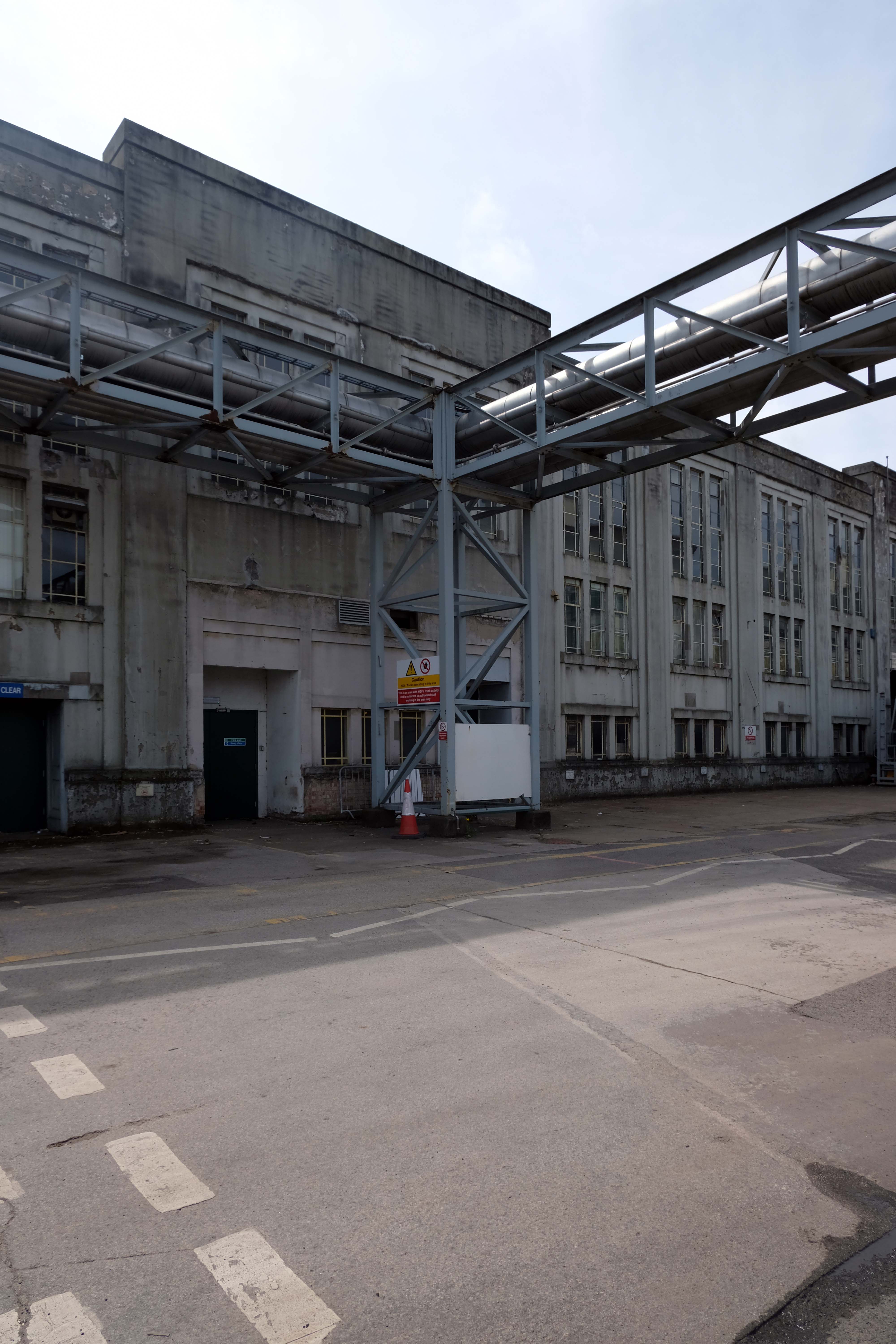
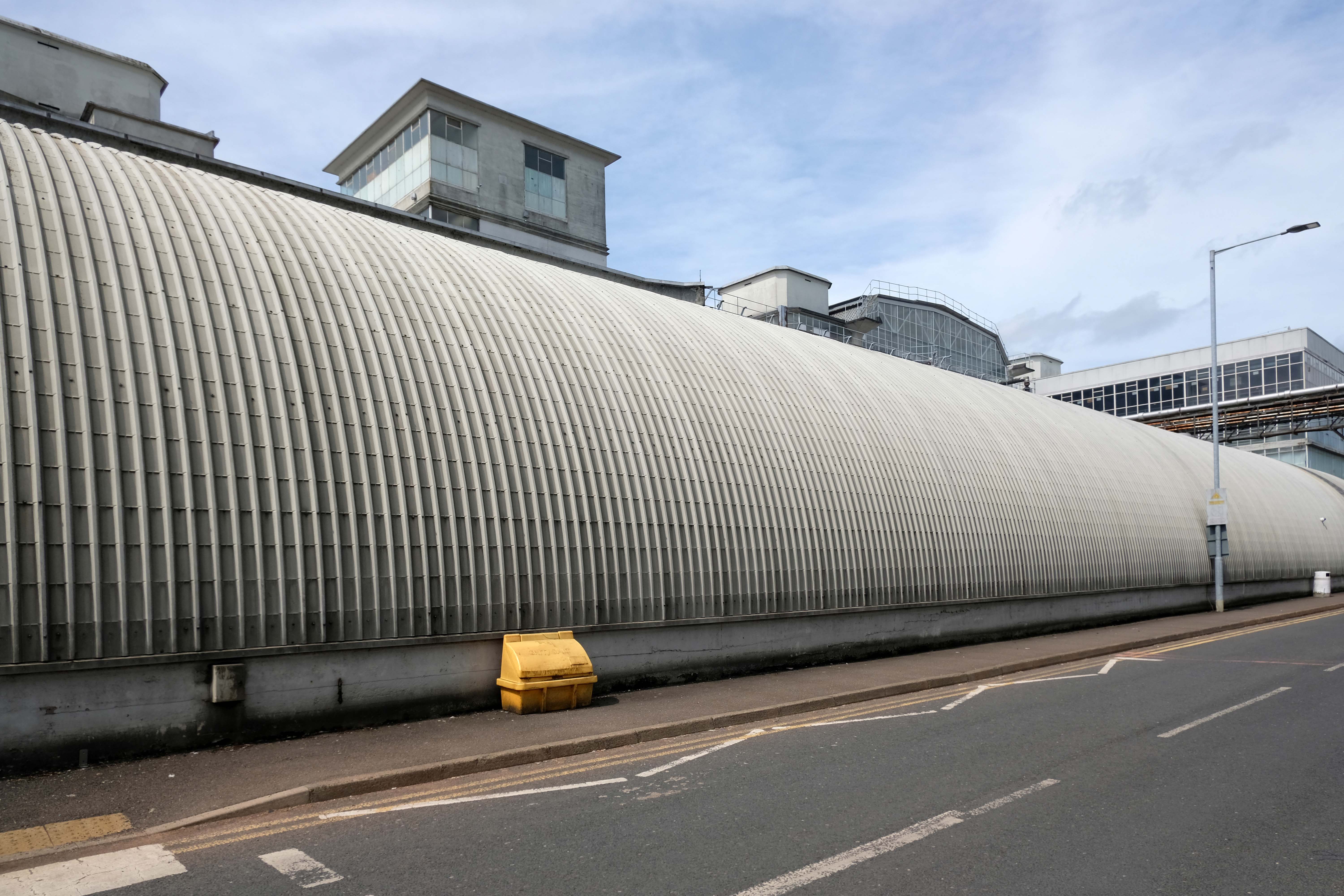
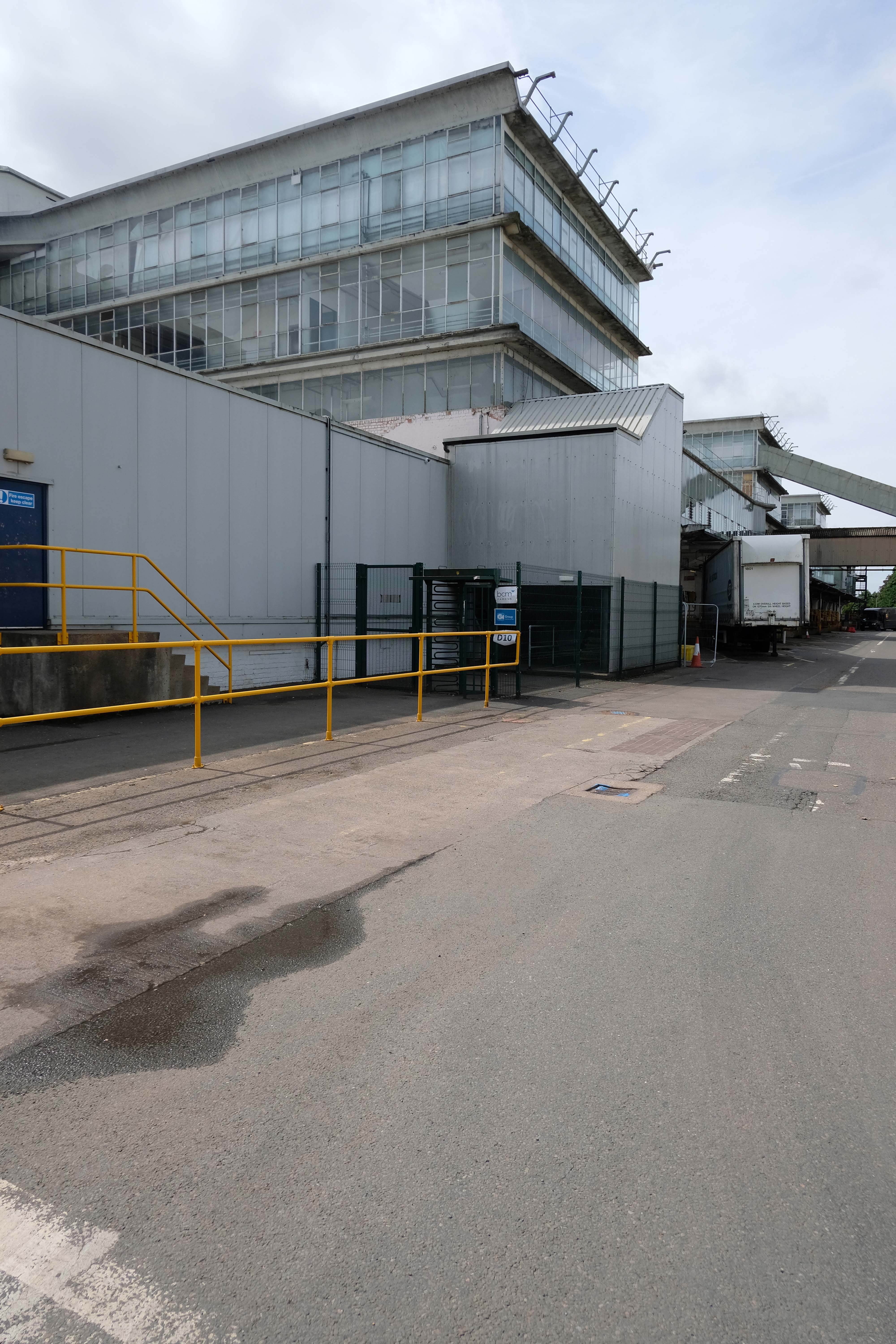
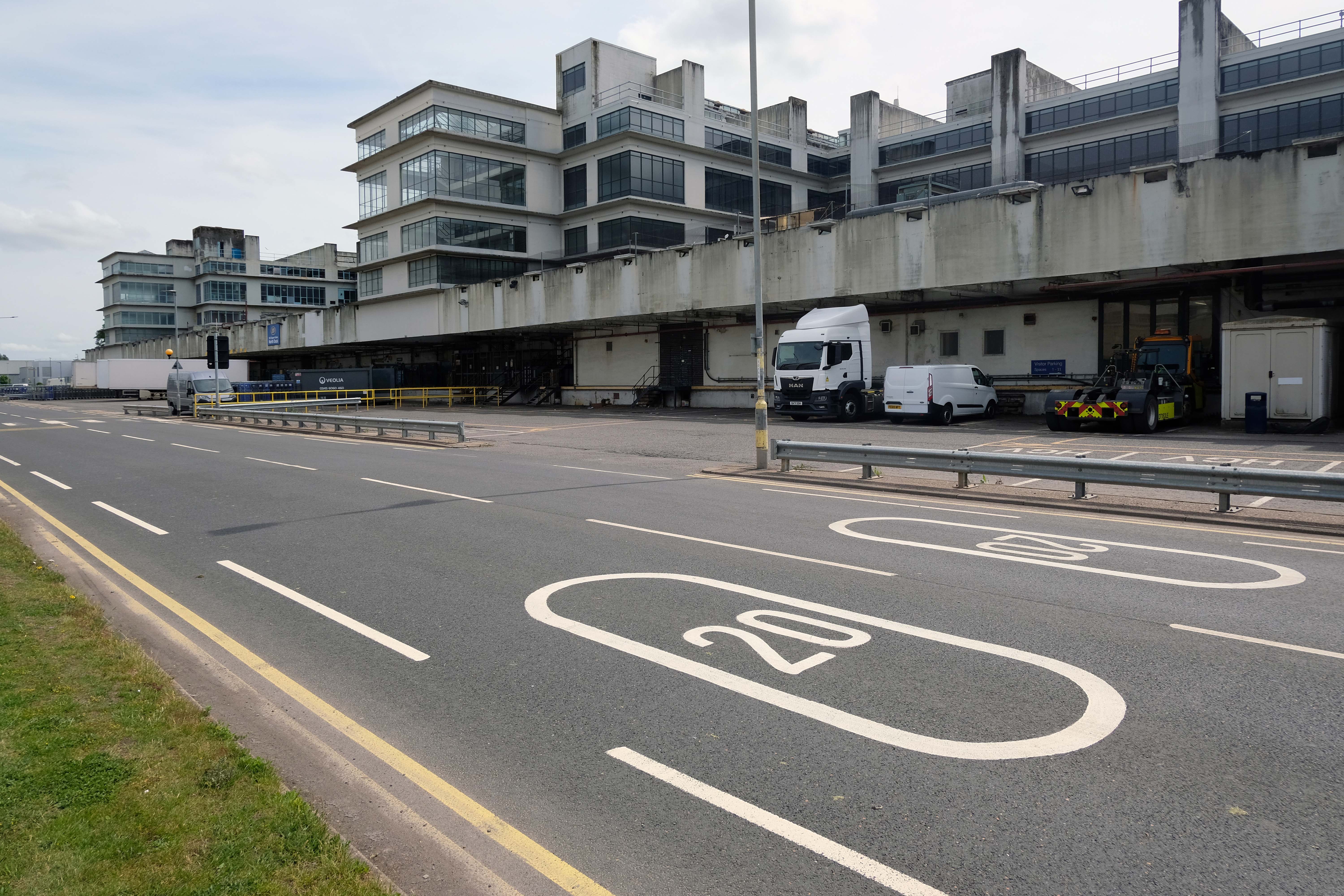
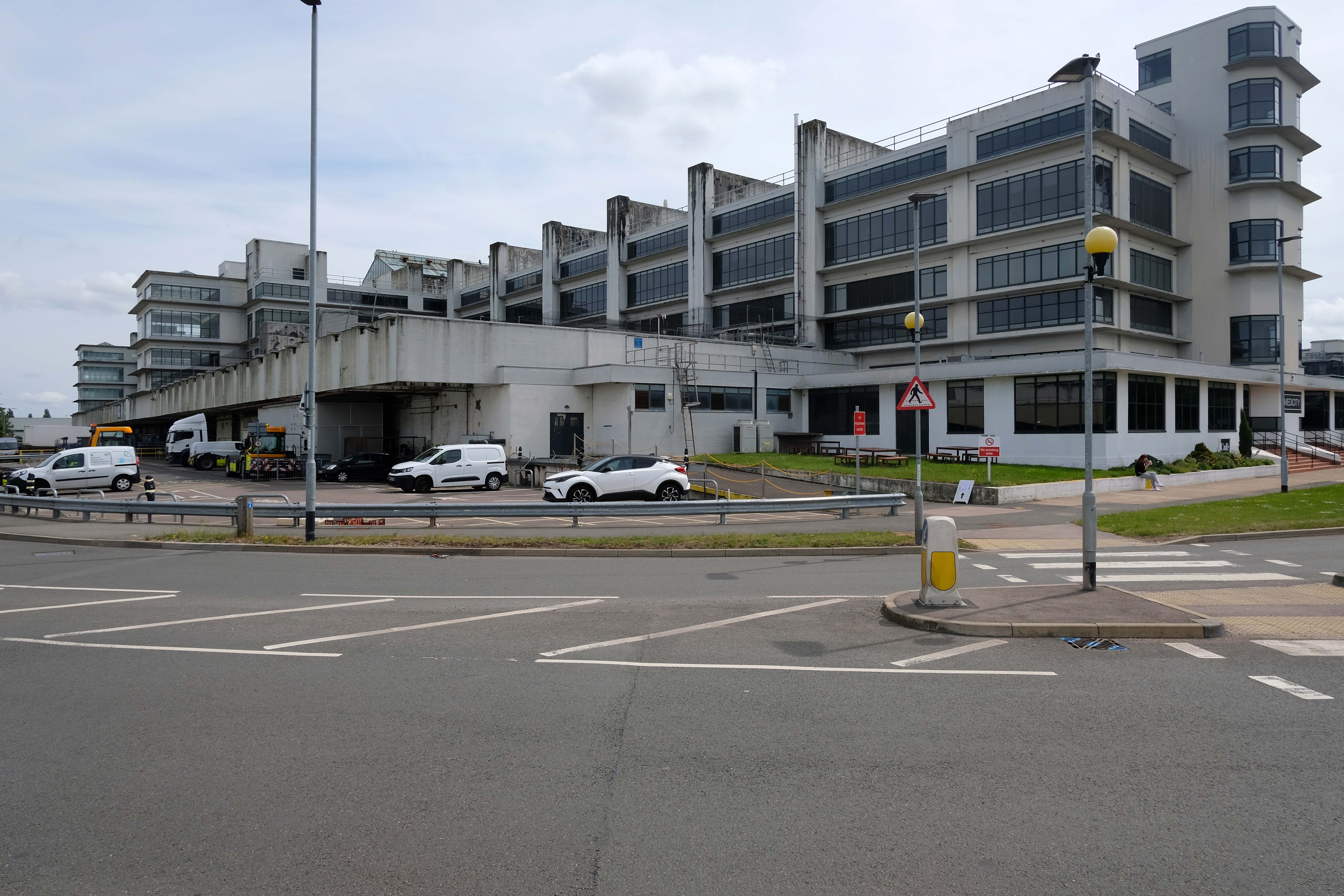
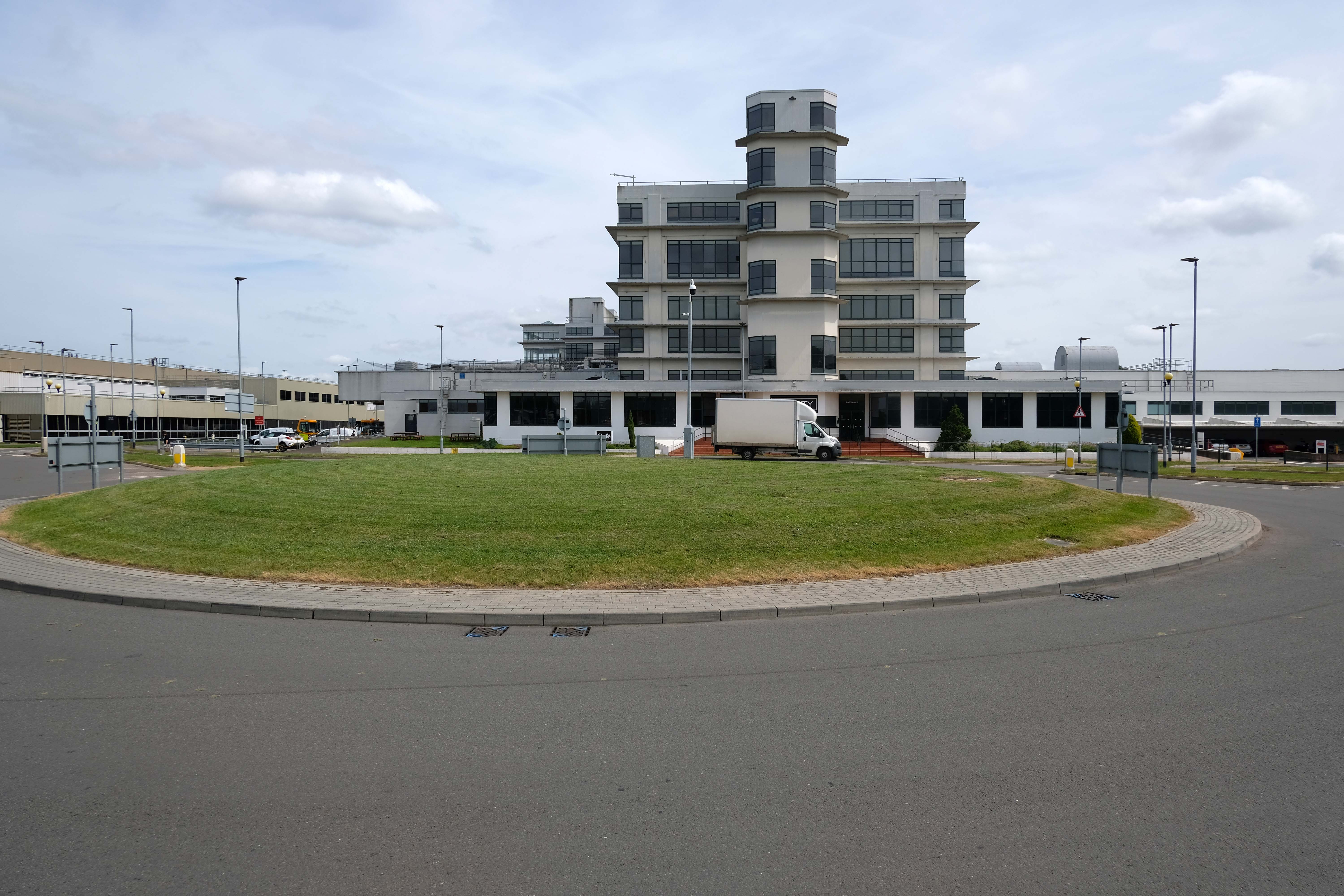
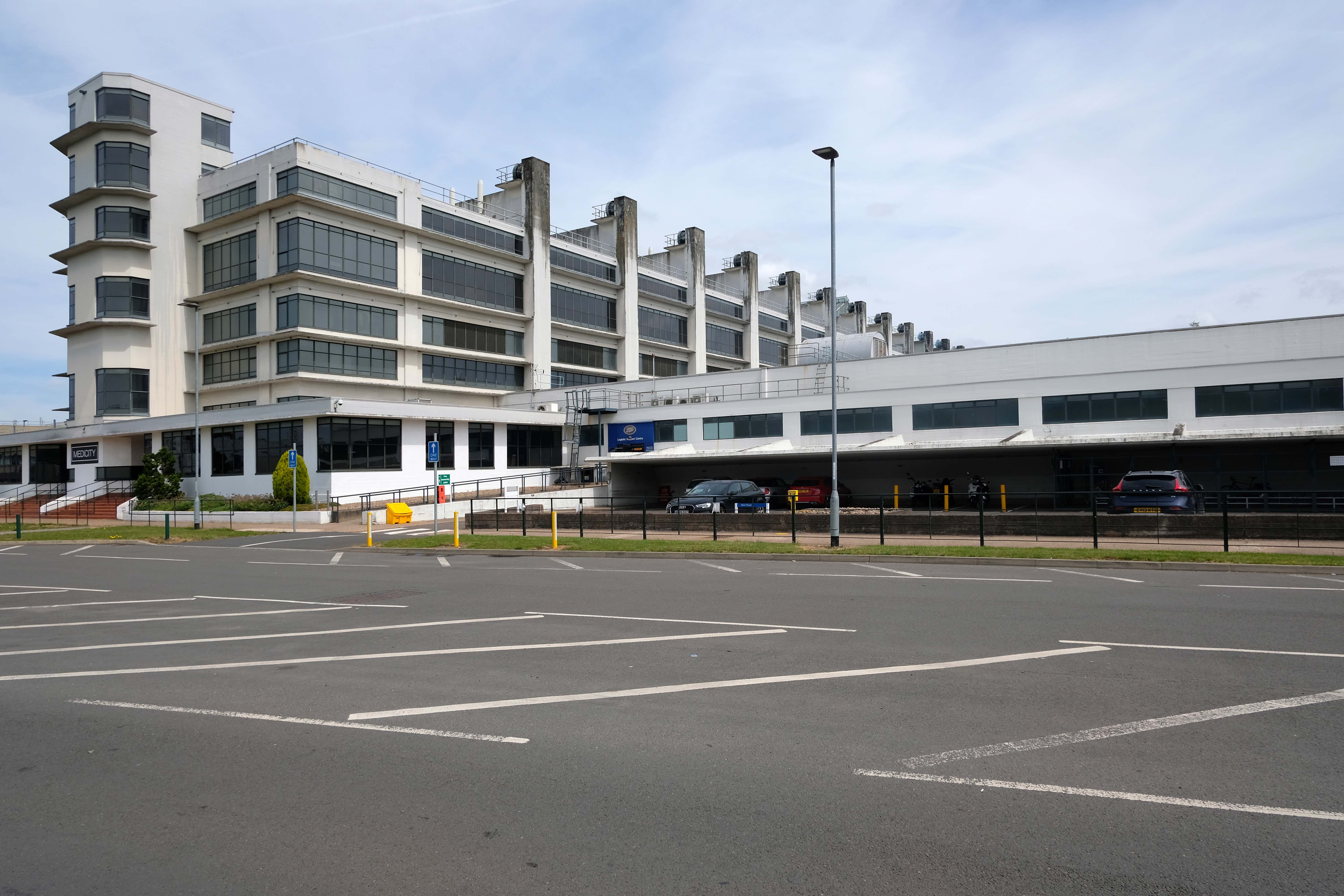
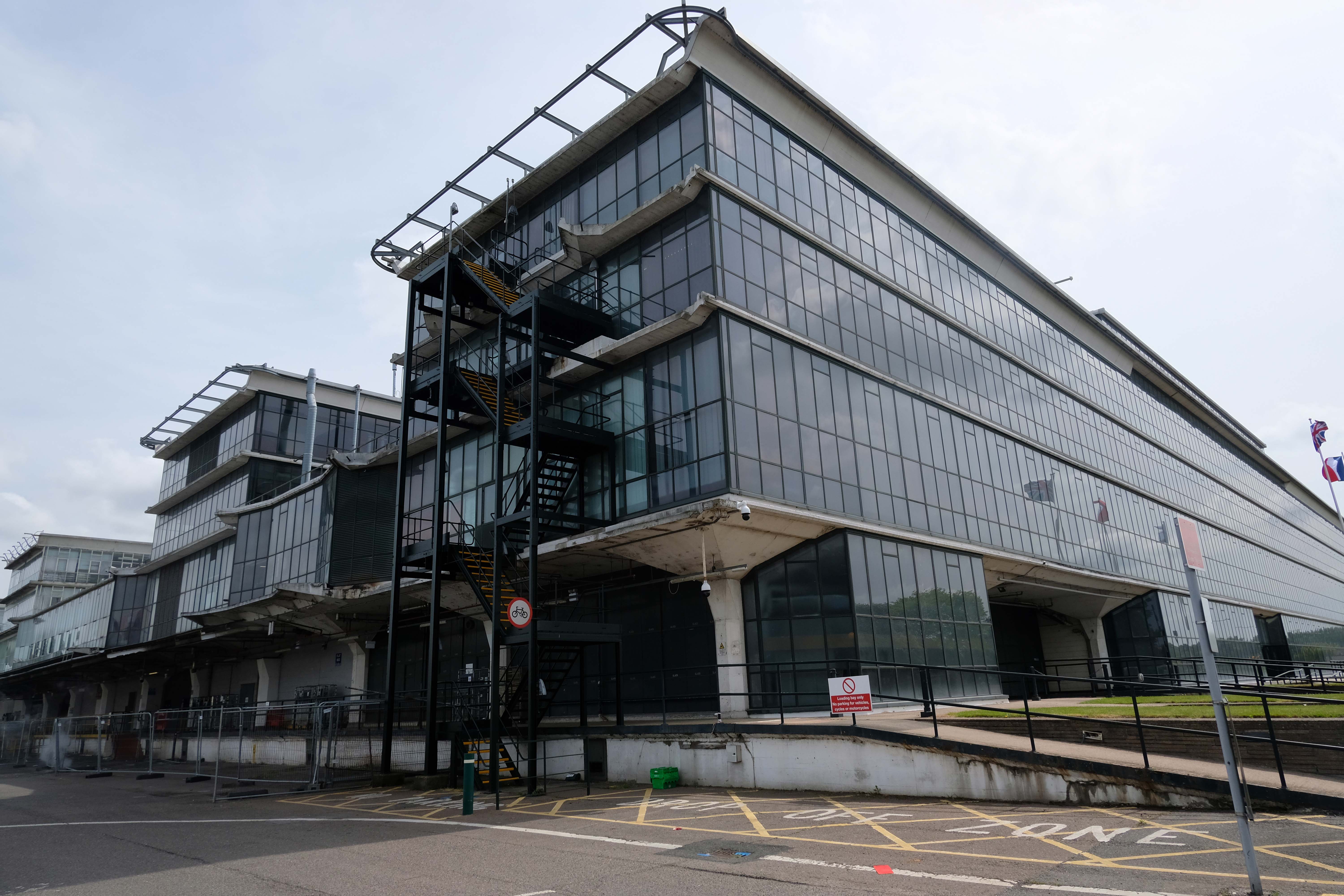
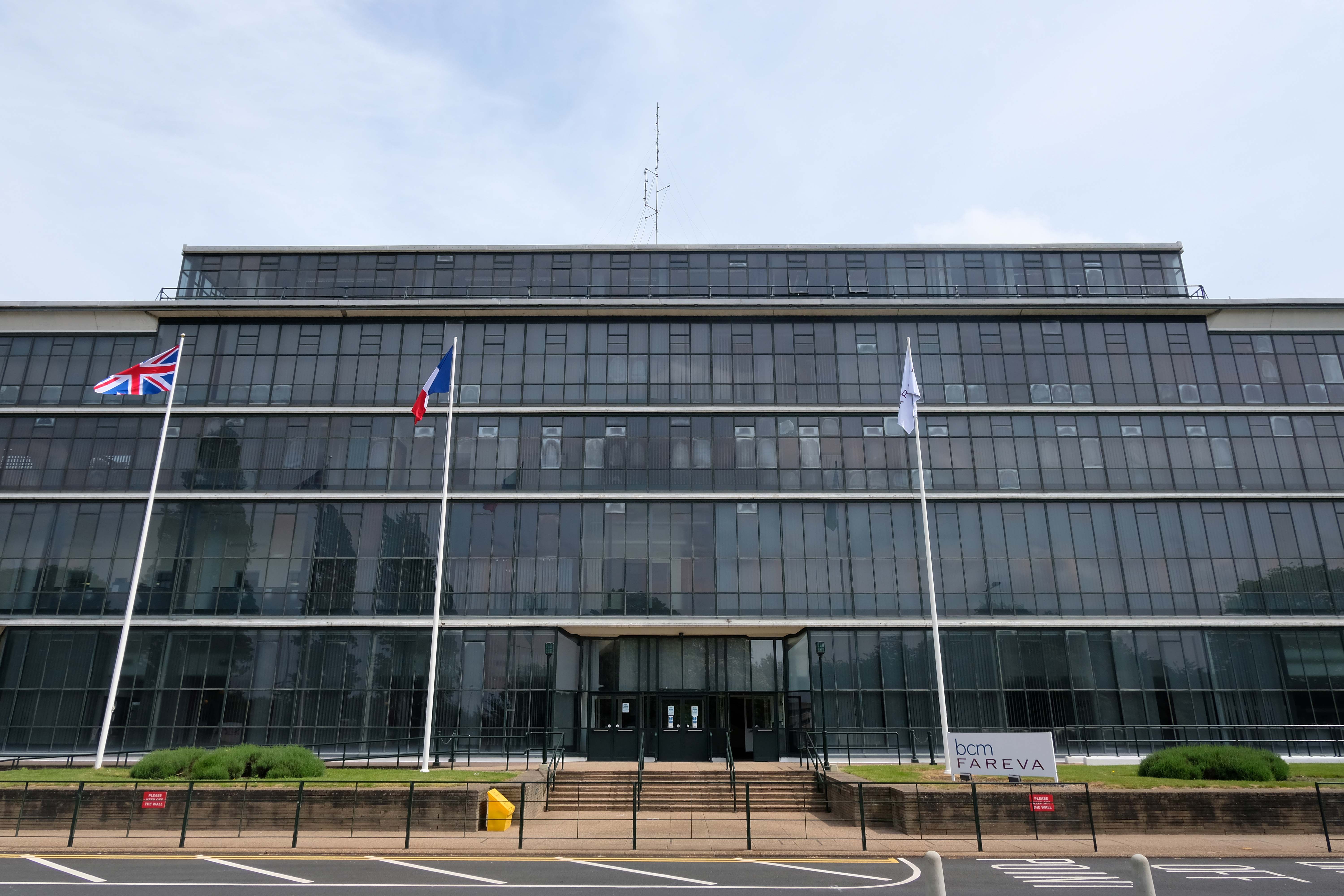
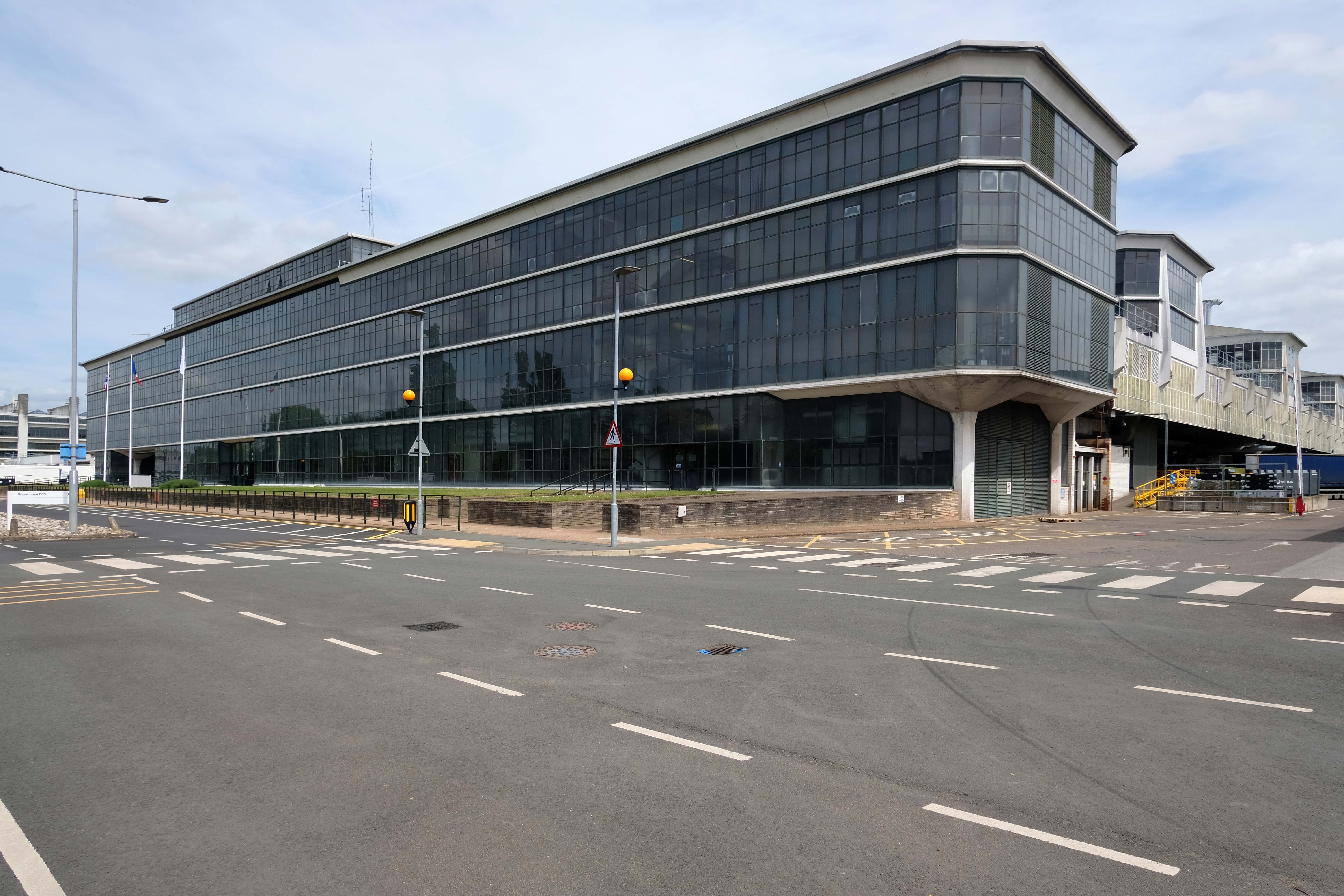
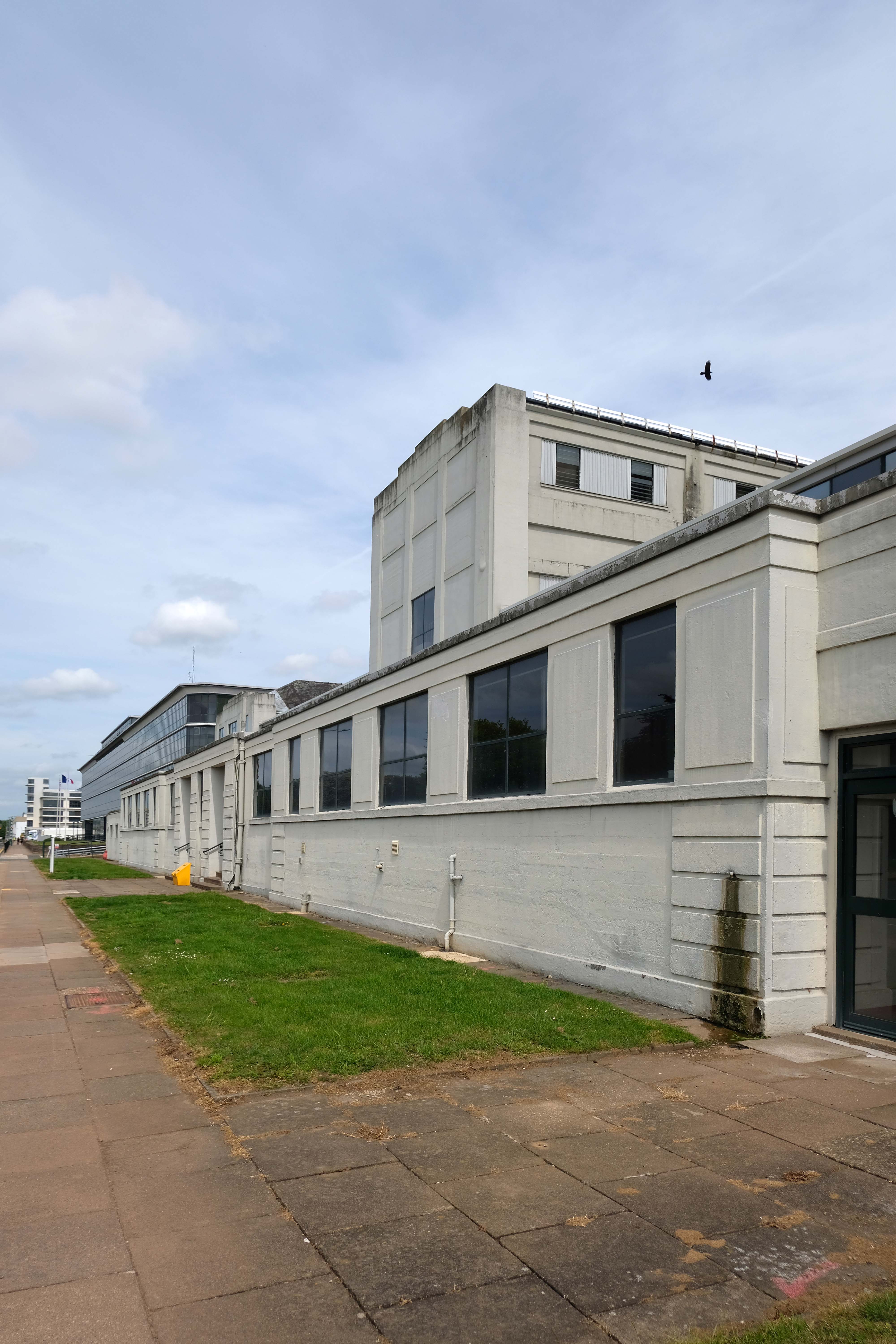
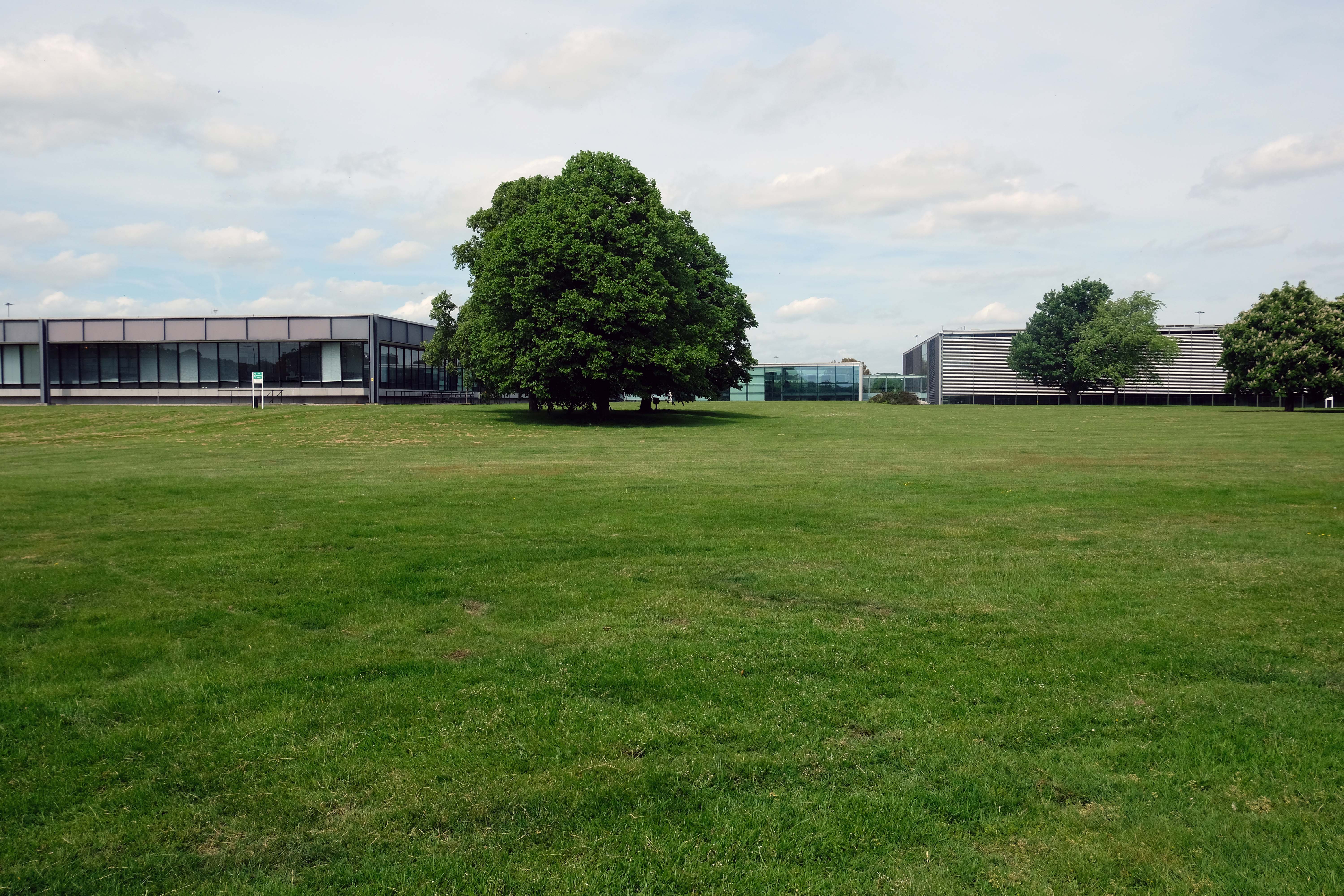
The pharmaceutical factory for the Boots Company was built in the 1930s and was designed by Sir E Owen Williams. It uses reinforced concrete as an external frame. The strength of the frame allowed the design to incorporate large areas of glass.

Much of the site is now listed.

Here is the company’s official history

Photograph taken December 1994 © Copyright Crown copyright

D10 Wets Building

D6 Dry Building

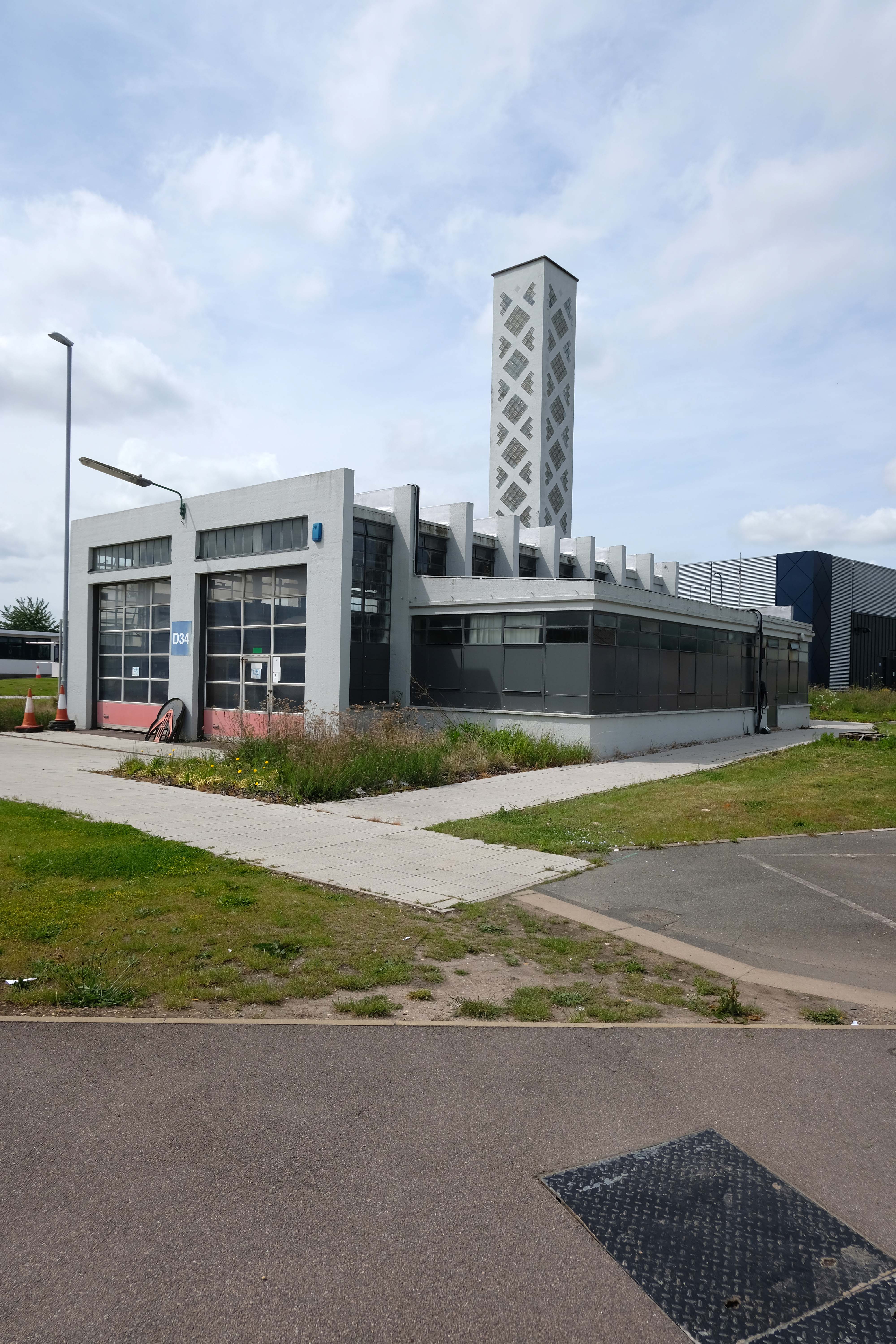
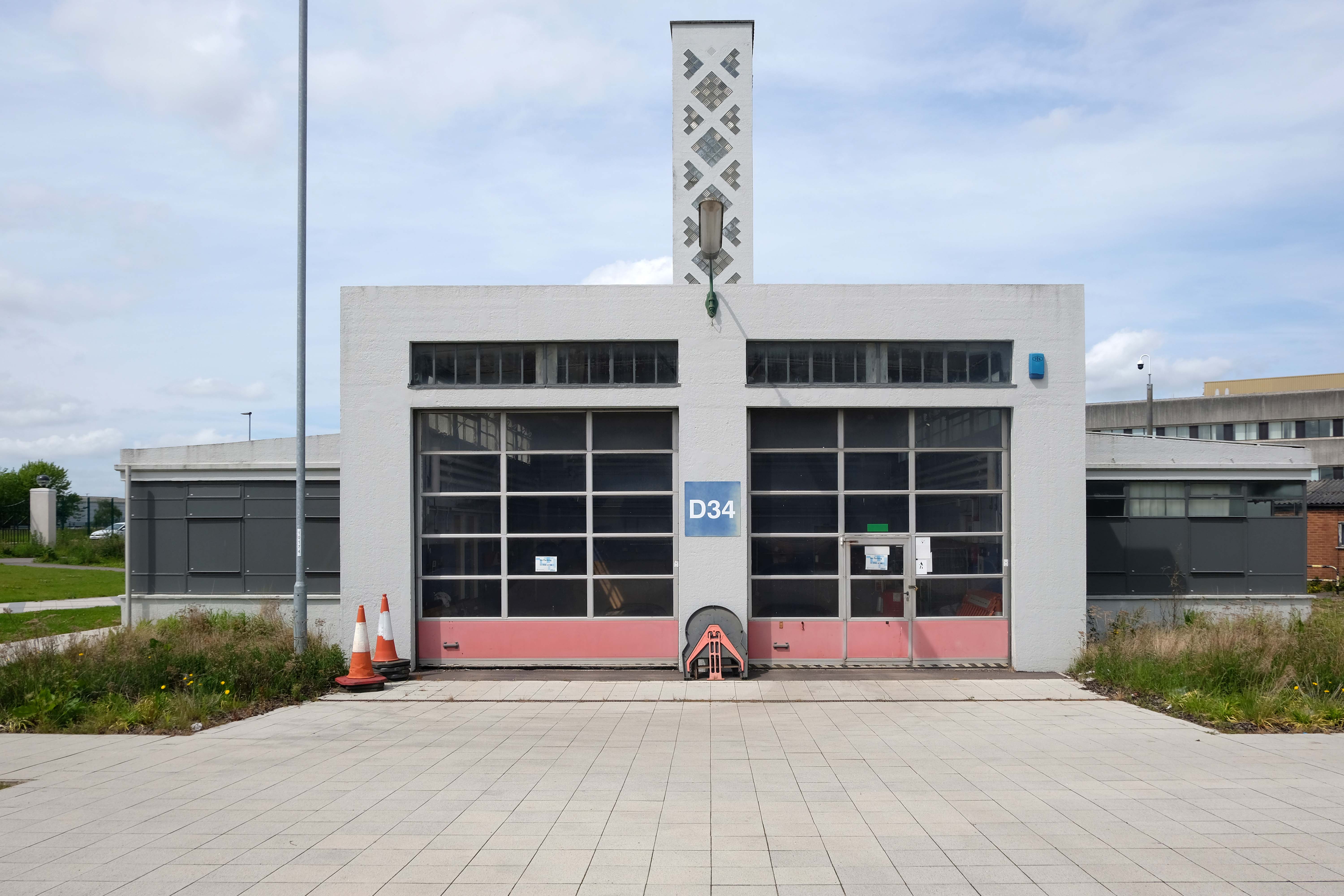
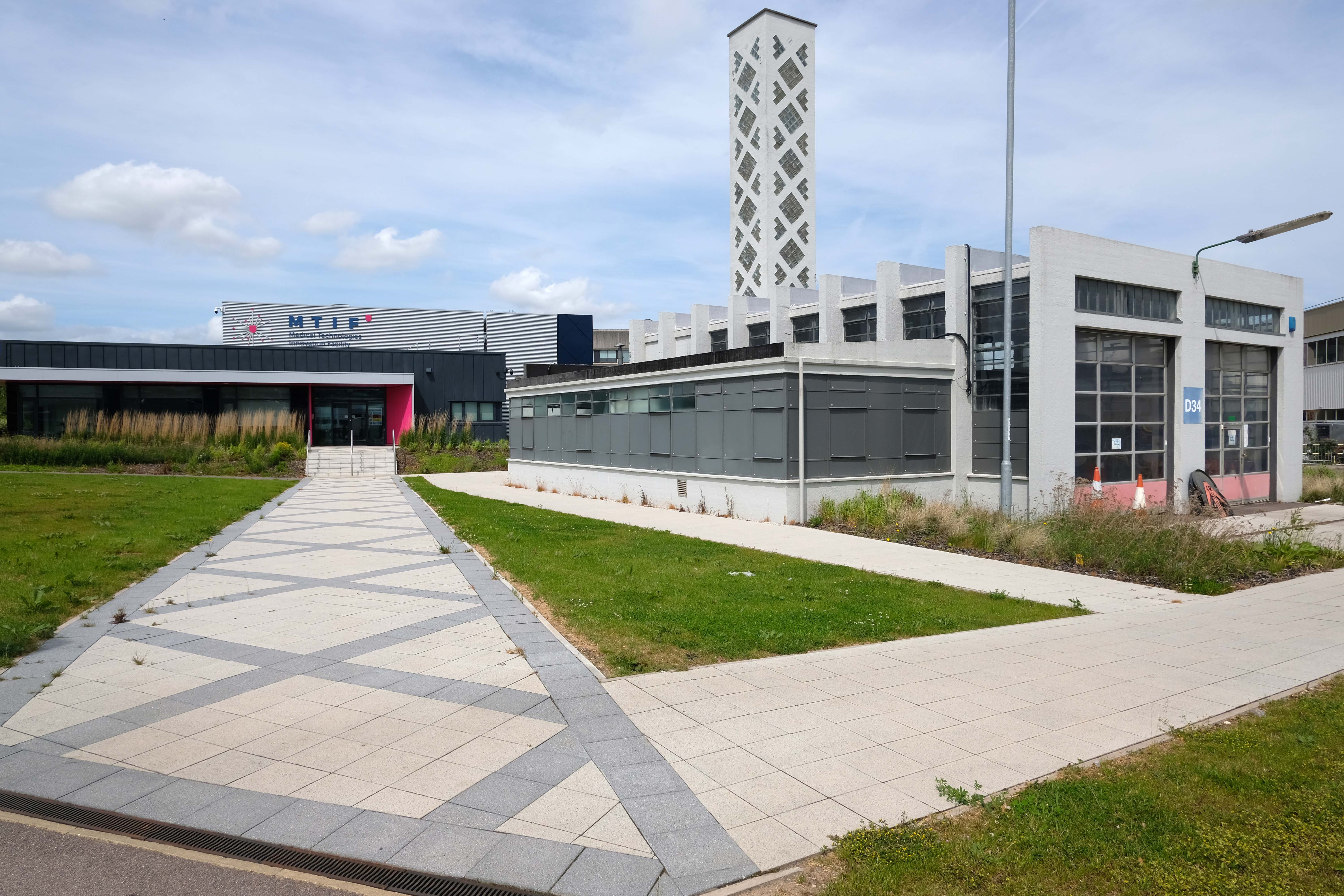
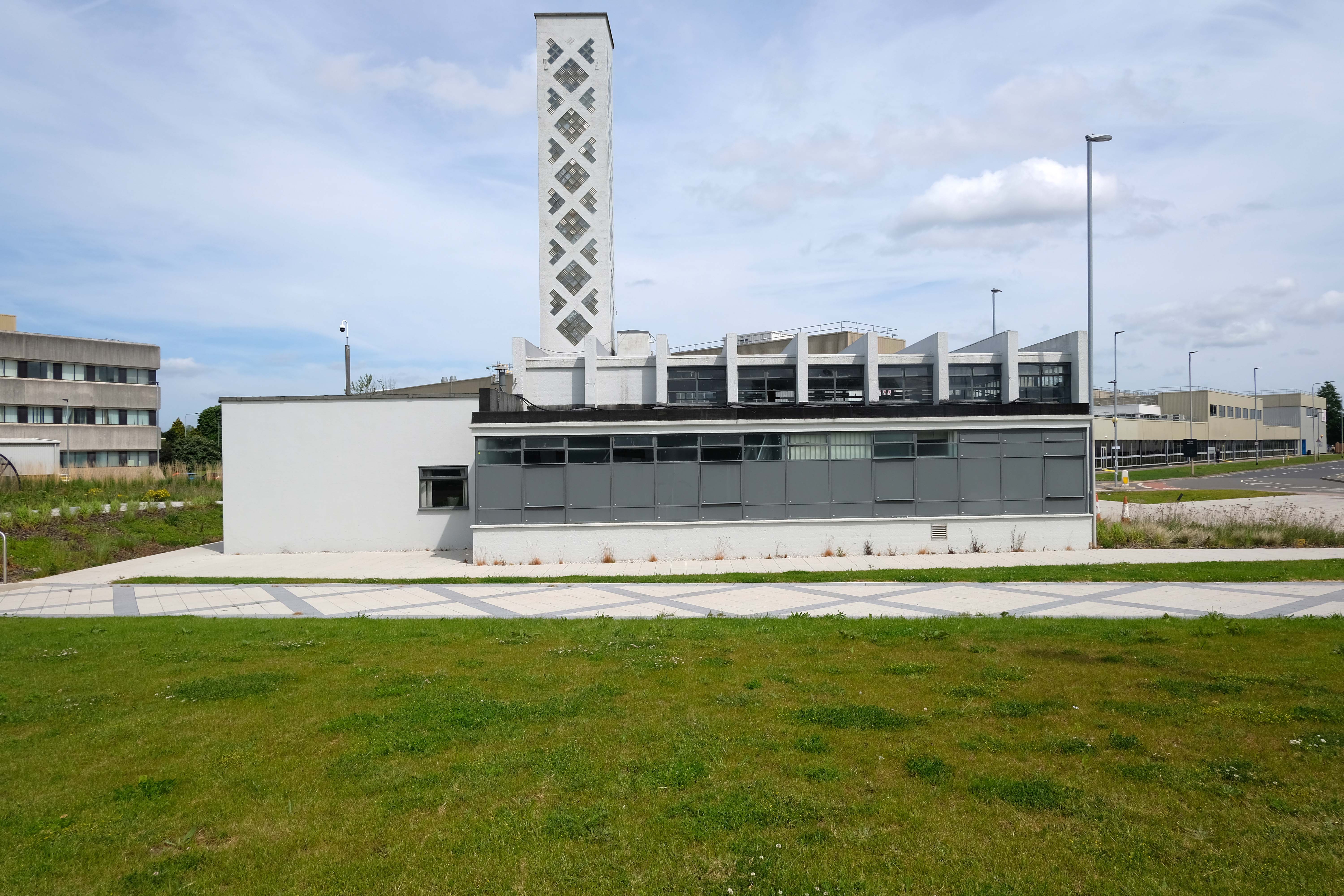
D34 Fire Station – now offices.

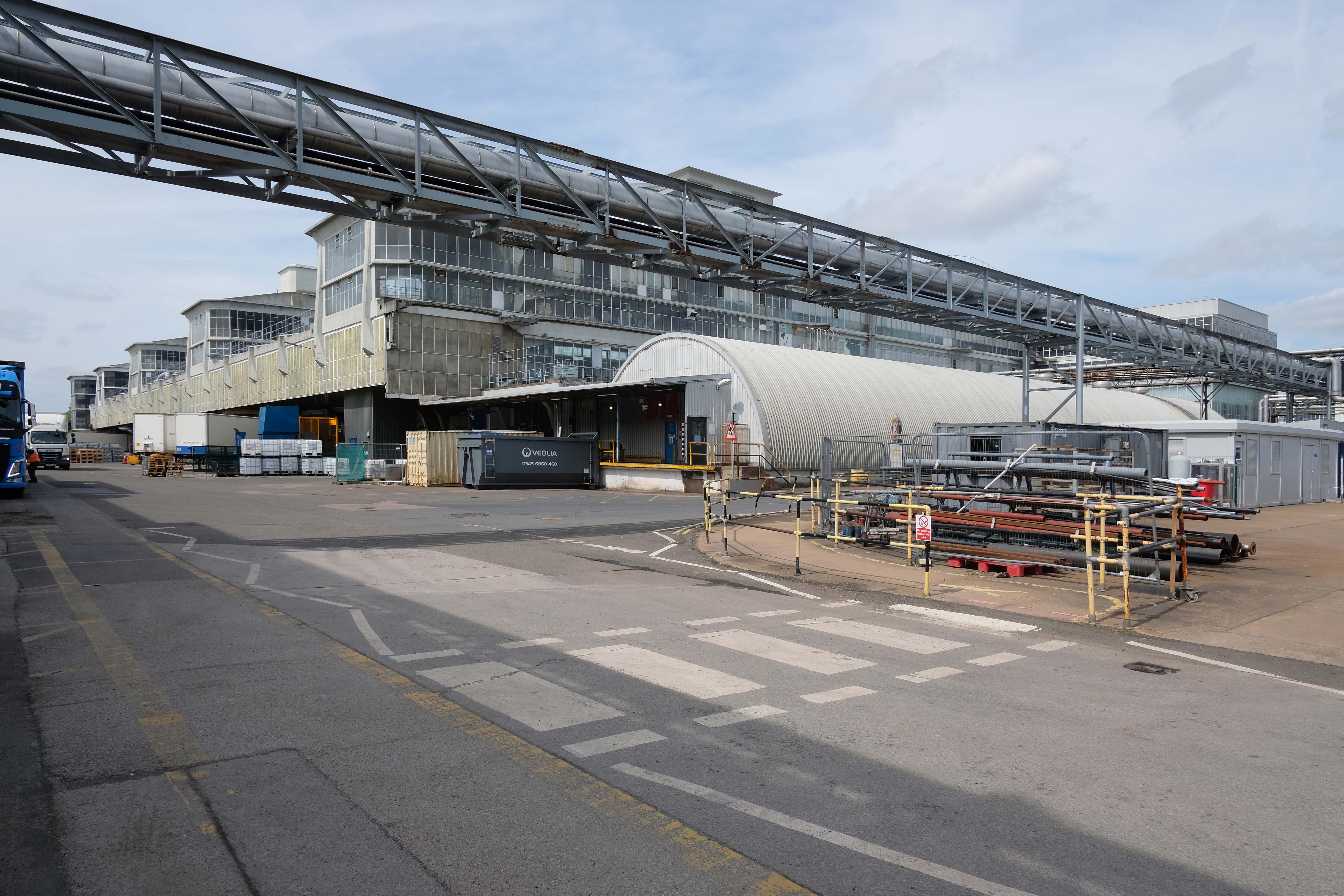
At this point I was asked to leave the site – having arrived on a public service bus, I was unaware that this was a restricted area.

This was explained to me by the ever so helpful security staff.

I made my excuses and left.

D90Skidmore Owings & Merrill and Yorke Rosenberg & Mardell 1967-69

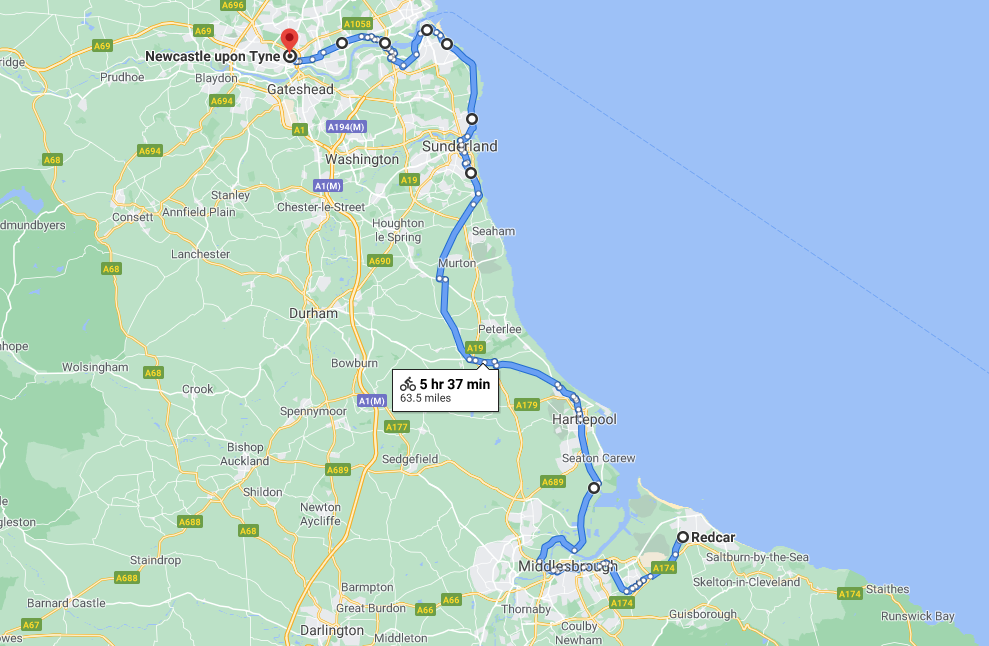
Redcar to Newcastle

An early start on another sunny day, cycling along long straight roads out of town, towards Middlesborough.

Having previously visited Hull and Scarborough and all points in between.

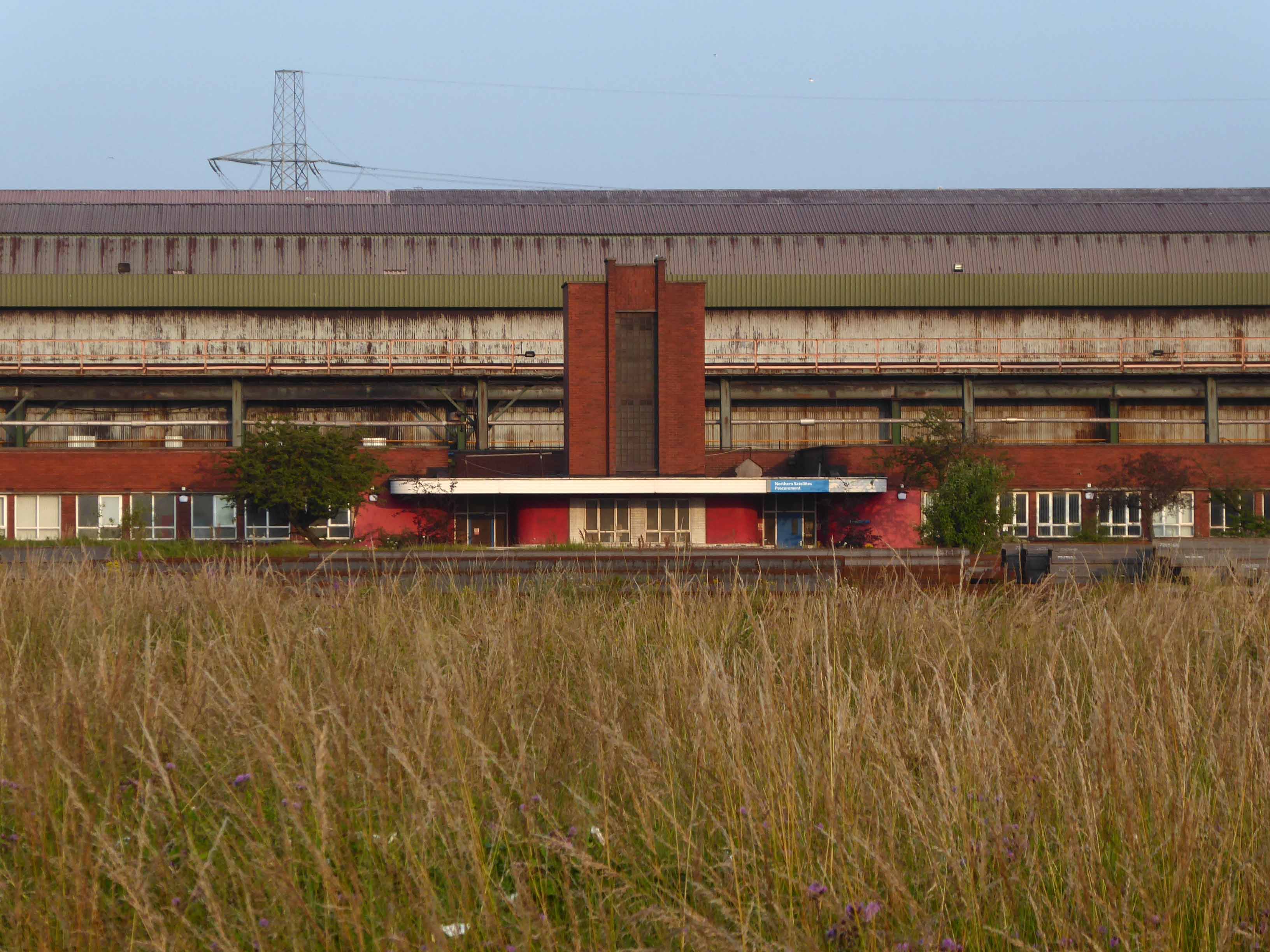
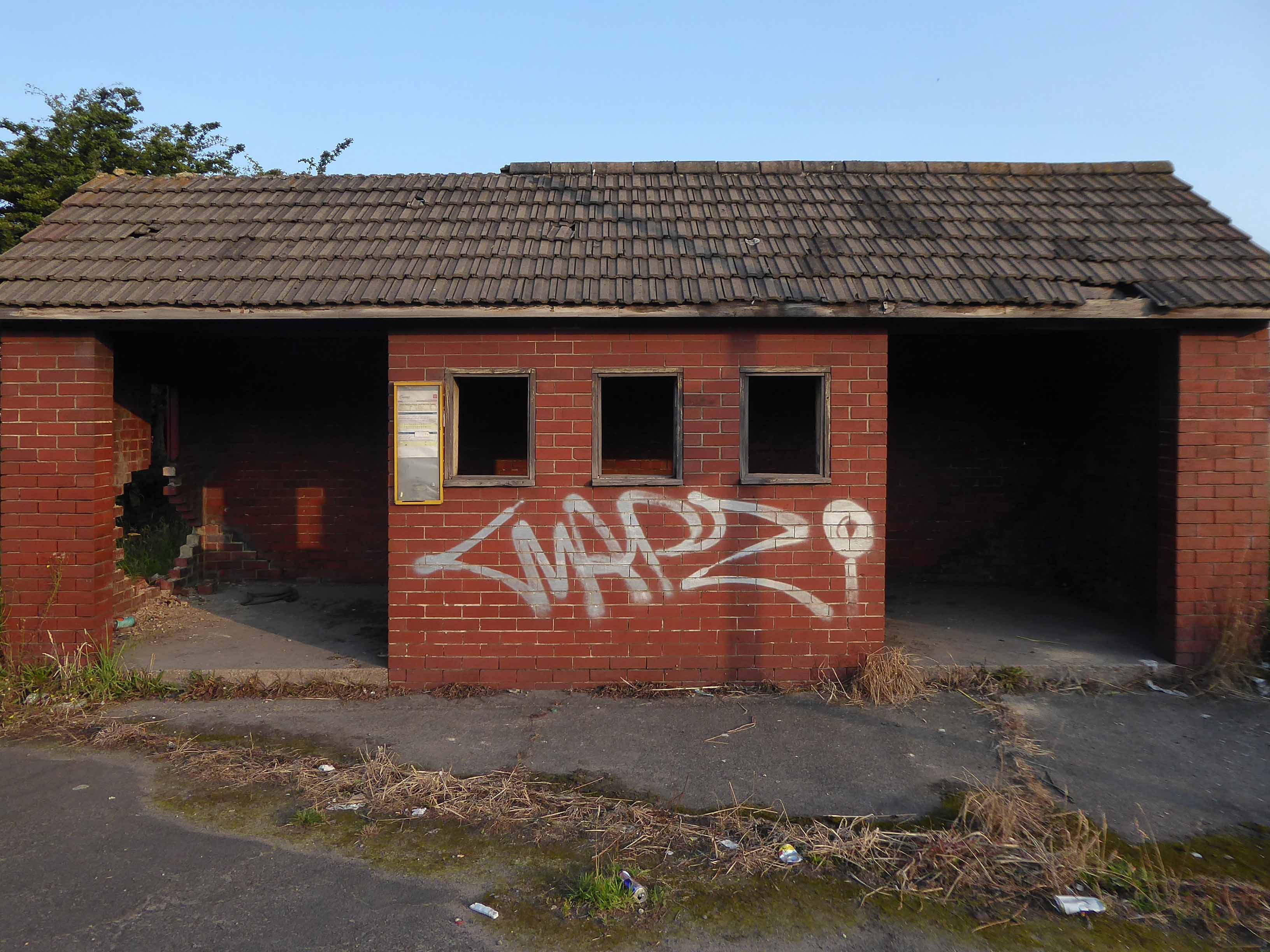
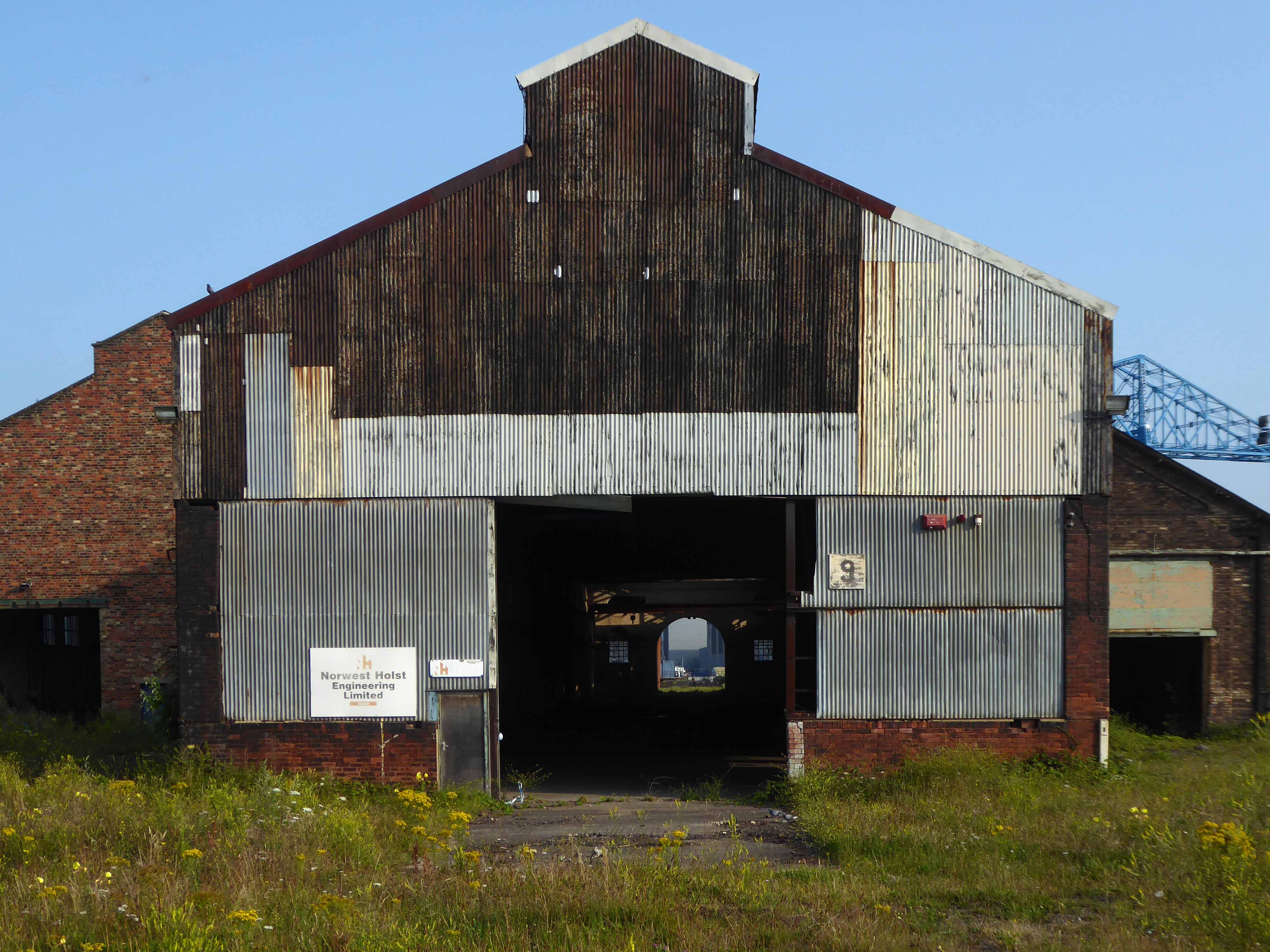
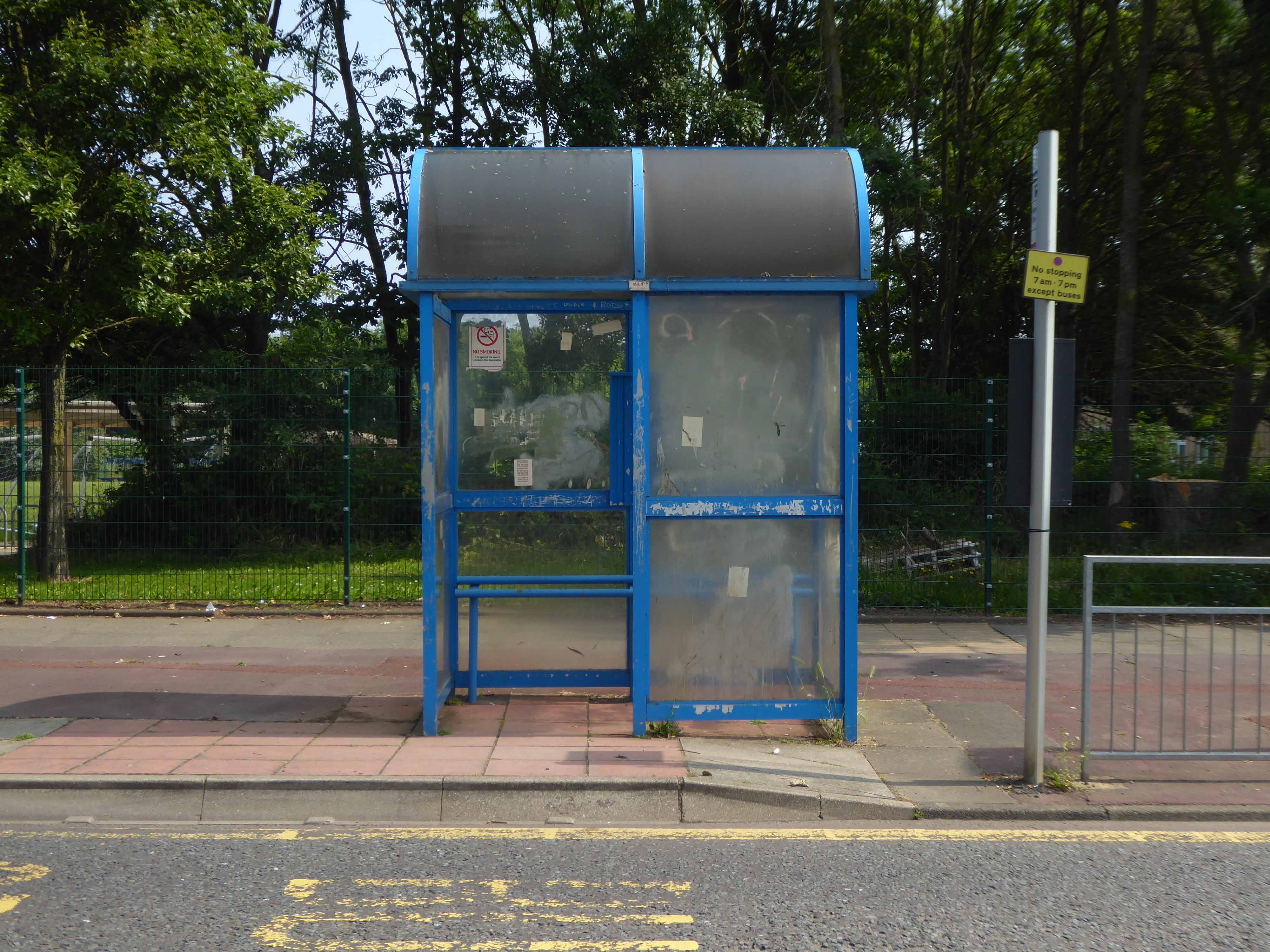
Slowly passing sleepy factories and desolate bus shelters.
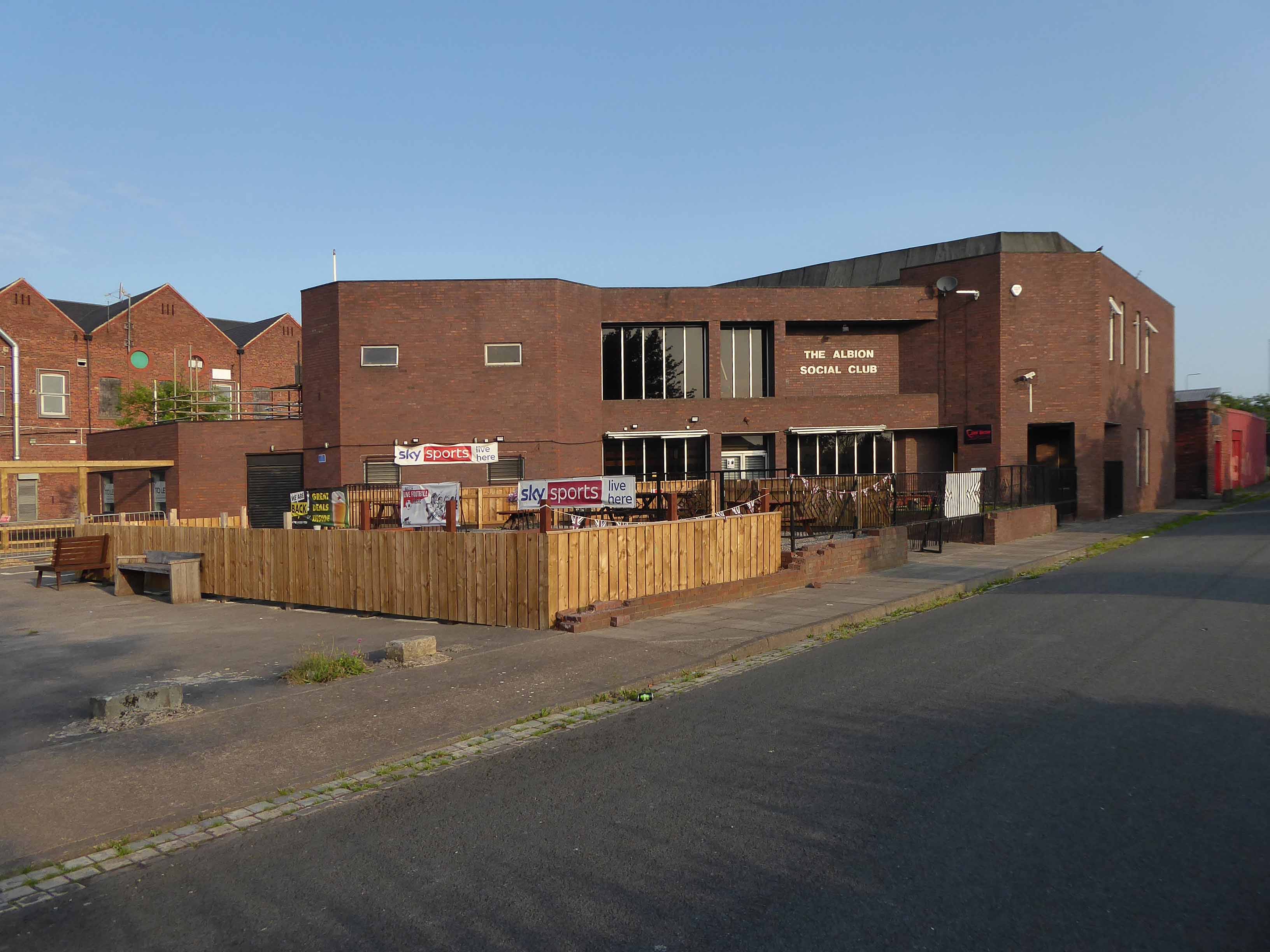
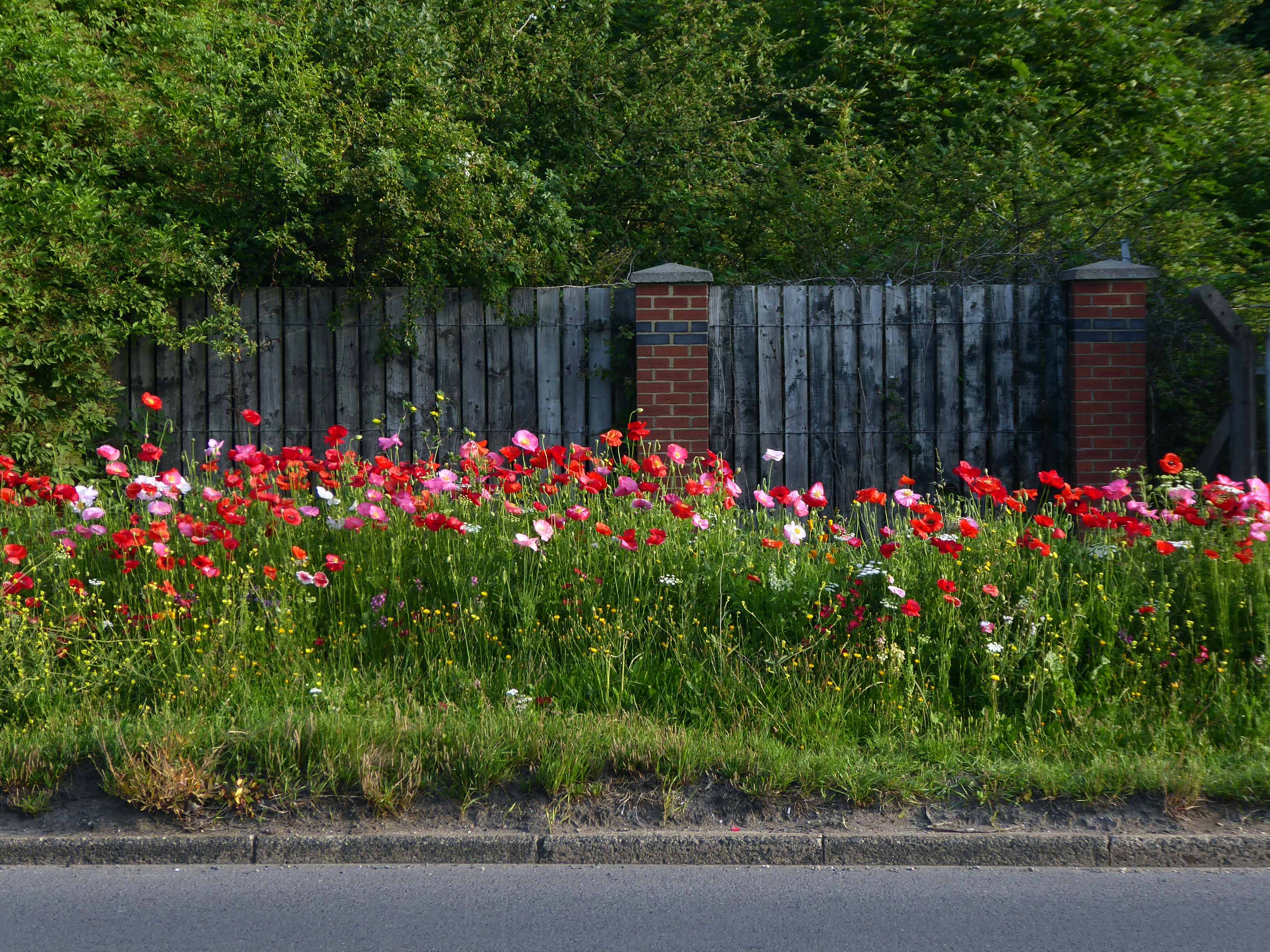
Bunker like social clubs and flower lined roads.

The Albion club in South Bank has stood empty for the last three years. 
Now local lad Mark Trainor has the keys – and says opening the doors to the club his own family frequented for years will be a dream come true.

He’s planning to cater for everyone, he says, and it won’t just be all about drinking.

Parents will be able to call in for a coffee after dropping the kids at school, there will be pool nights and Mark’s personal favourite – Pie Day Fridays.
Gazette

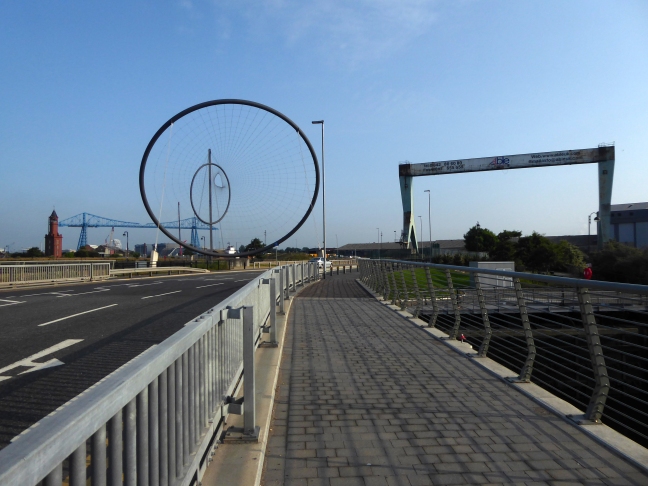
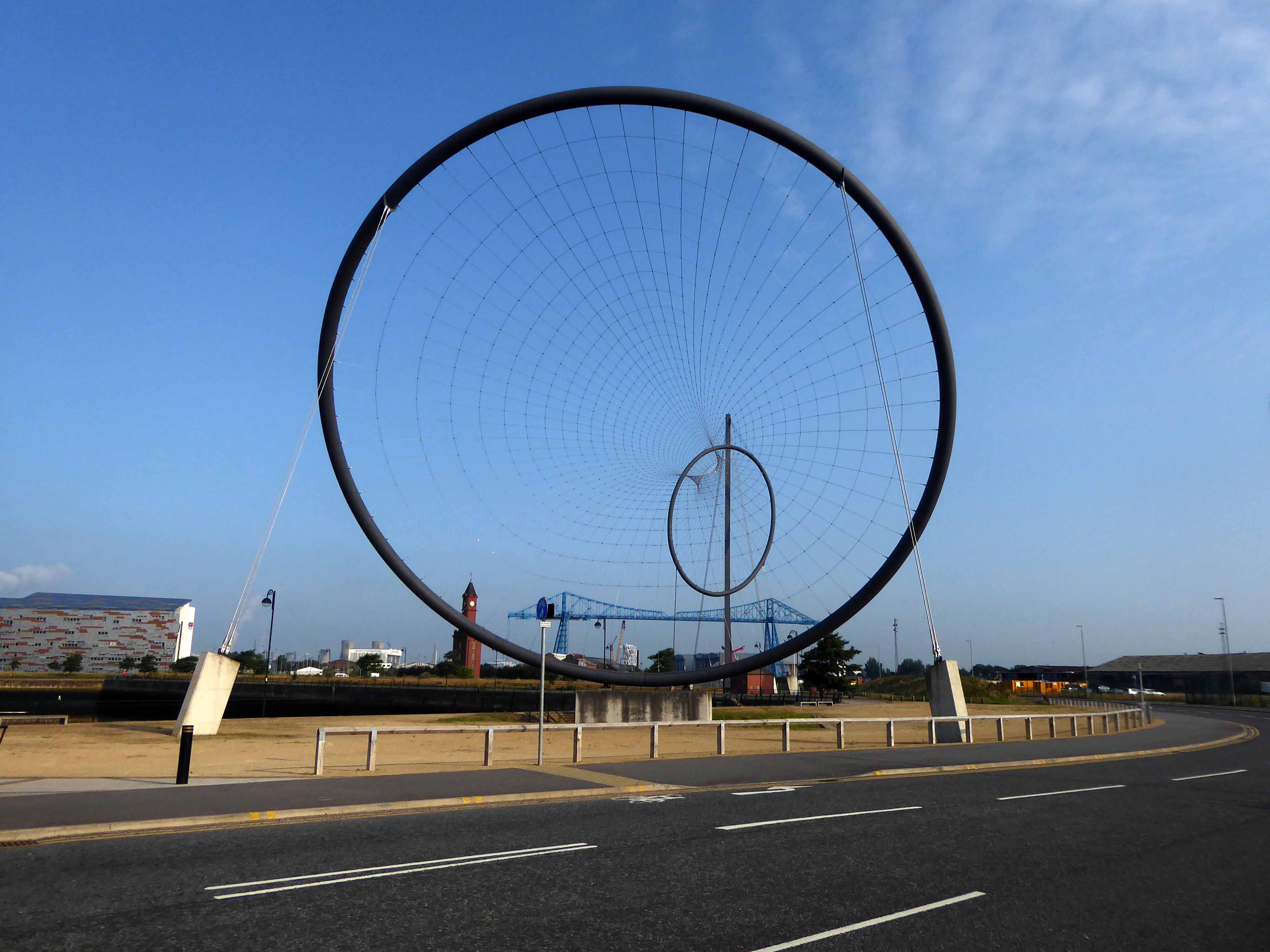
Public art framing the Transporter Bridge.
The £2.7m Temenos structure has taken four months to piece together on the banks of the River Tees near Middlesbrough’s Transporter Bridge.

Thousands of metres of steel wire have been woven between the two steel rings to create the 164ft high and 360ft long sculpture.

It was created by artist Anish Kapoor and structural designer Cecil Balmond.

BBC

Temenos is a Greek word meaning land cut off and assigned as a sanctuary or holy area.

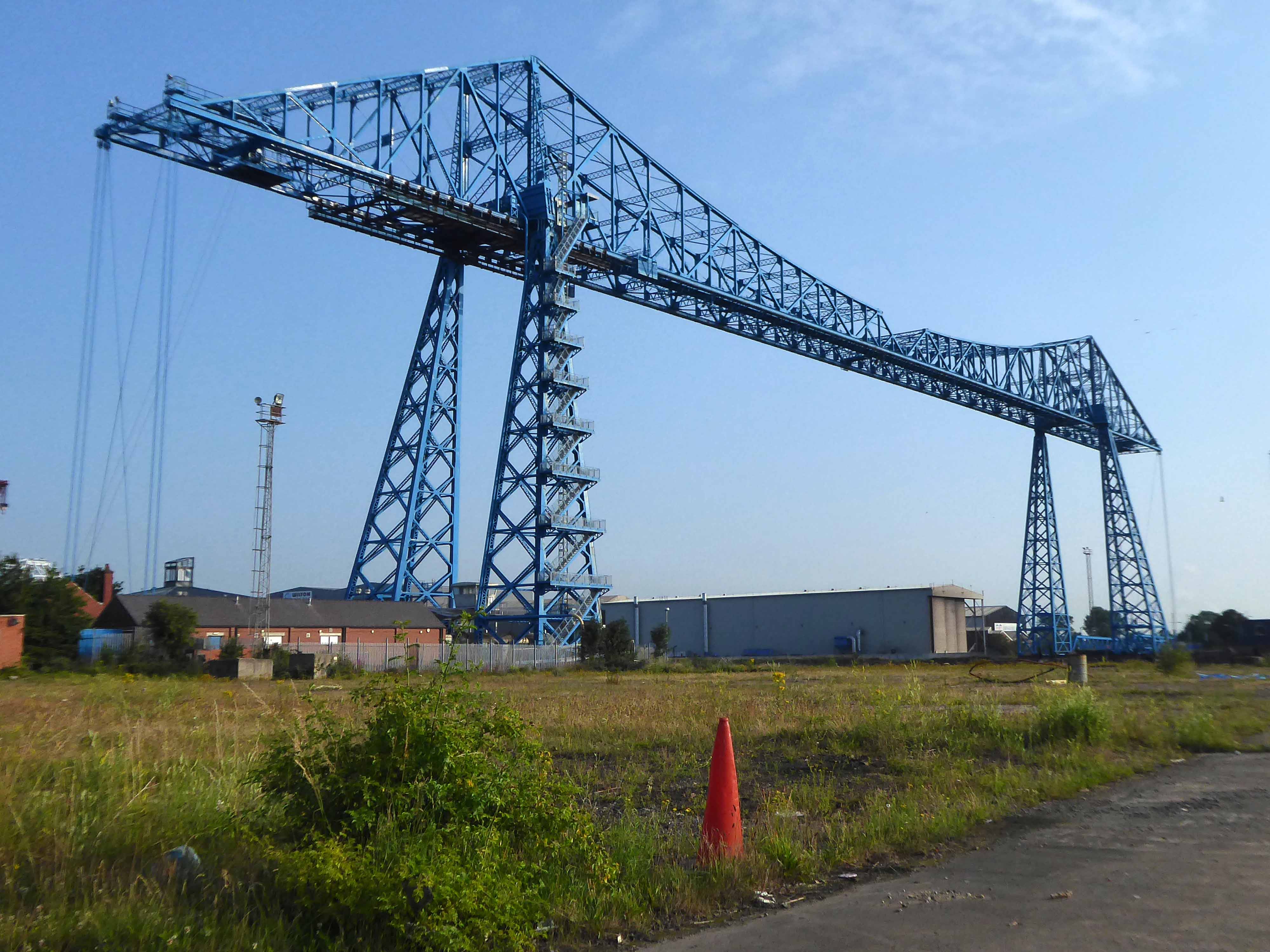
Following a 1907 Act of Parliament the bridge was built at a cost of £68,026 6s 8d  by Sir William Arrol & Co. of Glasgow between 1910 and 1911 to replace the Hugh Bell and Erimus steam ferry services. A transporter bridge was chosen because Parliament ruled that the new scheme of crossing the river had to avoid affecting the river navigation. 

The opening ceremony on 17 October 1911 was performed by Prince Arthur of Connaught, at its opening the bridge was painted red.

In 1961 the bridge was painted blue.

In 1974, the comedy actor Terry Scott, travelling between his hotel in Middlesbrough and a performance at the Billingham Forum, mistook the bridge for a regular toll crossing and drove his Jaguar off the end of the roadway, landing in the safety netting beneath.

Wikipedia

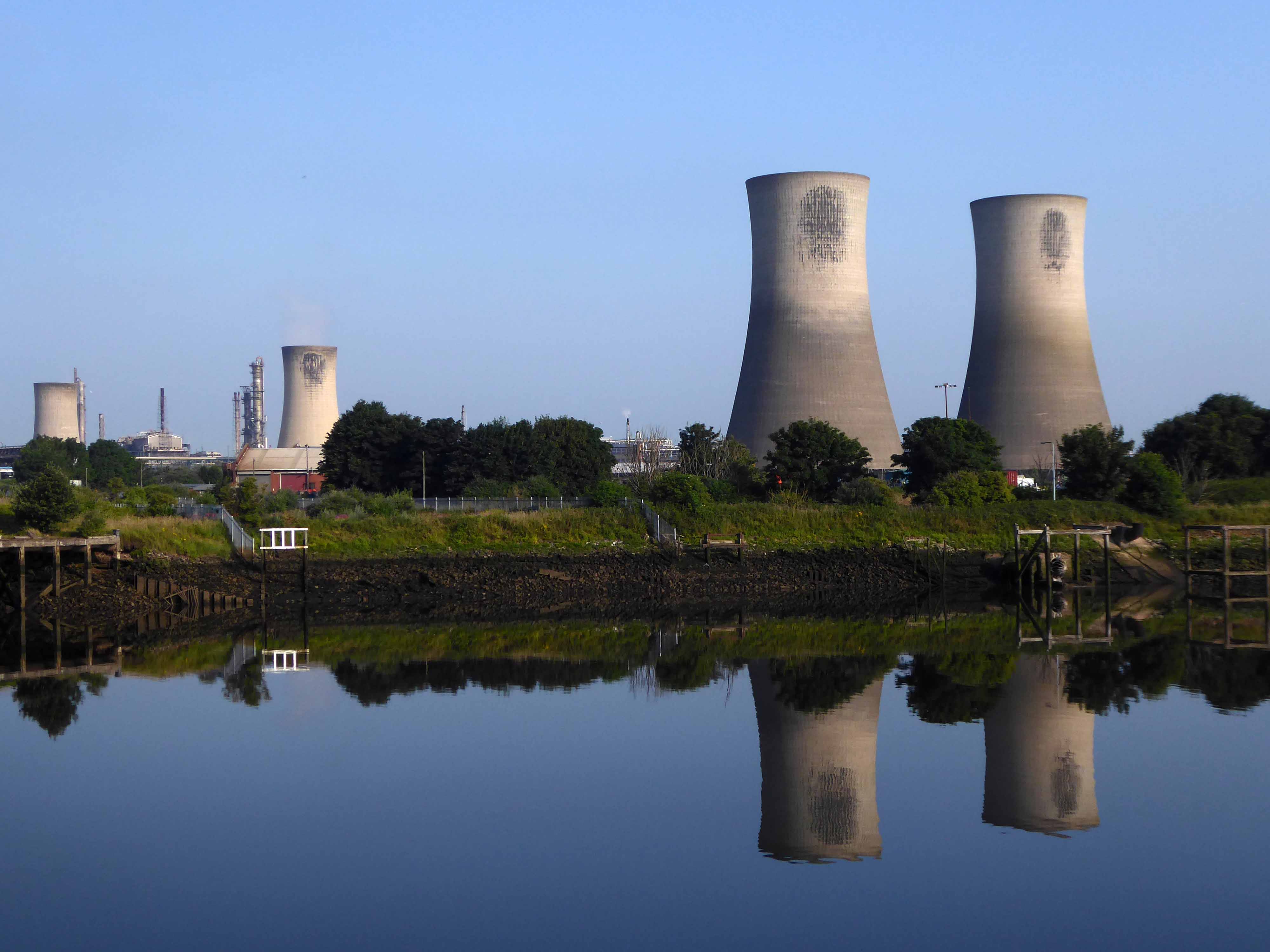
The cycle track followed the river, which sports a fine array of industrial architecture.

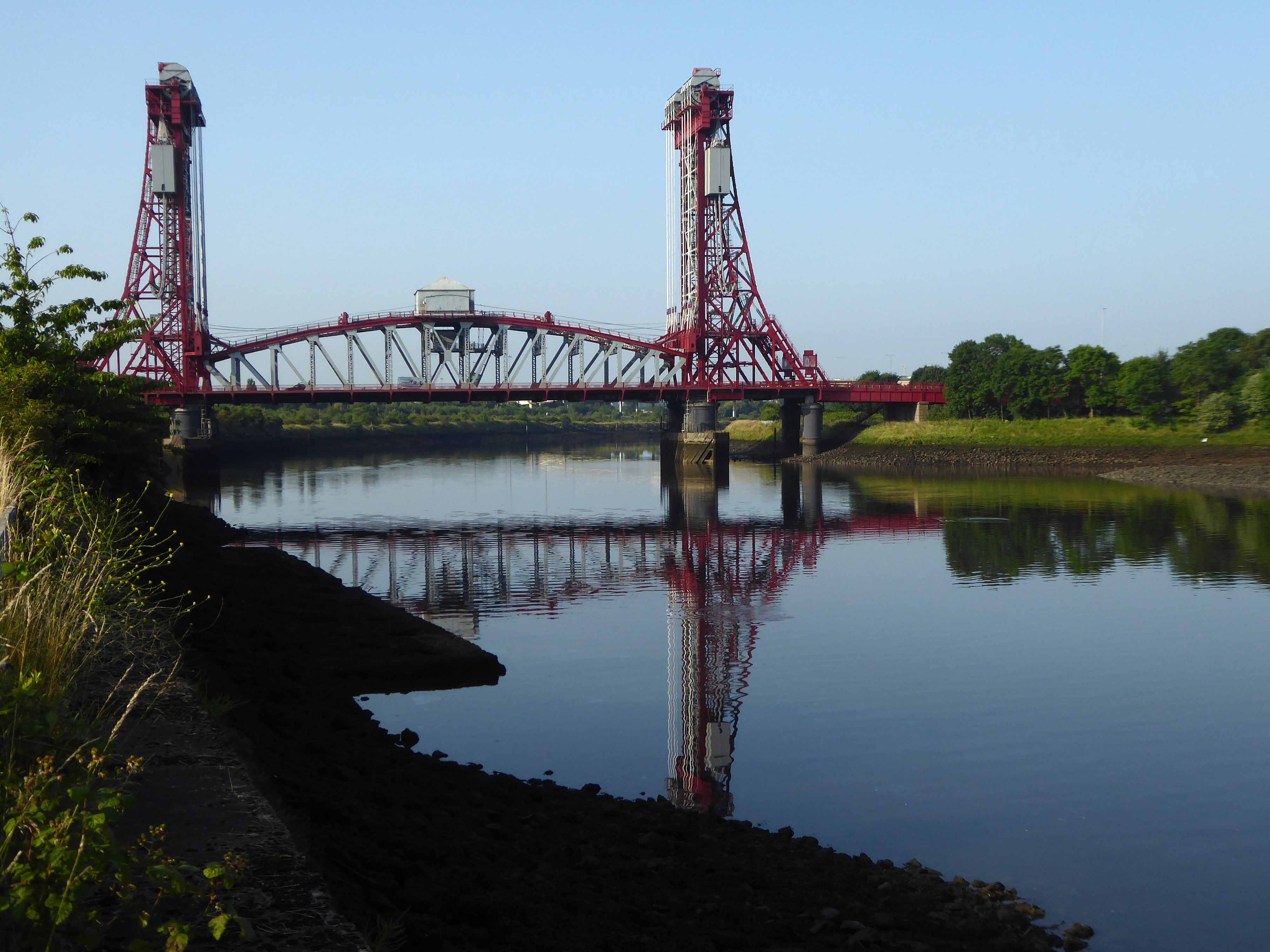
Tees Newport Bridge designed by Mott, Hay and Anderson and built by local company Dorman Long who have also been responsible for such structures as the Tyne Bridge and Sydney Harbour Bridge, it was the first large vertical-lift bridge in Britain.

Wikipedia

Crossing the river and heading for Hartlepool.

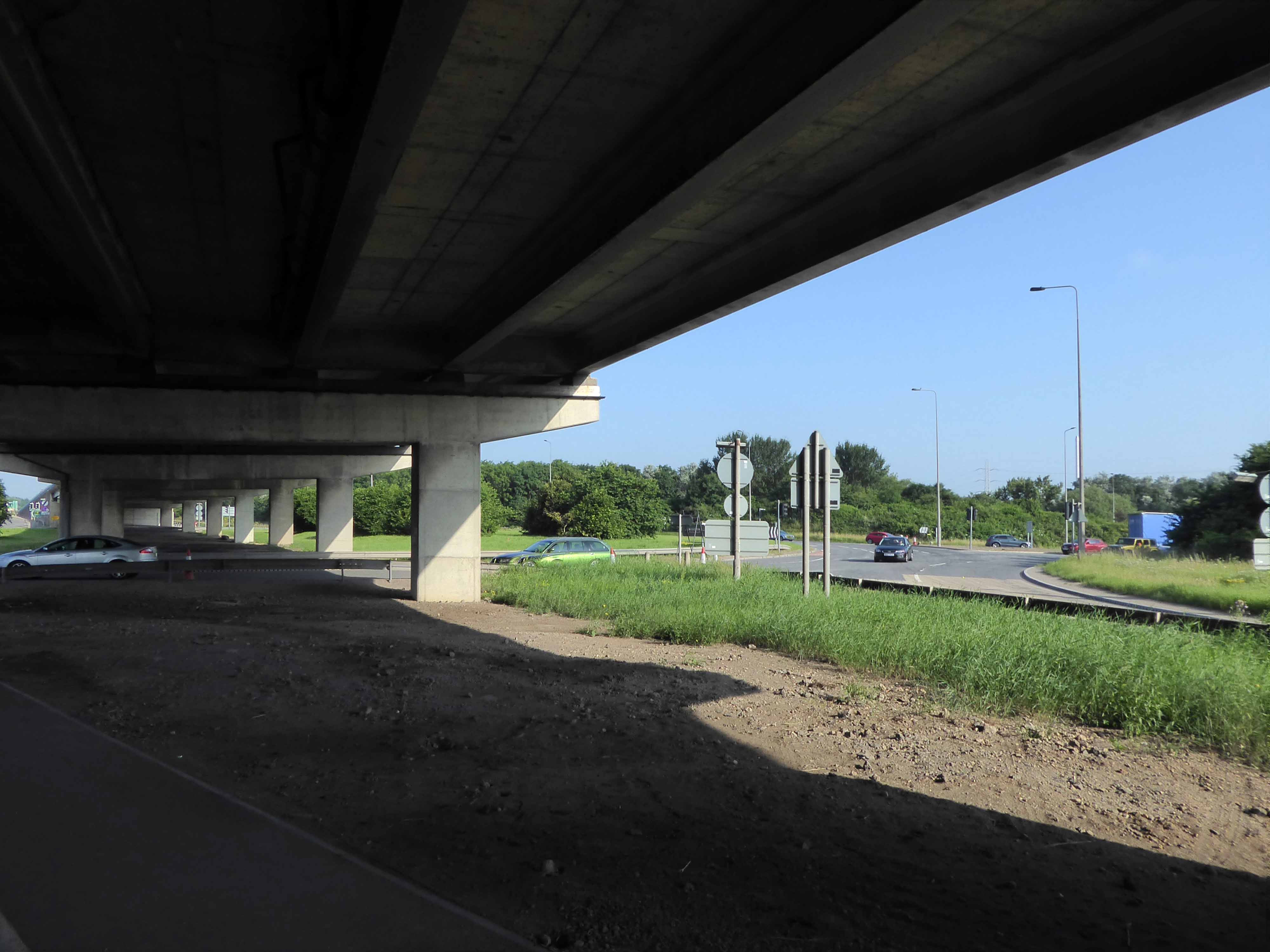
Negotiating underpasses and main road cycle lanes.

I was delighted to be drawn toward Dawson House here in Billingham.

Austere brick churches.

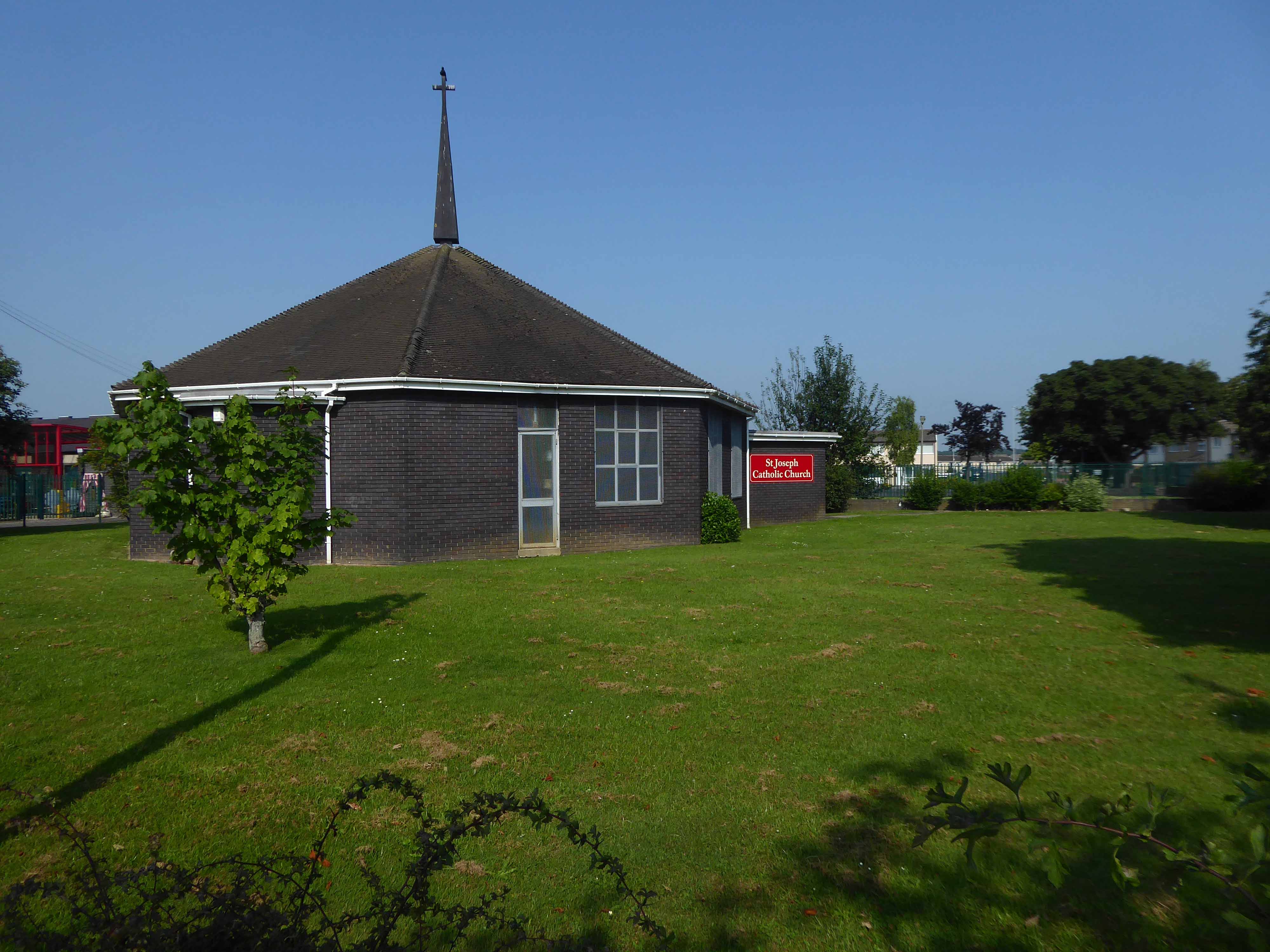
St Joseph RC Low Grange Avenue Billingham

A prefabricated polygonal structure of the 1970s, with laminated timber frame. The seating came from Pugin & Pugin’s church at Port Clarence. 

Taking Stock

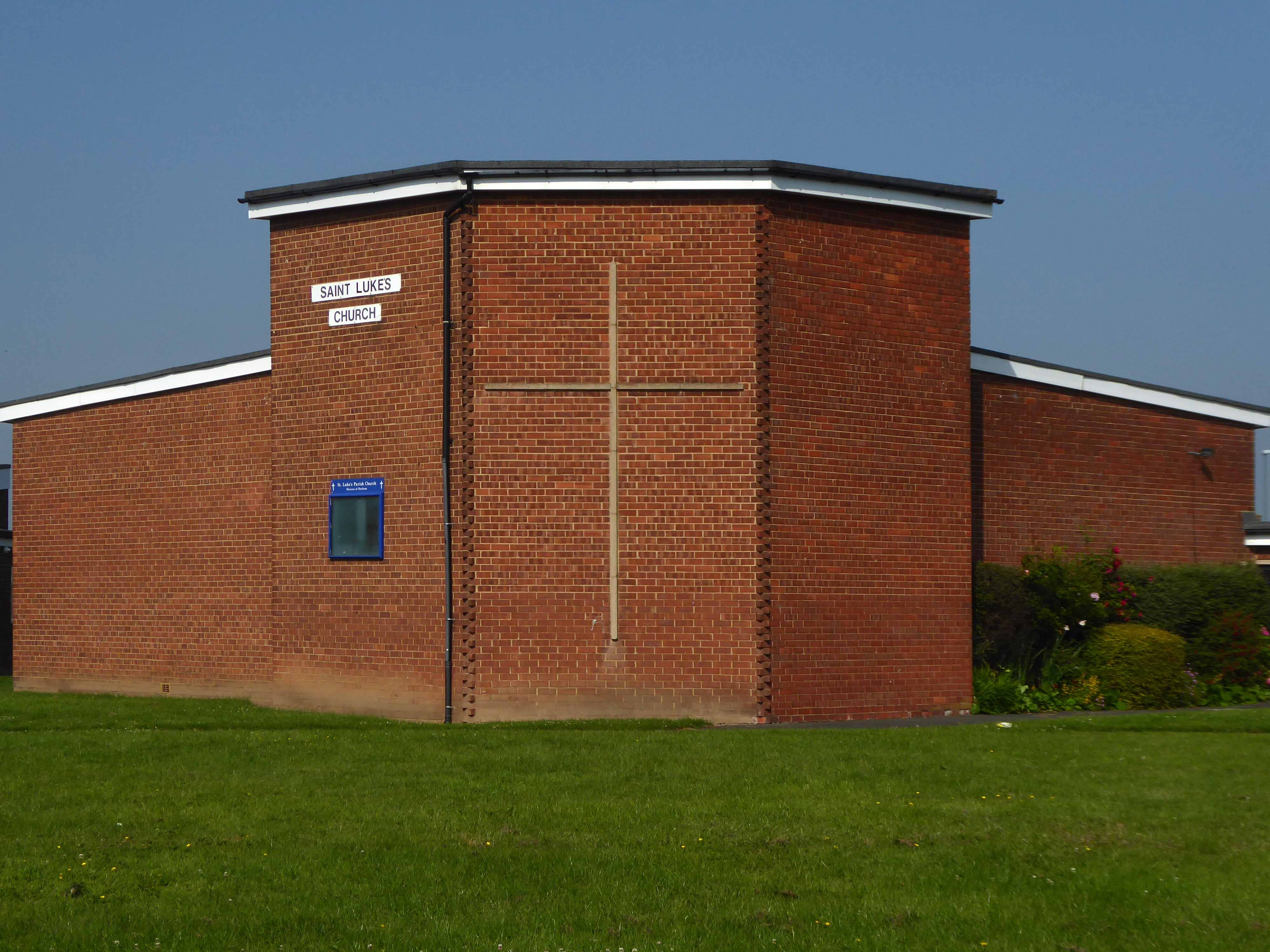
Just along the way Saint Lukes Billingham 1965.

In a slightly more upbeat mode St James the Apostle Owton Manor.

I convinced myself that this building on Station Road Seaton Carew was a former pub, I discovered following consultation with the local studies offices, that it was in fact a former children’s home destined to become a doctors.

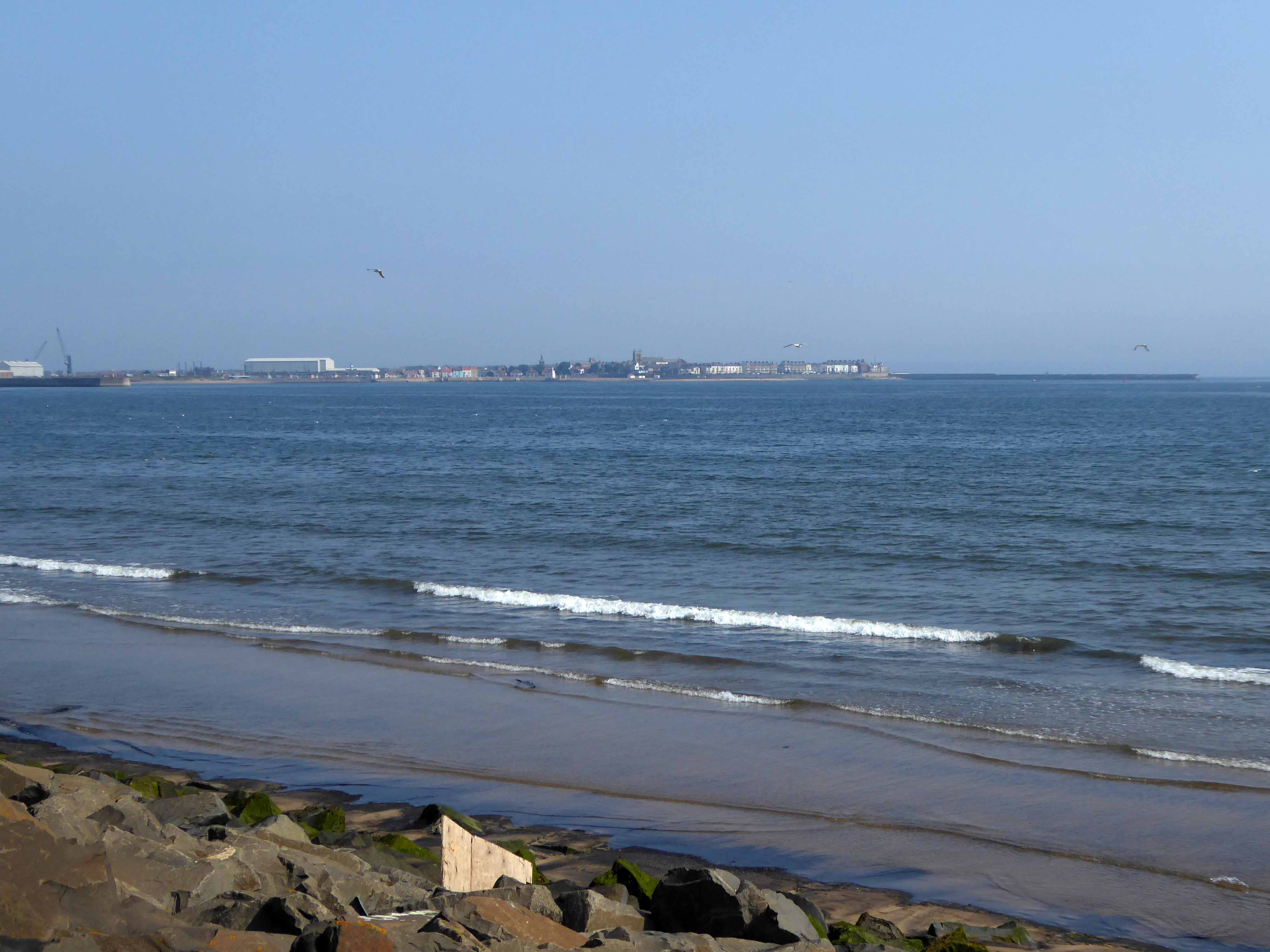
I found myself looking back across the estuary to Redcar.

Northward toward Hartlepool.

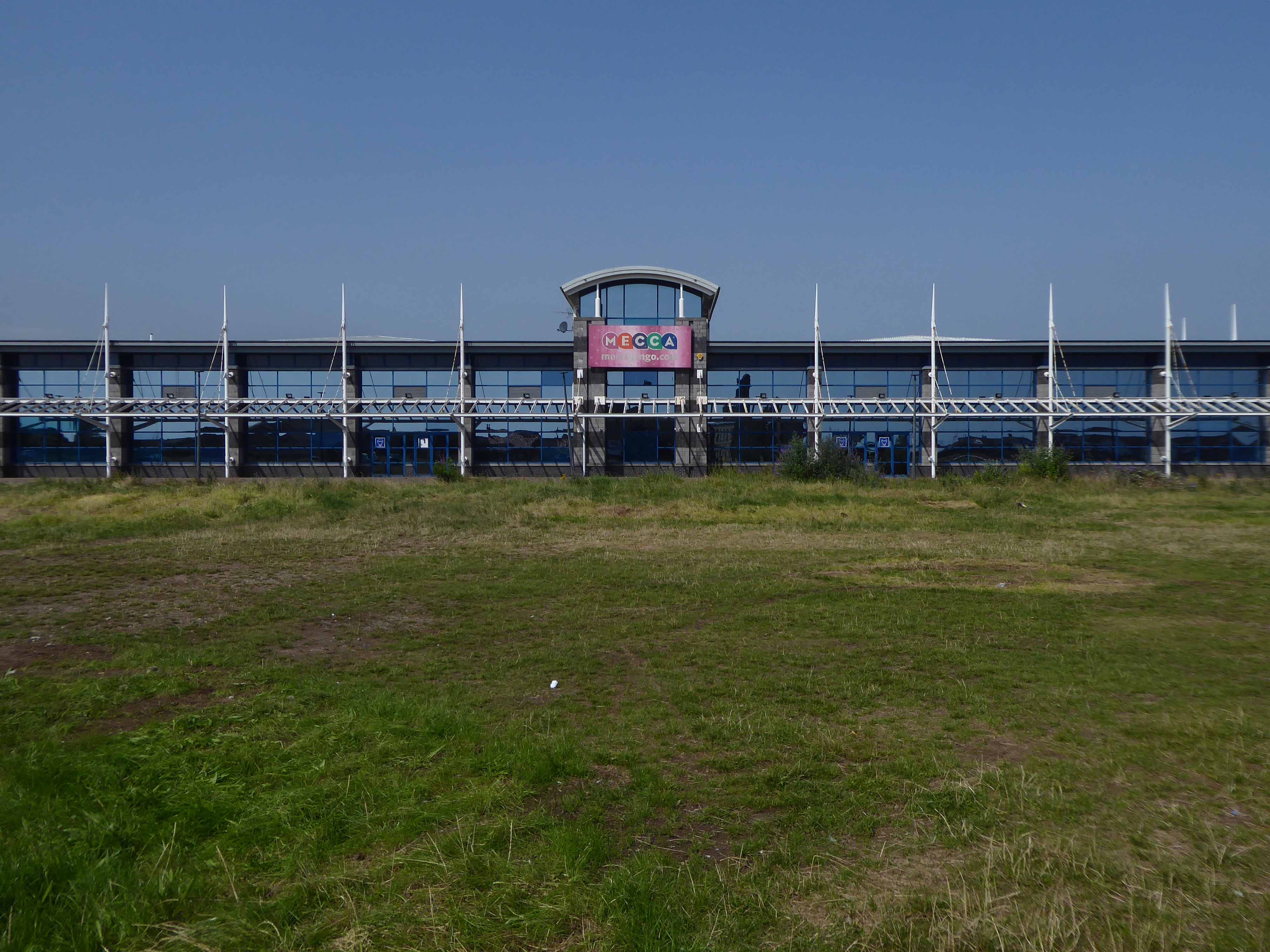
Where the bingo was closed and the circus had left town.

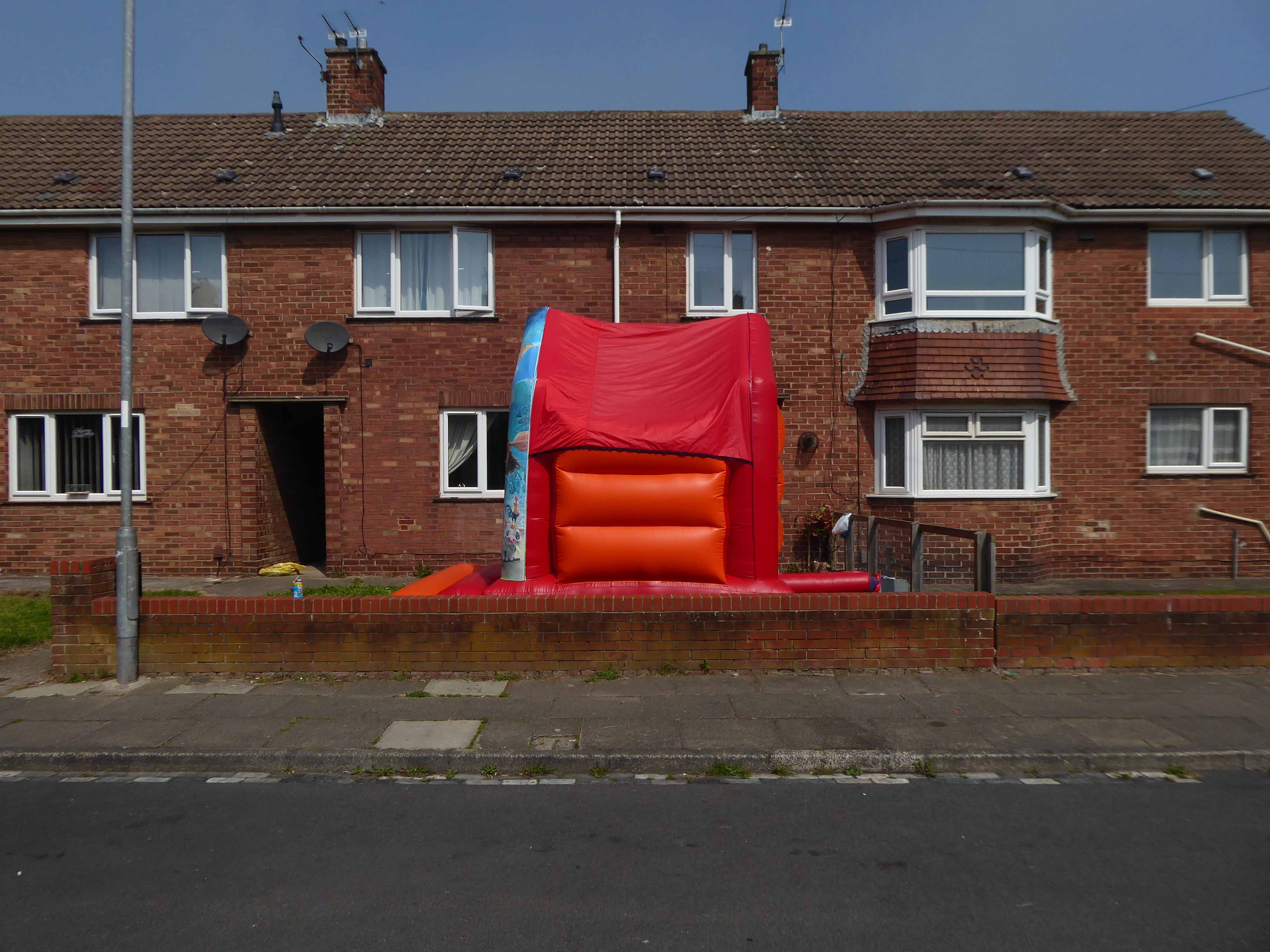
Every Englishman’s home is a bouncy castle.

St John Vianney located on King Oswy Drive West View Estate.

Architect: Crawford & Spencer Middlesbrough 1961.

A large post-war church built to serve a housing estate, economically built and with a functional interior. The campanile is a local landmark. 

The parish of St John Vianney was created in 1959 to serve the growing West View Estate, on the north side of Hartlepool. The church was opened by Bishop Cunningham on 4 April 1961. The presbytery was built at the same time.

Taking Stock

I found myself on yet another former railway line.

The Cycleway was once a railway line designed by George Stephenson to take coal from the Durham coal fields to the docks in Hartlepool, where the coal was then distributed throughout the world.

Tees Valley

The landscape opened up to coal scarred scrub, I lost the path and found a church, which imposed itself upon the hillside.

St Joseph RC Seaham County Durham

Architect: Anthony J. Rossi of Consett 1964

Taking Stock

Opening 1964

Seeking assistance from a passing cyclist I negotiated a safe passage to Sunderland.

The Sunderland Synagogue is a former synagogue building in Sunderland, England. The synagogue, on Ryhope Road, was designed by architect Marcus Kenneth Glass and completed in 1928. It is the last surviving synagogue to be designed by Glass.

The synagogue was listed as a Grade II historic structure in 1999.

Wikipedia

I crossed the Queen Alexandra Bridge

The steel truss bridge was designed by Charles A Harrison – a nephew of Robert Stephenson’s assistant.

It was built by Sir William Arrol between 1907 and 1909 and officially opened by The Earl of Durham, on behalf of Queen Alexandra on 10 June 1909.

Wikipedia

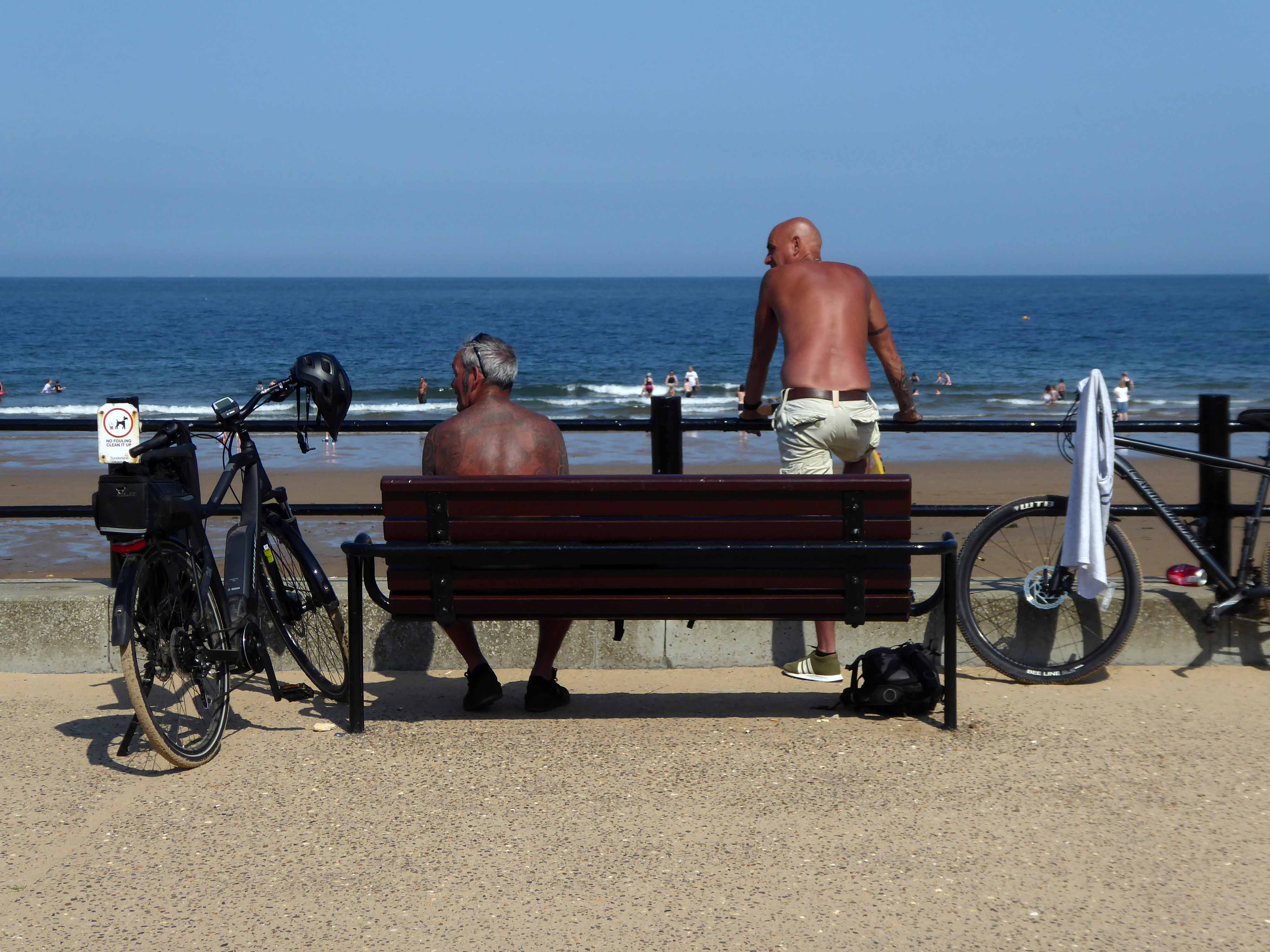
I took a right and arrived in Roker, where I saw these well tanned and tattooed cyclists taking a rest.

Pressed on, largely alongside the coast to South Shields.

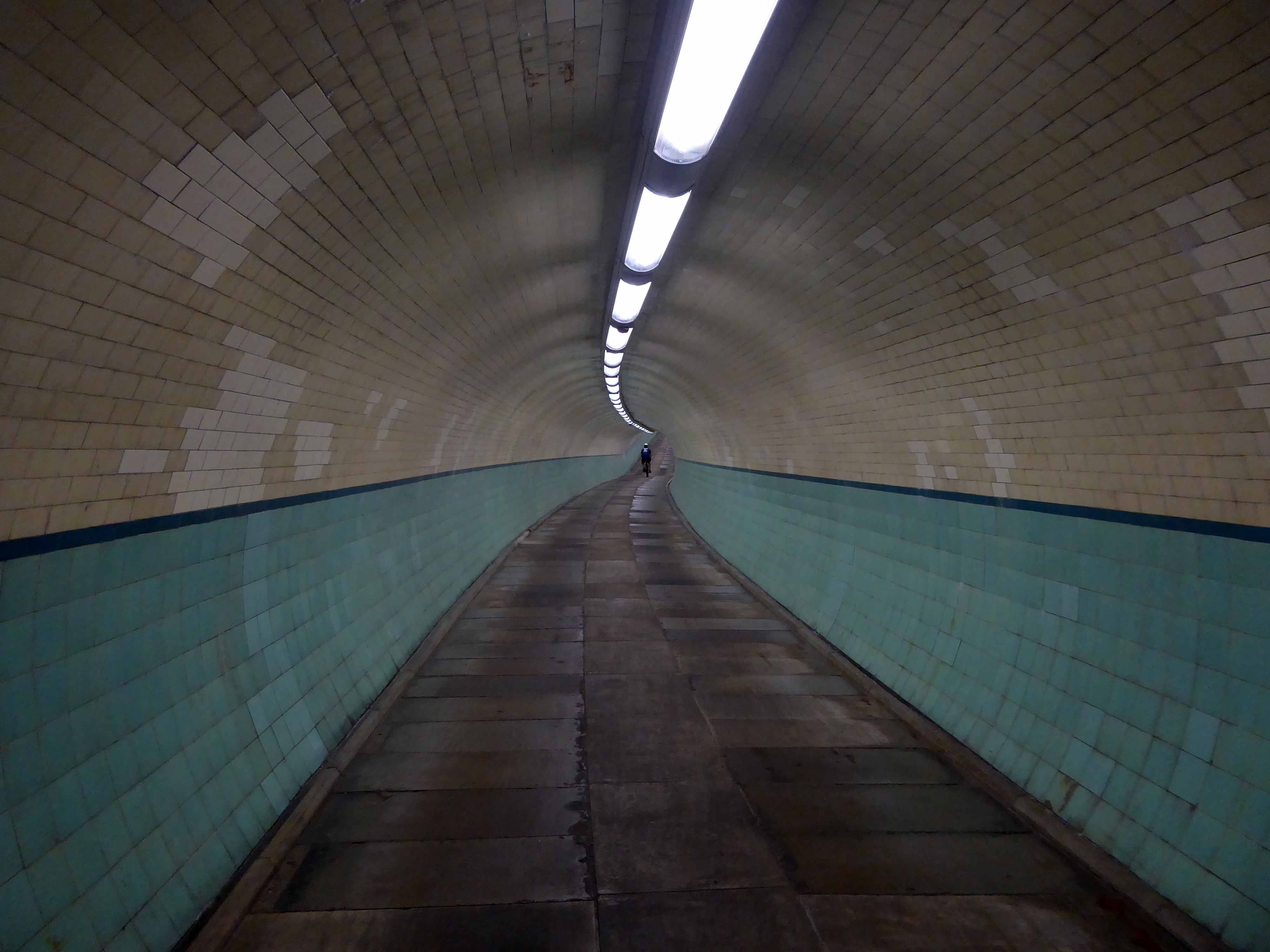
Under advisement from a jolly passing jogger I took the Tyne Pedestrian Tunnel.

Tyne Cyclist and Pedestrian Tunnel was Britain’s first purpose-built cycling tunnel. It runs under the River Tyne between Howdon and Jarrow, and was opened in 1951, heralded as a contribution to the Festival of Britain.

Wikipedia

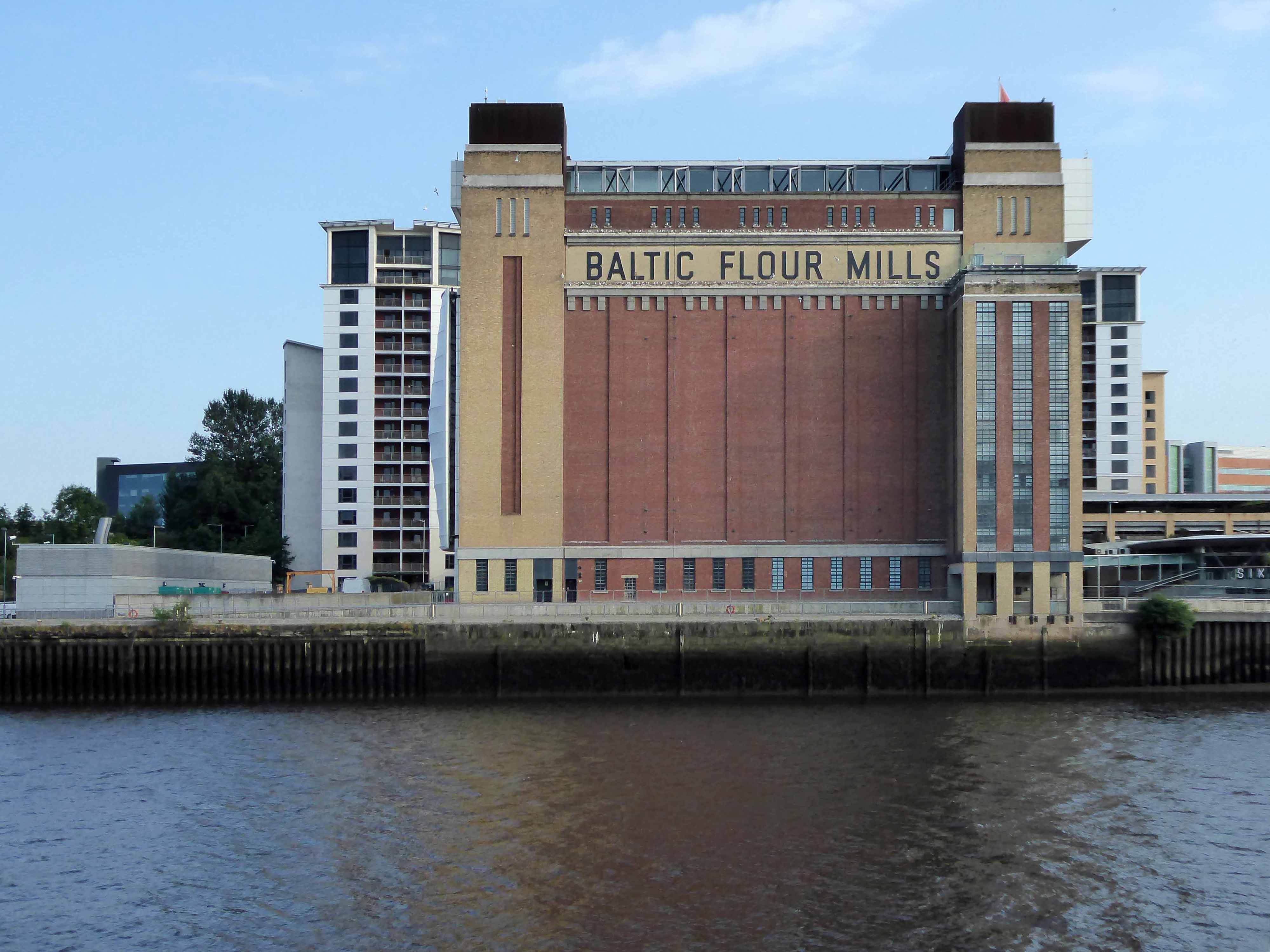
I cycled the banks of the Tyne, fetching up at the Quayside with a fine view of the Baltic.

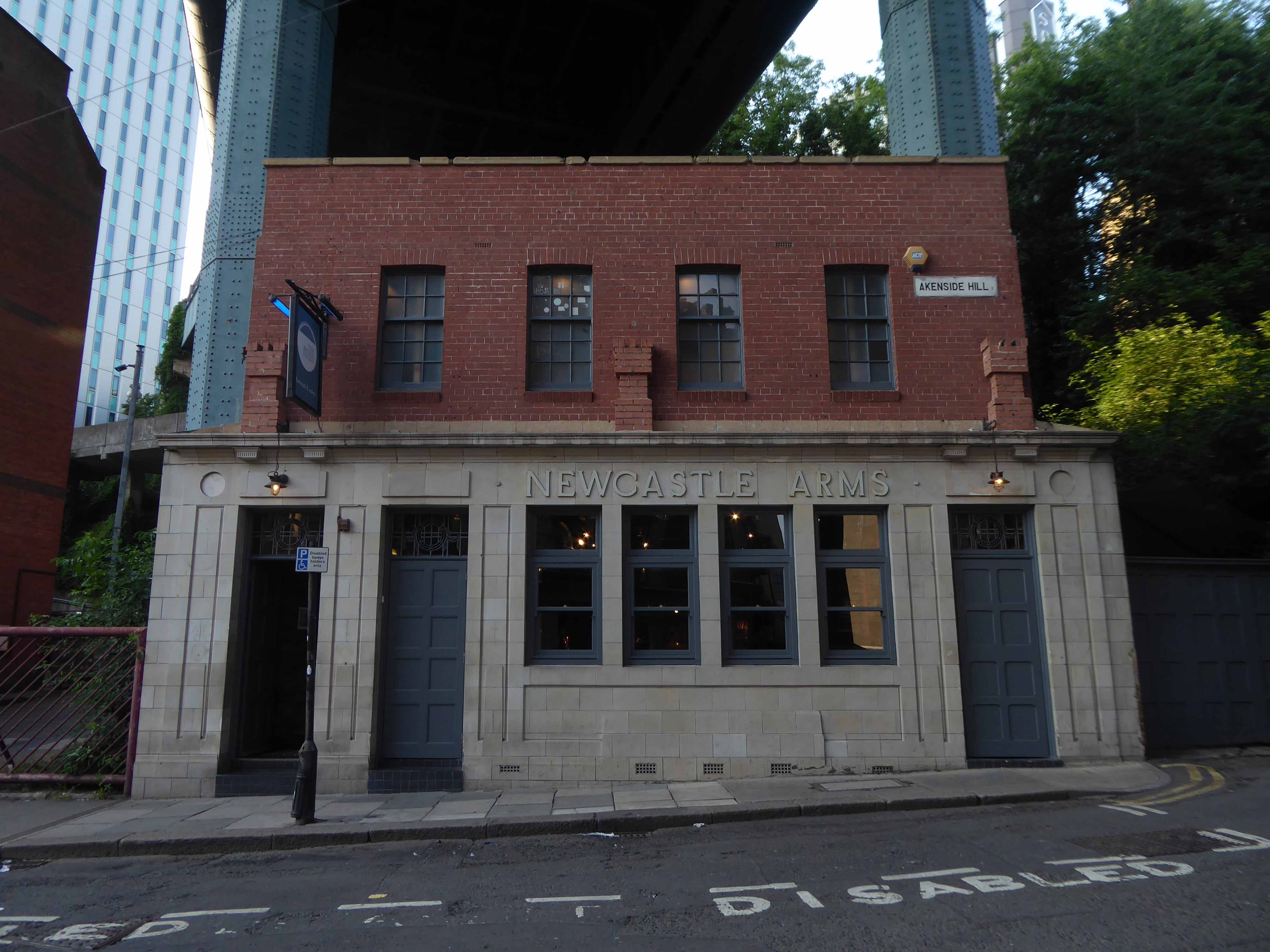
Washed and suitably brushed up I hastened to the Bridge Tavern – to take a glass or two.

A fine end to a very long day.

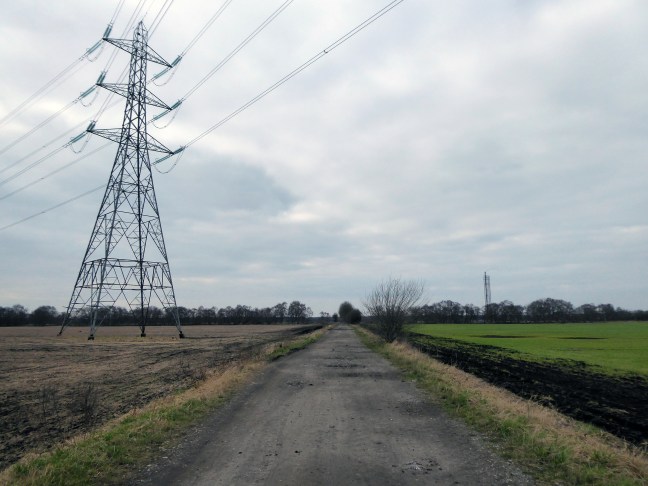
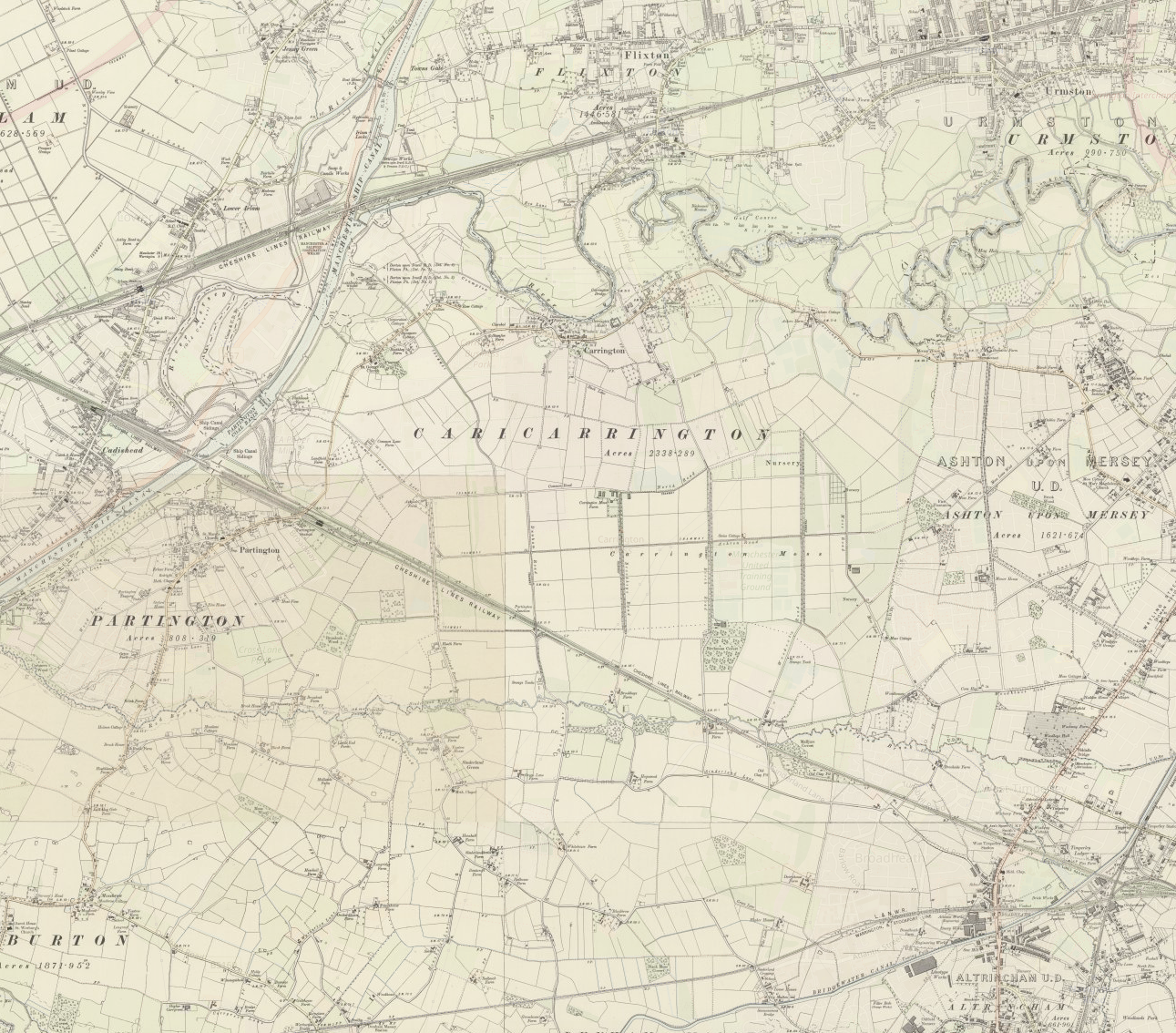
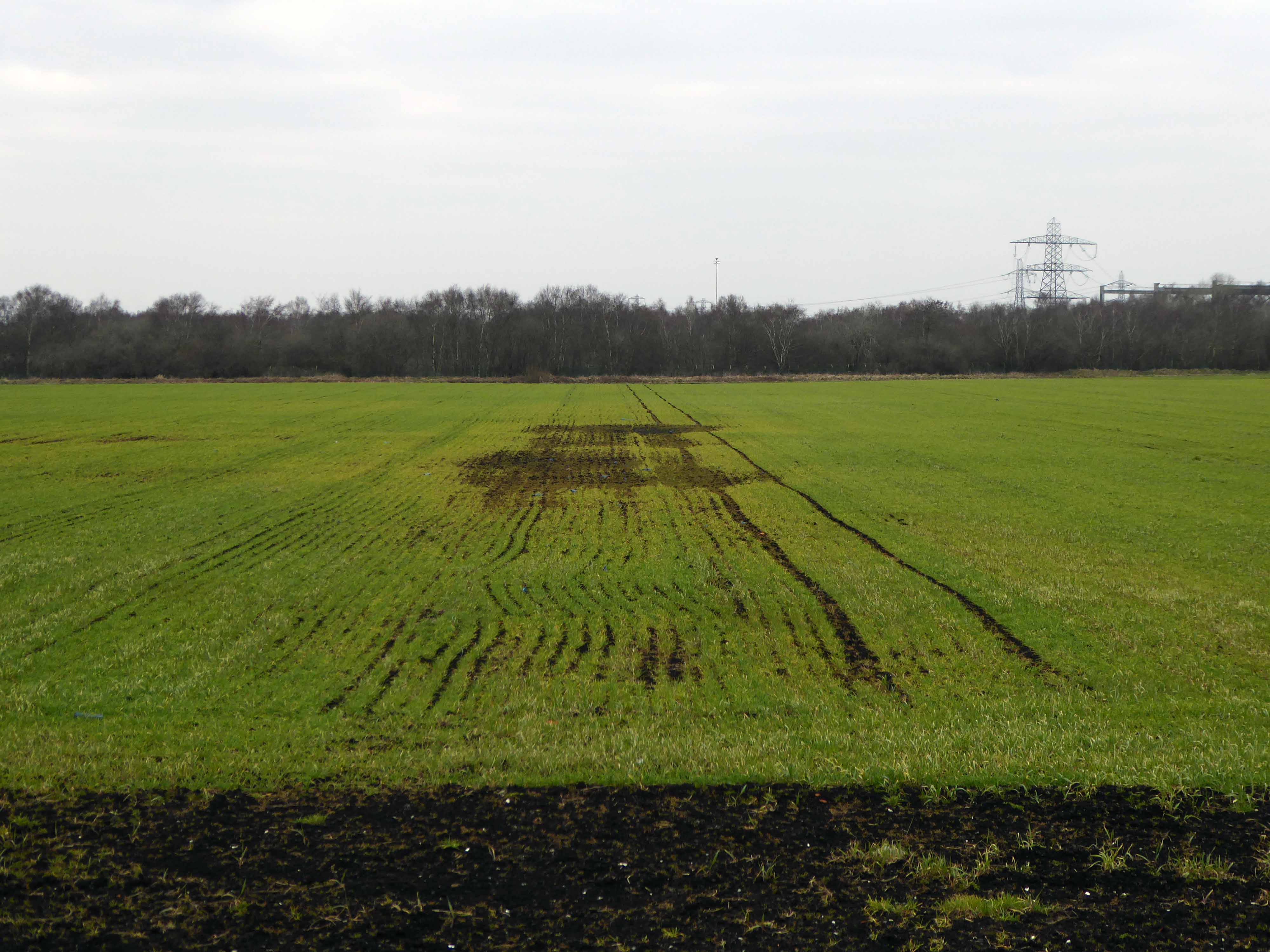
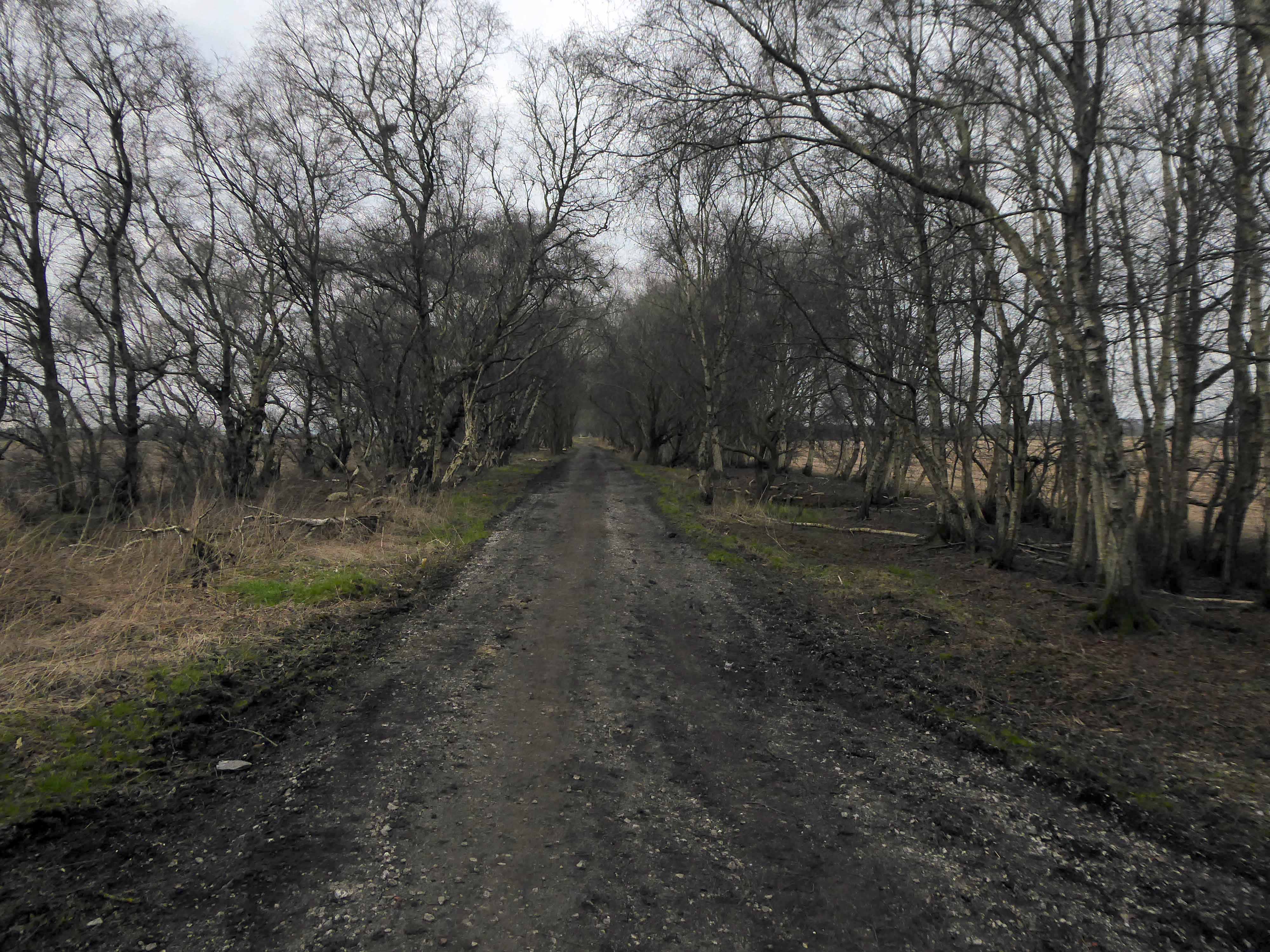
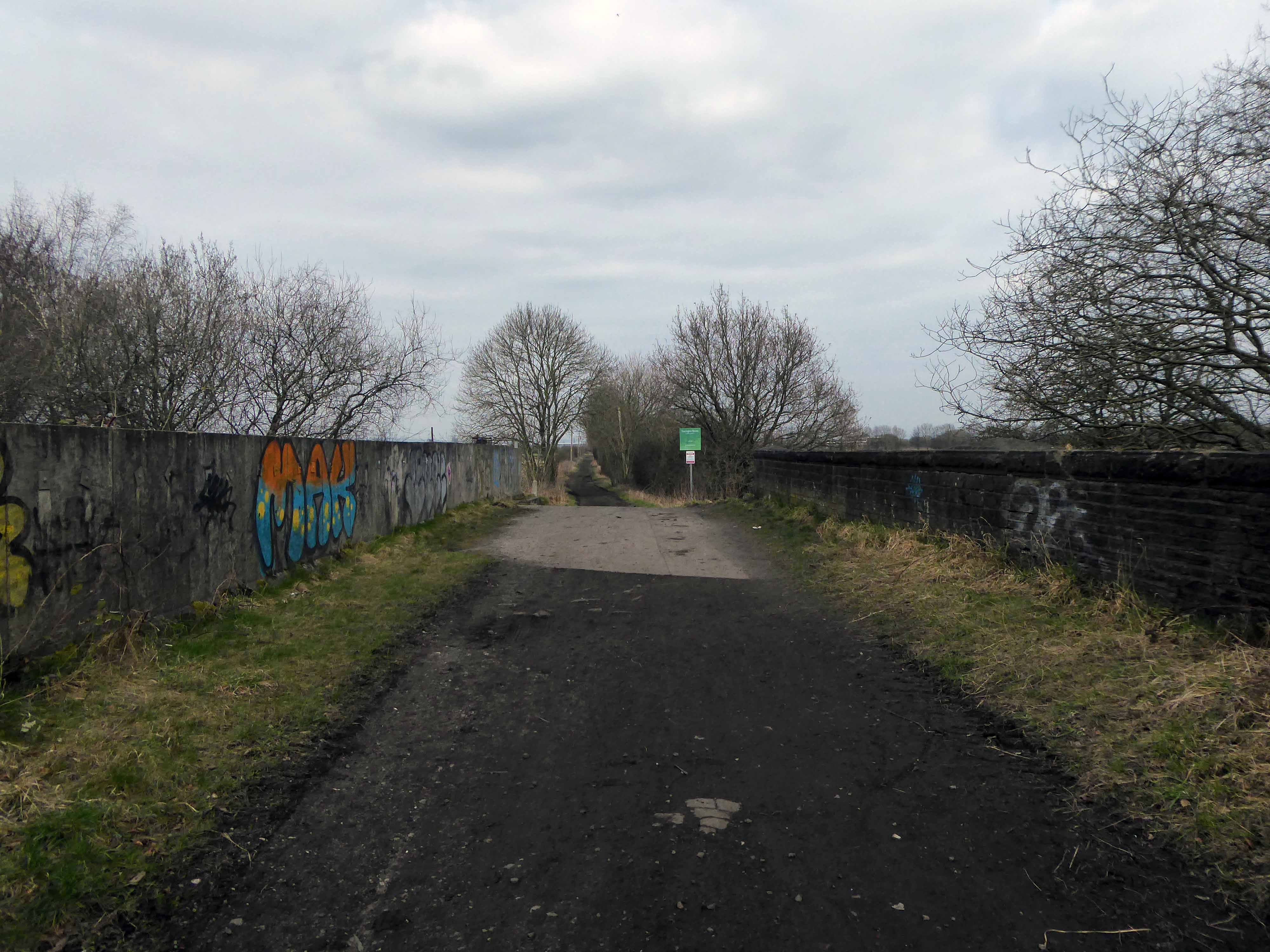
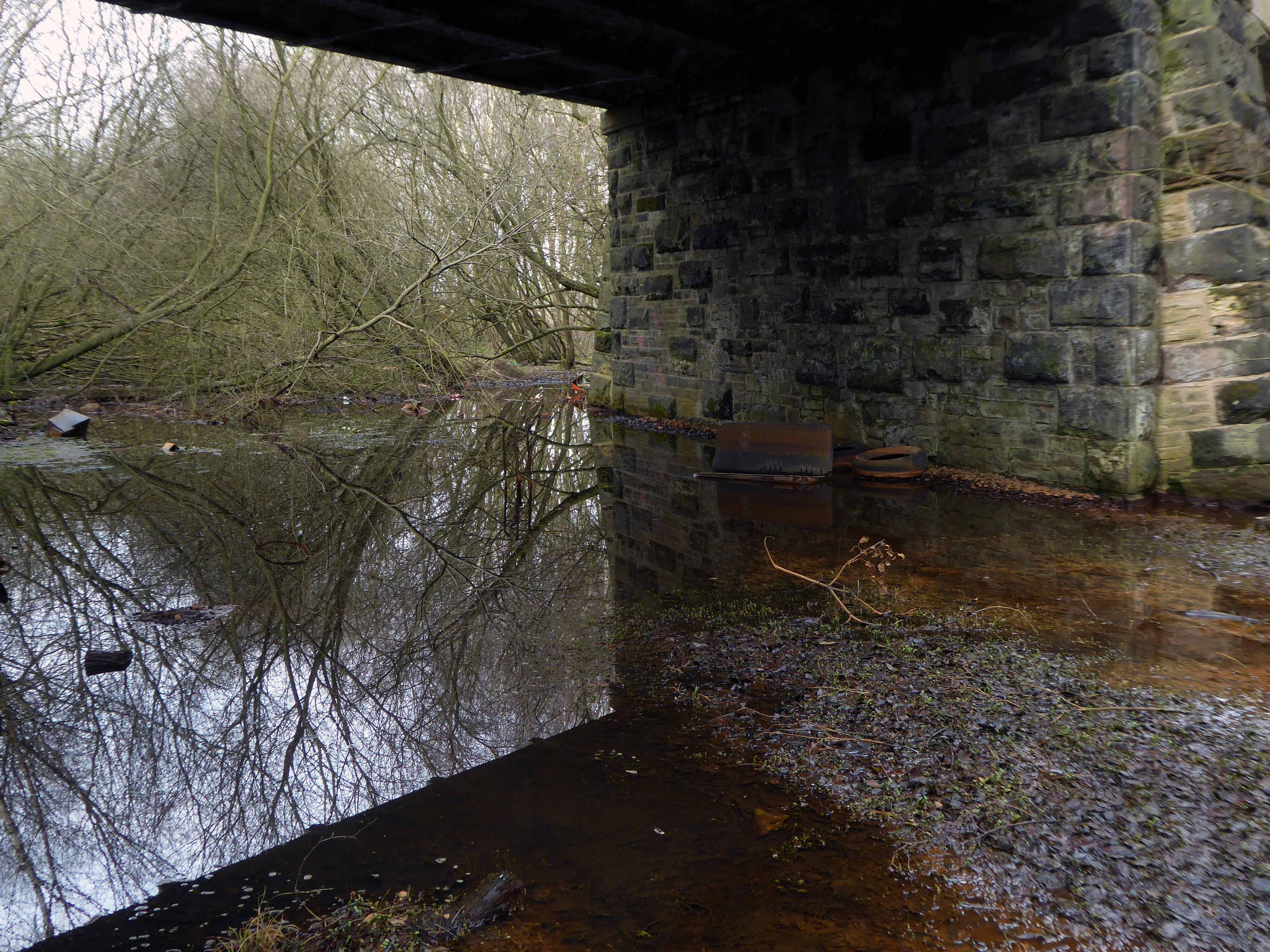
Carrington Moss

Flat as can be, between rail and river, flat.

Crisscrossed by tramways and drainage ditches.

Carrington Moss is a large area of peat bog near Carrington in Greater Manchester, England. It lies south of the River Mersey, approximately ten miles south-west of Manchester, and occupies an area of about 1,100 acres..Originally an unused area of grouse moorland, the moss was reclaimed in the latter half of the 19th century for farming and the disposal of Manchester’s waste. A system of tramways was built to connect it with the Manchester Ship Canal and a nearby railway line. During the Second World War the land was used as a Starfish site and in the latter half of the 20th century, a large industrial complex was built along its northern edge. More recently, several sporting facilities have been built on Carrington Moss. Today, the land is still used for farming and several nature reserves have been established within its bounds.

Parts of Carrington Moss are accessible to the public over several rights of way.

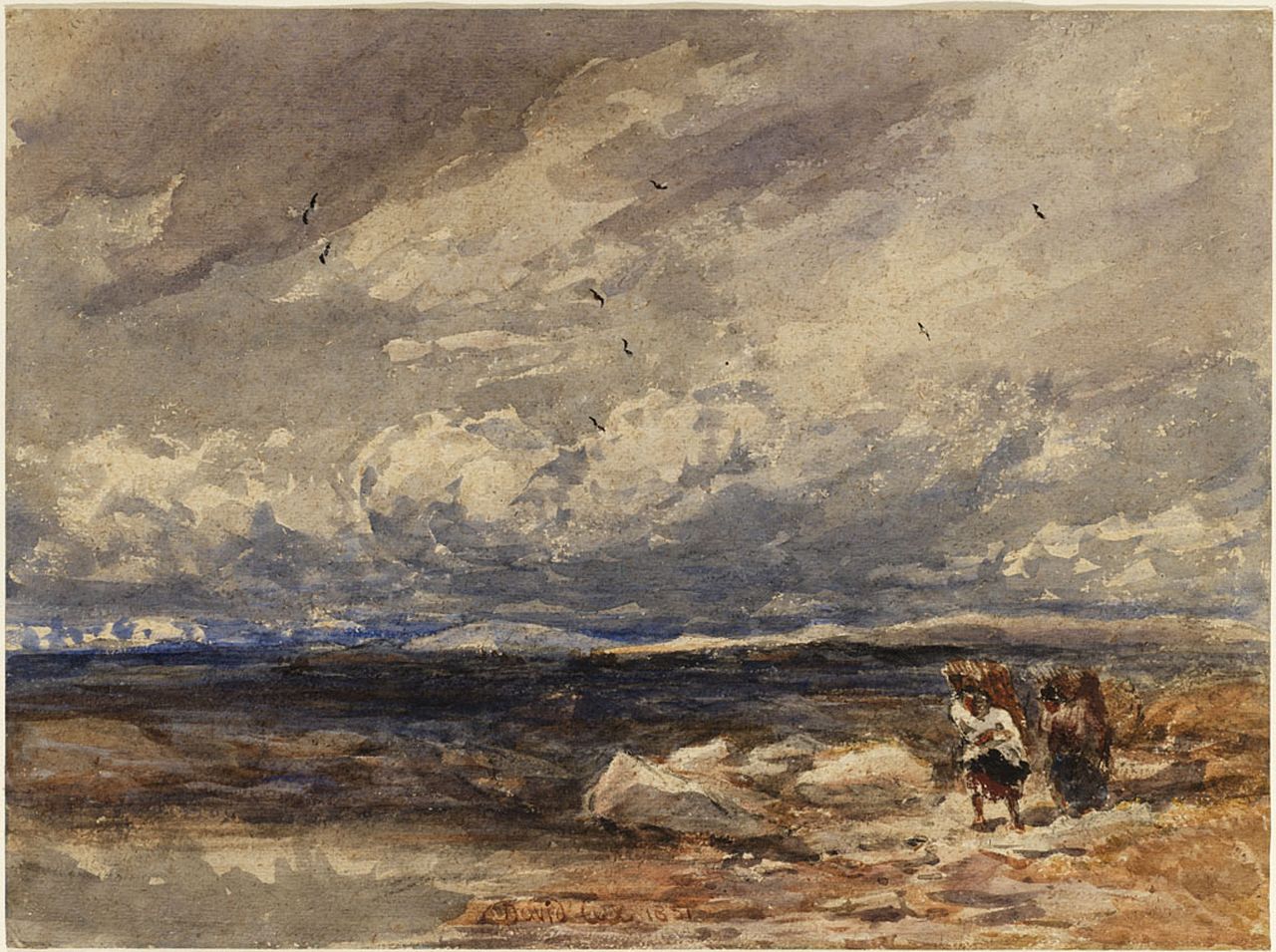
On Carrington Moss 1851 David Cox

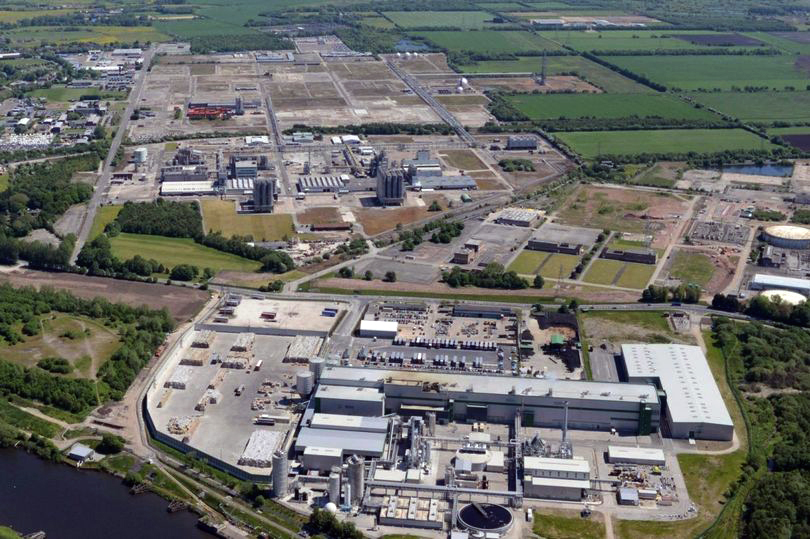
Industrialisation of the moss took place from 1947–1952 when Petro-Carbon ltd began to build what would later become known as the Shell Site. The estate was leased on 1 October 1968 to Shell Chemicals, who in 1957 had purchased a propylene oxide plant along the moss’s northern edge. Shell had built an ethylene oxide plant in 1958 and began to produce polyether polyols the following year. Council housing was built nearby, at Carrington and Partington, for workers and their families. By 1985 the Shell plant had a turnover of about £200M and employed 1,150 people, but a major restructuring of the business reduced the workforce to less than 500 by 1986. By 1994, four distinct plants operated on the 3,500-acre (14 km2) site, producing a range of chemicals, and materials including polystyrene, polyethylene and polypropylene. In 2005 it was reported that Shell would close their polyols and ethoxylates units, a decision which came into effect in 2007. The estate is currently managed by chartered surveyors Bell Ingram. Lyondell Basell operate the last remaining chemical plant on site.

Wikipedia

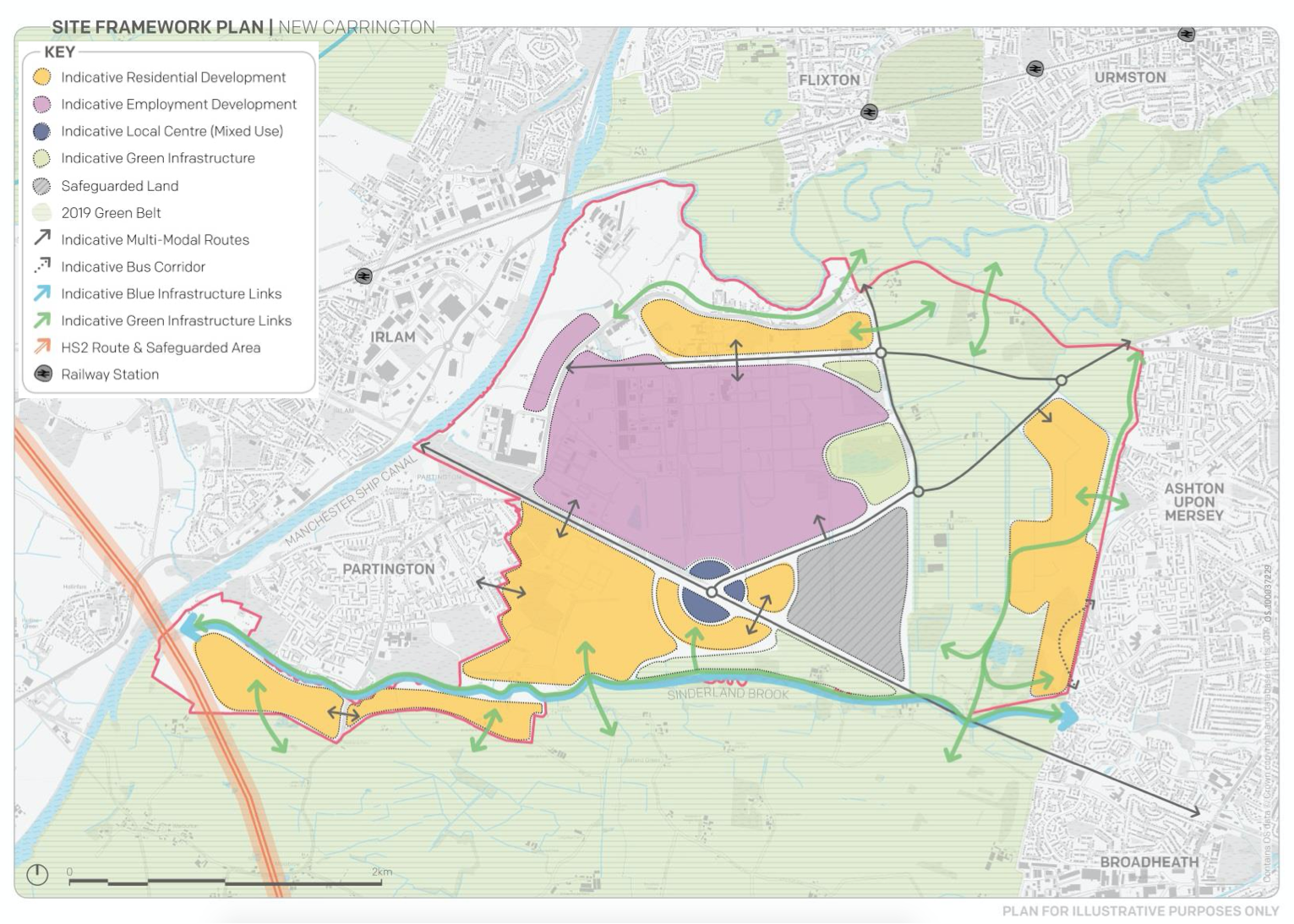
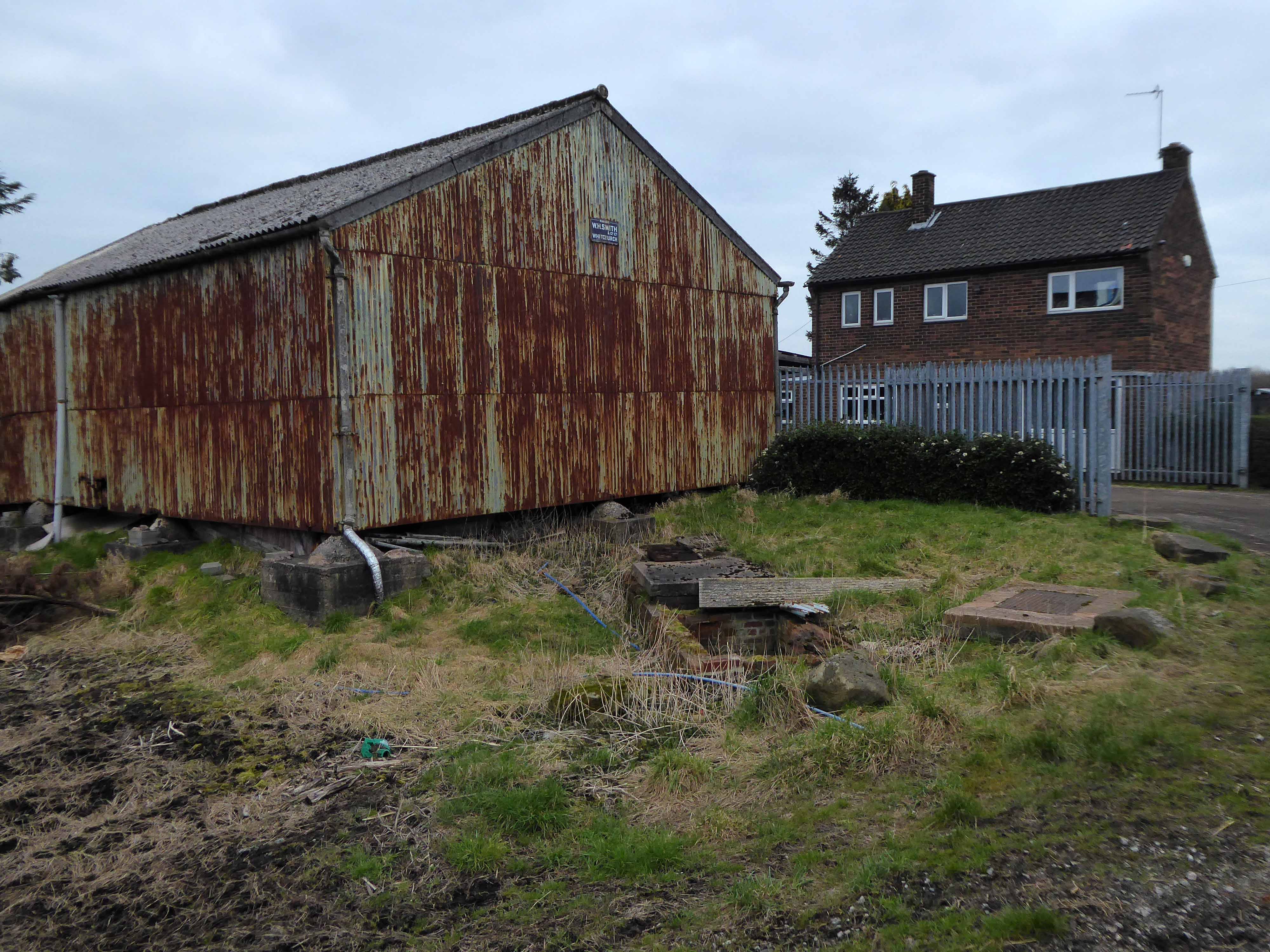
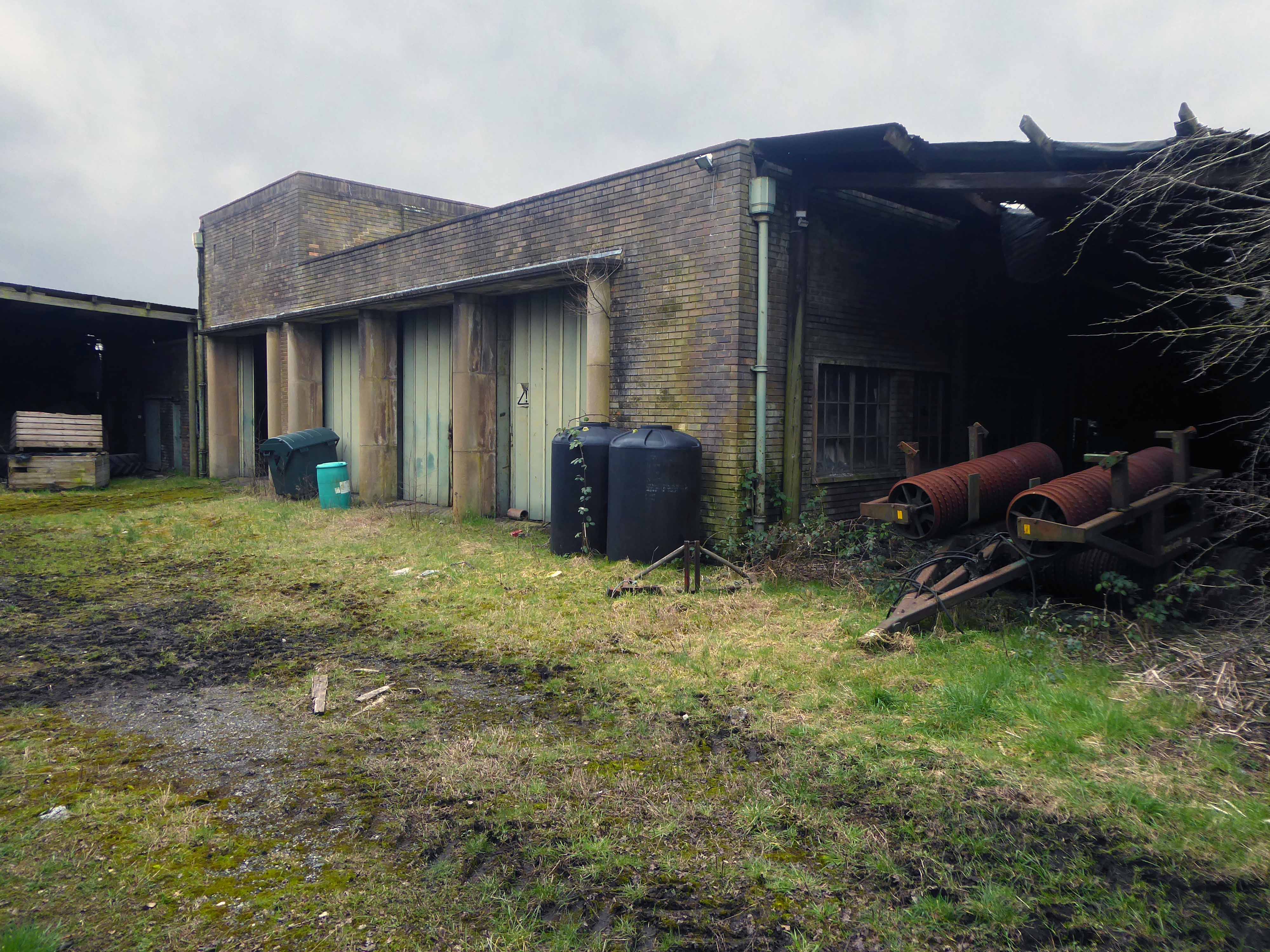
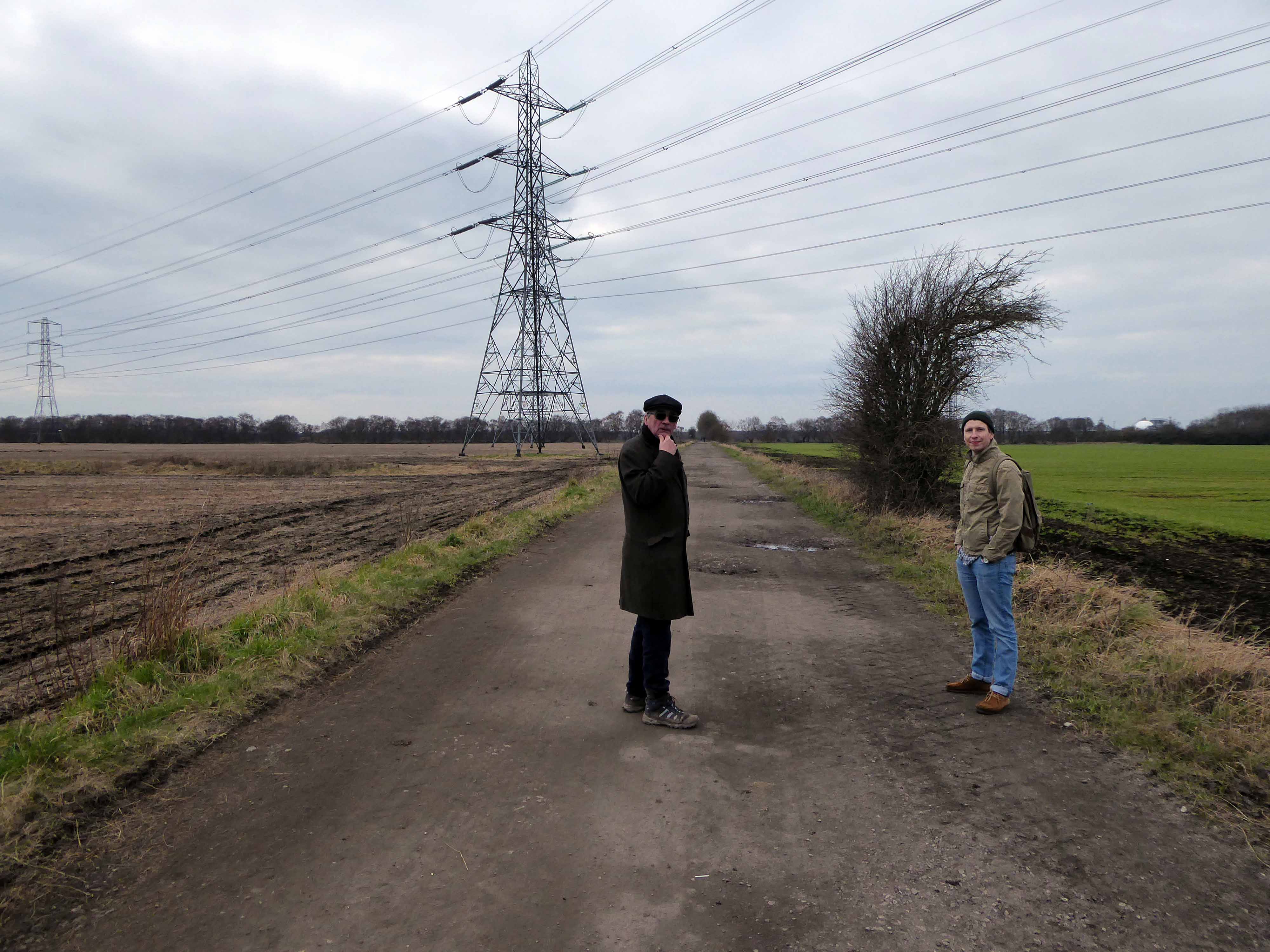
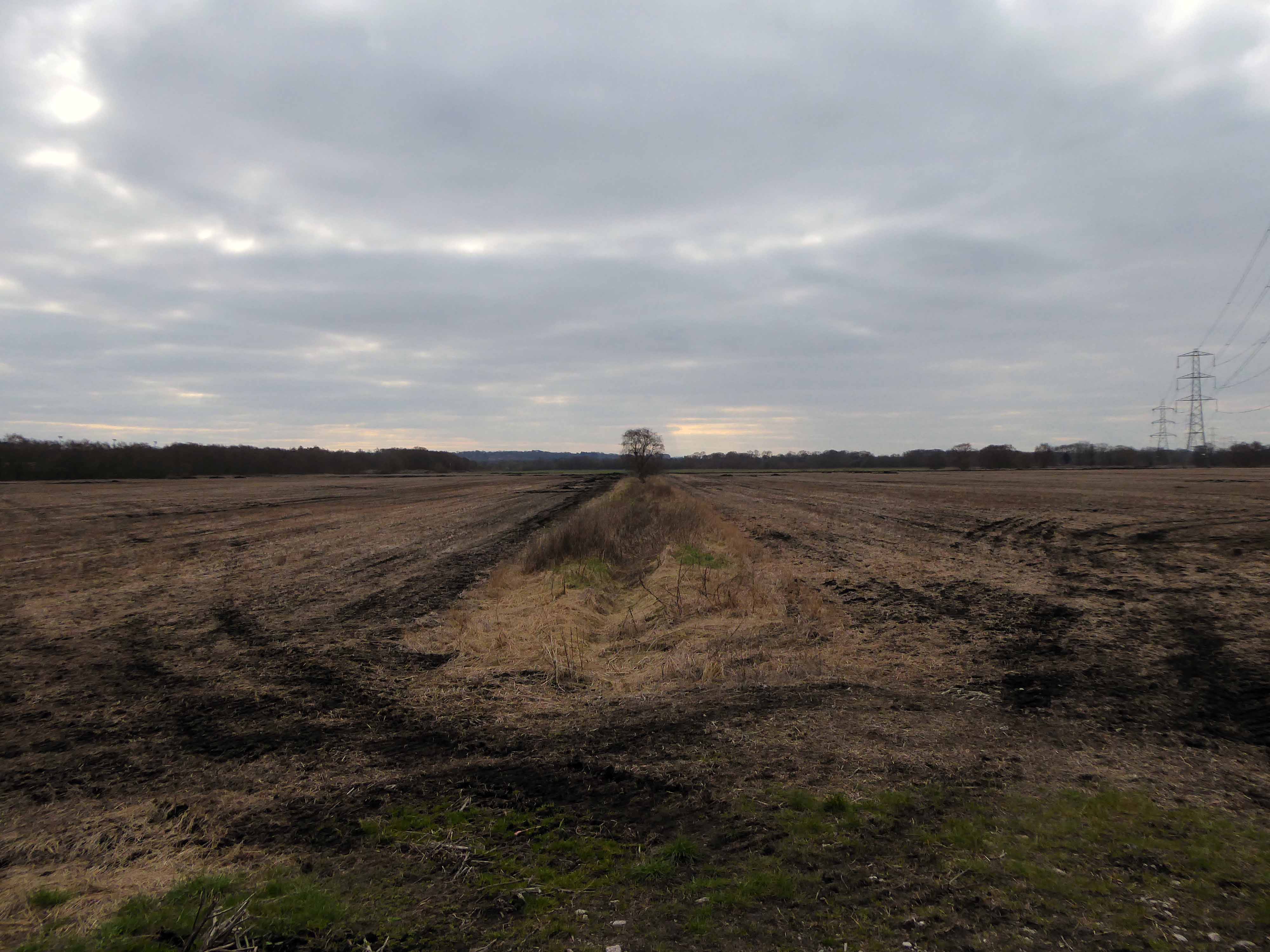
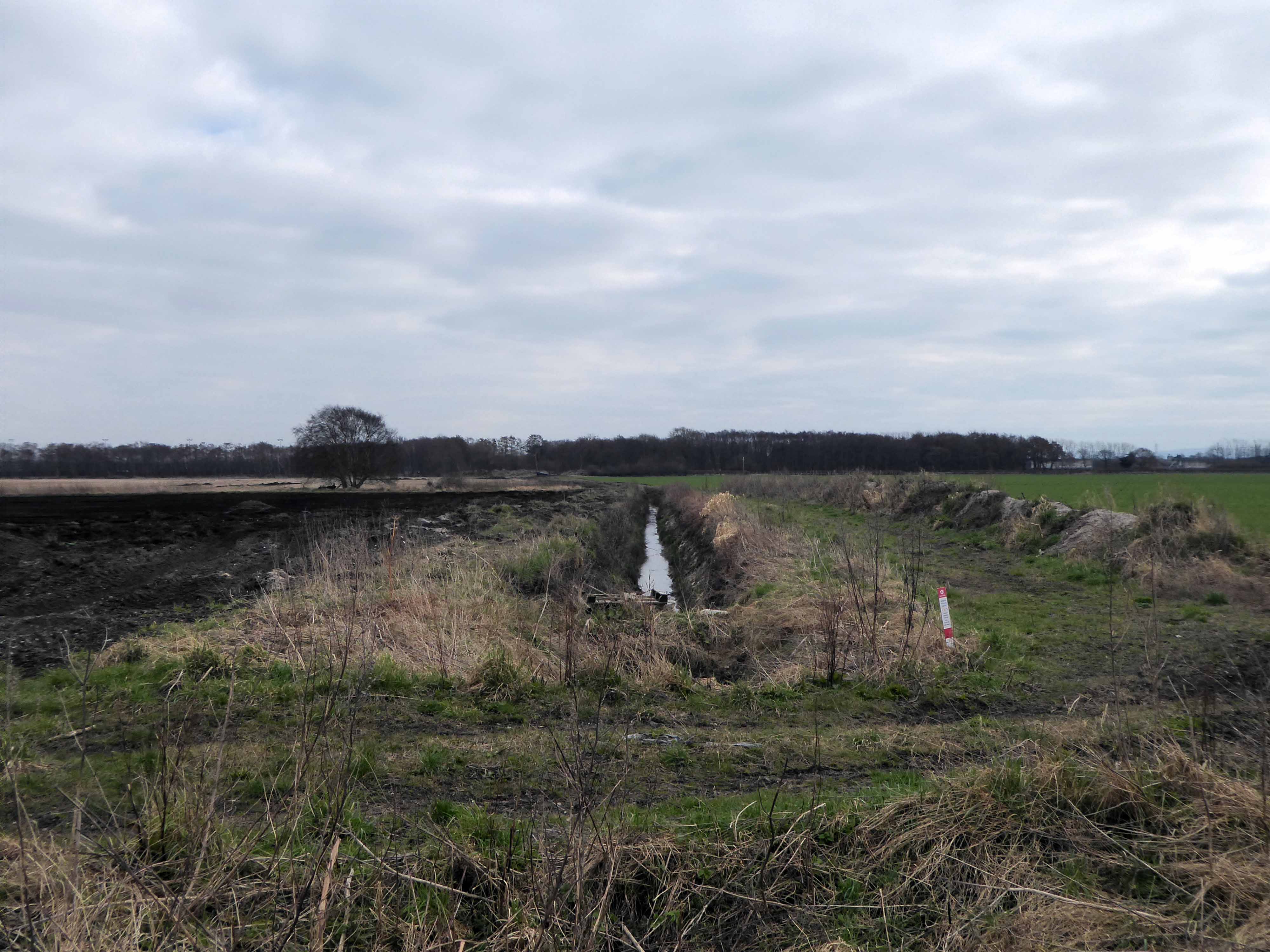
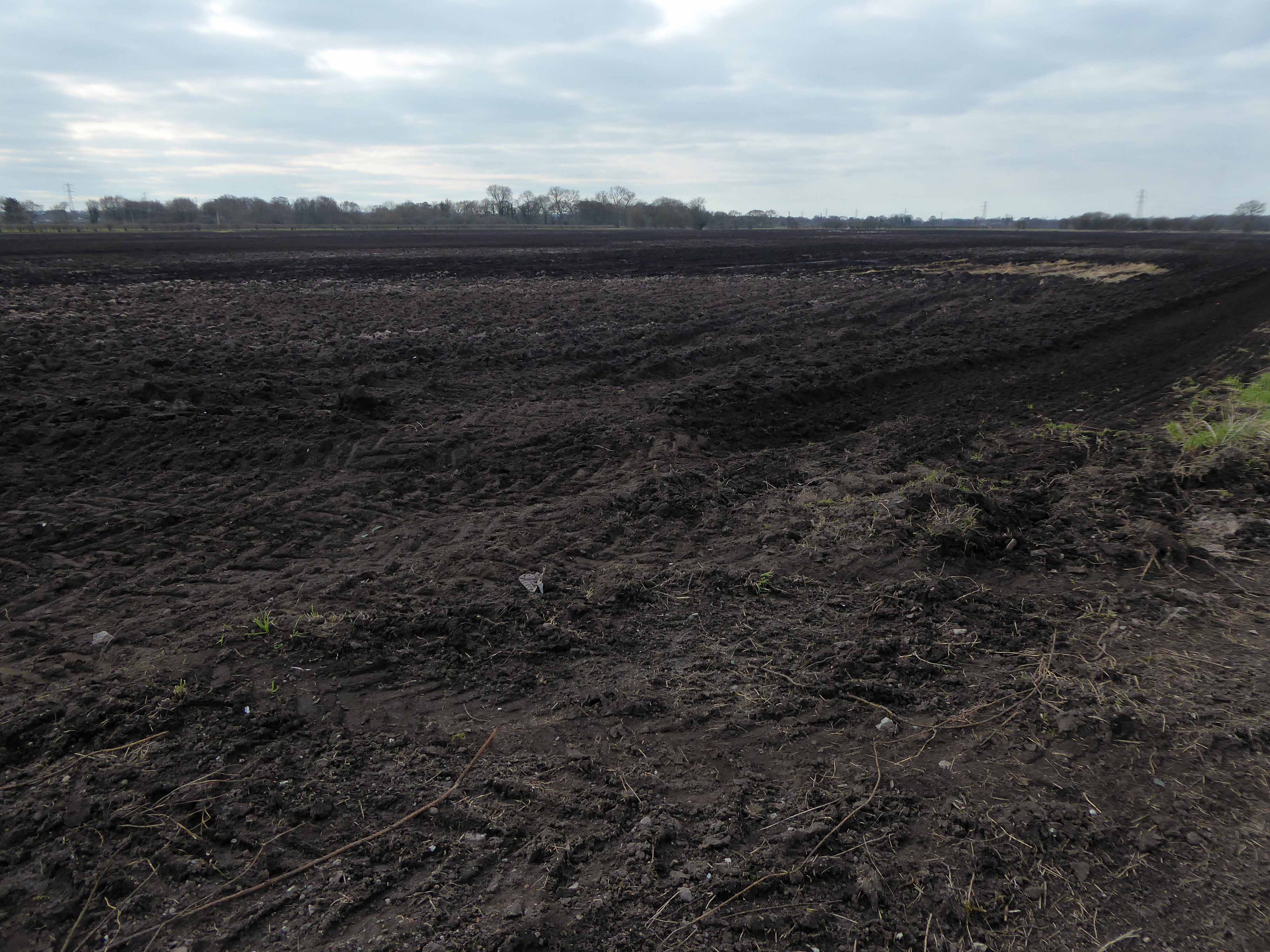
This is the beleaguered site, still farming, remnants of rail, traces of tipping and vestiges of industry.

Plans are afoot – including of course indicative multi-modal routes.

Trafford Gov UK

Hundreds of campaigners fear endangered wildlife at Carrington Moss will be ‘decimated’ if plans to build a new town on green belt land go ahead.

They also argue the development would be ‘catastrophic’ in terms of how it would impact the environment.

Manchester Evening News

Storm Christoph showed that Manchester is susceptible to the adverse effects of extreme weather events, which are forecast to become more regular occurrences.

Greater Manchester Labour for a Green New Deal argue that we must abandon the idea of developing on greenbelt, and instead embrace bold alternatives which reflects the urgency of the climate crisis﹣starting with sites like Carrington Moss.

The Meteor

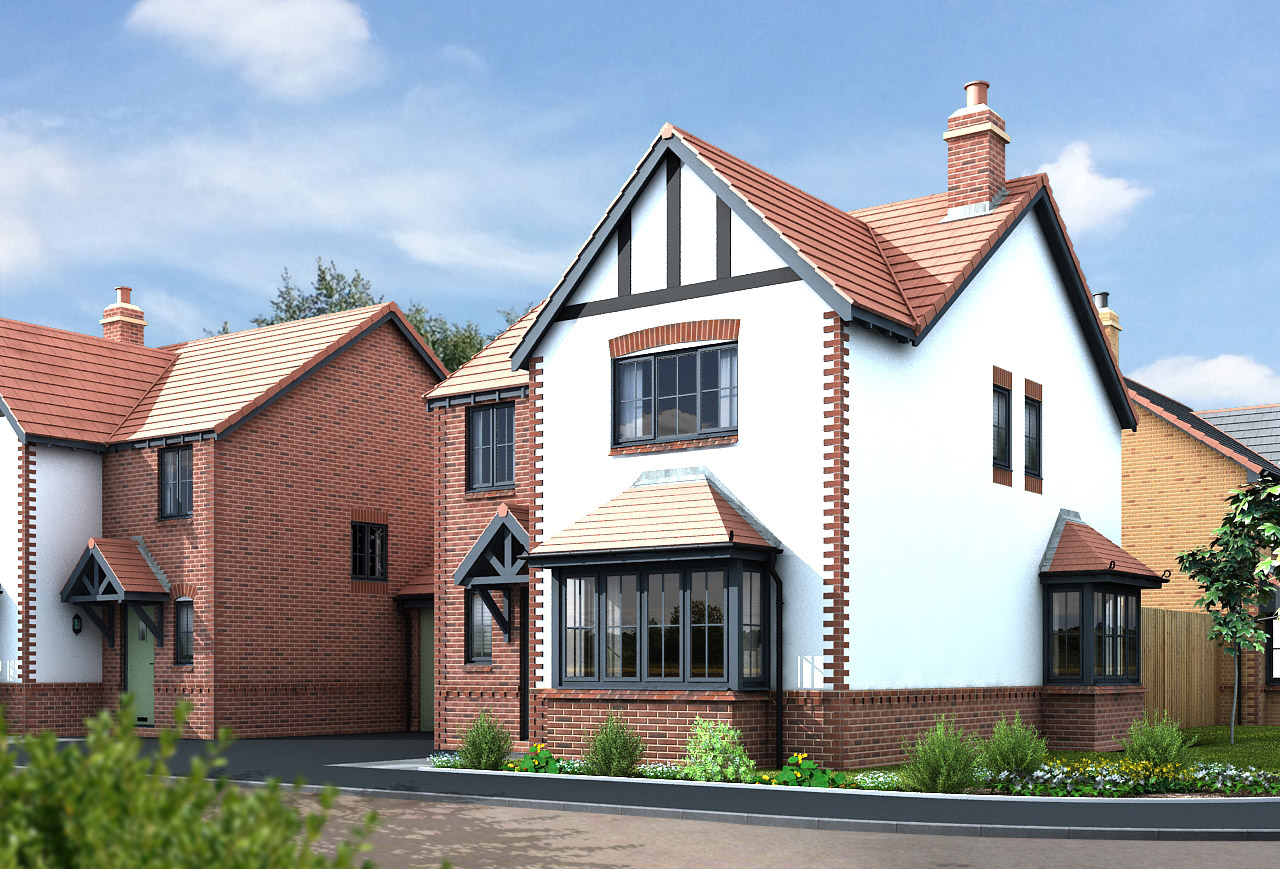
This is an area in liminal limbo, the pressures of the modern world leaning on its very being, as ash, alder, badger, field mouse, and kestrel give way to Wainhomes.

Where then will the wanderer wander, in search of solace?

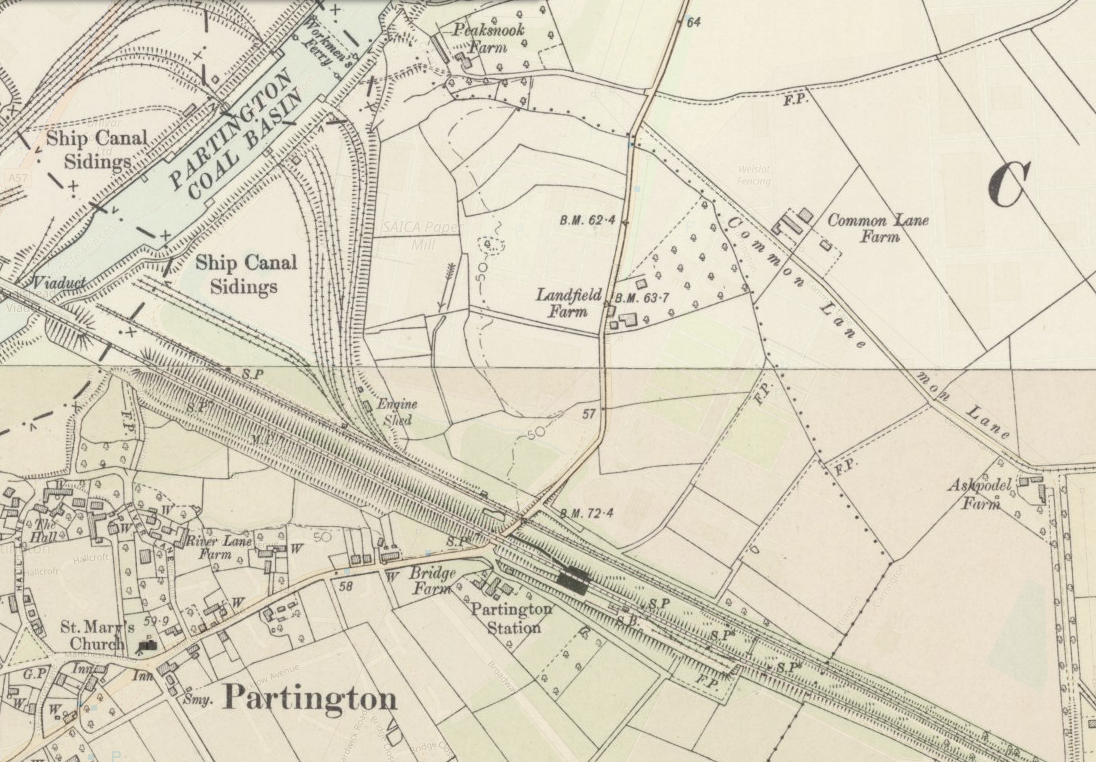
Ending our journey at the long gone Partington Station

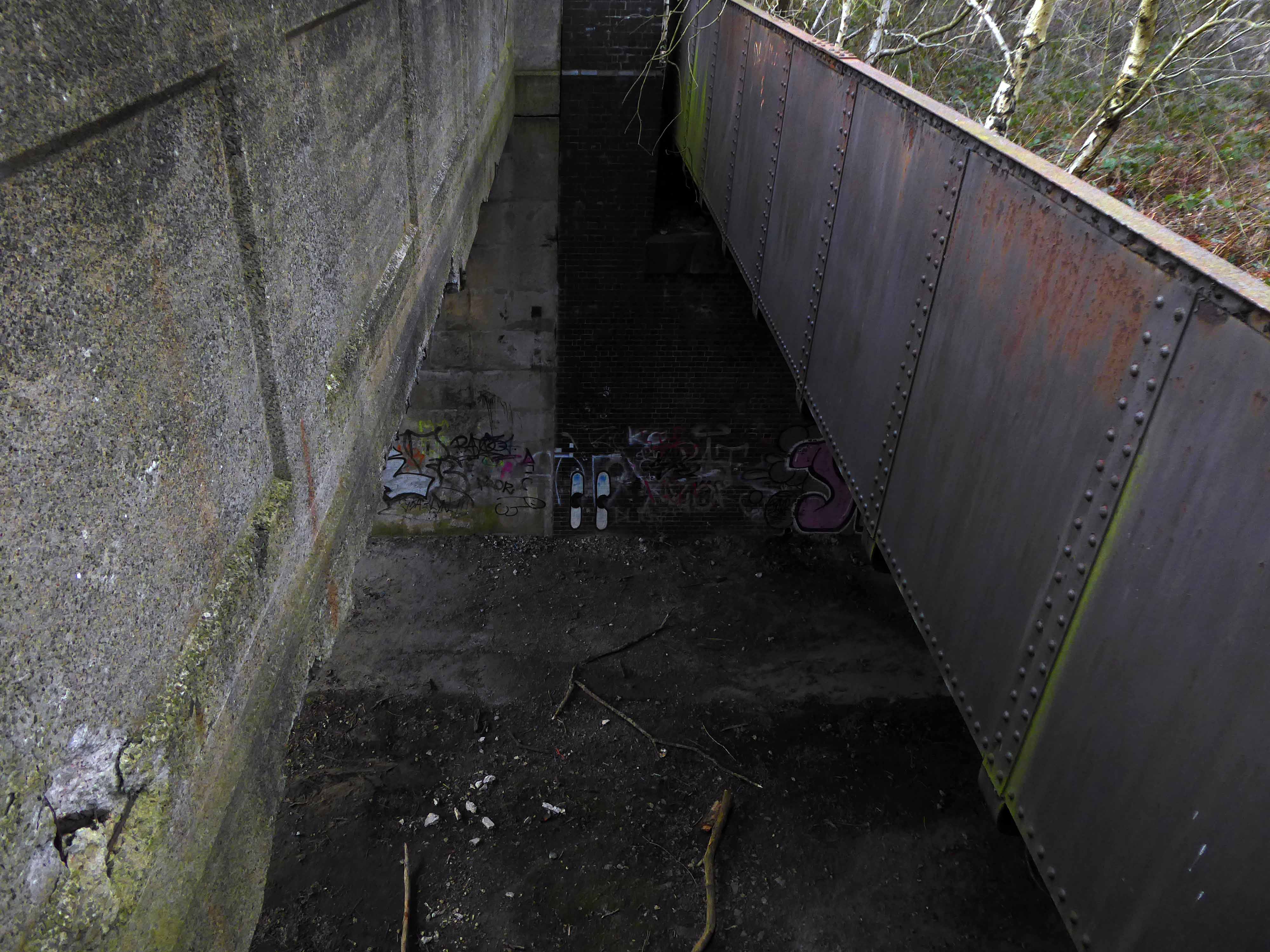
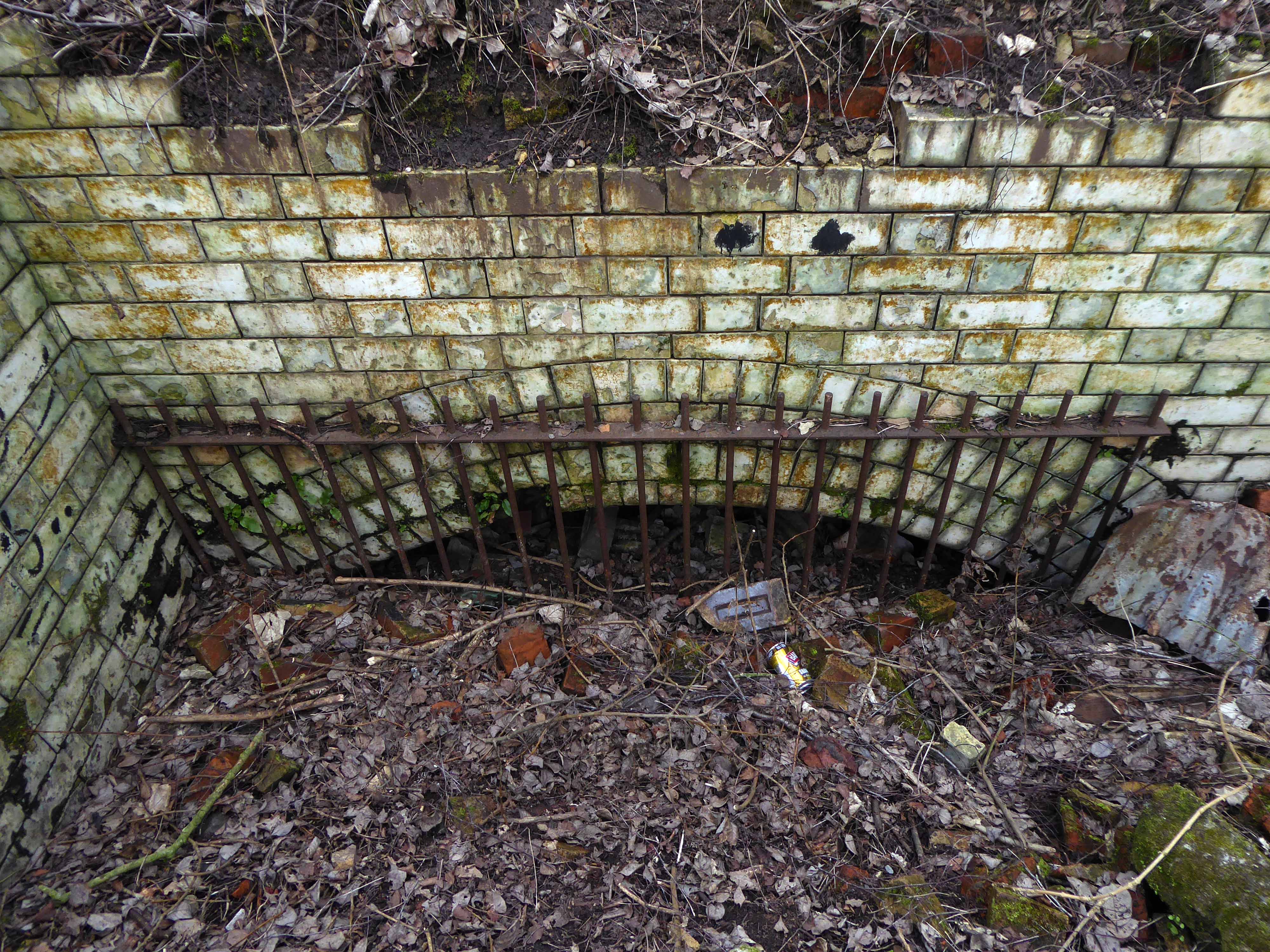
The remains of the subway.

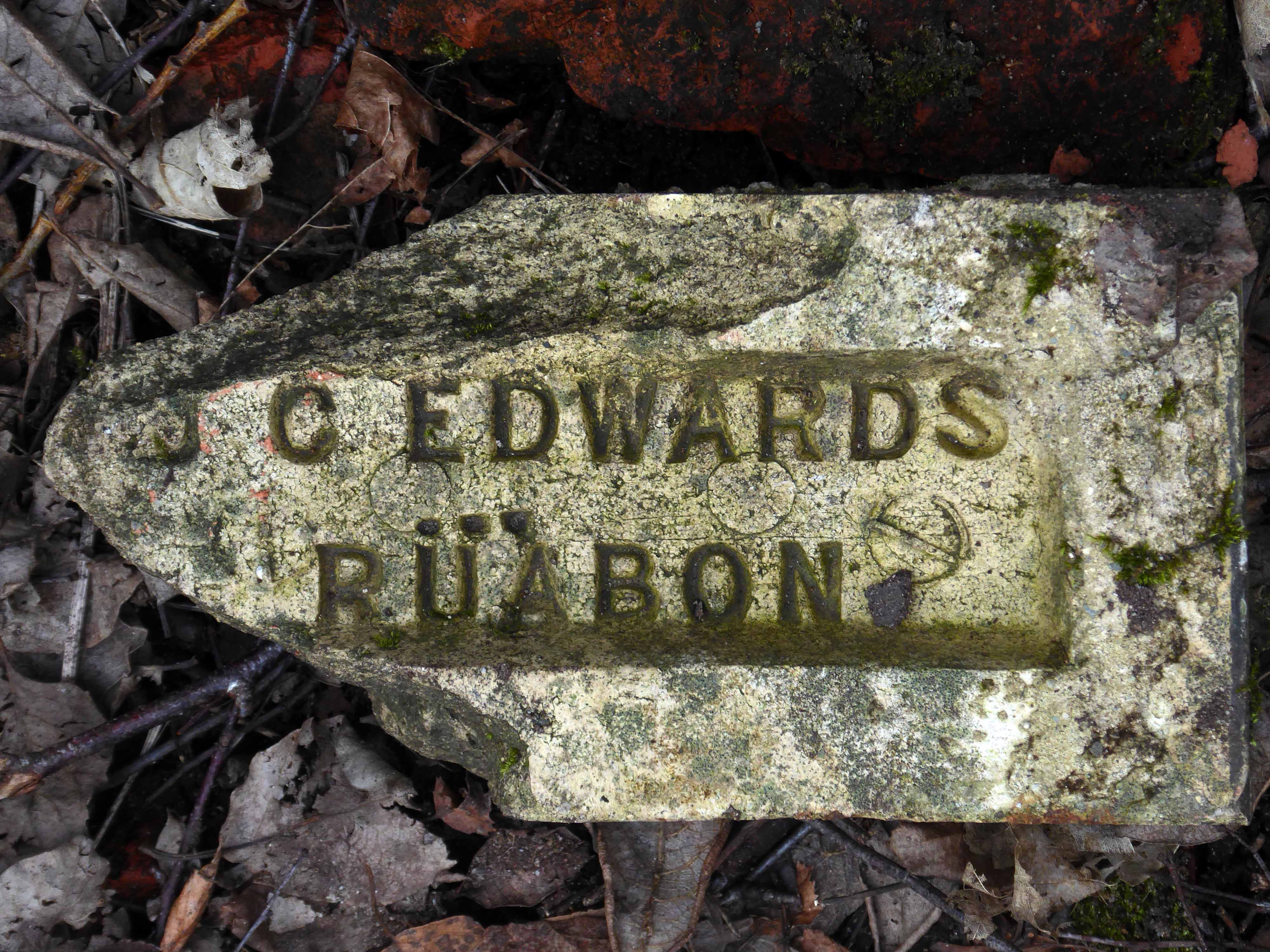
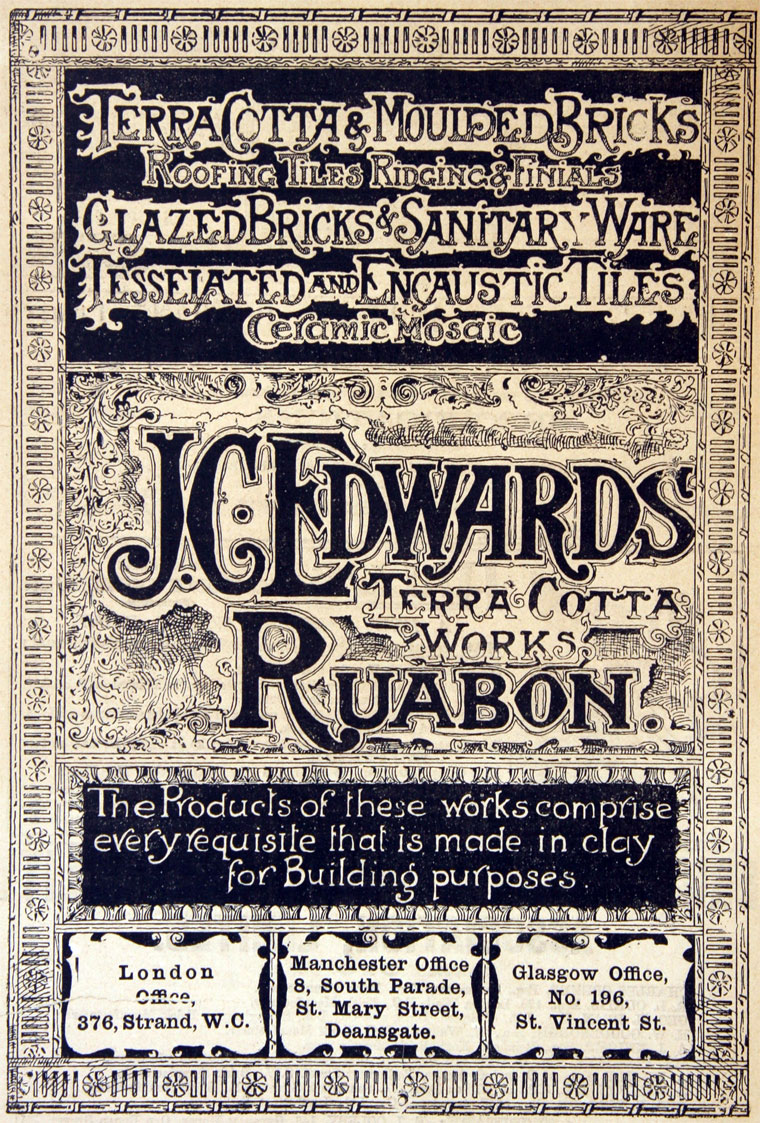
The company of J. C. Edwards Ruabon Ltd, was based in Ruabon, Denbighshire, and was active from 1903 to 1956 as a brick, tile and terracotta manufacturer from its works at Tref-y-Nant, Acrefair, Albert Works, Rhosllannerchrugog, and Pen-y-bont, Newbridge, Denbighshire.

James Coster Edwards (1828-1896) founded the company; it was sold in 1956.

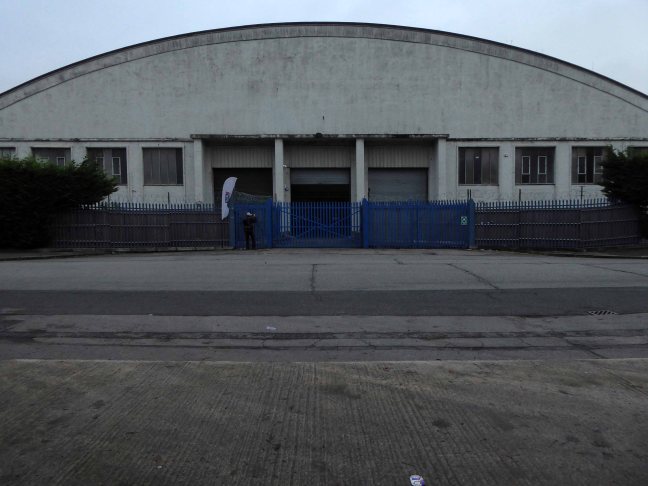
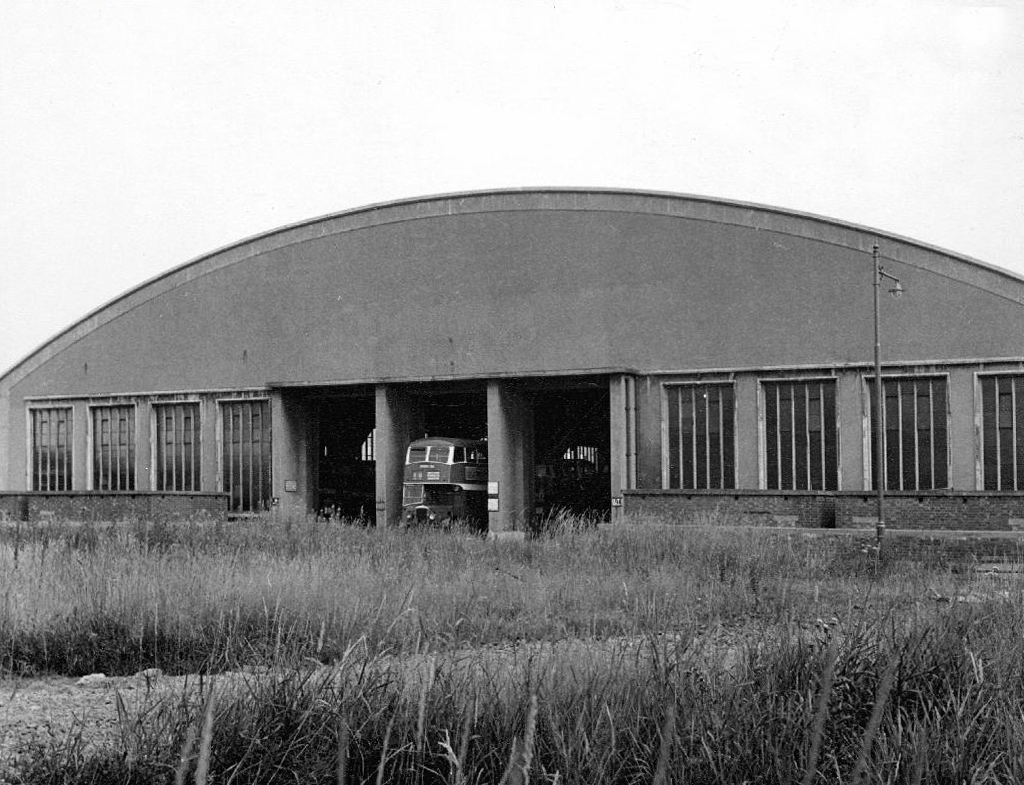
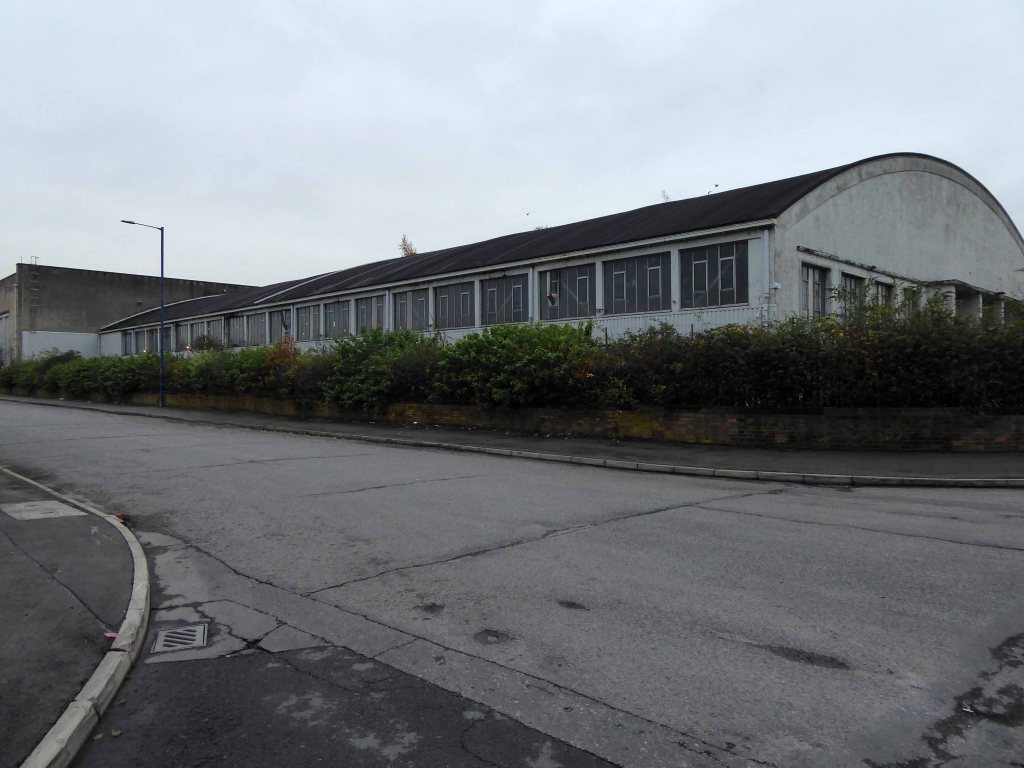
Sharston Bus Depot – Manchester

Bradnor Rd Sharston Industrial Area

Wythenshawe Manchester M22 4TE

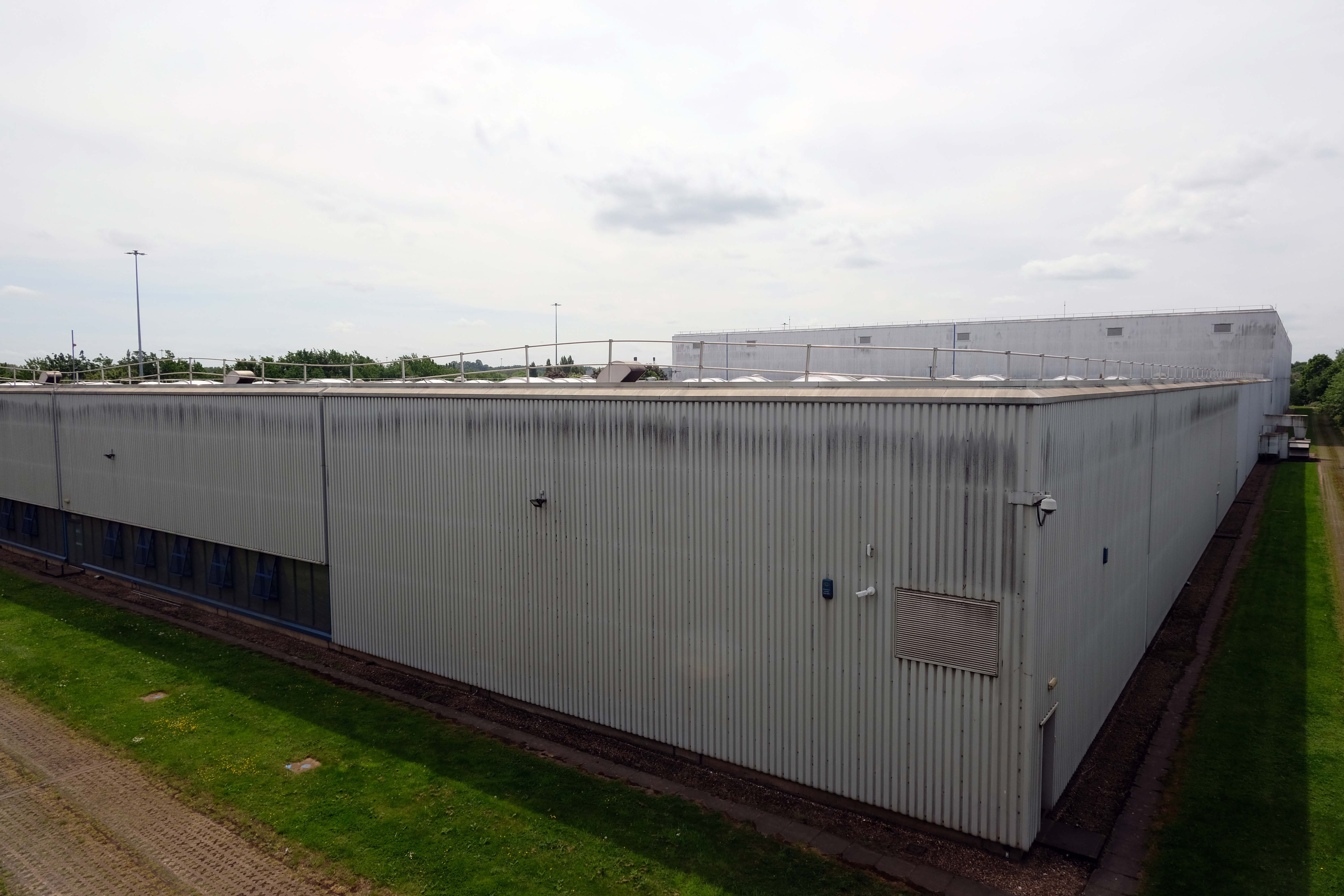
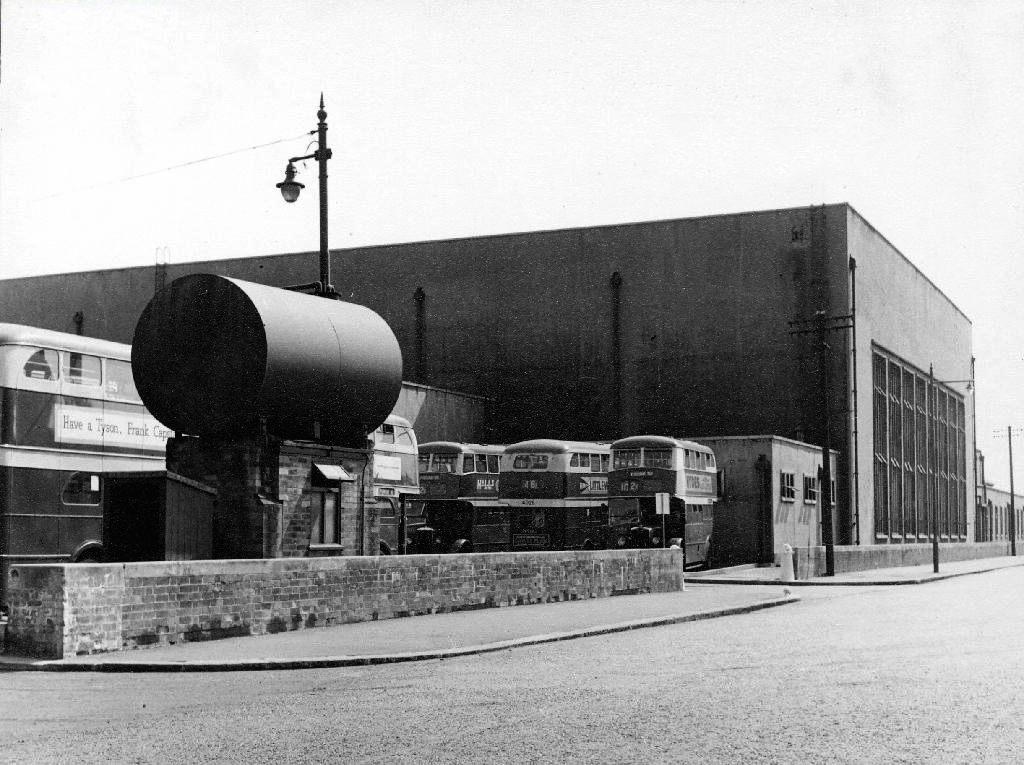
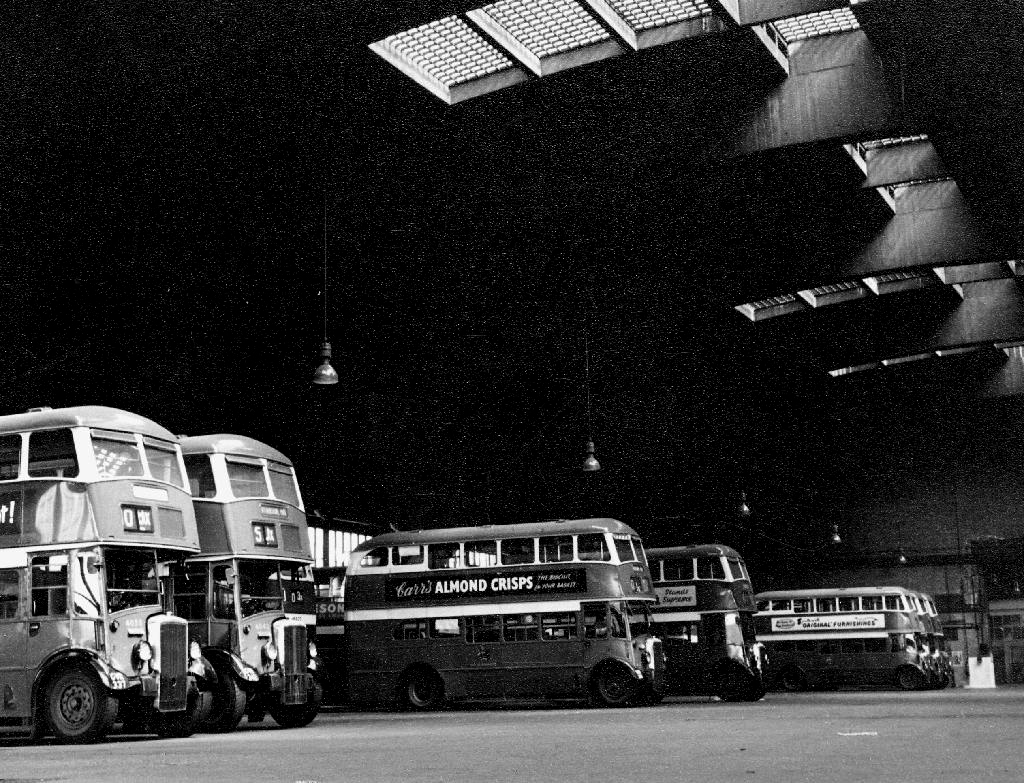
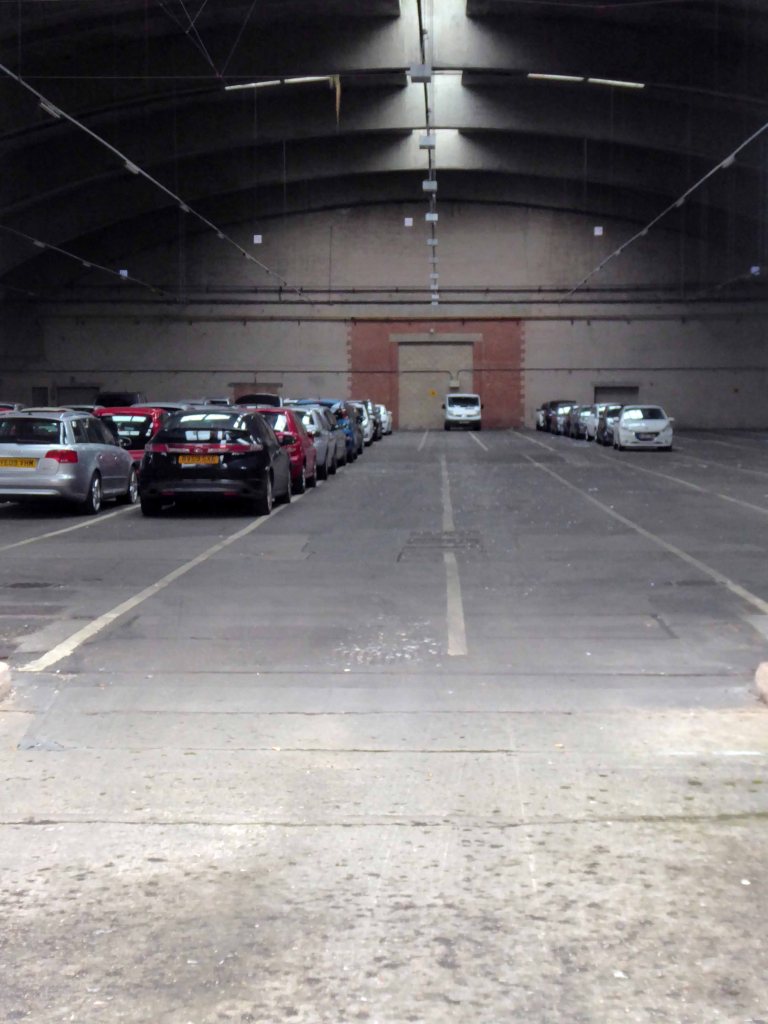
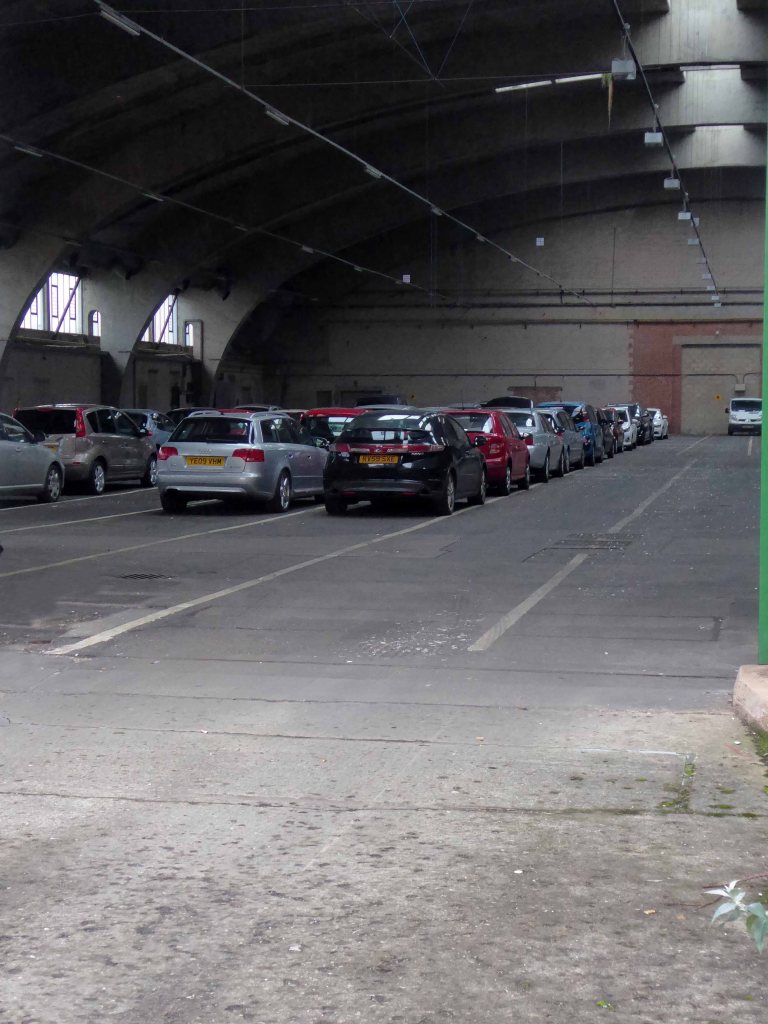
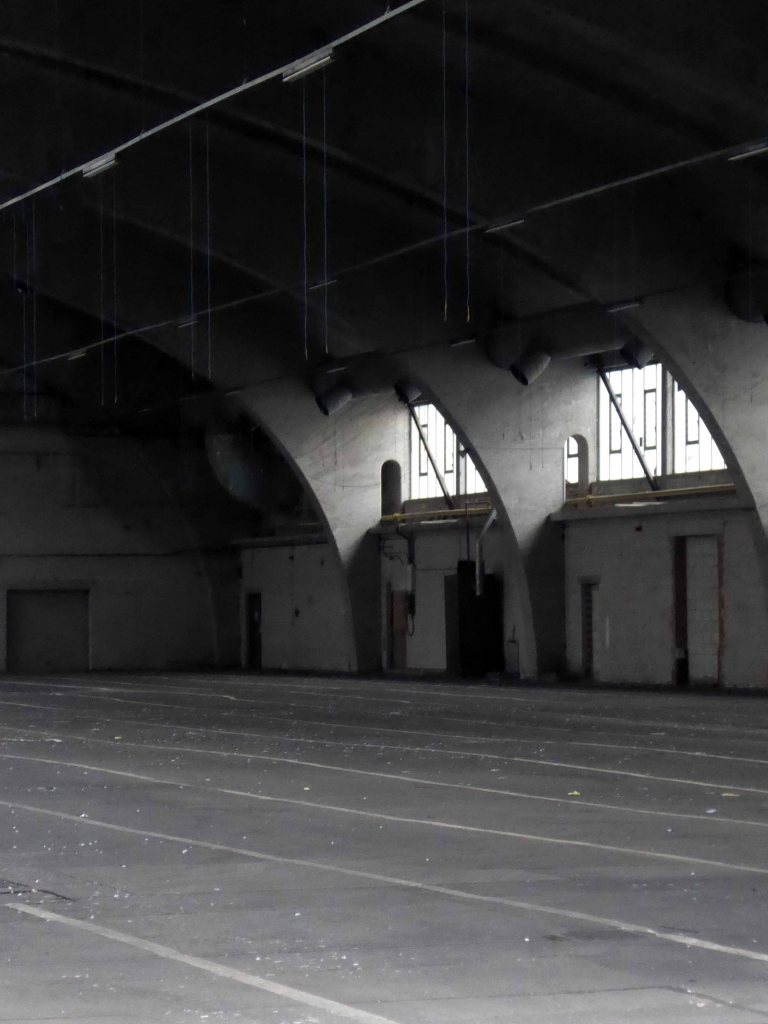
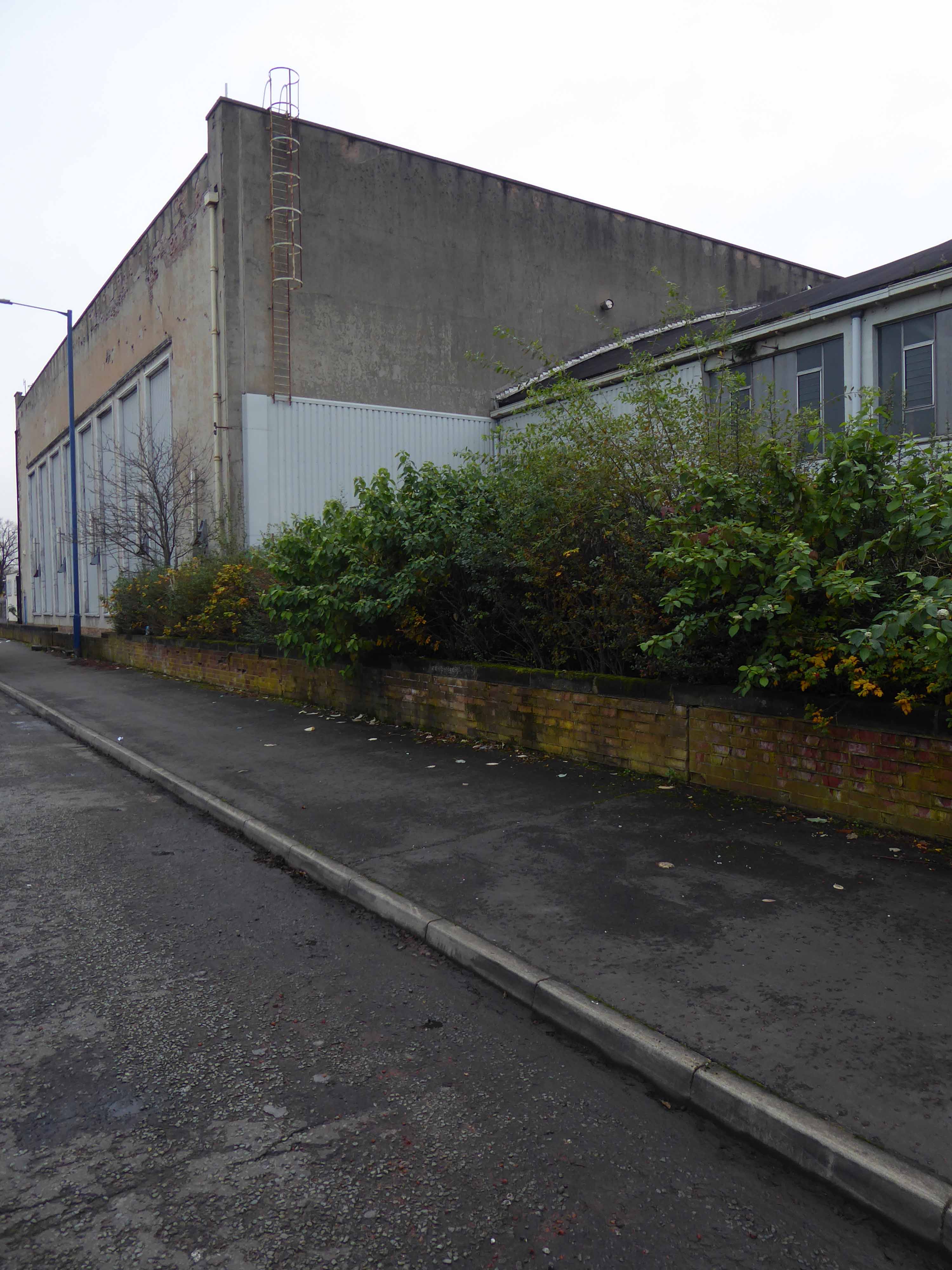
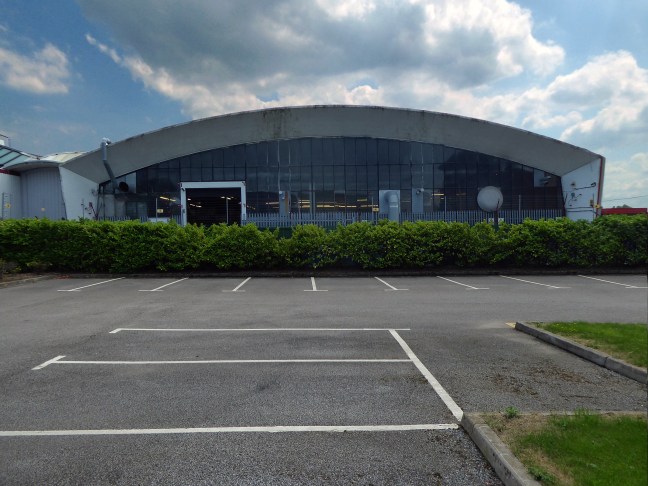
This building formed part of the later phasing of the proposed Garden Suburb of Wythenshawe. It was intended to house up to 100 double-decker buses but was put to use as a factory for components for Lancaster bombers during the war. It is included here for the functionalist qualities of the building and the acknowledgement of the daring of the City Architects Department. Academic papers, as late as 1952, cited this simple structure as exemplar of its type; Elaine Harwood notes, ‘this was the pioneering example of the means of construction, and the model for larger shells at Bournemouth and Stockwell’. The arches that support the shell have a span of over fifty metres and are spaced at twelve metre intervals. The concrete shell roof is of the short-barrel type commonly used on single span buildings such as hangars, it is uniformly around seventy millimetres thick. The only single span structure larger than this was indeed an aircraft hangar, at Doncaster Airport, demolished around 1990. This building is now in the ownership of an airport parking company that utilise it as vehicle storage; close to its original function.

Mainstream Modern

The building is Grade II* listed

Historic England

Manchester Local Image Collection1954

Walking from our house to Sharston, this was the furthest point west – I kept on walking towards the security gates, they opened – I snapped, they closed.

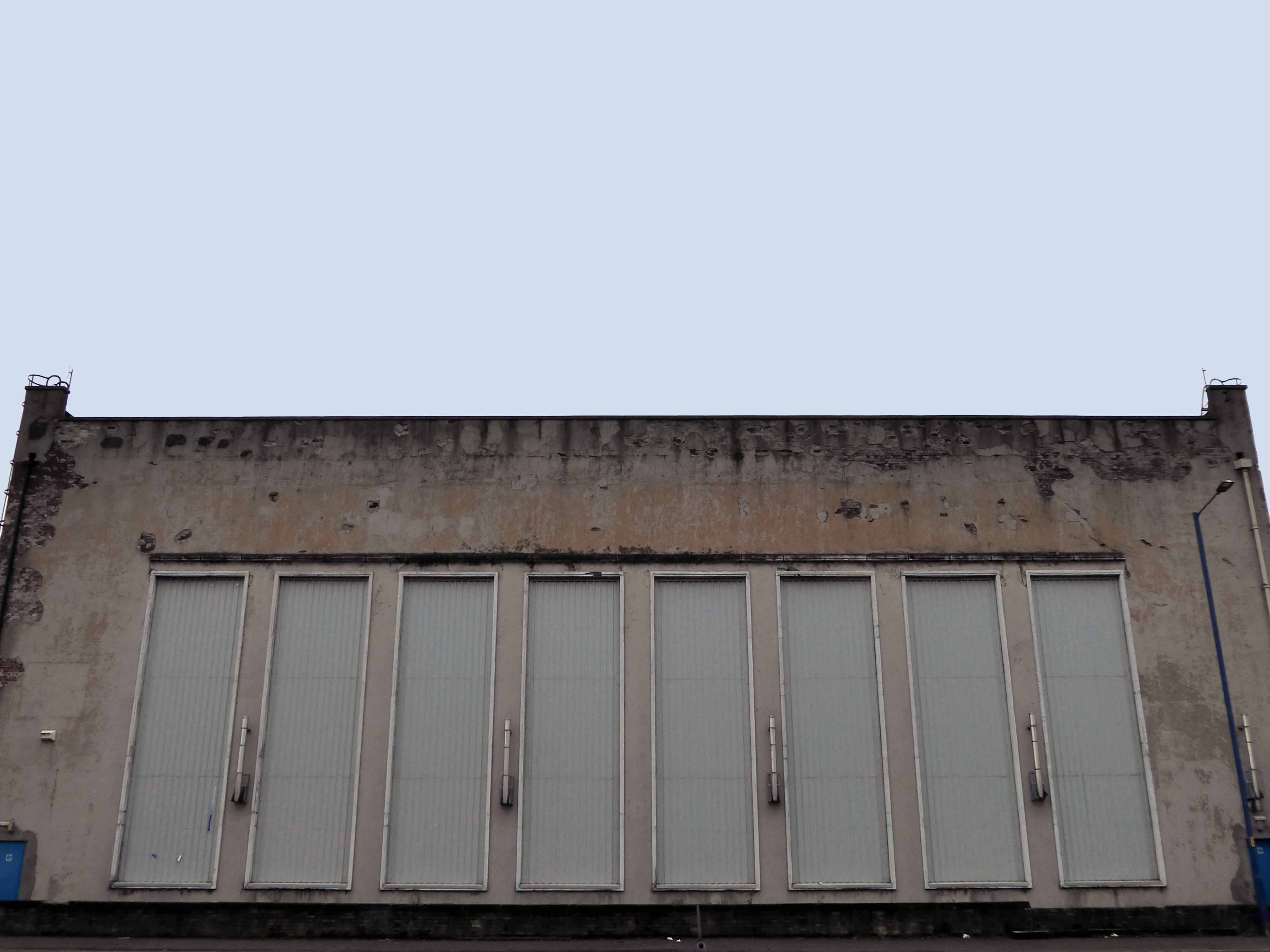
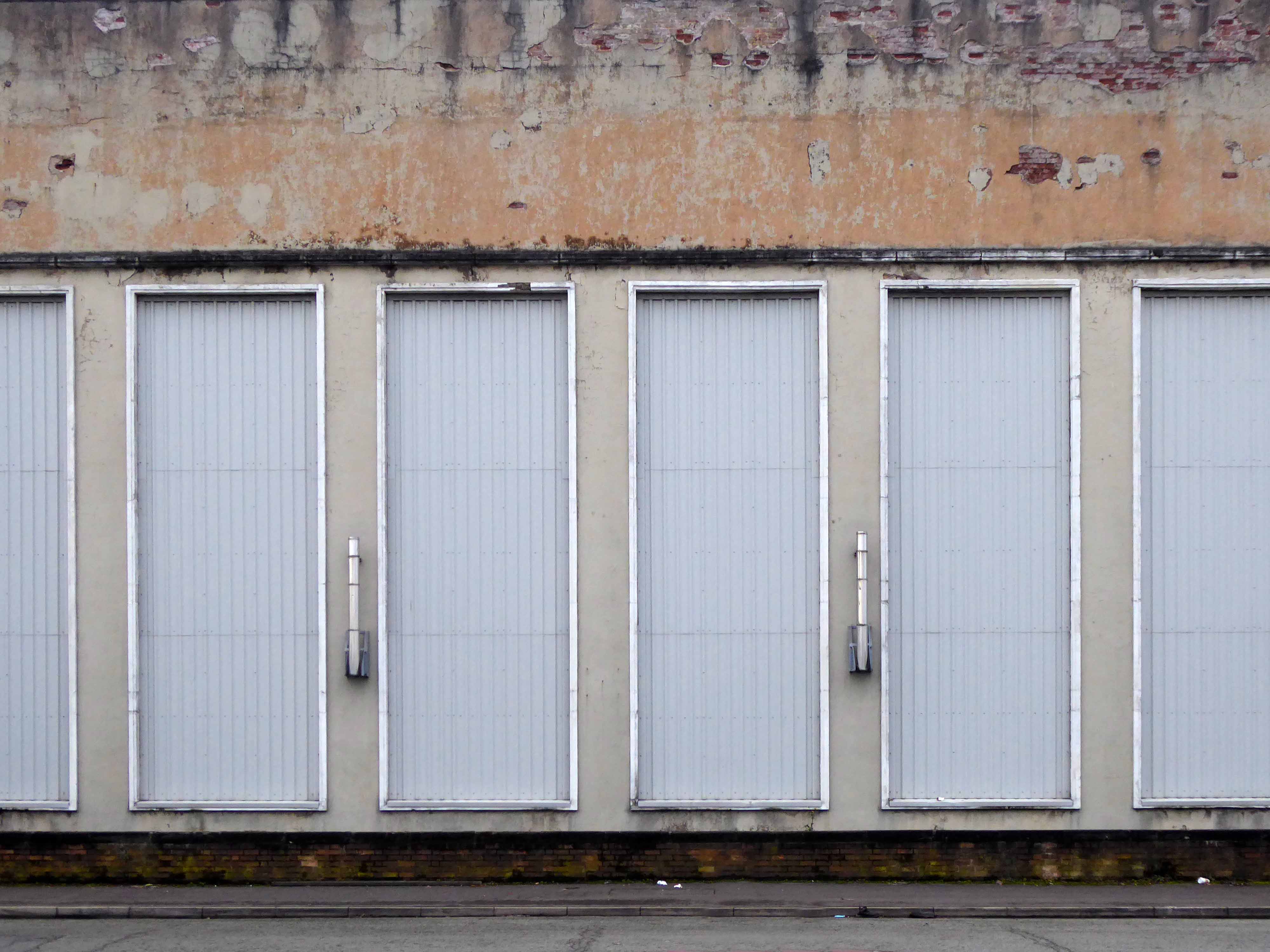
This is now the home of Manchester Airport Parking – no place for a pedestrian, I walked away, slowly circumnavigating this uplifting, uplifted behemoth.

I walked home.

I once was glazed but now I’m clad – how sad!

Elaine Harwood

Rotherham Modernism

There comes a time in everyone’s life, when one simply must go to Rotherham, at least once – so I did.

To keep company with my personal town guide, Sheffield Modernist and local resident, Helen Angell.

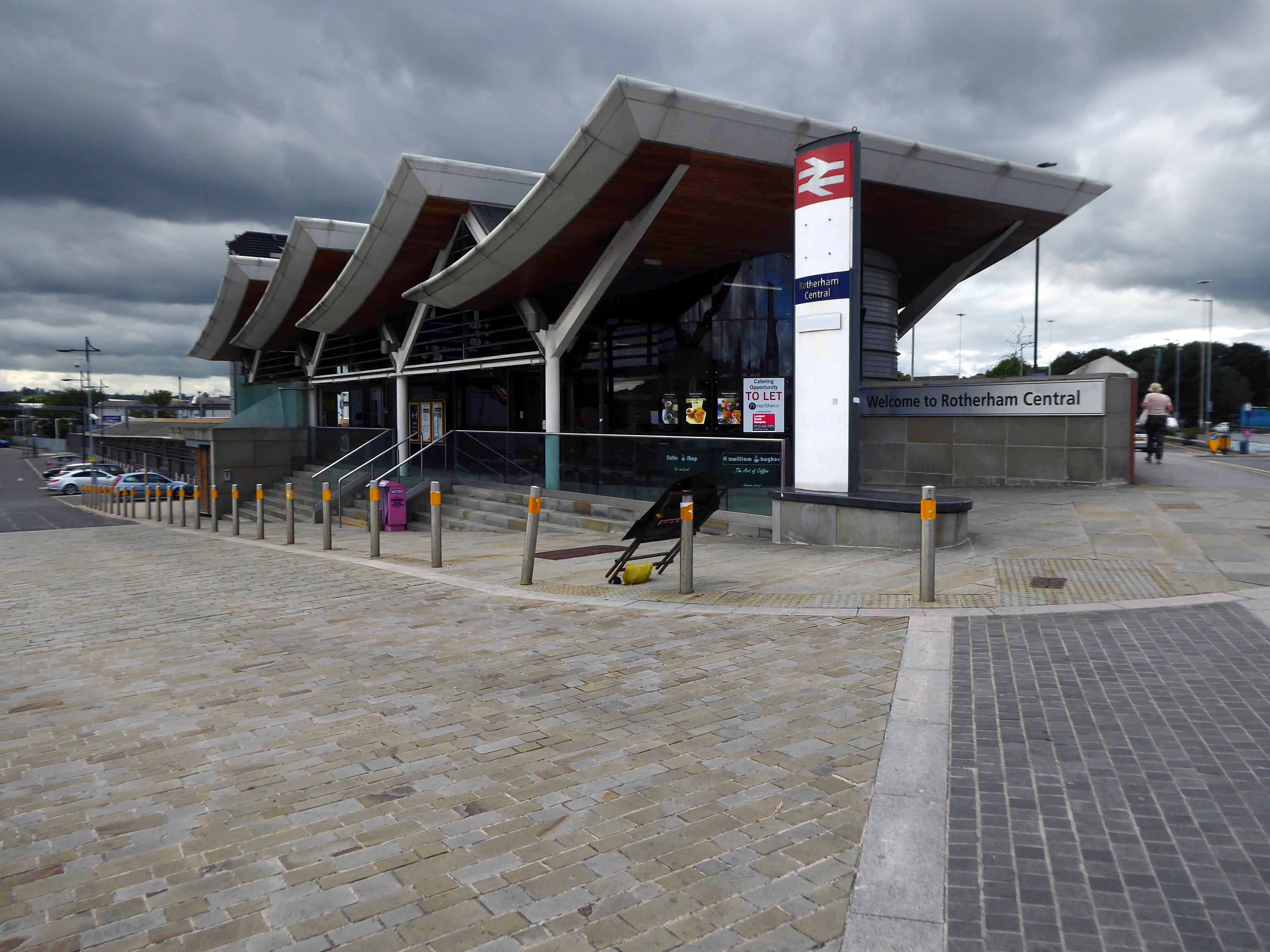
I arrived early at Rotherham Central, so went for a solo wander.

The station was originally named Rotherham, becoming Rotherham and Masborough in January 1889 and finally Rotherham Central on 25 September 1950.

The newish Rotherham Central station was opened to passengers on 11 May 1987, the present iteration on Friday 24 February 2012, as part of the Rotherham Renaissance plans for the regeneration of the town.

Wikipedia

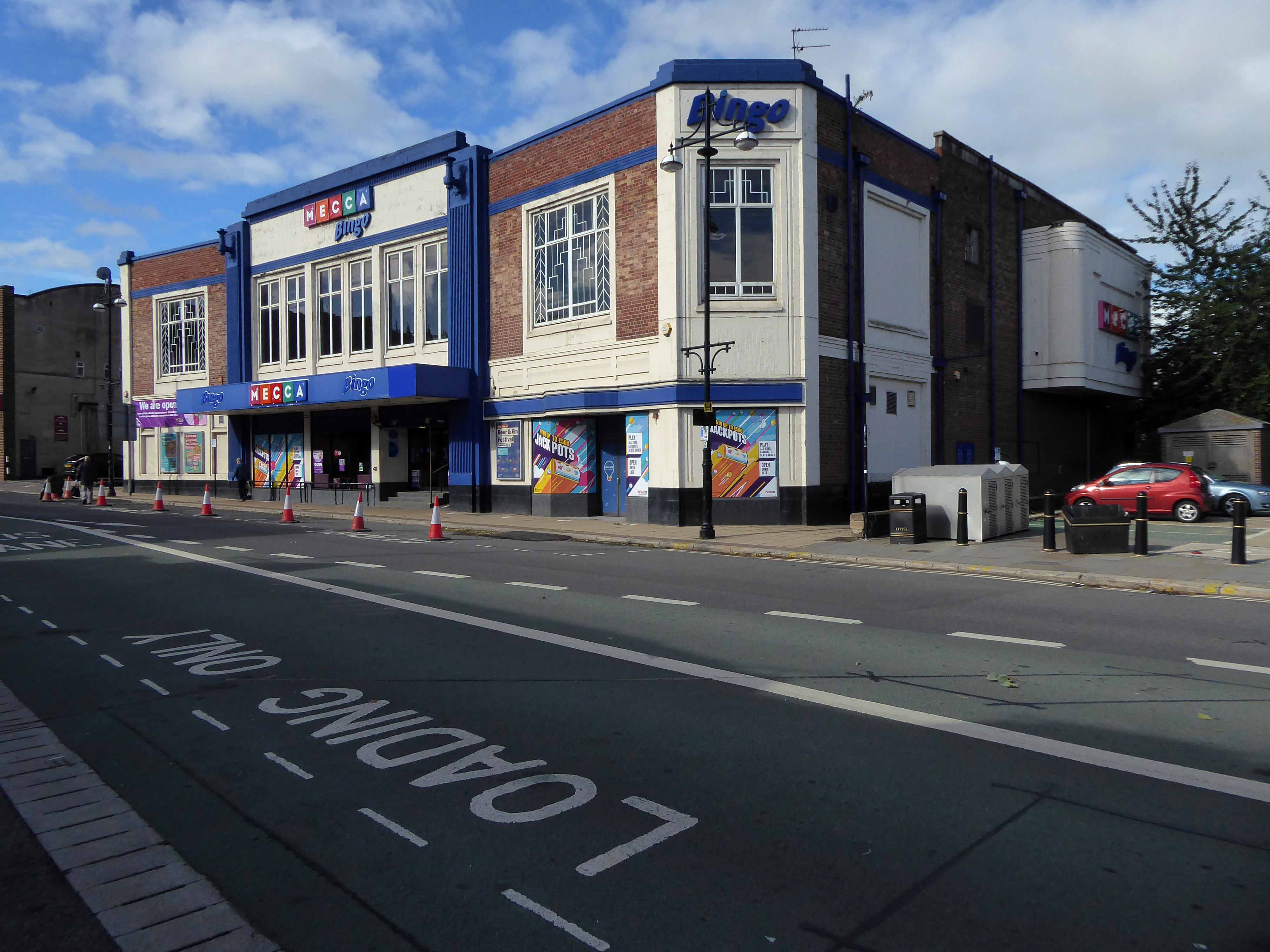
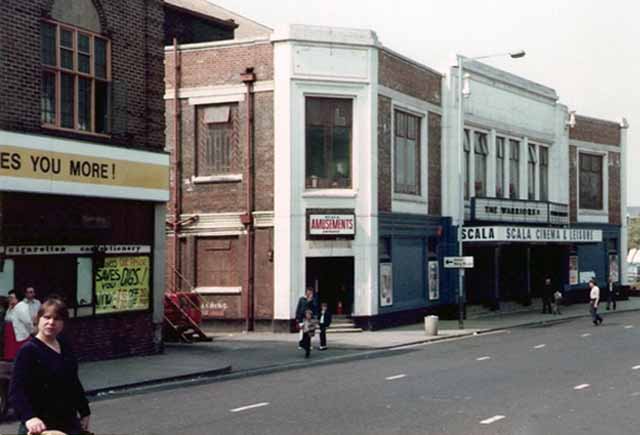
Opened 22 December 1934 as the Regal Cinema with Leslie Howard in Girls Please. Sandy Powell, the famous comedian attended opening night this 1,825 seat. It was designed by the Hull based architectural firm Messrs Blackmore & Sykes for local exhibitor Thomas Wade and was leased to the Lou Morris chain.

By 1937 it was operated by the London & Southern Super Cinemas Ltd. chain. The Regal Cinema was leased to the Odeon circuit in 1946 and was re-named Odeon. It was sold by the Rank Organisation to an independent operator in 1975 and renamed Scala Cinema, by 1981 using the circle only.

Closed 23rd September 1983 with the film Porky’s.

Became a bingo hall initially named Ritz but now Mecca. On 20th February 2020 the building was put up for sale by auction at an asking price of £600,000+, but failed to sell, with the maximum reached £590,000. Mecca bingo continues in the building.

Cinema Treasures

Curious corner retail development and sculpture of the Sixties – with pub archeology.

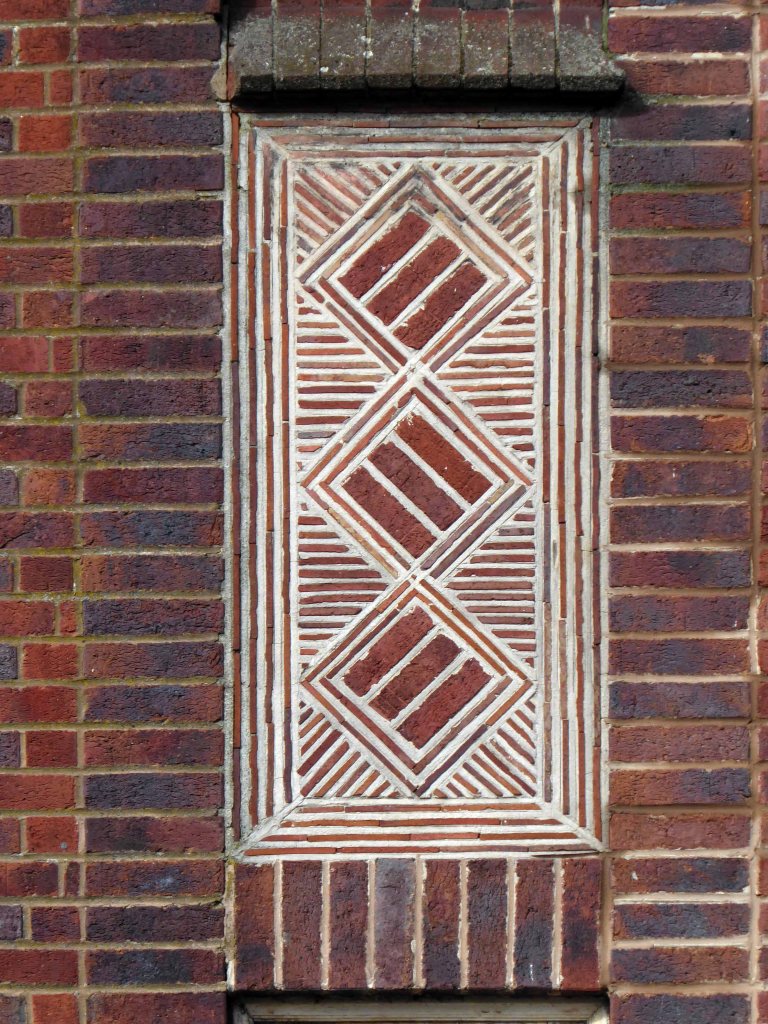
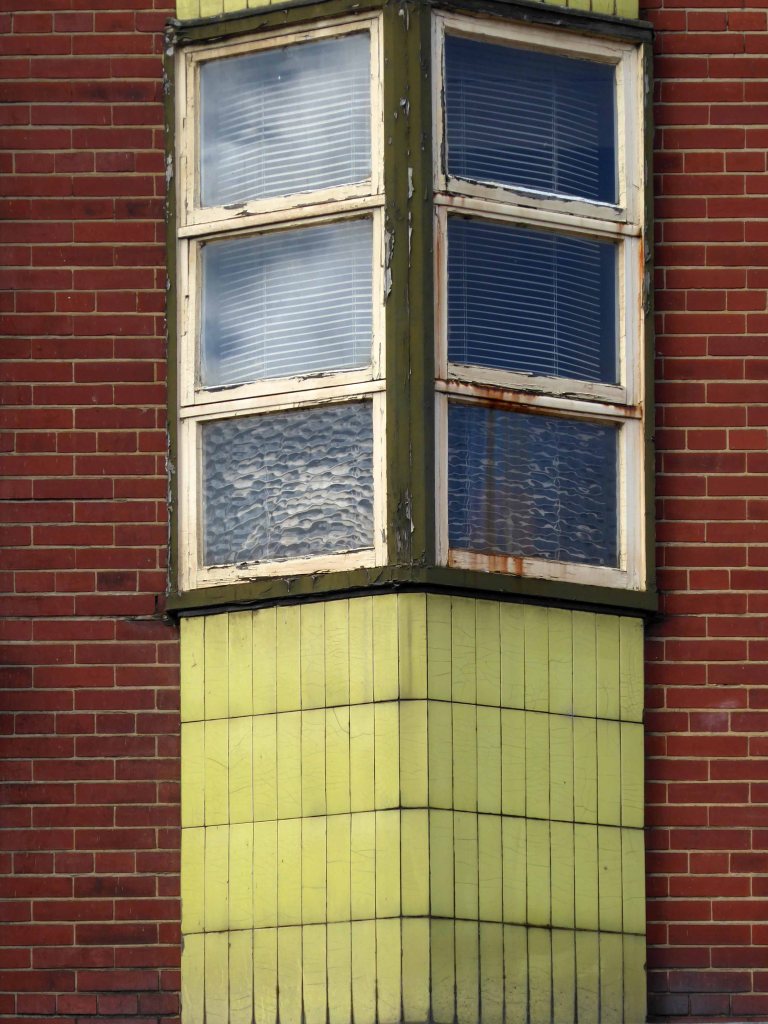
Art Deco detail and tiling.

Royal Mail Sorting Office.

Retail detail.

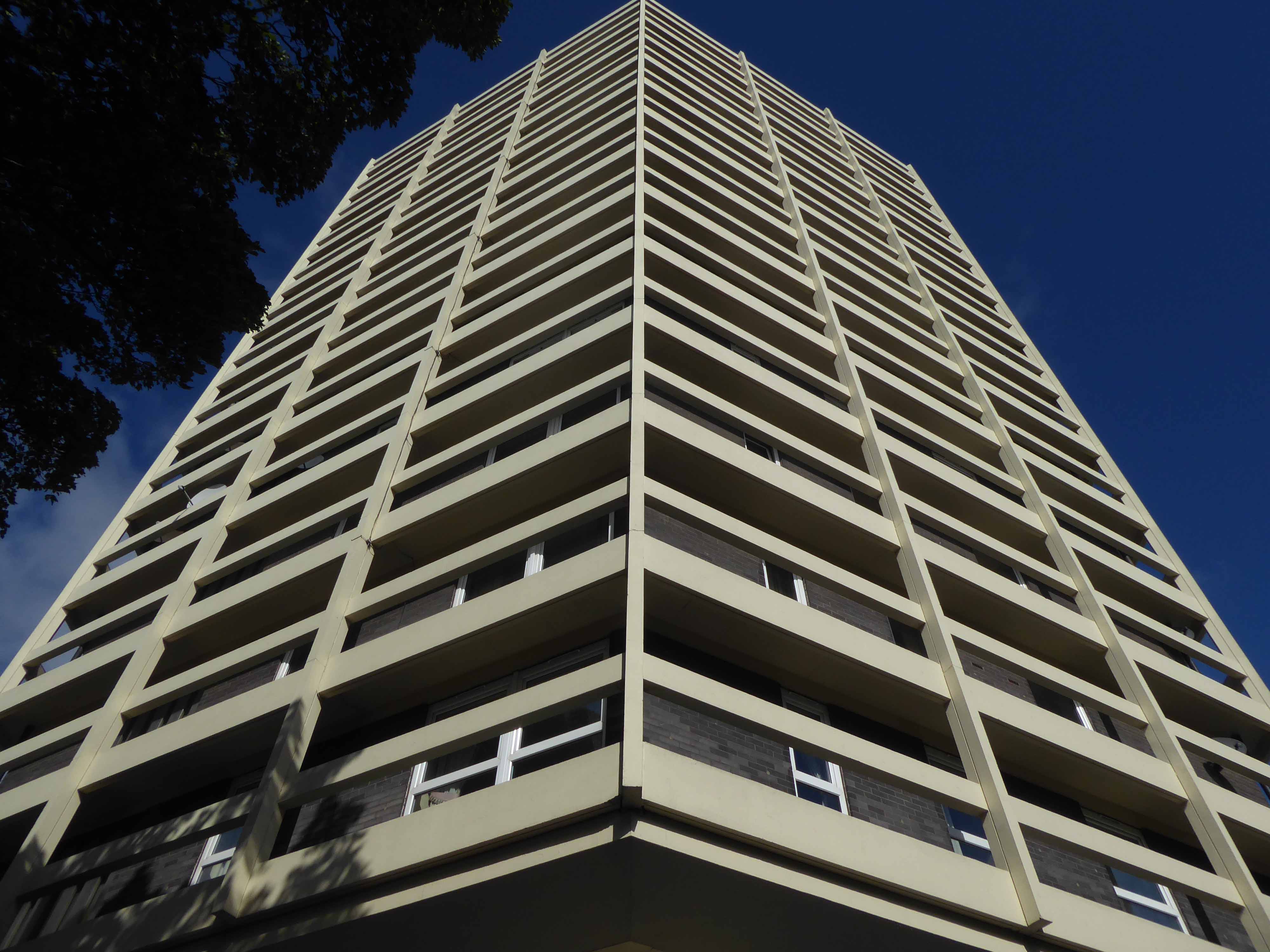
Beeversleigh Flats – built between 1968-71. 

Main contractors J. Finnegan it’s thirteen storeys high – housing forty eight dwellings.

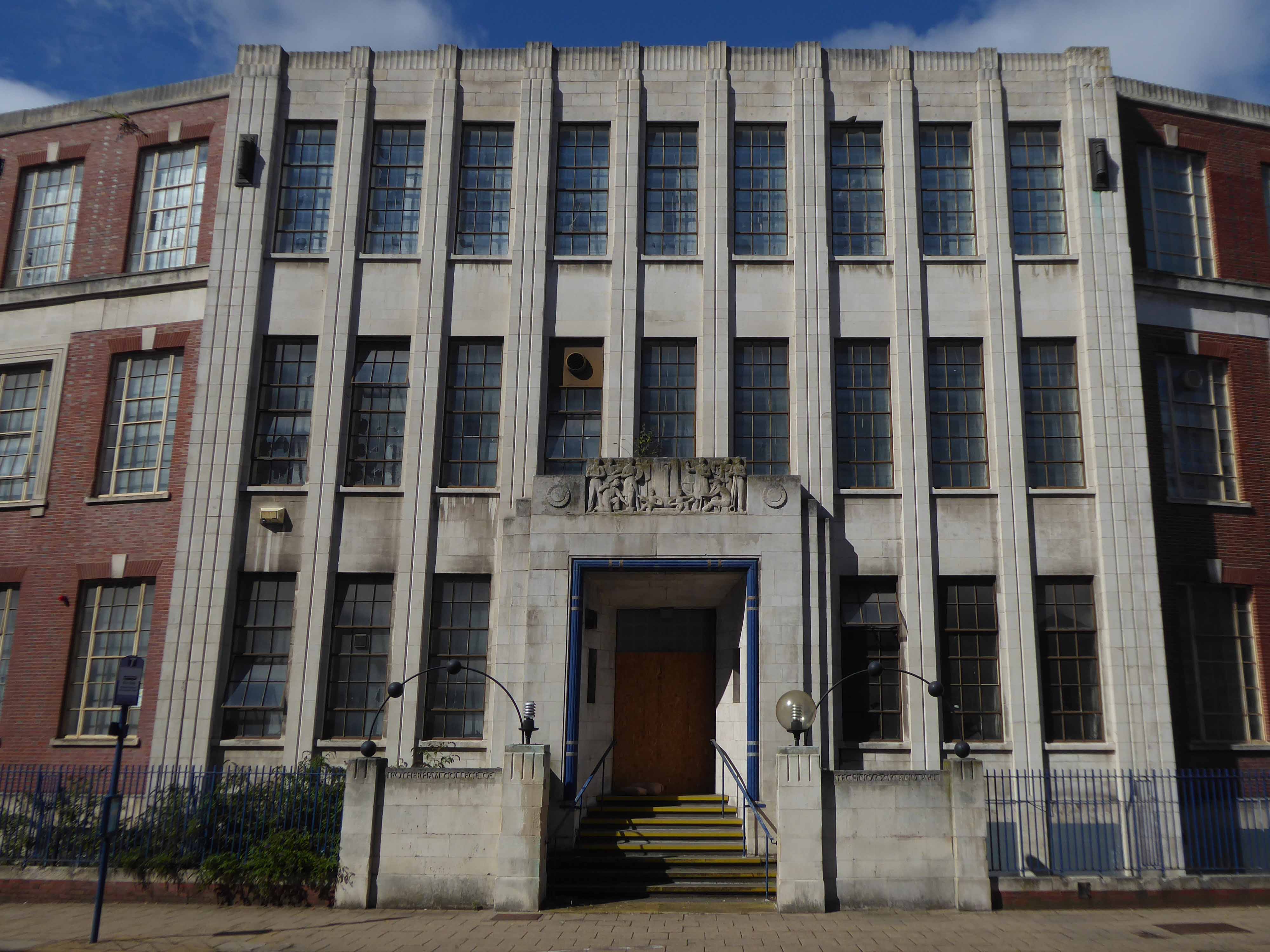
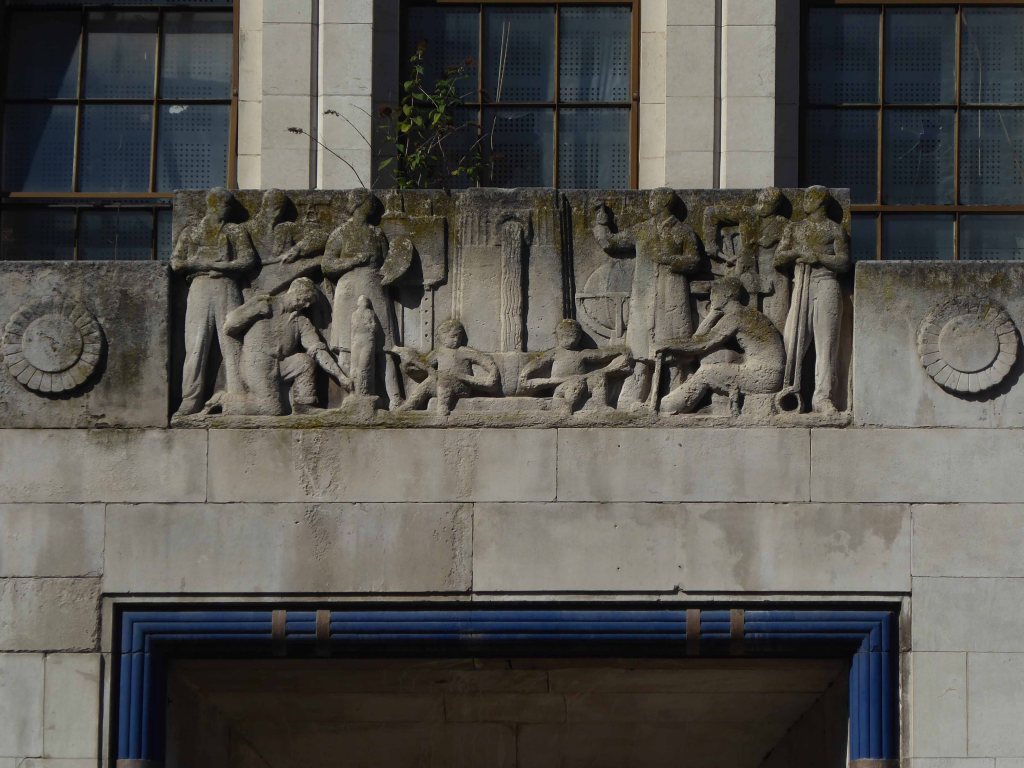
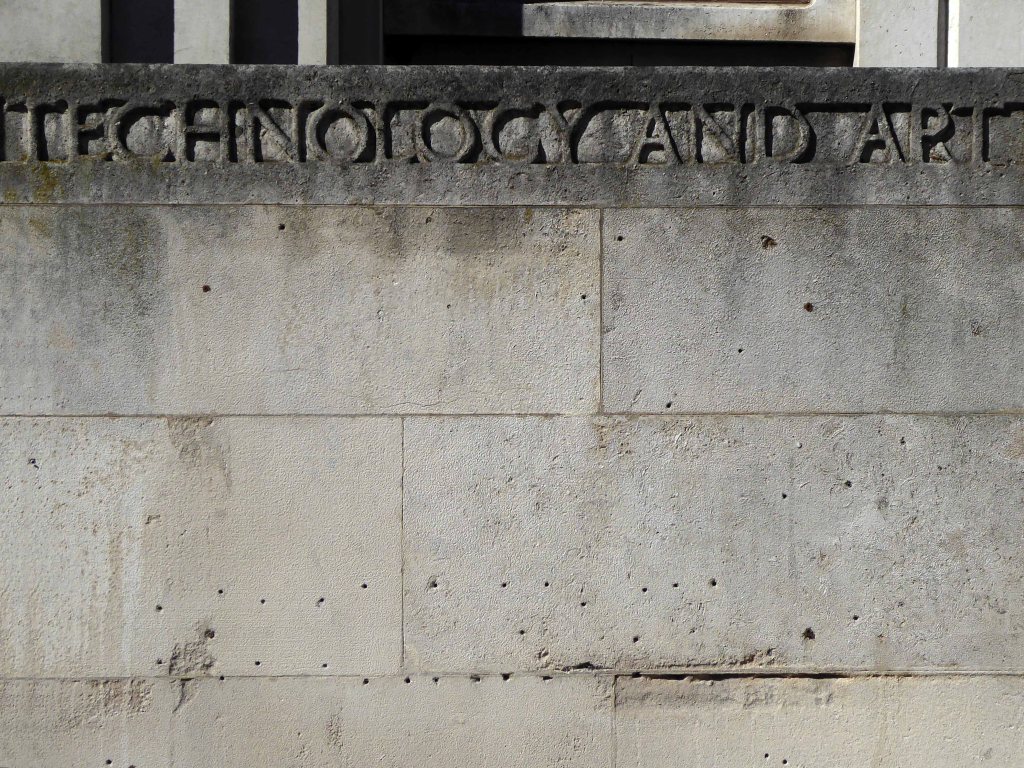
Interwar Technical College – Howard Building

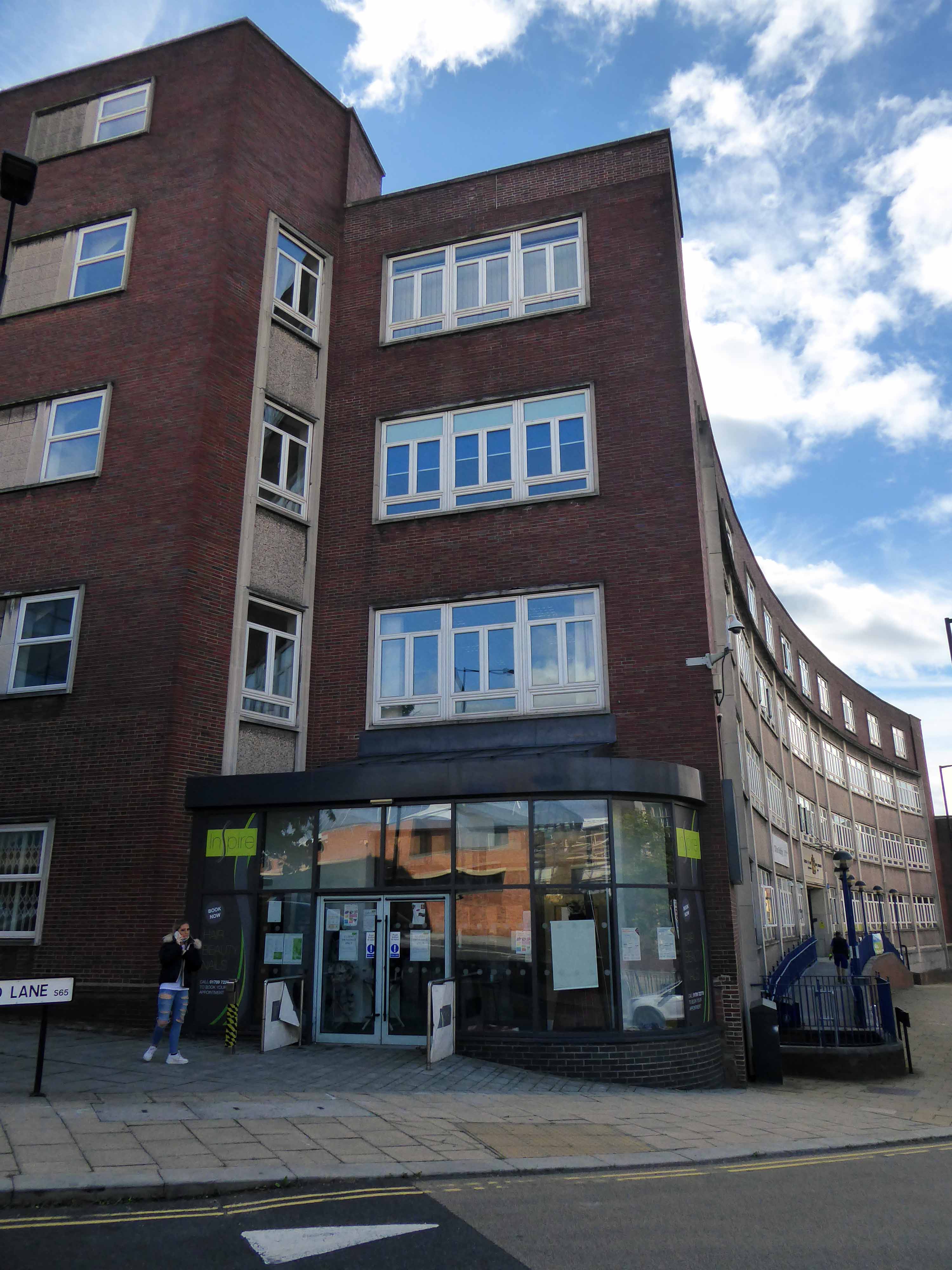
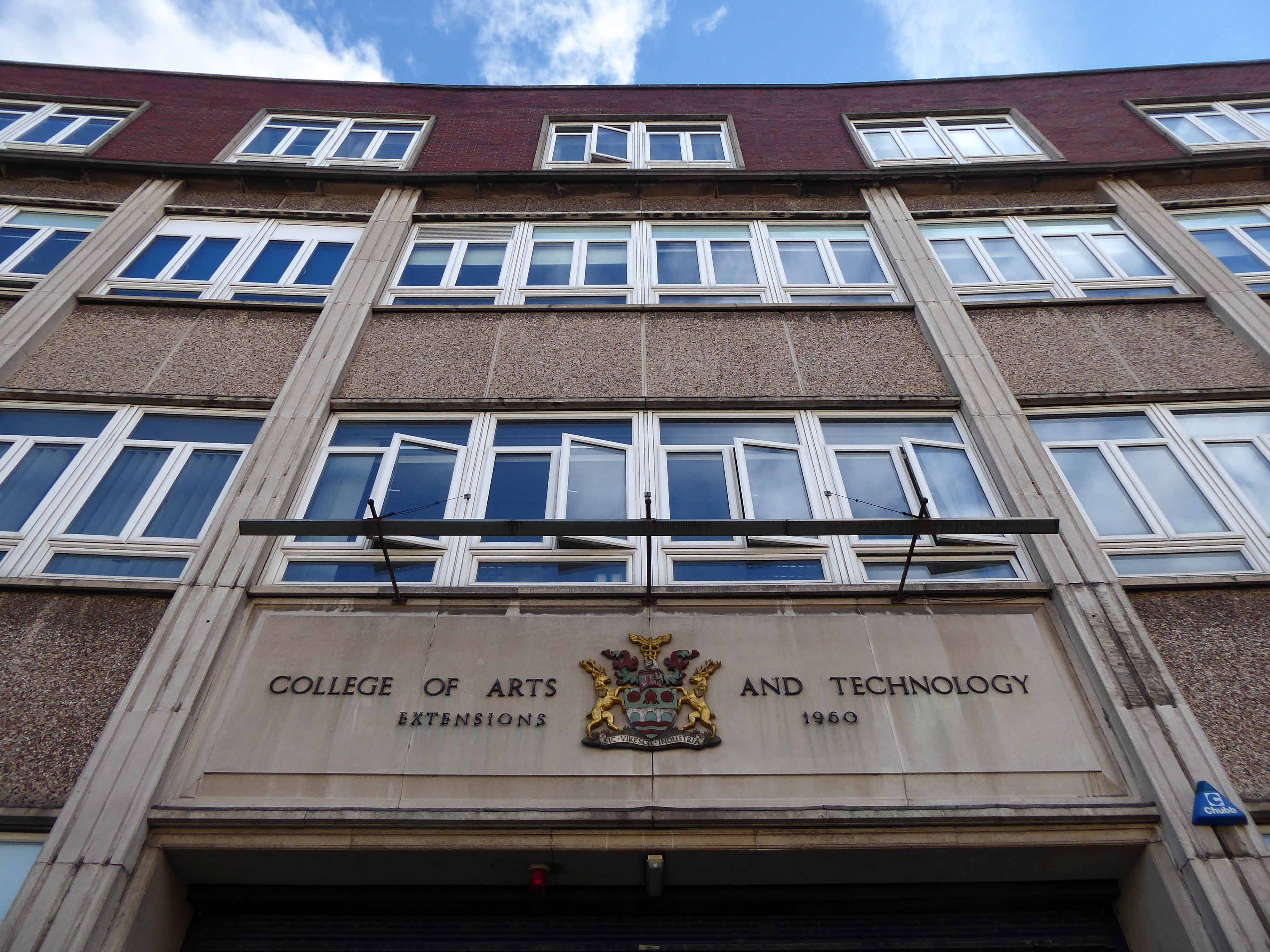
From the 1930s, it provided technical-orientated education from the Howard Building on Eastwood Lane, Rotherham. In 1981, three neighbouring colleges of arts, technology and adult education were merged into one. As a result, the college became known as Rotherham College of Arts and Technology.

Revised plans to convert the historic Howard Building in Rotherham town centre into self-contained studios and apartments have been approved by the planning board at Rotherham Council.

The prominent former college building was sold prior to going to auction last September after it was advertised as a development opportunity and given a guide price of £250,000 by local auctioneers, Mark Jenkinson & son.

2015

28 Days Later

A group of rogue property directors with links to a prominent derelict building in Rotherham have been banned for a total of 54 years. The six, of Absolute Living Developments, were found to have misled more than 300 people to invest at least £12 million in residential properties.

The firm was linked through a lender to Avro Developments, which had plans passed in 2015 to renovate former college block the Howard Building in Rotherham town centre.

Rotherham Advertiser 2019

Clifton Building

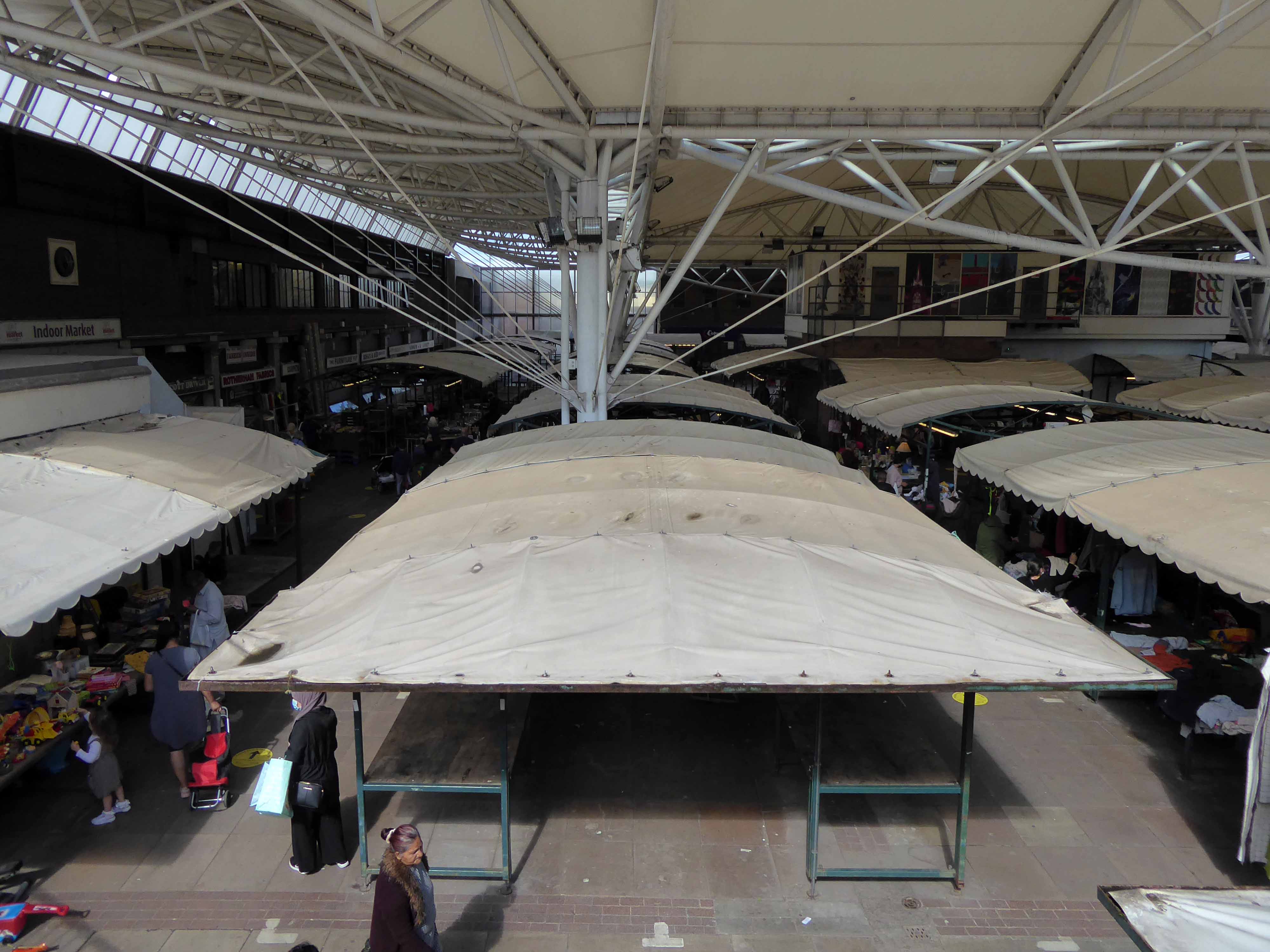
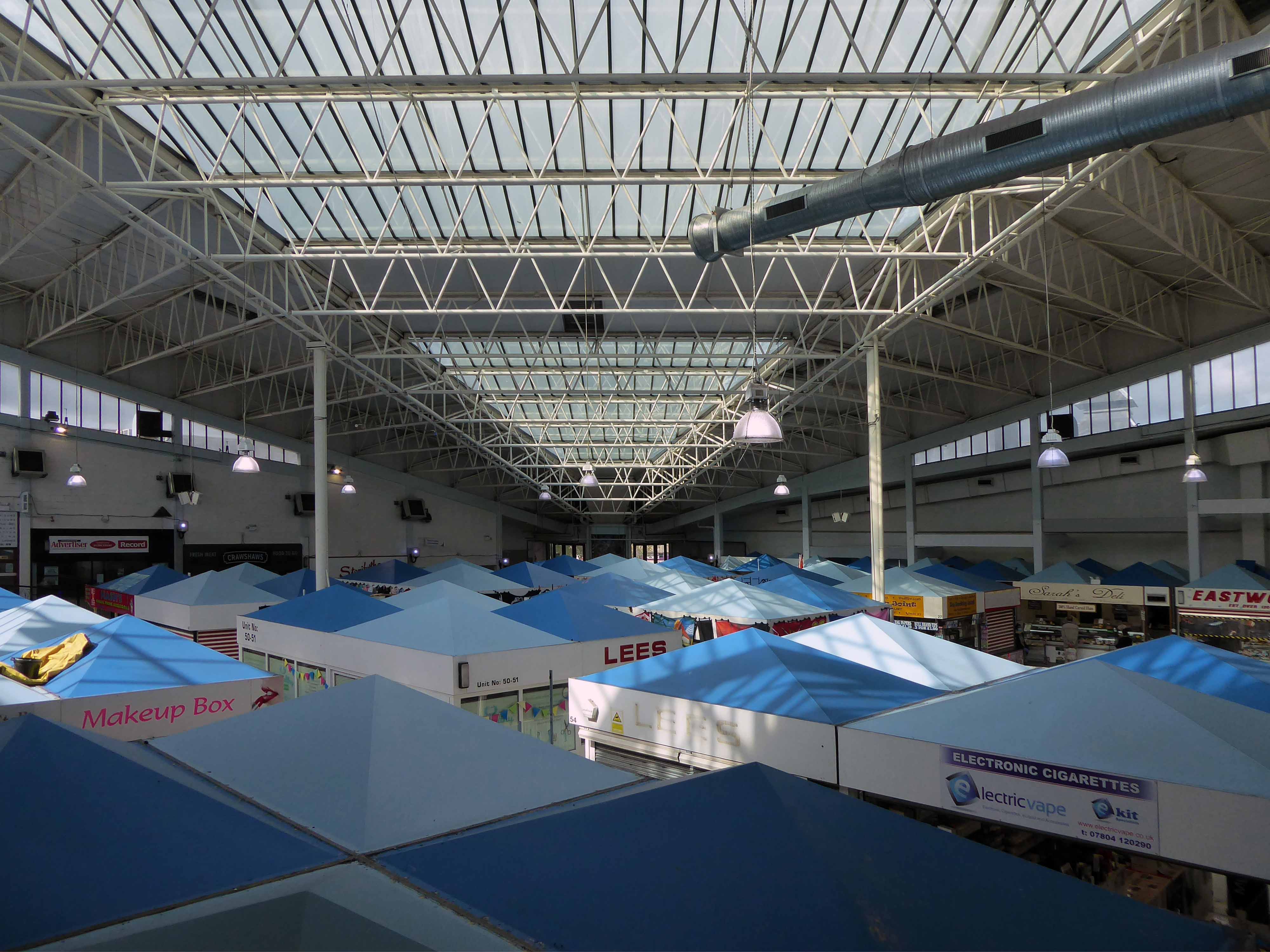
Next to the market.

With a strident high tech canopy, very recently added – though Rotherham’s history stems back 800 years when it is thought that the original royal market charter was granted by King John in the year 1207.

There are traces of the 1970’s rebuild.

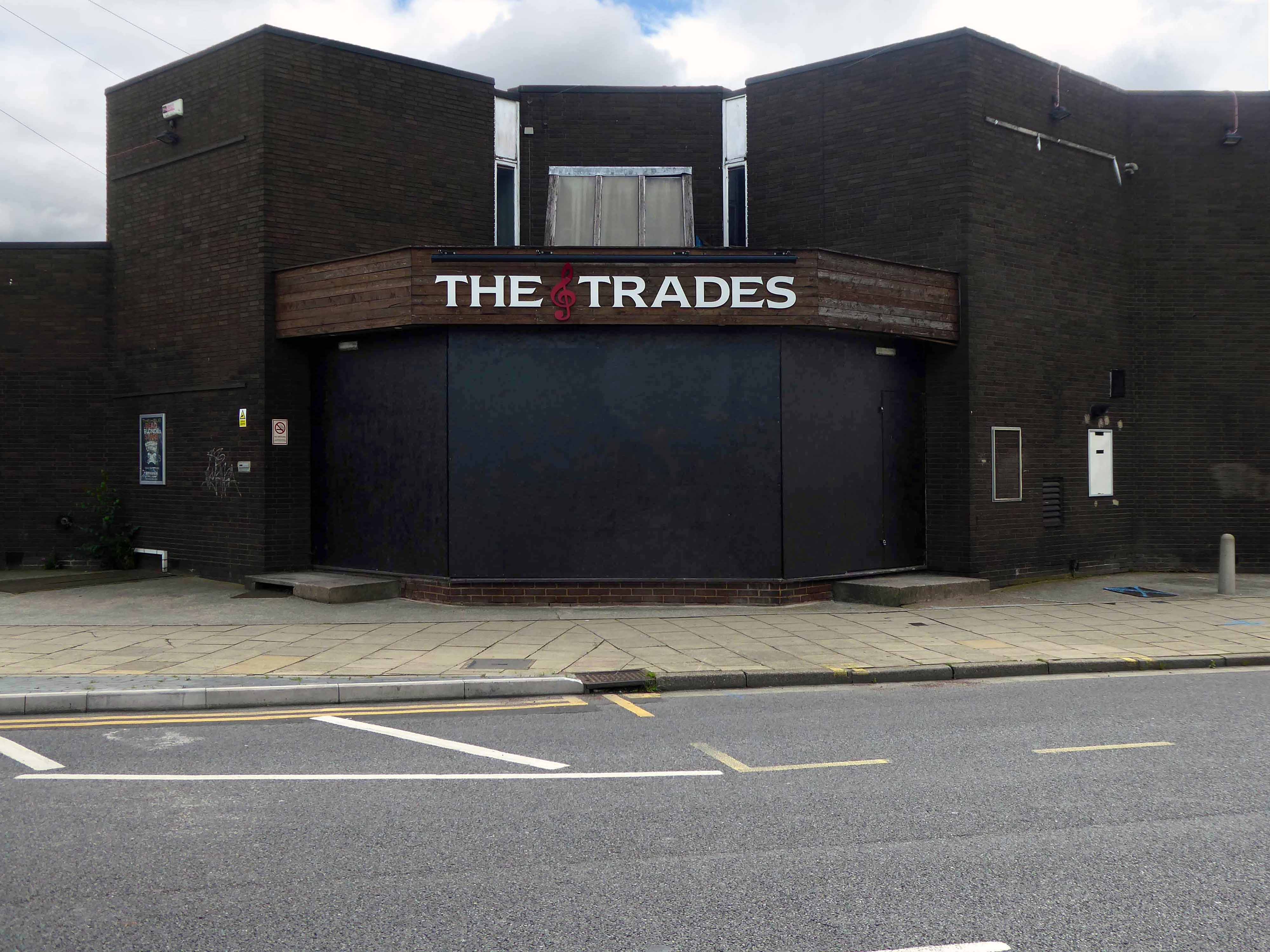
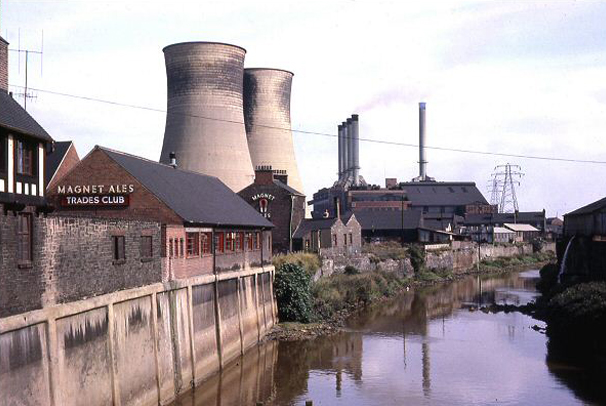
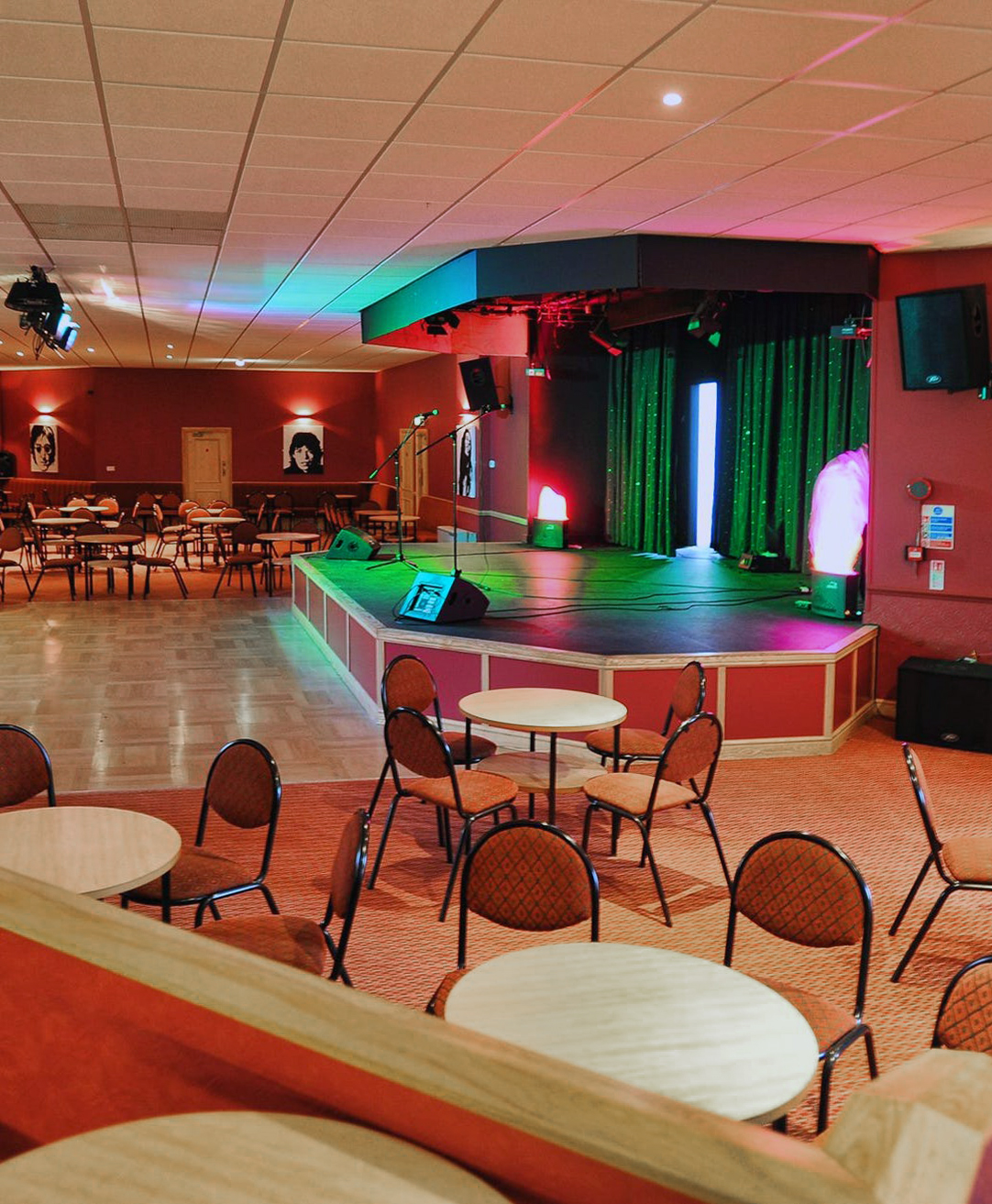
Bunker-like The Trades former music venue/pub, which replaced the former riverside Trades Club.

The PA now silenced.

This was an amazing event. The bands were really good and the drinks offers, while limited, were good. The ceiling in the ladies toilets had fallen through and was dripping, presumably there had been a leak from all the rain, but this didn’t lessen the awesome experience.

October 2019

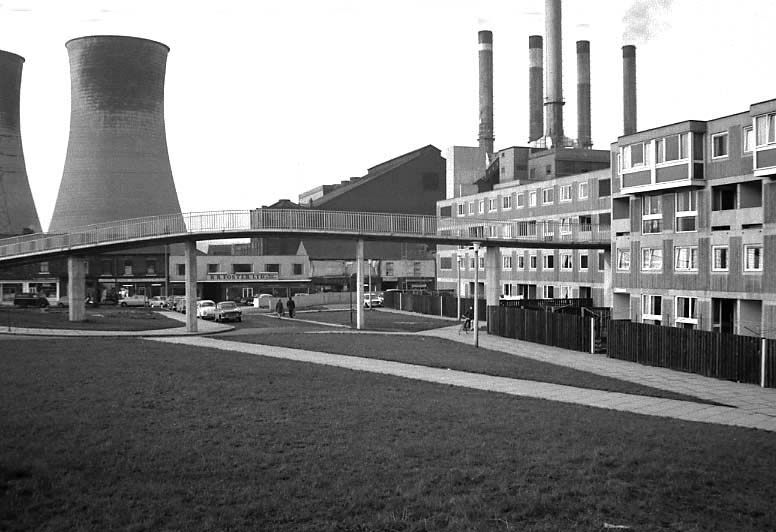
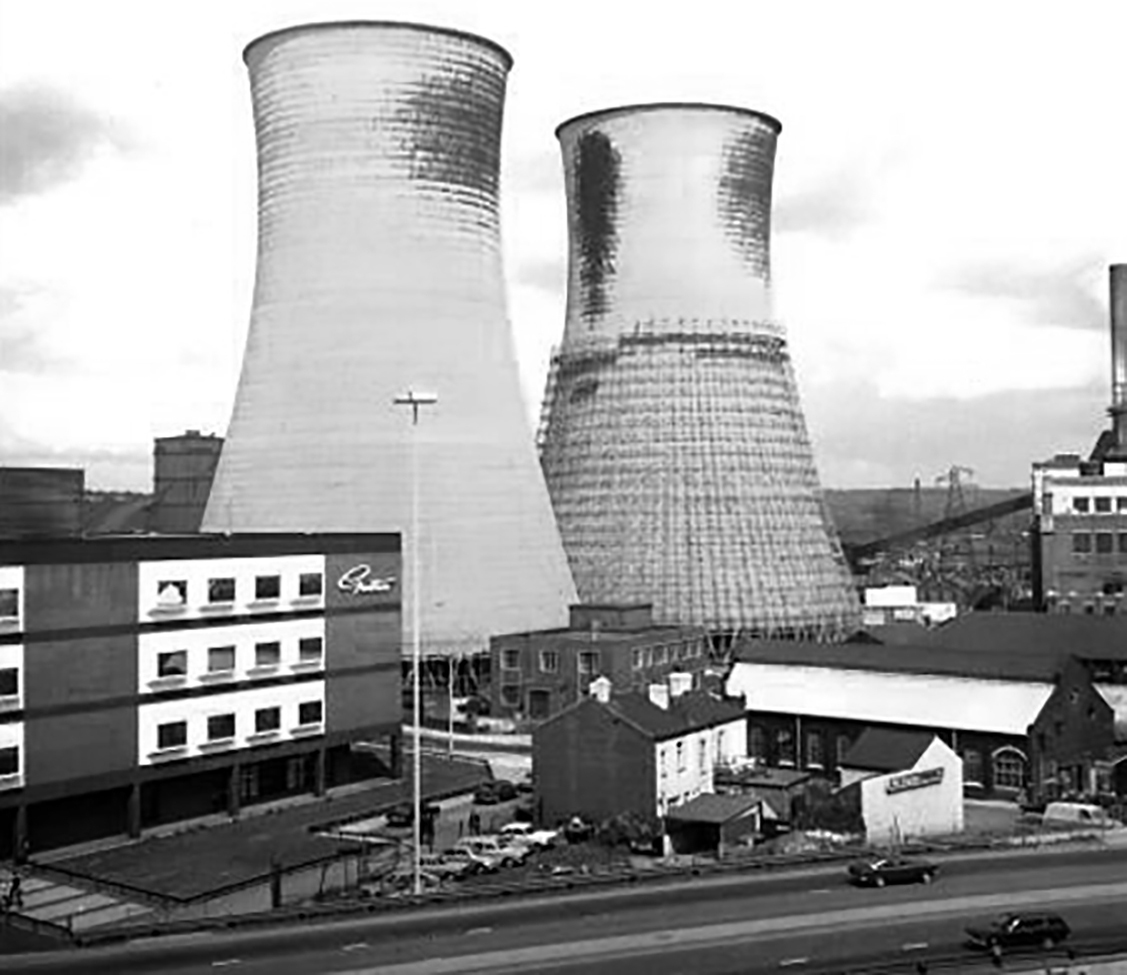
The cooling towers and flats are long gone – the coal-fired power station operated from 1923 until October 1978.

The Prince of Wales Power Station in Rotherham was located on Rawmarsh Road and was opened by the Prince of Wales – the future King Edward VIII.

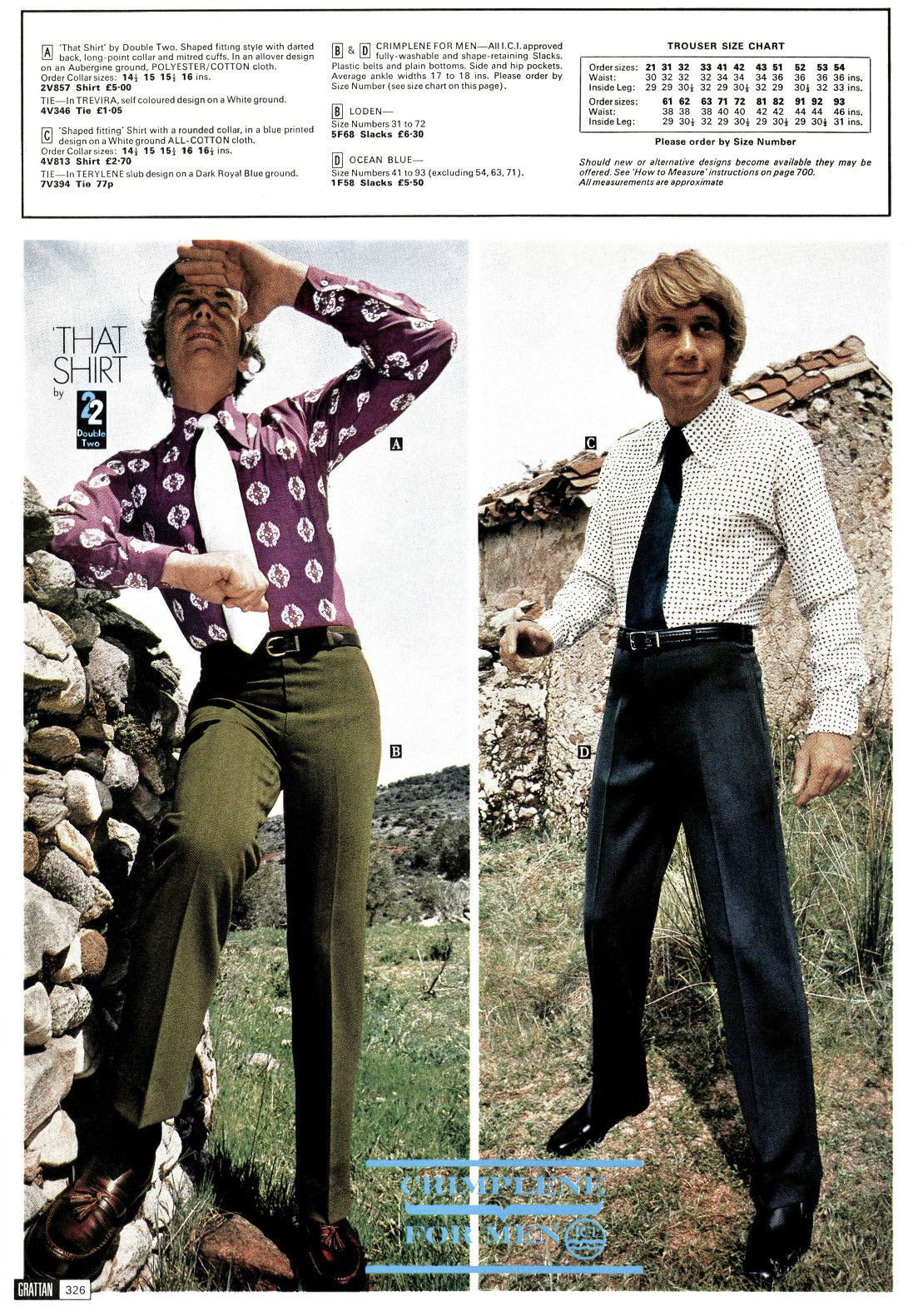
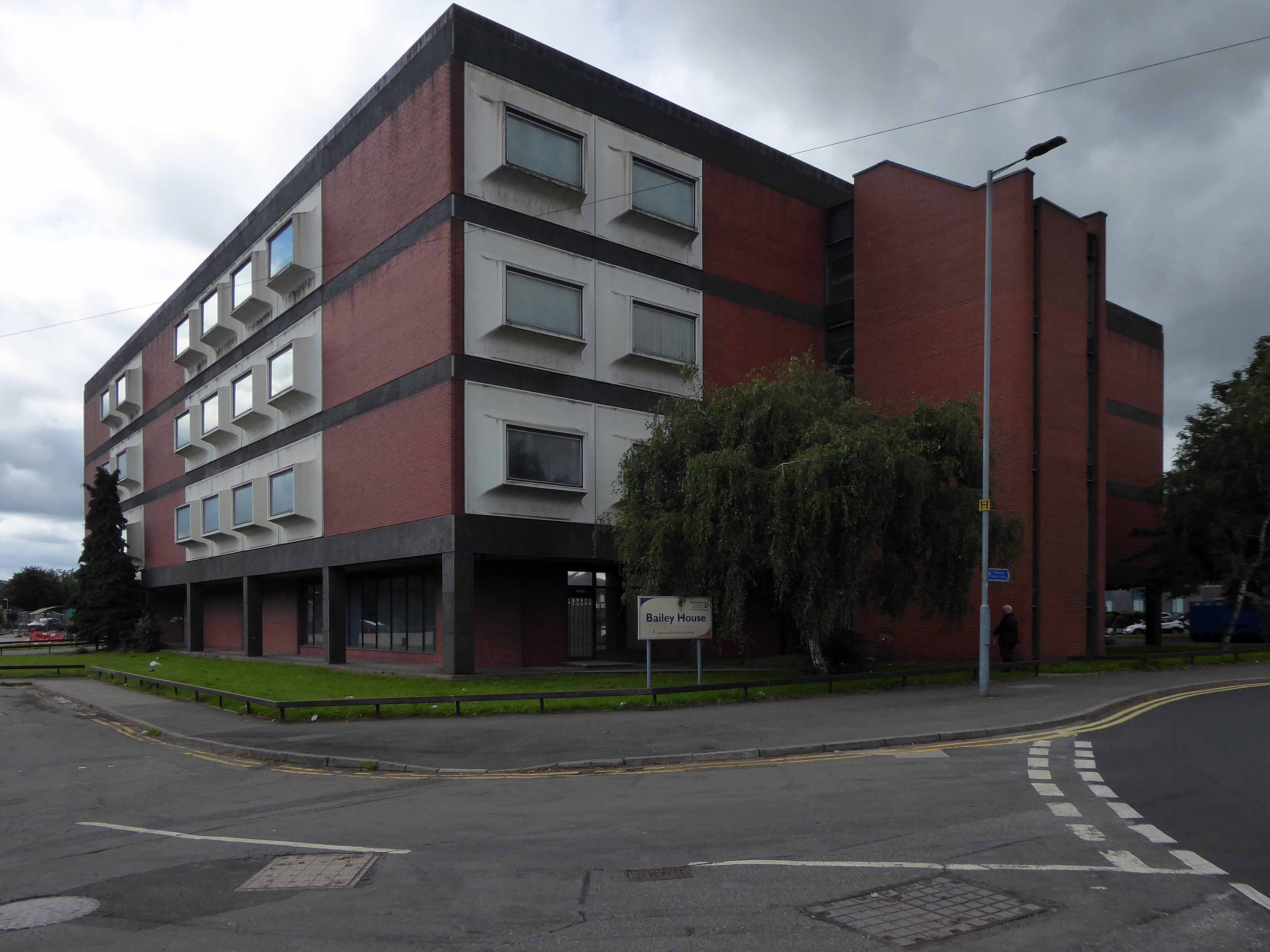
The former Grattans catalogue offices can be seen to the left.

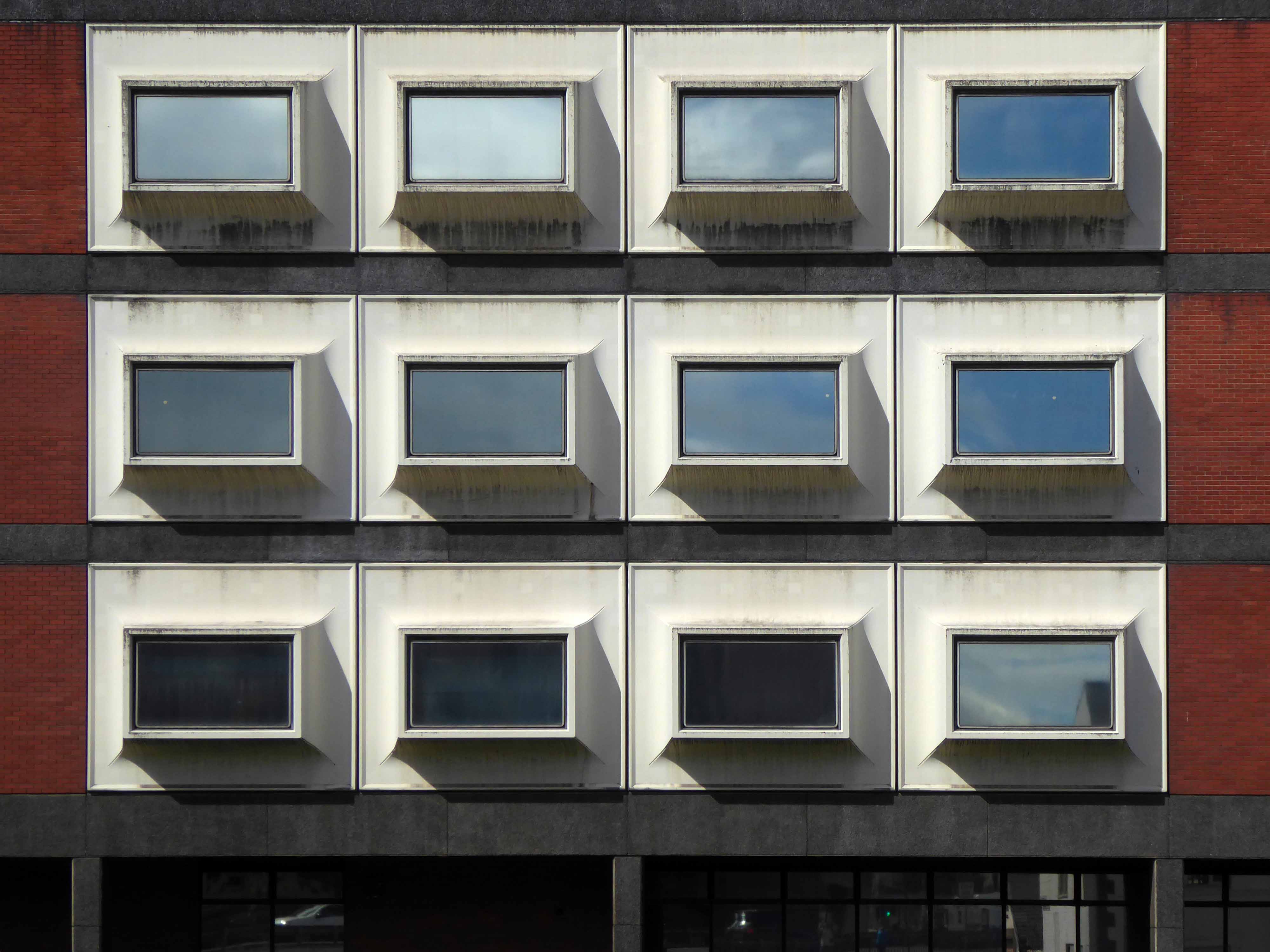
Renamed Bailey House and still in use by the local authority, its days it seems are numbered.

The building is named after Rotherham-born engineer Sir Donald Bailey whose ingenious bridge designs played a key role in shortening World War II, the house in which Bailey was born, 24 Albany Street is still standing.

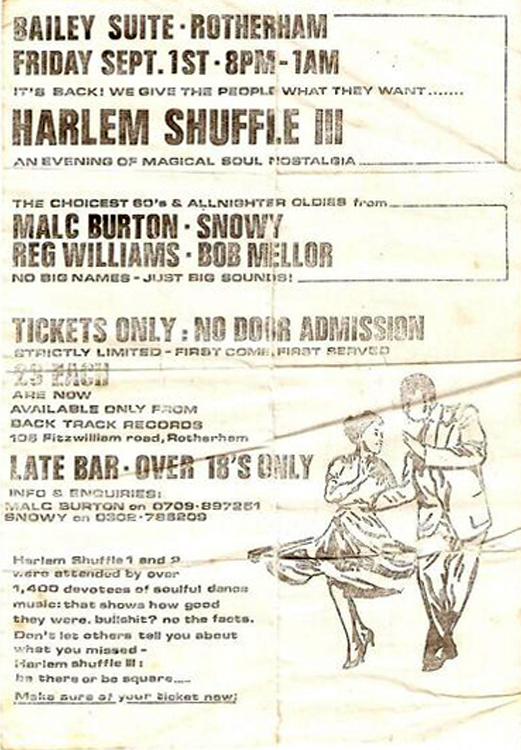
Sadly no longer home to the Harlem Shuffle

No big names – just big sounds.

There are some surviving power station buildings.

Along with electrical infrastructure.

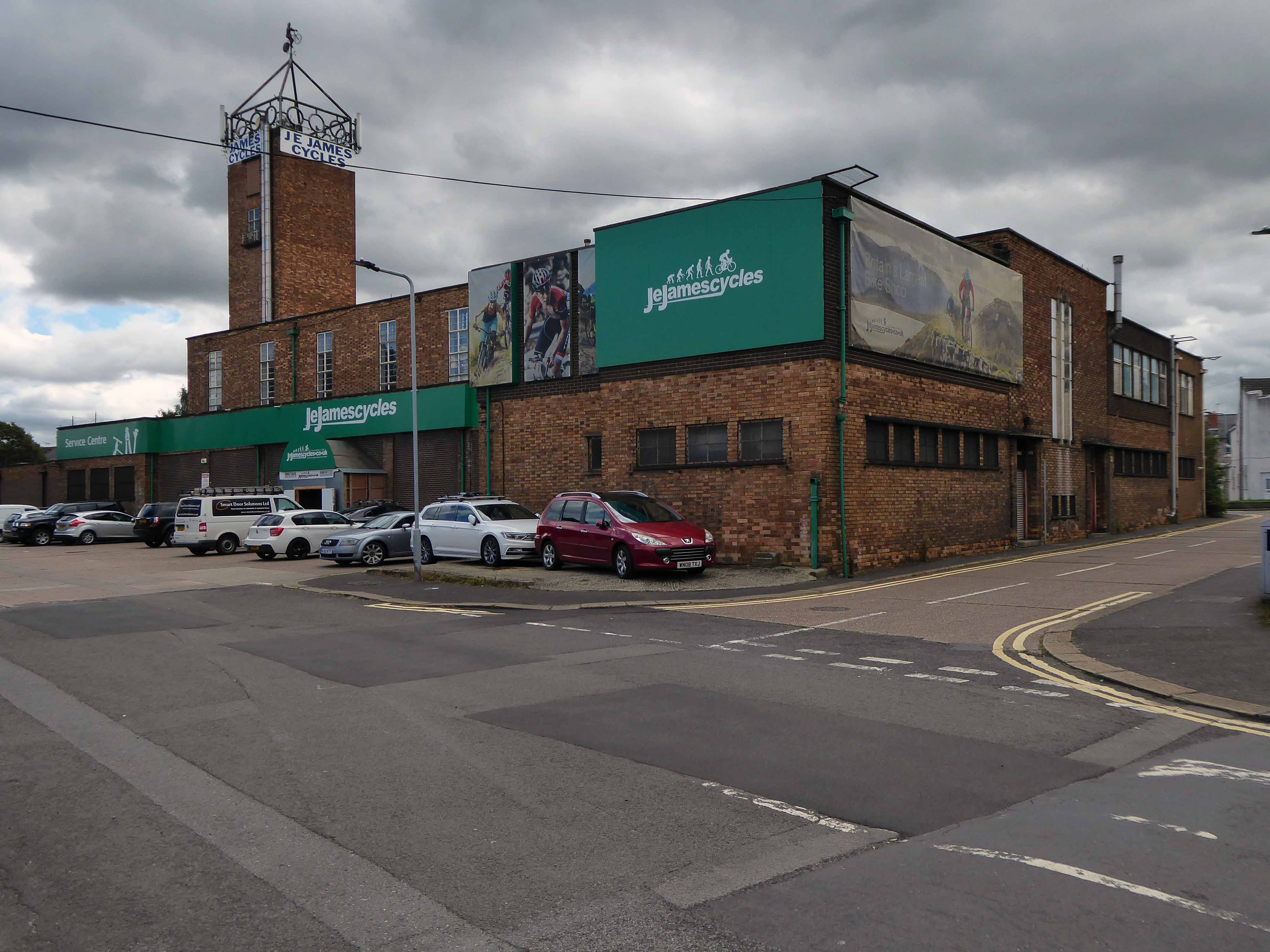
Up the road next, to the former fire station, which now houses J E James Cycles.

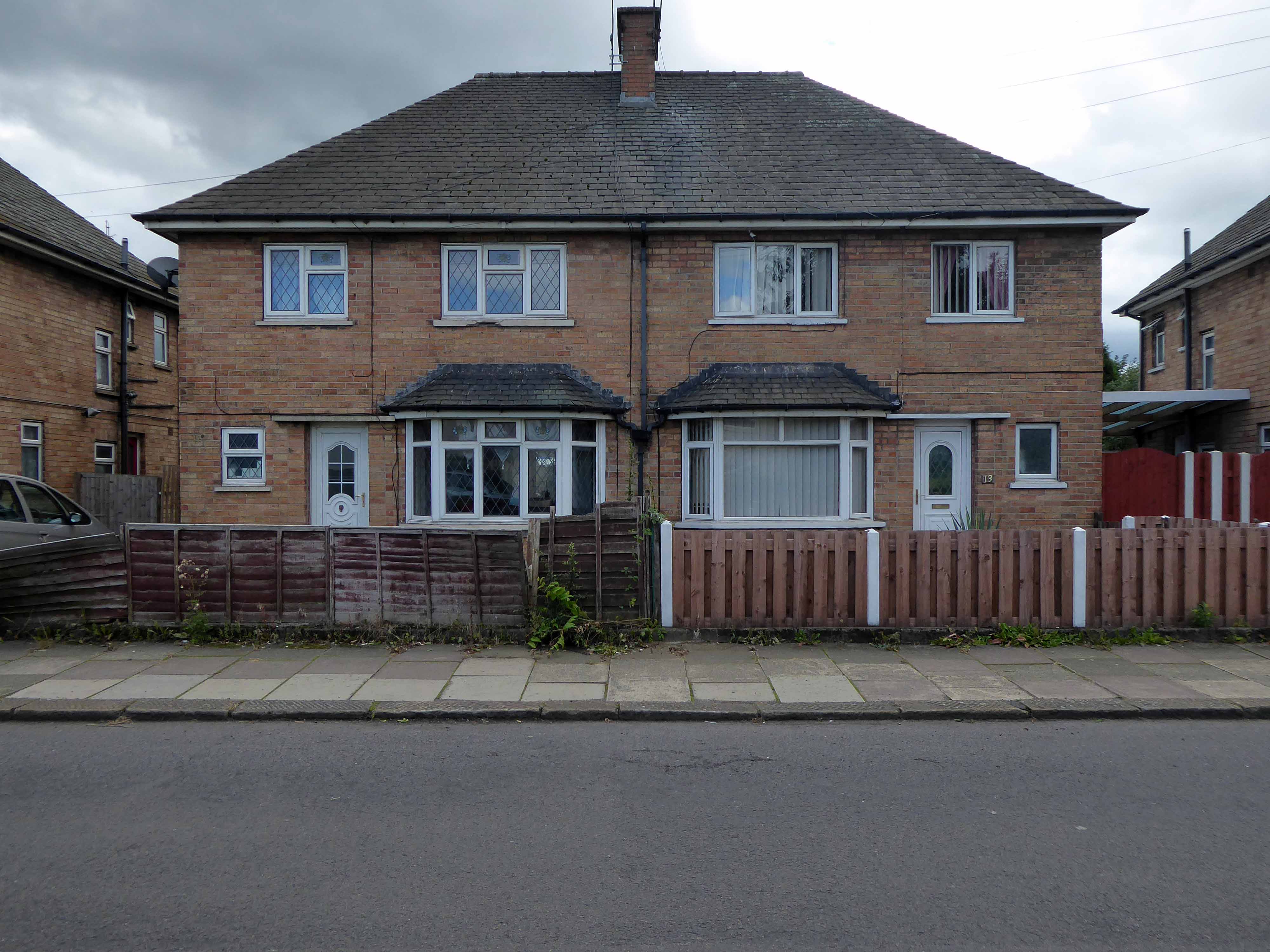
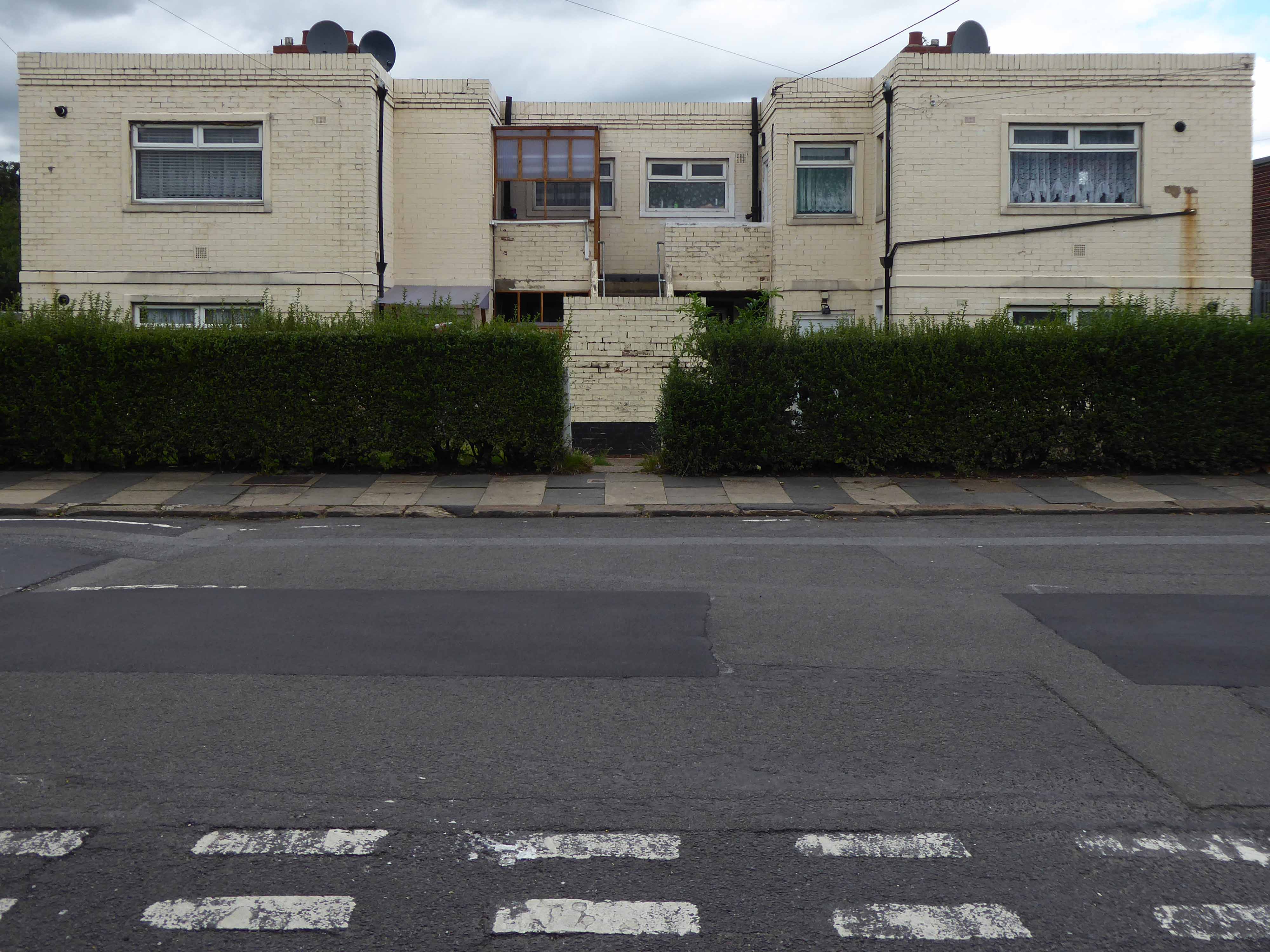
It is surrounded by typically atypical inter war housing.

I could make the wild assumption, that these flat roofed maisonettes were originally homes fit for firefighters.

A passing nod towards a former Methodist Chapel.

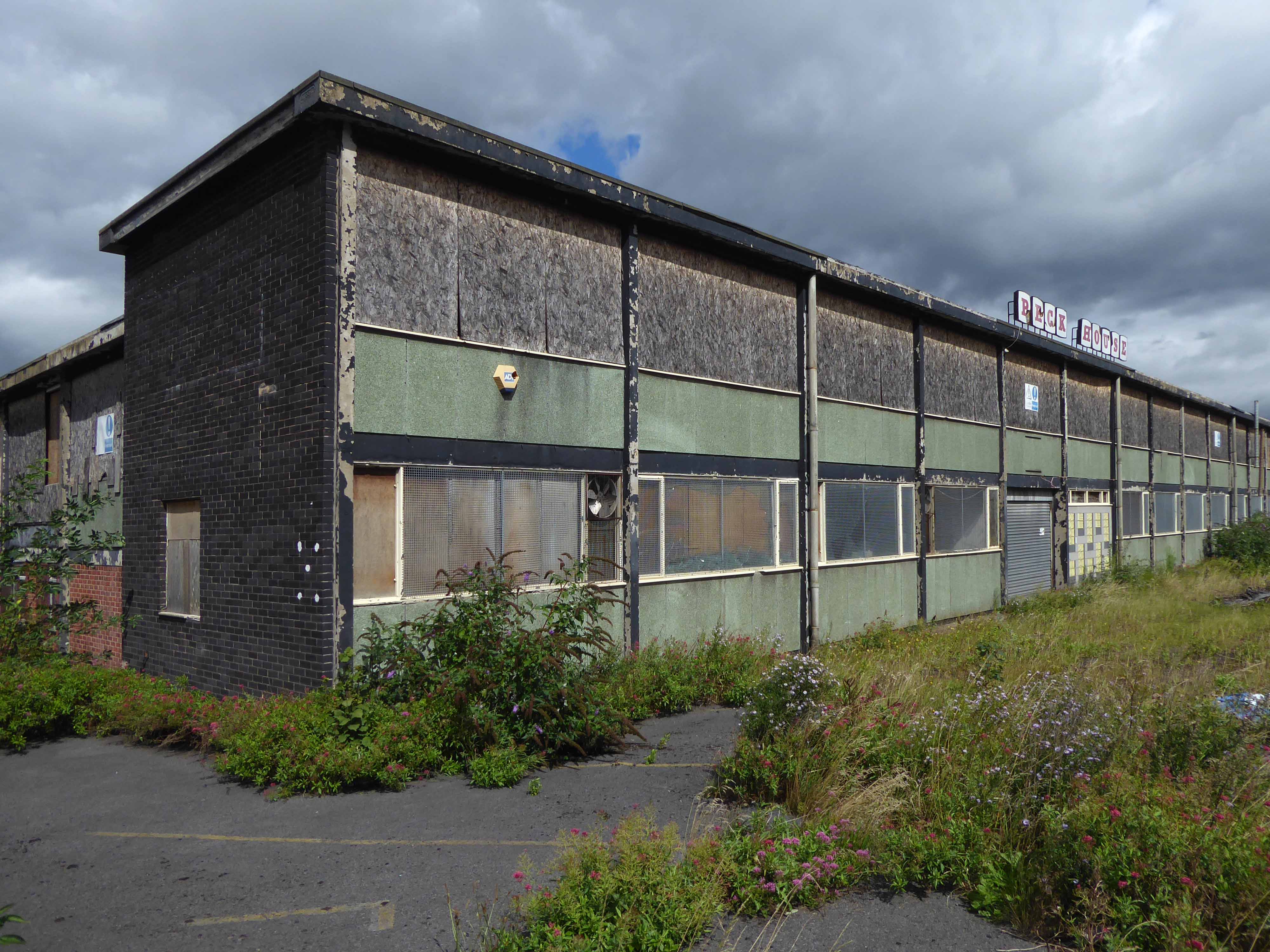
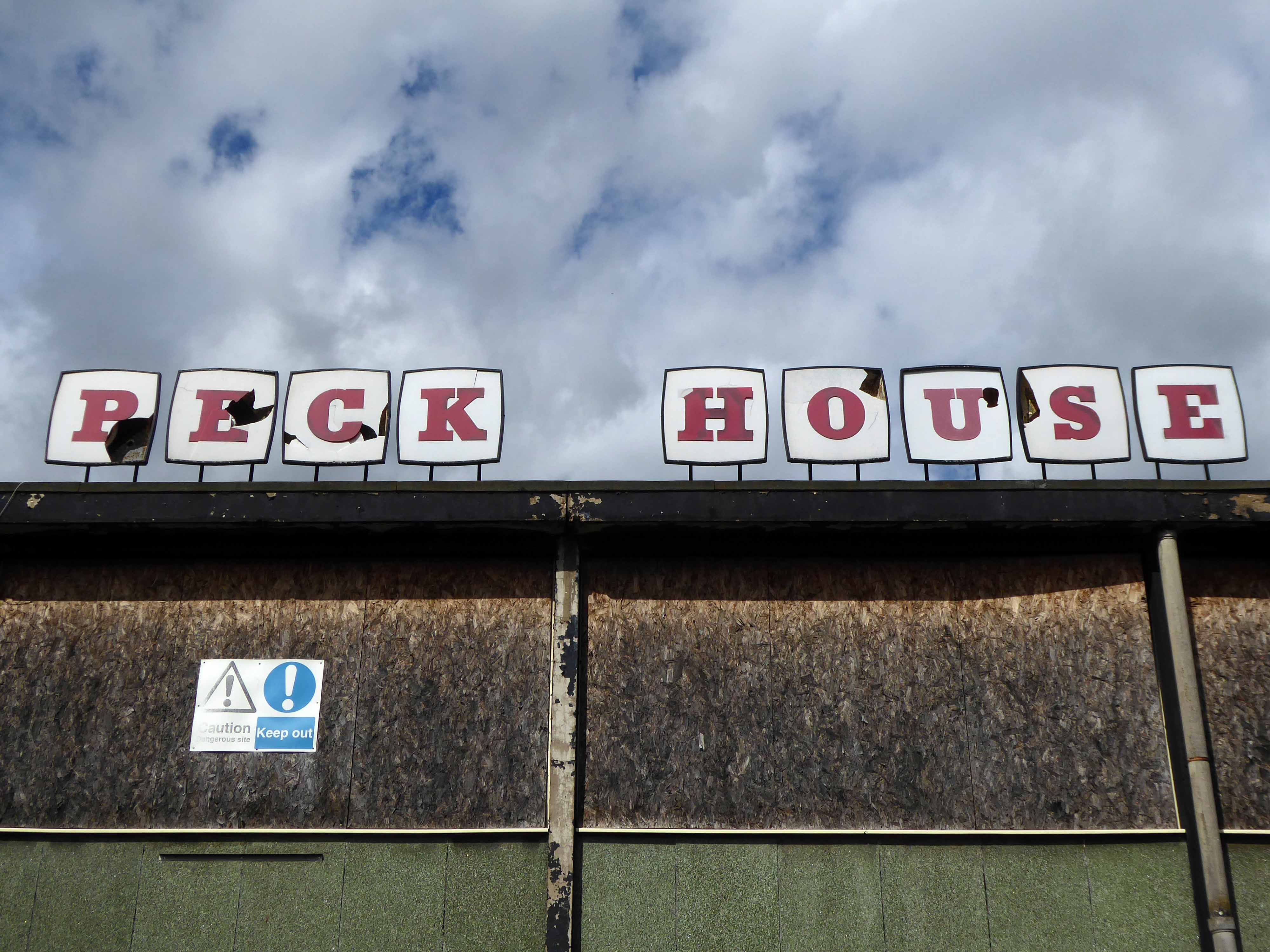
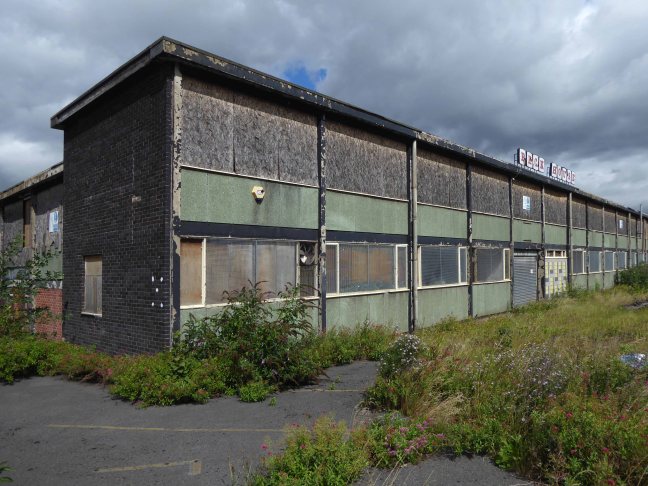
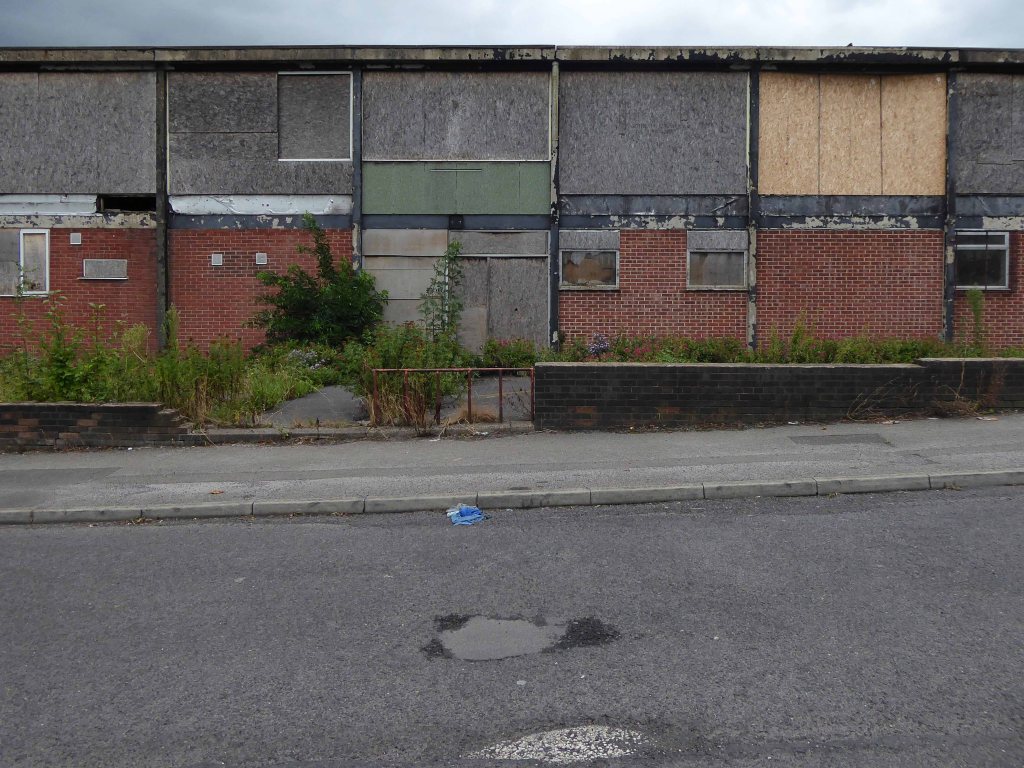
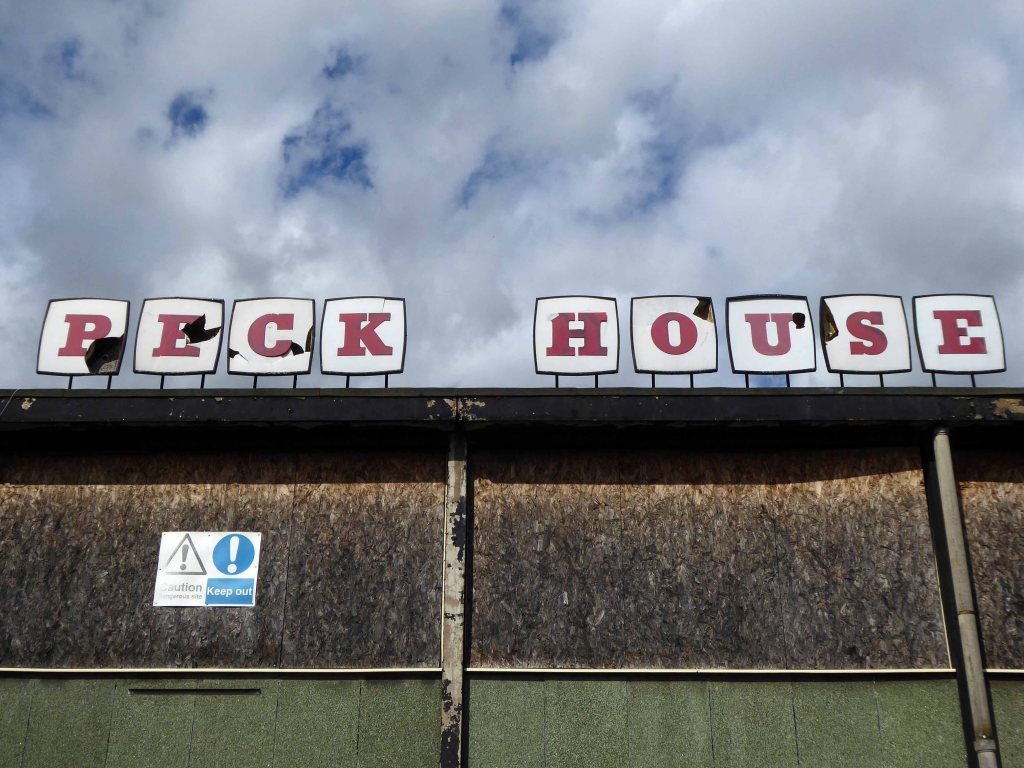
Further on up the road to Peck House.

And the attendant tiles.

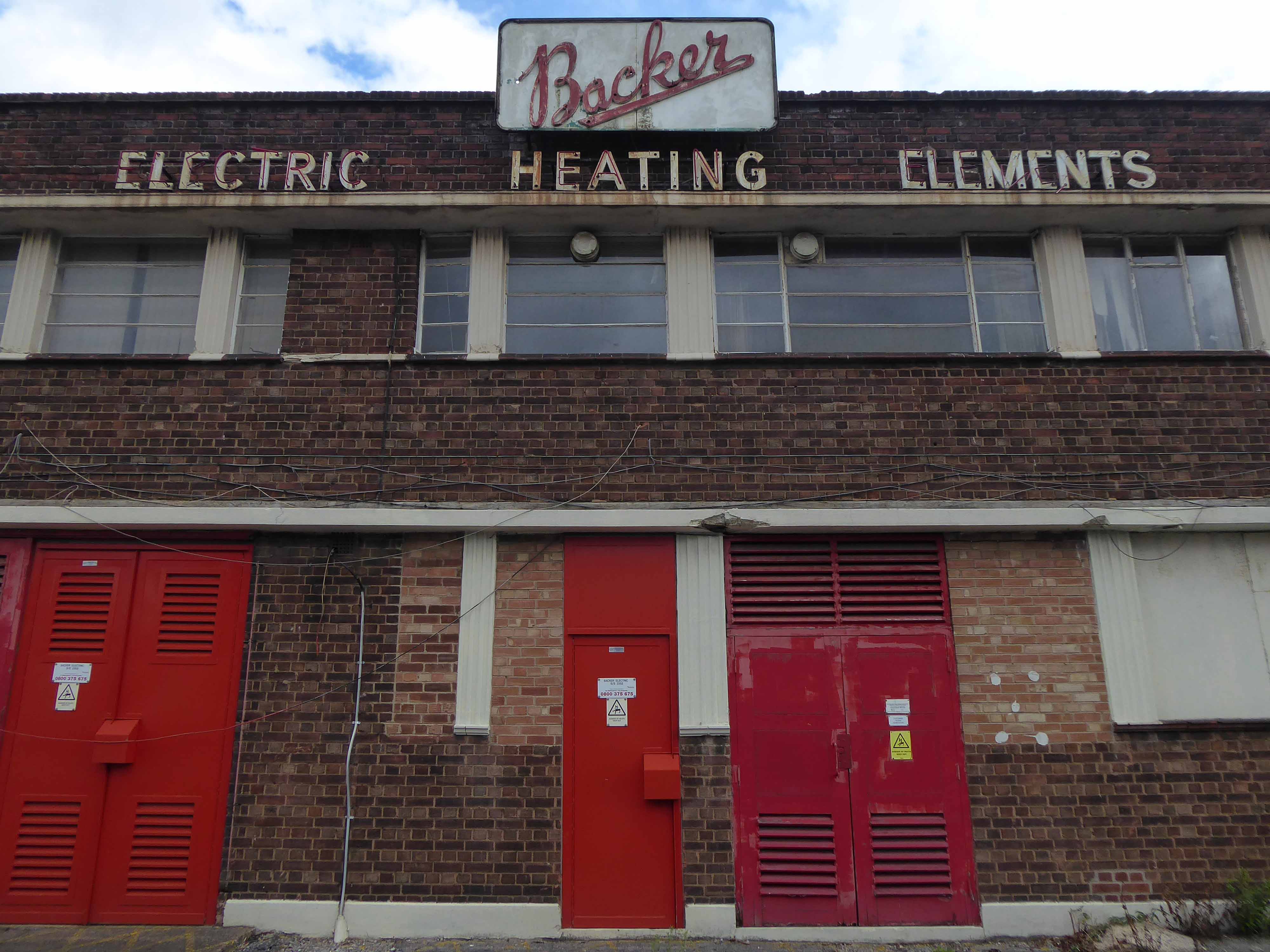
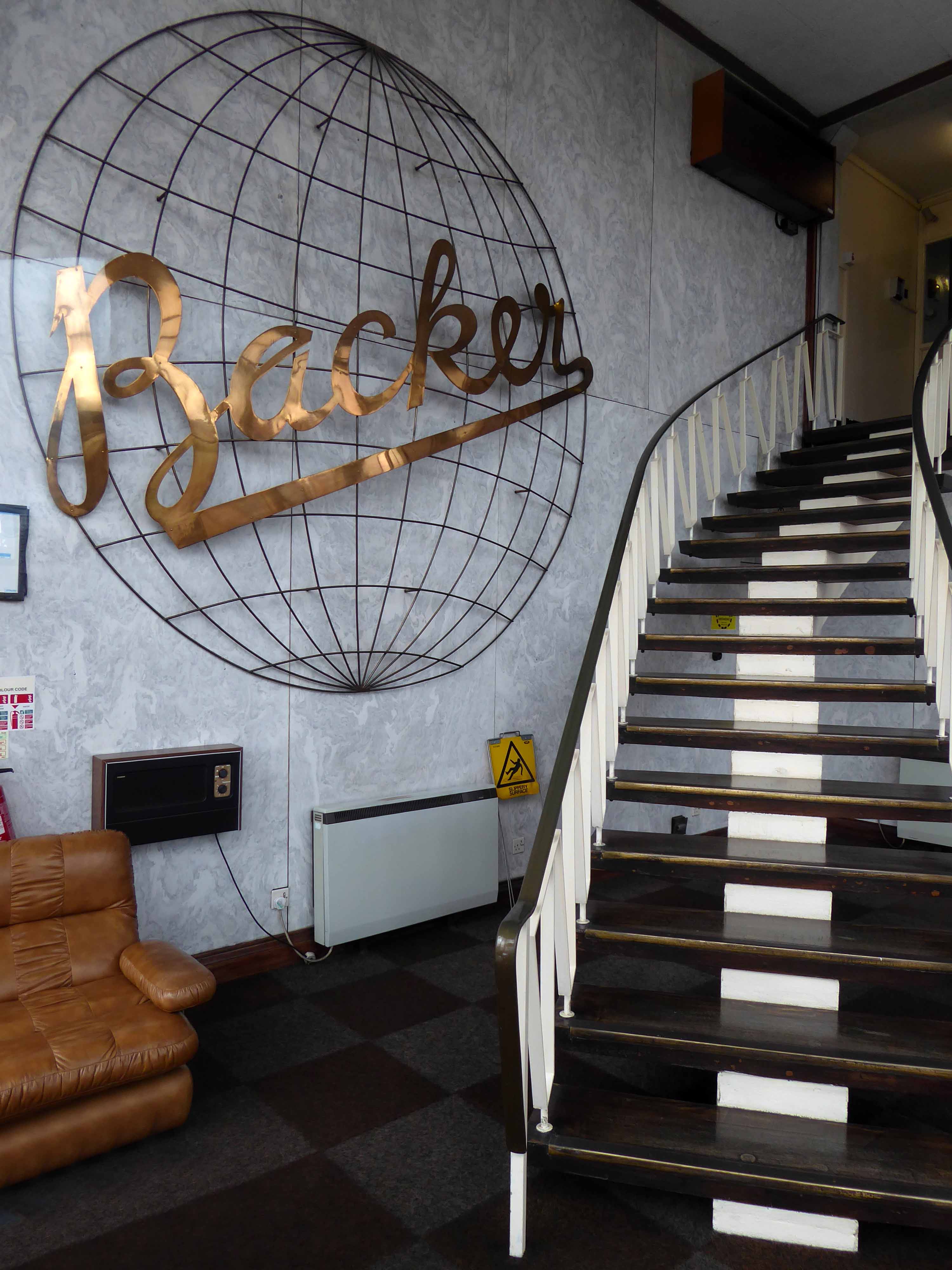
Just around the corner Backer Heating – still trading.

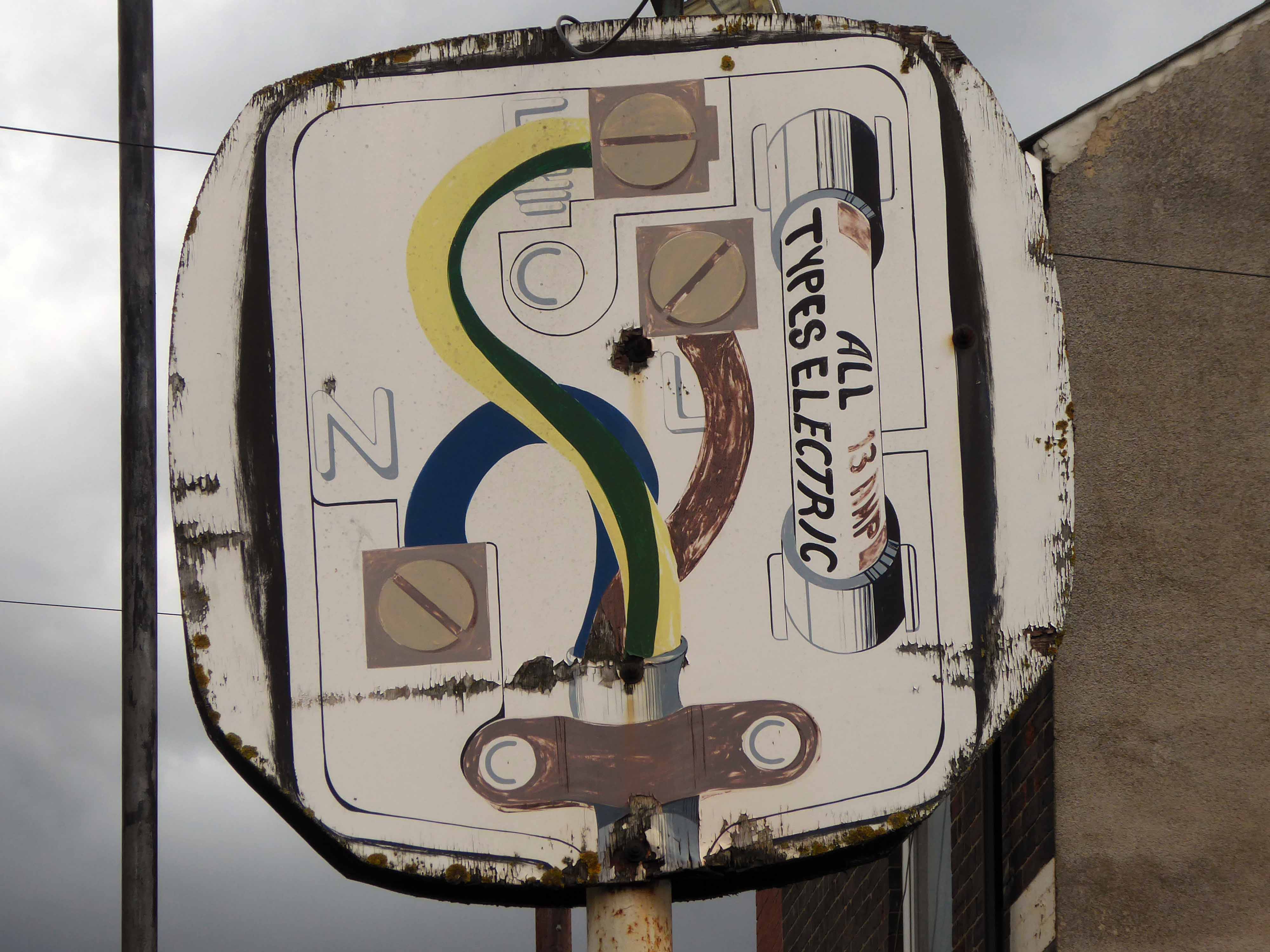
Returning toward town and enchanted by a giant 13 amp plug.

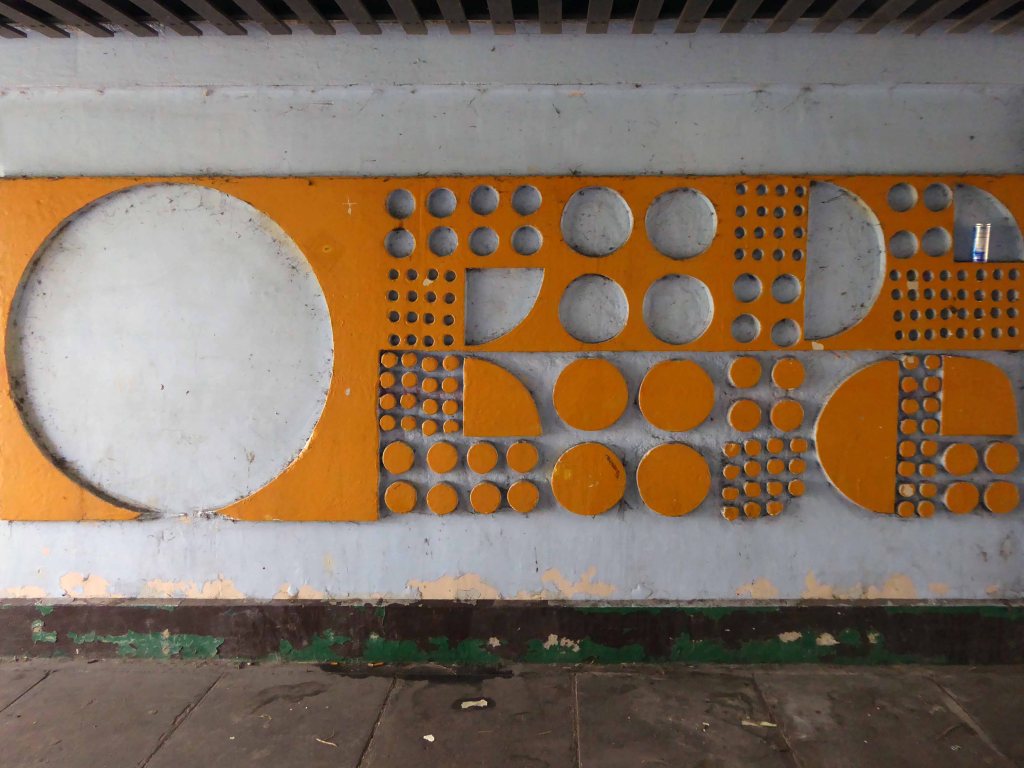
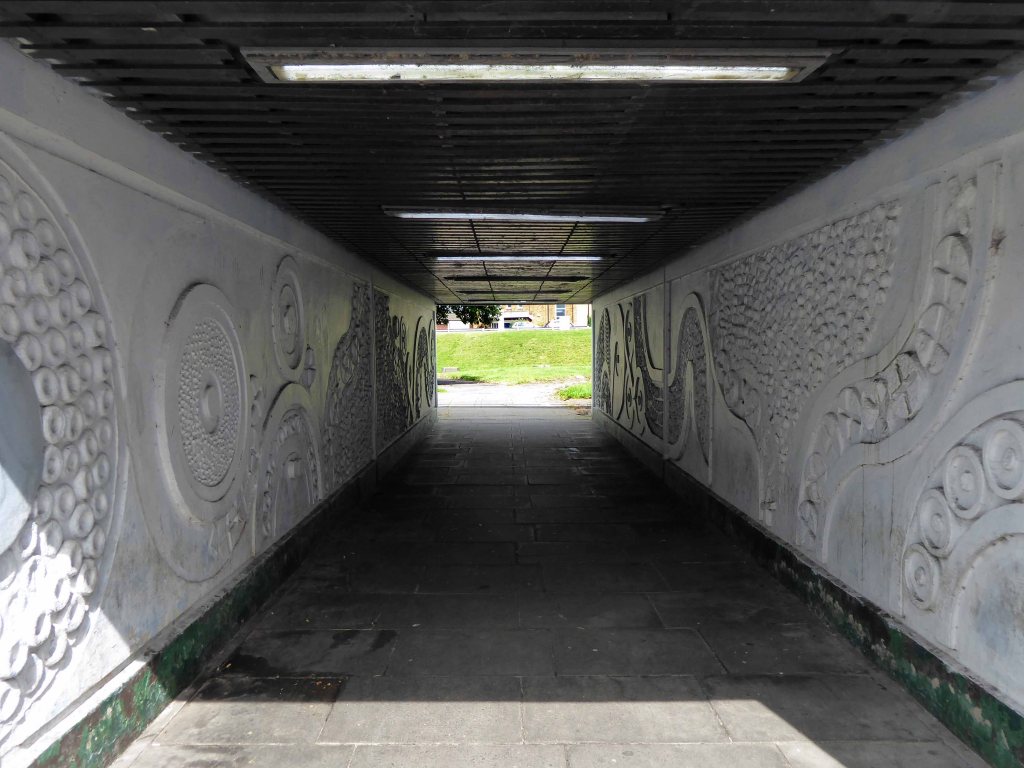
Under the underpass.

Then the other underpass.

Finally through the last underpass.

With a final notable note regarding Rotherham’s hand painted council commissioned signage – I’d like to think that they have a sign writer in their employ.

Many thanks to my learned companion Helen – thanks for a fine day out, so much to see and do!

Peck House Rotherham

Peck House, a long vacant commercial property on a prominent route into Rotherham, could be flattened for redevelopment as the owners begin discussions with the Council over its future.

The building on Eastwood Trading Estate, and its unique stylings, was the headquarters of Joseph Peck departments stores
.

Rotherham Business News 2017

The owners of the site, Backer Electric, occupy the adjacent building where they continue to manufacture heating elements, supplying products in high volume to the majority of household brand names. Options to reuse Peck House and the site have been investigated for a number of years.

A structural survey was carried out which found the building to be structurally sound and secure and therefore the Council has not been in a position to insist on its demolition.

In 1985, plans came forward to change of use of the retail/wholesale store to a church. In 2004, outline plans were submitted for a development including a hotel, restaurant, hot food takeaway and petrol station for the wider area. In 2014, Peck House was one of a number of sites discounted as the location for a new £5m primary school.

As of Wednesday 26th August 2020 it’s still there underdeveloped and overgrown.

In the company of local resident Helen Angell and having become aware of the site through the paintings of Mandy Payne and the photographs of Sean Madner – I was eager to pay a visit.

Joseph Peck departments stores originated in Rotherham in the late 1800s and had branches in Worksop, Barnsley and Sheffield.

I have only been able to find evidence of the Sheffield store – which may not be linked.

Though there are references to a Rotherham store on Bridgegate.

Joseph Peck was in Bridgegate in Rotherham, and in the late 40’s at Christmas, they had a grotto and a Father Christmas. The queues of parents and children would go down the yard and up Bridgegate. My mum and dad always took my brother and I to see Father Christmas and get a present from him. The store was a department store selling just about everything that was available just after the war. Mum took my brother and I coming up to one Christmas, she was trying to find a bicycle for my brother and I, but they didn’t have one. As we came out of the store, one of old fashioned three wheel railway delivery lorries was just pulling out of the yard. On the back was a blue bike. Mum stopped the driver and asked him where he was taking it. He told her ‘Redgates at the bottom of Ecclesall Road in Sheffield. She shouted ‘Taxi’, and told the driver to ‘follow that lorry’. Just before the lorry arrived on The Moor, she told the taxi driver to overtake the lorry and go to Redgates. We rushed in, she found the manager and asked him about the bike. He hadn’t known that one was being delivered so Mum told him she’d have it without even asking the price. The lorry driver didn’t even have to take it off the lorry, and delivered it to our house next day.

My elder brother had it first, then me, then my younger brother, and finally our young sister. It was still being used when I flew the nest in 1959. 

Merry Christmas everybody.

Sheffield Forum

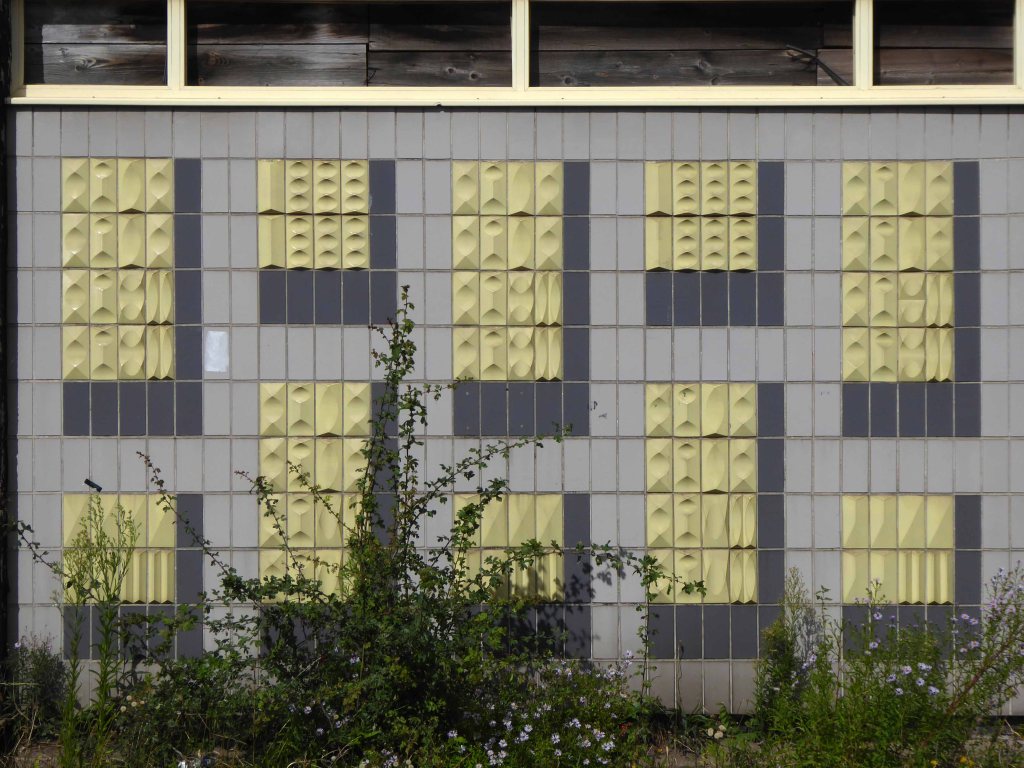
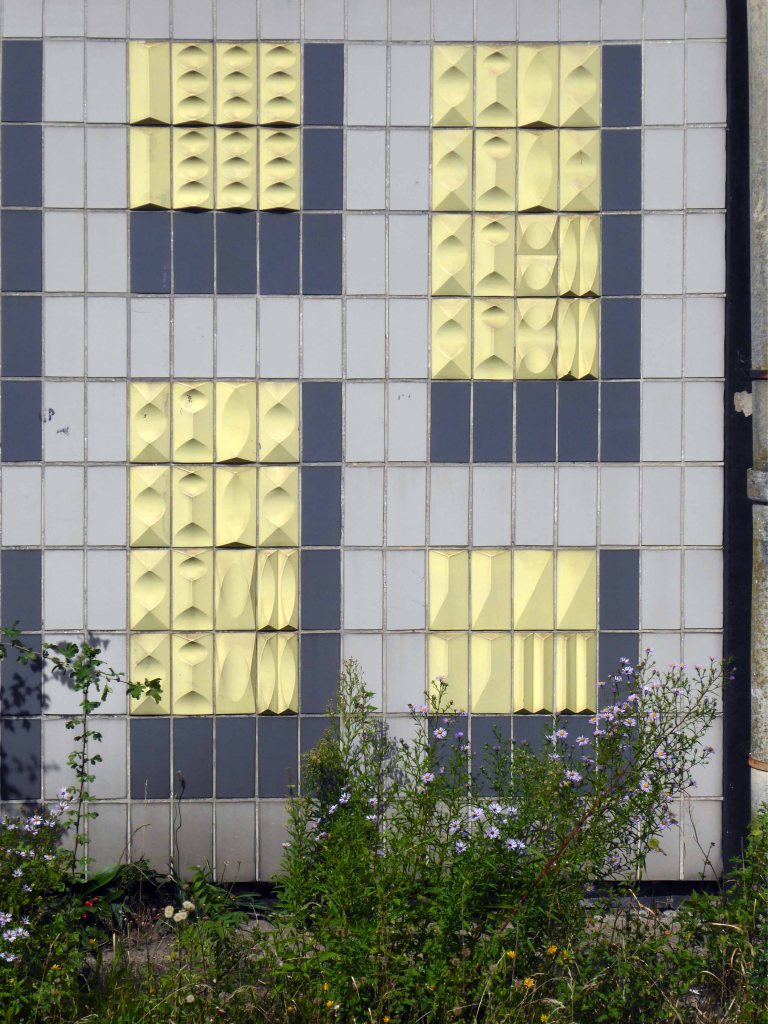
So here we are confronted with some tip top architectural type high atop the low-rise industrial facility.

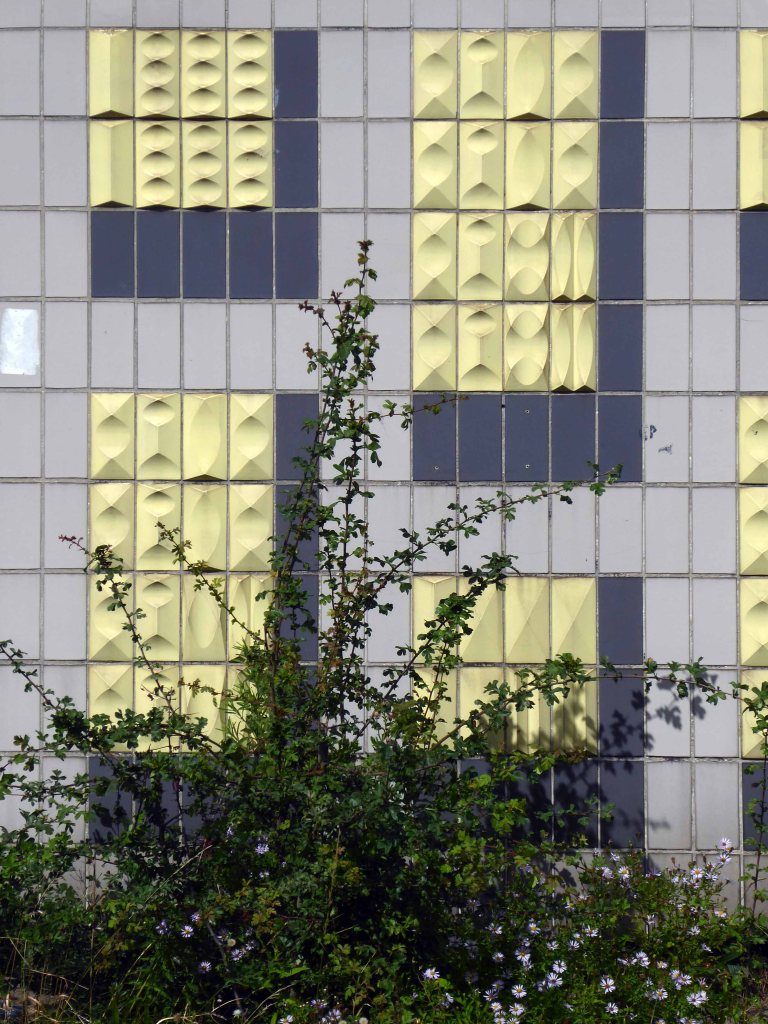
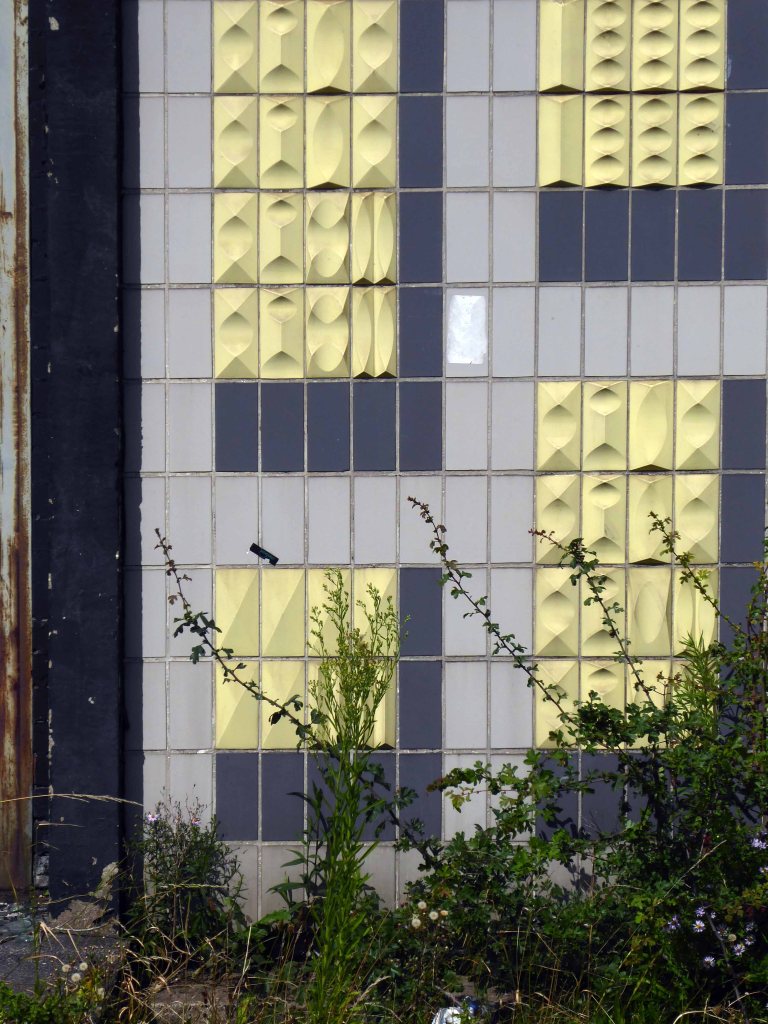
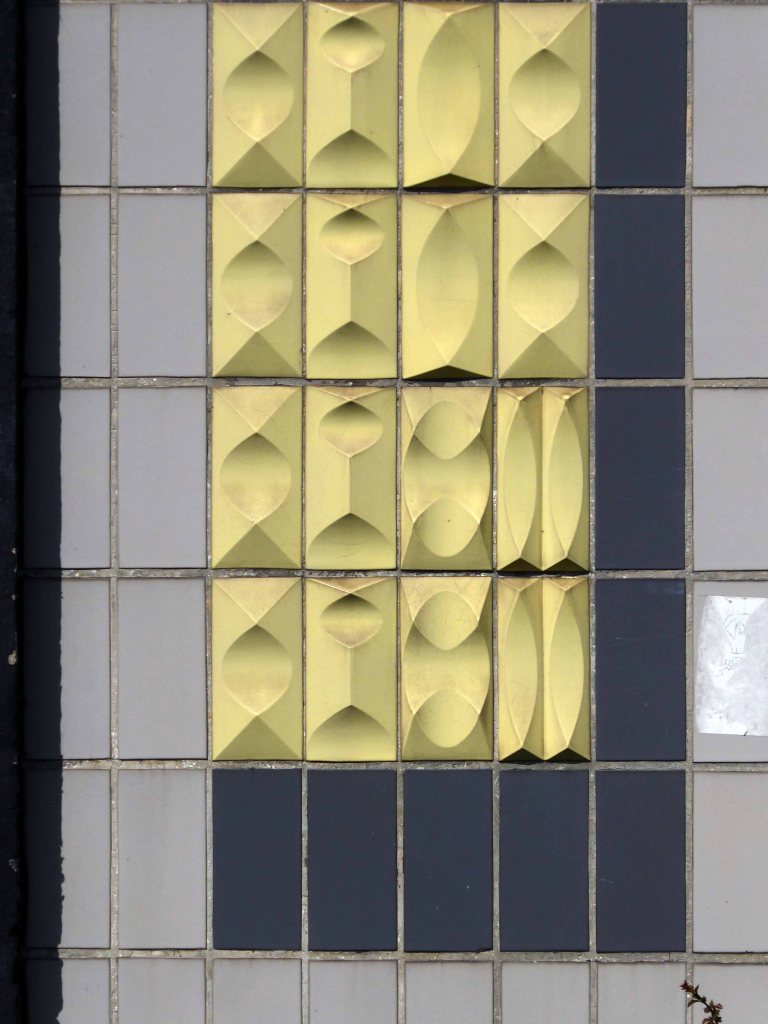
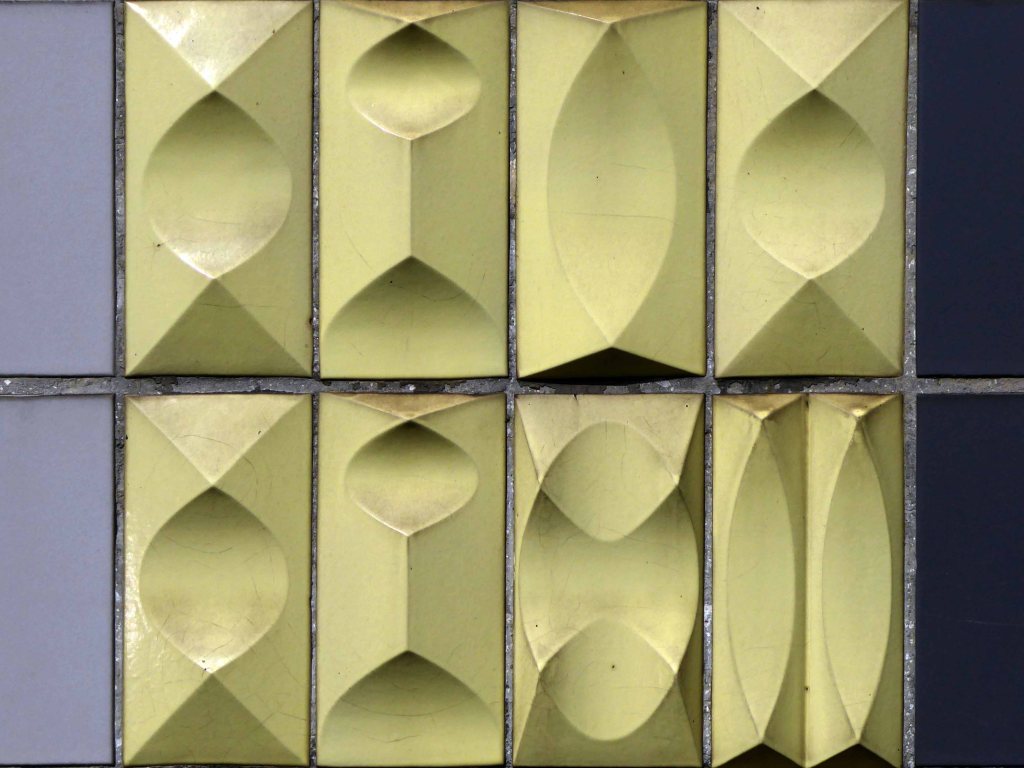
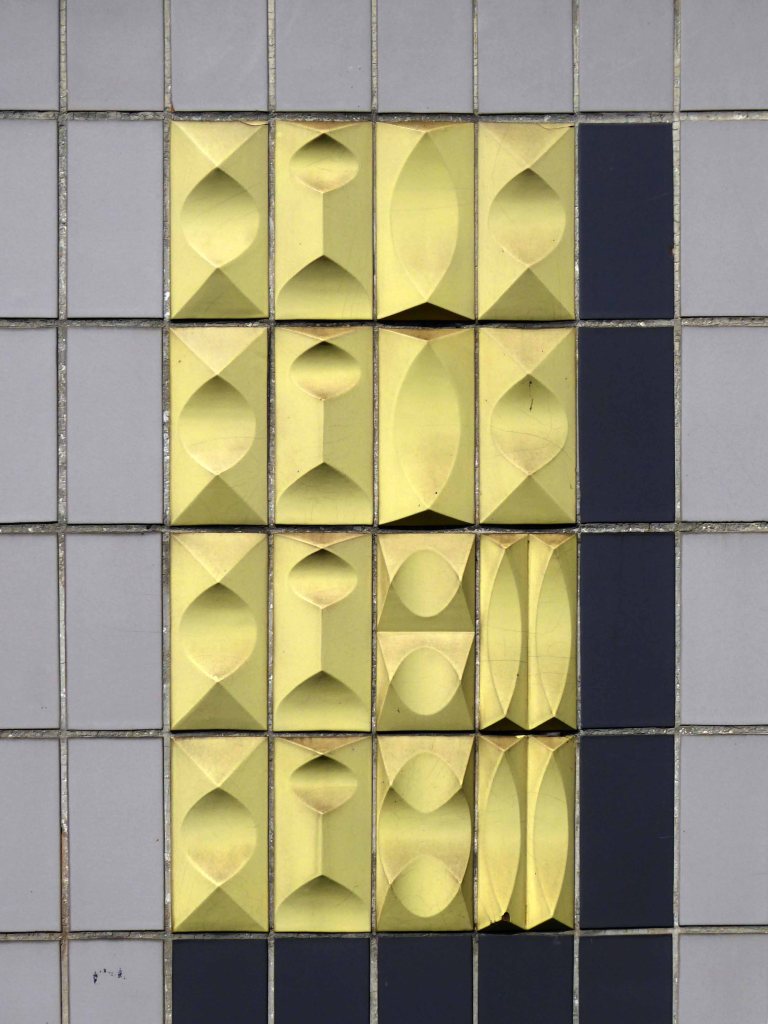
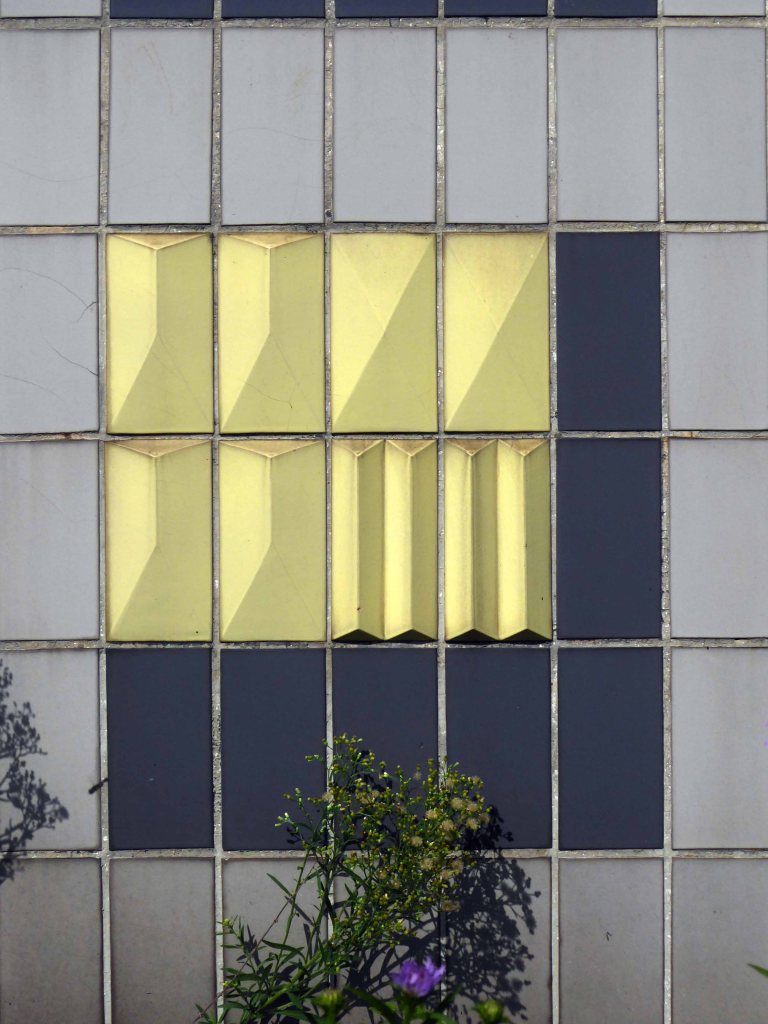
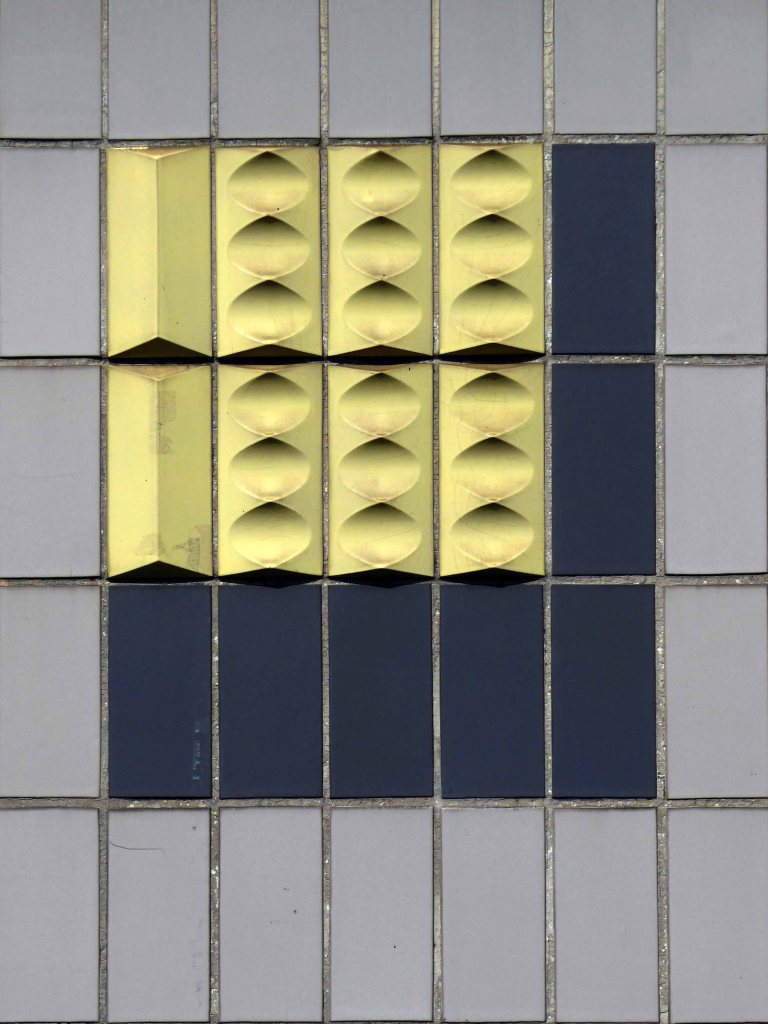
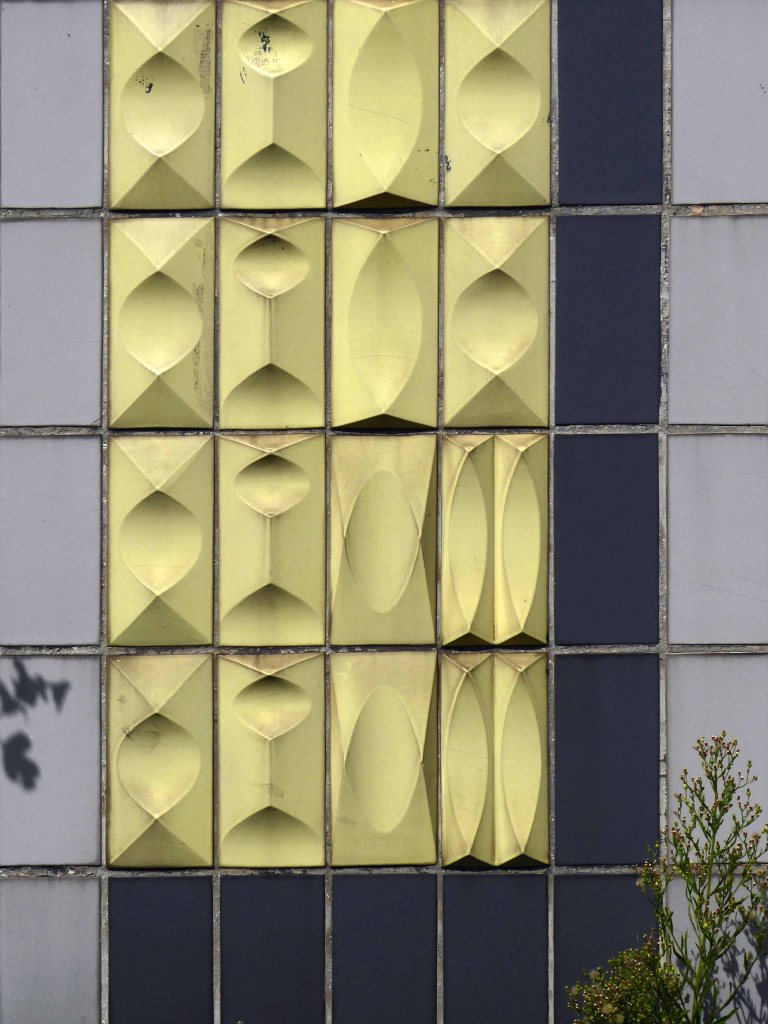
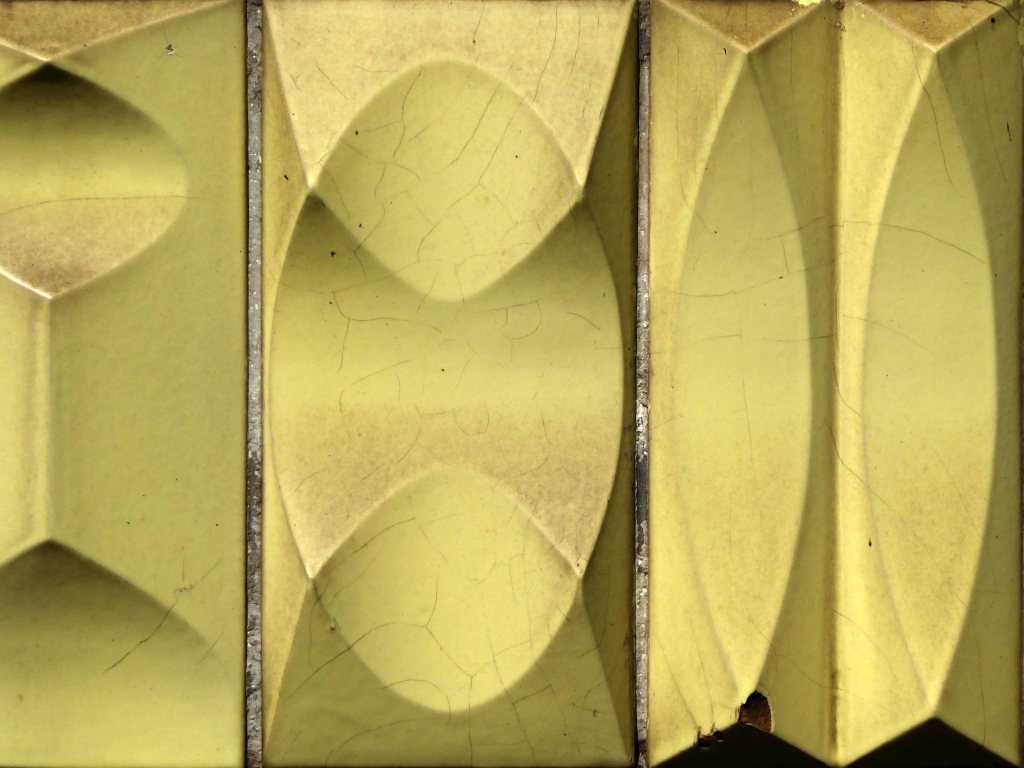
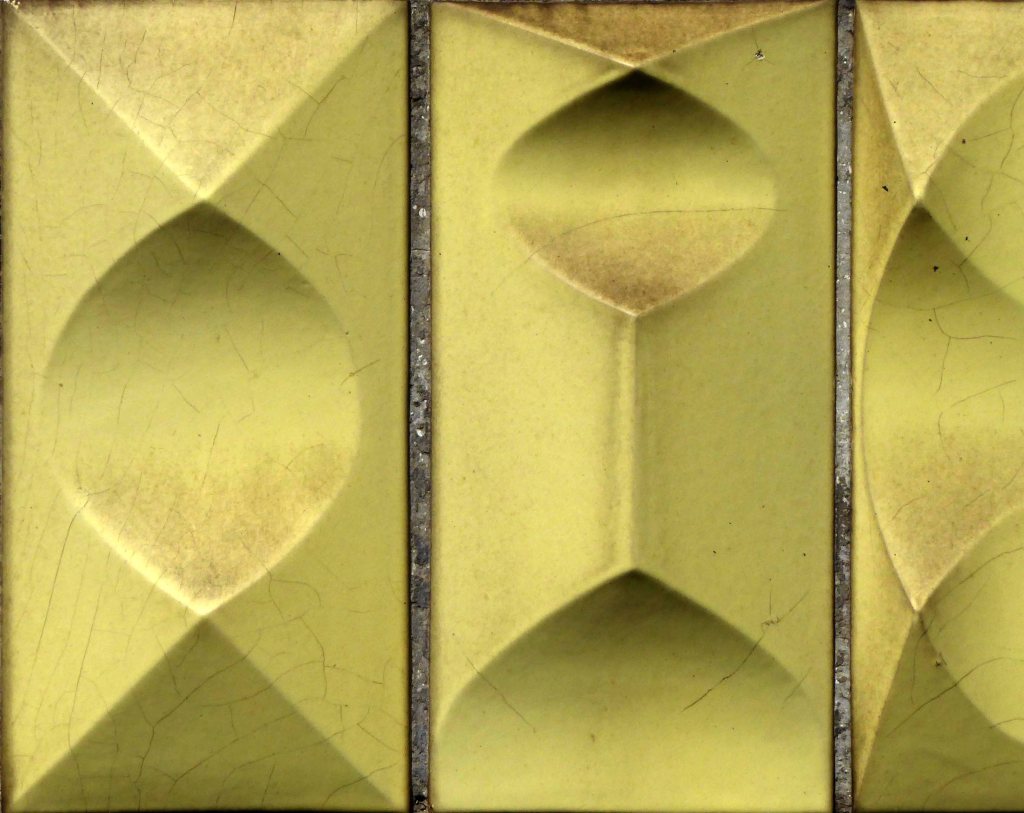
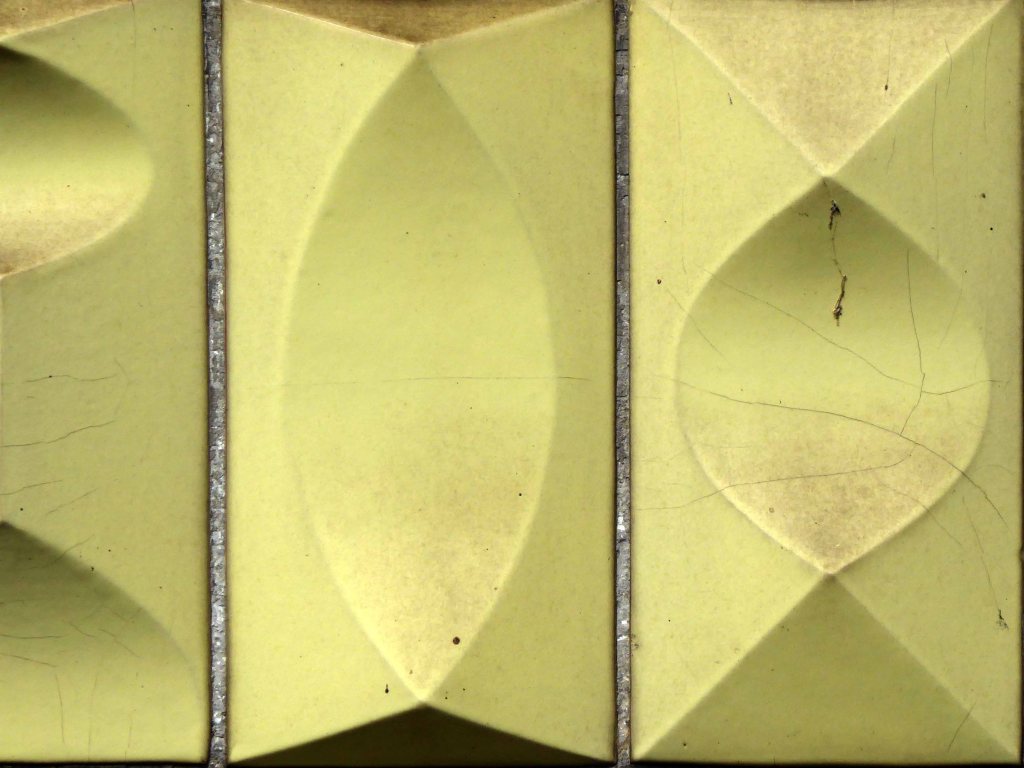
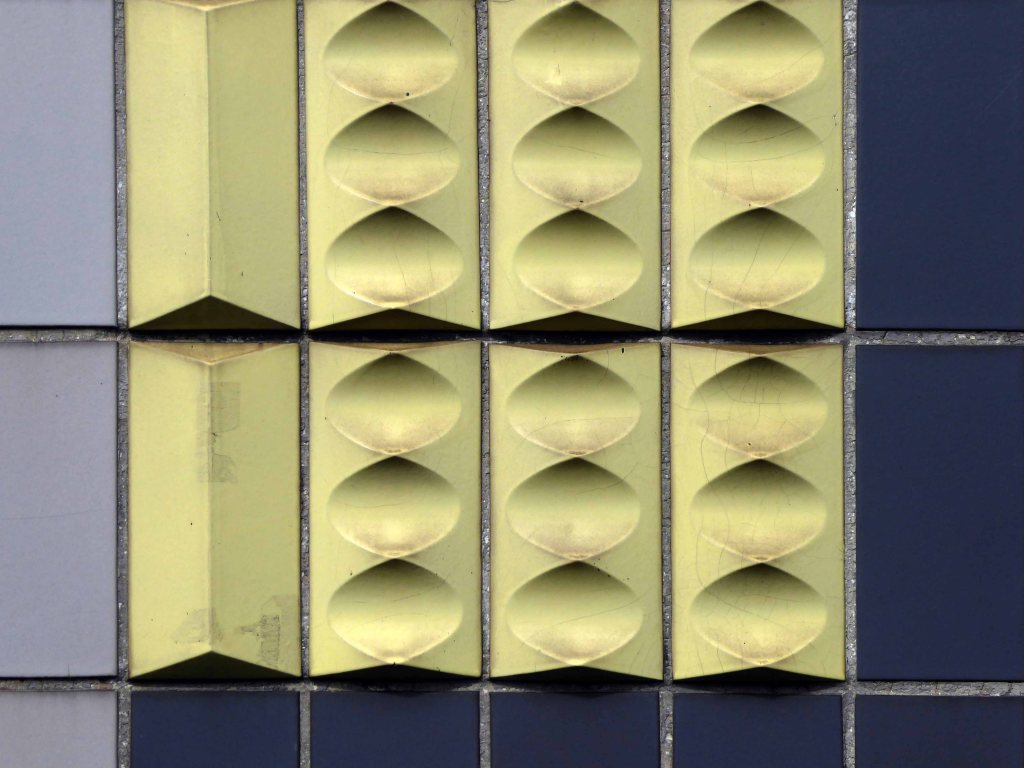
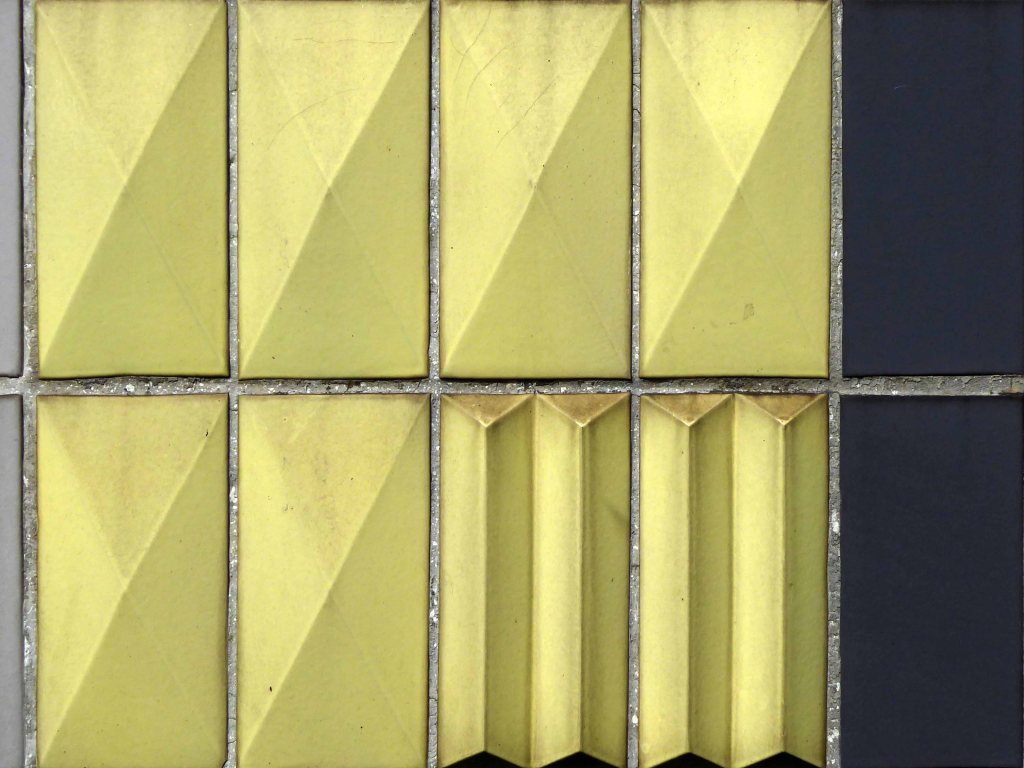
What’s more there is a panel of ceramic tiles many with a pronounced profile in relief – a fugue in lemon, grey and a deep Prussian Blue.

No reference to the manufacturer or date online sadly, suffice to say that they are truly enchanting – look!

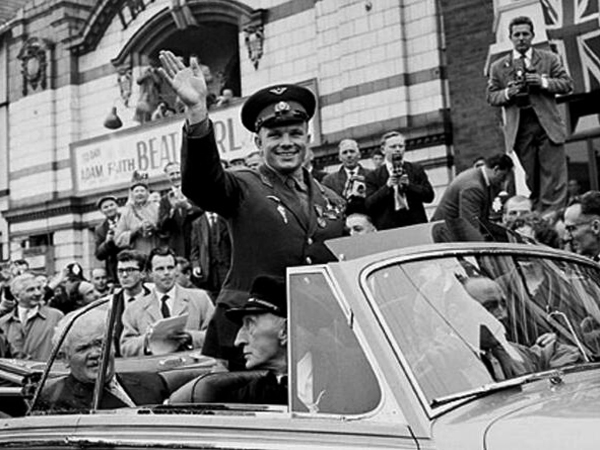
Yuri Gagarin Manchester 1961

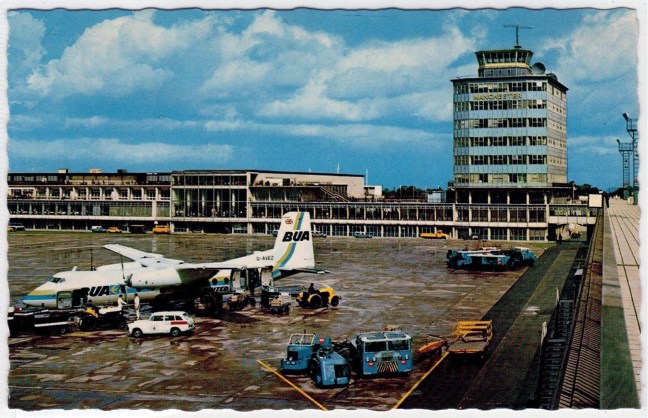
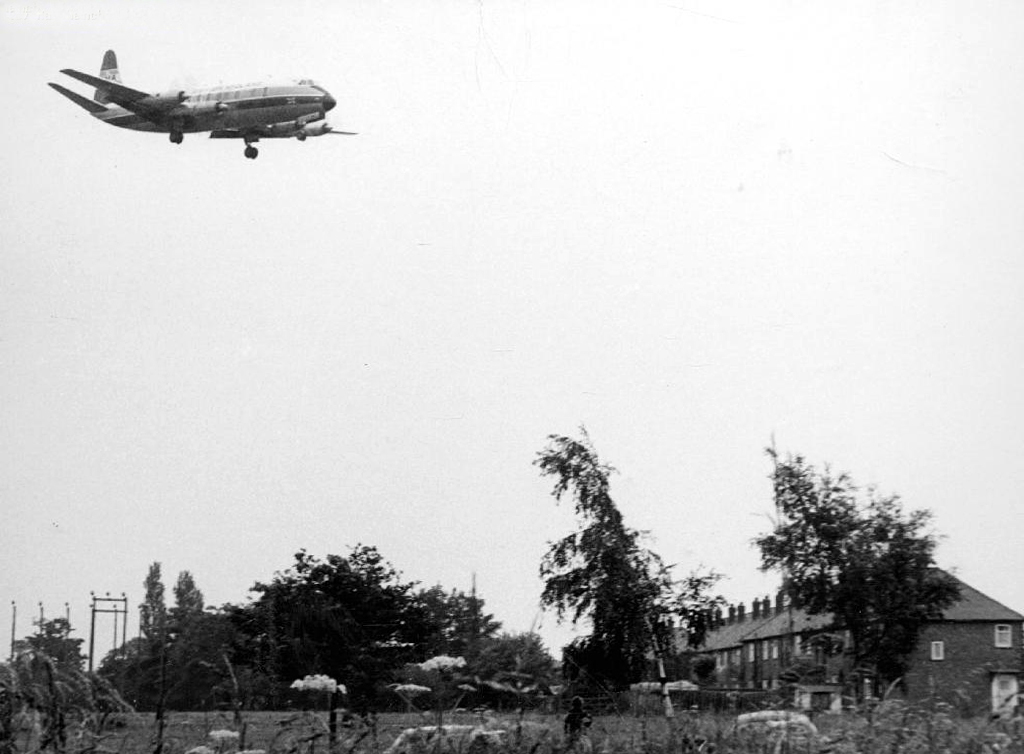
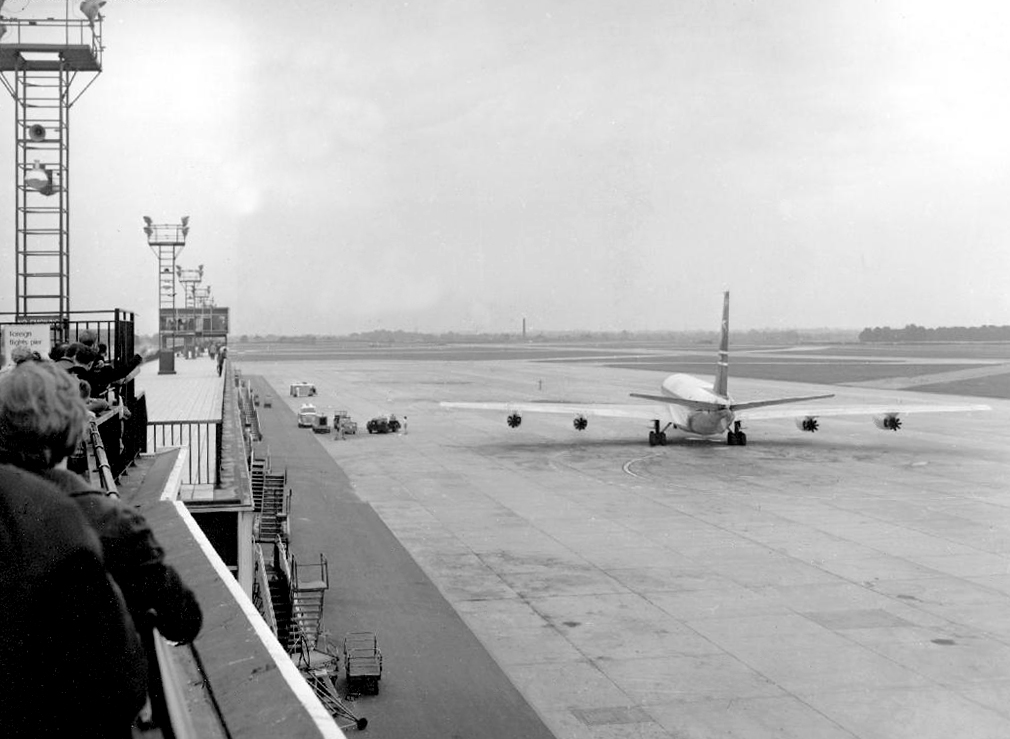
Exactly three months to the day after his flight in Vostok I had ushered in a new age of space exploration, on 12 July 1961, the trim figure of Yuri Gagarin strode down the gangway of a British Viscount airliner and walked briskly out across the runway of Manchester airport towards a sea of expectant faces, and flashing camera bulbs.

Working Class Movement Library

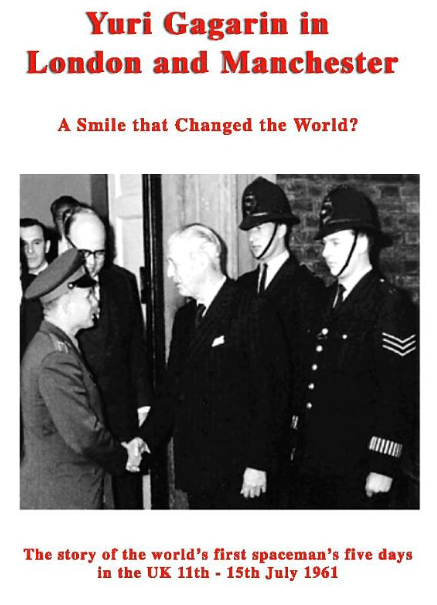
There are many excellent accounts of his visit – for a detailed view Gurbir Singh’s book Yuri Gagarin in London and Manchester is hard to beat.

It is from this source that I was able to retrace Yuri’s journey, from the then Ringway Airport, to the offices of the AUFW at Brooks Bar.

Archive photographs – Local Image Collection

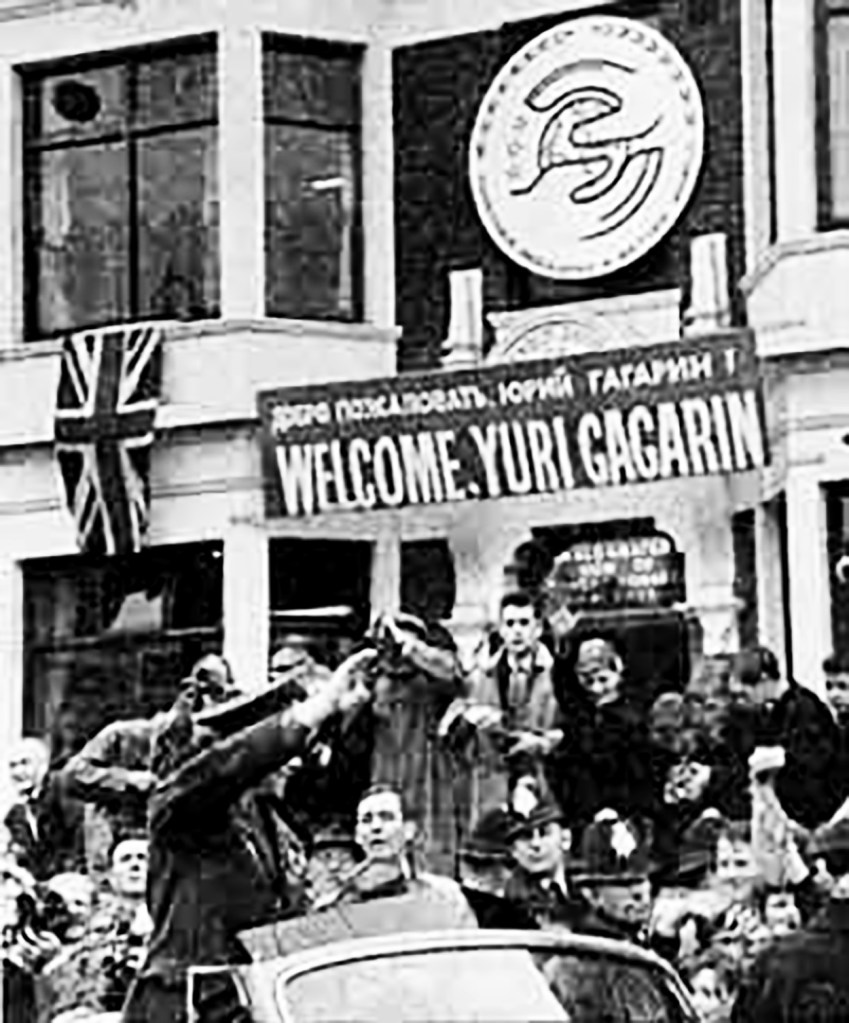
Thousands lined the wet streets of Manchester that day as he passed by in his beige open topped Bentley – standing proud waving to all and sundry.

This is Yuri’s journey via the Manchester Local Image Collection.

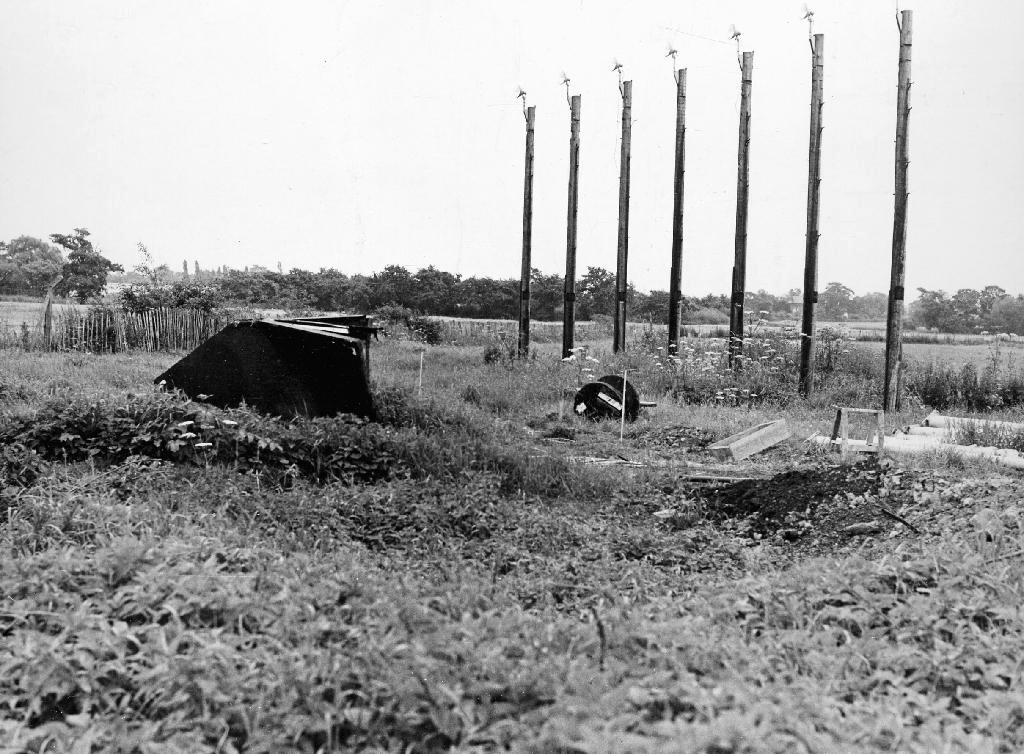
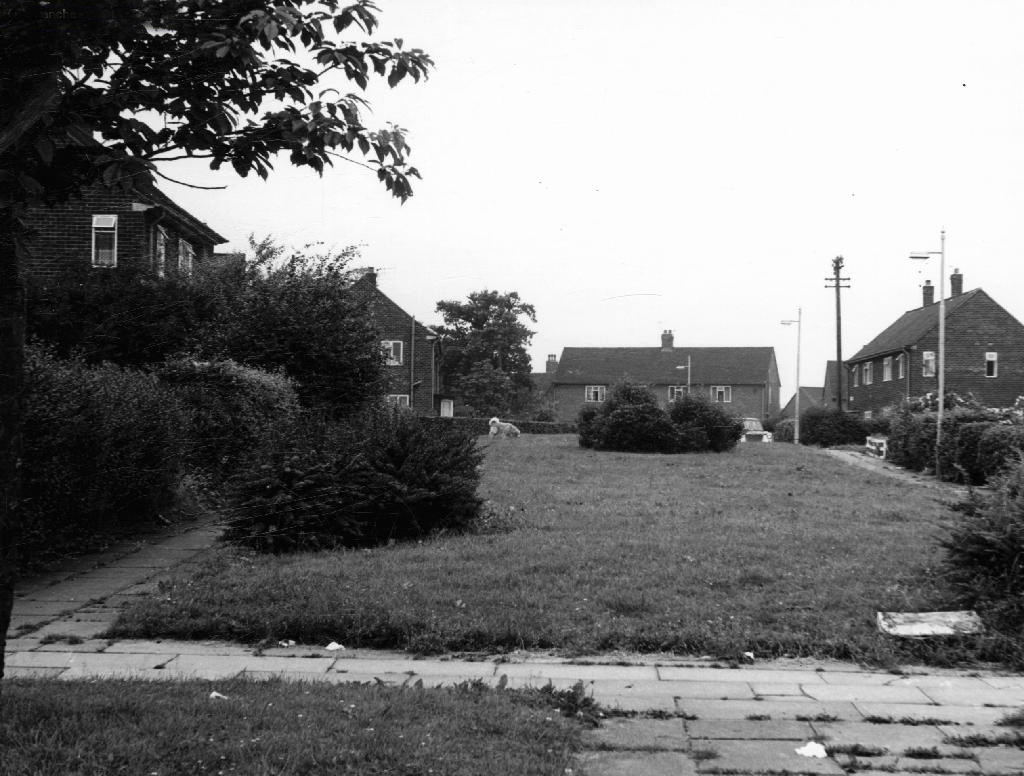
A loose approximation of what he may have see on that day in 1961.

We were allowed out of Brownley Green school to line the road as he passed, great memories.

I stood on Chester Road with my mum, I was 4 years old, but still remember it.

At that time, I was a student, working my socks off in the Central Library, I went outside into St. Peter’s Square to watch him pass, he gave everyone a big smile.

Still tell my children, tiny at the time – you saw the first man in space, I remember his smile.

Worked in an office in Albert Square – had a grandstand view of him arriving at the Town Hall.

I can remember a police escort taking Yuri to Albert Square via Princess Parkway through Withington, Fallowfield and Moss side, there were hundreds of people lined up watching a waving at him.

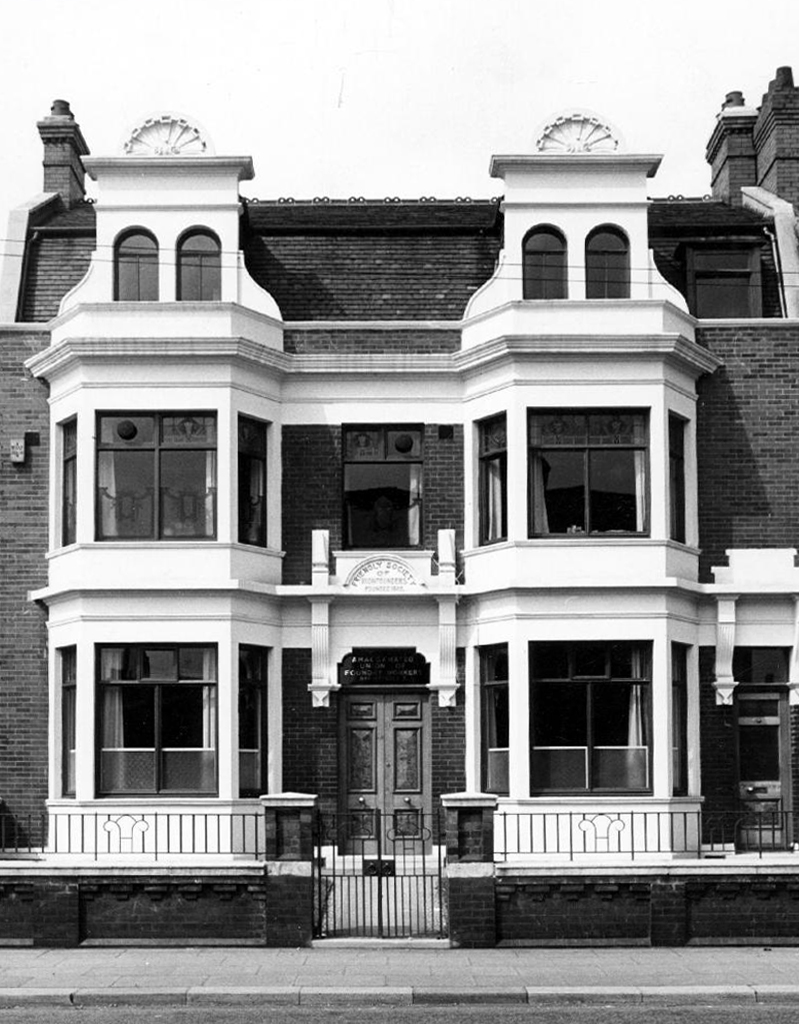
When Gagarin visited Manchester he was given a bronze bust of Lenin made by the Amalgamated Union of Foundry Workers. Four were made in total and my Dad owns one of them.

My Grandad’s funeral was on the day he came, as we passed down Altrincham Rd onto the Parkway policemen who were holding back the crowds saluted, he would have loved it.

Yeah I seen him stood up in a big car with a green uniform on. It was going down Brownley Rd passing Meliden Crescent heading for the Airport in Wythenshawe, I was about 6 years old.

Working for Manchester Parks as a 20 yr old on Princess Parkway and he came past me as I was mowing the grass, in an open top Rolls or Bentley, he saluted me personally as he passed, of course I stood to attention and returned the salute – Magic Moment

Ringway Road

Shadow Moss Road

Post-war social housing

Simonsway

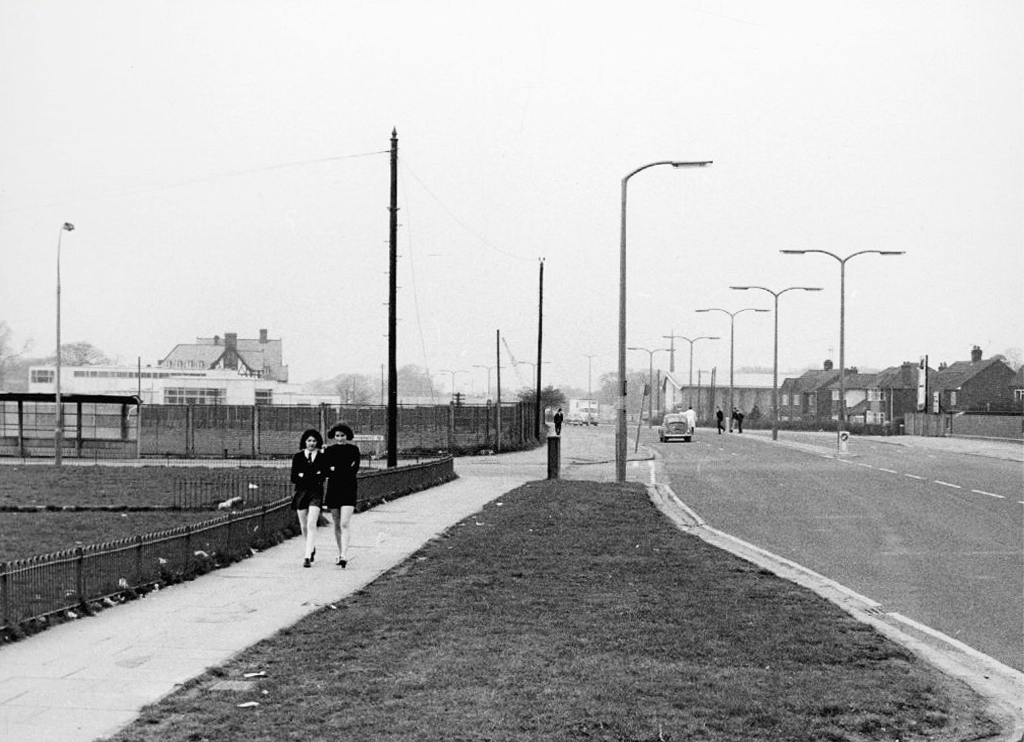
Brownley Road

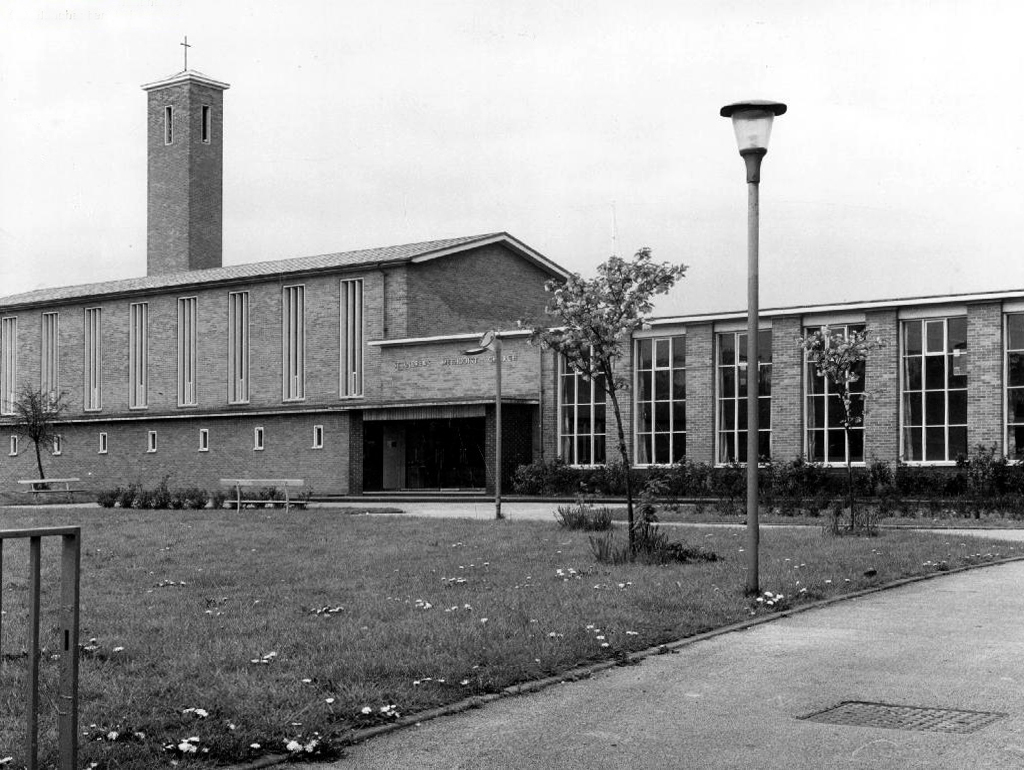
St Andrews Church JCG Prestwich and Son 1960

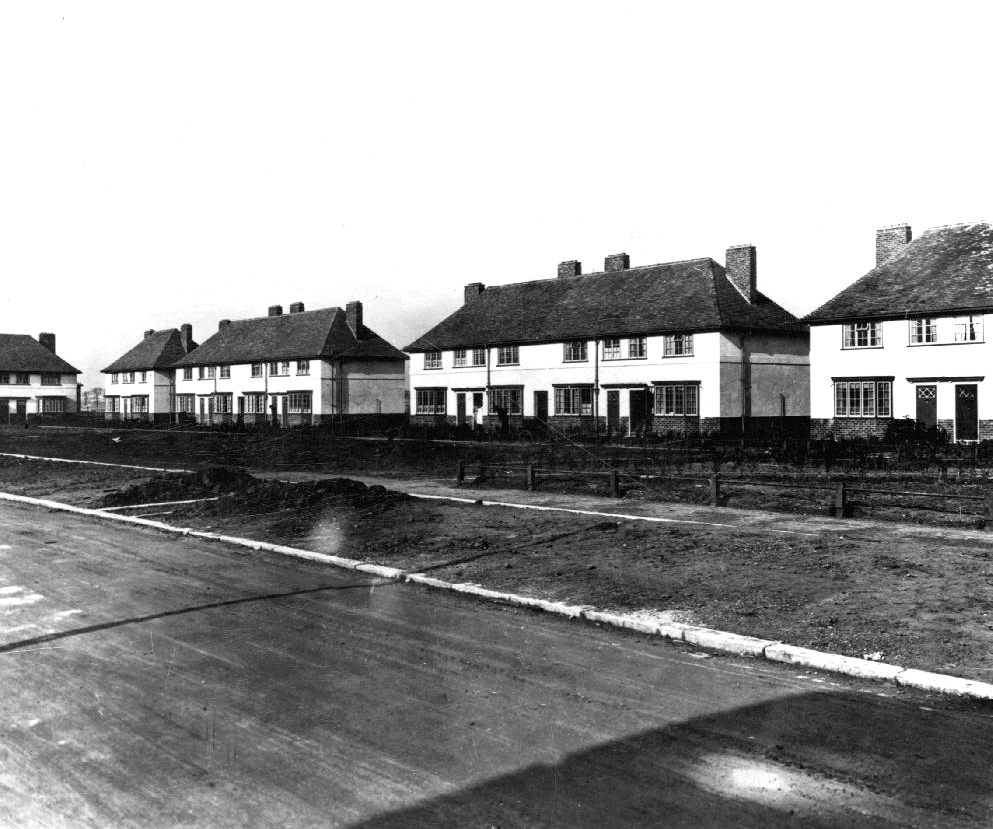
Housing built 1934

1960 development

St Luke The Physician1938-9 by Taylor and Young

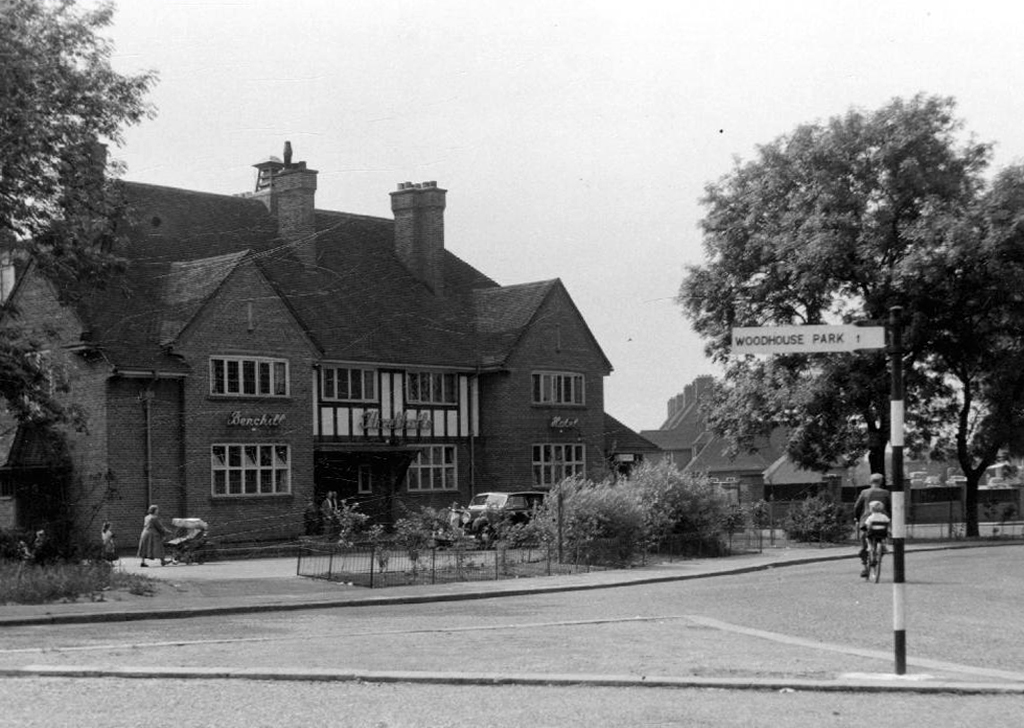
Benchill Hotel – demolished Autumn 2012

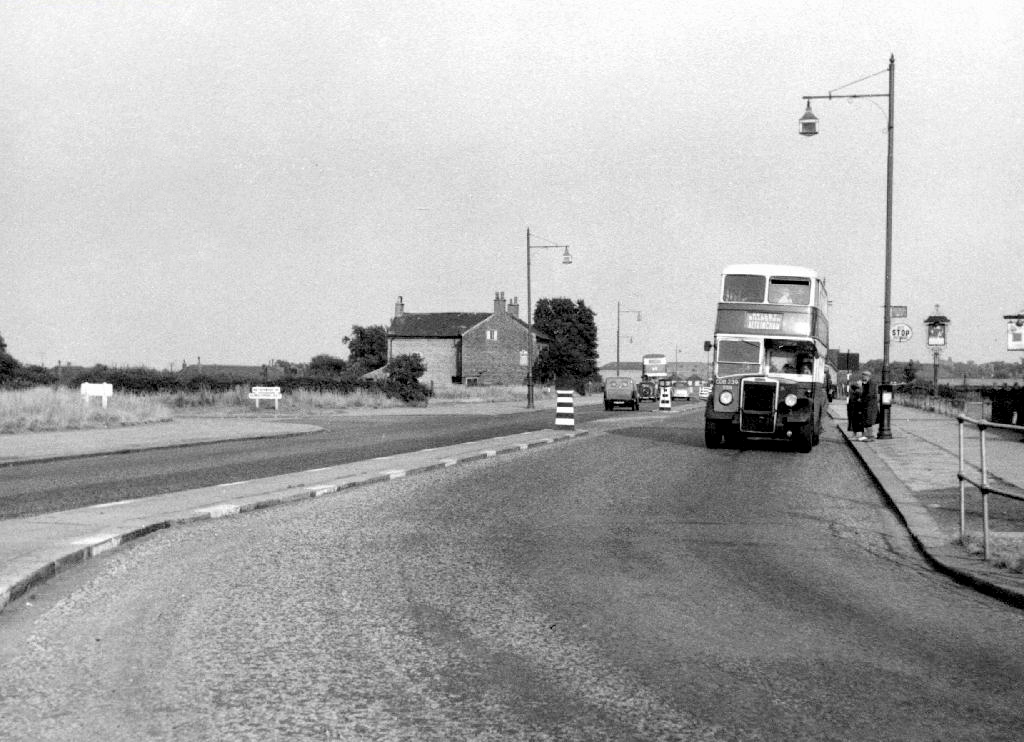
Altrincham Road

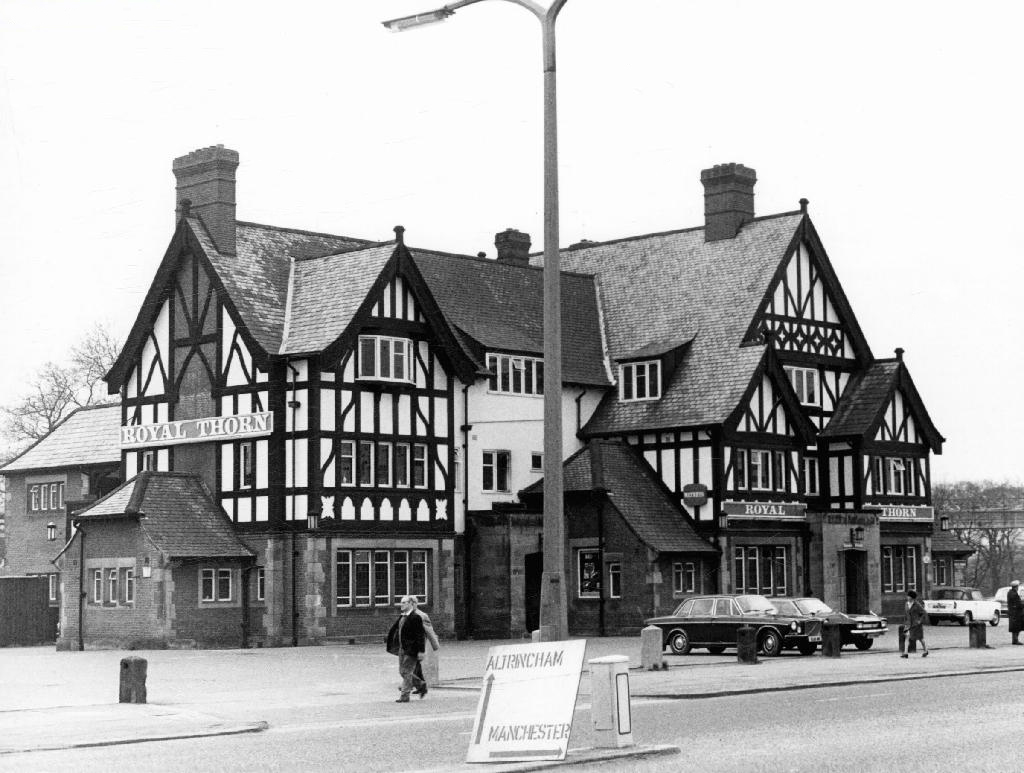
Royal Thorn – demolished 2001

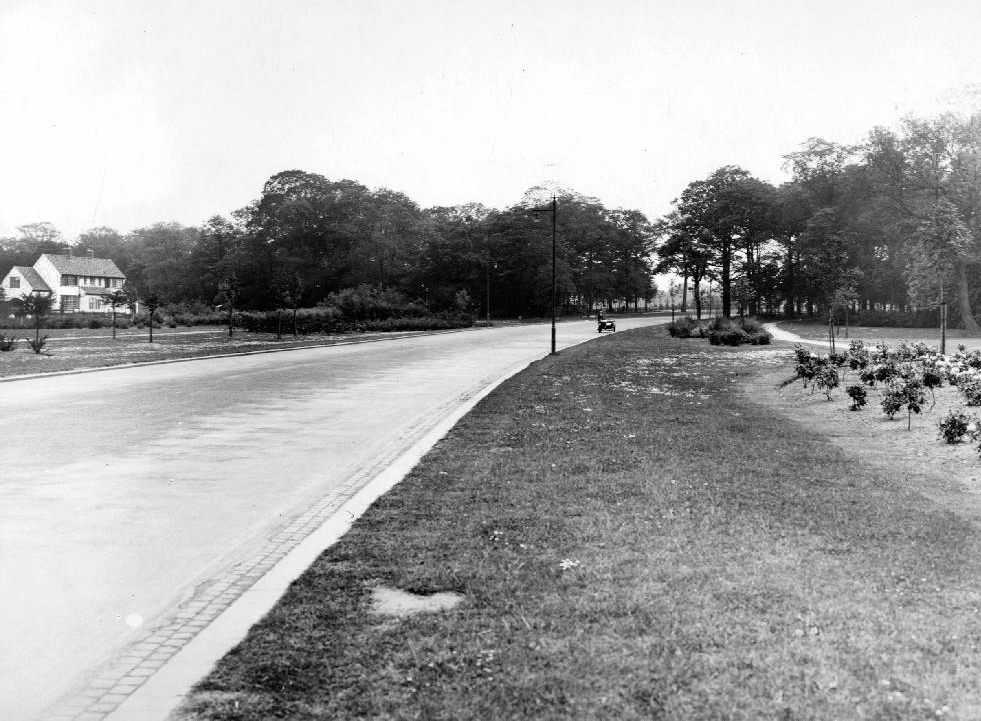
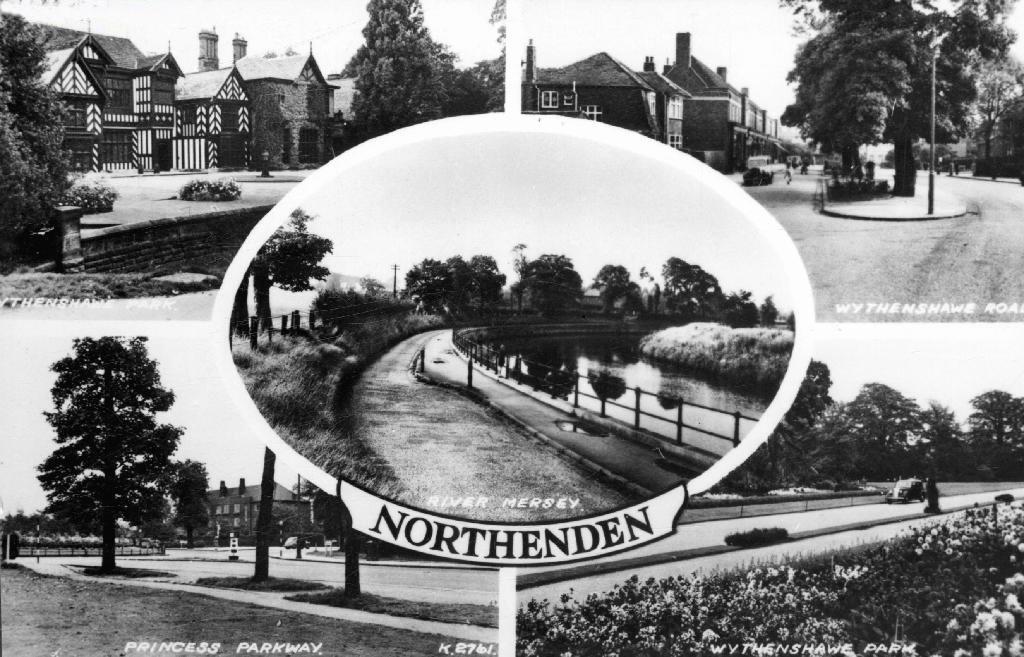
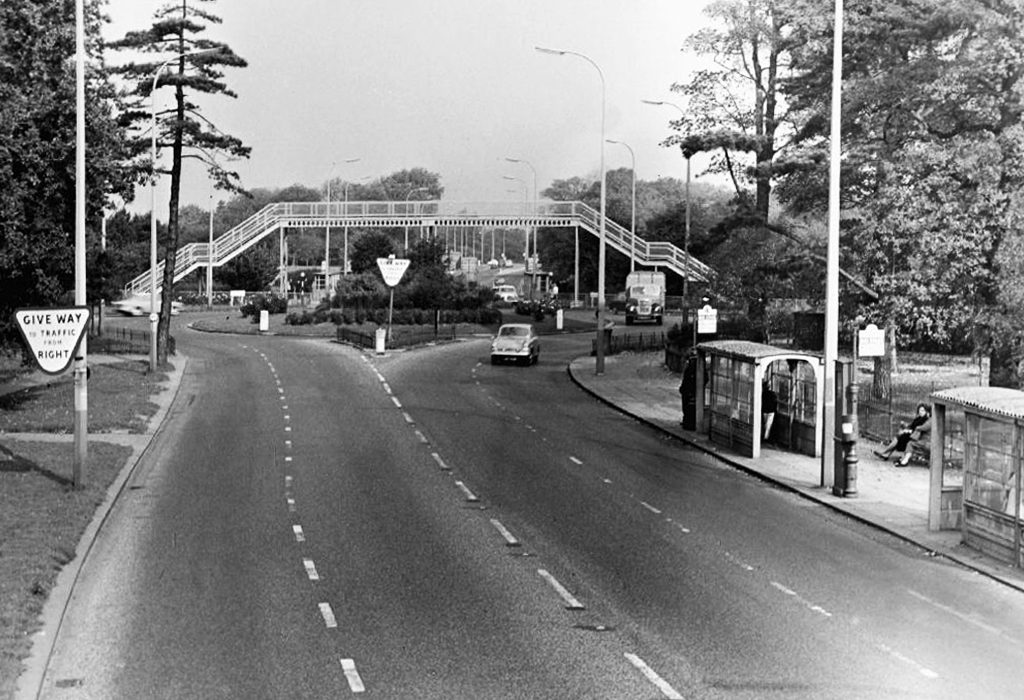
Princess Parkway

St Ambrose A well-detailed, relatively modest post-war design by Reynolds & Scott, with an impressive and largely unaltered vaulted interior.  The dedication relates to St Ambrose Barlow, a Catholic martyr from nearby Barlow Hall. 

Barlow Moor Road

The Oaks demolished in the early 1990s following a brief life as the Sports Bar

Manchester Road

The Seymour – demolished 2002

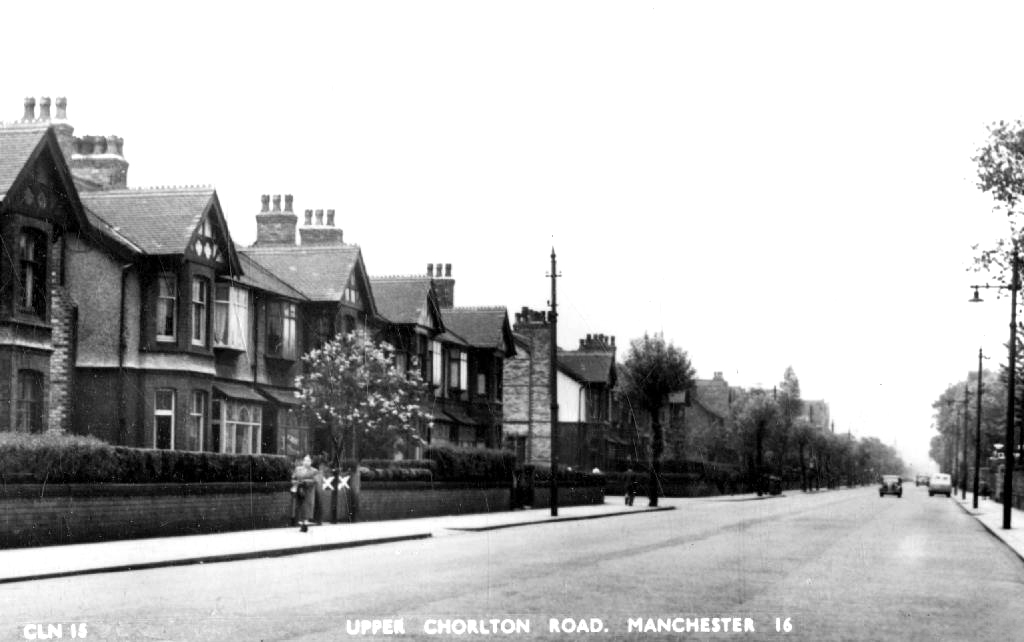
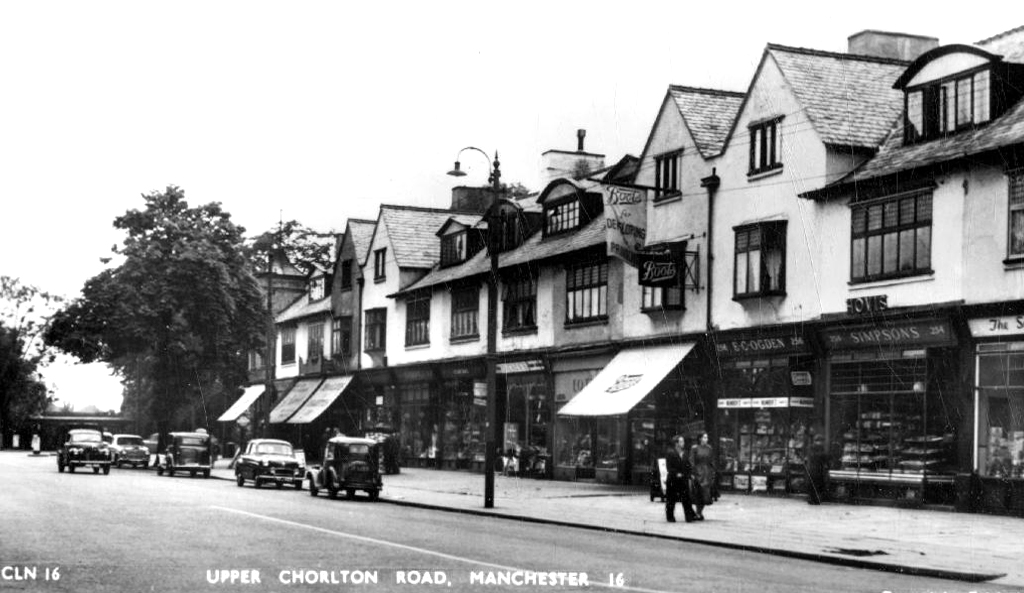
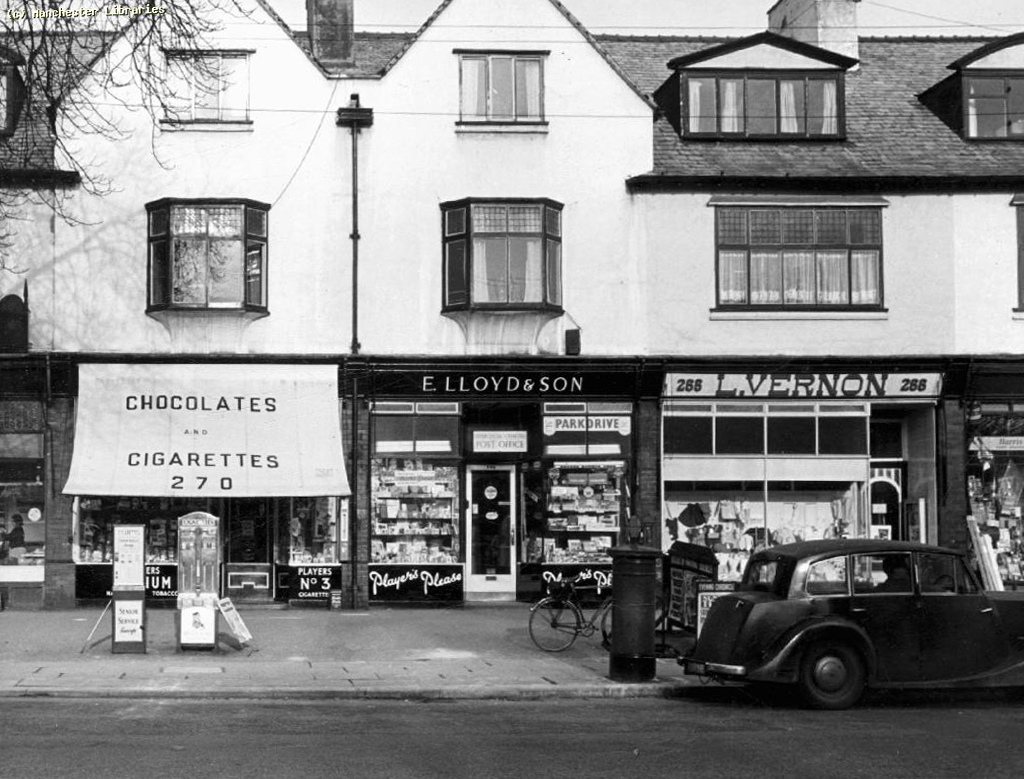
Upper Chorlton Road

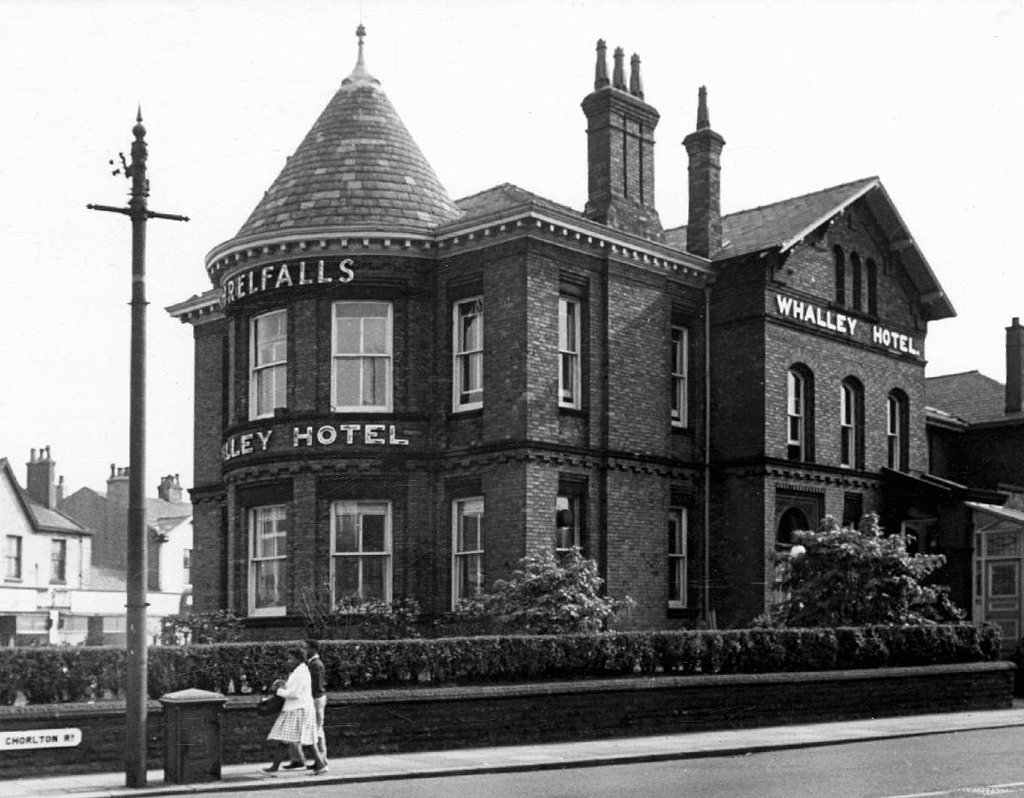
The Whalley Hotel closed in 2014

Chorlton Road

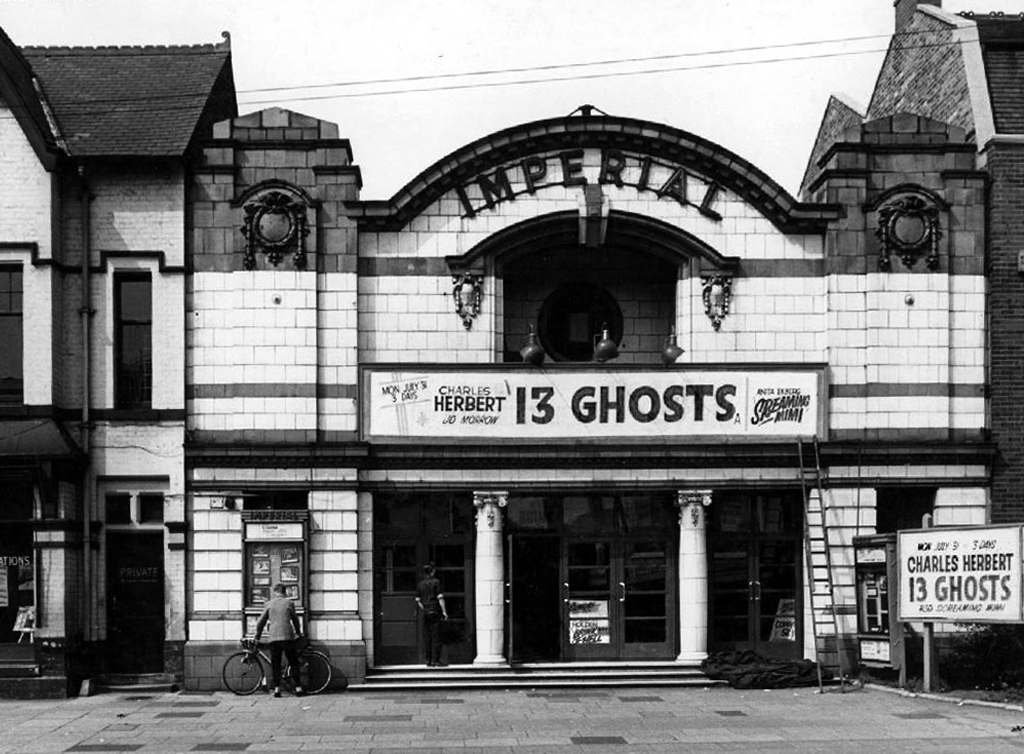
Imperial Picture Theatrewas opened in 1914. Seating was provided in stalls level only. It had a 5 feet deep stage and two dressing rooms. There was also a café in the cinema. Around 1929 it was equipped with a Western Electric sound system.

Architect W.H. Matley

The Imperial Picture Theatre was closed on 15th January 1976 with Charlotte Rampling in Caravan to Vaccares and Jean-Claude Brialy in A Murder Is a Murder Is a Murder.

Cinema Treasures

164 Chorlton Road Hulme Manchester – offices of the Amalgamated Union of Foundry Workers, it was at their invitation that Yuri had visited Manchester.

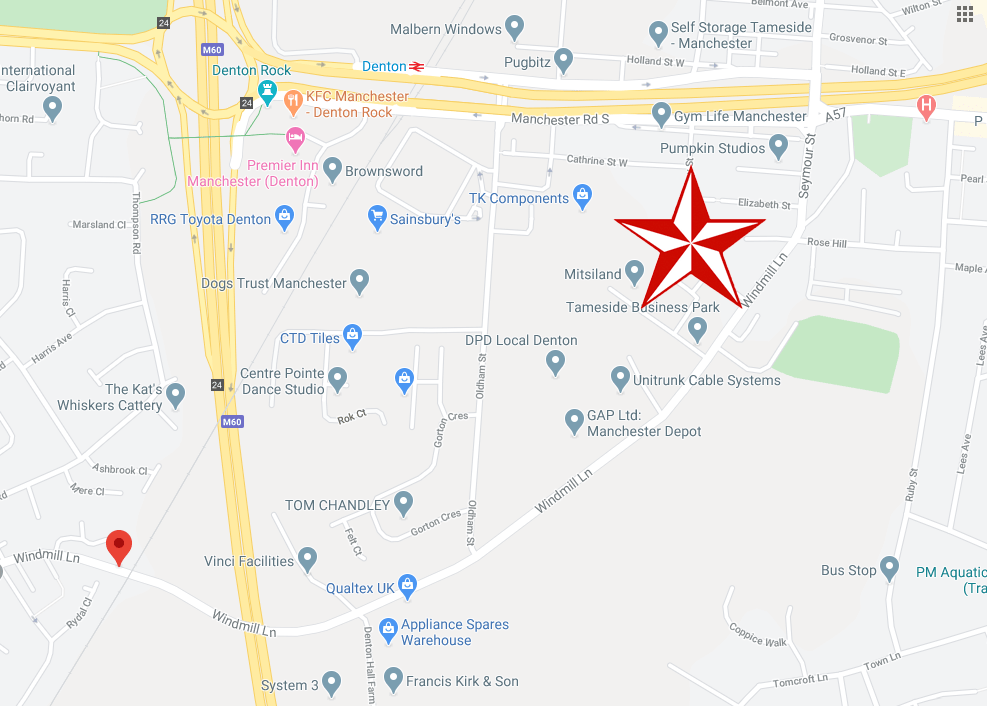
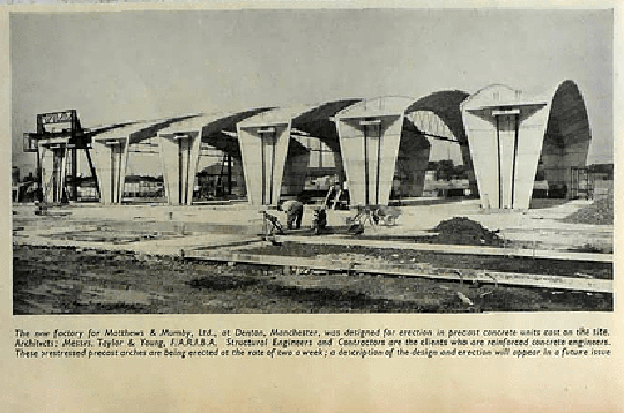
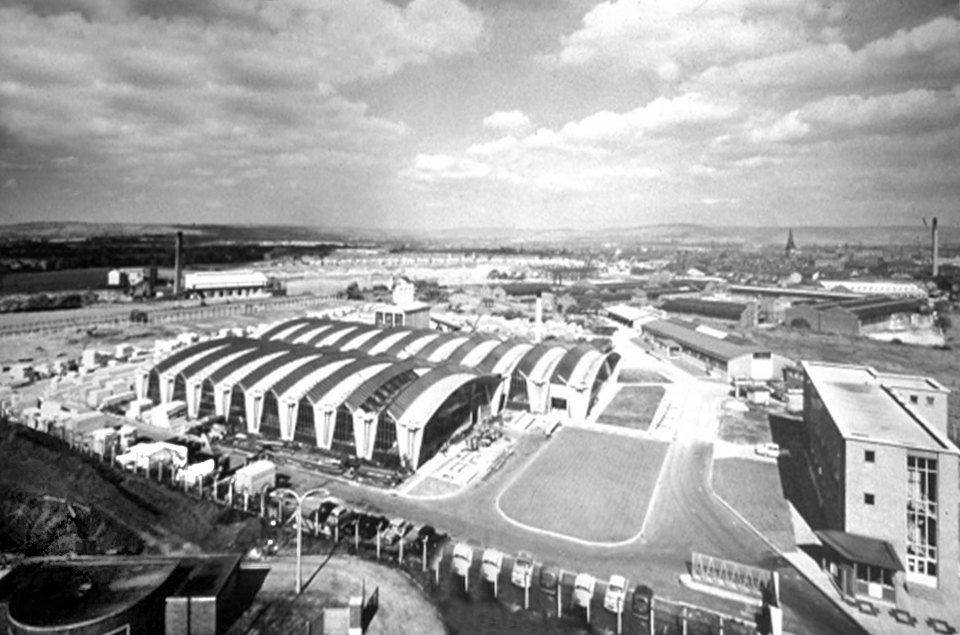
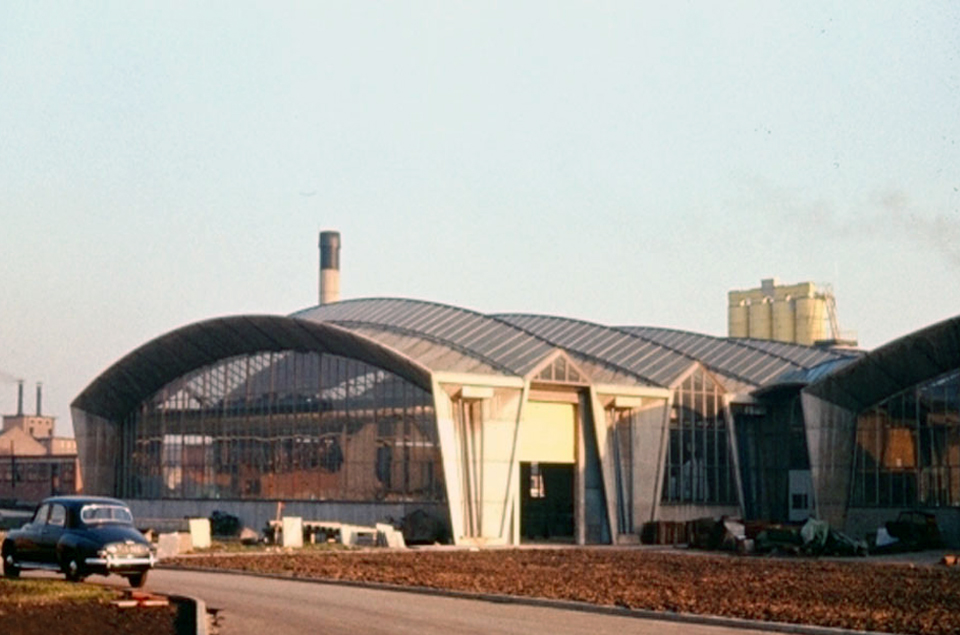
Factory – Windmill Lane Denton

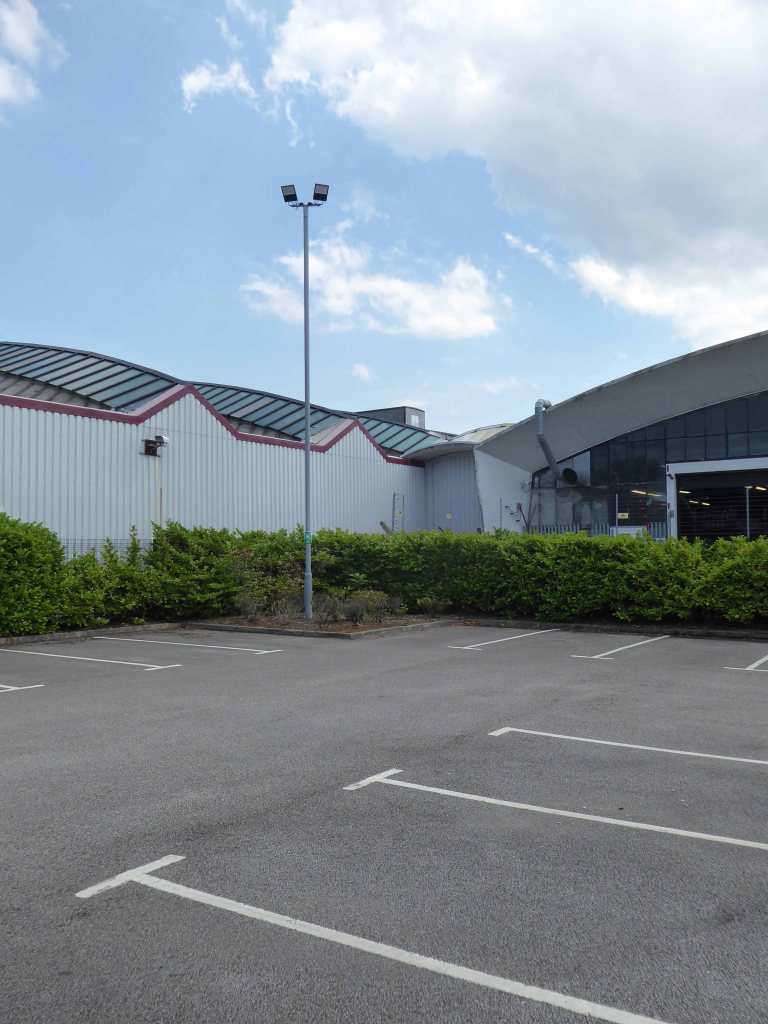
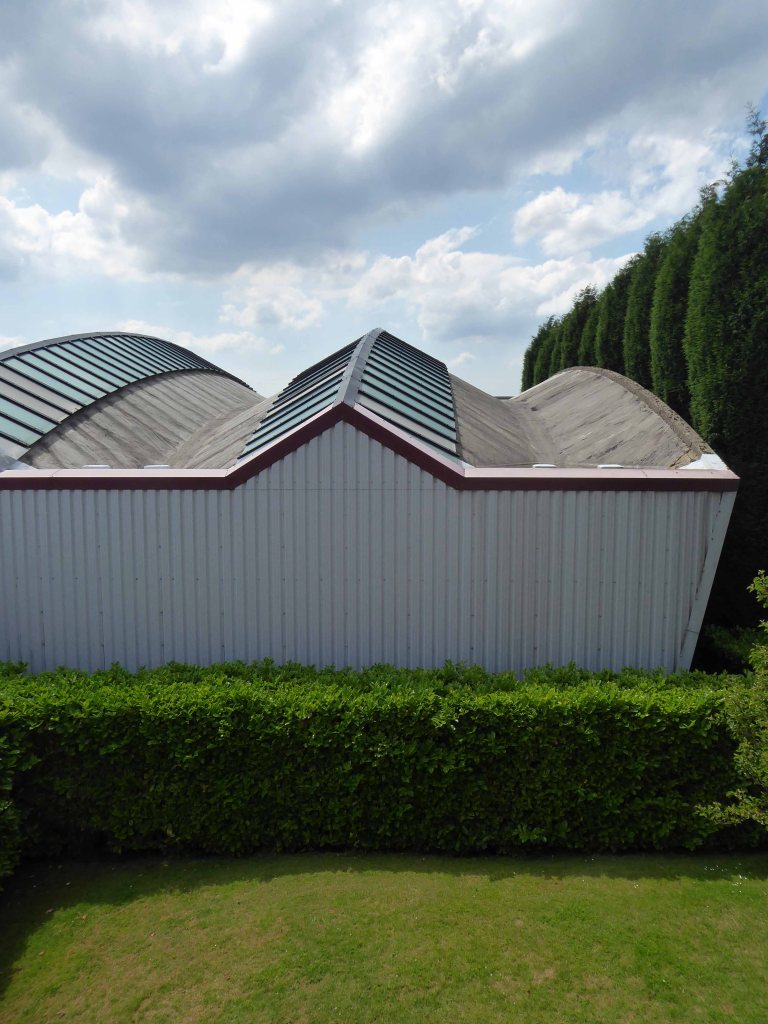
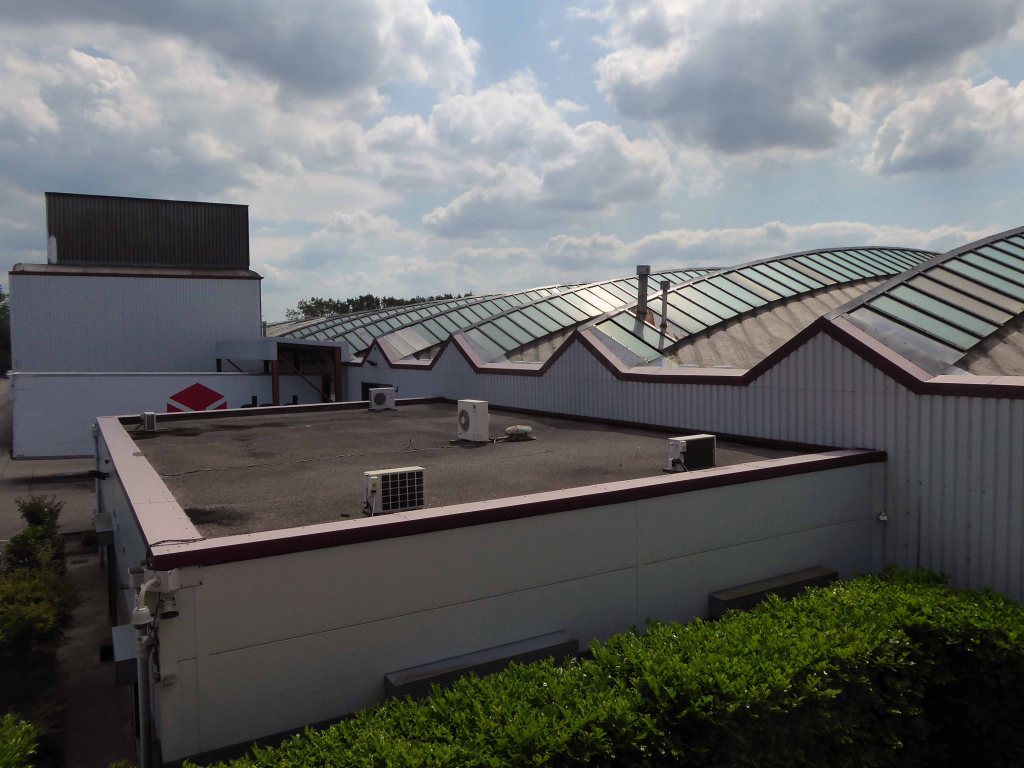
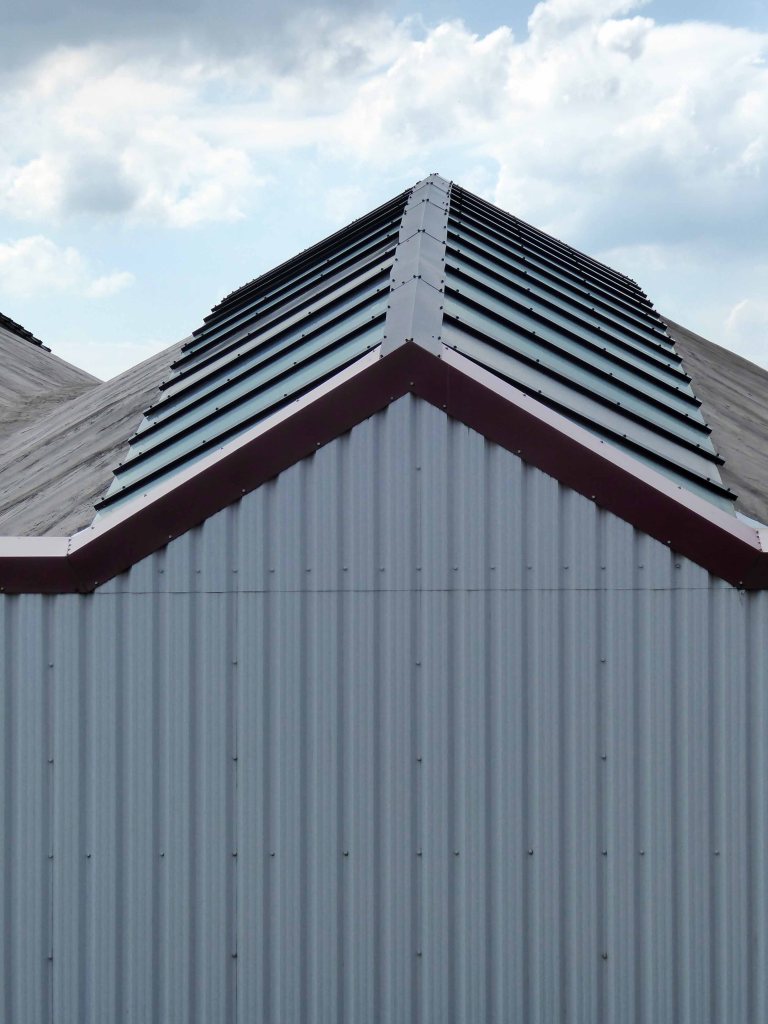
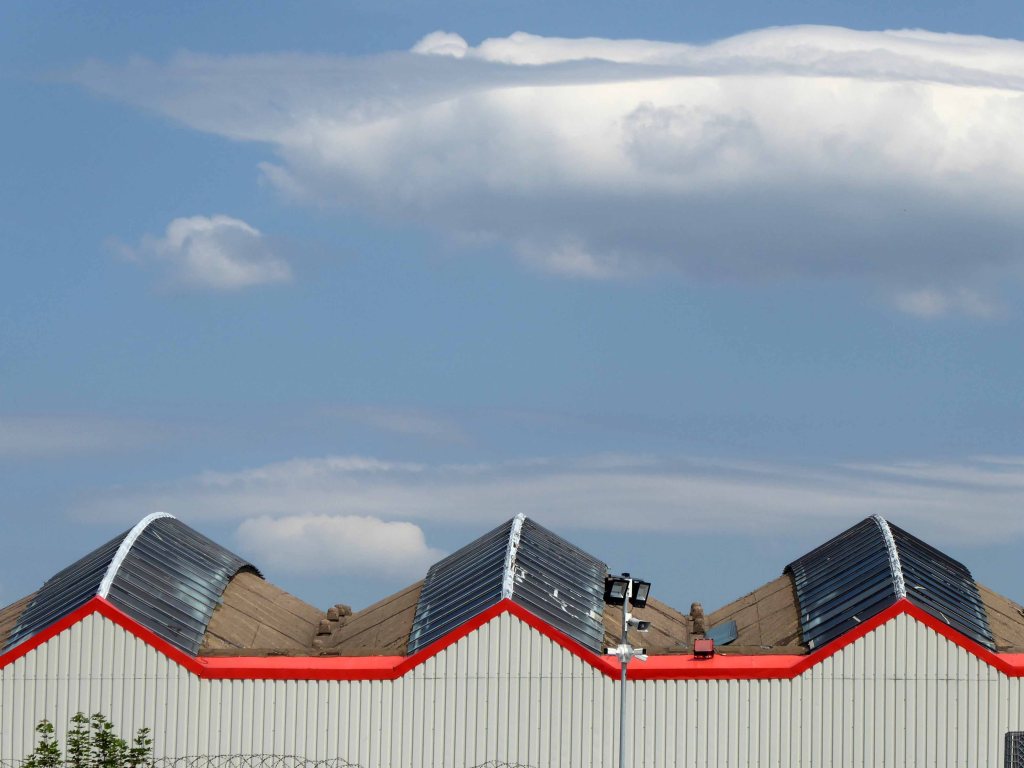
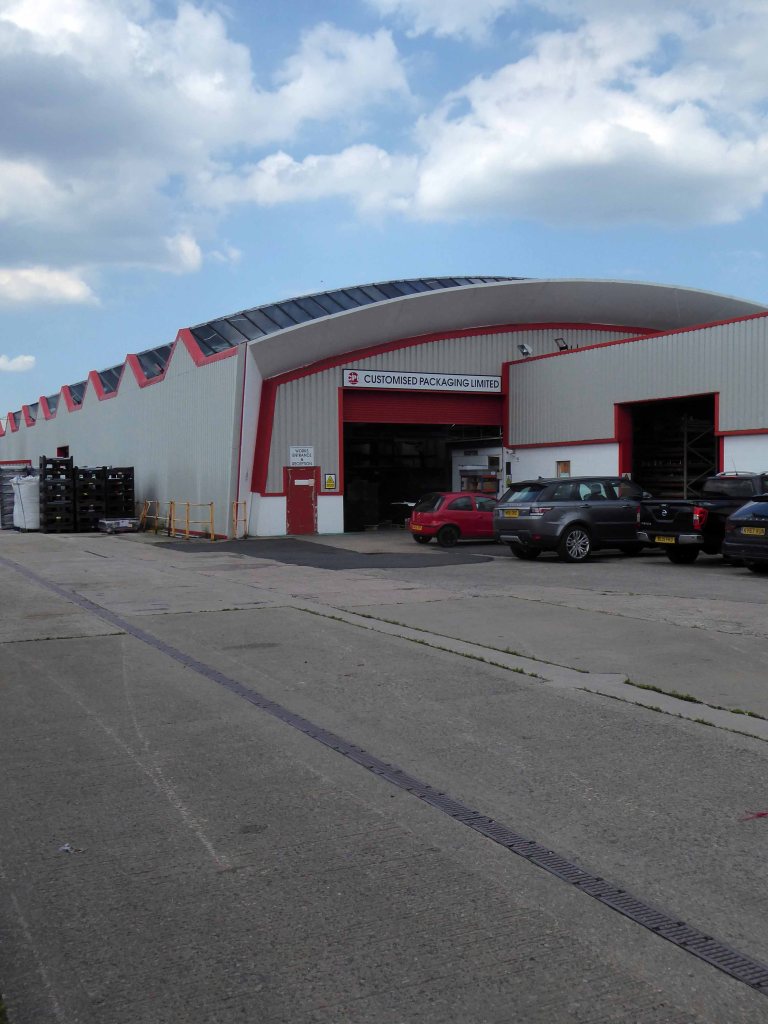
I’ve cycled by here for some fifty years or more – always admiring its serrated roof.

Way back when we would roam around on our bikes, exploring the waste ground adjacent to Jackson’s Brickworks.

Where we would scavenge tape from the Rotunda tip.

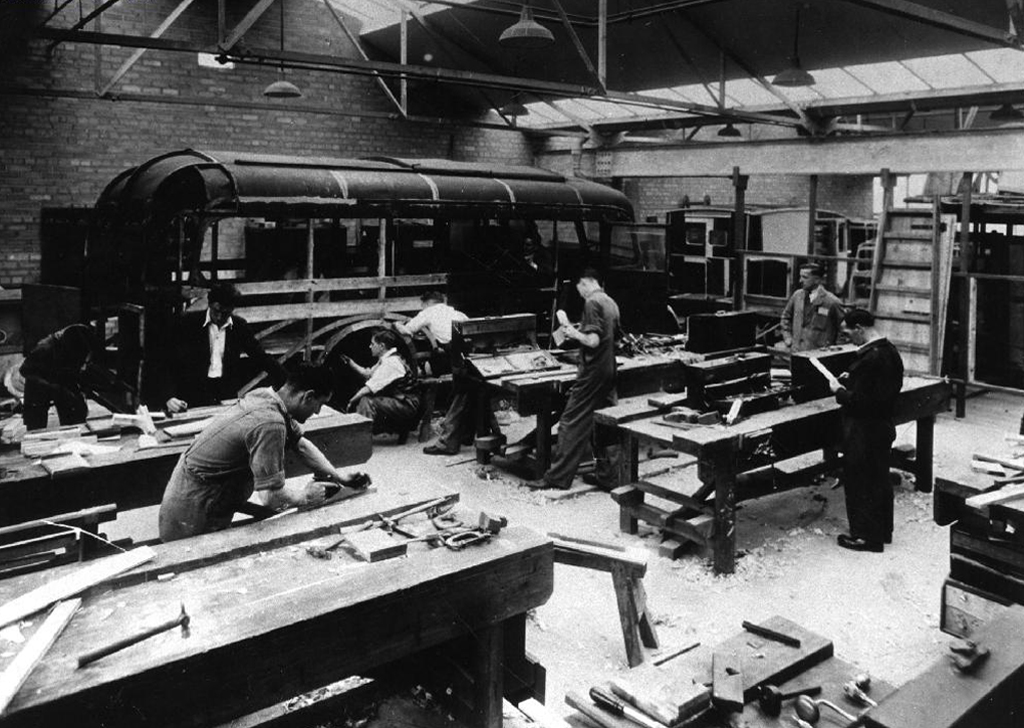
I remember it as a Remploy Centre.

My last 13 years prior to retirement last May were spent at the centre, on Windmill Lane, Denton. Just before I left, a lot of demolition work was done, prior to redevelopment of much of the site.

I seem to remember the place always being referred to locally as Th’ Rehab – the Rehabilitation Centre, a Government training centre, where skills were taught, such as joinery, bricklaying etc, and there was also a Remploy Unit housed there.

Local men could go for a free haircut, administered by a well supervised trainee.

Denton History

1949 Manchester Local Image Collection

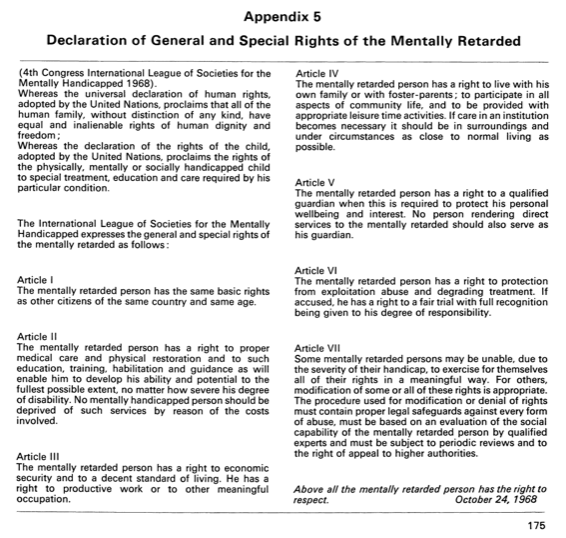
It is listed in a 1968 directory of rehabilitations centres.

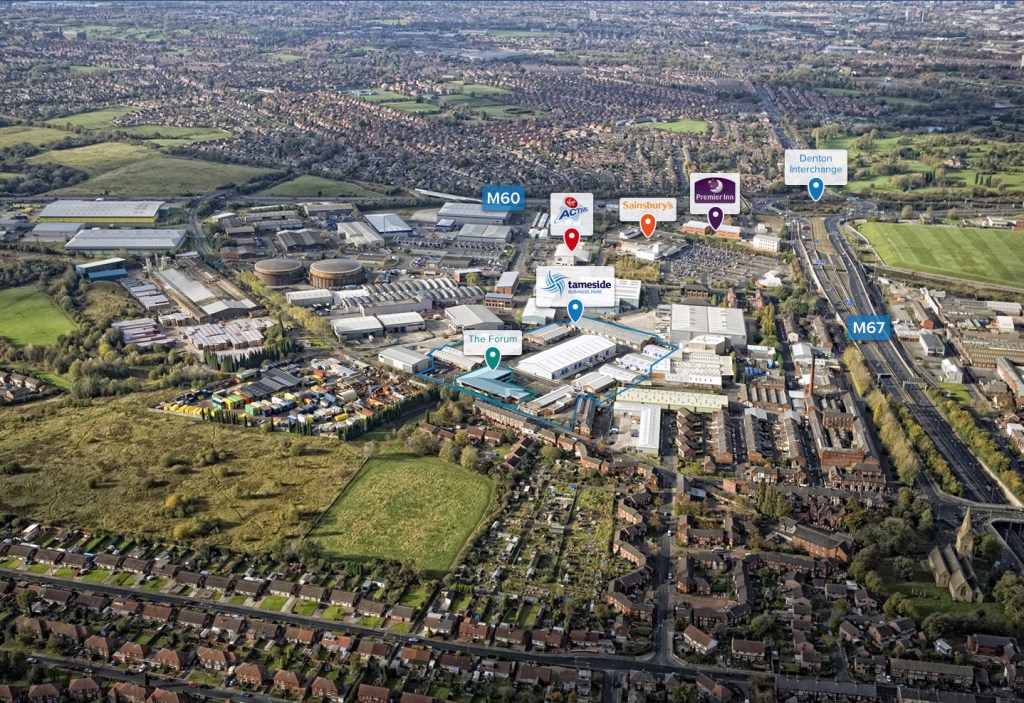
Currently forming part of Tameside Business Park with multiple occupancy.

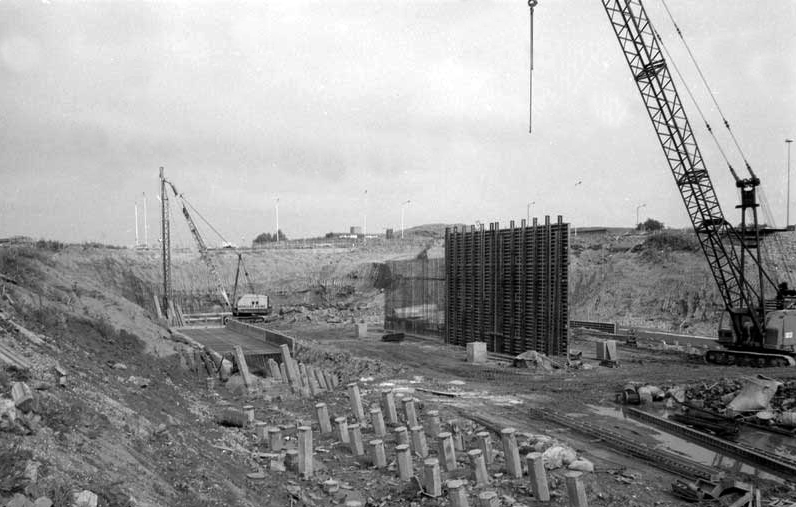
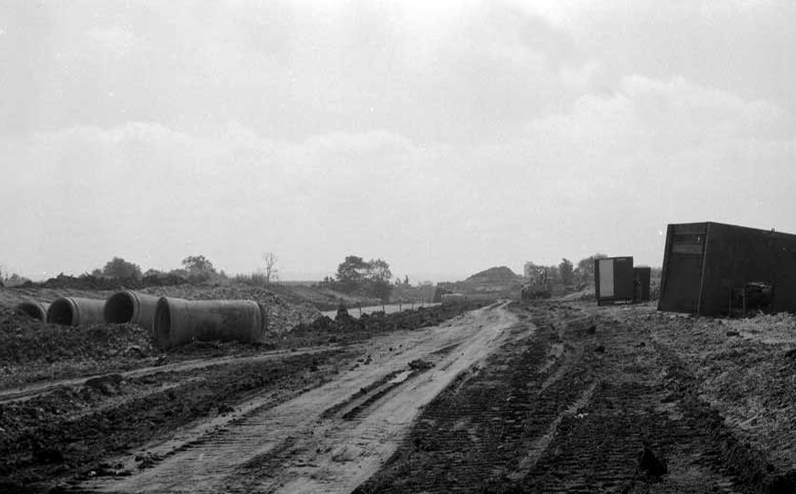
Proximity to the M60, seen here under construction is paramount to its future success.

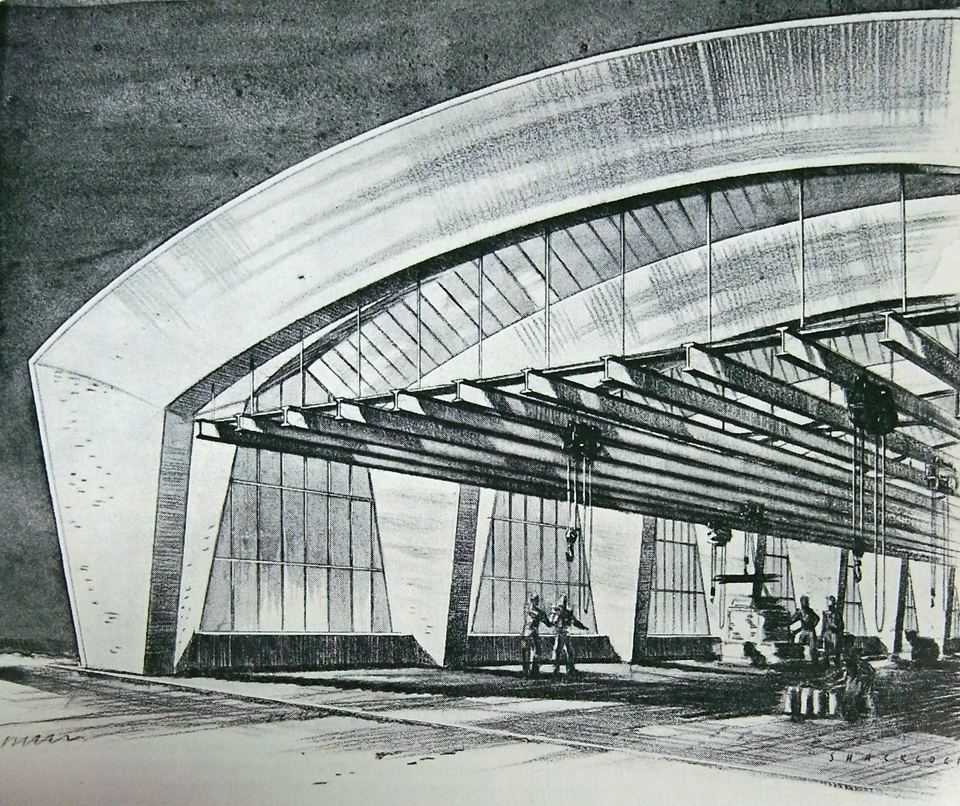
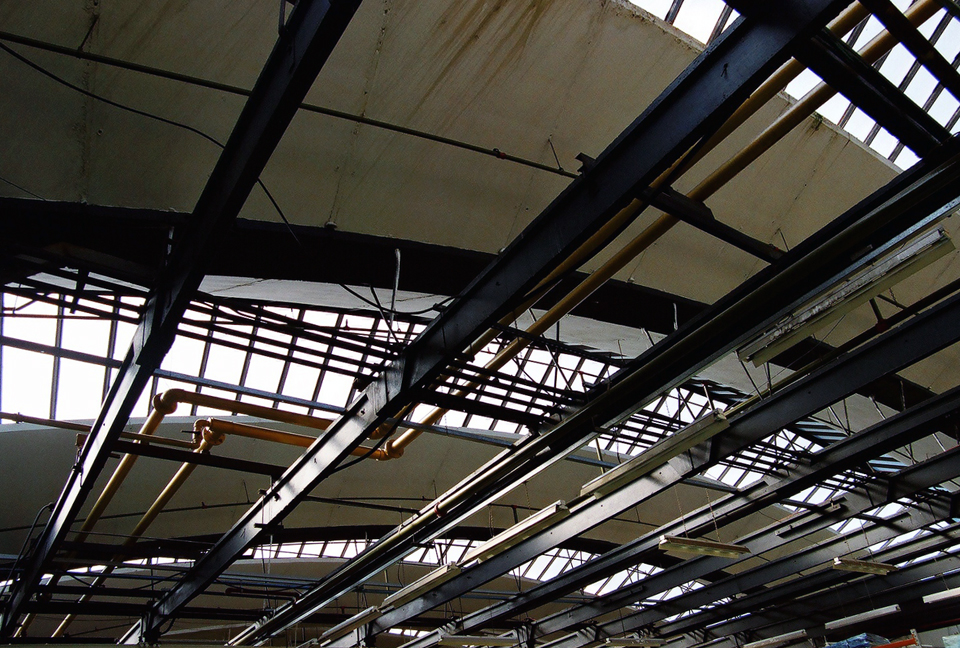
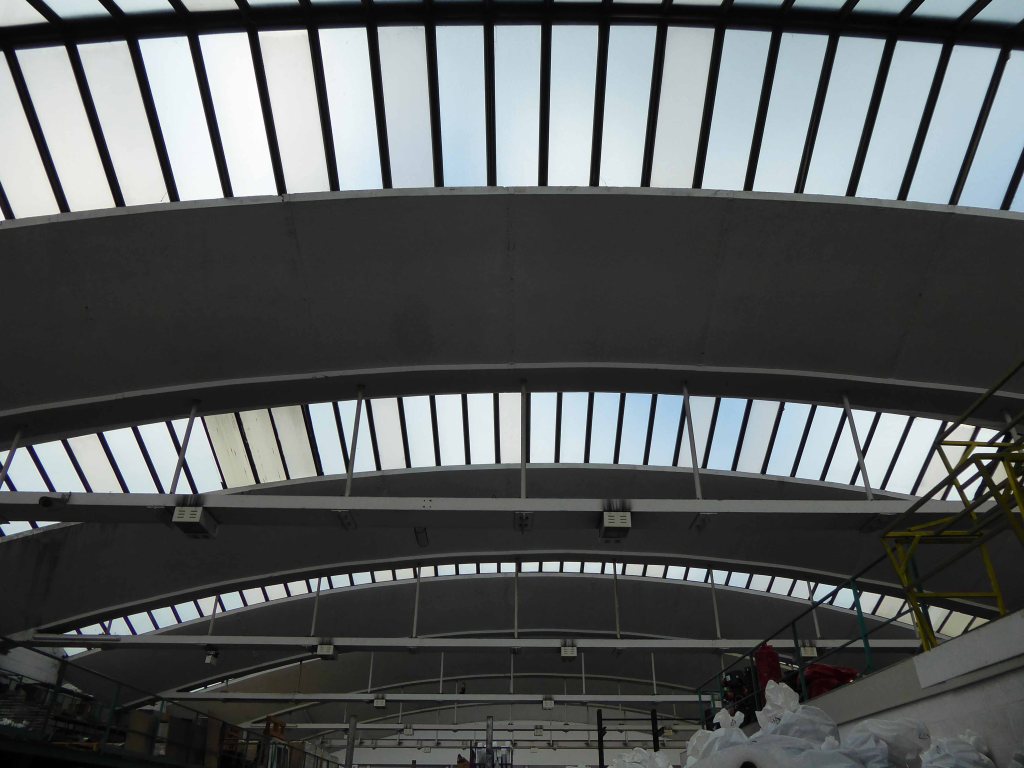
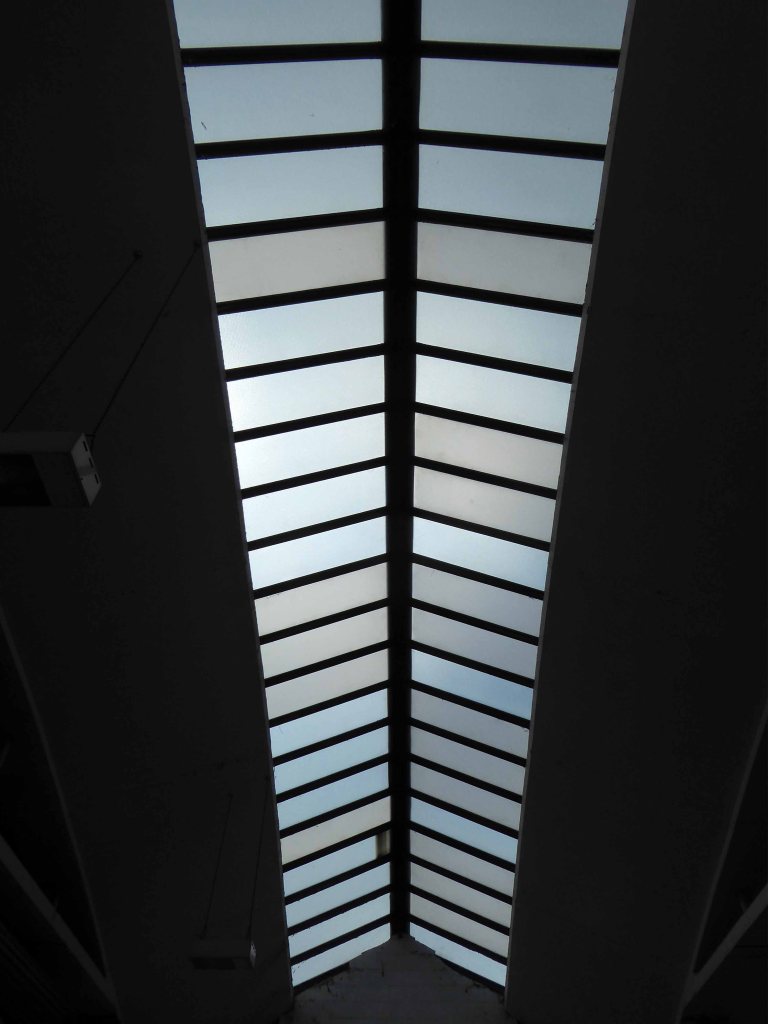
This former production plant for concrete components is now sadly partitioned and houses a number of businesses, only one of which still has a manufacturing base. The engineer for the project was also the client; reinforced concrete engineers, Matthews & Mumby. The intention was to create large floor areas, free from columns, to accommodate fourteen casting beds of about fifty metres in length. The structure of the two sheds was formed from arch units assembled on the ground, jacked into position and post-tensioned to form large tied span arches. Each arch spans approximately thirty metres and was designed to carry up to fourteen one tonne loads along the monorail hangers that ran the length of the factory, centred to each casting bed and suspended from the arches. Lantern section glazing hugs the curve of the arches that act as a reflective surface to provide an even light across the factory floor. The rails and hangers added a further louvered filter to the light, described at the time as ‘the ‘venetian blind’ effect. Originally the elevation between the V shaped columns was also glazed, this has now been filled and significantly reduces the aesthetic presence of the exposed structure and a distinctly ‘modern’ building of the time. 

Mainstream Modern – my thanks to Richard Brook for the text and archive images.

So one sunny day last week, on a lockdown walk I went to take a look around.

The addition of cladding is never an uplifting sight on any site – the integrity of the building is seriously challenged.

Sometimes a former Rehabilitation Centre can do without rehabilitation it seems.

Hull to Hessle – Humber Estuary Walk

Overcast and grey – heading headlong into the prevailing westerly.

This is just the day to walk from Hull to Hessle.

From the recently renovated early morning, empty piazzas of Hull Marina to the foot of the Humber bridge.

To the left the interminable rippling brown surface of the river, relentlessly heading out to sea.

To the right a modern melange of working docks – shipping aggregates and timber, hither and thither.

The vacant haunts of fisher folk no longer casting nets, forever and a day.

Disused and decayed warehousing, betrayed by the coming of the container, home now to the Urbex snapper and itinerate tagger.

Out of town retail parks fuelled by debt.

Dried up reed beds swaying beneath the weight of the wind.

The suspended bed of the bridge, floating high above the waters, far below.

Take a walk with me now.

Sheffield Streets

I had time to kill – in search of early Sunday morning visual thrills.

I took to the mean streets of Steeltown UK.

Down these mean streets a man must go who is not himself mean, who is neither tarnished nor afraid. He is the hero; he is everything. He must be a complete man and a common man and yet an unusual man. He must be, to use a rather weathered phrase, a man of honor—by instinct, by inevitability, without thought of it, and certainly without saying it. He must be the best man in his world and a good enough man for any world.

He will take no man’s money dishonestly and no man’s insolence without a due and dispassionate revenge. He is a lonely man and his pride is that you will treat him as a proud man or be very sorry you ever saw him.

The story is this man’s adventure in search of a hidden truth, and it would be no adventure if it did not happen to a man fit for adventure. If there were enough like him, the world would be a very safe place to live in, without becoming too dull to be worth living in.

Raymond Chandler 

It was 8am – low bright sun pierced the achingly empty space between the long high industrial buildings.

There was nobody to share the morning – yet the clearly audible kling and klang of work pervaded the air, along with the lingering aroma of engine oil and decay.

This is what I found:

P1300863

P1300869

P1300870

P1300873

P1300874

P1300875


P1300879

P1300880

P1300886

P1300889

P1300890

P1300892

P1300895

P1300896

P1300897

P1300899

P1300900

P1300912

P1300927

P1300928

P1300929

P1300951


Heaton Mersey Vale – Stockport

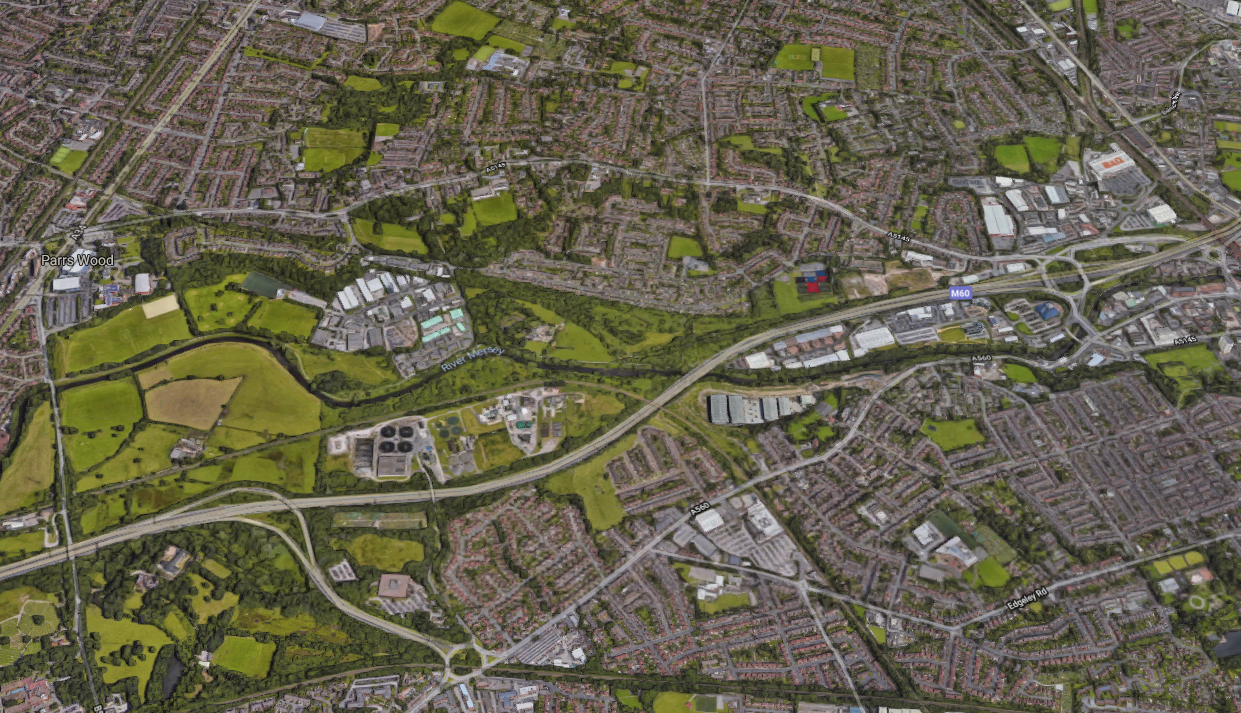
A mighty river valley was formed in the second Ice Age, as the glaciers receded and rushed seaward.

The mighty River Mersey was formed on the eastern edge of Stockport, at the confluence of the Tame and Goyt/Etherow rivers.

Thousands of years in the making, as the water-powered mills of the adjacent Pennine Hills migrate to the lower reaches of the towns, in search of water, workers and steam, the full force of the Industrial Revolution takes shape in the west.

The mixed farming of the alluvial valley, which opens up onto the Lancashire and Cheshire Plains, meets and greets the incursion of dye and brick works, mills and manufacturing.

31891

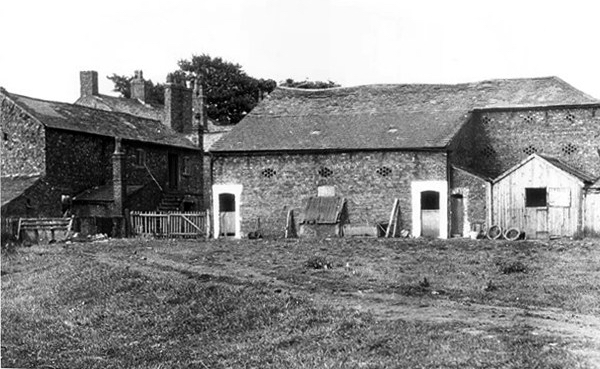
Fred Schofield’s farm 1930

1963

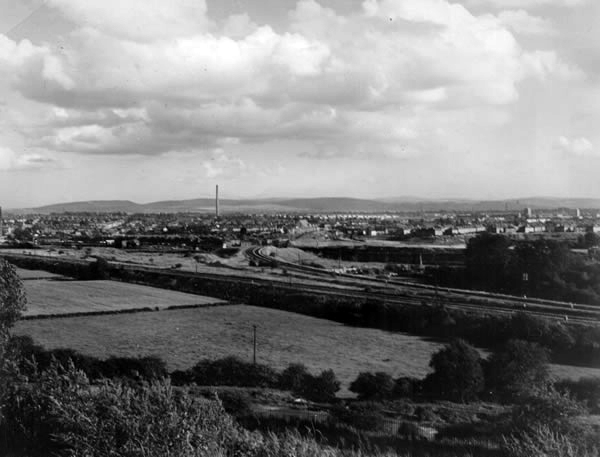
View towards Stockport from Heaton Mersey Park

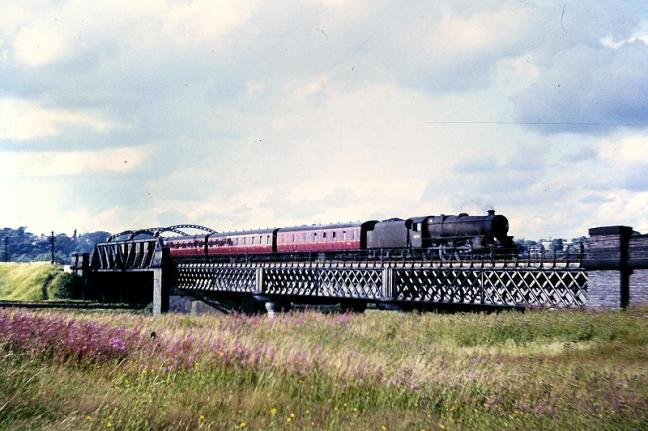
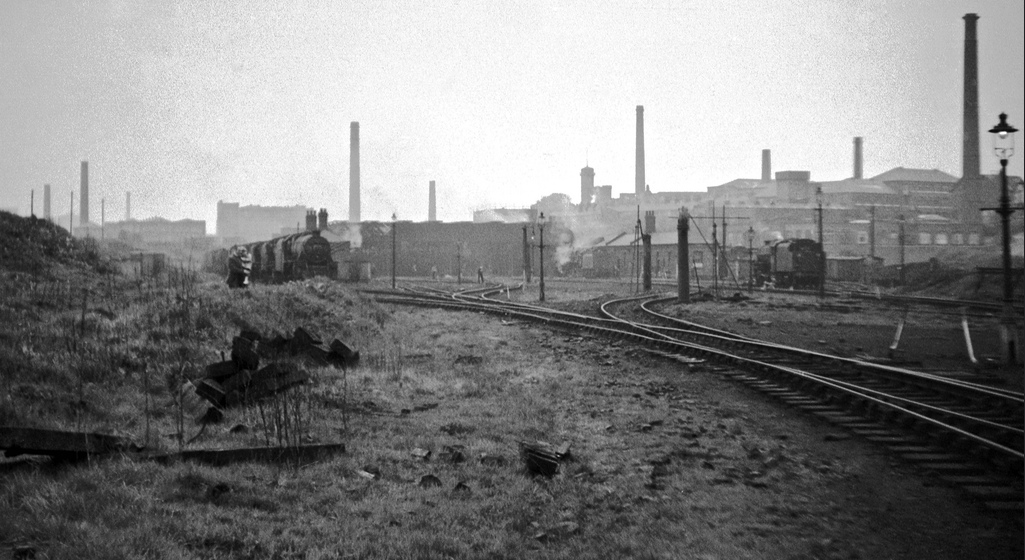
Serviced by a complex and competing rail system based around Heaton Mersey Shed.

edgeley2016-11

Opened in 1889 and served until May 1968 operating steam locomotives to the end -Coded 9F.

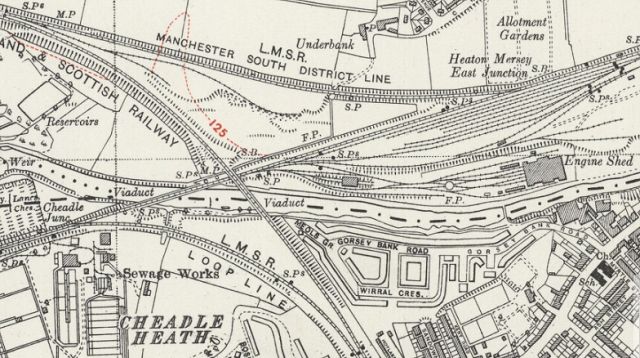
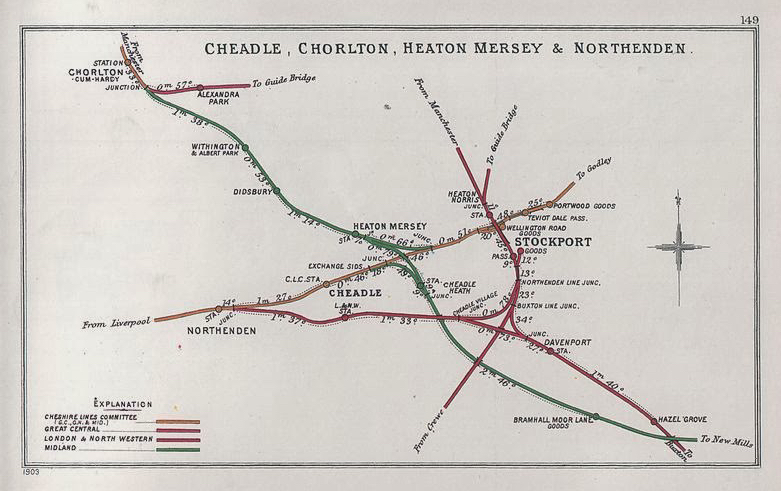
Heaton_Mersey rail map

Here we were at the centre of a rail hub spreading out in all directions, to and from the ports, cities and resources of the country and beyond.

Great movements of steel, cotton, coal, people and manufactured goods.

Screen Shot 2018-05-16 at 19.27.37

38106

Fireman Eddy “Ned” Kelly

heaton(nigel_bruce7.1965)mersey_old7

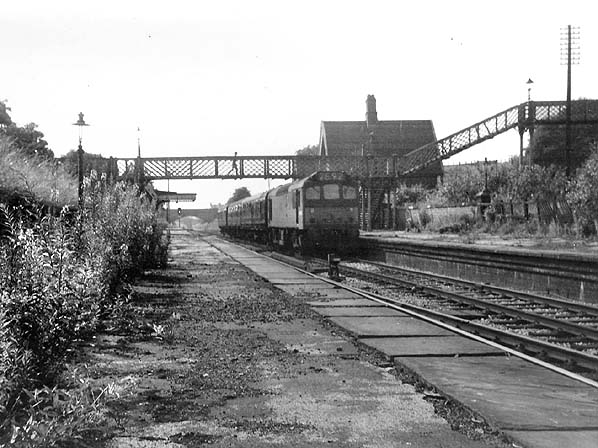
Heaton Mersey railway station was opened on 1 January 1880 by the Midland Railway and lay on the newly opened line which ran from Heaton Mersey East Junction to Chorlton Junction and on to Manchester Central station.

The station was situated at the southern end of Station Road which still exists. The station was later operated by the London Midland and Scottish Railway and was closed by the London Midland Region of British Railways on 3 July 1961.

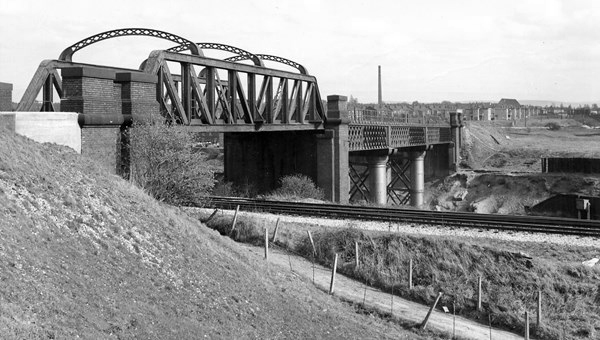
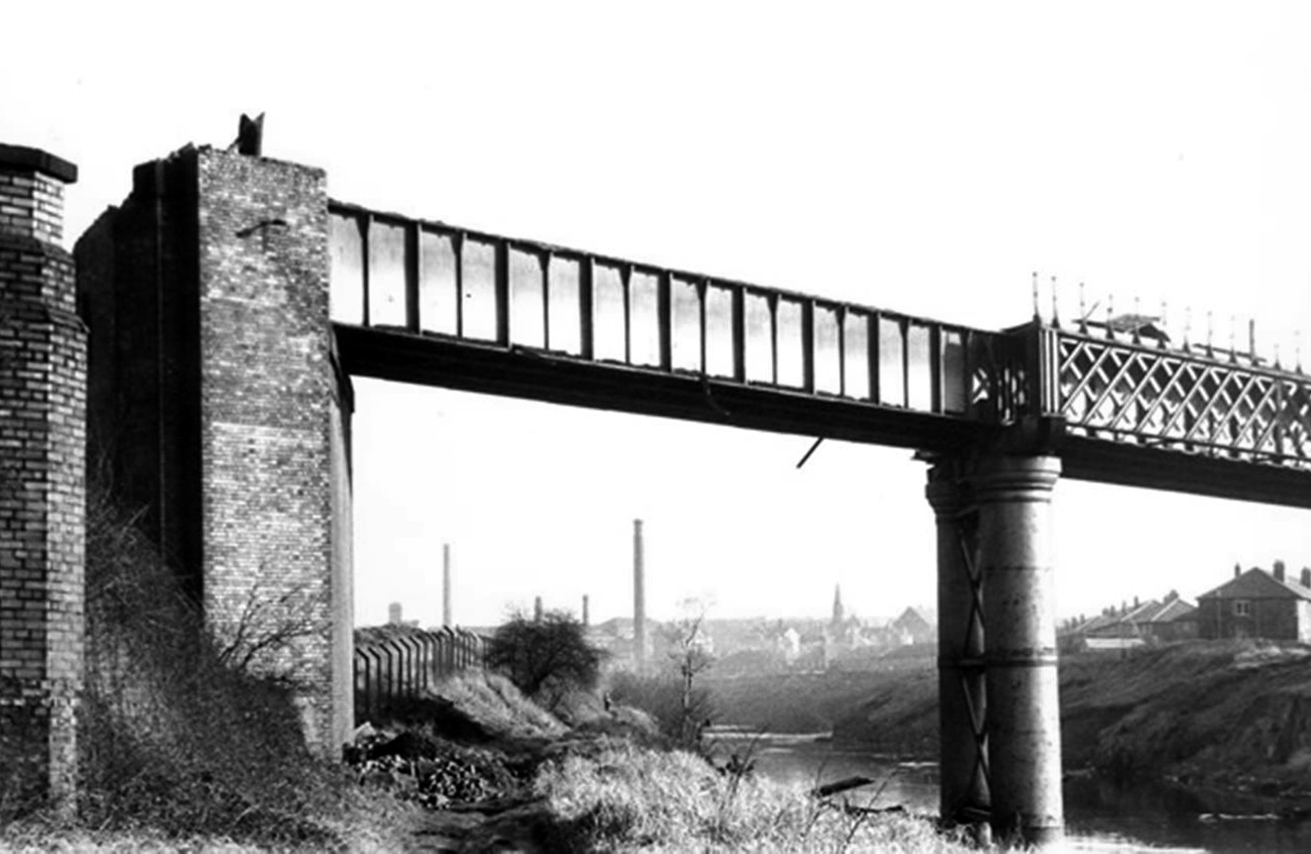
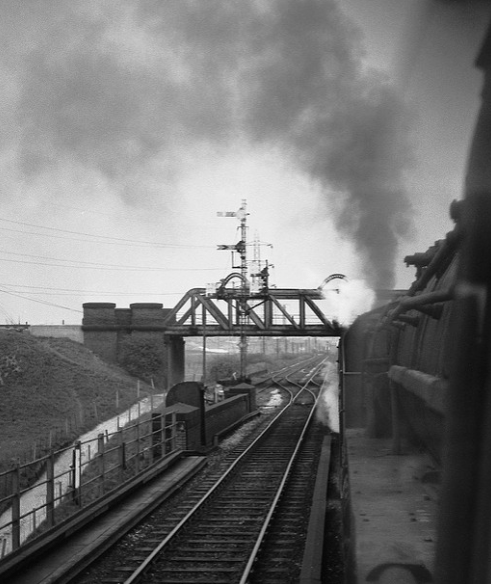
The area was criss-crossed by railways – its bridges traversing the roads, fields and river, dominating the landscape in a wild flurry of steam and smoke.

2633

32822

32625936_2079214925657568_2140863625928114176_o

HeatonMerseyHLBridge3

Screen Shot 2018-05-16 at 10.04.03

Further photographs from Grip 99

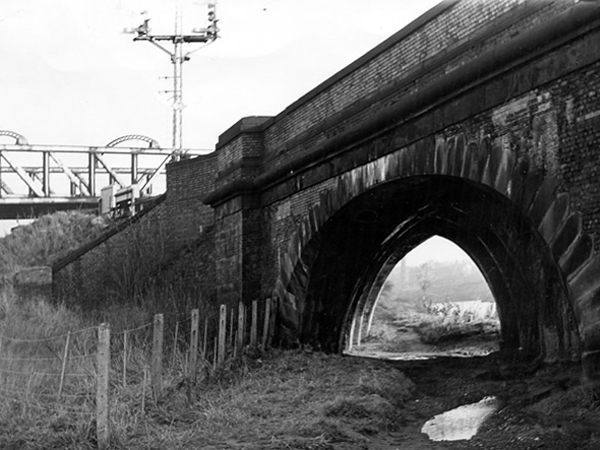
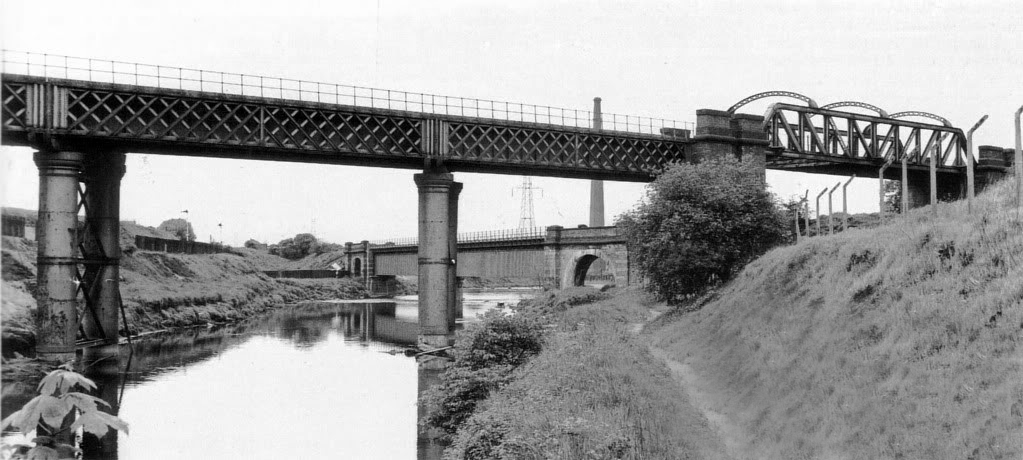
Crossing the Mersey – the link between Gorsey Bank and the Shed

10220

Surviving until 2007

screen-shot-2018-05-16-at-10-17-14.png

B&W photographs Stockport Image Archive

The end of steam – as drivers, fireman and staff were transferred to Newton Heath, was followed by the slow demise of the rail network, freight moved to road and passengers purchasing their first cars and a passport to illusory freedom.

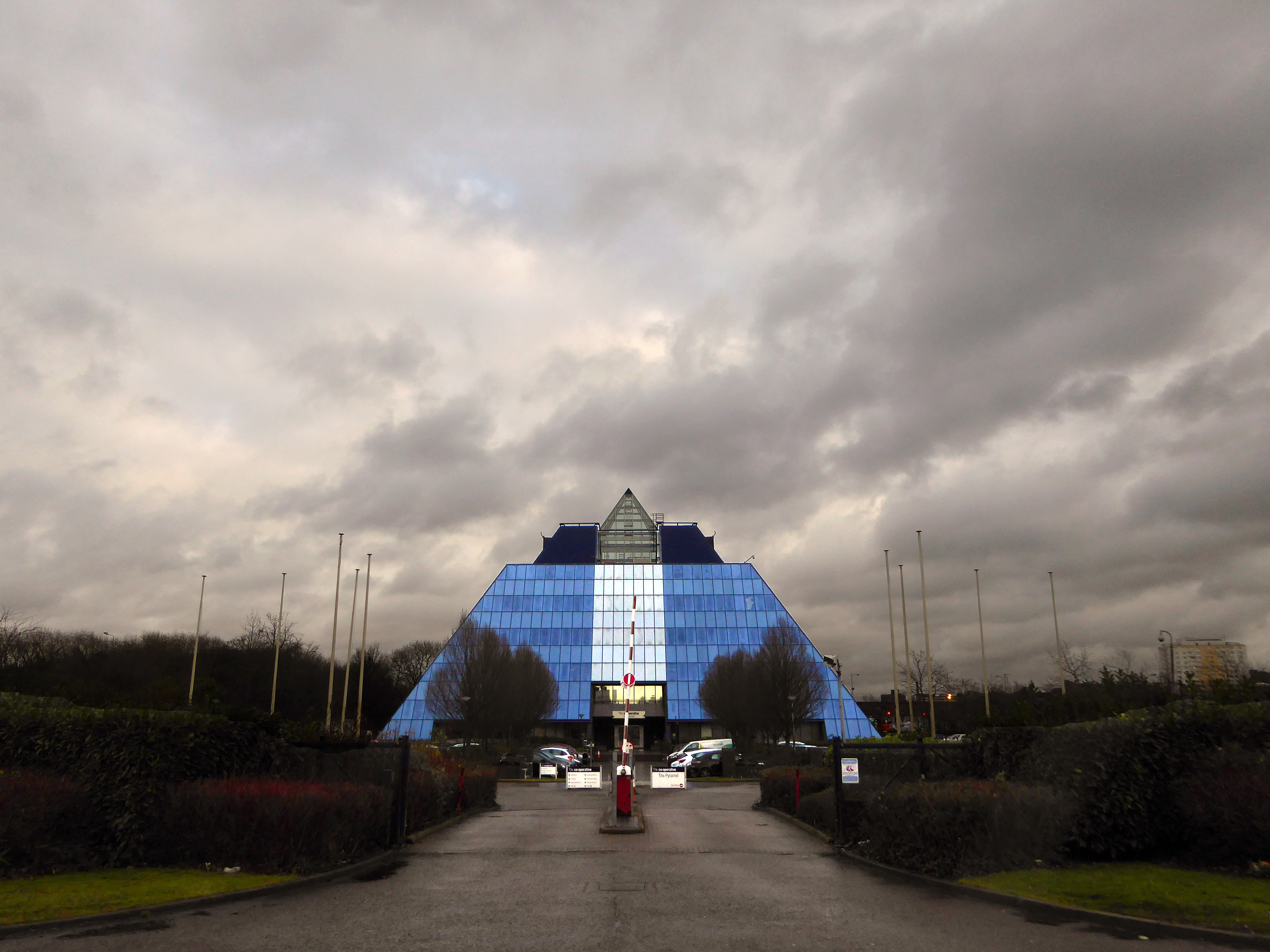
The mighty Mersey is now flanked by newer neighbours, a shiny blue administrative pyramid, business park, car showrooms and nature reserve, the only certainty is change.

Screen Shot 2018-05-16 at 10.19.19

P1220916 copy

P1220917 copy

Great volumes of earth are moved to from a new topography a topography of leisure – the gentle stroll, jog and cycle replaces the clank of fire doors and shovel on coal.

NEW-GWEB

But take a look around you and you will see the remnants of the industrial age, shrouded in fresh hawthorn and enshrined in birch and beech.

P1250163

P1250164

P1250169

P1250178

P1250179

P1250180

P1250182

P1250185

P1250186

P1250187

To walk this landscape is to traverse geological, agrarian, industrial and post-industrial time – they all coexist and coalesce. Have an eye, ear and heart open to their resonance and presence, transcend time and space in the Mersey Valley today, you’re part of the leisured generation.


Strangeways #3 – Black and White World

I’ve been here for the last fifteen years on and off, snapping away, capturing something of the area’s ever changing moods, the old, the new, the borrowed and the blue.

Wading through the archives, or searching for the remains of modernity.

On this occasion I have chosen to work on black and white film – the medium conveying something timeless, at a time when things are forever changing.

Let’s take a contradictory look and walk around those familiar, unfamiliar streets of Strangeways – where colourfully clad industrial barn, collides with blackened brick and stone behemoth.

Scan 2

Scan 3

Scan 4

Scan 5

Scan 6

Scan 7

Scan 10

Scan 11

Scan 12

Scan 13

Scan 14

Scan 15

Scan 17

Scan 8

Scan 18

Scan 20

Scan 21

Scan 22

Scan 23

Scan 24

Scan 25

Strangeways Manchester #2

Way back in the Twentieth Century – Cheetwood Industrial Estate was built.

The future was functionalist flat-roofed, concrete, steel and brick boxes.

Adorned with the flowing scripts and signage of the multi-nationals, nationals and local companies, intent upon rendering corporeal the post-war optimism, attendant full-employment and the buoyant business of business.

Fast forward to the future – the roofs have been pitched up, the windows bricked up or shuttered or both, walls encased in sad cladding.

The semi-permanent signage replaced with terminally temporary vinyl.

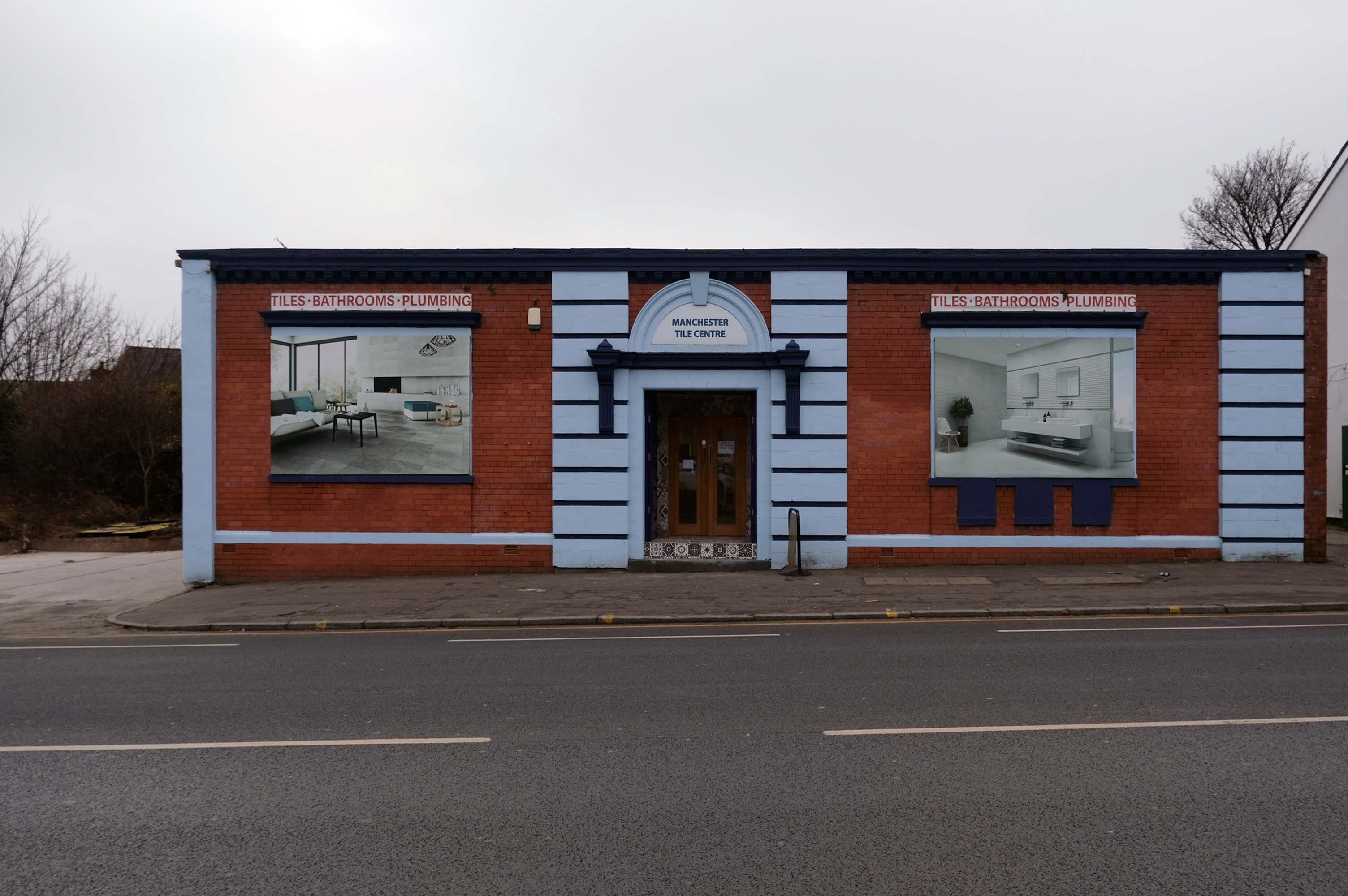
Joe Sunlight’s neo-classical pediments have been painted a funny colour.

P1000135 copy

P1000157 copy

P1000217 copy

P1000218 copy

P1000223 copy

P1000229 copy

P1000231 copy

P1000234 copy

P1000235 copy

P1000252 copy

P1000255 copy

P1190103 copy

P1190104 copy

P1190106 copy

P1190111 copy

P1190112 copy

P1190114 copy

P1190117 copy

P1190385 copy

P1190387 copy

P1190388 copy

P1190391 copy

P1190398 copy